<?xml version="1.0" encoding="ISO-8859-1"?><article xmlns:mml="http://www.w3.org/1998/Math/MathML" xmlns:xlink="http://www.w3.org/1999/xlink" xmlns:xsi="http://www.w3.org/2001/XMLSchema-instance">
<front>
<journal-meta>
<journal-id>0036-3634</journal-id>
<journal-title><![CDATA[Salud Pública de México]]></journal-title>
<abbrev-journal-title><![CDATA[Salud pública Méx]]></abbrev-journal-title>
<issn>0036-3634</issn>
<publisher>
<publisher-name><![CDATA[Instituto Nacional de Salud Pública]]></publisher-name>
</publisher>
</journal-meta>
<article-meta>
<article-id>S0036-36342003000900014</article-id>
<title-group>
<article-title xml:lang="en"><![CDATA[Early detection of cervical cancer with visual inspection methods: a summary of completed and on-going studies in India]]></article-title>
<article-title xml:lang="es"><![CDATA[Detección oportuna de cáncer cervical con métodos de inspección visual: un resumen de estudios en India]]></article-title>
</title-group>
<contrib-group>
<contrib contrib-type="author">
<name>
<surname><![CDATA[Sankaranarayanan]]></surname>
<given-names><![CDATA[R]]></given-names>
</name>
<xref ref-type="aff" rid="A01"/>
</contrib>
<contrib contrib-type="author">
<name>
<surname><![CDATA[Nene]]></surname>
<given-names><![CDATA[BM]]></given-names>
</name>
<xref ref-type="aff" rid="A02"/>
</contrib>
<contrib contrib-type="author">
<name>
<surname><![CDATA[Dinshaw]]></surname>
<given-names><![CDATA[K]]></given-names>
</name>
<xref ref-type="aff" rid="A03"/>
</contrib>
<contrib contrib-type="author">
<name>
<surname><![CDATA[Rajkumar]]></surname>
<given-names><![CDATA[R]]></given-names>
</name>
<xref ref-type="aff" rid="A04"/>
</contrib>
<contrib contrib-type="author">
<name>
<surname><![CDATA[Shastri]]></surname>
<given-names><![CDATA[S]]></given-names>
</name>
<xref ref-type="aff" rid="A03"/>
</contrib>
<contrib contrib-type="author">
<name>
<surname><![CDATA[Wesley]]></surname>
<given-names><![CDATA[R]]></given-names>
</name>
<xref ref-type="aff" rid="A05"/>
</contrib>
<contrib contrib-type="author">
<name>
<surname><![CDATA[Basu]]></surname>
<given-names><![CDATA[P]]></given-names>
</name>
<xref ref-type="aff" rid="A06"/>
</contrib>
<contrib contrib-type="author">
<name>
<surname><![CDATA[Sharma]]></surname>
<given-names><![CDATA[R]]></given-names>
</name>
<xref ref-type="aff" rid="A07"/>
</contrib>
<contrib contrib-type="author">
<name>
<surname><![CDATA[Thara]]></surname>
<given-names><![CDATA[S]]></given-names>
</name>
<xref ref-type="aff" rid="A05"/>
</contrib>
<contrib contrib-type="author">
<name>
<surname><![CDATA[Budukh]]></surname>
<given-names><![CDATA[A]]></given-names>
</name>
<xref ref-type="aff" rid="A02"/>
</contrib>
<contrib contrib-type="author">
<name>
<surname><![CDATA[Parkin]]></surname>
<given-names><![CDATA[DM]]></given-names>
</name>
<xref ref-type="aff" rid="A01"/>
</contrib>
</contrib-group>
<aff id="A01">
<institution><![CDATA[,International Agency for Research on Cancer  ]]></institution>
<addr-line><![CDATA[Lyon ]]></addr-line>
<country>France</country>
</aff>
<aff id="A02">
<institution><![CDATA[,Nargis Dutt Memorial Cancer Hospital  ]]></institution>
<addr-line><![CDATA[Maharashtra ]]></addr-line>
<country>India</country>
</aff>
<aff id="A03">
<institution><![CDATA[,Tata Memorial Centre  ]]></institution>
<addr-line><![CDATA[Parel ]]></addr-line>
<country>India</country>
</aff>
<aff id="A04">
<institution><![CDATA[,Christian Fellowship Community Health Centre  ]]></institution>
<addr-line><![CDATA[ ]]></addr-line>
<country>India</country>
</aff>
<aff id="A05">
<institution><![CDATA[,Regional Cancer Centre  ]]></institution>
<addr-line><![CDATA[ ]]></addr-line>
<country>India</country>
</aff>
<aff id="A06">
<institution><![CDATA[,Chittaranjan National Cancer Institute  ]]></institution>
<addr-line><![CDATA[ ]]></addr-line>
<country>India</country>
</aff>
<aff id="A07">
<institution><![CDATA[,Bhagwan Mahaveer Cancer Hospital & Research Centre  ]]></institution>
<addr-line><![CDATA[ ]]></addr-line>
<country>India</country>
</aff>
<pub-date pub-type="pub">
<day>00</day>
<month>00</month>
<year>2003</year>
</pub-date>
<pub-date pub-type="epub">
<day>00</day>
<month>00</month>
<year>2003</year>
</pub-date>
<volume>45</volume>
<fpage>399</fpage>
<lpage>407</lpage>
<copyright-statement/>
<copyright-year/>
<self-uri xlink:href="http://www.scielo.org.mx/scielo.php?script=sci_arttext&amp;pid=S0036-36342003000900014&amp;lng=en&amp;nrm=iso"></self-uri><self-uri xlink:href="http://www.scielo.org.mx/scielo.php?script=sci_abstract&amp;pid=S0036-36342003000900014&amp;lng=en&amp;nrm=iso"></self-uri><self-uri xlink:href="http://www.scielo.org.mx/scielo.php?script=sci_pdf&amp;pid=S0036-36342003000900014&amp;lng=en&amp;nrm=iso"></self-uri><abstract abstract-type="short" xml:lang="en"><p><![CDATA[India is a high-risk country for cervical cancer which accounts a quarter (126 000 new cases, 71 000 deaths around 2 000) of the world burden. The age-standardized incidence rates range from 16-55 per 100 000 women in different regions with particularly high rates in rural areas. Control of cervical cancer by early detection and treatment is a priority of the National Cancer Control Programme of India. There are no organized cytology screening programmes in the country. The technical and financial constraints to organize cytology screening have encouraged the evaluation of visual inspection approaches as potential alternatives to cervical cytology in India. Four types of visual detection approaches for cervical neoplasia are investigated in India: a) naked eye inspection without acetic acid application, widely known as 'downstaging'; b) naked eye inspection after application of 3-5% acetic acid (VIA); c) VIA using magnification devices (VIAM); d) visual inspection after the application of Lugol's iodine (VILI). Downstaging has been shown to be poorly sensitive and specific to detect cervical neoplasia and is no longer considered as a suitable screening test for cervical cancer. VIA, VIAM and VILI are currently being investigated in multicentre cross-sectional studies (without verification bias), in which cytology and HPV testing are also simultaneously evaluated, and the results of these investigations will be available in 2003. These studies will provide valuable information on the average, comparative test performances in detecting high-grade cervical cancer precursors and cancer. Results from pooled analysis of data from two completed studies indicated an approximate sensitivity of 93.4% and specificity of 85.1% for VIA to detect CIN 2 or worse lesions; the corresponding figures for cytology were 72.1% and 91.6%. The efficacy of VIA in reducing incidence of and mortality from cervical cancer and its cost-effectiveness is currently being investigated in two cluster randomized controlled intervention trials in India. One of these studies is a 4-arm trial addressing the comparative efficacy of VIA, cytology and primary screening with HPV DNA testing. This trial will provide valuable information on comparative detection rates of CIN 2-3 lesions by the middle of 2003. The expected outcomes from the Indian studies will contribute valuable information for guiding the development of public health policies on cervical cancer prevention in countries with different levels of socio-economic and health services development and open up new avenues of research.]]></p></abstract>
<abstract abstract-type="short" xml:lang="es"><p><![CDATA[La India es un país de alto riesgo de cáncer cervical, donde se presentan cerca de la cuarta parte de los casos del total mundial (126 000 casos incidentes y 71 000 muertes durante 2000). La tasa de incidencia estandarizada por edad se encuentra en el rango de 16 a 55 por 100 000 mujeres en diferentes regiones con tasas particularmente altas en áreas rurales. El control del cáncer cervical por detección temprana y tratamiento es una prioridad del Programa Nacional de Control de Cáncer y, desafortunadamente, no hay programas organizados de tamizaje citológico en este país. La infraestructura técnica y financiera para organizar tamizaje en este tipo de cáncer, ha promovido la inspección visual como una potencial alternativa de la citología cervical en la India. Se investigan cuatro tipos de opciones de detección visual de neoplasia cervical: a) inspección a ojo desnudo sin la aplicación de ácido acético, opción ampliamente conocida como downstaging; b) inspección de ojo desnudo después de la aplicación de ácido acético de 3 a 5% (VIA); c) VIA usando un dispositivo de aumento (VIAM); d) inspección visual después de la aplicación de yodo-lugol (VILI). Se ha mostrado que el Downstaging ha sido pobremente sensible y específico para detectar neoplasia cervical y no es considerado ampliamente como una prueba de tamizaje conveniente para cáncer cervical. VIA, VIAM y VILI son frecuentemente investigados en estudios de corte transversal multicéntricos (sin verificación de sesgo), en los que se evalúan simultáneamente la citología y las pruebas del VPH; los resultados de esas investigaciones estarán disponibles próximamente. Estos estudios proveerán información valiosa sobre el desarrollo de pruebas comparativas para detectar lesiones de alto grado precursoras de neoplasia cervical, y cáncer invasor. Los resultados de los análisis de los datos de dos estudios previos indicaron una sensibilidad aproximada de 93.4% y una especificidad de 85.1% para VIA en la detección de CIN 2-3 o lesiones invasoras, comparadas con las de citología con 72.1% y 91.6% de sensibilidad y especificidad, respectivamente. La eficacia de VIA para la reducción de la incidencia y la mortalidad de cáncer cervical y su costo-efectividad están siendo actualmente investigadas en dos ensayos de intervención aleatorizados controlados en población de la India. Uno de esos estudios es un ensayo con cuatro brazos que establece la eficacia comparativa de VIA, citología y tamizaje primario, con pruebas de ADN del VPH. Este ensayo proveerá información valiosa sobre la detección comparativa de tasas de lesiones de CIN 2-3 que podrá ser utilizada para guiar el desarrollo de las políticas en salud pública sobre prevención del cáncer cervical en países con diferentes niveles socioeconómicos y abrir nuevos caminos de investigación.]]></p></abstract>
<kwd-group>
<kwd lng="en"><![CDATA[cervix neoplasms/ control and prevention/cytology]]></kwd>
<kwd lng="en"><![CDATA[screening]]></kwd>
<kwd lng="en"><![CDATA[India]]></kwd>
<kwd lng="es"><![CDATA[detección oportuna de cáncer]]></kwd>
<kwd lng="es"><![CDATA[imagen visual cervical]]></kwd>
<kwd lng="es"><![CDATA[cáncer cervical]]></kwd>
<kwd lng="es"><![CDATA[India]]></kwd>
</kwd-group>
</article-meta>
</front><body><![CDATA[ <p align="right"><font face="Verdana" size="2"><b>ARTICLE    </b> ARTÍCULOS</font></p>     <p>&nbsp;</p>     <p><font face="Verdana" size="4"><b>Early detection    of cervical cancer with visual inspection methods: a summary of completed and    on-going studies in India </b></font></p>     <p>&nbsp;</p>     <p><font face="Verdana" size="3"><b>Detecci&oacute;n    oportuna de c&aacute;ncer cervical con m&eacute;todos de inspecci&oacute;n visual:    un resumen de estudios en India</b></font></p>     <p>&nbsp;</p>     <p>&nbsp;</p>     <p><font face="Verdana" size="2"><b>R Sankaranarayanan,    MD<sup>I</sup>; BM Nene, MD<sup>II</sup>; K Dinshaw, MD<sup>III</sup>; R Rajkumar,    MD<sup>IV</sup>; S Shastri, MD<sup>III</sup>; R Wesley, MD<sup>V</sup>; P Basu,    MD<sup>VI</sup>; R Sharma, MD<sup>VII</sup>; S Thara, MD<sup>V</sup>; A Budukh<sup>II</sup>;    DM Parkin, MD<sup>I</sup> </b></font></p>     <p><font face="Verdana" size="2"><sup>I</sup>International    Agency for Research on Cancer, 150 cours Albert Thomas, Lyon 69008, France    <br>   <sup>II</sup>Nargis Dutt Memorial Cancer Hospital, Agalgoan Road, Barshi 413    401, Solapur District, Maharashtra, India    ]]></body>
<body><![CDATA[<br>   <sup>III</sup>Tata Memorial Centre, Dr Ernest Borges Road, Parel, Bombay 400    012, India    <br>   <sup>IV</sup>Christian Fellowship Community Health Centre, Ambillikai 624 612,    Dindigul District, India    <br>   <sup>V</sup>Regional Cancer Centre, Trivandrum 695011, India    <br>   <sup>VI</sup>Chittaranjan National Cancer Institute, 37 SP Mukherjee Road, Calcutta    700 026, India    <br>   <sup>VII</sup>Bhagwan Mahaveer Cancer Hospital &amp; Research Centre, Jawaharlal    Nehru Marg, Jaipur 302 017, India</font></p>     <p>&nbsp;</p>     <p>&nbsp;</p> <hr size="1" noshade>     <p><font face="Verdana" size="2"><b>ABSTRACT </b></font></p>     <p><font face="Verdana" size="2">India is a high-risk    country for cervical cancer which accounts a quarter (126 000 new cases, 71    000 deaths around 2 000) of the world burden. The age-standardized incidence    rates range from 16-55 per 100 000 women in different regions with particularly    high rates in rural areas. Control of cervical cancer by early detection and    treatment is a priority of the National Cancer Control Programme of India. There    are no organized cytology screening programmes in the country. The technical    and financial constraints to organize cytology screening have encouraged the    evaluation of visual inspection approaches as potential alternatives to cervical    cytology in India. Four types of visual detection approaches for cervical neoplasia    are investigated in India: a) naked eye inspection without acetic acid application,    widely known as 'downstaging'; b) naked eye inspection after application of    3-5% acetic acid (VIA); c) VIA using magnification devices (VIAM); d) visual    inspection after the application of Lugol's iodine (VILI). Downstaging has been    shown to be poorly sensitive and specific to detect cervical neoplasia and is    no longer considered as a suitable screening test for cervical cancer. VIA,    VIAM and VILI are currently being investigated in multicentre cross-sectional    studies (without verification bias), in which cytology and HPV testing are also    simultaneously evaluated, and the results of these investigations will be available    in 2003. These studies will provide valuable information on the average, comparative    test performances in detecting high-grade cervical cancer precursors and cancer.    Results from pooled analysis of data from two completed studies indicated an    approximate sensitivity of 93.4% and specificity of 85.1% for VIA to detect    CIN 2 or worse lesions; the corresponding figures for cytology were 72.1% and    91.6%. The efficacy of VIA in reducing incidence of and mortality from cervical    cancer and its cost-effectiveness is currently being investigated in two cluster    randomized controlled intervention trials in India. One of these studies is    a 4-arm trial addressing the comparative efficacy of VIA, cytology and primary    screening with HPV DNA testing. This trial will provide valuable information    on comparative detection rates of CIN 2-3 lesions by the middle of 2003. The    expected outcomes from the Indian studies will contribute valuable information    for guiding the development of public health policies on cervical cancer prevention    in countries with different levels of socio-economic and health services development    and open up new avenues of research. This paper is available too at: <a href="http://www.insp.mx/salud/index.html">http://www.insp.mx/salud/index.html</a>    </font></p>     <p><font face="Verdana" size="2"><b>Key words:</b>    cervix neoplasms/control and prevention/cytology; screening; India </font></p> <hr size="1" noshade>     ]]></body>
<body><![CDATA[<p><font face="Verdana" size="2"><b>RESUMEN</b>    </font></p>     <p><font face="Verdana" size="2">La India es un    pa&iacute;s de alto riesgo de c&aacute;ncer cervical, donde se presentan cerca    de la cuarta parte de los casos del total mundial (126 000 casos incidentes    y 71 000 muertes durante 2000). La tasa de incidencia estandarizada por edad    se encuentra en el rango de 16 a 55 por 100 000 mujeres en diferentes regiones    con tasas particularmente altas en &aacute;reas rurales. El control del c&aacute;ncer    cervical por detecci&oacute;n temprana y tratamiento es una prioridad del Programa    Nacional de Control de C&aacute;ncer y, desafortunadamente, no hay programas    organizados de tamizaje citol&oacute;gico en este pa&iacute;s. La infraestructura    t&eacute;cnica y financiera para organizar tamizaje en este tipo de c&aacute;ncer,    ha promovido la inspecci&oacute;n visual como una potencial alternativa de la    citolog&iacute;a cervical en la India. Se investigan cuatro tipos de opciones    de detecci&oacute;n visual de neoplasia cervical: a) inspecci&oacute;n a ojo    desnudo sin la aplicaci&oacute;n de &aacute;cido ac&eacute;tico, opci&oacute;n    ampliamente conocida como <i>downstaging</i>; b) inspecci&oacute;n de ojo desnudo    despu&eacute;s de la aplicaci&oacute;n de &aacute;cido ac&eacute;tico de 3 a    5% (VIA); c) VIA usando un dispositivo de aumento (VIAM); d) inspecci&oacute;n    visual despu&eacute;s de la aplicaci&oacute;n de yodo-lugol (VILI). Se ha mostrado    que el <i>Downstaging</i> ha sido pobremente sensible y espec&iacute;fico para    detectar neoplasia cervical y no es considerado ampliamente como una prueba    de tamizaje conveniente para c&aacute;ncer cervical. VIA, VIAM y VILI son frecuentemente    investigados en estudios de corte transversal multic&eacute;ntricos (sin verificaci&oacute;n    de sesgo), en los que se eval&uacute;an simult&aacute;neamente la citolog&iacute;a    y las pruebas del VPH; los resultados de esas investigaciones estar&aacute;n    disponibles pr&oacute;ximamente. Estos estudios proveer&aacute;n informaci&oacute;n    valiosa sobre el desarrollo de pruebas comparativas para detectar lesiones de    alto grado precursoras de neoplasia cervical, y c&aacute;ncer invasor. Los resultados    de los an&aacute;lisis de los datos de dos estudios previos indicaron una sensibilidad    aproximada de 93.4% y una especificidad de 85.1% para VIA en la detecci&oacute;n    de CIN 2-3 o lesiones invasoras, comparadas con las de citolog&iacute;a con    72.1% y 91.6% de sensibilidad y especificidad, respectivamente. La eficacia    de VIA para la reducci&oacute;n de la incidencia y la mortalidad de c&aacute;ncer    cervical y su costo-efectividad est&aacute;n siendo actualmente investigadas    en dos ensayos de intervenci&oacute;n aleatorizados controlados en poblaci&oacute;n    de la India. Uno de esos estudios es un ensayo con cuatro brazos que establece    la eficacia comparativa de VIA, citolog&iacute;a y tamizaje primario, con pruebas    de ADN del VPH. Este ensayo proveer&aacute; informaci&oacute;n valiosa sobre    la detecci&oacute;n comparativa de tasas de lesiones de CIN 2-3 que podr&aacute;    ser utilizada para guiar el desarrollo de las pol&iacute;ticas en salud p&uacute;blica    sobre prevenci&oacute;n del c&aacute;ncer cervical en pa&iacute;ses con diferentes    niveles socioecon&oacute;micos y abrir nuevos caminos de investigaci&oacute;n.    Este art&iacute;culo tambi&eacute;n est&aacute; disponible en: <a href="http://www.insp.mx/salud/index.html">http://www.insp.mx/salud/index.html</a>    </font></p>     <p><font face="Verdana" size="2"><b>Palabras clave:</b>    detecci&oacute;n oportuna de c&aacute;ncer; imagen visual cervical; c&aacute;ncer    cervical; India </font></p> <hr size="1" noshade>     <p>&nbsp;</p>     <p>&nbsp;</p>     <p><font face="Verdana" size="2">A very high risk    of cervical cancer is observed in India. The reported age-standardized incidence    rate (ASR) of cervical cancer during 1993-1997 ranges from 11-30 per 100 000    women in different regions of India.<SUP>1</SUP> The incidence rates are particularly    high in rural areas: ASR as high as 55/100 000.<SUP>2 </SUP>Though a slow and    steady decline in cervical cancer incidence rates is observed in some urban    populations, the rates are still high, particularly in rural areas, and the    absolute number of cases is on the increase due to population growth.<SUP>3</SUP>    India accounts for a quarter (126 000 new cases, 71 000 deaths around 2000)    of the world burden of cervical cancer (471 000 new cases and 233 000 deaths).<SUP>4</SUP>    Control of cervical cancer by early detection and treatment is one of the priorities    of the National Cancer Control Programme of India.<SUP>5 </SUP>(NCCP). There    are no organised or opportunistic cervical cytology screening programmes anywhere    in the country. However, cytology services are available on demand in urban    areas. National consultations on cervical cancer control have concurred that    cytology based screening programmes are not feasible in India for many years    to come in view of technical, financial and manpower constraints.<SUP>6</SUP>    In this context, approaches based on visual inspection, as potential alternatives    to cervical cytology, have received great attention in India. </font></p>     <p><font face="Verdana" size="2"> Four visual inspection    based cervical neoplasia early detection approaches have been investigated in    the past or currently being evaluated in India. These are: a) Naked eye visualization    of the cervix without acetic acid application by health workers, widely known    as 'downstaging' or 'unaided visual inspection (UVI)'. We prefer to use the    term 'downstaging' to denote this approach; b) Naked eye visual inspection of    the cervix after application of 3-5% acetic acid (VIA); c) Visual inspection    with acetic acid using magnification devices (VIAM); d) Visual inspection after    the application of Lugol's iodine (VILI). A brief description of the Indian    studies using these four approaches and their findings is provided in this paper.    </font></p>     <p><font face="Verdana" size="2"><b>'Downstaging'    studies in India </b></font></p>     <p><font face="Verdana" size="2">Downstaging has    been defined as "the detection of the disease in an earlier stage when    still curable, by nurses and other non-medical health workers using a speculum    for visual inspection of the cervix".<SUP>7</SUP> Downstaging was advocated    for evaluation in areas where cytology screening would not be possible and where    the majority of cases of carcinoma of the cervix are diagnosed in advanced stages.<SUP>7</SUP>    It was implied that improving therapeutic intervention by detecting early preclinical    lesions might be useful in preventing deaths from cervical cancer.</font></p>     <p> <font face="Verdana" size="2">There have been    eight published studies of downstaging in India, carried out in Barshi, Delhi,    Mumbai (Bombay), Kolkata (Calcutta) and Trivandrum.<SUP>8-15</SUP> Seven of    these studies allow estimation of test characteristics.<SUP>9-15</SUP> However,    six of the studies used cervical cytology as the 'reference investigation' or    'gold standard' to assess the test performance to detect cervical dysplasias    and invasive cancer.<SUP>9-14 </SUP>The proportion of women subjected to colposcopy    and histology was very low in these studies. A pooled analysis of data from    these six studies indicates a sensitivity of 75.5% and a specificity of 82.0%    to detect invasive cancer. Three studies permit the test characteristics to    detect CIN 2 or worse lesions: a sensitivity of 75.5% and a specificity of 48.8%.    <SUP>11,12,14 </SUP>Cytology is not a diagnostic test and its sensitivity to    detect cervical neoplasia varies considerably.<SUP>16,17</SUP> The findings    and deficiencies of the Indian studies using cytology as reference investigation    have been extensively reviewed.<SUP>15,18 </SUP> </font></p>     ]]></body>
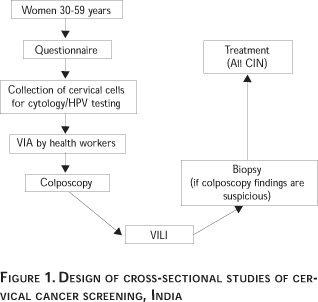
<body><![CDATA[<p><font face="Verdana" size="2"> Of particular    interest in assessing the performance of downstaging is a recently reported    cross-sectional study from Calcutta, India, in which 6 399 women aged 30 to    64 years were screened with downstaging by trained workers.<SUP>15</SUP> Two    thresholds were used to define positive downstaging: 'low threshold' when any    visible abnormality on the cervix was considered positive and 'high threshold'    when selected abnormalities such as bleeding on touch, bleeding erosion, hypertrophied    oedematous cervix, congested stippled cervix and growth or ulcer constituted    the positive test. All women had colposcopy and biopsies were directed when    colposcopy revealed abnormal lesions. True disease status was defined as histologically    proved CIN 2 and worse lesions. Since all the participants received a diagnostic    investigation (biopsy and/or colposcopy), sensitivity, specificity and predictive    values were estimated directly. Low- and high-threshold downstaging were positive    in 1 585 (24.8%) and 460 (7.2%) women, respectively. The sensitivities of low-    and high-threshold downstaging to detect high-grade precursors and invasive    cancers were 48.9% and 31.9% respectively. The specificities were 75.8% and    93.3%, respectively. </font></p>     <p><font face="Verdana" size="2"> The results from    the Indian studies of 'downstaging' indicate that it is not suitable as an independent    primary screening modality for cervical neoplasia and should not be considered    for early detection. It was often argued that downstaging was intended only    for detection of early stage disease to achieve a stage shift in diagnosis in    order to decrease morbidity and mortality from cervical cancer. Since downstaging    involves investigation of a large number of screen positive women, it may prove    to be a costly way of achieving a stage shift. The currently available evidence    suggests that a shift towards early stages may be at achieved at considerably    lower costs by health education and improved awareness, as revealed by the findings    from Sweden and Barshi, India.<SUP>19,20</SUP> In any case, in many low- resource    countries with a high incidence of cervical cancer, where a low technology test    might be considered for screening (e.g. countries in sub Saharan Africa), facilities    for treating invasive cancer are inadequate. In this context, an early detection    test with a potential to detect high-grade cervical cancer precursors is advisable.    'Downstaging' is not considered as a promising or experimental early detection    approach in the most recent WHO document on national cancer control programmes.<SUP>21</SUP>    </font></p>     <p><font face="Verdana" size="2"><b>Visual inspection    with acetic acid (VIA) studies </b></font></p>     <p><font face="Verdana" size="2"><I>Cross-sectional    studies</I> </font></p>     <p><font face="Verdana" size="2">VIA is considered    to be a promising approach in the detection of cervical neoplasia.<SUP>21</SUP>    VIA involves the application of 3-5% dilute acetic acid on the cervix and the    detection of opaque acetowhite area(s) close to the squamocolumnar junction    constitutes a positive test outcome. Two previously reported cross-sectional    studies simultaneously evaluated the test characteristics of VIA and cytology.<SUP>22,23</SUP>    However, these studies suffered from verification bias, as the reference investigations    coloposcopy with or without biopsy were provided to screen positive women and    to a selected proportion of screen negative women only. Thus sensitivity and    specificity could not be estimated directly. Pooled analysis of data from these    two indicated an approximate sensitivity of 93.4% and specificity of 85.1% for    VIA to detect CIN 2 or worse lesions; the corresponding figures for cytology    were 72.1% and 91.6%. Thus VIA was found to be more sensitive but less specific    than cytology. </font></p>     <p><font face="Verdana" size="2"> Currently cross-sectional    studies have been organized in four locations (Bombay, Calcutta, Jaipur and    Trivandrum) to study the test characteristics of VIA on a large sample (30 000    women aged 30-59 years). Twenty three thousand women have already been recruited    into these studies. These studies have been approved by the ethical committees    of the collaborating national institutions and the International Agency for    Research on Cancer (IARC). The study design is shown in <a href="#fig1">Figure    1</a>. The test characteristics of cytology (in four study locations), HPV DNA    testing with HC II method (in three study locations), and visual inspection    after the application of Lugol's iodine (VILI) (in four study locations) are    simultaneously evaluated in these studies. All the participating women in these    studies are investigated with colposcopy and directed biopsy depending upon    the colposcopy findings (irrespective of the screening test outcomes) to establish    the final disease status and these investigations constitute the reference investigation    in this study population. Thus, these studies do not suffer from verification    bias, as both screen negative and screen positive women receive the reference    investigation. The data from the above studies will be pooled for establishing    the comparative average test performance of VIA and the other screening tests    in devetecting CIN 2 and advanced lesions. Results of pooled analysis will be    available at the end of 2003. </font></p>     <p><a name="fig1"></a></p>     <p>&nbsp;</p>     <p align="center"><img src="/img/revistas/spm/v45s3/3a16f01.gif"></p>     <p>&nbsp;</p>     ]]></body>
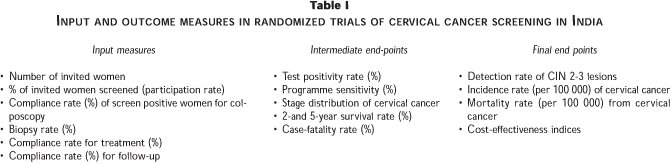
<body><![CDATA[<p><font face="Verdana" size="2"><I>Randomized intervention    trials</I> </font></p>     <p><font face="Verdana" size="2">Though there is    currently a large body of data on the test accuracy of VIA, the efficacy and    cost effectiveness of VIA based screening programme in reducing incidence of    and mortality from cervical cancer is not known. This is being addressed in    two cluster-randomised controlled intervention trials in India, which have been    initiated in 2000. The design of these studies will be briefly described. </font></p>     <p><font face="Verdana" size="2"><I>Osmanabad district    randomized cervical cancer screening trial</I> </font></p>     <p><font face="Verdana" size="2">The comparative    efficacy and cost-effectiveness of once a life-time VIA (provided by nurses),    conventional cytology, and HPV testing in detecting cervical neoplasia and in    reducing incidence of and mortality from cervical cancer is evaluated in a four-arm    cluster randomized, controlled intervention trial in Osmanabad district, Maharashtra,    India. This is a joint collaborative study of the Nargis Dutt Memorial Cancer    Hospital, Barshi; Tata Memorial Centre (TMC), Bombay; and the International    Agency for Research on Cancer (IARC), Lyon, France. This study has been approved    by the institutional ethical and scientific review committees of TMC, Bombay    and the IARC. </font></p>     <p><font face="Verdana" size="2"> Osmanabad district,    is an industrially and economically backward district in India, located 450    km south east of Mumbai, in the state of Maharashtra, Western India. The literacy    rate in adult women is around 20%. Five hundred two villages in this district    have been grouped under 52 clusters. Apparently healthy women aged 30-59 years    and with intact uterus in these clusters have been randomly allocated to one    of the four study groups and are invited to be screened once in a life-time    with one of the tests (<a href="/img/revistas/spm/v45s3/3a16f02.gif">Figure 2</a>). </font></p>     <p><font face="Verdana" size="2"> Women in 125 villages    in 13 clusters have been randomized to group 1 to be screened with VIA by nurses    (VIA screening group); women in 124 villages in 13 clusters have been randomized    to group 2, to be screened with cervical cytology (cytology screening group);    women in 125 villages in 13 clusters are allocated to group 3 to be screened    with HPV testing using HC II technique (HPV screening group); and women in 128    villages in 13 clusters are allocated to group 4 (control group) who receive    the usual care prevailing in the district and receive person to person health    education on the risk factors, methods of prevention and early detection for    cervical cancer and are advised on the diagnostic and treatment facilities for    cervical neoplasia available in the district. The number of eligible women in    each study group is estimated to be around 40 000. </font></p>     <p><font face="Verdana" size="2"> Women randomized    to groups 1-3 are personally invited for screening with specific tests in screening    clinics conducted in primary health centres, or in make shift screening clinics    organized in schools, women's club buildings, or the municipal buildings in    the villages. </font></p>     <p><font face="Verdana" size="2"> In group 1, screening    is carried out by applying 5% acetic acid and the findings are scored after    one minute. Screen positivity is defined by the presence of opaque acetowhite    area(s) close to or touching the squamocolumnar junction in the transformation    zone. Cytology smears from women in group 2 are taken by nurses, which are processed    and reported by trained cytotechnologists in the cytology laboratory of the    project located in Barshi town. The results of cytology are reported using the    Bethesda system (TBS) reporting categories. Those with atypical squamous cells    of uncertain significance (ASCUS), atypical glandular cells of uncertain significance    (AGUS), low-grade squamous intraepithelial lesions (LSIL), high-grade squamous    intraepithelial lesions (HSIL), cervical glandular intraepithelial neoplasia    (CGIN) and invasive carcinoma on cytology are considered screen positive. Cervical    cells are collected from women in group 3 using the Digene HC II collection    tubes and transported to the project HPV testing laboratory located in the project    office in Barshi for testing and reporting. Those detected with more than 6000    viral DNA (&gt; 1 RLU) copies are designated as screen positive in this group.    </font></p>     <p><font face="Verdana" size="2"> All screen positive    women are investigated with colposcopy by trained doctors. Directed biopsies    are carried out in women with colposcopically suspect neoplastic lesions. Biopsy    specimens are processed in the project histopathology laboratory at Barshi and    results are reported using the cervical intraepithelial neoplasia (CIN) terminology.    </font></p>     <p><font face="Verdana" size="2"> In order to avoid    another recall for treatment of precancerous lesions and to maximize compliance    to treatment, treatment decisions are made and carried out in the same session    as colposcopy, based on colposcopic diagnosis, whenever possible. All grades    of CIN are treated. Cryotherapy is provided to women with ectocervical CIN lesions    involving less than 75% of the transformation zone, and that can be covered    with the largest cryotherapy probe tip, without extension to the endocervix    and vagina and without clinical evidence of invasion. Cryotherapy is provided    only after directing a biopsy. Those with preinvasive lesions involving more    than 75% of the transformation zone or those with lesions extending in to the    cervical canal are treated with loop electrosurgical excision (LEEP) or cold    knife conization. Cryotherapy is provided by nurses and LEEP by doctors. Those    with invasive cancers are referred for treatment surgery and/or radiotherapy.    </font></p>     ]]></body>
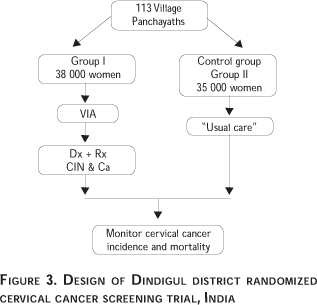
<body><![CDATA[<p><font face="Verdana" size="2"> Women treated    for preinvasive lesions are recalled at three months to assess if there is any    evidence of local infection and if the wound has healed and for any immediate    complications. They are assessed at one year from treatment for assessing treatment    success and complications </font></p>     <p><font face="Verdana" size="2"> The input and    outcome measures used for evaluating this study are given in <a href="/img/revistas/spm/v45s3/3a16t01.gif">Table    I</a>. The entire district is covered by a population-based cancer registry,    which will provide cervical cancer incidence data for the district. Mortality    data will be obtained by active collection of data from the municipal death    registers supplemented by periodic house-to-house surveys. </font></p>     <p><font face="Verdana" size="2"> As of 31 June    2002, around 60 000 women have been invited and 79% of the invited have been    screened. Test positivity rates of VIA, cytology and HPV testing among the screened    women were 16.4%, 9.5% and 11.4% respectively. Recruitment of women in this    programme will be completed by mid 2003 and the final results for the various    input measures, test positivity rates, detection rates of CIN 2-3 lesions, stage    distribution of cervical cancers, 2-year survival rates, and case-fatality rates    in the different study groups will be reported by the end of 2003. </font></p>     <p><font face="Verdana" size="2"><I>Dindigul district    randomized cervical cancer screening trial</I> </font></p>     <p><font face="Verdana" size="2">A two-arm cluster    randomized, controlled intervention trial has been initiated in 2000 to investigate    the efficacy and cost-effectiveness of VIA (provided by nurses) in reducing    incidence of and mortality from cervical cancer in Dindigul district, Tamil    Nadu, India. This is a joint collaborative project between the Christian Fellowship    Community Health Centre (CFCHC), Ambillikai, Dindigul district and the International    Agency for Research on Cancer (IARC), Lyon, France. This study has been approved    by the institutional review committees of the CFCHC and the IARC. </font></p>     <p><font face="Verdana" size="2"> This programme    involves 73 000 apparently healthy women, with intact uterus, aged 30-59 years    living in 113 village panchayaths. Thirty eight thousad women in 57 village    panchayaths have been randomized to be screened with once in a life-time VIA    by nurses (VIA screening group); 35 000 women in 56 village panchayaths have    been randomly allocated to the control group, who receive the usual care prevailing    in the district and receive person to person health education on the risk factors,    methods of prevention and early detection for cervical cancer and are advised    on the diagnostic and treatment facilities (<a href="#fig3">Figure 3</a>). </font></p>     <p><a name="fig3"></a></p>     <p>&nbsp;</p>     <p align="center"><img src="/img/revistas/spm/v45s3/3a16f03.gif"></p>     <p>&nbsp;</p>     ]]></body>
<body><![CDATA[<p><font face="Verdana" size="2">Women randomized    to the VIA screening group are personally invited for testing in screening clinics    conducted in primary health centres, or in make shift screening clinics organized    in schools, women's club buildings, or the municipal buildings in the villages.    VIA screening is carried out by applying 5% acetic acid and the findings are    scored after one minute. Screen positivity is defined by the presence of opaque    aceto white area(s) close to or touching the squamocolumnar junction in the    transformation zone. All screen positive women are investigated with colposcopy    by trained nurses. Directed biopsies are carried out in women with colposcopically    suspect neoplastic lesions. Biopsy specimens are processed in the project histopathology    laboratory and results are reported using the cervical intraepithelial neoplasia    (CIN) terminology. </font></p>     <p><font face="Verdana" size="2"> As of 31 June,    30 000 women have been invited and 65% of those invited have been screened.    Test positivity rate of VIA, in the screened women was 11.2%. Recruitment of    women in this programme will be completed by the end of 2002 and the final results    for input measures (<a href="/img/revistas/spm/v45s3/3a16t01.gif">Table I</a>) and outcome measures    such as test positivity rate, detection rate of CIN 2-3 lesions, stage distribution    of cervical cancer, 2-year survival and case fatality rates will be reported    in early 2003. </font></p>     <p><font face="Verdana" size="2"> Information on    the comparative trends in incidence/mortality, incidence and mortality rate    ratios following the introduction of the screening interventions in the above    two randomized trials is expected to emerge around 2007. </font></p>     <p><font face="Verdana" size="2"><I>Studies on visual    inspection with acetic acid after magnification (VIAM)</I> </font></p>     <p><font face="Verdana" size="2">Since several reported    studies indicate a significantly lower specificity for VIA when compared to    cytology, simple magnifying devices (2X-4X) have been used to visualize the    cervix after application of acetic acid to find out if this approach may improve    specificity of VIA without compromising sensitivity. In a hospital-based cross-sectional    study in Delhi involving 406 women, Parashari and coworkers,<SUP>24</SUP> reported    a sensitivity of 88.1% and specificity of 67.5% for VIAM using a 2.5X magnifying    device for reporting. It is of interest to note that the specificity falls within    the range observed for VIA in other studies. We have completed a cross-sectional    study in Calcutta, India, which has evaluated the comparative accuracy of VIA    and VIAM in 6 000 women and the results will be reported soon. Incidentally,    no differences in test characteristics between VIA and VIAM were observed in    a reported cross-sectional study in South Africa.<SUP>25</SUP> </font></p>     <p><font face="Verdana" size="2"><I>Studies on visual    inspection with Lugol's iodine (VILI)</I> </font></p>     <p><font face="Verdana" size="2">VILI is similar    in approach to the Schiller iodine test of the 1930s, which relied on viewing    the cervix with the naked eye after application of iodine solution to identify    yellow iodine non-uptake areas on the cervix. The practice of the test was discontinued    after the introduction of cytology, in view of its non-specific nature, and    relatively common false positive results. Lugol's iodine solution is prepared    by dissolving 5 gm of iodine and 10 gm of potassium iodide in 100 ml distilled    water. VILI findings depend on the interaction between iodine and glycogen.    Normal, mature, squamous epithelium is characterized by an abundance of glycogen,    whereas abnormal epithelium contains relatively little or no glycogen. Therefore,    application of iodine solution to normal squamous epithelial cells will produce    a dark mahogany brown, or almost black stain, while columnar and abnormal epithelial    cells, as well as immature metaplasia, all of which contain little or no glycogen,    remain relatively unstained, showing areas that are colourless, pale, or mustard-yellow    in colour. </font></p>     <p><font face="Verdana" size="2"> However, the increasing    use of colposcopy as a diagnostic triage investigation, in which iodine application    was used by many colposcopists, particularly to delineate the lesions, has helped    in recognizing and discriminating the findings that may lead to false positive    results after iodine application. We have observed, in a pilot study, that health    workers found it easier to detect the colour patterns produced by iodine staining,    rather than acetic acid, we decided to re-evaluate the accuracy VILI as a screening    test to detect cervical neoplasia, in cross-sectional studies in four locations    in India (<a href="/img/revistas/spm/v45s3/3a16f02.gif">Figure 2</a>). These studies, when completed,    will have 25 000 women tested with VILI. </font></p>     <p><font face="Verdana" size="2"> We have prepared    an atlas depicting the staining patterns associated with normal cervix, ectropion,    polyps, inflammatory conditions and squamous metaplasia, and neoplastic conditions,    in order to reduce the frequency of false positive outcomes. The naked eye visual    findings after iodine application is reported as negative and positive, as follows.    </font></p>     <p><font face="Verdana" size="2"> VILI finding is    scored 'negative' when one or more of the following findings are observed: the    entire area of the cervix outside the SCJ was stained brown by iodine; or when    the endocervical columnar epithelium was the only iodine non-staining area in    the cervix; or when the endocervical columnar epithelium was the only iodine    non-staining area in the cervix or when there was "leopard skin" appearance    suggestive of <I>Trichomonas vaginalis</I> infection, or when there were scattered    pepper-like iodine negative pale or colourless areas in the squamous epithelium    or scattered, irregular, streak-like iodine negative pale areas; or when pale    or yellow iodine non-uptake areas far away from the cervical os and dissociated    from the SCJ were present. VILI is categorized 'positive' when saffron or mustard-yellow    iodine non-uptake lesions are observed close to the squamocolumnar junction.    </font></p>     ]]></body>
<body><![CDATA[<p><font face="Verdana" size="2"> There are no published    results of VILI yet. Our current studies in India have recruited around 18 000    women and the test positivity in different studies vary between 18-28%. The    final results will be reported in late 2003. </font></p>     <p><font face="Verdana" size="2"><I>Training and    quality control</I> </font></p>     <p><font face="Verdana" size="2">The health workers    providing VIA, VIAM, and VILI in the Indian studies have been trained in 5-day    training courses, using the IARC training manual on VIA and VILI.<SUP>26</SUP>    The training courses involve theoretical lessons for eight hours dealing with    anatomy and physiology of the female genital tract, pathology of cervical neoplasia    and method of speculum examination, VIA and VILI. This is followed by clinical    sessions involving 100-150 women as subjects for the trainees over four days    when the practical aspects of testing, reporting, investigations and treatment    are taught. </font></p>     <p><font face="Verdana" size="2"> There are no standard    methods of quality control for visual inspection-based screening tests. In the    context of the Indian studies we have used studies of agreement between the    health workers and master trainers, on the findings of randomly selected photographs    of cervix after application of acetic acid or iodine, for quality control. The    findings and sensitivity of VIA provided by health workers are closely monitored    and periodic short retraining sessions are organized. </font></p>     <p>&nbsp;</p>     <p><font face="Verdana" size="3"><b>Conclusion </b></font></p>     <p><font face="Verdana" size="2">The Indian studies    have clearly established the unsatisfactory test characteristics of 'downstaging'    and its role as a less promising test for cervical cancer prevention. The answers    for some of the important research issues concerned with other visual inspection-based    screening tests such as VIA, VIAM and VILI may emerge when the currently on-going    Indian studies are completed and analysed. There will be more valid information    on the performance of the above tests in detecting lesions. The value of screening    with combinations of tests is likely to be better defined. The randomized trials    will provide the much-needed information on the extent of incidence and mortality    reduction associated with VIA screening and its cost effectiveness in comparison    to screening with cytology and HPV testing. The long-term impact of over treatment    associated with VIA may be well defined. They will also provide useful information    on feasible models of delivery of cervical cancer prevention services in low-resource    countries. Thus the expected outcomes from these studies will provide valuable    information for guiding the development of public health policies on cervical    cancer prevention in countries with different levels of socio-economic and health    services development and open up new avenues of research. </font></p>     <p>&nbsp;</p>     <p><font face="Verdana" size="3"><b>References </b></font></p>     <!-- ref --><p><font face="Verdana" size="2">1. Parkin DM, Whelan    SL, Ferlay J, Raymond L, Young J, ed. Cancer incidence in five continents. IARC    1997;Scientific Publication No. 143 Vol. VII. </font>&nbsp;&nbsp;&nbsp;&nbsp;&nbsp;&nbsp;&nbsp;&nbsp;[&#160;<a href="javascript:void(0);" onclick="javascript: window.open('/scielo.php?script=sci_nlinks&ref=9184120&pid=S0036-3634200300090001400001&lng=','','width=640,height=500,resizable=yes,scrollbars=1,menubar=yes,');">Links</a>&#160;]<!-- end-ref --><!-- ref --><p><font face="Verdana" size="2">2. Rajkumar R,    Sankaranarayanan R, Esmi A, Jayaraman R, Cherian J, Parkin DM. Leads to cancer    control based on cancer patterns in a rural population in South India. Cancer    Causes Control 2000;11:433-439. </font>&nbsp;&nbsp;&nbsp;&nbsp;&nbsp;&nbsp;&nbsp;&nbsp;[&#160;<a href="javascript:void(0);" onclick="javascript: window.open('/scielo.php?script=sci_nlinks&ref=9184121&pid=S0036-3634200300090001400002&lng=','','width=640,height=500,resizable=yes,scrollbars=1,menubar=yes,');">Links</a>&#160;]<!-- end-ref --><!-- ref --><p><font face="Verdana" size="2">3. Sankaranarayanan    R, Budukh AM, Rajkumar R.Effective screening programmes for cervical cancer    in low- and middle-income developing countries. Bull World Health Organ 2001;79:954-962.    </font>&nbsp;&nbsp;&nbsp;&nbsp;&nbsp;&nbsp;&nbsp;&nbsp;[&#160;<a href="javascript:void(0);" onclick="javascript: window.open('/scielo.php?script=sci_nlinks&ref=9184122&pid=S0036-3634200300090001400003&lng=','','width=640,height=500,resizable=yes,scrollbars=1,menubar=yes,');">Links</a>&#160;]<!-- end-ref --><!-- ref --><p><font face="Verdana" size="2">4. Ferlay J, Bray    F, Pisani P, Parkin DM. GLOBOCAN 2000: Cancer incidence, mortality and prevalence    worldwide. IARC Press, 2001; Version 1.0. IARC CancerBase No.5. </font>&nbsp;&nbsp;&nbsp;&nbsp;&nbsp;&nbsp;&nbsp;&nbsp;[&#160;<a href="javascript:void(0);" onclick="javascript: window.open('/scielo.php?script=sci_nlinks&ref=9184123&pid=S0036-3634200300090001400004&lng=','','width=640,height=500,resizable=yes,scrollbars=1,menubar=yes,');">Links</a>&#160;]<!-- end-ref --><!-- ref --><p><font face="Verdana" size="2">5. Ministry of    Health and Family Welfare. National Cancer Control Programme of India. New Delhi:    Government of India, 1982. </font>&nbsp;&nbsp;&nbsp;&nbsp;&nbsp;&nbsp;&nbsp;&nbsp;[&#160;<a href="javascript:void(0);" onclick="javascript: window.open('/scielo.php?script=sci_nlinks&ref=9184124&pid=S0036-3634200300090001400005&lng=','','width=640,height=500,resizable=yes,scrollbars=1,menubar=yes,');">Links</a>&#160;]<!-- end-ref --><!-- ref --><p><font face="Verdana" size="2">6. Institute of    Cytology and Preventive Oncology (ICMR). National workshop on control of cervical    cancer-alternative strategies. New Delhi, India: 2001. </font>&nbsp;&nbsp;&nbsp;&nbsp;&nbsp;&nbsp;&nbsp;&nbsp;[&#160;<a href="javascript:void(0);" onclick="javascript: window.open('/scielo.php?script=sci_nlinks&ref=9184125&pid=S0036-3634200300090001400006&lng=','','width=640,height=500,resizable=yes,scrollbars=1,menubar=yes,');">Links</a>&#160;]<!-- end-ref --><!-- ref --><p><font face="Verdana" size="2">7. Stjernsward    J, Eddy D, Luthra U, Stanley K. Plotting a new course for cervical cancer screening    in developing countries. World Health Forum 1987;8:42-45. </font>&nbsp;&nbsp;&nbsp;&nbsp;&nbsp;&nbsp;&nbsp;&nbsp;[&#160;<a href="javascript:void(0);" onclick="javascript: window.open('/scielo.php?script=sci_nlinks&ref=9184126&pid=S0036-3634200300090001400007&lng=','','width=640,height=500,resizable=yes,scrollbars=1,menubar=yes,');">Links</a>&#160;]<!-- end-ref --><!-- ref --><p><font face="Verdana" size="2">8. Sehgal A, Singh    V, Bhambhani S, Luthra UK. Screening for cervical cancer by direct inspection.    Lancet 1991;338:282. </font>&nbsp;&nbsp;&nbsp;&nbsp;&nbsp;&nbsp;&nbsp;&nbsp;[&#160;<a href="javascript:void(0);" onclick="javascript: window.open('/scielo.php?script=sci_nlinks&ref=9184127&pid=S0036-3634200300090001400008&lng=','','width=640,height=500,resizable=yes,scrollbars=1,menubar=yes,');">Links</a>&#160;]<!-- end-ref --><!-- ref --><p><font face="Verdana" size="2">9. Singh V, Sehgal    A, Luthra UK. Screening for cervical cancer by direct inspection. Brit Med J    1992;304:534-535. </font>&nbsp;&nbsp;&nbsp;&nbsp;&nbsp;&nbsp;&nbsp;&nbsp;[&#160;<a href="javascript:void(0);" onclick="javascript: window.open('/scielo.php?script=sci_nlinks&ref=9184128&pid=S0036-3634200300090001400009&lng=','','width=640,height=500,resizable=yes,scrollbars=1,menubar=yes,');">Links</a>&#160;]<!-- end-ref --><!-- ref --><p><font face="Verdana" size="2">10. Bharghava VL,    Verma K, Sharma R, Batra S, Anandalakshmy PN. A Hospital-based study on the    use of paramedical personnel for clinical down-staging of cancer cervix. Indian    J Med Res 1993;98:65-68. </font>&nbsp;&nbsp;&nbsp;&nbsp;&nbsp;&nbsp;&nbsp;&nbsp;[&#160;<a href="javascript:void(0);" onclick="javascript: window.open('/scielo.php?script=sci_nlinks&ref=9184129&pid=S0036-3634200300090001400010&lng=','','width=640,height=500,resizable=yes,scrollbars=1,menubar=yes,');">Links</a>&#160;]<!-- end-ref --><!-- ref --><p><font face="Verdana" size="2">11. Sujathan K,    Kannan S, Pillai KR, Mathew A, Joseph M, Shyamalakumari B et al. Implications    of gynaecological abnormalities in pre-selection criteria for cervical cancer    screening: Preliminary evaluation of 3602 subjects in south India. Cytopathology    1995;6:75-87. </font>&nbsp;&nbsp;&nbsp;&nbsp;&nbsp;&nbsp;&nbsp;&nbsp;[&#160;<a href="javascript:void(0);" onclick="javascript: window.open('/scielo.php?script=sci_nlinks&ref=9184130&pid=S0036-3634200300090001400011&lng=','','width=640,height=500,resizable=yes,scrollbars=1,menubar=yes,');">Links</a>&#160;]<!-- end-ref --><!-- ref --><p><font face="Verdana" size="2">12. Rao SR, Revathy    S, Malvi SG, Taskar V, Rao RS. Pitfalls in the visual inspection of the cervix,    as a method of downstaging cancer of the cervix in developing countries. Indian    J Obstet Gynaecol 1995;28:659-665. </font>&nbsp;&nbsp;&nbsp;&nbsp;&nbsp;&nbsp;&nbsp;&nbsp;[&#160;<a href="javascript:void(0);" onclick="javascript: window.open('/scielo.php?script=sci_nlinks&ref=9184131&pid=S0036-3634200300090001400012&lng=','','width=640,height=500,resizable=yes,scrollbars=1,menubar=yes,');">Links</a>&#160;]<!-- end-ref --><!-- ref --><p><font face="Verdana" size="2">13. Nene BM, Deshpande    S, Jayant K, Budukh AM, Dale PS, Deshpande DA <I>et al</I>. Early detection    of cervical cancer by visual inspection: A population-based study in rural India.    Int J Cancer 1996;68:770-773. </font>&nbsp;&nbsp;&nbsp;&nbsp;&nbsp;&nbsp;&nbsp;&nbsp;[&#160;<a href="javascript:void(0);" onclick="javascript: window.open('/scielo.php?script=sci_nlinks&ref=9184132&pid=S0036-3634200300090001400013&lng=','','width=640,height=500,resizable=yes,scrollbars=1,menubar=yes,');">Links</a>&#160;]<!-- end-ref --><!-- ref --><p><font face="Verdana" size="2">14. Wesley R, Sankaranarayanan    R, Mathew B, Chandralekha B, Beegum AA, Amma NS<I> et al</I>. Evaluation of    visual inspection as a screening test for cervical cancer. Br J Cancer 1997;75:    436-440. </font>&nbsp;&nbsp;&nbsp;&nbsp;&nbsp;&nbsp;&nbsp;&nbsp;[&#160;<a href="javascript:void(0);" onclick="javascript: window.open('/scielo.php?script=sci_nlinks&ref=9184133&pid=S0036-3634200300090001400014&lng=','','width=640,height=500,resizable=yes,scrollbars=1,menubar=yes,');">Links</a>&#160;]<!-- end-ref --><!-- ref --><p><font face="Verdana" size="2">15. Basu P, Sankaranarayanan    R, Mandal R, Roy C, Das P, Choudhary D <I>et al</I>. Evaluation of downstaging    in the detection of cervical neoplasia in Kolkata, India. Int J Cancer 2002;100:92-96.    </font>&nbsp;&nbsp;&nbsp;&nbsp;&nbsp;&nbsp;&nbsp;&nbsp;[&#160;<a href="javascript:void(0);" onclick="javascript: window.open('/scielo.php?script=sci_nlinks&ref=9184134&pid=S0036-3634200300090001400015&lng=','','width=640,height=500,resizable=yes,scrollbars=1,menubar=yes,');">Links</a>&#160;]<!-- end-ref --><!-- ref --><p><font face="Verdana" size="2">16. Fahey MT, Irwig    L, Macaskill P. Meta-analysis of Pap test Accuracy. Am J Epidemiol 1995;141:680-689.    </font>&nbsp;&nbsp;&nbsp;&nbsp;&nbsp;&nbsp;&nbsp;&nbsp;[&#160;<a href="javascript:void(0);" onclick="javascript: window.open('/scielo.php?script=sci_nlinks&ref=9184135&pid=S0036-3634200300090001400016&lng=','','width=640,height=500,resizable=yes,scrollbars=1,menubar=yes,');">Links</a>&#160;]<!-- end-ref --><!-- ref --><p><font face="Verdana" size="2">17. Nanda K, McCrory    DC, Myers ER, Bastian LA, Hasselblad V, Hickey JD <I>et al</I>. Accuracy of    the Papanicolaou test in screening for and follow-up of cervical cytologic abnormalities:    A systematic review. Ann Intern Med 2000;132:810-819. </font>&nbsp;&nbsp;&nbsp;&nbsp;&nbsp;&nbsp;&nbsp;&nbsp;[&#160;<a href="javascript:void(0);" onclick="javascript: window.open('/scielo.php?script=sci_nlinks&ref=9184136&pid=S0036-3634200300090001400017&lng=','','width=640,height=500,resizable=yes,scrollbars=1,menubar=yes,');">Links</a>&#160;]<!-- end-ref --><!-- ref --><p><font face="Verdana" size="2">18. Sankaranarayanan    R, Syamalakumari B, Wesley R, Thara Somanathan, Chandralekha B, Sreedevi Amma    N et al. Visual inspection as a screening test for cervical cancer control in    developing countries. In: Franco E, Monsonego J, ed. New developments in cervical    cancer screening and prevention. Oxford: Blackwell Science, 1997:411-421. </font>&nbsp;&nbsp;&nbsp;&nbsp;&nbsp;&nbsp;&nbsp;&nbsp;[&#160;<a href="javascript:void(0);" onclick="javascript: window.open('/scielo.php?script=sci_nlinks&ref=9184137&pid=S0036-3634200300090001400018&lng=','','width=640,height=500,resizable=yes,scrollbars=1,menubar=yes,');">Links</a>&#160;]<!-- end-ref --><!-- ref --><p><font face="Verdana" size="2">19. Ponten J, Adami    HO, Bergstorm R, Dillner J, Friberg LG, Gustafsson L <I>et al</I>. Strategies    for control of cervical cancer. Int J Cancer 1995;60:1-26. </font>&nbsp;&nbsp;&nbsp;&nbsp;&nbsp;&nbsp;&nbsp;&nbsp;[&#160;<a href="javascript:void(0);" onclick="javascript: window.open('/scielo.php?script=sci_nlinks&ref=9184138&pid=S0036-3634200300090001400019&lng=','','width=640,height=500,resizable=yes,scrollbars=1,menubar=yes,');">Links</a>&#160;]<!-- end-ref --><!-- ref --><p><font face="Verdana" size="2">20. Jayant K, Rao    RS, Nene BM, Dale PS. Improved stage at diagnosis of cervical cancer awareness    in a rural population. Int J Cancer 1995;63: 161-163. </font>&nbsp;&nbsp;&nbsp;&nbsp;&nbsp;&nbsp;&nbsp;&nbsp;[&#160;<a href="javascript:void(0);" onclick="javascript: window.open('/scielo.php?script=sci_nlinks&ref=9184139&pid=S0036-3634200300090001400020&lng=','','width=640,height=500,resizable=yes,scrollbars=1,menubar=yes,');">Links</a>&#160;]<!-- end-ref --><!-- ref --><p><font face="Verdana" size="2">21. World Health    Organization. National Cancer Control Programmes. Policies and managerial guidelines.    Second Edition. Ginebra: 2002. </font>&nbsp;&nbsp;&nbsp;&nbsp;&nbsp;&nbsp;&nbsp;&nbsp;[&#160;<a href="javascript:void(0);" onclick="javascript: window.open('/scielo.php?script=sci_nlinks&ref=9184140&pid=S0036-3634200300090001400021&lng=','','width=640,height=500,resizable=yes,scrollbars=1,menubar=yes,');">Links</a>&#160;]<!-- end-ref --><!-- ref --><p><font face="Verdana" size="2">22. Sankaranarayanan    R, Wesley R, Somanathan T, Dhakad N, Shyamalakumary B, Sreedevi Amma N <I>et    al</I>. Performance of visual inspection after acetic acid application (VIA)    in the detection of cervical cancer precursors. Cancer 1998;83:2150-2156. </font>&nbsp;&nbsp;&nbsp;&nbsp;&nbsp;&nbsp;&nbsp;&nbsp;[&#160;<a href="javascript:void(0);" onclick="javascript: window.open('/scielo.php?script=sci_nlinks&ref=9184141&pid=S0036-3634200300090001400022&lng=','','width=640,height=500,resizable=yes,scrollbars=1,menubar=yes,');">Links</a>&#160;]<!-- end-ref --><!-- ref --><p><font face="Verdana" size="2">23. Sankaranarayanan    R, Shyamalakumary B, Wesley R, Sreedevi Amma N, Parkin DM, Krishnan Nair M.    Visual inspection with acetic acid in the early detection of cervical cancer    and precursors. Int J Cancer 1999;80:161-163. </font>&nbsp;&nbsp;&nbsp;&nbsp;&nbsp;&nbsp;&nbsp;&nbsp;[&#160;<a href="javascript:void(0);" onclick="javascript: window.open('/scielo.php?script=sci_nlinks&ref=9184142&pid=S0036-3634200300090001400023&lng=','','width=640,height=500,resizable=yes,scrollbars=1,menubar=yes,');">Links</a>&#160;]<!-- end-ref --><!-- ref --><p><font face="Verdana" size="2">24. Parashari A,    Singh V, Seghal A, Satyanarayana L, Sodhani P, Gupta MM. Low-cost technology    for screening uterine cervical cancer. Bull World Health Organ 2000;78:964-967.    </font>&nbsp;&nbsp;&nbsp;&nbsp;&nbsp;&nbsp;&nbsp;&nbsp;[&#160;<a href="javascript:void(0);" onclick="javascript: window.open('/scielo.php?script=sci_nlinks&ref=9184143&pid=S0036-3634200300090001400024&lng=','','width=640,height=500,resizable=yes,scrollbars=1,menubar=yes,');">Links</a>&#160;]<!-- end-ref --><!-- ref --><p><font face="Verdana" size="2">25. Denny L, Kuhn    L, Pollack A, Wright TC Jr. Direct visual inspection for cervical cancer screening:    An analysis of factors influencing test performance. Cancer 2002;94:1699-1707.    </font>&nbsp;&nbsp;&nbsp;&nbsp;&nbsp;&nbsp;&nbsp;&nbsp;[&#160;<a href="javascript:void(0);" onclick="javascript: window.open('/scielo.php?script=sci_nlinks&ref=9184144&pid=S0036-3634200300090001400025&lng=','','width=640,height=500,resizable=yes,scrollbars=1,menubar=yes,');">Links</a>&#160;]<!-- end-ref --><!-- ref --><p><font face="Verdana" size="2">26. Sankaranarayanan    R, Wesley R. A practical manual on visual screening for cervical neoplasia.    IARC Internal Technical Manual. Lyon: IARC, 1999. </font>&nbsp;&nbsp;&nbsp;&nbsp;&nbsp;&nbsp;&nbsp;&nbsp;[&#160;<a href="javascript:void(0);" onclick="javascript: window.open('/scielo.php?script=sci_nlinks&ref=9184145&pid=S0036-3634200300090001400026&lng=','','width=640,height=500,resizable=yes,scrollbars=1,menubar=yes,');">Links</a>&#160;]<!-- end-ref --><p>&nbsp;</p>     <p>&nbsp;</p>     <p><font face="Verdana" size="2"><b>Address reprint    requests to:</b>    <br>   R Sankaranarayanan    <br>   International Agency for Research on Cancer    ]]></body>
<body><![CDATA[<br>   150 cours Albert Thomas    <br>   Lyon 69008, France    <br>   E-mail: <a href="mailto:Sankar@iarc.fr">Sankar@iarc.fr</a> </font></p>     <p><font face="Verdana" size="2"><b>Received on:</b>    September 17, 2002 <b>    <br>   Accepted on:</b> February 17, 2003 </font></p>     <p>&nbsp;</p>     <p>&nbsp;</p>     <p><font face="Verdana" size="2">The funding assistance    provided by the Bill and Melinda Gates Foundation through the Alliance for Cervical    Cancer Prevention (ACCP) for the IARC cervical cancer prevention studies in    India is gratefully acknowledged. We thank Mr G. Patwardhan, Additional Secretary    of Health, Ministry of Health &amp; Family Welfare, Government of India, for    his support. </font></p>      ]]></body><back>
<ref-list>
<ref id="B1">
<label>1</label><nlm-citation citation-type="">
<person-group person-group-type="author">
<name>
<surname><![CDATA[Parkin]]></surname>
<given-names><![CDATA[DM]]></given-names>
</name>
<name>
<surname><![CDATA[Whelan]]></surname>
<given-names><![CDATA[SL]]></given-names>
</name>
<name>
<surname><![CDATA[Ferlay]]></surname>
<given-names><![CDATA[J]]></given-names>
</name>
<name>
<surname><![CDATA[Raymond]]></surname>
<given-names><![CDATA[L]]></given-names>
</name>
<name>
<surname><![CDATA[Young]]></surname>
<given-names><![CDATA[J]]></given-names>
</name>
</person-group>
<source><![CDATA[Cancer incidence in five continents: IARC 1997]]></source>
<year></year>
</nlm-citation>
</ref>
<ref id="B2">
<label>2</label><nlm-citation citation-type="journal">
<person-group person-group-type="author">
<name>
<surname><![CDATA[Rajkumar]]></surname>
<given-names><![CDATA[R]]></given-names>
</name>
<name>
<surname><![CDATA[Sankaranarayanan]]></surname>
<given-names><![CDATA[R]]></given-names>
</name>
<name>
<surname><![CDATA[Esmi]]></surname>
<given-names><![CDATA[A]]></given-names>
</name>
<name>
<surname><![CDATA[Jayaraman]]></surname>
<given-names><![CDATA[R]]></given-names>
</name>
<name>
<surname><![CDATA[Cherian]]></surname>
<given-names><![CDATA[J]]></given-names>
</name>
<name>
<surname><![CDATA[Parkin]]></surname>
<given-names><![CDATA[DM]]></given-names>
</name>
</person-group>
<article-title xml:lang="en"><![CDATA[Leads to cancer control based on cancer patterns in a rural population in South India]]></article-title>
<source><![CDATA[Cancer Causes Control]]></source>
<year>2000</year>
<volume>11</volume>
<page-range>433-439</page-range></nlm-citation>
</ref>
<ref id="B3">
<label>3</label><nlm-citation citation-type="journal">
<person-group person-group-type="author">
<name>
<surname><![CDATA[Sankaranarayanan]]></surname>
<given-names><![CDATA[R]]></given-names>
</name>
<name>
<surname><![CDATA[Budukh]]></surname>
<given-names><![CDATA[AM]]></given-names>
</name>
<name>
<surname><![CDATA[Rajkumar]]></surname>
<given-names><![CDATA[R]]></given-names>
</name>
</person-group>
<article-title xml:lang="en"><![CDATA[Effective screening programmes for cervical cancer in low- and middle-income developing countries]]></article-title>
<source><![CDATA[Bull World Health Organ]]></source>
<year>2001</year>
<volume>79</volume>
<page-range>954-962</page-range></nlm-citation>
</ref>
<ref id="B4">
<label>4</label><nlm-citation citation-type="book">
<person-group person-group-type="author">
<name>
<surname><![CDATA[Ferlay]]></surname>
<given-names><![CDATA[J]]></given-names>
</name>
<name>
<surname><![CDATA[Bray]]></surname>
<given-names><![CDATA[F]]></given-names>
</name>
<name>
<surname><![CDATA[Pisani]]></surname>
<given-names><![CDATA[P]]></given-names>
</name>
<name>
<surname><![CDATA[Parkin]]></surname>
<given-names><![CDATA[DM]]></given-names>
</name>
</person-group>
<source><![CDATA[GLOBOCAN 2000: Cancer incidence, mortality and prevalence worldwide]]></source>
<year>2001</year>
<publisher-name><![CDATA[IARC Press]]></publisher-name>
</nlm-citation>
</ref>
<ref id="B5">
<label>5</label><nlm-citation citation-type="book">
<collab>Ministry of Health and Family Welfare</collab>
<source><![CDATA[National Cancer Control Programme of India]]></source>
<year>1982</year>
<publisher-loc><![CDATA[New Delhi ]]></publisher-loc>
<publisher-name><![CDATA[Government of India]]></publisher-name>
</nlm-citation>
</ref>
<ref id="B6">
<label>6</label><nlm-citation citation-type="">
<collab>Institute of Cytology and Preventive Oncology</collab>
<source><![CDATA[National workshop on control of cervical cancer-alternative strategies]]></source>
<year>2001</year>
<publisher-loc><![CDATA[New Delhi ]]></publisher-loc>
</nlm-citation>
</ref>
<ref id="B7">
<label>7</label><nlm-citation citation-type="journal">
<person-group person-group-type="author">
<name>
<surname><![CDATA[Stjernsward]]></surname>
<given-names><![CDATA[J]]></given-names>
</name>
<name>
<surname><![CDATA[Eddy]]></surname>
<given-names><![CDATA[D]]></given-names>
</name>
<name>
<surname><![CDATA[Luthra]]></surname>
<given-names><![CDATA[U]]></given-names>
</name>
<name>
<surname><![CDATA[Stanley]]></surname>
<given-names><![CDATA[K]]></given-names>
</name>
</person-group>
<article-title xml:lang="en"><![CDATA[Plotting a new course for cervical cancer screening in developing countries]]></article-title>
<source><![CDATA[World Health Forum]]></source>
<year>1987</year>
<volume>8</volume>
<page-range>42-45</page-range></nlm-citation>
</ref>
<ref id="B8">
<label>8</label><nlm-citation citation-type="journal">
<person-group person-group-type="author">
<name>
<surname><![CDATA[Sehgal]]></surname>
<given-names><![CDATA[A]]></given-names>
</name>
<name>
<surname><![CDATA[Singh]]></surname>
<given-names><![CDATA[V]]></given-names>
</name>
<name>
<surname><![CDATA[Bhambhani]]></surname>
<given-names><![CDATA[S]]></given-names>
</name>
<name>
<surname><![CDATA[Luthra]]></surname>
<given-names><![CDATA[UK]]></given-names>
</name>
</person-group>
<article-title xml:lang="en"><![CDATA[Screening for cervical cancer by direct inspection]]></article-title>
<source><![CDATA[Lancet]]></source>
<year>1991</year>
<volume>338</volume>
<page-range>282</page-range></nlm-citation>
</ref>
<ref id="B9">
<label>9</label><nlm-citation citation-type="journal">
<person-group person-group-type="author">
<name>
<surname><![CDATA[Singh]]></surname>
<given-names><![CDATA[V]]></given-names>
</name>
<name>
<surname><![CDATA[Sehgal]]></surname>
<given-names><![CDATA[A]]></given-names>
</name>
<name>
<surname><![CDATA[Luthra]]></surname>
<given-names><![CDATA[UK]]></given-names>
</name>
</person-group>
<article-title xml:lang="en"><![CDATA[Screening for cervical cancer by direct inspection]]></article-title>
<source><![CDATA[Brit Med J]]></source>
<year>1992</year>
<volume>304</volume>
<page-range>534-535</page-range></nlm-citation>
</ref>
<ref id="B10">
<label>10</label><nlm-citation citation-type="journal">
<person-group person-group-type="author">
<name>
<surname><![CDATA[Bharghava]]></surname>
<given-names><![CDATA[VL]]></given-names>
</name>
<name>
<surname><![CDATA[Verma]]></surname>
<given-names><![CDATA[K]]></given-names>
</name>
<name>
<surname><![CDATA[Sharma]]></surname>
<given-names><![CDATA[R]]></given-names>
</name>
<name>
<surname><![CDATA[Batra]]></surname>
<given-names><![CDATA[S]]></given-names>
</name>
<name>
<surname><![CDATA[Anandalakshmy]]></surname>
<given-names><![CDATA[PN]]></given-names>
</name>
</person-group>
<article-title xml:lang="en"><![CDATA[A Hospital-based study on the use of paramedical personnel for clinical down-staging of cancer cervix]]></article-title>
<source><![CDATA[Indian J Med Res]]></source>
<year>1993</year>
<volume>98</volume>
<page-range>65-68</page-range></nlm-citation>
</ref>
<ref id="B11">
<label>11</label><nlm-citation citation-type="journal">
<person-group person-group-type="author">
<name>
<surname><![CDATA[Sujathan]]></surname>
<given-names><![CDATA[K]]></given-names>
</name>
<name>
<surname><![CDATA[Kannan]]></surname>
<given-names><![CDATA[S]]></given-names>
</name>
<name>
<surname><![CDATA[Pillai]]></surname>
<given-names><![CDATA[KR]]></given-names>
</name>
<name>
<surname><![CDATA[Mathew]]></surname>
<given-names><![CDATA[A]]></given-names>
</name>
<name>
<surname><![CDATA[Joseph]]></surname>
<given-names><![CDATA[M]]></given-names>
</name>
<name>
<surname><![CDATA[Shyamalakumari]]></surname>
<given-names><![CDATA[B]]></given-names>
</name>
</person-group>
<article-title xml:lang="en"><![CDATA[Implications of gynaecological abnormalities in pre-selection criteria for cervical cancer screening: Preliminary evaluation of 3602 subjects in south India]]></article-title>
<source><![CDATA[Cytopathology]]></source>
<year>1995</year>
<volume>6</volume>
<page-range>75-87</page-range></nlm-citation>
</ref>
<ref id="B12">
<label>12</label><nlm-citation citation-type="journal">
<person-group person-group-type="author">
<name>
<surname><![CDATA[Rao]]></surname>
<given-names><![CDATA[SR]]></given-names>
</name>
<name>
<surname><![CDATA[Revathy]]></surname>
<given-names><![CDATA[S]]></given-names>
</name>
<name>
<surname><![CDATA[Malvi]]></surname>
<given-names><![CDATA[SG]]></given-names>
</name>
<name>
<surname><![CDATA[Taskar]]></surname>
<given-names><![CDATA[V]]></given-names>
</name>
<name>
<surname><![CDATA[Rao]]></surname>
<given-names><![CDATA[RS]]></given-names>
</name>
</person-group>
<article-title xml:lang="en"><![CDATA[Pitfalls in the visual inspection of the cervix, as a method of downstaging cancer of the cervix in developing countries]]></article-title>
<source><![CDATA[Indian J Obstet Gynaecol]]></source>
<year>1995</year>
<volume>28</volume>
<page-range>659-665</page-range></nlm-citation>
</ref>
<ref id="B13">
<label>13</label><nlm-citation citation-type="journal">
<person-group person-group-type="author">
<name>
<surname><![CDATA[Nene]]></surname>
<given-names><![CDATA[BM]]></given-names>
</name>
<name>
<surname><![CDATA[Deshpande]]></surname>
<given-names><![CDATA[S]]></given-names>
</name>
<name>
<surname><![CDATA[Jayant]]></surname>
<given-names><![CDATA[K]]></given-names>
</name>
<name>
<surname><![CDATA[Budukh]]></surname>
<given-names><![CDATA[AM]]></given-names>
</name>
<name>
<surname><![CDATA[Dale]]></surname>
<given-names><![CDATA[PS]]></given-names>
</name>
<name>
<surname><![CDATA[Deshpande]]></surname>
<given-names><![CDATA[DA]]></given-names>
</name>
</person-group>
<article-title xml:lang="en"><![CDATA[Early detection of cervical cancer by visual inspection: A population-based study in rural India]]></article-title>
<source><![CDATA[Int J Cancer]]></source>
<year>1996</year>
<volume>68</volume>
<page-range>770-773</page-range></nlm-citation>
</ref>
<ref id="B14">
<label>14</label><nlm-citation citation-type="journal">
<person-group person-group-type="author">
<name>
<surname><![CDATA[Wesley]]></surname>
<given-names><![CDATA[R]]></given-names>
</name>
<name>
<surname><![CDATA[Sankaranarayanan]]></surname>
<given-names><![CDATA[R]]></given-names>
</name>
<name>
<surname><![CDATA[Mathew]]></surname>
<given-names><![CDATA[B]]></given-names>
</name>
<name>
<surname><![CDATA[Chandralekha]]></surname>
<given-names><![CDATA[B]]></given-names>
</name>
<name>
<surname><![CDATA[Beegum]]></surname>
<given-names><![CDATA[AA]]></given-names>
</name>
<name>
<surname><![CDATA[Amma]]></surname>
<given-names><![CDATA[NS]]></given-names>
</name>
</person-group>
<article-title xml:lang="en"><![CDATA[Evaluation of visual inspection as a screening test for cervical cancer]]></article-title>
<source><![CDATA[Br J Cancer]]></source>
<year>1997</year>
<volume>75</volume>
<page-range>436-440</page-range></nlm-citation>
</ref>
<ref id="B15">
<label>15</label><nlm-citation citation-type="journal">
<person-group person-group-type="author">
<name>
<surname><![CDATA[Basu]]></surname>
<given-names><![CDATA[P]]></given-names>
</name>
<name>
<surname><![CDATA[Sankaranarayanan]]></surname>
<given-names><![CDATA[R]]></given-names>
</name>
<name>
<surname><![CDATA[Mandal]]></surname>
<given-names><![CDATA[R]]></given-names>
</name>
<name>
<surname><![CDATA[Roy]]></surname>
<given-names><![CDATA[C]]></given-names>
</name>
<name>
<surname><![CDATA[Das]]></surname>
<given-names><![CDATA[P]]></given-names>
</name>
<name>
<surname><![CDATA[Choudhary]]></surname>
<given-names><![CDATA[D]]></given-names>
</name>
</person-group>
<article-title xml:lang="en"><![CDATA[Evaluation of downstaging in the detection of cervical neoplasia in Kolkata, India]]></article-title>
<source><![CDATA[Int J Cancer]]></source>
<year>2002</year>
<volume>100</volume>
<page-range>92-96</page-range></nlm-citation>
</ref>
<ref id="B16">
<label>16</label><nlm-citation citation-type="journal">
<person-group person-group-type="author">
<name>
<surname><![CDATA[Fahey]]></surname>
<given-names><![CDATA[MT]]></given-names>
</name>
<name>
<surname><![CDATA[Irwig]]></surname>
<given-names><![CDATA[L]]></given-names>
</name>
<name>
<surname><![CDATA[Macaskill]]></surname>
<given-names><![CDATA[P]]></given-names>
</name>
</person-group>
<article-title xml:lang="en"><![CDATA[Meta-analysis of Pap test Accuracy]]></article-title>
<source><![CDATA[Am J Epidemiol]]></source>
<year>1995</year>
<volume>141</volume>
<page-range>680-689</page-range></nlm-citation>
</ref>
<ref id="B17">
<label>17</label><nlm-citation citation-type="journal">
<person-group person-group-type="author">
<name>
<surname><![CDATA[Nanda]]></surname>
<given-names><![CDATA[K]]></given-names>
</name>
<name>
<surname><![CDATA[McCrory]]></surname>
<given-names><![CDATA[DC]]></given-names>
</name>
<name>
<surname><![CDATA[Myers]]></surname>
<given-names><![CDATA[ER]]></given-names>
</name>
<name>
<surname><![CDATA[Bastian]]></surname>
<given-names><![CDATA[LA]]></given-names>
</name>
<name>
<surname><![CDATA[Hasselblad]]></surname>
<given-names><![CDATA[V]]></given-names>
</name>
<name>
<surname><![CDATA[Hickey]]></surname>
<given-names><![CDATA[JD]]></given-names>
</name>
</person-group>
<article-title xml:lang="en"><![CDATA[Accuracy of the Papanicolaou test in screening for and follow-up of cervical cytologic abnormalities: A systematic review]]></article-title>
<source><![CDATA[Ann Intern Med]]></source>
<year>2000</year>
<volume>132</volume>
<page-range>810-819</page-range></nlm-citation>
</ref>
<ref id="B18">
<label>18</label><nlm-citation citation-type="book">
<person-group person-group-type="author">
<name>
<surname><![CDATA[Sankaranarayanan]]></surname>
<given-names><![CDATA[R]]></given-names>
</name>
<name>
<surname><![CDATA[Syamalakumari]]></surname>
<given-names><![CDATA[B]]></given-names>
</name>
<name>
<surname><![CDATA[Wesley]]></surname>
<given-names><![CDATA[R]]></given-names>
</name>
<name>
<surname><![CDATA[Somanathan]]></surname>
<given-names><![CDATA[Thara]]></given-names>
</name>
<name>
<surname><![CDATA[Chandralekha]]></surname>
<given-names><![CDATA[B]]></given-names>
</name>
<name>
<surname><![CDATA[Sreedevi Amma]]></surname>
<given-names><![CDATA[N]]></given-names>
</name>
</person-group>
<article-title xml:lang="en"><![CDATA[Visual inspection as a screening test for cervical cancer control in developing countries]]></article-title>
<person-group person-group-type="editor">
<name>
<surname><![CDATA[Franco]]></surname>
<given-names><![CDATA[E]]></given-names>
</name>
<name>
<surname><![CDATA[Monsonego]]></surname>
<given-names><![CDATA[J]]></given-names>
</name>
</person-group>
<source><![CDATA[New developments in cervical cancer screening and prevention]]></source>
<year>1997</year>
<page-range>411-421</page-range><publisher-loc><![CDATA[Oxford ]]></publisher-loc>
<publisher-name><![CDATA[Blackwell Science]]></publisher-name>
</nlm-citation>
</ref>
<ref id="B19">
<label>19</label><nlm-citation citation-type="journal">
<person-group person-group-type="author">
<name>
<surname><![CDATA[Ponten]]></surname>
<given-names><![CDATA[J]]></given-names>
</name>
<name>
<surname><![CDATA[Adami]]></surname>
<given-names><![CDATA[HO]]></given-names>
</name>
<name>
<surname><![CDATA[Bergstorm]]></surname>
<given-names><![CDATA[R]]></given-names>
</name>
<name>
<surname><![CDATA[Dillner]]></surname>
<given-names><![CDATA[J]]></given-names>
</name>
<name>
<surname><![CDATA[Friberg]]></surname>
<given-names><![CDATA[LG]]></given-names>
</name>
<name>
<surname><![CDATA[Gustafsson]]></surname>
<given-names><![CDATA[L]]></given-names>
</name>
</person-group>
<article-title xml:lang="en"><![CDATA[Strategies for control of cervical cancer]]></article-title>
<source><![CDATA[Int J Cancer]]></source>
<year>1995</year>
<volume>60</volume>
<page-range>1-26</page-range></nlm-citation>
</ref>
<ref id="B20">
<label>20</label><nlm-citation citation-type="journal">
<person-group person-group-type="author">
<name>
<surname><![CDATA[Jayant]]></surname>
<given-names><![CDATA[K]]></given-names>
</name>
<name>
<surname><![CDATA[Rao]]></surname>
<given-names><![CDATA[RS]]></given-names>
</name>
<name>
<surname><![CDATA[Nene]]></surname>
<given-names><![CDATA[BM]]></given-names>
</name>
<name>
<surname><![CDATA[Dale]]></surname>
<given-names><![CDATA[PS]]></given-names>
</name>
</person-group>
<article-title xml:lang="en"><![CDATA[Improved stage at diagnosis of cervical cancer awareness in a rural population]]></article-title>
<source><![CDATA[Int J Cancer]]></source>
<year>1995</year>
<volume>63</volume>
<page-range>161-163</page-range></nlm-citation>
</ref>
<ref id="B21">
<label>21</label><nlm-citation citation-type="">
<collab>World Health Organization^dNational Cancer Control Programmes</collab>
<source><![CDATA[Policies and managerial guidelines]]></source>
<year>2002</year>
<edition>Second</edition>
<publisher-loc><![CDATA[Ginebra ]]></publisher-loc>
</nlm-citation>
</ref>
<ref id="B22">
<label>22</label><nlm-citation citation-type="journal">
<person-group person-group-type="author">
<name>
<surname><![CDATA[Sankaranarayanan]]></surname>
<given-names><![CDATA[R]]></given-names>
</name>
<name>
<surname><![CDATA[Wesley]]></surname>
<given-names><![CDATA[R]]></given-names>
</name>
<name>
<surname><![CDATA[Somanathan]]></surname>
<given-names><![CDATA[T]]></given-names>
</name>
<name>
<surname><![CDATA[Dhakad]]></surname>
<given-names><![CDATA[N]]></given-names>
</name>
<name>
<surname><![CDATA[Shyamalakumary]]></surname>
<given-names><![CDATA[B]]></given-names>
</name>
<name>
<surname><![CDATA[Sreedevi Amma]]></surname>
<given-names><![CDATA[N]]></given-names>
</name>
</person-group>
<article-title xml:lang="en"><![CDATA[Performance of visual inspection after acetic acid application (VIA) in the detection of cervical cancer precursors]]></article-title>
<source><![CDATA[Cancer]]></source>
<year>1998</year>
<volume>83</volume>
<page-range>2150-2156</page-range></nlm-citation>
</ref>
<ref id="B23">
<label>23</label><nlm-citation citation-type="journal">
<person-group person-group-type="author">
<name>
<surname><![CDATA[Sankaranarayanan]]></surname>
<given-names><![CDATA[R]]></given-names>
</name>
<name>
<surname><![CDATA[Shyamalakumary]]></surname>
<given-names><![CDATA[B]]></given-names>
</name>
<name>
<surname><![CDATA[Wesley]]></surname>
<given-names><![CDATA[R]]></given-names>
</name>
<name>
<surname><![CDATA[Sreedevi]]></surname>
<given-names><![CDATA[Amma N]]></given-names>
</name>
<name>
<surname><![CDATA[Parkin]]></surname>
<given-names><![CDATA[DM]]></given-names>
</name>
<name>
<surname><![CDATA[Krishnan]]></surname>
<given-names><![CDATA[Nair M]]></given-names>
</name>
</person-group>
<article-title xml:lang="en"><![CDATA[Visual inspection with acetic acid in the early detection of cervical cancer and precursors]]></article-title>
<source><![CDATA[Int J Cancer]]></source>
<year>1999</year>
<volume>80</volume>
<page-range>161-163</page-range></nlm-citation>
</ref>
<ref id="B24">
<label>24</label><nlm-citation citation-type="journal">
<person-group person-group-type="author">
<name>
<surname><![CDATA[Parashari]]></surname>
<given-names><![CDATA[A]]></given-names>
</name>
<name>
<surname><![CDATA[Singh]]></surname>
<given-names><![CDATA[V]]></given-names>
</name>
<name>
<surname><![CDATA[Seghal]]></surname>
<given-names><![CDATA[A]]></given-names>
</name>
<name>
<surname><![CDATA[Satyanarayana]]></surname>
<given-names><![CDATA[L]]></given-names>
</name>
<name>
<surname><![CDATA[Sodhani]]></surname>
<given-names><![CDATA[P]]></given-names>
</name>
<name>
<surname><![CDATA[Gupta]]></surname>
<given-names><![CDATA[MM]]></given-names>
</name>
</person-group>
<article-title xml:lang="en"><![CDATA[Low-cost technology for screening uterine cervical cancer]]></article-title>
<source><![CDATA[Bull World Health Organ]]></source>
<year>2000</year>
<volume>78</volume>
<page-range>964-967</page-range></nlm-citation>
</ref>
<ref id="B25">
<label>25</label><nlm-citation citation-type="journal">
<person-group person-group-type="author">
<name>
<surname><![CDATA[Denny]]></surname>
<given-names><![CDATA[L]]></given-names>
</name>
<name>
<surname><![CDATA[Kuhn]]></surname>
<given-names><![CDATA[L]]></given-names>
</name>
<name>
<surname><![CDATA[Pollack]]></surname>
<given-names><![CDATA[A]]></given-names>
</name>
<name>
<surname><![CDATA[Wright]]></surname>
<given-names><![CDATA[TC Jr]]></given-names>
</name>
</person-group>
<article-title xml:lang="en"><![CDATA[Direct visual inspection for cervical cancer screening: An analysis of factors influencing test performance]]></article-title>
<source><![CDATA[Cancer]]></source>
<year>2002</year>
<volume>94</volume>
<page-range>1699-1707</page-range></nlm-citation>
</ref>
<ref id="B26">
<label>26</label><nlm-citation citation-type="book">
<person-group person-group-type="author">
<name>
<surname><![CDATA[Sankaranarayanan]]></surname>
<given-names><![CDATA[R]]></given-names>
</name>
<name>
<surname><![CDATA[Wesley]]></surname>
<given-names><![CDATA[R]]></given-names>
</name>
</person-group>
<source><![CDATA[A practical manual on visual screening for cervical neoplasia]]></source>
<year>1999</year>
<publisher-loc><![CDATA[Lyon ]]></publisher-loc>
<publisher-name><![CDATA[IARC Internal Technical ManualIARC]]></publisher-name>
</nlm-citation>
</ref>
</ref-list>
</back>
</article>