<?xml version="1.0" encoding="ISO-8859-1"?><article xmlns:mml="http://www.w3.org/1998/Math/MathML" xmlns:xlink="http://www.w3.org/1999/xlink" xmlns:xsi="http://www.w3.org/2001/XMLSchema-instance">
<front>
<journal-meta>
<journal-id>0036-3634</journal-id>
<journal-title><![CDATA[Salud Pública de México]]></journal-title>
<abbrev-journal-title><![CDATA[Salud pública Méx]]></abbrev-journal-title>
<issn>0036-3634</issn>
<publisher>
<publisher-name><![CDATA[Instituto Nacional de Salud Pública]]></publisher-name>
</publisher>
</journal-meta>
<article-meta>
<article-id>S0036-36342003000500008</article-id>
<title-group>
<article-title xml:lang="en"><![CDATA[Intestinal parasites in children, in highly deprived areas in the border region of Chiapas, Mexico]]></article-title>
<article-title xml:lang="es"><![CDATA[Parasitosis intestinal en niños, en áreas de alta marginación socioeconómica de la región fronteriza de Chiapas, México]]></article-title>
</title-group>
<contrib-group>
<contrib contrib-type="author">
<name>
<surname><![CDATA[Morales-Espinoza]]></surname>
<given-names><![CDATA[Emma Marianela]]></given-names>
</name>
<xref ref-type="aff" rid="A01"/>
</contrib>
<contrib contrib-type="author">
<name>
<surname><![CDATA[Sánchez-Pérez]]></surname>
<given-names><![CDATA[Héctor Javier]]></given-names>
</name>
<xref ref-type="aff" rid="A02"/>
</contrib>
<contrib contrib-type="author">
<name>
<surname><![CDATA[García-Gil]]></surname>
<given-names><![CDATA[María del Mar]]></given-names>
</name>
<xref ref-type="aff" rid="A03"/>
</contrib>
<contrib contrib-type="author">
<name>
<surname><![CDATA[Vargas-Morales]]></surname>
<given-names><![CDATA[Guadalupe]]></given-names>
</name>
<xref ref-type="aff" rid="A02"/>
</contrib>
<contrib contrib-type="author">
<name>
<surname><![CDATA[Méndez-Sánchez]]></surname>
<given-names><![CDATA[José Domingo]]></given-names>
</name>
<xref ref-type="aff" rid="A04"/>
</contrib>
<contrib contrib-type="author">
<name>
<surname><![CDATA[Pérez-Ramírez]]></surname>
<given-names><![CDATA[Margarita]]></given-names>
</name>
<xref ref-type="aff" rid="A04"/>
</contrib>
</contrib-group>
<aff id="A01">
<institution><![CDATA[,Universitat Autónoma de Barcelona Facultad de Medicina Medicina Preventiva y Salud Pública]]></institution>
<addr-line><![CDATA[Barcelona ]]></addr-line>
<country>España</country>
</aff>
<aff id="A02">
<institution><![CDATA[,Colegio de la Frontera Sur  ]]></institution>
<addr-line><![CDATA[San Cristóbal de Las Casas Chiapas]]></addr-line>
<country>México</country>
</aff>
<aff id="A03">
<institution><![CDATA[,Hospital Universitario Dr. J Trueta Unidad de Investigación ]]></institution>
<addr-line><![CDATA[Girona ]]></addr-line>
<country>España</country>
</aff>
<aff id="A04">
<institution><![CDATA[,Instituto Nacional de Salud Pública Centro de Investigación en Paludismo ]]></institution>
<addr-line><![CDATA[Chiapas ]]></addr-line>
<country>México</country>
</aff>
<pub-date pub-type="pub">
<day>00</day>
<month>10</month>
<year>2003</year>
</pub-date>
<pub-date pub-type="epub">
<day>00</day>
<month>10</month>
<year>2003</year>
</pub-date>
<volume>45</volume>
<numero>5</numero>
<fpage>379</fpage>
<lpage>388</lpage>
<copyright-statement/>
<copyright-year/>
<self-uri xlink:href="http://www.scielo.org.mx/scielo.php?script=sci_arttext&amp;pid=S0036-36342003000500008&amp;lng=en&amp;nrm=iso"></self-uri><self-uri xlink:href="http://www.scielo.org.mx/scielo.php?script=sci_abstract&amp;pid=S0036-36342003000500008&amp;lng=en&amp;nrm=iso"></self-uri><self-uri xlink:href="http://www.scielo.org.mx/scielo.php?script=sci_pdf&amp;pid=S0036-36342003000500008&amp;lng=en&amp;nrm=iso"></self-uri><abstract abstract-type="short" xml:lang="en"><p><![CDATA[OBJECTIVE: To assess the prevalence of intestinal parasitic infections among children in highly deprived areas, and its possible association with demographic and socioeconomic indicators. MATERIAL AND METHODS: From March to September 1998 in a convenience sample of 32 communities of the border region of Chiapas, Mexico, selected at random based on the level of poverty and distance from the community to the nearest health care unit (<1 hour; 1 hour or more), one of every four households with children under 15 years of age was randomly selected to provide three stool samples from their children (n 1478). Bivariate and multivariate (generalized linear models for correlated binary data) analysis were performed. RESULTS: The global prevalence of intestinal parasitosis was 67% (95% confidence interval [CI] 64-70%). Sixty percent had multiple parasites. The prevalence of Entamoeba histolytica/E dispar was 51.2%, that of Giardia lamblia 18.3%, and that of Ascaris lumbricoides 14.5%. Multivariate analysis showed that age and speaking an indigenous language were significantly associated with the presence of E histolytica/ E dispar and Giardia lamblia. Source of water and lacking a refrigerator and electricity were associated with the presence of Ascaris lumbricoides. CONCLUSIONS: Measures should be taken to improve water quality, sewage disposal, and domestic hygiene. Furthermore, health programs should be established to promote breast-feeding, and education policies aimed at reinforcing the use of indigenous languages by physicians in the health services.]]></p></abstract>
<abstract abstract-type="short" xml:lang="es"><p><![CDATA[OBJETIVO: Estimar la prevalencia de parasitosis intestinal en niños de zonas de alta marginación y su asociación con indicadores demográficos y socioeconómicos de interés. MATERIAL Y MÉTODOS: En una muestra de 1478 menores de edad, de entre 1 a 14 años, provenientes de 32 comunidades de la región fronteriza de Chiapas, México, de marzo a septiembre de 1998, se recolectaron tres muestras de heces fecales, seleccionadas aleatoriamente a partir del grado de marginación (alto y muy alto) del municipio al que pertenecen, y distancia de la unidad de salud más cercana a la comunidad (<1 hora; 1 hora o más). En una de cada cuatro viviendas con niños menores de 15 años de edad, seleccionadas aleatoriamente, se obtuvieron tres muestras de heces fecales de éstos. Se efectuaron análisis bivariados con la prueba de ji cuadrada y multivariados con modelos lineales generalizados. RESULTADOS: La prevalencia global de parasitosis fue de 67% (intervalo de confianza IC 95% 64-70%). Sesenta por ciento de los niños estaban multiparasitados. La prevalencia de Entamoeba histolytica/E dispar fue de 51.2%, de Giardia lamblia, 18.3% y de Ascaris lumbricoides, 14.5%. La mayor prevalencia de E histolytica/E dispar se asoció con la edad y hablar algún idioma indígena; la de Ascaris lumbricoides con el sitio de obtención de agua y la carencia de refrigerador y electricidad. CONCLUSIONES: Es necesario hacer intervenciones locales de salud (calidad del agua, sistemas de desagüe), programas de educación sanitaria (promoción de la lactancia materna y medidas higiénicas) y promoción del habla de idiomas indígenas entre los médicos de la región.]]></p></abstract>
<kwd-group>
<kwd lng="en"><![CDATA[intestinal parasitosis]]></kwd>
<kwd lng="en"><![CDATA[poverty]]></kwd>
<kwd lng="en"><![CDATA[child health]]></kwd>
<kwd lng="en"><![CDATA[multivariate analysis]]></kwd>
<kwd lng="en"><![CDATA[Mexico]]></kwd>
<kwd lng="es"><![CDATA[parasitosis intestinal]]></kwd>
<kwd lng="es"><![CDATA[pobreza]]></kwd>
<kwd lng="es"><![CDATA[salud infantil]]></kwd>
<kwd lng="es"><![CDATA[análisis multivariado]]></kwd>
<kwd lng="es"><![CDATA[México]]></kwd>
</kwd-group>
</article-meta>
</front><body><![CDATA[ <p align="right"><font size="2" face="Verdana, Arial, Helvetica, sans-serif"><b>ART&Iacute;CULO    ORIGINAL</b></font></p>     <p>&nbsp;</p>     <p><b><font face="Verdana, Arial, Helvetica-Normal, sans-serif" size="4">Intestinal    parasites in children, in highly deprived areas in the border region of Chiapas,    Mexico</font></b></p>     <p>&nbsp;</p>     <p><b><font face="Verdana, Arial, Helvetica-Normal, sans-serif" size="3">Parasitosis    intestinal en ni&ntilde;os, en &aacute;reas de alta marginaci&oacute;n socioecon&oacute;mica    de la regi&oacute;n fronteriza de Chiapas, M&eacute;xico</font></b></p>     <p>&nbsp;</p>     <p>&nbsp;</p>     <p><b><font face="Verdana, Arial, Helvetica-Normal, sans-serif" size="2">Emma    Marianela Morales-Espinoza, MD,<sup>I</sup>; H&eacute;ctor Javier S&aacute;nchez-P&eacute;rez,    MSc, PhD,<sup>II</sup>; Mar&iacute;a del Mar Garc&iacute;a-Gil, MD, PhD,<sup>III</sup>;    Guadalupe Vargas-Morales, ChD,<sup>II</sup>; Jos&eacute; Domingo M&eacute;ndez-S&aacute;nchez,    ChD,<sup>IV</sup>; Margarita P&eacute;rez-Ram&iacute;rez, ChD.<sup>IV</sup></font></b></p>     <p><font face="Verdana, Arial, Helvetica-Normal, sans-serif" size="2"><sup>I</sup>Facultad    de Medicina. Medicina Preventiva y Salud P&uacute;blica. Universitat Aut&oacute;noma    de Barcelona. Barcelona, Espa&ntilde;a    <br>   </font><font face="Verdana, Arial, Helvetica-Normal, sans-serif" size="2"><sup>II</sup>El    Colegio de la Frontera Sur, San Crist&oacute;bal de Las Casas, Chiapas, M&eacute;xico    ]]></body>
<body><![CDATA[<br>   </font><font face="Verdana, Arial, Helvetica-Normal, sans-serif" size="2"><sup>III</sup>Unidad    de Investigaci&oacute;n. Hospital Universitario Dr. J Trueta, Girona,Espa&ntilde;a    <br>   </font><font face="Verdana, Arial, Helvetica-Normal, sans-serif" size="2"><sup>IV</sup>Instituto    Nacional de Salud P&uacute;blica, Centro de Investigaci&oacute;n en Paludismo,    Chiapas, M&eacute;xico</font></p>     <p>&nbsp;</p>     <p>&nbsp;</p> <hr size="1" noshade>     <p><b><font face="Verdana, Arial, Helvetica-Normal, sans-serif" size="2">ABSTRACT</font></b></p>     <p><b><font face="Verdana, Arial, Helvetica-Normal, sans-serif" size="2">OBJECTIVE:</font></b><font face="Verdana, Arial, Helvetica-Normal, sans-serif" size="2">    To assess the prevalence of intestinal parasitic infections among children in    highly deprived areas, and its possible association with demographic and socioeconomic    indicators. <b>    <br>   MATERIAL AND METHODS:</b> From March to September 1998 in a convenience sample    of 32 communities of the border region of Chiapas, Mexico, selected at random    based on the level of poverty and distance from the community to the nearest    health care unit (&lt;1 hour; 1 hour or more), one of every four households    with children under 15 years of age was randomly selected to provide three stool    samples from their children (<i>n</i> 1478). Bivariate and multivariate (generalized    linear models for correlated binary data) analysis were performed.    <br>   <b>RESULTS:</b> The global prevalence of intestinal parasitosis was 67% (95%    confidence interval [CI] 64-70%). Sixty percent had multiple parasites. The    prevalence of <i>Entamoeba histolytica/E dispar</i> was 51.2%, that of <i>Giardia    lamblia</i> 18.3%, and that of <i>Ascaris lumbricoides</i> 14.5%. Multivariate    analysis showed that age and speaking an indigenous language were significantly    associated with the presence of <i>E histolytica/ E dispar</i> and <i>Giardia    lamblia</i>. Source of water and lacking a refrigerator and electricity were    associated with the presence of <i>Ascaris lumbricoides.</i> <b>    <br>   CONCLUSIONS:</b> Measures should be taken to improve water quality, sewage disposal,    and domestic hygiene. Furthermore, health programs should be established to    promote breast-feeding, and education policies aimed at reinforcing the use    of indigenous languages by physicians in the health services. The English version    of this paper is available too at: <a href="http://www.insp.mx/salud/index.html">http://www.insp.mx/salud/index.html</a></font></p>     <p><b><font face="Verdana, Arial, Helvetica-Normal, sans-serif" size="2">Key words:</font></b><font face="Verdana, Arial, Helvetica-Normal, sans-serif" size="2">    intestinal parasitosis; poverty; child health; multivariate analysis; Mexico</font></p> <hr size="1" noshade>     ]]></body>
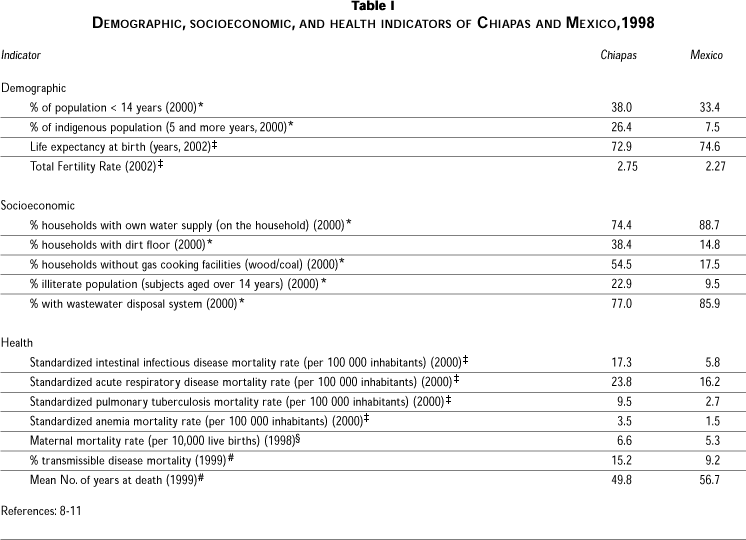
<body><![CDATA[<p><b><font face="Verdana, Arial, Helvetica-Normal, sans-serif" size="2">RESUMEN</font></b></p>     <p><b><font face="Verdana, Arial, Helvetica-Normal, sans-serif" size="2">OBJETIVO:</font></b><font face="Verdana, Arial, Helvetica-Normal, sans-serif" size="2">    Estimar la prevalencia de parasitosis intestinal en ni&ntilde;os de zonas de    alta marginaci&oacute;n y su asociaci&oacute;n con indicadores demogr&aacute;ficos    y socioecon&oacute;micos de inter&eacute;s. <b>    <br>   MATERIAL Y M&Eacute;TODOS:</b> En una muestra de 1478 menores de edad, de entre    1 a 14 a&ntilde;os, provenientes de 32 comunidades de la regi&oacute;n fronteriza    de Chiapas, M&eacute;xico, de marzo a septiembre de 1998, se recolectaron tres    muestras de heces fecales, seleccionadas aleatoriamente a partir del grado de    marginaci&oacute;n (alto y muy alto) del municipio al que pertenecen, y distancia    de la unidad de salud m&aacute;s cercana a la comunidad (&lt;1 hora; 1 hora    o m&aacute;s). En una de cada cuatro viviendas con ni&ntilde;os menores de 15    a&ntilde;os de edad, seleccionadas aleatoriamente, se obtuvieron tres muestras    de heces fecales de &eacute;stos. Se efectuaron an&aacute;lisis bivariados con    la prueba de ji cuadrada y multivariados con modelos lineales generalizados.    <br>   <b>RESULTADOS:</b> La prevalencia global de parasitosis fue de 67% (intervalo    de confianza IC 95% 64-70%). Sesenta por ciento de los ni&ntilde;os estaban    multiparasitados. La prevalencia de <i>Entamoeba histolytica/E dispar</i> fue    de 51.2%, de <i>Giardia lamblia,</i> 18.3% y de <i>Ascaris lumbricoides,</i>    14.5%. La mayor prevalencia de <i>E histolytica/E dispar</i> se asoci&oacute;    con la edad y hablar alg&uacute;n idioma ind&iacute;gena; la de <i>Ascaris lumbricoides</i>    con el sitio de obtenci&oacute;n de agua y la carencia de refrigerador y electricidad.    <b>    <br>   CONCLUSIONES:</b> Es necesario hacer intervenciones locales de salud (calidad    del agua, sistemas de desag&uuml;e), programas de educaci&oacute;n sanitaria    (promoci&oacute;n de la lactancia materna y medidas higi&eacute;nicas) y promoci&oacute;n    del habla de idiomas ind&iacute;genas entre los m&eacute;dicos de la regi&oacute;n.    El texto completo en ingl&eacute;s de este art&iacute;culo tambi&eacute;n est&aacute;    disponible en: <a href="http://www.insp.mx/salud/index.html">http://www.insp.mx/salud/index.html</a></font></p>     <p><b><font face="Verdana, Arial, Helvetica-Normal, sans-serif" size="2">Palabras    clave: </font></b><font face="Verdana, Arial, Helvetica-Normal, sans-serif" size="2">parasitosis    intestinal; pobreza; salud infantil; an&aacute;lisis multivariado; M&eacute;xico</font></p> <hr size="1" noshade>     <p>&nbsp;</p>     <p>&nbsp;</p>     <p><font face="Verdana, Arial, Helvetica-Normal, sans-serif" size="2">Parasitic    infections occur worldwide, mainly affecting the poorer sectors of society.<sup>1</sup>    According to the World Health Organization (WHO),<sup>2</sup> around 1 billion    people are infected by <i>Ascaris</i> or <i>Uncinarius</i>, 500 million by <i>Trichuris</i>    or amoebas, and 200 million by <i>Giardia lamblia</i>. Furthermore, there is    a wide variability in both inter- and intra-regional parasitoses within a given    country and among countries.<sup>3, 4</sup> These differences may be due to    a variety of factors associated with the prevalence of these infections, such    as soil composition, climate, and method of transmission, among others. Similarly,    socioeconomic and health conditions, education and beliefs related to traditional    health practices, as well as the presence of domestic animals in the home and    contamination of water and food, have all been reported as factors associated    with the presence of these diseases.<sup>3, 4</sup> Finally, age is also an    associated factor related to the individual's immunologic status and behavioral    patterns. One should also bear in mind that intestinal parasite infections are    associated with poor physical growth and development, as well as with retardation    of intellectual and cognitive development in children.<sup>5,6</sup></font></p>     <p><font face="Verdana, Arial, Helvetica-Normal, sans-serif" size="2">Several    estimates indicate that over a third (34%) of the Mexican population is aged    under 15 years and that more than 60% of Mexicans live in poverty.<sup>7</sup>    Within the Mexican Republic, Chiapas is one of the states with the worst conditions    of poverty and socioeconomic deprivation (<a href="/img/revistas/spm/v45n5/17742t1.gif">Table    I</a>). Additionally, Chiapas has a high proportion of indigenous population.<sup>12,13</sup>    In 1997 the death rate in Chiapas due to infectious intestinal diseases was    the highest in the country, at 23.9 per 100 000 inhabitants, while the national    figure was 7.8 with the same denominator.<sup>14</sup> The data recorded for    2000 showed the same situation (17.3 <i>versus</i> 5.8, respectively).<sup>9</sup></font></p>     ]]></body>
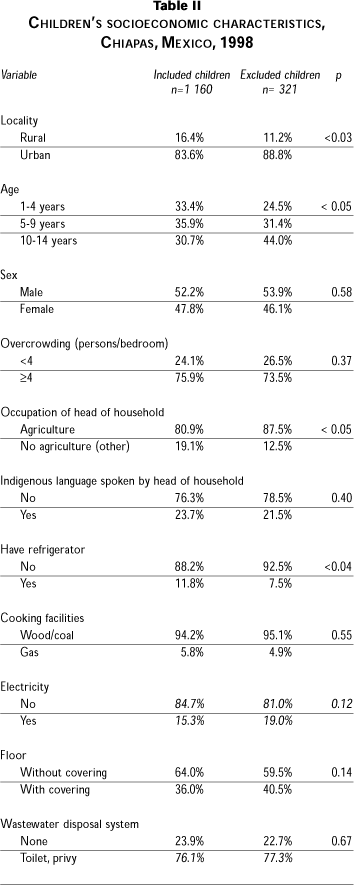
<body><![CDATA[<p><font face="Verdana, Arial, Helvetica-Normal, sans-serif" size="2">A study    carried out in Chiapas during 1994<sup>1</sup> among the non-indigenous population    revealed a higher prevalence of intestinal parasitosis &#150;mainly due to <i>Entamoeba    histolytica</i>&#150; among children of poor peasants than among those of "rich"    peasants. However, the few studies on parasites, which have been carried out    in Mexico in recent years, have mainly focused on determining the prevalence    of these infections without evaluating the associated epidemiological profile.<sup>15</sup>    Moreover, there are practically no studies addressing the magnitude of this    problem in indigenous areas of high and very high levels of poverty.</font></p>     <p><font face="Verdana, Arial, Helvetica-Normal, sans-serif" size="2">In addition,    Chiapas has a predominantly young population and the majority of its inhabitants    live in poverty with a supply of water that is not only scarce but also deficient    in quality.<sup>13,16</sup> This population also has inadequate health coverage    and scarcity of health resources. We decided to conduct a study to assess the    health and living conditions in areas of high and very high poverty levels,<sup>17</sup>    in an attempt to contribute to the improvement of public health in Chiapas,    Mexico. Our main objective was to assess the prevalence of intestinal parasitoses    among children aged 1 to 14 years, and to determine its possible association    with demographic and socioeconomic indicators in one of the regions of greatest    poverty in Chiapas, &#150;the region bordering Guatemala.</font></p>     <p>&nbsp;</p>     <p><font face="Verdana, Arial, Helvetica, sans-serif" size="3"><b>Material and    Methods</b></font></p>     <p><font face="Verdana, Arial, Helvetica-Normal, sans-serif" size="2">The study    was carried out from March to October 1998 in a convenience sample of 32 communities    of the border region of Chiapas, located in the Southeastern part of the state,    bordering Guatemala. This area is one of the poorest regions of Chiapas. The    population of approximately 425 000 inhabitants is conformed predominantly by    peasants, with substantial indigenous settlements, mainly of the Mayan ethnic    group Tojolabal. The majority of its inhabitants is engaged in agricultural    work, has low purchasing power, and practically no social security. In fact,    their health needs, as an "open population" (without social security), are satisfied    only through state-provided health services, or through self-care, including    the use of traditional medicine.<sup>18</sup></font></p>     <p><font face="Verdana, Arial, Helvetica-Normal, sans-serif" size="2">A random    sample of communities was drawn from municipalities with high and very high    poverty levels, considering their level of access to health services, as measured    by the traveling time to the nearest health facilities (&lt;1 hour; 1 hour or    more). The level of poverty proposed by the National Population Council,<sup>19</sup>    is based on an index using the 1990 census information, and nine indicators    considered to be structural in nature (with little change over time), such as    educational level, dwelling conditions, size of community, and monthly income.    All municipalities in Mexico are classified according to this index into five    levels of poverty (from very high to very low). In the border region, two of    twelve municipalities are classified as having "very high" poverty levels (both    of them were included in the sample), nine as "high" (five of them were selected    by simple random sampling), and one is classified as having a "medium" poverty    level (not included in the sample). On the other hand, the level of access to    health services is one of the indicators used to measure the level of development    of countries.<sup>20</sup></font></p>     <p><font face="Verdana, Arial, Helvetica-Normal, sans-serif" size="2">Information    was obtained from 1 878 of the 1 894 households that were selected (non-response    rate of 0.84%). A total of 11 274 people were registered in these households.    The total population in the study area (the municipalities with "high" and "very    high" poverty levels) was estimated at 331 437 persons, representing 9.0% of    the population of Chiapas, distributed among 885 communities.<sup>18</sup></font></p>     <p><font face="Verdana, Arial, Helvetica-Normal, sans-serif" size="2">A standardized    health questionnaire (based on previous studies carried out in Chiapas)<sup>1,21-24</sup>    was administered to all adults in the households studied, which gathered demographic    (age, sex, ethnic group), socioeconomic, and health and services usage information.    The fieldwork was carried out by seven interviewers: four graduate students    (two chemists, one biologist, and one social worker) and three people from the    same region who spoke Tojolabal (the main Mayan language of the region), to    translate when necessary. Of the total number of households, those with children    under 15 years of age were identified, and one in every four of these households    was systematically selected. Stool specimens were obtained from all the children    aged between 1 and 14 years (<i>n</i>=1 478) in each of the households selected.    In some households more than one child provided a specimen.</font></p>     <p><font face="Verdana, Arial, Helvetica-Normal, sans-serif" size="2">Mothers    or guardians of all selected children were asked to obtain three stool specimens    on three consecutive days starting the day following the interview. Mothers    were instructed on how to collect the stool samples and were provided with one    <i>Copropac</i> container per child, filled with Phenol-Alcohol-Formaldehyde    (PhAF) preserving solution,<sup>25</sup> and three wooden spatulas, each one    to be used to obtain one stool specimen, which was subsequently incorporated    into the PhAF solution. Fecal specimen containers were retrieved by fieldworkers    from the collaborating households. The containers were sealed in polystyrene    foam bins using <i>parafilm</i>, for storage and transportation from the communities    under study to the laboratories of the Malaria Research Center (Ministry of    Health), in Tapachula, Chiapas, where they were processed by the Faust Method    by trained laboratory personnel.<sup>26</sup></font></p>     <p><font face="Verdana, Arial, Helvetica-Normal, sans-serif" size="2">A total    of 1 160 children submitted three fecal specimens for analysis (response rate    78.5%). The main reasons for not being able to process specimens from the remaining    318 children were as follows: 224 did not respond, while the others either did    not complete the three specimens, provided insufficient quantities, were currently    taking anti-parasite medication, or the child was not at home during the study    period. Although some indicators (locality, age and occupation of head of household)    showed differences between excluded and included children, the groups were similar    for gender, indigenous language spoken by head of household, and some characteristics    of the households (<a href="#tabela2">Table II</a>).</font></p>     ]]></body>
<body><![CDATA[<p align="center"><a name="tabela2"></a></p>     <p align="center">&nbsp;</p>     <p align="center"><img src="/img/revistas/spm/v45n5/17742t2.gif"></p>     <p align="center">&nbsp;</p>     <p><font face="Verdana, Arial, Helvetica-Normal, sans-serif" size="2">The study    protocol was approved by local authorities and accepted by all adults in each    study community (informed consent was requested at community meetings organized    in each study village).</font></p>     <p><font face="Verdana, Arial, Helvetica-Normal, sans-serif" size="2">Positive    enteroparasitosis was defined as the presence, whether scarce or abundant, of    eggs, cysts, <i>larvae</i>, or parasites in the fecal specimen. To simplify    the presentation of results, despite more parasites being identified, analysis    was restricted to the three most prevalent and epidemiologically important (<i>Entamoeba    histolytica</i>, <i>Giardia lamblia</i>, and <i>Ascaris lumbricoides</i>). They    were analyzed separately, given that bivariate analyses showed that joint distributions    of the parasites were not significant (results not shown). The Faust method    does not differentiate pathogenic and non-pathogenic amoebas such as <i>Entamoeba    dispar</i>, therefore our results are expressed as: <i>Entamoeba histolytica/    Entamoeba dispar</i> infection<i>.</i></font></p>     <p><font face="Verdana, Arial, Helvetica-Normal, sans-serif" size="2">Bivariate    relationships between the above mentioned parasites and factors possibly associated    with their presence were assessed by the chi-square test, or Fisher's exact    test, using the SPSS package for Windows, version 8.0. Multivariate analysis    was performed using generalized linear models for correlated binary data for    each parasite<sup>27-29</sup> with SAS, PROC GENMOD. Models were adjusted for    factors related to the presence of parasites in the bivariate analyses and according    to epidemiological criteria. Therefore, the method used was the "enter" method.</font></p>     <p>&nbsp;</p>     <p><font face="Verdana, Arial, Helvetica, sans-serif" size="3"><b>Results</b></font></p>     <p><font face="Verdana, Arial, Helvetica-Normal, sans-serif" size="2">The mean    age of study subjects was 6.8 years (standard deviation [SD] 3.9), with 33%    aged between 1 and 4 years, 36% aged 5 to 9 years, and 31% 10 to 14 years. The    percentage of males was 52.1. With respect to socioeconomic indicators, 64%    lived in houses with dirt floors, 86% used wood as the cooking fuel, only 12%    lived in houses having a refrigerator, and 24% lived in houses with no sewage    disposal system.</font></p>     ]]></body>
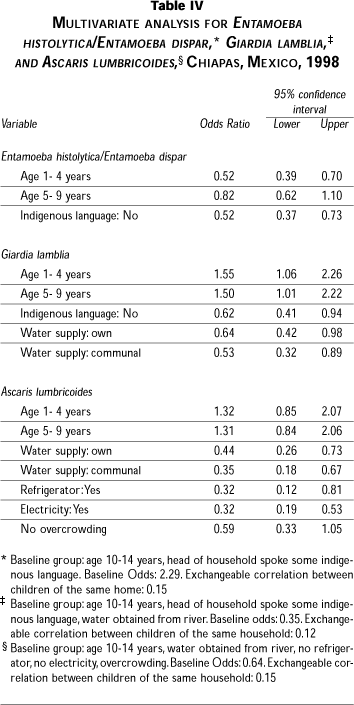
<body><![CDATA[<p><font face="Verdana, Arial, Helvetica-Normal, sans-serif" size="2">At least    one parasite was found in 776 of the children studied, yielding a global intestinal    parasitosis prevalence of 67% (CI 95%: 64-70%). Of these 776, 40% had one species    of parasite, 43% had two, 15% had three, and 2% had four. The distribution of    identified parasites was as follows: <i>Entamoeba histolytica/Entamoeba dispar</i>    51.2%, <i>Entamoeba coli</i> 32.9%, <i>Giardia lamblia</i> 18.3%, <i>Ascaris    lumbricoides</i> 14.5%, <i>Hymenolepis nana</i> 1.5%, <i>Trichuris trichuria</i>    0.8%, and <i>Iodamoeba butschlii</i> 0.1%.</font></p>     <p><font face="Verdana, Arial, Helvetica-Normal, sans-serif" size="2">Factors    associated with a higher prevalence of <i>Entamoeba histolytica/Entamoeba dispar</i>    (<a href="/img/revistas/spm/v45n5/17742t3.gif">Table III</a>) were: living in a locality classified    as having very high poverty; head of household speaking an indigenous language;    lack of a refrigerator in the home; river as the main source of water; and child's    age between 1 and 4 years.</font></p>     <p><font face="Verdana, Arial, Helvetica-Normal, sans-serif" size="2">Factors    associated with <i>Giardia lamblia</i> infection were: locality being classified    as having very high poverty, head of household speaking an indigenous language;    house with dirt floor; obtaining water from either a public well or from a river;    and child's age between 1 and 9 years.</font></p>     <p><font face="Verdana, Arial, Helvetica-Normal, sans-serif" size="2">Finally,    <i>Ascaris lumbricoides</i> was the parasite statistically associated with the    greatest number of factors. Practically all household-related indicators denoting    greater poverty were found to be associated with this helminth: lack of electricity,    lack of refrigerator; use of wood as cooking fuel; dirt floor; water supply    from communal source or river; overcrowding; and, as expected, living in a locality    classified as having very high poverty; head of household speaking an indigenous    language; and child's age between 10 and 14 years (<a href="/img/revistas/spm/v45n5/17742t3.gif">Table    III</a>).</font></p>     <p><font face="Verdana, Arial, Helvetica-Normal, sans-serif" size="2"><a href="#tabela4">Table    IV</a> shows the models including only the variables associated with the presence    of parasites, and the variables of epidemiological importance (such as age or    overcrowding) in the study of each parasite, as well as other variables indicating    the level of poverty (living conditions and educational level). Within the three    models, only the variables age and indigenous language were found to be significantly    associated with the presence of <i>Entamoeba histolytica/Entamoeba dispar</i>,    while for <i>Giardia lamblia</i> the significant variables were those mentioned    above and, additionally, the water source (<a href="#tabela4">Table IV</a>).    The variables associated with the presence of <i>Ascaris lumbricoides</i> were:    water source, and two conditions related to characteristics of the home &#150;having    a refrigerator and having electricity. However, age and overcrowding were retained    in the model due to their epidemiological importance in the study of this parasite    (<a href="#tabela4">Table IV</a>).</font></p>     <p align="center"><a name="tabela4"></a></p>     <p align="center">&nbsp;</p>     <p align="center"><img src="/img/revistas/spm/v45n5/17742t4.gif"></p>     <p align="center">&nbsp;</p>     <p><font face="Verdana, Arial, Helvetica-Normal, sans-serif" size="2">Finally,    it should be noted that in the three models fitted, the correlation between    children in the same home was below 0.2.</font></p>     ]]></body>
<body><![CDATA[<p>&nbsp;</p>     <p><font face="Verdana, Arial, Helvetica, sans-serif" size="3"><b>Discussion</b></font></p>     <p><font face="Verdana, Arial, Helvetica-Normal, sans-serif" size="2">Study findings    indicate a prevalence of 67% for intestinal parasitosis among the population    1 to 14 years of age in areas of high and very high poverty in the border region    of Chiapas, Mexico, almost two thirds (60%) of whom are infected with several    parasites. Thus, in this region, intestinal parasitosis infection is a common    phenomenon.</font></p>     <p><font face="Verdana, Arial, Helvetica-Normal, sans-serif" size="2">This fact    is very important, given that Chiapas is one of the Mexican states with the    highest rates of diarrheic diseases. It has the highest rate of death associated    with diarrhea (four times higher than the rate for Mexico as a whole) and 50%    of these deaths occur among children aged under 15 years.<sup>30</sup></font></p>     <p><font face="Verdana, Arial, Helvetica-Normal, sans-serif" size="2">The overall    distribution of parasite prevalence is consistent with that found by most of    studies undertaken in Mexico and in other countries, <i>Entamoeba histolytica</i>    and <i>Giardia lamblia</i> being the most common protozoa, and <i>Ascaris lumbricoides</i>    the most common helminth.<sup>31-34</sup> However, the percentages do not coincide.    This may be due to a variety of factors such as employment of differing diagnostic    techniques (we were unable to differentiate between pathogenic amoebas and non-pathogenic    ones such as <i>Entamoeba dispar</i>), geographical differences, or due to different    demographic and socioeconomic patterns of the populations studied (age, presence    of indigenous groups, rural <i>versus</i> urban areas).<sup>35</sup></font></p>     <p><font face="Verdana, Arial, Helvetica-Normal, sans-serif" size="2">One of the    most important factors associated with the presence of protozoa was the head    of household speaking an indigenous language. This condition probably reflects,    on the one hand, the poverty level of the indigenous population studied, and    on the other, problems in communication between these people and the health    services: many indigenous people have difficulty in speaking Spanish, and doctors    at health centers do not speak the indigenous language predominant in the region    (almost 100% of doctors working in health services in Chiapas speak no indigenous    language). Both situations affect access to health services and to health information.    At the same time, they can be associated with worse living conditions,<sup>18</sup>    as well as with habits, beliefs and health practices different from those promoted    by institutional medicine.<sup>33</sup></font></p>     <p><font face="Verdana, Arial, Helvetica-Normal, sans-serif" size="2">Age was    also found to be significantly associated with the prevalence of protozoa (<i>Entamoeba    histolytica/Entamoeba dispar</i> and <i>Giardia lamblia</i>). A lower prevalence    of <i>Entamoeba histolytica/Entamoeba dispar</i> was observed in the group aged    from 1 to 4 years. This could be due to the fact that generally children in    the areas where the other studies were carried out are breast-fed beyond one    year of age 1, and it is not uncommon for breast-feeding to continue until two    years or even longer (around 50%, data not shown). Thus, children receive immunological    protection through their mother's milk.<sup>36</sup> Two additional factors    must also be considered: that at this stage of infancy the child interacts less    with its surroundings; and secondly that liquids other than breast milk are    most commonly tea or coffee, thus ensuring that the water consumed has been    boiled.</font></p>     <p><font face="Verdana, Arial, Helvetica-Normal, sans-serif" size="2">In contrast,    a higher prevalence of <i>Giardia lamblia</i> parasitosis was found in the groups    aged from 1 to 9 years, an association that has been reported by other authors.<sup>36-38</sup>    The highest prevalence was among those aged under 5, which decreased as age    increased. Once again, the coexistence of two factors could explain the higher    prevalence of this parasite among the younger children: on the one hand immaturity    of the humoral immune response, which plays a very important role in controlling    <i>Giardia lamblia</i> infections but not so much in the case of <i>Entamoeba    histolytica,</i><sup>39</sup> and on the other hand, the presence of malnutrition,    to a greater or lesser extent, which in turn reduces both cellular and humoral    immune defenses.<sup>40</sup> Several studies have shown that Chiapas, along    with Oaxaca, are the Mexican states with the highest height deficit rates. For    example, among first grade elementary school children height deficit is 44.1%,    which contrasts with the national figure of 18.7%, and more dramatically when    compared to the state of Baja California (in the North of Mexico), where only    4.3% of such children have a height deficit.<sup>41</sup> Another study carried    out in 1996, an striking prevalence (51%) of height deficit in Chiapas was found    in children under five years.<sup>42</sup></font></p>     <p><font face="Verdana, Arial, Helvetica-Normal, sans-serif" size="2">Regarding    the association between <i>Giardia lamblia</i> parasitosis and obtaining water    for domestic consumption directly from rivers, it is important to note that    this practice makes it necessary to consider the possibilities of infection    by this parasite. River water is an exposed source and it is vulnerable to a    variety of types of contamination, not only environmental but also during its    transport, usually in non-hygienic conditions.</font></p>     <p><font face="Verdana, Arial, Helvetica-Normal, sans-serif" size="2">Although    it has been reported that ascariosis shows convex prevalence and intensity patterns    with age,<sup>27,43,44</sup> in our study no significant association was found    between age and the presence of ascariosis. Two plausible explanations for this    fact can be advanced: firstly, it has been reported that <i>Ascaris lumbricoides</i>    is more prevalent in children than adults, but its physiopathology is not associated    with an individual's predisposition related to age in terms of growth; secondly,    overcrowding among the population under study could affect this association    (in the present study overcrowding was at the borderline of statistical significance).    It should be pointed out that the literature which we consulted<sup>27,39,43-46</sup>    revealed that age is found to be a significant factor for <i>Ascaris lumbricoides</i>,    precisely when overcrowding is not taken into account. However, in the multivariate    analysis age was retained since it is traditionally associated with the presence    of this helminth.</font></p>     ]]></body>
<body><![CDATA[<p><font face="Verdana, Arial, Helvetica-Normal, sans-serif" size="2">Similarly,    <i>Ascaris lumbricoides</i> is also more prevalent in the less favored social    classes, which may be explained by their closer contact with soil and harsh    environmental conditions.<sup>38,43,46</sup> Thus, lacking a refrigerator and    electricity is an indirect measure of the family's economic situation and could    be related to higher probabilities of food contamination. This should be taken    into account precisely because it is in populations of this type that moderate    or severe ascariosis infection has been associated with malnutrition and growth    retardation in children.<sup>30</sup></font></p>     <p><font face="Verdana, Arial, Helvetica-Normal, sans-serif" size="2">With regard    to bacteriological water quality, the present study is limited when it comes    to analyzing the relationship between the bacteriological quality of drinking    water and the presence of parasites in the child. As we reported in another    article,<sup>47</sup> difficulties in access to the study area (geographical,    climatic and those specific to the armed conflict that began in 1994), as well    as budget problems, meant that water samples could only be obtained from 99    of the 1,874 households under study. In 67% of these 99 households the bacteriological    quality of the water was poor (three or more CFU/100 ml of total coliforms).<sup>48</sup>    This finding, although based on a small sample, reflects the problems of drinking    water contamination as well as the lack of adequate water supply systems in    most of the communities, which are predominantly rural. In many studies, water    contamination was associated with high intestinal parasitic infection.<sup>27,33</sup></font></p>     <p><font face="Verdana, Arial, Helvetica-Normal, sans-serif" size="2">The variable    maternal education level<sup>33</sup> has been found to be significantly associated    with parasitosis in other studies; however, in our survey it was not significant,    there were not enough data (information was obtained from about 377 mothers)    or most of the mothers from whom information was collected had very low education    levels (&lt; three years formal education).</font></p>     <p><font face="Verdana, Arial, Helvetica-Normal, sans-serif" size="2">Even so,    it should be noted that the low correlation estimated by the three models suggests    that the variables included explain well enough the presence or absence of intestinal    parasitosis. In other words, it would appear that no important variables have    been omitted which could help to significantly explain the clustering, in this    case family- or household-related, of the variable under study.</font></p>     <p>&nbsp;</p>     <p><font face="Verdana, Arial, Helvetica, sans-serif" size="3"><b>Conclusions</b></font></p>     <p><font face="Verdana, Arial, Helvetica-Normal, sans-serif" size="2">The results    obtained in the present study, along with the excessive death rates due to infectious    intestinal diseases en Chiapas, highlight the compulsory nature of the need    for programs to be developed to reduce the observed prevalence of parasitosis    and to raise the quality of life and health of these highly deprived populations.</font></p>     <p><font face="Verdana, Arial, Helvetica-Normal, sans-serif" size="2">In the particular    case of enteroparasitosis, urgent measures should be taken to improve water    quality, sewage disposal and domestic hygiene, and to promote breast-feeding,    as well as education policies aimed at reinforcing the use of indigenous languages    by physicians in the health services.</font></p>     <p>&nbsp;</p>     <p><font face="Verdana, Arial, Helvetica, sans-serif" size="3"><b>Acknowledgements</b></font></p>     ]]></body>
<body><![CDATA[<p><font face="Verdana, Arial, Helvetica-Normal, sans-serif" size="2">The authors    would like to express their gratitude to Alejandro Flores, Mar&iacute;a Luisa    Estudillo, Roberto Sol&iacute;s, Trinidad P&eacute;rez (El Colegio de la Frontera    Sur) and David Monterde (Universidad Aut&oacute;noma de Barcelona, Spain) for    their participation in data collection and data analysis; also to David McFarlane    for his invaluable comments to this manuscript.</font></p>     <p>&nbsp;</p>     <p><font face="Verdana, Arial, Helvetica, sans-serif" size="3"><b>References</b></font></p>     <!-- ref --><p><font face="Verdana, Arial, Helvetica-Normal, sans-serif" size="2">1. Ochoa-D&iacute;az    H, S&aacute;nchez-P&eacute;rez HJ, Ruiz-Flores M, Fuller M. Social inequalities    and health in rural Chiapas, Mexico: Agricultural economy, nutrition, and child    health in La Fraylesca Region. Cad Saude Publica, R&iacute;o de Janeiro 1999;15:261-70.</font>&nbsp;&nbsp;&nbsp;&nbsp;&nbsp;&nbsp;&nbsp;&nbsp;[&#160;<a href="javascript:void(0);" onclick="javascript: window.open('/scielo.php?script=sci_nlinks&ref=9172705&pid=S0036-3634200300050000800001&lng=','','width=640,height=500,resizable=yes,scrollbars=1,menubar=yes,');">Links</a>&#160;]<!-- end-ref --><!-- ref --><p><font face="Verdana, Arial, Helvetica-Normal, sans-serif" size="2">2. World    Health Organization. Prevention and control of intestinal parasitic infections.    Geneva: WHO, 1987;Technical report series N749.</font>&nbsp;&nbsp;&nbsp;&nbsp;&nbsp;&nbsp;&nbsp;&nbsp;[&#160;<a href="javascript:void(0);" onclick="javascript: window.open('/scielo.php?script=sci_nlinks&ref=9172706&pid=S0036-3634200300050000800002&lng=','','width=640,height=500,resizable=yes,scrollbars=1,menubar=yes,');">Links</a>&#160;]<!-- end-ref --><!-- ref --><p><font face="Verdana, Arial, Helvetica-Normal, sans-serif" size="2">3. Jemaneh    L. Comparative prevalences of some common intestinal helminth infections in    different altitudinal regions in Ethiopia. Ethiop Med J 1998;36:1-8.</font>&nbsp;&nbsp;&nbsp;&nbsp;&nbsp;&nbsp;&nbsp;&nbsp;[&#160;<a href="javascript:void(0);" onclick="javascript: window.open('/scielo.php?script=sci_nlinks&ref=9172707&pid=S0036-3634200300050000800003&lng=','','width=640,height=500,resizable=yes,scrollbars=1,menubar=yes,');">Links</a>&#160;]<!-- end-ref --><!-- ref --><p><font face="Verdana, Arial, Helvetica-Normal, sans-serif" size="2">4. Long    Qi Xu, Sen Hai Yu, Ze Xiao Jiang, Jia Lun Yang, Chang Qiu Lai, Xiang Jun Zhang    <i>et al</i>. Soil transmitted helminthiases: Nationwide survey in China. Bull    World Health Organ 1995;73:507-513.</font>&nbsp;&nbsp;&nbsp;&nbsp;&nbsp;&nbsp;&nbsp;&nbsp;[&#160;<a href="javascript:void(0);" onclick="javascript: window.open('/scielo.php?script=sci_nlinks&ref=9172708&pid=S0036-3634200300050000800004&lng=','','width=640,height=500,resizable=yes,scrollbars=1,menubar=yes,');">Links</a>&#160;]<!-- end-ref --><!-- ref --><p><font face="Verdana, Arial, Helvetica-Normal, sans-serif" size="2">5. Callender    J, Grantham-McGregor SM, Walker S, Cooper E. <i>Trichuris</i> infection and    mental development in children. Lancet 1992;339:181.</font>&nbsp;&nbsp;&nbsp;&nbsp;&nbsp;&nbsp;&nbsp;&nbsp;[&#160;<a href="javascript:void(0);" onclick="javascript: window.open('/scielo.php?script=sci_nlinks&ref=9172709&pid=S0036-3634200300050000800005&lng=','','width=640,height=500,resizable=yes,scrollbars=1,menubar=yes,');">Links</a>&#160;]<!-- end-ref --><!-- ref --><p><font face="Verdana, Arial, Helvetica-Normal, sans-serif" size="2">6. Nokes    C, Grantham-McGregor S, Sawyer A, Cooper E, Bundy DAP. Parasitic helminth infection    and cognitive function in schoolchildren. Proc R Soc Lond. B Biological Sci    1992;247:77-81.</font>&nbsp;&nbsp;&nbsp;&nbsp;&nbsp;&nbsp;&nbsp;&nbsp;[&#160;<a href="javascript:void(0);" onclick="javascript: window.open('/scielo.php?script=sci_nlinks&ref=9172710&pid=S0036-3634200300050000800006&lng=','','width=640,height=500,resizable=yes,scrollbars=1,menubar=yes,');">Links</a>&#160;]<!-- end-ref --><!-- ref --><p><font face="Verdana, Arial, Helvetica-Normal, sans-serif" size="2">7. Pan American    Health Organization. La salud en las Am&eacute;ricas, 1998. [serial on line];    II: 403 &#150; 418. Washington, DC: PAHO, 1998. Available from: URL: <a href="http://www.paho.org/Spanish/SHA/HIA_1998ed.htm">http://www.paho.org/Spanish/SHA/HIA_1998ed.htm</a>.</font>&nbsp;&nbsp;&nbsp;&nbsp;&nbsp;&nbsp;&nbsp;&nbsp;[&#160;<a href="javascript:void(0);" onclick="javascript: window.open('/scielo.php?script=sci_nlinks&ref=9172711&pid=S0036-3634200300050000800007&lng=','','width=640,height=500,resizable=yes,scrollbars=1,menubar=yes,');">Links</a>&#160;]<!-- end-ref --><!-- ref --><p><font face="Verdana, Arial, Helvetica-Normal, sans-serif" size="2">8. Instituto    Nacional de Estad&iacute;stica, Geograf&iacute;a e Inform&aacute;tica. Tabulados    b&aacute;sicos nacionales y por entidad federativa. XII Censo General de Poblaci&oacute;n    y Vivienda 2000. M&eacute;xico, DF: INEGI, 2001.</font>&nbsp;&nbsp;&nbsp;&nbsp;&nbsp;&nbsp;&nbsp;&nbsp;[&#160;<a href="javascript:void(0);" onclick="javascript: window.open('/scielo.php?script=sci_nlinks&ref=9172712&pid=S0036-3634200300050000800008&lng=','','width=640,height=500,resizable=yes,scrollbars=1,menubar=yes,');">Links</a>&#160;]<!-- end-ref --><!-- ref --><p><font face="Verdana, Arial, Helvetica-Normal, sans-serif" size="2">9. Secretar&iacute;a    de Salud, Direcci&oacute;n General de Informaci&oacute;n y Evaluaci&oacute;n    del Desempe&ntilde;o. Sistema Nacional de Informaci&oacute;n en Salud (SINAIS).    M&eacute;xico, DF: SSA, 2003. Disponible tambi&eacute;n en: <a href="http://www.ssa.gob.mx">http://www.ssa.gob.mx</a>.</font>&nbsp;&nbsp;&nbsp;&nbsp;&nbsp;&nbsp;&nbsp;&nbsp;[&#160;<a href="javascript:void(0);" onclick="javascript: window.open('/scielo.php?script=sci_nlinks&ref=9172713&pid=S0036-3634200300050000800009&lng=','','width=640,height=500,resizable=yes,scrollbars=1,menubar=yes,');">Links</a>&#160;]<!-- end-ref --><!-- ref --><p><font face="Verdana, Arial, Helvetica-Normal, sans-serif" size="2">10. Secretar&iacute;a    de Salud. La situaci&oacute;n de los estados, 1999. M&eacute;xico, DF: SSA,    2001.</font>&nbsp;&nbsp;&nbsp;&nbsp;&nbsp;&nbsp;&nbsp;&nbsp;[&#160;<a href="javascript:void(0);" onclick="javascript: window.open('/scielo.php?script=sci_nlinks&ref=9172714&pid=S0036-3634200300050000800010&lng=','','width=640,height=500,resizable=yes,scrollbars=1,menubar=yes,');">Links</a>&#160;]<!-- end-ref --><!-- ref --><p><font face="Verdana, Arial, Helvetica-Normal, sans-serif" size="2">11. Secretar&iacute;a    de Salud. Direcci&oacute;n General de Estad&iacute;stica e Inform&aacute;tica.    Principales resultados de la estad&iacute;stica sobre mortalidad en M&eacute;xico,    1999. Salud Publica Mex 2001;43:67-73.</font>&nbsp;&nbsp;&nbsp;&nbsp;&nbsp;&nbsp;&nbsp;&nbsp;[&#160;<a href="javascript:void(0);" onclick="javascript: window.open('/scielo.php?script=sci_nlinks&ref=9172715&pid=S0036-3634200300050000800011&lng=','','width=640,height=500,resizable=yes,scrollbars=1,menubar=yes,');">Links</a>&#160;]<!-- end-ref --><!-- ref --><p><font face="Verdana, Arial, Helvetica-Normal, sans-serif" size="2">12. Consejo    Nacional de Poblaci&oacute;n. La situaci&oacute;n demogr&aacute;fica de M&eacute;xico.    2a. ed. M&eacute;xico, DF: Conapo, 1998.</font>&nbsp;&nbsp;&nbsp;&nbsp;&nbsp;&nbsp;&nbsp;&nbsp;[&#160;<a href="javascript:void(0);" onclick="javascript: window.open('/scielo.php?script=sci_nlinks&ref=9172716&pid=S0036-3634200300050000800012&lng=','','width=640,height=500,resizable=yes,scrollbars=1,menubar=yes,');">Links</a>&#160;]<!-- end-ref --><!-- ref --><p><font face="Verdana, Arial, Helvetica-Normal, sans-serif" size="2">13. S&aacute;nchez-P&eacute;rez    HJ, Ochoa-D&iacute;az H, Miranda-Ocampo R. La situaci&oacute;n de salud en Chiapas:    consideraciones para su an&aacute;lisis. En: Miranda OR, Valqui C, ed. Chiapas:    el regreso a la utop&iacute;a. M&eacute;xico, DF: Ed. Comuna, Universidad Aut&oacute;noma    de Guerrero, 1995:63-80.</font>&nbsp;&nbsp;&nbsp;&nbsp;&nbsp;&nbsp;&nbsp;&nbsp;[&#160;<a href="javascript:void(0);" onclick="javascript: window.open('/scielo.php?script=sci_nlinks&ref=9172717&pid=S0036-3634200300050000800013&lng=','','width=640,height=500,resizable=yes,scrollbars=1,menubar=yes,');">Links</a>&#160;]<!-- end-ref --><!-- ref --><p><font face="Verdana, Arial, Helvetica-Normal, sans-serif" size="2">14. Secretar&iacute;a    de Salud. Direcci&oacute;n General de Estad&iacute;stica e Inform&aacute;tica.    Principales resultados de la estad&iacute;stica sobre mortalidad en M&eacute;xico,    1997. Salud Publica Mex 1998;40:517-523.</font>&nbsp;&nbsp;&nbsp;&nbsp;&nbsp;&nbsp;&nbsp;&nbsp;[&#160;<a href="javascript:void(0);" onclick="javascript: window.open('/scielo.php?script=sci_nlinks&ref=9172718&pid=S0036-3634200300050000800014&lng=','','width=640,height=500,resizable=yes,scrollbars=1,menubar=yes,');">Links</a>&#160;]<!-- end-ref --><!-- ref --><p><font face="Verdana, Arial, Helvetica-Normal, sans-serif" size="2">15. Tay    J, Ruiz A, Schenone H, Robert L, S&aacute;nchez-Vega J, Uribarren T <i>et al</i>.    Frecuencia de las protozoosis intestinales en la Rep&uacute;blica Mexicana.    Bol Chil Parasitol 1994;49:9-15.</font>&nbsp;&nbsp;&nbsp;&nbsp;&nbsp;&nbsp;&nbsp;&nbsp;[&#160;<a href="javascript:void(0);" onclick="javascript: window.open('/scielo.php?script=sci_nlinks&ref=9172719&pid=S0036-3634200300050000800015&lng=','','width=640,height=500,resizable=yes,scrollbars=1,menubar=yes,');">Links</a>&#160;]<!-- end-ref --><!-- ref --><p><font face="Verdana, Arial, Helvetica-Normal, sans-serif" size="2">16. Secretar&iacute;a    de Medio Ambiente, Recursos Naturales y Pesca, Comisi&oacute;n Nacional del    Agua. Programa Hidr&aacute;ulico de Gran Visi&oacute;n </font><font face="Verdana, Arial, Helvetica-Normal, sans-serif" size="2">2001-2025.    Documento preliminar para an&aacute;lisis en el Consejo Consultivo Nacional    para el Desarrollo Sustentable, M&eacute;xico, DF: SEMARNAP, CNA, 2001.</font>&nbsp;&nbsp;&nbsp;&nbsp;&nbsp;&nbsp;&nbsp;&nbsp;[&#160;<a href="javascript:void(0);" onclick="javascript: window.open('/scielo.php?script=sci_nlinks&ref=9172720&pid=S0036-3634200300050000800016&lng=','','width=640,height=500,resizable=yes,scrollbars=1,menubar=yes,');">Links</a>&#160;]<!-- end-ref --><!-- ref --><p><font face="Verdana, Arial, Helvetica-Normal, sans-serif" size="2">17. S&aacute;nchez-P&eacute;rez    HJ, Jans&agrave; JM, Mart&iacute;n-Mateo M. Hacia un mejor control de la tuberculosis    pulmonar en el estado de Chiapas, M&eacute;xico. San Crist&oacute;bal de las    Casas: El Colegio de la Frontera Sur, Instituto Municipal de la Salud de Barcelona,    Universidad Aut&oacute;noma de Barcelona, 1996.</font>&nbsp;&nbsp;&nbsp;&nbsp;&nbsp;&nbsp;&nbsp;&nbsp;[&#160;<a href="javascript:void(0);" onclick="javascript: window.open('/scielo.php?script=sci_nlinks&ref=9172721&pid=S0036-3634200300050000800017&lng=','','width=640,height=500,resizable=yes,scrollbars=1,menubar=yes,');">Links</a>&#160;]<!-- end-ref --><!-- ref --><p><font face="Verdana, Arial, Helvetica-Normal, sans-serif" size="2">18. S&aacute;nchez-P&eacute;rez    HJ. Tuberculosis pulmonar en zonas de alta marginaci&oacute;n socioecon&oacute;mica    de Chiapas, M&eacute;xico: problemas y retos a superar. El Caso de la Regi&oacute;n    Fronteriza [tesis doctoral]. Barcelona: Universitat Aut&ograve;noma de Barcelona,    1999.</font>&nbsp;&nbsp;&nbsp;&nbsp;&nbsp;&nbsp;&nbsp;&nbsp;[&#160;<a href="javascript:void(0);" onclick="javascript: window.open('/scielo.php?script=sci_nlinks&ref=9172722&pid=S0036-3634200300050000800018&lng=','','width=640,height=500,resizable=yes,scrollbars=1,menubar=yes,');">Links</a>&#160;]<!-- end-ref --><!-- ref --><p><font face="Verdana, Arial, Helvetica-Normal, sans-serif" size="2">19. Consejo    Nacional de Poblaci&oacute;n. Indicadores socioecon&oacute;micos e &iacute;ndice    de marginaci&oacute;n municipal, M&eacute;xico 1990. M&eacute;xico, DF: Conapo,    1993.</font>&nbsp;&nbsp;&nbsp;&nbsp;&nbsp;&nbsp;&nbsp;&nbsp;[&#160;<a href="javascript:void(0);" onclick="javascript: window.open('/scielo.php?script=sci_nlinks&ref=9172723&pid=S0036-3634200300050000800019&lng=','','width=640,height=500,resizable=yes,scrollbars=1,menubar=yes,');">Links</a>&#160;]<!-- end-ref --><!-- ref --><p><font face="Verdana, Arial, Helvetica-Normal, sans-serif" size="2">20. The    World Bank. World Development Report 1997. The state in a changing world. Washington:    Oxford University Press, 1997.</font>&nbsp;&nbsp;&nbsp;&nbsp;&nbsp;&nbsp;&nbsp;&nbsp;[&#160;<a href="javascript:void(0);" onclick="javascript: window.open('/scielo.php?script=sci_nlinks&ref=9172724&pid=S0036-3634200300050000800020&lng=','','width=640,height=500,resizable=yes,scrollbars=1,menubar=yes,');">Links</a>&#160;]<!-- end-ref --><!-- ref --><p><font face="Verdana, Arial, Helvetica-Normal, sans-serif" size="2">21. Gobierno    del Estado de Chiapas, Secretar&iacute;a de Desarrollo Social del Estado de    Chiapas. La marginaci&oacute;n por localidad en cifras 2000 (versi&oacute;n    disco compacto). Tuxtla Guti&eacute;rrez, Chiapas: Gobierno del Estado de Chiapas,    2002.</font>&nbsp;&nbsp;&nbsp;&nbsp;&nbsp;&nbsp;&nbsp;&nbsp;[&#160;<a href="javascript:void(0);" onclick="javascript: window.open('/scielo.php?script=sci_nlinks&ref=9172725&pid=S0036-3634200300050000800021&lng=','','width=640,height=500,resizable=yes,scrollbars=1,menubar=yes,');">Links</a>&#160;]<!-- end-ref --><!-- ref --><p><font face="Verdana, Arial, Helvetica-Normal, sans-serif" size="2">22. S&aacute;nchez-P&eacute;rez    HJ, Ochoa-D&iacute;az H, Garc&iacute;a-Gil M, Mart&iacute;n-Mateo M. Bienestar    social y servicios de salud en la Regi&oacute;n Fraylesca de Chiapas: el uso    de servicios de atenci&oacute;n prenatal. Salud Publica Mex 1997;39:530-538.</font>&nbsp;&nbsp;&nbsp;&nbsp;&nbsp;&nbsp;&nbsp;&nbsp;[&#160;<a href="javascript:void(0);" onclick="javascript: window.open('/scielo.php?script=sci_nlinks&ref=9172726&pid=S0036-3634200300050000800022&lng=','','width=640,height=500,resizable=yes,scrollbars=1,menubar=yes,');">Links</a>&#160;]<!-- end-ref --><!-- ref --><p><font face="Verdana, Arial, Helvetica-Normal, sans-serif" size="2">23. S&aacute;nchez-P&eacute;rez    HJ, Garc&iacute;a-Gil M, Halperin D. Pulmonary tuberculosis in the Border Region    of Chiapas, Mexico. Int J Tuberc Lung Dis 1998;2:37-43.</font>&nbsp;&nbsp;&nbsp;&nbsp;&nbsp;&nbsp;&nbsp;&nbsp;[&#160;<a href="javascript:void(0);" onclick="javascript: window.open('/scielo.php?script=sci_nlinks&ref=9172727&pid=S0036-3634200300050000800023&lng=','','width=640,height=500,resizable=yes,scrollbars=1,menubar=yes,');">Links</a>&#160;]<!-- end-ref --><!-- ref --><p><font face="Verdana, Arial, Helvetica-Normal, sans-serif" size="2">24. Ocampo-Torres    M, S&aacute;nchez-P&eacute;rez HJ, Nazar-Beutelspacher A, Castro-Ram&iacute;rez    AE, Cordero-Ocampo B. Factores asociados a la colonizaci&oacute;n por <i>Streptococcus</i>    del grupo B en mujeres embarazadas de los Altos de Chiapas. Salud Publica Mex    2000;42:413-421.</font>&nbsp;&nbsp;&nbsp;&nbsp;&nbsp;&nbsp;&nbsp;&nbsp;[&#160;<a href="javascript:void(0);" onclick="javascript: window.open('/scielo.php?script=sci_nlinks&ref=9172728&pid=S0036-3634200300050000800024&lng=','','width=640,height=500,resizable=yes,scrollbars=1,menubar=yes,');">Links</a>&#160;]<!-- end-ref --><!-- ref --><p><font face="Verdana, Arial, Helvetica-Normal, sans-serif" size="2">25. Cruz-L&oacute;pez    A, Cort&eacute;s R, Valerd&iacute; G, Gonz&aacute;lez E. Uso masivo de la coproparasitoscop&iacute;a    con FAF. Salud Publica Mex 1989;31:536-540.</font>&nbsp;&nbsp;&nbsp;&nbsp;&nbsp;&nbsp;&nbsp;&nbsp;[&#160;<a href="javascript:void(0);" onclick="javascript: window.open('/scielo.php?script=sci_nlinks&ref=9172729&pid=S0036-3634200300050000800025&lng=','','width=640,height=500,resizable=yes,scrollbars=1,menubar=yes,');">Links</a>&#160;]<!-- end-ref --><!-- ref --><p><font face="Verdana, Arial, Helvetica-Normal, sans-serif" size="2">26. Giono-Cerezo    S, Escobar-Guit&eacute;rrez A, Valdespino JL, ed. Diagn&oacute;stico de laboratorio    de infecciones gastrointestinales. M&eacute;xico, DF: Secretar&iacute;a de Salud,    Instituto Nacional de Diagn&oacute;stico y Referencia Epidemiol&oacute;gicos,    1994:411-432.</font>&nbsp;&nbsp;&nbsp;&nbsp;&nbsp;&nbsp;&nbsp;&nbsp;[&#160;<a href="javascript:void(0);" onclick="javascript: window.open('/scielo.php?script=sci_nlinks&ref=9172730&pid=S0036-3634200300050000800026&lng=','','width=640,height=500,resizable=yes,scrollbars=1,menubar=yes,');">Links</a>&#160;]<!-- end-ref --><!-- ref --><p><font face="Verdana, Arial, Helvetica-Normal, sans-serif" size="2">27. Curtale    F, Pezzotti P, Saad Y, Aloi A. An analysis of individual, household, and environmental    risk factors for intestinal helminth infection among children in Qena Governorate,    Upper Egypt. J Trop Pediatr 1999;45:14-17.</font>&nbsp;&nbsp;&nbsp;&nbsp;&nbsp;&nbsp;&nbsp;&nbsp;[&#160;<a href="javascript:void(0);" onclick="javascript: window.open('/scielo.php?script=sci_nlinks&ref=9172731&pid=S0036-3634200300050000800027&lng=','','width=640,height=500,resizable=yes,scrollbars=1,menubar=yes,');">Links</a>&#160;]<!-- end-ref --><!-- ref --><p><font face="Verdana, Arial, Helvetica-Normal, sans-serif" size="2">28. Lipsitz    S, Kim K, Zhao L. Analysis of repeated categorical data using generalized estimating    equations. Stat Med 1994;13:1149-1163.</font>&nbsp;&nbsp;&nbsp;&nbsp;&nbsp;&nbsp;&nbsp;&nbsp;[&#160;<a href="javascript:void(0);" onclick="javascript: window.open('/scielo.php?script=sci_nlinks&ref=9172732&pid=S0036-3634200300050000800028&lng=','','width=640,height=500,resizable=yes,scrollbars=1,menubar=yes,');">Links</a>&#160;]<!-- end-ref --><!-- ref --><p><font face="Verdana, Arial, Helvetica-Normal, sans-serif" size="2">29. Liang    K, Zeger S. Longitudinal data analysis using generalized linear models. Biometrika    1986; 73:13-22.</font>&nbsp;&nbsp;&nbsp;&nbsp;&nbsp;&nbsp;&nbsp;&nbsp;[&#160;<a href="javascript:void(0);" onclick="javascript: window.open('/scielo.php?script=sci_nlinks&ref=9172733&pid=S0036-3634200300050000800029&lng=','','width=640,height=500,resizable=yes,scrollbars=1,menubar=yes,');">Links</a>&#160;]<!-- end-ref --><!-- ref --><p><font face="Verdana, Arial, Helvetica-Normal, sans-serif" size="2">30. Valdespino-G&oacute;mez    JL, Garc&iacute;a-Garc&iacute;a ML, Del R&iacute;o ZA, Salcedo RA. Magnitud    y trascendencia de las infecciones gastrointestinales. Medidas de intervenci&oacute;n.    En: Giono CS, Escobar GA, Valdespino-G&oacute;mez JL, ed. Diagn&oacute;stico    de laboratorio de infecciones gastrointestinales. M&eacute;xico, DF: Secretar&iacute;a    de Salud, Instituto Nacional de Diagn&oacute;stico y Referencia Epidemiol&oacute;gicos,    1994:3-50.</font>&nbsp;&nbsp;&nbsp;&nbsp;&nbsp;&nbsp;&nbsp;&nbsp;[&#160;<a href="javascript:void(0);" onclick="javascript: window.open('/scielo.php?script=sci_nlinks&ref=9172734&pid=S0036-3634200300050000800030&lng=','','width=640,height=500,resizable=yes,scrollbars=1,menubar=yes,');">Links</a>&#160;]<!-- end-ref --><!-- ref --><p><font face="Verdana, Arial, Helvetica-Normal, sans-serif" size="2">31. Newman    RD, Moore SR, Lima AAM, Nataro JP, Guerrant RL, Sears CL. A longitudinal study    of <i>Giardia lamblia</i> infection in north-east Brazilian children. Trop Med    Int Health 2001;6:624-634.</font>&nbsp;&nbsp;&nbsp;&nbsp;&nbsp;&nbsp;&nbsp;&nbsp;[&#160;<a href="javascript:void(0);" onclick="javascript: window.open('/scielo.php?script=sci_nlinks&ref=9172735&pid=S0036-3634200300050000800031&lng=','','width=640,height=500,resizable=yes,scrollbars=1,menubar=yes,');">Links</a>&#160;]<!-- end-ref --><!-- ref --><p><font face="Verdana, Arial, Helvetica-Normal, sans-serif" size="2">32. Mahfouz    AA, el-Morsgedy H, Farghaly A, Khalil A. Ecological determinants of parasitic    infections among pre-school children in an urban squatter settlement of Egypt.    J Trop Pediatr 1997;43:341-344.</font>&nbsp;&nbsp;&nbsp;&nbsp;&nbsp;&nbsp;&nbsp;&nbsp;[&#160;<a href="javascript:void(0);" onclick="javascript: window.open('/scielo.php?script=sci_nlinks&ref=9172736&pid=S0036-3634200300050000800032&lng=','','width=640,height=500,resizable=yes,scrollbars=1,menubar=yes,');">Links</a>&#160;]<!-- end-ref --><!-- ref --><p><font face="Verdana, Arial, Helvetica-Normal, sans-serif" size="2">33. De Silva    NR, Jayapani VP, De Silva HJ. Socioeconomic and behavioral factors affecting    the prevalence of geohelminths in preschool children. Southeast Asian J trop    Med Public Health 1996;27:36-42.</font>&nbsp;&nbsp;&nbsp;&nbsp;&nbsp;&nbsp;&nbsp;&nbsp;[&#160;<a href="javascript:void(0);" onclick="javascript: window.open('/scielo.php?script=sci_nlinks&ref=9172737&pid=S0036-3634200300050000800033&lng=','','width=640,height=500,resizable=yes,scrollbars=1,menubar=yes,');">Links</a>&#160;]<!-- end-ref --><!-- ref --><p><font face="Verdana, Arial, Helvetica-Normal, sans-serif" size="2">34. Omar    MS, Abu-Zeid HA, Mahfouz AAR. Intestinal parasitic infections in shoolchildren    of Abha (Asir), Saudi Arabia. Acta Trop 1991;48:195-202.</font>&nbsp;&nbsp;&nbsp;&nbsp;&nbsp;&nbsp;&nbsp;&nbsp;[&#160;<a href="javascript:void(0);" onclick="javascript: window.open('/scielo.php?script=sci_nlinks&ref=9172738&pid=S0036-3634200300050000800034&lng=','','width=640,height=500,resizable=yes,scrollbars=1,menubar=yes,');">Links</a>&#160;]<!-- end-ref --><!-- ref --><p><font face="Verdana, Arial, Helvetica-Normal, sans-serif" size="2">35. Navarrete-Espinoza    J, Navarrete-Cadena E, Escand&oacute;n-Romero C, Escobedo-de la Pe&ntilde;a    J. Prevalencia de parasitosis intestinal en la poblaci&oacute;n infantil de    Santiago Jamiltepec, Oaxaca. Rev Med Inst Mex Seguro Soc 1993;31:157.</font>&nbsp;&nbsp;&nbsp;&nbsp;&nbsp;&nbsp;&nbsp;&nbsp;[&#160;<a href="javascript:void(0);" onclick="javascript: window.open('/scielo.php?script=sci_nlinks&ref=9172739&pid=S0036-3634200300050000800035&lng=','','width=640,height=500,resizable=yes,scrollbars=1,menubar=yes,');">Links</a>&#160;]<!-- end-ref --><!-- ref --><p><font face="Verdana, Arial, Helvetica-Normal, sans-serif" size="2">36. Islam    A, Stoll BJ, Ljungstrom I, Biswas J, Nazrul H, Huldt G. The prevalence of <i>Entamoeba    histolytica</i> in lactating women and in their infants in Bangladesh. Trans    R Soc Trop Med Hyg 1988;82:99-103.</font>&nbsp;&nbsp;&nbsp;&nbsp;&nbsp;&nbsp;&nbsp;&nbsp;[&#160;<a href="javascript:void(0);" onclick="javascript: window.open('/scielo.php?script=sci_nlinks&ref=9172740&pid=S0036-3634200300050000800036&lng=','','width=640,height=500,resizable=yes,scrollbars=1,menubar=yes,');">Links</a>&#160;]<!-- end-ref --><!-- ref --><p><font face="Verdana, Arial, Helvetica-Normal, sans-serif" size="2">37. Lunn    PG, Erinoso HO, Northrop-Clewes CA, Boyce SA. <i>Giardia intestinalis</i> is    unlikely to be a major cause of the poor growth of rural Gambian infants. Nutr    1999;129:872-877.</font>&nbsp;&nbsp;&nbsp;&nbsp;&nbsp;&nbsp;&nbsp;&nbsp;[&#160;<a href="javascript:void(0);" onclick="javascript: window.open('/scielo.php?script=sci_nlinks&ref=9172741&pid=S0036-3634200300050000800037&lng=','','width=640,height=500,resizable=yes,scrollbars=1,menubar=yes,');">Links</a>&#160;]<!-- end-ref --><!-- ref --><p><font face="Verdana, Arial, Helvetica-Normal, sans-serif" size="2">38. Birkhead    G, Vogt R. Epidemiologic surveillance for endemic <i>Giardia lamblia</i> infection    in Vermont. The roles of Waterborne and person-to person transmission. Am J    Epidemiol 1989;129:762-768.</font>&nbsp;&nbsp;&nbsp;&nbsp;&nbsp;&nbsp;&nbsp;&nbsp;[&#160;<a href="javascript:void(0);" onclick="javascript: window.open('/scielo.php?script=sci_nlinks&ref=9172742&pid=S0036-3634200300050000800038&lng=','','width=640,height=500,resizable=yes,scrollbars=1,menubar=yes,');">Links</a>&#160;]<!-- end-ref --><!-- ref --><p><font face="Verdana, Arial, Helvetica-Normal, sans-serif" size="2">39. Botero    D, Restrepo M. Parasitosis humanas. Medell&iacute;n, Colombia: Ed. Corporaci&oacute;n    para Investigaciones, 1998:27-135.</font>&nbsp;&nbsp;&nbsp;&nbsp;&nbsp;&nbsp;&nbsp;&nbsp;[&#160;<a href="javascript:void(0);" onclick="javascript: window.open('/scielo.php?script=sci_nlinks&ref=9172743&pid=S0036-3634200300050000800039&lng=','','width=640,height=500,resizable=yes,scrollbars=1,menubar=yes,');">Links</a>&#160;]<!-- end-ref --><!-- ref --><p><font face="Verdana, Arial, Helvetica-Normal, sans-serif" size="2">40. American    Academy of Pediatrics. Nutrition and Immunity. En: AAP, Ed. Pediatric Nutrition    Handbook. Illinois (IL): AAP, 1998:473-483.</font>&nbsp;&nbsp;&nbsp;&nbsp;&nbsp;&nbsp;&nbsp;&nbsp;[&#160;<a href="javascript:void(0);" onclick="javascript: window.open('/scielo.php?script=sci_nlinks&ref=9172744&pid=S0036-3634200300050000800040&lng=','','width=640,height=500,resizable=yes,scrollbars=1,menubar=yes,');">Links</a>&#160;]<!-- end-ref --><!-- ref --><p><font face="Verdana, Arial, Helvetica-Normal, sans-serif" size="2">41. Secretar&iacute;a    de Educaci&oacute;n P&uacute;blica, Sistema para el Desarrollo Integral de la    Familia. Segundo Censo Nacional de Talla en Ni&ntilde;os de Primer Grado de    Primaria. M&eacute;xico. Salud Publica Mex 1998;40:215.</font>&nbsp;&nbsp;&nbsp;&nbsp;&nbsp;&nbsp;&nbsp;&nbsp;[&#160;<a href="javascript:void(0);" onclick="javascript: window.open('/scielo.php?script=sci_nlinks&ref=9172745&pid=S0036-3634200300050000800041&lng=','','width=640,height=500,resizable=yes,scrollbars=1,menubar=yes,');">Links</a>&#160;]<!-- end-ref --><!-- ref --><p><font face="Verdana, Arial, Helvetica-Normal, sans-serif" size="2">42. Avila-Curiel    A, Shamah T, Ch&aacute;vez-Villasana A. Encuesta Nacional de Alimentaci&oacute;n    y Nutrici&oacute;n en el Medio Rural 1996. Resultados por entidad. Volumen 1.    M&eacute;xico, DF: Instituto Nacional de la Nutrici&oacute;n Salvador Zubir&aacute;n,    Subdirecci&oacute;n General de Nutrici&oacute;n de Comunidad, 1997:56.</font>&nbsp;&nbsp;&nbsp;&nbsp;&nbsp;&nbsp;&nbsp;&nbsp;[&#160;<a href="javascript:void(0);" onclick="javascript: window.open('/scielo.php?script=sci_nlinks&ref=9172746&pid=S0036-3634200300050000800042&lng=','','width=640,height=500,resizable=yes,scrollbars=1,menubar=yes,');">Links</a>&#160;]<!-- end-ref --><!-- ref --><p><font face="Verdana, Arial, Helvetica-Normal, sans-serif" size="2">43. Udonsi    JK, Behnke JM, Gilbert FS. Analysis of the prevalence of infection and associations    between human gastrointestinal nematodes among different age classes living    in the urban and suburban communities of Port Harcourt, Nigeria. Helminthology    1996;70:75-84.</font>&nbsp;&nbsp;&nbsp;&nbsp;&nbsp;&nbsp;&nbsp;&nbsp;[&#160;<a href="javascript:void(0);" onclick="javascript: window.open('/scielo.php?script=sci_nlinks&ref=9172747&pid=S0036-3634200300050000800043&lng=','','width=640,height=500,resizable=yes,scrollbars=1,menubar=yes,');">Links</a>&#160;]<!-- end-ref --><!-- ref --><p><font face="Verdana, Arial, Helvetica-Normal, sans-serif" size="2">44. Ocampo-G&oacute;mez    G, Salgado-Cuevas R, Rom&aacute;n-Bobadilla J. La omnipresencia de las helmintiasis.    Salud Publica Mex 1992;34:357-360.</font>&nbsp;&nbsp;&nbsp;&nbsp;&nbsp;&nbsp;&nbsp;&nbsp;[&#160;<a href="javascript:void(0);" onclick="javascript: window.open('/scielo.php?script=sci_nlinks&ref=9172748&pid=S0036-3634200300050000800044&lng=','','width=640,height=500,resizable=yes,scrollbars=1,menubar=yes,');">Links</a>&#160;]<!-- end-ref --><!-- ref --><p><font face="Verdana, Arial, Helvetica-Normal, sans-serif" size="2">45. Hagel    I, Lynch NR, P&eacute;rez M, Di Prisco MC, L&oacute;pez R, Rojas E. Relationship    between the degree of poverty and the IgE response to <i>Ascaris</i> infection    in slum children. Trans R Soc Trop Med Hyg 1993;87: 16-18.</font>&nbsp;&nbsp;&nbsp;&nbsp;&nbsp;&nbsp;&nbsp;&nbsp;[&#160;<a href="javascript:void(0);" onclick="javascript: window.open('/scielo.php?script=sci_nlinks&ref=9172749&pid=S0036-3634200300050000800045&lng=','','width=640,height=500,resizable=yes,scrollbars=1,menubar=yes,');">Links</a>&#160;]<!-- end-ref --><!-- ref --><p><font face="Verdana, Arial, Helvetica-Normal, sans-serif" size="2">46. Cooper    E. Intestinal parasitosis and the modern description of the disease of poverty.    Trans R Soc Trop Med Hyg 1991;85:168-170.</font>&nbsp;&nbsp;&nbsp;&nbsp;&nbsp;&nbsp;&nbsp;&nbsp;[&#160;<a href="javascript:void(0);" onclick="javascript: window.open('/scielo.php?script=sci_nlinks&ref=9172750&pid=S0036-3634200300050000800046&lng=','','width=640,height=500,resizable=yes,scrollbars=1,menubar=yes,');">Links</a>&#160;]<!-- end-ref --><!-- ref --><p><font face="Verdana, Arial, Helvetica-Normal, sans-serif" size="2">47. S&aacute;nchez-P&eacute;rez    HJ, Vargas-Morales MG, M&eacute;ndez-S&aacute;nchez JD. Calidad bacteriol&oacute;gica    del agua para consumo humano en zonas de alta marginaci&oacute;n de Chiapas.    Salud Publica Mex 2000;42:397-406.</font>&nbsp;&nbsp;&nbsp;&nbsp;&nbsp;&nbsp;&nbsp;&nbsp;[&#160;<a href="javascript:void(0);" onclick="javascript: window.open('/scielo.php?script=sci_nlinks&ref=9172751&pid=S0036-3634200300050000800047&lng=','','width=640,height=500,resizable=yes,scrollbars=1,menubar=yes,');">Links</a>&#160;]<!-- end-ref --><!-- ref --><p><font face="Verdana, Arial, Helvetica-Normal, sans-serif" size="2">48. Secretar&iacute;a    de Salud. Norma oficial mexicana NOM 127-SSAI-1994, para la salud ambiental,    agua para uso y consumo humano. L&iacute;mites permisibles de calidad y tratamiento    a que debe someterse el agua para su potabilizaci&oacute;n. M&eacute;xico, DF:    Diario Oficial de la Federaci&oacute;n, 18 de enero de 1996:41-45.</font>&nbsp;&nbsp;&nbsp;&nbsp;&nbsp;&nbsp;&nbsp;&nbsp;[&#160;<a href="javascript:void(0);" onclick="javascript: window.open('/scielo.php?script=sci_nlinks&ref=9172752&pid=S0036-3634200300050000800048&lng=','','width=640,height=500,resizable=yes,scrollbars=1,menubar=yes,');">Links</a>&#160;]<!-- end-ref --><p>&nbsp;</p>     <p>&nbsp;</p>     <p><font face="Verdana, Arial, Helvetica-Normal, sans-serif" size="2"><b>Address    reprint requests to:</b>    <br>   H&eacute;ctor Javier S&aacute;nchez-P&eacute;rez    <br>   El Colegio de la Frontera Sur    <br>   Carretera Panamericana y Perif&eacute;rico Sur, S/N    <br>   29290 San Crist&oacute;bal de Las Casas, Chiapas, M&eacute;xico    <br>   E-mail: <a href="mailto:hsanchez@sclc.ecosur.mx">hsanchez@sclc.ecosur.mx</a></font></p>     <p><b><font face="Verdana, Arial, Helvetica-Normal, sans-serif" size="2">Received    on:</font></b><font face="Verdana, Arial, Helvetica-Normal, sans-serif" size="2">    January 7, 2003    ]]></body>
<body><![CDATA[<br>   <b>Acepted on:</b> May 14, 2003    <br>   </font></p>     <p><font face="Verdana, Arial, Helvetica-Normal, sans-serif" size="2"> Our special    gratitude with the Barcelona Solidaria Program (through the Barcelona Municipal    Institute of Health) and to the Mexican National Science and Technology Council    (CONACYT, Mexico) for funding which made the present research possible</font></p>      ]]></body><back>
<ref-list>
<ref id="B1">
<label>1</label><nlm-citation citation-type="journal">
<person-group person-group-type="author">
<name>
<surname><![CDATA[Ochoa-Díaz]]></surname>
<given-names><![CDATA[H]]></given-names>
</name>
<name>
<surname><![CDATA[Sánchez-Pérez]]></surname>
<given-names><![CDATA[HJ]]></given-names>
</name>
<name>
<surname><![CDATA[Ruiz-Flores]]></surname>
<given-names><![CDATA[M]]></given-names>
</name>
<name>
<surname><![CDATA[Fuller]]></surname>
<given-names><![CDATA[M]]></given-names>
</name>
</person-group>
<article-title xml:lang="en"><![CDATA[Social inequalities and health in rural Chiapas, Mexico: Agricultural economy, nutrition, and child health in La Fraylesca Region]]></article-title>
<source><![CDATA[Cad Saude Publica]]></source>
<year>1999</year>
<volume>15</volume>
<page-range>261-70</page-range></nlm-citation>
</ref>
<ref id="B2">
<label>2</label><nlm-citation citation-type="book">
<collab>World Health Organization</collab>
<source><![CDATA[Prevention and control of intestinal parasitic infections]]></source>
<year>1987</year>
<publisher-loc><![CDATA[Geneva ]]></publisher-loc>
<publisher-name><![CDATA[WHO]]></publisher-name>
</nlm-citation>
</ref>
<ref id="B3">
<label>3</label><nlm-citation citation-type="journal">
<person-group person-group-type="author">
<name>
<surname><![CDATA[Jemaneh]]></surname>
<given-names><![CDATA[L]]></given-names>
</name>
</person-group>
<article-title xml:lang="en"><![CDATA[Comparative prevalences of some common intestinal helminth infections in different altitudinal regions in Ethiopia]]></article-title>
<source><![CDATA[Ethiop Med J]]></source>
<year>1998</year>
<volume>36</volume>
<page-range>1-8</page-range></nlm-citation>
</ref>
<ref id="B4">
<label>4</label><nlm-citation citation-type="journal">
<person-group person-group-type="author">
<name>
<surname><![CDATA[Long]]></surname>
<given-names><![CDATA[Qi Xu]]></given-names>
</name>
<name>
<surname><![CDATA[Sen]]></surname>
<given-names><![CDATA[Hai Yu]]></given-names>
</name>
<name>
<surname><![CDATA[Ze]]></surname>
<given-names><![CDATA[Xiao Jiang]]></given-names>
</name>
<name>
<surname><![CDATA[Jia]]></surname>
<given-names><![CDATA[Lun Yang]]></given-names>
</name>
<name>
<surname><![CDATA[Chang]]></surname>
<given-names><![CDATA[Qiu Lai]]></given-names>
</name>
<name>
<surname><![CDATA[Xiang]]></surname>
<given-names><![CDATA[Jun Zhang]]></given-names>
</name>
</person-group>
<article-title xml:lang="en"><![CDATA[Soil transmitted helminthiases: Nationwide survey in China]]></article-title>
<source><![CDATA[Bull World Health Organ]]></source>
<year>1995</year>
<volume>73</volume>
<page-range>507-513</page-range></nlm-citation>
</ref>
<ref id="B5">
<label>5</label><nlm-citation citation-type="journal">
<person-group person-group-type="author">
<name>
<surname><![CDATA[Callender]]></surname>
<given-names><![CDATA[J]]></given-names>
</name>
<name>
<surname><![CDATA[Grantham-McGregor]]></surname>
<given-names><![CDATA[SM]]></given-names>
</name>
<name>
<surname><![CDATA[Walker]]></surname>
<given-names><![CDATA[S]]></given-names>
</name>
<name>
<surname><![CDATA[Cooper]]></surname>
<given-names><![CDATA[E]]></given-names>
</name>
</person-group>
<article-title xml:lang="en"><![CDATA[Trichuris infection and mental development in children]]></article-title>
<source><![CDATA[Lancet]]></source>
<year>1992</year>
<volume>339</volume>
</nlm-citation>
</ref>
<ref id="B6">
<label>6</label><nlm-citation citation-type="journal">
<person-group person-group-type="author">
<name>
<surname><![CDATA[Nokes]]></surname>
<given-names><![CDATA[C]]></given-names>
</name>
<name>
<surname><![CDATA[Grantham-McGregor]]></surname>
<given-names><![CDATA[S]]></given-names>
</name>
<name>
<surname><![CDATA[Sawyer]]></surname>
<given-names><![CDATA[A]]></given-names>
</name>
<name>
<surname><![CDATA[Cooper]]></surname>
<given-names><![CDATA[E]]></given-names>
</name>
<name>
<surname><![CDATA[Bundy]]></surname>
<given-names><![CDATA[DAP]]></given-names>
</name>
</person-group>
<article-title xml:lang="en"><![CDATA[Parasitic helminth infection and cognitive function in schoolchildren]]></article-title>
<source><![CDATA[Proc R Soc Lond. B Biological Sci]]></source>
<year>1992</year>
<volume>247</volume>
<page-range>77-81</page-range></nlm-citation>
</ref>
<ref id="B7">
<label>7</label><nlm-citation citation-type="book">
<collab>Pan American Health Organization</collab>
<source><![CDATA[La salud en las Américas, 1998]]></source>
<year>1998</year>
<page-range>403 - 418</page-range><publisher-loc><![CDATA[Washington^eDC DC]]></publisher-loc>
<publisher-name><![CDATA[PAHO]]></publisher-name>
</nlm-citation>
</ref>
<ref id="B8">
<label>8</label><nlm-citation citation-type="confpro">
<collab>Instituto Nacional de Estadística, Geografía e Informática</collab>
<source><![CDATA[Tabulados básicos nacionales y por entidad federativa]]></source>
<year></year>
<conf-name><![CDATA[XII Censo General de Población y Vivienda 2000]]></conf-name>
<conf-date>2001</conf-date>
<conf-loc>México DF</conf-loc>
</nlm-citation>
</ref>
<ref id="B9">
<label>9</label><nlm-citation citation-type="book">
<collab>Secretaría de Salud^dDirección General de Información y Evaluación del Desempeño</collab>
<source><![CDATA[Sistema Nacional de Información en Salud]]></source>
<year>2003</year>
<publisher-loc><![CDATA[México^eDF DF]]></publisher-loc>
<publisher-name><![CDATA[SSA]]></publisher-name>
</nlm-citation>
</ref>
<ref id="B10">
<label>10</label><nlm-citation citation-type="book">
<collab>Secretaría de Salud</collab>
<source><![CDATA[La situación de los estados, 1999]]></source>
<year>2001</year>
<publisher-loc><![CDATA[México^eDF DF]]></publisher-loc>
<publisher-name><![CDATA[SSA]]></publisher-name>
</nlm-citation>
</ref>
<ref id="B11">
<label>11</label><nlm-citation citation-type="journal">
<collab>Secretaría de Salud^dDirección General de Estadística e Informática</collab>
<article-title xml:lang="es"><![CDATA[Principales resultados de la estadística sobre mortalidad en México, 1999]]></article-title>
<source><![CDATA[Salud Publica Mex]]></source>
<year>2001</year>
<volume>43</volume>
<page-range>67-73</page-range></nlm-citation>
</ref>
<ref id="B12">
<label>12</label><nlm-citation citation-type="book">
<collab>Consejo Nacional de Población</collab>
<source><![CDATA[La situación demográfica de México]]></source>
<year>1998</year>
<edition>2</edition>
<publisher-loc><![CDATA[México^eDF DF]]></publisher-loc>
<publisher-name><![CDATA[Conapo]]></publisher-name>
</nlm-citation>
</ref>
<ref id="B13">
<label>13</label><nlm-citation citation-type="book">
<person-group person-group-type="author">
<name>
<surname><![CDATA[Sánchez-Pérez]]></surname>
<given-names><![CDATA[HJ]]></given-names>
</name>
<name>
<surname><![CDATA[Ochoa-Díaz]]></surname>
<given-names><![CDATA[H]]></given-names>
</name>
<name>
<surname><![CDATA[Miranda-Ocampo]]></surname>
<given-names><![CDATA[R]]></given-names>
</name>
</person-group>
<article-title xml:lang="es"><![CDATA[La situación de salud en Chiapas: consideraciones para su análisis]]></article-title>
<person-group person-group-type="editor">
<name>
<surname><![CDATA[Miranda]]></surname>
<given-names><![CDATA[OR]]></given-names>
</name>
<name>
<surname><![CDATA[Valqui]]></surname>
<given-names><![CDATA[C]]></given-names>
</name>
</person-group>
<source><![CDATA[Chiapas: el regreso a la utopía]]></source>
<year>1995</year>
<page-range>63-80</page-range><publisher-loc><![CDATA[México^eDF DF]]></publisher-loc>
<publisher-name><![CDATA[Comuna, Universidad Autónoma de Guerrero]]></publisher-name>
</nlm-citation>
</ref>
<ref id="B14">
<label>14</label><nlm-citation citation-type="journal">
<collab>Secretaría de Salud^dDirección General de Estadística e Informática</collab>
<article-title xml:lang="es"><![CDATA[Principales resultados de la estadística sobre mortalidad en México, 1997]]></article-title>
<source><![CDATA[Salud Publica Mex]]></source>
<year>1998</year>
<volume>40</volume>
<page-range>517-523</page-range></nlm-citation>
</ref>
<ref id="B15">
<label>15</label><nlm-citation citation-type="journal">
<person-group person-group-type="author">
<name>
<surname><![CDATA[Tay]]></surname>
<given-names><![CDATA[J]]></given-names>
</name>
<name>
<surname><![CDATA[Ruiz]]></surname>
<given-names><![CDATA[A]]></given-names>
</name>
<name>
<surname><![CDATA[Schenone]]></surname>
<given-names><![CDATA[H]]></given-names>
</name>
<name>
<surname><![CDATA[Robert]]></surname>
<given-names><![CDATA[L]]></given-names>
</name>
<name>
<surname><![CDATA[Sánchez-Vega]]></surname>
<given-names><![CDATA[J]]></given-names>
</name>
<name>
<surname><![CDATA[Uribarren]]></surname>
<given-names><![CDATA[T]]></given-names>
</name>
</person-group>
<article-title xml:lang="es"><![CDATA[Frecuencia de las protozoosis intestinales en la República Mexicana]]></article-title>
<source><![CDATA[Bol Chil Parasitol]]></source>
<year>1994</year>
<volume>49</volume>
<page-range>9-15</page-range></nlm-citation>
</ref>
<ref id="B16">
<label>16</label><nlm-citation citation-type="book">
<collab>Secretaría de Medio Ambiente, Recursos Naturales y Pesca^dComisión Nacional del Agua</collab>
<source><![CDATA[Programa Hidráulico de Gran Visión 2001-2025.: Documento preliminar para análisis en el Consejo Consultivo Nacional para el Desarrollo Sustentable]]></source>
<year>2001</year>
<publisher-loc><![CDATA[México^eDF DF]]></publisher-loc>
<publisher-name><![CDATA[SEMARNAPCNA]]></publisher-name>
</nlm-citation>
</ref>
<ref id="B17">
<label>17</label><nlm-citation citation-type="book">
<person-group person-group-type="author">
<name>
<surname><![CDATA[Sánchez-Pérez]]></surname>
<given-names><![CDATA[HJ]]></given-names>
</name>
<name>
<surname><![CDATA[Jansà]]></surname>
<given-names><![CDATA[JM]]></given-names>
</name>
<name>
<surname><![CDATA[Martín-Mateo]]></surname>
<given-names><![CDATA[M]]></given-names>
</name>
</person-group>
<source><![CDATA[Hacia un mejor control de la tuberculosis pulmonar en el estado de Chiapas, México: San Cristóbal de las Casas: El Colegio de la Frontera Sur]]></source>
<year>1996</year>
<publisher-name><![CDATA[Instituto Municipal de la Salud de Barcelona, Universidad Autónoma de Barcelona]]></publisher-name>
</nlm-citation>
</ref>
<ref id="B18">
<label>18</label><nlm-citation citation-type="">
<person-group person-group-type="author">
<name>
<surname><![CDATA[Sánchez-Pérez]]></surname>
<given-names><![CDATA[HJ]]></given-names>
</name>
</person-group>
<source><![CDATA[Tuberculosis pulmonar en zonas de alta marginación socioeconómica de Chiapas, México: problemas y retos a superar. El Caso de la Región Fronteriza]]></source>
<year></year>
</nlm-citation>
</ref>
<ref id="B19">
<label>19</label><nlm-citation citation-type="book">
<collab>Consejo Nacional de Población</collab>
<source><![CDATA[Indicadores socioeconómicos e índice de marginación municipal, México 1990]]></source>
<year>1993</year>
<publisher-loc><![CDATA[México^eDF DF]]></publisher-loc>
<publisher-name><![CDATA[Conapo]]></publisher-name>
</nlm-citation>
</ref>
<ref id="B20">
<label>20</label><nlm-citation citation-type="book">
<collab>The World Bank</collab>
<source><![CDATA[World Development Report 1997: The state in a changing world]]></source>
<year>1997</year>
<publisher-loc><![CDATA[Washington ]]></publisher-loc>
<publisher-name><![CDATA[Oxford University Press]]></publisher-name>
</nlm-citation>
</ref>
<ref id="B21">
<label>21</label><nlm-citation citation-type="book">
<collab>Gobierno del Estado de Chiapas^dSecretaría de Desarrollo Social del Estado de Chiapas</collab>
<source><![CDATA[La marginación por localidad en cifras 2000]]></source>
<year>2002</year>
<publisher-loc><![CDATA[Tuxtla Gutiérrez^eChiapas Chiapas]]></publisher-loc>
<publisher-name><![CDATA[Gobierno del Estado de Chiapas]]></publisher-name>
</nlm-citation>
</ref>
<ref id="B22">
<label>22</label><nlm-citation citation-type="journal">
<person-group person-group-type="author">
<name>
<surname><![CDATA[Sánchez-Pérez]]></surname>
<given-names><![CDATA[HJ]]></given-names>
</name>
<name>
<surname><![CDATA[Ochoa-Díaz]]></surname>
<given-names><![CDATA[H]]></given-names>
</name>
<name>
<surname><![CDATA[García-Gil]]></surname>
<given-names><![CDATA[M]]></given-names>
</name>
<name>
<surname><![CDATA[Martín-Mateo]]></surname>
<given-names><![CDATA[M]]></given-names>
</name>
</person-group>
<article-title xml:lang="es"><![CDATA[Bienestar social y servicios de salud en la Región Fraylesca de Chiapas: el uso de servicios de atención prenatal]]></article-title>
<source><![CDATA[Salud Publica Mex]]></source>
<year>1997</year>
<volume>39</volume>
<page-range>530-538</page-range></nlm-citation>
</ref>
<ref id="B23">
<label>23</label><nlm-citation citation-type="journal">
<person-group person-group-type="author">
<name>
<surname><![CDATA[Sánchez-Pérez]]></surname>
<given-names><![CDATA[HJ]]></given-names>
</name>
<name>
<surname><![CDATA[García-Gil]]></surname>
<given-names><![CDATA[M]]></given-names>
</name>
<name>
<surname><![CDATA[Halperin]]></surname>
<given-names><![CDATA[D]]></given-names>
</name>
</person-group>
<article-title xml:lang="en"><![CDATA[Pulmonary tuberculosis in the Border Region of Chiapas, Mexico]]></article-title>
<source><![CDATA[Int J Tuberc Lung Dis]]></source>
<year>1998</year>
<volume>2</volume>
<page-range>37-43</page-range></nlm-citation>
</ref>
<ref id="B24">
<label>24</label><nlm-citation citation-type="journal">
<person-group person-group-type="author">
<name>
<surname><![CDATA[Ocampo-Torres]]></surname>
<given-names><![CDATA[M]]></given-names>
</name>
<name>
<surname><![CDATA[Sánchez-Pérez]]></surname>
<given-names><![CDATA[HJ]]></given-names>
</name>
<name>
<surname><![CDATA[Nazar-Beutelspacher]]></surname>
<given-names><![CDATA[A]]></given-names>
</name>
<name>
<surname><![CDATA[Castro-Ramírez]]></surname>
<given-names><![CDATA[AE]]></given-names>
</name>
<name>
<surname><![CDATA[Cordero-Ocampo]]></surname>
<given-names><![CDATA[B]]></given-names>
</name>
</person-group>
<article-title xml:lang="es"><![CDATA[Factores asociados a la colonización por Streptococcus del grupo B en mujeres embarazadas de los Altos de Chiapas]]></article-title>
<source><![CDATA[Salud Publica Mex]]></source>
<year>2000</year>
<volume>42</volume>
<page-range>413-421</page-range></nlm-citation>
</ref>
<ref id="B25">
<label>25</label><nlm-citation citation-type="journal">
<person-group person-group-type="author">
<name>
<surname><![CDATA[Cruz-López]]></surname>
<given-names><![CDATA[A]]></given-names>
</name>
<name>
<surname><![CDATA[Cortés]]></surname>
<given-names><![CDATA[R]]></given-names>
</name>
<name>
<surname><![CDATA[Valerdí]]></surname>
<given-names><![CDATA[G]]></given-names>
</name>
<name>
<surname><![CDATA[González]]></surname>
<given-names><![CDATA[E]]></given-names>
</name>
</person-group>
<article-title xml:lang="es"><![CDATA[Uso masivo de la coproparasitoscopía con FAF]]></article-title>
<source><![CDATA[Salud Publica Mex]]></source>
<year>1989</year>
<volume>31</volume>
<page-range>536-540</page-range></nlm-citation>
</ref>
<ref id="B26">
<label>26</label><nlm-citation citation-type="book">
<person-group person-group-type="author">
<name>
<surname><![CDATA[Giono-Cerezo]]></surname>
<given-names><![CDATA[S]]></given-names>
</name>
<name>
<surname><![CDATA[Escobar-Guitérrez]]></surname>
<given-names><![CDATA[A]]></given-names>
</name>
<name>
<surname><![CDATA[Valdespino]]></surname>
<given-names><![CDATA[JL]]></given-names>
</name>
</person-group>
<source><![CDATA[Diagnóstico de laboratorio de infecciones gastrointestinales]]></source>
<year>1994</year>
<page-range>411-432</page-range><publisher-loc><![CDATA[México^eDF DF]]></publisher-loc>
<publisher-name><![CDATA[Secretaría de SaludInstituto Nacional de Diagnóstico y Referencia Epidemiológicos]]></publisher-name>
</nlm-citation>
</ref>
<ref id="B27">
<label>27</label><nlm-citation citation-type="journal">
<person-group person-group-type="author">
<name>
<surname><![CDATA[Curtale]]></surname>
<given-names><![CDATA[F]]></given-names>
</name>
<name>
<surname><![CDATA[Pezzotti]]></surname>
<given-names><![CDATA[P]]></given-names>
</name>
<name>
<surname><![CDATA[Saad]]></surname>
<given-names><![CDATA[Y]]></given-names>
</name>
<name>
<surname><![CDATA[Aloi]]></surname>
<given-names><![CDATA[A]]></given-names>
</name>
</person-group>
<article-title xml:lang="en"><![CDATA[An analysis of individual, household, and environmental risk factors for intestinal helminth infection among children in Qena Governorate, Upper Egypt]]></article-title>
<source><![CDATA[J Trop Pediatr]]></source>
<year>1999</year>
<volume>45</volume>
<page-range>14-17</page-range></nlm-citation>
</ref>
<ref id="B28">
<label>28</label><nlm-citation citation-type="journal">
<person-group person-group-type="author">
<name>
<surname><![CDATA[Lipsitz]]></surname>
<given-names><![CDATA[S]]></given-names>
</name>
<name>
<surname><![CDATA[Kim]]></surname>
<given-names><![CDATA[K]]></given-names>
</name>
<name>
<surname><![CDATA[Zhao]]></surname>
<given-names><![CDATA[L]]></given-names>
</name>
</person-group>
<article-title xml:lang="en"><![CDATA[Analysis of repeated categorical data using generalized estimating equations]]></article-title>
<source><![CDATA[Stat Med]]></source>
<year>1994</year>
<volume>13</volume>
<page-range>1149-1163</page-range></nlm-citation>
</ref>
<ref id="B29">
<label>29</label><nlm-citation citation-type="journal">
<person-group person-group-type="author">
<name>
<surname><![CDATA[Liang]]></surname>
<given-names><![CDATA[K]]></given-names>
</name>
<name>
<surname><![CDATA[Zeger]]></surname>
<given-names><![CDATA[S]]></given-names>
</name>
</person-group>
<article-title xml:lang="en"><![CDATA[Longitudinal data analysis using generalized linear models]]></article-title>
<source><![CDATA[Biometrika]]></source>
<year>1986</year>
<volume>73</volume>
<page-range>13-22</page-range></nlm-citation>
</ref>
<ref id="B30">
<label>30</label><nlm-citation citation-type="book">
<person-group person-group-type="author">
<name>
<surname><![CDATA[Valdespino-Gómez]]></surname>
<given-names><![CDATA[JL]]></given-names>
</name>
<name>
<surname><![CDATA[García-García]]></surname>
<given-names><![CDATA[ML]]></given-names>
</name>
<name>
<surname><![CDATA[Del Río]]></surname>
<given-names><![CDATA[ZA]]></given-names>
</name>
<name>
<surname><![CDATA[Salcedo]]></surname>
<given-names><![CDATA[RA]]></given-names>
</name>
</person-group>
<article-title xml:lang="es"><![CDATA[Magnitud y trascendencia de las infecciones gastrointestinales.: Medidas de intervención]]></article-title>
<person-group person-group-type="editor">
<name>
<surname><![CDATA[Giono]]></surname>
<given-names><![CDATA[CS]]></given-names>
</name>
<name>
<surname><![CDATA[Escobar]]></surname>
<given-names><![CDATA[GA]]></given-names>
</name>
<name>
<surname><![CDATA[Valdespino-Gómez]]></surname>
<given-names><![CDATA[JL]]></given-names>
</name>
</person-group>
<source><![CDATA[Diagnóstico de laboratorio de infecciones gastrointestinales]]></source>
<year>1994</year>
<page-range>3-50</page-range><publisher-loc><![CDATA[México^eDF DF]]></publisher-loc>
<publisher-name><![CDATA[Secretaría de SaludInstituto Nacional de Diagnóstico y Referencia Epidemiológicos]]></publisher-name>
</nlm-citation>
</ref>
<ref id="B31">
<label>31</label><nlm-citation citation-type="journal">
<person-group person-group-type="author">
<name>
<surname><![CDATA[Newman]]></surname>
<given-names><![CDATA[RD]]></given-names>
</name>
<name>
<surname><![CDATA[Moore]]></surname>
<given-names><![CDATA[SR]]></given-names>
</name>
<name>
<surname><![CDATA[Lima]]></surname>
<given-names><![CDATA[AAM]]></given-names>
</name>
<name>
<surname><![CDATA[Nataro]]></surname>
<given-names><![CDATA[JP]]></given-names>
</name>
<name>
<surname><![CDATA[Guerrant]]></surname>
<given-names><![CDATA[RL]]></given-names>
</name>
<name>
<surname><![CDATA[Sears]]></surname>
<given-names><![CDATA[CL]]></given-names>
</name>
</person-group>
<article-title xml:lang="en"><![CDATA[A longitudinal study of Giardia lamblia infection in north-east Brazilian children]]></article-title>
<source><![CDATA[Trop Med Int Health]]></source>
<year>2001</year>
<volume>6</volume>
<page-range>624-634</page-range></nlm-citation>
</ref>
<ref id="B32">
<label>32</label><nlm-citation citation-type="journal">
<person-group person-group-type="author">
<name>
<surname><![CDATA[Mahfouz]]></surname>
<given-names><![CDATA[AA]]></given-names>
</name>
<name>
<surname><![CDATA[el-Morsgedy]]></surname>
<given-names><![CDATA[H]]></given-names>
</name>
<name>
<surname><![CDATA[Farghaly]]></surname>
<given-names><![CDATA[A]]></given-names>
</name>
<name>
<surname><![CDATA[Khalil]]></surname>
<given-names><![CDATA[A]]></given-names>
</name>
</person-group>
<article-title xml:lang="en"><![CDATA[Ecological determinants of parasitic infections among pre-school children in an urban squatter settlement of Egypt]]></article-title>
<source><![CDATA[J Trop Pediatr]]></source>
<year>1997</year>
<volume>43</volume>
<page-range>341-344</page-range></nlm-citation>
</ref>
<ref id="B33">
<label>33</label><nlm-citation citation-type="journal">
<person-group person-group-type="author">
<name>
<surname><![CDATA[De Silva]]></surname>
<given-names><![CDATA[NR]]></given-names>
</name>
<name>
<surname><![CDATA[Jayapani]]></surname>
<given-names><![CDATA[VP]]></given-names>
</name>
<name>
<surname><![CDATA[De Silva]]></surname>
<given-names><![CDATA[HJ]]></given-names>
</name>
</person-group>
<article-title xml:lang="en"><![CDATA[Socioeconomic and behavioral factors affecting the prevalence of geohelminths in preschool children]]></article-title>
<source><![CDATA[Southeast Asian J trop Med Public Health]]></source>
<year>1996</year>
<volume>27</volume>
<page-range>36-42</page-range></nlm-citation>
</ref>
<ref id="B34">
<label>34</label><nlm-citation citation-type="journal">
<person-group person-group-type="author">
<name>
<surname><![CDATA[Omar]]></surname>
<given-names><![CDATA[MS]]></given-names>
</name>
<name>
<surname><![CDATA[Abu-Zeid]]></surname>
<given-names><![CDATA[HA]]></given-names>
</name>
<name>
<surname><![CDATA[Mahfouz]]></surname>
<given-names><![CDATA[AAR]]></given-names>
</name>
</person-group>
<article-title xml:lang="en"><![CDATA[Intestinal parasitic infections in shoolchildren of Abha (Asir): Saudi Arabia]]></article-title>
<source><![CDATA[Acta Trop]]></source>
<year>1991</year>
<volume>48</volume>
<page-range>195-202</page-range></nlm-citation>
</ref>
<ref id="B35">
<label>35</label><nlm-citation citation-type="journal">
<person-group person-group-type="author">
<name>
<surname><![CDATA[Navarrete-Espinoza]]></surname>
<given-names><![CDATA[J]]></given-names>
</name>
<name>
<surname><![CDATA[Navarrete-Cadena]]></surname>
<given-names><![CDATA[E]]></given-names>
</name>
<name>
<surname><![CDATA[Escandón-Romero]]></surname>
<given-names><![CDATA[C]]></given-names>
</name>
<name>
<surname><![CDATA[Escobedo-de la Peña]]></surname>
<given-names><![CDATA[J]]></given-names>
</name>
</person-group>
<article-title xml:lang="en"><![CDATA[Prevalencia de parasitosis intestinal en la población infantil de Santiago Jamiltepec, Oaxaca]]></article-title>
<source><![CDATA[Rev Med Inst Mex Seguro Soc]]></source>
<year>1993</year>
<volume>31</volume>
<page-range>157</page-range></nlm-citation>
</ref>
<ref id="B36">
<label>36</label><nlm-citation citation-type="journal">
<person-group person-group-type="author">
<name>
<surname><![CDATA[Islam]]></surname>
<given-names><![CDATA[A]]></given-names>
</name>
<name>
<surname><![CDATA[Stoll]]></surname>
<given-names><![CDATA[BJ]]></given-names>
</name>
<name>
<surname><![CDATA[Ljungstrom]]></surname>
<given-names><![CDATA[I]]></given-names>
</name>
<name>
<surname><![CDATA[Biswas]]></surname>
<given-names><![CDATA[J]]></given-names>
</name>
<name>
<surname><![CDATA[Nazrul]]></surname>
<given-names><![CDATA[H]]></given-names>
</name>
<name>
<surname><![CDATA[Huldt]]></surname>
<given-names><![CDATA[G]]></given-names>
</name>
</person-group>
<article-title xml:lang="en"><![CDATA[The prevalence of Entamoeba histolytica in lactating women and in their infants in Bangladesh]]></article-title>
<source><![CDATA[Trans R Soc Trop Med Hyg]]></source>
<year>1988</year>
<volume>82</volume>
<page-range>99-103</page-range></nlm-citation>
</ref>
<ref id="B37">
<label>37</label><nlm-citation citation-type="journal">
<person-group person-group-type="author">
<name>
<surname><![CDATA[Lunn]]></surname>
<given-names><![CDATA[PG]]></given-names>
</name>
<name>
<surname><![CDATA[Erinoso]]></surname>
<given-names><![CDATA[HO]]></given-names>
</name>
<name>
<surname><![CDATA[Northrop-Clewes]]></surname>
<given-names><![CDATA[CA]]></given-names>
</name>
<name>
<surname><![CDATA[Boyce]]></surname>
<given-names><![CDATA[SA]]></given-names>
</name>
</person-group>
<article-title xml:lang="en"><![CDATA[Giardia intestinalis is unlikely to be a major cause of the poor growth of rural Gambian infants]]></article-title>
<source><![CDATA[Nutr]]></source>
<year>1999</year>
<volume>129</volume>
<page-range>872-877</page-range></nlm-citation>
</ref>
<ref id="B38">
<label>38</label><nlm-citation citation-type="journal">
<person-group person-group-type="author">
<name>
<surname><![CDATA[Birkhead]]></surname>
<given-names><![CDATA[G]]></given-names>
</name>
<name>
<surname><![CDATA[Vogt]]></surname>
<given-names><![CDATA[R]]></given-names>
</name>
</person-group>
<article-title xml:lang="en"><![CDATA[Epidemiologic surveillance for endemic Giardia lamblia infection in Vermont: The roles of Waterborne and person-to person transmission]]></article-title>
<source><![CDATA[Am J Epidemiol]]></source>
<year>1989</year>
<volume>129</volume>
<page-range>762-768</page-range></nlm-citation>
</ref>
<ref id="B39">
<label>39</label><nlm-citation citation-type="book">
<person-group person-group-type="author">
<name>
<surname><![CDATA[Botero]]></surname>
<given-names><![CDATA[D]]></given-names>
</name>
<name>
<surname><![CDATA[Restrepo]]></surname>
<given-names><![CDATA[M]]></given-names>
</name>
</person-group>
<source><![CDATA[Parasitosis humanas]]></source>
<year>1998</year>
<page-range>27-135</page-range><publisher-loc><![CDATA[Medellín ]]></publisher-loc>
<publisher-name><![CDATA[ColombiaCorporación para Investigaciones]]></publisher-name>
</nlm-citation>
</ref>
<ref id="B40">
<label>40</label><nlm-citation citation-type="book">
<collab>American Academy of Pediatrics</collab>
<article-title xml:lang="en"><![CDATA[Nutrition and Immunity]]></article-title>
<collab>AAP</collab>
<source><![CDATA[]]></source>
<year>1998</year>
<page-range>473-483</page-range><publisher-loc><![CDATA[Illinois^eIL IL]]></publisher-loc>
<publisher-name><![CDATA[Pediatric Nutrition Handbook]]></publisher-name>
</nlm-citation>
</ref>
<ref id="B41">
<label>41</label><nlm-citation citation-type="journal">
<collab>Secretaría de Educación Pública^dSistema para el Desarrollo Integral de la Familia</collab>
<article-title xml:lang="es"><![CDATA[Segundo Censo Nacional de Talla en Niños de Primer Grado de Primaria: México]]></article-title>
<source><![CDATA[Salud Publica Mex]]></source>
<year>1998</year>
<volume>40</volume>
</nlm-citation>
</ref>
<ref id="B42">
<label>42</label><nlm-citation citation-type="book">
<person-group person-group-type="author">
<name>
<surname><![CDATA[Avila-Curiel]]></surname>
<given-names><![CDATA[A]]></given-names>
</name>
<name>
<surname><![CDATA[Shamah]]></surname>
<given-names><![CDATA[T]]></given-names>
</name>
<name>
<surname><![CDATA[Chávez-Villasana]]></surname>
<given-names><![CDATA[A]]></given-names>
</name>
</person-group>
<source><![CDATA[Encuesta Nacional de Alimentación y Nutrición en el Medio Rural 1996: Resultados por entidad]]></source>
<year>1997</year>
<page-range>56</page-range><publisher-loc><![CDATA[México^eDF DF]]></publisher-loc>
<publisher-name><![CDATA[Instituto Nacional de la Nutrición Salvador Zubirán, Subdirección General de Nutrición de Comunidad]]></publisher-name>
</nlm-citation>
</ref>
<ref id="B43">
<label>43</label><nlm-citation citation-type="journal">
<person-group person-group-type="author">
<name>
<surname><![CDATA[Udonsi]]></surname>
<given-names><![CDATA[JK]]></given-names>
</name>
<name>
<surname><![CDATA[Behnke]]></surname>
<given-names><![CDATA[JM]]></given-names>
</name>
<name>
<surname><![CDATA[Gilbert]]></surname>
<given-names><![CDATA[FS]]></given-names>
</name>
</person-group>
<article-title xml:lang="en"><![CDATA[Analysis of the prevalence of infection and associations between human gastrointestinal nematodes among different age classes living in the urban and suburban communities of Port Harcourt, Nigeria]]></article-title>
<source><![CDATA[Helminthology]]></source>
<year>1996</year>
<volume>70</volume>
<page-range>75-84</page-range></nlm-citation>
</ref>
<ref id="B44">
<label>44</label><nlm-citation citation-type="journal">
<person-group person-group-type="author">
<name>
<surname><![CDATA[Ocampo-Gómez]]></surname>
<given-names><![CDATA[G]]></given-names>
</name>
<name>
<surname><![CDATA[Salgado-Cuevas]]></surname>
<given-names><![CDATA[R]]></given-names>
</name>
<name>
<surname><![CDATA[Román-Bobadilla]]></surname>
<given-names><![CDATA[J]]></given-names>
</name>
</person-group>
<article-title xml:lang="es"><![CDATA[La omnipresencia de las helmintiasis]]></article-title>
<source><![CDATA[Salud Publica Mex]]></source>
<year>1992</year>
<volume>34</volume>
<page-range>357-360</page-range></nlm-citation>
</ref>
<ref id="B45">
<label>45</label><nlm-citation citation-type="">
<source><![CDATA[]]></source>
<year></year>
</nlm-citation>
</ref>
<ref id="B46">
<label>46</label><nlm-citation citation-type="journal">
<person-group person-group-type="author">
<name>
<surname><![CDATA[Cooper]]></surname>
<given-names><![CDATA[E]]></given-names>
</name>
</person-group>
<article-title xml:lang="en"><![CDATA[Intestinal parasitosis and the modern description of the disease of poverty]]></article-title>
<source><![CDATA[Trans R Soc Trop Med Hyg]]></source>
<year>1991</year>
<volume>85</volume>
<page-range>168-170</page-range></nlm-citation>
</ref>
<ref id="B47">
<label>47</label><nlm-citation citation-type="journal">
<person-group person-group-type="author">
<name>
<surname><![CDATA[Sánchez-Pérez]]></surname>
<given-names><![CDATA[HJ]]></given-names>
</name>
<name>
<surname><![CDATA[Vargas-Morales]]></surname>
<given-names><![CDATA[MG]]></given-names>
</name>
<name>
<surname><![CDATA[Méndez-Sánchez]]></surname>
<given-names><![CDATA[JD]]></given-names>
</name>
</person-group>
<article-title xml:lang="es"><![CDATA[Calidad bacteriológica del agua para consumo humano en zonas de alta marginación de Chiapas]]></article-title>
<source><![CDATA[Salud Publica Mex]]></source>
<year>2000</year>
<volume>42</volume>
<page-range>397-406</page-range></nlm-citation>
</ref>
<ref id="B48">
<label>48</label><nlm-citation citation-type="book">
<collab>Secretaría de Salud</collab>
<source><![CDATA[Norma oficial mexicana NOM 127-SSAI-1994, para la salud ambiental, agua para uso y consumo humano: Límites permisibles de calidad y tratamiento a que debe someterse el agua para su potabilización]]></source>
<year>18 d</year>
<month>e </month>
<day>en</day>
<page-range>41-45</page-range><publisher-loc><![CDATA[México^eDF DF]]></publisher-loc>
<publisher-name><![CDATA[Diario Oficial de la Federación]]></publisher-name>
</nlm-citation>
</ref>
</ref-list>
</back>
</article>