<?xml version="1.0" encoding="ISO-8859-1"?><article xmlns:mml="http://www.w3.org/1998/Math/MathML" xmlns:xlink="http://www.w3.org/1999/xlink" xmlns:xsi="http://www.w3.org/2001/XMLSchema-instance">
<front>
<journal-meta>
<journal-id>0036-3634</journal-id>
<journal-title><![CDATA[Salud Pública de México]]></journal-title>
<abbrev-journal-title><![CDATA[Salud pública Méx]]></abbrev-journal-title>
<issn>0036-3634</issn>
<publisher>
<publisher-name><![CDATA[Instituto Nacional de Salud Pública]]></publisher-name>
</publisher>
</journal-meta>
<article-meta>
<article-id>S0036-36342003000100002</article-id>
<title-group>
<article-title xml:lang="en"><![CDATA[Emotional dysfunction associated with diabetes in Mexican adolescents and young adults with type-1 diabetes]]></article-title>
<article-title xml:lang="es"><![CDATA[Disfunción emocional asociada a diabetes en adolescentes y adultos jóvenes mexicanos con diabetes tipo 1]]></article-title>
</title-group>
<contrib-group>
<contrib contrib-type="author">
<name>
<surname><![CDATA[Lerman-Garber]]></surname>
<given-names><![CDATA[Israel]]></given-names>
</name>
<xref ref-type="aff" rid="A01"/>
</contrib>
<contrib contrib-type="author">
<name>
<surname><![CDATA[Barrón-Uribe]]></surname>
<given-names><![CDATA[Consuelo]]></given-names>
</name>
<xref ref-type="aff" rid="A02"/>
</contrib>
<contrib contrib-type="author">
<name>
<surname><![CDATA[Calzada-León]]></surname>
<given-names><![CDATA[Raúl]]></given-names>
</name>
<xref ref-type="aff" rid="A03"/>
</contrib>
<contrib contrib-type="author">
<name>
<surname><![CDATA[Mercado-Atri]]></surname>
<given-names><![CDATA[Moisés]]></given-names>
</name>
<xref ref-type="aff" rid="A04"/>
</contrib>
<contrib contrib-type="author">
<name>
<surname><![CDATA[Vidal-Tamayo]]></surname>
<given-names><![CDATA[Rafael]]></given-names>
</name>
<xref ref-type="aff" rid="A01"/>
</contrib>
<contrib contrib-type="author">
<name>
<surname><![CDATA[Quintana]]></surname>
<given-names><![CDATA[Silvia]]></given-names>
</name>
<xref ref-type="aff" rid="A03"/>
</contrib>
<contrib contrib-type="author">
<name>
<surname><![CDATA[Hernández]]></surname>
<given-names><![CDATA[María Elena]]></given-names>
</name>
<xref ref-type="aff" rid="A02"/>
</contrib>
<contrib contrib-type="author">
<name>
<surname><![CDATA[Ruiz-Reyes]]></surname>
<given-names><![CDATA[María de la Luz]]></given-names>
</name>
<xref ref-type="aff" rid="A03"/>
</contrib>
<contrib contrib-type="author">
<name>
<surname><![CDATA[Tamez-Gutiérrez]]></surname>
<given-names><![CDATA[Laura Elena]]></given-names>
</name>
<xref ref-type="aff" rid="A01"/>
</contrib>
<contrib contrib-type="author">
<name>
<surname><![CDATA[Nishimura-Meguro]]></surname>
<given-names><![CDATA[Elisa]]></given-names>
</name>
<xref ref-type="aff" rid="A02"/>
</contrib>
<contrib contrib-type="author">
<name>
<surname><![CDATA[Villa]]></surname>
<given-names><![CDATA[Antonio R]]></given-names>
</name>
<xref ref-type="aff" rid="A05"/>
</contrib>
</contrib-group>
<aff id="A01">
<institution><![CDATA[,Instituto Nacional de Ciencias Médicas y Nutrición Salvador Zubirán Departamento de Endocrinología ]]></institution>
<addr-line><![CDATA[México D.F.]]></addr-line>
<country>México</country>
</aff>
<aff id="A02">
<institution><![CDATA[,Instituto Mexicano del Seguro Social Centro Médico Nacional Siglo XXI Departamento de Endocrinología]]></institution>
<addr-line><![CDATA[México D.F.]]></addr-line>
<country>México</country>
</aff>
<aff id="A03">
<institution><![CDATA[,Instituto Nacional de Pediatría Servicio de Endocrinología Pediátrica ]]></institution>
<addr-line><![CDATA[México D.F.]]></addr-line>
<country>México</country>
</aff>
<aff id="A04">
<institution><![CDATA[,Centro Médico Nacional Siglo XXI Departamento de Endocrinología Pediátrica ]]></institution>
<addr-line><![CDATA[México D.F.]]></addr-line>
<country>México</country>
</aff>
<aff id="A05">
<institution><![CDATA[,Instituto Nacional de Ciencias Médicas y Nutrición Salvador Zubirán Unidad de Epidemiología Clínica ]]></institution>
<addr-line><![CDATA[México D.F.]]></addr-line>
<country>México</country>
</aff>
<pub-date pub-type="pub">
<day>00</day>
<month>01</month>
<year>2003</year>
</pub-date>
<pub-date pub-type="epub">
<day>00</day>
<month>01</month>
<year>2003</year>
</pub-date>
<volume>45</volume>
<numero>1</numero>
<fpage>13</fpage>
<lpage>18</lpage>
<copyright-statement/>
<copyright-year/>
<self-uri xlink:href="http://www.scielo.org.mx/scielo.php?script=sci_arttext&amp;pid=S0036-36342003000100002&amp;lng=en&amp;nrm=iso"></self-uri><self-uri xlink:href="http://www.scielo.org.mx/scielo.php?script=sci_abstract&amp;pid=S0036-36342003000100002&amp;lng=en&amp;nrm=iso"></self-uri><self-uri xlink:href="http://www.scielo.org.mx/scielo.php?script=sci_pdf&amp;pid=S0036-36342003000100002&amp;lng=en&amp;nrm=iso"></self-uri><abstract abstract-type="short" xml:lang="en"><p><![CDATA[OBJECTIVE: To assess the emotional dysfunction associated with diabetes in Mexican young individuals with type-1 diabetes. MATERIAL AND METHODS: A cross-sectional survey was conducted to perform a complete clinical and psychosocial evaluation of 93 consecutive type-1 diabetes patients, aged 14 to 30 years. RESULTS: Adolescents had higher scores of emotional dysfunction related to diabetes and a diminished knowledge in diabetes-related areas. A multivariate logistic regression model showed that an inadequate emotional response to diabetes (high problem areas in diabetes or PAID scores) was mainly associated with a poor glycemic control (OR=2.9, 95% CI 0.9-9.7, p=0.09). Apprehension about the future and the possibility of serious complications had the highest mean PAID score in all age groups. CONCLUSIONS: New strategies should be developed to improve the routine care and support of young individuals with type-1 diabetes.]]></p></abstract>
<abstract abstract-type="short" xml:lang="es"><p><![CDATA[OBJETIVO: Investigar la disfunción emocional asociada con la diabetes en jóvenes mexicanos con diabetes tipo 1. MATERIAL Y MÉTODOS: Estudio transversal que incluyó la evaluación clínica y psicosocial de 93 pacientes con diabetes tipo 1 con edades comprendidas entre los 14 y los 30 años. RESULTADOS: Los adolescentes como grupo presentaron mayor disfunción emocional asociada con la diabetes y menores conocimientos en las diferentes áreas de diabetes. En un análisis de regresión logística multivariado, una respuesta emocional inadecuada (calificación alta de áreas problema en diabetes o PAID, por sus siglas en inglés), se asoció principalmente con un mal control glucémico (OR=2.9; 95% CI 0.9-9.7 p=0.09). La preocupación acerca del futuro y la posibilidad de desarrollar complicaciones se asoció con las calificaciones más altas de PAID en todos los grupos de edad. CONCLUSIONES: Es una imperiosa necesidad desarrollar nuevas estrategias que permitan mejorar el cuidado y brindar más apoyo a los jóvenes con diabetes tipo 1.]]></p></abstract>
<kwd-group>
<kwd lng="en"><![CDATA[type-1 diabetes]]></kwd>
<kwd lng="en"><![CDATA[emotional dysfunction]]></kwd>
<kwd lng="en"><![CDATA[glycemic control]]></kwd>
<kwd lng="en"><![CDATA[Mexico]]></kwd>
<kwd lng="es"><![CDATA[diabetes tipo 1]]></kwd>
<kwd lng="es"><![CDATA[disfunción emocional]]></kwd>
<kwd lng="es"><![CDATA[control glucémico]]></kwd>
<kwd lng="es"><![CDATA[México]]></kwd>
</kwd-group>
</article-meta>
</front><body><![CDATA[ <p align="right"><b><font size="2" face="Verdana, Arial, Helvetica-Normal, sans-serif">ART&Iacute;CULO    ORIGINAL</font></b></p>     <p>&nbsp;</p>     <p><b><font size="4" face="Verdana, Arial, Helvetica-Normal, sans-serif"><a name="top1"></a>Emotional    dysfunction associated with diabetes in Mexican adolescents and young adults    with type-1 diabetes</font></b></p>     <p>&nbsp;</p>     <p><b><font face="Verdana, Arial, Helvetica-Normal, sans-serif" size="3">Disfunci&oacute;n    emocional asociada a diabetes en adolescentes y adultos j&oacute;venes mexicanos    con diabetes tipo 1</font></b></p>     <p>&nbsp;</p>     <p>&nbsp;</p>     <p><b><font face="Verdana, Arial, Helvetica-Normal, sans-serif" size="2">Israel    Lerman-Garber, MD<sup>I, <a href="#back1">1</a></sup>; Consuelo Barr&oacute;n-Uribe,    MD<sup>II, <a href="#back2">2</a></sup>; Ra&uacute;l Calzada-Le&oacute;n, MD<sup>III,    <a href="#back3">3</a></sup>; Mois&eacute;s Mercado-Atri MD<sup>IV, <a href="#back4">4</a></sup>;    Rafael Vidal-Tamayo, MD<sup>I, <a href="#back1">1</a></sup>; Silvia Quintana,    MD<sup>III, <a href="#back3">3</a></sup>; Mar&iacute;a Elena Hern&aacute;ndez,    BS<sup>II, <a href="#back2">2</a></sup>; Mar&iacute;a de la Luz Ruiz-Reyes,    BS<sup>III, <a href="#back3">3</a></sup>; Laura Elena Tamez-Guti&eacute;rrez,    MD<sup>I, <a href="#back1">1</a></sup>; Elisa Nishimura-Meguro, MD<sup>II, <a href="#back2">2</a></sup>;    Antonio R Villa, MD<sup>V, <a href="#back5">5</a></sup></font></b></p>     <p><font face="Verdana, Arial, Helvetica-Normal, sans-serif" size="2"><sup>I</sup>Departamento    de Endocrinolog&iacute;a, Instituto Nacional de Ciencias M&eacute;dicas y Nutrici&oacute;n    Salvador Zubir&aacute;n. M&eacute;xico D.F., M&eacute;xico    <br>   <sup>II</sup>Departamento de Endocrinolog&iacute;a, Centro M&eacute;dico Nacional    Siglo XXI, Instituto Mexicano del Seguro Social (IMSS), M&eacute;xico, D.F.,    M&eacute;xico    ]]></body>
<body><![CDATA[<br>   <sup>III</sup>Servicio de Endocrinolog&iacute;a Pedi&aacute;trica, Instituto    Nacional de Pediatr&iacute;a, M&eacute;xico, D.F., M&eacute;xico    <br>   <sup>IV</sup>Departamento de Endocrinolog&iacute;a Pedi&aacute;trica, Centro    M&eacute;dico Nacional Siglo XXI, IMSS, M&eacute;xico, D.F., M&eacute;xico    <br>   </font><font face="Verdana, Arial, Helvetica-Normal, sans-serif" size="2"><sup>V</sup>Unidad    de Epidemiolog&iacute;a Cl&iacute;nica, Instituto Nacional de Ciencias M&eacute;dicas    y Nutrici&oacute;n Salvador Zubir&aacute;n, M&eacute;xico, D.F., M&eacute;xico</font></p>     <p>&nbsp;</p>     <p>&nbsp;</p> <hr size="1" noshade>     <p><font face="Verdana, Arial, Helvetica-Normal, sans-serif" size="2"><b>ABSTRACT</b></font></p>     <p><b><font face="Verdana, Arial, Helvetica-Normal, sans-serif" size="2">OBJECTIVE:</font></b><font face="Verdana, Arial, Helvetica-Normal, sans-serif" size="2">    To assess the emotional dysfunction associated with diabetes in Mexican young    individuals with type-1 diabetes.    <br>   <b>MATERIAL AND METHODS:</b> A cross-sectional survey was conducted to perform    a complete clinical and psychosocial evaluation of 93 consecutive type-1 diabetes    patients, aged 14 to 30 years.    <br>   <b>RESULTS:</b> Adolescents had higher scores of emotional dysfunction related    to diabetes and a diminished knowledge in diabetes-related areas. A multivariate    logistic regression model showed that an inadequate emotional response to diabetes    (high problem areas in diabetes or PAID scores) was mainly associated with a    poor glycemic control (OR=2.9, 95% CI 0.9-9.7, <i>p</i>=0.09). Apprehension    about the future and the possibility of serious complications had the highest    mean PAID score in all age groups.    <br>   <b>CONCLUSIONS:</b> New strategies should be developed to improve the routine    care and support of young individuals with type-1 diabetes. The English version    of this paper is available too at: <a href="http://www.insp.mx/salud/index.html">http://www.insp.mx/salud/index.html</a></font></p>     ]]></body>
<body><![CDATA[<p><font face="Verdana, Arial, Helvetica-Normal, sans-serif" size="2"><b>Key words:</b>    type-1 diabetes; emotional dysfunction; glycemic control; Mexico</font></p> <hr size="1" noshade>     <p><font face="Verdana, Arial, Helvetica-Normal, sans-serif" size="2"><b>RESUMEN</b></font></p>     <p><b><font face="Verdana, Arial, Helvetica-Normal, sans-serif" size="2">OBJETIVO:</font></b><font face="Verdana, Arial, Helvetica-Normal, sans-serif" size="2">    Investigar la disfunci&oacute;n emocional asociada con la diabetes en j&oacute;venes    mexicanos con diabetes tipo 1.    <br>   <b>MATERIAL Y M&Eacute;TODOS:</b> Estudio transversal que incluy&oacute; la    evaluaci&oacute;n cl&iacute;nica y psicosocial de 93 pacientes con diabetes    tipo 1 con edades comprendidas entre los 14 y los 30 a&ntilde;os.    <br>   <b>RESULTADOS:</b> Los adolescentes como grupo presentaron mayor disfunci&oacute;n    emocional asociada con la diabetes y menores conocimientos en las diferentes    &aacute;reas de diabetes. En un an&aacute;lisis de regresi&oacute;n log&iacute;stica    multivariado, una respuesta emocional inadecuada (calificaci&oacute;n alta de    &aacute;reas problema en diabetes o PAID, por sus siglas en ingl&eacute;s),    se asoci&oacute; principalmente con un mal control gluc&eacute;mico (OR=2.9;    95% CI 0.9-9.7 <i>p</i>=0.09). La preocupaci&oacute;n acerca del futuro y la    posibilidad de desarrollar complicaciones se asoci&oacute; con las calificaciones    m&aacute;s altas de PAID en todos los grupos de edad.    <br>   <b>CONCLUSIONES:</b> Es una imperiosa necesidad desarrollar nuevas estrategias    que permitan mejorar el cuidado y brindar m&aacute;s apoyo a los j&oacute;venes    con diabetes tipo 1. El texto completo en ingl&eacute;s de este art&iacute;culo    tambi&eacute;n est&aacute; disponible en: <a href="http://www.insp.mx/salud/index.html">http://www.insp.mx/salud/index.html</a></font></p>     <p><font face="Verdana, Arial, Helvetica-Normal, sans-serif" size="2"><b>Palabras    clave:</b> diabetes tipo 1; disfunci&oacute;n emocional; control gluc&eacute;mico;    M&eacute;xico</font></p> <hr size="1" noshade>     <p>&nbsp;</p>     <p>&nbsp;</p>     <p><font face="Verdana, Arial, Helvetica-Normal, sans-serif" size="2">Early adulthood    is the developmental period during which individuals assume a greater degree    of independent functioning and take on adult roles. A chronic illness like diabetes    could hinder the development of these aspects of the life cycle.</font></p>     ]]></body>
<body><![CDATA[<p><font face="Verdana, Arial, Helvetica-Normal, sans-serif" size="2">Many studies    have demonstrated that psychosocial stress during adolescence is often associated    with neglect to follow treatment guidelines, as well as with a higher risk of    poor metabolic control requiring hospitalization and, eventually, with the development    of long-term complications.<sup>1-9</sup></font></p>     <p><font face="Verdana, Arial, Helvetica-Normal, sans-serif" size="2">In young    adults with type-1 diabetes, the primary concern is the actual or potential    manifestation of physical damage related to chronic disease. Some patients are    overwhelmed by the fear of physical impairment, whereas others actively suppress    these concerns.<sup>2-4,10-16</sup> The psychological demand of leaving home    and learning to live on one's own is quite a challenge. The need to find a new    physician adds to these problems. However, early adulthood could be the end    of a stormy period, and many patients return for clinical advice and guidance.    After years of poor glycemic control, many patients begin to take life and their    illness more seriously, and intensive insulin treatment programs can succeed.</font></p>     <p><font face="Verdana, Arial, Helvetica-Normal, sans-serif" size="2">Mexico has    a population currently estimated at 100 million inhabitants. Type-1 diabetes    is uncommon (the estimated incidence is 4/100 000),<sup>17</sup> but has a high    rate of complications at early stages of the disease. In Mexico's partially    socialized Health Care System, most of the children and adolescents with type-1    diabetes are expected to be treated in Pediatric Endocrine Centers, and at age    17-18 they are transferred to Internal Medicine services. The aim of the present    study was to investigate the emotional dysfunction associated with diabetes    in Mexican adolescents and young adults with type-1 diabetes.</font></p>     <p>&nbsp;</p>     <p><b><font size="3" face="Verdana, Arial, Helvetica-Normal, sans-serif">Material    and Methods</font></b></p>     <p><font face="Verdana, Arial, Helvetica-Normal, sans-serif" size="2">The present    study is a cross-sectional survey. The sample population consisted of type-1    diabetes patients aged 14 to 30 years, diagnosed with diabetes as children or    adolescents. Patients diagnosed within the year, or those recently admitted    (within the previous month) for in-patient treatment, were excluded.</font></p>     <p><font face="Verdana, Arial, Helvetica-Normal, sans-serif" size="2">Between    March and September 2000, 93 consecutive type-1 diabetes patients were included    in the study. Participants were selected during their routine outpatient visits    in different locations (Departments of Endocrinology of the Instituto Nacional    de Ciencias M&eacute;dicas y Nutrici&oacute;n Salvador Zubir&aacute;n, Instituto    Nacional de Pediatr&iacute;a, Centro M&eacute;dico Siglo XXI, and private clinics).    Clinical, psychosocial and demographic data were obtained. The patients answered    two established self-report, previously validated questionnaires: one related    to their knowledge about different diabetes issues<sup>18</sup> and the other    was the Problem areas in diabetes (PAID) questionnaire. PAID scores are converted    to a 0-100 scale, with higher scores indicating greater emotional distress.<sup>19-21</sup>    In addition, young adults over 18 years of age answered specific questions and    described the transitional period of diabetes care between adolescence and young    adulthood. Poor glycemic control was defined as a hemoglobin A1c (HbA1c) level    &gt;9% (non-diabetic range &lt;6.1%).</font></p>     <p><font face="Verdana, Arial, Helvetica-Normal, sans-serif" size="2">Analyses    of previously classified variables was performed to assess associations. The    sociodemographic and clinical variables were compared for the different age    groups (adolescents were defined as the 14-17 year-old group). A chi-squared    test was used to test differences between categorical variables. For continuous    variables, the non-parametric Kruskal-Wallis test was employed. Odds ratios    were obtained by logistic regression analysis. A 3-point Likert scale (worse,    better, or no change) was used to evaluate how young adults perceived changes    in their diabetes care since their adolescent years). Questions were related    to: glycemic control, meal planning, exercise, home blood glucose (BG) monitoring,    adherence to insulin regimens, concern about diabetes, episodes of severe hypoglycemia    and/or diabetic ketoacidosis (DKA).</font></p>     <p><font face="Verdana, Arial, Helvetica-Normal, sans-serif" size="2">The PAID    questionnaire was previously translated, back-translated, and validated in the    sample population. Its psychometric properties were tested in a pilot group    of 20 Mexican diabetes patients, with a Cronbach's alpha coefficient of reliability    for each item &gt; 0.90.<sup>21</sup> In the present study, the internal consistency    of the entire questionnaire had a Cronbach's alpha reliability coefficient of    0.945. The diabetes knowledge scale involved a similar process and previous    validation in our population.<sup>18</sup> Results were expressed in numerical    values. Data are presented as mean &plusmn; SD where appropriate. The study    protocol was approved by the Medical Ethics Committee.</font></p>     <p>&nbsp;</p>     ]]></body>
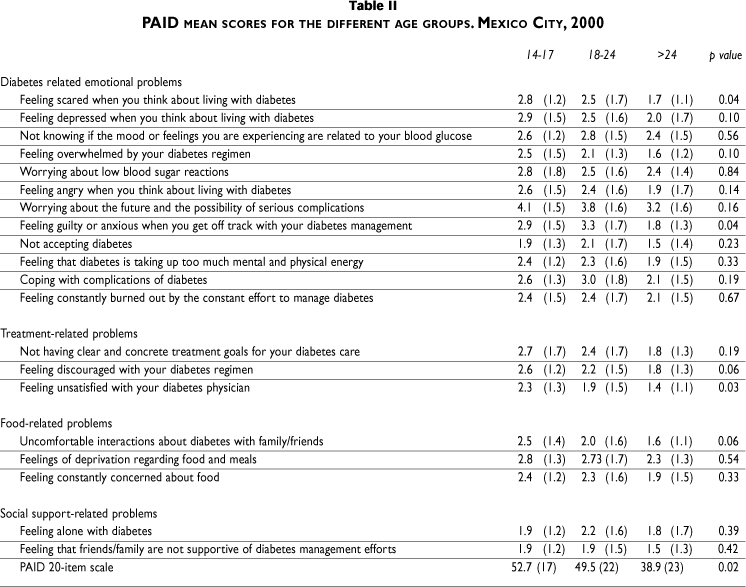
<body><![CDATA[<p><b><font size="3" face="Verdana, Arial, Helvetica-Normal, sans-serif">Results</font></b></p>     <p><font face="Verdana, Arial, Helvetica-Normal, sans-serif" size="2">The clinical    and sociodemographic data of the studied population is shown in <a href="#tabela1">Table    I</a>. Significant differences were observed in the different age groups. Adolescents    as a group had higher scores in emotional dysfunction related to diabetes (PAID)    and diminished knowledge about diabetes. Adolescents had poorer glycemic control,    although it did not reach statistical significance. The 25-30 age group tended    to have better glycemic control and lower PAID scores, but fewer individuals    were doing BG monitoring or intensive insulin treatment programs, and the prevalence    of diabetes-related complications was high. In a multivariate model of the logistic    regression analysis, inadequate emotional response to diabetes (high PAID scores)    was mainly associated with poor glycemic control (OR= 2.9; 95% CI 0.9-9.7, <i>p</i>=0.09).    When metabolic control was included in the model, two other variables had an    inversely significant association; higher educational levels (OR= 0.09; 95%    CI 0.01-0.8, <i>p</i>=0.03) and evidence of an episode of severe hypoglycemia    within the year (OR= 0.3; 95% CI 0.07-1.1, <i>p</i>=0.06). Age, sex, income,    activity, marital status, treatment regimen, alcohol intake, diabetes duration,    home BG monitoring or history of DKA did not show a significant association.    Apprehension about the future and the possibility of serious complications had    the highest mean PAID score in all age groups. Adolescents had significantly    higher PAID scores in the following items: feeling scared about living with    diabetes; feeling guilty about not complying with diabetes treatment, and dissatisfaction    with the physician. There was a trend about feeling more discouraged with the    diabetes regimen and problems with interactions related to diabetes with family/friends    (<a href="/img/revistas/spm/v45n1/15045t2.gif">Table II</a>).</font></p>     <p align="center"><a name="tabela1"></a></p>     <p align="center">&nbsp;</p>     <p align="center"><img src="/img/revistas/spm/v45n1/15045t1.gif"></p>     <p align="center">&nbsp;</p>     <p><font face="Verdana, Arial, Helvetica-Normal, sans-serif" size="2">Specific    questions answered by patients 18 years and older, showed that young adulthood    was perceived as a moment in life with increased concerns about glycemic control    and the development of late complications of the disease. There was a trend    for diminished DKA episodes and more episodes of hypoglycemia. Young adults    described how they experienced the transition period from adolescence to young    adulthood. Some of their main comments were the following: "I am more worried    now but I just can't stay under control; I had a very negative and pessimistic    perspective"; "As an adolescent I was "untouchable"; "I couldn't accept my illness";    "I was very rebellious"; "I did not take my illness seriously"; "I was always    frustrated"; "I used to feel sad and inferior to others"; "I have learned to    live with diabetes"; "I am more responsible"; "I have stopped letting diabetes    run my life"; "I am recovering happiness after living many years as if I where    in a hole (antisocial and frightened)"; "It changes from a sickness to a life-style";    "My control has nothing to do with my age, it depends on other circumstances    like problems at home, school or work"; "I felt my mother on my back all the    time"; "Before I was not alone, I had my family's support"; "Since my parents    have not been paying much attention, I have not taken care of my health"; "I    knew that even if I didn't pay attention to the doctors or my parents, nothing    was going to happen to me"; "I lied and was bothered by the doctors, who made    me feel guilty about my HbA1c levels"; "My new doctor examined me and asked    me about my diabetes, but he is not really interested in me"; "It helped me    a lot to meet other young people with diabetes"; "Now I am worried about complications    and my future"; "I was not in control until I became pregnant"; "Now with so    many activities and responsibilities, its more difficult to care for my health";    "Now I realize that I could have prevented the complications".</font></p>     <p>&nbsp;</p>     <p><b><font size="3" face="Verdana, Arial, Helvetica-Normal, sans-serif">Discussion</font></b></p>     <p><font face="Verdana, Arial, Helvetica-Normal, sans-serif" size="2">The present    study was done with the main objective to describe the emotional dysfunction    associated with diabetes in Mexican adolescents and young adults with type-1    diabetes. Adolescents as a group had higher scores in emotional dysfunction    related to diabetes (PAID), and diminished knowledge in diabetes-related areas.    The 25-30 age group, which was composed mostly by women, showed a trend for    a better glycemic control and lower PAID scores; however, fewer individuals    were doing BG monitoring or had intensive insulin treatment programs. The improvement    in metabolic control in this age group is likely related to a better adherence    to the diabetes treatment program. It does not mean, however, that intensive    programs do not result in a better glycemic control.</font></p>     ]]></body>
<body><![CDATA[<p><font face="Verdana, Arial, Helvetica-Normal, sans-serif" size="2">The Problem    Areas in Diabetes Scale<sup>19-21</sup> is a brief self-report measure of diabetes-related    distress that has been found to be valid and clinically useful in type-1 and    type-2 diabetes patients. PAID scores have been found to show positive associations    with HbA1c, and are a major predictor of poor adherence to treatment not involving    general emotional distress. In the present study, an inadequate emotional response    to diabetes was mainly associated with poor glycemic control, and inversely,    with higher educational levels and recent evidence of severe hypoglycemia. Adolescents    had higher scores in the following items; feeling scared about living with diabetes;    feeling guilty about not complying with treatment programs, and dissatisfaction    with their attending physician. There was also a trend towards feeling more    discouraged with the diabetes regimen and uncomfortable with interactions related    to diabetes issues with family/friends.</font></p>     <p><font face="Verdana, Arial, Helvetica-Normal, sans-serif" size="2">In a study    comparing type-I diabetic subjects in US and Dutch population,<sup>22</sup>    the mean PAID score was 33<u>+</u>22 and 25<u>+</u>19 respectively, compared    with 48<u>+</u>21 in the present study. The differences observed are only partially    related to the youngest age in our studied population. As in the present study,    lower HbA1c levels were associated with less emotional dysfunction related to    diabetes, and a younger age was related to higher PAID scores.</font></p>     <p><font face="Verdana, Arial, Helvetica-Normal, sans-serif" size="2">Critical    tasks of young adulthood include the development of a comfortable identity,    the capacity to enjoy intimate relationships, the ability to preserve a previously    developed sense of autonomy and productivity, and the acquisition of more mature    defenses against adversity. Concerns about the presence of a chronic illness    may inhibit this progression. Some young people make decisions based on incomplete    information, which changes the course of their lives. For example, some avoid    marriage or permanent relationships, or fail to get involved in long-term commitments.<sup>9-11,14-16</sup></font></p>     <p><font face="Verdana, Arial, Helvetica-Normal, sans-serif" size="2">Most of    the medical literature includes information from patients who have had an adequate    medical follow-up. In a previous report,<sup>23</sup> we studied 209 type-1    diabetes patients who attended two of the main Pediatric Endocrine Clinics in    Mexico City, and left those Centers because of age (as they became young adults).    We could not obtain information or confirm a medical follow-up in 71% of them;    eight were known to be dead (seven from diabetes-related complications). Presumably,    most patients were seen by primary care physicians, or by no physicians at all.    Only 62 (29%) of the patients, could be reached by phone, telegram or during    their routine clinical appointments. Reviewing their old clinical records as    adolescents, two thirds had poorly controlled diabetes and 16% had proliferative    retinopathy. This information leads us to reflect upon the true story of diabetes,    particularly in underdeveloped countries or in very low income groups.</font></p>     <p><font face="Verdana, Arial, Helvetica-Normal, sans-serif" size="2">Why are    so many patients lost to follow&#150up?, and What happens to them?, are two important    questions that deserve an answer, and are likely related to a diversity of factors:    The scarce economic and social resources compel patients to not leaving their    work for a medical appointment (consequently, most of them do not even mention    that they have diabetes for the fear of losing their job). Others, as young    adults, may lose the family health coverage offered by the Social Security System.    There may be erroneous attitudes towards a disabled child (in this case with    diabetes), more common in the poor income classes, that leave these patients    with no other alternative but to deny their illness. Patient attitudes such    as reluctance to see another physician, take on more responsibilities, be overwhelmed    by other problems, and the belief that they will be safe just by following the    usual indications, are some of the coping strategies used by patients. Unfortunately,    patients usually return too late to be followed and treated for their diabetes,    when the majority of them have already developed serious complications of the    disease. The latter is usually the main reason why they return for medical follow-up.</font></p>     <p><font face="Verdana, Arial, Helvetica-Normal, sans-serif" size="2">Only a few    studies have examined the impact of diabetes in patients as they experience    the transition into young adulthood. Lloyd <i>et al</i><sup>10</sup> observed    that type-1 diabetes patients where more socially isolated than healthy controls.    Tebbi <i>et al</i> <sup>11</sup> found that general wellbeing was lower in diabetes    patients, but that they were able to adjust well in terms of employment-related    issues. Increased rates of depression and high, but significant rates of suicide    have not been observed.<sup>12,13</sup> Other authors have suggested that there    may be an increased prevalence of eating or other psychiatric disorders.<sup>24</sup>    As it has become obvious, diabetes in someone with immature psychosocial defenses    is more likely to require increased structure and support for treatment.<sup>1-3,15</sup></font></p>     <p><font face="Verdana, Arial, Helvetica-Normal, sans-serif" size="2">Other studies    suggest that type-1 diabetic young patients do not experience lower self esteem,    more symptomatic distress, or personality disorders.<sup>14-16</sup> Adolescents    were found to be carrying out the developmentally appropriate tasks involved    in the transition to adulthood. However, they perceived a lower competence in    social relationships, but diabetes did not have a clear negative impact on their    adjustment as young adults. These findings were observed in a Caucasian population    reasonably well educated and with few individuals from lower socioeconomic strata.    It is likely that type-1 diabetes causes more serious psychosocial problems    in patients from minority populations, who are often less educated and from    a lower socioeconomic class.<sup>14</sup></font></p>     <p><font face="Verdana, Arial, Helvetica-Normal, sans-serif" size="2">In the present    study, young adulthood was associated with a better metabolic control in females    (those reached by the survey and who had a medical follow-up). This could be    related to the fact, that they became more concerned about the near future (marriage,    motherhood, complications).</font></p>     <p><font face="Verdana, Arial, Helvetica-Normal, sans-serif" size="2">Adolescence    and early adulthood is different in Mexico than in most developed countries.    The family bounds are closer, young adults must obtain their own economical    support at early ages and independence from the family occurs only several years    later.</font></p>     <p><font face="Verdana, Arial, Helvetica-Normal, sans-serif" size="2">In a recent    study comparing health care indicators in type-1 diabetes patients, it was concluded    that other components of the health care structure (including free, and/or easy    access to insulin pens and self-monitoring of blood glucose supplies) may be    critical.<sup>24</sup> In Mexico, because of poverty and scarce medical and    family resources, intensive insulin treatment programs are a real option for    less than 5% of our diabetic population.<sup>17</sup></font></p>     ]]></body>
<body><![CDATA[<p><font face="Verdana, Arial, Helvetica-Normal, sans-serif" size="2">Diabetes    regimens include many aspects that are difficult to comply with; it is a chronic    disorder, lifestyle changes are required, treatment is complex, intrusive, and    inconvenient, and prevention instead of symptom reduction or cure is usually    the main goal. Variables that are known to affect adherence to treatment include    the type and duration of diabetes, evidence of late complications, availability    of socioeconomic resources, educational background, culture, and the individual's    personality.<sup>1,2,25</sup></font></p>     <p><font face="Verdana, Arial, Helvetica-Normal, sans-serif" size="2">As evidenced    in this and other studies, most young adults have no clear concept of chronic    illness and prevention, therefore, this is not a problem exclusive of this age    group. It is a great challenge, particularly during the transition period from    adolescence to early adulthood. It is necessary to discuss carefully the prognosis    of the quality and duration of life and to review the known facts about the    long-term outcome of diabetes. The relevance of relationship building, assessing    expectations, realistic goal setting, and team and family support is unquestionable.    Cost-effective approaches and optimization of resources must always be kept    in mind.</font></p>     <p><font face="Verdana, Arial, Helvetica-Normal, sans-serif" size="2">In conclusion,    the identification of psychological and behavioral problems in adolescents and    young adults with diabetes is mandatory. There is a need to develop new strategies    that may help to improve the follow-up and treatment of type-1 diabetic patients.</font></p>     <p>&nbsp;</p>     <p><b><font size="3" face="Verdana, Arial, Helvetica-Normal, sans-serif">References</font></b></p>     <!-- ref --><p><font face="Verdana, Arial, Helvetica-Normal, sans-serif" size="2">1. LaGreca    AM, Follansbee D, Skyler JS. Developmental and behavioral aspects of diabetes    management in youngsters. Child Health Care 1990;19:132-139.</font>&nbsp;&nbsp;&nbsp;&nbsp;&nbsp;&nbsp;&nbsp;&nbsp;[&#160;<a href="javascript:void(0);" onclick="javascript: window.open('/scielo.php?script=sci_nlinks&ref=9165504&pid=S0036-3634200300010000200001&lng=','','width=640,height=500,resizable=yes,scrollbars=1,menubar=yes,');">Links</a>&#160;]<!-- end-ref --><!-- ref --><p><font face="Verdana, Arial, Helvetica-Normal, sans-serif" size="2">2. Tattersall    RB, Lowe J. Diabetes in adolescence. Diabetologia 1981;20: 517-523.</font>&nbsp;&nbsp;&nbsp;&nbsp;&nbsp;&nbsp;&nbsp;&nbsp;[&#160;<a href="javascript:void(0);" onclick="javascript: window.open('/scielo.php?script=sci_nlinks&ref=9165505&pid=S0036-3634200300010000200002&lng=','','width=640,height=500,resizable=yes,scrollbars=1,menubar=yes,');">Links</a>&#160;]<!-- end-ref --><!-- ref --><p><font face="Verdana, Arial, Helvetica-Normal, sans-serif" size="2">3. The Diabetes    Control and Complications Trial Research Group. The effect of intensive treatment    of diabetes on the development and progression of long-term complications in    insulin-dependent diabetes mellitus. N Engl J Med 1993;329:977-986.</font>&nbsp;&nbsp;&nbsp;&nbsp;&nbsp;&nbsp;&nbsp;&nbsp;[&#160;<a href="javascript:void(0);" onclick="javascript: window.open('/scielo.php?script=sci_nlinks&ref=9165506&pid=S0036-3634200300010000200003&lng=','','width=640,height=500,resizable=yes,scrollbars=1,menubar=yes,');">Links</a>&#160;]<!-- end-ref --><!-- ref --><p><font face="Verdana, Arial, Helvetica-Normal, sans-serif" size="2">4. Hanson    CL, Harris MA, Relyea G, Cograng GA, Carle DL, Burghen GA. Coping styles in    youths with insulin-dependent diabetes mellitus. J Consult Clin Psychol 1989;57:644-651.</font>&nbsp;&nbsp;&nbsp;&nbsp;&nbsp;&nbsp;&nbsp;&nbsp;[&#160;<a href="javascript:void(0);" onclick="javascript: window.open('/scielo.php?script=sci_nlinks&ref=9165507&pid=S0036-3634200300010000200004&lng=','','width=640,height=500,resizable=yes,scrollbars=1,menubar=yes,');">Links</a>&#160;]<!-- end-ref --><!-- ref --><p><font face="Verdana, Arial, Helvetica-Normal, sans-serif" size="2">5. Charron-Prochownik    D, Arslaninan S. Women with diabetes: The adolescent years: A case study and    review. Diabetes Spectrum 1997;10: 180-184.</font>&nbsp;&nbsp;&nbsp;&nbsp;&nbsp;&nbsp;&nbsp;&nbsp;[&#160;<a href="javascript:void(0);" onclick="javascript: window.open('/scielo.php?script=sci_nlinks&ref=9165508&pid=S0036-3634200300010000200005&lng=','','width=640,height=500,resizable=yes,scrollbars=1,menubar=yes,');">Links</a>&#160;]<!-- end-ref --><!-- ref --><p><font face="Verdana, Arial, Helvetica-Normal, sans-serif" size="2">6. Delamater    AM, Kurtz SM, Bubb J, White NH, Santiago JV. Stress and coping in relation to    metabolic control in adolescents with type-1 diabetes. Dev Behav Pediatr 1987;8:136-140.</font>&nbsp;&nbsp;&nbsp;&nbsp;&nbsp;&nbsp;&nbsp;&nbsp;[&#160;<a href="javascript:void(0);" onclick="javascript: window.open('/scielo.php?script=sci_nlinks&ref=9165509&pid=S0036-3634200300010000200006&lng=','','width=640,height=500,resizable=yes,scrollbars=1,menubar=yes,');">Links</a>&#160;]<!-- end-ref --><!-- ref --><p><font face="Verdana, Arial, Helvetica-Normal, sans-serif" size="2">7. Golden    MP. Incorporation of quality-of-life considerations into intensive diabetes    management protocols in adolescents. Diabetes Care 1998; 21:885-886.</font>&nbsp;&nbsp;&nbsp;&nbsp;&nbsp;&nbsp;&nbsp;&nbsp;[&#160;<a href="javascript:void(0);" onclick="javascript: window.open('/scielo.php?script=sci_nlinks&ref=9165510&pid=S0036-3634200300010000200007&lng=','','width=640,height=500,resizable=yes,scrollbars=1,menubar=yes,');">Links</a>&#160;]<!-- end-ref --><!-- ref --><p><font face="Verdana, Arial, Helvetica-Normal, sans-serif" size="2">8. Jacobson    AM, Hauser ST, Wertlieb D, Wofsdorf JI, Orleans J, Vieyra M. Psychological adjustment    of children with recently diagnosed diabetes mellitus. Diabetes Care 1986;9:323-329.</font>&nbsp;&nbsp;&nbsp;&nbsp;&nbsp;&nbsp;&nbsp;&nbsp;[&#160;<a href="javascript:void(0);" onclick="javascript: window.open('/scielo.php?script=sci_nlinks&ref=9165511&pid=S0036-3634200300010000200008&lng=','','width=640,height=500,resizable=yes,scrollbars=1,menubar=yes,');">Links</a>&#160;]<!-- end-ref --><!-- ref --><p><font face="Verdana, Arial, Helvetica-Normal, sans-serif" size="2">9. Grey    M, Boland EA, Davidson M, Yu C, Sullivan-Bolyai S, Tamborlane WV. Short-term    effects of coping skills training as adjunct to intensive therapy in adolescents.    Diabetes Care 1998;21:902-908.</font>&nbsp;&nbsp;&nbsp;&nbsp;&nbsp;&nbsp;&nbsp;&nbsp;[&#160;<a href="javascript:void(0);" onclick="javascript: window.open('/scielo.php?script=sci_nlinks&ref=9165512&pid=S0036-3634200300010000200009&lng=','','width=640,height=500,resizable=yes,scrollbars=1,menubar=yes,');">Links</a>&#160;]<!-- end-ref --><!-- ref --><p><font face="Verdana, Arial, Helvetica-Normal, sans-serif" size="2">10. Lloyd    CE, Robinson N, Andrews B, Elston MA, Fuller JH. Are the social relationships    of young insulin-dependent diabetes patients affected by their condition? Diabet    Med 1993;10:481-485.</font>&nbsp;&nbsp;&nbsp;&nbsp;&nbsp;&nbsp;&nbsp;&nbsp;[&#160;<a href="javascript:void(0);" onclick="javascript: window.open('/scielo.php?script=sci_nlinks&ref=9165513&pid=S0036-3634200300010000200010&lng=','','width=640,height=500,resizable=yes,scrollbars=1,menubar=yes,');">Links</a>&#160;]<!-- end-ref --><!-- ref --><p><font face="Verdana, Arial, Helvetica-Normal, sans-serif" size="2">11. Tebbi    C, Bromberg C, Sills I, Cukierman J, Piedmonte M. Vocational adjustment and    general well-being of young adults with IDDM. Diabetes Care 1993;13:983-989.</font>&nbsp;&nbsp;&nbsp;&nbsp;&nbsp;&nbsp;&nbsp;&nbsp;[&#160;<a href="javascript:void(0);" onclick="javascript: window.open('/scielo.php?script=sci_nlinks&ref=9165514&pid=S0036-3634200300010000200011&lng=','','width=640,height=500,resizable=yes,scrollbars=1,menubar=yes,');">Links</a>&#160;]<!-- end-ref --><!-- ref --><p><font face="Verdana, Arial, Helvetica-Normal, sans-serif" size="2">12. Mayou    R, Peveler R, Davies B, Mann J, Fairburn C. Psychiatric morbidity in young adults    with insulin-dependent diabetes mellitus. Psychol Med 1991; 21:639-645.</font>&nbsp;&nbsp;&nbsp;&nbsp;&nbsp;&nbsp;&nbsp;&nbsp;[&#160;<a href="javascript:void(0);" onclick="javascript: window.open('/scielo.php?script=sci_nlinks&ref=9165515&pid=S0036-3634200300010000200012&lng=','','width=640,height=500,resizable=yes,scrollbars=1,menubar=yes,');">Links</a>&#160;]<!-- end-ref --><!-- ref --><p><font face="Verdana, Arial, Helvetica-Normal, sans-serif" size="2">13. Kyvik    K, Satenager E, Green A, Svendsen A. Suicides in men with IDDM. Diabetes Care    1994;17:210-213.</font>&nbsp;&nbsp;&nbsp;&nbsp;&nbsp;&nbsp;&nbsp;&nbsp;[&#160;<a href="javascript:void(0);" onclick="javascript: window.open('/scielo.php?script=sci_nlinks&ref=9165516&pid=S0036-3634200300010000200013&lng=','','width=640,height=500,resizable=yes,scrollbars=1,menubar=yes,');">Links</a>&#160;]<!-- end-ref --><!-- ref --><p><font face="Verdana, Arial, Helvetica-Normal, sans-serif" size="2">14. Jacobson    AM, Hauser ST, Willet JB, Dvorak R, Wolpert H, Herman L <i>et al</i>. Social    relationships among young adults with insulin dependent diabetes mellitus: Ten    year follow-up of an onset cohort. Diabet Med 1997; 14:73-79.</font>&nbsp;&nbsp;&nbsp;&nbsp;&nbsp;&nbsp;&nbsp;&nbsp;[&#160;<a href="javascript:void(0);" onclick="javascript: window.open('/scielo.php?script=sci_nlinks&ref=9165517&pid=S0036-3634200300010000200014&lng=','','width=640,height=500,resizable=yes,scrollbars=1,menubar=yes,');">Links</a>&#160;]<!-- end-ref --><!-- ref --><p><font face="Verdana, Arial, Helvetica-Normal, sans-serif" size="2">15. Jacobson    AM, Hauser ST, Willwt JB, Wolfsdorf JI, Dvorak R, Herman L <i>et al</i>. Psychological    adjustment to IDDM: 10-year follow-up of an onset cohort of child and adolescent    patients. Diabetes Care 1997;20:811-818.</font>&nbsp;&nbsp;&nbsp;&nbsp;&nbsp;&nbsp;&nbsp;&nbsp;[&#160;<a href="javascript:void(0);" onclick="javascript: window.open('/scielo.php?script=sci_nlinks&ref=9165518&pid=S0036-3634200300010000200015&lng=','','width=640,height=500,resizable=yes,scrollbars=1,menubar=yes,');">Links</a>&#160;]<!-- end-ref --><!-- ref --><p><font face="Verdana, Arial, Helvetica-Normal, sans-serif" size="2">16. Dunn    SM, Turtle JR. The myth of the diabetic personality. Diabetes Care 1981;4:640-646.</font>&nbsp;&nbsp;&nbsp;&nbsp;&nbsp;&nbsp;&nbsp;&nbsp;[&#160;<a href="javascript:void(0);" onclick="javascript: window.open('/scielo.php?script=sci_nlinks&ref=9165519&pid=S0036-3634200300010000200016&lng=','','width=640,height=500,resizable=yes,scrollbars=1,menubar=yes,');">Links</a>&#160;]<!-- end-ref --><!-- ref --><p><font face="Verdana, Arial, Helvetica-Normal, sans-serif" size="2">17. Lerman    I, Quibrera R, G&oacute;mez-P&eacute;rez FJ. Epidemiology of diabetes in Mexico.    En: Ekoe JM, Zimmet P, Williams R, ed. The epidemiology of diabetes: An international    perspective. Londres: John Wiley &amp; Sons, 2001: 177-186.</font>&nbsp;&nbsp;&nbsp;&nbsp;&nbsp;&nbsp;&nbsp;&nbsp;[&#160;<a href="javascript:void(0);" onclick="javascript: window.open('/scielo.php?script=sci_nlinks&ref=9165520&pid=S0036-3634200300010000200017&lng=','','width=640,height=500,resizable=yes,scrollbars=1,menubar=yes,');">Links</a>&#160;]<!-- end-ref --><!-- ref --><p><font face="Verdana, Arial, Helvetica-Normal, sans-serif" size="2">18. Bautista    MS, Aguilar-Salina CA, Lerman GI, Velasco ML, Castellanos R, Zenteno E <i>et    al</i>. Diabetes knowledge and its determinants in a Mexican Population. The    Diabetes Educator 1999;25:3-9.</font>&nbsp;&nbsp;&nbsp;&nbsp;&nbsp;&nbsp;&nbsp;&nbsp;[&#160;<a href="javascript:void(0);" onclick="javascript: window.open('/scielo.php?script=sci_nlinks&ref=9165521&pid=S0036-3634200300010000200018&lng=','','width=640,height=500,resizable=yes,scrollbars=1,menubar=yes,');">Links</a>&#160;]<!-- end-ref --><!-- ref --><p><font face="Verdana, Arial, Helvetica-Normal, sans-serif" size="2">19. Polonsky    WH, Anderson BJ, Lohrer PA, Welch G, Jacobson AM, Aponte JE <i>et al</i>. Assessment    of diabetes-related distress. Diabetes Care 1995; 18:754-760.</font>&nbsp;&nbsp;&nbsp;&nbsp;&nbsp;&nbsp;&nbsp;&nbsp;[&#160;<a href="javascript:void(0);" onclick="javascript: window.open('/scielo.php?script=sci_nlinks&ref=9165522&pid=S0036-3634200300010000200019&lng=','','width=640,height=500,resizable=yes,scrollbars=1,menubar=yes,');">Links</a>&#160;]<!-- end-ref --><!-- ref --><p><font face="Verdana, Arial, Helvetica-Normal, sans-serif" size="2">20. Welch    GW, Jacobson AM, Polonsky WH. The Problem Areas in Diabetes Scale: An evaluation    of its clinical utility. Diabetes Care 1997;20: 760-766.</font>&nbsp;&nbsp;&nbsp;&nbsp;&nbsp;&nbsp;&nbsp;&nbsp;[&#160;<a href="javascript:void(0);" onclick="javascript: window.open('/scielo.php?script=sci_nlinks&ref=9165523&pid=S0036-3634200300010000200020&lng=','','width=640,height=500,resizable=yes,scrollbars=1,menubar=yes,');">Links</a>&#160;]<!-- end-ref --><!-- ref --><p><font face="Verdana, Arial, Helvetica-Normal, sans-serif" size="2">21. Gonz&aacute;lez-Uresti    X, L&oacute;pez AJC, Aguilar SC, Garc&iacute;a GE, G&oacute;mez-P&eacute;rez    FJ, Lerman GI. Disfunci&oacute;n emocional y diabetes. XIV Congreso Panamericano    de Endocrinolog&iacute;a; 1997;noviembre 21-25;Canc&uacute;n, M&eacute;xico:    29.</font>&nbsp;&nbsp;&nbsp;&nbsp;&nbsp;&nbsp;&nbsp;&nbsp;[&#160;<a href="javascript:void(0);" onclick="javascript: window.open('/scielo.php?script=sci_nlinks&ref=9165524&pid=S0036-3634200300010000200021&lng=','','width=640,height=500,resizable=yes,scrollbars=1,menubar=yes,');">Links</a>&#160;]<!-- end-ref --><!-- ref --><p><font face="Verdana, Arial, Helvetica-Normal, sans-serif" size="2">22. Snoek    FJ, Pouwer F, Welch GW, Polonsky WH. Diabetes-related emotional distress in    Dutch and US diabetes patients. Cross-cultural validity of the Problem Areas    in Diabetes Scale. Diabetes Care 2000;23:1305-1309.</font>&nbsp;&nbsp;&nbsp;&nbsp;&nbsp;&nbsp;&nbsp;&nbsp;[&#160;<a href="javascript:void(0);" onclick="javascript: window.open('/scielo.php?script=sci_nlinks&ref=9165525&pid=S0036-3634200300010000200022&lng=','','width=640,height=500,resizable=yes,scrollbars=1,menubar=yes,');">Links</a>&#160;]<!-- end-ref --><!-- ref --><p><font face="Verdana, Arial, Helvetica-Normal, sans-serif" size="2">23. Lerman    GI, Barr&oacute;n C, Calzada LR, Mercado M, Vidal R, Quintana S <i>et al</i>.    Transition from adolescence to young adulthood in diabetes care (Abstract).    Diabetes 2001;50(2):393A.</font>&nbsp;&nbsp;&nbsp;&nbsp;&nbsp;&nbsp;&nbsp;&nbsp;[&#160;<a href="javascript:void(0);" onclick="javascript: window.open('/scielo.php?script=sci_nlinks&ref=9165526&pid=S0036-3634200300010000200023&lng=','','width=640,height=500,resizable=yes,scrollbars=1,menubar=yes,');">Links</a>&#160;]<!-- end-ref --><!-- ref --><p><font face="Verdana, Arial, Helvetica-Normal, sans-serif" size="2">24. Rodiri    GM, Daneman D. Eating disorders and IDDM: A problematic association. Diabetes    Care 1992;15:1402-1411.</font>&nbsp;&nbsp;&nbsp;&nbsp;&nbsp;&nbsp;&nbsp;&nbsp;[&#160;<a href="javascript:void(0);" onclick="javascript: window.open('/scielo.php?script=sci_nlinks&ref=9165527&pid=S0036-3634200300010000200024&lng=','','width=640,height=500,resizable=yes,scrollbars=1,menubar=yes,');">Links</a>&#160;]<!-- end-ref --><!-- ref --><p><font face="Verdana, Arial, Helvetica-Normal, sans-serif" size="2">25. Tabak    AG, Tamas G, Zgibor J, Wilson R, Becker D, Kerenyi Z <i>et al</i>. Targets and    reality: A comparison of health care indicators in the US (Pittsburgh Epidemiology    of Diabetes Complications Study) and Hungary (Diab Care Hungary). Diabetes Care    2000;23:1284-1289.</font>&nbsp;&nbsp;&nbsp;&nbsp;&nbsp;&nbsp;&nbsp;&nbsp;[&#160;<a href="javascript:void(0);" onclick="javascript: window.open('/scielo.php?script=sci_nlinks&ref=9165528&pid=S0036-3634200300010000200025&lng=','','width=640,height=500,resizable=yes,scrollbars=1,menubar=yes,');">Links</a>&#160;]<!-- end-ref --><p>&nbsp;</p>     <p>&nbsp;</p>     <p><font face="Verdana, Arial, Helvetica-Normal, sans-serif" size="2"><b>Address    reprint requests to:</b>    <br>   Israel Lerman MD    <br>   Departamento de Endocrinolog&iacute;a y Metabolismo    <br>   Instituto Nacional de Ciencias M&eacute;dicas y Nutrici&oacute;n Salvador Zubir&aacute;n    <br>   Vasco de Quiroga 15    <br>   Tlalpan, 14080 M&eacute;xico, D.F., M&eacute;xico    <br>   E-Mail: <a href="mailto:lerman@netservice.com.mx">lerman@netservice.com.mx</a></font></p>     <p><b><font face="Verdana, Arial, Helvetica-Normal, sans-serif" size="2">Received    on:</font></b><font face="Verdana, Arial, Helvetica-Normal, sans-serif" size="2">    August 21, 2001    ]]></body>
<body><![CDATA[<br>   <b>Accepted on:</b> October 15, 2002    <br>   </font><font face="Verdana, Arial, Helvetica-Normal, sans-serif" size="2">The    present study was previously presented as a poster at the 61<sup>st</sup> Scientific    Session of the American Diabetes Association.</font></p>     <p>&nbsp;</p>     <p>&nbsp;</p>     <p><font face="Verdana, Arial, Helvetica-Normal, sans-serif" size="2">The English    version of this paper is available too at: <a href="http://www.insp.mx/salud/index.html">http://www.insp.mx/salud/index.html    <br>   </a></font><font face="Verdana, Arial, Helvetica-Normal, sans-serif" size="2"><a name="back1"></a><a href="#top1">1</a>    Departamento de Endocrinolog&iacute;a, Instituto Nacional de Ciencias M&eacute;dicas    y Nutrici&oacute;n Salvador Zubir&aacute;n. M&eacute;xico D.F., M&eacute;xico    <br>   </font><font face="Verdana, Arial, Helvetica-Normal, sans-serif" size="2"><a name="back2"></a><a href="#top1">2</a>    Departamento de Endocrinolog&iacute;a, Centro M&eacute;dico Nacional Siglo XXI,    Instituto Mexicano del Seguro Social (IMSS), M&eacute;xico, D.F., M&eacute;xico    <br>   </font><font face="Verdana, Arial, Helvetica-Normal, sans-serif" size="2"><a name="back3"></a><a href="#top1">3</a>    Servicio de Endocrinolog&iacute;a Pedi&aacute;trica, Instituto Nacional de Pediatr&iacute;a,    M&eacute;xico, D.F., M&eacute;xico    <br>   </font><font face="Verdana, Arial, Helvetica-Normal, sans-serif" size="2"><a name="back4"></a><a href="#top1">4</a>    Departamento de Endocrinolog&iacute;a Pedi&aacute;trica, Centro M&eacute;dico    Nacional Siglo XXI, IMSS, M&eacute;xico, D.F., M&eacute;xico    <br>   </font><font face="Verdana, Arial, Helvetica-Normal, sans-serif" size="2"><a name="back5"></a><a href="#top1">5</a>    Unidad de Epidemiolog&iacute;a Cl&iacute;nica, Instituto Nacional de Ciencias    M&eacute;dicas y Nutrici&oacute;n Salvador Zubir&aacute;n, M&eacute;xico, D.F.,    M&eacute;xico</font></p>     ]]></body>
<body><![CDATA[ ]]></body><back>
<ref-list>
<ref id="B1">
<label>1</label><nlm-citation citation-type="journal">
<person-group person-group-type="author">
<name>
<surname><![CDATA[LaGreca]]></surname>
<given-names><![CDATA[AM]]></given-names>
</name>
<name>
<surname><![CDATA[Follansbee]]></surname>
<given-names><![CDATA[D]]></given-names>
</name>
<name>
<surname><![CDATA[Skyler]]></surname>
<given-names><![CDATA[JS]]></given-names>
</name>
</person-group>
<article-title xml:lang="en"><![CDATA[Developmental and behavioral aspects of diabetes management in youngsters]]></article-title>
<source><![CDATA[Child Health Care]]></source>
<year>1990</year>
<volume>19</volume>
<page-range>132-139</page-range></nlm-citation>
</ref>
<ref id="B2">
<label>2</label><nlm-citation citation-type="journal">
<person-group person-group-type="author">
<name>
<surname><![CDATA[Tattersall]]></surname>
<given-names><![CDATA[RB]]></given-names>
</name>
<name>
<surname><![CDATA[Lowe]]></surname>
<given-names><![CDATA[J]]></given-names>
</name>
</person-group>
<article-title xml:lang="en"><![CDATA[Diabetes in adolescence]]></article-title>
<source><![CDATA[Diabetologia]]></source>
<year>1981</year>
<volume>20</volume>
<page-range>517-523</page-range></nlm-citation>
</ref>
<ref id="B3">
<label>3</label><nlm-citation citation-type="journal">
<collab>The Diabetes Control and Complications Trial Research Group</collab>
<article-title xml:lang="en"><![CDATA[The effect of intensive treatment of diabetes on the development and progression of long-term complications in insulin-dependent diabetes mellitus]]></article-title>
<source><![CDATA[N Engl J Med]]></source>
<year>1993</year>
<volume>329</volume>
<page-range>977-986</page-range></nlm-citation>
</ref>
<ref id="B4">
<label>4</label><nlm-citation citation-type="journal">
<person-group person-group-type="author">
<name>
<surname><![CDATA[Hanson]]></surname>
<given-names><![CDATA[CL]]></given-names>
</name>
<name>
<surname><![CDATA[Harris]]></surname>
<given-names><![CDATA[MA]]></given-names>
</name>
<name>
<surname><![CDATA[Relyea]]></surname>
<given-names><![CDATA[G]]></given-names>
</name>
<name>
<surname><![CDATA[Cograng]]></surname>
<given-names><![CDATA[GA]]></given-names>
</name>
<name>
<surname><![CDATA[Carle]]></surname>
<given-names><![CDATA[DL]]></given-names>
</name>
<name>
<surname><![CDATA[Burghen]]></surname>
<given-names><![CDATA[GA]]></given-names>
</name>
</person-group>
<article-title xml:lang="en"><![CDATA[Coping styles in youths with insulin-dependent diabetes mellitus]]></article-title>
<source><![CDATA[J Consult Clin Psychol]]></source>
<year>1989</year>
<volume>57</volume>
<page-range>644-651</page-range></nlm-citation>
</ref>
<ref id="B5">
<label>5</label><nlm-citation citation-type="journal">
<person-group person-group-type="author">
<name>
<surname><![CDATA[Charron-Prochownik]]></surname>
<given-names><![CDATA[D]]></given-names>
</name>
<name>
<surname><![CDATA[Arslaninan]]></surname>
<given-names><![CDATA[S]]></given-names>
</name>
</person-group>
<article-title xml:lang="en"><![CDATA[Women with diabetes: The adolescent years: A case study and review]]></article-title>
<source><![CDATA[Diabetes Spectrum]]></source>
<year>1997</year>
<volume>10</volume>
<page-range>180-184</page-range></nlm-citation>
</ref>
<ref id="B6">
<label>6</label><nlm-citation citation-type="journal">
<person-group person-group-type="author">
<name>
<surname><![CDATA[Delamater]]></surname>
<given-names><![CDATA[AM]]></given-names>
</name>
<name>
<surname><![CDATA[Kurtz]]></surname>
<given-names><![CDATA[SM]]></given-names>
</name>
<name>
<surname><![CDATA[Bubb]]></surname>
<given-names><![CDATA[J]]></given-names>
</name>
<name>
<surname><![CDATA[White]]></surname>
<given-names><![CDATA[NH]]></given-names>
</name>
<name>
<surname><![CDATA[Santiago]]></surname>
<given-names><![CDATA[JV]]></given-names>
</name>
</person-group>
<article-title xml:lang="en"><![CDATA[Stress and coping in relation to metabolic control in adolescents with type-1 diabetes]]></article-title>
<source><![CDATA[Dev Behav Pediatr]]></source>
<year>1987</year>
<volume>8</volume>
<page-range>136-140</page-range></nlm-citation>
</ref>
<ref id="B7">
<label>7</label><nlm-citation citation-type="journal">
<person-group person-group-type="author">
<name>
<surname><![CDATA[Golden]]></surname>
<given-names><![CDATA[MP]]></given-names>
</name>
</person-group>
<article-title xml:lang="en"><![CDATA[Incorporation of quality-of-life considerations into intensive diabetes management protocols in adolescents]]></article-title>
<source><![CDATA[Diabetes Care]]></source>
<year>1998</year>
<volume>21</volume>
<page-range>885-886</page-range></nlm-citation>
</ref>
<ref id="B8">
<label>8</label><nlm-citation citation-type="journal">
<person-group person-group-type="author">
<name>
<surname><![CDATA[Jacobson]]></surname>
<given-names><![CDATA[AM]]></given-names>
</name>
<name>
<surname><![CDATA[Hauser]]></surname>
<given-names><![CDATA[ST]]></given-names>
</name>
<name>
<surname><![CDATA[Wertlieb]]></surname>
<given-names><![CDATA[D]]></given-names>
</name>
<name>
<surname><![CDATA[Wofsdorf]]></surname>
<given-names><![CDATA[JI]]></given-names>
</name>
<name>
<surname><![CDATA[Orleans]]></surname>
<given-names><![CDATA[J]]></given-names>
</name>
<name>
<surname><![CDATA[Vieyra]]></surname>
<given-names><![CDATA[M]]></given-names>
</name>
</person-group>
<article-title xml:lang="en"><![CDATA[Psychological adjustment of children with recently diagnosed diabetes mellitus]]></article-title>
<source><![CDATA[Diabetes Care]]></source>
<year>1986</year>
<volume>9</volume>
<page-range>323-329</page-range></nlm-citation>
</ref>
<ref id="B9">
<label>9</label><nlm-citation citation-type="journal">
<person-group person-group-type="author">
<name>
<surname><![CDATA[Grey]]></surname>
<given-names><![CDATA[M]]></given-names>
</name>
<name>
<surname><![CDATA[Boland]]></surname>
<given-names><![CDATA[EA]]></given-names>
</name>
<name>
<surname><![CDATA[Davidson]]></surname>
<given-names><![CDATA[M]]></given-names>
</name>
<name>
<surname><![CDATA[Yu]]></surname>
<given-names><![CDATA[C]]></given-names>
</name>
<name>
<surname><![CDATA[Sullivan-Bolyai]]></surname>
<given-names><![CDATA[S]]></given-names>
</name>
<name>
<surname><![CDATA[Tamborlane]]></surname>
<given-names><![CDATA[WV]]></given-names>
</name>
</person-group>
<article-title xml:lang="en"><![CDATA[Short-term effects of coping skills training as adjunct to intensive therapy in adolescents]]></article-title>
<source><![CDATA[Diabetes Care]]></source>
<year>1998</year>
<volume>21</volume>
<page-range>902-908</page-range></nlm-citation>
</ref>
<ref id="B10">
<label>10</label><nlm-citation citation-type="journal">
<person-group person-group-type="author">
<name>
<surname><![CDATA[Lloyd]]></surname>
<given-names><![CDATA[CE]]></given-names>
</name>
<name>
<surname><![CDATA[Robinson]]></surname>
<given-names><![CDATA[N]]></given-names>
</name>
<name>
<surname><![CDATA[Andrews]]></surname>
<given-names><![CDATA[B]]></given-names>
</name>
<name>
<surname><![CDATA[Elston]]></surname>
<given-names><![CDATA[MA]]></given-names>
</name>
<name>
<surname><![CDATA[Fuller]]></surname>
<given-names><![CDATA[JH]]></given-names>
</name>
</person-group>
<article-title xml:lang="en"><![CDATA[Are the social relationships of young insulin-dependent diabetes patients affected by their condition?]]></article-title>
<source><![CDATA[Diabet Med 1993]]></source>
<year></year>
<volume>10</volume>
<page-range>481-485</page-range></nlm-citation>
</ref>
<ref id="B11">
<label>11</label><nlm-citation citation-type="journal">
<person-group person-group-type="author">
<name>
<surname><![CDATA[Tebbi]]></surname>
<given-names><![CDATA[C]]></given-names>
</name>
<name>
<surname><![CDATA[Bromberg]]></surname>
<given-names><![CDATA[C]]></given-names>
</name>
<name>
<surname><![CDATA[Sills]]></surname>
<given-names><![CDATA[I]]></given-names>
</name>
<name>
<surname><![CDATA[Cukierman]]></surname>
<given-names><![CDATA[J]]></given-names>
</name>
<name>
<surname><![CDATA[Piedmonte]]></surname>
<given-names><![CDATA[M]]></given-names>
</name>
</person-group>
<article-title xml:lang="en"><![CDATA[Vocational adjustment and general well-being of young adults with IDDM]]></article-title>
<source><![CDATA[Diabetes Care]]></source>
<year>1993</year>
<volume>13</volume>
<page-range>983-989</page-range></nlm-citation>
</ref>
<ref id="B12">
<label>12</label><nlm-citation citation-type="journal">
<person-group person-group-type="author">
<name>
<surname><![CDATA[Mayou]]></surname>
<given-names><![CDATA[R]]></given-names>
</name>
<name>
<surname><![CDATA[Peveler]]></surname>
<given-names><![CDATA[R]]></given-names>
</name>
<name>
<surname><![CDATA[Davies]]></surname>
<given-names><![CDATA[B]]></given-names>
</name>
<name>
<surname><![CDATA[Mann]]></surname>
<given-names><![CDATA[J]]></given-names>
</name>
<name>
<surname><![CDATA[Fairburn]]></surname>
<given-names><![CDATA[C]]></given-names>
</name>
</person-group>
<article-title xml:lang="en"><![CDATA[Psychiatric morbidity in young adults with insulin-dependent diabetes mellitus]]></article-title>
<source><![CDATA[Psychol Med]]></source>
<year>1991</year>
<volume>21</volume>
<page-range>639-645</page-range></nlm-citation>
</ref>
<ref id="B13">
<label>13</label><nlm-citation citation-type="journal">
<person-group person-group-type="author">
<name>
<surname><![CDATA[Kyvik]]></surname>
<given-names><![CDATA[K]]></given-names>
</name>
<name>
<surname><![CDATA[Satenager]]></surname>
<given-names><![CDATA[E]]></given-names>
</name>
<name>
<surname><![CDATA[Green]]></surname>
<given-names><![CDATA[A]]></given-names>
</name>
<name>
<surname><![CDATA[Svendsen]]></surname>
<given-names><![CDATA[A]]></given-names>
</name>
</person-group>
<article-title xml:lang="en"><![CDATA[Suicides in men with IDDM]]></article-title>
<source><![CDATA[Diabetes Care]]></source>
<year>1994</year>
<volume>17</volume>
<page-range>210-213</page-range></nlm-citation>
</ref>
<ref id="B14">
<label>14</label><nlm-citation citation-type="journal">
<person-group person-group-type="author">
<name>
<surname><![CDATA[Jacobson]]></surname>
<given-names><![CDATA[AM]]></given-names>
</name>
<name>
<surname><![CDATA[Hauser]]></surname>
<given-names><![CDATA[ST]]></given-names>
</name>
<name>
<surname><![CDATA[Willet]]></surname>
<given-names><![CDATA[JB]]></given-names>
</name>
<name>
<surname><![CDATA[Dvorak]]></surname>
<given-names><![CDATA[R]]></given-names>
</name>
<name>
<surname><![CDATA[Wolpert]]></surname>
<given-names><![CDATA[H]]></given-names>
</name>
<name>
<surname><![CDATA[Herman]]></surname>
<given-names><![CDATA[L]]></given-names>
</name>
</person-group>
<article-title xml:lang="en"><![CDATA[Social relationships among young adults with insulin dependent diabetes mellitus: Ten year follow-up of an onset cohort]]></article-title>
<source><![CDATA[Diabet Med]]></source>
<year>1997</year>
<volume>14</volume>
<page-range>73-79</page-range></nlm-citation>
</ref>
<ref id="B15">
<label>15</label><nlm-citation citation-type="journal">
<person-group person-group-type="author">
<name>
<surname><![CDATA[Jacobson]]></surname>
<given-names><![CDATA[AM]]></given-names>
</name>
<name>
<surname><![CDATA[Hauser]]></surname>
<given-names><![CDATA[ST]]></given-names>
</name>
<name>
<surname><![CDATA[Willwt]]></surname>
<given-names><![CDATA[JB]]></given-names>
</name>
<name>
<surname><![CDATA[Wolfsdorf]]></surname>
<given-names><![CDATA[JI]]></given-names>
</name>
<name>
<surname><![CDATA[Dvorak]]></surname>
<given-names><![CDATA[R]]></given-names>
</name>
<name>
<surname><![CDATA[Herman]]></surname>
<given-names><![CDATA[L]]></given-names>
</name>
</person-group>
<article-title xml:lang="en"><![CDATA[Psychological adjustment to IDDM: 10-year follow-up of an onset cohort of child and adolescent patients]]></article-title>
<source><![CDATA[Diabetes Care]]></source>
<year>1997</year>
<volume>20</volume>
<page-range>811-818</page-range></nlm-citation>
</ref>
<ref id="B16">
<label>16</label><nlm-citation citation-type="journal">
<person-group person-group-type="author">
<name>
<surname><![CDATA[Dunn]]></surname>
<given-names><![CDATA[SM]]></given-names>
</name>
<name>
<surname><![CDATA[Turtle]]></surname>
<given-names><![CDATA[JR]]></given-names>
</name>
</person-group>
<article-title xml:lang="en"><![CDATA[The myth of the diabetic personality]]></article-title>
<source><![CDATA[Diabetes Care]]></source>
<year>1981</year>
<volume>4</volume>
<page-range>640-646</page-range></nlm-citation>
</ref>
<ref id="B17">
<label>17</label><nlm-citation citation-type="book">
<person-group person-group-type="author">
<name>
<surname><![CDATA[Lerman]]></surname>
<given-names><![CDATA[I]]></given-names>
</name>
<name>
<surname><![CDATA[Quibrera]]></surname>
<given-names><![CDATA[R]]></given-names>
</name>
<name>
<surname><![CDATA[Gómez-Pérez]]></surname>
<given-names><![CDATA[FJ]]></given-names>
</name>
</person-group>
<article-title xml:lang="en"><![CDATA[Epidemiology of diabetes in Mexico]]></article-title>
<person-group person-group-type="editor">
<name>
<surname><![CDATA[Ekoe]]></surname>
<given-names><![CDATA[JM]]></given-names>
</name>
<name>
<surname><![CDATA[Zimmet]]></surname>
<given-names><![CDATA[P]]></given-names>
</name>
<name>
<surname><![CDATA[Williams]]></surname>
<given-names><![CDATA[R]]></given-names>
</name>
</person-group>
<source><![CDATA[The epidemiology of diabetes: An international perspective]]></source>
<year>2001</year>
<page-range>177-186</page-range><publisher-loc><![CDATA[Londres ]]></publisher-loc>
<publisher-name><![CDATA[John Wiley & Sons]]></publisher-name>
</nlm-citation>
</ref>
<ref id="B18">
<label>18</label><nlm-citation citation-type="journal">
<person-group person-group-type="author">
<name>
<surname><![CDATA[Bautista]]></surname>
<given-names><![CDATA[MS]]></given-names>
</name>
<name>
<surname><![CDATA[Aguilar-Salina]]></surname>
<given-names><![CDATA[CA]]></given-names>
</name>
<name>
<surname><![CDATA[Lerman]]></surname>
<given-names><![CDATA[GI]]></given-names>
</name>
<name>
<surname><![CDATA[Velasco]]></surname>
<given-names><![CDATA[ML]]></given-names>
</name>
<name>
<surname><![CDATA[Castellanos]]></surname>
<given-names><![CDATA[R]]></given-names>
</name>
<name>
<surname><![CDATA[Zenteno]]></surname>
<given-names><![CDATA[E]]></given-names>
</name>
</person-group>
<article-title xml:lang="en"><![CDATA[Diabetes knowledge and its determinants in a Mexican Population]]></article-title>
<source><![CDATA[The Diabetes Educator]]></source>
<year>1999</year>
<volume>25</volume>
<page-range>3-9</page-range></nlm-citation>
</ref>
<ref id="B19">
<label>19</label><nlm-citation citation-type="journal">
<person-group person-group-type="author">
<name>
<surname><![CDATA[Polonsky]]></surname>
<given-names><![CDATA[WH]]></given-names>
</name>
<name>
<surname><![CDATA[Anderson]]></surname>
<given-names><![CDATA[BJ]]></given-names>
</name>
<name>
<surname><![CDATA[Lohrer]]></surname>
<given-names><![CDATA[PA]]></given-names>
</name>
<name>
<surname><![CDATA[Welch]]></surname>
<given-names><![CDATA[G]]></given-names>
</name>
<name>
<surname><![CDATA[Jacobson]]></surname>
<given-names><![CDATA[AM]]></given-names>
</name>
<name>
<surname><![CDATA[Aponte]]></surname>
<given-names><![CDATA[JE]]></given-names>
</name>
</person-group>
<article-title xml:lang="en"><![CDATA[Assessment of diabetes-related distress]]></article-title>
<source><![CDATA[Diabetes Care]]></source>
<year>1995</year>
<volume>18</volume>
<page-range>754-760</page-range></nlm-citation>
</ref>
<ref id="B20">
<label>20</label><nlm-citation citation-type="journal">
<person-group person-group-type="author">
<name>
<surname><![CDATA[Welch]]></surname>
<given-names><![CDATA[GW]]></given-names>
</name>
<name>
<surname><![CDATA[Jacobson]]></surname>
<given-names><![CDATA[AM]]></given-names>
</name>
<name>
<surname><![CDATA[Polonsky]]></surname>
<given-names><![CDATA[WH]]></given-names>
</name>
</person-group>
<article-title xml:lang="en"><![CDATA[The Problem Areas in Diabetes Scale: An evaluation of its clinical utility]]></article-title>
<source><![CDATA[Diabetes Care]]></source>
<year>1997</year>
<volume>20</volume>
<page-range>760-766</page-range></nlm-citation>
</ref>
<ref id="B21">
<label>21</label><nlm-citation citation-type="confpro">
<person-group person-group-type="author">
<name>
<surname><![CDATA[González-Uresti]]></surname>
<given-names><![CDATA[X]]></given-names>
</name>
<name>
<surname><![CDATA[López]]></surname>
<given-names><![CDATA[AJC]]></given-names>
</name>
<name>
<surname><![CDATA[Aguilar]]></surname>
<given-names><![CDATA[SC]]></given-names>
</name>
<name>
<surname><![CDATA[García]]></surname>
<given-names><![CDATA[GE]]></given-names>
</name>
<name>
<surname><![CDATA[Gómez-Pérez]]></surname>
<given-names><![CDATA[FJ]]></given-names>
</name>
<name>
<surname><![CDATA[Lerman]]></surname>
<given-names><![CDATA[GI]]></given-names>
</name>
</person-group>
<article-title xml:lang="es"><![CDATA[Disfunción emocional y diabetes]]></article-title>
<source><![CDATA[]]></source>
<year></year>
<conf-name><![CDATA[XIV Congreso Panamericano de Endocrinología]]></conf-name>
<conf-date>1997;noviembre 21-25</conf-date>
<conf-loc>Cancún </conf-loc>
</nlm-citation>
</ref>
<ref id="B22">
<label>22</label><nlm-citation citation-type="journal">
<person-group person-group-type="author">
<name>
<surname><![CDATA[Snoek]]></surname>
<given-names><![CDATA[FJ]]></given-names>
</name>
<name>
<surname><![CDATA[Pouwer]]></surname>
<given-names><![CDATA[F]]></given-names>
</name>
<name>
<surname><![CDATA[Welch]]></surname>
<given-names><![CDATA[GW]]></given-names>
</name>
<name>
<surname><![CDATA[Polonsky]]></surname>
<given-names><![CDATA[WH]]></given-names>
</name>
</person-group>
<article-title xml:lang="en"><![CDATA[Diabetes-related emotional distress in Dutch and US diabetes patients: Cross-cultural validity of the Problem Areas in Diabetes Scale]]></article-title>
<source><![CDATA[Diabetes Care]]></source>
<year>2000</year>
<volume>23</volume>
<page-range>1305-1309</page-range></nlm-citation>
</ref>
<ref id="B23">
<label>23</label><nlm-citation citation-type="journal">
<person-group person-group-type="author">
<name>
<surname><![CDATA[Lerman]]></surname>
<given-names><![CDATA[GI]]></given-names>
</name>
<name>
<surname><![CDATA[Barrón]]></surname>
<given-names><![CDATA[C]]></given-names>
</name>
<name>
<surname><![CDATA[Calzada]]></surname>
<given-names><![CDATA[LR]]></given-names>
</name>
<name>
<surname><![CDATA[Mercado]]></surname>
<given-names><![CDATA[M]]></given-names>
</name>
<name>
<surname><![CDATA[Vidal]]></surname>
<given-names><![CDATA[R]]></given-names>
</name>
<name>
<surname><![CDATA[Quintana]]></surname>
<given-names><![CDATA[S]]></given-names>
</name>
</person-group>
<article-title xml:lang="en"><![CDATA[Transition from adolescence to young adulthood in diabetes care (Abstract)]]></article-title>
<source><![CDATA[Diabetes]]></source>
<year>2001</year>
<volume>50</volume>
<numero>2</numero>
<issue>2</issue>
<page-range>393A</page-range></nlm-citation>
</ref>
<ref id="B24">
<label>24</label><nlm-citation citation-type="journal">
<person-group person-group-type="author">
<name>
<surname><![CDATA[Rodiri]]></surname>
<given-names><![CDATA[GM]]></given-names>
</name>
<name>
<surname><![CDATA[Daneman]]></surname>
<given-names><![CDATA[D]]></given-names>
</name>
</person-group>
<article-title xml:lang="en"><![CDATA[Eating disorders and IDDM: A problematic association]]></article-title>
<source><![CDATA[Diabetes Care]]></source>
<year>1992</year>
<volume>15</volume>
<page-range>1402-1411</page-range></nlm-citation>
</ref>
<ref id="B25">
<label>25</label><nlm-citation citation-type="journal">
<person-group person-group-type="author">
<name>
<surname><![CDATA[Tabak]]></surname>
<given-names><![CDATA[AG]]></given-names>
</name>
<name>
<surname><![CDATA[Tamas]]></surname>
<given-names><![CDATA[G]]></given-names>
</name>
<name>
<surname><![CDATA[Zgibor]]></surname>
<given-names><![CDATA[J]]></given-names>
</name>
<name>
<surname><![CDATA[Wilson]]></surname>
<given-names><![CDATA[R]]></given-names>
</name>
<name>
<surname><![CDATA[Becker]]></surname>
<given-names><![CDATA[D]]></given-names>
</name>
<name>
<surname><![CDATA[Kerenyi]]></surname>
<given-names><![CDATA[Z]]></given-names>
</name>
</person-group>
<article-title xml:lang="en"><![CDATA[Targets and reality: A comparison of health care indicators in the US (Pittsburgh Epidemiology of Diabetes Complications Study) and Hungary (Diab Care Hungary)]]></article-title>
<source><![CDATA[Diabetes Care]]></source>
<year>2000</year>
<volume>23</volume>
<page-range>1284-1289</page-range></nlm-citation>
</ref>
</ref-list>
</back>
</article>
