<?xml version="1.0" encoding="ISO-8859-1"?><article xmlns:mml="http://www.w3.org/1998/Math/MathML" xmlns:xlink="http://www.w3.org/1999/xlink" xmlns:xsi="http://www.w3.org/2001/XMLSchema-instance">
<front>
<journal-meta>
<journal-id>0034-8376</journal-id>
<journal-title><![CDATA[Revista de investigación clínica]]></journal-title>
<abbrev-journal-title><![CDATA[Rev. invest. clín.]]></abbrev-journal-title>
<issn>0034-8376</issn>
<publisher>
<publisher-name><![CDATA[Instituto Nacional de Ciencias Médicas y Nutrición Salvador Zubirán]]></publisher-name>
</publisher>
</journal-meta>
<article-meta>
<article-id>S0034-83762004000100006</article-id>
<title-group>
<article-title xml:lang="en"><![CDATA[Pharmacokinetics of digoxin in children with congestive heart failure aggravated by other diseases]]></article-title>
<article-title xml:lang="es"><![CDATA[Farmacocinética de la digoxina en niños con insuficiencia cardiaca congestiva agravada por otras enfermedades]]></article-title>
</title-group>
<contrib-group>
<contrib contrib-type="author">
<name>
<surname><![CDATA[Flores Pérez]]></surname>
<given-names><![CDATA[Janett]]></given-names>
</name>
<xref ref-type="aff" rid="A01"/>
</contrib>
<contrib contrib-type="author">
<name>
<surname><![CDATA[Lares Asseff]]></surname>
<given-names><![CDATA[Ismael]]></given-names>
</name>
<xref ref-type="aff" rid="A02"/>
</contrib>
<contrib contrib-type="author">
<name>
<surname><![CDATA[Juárez Olguín]]></surname>
<given-names><![CDATA[Hugo]]></given-names>
</name>
<xref ref-type="aff" rid="A03"/>
</contrib>
</contrib-group>
<aff id="A01">
<institution><![CDATA[,Instituto Nacional de Pediatría Laboratorio de Farmacología ]]></institution>
<addr-line><![CDATA[ ]]></addr-line>
<country>Mèxico</country>
</aff>
<aff id="A02">
<institution><![CDATA[,Centro Interdisciplinario de Investigación para el Desarrollo Integral Regional  ]]></institution>
<addr-line><![CDATA[Durango ]]></addr-line>
</aff>
<aff id="A03">
<institution><![CDATA[,Instituto Nacional de Pediatría Laboratotio de Farmacología ]]></institution>
<addr-line><![CDATA[México D,F,]]></addr-line>
</aff>
<pub-date pub-type="pub">
<day>00</day>
<month>02</month>
<year>2004</year>
</pub-date>
<pub-date pub-type="epub">
<day>00</day>
<month>02</month>
<year>2004</year>
</pub-date>
<volume>56</volume>
<numero>1</numero>
<fpage>32</fpage>
<lpage>37</lpage>
<copyright-statement/>
<copyright-year/>
<self-uri xlink:href="http://www.scielo.org.mx/scielo.php?script=sci_arttext&amp;pid=S0034-83762004000100006&amp;lng=en&amp;nrm=iso"></self-uri><self-uri xlink:href="http://www.scielo.org.mx/scielo.php?script=sci_abstract&amp;pid=S0034-83762004000100006&amp;lng=en&amp;nrm=iso"></self-uri><self-uri xlink:href="http://www.scielo.org.mx/scielo.php?script=sci_pdf&amp;pid=S0034-83762004000100006&amp;lng=en&amp;nrm=iso"></self-uri><abstract abstract-type="short" xml:lang="en"><p><![CDATA[Objective. To determine individual digoxin level variations and the effect of some common diseases those aggravate congestive heart failure (CHF) on digoxin pharmacokinetics in children. Design. Digoxin pharmacokinetics was evaluated in 11 children with CHF and an additional disease, such as rheumatic fever, anemia or infections. Digoxin plasma levels were monitored in patients on multiple-dose regime. Setting. Third level pediatric hospital. Results. Pharmacokinetic parameters showed extensive variation; median values were: elimination half-life 42.0 hrs (8.3-77.0), volume of distribution 1.01 L/kg (0.654-6.25), and clearance 15.0 mL/kg/h (6.0-331.8), which differed from results in patients with only CHF, reported previously. Dosage schemes in use at the Cardiology Service produced the following results: 40.5% of patients reached therapeutic levels, 10.8% toxic levels and 48.6% sub-therapeutic levels. Conclusion. The range of dosage required in order to adjust individual treatments was very wide, leading us to the conclusion that therapeutic schemes for this population should be individualized based on their pharmacokinetic parameters, and therapeutic monitoring of drugs should be performed.]]></p></abstract>
<abstract abstract-type="short" xml:lang="es"><p><![CDATA[El objetivo del presente estudio es determinar el efecto de algunas enfermedades que agravan la insuficiencia cardiaca congestiva (ICC) sobre la farmacocinètica de digoxina en niños. Diseño. Se estudió la farmacocinètica de digoxina en 11 niños con ICC, agravada por otras enfermedades como fiebre reumática, anemia o infecciones. Posteriormente se llevó a cabo monitoreo de los niveles de digoxina mientras seguían un règimen de dosis múltiple. Lugar. Centro de atención de tercer nivel. Resultados. Los parámetros farmacocinèticos mostraron amplia variabilidad: los valores de las medianas fueron: vida media de eliminación 42.0 horas (8.3-77.0), volumen de distribución 1.01 L/kg (0.654-6.25), y depuración 15.0 mL/kg/h (6.0-331.8) los cuales son diferentes a los de los pacientes que únicamente padecen ICC previamente reportados. Con el esquema de dosis usado en el Servicio de Cardiología se encontraron los siguientes resultados: 40.5% de las muestras de pacientes alcanzaron niveles terapèuticos, 10.8% niveles tóxicos y 48.6% subterapèuticos. Conclusión. Debido a la variación en los parámetros farmacocinèticos individuales, ocasionados por las patologías que agravan la ICC, se recomienda individualizar los esquemas de dosificación a partir de criterios farmacocinèticos, sin prescindir del monitoreo terapèutico del fármaco.]]></p></abstract>
<kwd-group>
<kwd lng="en"><![CDATA[Children]]></kwd>
<kwd lng="en"><![CDATA[Digoxin]]></kwd>
<kwd lng="en"><![CDATA[Drug monitoring]]></kwd>
<kwd lng="en"><![CDATA[Heart failu-re]]></kwd>
<kwd lng="en"><![CDATA[Pharmacokinetics]]></kwd>
<kwd lng="es"><![CDATA[Digoxina]]></kwd>
<kwd lng="es"><![CDATA[Farmacocinètica]]></kwd>
<kwd lng="es"><![CDATA[Monitoreo terapèutico]]></kwd>
<kwd lng="es"><![CDATA[Insuficiencia cardiaca]]></kwd>
<kwd lng="es"><![CDATA[Pediatría]]></kwd>
</kwd-group>
</article-meta>
</front><body><![CDATA[ <p><font size="2" face="Verdana"> Rev Invest Cl&iacute;n 2004; Vol. 56(1):32-37    <br>     <b>ART&Iacute;CULO ORIGINAL</b></font></p>     <p>&nbsp;</p>     <p><font size="2" face="Verdana"><font size="4"><b>Pharmacokinetics of digoxin in children with congestive heart failure aggravated by other diseases</b></font></font></p>     <p><em><font size="2"><b><font face="Verdana">Farmacocin&eacute;tica de la digoxina en    <br> ni&ntilde;os con insuficiencia cardiaca congestiva    <br> agravada por otras enfermedades</font></b></font></em></p>     <p><font size="2" face="Verdana"><b>Janett Flores P&eacute;rez</b>*<b>    <BR>   Ismael Lares Asseff</b>*,**<b>    <BR>   Hugo Ju&aacute;rez Olgu&iacute;n</b>*, ***     ]]></body>
<body><![CDATA[<BR> *Laboratorio de Farmacolog&iacute;a, Instituto Nacional de Pediatr&iacute;a (INP), M&egrave;xico. **Centro Interdisciplinario de Investigaci&oacute;n para el Desarrollo Integral Regional (CIIDIR-IPN) Unidad Durango. *** </font><font size="2" face="Verdana">Departamento de Farmacolog&iacute;a, Facultad de Medicina, Universidad Nacional Aut&oacute;noma de M&egrave;xico.</font>   <font size="2" face="Verdana">    <BR>   <b>Jesus Bobadilla Ch&aacute;vez</b>****<b>    <BR>     </b>Servicio de Cardiolog&iacute;a, INP.</font></p>     <p>&nbsp;</p>     <p><font size="2" face="Verdana"><em>Correspondece and reprint request</em><b><em>:</em></b>    <br>  </font></p>     <p><font size="2" face="Verdana"><b>Hugo Ju&aacute;rez Olgu&iacute;n    <br>       </b> Laboratotio de Farmacolog&iacute;a.    <br>   Instituto Nacional de Pediatr&iacute;a    <br>   Avenida Im&aacute;n No. 1, 3er Piso Col. Cuicuilco,    ]]></body>
<body><![CDATA[<br>   04530 M&eacute;xico, D,F,     <br>   Tel.&amp; Fax: 10 8409-00 ext. 1426.    <br>    E-mail :<a href="mailto:juarezol@yahoo.com">juarezol@yahoo.com</a></font></p>     <p><font size="2" face="Verdana"><em>Recibido el 10 de abril de 2003    <br> Aceptado el 25 de septiembre de 2003 </em></font></p>     <p>&nbsp;</p>     <p><font size="2" face="Verdana"><b>ABSTRACT</b></font></p>     <p><font size="2" face="Verdana"><B><em>Objective. </em></B><em> To determine individual digoxin level variations and the effect of some common diseases those aggravate congestive heart failure (CHF) on digoxin pharmacokinetics in children. <B>   Design. </B> Digoxin pharmacokinetics was evaluated in 11 children with CHF and an additional disease, such as rheumatic fever, anemia or infections. Digoxin plasma levels were monitored in patients on multiple-dose regime. <B>   Setting. </B> Third level pediatric hospital. <B>   Results. </B> Pharmacokinetic parameters showed extensive variation; median values were: elimination half-life 42.0 hrs (8.3-77.0), volume of distribution 1.01 L/kg (0.654-6.25), and clearance 15.0 mL/kg/h (6.0-331.8), which differed from results in patients with only CHF, reported previously. Dosage schemes in use at the Cardiology Service produced the following results: 40.5% of patients reached therapeutic levels, 10.8% toxic levels and 48.6% sub-therapeutic levels. <B>   Conclusion. </B> The range of dosage required in order to adjust individual treatments was very wide, leading us to the conclusion that therapeutic schemes for this population should be individualized based on their pharmacokinetic parameters, and therapeutic monitoring of drugs should be performed.        </em></font></p>     <p>&nbsp;</p>     <p><em><font size="2" face="Verdana"><b>KEY WORDS</b>.  Children. Digoxin. Drug monitoring. Heart failu-re. Pharmacokinetics</font></em><font size="2" face="Verdana">.</font></p>     ]]></body>
<body><![CDATA[<p><font size="2" face="Verdana"><b>RESUMEN</b></font></p>     <p><font size="2" face="Verdana"><em>El objetivo del presente estudio es determinar el efecto de algunas enfermedades que agravan la insuficiencia cardiaca congestiva (ICC) sobre la farmacocin&egrave;tica de digoxina en niños. <B> Diseño. </B> Se estudi&oacute; la farmacocin&egrave;tica de digoxina en 11 niños con ICC, agravada por otras enfermedades como fiebre reum&aacute;tica, anemia o infecciones. Posteriormente se llev&oacute; a cabo monitoreo de los niveles de digoxina mientras segu&iacute;an un r&egrave;gimen de dosis m&uacute;ltiple. <B>   Lugar. </B> Centro de atenci&oacute;n de tercer nivel. <B>   Resultados. </B> Los par&aacute;metros farmacocin&egrave;ticos mostraron amplia variabilidad: los valores de las medianas fueron: vida media de eliminaci&oacute;n 42.0 horas (8.3-77.0), volumen de distribuci&oacute;n 1.01 L/kg (0.654-6.25), y depuraci&oacute;n 15.0 mL/kg/h (6.0-331.8) los cuales son diferentes a los de los pacientes que &uacute;nicamente padecen ICC previamente reportados. Con el esquema de dosis usado en el Servicio de Cardiolog&iacute;a se encontraron los siguientes resultados: 40.5% de las muestras de pacientes alcanzaron niveles terap&egrave;uticos, 10.8% niveles t&oacute;xicos y 48.6% subterap&egrave;uticos. <B> Conclusi&oacute;n. </B> Debido a la variaci&oacute;n en los par&aacute;metros farmacocin&egrave;ticos individuales, ocasionados por las patolog&iacute;as que agravan la ICC, se recomienda individualizar los esquemas de dosificaci&oacute;n a partir de criterios farmacocin&egrave;ticos, sin prescindir del monitoreo terap&egrave;utico del f&aacute;rmaco.</em></font></p>     <p>&nbsp;</p>     <p><font size="2" face="Verdana"> <b><em>PALABRAS CLAVE</em></b><em>.    Digoxina. Farmacocin&egrave;tica. Monitoreo terap&egrave;utico. Insuficiencia cardiaca. Pediatr&iacute;a.</em></font></p>     <p>&nbsp;</p>     <p><font size="2" face="Verdana"><b>INTRODUCTION                 </b></font></p>     <p><font size="2" face="Verdana">Most pharmacokinetic studies found in the literature have been performed in healthy adults. Some trials have been conducted in children, but very few have been completed in severely ill children who suffer from congestive heart failure (CHF) associated with other diseases that further undermine their health. <SUP>1,2</SUP> Studies in adults with renal failure under digoxin treatment showed an increase in digoxin serum levels and a prolonged half-life, which could lead to digitalis intoxication. <SUP>3</SUP> Several reports in the literature indicate that digoxin serum levels in infants and older children are higher than in adults. <SUP>4,5</SUP> Some authors recommend the use of small doses of digoxin in premature children, presumably due to reduced renal function compared with older children and adults. <SUP>6,7</SUP> As a result, digoxin dosage schemes have been based on trials performed in various populations, without considering the effect some disorders may have on the pharmacokinetics of this drug.                   This study was performed to describe the variations in the natural evolution of digoxin plasma concentration in pediatric patients with heart failure, independently from age and gender, and to determine the effect of certain disease conditions on digoxin pharmacokinetics in children, taking into account the drug pharmacokinetics during the disease process in patients treated with digoxin. Similarly, digoxin levels were monitored with the purpose of assessing plasma concentrations and performing a kinetic evaluation of the therapeutic scheme, to consider dosage adjustments based on individual pharmacokinetic parameters.                   </font></p>     <p>&nbsp;</p>     <p><font size="2" face="Verdana"><b>MATERIAL AND METHODS</b></font></p>     <p> <font size="2" face="Verdana">The study included 11 children from the Emergency Ward at the Instituto Nacional de Pediatr&iacute;a (National Institute of Pediatrics), Mexico City, diagnosed with CHF secondary to diverse etiologies that required treatment with oral digitalis. In some cases, erythropheresis was required. The study was approved by the Ethics Committee, and an informed consent was obtained from the parents of children included in the study. The digoxin dose was estimated based on the recommended treatment scheme followed by the Cardiology Service of the Institute. A 0.5 mL blood sample was obtained at 0, 30, 60 and 90 minutes, and 3, 5, 10, 15, 24, 30, 35, 40 and 48 hours after digoxin administration.                         The study was performed in other wards different to the emergency room where the children were admitted due to their health condition; as a standard hospital procedure, children are not allowed to stay for more than three days in the emergency room. Digoxin plasma levels were monitored while patients received their multiple-dose regime, collecting blood samples before the administration of each maintenance dose.                         Digoxin plasma levels were measured with a radioimmunoassay technique and a gamma-ray counting device manufactured by Abbott. The method was validated running several calibration curves with increasing concentrations, based on the quality control system followed in the laboratory.                         The pharmacokinetic analysis was done using the Winnolin program version 1.1, <SUP>8</SUP> which considers the logarithms of plasma concentration-time and estimates linear regression slopes; in addition, it analyzes the behavior of the pharmacokinetic data and fits them to the best pharmacokinetic model with first order elimination kinetics. The predictive and simulation models used to measure steady-state maximum (C <SUB>max</SUB> ) and minimum (C <SUB>min</SUB> ) plasma concentrations were estimated with the Ritschel method. <SUP>9</SUP></font></p>     ]]></body>
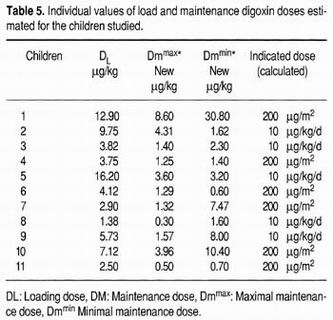
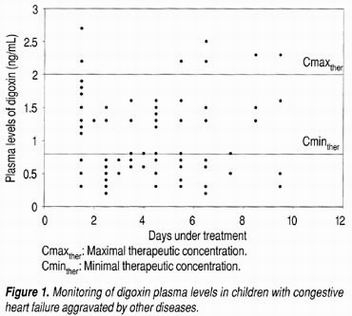
<body><![CDATA[<p>&nbsp;</p>     <p><font size="2" face="Verdana"> <b>RESULTS</b></font></p>     <p><font size="2" face="Verdana"> Age ranged between 1 month, 10 days and 15 years, 11 months. Six male and five female patients were included with clear signs of CHF. In addition to CHF, the children had other diseases: 2 had rheumatic fever, 5 had anemia of diverse etiology, and 5 had lower respiratory tract infections. The remaining conditions are shown in <a href="/img/revistas/ric/v56n1/n1a06t1.jpg" target="_blank">(table 1)</a>.    <br>   <a href="/img/revistas/ric/v56n1/n1a06t2.jpg" target="_blank">(Table 2)</a> shows the individual values of the pharmacokinetic parameters. Values vary considerably. For example, the elimination half-life (t <SUB>½</SUB> ) ranged from 8.3 to 77.0 hours with a median value of 42.0 hours; the distribution volume (Vd) ranged from 0.654 to 6.25 L/kg with a median value of 1.01 L/kg: total body clearance (Cl) ranged from 6.0 to 331.0 mL/kg/h, with a median of 15.0 mL/kg/h. The remaining pharmacokinetic parameters also showed important variations. Based on population heterogeneity, children were grouped according to age. Group I comprised children from 1 month to 3 years of age, and group II included children aged between 8 and 15 years. The analysis of the effect of age on drug distribution showed significant differences (p &lt; 0.05): group II had a mean &#945; value (distribution rate constant) of 0.2419 h <SUP>-1</SUP> (range 0.0928- 0.7340 h <SUP>-1</SUP> ), while group I had a mean &#945; value of 0.8682 h <SUP>-</SUP> 1 (range 0.3472 - 1.1254 h <SUP>-1</SUP> ). Similarly, distribution half-life (t <SUB>½</SUB> &#945;) was longer in the second group, with a median of 2.86 h (range 0.937-7.46 h). Group I showed a median value of 0.814 h (range 0.6157-1.22 h); the remaining results are shown in <a href="/img/revistas/ric/v56n1/n1a06t3.jpg" target="_blank">(table 3)</a>. Grouping of children according to their drug-biotransformation ability disclosed two groups: slow eliminators, with an elimination half-life longer than 1.6 days and fast eliminators, with a shorter half-life. Significant statistical differences were found (p &lt; 0.01) for several pharmacokinetic parameters, such as k <SUB>21</SUB> (transference constant), with a median value of 0.1451 (range 0.0470 - 0.2504 h <SUP>-1</SUP> ) among slow eliminators, and 0.2944 (range 0.1656 - 0.8634 h-1) among fast eliminators. Similarly, the results for the area under curve from zero to infinity were higher among slow eliminators, with a median value of 213.56 (range 120.22 - 873.24 &#956;g/mL/h), while fast eliminators showed a lower mean value of 41.25 (range 8.53- 171.8 &#956;g/mL/h) <a href="/img/revistas/ric/v56n1/n1a06t4.jpg" target="_blank">(Table 4)</a>.    <br>   <a href="#f1">(Figure 1)</a> shows the evolution of daily therapeutic digoxin monitoring during the treatment period. Extensive dispersion of the concentrations can be observed along the treatment period. A total of 74 samples were analyzed, corresponding to the minimum concentrations, of which only 40.5% reached therapeutic levels. Approximately 10.8% exceeded the therapeutic level with risk of toxicity, and 48.64% were sub-therapeutic. </font></p>     <p align="center"><font size="2" face="Verdana"><a name="f1"></a><img src="/img/revistas/ric/v56n1/n1a06f1.jpg" alt="Click para agrandar"></a></font></p>     <p><font size="2" face="Verdana"> </a> </font></p>     <p>&nbsp;</p>     <p><font size="2" face="Verdana">Dosage schemes were re-calculated for patients with digoxin concentrations above the recommended therapeutic range to reach a sustained therapeutic level. The loading and maintenance doses were estimated based on the results of the pharmacokinetic study for each patient, and are shown in <a href="#t5">(Table 5)</a>. </font></p>     <p align="center"><font size="2" face="Verdana"><img src="/img/revistas/ric/v56n1/n1a06t5.jpg" alt="Click para agrandar"></a><a name="t5"> </a> </font></p>     ]]></body>
<body><![CDATA[<p>&nbsp;</p>     <p><font size="2" face="Verdana"><b>DISCUSSION</b></font></p>     <p><font size="2" face="Verdana">Disease severity confers special physiologic characteristics to the individual, which affect various organs or systems and modify the pharmacokinetic behavior of several drugs. <SUP>10,11</SUP> The assessment of digoxin plasma levels and the use of pharmacokinetic parameters are not common practice in our environment, and the authors consider it important to emphasize the implications and risks of neglecting this practice.                                                       The study group was interested in determining the natural development of digoxin plasma concentration among pediatric patients with heart failure treated with digoxin, independently of age, gender, or other factors, in order to demonstrate the importance of digoxin monitoring and of the pharmacokinetic differences that require individual management as a consequence of inter-individual variations observed in the present study and other reported investigations. Thus, the aim of this work was precisely to justify digoxin monitoring and to obtain individual pharmacokinetic parameters to optimize the rational use of digoxin, when future concentrations are unpredictable due to the presence of various factors. The variable and longer elimination half-lives observed in this study compared to results found in the literature definitely point to different populations, in view of the fact that findings reported elsewhere are derived from children with CHF, <SUP>10</SUP> while present results were obtained from severely ill children suffering from CHF aggravated by other diseases that complicated their health condition. In addition, children were classified as fast- or slow eliminators based on their ability to biotransform and/or excrete digoxin. This feature is determined by the effects of heart failure on renal and liver clearance, <SUP>12</SUP> resulting in altered distribution due to blood flow modifications. Similarly, heart failure has an effect on the distribution volume of certain drugs, which is usually decreased among these patients. <SUP>3</SUP> The effects of changes in the circulatory system on digoxin distribution to deep tissues is a result of hypoperfusion, often seen in patients with hypovolemic shock and/or heart failure. <SUP>13</SUP> Therapeutic failure is a consequence of inter-individual variability in the digoxin pharmacokinetic behavior, and is more common among severely ill patients suffering from hyperdynamic conditions resulting from the physiological implications related to their pathological condition. <SUP>2</SUP> Considering the wide variety of doses required as a result of this pharmacokinetic variability, it is important to establish individual treatment schemes and to conduct close therapeutic digoxin monitoring. Medical management control can be improved for these conditions, as suggested by several authors. <SUP>14,15</SUP> Once the evolution of plasma concentrations during a multiple-dose scheme has been determined, therapeutic failure can be established. Over 11% of the digoxin-concentrations monitored during treatment were found to be toxic, 49% were below therapeutic levels, large fluctuations between maximum and minimum concentrations were observed, and only 40% were within therapeutic range.                                                       Based on the results of the analyzed variables, it may be concluded that the reason for the decrease in recommended loading and maintenance doses in the study group was a result of the patients' different capacities to biotransform and/or excrete digoxin, reflected by the pharmacokinetic changes mainly on elimination half-life or distribution volume, since these parameters are fundamental for the establishment of adequate dosage regimes. So far, pediatric patients cannot be classified according to the severity of their cardiac failure in the same way as adults. This limiting factor obstructs the evaluation of effects of cardiac failure severity on digoxin pharmacokinetics. Additionally, a general conclusion is that strict drug monitoring of any critically ill or unstable patient treated with digoxin is required.                                                       Acknowledgements                                                       We thank Isabel P&egrave;rez Montfort for correcting and editing this manuscript</font></p>     <p>&nbsp;</p>     <p><font size="2" face="Verdana"><b>REFERENCES</b></font></p>     <!-- ref --><p><font size="2" face="Verdana">1. Steinberg C, Notterman DA. Pharmacokinetics drugs in children. Inotropes and vasopressors.    <em>Clin Pharmacokinetics </em>1994; 27: 345-67. </font>&nbsp;&nbsp;&nbsp;&nbsp;&nbsp;&nbsp;&nbsp;&nbsp;[&#160;<a href="javascript:void(0);" onclick="javascript: window.open('/scielo.php?script=sci_nlinks&ref=6792059&pid=S0034-8376200400010000600001&lng=','','width=640,height=500,resizable=yes,scrollbars=1,menubar=yes,');">Links</a>&#160;]<!-- end-ref --><!-- ref --><p><font size="2" face="Verdana">2. Steinberg C, Notterman DA. Pharmacokinetics of cardiovascular drugs in children. inotropes and vasopressors.    <em>Clin Pharmacokinet</em>  1994; 27 :345-67. </font>&nbsp;&nbsp;&nbsp;&nbsp;&nbsp;&nbsp;&nbsp;&nbsp;[&#160;<a href="javascript:void(0);" onclick="javascript: window.open('/scielo.php?script=sci_nlinks&ref=6792060&pid=S0034-8376200400010000600002&lng=','','width=640,height=500,resizable=yes,scrollbars=1,menubar=yes,');">Links</a>&#160;]<!-- end-ref --><!-- ref --><p><font size="2" face="Verdana">3. Riaz K, Forker AD. Digoxin use in congestive heart failure.    <em>Drugs</em>  1988; 55: 747-58. </font>&nbsp;&nbsp;&nbsp;&nbsp;&nbsp;&nbsp;&nbsp;&nbsp;[&#160;<a href="javascript:void(0);" onclick="javascript: window.open('/scielo.php?script=sci_nlinks&ref=6792061&pid=S0034-8376200400010000600003&lng=','','width=640,height=500,resizable=yes,scrollbars=1,menubar=yes,');">Links</a>&#160;]<!-- end-ref --><!-- ref --><p><font size="2" face="Verdana">4. Miura T, Kojima R. Sugiura Y, Mizutani M, Takatsu F, Suzuki Y. Effect of aging on the incidence of digoxin toxicity.    <em>Ann Pharmacother </em>2000; 34; 427-32. </font>&nbsp;&nbsp;&nbsp;&nbsp;&nbsp;&nbsp;&nbsp;&nbsp;[&#160;<a href="javascript:void(0);" onclick="javascript: window.open('/scielo.php?script=sci_nlinks&ref=6792062&pid=S0034-8376200400010000600004&lng=','','width=640,height=500,resizable=yes,scrollbars=1,menubar=yes,');">Links</a>&#160;]<!-- end-ref --><!-- ref --><p><font size="2" face="Verdana">5. Cambonie G, Haack K, Guyon G, Badr M, Fournier-Favre S, Souksi I, Guillaumont S. Digitalis intoxication during the neonatal period: role of dehydration.    <em>Arch Pediatr</em>  2000; 7: 633-6. </font>&nbsp;&nbsp;&nbsp;&nbsp;&nbsp;&nbsp;&nbsp;&nbsp;[&#160;<a href="javascript:void(0);" onclick="javascript: window.open('/scielo.php?script=sci_nlinks&ref=6792063&pid=S0034-8376200400010000600005&lng=','','width=640,height=500,resizable=yes,scrollbars=1,menubar=yes,');">Links</a>&#160;]<!-- end-ref --><!-- ref --><p><font size="2" face="Verdana">6. Bendayan R, McKenzie MW. Digoxin pharmacokinetics and dosage requirements in pediatric patients.    <em>Clin Pharm</em>  1983; 2: 224-35. </font>&nbsp;&nbsp;&nbsp;&nbsp;&nbsp;&nbsp;&nbsp;&nbsp;[&#160;<a href="javascript:void(0);" onclick="javascript: window.open('/scielo.php?script=sci_nlinks&ref=6792064&pid=S0034-8376200400010000600006&lng=','','width=640,height=500,resizable=yes,scrollbars=1,menubar=yes,');">Links</a>&#160;]<!-- end-ref --><!-- ref --><p><font size="2" face="Verdana">7. Sorkness R. Prolonged digoxin elimination in two patients with renal and hepatic disease.    <em>Clin Pharm</em>  1983; 2: 271-3. </font>&nbsp;&nbsp;&nbsp;&nbsp;&nbsp;&nbsp;&nbsp;&nbsp;[&#160;<a href="javascript:void(0);" onclick="javascript: window.open('/scielo.php?script=sci_nlinks&ref=6792065&pid=S0034-8376200400010000600007&lng=','','width=640,height=500,resizable=yes,scrollbars=1,menubar=yes,');">Links</a>&#160;]<!-- end-ref --><!-- ref --><p><font size="2" face="Verdana">8. Winnolin program, Standard Edition, version 1.1, Scientific Consulting Inc. 1996. </font>&nbsp;&nbsp;&nbsp;&nbsp;&nbsp;&nbsp;&nbsp;&nbsp;[&#160;<a href="javascript:void(0);" onclick="javascript: window.open('/scielo.php?script=sci_nlinks&ref=6792066&pid=S0034-8376200400010000600008&lng=','','width=640,height=500,resizable=yes,scrollbars=1,menubar=yes,');">Links</a>&#160;]<!-- end-ref --><!-- ref --><p><font size="2" face="Verdana">9. Ritschel WA. Graphic approach to clinical pharmacokinetics. 2nd. ed. Barcelona: J. R. Prous. Publishers; 1984, p. 36-41. </font>&nbsp;&nbsp;&nbsp;&nbsp;&nbsp;&nbsp;&nbsp;&nbsp;[&#160;<a href="javascript:void(0);" onclick="javascript: window.open('/scielo.php?script=sci_nlinks&ref=6792067&pid=S0034-8376200400010000600009&lng=','','width=640,height=500,resizable=yes,scrollbars=1,menubar=yes,');">Links</a>&#160;]<!-- end-ref --><!-- ref --><p><font size="2" face="Verdana">10. Hauptman PJ, Kelly RA. Digitalis, cardiovascular drugs.    <em>Circulation</em>  1999; 99; 1265-76. </font>&nbsp;&nbsp;&nbsp;&nbsp;&nbsp;&nbsp;&nbsp;&nbsp;[&#160;<a href="javascript:void(0);" onclick="javascript: window.open('/scielo.php?script=sci_nlinks&ref=6792068&pid=S0034-8376200400010000600010&lng=','','width=640,height=500,resizable=yes,scrollbars=1,menubar=yes,');">Links</a>&#160;]<!-- end-ref --><!-- ref --><p><font size="2" face="Verdana">11. Aronson JK. Clinical pharmacokinetics of cardiac glycosides in patients with renal dysfunction.    <em>Clin Pharmacokinet</em>  1983; 8: 155-178. </font>&nbsp;&nbsp;&nbsp;&nbsp;&nbsp;&nbsp;&nbsp;&nbsp;[&#160;<a href="javascript:void(0);" onclick="javascript: window.open('/scielo.php?script=sci_nlinks&ref=6792069&pid=S0034-8376200400010000600011&lng=','','width=640,height=500,resizable=yes,scrollbars=1,menubar=yes,');">Links</a>&#160;]<!-- end-ref --><!-- ref --><p><font size="2" face="Verdana">12. Cheng JW, Charland SL, Shaw LM, Kobrin S, Goldfarb S, Stanek EJ. Is the volume of distribution of digoxin reduced in patients with renal disfunction? Determining digoxin pharmacokinetics by fluorescence polarization immunoassay.    <em>Pharmacotherapy</em>  1997; 17: 584-90. </font>&nbsp;&nbsp;&nbsp;&nbsp;&nbsp;&nbsp;&nbsp;&nbsp;[&#160;<a href="javascript:void(0);" onclick="javascript: window.open('/scielo.php?script=sci_nlinks&ref=6792070&pid=S0034-8376200400010000600012&lng=','','width=640,height=500,resizable=yes,scrollbars=1,menubar=yes,');">Links</a>&#160;]<!-- end-ref --><!-- ref --><p><font size="2" face="Verdana">13. Kearney K. Emergency. Digitals Toxicity.    <em>Am J Nurs</em>  2000; 100: 51-53. </font>&nbsp;&nbsp;&nbsp;&nbsp;&nbsp;&nbsp;&nbsp;&nbsp;[&#160;<a href="javascript:void(0);" onclick="javascript: window.open('/scielo.php?script=sci_nlinks&ref=6792071&pid=S0034-8376200400010000600013&lng=','','width=640,height=500,resizable=yes,scrollbars=1,menubar=yes,');">Links</a>&#160;]<!-- end-ref --><!-- ref --><p><font size="2" face="Verdana">14. Mooradian AD. Digitalis: An update of clinical pharmacokinetics, therapeutic monitoring techniques and treatment recommendations.    <em>Clin Pharmacokinet</em>  1988; 15: 165-79. </font>&nbsp;&nbsp;&nbsp;&nbsp;&nbsp;&nbsp;&nbsp;&nbsp;[&#160;<a href="javascript:void(0);" onclick="javascript: window.open('/scielo.php?script=sci_nlinks&ref=6792072&pid=S0034-8376200400010000600014&lng=','','width=640,height=500,resizable=yes,scrollbars=1,menubar=yes,');">Links</a>&#160;]<!-- end-ref --><!-- ref --><p><font size="2" face="Verdana">15. Abad-Santos F, Carcas AJ, Ibanez C, Frias J. Digoxin level and clinical manifestations as determinants in the diagnosis of digoxin toxicity.    <em>Ther Drug Monit</em>  2000; 22: 163-8. </font>&nbsp;&nbsp;&nbsp;&nbsp;&nbsp;&nbsp;&nbsp;&nbsp;[&#160;<a href="javascript:void(0);" onclick="javascript: window.open('/scielo.php?script=sci_nlinks&ref=6792073&pid=S0034-8376200400010000600015&lng=','','width=640,height=500,resizable=yes,scrollbars=1,menubar=yes,');">Links</a>&#160;]<!-- end-ref --> ]]></body><back>
<ref-list>
<ref id="B1">
<label>1</label><nlm-citation citation-type="journal">
<person-group person-group-type="author">
<name>
<surname><![CDATA[Steinberg]]></surname>
<given-names><![CDATA[C]]></given-names>
</name>
<name>
<surname><![CDATA[Notterman]]></surname>
<given-names><![CDATA[DA]]></given-names>
</name>
</person-group>
<article-title xml:lang="en"><![CDATA[Pharmacokinetics drugs in children: Inotropes and vasopressors]]></article-title>
<source><![CDATA[Clin Pharmacokinetics]]></source>
<year>1994</year>
<numero>27</numero>
<issue>27</issue>
<page-range>345-67</page-range></nlm-citation>
</ref>
<ref id="B2">
<label>2</label><nlm-citation citation-type="journal">
<person-group person-group-type="author">
<name>
<surname><![CDATA[Steinberg]]></surname>
<given-names><![CDATA[C]]></given-names>
</name>
<name>
<surname><![CDATA[Notterman]]></surname>
<given-names><![CDATA[DA]]></given-names>
</name>
</person-group>
<article-title xml:lang="en"><![CDATA[Pharmacokinetics of cardiovascular drugs in children. inotropes and vasopressors]]></article-title>
<source><![CDATA[Clin Pharmacokinet]]></source>
<year>1994</year>
<numero>27</numero>
<issue>27</issue>
<page-range>345-67</page-range></nlm-citation>
</ref>
<ref id="B3">
<label>3</label><nlm-citation citation-type="journal">
<person-group person-group-type="author">
<name>
<surname><![CDATA[Riaz]]></surname>
<given-names><![CDATA[K]]></given-names>
</name>
<name>
<surname><![CDATA[Forker]]></surname>
<given-names><![CDATA[AD]]></given-names>
</name>
</person-group>
<article-title xml:lang="en"><![CDATA[Digoxin use in congestive heart failure]]></article-title>
<source><![CDATA[Drugs]]></source>
<year>1988</year>
<numero>55</numero>
<issue>55</issue>
<page-range>747-58</page-range></nlm-citation>
</ref>
<ref id="B4">
<label>4</label><nlm-citation citation-type="journal">
<person-group person-group-type="author">
<name>
<surname><![CDATA[Miura]]></surname>
<given-names><![CDATA[T]]></given-names>
</name>
<name>
<surname><![CDATA[Kojima]]></surname>
<given-names><![CDATA[R]]></given-names>
</name>
<name>
<surname><![CDATA[Sugiura]]></surname>
<given-names><![CDATA[Y]]></given-names>
</name>
<name>
<surname><![CDATA[Mizutani]]></surname>
<given-names><![CDATA[M]]></given-names>
</name>
<name>
<surname><![CDATA[Takatsu]]></surname>
<given-names><![CDATA[F]]></given-names>
</name>
<name>
<surname><![CDATA[Suzuki]]></surname>
<given-names><![CDATA[Y]]></given-names>
</name>
</person-group>
<article-title xml:lang="en"><![CDATA[Effect of aging on the incidence of digoxin toxicity]]></article-title>
<source><![CDATA[Ann Pharmacother]]></source>
<year>2000</year>
<numero>34</numero>
<issue>34</issue>
<page-range>427-32</page-range></nlm-citation>
</ref>
<ref id="B5">
<label>5</label><nlm-citation citation-type="journal">
<person-group person-group-type="author">
<name>
<surname><![CDATA[Cambonie]]></surname>
<given-names><![CDATA[G]]></given-names>
</name>
<name>
<surname><![CDATA[Haack]]></surname>
<given-names><![CDATA[K]]></given-names>
</name>
<name>
<surname><![CDATA[Guyon]]></surname>
<given-names><![CDATA[G]]></given-names>
</name>
<name>
<surname><![CDATA[Badr]]></surname>
<given-names><![CDATA[M]]></given-names>
</name>
<name>
<surname><![CDATA[Fournier-Favre]]></surname>
<given-names><![CDATA[S]]></given-names>
</name>
<name>
<surname><![CDATA[Souksi]]></surname>
<given-names><![CDATA[I]]></given-names>
</name>
<name>
<surname><![CDATA[Guillaumont]]></surname>
<given-names><![CDATA[S]]></given-names>
</name>
</person-group>
<article-title xml:lang="en"><![CDATA[Digitalis intoxication during the neonatal period: role of dehydration]]></article-title>
<source><![CDATA[Arch Pediatr]]></source>
<year>2000</year>
<numero>7</numero>
<issue>7</issue>
<page-range>633-6</page-range></nlm-citation>
</ref>
<ref id="B6">
<label>6</label><nlm-citation citation-type="journal">
<person-group person-group-type="author">
<name>
<surname><![CDATA[Bendayan]]></surname>
<given-names><![CDATA[R]]></given-names>
</name>
<name>
<surname><![CDATA[McKenzie]]></surname>
<given-names><![CDATA[MW]]></given-names>
</name>
</person-group>
<article-title xml:lang="en"><![CDATA[Digoxin pharmacokinetics and dosage requirements in pediatric patients]]></article-title>
<source><![CDATA[Clin Pharm]]></source>
<year>1983</year>
<numero>2</numero>
<issue>2</issue>
<page-range>224-35</page-range></nlm-citation>
</ref>
<ref id="B7">
<label>7</label><nlm-citation citation-type="journal">
<person-group person-group-type="author">
<name>
<surname><![CDATA[Sorkness]]></surname>
<given-names><![CDATA[R]]></given-names>
</name>
</person-group>
<article-title xml:lang="en"><![CDATA[Prolonged digoxin elimination in two patients with renal and hepatic disease]]></article-title>
<source><![CDATA[Clin Pharm]]></source>
<year>1983</year>
<numero>2</numero>
<issue>2</issue>
<page-range>271-3</page-range></nlm-citation>
</ref>
<ref id="B8">
<label>8</label><nlm-citation citation-type="book">
<source><![CDATA[Winnolin program]]></source>
<year>1996</year>
<volume>1.1</volume>
<publisher-name><![CDATA[Scientific Consulting Inc.]]></publisher-name>
</nlm-citation>
</ref>
<ref id="B9">
<label>9</label><nlm-citation citation-type="book">
<person-group person-group-type="author">
<name>
<surname><![CDATA[Ritschel]]></surname>
<given-names><![CDATA[WA]]></given-names>
</name>
</person-group>
<source><![CDATA[Graphic approach to clinical pharmacokinetics]]></source>
<year>1984</year>
<edition>2</edition>
<page-range>36-41</page-range><publisher-loc><![CDATA[Barcelona ]]></publisher-loc>
<publisher-name><![CDATA[J. R. Prous. Publishers]]></publisher-name>
</nlm-citation>
</ref>
<ref id="B10">
<label>10</label><nlm-citation citation-type="journal">
<person-group person-group-type="author">
<name>
<surname><![CDATA[Hauptman]]></surname>
<given-names><![CDATA[PJ]]></given-names>
</name>
<name>
<surname><![CDATA[Kelly]]></surname>
<given-names><![CDATA[RA]]></given-names>
</name>
</person-group>
<article-title xml:lang="en"><![CDATA[Digitalis, cardiovascular drugs]]></article-title>
<source><![CDATA[Circulation]]></source>
<year>1999</year>
<numero>99</numero>
<issue>99</issue>
<page-range>1265-76</page-range></nlm-citation>
</ref>
<ref id="B11">
<label>11</label><nlm-citation citation-type="journal">
<person-group person-group-type="author">
<name>
<surname><![CDATA[Aronson]]></surname>
<given-names><![CDATA[JK]]></given-names>
</name>
</person-group>
<article-title xml:lang="en"><![CDATA[Clinical pharmacokinetics of cardiac glycosides in patients with renal dysfunction]]></article-title>
<source><![CDATA[Clin Pharmacokinet]]></source>
<year>1983</year>
<numero>8</numero>
<issue>8</issue>
<page-range>155-178</page-range></nlm-citation>
</ref>
<ref id="B12">
<label>12</label><nlm-citation citation-type="journal">
<person-group person-group-type="author">
<name>
<surname><![CDATA[Cheng]]></surname>
<given-names><![CDATA[JW]]></given-names>
</name>
<name>
<surname><![CDATA[Charland]]></surname>
<given-names><![CDATA[SL]]></given-names>
</name>
<name>
<surname><![CDATA[Shaw]]></surname>
<given-names><![CDATA[LM]]></given-names>
</name>
<name>
<surname><![CDATA[Kobrin]]></surname>
<given-names><![CDATA[S]]></given-names>
</name>
<name>
<surname><![CDATA[Goldfarb]]></surname>
<given-names><![CDATA[S]]></given-names>
</name>
<name>
<surname><![CDATA[Stanek]]></surname>
<given-names><![CDATA[EJ]]></given-names>
</name>
</person-group>
<article-title xml:lang="en"><![CDATA[Is the volume of distribution of digoxin reduced in patients with renal disfunction?: Determining digoxin pharmacokinetics by fluorescence polarization immunoassay]]></article-title>
<source><![CDATA[Pharmacotherapy]]></source>
<year>1997</year>
<numero>17</numero>
<issue>17</issue>
<page-range>584-90</page-range></nlm-citation>
</ref>
<ref id="B13">
<label>13</label><nlm-citation citation-type="journal">
<person-group person-group-type="author">
<name>
<surname><![CDATA[Kearney]]></surname>
<given-names><![CDATA[K]]></given-names>
</name>
</person-group>
<article-title xml:lang="en"><![CDATA[Emergency: Digitals Toxicity]]></article-title>
<source><![CDATA[Am J Nurs]]></source>
<year>2000</year>
<numero>100</numero>
<issue>100</issue>
<page-range>51-53</page-range></nlm-citation>
</ref>
<ref id="B14">
<label>14</label><nlm-citation citation-type="journal">
<person-group person-group-type="author">
<name>
<surname><![CDATA[Mooradian]]></surname>
<given-names><![CDATA[AD]]></given-names>
</name>
</person-group>
<article-title xml:lang="en"><![CDATA[Digitalis: An update of clinical pharmacokinetics, therapeutic monitoring techniques and treatment recommendations]]></article-title>
<source><![CDATA[Clin Pharmacokinet]]></source>
<year>1988</year>
<numero>15</numero>
<issue>15</issue>
<page-range>165-79</page-range></nlm-citation>
</ref>
<ref id="B15">
<label>15</label><nlm-citation citation-type="journal">
<person-group person-group-type="author">
<name>
<surname><![CDATA[Abad-Santos]]></surname>
<given-names><![CDATA[F]]></given-names>
</name>
<name>
<surname><![CDATA[Carcas]]></surname>
<given-names><![CDATA[AJ]]></given-names>
</name>
<name>
<surname><![CDATA[Ibanez]]></surname>
<given-names><![CDATA[C]]></given-names>
</name>
<name>
<surname><![CDATA[Frias]]></surname>
<given-names><![CDATA[J]]></given-names>
</name>
</person-group>
<article-title xml:lang="en"><![CDATA[Digoxin level and clinical manifestations as determinants in the diagnosis of digoxin toxicity]]></article-title>
<source><![CDATA[Ther Drug Monit]]></source>
<year>2000</year>
<numero>22</numero>
<issue>22</issue>
<page-range>163-8</page-range></nlm-citation>
</ref>
</ref-list>
</back>
</article>