<?xml version="1.0" encoding="ISO-8859-1"?><article xmlns:mml="http://www.w3.org/1998/Math/MathML" xmlns:xlink="http://www.w3.org/1999/xlink" xmlns:xsi="http://www.w3.org/2001/XMLSchema-instance">
<front>
<journal-meta>
<journal-id>0016-7169</journal-id>
<journal-title><![CDATA[Geofísica internacional]]></journal-title>
<abbrev-journal-title><![CDATA[Geofís. Intl]]></abbrev-journal-title>
<issn>0016-7169</issn>
<publisher>
<publisher-name><![CDATA[Universidad Nacional Autónoma de México, Instituto de Geofísica]]></publisher-name>
</publisher>
</journal-meta>
<article-meta>
<article-id>S0016-71692014000400004</article-id>
<title-group>
<article-title xml:lang="en"><![CDATA[Comparative study of top soil magnetic susceptibility variation based on some human activities]]></article-title>
</title-group>
<contrib-group>
<contrib contrib-type="author">
<name>
<surname><![CDATA[Kanu]]></surname>
<given-names><![CDATA[M. O.]]></given-names>
</name>
<xref ref-type="aff" rid="A01"/>
</contrib>
<contrib contrib-type="author">
<name>
<surname><![CDATA[Meludu]]></surname>
<given-names><![CDATA[O. C.]]></given-names>
</name>
<xref ref-type="aff" rid="A02"/>
</contrib>
<contrib contrib-type="author">
<name>
<surname><![CDATA[Oniku]]></surname>
<given-names><![CDATA[S. A.]]></given-names>
</name>
<xref ref-type="aff" rid="A02"/>
</contrib>
</contrib-group>
<aff id="A01">
<institution><![CDATA[,Taraba State University P. M. B. Department of Physics ]]></institution>
<addr-line><![CDATA[Jalingo Taraba]]></addr-line>
<country>Nigeria</country>
</aff>
<aff id="A02">
<institution><![CDATA[,Modibbo Adama University of Technology P.M.B. Department of Physics ]]></institution>
<addr-line><![CDATA[Yola Adamawa]]></addr-line>
<country>Nigeria</country>
</aff>
<pub-date pub-type="pub">
<day>00</day>
<month>12</month>
<year>2014</year>
</pub-date>
<pub-date pub-type="epub">
<day>00</day>
<month>12</month>
<year>2014</year>
</pub-date>
<volume>53</volume>
<numero>4</numero>
<fpage>411</fpage>
<lpage>423</lpage>
<copyright-statement/>
<copyright-year/>
<self-uri xlink:href="http://www.scielo.org.mx/scielo.php?script=sci_arttext&amp;pid=S0016-71692014000400004&amp;lng=en&amp;nrm=iso"></self-uri><self-uri xlink:href="http://www.scielo.org.mx/scielo.php?script=sci_abstract&amp;pid=S0016-71692014000400004&amp;lng=en&amp;nrm=iso"></self-uri><self-uri xlink:href="http://www.scielo.org.mx/scielo.php?script=sci_pdf&amp;pid=S0016-71692014000400004&amp;lng=en&amp;nrm=iso"></self-uri><abstract abstract-type="short" xml:lang="es"><p><![CDATA[Se realizó una investigación sobre el efecto que tienen algunas actividades humanas en la susceptibilidad magnética y la susceptibilidad dependiente de la frecuencia: el estudio se realizó en Jalingo, estado de Taraba, Nigeria, en la superficie del suelo de una zona comercial, un estacionamiento de autos y una zona escolar. El objetivo fue evaluar la variación de la susceptibilidad magnética con distintos tipos de uso de la tierra y detectar los puntos más contaminados utilizando los parámetros de proxy magnéticos. Con ello se evaluó la contribución de superparamagnéticas (SP), del tamaño de un grano, a la susceptibilidad magnética del cálculo de la dependencia de la frecuencia de la susceptibilidad magnética (MS). Los resultados de las mediciones de masa específicos de susceptibilidad de baja frecuencia magnética mostraron una mejora significativa con valores que van desde 67,8 hasta 495,3 x 10⁻⁸ m³kg-1, con un valor medio de 191,61 x 10⁻⁸ m³kg-1 para el Colegio Jalingo de Educación (datos JCOE); 520,1-1612,8 x 10-8 m³kg-1 con un valor medio de 901,34 x 10⁻⁸ m³kg-1 para el mercado principal de Jalingo (JMM) y 188.5- 1.203,6 x 10-8m³kg-1 con un valor promedio de 574 92 x 10-6 m³kg-1 para el Motor Park Jalingo (JMP). La mejora magnética significativa indica una alta concentración de minerales ferrimagnéticos en el suelo y, por lo tanto, un aumento en la contaminación. La susceptibilidad magnética de los diferentes usos del suelo estudiados se redujo en la zona comercial (mercado)&gt;, estacionamiento &gt; e instalaciones escolares. Los resultados de la dependencia del porcentaje de la susceptibilidad dependiente de la frecuencia mostró que la mayoría de las muestras tenían una mezcla de SP y los granos gruesos o de dominio de múltiples granos SP <0.05&#956;m. El valor de% &#967;fd% rango 2,68 a 13,80%, con un valor medio de 8,67% en las muestras JCOE, 0,49 a 10,04%, con un promedio de 5,05% en las muestras JMM y 0,56 a 13,04%, con un valor promedio de 5.86% en las muestras de JMP.]]></p></abstract>
<abstract abstract-type="short" xml:lang="en"><p><![CDATA[An investigation of the effect of some human activities on the magnetic susceptibility and frequency dependent susceptibility was conducted on top soil samples from, a commercial area, a motor park and a school environment in Jalingo, Taraba State, N-E Nigeria. The purpose was to assess the variation of magnetic susceptibility with different land use, detect pollution hotspots using magnetic proxy parameters and evaluate the contribution of superparamagnetic (SP) grain size contribution to the magnetic susceptibility from calculation of the frequency dependence of magnetic susceptibility (MS). The results of the mass specific low frequency magnetic susceptibility measurements showed significant enhancement with values ranging from 67.8 - 495.3 x 10⁻⁸ m³kg-1 with a mean value of 191.61 x 10⁻⁸ m³kg-1 for the Jalingo College of Education (JCOE) data; 520.1 - 1612.8 x 10-8 m³kg-1 with a mean value of 901.34 x 10⁻⁸ m³kg-1 for the Jalingo main Market (JMM) and 188.5- 1203.6 x 10-8m³kg-1 with an average value of 574 92 x 10-6 m³kg-1 for the Jalingo Motor Park (JMP). The significant magnetic enhancement indicates high concentration of ferrimagnetic minerals in the soil and hence increased pollution. The magnetic susceptibility of the different land use studied decreased in the order commercial area (market) &gt; motor park &gt; school premises. The results of the percentage frequency dependence susceptibility showed that most of the samples had a mixture of SP and coarse multi domain grains or SP grains < 0.05&#956;m. The value of &#967;fd% range from 2.68 to 13.80% with an average value of 8.67% in the JCOE samples, 0.49 to 10.04% with an a-verage of 5.05% in the JMM samples and 0.56 to 13.04% with an average value of 5.86% in the JMP samples.]]></p></abstract>
<kwd-group>
<kwd lng="es"><![CDATA[Contaminación del suelo]]></kwd>
<kwd lng="es"><![CDATA[susceptibilidad magnética]]></kwd>
<kwd lng="es"><![CDATA[susceptibilidad dependiente de la frecuencia]]></kwd>
<kwd lng="es"><![CDATA[mineral magnético]]></kwd>
<kwd lng="es"><![CDATA[ferrimagnético]]></kwd>
<kwd lng="en"><![CDATA[Soil pollution]]></kwd>
<kwd lng="en"><![CDATA[magnetic susceptibility]]></kwd>
<kwd lng="en"><![CDATA[frequency dependent susceptibility]]></kwd>
<kwd lng="en"><![CDATA[mineral magnetic]]></kwd>
<kwd lng="en"><![CDATA[ferrimagnetic]]></kwd>
</kwd-group>
</article-meta>
</front><body><![CDATA[ 
    <p align="justify"><font face="verdana" size="4">Original paper</font></p>
    <p align="justify">&nbsp;</p>
    <p align="center"><font face="verdana" size="4"><b>Comparative study of top soil magnetic susceptibility variation based on some human activities</b></font></p>

    <p align="center">&nbsp;</p>
    <p align="center"><b><font face="verdana" size="2">Kanu M. O.*, Meludu O. C.&#42;&#42; and Oniku S. A.</font></b><b><font face="verdana" size="2">&#42;</font></b><b><font face="verdana" size="2">&#42;</font></b></p>

    <p align="center">&nbsp;</p>
    <p align="justify"><font face="verdana" size="2"><i>* Department of Physics Taraba State University P. M. B. 1167, Jalingo Taraba State, Nigeria</i> * Corresponding author: <a href="mailto:maxiexpress007@gmail.com" target="_blank">maxiexpress007@gmail.com</a></font></p>
    <p align="justify"><font face="verdana" size="2"><font face="verdana" size="2"><i>&#42;&#42;</i></font><i> Department of Physics Modibbo Adama University of Technology P.M.B. 2076, Yola Adamawa State, Nigeria.</i></font></p>
    <p align="justify">&nbsp;</p>
    ]]></body>
<body><![CDATA[<p align="justify"><font face="verdana" size="2">Received: June 10; 2013.    <br>
Accepted: November 11, 2013.     <br>
Published on line: October 01, 2014.</font></p>

    <p align="justify">&nbsp;</p>
    <p align="justify"><font face="verdana" size="2"><b>Resumen</b></font></p>

    <p align="justify"><font face="verdana" size="2">Se realiz&oacute; una investigaci&oacute;n sobre el efecto que tienen algunas actividades humanas en la susceptibilidad magn&eacute;tica y la susceptibilidad dependiente de la frecuencia: el estudio se realiz&oacute; en Jalingo, estado de Taraba, Nigeria, en la superficie del suelo de una zona comercial, un estacionamiento de autos y una zona escolar. El objetivo fue evaluar la variaci&oacute;n de la susceptibilidad magn&eacute;tica con distintos tipos de uso de la tierra y detectar los puntos m&aacute;s contaminados utilizando los par&aacute;metros de proxy magn&eacute;ticos. Con ello se evalu&oacute; la contribuci&oacute;n de superparamagn&eacute;ticas (SP), del tama&ntilde;o de un grano, a la susceptibilidad magn&eacute;tica del c&aacute;lculo de la dependencia de la frecuencia de la susceptibilidad magn&eacute;tica (MS). Los resultados de las mediciones de masa espec&iacute;ficos de susceptibilidad de baja frecuencia magn&eacute;tica mostraron una mejora significativa con valores que van desde 67,8 hasta 495,3 x 10<sup>&#45;8</sup> m<sup>3</sup>kg<sup>&#45;1</sup>, con un valor medio de 191,61 x 10<sup>&#45;8</sup> m<sup>3</sup>kg<sup>&#45;1</sup> para el Colegio Jalingo de Educaci&oacute;n (datos JCOE); 520,1&#45;1612,8 x 10<sup>&#45;8</sup> m<sup>3</sup>kg<sup>&#45;1</sup> con un valor medio de 901,34 x 10<sup>&#45;8</sup> m<sup>3</sup>kg<sup>&#45;1</sup> para el mercado principal de Jalingo (JMM) y 188.5&#45; 1.203,6 x 10<sup>&#45;8</sup>m<sup>3</sup>kg<sup>&#45;1</sup> con un valor promedio de 574 92 x 10&#45;6 m<sup>3</sup>kg<sup>&#45;1</sup> para el Motor Park Jalingo (JMP). La mejora magn&eacute;tica significativa indica una alta concentraci&oacute;n de minerales ferrimagn&eacute;ticos en el suelo y, por lo tanto, un aumento en la contaminaci&oacute;n. La susceptibilidad magn&eacute;tica de los diferentes usos del suelo estudiados se redujo en la zona comercial (mercado)&gt;, estacionamiento &gt; e instalaciones escolares. Los resultados de la dependencia del porcentaje de la susceptibilidad dependiente de la frecuencia mostr&oacute; que la mayor&iacute;a de las muestras ten&iacute;an una mezcla de SP y los granos gruesos o de dominio de m&uacute;ltiples granos SP &lt;0.05&#956;m. El valor de% <i>&#967;<sub>fd</sub></i>% rango 2,68 a 13,80%, con un valor medio de 8,67% en las muestras JCOE, 0,49 a 10,04%, con un promedio de 5,05% en las muestras JMM y 0,56 a 13,04%, con un valor promedio de 5.86% en las muestras de JMP.</font></p>

	    <p align="justify"><font face="verdana" size="2"><b>Palabras clave:</b> Contaminaci&oacute;n del suelo, susceptibilidad magn&eacute;tica, susceptibilidad dependiente de la frecuencia, mineral magn&eacute;tico, ferrimagn&eacute;tico.</font></p>

	    <p align="justify">&nbsp;</p>
	    <p align="justify"><font face="verdana" size="2"><b>Abstract</b></font></p>

    <p align="justify"><font face="verdana" size="2">An investigation of the effect of some human activities on the magnetic susceptibility and frequency dependent susceptibility was conducted on top soil samples from, a commercial area, a motor park and a school environment in Jalingo, Taraba State, N&#45;E Nigeria. The purpose was to assess the variation of magnetic susceptibility with different land use, detect pollution hotspots using magnetic proxy parameters and evaluate the contribution of superparamagnetic (SP) grain size contribution to the magnetic susceptibility from calculation of the frequency dependence of magnetic susceptibility (MS). The results of the mass specific low frequency magnetic susceptibility measurements showed significant enhancement with values ranging from 67.8 &#45; 495.3 x 10<sup>&#45;8</sup> m<sup>3</sup>kg<sup>&#45;1</sup> with a mean value of 191.61 x 10<sup>&#45;8</sup> m<sup>3</sup>kg<sup>&#45;1</sup> for the Jalingo College of Education (JCOE) data; 520.1 &#45; 1612.8 x 10<sup>&#45;8</sup> m<sup>3</sup>kg<sup>&#45;1</sup> with a mean value of 901.34 x 10<sup>&#45;8</sup> m<sup>3</sup>kg<sup>&#45;</sup><sup>1</sup> for the Jalingo main Market (JMM) and 188.5&#45; 1203.6 x 10<sup>&#45;8</sup>m<sup>3</sup>kg<sup>&#45;1</sup> with an average value of 574 92 x 10&#45;6 m<sup>3</sup>kg<sup>&#45;1</sup> for the Jalingo Motor Park (JMP). The significant magnetic enhancement indicates high concentration of ferrimagnetic minerals in the soil and hence increased pollution. The magnetic susceptibility of the different land use studied decreased in the order commercial area (market) &gt; motor park &gt; school premises. The results of the percentage frequency dependence susceptibility showed that most of the samples had a mixture of SP and coarse multi domain grains or SP grains &lt; 0.05&#956;m. The value of <i>&#967;<sub>fd</sub></i>% range from 2.68 to 13.80% with an average value of 8.67% in the JCOE samples, 0.49 to 10.04% with an a&#45;verage of 5.05% in the JMM samples and 0.56 to 13.04% with an average value of 5.86% in the JMP samples.</font></p>

	    ]]></body>
<body><![CDATA[<p align="justify"><font face="verdana" size="2"><b>Key words:</b> Soil pollution, magnetic susceptibility, frequency dependent susceptibility, mineral magnetic, ferrimagnetic.</font></p>

	    <p align="justify">&nbsp;</p>
    <p align="justify"><font face="verdana" size="2"><b>Introduction</b></font></p>

	    <p align="justify"><font face="verdana" size="2">The adverse effect of human impact in the environment has increased in recent years and has become a subject of global concern. The type and intensity of human activity greatly impact on the environment. With increased urbanization, the urban environment is threatened by various pollution sources released into it. This pollution ranged from indiscriminate refuse dump, sewage disposal, industrial wastes, bush burning, and emissions from industries and automobile exhaust. So, pollution has become a subject widely investigated from several fields, such as geology, geophysics, chemistry, agriculture etc. Atmospheric pollution has been identified, as one of the most harmful factors for ecosystems (Petrovsky and Elwood, 1999). Usually, heavy metals and toxic elements from industrial, vehicular and domestic emissions are released into the atmosphere and are incorporated into the environment or in living organism such as vegetation, animals and human beings. These contaminants that are released into the atmosphere, soils and sediments are rich in magnetic particles, resulting in magnetic enhancement of the urban soils and sediments. A measure of the amount of magnetic enhancement is expressed by its magnetic susceptibility and in recent years, it has been successfully used to monitor anthropogenic pollution, especially heavy metal pollution in soils (example Gautam <i>et al</i>., 2004, Petrovsky <i>et al</i>., 2000, Strzyszcz and Magiera, 1998, etc.).</font></p>

	    <p align="justify"><font face="verdana" size="2">Magnetic susceptibility is defined as the ratio of the total magnetization induced in a sample to the intensity of the magnetic field that produces the magnetization Mullins (1977).</font></p>

	    <p align="justify"><font face="verdana" size="2">Magnetic susceptibility measures the concentration of magnetic crystals and also gives information on the type of magnetic minerals present in a sample. Magnetic minerals present in soils may either be obtained from the parent rocks (lithogenic origin), during pedogenesis or as a result of anthropogenic activities. The magnetic mineral content of the soil can broadly be expressed by its magnetic susceptibility. Magnetic susceptibility can be used to identify the type of mineral and the amount of iron bearing minerals contained in a material. Soils are sinks to anthropogenic pollutants released into the atmosphere. Accumulation of anthropogenic ferrimagnetic particles, originating from oxidation process during combustion of fossil fuels results in significant enhancement of topsoil magnetic susceptibility. The most important magnetic mineral is magnetite and in the atmosphere it can originate from combustion (and other industrial) processes (Petrovsky <i>et al</i>., 2000).</font></p>

	    <p align="justify"><font face="verdana" size="2">The first evidence of magnetic enhancement was reported by Le Borgne (1955). Subsequent studies by Mullins (1977) confirmed this phenomenon. Thompson and Oldfield (1986) further reported that the soils near urban areas and industrial zones have an increased susceptibility due to deposition of magnetic particles such as, dust of the metallurgical industries and fly ashes of the coal combustion. Since then, extensive studies of pollution and magnetic proxies for pollution have been conducted for example Alagarsamy (2009), Canbay (2010), Gautam <i>et al</i>. (2005), Kapicka <i>et al</i>. (1999), Knab <i>et al</i>. (2006), Magiera <i>et al</i>. (2006), Petrovsky <i>et al</i>. (2000), Shen <i>et al</i>. (2008), Strzyszcz <i>et al</i>. (1996) etc. Magnetic measurement is a simple, rapid and non&#45; destructive technique that can be applied on soil/sediment samples.</font></p>

	    <p align="justify"><font face="verdana" size="2">The purpose of this study was to assess the variation of magnetic susceptibility with different land use, detect pollution hotspots using magnetic proxy parameters and determine the grain size of the samples from calculation of the frequency dependence of magnetic susceptibility (MS).</font></p>

	    <p align="justify">&nbsp;</p>
	    <p align="justify"><font face="verdana" size="2"><b>Materials and Methods</b></font></p>
    ]]></body>
<body><![CDATA[<p align="justify"><font face="verdana" size="2"><i>Geographical and Geological setting of the Study Area</i></font></p>
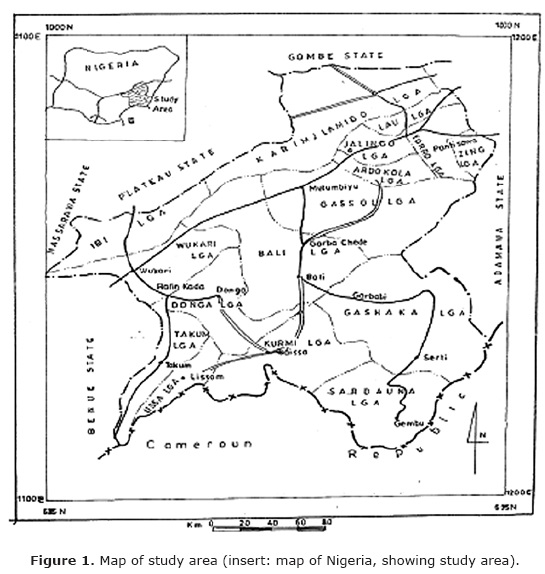
    <p align="justify"><font face="verdana" size="2">Jalingo, the study area is the administrative headquarters of Taraba State which is located between latitude 6&ordm;30' and 8&ordm;30' North of the equator and between 9&ordm;00' and 12&ordm;00' East of the Greenwich meridian (<a href="#f1">Figure 1</a>). The state has a tropical wet and dry climate, dry season lasts for a minimum of five months (November to March) while the wet season spans from April to October. It has an annual rainfall of about 8000 mm. Jalingo is a rapidly growing city without significant industrial activity, the major pollution source is the emission from traffic and power generating sets and other human activities such as indiscriminate refuse dump, bush burning etc.</font></p>
	    <p align="center"><a name="f1"></a></p>
	    <p align="center"><img src="/img/revistas/geoint/v53n4/a4f1.jpg"></p>

	    <p align="justify"><font face="verdana" size="2">The study area is underlain by the undifferentiated Basement Complex rocks which consist mainly of the migmatites, gneisses and the Older Granites. Tertiary to Recent basalts also occurs in the area. The undifferentiated Basement Complex particularly the migmatites, generally vary from coarsely mixed gneisses to diffused textured rocks of variable grain size and are frequently porphyroblastic (Macleod <i>et al</i>., 1971).</font></p>

	    <p align="justify"><font face="verdana" size="2">The Pan African Older Granites are equally widespread in the area. They occur either as basic or intermediate intrusives (Turner, 1964). Different kinds of textures ranging from fine to medium to coarse grains can be noticed on the Older Granites (McCurry, 1976). Other localized occurrences of minor rock types include some doleritic and pegmatitic rocks mostly occurring as intrusive dykes and vein bodies. These occurrences are common to both the undifferentiated Basement Complex and the Older Granite rocks (Carter <i>et al</i>., 1963, McCurry, 1976). The Tertiary basalts on the other hand are found in the Mambila Plateau mostly formed by trachytic lavas and extensive basalts which occur around Nguroje (du Preez and Barber, 1965).</font></p>

	    <p align="justify">&nbsp;</p>
	    <p align="justify"><font face="verdana" size="2"><b>Sampling and Analysis</b></font></p>

	    <p align="justify"><font face="verdana" size="2">Topsoil samples (0&#45; 2 cm) were collected from three different locations using a plastic material to avoid contamination. The samples locations were determined using a 12 Channel Garmin Global Positioning System (GPS 12). A total of 59 samples were randomly collected, 15 samples from a school environment, 10 samples from a motor park, 11 samples from a commercial area and 23 samples from an unpolluted rural area with the same geology to serve as control. The Jalingo College of Education (JCOE) which has been in existence for more than 25 years was chosen to represent a school environment. The Jalingo Motor Park (JMP) has been in operation for more than 15 years with a land area of about 250 square meters with more than 500 vehicles moving in and out daily. The Jalingo Main Market (JMM), which is the major commercial centre of the city has an area of about 500 square meters and was built more than two decades ago. A lot of commercial activities take place in this market and vehicular movement around the market area has been on the increase over the years.</font></p>

	    <p align="justify"><font face="verdana" size="2">The samples were air dried at a temperature of 30&ordm;C in the laboratory for some days to avoid any chemical reactions. They were then ground using agate mortar and sieved using a 1 mm sieve mesh (Kim <i>et al</i>., 1999) and stored in a plastic container for further laboratory measurements. The mass specific magnetic susceptibility measurements were then carried out on the sieved samples packaged in a 10 ml plastic container at laboratory temperature. Measurements of magnetic susceptibility were made at both low (0.47 kHz) and high (4.7 kHz) frequencies using MS2 dual frequency susceptibility meter. All measurements were conducted at the 1.0 sensitivity setting. Each sample was measured three times with an air reading before and after each series for drift correction. The mass specific frequency dependence susceptibility <i>&#967;<sub>fd</sub></i> was obtained from the relation:</font></p>

	    ]]></body>
<body><![CDATA[<p align="center"><font face="verdana" size="2"><i>&#967;<sub>fd</sub></i> = <i>&#967;<sub>lf</sub></i> &minus; <i>&#967;<sub>hf</sub></i>   (1)</font></p>

	    <p align="justify"><font face="verdana" size="2">Where <i>&#967;<sub>lf</sub></i> and <i>&#967;<sub>hf</sub></i> are the low and high frequencies susceptibility respectively.</font></p>

	    <p align="justify"><font face="verdana" size="2">This parameter is sensitive only to a very narrow grain size region crossing the superparamagnetic/single domain threshold (~ 20 &#45; 25 nm for maghemite) (Worm and Jackson, 1999). For natural samples which generally exhibit a continuous and nearly constant grain size distribution, <i>&#967;<sub>fd</sub></i> can be used as a proxy for relative changes in concentration in pedogenic fined &#45; grained magnetic particles (Liu <i>et al</i>., 2005). The relative <i>&#967;<sub>fd</sub></i> also called Percentage frequency dependent susceptibility (<i>&#967;<sub>fd</sub></i>%) was then calculated following Dearing (1999) as:</font></p>
	    <p align="center"><img src="/img/revistas/geoint/v53n4/a4e2.jpg"> </p>
	    <p align="justify"><font face="verdana" size="2"><b>Results and Discussion</b></font></p>
    <p align="justify"><font face="verdana" size="2">The results of the mass specific low field magnetic susceptibility, frequency dependence and percentage frequency dependence of the samples are displayed in <a href="/img/revistas/geoint/v53n4/a4t1.jpg" target="_blank">tables 1</a>, <a href="/img/revistas/geoint/v53n4/a4t2.jpg" target="_blank">2</a>, <a href="/img/revistas/geoint/v53n4/a4t3.jpg" target="_blank">3</a>. The value of low frequency mass specific magnetic susceptibility ranges from 67.8 to 495.3 x 10<sup>&#45;8</sup> m<sup>3</sup>kg<sup>&#45;1</sup> with a mean value of 191.61 x 10<sup>&#45;8</sup> m<sup>3</sup>kg<sup>&#45;1</sup> for the JCOE data. The JMM has low frequency magnetic susceptibility values ranging from 520.1 to 1612.8 x 10<sup>&#45;8</sup> m<sup>3</sup>kg<sup>&#45;1</sup> with a mean value of 901.34 x 10<sup>&#45;8</sup> m<sup>3</sup>kg<sup>&#45;1</sup>, while the JMP has value of low frequency magnetic susceptibility ranging from 188.5 to 1203.6 x10<sup>&#45;8</sup> m<sup>3</sup>kg<sup>&#45;1</sup> with an average value of 574.92 x 10<sup>&#45;8</sup> m<sup>3</sup>kg<sup>&#45;1</sup>. The magnetic susceptibility of the different land use studied decreased in the order: commercial area (market) &gt; motor park &gt; official area. Differences in the values of magnetic susceptibility are a result of difference in the type and strength of human activity in the different areas. The high magnetic susceptibility values of the JMM may be attributed to the high commercial activity in the market rusted of pieces of metals that might be thrown on the soils and emissions from the high volume of traffic around the market area.</font></p>

	    <p align="justify"><font face="verdana" size="2">Gautam <i>et al</i>. (2004) classified soils into three broad categories based on their magnetic susceptibility (MS) values as follows: 'normal' (MS &lt; 10 x 10<sup>&#45;8</sup> m<sup>3</sup>kg<sup>&#45;1</sup>), 'moderately magnetic' (MS 10 &#45; 100 x 10<sup>&#45;8</sup> m<sup>3</sup>kg<sup>&#45;1</sup>) and 'highly magnetic' (MS &gt;100 x 10<sup>&#45;8</sup> m<sup>3</sup>kg<sup>&#45;1</sup>). From the above classification, the soils from JMM and JMP can be said to be highly magnetic, while that of JCOE ranges from moderate to highly magnetic. The high values indicate high concentration of ferrimagnetic minerals in the soil. Previous studies showed that magnetic susceptibility variations are caused by differences in geology (lithogenic/geogenic), soil forming processes (pedogenesis) and anthropogenic input of magnetic material (Dearing <i>et al</i>., 1996 and Thompson and Oldfield, 1986). The higher magnetic enhancement in JMM and JMP is attributed to anthropogenic inputs of magnetic minerals. The anthropogenic magnetic particles may likely come from vehicle emissions (vehicular exhaust, abrasion of tyres and brake linings) and waste products. Vehicular emissions comprises of different fractions of particles formed in the exhaust pipes and released into the environment. These emissions have magnetic character which is determined by the increase in the MS. The moderate values of MS obtained from JCOE samples are expected since the area is an academic environment with less traffic and with proper waste disposal system. The results obtained for the JCOE are similar to that obtained for a school in Xi'an city, China (263.45 &#45;531.28 x 10<sup>&#45;8</sup> m<sup>3</sup>kg<sup>&#45;1</sup>) (Li <i>et al</i>., 2010). The high values obtained in some samples are attributed to emissions from vehicles and power generating sets as there is insufficient power supply in this city. Most businesses are operated using private alternating current generators.</font></p>

	    <p align="justify"><font face="verdana" size="2">The values of low frequency mass specific magnetic susceptibility of the unpolluted site range from 35.4 to 92.8 x 10<sup>&#45;8</sup> m<sup>3</sup>kg<sup>&#45;1</sup> with a mean value of 64.56 x 10<sup>&#45;8</sup> m<sup>3</sup>kg<sup>&#45;1</sup>. These values are lower than the signal from urban topsoil samples. The average magnetic susceptibility value in JCOE, JMM and JMP respectively increased by about 3, 14 and 9 times those of the unpolluted site, suggesting magnetic enhancement derived from anthropogenic activities in urban soils.</font></p>

	    <p align="justify"><font face="verdana" size="2">The values of magnetic susceptibility measured at high frequencies (4.7 kHz) are usually lower than the values obtained from the low frequency (0.47 kHz) magnetic susceptibility measurements (Dearing <i>et al</i>., 1996; Dearing, 1999). This is further confirmed for soils in Jalingo as shown in <a href="/img/revistas/geoint/v53n4/a4f2.jpg" target="_blank">Figures 2</a>, <a href="/img/revistas/geoint/v53n4/a4f3.jpg" target="_blank">3</a>, <a href="/img/revistas/geoint/v53n4/a4f4.jpg" target="_blank">4</a>. Measurements made at these two frequencies at a constant applied field are generally used to detect the presence of ultrafine ferrimagnetic (also called super paramagnetic fraction of less than 0.03 &#956;m) minerals occurring as crystals and to some extent the single domain (approximately greater than 0.03 to less than 0.06 &#956;m fractions) (Sangode <i>et al</i>., 2010). Higher frequency measurements do not allow super paramagnetic grains to react with the applied magnetic field, as it changes more quickly than the required relaxation time for super paramagnetic grains. As a result, in higher frequency, lower values of MS are encountered and the difference is used to estimate the super paramagnetic ferrimagnetic particles (Sangode <i>et al</i>., 2010). When super paramagnetic minerals are present in a soil sample, the MS values at high frequency are slightly lower than the values of MS at low frequency. If there are no super paramagnetic (SP) minerals the two measurements are identical (Dearing, 1999).</font></p>

	    <p align="justify"><font face="verdana" size="2">There is wide difference between measured values of &#967;<sub>LF</sub> and &#967;<sub>HF</sub> which indicates the presence of admixture of SP minerals in the studied soil. This difference is expressed by the frequency dependent MS (<i>&#967;<sub>fd</sub></i>) shown in <a href="/img/revistas/geoint/v53n4/a4t1.jpg" target="_blank">Tables 1</a>&#45;<a href="/img/revistas/geoint/v53n4/a4t3.jpg" target="_blank">3</a>.</font></p>

	    ]]></body>
<body><![CDATA[<p align="justify"><font face="verdana" size="2">The values of <i>&#967;<sub>fd</sub></i> varied between 4.7 and 58.1 x 10<sup>&#45;8</sup> m<sup>3</sup>kg<sup>&#45;1</sup> with an average of 17.99 x 10<sup>&#45;8</sup> m<sup>3</sup>kg<sup>&#45;1</sup> for the JCOE, 2.8 and 112.5 x 10<sup>&#45;8</sup> m<sup>3</sup>kg<sup>&#45;1</sup> with a mean value of 52.28 x 10<sup>&#45;8</sup> m<sup>3</sup>kg<sup>&#45;1</sup> for JMM and 2.5 and 53.7 x 10<sup>&#45;8</sup> m<sup>3</sup>kg<sup>&#45;1</sup> with a mean of 29.21 x 10<sup>&#45;8</sup> m<sup>3</sup>kg<sup>&#45;1</sup> for the JMP. According to Dearing (1999), the mass specific frequency dependent susceptibility <i>&#967;<sub>fd</sub></i> ranges from ~30 x 10<sup>&#45;8</sup> m<sup>3</sup>kg<sup>&#45;1</sup> in stable single domain (SSD) grains to 75 &#45; 160 x 10<sup>&#45;8</sup> m<sup>3</sup>kg<sup>&#45;1</sup> in the SP range. From this information, the majority of the samples studied falls within the SSD range while only about 20% from the JMM are in the SP range.</font></p>

	    <p align="justify"><font face="verdana" size="2"><a href="/img/revistas/geoint/v53n4/a4f5.jpg" target="_blank">Figure 5</a> relate the &#967;<sub>LF</sub> and &#967;<sub>HF</sub> values in the topsoil samples of JMP. The graph shows a linear relationship between &#967;<sub>lf</sub> and &#967;HF with very significant correlation coefficient and a slope less than one indicating evidence of superparamagnetic minerals.</font></p>

	    <p align="justify"><font face="verdana" size="2"><a href="/img/revistas/geoint/v53n4/a4f6.jpg" target="_blank">Figures 6</a>, <a href="/img/revistas/geoint/v53n4/a4f7.jpg" target="_blank">7</a>, <a href="/img/revistas/geoint/v53n4/a4f8.jpg" target="_blank">8</a> compares the <i>&#967;<sub>fd</sub></i> and &#967;<sub>LF</sub> values in the topsoil samples. An increase in MS appears to be related with an increase in the <i>&#967;<sub>fd</sub></i>. According to Forster <i>et al</i>. (1994), such linear correlation indicates that with increasing magnitude the susceptibility is more controlled by the contribution from the fine pedogenic magnetic fraction. The linear relationship also indicates high homogeneity in the magnetic mineralogy of the soils corresponding with the mineral size. Similar result was obtained by Sadiki <i>et al</i>. (2009). The JMM and JCOE are more correlated with correlation coefficients of 0.84 and 0.85 respectively. The graph of &#967;<sub>lf </sub>against &#967;<sub>fd</sub> can be used to obtain the background low magnetic susceptibility &#967;B (Forster <i>et al</i>., 1994). This corresponds to the intercept on the &#967;<sub>lf</sub> axis where &#967;<sub>fd</sub> is zero. From <a href="/img/revistas/geoint/v53n4/a4f9.jpg" target="_blank">Figures 9</a>, <a href="/img/revistas/geoint/v53n4/a4f10.jpg" target="_blank">10</a>, <a href="/img/revistas/geoint/v53n4/a4f11.jpg" target="_blank">11</a>, the values of the background magnetic susceptibility are 176.0 x10<sup>&#45;8</sup> m<sup>3</sup>kg1, 72.89 x10<sup>&#45;8</sup> m<sup>3</sup>kg<sup>&#45;1</sup>, 457.1 x10<sup>&#45;8</sup> m<sup>3</sup>kg<sup>&#45;1</sup> respectively for JMP, JCOE and JMM. From these values, it was observed that all the samples except JCOE 12 had magnetic susceptibility values above the background value, implying an enhancement in the MS values. The MS enhancement can be attributed to either pedogenesis or anthropogenic sources. This observation seems to agree with our earlier observation using the classification of Gautam <i>et al</i>. (2004). The MS enhancement of sample JCOE 12 was attributed to lithogenesis.</font></p>

	    <p align="justify"><font face="verdana" size="2">Percentage frequency dependent susceptibility <i>&#967;<sub>fd</sub></i>% is used to approximate the total concentration of SP grains, while coarse multi domain (MD) magnetic grains are frequency independent as they show similar susceptibility values at low and high frequencies. Dearing (1999) proposed a model for the interpretation of frequency dependence as follows:</font></p>
	    <p align="center"><font face="verdana" size="2"><img src="/img/revistas/geoint/v53n4/a4t4.jpg"><a href="/img/revistas/geoint/v53n4/a4t4_1.jpg" target="_blank">    <br>
	  Haga clic para agrandar
	</a></font></p>
	
	
	    <p align="justify"><font face="verdana" size="2">Based on the semi quantitative model above, the results of this work demonstrated that most of the samples (about 67%) have a mixture of SP and coarse grains or SP grains &lt; 0.005&#956;m. In the JCOE samples, the value of <i>&#967;<sub>fd</sub></i>% ranges from 2.68 to 13.80% with an average value of 8.67%. Five samples (that is about 30%) are virtually all SP grains as they have <i>&#967;<sub>fd</sub></i>% in the range of 12 &#45; 14 %, while other samples have values in the range of 2 &#45; 10 % indicating the presence of a mixture of SP and MD magnetic grains. In the JMM samples, seven samples falls within the medium range of 2 &#45; 10 % and may be said to have a mixture of SP and coarse MD grains, three samples have low <i>&#967;<sub>fd</sub></i>% of &lt; 2% implying that they have no SP grains while only one sample has high <i>&#967;<sub>fd</sub></i>% of 10.04 % meaning that the dominant magnetic component of this soil are SP ferrimagnetic grains. For the JMP samples, about 70% of the samples have <i>&#967;<sub>fd</sub></i>% value in the medium range and this can be interpreted as soils with admixture of SP and coarser non SP grains or &lt; 0.005&#956;m SP grains. About 20% of the JMP samples are soils where virtually all the iron component are SP grains, while about 10% of the samples contains no SP grains. Generally, most of the samples in the studied area contain a mixture of SP and MD magnetic grains.</font></p>
    <p align="justify"><font face="verdana" size="2"><a href="/img/revistas/geoint/v53n4/a4f9.jpg" target="_blank">Figures 9</a> &#45; <a href="/img/revistas/geoint/v53n4/a4f11.jpg" target="_blank">11</a> are the respective scattergram of &#967;<sub>lf</sub> &#45; <i>&#967;<sub>fd</sub></i> % for JMP, JCOE and JMM showing typical sample positions for the various domains and sources. The JMP samples showed negative correlation between &#967;<sub>lf </sub>and <i>&#967;<sub>fd</sub></i> % while the JCOE and JMM samples showed positive correlation. The negative correlation observed in the JMP samples indicates that the main susceptibility variations are due to magnetic enhancement as a result of industrial and anthropogenic pollution. The negative correlation between &#967;<sub>lf</sub> and <i>&#967;<sub>fd</sub></i> % further shows that pedogenic SP grains contribute little to the magnetic enhancement of urban soils, the magnetic enhancement is mainly contributed by coarse magnetic grains from industrial and anthropogenic pollution. Similar results were also obtained by Lu <i>et al</i>. (2007) for urban topsoils from Luoyang and Lu and Bai (2008) for urban soils from Hangzhou. The positive correlation of the JMM and JCOE samples indicates that the MS enhancement is due to SP ferrimagnetic grains. The MS of soils derived from sedimentary rocks usually increase with an increase in frequency dependent susceptibility (Lu, 2003). Many authors (example Wang <i>et al</i>., 2003, Zhu <i>et al</i>., 2001) also reported positive correlation between &#967;<sub>(<sub>lf</sub>)</sub> and <i>&#967;<sub>fd</sub></i>% for Chinese loess and paleosol. The combination of both positive and negative correlation within the study area is attributed to a combination of anthropogenic and pedogenic contribution to the magnetic susceptibility enhancement.</font></p>

    <p align="justify">&nbsp;</p>
	    <p align="justify"><font face="verdana" size="2"><b>Conclusion</b></font></p>

	    ]]></body>
<body><![CDATA[<p align="justify"><font face="verdana" size="2">This paper presents the result of magnetic susceptibility measurements of topsoils in different areas of Jalingo based on different types of human activities undertaken. The results shows significant magnetic enhancement which indicates the high concentration of ferrimagnetic minerals in the soil. The magnetic susceptibility of the different land use studied decreased in the order commercial area (market) &gt; motor park &gt; school premises. The significant magnetic enhancement also implied that the soils in the studied areas were polluted. Pollution distribution can be known by measurement of MS. Since the MS method is cheap, fast and capable of covering wide area in a short time, it can be used as preliminary tool to detect pollution hotspots before the application of the time consuming and expensive geochemical methods to selected samples.</font></p>

	    <p align="justify"><font face="verdana" size="2">Evaluation of the background MS from the graph of &#967;<sub>lf</sub> and <i>&#967;<sub>fd</sub></i> reveal that all the samples had MS value beyond the background values, indicating significant enhancement in the soils caused by the different land use.</font></p>

	    <p align="justify"><font face="verdana" size="2">The results of the percentage frequency dependence showed that most of the samples have a mixture of SP and coarser non SP grains or SP grains &lt; 0.05&#956;m. This implied that the observed magnetic susceptibility values results from a combination of pedogenic and anthropogenic sources.</font></p>

	    <p align="justify">&nbsp;</p>
	    <p align="justify"><font face="verdana" size="2"><b>References</b></font></p>

    <!-- ref --><p align="justify"><font face="verdana" size="2">Alagarsamy R., 2009, Environmental Magnetism and Application in the Continental Shelf of Sediments of India. <i>Mar. Environ. Res.</i>, 68, 2, pp 49 &#45; 58.    &nbsp;&nbsp;&nbsp;&nbsp;&nbsp;&nbsp;&nbsp;&nbsp;[&#160;<a href="javascript:void(0);" onclick="javascript: window.open('/scielo.php?script=sci_nlinks&ref=3935353&pid=S0016-7169201400040000400001&lng=','','width=640,height=500,resizable=yes,scrollbars=1,menubar=yes,');">Links</a>&#160;]<!-- end-ref --></font></p>

	    <!-- ref --><p align="justify"><font face="verdana" size="2">Canbay M., 2010, Investigation of the Relationship between Heavy metal Contamination of soils and its Magnetic Susceptibility. <i>International Journ. of Physical Sciences,</i> 5, 5, pp.393 &#45; 400.    &nbsp;&nbsp;&nbsp;&nbsp;&nbsp;&nbsp;&nbsp;&nbsp;[&#160;<a href="javascript:void(0);" onclick="javascript: window.open('/scielo.php?script=sci_nlinks&ref=3935355&pid=S0016-7169201400040000400002&lng=','','width=640,height=500,resizable=yes,scrollbars=1,menubar=yes,');">Links</a>&#160;]<!-- end-ref --></font></p>

	    <!-- ref --><p align="justify"><font face="verdana" size="2">Carter J.D., Barber W., Tait E.A., 1963, The Geology of parts of Adamawa, Bauchi and Bornu Provinces in Northeastern Nigeria. Bull. No. 30, <i>Geological Survey of Nigeria,</i> 108.    &nbsp;&nbsp;&nbsp;&nbsp;&nbsp;&nbsp;&nbsp;&nbsp;[&#160;<a href="javascript:void(0);" onclick="javascript: window.open('/scielo.php?script=sci_nlinks&ref=3935357&pid=S0016-7169201400040000400003&lng=','','width=640,height=500,resizable=yes,scrollbars=1,menubar=yes,');">Links</a>&#160;]<!-- end-ref --></font></p>

	    <!-- ref --><p align="justify"><font face="verdana" size="2">Dearing J.A., 1999, Environmental Magnetic Susceptibility, Using the Bartington MS2 System. Second edition, England: <i>Chi Publishing</i>.    &nbsp;&nbsp;&nbsp;&nbsp;&nbsp;&nbsp;&nbsp;&nbsp;[&#160;<a href="javascript:void(0);" onclick="javascript: window.open('/scielo.php?script=sci_nlinks&ref=3935359&pid=S0016-7169201400040000400004&lng=','','width=640,height=500,resizable=yes,scrollbars=1,menubar=yes,');">Links</a>&#160;]<!-- end-ref --></font></p>

	    <!-- ref --><p align="justify"><font face="verdana" size="2">Dearing J.A., Dann R.J.L., Hay K., Lees J.A., Loveland P.J., Maher B.A, O'Grady K., 1996, Frequency Dependent Susceptibility Measurements of Environmental Materials. <i>Geophys. J. Int.,</i> 124, 228 &#45; 240.    &nbsp;&nbsp;&nbsp;&nbsp;&nbsp;&nbsp;&nbsp;&nbsp;[&#160;<a href="javascript:void(0);" onclick="javascript: window.open('/scielo.php?script=sci_nlinks&ref=3935361&pid=S0016-7169201400040000400005&lng=','','width=640,height=500,resizable=yes,scrollbars=1,menubar=yes,');">Links</a>&#160;]<!-- end-ref --></font></p>

	    <!-- ref --><p align="justify"><font face="verdana" size="2">du Preez J.W., Barber W., 1965, The Distinction of Chemical Quality of Ground Water in Northern Nigeria. Bull. 36, <i>Geological Survey of Nigeria</i>, 93.    &nbsp;&nbsp;&nbsp;&nbsp;&nbsp;&nbsp;&nbsp;&nbsp;[&#160;<a href="javascript:void(0);" onclick="javascript: window.open('/scielo.php?script=sci_nlinks&ref=3935363&pid=S0016-7169201400040000400006&lng=','','width=640,height=500,resizable=yes,scrollbars=1,menubar=yes,');">Links</a>&#160;]<!-- end-ref --></font></p>

	    <!-- ref --><p align="justify"><font face="verdana" size="2">Forster T.H., Evans M.E., Heller F., 1994, The Frequency Dependence of Low Field Susceptibility in Loess Sediments, <i>Geophys. J. Int.</i>, 118, 636 &#45; 642.    &nbsp;&nbsp;&nbsp;&nbsp;&nbsp;&nbsp;&nbsp;&nbsp;[&#160;<a href="javascript:void(0);" onclick="javascript: window.open('/scielo.php?script=sci_nlinks&ref=3935365&pid=S0016-7169201400040000400007&lng=','','width=640,height=500,resizable=yes,scrollbars=1,menubar=yes,');">Links</a>&#160;]<!-- end-ref --></font></p>

	    <!-- ref --><p align="justify"><font face="verdana" size="2">Gautam P., Blaha U., Appel E., 2004, Integration of Magnetic Properties and Heavy Metal Chemistry to Quantify Environmental Pollution in Urban Soils, Kathmandu, Nepal. Extended Abstract: 19th Himalaya&#45;Karakoram &#45;Tibet Workshop, Niseko, Japan.    &nbsp;&nbsp;&nbsp;&nbsp;&nbsp;&nbsp;&nbsp;&nbsp;[&#160;<a href="javascript:void(0);" onclick="javascript: window.open('/scielo.php?script=sci_nlinks&ref=3935367&pid=S0016-7169201400040000400008&lng=','','width=640,height=500,resizable=yes,scrollbars=1,menubar=yes,');">Links</a>&#160;]<!-- end-ref --></font></p>

	    <!-- ref --><p align="justify"><font face="verdana" size="2">Gautam P., Blaha U., Appel E., 2005, Magnetic Susceptibility of Dust Loaded Leaves as a Proxy of Traffic &#45;Related Heavy Metal Pollution in Kathmandu, Nepal. <i>Phy. Chem. Earth</i>, 29, 2201 &#45;2211.    &nbsp;&nbsp;&nbsp;&nbsp;&nbsp;&nbsp;&nbsp;&nbsp;[&#160;<a href="javascript:void(0);" onclick="javascript: window.open('/scielo.php?script=sci_nlinks&ref=3935369&pid=S0016-7169201400040000400009&lng=','','width=640,height=500,resizable=yes,scrollbars=1,menubar=yes,');">Links</a>&#160;]<!-- end-ref --></font></p>

	    <!-- ref --><p align="justify"><font face="verdana" size="2">Kapicka A., Petrovsky E., Ustjak S., Mach&aacute;&#263;kov&aacute; K., 1999, Proxy Mapping of Fly&#45;ash Pollution of soils around a Coal&#45; burning Power Plant: A Case Study in the Czech Republic.<i> J. Geochem. Explor.</i>, 66, 291 &#45; 297.    &nbsp;&nbsp;&nbsp;&nbsp;&nbsp;&nbsp;&nbsp;&nbsp;[&#160;<a href="javascript:void(0);" onclick="javascript: window.open('/scielo.php?script=sci_nlinks&ref=3935371&pid=S0016-7169201400040000400010&lng=','','width=640,height=500,resizable=yes,scrollbars=1,menubar=yes,');">Links</a>&#160;]<!-- end-ref --></font></p>

	    <!-- ref --><p align="justify"><font face="verdana" size="2">Kim W., Doh S.J., Yu Y., 1999, Anthropogenic contribution of magnetic particulates in urban roadside dust. <i>Atmospheric Environment,</i> 43, 3137&#45;3144.    &nbsp;&nbsp;&nbsp;&nbsp;&nbsp;&nbsp;&nbsp;&nbsp;[&#160;<a href="javascript:void(0);" onclick="javascript: window.open('/scielo.php?script=sci_nlinks&ref=3935373&pid=S0016-7169201400040000400011&lng=','','width=640,height=500,resizable=yes,scrollbars=1,menubar=yes,');">Links</a>&#160;]<!-- end-ref --></font></p>

	    <!-- ref --><p align="justify"><font face="verdana" size="2">Knab M., Hoffmann V., Petrovsky A. Kapicka A., Jordanova N., Appel E., 2006, Surveying the anthropogenic impact of the Moldan River Sediments and Nearby Soils using Magnetic Susceptibility. <i>Environ. Geol.,</i> 49, 527&#45;535.    &nbsp;&nbsp;&nbsp;&nbsp;&nbsp;&nbsp;&nbsp;&nbsp;[&#160;<a href="javascript:void(0);" onclick="javascript: window.open('/scielo.php?script=sci_nlinks&ref=3935375&pid=S0016-7169201400040000400012&lng=','','width=640,height=500,resizable=yes,scrollbars=1,menubar=yes,');">Links</a>&#160;]<!-- end-ref --></font></p>

	    <!-- ref --><p align="justify"><font face="verdana" size="2">Le Borgne E., 1955, Susceptibit&eacute; Magn&eacute;tiqu&eacute; anormale du Soil Superficiel. <i>Ann. Geophys</i>., 11, 399 &#45;419.    &nbsp;&nbsp;&nbsp;&nbsp;&nbsp;&nbsp;&nbsp;&nbsp;[&#160;<a href="javascript:void(0);" onclick="javascript: window.open('/scielo.php?script=sci_nlinks&ref=3935377&pid=S0016-7169201400040000400013&lng=','','width=640,height=500,resizable=yes,scrollbars=1,menubar=yes,');">Links</a>&#160;]<!-- end-ref --></font></p>

	    <!-- ref --><p align="justify"><font face="verdana" size="2">Li P., Qiang X.K., Xu X.W., Li X.B., Sun Y.F., 2010, Magnetic properties of street dust: A case in Xi'an city, Shaanxi province, China. <i>Chinese Journal of Geophysics,</i> 53, 1, pp 113&#45;120.    &nbsp;&nbsp;&nbsp;&nbsp;&nbsp;&nbsp;&nbsp;&nbsp;[&#160;<a href="javascript:void(0);" onclick="javascript: window.open('/scielo.php?script=sci_nlinks&ref=3935379&pid=S0016-7169201400040000400014&lng=','','width=640,height=500,resizable=yes,scrollbars=1,menubar=yes,');">Links</a>&#160;]<!-- end-ref --></font></p>

	    <!-- ref --><p align="justify"><font face="verdana" size="2">Liu Q.S., Maher B.A., Yu Y., Deng C.I., Zhu R.X., Zhao X.X., 2005, Quantifying Grain Size Distribution of Pedogenic Magnetite Particles in Chinese Loess and its Significance for Pedogenesis. <i>J. Geophys. Res</i>., 110, B11102, doi: 10.1029/2005JB003726.    &nbsp;&nbsp;&nbsp;&nbsp;&nbsp;&nbsp;&nbsp;&nbsp;[&#160;<a href="javascript:void(0);" onclick="javascript: window.open('/scielo.php?script=sci_nlinks&ref=3935381&pid=S0016-7169201400040000400015&lng=','','width=640,height=500,resizable=yes,scrollbars=1,menubar=yes,');">Links</a>&#160;]<!-- end-ref --></font></p>

	    <!-- ref --><p align="justify"><font face="verdana" size="2">Lu S.G., 2003, Chinese Soil Magnetism and Environment. Higher Education Press, Beijing (in Chinese).    &nbsp;&nbsp;&nbsp;&nbsp;&nbsp;&nbsp;&nbsp;&nbsp;[&#160;<a href="javascript:void(0);" onclick="javascript: window.open('/scielo.php?script=sci_nlinks&ref=3935383&pid=S0016-7169201400040000400016&lng=','','width=640,height=500,resizable=yes,scrollbars=1,menubar=yes,');">Links</a>&#160;]<!-- end-ref --></font></p>

	    <!-- ref --><p align="justify"><font face="verdana" size="2">Lu S.G., Bai S.Q., Xue Q.F., 2007, Magnetic Particles as Indicators of Heavy Metals Pollution in Urban Soils: A case Study from the City of Luoyang, China. <i>Geophys. Journ. Inter.</i>, 171, 603 &#45; 612.    &nbsp;&nbsp;&nbsp;&nbsp;&nbsp;&nbsp;&nbsp;&nbsp;[&#160;<a href="javascript:void(0);" onclick="javascript: window.open('/scielo.php?script=sci_nlinks&ref=3935385&pid=S0016-7169201400040000400017&lng=','','width=640,height=500,resizable=yes,scrollbars=1,menubar=yes,');">Links</a>&#160;]<!-- end-ref --></font></p>

	    <!-- ref --><p align="justify"><font face="verdana" size="2">Lu S.G., Bai S.Q., 2008, Magnetic Characte&#45;rization and Magnetic Mineralogy of the Hangzhou Urban Soils and its Environmental Implications. <i>Chinese Journal of Geophys.,</i> 51, 3, pp. 549 &#45; 557.    &nbsp;&nbsp;&nbsp;&nbsp;&nbsp;&nbsp;&nbsp;&nbsp;[&#160;<a href="javascript:void(0);" onclick="javascript: window.open('/scielo.php?script=sci_nlinks&ref=3935387&pid=S0016-7169201400040000400018&lng=','','width=640,height=500,resizable=yes,scrollbars=1,menubar=yes,');">Links</a>&#160;]<!-- end-ref --></font></p>

	    <!-- ref --><p align="justify"><font face="verdana" size="2">Magiera T., Strzyszcz Z., Kapicka A., Petrovsky E., MAGPROX TEAM, 2006, Discrimination of Lithogenic and Anthropogenic Influences on Topsoil Magnetic Susceptibility in Central Europe. <i>Geoderma, </i>130, 299 &#45; 311.    &nbsp;&nbsp;&nbsp;&nbsp;&nbsp;&nbsp;&nbsp;&nbsp;[&#160;<a href="javascript:void(0);" onclick="javascript: window.open('/scielo.php?script=sci_nlinks&ref=3935389&pid=S0016-7169201400040000400019&lng=','','width=640,height=500,resizable=yes,scrollbars=1,menubar=yes,');">Links</a>&#160;]<!-- end-ref --></font></p>

	    <!-- ref --><p align="justify"><font face="verdana" size="2">Macleod W.N., Turner D.C., Wright E.P., 1971, The Geology of the Jos Plateau. <i>Geological Survey of Nigeria, Bull.</i> No. 32, 18.    &nbsp;&nbsp;&nbsp;&nbsp;&nbsp;&nbsp;&nbsp;&nbsp;[&#160;<a href="javascript:void(0);" onclick="javascript: window.open('/scielo.php?script=sci_nlinks&ref=3935391&pid=S0016-7169201400040000400020&lng=','','width=640,height=500,resizable=yes,scrollbars=1,menubar=yes,');">Links</a>&#160;]<!-- end-ref --></font></p>

	    <!-- ref --><p align="justify"><font face="verdana" size="2">McCurry P., 1976, A Generalized Review of the Geology of the Precambrian to lower Paleozoic Rocks, Northern Nigeria: In Kogbe, C. A. (ed.), Geology of Nigeria, Elizabethan Press, Lagos. Pp. 13 &#45;38.    &nbsp;&nbsp;&nbsp;&nbsp;&nbsp;&nbsp;&nbsp;&nbsp;[&#160;<a href="javascript:void(0);" onclick="javascript: window.open('/scielo.php?script=sci_nlinks&ref=3935393&pid=S0016-7169201400040000400021&lng=','','width=640,height=500,resizable=yes,scrollbars=1,menubar=yes,');">Links</a>&#160;]<!-- end-ref --></font></p>

	    <!-- ref --><p align="justify"><font face="verdana" size="2">Mullins C.E., 1977, Magnetic Suscep tibility of the Soil and its significance in Soil Science: a Review, J<i>. Soil Sci.</i>, 28, 223 &#45; 246.    &nbsp;&nbsp;&nbsp;&nbsp;&nbsp;&nbsp;&nbsp;&nbsp;[&#160;<a href="javascript:void(0);" onclick="javascript: window.open('/scielo.php?script=sci_nlinks&ref=3935395&pid=S0016-7169201400040000400022&lng=','','width=640,height=500,resizable=yes,scrollbars=1,menubar=yes,');">Links</a>&#160;]<!-- end-ref --></font></p>

	    <!-- ref --><p align="justify"><font face="verdana" size="2">Petrovsky E., Ellwood B.B., 1999, Magnetic Monitoring of Air, Land and Water pollution. In: Maher, B. A. and Thompson, R. (eds.) Quaternary Climates, Environments and Magnetism. UK: Cambridge University Press, pp. 279 &#45; 319.    &nbsp;&nbsp;&nbsp;&nbsp;&nbsp;&nbsp;&nbsp;&nbsp;[&#160;<a href="javascript:void(0);" onclick="javascript: window.open('/scielo.php?script=sci_nlinks&ref=3935397&pid=S0016-7169201400040000400023&lng=','','width=640,height=500,resizable=yes,scrollbars=1,menubar=yes,');">Links</a>&#160;]<!-- end-ref --></font></p>

	    <!-- ref --><p align="justify"><font face="verdana" size="2">Petrovsky E., Kapicka A., Jordanova N., Knab M., Hoffmann V., 2000, Low Field Magnetic Susceptibility: A Proxy Method in Estimating increased Pollution of different Environmental Systems. <i>Environ. Geol.</i>, 39, 312 &#45; 318.    &nbsp;&nbsp;&nbsp;&nbsp;&nbsp;&nbsp;&nbsp;&nbsp;[&#160;<a href="javascript:void(0);" onclick="javascript: window.open('/scielo.php?script=sci_nlinks&ref=3935399&pid=S0016-7169201400040000400024&lng=','','width=640,height=500,resizable=yes,scrollbars=1,menubar=yes,');">Links</a>&#160;]<!-- end-ref --></font></p>

	    <!-- ref --><p align="justify"><font face="verdana" size="2">Sadiki A., Faleh A., Navas A., Bouhlassa S., 2009, Using magnetic susceptibility to asses soil degradation in the Eastrn Rif, Morocco. <i>Earth Surface Processes and Landforms</i>, 34, 15, 2057&#45;2069.    &nbsp;&nbsp;&nbsp;&nbsp;&nbsp;&nbsp;&nbsp;&nbsp;[&#160;<a href="javascript:void(0);" onclick="javascript: window.open('/scielo.php?script=sci_nlinks&ref=3935401&pid=S0016-7169201400040000400025&lng=','','width=640,height=500,resizable=yes,scrollbars=1,menubar=yes,');">Links</a>&#160;]<!-- end-ref --></font></p>

	    <!-- ref --><p align="justify"><font face="verdana" size="2">Sangode S.J., Vhatkar K., Patil S.K., Meshram D.C., Pawar N.J., Gudadhe S.S., Badekar A.G., Kumaravel V., 2010, Magnetic Susceptibility Distribution in the Soils of Pune Metropolitan Region: Implications to Soil Magnetometry of Anthropogenic Loading. <i>Current Science</i>, 98, 4, PP. 516 &#45;527.    &nbsp;&nbsp;&nbsp;&nbsp;&nbsp;&nbsp;&nbsp;&nbsp;[&#160;<a href="javascript:void(0);" onclick="javascript: window.open('/scielo.php?script=sci_nlinks&ref=3935403&pid=S0016-7169201400040000400026&lng=','','width=640,height=500,resizable=yes,scrollbars=1,menubar=yes,');">Links</a>&#160;]<!-- end-ref --></font></p>

	    <!-- ref --><p align="justify"><font face="verdana" size="2">Shen M., Hu S., Blaha U., Yan H., Roster W., Appel E., Hoffmann V., 2008, Magnetic Properties of Urban Soil Profiles and their Significance for traffic Pollution&#45; Case Study of the Capital Airport Expressway in Beijing. Front. <i>Earth Sci. China</i>, 2, 4, 400 &#45; 407.    &nbsp;&nbsp;&nbsp;&nbsp;&nbsp;&nbsp;&nbsp;&nbsp;[&#160;<a href="javascript:void(0);" onclick="javascript: window.open('/scielo.php?script=sci_nlinks&ref=3935405&pid=S0016-7169201400040000400027&lng=','','width=640,height=500,resizable=yes,scrollbars=1,menubar=yes,');">Links</a>&#160;]<!-- end-ref --></font></p>

	    <!-- ref --><p align="justify"><font face="verdana" size="2">Strzyszcz Z.T., Magiera T., Heller F., 1996, The Influence of Industrial Immsions on the Magnetic Susceptibility of Soils in Upper Silesia. <i>Stud. Geoph. Geod.</i>, 40, 276 &#45; 286.    &nbsp;&nbsp;&nbsp;&nbsp;&nbsp;&nbsp;&nbsp;&nbsp;[&#160;<a href="javascript:void(0);" onclick="javascript: window.open('/scielo.php?script=sci_nlinks&ref=3935407&pid=S0016-7169201400040000400028&lng=','','width=640,height=500,resizable=yes,scrollbars=1,menubar=yes,');">Links</a>&#160;]<!-- end-ref --></font></p>

	    <!-- ref --><p align="justify"><font face="verdana" size="2">Strzyszcz Z.T., Magiera T., 1998, Magneic Susceptibility and Heavy Metals Contamination in Soils of Southern Poland. <i>Phys. Chem. Earth</i>, 23, 1127 &#45;1131.    &nbsp;&nbsp;&nbsp;&nbsp;&nbsp;&nbsp;&nbsp;&nbsp;[&#160;<a href="javascript:void(0);" onclick="javascript: window.open('/scielo.php?script=sci_nlinks&ref=3935409&pid=S0016-7169201400040000400029&lng=','','width=640,height=500,resizable=yes,scrollbars=1,menubar=yes,');">Links</a>&#160;]<!-- end-ref --></font></p>

	    <!-- ref --><p align="justify"><font face="verdana" size="2">Thompson R., Oldfield F., 1986, Environmental Magnetism. <i>Allen and Unwin,</i> London.    &nbsp;&nbsp;&nbsp;&nbsp;&nbsp;&nbsp;&nbsp;&nbsp;[&#160;<a href="javascript:void(0);" onclick="javascript: window.open('/scielo.php?script=sci_nlinks&ref=3935411&pid=S0016-7169201400040000400030&lng=','','width=640,height=500,resizable=yes,scrollbars=1,menubar=yes,');">Links</a>&#160;]<!-- end-ref --></font></p>

	    <!-- ref --><p align="justify"><font face="verdana" size="2">Turner D.C., 1964, Notes on Fieldwork of the Basement Rocks of 1: 250,000 Sheets 7 and 8. <i>Geol. Survey of Nigeria Report</i> No. 5503.    &nbsp;&nbsp;&nbsp;&nbsp;&nbsp;&nbsp;&nbsp;&nbsp;[&#160;<a href="javascript:void(0);" onclick="javascript: window.open('/scielo.php?script=sci_nlinks&ref=3935413&pid=S0016-7169201400040000400031&lng=','','width=640,height=500,resizable=yes,scrollbars=1,menubar=yes,');">Links</a>&#160;]<!-- end-ref --></font></p>

	    <!-- ref --><p align="justify"><font face="verdana" size="2">Wang X.Y., Lu Z., Deng C.L., Tan H.B., Song Y.G., 2003, Paleoclimate Significance of Mineral Magnetic Properties of Loess Sediments in Northern Qingai&#45;Tibetan Plateau. <i>Chinese Sci. Bull</i>. 48, 2126 &#45; 2133.    &nbsp;&nbsp;&nbsp;&nbsp;&nbsp;&nbsp;&nbsp;&nbsp;[&#160;<a href="javascript:void(0);" onclick="javascript: window.open('/scielo.php?script=sci_nlinks&ref=3935415&pid=S0016-7169201400040000400032&lng=','','width=640,height=500,resizable=yes,scrollbars=1,menubar=yes,');">Links</a>&#160;]<!-- end-ref --></font></p>

	    <!-- ref --><p align="justify"><font face="verdana" size="2">Worm H.U., Jackson M., 1999, The Superparamagnetism of Yucca Mountain Tuff. <i>J. Geophys. Res.</i> 104, 25415 &#45; 25425.    &nbsp;&nbsp;&nbsp;&nbsp;&nbsp;&nbsp;&nbsp;&nbsp;[&#160;<a href="javascript:void(0);" onclick="javascript: window.open('/scielo.php?script=sci_nlinks&ref=3935417&pid=S0016-7169201400040000400033&lng=','','width=640,height=500,resizable=yes,scrollbars=1,menubar=yes,');">Links</a>&#160;]<!-- end-ref --></font></p>

	    <!-- ref --><p align="justify"><font face="verdana" size="2">Zhu R.X., Deng C.I., Jackson M.J., 2001, A Magnetic Investigation along a NW&#45;SE transect of the Chinese Loess Plateau and its Implications.<i> Phys. Chem. Earth.</i> 26, 867 &#45; 872.    &nbsp;&nbsp;&nbsp;&nbsp;&nbsp;&nbsp;&nbsp;&nbsp;[&#160;<a href="javascript:void(0);" onclick="javascript: window.open('/scielo.php?script=sci_nlinks&ref=3935419&pid=S0016-7169201400040000400034&lng=','','width=640,height=500,resizable=yes,scrollbars=1,menubar=yes,');">Links</a>&#160;]<!-- end-ref --></font></p>
     ]]></body><back>
<ref-list>
<ref id="B1">
<nlm-citation citation-type="journal">
<person-group person-group-type="author">
<name>
<surname><![CDATA[Alagarsamy]]></surname>
<given-names><![CDATA[R.]]></given-names>
</name>
</person-group>
<article-title xml:lang="en"><![CDATA[Environmental Magnetism and Application in the Continental Shelf of Sediments of India]]></article-title>
<source><![CDATA[Mar. Environ. Res.]]></source>
<year>2009</year>
<volume>68</volume>
<numero>2</numero>
<issue>2</issue>
<page-range>49 - 58</page-range></nlm-citation>
</ref>
<ref id="B2">
<nlm-citation citation-type="journal">
<person-group person-group-type="author">
<name>
<surname><![CDATA[Canbay]]></surname>
<given-names><![CDATA[M.]]></given-names>
</name>
</person-group>
<article-title xml:lang="en"><![CDATA[Investigation of the Relationship between Heavy metal Contamination of soils and its Magnetic Susceptibility]]></article-title>
<source><![CDATA[International Journ. of Physical Sciences]]></source>
<year>2010</year>
<volume>5</volume>
<numero>5</numero>
<issue>5</issue>
<page-range>393 - 400</page-range></nlm-citation>
</ref>
<ref id="B3">
<nlm-citation citation-type="">
<person-group person-group-type="author">
<name>
<surname><![CDATA[Carter]]></surname>
<given-names><![CDATA[J.D.]]></given-names>
</name>
<name>
<surname><![CDATA[Barber]]></surname>
<given-names><![CDATA[W.]]></given-names>
</name>
<name>
<surname><![CDATA[Tait]]></surname>
<given-names><![CDATA[E.A.]]></given-names>
</name>
</person-group>
<source><![CDATA[The Geology of parts of Adamawa, Bauchi and Bornu Provinces in Northeastern Nigeria]]></source>
<year>1963</year>
<page-range>108</page-range></nlm-citation>
</ref>
<ref id="B4">
<nlm-citation citation-type="book">
<person-group person-group-type="author">
<name>
<surname><![CDATA[Dearing]]></surname>
<given-names><![CDATA[J.A.]]></given-names>
</name>
</person-group>
<source><![CDATA[Environmental Magnetic Susceptibility, Using the Bartington MS2 System]]></source>
<year>1999</year>
<edition>Second</edition>
<publisher-name><![CDATA[Chi Publishing]]></publisher-name>
</nlm-citation>
</ref>
<ref id="B5">
<nlm-citation citation-type="journal">
<person-group person-group-type="author">
<name>
<surname><![CDATA[Dearing]]></surname>
<given-names><![CDATA[J.A.]]></given-names>
</name>
<name>
<surname><![CDATA[Dann]]></surname>
<given-names><![CDATA[R.J.L.]]></given-names>
</name>
<name>
<surname><![CDATA[Hay]]></surname>
<given-names><![CDATA[K.]]></given-names>
</name>
<name>
<surname><![CDATA[Lees]]></surname>
<given-names><![CDATA[J.A.]]></given-names>
</name>
<name>
<surname><![CDATA[Loveland]]></surname>
<given-names><![CDATA[P.J.]]></given-names>
</name>
<name>
<surname><![CDATA[Maher]]></surname>
<given-names><![CDATA[B.A]]></given-names>
</name>
<name>
<surname><![CDATA[O'Grady]]></surname>
<given-names><![CDATA[K.]]></given-names>
</name>
</person-group>
<article-title xml:lang="en"><![CDATA[Frequency Dependent Susceptibility Measurements of Environmental Materials]]></article-title>
<source><![CDATA[Geophys. J. Int.]]></source>
<year>1996</year>
<volume>124</volume>
<page-range>228 - 240</page-range></nlm-citation>
</ref>
<ref id="B6">
<nlm-citation citation-type="">
<person-group person-group-type="author">
<name>
<surname><![CDATA[du Preez]]></surname>
<given-names><![CDATA[J.W.]]></given-names>
</name>
<name>
<surname><![CDATA[Barber]]></surname>
<given-names><![CDATA[W.]]></given-names>
</name>
</person-group>
<source><![CDATA[The Distinction of Chemical Quality of Ground Water in Northern Nigeria]]></source>
<year>1965</year>
<page-range>93</page-range></nlm-citation>
</ref>
<ref id="B7">
<nlm-citation citation-type="journal">
<person-group person-group-type="author">
<name>
<surname><![CDATA[Forster]]></surname>
<given-names><![CDATA[T.H.]]></given-names>
</name>
<name>
<surname><![CDATA[Evans]]></surname>
<given-names><![CDATA[M.E.]]></given-names>
</name>
<name>
<surname><![CDATA[Heller]]></surname>
<given-names><![CDATA[F.]]></given-names>
</name>
</person-group>
<article-title xml:lang="en"><![CDATA[The Frequency Dependence of Low Field Susceptibility in Loess Sediments, Geophys]]></article-title>
<source><![CDATA[J. Int.]]></source>
<year>1994</year>
<volume>118</volume>
<page-range>636 - 642</page-range></nlm-citation>
</ref>
<ref id="B8">
<nlm-citation citation-type="book">
<person-group person-group-type="author">
<name>
<surname><![CDATA[Gautam]]></surname>
<given-names><![CDATA[P.]]></given-names>
</name>
<name>
<surname><![CDATA[Blaha]]></surname>
<given-names><![CDATA[U.]]></given-names>
</name>
<name>
<surname><![CDATA[Appel]]></surname>
<given-names><![CDATA[E.]]></given-names>
</name>
</person-group>
<source><![CDATA[Integration of Magnetic Properties and Heavy Metal Chemistry to Quantify Environmental Pollution in Urban Soils, Kathmandu, Nepal Extended Abstract: 19th Himalaya-Karakoram]]></source>
<year>2004</year>
<publisher-loc><![CDATA[Niseko ]]></publisher-loc>
<publisher-name><![CDATA[Tibet Workshop]]></publisher-name>
</nlm-citation>
</ref>
<ref id="B9">
<nlm-citation citation-type="journal">
<person-group person-group-type="author">
<name>
<surname><![CDATA[Gautam]]></surname>
<given-names><![CDATA[P.]]></given-names>
</name>
<name>
<surname><![CDATA[Blaha]]></surname>
<given-names><![CDATA[U.]]></given-names>
</name>
<name>
<surname><![CDATA[Appel]]></surname>
<given-names><![CDATA[E.]]></given-names>
</name>
</person-group>
<article-title xml:lang="en"><![CDATA[Magnetic Susceptibility of Dust Loaded Leaves as a Proxy of Traffic -Related Heavy Metal Pollution in Kathmandu, Nepal]]></article-title>
<source><![CDATA[Phy. Chem. Earth]]></source>
<year>2005</year>
<volume>29</volume>
<page-range>2201 -2211</page-range></nlm-citation>
</ref>
<ref id="B10">
<nlm-citation citation-type="journal">
<person-group person-group-type="author">
<name>
<surname><![CDATA[Kapicka]]></surname>
<given-names><![CDATA[A.]]></given-names>
</name>
<name>
<surname><![CDATA[Petrovsky]]></surname>
<given-names><![CDATA[E.]]></given-names>
</name>
<name>
<surname><![CDATA[Ustjak]]></surname>
<given-names><![CDATA[S.]]></given-names>
</name>
<name>
<surname><![CDATA[Machá&#263;ková]]></surname>
<given-names><![CDATA[K.]]></given-names>
</name>
</person-group>
<article-title xml:lang="en"><![CDATA[Proxy Mapping of Fly-ash Pollution of soils around a Coal- burning Power Plant: A Case Study in the Czech Republic]]></article-title>
<source><![CDATA[J. Geochem. Explor.]]></source>
<year>1999</year>
<volume>66</volume>
<page-range>291 - 297</page-range></nlm-citation>
</ref>
<ref id="B11">
<nlm-citation citation-type="journal">
<person-group person-group-type="author">
<name>
<surname><![CDATA[Kim]]></surname>
<given-names><![CDATA[W.]]></given-names>
</name>
<name>
<surname><![CDATA[Doh]]></surname>
<given-names><![CDATA[S.J.]]></given-names>
</name>
<name>
<surname><![CDATA[Yu]]></surname>
<given-names><![CDATA[Y.]]></given-names>
</name>
</person-group>
<article-title xml:lang="en"><![CDATA[Anthropogenic contribution of magnetic particulates in urban roadside dust]]></article-title>
<source><![CDATA[Atmospheric Environment]]></source>
<year>1999</year>
<volume>43</volume>
<page-range>3137-3144</page-range></nlm-citation>
</ref>
<ref id="B12">
<nlm-citation citation-type="journal">
<person-group person-group-type="author">
<name>
<surname><![CDATA[Knab]]></surname>
<given-names><![CDATA[M.]]></given-names>
</name>
<name>
<surname><![CDATA[Hoffmann]]></surname>
<given-names><![CDATA[V.]]></given-names>
</name>
<name>
<surname><![CDATA[Petrovsky]]></surname>
<given-names><![CDATA[A.]]></given-names>
</name>
<name>
<surname><![CDATA[Kapicka]]></surname>
<given-names><![CDATA[A.]]></given-names>
</name>
<name>
<surname><![CDATA[Jordanova]]></surname>
<given-names><![CDATA[N.]]></given-names>
</name>
<name>
<surname><![CDATA[Appel]]></surname>
<given-names><![CDATA[E.]]></given-names>
</name>
</person-group>
<article-title xml:lang="en"><![CDATA[Surveying the anthropogenic impact of the Moldan River Sediments and Nearby Soils using Magnetic Susceptibility]]></article-title>
<source><![CDATA[Environ. Geol.]]></source>
<year>2006</year>
<volume>49</volume>
<page-range>527-535</page-range></nlm-citation>
</ref>
<ref id="B13">
<nlm-citation citation-type="journal">
<person-group person-group-type="author">
<name>
<surname><![CDATA[Le Borgne]]></surname>
<given-names><![CDATA[E.]]></given-names>
</name>
</person-group>
<article-title xml:lang="fr"><![CDATA[Susceptibité Magnétiqué anormale du Soil Superficiel]]></article-title>
<source><![CDATA[Ann. Geophys.]]></source>
<year>1955</year>
<volume>11</volume>
<page-range>399 -419</page-range></nlm-citation>
</ref>
<ref id="B14">
<nlm-citation citation-type="journal">
<person-group person-group-type="author">
<name>
<surname><![CDATA[Li]]></surname>
<given-names><![CDATA[P.]]></given-names>
</name>
<name>
<surname><![CDATA[Qiang]]></surname>
<given-names><![CDATA[X.K.]]></given-names>
</name>
<name>
<surname><![CDATA[Xu]]></surname>
<given-names><![CDATA[X.W.]]></given-names>
</name>
<name>
<surname><![CDATA[Li]]></surname>
<given-names><![CDATA[X.B.]]></given-names>
</name>
<name>
<surname><![CDATA[Sun]]></surname>
<given-names><![CDATA[Y.F.]]></given-names>
</name>
</person-group>
<article-title xml:lang="en"><![CDATA[Magnetic properties of street dust: A case in Xi'an city, Shaanxi province, China]]></article-title>
<source><![CDATA[Chinese Journal of Geophysics]]></source>
<year>2010</year>
<volume>53</volume>
<numero>1</numero>
<issue>1</issue>
<page-range>113-120</page-range></nlm-citation>
</ref>
<ref id="B15">
<nlm-citation citation-type="journal">
<person-group person-group-type="author">
<name>
<surname><![CDATA[Liu]]></surname>
<given-names><![CDATA[Q.S.]]></given-names>
</name>
<name>
<surname><![CDATA[Maher]]></surname>
<given-names><![CDATA[B.A.]]></given-names>
</name>
<name>
<surname><![CDATA[Yu]]></surname>
<given-names><![CDATA[Y.]]></given-names>
</name>
<name>
<surname><![CDATA[Deng]]></surname>
<given-names><![CDATA[C.I.]]></given-names>
</name>
<name>
<surname><![CDATA[Zhu]]></surname>
<given-names><![CDATA[R.X.]]></given-names>
</name>
<name>
<surname><![CDATA[Zhao]]></surname>
<given-names><![CDATA[X.X.]]></given-names>
</name>
</person-group>
<article-title xml:lang="en"><![CDATA[Quantifying Grain Size Distribution of Pedogenic Magnetite Particles in Chinese Loess and its Significance for Pedogenesis]]></article-title>
<source><![CDATA[J. Geophys. Res.]]></source>
<year>2005</year>
<volume>110</volume>
<page-range>B11102</page-range></nlm-citation>
</ref>
<ref id="B16">
<nlm-citation citation-type="book">
<person-group person-group-type="author">
<name>
<surname><![CDATA[Lu]]></surname>
<given-names><![CDATA[S.G.]]></given-names>
</name>
</person-group>
<source><![CDATA[Chinese Soil Magnetism and Environment]]></source>
<year>2003</year>
<publisher-loc><![CDATA[Beijing ]]></publisher-loc>
<publisher-name><![CDATA[Higher Education Press]]></publisher-name>
</nlm-citation>
</ref>
<ref id="B17">
<nlm-citation citation-type="journal">
<person-group person-group-type="author">
<name>
<surname><![CDATA[Lu]]></surname>
<given-names><![CDATA[S.G.]]></given-names>
</name>
<name>
<surname><![CDATA[Bai]]></surname>
<given-names><![CDATA[S.Q.]]></given-names>
</name>
<name>
<surname><![CDATA[Xue]]></surname>
<given-names><![CDATA[Q.F.]]></given-names>
</name>
</person-group>
<article-title xml:lang="en"><![CDATA[Magnetic Particles as Indicators of Heavy Metals Pollution in Urban Soils: A case Study from the City of Luoyang, China]]></article-title>
<source><![CDATA[Geophys. Journ. Inter.]]></source>
<year>2007</year>
<volume>171</volume>
<page-range>603 - 612</page-range></nlm-citation>
</ref>
<ref id="B18">
<nlm-citation citation-type="journal">
<person-group person-group-type="author">
<name>
<surname><![CDATA[Lu]]></surname>
<given-names><![CDATA[S.G.]]></given-names>
</name>
<name>
<surname><![CDATA[Bai]]></surname>
<given-names><![CDATA[S.Q.]]></given-names>
</name>
</person-group>
<article-title xml:lang="en"><![CDATA[Magnetic Characte-rization and Magnetic Mineralogy of the Hangzhou Urban Soils and its Environmental Implications]]></article-title>
<source><![CDATA[Chinese Journal of Geophys.]]></source>
<year>2008</year>
<volume>51</volume>
<numero>3</numero>
<issue>3</issue>
<page-range>549 - 557</page-range></nlm-citation>
</ref>
<ref id="B19">
<nlm-citation citation-type="journal">
<person-group person-group-type="author">
<name>
<surname><![CDATA[Magiera]]></surname>
<given-names><![CDATA[T.]]></given-names>
</name>
<name>
<surname><![CDATA[Strzyszcz]]></surname>
<given-names><![CDATA[Z.]]></given-names>
</name>
<name>
<surname><![CDATA[Kapicka]]></surname>
<given-names><![CDATA[A.]]></given-names>
</name>
<name>
<surname><![CDATA[Petrovsky]]></surname>
<given-names><![CDATA[E.]]></given-names>
</name>
</person-group>
<collab>MAGPROX TEAM</collab>
<article-title xml:lang="en"><![CDATA[Discrimination of Lithogenic and Anthropogenic Influences on Topsoil Magnetic Susceptibility in Central Europe]]></article-title>
<source><![CDATA[Geoderma]]></source>
<year>2006</year>
<volume>130</volume>
<page-range>299 - 311</page-range></nlm-citation>
</ref>
<ref id="B20">
<nlm-citation citation-type="journal">
<person-group person-group-type="author">
<name>
<surname><![CDATA[Macleod]]></surname>
<given-names><![CDATA[W.N.]]></given-names>
</name>
<name>
<surname><![CDATA[Turner]]></surname>
<given-names><![CDATA[D.C.]]></given-names>
</name>
<name>
<surname><![CDATA[Wright]]></surname>
<given-names><![CDATA[E.P.]]></given-names>
</name>
</person-group>
<article-title xml:lang="en"><![CDATA[The Geology of the Jos Plateau]]></article-title>
<source><![CDATA[Geological Survey of Nigeria, Bull.]]></source>
<year>1971</year>
<numero>32</numero>
<issue>32</issue>
<page-range>18</page-range></nlm-citation>
</ref>
<ref id="B21">
<nlm-citation citation-type="book">
<person-group person-group-type="author">
<name>
<surname><![CDATA[McCurry]]></surname>
<given-names><![CDATA[P.]]></given-names>
</name>
</person-group>
<article-title xml:lang="en"><![CDATA[A Generalized Review of the Geology of the Precambrian to lower Paleozoic Rocks, Northern Nigeria]]></article-title>
<person-group person-group-type="editor">
<name>
<surname><![CDATA[Kogbe]]></surname>
<given-names><![CDATA[C. A.]]></given-names>
</name>
</person-group>
<source><![CDATA[]]></source>
<year>1976</year>
<page-range>13 -38</page-range><publisher-loc><![CDATA[Lagos ]]></publisher-loc>
<publisher-name><![CDATA[Geology of Nigeria, Elizabethan Press]]></publisher-name>
</nlm-citation>
</ref>
<ref id="B22">
<nlm-citation citation-type="journal">
<person-group person-group-type="author">
<name>
<surname><![CDATA[Mullins]]></surname>
<given-names><![CDATA[C.E.]]></given-names>
</name>
</person-group>
<article-title xml:lang="en"><![CDATA[Magnetic Suscep tibility of the Soil and its significance in Soil Science: a Review]]></article-title>
<source><![CDATA[J. Soil Sci.]]></source>
<year>1977</year>
<volume>28</volume>
<page-range>223 - 246</page-range></nlm-citation>
</ref>
<ref id="B23">
<nlm-citation citation-type="book">
<person-group person-group-type="author">
<name>
<surname><![CDATA[Petrovsky]]></surname>
<given-names><![CDATA[E.]]></given-names>
</name>
<name>
<surname><![CDATA[Ellwood]]></surname>
<given-names><![CDATA[B.B.]]></given-names>
</name>
</person-group>
<article-title xml:lang="en"><![CDATA[Magnetic Monitoring of Air, Land and Water pollution]]></article-title>
<person-group person-group-type="editor">
<name>
<surname><![CDATA[Maher]]></surname>
<given-names><![CDATA[B. A.]]></given-names>
</name>
<name>
<surname><![CDATA[Thompson]]></surname>
<given-names><![CDATA[R.]]></given-names>
</name>
</person-group>
<source><![CDATA[Quaternary Climates, Environments and Magnetism]]></source>
<year>1999</year>
<page-range>279 - 319</page-range><publisher-name><![CDATA[Cambridge University Press]]></publisher-name>
</nlm-citation>
</ref>
<ref id="B24">
<nlm-citation citation-type="journal">
<person-group person-group-type="author">
<name>
<surname><![CDATA[Petrovsky]]></surname>
<given-names><![CDATA[E.]]></given-names>
</name>
<name>
<surname><![CDATA[Kapicka]]></surname>
<given-names><![CDATA[A.]]></given-names>
</name>
<name>
<surname><![CDATA[Jordanova]]></surname>
<given-names><![CDATA[N.]]></given-names>
</name>
<name>
<surname><![CDATA[Knab]]></surname>
<given-names><![CDATA[M.]]></given-names>
</name>
<name>
<surname><![CDATA[Hoffmann]]></surname>
<given-names><![CDATA[V.]]></given-names>
</name>
</person-group>
<article-title xml:lang="en"><![CDATA[Low Field Magnetic Susceptibility: A Proxy Method in Estimating increased Pollution of different Environmental Systems]]></article-title>
<source><![CDATA[Environ. Geol.]]></source>
<year>2000</year>
<volume>39</volume>
<page-range>312 - 318</page-range></nlm-citation>
</ref>
<ref id="B25">
<nlm-citation citation-type="journal">
<person-group person-group-type="author">
<name>
<surname><![CDATA[Sadiki]]></surname>
<given-names><![CDATA[A.]]></given-names>
</name>
<name>
<surname><![CDATA[Faleh]]></surname>
<given-names><![CDATA[A.]]></given-names>
</name>
<name>
<surname><![CDATA[Navas]]></surname>
<given-names><![CDATA[A.]]></given-names>
</name>
<name>
<surname><![CDATA[Bouhlassa]]></surname>
<given-names><![CDATA[S.]]></given-names>
</name>
</person-group>
<article-title xml:lang="en"><![CDATA[Using magnetic susceptibility to asses soil degradation in the Eastrn Rif, Morocco]]></article-title>
<source><![CDATA[Earth Surface Processes and Landforms]]></source>
<year>2009</year>
<volume>34</volume>
<numero>15</numero>
<issue>15</issue>
<page-range>2057-2069</page-range></nlm-citation>
</ref>
<ref id="B26">
<nlm-citation citation-type="journal">
<person-group person-group-type="author">
<name>
<surname><![CDATA[Sangode]]></surname>
<given-names><![CDATA[S.J.]]></given-names>
</name>
<name>
<surname><![CDATA[Vhatkar]]></surname>
<given-names><![CDATA[K.]]></given-names>
</name>
<name>
<surname><![CDATA[Patil]]></surname>
<given-names><![CDATA[S.K.]]></given-names>
</name>
<name>
<surname><![CDATA[Meshram]]></surname>
<given-names><![CDATA[D.C.]]></given-names>
</name>
<name>
<surname><![CDATA[Pawar]]></surname>
<given-names><![CDATA[N.J.]]></given-names>
</name>
<name>
<surname><![CDATA[Gudadhe]]></surname>
<given-names><![CDATA[S.S.]]></given-names>
</name>
<name>
<surname><![CDATA[Badekar]]></surname>
<given-names><![CDATA[A.G.]]></given-names>
</name>
<name>
<surname><![CDATA[Kumaravel]]></surname>
<given-names><![CDATA[V.]]></given-names>
</name>
</person-group>
<article-title xml:lang="en"><![CDATA[Magnetic Susceptibility Distribution in the Soils of Pune Metropolitan Region: Implications to Soil Magnetometry of Anthropogenic Loading]]></article-title>
<source><![CDATA[Current Science]]></source>
<year>2010</year>
<volume>98</volume>
<numero>4</numero>
<issue>4</issue>
<page-range>516 -527</page-range></nlm-citation>
</ref>
<ref id="B27">
<nlm-citation citation-type="journal">
<person-group person-group-type="author">
<name>
<surname><![CDATA[Shen]]></surname>
<given-names><![CDATA[M.]]></given-names>
</name>
<name>
<surname><![CDATA[Hu]]></surname>
<given-names><![CDATA[S.]]></given-names>
</name>
<name>
<surname><![CDATA[Blaha]]></surname>
<given-names><![CDATA[U.]]></given-names>
</name>
<name>
<surname><![CDATA[Yan]]></surname>
<given-names><![CDATA[H.]]></given-names>
</name>
<name>
<surname><![CDATA[Roster]]></surname>
<given-names><![CDATA[W.]]></given-names>
</name>
<name>
<surname><![CDATA[Appel]]></surname>
<given-names><![CDATA[E.]]></given-names>
</name>
<name>
<surname><![CDATA[Hoffmann]]></surname>
<given-names><![CDATA[V.]]></given-names>
</name>
</person-group>
<article-title xml:lang="en"><![CDATA[Magnetic Properties of Urban Soil Profiles and their Significance for traffic Pollution- Case Study of the Capital Airport Expressway in Beijing]]></article-title>
<source><![CDATA[Front. Earth Sci.]]></source>
<year>2008</year>
<volume>2</volume>
<numero>4</numero>
<issue>4</issue>
<page-range>400 - 407</page-range></nlm-citation>
</ref>
<ref id="B28">
<nlm-citation citation-type="journal">
<person-group person-group-type="author">
<name>
<surname><![CDATA[Strzyszcz]]></surname>
<given-names><![CDATA[Z.T.]]></given-names>
</name>
<name>
<surname><![CDATA[Magiera]]></surname>
<given-names><![CDATA[T.]]></given-names>
</name>
<name>
<surname><![CDATA[Heller]]></surname>
<given-names><![CDATA[F.]]></given-names>
</name>
</person-group>
<article-title xml:lang="en"><![CDATA[The Influence of Industrial Immsions on the Magnetic Susceptibility of Soils in Upper Silesia]]></article-title>
<source><![CDATA[Stud. Geoph. Geod.]]></source>
<year>1996</year>
<volume>40</volume>
<page-range>276 - 286</page-range></nlm-citation>
</ref>
<ref id="B29">
<nlm-citation citation-type="journal">
<person-group person-group-type="author">
<name>
<surname><![CDATA[Strzyszcz]]></surname>
<given-names><![CDATA[Z.T.]]></given-names>
</name>
<name>
<surname><![CDATA[Magiera]]></surname>
<given-names><![CDATA[T.]]></given-names>
</name>
</person-group>
<article-title xml:lang="en"><![CDATA[Magneic Susceptibility and Heavy Metals Contamination in Soils of Southern Poland]]></article-title>
<source><![CDATA[Phys. Chem. Earth]]></source>
<year>1998</year>
<volume>23</volume>
<page-range>1127 -1131</page-range></nlm-citation>
</ref>
<ref id="B30">
<nlm-citation citation-type="book">
<person-group person-group-type="author">
<name>
<surname><![CDATA[Thompson]]></surname>
<given-names><![CDATA[R.]]></given-names>
</name>
<name>
<surname><![CDATA[Oldfield]]></surname>
<given-names><![CDATA[F.]]></given-names>
</name>
</person-group>
<source><![CDATA[Environmental Magnetism]]></source>
<year>1986</year>
<publisher-loc><![CDATA[London ]]></publisher-loc>
<publisher-name><![CDATA[Allen and Unwin]]></publisher-name>
</nlm-citation>
</ref>
<ref id="B31">
<nlm-citation citation-type="journal">
<person-group person-group-type="author">
<name>
<surname><![CDATA[Turner]]></surname>
<given-names><![CDATA[D.C.]]></given-names>
</name>
</person-group>
<article-title xml:lang="en"><![CDATA[Notes on Fieldwork of the Basement Rocks of 1: 250,000 Sheets 7 and 8]]></article-title>
<source><![CDATA[Geol. Survey of Nigeria]]></source>
<year>1964</year>
<numero>5503</numero>
<issue>5503</issue>
</nlm-citation>
</ref>
<ref id="B32">
<nlm-citation citation-type="journal">
<person-group person-group-type="author">
<name>
<surname><![CDATA[Wang]]></surname>
<given-names><![CDATA[X.Y.]]></given-names>
</name>
<name>
<surname><![CDATA[Lu]]></surname>
<given-names><![CDATA[Z.]]></given-names>
</name>
<name>
<surname><![CDATA[Deng]]></surname>
<given-names><![CDATA[C.L.]]></given-names>
</name>
<name>
<surname><![CDATA[Tan]]></surname>
<given-names><![CDATA[H.B.]]></given-names>
</name>
<name>
<surname><![CDATA[Song]]></surname>
<given-names><![CDATA[Y.G.]]></given-names>
</name>
</person-group>
<article-title xml:lang="en"><![CDATA[Paleoclimate Significance of Mineral Magnetic Properties of Loess Sediments in Northern Qingai-Tibetan Plateau]]></article-title>
<source><![CDATA[Chinese Sci. Bull.]]></source>
<year>2003</year>
<volume>48</volume>
<page-range>2126 - 2133</page-range></nlm-citation>
</ref>
<ref id="B33">
<nlm-citation citation-type="journal">
<person-group person-group-type="author">
<name>
<surname><![CDATA[Worm]]></surname>
<given-names><![CDATA[H.U.]]></given-names>
</name>
<name>
<surname><![CDATA[Jackson]]></surname>
<given-names><![CDATA[M.]]></given-names>
</name>
</person-group>
<article-title xml:lang="en"><![CDATA[The Superparamagnetism of Yucca Mountain Tuff]]></article-title>
<source><![CDATA[J. Geophys. Res.]]></source>
<year>1999</year>
<volume>104</volume>
<page-range>25415 - 25425</page-range></nlm-citation>
</ref>
<ref id="B34">
<nlm-citation citation-type="journal">
<person-group person-group-type="author">
<name>
<surname><![CDATA[Zhu]]></surname>
<given-names><![CDATA[R.X.]]></given-names>
</name>
<name>
<surname><![CDATA[Deng]]></surname>
<given-names><![CDATA[C.I.]]></given-names>
</name>
<name>
<surname><![CDATA[Jackson]]></surname>
<given-names><![CDATA[M.J.]]></given-names>
</name>
</person-group>
<article-title xml:lang="en"><![CDATA[A Magnetic Investigation along a NW-SE transect of the Chinese Loess Plateau and its Implications]]></article-title>
<source><![CDATA[Phys. Chem. Earth.]]></source>
<year>2001</year>
<volume>26</volume>
<page-range>867 - 872</page-range></nlm-citation>
</ref>
</ref-list>
</back>
</article>
