<?xml version="1.0" encoding="ISO-8859-1"?><article xmlns:mml="http://www.w3.org/1998/Math/MathML" xmlns:xlink="http://www.w3.org/1999/xlink" xmlns:xsi="http://www.w3.org/2001/XMLSchema-instance">
<front>
<journal-meta>
<journal-id>0016-7169</journal-id>
<journal-title><![CDATA[Geofísica internacional]]></journal-title>
<abbrev-journal-title><![CDATA[Geofís. Intl]]></abbrev-journal-title>
<issn>0016-7169</issn>
<publisher>
<publisher-name><![CDATA[Universidad Nacional Autónoma de México, Instituto de Geofísica]]></publisher-name>
</publisher>
</journal-meta>
<article-meta>
<article-id>S0016-71692014000100002</article-id>
<title-group>
<article-title xml:lang="en"><![CDATA[Active segment of the 12 November 2003 Mw 5.6 earthquake at Salsipuedes oceanic basin, Gulf of California. Mexico]]></article-title>
</title-group>
<contrib-group>
<contrib contrib-type="author">
<name>
<surname><![CDATA[López-Pineda]]></surname>
<given-names><![CDATA[Leobardo]]></given-names>
</name>
<xref ref-type="aff" rid="A01"/>
</contrib>
<contrib contrib-type="author">
<name>
<surname><![CDATA[Quintanar Robles]]></surname>
<given-names><![CDATA[Luis]]></given-names>
</name>
<xref ref-type="aff" rid="A02"/>
</contrib>
<contrib contrib-type="author">
<name>
<surname><![CDATA[Huerta López]]></surname>
<given-names><![CDATA[Carlos Isidro]]></given-names>
</name>
<xref ref-type="aff" rid="A03"/>
</contrib>
<contrib contrib-type="author">
<name>
<surname><![CDATA[Rodríguez Lozoya]]></surname>
<given-names><![CDATA[Héctor Enrique]]></given-names>
</name>
<xref ref-type="aff" rid="A04"/>
</contrib>
</contrib-group>
<aff id="A01">
<institution><![CDATA[,Universidad Estatal de Sonora Unidad Académica Hermosillo Programa de Ingeniero en Geociencias]]></institution>
<addr-line><![CDATA[ Sonora]]></addr-line>
<country>México</country>
</aff>
<aff id="A02">
<institution><![CDATA[,Universidad Nacional Autónoma de México Instituto de Geofísica ]]></institution>
<addr-line><![CDATA[México D.F]]></addr-line>
<country>México</country>
</aff>
<aff id="A03">
<institution><![CDATA[,Centro de Investigación Científica y Educación Superior de Ensenada  ]]></institution>
<addr-line><![CDATA[Ensenada Baja California]]></addr-line>
<country>México</country>
</aff>
<aff id="A04">
<institution><![CDATA[,Universidad Autónoma de Sinaloa Facultad de Arquitectura ]]></institution>
<addr-line><![CDATA[ ]]></addr-line>
</aff>
<pub-date pub-type="pub">
<day>00</day>
<month>03</month>
<year>2014</year>
</pub-date>
<pub-date pub-type="epub">
<day>00</day>
<month>03</month>
<year>2014</year>
</pub-date>
<volume>53</volume>
<numero>1</numero>
<fpage>17</fpage>
<lpage>26</lpage>
<copyright-statement/>
<copyright-year/>
<self-uri xlink:href="http://www.scielo.org.mx/scielo.php?script=sci_arttext&amp;pid=S0016-71692014000100002&amp;lng=en&amp;nrm=iso"></self-uri><self-uri xlink:href="http://www.scielo.org.mx/scielo.php?script=sci_abstract&amp;pid=S0016-71692014000100002&amp;lng=en&amp;nrm=iso"></self-uri><self-uri xlink:href="http://www.scielo.org.mx/scielo.php?script=sci_pdf&amp;pid=S0016-71692014000100002&amp;lng=en&amp;nrm=iso"></self-uri><abstract abstract-type="short" xml:lang="es"><p><![CDATA[Analizamos el registro de ocho estaciones autónomas con sismógrafos de banda ancha de la red conjunta entre la Universidad de Utrecht, Instituto Tecnológico de California y Centro de Investigación Científica y de Educación Superior de Ensenada, del sismo Mw. 5.6, que ocurrió el 12 de noviembre de 2003, en la cuenca oceánica Salsipuedes en la parte media del Golfo de California, a 2 km al oeste de la isla Ángel de la Guarda. Este evento se localizó en las coordenadas geográficas 29.16ºN y 113.37ºO a 30 kilómetros al noreste de Bahía de los Ángeles, además un precursor y cientos de réplicas se registraron en las 48 horas siguientes de su tiempo origen. Con la localización de 29 sismos identificamos el segmento activo, perpendicular a la principal falla tranformante NW-SE del Canal de Ballenas que representa el límite transtensional entre las placas del Pacífico y Norte América. La dirección de la falla activa descrita es congruente con el mecanismo de falla normal propuesto por el NEIC dependiente del United States Geological Survey, cuyos valores indican un rumbo de 39º, echado de 34º y deslizamiento de -44º. Con el análisis de la magnitud de duración de 456 réplicas, calculamos un valor de b=1.14±0.28. Además determinamos un momento sísmico de (3.5 ±3.3)X10(17)Nm, el radio de la fuente fue de 3.7 ± 2.63 km y la caída de esfuerzos estática fue de 3.94 ± 1.15 MPa (39.4 ± 11.5 bar.).]]></p></abstract>
<abstract abstract-type="short" xml:lang="en"><p><![CDATA[We analyzed records of eight seismic stations of the autonomous broadband seismograph network of a joint project between Utrecht University (the Netherlands), California Institute of Technology, and Centro de Investigación Científica y de Estudios Superiores de Ensenada (CICESE). These stations recorded the Mw 5.6 earthquake that occurred on 12 November 2003 at Salsipuedes basin in the middle of the Gulf of California 2 km west of the island Angel de la Guarda. This event was located at 29.16º N and 113.37º W, 30 km northeast of Bahia de los Angeles. A foreshock and hundreds of aftershocks were recorded in the 48 hours after its origin time. With the location of 29 earthquakes we identified the active segment, perpendicular to the main transform fault NW-SE of Canal de Ballenas, representing the transtensional boundary between the Pacific and North American plates. The direction of the active fault described is consistent with the normal fault mechanism reported by the National Earthquake Information Center (strike=39º, dip=34º, slip=-44º). From the duration magnitude of 456 aftershocks, we calculated a b-value of 1.14±0.28; furthermore, we calculated a seismic moment of (3.5 ±3.3)X10(17)Nm, a source radius of 3.7 ± 2.63 km, and a static stress drop of 3.94 ± 1.15 MPa (39.4 ± 11.5 bar.).]]></p></abstract>
<kwd-group>
<kwd lng="es"><![CDATA[parámetros de fuente]]></kwd>
<kwd lng="es"><![CDATA[sismotectónica]]></kwd>
<kwd lng="es"><![CDATA[Golfo de California]]></kwd>
<kwd lng="en"><![CDATA[source parameters]]></kwd>
<kwd lng="en"><![CDATA[seismotectonics]]></kwd>
<kwd lng="en"><![CDATA[Gulf of California]]></kwd>
</kwd-group>
</article-meta>
</front><body><![CDATA[  	    <p align="justify"><font face="verdana" size="4">Original paper</font></p>     <p align="justify">&nbsp;</p>      <p align="center"><font face="verdana" size="4"><b>Active segment of the 12 November 2003 Mw 5.6 earthquake at Salsipuedes oceanic basin, Gulf of California. Mexico</b></font></p>     <p align="center">&nbsp;</p>  	    <p align="center"><b><font face="verdana" size="2">Leobardo L&oacute;pez&#45;Pineda<sup>1</sup>*, Luis Quintanar Robles<sup>2</sup>, Carlos Isidro Huerta L&oacute;pez<sup>3</sup> and H&eacute;ctor Enrique Rodr&iacute;guez Lozoya<sup>4</sup></font></b></p> 	    <p align="justify">&nbsp;</p>      <p align="justify"><font face="verdana" size="2"><sup><i>1</i></sup><i> Programa de Ingeniero en Geociencias, Unidad Acad&eacute;mica Hermosillo, Universidad Estatal de Sonora. Sonora, M&eacute;xico.</i> *Corresponding author: <a href="mailto:leobardo.lopezpineda@gmail.com">leobardo.lopezpineda@gmail.com</a></font></p>     <p align="justify"><font face="verdana" size="2"><sup><i>2</i></sup><i> Instituto de Geof&iacute;sica, Universidad Nacional Aut&oacute;noma de M&eacute;xico. Ciudad Universitaria, Delegaci&oacute;n Coyoac&aacute;n, 04510. M&eacute;xico D.F, M&eacute;xico.</i></font></p>     <p align="justify"><font face="verdana" size="2"><sup><i>3</i></sup><i> Centro de Investigaci&oacute;n Cient&iacute;fica y Educaci&oacute;n Superior de Ensenada. Carretera Ensenada&#45;Tijuana N&uacute;m. 3918 Zona Playitas, Ensenada 22860, Baja California, M&eacute;xico.</i></font></p>     ]]></body>
<body><![CDATA[<p align="justify"><font face="verdana" size="2"><sup><i>4</i></sup><i> Facultad de Arquitectura, Facultad de Ingenier&iacute;a Civil, Universidad Aut&oacute;noma de Sinaloa. Sinaloa, M&eacute;xico.</i></font></p>     <p align="justify">&nbsp;</p>     <p align="justify"><font face="verdana" size="2">Received: May 05, 2011.     <br>   Accepted: August 06, 2013.     <br>   Published on line: December 11, 2013.</font></p>     <p align="justify">&nbsp;</p>     <p align="justify"><font face="verdana" size="2"><b>Resumen</b></font></p>  	    <p align="justify"><font face="verdana" size="2">Analizamos el registro de ocho estaciones aut&oacute;nomas con sism&oacute;grafos de banda ancha de la red conjunta entre la Universidad de Utrecht, Instituto Tecnol&oacute;gico de California y Centro de Investigaci&oacute;n Cient&iacute;fica y de Educaci&oacute;n Superior de Ensenada, del sismo Mw. 5.6, que ocurri&oacute; el 12 de noviembre de 2003, en la cuenca oce&aacute;nica <i>Salsipuedes</i> en la parte media del Golfo de California, a 2 km al oeste de la isla &Aacute;ngel de la Guarda. Este evento se localiz&oacute; en las coordenadas geogr&aacute;ficas 29.16&ordm;N y 113.37&ordm;O a 30 kil&oacute;metros al noreste de Bah&iacute;a de los &Aacute;ngeles, adem&aacute;s un precursor y cientos de r&eacute;plicas se registraron en las 48 horas siguientes de su tiempo origen. Con la localizaci&oacute;n de 29 sismos identificamos el segmento activo, perpendicular a la principal falla tranformante NW&#45;SE del <i>Canal de Ballenas</i> que representa el l&iacute;mite transtensional entre las placas del Pac&iacute;fico y Norte Am&eacute;rica. La direcci&oacute;n de la falla activa descrita es congruente con el mecanismo de falla normal propuesto por el NEIC dependiente del United States Geological Survey, cuyos valores indican un rumbo de 39&ordm;, echado de 34&ordm; y deslizamiento de &#45;44&ordm;.</font></p>  	    <p align="justify"><font face="verdana" size="2">Con el an&aacute;lisis de la magnitud de duraci&oacute;n de 456 r&eacute;plicas, calculamos un valor de b=1.14&#177;0.28. Adem&aacute;s determinamos un momento s&iacute;smico de (3.5 &#177;3.3)X10<sup>17</sup>Nm, el radio de la fuente fue de 3.7 &#177; 2.63 km y la ca&iacute;da de esfuerzos est&aacute;tica fue de 3.94 &#177; 1.15 MPa (39.4 &#177; 11.5 bar.).</font></p>  	    <p align="justify"><font face="verdana" size="2"><b>Palabras clave:</b> par&aacute;metros de fuente, sismotect&oacute;nica, Golfo de California.</font></p>     ]]></body>
<body><![CDATA[<p align="justify">&nbsp;</p>      <p align="justify"><font face="verdana" size="2"><b>Abstract</b></font></p>  	    <p align="justify"><font face="verdana" size="2">We analyzed records of eight seismic stations of the autonomous broadband seismograph network of a joint project between Utrecht University (the Netherlands), California Institute of Technology, and <i>Centro de Investigaci&oacute;n Cient&iacute;fica y de Estudios Superiores de Ensenada</i> (CICESE). These stations recorded the Mw 5.6 earthquake that occurred on 12 November 2003 at <i>Salsipuedes</i> basin in the middle of the Gulf of California 2 km west of the island <i>Angel de la Guarda</i>. This event was located at 29.16&ordm; N and 113.37&ordm; W, 30 km northeast of <i>Bahia de los Angeles</i>. A foreshock and hundreds of aftershocks were recorded in the 48 hours after its origin time. With the location of 29 earthquakes we identified the active segment, perpendicular to the main transform fault NW&#150;SE of <i>Canal de Ballenas</i>, representing the transtensional boundary between the Pacific and North American plates. The direction of the active fault described is consistent with the normal fault mechanism reported by the National Earthquake Information Center (strike=39&ordm;, dip=34&ordm;, slip=&#150;44&ordm;).</font></p>  	    <p align="justify"><font face="verdana" size="2">From the duration magnitude of 456 aftershocks, we calculated a <i>b&#45;value</i> of 1.14&#177;0.28; furthermore, we calculated a seismic moment of (3.5 &#177;3.3)X10<sup>17</sup>Nm, a source radius of 3.7 &#177; 2.63 km, and a static stress drop of 3.94 &#177; 1.15 MPa (39.4 &#177; 11.5 bar.).</font></p>  	    <p align="justify"><font face="verdana" size="2"><b>Key words: </b>source parameters, seismotectonics, Gulf of California.</font></p>  	    <p align="justify">&nbsp;</p>     <p align="justify"><font face="verdana" size="2"><b>Introduction</b></font></p>  	    <p align="justify"><font face="verdana" size="2">Since the Miocene, the Gulf of California has been continuously affected by a slow rifting with NW&#45;SE displacement between the North American and the Pacific plates. This process generates a high seismicity rate, volcanism, seafloor spreading, thinning of the continental crust and geothermal processes (Lomnitz <i>et al</i>., 1970).</font></p>  	    <p align="justify"><font face="verdana" size="2">The <i>Centro de Investigaci&oacute;n Cient&iacute;fica y de Educaci&oacute;n Superior de Ensenada</i> (CICESE), in a joint project with Utrecht University (the Netherlands) and the California Institute of Technology (Trampert <i>et al</i>., 2003) deployed 22 broadband digital seismic stations of continuous recording, more than one year prior the occurrence of the studied earthquake, as part of the Network of Autonomously Recording Seismographs, (NARS&#45;Baja) array.</font></p>  	    <p align="justify"><font face="verdana" size="2">The stations were deployed all along the 1200 km of the <i>Baja California</i> peninsula, Sonora, and Sinaloa states around the Gulf of California. The purpose of this network was to study local and regional seismicity and the crust and upper&#45;mantle structure.</font></p>  	    ]]></body>
<body><![CDATA[<p align="justify"><font face="verdana" size="2">In this study, we relocated the 12 November 2003 Mw 5.6 earthquake. We examined the source parameters of the mainshock using the local seismic network. We also estimated source displacement spectra, <img src="/img/revistas/geoint/v53n1/a2i1.jpg">( &#402; ) and, through the analysis of seismicity we identified the alignment of rupture and estimated the b&#45; value.</font></p>     <p align="justify">&nbsp;</p>      <p align="justify"><font face="verdana" size="2"><b>Tectonics and seismicity</b></font></p>  	    <p align="justify"><font face="verdana" size="2">In the middle of the Gulf of California the <i>Salsipuedes</i> basin is bounded by the <i>Baja California</i> peninsula to the west and the <i>Angel de la Guarda</i> Island to the east. Frequent earthquake swarms are well documented to occur in the northern end of this zone (Rebollar <i>et al</i>., 2001). Eventhough there is a transform fault connecting the <i>Salsipuedes</i> with <i>Tiburon</i> and <i>Delfin</i> basins (at the southeast and northwest ends, respectively), serious doubts arise to the plate boundary position due to the complexity of the structures interpreted, and by the bathymetric information showing faults at both sides of the island. In addition, Vaquier and Whiteman (1973) in an experiment conducted between 1970&#45;1971 determined 4 mm/year of relative displacement between <i>Angel de la Guarda</i> Island and the peninsula of <i>Baja California</i>. Kasser <i>et al</i>. (1987) using laser geodimeter measurements between stations located on elevated points of <i>Baja California</i> and Sonora, estimated a right lateral shear motion direction (N46&ordm;W and 8 mm/year) in the <i>Salsipuedes</i> basin. Lonsdale (1989) indicated the existence of grabens and horsts structures at the Gulf of California, nearby to <i>Angel de la Guarda</i> Island with azimuth of 312&deg;, which is the same direction of the transform fault. From 1973 until 2003, the reported seismicity includes few earthquakes of magnitude greater than 5; all of them with right&#45;lateral strike slip fault mechanism (Goff <i>et al</i>., (1987), GCMT catalog, <a href="http://www.globalcmt.org" target="_blank">www.globalcmt.org</a>). In <a href="/img/revistas/geoint/v53n1/a2t1.jpg" target="_blank">Table 1</a> relevant information of the earthquakes mentioned above is provided. Among them in 1975, an Ms=6.5 earthquake is of particular interest because it was associated with the structure of <i>Salsipuedes</i> basin, as well as its aftershocks (Mungu&iacute;a <i>et al</i>., 1977).</font></p>     <p align="justify">&nbsp;</p>      <p align="justify"><font face="verdana" size="2"><b>Data recording and earthquake location</b></font></p>  	    <p align="justify"><font face="verdana" size="2">On 12 November 2003, an earthquake occurred in the <i>Salsipuedes</i> basin and was recorded by the NARS&#45;Baja network as well as its associated foreshock, and 456 aftershocks occurred during the following two days.</font></p>  	    <p align="justify"><font face="verdana" size="2">The NARS&#45;Baja seismic stations, NE74, NE75, NE80, NE81, and NE82, consisted of a Streckeisen STS&#45;2 broadband sensor with a generator constant of 1500 V*s/m and a bandwidth response between corners 0.0083 Hz (120 sec) and 50 Hz, a Global Positioning System (GPS), and a laptop for data acquisition and timing (Trampert <i>et al</i>., 2003). The RESBAN station network consists of a Guralp CMG&#45;40T or CMG&#45;3ESP broadband sensor. All seismic stations recorded continuously with a rate of 20 samples per second (See <a href="/img/revistas/geoint/v53n1/a2f1.jpg" target="_blank">Figure 1</a>).</font></p>  	    <p align="justify"><font face="verdana" size="2">Using the closest stations of the NARS&#45;Baja network (NE74, NE75, NE80, NE81, NE82), and the ones of RESBAN network (BAHB, IAGU, PLIB) to the epicenter, we relocate the mainshock using the HYPOCENTER code (Lienert <i>et al</i>., 1988; Lienert and Havskov, 1995) and a velocity model that includes a thin continental crust with a Moho depth in the range from 20 to 24 km. This model was used by Rebollar <i>et al</i>. (2001) and it is displayed in <a href="/img/revistas/geoint/v53n1/a2t3.jpg" target="_blank">Table 3</a>. The records with the best signal&#45;to&#45;noise ratio correspond to the stations shown in <a href="#f2">Figure 2</a>. The mainshock was located at 29.16&ordm;N and 113.37&deg;W. This event had a Mw 4.4 foreshock, with epicentral location at 29.17&ordm;N and 113.356&ordm;W. <a href="/img/revistas/geoint/v53n1/a2t2.jpg" target="_blank">Table 2</a> and <a href="/img/revistas/geoint/v53n1/a2f3.jpg" target="_blank">Figure 3</a> show the location of the mainshock, the foreshock and 27 aftershocks at the rupture area and post&#45;event seismic activity. You can see the rupture area marked by a white star and a set of aftershocks that identify it, also showed the post&#45;event seismicity, and associated with an existing structure in the oceanic floor. Note the perfect partnership between the structures and seismicity.</font></p> 	    <p align="center"><a name="f2"></a></p> 	    ]]></body>
<body><![CDATA[<p align="center"><img src="/img/revistas/geoint/v53n1/a2f2.jpg"></p>  	    <p align="justify"><font face="verdana" size="2">We constructed a vertical section perpendicular to the strike of the fault and plot the position of the mainshock, foreshock and aftershocks with respect to depth; this vertical section is shown in <a href="/img/revistas/geoint/v53n1/a2f4.jpg" target="_blank">Figure 4</a>. We note that the seismogenic zone reaches a depth of 12 km, suggesting a brittle crust of similar thickness.</font></p>     <p align="justify">&nbsp;</p>      <p align="justify"><font face="verdana" size="2"><b>b&#45;value</b></font></p>  	    <p align="justify"><font face="verdana" size="2">The statistical Gutenberg&#45;Richter (1942) <i>b&#45;value</i> was estimated for the aftershock sequence in order to identify a seismotectonic pattern of the <i>Salsipuedes</i> basin. The duration magnitude (<i>M<sub>d</sub></i>) of 476 aftershocks recorded at seismic station BAHB, was calculated using the equation (1):</font></p>  	    <p align="center"><img src="/img/revistas/geoint/v53n1/a2e1.jpg"></p>      <p align="justify"><font face="verdana" size="2">where <i>T</i> is the duration of the signal. This relationship has been used by Rebollar and Reichle (1987), L&oacute;pez&#45;Pineda and Rebollar (2005). Duration magnitudes of the located earthquakes range from 2.3 to 3.5. The <i>b&#45;</i>value from the Gutenberg&#45;Richter relationship was calculated and the estimated <i>b&#45;</i>value was 1.14 &#177; 0.28 using a least&#45;squares approach (<a href="/img/revistas/geoint/v53n1/a2f5.jpg" target="_blank">Figure 5</a>).</font></p>  	    <p align="justify"><font face="verdana" size="2">This <i>b&#45;</i>value contrasts with that obtained for Loreto earthquake of 12 March 2003 using 333 aftershocks. L&oacute;pez&#45;Pineda and Rebollar (2005) obtained a <i>b&#45;value</i> of 0.68. This difference suggests larger heterogeneous concentration of stresses at <i>Salsipuedes</i> basin than Carmen basin (Scholz, 1968).</font></p>  	    <p align="justify"><font face="verdana" size="2">Regarding the moment tensor solution, there are two proposed mechanisms for the earthquake fault of 12 November 2003 Mw 5.55 &#177; 0.05; these solutions are shown in <a href="/img/revistas/geoint/v53n1/html/v53n1a2t4.html" target="_blank">Table 4</a>. As it is noted in <a href="/img/revistas/geoint/v53n1/a2f3.jpg" target="_blank">Figure 3</a>, the seismicity location agrees with a trend perpendicular to the main transform NW&#45;SE fault. A strike of 39&ordm; is therefore more consistent with the tectonics of the area.</font></p>     <p align="justify">&nbsp;</p>      ]]></body>
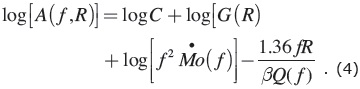
<body><![CDATA[<p align="justify"><font face="verdana" size="2"><b>Source spectrum and stress drop</b></font></p>  	    <p align="justify"><font face="verdana" size="2">We estimated the average displacement spectra, <img src="/img/revistas/geoint/v53n1/a2i1.jpg">( &#402; ), of the mainshock from the analysis of the S&#45;wave group recorded at horizontal components of 5 stations within a hypocentral distance of 475 km. Following Singh <i>et al</i>. (1999), the Fourier acceleration spectral amplitude of the intense part of the ground motion at a station, under far&#45;field, point&#45;source approximation, may be written as</font></p>      <p align="center"><img src="/img/revistas/geoint/v53n1/a2e2.jpg"></p>      <p align="justify"><font face="verdana" size="2">where</font></p>  	    <p align="center"><img src="/img/revistas/geoint/v53n1/a2e3.jpg"></p>      <p align="justify"><font face="verdana" size="2">In the equations above, <img src="/img/revistas/geoint/v53n1/a2i1.jpg">( &#402; ) is the moment rate spectrum so that <img src="/img/revistas/geoint/v53n1/a2i1.jpg">( &#402; ) &rarr; <i>M<sub>0</sub></i> as &#402; &rarr; 0, <i>R</i> = hypocentral distance, <i>R<sub>&#952;&#966;</sub></i> = average radiation pattern (0.55), <i>F</i> = free surface amplification (2.0), <i>P</i> takes into account the partitioning of energy in the two horizontal components <img src="/img/revistas/geoint/v53n1/a2i2.jpg">, <i>&#946;</i> = shear&#45;wave velocity at the source (3.00 km/s), <i>&#961;</i> = density in the focal region (2.65 kg/m3), and <i>Q(f)</i> = quality factor, which includes both anelastic absorption and scattering. The appropriate geometrical spreading term, <i>G(R)</i>, is <i>R</i><sup>&#150;1</sup> for <i>R</i> &#8804; <i>R<sub>0</sub></i> and (<i>RR<sub>0</sub></i>)<sup>&#150;1/2</sup> for <i>R</i> &gt; <i>R<sub>0</sub></i>. The form of <i>G(R)</i> implies dominance of body waves for <i>R</i>&#8804; <i>R<sub>0</sub></i> and of surface waves for <i>R</i> &gt; <i>R<sub>0</sub></i>. For this earthquake, we took <i>Q(f)</i> = 213&#402;<sup>0.72</sup> (Rebollar <i>et al</i>., 1995) and <i>R<sub>0</sub></i> = 100 km. Taking logarithms of equation 2 we obtain</font></p>      <p align="center"><img src="/img/revistas/geoint/v53n1/a2e4.jpg"></p>     <p align="justify"><font face="verdana" size="2">We solved equation (4) in the least&#45;squares sense to obtain log &#91; &#402;<sup>2</sup> <img src="/img/revistas/geoint/v53n1/a2i1.jpg">( &#402; )&#93; and so <img src="/img/revistas/geoint/v53n1/a2i1.jpg">( &#402; ).</font></p>      <p align="justify"><font face="verdana" size="2">The source displacement spectra of the mainshock for the 5 stations are shown in <a href="/img/revistas/geoint/v53n1/a2f6.jpg" target="_blank">Figure 6</a>. We interpret these spectra within the framework of a <i>&#969;<sup>2</sup></i>&#45;source model and obtain an estimation of the seismic moment (<i>M<sub>0</sub></i>) and corner frequency ( &#402;<sub>c</sub> ). The stress drop (<i>&#916;&#963;</i>) is computed using the Brune (1970) model. The source spectra can be fit by <i>M<sub>0</sub></i>, <i>f<sub>c</sub></i> and <i>&#916;&#963;</i> values indicated in these figures.</font></p>      <p align="justify"><font face="verdana" size="2">The Brune model consists in a circular fault plane with finite radius on which a shear stress pulse is applied instantaneously on the whole fault area and there is no fracture propagation. This model is commonly used to obtain fault dimensions from spectra of S waves for earthquakes of small&#45;to&#45;moderate size (M &lt; 6), for which the circular fault is a good approximation. Under this hypothesis, the source radius is given by:</font></p>  	    ]]></body>
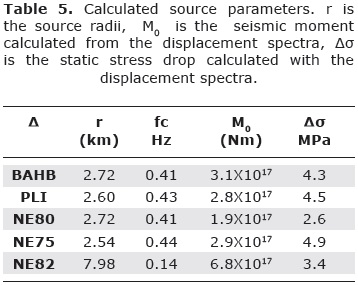
<body><![CDATA[<p align="center"><img src="/img/revistas/geoint/v53n1/a2e5.jpg"></p>      <p align="justify"><font face="verdana" size="2">The moment magnitude was calculated by Equation (6), proposed by Hanks and Kanamori (1979)</font></p>  	    <p align="center"><img src="/img/revistas/geoint/v53n1/a2e6.jpg"></p>      <p align="justify"><font face="verdana" size="2">Taking the average value for these parameters, we obtain finally M<sub>0</sub> =(3.5 &#177; 3.3)X10<sup>17</sup>Nm, fc = 0.36 &#177; 0.15 Hz, r = 3.7 &#177; 2.6 km and <i>&#916;&#963;</i>= 3.9 &#177; 1.15 MPa (39&#177; 11.5 bar.).</font></p>     <p align="justify">&nbsp;</p>      <p align="justify"><font face="verdana" size="2"><b>Discussion and Conclusions</b></font></p>  	    <p align="justify"><font face="verdana" size="2">According to results of seismic reflection studies conducted in the upper part of the Gulf of California by Lonsdale (1989) and Gonz&aacute;lez&#45;Fern&aacute;ndez <i>et al</i>. (2005), the <i>Salsipuedes</i> basin is in its early stage of development. In this region the basins are aligned in an en echelon trend linking the pull&#45;apart basin by NW&#45;SE transform faults. <i>Canal de Ballenas </i>transform fault connects the <i>Salsipuedes</i> basin at SE with the <i>Delfin</i> basin at the NW. In this zone, six earthquakes with magnitude larger than 5 have occurred during the last thirty years. The focal mechanisms of the great majority of these earthquakes were strike&#45;slip. The earthquake studied here is the first one with a dip&#45;slip mechanism in this part of the Gulf of California, which was located off the west coast of <i>Angel de la Guarda</i> Island. Other earthquakes with normal faulting mechanisms have been reported by Rebollar <i>et al</i>. (1995) at <i>Bahia de las Animas</i> (30 km south of the epicenter of study) and Reichle and Reid (1977) following a seismic swarm pattern at <i>Delfin</i> basin, (60 km northwest of the epicenter of study). Castro <i>et al</i>. (2011) associates this type of faulting in the Gulf of California to spreading centers.</font></p>  	    <p align="justify"><font face="verdana" size="2">The distribution of earthquakes with magnitude larger than 5 during the last thirty years suggests a seismic activity migration from north to south. Considering that the elastic energy stored in rocks in the form of deformation stress is released when the rocks reach their rupture, part of the energy propagates as vibrational energy producing seismic waves and another part of the energy remains in the rock as residual energy, this energy is transmitted to other parts of the same stress axis increasing the stress level of the adjacent regions (Husseini <i>et al</i>., 1975). So the seismic energy released by fracturing and sliding at the northern edge of the <i>Canal de Ballenas</i> transform fault, triggered off significant seismicity at the southern edge of the transform. Examples of these sequences are: (i) the 1973&#45;1975&#45;1977 earthquakes, (ii) the 1980&#45;1982 earthquakes, and (iii) the 1997&#45;2003 earthquakes. All of these shocks were presumably seismically associated (see their latitudes shown in <a href="/img/revistas/geoint/v53n1/a2t1.jpg" target="_blank">Table 1</a>).</font></p> 	    <p align="center"><img src="/img/revistas/geoint/v53n1/a2t5.jpg"></p>  	    <p align="justify"><font face="verdana" size="2">The earthquake studied here represents an example of active extensional faults at north of Gulf of California. Eventhough Sumy <i>et al</i>. (2013) propose that much of the extension across the plate boundary is accommodated aseismically, this activity shows that, at least in this zone, normal faulting plays an important role.</font></p>  	    ]]></body>
<body><![CDATA[<p align="justify"><font face="verdana" size="2">A Mw 4.4 foreshock occurred seven minutes before the 12 November 2003 Mw 5.6 earthquake. Both events were located on a dip slip fault perpendicular to the main <i>Canal de Ballenas</i> transform fault according their locations indicated on <a href="/img/revistas/geoint/v53n1/a2f3.jpg" target="_blank">Figure 3</a>.</font></p>  	    <p align="justify"><font face="verdana" size="2">The b value represent properties of the seismic medium in some respect, like stress or material conditions in the focal region Scholz (1968) and we expect an inverse correlation between the b value and the level of stresses accumulated in the seismic region. Others like Mogi (1962) have associated high <i>b&#45;</i>values with the material heterogeneity. Through a comparative analysis of <i>b&#45;</i>values estimations at north of Gulf of California between 1.5 (Reichle and Reid, 1977; Rebollar and Reichle, 1987), 0.68 for <i>Loreto's</i> earthquake of 12 March 2003 at Carmen basin (L&oacute;pez&#45;Pineda and Rebollar, 2005) and the b value of 1.14&#177;0.28 for this <i>Salsipuedes</i> basin earthquake at the middle of Gulf of California, we can infer that there is a transition of stress distribution from north, where the stresses are more heterogeneous, to south where concentration of stresses are more homogeneous, as well as in the central region of the Gulf of California.</font></p>  	    <p align="justify"><font face="verdana" size="2">From spectral analysis and assuming a Brune model of circular fault, we obtain the following source parameters:</font></p>  	    <p align="justify"><font face="verdana" size="2">M<sub>0</sub> = (3.5&#177;3.3)X10<sup>17</sup>Nm</font></p>  	    <p align="justify"><font face="verdana" size="2">Corner frequency fc = 0.36 &#177; 0.15 Hz</font></p>  	    <p align="justify"><font face="verdana" size="2">r = 3.7 &#177; 2.6 km</font></p>  	    <p align="justify"><font face="verdana" size="2"><i>&#916;&#963;</i>= 3.9 &#177; 1.15 MPa (39 &#177; 11.5 bar.)</font></p>      <p align="justify"><font face="verdana" size="2">In agreement with the magnitude of 5.6 previously reported by NEIC; the calculated static stress drop is typical of this tectonic region ranging between 2 and 49 bars (L&oacute;pez&#45;Pineda and Rebollar, 2005) and the rupture radius is consistent with the magnitude of a moderate earthquake.</font></p>     <p align="justify">&nbsp;</p>      <p align="justify"><font face="verdana" size="2"><b>Acknowledgements</b></font></p>  	    ]]></body>
<body><![CDATA[<p align="justify"><font face="verdana" size="2">The greatest thanks to Dr. Cecilio Javier Rebollar Bustamante, deceased on September 2006, who was director of doctoral theses of two of the authors (LLP. and HERL); this work is part of LLP's thesis. For health reasons and a long process of struggle against cancer Dr Rebollar could not publish it. Moreover we thank Arturo Perez Vertti and Arie van Wettum for the field work that they performed during the deployment of the seismic stations. We also thank Juan A. Mendoza and Omar Lugo Castillo for help in handling the digital data. Finally we wish to thank Dr. Xyoli P&eacute;rez&#45;Campos her suggestions for improving the manuscript of this paper. The Consejo Nacional de Ciencia y Tecnolog&iacute;a (CONACYT) sponsored partially this Project (Proyecto 37038&#45;T). L.L.P was supported by Programa al Mejoramiento de Profesores (Promep).</font></p>     <p align="justify">&nbsp;</p>      <p align="justify"><font face="verdana" size="2"><b>Bibliography</b></font></p>  	    <!-- ref --><p align="justify"><font face="verdana" size="2">Brune J.N., 1970, Tectonic stress and the spectra of seismic shear waves from earthquakes. <i>J. Geophys. Res.</i>, 75, 4997&#150;5009.    &nbsp;&nbsp;&nbsp;&nbsp;&nbsp;&nbsp;&nbsp;&nbsp;[&#160;<a href="javascript:void(0);" onclick="javascript: window.open('/scielo.php?script=sci_nlinks&ref=3929927&pid=S0016-7169201400010000200001&lng=','','width=640,height=500,resizable=yes,scrollbars=1,menubar=yes,');">Links</a>&#160;]<!-- end-ref --></font></p>  	    <!-- ref --><p align="justify"><font face="verdana" size="2">Castro R.R, Perez&#45;Vertti A., Mendez I., Mendoza A., Inzunza L., 2011, Location of Moderate&#45;Sized Earthquakes Recorded by the NARS&#45;Baja Array in the Gulf of California Region Between 2002 and 2006. <i>Pure Appl. Geophys. </i>168:1279&#45;1292</font>&nbsp;&nbsp;&nbsp;&nbsp;&nbsp;&nbsp;&nbsp;&nbsp;[&#160;<a href="javascript:void(0);" onclick="javascript: window.open('/scielo.php?script=sci_nlinks&ref=3929929&pid=S0016-7169201400010000200002&lng=','','width=640,height=500,resizable=yes,scrollbars=1,menubar=yes,');">Links</a>&#160;]<!-- end-ref --><!-- ref --><p align="justify"><font face="verdana" size="2">Goff J.A., Bergman E.A., Solomon S.C., 1987, Earthquake source mechanism and transform fault tectonics in the Gulf of California. <i>J. Geophys. Res.</i>, 92, 10485&#150;10510.    &nbsp;&nbsp;&nbsp;&nbsp;&nbsp;&nbsp;&nbsp;&nbsp;[&#160;<a href="javascript:void(0);" onclick="javascript: window.open('/scielo.php?script=sci_nlinks&ref=3929930&pid=S0016-7169201400010000200003&lng=','','width=640,height=500,resizable=yes,scrollbars=1,menubar=yes,');">Links</a>&#160;]<!-- end-ref --></font></p>  	    <!-- ref --><p align="justify"><font face="verdana" size="2">Gonz&aacute;lez&#45;Fern&aacute;ndez A., Da&ntilde;obeitia J.J., Delgado&#45;Argote L.A., Michaud F., C&oacute;rdoba D., Bartolom&eacute; R., 2005, Mode of extension and rifting history of upper Tibur&oacute;n and upper Delfin basins, northern Gulf of California. <i>J. Geophys. Res.</i>, 110, B01313, 17.    &nbsp;&nbsp;&nbsp;&nbsp;&nbsp;&nbsp;&nbsp;&nbsp;[&#160;<a href="javascript:void(0);" onclick="javascript: window.open('/scielo.php?script=sci_nlinks&ref=3929932&pid=S0016-7169201400010000200004&lng=','','width=640,height=500,resizable=yes,scrollbars=1,menubar=yes,');">Links</a>&#160;]<!-- end-ref --></font></p>  	    ]]></body>
<body><![CDATA[<!-- ref --><p align="justify"><font face="verdana" size="2">Gutenberg B., Richter C.F., 1942, Earthquake magnitude, intensity, energy and acceleration. <i>Bull. Seismol. Soc. Am.</i>, 32, 163&#45;191.    &nbsp;&nbsp;&nbsp;&nbsp;&nbsp;&nbsp;&nbsp;&nbsp;[&#160;<a href="javascript:void(0);" onclick="javascript: window.open('/scielo.php?script=sci_nlinks&ref=3929934&pid=S0016-7169201400010000200005&lng=','','width=640,height=500,resizable=yes,scrollbars=1,menubar=yes,');">Links</a>&#160;]<!-- end-ref --></font></p>  	    <!-- ref --><p align="justify"><font face="verdana" size="2">Hanks T.C. Kanamori H., 1979, A moment magnitude scale, <i>J. Geophys. Res.</i>, 84, 2348&#45;50.    &nbsp;&nbsp;&nbsp;&nbsp;&nbsp;&nbsp;&nbsp;&nbsp;[&#160;<a href="javascript:void(0);" onclick="javascript: window.open('/scielo.php?script=sci_nlinks&ref=3929936&pid=S0016-7169201400010000200006&lng=','','width=640,height=500,resizable=yes,scrollbars=1,menubar=yes,');">Links</a>&#160;]<!-- end-ref --></font></p>  	    <!-- ref --><p align="justify"><font face="verdana" size="2">Husseini M., Jovanovich D., Randall M., Freud L., 1975, The fracture energy of the earthquakes. <i>Geophys. J.R. Astro</i>. Soc., 43, 367&#45;385 pp.    &nbsp;&nbsp;&nbsp;&nbsp;&nbsp;&nbsp;&nbsp;&nbsp;[&#160;<a href="javascript:void(0);" onclick="javascript: window.open('/scielo.php?script=sci_nlinks&ref=3929938&pid=S0016-7169201400010000200007&lng=','','width=640,height=500,resizable=yes,scrollbars=1,menubar=yes,');">Links</a>&#160;]<!-- end-ref --></font></p>  	    <!-- ref --><p align="justify"><font face="verdana" size="2">Kasser M., Ruegg J.C., Lesage Ph., Ortlfeb L., Pagarete J., Duch N., Guerrero J., Roldan J., 1987, Geodetic measurements of plate motions across the central Gulf of California, 1982&#45;1986. <i>J. Geophys. Res. Lett.</i>, 14, 5&#45;8.    &nbsp;&nbsp;&nbsp;&nbsp;&nbsp;&nbsp;&nbsp;&nbsp;[&#160;<a href="javascript:void(0);" onclick="javascript: window.open('/scielo.php?script=sci_nlinks&ref=3929940&pid=S0016-7169201400010000200008&lng=','','width=640,height=500,resizable=yes,scrollbars=1,menubar=yes,');">Links</a>&#160;]<!-- end-ref --></font></p>  	    <!-- ref --><p align="justify"><font face="verdana" size="2">Lienert B.R., Berg E., Frazer L.N., 1988, HYPOCENTER: an earthquake location method using centered, scaled, and adaptively least squares.<i> Bull. Seismol. Soc. Am.</i>, 76, 771&#150;783.    &nbsp;&nbsp;&nbsp;&nbsp;&nbsp;&nbsp;&nbsp;&nbsp;[&#160;<a href="javascript:void(0);" onclick="javascript: window.open('/scielo.php?script=sci_nlinks&ref=3929942&pid=S0016-7169201400010000200009&lng=','','width=640,height=500,resizable=yes,scrollbars=1,menubar=yes,');">Links</a>&#160;]<!-- end-ref --></font></p>  	    ]]></body>
<body><![CDATA[<!-- ref --><p align="justify"><font face="verdana" size="2">Lienert B.R., Havskov J., 1995, A computer program for locating earthquakes both locally and globally. <i>Seismol. Res. Lett.,</i> 66, 26&#150;36.    &nbsp;&nbsp;&nbsp;&nbsp;&nbsp;&nbsp;&nbsp;&nbsp;[&#160;<a href="javascript:void(0);" onclick="javascript: window.open('/scielo.php?script=sci_nlinks&ref=3929944&pid=S0016-7169201400010000200010&lng=','','width=640,height=500,resizable=yes,scrollbars=1,menubar=yes,');">Links</a>&#160;]<!-- end-ref --></font></p>  	    <!-- ref --><p align="justify"><font face="verdana" size="2">Lomnitz C., Mooser F., Allen C.R., Brune J.N., Thatcher W., 1970, Seismicity and tectonics of the northern Gulf of California region; preliminary results. <i>Geofisica Internacional,</i> 10, 37&#150;48.    &nbsp;&nbsp;&nbsp;&nbsp;&nbsp;&nbsp;&nbsp;&nbsp;[&#160;<a href="javascript:void(0);" onclick="javascript: window.open('/scielo.php?script=sci_nlinks&ref=3929946&pid=S0016-7169201400010000200011&lng=','','width=640,height=500,resizable=yes,scrollbars=1,menubar=yes,');">Links</a>&#160;]<!-- end-ref --></font></p>  	    <!-- ref --><p align="justify"><font face="verdana" size="2">Lonsdale P.L., 1989, Geology and tectonics history of the Gulf of California, in: The Geology of North America: The Eastern Pacific Ocean and Hawaii, Vol. N, The Geological Society of America.    &nbsp;&nbsp;&nbsp;&nbsp;&nbsp;&nbsp;&nbsp;&nbsp;[&#160;<a href="javascript:void(0);" onclick="javascript: window.open('/scielo.php?script=sci_nlinks&ref=3929948&pid=S0016-7169201400010000200012&lng=','','width=640,height=500,resizable=yes,scrollbars=1,menubar=yes,');">Links</a>&#160;]<!-- end-ref --></font></p>  	    <!-- ref --><p align="justify"><font face="verdana" size="2">L&oacute;pez&#45;Pineda L., Rebollar C.J., 2005, Source characteristics of the (Mw 6.2) Loreto earthquake of 12 March 2003 that occurred in a transform fault in the middle of the Gulf of California, M&eacute;xico. <i>Bull. Seismol. Soc. Am.</i>, 95, 419&#150;430.    &nbsp;&nbsp;&nbsp;&nbsp;&nbsp;&nbsp;&nbsp;&nbsp;[&#160;<a href="javascript:void(0);" onclick="javascript: window.open('/scielo.php?script=sci_nlinks&ref=3929950&pid=S0016-7169201400010000200013&lng=','','width=640,height=500,resizable=yes,scrollbars=1,menubar=yes,');">Links</a>&#160;]<!-- end-ref --></font></p>  	    <!-- ref --><p align="justify"><font face="verdana" size="2">Mogi K., 1962, Magnitude&#45;frequency relationship for elastic shocks accompanying fractures of various materials and some related problems in earthquakes. <i>Bull. Earthquake Res. Inst. Univ.Tokyo.</i>, 40, 831&#45;883.    &nbsp;&nbsp;&nbsp;&nbsp;&nbsp;&nbsp;&nbsp;&nbsp;[&#160;<a href="javascript:void(0);" onclick="javascript: window.open('/scielo.php?script=sci_nlinks&ref=3929952&pid=S0016-7169201400010000200014&lng=','','width=640,height=500,resizable=yes,scrollbars=1,menubar=yes,');">Links</a>&#160;]<!-- end-ref --></font></p>  	    ]]></body>
<body><![CDATA[<!-- ref --><p align="justify"><font face="verdana" size="2">Mungu&iacute;a L., Reichle M., Reyes A., Simons R., Brune J., 1977, Afthershocks of the 8 July 1975 Canal de las Ballenas, Gulf of California, Earthquake; <i>Geophys. Res. Lett.</i>, 4, 507&#45;509.    &nbsp;&nbsp;&nbsp;&nbsp;&nbsp;&nbsp;&nbsp;&nbsp;[&#160;<a href="javascript:void(0);" onclick="javascript: window.open('/scielo.php?script=sci_nlinks&ref=3929954&pid=S0016-7169201400010000200015&lng=','','width=640,height=500,resizable=yes,scrollbars=1,menubar=yes,');">Links</a>&#160;]<!-- end-ref --></font></p>  	    <!-- ref --><p align="justify"><font face="verdana" size="2">Rebollar C.J., Reichle M.S., 1987, Analysis of the seismicity detected in 1982&#150;1984 in the Northern Peninsular ranges of Baja California, <i>Bull. Seismol. Soc. Am.,</i> 77, 173&#150;183.    &nbsp;&nbsp;&nbsp;&nbsp;&nbsp;&nbsp;&nbsp;&nbsp;[&#160;<a href="javascript:void(0);" onclick="javascript: window.open('/scielo.php?script=sci_nlinks&ref=3929956&pid=S0016-7169201400010000200016&lng=','','width=640,height=500,resizable=yes,scrollbars=1,menubar=yes,');">Links</a>&#160;]<!-- end-ref --></font></p>  	    <!-- ref --><p align="justify"><font face="verdana" size="2">Rebollar C.J., Castillo&#45;Rom&aacute;n J., Uribe A., 1995, Par&aacute;metros de fuente de la actividad s&iacute;smica que ocurri&oacute; en Marzo de 1993 en la Bah&iacute;a de las Animas. Baja California. Uni&oacute;n Geof&iacute;sica Mexicana, In: Monograf&iacute;a 2. La Sismolog&iacute;a en M&eacute;xico: 10 a&ntilde;os despu&eacute;s del temblor de Michoac&aacute;n del 19 de Septiembre de 1985 (Ms 8.1).    &nbsp;&nbsp;&nbsp;&nbsp;&nbsp;&nbsp;&nbsp;&nbsp;[&#160;<a href="javascript:void(0);" onclick="javascript: window.open('/scielo.php?script=sci_nlinks&ref=3929958&pid=S0016-7169201400010000200017&lng=','','width=640,height=500,resizable=yes,scrollbars=1,menubar=yes,');">Links</a>&#160;]<!-- end-ref --></font></p>  	    <!-- ref --><p align="justify"><font face="verdana" size="2">Rebollar C.J., Quintanar L., Castro R., Day S., Madrid J., Brune J.N., Astiz L., Vernon F., 2001, Source characteristics of a 5.5 magnitude earthquake that occurred in the transform fault system of the Delf&iacute;n Basin in the Gulf of California. <i>Bull. Seismol. Soc. Am.</i>, 91, 781&#150;791.    &nbsp;&nbsp;&nbsp;&nbsp;&nbsp;&nbsp;&nbsp;&nbsp;[&#160;<a href="javascript:void(0);" onclick="javascript: window.open('/scielo.php?script=sci_nlinks&ref=3929960&pid=S0016-7169201400010000200018&lng=','','width=640,height=500,resizable=yes,scrollbars=1,menubar=yes,');">Links</a>&#160;]<!-- end-ref --></font></p>  	    <!-- ref --><p align="justify"><font face="verdana" size="2">Reichle M., Reid I., 1977, Detailed study of earthquake swarms from the Gulf of California. <i>Bull. Seismol. Soc. Am.</i>, 67, 159&#150;171.    &nbsp;&nbsp;&nbsp;&nbsp;&nbsp;&nbsp;&nbsp;&nbsp;[&#160;<a href="javascript:void(0);" onclick="javascript: window.open('/scielo.php?script=sci_nlinks&ref=3929962&pid=S0016-7169201400010000200019&lng=','','width=640,height=500,resizable=yes,scrollbars=1,menubar=yes,');">Links</a>&#160;]<!-- end-ref --></font></p>  	    ]]></body>
<body><![CDATA[<!-- ref --><p align="justify"><font face="verdana" size="2">Sholz C.H., 1968, The frequency&#150;magnitude relation of microfracturing in rock and its relation to earthquakes. <i>Bull. Seismol. Soc. Am.,</i> 58, 399&#45;415.    &nbsp;&nbsp;&nbsp;&nbsp;&nbsp;&nbsp;&nbsp;&nbsp;[&#160;<a href="javascript:void(0);" onclick="javascript: window.open('/scielo.php?script=sci_nlinks&ref=3929964&pid=S0016-7169201400010000200020&lng=','','width=640,height=500,resizable=yes,scrollbars=1,menubar=yes,');">Links</a>&#160;]<!-- end-ref --></font></p>  	    <!-- ref --><p align="justify"><font face="verdana" size="2">Singh S.K., Ordaz M., Pacheco J.F., Quaas R., Alc&aacute;ntara L., Alcocer S., Guti&eacute;rrez C., Meli R., Ovando E., 1999, A Preliminary Report on the Tehuac&aacute;n, M&eacute;xico Earthquake of June 15, 1999 (M<sub>w</sub>=7.0); <i>Seismological Research Letters</i>, 70, 5, September/October 1999, pp. 489&#45;504.    &nbsp;&nbsp;&nbsp;&nbsp;&nbsp;&nbsp;&nbsp;&nbsp;[&#160;<a href="javascript:void(0);" onclick="javascript: window.open('/scielo.php?script=sci_nlinks&ref=3929966&pid=S0016-7169201400010000200021&lng=','','width=640,height=500,resizable=yes,scrollbars=1,menubar=yes,');">Links</a>&#160;]<!-- end-ref --></font></p>  	    <!-- ref --><p align="justify"><font face="verdana" size="2">Sumy D.F., Gaherty J.B., Kim W.Y., Diehl T., Collins J.A., 2013, The Mechanisms of Earthquakes and Faulting in the Southern Gulf of California. <i>Bull. Seismol. Soc. Am.,</i> 103, 487&#45;506.    &nbsp;&nbsp;&nbsp;&nbsp;&nbsp;&nbsp;&nbsp;&nbsp;[&#160;<a href="javascript:void(0);" onclick="javascript: window.open('/scielo.php?script=sci_nlinks&ref=3929968&pid=S0016-7169201400010000200022&lng=','','width=640,height=500,resizable=yes,scrollbars=1,menubar=yes,');">Links</a>&#160;]<!-- end-ref --></font></p>  	    <!-- ref --><p align="justify"><font face="verdana" size="2">Trampert J., Paulssen H., van Wettum A., Ritsema J., Clayton R., Castro R., Rebollar C.J., Perez&#45;Vertti A., 2003, New array monitors seismic activity near the Gulf of California in Mexico. <i>Eos</i>, 84, 4, 29&#150;32.    &nbsp;&nbsp;&nbsp;&nbsp;&nbsp;&nbsp;&nbsp;&nbsp;[&#160;<a href="javascript:void(0);" onclick="javascript: window.open('/scielo.php?script=sci_nlinks&ref=3929970&pid=S0016-7169201400010000200023&lng=','','width=640,height=500,resizable=yes,scrollbars=1,menubar=yes,');">Links</a>&#160;]<!-- end-ref --></font></p>  	    <!-- ref --><p align="justify"><font face="verdana" size="2">Vacquier V., Whiteman R.E., 1973, Measurements of faults displacement by optical parallax. <i>J. Geophys. Res.</i>, 78, 858&#45;865.    &nbsp;&nbsp;&nbsp;&nbsp;&nbsp;&nbsp;&nbsp;&nbsp;[&#160;<a href="javascript:void(0);" onclick="javascript: window.open('/scielo.php?script=sci_nlinks&ref=3929972&pid=S0016-7169201400010000200024&lng=','','width=640,height=500,resizable=yes,scrollbars=1,menubar=yes,');">Links</a>&#160;]<!-- end-ref --></font></p>     ]]></body>
<body><![CDATA[ ]]></body><back>
<ref-list>
<ref id="B1">
<nlm-citation citation-type="journal">
<person-group person-group-type="author">
<name>
<surname><![CDATA[Brune]]></surname>
<given-names><![CDATA[J.N.]]></given-names>
</name>
</person-group>
<article-title xml:lang="en"><![CDATA[Tectonic stress and the spectra of seismic shear waves from earthquakes]]></article-title>
<source><![CDATA[J. Geophys. Res.]]></source>
<year>1970</year>
<volume>75</volume>
<page-range>4997-5009</page-range></nlm-citation>
</ref>
<ref id="B2">
<nlm-citation citation-type="journal">
<person-group person-group-type="author">
<name>
<surname><![CDATA[Castro]]></surname>
<given-names><![CDATA[R.R]]></given-names>
</name>
<name>
<surname><![CDATA[Perez-Vertti]]></surname>
<given-names><![CDATA[A.]]></given-names>
</name>
<name>
<surname><![CDATA[Mendez]]></surname>
<given-names><![CDATA[I.]]></given-names>
</name>
<name>
<surname><![CDATA[Mendoza]]></surname>
<given-names><![CDATA[A.]]></given-names>
</name>
<name>
<surname><![CDATA[Inzunza]]></surname>
<given-names><![CDATA[L.]]></given-names>
</name>
</person-group>
<article-title xml:lang="en"><![CDATA[Location of Moderate-Sized Earthquakes Recorded by the NARS-Baja Array in the Gulf of California Region Between 2002 and 2006]]></article-title>
<source><![CDATA[Pure Appl. Geophys.]]></source>
<year>2011</year>
<volume>168</volume>
<page-range>1279-1292</page-range></nlm-citation>
</ref>
<ref id="B3">
<nlm-citation citation-type="journal">
<person-group person-group-type="author">
<name>
<surname><![CDATA[Goff]]></surname>
<given-names><![CDATA[J.A.]]></given-names>
</name>
<name>
<surname><![CDATA[Bergman]]></surname>
<given-names><![CDATA[E.A.]]></given-names>
</name>
<name>
<surname><![CDATA[Solomon]]></surname>
<given-names><![CDATA[S.C.]]></given-names>
</name>
</person-group>
<article-title xml:lang="en"><![CDATA[Earthquake source mechanism and transform fault tectonics in the Gulf of California]]></article-title>
<source><![CDATA[J. Geophys. Res.]]></source>
<year>1987</year>
<volume>92</volume>
<page-range>10485-10510</page-range></nlm-citation>
</ref>
<ref id="B4">
<nlm-citation citation-type="journal">
<person-group person-group-type="author">
<name>
<surname><![CDATA[González-Fernández]]></surname>
<given-names><![CDATA[A.]]></given-names>
</name>
<name>
<surname><![CDATA[Dañobeitia]]></surname>
<given-names><![CDATA[J.J.]]></given-names>
</name>
<name>
<surname><![CDATA[Delgado-Argote]]></surname>
<given-names><![CDATA[L.A.]]></given-names>
</name>
<name>
<surname><![CDATA[Michaud]]></surname>
<given-names><![CDATA[F.]]></given-names>
</name>
<name>
<surname><![CDATA[Córdoba]]></surname>
<given-names><![CDATA[D.]]></given-names>
</name>
<name>
<surname><![CDATA[Bartolomé]]></surname>
<given-names><![CDATA[R.]]></given-names>
</name>
</person-group>
<article-title xml:lang="en"><![CDATA[Mode of extension and rifting history of upper Tiburón and upper Delfin basins, northern Gulf of California]]></article-title>
<source><![CDATA[J. Geophys. Res.]]></source>
<year>2005</year>
<volume>110</volume>
<page-range>17</page-range></nlm-citation>
</ref>
<ref id="B5">
<nlm-citation citation-type="journal">
<person-group person-group-type="author">
<name>
<surname><![CDATA[Gutenberg]]></surname>
<given-names><![CDATA[B.]]></given-names>
</name>
<name>
<surname><![CDATA[Richter]]></surname>
<given-names><![CDATA[C.F.]]></given-names>
</name>
</person-group>
<article-title xml:lang="en"><![CDATA[Earthquake magnitude, intensity, energy and acceleration]]></article-title>
<source><![CDATA[Bull. Seismol. Soc. Am.]]></source>
<year>1942</year>
<volume>32</volume>
<page-range>163-191</page-range></nlm-citation>
</ref>
<ref id="B6">
<nlm-citation citation-type="journal">
<person-group person-group-type="author">
<name>
<surname><![CDATA[Hanks T.C. Kanamori]]></surname>
<given-names><![CDATA[H.]]></given-names>
</name>
</person-group>
<article-title xml:lang="en"><![CDATA[A moment magnitude scale, J]]></article-title>
<source><![CDATA[Geophys. Res.]]></source>
<year>1979</year>
<volume>84</volume>
<page-range>2348-50</page-range></nlm-citation>
</ref>
<ref id="B7">
<nlm-citation citation-type="">
<person-group person-group-type="author">
<name>
<surname><![CDATA[Husseini]]></surname>
<given-names><![CDATA[M.]]></given-names>
</name>
<name>
<surname><![CDATA[Jovanovich]]></surname>
<given-names><![CDATA[D.]]></given-names>
</name>
<name>
<surname><![CDATA[Randall]]></surname>
<given-names><![CDATA[M.]]></given-names>
</name>
<name>
<surname><![CDATA[Freud]]></surname>
<given-names><![CDATA[L.]]></given-names>
</name>
</person-group>
<article-title xml:lang="en"><![CDATA[The fracture energy of the earthquakes]]></article-title>
<source><![CDATA[]]></source>
<year>1975</year>
<volume>Geophys. J.R. Astro. Soc.</volume><volume>43</volume>
<page-range>367-385</page-range></nlm-citation>
</ref>
<ref id="B8">
<nlm-citation citation-type="journal">
<person-group person-group-type="author">
<name>
<surname><![CDATA[Kasser]]></surname>
<given-names><![CDATA[M.]]></given-names>
</name>
<name>
<surname><![CDATA[Ruegg]]></surname>
<given-names><![CDATA[J.C.]]></given-names>
</name>
<name>
<surname><![CDATA[Lesage]]></surname>
<given-names><![CDATA[Ph.]]></given-names>
</name>
<name>
<surname><![CDATA[Ortlfeb]]></surname>
<given-names><![CDATA[L.]]></given-names>
</name>
<name>
<surname><![CDATA[Pagarete]]></surname>
<given-names><![CDATA[J.]]></given-names>
</name>
<name>
<surname><![CDATA[Duch]]></surname>
<given-names><![CDATA[N.]]></given-names>
</name>
<name>
<surname><![CDATA[Guerrero]]></surname>
<given-names><![CDATA[J.]]></given-names>
</name>
<name>
<surname><![CDATA[Roldan]]></surname>
<given-names><![CDATA[J.]]></given-names>
</name>
</person-group>
<article-title xml:lang="en"><![CDATA[Geodetic measurements of plate motions across the central Gulf of California, 1982-1986]]></article-title>
<source><![CDATA[J. Geophys. Res. Lett.]]></source>
<year>1987</year>
<volume>14</volume>
<page-range>5-8</page-range></nlm-citation>
</ref>
<ref id="B9">
<nlm-citation citation-type="journal">
<person-group person-group-type="author">
<name>
<surname><![CDATA[Lienert]]></surname>
<given-names><![CDATA[B.R.]]></given-names>
</name>
<name>
<surname><![CDATA[Berg]]></surname>
<given-names><![CDATA[E.]]></given-names>
</name>
<name>
<surname><![CDATA[Frazer]]></surname>
<given-names><![CDATA[L.N.]]></given-names>
</name>
</person-group>
<article-title xml:lang="en"><![CDATA[HYPOCENTER: an earthquake location method using centered, scaled, and adaptively least squares]]></article-title>
<source><![CDATA[Bull. Seismol. Soc. Am.]]></source>
<year>1988</year>
<volume>76</volume>
<page-range>771-783</page-range></nlm-citation>
</ref>
<ref id="B10">
<nlm-citation citation-type="journal">
<person-group person-group-type="author">
<name>
<surname><![CDATA[Lienert]]></surname>
<given-names><![CDATA[B.R.]]></given-names>
</name>
<name>
<surname><![CDATA[Havskov]]></surname>
<given-names><![CDATA[J.]]></given-names>
</name>
</person-group>
<article-title xml:lang="en"><![CDATA[A computer program for locating earthquakes both locally and globally]]></article-title>
<source><![CDATA[Seismol. Res. Lett.]]></source>
<year>1995</year>
<volume>66</volume>
<page-range>26-36</page-range></nlm-citation>
</ref>
<ref id="B11">
<nlm-citation citation-type="journal">
<person-group person-group-type="author">
<name>
<surname><![CDATA[Lomnitz]]></surname>
<given-names><![CDATA[C.]]></given-names>
</name>
<name>
<surname><![CDATA[Mooser]]></surname>
<given-names><![CDATA[F.]]></given-names>
</name>
<name>
<surname><![CDATA[Allen]]></surname>
<given-names><![CDATA[C.R.]]></given-names>
</name>
<name>
<surname><![CDATA[Brune]]></surname>
<given-names><![CDATA[J.N.]]></given-names>
</name>
<name>
<surname><![CDATA[Thatcher]]></surname>
<given-names><![CDATA[W.]]></given-names>
</name>
</person-group>
<article-title xml:lang="en"><![CDATA[Seismicity and tectonics of the northern Gulf of California region; preliminary results]]></article-title>
<source><![CDATA[Geofisica Internacional]]></source>
<year>1970</year>
<numero>10</numero>
<issue>10</issue>
<page-range>37-48</page-range></nlm-citation>
</ref>
<ref id="B12">
<nlm-citation citation-type="book">
<person-group person-group-type="author">
<name>
<surname><![CDATA[Lonsdale]]></surname>
<given-names><![CDATA[P.L.]]></given-names>
</name>
</person-group>
<article-title xml:lang="en"><![CDATA[Geology and tectonics history of the Gulf of California]]></article-title>
<source><![CDATA[The Geology of North America: The Eastern Pacific Ocean and Hawaii]]></source>
<year>1989</year>
<volume>N</volume>
<publisher-name><![CDATA[The Geological Society of America]]></publisher-name>
</nlm-citation>
</ref>
<ref id="B13">
<nlm-citation citation-type="journal">
<person-group person-group-type="author">
<name>
<surname><![CDATA[López-Pineda]]></surname>
<given-names><![CDATA[L.]]></given-names>
</name>
<name>
<surname><![CDATA[Rebollar]]></surname>
<given-names><![CDATA[C.J.]]></given-names>
</name>
</person-group>
<article-title xml:lang="en"><![CDATA[Source characteristics of the (Mw 6.2) Loreto earthquake of 12 March 2003 that occurred in a transform fault in the middle of the Gulf of California, México]]></article-title>
<source><![CDATA[Bull. Seismol. Soc. Am.]]></source>
<year>2005</year>
<volume>95</volume>
<page-range>419-430</page-range></nlm-citation>
</ref>
<ref id="B14">
<nlm-citation citation-type="journal">
<person-group person-group-type="author">
<name>
<surname><![CDATA[Mogi]]></surname>
<given-names><![CDATA[K.]]></given-names>
</name>
</person-group>
<article-title xml:lang="en"><![CDATA[Magnitude-frequency relationship for elastic shocks accompanying fractures of various materials and some related problems in earthquakes]]></article-title>
<source><![CDATA[Bull. Earthquake Res.]]></source>
<year>1962</year>
<volume>40</volume>
<page-range>831-883</page-range></nlm-citation>
</ref>
<ref id="B15">
<nlm-citation citation-type="journal">
<person-group person-group-type="author">
<name>
<surname><![CDATA[Munguía]]></surname>
<given-names><![CDATA[L.]]></given-names>
</name>
<name>
<surname><![CDATA[Reichle]]></surname>
<given-names><![CDATA[M.]]></given-names>
</name>
<name>
<surname><![CDATA[Reyes]]></surname>
<given-names><![CDATA[A.]]></given-names>
</name>
<name>
<surname><![CDATA[Simons]]></surname>
<given-names><![CDATA[R.]]></given-names>
</name>
<name>
<surname><![CDATA[Brune]]></surname>
<given-names><![CDATA[J.]]></given-names>
</name>
</person-group>
<article-title xml:lang="en"><![CDATA[Afthershocks of the 8 July 1975 Canal de las Ballenas, Gulf of California, Earthquake]]></article-title>
<source><![CDATA[Geophys. Res. Lett.]]></source>
<year>1977</year>
<volume>4</volume>
<page-range>507-509</page-range></nlm-citation>
</ref>
<ref id="B16">
<nlm-citation citation-type="journal">
<person-group person-group-type="author">
<name>
<surname><![CDATA[Rebollar]]></surname>
<given-names><![CDATA[C.J.]]></given-names>
</name>
<name>
<surname><![CDATA[Reichle]]></surname>
<given-names><![CDATA[M.S.]]></given-names>
</name>
</person-group>
<article-title xml:lang="en"><![CDATA[Analysis of the seismicity detected in 1982-1984 in the Northern Peninsular ranges of Baja California, Bull]]></article-title>
<source><![CDATA[Seismol. Soc. Am.]]></source>
<year>1987</year>
<volume>77</volume>
<page-range>173-183</page-range></nlm-citation>
</ref>
<ref id="B17">
<nlm-citation citation-type="">
<person-group person-group-type="author">
<name>
<surname><![CDATA[Rebollar]]></surname>
<given-names><![CDATA[C.J.]]></given-names>
</name>
<name>
<surname><![CDATA[Castillo-Román]]></surname>
<given-names><![CDATA[J.]]></given-names>
</name>
<name>
<surname><![CDATA[Uribe]]></surname>
<given-names><![CDATA[A.]]></given-names>
</name>
</person-group>
<article-title xml:lang="en"><![CDATA[Parámetros de fuente de la actividad sísmica que ocurrió en Marzo de 1993 en la Bahía de las Animas. Baja California. Unión Geofísica Mexicana,]]></article-title>
<source><![CDATA[Monografía 2. La Sismología en México: 10 años después del temblor de Michoacán del 19 de Septiembre de 1985 (Ms 8.1)]]></source>
<year>1995</year>
</nlm-citation>
</ref>
<ref id="B18">
<nlm-citation citation-type="journal">
<person-group person-group-type="author">
<name>
<surname><![CDATA[Rebollar]]></surname>
<given-names><![CDATA[C.J.]]></given-names>
</name>
<name>
<surname><![CDATA[Quintanar]]></surname>
<given-names><![CDATA[L.]]></given-names>
</name>
<name>
<surname><![CDATA[Castro]]></surname>
<given-names><![CDATA[R.]]></given-names>
</name>
<name>
<surname><![CDATA[Day]]></surname>
<given-names><![CDATA[S.]]></given-names>
</name>
<name>
<surname><![CDATA[Madrid]]></surname>
<given-names><![CDATA[J.]]></given-names>
</name>
<name>
<surname><![CDATA[Brune]]></surname>
<given-names><![CDATA[J.N.]]></given-names>
</name>
<name>
<surname><![CDATA[Astiz]]></surname>
<given-names><![CDATA[L.]]></given-names>
</name>
<name>
<surname><![CDATA[Vernon]]></surname>
<given-names><![CDATA[F.]]></given-names>
</name>
</person-group>
<article-title xml:lang="en"><![CDATA[Source characteristics of a 5.5 magnitude earthquake that occurred in the transform fault system of the Delfín Basin in the Gulf of California]]></article-title>
<source><![CDATA[Bull. Seismol. Soc. Am.]]></source>
<year>2001</year>
<volume>91</volume>
<page-range>781-791</page-range></nlm-citation>
</ref>
<ref id="B19">
<nlm-citation citation-type="journal">
<person-group person-group-type="author">
<name>
<surname><![CDATA[Reichle]]></surname>
<given-names><![CDATA[M.]]></given-names>
</name>
<name>
<surname><![CDATA[Reid]]></surname>
<given-names><![CDATA[I.]]></given-names>
</name>
</person-group>
<article-title xml:lang="en"><![CDATA[Detailed study of earthquake swarms from the Gulf of California]]></article-title>
<source><![CDATA[Bull. Seismol. Soc. Am.]]></source>
<year>1977</year>
<volume>67</volume>
<page-range>159-171</page-range></nlm-citation>
</ref>
<ref id="B20">
<nlm-citation citation-type="journal">
<person-group person-group-type="author">
<name>
<surname><![CDATA[Sholz]]></surname>
<given-names><![CDATA[C.H.]]></given-names>
</name>
</person-group>
<article-title xml:lang="en"><![CDATA[The frequency-magnitude relation of microfracturing in rock and its relation to earthquakes]]></article-title>
<source><![CDATA[Bull. Seismol. Soc. Am.]]></source>
<year>1968</year>
<volume>58</volume>
<page-range>399-415</page-range></nlm-citation>
</ref>
<ref id="B21">
<nlm-citation citation-type="journal">
<person-group person-group-type="author">
<name>
<surname><![CDATA[Singh]]></surname>
<given-names><![CDATA[S.K.]]></given-names>
</name>
<name>
<surname><![CDATA[Ordaz]]></surname>
<given-names><![CDATA[M.]]></given-names>
</name>
<name>
<surname><![CDATA[Pacheco]]></surname>
<given-names><![CDATA[J.F.]]></given-names>
</name>
<name>
<surname><![CDATA[Quaas]]></surname>
<given-names><![CDATA[R.]]></given-names>
</name>
<name>
<surname><![CDATA[Alcántara]]></surname>
<given-names><![CDATA[L.]]></given-names>
</name>
<name>
<surname><![CDATA[Alcocer]]></surname>
<given-names><![CDATA[S.]]></given-names>
</name>
<name>
<surname><![CDATA[Gutiérrez]]></surname>
<given-names><![CDATA[C.]]></given-names>
</name>
<name>
<surname><![CDATA[Meli]]></surname>
<given-names><![CDATA[R.]]></given-names>
</name>
<name>
<surname><![CDATA[Ovando]]></surname>
<given-names><![CDATA[E.]]></given-names>
</name>
</person-group>
<article-title xml:lang="en"><![CDATA[A Preliminary Report on the Tehuacán, México Earthquake of June 15, 1999 (Mw=7.0)]]></article-title>
<source><![CDATA[Seismological Research Letters]]></source>
<year>1999</year>
<month>Se</month>
<day>pt</day>
<volume>70</volume>
<numero>5</numero>
<issue>5</issue>
<page-range>489-504</page-range></nlm-citation>
</ref>
<ref id="B22">
<nlm-citation citation-type="journal">
<person-group person-group-type="author">
<name>
<surname><![CDATA[Sumy]]></surname>
<given-names><![CDATA[D.F.]]></given-names>
</name>
<name>
<surname><![CDATA[Gaherty]]></surname>
<given-names><![CDATA[J.B.]]></given-names>
</name>
<name>
<surname><![CDATA[Kim]]></surname>
<given-names><![CDATA[W.Y.]]></given-names>
</name>
<name>
<surname><![CDATA[Diehl]]></surname>
<given-names><![CDATA[T.]]></given-names>
</name>
<name>
<surname><![CDATA[Collins]]></surname>
<given-names><![CDATA[J.A.]]></given-names>
</name>
</person-group>
<article-title xml:lang="en"><![CDATA[The Mechanisms of Earthquakes and Faulting in the Southern Gulf of California]]></article-title>
<source><![CDATA[Bull. Seismol. Soc. Am.]]></source>
<year>2013</year>
<volume>103</volume>
<page-range>487-506</page-range></nlm-citation>
</ref>
<ref id="B23">
<nlm-citation citation-type="journal">
<person-group person-group-type="author">
<name>
<surname><![CDATA[Trampert]]></surname>
<given-names><![CDATA[J.]]></given-names>
</name>
<name>
<surname><![CDATA[Paulssen]]></surname>
<given-names><![CDATA[H.]]></given-names>
</name>
<name>
<surname><![CDATA[van Wettum]]></surname>
<given-names><![CDATA[A.]]></given-names>
</name>
<name>
<surname><![CDATA[Ritsema]]></surname>
<given-names><![CDATA[J.]]></given-names>
</name>
<name>
<surname><![CDATA[Clayton]]></surname>
<given-names><![CDATA[R.]]></given-names>
</name>
<name>
<surname><![CDATA[Castro]]></surname>
<given-names><![CDATA[R.]]></given-names>
</name>
<name>
<surname><![CDATA[Rebollar]]></surname>
<given-names><![CDATA[C.J.]]></given-names>
</name>
<name>
<surname><![CDATA[Perez-Vertti]]></surname>
<given-names><![CDATA[A.]]></given-names>
</name>
</person-group>
<article-title xml:lang="en"><![CDATA[New array monitors seismic activity near the Gulf of California in Mexico]]></article-title>
<source><![CDATA[Eos]]></source>
<year>2003</year>
<volume>84</volume>
<numero>4</numero>
<issue>4</issue>
<page-range>29-32</page-range></nlm-citation>
</ref>
<ref id="B24">
<nlm-citation citation-type="journal">
<person-group person-group-type="author">
<name>
<surname><![CDATA[Vacquier]]></surname>
<given-names><![CDATA[V.]]></given-names>
</name>
<name>
<surname><![CDATA[Whiteman]]></surname>
<given-names><![CDATA[R.E.]]></given-names>
</name>
</person-group>
<article-title xml:lang="en"><![CDATA[Measurements of faults displacement by optical parallax]]></article-title>
<source><![CDATA[J. Geophys. Res.]]></source>
<year>1973</year>
<volume>78</volume>
<page-range>858-865</page-range></nlm-citation>
</ref>
</ref-list>
</back>
</article>