<?xml version="1.0" encoding="ISO-8859-1"?><article xmlns:mml="http://www.w3.org/1998/Math/MathML" xmlns:xlink="http://www.w3.org/1999/xlink" xmlns:xsi="http://www.w3.org/2001/XMLSchema-instance">
<front>
<journal-meta>
<journal-id>0016-7169</journal-id>
<journal-title><![CDATA[Geofísica internacional]]></journal-title>
<abbrev-journal-title><![CDATA[Geofís. Intl]]></abbrev-journal-title>
<issn>0016-7169</issn>
<publisher>
<publisher-name><![CDATA[Universidad Nacional Autónoma de México, Instituto de Geofísica]]></publisher-name>
</publisher>
</journal-meta>
<article-meta>
<article-id>S0016-71692010000200004</article-id>
<title-group>
<article-title xml:lang="en"><![CDATA[The 1998-1999 eruption of Volcán de Colima, Mexico: an application of Maeda's viscoelastic model]]></article-title>
</title-group>
<contrib-group>
<contrib contrib-type="author">
<name>
<surname><![CDATA[Cabrera-Gutiérrez]]></surname>
<given-names><![CDATA[R.]]></given-names>
</name>
<xref ref-type="aff" rid="A01"/>
</contrib>
<contrib contrib-type="author">
<name>
<surname><![CDATA[Espíndola]]></surname>
<given-names><![CDATA[J. M.]]></given-names>
</name>
<xref ref-type="aff" rid="A01"/>
</contrib>
</contrib-group>
<aff id="A01">
<institution><![CDATA[,Universidad Nacional Autónoma de México Instituto de Geofísica ]]></institution>
<addr-line><![CDATA[Mexico City ]]></addr-line>
<country>Mexico</country>
</aff>
<pub-date pub-type="pub">
<day>00</day>
<month>06</month>
<year>2010</year>
</pub-date>
<pub-date pub-type="epub">
<day>00</day>
<month>06</month>
<year>2010</year>
</pub-date>
<volume>49</volume>
<numero>2</numero>
<fpage>83</fpage>
<lpage>96</lpage>
<copyright-statement/>
<copyright-year/>
<self-uri xlink:href="http://www.scielo.org.mx/scielo.php?script=sci_arttext&amp;pid=S0016-71692010000200004&amp;lng=en&amp;nrm=iso"></self-uri><self-uri xlink:href="http://www.scielo.org.mx/scielo.php?script=sci_abstract&amp;pid=S0016-71692010000200004&amp;lng=en&amp;nrm=iso"></self-uri><self-uri xlink:href="http://www.scielo.org.mx/scielo.php?script=sci_pdf&amp;pid=S0016-71692010000200004&amp;lng=en&amp;nrm=iso"></self-uri><abstract abstract-type="short" xml:lang="es"><p><![CDATA[Se presenta una versión modifcada del modelo viscoelástico de Maeda y su aplicación a la erupción de 1998-1999 del volcán de Colima. El modelo se ajusta razonablemente bien a los datos observados de volumen emitido suponiendo una cámara magmática con un volumen de 30 km³ y un radio aproximado de 1.93 km centrado ~ 1.7 km bajo el nivel del mar (~ 5.6 km bajo el cráter). Estas características están de acuerdo con los datos gravimétricos del área y explican en términos generales el proceso de emisión de masa que tuvo lugar en el volcán de Colima durante el periodo estudiado, mismo que consistió en la emisión lenta de lava por 2 meses. En este modelo tal conducta se atribuye a la reología viscoelástica de la roca encajonante, la dimensión del conducto volcánico y la entrada de material a la cámara magmática.]]></p></abstract>
<abstract abstract-type="short" xml:lang="en"><p><![CDATA[A modifed version of Maeda's viscoelastic model of mass ejection is applied to the 1998-1999 eruptive period of Volcán de Colima, Mexico. The model fts reasonably well the observed volume and volume rate of the eruption, assuming a magma chamber with a volume 30 km³ and radius of 1.93 km centered at about 1.7 km below sea level (~ 5.6 km below the summit crater). These fgures are roughly in agreement with gravimetric data. The process of mass emission at Colima Volcano during the studied period, consisted of slow emission of lava for 2 months. This behavior is attributed to the viscoelastic rheology of the medium around the volcanic conduit and the input to the magma chamber.]]></p></abstract>
<kwd-group>
<kwd lng="es"><![CDATA[Volcán de Colima]]></kwd>
<kwd lng="es"><![CDATA[modelo viscoelástico]]></kwd>
<kwd lng="es"><![CDATA[modelo de Maeda]]></kwd>
<kwd lng="es"><![CDATA[tasa de erupción]]></kwd>
<kwd lng="es"><![CDATA[volcanes de México]]></kwd>
<kwd lng="en"><![CDATA[Volcán de Colima]]></kwd>
<kwd lng="en"><![CDATA[viscoelastic model]]></kwd>
<kwd lng="en"><![CDATA[Maeda's model]]></kwd>
<kwd lng="en"><![CDATA[eruption rate]]></kwd>
<kwd lng="en"><![CDATA[mexican volcanoes]]></kwd>
</kwd-group>
</article-meta>
</front><body><![CDATA[ <p align="justify"><font face="verdana" size="4">Articles</font></p>     <p align="justify"><font face="verdana" size="2">&nbsp;</font></p>     <p align="center"><font face="verdana" size="4"><b>The 1998&#150;1999 eruption of Volc&aacute;n de Colima, Mexico: an application of Maeda's viscoelastic model</b></font></p>     <p align="center"><font face="verdana" size="2">&nbsp;</font></p>     <p align="center"><font face="verdana" size="2"><b>R. Cabrera&#150;Guti&eacute;rrez and J. M. Esp&iacute;ndola<sup>*</sup></b></font></p>     <p align="center"><font face="verdana" size="2">&nbsp;</font></p>     <p align="justify"><font face="verdana" size="2"><i>Instituto de Geof&iacute;sica, Universidad Nacional Aut&oacute;noma de M&eacute;xico, Ciudad Universitaria, Del. Coyoac&aacute;n, 04510, Mexico City, Mexico. </i>*Corresponding author: <a href="mailto:jme@servidor.unam.mx">jme@servidor.unam.mx</a></font></p>     <p align="justify"><font face="verdana" size="2">&nbsp;</font></p>     <p align="justify"><font face="verdana" size="2">Received: May 20, 2009    <br> Accepted: February 9, 2010</font></p>     ]]></body>
<body><![CDATA[<p align="justify"><font face="verdana" size="2">&nbsp;</font></p>     <p align="justify"><font face="verdana" size="2"><b>Resumen</b></font></p>     <p align="justify"><font face="verdana" size="2">Se presenta una versi&oacute;n modifcada del modelo viscoel&aacute;stico de Maeda y su aplicaci&oacute;n a la erupci&oacute;n de 1998&#150;1999 del volc&aacute;n de Colima. El modelo se ajusta razonablemente bien a los datos observados de volumen emitido suponiendo una c&aacute;mara magm&aacute;tica con un volumen de 30 km<sup>3</sup> y un radio aproximado de 1.93 km centrado &#126; 1.7 km bajo el nivel del mar (&#126; 5.6 km bajo el cr&aacute;ter). Estas caracter&iacute;sticas est&aacute;n de acuerdo con los datos gravim&eacute;tricos del &aacute;rea y explican en t&eacute;rminos generales el proceso de emisi&oacute;n de masa que tuvo lugar en el volc&aacute;n de Colima durante el periodo estudiado, mismo que consisti&oacute; en la emisi&oacute;n lenta de lava por 2 meses. En este modelo tal conducta se atribuye a la reolog&iacute;a viscoel&aacute;stica de la roca encajonante, la dimensi&oacute;n del conducto volc&aacute;nico y la entrada de material a la c&aacute;mara magm&aacute;tica.</font></p>     <p align="justify"><font face="verdana" size="2"><b>Palabras clave: </b>Volc&aacute;n de Colima, modelo viscoel&aacute;stico, modelo de Maeda, tasa de erupci&oacute;n, volcanes de M&eacute;xico.</font></p>     <p align="justify"><font face="verdana" size="2">&nbsp;</font></p>     <p align="justify"><font face="verdana" size="2"><b>Abstract</b></font></p>     <p align="justify"><font face="verdana" size="2">A modifed version of Maeda's viscoelastic model of mass ejection is applied to the 1998&#150;1999 eruptive period of Volc&aacute;n de Colima, Mexico. The model fts reasonably well the observed volume and volume rate of the eruption, assuming a magma chamber with a volume 30 km<sup>3</sup> and radius of 1.93 km centered at about 1.7 km below sea level (&#126; 5.6 km below the summit crater). These fgures are roughly in agreement with gravimetric data. The process of mass emission at Colima Volcano during the studied period, consisted of slow emission of lava for 2 months. This behavior is attributed to the viscoelastic rheology of the medium around the volcanic conduit and the input to the magma chamber.</font></p>     <p align="justify"><font face="verdana" size="2"><b>Key words: </b>Volc&aacute;n de Colima, viscoelastic model, Maeda's model, eruption rate, mexican volcanoes.</font></p>     <p align="justify"><font face="verdana" size="2">&nbsp;</font></p>     <p align="justify"><font face="verdana" size="2"><b>Introduction</b></font></p>     ]]></body>
<body><![CDATA[<p align="justify"><font face="verdana" size="2">Volc&aacute;n de Colima (19&deg;30'45"N, 103&deg;37'W; 3860 masl) is located at the boundary of Jalisco and Colima states. It is the Mexican volcano with the highest historical activity in terms of frequency of its eruptive events and proximity to major cities and towns in Colima and Jalisco. More than 60 eruptions have been reported since 1560, including major events in 1585, 1690, 1818, 1869, 1890, 1903, and 1913 (Medina&#150;Mart&iacute;nez, 1983; De la Cruz&#150;Reyna, 1993, Bret&oacute;n&#150;Gonz&aacute;lez <i>et al</i>., 2002). Moderate events occur more frequently and may feature emission of block&#150;lava fows, dome growth, explosions, ashfalls, and generation of block&#150;and&#150;ash fows. The most recent events occurred in 1975&#150;76, 1981&#150;82, 1987, 1991, 1994, 1998&#150;2000 and 2005 (De la Cruz&#150;Reyna, 1993; Navarro&#150;Ochoa <i>et al</i>., 2002; Zobin <i>et al</i>., 2002a,b). Quantitative information exists for the past decades.</font></p>     <p align="justify"><font face="verdana" size="2">Models of varying complexity have been devised to compute the depth and dimensions of the magma chamber and the rheology of the magma and of the country rock from the mass eruption rate. Maeda (2000) explained the behavior of the 1991&#150;1995 eruption of Mt. Unzen, Japan, from the elastic behavior of the magma chamber and the viscolestic response of the conduit system. The 1998 eruptive episode of Volc&aacute;n de Colima exhibited a behavior reminiscent of the 1991&#150;1995 Mt. Unzen eruption, but its duration lasted 5 years at Unzen and 2 months at Colima. This difference, however, might be attributed to the amount of magma fed from below.</font></p>     <p align="justify"><font face="verdana" size="2">Estimates of eruption rates for the eruptive period 1998&#150;1999 of Colima Volcano were reported by Navarro&#150;Ochoa <i>et al</i>. (2002). An estimate of the location/dimensions of the magma chamber was published by Medina <i>et al</i>. (1996) from gravity data.</font></p>     <p align="justify"><font face="verdana" size="2">&nbsp;</font></p>     <p align="justify"><font face="verdana" size="2"><b>Eruptive activity of Volc&aacute;n de Colima</b></font></p>     <p align="justify"><font face="verdana" size="2">Colima has sustained at least 52 documented eruptions, 29 of them explosive (Luhr and Carmichael, 1980; Medina&#150;Mart&iacute;nez, 1983; De la Cruz&#150;Reyna, 1993; Bret&oacute;n&#150;Gonz&aacute;lez <i>et al</i>., 2002). According to Luhr and Carmichael (1980, 1990) Colima volcanic activity has evolved by four eruptive cycles. Each cycle begins with dome formation and ends with a major explosive eruption. The frst cycle began in 1576 and ended with the eruption of 1611, the second started in 1749 ending in 1818. The third cycle was characterized by several eruption styles and ended with the 1913 eruption, which produced a Plinian column 23 km high and ashfall as far as 720 km from the volcano (Luhr and Carmichael, 1990; Saucedo <i>et al</i>., 2010). The fourth cycle of activity began with the 1961&#150;1962 lava emissions pouring from the crater and continued with lava eruptions in 1975&#150;1976, 1981&#150;1982, 1991 and most recently in 1998&#150;99, 2002&#150;03 and 2004. The andesitic pumice from the cycle&#150;ending eruptions are signifcantly more basic (57.9&#150;59.2 wt.% SiO<sub>2</sub>) than the preceding block&#150;lava fows. The analyses of the andesitic lavas and crater domes extruted since the end of the 1975&#150;76 eruption shows that there is a transition to more basic andesitic compositions (to 58.9 wt.% SiO<sub>2</sub>). However this pattern is not simple, due to the presence of compositional sub&#150;cycles, characterized by reversals to more&#150;evolved andesitic magmas in 1975&#150;76 and 1981&#150;82 (Luhr and Carmichael, 1990). Probably several concurrent mechanisms are operating including crystal fractionation, since simple models closely reproduce major element variations in the suites. Intrusion of pulses of relatively basic magma feeding from below the subvolcanic magma system, explain the concentrations of compatible trace elements Cr, Ni, and Zn (Luhr and Carmichael, 1980).</font></p>     <p align="justify"><font face="verdana" size="2">The 1998&#150;2000 period of activity peaked in late 1998 and early 1999. Magma outfow was noticed on 20 November 1998 when the appearance of a dome was observed. The activity had begun much earlier since geochemical and geophysical changes were observed more than a year before. These changes included increases in the S/Cl ratio and &#948;D values at the summit fumaroles by mid&#150;1997; earthquake swarms in the period November&#150;December 1997 and in October&#150;November 1998, infation of the volcano beginning in November 1997 and continuing until the start of the eruption; increased SO<sub>2</sub> emissions and fnally small ash emissions detected by satellite on 22 November 1997 (Zobin <i>et al</i>., 2002a).</font></p>     <p align="justify"><font face="verdana" size="2">At 7:30 hrs LT on 21 November, 1998 the dome, with a volume estimated at 3.8 x 10<sup>5</sup> m<sup>3</sup> flled the crater, overtopped its SSW rim at 11:30 hrs and produced block&#150;and&#150;ash fows at intervals of several minutes. The fows ran trough the eastern branch of El Cordob&aacute;n gully (Navarro&#150;Ochoa <i>et al</i>., 2002).</font></p>     <p align="justify"><font face="verdana" size="2">The continuing lava overspill formed a growing coulee that on 22 November reached a volume of 4.6×10<sup>5 </sup>m<sup>3</sup>. On 27 November its estimated volume was of 4.3x10<sup>6 </sup>m<sup>3</sup> and 7.2×10<sup>6</sup> m<sup>3</sup> on 30 November. On 2 December there were three fows from the main Cordoban gully; these had reached lengths of approximately 1170, 1450 and 1090 m. On 18 January 1999, these fows had reached 3400, 3700 and 2300 m. By 8 February the fows, which had almost completely come to a standstill reached lengths about 3500, 3800 and 2800 m respectively. Only the eastern fow continued its advance at a slow rate of 20 m per day (Navarro&#150;Ochoa <i>et al</i>., 2002). From early February onwards, volcanic activity shifted from mainly effusive to intermittent and explosive; the 1998 dome as well as parts of older remnant domes were destroyed.</font></p>     <p align="justify"><font face="verdana" size="2">Navarro&#150;Ochoa <i>et al</i>. (2002) estimated the daily eruption rate as shown in <a href="/img/revistas/geoint/v49n2/a4f1.jpg" target="_blank">Fig. 1a</a>. From this plot the cumulative volume of lava erupted can be estimated as appears in <a href="/img/revistas/geoint/v49n2/a4f1.jpg" target="_blank">Fig. 1b</a>, where the cumulative volume grows almost monotonically in the last part of the eruption. The total erupted volume was estimated by these authors at about 4x10<sup>7</sup>m<sup>3</sup>.</font></p>     ]]></body>
<body><![CDATA[<p align="justify"><font face="verdana" size="2">Mora <i>et al</i>. (2002) based on petrological data found that prior to the eruption the magma was at a temperature of &#126;900 &deg;C, had an oxygen fugacity of 10<sup>&#150;11.1</sup>, and water contents in the rhyolitic melt of &#126;2 wt%. They suggest that magma probably originated from mixing between two andesitic magmas with different silica content, degree of evolution, and crystal content. One of the magmas was more acidic, had temperatures less than 900 &deg;C, 3 wt% water content in the melt, and stagnated at depth. The other was an andesitic magma at higher temperature, more mafc and intruded into the former magma producing an overpressure in the magmatic system. According to Luhr (2002), Volc&aacute;n de Colima is located in the four stage of a cycle that began in 1913 and that these eruptive cycles refect passage of discrete, compositionally zoned magma bodies (upwardly enriched in SiO<sub>2</sub>) through the volcanic system. The 1981&#150;82 lava fow was more mafc that the lava erupted in 1976 (SiO<sub>2</sub> &#126;58.8 %). However, andesitic lavas became in a progressive manner richer in SiO<sub>2 </sub>during the 1991 and the 1998&#150;99 eruptions (Zobin <i>et al</i>., 2002a).</font></p>     <p align="justify"><font face="verdana" size="2">On 10 February 1999 a large explosion produced a crater in the 1998&#150;1999 lava dome and marked the beginning of a new explosive stage of activity. Further large explosions occurred on 10 May and 17 July 1999. Sporadic minor explosive activity continued through the year 2000, and a large explosion occurred on 22 February, 2001.</font></p>     <p align="justify"><font face="verdana" size="2">&nbsp;</font></p>     <p align="justify"><font face="verdana" size="2"><b>Models of mass emission</b></font></p>     <p align="justify"><font face="verdana" size="2">Volcanic eruptions in polygenetic volcanoes follow an increase of pressure in the magma chamber. The increase is generally due to feeding of the magma chamber from below. The response of the magma chamber to an increase in pressure is deformation followed by fracturing of the country rock until a fracture extending from the magma chamber walls to the surface is produced. The ensuing eruption can be of a variety of types from a slowly proceeding effusive type to a very fast explosive event. The most explosive phase of the 1913 Colima eruption produced about 0.57 km<sup>3</sup> (DRE) of material in 8 hrs (Saucedo <i>et al</i>., 2010). On the other hand during the 1998&#150;1999 period of activity only 0.004 km<sup>3</sup> of material was erupted in two months with a variable eruption rate. The vast difference in eruption rates is related to the amount of volatiles and magma volume in the different cases, but in the effusive case the behavior of the country rock or the conduit system probably plays an important role. Ida (1996) proposed that such behavior is due to oscillations in the conduit radius caused by the viscous deformation of the country rock. He proposed a model of a spherical chamber, fed from below, buried in an elastic medium and connected to the surface through a cylindric conduit in a viscous medium. For constant feeding, this model predicts effusion at regular intervals of the same intensity. Since what is generally observed is a decrease of the discharge with time, Maeda (2000) proposed a similar model except that the medium in the upper conduit is a material of the Maxwell type; this model yields an eruption rate which decreases with time. A viscoelastic rheology of the country rock has been long used to explain several types of phenomena in volcanoes, such as deformation (see Poland <i>et al</i>., 2006 for a review) and premonitory material&#150;failure (De la Cruz&#150;Reyna and Reyes&#150;D&aacute;vila, 2001). Scandone and Giacomelli (2001) discussed the behavior of the walls of a magma chamber during volcanic eruptions; they consider that they behave as a rigid body during explosive eruptions because the relaxation time of the country rock is of the order of 10<sup>6 </sup>sec. (&#126;12 days), longer than the eruption time in explosive events. The period we are considering lasted 2 months, longer than the relaxation time and therefore time enough for the viscoelastic behavior of the country rock to play a role as assumed by Maeda (2000).</font></p>     <p align="justify"><font face="verdana" size="2">Periodicity in the lava emission could also be an effect of the plumbing system and the magma rheology. Costa <i>et al</i>. (2007a,b) proposed a model of a magma chamber coupled to a dyke of elliptic cross section connected to the surface by a cylindrical conduit. The country rock is treated as elastic and the magma rheology depends on composition and crystal fraction content. This model yields a cyclic behavior in mass emission with long and short periods related to the magma chamber and the dyke respectively. The two models may be complementary as they deal with different processes. Volcanic systems evolve with time due to numerous factors; at some point in the system's history, fow changes due to changes in the dyke cross section, since the magma tends to fow faster at the center of the dyke. The dome also affects the course of the eruption but this effect is not accounted by any of the models, which apply after the fow is established.</font></p>     <p align="justify"><font face="verdana" size="2">The pattern of deformation of Volc&aacute;n de Colima shows stages of infation and defation that cannot be ftted by a Mogi point source (Murray and Wooller, 2002, Ramirez <i>et al</i>., 2002); using a different type of source is not justifed by the available data, which derives from an incomplete deformation network (Murray and Wooller, 2002). Distance changes recorded during different stages of recent activity at Volc&aacute;n de Colima suggest an infationary process preceding the 20 November 1998 lava eruption (Ramirez <i>et al</i>., 2002). It is reasonable to explore the capability of Maeda's model to explain the eruption rates observed during 1998&#150;1999 at Volc&aacute;n de Colima.</font></p>     <p align="justify"><font face="verdana" size="2"><i>Maeda's Model</i></font></p>     <p align="justify"><font face="verdana" size="2">Maeda (2000) proposed a model of a spherical magma chamber in an elastic medium connected to the surface by a cylindrical conduit surrounded by a viscoelastic medium of the Maxwell type (<a href="#figura2">Fig. 2</a>). The chamber is fed from below with a supply rate that can be constant or a function of time. For a simple time dependent rate, a bell shaped function&#150; a soliton&#150; with a constant part was used. The excess mass in the reservoir increases proportionally to the pressure in the chamber, which expands the conduit, through which the magma is discharged with a rate determined by Poiseuille's law.</font></p>     <p align="center"><font face="verdana" size="2"><a name="figura2"></a></font></p>     ]]></body>
<body><![CDATA[<p align="center"><font face="verdana" size="2"><img src="/img/revistas/geoint/v49n2/a4f2.jpg"></font></p>     <p align="justify"><font face="verdana" size="2">The equations describing this model are provided by Maeda (2000). We show them here for the sake of completeness.</font></p>     <p align="justify"><font face="verdana" size="2">Let <i>p </i>be the overpressure in the chamber; it is related to the excess volume <i>v </i>through the equation</font></p>     <p align="center"><font face="verdana" size="2"><img src="/img/revistas/geoint/v49n2/a4e2.jpg"></font></p>     <p align="justify"><font face="verdana" size="2">where:</font></p>     <p align="center"><font face="verdana" size="2"><img src="/img/revistas/geoint/v49n2/a4e1.jpg"></font></p>     <p align="justify"><font face="verdana" size="2">Here <i>V<sub>r</sub> </i>is the volume of the magma chamber, and &micro; and <i>K </i>are the rigidity and bulk constants of the medium. Equation (1) is derived from the Mogi (1958) relation assuming an elastic medium (see Cabrera&#150;Guti&eacute;rrez, 2010 for a complete derivation). From consideration of mass conservation the following equation can be derived:</font></p>     <p align="center"><font face="verdana" size="2"><img src="/img/revistas/geoint/v49n2/a4e3.jpg"></font></p>     <p align="justify"><font face="verdana" size="2">where <i>I </i>and <i>J </i>are the infux and outfux through the conduit respectively. For Poiseulle fow we can derive the following equation:</font></p>     <p align="center"><font face="verdana" size="2"><img src="/img/revistas/geoint/v49n2/a4e4.jpg"></font></p>     ]]></body>
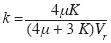
<body><![CDATA[<p align="justify"><font face="verdana" size="2">where <i>a </i>is the radius of the conduit, <i>l</i> its length, g the value of gravity, <i>&eta;<sub>m </sub></i>the kinematic viscosity of the magma and <i>&Delta;&rho; </i>the density contrast between magma and host rock. We shall simplify the problem by assuming constant magma viscosity. Althoung it is a function of temperature, crystal and gas content, we consider that those factors do not change considerably in the course of the eruption, for the period we are analyzing.</font></p>     <p align="justify"><font face="verdana" size="2">The conduit from the chamber to the surface is surrounded by a medium with a Maxwell viscoelastic rheology; therefore the radius of the conduit responds to changes in pressure according to</font></p>     <p align="center"><font face="verdana" size="2"><img src="/img/revistas/geoint/v49n2/a4e5.jpg"></font></p>     <p align="justify"><font face="verdana" size="2">where <i>&eta;<sub>r</sub></i> is the viscosity of the country rock.</font></p>     <p align="justify"><font face="verdana" size="2">Maeda (2000) assumed that the magma behaves as an incompressible fuid; however one can consider compressibility though the equation</font></p>     <p align="center"><font face="verdana" size="2"><img src="/img/revistas/geoint/v49n2/a4e6.jpg"></font></p>     <p align="justify"><font face="verdana" size="2">where <i>K<sub>m</sub> </i>is the bulk modulus of the magma and <i>&rho;<sub>ma</sub> </i>the density of the magma at lithostatic pressure.</font></p>     <p align="justify"><font face="verdana" size="2">Equations 1 to 5 form a complete system of equations suitable for numerical treatment. The solutions obtained are more general and may easily be derived by reducing the number of equations through proper substitution and the introduction of the following dimensionless variables:</font></p>     <p align="center"><font face="verdana" size="2"><img src="/img/revistas/geoint/v49n2/a4e7.jpg"></font></p>     <p align="justify"><font face="verdana" size="2">where</font></p>     ]]></body>
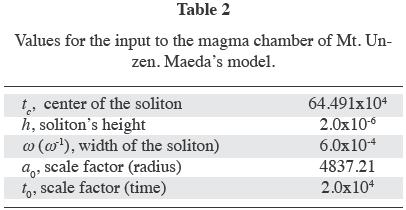
<body><![CDATA[<p align="center"><font face="verdana" size="2"><img src="/img/revistas/geoint/v49n2/a4e8.jpg"></font></p>     <p align="justify"><font face="verdana" size="2">These   changes   lead   to the   following   set   of dimensionless equations:</font></p>     <p align="center"><font face="verdana" size="2"><img src="/img/revistas/geoint/v49n2/a4e9.jpg"></font></p>     <p align="justify"><font face="verdana" size="2">The above equations were solved with the commercial software &reg;MATHEMATICA, which uses the Adams&#150;Bashford method to solve the system of differential equations. The input data required for the solution is / the input, which is a general function of time of the physical characteristics of magma and country rock, and the dimensions and depth of the magma chamber as well as the initial radius of the conduit. The solution yields the pressure and rate of change of the conduit radius and the discharge rate is computed from equation (3).</font></p>     <p align="justify"><font face="verdana" size="2">The model requires knowing the input rate to the magma chamber. Maeda (2000) considers two cases: a constant supply to obtain the general characteristics of the system, and a time varying input such as a soliton described by the dimensionless function (in dimensionless form):</font></p>     <p align="center"><font face="verdana" size="2"><img src="/img/revistas/geoint/v49n2/a4e10.jpg"></font></p>     <p align="justify"><font face="verdana" size="2">The meanings of the variables in the above equation are shown in <a href="#figura3">Fig. 3</a>. This is a simple representation of the feeding of a magma chamber by patches of magma from below, but the actual feeding must be a more complex function as suggested by the real output rate observed at Colima (Navarro&#150;Ochoa <i>et ah, </i>2002).</font></p>     <p align="center"><font face="verdana" size="2"><a name="figura3"></a></font></p>     <p align="center"><font face="verdana" size="2"><img src="/img/revistas/geoint/v49n2/a4f3.jpg"></font></p>     <p align="justify"><font face="verdana" size="2">Maeda (2000) presented the results of the application of the model to the 1991&#150;1995 eruption of Mt. Unzen; his results are shown in <a href="#figura4">Fig. 4b</a>. This fgure shows the comparison between data from Maeda (2000) for Mt. Unzen (<a href="#figura4">Fig 4a</a>) and the results for the algorithm developed in this paper (<a href="#figura4">Fig. 4b</a>) (Cabrera&#150;Guti&eacute;rrez, 2010). This last fgure was obtained with the values listed in <a href="#tabla1">Table 1</a>, whereas <a href="#tabla2">Table 2</a> shows the input to the magma chamber of Mt. Unzen. The results with our code are substantially the same as those shown by Maeda. Before applying the model to the 1998&#150;1999 eruption of Volc&aacute;n de Colima, the convergence of the model was assessed and the optimal time step was determined. The sensitivity of the model to changes in the variables was also assessed as follows.</font></p>     ]]></body>
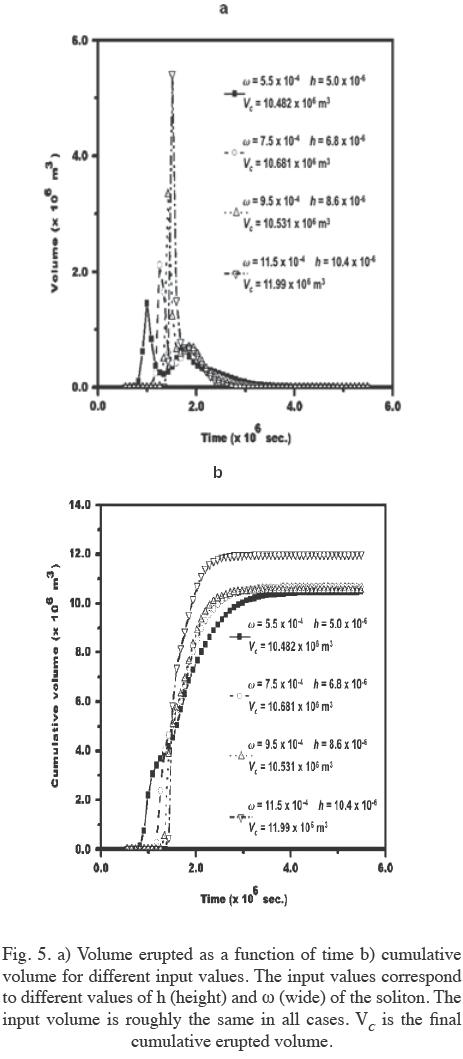
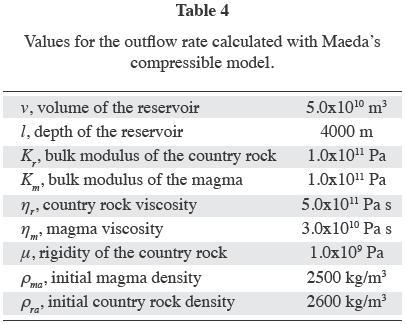
<body><![CDATA[<p align="center"><font face="verdana" size="2"><a name="figura4"></a></font></p>     <p align="center"><font face="verdana" size="2"><img src="/img/revistas/geoint/v49n2/a4f4.jpg"></font></p>     <p align="center"><font face="verdana" size="2"><a name="tabla1"></a></font></p>     <p align="center"><font face="verdana" size="2"><img src="/img/revistas/geoint/v49n2/a4t1.jpg"></font></p>     <p align="center"><font face="verdana" size="2"><a name="tabla2"></a></font></p>     <p align="center"><font face="verdana" size="2"><img src="/img/revistas/geoint/v49n2/a4t2.jpg"></font></p>     <p align="justify"><font face="verdana" size="2"><a href="#figura5">Fig. 5</a> shows the effect of solitons of different shape keeping the total volume and all other variables constant. As can be observed, the output is of the same shape but different amplitude and timing; the cumulative output is less sensitive to the shape of the soliton. <a href="/img/revistas/geoint/v49n2/a4f6.jpg" target="_blank">Figs. 6</a> to <a href="/img/revistas/geoint/v49n2/a4f12.jpg" target="_blank">12</a> (<a href="/img/revistas/geoint/v49n2/a4f7.jpg" target="_blank">7</a>,<a href="/img/revistas/geoint/v49n2/a4f8.jpg" target="_blank">8</a>,<a href="/img/revistas/geoint/v49n2/a4f9.jpg" target="_blank">9</a>,<a href="/img/revistas/geoint/v49n2/a4f10.jpg" target="_blank">10</a>,<a href="/img/revistas/geoint/v49n2/a4f11.jpg" target="_blank">11</a>) show output and output rate for different values of the parameters as shown in the inset. The values were chosen to display the differences in the output and output rate. <a href="#tabla3">Table 3</a> shows the percent change from a 100 % change in a given variable. The volume of the magma chamber is by far the most sensitive parameter in the model, next to changes in magma viscosity, rock density contrast, and the rigidity/viscosity ratio of the country rock. The model is less sensitive to changes in the other parameters, such as the rock bulk modulus, the depth, the conduit radius, and the magma bulk modulus. <a href="/img/revistas/geoint/v49n2/a4f13.jpg" target="_blank">Fig. 13</a> presents the effect of compressibility of the magma; the difference between the compressible and incompressible cases for a reasonable choice of the bulk modulus of the magma is small. <a href="#tabla4">Tables 4</a> and <a href="#tabla5">5</a> show the values for the outfow rate and the input , respectively, for the parameter values showed in <a href="/img/revistas/geoint/v49n2/a4f13.jpg" target="_blank">Fig. 13</a>.</font></p>     <p align="center"><font face="verdana" size="2"><a name="figura5"></a></font></p>     <p align="center"><font face="verdana" size="2"><img src="/img/revistas/geoint/v49n2/a4f5.jpg"></font></p>     <p align="center"><font face="verdana" size="2"><a name="tabla3"></a></font></p>     ]]></body>
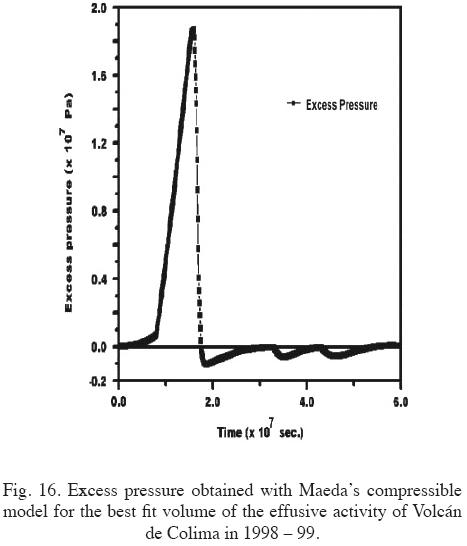
<body><![CDATA[<p align="center"><font face="verdana" size="2"><img src="/img/revistas/geoint/v49n2/a4t3.jpg"></font></p>     <p align="center"><font face="verdana" size="2"><a name="tabla4"></a></font></p>     <p align="center"><font face="verdana" size="2"><img src="/img/revistas/geoint/v49n2/a4t4.jpg"></font></p>     <p align="center"><font face="verdana" size="2"><a name="tabla5"></a></font></p>     <p align="center"><font face="verdana" size="2"><img src="/img/revistas/geoint/v49n2/a4t5.jpg"></font></p>     <p align="center"><font face="verdana" size="2">&nbsp;     </font></p>     <p align="justify"><font face="verdana" size="2">&nbsp;</font></p>     <p align="justify"><font face="verdana" size="2"><b>Application of Maeda's model to Colima volcano and discussion</b></font></p>     <p align="justify"><font face="verdana" size="2">The model is very sensitive to the volume of the Magma chamber, so it is important to have an independent estimate of these parameters. Medina <i>et al</i>. (1996) found a negative mass anomaly beneath Colima volcano. They proposed the gravimetric model shown in <a href="#figura14">Fig. 14</a>, a rectangular body 2 km wide, 5 km long and 5 km thick, yielding a volume of 50 km<sup>3</sup>. The top of the body is about 1.5 km below sea level (&#126; 5.4 km below the summit crater). In 1998&#150;1999 the seismic foci occured roughly around this volume, which agrees with the gravity model (Zamora&#150;Camacho <i>et al</i>., 2006). However, the gravity model was not constrained by subsurface density measurements nor other geophysical methods. Since Maeda's model requires a spherical magma chamber we considered a sphere about the center of the rectangular body (<a href="#figura14">Fig. 14</a>). By trial and error the effective viscosity of the magma was set at 10<sup>9 </sup>Pa s in agreement with the value obtained by Navarro&#150;Ochoa <i>et al</i>., (2002). The best ft to the observed output is shown in <a href="/img/revistas/geoint/v49n2/a4f15.jpg" target="_blank">Figs. 15a and 15b</a> with the values listed in <a href="#tabla6">Tables 6</a> and <a href="#tabla7">7</a>, which describe the input to the magma chamber as a time&#150;function formed by several time steps. This form of the time function is required to model the slow emission of lava over several weeks after the main events. Magma apparently continued to feed into the magma chamber at a constant rate after the passage of the peak infow of the time&#150;varying feeding.</font></p>      <p align="center"><font face="verdana" size="2"><a name="figura14"></a></font></p>      ]]></body>
<body><![CDATA[<p align="center"><font face="verdana" size="2"><img src="/img/revistas/geoint/v49n2/a4f14.jpg"></font></p>      <p align="center"><font face="verdana" size="2"><a name="tabla6"></a></font></p>      <p align="center"><font face="verdana" size="2"><img src="/img/revistas/geoint/v49n2/a4t6.jpg"></font></p>      <p align="center"><font face="verdana" size="2"><a name="tabla7"></a></font></p>      <p align="center"><font face="verdana" size="2"><img src="/img/revistas/geoint/v49n2/a4t7.jpg"></font></p>      <p align="justify"><font face="verdana" size="2">From <a href="/img/revistas/geoint/v49n2/a4f15.jpg" target="_blank">Fig. 15a</a>, the model reproduces roughly the volume erupted as a function of time, consisting of two periods of large emission followed by a continuing small emission of lava. However the theoretical plot is continuous while the observed was constructed with indirect observations made at discrete times and represents average values over periods of time (Navarro&#150;Ochoa <i>et ah, </i>2002). The theoretical curves assume a continuous discharge unhampered by surface conditions. Actually, the extrusion of magma is subjected to many processes not considered in the model, but the cumulative volume tends to smooth out these effects as shown <a href="/img/revistas/geoint/v49n2/a4f15.jpg" target="_blank">Fig. 15b</a>. Notice that the ft is reasonably better than in the previous case. Different values of volume, conduit radius, and depth of the sphere produce results that do not ft the observed data. <a href="#figura16">Fig. 16</a> shows pressure as a function of time during the eruption: notice that the pressure does not exceed the strength of the country rock, which is believed to be in the range of 30 MPa.</font></p>      <p align="center"><font face="verdana" size="2"><a name="figura16"></a></font></p>      <p align="center"><font face="verdana" size="2"><img src="/img/revistas/geoint/v49n2/a4f16.jpg"></font></p>      <p align="justify"><font face="verdana" size="2">Changes in volume due to input of magma are not accommodated by elastic or viscoelastic deformation as evidenced by the seismicity which suggests that part of the volume change may be accommodated by faulting of the country rock. McGarr (1976) obtained a formula to correlate cumulative seismic moment and volume change, which yielded a fgure in the range of 0.14 to 0.18 x 10<sup>5</sup> km<sup>3</sup> (&#931;<i>M</i><sub>0</sub>=2.68X10<sup>22</sup> dynes/cm; Zamora&#150;Camacho, 2003), a small volume compared with the size of the magma chamber required by the model. We conclude that most of the volume change required by the magma input is accomodated by the rheology of the medium, which also infuences the mass eruption rate.</font></p>      <p align="justify"><font face="verdana" size="2">&nbsp;</font></p>     ]]></body>
<body><![CDATA[<p align="justify"><font face="verdana" size="2"><b>Conclusions</b></font></p>     <p align="justify"><font face="verdana" size="2">The modifed model of Maeda (2000) applied to the 1998&#150;1999 eruption of Volc&aacute;n de Colima fts reasonably well the observed data. The magma chamber is modeled as a sphere at 1.715 km below sea level (5.565 km below the summit crater) with a volume of 30 km<sup>3</sup>. The magma chamber evolves through time as it cools during repose and heats up during periods of magma feeding. This model can be applied to future eruptions to investigate its appropriateness to Volc&aacute;n de Colima; it could serve to determine the mechanism of this type of eruptions and to establish the internal characteristics of the volcanic system at Colima Volcano.</font></p>     <p align="justify"><font face="verdana" size="2">&nbsp;</font></p>     <p align="justify"><font face="verdana" size="2"><b>Acknowledgements</b></font></p>     <p align="justify"><font face="verdana" size="2">The authors wish to express their gratitude to the two reviewers of this paper, for their careful review and enlightening comments. Thanks are due to CONACYT grant 428427&#150;F and PAPIIT grant IN105003&#150;3. RC wishes to express his indebtness to CONACYT for a scholarship grant from 2003 to 2007.</font></p>     <p align="justify"><font face="verdana" size="2">&nbsp;</font></p>     <p align="justify"><font face="verdana" size="2"><b>Bibliography</b></font></p>     <!-- ref --><p align="justify"><font face="verdana" size="2">Bret&oacute;n&#150;Gonz&aacute;lez, M., J. J. Ram&iacute;rez and C. Navarro, 2002. Summary of the historical eruptive activity of Volc&aacute;n de Colima, Mexico 1519 &#150; 2000, <i>J.Volcanol. Geotherm. Res.</i>, <i>117</i>, 21 &#150; 46.</font>&nbsp;&nbsp;&nbsp;&nbsp;&nbsp;&nbsp;&nbsp;&nbsp;[&#160;<a href="javascript:void(0);" onclick="javascript: window.open('/scielo.php?script=sci_nlinks&ref=3908928&pid=S0016-7169201000020000400001&lng=','','width=640,height=500,resizable=yes,scrollbars=1,menubar=yes,');">Links</a>&#160;]<!-- end-ref --><!-- ref --><p align="justify"><font face="verdana" size="2">Cabrera&#150;Guti&eacute;rrez, R., 2010. Modelo de emisi&oacute;n de masa para la erupci&oacute;n de 1998 del Volc&aacute;n de Colima, M&eacute;xico, PhD. Thesis, M&eacute;xico, D.F., Instituto de Geof&iacute;sica, Universidad Nacional Aut&oacute;noma de M&eacute;xico, 206 pp.</font>&nbsp;&nbsp;&nbsp;&nbsp;&nbsp;&nbsp;&nbsp;&nbsp;[&#160;<a href="javascript:void(0);" onclick="javascript: window.open('/scielo.php?script=sci_nlinks&ref=3908929&pid=S0016-7169201000020000400002&lng=','','width=640,height=500,resizable=yes,scrollbars=1,menubar=yes,');">Links</a>&#160;]<!-- end-ref --><!-- ref --><p align="justify"><font face="verdana" size="2">Costa, A., O. Melnik, R. S. J. Sparks and B. Voight, 2007a. Control of magma fow in dykes on cyclic lava dome extrusion, <i>Geophys. Res. Lett.</i>, <i>34</i>, L02303, doi: 10.1029/2006GL027466.</font>&nbsp;&nbsp;&nbsp;&nbsp;&nbsp;&nbsp;&nbsp;&nbsp;[&#160;<a href="javascript:void(0);" onclick="javascript: window.open('/scielo.php?script=sci_nlinks&ref=3908930&pid=S0016-7169201000020000400003&lng=','','width=640,height=500,resizable=yes,scrollbars=1,menubar=yes,');">Links</a>&#160;]<!-- end-ref --><!-- ref --><p align="justify"><font face="verdana" size="2">Costa, A., O. Melnik and R. S. J. Sparks, 2007b. Controls of conduit geometry and wallrock elasticity on lava dome eruptions, <i>Earth Planet. Sci. Lett.</i>, <i>260</i>, 137&#150;151.</font>&nbsp;&nbsp;&nbsp;&nbsp;&nbsp;&nbsp;&nbsp;&nbsp;[&#160;<a href="javascript:void(0);" onclick="javascript: window.open('/scielo.php?script=sci_nlinks&ref=3908931&pid=S0016-7169201000020000400004&lng=','','width=640,height=500,resizable=yes,scrollbars=1,menubar=yes,');">Links</a>&#160;]<!-- end-ref --><!-- ref --><p align="justify"><font face="verdana" size="2">De la Cruz&#150;Reyna, S., 1993. Random patterns of activity at Colima Volcano, M&eacute;xico, <i>J. Volcanol. Geotherm. Res., 55</i>, 51&#150; 68.</font>&nbsp;&nbsp;&nbsp;&nbsp;&nbsp;&nbsp;&nbsp;&nbsp;[&#160;<a href="javascript:void(0);" onclick="javascript: window.open('/scielo.php?script=sci_nlinks&ref=3908932&pid=S0016-7169201000020000400005&lng=','','width=640,height=500,resizable=yes,scrollbars=1,menubar=yes,');">Links</a>&#160;]<!-- end-ref --><!-- ref --><p align="justify"><font face="verdana" size="2">De la Cruz&#150;Reyna, S. and G. A. Reyes&#150;D&aacute;vila, 2001. A model to describe precursory material&#150;failure phenomena: applications to short&#150;term forecasting at Colima volcano, Mexico, <i>Bull. Volcanol., 63</i>, 297&#150;308.</font>&nbsp;&nbsp;&nbsp;&nbsp;&nbsp;&nbsp;&nbsp;&nbsp;[&#160;<a href="javascript:void(0);" onclick="javascript: window.open('/scielo.php?script=sci_nlinks&ref=3908933&pid=S0016-7169201000020000400006&lng=','','width=640,height=500,resizable=yes,scrollbars=1,menubar=yes,');">Links</a>&#160;]<!-- end-ref --><!-- ref --><p align="justify"><font face="verdana" size="2">Ida, Y. , 1996. Cyclic fuid efussion accompanied by pressure change: Implication for volcanic eruptions and tremor, <i>Geophys. Res. Lett.</i>, <i>23</i>, 12, 1457 &#150; 1460.</font>&nbsp;&nbsp;&nbsp;&nbsp;&nbsp;&nbsp;&nbsp;&nbsp;[&#160;<a href="javascript:void(0);" onclick="javascript: window.open('/scielo.php?script=sci_nlinks&ref=3908934&pid=S0016-7169201000020000400007&lng=','','width=640,height=500,resizable=yes,scrollbars=1,menubar=yes,');">Links</a>&#160;]<!-- end-ref --><!-- ref --><p align="justify"><font face="verdana" size="2">Luhr, J. F. and I. S. E. Carmichael, 1980. The Colima volcanic complex, Mexico; Part I. Postcaldera andesites from Volc&aacute;n Colima, <i>Contrib. Mineral. Petrology</i>, <i>71</i>, 343&#150;372.</font>&nbsp;&nbsp;&nbsp;&nbsp;&nbsp;&nbsp;&nbsp;&nbsp;[&#160;<a href="javascript:void(0);" onclick="javascript: window.open('/scielo.php?script=sci_nlinks&ref=3908935&pid=S0016-7169201000020000400008&lng=','','width=640,height=500,resizable=yes,scrollbars=1,menubar=yes,');">Links</a>&#160;]<!-- end-ref --><!-- ref --><p align="justify"><font face="verdana" size="2">Luhr, J. F. and I. S. E. Carmichael, 1990. Geology of Volc&aacute;n de Colima, <i>Univ. Nal. Aut&oacute;n. M&eacute;xico, Ins. Geolog&iacute;a, Bol. 107</i>, 101 pp.</font>&nbsp;&nbsp;&nbsp;&nbsp;&nbsp;&nbsp;&nbsp;&nbsp;[&#160;<a href="javascript:void(0);" onclick="javascript: window.open('/scielo.php?script=sci_nlinks&ref=3908936&pid=S0016-7169201000020000400009&lng=','','width=640,height=500,resizable=yes,scrollbars=1,menubar=yes,');">Links</a>&#160;]<!-- end-ref --><!-- ref --><p align="justify"><font face="verdana" size="2">Luhr, J. F., 2002. Petrology and geochemistry of the 1991 and 1998&#150;1999 lava fows from Volc&aacute;n de Colima, M&eacute;xico: implications for the end of the current eruptive cycle, <i>J. Volcanol. Geotherm. Res., 117, </i>169&#150;194.</font>&nbsp;&nbsp;&nbsp;&nbsp;&nbsp;&nbsp;&nbsp;&nbsp;[&#160;<a href="javascript:void(0);" onclick="javascript: window.open('/scielo.php?script=sci_nlinks&ref=3908937&pid=S0016-7169201000020000400010&lng=','','width=640,height=500,resizable=yes,scrollbars=1,menubar=yes,');">Links</a>&#160;]<!-- end-ref --><!-- ref --><p align="justify"><font face="verdana" size="2">Maeda, I., 2000. Nonlinear visco&#150;elastic volcanic model and its application to the recent eruption of Mt. Unzen, <i>J. Volcanol. Geotherm. Res., 95</i>, 35&#150;47.</font>&nbsp;&nbsp;&nbsp;&nbsp;&nbsp;&nbsp;&nbsp;&nbsp;[&#160;<a href="javascript:void(0);" onclick="javascript: window.open('/scielo.php?script=sci_nlinks&ref=3908938&pid=S0016-7169201000020000400011&lng=','','width=640,height=500,resizable=yes,scrollbars=1,menubar=yes,');">Links</a>&#160;]<!-- end-ref --><!-- ref --><p align="justify"><font face="verdana" size="2">McGarr, A., 1976. Seismic moments and volume changes, <i>J. Geophys. Res.</i>, <i>81</i>, 1487&#150;1494.</font>&nbsp;&nbsp;&nbsp;&nbsp;&nbsp;&nbsp;&nbsp;&nbsp;[&#160;<a href="javascript:void(0);" onclick="javascript: window.open('/scielo.php?script=sci_nlinks&ref=3908939&pid=S0016-7169201000020000400012&lng=','','width=640,height=500,resizable=yes,scrollbars=1,menubar=yes,');">Links</a>&#160;]<!-- end-ref --><!-- ref --><p align="justify"><font face="verdana" size="2">Medina&#150;Mart&iacute;nez, F., 1983. Analisis of the eruptive history of the Volc&aacute;n de Colima, M&eacute;xico (1560&#150;1980), <i>Geof&iacute;sica Int</i>ernacional <i>22</i>, 157&#150;178.</font>&nbsp;&nbsp;&nbsp;&nbsp;&nbsp;&nbsp;&nbsp;&nbsp;[&#160;<a href="javascript:void(0);" onclick="javascript: window.open('/scielo.php?script=sci_nlinks&ref=3908940&pid=S0016-7169201000020000400013&lng=','','width=640,height=500,resizable=yes,scrollbars=1,menubar=yes,');">Links</a>&#160;]<!-- end-ref --><!-- ref --><p align="justify"><font face="verdana" size="2">Medina, F., J. M. Esp&iacute;ndola, M. de la Fuente and M. Mena, 1996. A gravity model of the Colima, Mexico region, <i>Geof&iacute;sica Internacional 35</i>, 409&#150;414.</font>&nbsp;&nbsp;&nbsp;&nbsp;&nbsp;&nbsp;&nbsp;&nbsp;[&#160;<a href="javascript:void(0);" onclick="javascript: window.open('/scielo.php?script=sci_nlinks&ref=3908941&pid=S0016-7169201000020000400014&lng=','','width=640,height=500,resizable=yes,scrollbars=1,menubar=yes,');">Links</a>&#160;]<!-- end-ref --><!-- ref --><p align="justify"><font face="verdana" size="2">Mogi, K., 1958. Relations of the eruptions of various volcanoes and the deformations of the ground around them, <i>Bull. Earthq. Res. Inst. Tokyo Univ.</i>, <i>36</i>, 98&#150;134.</font>&nbsp;&nbsp;&nbsp;&nbsp;&nbsp;&nbsp;&nbsp;&nbsp;[&#160;<a href="javascript:void(0);" onclick="javascript: window.open('/scielo.php?script=sci_nlinks&ref=3908942&pid=S0016-7169201000020000400015&lng=','','width=640,height=500,resizable=yes,scrollbars=1,menubar=yes,');">Links</a>&#160;]<!-- end-ref --><!-- ref --><p align="justify"><font face="verdana" size="2">Mora, J. C., J. L. Mac&iacute;as, R. Saucedo, A. Orlando, P. Manetti and O. Vaselli, 2002. Petrology of the 1998&#150;2000 products of Volc&aacute;n de Colima, M&eacute;xico, <i>J. Volcanol. Geotherm. Res., 117</i>, 79&#150;89.</font>&nbsp;&nbsp;&nbsp;&nbsp;&nbsp;&nbsp;&nbsp;&nbsp;[&#160;<a href="javascript:void(0);" onclick="javascript: window.open('/scielo.php?script=sci_nlinks&ref=3908943&pid=S0016-7169201000020000400016&lng=','','width=640,height=500,resizable=yes,scrollbars=1,menubar=yes,');">Links</a>&#160;]<!-- end-ref --><!-- ref --><p align="justify"><font face="verdana" size="2">Murray, J. B. and L. K. Wooller, 2002. Persistent summit subsidence at Volc&aacute;n de Colima, Mexico, 1982&#150;1999: strong evidence against Mogi defation. <i>J. Volcanol Geotherm Res.</i>, <i>117</i>, 69&#150;78.</font>&nbsp;&nbsp;&nbsp;&nbsp;&nbsp;&nbsp;&nbsp;&nbsp;[&#160;<a href="javascript:void(0);" onclick="javascript: window.open('/scielo.php?script=sci_nlinks&ref=3908944&pid=S0016-7169201000020000400017&lng=','','width=640,height=500,resizable=yes,scrollbars=1,menubar=yes,');">Links</a>&#160;]<!-- end-ref --><!-- ref --><p align="justify"><font face="verdana" size="2">Navarro&#150;Ochoa, C., J. C. Gavilanes&#150;Ru&iacute;z and A. Cort&eacute;s&#150;Cort&eacute;s, 2002. Movement and emplacement of lava fows at Volc&aacute;n de Colima, M&eacute;xico: November 1998 &#150; February 1999, <i>J. Volcanol. Geotherm. Res.</i>, <i>117</i>, 153&#150;167. </font>&nbsp;&nbsp;&nbsp;&nbsp;&nbsp;&nbsp;&nbsp;&nbsp;[&#160;<a href="javascript:void(0);" onclick="javascript: window.open('/scielo.php?script=sci_nlinks&ref=3908945&pid=S0016-7169201000020000400018&lng=','','width=640,height=500,resizable=yes,scrollbars=1,menubar=yes,');">Links</a>&#160;]<!-- end-ref --><!-- ref --><p align="justify"><font face="verdana" size="2">Poland, M., M. Hamburger and A. Newman, 2006. The changing shapes of active volcanoes: History, evolution, and future challenges for volcano geodesy, <i>J. Volcanol. Geotherm. Res.</i>, <i>150</i>, 1 &#150;13.</font>&nbsp;&nbsp;&nbsp;&nbsp;&nbsp;&nbsp;&nbsp;&nbsp;[&#160;<a href="javascript:void(0);" onclick="javascript: window.open('/scielo.php?script=sci_nlinks&ref=3908946&pid=S0016-7169201000020000400019&lng=','','width=640,height=500,resizable=yes,scrollbars=1,menubar=yes,');">Links</a>&#160;]<!-- end-ref --><!-- ref --><p align="justify"><font face="verdana" size="2">Ram&iacute;rez&#150;Ruiz J. J., H. Santiago&#150;Jim&eacute;nez, E. Alatorre&#150;Ch&aacute;vez and M. Bret&oacute;n&#150;Gonz&aacute;lez, 2002. EDM deformation monitoring of the 1997&#150;2000 activity at Volc&aacute;n de Colima <i>J. Volcanol. Geotherm. Res., 117, </i>61&#150;67.</font>&nbsp;&nbsp;&nbsp;&nbsp;&nbsp;&nbsp;&nbsp;&nbsp;[&#160;<a href="javascript:void(0);" onclick="javascript: window.open('/scielo.php?script=sci_nlinks&ref=3908947&pid=S0016-7169201000020000400020&lng=','','width=640,height=500,resizable=yes,scrollbars=1,menubar=yes,');">Links</a>&#160;]<!-- end-ref --><!-- ref --><p align="justify"><font face="verdana" size="2">Saucedo, R., J. L. Mac&iacute;as, J. C. Gavilanes, J. L. Arce, J. C. Komorowski, J. E. Gardner and G. Vald&eacute;z&#150;Moreno, 2010. Eyewitness, stratigraphy, chemistry, and eruptive dynamics of the 1913 Plinian eruption of Volc&aacute;n de Colima, M&eacute;xico, <i>J. Volcanol. Geotherm. Res.</i>, 2010 (Article in press), doi: 10.1016/ jvolgeores.2010.01.011.</font>&nbsp;&nbsp;&nbsp;&nbsp;&nbsp;&nbsp;&nbsp;&nbsp;[&#160;<a href="javascript:void(0);" onclick="javascript: window.open('/scielo.php?script=sci_nlinks&ref=3908948&pid=S0016-7169201000020000400021&lng=','','width=640,height=500,resizable=yes,scrollbars=1,menubar=yes,');">Links</a>&#160;]<!-- end-ref --><!-- ref --><p align="justify"><font face="verdana" size="2">Scandone, R. and L. Giacomelli, 2001. The slow boiling of magma chambers and the dynamics of explosive eruptions, <i>J. Volcanol. Geotherm. Res.</i>, <i>110</i>, 121 &#150; 136.</font>&nbsp;&nbsp;&nbsp;&nbsp;&nbsp;&nbsp;&nbsp;&nbsp;[&#160;<a href="javascript:void(0);" onclick="javascript: window.open('/scielo.php?script=sci_nlinks&ref=3908949&pid=S0016-7169201000020000400022&lng=','','width=640,height=500,resizable=yes,scrollbars=1,menubar=yes,');">Links</a>&#160;]<!-- end-ref --><!-- ref --><p align="justify"><font face="verdana" size="2">Zamora&#150;Camacho, A., 2003. La presencia de familias de temblores en la sismicidad asociada a la erupci&oacute;n del 21 de noviembre de 1998 del Volc&aacute;n de Colima y su relaci&oacute;n con el proceso eruptivo, MS Thesis, M&eacute;xico, D.F., Instituto de Geof&iacute;sica, UNAM, 67 pp.</font>&nbsp;&nbsp;&nbsp;&nbsp;&nbsp;&nbsp;&nbsp;&nbsp;[&#160;<a href="javascript:void(0);" onclick="javascript: window.open('/scielo.php?script=sci_nlinks&ref=3908950&pid=S0016-7169201000020000400023&lng=','','width=640,height=500,resizable=yes,scrollbars=1,menubar=yes,');">Links</a>&#160;]<!-- end-ref --><!-- ref --><p align="justify"><font face="verdana" size="2">Zamora&#150;Camacho, A., J. M. Esp&iacute;ndola and G. Reyes&#150;D&aacute;vila, 2006. The 1997&#150;1998 Activity of Volcan de Colima, Western Mexico: Some Aspects of the Associated Seismic Activity. <i>Pure Appl. Geophys</i>., <i>164</i>, 1&#150;14.</font>&nbsp;&nbsp;&nbsp;&nbsp;&nbsp;&nbsp;&nbsp;&nbsp;[&#160;<a href="javascript:void(0);" onclick="javascript: window.open('/scielo.php?script=sci_nlinks&ref=3908951&pid=S0016-7169201000020000400024&lng=','','width=640,height=500,resizable=yes,scrollbars=1,menubar=yes,');">Links</a>&#160;]<!-- end-ref --><!-- ref --><p align="justify"><font face="verdana" size="2">Zobin, V. M., J. F. Lurh, Y. A. Tar&aacute;n, M. Bret&oacute;n, A. Cort&eacute;s, S. De la Cruz, T. Dom&iacute;nguez, I. Galindo, J. C. Gavilanes, J. J. Mu&ntilde;iz, C. Navarro, J. J. Ram&iacute;rez, G. A. Reyes, M. Urs&uacute;a, J. Velasco, E. Alatorre and H. Santiago, 2002a. Overview of the 1997 &#150; 2000 activity of Volc&aacute;n de Colima, M&eacute;xico, <i>J. Volcanol. Geotherm. Res., 117</i>, 1&#150;19.</font>&nbsp;&nbsp;&nbsp;&nbsp;&nbsp;&nbsp;&nbsp;&nbsp;[&#160;<a href="javascript:void(0);" onclick="javascript: window.open('/scielo.php?script=sci_nlinks&ref=3908952&pid=S0016-7169201000020000400025&lng=','','width=640,height=500,resizable=yes,scrollbars=1,menubar=yes,');">Links</a>&#160;]<!-- end-ref --><!-- ref --><p align="justify"><font face="verdana" size="2">Zobin, V. M., M. Gonz&aacute;lez&#150;Amezcua, G. A. Reyes&#150;D&aacute;vila, T. Dom&iacute;nguez, J. C. Cerda Chac&oacute;n and J. M. Ch&aacute;vez&#150;Alvarez, 2002b. Comparative characteristics of the 1997 &#150; 1998 seismic swarms preceding the November 1998 eruption of Volc&aacute;n de Colima, M&eacute;xico, <i>J. Volcanol. Geotherm. Res.</i>, <i>17</i>, 47&#150;60.</font>&nbsp;&nbsp;&nbsp;&nbsp;&nbsp;&nbsp;&nbsp;&nbsp;[&#160;<a href="javascript:void(0);" onclick="javascript: window.open('/scielo.php?script=sci_nlinks&ref=3908953&pid=S0016-7169201000020000400026&lng=','','width=640,height=500,resizable=yes,scrollbars=1,menubar=yes,');">Links</a>&#160;]<!-- end-ref --> ]]></body><back>
<ref-list>
<ref id="B1">
<nlm-citation citation-type="journal">
<person-group person-group-type="author">
<name>
<surname><![CDATA[Bretón-González]]></surname>
<given-names><![CDATA[M.]]></given-names>
</name>
<name>
<surname><![CDATA[Ramírez]]></surname>
<given-names><![CDATA[J. J.]]></given-names>
</name>
<name>
<surname><![CDATA[Navarro]]></surname>
<given-names><![CDATA[C.]]></given-names>
</name>
</person-group>
<article-title xml:lang="en"><![CDATA[Summary of the historical eruptive activity of Volcán de Colima, Mexico 1519 - 2000]]></article-title>
<source><![CDATA[J.Volcanol. Geotherm. Res.]]></source>
<year>2002</year>
<volume>117</volume>
<page-range>21 - 46</page-range></nlm-citation>
</ref>
<ref id="B2">
<nlm-citation citation-type="">
<person-group person-group-type="author">
<name>
<surname><![CDATA[Cabrera-Gutiérrez]]></surname>
<given-names><![CDATA[R.]]></given-names>
</name>
</person-group>
<source><![CDATA[Modelo de emisión de masa para la erupción de 1998 del Volcán de Colima, México]]></source>
<year>2010</year>
<page-range>206</page-range></nlm-citation>
</ref>
<ref id="B3">
<nlm-citation citation-type="journal">
<person-group person-group-type="author">
<name>
<surname><![CDATA[Costa]]></surname>
<given-names><![CDATA[A.]]></given-names>
</name>
<name>
<surname><![CDATA[Melnik]]></surname>
<given-names><![CDATA[O.]]></given-names>
</name>
<name>
<surname><![CDATA[Sparks]]></surname>
<given-names><![CDATA[R. S. J.]]></given-names>
</name>
<name>
<surname><![CDATA[Voight]]></surname>
<given-names><![CDATA[B.]]></given-names>
</name>
</person-group>
<article-title xml:lang="en"><![CDATA[Control of magma fow in dykes on cyclic lava dome extrusion]]></article-title>
<source><![CDATA[Geophys. Res. Lett.]]></source>
<year>2007</year>
<volume>34</volume>
</nlm-citation>
</ref>
<ref id="B4">
<nlm-citation citation-type="journal">
<person-group person-group-type="author">
<name>
<surname><![CDATA[Costa]]></surname>
<given-names><![CDATA[A.]]></given-names>
</name>
<name>
<surname><![CDATA[Melnik]]></surname>
<given-names><![CDATA[O.]]></given-names>
</name>
<name>
<surname><![CDATA[Sparks]]></surname>
<given-names><![CDATA[R. S. J.]]></given-names>
</name>
</person-group>
<article-title xml:lang="en"><![CDATA[Controls of conduit geometry and wallrock elasticity on lava dome eruptions]]></article-title>
<source><![CDATA[Earth Planet. Sci. Lett.]]></source>
<year>2007</year>
<volume>260</volume>
<page-range>137-151</page-range></nlm-citation>
</ref>
<ref id="B5">
<nlm-citation citation-type="journal">
<person-group person-group-type="author">
<name>
<surname><![CDATA[De la Cruz-Reyna]]></surname>
<given-names><![CDATA[S.]]></given-names>
</name>
</person-group>
<article-title xml:lang="en"><![CDATA[Random patterns of activity at Colima Volcano, México]]></article-title>
<source><![CDATA[J. Volcanol. Geotherm. Res.]]></source>
<year>1993</year>
<volume>55</volume>
<page-range>51- 68</page-range></nlm-citation>
</ref>
<ref id="B6">
<nlm-citation citation-type="journal">
<person-group person-group-type="author">
<name>
<surname><![CDATA[De la Cruz-Reyna]]></surname>
<given-names><![CDATA[S.]]></given-names>
</name>
<name>
<surname><![CDATA[Reyes-Dávila]]></surname>
<given-names><![CDATA[G. A.]]></given-names>
</name>
</person-group>
<article-title xml:lang="en"><![CDATA[A model to describe precursory material-failure phenomena: applications to short-term forecasting at Colima volcano, Mexico]]></article-title>
<source><![CDATA[Bull. Volcanol.]]></source>
<year>2001</year>
<volume>63</volume>
<page-range>297-308</page-range></nlm-citation>
</ref>
<ref id="B7">
<nlm-citation citation-type="journal">
<person-group person-group-type="author">
<name>
<surname><![CDATA[Ida]]></surname>
<given-names><![CDATA[Y.]]></given-names>
</name>
</person-group>
<article-title xml:lang="en"><![CDATA[Cyclic fuid efussion accompanied by pressure change: Implication for volcanic eruptions and tremor]]></article-title>
<source><![CDATA[Geophys. Res. Lett.]]></source>
<year>1996</year>
<volume>23</volume>
<numero>12</numero>
<issue>12</issue>
<page-range>1457 - 1460</page-range></nlm-citation>
</ref>
<ref id="B8">
<nlm-citation citation-type="journal">
<person-group person-group-type="author">
<name>
<surname><![CDATA[Luhr]]></surname>
<given-names><![CDATA[J. F.]]></given-names>
</name>
<name>
<surname><![CDATA[Carmichael]]></surname>
<given-names><![CDATA[I. S. E.]]></given-names>
</name>
</person-group>
<article-title xml:lang="en"><![CDATA[The Colima volcanic complex, Mexico; Part I: Postcaldera andesites from Volcán Colima]]></article-title>
<source><![CDATA[Contrib. Mineral. Petrology]]></source>
<year>1980</year>
<volume>71</volume>
<page-range>343-372</page-range></nlm-citation>
</ref>
<ref id="B9">
<nlm-citation citation-type="journal">
<person-group person-group-type="author">
<name>
<surname><![CDATA[Luhr]]></surname>
<given-names><![CDATA[J. F.]]></given-names>
</name>
<name>
<surname><![CDATA[Carmichael]]></surname>
<given-names><![CDATA[I. S. E.]]></given-names>
</name>
</person-group>
<article-title xml:lang="en"><![CDATA[Geology of Volcán de Colima]]></article-title>
<source><![CDATA[Univ. Nal. Autón. México, Ins. Geología, Bol.]]></source>
<year>1990</year>
<volume>107</volume>
<page-range>101</page-range></nlm-citation>
</ref>
<ref id="B10">
<nlm-citation citation-type="journal">
<person-group person-group-type="author">
<name>
<surname><![CDATA[Luhr]]></surname>
<given-names><![CDATA[J. F.]]></given-names>
</name>
</person-group>
<article-title xml:lang="en"><![CDATA[Petrology and geochemistry of the 1991 and 1998-1999 lava fows from Volcán de Colima, México: implications for the end of the current eruptive cycle]]></article-title>
<source><![CDATA[J. Volcanol. Geotherm. Res.]]></source>
<year>2002</year>
<volume>117</volume>
<page-range>169-194</page-range></nlm-citation>
</ref>
<ref id="B11">
<nlm-citation citation-type="journal">
<person-group person-group-type="author">
<name>
<surname><![CDATA[Maeda]]></surname>
<given-names><![CDATA[I.]]></given-names>
</name>
</person-group>
<article-title xml:lang="en"><![CDATA[Nonlinear visco-elastic volcanic model and its application to the recent eruption of Mt. Unzen]]></article-title>
<source><![CDATA[J. Volcanol. Geotherm. Res.]]></source>
<year>2000</year>
<volume>95</volume>
<page-range>35-47</page-range></nlm-citation>
</ref>
<ref id="B12">
<nlm-citation citation-type="journal">
<person-group person-group-type="author">
<name>
<surname><![CDATA[McGarr]]></surname>
<given-names><![CDATA[A.]]></given-names>
</name>
</person-group>
<article-title xml:lang="en"><![CDATA[Seismic moments and volume changes]]></article-title>
<source><![CDATA[J. Geophys. Res.]]></source>
<year>1976</year>
<volume>81</volume>
<page-range>1487-1494</page-range></nlm-citation>
</ref>
<ref id="B13">
<nlm-citation citation-type="journal">
<person-group person-group-type="author">
<name>
<surname><![CDATA[Medina-Martínez]]></surname>
<given-names><![CDATA[F.]]></given-names>
</name>
</person-group>
<article-title xml:lang="en"><![CDATA[Analisis of the eruptive history of the Volcán de Colima, México (1560-1980)]]></article-title>
<source><![CDATA[Geofísica Internacional]]></source>
<year>1983</year>
<volume>22</volume>
<page-range>157-178</page-range></nlm-citation>
</ref>
<ref id="B14">
<nlm-citation citation-type="journal">
<person-group person-group-type="author">
<name>
<surname><![CDATA[Medina]]></surname>
<given-names><![CDATA[F.]]></given-names>
</name>
<name>
<surname><![CDATA[Espíndola]]></surname>
<given-names><![CDATA[J. M.]]></given-names>
</name>
<name>
<surname><![CDATA[de la Fuente]]></surname>
<given-names><![CDATA[M.]]></given-names>
</name>
<name>
<surname><![CDATA[Mena]]></surname>
<given-names><![CDATA[M.]]></given-names>
</name>
</person-group>
<article-title xml:lang="en"><![CDATA[A gravity model of the Colima, Mexico region]]></article-title>
<source><![CDATA[Geofísica Internacional]]></source>
<year>1996</year>
<volume>35</volume>
<page-range>409-414</page-range></nlm-citation>
</ref>
<ref id="B15">
<nlm-citation citation-type="journal">
<person-group person-group-type="author">
<name>
<surname><![CDATA[Mogi]]></surname>
<given-names><![CDATA[K.]]></given-names>
</name>
</person-group>
<article-title xml:lang="en"><![CDATA[Relations of the eruptions of various volcanoes and the deformations of the ground around them]]></article-title>
<source><![CDATA[Bull. Earthq. Res. Inst. Tokyo Univ.]]></source>
<year>1958</year>
<volume>36</volume>
<page-range>98-134</page-range></nlm-citation>
</ref>
<ref id="B16">
<nlm-citation citation-type="journal">
<person-group person-group-type="author">
<name>
<surname><![CDATA[Mora]]></surname>
<given-names><![CDATA[J. C.]]></given-names>
</name>
<name>
<surname><![CDATA[Macías]]></surname>
<given-names><![CDATA[J. L.]]></given-names>
</name>
<name>
<surname><![CDATA[Saucedo]]></surname>
<given-names><![CDATA[R.]]></given-names>
</name>
<name>
<surname><![CDATA[Orlando]]></surname>
<given-names><![CDATA[A.]]></given-names>
</name>
<name>
<surname><![CDATA[Manetti]]></surname>
<given-names><![CDATA[P.]]></given-names>
</name>
<name>
<surname><![CDATA[Vaselli]]></surname>
<given-names><![CDATA[O.]]></given-names>
</name>
</person-group>
<article-title xml:lang="en"><![CDATA[Petrology of the 1998-2000 products of Volcán de Colima, México]]></article-title>
<source><![CDATA[J. Volcanol. Geotherm. Res.]]></source>
<year>2002</year>
<volume>117</volume>
<page-range>79-89</page-range></nlm-citation>
</ref>
<ref id="B17">
<nlm-citation citation-type="journal">
<person-group person-group-type="author">
<name>
<surname><![CDATA[Murray]]></surname>
<given-names><![CDATA[J. B.]]></given-names>
</name>
<name>
<surname><![CDATA[Wooller]]></surname>
<given-names><![CDATA[L. K.]]></given-names>
</name>
</person-group>
<article-title xml:lang="en"><![CDATA[Persistent summit subsidence at Volcán de Colima, Mexico, 1982-1999: strong evidence against Mogi defation]]></article-title>
<source><![CDATA[J. Volcanol Geotherm Res.]]></source>
<year>2002</year>
<volume>117</volume>
<page-range>69-78</page-range></nlm-citation>
</ref>
<ref id="B18">
<nlm-citation citation-type="journal">
<person-group person-group-type="author">
<name>
<surname><![CDATA[Navarro-Ochoa]]></surname>
<given-names><![CDATA[C.]]></given-names>
</name>
<name>
<surname><![CDATA[Gavilanes-Ruíz]]></surname>
<given-names><![CDATA[J. C.]]></given-names>
</name>
<name>
<surname><![CDATA[Cortés-Cortés]]></surname>
<given-names><![CDATA[A.]]></given-names>
</name>
</person-group>
<article-title xml:lang="en"><![CDATA[Movement and emplacement of lava fows at Volcán de Colima, México: November 1998 - February 1999]]></article-title>
<source><![CDATA[J. Volcanol. Geotherm. Res.]]></source>
<year>2002</year>
<volume>117</volume>
<page-range>153-167</page-range></nlm-citation>
</ref>
<ref id="B19">
<nlm-citation citation-type="journal">
<person-group person-group-type="author">
<name>
<surname><![CDATA[Poland]]></surname>
<given-names><![CDATA[M.]]></given-names>
</name>
<name>
<surname><![CDATA[Hamburger]]></surname>
<given-names><![CDATA[M.]]></given-names>
</name>
<name>
<surname><![CDATA[Newman]]></surname>
<given-names><![CDATA[A.]]></given-names>
</name>
</person-group>
<article-title xml:lang="en"><![CDATA[The changing shapes of active volcanoes: History, evolution, and future challenges for volcano geodesy]]></article-title>
<source><![CDATA[J. Volcanol. Geotherm. Res.]]></source>
<year>2006</year>
<volume>150</volume>
<page-range>1 -13</page-range></nlm-citation>
</ref>
<ref id="B20">
<nlm-citation citation-type="journal">
<person-group person-group-type="author">
<name>
<surname><![CDATA[Ramírez-Ruiz]]></surname>
<given-names><![CDATA[J. J.]]></given-names>
</name>
<name>
<surname><![CDATA[Santiago-Jiménez]]></surname>
<given-names><![CDATA[H.]]></given-names>
</name>
<name>
<surname><![CDATA[Alatorre-Chávez]]></surname>
<given-names><![CDATA[E.]]></given-names>
</name>
<name>
<surname><![CDATA[Bretón-González]]></surname>
<given-names><![CDATA[M.]]></given-names>
</name>
</person-group>
<article-title xml:lang="en"><![CDATA[EDM deformation monitoring of the 1997-2000 activity at Volcán de Colima]]></article-title>
<source><![CDATA[J. Volcanol. Geotherm. Res.]]></source>
<year>2002</year>
<volume>117</volume>
<page-range>61-67</page-range></nlm-citation>
</ref>
<ref id="B21">
<nlm-citation citation-type="journal">
<person-group person-group-type="author">
<name>
<surname><![CDATA[Saucedo]]></surname>
<given-names><![CDATA[R.]]></given-names>
</name>
<name>
<surname><![CDATA[Macías]]></surname>
<given-names><![CDATA[J. L.]]></given-names>
</name>
<name>
<surname><![CDATA[Gavilanes]]></surname>
<given-names><![CDATA[J. C.]]></given-names>
</name>
<name>
<surname><![CDATA[Arce]]></surname>
<given-names><![CDATA[J. L.]]></given-names>
</name>
<name>
<surname><![CDATA[Komorowski]]></surname>
<given-names><![CDATA[J. C.]]></given-names>
</name>
<name>
<surname><![CDATA[Gardner]]></surname>
<given-names><![CDATA[J. E.]]></given-names>
</name>
<name>
<surname><![CDATA[Valdéz-Moreno]]></surname>
<given-names><![CDATA[G.]]></given-names>
</name>
</person-group>
<article-title xml:lang="en"><![CDATA[Eyewitness, stratigraphy, chemistry, and eruptive dynamics of the 1913 Plinian eruption of Volcán de Colima, México]]></article-title>
<source><![CDATA[J. Volcanol. Geotherm. Res.]]></source>
<year>2010</year>
<month>20</month>
<day>10</day>
</nlm-citation>
</ref>
<ref id="B22">
<nlm-citation citation-type="journal">
<person-group person-group-type="author">
<name>
<surname><![CDATA[Scandone]]></surname>
<given-names><![CDATA[R.]]></given-names>
</name>
<name>
<surname><![CDATA[Giacomelli]]></surname>
<given-names><![CDATA[L.]]></given-names>
</name>
</person-group>
<article-title xml:lang="en"><![CDATA[The slow boiling of magma chambers and the dynamics of explosive eruptions]]></article-title>
<source><![CDATA[J. Volcanol. Geotherm. Res.]]></source>
<year>2001</year>
<volume>110</volume>
<page-range>121 - 136</page-range></nlm-citation>
</ref>
<ref id="B23">
<nlm-citation citation-type="">
<person-group person-group-type="author">
<name>
<surname><![CDATA[Zamora-Camacho]]></surname>
<given-names><![CDATA[A.]]></given-names>
</name>
</person-group>
<source><![CDATA[La presencia de familias de temblores en la sismicidad asociada a la erupción del 21 de noviembre de 1998 del Volcán de Colima y su relación con el proceso eruptivo]]></source>
<year>2003</year>
<page-range>67</page-range></nlm-citation>
</ref>
<ref id="B24">
<nlm-citation citation-type="journal">
<person-group person-group-type="author">
<name>
<surname><![CDATA[Zamora-Camacho]]></surname>
<given-names><![CDATA[A.]]></given-names>
</name>
<name>
<surname><![CDATA[Espíndola]]></surname>
<given-names><![CDATA[J. M.]]></given-names>
</name>
<name>
<surname><![CDATA[Reyes-Dávila]]></surname>
<given-names><![CDATA[G.]]></given-names>
</name>
</person-group>
<article-title xml:lang="en"><![CDATA[The 1997-1998 Activity of Volcan de Colima, Western Mexico: Some Aspects of the Associated Seismic Activity]]></article-title>
<source><![CDATA[Pure Appl. Geophys.]]></source>
<year>2006</year>
<volume>164</volume>
<page-range>1-14</page-range></nlm-citation>
</ref>
<ref id="B25">
<nlm-citation citation-type="journal">
<person-group person-group-type="author">
<name>
<surname><![CDATA[Zobin]]></surname>
<given-names><![CDATA[V. M.]]></given-names>
</name>
<name>
<surname><![CDATA[Lurh]]></surname>
<given-names><![CDATA[J. F.]]></given-names>
</name>
<name>
<surname><![CDATA[Tarán]]></surname>
<given-names><![CDATA[Y. A.]]></given-names>
</name>
<name>
<surname><![CDATA[Bretón]]></surname>
<given-names><![CDATA[M.]]></given-names>
</name>
<name>
<surname><![CDATA[Cortés]]></surname>
<given-names><![CDATA[A.]]></given-names>
</name>
<name>
<surname><![CDATA[De la Cruz]]></surname>
<given-names><![CDATA[S.]]></given-names>
</name>
<name>
<surname><![CDATA[Domínguez]]></surname>
<given-names><![CDATA[T.]]></given-names>
</name>
<name>
<surname><![CDATA[Galindo]]></surname>
<given-names><![CDATA[I.]]></given-names>
</name>
<name>
<surname><![CDATA[Gavilanes]]></surname>
<given-names><![CDATA[J. C.]]></given-names>
</name>
<name>
<surname><![CDATA[Muñiz]]></surname>
<given-names><![CDATA[J. J.]]></given-names>
</name>
<name>
<surname><![CDATA[Navarro]]></surname>
<given-names><![CDATA[C.]]></given-names>
</name>
<name>
<surname><![CDATA[Ramírez]]></surname>
<given-names><![CDATA[J. J.]]></given-names>
</name>
<name>
<surname><![CDATA[Reyes]]></surname>
<given-names><![CDATA[G. A.]]></given-names>
</name>
<name>
<surname><![CDATA[Ursúa]]></surname>
<given-names><![CDATA[M.]]></given-names>
</name>
<name>
<surname><![CDATA[Velasco]]></surname>
<given-names><![CDATA[J.]]></given-names>
</name>
<name>
<surname><![CDATA[Alatorre]]></surname>
<given-names><![CDATA[E.]]></given-names>
</name>
<name>
<surname><![CDATA[Santiago]]></surname>
<given-names><![CDATA[H.]]></given-names>
</name>
</person-group>
<article-title xml:lang="en"><![CDATA[Overview of the 1997 - 2000 activity of Volcán de Colima, México]]></article-title>
<source><![CDATA[J. Volcanol. Geotherm. Res.]]></source>
<year>2002</year>
<volume>117</volume>
<page-range>1-19</page-range></nlm-citation>
</ref>
<ref id="B26">
<nlm-citation citation-type="journal">
<person-group person-group-type="author">
<name>
<surname><![CDATA[Zobin]]></surname>
<given-names><![CDATA[V. M.]]></given-names>
</name>
<name>
<surname><![CDATA[González-Amezcua]]></surname>
<given-names><![CDATA[M.]]></given-names>
</name>
<name>
<surname><![CDATA[Reyes-Dávila]]></surname>
<given-names><![CDATA[G. A.]]></given-names>
</name>
<name>
<surname><![CDATA[Domínguez]]></surname>
<given-names><![CDATA[T.]]></given-names>
</name>
<name>
<surname><![CDATA[Cerda Chacón]]></surname>
<given-names><![CDATA[J. C.]]></given-names>
</name>
<name>
<surname><![CDATA[Chávez-Alvarez]]></surname>
<given-names><![CDATA[J. M.]]></given-names>
</name>
</person-group>
<article-title xml:lang="en"><![CDATA[Comparative characteristics of the 1997 - 1998 seismic swarms preceding the November 1998 eruption of Volcán de Colima, México]]></article-title>
<source><![CDATA[J. Volcanol. Geotherm. Res.]]></source>
<year>2002</year>
<volume>17</volume>
<page-range>47-60</page-range></nlm-citation>
</ref>
</ref-list>
</back>
</article>