<?xml version="1.0" encoding="ISO-8859-1"?><article xmlns:mml="http://www.w3.org/1998/Math/MathML" xmlns:xlink="http://www.w3.org/1999/xlink" xmlns:xsi="http://www.w3.org/2001/XMLSchema-instance">
<front>
<journal-meta>
<journal-id>0016-7169</journal-id>
<journal-title><![CDATA[Geofísica internacional]]></journal-title>
<abbrev-journal-title><![CDATA[Geofís. Intl]]></abbrev-journal-title>
<issn>0016-7169</issn>
<publisher>
<publisher-name><![CDATA[Universidad Nacional Autónoma de México, Instituto de Geofísica]]></publisher-name>
</publisher>
</journal-meta>
<article-meta>
<article-id>S0016-71692009000200007</article-id>
<title-group>
<article-title xml:lang="en"><![CDATA[Absolute Thellier paleointensities from Ponta Grossa dikes (southern Brazil) and the early Cretaceous geomagnetic field strength]]></article-title>
</title-group>
<contrib-group>
<contrib contrib-type="author">
<name>
<surname><![CDATA[Cejudo Ruiz]]></surname>
<given-names><![CDATA[R]]></given-names>
</name>
<xref ref-type="aff" rid="A01"/>
</contrib>
<contrib contrib-type="author">
<name>
<surname><![CDATA[Goguitchaichvili]]></surname>
<given-names><![CDATA[A]]></given-names>
</name>
<xref ref-type="aff" rid="A01"/>
</contrib>
<contrib contrib-type="author">
<name>
<surname><![CDATA[Morales]]></surname>
<given-names><![CDATA[J]]></given-names>
</name>
<xref ref-type="aff" rid="A01"/>
</contrib>
<contrib contrib-type="author">
<name>
<surname><![CDATA[Trindade]]></surname>
<given-names><![CDATA[R. I. F.]]></given-names>
</name>
<xref ref-type="aff" rid="A02"/>
</contrib>
<contrib contrib-type="author">
<name>
<surname><![CDATA[Alva Valdivia]]></surname>
<given-names><![CDATA[L. M.]]></given-names>
</name>
<xref ref-type="aff" rid="A03"/>
</contrib>
<contrib contrib-type="author">
<name>
<surname><![CDATA[Urrutia-Fucugauchi]]></surname>
<given-names><![CDATA[J]]></given-names>
</name>
<xref ref-type="aff" rid="A03"/>
</contrib>
</contrib-group>
<aff id="A01">
<institution><![CDATA[,Universidad Nacional Autónoma de México Instituto de Geofísica Laboratorio Interinstitucional de Magnetismo Natural]]></institution>
<addr-line><![CDATA[ ]]></addr-line>
<country>México</country>
</aff>
<aff id="A02">
<institution><![CDATA[,Universidade de São Paulo Instituto de Astronomia, Geofísica e Ciências Atmosféricas Departamento de Geofísica]]></institution>
<addr-line><![CDATA[São Paulo SP]]></addr-line>
<country>Brazil</country>
</aff>
<aff id="A03">
<institution><![CDATA[,Universidad Nacional Autónoma de México Instituto de Geofísica, Laboratorio de Paleomagnetismo y Geofísica Nuclear]]></institution>
<addr-line><![CDATA[México ]]></addr-line>
<country>México</country>
</aff>
<pub-date pub-type="pub">
<day>00</day>
<month>06</month>
<year>2009</year>
</pub-date>
<pub-date pub-type="epub">
<day>00</day>
<month>06</month>
<year>2009</year>
</pub-date>
<volume>48</volume>
<numero>2</numero>
<fpage>243</fpage>
<lpage>251</lpage>
<copyright-statement/>
<copyright-year/>
<self-uri xlink:href="http://www.scielo.org.mx/scielo.php?script=sci_arttext&amp;pid=S0016-71692009000200007&amp;lng=en&amp;nrm=iso"></self-uri><self-uri xlink:href="http://www.scielo.org.mx/scielo.php?script=sci_abstract&amp;pid=S0016-71692009000200007&amp;lng=en&amp;nrm=iso"></self-uri><self-uri xlink:href="http://www.scielo.org.mx/scielo.php?script=sci_pdf&amp;pid=S0016-71692009000200007&amp;lng=en&amp;nrm=iso"></self-uri><abstract abstract-type="short" xml:lang="es"><p><![CDATA[Se presentan los estudios de propiedades magnéticas y paleointensidades por el método de Thellier en los diques de <img border=0 src="../../../../../img/revistas/geoint/v48n2/a7s1.jpg">130.5 Ma de Ponta Grossa, sur de Brasil. Para este estudio se seleccionaron 29 muestras, correspondientes a siete unidades de enfriamiento, en términos de su bajo índice de viscosidad magnética, magnetizaciones remanentes estables y curvas termomagnéticas reversibles para los análisis de paleointensidades. Diecinueve muestras mostraron curvas Arai cóncavas, pruebas pTRM negativas o pruebas pTRM positivas con adquisición de TRM no correlacionado a eliminación de NRM, por lo que fueron retiradas de los análisis subsecuentes. Determinaciones de paleointensidad de alta calidad técnica, que cumplen con estrictos criterios, se obtuvieron para 10 muestras provenientes de 3 diques. Las paleointensidades promedio para los 3 diques varían de 25.6 ± 4.3 a 11.3 ± 2.1 µT, que corresponden a momentos dipolares virtuales VDM de 5.7 ± 0.9 a 2.5 ± 0.5 (10(22) Am²). El valor medio del momento dipolar VDM es 4.1 ± 1.6 x 10(22) Am². Los valores de paleointensidades sugieren una variación grande para los diques y el momento dipolar VDM es inferior al momento dipolar determinado para la Provincia Magmática del Paraná. Las paleointensidades determinadas en los diques Ponta Grossa concuerdan con las determinaciones en vidrios basálticos submarinos en el intervalo 130-120 Ma, lo que sugiere una intensidad del campo paleomagnético relativamente baja en el periodo anterior al Super-Crón Normal del Cretácico.]]></p></abstract>
<abstract abstract-type="short" xml:lang="en"><p><![CDATA[We report a detailed rock magnetic and Thellier paleointensity study from <img border=0 src="../../../../../img/revistas/geoint/v48n2/a7s1.jpg">130.5 Ma Ponta Grossa Dike Swarms in Southern Brazil. Twenty-nine samples from seven cooling units were pre-selected for paleointensity experiments based on their low viscosity index, stable remanent magnetization and close to reversible continuous thermomagnetic curves. 19 samples characterized by negative pTRM tests, Arai concave-up curves or positive pTRM tests with NRM loss uncorrelated with TRM acquisition were rejected. High quality reliable paleointensity determinations are determined from detailed evaluation criteria, with 10 samples belonging to three dikes passing the tests. The site-mean paleointensity values obtained in this study range from 25.6 ± 4.3 to 11.3 ± 2.1 µT and the corresponding VDMs range from 5.7 ± 0.9 to 2.5 ± 0.5 (10(22) Am²). These data yield a VDM mean value of 4.1 ± 1.6 x 10(22) Am². Significant variability of Earths magnetic field strength is observed for Ponta Grossa Dikes with the mean value being significantly lower as compared to the mean VDM obtained from the nearby Paraná Magmatic Province. The paleointensities for the Ponta Grossa Dikes are in agreement with absolute paleointensities retrieved from the submarine basaltic glasses from 130 to 120 Ma. It seems that a relatively low field prevailed just before the Cretaceous Normal Superchron.]]></p></abstract>
<kwd-group>
<kwd lng="es"><![CDATA[Cretácico temprano]]></kwd>
<kwd lng="es"><![CDATA[paleointensidades]]></kwd>
<kwd lng="es"><![CDATA[magnetismo de rocas]]></kwd>
<kwd lng="es"><![CDATA[diques Ponta Grossa]]></kwd>
<kwd lng="es"><![CDATA[cuenca del Paraná, Brasil]]></kwd>
<kwd lng="en"><![CDATA[Early Cretaceous]]></kwd>
<kwd lng="en"><![CDATA[paleointensity]]></kwd>
<kwd lng="en"><![CDATA[rock magnetism]]></kwd>
<kwd lng="en"><![CDATA[Ponta Grossa dike swarms]]></kwd>
<kwd lng="en"><![CDATA[Paraná basin, Brazil]]></kwd>
</kwd-group>
</article-meta>
</front><body><![CDATA[ <p align="justify"><font face="verdana" size="4">Article</font></p>     <p align="justify"><font face="verdana" size="2">&nbsp;</font></p>     <p align="center"><font face="verdana" size="4"><b>Absolute Thellier paleointensities from Ponta Grossa dikes (southern Brazil) and the early Cretaceous geomagnetic field </b><b>strength</b></font></p>     <p align="center"><font face="verdana" size="2">&nbsp;</font></p>     <p align="center"><font face="verdana" size="2"><b>R. Cejudo Ruiz<sup>1</sup>, A. Goguitchaichvili<sup>1</sup>*, J. Morales<sup>1</sup>, R. I. F. Trindade<sup>2</sup>, L. M. Alva Valdivia<sup>3</sup> and J. Urrutia&#150;Fucugauchi<sup>3</sup></b></font></p>     <p align="justify"><font face="verdana" size="2">&nbsp;</font></p>     <p align="justify"><font face="verdana" size="2"><i><sup>1</sup> Laboratorio Interinstitucional de Magnetismo Natural, </i><i>Instituto de Geof&iacute;sica, Universidad Nacional Aut&oacute;noma </i><i>de M&eacute;xico, Campus Morelia, M&eacute;xico.</i> <i>* Corresponding author: <a href="mailto:avto@geofisica.unam.mx">avto@geofisica.unam.mx</a></i></font></p>     <p align="justify"><font face="verdana" size="2"><i><sup>2</sup> Departamento de Geof&iacute;sica, Instituto de Astronomia, </i><i>Geof&iacute;sica e Ci&ecirc;ncias Atmosf&eacute;ricas,  Universidade de </i><i>S&atilde;o Paulo, Rua do Mat&atilde;o 1226, 05508&#150;090, S&atilde;o Paulo, </i><i>SP, Brazil.</i></font></p>     <p align="justify"><font face="verdana" size="2"><i><sup>3 </sup>Laboratorio    de    Paleomagnetismo    y    Geof&iacute;sica Nuclear, Instituto de Geof&iacute;sica, Universidad Nacional Aut&oacute;noma de M&eacute;xico, Del. Coyoac&aacute;n, 04510 M&eacute;xico City, M&eacute;xico.</i></font></p>     <p align="justify"><font face="verdana" size="2">&nbsp;</font></p>     ]]></body>
<body><![CDATA[<p align="justify"><font face="verdana" size="2">Received: October 3, 2008    <br> Accepted: January 20, 2009.</font></p>     <p align="justify"><font face="verdana" size="2">&nbsp;</font></p>     <p align="justify"><font face="verdana" size="2"><b>Resumen</b></font></p>     <p align="justify"><font face="verdana" size="2">Se presentan los estudios de propiedades magn&eacute;ticas y paleointensidades por el m&eacute;todo de Thellier en los diques de <img src="/img/revistas/geoint/v48n2/a7s1.jpg"> 130.5 Ma de Ponta Grossa, sur de Brasil. Para este estudio se seleccionaron 29 muestras, correspondientes a siete unidades de enfriamiento, en t&eacute;rminos de su bajo &iacute;ndice de viscosidad magn&eacute;tica, magnetizaciones remanentes estables y curvas termomagn&eacute;ticas reversibles para los an&aacute;lisis de paleointensidades. Diecinueve muestras mostraron curvas Arai c&oacute;ncavas, pruebas pTRM negativas o pruebas pTRM positivas con adquisici&oacute;n de TRM no correlacionado a eliminaci&oacute;n de NRM, por lo que fueron retiradas de los an&aacute;lisis subsecuentes. Determinaciones de paleointensidad de alta calidad t&eacute;cnica, que cumplen con estrictos criterios, se obtuvieron para 10 muestras provenientes de 3 diques. Las paleointensidades promedio para los 3 diques var&iacute;an de 25.6 &plusmn; 4.3 a 11.3 &plusmn; 2.1 &micro;T, que corresponden a momentos dipolares virtuales VDM de 5.7 &plusmn; 0.9 a 2.5 &plusmn; 0.5 (10<sup>22</sup> Am<sup>2</sup>). El valor medio del momento dipolar VDM es 4.1 &plusmn; 1.6 x 10<sup>22</sup> Am<sup>2</sup>. Los valores de paleointensidades sugieren una variaci&oacute;n grande para los diques y el momento dipolar VDM es inferior al momento dipolar determinado para la Provincia Magm&aacute;tica del Paran&aacute;. Las paleointensidades determinadas en los diques Ponta Grossa concuerdan con las determinaciones en vidrios bas&aacute;lticos submarinos en el intervalo 130&#150;120 Ma, lo que sugiere una intensidad del campo paleomagn&eacute;tico relativamente baja en el periodo anterior al Super&#150;Cr&oacute;n Normal del Cret&aacute;cico.</font></p>     <p align="justify"><font face="verdana" size="2"><b>Palabras clave: </b>Cret&aacute;cico temprano, paleointensidades, magnetismo de rocas, diques Ponta Grossa, cuenca del Paran&aacute;, Brasil.</font></p>     <p align="justify"><font face="verdana" size="2">&nbsp;</font></p>     <p align="justify"><font face="verdana" size="2"><b>Abstract</b></font></p>     <p align="justify"><font face="verdana" size="2">We report a detailed rock magnetic and Thellier paleointensity study from <img src="/img/revistas/geoint/v48n2/a7s1.jpg"> 130.5 Ma Ponta Grossa Dike Swarms in Southern Brazil. Twenty&#150;nine samples from seven cooling units were pre&#150;selected for paleointensity experiments based on their low viscosity index, stable remanent magnetization and close to reversible continuous thermomagnetic curves. 19 samples characterized by negative pTRM tests, Arai concave&#150;up curves or positive pTRM tests with NRM loss uncorrelated with TRM acquisition were rejected. High quality reliable paleointensity determinations are determined from detailed evaluation criteria, with 10 samples belonging to three dikes passing the tests. The site&#150;mean paleointensity values obtained in this study range from 25.6 &plusmn; 4.3 to 11.3 &plusmn; 2.1 &micro;T and the corresponding VDMs range from 5.7 &plusmn; 0.9 to 2.5 &plusmn; 0.5 (10<sup>22</sup> Am<sup>2</sup>). These data yield a VDM mean value of 4.1 &plusmn; 1.6 x 10<sup>22</sup> Am<sup>2</sup>. Significant variability of Earths magnetic field strength is observed for Ponta Grossa Dikes with the mean value being significantly lower as compared to the mean VDM obtained from the nearby Paran&aacute; Magmatic Province. The paleointensities for the Ponta Grossa Dikes are in agreement with absolute paleointensities retrieved from the submarine basaltic glasses from 130 to 120 Ma. It seems that a relatively low field prevailed just before the Cretaceous Normal Superchron.</font></p>     <p align="justify"><font face="verdana" size="2"><b>Key words:</b> Early Cretaceous, paleointensity, rock magnetism, Ponta Grossa dike swarms, Paran&aacute; basin, Brazil.</font></p>     ]]></body>
<body><![CDATA[<p align="justify"><font face="verdana" size="2">&nbsp;</font></p>     <p align="justify"><font face="verdana" size="2"><b>Introduction</b></font></p>     <p align="justify"><font face="verdana" size="2">The Earths magnetic field strength may have been significantly different in the geological past because of different factors that may influence magnetohydrodynaniic processes within the Earths fluid outer core. The Cretaceous is a key interval in the history of the Earths magnetic field. The currently debated relationship between the frequency of reversals, secular variation, and paleointensity should be clearly expressed during Cretaceous Normal Superchron (CNS; Tarduno <i>et al., </i>2002) when the reversal rate was almost zero.</font></p>     <p align="justify"><font face="verdana" size="2">Already Koenigsberger (1938) argued that low paleointensity prevailed during some periods of the Mesozoic. These pioneering data were interpreted to reflect the decay of magnetic remanence with time. Pr&eacute;vot <i>et al., </i>(1990); Perrin and Scherbakov, (1997) and Pick and Tauxe (1993) suggested extension of the Mesozoic dipole low into the whole Cretaceous period. Recently available reliable paleointensity data (Tarduno <i>et al., </i>2001, 2002; Tauxe, 2006, Granot <i>et al., </i>2007) suggest, however, that the paleostrength during the early Cretaceous may have been comparable or even higher than present intensity and not anomalously low as suggested in previous studies. The paucity of data makes difficult to derive any firm conclusions about the evolution of geomagnetic intensity through geological time.</font></p>     <p align="justify"><font face="verdana" size="2">Although the data becomes abundant during last years, the age distribution of paleointensity data is still quite patchy with 39% of the data being younger than 1 Ma (Tauxe and Yamazaki, 2007). Moreover, most data come from the Northern Hemisphere. A preliminary paleointensity study was already performed on Ponta Grossa dikes using the multisample technique (Brandt <i>et al.</i>, 2008). Main handicap of this technique is the difficulty to correct raw paleointensity values by anisotropy effects which are particularly important for dikes. The samples are aligned (using a special sample holder) to held the laboratory field direction parallel to the NRM (Natural Remanent Magnetization) direction of samples. In case of highly anisotropic materials, it cannot be ascertained that the ancient field direction was exactly parallel to the NRM directions. Another limitation is the impossibility to monitor the creation (if any) of chemical remanence (CRM) during the heatings in air.</font></p>     <p align="justify"><font face="verdana" size="2">In this study, we contribute to the investigation of the long&#150;term variation of geomagnetic field strength by reporting new reliable paleointensities from <img src="/img/revistas/geoint/v48n2/a7s1.jpg"> 130.5 Ma Ponta Grossa Dike Swarms from Southern Brazil. These rocks formed just before the Cretaceous Normal Superchron and thus are of particular interest for investigating the field variations in the Early Cretaceous and the relationship between field strength and reversals.</font></p>     <p align="justify"><font face="verdana" size="2">&nbsp;</font></p>     <p align="justify"><font face="verdana" size="2"><b>Sampling Details and Available Ages</b></font></p>     <p align="justify"><font face="verdana" size="2">Almost all Mesozoic tholeiitic dike swarms in Brazil are concentrated towards the continental margins (Sial <i>et al., </i>1987). The most important mafic dike swarms in Brazil occur in the Ponta Grossa (PG) region (<a href="/img/revistas/geoint/v48n2/a7f1.jpg" target="_blank">Fig. 1</a>) and are associated with the flood basalt suites of the Paran&aacute; basin (Piccirillo <i>et al., </i>1990). The Ponta Grossa Arch is a large (<img src="/img/revistas/geoint/v48n2/a7s1.jpg">134,000 km<sup>2</sup> after Raposo and Ernesto, 1995) tectonic feature on the eastern border of the Paleozoic&#150;Mesozoic Paran&aacute; Basin, with north and south limits corresponding to the Guapiara and Rio Piquiri lineaments respectively. This region comprises hundreds of dikes, predominantly basaltic and andesitic but also (rarely) of rhyolitic composition. All previous studies suggest that Ponta Grossa dikes were probably feeders of the stratovolcanoes built in northern Paran&aacute; towards the continental margin and later eroded.</font></p>     <p align="justify"><font face="verdana" size="2">Renne <i>et al. </i>(1996) reported numerous <sup>40</sup>Ar/ <sup>39</sup>Ar high quality plateau ages. The age&#150;probability distribution for the dominant pulse (131.4 &plusmn; 0.4 to 129.2 &plusmn; 0.4 Ma) shows a pronounced peak at 130.5 Ma; this distribution probably reflects the magma production history in the region. These geochronological data are consistent with conclusions (based on paleomagnetic and stratigraphic data) that the PG dikes are younger than the volumetrically dominant volcanism of the southern Paran&aacute; Magmatic Province, which occurred at 133&#150;132 Ma.</font></p>     ]]></body>
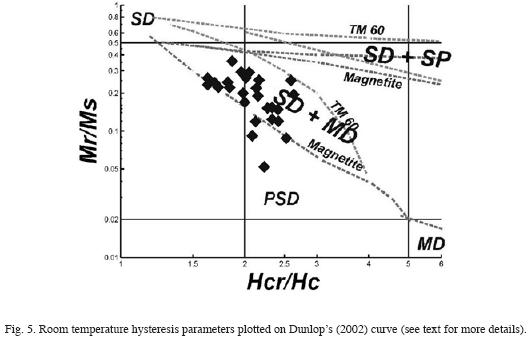
<body><![CDATA[<p align="justify"><font face="verdana" size="2">In total, we obtained 235 standard paleomagnetic cores belonging to 29 sites (<a href="/img/revistas/geoint/v48n2/a7f1.jpg" target="_blank">Fig. 1</a>) distributed along road outcrops in Ponta Grossa region, Southern Brazil. The samples were distributed throughout each dike both horizontally and vertically. In general, samples were obtained at least 30 cm distance from the dike edge. Cores were obtained with a gasoline&#150;powered portable drill, and then oriented in most cases with both magnetic and sun compasses. </font></p>     <p align="justify"><font face="verdana" size="2">&nbsp;</font></p>     <p align="justify"><font face="verdana" size="2"><b>Sample Selection for Thellier Paleointensity Experiments</b></font></p>     <p align="justify"><font face="verdana" size="2">Pre&#150;selection of the samples for Thellier paleointensity experiments was mainly based on analyses of viscosity index measurements, coercivity and unblocking spectra and vectorial composition from demagnetization of natural remanent magnetization and temperature dependence of low&#150;field magnetic susceptibility. Magnetic hysteresis measurements combined with IRM (isothermal remanent magnetization) acquisition experiments were used to estimate the domain state of main magnetic carriers.</font></p>     <p align="justify"><font face="verdana" size="2">Magnetic characteristics of typical samples selected for Thellier paleointensity experiments are as follows:</font></p>     <p align="justify"><font face="verdana" size="2">a)&nbsp;Ponta Grossa Dikes are likely to have a relatively high Brunhes&#150;age VRM (viscous remanent magnetization). In storage tests (Pr&eacute;vot <i>et al., </i>1983), 132 samples exhibited viscosity indexes higher than 5 %. These samples were discarded for Thellier experiments.</font></p>     <p align="justify"><font face="verdana" size="2">b) Selected samples carry essentially a stable, univectorial remanent magnetization, observed upon both thermal   (sample   03D011A,   <a href="/img/revistas/geoint/v48n2/a7f2.jpg" target="_blank">Fig.   2</a>)   and   alternating field  (sample 03D012A)  treatment.  Minor  secondary components  probably  of viscous  origin is  sometime present but easily removed at first steps of demagnetization procedure. The median destructive fields range mostly in the 30&#150;40 mT interval, suggesting the existence of small pseudo&#150;single   domain  grains   as   remanence   carriers (Dunlop   and   Ozdemir,   1997).   Some   other   samples (03D064A and 03D059A) exhibit clearly defined two component magnetizations probably of chemical origin.</font></p>     <p align="justify"><font face="verdana" size="2">c) Low&#150;field continuous susceptibility measurements performed in air (using a Bartington susceptibilitymeter MS2 equipped with furnace) show the presence of a single ferrimagnetic phase with Curie temperature compatible with Ti&#150;poor titanomagnetite (sample 03D014, <a href="/img/revistas/geoint/v48n2/a7f3.jpg" target="_blank">Fig. 3</a>). This is a case of 58 samples out of 235 analyzed. Remained samples   displayed  highly  unstable  thermal  behavior during heating and cooling cycles (03D054 and 03D103) and thus were discarded for paleointensity experiments.</font></p>     <p align="justify"><font face="verdana" size="2">d) Hysteresis measurements at room temperature show (<a href="/img/revistas/geoint/v48n2/a7f4.jpg" target="_blank">Fig. 4</a>) that the studied samples fall in the small pseudo&#150;single&#150;domain grain size region on a plot Mr/Mrs vs Hcr/ Hc (Day <i>et al., </i>1977). This probably indicates a mixture of multidomain and a significant amount of single&#150;domain (SD) grains (<a href="#f5">Fig. 5</a>, Parry, 1982; Dunlop, 2002). IRM (isothermal remanent magnetization) acquisition curves show the saturation at moderate fields (150&#150;200 mT), which point to the presence of titanomagnetite.</font></p>     <p align="center"><font face="verdana" size="2"><a name="f5"></a></font></p>     ]]></body>
<body><![CDATA[<p align="center"><font face="verdana" size="2"><img src="/img/revistas/geoint/v48n2/a7f5.jpg"></font></p>     <p align="justify"><font face="verdana" size="2">In total, we selected 29 samples from 7 dikes for the paleointensity experiments having the above&#150;described magnetic characteristics.</font></p>     <p align="justify"><font face="verdana" size="2">&nbsp;</font></p>     <p align="justify"><font face="verdana" size="2"><b>Paleointensity measurements</b></font></p>     <p align="justify"><font face="verdana" size="2">Paleointensity experiments were performed using the Thellier method (Thellier and Thellier, 1959) in its modified form (Coe, 1967). All heatings were made in vacuum better than 10<sup>-2</sup> mbar. Eleven temperature steps (<a href="/img/revistas/geoint/v48n2/a7f6.jpg" target="_blank">Fig. 6</a>) were distributed between room temperature and 570&deg;C, and the laboratory field was set to 30 &micro;T. Control heatings, commonly referred as pTRM checks (Pr&eacute;vot <i>et al., </i>1985), were performed after every second heating step throughout the whole experiment. All remanences were   measured  using   both  JR5A  and  JR6   spinner magnetometers.</font></p>     <p align="justify"><font face="verdana" size="2">We accepted only determinations that satisfied all of the following requirements: a) obtained from at least 7 NRM&#150;TRM points corresponding to a NRM fraction, f, (Coe <i>et al., </i>1978) larger than about 1/3 with quality factor, <i>q, </i>(Coe <i>et al., </i>1978) of about 5 or more (<a href="/img/revistas/geoint/v48n2/a7t1.jpg" target="_blank">Table 1</a>). b) At least three positive pTRM checks. We define pTRM checks as positive if the repeat pTRM value agrees with the first measurement within 15%. c) The directions of NRM end points at each step obtained from paleointensity experiments are stable and linear pointing to the origin. No significant deviation of NRM remaining directions towards the direction of applied laboratory field was observed, d) For accepted determinations y values (the ratio of potential CRM(T) to the magnitude of NRM(T) for each double heating step in the direction of the laboratory field during heating, Goguitchaichvili <i>et al., </i>1999), are &lt; 10&deg; which attest that no significant CRM (chemical remanent magnetization) is acquired during the laboratory heatings.</font></p>     <p align="justify"><font face="verdana" size="2">The reasons for failure of Thellier experiments were negative pTRM checks and/or typical concave&#150;up behavior (Dunlop and &Ouml;zdemir, 1997) detected in some cases (samples 03D042C and 03D057D, <a href="/img/revistas/geoint/v48n2/a7f6.jpg" target="_blank">Fig. 6</a>). An important loss of NRM without any noticeable TRM acquisition but with positive pTRM checks is observed. This phenomenon can be due to irreversible variations of coercive force (Kosterov and Pr&eacute;vot, 1998) at low temperature and can be interpreted as transformation from a single&#150;domain or pseudo&#150;single&#150;domain metastable state to multidomain state which results in a large NRM lost without any correlated TRM acquisition during the subsequent cooling.</font></p>     <p align="justify"><font face="verdana" size="2">&nbsp;</font></p>     <p align="justify"><font face="verdana" size="2"><b>Main Results and Discussion</b></font></p>     <p align="justify"><font face="verdana" size="2">Ten samples, from three individual cooling units, yield acceptable paleointensity estimates (<a href="/img/revistas/geoint/v48n2/a7f6.jpg" target="_blank">Fig. 6</a>, <a href="/img/revistas/geoint/v48n2/a7t1.jpg" target="_blank">Table 1</a>) while 19 determinations were rejected based on negative pTRM tests (11 samples) Arai concave&#150;up curves (8 samples yielding positive pTRM tests with NRM loss uncorrelated with TRM acquisition). For accepted samples, the NRM fraction f used for determination ranges between 0.49 to 0.77 and the quality factor <i>q </i>varies from 6.4 to 23.6. The Thellier and Thellier (1959) method of geomagnetic absolute intensity determination, which is considered the most reliable one (Goguitchaichvili <i>et al., </i>1999), imposes many restrictions on the choice of samples that can be used for a successful determination (Coe, 1967, Levi, 1977, Prevot <i>et al., </i>1985, Pick and Tauxe, 1993, Kosterov and Pr&eacute;vot, 1998). The almost 70 percent failure rate that we find in our study is not exceptional for a Thellier paleointensity study, if correct pre&#150;selection of suitable samples and strict analysis of the obtained data are made. Although the final results from the pre&#150;selection and paleointensity experiments are not numerous, the high technical quality determination, attested by the high quality factors defined by Coe <i>et al. </i>(1978) lend support for the paleointensity estimates for the dikes.</font></p>     ]]></body>
<body><![CDATA[<p align="justify"><font face="verdana" size="2">The site&#150;mean paleointensity values obtained in this study for the dikes are 25.6 &plusmn; 4.3, 18.2 &plusmn; 0.8 and 11.3 &plusmn; 2.1 &micro;T, with corresponding VDMs are 5.7 &plusmn; 0.9, 4.1 &plusmn; 1.3 and 2.5 &plusmn; 0.5 (10<sup>22</sup> Am<sup>2</sup>). These data yield a mean value of 4.1 &plusmn; 1.6 x 10<sup>22</sup> Am<sup>2</sup>. Brandt <i>et al. </i>(2008) obtained intensities between 5.7 &plusmn; 0.2 &micro;T to 26.4 &plusmn; 0. 7 &micro;T (average of 13.4 &plusmn; 1.9 &micro;T). Virtual dipole moments for these sites range from 1.3 &plusmn; 0.04 to 6.0 &plusmn; 0.2 10<sup>22</sup> Am<sup>2</sup> (average of 2.9 &plusmn; 0.5 10<sup>22</sup> Am<sup>2</sup>).</font></p>     <p align="justify"><font face="verdana" size="2">Paleointensity data (selected applying same strict selection criteria as in present study) from nearby Paran&aacute; Magmatic Province (PMP) are as strong and variable as those from Troodos Ophiolite (<a href="/img/revistas/geoint/v48n2/a7f7.jpg" target="_blank">Fig. 7</a>, Tauxe, 2006; Granot <i>et al., </i>2007; Goguitchaichvili <i>et al., </i>2008). Globally, early Cretaceous paleointensities appear similar to Brunhes data. The important variability of Earths magnetic field strength is also observed for Ponta Grossa Dikes. The mean paleointensity for each dike is well defined, with low standard deviations. This suggests that the differences between dikes may relate to variability of the field strength during the time span represented by the dikes. The mean overall value is significantly lower as compared to the mean VDM obtained from the Paran&aacute; Magmatic Province. In contrast, these new data are in excellent agreement with absolute paleointensities retrieved from the submarine basaltic glasses from 130 to 120 Ma (Tauxe, 2006). It seems that relatively variable low field prevailed just before the Cretaceous Normal Superchron.</font></p>     <p align="justify"><font face="verdana" size="2">&nbsp;</font></p>     <p align="justify"><font face="verdana" size="2"><b>Acknowledgment</b></font></p>     <p align="justify"><font face="verdana" size="2">The financial support was provided by UNAM DGAPA IN&#150;102007.</font></p>     <p align="justify"><font face="verdana" size="2">&nbsp;</font></p>     <p align="justify"><font face="verdana" size="2"><b>Bibliography</b></font></p>     <!-- ref --><p align="justify"><font face="verdana" size="2">Brandt, D., G. A. Hartmann, E. Yokoyama, E. L. Catelani, and R. I. F. Trindade, 2009. Paleointensity data from Early Cretaceous Ponta Grossa dikes (Brazil) using a modified multisample method. <i>Earth Planets Space, 61, </i>41&#150;49.</font>&nbsp;&nbsp;&nbsp;&nbsp;&nbsp;&nbsp;&nbsp;&nbsp;[&#160;<a href="javascript:void(0);" onclick="javascript: window.open('/scielo.php?script=sci_nlinks&ref=3905701&pid=S0016-7169200900020000700001&lng=','','width=640,height=500,resizable=yes,scrollbars=1,menubar=yes,');">Links</a>&#160;]<!-- end-ref --><!-- ref --><p align="justify"><font face="verdana" size="2">Coe, R., 1967. Paleointensity of the Earths magnetic field determined from Tertiary and Quaternary rocks, <i>J. Geophys. Res., 72, 12, </i>3247&#150;3262.</font>&nbsp;&nbsp;&nbsp;&nbsp;&nbsp;&nbsp;&nbsp;&nbsp;[&#160;<a href="javascript:void(0);" onclick="javascript: window.open('/scielo.php?script=sci_nlinks&ref=3905702&pid=S0016-7169200900020000700002&lng=','','width=640,height=500,resizable=yes,scrollbars=1,menubar=yes,');">Links</a>&#160;]<!-- end-ref --><!-- ref --><p align="justify"><font face="verdana" size="2">Coe, R., S. Gromm&eacute; and E. A. Mankinen, 1978. Geomagnetic paleointensities from radiocarbon&#150;dated lava flows on Hawaii and the question of the Pacific nondipole low. <i>J. Geophys. Res., 83, </i>1740&#150;1756.</font>&nbsp;&nbsp;&nbsp;&nbsp;&nbsp;&nbsp;&nbsp;&nbsp;[&#160;<a href="javascript:void(0);" onclick="javascript: window.open('/scielo.php?script=sci_nlinks&ref=3905703&pid=S0016-7169200900020000700003&lng=','','width=640,height=500,resizable=yes,scrollbars=1,menubar=yes,');">Links</a>&#160;]<!-- end-ref --><!-- ref --><p align="justify"><font face="verdana" size="2">Day, R., M. Fuller and V. A. Schmidt, 1977. Hysteresis properties of titanomagnetites: Grain&#150;size and compositional dependence. <i>Phys. Earth Planet. Inter., 13, </i>260&#150;267.</font>&nbsp;&nbsp;&nbsp;&nbsp;&nbsp;&nbsp;&nbsp;&nbsp;[&#160;<a href="javascript:void(0);" onclick="javascript: window.open('/scielo.php?script=sci_nlinks&ref=3905704&pid=S0016-7169200900020000700004&lng=','','width=640,height=500,resizable=yes,scrollbars=1,menubar=yes,');">Links</a>&#160;]<!-- end-ref --><!-- ref --><p align="justify"><font face="verdana" size="2">Dunlop, D. and &Ouml;. &Ouml;zdemir, 1997. Rock&#150;Magnetism, Fundamentals and Frontiers. <i>Cambridge University Press, </i>573.</font>&nbsp;&nbsp;&nbsp;&nbsp;&nbsp;&nbsp;&nbsp;&nbsp;[&#160;<a href="javascript:void(0);" onclick="javascript: window.open('/scielo.php?script=sci_nlinks&ref=3905705&pid=S0016-7169200900020000700005&lng=','','width=640,height=500,resizable=yes,scrollbars=1,menubar=yes,');">Links</a>&#160;]<!-- end-ref --><!-- ref --><p align="justify"><font face="verdana" size="2">Dunlop, D. J., 2002. Theory and application of the Day plot (Mrs/Ms versus Hcr/Hc), Theoretical curves and tests using titanomagnetite data. <i>J. Geophys. Res., 107, </i>doi : 10.1029/2001JB000486.</font>&nbsp;&nbsp;&nbsp;&nbsp;&nbsp;&nbsp;&nbsp;&nbsp;[&#160;<a href="javascript:void(0);" onclick="javascript: window.open('/scielo.php?script=sci_nlinks&ref=3905706&pid=S0016-7169200900020000700006&lng=','','width=640,height=500,resizable=yes,scrollbars=1,menubar=yes,');">Links</a>&#160;]<!-- end-ref --><!-- ref --><p align="justify"><font face="verdana" size="2">Goguitchaichvili, A., M. Pr&eacute;vot, N. Roberts and J. Thompson, 1999. An attempt to determine the absolute geomagnetic field intensity in Southwestern Iceland during the Gauss&#150;Matyama reversal. <i>Phys. Earth Planet. Int., 115, </i>53&#150;66.</font>&nbsp;&nbsp;&nbsp;&nbsp;&nbsp;&nbsp;&nbsp;&nbsp;[&#160;<a href="javascript:void(0);" onclick="javascript: window.open('/scielo.php?script=sci_nlinks&ref=3905707&pid=S0016-7169200900020000700007&lng=','','width=640,height=500,resizable=yes,scrollbars=1,menubar=yes,');">Links</a>&#160;]<!-- end-ref --><!-- ref --><p align="justify"><font face="verdana" size="2">Gogichaishvili, A., R. C. Ruiz, L. Sanchez&#150;Bettucci, B. A. Reyes, L. A. Valdivia, J. Urrutia&#150;Fucugauchi, J. Morales and M. Calvo, 2008. New absolute paleointensity results from the Parana Magmatic Province (Uruguay) and the Early Cretaceous geomagnetic paleofield. Geochemistry Geophysics Geosystems, doi:10.1029/ 2008GC002102.</font>&nbsp;&nbsp;&nbsp;&nbsp;&nbsp;&nbsp;&nbsp;&nbsp;[&#160;<a href="javascript:void(0);" onclick="javascript: window.open('/scielo.php?script=sci_nlinks&ref=3905708&pid=S0016-7169200900020000700008&lng=','','width=640,height=500,resizable=yes,scrollbars=1,menubar=yes,');">Links</a>&#160;]<!-- end-ref --><!-- ref --><p align="justify"><font face="verdana" size="2">Granot, R., L. Tauxe, J. S. Gee and H. A. Ron, 2007. View into the Cretaceous geomagnetic field from analysis of gabbros and submarine glasses. <i>Earth and Planetary Science Letters, 256, </i>1&#150;11.</font>&nbsp;&nbsp;&nbsp;&nbsp;&nbsp;&nbsp;&nbsp;&nbsp;[&#160;<a href="javascript:void(0);" onclick="javascript: window.open('/scielo.php?script=sci_nlinks&ref=3905709&pid=S0016-7169200900020000700009&lng=','','width=640,height=500,resizable=yes,scrollbars=1,menubar=yes,');">Links</a>&#160;]<!-- end-ref --><!-- ref --><p align="justify"><font face="verdana" size="2">Koenigsberger, J. G., 1938. Natural residual magnetism of eruptive rocks. <i>Terr. Mag., 43, </i>119&#150;127</font>&nbsp;&nbsp;&nbsp;&nbsp;&nbsp;&nbsp;&nbsp;&nbsp;[&#160;<a href="javascript:void(0);" onclick="javascript: window.open('/scielo.php?script=sci_nlinks&ref=3905710&pid=S0016-7169200900020000700010&lng=','','width=640,height=500,resizable=yes,scrollbars=1,menubar=yes,');">Links</a>&#160;]<!-- end-ref --><!-- ref --><p align="justify"><font face="verdana" size="2">Kosterov, A. and M. Pr&eacute;vot, 1998. Possible failure of Thellier paleointensity experiments in some basalts, <i>Geophys. J. Inter., 134, </i>554&#150;572.</font>&nbsp;&nbsp;&nbsp;&nbsp;&nbsp;&nbsp;&nbsp;&nbsp;[&#160;<a href="javascript:void(0);" onclick="javascript: window.open('/scielo.php?script=sci_nlinks&ref=3905711&pid=S0016-7169200900020000700011&lng=','','width=640,height=500,resizable=yes,scrollbars=1,menubar=yes,');">Links</a>&#160;]<!-- end-ref --><!-- ref --><p align="justify"><font face="verdana" size="2">Levi, S., 1977. The effect of magnetic particle size in paleointensity determinations of the geomagnetic field. <i>Phys. Earth Planet. Int., 13, </i>245&#150;259.</font>&nbsp;&nbsp;&nbsp;&nbsp;&nbsp;&nbsp;&nbsp;&nbsp;[&#160;<a href="javascript:void(0);" onclick="javascript: window.open('/scielo.php?script=sci_nlinks&ref=3905712&pid=S0016-7169200900020000700012&lng=','','width=640,height=500,resizable=yes,scrollbars=1,menubar=yes,');">Links</a>&#160;]<!-- end-ref --><!-- ref --><p align="justify"><font face="verdana" size="2">Parry, L. G., 1982. Magnetization of immobilized particle dispersions with two distinct particle sizes. <i>Phys. Earth Planet. Int., 28, </i>230&#150;241.</font>&nbsp;&nbsp;&nbsp;&nbsp;&nbsp;&nbsp;&nbsp;&nbsp;[&#160;<a href="javascript:void(0);" onclick="javascript: window.open('/scielo.php?script=sci_nlinks&ref=3905713&pid=S0016-7169200900020000700013&lng=','','width=640,height=500,resizable=yes,scrollbars=1,menubar=yes,');">Links</a>&#160;]<!-- end-ref --><!-- ref --><p align="justify"><font face="verdana" size="2">Perrin, M. and V. P. Shcherbakov, 1997. Paleointensity of the earth magnetic field for the past 400 My: evidence for a dipole structure during the Mesozoic low. <i>J. </i><i>Geomag. Geoelectr., 49, </i>601&#150;614.</font>&nbsp;&nbsp;&nbsp;&nbsp;&nbsp;&nbsp;&nbsp;&nbsp;[&#160;<a href="javascript:void(0);" onclick="javascript: window.open('/scielo.php?script=sci_nlinks&ref=3905714&pid=S0016-7169200900020000700014&lng=','','width=640,height=500,resizable=yes,scrollbars=1,menubar=yes,');">Links</a>&#160;]<!-- end-ref --><!-- ref --><p align="justify"><font face="verdana" size="2">Piccirillo, E. M., G. Bellieni, G. Cavazzini, P. Comin&#150;Chiaramonti, R. Petrini, A. J. Melfi, 1990. Lower Cretaceous tholeiitic dyke swarms from the Ponta Grossa Arch (southeast Brazil)" Petrology, Sr&#150;Nd isotopes and genetic relationships with the Paran i flood volcanics, <i>Chemical Geology, 89, </i>19&#150;48.</font>&nbsp;&nbsp;&nbsp;&nbsp;&nbsp;&nbsp;&nbsp;&nbsp;[&#160;<a href="javascript:void(0);" onclick="javascript: window.open('/scielo.php?script=sci_nlinks&ref=3905715&pid=S0016-7169200900020000700015&lng=','','width=640,height=500,resizable=yes,scrollbars=1,menubar=yes,');">Links</a>&#160;]<!-- end-ref --><!-- ref --><p align="justify"><font face="verdana" size="2">Pick, T. and L. Tauxe, 1993. Geomagnetic palaeointensities during the Cretaceous normal superchron measured using submarine basaltic glass, <i>Nature, 366, </i>238&#150;242.</font>&nbsp;&nbsp;&nbsp;&nbsp;&nbsp;&nbsp;&nbsp;&nbsp;[&#160;<a href="javascript:void(0);" onclick="javascript: window.open('/scielo.php?script=sci_nlinks&ref=3905716&pid=S0016-7169200900020000700016&lng=','','width=640,height=500,resizable=yes,scrollbars=1,menubar=yes,');">Links</a>&#160;]<!-- end-ref --><!-- ref --><p align="justify"><font face="verdana" size="2">Pr&eacute;vot, M., E. A. Mankinen, S. Gromm&eacute; and A. Lecaille, 1983. High paleointensities of the geomagnetic field from thermomagnetic study on rift valley pillow basalts from the mid&#150;Atlantic ridge. <i>J. Geophys. Res., </i>88, 2316&#150;2326.</font>&nbsp;&nbsp;&nbsp;&nbsp;&nbsp;&nbsp;&nbsp;&nbsp;[&#160;<a href="javascript:void(0);" onclick="javascript: window.open('/scielo.php?script=sci_nlinks&ref=3905717&pid=S0016-7169200900020000700017&lng=','','width=640,height=500,resizable=yes,scrollbars=1,menubar=yes,');">Links</a>&#160;]<!-- end-ref --><!-- ref --><p align="justify"><font face="verdana" size="2">Pr&eacute;vot, M., R. S. Mainkinen, S. Gromm&eacute; and A. Lecaille, 1985. High paleointensity of the geomagnetic field from thermomagnetic studies on rift valley pillow basalts from the middle Atlantic ridge. <i>J. Geophys. Res., </i>88, 2316&#150;2326.</font>&nbsp;&nbsp;&nbsp;&nbsp;&nbsp;&nbsp;&nbsp;&nbsp;[&#160;<a href="javascript:void(0);" onclick="javascript: window.open('/scielo.php?script=sci_nlinks&ref=3905718&pid=S0016-7169200900020000700018&lng=','','width=640,height=500,resizable=yes,scrollbars=1,menubar=yes,');">Links</a>&#160;]<!-- end-ref --><!-- ref --><p align="justify"><font face="verdana" size="2">Pr&eacute;vot, M., M. Derder, M. M. McWilliams and J . Thompson, 1990. Intensity of the Earths magnetic field: evidence for a Mesozoic dipole low. <i>Earth Planet. Sci. Lett., </i>97,129&#150;139.</font>&nbsp;&nbsp;&nbsp;&nbsp;&nbsp;&nbsp;&nbsp;&nbsp;[&#160;<a href="javascript:void(0);" onclick="javascript: window.open('/scielo.php?script=sci_nlinks&ref=3905719&pid=S0016-7169200900020000700019&lng=','','width=640,height=500,resizable=yes,scrollbars=1,menubar=yes,');">Links</a>&#160;]<!-- end-ref --><!-- ref --><p align="justify"><font face="verdana" size="2">Raposo, M. I. B. and M. Ernesto, 1995. An Early Cretaceous paleomagnetic pole from Ponta Grossa dykes (Brazil): implications for the South America Mesozoic APWP, <i>J. Geophys. Res., 100, B10, </i>20095&#150;20109.</font>&nbsp;&nbsp;&nbsp;&nbsp;&nbsp;&nbsp;&nbsp;&nbsp;[&#160;<a href="javascript:void(0);" onclick="javascript: window.open('/scielo.php?script=sci_nlinks&ref=3905720&pid=S0016-7169200900020000700020&lng=','','width=640,height=500,resizable=yes,scrollbars=1,menubar=yes,');">Links</a>&#160;]<!-- end-ref --><!-- ref --><p align="justify"><font face="verdana" size="2">Renne, P., K. Deckart, M. Ernesto, G. Feraud and E. M. Piccirillo, 1996. Age of the Ponta Grosssa dike swarm (Brazil), and implications to Paran&aacute; flood volcanism, <i>Earth Planet. Sci. Lett., 144, </i>199&#150;211.</font>&nbsp;&nbsp;&nbsp;&nbsp;&nbsp;&nbsp;&nbsp;&nbsp;[&#160;<a href="javascript:void(0);" onclick="javascript: window.open('/scielo.php?script=sci_nlinks&ref=3905721&pid=S0016-7169200900020000700021&lng=','','width=640,height=500,resizable=yes,scrollbars=1,menubar=yes,');">Links</a>&#160;]<!-- end-ref --><!-- ref --><p align="justify"><font face="verdana" size="2">Sial, A.N., E. P. Oliveira and A. Choudhuri, 1987. Mafic dyke swarms of Brazil. In: H.C. Halls and W.F. Fahrig (Editors), Mafic Dyke Swarms in Brazil. <i>Geol. Assoc. Can. Spec. Pap., 34, </i>467&#150;481.</font>&nbsp;&nbsp;&nbsp;&nbsp;&nbsp;&nbsp;&nbsp;&nbsp;[&#160;<a href="javascript:void(0);" onclick="javascript: window.open('/scielo.php?script=sci_nlinks&ref=3905722&pid=S0016-7169200900020000700022&lng=','','width=640,height=500,resizable=yes,scrollbars=1,menubar=yes,');">Links</a>&#160;]<!-- end-ref --><!-- ref --><p align="justify"><font face="verdana" size="2">Tarduno, J. A., R. D. Cottrell and A. V. Smirnov 2001. High geomagnetic intensity during the Mid&#150;Cretaceous from Thellier analyses of single plagioclase crystals. <i>Science, 291, </i>1779&#150;1783.</font>&nbsp;&nbsp;&nbsp;&nbsp;&nbsp;&nbsp;&nbsp;&nbsp;[&#160;<a href="javascript:void(0);" onclick="javascript: window.open('/scielo.php?script=sci_nlinks&ref=3905723&pid=S0016-7169200900020000700023&lng=','','width=640,height=500,resizable=yes,scrollbars=1,menubar=yes,');">Links</a>&#160;]<!-- end-ref --><!-- ref --><p align="justify"><font face="verdana" size="2">Tarduno, J. A., R. D. Cottrell and A. V. Smirnov, 2002. The Cretaceous superchron geodynamo: observations near the tangent cylinder. <i>PNAS, 99, </i>14020&#150;14025.</font>&nbsp;&nbsp;&nbsp;&nbsp;&nbsp;&nbsp;&nbsp;&nbsp;[&#160;<a href="javascript:void(0);" onclick="javascript: window.open('/scielo.php?script=sci_nlinks&ref=3905724&pid=S0016-7169200900020000700024&lng=','','width=640,height=500,resizable=yes,scrollbars=1,menubar=yes,');">Links</a>&#160;]<!-- end-ref --><!-- ref --><p align="justify"><font face="verdana" size="2">Tauxe, L., 2006. Long term trends in paleointensity: The contribution of DSDP/ODP submarine basaltic glass collections. <i>Phys. Earth Planet. Int., 244, </i>515&#150;529.</font>&nbsp;&nbsp;&nbsp;&nbsp;&nbsp;&nbsp;&nbsp;&nbsp;[&#160;<a href="javascript:void(0);" onclick="javascript: window.open('/scielo.php?script=sci_nlinks&ref=3905725&pid=S0016-7169200900020000700025&lng=','','width=640,height=500,resizable=yes,scrollbars=1,menubar=yes,');">Links</a>&#160;]<!-- end-ref --><!-- ref --><p align="justify"><font face="verdana" size="2">Tauxe, L. and T. Yamazaki, 2007. Paleointensities, in: Treatise on Geophysics, Schubert, G. (ed.), vol. 5, Geomagnetism, 509&#150;564, Oxford: Elsevier Ltd.</font>&nbsp;&nbsp;&nbsp;&nbsp;&nbsp;&nbsp;&nbsp;&nbsp;[&#160;<a href="javascript:void(0);" onclick="javascript: window.open('/scielo.php?script=sci_nlinks&ref=3905726&pid=S0016-7169200900020000700026&lng=','','width=640,height=500,resizable=yes,scrollbars=1,menubar=yes,');">Links</a>&#160;]<!-- end-ref --><!-- ref --><p align="justify"><font face="verdana" size="2">Thellier, E. and O. Thellier, 1959. Sur l'intensit&eacute; du champ magn&eacute;tique terrestre dans le pass&eacute; historique et g&eacute;ologique. <i>Ann. G&eacute;ophysique. 15, </i>285&#150;37.</font>&nbsp;&nbsp;&nbsp;&nbsp;&nbsp;&nbsp;&nbsp;&nbsp;[&#160;<a href="javascript:void(0);" onclick="javascript: window.open('/scielo.php?script=sci_nlinks&ref=3905727&pid=S0016-7169200900020000700027&lng=','','width=640,height=500,resizable=yes,scrollbars=1,menubar=yes,');">Links</a>&#160;]<!-- end-ref --> ]]></body><back>
<ref-list>
<ref id="B1">
<nlm-citation citation-type="journal">
<person-group person-group-type="author">
<name>
<surname><![CDATA[Brandt]]></surname>
<given-names><![CDATA[D]]></given-names>
</name>
<name>
<surname><![CDATA[Hartmann]]></surname>
<given-names><![CDATA[G. A.]]></given-names>
</name>
<name>
<surname><![CDATA[Yokoyama]]></surname>
<given-names><![CDATA[E]]></given-names>
</name>
<name>
<surname><![CDATA[Catelani]]></surname>
<given-names><![CDATA[E. L.]]></given-names>
</name>
<name>
<surname><![CDATA[Trindade]]></surname>
<given-names><![CDATA[R. I. F.]]></given-names>
</name>
</person-group>
<article-title xml:lang="en"><![CDATA[Paleointensity data from Early Cretaceous Ponta Grossa dikes (Brazil) using a modified multisample method]]></article-title>
<source><![CDATA[Earth Planets Space]]></source>
<year>2009</year>
<volume>61</volume>
<page-range>41-49</page-range></nlm-citation>
</ref>
<ref id="B2">
<nlm-citation citation-type="journal">
<person-group person-group-type="author">
<name>
<surname><![CDATA[Coe]]></surname>
<given-names><![CDATA[R]]></given-names>
</name>
</person-group>
<article-title xml:lang="en"><![CDATA[Paleointensity of the Earths magnetic field determined from Tertiary and Quaternary rocks]]></article-title>
<source><![CDATA[J. Geophys. Res.]]></source>
<year>1967</year>
<volume>72</volume>
<numero>12</numero>
<issue>12</issue>
<page-range>3247-3262</page-range></nlm-citation>
</ref>
<ref id="B3">
<nlm-citation citation-type="journal">
<person-group person-group-type="author">
<name>
<surname><![CDATA[Coe]]></surname>
<given-names><![CDATA[R]]></given-names>
</name>
<name>
<surname><![CDATA[Grommé]]></surname>
<given-names><![CDATA[S]]></given-names>
</name>
<name>
<surname><![CDATA[Mankinen]]></surname>
<given-names><![CDATA[E. A.]]></given-names>
</name>
</person-group>
<article-title xml:lang="en"><![CDATA[eomagnetic paleointensities from radiocarbon-dated lava flows on Hawaii and the question of the Pacific nondipole low]]></article-title>
<source><![CDATA[J. Geophys. Res.]]></source>
<year>1978</year>
<volume>83</volume>
<page-range>1740-1756</page-range></nlm-citation>
</ref>
<ref id="B4">
<nlm-citation citation-type="journal">
<person-group person-group-type="author">
<name>
<surname><![CDATA[Day]]></surname>
<given-names><![CDATA[R]]></given-names>
</name>
<name>
<surname><![CDATA[Fuller]]></surname>
<given-names><![CDATA[M]]></given-names>
</name>
<name>
<surname><![CDATA[Schmidt]]></surname>
<given-names><![CDATA[V. A.]]></given-names>
</name>
</person-group>
<article-title xml:lang="en"><![CDATA[Hysteresis properties of titanomagnetites: Grain-size and compositional dependence]]></article-title>
<source><![CDATA[Phys. Earth Planet. Inter.]]></source>
<year>1977</year>
<volume>13</volume>
<page-range>260-267</page-range></nlm-citation>
</ref>
<ref id="B5">
<nlm-citation citation-type="book">
<person-group person-group-type="author">
<name>
<surname><![CDATA[Dunlop]]></surname>
<given-names><![CDATA[D]]></given-names>
</name>
<name>
<surname><![CDATA[Özdemir]]></surname>
<given-names><![CDATA[Ö]]></given-names>
</name>
</person-group>
<source><![CDATA[Rock-Magnetism, Fundamentals and Frontiers]]></source>
<year>1997</year>
<page-range>573</page-range><publisher-name><![CDATA[Cambridge University Press]]></publisher-name>
</nlm-citation>
</ref>
<ref id="B6">
<nlm-citation citation-type="journal">
<person-group person-group-type="author">
<name>
<surname><![CDATA[Dunlop]]></surname>
<given-names><![CDATA[D. J.]]></given-names>
</name>
</person-group>
<article-title xml:lang="en"><![CDATA[Theory and application of the Day plot (Mrs/Ms versus Hcr/Hc), Theoretical curves and tests using titanomagnetite data]]></article-title>
<source><![CDATA[J. Geophys. Res.]]></source>
<year>2002</year>
<volume>107</volume>
</nlm-citation>
</ref>
<ref id="B7">
<nlm-citation citation-type="journal">
<person-group person-group-type="author">
<name>
<surname><![CDATA[Goguitchaichvili]]></surname>
<given-names><![CDATA[A]]></given-names>
</name>
<name>
<surname><![CDATA[Prévot]]></surname>
<given-names><![CDATA[M]]></given-names>
</name>
<name>
<surname><![CDATA[Roberts]]></surname>
<given-names><![CDATA[N]]></given-names>
</name>
<name>
<surname><![CDATA[Thompson]]></surname>
<given-names><![CDATA[J]]></given-names>
</name>
</person-group>
<article-title xml:lang="en"><![CDATA[. An attempt to determine the absolute geomagnetic field intensity in Southwestern Iceland during the Gauss-Matyama reversal]]></article-title>
<source><![CDATA[Phys. Earth Planet. Int.]]></source>
<year>1999</year>
<volume>115</volume>
<page-range>53-66</page-range></nlm-citation>
</ref>
<ref id="B8">
<nlm-citation citation-type="journal">
<person-group person-group-type="author">
<name>
<surname><![CDATA[Gogichaishvili]]></surname>
<given-names><![CDATA[A]]></given-names>
</name>
<name>
<surname><![CDATA[Ruiz]]></surname>
<given-names><![CDATA[R. C.]]></given-names>
</name>
<name>
<surname><![CDATA[Sanchez-Bettucci]]></surname>
<given-names><![CDATA[L]]></given-names>
</name>
<name>
<surname><![CDATA[Reyes]]></surname>
<given-names><![CDATA[B. A.]]></given-names>
</name>
<name>
<surname><![CDATA[Valdivia]]></surname>
<given-names><![CDATA[L. A.]]></given-names>
</name>
<name>
<surname><![CDATA[Urrutia-Fucugauchi]]></surname>
<given-names><![CDATA[J]]></given-names>
</name>
<name>
<surname><![CDATA[Morales]]></surname>
<given-names><![CDATA[J]]></given-names>
</name>
<name>
<surname><![CDATA[Calvo]]></surname>
<given-names><![CDATA[M]]></given-names>
</name>
</person-group>
<article-title xml:lang="en"><![CDATA[New absolute paleointensity results from the Parana Magmatic Province (Uruguay) and the Early Cretaceous geomagnetic paleofield]]></article-title>
<source><![CDATA[Geochemistry Geophysics Geosystems]]></source>
<year>2008</year>
</nlm-citation>
</ref>
<ref id="B9">
<nlm-citation citation-type="journal">
<person-group person-group-type="author">
<name>
<surname><![CDATA[Granot]]></surname>
<given-names><![CDATA[R]]></given-names>
</name>
<name>
<surname><![CDATA[Tauxe]]></surname>
<given-names><![CDATA[L]]></given-names>
</name>
<name>
<surname><![CDATA[Gee]]></surname>
<given-names><![CDATA[J. S.]]></given-names>
</name>
<name>
<surname><![CDATA[Ron]]></surname>
<given-names><![CDATA[H. A.]]></given-names>
</name>
</person-group>
<article-title xml:lang="en"><![CDATA[View into the Cretaceous geomagnetic field from analysis of gabbros and submarine glasses]]></article-title>
<source><![CDATA[Earth and Planetary Science Letters]]></source>
<year>2007</year>
<volume>256</volume>
<page-range>1-11</page-range></nlm-citation>
</ref>
<ref id="B10">
<nlm-citation citation-type="journal">
<person-group person-group-type="author">
<name>
<surname><![CDATA[Koenigsberger]]></surname>
<given-names><![CDATA[J. G.]]></given-names>
</name>
</person-group>
<article-title xml:lang="en"><![CDATA[Natural residual magnetism of eruptive rocks]]></article-title>
<source><![CDATA[Terr. Mag.]]></source>
<year>1938</year>
<volume>43</volume>
<page-range>119-127</page-range></nlm-citation>
</ref>
<ref id="B11">
<nlm-citation citation-type="journal">
<person-group person-group-type="author">
<name>
<surname><![CDATA[Kosterov]]></surname>
<given-names><![CDATA[A]]></given-names>
</name>
<name>
<surname><![CDATA[Prévot]]></surname>
<given-names><![CDATA[M]]></given-names>
</name>
</person-group>
<article-title xml:lang="en"><![CDATA[Possible failure of Thellier paleointensity experiments in some basalts]]></article-title>
<source><![CDATA[Geophys. J. Inter.]]></source>
<year>1998</year>
<volume>134</volume>
<page-range>554-572</page-range></nlm-citation>
</ref>
<ref id="B12">
<nlm-citation citation-type="journal">
<person-group person-group-type="author">
<name>
<surname><![CDATA[Levi]]></surname>
<given-names><![CDATA[S]]></given-names>
</name>
</person-group>
<article-title xml:lang="en"><![CDATA[The effect of magnetic particle size in paleointensity determinations of the geomagnetic field]]></article-title>
<source><![CDATA[Phys. Earth Planet. Int.]]></source>
<year>1977</year>
<volume>13</volume>
<page-range>245-259</page-range></nlm-citation>
</ref>
<ref id="B13">
<nlm-citation citation-type="journal">
<person-group person-group-type="author">
<name>
<surname><![CDATA[Parry]]></surname>
<given-names><![CDATA[L. G.]]></given-names>
</name>
</person-group>
<article-title xml:lang="en"><![CDATA[Magnetization of immobilized particle dispersions with two distinct particle sizes]]></article-title>
<source><![CDATA[Phys. Earth Planet. Int.]]></source>
<year>1982</year>
<volume>28</volume>
<page-range>230-241</page-range></nlm-citation>
</ref>
<ref id="B14">
<nlm-citation citation-type="journal">
<person-group person-group-type="author">
<name>
<surname><![CDATA[Perrin]]></surname>
<given-names><![CDATA[M]]></given-names>
</name>
<name>
<surname><![CDATA[Shcherbakov]]></surname>
<given-names><![CDATA[V. P.]]></given-names>
</name>
</person-group>
<article-title xml:lang="en"><![CDATA[Paleointensity of the earth magnetic field for the past 400 My: evidence for a dipole structure during the Mesozoic low]]></article-title>
<source><![CDATA[J. Geomag. Geoelectr.]]></source>
<year>1997</year>
<volume>49</volume>
<page-range>601-614</page-range></nlm-citation>
</ref>
<ref id="B15">
<nlm-citation citation-type="journal">
<person-group person-group-type="author">
<name>
<surname><![CDATA[Piccirillo]]></surname>
<given-names><![CDATA[E. M.]]></given-names>
</name>
<name>
<surname><![CDATA[Bellieni]]></surname>
<given-names><![CDATA[G]]></given-names>
</name>
<name>
<surname><![CDATA[Cavazzini]]></surname>
<given-names><![CDATA[G]]></given-names>
</name>
<name>
<surname><![CDATA[Comin-Chiaramonti]]></surname>
<given-names><![CDATA[P]]></given-names>
</name>
<name>
<surname><![CDATA[Petrini]]></surname>
<given-names><![CDATA[R]]></given-names>
</name>
<name>
<surname><![CDATA[Melfi]]></surname>
<given-names><![CDATA[A. J.]]></given-names>
</name>
</person-group>
<article-title xml:lang="en"><![CDATA[Lower Cretaceous tholeiitic dyke swarms from the Ponta Grossa Arch (southeast Brazil)" Petrology, Sr-Nd isotopes and genetic relationships with the Paran i flood volcanics]]></article-title>
<source><![CDATA[Chemical Geology]]></source>
<year>1990</year>
<volume>89</volume>
<page-range>19-48</page-range></nlm-citation>
</ref>
<ref id="B16">
<nlm-citation citation-type="journal">
<person-group person-group-type="author">
<name>
<surname><![CDATA[Pick]]></surname>
<given-names><![CDATA[T]]></given-names>
</name>
<name>
<surname><![CDATA[Tauxe]]></surname>
<given-names><![CDATA[L]]></given-names>
</name>
</person-group>
<article-title xml:lang="en"><![CDATA[Geomagnetic palaeointensities during the Cretaceous normal superchron measured using submarine basaltic glass]]></article-title>
<source><![CDATA[Nature]]></source>
<year>1993</year>
<volume>366</volume>
<page-range>238-242</page-range></nlm-citation>
</ref>
<ref id="B17">
<nlm-citation citation-type="journal">
<person-group person-group-type="author">
<name>
<surname><![CDATA[Prévot]]></surname>
<given-names><![CDATA[M]]></given-names>
</name>
<name>
<surname><![CDATA[Mankinen]]></surname>
<given-names><![CDATA[E. A.]]></given-names>
</name>
<name>
<surname><![CDATA[Grommé]]></surname>
<given-names><![CDATA[S]]></given-names>
</name>
<name>
<surname><![CDATA[Lecaille]]></surname>
<given-names><![CDATA[A]]></given-names>
</name>
</person-group>
<article-title xml:lang="en"><![CDATA[High paleointensities of the geomagnetic field from thermomagnetic study on rift valley pillow basalts from the mid-Atlantic ridge]]></article-title>
<source><![CDATA[J. Geophys. Res.]]></source>
<year>1983</year>
<volume>88</volume>
<page-range>2316-2326</page-range></nlm-citation>
</ref>
<ref id="B18">
<nlm-citation citation-type="journal">
<person-group person-group-type="author">
<name>
<surname><![CDATA[Prévot]]></surname>
<given-names><![CDATA[M]]></given-names>
</name>
<name>
<surname><![CDATA[Mainkinen]]></surname>
<given-names><![CDATA[R. S.]]></given-names>
</name>
<name>
<surname><![CDATA[Grommé]]></surname>
<given-names><![CDATA[S]]></given-names>
</name>
<name>
<surname><![CDATA[Lecaille]]></surname>
<given-names><![CDATA[A]]></given-names>
</name>
</person-group>
<article-title xml:lang="en"><![CDATA[High paleointensity of the geomagnetic field from thermomagnetic studies on rift valley pillow basalts from the middle Atlantic ridge]]></article-title>
<source><![CDATA[J. Geophys. Res.]]></source>
<year>1985</year>
<volume>88</volume>
<page-range>2316-2326</page-range></nlm-citation>
</ref>
<ref id="B19">
<nlm-citation citation-type="journal">
<person-group person-group-type="author">
<name>
<surname><![CDATA[Prévot]]></surname>
<given-names><![CDATA[M]]></given-names>
</name>
<name>
<surname><![CDATA[Derder]]></surname>
<given-names><![CDATA[M]]></given-names>
</name>
<name>
<surname><![CDATA[McWilliams]]></surname>
<given-names><![CDATA[M. M.]]></given-names>
</name>
<name>
<surname><![CDATA[Thompson]]></surname>
<given-names><![CDATA[J]]></given-names>
</name>
</person-group>
<article-title xml:lang="en"><![CDATA[Intensity of the Earths magnetic field: evidence for a Mesozoic dipole low]]></article-title>
<source><![CDATA[Earth Planet. Sci. Lett.]]></source>
<year>1990</year>
<volume>97</volume>
<page-range>129-139</page-range></nlm-citation>
</ref>
<ref id="B20">
<nlm-citation citation-type="journal">
<person-group person-group-type="author">
<name>
<surname><![CDATA[Raposo]]></surname>
<given-names><![CDATA[M. I. B.]]></given-names>
</name>
<name>
<surname><![CDATA[Ernesto]]></surname>
<given-names><![CDATA[M]]></given-names>
</name>
</person-group>
<article-title xml:lang="en"><![CDATA[An Early Cretaceous paleomagnetic pole from Ponta Grossa dykes (Brazil): implications for the South America Mesozoic APWP]]></article-title>
<source><![CDATA[J. Geophys. Res.]]></source>
<year>1995</year>
<volume>100</volume>
</nlm-citation>
</ref>
<ref id="B21">
<nlm-citation citation-type="journal">
<person-group person-group-type="author">
<name>
<surname><![CDATA[Renne]]></surname>
<given-names><![CDATA[P]]></given-names>
</name>
<name>
<surname><![CDATA[Deckart]]></surname>
<given-names><![CDATA[K]]></given-names>
</name>
<name>
<surname><![CDATA[Ernesto]]></surname>
<given-names><![CDATA[M]]></given-names>
</name>
<name>
<surname><![CDATA[Feraud]]></surname>
<given-names><![CDATA[G]]></given-names>
</name>
<name>
<surname><![CDATA[Piccirillo]]></surname>
<given-names><![CDATA[E. M.]]></given-names>
</name>
</person-group>
<article-title xml:lang="en"><![CDATA[Age of the Ponta Grosssa dike swarm (Brazil), and implications to Paraná flood volcanism]]></article-title>
<source><![CDATA[Earth Planet. Sci. Lett.]]></source>
<year>1996</year>
<volume>144</volume>
<page-range>199-211</page-range></nlm-citation>
</ref>
<ref id="B22">
<nlm-citation citation-type="journal">
<person-group person-group-type="author">
<name>
<surname><![CDATA[Sial]]></surname>
<given-names><![CDATA[A.N.]]></given-names>
</name>
<name>
<surname><![CDATA[Oliveira]]></surname>
<given-names><![CDATA[E. P.]]></given-names>
</name>
<name>
<surname><![CDATA[Choudhuri]]></surname>
<given-names><![CDATA[A]]></given-names>
</name>
</person-group>
<source><![CDATA[Geol. Assoc. Can. Spec. Pap.]]></source>
<year>1987</year>
<volume>34</volume>
<page-range>467-481</page-range></nlm-citation>
</ref>
<ref id="B23">
<nlm-citation citation-type="journal">
<person-group person-group-type="author">
<name>
<surname><![CDATA[Tarduno]]></surname>
<given-names><![CDATA[J. A.]]></given-names>
</name>
<name>
<surname><![CDATA[Cottrell]]></surname>
<given-names><![CDATA[R. D.]]></given-names>
</name>
<name>
<surname><![CDATA[Smirnov]]></surname>
<given-names><![CDATA[A. V.]]></given-names>
</name>
</person-group>
<article-title xml:lang="en"><![CDATA[High geomagnetic intensity during the Mid-Cretaceous from Thellier analyses of single plagioclase crystals]]></article-title>
<source><![CDATA[Science]]></source>
<year>2001</year>
<volume>291</volume>
<page-range>1779-1783</page-range></nlm-citation>
</ref>
<ref id="B24">
<nlm-citation citation-type="journal">
<person-group person-group-type="author">
<name>
<surname><![CDATA[Tarduno]]></surname>
<given-names><![CDATA[J. A.]]></given-names>
</name>
<name>
<surname><![CDATA[Cottrell]]></surname>
<given-names><![CDATA[R. D.]]></given-names>
</name>
<name>
<surname><![CDATA[Smirnov]]></surname>
<given-names><![CDATA[A. V.]]></given-names>
</name>
</person-group>
<article-title xml:lang="en"><![CDATA[The Cretaceous superchron geodynamo: observations near the tangent cylinder]]></article-title>
<source><![CDATA[PNAS]]></source>
<year>2002</year>
<volume>99</volume>
<page-range>14020-14025</page-range></nlm-citation>
</ref>
<ref id="B25">
<nlm-citation citation-type="journal">
<person-group person-group-type="author">
<name>
<surname><![CDATA[Tauxe]]></surname>
<given-names><![CDATA[L]]></given-names>
</name>
</person-group>
<article-title xml:lang="en"><![CDATA[Long term trends in paleointensity: The contribution of DSDP/ODP submarine basaltic glass collections]]></article-title>
<source><![CDATA[Phys. Earth Planet. Int.]]></source>
<year>2006</year>
<volume>244</volume>
<page-range>515-529</page-range></nlm-citation>
</ref>
<ref id="B26">
<nlm-citation citation-type="book">
<person-group person-group-type="author">
<name>
<surname><![CDATA[Tauxe]]></surname>
<given-names><![CDATA[L]]></given-names>
</name>
<name>
<surname><![CDATA[Yamazaki]]></surname>
<given-names><![CDATA[T]]></given-names>
</name>
</person-group>
<article-title xml:lang="en"><![CDATA[Paleointensities]]></article-title>
<person-group person-group-type="editor">
<name>
<surname><![CDATA[Schubert]]></surname>
<given-names><![CDATA[G]]></given-names>
</name>
</person-group>
<source><![CDATA[Treatise on Geophysics]]></source>
<year>2007</year>
<volume>vol. 5,</volume>
<page-range>509-564</page-range><publisher-loc><![CDATA[Oxford ]]></publisher-loc>
<publisher-name><![CDATA[Elsevier Ltd.]]></publisher-name>
</nlm-citation>
</ref>
<ref id="B27">
<nlm-citation citation-type="journal">
<person-group person-group-type="author">
<name>
<surname><![CDATA[Thellier]]></surname>
<given-names><![CDATA[E]]></given-names>
</name>
<name>
<surname><![CDATA[Thellier]]></surname>
<given-names><![CDATA[O]]></given-names>
</name>
</person-group>
<article-title xml:lang="fr"><![CDATA[Sur l'intensité du champ magnétique terrestre dans le passé historique et géologique]]></article-title>
<source><![CDATA[Ann. Géophysique.]]></source>
<year>1959</year>
<volume>15</volume>
<page-range>285-37</page-range></nlm-citation>
</ref>
</ref-list>
</back>
</article>