<?xml version="1.0" encoding="ISO-8859-1"?><article xmlns:mml="http://www.w3.org/1998/Math/MathML" xmlns:xlink="http://www.w3.org/1999/xlink" xmlns:xsi="http://www.w3.org/2001/XMLSchema-instance">
<front>
<journal-meta>
<journal-id>2007-4298</journal-id>
<journal-title><![CDATA[Botanical Sciences]]></journal-title>
<abbrev-journal-title><![CDATA[Bot. sci]]></abbrev-journal-title>
<issn>2007-4298</issn>
<publisher>
<publisher-name><![CDATA[Sociedad Botánica de México A.C.]]></publisher-name>
</publisher>
</journal-meta>
<article-meta>
<article-id>S2007-42982015000100010</article-id>
<article-id pub-id-type="doi">10.17129/botsci.79</article-id>
<title-group>
<article-title xml:lang="en"><![CDATA[The grass family (Poaceae) in Coahuila, Mexico: Diversity and distribution]]></article-title>
<article-title xml:lang="es"><![CDATA[La familia de las gramíneas (Poaceae) en Coahuila, México: Diversidad y distribución]]></article-title>
</title-group>
<contrib-group>
<contrib contrib-type="author">
<name>
<surname><![CDATA[Valdés-Reyna]]></surname>
<given-names><![CDATA[Jesús]]></given-names>
</name>
<xref ref-type="aff" rid="A01"/>
</contrib>
<contrib contrib-type="author">
<name>
<surname><![CDATA[Villaseñor]]></surname>
<given-names><![CDATA[José Luis]]></given-names>
</name>
<xref ref-type="aff" rid="A02"/>
</contrib>
<contrib contrib-type="author">
<name>
<surname><![CDATA[Encina-Domínguez]]></surname>
<given-names><![CDATA[Juan A.]]></given-names>
</name>
<xref ref-type="aff" rid="A01"/>
</contrib>
<contrib contrib-type="author">
<name>
<surname><![CDATA[Ortiz]]></surname>
<given-names><![CDATA[Enrique]]></given-names>
</name>
<xref ref-type="aff" rid="A02"/>
</contrib>
</contrib-group>
<aff id="A01">
<institution><![CDATA[,Universidad Autónoma Agraria Antonio Narro Departamento de Botánica ]]></institution>
<addr-line><![CDATA[Saltillo Coahuila]]></addr-line>
<country>México</country>
</aff>
<aff id="A02">
<institution><![CDATA[,Universidad Nacional Autónoma de México Instituto de Biología Departamento de Botánica]]></institution>
<addr-line><![CDATA[México Distrito Federal]]></addr-line>
<country>México</country>
</aff>
<pub-date pub-type="pub">
<day>00</day>
<month>00</month>
<year>2015</year>
</pub-date>
<pub-date pub-type="epub">
<day>00</day>
<month>00</month>
<year>2015</year>
</pub-date>
<volume>93</volume>
<numero>1</numero>
<fpage>119</fpage>
<lpage>129</lpage>
<copyright-statement/>
<copyright-year/>
<self-uri xlink:href="http://www.scielo.org.mx/scielo.php?script=sci_arttext&amp;pid=S2007-42982015000100010&amp;lng=en&amp;nrm=iso"></self-uri><self-uri xlink:href="http://www.scielo.org.mx/scielo.php?script=sci_abstract&amp;pid=S2007-42982015000100010&amp;lng=en&amp;nrm=iso"></self-uri><self-uri xlink:href="http://www.scielo.org.mx/scielo.php?script=sci_pdf&amp;pid=S2007-42982015000100010&amp;lng=en&amp;nrm=iso"></self-uri><abstract abstract-type="short" xml:lang="en"><p><![CDATA[We analyzed the species richness of the grass family (Poaceae) in the state of Coahuila, Mexico, evaluating data from herbarium specimens. The evaluation was made by dividing the state into a grid of 20' × 20' squares (latitude × longitude), the objective was to identify areas of high species diversity. The herbaria revision documented 319 species of grasses, distributed in eight subfamilies, 19 tribes, and 97 genera. The genera with the highest number of species are Muhlenbergia (32 species), Bouteloua (21), and Eragrostis (18). Seven species are endemic to Northeastern Mexico (Bromus densus, Bouteloua eriostachya, B. johnstonii, Calamagrostis coahuilensis, Festuca coahuilana, F. valdesii, and Poa wendtii) and, 58 species, plus one subspecies and one variety are rare. Because arid areas cover a larger portion of the state, the subfamily Chloridoideae is dominant with 125 species. The subfamily Panicoideae has a record of 87 species and is mainly present in humid regions, while the Pooideae is abundant in the mountain regions of southeast and northwest, and includes 86 species. We evaluated the species richness for each grid square and propose some of these as important areas to carry out future conservation projects.]]></p></abstract>
<abstract abstract-type="short" xml:lang="es"><p><![CDATA[Se analiza la riqueza de la familia de las gramíneas (Poaceae) en el estado de Coahuila, México, para lo cual se evalúan datos de los ejemplares de herbario recolectados, identificados y georreferenciados, provenientes de dicha región. Utilizando una división de la región en cuadros de 20' × 20' (latitud × longitud), el objetivo fue identificar los sitios de alta diversidad para la familia. La región tiene documentadas, con ejemplares de herbario, 319 especies de Poaceae distribuidas en ocho subfamilias, 19 tribus y 97 géneros. Los géneros que tienen mayor número de especies son Muhlenbergia (32 especies), Bouteloua (21) y Eragrostis (18). Siete especies son endémicas del estado: Bouteloua eriostachya, B. johnstonii, Bromus densus, Calamagrostis coahuilensis, Festuca coahuilana, F. valdesii y Poa wendtii. Se consideran como gramíneas raras a 58 especies, una variedad y una subespecie. Debido a que en el estado las zonas áridas ocupan una mayor superficie, domina la subfamilia Chloridoideae, la cual posee 125 especies. Los miembros de la subfamilia Panicoideae se presentan en las zonas húmedas con 87 especies, mientras que las Pooideae son abundantes en las zonas montañosas del sureste y noroeste del estado, donde se presentan 86 especies. Se evalúa la riqueza por cuadro y se proponen algunos como importantes para llevar a cabo futuras estrategias de conservación con base en los patrones de riqueza encontrados.]]></p></abstract>
<kwd-group>
<kwd lng="en"><![CDATA[conservation]]></kwd>
<kwd lng="en"><![CDATA[endemism]]></kwd>
<kwd lng="en"><![CDATA[grasses]]></kwd>
<kwd lng="en"><![CDATA[species richness]]></kwd>
<kwd lng="es"><![CDATA[conservación]]></kwd>
<kwd lng="es"><![CDATA[endemismo]]></kwd>
<kwd lng="es"><![CDATA[gramíneas]]></kwd>
<kwd lng="es"><![CDATA[riqueza de especies]]></kwd>
</kwd-group>
</article-meta>
</front><body><![CDATA[  	    <p align="justify"><font face="verdana" size="4">Taxonom&iacute;a y flor&iacute;stica</font></p>  	    <p>&nbsp;</p>  	    <p align="center"><font face="verdana" size="4"><b>The grass family (Poaceae) in Coahuila, Mexico: Diversity and distribution</b></font></p>  	    <p>&nbsp;</p>  	    <p align="center"><font face="verdana" size="3"><b>La familia de las gram&iacute;neas (Poaceae) en Coahuila, M&eacute;xico: Diversidad y distribuci&oacute;n</b></font></p>  	    <p>&nbsp;</p>  	    <p align="center"><font face="verdana" size="2"><b>Jes&uacute;s Vald&eacute;s&#45;Reyna<sup>1,3</sup>, Jos&eacute; Luis Villase&ntilde;or<sup>2</sup>, Juan A. Encina&#45;Dom&iacute;nguez<sup>1</sup> and Enrique Ortiz<sup>2</sup></b></font></p>  	    <p>&nbsp;</p>  	    <p align="justify"><font face="verdana" size="2"><sup><i>1</i></sup> <i>Departamento de Bot&aacute;nica, Universidad Aut&oacute;noma Agraria Antonio Narro, Saltillo, Coahuila, Mexico.</i></font></p>  	    ]]></body>
<body><![CDATA[<p align="justify"><font face="verdana" size="2"><i><sup>2</sup> Departamento de Bot&aacute;nica, Instituto de Biolog&iacute;a, Universidad Nacional Aut&oacute;noma de M&eacute;xico, M&eacute;xico, D.F., Mexico.</i></font></p>  	    <p align="justify"><font face="verdana" size="2"><i><sup>3</sup> Author for correspondence:</i> <a href="mailto:jvaldes.reyna@gmail.com">jvaldes.reyna@gmail.com</a>.</font></p>  	    <p>&nbsp;</p>  	    <p align="justify"><font face="verdana" size="2">Received: February 28th, 2014.    <br> 	Accepted July 3rd, 2014.</font></p>  	    <p>&nbsp;</p>  	    <p align="justify"><font face="verdana" size="2"><b>Abstract:</b> We analyzed the species richness of the grass family (Poaceae) in the state of Coahuila, Mexico, evaluating data from herbarium specimens. The evaluation was made by dividing the state into a grid of 20' &times; 20' squares (latitude &times; longitude), the objective was to identify areas of high species diversity. The herbaria revision documented 319 species of grasses, distributed in eight subfamilies, 19 tribes, and 97 genera. The genera with the highest number of species are <i>Muhlenbergia</i> (32 species), <i>Bouteloua</i> (21), and <i>Eragrostis</i> (18). Seven species are endemic to Northeastern Mexico (<i>Bromus densus, Bouteloua eriostachya, B. johnstonii, Calamagrostis coahuilensis, Festuca coahuilana, F. valdesii</i>, and <i>Poa wendtii</i>) and, 58 species, plus one subspecies and one variety are rare. Because arid areas cover a larger portion of the state, the subfamily Chloridoideae is dominant with 125 species. The subfamily Panicoideae has a record of 87 species and is mainly present in humid regions, while the Pooideae is abundant in the mountain regions of southeast and northwest, and includes 86 species. We evaluated the species richness for each grid square and propose some of these as important areas to carry out future conservation projects.</font></p>  	    <p align="justify"><font face="verdana" size="2"><b>Keywords:</b> conservation, endemism, grasses, species richness.</font></p>  	    <p>&nbsp;</p>  	    <p align="justify"><font face="verdana" size="2"><b>Resumen:</b> Se analiza la riqueza de la familia de las gram&iacute;neas (Poaceae) en el estado de Coahuila, M&eacute;xico, para lo cual se eval&uacute;an datos de los ejemplares de herbario recolectados, identificados y georreferenciados, provenientes de dicha regi&oacute;n. Utilizando una divisi&oacute;n de la regi&oacute;n en cuadros de 20' &times; 20' (latitud &times; longitud), el objetivo fue identificar los sitios de alta diversidad para la familia. La regi&oacute;n tiene documentadas, con ejemplares de herbario, 319 especies de Poaceae distribuidas en ocho subfamilias, 19 tribus y 97 g&eacute;neros. Los g&eacute;neros que tienen mayor n&uacute;mero de especies son <i>Muhlenbergia</i> (32 especies), <i>Bouteloua</i> (21) y <i>Eragrostis</i> (18). Siete especies son end&eacute;micas del estado: <i>Bouteloua eriostachya, B. johnstonii, Bromus densus, Calamagrostis coahuilensis, Festuca coahuilana, F. valdesii</i> y <i>Poa wendtii</i>. Se consideran como gram&iacute;neas raras a 58 especies, una variedad y una subespecie. Debido a que en el estado las zonas &aacute;ridas ocupan una mayor superficie, domina la subfamilia Chloridoideae, la cual posee 125 especies. Los miembros de la subfamilia Panicoideae se presentan en las zonas h&uacute;medas con 87 especies, mientras que las Pooideae son abundantes en las zonas monta&ntilde;osas del sureste y noroeste del estado, donde se presentan 86 especies. Se eval&uacute;a la riqueza por cuadro y se proponen algunos como importantes para llevar a cabo futuras estrategias de conservaci&oacute;n con base en los patrones de riqueza encontrados.</font></p>  	    ]]></body>
<body><![CDATA[<p align="justify"><font face="verdana" size="2"><b>Palabras clave:</b> conservaci&oacute;n, endemismo, gram&iacute;neas, riqueza de especies.</font></p>  	    <p>&nbsp;</p>  	    <p align="justify"><font face="verdana" size="2">Studies on biodiversity at different scales (continent, country, national parks, or natural protected areas) constitute the basis for conservation and for establishing plans for proper management of natural resources (Smith and Wolfson, 2004; Klopper <i>et al.</i>, 2007; Finot <i>et al.</i>, 2009). Mexico is an important center of biodiversity clustering and endemism (hotspot), compared with other political entities of the World (Mittermeier, 1988; Villase&ntilde;or, 2003; Villase&ntilde;or and Ortiz, 2012). Floristic inventories are revealing regions with high plant diversity; however, many states of Mexico have not documented their plant richness and it is difficult to estimate the true richness they harbor; some states have degraded so much their landscape that it is difficult to determine the biodiversity because a high rate of the species are attributed to anthropogenic disturbance (Villase&ntilde;or and Ortiz, 2012).</font></p>  	    <p align="justify"><font face="verdana" size="2">Chorological studies of Mexican Poaceae (Vald&eacute;s and Cabral, 1993) identified regions of high species diversity for the subfamilies Chloridoideae, Pooideae, and Panicoideae. They indicate centers of endemism and mention 272 endemic species, mostly belonging to the subfamily Chloridoideae (73 species). For Mexico, Vald&eacute;s and D&aacute;vila (1995), and D&aacute;vila <i>et al.</i> (2006) list 204 genera, 1,182 species, and 207 subspecific categories; 1,119 are native, 278 are endemic to Mexico, and 159 are introduced, several of them known only under cultivation.</font></p>  	    <p align="justify"><font face="verdana" size="2">The state of Coahuila, located in northeastern Mexico includes wide arid and semi&#45;arid regions, as well as several mountain and subtropical ones, harboring a rich grasses flora. The state is divided into two important eco&#45;regions or diversification centers for species of arid zones, the Chihuahuan desert and the Tamaulipan desert, the <a href="#f1">figure 1</a> shows the morphotectonic provinces occurring in Coahuila. This study emerges from the necessity to update the checklist of the grasses in the state and determine localities that have high species richness. The main objective of this study was to determine patterns of species richness and estimate areas of high species diversity for the grasses of Coahuila.</font></p>  	    <p align="center"><font face="verdana" size="2"><a name="f1"></a></font></p>  	    <p align="center"><font face="verdana" size="2"><img src="/img/revistas/bs/v93n1/a10f1.jpg"></font></p>  	    <p>&nbsp;</p>  	    <p align="justify"><font face="verdana" size="2"><b>Materials and methods</b></font></p>  	    <p align="justify"><font face="verdana" size="2">We generated a database for the known grass species in Coahuila. The data base contains 3,250 records collected along the state's political territory (Vald&eacute;s, 1977; Vald&eacute;s and D&aacute;vila, 1998). Specimens reviewed are registered in several herbaria, both in Mexico and foreign places (ANSM, ARIZ, CIIDIR&#45;DURANGO, COCA, CHAPA, ENCB, GH, MEXU, MICH, MO, NMCR, TAES, TEX, UAT, US, and WIS). Their study allowed us to verify their occurrences in the state. Also we reviewed the literature recently published on grass systematics, which includes nomenclatural changes for some genera and species distributed in the state of Coahuila (Bell <i>et al.</i>, 2012; Peterson <i>et al.</i>, 2012; Snow <i>et al.</i>, 2013; Peterson <i>et al.</i>, 2014; Saarela <i>et al.</i>, 2014).</font></p>  	    ]]></body>
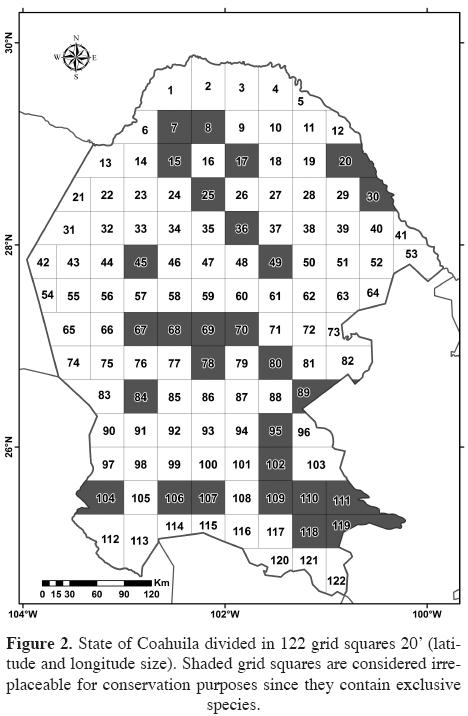
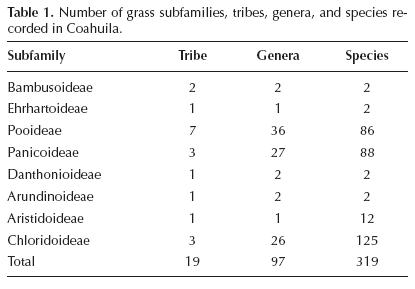
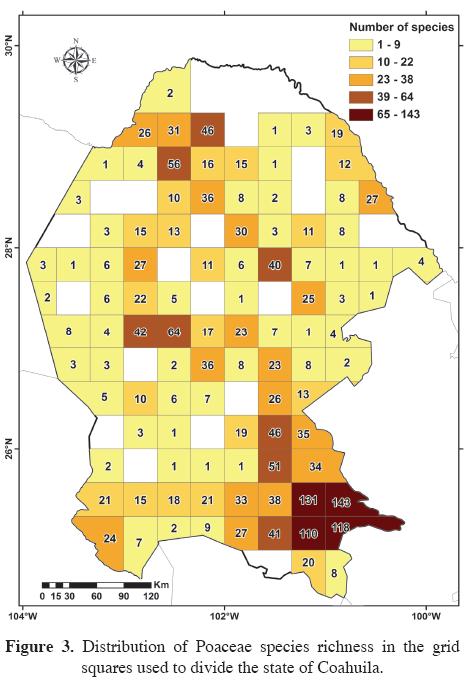
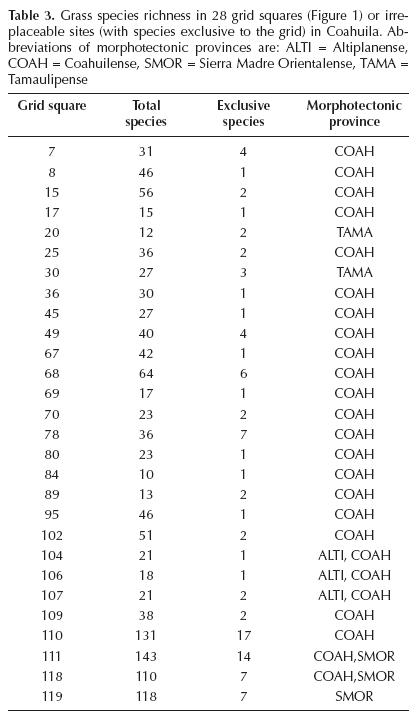
<body><![CDATA[<p align="justify"><font face="verdana" size="2">The information from collecting locations was employed to georeference specimens and then, to spatially validate latitude and longitude coordinates using the geographical information system software ArcMap 10 (ESRI, 2010).</font></p>  	    <p align="justify"><font face="verdana" size="2">We carried out a pattern diversity analysis dividing Coahuila into a grid squares network. The size of the grid squares or cells defined, followed recommendations of the International Union for Nature Conservation (IUCN, 2001) for estimating Areas of Occupancy (AOO). This agency suggests that in order to determine the AOO of a species, grid square size should be 10% of the distance between the two more distant gathering locations known for the species. In our analysis, AOO for each species was estimated by using a GIS extension for ArcView (Moat, 2007). The AOO median values of all estimates was obtained and used to determine cell size and this was applied to all species (Su&aacute;rez&#45;Mota and Villase&ntilde;or, 2011). The median obtained for cell size was 34.5 km per side, which is close to 20 arc minutes latitude and longitude. An edge effect resulted in cells of lesser size; therefore, those with a surface less than 50% of a full cell size were fused with a neighbor cell. In this way, the state of Coahuila was divided into 122 grid squares (<a href="#f2">Figure 2</a>). This grid square system allowed us to determine the species richness for each cell by intersecting with the GIS the collecting locations from all the state's political surface.</font></p>  	    <p align="center"><font face="verdana" size="2"><a name="f2"></a></font></p>  	    <p align="center"><font face="verdana" size="2"><img src="/img/revistas/bs/v93n1/a10f2.jpg"></font></p>  	    <p align="justify"><font face="verdana" size="2"><i>Species accumulation curve.</i> The species accumulation curves, because they consider rarity or abundance, are important emerging tools for estimating floristic richness from a place or region (Koellner <i>et al.</i>, 2004). To evaluate how exhaustive the Poaceae inventory was in the herbaria studied, we obtained a species accumulation curve by using EstimateS version 8.2.0 software (Colwell and Coddington, 1994; Colwell, 2009). As a measure of the collecting effort, we considered the 20 arc minute cell size and we calculated the estimated richness using a parametric coefficient based on Clench's function (Jim&eacute;nez&#45;Valverde and Hortal, 2003) using Statistica version 10 software (StatSoft Inc., 2011). This function is now widely used to estimate the accumulation curves of the expected floristic richness. Sober&oacute;n and Llorente (1993) explain with details Clench's function and discuss its usefulness and limitations in biological inventories.</font></p>  	    <p align="justify"><font face="verdana" size="2"><i>Priority sites for conservation of Poaceae of Coahuila.</i> Once we obtained the species geographical distribution by cell, we identified those with high species richness. Among them, those with exclusive species; i.e. species recorded only in this grid square. Such cells were considered as irreplaceable sites, if we want to carry out effi cient conservation strategies of known species.</font></p>  	    <p align="justify"><font face="verdana" size="2">Species richness by cells helped us carry out a complementary heuristic analysis (Villase&ntilde;or <i>et al.</i>, 2003) by ranking the cells in which the state was divided. Thus, we were able to identify priority sites for conservation. In this work, endemism was not considered, only total species richness. Therefore, the complementary method (Villase&ntilde;or <i>et al.</i>, 2003) was modified to not account ties in the number of endemic species (step 3 of algorithm), going directly to step 4 ("in case of a tie, the cell closest to one already selected will be selected"). If ties persisted, the cell with higher species richness was selected.</font></p>  	    <p>&nbsp;</p>  	    <p align="justify"><font face="verdana" size="2"><b>Results</b></font></p>  	    <p align="justify"><font face="verdana" size="2">To date, 319 species of Poaceae were recorded in Coahuila, all of them based on a herbarium specimen. The species are distributed in eight subfamilies, 19 tribes, and 97 genera (<a href="#t1">Table 1</a>). Subfamily Chloridoideae, primarily distributed in arid zones, includes 125 species. Subfamily Panicoideae, usually found in more humid environments, includes 87 species, and Pooideae, found primarily in mountain temperate regions, includes 86 species. The other subfamilies include fewer species: Aristidoideae (12 spp.); Arundinoideae (2 spp.), Bambusoideae (2 spp.), Danthonioideae (2 spp.), and Ehrhartoideae (2 spp.). In Coahuila there are 253 native species and 65 naturalized or introduced species from Europe, Eurasia, Africa, and South America (<a href="#t2">Table 2</a>). The genera with the most species are: <i>Muhlenbergia</i> (32), <i>Bouteloua</i> (21), <i>Eragrostis</i> (18), <i>Sporobolus</i> (13), <i>Aristida</i> (12), <i>Setaria</i> (11), and <i>Panicum</i> (11). In addition, 58 species are considered rare because their distribution is known only from one or just a few localities, and seven of these are endemic to the state: <i>Bouteloua eriostachya, B. johnstonii, Bromus densus, Calamagrostis coahuilensis, Festuca coahuilana, F. valdesii</i>, and <i>Poa wendtii.</i></font></p>  	    ]]></body>
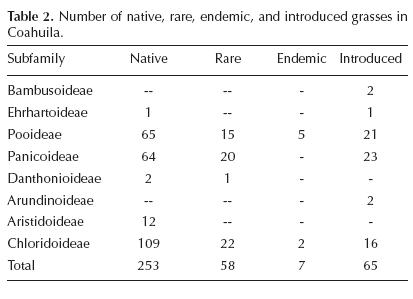
<body><![CDATA[<p align="center"><font face="verdana" size="2"><a name="t1"></a></font></p>  	    <p align="center"><font face="verdana" size="2"><img src="/img/revistas/bs/v93n1/a10t1.jpg"></font></p>  	    <p align="center"><font face="verdana" size="2"><a name="t2"></a></font></p>  	    <p align="center"><font face="verdana" size="2"><img src="/img/revistas/bs/v93n1/a10t2.jpg"></font></p>  	    <p align="justify"><font face="verdana" size="2">Poaceae richness does not distribute homogeneously in Coahuila. <a href="#f2">Figure 2</a> shows the state divided in 122 grid squares 20' &times; 20' latitude and longitude (about 1,133 km<sup>2</sup>), and grasses were only found in 99 (<a href="#f3">Figure 3</a>). Our results indicate 81% of the area is inequitably sampled, because 51 of the grid squares scored from 1 to 9 species, whereas 19 scored between 10 to 22 species, 17 scored between 23 and 38 species and only 12 scored more than 39 species.</font></p>  	    <p align="center"><font face="verdana" size="2"><a name="f3"></a></font></p>  	    <p align="center"><font face="verdana" size="2"><img src="/img/revistas/bs/v93n1/a10f3.jpg"></font></p>  	    <p align="justify"><font face="verdana" size="2">The species accumulation curve (<a href="#f4">Figure 4</a>) shows the number of species collected as a function of sampling effort in the grid squares. The curve reveals a confi dent, although incomplete inventory. The estimated species richness when the asymptote is reached &#91;y = 16.13236x (1 + 0.040668)<sup>&#45;1</sup>&#93; suggests the inventory will be completed with 396 species. Therefore, it still remains to add about 73 additional species to the state richness (80.5% completeness).</font></p>  	    <p align="center"><font face="verdana" size="2"><a name="f4"></a></font></p>  	    <p align="center"><font face="verdana" size="2"><img src="/img/revistas/bs/v93n1/a10f4.jpg"></font></p>  	    ]]></body>
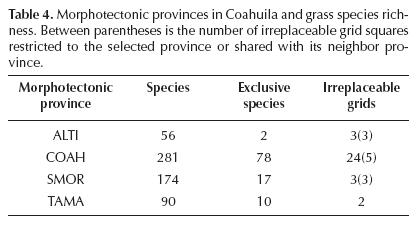
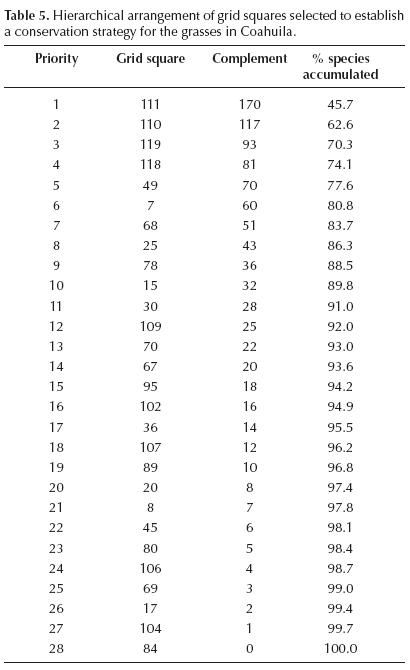
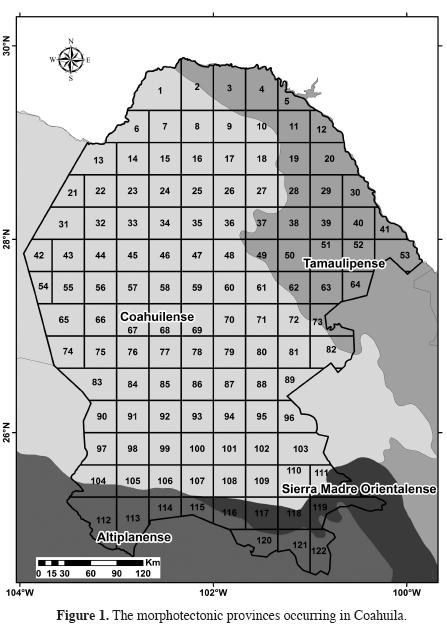
<body><![CDATA[<p align="justify"><font face="verdana" size="2">Most species (96) restrict their distribution to a single grid square; 58 additional species are known from two squares. In general, 75.7% of total richness is known from no more than five squares and only eight species (2.6%) are recorded from 15 or more squares. The widespread species are: <i>Aristida adscensionis, A. purpurea, Bouteloua curtipendula, Disakisperma dubium, Muhlenbergia tenuifolia, Panicum hallii, Setaria leucopila, and Tridentopsis mutica.</i></font></p>  	    <p align="justify"><font face="verdana" size="2">The 96 grass species restricted to a single grid square represent Coahuila it is rare elements. These species are found in only 28 squares and are considered irreplaceable for conservation (<a href="#f2">Figure 2</a>), because they must be considered, if we want to assure the long&#45;term survival of these grasses. The 28 irreplaceable grid squares record 313 out of the 316 species. The three species not recorded are: <i>Aristida oligantha, Paspalum urvillei</i>, and <i>Setariopsis auriculata</i>. <a href="#t3">Table 3</a> summarizes the number of species recorded in each of the 28 squares, and also includes their position according to the morphotectonic provinces in Coahuila (<a href="#f1">Figure 1</a>) (Ferrusqu&iacute;a&#45;Villafranca, 1990). The Coahuilense province records the larger number of grid squares (20); the Tamaulipense province includes two (grid squares 20 and 30), one in the Sierra Madre Orientalense province (grid 119) and five additional grids combine territories between two adjoining provinces, as are the Altiplanense and Coahuilense provinces (grids 104, 106, and 107) or Coahuilense and Sierra Madre Orientalense (grids 111 and 118).</font></p>  	    <p align="center"><font face="verdana" size="2"><a name="t3"></a></font></p>  	    <p align="center"><font face="verdana" size="2"><img src="/img/revistas/bs/v93n1/a10t3.jpg"></font></p>  	    <p align="justify"><font face="verdana" size="2"><a href="#t4">Table 4</a> summarizes the Poaceae richness recorded in the morphotectonic provinces occurring in Coahuila. The Coahuilense province has 281 species with 78 species known only from this province. The Sierra Madre Orientalense province contains 174 species with 17 unique species. The Tamaulipense province includes 90 species and ten of these are unique to the province. The Altiplanense province has 56 species and two unique species.</font></p>  	    <p align="center"><font face="verdana" size="2"><a name="t4"></a></font></p>  	    <p align="center"><font face="verdana" size="2"><img src="/img/revistas/bs/v93n1/a10t4.jpg"></font></p>  	    <p align="justify"><font face="verdana" size="2">Since 28 grid squares identified are irreplaceable and contain 99% of the Poaceae richness, we carried out a complementary analysis of these 28 grid squares excluding the three unplaced species. <a href="#t5">Table 5</a> sorts the 28 grid squares containing most of the species in descending order; their distribution covers all the state's territory and their confi guration could allow the establishment of corridors to facilitate species mobility among most of them. This strategy could guarantee the surviving of both, the species restricted to their territory as the other more widespread species. So the higher grids have diverse habitats worthy of preservation.</font></p>  	    <p align="center"><font face="verdana" size="2"><a name="t5"></a></font></p>  	    <p align="center"><font face="verdana" size="2"><img src="/img/revistas/bs/v93n1/a10t5.jpg"></font></p>  	    ]]></body>
<body><![CDATA[<p>&nbsp;</p>  	    <p align="justify"><font face="verdana" size="2"><b>Discussion</b></font></p>  	    <p align="justify"><font face="verdana" size="2">The 319 Poaceae species recorded in Coahuila represent 10.5% of the total floristic richness reported by Villarreal (2001) for all plants; additionally, these 319 species represent 26.9% of the Poaceae richness in Mexico, and 2.5% (seven spp.) represent the country endemics (D&aacute;vila <i>et al.</i>, 2006). Rzedowski (1975) considers that the high grass richness found in Mexico reflects the autochthonous origin of the flora, this pattern is also found in the state of Coahuila. The dominance of species in the Chloridoideae, mostly found in arid and semi&#45;arid environments, also corresponds with the dominant environment in the state (Vald&eacute;s, 1977).</font></p>  	    <p align="justify"><font face="verdana" size="2">Areas with the highest species richness in Coahuila are also important collecting sites and have attracted notable botanical explorers such as Edward Palmer and Cyrus Pringle. The high rate of endemism is also related to this phenomenon, although other regions, such as Cuatro Ci&eacute;negas or the Sierra Maderas del Carmen, without strong historical records, are centers of endemism (Villarreal&#45;Quintanilla and Encina&#45;Dom&iacute;nguez, 2005).</font></p>  	    <p align="justify"><font face="verdana" size="2">The effort accumulation curve using Clench's function indicates a Poaceae richness of 81.5%, pointing to an increase of 73 species (Koellner <i>et al.</i>, 2004). Our results denote the need to increase the collecting effort in 23 grid squares (19% of state's surface) where no grasses have been recorded (<a href="#f3">Figure 3</a>). Surely their exploration will extend the known distribution of many species and add new records.</font></p>  	    <p align="justify"><font face="verdana" size="2">The Coahuilense morphotectonic province contains the greatest number of irreplaceable sites (24 grid squares with exclusive species), although four of them are shared with two neighbor provinces (Altiplanense and Sierra Madre Orientalense) because this offers many diverse habitats. The Altiplanense province has three irreplaceable sites and it is found in the southern part of the state (112, 113, 114, 115, 116, 117, 120, 121, and 122). This province has higher grass richness further south in San Luis Potos&iacute; and Zacatecas, seen in the Asteraceae (Balleza and Villase&ntilde;or, 2011). In contrast, the Sierra Madre Orientalense province, which also finds its northernmost limit in the state (grid squares 111, 115, 116, 117, 118, 119, and 122) records three irreplaceable sites (grids 111, 118, and 119), sharing its foothills with the Coahuilense province.</font></p>  	    <p align="justify"><font face="verdana" size="2">The 28 irreplaceable grid squares include a surface of about 31,724 km<sup>2</sup>, representing a little more than 21% of the state's surface (<a href="#f2">Figure 2</a>). Undoubtedly this area is too large to be considered in conservation strategies. However, its identification will allow the planning and further action, such as forming conservation refuges. These highly unique areas will be then inventoried for other plants and animals. In this way, we can contribute to the scientific knowledge and begin to initiate a list of possible areas to protect in the future.</font></p>  	    <p align="justify"><font face="verdana" size="2">The southeastern edge of the state where the Sierra Madre Orientalense morphotectonic province exists has the largest floristic richness. The three irreplaceable grid squares in this region have high richness values (<a href="#t4">Table 4</a>). There are many diverse habitats in this region and it is located within the confluence of two provinces, these squares increase the biogeographical complexity and the environmental heterogeneity, which favor the occurrence of a large number of species. This region was identified as a biogeographic node for the Asteraceae (Gonz&aacute;lez&#45;Zamora <i>et al.</i>, 2007), where the nodes represent regions with biotic elements from different sources; i.e., from different geological origins and climatic regimes. All these factors combine to promote a high biodiversity and increased endemism (hotspots). This area is important because it contains a diverse assemblage of grasses and should be considered for conservations measures. Additional studies on the diversity and distribution of introduced and invasive species (Vald&eacute;s, 2008) are needed to understand the impact of agricultural and forest practices. Our results emphasize the need for ongoing collecting activities in Coahuila, particularly of grasses and other organisms, especially in the already protected natural areas.</font></p>  	    <p>&nbsp;</p>  	    <p align="justify"><font face="verdana" size="2"><b>Acknowledgments</b></font></p>  	    ]]></body>
<body><![CDATA[<p align="justify"><font face="verdana" size="2">We thank the curators of the herbaria ANSM, MEXU, TEX, TAES, and US for their help during the review of material. Paul M. Peterson and Gabriel S&aacute;nchez&#45;Ken reviewed the checklist of selected subfamilies. Paul and an anonymous reviewer made important additions that improved the manuscript. Celia Portillo of the University of Texas at Brownsville, careful review and made changes that improved the manuscript. Sergio G. G&oacute;mez helped with data base handling, collecting information, and georeferencing of specimens.</font></p>  	    <p>&nbsp;</p>  	    <p align="center"><font face="verdana" size="2"><a href="/img/revistas/bs/v93n1/html/ap10.htm" target="_blank">Appendix 1</a></font></p>  	    <p>&nbsp;</p>  	    <p align="justify"><font face="verdana" size="2"><b>Literature cited</b></font></p>  	    <!-- ref --><p align="justify"><font face="verdana" size="2">Balleza J.J. and Villase&ntilde;or J.L. 2011. Contribuci&oacute;n del estado de Zacatecas (M&eacute;xico) a la conservaci&oacute;n de la riqueza flor&iacute;stica del Desierto Chihuahuense. Acta Botanica Mexicana <b>94</b>:61&#45;89.    &nbsp;&nbsp;&nbsp;&nbsp;&nbsp;&nbsp;&nbsp;&nbsp;[&#160;<a href="javascript:void(0);" onclick="javascript: window.open('/scielo.php?script=sci_nlinks&ref=1809882&pid=S2007-4298201500010001000001&lng=','','width=640,height=500,resizable=yes,scrollbars=1,menubar=yes,');">Links</a>&#160;]<!-- end-ref --></font></p>  	    <!-- ref --><p align="justify"><font face="verdana" size="2">Bell H.L. Columbus J.T. and Ingram A.L. 2012. <i>Kalinia</i>, a new North American genus for a species long misplaced in <i>Eragrostis</i> (Poaceae, Chloridoideae). <i>Aliso</i> <b>30</b>:85&#45;95.    &nbsp;&nbsp;&nbsp;&nbsp;&nbsp;&nbsp;&nbsp;&nbsp;[&#160;<a href="javascript:void(0);" onclick="javascript: window.open('/scielo.php?script=sci_nlinks&ref=1809884&pid=S2007-4298201500010001000002&lng=','','width=640,height=500,resizable=yes,scrollbars=1,menubar=yes,');">Links</a>&#160;]<!-- end-ref --></font></p>  	    <!-- ref --><p align="justify"><font face="verdana" size="2">Colwell R.K. 2009. <i>EstimateS Version 8.2.0: statistical estimation of species richness and shared species from samples (Software and User's Guide)</i>. Edited by himself, Storrs.    &nbsp;&nbsp;&nbsp;&nbsp;&nbsp;&nbsp;&nbsp;&nbsp;[&#160;<a href="javascript:void(0);" onclick="javascript: window.open('/scielo.php?script=sci_nlinks&ref=1809886&pid=S2007-4298201500010001000003&lng=','','width=640,height=500,resizable=yes,scrollbars=1,menubar=yes,');">Links</a>&#160;]<!-- end-ref --></font></p>  	    <!-- ref --><p align="justify"><font face="verdana" size="2">Colwell R.K. and Coddington J.A. 1994. Estimating terrestrial biodiversity through extrapolation. <i>Philosophical Transactions of the Royal Society of London Series B</i> <b>345</b>:101&#45;118.    &nbsp;&nbsp;&nbsp;&nbsp;&nbsp;&nbsp;&nbsp;&nbsp;[&#160;<a href="javascript:void(0);" onclick="javascript: window.open('/scielo.php?script=sci_nlinks&ref=1809888&pid=S2007-4298201500010001000004&lng=','','width=640,height=500,resizable=yes,scrollbars=1,menubar=yes,');">Links</a>&#160;]<!-- end-ref --></font></p>  	    <!-- ref --><p align="justify"><font face="verdana" size="2">D&aacute;vila A.P., Mej&iacute;a&#45;Saul&eacute;s M.T., G&oacute;mez&#45;S&aacute;nchez M., Vald&eacute;s&#45;Reyna J., Ortiz J.J., Mor&iacute;n C., Castrej&oacute;n J. and Ocampo A. 2006. <i>Cat&aacute;logo de las Gram&iacute;neas de M&eacute;xico</i>. Universidad Nacional Aut&oacute;noma de M&eacute;xico, Comisi&oacute;n Nacional para el Conocimiento y Uso de la Biodiversidad, M&eacute;xico, D.F.    &nbsp;&nbsp;&nbsp;&nbsp;&nbsp;&nbsp;&nbsp;&nbsp;[&#160;<a href="javascript:void(0);" onclick="javascript: window.open('/scielo.php?script=sci_nlinks&ref=1809890&pid=S2007-4298201500010001000005&lng=','','width=640,height=500,resizable=yes,scrollbars=1,menubar=yes,');">Links</a>&#160;]<!-- end-ref --></font></p>  	    <!-- ref --><p align="justify"><font face="verdana" size="2">ESRI. 2010. <i>ArcGIS Desktop 10</i>. Environmental Systems Research Institute, Redlands.    &nbsp;&nbsp;&nbsp;&nbsp;&nbsp;&nbsp;&nbsp;&nbsp;[&#160;<a href="javascript:void(0);" onclick="javascript: window.open('/scielo.php?script=sci_nlinks&ref=1809892&pid=S2007-4298201500010001000006&lng=','','width=640,height=500,resizable=yes,scrollbars=1,menubar=yes,');">Links</a>&#160;]<!-- end-ref --></font></p>  	    <!-- ref --><p align="justify"><font face="verdana" size="2">Ferrusqu&iacute;a&#45;Villafranca I. 1990. Provincias bi&oacute;ticas (con &eacute;nfasis en criterios morfotect&oacute;nicos). Escala 1:4 000 000. In: <i>Regionalizaci&oacute;n Biogeogr&aacute;fica, Atlas Nacional de M&eacute;xico, vol. II</i>, IV.8.10., Instituto de Geograf&iacute;a, Universidad Nacional Aut&oacute;noma de M&eacute;xico, M&eacute;xico, D. F.    &nbsp;&nbsp;&nbsp;&nbsp;&nbsp;&nbsp;&nbsp;&nbsp;[&#160;<a href="javascript:void(0);" onclick="javascript: window.open('/scielo.php?script=sci_nlinks&ref=1809894&pid=S2007-4298201500010001000007&lng=','','width=640,height=500,resizable=yes,scrollbars=1,menubar=yes,');">Links</a>&#160;]<!-- end-ref --></font></p>  	    <!-- ref --><p align="justify"><font face="verdana" size="2">Finot V.L., Marticorena C., Barrera J.A., Mu&ntilde;&oacute;z&#45;Schick M. and Negritto M.A. 2009. Diversidad de la familia Poaceae (Gramineae) en la regi&oacute;n del B&iacute;o&#45;B&iacute;o, Chile, basada en colecciones de herbario. <i>Gayana Bot&aacute;nica</i> <b>66</b>:134&#45;157.    &nbsp;&nbsp;&nbsp;&nbsp;&nbsp;&nbsp;&nbsp;&nbsp;[&#160;<a href="javascript:void(0);" onclick="javascript: window.open('/scielo.php?script=sci_nlinks&ref=1809896&pid=S2007-4298201500010001000008&lng=','','width=640,height=500,resizable=yes,scrollbars=1,menubar=yes,');">Links</a>&#160;]<!-- end-ref --></font></p>  	    <!-- ref --><p align="justify"><font face="verdana" size="2">Gonz&aacute;lez&#45;Zamora A., Luna V.I., Villase&ntilde;or J.L. and Ruiz&#45;Jim&eacute;nez C.A. 2007. Distributional patterns and conservation of species of Asteraceae (asters etc.) endemic to eastern Mexico: a panbiogeographical approach. <i>Systematics and Biodiversity</i> <b>5</b>:135&#45;144.    &nbsp;&nbsp;&nbsp;&nbsp;&nbsp;&nbsp;&nbsp;&nbsp;[&#160;<a href="javascript:void(0);" onclick="javascript: window.open('/scielo.php?script=sci_nlinks&ref=1809898&pid=S2007-4298201500010001000009&lng=','','width=640,height=500,resizable=yes,scrollbars=1,menubar=yes,');">Links</a>&#160;]<!-- end-ref --></font></p>  	    <!-- ref --><p align="justify"><font face="verdana" size="2">IUCN. International Union for Conservation of Nature. 2001. <i>IUCN Red List Categories and Criteria: Version 3.1.</i> 2<sup>nd</sup> ed. International Union for Conservation of Nature, Gland.    &nbsp;&nbsp;&nbsp;&nbsp;&nbsp;&nbsp;&nbsp;&nbsp;[&#160;<a href="javascript:void(0);" onclick="javascript: window.open('/scielo.php?script=sci_nlinks&ref=1809900&pid=S2007-4298201500010001000010&lng=','','width=640,height=500,resizable=yes,scrollbars=1,menubar=yes,');">Links</a>&#160;]<!-- end-ref --></font></p>  	    <!-- ref --><p align="justify"><font face="verdana" size="2">Jim&eacute;nez&#45;Valverde A. and Hortal J. 2003. Las curvas de acumulaci&oacute;n de especies y la necesidad de evaluar la calidad de los inventarios biol&oacute;gicos. <i>Revista Ib&eacute;rica de Aracnolog&iacute;a</i> <b>8</b>:151&#45;161.    &nbsp;&nbsp;&nbsp;&nbsp;&nbsp;&nbsp;&nbsp;&nbsp;[&#160;<a href="javascript:void(0);" onclick="javascript: window.open('/scielo.php?script=sci_nlinks&ref=1809902&pid=S2007-4298201500010001000011&lng=','','width=640,height=500,resizable=yes,scrollbars=1,menubar=yes,');">Links</a>&#160;]<!-- end-ref --></font></p>  	    <!-- ref --><p align="justify"><font face="verdana" size="2">Klopper R.R., Gautier L., Chatelain C., Smith G.F. and Spichiger R. 2007. Floristics of the angiosperm flora of Sub&#45;Saharan Africa: an analysis of the African plants checklist and database. <i>Taxon</i> <b>56</b>:201&#45;208.    &nbsp;&nbsp;&nbsp;&nbsp;&nbsp;&nbsp;&nbsp;&nbsp;[&#160;<a href="javascript:void(0);" onclick="javascript: window.open('/scielo.php?script=sci_nlinks&ref=1809904&pid=S2007-4298201500010001000012&lng=','','width=640,height=500,resizable=yes,scrollbars=1,menubar=yes,');">Links</a>&#160;]<!-- end-ref --></font></p>  	    <!-- ref --><p align="justify"><font face="verdana" size="2">Koellner T., Hersperger A.M. and Wohlgemuth T. 2004. Rarefaction method for assessing plant species diversity on a regional scale. <i>Ecography</i> <b>27</b>:532&#45;544.    &nbsp;&nbsp;&nbsp;&nbsp;&nbsp;&nbsp;&nbsp;&nbsp;[&#160;<a href="javascript:void(0);" onclick="javascript: window.open('/scielo.php?script=sci_nlinks&ref=1809906&pid=S2007-4298201500010001000013&lng=','','width=640,height=500,resizable=yes,scrollbars=1,menubar=yes,');">Links</a>&#160;]<!-- end-ref --></font></p>  	    <!-- ref --><p align="justify"><font face="verdana" size="2">Mittermeier R.A. 1988. Primate diversity and the tropical forest. In: Wilson E.O. Ed. <i>Biodiversity</i>, pp. 145&#45;154, National Academic Press, Washington, D.C.    &nbsp;&nbsp;&nbsp;&nbsp;&nbsp;&nbsp;&nbsp;&nbsp;[&#160;<a href="javascript:void(0);" onclick="javascript: window.open('/scielo.php?script=sci_nlinks&ref=1809908&pid=S2007-4298201500010001000014&lng=','','width=640,height=500,resizable=yes,scrollbars=1,menubar=yes,');">Links</a>&#160;]<!-- end-ref --></font></p>  	    <!-- ref --><p align="justify"><font face="verdana" size="2">Moat J. 2007. <i>Conservation assessment tools extension for ArcView 3.x, version 1.2. GIS Unit</i>. Royal Botanic Gardens, Kew, London.    &nbsp;&nbsp;&nbsp;&nbsp;&nbsp;&nbsp;&nbsp;&nbsp;[&#160;<a href="javascript:void(0);" onclick="javascript: window.open('/scielo.php?script=sci_nlinks&ref=1809910&pid=S2007-4298201500010001000015&lng=','','width=640,height=500,resizable=yes,scrollbars=1,menubar=yes,');">Links</a>&#160;]<!-- end-ref --></font></p>  	    <!-- ref --><p align="justify"><font face="verdana" size="2">Peterson P.M., Romaschenko K., Snow N. and Johnson G. 2012. A molecular phylogeny and classifi cation of <i>Leptochloa</i> (Poaceae: Chloridoideae: Chlorideae) <i>sensu lato</i> and related genera. <i>Annals of Botany</i> <b>109</b>:1317&#45;1330.    &nbsp;&nbsp;&nbsp;&nbsp;&nbsp;&nbsp;&nbsp;&nbsp;[&#160;<a href="javascript:void(0);" onclick="javascript: window.open('/scielo.php?script=sci_nlinks&ref=1809912&pid=S2007-4298201500010001000016&lng=','','width=640,height=500,resizable=yes,scrollbars=1,menubar=yes,');">Links</a>&#160;]<!-- end-ref --></font></p>  	    <!-- ref --><p align="justify"><font face="verdana" size="2">Peterson P.M., Romaschenko K. and Herrera A.Y. 2014. A molecular phylogeny and classification of the Cteniinae, Farragininae, Gouiniinae, Gymnopogoninae, Perotidinae, and Trichoneurinae (Poaceae: Chloridoideae: Cynodonteae). <i>Taxon</i> <b>63</b>:275&#45;286.    &nbsp;&nbsp;&nbsp;&nbsp;&nbsp;&nbsp;&nbsp;&nbsp;[&#160;<a href="javascript:void(0);" onclick="javascript: window.open('/scielo.php?script=sci_nlinks&ref=1809914&pid=S2007-4298201500010001000017&lng=','','width=640,height=500,resizable=yes,scrollbars=1,menubar=yes,');">Links</a>&#160;]<!-- end-ref --></font></p>  	    <!-- ref --><p align="justify"><font face="verdana" size="2">Rzedowski J. 1975. An ecological and phytogeographycal analysis of the grasslands of M&eacute;xico. <i>Taxon</i> <b>24</b>:67&#45;80.    &nbsp;&nbsp;&nbsp;&nbsp;&nbsp;&nbsp;&nbsp;&nbsp;[&#160;<a href="javascript:void(0);" onclick="javascript: window.open('/scielo.php?script=sci_nlinks&ref=1809916&pid=S2007-4298201500010001000018&lng=','','width=640,height=500,resizable=yes,scrollbars=1,menubar=yes,');">Links</a>&#160;]<!-- end-ref --></font></p>  	    <!-- ref --><p align="justify"><font face="verdana" size="2">Saarela J.M., Peterson P.M. and Vald&eacute;s&#45;Reyna J. 2014. A taxonomic revision of <i>Bromus</i> (Poaceae: Pooideae: Bromeae) in M&eacute;xico and Central America. <i>Phytotaxa</i> <b>185</b>:1&#45;147.    &nbsp;&nbsp;&nbsp;&nbsp;&nbsp;&nbsp;&nbsp;&nbsp;[&#160;<a href="javascript:void(0);" onclick="javascript: window.open('/scielo.php?script=sci_nlinks&ref=1809918&pid=S2007-4298201500010001000019&lng=','','width=640,height=500,resizable=yes,scrollbars=1,menubar=yes,');">Links</a>&#160;]<!-- end-ref --></font></p>  	    <!-- ref --><p align="justify"><font face="verdana" size="2">Smith G.F. and Wolfson M.M. 2004. Mainstreaming biodiversity: the role of taxonomy in bioregional planning activities in South Africa. <i>Taxon</i> <b>53</b>:467&#45;468.    &nbsp;&nbsp;&nbsp;&nbsp;&nbsp;&nbsp;&nbsp;&nbsp;[&#160;<a href="javascript:void(0);" onclick="javascript: window.open('/scielo.php?script=sci_nlinks&ref=1809920&pid=S2007-4298201500010001000020&lng=','','width=640,height=500,resizable=yes,scrollbars=1,menubar=yes,');">Links</a>&#160;]<!-- end-ref --></font></p>  	    <!-- ref --><p align="justify"><font face="verdana" size="2">Snow N., Peterson P.M., Romaschenko K. 2013. Systematics of <i>Disakisperma</i> (Poaceae, Chloridoideae, Chlorideae. <i>PhytoKeys</i> <b>26</b>: 21&#45;70.    &nbsp;&nbsp;&nbsp;&nbsp;&nbsp;&nbsp;&nbsp;&nbsp;[&#160;<a href="javascript:void(0);" onclick="javascript: window.open('/scielo.php?script=sci_nlinks&ref=1809922&pid=S2007-4298201500010001000021&lng=','','width=640,height=500,resizable=yes,scrollbars=1,menubar=yes,');">Links</a>&#160;]<!-- end-ref --></font></p>  	    <!-- ref --><p align="justify"><font face="verdana" size="2">Sober&oacute;n M.J. and Llorente B.J. 1993. The use of species accumulation functions for the prediction of species richness. <i>Conservation Biology</i> <b>7</b>:480&#45;488.    &nbsp;&nbsp;&nbsp;&nbsp;&nbsp;&nbsp;&nbsp;&nbsp;[&#160;<a href="javascript:void(0);" onclick="javascript: window.open('/scielo.php?script=sci_nlinks&ref=1809924&pid=S2007-4298201500010001000022&lng=','','width=640,height=500,resizable=yes,scrollbars=1,menubar=yes,');">Links</a>&#160;]<!-- end-ref --></font></p>  	    <!-- ref --><p align="justify"><font face="verdana" size="2">Su&aacute;rez&#45;Mota M.E. and Villase&ntilde;or J.L. 2011. Las Compuestas end&eacute;micas de Oaxaca, M&eacute;xico: diversidad y distribuci&oacute;n. <i>Bolet&iacute;n de la Sociedad Bot&aacute;nica de M&eacute;xico</i> <b>88</b>:55&#45;61.    &nbsp;&nbsp;&nbsp;&nbsp;&nbsp;&nbsp;&nbsp;&nbsp;[&#160;<a href="javascript:void(0);" onclick="javascript: window.open('/scielo.php?script=sci_nlinks&ref=1809926&pid=S2007-4298201500010001000023&lng=','','width=640,height=500,resizable=yes,scrollbars=1,menubar=yes,');">Links</a>&#160;]<!-- end-ref --></font></p>  	    <!-- ref --><p align="justify"><font face="verdana" size="2">StatSoft Inc. 2011. STATISTICA (data analysis software system). Version 10.    &nbsp;&nbsp;&nbsp;&nbsp;&nbsp;&nbsp;&nbsp;&nbsp;[&#160;<a href="javascript:void(0);" onclick="javascript: window.open('/scielo.php?script=sci_nlinks&ref=1809928&pid=S2007-4298201500010001000024&lng=','','width=640,height=500,resizable=yes,scrollbars=1,menubar=yes,');">Links</a>&#160;]<!-- end-ref --></font></p>  	    <!-- ref --><p align="justify"><font face="verdana" size="2">Vald&eacute;s R.J. 1977. Gram&iacute;neas de Coahuila. Lista de especies (con nombres y s&iacute;mbolos): clave para los g&eacute;neros. <i>Monograf&iacute;a T&eacute;cnico Cient&iacute;fica</i> <b>3</b>:884&#45;1018.    &nbsp;&nbsp;&nbsp;&nbsp;&nbsp;&nbsp;&nbsp;&nbsp;[&#160;<a href="javascript:void(0);" onclick="javascript: window.open('/scielo.php?script=sci_nlinks&ref=1809930&pid=S2007-4298201500010001000025&lng=','','width=640,height=500,resizable=yes,scrollbars=1,menubar=yes,');">Links</a>&#160;]<!-- end-ref --></font></p>  	    <!-- ref --><p align="justify"><font face="verdana" size="2">Vald&eacute;s R.J. 2008. <i>Gram&iacute;neas Invasoras del noreste de M&eacute;xico</i>. Universidad Aut&oacute;noma Agraria Antonio Narro. Base de datos. SNIB&#45;CONABIO. Proyecto EK002. M&eacute;xico D.F.    &nbsp;&nbsp;&nbsp;&nbsp;&nbsp;&nbsp;&nbsp;&nbsp;[&#160;<a href="javascript:void(0);" onclick="javascript: window.open('/scielo.php?script=sci_nlinks&ref=1809932&pid=S2007-4298201500010001000026&lng=','','width=640,height=500,resizable=yes,scrollbars=1,menubar=yes,');">Links</a>&#160;]<!-- end-ref --></font></p>  	    <!-- ref --><p align="justify"><font face="verdana" size="2">Vald&eacute;s R.J. and Cabral I.I. 1993. Chorology of Mexican grasses. In: Ramamoorthy T.P., Bye R., Lot A. and Fa J. Eds. <i>Biological Diversity of Mexico: Origins and Distribution</i>, pp. 439&#45;446, Oxford University Press, New York.    &nbsp;&nbsp;&nbsp;&nbsp;&nbsp;&nbsp;&nbsp;&nbsp;[&#160;<a href="javascript:void(0);" onclick="javascript: window.open('/scielo.php?script=sci_nlinks&ref=1809934&pid=S2007-4298201500010001000027&lng=','','width=640,height=500,resizable=yes,scrollbars=1,menubar=yes,');">Links</a>&#160;]<!-- end-ref --></font></p>  	    <!-- ref --><p align="justify"><font face="verdana" size="2">Vald&eacute;s R.J. and D&aacute;vila A.P.D. 1995. Clasificaci&oacute;n de los g&eacute;neros de gram&iacute;neas (Poaceae) mexicanas. <i>Acta Botanica Mexicana</i> <b>33</b>:37&#45;50.    &nbsp;&nbsp;&nbsp;&nbsp;&nbsp;&nbsp;&nbsp;&nbsp;[&#160;<a href="javascript:void(0);" onclick="javascript: window.open('/scielo.php?script=sci_nlinks&ref=1809936&pid=S2007-4298201500010001000028&lng=','','width=640,height=500,resizable=yes,scrollbars=1,menubar=yes,');">Links</a>&#160;]<!-- end-ref --></font></p>  	    <!-- ref --><p align="justify"><font face="verdana" size="2">Vald&eacute;s R.J. and D&aacute;vila A.P. 1998. <i>Base de datos de las gram&iacute;neas (Poaceae) del noreste de M&eacute;xico</i>. Universidad Aut&oacute;noma Agraria Antonio Narro. Informe final. SNIB&#45;CONABIO. Proyecto No. G029. M&eacute;xico, D.F.    &nbsp;&nbsp;&nbsp;&nbsp;&nbsp;&nbsp;&nbsp;&nbsp;[&#160;<a href="javascript:void(0);" onclick="javascript: window.open('/scielo.php?script=sci_nlinks&ref=1809938&pid=S2007-4298201500010001000029&lng=','','width=640,height=500,resizable=yes,scrollbars=1,menubar=yes,');">Links</a>&#160;]<!-- end-ref --></font></p>  	    <!-- ref --><p align="justify"><font face="verdana" size="2">Villarreal Q.J.&Aacute;. 2001. Flora de Coahuila. <i>Listados flor&iacute;sticos de M&eacute;xico</i> <b>23</b>:1&#45;138.    &nbsp;&nbsp;&nbsp;&nbsp;&nbsp;&nbsp;&nbsp;&nbsp;[&#160;<a href="javascript:void(0);" onclick="javascript: window.open('/scielo.php?script=sci_nlinks&ref=1809940&pid=S2007-4298201500010001000030&lng=','','width=640,height=500,resizable=yes,scrollbars=1,menubar=yes,');">Links</a>&#160;]<!-- end-ref --></font></p>  	    <!-- ref --><p align="justify"><font face="verdana" size="2">Villarreal&#45;Quintanilla J.&Aacute;. and Encina&#45;Dom&iacute;nguez J.A. 2005. Plantas vasculares end&eacute;micas de Coahuila y algunas &aacute;reas adyacentes, M&eacute;xico. <i>Acta Botanica Mexicana</i> <b>70</b>:1&#45;46.    &nbsp;&nbsp;&nbsp;&nbsp;&nbsp;&nbsp;&nbsp;&nbsp;[&#160;<a href="javascript:void(0);" onclick="javascript: window.open('/scielo.php?script=sci_nlinks&ref=1809942&pid=S2007-4298201500010001000031&lng=','','width=640,height=500,resizable=yes,scrollbars=1,menubar=yes,');">Links</a>&#160;]<!-- end-ref --></font></p>  	    <!-- ref --><p align="justify"><font face="verdana" size="2">Villase&ntilde;or J.L. 2003. Diversidad y distribuci&oacute;n de las Magnoliophyta de M&eacute;xico. <i>Interciencia</i> <b>28</b>:160&#45;167.    &nbsp;&nbsp;&nbsp;&nbsp;&nbsp;&nbsp;&nbsp;&nbsp;[&#160;<a href="javascript:void(0);" onclick="javascript: window.open('/scielo.php?script=sci_nlinks&ref=1809944&pid=S2007-4298201500010001000032&lng=','','width=640,height=500,resizable=yes,scrollbars=1,menubar=yes,');">Links</a>&#160;]<!-- end-ref --></font></p>  	    <!-- ref --><p align="justify"><font face="verdana" size="2">Villase&ntilde;or J.L. and Ortiz E. 2012. La familia Asteraceae en la flora del Baj&iacute;o y de regiones adyacentes. <i>Acta Botanica Mexicana</i> <b>100</b>:259&#45;291.    &nbsp;&nbsp;&nbsp;&nbsp;&nbsp;&nbsp;&nbsp;&nbsp;[&#160;<a href="javascript:void(0);" onclick="javascript: window.open('/scielo.php?script=sci_nlinks&ref=1809946&pid=S2007-4298201500010001000033&lng=','','width=640,height=500,resizable=yes,scrollbars=1,menubar=yes,');">Links</a>&#160;]<!-- end-ref --></font></p>  	    <!-- ref --><p align="justify"><font face="verdana" size="2">Villase&ntilde;or J.L., Meave J.A., Ortiz E. and Ibarra&#45;Manr&iacute;quez G. 2003. Biogeograf&iacute;a y conservaci&oacute;n de los bosques tropicales h&uacute;medos de M&eacute;xico. P&aacute;ginas 209&#45;216. In: Morrone J.J. and Llorente B.J. Eds. <i>Una Perspectiva Latinoamericana de la Biogeograf&iacute;a.</i> Comisi&oacute;n Nacional para el Conocimiento y Uso de la Biodiversidad, Universidad Nacional Aut&oacute;noma de M&eacute;xico, La Prensa de Ciencias, Mexico City.    &nbsp;&nbsp;&nbsp;&nbsp;&nbsp;&nbsp;&nbsp;&nbsp;[&#160;<a href="javascript:void(0);" onclick="javascript: window.open('/scielo.php?script=sci_nlinks&ref=1809948&pid=S2007-4298201500010001000034&lng=','','width=640,height=500,resizable=yes,scrollbars=1,menubar=yes,');">Links</a>&#160;]<!-- end-ref --></font></p>      ]]></body>
<back>
<ref-list>
<ref id="B1">
<nlm-citation citation-type="journal">
<person-group person-group-type="author">
<name>
<surname><![CDATA[Balleza]]></surname>
<given-names><![CDATA[J.J.]]></given-names>
</name>
<name>
<surname><![CDATA[Villaseñor]]></surname>
<given-names><![CDATA[J.L.]]></given-names>
</name>
</person-group>
<article-title xml:lang="es"><![CDATA[Contribución del estado de Zacatecas (México) a la conservación de la riqueza florística del Desierto Chihuahuense]]></article-title>
<source><![CDATA[Acta Botanica Mexicana]]></source>
<year>2011</year>
<volume>94</volume>
<page-range>61-89</page-range></nlm-citation>
</ref>
<ref id="B2">
<nlm-citation citation-type="journal">
<person-group person-group-type="author">
<name>
<surname><![CDATA[Bell]]></surname>
<given-names><![CDATA[H.L.]]></given-names>
</name>
<name>
<surname><![CDATA[Columbus]]></surname>
<given-names><![CDATA[J.T.]]></given-names>
</name>
<name>
<surname><![CDATA[Ingram]]></surname>
<given-names><![CDATA[A.L.]]></given-names>
</name>
</person-group>
<article-title xml:lang="en"><![CDATA[Kalinia, a new North American genus for a species long misplaced in Eragrostis (Poaceae, Chloridoideae)]]></article-title>
<source><![CDATA[Aliso]]></source>
<year>2012</year>
<volume>30</volume>
<page-range>85-95</page-range></nlm-citation>
</ref>
<ref id="B3">
<nlm-citation citation-type="">
<person-group person-group-type="author">
<name>
<surname><![CDATA[Colwell]]></surname>
<given-names><![CDATA[R.K.]]></given-names>
</name>
</person-group>
<source><![CDATA[EstimateS Version 8.2.0: statistical estimation of species richness and shared species from samples (Software and User's Guide)]]></source>
<year>2009</year>
<publisher-loc><![CDATA[Storrs ]]></publisher-loc>
</nlm-citation>
</ref>
<ref id="B4">
<nlm-citation citation-type="journal">
<person-group person-group-type="author">
<name>
<surname><![CDATA[Colwell]]></surname>
<given-names><![CDATA[R.K.]]></given-names>
</name>
<name>
<surname><![CDATA[Coddington]]></surname>
<given-names><![CDATA[J.A.]]></given-names>
</name>
</person-group>
<article-title xml:lang="en"><![CDATA[Estimating terrestrial biodiversity through extrapolation]]></article-title>
<source><![CDATA[Philosophical Transactions of the Royal Society of London Series B]]></source>
<year>1994</year>
<volume>345</volume>
<page-range>101-118</page-range></nlm-citation>
</ref>
<ref id="B5">
<nlm-citation citation-type="book">
<person-group person-group-type="author">
<name>
<surname><![CDATA[Dávila]]></surname>
<given-names><![CDATA[A.P.]]></given-names>
</name>
<name>
<surname><![CDATA[Mejía-Saulés]]></surname>
<given-names><![CDATA[M.T.]]></given-names>
</name>
<name>
<surname><![CDATA[Gómez-Sánchez]]></surname>
<given-names><![CDATA[M.]]></given-names>
</name>
<name>
<surname><![CDATA[Valdés-Reyna]]></surname>
<given-names><![CDATA[J.]]></given-names>
</name>
<name>
<surname><![CDATA[Ortiz]]></surname>
<given-names><![CDATA[J.J.]]></given-names>
</name>
<name>
<surname><![CDATA[Morín]]></surname>
<given-names><![CDATA[C.]]></given-names>
</name>
<name>
<surname><![CDATA[Castrejón]]></surname>
<given-names><![CDATA[J.]]></given-names>
</name>
<name>
<surname><![CDATA[Ocampo]]></surname>
<given-names><![CDATA[A.]]></given-names>
</name>
</person-group>
<source><![CDATA[Catálogo de las Gramíneas de México]]></source>
<year>2006</year>
<publisher-loc><![CDATA[México^eD.F. D.F.]]></publisher-loc>
<publisher-name><![CDATA[Universidad Nacional Autónoma de MéxicoComisión Nacional para el Conocimiento y Uso de la Biodiversidad]]></publisher-name>
</nlm-citation>
</ref>
<ref id="B6">
<nlm-citation citation-type="book">
<collab>ESRI</collab>
<source><![CDATA[ArcGIS Desktop 10]]></source>
<year>2010</year>
<publisher-loc><![CDATA[Redlands ]]></publisher-loc>
<publisher-name><![CDATA[Environmental Systems Research Institute]]></publisher-name>
</nlm-citation>
</ref>
<ref id="B7">
<nlm-citation citation-type="book">
<person-group person-group-type="author">
<name>
<surname><![CDATA[Ferrusquía-Villafranca]]></surname>
<given-names><![CDATA[I.]]></given-names>
</name>
</person-group>
<article-title xml:lang="es"><![CDATA[Provincias bióticas (con énfasis en criterios morfotectónicos). Escala 1:4 000 000]]></article-title>
<source><![CDATA[Regionalización Biogeográfica, Atlas Nacional de México]]></source>
<year>1990</year>
<volume>II</volume>
<publisher-loc><![CDATA[México^eD. F. D. F.]]></publisher-loc>
<publisher-name><![CDATA[Instituto de Geografía, Universidad Nacional Autónoma de México]]></publisher-name>
</nlm-citation>
</ref>
<ref id="B8">
<nlm-citation citation-type="journal">
<person-group person-group-type="author">
<name>
<surname><![CDATA[Finot]]></surname>
<given-names><![CDATA[V.L.]]></given-names>
</name>
<name>
<surname><![CDATA[Marticorena]]></surname>
<given-names><![CDATA[C.]]></given-names>
</name>
<name>
<surname><![CDATA[Barrera]]></surname>
<given-names><![CDATA[J.A.]]></given-names>
</name>
<name>
<surname><![CDATA[Muñóz-Schick]]></surname>
<given-names><![CDATA[M.]]></given-names>
</name>
<name>
<surname><![CDATA[Negritto]]></surname>
<given-names><![CDATA[M.A.]]></given-names>
</name>
</person-group>
<article-title xml:lang="es"><![CDATA[Diversidad de la familia Poaceae (Gramineae) en la región del Bío-Bío, Chile, basada en colecciones de herbario]]></article-title>
<source><![CDATA[Gayana Botánica]]></source>
<year>2009</year>
<volume>66</volume>
<page-range>134-157</page-range></nlm-citation>
</ref>
<ref id="B9">
<nlm-citation citation-type="journal">
<person-group person-group-type="author">
<name>
<surname><![CDATA[González-Zamora]]></surname>
<given-names><![CDATA[A.]]></given-names>
</name>
<name>
<surname><![CDATA[Luna]]></surname>
<given-names><![CDATA[V.I.]]></given-names>
</name>
<name>
<surname><![CDATA[Villaseñor]]></surname>
<given-names><![CDATA[J.L.]]></given-names>
</name>
<name>
<surname><![CDATA[Ruiz-Jiménez]]></surname>
<given-names><![CDATA[C.A.]]></given-names>
</name>
</person-group>
<article-title xml:lang="en"><![CDATA[Distributional patterns and conservation of species of Asteraceae (asters etc.) endemic to eastern Mexico: a panbiogeographical approach]]></article-title>
<source><![CDATA[Systematics and Biodiversity]]></source>
<year>2007</year>
<volume>5</volume>
<page-range>135-144</page-range></nlm-citation>
</ref>
<ref id="B10">
<nlm-citation citation-type="book">
<collab>International Union for Conservation of Nature</collab>
<source><![CDATA[IUCN Red List Categories and Criteria: Version 3.1]]></source>
<year>2001</year>
<edition>2</edition>
<publisher-loc><![CDATA[Gland ]]></publisher-loc>
<publisher-name><![CDATA[International Union for Conservation of Nature]]></publisher-name>
</nlm-citation>
</ref>
<ref id="B11">
<nlm-citation citation-type="journal">
<person-group person-group-type="author">
<name>
<surname><![CDATA[Jiménez-Valverde]]></surname>
<given-names><![CDATA[A.]]></given-names>
</name>
<name>
<surname><![CDATA[Hortal]]></surname>
<given-names><![CDATA[J.]]></given-names>
</name>
</person-group>
<article-title xml:lang="es"><![CDATA[Las curvas de acumulación de especies y la necesidad de evaluar la calidad de los inventarios biológicos]]></article-title>
<source><![CDATA[Revista Ibérica de Aracnología]]></source>
<year>2003</year>
<volume>8</volume>
<page-range>151-161</page-range></nlm-citation>
</ref>
<ref id="B12">
<nlm-citation citation-type="journal">
<person-group person-group-type="author">
<name>
<surname><![CDATA[Klopper]]></surname>
<given-names><![CDATA[R.R.]]></given-names>
</name>
<name>
<surname><![CDATA[Gautier]]></surname>
<given-names><![CDATA[L.]]></given-names>
</name>
<name>
<surname><![CDATA[Chatelain]]></surname>
<given-names><![CDATA[C.]]></given-names>
</name>
<name>
<surname><![CDATA[Smith]]></surname>
<given-names><![CDATA[G.F.]]></given-names>
</name>
<name>
<surname><![CDATA[Spichiger]]></surname>
<given-names><![CDATA[R.]]></given-names>
</name>
</person-group>
<article-title xml:lang="en"><![CDATA[Floristics of the angiosperm flora of Sub-Saharan Africa: an analysis of the African plants checklist and database]]></article-title>
<source><![CDATA[Taxon]]></source>
<year>2007</year>
<volume>56</volume>
<page-range>201-208</page-range></nlm-citation>
</ref>
<ref id="B13">
<nlm-citation citation-type="journal">
<person-group person-group-type="author">
<name>
<surname><![CDATA[Koellner]]></surname>
<given-names><![CDATA[T.]]></given-names>
</name>
<name>
<surname><![CDATA[Hersperger]]></surname>
<given-names><![CDATA[A.M.]]></given-names>
</name>
<name>
<surname><![CDATA[Wohlgemuth]]></surname>
<given-names><![CDATA[T.]]></given-names>
</name>
</person-group>
<article-title xml:lang="en"><![CDATA[Rarefaction method for assessing plant species diversity on a regional scale]]></article-title>
<source><![CDATA[Ecography]]></source>
<year>2004</year>
<volume>27</volume>
<page-range>532-544</page-range></nlm-citation>
</ref>
<ref id="B14">
<nlm-citation citation-type="book">
<person-group person-group-type="author">
<name>
<surname><![CDATA[Mittermeier]]></surname>
<given-names><![CDATA[R.A.]]></given-names>
</name>
</person-group>
<article-title xml:lang="en"><![CDATA[Primate diversity and the tropical forest]]></article-title>
<person-group person-group-type="editor">
<name>
<surname><![CDATA[Wilson]]></surname>
<given-names><![CDATA[E.O.]]></given-names>
</name>
</person-group>
<source><![CDATA[Biodiversity]]></source>
<year>1988</year>
<page-range>145-154</page-range><publisher-loc><![CDATA[Washington^eD.C. D.C.]]></publisher-loc>
<publisher-name><![CDATA[National Academic Press]]></publisher-name>
</nlm-citation>
</ref>
<ref id="B15">
<nlm-citation citation-type="book">
<person-group person-group-type="author">
<name>
<surname><![CDATA[Moat]]></surname>
<given-names><![CDATA[J.]]></given-names>
</name>
</person-group>
<source><![CDATA[Conservation assessment tools extension for ArcView 3.x, version 1.2. GIS Unit]]></source>
<year>2007</year>
<publisher-loc><![CDATA[London ]]></publisher-loc>
<publisher-name><![CDATA[Royal Botanic Gardens]]></publisher-name>
</nlm-citation>
</ref>
<ref id="B16">
<nlm-citation citation-type="journal">
<person-group person-group-type="author">
<name>
<surname><![CDATA[Peterson]]></surname>
<given-names><![CDATA[P.M.]]></given-names>
</name>
<name>
<surname><![CDATA[Romaschenko]]></surname>
<given-names><![CDATA[K.]]></given-names>
</name>
<name>
<surname><![CDATA[Snow]]></surname>
<given-names><![CDATA[N.]]></given-names>
</name>
<name>
<surname><![CDATA[Johnson]]></surname>
<given-names><![CDATA[G.]]></given-names>
</name>
</person-group>
<article-title xml:lang="en"><![CDATA[A molecular phylogeny and classifi cation of Leptochloa (Poaceae: Chloridoideae: Chlorideae) sensu lato and related genera]]></article-title>
<source><![CDATA[Annals of Botany]]></source>
<year>2012</year>
<volume>109</volume>
<page-range>1317-1330</page-range></nlm-citation>
</ref>
<ref id="B17">
<nlm-citation citation-type="journal">
<person-group person-group-type="author">
<name>
<surname><![CDATA[Peterson]]></surname>
<given-names><![CDATA[P.M.]]></given-names>
</name>
<name>
<surname><![CDATA[Romaschenko]]></surname>
<given-names><![CDATA[K.]]></given-names>
</name>
<name>
<surname><![CDATA[Herrera]]></surname>
<given-names><![CDATA[A.Y.]]></given-names>
</name>
</person-group>
<article-title xml:lang="en"><![CDATA[A molecular phylogeny and classification of the Cteniinae, Farragininae, Gouiniinae, Gymnopogoninae, Perotidinae, and Trichoneurinae (Poaceae: Chloridoideae: Cynodonteae)]]></article-title>
<source><![CDATA[Taxon]]></source>
<year>2014</year>
<volume>63</volume>
<page-range>275-286</page-range></nlm-citation>
</ref>
<ref id="B18">
<nlm-citation citation-type="journal">
<person-group person-group-type="author">
<name>
<surname><![CDATA[Rzedowski]]></surname>
<given-names><![CDATA[J.]]></given-names>
</name>
</person-group>
<article-title xml:lang="en"><![CDATA[An ecological and phytogeographycal analysis of the grasslands of México]]></article-title>
<source><![CDATA[Taxon]]></source>
<year>1975</year>
<volume>24</volume>
<page-range>67-80</page-range></nlm-citation>
</ref>
<ref id="B19">
<nlm-citation citation-type="journal">
<person-group person-group-type="author">
<name>
<surname><![CDATA[Saarela]]></surname>
<given-names><![CDATA[J.M.]]></given-names>
</name>
<name>
<surname><![CDATA[Peterson]]></surname>
<given-names><![CDATA[P.M.]]></given-names>
</name>
<name>
<surname><![CDATA[Valdés-Reyna]]></surname>
<given-names><![CDATA[J.]]></given-names>
</name>
</person-group>
<article-title xml:lang="en"><![CDATA[A taxonomic revision of Bromus (Poaceae: Pooideae: Bromeae) in México and Central America]]></article-title>
<source><![CDATA[Phytotaxa]]></source>
<year>2014</year>
<volume>185</volume>
<page-range>1-147</page-range></nlm-citation>
</ref>
<ref id="B20">
<nlm-citation citation-type="journal">
<person-group person-group-type="author">
<name>
<surname><![CDATA[Smith]]></surname>
<given-names><![CDATA[G.F.]]></given-names>
</name>
<name>
<surname><![CDATA[Wolfson]]></surname>
<given-names><![CDATA[M.M.]]></given-names>
</name>
</person-group>
<article-title xml:lang="en"><![CDATA[Mainstreaming biodiversity: the role of taxonomy in bioregional planning activities in South Africa]]></article-title>
<source><![CDATA[Taxon]]></source>
<year>2004</year>
<volume>53</volume>
<page-range>467-468</page-range></nlm-citation>
</ref>
<ref id="B21">
<nlm-citation citation-type="journal">
<person-group person-group-type="author">
<name>
<surname><![CDATA[Snow]]></surname>
<given-names><![CDATA[N.]]></given-names>
</name>
<name>
<surname><![CDATA[Peterson]]></surname>
<given-names><![CDATA[P.M.]]></given-names>
</name>
<name>
<surname><![CDATA[Romaschenko]]></surname>
<given-names><![CDATA[K.]]></given-names>
</name>
</person-group>
<article-title xml:lang="en"><![CDATA[Systematics of Disakisperma (Poaceae, Chloridoideae, Chlorideae]]></article-title>
<source><![CDATA[PhytoKeys]]></source>
<year>2013</year>
<volume>26</volume>
<page-range>21-70</page-range></nlm-citation>
</ref>
<ref id="B22">
<nlm-citation citation-type="journal">
<person-group person-group-type="author">
<name>
<surname><![CDATA[Soberón]]></surname>
<given-names><![CDATA[M.J.]]></given-names>
</name>
<name>
<surname><![CDATA[Llorente]]></surname>
<given-names><![CDATA[B.J.]]></given-names>
</name>
</person-group>
<article-title xml:lang="en"><![CDATA[The use of species accumulation functions for the prediction of species richness]]></article-title>
<source><![CDATA[Conservation Biology]]></source>
<year>1993</year>
<volume>7</volume>
<page-range>480-488</page-range></nlm-citation>
</ref>
<ref id="B23">
<nlm-citation citation-type="journal">
<person-group person-group-type="author">
<name>
<surname><![CDATA[Suárez-Mota]]></surname>
<given-names><![CDATA[M.E.]]></given-names>
</name>
<name>
<surname><![CDATA[Villaseñor]]></surname>
<given-names><![CDATA[J.L.]]></given-names>
</name>
</person-group>
<article-title xml:lang="es"><![CDATA[Las Compuestas endémicas de Oaxaca, México: diversidad y distribución]]></article-title>
<source><![CDATA[Boletín de la Sociedad Botánica de México]]></source>
<year>2011</year>
<volume>88</volume>
<page-range>55-61</page-range></nlm-citation>
</ref>
<ref id="B24">
<nlm-citation citation-type="">
<collab>StatSoft Inc.</collab>
<source><![CDATA[STATISTICA (data analysis software system). Version 10]]></source>
<year>2011</year>
</nlm-citation>
</ref>
<ref id="B25">
<nlm-citation citation-type="journal">
<person-group person-group-type="author">
<name>
<surname><![CDATA[Valdés]]></surname>
<given-names><![CDATA[R.J.]]></given-names>
</name>
</person-group>
<article-title xml:lang="es"><![CDATA[Gramíneas de Coahuila. Lista de especies (con nombres y símbolos): clave para los géneros]]></article-title>
<source><![CDATA[Monografía Técnico Científica]]></source>
<year>1977</year>
<volume>3</volume>
<page-range>884-1018</page-range></nlm-citation>
</ref>
<ref id="B26">
<nlm-citation citation-type="book">
<person-group person-group-type="author">
<name>
<surname><![CDATA[Valdés]]></surname>
<given-names><![CDATA[R.J.]]></given-names>
</name>
</person-group>
<source><![CDATA[Gramíneas Invasoras del noreste de México]]></source>
<year>2008</year>
<publisher-loc><![CDATA[México^eD.F. D.F.]]></publisher-loc>
<publisher-name><![CDATA[Universidad Autónoma Agraria Antonio NarroSNIBCONABIO]]></publisher-name>
</nlm-citation>
</ref>
<ref id="B27">
<nlm-citation citation-type="book">
<person-group person-group-type="author">
<name>
<surname><![CDATA[Valdés]]></surname>
<given-names><![CDATA[R.J.]]></given-names>
</name>
<name>
<surname><![CDATA[Cabral]]></surname>
<given-names><![CDATA[I.I.]]></given-names>
</name>
</person-group>
<article-title xml:lang="en"><![CDATA[Chorology of Mexican grasses]]></article-title>
<person-group person-group-type="editor">
<name>
<surname><![CDATA[Ramamoorthy]]></surname>
<given-names><![CDATA[T.P.]]></given-names>
</name>
<name>
<surname><![CDATA[Bye]]></surname>
<given-names><![CDATA[R.]]></given-names>
</name>
<name>
<surname><![CDATA[Lot]]></surname>
<given-names><![CDATA[A.]]></given-names>
</name>
<name>
<surname><![CDATA[Fa]]></surname>
<given-names><![CDATA[J.]]></given-names>
</name>
</person-group>
<source><![CDATA[Biological Diversity of Mexico: Origins and Distribution]]></source>
<year>1993</year>
<page-range>439-446</page-range><publisher-loc><![CDATA[New York ]]></publisher-loc>
<publisher-name><![CDATA[Oxford University Press]]></publisher-name>
</nlm-citation>
</ref>
<ref id="B28">
<nlm-citation citation-type="journal">
<person-group person-group-type="author">
<name>
<surname><![CDATA[Valdés]]></surname>
<given-names><![CDATA[R.J.]]></given-names>
</name>
<name>
<surname><![CDATA[Dávila]]></surname>
<given-names><![CDATA[A.P.D.]]></given-names>
</name>
</person-group>
<article-title xml:lang="es"><![CDATA[Clasificación de los géneros de gramíneas (Poaceae) mexicanas]]></article-title>
<source><![CDATA[Acta Botanica Mexicana]]></source>
<year>1995</year>
<volume>33</volume>
<page-range>37-50</page-range></nlm-citation>
</ref>
<ref id="B29">
<nlm-citation citation-type="book">
<person-group person-group-type="author">
<name>
<surname><![CDATA[Valdés]]></surname>
<given-names><![CDATA[R.J.]]></given-names>
</name>
<name>
<surname><![CDATA[Dávila]]></surname>
<given-names><![CDATA[A.P.]]></given-names>
</name>
</person-group>
<source><![CDATA[Base de datos de las gramíneas (Poaceae) del noreste de México]]></source>
<year>1998</year>
<publisher-loc><![CDATA[México^eD.F. D.F.]]></publisher-loc>
<publisher-name><![CDATA[Universidad Autónoma Agraria Antonio NarroSNIBCONABIO]]></publisher-name>
</nlm-citation>
</ref>
<ref id="B30">
<nlm-citation citation-type="journal">
<person-group person-group-type="author">
<name>
<surname><![CDATA[Villarreal]]></surname>
<given-names><![CDATA[Q.J.Á]]></given-names>
</name>
</person-group>
<article-title xml:lang="es"><![CDATA[Flora de Coahuila]]></article-title>
<source><![CDATA[Listados florísticos de México]]></source>
<year>2001</year>
<volume>23</volume>
<page-range>1-138</page-range></nlm-citation>
</ref>
<ref id="B31">
<nlm-citation citation-type="journal">
<person-group person-group-type="author">
<name>
<surname><![CDATA[Villarreal-Quintanilla]]></surname>
<given-names><![CDATA[J.Á.]]></given-names>
</name>
<name>
<surname><![CDATA[Encina-Domínguez]]></surname>
<given-names><![CDATA[J.A.]]></given-names>
</name>
</person-group>
<article-title xml:lang="es"><![CDATA[Plantas vasculares endémicas de Coahuila y algunas áreas adyacentes, México]]></article-title>
<source><![CDATA[Acta Botanica Mexicana]]></source>
<year>2005</year>
<volume>70</volume>
<page-range>1-46</page-range></nlm-citation>
</ref>
<ref id="B32">
<nlm-citation citation-type="journal">
<person-group person-group-type="author">
<name>
<surname><![CDATA[Villaseñor]]></surname>
<given-names><![CDATA[J.L.]]></given-names>
</name>
</person-group>
<article-title xml:lang="es"><![CDATA[Diversidad y distribución de las Magnoliophyta de México]]></article-title>
<source><![CDATA[Interciencia]]></source>
<year>2003</year>
<volume>28</volume>
<page-range>160-167</page-range></nlm-citation>
</ref>
<ref id="B33">
<nlm-citation citation-type="journal">
<person-group person-group-type="author">
<name>
<surname><![CDATA[Villaseñor]]></surname>
<given-names><![CDATA[J.L.]]></given-names>
</name>
<name>
<surname><![CDATA[Ortiz]]></surname>
<given-names><![CDATA[E.]]></given-names>
</name>
</person-group>
<article-title xml:lang="es"><![CDATA[La familia Asteraceae en la flora del Bajío y de regiones adyacentes]]></article-title>
<source><![CDATA[Acta Botanica Mexicana]]></source>
<year>2012</year>
<volume>100</volume>
<page-range>259-291</page-range></nlm-citation>
</ref>
<ref id="B34">
<nlm-citation citation-type="book">
<person-group person-group-type="author">
<name>
<surname><![CDATA[Villaseñor]]></surname>
<given-names><![CDATA[J.L.]]></given-names>
</name>
<name>
<surname><![CDATA[Meave]]></surname>
<given-names><![CDATA[J.A.]]></given-names>
</name>
<name>
<surname><![CDATA[Ortiz]]></surname>
<given-names><![CDATA[E.]]></given-names>
</name>
<name>
<surname><![CDATA[Ibarra-Manríquez]]></surname>
<given-names><![CDATA[G.]]></given-names>
</name>
</person-group>
<article-title xml:lang="es"><![CDATA[Biogeografía y conservación de los bosques tropicales húmedos de México]]></article-title>
<person-group person-group-type="editor">
<name>
<surname><![CDATA[Morrone]]></surname>
<given-names><![CDATA[J.J.]]></given-names>
</name>
<name>
<surname><![CDATA[Llorente]]></surname>
<given-names><![CDATA[B.J.]]></given-names>
</name>
</person-group>
<source><![CDATA[Una Perspectiva Latinoamericana de la Biogeografía]]></source>
<year>2003</year>
<page-range>209-216</page-range><publisher-loc><![CDATA[Mexico City ]]></publisher-loc>
<publisher-name><![CDATA[Comisión Nacional para el Conocimiento y Uso de la BiodiversidadUniversidad Nacional Autónoma de MéxicoLa Prensa de Ciencias]]></publisher-name>
</nlm-citation>
</ref>
</ref-list>
</back>
</article>