<?xml version="1.0" encoding="ISO-8859-1"?><article xmlns:mml="http://www.w3.org/1998/Math/MathML" xmlns:xlink="http://www.w3.org/1999/xlink" xmlns:xsi="http://www.w3.org/2001/XMLSchema-instance">
<front>
<journal-meta>
<journal-id>2007-4298</journal-id>
<journal-title><![CDATA[Botanical Sciences]]></journal-title>
<abbrev-journal-title><![CDATA[Bot. sci]]></abbrev-journal-title>
<issn>2007-4298</issn>
<publisher>
<publisher-name><![CDATA[Sociedad Botánica de México A.C.]]></publisher-name>
</publisher>
</journal-meta>
<article-meta>
<article-id>S2007-42982014000100009</article-id>
<title-group>
<article-title xml:lang="en"><![CDATA[Soil seed bank, seed removal, and germination in a seasonally dry tropical forest in Veracruz, Mexico]]></article-title>
<article-title xml:lang="es"><![CDATA[Banco de semillas del suelo, remoción y germinación de semillas en una selva baja caducifolia en Veracruz, México]]></article-title>
</title-group>
<contrib-group>
<contrib contrib-type="author">
<name>
<surname><![CDATA[Alvarez-Aquino]]></surname>
<given-names><![CDATA[Claudia]]></given-names>
</name>
<xref ref-type="aff" rid="A01"/>
</contrib>
<contrib contrib-type="author">
<name>
<surname><![CDATA[Barradas-Sánchez]]></surname>
<given-names><![CDATA[Laura]]></given-names>
</name>
<xref ref-type="aff" rid="A01"/>
</contrib>
<contrib contrib-type="author">
<name>
<surname><![CDATA[Ponce-González]]></surname>
<given-names><![CDATA[Oscar]]></given-names>
</name>
<xref ref-type="aff" rid="A01"/>
</contrib>
<contrib contrib-type="author">
<name>
<surname><![CDATA[Williams-Linera]]></surname>
<given-names><![CDATA[Guadalupe]]></given-names>
</name>
<xref ref-type="aff" rid="A02"/>
</contrib>
</contrib-group>
<aff id="A01">
<institution><![CDATA[,Universidad Veracruzana Instituto de Investigaciones Forestales ]]></institution>
<addr-line><![CDATA[Xalapa Veracruz]]></addr-line>
<country>Mexico</country>
</aff>
<aff id="A02">
<institution><![CDATA[,Instituto de Ecología, A.C.  ]]></institution>
<addr-line><![CDATA[Xalapa Veracruz]]></addr-line>
<country>Mexico</country>
</aff>
<pub-date pub-type="pub">
<day>00</day>
<month>03</month>
<year>2014</year>
</pub-date>
<pub-date pub-type="epub">
<day>00</day>
<month>03</month>
<year>2014</year>
</pub-date>
<volume>92</volume>
<numero>1</numero>
<fpage>111</fpage>
<lpage>121</lpage>
<copyright-statement/>
<copyright-year/>
<self-uri xlink:href="http://www.scielo.org.mx/scielo.php?script=sci_arttext&amp;pid=S2007-42982014000100009&amp;lng=en&amp;nrm=iso"></self-uri><self-uri xlink:href="http://www.scielo.org.mx/scielo.php?script=sci_abstract&amp;pid=S2007-42982014000100009&amp;lng=en&amp;nrm=iso"></self-uri><self-uri xlink:href="http://www.scielo.org.mx/scielo.php?script=sci_pdf&amp;pid=S2007-42982014000100009&amp;lng=en&amp;nrm=iso"></self-uri><abstract abstract-type="short" xml:lang="en"><p><![CDATA[The soil seed bank has a limited role in the seasonal dry tropical forest regeneration process, but seed removal and germination can also be limiting factors during the early forest recovery. In central Veracruz, Mexico, the soil seed bank was determined en five fallows and two forests. Seed bank decreased from fallow to forest (1,303 to 101 seeds m-2); herbs and grasses predominated, thus the similarity between species composition of seed bank and vegetation was low. Seed removal and germination were evaluated for Acacia cochliacantha, Caesalpinia cacalaco, lpomoea wolcottiana, and Senna alomaría, in contrasting habitats represented by pasture, fallow and forest. Seed removal was determined under treatments of total access, rodent exclosure, and insect exclosure. Caesalpinia (largest seeds) showed the lowest seed removal (5%), whereas Senna (63%) and lpomoea (29%) showed the highest. Rodent exclosure reduced seed removal for lpomoea (medium-sized seeds); and insect exclosure reduced removal for Senna and Acacia (small seeds). With the exception of Senna (18% germination), the scarified seeds displayed the highest germination percentage (53-99%). For all species, germination was higher in forest than in open habitats, only Senna seeds presented the lowest germination percentage in the forest habitat. Results suggested that in the dry forest of Veracruz, current seed removal may not limit forest regeneration. We suggest seed scarification of some species for use in restoration activities.]]></p></abstract>
<abstract abstract-type="short" xml:lang="es"><p><![CDATA[El banco de semillas del suelo tiene un papel limitado en la recuperación de la selva baja caducifolia, pero la remoción y germinación de semillas pueden también ser factores limitantes al inicio de la sucesión. En el centro de Veracruz, México, el banco de semillas del suelo se determinó en cinco acahuales y dos selvas. El banco de semillas disminuyó de acahual a selva (1,303 a 101 semillas m-2). Predominaron hierbas y pastos, por lo que la similitud entre la composición de especies del banco y la vegetación fue baja. La remoción y germinación de semillas se evaluó en Acacia cochliacantha, Caesalpinia cacalaco, lpomoea wolcottiana y Senna atomaria en hábitats contrastantes representados por potrero y selva. La remoción de semillas se determinó bajo tratamientos de acceso total, exclusión de roedores y de insectos. Caesalpinia (semilla más grande) presentó la menor remoción (5%), mientras que Senna (63%) e lpomoea (29%) presentaron la más elevada. La exclusión de roedores redujo la remoción para Ipomoea (semillas de tamaño mediano), y la exclusión de insectos redujo la remoción de Senna y Acacia (semillas pequeñas). Con la excepción de Senna (18% germinación), las semillas escarificadas presentaron el mayor porcentaje de germinación (53-99%). Para todas las especies, la germinación fue mayor en selva que en hábitats abiertos, únicamente Senna presentó un porcentaje de germinación más bajo en selva. La remoción actual de semillas puede no limitar la regeneración. Se recomienda la escarificación de las semillas de algunas especies para actividades de restauración.]]></p></abstract>
<kwd-group>
<kwd lng="en"><![CDATA[dry forest]]></kwd>
<kwd lng="en"><![CDATA[forest recovery]]></kwd>
<kwd lng="en"><![CDATA[native trees]]></kwd>
<kwd lng="en"><![CDATA[seed predation]]></kwd>
<kwd lng="en"><![CDATA[seed scarification]]></kwd>
<kwd lng="en"><![CDATA[secondary succession]]></kwd>
<kwd lng="es"><![CDATA[árboles nativos]]></kwd>
<kwd lng="es"><![CDATA[depredación de semillas]]></kwd>
<kwd lng="es"><![CDATA[escarificación de semillas]]></kwd>
<kwd lng="es"><![CDATA[recuperación de selva]]></kwd>
<kwd lng="es"><![CDATA[selva seca]]></kwd>
<kwd lng="es"><![CDATA[sucesión secundaria]]></kwd>
</kwd-group>
</article-meta>
</front><body><![CDATA[  	    <p align="justify"><font face="verdana" size="4">Ecolog&iacute;a</font></p>  	    <p align="center"><font face="verdana" size="2">&nbsp;</font></p>  	    <p align="center"><font face="verdana" size="4"><b>Soil seed bank, seed removal, and germination in a seasonally dry tropical forest in Veracruz, Mexico</b></font></p> 	    <p align="center">&nbsp;</p> 	    <p align="center"><font face="verdana" size="3"><b>Banco de semillas del suelo, remoci&oacute;n y germinaci&oacute;n de semillas en una selva baja caducifolia en Veracruz, M&eacute;xico</b></font></p>      <p align="center"><font face="verdana" size="2">&nbsp;</font></p>  	    <p align="center"><font face="verdana" size="2"><b>Claudia Alvarez&#45;Aquino<sup>1</sup>, Laura Barradas&#45;S&aacute;nchez<sup>1</sup>, Oscar Ponce&#45;Gonz&aacute;lez<sup>1</sup> and Guadalupe Williams&#45;Linera<sup>2,3</sup></b></font></p>  	    <p align="justify"><font face="verdana" size="2">&nbsp;</font></p>  	    <p align="justify"><font face="verdana" size="2"><sup><i>1</i></sup> <i>Instituto de Investigaciones Forestales; Universidad Veracruzana, Xalapa, Veracruz, Mexico</i></font></p>  	    ]]></body>
<body><![CDATA[<p align="justify"><font face="verdana" size="2"><i><sup>2</sup> Instituto de Ecolog&iacute;a, A.C. Xalapa, Veracruz, Mexico</i></font></p>  	    <p align="justify"><font face="verdana" size="2"><i><sup>3</sup> Corresponding author</i>: <a href="mailto:guadalupe.williams@inecol.mx">guadalupe.williams@inecol.mx</a></font></p>  	    <p align="justify"><font face="verdana" size="2">&nbsp;</font></p>  	    <p align="justify"><font face="verdana" size="2">Received: February 11th, 2013    <br> 	Accepted: March 22nd, 2013</font></p>  	    <p align="justify"><font face="verdana" size="2">&nbsp;</font></p>  	    <p align="justify"><font face="verdana" size="2"><b>Abstract</b></font></p>  	    <p align="justify"><font face="verdana" size="2">The soil seed bank has a limited role in the seasonal dry tropical forest regeneration process, but seed removal and germination can also be limiting factors during the early forest recovery. In central Veracruz, Mexico, the soil seed bank was determined en five fallows and two forests. Seed bank decreased from fallow to forest (1,303 to 101 seeds m<sup>&#45;2</sup>); herbs and grasses predominated, thus the similarity between species composition of seed bank and vegetation was low. Seed removal and germination were evaluated for <i>Acacia cochliacantha, Caesalpinia cacalaco, lpomoea wolcottiana,</i> and <i>Senna alomar&iacute;a,</i> in contrasting habitats represented by pasture, fallow and forest. Seed removal was determined under treatments of total access, rodent exclosure, and insect exclosure. <i>Caesalpinia</i> (largest seeds) showed the lowest seed removal (5%), whereas <i>Senna</i> (63%) and <i>lpomoea</i> (29%) showed the highest. Rodent exclosure reduced seed removal for <i>lpomoea</i> (medium&#45;sized seeds); and insect exclosure reduced removal for <i>Senna</i> and <i>Acacia</i> (small seeds). With the exception of <i>Senna</i> (18% germination), the scarified seeds displayed the highest germination percentage (53&#45;99%). For all species, germination was higher in forest than in open habitats, only <i>Senna</i> seeds presented the lowest germination percentage in the forest habitat. Results suggested that in the dry forest of Veracruz, current seed removal may not limit forest regeneration. We suggest seed scarification of some species for use in restoration activities.</font></p>  	    <p align="justify"><font face="verdana" size="2"><b>Key words:</b> dry forest, forest recovery, native trees, seed predation, seed scarification, secondary succession.</font></p>  	    <p align="justify"><font face="verdana" size="2">&nbsp;</font></p>  	    ]]></body>
<body><![CDATA[<p align="justify"><font face="verdana" size="2"><b>Resumen</b></font></p>  	    <p align="justify"><font face="verdana" size="2">El banco de semillas del suelo tiene un papel limitado en la recuperaci&oacute;n de la selva baja caducifolia, pero la remoci&oacute;n y germinaci&oacute;n de semillas pueden tambi&eacute;n ser factores limitantes al inicio de la sucesi&oacute;n. En el centro de Veracruz, M&eacute;xico, el banco de semillas del suelo se determin&oacute; en cinco acahuales y dos selvas. El banco de semillas disminuy&oacute; de acahual a selva (1,303 a 101 semillas m<sup>&#45;2</sup>). Predominaron hierbas y pastos, por lo que la similitud entre la composici&oacute;n de especies del banco y la vegetaci&oacute;n fue baja. La remoci&oacute;n y germinaci&oacute;n de semillas se evalu&oacute; en <i>Acacia cochliacantha, Caesalpinia cacalaco, lpomoea wolcottiana</i> y <i>Senna atomaria</i> en h&aacute;bitats contrastantes representados por potrero y selva. La remoci&oacute;n de semillas se determin&oacute; bajo tratamientos de acceso total, exclusi&oacute;n de roedores y de insectos. <i>Caesalpinia</i> (semilla m&aacute;s grande) present&oacute; la menor remoci&oacute;n (5%), mientras que <i>Senna</i> (63%) e <i>lpomoea</i> (29%) presentaron la m&aacute;s elevada. La exclusi&oacute;n de roedores redujo la remoci&oacute;n para Ipomoea (semillas de tama&ntilde;o mediano), y la exclusi&oacute;n de insectos redujo la remoci&oacute;n de <i>Senna</i> y <i>Acacia</i> (semillas peque&ntilde;as). Con la excepci&oacute;n de <i>Senna</i> (18% germinaci&oacute;n), las semillas escarificadas presentaron el mayor porcentaje de germinaci&oacute;n (53&#45;99%). Para todas las especies, la germinaci&oacute;n fue mayor en selva que en h&aacute;bitats abiertos, &uacute;nicamente <i>Senna</i> present&oacute; un porcentaje de germinaci&oacute;n m&aacute;s bajo en selva. La remoci&oacute;n actual de semillas puede no limitar la regeneraci&oacute;n. Se recomienda la escarificaci&oacute;n de las semillas de algunas especies para actividades de restauraci&oacute;n.</font></p>  	    <p align="justify"><font face="verdana" size="2"><b>Palabras clave:</b> &aacute;rboles nativos, depredaci&oacute;n de semillas, escarificaci&oacute;n de semillas, recuperaci&oacute;n de selva, selva seca, sucesi&oacute;n secundaria.</font></p>  	    <p align="justify"><font face="verdana" size="2">&nbsp;</font></p>  	    <p align="justify"><font face="verdana" size="2">Soil seed banks, as well as seed removal and germination, have been studied in relation to the recovery of the seasonally dry tropical forest in abandoned fields (Rico&#45;Gray and Garc&iacute;a&#45;Franco, 1992; Skoglund, 1992; Miller, 1999; Wijdeven and Kuzee, 2000; Dalling, 2002; Lemenih and Teketay, 2006; Reubens <i>et al.,</i> 2007; Maza&#45;Villalobos <i>et al.,</i> 2011; Meave <i>et al.,</i> 2012). In dry forests, another important source of forest regeneration is root or stem sprouting (Vieira and Scariot, 2006); however, when propagules are available, forest recovery in open areas may occur through secondary succession (Garwood, 1989; Dalling and Denslow, 1998; Holl, 1999; Holl <i>et al.,</i> 2000; Williams&#45;Linera <i>et al.,</i> 2011).</font></p>  	    <p align="justify"><font face="verdana" size="2">The presence of propagules can be the result of seed storage in soil banks, seed rain, and the proximity to the propagule source&#45;forest patches, isolated trees, or secondary vegetation (Holl, 1999; Zahawi and Augspurger, 1999; Wijdeven and Kuzee, 2000; Vieira and Scariot, 2006). Lack of dispersal and competition with seedlings and pastures may limit natural regeneration (Holl <i>et al.,</i> 2000; Maza&#45;Villalobos <i>et al.,</i> 2011; Reid and Armesto, 2011). In abandoned areas, seed banks can trigger secondary succession; however, successful seedling establishment is influenced by other selective pressures that affect regeneration patterns, such as animal&#45;plant interactions (e.g., herbivory, seed removal), seed germination, and favorable microenvironments (Skoglund, 1992; Holl <i>et al.,</i> 2000; Fenner and Thompson, 2005; Aerts <i>et al.,</i> 2006; Wassie <i>et al.,</i> 2009).</font></p>  	    <p align="justify"><font face="verdana" size="2">Seed predation may critically reduce seedling recruitment; therefore, postdispersal seed removal has been identified as a crucial phase in the regeneration and composition of tropical dry forest communities (Wijdeven and Kuzee, 2000; Jones <i>et al.,</i> 2003; Briones&#45;Salas <i>et al.,</i> 2006). A general consensus is that low seed availability in open areas and seed mortality during dispersal are two of the major constraints to natural regeneration (Hammond, 1995; Vieira and Scariot, 2006). Seed size is also an important factor that affects the chances of being eaten or removed. Rodents prefer larger seeds, while small ones are more likely to become buried, which may cause ants and beetles to preferentially select them (Forget and Milleron, 1991; Dalling, 2002; Fenner and Thompson, 2005; Briones&#45;Salas <i>et al.,</i> 2006; Farwig <i>et al.,</i> 2008).</font></p>  	    <p align="justify"><font face="verdana" size="2">Seed germination studies have found more variability between tree species than between habitats (Baskin <i>et al.,</i> 1998; Holl, 2002). A higher germination rate in sites with vegetation cover than in open areas has been found; there, high humidity and low evapotranspiration may provide more favorable microclimatic conditions (Holl, 1999; Ceccon <i>et al.,</i> 2006; Wassie <i>et al.,</i> 2009). Mechanical or chemical scarification or other damage to seed coatings allows water absorption and promotes germination (Camargo&#45;Ricalde and Grether, 1998; Ortega <i>et al.,</i> 2001; Dalling <i>et al.,</i> 2011).</font></p>  	    <p align="justify"><font face="verdana" size="2">In central Veracruz, the seasonally dry tropical forest (SDTF) has been reduced to 7% of its original size, even though one&#45;third of this area is secondary vegetation; previous work has indicated that the fallow period is short, usually no longer than 7&#45;10 years, making old secondary succes&#45;sional sites unavailable (Williams&#45;Linera <i>et al.,</i> 2011). The working hypothesis were: (1) the size and composition of soil seed banks in successional sites and dry forest habitats do not mirror the aboveground vegetation, (2) the seed removal patterns of selected tree species is higher in open habitats, and (3) the germination potential of selected tree species in contrasting habitats (active pasture, successional sites and forest) will be lower in open habitats.</font></p>  	    <p align="justify"><font face="verdana" size="2">&nbsp;</font></p>  	    ]]></body>
<body><![CDATA[<p align="justify"><font face="verdana" size="2"><b>Methods</b></font></p>  	    <p align="justify"><font face="verdana" size="2"><i>Study area.</i> The study area is located in the SDTF region of central Veracruz, Mexico (19&deg; 17' N, 96&deg; 26' W; 19&deg; 10' N, 96&deg; 32' W; altitude: 97&#45;230 m). In forests fragments, some dominant tree species are <i>Bursera fagaraoides, B. simaruba, Calyptranthes schiedeana, Heliocarpus donnellsmithii, lpomoea wolcottiana, Luehea candida,</i> and <i>Tabebuia chrysantha,</i> whereas in the early successional sites, dominant species are <i>Acacia cochliacantha, A. cornigera,</i> and <i>Guazu&#45;ma ulmifolia.</i> Mean annual precipitation is 957 mm (range: 502&#45;1,467 mm), with a dry season from October to May. Mean minimum and maximum temperatures are 20 and 31 &deg;C, respectively. The dominant soil units are Cambisol and Vertisol with exposed rock. In this area, we selected eight study sites corresponding to different habitats: one active pasture (P1), five fallows with different years of abandonment (S1&#45;S5), and two forest fragments (F1&#45;F2; <a href="/img/revistas/bs/v92n1/a9t1.jpg" target="_blank">Table 1</a>). A detailed description of each site can be found in Williams&#45;Linera and Lorea (2009) and Williams&#45;Linera <i>et al.</i> (2011).</font></p>  	    <p align="justify"><font face="verdana" size="2"><i>Soil seed bank.</i> The soil was collected from five fallow sites and two forest fragments in late May 2008, just before the onset of the rainy season that triggers seed germination (<a href="/img/revistas/bs/v92n1/a9t1.jpg" target="_blank">Table 1</a>). At each study site, ten soil samples (30 cm x 30 cm and 5 cm depth) were collected on plots previously established for vegetation studies (Williams&#45;Linera and Lorea, 2009; Williams&#45;Linera <i>et al.,</i> 2011). The soil samples were transported to a greenhouse located on the campus of the University of Veracruz in Xalapa. They were placed in 70 trays (53 x 26 cm) in layers of approximately 5 cm depth. Four control trays with autoclaved sterilized soil were located randomly in the greenhouse. Trays were watered every day during the seven&#45;month period. Emerging seedlings were identified, counted and removed from the trays to reduce shade. Unidentified seedlings were transplanted to pots and grown until identification became possible; seedlings were identified and deposited in the University of Veracruz XALUV herbarium. Although dormant seeds may not show using this technique, germination may provide a more reliable method than directly extracting and counting the seeds from the soil (Gross, 1990).</font></p>  	    <p align="justify"><font face="verdana" size="2"><i>Plant species.</i> Four native tree species were selected to test germination and seed removal. They were abundant and represented different seed dispersal modes: <i>Acacia cochlia&#45;cantha</i> (animal&#45;dispersed), <i>Ipomoea wolcottiana</i> (wind&#45;dispersed), and <i>Caesalpinia cacalaco</i> and <i>Senna atomaria</i> (self&#45;dispersed). <i>Acacia cochliacantha</i> and <i>S. atomaria</i> can be considered as early successional or pioneer trees and the other species as late succesional or forest species (Williams&#45;Linera <i>et al.,</i> 2011). Hereafter, they will be referred to by genus only. Seeds were collected between May and August 2007, when fruit production peaks (GWL, unpubl. data).</font></p>  	    <p align="justify"><font face="verdana" size="2">Five to ten mature trees of each species were selected, and at least 50 fruits were collected per tree and stored in paper bags. Seeds were separated from fruit; only seeds that had a good appearance (fully grown and without evidence of rot or insect damage) were chosen and subsequently selected using the flotation in water method.</font></p>  	    <p align="justify"><font face="verdana" size="2">Since the probability of successful seedling establishment in the face of environmental hazards increases with seed mass, the seed volume was calculated from linear dimensions, assuming an ellipsoidal shape and using the equation proposed by Dias and Ganhao (2012). Ten seeds of each species were randomly chosen and measured to the nearest mm. Seed mass varied by 5&#45;6 orders of magnitude among species. <i>Caesalpinia</i> seeds had the largest volume (V = 243.8 mm<sup>3</sup>, se = 17.3), followed by <i>lpomoea</i> (V = 109.8 mm<sup>3</sup>, se = 5.4); seeds of <i>Senna</i> (V = 21.1 mm<sup>3</sup>, se = 1.2) and <i>Acacia</i> (V = 17.3 mm<sup>3</sup>, se = 2.5) were smaller and statistically similar to each other (Kruskal&#45;Wallis test, &#967;<sup>2</sup> = 34.2, <i>P</i> &lt; 0.0001).</font></p>  	    <p align="justify"><font face="verdana" size="2"><i>Seed removal.</i> Seed removal was studied during the rainy season using three treatments: total access to animals, and the exclusion of rodents or exclusion of insects. To exclude insects, we used 20 x 20 x 10 cm boxes made of wire mesh with 0.5 cm<sup>2</sup> openings, and open tops and walls coated with Vaseline to keep insects from entering. To exclude rodents, we used 20 x 20 x 10 cm boxes made of wire mesh with 1 cm<sup>2</sup> openings and closed tops. At site P1, twelve trees were chosen in open areas. Boxes were placed at ground level under the crown of each tree at least 0.50 m from the trunk. For each species, 25 seeds were placed in one Petri dish per box; three treatments with four replications were located around each tree. A total of 144 boxes (per species, 12 open, 12 inaccessible to insects, and 12 inaccessible to rodents) were checked daily during the first week and every other day for the following three weeks.</font></p>  	    <p align="justify"><font face="verdana" size="2"><i>Seed germination.</i> Seed germination experiments were conducted in laboratory and field conditions using two treatments consisting of mechanical scarification and one control. Scarification consisted of a small cut in the seed coat made with a knife, care being taken not to damage the embryo. Control and scarified seeds were immersed in distilled water for a period of 24 hours. Subsequently, sets of 50 seeds were placed in four Petri dishes for each treatment; cotton was used as substrate and kept wet with distilled water to a saturation point during the whole experiment. In the lab, germination was evaluated in a germination chamber (Lab&#45;Line Instruments INC.) with temperature varying from 25 to 30 &deg;C, and 12&#45;hour photoperiod. Germination in the field was conducted in forest, fallow, and pasture habitats during the rainy season. In each, we established four 1 x 1 m plots, one for each species. Eight Petri dishes (four with control seeds and four with scarified seeds) were placed on each plot. The 96 Petri dishes were buried at 3 cm with removal of litterfall; they were protected with wire mesh boxes 20 x 20 x 10 cm placed at ground level. We counted germinated seeds daily for one week and then every other day.</font></p>  	    <p align="justify"><font face="verdana" size="2"><i>Statistical analyses.</i> Differences in soil seed bank density and richness were analyzed using generalized linear models, since data were counts a Poisson distribution and logarithmic link function were used to test differences in total density, richness, and life forms. Shannon diversity indices were estimated as H' = &#45; 2p. ln p.. The Chao&#45;Jaccard Index was calculated to analyze similarity between seed bank species abundance using Estimates version 7.5 software (Colwell, 2005). This index has a value of 1 for identical species composition and 0 when assemblages are completely dissimilar. Absence&#45;presence of species between seed banks and woody vegetation were compared, but since they were predominantly different, the index was not calculated.</font></p>  	    <p align="justify"><font face="verdana" size="2">For the seed removal experiment, all seeds were observed during a month; survivorship curves were analyzed as censored data with the product&#45;limit (Kaplan&#45;Meier) survival analysis. This is a nonparametric test for comparing the distribution of life&#45;spans of groups; Wilcoxon statistics was used to test homogeneity between groups. Statistical analyses were performed using JMP version 6.0 software.</font></p>  	    ]]></body>
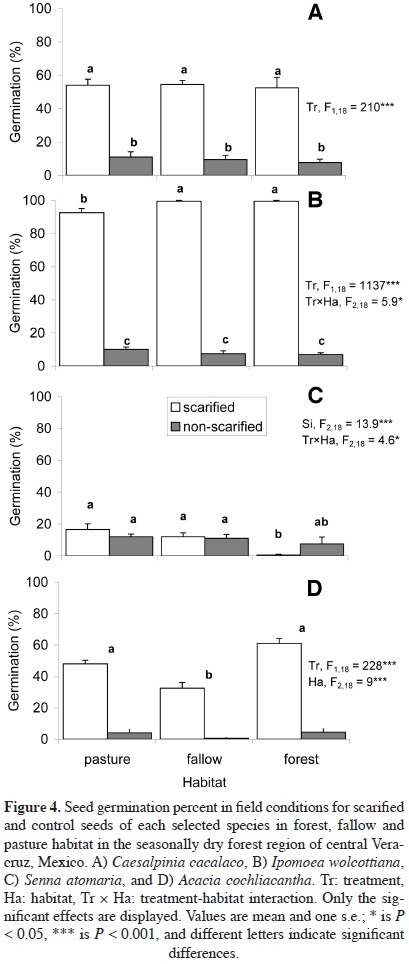
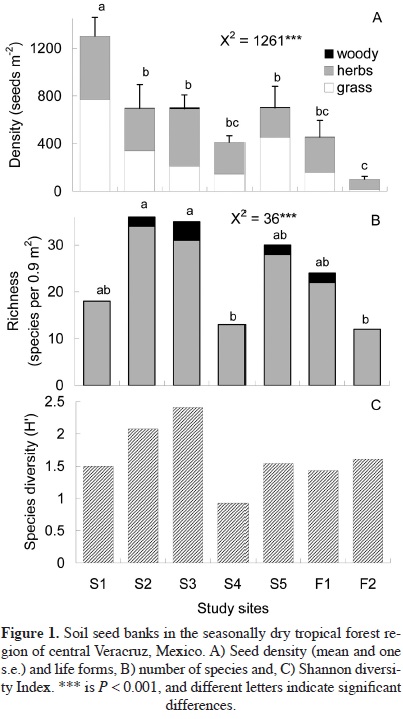
<body><![CDATA[<p align="justify"><font face="verdana" size="2">Germination data percentages were arcsine transformed, and two&#45;way ANOVAs were used to test for differences between treatments (scarification and control) and habitats (forest, fallow, and pasture) per species. When significant differences were detected, means were compared using a Tukey&#45;HSD test.</font></p>  	    <p align="justify"><font face="verdana" size="2">&nbsp;</font></p>  	    <p align="justify"><font face="verdana" size="2"><b>Results</b></font></p>  	    <p align="justify"><font face="verdana" size="2"><i>Seed bank.</i> In total, 3,946 seedlings were recorded in the soil seed bank of the study sites, corresponding to 25 families represented by 51 genera, 83 species, and three morphospecies, although graminoid species (grasses and sedges) were not identified (<a href="/img/revistas/bs/v92n1/html/a9appendix1.html" target="_blank">Appendix 1</a>). The most abundant families were Cyperaceae&#45;Poaceae (47.7%), Acanthaceae (15.2%), Euphorbiaceae (9.9%), Malvaceae (6.9%), Asteraceae (6.6%), and Fabaceae (1.8%). Life forms were unequally represented, with very few trees and abundant herbs (including sedges and grasses; <a href="#a9f1">Figure 1</a>). Seed density ranged from 101 to 1,303 seeds m<sup>&#45;2</sup>. Overall, germinated seeds significantly decreased from the most disturbed site (S1) to the forest (F1 and F2) (<a href="#a9f1">Figure 1A</a>). Richness varied from 13 to 36 species (<a href="#a9f1">Figure 1B</a>), and the Shannon diversity index was between 0.93 and 2.41 (<a href="#a9f1">Figure 1C</a>). When soil seed bank composition was compared using the Chao&#45;Jaccard Index, we found that fallows S2, S3, and S4 were highly similar. Furthermore, the soil seed bank of the two forest sites was similar between themselves and S4 too (<a href="#a9t2">Table 2</a>). However, seed bank in fallow S1 differed from all others.</font></p>  	    <p align="center"><font face="verdana" size="2"><a name="a9f1"></a></font></p>  	    <p align="center"><font face="verdana" size="2"><img src="/img/revistas/bs/v92n1/a9f1.jpg"></font></p>  	    <p align="center"><font face="verdana" size="2"><a name="a9t2"></a></font></p>  	    <p align="center"><font face="verdana" size="2"><img src="/img/revistas/bs/v92n1/a9t2.jpg"></font></p>  	    <p align="justify"><font face="verdana" size="2">The species composition found in soil seed banks and woody vegetation was dissimilar (Chao Jaccard Index = 0). Only <i>Acacia cochliacantha, Bursera cinerea,</i> and <i>Caesalpinia cacalaco</i> were found in both the seed bank and standing vegetation of the same site. However, seeds from species not present as adult plants such as <i>Ipomoea wolcottiana, Piscidia piscipula,</i> and <i>Senna atomaria</i> were found in seed banks (<a href="/img/revistas/bs/v92n1/html/a9appendix1.html" target="_blank">Appendix 1</a>).</font></p>  	    <p align="justify"><font face="verdana" size="2"><i>Seed removal.</i> Seed removal was significantly different among species (&#967;<sup>2</sup> = 1493, df = 3, <i>P</i> &lt; 0.0001) and treatments (&#967;<sup>2</sup> = 409, df = 2, <i>P</i> &lt; 0.0001). Overall, <i>Senna</i> and <i>lpomoea</i> had the highest percentage of seed removal; as could be expected, for all species the highest percentage of seed removal was recorded when seeds were offered with complete access to animals (<a href="#a9f2">Figure 2</a>). The species with the largest seeds <i>(Caesalpinia)</i> showed the lowest seed removal rate (<a href="#a9f2">Figure 2A</a>). The treatment of rodent exclosure reduced seed removal for <i>lpomoea,</i> which has medium&#45;sized seeds (<a href="#a9f2">Figure 2B</a>); the insect exclosure treatment reduced seed removal for species with small seed size, such as <i>Senna</i> (<a href="#a9f2">Figure 2C</a>) and <i>Acacia</i> (<a href="#a9f2">Figure 2D</a>).</font></p>  	    ]]></body>
<body><![CDATA[<p align="center"><font face="verdana" size="2"><a name="a9f2"></a></font></p>  	    <p align="center"><font face="verdana" size="2"><img src="/img/revistas/bs/v92n1/a9f2.jpg"></font></p>  	    <p align="justify"><font face="verdana" size="2"><i>Seed germination.</i> Under laboratory conditions, seed germination was significantly higher for seeds with mechanical scarification treatment than for untreated seeds, and was significantly different among species (<a href="/img/revistas/bs/v92n1/a9f3.jpg" target="_blank">Figure 3</a>). For scarified seeds, the highest percentages were recorded for <i>lpomoea</i> (99.0%) and <i>Caesalpinia</i> (98.5%) seeds, followed by <i>Acacia</i> (81.0%) and Senna (18.5%). In field conditions, scarified seeds also had a significantly higher germination percent for all species (47.2&#45;97.2%) except <i>Senna</i> (9.7%; <a href="#a9f4">Figure 4</a>). Species showed differences in germination percentage. <i>Caesalpinia</i> did not display significant differences between habitats (<a href="#a9f4">Figure 4A</a>), while <i>Ipomoea</i> seed germination was higher in fallow and forest than in pasture (<a href="#a9f4">Figure 4B</a>). Germination percentage for <i>Acacia</i> seeds (<a href="#a9f4">Figure 4D</a>) was higher in forest and pasture than in the fallow habitat, whereas germination in the forest was the lowest for <i>Senna</i> seeds (<a href="#a9f4">Figure 4C</a>).</font></p>  	    <p align="center"><font face="verdana" size="2"><a name="a9f4"></a></font></p>  	    <p align="center"><font face="verdana" size="2"><img src="/img/revistas/bs/v92n1/a9f4.jpg"></font></p>  	    <p align="justify"><font face="verdana" size="2">&nbsp;</font></p>  	    <p align="justify"><font face="verdana" size="2"><b>Discussion</b></font></p>  	    <p align="justify"><font face="verdana" size="2">Soil seed bank density in early successional and forest habitats was within the range found for tropical dry forests, with a trend toward more germinated seeds at more disturbed sites (70&#45;855 seed m<sup>&#45;2</sup>, Rico&#45;Gray and Garc&iacute;a&#45;Franco,1992; 700&#45;1,000 seeds m<sup>&#45;2</sup>, Miller, 1999; 466&#45;1,257 seed m<sup>&#45;2</sup>, Uasuf <i>et al.,</i> 2009; 806&#45;3,150 seed m<sup>2</sup>, Maza&#45;Villalobos <i>et al.,</i> 2011). In our study, land&#45;use history does not have a clear effect on seed bank characteristics, however, a site used for agriculture for a long time (S1, <a href="/img/revistas/bs/v92n1/a9t1.jpg" target="_blank">Table 1</a>) had the highest seed density and lower richness than the abandoned sites planted with exotic grasses and the forest sites. In Ethiopia, changes in soil seed density did not show any trend with cultivation time (Lemenih and Teketay, 2006), but in Oaxaca, Mexico, Meave <i>et al.</i> (2012) found that seed bank density tended to increase with the time of use of the agricultural fields. Whereas, along a chronosequence of abandoned pastures and forest sites in Chamela, Mexico, Maza&#45;Villalobos <i>et al.</i> (2011) reported a reduction in the seed density.</font></p>  	    <p align="justify"><font face="verdana" size="2">Previous studies have shown that the species composition of soil seed banks in SDTF and successional sites are dominated by grasses and herbs, with scarce native forest species (Garwood, 1989; Rico&#45;Gray and Garc&iacute;a&#45;Franco, 1992; Miller, 1999; Tekle and Bekele, 2000; Lemenih and Teketay, 2006; Reubens <i>et al.,</i> 2007; Salazar <i>et al.,</i> 2011; Meave <i>et al.,</i> 2012). Here, a few woody species were found in the soil bank, mostly at the successional site (S3) with high species richness both in the seed bank and vegetation; however, the soil seed bank on the forest habitats contained just two seeds from woody species. Similarity between the composition of seed banks and woody vegetation was near zero. Soil was collected before the rainy season to sample the transient plus persistent bank (Fenner and Thompson, 2005); thus, scarceness of woody species may indicate that SDTF species did not form a persistent seed bank and germinate after dispersal during the rainy season (Salazar <i>et al.,</i> 2011). At early successional sites, the limited representation of woody species in seed banks may be due to their distance from propagule sources (Garwood, 1989; Wijdeven and Kuzee, 2000; Lemenih and Teketay, 2006; Salazar <i>et</i> al., 2011), absence of seed dispersers such as birds (Jim&eacute;nez and Armesto, 1992; Rico&#45;Gray and Garc&iacute;a&#45;Franco, 1992), high predation rates (Hammond, 1995; Jones <i>et al.,</i> 2003; Briones&#45;Salas <i>et al.,</i> 2006), or the use of fire for land clearing (Miller, 1999).</font></p>  	    <p align="justify"><font face="verdana" size="2">In our study, some tree species were found in both the seed bank and vegetation, while others species were identified in the soil but not in standing vegetation. Those seeds may have arrived due to seed rain, since nearby forest patches, isolated trees that provide shade for livestock, and living fences could act as propagule sources (Holl, 1999; Ceccon <i>et al.,</i> 2006). Seed banks have been considered a limited tool in regenerating dry forest vegetation because an almost total absence of seeds from woody species (Lemenih and Teketay, 2006; Reubens <i>et al.,</i> 2007; Uasuf <i>et al.,</i> 2009; Reid and Armesto, 2011; Salazar <i>et al.,</i> 2011). However, in Nicaragua, Uasuf <i>et al.</i> (2009) found a 20% similarity between seed bank and standing vegetation; in Tanzania, Lyaruu <i>et al.</i> (2000) reported several species in common, and in Chamela, Mexico, Maza&#45;Villalobos <i>et al.</i> (2011) found that during succession the soil seed banks change and, herb and grass species may be replaced in abundance and diversity by woody species.</font></p>  	    ]]></body>
<body><![CDATA[<p align="justify"><font face="verdana" size="2">Seed removal may produce considerable seed losses (Wijdeven and Kuzee, 2000; Briones&#45;Salas <i>et al.,</i> 2006).</font></p>  	    <p align="justify"><font face="verdana" size="2">In this study, the highest seed removal rate occurred in the total access treatment, as has been observed in other SDTF studies (e.g., Hammond, 1995; Briones&#45;Salas <i>et al.,</i> 2006). Species removal agents may be small mammals such as rodents or invertebrates such as ants. Here, insects seem to be the most important seed removers. In Chiapas, Hammond (1995) found that seed removal by vertebrates is greater in early successional sites after shifting agriculture than in mature forest or at sites abandoned for more than 30 years. In Costa Rica, Jones <i>et al.</i> (2003) reported more removal in abandoned pasture adjacent to forest fragments than far from the edge; and that interspecific differences in seed removal rates were consistent with the hypothesis that in pasture, larger seeds are removed less than smaller seeds. In our study, the largest seeds are relatively small compared to the seeds of species that occur in secondary forest (Khurana and Singh, 2001; Fenner and Thompson, 2005). Nevertheless, <i>Caesalpinia,</i> the species with the largest seeds, was removed, or at least, despite the fact that it has been found as one of the most removed seed by rodents in Chamela (Briones&#45;Salas <i>et al.,</i> 2006) and, that rodents are abundant in our study area and are represented by at least eight species (G&oacute;mez&#45;Alanis, 2010). <i>lpomoea</i> (medium&#45;size seed) and <i>Senna</i> (small&#45;size seed) had the highest percentage of seed removal. In the case of <i>Ipomoea</i> seeds, a lower removal with rodent exclosure suggests that rodents were the main predator.</font></p>  	    <p align="justify"><font face="verdana" size="2">In addition, direct field observations indicated that ants also remove these seeds, as substantial amounts of seeds were found around ant nests. <i>Ipomoea</i> presented a vast seed production that can be directly related to the observed high seed removal (CAA, <i>pers. obs).</i> Several authors have found this denso&#45;dependent mechanism of higher removal rates when seed density is high (Hammond, 1995; Fenner and Thompson, 2005; Briones&#45;Salas <i>et al.,</i> 2006).</font></p>  	    <p align="justify"><font face="verdana" size="2">In this study, seed removal was relatively low in comparison with values reported for other SDTF sites (98%, Hammond, 1995; 42%, Wijdeven and Kuzee, 2000); thus, current removal rates may not be a limiting factor for regional forest regeneration. Still, before seed germination and seedling establishment take place other barriers such as seed scarification and microhabitat became apparent. Mechanical seed scarification resulted in substantially higher germination percentage, both in lab and field conditions, except for <i>Senna</i> seeds. Our results suggest that the other species <i>(Acacia, Caesalpinia,</i> and <i>Ipomoea)</i> need to be mechanically scariied to absorb water to enhance germination; otherwise, germination percentage is low and spread out over time. <i>Senna</i> as a pioneer tree, displayed lower germination in the shaded forest habitat, but also in the light&#45;controlled germination chamber, thus <i>Senna</i> seeds may have a non&#45;physical dormancy and variation in seed dormancy among populations (Lacerda <i>et al.,</i> 2004).</font></p>  	    <p align="justify"><font face="verdana" size="2"><i>Caesalpinia</i> displayed similar germination percentage in different habitats, whereas <i>Ipomoea</i> and <i>Acacia</i> had higher germination in forest habitat. In SDTF, germination and early seedling establishment mainly depend on water availability; therefore, lower germination in pasture and fallow are probably due to water stress (Lieberman and Li, 1992; Fenner and Thompson, 2005; Ceccon <i>et al.,</i> 2006; Wassie <i>et al.,</i> 2009). Scarification is required because the hard and impermeable seed coat prevents the passage of water to the embryo (Cervantes <i>et al.,</i> 1996; Camargo&#45;Ricalde and Grether, 1998; Fenner and Thompson, 2005; Wassie <i>et al.,</i> 2009; Maza&#45;Villalobos <i>et al.,</i> 2011). Seed dormancy prevails in SDTF species, but increased germination after mechanical scariication has been reported for several legume tree seeds <i>(Acacia cochliacantha,</i> Cervantes <i>et al.,</i> 1996; <i>Mimosa tenuiflora,</i> Camargo&#45;Ricalde and Grether, 1998; <i>Caesalpiniaparaguariensis,</i> Ortega <i>et al.,</i> 2001). Under natural conditions, scariication may depend on the effect of avian gut&#45;passage (Reid and Armesto, 2011), but other authors have suggested that in a dry environment, temperature fluctuations on the soil surface can soften the seed coat and allow germination (Moreno&#45;Casasola <i>et al.,</i> 1994; Ortega <i>et al.,</i> 2001; Fenner and Thompson, 2005).</font></p>  	    <p align="justify"><font face="verdana" size="2">&nbsp;</font></p>  	    <p align="justify"><font face="verdana" size="2"><b>Conclusions</b></font></p>  	    <p align="justify"><font face="verdana" size="2">This study suggests that the soil seed bank of disturbed SDTF habitats is very unlikely to contribute to forest recovery since there is no resemblance between the species composition of seed bank and vegetation. The effect of seed removal may not be a limiting factor for recovery in open areas: most seeds of the selected species suffered low removal rates. Furthermore, several seed species showed physical dormancy that broke after scarification. For restoration activities, seeds need to be mechanically scarified in order to achieve a high germination rate. In the study area, the presence of woody vegetation and the proximity to forest fragments may provide early support for forest recovery.</font></p>  	    <p align="justify"><font face="verdana" size="2">&nbsp;</font></p>  	    <p align="justify"><font face="verdana" size="2"><b>Acknowledgments</b></font></p>  	    ]]></body>
<body><![CDATA[<p align="justify"><font face="verdana" size="2">We are grateful to Javier Tolome, Marichu Peralta, and Alfonso Su&aacute;rez Islas for their valuable help and friendship. We thank Enrique Jurado and an anonymous referee for their helpful suggestions that improved this manuscript. We are grateful to the landowners who permitted fieldwork on their properties: Miguel Morales in Paso de Ovejas and Don Aurelio Molina and son in Xocotitla. This research was funded by the European Community under INCO Project ReFor&#45;Lan CT2006&#45;032132.</font></p>  	    <p align="justify"><font face="verdana" size="2">&nbsp;</font></p>  	    <p align="justify"><font face="verdana" size="2"><b>Literature cited</b></font></p>  	    <!-- ref --><p align="justify"><font face="verdana" size="2">Aerts R., Maes W., November E., Negussie A., Henry M. and Muys B. 2006. Restoring dry Afromontane forest using bird and nurse plant effects: direct sowing of <i>Orea europaea</i> ssp. <i>cuspidata</i> seeds. <i>Forest Ecology and Management</i> <b>230</b>:23&#45;31.    &nbsp;&nbsp;&nbsp;&nbsp;&nbsp;&nbsp;&nbsp;&nbsp;[&#160;<a href="javascript:void(0);" onclick="javascript: window.open('/scielo.php?script=sci_nlinks&ref=1772102&pid=S2007-4298201400010000900001&lng=','','width=640,height=500,resizable=yes,scrollbars=1,menubar=yes,');">Links</a>&#160;]<!-- end-ref --></font></p>  	    <!-- ref --><p align="justify"><font face="verdana" size="2">Baskin J.M., Nan X. and Baskin C.C. 1998. A comparative study of seed dormancy and germination in an annual and a perennial species of <i>Senna</i> (Fabaceae). <i>Seed Science Research</i> <b>8</b>:501&#45;512.    &nbsp;&nbsp;&nbsp;&nbsp;&nbsp;&nbsp;&nbsp;&nbsp;[&#160;<a href="javascript:void(0);" onclick="javascript: window.open('/scielo.php?script=sci_nlinks&ref=1772104&pid=S2007-4298201400010000900002&lng=','','width=640,height=500,resizable=yes,scrollbars=1,menubar=yes,');">Links</a>&#160;]<!-- end-ref --></font></p>      <!-- ref --><p align="justify"><font face="verdana" size="2">Briones&#45;Salas M., S&aacute;nchez&#45;Cordero V. and S&aacute;nchez&#45;Rojas G. 2006. Multi&#45;species fruit and seed removal in a tropical deciduous forest in Mexico. <i>Canadian Journal of Botany</i> <b>84</b>:433&#45;442.    &nbsp;&nbsp;&nbsp;&nbsp;&nbsp;&nbsp;&nbsp;&nbsp;[&#160;<a href="javascript:void(0);" onclick="javascript: window.open('/scielo.php?script=sci_nlinks&ref=1772106&pid=S2007-4298201400010000900003&lng=','','width=640,height=500,resizable=yes,scrollbars=1,menubar=yes,');">Links</a>&#160;]<!-- end-ref --></font></p>  	    <!-- ref --><p align="justify"><font face="verdana" size="2">Camargo&#45;Ricalde S.L. and Grether R. 1998. Germinaci&oacute;n, dispersi&oacute;n y establecimiento de pl&aacute;ntulas de <i>Mimosa tenuiflora</i> (Legu&#45;minosae) en M&eacute;xico. <i>Revista de Biolog&iacute;a Tropical</i> <b>46</b>:543&#45;554.    &nbsp;&nbsp;&nbsp;&nbsp;&nbsp;&nbsp;&nbsp;&nbsp;[&#160;<a href="javascript:void(0);" onclick="javascript: window.open('/scielo.php?script=sci_nlinks&ref=1772108&pid=S2007-4298201400010000900004&lng=','','width=640,height=500,resizable=yes,scrollbars=1,menubar=yes,');">Links</a>&#160;]<!-- end-ref --></font></p>  	    <!-- ref --><p align="justify"><font face="verdana" size="2">Ceccon E., Huante P. and Rinc&oacute;n E. 2006. Abiotic factors influencing tropical dry forests regeneration. <i>Brazilian Archives of Biology and Technology</i> <b>49</b>:305&#45;312.    &nbsp;&nbsp;&nbsp;&nbsp;&nbsp;&nbsp;&nbsp;&nbsp;[&#160;<a href="javascript:void(0);" onclick="javascript: window.open('/scielo.php?script=sci_nlinks&ref=1772110&pid=S2007-4298201400010000900005&lng=','','width=640,height=500,resizable=yes,scrollbars=1,menubar=yes,');">Links</a>&#160;]<!-- end-ref --></font></p>  	    <!-- ref --><p align="justify"><font face="verdana" size="2">Cervantes V., Carabias J. and V&aacute;zquez&#45;Ya&ntilde;ez C. 1996. Seed germination of woody legumes from deciduous tropical forest of southern Mexico. <i>Forest Ecology and Management</i> <b>82</b>:171&#45;184.    &nbsp;&nbsp;&nbsp;&nbsp;&nbsp;&nbsp;&nbsp;&nbsp;[&#160;<a href="javascript:void(0);" onclick="javascript: window.open('/scielo.php?script=sci_nlinks&ref=1772112&pid=S2007-4298201400010000900006&lng=','','width=640,height=500,resizable=yes,scrollbars=1,menubar=yes,');">Links</a>&#160;]<!-- end-ref --></font></p>      <!-- ref --><p align="justify"><font face="verdana" size="2">Colwell R.K. 2006. EstimateS: Statistical estimation of species richness and shared species from samples. Version 7.5.    &nbsp;&nbsp;&nbsp;&nbsp;&nbsp;&nbsp;&nbsp;&nbsp;[&#160;<a href="javascript:void(0);" onclick="javascript: window.open('/scielo.php?script=sci_nlinks&ref=1772114&pid=S2007-4298201400010000900007&lng=','','width=640,height=500,resizable=yes,scrollbars=1,menubar=yes,');">Links</a>&#160;]<!-- end-ref --> </font></p> 	    <!-- ref --><p align="justify"><font face="verdana" size="2">Dalling J.W. 2002. Ecolog&iacute;a de semillas. In: Guariguata M.R. and Katt&aacute;n G. Eds. <i>Ecolog&iacute;a y Conservaci&oacute;n de Bosques Neotropicales,</i> pp. 345&#45;375, Libro Universitario Regional, C&aacute;rtago.    &nbsp;&nbsp;&nbsp;&nbsp;&nbsp;&nbsp;&nbsp;&nbsp;[&#160;<a href="javascript:void(0);" onclick="javascript: window.open('/scielo.php?script=sci_nlinks&ref=1772116&pid=S2007-4298201400010000900008&lng=','','width=640,height=500,resizable=yes,scrollbars=1,menubar=yes,');">Links</a>&#160;]<!-- end-ref --></font></p>      <!-- ref --><p align="justify"><font face="verdana" size="2">Dalling J.W. and Denslow J.S. 1998. Soil seed bank composition along a forest chronosequence in seasonally moist tropical forest, Panama. <i>Journal of Vegetation Science</i> <b>9</b>:669&#45;678.    &nbsp;&nbsp;&nbsp;&nbsp;&nbsp;&nbsp;&nbsp;&nbsp;[&#160;<a href="javascript:void(0);" onclick="javascript: window.open('/scielo.php?script=sci_nlinks&ref=1772118&pid=S2007-4298201400010000900009&lng=','','width=640,height=500,resizable=yes,scrollbars=1,menubar=yes,');">Links</a>&#160;]<!-- end-ref --></font></p>  	    <!-- ref --><p align="justify"><font face="verdana" size="2">Dalling J.W., Davis A.S., Schutte B.J. and Arnold A.E. 2011. Seed survival in soil: interacting effects of predation, dormancy and the soil microbial community. <i>Journal of Ecology</i> <b>99</b>:89&#45;95.    &nbsp;&nbsp;&nbsp;&nbsp;&nbsp;&nbsp;&nbsp;&nbsp;[&#160;<a href="javascript:void(0);" onclick="javascript: window.open('/scielo.php?script=sci_nlinks&ref=1772120&pid=S2007-4298201400010000900010&lng=','','width=640,height=500,resizable=yes,scrollbars=1,menubar=yes,');">Links</a>&#160;]<!-- end-ref --></font></p>  	    <!-- ref --><p align="justify"><font face="verdana" size="2">Dias L.S. and Ganhao E. 2012. Extending the range for accurate estimation of seed volume from incomplete linear dimension data. <i>Seed Science and Technology</i> <b>40</b>:129&#45;133.    &nbsp;&nbsp;&nbsp;&nbsp;&nbsp;&nbsp;&nbsp;&nbsp;[&#160;<a href="javascript:void(0);" onclick="javascript: window.open('/scielo.php?script=sci_nlinks&ref=1772122&pid=S2007-4298201400010000900011&lng=','','width=640,height=500,resizable=yes,scrollbars=1,menubar=yes,');">Links</a>&#160;]<!-- end-ref --></font></p>  	    <!-- ref --><p align="justify"><font face="verdana" size="2">Farwig N., Bleher B., von der G&oacute;nna S. and B&oacute;hning&#45;Gaese K. 2008. Does forest fragmentation and selective logging affect seed predators and seed predation rates of <i>Prunus africana</i> (Ro&#45;saceae)? <i>Biotropica</i> <b>40</b>:218&#45;224.    &nbsp;&nbsp;&nbsp;&nbsp;&nbsp;&nbsp;&nbsp;&nbsp;[&#160;<a href="javascript:void(0);" onclick="javascript: window.open('/scielo.php?script=sci_nlinks&ref=1772124&pid=S2007-4298201400010000900012&lng=','','width=640,height=500,resizable=yes,scrollbars=1,menubar=yes,');">Links</a>&#160;]<!-- end-ref --></font></p>  	    <!-- ref --><p align="justify"><font face="verdana" size="2">Fenner M. and Thompson K. 2005. <i>The Ecology of Seeds.</i> Cambridge University Press, Cambridge.    &nbsp;&nbsp;&nbsp;&nbsp;&nbsp;&nbsp;&nbsp;&nbsp;[&#160;<a href="javascript:void(0);" onclick="javascript: window.open('/scielo.php?script=sci_nlinks&ref=1772126&pid=S2007-4298201400010000900013&lng=','','width=640,height=500,resizable=yes,scrollbars=1,menubar=yes,');">Links</a>&#160;]<!-- end-ref --></font></p>  	    <!-- ref --><p align="justify"><font face="verdana" size="2">Forget P.M. and Milleron T. 1991. Evidence for secondary seed dispersal by rodents in Panama. <i>Oecologia</i> <b>87</b>:596&#45;599.    &nbsp;&nbsp;&nbsp;&nbsp;&nbsp;&nbsp;&nbsp;&nbsp;[&#160;<a href="javascript:void(0);" onclick="javascript: window.open('/scielo.php?script=sci_nlinks&ref=1772128&pid=S2007-4298201400010000900014&lng=','','width=640,height=500,resizable=yes,scrollbars=1,menubar=yes,');">Links</a>&#160;]<!-- end-ref --></font></p>  	    <!-- ref --><p align="justify"><font face="verdana" size="2">Garwood N.C. 1989. Tropical soil seed Banks: a review. In: Allessio L.M., Thomas P.V. and Simpson R.L. Eds. <i>Ecology of Soil Seed Banks,</i> pp. 149&#45;209, Academic Press, San Diego.    &nbsp;&nbsp;&nbsp;&nbsp;&nbsp;&nbsp;&nbsp;&nbsp;[&#160;<a href="javascript:void(0);" onclick="javascript: window.open('/scielo.php?script=sci_nlinks&ref=1772130&pid=S2007-4298201400010000900015&lng=','','width=640,height=500,resizable=yes,scrollbars=1,menubar=yes,');">Links</a>&#160;]<!-- end-ref --></font></p>  	    <!-- ref --><p align="justify"><font face="verdana" size="2">G&oacute;mez&#45;Alanis, C. 2010. An&aacute;lisis multicriterio para la determinaci&oacute;n de &aacute;reas prioritarias para la conservaci&oacute;n de elementos bi&oacute;ticos y culturales en el bosque seco del centro de Veracruz, M&eacute;xico. Master Thesis. Instituto de Ecolog&iacute;a, A.C., Xalapa. 135 pp.    &nbsp;&nbsp;&nbsp;&nbsp;&nbsp;&nbsp;&nbsp;&nbsp;[&#160;<a href="javascript:void(0);" onclick="javascript: window.open('/scielo.php?script=sci_nlinks&ref=1772132&pid=S2007-4298201400010000900016&lng=','','width=640,height=500,resizable=yes,scrollbars=1,menubar=yes,');">Links</a>&#160;]<!-- end-ref --></font></p>  	    <!-- ref --><p align="justify"><font face="verdana" size="2">Gross K.L. 1990. A comparison of methods for estimating seed numbers in the soil. <i>Journal of Ecology</i> <b>78</b>:1079&#45;1093.    &nbsp;&nbsp;&nbsp;&nbsp;&nbsp;&nbsp;&nbsp;&nbsp;[&#160;<a href="javascript:void(0);" onclick="javascript: window.open('/scielo.php?script=sci_nlinks&ref=1772134&pid=S2007-4298201400010000900017&lng=','','width=640,height=500,resizable=yes,scrollbars=1,menubar=yes,');">Links</a>&#160;]<!-- end-ref --></font></p>  	    <!-- ref --><p align="justify"><font face="verdana" size="2">Hammond D.S. 1995. Post&#45;dispersal seed and seedling mortality of tropical dry forest trees after shifting agriculture, Chiapas, Mexico. <i>Journal of Tropical Ecology</i> <b>11</b>:295&#45;313.    &nbsp;&nbsp;&nbsp;&nbsp;&nbsp;&nbsp;&nbsp;&nbsp;[&#160;<a href="javascript:void(0);" onclick="javascript: window.open('/scielo.php?script=sci_nlinks&ref=1772136&pid=S2007-4298201400010000900018&lng=','','width=640,height=500,resizable=yes,scrollbars=1,menubar=yes,');">Links</a>&#160;]<!-- end-ref --></font></p>  	    <!-- ref --><p align="justify"><font face="verdana" size="2">Holl K.D. 1999. Factors limiting rain forest regeneration in abandoned pasture: seed rain, seed germination, microclimate, and soil. <i>Biotropica</i> <b>31</b>:229&#45;242.    &nbsp;&nbsp;&nbsp;&nbsp;&nbsp;&nbsp;&nbsp;&nbsp;[&#160;<a href="javascript:void(0);" onclick="javascript: window.open('/scielo.php?script=sci_nlinks&ref=1772138&pid=S2007-4298201400010000900019&lng=','','width=640,height=500,resizable=yes,scrollbars=1,menubar=yes,');">Links</a>&#160;]<!-- end-ref --></font></p>  	    <!-- ref --><p align="justify"><font face="verdana" size="2">Holl K.D. 2002. Effect of shrubs on tree seedling establishment in an abandoned tropical pasture. <i>Journal of Ecology</i> <b>90</b>:179&#45;187.    &nbsp;&nbsp;&nbsp;&nbsp;&nbsp;&nbsp;&nbsp;&nbsp;[&#160;<a href="javascript:void(0);" onclick="javascript: window.open('/scielo.php?script=sci_nlinks&ref=1772140&pid=S2007-4298201400010000900020&lng=','','width=640,height=500,resizable=yes,scrollbars=1,menubar=yes,');">Links</a>&#160;]<!-- end-ref --></font></p>  	    <!-- ref --><p align="justify"><font face="verdana" size="2">Holl K.D., Loik M.E, Lin E.H.V. and Samuels I.A. 2000. Tropical montane forest restoration in Costa Rica: overcoming barriers to dispersal and establishment. <i>Restoration Ecology</i> <b>8</b>:339&#45;349.    &nbsp;&nbsp;&nbsp;&nbsp;&nbsp;&nbsp;&nbsp;&nbsp;[&#160;<a href="javascript:void(0);" onclick="javascript: window.open('/scielo.php?script=sci_nlinks&ref=1772142&pid=S2007-4298201400010000900021&lng=','','width=640,height=500,resizable=yes,scrollbars=1,menubar=yes,');">Links</a>&#160;]<!-- end-ref --></font></p>  	    <!-- ref --><p align="justify"><font face="verdana" size="2">Jim&eacute;nez H.E. and Armesto J. 1992. Importance of the soil seed bank of disturbed sites in Chilean matorral in early secondary succession. <i>Journal of Vegetation Science</i> <b>3</b>:579&#45;586.    &nbsp;&nbsp;&nbsp;&nbsp;&nbsp;&nbsp;&nbsp;&nbsp;[&#160;<a href="javascript:void(0);" onclick="javascript: window.open('/scielo.php?script=sci_nlinks&ref=1772144&pid=S2007-4298201400010000900022&lng=','','width=640,height=500,resizable=yes,scrollbars=1,menubar=yes,');">Links</a>&#160;]<!-- end-ref --></font></p>  	    <!-- ref --><p align="justify"><font face="verdana" size="2">Jones F.A., Peterson C.J. and Haines B.L. 2003. Seed predation in Neotropical premontane pastures: site, distance, and species effects. <i>Biotropica</i> <b>35</b>:219&#45;225.    &nbsp;&nbsp;&nbsp;&nbsp;&nbsp;&nbsp;&nbsp;&nbsp;[&#160;<a href="javascript:void(0);" onclick="javascript: window.open('/scielo.php?script=sci_nlinks&ref=1772146&pid=S2007-4298201400010000900023&lng=','','width=640,height=500,resizable=yes,scrollbars=1,menubar=yes,');">Links</a>&#160;]<!-- end-ref --></font></p>  	    <!-- ref --><p align="justify"><font face="verdana" size="2">Khurana E. and Singh J.S. 2001. Ecology of seed and seedling growth for conservation and restoration of tropical dry forest: a review. <i>Environmental Conservation</i> <b>28</b>:39&#45;52.    &nbsp;&nbsp;&nbsp;&nbsp;&nbsp;&nbsp;&nbsp;&nbsp;[&#160;<a href="javascript:void(0);" onclick="javascript: window.open('/scielo.php?script=sci_nlinks&ref=1772148&pid=S2007-4298201400010000900024&lng=','','width=640,height=500,resizable=yes,scrollbars=1,menubar=yes,');">Links</a>&#160;]<!-- end-ref --></font></p>  	    <!-- ref --><p align="justify"><font face="verdana" size="2">Lacerda D.R., Filho J.P.L., Goulart M.F., Ribeiro R.A. and Lovato M.B. 2004. Seed&#45;dormancy variation in natural populations of two tropical leguminous tree species: <i>Senna multijuga</i> (Caesal&#45;pinoideae) and <i>Plathymenia reticulata</i> (Mimosoideae). <i>Seed Science Research</i> <b>14</b>:127&#45;135.    &nbsp;&nbsp;&nbsp;&nbsp;&nbsp;&nbsp;&nbsp;&nbsp;[&#160;<a href="javascript:void(0);" onclick="javascript: window.open('/scielo.php?script=sci_nlinks&ref=1772150&pid=S2007-4298201400010000900025&lng=','','width=640,height=500,resizable=yes,scrollbars=1,menubar=yes,');">Links</a>&#160;]<!-- end-ref --></font></p>  	    <!-- ref --><p align="justify"><font face="verdana" size="2">Lemenih M. and Teketay D. 2006. Changes in soil seed bank composition and density following deforestation and subsequent cultivation of a tropical dry Afromontane forest in Ethiopia. <i>Tropical Ecology</i> <b>47</b>:1&#45;12.    &nbsp;&nbsp;&nbsp;&nbsp;&nbsp;&nbsp;&nbsp;&nbsp;[&#160;<a href="javascript:void(0);" onclick="javascript: window.open('/scielo.php?script=sci_nlinks&ref=1772152&pid=S2007-4298201400010000900026&lng=','','width=640,height=500,resizable=yes,scrollbars=1,menubar=yes,');">Links</a>&#160;]<!-- end-ref --></font></p>  	    <!-- ref --><p align="justify"><font face="verdana" size="2">Lieberman D. and Li M. 1992. Seedling recruitment patterns in a tropical dry forest in Ghana. <i>Journal of Vegetation Science</i> <b>3</b>:375&#45;382.    &nbsp;&nbsp;&nbsp;&nbsp;&nbsp;&nbsp;&nbsp;&nbsp;[&#160;<a href="javascript:void(0);" onclick="javascript: window.open('/scielo.php?script=sci_nlinks&ref=1772154&pid=S2007-4298201400010000900027&lng=','','width=640,height=500,resizable=yes,scrollbars=1,menubar=yes,');">Links</a>&#160;]<!-- end-ref --></font></p>  	    <!-- ref --><p align="justify"><font face="verdana" size="2">Lyaruu H.V., Eliapenda S. and Back&eacute;us I. 2000. Floristic, structural and seed bank diversity of a dry Afromontane forest at Mafai, central Tanzania. <i>Biodiversity and Conservation</i> <b>9</b>:241&#45;263.    &nbsp;&nbsp;&nbsp;&nbsp;&nbsp;&nbsp;&nbsp;&nbsp;[&#160;<a href="javascript:void(0);" onclick="javascript: window.open('/scielo.php?script=sci_nlinks&ref=1772156&pid=S2007-4298201400010000900028&lng=','','width=640,height=500,resizable=yes,scrollbars=1,menubar=yes,');">Links</a>&#160;]<!-- end-ref --></font></p>  	    <!-- ref --><p align="justify"><font face="verdana" size="2">Maza&#45;Villalobos S., Lemus&#45;Herrera C. and Mart&iacute;nez&#45;Ramos M. 2011. Successional trends in soil seed banks of abandoned pastures of a Neotropical dry region. <i>Journal of Tropical Ecology</i> <b>27</b>:35&#45;49.    &nbsp;&nbsp;&nbsp;&nbsp;&nbsp;&nbsp;&nbsp;&nbsp;[&#160;<a href="javascript:void(0);" onclick="javascript: window.open('/scielo.php?script=sci_nlinks&ref=1772158&pid=S2007-4298201400010000900029&lng=','','width=640,height=500,resizable=yes,scrollbars=1,menubar=yes,');">Links</a>&#160;]<!-- end-ref --></font></p>  	    <!-- ref --><p align="justify"><font face="verdana" size="2">Meave J.A., Flores&#45;Rodr&iacute;guez C., P&eacute;rez&#45;Garc&iacute;a E.A. and Romero&#45;Romero M.A. 2012. Edaphic and seasonal heterogeneity of seed banks in agricultural fields of a tropical dry forest region in Southern Mexico. <i>Botanical Sciences</i> <b>90</b>:313&#45;329.    &nbsp;&nbsp;&nbsp;&nbsp;&nbsp;&nbsp;&nbsp;&nbsp;[&#160;<a href="javascript:void(0);" onclick="javascript: window.open('/scielo.php?script=sci_nlinks&ref=1772160&pid=S2007-4298201400010000900030&lng=','','width=640,height=500,resizable=yes,scrollbars=1,menubar=yes,');">Links</a>&#160;]<!-- end-ref --></font></p>  	    <!-- ref --><p align="justify"><font face="verdana" size="2">Miller PM. 1999. Effects of deforestation on seed banks in a tropical deciduous forest of western Mexico. <i>Journal of Tropical Ecology</i> <b>15</b>:179&#45;188.    &nbsp;&nbsp;&nbsp;&nbsp;&nbsp;&nbsp;&nbsp;&nbsp;[&#160;<a href="javascript:void(0);" onclick="javascript: window.open('/scielo.php?script=sci_nlinks&ref=1772162&pid=S2007-4298201400010000900031&lng=','','width=640,height=500,resizable=yes,scrollbars=1,menubar=yes,');">Links</a>&#160;]<!-- end-ref --></font></p>  	    <!-- ref --><p align="justify"><font face="verdana" size="2">Moreno&#45;Casasola P., Grime J.P. and Mart&iacute;nez M.L. 1994. A comparative study of the effects of fluctuations in temperature and moisture supply on hard coat dormancy in seeds of coastal tropical legumes in Mexico. <i>Journal of Tropical Ecology</i> <b>10</b>:67&#45;86.    &nbsp;&nbsp;&nbsp;&nbsp;&nbsp;&nbsp;&nbsp;&nbsp;[&#160;<a href="javascript:void(0);" onclick="javascript: window.open('/scielo.php?script=sci_nlinks&ref=1772164&pid=S2007-4298201400010000900032&lng=','','width=640,height=500,resizable=yes,scrollbars=1,menubar=yes,');">Links</a>&#160;]<!-- end-ref --></font></p>      <!-- ref --><p align="justify"><font face="verdana" size="2">Ortega B.P., De Viana M.L., Larenas G. and Saravia M. 2001. Germinaci&oacute;n de semillas de <i>Caesalpinia paraguariensis</i> (Fabaceae): agentes escarificadores y efecto del ganado. <i>Revista de</i> <i>Biolog&iacute;a Tropical</i> <b>49</b>:301&#45;304.    &nbsp;&nbsp;&nbsp;&nbsp;&nbsp;&nbsp;&nbsp;&nbsp;[&#160;<a href="javascript:void(0);" onclick="javascript: window.open('/scielo.php?script=sci_nlinks&ref=1772166&pid=S2007-4298201400010000900033&lng=','','width=640,height=500,resizable=yes,scrollbars=1,menubar=yes,');">Links</a>&#160;]<!-- end-ref --></font></p>  	    <!-- ref --><p align="justify"><font face="verdana" size="2">Reid S. and Armesto J.J. 2011. Avian gut&#45;passage effects on seed germination of shrubland species in Mediterranean central Chile. <i>Plant Ecology</i> <b>212</b>:1&#45;10.    &nbsp;&nbsp;&nbsp;&nbsp;&nbsp;&nbsp;&nbsp;&nbsp;[&#160;<a href="javascript:void(0);" onclick="javascript: window.open('/scielo.php?script=sci_nlinks&ref=1772168&pid=S2007-4298201400010000900034&lng=','','width=640,height=500,resizable=yes,scrollbars=1,menubar=yes,');">Links</a>&#160;]<!-- end-ref --></font></p>  	    <!-- ref --><p align="justify"><font face="verdana" size="2">Reubens B., Heyn M., Gebrehiwot K., Hermy M. and Muys. 2007. Persistent soil seed banks for natural rehabilitation of dry tropical forests in northern Ethiopia. <i>Tropicultura</i> <b>25</b>:204&#45;214.    &nbsp;&nbsp;&nbsp;&nbsp;&nbsp;&nbsp;&nbsp;&nbsp;[&#160;<a href="javascript:void(0);" onclick="javascript: window.open('/scielo.php?script=sci_nlinks&ref=1772170&pid=S2007-4298201400010000900035&lng=','','width=640,height=500,resizable=yes,scrollbars=1,menubar=yes,');">Links</a>&#160;]<!-- end-ref --></font></p>  	    <!-- ref --><p align="justify"><font face="verdana" size="2">Rico&#45;Gray V. and Garc&iacute;a&#45;Franco J.G. 1992. Vegetation and soil seed bank of successional stages in tropical lowland deciduous forest. <i>Journal of Vegetation Science</i> <b>3</b>:617&#45;624.    &nbsp;&nbsp;&nbsp;&nbsp;&nbsp;&nbsp;&nbsp;&nbsp;[&#160;<a href="javascript:void(0);" onclick="javascript: window.open('/scielo.php?script=sci_nlinks&ref=1772172&pid=S2007-4298201400010000900036&lng=','','width=640,height=500,resizable=yes,scrollbars=1,menubar=yes,');">Links</a>&#160;]<!-- end-ref --></font></p>  	    <!-- ref --><p align="justify"><font face="verdana" size="2">Salazar A., Goldstein G., Franco A.C. and Miralles&#45;Wilhelm F. 2011. Timing of seed dispersal and dormancy, rather than persistent soil seed&#45;banks, control seedling recruitment of woody plants in Neotropical savannas. <i>Seed Science Research</i> <b>21</b>:103&#45;116.    &nbsp;&nbsp;&nbsp;&nbsp;&nbsp;&nbsp;&nbsp;&nbsp;[&#160;<a href="javascript:void(0);" onclick="javascript: window.open('/scielo.php?script=sci_nlinks&ref=1772174&pid=S2007-4298201400010000900037&lng=','','width=640,height=500,resizable=yes,scrollbars=1,menubar=yes,');">Links</a>&#160;]<!-- end-ref --></font></p>  	    <!-- ref --><p align="justify"><font face="verdana" size="2">Skoglund J. 1992. The role of seed banks in vegetation dynamics and restoration of dry tropical ecosystems. <i>Journal of Vegetation Science</i> <b>3</b>:357&#45;360.    &nbsp;&nbsp;&nbsp;&nbsp;&nbsp;&nbsp;&nbsp;&nbsp;[&#160;<a href="javascript:void(0);" onclick="javascript: window.open('/scielo.php?script=sci_nlinks&ref=1772176&pid=S2007-4298201400010000900038&lng=','','width=640,height=500,resizable=yes,scrollbars=1,menubar=yes,');">Links</a>&#160;]<!-- end-ref --></font></p>  	    <!-- ref --><p align="justify"><font face="verdana" size="2">Tekle K. and Bekele T. 2000. The role of soil seed banks in the rehabilitation of degraded hillslopes in southern Wello, Ethiopia. <i>Biotropica</i> <b>32</b>:23&#45;32.    &nbsp;&nbsp;&nbsp;&nbsp;&nbsp;&nbsp;&nbsp;&nbsp;[&#160;<a href="javascript:void(0);" onclick="javascript: window.open('/scielo.php?script=sci_nlinks&ref=1772178&pid=S2007-4298201400010000900039&lng=','','width=640,height=500,resizable=yes,scrollbars=1,menubar=yes,');">Links</a>&#160;]<!-- end-ref --></font></p>  	    <!-- ref --><p align="justify"><font face="verdana" size="2">Uasuf A., Tigabu M. and Od&eacute;n P.C. 2009. Soil seed banks and regeneration of Neotropical dry deciduous and gallery forests in Nicaragua. <i>Bois et For&ecirc;ts des Tropiques</i> <b>299</b>:49&#45;62.    &nbsp;&nbsp;&nbsp;&nbsp;&nbsp;&nbsp;&nbsp;&nbsp;[&#160;<a href="javascript:void(0);" onclick="javascript: window.open('/scielo.php?script=sci_nlinks&ref=1772180&pid=S2007-4298201400010000900040&lng=','','width=640,height=500,resizable=yes,scrollbars=1,menubar=yes,');">Links</a>&#160;]<!-- end-ref --></font></p>  	    <!-- ref --><p align="justify"><font face="verdana" size="2">Vieira D.L.M. and Scariot A. 2006. Principles of natural regeneration of topical dry forests for restoration. <i>Restoration Ecology</i> 14:11&#45;20.    &nbsp;&nbsp;&nbsp;&nbsp;&nbsp;&nbsp;&nbsp;&nbsp;[&#160;<a href="javascript:void(0);" onclick="javascript: window.open('/scielo.php?script=sci_nlinks&ref=1772182&pid=S2007-4298201400010000900041&lng=','','width=640,height=500,resizable=yes,scrollbars=1,menubar=yes,');">Links</a>&#160;]<!-- end-ref --></font></p>  	    <!-- ref --><p align="justify"><font face="verdana" size="2">Wassie A., Sterck F.J., Teketay D. and Bongers F. 2009. Tree regeneration in Church forests of Ethiopia: effects of microsites and management. <i>Biotropica</i> <b>41</b>:110&#45;119.    &nbsp;&nbsp;&nbsp;&nbsp;&nbsp;&nbsp;&nbsp;&nbsp;[&#160;<a href="javascript:void(0);" onclick="javascript: window.open('/scielo.php?script=sci_nlinks&ref=1772184&pid=S2007-4298201400010000900042&lng=','','width=640,height=500,resizable=yes,scrollbars=1,menubar=yes,');">Links</a>&#160;]<!-- end-ref --></font></p>  	    <!-- ref --><p align="justify"><font face="verdana" size="2">Wijdeven S.M.J. and Kuzee M.E. 2000. Seed availability as a limiting factor in forest recovery processes in Costa Rica. <i>Restoration Ecology</i> <b>8</b>:414&#45;424.    &nbsp;&nbsp;&nbsp;&nbsp;&nbsp;&nbsp;&nbsp;&nbsp;[&#160;<a href="javascript:void(0);" onclick="javascript: window.open('/scielo.php?script=sci_nlinks&ref=1772186&pid=S2007-4298201400010000900043&lng=','','width=640,height=500,resizable=yes,scrollbars=1,menubar=yes,');">Links</a>&#160;]<!-- end-ref --></font></p>  	    <!-- ref --><p align="justify"><font face="verdana" size="2">Williams&#45;Linera G. and Lorea F. 2009. Tree species diversity driven by environmental and anthropogenic factors in tropical dry forest fragments of central Veracruz, Mexico. <i>Biodiversity and Conservation</i> <b>18</b>:3269&#45;3293.    &nbsp;&nbsp;&nbsp;&nbsp;&nbsp;&nbsp;&nbsp;&nbsp;[&#160;<a href="javascript:void(0);" onclick="javascript: window.open('/scielo.php?script=sci_nlinks&ref=1772188&pid=S2007-4298201400010000900044&lng=','','width=640,height=500,resizable=yes,scrollbars=1,menubar=yes,');">Links</a>&#160;]<!-- end-ref --></font></p>  	    <!-- ref --><p align="justify"><font face="verdana" size="2">Williams&#45;Linera G., Alvarez&#45;Aquino C., Hern&aacute;ndez&#45;Ascenci&oacute;n E. and Toledo M. 2011. Early successional sites and the recovery of vegetation structure and tree species of the tropical dry forest in Veracruz, Mexico. <i>New Forests</i> <b>42</b>:131&#45;148.    &nbsp;&nbsp;&nbsp;&nbsp;&nbsp;&nbsp;&nbsp;&nbsp;[&#160;<a href="javascript:void(0);" onclick="javascript: window.open('/scielo.php?script=sci_nlinks&ref=1772190&pid=S2007-4298201400010000900045&lng=','','width=640,height=500,resizable=yes,scrollbars=1,menubar=yes,');">Links</a>&#160;]<!-- end-ref --></font></p>  	    <!-- ref --><p align="justify"><font face="verdana" size="2">Zahawi R.A. and Augspurger C.K. 1999. Early plant succession in abandoned pastures in Ecuador. <i>Biotropica</i> <b>31</b>:540&#45;552.    &nbsp;&nbsp;&nbsp;&nbsp;&nbsp;&nbsp;&nbsp;&nbsp;[&#160;<a href="javascript:void(0);" onclick="javascript: window.open('/scielo.php?script=sci_nlinks&ref=1772192&pid=S2007-4298201400010000900046&lng=','','width=640,height=500,resizable=yes,scrollbars=1,menubar=yes,');">Links</a>&#160;]<!-- end-ref --></font></p>      ]]></body><back>
<ref-list>
<ref id="B1">
<nlm-citation citation-type="journal">
<person-group person-group-type="author">
<name>
<surname><![CDATA[Aerts]]></surname>
<given-names><![CDATA[R.]]></given-names>
</name>
<name>
<surname><![CDATA[Maes]]></surname>
<given-names><![CDATA[W.]]></given-names>
</name>
<name>
<surname><![CDATA[November]]></surname>
<given-names><![CDATA[E.]]></given-names>
</name>
<name>
<surname><![CDATA[Negussie]]></surname>
<given-names><![CDATA[A.]]></given-names>
</name>
<name>
<surname><![CDATA[Henry]]></surname>
<given-names><![CDATA[M.]]></given-names>
</name>
<name>
<surname><![CDATA[Muys]]></surname>
<given-names><![CDATA[B.]]></given-names>
</name>
</person-group>
<article-title xml:lang="en"><![CDATA[Restoring dry Afromontane forest using bird and nurse plant effects: direct sowing of Orea europaea ssp. cuspidata seeds]]></article-title>
<source><![CDATA[Forest Ecology and Management]]></source>
<year>2006</year>
<volume>230</volume>
<page-range>23-31</page-range></nlm-citation>
</ref>
<ref id="B2">
<nlm-citation citation-type="journal">
<person-group person-group-type="author">
<name>
<surname><![CDATA[Baskin]]></surname>
<given-names><![CDATA[J.M.]]></given-names>
</name>
<name>
<surname><![CDATA[Nan]]></surname>
<given-names><![CDATA[X.]]></given-names>
</name>
<name>
<surname><![CDATA[Baskin]]></surname>
<given-names><![CDATA[C.C.]]></given-names>
</name>
</person-group>
<article-title xml:lang="en"><![CDATA[A comparative study of seed dormancy and germination in an annual and a perennial species of Senna (Fabaceae)]]></article-title>
<source><![CDATA[Seed Science Research]]></source>
<year>1998</year>
<volume>8</volume>
<page-range>501-512</page-range></nlm-citation>
</ref>
<ref id="B3">
<nlm-citation citation-type="journal">
<person-group person-group-type="author">
<name>
<surname><![CDATA[Briones-Salas]]></surname>
<given-names><![CDATA[M.]]></given-names>
</name>
<name>
<surname><![CDATA[Sánchez-Cordero]]></surname>
<given-names><![CDATA[V.]]></given-names>
</name>
<name>
<surname><![CDATA[Sánchez-Rojas]]></surname>
<given-names><![CDATA[G.]]></given-names>
</name>
</person-group>
<article-title xml:lang="en"><![CDATA[Multi-species fruit and seed removal in a tropical deciduous forest in Mexico]]></article-title>
<source><![CDATA[Canadian Journal of Botany]]></source>
<year>2006</year>
<volume>84</volume>
<page-range>433-442</page-range></nlm-citation>
</ref>
<ref id="B4">
<nlm-citation citation-type="journal">
<person-group person-group-type="author">
<name>
<surname><![CDATA[Camargo-Ricalde]]></surname>
<given-names><![CDATA[S.L.]]></given-names>
</name>
<name>
<surname><![CDATA[Grether]]></surname>
<given-names><![CDATA[R.]]></given-names>
</name>
</person-group>
<article-title xml:lang="es"><![CDATA[Germinación, dispersión y establecimiento de plántulas de Mimosa tenuiflora (Legu-minosae) en México]]></article-title>
<source><![CDATA[Revista de Biología Tropical]]></source>
<year>1998</year>
<volume>46</volume>
<page-range>543-554</page-range></nlm-citation>
</ref>
<ref id="B5">
<nlm-citation citation-type="journal">
<person-group person-group-type="author">
<name>
<surname><![CDATA[Ceccon]]></surname>
<given-names><![CDATA[E.]]></given-names>
</name>
<name>
<surname><![CDATA[Huante]]></surname>
<given-names><![CDATA[P.]]></given-names>
</name>
<name>
<surname><![CDATA[Rincón]]></surname>
<given-names><![CDATA[E.]]></given-names>
</name>
</person-group>
<article-title xml:lang="en"><![CDATA[Abiotic factors influencing tropical dry forests regeneration]]></article-title>
<source><![CDATA[Brazilian Archives of Biology and Technology]]></source>
<year>2006</year>
<volume>49</volume>
<page-range>305-312</page-range></nlm-citation>
</ref>
<ref id="B6">
<nlm-citation citation-type="journal">
<person-group person-group-type="author">
<name>
<surname><![CDATA[Cervantes]]></surname>
<given-names><![CDATA[V.]]></given-names>
</name>
<name>
<surname><![CDATA[Carabias]]></surname>
<given-names><![CDATA[J.]]></given-names>
</name>
<name>
<surname><![CDATA[Vázquez-Yañez]]></surname>
<given-names><![CDATA[C.]]></given-names>
</name>
</person-group>
<article-title xml:lang="en"><![CDATA[Seed germination of woody legumes from deciduous tropical forest of southern Mexico]]></article-title>
<source><![CDATA[Forest Ecology and Management]]></source>
<year>1996</year>
<volume>82</volume>
<page-range>171-184</page-range></nlm-citation>
</ref>
<ref id="B7">
<nlm-citation citation-type="">
<person-group person-group-type="author">
<name>
<surname><![CDATA[Colwell]]></surname>
<given-names><![CDATA[R.K.]]></given-names>
</name>
</person-group>
<source><![CDATA[EstimateS: Statistical estimation of species richness and shared species from samples. Version 7.5]]></source>
<year>2006</year>
</nlm-citation>
</ref>
<ref id="B8">
<nlm-citation citation-type="book">
<person-group person-group-type="author">
<name>
<surname><![CDATA[Dalling]]></surname>
<given-names><![CDATA[J.W.]]></given-names>
</name>
</person-group>
<article-title xml:lang="es"><![CDATA[Ecología de semillas]]></article-title>
<person-group person-group-type="editor">
<name>
<surname><![CDATA[Guariguata]]></surname>
<given-names><![CDATA[M.R.]]></given-names>
</name>
<name>
<surname><![CDATA[Kattán]]></surname>
<given-names><![CDATA[G.]]></given-names>
</name>
</person-group>
<source><![CDATA[Ecología y Conservación de Bosques Neotropicales]]></source>
<year>2002</year>
<page-range>345-375</page-range><publisher-loc><![CDATA[Cártago ]]></publisher-loc>
<publisher-name><![CDATA[Libro Universitario Regional]]></publisher-name>
</nlm-citation>
</ref>
<ref id="B9">
<nlm-citation citation-type="journal">
<person-group person-group-type="author">
<name>
<surname><![CDATA[Dalling]]></surname>
<given-names><![CDATA[J.W.]]></given-names>
</name>
<name>
<surname><![CDATA[Denslow]]></surname>
<given-names><![CDATA[J.S.]]></given-names>
</name>
</person-group>
<article-title xml:lang="en"><![CDATA[Soil seed bank composition along a forest chronosequence in seasonally moist tropical forest, Panama]]></article-title>
<source><![CDATA[Journal of Vegetation Science]]></source>
<year>1998</year>
<volume>9</volume>
<page-range>669-678</page-range></nlm-citation>
</ref>
<ref id="B10">
<nlm-citation citation-type="journal">
<person-group person-group-type="author">
<name>
<surname><![CDATA[Dalling]]></surname>
<given-names><![CDATA[J.W.]]></given-names>
</name>
<name>
<surname><![CDATA[Davis]]></surname>
<given-names><![CDATA[A.S.]]></given-names>
</name>
<name>
<surname><![CDATA[Schutte]]></surname>
<given-names><![CDATA[B.J.]]></given-names>
</name>
<name>
<surname><![CDATA[Arnold]]></surname>
<given-names><![CDATA[A.E.]]></given-names>
</name>
</person-group>
<article-title xml:lang="en"><![CDATA[Seed survival in soil: interacting effects of predation, dormancy and the soil microbial community]]></article-title>
<source><![CDATA[Journal of Ecology]]></source>
<year>2011</year>
<volume>99</volume>
<page-range>89-95</page-range></nlm-citation>
</ref>
<ref id="B11">
<nlm-citation citation-type="journal">
<person-group person-group-type="author">
<name>
<surname><![CDATA[Dias]]></surname>
<given-names><![CDATA[L.S.]]></given-names>
</name>
<name>
<surname><![CDATA[Ganhao]]></surname>
<given-names><![CDATA[E.]]></given-names>
</name>
</person-group>
<article-title xml:lang="en"><![CDATA[Extending the range for accurate estimation of seed volume from incomplete linear dimension data]]></article-title>
<source><![CDATA[Seed Science and Technology]]></source>
<year>2012</year>
<volume>40</volume>
<page-range>129-133</page-range></nlm-citation>
</ref>
<ref id="B12">
<nlm-citation citation-type="journal">
<person-group person-group-type="author">
<name>
<surname><![CDATA[Farwig]]></surname>
<given-names><![CDATA[N.]]></given-names>
</name>
<name>
<surname><![CDATA[Bleher]]></surname>
<given-names><![CDATA[B.]]></given-names>
</name>
<name>
<surname><![CDATA[von der Gónna]]></surname>
<given-names><![CDATA[S.]]></given-names>
</name>
<name>
<surname><![CDATA[Bóhning-Gaese]]></surname>
<given-names><![CDATA[K.]]></given-names>
</name>
</person-group>
<article-title xml:lang="en"><![CDATA[Does forest fragmentation and selective logging affect seed predators and seed predation rates of Prunus africana (Ro-saceae)?]]></article-title>
<source><![CDATA[Biotropica]]></source>
<year>2008</year>
<volume>40</volume>
<page-range>218-224</page-range></nlm-citation>
</ref>
<ref id="B13">
<nlm-citation citation-type="book">
<person-group person-group-type="author">
<name>
<surname><![CDATA[Fenner]]></surname>
<given-names><![CDATA[M.]]></given-names>
</name>
<name>
<surname><![CDATA[Thompson]]></surname>
<given-names><![CDATA[K.]]></given-names>
</name>
</person-group>
<source><![CDATA[The Ecology of Seeds]]></source>
<year>2005</year>
<publisher-loc><![CDATA[Cambridge ]]></publisher-loc>
<publisher-name><![CDATA[Cambridge University Press]]></publisher-name>
</nlm-citation>
</ref>
<ref id="B14">
<nlm-citation citation-type="journal">
<person-group person-group-type="author">
<name>
<surname><![CDATA[Forget]]></surname>
<given-names><![CDATA[P.M.]]></given-names>
</name>
<name>
<surname><![CDATA[Milleron]]></surname>
<given-names><![CDATA[T.]]></given-names>
</name>
</person-group>
<article-title xml:lang="en"><![CDATA[Evidence for secondary seed dispersal by rodents in Panama]]></article-title>
<source><![CDATA[Oecologia]]></source>
<year>1991</year>
<volume>87</volume>
<page-range>596-599</page-range></nlm-citation>
</ref>
<ref id="B15">
<nlm-citation citation-type="book">
<person-group person-group-type="author">
<name>
<surname><![CDATA[Garwood]]></surname>
<given-names><![CDATA[N.C.]]></given-names>
</name>
</person-group>
<article-title xml:lang="en"><![CDATA[Tropical soil seed Banks: a review]]></article-title>
<person-group person-group-type="editor">
<name>
<surname><![CDATA[Allessio]]></surname>
<given-names><![CDATA[L.M.]]></given-names>
</name>
<name>
<surname><![CDATA[Thomas]]></surname>
<given-names><![CDATA[P.V.]]></given-names>
</name>
<name>
<surname><![CDATA[Simpson]]></surname>
<given-names><![CDATA[R.L.]]></given-names>
</name>
</person-group>
<source><![CDATA[Ecology of Soil Seed Bank]]></source>
<year>1989</year>
<page-range>149-209</page-range><publisher-loc><![CDATA[San Diego ]]></publisher-loc>
<publisher-name><![CDATA[Academic Press]]></publisher-name>
</nlm-citation>
</ref>
<ref id="B16">
<nlm-citation citation-type="">
<person-group person-group-type="author">
<name>
<surname><![CDATA[Gómez-Alanis]]></surname>
<given-names><![CDATA[C.]]></given-names>
</name>
</person-group>
<source><![CDATA[Análisis multicriterio para la determinación de áreas prioritarias para la conservación de elementos bióticos y culturales en el bosque seco del centro de Veracruz, México]]></source>
<year>2010</year>
<page-range>135</page-range></nlm-citation>
</ref>
<ref id="B17">
<nlm-citation citation-type="journal">
<person-group person-group-type="author">
<name>
<surname><![CDATA[Gross]]></surname>
<given-names><![CDATA[K.L.]]></given-names>
</name>
</person-group>
<article-title xml:lang="en"><![CDATA[A comparison of methods for estimating seed numbers in the soil]]></article-title>
<source><![CDATA[Journal of Ecology]]></source>
<year>1990</year>
<volume>78</volume>
<page-range>1079-1093</page-range></nlm-citation>
</ref>
<ref id="B18">
<nlm-citation citation-type="journal">
<person-group person-group-type="author">
<name>
<surname><![CDATA[Hammond]]></surname>
<given-names><![CDATA[D.S.]]></given-names>
</name>
</person-group>
<article-title xml:lang="en"><![CDATA[Post-dispersal seed and seedling mortality of tropical dry forest trees after shifting agriculture, Chiapas, Mexico]]></article-title>
<source><![CDATA[Journal of Tropical Ecology]]></source>
<year>1995</year>
<volume>11</volume>
<page-range>295-313</page-range></nlm-citation>
</ref>
<ref id="B19">
<nlm-citation citation-type="journal">
<person-group person-group-type="author">
<name>
<surname><![CDATA[Holl]]></surname>
<given-names><![CDATA[K.D.]]></given-names>
</name>
</person-group>
<article-title xml:lang="en"><![CDATA[Factors limiting rain forest regeneration in abandoned pasture: seed rain, seed germination, microclimate, and soil]]></article-title>
<source><![CDATA[Biotropica]]></source>
<year>1999</year>
<volume>31</volume>
<page-range>229-242</page-range></nlm-citation>
</ref>
<ref id="B20">
<nlm-citation citation-type="journal">
<person-group person-group-type="author">
<name>
<surname><![CDATA[Holl]]></surname>
<given-names><![CDATA[K.D.]]></given-names>
</name>
</person-group>
<article-title xml:lang="en"><![CDATA[Effect of shrubs on tree seedling establishment in an abandoned tropical pasture]]></article-title>
<source><![CDATA[Journal of Ecology]]></source>
<year>2002</year>
<volume>90</volume>
<page-range>179-187</page-range></nlm-citation>
</ref>
<ref id="B21">
<nlm-citation citation-type="journal">
<person-group person-group-type="author">
<name>
<surname><![CDATA[Holl]]></surname>
<given-names><![CDATA[K.D.]]></given-names>
</name>
<name>
<surname><![CDATA[Loik]]></surname>
<given-names><![CDATA[M.E]]></given-names>
</name>
<name>
<surname><![CDATA[Lin]]></surname>
<given-names><![CDATA[E.H.V.]]></given-names>
</name>
<name>
<surname><![CDATA[Samuels]]></surname>
<given-names><![CDATA[I.A.]]></given-names>
</name>
</person-group>
<article-title xml:lang="en"><![CDATA[Tropical montane forest restoration in Costa Rica: overcoming barriers to dispersal and establishment]]></article-title>
<source><![CDATA[Restoration Ecology]]></source>
<year>2000</year>
<volume>8</volume>
<page-range>339-349</page-range></nlm-citation>
</ref>
<ref id="B22">
<nlm-citation citation-type="journal">
<person-group person-group-type="author">
<name>
<surname><![CDATA[Jiménez]]></surname>
<given-names><![CDATA[H.E.]]></given-names>
</name>
<name>
<surname><![CDATA[Armesto]]></surname>
<given-names><![CDATA[J.]]></given-names>
</name>
</person-group>
<article-title xml:lang="en"><![CDATA[Importance of the soil seed bank of disturbed sites in Chilean matorral in early secondary succession]]></article-title>
<source><![CDATA[Journal of Vegetation Science]]></source>
<year>1992</year>
<volume>3</volume>
<page-range>579-586</page-range></nlm-citation>
</ref>
<ref id="B23">
<nlm-citation citation-type="journal">
<person-group person-group-type="author">
<name>
<surname><![CDATA[Jones]]></surname>
<given-names><![CDATA[F.A.]]></given-names>
</name>
<name>
<surname><![CDATA[Peterson]]></surname>
<given-names><![CDATA[C.J.]]></given-names>
</name>
<name>
<surname><![CDATA[Haines]]></surname>
<given-names><![CDATA[B.L.]]></given-names>
</name>
</person-group>
<article-title xml:lang="en"><![CDATA[Seed predation in Neotropical premontane pastures: site, distance, and species effects]]></article-title>
<source><![CDATA[Biotropica]]></source>
<year>2003</year>
<volume>35</volume>
<page-range>219-225</page-range></nlm-citation>
</ref>
<ref id="B24">
<nlm-citation citation-type="journal">
<person-group person-group-type="author">
<name>
<surname><![CDATA[Khurana]]></surname>
<given-names><![CDATA[E.]]></given-names>
</name>
<name>
<surname><![CDATA[Singh]]></surname>
<given-names><![CDATA[J.S.]]></given-names>
</name>
</person-group>
<article-title xml:lang="en"><![CDATA[Ecology of seed and seedling growth for conservation and restoration of tropical dry forest: a review]]></article-title>
<source><![CDATA[Environmental Conservation]]></source>
<year>2001</year>
<volume>28</volume>
<page-range>39-52</page-range></nlm-citation>
</ref>
<ref id="B25">
<nlm-citation citation-type="journal">
<person-group person-group-type="author">
<name>
<surname><![CDATA[Lacerda]]></surname>
<given-names><![CDATA[D.R.]]></given-names>
</name>
<name>
<surname><![CDATA[Filho]]></surname>
<given-names><![CDATA[J.P.L.]]></given-names>
</name>
<name>
<surname><![CDATA[Goulart]]></surname>
<given-names><![CDATA[M.F.]]></given-names>
</name>
<name>
<surname><![CDATA[Ribeiro]]></surname>
<given-names><![CDATA[R.A.]]></given-names>
</name>
<name>
<surname><![CDATA[Lovato]]></surname>
<given-names><![CDATA[M.B.]]></given-names>
</name>
</person-group>
<article-title xml:lang="en"><![CDATA[Seed-dormancy variation in natural populations of two tropical leguminous tree species: Senna multijuga (Caesal-pinoideae) and Plathymenia reticulata (Mimosoideae)]]></article-title>
<source><![CDATA[Seed Science Research]]></source>
<year>2004</year>
<volume>14</volume>
<page-range>127-135</page-range></nlm-citation>
</ref>
<ref id="B26">
<nlm-citation citation-type="journal">
<person-group person-group-type="author">
<name>
<surname><![CDATA[Lemenih]]></surname>
<given-names><![CDATA[M.]]></given-names>
</name>
<name>
<surname><![CDATA[Teketay]]></surname>
<given-names><![CDATA[D.]]></given-names>
</name>
</person-group>
<article-title xml:lang="en"><![CDATA[Changes in soil seed bank composition and density following deforestation and subsequent cultivation of a tropical dry Afromontane forest in Ethiopia]]></article-title>
<source><![CDATA[Tropical Ecology]]></source>
<year>2006</year>
<volume>47</volume>
<page-range>1-12</page-range></nlm-citation>
</ref>
<ref id="B27">
<nlm-citation citation-type="journal">
<person-group person-group-type="author">
<name>
<surname><![CDATA[Lieberman]]></surname>
<given-names><![CDATA[D.]]></given-names>
</name>
<name>
<surname><![CDATA[Li]]></surname>
<given-names><![CDATA[M.]]></given-names>
</name>
</person-group>
<article-title xml:lang="en"><![CDATA[Seedling recruitment patterns in a tropical dry forest in Ghana]]></article-title>
<source><![CDATA[Journal of Vegetation Science]]></source>
<year>1992</year>
<volume>3</volume>
<page-range>375-382</page-range></nlm-citation>
</ref>
<ref id="B28">
<nlm-citation citation-type="journal">
<person-group person-group-type="author">
<name>
<surname><![CDATA[Lyaruu]]></surname>
<given-names><![CDATA[H.V.]]></given-names>
</name>
<name>
<surname><![CDATA[Eliapenda]]></surname>
<given-names><![CDATA[S.]]></given-names>
</name>
<name>
<surname><![CDATA[Backéus]]></surname>
<given-names><![CDATA[I.]]></given-names>
</name>
</person-group>
<article-title xml:lang="en"><![CDATA[Floristic, structural and seed bank diversity of a dry Afromontane forest at Mafai, central Tanzania]]></article-title>
<source><![CDATA[Biodiversity and Conservation]]></source>
<year>2000</year>
<volume>9</volume>
<page-range>241-263</page-range></nlm-citation>
</ref>
<ref id="B29">
<nlm-citation citation-type="journal">
<person-group person-group-type="author">
<name>
<surname><![CDATA[Maza-Villalobos]]></surname>
<given-names><![CDATA[S.]]></given-names>
</name>
<name>
<surname><![CDATA[Lemus-Herrera]]></surname>
<given-names><![CDATA[C.]]></given-names>
</name>
<name>
<surname><![CDATA[Martínez-Ramos]]></surname>
<given-names><![CDATA[M.]]></given-names>
</name>
</person-group>
<article-title xml:lang="en"><![CDATA[Successional trends in soil seed banks of abandoned pastures of a Neotropical dry region]]></article-title>
<source><![CDATA[Journal of Tropical Ecology]]></source>
<year>2011</year>
<volume>27</volume>
<page-range>35-49</page-range></nlm-citation>
</ref>
<ref id="B30">
<nlm-citation citation-type="journal">
<person-group person-group-type="author">
<name>
<surname><![CDATA[Meave]]></surname>
<given-names><![CDATA[J.A.]]></given-names>
</name>
<name>
<surname><![CDATA[Flores-Rodríguez]]></surname>
<given-names><![CDATA[C.]]></given-names>
</name>
<name>
<surname><![CDATA[Pérez-García]]></surname>
<given-names><![CDATA[E.A.]]></given-names>
</name>
<name>
<surname><![CDATA[M.A.]]></surname>
<given-names><![CDATA[Romero-Romero]]></given-names>
</name>
</person-group>
<article-title xml:lang="en"><![CDATA[Edaphic and seasonal heterogeneity of seed banks in agricultural fields of a tropical dry forest region in Southern Mexico]]></article-title>
<source><![CDATA[Botanical Sciences]]></source>
<year>2012</year>
<volume>90</volume>
<page-range>313-329</page-range></nlm-citation>
</ref>
<ref id="B31">
<nlm-citation citation-type="journal">
<person-group person-group-type="author">
<name>
<surname><![CDATA[Miller]]></surname>
<given-names><![CDATA[PM.]]></given-names>
</name>
</person-group>
<article-title xml:lang="en"><![CDATA[Effects of deforestation on seed banks in a tropical deciduous forest of western Mexico]]></article-title>
<source><![CDATA[Journal of Tropical Ecology]]></source>
<year>1999</year>
<volume>15</volume>
<page-range>179-188</page-range></nlm-citation>
</ref>
<ref id="B32">
<nlm-citation citation-type="">
<person-group person-group-type="author">
<name>
<surname><![CDATA[Moreno-Casasola]]></surname>
<given-names><![CDATA[P.]]></given-names>
</name>
<name>
<surname><![CDATA[Grime]]></surname>
<given-names><![CDATA[J.P.]]></given-names>
</name>
<name>
<surname><![CDATA[Martínez]]></surname>
<given-names><![CDATA[M.L.]]></given-names>
</name>
</person-group>
<article-title xml:lang="en"><![CDATA[A comparative study of the effects of fluctuations in temperature and moisture supply on hard coat dormancy in seeds of coastal tropical legumes in Mexico]]></article-title>
<source><![CDATA[]]></source>
<year>1994</year>
<volume>10</volume>
<page-range>67-86</page-range></nlm-citation>
</ref>
<ref id="B33">
<nlm-citation citation-type="journal">
<person-group person-group-type="author">
<name>
<surname><![CDATA[Ortega]]></surname>
<given-names><![CDATA[B.P.]]></given-names>
</name>
<name>
<surname><![CDATA[De Viana]]></surname>
<given-names><![CDATA[M.L.]]></given-names>
</name>
<name>
<surname><![CDATA[Larenas]]></surname>
<given-names><![CDATA[G.]]></given-names>
</name>
<name>
<surname><![CDATA[Saravia]]></surname>
<given-names><![CDATA[M.]]></given-names>
</name>
</person-group>
<article-title xml:lang="ES"><![CDATA[Germinación de semillas de Caesalpinia paraguariensis (Fabaceae): agentes escarificadores y efecto del ganado]]></article-title>
<source><![CDATA[Revista de Biología Tropical]]></source>
<year>2001</year>
<volume>49</volume>
<page-range>301-304</page-range></nlm-citation>
</ref>
<ref id="B34">
<nlm-citation citation-type="journal">
<person-group person-group-type="author">
<name>
<surname><![CDATA[Reid]]></surname>
<given-names><![CDATA[S.]]></given-names>
</name>
<name>
<surname><![CDATA[Armesto]]></surname>
<given-names><![CDATA[J.J.]]></given-names>
</name>
</person-group>
<article-title xml:lang="en"><![CDATA[Avian gut-passage effects on seed germination of shrubland species in Mediterranean central Chile]]></article-title>
<source><![CDATA[Plant Ecology]]></source>
<year>2011</year>
<volume>212</volume>
<page-range>1-10</page-range></nlm-citation>
</ref>
<ref id="B35">
<nlm-citation citation-type="journal">
<person-group person-group-type="author">
<name>
<surname><![CDATA[Reubens]]></surname>
<given-names><![CDATA[B.]]></given-names>
</name>
<name>
<surname><![CDATA[Heyn]]></surname>
<given-names><![CDATA[M.]]></given-names>
</name>
<name>
<surname><![CDATA[Gebrehiwot]]></surname>
<given-names><![CDATA[K.]]></given-names>
</name>
<name>
<surname><![CDATA[Hermy]]></surname>
<given-names><![CDATA[M.]]></given-names>
</name>
<name>
<surname><![CDATA[Muys]]></surname>
</name>
</person-group>
<article-title xml:lang="en"><![CDATA[Persistent soil seed banks for natural rehabilitation of dry tropical forests in northern Ethiopia]]></article-title>
<source><![CDATA[Tropicultura]]></source>
<year>2007</year>
<volume>25</volume>
<page-range>204-214</page-range></nlm-citation>
</ref>
<ref id="B36">
<nlm-citation citation-type="journal">
<person-group person-group-type="author">
<name>
<surname><![CDATA[Rico-Gray]]></surname>
<given-names><![CDATA[V.]]></given-names>
</name>
<name>
<surname><![CDATA[García-Franco]]></surname>
<given-names><![CDATA[J.G.]]></given-names>
</name>
</person-group>
<article-title xml:lang="en"><![CDATA[Vegetation and soil seed bank of successional stages in tropical lowland deciduous forest]]></article-title>
<source><![CDATA[Journal of Vegetation Science]]></source>
<year>1992</year>
<volume>3</volume>
<page-range>617-624</page-range></nlm-citation>
</ref>
<ref id="B37">
<nlm-citation citation-type="journal">
<person-group person-group-type="author">
<name>
<surname><![CDATA[Salazar]]></surname>
<given-names><![CDATA[A.]]></given-names>
</name>
<name>
<surname><![CDATA[Goldstein]]></surname>
<given-names><![CDATA[G.]]></given-names>
</name>
<name>
<surname><![CDATA[Franco]]></surname>
<given-names><![CDATA[A.C.]]></given-names>
</name>
<name>
<surname><![CDATA[Miralles-Wilhelm]]></surname>
<given-names><![CDATA[F.]]></given-names>
</name>
</person-group>
<article-title xml:lang="en"><![CDATA[Timing of seed dispersal and dormancy, rather than persistent soil seed-banks, control seedling recruitment of woody plants in Neotropical savannas]]></article-title>
<source><![CDATA[Seed Science Research]]></source>
<year>2011</year>
<volume>21</volume>
<page-range>103-116</page-range></nlm-citation>
</ref>
<ref id="B38">
<nlm-citation citation-type="journal">
<person-group person-group-type="author">
<name>
<surname><![CDATA[Skoglund]]></surname>
<given-names><![CDATA[J.]]></given-names>
</name>
</person-group>
<article-title xml:lang="en"><![CDATA[The role of seed banks in vegetation dynamics and restoration of dry tropical ecosystems]]></article-title>
<source><![CDATA[Journal of Vegetation Science]]></source>
<year>1992</year>
<volume>3</volume>
<page-range>357-360</page-range></nlm-citation>
</ref>
<ref id="B39">
<nlm-citation citation-type="journal">
<person-group person-group-type="author">
<name>
<surname><![CDATA[Tekle]]></surname>
<given-names><![CDATA[K.]]></given-names>
</name>
<name>
<surname><![CDATA[Bekele]]></surname>
<given-names><![CDATA[T.]]></given-names>
</name>
</person-group>
<article-title xml:lang="en"><![CDATA[The role of soil seed banks in the rehabilitation of degraded hillslopes in southern Wello, Ethiopia]]></article-title>
<source><![CDATA[Biotropica]]></source>
<year>2000</year>
<volume>32</volume>
<page-range>23-32</page-range></nlm-citation>
</ref>
<ref id="B40">
<nlm-citation citation-type="journal">
<person-group person-group-type="author">
<name>
<surname><![CDATA[Uasuf]]></surname>
<given-names><![CDATA[A.]]></given-names>
</name>
<name>
<surname><![CDATA[Tigabu]]></surname>
<given-names><![CDATA[M.]]></given-names>
</name>
<name>
<surname><![CDATA[Odén]]></surname>
<given-names><![CDATA[P.C.]]></given-names>
</name>
</person-group>
<article-title xml:lang="en"><![CDATA[Soil seed banks and regeneration of Neotropical dry deciduous and gallery forests in Nicaragua]]></article-title>
<source><![CDATA[Bois et Forêts des Tropiques]]></source>
<year>2009</year>
<volume>299</volume>
<page-range>49-62</page-range></nlm-citation>
</ref>
<ref id="B41">
<nlm-citation citation-type="journal">
<person-group person-group-type="author">
<name>
<surname><![CDATA[Vieira]]></surname>
<given-names><![CDATA[D.L.M.]]></given-names>
</name>
<name>
<surname><![CDATA[Scariot]]></surname>
<given-names><![CDATA[A.]]></given-names>
</name>
</person-group>
<article-title xml:lang="en"><![CDATA[Principles of natural regeneration of topical dry forests for restoration]]></article-title>
<source><![CDATA[Restoration Ecology]]></source>
<year>2006</year>
<volume>14</volume>
<page-range>11-20</page-range></nlm-citation>
</ref>
<ref id="B42">
<nlm-citation citation-type="journal">
<person-group person-group-type="author">
<name>
<surname><![CDATA[Wassie]]></surname>
<given-names><![CDATA[A.]]></given-names>
</name>
<name>
<surname><![CDATA[Sterck]]></surname>
<given-names><![CDATA[F.J.]]></given-names>
</name>
<name>
<surname><![CDATA[Teketay]]></surname>
<given-names><![CDATA[D.]]></given-names>
</name>
<name>
<surname><![CDATA[Bongers]]></surname>
<given-names><![CDATA[F.]]></given-names>
</name>
</person-group>
<article-title xml:lang="en"><![CDATA[Tree regeneration in Church forests of Ethiopia: effects of microsites and management]]></article-title>
<source><![CDATA[Biotropica]]></source>
<year>2009</year>
<volume>41</volume>
<page-range>110-119</page-range></nlm-citation>
</ref>
<ref id="B43">
<nlm-citation citation-type="journal">
<person-group person-group-type="author">
<name>
<surname><![CDATA[Wijdeven]]></surname>
<given-names><![CDATA[S.M.J.]]></given-names>
</name>
<name>
<surname><![CDATA[Kuzee]]></surname>
<given-names><![CDATA[M.E.]]></given-names>
</name>
</person-group>
<article-title xml:lang="en"><![CDATA[Seed availability as a limiting factor in forest recovery processes in Costa Rica]]></article-title>
<source><![CDATA[Restoration Ecology]]></source>
<year>2000</year>
<volume>8</volume>
<page-range>414-424</page-range></nlm-citation>
</ref>
<ref id="B44">
<nlm-citation citation-type="journal">
<person-group person-group-type="author">
<name>
<surname><![CDATA[Williams-Linera]]></surname>
<given-names><![CDATA[G.]]></given-names>
</name>
<name>
<surname><![CDATA[Lorea]]></surname>
<given-names><![CDATA[F.]]></given-names>
</name>
</person-group>
<article-title xml:lang="en"><![CDATA[Tree species diversity driven by environmental and anthropogenic factors in tropical dry forest fragments of central Veracruz, Mexico]]></article-title>
<source><![CDATA[Biodiversity and Conservation]]></source>
<year>2009</year>
<volume>18</volume>
<page-range>3269-3293</page-range></nlm-citation>
</ref>
<ref id="B45">
<nlm-citation citation-type="journal">
<person-group person-group-type="author">
<name>
<surname><![CDATA[Williams-Linera]]></surname>
<given-names><![CDATA[G.]]></given-names>
</name>
<name>
<surname><![CDATA[Alvarez-Aquino]]></surname>
<given-names><![CDATA[C.]]></given-names>
</name>
<name>
<surname><![CDATA[Hernández-Ascención]]></surname>
<given-names><![CDATA[E.]]></given-names>
</name>
<name>
<surname><![CDATA[Toledo]]></surname>
<given-names><![CDATA[M.]]></given-names>
</name>
</person-group>
<article-title xml:lang="en"><![CDATA[Early successional sites and the recovery of vegetation structure and tree species of the tropical dry forest in Veracruz, Mexico]]></article-title>
<source><![CDATA[New Forests]]></source>
<year>2011</year>
<volume>42</volume>
<page-range>131-148</page-range></nlm-citation>
</ref>
<ref id="B46">
<nlm-citation citation-type="journal">
<person-group person-group-type="author">
<name>
<surname><![CDATA[Zahawi]]></surname>
<given-names><![CDATA[R.A.]]></given-names>
</name>
<name>
<surname><![CDATA[Augspurger]]></surname>
<given-names><![CDATA[C.K.]]></given-names>
</name>
</person-group>
<article-title xml:lang="en"><![CDATA[Early plant succession in abandoned pastures in Ecuador]]></article-title>
<source><![CDATA[Biotropica]]></source>
<year>1999</year>
<volume>31</volume>
<page-range>540-552</page-range></nlm-citation>
</ref>
</ref-list>
</back>
</article>