<?xml version="1.0" encoding="ISO-8859-1"?><article xmlns:mml="http://www.w3.org/1998/Math/MathML" xmlns:xlink="http://www.w3.org/1999/xlink" xmlns:xsi="http://www.w3.org/2001/XMLSchema-instance">
<front>
<journal-meta>
<journal-id>2007-4298</journal-id>
<journal-title><![CDATA[Botanical Sciences]]></journal-title>
<abbrev-journal-title><![CDATA[Bot. sci]]></abbrev-journal-title>
<issn>2007-4298</issn>
<publisher>
<publisher-name><![CDATA[Sociedad Botánica de México A.C.]]></publisher-name>
</publisher>
</journal-meta>
<article-meta>
<article-id>S2007-42982013000200009</article-id>
<title-group>
<article-title xml:lang="en"><![CDATA[Propagation of three Bursera species from cuttings]]></article-title>
<article-title xml:lang="es"><![CDATA[Propagación de tres especies de Bursera a partir de estacas]]></article-title>
</title-group>
<contrib-group>
<contrib contrib-type="author">
<name>
<surname><![CDATA[Castellanos-Castro]]></surname>
<given-names><![CDATA[Carolina]]></given-names>
</name>
<xref ref-type="aff" rid="A01"/>
<xref ref-type="aff" rid="A02"/>
</contrib>
<contrib contrib-type="author">
<name>
<surname><![CDATA[Bonfil]]></surname>
<given-names><![CDATA[Consuelo]]></given-names>
</name>
<xref ref-type="aff" rid="A01"/>
</contrib>
</contrib-group>
<aff id="A01">
<institution><![CDATA[,Universidad Nacional Autónoma de México Facultad de Ciencias Departamento de Ecología y Recursos Naturales]]></institution>
<addr-line><![CDATA[México D. F.]]></addr-line>
<country>México</country>
</aff>
<aff id="A02">
<institution><![CDATA[,Bournemouth University School of Applied Science ]]></institution>
<addr-line><![CDATA[Poole Dorset]]></addr-line>
<country>United Kingdom</country>
</aff>
<pub-date pub-type="pub">
<day>00</day>
<month>00</month>
<year>2013</year>
</pub-date>
<pub-date pub-type="epub">
<day>00</day>
<month>00</month>
<year>2013</year>
</pub-date>
<volume>91</volume>
<numero>2</numero>
<fpage>217</fpage>
<lpage>224</lpage>
<copyright-statement/>
<copyright-year/>
<self-uri xlink:href="http://www.scielo.org.mx/scielo.php?script=sci_arttext&amp;pid=S2007-42982013000200009&amp;lng=en&amp;nrm=iso"></self-uri><self-uri xlink:href="http://www.scielo.org.mx/scielo.php?script=sci_abstract&amp;pid=S2007-42982013000200009&amp;lng=en&amp;nrm=iso"></self-uri><self-uri xlink:href="http://www.scielo.org.mx/scielo.php?script=sci_pdf&amp;pid=S2007-42982013000200009&amp;lng=en&amp;nrm=iso"></self-uri><abstract abstract-type="short" xml:lang="en"><p><![CDATA[Vegetative propagation of three species of Bursera (B. glabrifolia, B. copallifera and B. linanoe) was studied. Cuttings were collected during the dry season, when trees were leafless and dormant. In a first trial, the effects of species, indol-butyric acid concentration (control, 4,000, and 9,000 ppm), and relative age of stockplants (young vs. mature trees) on rooting success were evaluated. Percentage of rooted cuttings and number of roots per cutting differed significantly among species, indol-butyric acid, and age of the stockplants. The three species studied showed increased rooting when indol-butyric acid was applied compared to the control, but sensitivity to applied indol-butyric acid varied relative to the type of cutting. Cuttings from young stockplants attained higher rooting percentages but were less responsive to indol-butyric acid application. In a second trial performed later in the dry season, one species (B. linanoe) showed a significant increase in rooting success. Overall, rooting percentages higher than 70% were attained when the sources of cuttings were young stockplants and when indol-butyric acid was applied. These results show that propagation of these species from cuttings is feasible. Rooted cuttings may be used for the restoration of degraded secondary tropical dry forests, where they are usually absent, for commercial plantations, or in agroforestry.]]></p></abstract>
<abstract abstract-type="short" xml:lang="es"><p><![CDATA[Se estudió la propagación vegetativa de tres especies de Bursera (B. glabrifolia, B. copallifera y B. linanoe). Las estacas se recolectaron durante la temporada seca, cuando los árboles se encontraban en estado de reposo y sin hojas. En un primer ensayo se evaluó el efecto de la especie, la concentración de ácido indol-butírico (control, 4,000 y 9,000 ppm) y la edad relativa de las plantas de origen (árboles jóvenes vs. maduros) en el enraizamiento. El porcentaje de estacas con raíces y el número de raíces por estaca difirió significativamente entre especies y en respuesta a la concentración de ácido indol-butírico y la edad de las plantas de origen. El porcentaje de enraizamiento aumentó en todas las especies cuando se aplicó ácido indol-butírico, pero la sensibilidad al ácido indol-butírico varió con el tipo de estaca. Las que provinieron de plantas juveniles alcanzaron mayores porcentajes de enraizamiento y respondieron menos a la aplicación del ácido indol-butírico. En un segundo ensayo, realizado más tarde durante la temporada seca, se presentó un aumento considerable en el éxito de enraizamiento de una especie (B. linanoe). En conjunto, cuando se usaron estacas de árboles jóvenes y se aplicó ácido indol-butírico, se alcanzaron porcentajes de enraizamiento superiores a 70%. Estos resultados muestran que la propagación de estas especies a partir de estacas es posible. Las estacas enraizadas pueden usarse para la restauración de bosques tropicales secos degradados, en donde normalmente están ausentes, para establecer plantaciones comerciales o en agroforestería.]]></p></abstract>
<kwd-group>
<kwd lng="en"><![CDATA[Burseraceae]]></kwd>
<kwd lng="en"><![CDATA[indolbutyric acid]]></kwd>
<kwd lng="en"><![CDATA[restoration]]></kwd>
<kwd lng="en"><![CDATA[rooting]]></kwd>
<kwd lng="en"><![CDATA[tropical dry forest]]></kwd>
<kwd lng="es"><![CDATA[ácido indolbutírico]]></kwd>
<kwd lng="es"><![CDATA[bosque tropical seco]]></kwd>
<kwd lng="es"><![CDATA[Burseraceae]]></kwd>
<kwd lng="es"><![CDATA[enraizamiento]]></kwd>
<kwd lng="es"><![CDATA[restauración]]></kwd>
</kwd-group>
</article-meta>
</front><body><![CDATA[  	    <p align="justify"><font face="verdana" size="4">Ecolog&iacute;a</font></p>      <p align="justify"><font face="verdana" size="2">&nbsp;</font></p>  	    <p align="center"><font face="verdana" size="4"><b>Propagation of three <i>Bursera</i> species from cuttings</b></font></p>      <p align="center"><font face="verdana" size="2">&nbsp;</font></p>  	    <p align="center"><font face="verdana" size="3"><b>Propagaci&oacute;n de tres especies de <i>Bursera</i> a partir de estacas</b></font></p>      <p align="center"><font face="verdana" size="2">&nbsp;</font></p>  	    <p align="center"><font face="verdana" size="2"><b>Carolina Castellanos&#45;Castro<sup>1,2</sup> and Consuelo Bonfil<sup>1,3</sup></b></font></p>  	    <p align="justify"><font face="verdana" size="2">&nbsp;</font></p>  	    <p align="justify"><font face="verdana" size="2"><sup>1</sup> <i>Departamento de Ecolog&iacute;a y Recursos Naturales, Facultad de Ciencias, Universidad Nacional Aut&oacute;noma de M&eacute;xico, M&eacute;xico, D. F., M&eacute;xico</i>.</font></p>  	    ]]></body>
<body><![CDATA[<p align="justify"><font face="verdana" size="2"><sup>2</sup> <i>Present address: School of Applied Science, Bournemouth University, Poole, Dorset, United Kingdom</i>.</font></p>  	    <p align="justify"><font face="verdana" size="2"><sup>3</sup> <i>Author for correspondence</i>: <a href="mailto:cbonfil@ciencias.unam.mx">cbonfil@ciencias.unam.mx</a></font></p>  	    <p align="justify"><font face="verdana" size="2">&nbsp;</font></p>  	    <p align="justify"><font face="verdana" size="2">Received: April 12th, 2012    <br> 	Accepted: September 3rd, 2012</font></p>  	    <p align="justify"><font face="verdana" size="2">&nbsp;</font></p>  	    <p align="justify"><font face="verdana" size="2"><b>Abstract</b></font></p>  	    <p align="justify"><font face="verdana" size="2">Vegetative propagation of three species of <i>Bursera (B. glabrifolia, B. copallifera</i> and <i>B. linanoe)</i> was studied. Cuttings were collected during the dry season, when trees were leafless and dormant. In a first trial, the effects of species, indol&#45;butyric acid concentration (control, 4,000, and 9,000 ppm), and relative age of stockplants (young vs. mature trees) on rooting success were evaluated. Percentage of rooted cuttings and number of roots per cutting differed significantly among species, indol&#45;butyric acid, and age of the stockplants. The three species studied showed increased rooting when indol&#45;butyric acid was applied compared to the control, but sensitivity to applied indol&#45;butyric acid varied relative to the type of cutting. Cuttings from young stockplants attained higher rooting percentages but were less responsive to indol&#45;butyric acid application. In a second trial performed later in the dry season, one species (B. <i>linanoe)</i> showed a significant increase in rooting success. Overall, rooting percentages higher than 70&#37; were attained when the sources of cuttings were young stockplants and when indol&#45;butyric acid was applied. These results show that propagation of these species from cuttings is feasible. Rooted cuttings may be used for the restoration of degraded secondary tropical dry forests, where they are usually absent, for commercial plantations, or in agroforestry.</font></p>  	    <p align="justify"><font face="verdana" size="2"><b>Keywords:</b> Burseraceae; indolbutyric acid; restoration; rooting; tropical dry forest.</font></p>  	    <p align="justify"><font face="verdana" size="2">&nbsp;</font></p>  	    ]]></body>
<body><![CDATA[<p align="justify"><font face="verdana" size="2"><b>Resumen</b></font></p>  	    <p align="justify"><font face="verdana" size="2">Se estudi&oacute; la propagaci&oacute;n vegetativa de tres especies de <i>Bursera (B. glabrifolia, B. copallifera</i> y <i>B. linanoe).</i> Las estacas se recolectaron durante la temporada seca, cuando los &aacute;rboles se encontraban en estado de reposo y sin hojas. En un primer ensayo se evalu&oacute; el efecto de la especie, la concentraci&oacute;n de &aacute;cido indol&#45;but&iacute;rico (control, 4,000 y 9,000 ppm) y la edad relativa de las plantas de origen (&aacute;rboles j&oacute;venes <i>vs.</i> maduros) en el enraizamiento. El porcentaje de estacas con ra&iacute;ces y el n&uacute;mero de ra&iacute;ces por estaca difiri&oacute; significativamente entre especies y en respuesta a la concentraci&oacute;n de &aacute;cido indol&#45;but&iacute;rico y la edad de las plantas de origen. El porcentaje de enraizamiento aument&oacute; en todas las especies cuando se aplic&oacute; &aacute;cido indol&#45;but&iacute;rico, pero la sensibilidad al &aacute;cido indol&#45;but&iacute;rico vari&oacute; con el tipo de estaca. Las que provinieron de plantas juveniles alcanzaron mayores porcentajes de enraizamiento y respondieron menos a la aplicaci&oacute;n del &aacute;cido indol&#45;but&iacute;rico. En un segundo ensayo, realizado m&aacute;s tarde durante la temporada seca, se present&oacute; un aumento considerable en el &eacute;xito de enraizamiento de una especie <i>(B. linanoe).</i> En conjunto, cuando se usaron estacas de &aacute;rboles j&oacute;venes y se aplic&oacute; &aacute;cido indol&#45;but&iacute;rico, se alcanzaron porcentajes de enraizamiento superiores a 70&#37;. Estos resultados muestran que la propagaci&oacute;n de estas especies a partir de estacas es posible. Las estacas enraizadas pueden usarse para la restauraci&oacute;n de bosques tropicales secos degradados, en donde normalmente est&aacute;n ausentes, para establecer plantaciones comerciales o en agroforester&iacute;a.</font></p>  	    <p align="justify"><font face="verdana" size="2"><b>Keywords:</b> &aacute;cido indolbut&iacute;rico; bosque tropical seco; Burseraceae; enraizamiento; restauraci&oacute;n.</font></p>  	    <p align="justify"><font face="verdana" size="2">&nbsp;</font></p>  	    <p align="justify"><font face="verdana" size="2">There are around 100 tree species in the genus <i>Bursera</i> (Burseraceae), which has a broad distribution in America. Its highest diversity is found in Mexico, especially along the Pacific coast and the Balsas river basin. <i>Bursera</i> species are dioecious, deciduous trees and shrubs, often dominant or subdominant in many tropical dry forests (McVaugh and Rzedowski, 1965; Rzedowski <i>et al.,</i> 2004). The fruit is a drupe with an orange (yellow to red) pericarp, and is consumed by a wide range of animals, including birds, which act as dispersal agents (Scott and Martin, 1984).</font></p>  	    <p align="justify"><font face="verdana" size="2">Knowledge on propagation techniques for native species of trees of the tropical dry forest is scarce, and it is becoming increasingly necessary to broaden the spectrum of species that can easily be propagated (Bonfil and Trejo, 2010), considering that extensive areas of these forests have been severely disturbed by frequent forest fires, cattle raising and wood extraction (Murphy and Lugo, 1986, Janzen, 1988, Trejo and Dirzo, 2000, Miles <i>et al.,</i> 2006; S&aacute;nchez&#45;Azofeifa and Portillo&#45;Quintero, 2011). <i>Bursera</i> trees usually become important in late successional stages in Mexican tropical dry forests (Rzedowski and Kruse, 1979; Romero&#45;Duque <i>et al.,</i> 2007; Lebrija&#45;Trejos <i>et al.,</i> 2008; Williams&#45;Linera <i>et al.,</i> 2011), and therefore their propagation and reintroduction in disturbed sites could be an effective strategy to accelerate succession and restore them. Since <i>Bursera</i> trees are frequently used as living fences, their production in local nurseries could enhance the conservation value of agricultural landscapes. A few species have been overexploited because of their economic importance, resulting in significant population decline, and their propagation could promote the establishment of agroforestry plantations. This is the case for the three species whose vegetative propagation we studied: <i>B. linanoe</i> (La Llave) Rzedowski, Calder&oacute;n &amp; Medina, <i>B. glabrifolia</i> (H.B.K.) Engel., and <i>B. copallifera</i> (Sess&eacute; &amp; Moc., ex D. C.) Bullock.</font></p>  	    <p align="justify"><font face="verdana" size="2">The wood and seeds of <i>B. linanoe</i> (commonly known as linaloe) are used in traditional woodcrafting, essential oil extraction and traditional medicine. As a consequence of over&#45;harvesting, trees are either absent or scarce in the vicinity of the villages where traditional crafts are manufactured (Hersch&#45;Mart&iacute;nez and Glass, 2006; Fuentes&#45;L&oacute;pez, 2009). This reduced availability is also found in the areas where <i>alebrijes</i> (a popular handcraft from Oaxaca) are made from the soft wood of <i>B. glabrifolia</i> (Purata <i>et al.,</i> 2004; Hern&aacute;ndez&#45;Apolinar <i>et al.,</i> 2006). Resin of <i>B. copallifera</i> is collected from natural populations and sold in many regional markets as copal, a kind of incense used in traditional and religious ceremonies (Linares and Bye, 2008). All these traditional uses have decimated natural populations, and thus it is becoming increasingly important to establish enrichment and agroforestry plantings to fulfill regional demand and restore degraded forests.</font></p>  	    <p align="justify"><font face="verdana" size="2">Several studies have shown poor seed germination in a number of <i>Bursera</i> species, and therefore plant production from seed is unreliable (Johnson, 1992; Maradiga <i>et al.,</i> 2000; Andr&eacute;s and Espinosa, 2002; Bonfil&#45;Sanders <i>et al.,</i> 2008). Vegetative propagation by cuttings is a low&#45;tech option which could allow the production of large numbers of plants in a short period of time (Landis <i>et al.,</i> 1999). Also, vegetatively propagated plants could keep the favorable features of the parent trees and they could be selected for their domestication as agroforestry crops (Simons and Leakey, 2004). In addition, the potential use of stakes and cuttings has been put forward as a promising tool for the restoration of tropical dry forests (Ray and Brown, 1995; Zahawi, 2005). Some <i>Bursera</i> species are propagated by local farmers using large stakes (&#126;1.5 m long), not only for <i>B. simaruba</i> in Mexico and the Caribbean, but also for <i>B. grandifolia, B. lancifolia, B. glabrifolia,</i> and <i>B. linanoe</i> in many tropical dry forests areas of Mexico (Hersch&#45;Mart&iacute;nez <i>et al.,</i> 2004; Zahawi and Holl, 2009). However, the use of large branches limits not only the number of new plants that can be obtained, but is also relatively expensive and may have negative impacts on small populations of <i>Bursera.</i></font></p>  	    <p align="justify"><font face="verdana" size="2">Preliminary studies on the propagation of several species of <i>Bursera</i> from cuttings showed differences among species in rooting ability, as well as response to indol&#45;butyric acid (IBA), and suggested that a refinement of the technique could improve the success of plant propagation by cuttings (Bonfil&#45;Sanders <i>et al.,</i> 2007). Thus, the current investigation was aimed at evaluating the effect of: (a) species, (b) IBA concentration, and (c) age of the stockplants, on rooting success of cuttings of <i>Bursera glabrifolia, B. copallifera,</i> and <i>B. linanoe</i> collected during the dry season. This first trial identified appropriate experimental conditions, which were then used in a second trial to confirm its efficiency and to propagate larger numbers of plants to test their field performance (not reported in this paper, but see Castellanos&#45;Castro and Bonfil, 2010).</font></p>  	    <p align="justify"><font face="verdana" size="2">&nbsp;</font></p>  	    ]]></body>
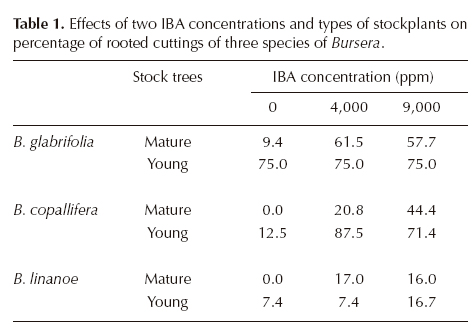
<body><![CDATA[<p align="justify"><font face="verdana" size="2"><b>Materials and methods</b></font></p>  	    <p align="justify"><font face="verdana" size="2">The research was carried out between March and August 2007. Cuttings were collected from leafless individuals in different localities of the state of Morelos (central Mexico), during March and May. Period of collection was chosen following traditional knowledge on vegetative propagation of these species from large tree branches, which are used for living fences. Shoot cuttings of <i>Bursera copallifera</i> and <i>B. glabrifolia</i> were collected from vigorous individuals at the archaeological site of Xochicalco (18&#176; 48' N, 99&#176; 17' W, altitude 1,200&#45;1,350 m), while cuttings from <i>B. linanoe</i> were collected at Chimalacatl&aacute;n, Sierra de Huautla (18&#176; 27' N, 99&#176; 5' W, altitude 1,000 m). Both sites are part of national protected areas having secondary tropical dry forests in which <i>Bursera</i> trees are dominant. Forests are not managed in Xochicalco, while in the area of Chimalacatl&aacute;n seeds of <i>B. linanoe</i> are collected for oil extraction. The climate in the region is warm subhumid, with a rainy season in summer (June to october), and a dry season that usually extends from December to May (Garc&iacute;a, 1988); annual mean temperature is 22.9 &#176;C in Xochicalco and 29.2 &#176;C near Chimalacatl&aacute;n, while average annual precipitation is 1,055 and 900 mm, respectively.</font></p>  	    <p align="justify"><font face="verdana" size="2">The first trial was performed on cuttings collected in March, and evaluated the effect of species, IBA concentration and relative age <i>(i.e.,</i> maturity) of the stock trees on the rooting ability of cuttings. Individual source trees were growing in natural forests in the vicinity of agricultural or cattle grazing areas. They were categorized as mature reproductive trees (&#8805; 5 m tall and a well&#45;defined single trunk) or young non&#45;reproductive saplings (&#8804; 2 m tall with one or more basal branches). For each plant species, 75 cuttings were collected from five adult trees (15 per tree), and 27&#45;45 cuttings were collected from three to five young trees or saplings (&#126;9 per sapling). There were fewer cuttings from young stockplants of <i>Bursera glabrifolia</i> and <i>B. copallifera</i> than from mature trees due to their lower availability in the field. From this sample 25 mature and 8&#45;15 young cuttings were randomly assigned to one of the following solutions: control (water), 4,000 ppm IBA, and 9,000 ppm IBA. The number of cuttings per stock individual was the same in all treatments. The 4,000 ppm solution was available in the market (name AIB 0.4&#37; solution), while the 9,000 ppm solution was obtained by dissolving 35&#37; IBA tablets (name Radix 35&#37; TB) in water, as indicated by the manufacturer (Intercontinental Import Export, S. A. for both products). In a second trial, the protocol achieving the best results in March (IBA concentration &#43; age of stockplants) was applied to 100 cuttings per species collected in the dry season, in May 2007, to confirm its efficiency and to propagate a larger number of plants to test their field performance (not reported in this paper). For this trial five stock individuals were used for <i>B. linanoe</i> and six for <i>B. copallifera</i> and <i>B. glabrifolia.</i> The source individuals used in each collection date were not the same, but in all cases the same number of cuttings per stock tree was assigned to each treatment, to reduce the possibility of an individual stockplant effect.</font></p>     <p align="justify"><font face="verdana" size="2">All cuttings were taken from lateral twigs (hardwood corresponding to the last two growing seasons) growing in full sun. As they were collected in the middle of the dry season, all plants were leafless and relative humidity was low. Twigs were collected in the morning to avoid high irradiance and heat; the basal and proximal ends of each twig were distinguished by different angles of cut to keep their polarity; they were tied in groups according to their stockplant. On the same day of collection the twigs were taken to the nursery (at Jard&iacute;n Etnobot&aacute;nico INAH, Cuernavaca, Morelos) in closed coolers, in order to keep them in shaded, fresh conditions. At the nursery the cuttings were pruned to their final size and measured (mean length &#177; s.d. = 25.1 &#177; 3.6 cm and mean basal diameter &#177; s.d. = 12.4 &#177; 3.2 mm; 2&#45;3 nodes per cutting); no more than two cuttings were obtained from each twig; one from the apex and the next just below it. Two longitudinal, superficial cuts of &#126;2 cm long were made at the basal end of each cutting (just deep enough to take off the bark, approximately 2&#45;3 mm), and they were immediately immersed in the IBA solution for 1 min, after which they were sown (&#126;5 cm depth) in black polyethylene bags filled with a mixture of black soil and agrolite (1:1 V/V). The sieved organic soil (obtained from fertile oak forest areas in the region) was purchased from local markets, while the agrolite (purchased from nursery suppliers) is a substrate of mineral origin that increases porosity and drainage, favoring root development and avoiding waterlogging from irrigation.</font></p>  	    <p align="justify"><font face="verdana" size="2">The nursery walls and ceiling were covered with white plastic film and water was applied by an automatic intermittent mist system activated twice a day for &#126;5 min; additionally cuttings were watered manually when necessary. Temperature and humidity were not controlled and daily fluctuations were registered with a datalogger during the rooting period (Hobo H8 Pro Temp/Rh). Average temperature and humidity (&#177; s.d.) from 00:00 to 8:00 h were 18.5 &#176;C (&#177; 0.3) and 93.9&#37; (&#177; 3.7), from 8:00 to 16:00 they were 30.6 &#176;C (&#177; 0.9) and 63.6&#37; (&#177; 6.6), and from 16:00 to 24:00 h they were 23.3 &#176;C (&#177; 0.9) and 78.2&#37; (&#177; 9.5). Maximum and minimum values during the rooting period were 43.9 &#176;C and 14.5 &#176;C for temperature, and 100&#37; and 26&#37; for humidity. Photosynthetically active radiation (PAR) on a clear summer day (between 12:00 &#45; 14:00 h) inside the nursery was 303.25 &#956;mol seg<sup>&#45;1</sup> m<sup>&#45;2</sup>, 23&#37; of the full radiation on a clear day.</font></p>  	    <p align="justify"><font face="verdana" size="2">In the first trial, bud and leaf development were registered during the rooting period (three months, from March to June) as an indirect measure of plant health and possible root development. Rooting response evaluations were undertaken 11 and 15 weeks after setting the cuttings into the rooting medium, in order to allow for root growth and avoid early uprooting, which can cause wilting (personal observation). The variables registered were presence of callus and roots, number of roots and number of leaves and leaf buds per cutting. Root data were obtained by splashing water on the rooting medium and gently removing remains of the medium from the roots. once the information was registered, the cuttings were returned to the bag. For the collection conducted in May, the number of roots and the diameter and length of the largest root per cutting were recorded in July and September 2007.</font></p>  	    <p align="justify"><font face="verdana" size="2"><i>Data analysis.</i> A generalized linear model was used to analyze the effects of species, age of stockplant, and IBA concentration on rooting of cuttings collected in March. As the response variable was the number of rooted and non&#45;rooted cuttings, a binomial error and a logit link function were used. The effects of the same variables on the number of roots per cutting were analyzed by means of a factorial ANoVA, previously transforming data (log N&#43;1) to achieve normality and homocedasticity. The relationship between final number of leaves &#43; buds and number of roots in cuttings of each species was evaluated using Fisher exact test.</font></p>  	    <p align="justify"><font face="verdana" size="2">In cuttings collected in May, the number of roots per species was compared using a Kruskal&#45;Wallis test, while length and diameter of the longest root were analyzed using one factor ANOVA and Tukey post&#45;hoc tests when appropriate.</font></p>  	    <p align="justify"><font face="verdana" size="2">&nbsp;</font></p>  	    <p align="justify"><font face="verdana" size="2"><b>Results</b></font></p>  	    ]]></body>
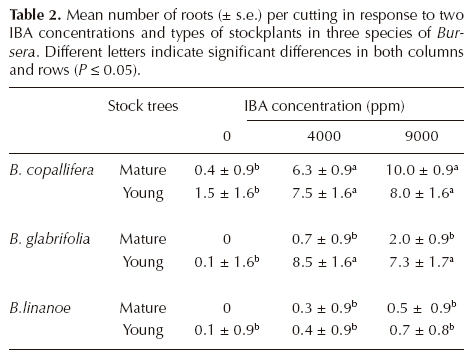
<body><![CDATA[<p align="justify"><font face="verdana" size="2">Eleven weeks after the first experiment was set, cuttings of all three species had initiated roots and the proportions recorded did not increase four weeks later, at the second root assessment. Callus formation was frequent only in the control treatment: 19.4&#37; of cuttings in <i>Bursera glabrifolia,</i> 37.5&#37; in <i>B. copallifera,</i> and 40&#37; in <i>B. linanoe.</i> Most of the cuttings that developed noticeable calli failed to produce roots by the time of the final evaluation.</font></p>  	    <p align="justify"><font face="verdana" size="2">To analyze the proportion of rooted cuttings, a generalized linear model that included all main factors (species, type of cutting, and IBA concentration) and its interactions was initially used. However, as the fitting of this model was not significantly <i>(P</i> = 0.73) better than the one with only second grade interactions, the latter, simpler model was used for the analysis. All main factors had significant effects on the proportion of rooted cuttings: species (deviance 53.4, df 2, <i>P</i> &#60; 0.0001), IBA concentration (deviance 42.4, df 2, <i>P</i> &#60; 0.0001) and age of stockplant (deviance 15.6, df 1, <i>P</i> &#60; 0.0001). The interaction age x IBA was also significant (deviance 8.37, df 2, <i>P</i> = 0.015), while remaining interactions were not (species x age P = 0.11 and species x IBA P = 0.18).</font></p>  	    <p align="justify"><font face="verdana" size="2"><i>Bursera glabrifolia</i> attained the highest mean rooting percentage (58.9&#37; of all cuttings) and <i>B. linanoe</i> the lowest (9.2&#37;). Higher proportions of rooted cuttings were observed when using IBA concentrations of 4,000 and 9,000 ppm than in the control (<a href="#t1">Table 1</a>), and in cuttings from young trees than in those from mature trees. The significant interaction between age of stock tree and IBA is explained by a larger response to auxin application <i>(i.e.</i> increase in the proportion of rooted cuttings) in cuttings from mature trees than in those from younger trees. This was especially conspicuous in <i>B. glabrifolia,</i> in which there was no noticeable response to applied IBA when using young cuttings, but it was evident among cuttings from mature trees (<a href="#t1">Table 1</a>).</font></p>  	    <p align="center"><font face="verdana" size="2"><a name="t1"></a></font></p>  	    <p align="center"><font face="verdana" size="2"><img src="/img/revistas/bs/v91n2/a9t1.jpg"></font></p>  	    <p align="justify"><font face="verdana" size="2"><i>Root development.</i> The effect of species (F = 54.9, df 2, <i>P</i> &#60; 0.0001), age of stock tree (F = 21.2, df 1, <i>P</i> &#60; 0.0001), applied IBA (F = 29.8, df 2, P &#60; 0.0001), and the interactions species x age (F = 7.04, df 2, <i>P</i> = 0.0007), species x IBA (F = 6.2, df 4, P &#60; 0.0001), and species x age x IBA (F = 2.7, df 4, P = 0.03) on number of roots per cutting were significant. Mean number of roots per cutting was largest in <i>Bursera glabrifolia</i> and smallest in <i>B. linanoe</i> (<a href="#t2">Table 2</a>). In <i>B. copallifera</i> and especially in <i>B. glabrifolia</i> this number increased in cuttings derived from young stockplants relative to mature ones, but this difference was not quite as important in <i>B. linanoe,</i> which accounts for the significant interaction species x age. Not all species showed the same response to IBA application, as differences among cuttings in the control treatment and those with IBA were much larger in <i>B. glabrifolia</i> and <i>B. copallifera</i> than in <i>B. linanoe.</i> Overall, differences among cuttings derived from younger and mature stockplants were small without IBA (control), but increased when the auxin was applied, particularly in <i>B. glabrifolia</i> (<a href="#t2">Table 2</a>).</font></p>  	    <p align="center"><font face="verdana" size="2"><a name="t2"></a></font></p>  	    <p align="center"><font face="verdana" size="2"><img src="/img/revistas/bs/v91n2/a9t2.jpg"></font></p>  	    <p align="justify"><font face="verdana" size="2">A significant positive association was found between presence of buds and leaves, and the presence of roots in <i>Bursera glabrifolia</i> and <i>B. copallifera</i> (Fisher exact test <i>P</i> = 1.6 x 10<sup>&#45;17</sup> and <i>P</i> = 2.2 x 10<sup>&#45;14</sup> respectively). These observations allowed us to establish that cuttings with the best root development were also the ones that had the largest number of leaves, while the ones that did not develop leaves usually had no roots, though they could have a few leaf buds. Buds were recorded in a high proportion of cuttings 11 days after sowing, while fully expanded leaves were observed ten days later. overall, correlations between the initial size (length and diameter) of the cuttings and the number of roots per cutting were not significant in <i>B. glabrifolia</i> nor in <i>B. copallifera,</i> except for length of the cutting in the former species (r = 0.37, <i>P</i> = 0.005). The low number of rooted cuttings of <i>B. linanoe</i> precluded these analyses.</font></p>  	    <p align="justify"><font face="verdana" size="2">Although it was not our main goal to evaluate differences in rooting ability in cuttings obtained from different individual source trees, we noticed that most trees produced high proportions of rooted cuttings, but in one or a few of them this proportion was much lower; this pattern was observed in all species and in cuttings of both ages.</font></p>  	    ]]></body>
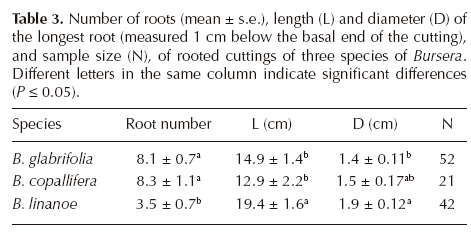
<body><![CDATA[<p align="justify"><font face="verdana" size="2">In the second collection made later in the dry season (in May, approximately eight weeks later), only the IBA concentrations producing the best results in cuttings from young trees were tried: 9,000 ppm in <i>Bursera linanoe</i> and 4,000 ppm in <i>B. glabrifolia</i> and <i>B. copallifera.</i> Rooting percentages were high and similar to those obtained in March for two species: <i>B. glabrifolia</i> 75.8&#37; (cuttings from young stockplants in March 75&#37;, see <a href="#t1">Table 1</a>) and <i>B. copallifera</i> 70.6&#37; (71&#45;87&#37; in March, <a href="#t1">Table 1</a>), but in <i>B. linanoe</i> there was a noticeable increase in the percentage of rooted cuttings (81.4&#37; in May vs. 16.7&#37; in March). Comparisons among species on the number of roots per cutting and length and diameter of the longest root showed significant differences among species in the three variables (number of roots Kruskal&#45;Wallis H = 26.7, <i>P</i> &#60; 0.001; length and diameter of the largest root F = 3.69, df 2, <i>P</i> = 0.04 and F = 4.05, df 2, <i>P</i> = 0.02 respectively). <i>Bursera glabrifolia</i> and <i>B. copallifera</i> had more roots per cutting than <i>B. linanoe,</i> but the latter had a larger main root than the other two species (<a href="#t3">Table 3</a>).</font></p>  	    <p align="center"><font face="verdana" size="2"><a name="t3"></a></font></p>  	    <p align="center"><font face="verdana" size="2"><img src="/img/revistas/bs/v91n2/a9t3.jpg"></font></p>  	    <p align="justify"><font face="verdana" size="2">&nbsp;</font></p>  	    <p align="justify"><font face="verdana" size="2"><b>Discussion</b></font></p>  	    <p align="justify"><font face="verdana" size="2">Root development was successful in cuttings of the three <i>Bursera</i> species studied, and it was strongly influenced by IBA treatment and age of stockplants. The great majority of rooted cuttings developed buds, leaves, and roots by the time of the first evaluation, eleven weeks after sown, indicating that this period is appropriate to evaluate final root development under the temperature and humidity conditions found in the nursery.</font></p>  	    <p align="justify"><font face="verdana" size="2">There was no association between external callus and root formation. In cuttings of <i>Bursera simaruba</i> a high proportion of callus formation (0.93) and a low rooting proportion (0.04) has been reported (Garc&iacute;a&#45;Orth, 2002), and in other <i>Bursera</i> species cuttings with conspicuous calluses frequently lack roots (Bonfil&#45;Sanders <i>et al.,</i> 2007). Although there is a general belief that callus tissue that develops as part of the wounding response is a precursor to the development of adventitious roots (Landis <i>et al.,</i> 1999), it has been reported that recalcitrant species form callus without subsequent root formation (Hartmann <i>et al.,</i> 1997), and a similar response might have occurred in untreated (control) cuttings. Callus formation without rooting has been reported to increase with ageing and related to unfavorable metabolic conditions for the development of roots (Husen and Pal, 2006).</font></p>  	    <p align="justify"><font face="verdana" size="2">A positive response of rooting to IBA application was observed in most cases, as in many other tropical species where this auxin induced root development, especially in leafy cuttings (Aminah <i>et al.,</i> 1995; Mes&eacute;n <i>et al.,</i> 1997; Eganathan <i>et al.,</i> 2000; Negash, 2002, 2003; Tchoundjeu <i>et al.,</i> 2002; Husen and Pal, 2007a). No signs of toxicity due to the high concentrations of IBA used were observed, although negative effects on survival with similar and lower concentrations have been reported both on leafy and leafless cuttings (Ofori <i>et al.,</i> 1996; Puri and Verma, 1996; Negash, 2002). However, full identification of optimal, suboptimal, and supraoptimal concentrations of the hormone will be achieved in future studies.</font></p>  	    <p align="justify"><font face="verdana" size="2">The higher root development found in cuttings from young rather than from mature trees has been reported in other species, such as <i>Prosopis cineara</i> (Arya <i>et al.,</i> 1994), <i>Inga feuillei</i> (Brennan and Mudge, 1998), <i>Juniperus procera</i> (Negash, 2002), <i>Argania spinosa</i> (Nouaim <i>et al.,</i> 2002), <i>Robinia pseudoacacia</i> and <i>Grewia optiva</i> (Swamy <i>et al.,</i> 2002), <i>Backhousia citriodora</i> (Kibbler <i>et al.,</i> 2004a) and <i>Ulmus villosa</i> (Bhardwaj and Mishra, 2005). Ontogenetic juvenility has been associated with a number of factors, such as optimum levels of auxins, sugars and carbohydrates, and low nitrogen levels (Bhardwaj and Mishra, 2005). Young plants also have less lignified tissues and lower production of rooting inhibitors than older plants (Leopold and Kriedemann, 1975, Hartmann <i>et al.,</i> 1997). Other differences are related to higher peroxidase activity during root development in young cuttings (Husen and Pal, 2007b), and differences in fiber and vessel elements of the stem (Husen and Pal., 2006; Amissah <i>et al.,</i> 2008).</font></p>  	    <p align="justify"><font face="verdana" size="2">In this study, juvenility refers to ontogenetic ageing, and differences in physiological juvenility were controlled by collecting young twigs (i.e., grown during the last two growing seasons) from both types of stockplants. It is not possible to establish which of the above mentioned factors associated with juvenility were more relevant in this case, but cuttings from young trees of all species have less lignified tissues than those from mature trees (as was evident by the different strength needed to collect them) and the bark is thinner in the former than in twigs from large reproductive trees. Endogenous auxin levels were probably not optimal even in cuttings from young trees, as they responded strongly to IBA application (except for <i>Bursera glabrifolia).</i> The significant interaction between age of stockplant and IBA also supports the hypothesis of metabolic differences between young and mature stockplants, as has been observed on cuttings of <i>Dalbergia megaloxylon</i> (Amri <i>et al.,</i> 2010).</font></p>  	    ]]></body>
<body><![CDATA[<p align="justify"><font face="verdana" size="2">The young trees used as stock material were not as juvenile as smaller&#45;sized or continuously hedged stockplants, but their morphology suggests that most of them had been coppiced and had resprouted. Additionally, these young trees allowed us to obtain more cuttings per individual than smaller, younger plants. The use of cuttings from young shoots on managed stockplants is recognized as the best vegetative propagation strategy (Landis <i>et al.,</i> 1999; Negash, 2004), and future research in a larger set of <i>Bursera</i> species may help to establish the morphological and physiological characteristics of the shoots that encourage root development, as well as the best management strategy for the stockplants (Leakey, 2004).</font></p>  	    <p align="justify"><font face="verdana" size="2">Although the effect of different IBA concentrations on the percentage of rooted cuttings was analyzed using a small sample size in some cases (i.e., young cuttings of <i>Bursera glabrifolia</i> and <i>B. copallifera,</i> see methods section), the results were supported by the high percentage of rooted cuttings obtained later in the dry season, when the protocols rendering the best results in the first experiment were used. The only noticeable difference between results from these two trials was an increase in the proportion of rooted cuttings of <i>B. linanoe</i> in May. In species growing in highly seasonal environments, such as tropical dry forests, the increase in temperature during spring, when bud dormancy ends, induces carbohydrate mobilization and enzymatic activity, favoring root development in leafless hardwood cuttings (Puri and Verma, 1996; Bhardwaj and Mishra, 2005; Kibbler <i>et al.,</i> 2004b, Haile <i>et al.,</i> 2011). In this case, good results were obtained when leafless cuttings were completely dormant, prior to the beginning of bud swelling and development of flowers and leaves, which occurs early in May, before the onset of the rainy season, in <i>B. copallifera</i> and <i>B. glabrifolia,</i> (Vel&aacute;zquez&#45;Herrera, 2011). <i>Bursera linanoe</i> grows in relatively drier conditions than the other two species (Hern&aacute;ndez&#45;P&eacute;rez <i>et al.,</i> 2011), and buds may become active a few weeks later. In other tropical dry species an increase in rooting potential has also been found when cuttings are collected towards the end of the dry season but before bud breaking (Danthu <i>et al.,</i> 2002; Haile <i>et al.,</i> 2011).</font></p>  	    <p align="justify"><font face="verdana" size="2">When using the number of roots per cutting as a response variable to the experimental factors the same general trend was shown: all main factors had a very significant effect, as well as the interaction species x IBA. The positive effect of IBA on rooting percentage and on root number has been observed in other assessments of vegetative propagation (Amri <i>et al.,</i> 2010), supporting its overall positive effect. We advise the use of young stockplants and IBA application when propagating cuttings of <i>Bursera,</i> considering differences regarding the best concentration for each species. It is worth noticing that even if young cuttings of <i>B. glabrifolia</i> did not need IBA to develop roots, the number of roots increased significantly when the hormone was applied to cuttings of both ages. A good root system is important for tree stability and growth (Asaah <i>et al.,</i> 2010).</font></p>  	    <p align="justify"><font face="verdana" size="2">Shoot growth can reduce rooting as a result of internal competition for resources in leafy softwood cuttings (ofori <i>et al.,</i> 1996; Mes&eacute;n <i>et al.,</i> 1997; Kibbler <i>et al.,</i> 2004b), but a positive relationship between the development of both types of tissues is common in leafless hardwood cuttings and has been considered an indicator of metabolic activity (Tchigio and Duguma, 1998, Dick <i>et al.,</i> 1998). The positive association found between bud and leaf development and root formation in two of three species of <i>Bursera</i> supports the second statement, and the fact that cuttings having the largest number of leaves were also the ones that developed more roots suggests the benefit of current assimilates to supplement the mobilization of stored carbohydrates in leafless cuttings from dormant shoots, and the absence of competition in this situation between the two types of tissues. Root development probably started a few weeks after the appearance of fully expanded leaves (three to four weeks), so a period of six weeks may be adequate to make an initial evaluation of root development and assess the speed of rooting in future studies.</font></p>  	    <p align="justify"><font face="verdana" size="2">It is likely that efforts to propagate other species of <i>Bursera</i> from young, dormant cuttings will be successful. Leafy cuttings can probably also be propagated under good propagation conditions, and a comparison of the rooting behavior of both types of cuttings will be useful to draw sound conclusions on the best procedure to propagate trees of this diverse and important genus. The propagation of large numbers of plants of <i>Bursera</i> species from small cuttings will certainly contribute to the restoration of degraded tropical dry forests of America and will also allow the establishment of productive plantations and agroforests in regions experiencing high demand of fruits, resin, or wood for scents and handcrafts.</font></p>  	    <p align="justify"><font face="verdana" size="2">&nbsp;</font></p>  	    <p align="justify"><font face="verdana" size="2"><b>Acknowledgements</b></font></p>  	    <p align="justify"><font face="verdana" size="2">C. Castellanos was supported by a scholarship from the Packard Foundation while doing this research. We thank P. Hersch, Ray and E. Soriano at the Jard&iacute;n Etnobot&aacute;nico of Instituto Nacional de Antropolog&iacute;a e Historia for allowing us to use the nursery and other facilities. P. Mendoza, B. Barrales, F. Garc&iacute;a, A. Sierra, and R. D&iacute;az helped with field and nursery work. This project was financially supported by the Universidad Nacional Aut&oacute;noma de M&eacute;xico through projects "Manejo de Ecosistemas y Desarrollo Humano" SDEIPTID&#45;02 and PAPIIT&#45; DGAPA IN218612. We thank Drs. R.R.B. Leakey, L. Negash, and one anonymous reviewer for their careful revision and comments to the original manuscript, which helped to improve it.</font></p>  	    <p align="justify"><font face="verdana" size="2">&nbsp;</font></p>  	    <p align="justify"><font face="verdana" size="2"><b>Literature cited</b></font></p>  	    ]]></body>
<body><![CDATA[<!-- ref --><p align="justify"><font face="verdana" size="2">Aminah H., Dick J. McP., Leakey R.R.B., Grace J. and Smith R.I. 1995. Effect of indole butyric acid (IBA) on stem cuttings of <i>Shorea leprosula. Forest Ecology and Management</i> <b>72</b>:199&#45;206.    &nbsp;&nbsp;&nbsp;&nbsp;&nbsp;&nbsp;&nbsp;&nbsp;[&#160;<a href="javascript:void(0);" onclick="javascript: window.open('/scielo.php?script=sci_nlinks&ref=1763499&pid=S2007-4298201300020000900001&lng=','','width=640,height=500,resizable=yes,scrollbars=1,menubar=yes,');">Links</a>&#160;]<!-- end-ref --></font></p>  	    <!-- ref --><p align="justify"><font face="verdana" size="2">Amissah J.N., Paolillo D.J. and Bassuk N. 2008. Adventitious root formation in stem cuttings of <i>Quercus bicolor</i> and <i>Quercus macrocarpa</i> and its relationship to stem anatomy. <i>Journal of the American Society for Horticultural Science</i> <b>133</b>:479&#45;486.    &nbsp;&nbsp;&nbsp;&nbsp;&nbsp;&nbsp;&nbsp;&nbsp;[&#160;<a href="javascript:void(0);" onclick="javascript: window.open('/scielo.php?script=sci_nlinks&ref=1763501&pid=S2007-4298201300020000900002&lng=','','width=640,height=500,resizable=yes,scrollbars=1,menubar=yes,');">Links</a>&#160;]<!-- end-ref --></font></p>  	    <!-- ref --><p align="justify"><font face="verdana" size="2">Amri E., Lyaruu H.V.M., Nyomora A.S. and Kanyeka Z.L. 2010. Vegetative propagation of African Blackwood <i>(Dalbergia melanoxylon</i> Guill. &amp; Perr.): effects of age of donor plant, IBA treatment and cutting position on rooting ability of stem cuttings. <i>New Forests</i> <b>39</b>:183&#45;194.    &nbsp;&nbsp;&nbsp;&nbsp;&nbsp;&nbsp;&nbsp;&nbsp;[&#160;<a href="javascript:void(0);" onclick="javascript: window.open('/scielo.php?script=sci_nlinks&ref=1763503&pid=S2007-4298201300020000900003&lng=','','width=640,height=500,resizable=yes,scrollbars=1,menubar=yes,');">Links</a>&#160;]<!-- end-ref --></font></p>  	    <!-- ref --><p align="justify"><font face="verdana" size="2">Andr&eacute;s H.A.R and Espinosa O.D. 2002. Morfolog&iacute;a de pl&aacute;ntulas de <i>Bursera</i> Jacq. ex L. (Burseraceae) y sus implaciones filogen&eacute;ticas. <i>Bolet&iacute;n de la Sociedad Bot&aacute;nica de M&eacute;xico</i> <b>70</b>:5&#45;12.    &nbsp;&nbsp;&nbsp;&nbsp;&nbsp;&nbsp;&nbsp;&nbsp;[&#160;<a href="javascript:void(0);" onclick="javascript: window.open('/scielo.php?script=sci_nlinks&ref=1763505&pid=S2007-4298201300020000900004&lng=','','width=640,height=500,resizable=yes,scrollbars=1,menubar=yes,');">Links</a>&#160;]<!-- end-ref --></font></p>  	    <!-- ref --><p align="justify"><font face="verdana" size="2">Arya S., Tomar R. and Toky O.P. 1994. Effect of plant age and auxin treatment on rooting response in stem cuttings of <i>Prosopis cineraria. Journal of Arid Environments</i> <b>27</b>:99&#45;103.    &nbsp;&nbsp;&nbsp;&nbsp;&nbsp;&nbsp;&nbsp;&nbsp;[&#160;<a href="javascript:void(0);" onclick="javascript: window.open('/scielo.php?script=sci_nlinks&ref=1763507&pid=S2007-4298201300020000900005&lng=','','width=640,height=500,resizable=yes,scrollbars=1,menubar=yes,');">Links</a>&#160;]<!-- end-ref --></font></p>  	    ]]></body>
<body><![CDATA[<!-- ref --><p align="justify"><font face="verdana" size="2">Asaah E.K., Tchoundjeu T.N., Wanduku T.N and Van Damme P. 2010. Understanding structural roots system of 5&#45;year&#45;old Africam plum tree <i>(D. edulis)</i> of seed and vegetative origins (G. Don) H. J. Lam. <i>Trees Structure and Function</i> <b>24</b>:789&#45;796.    &nbsp;&nbsp;&nbsp;&nbsp;&nbsp;&nbsp;&nbsp;&nbsp;[&#160;<a href="javascript:void(0);" onclick="javascript: window.open('/scielo.php?script=sci_nlinks&ref=1763509&pid=S2007-4298201300020000900006&lng=','','width=640,height=500,resizable=yes,scrollbars=1,menubar=yes,');">Links</a>&#160;]<!-- end-ref --></font></p>  	    <!-- ref --><p align="justify"><font face="verdana" size="2">Bhardwaj D.R. and Mishra V.K. 2005. Vegetative propagation of <i>ulmus villosa:</i> effects of plant growth regulators, collection time, type of donor and position of the shoot on adventitious root formation in stem cuttings. <i>New Forests</i> <b>29</b>:105&#45;116.    &nbsp;&nbsp;&nbsp;&nbsp;&nbsp;&nbsp;&nbsp;&nbsp;[&#160;<a href="javascript:void(0);" onclick="javascript: window.open('/scielo.php?script=sci_nlinks&ref=1763511&pid=S2007-4298201300020000900007&lng=','','width=640,height=500,resizable=yes,scrollbars=1,menubar=yes,');">Links</a>&#160;]<!-- end-ref --></font></p>  	    <!-- ref --><p align="justify"><font face="verdana" size="2">Bonfil&#45;Sanders C., Mendoza&#45;Hern&aacute;ndez P and Ulloa&#45;Nieto J.A. 2007. Root and callus development in cuttings of seven species of the genus <i>Bursera. Agrociencia</i> <b>41</b>:103&#45;109.    &nbsp;&nbsp;&nbsp;&nbsp;&nbsp;&nbsp;&nbsp;&nbsp;[&#160;<a href="javascript:void(0);" onclick="javascript: window.open('/scielo.php?script=sci_nlinks&ref=1763513&pid=S2007-4298201300020000900008&lng=','','width=640,height=500,resizable=yes,scrollbars=1,menubar=yes,');">Links</a>&#160;]<!-- end-ref --></font></p>  	    <!-- ref --><p align="justify"><font face="verdana" size="2">Bonfil&#45;Sanders C., Cajero&#45;L&aacute;zaro I. and Evans R.Y. 2008. Seed germination of six <i>Bursera</i> species from central Mexico. <i>Agrociencia</i> <b>42</b>:827&#45;834.    &nbsp;&nbsp;&nbsp;&nbsp;&nbsp;&nbsp;&nbsp;&nbsp;[&#160;<a href="javascript:void(0);" onclick="javascript: window.open('/scielo.php?script=sci_nlinks&ref=1763515&pid=S2007-4298201300020000900009&lng=','','width=640,height=500,resizable=yes,scrollbars=1,menubar=yes,');">Links</a>&#160;]<!-- end-ref --></font></p>  	    <!-- ref --><p align="justify"><font face="verdana" size="2">Bonfil C. and Trejo I. 2010. Plant propagation and the ecological restoration of Mexican tropical deciduous forests. <i>Ecological Restoration</i> <b>28</b>:369&#45;376.    &nbsp;&nbsp;&nbsp;&nbsp;&nbsp;&nbsp;&nbsp;&nbsp;[&#160;<a href="javascript:void(0);" onclick="javascript: window.open('/scielo.php?script=sci_nlinks&ref=1763517&pid=S2007-4298201300020000900010&lng=','','width=640,height=500,resizable=yes,scrollbars=1,menubar=yes,');">Links</a>&#160;]<!-- end-ref --></font></p>  	    ]]></body>
<body><![CDATA[<!-- ref --><p align="justify"><font face="verdana" size="2">Brennan E.B. and Mudge K.W. 1998. Vegetative propagation of <i>Inga feuillei</i> from shoot cuttings and air layering. <i>New Forests</i> <b>15</b>:37&#45;51.    &nbsp;&nbsp;&nbsp;&nbsp;&nbsp;&nbsp;&nbsp;&nbsp;[&#160;<a href="javascript:void(0);" onclick="javascript: window.open('/scielo.php?script=sci_nlinks&ref=1763519&pid=S2007-4298201300020000900011&lng=','','width=640,height=500,resizable=yes,scrollbars=1,menubar=yes,');">Links</a>&#160;]<!-- end-ref --></font></p>  	    <!-- ref --><p align="justify"><font face="verdana" size="2">Castellanos&#45;Castro C. and Bonfil S.C. 2010. Establecimiento y crecimiento inicial de estacas de tres especies de <i>Bursera</i> Jacq. ex L. <i>Revista Mexicana de Ciencias Forestales</i> <b>1</b>:93&#45;108.    &nbsp;&nbsp;&nbsp;&nbsp;&nbsp;&nbsp;&nbsp;&nbsp;[&#160;<a href="javascript:void(0);" onclick="javascript: window.open('/scielo.php?script=sci_nlinks&ref=1763521&pid=S2007-4298201300020000900012&lng=','','width=640,height=500,resizable=yes,scrollbars=1,menubar=yes,');">Links</a>&#160;]<!-- end-ref --></font></p>  	    <!-- ref --><p align="justify"><font face="verdana" size="2">Danthu P, Soloviev P., Gaye A., Sarr A., Seck M. and Thomas I. 2002. Vegetative propagation of some West Africa <i>Ficus</i> species by cuttings. <i>Agroforestry Systems</i> <b>55</b>:57&#45;63.    &nbsp;&nbsp;&nbsp;&nbsp;&nbsp;&nbsp;&nbsp;&nbsp;[&#160;<a href="javascript:void(0);" onclick="javascript: window.open('/scielo.php?script=sci_nlinks&ref=1763523&pid=S2007-4298201300020000900013&lng=','','width=640,height=500,resizable=yes,scrollbars=1,menubar=yes,');">Links</a>&#160;]<!-- end-ref --></font></p>  	    <!-- ref --><p align="justify"><font face="verdana" size="2">Dick J., Magingo F., Smith R.I. and McBeath C. 1998. Rooting ability of <i>Leucaena leucocephala</i> stem cuttings. <i>Agroforestry Systems</i> <b>42</b>:149&#45;157.    &nbsp;&nbsp;&nbsp;&nbsp;&nbsp;&nbsp;&nbsp;&nbsp;[&#160;<a href="javascript:void(0);" onclick="javascript: window.open('/scielo.php?script=sci_nlinks&ref=1763525&pid=S2007-4298201300020000900014&lng=','','width=640,height=500,resizable=yes,scrollbars=1,menubar=yes,');">Links</a>&#160;]<!-- end-ref --></font></p>  	    <!-- ref --><p align="justify"><font face="verdana" size="2">Eganathan P., Srinivasa Rao C. and Anand A. 2000. Vegetative propagation of three mangrove tree species by cuttings and air layering. <i>Wetland Ecology Management</i> <b>8</b>:281&#45;286.    &nbsp;&nbsp;&nbsp;&nbsp;&nbsp;&nbsp;&nbsp;&nbsp;[&#160;<a href="javascript:void(0);" onclick="javascript: window.open('/scielo.php?script=sci_nlinks&ref=1763527&pid=S2007-4298201300020000900015&lng=','','width=640,height=500,resizable=yes,scrollbars=1,menubar=yes,');">Links</a>&#160;]<!-- end-ref --></font></p>  	    ]]></body>
<body><![CDATA[<!-- ref --><p align="justify"><font face="verdana" size="2">Fuentes&#45;L&oacute;pez M.E. 2009. Comercializaci&oacute;n de productos de linaloe. In: Solares&#45;Arenas F. and Cruz&#45;Cruz E. Ed. <i>Ecolog&iacute;a, Manejo Productivo y Comercializaci&oacute;n del Linaloe (Bursera linanoe (La Llave) Rzedowski, Calder&oacute;n &amp; Medina),</i> pp. 3549. INIFAP&#45; Campo Experimental Valles Centrales de Oaxaca, M&eacute;xico.    &nbsp;&nbsp;&nbsp;&nbsp;&nbsp;&nbsp;&nbsp;&nbsp;[&#160;<a href="javascript:void(0);" onclick="javascript: window.open('/scielo.php?script=sci_nlinks&ref=1763529&pid=S2007-4298201300020000900016&lng=','','width=640,height=500,resizable=yes,scrollbars=1,menubar=yes,');">Links</a>&#160;]<!-- end-ref --></font></p>  	    <!-- ref --><p align="justify"><font face="verdana" size="2">Garc&iacute;a E. 1988. <i>Modificaciones al Sistema de Clasificaci&oacute;n Clim&aacute;tica de K&ouml;ppen.</i> Instituto de Geograf&iacute;a, Universidad Nacional Aut&oacute;noma de M&eacute;xico, M&eacute;xico, D. F</font>&nbsp;&nbsp;&nbsp;&nbsp;&nbsp;&nbsp;&nbsp;&nbsp;[&#160;<a href="javascript:void(0);" onclick="javascript: window.open('/scielo.php?script=sci_nlinks&ref=1763531&pid=S2007-4298201300020000900017&lng=','','width=640,height=500,resizable=yes,scrollbars=1,menubar=yes,');">Links</a>&#160;]<!-- end-ref --><!-- ref --><p align="justify"><font face="verdana" size="2">Garc&iacute;a&#45;Orth X. 2002. Efecto del &aacute;cido indolbut&iacute;rico en la formaci&oacute;n de callos y de ra&iacute;ces en estacas de <i>Bursera simaruba</i> (L.) Sarg., <i>Gliricidia sepium</i> (Jacq.) Kunth ex Walp. y <i>Omphalea oleifera</i> Hemsl., tres especies potencialmente &uacute;tiles para restauraci&oacute;n ecol&oacute;gica. Thesis, Facultad de Ciencias, Universidad Nacional Aut&oacute;noma de M&eacute;xico, M&eacute;xico, D. F. 66 pp.    &nbsp;&nbsp;&nbsp;&nbsp;&nbsp;&nbsp;&nbsp;&nbsp;[&#160;<a href="javascript:void(0);" onclick="javascript: window.open('/scielo.php?script=sci_nlinks&ref=1763532&pid=S2007-4298201300020000900018&lng=','','width=640,height=500,resizable=yes,scrollbars=1,menubar=yes,');">Links</a>&#160;]<!-- end-ref --></font></p>  	    <!-- ref --><p align="justify"><font face="verdana" size="2">Haile G., Gebrehiwot K., Lemenih M. and Bongers F. 2011. Time of collection and cutting sizes affect vegetative propagation of <i>Boswelliapapyrifera</i> (Del.) Hochst through leafless branch cuttings. <i>Journal of Arid Environments</i> <b>75</b>:873&#45;877.    &nbsp;&nbsp;&nbsp;&nbsp;&nbsp;&nbsp;&nbsp;&nbsp;[&#160;<a href="javascript:void(0);" onclick="javascript: window.open('/scielo.php?script=sci_nlinks&ref=1763534&pid=S2007-4298201300020000900019&lng=','','width=640,height=500,resizable=yes,scrollbars=1,menubar=yes,');">Links</a>&#160;]<!-- end-ref --></font></p>  	    <!-- ref --><p align="justify"><font face="verdana" size="2">Hartmann H.T., Kester D.E., Davies F.T. and Geneve R.L. 1997. <i>Plant Propagation: Principles and Practices,</i> 6th ed. Prentice Hall, New York.    &nbsp;&nbsp;&nbsp;&nbsp;&nbsp;&nbsp;&nbsp;&nbsp;[&#160;<a href="javascript:void(0);" onclick="javascript: window.open('/scielo.php?script=sci_nlinks&ref=1763536&pid=S2007-4298201300020000900020&lng=','','width=640,height=500,resizable=yes,scrollbars=1,menubar=yes,');">Links</a>&#160;]<!-- end-ref --></font></p>  	    <!-- ref --><p align="justify"><font face="verdana" size="2">Hern&aacute;ndez&#45;Apolinar M., Valverde T. and Purata S. 2006. Demography of <i>Bursera glabrifolia,</i> a tropical tree used for folk wood&#45;crafting in Southern Mexico: an evaluation of its management plan. <i>Forest Ecology and Management</i> <b>223</b>:139&#45;151.    &nbsp;&nbsp;&nbsp;&nbsp;&nbsp;&nbsp;&nbsp;&nbsp;[&#160;<a href="javascript:void(0);" onclick="javascript: window.open('/scielo.php?script=sci_nlinks&ref=1763538&pid=S2007-4298201300020000900021&lng=','','width=640,height=500,resizable=yes,scrollbars=1,menubar=yes,');">Links</a>&#160;]<!-- end-ref --></font></p>  	    <!-- ref --><p align="justify"><font face="verdana" size="2">Hern&aacute;ndez&#45;P&eacute;rez E., Gonz&aacute;lez&#45;Espinosa M., Trejo I. and Bonfil C. 2011. Distribuci&oacute;n del g&eacute;nero <i>Bursera</i> en el estado de Morelos, M&eacute;xico y su relaci&oacute;n con el clima. <i>Revista Mexicana de Biodiversidad</i> <b>82</b>:964&#45;976.    &nbsp;&nbsp;&nbsp;&nbsp;&nbsp;&nbsp;&nbsp;&nbsp;[&#160;<a href="javascript:void(0);" onclick="javascript: window.open('/scielo.php?script=sci_nlinks&ref=1763540&pid=S2007-4298201300020000900022&lng=','','width=640,height=500,resizable=yes,scrollbars=1,menubar=yes,');">Links</a>&#160;]<!-- end-ref --></font></p>  	    <!-- ref --><p align="justify"><font face="verdana" size="2">Hersch&#45;Mart&iacute;nez P, Glass R., Fierro A.A. and Guerrero B.C. 2004. <i>El linaloe, Bursera aloexylon (Schiede ex Schltdl)</i> Engl. Programa actores sociales de la flora medicinal de M&eacute;xico. Serie Patrimonio Vivo 6. Instituto Nacional de Antropolog&iacute;a e Historia, Comisi&oacute;n Nacional para el Conocimiento y uso de la Biodiversidad, M&eacute;xico, D.F</font>&nbsp;&nbsp;&nbsp;&nbsp;&nbsp;&nbsp;&nbsp;&nbsp;[&#160;<a href="javascript:void(0);" onclick="javascript: window.open('/scielo.php?script=sci_nlinks&ref=1763542&pid=S2007-4298201300020000900023&lng=','','width=640,height=500,resizable=yes,scrollbars=1,menubar=yes,');">Links</a>&#160;]<!-- end-ref --><!-- ref --><p align="justify"><font face="verdana" size="2">Hersch&#45;Mart&iacute;nez P. and Glass R. 2006. <i>Linaloe: Un Reto Arom&aacute;tico. Diversas Dimensiones de una Especie Mexicana, Bursera linanoe.</i> Colecci&oacute;n Cient&iacute;fica Vol. 498. Serie Etnohistoria. Instituto Nacional de Antropolog&iacute;a e Historia, M&eacute;xico D.F.    &nbsp;&nbsp;&nbsp;&nbsp;&nbsp;&nbsp;&nbsp;&nbsp;[&#160;<a href="javascript:void(0);" onclick="javascript: window.open('/scielo.php?script=sci_nlinks&ref=1763543&pid=S2007-4298201300020000900024&lng=','','width=640,height=500,resizable=yes,scrollbars=1,menubar=yes,');">Links</a>&#160;]<!-- end-ref --></font></p>  	    <!-- ref --><p align="justify"><font face="verdana" size="2">Husen A. and Pal M. 2006. Variation in shoot anatomy and rooting behavior of stem cuttings in relation to age of donor plants in teak <i>(Tectona grandis</i> Linn. f.). <i>New Forests</i> <b>31</b>:57&#45;73.    &nbsp;&nbsp;&nbsp;&nbsp;&nbsp;&nbsp;&nbsp;&nbsp;[&#160;<a href="javascript:void(0);" onclick="javascript: window.open('/scielo.php?script=sci_nlinks&ref=1763545&pid=S2007-4298201300020000900025&lng=','','width=640,height=500,resizable=yes,scrollbars=1,menubar=yes,');">Links</a>&#160;]<!-- end-ref --></font></p>  	    <!-- ref --><p align="justify"><font face="verdana" size="2">Husen A. and Pal M. 2007a. Effect of branch position and auxin treatment on clonal propagation of <i>Tectona grandis</i> Linn. f. <i>New Forests</i> <b>34</b>:223&#45;233.    &nbsp;&nbsp;&nbsp;&nbsp;&nbsp;&nbsp;&nbsp;&nbsp;[&#160;<a href="javascript:void(0);" onclick="javascript: window.open('/scielo.php?script=sci_nlinks&ref=1763547&pid=S2007-4298201300020000900026&lng=','','width=640,height=500,resizable=yes,scrollbars=1,menubar=yes,');">Links</a>&#160;]<!-- end-ref --></font></p>  	    ]]></body>
<body><![CDATA[<!-- ref --><p align="justify"><font face="verdana" size="2">Husen A. and Pal M. 2007b. Metabolic changes during adventitious root primordium development in <i>Tectona grandis</i> Linn. f. (teak) cuttings as affected by age of donor plants and auxin (IBA and NAA) treatments. <i>New Forests</i> <b>33</b>:309&#45;323.    &nbsp;&nbsp;&nbsp;&nbsp;&nbsp;&nbsp;&nbsp;&nbsp;[&#160;<a href="javascript:void(0);" onclick="javascript: window.open('/scielo.php?script=sci_nlinks&ref=1763549&pid=S2007-4298201300020000900027&lng=','','width=640,height=500,resizable=yes,scrollbars=1,menubar=yes,');">Links</a>&#160;]<!-- end-ref --></font></p>  	    <!-- ref --><p align="justify"><font face="verdana" size="2">Janzen D.H. 1988. Management of habitats fragments in a tropical dry forest: growth. <i>Annals of the Missouri Botanical Garden</i> <b>75</b>:105&#45;116.    &nbsp;&nbsp;&nbsp;&nbsp;&nbsp;&nbsp;&nbsp;&nbsp;[&#160;<a href="javascript:void(0);" onclick="javascript: window.open('/scielo.php?script=sci_nlinks&ref=1763551&pid=S2007-4298201300020000900028&lng=','','width=640,height=500,resizable=yes,scrollbars=1,menubar=yes,');">Links</a>&#160;]<!-- end-ref --></font></p>  	    <!-- ref --><p align="justify"><font face="verdana" size="2">Johnson M.B. 1992. The genus <i>Bursera</i> (Burseraceae) in Sonora, Mexico and Arizona, U. S. A. <i>Desert Plants</i> <b>10</b>:126&#45;143.    &nbsp;&nbsp;&nbsp;&nbsp;&nbsp;&nbsp;&nbsp;&nbsp;[&#160;<a href="javascript:void(0);" onclick="javascript: window.open('/scielo.php?script=sci_nlinks&ref=1763553&pid=S2007-4298201300020000900029&lng=','','width=640,height=500,resizable=yes,scrollbars=1,menubar=yes,');">Links</a>&#160;]<!-- end-ref --></font></p>  	    <!-- ref --><p align="justify"><font face="verdana" size="2">Kibbler H., Johnston M.E. and Williams R.R. 2004a. Adventitious root formation in <i>Backhousia citriodora</i> F. Muell: 1. Plant genotype, juvenility and characteristics of cuttings. <i>Scientia Horticulturae</i> <b>102</b>:133&#45;143.    &nbsp;&nbsp;&nbsp;&nbsp;&nbsp;&nbsp;&nbsp;&nbsp;[&#160;<a href="javascript:void(0);" onclick="javascript: window.open('/scielo.php?script=sci_nlinks&ref=1763555&pid=S2007-4298201300020000900030&lng=','','width=640,height=500,resizable=yes,scrollbars=1,menubar=yes,');">Links</a>&#160;]<!-- end-ref --></font></p>  	    <!-- ref --><p align="justify"><font face="verdana" size="2">Kibbler H., Johnston M.E. and Williams R.R. 2004b. Adventitious root formation in <i>Backhousia citriodora</i> F. Muell: 2. Seasonal influence of temperature, rainfall, flowering and auxins on the stock plant. <i>Scientia Horticulturae</i> <b>102</b>:343&#45;358.    &nbsp;&nbsp;&nbsp;&nbsp;&nbsp;&nbsp;&nbsp;&nbsp;[&#160;<a href="javascript:void(0);" onclick="javascript: window.open('/scielo.php?script=sci_nlinks&ref=1763557&pid=S2007-4298201300020000900031&lng=','','width=640,height=500,resizable=yes,scrollbars=1,menubar=yes,');">Links</a>&#160;]<!-- end-ref --></font></p>  	    ]]></body>
<body><![CDATA[<!-- ref --><p align="justify"><font face="verdana" size="2">Landis T.D., Tinus R.W. and Barnett J.P. 1999. <i>The Container Tree Nursery Manual. Vol. 6. Seedling Propagation.</i> Agriculture Handbook 674. USDA Forest Service. Washington, DC.    &nbsp;&nbsp;&nbsp;&nbsp;&nbsp;&nbsp;&nbsp;&nbsp;[&#160;<a href="javascript:void(0);" onclick="javascript: window.open('/scielo.php?script=sci_nlinks&ref=1763559&pid=S2007-4298201300020000900032&lng=','','width=640,height=500,resizable=yes,scrollbars=1,menubar=yes,');">Links</a>&#160;]<!-- end-ref --></font></p>  	    <!-- ref --><p align="justify"><font face="verdana" size="2">Leakey R.R.B. 2004. Physiology of vegetative reproduction. In: Burley J., Evans J. and Youngquist J.A. Eds. <i>Encyclopedia of Forest Sciences,</i> pp.1655&#45;1668, Academic Press, London.    &nbsp;&nbsp;&nbsp;&nbsp;&nbsp;&nbsp;&nbsp;&nbsp;[&#160;<a href="javascript:void(0);" onclick="javascript: window.open('/scielo.php?script=sci_nlinks&ref=1763561&pid=S2007-4298201300020000900033&lng=','','width=640,height=500,resizable=yes,scrollbars=1,menubar=yes,');">Links</a>&#160;]<!-- end-ref --></font></p>  	    <!-- ref --><p align="justify"><font face="verdana" size="2">Lebrija&#45;Trejos E., Bongers F., P&eacute;rez&#45;Garc&iacute;a E.A. and Meave J.A. 2008. Successional change and resilience of a very dry tropical deciduous forest following shifting agriculture. <i>Biotropica</i> <b>40</b>:422&#45;431.    &nbsp;&nbsp;&nbsp;&nbsp;&nbsp;&nbsp;&nbsp;&nbsp;[&#160;<a href="javascript:void(0);" onclick="javascript: window.open('/scielo.php?script=sci_nlinks&ref=1763563&pid=S2007-4298201300020000900034&lng=','','width=640,height=500,resizable=yes,scrollbars=1,menubar=yes,');">Links</a>&#160;]<!-- end-ref --></font></p>  	    <!-- ref --><p align="justify"><font face="verdana" size="2">Leopold A.C. and Kriedemann P.E. 1975. <i>Plant Growth and Development.</i> 2nd ed. McGraw Hill, New York.    &nbsp;&nbsp;&nbsp;&nbsp;&nbsp;&nbsp;&nbsp;&nbsp;[&#160;<a href="javascript:void(0);" onclick="javascript: window.open('/scielo.php?script=sci_nlinks&ref=1763565&pid=S2007-4298201300020000900035&lng=','','width=640,height=500,resizable=yes,scrollbars=1,menubar=yes,');">Links</a>&#160;]<!-- end-ref --></font></p>  	    <!-- ref --><p align="justify"><font face="verdana" size="2">Linares E. and Bye R. 2008. El copal en M&eacute;xico. <i>Biodiversitas</i> <b>78</b>:8&#45;11.    &nbsp;&nbsp;&nbsp;&nbsp;&nbsp;&nbsp;&nbsp;&nbsp;[&#160;<a href="javascript:void(0);" onclick="javascript: window.open('/scielo.php?script=sci_nlinks&ref=1763567&pid=S2007-4298201300020000900036&lng=','','width=640,height=500,resizable=yes,scrollbars=1,menubar=yes,');">Links</a>&#160;]<!-- end-ref --></font></p>  	    ]]></body>
<body><![CDATA[<!-- ref --><p align="justify"><font face="verdana" size="2">Maradiga F. S., Urban G. and Viller&iacute;as S. 2000. Ecolog&iacute;a de especies vegetales &uacute;tiles del tr&oacute;pico de Guerrero. In: Monroy R., Col&iacute;n H., and Boyas D.J.C. Eds. <i>Los Sistemas Agroforestales de Latinoam&eacute;rica y la Selva Baja Caducifolia en M&eacute;xico,</i> pp. 455&#45;463, IICA&#45;INIFAP. Universidad Aut&oacute;noma del Estado de Morelos, Cuernavaca.    &nbsp;&nbsp;&nbsp;&nbsp;&nbsp;&nbsp;&nbsp;&nbsp;[&#160;<a href="javascript:void(0);" onclick="javascript: window.open('/scielo.php?script=sci_nlinks&ref=1763569&pid=S2007-4298201300020000900037&lng=','','width=640,height=500,resizable=yes,scrollbars=1,menubar=yes,');">Links</a>&#160;]<!-- end-ref --></font></p>  	    <!-- ref --><p align="justify"><font face="verdana" size="2">McVaugh R. and Rzedowski J. 1965. Synopsis of the genus <i>Bursera</i> L. in western Mexico, with notes on the material of <i>Bursera</i> collected by Sess&eacute; &amp; Moci&ntilde;o. <i>Kew Bulletin</i> <b>18</b>:317&#45;382.    &nbsp;&nbsp;&nbsp;&nbsp;&nbsp;&nbsp;&nbsp;&nbsp;[&#160;<a href="javascript:void(0);" onclick="javascript: window.open('/scielo.php?script=sci_nlinks&ref=1763571&pid=S2007-4298201300020000900038&lng=','','width=640,height=500,resizable=yes,scrollbars=1,menubar=yes,');">Links</a>&#160;]<!-- end-ref --></font></p>  	    <!-- ref --><p align="justify"><font face="verdana" size="2">Mes&eacute;n F., Newton A.C. and Leakey R.R.B. 1997. Vegetative propagation of <i>Cordia alliodora</i> (Ruiz &amp; Pavon) oken: the effects of IBA concentration, propagation medium and cutting origin. <i>Forest Ecology and Management</i> <b>92</b>:45&#45;54.    &nbsp;&nbsp;&nbsp;&nbsp;&nbsp;&nbsp;&nbsp;&nbsp;[&#160;<a href="javascript:void(0);" onclick="javascript: window.open('/scielo.php?script=sci_nlinks&ref=1763573&pid=S2007-4298201300020000900039&lng=','','width=640,height=500,resizable=yes,scrollbars=1,menubar=yes,');">Links</a>&#160;]<!-- end-ref --></font></p>  	    <!-- ref --><p align="justify"><font face="verdana" size="2">Miles L., Newton A.C., DeFries R.S., Ravilious C., May I., Blyth S., Kapos V. and Gordon J.E. 2006. A global overview of the conservation status of tropical dry forests. <i>Journal of Biogeography</i> <b>33</b>:491&#45;505.    &nbsp;&nbsp;&nbsp;&nbsp;&nbsp;&nbsp;&nbsp;&nbsp;[&#160;<a href="javascript:void(0);" onclick="javascript: window.open('/scielo.php?script=sci_nlinks&ref=1763575&pid=S2007-4298201300020000900040&lng=','','width=640,height=500,resizable=yes,scrollbars=1,menubar=yes,');">Links</a>&#160;]<!-- end-ref --></font></p>  	    <!-- ref --><p align="justify"><font face="verdana" size="2">Murphy PG. and Lugo A.E. 1986. Ecology of tropical dry forest. <i>Annual Review of Ecology and Systematics</i> <b>17</b>:66&#45;88.    &nbsp;&nbsp;&nbsp;&nbsp;&nbsp;&nbsp;&nbsp;&nbsp;[&#160;<a href="javascript:void(0);" onclick="javascript: window.open('/scielo.php?script=sci_nlinks&ref=1763577&pid=S2007-4298201300020000900041&lng=','','width=640,height=500,resizable=yes,scrollbars=1,menubar=yes,');">Links</a>&#160;]<!-- end-ref --></font></p>  	    ]]></body>
<body><![CDATA[<!-- ref --><p align="justify"><font face="verdana" size="2">Negash L. 2002. Successful vegetative propagation techniques for the threatened African pencil cedar <i>(Juniperus procera</i> Hoechst. ex Endl.). <i>Forest Ecology and Management</i> <b>161</b>:53&#45;64.    &nbsp;&nbsp;&nbsp;&nbsp;&nbsp;&nbsp;&nbsp;&nbsp;[&#160;<a href="javascript:void(0);" onclick="javascript: window.open('/scielo.php?script=sci_nlinks&ref=1763579&pid=S2007-4298201300020000900042&lng=','','width=640,height=500,resizable=yes,scrollbars=1,menubar=yes,');">Links</a>&#160;]<!-- end-ref --></font></p>  	    <!-- ref --><p align="justify"><font face="verdana" size="2">Negash L. 2003. Vegetative propagation of the threatened African wild olive <i>&#91;Olea europaea</i> L. subsp. <i>causpidata</i> (Wall. ex DC) Ciffieri&#93;. <i>New Forests</i> <b>26</b>:137&#45;146.    &nbsp;&nbsp;&nbsp;&nbsp;&nbsp;&nbsp;&nbsp;&nbsp;[&#160;<a href="javascript:void(0);" onclick="javascript: window.open('/scielo.php?script=sci_nlinks&ref=1763581&pid=S2007-4298201300020000900043&lng=','','width=640,height=500,resizable=yes,scrollbars=1,menubar=yes,');">Links</a>&#160;]<!-- end-ref --></font></p>  	    <!-- ref --><p align="justify"><font face="verdana" size="2">Negash L. 2004. Stump sprouts as sources of cutting production for the vegetative propagation of the threatened African wild olive <i>(Olea europaea</i> L. subsp. <i>cuspidata). South African Journal of Botany</i> <b>70</b>:24&#45;30.    &nbsp;&nbsp;&nbsp;&nbsp;&nbsp;&nbsp;&nbsp;&nbsp;[&#160;<a href="javascript:void(0);" onclick="javascript: window.open('/scielo.php?script=sci_nlinks&ref=1763583&pid=S2007-4298201300020000900044&lng=','','width=640,height=500,resizable=yes,scrollbars=1,menubar=yes,');">Links</a>&#160;]<!-- end-ref --></font></p>  	    <!-- ref --><p align="justify"><font face="verdana" size="2">Nouaim R., Mangin G., Breuil M.C. and Chaussod R. 2002. The argan tree <i>(Argania spinosa)</i> in Morocco: propagation by seeds, cuttings and in&#45;vitro techniques. <i>Agroforestry Systems</i> <b>54</b>:71&#45;81.    &nbsp;&nbsp;&nbsp;&nbsp;&nbsp;&nbsp;&nbsp;&nbsp;[&#160;<a href="javascript:void(0);" onclick="javascript: window.open('/scielo.php?script=sci_nlinks&ref=1763585&pid=S2007-4298201300020000900045&lng=','','width=640,height=500,resizable=yes,scrollbars=1,menubar=yes,');">Links</a>&#160;]<!-- end-ref --></font></p>  	    <!-- ref --><p align="justify"><font face="verdana" size="2">Ofori D. A., Newton A.C., Leakey R.R.B. and Grace J. 1996. Vegetative propagation of <i>Milicia excelsa</i> by leafy stem cuttings: effects of auxin concentration, leaf area and rooting medium. <i>Forest Ecology and Management</i> <b>84</b>:39&#45;48.    &nbsp;&nbsp;&nbsp;&nbsp;&nbsp;&nbsp;&nbsp;&nbsp;[&#160;<a href="javascript:void(0);" onclick="javascript: window.open('/scielo.php?script=sci_nlinks&ref=1763587&pid=S2007-4298201300020000900046&lng=','','width=640,height=500,resizable=yes,scrollbars=1,menubar=yes,');">Links</a>&#160;]<!-- end-ref --></font></p>  	    ]]></body>
<body><![CDATA[<!-- ref --><p align="justify"><font face="verdana" size="2">Purata S.E., Chibnik M., Brosi B.J. and L&oacute;pez A.M. 2004. Figuras de madera de <i>Bursera glabrifolia</i> H. B. K. (Engl.) en Oaxaca, M&eacute;xico. In: Alexiades M.N. and Shanley P Eds. <i>Productos Forestales, Medios de Subsistencia y Conservaci&oacute;n. Estudios de Caso sobre Sistemas de Manejo de Productos Forestales No Maderables, Volumen 3 &#45; Am&eacute;rica Latina,</i> pp. 415&#45;437. CIFOR, Bogor Barat.    &nbsp;&nbsp;&nbsp;&nbsp;&nbsp;&nbsp;&nbsp;&nbsp;[&#160;<a href="javascript:void(0);" onclick="javascript: window.open('/scielo.php?script=sci_nlinks&ref=1763589&pid=S2007-4298201300020000900047&lng=','','width=640,height=500,resizable=yes,scrollbars=1,menubar=yes,');">Links</a>&#160;]<!-- end-ref --></font></p>  	    <!-- ref --><p align="justify"><font face="verdana" size="2">Puri S. and Verma R.C. 1996. Vegetative propagation of <i>Dalbergia sissoo</i> Roxb. using softwood and hardwood cuttings. <i>Journal of Arid Environments</i> <b>34</b>:235&#45;245.    &nbsp;&nbsp;&nbsp;&nbsp;&nbsp;&nbsp;&nbsp;&nbsp;[&#160;<a href="javascript:void(0);" onclick="javascript: window.open('/scielo.php?script=sci_nlinks&ref=1763591&pid=S2007-4298201300020000900048&lng=','','width=640,height=500,resizable=yes,scrollbars=1,menubar=yes,');">Links</a>&#160;]<!-- end-ref --></font></p>  	    <!-- ref --><p align="justify"><font face="verdana" size="2">Ray G. J. and Brown B.J. 1995. Restoring Caribbean dry forests: Evaluation of tree propagation techniques. <i>Restoration Ecology</i> <b>3</b>:86&#45;94.    &nbsp;&nbsp;&nbsp;&nbsp;&nbsp;&nbsp;&nbsp;&nbsp;[&#160;<a href="javascript:void(0);" onclick="javascript: window.open('/scielo.php?script=sci_nlinks&ref=1763593&pid=S2007-4298201300020000900049&lng=','','width=640,height=500,resizable=yes,scrollbars=1,menubar=yes,');">Links</a>&#160;]<!-- end-ref --></font></p>  	    <!-- ref --><p align="justify"><font face="verdana" size="2">Romero&#45;Duque L.P.., Jaramillo V.J. and P&eacute;rez&#45;Jim&eacute;nez A. 2007. Structure and diversity of secondary tropical dry forests in Mexico, differing in their prior land&#45;use history. <i>Forest Ecology and Management</i> <b>253</b>:38&#45;47.    &nbsp;&nbsp;&nbsp;&nbsp;&nbsp;&nbsp;&nbsp;&nbsp;[&#160;<a href="javascript:void(0);" onclick="javascript: window.open('/scielo.php?script=sci_nlinks&ref=1763595&pid=S2007-4298201300020000900050&lng=','','width=640,height=500,resizable=yes,scrollbars=1,menubar=yes,');">Links</a>&#160;]<!-- end-ref --></font></p>  	    <!-- ref --><p align="justify"><font face="verdana" size="2">Rzedowski J. and Kruse H. 1979. Algunas tendencias evolutivas en <i>Bursera</i> (Burseraceae). <i>Taxon</i> <b>28</b>:103&#45;116.    &nbsp;&nbsp;&nbsp;&nbsp;&nbsp;&nbsp;&nbsp;&nbsp;[&#160;<a href="javascript:void(0);" onclick="javascript: window.open('/scielo.php?script=sci_nlinks&ref=1763597&pid=S2007-4298201300020000900051&lng=','','width=640,height=500,resizable=yes,scrollbars=1,menubar=yes,');">Links</a>&#160;]<!-- end-ref --></font></p>  	    ]]></body>
<body><![CDATA[<!-- ref --><p align="justify"><font face="verdana" size="2">Rzedowski J., Medina L.R. and Calder&oacute;n R.G. 2004. Las especies de <i>Bursera</i> (Burseraceae) en la cuenca superior del r&iacute;o Papaloapan (M&eacute;xico). <i>Acta Botanica Mexicana</i> <b>66</b>:23&#45;151.    &nbsp;&nbsp;&nbsp;&nbsp;&nbsp;&nbsp;&nbsp;&nbsp;[&#160;<a href="javascript:void(0);" onclick="javascript: window.open('/scielo.php?script=sci_nlinks&ref=1763599&pid=S2007-4298201300020000900052&lng=','','width=640,height=500,resizable=yes,scrollbars=1,menubar=yes,');">Links</a>&#160;]<!-- end-ref --></font></p>  	    <!-- ref --><p align="justify"><font face="verdana" size="2">S&aacute;nchez&#45;Azofeifa G.A. and Portillo&#45;Quintero C. 2011. Extent and drivers of change of Neotropical seasonally dry tropical forests. In: Dirzo R., Young H.S., Mooney H.A. and Ceballos G. Eds. <i>Seasonally Dry Tropical Forest. Ecology and Conservation,</i> pp. 45&#45;57, Island Press, Washington, DC.    &nbsp;&nbsp;&nbsp;&nbsp;&nbsp;&nbsp;&nbsp;&nbsp;[&#160;<a href="javascript:void(0);" onclick="javascript: window.open('/scielo.php?script=sci_nlinks&ref=1763601&pid=S2007-4298201300020000900053&lng=','','width=640,height=500,resizable=yes,scrollbars=1,menubar=yes,');">Links</a>&#160;]<!-- end-ref --></font></p>  	    <!-- ref --><p align="justify"><font face="verdana" size="2">Scott P.E. and Martin R.F. 1984. Avian consumers of <i>Bursera, Ficus</i> and <i>Ehretia</i> fruit in Yucat&aacute;n. <i>Biotropica</i> <b>16</b>:319&#45;323.    &nbsp;&nbsp;&nbsp;&nbsp;&nbsp;&nbsp;&nbsp;&nbsp;[&#160;<a href="javascript:void(0);" onclick="javascript: window.open('/scielo.php?script=sci_nlinks&ref=1763603&pid=S2007-4298201300020000900054&lng=','','width=640,height=500,resizable=yes,scrollbars=1,menubar=yes,');">Links</a>&#160;]<!-- end-ref --></font></p>  	    <!-- ref --><p align="justify"><font face="verdana" size="2">Simons A.J. and Leakey R.R.B. 2004. Tree domestication in tropical agroforestry. <i>Agroforestry Systems</i> <b>61</b>:167&#45;181.    &nbsp;&nbsp;&nbsp;&nbsp;&nbsp;&nbsp;&nbsp;&nbsp;[&#160;<a href="javascript:void(0);" onclick="javascript: window.open('/scielo.php?script=sci_nlinks&ref=1763605&pid=S2007-4298201300020000900055&lng=','','width=640,height=500,resizable=yes,scrollbars=1,menubar=yes,');">Links</a>&#160;]<!-- end-ref --></font></p>  	    <!-- ref --><p align="justify"><font face="verdana" size="2">Swamy S.L., Puri S. and Kanwar K. 2002. Propagation of <i>Robinia pseudoacacia</i> Linn. and <i>Grewia optiva</i> Drummond from rooted stem cuttings. <i>Agroforestry Systems</i> <b>55</b>:231&#45;237.    &nbsp;&nbsp;&nbsp;&nbsp;&nbsp;&nbsp;&nbsp;&nbsp;[&#160;<a href="javascript:void(0);" onclick="javascript: window.open('/scielo.php?script=sci_nlinks&ref=1763607&pid=S2007-4298201300020000900056&lng=','','width=640,height=500,resizable=yes,scrollbars=1,menubar=yes,');">Links</a>&#160;]<!-- end-ref --></font></p>  	    ]]></body>
<body><![CDATA[<!-- ref --><p align="justify"><font face="verdana" size="2">Tchigio I. and Duguma B. 1998. Vegetative propagation of <i>Calliandra calothyrsus</i> (Meissner). <i>Agroforestry Systems</i> <b>40</b>:275&#45;281.    &nbsp;&nbsp;&nbsp;&nbsp;&nbsp;&nbsp;&nbsp;&nbsp;[&#160;<a href="javascript:void(0);" onclick="javascript: window.open('/scielo.php?script=sci_nlinks&ref=1763609&pid=S2007-4298201300020000900057&lng=','','width=640,height=500,resizable=yes,scrollbars=1,menubar=yes,');">Links</a>&#160;]<!-- end-ref --></font></p>  	    <!-- ref --><p align="justify"><font face="verdana" size="2">Tchoundjeu Z., Avana M.L., Leakey R.R.B., Simons A.J., Assah E., Duguma B. and Bell J. M. 2002. Vegetative propagation of <i>Prunus africana:</i> effect of rooting medium, auxin concentrations and leaf area. <i>Agroforestry Systems</i> <b>54</b>:183&#45;192.    &nbsp;&nbsp;&nbsp;&nbsp;&nbsp;&nbsp;&nbsp;&nbsp;[&#160;<a href="javascript:void(0);" onclick="javascript: window.open('/scielo.php?script=sci_nlinks&ref=1763611&pid=S2007-4298201300020000900058&lng=','','width=640,height=500,resizable=yes,scrollbars=1,menubar=yes,');">Links</a>&#160;]<!-- end-ref --></font></p>  	    <!-- ref --><p align="justify"><font face="verdana" size="2">Trejo I. and Dirzo R. 2000. Deforestation of seasonally dry tropical forests: a national and local analysis in Mexico. <i>Biological Conservation</i> <b>94</b>:133&#45;142.    &nbsp;&nbsp;&nbsp;&nbsp;&nbsp;&nbsp;&nbsp;&nbsp;[&#160;<a href="javascript:void(0);" onclick="javascript: window.open('/scielo.php?script=sci_nlinks&ref=1763613&pid=S2007-4298201300020000900059&lng=','','width=640,height=500,resizable=yes,scrollbars=1,menubar=yes,');">Links</a>&#160;]<!-- end-ref --></font></p>  	    <!-- ref --><p align="justify"><font face="verdana" size="2">Vel&aacute;zquez&#45;Herrera J. 2011. Biolog&iacute;a reproductiva de dos especies del g&eacute;nero <i>Bursera.</i> Thesis, Facultad de Ciencias, Universidad Nacional Aut&oacute;noma de M&eacute;xico, M&eacute;xico D. F. 68 pp.    &nbsp;&nbsp;&nbsp;&nbsp;&nbsp;&nbsp;&nbsp;&nbsp;[&#160;<a href="javascript:void(0);" onclick="javascript: window.open('/scielo.php?script=sci_nlinks&ref=1763615&pid=S2007-4298201300020000900060&lng=','','width=640,height=500,resizable=yes,scrollbars=1,menubar=yes,');">Links</a>&#160;]<!-- end-ref --></font></p>  	    <!-- ref --><p align="justify"><font face="verdana" size="2">Williams&#45;Linera G., Alvarez&#45;Aquino C., Hern&aacute;ndez&#45;Ascenci&oacute;n E. and Toledo M. 2011. Early successional sites and the recovery of vegetation structure and tree species of the tropical dry forest in Veracruz, Mexico. <i>New Forests</i> <b>42</b>:131&#45;148.    &nbsp;&nbsp;&nbsp;&nbsp;&nbsp;&nbsp;&nbsp;&nbsp;[&#160;<a href="javascript:void(0);" onclick="javascript: window.open('/scielo.php?script=sci_nlinks&ref=1763617&pid=S2007-4298201300020000900061&lng=','','width=640,height=500,resizable=yes,scrollbars=1,menubar=yes,');">Links</a>&#160;]<!-- end-ref --></font></p>  	    ]]></body>
<body><![CDATA[<!-- ref --><p align="justify"><font face="verdana" size="2">Zahawi R.A. 2005. Establishment and growth of living fence species: an overlooked tool for the restoration of degraded areas in the tropics. <i>Restoration Ecology</i> <b>13</b>:92&#45;102.    &nbsp;&nbsp;&nbsp;&nbsp;&nbsp;&nbsp;&nbsp;&nbsp;[&#160;<a href="javascript:void(0);" onclick="javascript: window.open('/scielo.php?script=sci_nlinks&ref=1763619&pid=S2007-4298201300020000900062&lng=','','width=640,height=500,resizable=yes,scrollbars=1,menubar=yes,');">Links</a>&#160;]<!-- end-ref --></font></p>  	    <!-- ref --><p align="justify"><font face="verdana" size="2">Zahawi R.A. and Holl K.D. 2009. Comparing the performance of tree stakes and seedlings to restore abandoned tropical pastures. <i>Restoration Ecology</i> <b>17</b>:854&#45;864.    &nbsp;&nbsp;&nbsp;&nbsp;&nbsp;&nbsp;&nbsp;&nbsp;[&#160;<a href="javascript:void(0);" onclick="javascript: window.open('/scielo.php?script=sci_nlinks&ref=1763621&pid=S2007-4298201300020000900063&lng=','','width=640,height=500,resizable=yes,scrollbars=1,menubar=yes,');">Links</a>&#160;]<!-- end-ref --></font></p>      ]]></body><back>
<ref-list>
<ref id="B1">
<nlm-citation citation-type="journal">
<person-group person-group-type="author">
<name>
<surname><![CDATA[Aminah]]></surname>
<given-names><![CDATA[H.]]></given-names>
</name>
<name>
<surname><![CDATA[Dick J.]]></surname>
<given-names><![CDATA[McP.]]></given-names>
</name>
<name>
<surname><![CDATA[Leakey]]></surname>
<given-names><![CDATA[R.R.B.]]></given-names>
</name>
<name>
<surname><![CDATA[Grace]]></surname>
<given-names><![CDATA[J.]]></given-names>
</name>
<name>
<surname><![CDATA[Smith]]></surname>
<given-names><![CDATA[R.I.]]></given-names>
</name>
</person-group>
<article-title xml:lang="en"><![CDATA[Effect of indole butyric acid (IBA) on stem cuttings of Shorea leprosula]]></article-title>
<source><![CDATA[Forest Ecology and Management]]></source>
<year>1995</year>
<volume>72</volume>
<page-range>199-206</page-range></nlm-citation>
</ref>
<ref id="B2">
<nlm-citation citation-type="journal">
<person-group person-group-type="author">
<name>
<surname><![CDATA[Amissah]]></surname>
<given-names><![CDATA[J.N.]]></given-names>
</name>
<name>
<surname><![CDATA[Paolillo]]></surname>
<given-names><![CDATA[D.J.]]></given-names>
</name>
<name>
<surname><![CDATA[Bassuk]]></surname>
<given-names><![CDATA[N.]]></given-names>
</name>
</person-group>
<article-title xml:lang="en"><![CDATA[Adventitious root formation in stem cuttings of Quercus bicolor and Quercus macrocarpa and its relationship to stem anatomy]]></article-title>
<source><![CDATA[Journal of the American Society for Horticultural Science]]></source>
<year>2008</year>
<volume>133</volume>
<page-range>479-486</page-range></nlm-citation>
</ref>
<ref id="B3">
<nlm-citation citation-type="journal">
<person-group person-group-type="author">
<name>
<surname><![CDATA[Amri]]></surname>
<given-names><![CDATA[E.]]></given-names>
</name>
<name>
<surname><![CDATA[Lyaruu]]></surname>
<given-names><![CDATA[H.V.M.]]></given-names>
</name>
<name>
<surname><![CDATA[Nyomora]]></surname>
<given-names><![CDATA[A.S.]]></given-names>
</name>
<name>
<surname><![CDATA[Kanyeka]]></surname>
<given-names><![CDATA[Z.L.]]></given-names>
</name>
</person-group>
<article-title xml:lang="en"><![CDATA[Vegetative propagation of African Blackwood (Dalbergia melanoxylon Guill. & Perr.): effects of age of donor plant, IBA treatment and cutting position on rooting ability of stem cuttings]]></article-title>
<source><![CDATA[New Forests]]></source>
<year>2010</year>
<volume>39</volume>
<page-range>183-194</page-range></nlm-citation>
</ref>
<ref id="B4">
<nlm-citation citation-type="journal">
<person-group person-group-type="author">
<name>
<surname><![CDATA[Andrés]]></surname>
<given-names><![CDATA[H.A.R]]></given-names>
</name>
<name>
<surname><![CDATA[Espinosa]]></surname>
<given-names><![CDATA[O.D.]]></given-names>
</name>
</person-group>
<article-title xml:lang="es"><![CDATA[Morfología de plántulas de Bursera Jacq. ex L. (Burseraceae) y sus implaciones filogenéticas]]></article-title>
<source><![CDATA[Boletín de la Sociedad Botánica de México]]></source>
<year>2002</year>
<volume>70</volume>
<page-range>5-12</page-range></nlm-citation>
</ref>
<ref id="B5">
<nlm-citation citation-type="journal">
<person-group person-group-type="author">
<name>
<surname><![CDATA[Arya]]></surname>
<given-names><![CDATA[S.]]></given-names>
</name>
<name>
<surname><![CDATA[Tomar]]></surname>
<given-names><![CDATA[R.]]></given-names>
</name>
<name>
<surname><![CDATA[Toky]]></surname>
<given-names><![CDATA[O.P.]]></given-names>
</name>
</person-group>
<article-title xml:lang="en"><![CDATA[Effect of plant age and auxin treatment on rooting response in stem cuttings of Prosopis cineraria]]></article-title>
<source><![CDATA[Journal of Arid Environments]]></source>
<year>1994</year>
<volume>27</volume>
<page-range>99-103</page-range></nlm-citation>
</ref>
<ref id="B6">
<nlm-citation citation-type="journal">
<person-group person-group-type="author">
<name>
<surname><![CDATA[Asaah]]></surname>
<given-names><![CDATA[E.K.]]></given-names>
</name>
<name>
<surname><![CDATA[Tchoundjeu]]></surname>
<given-names><![CDATA[T.N.]]></given-names>
</name>
<name>
<surname><![CDATA[Wanduku]]></surname>
<given-names><![CDATA[T.N]]></given-names>
</name>
<name>
<surname><![CDATA[Van Damme]]></surname>
<given-names><![CDATA[P.]]></given-names>
</name>
</person-group>
<article-title xml:lang="en"><![CDATA[Understanding structural roots system of 5-year-old Africam plum tree (D. edulis) of seed and vegetative origins (G. Don) H. J. Lam]]></article-title>
<source><![CDATA[Trees Structure and Function]]></source>
<year>2010</year>
<volume>24</volume>
<page-range>789-796</page-range></nlm-citation>
</ref>
<ref id="B7">
<nlm-citation citation-type="journal">
<person-group person-group-type="author">
<name>
<surname><![CDATA[Bhardwaj]]></surname>
<given-names><![CDATA[D.R.]]></given-names>
</name>
<name>
<surname><![CDATA[Mishra]]></surname>
<given-names><![CDATA[V.K.]]></given-names>
</name>
</person-group>
<article-title xml:lang="en"><![CDATA[Vegetative propagation of ulmus villosa: effects of plant growth regulators, collection time, type of donor and position of the shoot on adventitious root formation in stem cuttings]]></article-title>
<source><![CDATA[New Forests]]></source>
<year>2005</year>
<volume>29</volume>
<page-range>105-116</page-range></nlm-citation>
</ref>
<ref id="B8">
<nlm-citation citation-type="journal">
<person-group person-group-type="author">
<name>
<surname><![CDATA[Bonfil-Sanders]]></surname>
<given-names><![CDATA[C.]]></given-names>
</name>
<name>
<surname><![CDATA[Mendoza-Hernández]]></surname>
<given-names><![CDATA[P]]></given-names>
</name>
<name>
<surname><![CDATA[Ulloa-Nieto]]></surname>
<given-names><![CDATA[J.A.]]></given-names>
</name>
</person-group>
<article-title xml:lang="en"><![CDATA[Root and callus development in cuttings of seven species of the genus Bursera]]></article-title>
<source><![CDATA[Agrociencia]]></source>
<year>2007</year>
<volume>41</volume>
<page-range>103-109</page-range></nlm-citation>
</ref>
<ref id="B9">
<nlm-citation citation-type="journal">
<person-group person-group-type="author">
<name>
<surname><![CDATA[Bonfil-Sanders]]></surname>
<given-names><![CDATA[C.]]></given-names>
</name>
<name>
<surname><![CDATA[Cajero-Lázaro]]></surname>
<given-names><![CDATA[I.]]></given-names>
</name>
<name>
<surname><![CDATA[Evans]]></surname>
<given-names><![CDATA[R.Y.]]></given-names>
</name>
</person-group>
<article-title xml:lang="en"><![CDATA[Seed germination of six Bursera species from central Mexico]]></article-title>
<source><![CDATA[Agrociencia]]></source>
<year>2008</year>
<volume>42</volume>
<page-range>827-834</page-range></nlm-citation>
</ref>
<ref id="B10">
<nlm-citation citation-type="journal">
<person-group person-group-type="author">
<name>
<surname><![CDATA[Bonfil]]></surname>
<given-names><![CDATA[C.]]></given-names>
</name>
<name>
<surname><![CDATA[Trejo]]></surname>
<given-names><![CDATA[I.]]></given-names>
</name>
</person-group>
<article-title xml:lang="en"><![CDATA[Plant propagation and the ecological restoration of Mexican tropical deciduous forests]]></article-title>
<source><![CDATA[Ecological Restoration]]></source>
<year>2010</year>
<volume>28</volume>
<page-range>369-376</page-range></nlm-citation>
</ref>
<ref id="B11">
<nlm-citation citation-type="journal">
<person-group person-group-type="author">
<name>
<surname><![CDATA[Brennan]]></surname>
<given-names><![CDATA[E.B.]]></given-names>
</name>
<name>
<surname><![CDATA[Mudge]]></surname>
<given-names><![CDATA[K.W.]]></given-names>
</name>
</person-group>
<article-title xml:lang="en"><![CDATA[Vegetative propagation of Inga feuillei from shoot cuttings and air layering]]></article-title>
<source><![CDATA[New Forests]]></source>
<year>1998</year>
<volume>15</volume>
<page-range>37-51</page-range></nlm-citation>
</ref>
<ref id="B12">
<nlm-citation citation-type="journal">
<person-group person-group-type="author">
<name>
<surname><![CDATA[Castellanos-Castro]]></surname>
<given-names><![CDATA[C.]]></given-names>
</name>
<name>
<surname><![CDATA[Bonfil]]></surname>
<given-names><![CDATA[S.C.]]></given-names>
</name>
</person-group>
<article-title xml:lang="es"><![CDATA[Establecimiento y crecimiento inicial de estacas de tres especies de Bursera Jacq. ex L]]></article-title>
<source><![CDATA[Revista Mexicana de Ciencias Forestales]]></source>
<year>2010</year>
<volume>1</volume>
<page-range>93-108</page-range></nlm-citation>
</ref>
<ref id="B13">
<nlm-citation citation-type="journal">
<person-group person-group-type="author">
<name>
<surname><![CDATA[Danthu]]></surname>
<given-names><![CDATA[P]]></given-names>
</name>
<name>
<surname><![CDATA[Soloviev]]></surname>
<given-names><![CDATA[P.]]></given-names>
</name>
<name>
<surname><![CDATA[Gaye]]></surname>
<given-names><![CDATA[A.]]></given-names>
</name>
<name>
<surname><![CDATA[Sarr]]></surname>
<given-names><![CDATA[A.]]></given-names>
</name>
<name>
<surname><![CDATA[Seck]]></surname>
<given-names><![CDATA[M.]]></given-names>
</name>
<name>
<surname><![CDATA[Thomas]]></surname>
<given-names><![CDATA[I.]]></given-names>
</name>
</person-group>
<article-title xml:lang="en"><![CDATA[Vegetative propagation of some West Africa Ficus species by cuttings]]></article-title>
<source><![CDATA[Agroforestry Systems]]></source>
<year>2002</year>
<volume>55</volume>
<page-range>57-63</page-range></nlm-citation>
</ref>
<ref id="B14">
<nlm-citation citation-type="journal">
<person-group person-group-type="author">
<name>
<surname><![CDATA[Dick]]></surname>
<given-names><![CDATA[J.]]></given-names>
</name>
<name>
<surname><![CDATA[Magingo]]></surname>
<given-names><![CDATA[F.]]></given-names>
</name>
<name>
<surname><![CDATA[Smith]]></surname>
<given-names><![CDATA[R.I.]]></given-names>
</name>
<name>
<surname><![CDATA[McBeath]]></surname>
<given-names><![CDATA[C.]]></given-names>
</name>
</person-group>
<article-title xml:lang="en"><![CDATA[Rooting ability of Leucaena leucocephala stem cuttings]]></article-title>
<source><![CDATA[Agroforestry Systems]]></source>
<year>1998</year>
<volume>42</volume>
<page-range>149-157</page-range></nlm-citation>
</ref>
<ref id="B15">
<nlm-citation citation-type="journal">
<person-group person-group-type="author">
<name>
<surname><![CDATA[Eganathan]]></surname>
<given-names><![CDATA[P.]]></given-names>
</name>
<name>
<surname><![CDATA[Srinivasa Rao]]></surname>
<given-names><![CDATA[C.]]></given-names>
</name>
<name>
<surname><![CDATA[Anand]]></surname>
<given-names><![CDATA[A.]]></given-names>
</name>
</person-group>
<article-title xml:lang="en"><![CDATA[Vegetative propagation of three mangrove tree species by cuttings and air layering]]></article-title>
<source><![CDATA[Wetland Ecology Management]]></source>
<year>2000</year>
<volume>8</volume>
<page-range>281-286</page-range></nlm-citation>
</ref>
<ref id="B16">
<nlm-citation citation-type="book">
<person-group person-group-type="author">
<name>
<surname><![CDATA[Fuentes-López]]></surname>
<given-names><![CDATA[M.E.]]></given-names>
</name>
</person-group>
<article-title xml:lang="es"><![CDATA[Comercialización de productos de linaloe]]></article-title>
<person-group person-group-type="editor">
<name>
<surname><![CDATA[Solares-Arenas]]></surname>
<given-names><![CDATA[F.]]></given-names>
</name>
<name>
<surname><![CDATA[Cruz-Cruz]]></surname>
<given-names><![CDATA[E.]]></given-names>
</name>
</person-group>
<source><![CDATA[Ecología, Manejo Productivo y Comercialización del Linaloe (Bursera linanoe (La Llave) Rzedowski, Calderón & Medina)]]></source>
<year>2009</year>
<page-range>3549</page-range><publisher-name><![CDATA[INIFAPCampo Experimental Valles Centrales de Oaxaca]]></publisher-name>
</nlm-citation>
</ref>
<ref id="B17">
<nlm-citation citation-type="book">
<person-group person-group-type="author">
<name>
<surname><![CDATA[García]]></surname>
<given-names><![CDATA[E.]]></given-names>
</name>
</person-group>
<source><![CDATA[Modificaciones al Sistema de Clasificación Climática de Köppen]]></source>
<year>1988</year>
<publisher-loc><![CDATA[México^eD. F D. F]]></publisher-loc>
<publisher-name><![CDATA[Instituto de Geografía, Universidad Nacional Autónoma de México]]></publisher-name>
</nlm-citation>
</ref>
<ref id="B18">
<nlm-citation citation-type="">
<person-group person-group-type="author">
<name>
<surname><![CDATA[García-Orth]]></surname>
<given-names><![CDATA[X.]]></given-names>
</name>
</person-group>
<source><![CDATA[Efecto del ácido indolbutírico en la formación de callos y de raíces en estacas de Bursera simaruba (L.) Sarg., Gliricidia sepium (Jacq.) Kunth ex Walp. y Omphalea oleifera Hemsl., tres especies potencialmente útiles para restauración ecológica]]></source>
<year>2002</year>
<page-range>66</page-range></nlm-citation>
</ref>
<ref id="B19">
<nlm-citation citation-type="journal">
<person-group person-group-type="author">
<name>
<surname><![CDATA[Haile]]></surname>
<given-names><![CDATA[G.]]></given-names>
</name>
<name>
<surname><![CDATA[Gebrehiwot]]></surname>
<given-names><![CDATA[K.]]></given-names>
</name>
<name>
<surname><![CDATA[Lemenih]]></surname>
<given-names><![CDATA[M.]]></given-names>
</name>
<name>
<surname><![CDATA[Bongers]]></surname>
<given-names><![CDATA[F.]]></given-names>
</name>
</person-group>
<article-title xml:lang="en"><![CDATA[Time of collection and cutting sizes affect vegetative propagation of Boswelliapapyrifera (Del.) Hochst through leafless branch cuttings]]></article-title>
<source><![CDATA[Journal of Arid Environments]]></source>
<year>2011</year>
<volume>75</volume>
<page-range>873-877</page-range></nlm-citation>
</ref>
<ref id="B20">
<nlm-citation citation-type="book">
<person-group person-group-type="author">
<name>
<surname><![CDATA[Hartmann]]></surname>
<given-names><![CDATA[H.T.]]></given-names>
</name>
<name>
<surname><![CDATA[Kester]]></surname>
<given-names><![CDATA[D.E.]]></given-names>
</name>
<name>
<surname><![CDATA[Davies]]></surname>
<given-names><![CDATA[F.T.]]></given-names>
</name>
<name>
<surname><![CDATA[Geneve]]></surname>
<given-names><![CDATA[R.L.]]></given-names>
</name>
</person-group>
<source><![CDATA[Plant Propagation: Principles and Practices]]></source>
<year>1997</year>
<edition>6th</edition>
<publisher-loc><![CDATA[New York ]]></publisher-loc>
<publisher-name><![CDATA[Prentice Hall]]></publisher-name>
</nlm-citation>
</ref>
<ref id="B21">
<nlm-citation citation-type="journal">
<person-group person-group-type="author">
<name>
<surname><![CDATA[Hernández-Apolinar]]></surname>
<given-names><![CDATA[M.]]></given-names>
</name>
<name>
<surname><![CDATA[Valverde]]></surname>
<given-names><![CDATA[T.]]></given-names>
</name>
<name>
<surname><![CDATA[Purata]]></surname>
<given-names><![CDATA[S.]]></given-names>
</name>
</person-group>
<article-title xml:lang="en"><![CDATA[Demography of Bursera glabrifolia, a tropical tree used for folk wood-crafting in Southern Mexico: an evaluation of its management plan]]></article-title>
<source><![CDATA[Forest Ecology and Management]]></source>
<year>2006</year>
<volume>223</volume>
<page-range>139-151</page-range></nlm-citation>
</ref>
<ref id="B22">
<nlm-citation citation-type="journal">
<person-group person-group-type="author">
<name>
<surname><![CDATA[Hernández-Pérez]]></surname>
<given-names><![CDATA[E.]]></given-names>
</name>
<name>
<surname><![CDATA[González-Espinosa]]></surname>
<given-names><![CDATA[M.]]></given-names>
</name>
<name>
<surname><![CDATA[Trejo]]></surname>
<given-names><![CDATA[I.]]></given-names>
</name>
<name>
<surname><![CDATA[Bonfil]]></surname>
<given-names><![CDATA[C.]]></given-names>
</name>
</person-group>
<article-title xml:lang="es"><![CDATA[Distribución del género Bursera en el estado de Morelos, México y su relación con el clima]]></article-title>
<source><![CDATA[Revista Mexicana de Biodiversidad]]></source>
<year>2011</year>
<volume>82</volume>
<page-range>964-976</page-range></nlm-citation>
</ref>
<ref id="B23">
<nlm-citation citation-type="book">
<person-group person-group-type="author">
<name>
<surname><![CDATA[Hersch-Martínez]]></surname>
<given-names><![CDATA[P]]></given-names>
</name>
<name>
<surname><![CDATA[Glass]]></surname>
<given-names><![CDATA[R.]]></given-names>
</name>
<name>
<surname><![CDATA[Fierro]]></surname>
<given-names><![CDATA[A.A.]]></given-names>
</name>
<name>
<surname><![CDATA[Guerrero]]></surname>
<given-names><![CDATA[B.C.]]></given-names>
</name>
</person-group>
<source><![CDATA[El linaloe, Bursera aloexylon (Schiede ex Schltdl) Engl]]></source>
<year>2004</year>
<publisher-loc><![CDATA[México^eD.F D.F]]></publisher-loc>
<publisher-name><![CDATA[Instituto Nacional de Antropología e Historia, Comisión Nacional para el Conocimiento y uso de la Biodiversidad]]></publisher-name>
</nlm-citation>
</ref>
<ref id="B24">
<nlm-citation citation-type="book">
<person-group person-group-type="author">
<name>
<surname><![CDATA[Hersch-Martínez]]></surname>
<given-names><![CDATA[P.]]></given-names>
</name>
<name>
<surname><![CDATA[Glass]]></surname>
<given-names><![CDATA[R.]]></given-names>
</name>
</person-group>
<source><![CDATA[Linaloe: Un Reto Aromático. Diversas Dimensiones de una Especie Mexicana, Bursera linanoe]]></source>
<year>2006</year>
<publisher-loc><![CDATA[México^eD.F. D.F.]]></publisher-loc>
<publisher-name><![CDATA[Instituto Nacional de Antropología e Historia]]></publisher-name>
</nlm-citation>
</ref>
<ref id="B25">
<nlm-citation citation-type="journal">
<person-group person-group-type="author">
<name>
<surname><![CDATA[Husen]]></surname>
<given-names><![CDATA[A.]]></given-names>
</name>
<name>
<surname><![CDATA[Pal]]></surname>
<given-names><![CDATA[M.]]></given-names>
</name>
</person-group>
<article-title xml:lang="en"><![CDATA[Variation in shoot anatomy and rooting behavior of stem cuttings in relation to age of donor plants in teak (Tectona grandis Linn. f.)]]></article-title>
<source><![CDATA[New Forests]]></source>
<year>2006</year>
<volume>31</volume>
<page-range>57-73</page-range></nlm-citation>
</ref>
<ref id="B26">
<nlm-citation citation-type="journal">
<person-group person-group-type="author">
<name>
<surname><![CDATA[Husen]]></surname>
<given-names><![CDATA[A.]]></given-names>
</name>
<name>
<surname><![CDATA[Pal]]></surname>
<given-names><![CDATA[M.]]></given-names>
</name>
</person-group>
<article-title xml:lang="en"><![CDATA[Effect of branch position and auxin treatment on clonal propagation of Tectona grandis Linn. f.]]></article-title>
<source><![CDATA[New Forests]]></source>
<year>2007</year>
<volume>34</volume>
<page-range>223-233</page-range></nlm-citation>
</ref>
<ref id="B27">
<nlm-citation citation-type="journal">
<person-group person-group-type="author">
<name>
<surname><![CDATA[Husen]]></surname>
<given-names><![CDATA[A.]]></given-names>
</name>
<name>
<surname><![CDATA[Pal]]></surname>
<given-names><![CDATA[M.]]></given-names>
</name>
</person-group>
<article-title xml:lang="en"><![CDATA[Metabolic changes during adventitious root primordium development in Tectona grandis Linn. f. (teak) cuttings as affected by age of donor plants and auxin (IBA and NAA) treatments]]></article-title>
<source><![CDATA[New Forests]]></source>
<year>2007</year>
<volume>33</volume>
<page-range>309-323</page-range></nlm-citation>
</ref>
<ref id="B28">
<nlm-citation citation-type="journal">
<person-group person-group-type="author">
<name>
<surname><![CDATA[Janzen]]></surname>
<given-names><![CDATA[D.H.]]></given-names>
</name>
</person-group>
<article-title xml:lang="en"><![CDATA[Management of habitats fragments in a tropical dry forest: growth]]></article-title>
<source><![CDATA[Annals of the Missouri Botanical Garden]]></source>
<year>1988</year>
<volume>75</volume>
<page-range>105-116</page-range></nlm-citation>
</ref>
<ref id="B29">
<nlm-citation citation-type="journal">
<person-group person-group-type="author">
<name>
<surname><![CDATA[Johnson]]></surname>
<given-names><![CDATA[M.B.]]></given-names>
</name>
</person-group>
<article-title xml:lang="en"><![CDATA[The genus Bursera (Burseraceae) in Sonora, Mexico and Arizona, U. S. A]]></article-title>
<source><![CDATA[Desert Plants]]></source>
<year>1992</year>
<volume>10</volume>
<page-range>126-143</page-range></nlm-citation>
</ref>
<ref id="B30">
<nlm-citation citation-type="journal">
<person-group person-group-type="author">
<name>
<surname><![CDATA[Kibbler]]></surname>
<given-names><![CDATA[H.]]></given-names>
</name>
<name>
<surname><![CDATA[Johnston]]></surname>
<given-names><![CDATA[M.E.]]></given-names>
</name>
<name>
<surname><![CDATA[Williams]]></surname>
<given-names><![CDATA[R.R.]]></given-names>
</name>
</person-group>
<article-title xml:lang="en"><![CDATA[Adventitious root formation in Backhousia citriodora F. Muell: 1. Plant genotype, juvenility and characteristics of cuttings]]></article-title>
<source><![CDATA[Scientia Horticulturae]]></source>
<year>2004</year>
<volume>102</volume>
<page-range>133-143</page-range></nlm-citation>
</ref>
<ref id="B31">
<nlm-citation citation-type="journal">
<person-group person-group-type="author">
<name>
<surname><![CDATA[Kibbler]]></surname>
<given-names><![CDATA[H.]]></given-names>
</name>
<name>
<surname><![CDATA[Johnston]]></surname>
<given-names><![CDATA[M.E.]]></given-names>
</name>
<name>
<surname><![CDATA[Williams]]></surname>
<given-names><![CDATA[R.R.]]></given-names>
</name>
</person-group>
<article-title xml:lang="en"><![CDATA[Adventitious root formation in Backhousia citriodora F. Muell: 2. Seasonal influence of temperature, rainfall, flowering and auxins on the stock plant]]></article-title>
<source><![CDATA[Scientia Horticulturae]]></source>
<year>2004</year>
<volume>102</volume>
<page-range>343-358</page-range></nlm-citation>
</ref>
<ref id="B32">
<nlm-citation citation-type="book">
<person-group person-group-type="author">
<name>
<surname><![CDATA[Landis]]></surname>
<given-names><![CDATA[T.D.]]></given-names>
</name>
<name>
<surname><![CDATA[Tinus]]></surname>
<given-names><![CDATA[R.W.]]></given-names>
</name>
<name>
<surname><![CDATA[Barnett]]></surname>
<given-names><![CDATA[J.P.]]></given-names>
</name>
</person-group>
<source><![CDATA[The Container Tree Nursery Manual. Vol. 6. Seedling Propagation]]></source>
<year>1999</year>
<publisher-loc><![CDATA[Washington^eDC DC]]></publisher-loc>
<publisher-name><![CDATA[USDA Forest Service]]></publisher-name>
</nlm-citation>
</ref>
<ref id="B33">
<nlm-citation citation-type="book">
<person-group person-group-type="author">
<name>
<surname><![CDATA[Leakey]]></surname>
<given-names><![CDATA[R.R.B.]]></given-names>
</name>
</person-group>
<article-title xml:lang="en"><![CDATA[Physiology of vegetative reproduction]]></article-title>
<person-group person-group-type="editor">
<name>
<surname><![CDATA[Burley]]></surname>
<given-names><![CDATA[J.]]></given-names>
</name>
<name>
<surname><![CDATA[Evans]]></surname>
<given-names><![CDATA[J.]]></given-names>
</name>
<name>
<surname><![CDATA[Youngquist]]></surname>
<given-names><![CDATA[J.A.]]></given-names>
</name>
</person-group>
<source><![CDATA[Encyclopedia of Forest Sciences]]></source>
<year>2004</year>
<page-range>1655-1668</page-range><publisher-loc><![CDATA[London ]]></publisher-loc>
<publisher-name><![CDATA[Academic Press]]></publisher-name>
</nlm-citation>
</ref>
<ref id="B34">
<nlm-citation citation-type="journal">
<person-group person-group-type="author">
<name>
<surname><![CDATA[Lebrija-Trejos]]></surname>
<given-names><![CDATA[E.]]></given-names>
</name>
<name>
<surname><![CDATA[Bongers]]></surname>
<given-names><![CDATA[F.]]></given-names>
</name>
<name>
<surname><![CDATA[Pérez-García]]></surname>
<given-names><![CDATA[E.A.]]></given-names>
</name>
<name>
<surname><![CDATA[Meave]]></surname>
<given-names><![CDATA[J.A.]]></given-names>
</name>
</person-group>
<article-title xml:lang="en"><![CDATA[Successional change and resilience of a very dry tropical deciduous forest following shifting agriculture]]></article-title>
<source><![CDATA[Biotropica]]></source>
<year>2008</year>
<volume>40</volume>
<page-range>422-431</page-range></nlm-citation>
</ref>
<ref id="B35">
<nlm-citation citation-type="book">
<person-group person-group-type="author">
<name>
<surname><![CDATA[Leopold]]></surname>
<given-names><![CDATA[A.C.]]></given-names>
</name>
<name>
<surname><![CDATA[Kriedemann]]></surname>
<given-names><![CDATA[P.E.]]></given-names>
</name>
</person-group>
<source><![CDATA[Plant Growth and Development]]></source>
<year>1975</year>
<edition>2nd</edition>
<publisher-loc><![CDATA[New York ]]></publisher-loc>
<publisher-name><![CDATA[McGraw Hill]]></publisher-name>
</nlm-citation>
</ref>
<ref id="B36">
<nlm-citation citation-type="journal">
<person-group person-group-type="author">
<name>
<surname><![CDATA[Linares]]></surname>
<given-names><![CDATA[E.]]></given-names>
</name>
<name>
<surname><![CDATA[Bye]]></surname>
<given-names><![CDATA[R.]]></given-names>
</name>
</person-group>
<article-title xml:lang="es"><![CDATA[El copal en México]]></article-title>
<source><![CDATA[Biodiversitas]]></source>
<year>2008</year>
<volume>78</volume>
<page-range>8-11</page-range></nlm-citation>
</ref>
<ref id="B37">
<nlm-citation citation-type="book">
<person-group person-group-type="author">
<name>
<surname><![CDATA[Maradiga]]></surname>
<given-names><![CDATA[F. S.]]></given-names>
</name>
<name>
<surname><![CDATA[Urban]]></surname>
<given-names><![CDATA[G.]]></given-names>
</name>
<name>
<surname><![CDATA[Villerías]]></surname>
<given-names><![CDATA[S.]]></given-names>
</name>
</person-group>
<article-title xml:lang="es"><![CDATA[Ecología de especies vegetales útiles del trópico de Guerrero]]></article-title>
<person-group person-group-type="editor">
<name>
<surname><![CDATA[Monroy]]></surname>
<given-names><![CDATA[R.]]></given-names>
</name>
<name>
<surname><![CDATA[Colín]]></surname>
<given-names><![CDATA[H.]]></given-names>
</name>
<name>
<surname><![CDATA[Boyas]]></surname>
<given-names><![CDATA[D.J.C.]]></given-names>
</name>
</person-group>
<source><![CDATA[Los Sistemas Agroforestales de Latinoamérica y la Selva Baja Caducifolia en México]]></source>
<year>2000</year>
<page-range>455-463</page-range><publisher-loc><![CDATA[Cuernavaca ]]></publisher-loc>
<publisher-name><![CDATA[IICAINIFAPUniversidad Autónoma del Estado de Morelos]]></publisher-name>
</nlm-citation>
</ref>
<ref id="B38">
<nlm-citation citation-type="journal">
<person-group person-group-type="author">
<name>
<surname><![CDATA[McVaugh]]></surname>
<given-names><![CDATA[R.]]></given-names>
</name>
<name>
<surname><![CDATA[Rzedowski]]></surname>
<given-names><![CDATA[J.]]></given-names>
</name>
</person-group>
<article-title xml:lang="en"><![CDATA[Synopsis of the genus Bursera L. in western Mexico, with notes on the material of Bursera collected by Sessé & Mociño]]></article-title>
<source><![CDATA[Kew Bulletin]]></source>
<year>1965</year>
<volume>18</volume>
<page-range>317-382</page-range></nlm-citation>
</ref>
<ref id="B39">
<nlm-citation citation-type="journal">
<person-group person-group-type="author">
<name>
<surname><![CDATA[Mesén]]></surname>
<given-names><![CDATA[F.]]></given-names>
</name>
<name>
<surname><![CDATA[Newton]]></surname>
<given-names><![CDATA[A.C.]]></given-names>
</name>
<name>
<surname><![CDATA[Leakey]]></surname>
<given-names><![CDATA[R.R.B.]]></given-names>
</name>
</person-group>
<article-title xml:lang="en"><![CDATA[Vegetative propagation of Cordia alliodora (Ruiz & Pavon) oken: the effects of IBA concentration, propagation medium and cutting origin]]></article-title>
<source><![CDATA[Forest Ecology and Management]]></source>
<year>1997</year>
<volume>92</volume>
<page-range>45-54</page-range></nlm-citation>
</ref>
<ref id="B40">
<nlm-citation citation-type="journal">
<person-group person-group-type="author">
<name>
<surname><![CDATA[Miles]]></surname>
<given-names><![CDATA[L.]]></given-names>
</name>
<name>
<surname><![CDATA[Newton]]></surname>
<given-names><![CDATA[A.C.]]></given-names>
</name>
<name>
<surname><![CDATA[DeFries]]></surname>
<given-names><![CDATA[R.S.]]></given-names>
</name>
<name>
<surname><![CDATA[Ravilious]]></surname>
<given-names><![CDATA[C.]]></given-names>
</name>
<name>
<surname><![CDATA[May]]></surname>
<given-names><![CDATA[I.]]></given-names>
</name>
<name>
<surname><![CDATA[Blyth]]></surname>
<given-names><![CDATA[S.]]></given-names>
</name>
<name>
<surname><![CDATA[Kapos]]></surname>
<given-names><![CDATA[V.]]></given-names>
</name>
<name>
<surname><![CDATA[Gordon]]></surname>
<given-names><![CDATA[J.E.]]></given-names>
</name>
</person-group>
<article-title xml:lang="en"><![CDATA[A global overview of the conservation status of tropical dry forests]]></article-title>
<source><![CDATA[Journal of Biogeography]]></source>
<year>2006</year>
<volume>33</volume>
<page-range>491-505</page-range></nlm-citation>
</ref>
<ref id="B41">
<nlm-citation citation-type="journal">
<person-group person-group-type="author">
<name>
<surname><![CDATA[Murphy]]></surname>
<given-names><![CDATA[PG.]]></given-names>
</name>
<name>
<surname><![CDATA[Lugo]]></surname>
<given-names><![CDATA[A.E.]]></given-names>
</name>
</person-group>
<article-title xml:lang="en"><![CDATA[Ecology of tropical dry forest]]></article-title>
<source><![CDATA[Annual Review of Ecology and Systematics]]></source>
<year>1986</year>
<volume>17</volume>
<page-range>66-88</page-range></nlm-citation>
</ref>
<ref id="B42">
<nlm-citation citation-type="journal">
<person-group person-group-type="author">
<name>
<surname><![CDATA[Negash]]></surname>
<given-names><![CDATA[L.]]></given-names>
</name>
</person-group>
<article-title xml:lang="en"><![CDATA[Successful vegetative propagation techniques for the threatened African pencil cedar (Juniperus procera Hoechst. ex Endl.)]]></article-title>
<source><![CDATA[Forest Ecology and Management]]></source>
<year>2002</year>
<volume>161</volume>
<page-range>53-64</page-range></nlm-citation>
</ref>
<ref id="B43">
<nlm-citation citation-type="journal">
<person-group person-group-type="author">
<name>
<surname><![CDATA[Negash]]></surname>
<given-names><![CDATA[L.]]></given-names>
</name>
</person-group>
<article-title xml:lang="en"><![CDATA[Vegetative propagation of the threatened African wild olive [Olea europaea L. subsp. causpidata (Wall. ex DC) Ciffieri]]]></article-title>
<source><![CDATA[New Forests]]></source>
<year>2003</year>
<volume>26</volume>
<page-range>137-146</page-range></nlm-citation>
</ref>
<ref id="B44">
<nlm-citation citation-type="journal">
<person-group person-group-type="author">
<name>
<surname><![CDATA[Negash]]></surname>
<given-names><![CDATA[L.]]></given-names>
</name>
</person-group>
<article-title xml:lang="en"><![CDATA[Stump sprouts as sources of cutting production for the vegetative propagation of the threatened African wild olive (Olea europaea L. subsp. cuspidata)]]></article-title>
<source><![CDATA[South African Journal of Botany]]></source>
<year>2004</year>
<volume>70</volume>
<page-range>24-30</page-range></nlm-citation>
</ref>
<ref id="B45">
<nlm-citation citation-type="journal">
<person-group person-group-type="author">
<name>
<surname><![CDATA[Nouaim]]></surname>
<given-names><![CDATA[R.]]></given-names>
</name>
<name>
<surname><![CDATA[Mangin]]></surname>
<given-names><![CDATA[G.]]></given-names>
</name>
<name>
<surname><![CDATA[Breuil]]></surname>
<given-names><![CDATA[M.C.]]></given-names>
</name>
<name>
<surname><![CDATA[Chaussod]]></surname>
<given-names><![CDATA[R.]]></given-names>
</name>
</person-group>
<article-title xml:lang="en"><![CDATA[The argan tree (Argania spinosa) in Morocco: propagation by seeds, cuttings and in-vitro techniques]]></article-title>
<source><![CDATA[Agroforestry Systems]]></source>
<year>2002</year>
<volume>54</volume>
<page-range>71-81</page-range></nlm-citation>
</ref>
<ref id="B46">
<nlm-citation citation-type="journal">
<person-group person-group-type="author">
<name>
<surname><![CDATA[Ofori]]></surname>
<given-names><![CDATA[D. A.]]></given-names>
</name>
<name>
<surname><![CDATA[Newton]]></surname>
<given-names><![CDATA[A.C.]]></given-names>
</name>
<name>
<surname><![CDATA[Leakey]]></surname>
<given-names><![CDATA[R.R.B.]]></given-names>
</name>
<name>
<surname><![CDATA[Grace]]></surname>
<given-names><![CDATA[J.]]></given-names>
</name>
</person-group>
<article-title xml:lang="en"><![CDATA[Vegetative propagation of Milicia excelsa by leafy stem cuttings: effects of auxin concentration, leaf area and rooting medium]]></article-title>
<source><![CDATA[Forest Ecology and Management]]></source>
<year>1996</year>
<volume>84</volume>
<page-range>39-48</page-range></nlm-citation>
</ref>
<ref id="B47">
<nlm-citation citation-type="book">
<person-group person-group-type="author">
<name>
<surname><![CDATA[Purata]]></surname>
<given-names><![CDATA[S.E.]]></given-names>
</name>
<name>
<surname><![CDATA[Chibnik]]></surname>
<given-names><![CDATA[M.]]></given-names>
</name>
<name>
<surname><![CDATA[Brosi]]></surname>
<given-names><![CDATA[B.J.]]></given-names>
</name>
<name>
<surname><![CDATA[López]]></surname>
<given-names><![CDATA[A.M.]]></given-names>
</name>
</person-group>
<article-title xml:lang="es"><![CDATA[Figuras de madera de Bursera glabrifolia H. B. K. (Engl.) en Oaxaca, México]]></article-title>
<person-group person-group-type="editor">
<name>
<surname><![CDATA[Alexiades]]></surname>
<given-names><![CDATA[M.N.]]></given-names>
</name>
<name>
<surname><![CDATA[Shanley]]></surname>
<given-names><![CDATA[P]]></given-names>
</name>
</person-group>
<source><![CDATA[Productos Forestales, Medios de Subsistencia y Conservación. Estudios de Caso sobre Sistemas de Manejo de Productos Forestales No Maderables, Volumen 3 - América Latina]]></source>
<year>2004</year>
<page-range>415-437</page-range><publisher-loc><![CDATA[Bogor Barat ]]></publisher-loc>
<publisher-name><![CDATA[CIFOR]]></publisher-name>
</nlm-citation>
</ref>
<ref id="B48">
<nlm-citation citation-type="journal">
<person-group person-group-type="author">
<name>
<surname><![CDATA[Puri]]></surname>
<given-names><![CDATA[S.]]></given-names>
</name>
<name>
<surname><![CDATA[Verma]]></surname>
<given-names><![CDATA[R.C.]]></given-names>
</name>
</person-group>
<article-title xml:lang="en"><![CDATA[Vegetative propagation of Dalbergia sissoo Roxb. using softwood and hardwood cuttings]]></article-title>
<source><![CDATA[Journal of Arid Environments]]></source>
<year>1996</year>
<volume>34</volume>
<page-range>235-245</page-range></nlm-citation>
</ref>
<ref id="B49">
<nlm-citation citation-type="journal">
<person-group person-group-type="author">
<name>
<surname><![CDATA[Ray]]></surname>
<given-names><![CDATA[G. J.]]></given-names>
</name>
<name>
<surname><![CDATA[Brown]]></surname>
<given-names><![CDATA[B.J.]]></given-names>
</name>
</person-group>
<article-title xml:lang="en"><![CDATA[Restoring Caribbean dry forests: Evaluation of tree propagation techniques]]></article-title>
<source><![CDATA[Restoration Ecology]]></source>
<year>1995</year>
<volume>3</volume>
<page-range>86-94</page-range></nlm-citation>
</ref>
<ref id="B50">
<nlm-citation citation-type="journal">
<person-group person-group-type="author">
<name>
<surname><![CDATA[Romero-Duque]]></surname>
<given-names><![CDATA[L.P.]]></given-names>
</name>
<name>
<surname><![CDATA[Jaramillo]]></surname>
<given-names><![CDATA[V.J.]]></given-names>
</name>
<name>
<surname><![CDATA[Pérez-Jiménez]]></surname>
<given-names><![CDATA[A.]]></given-names>
</name>
</person-group>
<article-title xml:lang="en"><![CDATA[Structure and diversity of secondary tropical dry forests in Mexico, differing in their prior land-use history]]></article-title>
<source><![CDATA[Forest Ecology and Management]]></source>
<year>2007</year>
<volume>253</volume>
<page-range>38-47</page-range></nlm-citation>
</ref>
<ref id="B51">
<nlm-citation citation-type="journal">
<person-group person-group-type="author">
<name>
<surname><![CDATA[Rzedowski]]></surname>
<given-names><![CDATA[J.]]></given-names>
</name>
<name>
<surname><![CDATA[Kruse]]></surname>
<given-names><![CDATA[H.]]></given-names>
</name>
</person-group>
<article-title xml:lang="es"><![CDATA[Algunas tendencias evolutivas en Bursera (Burseraceae)]]></article-title>
<source><![CDATA[Taxon]]></source>
<year>1979</year>
<volume>28</volume>
<page-range>103-116</page-range></nlm-citation>
</ref>
<ref id="B52">
<nlm-citation citation-type="journal">
<person-group person-group-type="author">
<name>
<surname><![CDATA[Rzedowski]]></surname>
<given-names><![CDATA[J.]]></given-names>
</name>
<name>
<surname><![CDATA[Medina]]></surname>
<given-names><![CDATA[L.R.]]></given-names>
</name>
<name>
<surname><![CDATA[Calderón]]></surname>
<given-names><![CDATA[R.G.]]></given-names>
</name>
</person-group>
<article-title xml:lang="es"><![CDATA[Las especies de Bursera (Burseraceae) en la cuenca superior del río Papaloapan (México)]]></article-title>
<source><![CDATA[Acta Botanica Mexicana]]></source>
<year>2004</year>
<volume>66</volume>
<page-range>23-151</page-range></nlm-citation>
</ref>
<ref id="B53">
<nlm-citation citation-type="book">
<person-group person-group-type="author">
<name>
<surname><![CDATA[Sánchez-Azofeifa]]></surname>
<given-names><![CDATA[G.A.]]></given-names>
</name>
<name>
<surname><![CDATA[Portillo-Quintero]]></surname>
<given-names><![CDATA[C.]]></given-names>
</name>
</person-group>
<article-title xml:lang="en"><![CDATA[Extent and drivers of change of Neotropical seasonally dry tropical forests]]></article-title>
<person-group person-group-type="editor">
<name>
<surname><![CDATA[Dirzo]]></surname>
<given-names><![CDATA[R.]]></given-names>
</name>
<name>
<surname><![CDATA[Young]]></surname>
<given-names><![CDATA[H.S.]]></given-names>
</name>
<name>
<surname><![CDATA[Mooney]]></surname>
<given-names><![CDATA[H.A.]]></given-names>
</name>
<name>
<surname><![CDATA[Ceballos]]></surname>
<given-names><![CDATA[G.]]></given-names>
</name>
</person-group>
<source><![CDATA[Seasonally Dry Tropical Forest. Ecology and Conservation]]></source>
<year>2011</year>
<page-range>45-57</page-range><publisher-loc><![CDATA[Washington^eDC DC]]></publisher-loc>
<publisher-name><![CDATA[Island Press]]></publisher-name>
</nlm-citation>
</ref>
<ref id="B54">
<nlm-citation citation-type="journal">
<person-group person-group-type="author">
<name>
<surname><![CDATA[Scott]]></surname>
<given-names><![CDATA[P.E.]]></given-names>
</name>
<name>
<surname><![CDATA[Martin]]></surname>
<given-names><![CDATA[R.F.]]></given-names>
</name>
</person-group>
<article-title xml:lang="en"><![CDATA[Avian consumers of Bursera, Ficus and Ehretia fruit in Yucatán]]></article-title>
<source><![CDATA[Biotropica]]></source>
<year>1984</year>
<volume>16</volume>
<page-range>319-323</page-range></nlm-citation>
</ref>
<ref id="B55">
<nlm-citation citation-type="journal">
<person-group person-group-type="author">
<name>
<surname><![CDATA[Simons]]></surname>
<given-names><![CDATA[A.J.]]></given-names>
</name>
<name>
<surname><![CDATA[Leakey]]></surname>
<given-names><![CDATA[R.R.B.]]></given-names>
</name>
</person-group>
<article-title xml:lang="en"><![CDATA[Tree domestication in tropical agroforestry]]></article-title>
<source><![CDATA[Agroforestry Systems]]></source>
<year>2004</year>
<volume>61</volume>
<page-range>167-181</page-range></nlm-citation>
</ref>
<ref id="B56">
<nlm-citation citation-type="journal">
<person-group person-group-type="author">
<name>
<surname><![CDATA[Swamy]]></surname>
<given-names><![CDATA[S.L.]]></given-names>
</name>
<name>
<surname><![CDATA[Puri]]></surname>
<given-names><![CDATA[S.]]></given-names>
</name>
<name>
<surname><![CDATA[Kanwar]]></surname>
<given-names><![CDATA[K.]]></given-names>
</name>
</person-group>
<article-title xml:lang="en"><![CDATA[Propagation of Robinia pseudoacacia Linn. and Grewia optiva Drummond from rooted stem cuttings]]></article-title>
<source><![CDATA[Agroforestry Systems]]></source>
<year>2002</year>
<volume>55</volume>
<page-range>231-237</page-range></nlm-citation>
</ref>
<ref id="B57">
<nlm-citation citation-type="journal">
<person-group person-group-type="author">
<name>
<surname><![CDATA[Tchigio]]></surname>
<given-names><![CDATA[I.]]></given-names>
</name>
<name>
<surname><![CDATA[Duguma]]></surname>
<given-names><![CDATA[B.]]></given-names>
</name>
</person-group>
<article-title xml:lang="en"><![CDATA[Vegetative propagation of Calliandra calothyrsus (Meissner)]]></article-title>
<source><![CDATA[Agroforestry Systems]]></source>
<year>1998</year>
<volume>40</volume>
<page-range>275-281</page-range></nlm-citation>
</ref>
<ref id="B58">
<nlm-citation citation-type="journal">
<person-group person-group-type="author">
<name>
<surname><![CDATA[Tchoundjeu]]></surname>
<given-names><![CDATA[Z.]]></given-names>
</name>
<name>
<surname><![CDATA[Avana]]></surname>
<given-names><![CDATA[M.L.]]></given-names>
</name>
<name>
<surname><![CDATA[Leakey]]></surname>
<given-names><![CDATA[R.R.B.]]></given-names>
</name>
<name>
<surname><![CDATA[Simons]]></surname>
<given-names><![CDATA[A.J.]]></given-names>
</name>
<name>
<surname><![CDATA[Assah]]></surname>
<given-names><![CDATA[E.]]></given-names>
</name>
<name>
<surname><![CDATA[Duguma]]></surname>
<given-names><![CDATA[B.]]></given-names>
</name>
<name>
<surname><![CDATA[Bell]]></surname>
<given-names><![CDATA[J. M.]]></given-names>
</name>
</person-group>
<article-title xml:lang="en"><![CDATA[Vegetative propagation of Prunus africana: effect of rooting medium, auxin concentrations and leaf area]]></article-title>
<source><![CDATA[Agroforestry Systems]]></source>
<year>2002</year>
<volume>54</volume>
<page-range>183-192</page-range></nlm-citation>
</ref>
<ref id="B59">
<nlm-citation citation-type="journal">
<person-group person-group-type="author">
<name>
<surname><![CDATA[Trejo]]></surname>
<given-names><![CDATA[I.]]></given-names>
</name>
<name>
<surname><![CDATA[Dirzo]]></surname>
<given-names><![CDATA[R.]]></given-names>
</name>
</person-group>
<article-title xml:lang="en"><![CDATA[Deforestation of seasonally dry tropical forests: a national and local analysis in Mexico]]></article-title>
<source><![CDATA[Biological Conservation]]></source>
<year>2000</year>
<volume>94</volume>
<page-range>133-142</page-range></nlm-citation>
</ref>
<ref id="B60">
<nlm-citation citation-type="">
<person-group person-group-type="author">
<name>
<surname><![CDATA[Velázquez-Herrera]]></surname>
<given-names><![CDATA[J.]]></given-names>
</name>
</person-group>
<source><![CDATA[Biología reproductiva de dos especies del género Bursera]]></source>
<year>2011</year>
<page-range>68</page-range></nlm-citation>
</ref>
<ref id="B61">
<nlm-citation citation-type="journal">
<person-group person-group-type="author">
<name>
<surname><![CDATA[Williams-Linera]]></surname>
<given-names><![CDATA[G.]]></given-names>
</name>
<name>
<surname><![CDATA[Alvarez-Aquino]]></surname>
<given-names><![CDATA[C.]]></given-names>
</name>
<name>
<surname><![CDATA[Hernández-Ascención]]></surname>
<given-names><![CDATA[E.]]></given-names>
</name>
<name>
<surname><![CDATA[Toledo]]></surname>
<given-names><![CDATA[M.]]></given-names>
</name>
</person-group>
<article-title xml:lang="en"><![CDATA[Early successional sites and the recovery of vegetation structure and tree species of the tropical dry forest in Veracruz, Mexico]]></article-title>
<source><![CDATA[New Forests]]></source>
<year>2011</year>
<volume>42</volume>
<page-range>131-148</page-range></nlm-citation>
</ref>
<ref id="B62">
<nlm-citation citation-type="journal">
<person-group person-group-type="author">
<name>
<surname><![CDATA[Zahawi]]></surname>
<given-names><![CDATA[R.A.]]></given-names>
</name>
</person-group>
<article-title xml:lang="en"><![CDATA[Establishment and growth of living fence species: an overlooked tool for the restoration of degraded areas in the tropics]]></article-title>
<source><![CDATA[Restoration Ecology]]></source>
<year>2005</year>
<volume>13</volume>
<page-range>92-102</page-range></nlm-citation>
</ref>
<ref id="B63">
<nlm-citation citation-type="journal">
<person-group person-group-type="author">
<name>
<surname><![CDATA[Zahawi]]></surname>
<given-names><![CDATA[R.A.]]></given-names>
</name>
<name>
<surname><![CDATA[Holl]]></surname>
<given-names><![CDATA[K.D.]]></given-names>
</name>
</person-group>
<article-title xml:lang="en"><![CDATA[Comparing the performance of tree stakes and seedlings to restore abandoned tropical pastures]]></article-title>
<source><![CDATA[Restoration Ecology]]></source>
<year>2009</year>
<volume>17</volume>
<page-range>854-864</page-range></nlm-citation>
</ref>
</ref-list>
</back>
</article>