<?xml version="1.0" encoding="ISO-8859-1"?><article xmlns:mml="http://www.w3.org/1998/Math/MathML" xmlns:xlink="http://www.w3.org/1999/xlink" xmlns:xsi="http://www.w3.org/2001/XMLSchema-instance">
<front>
<journal-meta>
<journal-id>2007-0705</journal-id>
<journal-title><![CDATA[Nova scientia]]></journal-title>
<abbrev-journal-title><![CDATA[Nova scientia]]></abbrev-journal-title>
<issn>2007-0705</issn>
<publisher>
<publisher-name><![CDATA[Universidad de La Salle Bajío A. C., Coordinación de Investigación]]></publisher-name>
</publisher>
</journal-meta>
<article-meta>
<article-id>S2007-07052011000100001</article-id>
<title-group>
<article-title xml:lang="en"><![CDATA[Simulation of direct solar radiation transmission in a building well]]></article-title>
<article-title xml:lang="es"><![CDATA[Simulación de la transmisión de radiación solar directa en un hueco aire-luz de edificio]]></article-title>
</title-group>
<contrib-group>
<contrib contrib-type="author">
<name>
<surname><![CDATA[Eliçabe Urriol]]></surname>
<given-names><![CDATA[Juan José]]></given-names>
</name>
<xref ref-type="aff" rid="A01"/>
</contrib>
<contrib contrib-type="author">
<name>
<surname><![CDATA[Belluccia]]></surname>
<given-names><![CDATA[Horacio A.]]></given-names>
</name>
<xref ref-type="aff" rid="A02"/>
</contrib>
</contrib-group>
<aff id="A01">
<institution><![CDATA[,Universidad Nacional de Rosario Consejo de Investigaciones ]]></institution>
<addr-line><![CDATA[Rosario Santa Fe]]></addr-line>
<country>Argentina</country>
</aff>
<aff id="A02">
<institution><![CDATA[,Universidad Nacional de Rosario Facultad de Ciencias Exactas, Ingeniería y Agrimensura ]]></institution>
<addr-line><![CDATA[Rosario Santa Fe]]></addr-line>
<country>Argentina</country>
</aff>
<pub-date pub-type="pub">
<day>00</day>
<month>00</month>
<year>2011</year>
</pub-date>
<pub-date pub-type="epub">
<day>00</day>
<month>00</month>
<year>2011</year>
</pub-date>
<volume>3</volume>
<numero>5</numero>
<fpage>1</fpage>
<lpage>10</lpage>
<copyright-statement/>
<copyright-year/>
<self-uri xlink:href="http://www.scielo.org.mx/scielo.php?script=sci_arttext&amp;pid=S2007-07052011000100001&amp;lng=en&amp;nrm=iso"></self-uri><self-uri xlink:href="http://www.scielo.org.mx/scielo.php?script=sci_abstract&amp;pid=S2007-07052011000100001&amp;lng=en&amp;nrm=iso"></self-uri><self-uri xlink:href="http://www.scielo.org.mx/scielo.php?script=sci_pdf&amp;pid=S2007-07052011000100001&amp;lng=en&amp;nrm=iso"></self-uri><abstract abstract-type="short" xml:lang="en"><p><![CDATA[Propagation of direct solar radiation in a simple design light-well of quasi-specular inner surface is simulated using a stochastic model. Irradiances on inner windows and also on the well bottom were calculated for typical situations. The numerical results are of significance from the daylighting point of view.]]></p></abstract>
<abstract abstract-type="short" xml:lang="es"><p><![CDATA[Con un modelo estocástico se simula la propagación de radiación solar directa en un hueco aire-luz de superficie interior cuasiespecular. Para situaciones típicas fueron calculadas las irradiancias sobre las ventanas internas y también la base del hueco. Los resultados numéricos, desde el punto de vista de la iluminación natural (de edificios), son significativos.]]></p></abstract>
<kwd-group>
<kwd lng="en"><![CDATA[solar radiation]]></kwd>
<kwd lng="en"><![CDATA[reflection]]></kwd>
<kwd lng="en"><![CDATA[dayligthing]]></kwd>
<kwd lng="en"><![CDATA[light-wells]]></kwd>
<kwd lng="en"><![CDATA[stochastic]]></kwd>
<kwd lng="en"><![CDATA[building]]></kwd>
<kwd lng="es"><![CDATA[radiación solar]]></kwd>
<kwd lng="es"><![CDATA[reflexión]]></kwd>
<kwd lng="es"><![CDATA[iluminación natural]]></kwd>
<kwd lng="es"><![CDATA[hueco aire-luz]]></kwd>
<kwd lng="es"><![CDATA[estocástico]]></kwd>
<kwd lng="es"><![CDATA[edificio]]></kwd>
</kwd-group>
</article-meta>
</front><body><![CDATA[  	    <p align="justify"><font face="verdana" size="4">Ciencias naturales e ingenier&iacute;as</font></p>  	    <p align="center"><font face="verdana" size="2">&nbsp;</font></p>  	    <p align="center"><font face="verdana" size="4"><b>Simulation of direct solar radiation transmission in a building well</b></font></p>  	    <p align="center"><font face="verdana" size="2">&nbsp;</font></p>  	    <p align="center"><font face="verdana" size="3"><b>Simulaci&oacute;n de la transmisi&oacute;n de radiaci&oacute;n solar directa en un hueco aire&#45;luz de edificio</b></font></p>  	    <p align="center"><font face="verdana" size="2">&nbsp;</font></p>  	    <p align="center"><font face="verdana" size="2"><b>Juan Jos&eacute; Eli&ccedil;abe Urriol<sup>1,</sup> <sup>2</sup> y Horacio A. Belluccia<sup>2</sup></b></font></p>  	    <p align="justify"><font face="verdana" size="2">&nbsp;</font></p>  	    <p align="justify"><font face="verdana" size="2"><sup><i>1</i></sup> <i>Consejo de Investigaciones, Universidad Nacional de Rosario, Argentina.</i></font></p>  	    ]]></body>
<body><![CDATA[<p align="justify"><font face="verdana" size="2"><i><sup>2</sup> Facultad de Ciencias Exactas, Ingenier&iacute;a y Agrimensura, Universidad Nacional de Rosario, Argentina.</i></font></p>  	    <p align="justify"><font face="verdana" size="2">&nbsp;</font></p>  	    <p align="justify"><font face="verdana" size="2"><i>J. J. Eli&ccedil;abe Urriol</i>. Dpto. de F&iacute;sica. Facultad de Ingenier&iacute;a. Av. Pellegrini 250 &#45; 2000 Rosario. E&#45;Mail: <a href="mailto:elicabe@fceia.unr.edu.ar">elicabe@fceia.unr.edu.ar</a></font>.</p>  	    <p align="justify"><font face="verdana" size="2">&nbsp;</font></p>  	    <p align="justify"><font face="verdana" size="2">Recepci&oacute;n: 03&#45;03&#45;10    <br> 	Aceptaci&oacute;n: 16&#45;08&#45;10</font></p>  	    <p align="justify"><font face="verdana" size="2">&nbsp;</font></p>  	    <p align="justify"><font face="verdana" size="2"><b>Abstract</b></font></p>  	    <p align="justify"><font face="verdana" size="2">Propagation of direct solar radiation in a simple design light&#45;well of quasi&#45;specular inner surface is simulated using a stochastic model. Irradiances on inner windows and also on the well bottom were calculated for typical situations. The numerical results are of significance from the daylighting point of view.</font></p>  	    <p align="justify"><font face="verdana" size="2"><b>Keywords:</b> solar radiation, reflection, dayligthing, light&#45;wells, stochastic, building.</font></p>  	    ]]></body>
<body><![CDATA[<p align="justify"><font face="verdana" size="2">&nbsp;</font></p>  	    <p align="justify"><font face="verdana" size="2"><b>Resumen</b></font></p>  	    <p align="justify"><font face="verdana" size="2">Con un modelo estoc&aacute;stico se simula la propagaci&oacute;n de radiaci&oacute;n solar directa en un hueco aire&#45;luz de superficie interior cuasiespecular. Para situaciones t&iacute;picas fueron calculadas las irradiancias sobre las ventanas internas y tambi&eacute;n la base del hueco. Los resultados num&eacute;ricos, desde el punto de vista de la iluminaci&oacute;n natural (de edificios), son significativos.</font></p>  	    <p align="justify"><font face="verdana" size="2"><b>Palabras claves:</b> radiaci&oacute;n solar, reflexi&oacute;n, iluminaci&oacute;n natural, hueco aire&#45;luz, estoc&aacute;stico, edificio.</font></p>  	    <p align="justify"><font face="verdana" size="2">&nbsp;</font></p>  	    <p align="justify"><font face="verdana" size="2"><b>Introduction</b></font></p>  	    <p align="justify"><font face="verdana" size="2">When designing multi&#45;storey buildings, it is sound practice to place windows facing a common vertical duct as a way of illuminating and ventilating central rooms.</font></p>  	    <p align="justify"><font face="verdana" size="2">These ordinary air/light wells supply a certain amount of solar radiation through the windows (those placed on the well walls). Wall surfaces are usually rough, and consequently, they generate a rather diffuse reflection of the incoming natural light.</font></p>  	    <p align="justify"><font face="verdana" size="2">Using light colors, it is possible to transmit radiation in depth; but at the sight of the well interior, the observer behind any inner window is exposed to unpleasant glare effects due to horizontal, or almost horizontal, reflected rays. To avoid this phenomenon one sort of high specular covering must be applied to the well surface. In this way the apparent solar altitude angle will remain almost the same after several inner reflections.</font></p>  	    <p align="justify"><font face="verdana" size="2">The daylight performance of a simple design light&#45;well, but with a quasi&#45;specular inner surface is here numerically simulated, for typical situations. This modeling field has been little explored up to now.</font></p>  	    ]]></body>
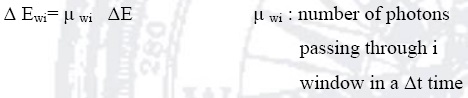
<body><![CDATA[<p align="justify"><font face="verdana" size="2">Similar problems related with the transmission of daylight by means of successive reflections on the inner surface of hollow ducts (or pipes) have received some attention since the eighties &#91;1, 2, 3, 4&#93;. In &#91;5, 6&#93;, building light&#45;wells of rather complex design has been experimentally studied.</font></p>  	    <p align="justify"><font face="verdana" size="2">A review of the scientific literature on the subject shows that in general, the basic purpose is to determine, either the radiation levels, or the photometric conditions at the end of the ducts, as effects of a known solar radiation input.</font></p>  	    <p align="justify"><font face="verdana" size="2">In the present contribution, instead of a unique outgoing flux (radiant or luminous), two quite different ones are computed: a) the flux which reaches the bottom of the well; and b), the lateral fluxes through the windows placed facing the well interior.</font></p>  	    <p align="justify"><font face="verdana" size="2">The model was built on the basis of the Snell&acute;s law. Stochasticity is introduced into it by using a Monte Carlo scheme &#91;7&#93;. As outputs of the model, the inner irradiances relative to the outer solar irradiance on a horizontal plane were chosen.</font></p>  	    <p align="justify"><font face="verdana" size="2">To characterize the single light reflection phenomenon of a one direction incident radiation onto a low roughness reflecting surface, it was assumed that the radiation scattering is given by a narrow Gaussian distribution which is centered around the specular reflection direction.</font></p>  	    <p align="justify"><font face="verdana" size="2">&nbsp;</font></p>  	    <p align="justify"><font face="verdana" size="2"><b>THE MODEL</b></font></p>  	    <p align="justify"><font face="verdana" size="2">Solar radiation flux entering into a light well can be written as</font></p>  	    <p align="center"><img src="/img/revistas/ns/v3n5/a1fo1.jpg"></p>      <p align="justify"><font face="verdana" size="2">where <b>I</b> is the vector defined by the direction, sense and intensity of direct solar radiation, <b>k</b> is the z&#45;axe versor ( see <a href="/img/revistas/ns/v3n5/a1f1.jpg" target="_blank">figure 1</a> ) and S is the area of the well cross section.</font></p>  	    ]]></body>
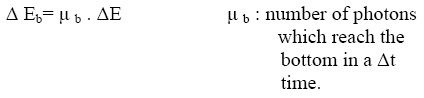
<body><![CDATA[<p align="justify"><font face="verdana" size="2">The radiation incidence area (at the top of the well ) is divided into a given number of equal cells, being the incident energy flux on each cell: N &#916;E/&#916;t, where &#916;E is an elemental quantity of radiant energy ( or "photon"), &#916;t an arbitrary lapse time and N, the number of incident photons on the cell in a &#916;t time (here, "elemental" means that there are not any partition of &#916;E in the model.</font></p>  	    <p align="justify"><font face="verdana" size="2">A vectorial algorithm simulates, step by step, the photons trajectories and photon&#45;escape events through control surfaces (inner windows and the top and bottom of the well).</font></p>  	    <p align="justify"><font face="verdana" size="2">When a photon is intercepted by a reflecting surface the probability of absorption is evaluated by means of a uniform distribution. In the case of no absorption, specular reflection direction is calculated by the well known vectorial formula:</font></p>  	    <p align="center"><img src="/img/revistas/ns/v3n5/a1fo2.jpg"></p>      <p align="justify"><font face="verdana" size="2">Where <b>n</b> is the normal at the reflecting surface, <b>i</b><sub>o</sub> is the versor which defines the sense and direction of the incident photon and <b>&#961;</b><sub>o</sub> is the versor corresponding to the reflected photon.</font></p>  	    <p align="justify"><font face="verdana" size="2">To simulate the quasi&#45;especular reflection phenomena it is used a Gaussian perturbation of the perfect specular reflection direction given by (2) &#91;8&#93;.</font></p>  	    <p align="justify"><font face="verdana" size="2">The absolute energy gain for the i window , in a time &#916;t is</font></p>  	    <p align="center"><img src="/img/revistas/ns/v3n5/a1fo3.jpg"></p>      <p align="justify"><font face="verdana" size="2">In a similar way the absolute energy at the bottom (neglecting any reflection from it) can be expressed as</font></p>  	    <p align="center"><img src="/img/revistas/ns/v3n5/a1fo4.jpg"></p>      ]]></body>
<body><![CDATA[<p align="justify"><font face="verdana" size="2">In order to quantify the radiation energy distribution it is convenient to define:</font></p>  	    <p align="justify"><font face="verdana" size="2">a) the energy gain of i window as a fraction of the total incident direct radiation: G<sub>wi</sub>= &#934;<sub>wi</sub>/&#934; , where &#934;<sub>wi</sub> = &#916; E<sub>wi</sub> / &#916;t</font></p>  	    <p align="justify"><font face="verdana" size="2">b) the relation between the flux which reaches the well bottom &#934;<sub>b</sub> = &#916; E<sub>b</sub> / &#916;t, and the incident one:</font></p>  	    <p align="center"><img src="/img/revistas/ns/v3n5/a1fo5.jpg"></p>      <p align="justify"><font face="verdana" size="2">Multiplying G<sub>wi</sub> by the factor f = S/S<sub>w</sub> (S<sub>w</sub> : window area), the irradiance on i window is obtained as a fraction of the external irradiation on a horizontal plane , without considering diffuse radiation. This new quantity, I<sub>wi</sub> = G<sub>wi</sub>.f, supplies relevant information about the daylighting method in study.</font></p>  	    <p align="justify"><font face="verdana" size="2">Also it is calculated the global fraction of absorbed radiant energy by means of the expression &#945; = &#934;<sub>a</sub>/&#934;, where &#934;<sub>a</sub> is the total absorbed flux by the reflecting material.</font></p>  	    <p align="justify"><font face="verdana" size="2">The energy lost by retroreflection, that is , the radiant flux from the top of the well, is negligible for the cases here shown. So, from the energy conservation law, the following relation holds:</font></p>  	    <p align="center"><img src="/img/revistas/ns/v3n5/a1fo6.jpg"></p>  	    <p align="justify"><font face="verdana" size="2">A reasonable validation of the computational code was obtained by performing a series of numerical experiments regarding energy conservation, convergence and fitting of exact solutions. It can be added that the solar intensity is automatically generated by a well known algorithm that process initial data of time (date, solar hour) and latitude.</font></p>  	    <p align="justify">&nbsp;</p> 	    ]]></body>
<body><![CDATA[<p align="justify"><font face="verdana" size="2"><b>Calculations Results</b></font></p>      <p align="justify"><font face="verdana" size="2">The dimensions and orientation of the light well that were chosen to perform the numerical examples are displayed in <a href="/img/revistas/ns/v3n5/a1f1.jpg" target="_blank">fig. 1</a>. There are three stories and four windows in each storey.</font></p>  	    <p align="justify"><font face="verdana" size="2">It was selected an absortivity value of the reflecting material equal to 0.2. The 3&#963; value of the normal distribution fit a 10 degree angle of deviation respect of the specular reflection direction. For basic Montecarlo program running it was used a total photons number equal to 3. 10<sup>4</sup>.</font></p>  	    <p align="justify"><font face="verdana" size="2">Diffuse radiation was not taken into account.</font></p>  	    <p align="justify"><font face="verdana" size="2">Most of the simulations correspond to local latitude of 33 <sup>o</sup> S which, in the country, approximates the main cities latitudes (<a href="/img/revistas/ns/v3n5/a1t1.jpg" target="_blank">Table I</a>). Due to the problem symmetry with respect to the North&#150;South direction, all the results are also valid for the North hemisphere.</font></p>  	    <p align="justify"><font face="verdana" size="2">Additional results, for higher and lower latitudes are presented too (<a href="/img/revistas/ns/v3n5/a1t2.jpg" target="_blank">Tables II</a> and <a href="/img/revistas/ns/v3n5/a1t3.jpg" target="_blank">III</a>).</font></p>  	    <p align="justify"><font face="verdana" size="2">To calculate absolute irradiances, <a href="/img/revistas/ns/v3n5/a1t1.jpg" target="_blank">Tables I</a> to <a href="/img/revistas/ns/v3n5/a1t3.jpg" target="_blank">III</a> (<a href="/img/revistas/ns/v3n5/a1t2.jpg" target="_blank">II</a>) can be used in connection with standard models which determine the atmosphere transmittance for direct solar radiation, as for instance the Hottel one &#91;9&#93;. Using this latter model it was built <a href="/img/revistas/ns/v3n5/a1f2.jpg" target="_blank">Fig. 2</a>, where absolute irradiances values are shown. </font><font face="verdana" size="2">In all cases, 0 solar hour corresponds to solar noon.</font></p>     <p align="justify"><font face="verdana" size="2">An inspection of the irradiances curves in <a href="/img/revistas/ns/v3n5/a1f2.jpg" target="_blank">Fig. 2</a> shows that all of them decrease in a monotone way for solar time greater than 3hr. This common trend is due to the great number of inner reflections at low values of the solar altitude angle. But, when considering the complete solar time range, other factors must be taken into account in order to explain the mean irradiance evolution, as the variation of the solar azimuth angle. At solar noon, for instance, the east and west walls of the well are almost not irradiated; the solar irradiation on these walls increases from 0hr to 1hr, and consequently, the mean irradiance also increases.</font></p>  	    <p align="justify">&nbsp;</p> 	    <p align="justify"><font face="verdana" size="2"><b>Conclusions and Perspectives</b></font></p>      ]]></body>
<body><![CDATA[<p align="justify"><font face="verdana" size="2">At the present research stage the gaussian model seems a suitable approach to treat quasi&#45;specular successive reflections. Experimental bidirectional spectral reflectivity &#91;7&#93; data for specific reflecting surfaces (of practical utility) could be used in the future to improve the calculation code.</font></p>  	    <p align="justify"><font face="verdana" size="2">Numerical values displayed in <a href="/img/revistas/ns/v3n5/a1t1.jpg" target="_blank">tables I</a> to <a href="/img/revistas/ns/v3n5/a1t3.jpg" target="_blank">III</a> (<a href="/img/revistas/ns/v3n5/a1t2.jpg" target="_blank">II</a>) can be used with any solar direct radiation data to predict the corresponding internal irradiances values.</font></p>  	    <p align="justify"><font face="verdana" size="2">These irradiances, assuming that the solar spectrum is little modified by the reflections, can be considered as "solar irradiances", and then be used as inputs to determine illumination distributions into the rooms which are illuminated from the well; provided that all the complementary data are known: geometry, windows glass transmittance (spectral), reflectivities of the room surfaces, optical properties of diffusers (if needed), etc. Undoubtedly this is a complex task, but not so different to the one involved in the dayligthing calculations for a room which is illuminated through a window of the building facade. That is to say, in both situations, primary data of solar radiation can be used to obtain inner illuminances.</font></p>  	    <p align="justify"><font face="verdana" size="2">It can be expected significant solar radiation levels for either illumination or growing plant (photosynthetical active radiation) purposes.</font></p>  	    <p align="justify"><font face="verdana" size="2">In particular, to visualize the availability of natural illumination, a luminous efficiency of solar radiation equal to 100 lumen/watt &#91; 5 &#93; can be assumed.</font></p>  	    <p align="justify"><font face="verdana" size="2">As an example, it can be calculated the mean illuminances onto the windows at the lowest level , for 43 degree latitude, during the equinoxes. Using this latter efficiency figure in combination with <a href="/img/revistas/ns/v3n5/a1t2.jpg" target="_blank">Table II</a> irradiances values and the Hottel model &#91; 9 &#93;, it is found that mean illuminances are over 2200 lux between 4am to 4pm , with a maximum near 11000 lux at solar noon. On the contrary, when the well inner surface is smooth but of a dark color (absortivity around 0.5) , the model predicts that the corresponding illuminances values are much smaller.</font></p>  	    <p align="justify"><font face="verdana" size="2">It is worth to observe the considerable high values of the solar transmittance. This supports the idea of using the light&#45; well as a sort of atrium, with a garden.</font></p>  	    <p align="justify"><font face="verdana" size="2">To appreciate the potential of this new passive daylighting strategy the results here discussed are enough; but, it is clear that more numerical&#45;experimental research is required to gain a better insight on the subject.</font></p>  	    <p align="justify"><font face="verdana" size="2">Regarding the reasons to do additional research efforts, it must be said:</font></p>  	    <p align="justify"><font face="verdana" size="2">On one hand, the method can be implemented in existing buildings with an air&#45;light well of similar characteristics to the one here studied .This can be done by attaching a reflecting film to the well surface (comments on specific techniques are beyond the scope of the this work).</font></p>  	    ]]></body>
<body><![CDATA[<p align="justify"><font face="verdana" size="2">On the other hand, the development of low cost high reflecting films would permit the method to be applied in deeper wells.</font></p>  	    <p align="justify"><font face="verdana" size="2">Also that, in any case, a reduction of the electrical energy consumption for diurnal illumination implies more sustainable buildings.</font></p>  	    <p align="justify"><font face="verdana" size="2">&nbsp;</font></p>  	    <p align="justify"><font face="verdana" size="2"><b>Acknowledgements</b></font></p>  	    <p align="justify"><font face="verdana" size="2">In memoriam Professor L.C.A. Fernandez.</font></p>  	    <p align="justify"><font face="verdana" size="2">&nbsp;</font></p>  	    <p align="justify"><font face="verdana" size="2"><b>References</b></font></p>  	    <!-- ref --><p align="justify"><font face="verdana" size="2">1.&#45; Courret G., Scartezzini J. L, Francioli D., Meyer J. J. Design and assessment of an anidolic light&#45;duct. Energy and Buildings, V. 28, n. 1, pp. 79&#45;99, (1998).    &nbsp;&nbsp;&nbsp;&nbsp;&nbsp;&nbsp;&nbsp;&nbsp;[&#160;<a href="javascript:void(0);" onclick="javascript: window.open('/scielo.php?script=sci_nlinks&ref=5470112&pid=S2007-0705201100010000100001&lng=','','width=640,height=500,resizable=yes,scrollbars=1,menubar=yes,');">Links</a>&#160;]<!-- end-ref --></font></p>  	    <!-- ref --><p align="justify"><font face="verdana" size="2">2.&#45; Oakley G., Riffat S. B. and Shao L. Daylight performance of lightpipes. Solar Energy, V. 69, n. 2, pp. 89&#45;98, (2000).    &nbsp;&nbsp;&nbsp;&nbsp;&nbsp;&nbsp;&nbsp;&nbsp;[&#160;<a href="javascript:void(0);" onclick="javascript: window.open('/scielo.php?script=sci_nlinks&ref=5470114&pid=S2007-0705201100010000100002&lng=','','width=640,height=500,resizable=yes,scrollbars=1,menubar=yes,');">Links</a>&#160;]<!-- end-ref --></font></p>  	    <!-- ref --><p align="justify"><font face="verdana" size="2">3.&#45; Eli&ccedil;abe Urriol J. J., Lara M. A. and Piacentini R. D. Passive solar light&#45;ducts, Applied Energy, V. 28, pp. 95&#45;195, (1987).    &nbsp;&nbsp;&nbsp;&nbsp;&nbsp;&nbsp;&nbsp;&nbsp;[&#160;<a href="javascript:void(0);" onclick="javascript: window.open('/scielo.php?script=sci_nlinks&ref=5470116&pid=S2007-0705201100010000100003&lng=','','width=640,height=500,resizable=yes,scrollbars=1,menubar=yes,');">Links</a>&#160;]<!-- end-ref --></font></p>  	    <!-- ref --><p align="justify"><font face="verdana" size="2">4.&#45; Zhang X and Muneer T. Mathematical model for the performance of light pipes. Lighting Research and Technology, V. 32, n. 3, pp. 141&#45;146, (2000).    &nbsp;&nbsp;&nbsp;&nbsp;&nbsp;&nbsp;&nbsp;&nbsp;[&#160;<a href="javascript:void(0);" onclick="javascript: window.open('/scielo.php?script=sci_nlinks&ref=5470118&pid=S2007-0705201100010000100004&lng=','','width=640,height=500,resizable=yes,scrollbars=1,menubar=yes,');">Links</a>&#160;]<!-- end-ref --></font></p>  	    <!-- ref --><p align="justify"><font face="verdana" size="2">5.&#45; Zastrow A. y Vittwer V. Daylighting with fluorescent and highly reflective silver coated films. New applications for new materials. 3nd. International Symposium of Optical and Optoelectronic Applied Sciences and Engineering &#45; Optical Materials Technology for Energy Efficiency and Solar Energy Conversion V, 14&#45;18 April, Innsbruck, (1986).    &nbsp;&nbsp;&nbsp;&nbsp;&nbsp;&nbsp;&nbsp;&nbsp;[&#160;<a href="javascript:void(0);" onclick="javascript: window.open('/scielo.php?script=sci_nlinks&ref=5470120&pid=S2007-0705201100010000100005&lng=','','width=640,height=500,resizable=yes,scrollbars=1,menubar=yes,');">Links</a>&#160;]<!-- end-ref --></font></p>  	    <!-- ref --><p align="justify"><font face="verdana" size="2">6.&#45;Kristl Z, Krainer A. Light wells in residential buildings as a complementary daylight source. Solar Energy, V.65, pp. 197&#45;206, (1999).    &nbsp;&nbsp;&nbsp;&nbsp;&nbsp;&nbsp;&nbsp;&nbsp;[&#160;<a href="javascript:void(0);" onclick="javascript: window.open('/scielo.php?script=sci_nlinks&ref=5470122&pid=S2007-0705201100010000100006&lng=','','width=640,height=500,resizable=yes,scrollbars=1,menubar=yes,');">Links</a>&#160;]<!-- end-ref --></font></p>  	    <!-- ref --><p align="justify"><font face="verdana" size="2">7.&#45; Siegel R. and Howell J. Thermal Radiation Heat Transfer. Mc Graw Hill, New York, (1965).    &nbsp;&nbsp;&nbsp;&nbsp;&nbsp;&nbsp;&nbsp;&nbsp;[&#160;<a href="javascript:void(0);" onclick="javascript: window.open('/scielo.php?script=sci_nlinks&ref=5470124&pid=S2007-0705201100010000100007&lng=','','width=640,height=500,resizable=yes,scrollbars=1,menubar=yes,');">Links</a>&#160;]<!-- end-ref --></font></p>  	    <!-- ref --><p align="justify"><font face="verdana" size="2">8.&#45; Eli&ccedil;abe Urriol J. J. , Belluccia H. A., Vital M. V,, Navone H. D. Solar radiation transmission by means of rectangular cross section ducts with quasi&#45;specular inner surface. Energ&iacute;as Renovables y Medio Ambiente, V. 16, pp. 15&#45;20, (2005).    &nbsp;&nbsp;&nbsp;&nbsp;&nbsp;&nbsp;&nbsp;&nbsp;[&#160;<a href="javascript:void(0);" onclick="javascript: window.open('/scielo.php?script=sci_nlinks&ref=5470126&pid=S2007-0705201100010000100008&lng=','','width=640,height=500,resizable=yes,scrollbars=1,menubar=yes,');">Links</a>&#160;]<!-- end-ref --></font></p>  	    <!-- ref --><p align="justify"><font face="verdana" size="2">9.&#45; Hottel H.C. A simple model for estimating the transmittance of direct solar radiation through clear atmospheres. Solar Energy, V. 18, pp.129&#45;134, (1976).    &nbsp;&nbsp;&nbsp;&nbsp;&nbsp;&nbsp;&nbsp;&nbsp;[&#160;<a href="javascript:void(0);" onclick="javascript: window.open('/scielo.php?script=sci_nlinks&ref=5470128&pid=S2007-0705201100010000100009&lng=','','width=640,height=500,resizable=yes,scrollbars=1,menubar=yes,');">Links</a>&#160;]<!-- end-ref --></font></p>      ]]></body><back>
<ref-list>
<ref id="B1">
<label>1</label><nlm-citation citation-type="journal">
<person-group person-group-type="author">
<name>
<surname><![CDATA[Courret]]></surname>
<given-names><![CDATA[G.]]></given-names>
</name>
<name>
<surname><![CDATA[Scartezzini]]></surname>
<given-names><![CDATA[J. L]]></given-names>
</name>
<name>
<surname><![CDATA[Francioli]]></surname>
<given-names><![CDATA[D.]]></given-names>
</name>
<name>
<surname><![CDATA[Meyer]]></surname>
<given-names><![CDATA[J. J.]]></given-names>
</name>
</person-group>
<article-title xml:lang="en"><![CDATA[Design and assessment of an anidolic light-duct]]></article-title>
<source><![CDATA[Energy and Buildings]]></source>
<year>1998</year>
<volume>28</volume>
<numero>1</numero>
<issue>1</issue>
<page-range>79-99</page-range></nlm-citation>
</ref>
<ref id="B2">
<label>2</label><nlm-citation citation-type="journal">
<person-group person-group-type="author">
<name>
<surname><![CDATA[Oakley]]></surname>
<given-names><![CDATA[G.]]></given-names>
</name>
<name>
<surname><![CDATA[Riffat]]></surname>
<given-names><![CDATA[S. B.]]></given-names>
</name>
<name>
<surname><![CDATA[Shao]]></surname>
<given-names><![CDATA[L.]]></given-names>
</name>
</person-group>
<article-title xml:lang="en"><![CDATA[Daylight performance of lightpipes]]></article-title>
<source><![CDATA[Solar Energy]]></source>
<year>2000</year>
<volume>69</volume>
<numero>2</numero>
<issue>2</issue>
<page-range>89-98</page-range></nlm-citation>
</ref>
<ref id="B3">
<label>3</label><nlm-citation citation-type="journal">
<person-group person-group-type="author">
<name>
<surname><![CDATA[Eliçabe Urriol]]></surname>
<given-names><![CDATA[J. J.]]></given-names>
</name>
<name>
<surname><![CDATA[Lara]]></surname>
<given-names><![CDATA[M. A.]]></given-names>
</name>
<name>
<surname><![CDATA[Piacentini]]></surname>
<given-names><![CDATA[R. D.]]></given-names>
</name>
</person-group>
<article-title xml:lang="en"><![CDATA[Passive solar light-ducts]]></article-title>
<source><![CDATA[Applied Energy]]></source>
<year>1987</year>
<volume>28</volume>
<page-range>95-195</page-range></nlm-citation>
</ref>
<ref id="B4">
<label>4</label><nlm-citation citation-type="journal">
<person-group person-group-type="author">
<name>
<surname><![CDATA[Zhang]]></surname>
<given-names><![CDATA[X]]></given-names>
</name>
<name>
<surname><![CDATA[Muneer]]></surname>
<given-names><![CDATA[T.]]></given-names>
</name>
</person-group>
<article-title xml:lang="en"><![CDATA[Mathematical model for the performance of light pipes]]></article-title>
<source><![CDATA[Lighting Research and Technology]]></source>
<year>2000</year>
<volume>32</volume>
<numero>3</numero>
<issue>3</issue>
<page-range>141-146</page-range></nlm-citation>
</ref>
<ref id="B5">
<label>5</label><nlm-citation citation-type="">
<person-group person-group-type="author">
<name>
<surname><![CDATA[Zastrow]]></surname>
<given-names><![CDATA[A.]]></given-names>
</name>
<name>
<surname><![CDATA[Vittwer]]></surname>
<given-names><![CDATA[V.]]></given-names>
</name>
</person-group>
<source><![CDATA[Daylighting with fluorescent and highly reflective silver coated films. New applications for new materials]]></source>
<year>1986</year>
<publisher-loc><![CDATA[Innsbruck ]]></publisher-loc>
</nlm-citation>
</ref>
<ref id="B6">
<label>6</label><nlm-citation citation-type="journal">
<person-group person-group-type="author">
<name>
<surname><![CDATA[Kristl]]></surname>
<given-names><![CDATA[Z]]></given-names>
</name>
<name>
<surname><![CDATA[Krainer]]></surname>
<given-names><![CDATA[A.]]></given-names>
</name>
</person-group>
<article-title xml:lang="en"><![CDATA[Light wells in residential buildings as a complementary daylight source]]></article-title>
<source><![CDATA[Solar Energy]]></source>
<year>1999</year>
<volume>65</volume>
<page-range>197-206</page-range></nlm-citation>
</ref>
<ref id="B7">
<label>7</label><nlm-citation citation-type="book">
<person-group person-group-type="author">
<name>
<surname><![CDATA[Siegel]]></surname>
<given-names><![CDATA[R.]]></given-names>
</name>
<name>
<surname><![CDATA[Howell]]></surname>
<given-names><![CDATA[J.]]></given-names>
</name>
</person-group>
<source><![CDATA[Thermal Radiation Heat Transfer]]></source>
<year>1965</year>
<publisher-loc><![CDATA[New York ]]></publisher-loc>
<publisher-name><![CDATA[Mc Graw Hill]]></publisher-name>
</nlm-citation>
</ref>
<ref id="B8">
<label>8</label><nlm-citation citation-type="journal">
<person-group person-group-type="author">
<name>
<surname><![CDATA[Eliçabe Urriol]]></surname>
<given-names><![CDATA[J. J.]]></given-names>
</name>
<name>
<surname><![CDATA[Belluccia]]></surname>
<given-names><![CDATA[H. A.]]></given-names>
</name>
<name>
<surname><![CDATA[Vital]]></surname>
<given-names><![CDATA[M. V]]></given-names>
</name>
<name>
<surname><![CDATA[Navone]]></surname>
<given-names><![CDATA[H. D.]]></given-names>
</name>
</person-group>
<article-title xml:lang="en"><![CDATA[Solar radiation transmission by means of rectangular cross section ducts with quasi-specular inner surface]]></article-title>
<source><![CDATA[Energías Renovables y Medio Ambiente]]></source>
<year>2005</year>
<volume>16</volume>
<page-range>15-20</page-range></nlm-citation>
</ref>
<ref id="B9">
<label>9</label><nlm-citation citation-type="journal">
<person-group person-group-type="author">
<name>
<surname><![CDATA[Hottel]]></surname>
<given-names><![CDATA[H.C.]]></given-names>
</name>
</person-group>
<article-title xml:lang="en"><![CDATA[A simple model for estimating the transmittance of direct solar radiation through clear atmospheres]]></article-title>
<source><![CDATA[Solar Energy]]></source>
<year>1976</year>
<volume>18</volume>
<page-range>129-134</page-range></nlm-citation>
</ref>
</ref-list>
</back>
</article>