<?xml version="1.0" encoding="ISO-8859-1"?><article xmlns:mml="http://www.w3.org/1998/Math/MathML" xmlns:xlink="http://www.w3.org/1999/xlink" xmlns:xsi="http://www.w3.org/2001/XMLSchema-instance">
<front>
<journal-meta>
<journal-id>1870-7459</journal-id>
<journal-title><![CDATA[Huitzil]]></journal-title>
<abbrev-journal-title><![CDATA[Huitzil]]></abbrev-journal-title>
<issn>1870-7459</issn>
<publisher>
<publisher-name><![CDATA[Sociedad para el Estudio y Conservación de las Aves en México, A.C. (CIPAMEX)]]></publisher-name>
</publisher>
</journal-meta>
<article-meta>
<article-id>S1870-74592015000100005</article-id>
<title-group>
<article-title xml:lang="en"><![CDATA[Urban birds in the Sonoran Desert: estimating population density from point counts]]></article-title>
<article-title xml:lang="es"><![CDATA[Aves urbanas en el Desierto Sonorense: estimando densidades poblacionales a partir de conteos de puntos]]></article-title>
</title-group>
<contrib-group>
<contrib contrib-type="author">
<name>
<surname><![CDATA[Johnston López]]></surname>
<given-names><![CDATA[Karina]]></given-names>
</name>
<xref ref-type="aff" rid="A01"/>
</contrib>
<contrib contrib-type="author">
<name>
<surname><![CDATA[Macías Duarte]]></surname>
<given-names><![CDATA[Alberto]]></given-names>
</name>
<xref ref-type="aff" rid="A02"/>
</contrib>
<contrib contrib-type="author">
<name>
<surname><![CDATA[Castillo Gámez]]></surname>
<given-names><![CDATA[Reyna Amanda]]></given-names>
</name>
<xref ref-type="aff" rid="A01"/>
</contrib>
</contrib-group>
<aff id="A01">
<institution><![CDATA[,Universidad de Sonora Departamento de Investigaciones Científicas y Tecnológicas ]]></institution>
<addr-line><![CDATA[Hermosillo Sonora]]></addr-line>
<country>México</country>
</aff>
<aff id="A02">
<institution><![CDATA[,Universidad Estatal de Sonora  ]]></institution>
<addr-line><![CDATA[Hermosillo Sonora]]></addr-line>
<country>México</country>
</aff>
<pub-date pub-type="pub">
<day>00</day>
<month>06</month>
<year>2015</year>
</pub-date>
<pub-date pub-type="epub">
<day>00</day>
<month>06</month>
<year>2015</year>
</pub-date>
<volume>16</volume>
<numero>1</numero>
<fpage>37</fpage>
<lpage>47</lpage>
<copyright-statement/>
<copyright-year/>
<self-uri xlink:href="http://www.scielo.org.mx/scielo.php?script=sci_arttext&amp;pid=S1870-74592015000100005&amp;lng=en&amp;nrm=iso"></self-uri><self-uri xlink:href="http://www.scielo.org.mx/scielo.php?script=sci_abstract&amp;pid=S1870-74592015000100005&amp;lng=en&amp;nrm=iso"></self-uri><self-uri xlink:href="http://www.scielo.org.mx/scielo.php?script=sci_pdf&amp;pid=S1870-74592015000100005&amp;lng=en&amp;nrm=iso"></self-uri><abstract abstract-type="short" xml:lang="en"><p><![CDATA[We conducted bird surveys in Hermosillo, Sonora using distance sampling to characterize detection functions at point-transects for native and non-native urban birds in a desert environment. From March to August 2013 we sampled 240 plots in the city and its surroundings; each plot was visited three times. Our purpose was to provide information for a rapid assessment of bird density in this region by using point counts. We identified 72 species, including six non-native species. Sixteen species had sufficient detections to accurately estimate the parameters of the detection functions. To illustrate the estimation of density from bird count data using our inferred detection functions, we estimated the density of the Eurasian Collared-Dove (Streptopelia decaocto) under two different levels of urbanization: highly urbanized (90-100% of urban impact) and moderately urbanized zones (39-50% of urban impact). Density of S. decaocto in the highly-urbanized and moderately-urbanized zones was 3.97±0.52 and 2.92±0.52 individuals/ha, respectively. By using our detection functions, avian ecologists can efficiently relocate time and effort that is regularly used for the estimation of detection distances, to increase the number of sites surveyed and to collect other relevant ecological information.]]></p></abstract>
<abstract abstract-type="short" xml:lang="es"><p><![CDATA[Realizamos conteos de aves en Hermosillo, Sonora, usando muéstreos de distancias para caracterizar las funciones de detección en trayectos por punto para las aves urbanas, nativas y no nativas, en un ecosistema desértico. De marzo a agosto de 2013 muestreamos 240 puntos en la ciudad y sus alrededores; visitamos cada punto tres veces. Nuestro propósito fue proveer información para agilizar la evaluación de la densidad de aves de la región utilizando puntos de conteo. De las 72 especies que identificamos, seis no son nativas. En 16 especies obtuvimos suficientes registros para estimar, de forma adecuada, los parámetros de las funciones de detección. Para ilustrar la estimación de la densidad por medio de puntos de conteo utilizamos las funciones de detección inferidas y estimamos la densidad de la tórtola turca (Streptopelia decaocto) en dos distintos niveles de urbanización: alto (90-100% de impacto urbano) y moderado (39-50% de impacto urbano). La densidad de S. decaocto en las zonas altamente urbanizadas y en las moderadas fue de 3.97±0.52 y 2.92±0.52 individuos/ha, respectivamente. Si los ecólogos utilizan nuestras funciones de detección podrán administrar su tiempo y esfuerzo, por lo regular dedicado a estimar las distancias de detección, para incrementar el número de sitios muestreados y colectar otra información ecológicamente relevante.]]></p></abstract>
<kwd-group>
<kwd lng="en"><![CDATA[Eurasian Collared-Dove]]></kwd>
<kwd lng="en"><![CDATA[Streptopelia decaocto]]></kwd>
<kwd lng="en"><![CDATA[detection function]]></kwd>
<kwd lng="en"><![CDATA[distance sampling]]></kwd>
<kwd lng="en"><![CDATA[point count]]></kwd>
<kwd lng="en"><![CDATA[Hermosillo]]></kwd>
<kwd lng="en"><![CDATA[Sonora]]></kwd>
<kwd lng="es"><![CDATA[tórtola turca]]></kwd>
<kwd lng="es"><![CDATA[Streptopelia decaocto]]></kwd>
<kwd lng="es"><![CDATA[función de detección]]></kwd>
<kwd lng="es"><![CDATA[muestreo de distancias]]></kwd>
<kwd lng="es"><![CDATA[puntos de conteo]]></kwd>
<kwd lng="es"><![CDATA[Hermosillo]]></kwd>
<kwd lng="es"><![CDATA[Sonora]]></kwd>
</kwd-group>
</article-meta>
</front><body><![CDATA[  	    <p align="justify"><font face="verdana" size="4">Art&iacute;culo original</font></p>     <p align="justify">&nbsp;</p>     <p align="center"><font face="verdana" size="4"><b>Urban birds in the Sonoran Desert: estimating population density from point counts</b></font></p>      <p align="center">&nbsp;</p>  	    <p align="center"><font face="verdana" size="3"><b>Aves urbanas en el Desierto Sonorense: estimando densidades poblacionales a partir de conteos de puntos</b></font></p>          <p align="center">&nbsp;</p>      <p align="center"><font face="verdana" size="2"><b>Karina Johnston L&oacute;pez,<sup>1</sup> Alberto Mac&iacute;as Duarte<sup>2</sup>* y Reyna Amanda Castillo G&aacute;mez<sup>1</sup></b><sup></sup></font></p> 	    <p align="center">&nbsp;</p>          <p align="justify"><i><font face="verdana" size="2"><sup>1</sup> Departamento de Investigaciones Cient&iacute;ficas y Tecnol&oacute;gicas de la Universidad de Sonora. Luis Donaldo Colosio s/n, entre Sahuaripa y Reforma, Colonia Centro, Hermosillo, Sonora, 83000, M&eacute;xico.</font></i></p>  	    ]]></body>
<body><![CDATA[<p align="justify"><font face="verdana" size="2"><sup><i>2</i></sup><i> Unidad Acad&eacute;mica Hermosillo, Universidad Estatal de Sonora. Ley Federal del Trabajo s/n, Colonia Apolo, Hermosillo, Sonora, 83100, M&eacute;xico</i>. *Email: <a href="mailto:alberto.macias@ues.mx">alberto.macias@ues.mx</a></font></p>      	    <p align="justify">&nbsp;</p>          <p align="justify"><font face="verdana" size="2">Recibido: 20 de marzo de 2014    <br>Revisi&oacute;n aceptada: 21 de octubre de 2014    <br>Editora asociada: Claudia E. Moreno Ortega</font></p>              <p align="justify">&nbsp;</p>  	    <p align="justify"><font face="verdana" size="2"><b>Abstract</b></font></p>  	    <p align="justify"><font face="verdana" size="2">We conducted bird surveys in Hermosillo, Sonora using distance sampling to characterize detection functions at point&#45;transects for native and non&#45;native urban birds in a desert environment. From March to August 2013 we sampled 240 plots in the city and its surroundings; each plot was visited three times. Our purpose was to provide information for a rapid assessment of bird density in this region by using point counts. We identified 72 species, including six non&#45;native species. Sixteen species had sufficient detections to accurately estimate the parameters of the detection functions. To illustrate the estimation of density from bird count data using our inferred detection functions, we estimated the density of the Eurasian Collared&#45;Dove (<i>Streptopelia decaocto</i>) under two different levels of urbanization: highly urbanized (90&#45;100% of urban impact) and moderately urbanized zones (39&#45;50% of urban impact). Density of <i>S. decaocto</i> in the highly&#45;urbanized and moderately&#45;urbanized zones was 3.97&plusmn;0.52 and 2.92&plusmn;0.52 individuals/ha, respectively. By using our detection functions, avian ecologists can efficiently relocate time and effort that is regularly used for the estimation of detection distances, to increase the number of sites surveyed and to collect other relevant ecological information.</font></p>  	    <p align="justify"><font face="verdana" size="2"><b>Keywords:</b> Eurasian Collared&#45;Dove, <i>Streptopelia decaocto,</i> detection function, distance sampling, point count, Hermosillo, Sonora.</font></p>          <p align="justify">&nbsp;</p>   	    ]]></body>
<body><![CDATA[<p align="justify"><font face="verdana" size="2"><b>Resumen</b></font></p>  	    <p align="justify"><font face="verdana" size="2">Realizamos conteos de aves en Hermosillo, Sonora, usando mu&eacute;streos de distancias para caracterizar las funciones de detecci&oacute;n en trayectos por punto para las aves urbanas, nativas y no nativas, en un ecosistema des&eacute;rtico. De marzo a agosto de 2013 muestreamos 240 puntos en la ciudad y sus alrededores; visitamos cada punto tres veces. Nuestro prop&oacute;sito fue proveer informaci&oacute;n para agilizar la evaluaci&oacute;n de la densidad de aves de la regi&oacute;n utilizando puntos de conteo. De las 72 especies que identificamos, seis no son nativas. En 16 especies obtuvimos suficientes registros para estimar, de forma adecuada, los par&aacute;metros de las funciones de detecci&oacute;n. Para ilustrar la estimaci&oacute;n de la densidad por medio de puntos de conteo utilizamos las funciones de detecci&oacute;n inferidas y estimamos la densidad de la t&oacute;rtola turca (<i>Streptopelia decaocto</i>) en dos distintos niveles de urbanizaci&oacute;n: alto (90&#45;100% de impacto urbano) y moderado (39&#45;50% de impacto urbano). La densidad de <i>S. decaocto</i> en las zonas altamente urbanizadas y en las moderadas fue de 3.97&plusmn;0.52 y 2.92&plusmn;0.52 individuos/ha, respectivamente. Si los ec&oacute;logos utilizan nuestras funciones de detecci&oacute;n podr&aacute;n administrar su tiempo y esfuerzo, por lo regular dedicado a estimar las distancias de detecci&oacute;n, para incrementar el n&uacute;mero de sitios muestreados y colectar otra informaci&oacute;n ecol&oacute;gicamente relevante.</font></p>  	    <p align="justify"><font face="verdana" size="2"><b>Palabras clave:</b> t&oacute;rtola turca, <i>Streptopelia decaocto,</i> funci&oacute;n de detecci&oacute;n, muestreo de distancias, puntos de conteo, Hermosillo, Sonora.</font></p>      	    <p align="justify">&nbsp;</p>          <p align="justify"><font face="verdana" size="2"><b>Introduction</b></font></p>      <p align="justify"><font face="verdana" size="2">According to the Secretar&iacute;a del Medio Ambiente y Recursos Naturales (Semarnat), from 1993 to 2002, 2.8 million hectares changed from natural ecosystems to urban and rural areas (Semarnat 2011). Urban areas are in constant expansion, causing a massive and unpredictable environmental change (McDonnell and Pickett 1990, Chance and Walsh 2004, McKinney 2008, Fuller <i>et al.</i> 2009). For some animals, urbanization may imply new food sources or nesting sites, but for others, urbanization may imply new predators or competitors, and depleted resources (Marzluff 2001, Blair 2001, Shochat 2004). Ecologists are interested on how the urban expansion affects native wildlife populations, particularly the avifauna (Marzluff <i>et al</i>. 2001a, Pennington and Blair 2012).</font></p>  	    <p align="justify"><font face="verdana" size="2">Birds are particularly adaptable to urban environments. In fact, some native and non&#45;native species have developed dense and stable populations within urban areas (Blair 2001, Pennington and Blair 2012). Some native species, such as the American Crow (<i>Corvus brachyrhynchos</i>), the Black&#45;billed Magpie (<i>Pica pica</i>), and the Greater Roadrunner (<i>Geococcyx californianus</i>) have become even more abundant inside cities than in their natural ecosystems (Marzluff <i>et al.</i> 2001b, Jerzak 2001, Schoech and Bowman 2001, DeStefano and Webster 2012). Some non&#45;native species such as the House Sparrow (<i>Passer domesticus</i>), the Rock Pigeon (<i>Columba livia</i>), the European Starling (<i>Sturnus vulgaris</i>), and the recently introduced Eurasian Collared&#45;Dove (<i>Streptopelia decaocto</i>) have expanded their distribution along with urbanization (Mennechez and Clergeau 2001, Blair 2001, McKinney 2006, Olden 2006, Fuller <i>et al.</i> 2009). Both native and non&#45;native populations should continuously be monitored to detect population trends. Therefore, estimating abundance is a critical step towards their management and conservation. Increasing our knowledge of urban birds is also relevant to promote the awareness of citizens on the natural heritage of their surroundings.</font></p>  	    <p align="justify"><font face="verdana" size="2">It is important to rely on sampling methods that effectively estimate density (individuals per unit of area). Bird counts (number of birds detected in a given area) do not account for imperfect detection, this is, when individuals are overlooked during sampling. Therefore, counts can only obtain indices of relative abundance (Conroy and Carroll 2009). A popular count technique in ornithology is point counts (Ralph <i>et al.</i> 1995), where an observer records all birds seen and heard for a defined period of time at a point with a fixed radius. Distance sampling is a widely used method employed to estimate bird density (Bibby <i>et al.</i> 1998, Gregory <i>et al.</i> 2004, Buckland <i>et al.</i> 2001, Conroy and Carroll 2009) accounting for imperfect detection. In contrast to counts, distance sampling consists on counting individuals and measuring their distance from the observer, under the assumption that all birds at a zero distance are detected. Distance sampling has two forms: line&#45;transect sampling and point&#45;transect sampling. Line&#45;transect sampling consists of counting organisms and measuring their distance while walking along a line. Line&#45;transect sampling is not usually suitable for urban areas since the random allocation of sampling units is difficult given the frequent occurrence of obstacles such as building or streets. Point&#45;transect sampling consists on measuring distances from every detected bird to a fixed observer during a defined period of time within a given radius. Therefore, point&#45;transect sampling is more appropriate for urban areas (Buckland <i>et al.</i> 2001).</font></p>  	    <p align="justify"><font face="verdana" size="2">Detection distances are used to infer the detection function <i>g(x),</i> i.e., the probability to detect a bird at a given distance (<i>x</i>) from the observer (Buckland <i>et al.</i> 2001). The characterization of the detection function is the key to estimate density accounting for imperfect detection. Once a detection function is obtained from the distance data, the detection function can be used to estimate density in future point counts (i.e., without measuring distances). However, no one seems to take advantage of using detection functions from previous studies (e.g., Norvell <i>et al.</i> 2003, Somershoe <i>et al.</i> 2006, Kark <i>et al.</i> 2007, Newson <i>et al.</i> 2008, Fuller <i>et al.</i> 2008, Fuller <i>et al.</i> 2009, Loss <i>et al.</i> 2009, Walker and Shochat 2010). Researchers usually calculate their own detection functions when they need to estimate densities, instead of devoting their time and effort in other relevant aspects of their studies.</font></p>  	    <p align="justify"><font face="verdana" size="2">The objective of this study was to characterize detection functions of several native and non&#45;native species present in the city of Hermosillo, Sonora, through an exhaustive bird sampling. By providing these detection functions, researchers interested in studying urban bird communities in similar habitats will be able to estimate population density (Thomas <i>et al.</i> 2010) from simple point counts without spending time and effort on recording detection distances. In addition, we exemplify the use of detection functions to estimate density from point count data. We do this in the context of a relevant aspect to be studied in urban environments: the increasing abundance of several exotic bird species which possibly compete and displace native species. In this regard, the recent invasion of the Eurasian Collared&#45;Dove may require population monitoring since several native dove species could suffer from resource competition from this exotic species (Romagosa 2012). Therefore, we use records from our study to illustrate our suggestion of future uses of our detection functions.</font></p>          ]]></body>
<body><![CDATA[<p align="justify">&nbsp;</p>  	    <p align="justify"><font face="verdana" size="2"><b>Methods</b></font></p> 	    <p align="justify"><font face="verdana" size="2"> Study area</font></p>  	    <p align="justify"><font face="verdana" size="2">Hermosillo, Sonora (29&deg;08'N, 110&deg;96'W; 211 m altitude) is a medium&#45;size city (population 784,342; INEGI 2012) within the Mexican portion of the Sonoran Desert. The city has a hot desert climate (BWh in the K&oacute;ppen climate classification), with 200 mm of mean annual rainfall. Hermosillo reaches high temperatures in summer (&gt;40 &deg;C) and winter can bring temperatures as low as 0 &deg;C (annual average temperature of 25 &deg;C).</font></p>     <p align="justify">&nbsp;</p>  	    <p align="justify"><font face="verdana" size="2">Survey method</font></p>  	    <p align="justify"><font face="verdana" size="2">The study was conducted during the breeding season of 2013 (March to August). We divided this breeding season in three sampling periods: March&#45;April, May&#45;June and July&#45;August. We visited the same sampling points each time. We used a grid of 440 quadrants of 1 km<sup>2</sup> defined by the UTM grid that covers the entire urban area of Hermosillo and its surroundings. Following the urban&#45;rural gradient categorization proposed by McDonnell and Pickett (1990) and recommended by other authors (e.g., Marzluff <i>et al.</i> 2001a; Pennington y Blair, 2012), we gave each quadrant one of four levels of urbanization (0&#45;29%, 30&#45;59%, 89&#45;60% and 90&#45;100% of urban impact) corresponding to its percent cover of buildings and streets. The levels of urbanization were estimated using satellite images from Google Earth (2013) and from the Inventario Nacional de Viviendas (updated to 2012, INEGI 2013) at each quadrant. From the total of 440 quadrants, 60 quadrants were randomly selected to sample, 15 quadrants of each level of urbanization. We randomly positioned four plots within each square. A total of 240 plots distributed within the city's boundaries were visited each period. We sampled each plot for 8 minutes using 200 m fixed&#45;radius point transects (Buckland <i>et al.</i> 2001) between 05:40 h and 09:30 h, just after sunrise and before the temperature reached more than 30 &deg;C. Sampling was performed by a two&#45;person team, the observer was the same during the entire sampling period. Birds disturbed during the observer's arrival were recorded at their initial location. We recorded individuals and groups of individuals (clusters hereafter) detected, as well as their species, cluster size and detection distance from the observer. We measured each detection distance (in meters) using a Nikon Prostaff Laser 440 Rangefinder&reg;. We recorded all birds seen and heard, while birds flying through the sampling point were neither recorded nor considered for the analysis.</font></p>          <p align="justify">&nbsp;</p>  	    <p align="justify"><font face="verdana" size="2">Data analysis</font></p>  	    <p align="justify"><font face="verdana" size="2">We estimated parameters of detection functions for species with &gt;75 detections (Buckland <i>et al.</i> 2001), using program <i>DISTANCE</i> (V 6.0 release 2, Thomas <i>et al.</i> 2010). We adjusted three key functions (half&#45;normal, hazard&#45;rate and uniform), each with three expansion adjustments (cosine, simple polynomial and hermit polynomial) with up to four terms. We chose the model with lowest value of the Akaike's Information Criterion (AIC) as the most plausible (best) model. We used detection distances below the 90<sup>th</sup> percentile to reduce the impact of outliers and improve the model fit.</font></p>  	    ]]></body>
<body><![CDATA[<p align="justify"><font face="verdana" size="2">To illustrate the use of our detection function (built with all detection distances in our three sampling periods) using count data to estimate density, we used our records on <i>S. decaocto</i> from two levels of urbanization, highly&#45;urbanized zones (90&#45;100% of urban impact) and moderately&#45;urban zones (30&#45;59% of urban impact) during the third sampling period (when the species was more abundant within the breeding season). The highly&#45;urbanized zones differed from the moderately&#45;urbanized zones because of the heavy vehicular traffic, tall and dense buildings and poor vegetation structure. Moderately&#45;urbanized had lower vehicular traffic, sparser and smaller buildings (mostly houses), few unpaved streets and a medium vegetation structure with several native plants. We used data that can be easily obtained from bird counts: clusters detected (<i>n</i>) and the number of plots surveyed (<i>k</i>). For the highly&#45;urbanized level of urbanization we used the records obtained in 60 plots and for the moderately&#45;urbanized level of urbanization we used the records obtained in 55 plots.</font></p>  	    <p align="justify"><font face="verdana" size="2">Among all species identified we used count data from <i>S. decaocto</i> given that the specie is one of the most common species in Hermosillo and it is important to monitor this species continentally. <i>Streptopelia decaocto</i> is a recently&#45;introduced (1980) avian species to the American continent that has been able to expand its distribution along most of America quite rapidly. Recent studies have encountered <i>S. decaocto</i> from southern Canada, all over the United States and Mexico, down to Central America (Romagosa 2012). The rapid and increasing distribution of <i>S. decaocto</i> is occasionally attributed to the continuous urban expansion (Crooks y Soule 1999). Several studies have identified that <i>S. decaocto</i> inhabits areas that present some degree of urban impact (Johnston, 2001; Bonter <i>et al.</i> 2010).</font></p>  	    <p align="justify"><font face="verdana" size="2">The estimator of density <img src="/img/revistas/huitzil/v16n1/a5d1.jpg"> is given by the expression (Buckland <i>et al.</i> 2001):</font></p>  	    <p align="center"><img src="/img/revistas/huitzil/v16n1/a5for1.jpg"></p>      <p align="justify"><font face="verdana" size="2">where <i><b>&#293;</b></i><b>(0)</b> is the estimator of the derivative of the probability density function of detection distances evaluated at zero distance, direct output of program <i>DISTANCE,</i> and <b><img src="/img/revistas/huitzil/v16n1/a5s1.jpg"></b> is the average number of individuals per detection. The standard error of density SE <img src="/img/revistas/huitzil/v16n1/a5d1.jpg">, assuming a Poisson distribution of counts, can be approximated using the delta method as follows (Buckland <i>et al.</i> 2001):</font></p>  	    <p align="center"><img src="/img/revistas/huitzil/v16n1/a5for2.jpg"></p>  	    <p align="justify"><font face="verdana" size="2">where <b>SE(<i>&#293;</i>(0))</b> also a direct output of program <i>DISTANCE</i> and Var(<img src="/img/revistas/huitzil/v16n1/a5s1.jpg">) is the sampling variance of the average number of individuals per detection. Finally, we used our estimates of density and their standard errors to test statistical differences in density of <i>S. decaocto</i> between highly&#45;urbanized and moderately&#45;urbanized zones using a Wald test (McCulloch <i>et al.</i> 2008).</font></p>     <p align="justify">&nbsp;</p>  	    <p align="justify"><font face="verdana" size="2"><b>Results</b></font></p>  	    <p align="justify"><font face="verdana" size="2">We recorded a total of 11,024 individuals from 72 species (<a href="/img/revistas/huitzil/v16n1/a5t1.jpg" target="_blank">Table 1</a>) during the breeding season of 2013 in 240 point transects with three replicates. According to each species' account in The Birds of North America (BNA), this 72 species include 39 resident breeders, 12 summer breeders, and 21 migrants (Poole 2013). Ten species comprised 80% of the individuals detected (<a href="#f1">Figure 1</a>). We found six non&#45;native species inhabiting the city of Hermosillo, with <i>Paser domesticus</i> being the most abundant, followed by <i>Streptopelia decaocto, Columba livia, Sturnus vulgaris,</i> and the parrots <i>Myiopsitta monachus</i> and <i>Amazona albifrons.</i> Order Columbiformes is the most abundant taxa, represented by 5. <i>decaocto, C. livia, Zenaida asi&aacute;tica, Z. macroura,</i> and <i>Columbina inca;</i> Columbiformes comprises 40% of the individuals detected. Native species of high relative importance in the urban bird community included (in decreasing order) <i>Zenaida asi&aacute;tica, Z. macroura, Columbina inca, Haemorhous mexicanus, Auriparus flavipens, Quiscalus mexicanus,</i> and <i>Melanerpes uropygialis</i> (<a href="#f1">Figure 1</a>). Two identified species are included in the Red List of Threatened Species (IUCN 2013), <i>Vireo bellii</i> as near threatened and <i>ToxoStoma bendirei</i> as vulnerable.</font></p>      	    ]]></body>
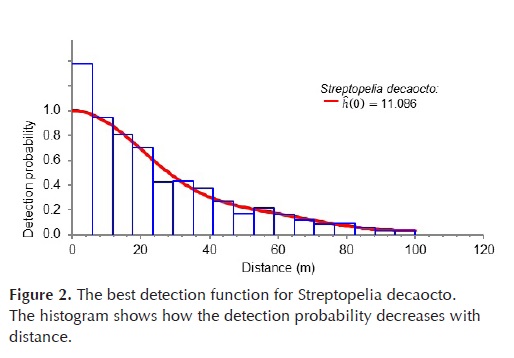
<body><![CDATA[<p align="center"><a name="f1"></a></p> 	    <p align="center"><img src="/img/revistas/huitzil/v16n1/a5f1.jpg"></p>          <p align="justify"><font face="verdana" size="2">We had 16 species with sufficient detections to carry out the analysis and model a best fitting detection function (<a href="/img/revistas/huitzil/v16n1/a5t2.jpg" target="_blank">Table 2</a>). Uniform key functions with cosine adjustments and hazard&#45;rate key functions were superior for modeling detection functions in our bird community compared to models with half&#45;normal and hermit and polynomial adjustments.</font></p>  	    <p align="justify"><font face="verdana" size="2">The best detection function for <i>S. decaocto</i> was the uniform key with a 4<sup>th</sup> order cosine adjustment, <b><i>&#293;</i>(0)</b> = 11.086 ha<sup>1</sup> (<a href="/img/revistas/huitzil/v16n1/a5t2.jpg" target="_blank">Table 2</a>, <a href="#f2">Figure 2</a>).</font></p>          <p align="center"><a name="f2"></a></p> 	    <p align="center"><img src="/img/revistas/huitzil/v16n1/a5f2.jpg"></p>  	    <p align="justify"><font face="verdana" size="2">We will now illustrate the use of the inferred detection functions to transform counts into density estimates. In the highly urbanized zones we had <i>n =</i> 122 detections of <i>S. decaocto</i> in <i>k</i> = 60 plots, and an average cluster size per detection of<b> <img src="/img/revistas/huitzil/v16n1/a5s1.jpg"> </b>= 1.111 individuals. With the estimate <i>&#293;</i>(0) = 11.09 ha<sup>&#45;1</sup> (<a href="/img/revistas/huitzil/v16n1/a5t2.jpg" target="_blank">Table 2</a>) we estimated a density <i>id</i>)<img src="/img/revistas/huitzil/v16n1/a5d1.jpg"> = 3.97 individuals/ha. With a Var(<img src="/img/revistas/huitzil/v16n1/a5s1.jpg">) = 0.007, and <b>SE(<i>&#293;</i>(0))</b> = 0.97 ha<sup>1</sup> (<a href="/img/revistas/huitzil/v16n1/a5t2.jpg" target="_blank">Table 2</a>), we obtained and SE<img src="/img/revistas/huitzil/v16n1/a5d1.jpg"> = 0.52 individuals/ha and a 95% CI(<i>D</i>) = (2.96, 4.98).</font></p>  	    <p align="justify"><font face="verdana" size="2">In the moderately&#45;urbanized zones we had <i>n =</i> 63 detections of <i>S. decaocto</i> in <i>k</i> = 55 plots, with an average cluster size per detection of<i> <img src="/img/revistas/huitzil/v16n1/a5s1.jpg"></i> = 1.44 individuals. With the estimate <b><i>&#293;</i>(0)</b> = 11.09 ha <sup>1</sup> we estimated a density <i><img src="/img/revistas/huitzil/v16n1/a5d1.jpg"></i> = 2.92 individuals/ha. With a Var(<img src="/img/revistas/huitzil/v16n1/a5s1.jpg">) = 0.007, and having <b>SE(<i>&#293;</i>(0))</b> = 0.97/ha, we obtained SE<img src="/img/revistas/huitzil/v16n1/a5d1.jpg">  = 0.52 individuals/ha and a 95% CI(<i>D</i>) = (2.92, 3.94).</font></p>  	    <p align="justify"><font face="verdana" size="2">The Wald test did not show enough evidence of statistical differences in density between these two zones (z = 1.43, <i>P</i> = 0.15).</font></p>          <p align="justify">&nbsp;</p>  	    ]]></body>
<body><![CDATA[<p align="justify"><font face="verdana" size="2"><b>Discussion</b></font></p>  	    <p align="justify"><font face="verdana" size="2">The bird community of the city of Hermosillo shares some dominant components with other urban bird communities in the Sonoran Desert and the world. For instance, <i>Paser domesticus</i> (exotic) is also the most abundant species in urban Tucson (Emlen 1974) and Phoenix (Green and Baker 2003) in Arizona, USA; native and exotic columbids (pigeons and doves) also attain high relative abundances. Large body mass and granivorous diets, attained by these dominant species, are traits that have related to success in urban areas (Lancaster and Rees 1979, Beissinger and Osborne 1982, Ikin <i>et al.</i> 2 002, Kark <i>et al.</i> 2007, Johnston&#45;L&oacute;pez 2014). Furthermore, reduced bird diversity in urban environments, as revealed in this work by the existence of few species comprising the majority of the bird abundance (<a href="#f1">Figure 1</a>), is a widespread pattern (Emlen 1974, Beissinger and Osborne 1982, Mills <i>et al.</i> 1989, Green and Baker2003). More predictable food sources and reduction in predation risk by top predators in urban areas compared to the surrounding arid environments are thought to change trophic relationships that ultimately lead to the dominance of fewer urban specialists (Faeth <i>et al.</i> 2005) with important exotic component such as <i>Paser domesticus, Columba livia</i> and, more recently, <i>Streptopelia decaocto.</i> Urbanization also reduces the insectivorous component of the native bird community in the surrounding desert (Walker and Shochat 2010), such as <i>Campylorhynchus brunneicapillus</i> and <i>Polioptila melanura,</i> which inhabit the less urbanized areas in Hermosillo (Johnston&#45;L&oacute;pez 2014).</font></p>  	    <p align="justify"><font face="verdana" size="2">The study of urban bird community dynamics requires reliable estimation of bird abundance to make reliable inferences in the ecological processes that shape structure and composition of those communities. Point counts are one of the most popular methods for estimating abundance of birds (Ralph <i>et al.</i> 1998, Rosenstock <i>et al.</i> 2002). Studies that conduct point counts can cover larger land extensions and can be conducted by a larger group of people, since only identification training is needed. Some coordinated survey efforts organize annual bird point counts, such as The North American Breeding Bird Survey, and encourage citizen participation. These bird counts collect important information about population trends and promote avian conservation, but they do not account for imperfect detection, and the information cannot be used to correctly estimate densities.</font></p>          <p align="justify"><font face="verdana" size="2">Studies that estimate densities by distance sampling usually rely on visual estimation of distances to save time when collecting the survey data. However, the use of visually&#45;estimated distances (e.g., Norvell <i>et al.</i> 2003, Fuller <i>et al.</i> 2009, Loss <i>et al.</i> 2009, Walker and Shochat 2010) is questionable. Distance sampling analyses assume that all distances are estimated accurately (Buckland <i>et al.</i> 2001). Distances are also frequently measured in ranges (e.g., Somershoe <i>et al.</i> 2006, Kark <i>et al.</i> 2007, Fuller <i>et al.</i> 2008, Newson <i>et al.</i> 2008). Accurately measuring distances will always be preferred to visually estimating densities, even obtaining them by pacing distances. The use of detection functions inferred from previous distance data could help avoid having to rely on uncertain distances to estimate densities. By using these detection functions to estimate densities, ecologists could relocate their time and effort employed in estimating distances and readjusting their estimating capacity to obtain other important details from their studies, such as environmental information or additional counts. For the city of Hermosillo and other cities in the Sonoran Desert, we recommend that research on urban avifaunas use point counts, considering all birds seen and heard (except for those just flying by) within a radial distance of 200 m from the observer and then use our estimates of <i>&#293;</i>(0) to convert those counts into density. All bird surveys were conducted by a single observer (KJL) during the breeding season of 2013. Therefore, we did not have the need of accounting for differences between observers and seasons when estimating detection functions. Although our detection functions are representative of trained surveyors, further evaluations of variability due to observers is needed.</font></p>  	    <p align="justify"><font face="verdana" size="2">Variation of our detection functions among species are evidently due to variation in species detectability, which is quantified by the estimates of <i>h</i>(0). The parameter <i>h</i>(0) is inversely proportional to the effective area (v), that is <i>h</i>(0)<i> = 2&#960;/v.</i> In our case, <i>v</i> is the inner circle within the 200 m&#45;radius plot, such that the number of birds detected outside it (but within the 200 m&#45;radius plot) equals the number of birds undetected within it (Buckland <i>et al.</i> 2001). Relatively large <i>v</i> then represents a better coverage of the 200 m&#45;radius sampling plot by the surveyor. Species such as <i>Columba livia, Tyrannus verticalis, Quiscalus mexicanus</i> and <i>Zenaida macroura</i> that tend to perch high on buildings, electric poles and cables in large groups, and <i>Cardinalis sinuatus</i> that sings loud while perched on high branches, are all easily detectable at distances over 60 m (some are easily detected over 150 m) and attain the lowest <i>h</i>(0) estimates among all species (<a href="/img/revistas/huitzil/v16n1/a5t2.jpg" target="_blank">Table 2</a>) and therefore, have relatively large effective areas. Species such as <i>Zenaida asi&aacute;tica and Streptopelia decaocto</i> also tend to perch high on electric poles and cables but individually or in small groups; <i>Melanerpes uropygialis</i> and <i>Campylorhynchus brunneicapillus</i> tend to sing loud when approached; and <i>Chondestes grammacus</i> are all easily detected over 30 m (some are easily detected even at 100 m); these species attain relatively low estimates of <i>h</i>(0) (<a href="/img/revistas/huitzil/v16n1/a5t2.jpg" target="_blank">Table 2</a>) and therefore also have fairly large effective areas. On the other hand, species such as <i>Haemorhous mexicanus, Passer domesticus, Columbina inca,</i> and <i>Auriparus flaviceps</i> that are relatively abundant and some even sing quite loud, are not easily detectable at relatively large distances because of their small body size. These species are mostly detected under 60 m and attain intermediate <i>h</i>(0) estimates among the species we analyzed (<a href="/img/revistas/huitzil/v16n1/a5t2.jpg" target="_blank">Table 2</a>) and therefore, have small&#45;medium effective areas. Finally, species such as <i>Polioptila melanura</i> and <i>Cynanthus latirostris</i> are frequently hard to detect because of their tiny body size and their constant "hopping&#45;flying around" behavior. These species are mostly detected under 40 m and therefore attain large <i>h</i>(0) estimates (<a href="/img/revistas/huitzil/v16n1/a5t2.jpg" target="_blank">Table 2</a>) and small effective areas.</font></p>  	    <p align="justify"><font face="verdana" size="2">Using our detection function results from point counts readily produce relevant management information in terms of population density. In particular, density estimates for <i>Streptopelia decaocto</i> using the detection function suggests that the species attains similar abundances in highly&#45;urbanized zones and moderately&#45;urbanized zones. This species has been recorded in both urban and agricultural areas (Johnston 2001, Fuller <i>et al.</i> 2009) and rarely in natural lands. Fuller <i>et al.</i> 2009 studied the urban birds within the boundaries of the city of Sheffield (England), a 160 km<sup>2</sup> city with temperate climate. Their population estimate for the entire city was 13,271 (95%CI = (11,312, 15,568)) individuals of <i>S. decaocto</i> during the summer (May&#45;July). Our population estimate for the species in the city of Hermosillo (Mexico), a 193 km<sup>2</sup> city with arid climate was 57,384 (95% CI = (51,484, 63,284)) individuals during the summer (March&#45;August). We are not aware of any estimate of the species' density by levels of any urban impact classification anywhere else for comparison to our estimates. Fujisaki <i>et al.</i> (2010) mention that the range expansion of this species tends to follow human altered landscapes such as road and agricultural areas, but the authors do not have enough data to conclude whether <i>S. decaocto</i> was more abundant in urban or suburban areas. Several studies have reported this species in urban areas of several Mexican states (Pineda&#45;Lopez and Malagamba2011, Chabl&eacute;&#45;Santos <i>et al.</i> 2012, Pineda&#45;Lopez <i>et al.</i> 2013), but none of these studies documents the changes in the distribution of this species along an urban&#45;rural gradient.</font></p>     <p align="justify">&nbsp;</p>  	    <p align="justify"><font face="verdana" size="2"><b>Acknowledgments</b></font></p>  	    <p align="justify"><font face="verdana" size="2">We thank our field assistants R.R. Valle&#45;Salinas and F. Johnston&#45;L&oacute;pez for their unconditional help during the whole summer. We also thank A.G. Martinez&#45;Vargas and an anonymous reviewers for their helpful comments during the manuscript preparation. K. Johnston&#45;L&oacute;pez has a National Council of Science and Technology (Conacyt) graduate scholarship (No. 273604).</font></p>          <p align="justify">&nbsp;</p>  	    ]]></body>
<body><![CDATA[<p align="justify"><font face="verdana" size="2"><b>Literature cited</b></font></p>  	    <!-- ref --><p align="justify"><font face="verdana" size="2">Beissinger, S.R. and D.R. Osborne. 1982. Effects of urbanization on avian community organization. The Condor 84:75&#45;83.    &nbsp;&nbsp;&nbsp;&nbsp;&nbsp;&nbsp;&nbsp;&nbsp;[&#160;<a href="javascript:void(0);" onclick="javascript: window.open('/scielo.php?script=sci_nlinks&ref=4214564&pid=S1870-7459201500010000500001&lng=','','width=640,height=500,resizable=yes,scrollbars=1,menubar=yes,');">Links</a>&#160;]<!-- end-ref --></font></p>  	    <!-- ref --><p align="justify"><font face="verdana" size="2">Bibby, C., M. Jones, and S. Marsden. 1998. Expedition Field Techniques: Bird Surveys. Expedition Advisory Centre, Royal Geographical Society. London, United Kingdom.    &nbsp;&nbsp;&nbsp;&nbsp;&nbsp;&nbsp;&nbsp;&nbsp;[&#160;<a href="javascript:void(0);" onclick="javascript: window.open('/scielo.php?script=sci_nlinks&ref=4214566&pid=S1870-7459201500010000500002&lng=','','width=640,height=500,resizable=yes,scrollbars=1,menubar=yes,');">Links</a>&#160;]<!-- end-ref --></font></p>  	    <!-- ref --><p align="justify"><font face="verdana" size="2">Blair, B.B. 2001. Creating a homogeneous avifauna. Pp. 459&#45;486. <i>In:</i> J.M. Marzluff, R. Bowman, and R. Donnelly (eds.). Avian ecology and conservation in an urbanizing world. Kluwer Academic Publishers. London, United Kingdom.    &nbsp;&nbsp;&nbsp;&nbsp;&nbsp;&nbsp;&nbsp;&nbsp;[&#160;<a href="javascript:void(0);" onclick="javascript: window.open('/scielo.php?script=sci_nlinks&ref=4214568&pid=S1870-7459201500010000500003&lng=','','width=640,height=500,resizable=yes,scrollbars=1,menubar=yes,');">Links</a>&#160;]<!-- end-ref --></font></p>  	    <!-- ref --><p align="justify"><font face="verdana" size="2">Bonter, D.N., B. Zuckerberg, and J.L. Dickinson. 2010. Invasive birds in a novel landscape: habitat associations and effects on established species. Echography, 33:494&#45;502.    &nbsp;&nbsp;&nbsp;&nbsp;&nbsp;&nbsp;&nbsp;&nbsp;[&#160;<a href="javascript:void(0);" onclick="javascript: window.open('/scielo.php?script=sci_nlinks&ref=4214570&pid=S1870-7459201500010000500004&lng=','','width=640,height=500,resizable=yes,scrollbars=1,menubar=yes,');">Links</a>&#160;]<!-- end-ref --></font></p>  	    <!-- ref --><p align="justify"><font face="verdana" size="2">Buckland, ST., D.R. Anderson, K.P. Burnham, J.L. Laake, D.L. Borchers, and L. Thomas. 2001. Introduction to distance sampling: estimating abundance of biological populations. Oxford University Press. Oxford, United Kingdom.    &nbsp;&nbsp;&nbsp;&nbsp;&nbsp;&nbsp;&nbsp;&nbsp;[&#160;<a href="javascript:void(0);" onclick="javascript: window.open('/scielo.php?script=sci_nlinks&ref=4214572&pid=S1870-7459201500010000500005&lng=','','width=640,height=500,resizable=yes,scrollbars=1,menubar=yes,');">Links</a>&#160;]<!-- end-ref --></font></p>  	    <!-- ref --><p align="justify"><font face="verdana" size="2">Chabl&eacute;&#45;Santos, J., E. G&oacute;mez&#45;Uc, and S. Hern&aacute;ndez&#45;Betancourt. 2012. Registros reproductivos de la paloma de collar (<i>Streptopelia decaocto</i>) en Yucat&aacute;n, M&eacute;xico. Huitzil 13:1&#45;5.    &nbsp;&nbsp;&nbsp;&nbsp;&nbsp;&nbsp;&nbsp;&nbsp;[&#160;<a href="javascript:void(0);" onclick="javascript: window.open('/scielo.php?script=sci_nlinks&ref=4214574&pid=S1870-7459201500010000500006&lng=','','width=640,height=500,resizable=yes,scrollbars=1,menubar=yes,');">Links</a>&#160;]<!-- end-ref --></font></p>  	    <!-- ref --><p align="justify"><font face="verdana" size="2">Chance, J.F. and J.J. Walsh. 2004. Urban effects on native avifauna: A review. Landscape and Urban Planning 74:46&#45;69.    &nbsp;&nbsp;&nbsp;&nbsp;&nbsp;&nbsp;&nbsp;&nbsp;[&#160;<a href="javascript:void(0);" onclick="javascript: window.open('/scielo.php?script=sci_nlinks&ref=4214576&pid=S1870-7459201500010000500007&lng=','','width=640,height=500,resizable=yes,scrollbars=1,menubar=yes,');">Links</a>&#160;]<!-- end-ref --></font></p>  	    <!-- ref --><p align="justify"><font face="verdana" size="2">Conroy, M.J. and J.P. Carroll. 2009. Quantitative conservation of vertebrates. Wiley&#45;Blackwell. Chichester, United Kingdom.    &nbsp;&nbsp;&nbsp;&nbsp;&nbsp;&nbsp;&nbsp;&nbsp;[&#160;<a href="javascript:void(0);" onclick="javascript: window.open('/scielo.php?script=sci_nlinks&ref=4214578&pid=S1870-7459201500010000500008&lng=','','width=640,height=500,resizable=yes,scrollbars=1,menubar=yes,');">Links</a>&#160;]<!-- end-ref --></font></p>  	    <!-- ref --><p align="justify"><font face="verdana" size="2">Crooks, J.A. and M.E. Soule. 1999. Lag times in population explosions of invasive species: causes and implications. Pp. 103&#45;125. <i>In:</i> O.T. Sandland, P.J. Schei, and A. Viken (eds). Invasive Species and Biodiversity Management. Dordrecht: Kluwer Academic Publishers. London, United Kingdom.    &nbsp;&nbsp;&nbsp;&nbsp;&nbsp;&nbsp;&nbsp;&nbsp;[&#160;<a href="javascript:void(0);" onclick="javascript: window.open('/scielo.php?script=sci_nlinks&ref=4214580&pid=S1870-7459201500010000500009&lng=','','width=640,height=500,resizable=yes,scrollbars=1,menubar=yes,');">Links</a>&#160;]<!-- end-ref --></font></p>  	    <!-- ref --><p align="justify"><font face="verdana" size="2">DeStefano, S. and C.M. Webster. 2012. Distribution and habitat of Greater Roadrunners in urban and suburban Arizona. Pp. 155&#45;165. <i>In:</i> C.A. Lepczyk and PS. Warren (eds.). Urban Bird Ecology and Conservation. University of California Press. Berkeley, California, USA.    &nbsp;&nbsp;&nbsp;&nbsp;&nbsp;&nbsp;&nbsp;&nbsp;[&#160;<a href="javascript:void(0);" onclick="javascript: window.open('/scielo.php?script=sci_nlinks&ref=4214582&pid=S1870-7459201500010000500010&lng=','','width=640,height=500,resizable=yes,scrollbars=1,menubar=yes,');">Links</a>&#160;]<!-- end-ref --></font></p>  	    <!-- ref --><p align="justify"><font face="verdana" size="2">Green, D.M. and M.G. Baker. 2003. Urbanization impacts on habitat and bird communities in a Sonoran desert ecosystem. Landscape and urban planning 63(4):225&#45;239</font>&nbsp;&nbsp;&nbsp;&nbsp;&nbsp;&nbsp;&nbsp;&nbsp;[&#160;<a href="javascript:void(0);" onclick="javascript: window.open('/scielo.php?script=sci_nlinks&ref=4214584&pid=S1870-7459201500010000500011&lng=','','width=640,height=500,resizable=yes,scrollbars=1,menubar=yes,');">Links</a>&#160;]<!-- end-ref --><!-- ref --><p align="justify"><font face="verdana" size="2">Emlen, J.T. 1974. An urban bird community in Tucson, Arizona: derivation, structure, regulation. The Condor 76:184&#45;197.    &nbsp;&nbsp;&nbsp;&nbsp;&nbsp;&nbsp;&nbsp;&nbsp;[&#160;<a href="javascript:void(0);" onclick="javascript: window.open('/scielo.php?script=sci_nlinks&ref=4214585&pid=S1870-7459201500010000500012&lng=','','width=640,height=500,resizable=yes,scrollbars=1,menubar=yes,');">Links</a>&#160;]<!-- end-ref --></font></p>  	    <!-- ref --><p align="justify"><font face="verdana" size="2">Faeth, S.H., P.S. Warren, E. Shochat, and W.A. Marussich. 2005. Trophic dynamics in urban communities. Bioscience 55(5):399&#45;407.    &nbsp;&nbsp;&nbsp;&nbsp;&nbsp;&nbsp;&nbsp;&nbsp;[&#160;<a href="javascript:void(0);" onclick="javascript: window.open('/scielo.php?script=sci_nlinks&ref=4214587&pid=S1870-7459201500010000500013&lng=','','width=640,height=500,resizable=yes,scrollbars=1,menubar=yes,');">Links</a>&#160;]<!-- end-ref --></font></p>  	    <!-- ref --><p align="justify"><font face="verdana" size="2">Fujisaki, I., E.V Pearlstine, and F.J. Mazzotti. 2010. The rapid spread of invasive Eurasian Collared Doves <i>Streptopelia decaocto</i> in the continental USA follows human&#45;altered habitats. Ibis 152:622&#45;632.    &nbsp;&nbsp;&nbsp;&nbsp;&nbsp;&nbsp;&nbsp;&nbsp;[&#160;<a href="javascript:void(0);" onclick="javascript: window.open('/scielo.php?script=sci_nlinks&ref=4214589&pid=S1870-7459201500010000500014&lng=','','width=640,height=500,resizable=yes,scrollbars=1,menubar=yes,');">Links</a>&#160;]<!-- end-ref --></font></p>      	    <!-- ref --><p align="justify"><font face="verdana" size="2">Fuller, R.A., J. Tr&aacute;talos, and K.J. Gaston. 2009. How many birds are there in a city of a half a million people? Diversity and Distributions 15:328&#45;337.    &nbsp;&nbsp;&nbsp;&nbsp;&nbsp;&nbsp;&nbsp;&nbsp;[&#160;<a href="javascript:void(0);" onclick="javascript: window.open('/scielo.php?script=sci_nlinks&ref=4214591&pid=S1870-7459201500010000500015&lng=','','width=640,height=500,resizable=yes,scrollbars=1,menubar=yes,');">Links</a>&#160;]<!-- end-ref --></font></p>          ]]></body>
<body><![CDATA[<!-- ref --><p align="justify"><font face="verdana" size="2">Fuller, R.A., RH. Warren, RR. Armsworth, O. Barbosa, and K.J. Gaston. 2008. Garden bird feeding predicts the structure of urban avian assemblages. Diversity and Distributions 14:131&#45;137.    &nbsp;&nbsp;&nbsp;&nbsp;&nbsp;&nbsp;&nbsp;&nbsp;[&#160;<a href="javascript:void(0);" onclick="javascript: window.open('/scielo.php?script=sci_nlinks&ref=4214593&pid=S1870-7459201500010000500016&lng=','','width=640,height=500,resizable=yes,scrollbars=1,menubar=yes,');">Links</a>&#160;]<!-- end-ref --></font></p>  	    <!-- ref --><p align="justify"><font face="verdana" size="2">Google (on line). 2013. Google Earth Version 6.2 Software. Available at &lt;<a href="http://www.google.com/earth/" target="_blank">www.google.com/earth/</a>&gt; (accessed January 2013).    &nbsp;&nbsp;&nbsp;&nbsp;&nbsp;&nbsp;&nbsp;&nbsp;[&#160;<a href="javascript:void(0);" onclick="javascript: window.open('/scielo.php?script=sci_nlinks&ref=4214595&pid=S1870-7459201500010000500017&lng=','','width=640,height=500,resizable=yes,scrollbars=1,menubar=yes,');">Links</a>&#160;]<!-- end-ref --></font></p>  	    <!-- ref --><p align="justify"><font face="verdana" size="2">Gregory, R.D., D.W. Gibbons, and P.F. Donald. 2004. Bird census and survey techniques. Pp. 17&#45;56. <i>In:</i> W. J. Sutherland, I. Newton, and R. E. Green (eds.). Bird Ecology and Conservation: A Handbook of Techniques.Oxford University Press. Oxford.    &nbsp;&nbsp;&nbsp;&nbsp;&nbsp;&nbsp;&nbsp;&nbsp;[&#160;<a href="javascript:void(0);" onclick="javascript: window.open('/scielo.php?script=sci_nlinks&ref=4214597&pid=S1870-7459201500010000500018&lng=','','width=640,height=500,resizable=yes,scrollbars=1,menubar=yes,');">Links</a>&#160;]<!-- end-ref --></font></p>  	    <!-- ref --><p align="justify"><font face="verdana" size="2">Ikin, K., E. Knight, D.B. Lindenmayer, J. Fischer, and A.D. Manning. 2012. Linking bird species traits to vegetation characteristics in a future urban development zone: implications for urban planning. Urban Ecosystems 15:961&#45;977.    &nbsp;&nbsp;&nbsp;&nbsp;&nbsp;&nbsp;&nbsp;&nbsp;[&#160;<a href="javascript:void(0);" onclick="javascript: window.open('/scielo.php?script=sci_nlinks&ref=4214599&pid=S1870-7459201500010000500019&lng=','','width=640,height=500,resizable=yes,scrollbars=1,menubar=yes,');">Links</a>&#160;]<!-- end-ref --></font></p>  	    <!-- ref --><p align="justify"><font face="verdana" size="2">INEGI (Instituto Nacional de Estad&iacute;stica y Geograf&iacute;a) (on line). 2012. Perspectiva Estad&iacute;stica Sonora Diciembre 2012. Available at &lt;<a href="http://www.inegi.org.mx/prod_serv/contenidos/espanol/bvinegi/productos/integracion/estd_perspect/son/Pers-son.pdf" target="_blank">www.inegi.org.mx/prod_serv/contenidos/espanol/bvinegi/productos/integracion/estd_perspect/son/Pers&#45;son.pdf</a>&gt; (last accessed 1<sup>st</sup> March 2014).    &nbsp;&nbsp;&nbsp;&nbsp;&nbsp;&nbsp;&nbsp;&nbsp;[&#160;<a href="javascript:void(0);" onclick="javascript: window.open('/scielo.php?script=sci_nlinks&ref=4214601&pid=S1870-7459201500010000500020&lng=','','width=640,height=500,resizable=yes,scrollbars=1,menubar=yes,');">Links</a>&#160;]<!-- end-ref --></font></p>  	    ]]></body>
<body><![CDATA[<!-- ref --><p align="justify"><font face="verdana" size="2">INEGI (Instituto Nacional de Estad&iacute;stica y Geograf&iacute;a) (on line). 2013. Inventario Nacional de Viviendas (actualizado 2012). Available at &lt;<a href="http://www3.inegi.org.mx/sistemas/mapa/inv/Default.aspx" target="_blank">www3.inegi.org.mx/sistemas/mapa/inv/Default.aspx</a>&gt; (accessed January 2013)</font>&nbsp;&nbsp;&nbsp;&nbsp;&nbsp;&nbsp;&nbsp;&nbsp;[&#160;<a href="javascript:void(0);" onclick="javascript: window.open('/scielo.php?script=sci_nlinks&ref=4214603&pid=S1870-7459201500010000500021&lng=','','width=640,height=500,resizable=yes,scrollbars=1,menubar=yes,');">Links</a>&#160;]<!-- end-ref --><!-- ref --><p align="justify"><font face="verdana" size="2">IUCN (International Union for Conservation of Nature) (online). 2013. IUCN Red List of Threatened Species version 2013.1. Available at &lt;<a href="http://www.iucnredlist.org" target="_blank">www.iucnredlist.org</a>&gt; (last accessed 28<sup>th</sup> October 2013).    &nbsp;&nbsp;&nbsp;&nbsp;&nbsp;&nbsp;&nbsp;&nbsp;[&#160;<a href="javascript:void(0);" onclick="javascript: window.open('/scielo.php?script=sci_nlinks&ref=4214604&pid=S1870-7459201500010000500022&lng=','','width=640,height=500,resizable=yes,scrollbars=1,menubar=yes,');">Links</a>&#160;]<!-- end-ref --></font></p>  	    <!-- ref --><p align="justify"><font face="verdana" size="2">Jerzak, L. 2001. Synurbanization of the magpie in the Paleartic. Pp. 403&#45;425. <i>In:</i> J. M. Marzluff, R. Bowman, and R. Donnelly (eds.). Avian ecology and conservation in an urbanizing world. Kluwer Academic Publishers. London, United Kingdom.    &nbsp;&nbsp;&nbsp;&nbsp;&nbsp;&nbsp;&nbsp;&nbsp;[&#160;<a href="javascript:void(0);" onclick="javascript: window.open('/scielo.php?script=sci_nlinks&ref=4214606&pid=S1870-7459201500010000500023&lng=','','width=640,height=500,resizable=yes,scrollbars=1,menubar=yes,');">Links</a>&#160;]<!-- end-ref --></font></p>  	    <!-- ref --><p align="justify"><font face="verdana" size="2">Johnston, R.F. 2001. Synanthropic birds of North America. Pp. 49&#45;67. <i>In:</i> J.M. Marzluff, R. Bowman, and R. Donnelly (eds.). Avian ecology and conservation in an urbanizing world. Kluwer Academic Publishers. London, United Kingdom.    &nbsp;&nbsp;&nbsp;&nbsp;&nbsp;&nbsp;&nbsp;&nbsp;[&#160;<a href="javascript:void(0);" onclick="javascript: window.open('/scielo.php?script=sci_nlinks&ref=4214608&pid=S1870-7459201500010000500024&lng=','','width=640,height=500,resizable=yes,scrollbars=1,menubar=yes,');">Links</a>&#160;]<!-- end-ref --></font></p>  	    <!-- ref --><p align="justify"><font face="verdana" size="2">Johnston&#45;L&oacute;pez, K. 2014. Estructura de la comunidad de aves en un ecosistema urbano en el Desierto Sonorense. M.Sc. thesis. Universidad de Sonora. Hermosillo, Sonora.    &nbsp;&nbsp;&nbsp;&nbsp;&nbsp;&nbsp;&nbsp;&nbsp;[&#160;<a href="javascript:void(0);" onclick="javascript: window.open('/scielo.php?script=sci_nlinks&ref=4214610&pid=S1870-7459201500010000500025&lng=','','width=640,height=500,resizable=yes,scrollbars=1,menubar=yes,');">Links</a>&#160;]<!-- end-ref --></font></p>  	    <!-- ref --><p align="justify"><font face="verdana" size="2">Kark, S., A. Iwaniuk, A. Schalimtzek, and F. Banker. 2007. Living in the city: can anyone become an 'urban exploiter'? Journal of Biogeography 34:638&#45;651.    &nbsp;&nbsp;&nbsp;&nbsp;&nbsp;&nbsp;&nbsp;&nbsp;[&#160;<a href="javascript:void(0);" onclick="javascript: window.open('/scielo.php?script=sci_nlinks&ref=4214612&pid=S1870-7459201500010000500026&lng=','','width=640,height=500,resizable=yes,scrollbars=1,menubar=yes,');">Links</a>&#160;]<!-- end-ref --></font></p>  	    <!-- ref --><p align="justify"><font face="verdana" size="2">Lancaster, R.K. and William E. Rees. 1979. Bird communities and the structure of urban habitats. Canadian Journal of Zoology 57(12):2358&#45;2368.    &nbsp;&nbsp;&nbsp;&nbsp;&nbsp;&nbsp;&nbsp;&nbsp;[&#160;<a href="javascript:void(0);" onclick="javascript: window.open('/scielo.php?script=sci_nlinks&ref=4214614&pid=S1870-7459201500010000500027&lng=','','width=640,height=500,resizable=yes,scrollbars=1,menubar=yes,');">Links</a>&#160;]<!-- end-ref --></font></p>  	    <!-- ref --><p align="justify"><font face="verdana" size="2">Loss, S.R., M.O. Ruiz, and J.D. Brawn. 2009. Relationships between avian diversity, neighborhood age, income, and environmental characteristics of an urban landscape. Biological Conservation 142:2578&#45;2585.    &nbsp;&nbsp;&nbsp;&nbsp;&nbsp;&nbsp;&nbsp;&nbsp;[&#160;<a href="javascript:void(0);" onclick="javascript: window.open('/scielo.php?script=sci_nlinks&ref=4214616&pid=S1870-7459201500010000500028&lng=','','width=640,height=500,resizable=yes,scrollbars=1,menubar=yes,');">Links</a>&#160;]<!-- end-ref --></font></p>  	    <!-- ref --><p align="justify"><font face="verdana" size="2">Marzluff, J.M. 2001. Worldwide urbanization and its effects on birds. Avian ecology and conservation in an urbanizing world. Pp. 19&#45;48. <i>In:</i> J.M. Marzluff, R. Bowman, and R. Donnelly (eds.). Avian ecology and conservation in an urbanizing world. Kluwer Academic Publishers. London, United Kingdom.    &nbsp;&nbsp;&nbsp;&nbsp;&nbsp;&nbsp;&nbsp;&nbsp;[&#160;<a href="javascript:void(0);" onclick="javascript: window.open('/scielo.php?script=sci_nlinks&ref=4214618&pid=S1870-7459201500010000500029&lng=','','width=640,height=500,resizable=yes,scrollbars=1,menubar=yes,');">Links</a>&#160;]<!-- end-ref --></font></p>  	    <!-- ref --><p align="justify"><font face="verdana" size="2">Marzluff, J.M., R. Bowman, and R. Donnelly. 2001 a. History of urban bird research. Pp. 1&#45;17. <i>In:</i> J.M. Marzluff, R. Bowman, and R. Donnelly (eds.). Avian ecology and conservation in an urbanizing world. Kluwer Academic Publishers. London, United Kingdom.    &nbsp;&nbsp;&nbsp;&nbsp;&nbsp;&nbsp;&nbsp;&nbsp;[&#160;<a href="javascript:void(0);" onclick="javascript: window.open('/scielo.php?script=sci_nlinks&ref=4214620&pid=S1870-7459201500010000500030&lng=','','width=640,height=500,resizable=yes,scrollbars=1,menubar=yes,');">Links</a>&#160;]<!-- end-ref --></font></p>  	    <!-- ref --><p align="justify"><font face="verdana" size="2">Marzluff, J.M., K.J. McGowan, R. Donnelly, and R.L Knight. 2001b. Causes and consequences of expanding American Crow populations. Pp. 331&#45;363. <i>In:</i> J.M. Marzluff, R. Bowman, and R. Donnelly (eds.). Avian ecology and conservation in an urbanizing world. Kluwer Academic Publishers. London, United Kingdom.    &nbsp;&nbsp;&nbsp;&nbsp;&nbsp;&nbsp;&nbsp;&nbsp;[&#160;<a href="javascript:void(0);" onclick="javascript: window.open('/scielo.php?script=sci_nlinks&ref=4214622&pid=S1870-7459201500010000500031&lng=','','width=640,height=500,resizable=yes,scrollbars=1,menubar=yes,');">Links</a>&#160;]<!-- end-ref --></font></p>  	    <!-- ref --><p align="justify"><font face="verdana" size="2">McCulloch, C. E., S. R. Searle, and J. M. Neuhaus. 2008. Generalized, Linear, and Mixed Models. Wiley John &amp; Sons. Hoboken, New Jersey, USA.    &nbsp;&nbsp;&nbsp;&nbsp;&nbsp;&nbsp;&nbsp;&nbsp;[&#160;<a href="javascript:void(0);" onclick="javascript: window.open('/scielo.php?script=sci_nlinks&ref=4214624&pid=S1870-7459201500010000500032&lng=','','width=640,height=500,resizable=yes,scrollbars=1,menubar=yes,');">Links</a>&#160;]<!-- end-ref --></font></p>  	    <!-- ref --><p align="justify"><font face="verdana" size="2">McDonnell, M.J. and S.T.A. Pickett. 1990. Ecosystem structure and function along urban&#45;rural gradients: An unexploited opportunity for ecology. Ecology 71:1232&#45;1237.    &nbsp;&nbsp;&nbsp;&nbsp;&nbsp;&nbsp;&nbsp;&nbsp;[&#160;<a href="javascript:void(0);" onclick="javascript: window.open('/scielo.php?script=sci_nlinks&ref=4214626&pid=S1870-7459201500010000500033&lng=','','width=640,height=500,resizable=yes,scrollbars=1,menubar=yes,');">Links</a>&#160;]<!-- end-ref --></font></p>  	    <!-- ref --><p align="justify"><font face="verdana" size="2">McKinney, M.L. 2006. Urbanization as a major cause of biotic homogenization. Biological Conservation 127:247&#45;260.    &nbsp;&nbsp;&nbsp;&nbsp;&nbsp;&nbsp;&nbsp;&nbsp;[&#160;<a href="javascript:void(0);" onclick="javascript: window.open('/scielo.php?script=sci_nlinks&ref=4214628&pid=S1870-7459201500010000500034&lng=','','width=640,height=500,resizable=yes,scrollbars=1,menubar=yes,');">Links</a>&#160;]<!-- end-ref --></font></p>  	    <!-- ref --><p align="justify"><font face="verdana" size="2">McKinney, M.L. 2008. Effects of urbanization on species richness: a review of plants and animals. Urban Ecosystems 11:161&#45;176.    &nbsp;&nbsp;&nbsp;&nbsp;&nbsp;&nbsp;&nbsp;&nbsp;[&#160;<a href="javascript:void(0);" onclick="javascript: window.open('/scielo.php?script=sci_nlinks&ref=4214630&pid=S1870-7459201500010000500035&lng=','','width=640,height=500,resizable=yes,scrollbars=1,menubar=yes,');">Links</a>&#160;]<!-- end-ref --></font></p>  	    <!-- ref --><p align="justify"><font face="verdana" size="2">Mennechez, G. and P. Clergeau. 2001. Settlement of breeding European Starlings in urban areas: Importance of lawn vs. anthropogenic waste. Pp. 275&#45;287. <i>In:</i> J.M. Marzluff, R. Bowman, and R. Donnelly (eds.). Avian ecology and conservation in an urbanizing world. Kluwer Academic Publishers. London, United Kingdom.    &nbsp;&nbsp;&nbsp;&nbsp;&nbsp;&nbsp;&nbsp;&nbsp;[&#160;<a href="javascript:void(0);" onclick="javascript: window.open('/scielo.php?script=sci_nlinks&ref=4214632&pid=S1870-7459201500010000500036&lng=','','width=640,height=500,resizable=yes,scrollbars=1,menubar=yes,');">Links</a>&#160;]<!-- end-ref --></font></p>  	    <!-- ref --><p align="justify"><font face="verdana" size="2">Mills, OS., J.B. Dunning, Jr., and J.M. Bates. 1989. Effects of urbanization on breeding bird community structure in southwestern desert habitats. The Condor 9:416&#45;428.    &nbsp;&nbsp;&nbsp;&nbsp;&nbsp;&nbsp;&nbsp;&nbsp;[&#160;<a href="javascript:void(0);" onclick="javascript: window.open('/scielo.php?script=sci_nlinks&ref=4214634&pid=S1870-7459201500010000500037&lng=','','width=640,height=500,resizable=yes,scrollbars=1,menubar=yes,');">Links</a>&#160;]<!-- end-ref --></font></p>  	    <!-- ref --><p align="justify"><font face="verdana" size="2">Newson, S.E., K.L. Evans, D.G. Noble, J.J. Greenwood, and K.J. Gaston. 2008. Use of distance sampling to improve estimates of national population sizes for common and widespread breeding birds in the UK. Journal of Applied Ecology 45:1330&#45;1338.    &nbsp;&nbsp;&nbsp;&nbsp;&nbsp;&nbsp;&nbsp;&nbsp;[&#160;<a href="javascript:void(0);" onclick="javascript: window.open('/scielo.php?script=sci_nlinks&ref=4214636&pid=S1870-7459201500010000500038&lng=','','width=640,height=500,resizable=yes,scrollbars=1,menubar=yes,');">Links</a>&#160;]<!-- end-ref --></font></p>  	    <!-- ref --><p align="justify"><font face="verdana" size="2">Norvell, R.E., F.P. Howe, and J.R. Parrish. 2003. A seven&#45;year comparison of relative&#45;abundance and distance&#45;sampling methods. The Auk 120:1013&#45;1028.    &nbsp;&nbsp;&nbsp;&nbsp;&nbsp;&nbsp;&nbsp;&nbsp;[&#160;<a href="javascript:void(0);" onclick="javascript: window.open('/scielo.php?script=sci_nlinks&ref=4214638&pid=S1870-7459201500010000500039&lng=','','width=640,height=500,resizable=yes,scrollbars=1,menubar=yes,');">Links</a>&#160;]<!-- end-ref --></font></p>  	    <!-- ref --><p align="justify"><font face="verdana" size="2">Olden, J.D. 2006. Biotic homogenization: a new research agenda for conservation biogeography. Journal of Biogeography. 33:2027&#45;2039.    &nbsp;&nbsp;&nbsp;&nbsp;&nbsp;&nbsp;&nbsp;&nbsp;[&#160;<a href="javascript:void(0);" onclick="javascript: window.open('/scielo.php?script=sci_nlinks&ref=4214640&pid=S1870-7459201500010000500040&lng=','','width=640,height=500,resizable=yes,scrollbars=1,menubar=yes,');">Links</a>&#160;]<!-- end-ref --></font></p>  	    <!-- ref --><p align="justify"><font face="verdana" size="2">Pennington, D.N. and R.B. Blair. 2012. Using gradient analysis to uncover pattern and process in urban bird communities. Pp. 9&#45;31. <i>In:</i> C.A. Lepczyk and PS. Warren (eds.). Urban Bird Ecology and Conservation. University of California Press. Berkeley, California, USA.    &nbsp;&nbsp;&nbsp;&nbsp;&nbsp;&nbsp;&nbsp;&nbsp;[&#160;<a href="javascript:void(0);" onclick="javascript: window.open('/scielo.php?script=sci_nlinks&ref=4214642&pid=S1870-7459201500010000500041&lng=','','width=640,height=500,resizable=yes,scrollbars=1,menubar=yes,');">Links</a>&#160;]<!-- end-ref --></font></p>  	    <!-- ref --><p align="justify"><font face="verdana" size="2">Pineda&#45;L&oacute;pez, R. and A.R. Malagamba 2011. Nuevos registros de aves ex&oacute;ticas en la ciudad de Quer&eacute;taro, M&eacute;xico. Huitzil 12:22&#45;27.    &nbsp;&nbsp;&nbsp;&nbsp;&nbsp;&nbsp;&nbsp;&nbsp;[&#160;<a href="javascript:void(0);" onclick="javascript: window.open('/scielo.php?script=sci_nlinks&ref=4214644&pid=S1870-7459201500010000500042&lng=','','width=640,height=500,resizable=yes,scrollbars=1,menubar=yes,');">Links</a>&#160;]<!-- end-ref --></font></p>  	    <!-- ref --><p align="justify"><font face="verdana" size="2">Pineda&#45;L&oacute;pez, R., A.R. Malagamba, I. Arce&#45;Acosta, and J.A. Ojeda&#45;Orranti. 2013. Detecci&oacute;n de aves ex&oacute;ticas en parques urbanos del centro de M&eacute;xico. Huitzil 14:56&#45;67.    &nbsp;&nbsp;&nbsp;&nbsp;&nbsp;&nbsp;&nbsp;&nbsp;[&#160;<a href="javascript:void(0);" onclick="javascript: window.open('/scielo.php?script=sci_nlinks&ref=4214646&pid=S1870-7459201500010000500043&lng=','','width=640,height=500,resizable=yes,scrollbars=1,menubar=yes,');">Links</a>&#160;]<!-- end-ref --></font></p>  	    <!-- ref --><p align="justify"><font face="verdana" size="2">Poole, A. (ed.) (on line). 2013. The Birds of North America Online. Cornell Laboratory of Ornithology, Ithaca, NY. Available at &lt;<a href="http://bna.birds.cornell.edu/BNA/" target="_blank">bna.birds.cornell.edu/BNA/</a>&gt; (last accessed on 1<sup>st</sup> March 2014).    &nbsp;&nbsp;&nbsp;&nbsp;&nbsp;&nbsp;&nbsp;&nbsp;[&#160;<a href="javascript:void(0);" onclick="javascript: window.open('/scielo.php?script=sci_nlinks&ref=4214648&pid=S1870-7459201500010000500044&lng=','','width=640,height=500,resizable=yes,scrollbars=1,menubar=yes,');">Links</a>&#160;]<!-- end-ref --></font></p>  	    <!-- ref --><p align="justify"><font face="verdana" size="2">Ralph, C.J., J.R. Sauer, and S. Droege (eds.). 1995. Monitoring bird populations by point counts. General Technical Report PSW&#45;GTR&#45;149. Pacific Southwest Research Station. Albany, California, USA.    &nbsp;&nbsp;&nbsp;&nbsp;&nbsp;&nbsp;&nbsp;&nbsp;[&#160;<a href="javascript:void(0);" onclick="javascript: window.open('/scielo.php?script=sci_nlinks&ref=4214650&pid=S1870-7459201500010000500045&lng=','','width=640,height=500,resizable=yes,scrollbars=1,menubar=yes,');">Links</a>&#160;]<!-- end-ref --></font></p>  	    <!-- ref --><p align="justify"><font face="verdana" size="2">Romagosa, C.M. 2012. Eurasian Collared&#45;Dove <i>(Streptopelia decaocto).</i> The Birds of North America Online (A. Poole, <i>ed.). In:</i> Cornell Lab of Ornithology; Retrieved from the Birds of North America Online: &lt;<a href="http://bna.birds.cornell.edu/bna/species/630" target="_blank">bna.birds.cornell.edu/bna/species/630</a>&gt; (last accessed 1<sup>st</sup> March 2014).    &nbsp;&nbsp;&nbsp;&nbsp;&nbsp;&nbsp;&nbsp;&nbsp;[&#160;<a href="javascript:void(0);" onclick="javascript: window.open('/scielo.php?script=sci_nlinks&ref=4214652&pid=S1870-7459201500010000500046&lng=','','width=640,height=500,resizable=yes,scrollbars=1,menubar=yes,');">Links</a>&#160;]<!-- end-ref --></font></p>  	    <!-- ref --><p align="justify"><font face="verdana" size="2">Rosenstock, S.S., D.R. Anderson, K.M. Giesen, T. Leukering, and M.F. Carter. 2002. Landbird counting techniques: current practices and an alternative. The Auk 119:46&#45;53.    &nbsp;&nbsp;&nbsp;&nbsp;&nbsp;&nbsp;&nbsp;&nbsp;[&#160;<a href="javascript:void(0);" onclick="javascript: window.open('/scielo.php?script=sci_nlinks&ref=4214654&pid=S1870-7459201500010000500047&lng=','','width=640,height=500,resizable=yes,scrollbars=1,menubar=yes,');">Links</a>&#160;]<!-- end-ref --></font></p>  	    <!-- ref --><p align="justify"><font face="verdana" size="2">Schoech, S.J. and R. Bowman. 2001. Variation in the timing of breeding between suburban and wild land Florida Scrub&#45;Jay: Do physiological measures reflect different environments? Pp. 289&#45;306. <i>In:</i> J.M. Marzluff, R. Bowman, and R. Donnelly (eds.). Avian ecology and conservation in an urbanizing world. Kluwer Academic Publishers. London, United Kingdom.    &nbsp;&nbsp;&nbsp;&nbsp;&nbsp;&nbsp;&nbsp;&nbsp;[&#160;<a href="javascript:void(0);" onclick="javascript: window.open('/scielo.php?script=sci_nlinks&ref=4214656&pid=S1870-7459201500010000500048&lng=','','width=640,height=500,resizable=yes,scrollbars=1,menubar=yes,');">Links</a>&#160;]<!-- end-ref --></font></p>  	    <!-- ref --><p align="justify"><font face="verdana" size="2">Semarnat (Secretar&iacute;a de Medio Ambiente y Recursos Naturales). 2011. Estrategia Nacional del Manejo Sustentable de Tierras. M&eacute;xico, DF.    &nbsp;&nbsp;&nbsp;&nbsp;&nbsp;&nbsp;&nbsp;&nbsp;[&#160;<a href="javascript:void(0);" onclick="javascript: window.open('/scielo.php?script=sci_nlinks&ref=4214658&pid=S1870-7459201500010000500049&lng=','','width=640,height=500,resizable=yes,scrollbars=1,menubar=yes,');">Links</a>&#160;]<!-- end-ref --></font></p>  	    <!-- ref --><p align="justify"><font face="verdana" size="2">Shochat, E. 2004. Credit or debit? Resource input changes population dynamics of city slicker birds. Oikos 106:622&#45;626.    &nbsp;&nbsp;&nbsp;&nbsp;&nbsp;&nbsp;&nbsp;&nbsp;[&#160;<a href="javascript:void(0);" onclick="javascript: window.open('/scielo.php?script=sci_nlinks&ref=4214660&pid=S1870-7459201500010000500050&lng=','','width=640,height=500,resizable=yes,scrollbars=1,menubar=yes,');">Links</a>&#160;]<!-- end-ref --></font></p>  	    <!-- ref --><p align="justify"><font face="verdana" size="2">Somershoe, S.G., D.J. Twedt, and B. Reid. 2006. Combining breeding bird survey and distance sampling to estimate density of migrant and breeding birds. The Condor 108:691&#45;699.    &nbsp;&nbsp;&nbsp;&nbsp;&nbsp;&nbsp;&nbsp;&nbsp;[&#160;<a href="javascript:void(0);" onclick="javascript: window.open('/scielo.php?script=sci_nlinks&ref=4214662&pid=S1870-7459201500010000500051&lng=','','width=640,height=500,resizable=yes,scrollbars=1,menubar=yes,');">Links</a>&#160;]<!-- end-ref --></font></p>  	    <!-- ref --><p align="justify"><font face="verdana" size="2">Thomas, L., S.T. Buckland, E.A. Rexstad, J.L. Laake, S. Strind&#45;berg, S.L. Hedley, J.R.B. Bishop, T.A. Marques, and K. P. Burnham. 2010. Distance software: design and analysis of distance sampling surveys for estimating population size. Journal of Applied Ecology 47:5&#45;14.    &nbsp;&nbsp;&nbsp;&nbsp;&nbsp;&nbsp;&nbsp;&nbsp;[&#160;<a href="javascript:void(0);" onclick="javascript: window.open('/scielo.php?script=sci_nlinks&ref=4214664&pid=S1870-7459201500010000500052&lng=','','width=640,height=500,resizable=yes,scrollbars=1,menubar=yes,');">Links</a>&#160;]<!-- end-ref --></font></p>  	    <!-- ref --><p align="justify"><font face="verdana" size="2">Walker, J.S. and E. Shochat, E. 2010. Scalar effects of vegetation on bird communities in an urbanizing desert ecosystem. Urban Ecosystems 13:155&#45;167.    &nbsp;&nbsp;&nbsp;&nbsp;&nbsp;&nbsp;&nbsp;&nbsp;[&#160;<a href="javascript:void(0);" onclick="javascript: window.open('/scielo.php?script=sci_nlinks&ref=4214666&pid=S1870-7459201500010000500053&lng=','','width=640,height=500,resizable=yes,scrollbars=1,menubar=yes,');">Links</a>&#160;]<!-- end-ref --></font></p>      ]]></body><back>
<ref-list>
<ref id="B1">
<nlm-citation citation-type="journal">
<person-group person-group-type="author">
<name>
<surname><![CDATA[Beissinger]]></surname>
<given-names><![CDATA[S.R.]]></given-names>
</name>
<name>
<surname><![CDATA[Osborne]]></surname>
<given-names><![CDATA[D.R.]]></given-names>
</name>
</person-group>
<article-title xml:lang="en"><![CDATA[Effects of urbanization on avian community organization]]></article-title>
<source><![CDATA[The Condor]]></source>
<year>1982</year>
<volume>84</volume>
<page-range>75-83</page-range></nlm-citation>
</ref>
<ref id="B2">
<nlm-citation citation-type="">
<person-group person-group-type="author">
<name>
<surname><![CDATA[Bibby]]></surname>
<given-names><![CDATA[C.]]></given-names>
</name>
<name>
<surname><![CDATA[Jones]]></surname>
<given-names><![CDATA[M.]]></given-names>
</name>
<name>
<surname><![CDATA[Marsden]]></surname>
<given-names><![CDATA[S.]]></given-names>
</name>
</person-group>
<source><![CDATA[Expedition Field Techniques: Bird Surveys. Expedition Advisory Centre, Royal Geographical Society]]></source>
<year>1998</year>
<publisher-loc><![CDATA[London ]]></publisher-loc>
</nlm-citation>
</ref>
<ref id="B3">
<nlm-citation citation-type="book">
<person-group person-group-type="author">
<name>
<surname><![CDATA[Blair]]></surname>
<given-names><![CDATA[B.B.]]></given-names>
</name>
</person-group>
<article-title xml:lang="en"><![CDATA[Creating a homogeneous avifauna]]></article-title>
<person-group person-group-type="editor">
<name>
<surname><![CDATA[Marzluff]]></surname>
<given-names><![CDATA[J.M.]]></given-names>
</name>
<name>
<surname><![CDATA[Bowman]]></surname>
<given-names><![CDATA[R.]]></given-names>
</name>
<name>
<surname><![CDATA[Donnelly]]></surname>
<given-names><![CDATA[R.]]></given-names>
</name>
</person-group>
<source><![CDATA[Avian ecology and conservation in an urbanizing world]]></source>
<year>2001</year>
<page-range>459-486</page-range><publisher-loc><![CDATA[London ]]></publisher-loc>
<publisher-name><![CDATA[Kluwer Academic Publishers]]></publisher-name>
</nlm-citation>
</ref>
<ref id="B4">
<nlm-citation citation-type="journal">
<person-group person-group-type="author">
<name>
<surname><![CDATA[Bonter]]></surname>
<given-names><![CDATA[D.N.]]></given-names>
</name>
<name>
<surname><![CDATA[Zuckerberg]]></surname>
<given-names><![CDATA[B.]]></given-names>
</name>
<name>
<surname><![CDATA[Dickinson]]></surname>
<given-names><![CDATA[J.L.]]></given-names>
</name>
</person-group>
<article-title xml:lang="en"><![CDATA[Invasive birds in a novel landscape: habitat associations and effects on established species]]></article-title>
<source><![CDATA[Echography]]></source>
<year>2010</year>
<volume>33</volume>
<page-range>494-502</page-range></nlm-citation>
</ref>
<ref id="B5">
<nlm-citation citation-type="book">
<person-group person-group-type="author">
<name>
<surname><![CDATA[Buckland]]></surname>
<given-names><![CDATA[ST.]]></given-names>
</name>
<name>
<surname><![CDATA[Anderson]]></surname>
<given-names><![CDATA[D.R.]]></given-names>
</name>
<name>
<surname><![CDATA[Burnham]]></surname>
<given-names><![CDATA[K.P.]]></given-names>
</name>
<name>
<surname><![CDATA[Laake]]></surname>
<given-names><![CDATA[J.L.]]></given-names>
</name>
<name>
<surname><![CDATA[Borchers]]></surname>
<given-names><![CDATA[D.L.]]></given-names>
</name>
<name>
<surname><![CDATA[Thomas]]></surname>
<given-names><![CDATA[L.]]></given-names>
</name>
</person-group>
<source><![CDATA[Introduction to distance sampling: estimating abundance of biological populations]]></source>
<year>2001</year>
<publisher-loc><![CDATA[Oxford ]]></publisher-loc>
<publisher-name><![CDATA[Oxford University Press]]></publisher-name>
</nlm-citation>
</ref>
<ref id="B6">
<nlm-citation citation-type="journal">
<person-group person-group-type="author">
<name>
<surname><![CDATA[Chablé-Santos]]></surname>
<given-names><![CDATA[J.]]></given-names>
</name>
<name>
<surname><![CDATA[Gómez-Uc]]></surname>
<given-names><![CDATA[E.]]></given-names>
</name>
<name>
<surname><![CDATA[Hernández-Betancourt]]></surname>
<given-names><![CDATA[S.]]></given-names>
</name>
</person-group>
<article-title xml:lang="es"><![CDATA[Registros reproductivos de la paloma de collar (Streptopelia decaocto) en Yucatán]]></article-title>
<source><![CDATA[Huitzil]]></source>
<year>2012</year>
<volume>13</volume>
<page-range>1-5</page-range></nlm-citation>
</ref>
<ref id="B7">
<nlm-citation citation-type="journal">
<person-group person-group-type="author">
<name>
<surname><![CDATA[Chance]]></surname>
<given-names><![CDATA[J.F.]]></given-names>
</name>
<name>
<surname><![CDATA[Walsh]]></surname>
<given-names><![CDATA[J.J.]]></given-names>
</name>
</person-group>
<article-title xml:lang="en"><![CDATA[Urban effects on native avifauna: A review]]></article-title>
<source><![CDATA[Landscape and Urban Planning]]></source>
<year>2004</year>
<volume>74</volume>
<page-range>46-69</page-range></nlm-citation>
</ref>
<ref id="B8">
<nlm-citation citation-type="book">
<person-group person-group-type="author">
<name>
<surname><![CDATA[Conroy]]></surname>
<given-names><![CDATA[M.J.]]></given-names>
</name>
<name>
<surname><![CDATA[Carroll]]></surname>
<given-names><![CDATA[J.P.]]></given-names>
</name>
</person-group>
<source><![CDATA[Quantitative conservation of vertebrates]]></source>
<year>2009</year>
<publisher-loc><![CDATA[Chichester ]]></publisher-loc>
<publisher-name><![CDATA[Wiley-Blackwell]]></publisher-name>
</nlm-citation>
</ref>
<ref id="B9">
<nlm-citation citation-type="book">
<person-group person-group-type="author">
<name>
<surname><![CDATA[Crooks]]></surname>
<given-names><![CDATA[J.A.]]></given-names>
</name>
<name>
<surname><![CDATA[Soule]]></surname>
<given-names><![CDATA[M.E.]]></given-names>
</name>
</person-group>
<article-title xml:lang="en"><![CDATA[Lag times in population explosions of invasive species: causes and implications]]></article-title>
<person-group person-group-type="editor">
<name>
<surname><![CDATA[Sandland]]></surname>
<given-names><![CDATA[O.T.]]></given-names>
</name>
<name>
<surname><![CDATA[Schei]]></surname>
<given-names><![CDATA[P.J.]]></given-names>
</name>
<name>
<surname><![CDATA[Viken]]></surname>
<given-names><![CDATA[A.]]></given-names>
</name>
</person-group>
<source><![CDATA[Invasive Species and Biodiversity Management. Dordrecht]]></source>
<year>1999</year>
<page-range>103-125</page-range><publisher-loc><![CDATA[London ]]></publisher-loc>
<publisher-name><![CDATA[Kluwer Academic Publishers]]></publisher-name>
</nlm-citation>
</ref>
<ref id="B10">
<nlm-citation citation-type="book">
<person-group person-group-type="author">
<name>
<surname><![CDATA[DeStefano]]></surname>
<given-names><![CDATA[S.]]></given-names>
</name>
<name>
<surname><![CDATA[Webster]]></surname>
<given-names><![CDATA[C.M.]]></given-names>
</name>
</person-group>
<article-title xml:lang="en"><![CDATA[Distribution and habitat of Greater Roadrunners in urban and suburban Arizona]]></article-title>
<person-group person-group-type="editor">
<name>
<surname><![CDATA[Lepczyk]]></surname>
<given-names><![CDATA[C.A.]]></given-names>
</name>
<name>
<surname><![CDATA[Warren]]></surname>
<given-names><![CDATA[PS.]]></given-names>
</name>
</person-group>
<source><![CDATA[Urban Bird Ecology and Conservation]]></source>
<year>2012</year>
<page-range>155-165</page-range><publisher-loc><![CDATA[Berkeley^eCalifornia California]]></publisher-loc>
<publisher-name><![CDATA[University of California Press]]></publisher-name>
</nlm-citation>
</ref>
<ref id="B11">
<nlm-citation citation-type="journal">
<person-group person-group-type="author">
<name>
<surname><![CDATA[Green]]></surname>
<given-names><![CDATA[D.M.]]></given-names>
</name>
<name>
<surname><![CDATA[Baker]]></surname>
<given-names><![CDATA[M.G.]]></given-names>
</name>
</person-group>
<article-title xml:lang="en"><![CDATA[Urbanization impacts on habitat and bird communities in a Sonoran desert ecosystem]]></article-title>
<source><![CDATA[Landscape and urban planning]]></source>
<year>2003</year>
<volume>63</volume>
<numero>4</numero>
<issue>4</issue>
<page-range>225-239</page-range></nlm-citation>
</ref>
<ref id="B12">
<nlm-citation citation-type="journal">
<person-group person-group-type="author">
<name>
<surname><![CDATA[Emlen]]></surname>
<given-names><![CDATA[J.T.]]></given-names>
</name>
</person-group>
<article-title xml:lang="en"><![CDATA[An urban bird community in Tucson, Arizona: derivation, structure, regulation]]></article-title>
<source><![CDATA[The Condor]]></source>
<year>1974</year>
<volume>76</volume>
<page-range>184-197</page-range></nlm-citation>
</ref>
<ref id="B13">
<nlm-citation citation-type="journal">
<person-group person-group-type="author">
<name>
<surname><![CDATA[Faeth]]></surname>
<given-names><![CDATA[S.H.]]></given-names>
</name>
<name>
<surname><![CDATA[Warren]]></surname>
<given-names><![CDATA[P.S.]]></given-names>
</name>
<name>
<surname><![CDATA[Shochat]]></surname>
<given-names><![CDATA[E.]]></given-names>
</name>
<name>
<surname><![CDATA[Marussich]]></surname>
<given-names><![CDATA[W.A.]]></given-names>
</name>
</person-group>
<article-title xml:lang="en"><![CDATA[Trophic dynamics in urban communities]]></article-title>
<source><![CDATA[Bioscience]]></source>
<year>2005</year>
<volume>55</volume>
<numero>5</numero>
<issue>5</issue>
<page-range>399-407</page-range></nlm-citation>
</ref>
<ref id="B14">
<nlm-citation citation-type="journal">
<person-group person-group-type="author">
<name>
<surname><![CDATA[Fujisaki]]></surname>
<given-names><![CDATA[I.]]></given-names>
</name>
<name>
<surname><![CDATA[Pearlstine]]></surname>
<given-names><![CDATA[E.V]]></given-names>
</name>
<name>
<surname><![CDATA[Mazzotti]]></surname>
<given-names><![CDATA[F.J.]]></given-names>
</name>
</person-group>
<article-title xml:lang="en"><![CDATA[The rapid spread of invasive Eurasian Collared Doves Streptopelia decaocto in the continental USA follows human-altered habitats]]></article-title>
<source><![CDATA[Ibis]]></source>
<year>2010</year>
<volume>152</volume>
<page-range>622-632</page-range></nlm-citation>
</ref>
<ref id="B15">
<nlm-citation citation-type="journal">
<person-group person-group-type="author">
<name>
<surname><![CDATA[Fuller]]></surname>
<given-names><![CDATA[R.A.]]></given-names>
</name>
<name>
<surname><![CDATA[Trátalos]]></surname>
<given-names><![CDATA[J.]]></given-names>
</name>
<name>
<surname><![CDATA[Gaston]]></surname>
<given-names><![CDATA[K.J.]]></given-names>
</name>
</person-group>
<article-title xml:lang="en"><![CDATA[How many birds are there in a city of a half a million people?]]></article-title>
<source><![CDATA[Diversity and Distributions]]></source>
<year>2009</year>
<volume>15</volume>
<page-range>328-337</page-range></nlm-citation>
</ref>
<ref id="B16">
<nlm-citation citation-type="journal">
<person-group person-group-type="author">
<name>
<surname><![CDATA[Fuller]]></surname>
<given-names><![CDATA[R.A.]]></given-names>
</name>
<name>
<surname><![CDATA[Warren]]></surname>
<given-names><![CDATA[RH.]]></given-names>
</name>
<name>
<surname><![CDATA[Armsworth]]></surname>
<given-names><![CDATA[RR.]]></given-names>
</name>
<name>
<surname><![CDATA[Barbosa]]></surname>
<given-names><![CDATA[O.]]></given-names>
</name>
<name>
<surname><![CDATA[Gaston]]></surname>
<given-names><![CDATA[K.J.]]></given-names>
</name>
</person-group>
<article-title xml:lang="en"><![CDATA[Garden bird feeding predicts the structure of urban avian assemblages]]></article-title>
<source><![CDATA[Diversity and Distributions]]></source>
<year>2008</year>
<volume>14</volume>
<page-range>131-137</page-range></nlm-citation>
</ref>
<ref id="B17">
<nlm-citation citation-type="">
<collab>Google</collab>
<source><![CDATA[Google Earth Version 6.2 Software]]></source>
<year>2013</year>
</nlm-citation>
</ref>
<ref id="B18">
<nlm-citation citation-type="book">
<person-group person-group-type="author">
<name>
<surname><![CDATA[Gregory]]></surname>
<given-names><![CDATA[R.D.]]></given-names>
</name>
<name>
<surname><![CDATA[Gibbons]]></surname>
<given-names><![CDATA[D.W.]]></given-names>
</name>
<name>
<surname><![CDATA[Donald]]></surname>
<given-names><![CDATA[P.F.]]></given-names>
</name>
</person-group>
<article-title xml:lang="en"><![CDATA[Bird census and survey techniques]]></article-title>
<person-group person-group-type="editor">
<name>
<surname><![CDATA[Sutherland]]></surname>
<given-names><![CDATA[W. J.]]></given-names>
</name>
<name>
<surname><![CDATA[Newton]]></surname>
<given-names><![CDATA[I.]]></given-names>
</name>
<name>
<surname><![CDATA[Green]]></surname>
<given-names><![CDATA[R. E.]]></given-names>
</name>
</person-group>
<source><![CDATA[Bird Ecology and Conservation]]></source>
<year>2004</year>
<page-range>17-56</page-range><publisher-loc><![CDATA[Oxford ]]></publisher-loc>
<publisher-name><![CDATA[A Handbook of Techniques.Oxford University Press]]></publisher-name>
</nlm-citation>
</ref>
<ref id="B19">
<nlm-citation citation-type="journal">
<person-group person-group-type="author">
<name>
<surname><![CDATA[Ikin]]></surname>
<given-names><![CDATA[K.]]></given-names>
</name>
<name>
<surname><![CDATA[Knight]]></surname>
<given-names><![CDATA[E.]]></given-names>
</name>
<name>
<surname><![CDATA[Lindenmayer]]></surname>
<given-names><![CDATA[D.B.]]></given-names>
</name>
<name>
<surname><![CDATA[Fischer]]></surname>
<given-names><![CDATA[J.]]></given-names>
</name>
<name>
<surname><![CDATA[Manning]]></surname>
<given-names><![CDATA[A.D.]]></given-names>
</name>
</person-group>
<article-title xml:lang="en"><![CDATA[Linking bird species traits to vegetation characteristics in a future urban development zone: implications for urban planning]]></article-title>
<source><![CDATA[Urban Ecosystems 15]]></source>
<year>2012</year>
<page-range>961-977</page-range></nlm-citation>
</ref>
<ref id="B20">
<nlm-citation citation-type="">
<collab>Instituto Nacional de Estadística y Geografía</collab>
<source><![CDATA[Perspectiva Estadística Sonora Diciembre 2012]]></source>
<year>2012</year>
</nlm-citation>
</ref>
<ref id="B21">
<nlm-citation citation-type="">
<collab>Instituto Nacional de Estadística y Geografía</collab>
<source><![CDATA[Inventario Nacional de Viviendas]]></source>
<year>2013</year>
</nlm-citation>
</ref>
<ref id="B22">
<nlm-citation citation-type="">
<collab>International Union for Conservation of Nature</collab>
<source><![CDATA[IUCN Red List of Threatened Species version 2013.1.]]></source>
<year>2013</year>
</nlm-citation>
</ref>
<ref id="B23">
<nlm-citation citation-type="book">
<person-group person-group-type="author">
<name>
<surname><![CDATA[Jerzak]]></surname>
<given-names><![CDATA[L.]]></given-names>
</name>
</person-group>
<article-title xml:lang="en"><![CDATA[Synurbanization of the magpie in the Paleartic]]></article-title>
<person-group person-group-type="editor">
<name>
<surname><![CDATA[Marzluff]]></surname>
<given-names><![CDATA[J. M.]]></given-names>
</name>
<name>
<surname><![CDATA[Bowman]]></surname>
<given-names><![CDATA[R.]]></given-names>
</name>
<name>
<surname><![CDATA[Donnelly]]></surname>
<given-names><![CDATA[R.]]></given-names>
</name>
</person-group>
<source><![CDATA[Avian ecology and conservation in an urbanizing world]]></source>
<year>2001</year>
<page-range>403-425</page-range><publisher-loc><![CDATA[London ]]></publisher-loc>
<publisher-name><![CDATA[Kluwer Academic PublishersUnited Kingdom]]></publisher-name>
</nlm-citation>
</ref>
<ref id="B24">
<nlm-citation citation-type="book">
<person-group person-group-type="author">
<name>
<surname><![CDATA[Johnston]]></surname>
<given-names><![CDATA[R.F.]]></given-names>
</name>
</person-group>
<article-title xml:lang="en"><![CDATA[Synanthropic birds of North America]]></article-title>
<person-group person-group-type="editor">
<name>
<surname><![CDATA[Marzluff]]></surname>
<given-names><![CDATA[J.M.]]></given-names>
</name>
<name>
<surname><![CDATA[Bowman]]></surname>
<given-names><![CDATA[R.]]></given-names>
</name>
<name>
<surname><![CDATA[Donnelly]]></surname>
<given-names><![CDATA[R.]]></given-names>
</name>
</person-group>
<source><![CDATA[Avian ecology and conservation in an urbanizing world]]></source>
<year>2001</year>
<page-range>49-67</page-range><publisher-loc><![CDATA[London ]]></publisher-loc>
<publisher-name><![CDATA[Kluwer Academic Publishers]]></publisher-name>
</nlm-citation>
</ref>
<ref id="B25">
<nlm-citation citation-type="">
<person-group person-group-type="author">
<name>
<surname><![CDATA[Johnston-López]]></surname>
<given-names><![CDATA[K.]]></given-names>
</name>
</person-group>
<source><![CDATA[Estructura de la comunidad de aves en un ecosistema urbano en el Desierto Sonorense]]></source>
<year>2014</year>
</nlm-citation>
</ref>
<ref id="B26">
<nlm-citation citation-type="journal">
<person-group person-group-type="author">
<name>
<surname><![CDATA[Kark]]></surname>
<given-names><![CDATA[S.]]></given-names>
</name>
<name>
<surname><![CDATA[Iwaniuk]]></surname>
<given-names><![CDATA[A.]]></given-names>
</name>
<name>
<surname><![CDATA[Schalimtzek]]></surname>
<given-names><![CDATA[A.]]></given-names>
</name>
<name>
<surname><![CDATA[Banker]]></surname>
<given-names><![CDATA[F.]]></given-names>
</name>
</person-group>
<article-title xml:lang="es"><![CDATA[Living in the city: can anyone become an 'urban exploiter'?]]></article-title>
<source><![CDATA[Journal of Biogeography]]></source>
<year>2007</year>
<volume>34</volume>
<page-range>638-651</page-range></nlm-citation>
</ref>
<ref id="B27">
<nlm-citation citation-type="journal">
<person-group person-group-type="author">
<name>
<surname><![CDATA[Lancaster]]></surname>
<given-names><![CDATA[R.K.]]></given-names>
</name>
<name>
<surname><![CDATA[Rees]]></surname>
<given-names><![CDATA[William E.]]></given-names>
</name>
</person-group>
<article-title xml:lang="en"><![CDATA[Bird communities and the structure of urban habitats]]></article-title>
<source><![CDATA[Canadian Journal of Zoology]]></source>
<year>1979</year>
<volume>57</volume>
<numero>12</numero>
<issue>12</issue>
<page-range>2358-2368</page-range></nlm-citation>
</ref>
<ref id="B28">
<nlm-citation citation-type="journal">
<person-group person-group-type="author">
<name>
<surname><![CDATA[Loss]]></surname>
<given-names><![CDATA[S.R.]]></given-names>
</name>
<name>
<surname><![CDATA[Ruiz]]></surname>
<given-names><![CDATA[M.O.]]></given-names>
</name>
<name>
<surname><![CDATA[Brawn]]></surname>
<given-names><![CDATA[J.D.]]></given-names>
</name>
</person-group>
<article-title xml:lang="en"><![CDATA[Relationships between avian diversity, neighborhood age, income, and environmental characteristics of an urban landscape]]></article-title>
<source><![CDATA[Biological Conservation]]></source>
<year>2009</year>
<volume>142</volume>
<page-range>2578-2585</page-range></nlm-citation>
</ref>
<ref id="B29">
<nlm-citation citation-type="book">
<person-group person-group-type="author">
<name>
<surname><![CDATA[Marzluff]]></surname>
<given-names><![CDATA[J.M.]]></given-names>
</name>
</person-group>
<article-title xml:lang="en"><![CDATA[Worldwide urbanization and its effects on birds. Avian ecology and conservation in an urbanizing world]]></article-title>
<person-group person-group-type="editor">
<name>
<surname><![CDATA[Marzluff]]></surname>
<given-names><![CDATA[J.M.]]></given-names>
</name>
<name>
<surname><![CDATA[Bowman]]></surname>
<given-names><![CDATA[R.]]></given-names>
</name>
<name>
<surname><![CDATA[Donnelly]]></surname>
<given-names><![CDATA[R.]]></given-names>
</name>
</person-group>
<source><![CDATA[Avian ecology and conservation in an urbanizing world]]></source>
<year>2001</year>
<page-range>19-48</page-range><publisher-loc><![CDATA[London ]]></publisher-loc>
<publisher-name><![CDATA[Kluwer Academic Publishers]]></publisher-name>
</nlm-citation>
</ref>
<ref id="B30">
<nlm-citation citation-type="book">
<person-group person-group-type="author">
<name>
<surname><![CDATA[Marzluff]]></surname>
<given-names><![CDATA[J.M.]]></given-names>
</name>
<name>
<surname><![CDATA[Bowman]]></surname>
<given-names><![CDATA[R.]]></given-names>
</name>
<name>
<surname><![CDATA[Donnelly]]></surname>
<given-names><![CDATA[R.]]></given-names>
</name>
</person-group>
<article-title xml:lang="en"><![CDATA[History of urban bird research]]></article-title>
<person-group person-group-type="editor">
<name>
<surname><![CDATA[Marzluff]]></surname>
<given-names><![CDATA[J.M.]]></given-names>
</name>
<name>
<surname><![CDATA[Bowman]]></surname>
<given-names><![CDATA[R.]]></given-names>
</name>
<name>
<surname><![CDATA[Donnelly]]></surname>
<given-names><![CDATA[R.]]></given-names>
</name>
</person-group>
<source><![CDATA[Avian ecology and conservation in an urbanizing world]]></source>
<year>2001</year>
<page-range>1-17</page-range><publisher-loc><![CDATA[London ]]></publisher-loc>
<publisher-name><![CDATA[Kluwer Academic Publishers]]></publisher-name>
</nlm-citation>
</ref>
<ref id="B31">
<nlm-citation citation-type="book">
<person-group person-group-type="author">
<name>
<surname><![CDATA[Marzluff]]></surname>
<given-names><![CDATA[J.M.]]></given-names>
</name>
<name>
<surname><![CDATA[McGowan]]></surname>
<given-names><![CDATA[K.J.]]></given-names>
</name>
<name>
<surname><![CDATA[Donnelly]]></surname>
<given-names><![CDATA[R.]]></given-names>
</name>
<name>
<surname><![CDATA[Knight]]></surname>
<given-names><![CDATA[R.L]]></given-names>
</name>
</person-group>
<article-title xml:lang="en"><![CDATA[Causes and consequences of expanding American Crow populations]]></article-title>
<person-group person-group-type="editor">
<name>
<surname><![CDATA[Marzluff]]></surname>
<given-names><![CDATA[J.M.]]></given-names>
</name>
<name>
<surname><![CDATA[Bowman]]></surname>
</name>
<name>
<surname><![CDATA[Donnelly]]></surname>
<given-names><![CDATA[R.]]></given-names>
</name>
</person-group>
<source><![CDATA[Avian ecology and conservation in an urbanizing world]]></source>
<year>2001</year>
<page-range>331-363</page-range><publisher-loc><![CDATA[London ]]></publisher-loc>
<publisher-name><![CDATA[Kluwer Academic Publishers]]></publisher-name>
</nlm-citation>
</ref>
<ref id="B32">
<nlm-citation citation-type="book">
<person-group person-group-type="author">
<name>
<surname><![CDATA[McCulloch]]></surname>
<given-names><![CDATA[C. E.]]></given-names>
</name>
<name>
<surname><![CDATA[Searle]]></surname>
<given-names><![CDATA[S. R.]]></given-names>
</name>
<name>
<surname><![CDATA[Neuhaus]]></surname>
<given-names><![CDATA[J. M.]]></given-names>
</name>
</person-group>
<source><![CDATA[Generalized, Linear, and Mixed Models]]></source>
<year>2008</year>
<publisher-loc><![CDATA[Hoboken^eNew Jersey New Jersey]]></publisher-loc>
<publisher-name><![CDATA[Wiley John & Sons]]></publisher-name>
</nlm-citation>
</ref>
<ref id="B33">
<nlm-citation citation-type="journal">
<person-group person-group-type="author">
<name>
<surname><![CDATA[McDonnell]]></surname>
<given-names><![CDATA[M.J.]]></given-names>
</name>
<name>
<surname><![CDATA[Pickett]]></surname>
<given-names><![CDATA[S.T.A.]]></given-names>
</name>
</person-group>
<article-title xml:lang="en"><![CDATA[Ecosystem structure and function along urban-rural gradients: An unexploited opportunity for ecology]]></article-title>
<source><![CDATA[Ecology]]></source>
<year>1990</year>
<volume>71</volume>
<page-range>1232-1237</page-range></nlm-citation>
</ref>
<ref id="B34">
<nlm-citation citation-type="journal">
<person-group person-group-type="author">
<name>
<surname><![CDATA[McKinney]]></surname>
<given-names><![CDATA[M.L.]]></given-names>
</name>
</person-group>
<article-title xml:lang="en"><![CDATA[Urbanization as a major cause of biotic homogenization]]></article-title>
<source><![CDATA[Biological Conservation]]></source>
<year>2006</year>
<volume>127</volume>
<page-range>247-260</page-range></nlm-citation>
</ref>
<ref id="B35">
<nlm-citation citation-type="journal">
<person-group person-group-type="author">
<name>
<surname><![CDATA[McKinney]]></surname>
<given-names><![CDATA[M.L.]]></given-names>
</name>
</person-group>
<article-title xml:lang="en"><![CDATA[Effects of urbanization on species richness: a review of plants and animals]]></article-title>
<source><![CDATA[Urban Ecosystems]]></source>
<year>2008</year>
<volume>11</volume>
<page-range>161-176</page-range></nlm-citation>
</ref>
<ref id="B36">
<nlm-citation citation-type="">
<person-group person-group-type="author">
<name>
<surname><![CDATA[Mennechez]]></surname>
<given-names><![CDATA[G.]]></given-names>
</name>
<name>
<surname><![CDATA[Clergeau]]></surname>
<given-names><![CDATA[P.]]></given-names>
</name>
</person-group>
<article-title xml:lang="en"><![CDATA[Settlement of breeding European Starlings in urban areas: Importance of lawn vs. anthropogenic waste]]></article-title>
<person-group person-group-type="editor">
<name>
<surname><![CDATA[Marzluff]]></surname>
<given-names><![CDATA[J.M.]]></given-names>
</name>
<name>
<surname><![CDATA[Bowman]]></surname>
<given-names><![CDATA[R.]]></given-names>
</name>
<name>
<surname><![CDATA[Donnelly]]></surname>
<given-names><![CDATA[R.]]></given-names>
</name>
</person-group>
<source><![CDATA[Avian ecology and conservation in an urbanizing world. Kluwer Academic Publishers]]></source>
<year>2001</year>
<page-range>275-287</page-range><publisher-loc><![CDATA[London ]]></publisher-loc>
</nlm-citation>
</ref>
<ref id="B37">
<nlm-citation citation-type="journal">
<person-group person-group-type="author">
<name>
<surname><![CDATA[Mills]]></surname>
<given-names><![CDATA[OS.]]></given-names>
</name>
<name>
<surname><![CDATA[Dunning, Jr.]]></surname>
<given-names><![CDATA[J.B.]]></given-names>
</name>
<name>
<surname><![CDATA[Bates]]></surname>
<given-names><![CDATA[J.M.]]></given-names>
</name>
</person-group>
<article-title xml:lang="en"><![CDATA[Effects of urbanization on breeding bird community structure in southwestern desert habitats]]></article-title>
<source><![CDATA[The Condor]]></source>
<year>1989</year>
<volume>9</volume>
<page-range>416-428</page-range></nlm-citation>
</ref>
<ref id="B38">
<nlm-citation citation-type="journal">
<person-group person-group-type="author">
<name>
<surname><![CDATA[Newson]]></surname>
<given-names><![CDATA[S.E.]]></given-names>
</name>
<name>
<surname><![CDATA[Evans]]></surname>
<given-names><![CDATA[K.L.]]></given-names>
</name>
<name>
<surname><![CDATA[Noble]]></surname>
<given-names><![CDATA[D.G.]]></given-names>
</name>
<name>
<surname><![CDATA[Greenwood]]></surname>
<given-names><![CDATA[J.J.]]></given-names>
</name>
<name>
<surname><![CDATA[Gaston]]></surname>
<given-names><![CDATA[K.J.]]></given-names>
</name>
</person-group>
<article-title xml:lang="en"><![CDATA[Use of distance sampling to improve estimates of national population sizes for common and widespread breeding birds in the UK.]]></article-title>
<source><![CDATA[Journal of Applied Ecology]]></source>
<year>2008</year>
<volume>45</volume>
<page-range>1330-1338</page-range></nlm-citation>
</ref>
<ref id="B39">
<nlm-citation citation-type="journal">
<person-group person-group-type="author">
<name>
<surname><![CDATA[Norvell]]></surname>
<given-names><![CDATA[R.E.]]></given-names>
</name>
<name>
<surname><![CDATA[Howe]]></surname>
<given-names><![CDATA[F.P.]]></given-names>
</name>
<name>
<surname><![CDATA[Parrish]]></surname>
<given-names><![CDATA[J.R.]]></given-names>
</name>
</person-group>
<article-title xml:lang="en"><![CDATA[A seven-year comparison of relative-abundance and distance-sampling methods]]></article-title>
<source><![CDATA[The Auk]]></source>
<year>2003</year>
<volume>120</volume>
<page-range>1013-1028</page-range></nlm-citation>
</ref>
<ref id="B40">
<nlm-citation citation-type="journal">
<person-group person-group-type="author">
<name>
<surname><![CDATA[Olden]]></surname>
<given-names><![CDATA[J.D.]]></given-names>
</name>
</person-group>
<article-title xml:lang="en"><![CDATA[Biotic homogenization: a new research agenda for conservation biogeography]]></article-title>
<source><![CDATA[Journal of Biogeography]]></source>
<year>2006</year>
<volume>33</volume>
<page-range>2027-2039</page-range></nlm-citation>
</ref>
<ref id="B41">
<nlm-citation citation-type="book">
<person-group person-group-type="author">
<name>
<surname><![CDATA[Pennington]]></surname>
<given-names><![CDATA[D.N.]]></given-names>
</name>
<name>
<surname><![CDATA[Blair]]></surname>
<given-names><![CDATA[R.B.]]></given-names>
</name>
</person-group>
<article-title xml:lang="en"><![CDATA[Using gradient analysis to uncover pattern and process in urban bird communities]]></article-title>
<person-group person-group-type="editor">
<name>
<surname><![CDATA[Lepczyk]]></surname>
<given-names><![CDATA[C.A.]]></given-names>
</name>
<name>
<surname><![CDATA[Warren]]></surname>
<given-names><![CDATA[PS.]]></given-names>
</name>
</person-group>
<source><![CDATA[Urban Bird Ecology and Conservation]]></source>
<year>2012</year>
<page-range>9-31</page-range><publisher-loc><![CDATA[Berkeley^eCalifornia California]]></publisher-loc>
<publisher-name><![CDATA[University of California Press]]></publisher-name>
</nlm-citation>
</ref>
<ref id="B42">
<nlm-citation citation-type="journal">
<person-group person-group-type="author">
<name>
<surname><![CDATA[Pineda-López]]></surname>
<given-names><![CDATA[R.]]></given-names>
</name>
<name>
<surname><![CDATA[Malagamba]]></surname>
<given-names><![CDATA[A.R.]]></given-names>
</name>
</person-group>
<article-title xml:lang="es"><![CDATA[Nuevos registros de aves exóticas en la ciudad de Querétaro]]></article-title>
<source><![CDATA[Huitzil]]></source>
<year>2011</year>
<volume>12</volume>
<page-range>22-27</page-range></nlm-citation>
</ref>
<ref id="B43">
<nlm-citation citation-type="journal">
<person-group person-group-type="author">
<name>
<surname><![CDATA[Pineda-López]]></surname>
<given-names><![CDATA[R.]]></given-names>
</name>
<name>
<surname><![CDATA[Malagamba]]></surname>
<given-names><![CDATA[A.R.]]></given-names>
</name>
<name>
<surname><![CDATA[Arce-Acosta]]></surname>
<given-names><![CDATA[I.]]></given-names>
</name>
<name>
<surname><![CDATA[Ojeda-Orranti]]></surname>
<given-names><![CDATA[J.A.]]></given-names>
</name>
</person-group>
<article-title xml:lang="es"><![CDATA[Detección de aves exóticas en parques urbanos del centro de México]]></article-title>
<source><![CDATA[Huitzil]]></source>
<year>2013</year>
<volume>14</volume>
<page-range>56-67</page-range></nlm-citation>
</ref>
<ref id="B44">
<nlm-citation citation-type="book">
<person-group person-group-type="author">
<name>
<surname><![CDATA[Poole]]></surname>
<given-names><![CDATA[A.]]></given-names>
</name>
</person-group>
<source><![CDATA[The Birds of North America Online]]></source>
<year>2013</year>
<publisher-loc><![CDATA[NY. ]]></publisher-loc>
<publisher-name><![CDATA[Cornell Laboratory of OrnithologyIthaca]]></publisher-name>
</nlm-citation>
</ref>
<ref id="B45">
<nlm-citation citation-type="book">
<person-group person-group-type="author">
<name>
<surname><![CDATA[Ralph]]></surname>
<given-names><![CDATA[C.J.]]></given-names>
</name>
<name>
<surname><![CDATA[Sauer]]></surname>
<given-names><![CDATA[J.R.]]></given-names>
</name>
<name>
<surname><![CDATA[Droege]]></surname>
<given-names><![CDATA[S.]]></given-names>
</name>
</person-group>
<source><![CDATA[Monitoring bird populations by point counts. General Technical Report PSW-GTR-149]]></source>
<year>1995</year>
<publisher-loc><![CDATA[Albany^eCalifornia California]]></publisher-loc>
<publisher-name><![CDATA[Pacific Southwest Research Station]]></publisher-name>
</nlm-citation>
</ref>
<ref id="B46">
<nlm-citation citation-type="">
<person-group person-group-type="author">
<name>
<surname><![CDATA[Romagosa]]></surname>
<given-names><![CDATA[C.M.]]></given-names>
</name>
</person-group>
<article-title xml:lang="en"><![CDATA[Eurasian Collared-Dove (Streptopelia decaocto). The Birds of North America Online]]></article-title>
<collab>Cornell Lab of Ornithology</collab>
<source><![CDATA[Retrieved from the Birds of North America Online]]></source>
<year>2012</year>
</nlm-citation>
</ref>
<ref id="B47">
<nlm-citation citation-type="journal">
<person-group person-group-type="author">
<name>
<surname><![CDATA[Rosenstock]]></surname>
<given-names><![CDATA[S.S.]]></given-names>
</name>
<name>
<surname><![CDATA[Anderson]]></surname>
<given-names><![CDATA[D.R.]]></given-names>
</name>
<name>
<surname><![CDATA[Giesen]]></surname>
<given-names><![CDATA[K.M.]]></given-names>
</name>
<name>
<surname><![CDATA[Leukering]]></surname>
<given-names><![CDATA[T.]]></given-names>
</name>
<name>
<surname><![CDATA[Carter]]></surname>
<given-names><![CDATA[M.F.]]></given-names>
</name>
</person-group>
<article-title xml:lang="en"><![CDATA[Landbird counting techniques: current practices and an alternative]]></article-title>
<source><![CDATA[The Auk]]></source>
<year>2002</year>
<volume>119</volume>
<page-range>46-53</page-range></nlm-citation>
</ref>
<ref id="B48">
<nlm-citation citation-type="">
<person-group person-group-type="author">
<name>
<surname><![CDATA[Schoech]]></surname>
<given-names><![CDATA[S.J.]]></given-names>
</name>
<name>
<surname><![CDATA[Bowman]]></surname>
<given-names><![CDATA[R.]]></given-names>
</name>
</person-group>
<article-title xml:lang="en"><![CDATA[Variation in the timing of breeding between suburban and wild land Florida Scrub-Jay: Do physiological measures reflect different environments?]]></article-title>
<person-group person-group-type="editor">
<name>
<surname><![CDATA[Marzluff]]></surname>
<given-names><![CDATA[J.M.]]></given-names>
</name>
<name>
<surname><![CDATA[Bowman]]></surname>
<given-names><![CDATA[R.]]></given-names>
</name>
<name>
<surname><![CDATA[Donnelly]]></surname>
<given-names><![CDATA[R.]]></given-names>
</name>
</person-group>
<source><![CDATA[Avian ecology and conservation in an urbanizing world. Kluwer Academic Publishers]]></source>
<year>2001</year>
<page-range>289-306</page-range><publisher-loc><![CDATA[London ]]></publisher-loc>
</nlm-citation>
</ref>
<ref id="B49">
<nlm-citation citation-type="">
<collab>Secretaría de Medio Ambiente y Recursos Naturales</collab>
<source><![CDATA[Estrategia Nacional del Manejo Sustentable de Tierras]]></source>
<year>2011</year>
<publisher-loc><![CDATA[México^eDF. DF.]]></publisher-loc>
</nlm-citation>
</ref>
<ref id="B50">
<nlm-citation citation-type="journal">
<person-group person-group-type="author">
<name>
<surname><![CDATA[Shochat]]></surname>
<given-names><![CDATA[E.]]></given-names>
</name>
</person-group>
<article-title xml:lang="en"><![CDATA[Credit or debit? Resource input changes population dynamics of city slicker birds]]></article-title>
<source><![CDATA[Oikos]]></source>
<year>2004</year>
<volume>106</volume>
<page-range>622-626</page-range></nlm-citation>
</ref>
<ref id="B51">
<nlm-citation citation-type="journal">
<person-group person-group-type="author">
<name>
<surname><![CDATA[Somershoe]]></surname>
<given-names><![CDATA[S.G.]]></given-names>
</name>
<name>
<surname><![CDATA[Twedt]]></surname>
<given-names><![CDATA[D.J.]]></given-names>
</name>
<name>
<surname><![CDATA[Reid]]></surname>
<given-names><![CDATA[B.]]></given-names>
</name>
</person-group>
<article-title xml:lang="en"><![CDATA[Combining breeding bird survey and distance sampling to estimate density of migrant and breeding birds]]></article-title>
<source><![CDATA[The Condor]]></source>
<year>2006</year>
<volume>108</volume>
<page-range>691-699</page-range></nlm-citation>
</ref>
<ref id="B52">
<nlm-citation citation-type="journal">
<person-group person-group-type="author">
<name>
<surname><![CDATA[Thomas]]></surname>
<given-names><![CDATA[L.]]></given-names>
</name>
<name>
<surname><![CDATA[Buckland]]></surname>
<given-names><![CDATA[S.T.]]></given-names>
</name>
<name>
<surname><![CDATA[Rexstad]]></surname>
<given-names><![CDATA[E.A.]]></given-names>
</name>
<name>
<surname><![CDATA[Laake]]></surname>
<given-names><![CDATA[J.L.]]></given-names>
</name>
<name>
<surname><![CDATA[Strind-berg]]></surname>
<given-names><![CDATA[S.]]></given-names>
</name>
<name>
<surname><![CDATA[Hedley]]></surname>
<given-names><![CDATA[S.L.]]></given-names>
</name>
<name>
<surname><![CDATA[Bishop]]></surname>
<given-names><![CDATA[J.R.B.]]></given-names>
</name>
<name>
<surname><![CDATA[Marques]]></surname>
<given-names><![CDATA[T.A.]]></given-names>
</name>
<name>
<surname><![CDATA[Burnham]]></surname>
<given-names><![CDATA[K. P.]]></given-names>
</name>
</person-group>
<article-title xml:lang="en"><![CDATA[Distance software: design and analysis of distance sampling surveys for estimating population size]]></article-title>
<source><![CDATA[Journal of Applied Ecology]]></source>
<year>2010</year>
<volume>47</volume>
<page-range>5-14</page-range></nlm-citation>
</ref>
<ref id="B53">
<nlm-citation citation-type="journal">
<person-group person-group-type="author">
<name>
<surname><![CDATA[Walker]]></surname>
<given-names><![CDATA[J.S.]]></given-names>
</name>
<name>
<surname><![CDATA[E.]]></surname>
<given-names><![CDATA[E. Shochat]]></given-names>
</name>
</person-group>
<article-title xml:lang="en"><![CDATA[Scalar effects of vegetation on bird communities in an urbanizing desert ecosystem]]></article-title>
<source><![CDATA[Urban Ecosystems]]></source>
<year>2010</year>
<volume>13</volume>
<page-range>155-167</page-range></nlm-citation>
</ref>
</ref-list>
</back>
</article>