<?xml version="1.0" encoding="ISO-8859-1"?><article xmlns:mml="http://www.w3.org/1998/Math/MathML" xmlns:xlink="http://www.w3.org/1999/xlink" xmlns:xsi="http://www.w3.org/2001/XMLSchema-instance">
<front>
<journal-meta>
<journal-id>1870-6622</journal-id>
<journal-title><![CDATA[EconoQuantum]]></journal-title>
<abbrev-journal-title><![CDATA[EconoQuantum]]></abbrev-journal-title>
<issn>1870-6622</issn>
<publisher>
<publisher-name><![CDATA[Universidad de Guadalajara]]></publisher-name>
</publisher>
</journal-meta>
<article-meta>
<article-id>S1870-66222014000200001</article-id>
<title-group>
<article-title xml:lang="en"><![CDATA[14 years later: The spread of drug crime in Mexico]]></article-title>
</title-group>
<contrib-group>
<contrib contrib-type="author">
<name>
<surname><![CDATA[Corona Juárez]]></surname>
<given-names><![CDATA[Nicolás]]></given-names>
</name>
<xref ref-type="aff" rid="A01"/>
</contrib>
</contrib-group>
<aff id="A01">
<institution><![CDATA[,Universidad de las Amerícas  ]]></institution>
<addr-line><![CDATA[Cholula Puebla]]></addr-line>
<country>México</country>
</aff>
<pub-date pub-type="pub">
<day>00</day>
<month>12</month>
<year>2014</year>
</pub-date>
<pub-date pub-type="epub">
<day>00</day>
<month>12</month>
<year>2014</year>
</pub-date>
<volume>11</volume>
<numero>2</numero>
<fpage>07</fpage>
<lpage>40</lpage>
<copyright-statement/>
<copyright-year/>
<self-uri xlink:href="http://www.scielo.org.mx/scielo.php?script=sci_arttext&amp;pid=S1870-66222014000200001&amp;lng=en&amp;nrm=iso"></self-uri><self-uri xlink:href="http://www.scielo.org.mx/scielo.php?script=sci_abstract&amp;pid=S1870-66222014000200001&amp;lng=en&amp;nrm=iso"></self-uri><self-uri xlink:href="http://www.scielo.org.mx/scielo.php?script=sci_pdf&amp;pid=S1870-66222014000200001&amp;lng=en&amp;nrm=iso"></self-uri><abstract abstract-type="short" xml:lang="en"><p><![CDATA[Over the past five years public security in Mexico started to become one of the first problems for civil society and authorities. Analysts have warned that insecurity is spreading to regions that were previously unaffected. Applying spatial econometrics techniques, this paper empirically investigates whether and how drug related crime in a given Mexican state spreads to its neighboring states. Using a panel data set for the 31 Mexican federal states and Mexico City over the period 1997-2010 the papers finds a positive and significant diffusion effect of crimes related to drugs after controlling for political and socio-economic characteristics of regions. These findings take into account the endogeneity inherent to the spatial autoregression implementing a 2SLS estimation procedure and are robust to the selection of the spatial lag weighting matrix. Furthermore, after controlling for drug enforcement in neighboring states to state i, the results show weak evidence for a deterrent effect. This implies that authorities' deterrence measures in neighboring states to state i weakly reduce drug crimes in state i.]]></p></abstract>
<abstract abstract-type="short" xml:lang="es"><p><![CDATA[Durante los últimos cinco años la seguridad pública en México ha empezado a ser uno de los principales problemas para la sociedad civil y las autoridades. Analistas han advertido que la inseguridad se esta extendiendo a regiones que anteriormente no eran afectadas. Utilizando técnicas de econometría espacial el presente artículo investiga si y cómo el crimen de drogas en un determinado estado de México se extiende a sus estados vecinos. Se utilizan datos panel para los 31 estados mexicanos y la Ciudad de México durante el periodo 1997-2010. Contralando por las características políticas y socioeconómicas de las regiones de México, se encuentra un efecto de contagio positivo y significativo de los crímenes relacionados al tráfico de drogas. Estos hallazgos toman en cuenta la endogeneidad inherente a la regresión espacial utilizando una estimación 2SLS. Los resultados son robustos a la selección de la matriz ponderadora de rezagos espaciales. Además se encuentra una evidencia débil de un efecto disuasivo en los estados vecinos al estado i al controlar por medidas coercitivas contra las drogas. Esto implica que las medidas de disuasión de las autoridades en los estados vecinos al estado i reducen débilmente los crímenes de drogas en el estado i.]]></p></abstract>
<kwd-group>
<kwd lng="en"><![CDATA[Drug Crimes]]></kwd>
<kwd lng="en"><![CDATA[Mexico]]></kwd>
<kwd lng="en"><![CDATA[Spatial Econometrics]]></kwd>
<kwd lng="en"><![CDATA[Panel Data]]></kwd>
</kwd-group>
</article-meta>
</front><body><![CDATA[  	    <p align="justify"><font face="verdana" size="4">Art&iacute;culos</font></p> 	    <p align="justify">&nbsp;</p> 	    <p align="center"><font face="verdana" size="4"><b>14 years later: The spread of drug crime in Mexico</b></font></p>     <p align="justify"><font face="verdana" size="2">&nbsp;</font></p>  	    <p align="center"><font face="verdana" size="2"><b>Nicol&aacute;s Corona Ju&aacute;rez<sup>1</sup></b></font></p>      <p align="justify"><font face="verdana" size="2">&nbsp;</font></p>  	    <p align="justify"><font face="verdana" size="2"><sup><i>1</i></sup> <i>Universidad de las Am&eacute;ricas Puebla, M&eacute;xico. Alfred&#45;Weber&#45;Institute for Economics. University of Heidelberg, Germany.</i> E&#45;mail: <a href="mailto:nicolas.corona@awi.uni&#45;heidelberg.de">nicolas.corona@awi.uni&#45;heidelberg.de</a>.</font></p>  	    <p align="justify"><font face="verdana" size="2">&nbsp;</font></p>  	    <p align="justify"><font face="verdana" size="2">Recepci&oacute;n: 27/11/2013.    ]]></body>
<body><![CDATA[<br> 	&#9;Aceptaci&oacute;n: 14/02/2014.</font></p>  	    <p align="justify"><font face="verdana" size="2">&nbsp;</font></p>  	    <p align="justify"><font face="verdana" size="2"><b>Abstract</b></font></p>  	    <p align="justify"><font face="verdana" size="2">Over the past five years public security in Mexico started to become one of the first problems for civil society and authorities. Analysts have warned that insecurity is spreading to regions that were previously unaffected. Applying spatial econometrics techniques, this paper empirically investigates whether and how drug related crime in a given Mexican state spreads to its neighboring states. Using a panel data set for the 31 Mexican federal states and Mexico City over the period 1997&#45;2010 the papers finds a positive and significant diffusion effect of crimes related to drugs after controlling for political and socio&#45;economic characteristics of regions. These findings take into account the endogeneity inherent to the spatial autoregression implementing a 2SLS estimation procedure and are robust to the selection of the spatial lag weighting matrix. Furthermore, after controlling for drug enforcement in neighboring states to state <i>i</i>, the results show weak evidence for a deterrent effect. This implies that authorities' deterrence measures in neighboring states to state <i>i</i> weakly reduce drug crimes in state <i>i</i>.</font></p>      <p align="justify"><font face="verdana" size="2"><b>Keywords:</b> Drug Crimes, Mexico, Spatial Econometrics, Panel Data.</font></p>  	    <p align="justify"><font face="verdana" size="2"><b>JEL</b> <b>Classification:</b> C33, O17,O54.</font></p>  	    <p align="justify"><font face="verdana" size="2">&nbsp;</font></p>  	    <p align="justify"><font face="verdana" size="2"><b>Resumen</b></font></p>  	    <p align="justify"><font face="verdana" size="2">Durante los &uacute;ltimos cinco a&ntilde;os la seguridad p&uacute;blica en M&eacute;xico ha empezado a ser uno de los principales problemas para la sociedad civil y las autoridades. Analistas han advertido que la inseguridad se esta extendiendo a regiones que anteriormente no eran afectadas. Utilizando t&eacute;cnicas de econometr&iacute;a espacial el presente art&iacute;culo investiga si y c&oacute;mo el crimen de drogas en un determinado estado de M&eacute;xico se extiende a sus estados vecinos. Se utilizan datos panel para los 31 estados mexicanos y la Ciudad de M&eacute;xico durante el periodo 1997&#45;2010. Contralando por las caracter&iacute;sticas pol&iacute;ticas y socioecon&oacute;micas de las regiones de M&eacute;xico, se encuentra un efecto de contagio positivo y significativo de los cr&iacute;menes relacionados al tr&aacute;fico de drogas. Estos hallazgos toman en cuenta la endogeneidad inherente a la regresi&oacute;n espacial utilizando una estimaci&oacute;n 2SLS. Los resultados son robustos a la selecci&oacute;n de la matriz ponderadora de rezagos espaciales. Adem&aacute;s se encuentra una evidencia d&eacute;bil de un efecto disuasivo en los estados vecinos al estado <i>i</i> al controlar por medidas coercitivas contra las drogas. Esto implica que las medidas de disuasi&oacute;n de las autoridades en los estados vecinos al estado <i>i</i> reducen d&eacute;bilmente los cr&iacute;menes de drogas en el estado <i>i</i>.</font></p>  	    <p align="justify"><font face="verdana" size="2">&nbsp;</font></p>  	    ]]></body>
<body><![CDATA[<p align="justify"><font face="verdana" size="2"><i><b>Introduction</b></i></font></p>  	    <p align="justify"><font face="verdana" size="2">Drug trafficking in Mexico is nothing new, nor are the deterrent policies implemented by the local authorities. As documented in Camp (1992), Toro (1995), Turbiville (1997), Flores P&eacute;rez (2009) and Moloeznik (2009) over the last thirty years Mexican authorities have relied heavily on the armed forces in the fight against drug trafficking by deploying troops for crop eradication, drug seizures and other counter&#45;narcotics operations. This deterrence strategy accelerated greatly during the Fox and Calder&oacute;n administrations<sup><a href="#notas">2</a></sup>. As is well documented, by the end of 2006 and start of 2007 the Mexican federal government initiated an unprecedented frontal fight against the criminal organizations operating across the Mexican territory. Following this deployment, violence started to become one of the main concerns for Mexican society and authorities. The severity of this situation caused several scholars to start to analyze why Mexico became so violent. For instance, Rios (2012) argues that the main source of violence in the country stems from both drug trafficking organizations (henceforth DTO's) fighting each other for the control of the drug market routes to the United States and authorities fighting the DTO's using the police and military. According to R&iacute;os (2012), in the short run an uprising of violence is expected which is predicted to decline in the long run. In the long run only the strongest DTO's would survive this turmoil.</font></p>  	    <p align="justify"><font face="verdana" size="2">This strategy has been largely criticized by scholars, the media, prominent personalities such as former U.N. General Secretary, Koffi Annan, as well as NGOs in Mexico and abroad who question whether it was the best strategy available to authorities (HRW 2012, 2013).</font></p>  	    <p align="justify"><font face="verdana" size="2">These critics argue that by solely implementing deterrent policies violent crime would not stop. Rather, they claim that as a result of these policies drug&#45;related conflicts spread to regions which were previously unaffected. Given these violent events in Mexican contemporary history a question that arises is what is behind the spread of drug crime? The paper proposes as an explanation a combination of the political conditions and the poor economic performance of the Mexican economy as factors that facilitate the spread of drug crime in Mexico from one region to another.</font></p>  	    <p align="justify"><font face="verdana" size="2">As a second research question, the paper asks whether the spread of drug crime is influenced by the deterrence drug policy implemented by Mexican authorities. These two hypotheses are tested using panel data methods combined with spatial econometric techniques.</font></p>  	    <p align="justify"><font face="verdana" size="2">Within the literature on the economics of crime, geographical space has gained importance since crime in general is affected not only by local factors but also by the characteristics of neighboring areas (Ratcliffe, 2010). Thus, it might be the case that one deterrence policy could represent a gain to one region but a cost to another by displacing criminal offenders to other regions.</font></p>  	    <p align="justify"><font face="verdana" size="2">Some authors have sought to explain changes in overall crime levels. For instance, Klann (2012) investigates the effect of drug enforcement on overall crime levels in Mexico for the 1998&#45;2008 period. However, no assessment exists to date which analyses whether drug crime has spread throughout Mexico and whether this spillover effect is caused by the deterrent measures of the Mexican authorities. To fill this gap in the literature, I collect data specifically on drug crimes at the state level for the 1997&#45;2010 period for the 31 Mexican federal states and Mexico City. Certainly, drug crime in Mexico is not a new problem however data on drug crimes and policy deterrence measures are scarce. The data available register the period 1997&#45;2010 which includes the shift from a president coming from the political party PRI to a president coming from PAN<sup><a href="#notas">3</a></sup><a href="v11n2a1.html#footnote&#45;014"></a>. Specifically this time period registers three years of president Zedillo (PRI), the entire term of president Fox (PAN) and four years of president Calder&oacute;n (PAN). During these fourteen years Mexican Drug Policy was characterized by the use of federal and military troops to exercise control over the Drug Trafficking Organizations (Chabat 2002, Duran et al. 2010). The availability of data for these fourteen years allows to empirically assess the effect of a deterrent drug policy on the spread of drug crime in Mexico<sup><a href="#notas">4</a></sup>. The paper uses drug seizures as a proxy for a deterrent drug policy.</font></p>  	    <p align="justify"><font face="verdana" size="2">If there would be enough data, a difference in differences estimator could be applied in order to compare and contrast the drug policy outcomes during the PRI era with the outcomes during the PAN ruling years. Despite of the data availability, the paper shows that after fourteen years of the implementation of a deterrent drug policy the outcome is not satisfactory.</font></p>  	    <p align="justify"><font face="verdana" size="2">Assessing whether drug crime in Mexico shows any spillover effect from one region to another is important in terms of public security policy planning and police force coordination. Applying spatial econometrics techniques, this paper empirically investigates whether drug related crime in a given Mexican state shows a diffusion effect to the neighboring states and whether there is a spillover or contagion effect from one state to its neighbors. I find a positive and significant effect of a diffusion effect of drug crimes after controlling for political and socio&#45;economic characteristics of regions. These findings take into account the endogeneity inherent to the spatial autoregression implementing 2SLS estimation and are robust to the selection of the spatial lag weighting matrix. Furthermore, I find weak evidence of a spillover effect of drug crime as a response to the authorities' deterrence measures.</font></p>  	    <p align="justify"><font face="verdana" size="2">The rest of the paper is organized as follows: Section 2 provides a review of the literature and develops the hypotheses of the paper. Section 3 discusses the data and identification strategy, and the empirical results. Section 4 presents the robustness checks and section 5 concludes.</font></p>  	    ]]></body>
<body><![CDATA[<p align="justify"><font face="verdana" size="2">&nbsp;</font></p>  	    <p align="justify"><font face="verdana" size="2"><i><b>&bull; Literature Review and Hypotheses</b></i></font></p>  	    <p align="justify"><font face="verdana" size="2">Following the seminal work by Becker (1968) the literature on economics of crime has mainly attempted to determine its empirical validity. A large body of this research examines deterrence which is the idea that crime can be reduced by increasing the expected cost to felons of committing a crime. In particular, this research focuses on arrest and incarceration rates, policing levels and harsh punishments like death penalty<sup><a href="#notas">5</a></sup>. Parallel to this research, there is an array of literature considering hypotheses derived from economic models. These hypotheses include, for instance, the roles of gun laws, guns, drug prohibition, and abortion legalization in causing crime<sup><a href="#notas">6</a></sup>.</font></p>  	    <p align="justify"><font face="verdana" size="2">Additional to the previous research, there is a growing strand of literature concerned within the field of crime economics that highlights the importance of local geography as a determinant of crime. (Andresen 2006; Ratcliffe 2010). The underlying idea is that crime in one region is partly influenced by crime in a neighboring region. For example, a drug gang may sell drugs in one area and their presence may influence the growth of a drug market in a neighboring location. Similarly, the crime deterrence policies implemented by the authorities in one region might have implications for its neighboring regions. In this sense, Tabarrock and Helland (2009) examine whether harsher laws in California contribute to the displacement of criminals from that location to other states in the US. They find that these types of laws do not generate significant criminal spillovers.</font></p>  	    <p align="justify"><font face="verdana" size="2">Arguably, there might be different types of crime and it is right to ask whether the type of crime affects the rate or presence of spillover. Thus, disaggregating crime into murders, thefts, frauds and squeezes, Cracolici and Uberti (2008) explore the spatial structure and distribution of crime in Italian provinces for the years 1999 and 2003 and find some evidence of spatial spillover in four areas of crime. Cohen and Tita (1999) use spatial econometric techniques to analyze whether homicides in the city of Pittsburg exhibit a contagion effect across neighborhoods during the 1991 to 1995 period. They do find contagious diffusion between neighborhoods.</font></p>  	    <p align="justify"><font face="verdana" size="2">What is more, Buonanno et al. (2011) not only analyze whether crime shows a diffusion effect from one region to another but they also provide evidence that social sanctions represent a very strong deterrent to a specific type of crime: property crime. They develop an exogenous and reliable measure for the density of social interactions and by implementing spatial panel model GMM estimation for all 103 Italian provinces during the period 1996&#45;2003 they find that areas with denser social interactions display significantly and substantially lower rates of property crime. Further examples of articles applying spatial econometric techniques to understand the crime phenomenon are Cahill and Mulligan 2007, Fotheringham et al. (2002), Andresen (2006), Martin (2002) and Mencken and Barnett (1999).</font></p>  	    <p align="justify"><font face="verdana" size="2">Within this body of literature, spatial econometrics studies on crime related topics in Latin American and in particular in Mexico are scare. Dills et al. (2010) mention that this limitation is in part due to the scarcity of crime statistics and data on its possible determinants for countries other than the U.S. One such prominent study by Formisano (2002) applies spatial econometrics techniques to a cross section of 563 neighborhoods in Bogota, Colombia, for the year 1999 in order to investigate the spatial diffusion of homicides. He finds that, on average, the rate of homicides in one neighborhood spreads by 14% to surrounding neighborhoods. Extending the study period from 1995 to 2000 also reveals a contagion effect of 56% of homicides to the neighboring localities. A further finding is that homicides in Bogota are highly concentrated in a few zones, which are home to criminal groups and known drug selling locations.</font></p>  	    <p align="justify"><font face="verdana" size="2">&nbsp;</font></p>  	    <p align="justify"><font face="verdana" size="2"><i>Drug Crime in Mexico</i></font></p>  	    <p align="justify"><font face="verdana" size="2">Astorga (2009) documents that the Mexican drug trafficking organizations date back to the early twentieth century, when US and worldwide laws began to prohibit the production, distribution, and consumption of alcohol and psychotropic substances. At that time Mexico was a low&#45;level supplier of drugs and Mexican smugglers mainly trafficked in homegrown marihuana and opiates grown in areas that remain important production zones today. Since the year 1929 the country was ruled by the political party PRI (Institutional Revolutionary Party) till the year 2000. During these seven decades there was a type of peaceful operation of drug trafficking in Mexico since powerful traffickers and PRI government officials maintained relatively predictable relationships (Morris 2012). Kenny and Serrano (2012) explain that the modern Mexican State and organized crime have a mutual evolution and thus it finds itself fighting parts of itself when fighting the criminals. Similarly, Morris (2012) argues that rampant corruption in Mexico makes it difficult at times to distinguish law violators from enforcers. Accordingly Astorga (2007); Flores P&eacute;rez (2009) and Synder and Duran Martinez (2009) point out that the centralized power structure during the PRI ruling years was at the same time permissive and protective of organized criminal activities.</font></p>  	    ]]></body>
<body><![CDATA[<p align="justify"><font face="verdana" size="2">This mutual evolution of state and organized crime shaped a remarkable underlying pattern of corruption in Mexico in the kind of a revolving door, whereby state security officials leave government service to work for the DTO's and DTO's members infiltrate and work within the government (Morris 2012).</font></p>  	    <p align="justify"><font face="verdana" size="2">During the last three decades three broad changes altered the patterns and influence of corruption and its relation to drug trafficking and organized crime: Mexico's political transformation (Morris 2012), changes within the drug trafficking sector itself manifested through the alliance between the Colombian and Mexican DTO's as a result of US government's efforts to upset the Colombian supply chain through South Florida (Chabat 2002) and the confrontational policies of former President Calder&oacute;n (Morris 2012).</font></p>  	    <p align="justify"><font face="verdana" size="2">Mexico's political transformation occurred with the dismantling of the PRI&#45;led authoritarian regime during the last three decades and the control of state and local governments by opposition parties. The political change of this period weakened the informal rules of operation and old bargains. This left DTO's without the state&#45;.sponsored protection they had once enjoyed and forced them to acquire their own means of protection and to create their own paramilitary structures (Snyder and Duran&#45;Mart&iacute;nez 2009). Consequently, Drug Crime in Mexico is the result of a complex system of different political economy players.</font></p>  	    <p align="justify"><font face="verdana" size="2">It is to notice that the period under study covers the post NAFTA era. After twenty years of the signature of this free trade agreement, the Mexican economy has not evolved as planned. Weisbrot at al. (2014) provide a recent assessment of the effects of NAFTA on the Mexican economy. They conclude that the results of this outward looking development strategy has not fulfilled the desired expectations. Instead Mexico's poverty rate of 52.3 percent in 2012 is almost the same as to the poverty rate of 1994. This means that there were 14.3 million more Mexicans living below the poverty line as of 2012 than in 1994 (Weisbrot et al 2014).</font></p>  	    <p align="justify"><font face="verdana" size="2">It is also documented that peasants in Mexico are cheated by DTO's and offered an attractive payment if they work on the harvest of licit crops. Usually in tomato crops the salary is $4 US dollars per working day while the salary harvesting marihuana is $37 US dollars a day including meals. However, when peasants arrive to the crop location, they are forced to work on the harvest of marihuana<sup><a href="#notas">7</a></sup>. On the other hand, it is also documented that DTO's in Mexico hire highly skilled personnel as chemistry engineers, accountants, architects and lawyers<sup><a href="#notas">8</a></sup> in order to expand their illicit activities. These are examples of how, given the socio&#45;economic conditions of Mexico, drug crime is likely to spread from one region to another.</font></p>  	    <p align="justify"><font face="verdana" size="2">Ehrlich (1973) emphasizes the role of opportunities available in competing legitimate and illegitimate activities in determining the extent of an offender's participation in crime. Thus it is expected that individuals facing a poor improvement in the level of income and lack of formal jobs would have an incentive to participate in illicit activities.</font></p>  	    <p align="justify"><font face="verdana" size="2">Hence, my base expectation is that:</font></p>  	    <blockquote> 		    <p align="justify"><font face="verdana" size="2"><b>Hypothesis 1:</b> Given the political and socio&#45;economic conditions throughout regions in Mexico, drug crime spreads from one region to another, everything else being equal.</font></p> 	</blockquote>  	    <p align="justify"><font face="verdana" size="2">The literature about deterrence and crime contains mixed results. For instance, many studies find that increasing deterrence reduces crime<sup><a href="#notas">9</a></sup>. Decker and Kohfeld (1985) and Benson et al. (1994), however, suggest that while deterrence may reduce crime rates, it is more likely that arrests follow from an increase in crime as police reallocate enforcement resources to combat the increase in crime. Additionally, Cornwall and Trumbull (1994) find that labor market and criminal justice strategies are important in deterring crime, but that the effectiveness of law enforcement incentives has been greatly overstated. Tabarrok and Helland (2009) have shown that criminal sanctions in California displace criminals rather than deterring criminal activity; implying that a benefit to California represents a cost to other states.</font></p>  	    ]]></body>
<body><![CDATA[<p align="justify"><font face="verdana" size="2">Similarly, it has also been documented that pressure placed on drug growers is not sufficient to reduce drug crop production significantly. For instance in Bolivia, enforcement efforts against producers and traffickers have brought down the price of coca leaves, leading to a slight drop in the amount of coca produced since 1989. On the contrary, in Peru, coca production increased between 1989 and 1992 by an amount equivalent to 73 per cent of Bolivia's reduction. It is feasible that one country`s success in reducing production will simply be another's problem as criminals migrate to places of least resistance and most opportunity, creating demand for drug crop production. This phenomenon is referred to as the "balloon or spillover effect" in the literature. In other words, what is pushed down in one place simply springs up in another (UNRISD, 1994). However, it can also be the case that the measures implemented by the authorities in one country or region inhibit the activities of criminal organizations in such a way that crime incidents in the neighboring countries or regions are also reduced.</font></p>  	    <p align="justify"><font face="verdana" size="2">For the case of Mexico, the authorities have implemented throughout history a different array of deterrent measures as for instance drug and asset seizures, arrests, and extraditions to the United States. It must be noted that there are no public statistics available for these measures.</font></p>  	    <p align="justify"><font face="verdana" size="2">More recently, in December 2007 the federal Mexican authorities, by means of the federal police and the military implemented random checkpoints on highways throughout Mexico to hinder the flow of drugs from one state to another. Unfortunately there are no public records available which show the intensity and location of this deployment of federal forces<sup><a href="#notas">10</a></sup>.</font></p>  	    <p align="justify"><font face="verdana" size="2">The impact of the deterrent measures on crime depends on several tangible factors for which there are no public data available and several intangible factors. For instance weaponry of the police, military and DTO's and the number of authority members engaged in deterrent actions together with the number of criminals defending themselves from those actions enter into the tangible factors. Defense skills and intelligence strategies of the authorities and criminals, corruption within both groups enter into the group of intangible factors. Given these characteristics, the paper combines panel data methods with fixed effects and time dummies in order to account for them<sup><a href="#notas">11</a></sup>.</font></p>  	    <p align="justify"><font face="verdana" size="2">I thus test the hypothesis that:</font></p>  	    <blockquote> 		    <p align="justify"><font face="verdana" size="2"><b>Hypothesis 2:</b> Deterrence measures from the authorities in state <i>i</i> could have either a negative or a positive impact on the level of drug crime incidents in the neighboring states.</font></p>  		    <p align="justify"><font face="verdana" size="2">&nbsp;</font></p> 	</blockquote>  	    <p align="justify"><font face="verdana" size="2"><i><b>&bull; Data and Method</b></i></font></p>  	    <p align="justify"><font face="verdana" size="2">This paper uses a panel dataset across 32 Mexican states (including the Federal district, also known as Mexico City) during the 1997&#45;2010 period. The following specification estimates the change in the log of drug crimes (<i>DC<sub>it</sub></i>), in state <i>i</i> in year <i>t</i> as a function of a vector of control variables <i>Z<sub>it</sub></i> which are drawn from the existing literature and the drug crimes in other states in year <i>t</i>, a variable known in the literature as the spatial lag.</font></p>  	    ]]></body>
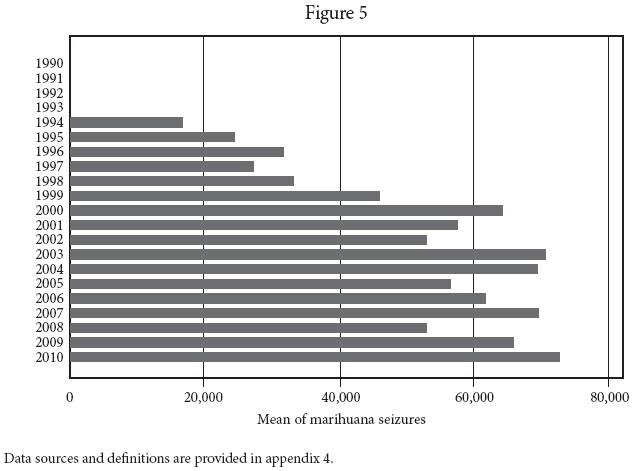
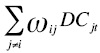
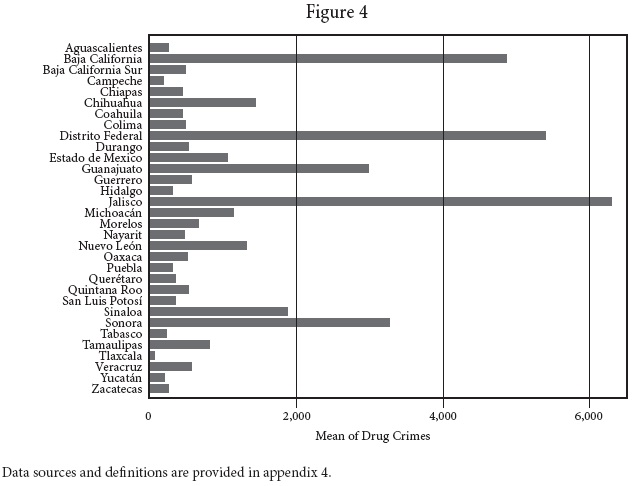
<body><![CDATA[<p align="center"><font face="verdana" size="2"><img src="/img/revistas/ecoqu/v11n2/a1e1.jpg"></font></p>  	    <p align="justify"><font face="verdana" size="2">Furthermore, <i>v<sub>i</sub></i> denotes state&#45;fixed&#45;effects to control for unobserved state&#45;specific heterogeneity in the panel dataset, <i>&#955;<sub>t</sub></i> is a time&#45;specific dummy and <i>&#949;<sub>it</sub></i> is the error term. For the dependent variable I use the log number of all sorts of crime events related to drugs: production, transport, trafficking, commerce and possession in each of the 31 Mexican states and the federal district. The use of panel data helps to eliminate spatial error dependence, which arises through spatial autocorrelation of omitted variables (Brueckner, 2003).</font></p>  	    <p align="justify"><font face="verdana" size="2">The spatial lag, <img src="/img/revistas/ecoqu/v11n2/a1e2.jpg"> is the weighted average of the inverse distance in kilometers from the capital city of each Mexican state and the Federal District to the other capital cities<sup><a href="#notas">12</a></sup>. The coefficient of the spatial lag <i>&#948;</i> depicts the degree to which changes in drug crimes in a given state are correlated with changes in the drugs crimes in its neighboring states, all else being equal. In other words, this variable captures the spillover effect of crime. That is, if a state experiences an increase in the level of crime in a given year, then the neighboring states should also experience increasing crime levels. From <a href="/img/revistas/ecoqu/v11n2/a1f1.jpg" target="_blank">Figure 1</a> and <a href="/img/revistas/ecoqu/v11n2/a1f3.jpg" target="_blank">Figure 3</a> it can be seen that the drug crimes in Mexico follow an upward trend from 1994, reach a peak in 2007 and fall thereafter. This coincides with the full&#45;scale military campaign launched by former president Calder&oacute;n's administration against DTOs across Mexico. In order to test the second hypothesis, I use data on marihuana seizures collected from the Office of the General Prosecutor Attorney General as a proxy for drug control policy and construct a spatial lag variable. Similarly to the above, this spatial lag depicts the extent to which changes in marihuana seizures in a given state affect changes in the drug crimes in its neighboring states, all else being equal. This data registers the tons of marihuana seized by the authorities in each and every state for the period 1994 through 2010. As can be seen from <a href="/img/revistas/ecoqu/v11n2/a1f2.jpg" target="_blank">Figure 2</a>, the tons of marihuana seized show an upward trend previous to the year 2000 and from there onwards both ups and downs are frequent. Disentangling this data across states, <a href="/img/revistas/ecoqu/v11n2/a1f6.jpg" target="_blank">Figure 6</a> shows that the bulk tons of marihuana seized in the 1994&#45;2010 period was in the states of Sinaloa, Sonora and Durango. The details of variable definitions and data sources are reported in <a href="/img/revistas/ecoqu/v11n2/html/a1apen.html#ap4" target="_blank">Appendix 4</a>. In general, drug seizures are a good proxy for drug control policy since they represent a tangible measure for drug law enforcement Miron (2001). Previous research suggests that drug seizures reduce the supply in the drug market increasing in this way the drug price. A reduced drug supply and higher drug price would lead criminal gangs to compete against each other for the control of the market. This will raise all sorts of crimes related to drugs (i.e production, selling, transportation, trafficking and homicides). For instance, Rasmussen (1993) finds for 67 Florida counties in 1989 that increased drug enforcement increases the size of the drug market in adjoining jurisdictions, resulting in a higher violent crime rate. Furthermore, Miron (2001) shows that drugs seizures explain the variation in homicide rates and proposes the argument that a high seizure rate is likely to correlate positively with other aspects of enforcement, such as a high drug arrest rate, and reflect a stricter attitude toward enforcement.</font></p> 	    <p align="center"><a href="/img/revistas/ecoqu/v11n2/a1f4.jpg" target="_blank"><img src="/img/revistas/ecoqu/v11n2/a1f4_th.jpg">    <br>     <font face="verdana" size="2">Haga clic para agrandar la imagen</font></a><font face="verdana" size="2"></font>	</p> 	    <p align="center"><a href="/img/revistas/ecoqu/v11n2/a1f5.jpg" target="_blank"><img src="/img/revistas/ecoqu/v11n2/a1f5_th.jpg">    <br>     <font face="verdana" size="2">Haga clic para agrandar la imagen</font></a><font face="verdana" size="2"></font></p> 	    <p align="justify"><font face="verdana" size="2">Spatial econometric theory suggests that the weights used in the construction of the spatial lag should be declining in distance but it does not propose a specific form (Davies and Naughton 2013). Basically, the specification of the weights is a matter of considerable discretion and the literature offers a wide range of suggestions (Anselin and Bera, 1998). I specify the spatial weights as: <img src="/img/revistas/ecoqu/v11n2/a1e3.jpg"></font></p>     <p align="justify"><font face="verdana" size="2">Setting <i>&#969;<sub>it</sub></i> in this way gives less weight to the states which are further away from state <i>i</i>. The rationale for using the inverse distance as a weight has been documented in the economics of crime literature since crime in general is affected not only by local factors but also by the characteristics of neighboring areas. Thus, it might be the case that one policy could represent a gain to a region by displacing criminal offenders to other regions. In other words, the cost of a region represents the gain of another (Tabarrock and Helland, 2009).</font></p>  	    <p align="justify"><font face="verdana" size="2">An issue of concern in the estimation of (1) pertains to the potential endogeneity of the drug crimes of other states. This is a problem which is inherent to spatial autoregression: <i>DC<sub>it</sub></i> depends on <i>DC<sub>jt</sub></i> and <i>DC<sub>jt</sub></i> on <i>DC<sub>it</sub></i>. In other words, there may be unobservable regional or national shocks which are correlated with the drug crimes of multiple states. However, even with the inclusion of time fixed effects, the issue of reverse causation and spatially correlated idiosyncratic shocks would still persist. Thus estimating equation (1) using OLS would provide biased estimates due to this endogeneity.</font></p>  	    ]]></body>
<body><![CDATA[<p align="justify"><font face="verdana" size="2">According to Kelejian and Prucha (1998), instrumental variables estimation (IV) yields consistent estimates even in the presence of spatial error dependence (Saavedra, 2000; Brueckner, 2001). In order to instrument for the spatial lag, I implement a 2SLS estimation procedure. The instruments for the drug crime spatial lag are the weighted sums of the control variables: log state per capita GDP; population; and the unemployment rate. To make this calculation I use the same weights as those used to calculate the spatial lag itself.</font></p>  	    <p align="center"><font face="verdana" size="2"><img src="/img/revistas/ecoqu/v11n2/a1e4.jpg"></font></p>  	    <p align="justify"><font face="verdana" size="2">In the second stage, the fitted values of equation (2) are used in the estimation of equation (1) in place of <img src="/img/revistas/ecoqu/v11n2/a1e5.jpg">. The vector of control variables (<i>Z<sub>it</sub></i>) includes other potential determinants of drug crime incidents (log) in state <i>i</i> during year <i>t</i>, which I obtain from the extant literature on the subject. This follows earlier studies by Buonanno, Pasini and Vanin (2011), Corman and Mocan (2005), Formisano (2002), Gould, Weinberg and Mustard (2002), Raphael, and Winter&#45;Ebmer (2001) and Cornwall and Trumbull (1994). Accordingly, I include state per capita GDP (logged) in Mexican pesos $ 2003 constant prices to proxy for income. The income data are available from the National Accounts System of INEGI.<sup><a href="#notas">13</a></sup> Likewise, I use state population, which is drawn from the population census data compiled by INEGI. The Mexican population censuses are carried out by INEGI across all the 32 Mexican states (including the Federal District) once every 10 years. Once every five years INEGI also conducts random surveys known as population counts. Thus, the data used to interpolate the population variable comes from the censuses of 1990, 2000, and 2010 (INEGI, 1990; 2000; 2010), and from the population surveys of 1995 and 2005 (INEGI, 1995; 2005). Similarly, the Mexican census files for 1990, 2000 and 2010 only (INEGI, 1990; 2000; 2010) and the population survey of 2005 (INEGI 2005) register interstate migration. The unemployment and labor force data are available from the Mexican census files for 1990, 2000 and 2010 only (INEGI, 1990; 2000; 2010). The data on crime reporting agencies are taken from the Penal Judicial Statistics provided and published on an annual basis by INEGI. Additionally, I include three political dummy variables which take the value of one if the state governor in state <i>i</i> during year <i>t</i> belonged to either one of the three governing political parties, PRI, PAN, PRD.<sup><a href="#notas">14</a></sup> As is well documented, and mentioned above, for many decades Mexico had in place a highly centralized power structure which was permissive and protective of organized criminal activities (Astorga Almanza 2007; Flores P&eacute;rez 2009; Synder and Duran Martinez 2009). The data on the exact governing period for each of these political parties in each state are obtained from the information published by the Institute of Marketing and Opinion (Instituto de Mercadotecnia y Opini&oacute;n 2012).</font></p>  	    <p align="justify"><font face="verdana" size="2">&nbsp;</font></p>  	    <p align="justify"><font face="verdana" size="2"><i>Empirical Results</i></font></p>  	    <p align="justify"><font face="verdana" size="2">Column 1 of <a href="/img/revistas/ecoqu/v11n2/a1t1.jpg" target="_blank">Table 1</a> represents the baseline model in which only the spatial lag of drug crimes is considered together with control variables drawn from the literature. Column 2 includes the spatial lag of marihuana seizures and excludes the spatial lag for drug crimes. Columns 3 and 4 consider both spatial lags but employ both different external instruments. For this first set of estimations I use the inverse distance of each of the capital of each state to all other capital cities as a weighting matrix. As introduced above, this allows me to give more weight to the drug crime incidents taking place in the neighboring states of state <i>i</i>. The weight of drugs crimes is thus decreasing with increased distance.</font></p>  	    <p align="justify"><font face="verdana" size="2">Turning to the coefficient of interest in Column 1 the results show a positive and significant spatial lag of drug crimes. Thus, keeping all other variables constant, an increase of one standard deviation in the drug crimes incidents from state i's neighboring states leads to an increase of 29.7<sup><a href="#notas">15</a></sup> percent in state i. This value is positive and significant at the 10% level. For this estimation I implement the spatial lags of GDP per capita logged, unemployment rate, population and crime reporting agencies of other states.</font></p>  	    <p align="justify"><font face="verdana" size="2">As highlighted above, first the spatial lag of the drug crimes is regressed on the spatial lags of GDP per capita logged, unemployment rate, population and crime reporting agencies of other states and all other regressors. In this way the predicted values of the spatial lag of drug crimes are obtained which then enter the second stage regression to obtain an unbiased estimator for the drug crime incidents variable. Staiger and Stock (1997) argue that in order to reject the null hypothesis that the selected instruments are not relevant, the first stage F&#45;statistic should show a value larger than 10. As can be seen at the bottom of <a href="/img/revistas/ecoqu/v11n2/a1t1.jpg" target="_blank">Table 1</a>, column 1 the specification shows an F&#45;statistic far above 10, thus rejecting the null hypothesis that the selected instruments are not relevant. Furthermore, the Hansen J&#45;statistic with a p&#45;value of 0.18 shows that the null&#45;hypothesis of exogeneity cannot be rejected at the conventional level of significance. Next, in Column 2, I account for the effect of drug control policy by including the spatial lag of marihuana seizures as a deterrence measure. The coefficient of this spatial lag shows a negative and significant coefficient at the 5% level. Again, for its interpretation I proceed in the same way as before. Thus, holding all other control variables constant, an increase of one standard deviation in the tons of marihuana seized in the neighboring states of state <i>i</i> leads to a reduction in drug crime incidents by 75.8%. This could be interpreted as a success of the drug control policy of the Mexican authorities. Since the dependent variable measures the drug crimes due to production, transport, trafficking, commerce and possession of drugs in state <i>i</i> at time <i>t</i>, the tons of marihuana seized in state <i>i</i> at time <i>t</i> exert variation in the drug crimes incidents variable.<sup><a href="#notas">16</a></sup> Thus, I exclude the marihuana seizures variable in state <i>i</i> at time <i>t</i> in the second specification.<sup><a href="#notas">17</a></sup> Again, the F&#45;statistic provides support for the relevance of external instruments and the Hansen J&#45;statistic with a p&#45;value of 0.87 shows that the null&#45;hypothesis of exogeneity cannot be rejected at conventional levels of significance.</font></p>  	    <p align="justify"><font face="verdana" size="2">Column 3 considers both spatial lags, namely for drug crime incidents and for marihuana seizures. Although the coefficient on the spatial lag of drug crime incidents shows a positive and significant coefficient and an F statistic above the threshold level of 10, the Hansen J&#45;statistic does not render support for the exogeneity of the set of external instruments used, &#45; the spatial lags of GDP per capita, unemployment rate, population and crime reporting agencies per capita. Consequently and based on the results of the first stage estimation, I exclude the spatial lag of the GDP per capita and again perform the 2SLS estimation with the remaining external instruments. The results of this estimation are shown in Column 4.</font></p>  	    <p align="justify"><font face="verdana" size="2">In this case, holding all other controls constant, a one standard deviation increase in drug crime incidents in the neighboring states to state <i>i</i> at time <i>t</i> leads to an increase of drug crime incidents of 52% in state <i>i</i> at time <i>t</i>. Contrary to the previous estimation in Column 3, the F&#45;statistic now shows a value above 10 for both of the spatial lags, which provides support for the relevance of the external instruments and the Hansen J&#45;statistic with p&#45;value of 0.86 exhibits support for their exogeneity.</font></p>  	    ]]></body>
<body><![CDATA[<p align="justify"><font face="verdana" size="2">Coming now to the control variables and as shown in <a href="/img/revistas/ecoqu/v11n2/a1t1.jpg" target="_blank">table 1</a>, the variable for crime reporting agencies is positive and significant at the 1% level in the first two specifications and positive and significant at the 10% level in the Columns 3 and 4. It could be argued that more crime reporting agencies are assigned to those regions with more crime incidents leading to a potential endogeneity problem in this variable. However, the distribution of crime reporting agencies throughout Mexico is not attached to the incidence of crime in its different regions. There are states in Mexico for which the distribution of crime reporting agencies does not correspond to the levels of crime activity in those regions. The number of crime reporting agencies assigned to regions is more an issue of financial costs. I control for income differences throughout states by including the state per capita GDP. Since the impact of the controls is not my primary focus, I do not delve further into these aspects in the interest of space.</font></p>  	    <p align="justify"><font face="verdana" size="2">&nbsp;</font></p>  	    <p align="justify"><font face="verdana" size="2"><i>Robustness Checks</i></font></p>  	    <p align="justify"><font face="verdana" size="2">As a robustness check of the previous findings in this section I present the estimations of the above&#45;mentioned models using a different weighting matrix in the construction of the spatial lags. In line with Buonanno et al., (2011), Bode et al. (2007) and Gumprecht (2005) I model the spatial weights as inverse exponential distances as:<img src="/img/revistas/ecoqu/v11n2/a1e6.jpg"> where <i>Dis<sub>ij</sub></i> denotes the distance between states <i>i</i> and <i>j</i>, and <i>&#964;</i> is a constant distance decay parameter that determines the percentage&#45;diffusion&#45;loss per unit of distance. In other words, it accounts for the degree of how strong the drug crimes lose weight with increasing distance. Following Bode et al. (2007), I arbitrarily assume three different values for <i>&#964;</i> = 0.005, 0.01 and 0.001. <a href="/img/revistas/ecoqu/v11n2/a1t2.jpg" target="_blank">Tables 2</a>, <a href="/img/revistas/ecoqu/v11n2/a1t3.jpg" target="_blank">3</a> and <a href="/img/revistas/ecoqu/v11n2/a1t4.jpg" target="_blank">4</a> present the results considering this weighting scheme with the three different corresponding values for <i>&#964;</i>.</font></p>  	    <p align="justify"><font face="verdana" size="2">First, in all three tables in Column 1 it can be seen that regardless of the value assigned to <i>&#964;</i> the spatial lag of the drug crime incidents variable remains significant and positive at the 5% and 10% level. . Here I use the same external instrument set as in <a href="/img/revistas/ecoqu/v11n2/a1t1.jpg" target="_blank">Table 1</a>. Thus, for all three tables, the F statistic and the Hansen J&#45;statistic lend support to the relevance and exogeneity of the external instruments in Column 1. Looking now at <a href="/img/revistas/ecoqu/v11n2/a1t2.jpg" target="_blank">Table 2</a>, we see that by assigning <i>&#964;</i> the intermediate value of 0.005, the F statistics of the spatial lag for the marihuana seizures variable in Columns 2 to 4 are less than 10, while the Hansen&#45;J statistic renders support to the three specifications. Based on this, in <a href="/img/revistas/ecoqu/v11n2/a1t3.jpg" target="_blank">Table 3</a> I choose the smaller value of 0.01 for <i>&#964;</i>. The results are similar to those in <a href="/img/revistas/ecoqu/v11n2/a1t2.jpg" target="_blank">Table 2</a> in terms of the F statistic for the marihuana seizures variable being less than 10. Next in <a href="/img/revistas/ecoqu/v11n2/a1t4.jpg" target="_blank">Table 4</a>, I choose the smallest value of the three selected for <i>&#964;</i>, namely 0.001. We see that all four specifications observe the same behavior as in <a href="/img/revistas/ecoqu/v11n2/a1t1.jpg" target="_blank">Table 1</a>, however the spatial lag of the marihuana seizures variable now shows no significance. In terms of interpretation, Column 1 <a href="/img/revistas/ecoqu/v11n2/a1t4.jpg" target="_blank">Table 4</a> shows that, everything else constant, an increase of one standard deviation in drug crime incidents in the neighboring states of state <i>i</i> leads to an increase of 34.2% in drug crimes in state i. I obtain this value in a similar way as <a href="/img/revistas/ecoqu/v11n2/a1t1.jpg" target="_blank">Table 1</a>. Furthermore, holding all other controls constant, in Columns 3 and 4, an increase of one standard deviation in drug crime incidents in the neighboring states of state <i>i</i> lead to an increase of the drug crimes in state <i>i</i> by 41% and 42%, respectively.</font></p>  	    <p align="justify"><font face="verdana" size="2">As can be seen in <a href="/img/revistas/ecoqu/v11n2/a1t4.jpg" target="_blank">Table 4</a> Column 2, the spatial lag of the marihuana seizures is no longer significant. Given the availability of data, this does not necessarily mean that by seizing drugs the authorities do not exert an impact on organized crime and hence on crime derived from illegal drug activities. Certainly the literature on the crime&#45;deterrence relationship has found mixed results with the contributions of Ehrlich (1975), Witte (1980), Layson (1985), Grogger (1991), and Levitt (1997) finding that increases in criminal&#45;justice sanctions reduce criminal activity. On the other hand, the papers of Myers (1983); Cover and Thistle (1988) and Cornwell and Trumbull (1994) find either a weak relationship, or none at all.</font></p>  	    <p align="justify"><font face="verdana" size="2">One reason for the vanishing of significance in the spatial lag of marihuana seizures could be the frequency of the data. In the literature on the economics of crime, this has been highlighted by Corman and Mocan (2000), who by employing high frequency data, find a strong support for the deterrence hypothesis.</font></p>  	    <p align="justify"><font face="verdana" size="2">&nbsp;</font></p>  	    <p align="justify"><font face="verdana" size="2"><i><b>&bull; Conclusion</b></i></font></p>  	    <p align="justify"><font face="verdana" size="2">This article investigates whether there is a spillover effect of drug crime across Mexican states and whether there is a deterrent effect from drug control policy on drug crimes across Mexican states. The data available register the period 1997&#45;2010 which includes the shift from a president coming from the political party PRI to a president coming from PAN.</font></p>  	    ]]></body>
<body><![CDATA[<p align="justify"><font face="verdana" size="2">Specifically this time period registers the last years of president Zedillos'term (PRI), the entire term of president Fox (PAN) and four years of president Calder&oacute;n (PAN). During these fourteen years Mexican Drug Policy was characterized by the use of federal and military troops to exercise control over the Drug Trafficking Organizations (Chabat 2002, Duran et al. 2010). The availability of data for these fourteen years allows to empirically assess the effect of a deterrent drug policy on the spread of drug crime in Mexico.</font></p>  	    <p align="justify"><font face="verdana" size="2">Building on the historical background of a highly centralized, permissive and protective power structure towards organized criminal activities, I initially hypothesize that drug crime in Mexico should vary not only with local socio&#45;economic and political factors but also with geographical space. Applying spatial econometrics techniques and accounting for the inherent endogeneity in a spatial regression, I find that drug crime incidents show a diffusion effect from one region of Mexico to another after controlling for socio&#45;economic and political conditions of regions. This effect is robust to different weighting schemes of the weighting matrix used in the computation of the spatial lag variable. I further hypothesized that deterrence measures from the authorities in state <i>i</i> could have either a negative or a positive impact on the level of drug crime incidents in the neighboring states. I argue that the result of the outcome depends on several tangible factors for which there are no public data available and several intangible factors. For instance weaponry of the police, military and DTO's and the number of authority members engaged in deterrent actions together with the number of criminals defending themselves from those actions enter into the tangible factors. Defense skills and intelligence strategies of the authorities and criminals, corruption within both groups enter into the group of intangible factors.</font></p>  	    <p align="justify"><font face="verdana" size="2">Thus, based on these factors, it can be the case that DTOs move to neighboring locations as a result of a harsh deterrence policy in state <i>i</i> thereby increasing drug crime incidents in the former locations. On the contrary it can also be the case that the measures implemented by the authorities in state <i>i</i> inhibit the activities of the DTOs in such a way that drug crime incidents in the neighboring states get reduced.</font></p>  	    <p align="justify"><font face="verdana" size="2">In practice there is a wide array of deterrence measures from the authorities as suggested in the economics of crime literature. For instance, the number of police and military forces deployed, effective arrests and stricter sentences for those arrested on drug charges, seizures of arms and drugs etc. Given the scarce availability of this kind of data, which would allow me to construct a reasonable sub&#45;national panel dataset, I use tons of marihuana seizures as a proxy for deterrence, i.e., drug control policy. I find weak evidence for this last expectation; a result which is not borne out by the robustness checks of the empirical models. This finding is also in line with previous research. For instance, Rasmussen (1993) finds that increased drug enforcement increases the size of the drug market in adjoining jurisdictions. This finding is also present for the Mexican case as this paper shows. It namely finds weak evidence for a deterrent effect after controlling for drug enforcement (using marihuana seizures) in neighboring states to state <i>i</i>. This implies that authorities' deterrence measures in neighboring states to state <i>i</i> weakly reduce drug crimes in state <i>i</i>.</font></p>  	    <p align="justify"><font face="verdana" size="2">This study provides evidence of a diffusion effect of drug crimes from one region in Mexico to another. The findings reported here may have implications for our understanding on whether drug crime in Mexico spreads from one state to another and whether a drug crime deterrent measure in one region coincides with a cost or a benefit for another.</font></p>  	    <p align="justify"><font face="verdana" size="2">These findings suggest that the approach to control drug crime by fighting the supply of drugs is not contributing to the reduction of the problem. These actions are having rather the opposite result, namely an increase in the drug crime in regions. As documented by Rasmussen (1993) and Miron (1999, 2001) this outcome will be accompanied with increasing levels of violence. Thus, a proposition of the paper would be a major change in the priority given to the supply&#45;side versus demand&#45;side drug control efforts.</font></p>  	    <p align="justify"><font face="verdana" size="2">Furthermore, the findings presented here may have implications for regions beyond the Mexican context experiencing a similar situation and may motivate more detailed data collection on crime statistics. Further research might look at the effects of different drug crime deterrence measures by the authorities and at which level of deterrence, if any, a turning point exists.</font></p>     <p align="center"><font face="verdana" size="2"><a href="/img/revistas/ecoqu/v11n2/html/a1apen.html" target="_blank">Appendix 1</a></font></p>     <p align="center"><font face="verdana" size="2"><a href="/img/revistas/ecoqu/v11n2/html/a1apen.html#ap2" target="_blank">Appendix 2</a></font></p>     <p align="center"><font face="verdana" size="2"><a href="/img/revistas/ecoqu/v11n2/html/a1apen.html#ap3" target="_blank">Appendix 3</a></font>	</p>     ]]></body>
<body><![CDATA[<p align="justify">&nbsp;</p>     <p align="justify"><font face="verdana" size="2"><i><b>References</b></i></font></p>  	    <!-- ref --><p align="justify"><font face="verdana" size="2">Andresen, Martin A. 2006. "Crime measures and the spatial analysis of criminal activity." <i>British Journal of Criminology</i> 46(2):258&#45;285.    &nbsp;&nbsp;&nbsp;&nbsp;&nbsp;&nbsp;&nbsp;&nbsp;[&#160;<a href="javascript:void(0);" onclick="javascript: window.open('/scielo.php?script=sci_nlinks&ref=3021858&pid=S1870-6622201400020000100001&lng=','','width=640,height=500,resizable=yes,scrollbars=1,menubar=yes,');">Links</a>&#160;]<!-- end-ref --></font></p>  	    <!-- ref --><p align="justify"><font face="verdana" size="2">Anselin, Luc and Anil K. Bera. 1998. "Spatial dependence in linear regression models with an introduction to spatial econometrics." <i>In Ullah, A. and Giles, D. E., editors, Handbook of Applied Economic Statistics,</i> pp 237&#45;289. Marcel Dekker, New York.    &nbsp;&nbsp;&nbsp;&nbsp;&nbsp;&nbsp;&nbsp;&nbsp;[&#160;<a href="javascript:void(0);" onclick="javascript: window.open('/scielo.php?script=sci_nlinks&ref=3021860&pid=S1870-6622201400020000100002&lng=','','width=640,height=500,resizable=yes,scrollbars=1,menubar=yes,');">Links</a>&#160;]<!-- end-ref --></font></p>  	    <!-- ref --><p align="justify"><font face="verdana" size="2">Astorga Almanza, Luis. 2007. "Seguridad, traficantes y militares: el poder y la sombra." (Security, traffickers and soldiers: the power and the shadow) Mexico City, Editorial Tusquets.    &nbsp;&nbsp;&nbsp;&nbsp;&nbsp;&nbsp;&nbsp;&nbsp;[&#160;<a href="javascript:void(0);" onclick="javascript: window.open('/scielo.php?script=sci_nlinks&ref=3021862&pid=S1870-6622201400020000100003&lng=','','width=640,height=500,resizable=yes,scrollbars=1,menubar=yes,');">Links</a>&#160;]<!-- end-ref --></font></p>  	    <!-- ref --><p align="justify"><font face="verdana" size="2">Astorga, Almanza, Luis and David A. Shirk. 2010. "Drug Trafficking Organizations and Counter&#45;Drug Strategies in the U.S.&#45;Mexican Context." <i>USMEX Working Paper 10&#45;01. Project: Mexico and the United States. Confronting the Twenty&#45;First Century.</i> Center for U.S.&#45;Mexican Studies, The Mexico Institute of the Woodrow Wilson Center. El Colegio de la Frontera Norte and El Colegio de M&eacute;xico.    &nbsp;&nbsp;&nbsp;&nbsp;&nbsp;&nbsp;&nbsp;&nbsp;[&#160;<a href="javascript:void(0);" onclick="javascript: window.open('/scielo.php?script=sci_nlinks&ref=3021864&pid=S1870-6622201400020000100004&lng=','','width=640,height=500,resizable=yes,scrollbars=1,menubar=yes,');">Links</a>&#160;]<!-- end-ref --></font></p>  	    ]]></body>
<body><![CDATA[<!-- ref --><p align="justify"><font face="verdana" size="2">Becker, Gary. 1968. "Crime and Punishment: An Economic Approach." <i>Journal of Political Economy</i> 76(2):169&#45;217.    &nbsp;&nbsp;&nbsp;&nbsp;&nbsp;&nbsp;&nbsp;&nbsp;[&#160;<a href="javascript:void(0);" onclick="javascript: window.open('/scielo.php?script=sci_nlinks&ref=3021866&pid=S1870-6622201400020000100005&lng=','','width=640,height=500,resizable=yes,scrollbars=1,menubar=yes,');">Links</a>&#160;]<!-- end-ref --></font></p>  	    <!-- ref --><p align="justify"><font face="verdana" size="2">Benson, Bruce L., Kim Iljoong, and David W. Rasmussen. 1994. "Estimating Deterrence Effects: A Public Choice Perspective on the Economics of Crime Literature." <i>Southern Economic Journal</i>, 61(1): 161&#45;168.    &nbsp;&nbsp;&nbsp;&nbsp;&nbsp;&nbsp;&nbsp;&nbsp;[&#160;<a href="javascript:void(0);" onclick="javascript: window.open('/scielo.php?script=sci_nlinks&ref=3021868&pid=S1870-6622201400020000100006&lng=','','width=640,height=500,resizable=yes,scrollbars=1,menubar=yes,');">Links</a>&#160;]<!-- end-ref --></font></p>  	    <!-- ref --><p align="justify"><font face="verdana" size="2">Blonigen, Bruce.A., and Ronald B. Davies 2004. The effects of bilateral tax treaties on US FDI activity. International Tax and Public Finance 11 (5), 601&#45;622.    &nbsp;&nbsp;&nbsp;&nbsp;&nbsp;&nbsp;&nbsp;&nbsp;[&#160;<a href="javascript:void(0);" onclick="javascript: window.open('/scielo.php?script=sci_nlinks&ref=3021870&pid=S1870-6622201400020000100007&lng=','','width=640,height=500,resizable=yes,scrollbars=1,menubar=yes,');">Links</a>&#160;]<!-- end-ref --></font></p>  	    <!-- ref --><p align="justify"><font face="verdana" size="2">Bode, Eckhardt, Peter Nunnenkamp and Andreas Waldkirch. 2012. "Spatial effects of foreign direct investment in US states." <i>Canadian Journal of Economics</i> 45(1):16&#45;40.    &nbsp;&nbsp;&nbsp;&nbsp;&nbsp;&nbsp;&nbsp;&nbsp;[&#160;<a href="javascript:void(0);" onclick="javascript: window.open('/scielo.php?script=sci_nlinks&ref=3021872&pid=S1870-6622201400020000100008&lng=','','width=640,height=500,resizable=yes,scrollbars=1,menubar=yes,');">Links</a>&#160;]<!-- end-ref --></font></p>  	    <!-- ref --><p align="justify"><font face="verdana" size="2">Brueckner, Jan K. 2003. "Strategic Interaction Among Governments: An Overview of Theoretical Studies." <i>International Regional Science Review</i>, 26(2): 175&#45;188.    &nbsp;&nbsp;&nbsp;&nbsp;&nbsp;&nbsp;&nbsp;&nbsp;[&#160;<a href="javascript:void(0);" onclick="javascript: window.open('/scielo.php?script=sci_nlinks&ref=3021874&pid=S1870-6622201400020000100009&lng=','','width=640,height=500,resizable=yes,scrollbars=1,menubar=yes,');">Links</a>&#160;]<!-- end-ref --></font></p>  	    ]]></body>
<body><![CDATA[<!-- ref --><p align="justify"><font face="verdana" size="2">Buonanno, Paolo, Giacomo Pasini and Paolo Vanin. 2011. "Crime and social sanction." <i>Papers in Regional Science</i>. 91(1):193&#45;218.    &nbsp;&nbsp;&nbsp;&nbsp;&nbsp;&nbsp;&nbsp;&nbsp;[&#160;<a href="javascript:void(0);" onclick="javascript: window.open('/scielo.php?script=sci_nlinks&ref=3021876&pid=S1870-6622201400020000100010&lng=','','width=640,height=500,resizable=yes,scrollbars=1,menubar=yes,');">Links</a>&#160;]<!-- end-ref --></font></p>  	    <!-- ref --><p align="justify"><font face="verdana" size="2">Cahill Meagan and Gordon Mulligan. 2007. "Using geographically weighted regression to explore local crime patterns." <i>Social Science Computer Review</i> 25(2):174&#45;193.    &nbsp;&nbsp;&nbsp;&nbsp;&nbsp;&nbsp;&nbsp;&nbsp;[&#160;<a href="javascript:void(0);" onclick="javascript: window.open('/scielo.php?script=sci_nlinks&ref=3021878&pid=S1870-6622201400020000100011&lng=','','width=640,height=500,resizable=yes,scrollbars=1,menubar=yes,');">Links</a>&#160;]<!-- end-ref --></font></p>  	    <!-- ref --><p align="justify"><font face="verdana" size="2">Camp, Roderick Ai. 1992. "General in the Palacio: The Military in Modern Mexico." <i>New York, Oxford University Press.    &nbsp;&nbsp;&nbsp;&nbsp;&nbsp;&nbsp;&nbsp;&nbsp;[&#160;<a href="javascript:void(0);" onclick="javascript: window.open('/scielo.php?script=sci_nlinks&ref=3021880&pid=S1870-6622201400020000100012&lng=','','width=640,height=500,resizable=yes,scrollbars=1,menubar=yes,');">Links</a>&#160;]<!-- end-ref --></i></font></p>  	    <!-- ref --><p align="justify"><font face="verdana" size="2">Chabat, J. (2002) Mexico's War on Drugs: No Margin for Maneuver. <i>Annals of the American Academy of Political and Social Science</i>. 582 pp. 134&#45;148.    &nbsp;&nbsp;&nbsp;&nbsp;&nbsp;&nbsp;&nbsp;&nbsp;[&#160;<a href="javascript:void(0);" onclick="javascript: window.open('/scielo.php?script=sci_nlinks&ref=3021882&pid=S1870-6622201400020000100013&lng=','','width=640,height=500,resizable=yes,scrollbars=1,menubar=yes,');">Links</a>&#160;]<!-- end-ref --></font></p>  	    <!-- ref --><p align="justify"><font face="verdana" size="2">Cohen, Jacqueline. and George Tita. 1999. "Diffusion in Homicide: Exploring a General Method for Detecting Spatial Diffusion Processes." <i>Journal of Quantitative Criminology.</i> 15(4):451&#45;493.    &nbsp;&nbsp;&nbsp;&nbsp;&nbsp;&nbsp;&nbsp;&nbsp;[&#160;<a href="javascript:void(0);" onclick="javascript: window.open('/scielo.php?script=sci_nlinks&ref=3021884&pid=S1870-6622201400020000100014&lng=','','width=640,height=500,resizable=yes,scrollbars=1,menubar=yes,');">Links</a>&#160;]<!-- end-ref --></font></p>  	    ]]></body>
<body><![CDATA[<!-- ref --><p align="justify"><font face="verdana" size="2">Corman, Hope and H. Naci Mocan. 2005. "Carrots, Sticks, and Broken Windows" <i>Journal of Law and Economics.</i> 48(1): 235&#45;266.    &nbsp;&nbsp;&nbsp;&nbsp;&nbsp;&nbsp;&nbsp;&nbsp;[&#160;<a href="javascript:void(0);" onclick="javascript: window.open('/scielo.php?script=sci_nlinks&ref=3021886&pid=S1870-6622201400020000100015&lng=','','width=640,height=500,resizable=yes,scrollbars=1,menubar=yes,');">Links</a>&#160;]<!-- end-ref --></font></p>  	    <!-- ref --><p align="justify"><font face="verdana" size="2">Corman, Hope and H. Naci Mocan. 2000. "A Time Series Analysis of Crime, Deterrence, and Drug Abuse in New York City." <i>The American Economic Review,</i> 90(3): 584&#45;604.    &nbsp;&nbsp;&nbsp;&nbsp;&nbsp;&nbsp;&nbsp;&nbsp;[&#160;<a href="javascript:void(0);" onclick="javascript: window.open('/scielo.php?script=sci_nlinks&ref=3021888&pid=S1870-6622201400020000100016&lng=','','width=640,height=500,resizable=yes,scrollbars=1,menubar=yes,');">Links</a>&#160;]<!-- end-ref --></font></p>  	    <!-- ref --><p align="justify"><font face="verdana" size="2">Cornwall, Christopher and William Trumbull. 1994. "Estimating the Economic Model of Crime with Panel Data." <i>Review of Economics and Statistics.</i> 76(2): 360&#45;366.    &nbsp;&nbsp;&nbsp;&nbsp;&nbsp;&nbsp;&nbsp;&nbsp;[&#160;<a href="javascript:void(0);" onclick="javascript: window.open('/scielo.php?script=sci_nlinks&ref=3021890&pid=S1870-6622201400020000100017&lng=','','width=640,height=500,resizable=yes,scrollbars=1,menubar=yes,');">Links</a>&#160;]<!-- end-ref --></font></p>  	    <!-- ref --><p align="justify"><font face="verdana" size="2">Cover, James Peery and Paul. D. Thistle. 1988. "Time Series, Homicide, and the Deterrent Effect of Capital Punishment." <i>Southern Economic Journal.</i> 54(3): 615&#45;622.    &nbsp;&nbsp;&nbsp;&nbsp;&nbsp;&nbsp;&nbsp;&nbsp;[&#160;<a href="javascript:void(0);" onclick="javascript: window.open('/scielo.php?script=sci_nlinks&ref=3021892&pid=S1870-6622201400020000100018&lng=','','width=640,height=500,resizable=yes,scrollbars=1,menubar=yes,');">Links</a>&#160;]<!-- end-ref --></font></p>  	    <!-- ref --><p align="justify"><font face="verdana" size="2">Cracolici, Maria Francesca and Teodora Erika Uberti. 2008. "Geographical Distribution of Crime in Italian Provinces: A Spatial Econometric Analysis." <i>Fondazione Eni Enrico Mattei Working Paper,</i> 11.2008.    &nbsp;&nbsp;&nbsp;&nbsp;&nbsp;&nbsp;&nbsp;&nbsp;[&#160;<a href="javascript:void(0);" onclick="javascript: window.open('/scielo.php?script=sci_nlinks&ref=3021894&pid=S1870-6622201400020000100019&lng=','','width=640,height=500,resizable=yes,scrollbars=1,menubar=yes,');">Links</a>&#160;]<!-- end-ref --></font></p>  	    ]]></body>
<body><![CDATA[<!-- ref --><p align="justify"><font face="verdana" size="2">Davies, Ronald B. and Helen T. Naughton 2013. "Cooperation in environmental policy: a spatial approach." I<i>nternational Tax and Public Finance.</i> Published online 27th April 2013. DOI 10.1007/s10797&#45;013&#45;9280&#45;1.    &nbsp;&nbsp;&nbsp;&nbsp;&nbsp;&nbsp;&nbsp;&nbsp;[&#160;<a href="javascript:void(0);" onclick="javascript: window.open('/scielo.php?script=sci_nlinks&ref=3021896&pid=S1870-6622201400020000100020&lng=','','width=640,height=500,resizable=yes,scrollbars=1,menubar=yes,');">Links</a>&#160;]<!-- end-ref --></font></p>  	    <!-- ref --><p align="justify"><font face="verdana" size="2">Decker, Scott. H. and Carol W. Kohfeld. 1985. "Crimes, Crime Rates, Arrests, and Arrest Ratios: Implications for Deterrence Theory." <i>Criminology.</i> 23(3): 437&#45;450.    &nbsp;&nbsp;&nbsp;&nbsp;&nbsp;&nbsp;&nbsp;&nbsp;[&#160;<a href="javascript:void(0);" onclick="javascript: window.open('/scielo.php?script=sci_nlinks&ref=3021898&pid=S1870-6622201400020000100021&lng=','','width=640,height=500,resizable=yes,scrollbars=1,menubar=yes,');">Links</a>&#160;]<!-- end-ref --></font></p>  	    <!-- ref --><p align="justify"><font face="verdana" size="2">Dezhbakhsh, Hashem. and Joanna M. Shepherd. 2006. "The deterrent effect of capital punishment: evidence from a 'judicial experiment.'" <i>Economic Inquiry</i> 44(3):512&#45;535.    &nbsp;&nbsp;&nbsp;&nbsp;&nbsp;&nbsp;&nbsp;&nbsp;[&#160;<a href="javascript:void(0);" onclick="javascript: window.open('/scielo.php?script=sci_nlinks&ref=3021900&pid=S1870-6622201400020000100022&lng=','','width=640,height=500,resizable=yes,scrollbars=1,menubar=yes,');">Links</a>&#160;]<!-- end-ref --></font></p>  	    <!-- ref --><p align="justify"><font face="verdana" size="2">Dezhbakhsh, Hashem, Paul H. Rubin, and Joanna M. Shepherd. 2003. "Does capital punishment have a deterrent effet? New Evidence from Postmoratorium Panel Data." <i>American Law and Economics Review</i> 5 (2): 344&#45;376.    &nbsp;&nbsp;&nbsp;&nbsp;&nbsp;&nbsp;&nbsp;&nbsp;[&#160;<a href="javascript:void(0);" onclick="javascript: window.open('/scielo.php?script=sci_nlinks&ref=3021902&pid=S1870-6622201400020000100023&lng=','','width=640,height=500,resizable=yes,scrollbars=1,menubar=yes,');">Links</a>&#160;]<!-- end-ref --></font></p>  	    <!-- ref --><p align="justify"><font face="verdana" size="2">Di Tella, R., and Ernesto Schargrodsky. 2004. "Do police reduce crime? Estimates using the allocation of police forces after a terrorist attack." <i>The American Economic Review</i> 94(1): 115&#45;133.    &nbsp;&nbsp;&nbsp;&nbsp;&nbsp;&nbsp;&nbsp;&nbsp;[&#160;<a href="javascript:void(0);" onclick="javascript: window.open('/scielo.php?script=sci_nlinks&ref=3021904&pid=S1870-6622201400020000100024&lng=','','width=640,height=500,resizable=yes,scrollbars=1,menubar=yes,');">Links</a>&#160;]<!-- end-ref --></font></p>  	    ]]></body>
<body><![CDATA[<!-- ref --><p align="justify"><font face="verdana" size="2">Dills, Angela K., Jeffrey A. Miron and Garrett Summers. 2010. "What do economists know about crime?" in <i>The Economics of Crime: lessons for and from Latin America</i>. Edited by Rafael Di Tella, Sebastian Edwards and Enrnesto Schargrodsky NBER.    &nbsp;&nbsp;&nbsp;&nbsp;&nbsp;&nbsp;&nbsp;&nbsp;[&#160;<a href="javascript:void(0);" onclick="javascript: window.open('/scielo.php?script=sci_nlinks&ref=3021906&pid=S1870-6622201400020000100025&lng=','','width=640,height=500,resizable=yes,scrollbars=1,menubar=yes,');">Links</a>&#160;]<!-- end-ref --></font></p>  	    <!-- ref --><p align="justify"><font face="verdana" size="2">Dobkin, Carlos., and Nancy Nicosia. 2009. "The War on Drugs: Methamphetamine, Public Health, and Crime." <i>American Economic Review</i> 99(1):324&#45;349.    &nbsp;&nbsp;&nbsp;&nbsp;&nbsp;&nbsp;&nbsp;&nbsp;[&#160;<a href="javascript:void(0);" onclick="javascript: window.open('/scielo.php?script=sci_nlinks&ref=3021908&pid=S1870-6622201400020000100026&lng=','','width=640,height=500,resizable=yes,scrollbars=1,menubar=yes,');">Links</a>&#160;]<!-- end-ref --></font></p>  	    <!-- ref --><p align="justify"><font face="verdana" size="2">Donohue, John. J., III, and StevenD. Levitt. 2001. "The impact of legalized abortion on crime." <i>Quarterly Journal of Economics</i> 116(2):379&#45;420.    &nbsp;&nbsp;&nbsp;&nbsp;&nbsp;&nbsp;&nbsp;&nbsp;[&#160;<a href="javascript:void(0);" onclick="javascript: window.open('/scielo.php?script=sci_nlinks&ref=3021910&pid=S1870-6622201400020000100027&lng=','','width=640,height=500,resizable=yes,scrollbars=1,menubar=yes,');">Links</a>&#160;]<!-- end-ref --></font></p>  	    <!-- ref --><p align="justify"><font face="verdana" size="2">Donohue, John J., III, and Steven D. Levitt. 2004. "Further evidence that legalized abortion lowered crime: A reply to Joyce." <i>Journal of Human Resources</i> 39(1): 29&#45;49.    &nbsp;&nbsp;&nbsp;&nbsp;&nbsp;&nbsp;&nbsp;&nbsp;[&#160;<a href="javascript:void(0);" onclick="javascript: window.open('/scielo.php?script=sci_nlinks&ref=3021912&pid=S1870-6622201400020000100028&lng=','','width=640,height=500,resizable=yes,scrollbars=1,menubar=yes,');">Links</a>&#160;]<!-- end-ref --></font></p>  	    <!-- ref --><p align="justify"><font face="verdana" size="2">Donohue, John J., III, and Steven D. Levitt. 2008 "Measurement error, legalized abortion, and the decline in crime: A response to Foote and Goetz." <i>Quarterly Journal of Economics</i> 123 (1): 425&#45;440.    &nbsp;&nbsp;&nbsp;&nbsp;&nbsp;&nbsp;&nbsp;&nbsp;[&#160;<a href="javascript:void(0);" onclick="javascript: window.open('/scielo.php?script=sci_nlinks&ref=3021914&pid=S1870-6622201400020000100029&lng=','','width=640,height=500,resizable=yes,scrollbars=1,menubar=yes,');">Links</a>&#160;]<!-- end-ref --></font></p>  	    ]]></body>
<body><![CDATA[<!-- ref --><p align="justify"><font face="verdana" size="2">Ehrlich, Isacc. 1975 "The Deterrent Effect of Capital Punishment: A Question of Life and Death." <i>The American Economic Review</i>, 65(3): 397&#45;417.    &nbsp;&nbsp;&nbsp;&nbsp;&nbsp;&nbsp;&nbsp;&nbsp;[&#160;<a href="javascript:void(0);" onclick="javascript: window.open('/scielo.php?script=sci_nlinks&ref=3021916&pid=S1870-6622201400020000100030&lng=','','width=640,height=500,resizable=yes,scrollbars=1,menubar=yes,');">Links</a>&#160;]<!-- end-ref --></font></p>  	    <!-- ref --><p align="justify"><font face="verdana" size="2">Ehrlich, Isacc. 1977. "Capital Punishment and Deterrence: Some Further Thoughts and Additional Evidence." <i>Journal of Political Economy</i> 85(4):741&#45;788.    &nbsp;&nbsp;&nbsp;&nbsp;&nbsp;&nbsp;&nbsp;&nbsp;[&#160;<a href="javascript:void(0);" onclick="javascript: window.open('/scielo.php?script=sci_nlinks&ref=3021918&pid=S1870-6622201400020000100031&lng=','','width=640,height=500,resizable=yes,scrollbars=1,menubar=yes,');">Links</a>&#160;]<!-- end-ref --></font></p>  	    <!-- ref --><p align="justify"><font face="verdana" size="2">Ehrlich, Isacc. 1996. "Crime, Punishment, and the Market for Offenses." <i>Journal of Economic Perspectives</i> 10(1):43&#45;67.    &nbsp;&nbsp;&nbsp;&nbsp;&nbsp;&nbsp;&nbsp;&nbsp;[&#160;<a href="javascript:void(0);" onclick="javascript: window.open('/scielo.php?script=sci_nlinks&ref=3021920&pid=S1870-6622201400020000100032&lng=','','width=640,height=500,resizable=yes,scrollbars=1,menubar=yes,');">Links</a>&#160;]<!-- end-ref --></font></p>  	    <!-- ref --><p align="justify"><font face="verdana" size="2">Evans, William N. and Emily G. Owens. 2007. "COPS and crime." <i>Journal of Public Economics</i> 91(1&#45;2): 181&#45;201.    &nbsp;&nbsp;&nbsp;&nbsp;&nbsp;&nbsp;&nbsp;&nbsp;[&#160;<a href="javascript:void(0);" onclick="javascript: window.open('/scielo.php?script=sci_nlinks&ref=3021922&pid=S1870-6622201400020000100033&lng=','','width=640,height=500,resizable=yes,scrollbars=1,menubar=yes,');">Links</a>&#160;]<!-- end-ref --></font></p>  	    <!-- ref --><p align="justify"><font face="verdana" size="2">Flores P&eacute;rez, Carlos (2009) "Organized Crime and Official Corruption in Mexico. Police and Public Security in Mexico." Edited by <i>Robert. A. Donnelly and David. A. Shirk. San Diego, Trans&#45;Border Institute.    &nbsp;&nbsp;&nbsp;&nbsp;&nbsp;&nbsp;&nbsp;&nbsp;[&#160;<a href="javascript:void(0);" onclick="javascript: window.open('/scielo.php?script=sci_nlinks&ref=3021924&pid=S1870-6622201400020000100034&lng=','','width=640,height=500,resizable=yes,scrollbars=1,menubar=yes,');">Links</a>&#160;]<!-- end-ref --></i></font></p>  	    ]]></body>
<body><![CDATA[<!-- ref --><p align="justify"><font face="verdana" size="2">Foote, Christopher L. and Christopher F. Goetz. 2008. "The impact of legalized abortion on crime: Comment." <i>Quarterly Journal of Economics</i> 123 (1):1&#45;48.    &nbsp;&nbsp;&nbsp;&nbsp;&nbsp;&nbsp;&nbsp;&nbsp;[&#160;<a href="javascript:void(0);" onclick="javascript: window.open('/scielo.php?script=sci_nlinks&ref=3021926&pid=S1870-6622201400020000100035&lng=','','width=640,height=500,resizable=yes,scrollbars=1,menubar=yes,');">Links</a>&#160;]<!-- end-ref --></font></p>  	    <!-- ref --><p align="justify"><font face="verdana" size="2">Formisano Michel. 2002. "Econometr&iacute;a Espacial: Caracter&iacute;sticas de la Violencia Homicida en Bogot&aacute; (Spatial Econometrics: Characteristics of violent homicides in Bogota)." Working Paper CEDE 2002&#45;10 ISSN 1657&#45;7191 Universidad de los Andes, Colombia.    &nbsp;&nbsp;&nbsp;&nbsp;&nbsp;&nbsp;&nbsp;&nbsp;[&#160;<a href="javascript:void(0);" onclick="javascript: window.open('/scielo.php?script=sci_nlinks&ref=3021928&pid=S1870-6622201400020000100036&lng=','','width=640,height=500,resizable=yes,scrollbars=1,menubar=yes,');">Links</a>&#160;]<!-- end-ref --></font></p>  	    <!-- ref --><p align="justify"><font face="verdana" size="2">Fotheringham A., Brunsdon Chris, Charlton Martin. 2002. "Geographically Weighted Regression: The Analysis of Spatially Varying Relationships." Wiley, Chichester, UK.    &nbsp;&nbsp;&nbsp;&nbsp;&nbsp;&nbsp;&nbsp;&nbsp;[&#160;<a href="javascript:void(0);" onclick="javascript: window.open('/scielo.php?script=sci_nlinks&ref=3021930&pid=S1870-6622201400020000100037&lng=','','width=640,height=500,resizable=yes,scrollbars=1,menubar=yes,');">Links</a>&#160;]<!-- end-ref --></font></p>  	    <!-- ref --><p align="justify"><font face="verdana" size="2">Gould, Eric D., Bruce A. Weinberg and Mustard, David B. 2002. "Crime Rates and Local Labor Market Opportunities in the United States: 1979&#45;1997." <i>Review of Economics and Statistics</i>, 84(1):,45&#45;61.    &nbsp;&nbsp;&nbsp;&nbsp;&nbsp;&nbsp;&nbsp;&nbsp;[&#160;<a href="javascript:void(0);" onclick="javascript: window.open('/scielo.php?script=sci_nlinks&ref=3021932&pid=S1870-6622201400020000100038&lng=','','width=640,height=500,resizable=yes,scrollbars=1,menubar=yes,');">Links</a>&#160;]<!-- end-ref --></font></p>  	    <!-- ref --><p align="justify"><font face="verdana" size="2">Grogger, Jeffrey. 1991. "Certainty versus Severity of Punishment." <i>Economic Inquiry,</i> 29(2): 297&#45;309.    &nbsp;&nbsp;&nbsp;&nbsp;&nbsp;&nbsp;&nbsp;&nbsp;[&#160;<a href="javascript:void(0);" onclick="javascript: window.open('/scielo.php?script=sci_nlinks&ref=3021934&pid=S1870-6622201400020000100039&lng=','','width=640,height=500,resizable=yes,scrollbars=1,menubar=yes,');">Links</a>&#160;]<!-- end-ref --></font></p>  	    ]]></body>
<body><![CDATA[<!-- ref --><p align="justify"><font face="verdana" size="2">Grogger, Jeffrey and Michael Willis. 2000. "The emergence of crack cocaine and the rise in urban crime rates." <i>Review of Economics and Statistics</i> 82 (4): 519&#45;29.    &nbsp;&nbsp;&nbsp;&nbsp;&nbsp;&nbsp;&nbsp;&nbsp;[&#160;<a href="javascript:void(0);" onclick="javascript: window.open('/scielo.php?script=sci_nlinks&ref=3021936&pid=S1870-6622201400020000100040&lng=','','width=640,height=500,resizable=yes,scrollbars=1,menubar=yes,');">Links</a>&#160;]<!-- end-ref --></font></p>  	    <!-- ref --><p align="justify"><font face="verdana" size="2">Gumprecht, Daniela. 2005. "Spatial Methods in Econometrics: An Application to R&amp;D Spillovers." <i>Report 26. Department of Statistics and Mathematics.</i> Wirtschaftsuniversit&auml;t Wien. Research Report Series.    &nbsp;&nbsp;&nbsp;&nbsp;&nbsp;&nbsp;&nbsp;&nbsp;[&#160;<a href="javascript:void(0);" onclick="javascript: window.open('/scielo.php?script=sci_nlinks&ref=3021938&pid=S1870-6622201400020000100041&lng=','','width=640,height=500,resizable=yes,scrollbars=1,menubar=yes,');">Links</a>&#160;]<!-- end-ref --></font></p>  	    <!-- ref --><p align="justify"><font face="verdana" size="2">Instituto Nacional de Estad&iacute;stica y Geograf&iacute;a (INEGI), INEGI, annual. <i>Estad&iacute;sticas judiciales en materia penal de los Estados Unidos Mexicanos</i> &#91;Crime Statistics of the Mexican United States&#93; Aguascalientes, Mexico. <a href="http://www.inegi.org.mx" target="_blank">www.inegi.org.mx</a> accessed January 2012.    &nbsp;&nbsp;&nbsp;&nbsp;&nbsp;&nbsp;&nbsp;&nbsp;[&#160;<a href="javascript:void(0);" onclick="javascript: window.open('/scielo.php?script=sci_nlinks&ref=3021940&pid=S1870-6622201400020000100042&lng=','','width=640,height=500,resizable=yes,scrollbars=1,menubar=yes,');">Links</a>&#160;]<!-- end-ref --></font></p>  	    <!-- ref --><p align="justify"><font face="verdana" size="2">Instituto Nacional de Estad&iacute;stica y Geograf&iacute;a (INEGI), 1990. 1990 Censo General de Poblaci&oacute;n y Vivienda. &#91;1990 General Census on Population and Housing&#93;, Aguascalientes, Mexico. <a href="http://www.inegi.org.mx" target="_blank">www.inegi.org.mx</a> <i>accessed January 2012.    &nbsp;&nbsp;&nbsp;&nbsp;&nbsp;&nbsp;&nbsp;&nbsp;[&#160;<a href="javascript:void(0);" onclick="javascript: window.open('/scielo.php?script=sci_nlinks&ref=3021942&pid=S1870-6622201400020000100043&lng=','','width=640,height=500,resizable=yes,scrollbars=1,menubar=yes,');">Links</a>&#160;]<!-- end-ref --></i></font></p>  	    <!-- ref --><p align="justify"><font face="verdana" size="2">Instituto Nacional de Estad&iacute;stica y Geograf&iacute;a (INEGI), 2000. 2000 Censo General de Poblaci&oacute;n y Vivienda. &#91;2000 General Census on Population and Housing&#93;, Aguascalientes, Mexico. <a href="http://www.inegi.org.mx" target="_blank">www.inegi.org.mx</a> <i>accessed January 2012.    &nbsp;&nbsp;&nbsp;&nbsp;&nbsp;&nbsp;&nbsp;&nbsp;[&#160;<a href="javascript:void(0);" onclick="javascript: window.open('/scielo.php?script=sci_nlinks&ref=3021944&pid=S1870-6622201400020000100044&lng=','','width=640,height=500,resizable=yes,scrollbars=1,menubar=yes,');">Links</a>&#160;]<!-- end-ref --></i></font></p>  	    ]]></body>
<body><![CDATA[<!-- ref --><p align="justify"><font face="verdana" size="2">Instituto Nacional de Estad&iacute;stica y Geograf&iacute;a (INEGI), 2010. 2010 Censo General de Poblaci&oacute;n y Vivienda. &#91;2010 General Census on Population and Housing&#93;, Aguascalientes, Mexico. <a href="http://www.inegi.org.mx" target="_blank">www.inegi.org.mx</a> <i>accessed January 2012.    &nbsp;&nbsp;&nbsp;&nbsp;&nbsp;&nbsp;&nbsp;&nbsp;[&#160;<a href="javascript:void(0);" onclick="javascript: window.open('/scielo.php?script=sci_nlinks&ref=3021946&pid=S1870-6622201400020000100045&lng=','','width=640,height=500,resizable=yes,scrollbars=1,menubar=yes,');">Links</a>&#160;]<!-- end-ref --></i></font></p>  	    <!-- ref --><p align="justify"><font face="verdana" size="2">Instituto Nacional de Estad&iacute;stica y Geograf&iacute;a (INEGI), 1995. 1995 Conteo de Poblaci&oacute;n y Vivienda. &#91;1995 Population and Housing Count&#93;, Aguascalientes, Mexico. <a href="http://www.inegi.org.mx" target="_blank">www.inegi.org.mx</a> <i>accessed January 2012.    &nbsp;&nbsp;&nbsp;&nbsp;&nbsp;&nbsp;&nbsp;&nbsp;[&#160;<a href="javascript:void(0);" onclick="javascript: window.open('/scielo.php?script=sci_nlinks&ref=3021948&pid=S1870-6622201400020000100046&lng=','','width=640,height=500,resizable=yes,scrollbars=1,menubar=yes,');">Links</a>&#160;]<!-- end-ref --></i></font></p>  	    <!-- ref --><p align="justify"><font face="verdana" size="2">Instituto Nacional de Estad&iacute;stica y Geograf&iacute;a (INEGI), 2005. 2005 Conteo de Poblaci&oacute;n y Vivienda. &#91;2005 Population and Housing Count&#93;, Aguascalientes, Mexico. <a href="http://www.inegi.org.mx" target="_blank">www.inegi.org.mx</a> <i>accessed January 2012.    &nbsp;&nbsp;&nbsp;&nbsp;&nbsp;&nbsp;&nbsp;&nbsp;[&#160;<a href="javascript:void(0);" onclick="javascript: window.open('/scielo.php?script=sci_nlinks&ref=3021950&pid=S1870-6622201400020000100047&lng=','','width=640,height=500,resizable=yes,scrollbars=1,menubar=yes,');">Links</a>&#160;]<!-- end-ref --></i></font></p>  	    <!-- ref --><p align="justify"><font face="verdana" size="2">Instituto Nacional de Estad&iacute;stica y Geograf&iacute;a (INEGI), 2012 Sistema de Cuentas Nacionales. &#91;National Accounting System. Economic Data Bank&#93;. Aguascalientes, Mexico. <a href="http://www.inegi.org.mx" target="_blank">www.inegi.org.mx</a> <i>accessed January 2012.    &nbsp;&nbsp;&nbsp;&nbsp;&nbsp;&nbsp;&nbsp;&nbsp;[&#160;<a href="javascript:void(0);" onclick="javascript: window.open('/scielo.php?script=sci_nlinks&ref=3021952&pid=S1870-6622201400020000100048&lng=','','width=640,height=500,resizable=yes,scrollbars=1,menubar=yes,');">Links</a>&#160;]<!-- end-ref --></i></font></p>  	    <!-- ref --><p align="justify"><font face="verdana" size="2">Instituto de Mercadotecnia y Opini&oacute;n (IMO) (Institute of Marketing and Opinion) 'IMO, annual'. Elecciones Estatales.&#91;State Governor Elections&#93; Jalisco, Mexico <a href="http://www.imocorp.com.mx" target="_blank">http://imocorp.com.mx/</a> accessed <i>March 2012.    &nbsp;&nbsp;&nbsp;&nbsp;&nbsp;&nbsp;&nbsp;&nbsp;[&#160;<a href="javascript:void(0);" onclick="javascript: window.open('/scielo.php?script=sci_nlinks&ref=3021954&pid=S1870-6622201400020000100049&lng=','','width=640,height=500,resizable=yes,scrollbars=1,menubar=yes,');">Links</a>&#160;]<!-- end-ref --></i></font></p>      ]]></body>
<body><![CDATA[<!-- ref --><p align="justify"><font face="verdana" size="2">Joyce, Ted. 2003. "Did legalized abortion lower crime?" <i>Journal of Human Resources</i> 38(1):1&#45;37.    &nbsp;&nbsp;&nbsp;&nbsp;&nbsp;&nbsp;&nbsp;&nbsp;[&#160;<a href="javascript:void(0);" onclick="javascript: window.open('/scielo.php?script=sci_nlinks&ref=3021956&pid=S1870-6622201400020000100050&lng=','','width=640,height=500,resizable=yes,scrollbars=1,menubar=yes,');">Links</a>&#160;]<!-- end-ref --></font></p>  	    <!-- ref --><p align="justify"><font face="verdana" size="2">Joyce, Ted. 2009. "A simple test on abortion and crime." The Review of Economics and Statistics 91(1): 112&#45;123.    &nbsp;&nbsp;&nbsp;&nbsp;&nbsp;&nbsp;&nbsp;&nbsp;[&#160;<a href="javascript:void(0);" onclick="javascript: window.open('/scielo.php?script=sci_nlinks&ref=3021958&pid=S1870-6622201400020000100051&lng=','','width=640,height=500,resizable=yes,scrollbars=1,menubar=yes,');">Links</a>&#160;]<!-- end-ref --></font></p>  	    <!-- ref --><p align="justify"><font face="verdana" size="2">Katz, Lawrence, Steven D. Levitt, and Ellen Shustorovich. 2003. "Prison conditions, capital punishment, and deterrence." <i>American Law and Economics Review</i> 5(2):318&#45;343.    &nbsp;&nbsp;&nbsp;&nbsp;&nbsp;&nbsp;&nbsp;&nbsp;[&#160;<a href="javascript:void(0);" onclick="javascript: window.open('/scielo.php?script=sci_nlinks&ref=3021960&pid=S1870-6622201400020000100052&lng=','','width=640,height=500,resizable=yes,scrollbars=1,menubar=yes,');">Links</a>&#160;]<!-- end-ref --></font></p>  	    <!-- ref --><p align="justify"><font face="verdana" size="2">Kelejian, Harry H. and Ingmar R. Prucha. 1998 "A generalized spatial two&#45;stage least squares procedure for estimating a spatial autoregressive model with autoregressive disturbances." <i>Journal of Real Estate Finance and Economics</i> 17(1): 99&#45;121.    &nbsp;&nbsp;&nbsp;&nbsp;&nbsp;&nbsp;&nbsp;&nbsp;[&#160;<a href="javascript:void(0);" onclick="javascript: window.open('/scielo.php?script=sci_nlinks&ref=3021962&pid=S1870-6622201400020000100053&lng=','','width=640,height=500,resizable=yes,scrollbars=1,menubar=yes,');">Links</a>&#160;]<!-- end-ref --></font></p>  	    <!-- ref --><p align="justify"><font face="verdana" size="2">Kenny, P. and M&oacute;nica Serrano (2012) The Mexican State and Organized Crime: An Unending Story. In Kenny, Peter, M&oacute;nica Serrano and Arturo Sotomayor (Eds.), <i>Mexico's Security Failure. Collapse into Criminal Violence.</i> pp. 29&#45;53. New York, NY Routledge.    &nbsp;&nbsp;&nbsp;&nbsp;&nbsp;&nbsp;&nbsp;&nbsp;[&#160;<a href="javascript:void(0);" onclick="javascript: window.open('/scielo.php?script=sci_nlinks&ref=3021964&pid=S1870-6622201400020000100054&lng=','','width=640,height=500,resizable=yes,scrollbars=1,menubar=yes,');">Links</a>&#160;]<!-- end-ref --></font></p>  	    ]]></body>
<body><![CDATA[<!-- ref --><p align="justify"><font face="verdana" size="2">Kessler, Daniel P., and Steven D. Levitt. 1999. "Using sentence enhancements to distinguish between deterrence and incapacitation." <i>Journal of Law and Economics</i> 42 (1, part 2):343&#45;63.    &nbsp;&nbsp;&nbsp;&nbsp;&nbsp;&nbsp;&nbsp;&nbsp;[&#160;<a href="javascript:void(0);" onclick="javascript: window.open('/scielo.php?script=sci_nlinks&ref=3021966&pid=S1870-6622201400020000100055&lng=','','width=640,height=500,resizable=yes,scrollbars=1,menubar=yes,');">Links</a>&#160;]<!-- end-ref --></font></p>  	    <!-- ref --><p align="justify"><font face="verdana" size="2">Klann, Nils Henrik. 2012 "Incapacitation or Proliferation? A District&#45;level Assessment of Mexico's War on Drugs." Unpublished manuscript. University of Goettingen, Germany.    &nbsp;&nbsp;&nbsp;&nbsp;&nbsp;&nbsp;&nbsp;&nbsp;[&#160;<a href="javascript:void(0);" onclick="javascript: window.open('/scielo.php?script=sci_nlinks&ref=3021968&pid=S1870-6622201400020000100056&lng=','','width=640,height=500,resizable=yes,scrollbars=1,menubar=yes,');">Links</a>&#160;]<!-- end-ref --></font></p>  	    <!-- ref --><p align="justify"><font face="verdana" size="2">Klick, Jonathan. and Alexander Tabarrok. 2005. "Using terror alert levels to estimate the effect of police on crime." <i>Journal of Law and Economics</i> 48 (4): 267&#45;80.    &nbsp;&nbsp;&nbsp;&nbsp;&nbsp;&nbsp;&nbsp;&nbsp;[&#160;<a href="javascript:void(0);" onclick="javascript: window.open('/scielo.php?script=sci_nlinks&ref=3021970&pid=S1870-6622201400020000100057&lng=','','width=640,height=500,resizable=yes,scrollbars=1,menubar=yes,');">Links</a>&#160;]<!-- end-ref --></font></p>  	    <!-- ref --><p align="justify"><font face="verdana" size="2">Kuziemko, Ilyana., and Steven.D. Levitt. 2004. "An empirical analysis of imprisoning drug offenders." <i>Journal of Public Economics</i> 88(8): 2043&#45;2066.    &nbsp;&nbsp;&nbsp;&nbsp;&nbsp;&nbsp;&nbsp;&nbsp;[&#160;<a href="javascript:void(0);" onclick="javascript: window.open('/scielo.php?script=sci_nlinks&ref=3021972&pid=S1870-6622201400020000100058&lng=','','width=640,height=500,resizable=yes,scrollbars=1,menubar=yes,');">Links</a>&#160;]<!-- end-ref --></font></p>  	    <!-- ref --><p align="justify"><font face="verdana" size="2">Layson, Stephen. K. 1985. "Homicide and Deterrence: A Reexamination of the United States Time&#45;Series Evidence." <i>Southern Economic Journal,</i> 52(1): 68&#45;89.    &nbsp;&nbsp;&nbsp;&nbsp;&nbsp;&nbsp;&nbsp;&nbsp;[&#160;<a href="javascript:void(0);" onclick="javascript: window.open('/scielo.php?script=sci_nlinks&ref=3021974&pid=S1870-6622201400020000100059&lng=','','width=640,height=500,resizable=yes,scrollbars=1,menubar=yes,');">Links</a>&#160;]<!-- end-ref --></font></p>  	    ]]></body>
<body><![CDATA[<!-- ref --><p align="justify"><font face="verdana" size="2">Lee, David S. and Justin McCrary. 2005. "Crime, Punishment and Myopia." <i>NBER</i> <i>Working Paper no. 11491. Cambridge, MA: National Bureau of Economics.    &nbsp;&nbsp;&nbsp;&nbsp;&nbsp;&nbsp;&nbsp;&nbsp;[&#160;<a href="javascript:void(0);" onclick="javascript: window.open('/scielo.php?script=sci_nlinks&ref=3021976&pid=S1870-6622201400020000100060&lng=','','width=640,height=500,resizable=yes,scrollbars=1,menubar=yes,');">Links</a>&#160;]<!-- end-ref --></i></font></p>  	    <!-- ref --><p align="justify"><font face="verdana" size="2">Levitt, Steven D. 2004. "Understanding why crime fell in the 1990s: Four factors that explain the decline and six that do not." <i>Journal of Economic Perspectives</i> 18 (1):163&#45;90.    &nbsp;&nbsp;&nbsp;&nbsp;&nbsp;&nbsp;&nbsp;&nbsp;[&#160;<a href="javascript:void(0);" onclick="javascript: window.open('/scielo.php?script=sci_nlinks&ref=3021978&pid=S1870-6622201400020000100061&lng=','','width=640,height=500,resizable=yes,scrollbars=1,menubar=yes,');">Links</a>&#160;]<!-- end-ref --></font></p>  	    <!-- ref --><p align="justify"><font face="verdana" size="2">Levitt, Steven D.1998. "Juvenile Crime and Punishment." <i>The Journal of Political Economy,</i> 106(6): 1156&#45;1185.    &nbsp;&nbsp;&nbsp;&nbsp;&nbsp;&nbsp;&nbsp;&nbsp;[&#160;<a href="javascript:void(0);" onclick="javascript: window.open('/scielo.php?script=sci_nlinks&ref=3021980&pid=S1870-6622201400020000100062&lng=','','width=640,height=500,resizable=yes,scrollbars=1,menubar=yes,');">Links</a>&#160;]<!-- end-ref --></font></p>  	    <!-- ref --><p align="justify"><font face="verdana" size="2">Levitt, Steven D. 1997. "Using Electoral Cycles in Police Hiring to Estimate the Effect of Police on Crime." <i>The American Economic Review,</i> 87( 3): 270&#45;290.    &nbsp;&nbsp;&nbsp;&nbsp;&nbsp;&nbsp;&nbsp;&nbsp;[&#160;<a href="javascript:void(0);" onclick="javascript: window.open('/scielo.php?script=sci_nlinks&ref=3021982&pid=S1870-6622201400020000100063&lng=','','width=640,height=500,resizable=yes,scrollbars=1,menubar=yes,');">Links</a>&#160;]<!-- end-ref --></font></p>  	    <!-- ref --><p align="justify"><font face="verdana" size="2">Levitt, Steven D. 1996. "The Effect of Prison Population Size on Crime Rates: Evidence from Prison Overcrowding Litigation." <i>Quarterly Journal of Economics</i> 111 (2):319&#45;52.    &nbsp;&nbsp;&nbsp;&nbsp;&nbsp;&nbsp;&nbsp;&nbsp;[&#160;<a href="javascript:void(0);" onclick="javascript: window.open('/scielo.php?script=sci_nlinks&ref=3021984&pid=S1870-6622201400020000100064&lng=','','width=640,height=500,resizable=yes,scrollbars=1,menubar=yes,');">Links</a>&#160;]<!-- end-ref --></font></p>  	    ]]></body>
<body><![CDATA[<!-- ref --><p align="justify"><font face="verdana" size="2">Martin, David. 2002. "Spatial Patterns in Residential Burglary: Assessing the Effect of Neighborhood Social Capital." <i>Journal of Contemporary Criminal Justice</i> 18(2):132&#45;146.    &nbsp;&nbsp;&nbsp;&nbsp;&nbsp;&nbsp;&nbsp;&nbsp;[&#160;<a href="javascript:void(0);" onclick="javascript: window.open('/scielo.php?script=sci_nlinks&ref=3021986&pid=S1870-6622201400020000100065&lng=','','width=640,height=500,resizable=yes,scrollbars=1,menubar=yes,');">Links</a>&#160;]<!-- end-ref --></font></p>  	    <!-- ref --><p align="justify"><font face="verdana" size="2">McCrary, Justin. 2002. "Using Electoral Cycles in Police Hiring to Estimate the Effect of Police on Crime: Comment." <i>American Economic Review</i> 92 (4): 1236&#45;1243.    &nbsp;&nbsp;&nbsp;&nbsp;&nbsp;&nbsp;&nbsp;&nbsp;[&#160;<a href="javascript:void(0);" onclick="javascript: window.open('/scielo.php?script=sci_nlinks&ref=3021988&pid=S1870-6622201400020000100066&lng=','','width=640,height=500,resizable=yes,scrollbars=1,menubar=yes,');">Links</a>&#160;]<!-- end-ref --></font></p>  	    <!-- ref --><p align="justify"><font face="verdana" size="2">Mencken F.Carsonand Cynthia Barnett.1999. "Murder, nonnegligent manslaughter and spatial autocorrelation in mid&#45;South counties." <i>Journal of Quantitative Criminology</i> 15(4):407&#45;422.    &nbsp;&nbsp;&nbsp;&nbsp;&nbsp;&nbsp;&nbsp;&nbsp;[&#160;<a href="javascript:void(0);" onclick="javascript: window.open('/scielo.php?script=sci_nlinks&ref=3021990&pid=S1870-6622201400020000100067&lng=','','width=640,height=500,resizable=yes,scrollbars=1,menubar=yes,');">Links</a>&#160;]<!-- end-ref --></font></p>  	    <!-- ref --><p align="justify"><font face="verdana" size="2">Miron, Jeffrey A. 1999. "Violence and the U.S. Prohibitions of Drugs and Alcohol." <i>American Law and Economics Review</i> 1(1): 78&#45;114.    &nbsp;&nbsp;&nbsp;&nbsp;&nbsp;&nbsp;&nbsp;&nbsp;[&#160;<a href="javascript:void(0);" onclick="javascript: window.open('/scielo.php?script=sci_nlinks&ref=3021992&pid=S1870-6622201400020000100068&lng=','','width=640,height=500,resizable=yes,scrollbars=1,menubar=yes,');">Links</a>&#160;]<!-- end-ref --></font></p>  	    <!-- ref --><p align="justify"><font face="verdana" size="2">Miron, Jeffrey. A.2001. "Violence, guns, and drugs: Across&#45;country analysis." <i>Journal of Law and Economics</i> 44 (2, part. 2): 615&#45;34.    &nbsp;&nbsp;&nbsp;&nbsp;&nbsp;&nbsp;&nbsp;&nbsp;[&#160;<a href="javascript:void(0);" onclick="javascript: window.open('/scielo.php?script=sci_nlinks&ref=3021994&pid=S1870-6622201400020000100069&lng=','','width=640,height=500,resizable=yes,scrollbars=1,menubar=yes,');">Links</a>&#160;]<!-- end-ref --></font></p>  	    ]]></body>
<body><![CDATA[<!-- ref --><p align="justify"><font face="verdana" size="2">Mocan, Naci H., and R. KajGittings. 2003. "Getting Off Death Row: Commuted Sentences and the Deterrent Effect of Capital Punishment." <i>Journal of Law and Economics</i> 46(2): 453&#45;78.    &nbsp;&nbsp;&nbsp;&nbsp;&nbsp;&nbsp;&nbsp;&nbsp;[&#160;<a href="javascript:void(0);" onclick="javascript: window.open('/scielo.php?script=sci_nlinks&ref=3021996&pid=S1870-6622201400020000100070&lng=','','width=640,height=500,resizable=yes,scrollbars=1,menubar=yes,');">Links</a>&#160;]<!-- end-ref --></font></p>  	    <!-- ref --><p align="justify"><font face="verdana" size="2">Mocan, Naci H. and R. Kaj. Gittings. 2006. "The impact of incentives on human behavior: Can we make it disappear? The case of the death penalty." NBER Working Paper no. 12631. Cambridge MA: National Bureau of Economics.    &nbsp;&nbsp;&nbsp;&nbsp;&nbsp;&nbsp;&nbsp;&nbsp;[&#160;<a href="javascript:void(0);" onclick="javascript: window.open('/scielo.php?script=sci_nlinks&ref=3021998&pid=S1870-6622201400020000100071&lng=','','width=640,height=500,resizable=yes,scrollbars=1,menubar=yes,');">Links</a>&#160;]<!-- end-ref --></font></p>  	    <!-- ref --><p align="justify"><font face="verdana" size="2">Moloeznik, Marcos Pablo. 2009. "Principales efectos de la militarizaci&oacute;n del combate al narcotr&aacute;fico en M&eacute;xico." (The impact of the use of military force against drug trafficking in Mexico) <i>Journal of Social Sciences and Humanities Renglones(61)</i>. Jesuit University of Guadalajara, ITESO Mexico.    &nbsp;&nbsp;&nbsp;&nbsp;&nbsp;&nbsp;&nbsp;&nbsp;[&#160;<a href="javascript:void(0);" onclick="javascript: window.open('/scielo.php?script=sci_nlinks&ref=3022000&pid=S1870-6622201400020000100072&lng=','','width=640,height=500,resizable=yes,scrollbars=1,menubar=yes,');">Links</a>&#160;]<!-- end-ref --></font></p>  	    <!-- ref --><p align="justify"><font face="verdana" size="2">Moloeznik, Marcos. Pablo. 2009. "The Militarization of Mexican Public Security and the Role of the Military in Mexico. Police and Public Security in Mexico." <i>Edited by Robert. A. Donnelly and David. A. Shirk. San Diego, Trans&#45;Border Institute.    &nbsp;&nbsp;&nbsp;&nbsp;&nbsp;&nbsp;&nbsp;&nbsp;[&#160;<a href="javascript:void(0);" onclick="javascript: window.open('/scielo.php?script=sci_nlinks&ref=3022002&pid=S1870-6622201400020000100073&lng=','','width=640,height=500,resizable=yes,scrollbars=1,menubar=yes,');">Links</a>&#160;]<!-- end-ref --></i></font></p>  	    <!-- ref --><p align="justify"><font face="verdana" size="2">Moody, Carlisle E., and ThomasB. Marvell. 1996 "Police levels, crime rates, and specification problems." <i>Criminology</i> 24(3):606&#45;646.    &nbsp;&nbsp;&nbsp;&nbsp;&nbsp;&nbsp;&nbsp;&nbsp;[&#160;<a href="javascript:void(0);" onclick="javascript: window.open('/scielo.php?script=sci_nlinks&ref=3022004&pid=S1870-6622201400020000100074&lng=','','width=640,height=500,resizable=yes,scrollbars=1,menubar=yes,');">Links</a>&#160;]<!-- end-ref --></font></p>  	    ]]></body>
<body><![CDATA[<!-- ref --><p align="justify"><font face="verdana" size="2">Morris, S. D. (2012) Corruption, Drug Trafficking, and Violence in Mexico, Brown Journal of World Affairs Vol.XVIII, Issue II.    &nbsp;&nbsp;&nbsp;&nbsp;&nbsp;&nbsp;&nbsp;&nbsp;[&#160;<a href="javascript:void(0);" onclick="javascript: window.open('/scielo.php?script=sci_nlinks&ref=3022006&pid=S1870-6622201400020000100075&lng=','','width=640,height=500,resizable=yes,scrollbars=1,menubar=yes,');">Links</a>&#160;]<!-- end-ref --></font></p>  	    <!-- ref --><p align="justify"><font face="verdana" size="2">Myers, Samuel L. Jr. 1983. "Estimating the Economic Model of Crime: Punishment vs. Deterrent Effects." <i>Quarterly Journal of Economics</i> 98(1):157&#45;166.    &nbsp;&nbsp;&nbsp;&nbsp;&nbsp;&nbsp;&nbsp;&nbsp;[&#160;<a href="javascript:void(0);" onclick="javascript: window.open('/scielo.php?script=sci_nlinks&ref=3022008&pid=S1870-6622201400020000100076&lng=','','width=640,height=500,resizable=yes,scrollbars=1,menubar=yes,');">Links</a>&#160;]<!-- end-ref --></font></p>  	    <!-- ref --><p align="justify"><font face="verdana" size="2">Plassmann, Florenz., and John. Whitley. 2003. "Confirming 'more guns, less crime.'" <i>Stanford Law Review</i> 55(1):1313&#45;1369.    &nbsp;&nbsp;&nbsp;&nbsp;&nbsp;&nbsp;&nbsp;&nbsp;[&#160;<a href="javascript:void(0);" onclick="javascript: window.open('/scielo.php?script=sci_nlinks&ref=3022010&pid=S1870-6622201400020000100077&lng=','','width=640,height=500,resizable=yes,scrollbars=1,menubar=yes,');">Links</a>&#160;]<!-- end-ref --></font></p>      <!-- ref --><p align="justify"><font face="verdana" size="2">Raphael, Steven and Winter&#45;Ebmer, Rudolf. 2001. "Identifying the Effect of Unemployment on Crime." <i>Journal of Law and Economics.</i> University of Chicago Press., 44(1):259&#45;283.    &nbsp;&nbsp;&nbsp;&nbsp;&nbsp;&nbsp;&nbsp;&nbsp;[&#160;<a href="javascript:void(0);" onclick="javascript: window.open('/scielo.php?script=sci_nlinks&ref=3022012&pid=S1870-6622201400020000100078&lng=','','width=640,height=500,resizable=yes,scrollbars=1,menubar=yes,');">Links</a>&#160;]<!-- end-ref --></font></p>  	    <!-- ref --><p align="justify"><font face="verdana" size="2">Rasmussen DW, Benson BL, Sollars DL. 1993. "Spatial competition in illicit drug markets: the consequences of increased drug enforcement". <i>Review of Regional Studies</i> 123: 219.    &nbsp;&nbsp;&nbsp;&nbsp;&nbsp;&nbsp;&nbsp;&nbsp;[&#160;<a href="javascript:void(0);" onclick="javascript: window.open('/scielo.php?script=sci_nlinks&ref=3022014&pid=S1870-6622201400020000100079&lng=','','width=640,height=500,resizable=yes,scrollbars=1,menubar=yes,');">Links</a>&#160;]<!-- end-ref --></font></p>  	    ]]></body>
<body><![CDATA[<!-- ref --><p align="justify"><font face="verdana" size="2">Ratcliffe, Jerry. 2010. "Crime Mapping: Spatial and Temporal Challenges." <i>Handbook of Quantitative Criminology.</i> Alex. R. Piquero and David. Weisburd (editors).    &nbsp;&nbsp;&nbsp;&nbsp;&nbsp;&nbsp;&nbsp;&nbsp;[&#160;<a href="javascript:void(0);" onclick="javascript: window.open('/scielo.php?script=sci_nlinks&ref=3022016&pid=S1870-6622201400020000100080&lng=','','width=640,height=500,resizable=yes,scrollbars=1,menubar=yes,');">Links</a>&#160;]<!-- end-ref --></font></p>  	    <!-- ref --><p align="justify"><font face="verdana" size="2">R&iacute;os, Viridiana. 2012. "Why did Mexico become so violent? A self&#45;reinforcing violent equilibrium caused by competition and enforcement." <i>Trends in Organized Crime.</i> August 2012 Springer Verlag.    &nbsp;&nbsp;&nbsp;&nbsp;&nbsp;&nbsp;&nbsp;&nbsp;[&#160;<a href="javascript:void(0);" onclick="javascript: window.open('/scielo.php?script=sci_nlinks&ref=3022018&pid=S1870-6622201400020000100081&lng=','','width=640,height=500,resizable=yes,scrollbars=1,menubar=yes,');">Links</a>&#160;]<!-- end-ref --></font></p>  	    <!-- ref --><p align="justify"><font face="verdana" size="2">Saavedra, Luz Amparo. 2000. "A model of welfare competition with evidence from AFDC." <i>Journal of Urban Economics</i> 47(2): 248&#45;279.    &nbsp;&nbsp;&nbsp;&nbsp;&nbsp;&nbsp;&nbsp;&nbsp;[&#160;<a href="javascript:void(0);" onclick="javascript: window.open('/scielo.php?script=sci_nlinks&ref=3022020&pid=S1870-6622201400020000100082&lng=','','width=640,height=500,resizable=yes,scrollbars=1,menubar=yes,');">Links</a>&#160;]<!-- end-ref --></font></p>  	    <!-- ref --><p align="justify"><font face="verdana" size="2">SEDENA (2011) National Defense Ministry of Mexico (SEDENA). Answer to request on information regarding the number of military checkpoints carried out by the 24th Military Zone in the state of Morelos, Mexico.    &nbsp;&nbsp;&nbsp;&nbsp;&nbsp;&nbsp;&nbsp;&nbsp;[&#160;<a href="javascript:void(0);" onclick="javascript: window.open('/scielo.php?script=sci_nlinks&ref=3022022&pid=S1870-6622201400020000100083&lng=','','width=640,height=500,resizable=yes,scrollbars=1,menubar=yes,');">Links</a>&#160;]<!-- end-ref --></font></p>  	    <!-- ref --><p align="justify"><font face="verdana" size="2">Shepherd, Joanna. M. 2004. "Murders of Passion, Execution Delays, and the Deterrence of Capital Punishment." <i>Journal of Legal Studies</i> 33(2):283&#45;321.    &nbsp;&nbsp;&nbsp;&nbsp;&nbsp;&nbsp;&nbsp;&nbsp;[&#160;<a href="javascript:void(0);" onclick="javascript: window.open('/scielo.php?script=sci_nlinks&ref=3022024&pid=S1870-6622201400020000100084&lng=','','width=640,height=500,resizable=yes,scrollbars=1,menubar=yes,');">Links</a>&#160;]<!-- end-ref --></font></p>  	    ]]></body>
<body><![CDATA[<!-- ref --><p align="justify"><font face="verdana" size="2">Shirk, David. A. 2010. Drug Violence in Mexico: Data and Analysis from 2001&#45;2009. San Diego, Trans&#45;Border Institute. Joan B. Kroc School of Peace Studies. University of San Diego.    &nbsp;&nbsp;&nbsp;&nbsp;&nbsp;&nbsp;&nbsp;&nbsp;[&#160;<a href="javascript:void(0);" onclick="javascript: window.open('/scielo.php?script=sci_nlinks&ref=3022026&pid=S1870-6622201400020000100085&lng=','','width=640,height=500,resizable=yes,scrollbars=1,menubar=yes,');">Links</a>&#160;]<!-- end-ref --></font></p>  	    <!-- ref --><p align="justify"><font face="verdana" size="2">Skaperdas, S. (2001) The political economy of organized crime: providing protection when the state does not. <i>Economics of Governance</i> 2: 173&#45;202.    &nbsp;&nbsp;&nbsp;&nbsp;&nbsp;&nbsp;&nbsp;&nbsp;[&#160;<a href="javascript:void(0);" onclick="javascript: window.open('/scielo.php?script=sci_nlinks&ref=3022028&pid=S1870-6622201400020000100086&lng=','','width=640,height=500,resizable=yes,scrollbars=1,menubar=yes,');">Links</a>&#160;]<!-- end-ref --></font></p>  	    <!-- ref --><p align="justify"><font face="verdana" size="2">Staiger, Douglas and James H. Stock 1997. "Instrumental Variables Regression with Weak Instruments." <i>Econometrica</i>, 65(3):557&#45;586.    &nbsp;&nbsp;&nbsp;&nbsp;&nbsp;&nbsp;&nbsp;&nbsp;[&#160;<a href="javascript:void(0);" onclick="javascript: window.open('/scielo.php?script=sci_nlinks&ref=3022030&pid=S1870-6622201400020000100087&lng=','','width=640,height=500,resizable=yes,scrollbars=1,menubar=yes,');">Links</a>&#160;]<!-- end-ref --></font></p>  	    <!-- ref --><p align="justify"><font face="verdana" size="2">Synder, R. and Angelica Duran&#45;Mart&iacute;nez (2009) Does Illegality Breed Violence? Drug Trafficking and State&#45;Sponsored Protection Rackets. <i>Crime, Law, and Social Change</i> 52 (2009):264.    &nbsp;&nbsp;&nbsp;&nbsp;&nbsp;&nbsp;&nbsp;&nbsp;[&#160;<a href="javascript:void(0);" onclick="javascript: window.open('/scielo.php?script=sci_nlinks&ref=3022032&pid=S1870-6622201400020000100088&lng=','','width=640,height=500,resizable=yes,scrollbars=1,menubar=yes,');">Links</a>&#160;]<!-- end-ref --></font></p>  	    <!-- ref --><p align="justify"><font face="verdana" size="2">Tabarrok, Alexander and Helland Eric. 2009. "Measuring Criminal Spillovers: Evidence from Three Strikes." <i>Review of Law and Economics</i> 5(1): 251&#45;268.    &nbsp;&nbsp;&nbsp;&nbsp;&nbsp;&nbsp;&nbsp;&nbsp;[&#160;<a href="javascript:void(0);" onclick="javascript: window.open('/scielo.php?script=sci_nlinks&ref=3022034&pid=S1870-6622201400020000100089&lng=','','width=640,height=500,resizable=yes,scrollbars=1,menubar=yes,');">Links</a>&#160;]<!-- end-ref --></font></p>  	    ]]></body>
<body><![CDATA[<!-- ref --><p align="justify"><font face="verdana" size="2">Toro, Mar&iacute;a Celia. 1999. "The Internationalization of Police: The DEA in Mexico." <i>Journal of American History</i> 86(2): 623&#45;640.    &nbsp;&nbsp;&nbsp;&nbsp;&nbsp;&nbsp;&nbsp;&nbsp;[&#160;<a href="javascript:void(0);" onclick="javascript: window.open('/scielo.php?script=sci_nlinks&ref=3022036&pid=S1870-6622201400020000100090&lng=','','width=640,height=500,resizable=yes,scrollbars=1,menubar=yes,');">Links</a>&#160;]<!-- end-ref --></font></p>  	    <!-- ref --><p align="justify"><font face="verdana" size="2">Turbiville, Graham H. 1997. "Law Enforcement and the Mexican Armed Forces: The Military Undertakes New Internal Security Missions." <i>Fort Leavenworth, Foreign Military Studies Office.    &nbsp;&nbsp;&nbsp;&nbsp;&nbsp;&nbsp;&nbsp;&nbsp;[&#160;<a href="javascript:void(0);" onclick="javascript: window.open('/scielo.php?script=sci_nlinks&ref=3022038&pid=S1870-6622201400020000100091&lng=','','width=640,height=500,resizable=yes,scrollbars=1,menubar=yes,');">Links</a>&#160;]<!-- end-ref --></i></font></p>  	    <!-- ref --><p align="justify"><font face="verdana" size="2">United Nations Research Institute for Social Development. 1994. UNRISD <i>Briefing Paper No.2. World Summit For Social Development.    &nbsp;&nbsp;&nbsp;&nbsp;&nbsp;&nbsp;&nbsp;&nbsp;[&#160;<a href="javascript:void(0);" onclick="javascript: window.open('/scielo.php?script=sci_nlinks&ref=3022040&pid=S1870-6622201400020000100092&lng=','','width=640,height=500,resizable=yes,scrollbars=1,menubar=yes,');">Links</a>&#160;]<!-- end-ref --></i></font></p>  	    <!-- ref --><p align="justify"><font face="verdana" size="2">Webster, Cherly Marie, Anthony N. Doob and Franklin E. Zimring. 2006. "Proposition 8 and the Crime Rate in California: The Case of the Disappearing Deterrent Effect." <i>Crime and Public Policy</i> 5(3): 417&#45;448.    &nbsp;&nbsp;&nbsp;&nbsp;&nbsp;&nbsp;&nbsp;&nbsp;[&#160;<a href="javascript:void(0);" onclick="javascript: window.open('/scielo.php?script=sci_nlinks&ref=3022042&pid=S1870-6622201400020000100093&lng=','','width=640,height=500,resizable=yes,scrollbars=1,menubar=yes,');">Links</a>&#160;]<!-- end-ref --></font></p>  	    <!-- ref --><p align="justify"><font face="verdana" size="2">Weisbrot Mark, Stephan Lefebvre, and Joseph Sammut (2014) Did NAFTA Help Mexico.    &nbsp;&nbsp;&nbsp;&nbsp;&nbsp;&nbsp;&nbsp;&nbsp;[&#160;<a href="javascript:void(0);" onclick="javascript: window.open('/scielo.php?script=sci_nlinks&ref=3022044&pid=S1870-6622201400020000100094&lng=','','width=640,height=500,resizable=yes,scrollbars=1,menubar=yes,');">Links</a>&#160;]<!-- end-ref --></font></p>  	    ]]></body>
<body><![CDATA[<!-- ref --><p align="justify"><font face="verdana" size="2">An Assessment After 20 Years. <i>Center For Economic And Policy Research.</i> Washington DC.    &nbsp;&nbsp;&nbsp;&nbsp;&nbsp;&nbsp;&nbsp;&nbsp;[&#160;<a href="javascript:void(0);" onclick="javascript: window.open('/scielo.php?script=sci_nlinks&ref=3022046&pid=S1870-6622201400020000100095&lng=','','width=640,height=500,resizable=yes,scrollbars=1,menubar=yes,');">Links</a>&#160;]<!-- end-ref --></font></p>  	    <!-- ref --><p align="justify"><font face="verdana" size="2">Witte, Ann Dryden. 1980. "Estimating the Economic Model of Crime with Individual Data." <i>Quarterly Journal of Economics</i> 94(1):59&#45;87.    &nbsp;&nbsp;&nbsp;&nbsp;&nbsp;&nbsp;&nbsp;&nbsp;[&#160;<a href="javascript:void(0);" onclick="javascript: window.open('/scielo.php?script=sci_nlinks&ref=3022048&pid=S1870-6622201400020000100096&lng=','','width=640,height=500,resizable=yes,scrollbars=1,menubar=yes,');">Links</a>&#160;]<!-- end-ref --></font></p>  	    <p align="justify"><font face="verdana" size="2">World Report 2012: Mexico. <i>Human Rights Watch.</i></font></p>  	    <p align="justify"><font face="verdana" size="2">World Report 2013: Mexico. <i>Human Rights Watch.</i></font></p>     <p align="center">&nbsp;</p> 	    <p align="justify"><font face="verdana" size="2"><b><a name="notas" id="notas"></a>Notas</b></font></p> 	    <p align="justify"><font face="verdana" size="2">Acknowledgements. The author is grateful to Axel Dreher, Maya Schmaljohann, Hannes &Ouml;hler and Krishna C. Vadlamannati for their helpful comments. Special thanks to the last two for the lively discussion on the spatial lag weighting matrix. The author thanks Gustavo Fondevila for his comments on the crime data used in the paper. The author thanks two anonymous referees for their comments and suggestions. The kind support from INEGI in Aguascalientes for all questions about the data at the state level is acknowledged. All errors are mine.</font></p>     <p align="justify"><font face="verdana" size="2"><sup>2</sup> <a href="v11n2a1.html#footnote&#45;015&#45;backlink"></a>&#9;This corresponds to the 2000&#45;2006 period for the Fox administration and to the 2006 to 2012 period for the Calder&oacute;n administration.</font></p>  	    ]]></body>
<body><![CDATA[<p align="justify"><font face="verdana" size="2"><sup>3</sup> <a href="v11n2a1.html#footnote&#45;014&#45;backlink"></a>&#9;Recall that before the year 2000 the political party PRI ruled Mexico for 70 years.</font></p>  	    <p align="justify"><font face="verdana" size="2"><sup>4</sup> <a href="v11n2a1.html#footnote&#45;013&#45;backlink"></a>&#9;Federal and military troops are responsible for arresting criminals and seizing drugs and assets from criminals.</font></p>  	    <p align="justify"><font face="verdana" size="2"><sup>5</sup> <a href="v11n2a1.html#footnote&#45;012&#45;backlink"></a>&#9;(Dezhbakhsh et al 2006; Webster et al 2006; Di Tella and Schargrodsky 2004; Kuziemko and Levitt 2004; Shepherd 2004; Dezhbakhsh et al 2003; Mocan et al 2006; Mocan et al 2003; Katz et al 2003; McCrary, J. 2002; Kessler 1999; Levitt 1996; Levitt 1997; Ehrlich 1996; Moody and Marvell 1996; Ehrlich 1975; Ehrlich 1977).</font></p>  	    <p align="justify"><font face="verdana" size="2"><sup>6</sup> (Dobkin and Nicosia 2009; Levitt 2004; Plassmann et al 2003, Donohue and Levitt 2008; Donohue and Levitt 2004; Donohue and Levitt 2001; Foote and Goetz 2008; Grogger and Willis 2000; Joyce 2003; Joyce 2009; Miron 2001; Miron 1999; Levitt 1997).</font></p>  	    <p align="justify"><font face="verdana" size="2"><sup>7</sup> See: <a href="http://www.bbc.co.uk/mundo/america_latina/2009/11/091104_2339_narco_campesinos_irm.shtml?print=1" target="_blank">http://www.bbc.co.uk/mundo/america_latina/2009/11/091104_2339_narco_campesinos_irm.shtml?print=1</a>. (Retrieved on September 24th 2014)</font></p>  	    <p align="justify"><font face="verdana" size="2"><sup>8</sup> See: <a href="http://www.eluniversal.com.mx/nacion&#45;mexico/2014/narcotrafico&#45;recluta&#45;a&#45;especialistas&#45;1012747.html" target="_blank">http://www.eluniversal.com.mx/nacion-mexico/2014/narcotrafico-recluta-a-especialistas-1012747.html</a>. (Retrieved on September 24th 2014)</font></p>      <p align="justify"><font face="verdana" size="2"><sup>9</sup> <a href="v11n2a1.html#footnote&#45;008&#45;backlink"></a>&#9;(Levitt, 1997, 1998; Lee and McCrary, 2005; Klick and Tabarrol, 2005; Evans and Owens, 2007)</font></p>  	    <p align="justify"><font face="verdana" size="2"><sup>10</sup> <a href="v11n2a1.html#footnote&#45;007&#45;backlink"></a>&#9;According to the Mexican Secretary of Defense (SEDENA), the number and location of these check points in the Mexican highways is classified and not revealed to the public (SEDENA 2011).</font></p>  	    <p align="justify"><font face="verdana" size="2"><sup>11</sup> <a href="v11n2a1.html#footnote&#45;006&#45;backlink"></a>&#9;Recall that the fixed effects estimation will control for the unobserved characteristics within each state, for instance, police forces honesty. The time dummies will control for seasonal factors which can also exercise an effect on the spreading effect of crime (for instance U.S. and international pressure on Mexico's drug control policy).</font></p>  	    <p align="justify"><font face="verdana" size="2"><sup>12</sup> <a href="v11n2a1.html#footnote&#45;005&#45;backlink"></a>&#9;As in Blonigen and Davies (2004) I specify the model in log&#45;linear form because this model leads to well&#45;behaved residuals given the skewness in the drug crime data.</font></p>  	    ]]></body>
<body><![CDATA[<p align="justify"><font face="verdana" size="2"><sup>13</sup> <a href="v11n2a1.html#footnote&#45;004&#45;backlink"></a>&#9;For more details see: <a href="http://www.inegi.org.mx" target="_blank">www.inegi.org.mx</a>.</font></p>      <p align="justify"><font face="verdana" size="2"><sup>14</sup> <a href="v11n2a1.html#footnote&#45;003&#45;backlink"></a>&#9;I leave the three political dummy variables in the model estimations since the states Chiapas 2001&#45;2006 and Nayarit 2000&#45;2005 experienced a government coalition involving the parties PAN and PRD.</font></p>  	    <p align="justify"><font face="verdana" size="2"><sup>15</sup>&#9;For the sake of interpretation of all results presented in this section, I perform the following calculation: <img src="/img/revistas/ecoqu/v11n2/a1e7.jpg">, where &#946; is the estimated coefficient from each model and <i>SD</i> is one standard deviation from the estimated sample.</font></p>  	    <p align="justify"><font face="verdana" size="2"><sup>16</sup>&#9;Arguably, marihuana is not the only illicit drug produced, consumed and trafficked in Mexico; however due to data availability I use only the tons of marihuana seized in each state i at time t.</font></p>  	    <p align="justify"><font face="verdana" size="2"><sup>17</sup>&#9;The inclusion of the marihuana seizures variable in state i does not qualitatively change the results. These estimations are not shown due to space limitations but are available upon request.</font></p>      ]]></body><back>
<ref-list>
<ref id="B1">
<nlm-citation citation-type="journal">
<person-group person-group-type="author">
<name>
<surname><![CDATA[Andresen]]></surname>
<given-names><![CDATA[Martin A.]]></given-names>
</name>
</person-group>
<article-title xml:lang="en"><![CDATA[Crime measures and the spatial analysis of criminal activity]]></article-title>
<source><![CDATA[British Journal of Criminology]]></source>
<year>2006</year>
<volume>46</volume>
<numero>2</numero>
<issue>2</issue>
<page-range>258-285</page-range></nlm-citation>
</ref>
<ref id="B2">
<nlm-citation citation-type="book">
<person-group person-group-type="author">
<name>
<surname><![CDATA[Anselin]]></surname>
<given-names><![CDATA[Luc]]></given-names>
</name>
<name>
<surname><![CDATA[Anil K.]]></surname>
<given-names><![CDATA[Bera]]></given-names>
</name>
</person-group>
<article-title xml:lang="en"><![CDATA[Spatial dependence in linear regression models with an introduction to spatial econometrics]]></article-title>
<person-group person-group-type="editor">
<name>
<surname><![CDATA[Ullah]]></surname>
<given-names><![CDATA[A.]]></given-names>
</name>
<name>
<surname><![CDATA[Giles]]></surname>
<given-names><![CDATA[D. E.]]></given-names>
</name>
</person-group>
<source><![CDATA[Handbook of Applied Economic Statistics]]></source>
<year>1998</year>
<page-range>237-289</page-range><publisher-loc><![CDATA[New York ]]></publisher-loc>
<publisher-name><![CDATA[Marcel Dekker]]></publisher-name>
</nlm-citation>
</ref>
<ref id="B3">
<nlm-citation citation-type="book">
<person-group person-group-type="author">
<name>
<surname><![CDATA[Astorga Almanza]]></surname>
<given-names><![CDATA[Luis]]></given-names>
</name>
</person-group>
<source><![CDATA[Seguridad, traficantes y militares: el poder y la sombra." (Security, traffickers and soldiers: the power and the shadow)]]></source>
<year>2007</year>
<publisher-loc><![CDATA[Mexico City ]]></publisher-loc>
<publisher-name><![CDATA[Editorial Tusquets]]></publisher-name>
</nlm-citation>
</ref>
<ref id="B4">
<nlm-citation citation-type="book">
<person-group person-group-type="author">
<name>
<surname><![CDATA[Astorga, Almanza]]></surname>
<given-names><![CDATA[Luis]]></given-names>
</name>
<name>
<surname><![CDATA[Shirk]]></surname>
<given-names><![CDATA[David A.]]></given-names>
</name>
</person-group>
<article-title xml:lang="en"><![CDATA[Drug Trafficking Organizations and Counter-Drug Strategies in the U.S.-Mexican Context]]></article-title>
<source><![CDATA[USMEX Working Paper 10-01. Project: Mexico and the United States. Confronting the Twenty-First Century]]></source>
<year>2010</year>
<publisher-name><![CDATA[Center for U.S.-Mexican StudiesThe Mexico Institute of the Woodrow Wilson CenterEl Colegio de la Frontera NorteEl Colegio de México]]></publisher-name>
</nlm-citation>
</ref>
<ref id="B5">
<nlm-citation citation-type="journal">
<person-group person-group-type="author">
<name>
<surname><![CDATA[Becker]]></surname>
<given-names><![CDATA[Gary]]></given-names>
</name>
</person-group>
<article-title xml:lang="en"><![CDATA[Crime and Punishment: An Economic Approach]]></article-title>
<source><![CDATA[Journal of Political Economy]]></source>
<year>1968</year>
<volume>76</volume>
<numero>2</numero>
<issue>2</issue>
<page-range>169-217</page-range></nlm-citation>
</ref>
<ref id="B6">
<nlm-citation citation-type="journal">
<person-group person-group-type="author">
<name>
<surname><![CDATA[Benson]]></surname>
<given-names><![CDATA[Bruce L.]]></given-names>
</name>
<name>
<surname><![CDATA[Iljoong]]></surname>
<given-names><![CDATA[Kim]]></given-names>
</name>
<name>
<surname><![CDATA[Rasmussen]]></surname>
<given-names><![CDATA[David W.]]></given-names>
</name>
</person-group>
<article-title xml:lang="en"><![CDATA[Estimating Deterrence Effects: A Public Choice Perspective on the Economics of Crime Literature]]></article-title>
<source><![CDATA[Southern Economic Journal]]></source>
<year>1994</year>
<volume>61</volume>
<numero>1</numero>
<issue>1</issue>
<page-range>161-168</page-range></nlm-citation>
</ref>
<ref id="B7">
<nlm-citation citation-type="journal">
<person-group person-group-type="author">
<name>
<surname><![CDATA[Blonigen]]></surname>
<given-names><![CDATA[Bruce.A.]]></given-names>
</name>
<name>
<surname><![CDATA[Davies]]></surname>
<given-names><![CDATA[Ronald B.]]></given-names>
</name>
</person-group>
<article-title xml:lang="en"><![CDATA[The effects of bilateral tax treaties on US FDI activity]]></article-title>
<source><![CDATA[International Tax and Public Finance]]></source>
<year>2004</year>
<volume>11</volume>
<numero>5</numero>
<issue>5</issue>
<page-range>601-622</page-range></nlm-citation>
</ref>
<ref id="B8">
<nlm-citation citation-type="journal">
<person-group person-group-type="author">
<name>
<surname><![CDATA[Bode]]></surname>
<given-names><![CDATA[Eckhardt]]></given-names>
</name>
<name>
<surname><![CDATA[Nunnenkamp]]></surname>
<given-names><![CDATA[Peter]]></given-names>
</name>
<name>
<surname><![CDATA[Waldkirch]]></surname>
<given-names><![CDATA[Andreas]]></given-names>
</name>
</person-group>
<article-title xml:lang="en"><![CDATA[Spatial effects of foreign direct investment in US states]]></article-title>
<source><![CDATA[Canadian Journal of Economics]]></source>
<year>2012</year>
<volume>45</volume>
<numero>1</numero>
<issue>1</issue>
<page-range>16-40</page-range></nlm-citation>
</ref>
<ref id="B9">
<nlm-citation citation-type="journal">
<person-group person-group-type="author">
<name>
<surname><![CDATA[Brueckner]]></surname>
<given-names><![CDATA[Jan K.]]></given-names>
</name>
</person-group>
<article-title xml:lang="en"><![CDATA[Strategic Interaction Among Governments: An Overview of Theoretical Studies]]></article-title>
<source><![CDATA[International Regional Science Review]]></source>
<year>2003</year>
<volume>26</volume>
<numero>2</numero>
<issue>2</issue>
<page-range>175-188</page-range></nlm-citation>
</ref>
<ref id="B10">
<nlm-citation citation-type="journal">
<person-group person-group-type="author">
<name>
<surname><![CDATA[Buonanno]]></surname>
<given-names><![CDATA[Paolo]]></given-names>
</name>
<name>
<surname><![CDATA[Pasini]]></surname>
<given-names><![CDATA[Giacomo]]></given-names>
</name>
<name>
<surname><![CDATA[Vanin]]></surname>
<given-names><![CDATA[Paolo]]></given-names>
</name>
</person-group>
<article-title xml:lang="en"><![CDATA[Crime and social sanction]]></article-title>
<source><![CDATA[Papers in Regional Science]]></source>
<year>2011</year>
<volume>91</volume>
<numero>1</numero>
<issue>1</issue>
<page-range>193-218</page-range></nlm-citation>
</ref>
<ref id="B11">
<nlm-citation citation-type="journal">
<person-group person-group-type="author">
<name>
<surname><![CDATA[Cahill]]></surname>
<given-names><![CDATA[Meagan]]></given-names>
</name>
<name>
<surname><![CDATA[Mulligan]]></surname>
<given-names><![CDATA[Gordon]]></given-names>
</name>
</person-group>
<article-title xml:lang="en"><![CDATA[Using geographically weighted regression to explore local crime patterns]]></article-title>
<source><![CDATA[Social Science Computer Review]]></source>
<year>2007</year>
<volume>25</volume>
<numero>2</numero>
<issue>2</issue>
<page-range>174-193</page-range></nlm-citation>
</ref>
<ref id="B12">
<nlm-citation citation-type="book">
<person-group person-group-type="author">
<name>
<surname><![CDATA[Camp]]></surname>
<given-names><![CDATA[Roderick Ai]]></given-names>
</name>
</person-group>
<source><![CDATA[General in the Palacio: The Military in Modern Mexico]]></source>
<year>1992</year>
<publisher-loc><![CDATA[New York ]]></publisher-loc>
<publisher-name><![CDATA[Oxford University Press]]></publisher-name>
</nlm-citation>
</ref>
<ref id="B13">
<nlm-citation citation-type="journal">
<person-group person-group-type="author">
<name>
<surname><![CDATA[Chabat]]></surname>
<given-names><![CDATA[J.]]></given-names>
</name>
</person-group>
<article-title xml:lang="en"><![CDATA[Mexico's War on Drugs: No Margin for Maneuver]]></article-title>
<source><![CDATA[Annals of the American Academy of Political and Social Science]]></source>
<year>2002</year>
<volume>582</volume>
<page-range>134-148</page-range></nlm-citation>
</ref>
<ref id="B14">
<nlm-citation citation-type="journal">
<person-group person-group-type="author">
<name>
<surname><![CDATA[Cohen]]></surname>
<given-names><![CDATA[Jacqueline]]></given-names>
</name>
<name>
<surname><![CDATA[Tita]]></surname>
<given-names><![CDATA[George]]></given-names>
</name>
</person-group>
<article-title xml:lang="en"><![CDATA[Diffusion in Homicide: Exploring a General Method for Detecting Spatial Diffusion Processes]]></article-title>
<source><![CDATA[Journal of Quantitative Criminology]]></source>
<year>1999</year>
<volume>15</volume>
<numero>4</numero>
<issue>4</issue>
<page-range>451-493</page-range></nlm-citation>
</ref>
<ref id="B15">
<nlm-citation citation-type="journal">
<person-group person-group-type="author">
<name>
<surname><![CDATA[Corman]]></surname>
<given-names><![CDATA[Hope]]></given-names>
</name>
<name>
<surname><![CDATA[Naci Mocan]]></surname>
<given-names><![CDATA[H.]]></given-names>
</name>
</person-group>
<article-title xml:lang="en"><![CDATA[Carrots, Sticks, and Broken Windows]]></article-title>
<source><![CDATA[Journal of Law and Economics]]></source>
<year>2005</year>
<volume>48</volume>
<numero>1</numero>
<issue>1</issue>
<page-range>235-266</page-range></nlm-citation>
</ref>
<ref id="B16">
<nlm-citation citation-type="journal">
<person-group person-group-type="author">
<name>
<surname><![CDATA[Corman]]></surname>
<given-names><![CDATA[Hope]]></given-names>
</name>
<name>
<surname><![CDATA[Naci Mocan]]></surname>
<given-names><![CDATA[H.]]></given-names>
</name>
</person-group>
<article-title xml:lang="en"><![CDATA[A Time Series Analysis of Crime, Deterrence, and Drug Abuse in New York City]]></article-title>
<source><![CDATA[The American Economic Review]]></source>
<year>2000</year>
<volume>90</volume>
<numero>3</numero>
<issue>3</issue>
<page-range>584-604</page-range></nlm-citation>
</ref>
<ref id="B17">
<nlm-citation citation-type="journal">
<person-group person-group-type="author">
<name>
<surname><![CDATA[Cornwall]]></surname>
<given-names><![CDATA[Christopher]]></given-names>
</name>
<name>
<surname><![CDATA[Trumbull]]></surname>
<given-names><![CDATA[William]]></given-names>
</name>
</person-group>
<article-title xml:lang="en"><![CDATA[Estimating the Economic Model of Crime with Panel Data]]></article-title>
<source><![CDATA[Review of Economics and Statistics]]></source>
<year>1994</year>
<volume>76</volume>
<numero>2</numero>
<issue>2</issue>
<page-range>360-366</page-range></nlm-citation>
</ref>
<ref id="B18">
<nlm-citation citation-type="journal">
<person-group person-group-type="author">
<name>
<surname><![CDATA[Cover]]></surname>
<given-names><![CDATA[James Peery]]></given-names>
</name>
<name>
<surname><![CDATA[Thistle]]></surname>
<given-names><![CDATA[Paul. D.]]></given-names>
</name>
</person-group>
<article-title xml:lang="en"><![CDATA[Time Series, Homicide, and the Deterrent Effect of Capital Punishment]]></article-title>
<source><![CDATA[Southern Economic Journal]]></source>
<year>1988</year>
<volume>54</volume>
<numero>3</numero>
<issue>3</issue>
<page-range>615-622</page-range></nlm-citation>
</ref>
<ref id="B19">
<nlm-citation citation-type="book">
<person-group person-group-type="author">
<name>
<surname><![CDATA[Cracolici]]></surname>
<given-names><![CDATA[Maria Francesca]]></given-names>
</name>
<name>
<surname><![CDATA[Uberti]]></surname>
<given-names><![CDATA[Teodora Erika]]></given-names>
</name>
</person-group>
<source><![CDATA[Geographical Distribution of Crime in Italian Provinces: A Spatial Econometric Analysis]]></source>
<year>2008</year>
<publisher-name><![CDATA[Fondazione Eni Enrico Mattei]]></publisher-name>
</nlm-citation>
</ref>
<ref id="B20">
<nlm-citation citation-type="journal">
<person-group person-group-type="author">
<name>
<surname><![CDATA[Davies]]></surname>
<given-names><![CDATA[Ronald B.]]></given-names>
</name>
<name>
<surname><![CDATA[Naughton]]></surname>
<given-names><![CDATA[Helen T.]]></given-names>
</name>
</person-group>
<article-title xml:lang="en"><![CDATA[Cooperation in environmental policy: a spatial approach]]></article-title>
<source><![CDATA[International Tax and Public Finance]]></source>
<year>2013</year>
<month>27</month>
<day>th</day>
</nlm-citation>
</ref>
<ref id="B21">
<nlm-citation citation-type="journal">
<person-group person-group-type="author">
<name>
<surname><![CDATA[Decker]]></surname>
<given-names><![CDATA[Scott. H.]]></given-names>
</name>
<name>
<surname><![CDATA[Kohfeld]]></surname>
<given-names><![CDATA[Carol W.]]></given-names>
</name>
</person-group>
<article-title xml:lang="en"><![CDATA[Crimes, Crime Rates, Arrests, and Arrest Ratios: Implications for Deterrence Theory]]></article-title>
<source><![CDATA[Criminology]]></source>
<year>1985</year>
<volume>23</volume>
<numero>3</numero>
<issue>3</issue>
<page-range>437-450</page-range></nlm-citation>
</ref>
<ref id="B22">
<nlm-citation citation-type="journal">
<person-group person-group-type="author">
<name>
<surname><![CDATA[Dezhbakhsh]]></surname>
<given-names><![CDATA[Hashem]]></given-names>
</name>
<name>
<surname><![CDATA[Shepherd]]></surname>
<given-names><![CDATA[Joanna M.]]></given-names>
</name>
</person-group>
<article-title xml:lang="en"><![CDATA[The deterrent effect of capital punishment: evidence from a 'judicial experiment.']]></article-title>
<source><![CDATA[Economic Inquiry]]></source>
<year>2006</year>
<volume>44</volume>
<numero>3</numero>
<issue>3</issue>
<page-range>512-535</page-range></nlm-citation>
</ref>
<ref id="B23">
<nlm-citation citation-type="journal">
<person-group person-group-type="author">
<name>
<surname><![CDATA[Dezhbakhsh]]></surname>
<given-names><![CDATA[Hashem]]></given-names>
</name>
<name>
<surname><![CDATA[Rubin]]></surname>
<given-names><![CDATA[Paul H.]]></given-names>
</name>
<name>
<surname><![CDATA[Shepherd]]></surname>
<given-names><![CDATA[Joanna M.]]></given-names>
</name>
</person-group>
<article-title xml:lang="en"><![CDATA[Does capital punishment have a deterrent effet? New Evidence from Postmoratorium Panel Data.]]></article-title>
<source><![CDATA[American Law and Economics Review]]></source>
<year>2003</year>
<volume>5</volume>
<numero>2</numero>
<issue>2</issue>
<page-range>344-376</page-range></nlm-citation>
</ref>
<ref id="B24">
<nlm-citation citation-type="journal">
<person-group person-group-type="author">
<name>
<surname><![CDATA[Di Tella]]></surname>
<given-names><![CDATA[R.]]></given-names>
</name>
<name>
<surname><![CDATA[Schargrodsky]]></surname>
<given-names><![CDATA[Ernesto]]></given-names>
</name>
</person-group>
<article-title xml:lang="en"><![CDATA[Do police reduce crime? Estimates using the allocation of police forces after a terrorist attack]]></article-title>
<source><![CDATA[The American Economic Review]]></source>
<year>2004</year>
<volume>94</volume>
<numero>1</numero>
<issue>1</issue>
<page-range>115-133</page-range></nlm-citation>
</ref>
<ref id="B25">
<nlm-citation citation-type="book">
<person-group person-group-type="author">
<name>
<surname><![CDATA[Dills]]></surname>
<given-names><![CDATA[Angela K.]]></given-names>
</name>
<name>
<surname><![CDATA[Miron]]></surname>
<given-names><![CDATA[Jeffrey A.]]></given-names>
</name>
<name>
<surname><![CDATA[Summers]]></surname>
<given-names><![CDATA[Garrett]]></given-names>
</name>
</person-group>
<article-title xml:lang="en"><![CDATA[What do economists know about crime?]]></article-title>
<person-group person-group-type="editor">
<name>
<surname><![CDATA[Di Tella]]></surname>
<given-names><![CDATA[Rafael]]></given-names>
</name>
<name>
<surname><![CDATA[Edwards]]></surname>
<given-names><![CDATA[Sebastian]]></given-names>
</name>
<name>
<surname><![CDATA[Schargrodsky]]></surname>
<given-names><![CDATA[Enrnesto]]></given-names>
</name>
</person-group>
<source><![CDATA[The Economics of Crime: lessons for and from Latin America]]></source>
<year>2010</year>
<publisher-name><![CDATA[NBER]]></publisher-name>
</nlm-citation>
</ref>
<ref id="B26">
<nlm-citation citation-type="journal">
<person-group person-group-type="author">
<name>
<surname><![CDATA[Dobkin]]></surname>
<given-names><![CDATA[Carlos]]></given-names>
</name>
<name>
<surname><![CDATA[Nicosia]]></surname>
<given-names><![CDATA[Nancy]]></given-names>
</name>
</person-group>
<article-title xml:lang="en"><![CDATA[The War on Drugs: Methamphetamine, Public Health, and Crime]]></article-title>
<source><![CDATA[American Economic Review]]></source>
<year>2009</year>
<volume>99</volume>
<numero>1</numero>
<issue>1</issue>
<page-range>324-349</page-range></nlm-citation>
</ref>
<ref id="B27">
<nlm-citation citation-type="journal">
<person-group person-group-type="author">
<name>
<surname><![CDATA[Donohue]]></surname>
<given-names><![CDATA[John. J.]]></given-names>
</name>
<name>
<surname><![CDATA[Levitt]]></surname>
<given-names><![CDATA[StevenD]]></given-names>
</name>
</person-group>
<article-title xml:lang="en"><![CDATA[The impact of legalized abortion on crime]]></article-title>
<source><![CDATA[Quarterly Journal of Economics]]></source>
<year>2001</year>
<volume>116</volume>
<numero>2</numero>
<issue>2</issue>
<page-range>379-420</page-range></nlm-citation>
</ref>
<ref id="B28">
<nlm-citation citation-type="journal">
<person-group person-group-type="author">
<name>
<surname><![CDATA[Donohue]]></surname>
<given-names><![CDATA[John J.]]></given-names>
</name>
<name>
<surname><![CDATA[Levitt]]></surname>
<given-names><![CDATA[Steven D.]]></given-names>
</name>
</person-group>
<article-title xml:lang="en"><![CDATA[Further evidence that legalized abortion lowered crime: A reply to Joyce]]></article-title>
<source><![CDATA[Journal of Human Resources]]></source>
<year>2004</year>
<volume>39</volume>
<numero>1</numero>
<issue>1</issue>
<page-range>29-49</page-range></nlm-citation>
</ref>
<ref id="B29">
<nlm-citation citation-type="journal">
<person-group person-group-type="author">
<name>
<surname><![CDATA[Donohue]]></surname>
<given-names><![CDATA[John J.]]></given-names>
</name>
<name>
<surname><![CDATA[Levitt]]></surname>
<given-names><![CDATA[Steven D.]]></given-names>
</name>
</person-group>
<article-title xml:lang="en"><![CDATA[Measurement error, legalized abortion, and the decline in crime: A response to Foote and Goetz]]></article-title>
<source><![CDATA[Quarterly Journal of Economics]]></source>
<year>2008</year>
<volume>123</volume>
<numero>1</numero>
<issue>1</issue>
<page-range>425-440</page-range></nlm-citation>
</ref>
<ref id="B30">
<nlm-citation citation-type="journal">
<person-group person-group-type="author">
<name>
<surname><![CDATA[Ehrlich]]></surname>
<given-names><![CDATA[Isacc]]></given-names>
</name>
</person-group>
<article-title xml:lang="en"><![CDATA[The Deterrent Effect of Capital Punishment: A Question of Life and Death]]></article-title>
<source><![CDATA[The American Economic Review]]></source>
<year>1975</year>
<volume>65</volume>
<numero>3</numero>
<issue>3</issue>
<page-range>397-417</page-range></nlm-citation>
</ref>
<ref id="B31">
<nlm-citation citation-type="journal">
<person-group person-group-type="author">
<name>
<surname><![CDATA[Ehrlich]]></surname>
<given-names><![CDATA[Isacc]]></given-names>
</name>
</person-group>
<article-title xml:lang="en"><![CDATA[Capital Punishment and Deterrence: Some Further Thoughts and Additional Evidence]]></article-title>
<source><![CDATA[Journal of Political Economy]]></source>
<year>1977</year>
<volume>85</volume>
<numero>4</numero>
<issue>4</issue>
<page-range>741-788</page-range></nlm-citation>
</ref>
<ref id="B32">
<nlm-citation citation-type="journal">
<person-group person-group-type="author">
<name>
<surname><![CDATA[Ehrlich]]></surname>
<given-names><![CDATA[Isacc]]></given-names>
</name>
</person-group>
<article-title xml:lang="en"><![CDATA[Crime, Punishment, and the Market for Offenses]]></article-title>
<source><![CDATA[Journal of Economic Perspectives]]></source>
<year>1996</year>
<volume>10</volume>
<numero>1</numero>
<issue>1</issue>
<page-range>43-67</page-range></nlm-citation>
</ref>
<ref id="B33">
<nlm-citation citation-type="journal">
<person-group person-group-type="author">
<name>
<surname><![CDATA[Evans]]></surname>
<given-names><![CDATA[William N.]]></given-names>
</name>
<name>
<surname><![CDATA[Owens]]></surname>
<given-names><![CDATA[Emily G.]]></given-names>
</name>
</person-group>
<article-title xml:lang="en"><![CDATA[COPS and crime]]></article-title>
<source><![CDATA[Journal of Public Economics]]></source>
<year>2007</year>
<volume>91</volume>
<numero>1</numero><numero>2</numero>
<issue>1</issue><issue>2</issue>
<page-range>181-201</page-range></nlm-citation>
</ref>
<ref id="B34">
<nlm-citation citation-type="book">
<person-group person-group-type="author">
<name>
<surname><![CDATA[Flores Pérez]]></surname>
<given-names><![CDATA[Carlos]]></given-names>
</name>
<name>
<surname><![CDATA[Donnelly]]></surname>
<given-names><![CDATA[Robert. A.]]></given-names>
</name>
<name>
<surname><![CDATA[Shirk]]></surname>
<given-names><![CDATA[David. A.]]></given-names>
</name>
</person-group>
<source><![CDATA[Organized Crime and Official Corruption in Mexico. Police and Public Security in Mexico]]></source>
<year>2009</year>
<publisher-loc><![CDATA[San Diego ]]></publisher-loc>
<publisher-name><![CDATA[Trans-Border Institute]]></publisher-name>
</nlm-citation>
</ref>
<ref id="B35">
<nlm-citation citation-type="journal">
<person-group person-group-type="author">
<name>
<surname><![CDATA[Foote]]></surname>
<given-names><![CDATA[Christopher L.]]></given-names>
</name>
<name>
<surname><![CDATA[Goetz]]></surname>
<given-names><![CDATA[Christopher F.]]></given-names>
</name>
</person-group>
<article-title xml:lang="en"><![CDATA[The impact of legalized abortion on crime: Comment]]></article-title>
<source><![CDATA[Quarterly Journal of Economics]]></source>
<year>2008</year>
<volume>123</volume>
<numero>1</numero>
<issue>1</issue>
<page-range>1-48</page-range></nlm-citation>
</ref>
<ref id="B36">
<nlm-citation citation-type="book">
<person-group person-group-type="author">
<name>
<surname><![CDATA[Formisano]]></surname>
<given-names><![CDATA[Michel]]></given-names>
</name>
</person-group>
<article-title xml:lang="es"><![CDATA[Econometría Espacial: Características de la Violencia Homicida en Bogotá (Spatial Econometrics: Characteristics of violent homicides in Bogota)]]></article-title>
<source><![CDATA[Working Paper CEDE 2002-10]]></source>
<year>2002</year>
<publisher-name><![CDATA[Universidad de los Andes]]></publisher-name>
</nlm-citation>
</ref>
<ref id="B37">
<nlm-citation citation-type="book">
<person-group person-group-type="author">
<name>
<surname><![CDATA[Fotheringham]]></surname>
<given-names><![CDATA[A.]]></given-names>
</name>
<name>
<surname><![CDATA[Brunsdon]]></surname>
<given-names><![CDATA[Chris]]></given-names>
</name>
<name>
<surname><![CDATA[Charlton]]></surname>
<given-names><![CDATA[Martin]]></given-names>
</name>
</person-group>
<source><![CDATA[Geographically Weighted Regression: The Analysis of Spatially Varying Relationships]]></source>
<year>2002</year>
<publisher-loc><![CDATA[Chichester ]]></publisher-loc>
<publisher-name><![CDATA[Wiley]]></publisher-name>
</nlm-citation>
</ref>
<ref id="B38">
<nlm-citation citation-type="journal">
<person-group person-group-type="author">
<name>
<surname><![CDATA[Gould]]></surname>
<given-names><![CDATA[Eric D.]]></given-names>
</name>
<name>
<surname><![CDATA[Weinberg]]></surname>
<given-names><![CDATA[Bruce A.]]></given-names>
</name>
<name>
<surname><![CDATA[Mustard]]></surname>
<given-names><![CDATA[David B.]]></given-names>
</name>
</person-group>
<article-title xml:lang="en"><![CDATA[Crime Rates and Local Labor Market Opportunities in the United States: 1979-1997]]></article-title>
<source><![CDATA[Review of Economics and Statistics]]></source>
<year>2002</year>
<volume>84</volume>
<numero>1</numero>
<issue>1</issue>
<page-range>45-61</page-range></nlm-citation>
</ref>
<ref id="B39">
<nlm-citation citation-type="journal">
<person-group person-group-type="author">
<name>
<surname><![CDATA[Grogger]]></surname>
<given-names><![CDATA[Jeffrey]]></given-names>
</name>
</person-group>
<article-title xml:lang="en"><![CDATA[Certainty versus Severity of Punishment]]></article-title>
<source><![CDATA[Economic Inquiry]]></source>
<year>1991</year>
<volume>29</volume>
<numero>2</numero>
<issue>2</issue>
<page-range>297-309</page-range></nlm-citation>
</ref>
<ref id="B40">
<nlm-citation citation-type="journal">
<person-group person-group-type="author">
<name>
<surname><![CDATA[Grogger]]></surname>
<given-names><![CDATA[Jeffrey]]></given-names>
</name>
<name>
<surname><![CDATA[Willis]]></surname>
<given-names><![CDATA[Michael]]></given-names>
</name>
</person-group>
<article-title xml:lang="en"><![CDATA[The emergence of crack cocaine and the rise in urban crime rates]]></article-title>
<source><![CDATA[Review of Economics and Statistics]]></source>
<year>2000</year>
<volume>82</volume>
<numero>4</numero>
<issue>4</issue>
<page-range>519-29</page-range></nlm-citation>
</ref>
<ref id="B41">
<nlm-citation citation-type="book">
<person-group person-group-type="author">
<name>
<surname><![CDATA[Gumprecht]]></surname>
<given-names><![CDATA[Daniela]]></given-names>
</name>
</person-group>
<article-title xml:lang="en"><![CDATA[Spatial Methods in Econometrics: An Application to R&D Spillovers]]></article-title>
<source><![CDATA[Report 26]]></source>
<year>2005</year>
<publisher-name><![CDATA[Department of Statistics and Mathematics. Wirtschaftsuniversität Wien]]></publisher-name>
</nlm-citation>
</ref>
<ref id="B42">
<nlm-citation citation-type="">
<collab>Instituto Nacional de Estadística y Geografía</collab>
<source><![CDATA[Estadísticas judiciales en materia penal de los Estados Unidos Mexicanos [Crime Statistics of the Mexican United States]]]></source>
<year></year>
<publisher-loc><![CDATA[Aguascalientes ]]></publisher-loc>
</nlm-citation>
</ref>
<ref id="B43">
<nlm-citation citation-type="">
<collab>Instituto Nacional de Estadística y Geografía</collab>
<source><![CDATA[1990 Censo General de Población y Vivienda. [1990 General Census on Population and Housing]]]></source>
<year>1990</year>
<publisher-loc><![CDATA[Aguascalientes ]]></publisher-loc>
</nlm-citation>
</ref>
<ref id="B44">
<nlm-citation citation-type="">
<collab>Instituto Nacional de Estadística y Geografía</collab>
<source><![CDATA[2000 Censo General de Población y Vivienda. [2000 General Census on Population and Housing]]]></source>
<year>2000</year>
<publisher-loc><![CDATA[Aguascalientes ]]></publisher-loc>
</nlm-citation>
</ref>
<ref id="B45">
<nlm-citation citation-type="">
<collab>Instituto Nacional de Estadística y Geografía</collab>
<source><![CDATA[2010 Censo General de Población y Vivienda. [2010 General Census on Population and Housing]]]></source>
<year>2010</year>
<publisher-loc><![CDATA[Aguascalientes ]]></publisher-loc>
</nlm-citation>
</ref>
<ref id="B46">
<nlm-citation citation-type="">
<collab>Instituto Nacional de Estadística y Geografía</collab>
<source><![CDATA[1995 Conteo de Población y Vivienda. [1995 Population and Housing Count]]]></source>
<year>1995</year>
<publisher-loc><![CDATA[Aguascalientes ]]></publisher-loc>
</nlm-citation>
</ref>
<ref id="B47">
<nlm-citation citation-type="">
<collab>Instituto Nacional de Estadística y Geografía</collab>
<source><![CDATA[2005 Conteo de Población y Vivienda. [2005 Population and Housing Count]]]></source>
<year>2005</year>
<publisher-loc><![CDATA[Aguascalientes ]]></publisher-loc>
</nlm-citation>
</ref>
<ref id="B48">
<nlm-citation citation-type="">
<collab>Instituto Nacional de Estadística y Geografía</collab>
<source><![CDATA[Sistema de Cuentas Nacionales. [National Accounting System. Economic Data Bank]]]></source>
<year>2012</year>
<publisher-loc><![CDATA[Aguascalientes ]]></publisher-loc>
</nlm-citation>
</ref>
<ref id="B49">
<nlm-citation citation-type="">
<collab>Instituto de Mercadotecnia y Opinión</collab>
<source><![CDATA['IMO, annual'. Elecciones Estatales.[State Governor Elections]]]></source>
<year></year>
<publisher-loc><![CDATA[^eJalisco Jalisco]]></publisher-loc>
</nlm-citation>
</ref>
<ref id="B50">
<nlm-citation citation-type="journal">
<person-group person-group-type="author">
<name>
<surname><![CDATA[Joyce]]></surname>
<given-names><![CDATA[Ted]]></given-names>
</name>
</person-group>
<article-title xml:lang="en"><![CDATA[Did legalized abortion lower crime?]]></article-title>
<source><![CDATA[Journal of Human Resources]]></source>
<year>2003</year>
<volume>38</volume>
<numero>1</numero>
<issue>1</issue>
<page-range>1-37</page-range></nlm-citation>
</ref>
<ref id="B51">
<nlm-citation citation-type="journal">
<person-group person-group-type="author">
<name>
<surname><![CDATA[Joyce]]></surname>
<given-names><![CDATA[Ted]]></given-names>
</name>
</person-group>
<article-title xml:lang="en"><![CDATA[A simple test on abortion and crime]]></article-title>
<source><![CDATA[The Review of Economics and Statistics]]></source>
<year>2009</year>
<volume>91</volume>
<numero>1</numero>
<issue>1</issue>
<page-range>112-123</page-range></nlm-citation>
</ref>
<ref id="B52">
<nlm-citation citation-type="journal">
<person-group person-group-type="author">
<name>
<surname><![CDATA[Katz]]></surname>
<given-names><![CDATA[Lawrence]]></given-names>
</name>
<name>
<surname><![CDATA[Levitt]]></surname>
<given-names><![CDATA[Steven D.]]></given-names>
</name>
<name>
<surname><![CDATA[Shustorovich]]></surname>
<given-names><![CDATA[Ellen]]></given-names>
</name>
</person-group>
<article-title xml:lang="en"><![CDATA[Prison conditions, capital punishment, and deterrence]]></article-title>
<source><![CDATA[American Law and Economics Review]]></source>
<year>2003</year>
<volume>5</volume>
<numero>2</numero>
<issue>2</issue>
<page-range>318-343</page-range></nlm-citation>
</ref>
<ref id="B53">
<nlm-citation citation-type="journal">
<person-group person-group-type="author">
<name>
<surname><![CDATA[Kelejian]]></surname>
<given-names><![CDATA[Harry H.]]></given-names>
</name>
<name>
<surname><![CDATA[Prucha]]></surname>
<given-names><![CDATA[Ingmar R.]]></given-names>
</name>
</person-group>
<article-title xml:lang="en"><![CDATA[A generalized spatial two-stage least squares procedure for estimating a spatial autoregressive model with autoregressive disturbances]]></article-title>
<source><![CDATA[Journal of Real Estate Finance and Economics]]></source>
<year>1998</year>
<volume>17</volume>
<numero>1</numero>
<issue>1</issue>
<page-range>99-121</page-range></nlm-citation>
</ref>
<ref id="B54">
<nlm-citation citation-type="book">
<person-group person-group-type="author">
<name>
<surname><![CDATA[Kenny]]></surname>
<given-names><![CDATA[P.]]></given-names>
</name>
<name>
<surname><![CDATA[Serrano]]></surname>
<given-names><![CDATA[Mónica]]></given-names>
</name>
</person-group>
<article-title xml:lang="en"><![CDATA[The Mexican State and Organized Crime: An Unending Story]]></article-title>
<person-group person-group-type="editor">
<name>
<surname><![CDATA[Kenny]]></surname>
<given-names><![CDATA[Peter]]></given-names>
</name>
<name>
<surname><![CDATA[Serrano]]></surname>
<given-names><![CDATA[Mónica]]></given-names>
</name>
<name>
<surname><![CDATA[Sotomayor]]></surname>
<given-names><![CDATA[Arturo]]></given-names>
</name>
</person-group>
<source><![CDATA[Mexico's Security Failure. Collapse into Criminal Violence]]></source>
<year>2012</year>
<page-range>29-53</page-range><publisher-loc><![CDATA[New York^eNY NY]]></publisher-loc>
<publisher-name><![CDATA[Routledge]]></publisher-name>
</nlm-citation>
</ref>
<ref id="B55">
<nlm-citation citation-type="journal">
<person-group person-group-type="author">
<name>
<surname><![CDATA[Kessler]]></surname>
<given-names><![CDATA[Daniel P.]]></given-names>
</name>
<name>
<surname><![CDATA[Levitt]]></surname>
<given-names><![CDATA[Steven D.]]></given-names>
</name>
</person-group>
<article-title xml:lang="en"><![CDATA[Using sentence enhancements to distinguish between deterrence and incapacitation]]></article-title>
<source><![CDATA[Journal of Law and Economics]]></source>
<year>1999</year>
<volume>42</volume>
<numero>1</numero>
<issue>1</issue>
<page-range>343-63</page-range></nlm-citation>
</ref>
<ref id="B56">
<nlm-citation citation-type="book">
<person-group person-group-type="author">
<name>
<surname><![CDATA[Klann]]></surname>
<given-names><![CDATA[Nils Henrik]]></given-names>
</name>
</person-group>
<source><![CDATA[Incapacitation or Proliferation? A District-level Assessment of Mexico's War on Drugs]]></source>
<year>2012</year>
<publisher-name><![CDATA[University of Goettingen]]></publisher-name>
</nlm-citation>
</ref>
<ref id="B57">
<nlm-citation citation-type="journal">
<person-group person-group-type="author">
<name>
<surname><![CDATA[Klick]]></surname>
<given-names><![CDATA[Jonathan]]></given-names>
</name>
<name>
<surname><![CDATA[Tabarrok]]></surname>
<given-names><![CDATA[Alexander]]></given-names>
</name>
</person-group>
<article-title xml:lang="en"><![CDATA[Using terror alert levels to estimate the effect of police on crime]]></article-title>
<source><![CDATA[Journal of Law and Economics]]></source>
<year>2005</year>
<volume>48</volume>
<numero>4</numero>
<issue>4</issue>
<page-range>267-80</page-range></nlm-citation>
</ref>
<ref id="B58">
<nlm-citation citation-type="journal">
<person-group person-group-type="author">
<name>
<surname><![CDATA[Kuziemko]]></surname>
<given-names><![CDATA[Ilyana]]></given-names>
</name>
<name>
<surname><![CDATA[Levitt]]></surname>
<given-names><![CDATA[Steven.D.]]></given-names>
</name>
</person-group>
<article-title xml:lang="en"><![CDATA[An empirical analysis of imprisoning drug offenders]]></article-title>
<source><![CDATA[Journal of Public Economics]]></source>
<year>2004</year>
<volume>88</volume>
<numero>8</numero>
<issue>8</issue>
<page-range>2043-2066</page-range></nlm-citation>
</ref>
<ref id="B59">
<nlm-citation citation-type="journal">
<person-group person-group-type="author">
<name>
<surname><![CDATA[Layson]]></surname>
<given-names><![CDATA[Stephen. K.]]></given-names>
</name>
</person-group>
<article-title xml:lang="en"><![CDATA[Homicide and Deterrence: A Reexamination of the United States Time-Series Evidence]]></article-title>
<source><![CDATA[Southern Economic Journal]]></source>
<year>1985</year>
<volume>52</volume>
<numero>1</numero>
<issue>1</issue>
<page-range>68-89</page-range></nlm-citation>
</ref>
<ref id="B60">
<nlm-citation citation-type="book">
<person-group person-group-type="author">
<name>
<surname><![CDATA[Lee]]></surname>
<given-names><![CDATA[David S.]]></given-names>
</name>
<name>
<surname><![CDATA[McCrary]]></surname>
<given-names><![CDATA[Justin]]></given-names>
</name>
</person-group>
<article-title xml:lang="en"><![CDATA[Crime, Punishment and Myopia]]></article-title>
<source><![CDATA[NBER Working Paper no. 11491]]></source>
<year>2005</year>
<publisher-loc><![CDATA[Cambridge^eMA MA]]></publisher-loc>
<publisher-name><![CDATA[National Bureau of Economics]]></publisher-name>
</nlm-citation>
</ref>
<ref id="B61">
<nlm-citation citation-type="journal">
<person-group person-group-type="author">
<name>
<surname><![CDATA[Levitt]]></surname>
<given-names><![CDATA[Steven D.]]></given-names>
</name>
</person-group>
<article-title xml:lang="en"><![CDATA[Understanding why crime fell in the 1990s: Four factors that explain the decline and six that do not]]></article-title>
<source><![CDATA[Journal of Economic Perspectives]]></source>
<year>2004</year>
<volume>18</volume>
<numero>1</numero>
<issue>1</issue>
<page-range>163-90</page-range></nlm-citation>
</ref>
<ref id="B62">
<nlm-citation citation-type="journal">
<person-group person-group-type="author">
<name>
<surname><![CDATA[Levitt]]></surname>
<given-names><![CDATA[Steven D.]]></given-names>
</name>
</person-group>
<article-title xml:lang="en"><![CDATA[Juvenile Crime and Punishment]]></article-title>
<source><![CDATA[The Journal of Political Economy]]></source>
<year>1998</year>
<volume>106</volume>
<numero>6</numero>
<issue>6</issue>
<page-range>1156-1185</page-range></nlm-citation>
</ref>
<ref id="B63">
<nlm-citation citation-type="journal">
<person-group person-group-type="author">
<name>
<surname><![CDATA[Levitt]]></surname>
<given-names><![CDATA[Steven D.]]></given-names>
</name>
</person-group>
<article-title xml:lang="en"><![CDATA[Using Electoral Cycles in Police Hiring to Estimate the Effect of Police on Crime]]></article-title>
<source><![CDATA[The American Economic Review]]></source>
<year>1997</year>
<volume>87</volume>
<numero>3</numero>
<issue>3</issue>
<page-range>270-290</page-range></nlm-citation>
</ref>
<ref id="B64">
<nlm-citation citation-type="journal">
<person-group person-group-type="author">
<name>
<surname><![CDATA[Levitt]]></surname>
<given-names><![CDATA[Steven D.]]></given-names>
</name>
</person-group>
<article-title xml:lang="en"><![CDATA[The Effect of Prison Population Size on Crime Rates: Evidence from Prison Overcrowding Litigation]]></article-title>
<source><![CDATA[Quarterly Journal of Economics]]></source>
<year>1996</year>
<volume>111</volume>
<numero>2</numero>
<issue>2</issue>
<page-range>319-52</page-range></nlm-citation>
</ref>
<ref id="B65">
<nlm-citation citation-type="journal">
<person-group person-group-type="author">
<name>
<surname><![CDATA[Martin]]></surname>
<given-names><![CDATA[David]]></given-names>
</name>
</person-group>
<article-title xml:lang="en"><![CDATA[Spatial Patterns in Residential Burglary: Assessing the Effect of Neighborhood Social Capital]]></article-title>
<source><![CDATA[Journal of Contemporary Criminal Justice]]></source>
<year>2002</year>
<volume>18</volume>
<numero>2</numero>
<issue>2</issue>
<page-range>132-146</page-range></nlm-citation>
</ref>
<ref id="B66">
<nlm-citation citation-type="journal">
<person-group person-group-type="author">
<name>
<surname><![CDATA[McCrary]]></surname>
<given-names><![CDATA[Justin]]></given-names>
</name>
</person-group>
<article-title xml:lang="en"><![CDATA[Using Electoral Cycles in Police Hiring to Estimate the Effect of Police on Crime: Comment]]></article-title>
<source><![CDATA[American Economic Review]]></source>
<year>2002</year>
<volume>92</volume>
<numero>4</numero>
<issue>4</issue>
<page-range>1236-1243</page-range></nlm-citation>
</ref>
<ref id="B67">
<nlm-citation citation-type="journal">
<person-group person-group-type="author">
<name>
<surname><![CDATA[Carsonand]]></surname>
<given-names><![CDATA[Mencken F]]></given-names>
</name>
<name>
<surname><![CDATA[Barnett]]></surname>
<given-names><![CDATA[Cynthia]]></given-names>
</name>
</person-group>
<article-title xml:lang="en"><![CDATA[Murder, nonnegligent manslaughter and spatial autocorrelation in mid-South counties]]></article-title>
<source><![CDATA[Journal of Quantitative Criminology]]></source>
<year>1999</year>
<volume>15</volume>
<numero>4</numero>
<issue>4</issue>
<page-range>407-422</page-range></nlm-citation>
</ref>
<ref id="B68">
<nlm-citation citation-type="journal">
<person-group person-group-type="author">
<name>
<surname><![CDATA[Miron]]></surname>
<given-names><![CDATA[Jeffrey A.]]></given-names>
</name>
</person-group>
<article-title xml:lang="en"><![CDATA[Violence and the U.S. Prohibitions of Drugs and Alcohol]]></article-title>
<source><![CDATA[American Law and Economics Review]]></source>
<year>1999</year>
<volume>1</volume>
<numero>1</numero>
<issue>1</issue>
<page-range>78-114</page-range></nlm-citation>
</ref>
<ref id="B69">
<nlm-citation citation-type="journal">
<person-group person-group-type="author">
<name>
<surname><![CDATA[Miron]]></surname>
<given-names><![CDATA[Jeffrey. A.]]></given-names>
</name>
</person-group>
<article-title xml:lang="en"><![CDATA[Violence, guns, and drugs: Across-country analysis]]></article-title>
<source><![CDATA[Journal of Law and Economics]]></source>
<year>2001</year>
<volume>44</volume>
<numero>2</numero>
<issue>2</issue>
<page-range>615-34</page-range></nlm-citation>
</ref>
<ref id="B70">
<nlm-citation citation-type="journal">
<person-group person-group-type="author">
<name>
<surname><![CDATA[Mocan]]></surname>
<given-names><![CDATA[Naci H.]]></given-names>
</name>
<name>
<surname><![CDATA[KajGittings]]></surname>
<given-names><![CDATA[R.]]></given-names>
</name>
</person-group>
<article-title xml:lang="en"><![CDATA[Getting Off Death Row: Commuted Sentences and the Deterrent Effect of Capital Punishment]]></article-title>
<source><![CDATA[Journal of Law and Economics]]></source>
<year>2003</year>
<volume>46</volume>
<numero>2</numero>
<issue>2</issue>
<page-range>453-78</page-range></nlm-citation>
</ref>
<ref id="B71">
<nlm-citation citation-type="book">
<person-group person-group-type="author">
<name>
<surname><![CDATA[Mocan]]></surname>
<given-names><![CDATA[Naci H.]]></given-names>
</name>
<name>
<surname><![CDATA[Kaj. Gittings]]></surname>
<given-names><![CDATA[R.]]></given-names>
</name>
</person-group>
<article-title xml:lang="en"><![CDATA[The impact of incentives on human behavior: Can we make it disappear? The case of the death penalty.]]></article-title>
<source><![CDATA[NBER Working Paper no. 12631]]></source>
<year>2006</year>
<publisher-loc><![CDATA[Cambridge^eMA MA]]></publisher-loc>
<publisher-name><![CDATA[National Bureau of Economics]]></publisher-name>
</nlm-citation>
</ref>
<ref id="B72">
<nlm-citation citation-type="journal">
<person-group person-group-type="author">
<name>
<surname><![CDATA[Moloeznik]]></surname>
<given-names><![CDATA[Marcos Pablo]]></given-names>
</name>
</person-group>
<article-title xml:lang="es"><![CDATA[Principales efectos de la militarización del combate al narcotráfico en México." (The impact of the use of military force against drug trafficking in Mexico)]]></article-title>
<source><![CDATA[Journal of Social Sciences and Humanities Renglones]]></source>
<year>2009</year>
<volume>61</volume>
<publisher-name><![CDATA[Jesuit University of GuadalajaraITESO]]></publisher-name>
</nlm-citation>
</ref>
<ref id="B73">
<nlm-citation citation-type="book">
<person-group person-group-type="author">
<name>
<surname><![CDATA[Moloeznik]]></surname>
<given-names><![CDATA[Marcos. Pablo]]></given-names>
</name>
<name>
<surname><![CDATA[Donnelly]]></surname>
<given-names><![CDATA[Robert. A.]]></given-names>
</name>
<name>
<surname><![CDATA[Shirk]]></surname>
<given-names><![CDATA[David. A.]]></given-names>
</name>
</person-group>
<source><![CDATA[The Militarization of Mexican Public Security and the Role of the Military in Mexico. Police and Public Security in Mexico]]></source>
<year>2009</year>
<publisher-loc><![CDATA[San Diego ]]></publisher-loc>
<publisher-name><![CDATA[Trans-Border Institute]]></publisher-name>
</nlm-citation>
</ref>
<ref id="B74">
<nlm-citation citation-type="journal">
<person-group person-group-type="author">
<name>
<surname><![CDATA[Moody]]></surname>
<given-names><![CDATA[Carlisle E.]]></given-names>
</name>
<name>
<surname><![CDATA[Marvell]]></surname>
<given-names><![CDATA[ThomasB]]></given-names>
</name>
</person-group>
<article-title xml:lang="en"><![CDATA[Police levels, crime rates, and specification problems]]></article-title>
<source><![CDATA[Criminology]]></source>
<year>1996</year>
<volume>24</volume>
<numero>3</numero>
<issue>3</issue>
<page-range>606-646</page-range></nlm-citation>
</ref>
<ref id="B75">
<nlm-citation citation-type="journal">
<person-group person-group-type="author">
<name>
<surname><![CDATA[Morris]]></surname>
<given-names><![CDATA[S. D.]]></given-names>
</name>
</person-group>
<article-title xml:lang="en"><![CDATA[Corruption, Drug Trafficking, and Violence in Mexico]]></article-title>
<source><![CDATA[Brown Journal of World Affairs]]></source>
<year>2012</year>
<volume>XVIII</volume>
<numero>II</numero>
<issue>II</issue>
</nlm-citation>
</ref>
<ref id="B76">
<nlm-citation citation-type="journal">
<person-group person-group-type="author">
<name>
<surname><![CDATA[Myers]]></surname>
<given-names><![CDATA[Samuel L. Jr.]]></given-names>
</name>
</person-group>
<article-title xml:lang="en"><![CDATA[Estimating the Economic Model of Crime: Punishment vs. Deterrent Effects.]]></article-title>
<source><![CDATA[Quarterly Journal of Economics]]></source>
<year>1983</year>
<volume>98</volume>
<numero>1</numero>
<issue>1</issue>
<page-range>157-166</page-range></nlm-citation>
</ref>
<ref id="B77">
<nlm-citation citation-type="journal">
<person-group person-group-type="author">
<name>
<surname><![CDATA[Plassmann]]></surname>
<given-names><![CDATA[Florenz]]></given-names>
</name>
<name>
<surname><![CDATA[Whitley]]></surname>
<given-names><![CDATA[John]]></given-names>
</name>
</person-group>
<article-title xml:lang="en"><![CDATA[Confirming 'more guns, less crime.']]></article-title>
<source><![CDATA[Stanford Law Review]]></source>
<year>2003</year>
<volume>55</volume>
<numero>1</numero>
<issue>1</issue>
<page-range>1313-1369</page-range></nlm-citation>
</ref>
<ref id="B78">
<nlm-citation citation-type="journal">
<person-group person-group-type="author">
<name>
<surname><![CDATA[Raphael]]></surname>
<given-names><![CDATA[Steven]]></given-names>
</name>
<name>
<surname><![CDATA[Winter-Ebmer]]></surname>
<given-names><![CDATA[Rudolf]]></given-names>
</name>
</person-group>
<article-title xml:lang="en"><![CDATA[Identifying the Effect of Unemployment on Crime]]></article-title>
<source><![CDATA[Journal of Law and Economics]]></source>
<year>2001</year>
<volume>44</volume>
<numero>1</numero>
<issue>1</issue>
<page-range>259-283</page-range><publisher-name><![CDATA[University of Chicago Press]]></publisher-name>
</nlm-citation>
</ref>
<ref id="B79">
<nlm-citation citation-type="journal">
<person-group person-group-type="author">
<name>
<surname><![CDATA[Rasmussen]]></surname>
<given-names><![CDATA[DW]]></given-names>
</name>
<name>
<surname><![CDATA[Benson]]></surname>
<given-names><![CDATA[BL]]></given-names>
</name>
<name>
<surname><![CDATA[Sollars]]></surname>
<given-names><![CDATA[DL]]></given-names>
</name>
</person-group>
<article-title xml:lang="en"><![CDATA[Spatial competition in illicit drug markets: the consequences of increased drug enforcement]]></article-title>
<source><![CDATA[Review of Regional Studies]]></source>
<year>1993</year>
<volume>123</volume>
<page-range>219</page-range></nlm-citation>
</ref>
<ref id="B80">
<nlm-citation citation-type="">
<person-group person-group-type="author">
<name>
<surname><![CDATA[Ratcliffe]]></surname>
<given-names><![CDATA[Jerry]]></given-names>
</name>
</person-group>
<article-title xml:lang="en"><![CDATA[Crime Mapping: Spatial and Temporal Challenges]]></article-title>
<person-group person-group-type="editor">
<name>
<surname><![CDATA[Piquero]]></surname>
<given-names><![CDATA[Alex. R.]]></given-names>
</name>
<name>
<surname><![CDATA[Weisburd]]></surname>
<given-names><![CDATA[David]]></given-names>
</name>
</person-group>
<source><![CDATA[Handbook of Quantitative Criminology]]></source>
<year>2010</year>
</nlm-citation>
</ref>
<ref id="B81">
<nlm-citation citation-type="book">
<person-group person-group-type="author">
<name>
<surname><![CDATA[Ríos]]></surname>
<given-names><![CDATA[Viridiana]]></given-names>
</name>
</person-group>
<article-title xml:lang="en"><![CDATA[Why did Mexico become so violent? A self-reinforcing violent equilibrium caused by competition and enforcement]]></article-title>
<source><![CDATA[Trends in Organized Crime]]></source>
<year>2012</year>
<month>Au</month>
<day>gu</day>
<publisher-name><![CDATA[Springer Verlag]]></publisher-name>
</nlm-citation>
</ref>
<ref id="B82">
<nlm-citation citation-type="journal">
<person-group person-group-type="author">
<name>
<surname><![CDATA[Saavedra]]></surname>
<given-names><![CDATA[Luz Amparo]]></given-names>
</name>
</person-group>
<article-title xml:lang="en"><![CDATA[A model of welfare competition with evidence from AFDC]]></article-title>
<source><![CDATA[Journal of Urban Economics]]></source>
<year>2000</year>
<volume>47</volume>
<numero>2</numero>
<issue>2</issue>
<page-range>248-279</page-range></nlm-citation>
</ref>
<ref id="B83">
<nlm-citation citation-type="">
<collab>SEDENA</collab>
<collab>National Defense Ministry of Mexico</collab>
<source><![CDATA[Answer to request on information regarding the number of military checkpoints carried out by the 24th Military Zone in the state of Morelos]]></source>
<year>2011</year>
</nlm-citation>
</ref>
<ref id="B84">
<nlm-citation citation-type="journal">
<person-group person-group-type="author">
<name>
<surname><![CDATA[Shepherd]]></surname>
<given-names><![CDATA[Joanna. M.]]></given-names>
</name>
</person-group>
<article-title xml:lang="en"><![CDATA[Murders of Passion, Execution Delays, and the Deterrence of Capital Punishment]]></article-title>
<source><![CDATA[Journal of Legal Studies]]></source>
<year>2004</year>
<volume>33</volume>
<numero>2</numero>
<issue>2</issue>
<page-range>283-321</page-range></nlm-citation>
</ref>
<ref id="B85">
<nlm-citation citation-type="book">
<person-group person-group-type="author">
<name>
<surname><![CDATA[Shirk]]></surname>
<given-names><![CDATA[David. A.]]></given-names>
</name>
</person-group>
<source><![CDATA[Drug Violence in Mexico: Data and Analysis from 2001-2009]]></source>
<year>2010</year>
<publisher-loc><![CDATA[San Diego ]]></publisher-loc>
<publisher-name><![CDATA[Trans-Border InstituteJoan B. Kroc School of Peace Studies. University of San Diego]]></publisher-name>
</nlm-citation>
</ref>
<ref id="B86">
<nlm-citation citation-type="journal">
<person-group person-group-type="author">
<name>
<surname><![CDATA[Skaperdas]]></surname>
<given-names><![CDATA[S.]]></given-names>
</name>
</person-group>
<article-title xml:lang="en"><![CDATA[The political economy of organized crime: providing protection when the state does not]]></article-title>
<source><![CDATA[Economics of Governance]]></source>
<year>2001</year>
<volume>2</volume>
<page-range>173-202</page-range></nlm-citation>
</ref>
<ref id="B87">
<nlm-citation citation-type="journal">
<person-group person-group-type="author">
<name>
<surname><![CDATA[Staiger]]></surname>
<given-names><![CDATA[Douglas]]></given-names>
</name>
<name>
<surname><![CDATA[Stock]]></surname>
<given-names><![CDATA[James H.]]></given-names>
</name>
</person-group>
<article-title xml:lang="en"><![CDATA[Instrumental Variables Regression with Weak Instruments]]></article-title>
<source><![CDATA[Econometrica]]></source>
<year>1997</year>
<volume>65</volume>
<numero>3</numero>
<issue>3</issue>
<page-range>557-586</page-range></nlm-citation>
</ref>
<ref id="B88">
<nlm-citation citation-type="journal">
<person-group person-group-type="author">
<name>
<surname><![CDATA[Synder]]></surname>
<given-names><![CDATA[R.]]></given-names>
</name>
<name>
<surname><![CDATA[Duran-Martínez]]></surname>
<given-names><![CDATA[Angelica]]></given-names>
</name>
</person-group>
<article-title xml:lang="en"><![CDATA[Does Illegality Breed Violence? Drug Trafficking and State-Sponsored Protection Rackets]]></article-title>
<source><![CDATA[Crime, Law, and Social Change]]></source>
<year>2009</year>
<month>20</month>
<day>09</day>
<volume>52</volume>
<page-range>264</page-range></nlm-citation>
</ref>
<ref id="B89">
<nlm-citation citation-type="journal">
<person-group person-group-type="author">
<name>
<surname><![CDATA[Tabarrok]]></surname>
<given-names><![CDATA[Alexander]]></given-names>
</name>
<name>
<surname><![CDATA[Helland]]></surname>
<given-names><![CDATA[Eric]]></given-names>
</name>
</person-group>
<article-title xml:lang="en"><![CDATA[Measuring Criminal Spillovers: Evidence from Three Strikes]]></article-title>
<source><![CDATA[Review of Law and Economics]]></source>
<year>2009</year>
<volume>5</volume>
<numero>1</numero>
<issue>1</issue>
<page-range>251-268</page-range></nlm-citation>
</ref>
<ref id="B90">
<nlm-citation citation-type="journal">
<person-group person-group-type="author">
<name>
<surname><![CDATA[Toro]]></surname>
<given-names><![CDATA[María Celia]]></given-names>
</name>
</person-group>
<article-title xml:lang="en"><![CDATA[The Internationalization of Police: The DEA in Mexico]]></article-title>
<source><![CDATA[Journal of American History]]></source>
<year>1999</year>
<volume>86</volume>
<numero>2</numero>
<issue>2</issue>
<page-range>623-640</page-range></nlm-citation>
</ref>
<ref id="B91">
<nlm-citation citation-type="book">
<person-group person-group-type="author">
<name>
<surname><![CDATA[Turbiville]]></surname>
<given-names><![CDATA[Graham H.]]></given-names>
</name>
</person-group>
<source><![CDATA[Law Enforcement and the Mexican Armed Forces: The Military Undertakes New Internal Security Missions]]></source>
<year>1997</year>
<publisher-name><![CDATA[Fort Leavenworth, Foreign Military Studies Office]]></publisher-name>
</nlm-citation>
</ref>
<ref id="B92">
<nlm-citation citation-type="">
<collab>United Nations Research Institute for Social Development</collab>
<source><![CDATA[Briefing Paper No.2. World Summit For Social Development]]></source>
<year>1994</year>
</nlm-citation>
</ref>
<ref id="B93">
<nlm-citation citation-type="journal">
<person-group person-group-type="author">
<name>
<surname><![CDATA[Webster]]></surname>
<given-names><![CDATA[Cherly Marie]]></given-names>
</name>
<name>
<surname><![CDATA[Doob]]></surname>
<given-names><![CDATA[Anthony N.]]></given-names>
</name>
<name>
<surname><![CDATA[Zimring]]></surname>
<given-names><![CDATA[Franklin E.]]></given-names>
</name>
</person-group>
<article-title xml:lang="en"><![CDATA[Proposition 8 and the Crime Rate in California: The Case of the Disappearing Deterrent Effect]]></article-title>
<source><![CDATA[Crime and Public Policy]]></source>
<year>2006</year>
<volume>5</volume>
<numero>3</numero>
<issue>3</issue>
<page-range>417-448</page-range></nlm-citation>
</ref>
<ref id="B94">
<nlm-citation citation-type="">
<person-group person-group-type="author">
<name>
<surname><![CDATA[Weisbrot]]></surname>
<given-names><![CDATA[Mark]]></given-names>
</name>
<name>
<surname><![CDATA[Lefebvre]]></surname>
<given-names><![CDATA[Stephan]]></given-names>
</name>
<name>
<surname><![CDATA[Sammut]]></surname>
<given-names><![CDATA[Joseph]]></given-names>
</name>
</person-group>
<source><![CDATA[Did NAFTA Help Mexico]]></source>
<year>2014</year>
</nlm-citation>
</ref>
<ref id="B95">
<nlm-citation citation-type="book">
<source><![CDATA[An Assessment After 20 Years]]></source>
<year></year>
<publisher-loc><![CDATA[Washington^eDC DC]]></publisher-loc>
<publisher-name><![CDATA[Center For Economic And Policy Research]]></publisher-name>
</nlm-citation>
</ref>
<ref id="B96">
<nlm-citation citation-type="journal">
<person-group person-group-type="author">
<name>
<surname><![CDATA[Witte]]></surname>
<given-names><![CDATA[Ann Dryden]]></given-names>
</name>
</person-group>
<article-title xml:lang="en"><![CDATA[Estimating the Economic Model of Crime with Individual Data]]></article-title>
<source><![CDATA[Quarterly Journal of Economics]]></source>
<year>1980</year>
<volume>94</volume>
<numero>1</numero>
<issue>1</issue>
<page-range>59-87</page-range></nlm-citation>
</ref>
</ref-list>
</back>
</article>