<?xml version="1.0" encoding="ISO-8859-1"?><article xmlns:mml="http://www.w3.org/1998/Math/MathML" xmlns:xlink="http://www.w3.org/1999/xlink" xmlns:xsi="http://www.w3.org/2001/XMLSchema-instance">
<front>
<journal-meta>
<journal-id>1870-6622</journal-id>
<journal-title><![CDATA[EconoQuantum]]></journal-title>
<abbrev-journal-title><![CDATA[EconoQuantum]]></abbrev-journal-title>
<issn>1870-6622</issn>
<publisher>
<publisher-name><![CDATA[Universidad de Guadalajara]]></publisher-name>
</publisher>
</journal-meta>
<article-meta>
<article-id>S1870-66222011000200003</article-id>
<title-group>
<article-title xml:lang="en"><![CDATA[Convexity and marginal contributions in bankruptcy games]]></article-title>
</title-group>
<contrib-group>
<contrib contrib-type="author">
<name>
<surname><![CDATA[Plata-Pérez]]></surname>
<given-names><![CDATA[Leobardo]]></given-names>
</name>
</contrib>
<contrib contrib-type="author">
<name>
<surname><![CDATA[Sánchez-Pérez]]></surname>
<given-names><![CDATA[Joss]]></given-names>
</name>
</contrib>
</contrib-group>
<aff id="A">
<institution><![CDATA[,  ]]></institution>
<addr-line><![CDATA[ ]]></addr-line>
</aff>
<pub-date pub-type="pub">
<day>00</day>
<month>12</month>
<year>2011</year>
</pub-date>
<pub-date pub-type="epub">
<day>00</day>
<month>12</month>
<year>2011</year>
</pub-date>
<volume>8</volume>
<numero>1-2</numero>
<fpage>61</fpage>
<lpage>72</lpage>
<copyright-statement/>
<copyright-year/>
<self-uri xlink:href="http://www.scielo.org.mx/scielo.php?script=sci_arttext&amp;pid=S1870-66222011000200003&amp;lng=en&amp;nrm=iso"></self-uri><self-uri xlink:href="http://www.scielo.org.mx/scielo.php?script=sci_abstract&amp;pid=S1870-66222011000200003&amp;lng=en&amp;nrm=iso"></self-uri><self-uri xlink:href="http://www.scielo.org.mx/scielo.php?script=sci_pdf&amp;pid=S1870-66222011000200003&amp;lng=en&amp;nrm=iso"></self-uri><abstract abstract-type="short" xml:lang="en"><p><![CDATA[In this paper we analyze two natural convexity definitions for cooperative bankruptcy games, one of them was introduced by Aumann and Maschler (1985). In particular, we show that convexity in the sense of increasing marginal contributions is not satisfied by the game introduced by these authors. Furthermore, we propose an alternative game that captures the situation of bankruptcy problems and characterize the anticore of such game; and using duality theory of cooperative games, we show that the core, anticore and its Shapley value coincide with the one studied by Aumann and Maschler (1985).]]></p></abstract>
<abstract abstract-type="short" xml:lang="es"><p><![CDATA[En este trabajo analizamos dos definiciones naturales de convexidad para los juegos de bancarrota, una de ellas fue introducida por Aumann y Maschler (1985). En particular, mostramos que la convexidad, entendida como contribuciones marginales crecientes, no se satisface en el juego presentado por estos autores. Además proponemos un juego alternativo para capturar situaciones de bancarrota y caracterizamos el antinúcleo de este juego; usando la teoría de la dualidad para juegos cooperativos probamos que el núcleo, el antinúcleo y el valor de Shapley coinciden con el del juego estudiado por Aumann and Maschler (1985).]]></p></abstract>
<kwd-group>
<kwd lng="en"><![CDATA[Bankruptcy problems]]></kwd>
<kwd lng="en"><![CDATA[cooperative games]]></kwd>
<kwd lng="en"><![CDATA[convexity]]></kwd>
<kwd lng="en"><![CDATA[marginal contributions]]></kwd>
</kwd-group>
</article-meta>
</front><body><![CDATA[  	    <p align="justify"><font face="verdana" size="4">Art&iacute;culos</font></p>  	    <p align="justify"><font face="verdana" size="2">&nbsp;</font></p>  	    <p align="center"><font face="verdana" size="4"><b>Convexity and marginal contributions in bankruptcy games</b></font></p>  	    <p align="center"><font face="verdana" size="2">&nbsp;</font></p>  	    <p align="center"><font face="verdana" size="2"><b>Leobardo Plata&#45;P&eacute;rez<sup>1,2</sup> Joss S&aacute;nchez&#45;P&eacute;rez<sup>3</sup></b></font></p>          <p align="justify"><font face="verdana" size="2">&nbsp;</font></p>  	    <p align="justify"><font face="verdana" size="2"><i><sup>1</sup> L. Plata&#45;P&eacute;rez acknowledges support from CONACYT research grant 82610. E&#45;mail:</i> <a href="mailto:lplata@uaslp.mx">lplata@uaslp.mx</a>.</font></p> 	         <p align="justify"><font face="verdana" size="2"><i><sup>2</sup> Corresponding author. Facultad de Econom&iacute;a, UASLP; Av. Pintores s/n, Col. B. del Estado 78213, San Luis Potos&iacute;, M&eacute;xico.</i></font></p> 	         <p align="justify"><font face="verdana" size="2"><i><sup>3</sup> J. S&aacute;nchez&#45;P&eacute;rez acknowledges support from CONACYT research grant 130515. E&#45;mail:</i> <a href="mailto:joss.sanchez@uaslp.mx">joss.sanchez@uaslp.mx</a>. </font></p> 	         ]]></body>
<body><![CDATA[<p align="justify"><font face="verdana" size="2">&nbsp;</font></p> 	         <p align="justify"><font face="verdana" size="2">Recepci&oacute;n: 23/03/2011    <br>     Aceptaci&oacute;n: 05/09/2011</font></p> 	         <p align="justify"><font face="verdana" size="2">&nbsp;</font></p> 	         <p align="justify"><font face="verdana" size="2"><b>Abstract</b></font></p> 	         <p align="justify"><font face="verdana" size="2">In this paper we analyze two natural convexity definitions for cooperative bankruptcy games, one of them was introduced by Aumann and Maschler (1985). In particular, we show that convexity in the sense of increasing marginal contributions is not satisfied by the game introduced by these authors. Furthermore, we propose an alternative game that captures the situation of bankruptcy problems and characterize the anticore of such game; and using duality theory of cooperative games, we show that the core, anticore and its Shapley value coincide with the one studied by Aumann and Maschler (1985).</font></p>  	    <p align="justify"><font face="verdana" size="2"><b>Keywords</b>: Bankruptcy problems, cooperative games, convexity, marginal contributions.</font></p> 	         <p align="justify"><font face="verdana" size="2"><b>Classification JEL:</b> A120, C710, C020.</font></p> 	         <p align="justify"><font face="verdana" size="2">&nbsp;</font></p> 	         <p align="justify"><font face="verdana" size="2"><b>Resumen</b></font></p> 	         ]]></body>
<body><![CDATA[<p align="justify"><font face="verdana" size="2">En este trabajo analizamos dos definiciones naturales de convexidad para los juegos de bancarrota, una de ellas fue introducida por Aumann y Maschler (1985). En particular, mostramos que la convexidad, entendida como contribuciones marginales crecientes, no se satisface en el juego presentado por estos autores. Adem&aacute;s proponemos un juego alternativo para capturar situaciones de bancarrota y caracterizamos el antin&uacute;cleo de este juego; usando la teor&iacute;a de la dualidad para juegos cooperativos probamos que el n&uacute;cleo, el antin&uacute;cleo y el valor de Shapley coinciden con el del juego estudiado por Aumann and Maschler (1985).</font></p> 	         <p align="justify"><font face="verdana" size="2">&nbsp;</font></p> 	         <p align="justify"><font face="verdana" size="2"><b>Introduction</b></font></p> 	         <p align="justify"><font face="verdana" size="2">A bankruptcy problem occurs when a company goes bankrupt owing money to some investors, but the company has only an amount <i>E</i> to cover debts. Investors demand quantities <i>d</i><sub><i>1</i></sub><i>,d</i><sub><i>2</i></sub><i>,....,d</i><sub><i>n</i></sub> so that the sum of these claims exceeds the amount <i>E</i> to be distributed. The problem can also motivate a tax problem, the <i>d</i><sub><i>i</i></sub> represents income from taxpayers and <i>E</i> represents what the government needs to raise. See Herrero and Villar (2001), Thomson (2003), and Aumann and Maschler (1985) and more recently Aumann (2010), for further discussion on the bankruptcy problem and its solutions. One approach is to solve the problem through the solutions of cooperative games; this requires a cooperative game associated with each bankruptcy problem. O'Neill (1982) and Aumann and Maschler (1985) proposed a way to define a bankruptcy game as follows. They suggested to take the worth of a coalition <i>S</i> to be what it can get without going to court; i.e., by accepting either nothing, or what is left of the estate <i>E</i> after each member of the complementary coalition is conceded to get his complete claim. This game is convex in the sense of the standard definition described below.</font></p>  	    <p align="justify"><font face="verdana" size="2">When we apply cooperative game solutions to bankruptcy problems, we must begin to construct a cooperative game associated with each bankruptcy problem. Cooperative games are formal representations of situations in which all groups, or coalitions (and not just the group of the whole), can achieve something.</font></p>  	    <p align="justify"><font face="verdana" size="2">An important solution for cooperative games is the core: it represents the vector of efficient and stable distribution payoffs. Efficiency is linked to the idea of not wasting or debt, and stability refers to the absence of incentives to leave the cooperative agreement. A condition to ensure its emptiness is the convexity of the game. In addition, the solution Shapley value, possibly the most important solution concept, is always in the core. In fact, this value is the center of gravity of the vertices that form the core (See Shapley (1971)). The standard meaning of convexity is that the contribution of a player to any coalition is at least as large as his contribution to any subcoalition of it. This notion of convexity is not the only natural and possible one. If we review the concept of convex function of real analysis or convexity assumptions used in traditional microeconomics, we can generate alternatives. In microeconomics, the convexity of functions appears to represent cost functions associated with technologies that represent decreasing returns (classic case of perfect competition and general equilibrium), the functions of production associated with technologies of increasing returns, functions of increasing marginal productivity, in monetary profits risk&#45;loving agents in decisions under uncertainty, among other uses. When these functions are represented by continuous, convex increasing functions, and defined on the non&#45;negative reals, we have at least two ways to identify them. The first way is to note that the derivatives of the high points are higher than those derivatives of low points. A second way is to note that the derivatives are increasing. Both ways are equivalent in the case of real functions of real variable with the requirements listed above. When we turn to the world of players' marginal contributions to coalitions in cooperative games, the identity of the meaning of convexity disappears. The standard version used in O'Neill (1982) and Aumann and Maschler (1985) is identified with the first version. The idea of increasing derivatives is linked to marginal contributions, of the same agent, to bigger coalitions than its sub&#45;coalitions. The idea of increasing successive derivatives is just the case of increasing marginal contributions that we exploit here. We proved that the game of Aumann and Maschler meets the standard definition of convexity but not the version of increasing marginal returns.</font></p>  	    <p align="justify"><font face="verdana" size="2">In this paper we make another contribution to the analysis of bankruptcy issues through cooperative games. We propose and study another way to associate a game with a general bankruptcy problem, different from the standard bankruptcy game presented in Aumann and Maschler (1985): the idea is to take the worth of a coalition to be what it can get by going to court; i.e., the total amount of debts its members are actually claiming, on the understanding that any amount of debt that goes beyond the estate is considered to be irrelevant. We show that those games are dual in a formal sense and exploit this duality relation to prove that their core, anticore and Shapley values coincide.</font></p>  	    <p align="justify"><font face="verdana" size="2">The paper is organized as follows. We first provide the framework of bankruptcy problems, as well as cooperative games in characteristic function form. The study of convexity in a game that appropriately summarizes the situation of bankruptcy problems is discussed in the third section. Finally, we studied an alternative bankruptcy game, which is defined in a way that members of a coalition receive their demands as far as possible, and leave the rest to the remaining players. We provide a simple characterization for the anticore for such game and we show that its Shapley value coincides with the one for the game studied in the third section.</font></p> 	    <p align="justify"><font face="verdana" size="2">&nbsp;</font></p> 	         <p align="justify"><font face="verdana" size="2"><b>Preliminaries</b></font></p> 	         ]]></body>

<body><![CDATA[<p align="justify"><font face="verdana" size="2">In this section we give a brief subsection of some concepts and notation related to bankruptcy problem, as well as preliminaries related to <i>n</i>&#45;person cooperative games in characteristic function form, since it is a key subject in subsequent developments.</font></p>  	    <p align="justify"><font face="verdana" size="2"><i>Bankruptcy problems</i></font></p>  	    <p align="justify"><font face="verdana" size="2">Think about the following situation. A small company goes bankrupt owing money to three creditors. The company owes creditor <i>A</i> $10,000, creditor <i>B</i> $20,000, and creditor <i>C</i> $30,000. If the company has only $36,000 to cover these debts, how should the money be divided among the creditors?</font></p>  	    <p align="center"><font face="verdana" size="2"><img src="/img/revistas/ecoqu/v8n1-2/a3d1.jpg"></font></p>  	    <p align="justify"><font face="verdana" size="2">We suppose a problem with <i>n</i> creditors and we interpret <i>d</i><sub><i>i</i></sub> as the amount that the <i>i</i>th creditor demands, whereas <i>E</i> is the total amount that may be repaid.</font></p>  	    <p align="center"><font face="verdana" size="2"><img src="/img/revistas/ecoqu/v8n1-2/a3d2.jpg"></font></p>  	    <p align="justify"><font face="verdana" size="2">A possible allocation for the situation described above is to proceed in a proportional way. So, a pro rata split of the money would lead to the allocation of $6,000 for creditor <i>A</i>, $12,000 for creditor <i>B</i> and $18,000 for creditor <i>C</i>.</font></p> 	         <p align="justify"><font face="verdana" size="2">&nbsp;</font></p> 	         <p align="justify"><font size="2" face="verdana"><i>Cooperative games</i></font></p> 	         <p align="justify"><font face="verdana" size="2">By an <i>n&#45;person cooperative game</i> in characteristic function form (or a TU cooperative game), in what follows just a game, we mean a pair (<i>N, v</i>), where <i>N</i> = {1, ..., <i>n</i>} is a finite set of players and <i>v</i> is a function <i>v</i>: 2<i><sup>N</sup></i> &rarr; <i>R</i> with the property that <i>v</i>: (<i>&#934;</i>) = 0 (2<i><sup>N</sup></i> denotes the set of subsets of <i>N</i>). We usually refer to subsets <i>S</i> of <i>N</i> as <i>coalitions</i> and to the number <i>v</i> (<i>S</i>) as the <i>worth</i> of <i>S</i>.</font></p>  	    ]]></body>
<body><![CDATA[<p align="justify"><font face="verdana" size="2">Since we consider a fixed set of players, by a game (<i>N, v</i>), we will mean just a characteristic function <i>v</i>. A game <i>v</i> is superadditive if <i>v</i> (<i>S</i> &cup; <i>T</i>) &ge; (<i>S</i>) <i>+ v</i> (<i>T</i>) for all <i>S, T</i> &sube; <i>N</i>, and it is subadditive if the inequality holds in the other direction. There are several interpretations for (<i>N, v</i>), it depends on what people want to model. For instance, if the game is superadditive, <i>v</i> (<i>S</i>) means the maximal amount the players in <i>S</i> can get if they decide to play together. While the game is subadditive, <i>v</i> (<i>S</i>) usually means the joint cost that players in <i>S</i> have to pay to get a service if they hired the service together. Additionally, we will denote the cardinality of a set by its corresponding lower&#45;case letter, for instance <img src="/img/revistas/ecoqu/v8n1-2/a3fi1.jpg">, and so on.</font></p>  	    <p align="justify"><font face="verdana" size="2">We denote by <i>G</i><i><sup>N</sup></i> the set of all games with a fixed set of players <i>N</i>, i.e., <i>G</i><i><sup>N</sup></i> <i>=</i> {<i>v:</i> 2<i><sup>N</sup></i> &rarr; <i>R / v</i> (<i>&#934;</i>) = 0}. A solution &#966;: <i>G</i><i>N</i> &rarr; <i>R</i><sup><i>n</i></sup> in <i>G</i><i><sup>N</sup></i> is a rule to divide the common gain or cost among the players in <i>N</i>. Let &#915;<i><sup>N</sup></i> be the set of solutions in <i>G</i><i><sup>N</sup></i>.</font></p>  	    <p align="justify"><font face="verdana" size="2">The core is a widely accepted and frequently applied solution for cooperative transferable utility games. Each element of the core of a coalitional game is stable in the sense that no coalition can improve upon this element. Since the worth of a coalition is interpreted as the maximal profit or minimal cost for the players in their own coalition, the definition of the core depends on the interpretation of the game.</font></p>  	    <p align="center"><font face="verdana" size="2"><img src="/img/revistas/ecoqu/v8n1-2/a3d3.jpg"></font></p>  	    <p align="justify"><font face="verdana" size="2">That is, the core is the set of efficient payoffs vectors such that each coalition receives at least its worth.</font></p>  	    <p align="justify"><font face="verdana" size="2">There is the counterpart for the core of cost games; here the feasible payoff vectors in such core are efficient and such that every coalition gets at most its worth. In this case, we refer to it as the "anticore":</font></p>  	    <p align="center"><font face="verdana" size="2"><img src="/img/revistas/ecoqu/v8n1-2/a3d4.jpg"></font></p>  	    <p align="justify"><font face="verdana" size="2">Given <i>v</i>, <i>w</i> <i>&isin; G</i><sup><i>N</i></sup> and <i>&#955;&isin;</i> <i>R</i> , we define the sum and the product <i>v</i> + &#969; and <i>&#955;&#957;</i> in <i>G</i><sup><i>N</i></sup> in the usual form, i.e.,</font></p>  	    <p align="center"><font face="verdana" size="2"><img src="/img/revistas/ecoqu/v8n1-2/a3fo2.jpg"></font></p>  	    <p align="justify"><font face="verdana" size="2">respectively.</font></p>  	    ]]></body>
<body><![CDATA[<p align="justify"><font face="verdana" size="2">In a similar manner, for <i>&#966;, &#968;</i> &isin;<i> &#915;<sup>N</sup></i> and <i>&#955;</i> &isin; R , we define the sum and the product <i>&#966;+&#968;</i> and &#955; <i>&#966;</i> in <i>G<sup>N</sup></i> by</font></p>              <p align="center"><font face="verdana" size="2"><img src="/img/revistas/ecoqu/v8n1-2/a3fo3.jpg"></font></p>  	    <p align="justify"><font face="verdana" size="2">It is easy to verify that <i>G</i><i>N</i> and <i>i</i><i>N</i> are vector spaces with these operations.</font></p>  	    <p align="justify"><font face="verdana" size="2">Shapley L. (1953) characterized a unique solution on <i>G</i><i>N</i> (denoted by <i>Sh</i>) for cooperative games:</font></p>  	    <p align="center"><font face="verdana" size="2"><img src="/img/revistas/ecoqu/v8n1-2/a3fo4.jpg"></font></p>  	    <p align="justify"><font face="verdana" size="2">For a brief revision of the concepts of solutions for cooperative games that are mentioned here, such as the Shapley value, see Driessen T. (1988) and Peleg B. and Sudh&ouml;lter P. (2007).</font></p> 	         <p align="justify"><font face="verdana" size="2">&nbsp;</font></p> 	         <p align="justify"><font size="2" face="verdana"><b>Convexity and marginal contributions</b></font></p> 	         <p align="justify"><font face="verdana" size="2">Aumann and Maschler (1985) define a natural way to associate a game with a bankruptcy problem (<i>E</i>, <i>d</i>), taking the worth of a coalition <i>S</i> to be what it can get without going to court; i.e., by accepting either nothing, or what is left of the estate <i>E</i> after each member of the complementary coalition <i>N\S</i> is paid his complete claim. Thus, they define the (bankruptcy) game <i>v<sub>E,d</sub></i> corresponding to the bankruptcy problem (<i>E, d</i>) by:</font></p>  	    <p align="center"><font face="verdana" size="2"><img src="/img/revistas/ecoqu/v8n1-2/a3f1.jpg"></font></p>  	    ]]></body>
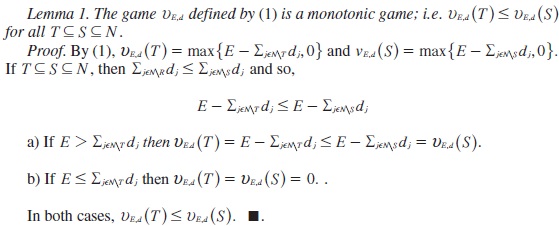
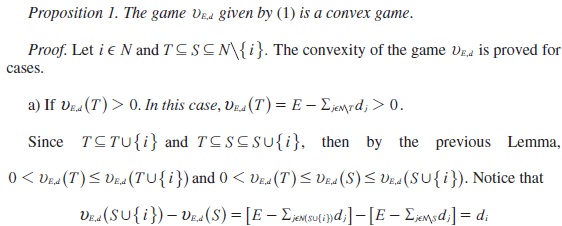
<body><![CDATA[<p align="justify"><font face="verdana" size="2"><i>Example 1.</i> Let , <i>(E, d)</i> be a bankruptcy problem, for 4 creditors with <i>E</i> = 10 and <i>d =</i> (2,4,5,9). The game associated to <i>(E, d)</i>, <i>v<sub>E,d</sub></i> is defined as</font></p>  	    <p align="center"><font face="verdana" size="2"><img src="/img/revistas/ecoqu/v8n1-2/a3fo5.jpg"></font></p>  	    <p align="justify"><font face="verdana" size="2">And the Shapley value for this game is</font></p>  	    <p align="center"><font face="verdana" size="2"><img src="/img/revistas/ecoqu/v8n1-2/a3fo6.jpg"></font></p>  	    <p align="justify"><font face="verdana" size="2">Introduced in Shapley (1971), convex cooperative games capture the intuitive property of "snowballing". Specifically, a game is convex if its characteristic function <i>y</i> satisfies:</font></p>  	    <p align="center"><font face="verdana" size="2"><img src="/img/revistas/ecoqu/v8n1-2/a3fo7.jpg"></font></p>  	    <p align="justify"><font face="verdana" size="2">There is an equivalent characterization of convex games. It can be shown (see, e.g., Section V.1 of (Driessen 1988)) that a game is convex if and only for all <i>i</i> &isin; <i>N</i> ,</font></p>  	    <p align="center"><font face="verdana" size="2"><img src="/img/revistas/ecoqu/v8n1-2/a3fo8.jpg"></font></p>  	    <p align="justify"><font face="verdana" size="2">Thus, the game <i>v</i> is convex if and only if the marginal contribution of a player to a coalition is monotone nondecreasing with respect to set&#45;theoretic inclusion. This explains the term convex.</font></p>          <p align="center"><font face="verdana" size="2"><img src="/img/revistas/ecoqu/v8n1-2/a3l1.jpg"></font></p>  	    ]]></body>
<body><![CDATA[<p align="center"><font face="verdana" size="2"><img src="/img/revistas/ecoqu/v8n1-2/a3p1.jpg"></font></p>  	    <p align="justify"><font face="verdana" size="2">and</font></p>  	    <p align="center"><font face="verdana" size="2"><img src="/img/revistas/ecoqu/v8n1-2/a3fo9.jpg"></font></p>  	    <p align="justify"><font face="verdana" size="2">&nbsp;</font></p>  	    <p align="justify"><font face="verdana" size="2">This concludes the proof.</font></p>  	    <p align="justify"><font face="verdana" size="2"><i>Remark 1.</i> It is well known that the core, the set of efficient payoff vectors such that each coalition receives at least its worth, of a convex game is non&#45;empty. Therefore <i>C(v<sub>E,d</sub> )&Dagger; &#966;</i> for every bankruptcy problem (<i>E, d</i>).</font></p>  	    <p align="justify"><font face="verdana" size="2">&nbsp;</font></p>  	    <p align="justify"><font face="verdana" size="2"><i>Example 2. </i>Let (<i>E, d</i>) be a bankruptcy problem given in Example 1. Consider the following embedded coalitions:</font></p>  	    <p align="center"><font face="verdana" size="2"><img src="/img/revistas/ecoqu/v8n1-2/a3fo10.jpg"></font></p>  	    <p align="justify"><font face="verdana" size="2">By Lemma 1, <i>v<sub>E,d</sub></i> (&#123;4&#125;)&le; <i>v<sub>E,d</sub></i> (&#123;1,4&#125;)&le; <i>v<sub>E,d</sub></i> (&#123;1,2,4&#125;)&le; <i>v<sub>E,d</sub></i> (&#123;1,2,3,4&#125;). The worths are 0 &le; 1 &le; 5 &le; 10 and the corresponding marginal contributions satisfy 1 &ge; 4 &ge; 5, which are increasing.</font></p>  	    ]]></body>
<body><![CDATA[<p align="center"><font face="verdana" size="2"><img src="/img/revistas/ecoqu/v8n1-2/a3d5.jpg"></font></p>  	    <p align="justify"><font face="verdana" size="2">Next, we will show that, in general, marginal contributions are not increasing for bankruptcy games. But first, we illustrate the idea with an example.</font></p>  	    <p align="center"><font face="verdana" size="2"><img src="/img/revistas/ecoqu/v8n1-2/a3e3.jpg"></font></p>  	    <p align="justify"><font face="verdana" size="2">We note that marginal contributions are not increasing in the case where creditors with greater demands are first incorporated in the coalition formation process. We can generalize this idea.</font></p>  	    <p align="justify"><font face="verdana" size="2"><i>Proposition 2. Let</i> (<i>E, d</i>) <i>be a bankruptcy problem with at least three creditors and let</i> , <i>a game associated to it, given by</i> (1). <i>Then marginal contributions are not in</i> <i>creasing for the game</i> <i>v<sub>E,d</sub></i>.</font></p>  	    <p align="justify"><font face="verdana" size="2"><i>Proof.</i> Let (<i>E, d</i>) be a bankruptcy problem and let <i>v<sub>E,d</sub></i>, a game associated to it. Without loss of generality, suppose <i>d</i><sub>1</sub> &le; <i>d</i><sub>2</sub>&le; ...&le; <i>d</i><sub>n</sub>. Let <i>k</i> be the greatest index such that</font></p>  	    <p align="center"><font face="verdana" size="2"><img src="/img/revistas/ecoqu/v8n1-2/a3fo11.jpg"></font></p>  	    <p align="justify"><font face="verdana" size="2">Take the embedded coalitions <i>T</i> &sube; <i>R</i> &sube; <i>S</i> defined by <i>T</i> =&#123;1, 2,...,<i>k</i>&#125;, <i>R</i> = <i>T&cup;</i> =1 &#123;<i>k</i>&#125; = &#123;1, 2,...,<i>k</i>&#125; and <i>S</i> = <i>R</i><i>&cup;</i> ,&#123;1+<i>k</i>&#125; = &#123;1, 2,...,<i>k + 1</i>&#125; By Lemma 1, <i>v<sub>E,d</sub></i> <i>(T)</i>&le; <i>v,</i> <i>v<sub>E,d</sub> (R)</i> &le; <i>v<sub>E,d</sub> (S)</i> and it is easy to check that, <i>v<sub>E,d</sub></i> (<i>T&cup;</i>&#123;<i>k</i>&#125;&#45;<i>v<sub>E,d</sub></i> (<i>T</i>) = <i>d<sub>k</sub></i> and <i>v<sub>E,d</sub></i> (<i>T&cup;</i>&#123;<i>k, k +1</i>&#125;) &#45;<i>v<sub>E,d</sub></i> (<i>T&cup;</i>&#123;<i>k</i>&#125;) =<i>d<sub>k&#45;1</sub></i>. Since <i>d<sub>k&#45;1</sub></i><i>d</i> &lt; <i>d<sub>k</sub></i>, we can conclude that marginal contributions are not increasing for the game <i>v<sub>E,d</sub></i>.</font></p>  	    <p align="justify"><font face="verdana" size="2">&nbsp;</font></p>  	    <p align="justify"><font face="verdana" size="2"><i>An alternative bankruptcy game</i></font></p>  	    ]]></body>
<body><![CDATA[<p align="justify"><font face="verdana" size="2">Since cooperative games are formal representations of situations in which all groups or coalitions (and not just the group of the whole) can achieve something, in this section we study another way to associate a game with a general bankruptcy problem. The idea is to take the worth of a coalition to be what it can get by going to court; i.e., the total amount of debts its members are actually claiming, on the understanding that any amount of debt that goes beyond the estate is considered to be irrelevant.</font></p>  	    <p align="center"><font face="verdana" size="2"><img src="/img/revistas/ecoqu/v8n1-2/a3d6.jpg"></font></p>  	    <p align="justify"><font face="verdana" size="2">Note that the previous definition is in agreement with the standard manner in which cooperative games are constructed to represent conflicts, namely by defining the worth of a coalition as a guaranteed amount. If the worth of a coalition is interpreted instead as the amount the coalition can expect to receive, the definition is somewhat optimistic. However, the bias being systematic across coalitions, we might still feel that the resulting game appropriately summarizes the situation.</font></p>  	    <p align="justify"><font face="verdana" size="2">Since the core (anticore) has one of the most appealing solution concepts for cooperative games, e.g., various papers deal with the existence of the core (anticore) for specified types of games, whereas other papers address to the characterization of it (for instance, see Peleg (1985)); we provide a simple characterization of the anticore of the game. In this case, the anticore of &#969;<i><sub>E,d</sub></i>, is the set</font></p>  	    <p align="center"><font face="verdana" size="2"><img src="/img/revistas/ecoqu/v8n1-2/a3fo12.jpg"></font></p>  	    <p align="center"><font face="verdana" size="2"><img src="/img/revistas/ecoqu/v8n1-2/a3t1.jpg"></font></p>  	    <p align="justify"><font face="verdana" size="2"><i>Proof.</i> First, we suppose 0 &le; <i>x</i><i><sub>i</sub></i> &le; <i>d<sub>i</sub></i>, &forall;<i><sub>i</sub></i> <i>&isin; N</i> . For every coalition <i>S</i>, such that, <i>&#934; &Dagger; S</i> &sube; <i>N</i> we have x<i>(S)</i> &le; <i>x(N)</i>= <i>E.</i> On the other hand, <i>x</i><i>(S)</i> &le; <img src="/img/revistas/ecoqu/v8n1-2/a3fo16.jpg">and so, <i>x</i><i>(S)</i>&le;<img src="/img/revistas/ecoqu/v8n1-2/a3fo17.jpg">= <i>w<sub>E,d</sub> (S)</i> for all <i>&#934; &Dagger; S</i> &sube; <i>N</i>. Hence, we conclude <img src="/img/revistas/ecoqu/v8n1-2/a3fo18.jpg">.</font></p>  	    <p align="justify"><font face="verdana" size="2">Now, we suppose <img src="/img/revistas/ecoqu/v8n1-2/a3fo18.jpg">. For the inequalities in the definition of <img src="/img/revistas/ecoqu/v8n1-2/a3fo19.jpg"> with coalitions of cardinality 1, it follows immediately that for <i>i</i> &isin; <i>N ,</i></font></p>  	    <p align="center"><font face="verdana" size="2"><img src="/img/revistas/ecoqu/v8n1-2/a3fo20.jpg"></font></p>  	    <p align="justify"><font face="verdana" size="2">While with coalitions of cardinality <i>n</i>&minus;1, notice that</font></p>  	    ]]></body>
<body><![CDATA[<p align="center"><font face="verdana" size="2"><img src="/img/revistas/ecoqu/v8n1-2/a3fo13.jpg"></font></p>  	    <p align="justify"><font face="verdana" size="2">Therefore<img src="/img/revistas/ecoqu/v8n1-2/a3fo14.jpg"></font></p>  	    <p align="justify"><font face="verdana" size="2">And so, we conclude</font></p>  	    <p align="center"><font face="verdana" size="2"><img src="/img/revistas/ecoqu/v8n1-2/a3fo15.jpg"></font></p>  	    <p align="justify"><font face="verdana" size="2"><i>Remark 2.</i> From this simplest characterization of the anticore mentioned in the previous Theorem, it is clear that the anticore of the bankruptcy game &#969;<i><sub>E,d</sub></i> is always non empty; e.g., allocate to each successive creditor his claim as long as the sum of their claims does not exceed the amount <i>E</i>, and allocate to the other creditors, except one, nothing. And also, we can notice that elements in the anticore are feasible solutions in the sense that no creditor receives more than he demands.</font></p>  	    <p align="justify"><font face="verdana" size="2"><i>Remark 3.</i> <i>C</i> (&#969;<i><sub>E,d</sub></i>) = <i>&#934;</i> for every bankruptcy problem, except for a problem where a creditor <i>i</i> claims an amount greater than <i>E</i>, and the remaining creditors <i>N</i>\{<i>i</i>} claims an amount of 0. In this case, <i>C</i> (&#969;<i><sub>E,d</sub></i>)= &#123;(0,..., 0, <i>E</i>, 0,..., 0)&#125;, where creditor <i>i</i> receives the amount <i>E</i>.</font></p>  	    <p align="justify"><font face="verdana" size="2"><i>Example 4.</i> Let (<i>E, d</i>) be a bankruptcy problem given in Example 1. The alternative game associated to (<i>E, d</i>), &#969;<i><sub>E,d</sub></i>, is defined as</font></p>  	    <p align="center"><font face="verdana" size="2"><img src="/img/revistas/ecoqu/v8n1-2/a3ta1.jpg"></font></p>  	    <p align="justify"><font face="verdana" size="2">And the Shapley value for this new game is</font></p>  	    <p align="center"><font face="verdana" size="2"><img src="/img/revistas/ecoqu/v8n1-2/a3fo21.jpg"></font></p>  	    ]]></body>
<body><![CDATA[<p align="justify"><font face="verdana" size="2">Which coincides with <i>S</i><i>h</i>(&#969;<i><sub>E,d</sub></i>).</font></p>  	    <p align="justify"><font face="verdana" size="2">For a general game <i>v</i> &isin;<i>G</i><sup><i>N</i></sup> , the interpretation of <i>v(S)</i> changes accordingly to what people want to model. For example, <i>v(S)</i> could be the joint benefit that the coalition <i>S</i> could generate if they decide to play together; in this case, we would say that <i>y</i> is a benefit game. In a second interpretation, we could assume that the players in <i>N</i> want to hire a service, then <i>v(S)</i> could be thought of as the joint cost (for the players in <i>S</i>) if they act together. In the latter case, we say that is a cost game. In both cases, <i>v(S)</i> is the "worth" assigned to the coalition <i>S</i> when it is formed, i.e., when the players in <i>S</i> decide to play together.</font></p>  	    <p align="justify"><font face="verdana" size="2">The duality operator, as defined next, allows us to move from one of these interpretations to the other. Thus it is a natural concept to study. For a brief revision of the dual operator, see for instance Funaki (1994), where this author investigates the relationship between axiomatizations of solutions of cooperative games due to their dual axiomatizations. The duality operator *:<i>G</i><sup><i>N</i></sup> &rarr; <i>G</i><sup><i>N</i></sup> is defined by</font></p>  	    <p align="center"><font face="verdana" size="2"><img src="/img/revistas/ecoqu/v8n1-2/a3fo22.jpg"></font></p>  	    <p align="justify"><font face="verdana" size="2">In other words, the value of a coalition in the dual of a given game equals the difference between the value of the grand coalition and the value of the complement of the coalition in the given game. It is considered as an optimistic valuation of the game situation if the original game is considered as a pessimistic valuation like maximum standard. The dual game is also considered as a cost game when we regard the original game as a saving game.</font></p>  	    <p align="justify"><font face="verdana" size="2">Note* <i>(*v)</i> = <i>v</i> that and it is easily shown that <img src="/img/revistas/ecoqu/v8n1-2/a3fo23.jpg">.</font></p>  	    <p align="justify"><font face="verdana" size="2"><i>Remark 4.</i> If <i>v<sub>E,d</sub></i>, and &#969;<i><sub>E,d</sub></i>, are games given by (1) and (2), respectively; then it holds that</font></p>  	    <p align="center"><font face="verdana" size="2"><img src="/img/revistas/ecoqu/v8n1-2/a3fo24.jpg"></font></p>  	    <p align="justify"><font face="verdana" size="2">and</font></p>  	    <p align="center"><font face="verdana" size="2"><img src="/img/revistas/ecoqu/v8n1-2/a3fo25.jpg"></font></p>  	    ]]></body>
<body><![CDATA[<p align="justify"><font face="verdana" size="2">for every <i>S</i> &sube; <i>N</i>; i.e., the game <i>v<sub>E,d</sub></i> is the dual game of &#969;<i><sub>E,d</sub></i> and conversely. So, it also holds that</font></p>  	    <p align="center"><font face="verdana" size="2"><img src="/img/revistas/ecoqu/v8n1-2/a3fo26.jpg"></font></p>  	    <p align="justify"><font face="verdana" size="2"><i>Remark 5.</i> The property of the Shapley value pointed out in the previous Example is satisfied for every game and its dual.</font></p>  	    <p align="justify"><font face="verdana" size="2">Let <i>v</i> &isin; <i>G</i><sup><i>N</i></sup> and (*<i>v</i>) its dual, then</font></p>  	    <p align="center"><font face="verdana" size="2"><img src="/img/revistas/ecoqu/v8n1-2/a3fo27.jpg"></font></p>  	    <p align="justify"><font face="verdana" size="2">Now, if <i>T</i> = <i>N\S</i>, then</font></p>  	    <p align="center"><font face="verdana" size="2"><img src="/img/revistas/ecoqu/v8n1-2/a3fo28.jpg"></font></p>  	    <p align="justify"><font face="verdana" size="2">In the cooperative game theory framework, this means that the Shapley value is a self&#45;dual solution.</font></p> 	         <p align="justify"><font face="verdana" size="2">&nbsp;</font></p>              <p align="justify"><font size="2" face="verdana"><b>Conclusion</b></font></p>              ]]></body>
<body><![CDATA[<p align="justify"><font face="verdana" size="2">This paper has contributed to the study of solutions for of bankruptcy problems through the use of cooperative games and their solutions. We have seen equivalent ways of defining convex real functions of real variable, they cannot be generalized in a natural and unique way, to generate a notion of convexity in cooperative games defined in the set of coalitions of players. The standard notion of convexity of a cooperative game is not equivalent to the notion that we introduce for increasing marginal contributions. We have explained the economic sense of duality in the case of cooperative games related to bankruptcy issues. We have obtained a characterization of stable solutions of the dual game of bankruptcy problems proposed in section 4. The high content of distributive justice of the Shapley value has been tested again. Two games built with apparently conflicting ideas of the behavior of coalitions have generated the same solution as the distribution of justice that the Shapley value. For future research, we may consider alternative ways to build cooperative games to solve bankruptcy problems; the imposition of desirable properties of any solution of bankruptcy can help to characterize solutions without going through the cooperative games.</font></p>              <p align="justify"><font face="verdana" size="2">&nbsp;</font></p>              <p align="justify"><font face="verdana" size="2"><b>References</b></font></p>              <!-- ref --><p align="justify"><font face="verdana" size="2">Aumann, R. J. (2010). "Some non&#45;superadditive games, and their Shapley values, in the Talmud", <i>International Journal of Game Theory</i>, 39, 3 &#45; 10.    &nbsp;&nbsp;&nbsp;&nbsp;&nbsp;&nbsp;&nbsp;&nbsp;[&#160;<a href="javascript:void(0);" onclick="javascript: window.open('/scielo.php?script=sci_nlinks&ref=3012755&pid=S1870-6622201100020000300001&lng=','','width=640,height=500,resizable=yes,scrollbars=1,menubar=yes,');">Links</a>&#160;]<!-- end-ref --></font></p>  	    <!-- ref --><p align="justify"><font face="verdana" size="2">Aumann, R. J., Maschler, M. (1985). "Game theoretic analysis of a bankruptcy problem from the Talmud", <i>Journal of Economic Theory</i>, 36, 195 &#45;213.    &nbsp;&nbsp;&nbsp;&nbsp;&nbsp;&nbsp;&nbsp;&nbsp;[&#160;<a href="javascript:void(0);" onclick="javascript: window.open('/scielo.php?script=sci_nlinks&ref=3012757&pid=S1870-6622201100020000300002&lng=','','width=640,height=500,resizable=yes,scrollbars=1,menubar=yes,');">Links</a>&#160;]<!-- end-ref --></font></p>  	    <!-- ref --><p align="justify"><font face="verdana" size="2">Driessen, T. (1988). Cooperative games, solutions and applications. Theory and Decision Library, Springer.    &nbsp;&nbsp;&nbsp;&nbsp;&nbsp;&nbsp;&nbsp;&nbsp;[&#160;<a href="javascript:void(0);" onclick="javascript: window.open('/scielo.php?script=sci_nlinks&ref=3012759&pid=S1870-6622201100020000300003&lng=','','width=640,height=500,resizable=yes,scrollbars=1,menubar=yes,');">Links</a>&#160;]<!-- end-ref --></font></p>  	    <!-- ref --><p align="justify"><font face="verdana" size="2">Funaki, Y. (1994). "Dual axiomatizations of solutions of cooperative games", Working paper 13, Faculty of Economics, Tokyo University.    &nbsp;&nbsp;&nbsp;&nbsp;&nbsp;&nbsp;&nbsp;&nbsp;[&#160;<a href="javascript:void(0);" onclick="javascript: window.open('/scielo.php?script=sci_nlinks&ref=3012761&pid=S1870-6622201100020000300004&lng=','','width=640,height=500,resizable=yes,scrollbars=1,menubar=yes,');">Links</a>&#160;]<!-- end-ref --></font></p>  	    <!-- ref --><p align="justify"><font face="verdana" size="2">Herrero, C., Villar, A. (2001). "The three musketeers: four classical solutions to bankruptcy problems", <i>Mathematical Social Sciences</i> 42, 307&#45;328.    &nbsp;&nbsp;&nbsp;&nbsp;&nbsp;&nbsp;&nbsp;&nbsp;[&#160;<a href="javascript:void(0);" onclick="javascript: window.open('/scielo.php?script=sci_nlinks&ref=3012763&pid=S1870-6622201100020000300005&lng=','','width=640,height=500,resizable=yes,scrollbars=1,menubar=yes,');">Links</a>&#160;]<!-- end-ref --></font></p>  	    <!-- ref --><p align="justify"><font face="verdana" size="2">O'Neill, B. (1982). "A problem of rights arbitration from the Talmud", Mathematical Social Sciences, 2, 345 &#45; 371.    &nbsp;&nbsp;&nbsp;&nbsp;&nbsp;&nbsp;&nbsp;&nbsp;[&#160;<a href="javascript:void(0);" onclick="javascript: window.open('/scielo.php?script=sci_nlinks&ref=3012765&pid=S1870-6622201100020000300006&lng=','','width=640,height=500,resizable=yes,scrollbars=1,menubar=yes,');">Links</a>&#160;]<!-- end-ref --></font></p>  	    <!-- ref --><p align="justify"><font face="verdana" size="2">Peleg, B. and Sudh&ouml;lter, P. (2007). "Introduction to the theory of cooperative games", Springer, 2nd edition.    &nbsp;&nbsp;&nbsp;&nbsp;&nbsp;&nbsp;&nbsp;&nbsp;[&#160;<a href="javascript:void(0);" onclick="javascript: window.open('/scielo.php?script=sci_nlinks&ref=3012767&pid=S1870-6622201100020000300007&lng=','','width=640,height=500,resizable=yes,scrollbars=1,menubar=yes,');">Links</a>&#160;]<!-- end-ref --></font></p>  	    <!-- ref --><p align="justify"><font face="verdana" size="2">Peleg, B. (1985). "An axiomatization of the core of cooperative games without side payments", Journal of Mathematical Economics, 14, 203 &#45; 214.    &nbsp;&nbsp;&nbsp;&nbsp;&nbsp;&nbsp;&nbsp;&nbsp;[&#160;<a href="javascript:void(0);" onclick="javascript: window.open('/scielo.php?script=sci_nlinks&ref=3012769&pid=S1870-6622201100020000300008&lng=','','width=640,height=500,resizable=yes,scrollbars=1,menubar=yes,');">Links</a>&#160;]<!-- end-ref --></font></p>  	    <!-- ref --><p align="justify"><font face="verdana" size="2">Shapley, Ll. (1953). "A value of a n&#45;person games", Contributions to the Theory of Games, Annals of Math.Studies, Princeton, 28, 307 &#45; 317.    &nbsp;&nbsp;&nbsp;&nbsp;&nbsp;&nbsp;&nbsp;&nbsp;[&#160;<a href="javascript:void(0);" onclick="javascript: window.open('/scielo.php?script=sci_nlinks&ref=3012771&pid=S1870-6622201100020000300009&lng=','','width=640,height=500,resizable=yes,scrollbars=1,menubar=yes,');">Links</a>&#160;]<!-- end-ref --></font></p>  	    <!-- ref --><p align="justify"><font face="verdana" size="2">Shapley, Ll. (1971). "Cores of convex games", <i>International Journal of Game Theory</i>, 1(1), 11 &#45; 26.    &nbsp;&nbsp;&nbsp;&nbsp;&nbsp;&nbsp;&nbsp;&nbsp;[&#160;<a href="javascript:void(0);" onclick="javascript: window.open('/scielo.php?script=sci_nlinks&ref=3012773&pid=S1870-6622201100020000300010&lng=','','width=640,height=500,resizable=yes,scrollbars=1,menubar=yes,');">Links</a>&#160;]<!-- end-ref --></font></p>  	    <!-- ref --><p align="justify"><font face="verdana" size="2">Thomson, W. (2003). "Axiomatic and game&#45;theoretic analysis of bankruptcy and taxation problems: a survey", <i>Mathematical Social Sciences</i>, 45, p&aacute;gs. 249&#45;297.    &nbsp;&nbsp;&nbsp;&nbsp;&nbsp;&nbsp;&nbsp;&nbsp;[&#160;<a href="javascript:void(0);" onclick="javascript: window.open('/scielo.php?script=sci_nlinks&ref=3012775&pid=S1870-6622201100020000300011&lng=','','width=640,height=500,resizable=yes,scrollbars=1,menubar=yes,');">Links</a>&#160;]<!-- end-ref --></font></p> 	         <p align="justify"><font face="verdana" size="2">&nbsp;</font></p> 	         <p align="justify"><font face="verdana" size="2"><b>Nota</b></font></p>              <p align="justify"><font face="verdana" size="2">We would like to thank the anonymous referee for helpful comments on an earlier draft. All remaining errors, however, are solely ours.</font></p>      ]]></body><back>
<ref-list>
<ref id="B1">
<nlm-citation citation-type="journal">
<person-group person-group-type="author">
<name>
<surname><![CDATA[Aumann]]></surname>
<given-names><![CDATA[R. J.]]></given-names>
</name>
</person-group>
<article-title xml:lang="en"><![CDATA[Some non-superadditive games, and their Shapley values, in the Talmud]]></article-title>
<source><![CDATA[International Journal of Game Theory]]></source>
<year>2010</year>
<numero>39</numero>
<issue>39</issue>
<page-range>3 - 10</page-range></nlm-citation>
</ref>
<ref id="B2">
<nlm-citation citation-type="journal">
<person-group person-group-type="author">
<name>
<surname><![CDATA[Aumann]]></surname>
<given-names><![CDATA[R. J.]]></given-names>
</name>
<name>
<surname><![CDATA[Maschler]]></surname>
<given-names><![CDATA[M.]]></given-names>
</name>
</person-group>
<article-title xml:lang="en"><![CDATA[Game theoretic analysis of a bankruptcy problem from the Talmud]]></article-title>
<source><![CDATA[Journal of Economic Theory]]></source>
<year>1985</year>
<numero>36</numero>
<issue>36</issue>
<page-range>195 -213</page-range></nlm-citation>
</ref>
<ref id="B3">
<nlm-citation citation-type="book">
<person-group person-group-type="author">
<name>
<surname><![CDATA[Driessen]]></surname>
<given-names><![CDATA[T.]]></given-names>
</name>
</person-group>
<source><![CDATA[Cooperative games, solutions and applications. Theory and Decision Library]]></source>
<year>1988</year>
<publisher-name><![CDATA[Springer]]></publisher-name>
</nlm-citation>
</ref>
<ref id="B4">
<nlm-citation citation-type="book">
<person-group person-group-type="author">
<name>
<surname><![CDATA[Funaki]]></surname>
<given-names><![CDATA[Y.]]></given-names>
</name>
</person-group>
<article-title xml:lang="en"><![CDATA[Dual axiomatizations of solutions of cooperative game]]></article-title>
<source><![CDATA[]]></source>
<year>1994</year>
<publisher-name><![CDATA[Faculty of Economics, Tokyo University]]></publisher-name>
</nlm-citation>
</ref>
<ref id="B5">
<nlm-citation citation-type="journal">
<person-group person-group-type="author">
<name>
<surname><![CDATA[Herrero]]></surname>
<given-names><![CDATA[C.]]></given-names>
</name>
<name>
<surname><![CDATA[Villar]]></surname>
<given-names><![CDATA[A.]]></given-names>
</name>
</person-group>
<article-title xml:lang="en"><![CDATA[The three musketeers: four classical solutions to bankruptcy problems]]></article-title>
<source><![CDATA[Mathematical Social Sciences]]></source>
<year>2001</year>
<volume>42</volume>
<page-range>307-328</page-range></nlm-citation>
</ref>
<ref id="B6">
<nlm-citation citation-type="journal">
<person-group person-group-type="author">
<name>
<surname><![CDATA[O'Neill]]></surname>
<given-names><![CDATA[B.]]></given-names>
</name>
</person-group>
<article-title xml:lang="en"><![CDATA[A problem of rights arbitration from the Talmud]]></article-title>
<source><![CDATA[Mathematical Social Sciences]]></source>
<year>1982</year>
<volume>2</volume>
<page-range>345 - 371</page-range></nlm-citation>
</ref>
<ref id="B7">
<nlm-citation citation-type="book">
<person-group person-group-type="author">
<name>
<surname><![CDATA[Peleg]]></surname>
<given-names><![CDATA[B.]]></given-names>
</name>
<name>
<surname><![CDATA[Sudhölter]]></surname>
<given-names><![CDATA[P.]]></given-names>
</name>
</person-group>
<source><![CDATA[Introduction to the theory of cooperative games]]></source>
<year>2007</year>
<edition>2</edition>
<publisher-name><![CDATA[Springer]]></publisher-name>
</nlm-citation>
</ref>
<ref id="B8">
<nlm-citation citation-type="journal">
<person-group person-group-type="author">
<name>
<surname><![CDATA[Peleg]]></surname>
<given-names><![CDATA[B.]]></given-names>
</name>
</person-group>
<article-title xml:lang="en"><![CDATA[An axiomatization of the core of cooperative games without side payments]]></article-title>
<source><![CDATA[Journal of Mathematical Economics]]></source>
<year>1985</year>
<volume>14</volume>
<page-range>203 - 214</page-range></nlm-citation>
</ref>
<ref id="B9">
<nlm-citation citation-type="journal">
<person-group person-group-type="author">
<name>
<surname><![CDATA[Shapley]]></surname>
<given-names><![CDATA[Ll.]]></given-names>
</name>
</person-group>
<article-title xml:lang="en"><![CDATA[A value of a n-person games]]></article-title>
<source><![CDATA[Annals of Math.Studies]]></source>
<year>1953</year>
<volume>28</volume>
<page-range>307 - 317</page-range><publisher-loc><![CDATA[Princeton ]]></publisher-loc>
</nlm-citation>
</ref>
<ref id="B10">
<nlm-citation citation-type="journal">
<person-group person-group-type="author">
<name>
<surname><![CDATA[Shapley]]></surname>
<given-names><![CDATA[Ll.]]></given-names>
</name>
</person-group>
<article-title xml:lang="en"><![CDATA[Cores of convex games]]></article-title>
<source><![CDATA[International Journal of Game Theory]]></source>
<year>1971</year>
<volume>1</volume>
<numero>1</numero>
<issue>1</issue>
<page-range>11 - 26</page-range></nlm-citation>
</ref>
<ref id="B11">
<nlm-citation citation-type="journal">
<person-group person-group-type="author">
<name>
<surname><![CDATA[Thomson]]></surname>
<given-names><![CDATA[W.]]></given-names>
</name>
</person-group>
<article-title xml:lang="en"><![CDATA[Axiomatic and game-theoretic analysis of bankruptcy and taxation problems: a survey]]></article-title>
<source><![CDATA[Mathematical Social Sciences]]></source>
<year>2003</year>
<volume>45</volume>
<page-range>249-297</page-range></nlm-citation>
</ref>
</ref-list>
</back>
</article>