<?xml version="1.0" encoding="ISO-8859-1"?><article xmlns:mml="http://www.w3.org/1998/Math/MathML" xmlns:xlink="http://www.w3.org/1999/xlink" xmlns:xsi="http://www.w3.org/2001/XMLSchema-instance">
<front>
<journal-meta>
<journal-id>1870-3453</journal-id>
<journal-title><![CDATA[Revista mexicana de biodiversidad]]></journal-title>
<abbrev-journal-title><![CDATA[Rev. Mex. Biodiv.]]></abbrev-journal-title>
<issn>1870-3453</issn>
<publisher>
<publisher-name><![CDATA[Instituto de Biología]]></publisher-name>
</publisher>
</journal-meta>
<article-meta>
<article-id>S1870-34532014000300035</article-id>
<article-id pub-id-type="doi">10.7550/rmb.43234</article-id>
<title-group>
<article-title xml:lang="en"><![CDATA[First record of the invasive greenhouse frog (Eleutherodactylus planirostris) in the Mexican Caribbean]]></article-title>
<article-title xml:lang="es"><![CDATA[Primer registro de la rana de invernadero invasora (Eleutherodactylus planirostris) en el Caribe mexicano]]></article-title>
</title-group>
<contrib-group>
<contrib contrib-type="author">
<name>
<surname><![CDATA[Cedeño-Vázquez]]></surname>
<given-names><![CDATA[José Rogelio]]></given-names>
</name>
<xref ref-type="aff" rid="A01"/>
</contrib>
<contrib contrib-type="author">
<name>
<surname><![CDATA[González-Vázquez]]></surname>
<given-names><![CDATA[Javier]]></given-names>
</name>
<xref ref-type="aff" rid="A02"/>
</contrib>
<contrib contrib-type="author">
<name>
<surname><![CDATA[Martínez-Arce]]></surname>
<given-names><![CDATA[Arely]]></given-names>
</name>
<xref ref-type="aff" rid="A01"/>
</contrib>
<contrib contrib-type="author">
<name>
<surname><![CDATA[Canseco-Márquez]]></surname>
<given-names><![CDATA[Luis]]></given-names>
</name>
<xref ref-type="aff" rid="A03"/>
</contrib>
</contrib-group>
<aff id="A01">
<institution><![CDATA[,El Colegio de la Frontera Sur Departamento de Sistemática y Ecología Acuática ]]></institution>
<addr-line><![CDATA[Chetumal Quintana Roo]]></addr-line>
<country>México</country>
</aff>
<aff id="A02">
<institution><![CDATA[,Aviario Xamán Ha  ]]></institution>
<addr-line><![CDATA[Playa del Carmen Quintana Roo]]></addr-line>
<country>México</country>
</aff>
<aff id="A03">
<institution><![CDATA[,Universidad Nacional Autónoma de México Facultad de Ciencias Departamento de Biología Evolutiva]]></institution>
<addr-line><![CDATA[México Distrito Federal]]></addr-line>
<country>México</country>
</aff>
<pub-date pub-type="pub">
<day>00</day>
<month>00</month>
<year>2014</year>
</pub-date>
<pub-date pub-type="epub">
<day>00</day>
<month>00</month>
<year>2014</year>
</pub-date>
<volume>85</volume>
<numero>2</numero>
<fpage>650</fpage>
<lpage>653</lpage>
<copyright-statement/>
<copyright-year/>
<self-uri xlink:href="http://www.scielo.org.mx/scielo.php?script=sci_arttext&amp;pid=S1870-34532014000300035&amp;lng=en&amp;nrm=iso"></self-uri><self-uri xlink:href="http://www.scielo.org.mx/scielo.php?script=sci_abstract&amp;pid=S1870-34532014000300035&amp;lng=en&amp;nrm=iso"></self-uri><self-uri xlink:href="http://www.scielo.org.mx/scielo.php?script=sci_pdf&amp;pid=S1870-34532014000300035&amp;lng=en&amp;nrm=iso"></self-uri><abstract abstract-type="short" xml:lang="en"><p><![CDATA[Based on morphological identification and a molecular analysis of specimens collected in the urban zone of Playa del Carmen in the state of Quintana Roo, we report the first record of the invasive greenhouse frog (Eleutherodactylus planirostris) in the Mexican Caribbean. The presence of E. planirostris in the Yucatán Peninsula suggests an urgent need for research to evaluate its invasion and ecological impacts.]]></p></abstract>
<abstract abstract-type="short" xml:lang="es"><p><![CDATA[Con base en identificación morfológica y análisis molecular de ejemplares recolectados en la zona urbana de la ciudad de Playa del Carmen, Quintana Roo, informamos del primer registro de la rana de invernadero (Eleutherodactylus planirostris) en el Caribe mexicano. La presencia de E. planirostris en la península de Yucatán sugiere la necesidad de realizar urgentemente una investigación para evaluar su invasión y los posibles impactos ecológicos que puedan suscitarse.]]></p></abstract>
<kwd-group>
<kwd lng="en"><![CDATA[new record]]></kwd>
<kwd lng="en"><![CDATA[DNA barcodes]]></kwd>
<kwd lng="en"><![CDATA[morphological analysis]]></kwd>
<kwd lng="en"><![CDATA[molecular analysis]]></kwd>
<kwd lng="en"><![CDATA[Playa del Carmen]]></kwd>
<kwd lng="en"><![CDATA[Yucatán Peninsula]]></kwd>
<kwd lng="es"><![CDATA[nuevo registro]]></kwd>
<kwd lng="es"><![CDATA[códigos de barras de DNA]]></kwd>
<kwd lng="es"><![CDATA[análisis morfológico]]></kwd>
<kwd lng="es"><![CDATA[análisis molecular]]></kwd>
<kwd lng="es"><![CDATA[Playa del Carmen]]></kwd>
<kwd lng="es"><![CDATA[península de Yucatán]]></kwd>
</kwd-group>
</article-meta>
</front><body><![CDATA[ 
	    <p align="justify"><font face="verdana" size="4">Notas cient&iacute;ficas</font></p>

    <p>&nbsp;</p>

	    <p align="center"><font face="verdana" size="4"><b>First record of the invasive greenhouse frog (<i>Eleutherodactylus planirostris</i>) in the Mexican Caribbean</b></font></p>

	    <p>&nbsp;</p>

	    <p align="center"><font face="verdana" size="3"><b>Primer registro de la rana de invernadero invasora (<i>Eleutherodactylus planirostris</i>) en el Caribe mexicano</b></font></p>

	    <p>&nbsp;</p>

	    <p align="center"><font face="verdana" size="2"><b>Jos&eacute; Rogelio Cede&ntilde;o&#45;V&aacute;zquez<sup>1*</sup>, Javier Gonz&aacute;lez&#45;V&aacute;zquez<sup>2</sup>, Arely Mart&iacute;nez&#45;Arce<sup>1</sup> and Luis Canseco&#45;M&aacute;rquez<sup>3</sup></b></font></p>

	    <p>&nbsp;</p>

	
    <p align="justify"><font face="verdana" size="2"><sup><i>1</i></sup><i> Departamento de 
  Sistem&aacute;tica y Ecolog&iacute;a Acu&aacute;tica. El Colegio de la Frontera 
  Sur, Unidad Chetumal, Av. Centenario Km 5.5, 77014 Chetumal, Quintana Roo, M&eacute;xico.</i> 
  * <a href="mailto:rcedenov@ecosur.mx">rcedenov@ecosur.mx</a></font></p>

	
    ]]></body>
<body><![CDATA[<p align="justify"><font face="verdana" size="2"><sup><i>2</i></sup><i> Aviario Xam&aacute;n 
  Ha, Paseo Xam&aacute;n Ha Mz13&#45;A, Fracc. Playacar, 77710 Playa del Carmen, 
  Quintana Roo, M&eacute;xico.</i></font></p>

	
    <p align="justify"><font face="verdana" size="2"><sup><i>3</i></sup><i> Departamento de 
  Biolog&iacute;a Evolutiva, Laboratorio de Herpetolog&iacute;a, Facultad de Ciencias. 
  Universidad Nacional Aut&oacute;noma de M&eacute;xico, Av. Universidad 3000, 
  Ciudad Universitaria, Coyoac&aacute;n, 04510, M&eacute;xico, D.F., M&eacute;xico.</i></font></p>

	    <p>&nbsp;</p>

	
    <p align="justify"><font face="verdana" size="2">Recibido: 04 noviembre 2013    <br>
	Aceptado: 30 diciembre 2013</font></p>

	    <p>&nbsp;</p>

	    <p align="justify"><font face="verdana" size="2"><b>Abstract</b></font></p> 
        <p align="justify"><font face="verdana" size="2">Based on morphological identification and a molecular analysis of specimens collected in the urban zone of Playa del Carmen in the state of Quintana Roo, we report the first record of the invasive greenhouse frog (<i>Eleutherodactylus planirostris</i>) in the Mexican Caribbean. The presence of <i>E. planirostris</i> in the Yucat&aacute;n Peninsula suggests an urgent need for research to evaluate its invasion and ecological impacts.</font></p>

	    <p align="justify"><font face="verdana" size="2"><b>Key words:</b> new record, DNA barcodes, morphological analysis, molecular analysis, Playa del Carmen, Yucat&aacute;n Peninsula.</font></p>

	    <p>&nbsp;</p>

	    ]]></body>
<body><![CDATA[<p align="justify"><font face="verdana" size="2"><b>Resumen</b></font></p> 
        <p align="justify"><font face="verdana" size="2">Con base en identificaci&oacute;n morfol&oacute;gica y an&aacute;lisis molecular de ejemplares recolectados en la zona urbana de la ciudad de Playa del Carmen, Quintana Roo, informamos del primer registro de la rana de invernadero (<i>Eleutherodactylus planirostris</i>) en el Caribe mexicano. La presencia de <i>E. planirostris</i> en la pen&iacute;nsula de Yucat&aacute;n sugiere la necesidad de realizar urgentemente una investigaci&oacute;n para evaluar su invasi&oacute;n y los posibles impactos ecol&oacute;gicos que puedan suscitarse.</font></p>

	    <p align="justify"><font face="verdana" size="2"><b>Palabras clave:</b> nuevo registro, c&oacute;digos de barras de DNA, an&aacute;lisis morfol&oacute;gico, an&aacute;lisis molecular, Playa del Carmen, pen&iacute;nsula de Yucat&aacute;n.</font></p>

	    <p>&nbsp;</p>

	    <p align="justify"><font face="verdana" size="2">Biological invasions are widely recognized as a significant component of human&#45;caused global environmental change, often resulting in the loss of biological diversity and ecosystem function (Hulme, 2003). The greenhouse frog <i>Eleutherodactylus planirostris</i> has direct development (no aquatic stage) and deposits its eggs in moist soil, which facilitate human&#45;mediated colonization (Christy et al., 2007) through transportation in potted plants (e.g. Kraus et al., 1999; Kraus and Campbell, 2002).</font></p>

	    <p align="justify"><font face="verdana" size="2">The greenhouse frog is native to the Caribbean islands of Cuba, Bahamas and Cayman Islands (D&iacute;az and C&aacute;diz, 2008; Olson et al., 2012a), but it has a wide non&#45;native distribution in the United States, Mexico, Jamaica, Grenada, Caicos Islands, the Miskito Cays of Nicaragua, Honduras, Panama City, Panama, and the Pacific islands of Hawaii and Guam (D&iacute;az and C&aacute;diz, 2008; McCrane et al., 2008; Kraus, 2009; Heinicke et al., 2011; Crawford et al., 2011; Olson et al., 2012a, 2012b).</font></p>

	    <p align="justify"><font face="verdana" size="2">Empirical observations indicate that the greenhouse frog is a highly successful invasive species (Bomford et al., 2009). For instance, after natural and human&#45;assisted introductions occurred in the early 1900s in Florida USA, the greenhouse frog is now found throughout the state. It is suspected that human&#45;assisted introductions often occur by hitch&#45;hiking on commercial nursery plants (Heinicke et al., 2011; Kraus et al., 1999) and probably this is the way the greenhouse frog arrived in Mexico. Here, we report the first record of <i>E. planirostris</i> in the Mexican Caribbean confirmed by morphological and molecular data.</font></p>

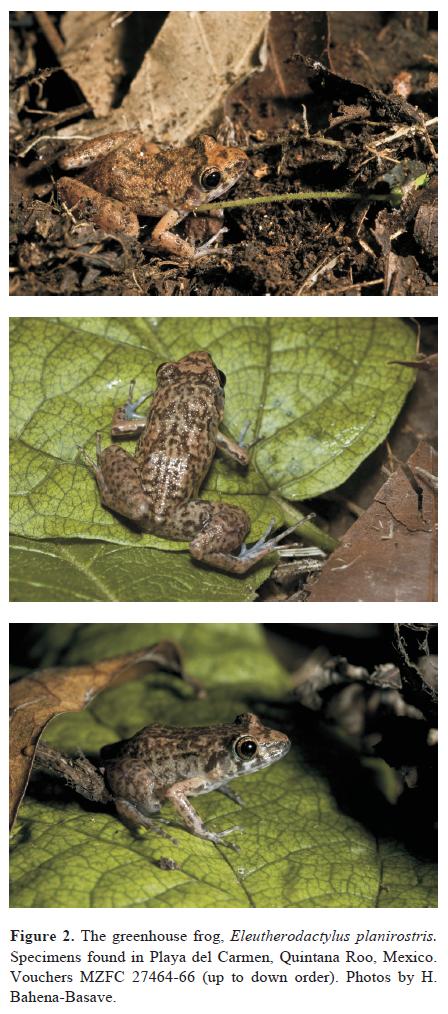
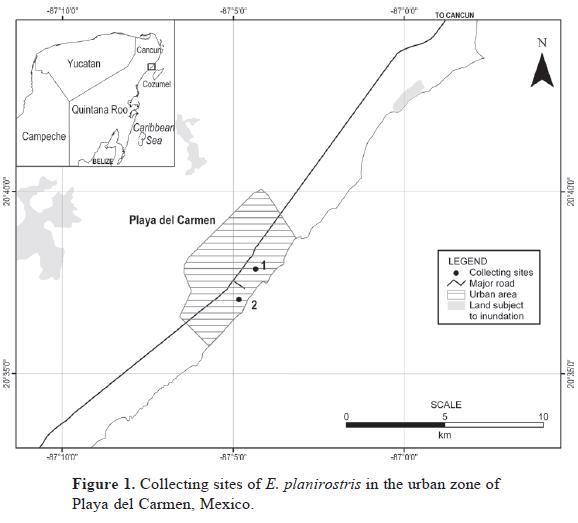
	    <p align="justify"><font face="verdana" size="2">On 19 November 2010 at 14:00 h following a heavy rain, 3 small frogs were collected (field numbers JGV 303&#45;305; 16, 20 and 21 mm snout&#45;vent length &#91;SVL&#93;, respectively) around a swimming pool at a condominium built in 1993 in the urban zone of Playa del Carmen, Quintana Roo, Mexico, 20&#176;37' 52" N, 87&#176;04' 21" W (<a href="#f1">Fig. 1</a>). Living specimens were photographed (<a href="#f2">Fig. 2</a>), sacrificed and preserved in 96% ethanol, and then deposited in the herpetological collection of the Museo de Zoolog&iacute;a Alfonso L. Herrera of the Facultad de Ciencias, Universidad Nacional Aut&oacute;noma de M&eacute;xico (UNAM) with catalogue numbers MZFC 27464&#45;27466.</font></p>

	    <p align="center"><font face="verdana" size="2"><a name="f1"></a></font></p>

	    <p align="center"><font face="verdana" size="2"><img src="/img/revistas/rmbiodiv/v85n2/a35f1.jpg"></font></p>

	    ]]></body>
<body><![CDATA[<p align="center"><font face="verdana" size="2"><a name="f2"></a></font></p>

	    <p align="center"><font face="verdana" size="2"><img src="/img/revistas/rmbiodiv/v85n2/a35f2.jpg"></font></p>

	    <p align="justify"><font face="verdana" size="2">After the literature review of local amphibians, photographic comparisons, and use of taxonomic keys, we identified the specimens as belonging to the genus <i>Eleutherodactylus</i>, but based on information in Lee (1996, 2000), Campbell (1998), and K&ouml;hler (2011) morphological features of the collected frogs were inconsistent with any of the 9 species native to the Yucat&aacute;n Peninsula. In order to identify our specimens to the species level, we conducted a genetic analysis using sequences from the mitochondrial gen Cytochrome Oxidase Subunit I (COI) (&gt;600 bp). Tissue samples were obtained from each specimen by toe clipping.</font></p>

	    <p align="justify"><font face="verdana" size="2">Molecular protocols (DNA extraction, amplification and sequencing) were conducted in the barcoding laboratory of El Colegio de la Frontera Sur (ECOSUR) following the Canadian Center of DNA Barcoding (CCDB) public protocols (<a href="http://www.dnabarcoding.ca" target="_blank">http://www.dnabarcoding.ca</a>). To corroborate and compare our genetic material, we obtained 3 additional sequences of <i>E. planirostris</i>, including 2 from Panama and 1 from Cuba (Crawford et al., 2011), and 6 sequences of other species of <i>Eleutherodactylus</i> (<i>E. glamyrus, E. eileenae, E. bartonsmithi, E. principalis</i>, <i>E</i>. <i>mariposa</i> and <i>E. ronaldi</i>) (Rodr&iacute;guez et al., 2010), all downloaded from the Barcode of Life Database (<a href="http://www.boldsystems.org" target="_blank">www.boldystems.org</a>). A neighbor&#45;joining (NJ) tree was reconstructed with a sequence of <i>Leptodactylus fragilis</i> as an outgroup (<a href="/img/revistas/rmbiodiv/v85n2/a35f3.jpg" target="_blank">Fig. 3</a>) using the software MEGA v. 4 (Tamura et al., 2007). Also, intra and interspecific <i>p</i> distances were calculated. Genetic sequences and metadata were deposited at Barcode of Life Data Systems (Ratnasingham and Hebert, 2007) under project <i>Eleutherodactylus</i> from Mexican Caribbean "EMC."</font></p>

	    <p align="justify"><font face="verdana" size="2">Morphological characters described by D&iacute;az and C&aacute;diz (2008) confirmed that our specimens belong to <i>E. planirostris</i>: a small frog, up to 27.3 mm SVL; long and thin toes with tubercles in the inferior surface, not webbed and small digital discs; dorsum variable overlaid with granules and tubercles. There are 2 basic colour patterns: <i>1)</i> a mottled tan and brown, and <i>2)</i> a mottled tan and brown, with 2 yellow dorsolateral stripes extending from the&#160;eye along the length of the body (Lynn and Grant,1940). The specimens we collected had the mottled tan and brown pattern (<a href="#f2">Fig. 2</a>). This identification was confirmed with the intra and interspecific genetic <i>p</i> distances (1.4%, and 25.51% average value, respectively).</font></p>

	    <p align="justify"><font face="verdana" size="2">Clusters formed in our phenogram, indicate that the 3 specimens from Mexico belong to <i>E</i>. <i>planisrostris</i> and consist of 3 different haplotypes (Mexico, Panama and Cuba). Both results (morphological and genetic) confirm for the first time the presence of the greenhouse frog in the state of Quintana Roo.</font></p>

	    <p align="justify"><font face="verdana" size="2">According to Kraus et al. (1999), in Hawaii <i>E. planirostris</i> potentially could eat indigenous, endemic arthropods, including species of insects and spiders of conservation concern. In a recent study in Hawaii, Olson and Beard (2012) found that this frog feeds mostly on leaf litter invertebrates, and consumption was estimated be as great as 129,000 invertebrates ha/night. Despite these possible ecological impacts, the impacts of the greenhouse frog invasions remain largely unstudied (Olson et al., 2012a).</font></p>

	    <p align="justify"><font face="verdana" size="2">Ecological studies are therefore urgently needed to understand the effects of the greenhouse frog invasions. In Mexico <i>E. planirostris</i> was first reported in the state of Veracruz (Schwartz 1974), but subsequent records have not been forthcoming (&Aacute;lvarez&#45;Romero et al., 2008). In the case reported herein, after a heavy rain, on 18 June 2011 at 9:00 h, we collected another specimen (25 mm SVL; voucher deposited in the herpetological collection of the Museo de Zoolog&iacute;a in ECOSUR campus Chetumal, Cat. Number ECO&#45;CH 2949) in the facilities of the Xaman Ha Aviary, 20&#176;37'6" N, 87&#176;04'50" W (site 2; <a href="#f1">Fig. 1</a>), located ca. 1650 m SW from the previous site, confirming the distribution of <i>E. planirostris</i> could be more widespread than previously thought. Furthermore, at the previous site we observed more adults (including calling males) and juveniles (only mottled individuals were found in both sites) in June 2013. This indicates an established population of <i>E. planirostris</i> now occurs in Playa del Carmen, which could be present over a wider area, and could spread beyond the urban zone in a short period of time. To address this concern, we strongly recommend that additional research be conducted to evaluate this invasion and its possible ecological impacts, and determine if control measures are necessary.</font></p>

	    <p align="justify"><font face="verdana" size="2">Sometimes invasive species are difficult to identify using only traditional morphology, and reference material for comparison often does not exist. For this reason, we suggest application of integrative taxonomy that includes morphological and molecular characters to correctly identify species as in this case.</font></p>

	    <p align="justify"><font face="verdana" size="2">We thank Samuel Pech Ram&iacute;rez for his help finding frogs, Humberto Bahena&#45;Basave for the images, and Janneth A. Padilla Sald&iacute;var for constructing the map. We also thank Steven G. Platt, Larry D. Wilson, Karen H. Beard, and Fred Kraus for comments on the manuscript.</font></p>

	    ]]></body>
<body><![CDATA[<p>&nbsp;</p>

	    <p align="justify"><font face="verdana" size="2"><b>Literature cited</b></font></p>

	    <!-- ref --><p align="justify"><font face="verdana" size="2">&Aacute;lvarez&#45;Romero, J. G., R. A. Medell&iacute;n, A. Oliveras&#45;de Ita, H. G&oacute;mez&#45;de Silva and O. S&aacute;nchez. 2008. Animales ex&oacute;ticos en M&eacute;xico: una amenaza para la biodiversidad. Comisi&oacute;n Nacional para el Conocimiento y Uso de la Biodiversidad. Instituto de Ecolog&iacute;a, UNAM, Secretar&iacute;a de Medio Ambiente y Recursos Naturales. M&eacute;xico, D.F., 218 p.    &nbsp;&nbsp;&nbsp;&nbsp;&nbsp;&nbsp;&nbsp;&nbsp;[&#160;<a href="javascript:void(0);" onclick="javascript: window.open('/scielo.php?script=sci_nlinks&ref=7631089&pid=S1870-3453201400030003500001&lng=','','width=640,height=500,resizable=yes,scrollbars=1,menubar=yes,');">Links</a>&#160;]<!-- end-ref --></font></p>

	    <!-- ref --><p align="justify"><font face="verdana" size="2">Bomford, M., F. Kraus, S. C. Barry and E. Lawrence. 2009. Predicting establishment success for alien reptiles and amphibians: a role for climate matching. Biological Invasions 11:713&#45;724.    &nbsp;&nbsp;&nbsp;&nbsp;&nbsp;&nbsp;&nbsp;&nbsp;[&#160;<a href="javascript:void(0);" onclick="javascript: window.open('/scielo.php?script=sci_nlinks&ref=7631091&pid=S1870-3453201400030003500002&lng=','','width=640,height=500,resizable=yes,scrollbars=1,menubar=yes,');">Links</a>&#160;]<!-- end-ref --></font></p>

	    <!-- ref --><p align="justify"><font face="verdana" size="2">Campbell, J. A. 1998. Amphibians and reptiles of northern Guatemala, the Yucat&aacute;n, and Belize. University of Oklahoma Press. Oklahoma. 380 p.    &nbsp;&nbsp;&nbsp;&nbsp;&nbsp;&nbsp;&nbsp;&nbsp;[&#160;<a href="javascript:void(0);" onclick="javascript: window.open('/scielo.php?script=sci_nlinks&ref=7631093&pid=S1870-3453201400030003500003&lng=','','width=640,height=500,resizable=yes,scrollbars=1,menubar=yes,');">Links</a>&#160;]<!-- end-ref --></font></p>

	    <!-- ref --><p align="justify"><font face="verdana" size="2">Christy, M. T., C. S. Clark, D. E. Gee II, D. Vice, D. S. Vice, M. P. Warner, C. L. Tyrrell, G. H. Rodda and J. A. Savidge. 2007. Recent records of alien anurans on the Pacific Island of Guam. Pacific Science 61:469&#45;483.    &nbsp;&nbsp;&nbsp;&nbsp;&nbsp;&nbsp;&nbsp;&nbsp;[&#160;<a href="javascript:void(0);" onclick="javascript: window.open('/scielo.php?script=sci_nlinks&ref=7631095&pid=S1870-3453201400030003500004&lng=','','width=640,height=500,resizable=yes,scrollbars=1,menubar=yes,');">Links</a>&#160;]<!-- end-ref --></font></p>

	    ]]></body>
<body><![CDATA[<!-- ref --><p align="justify"><font face="verdana" size="2">Crawford, A. J., R. Alonso, C. A. Jaramillo, S. Sucre and R. Ib&aacute;&ntilde;ez. 2011. DNA barcoding identifies a third invasive species of <i>Eleutherodactylus</i> (Anura: Eleutherodactylidae) in Panama City, Panama. Zootaxa 2890:65&#45;67.    &nbsp;&nbsp;&nbsp;&nbsp;&nbsp;&nbsp;&nbsp;&nbsp;[&#160;<a href="javascript:void(0);" onclick="javascript: window.open('/scielo.php?script=sci_nlinks&ref=7631097&pid=S1870-3453201400030003500005&lng=','','width=640,height=500,resizable=yes,scrollbars=1,menubar=yes,');">Links</a>&#160;]<!-- end-ref --></font></p>

	    <!-- ref --><p align="justify"><font face="verdana" size="2">D&iacute;az, L. M. and A. C&aacute;diz. 2008. Gu&iacute;a taxon&oacute;mica de los anfibios de Cuba. Abc Taxa Vol. 4. Royal Belgium Institute of Natural Sciences, Brussels. 294 p.    &nbsp;&nbsp;&nbsp;&nbsp;&nbsp;&nbsp;&nbsp;&nbsp;[&#160;<a href="javascript:void(0);" onclick="javascript: window.open('/scielo.php?script=sci_nlinks&ref=7631099&pid=S1870-3453201400030003500006&lng=','','width=640,height=500,resizable=yes,scrollbars=1,menubar=yes,');">Links</a>&#160;]<!-- end-ref --></font></p>

	    <!-- ref --><p align="justify"><font face="verdana" size="2">Heinicke, M. P., L. M. Diaz and S. B. Hedges. 2011. Origin of invasive Florida frogs traced to Cuba. Biology Letters 7:407&#45;410.    &nbsp;&nbsp;&nbsp;&nbsp;&nbsp;&nbsp;&nbsp;&nbsp;[&#160;<a href="javascript:void(0);" onclick="javascript: window.open('/scielo.php?script=sci_nlinks&ref=7631101&pid=S1870-3453201400030003500007&lng=','','width=640,height=500,resizable=yes,scrollbars=1,menubar=yes,');">Links</a>&#160;]<!-- end-ref --></font></p>

	    <!-- ref --><p align="justify"><font face="verdana" size="2">Hulme, P. E. 2003. Biological invasions: winning the science battles but losing the conservation war? Oryx 37:178&#150;193.    &nbsp;&nbsp;&nbsp;&nbsp;&nbsp;&nbsp;&nbsp;&nbsp;[&#160;<a href="javascript:void(0);" onclick="javascript: window.open('/scielo.php?script=sci_nlinks&ref=7631103&pid=S1870-3453201400030003500008&lng=','','width=640,height=500,resizable=yes,scrollbars=1,menubar=yes,');">Links</a>&#160;]<!-- end-ref --></font></p>

	    <!-- ref --><p align="justify"><font face="verdana" size="2">K&ouml;hler, G. 2011.Amphibians of Central America. Herpeton Verlag Elker K&ouml;hler. Offenbach, Germany. 379 p.    &nbsp;&nbsp;&nbsp;&nbsp;&nbsp;&nbsp;&nbsp;&nbsp;[&#160;<a href="javascript:void(0);" onclick="javascript: window.open('/scielo.php?script=sci_nlinks&ref=7631105&pid=S1870-3453201400030003500009&lng=','','width=640,height=500,resizable=yes,scrollbars=1,menubar=yes,');">Links</a>&#160;]<!-- end-ref --></font></p>

	    ]]></body>
<body><![CDATA[<!-- ref --><p align="justify"><font face="verdana" size="2">Kraus, F. 2009. Alien reptiles and amphibians: a scientific compendium and analysis. Springer Science and Business Media B. V. Dordrecht, Netherlands. 563 p.    &nbsp;&nbsp;&nbsp;&nbsp;&nbsp;&nbsp;&nbsp;&nbsp;[&#160;<a href="javascript:void(0);" onclick="javascript: window.open('/scielo.php?script=sci_nlinks&ref=7631107&pid=S1870-3453201400030003500010&lng=','','width=640,height=500,resizable=yes,scrollbars=1,menubar=yes,');">Links</a>&#160;]<!-- end-ref --></font></p>

	    <!-- ref --><p align="justify"><font face="verdana" size="2">Kraus, F. and E. W. Campbell. 2002. Human&#45;mediated escalation of a formerly eradicable problem: The invasion of Caribbean frogs in the Hawaiian Islands. Biological Invasions 4:327&#45;332.    &nbsp;&nbsp;&nbsp;&nbsp;&nbsp;&nbsp;&nbsp;&nbsp;[&#160;<a href="javascript:void(0);" onclick="javascript: window.open('/scielo.php?script=sci_nlinks&ref=7631109&pid=S1870-3453201400030003500011&lng=','','width=640,height=500,resizable=yes,scrollbars=1,menubar=yes,');">Links</a>&#160;]<!-- end-ref --></font></p>

	    <!-- ref --><p align="justify"><font face="verdana" size="2">Kraus, F., E. W. Campbell, A. Allison and T. Pratt. 1999. <i>Eleutherodactylus</i> frog introductions to Hawaii. Herpetological Review 30:21&#45;25.    &nbsp;&nbsp;&nbsp;&nbsp;&nbsp;&nbsp;&nbsp;&nbsp;[&#160;<a href="javascript:void(0);" onclick="javascript: window.open('/scielo.php?script=sci_nlinks&ref=7631111&pid=S1870-3453201400030003500012&lng=','','width=640,height=500,resizable=yes,scrollbars=1,menubar=yes,');">Links</a>&#160;]<!-- end-ref --></font></p>

	    <!-- ref --><p align="justify"><font face="verdana" size="2">Lee, J. C. 2000. A field guide to the amphibians and reptiles of the Maya world. The lowlands of Mexico, northern Guatemala, and Belize. Cornell University Press, Ithaca. 402 p.    &nbsp;&nbsp;&nbsp;&nbsp;&nbsp;&nbsp;&nbsp;&nbsp;[&#160;<a href="javascript:void(0);" onclick="javascript: window.open('/scielo.php?script=sci_nlinks&ref=7631113&pid=S1870-3453201400030003500013&lng=','','width=640,height=500,resizable=yes,scrollbars=1,menubar=yes,');">Links</a>&#160;]<!-- end-ref --></font></p>

	    <!-- ref --><p align="justify"><font face="verdana" size="2">Lee, J. C. 1996. The amphibians and reptiles of the Yucat&aacute;n Peninsula. Cornell University Press, Ithaca. 500 p.    &nbsp;&nbsp;&nbsp;&nbsp;&nbsp;&nbsp;&nbsp;&nbsp;[&#160;<a href="javascript:void(0);" onclick="javascript: window.open('/scielo.php?script=sci_nlinks&ref=7631115&pid=S1870-3453201400030003500014&lng=','','width=640,height=500,resizable=yes,scrollbars=1,menubar=yes,');">Links</a>&#160;]<!-- end-ref --></font></p>

	    ]]></body>
<body><![CDATA[<!-- ref --><p align="justify"><font face="verdana" size="2">Lynn, W. G. and C. Grant.1940. The herpetology of Jamaica. Bulletin of the Institute of Jamaica Science Series 1:1&#45;148.    &nbsp;&nbsp;&nbsp;&nbsp;&nbsp;&nbsp;&nbsp;&nbsp;[&#160;<a href="javascript:void(0);" onclick="javascript: window.open('/scielo.php?script=sci_nlinks&ref=7631117&pid=S1870-3453201400030003500015&lng=','','width=640,height=500,resizable=yes,scrollbars=1,menubar=yes,');">Links</a>&#160;]<!-- end-ref --></font></p>

	    <!-- ref --><p align="justify"><font face="verdana" size="2">McCrane, J. R., J. R. Collart, F. E. Casta&ntilde;eda and J. M. Solis. 2008. Geographic distribution: <i>Eleutherodactylus</i> (<i>Euhyas</i>) <i>planirostris</i>. Herpetological Review 39:362.    &nbsp;&nbsp;&nbsp;&nbsp;&nbsp;&nbsp;&nbsp;&nbsp;[&#160;<a href="javascript:void(0);" onclick="javascript: window.open('/scielo.php?script=sci_nlinks&ref=7631119&pid=S1870-3453201400030003500016&lng=','','width=640,height=500,resizable=yes,scrollbars=1,menubar=yes,');">Links</a>&#160;]<!-- end-ref --></font></p>

	    <!-- ref --><p align="justify"><font face="verdana" size="2">Olson, C. A. and K. H. Beard. 2012. Diet of the introduced greenhouse frog in Hawaii. Copeia 1:121&#45;129.    &nbsp;&nbsp;&nbsp;&nbsp;&nbsp;&nbsp;&nbsp;&nbsp;[&#160;<a href="javascript:void(0);" onclick="javascript: window.open('/scielo.php?script=sci_nlinks&ref=7631121&pid=S1870-3453201400030003500017&lng=','','width=640,height=500,resizable=yes,scrollbars=1,menubar=yes,');">Links</a>&#160;]<!-- end-ref --></font></p>

	    <!-- ref --><p align="justify"><font face="verdana" size="2">Olson, C. A., K. H. Beard and W. C. Pitt. 2012a. Biology and impacts of Pacific Island Invasive Species. 8. <i>Eleutherodactylus planirostris</i>, the Greenhouse Frog (Anura: Eleutherodactylidae). Pacific Science 66:255&#45;270.    &nbsp;&nbsp;&nbsp;&nbsp;&nbsp;&nbsp;&nbsp;&nbsp;[&#160;<a href="javascript:void(0);" onclick="javascript: window.open('/scielo.php?script=sci_nlinks&ref=7631123&pid=S1870-3453201400030003500018&lng=','','width=640,height=500,resizable=yes,scrollbars=1,menubar=yes,');">Links</a>&#160;]<!-- end-ref --></font></p>

	    <!-- ref --><p align="justify"><font face="verdana" size="2">Olson, C. A., K. H. Beard, D. N. Koons and W. C. Pitt. 2012b. Detection probabilities of two introduced frogs in Hawaii: implications for assessing non&#45;native species distributions. Biological Invasions 14:889&#45;900.    &nbsp;&nbsp;&nbsp;&nbsp;&nbsp;&nbsp;&nbsp;&nbsp;[&#160;<a href="javascript:void(0);" onclick="javascript: window.open('/scielo.php?script=sci_nlinks&ref=7631125&pid=S1870-3453201400030003500019&lng=','','width=640,height=500,resizable=yes,scrollbars=1,menubar=yes,');">Links</a>&#160;]<!-- end-ref --></font></p>

	    ]]></body>
<body><![CDATA[<!-- ref --><p align="justify"><font face="verdana" size="2">Ratnasingham, S. and P. D. N. Hebert. 2007 BOLD: The barcode of life data system (<a href="http://www.barcodinglife.org" target="_blank">http://www.barcodinglife.org</a>). Molecular Ecology Notes 7:355&#45;364.    &nbsp;&nbsp;&nbsp;&nbsp;&nbsp;&nbsp;&nbsp;&nbsp;[&#160;<a href="javascript:void(0);" onclick="javascript: window.open('/scielo.php?script=sci_nlinks&ref=7631127&pid=S1870-3453201400030003500020&lng=','','width=640,height=500,resizable=yes,scrollbars=1,menubar=yes,');">Links</a>&#160;]<!-- end-ref --></font></p>

	    <!-- ref --><p align="justify"><font face="verdana" size="2">Rodr&iacute;guez, A., M. Vences, B. Nevado, A, Machordom and E. Verheyen. 2010. Biogeographic origin and radiation of Cuban <i>Eleutherodactylus</i> frogs of the <i>auriculatus</i> species group, inferred from mitochondrial and nuclear gene sequences. Molecular Phylogenetics and Evolution 54:179&#45;86.    &nbsp;&nbsp;&nbsp;&nbsp;&nbsp;&nbsp;&nbsp;&nbsp;[&#160;<a href="javascript:void(0);" onclick="javascript: window.open('/scielo.php?script=sci_nlinks&ref=7631129&pid=S1870-3453201400030003500021&lng=','','width=640,height=500,resizable=yes,scrollbars=1,menubar=yes,');">Links</a>&#160;]<!-- end-ref --></font></p>

	    <!-- ref --><p align="justify"><font face="verdana" size="2">Schwartz, A. 1974. <i>Eleutherodactylus planirostris</i>. Catalogue of American Amphibians and Reptiles 154:1&#45;4.    &nbsp;&nbsp;&nbsp;&nbsp;&nbsp;&nbsp;&nbsp;&nbsp;[&#160;<a href="javascript:void(0);" onclick="javascript: window.open('/scielo.php?script=sci_nlinks&ref=7631131&pid=S1870-3453201400030003500022&lng=','','width=640,height=500,resizable=yes,scrollbars=1,menubar=yes,');">Links</a>&#160;]<!-- end-ref --></font></p>

	    <!-- ref --><p align="justify"><font face="verdana" size="2">Tamura, K., J. Dudley, M. Nei and S. Kumar. 2007 MEGA4: Molecular Evolutionary Genetics Analysis (MEGA) software version 4.0. Molecular Biology and Evolution 24:1596&#45;1599.    &nbsp;&nbsp;&nbsp;&nbsp;&nbsp;&nbsp;&nbsp;&nbsp;[&#160;<a href="javascript:void(0);" onclick="javascript: window.open('/scielo.php?script=sci_nlinks&ref=7631133&pid=S1870-3453201400030003500023&lng=','','width=640,height=500,resizable=yes,scrollbars=1,menubar=yes,');">Links</a>&#160;]<!-- end-ref --></font></p>
     ]]></body><back>
<ref-list>
<ref id="B1">
<nlm-citation citation-type="book">
<person-group person-group-type="author">
<name>
<surname><![CDATA[Álvarez-Romero]]></surname>
<given-names><![CDATA[J. G.]]></given-names>
</name>
<name>
<surname><![CDATA[Medellín]]></surname>
<given-names><![CDATA[R. A.]]></given-names>
</name>
<name>
<surname><![CDATA[Oliveras-de Ita]]></surname>
<given-names><![CDATA[A.]]></given-names>
</name>
<name>
<surname><![CDATA[Gómez-de Silva]]></surname>
<given-names><![CDATA[H.]]></given-names>
</name>
<name>
<surname><![CDATA[Sánchez]]></surname>
<given-names><![CDATA[O.]]></given-names>
</name>
</person-group>
<source><![CDATA[Animales exóticos en México: una amenaza para la biodiversidad]]></source>
<year>2008</year>
<page-range>218</page-range><publisher-loc><![CDATA[México^eD.F. D.F.]]></publisher-loc>
<publisher-name><![CDATA[Comisión Nacional para el Conocimiento y Uso de la BiodiversidadInstituto de Ecología, UNAMSecretaría de Medio Ambiente y Recursos Naturales]]></publisher-name>
</nlm-citation>
</ref>
<ref id="B2">
<nlm-citation citation-type="journal">
<person-group person-group-type="author">
<name>
<surname><![CDATA[Bomford]]></surname>
<given-names><![CDATA[M.]]></given-names>
</name>
<name>
<surname><![CDATA[Kraus]]></surname>
<given-names><![CDATA[F.]]></given-names>
</name>
<name>
<surname><![CDATA[Barry]]></surname>
<given-names><![CDATA[S. C.]]></given-names>
</name>
<name>
<surname><![CDATA[Lawrence]]></surname>
<given-names><![CDATA[E.]]></given-names>
</name>
</person-group>
<article-title xml:lang="en"><![CDATA[Predicting establishment success for alien reptiles and amphibians: a role for climate matching]]></article-title>
<source><![CDATA[Biological Invasions]]></source>
<year>2009</year>
<volume>11</volume>
<page-range>713-724</page-range></nlm-citation>
</ref>
<ref id="B3">
<nlm-citation citation-type="book">
<person-group person-group-type="author">
<name>
<surname><![CDATA[Campbell]]></surname>
<given-names><![CDATA[J. A.]]></given-names>
</name>
</person-group>
<source><![CDATA[Amphibians and reptiles of northern Guatemala, the Yucatán, and Belize]]></source>
<year>1998</year>
<page-range>380</page-range><publisher-loc><![CDATA[^eOklahoma Oklahoma]]></publisher-loc>
<publisher-name><![CDATA[University of Oklahoma Press]]></publisher-name>
</nlm-citation>
</ref>
<ref id="B4">
<nlm-citation citation-type="journal">
<person-group person-group-type="author">
<name>
<surname><![CDATA[Christy]]></surname>
<given-names><![CDATA[M. T.]]></given-names>
</name>
<name>
<surname><![CDATA[Clark]]></surname>
<given-names><![CDATA[C. S.]]></given-names>
</name>
<name>
<surname><![CDATA[Gee II]]></surname>
<given-names><![CDATA[D. E.]]></given-names>
</name>
<name>
<surname><![CDATA[Vice]]></surname>
<given-names><![CDATA[D.]]></given-names>
</name>
<name>
<surname><![CDATA[Vice]]></surname>
<given-names><![CDATA[D. S.]]></given-names>
</name>
<name>
<surname><![CDATA[Warner]]></surname>
<given-names><![CDATA[M. P.]]></given-names>
</name>
<name>
<surname><![CDATA[Tyrrell]]></surname>
<given-names><![CDATA[C. L.]]></given-names>
</name>
<name>
<surname><![CDATA[Rodda]]></surname>
<given-names><![CDATA[G. H.]]></given-names>
</name>
<name>
<surname><![CDATA[Savidge]]></surname>
<given-names><![CDATA[J. A.]]></given-names>
</name>
</person-group>
<article-title xml:lang="en"><![CDATA[Recent records of alien anurans on the Pacific Island of Guam]]></article-title>
<source><![CDATA[Pacific Science]]></source>
<year>2007</year>
<volume>61</volume>
<page-range>469-483</page-range></nlm-citation>
</ref>
<ref id="B5">
<nlm-citation citation-type="journal">
<person-group person-group-type="author">
<name>
<surname><![CDATA[Crawford]]></surname>
<given-names><![CDATA[A. J.]]></given-names>
</name>
<name>
<surname><![CDATA[Alonso]]></surname>
<given-names><![CDATA[R.]]></given-names>
</name>
<name>
<surname><![CDATA[Jaramillo]]></surname>
<given-names><![CDATA[C. A.]]></given-names>
</name>
<name>
<surname><![CDATA[Sucre]]></surname>
<given-names><![CDATA[S.]]></given-names>
</name>
<name>
<surname><![CDATA[Ibáñez]]></surname>
<given-names><![CDATA[R.]]></given-names>
</name>
</person-group>
<article-title xml:lang="en"><![CDATA[DNA barcoding identifies a third invasive species of Eleutherodactylus (Anura: Eleutherodactylidae) in Panama City, Panama]]></article-title>
<source><![CDATA[Zootaxa]]></source>
<year>2011</year>
<volume>2890</volume>
<page-range>65-67</page-range></nlm-citation>
</ref>
<ref id="B6">
<nlm-citation citation-type="journal">
<person-group person-group-type="author">
<name>
<surname><![CDATA[Díaz]]></surname>
<given-names><![CDATA[L. M.]]></given-names>
</name>
<name>
<surname><![CDATA[Cádiz]]></surname>
<given-names><![CDATA[A.]]></given-names>
</name>
</person-group>
<article-title xml:lang="es"><![CDATA[Guía taxonómica de los anfibios de Cuba]]></article-title>
<source><![CDATA[Abc Taxa]]></source>
<year>2008</year>
<volume>4</volume>
<page-range>294</page-range><publisher-loc><![CDATA[Brussels ]]></publisher-loc>
<publisher-name><![CDATA[Royal Belgium Institute of Natural Sciences]]></publisher-name>
</nlm-citation>
</ref>
<ref id="B7">
<nlm-citation citation-type="journal">
<person-group person-group-type="author">
<name>
<surname><![CDATA[Heinicke]]></surname>
<given-names><![CDATA[M. P.]]></given-names>
</name>
<name>
<surname><![CDATA[Diaz]]></surname>
<given-names><![CDATA[L. M.]]></given-names>
</name>
<name>
<surname><![CDATA[Hedges]]></surname>
<given-names><![CDATA[S. B.]]></given-names>
</name>
</person-group>
<article-title xml:lang="en"><![CDATA[Origin of invasive Florida frogs traced to Cuba]]></article-title>
<source><![CDATA[Biology Letters]]></source>
<year>2011</year>
<volume>7</volume>
<page-range>407-410</page-range></nlm-citation>
</ref>
<ref id="B8">
<nlm-citation citation-type="journal">
<person-group person-group-type="author">
<name>
<surname><![CDATA[Hulme]]></surname>
<given-names><![CDATA[P. E.]]></given-names>
</name>
</person-group>
<article-title xml:lang="en"><![CDATA[Biological invasions: winning the science battles but losing the conservation war?]]></article-title>
<source><![CDATA[Oryx]]></source>
<year>2003</year>
<volume>37</volume>
<page-range>178-193</page-range></nlm-citation>
</ref>
<ref id="B9">
<nlm-citation citation-type="book">
<person-group person-group-type="author">
<name>
<surname><![CDATA[Köhler]]></surname>
<given-names><![CDATA[G.]]></given-names>
</name>
</person-group>
<source><![CDATA[Amphibians of Central America]]></source>
<year>2011</year>
<page-range>379</page-range><publisher-loc><![CDATA[Offenbach ]]></publisher-loc>
<publisher-name><![CDATA[Herpeton Verlag Elker Köhler]]></publisher-name>
</nlm-citation>
</ref>
<ref id="B10">
<nlm-citation citation-type="book">
<person-group person-group-type="author">
<name>
<surname><![CDATA[Kraus]]></surname>
<given-names><![CDATA[F.]]></given-names>
</name>
</person-group>
<source><![CDATA[Alien reptiles and amphibians: a scientific compendium and analysis]]></source>
<year>2009</year>
<page-range>563</page-range><publisher-loc><![CDATA[Dordrecht ]]></publisher-loc>
<publisher-name><![CDATA[Springer Science and Business Media B. V.]]></publisher-name>
</nlm-citation>
</ref>
<ref id="B11">
<nlm-citation citation-type="journal">
<person-group person-group-type="author">
<name>
<surname><![CDATA[Kraus]]></surname>
<given-names><![CDATA[F.]]></given-names>
</name>
<name>
<surname><![CDATA[Campbell]]></surname>
<given-names><![CDATA[E. W.]]></given-names>
</name>
</person-group>
<article-title xml:lang="en"><![CDATA[Human-mediated escalation of a formerly eradicable problem: The invasion of Caribbean frogs in the Hawaiian Islands]]></article-title>
<source><![CDATA[Biological Invasions]]></source>
<year>2002</year>
<volume>4</volume>
<page-range>327-332</page-range></nlm-citation>
</ref>
<ref id="B12">
<nlm-citation citation-type="journal">
<person-group person-group-type="author">
<name>
<surname><![CDATA[Kraus]]></surname>
<given-names><![CDATA[F.]]></given-names>
</name>
<name>
<surname><![CDATA[Campbell]]></surname>
<given-names><![CDATA[E. W.]]></given-names>
</name>
<name>
<surname><![CDATA[Allison]]></surname>
<given-names><![CDATA[A.]]></given-names>
</name>
<name>
<surname><![CDATA[Pratt]]></surname>
<given-names><![CDATA[T.]]></given-names>
</name>
</person-group>
<article-title xml:lang="en"><![CDATA[Eleutherodactylus frog introductions to Hawaii]]></article-title>
<source><![CDATA[Herpetological Review]]></source>
<year>1999</year>
<volume>30</volume>
<page-range>21-25</page-range></nlm-citation>
</ref>
<ref id="B13">
<nlm-citation citation-type="book">
<person-group person-group-type="author">
<name>
<surname><![CDATA[Lee]]></surname>
<given-names><![CDATA[J. C.]]></given-names>
</name>
</person-group>
<source><![CDATA[A field guide to the amphibians and reptiles of the Maya world. The lowlands of Mexico, northern Guatemala, and Belize]]></source>
<year>2000</year>
<page-range>402</page-range><publisher-loc><![CDATA[Ithaca ]]></publisher-loc>
<publisher-name><![CDATA[Cornell University Press]]></publisher-name>
</nlm-citation>
</ref>
<ref id="B14">
<nlm-citation citation-type="book">
<person-group person-group-type="author">
<name>
<surname><![CDATA[Lee]]></surname>
<given-names><![CDATA[J. C.]]></given-names>
</name>
</person-group>
<source><![CDATA[The amphibians and reptiles of the Yucatán Peninsula]]></source>
<year>1996</year>
<page-range>500</page-range><publisher-loc><![CDATA[Ithaca ]]></publisher-loc>
<publisher-name><![CDATA[Cornell University Press]]></publisher-name>
</nlm-citation>
</ref>
<ref id="B15">
<nlm-citation citation-type="journal">
<person-group person-group-type="author">
<name>
<surname><![CDATA[Lynn]]></surname>
<given-names><![CDATA[W. G.]]></given-names>
</name>
<name>
<surname><![CDATA[Grant.]]></surname>
<given-names><![CDATA[C.]]></given-names>
</name>
</person-group>
<article-title xml:lang="en"><![CDATA[The herpetology of Jamaica]]></article-title>
<source><![CDATA[Bulletin of the Institute of Jamaica Science Series]]></source>
<year>1940</year>
<volume>1</volume>
<page-range>1-148</page-range></nlm-citation>
</ref>
<ref id="B16">
<nlm-citation citation-type="journal">
<person-group person-group-type="author">
<name>
<surname><![CDATA[McCrane]]></surname>
<given-names><![CDATA[J. R.]]></given-names>
</name>
<name>
<surname><![CDATA[Collart]]></surname>
<given-names><![CDATA[J. R.]]></given-names>
</name>
<name>
<surname><![CDATA[Castañeda]]></surname>
<given-names><![CDATA[F. E.]]></given-names>
</name>
<name>
<surname><![CDATA[Solis]]></surname>
<given-names><![CDATA[J. M.]]></given-names>
</name>
</person-group>
<article-title xml:lang="en"><![CDATA[Geographic distribution: Eleutherodactylus (Euhyas) planirostris]]></article-title>
<source><![CDATA[Herpetological Review]]></source>
<year>2008</year>
<volume>39</volume>
<page-range>362</page-range></nlm-citation>
</ref>
<ref id="B17">
<nlm-citation citation-type="journal">
<person-group person-group-type="author">
<name>
<surname><![CDATA[Olson]]></surname>
<given-names><![CDATA[C. A.]]></given-names>
</name>
<name>
<surname><![CDATA[Beard]]></surname>
<given-names><![CDATA[K. H.]]></given-names>
</name>
</person-group>
<article-title xml:lang="en"><![CDATA[Diet of the introduced greenhouse frog in Hawaii]]></article-title>
<source><![CDATA[Copeia]]></source>
<year>2012</year>
<volume>1</volume>
<page-range>121-129</page-range></nlm-citation>
</ref>
<ref id="B18">
<nlm-citation citation-type="journal">
<person-group person-group-type="author">
<name>
<surname><![CDATA[Olson]]></surname>
<given-names><![CDATA[C. A.]]></given-names>
</name>
<name>
<surname><![CDATA[Beard]]></surname>
<given-names><![CDATA[K. H.]]></given-names>
</name>
<name>
<surname><![CDATA[Pitt]]></surname>
<given-names><![CDATA[W. C.]]></given-names>
</name>
</person-group>
<article-title xml:lang="en"><![CDATA[Biology and impacts of Pacific Island Invasive Species. 8. Eleutherodactylus planirostris, the Greenhouse Frog (Anura: Eleutherodactylidae)]]></article-title>
<source><![CDATA[Pacific Science]]></source>
<year>2012</year>
<month>a</month>
<volume>66</volume>
<page-range>255-270</page-range></nlm-citation>
</ref>
<ref id="B19">
<nlm-citation citation-type="journal">
<person-group person-group-type="author">
<name>
<surname><![CDATA[Olson]]></surname>
<given-names><![CDATA[C. A.]]></given-names>
</name>
<name>
<surname><![CDATA[Beard]]></surname>
<given-names><![CDATA[K. H.]]></given-names>
</name>
<name>
<surname><![CDATA[Koons]]></surname>
<given-names><![CDATA[D. N.]]></given-names>
</name>
<name>
<surname><![CDATA[Pitt]]></surname>
<given-names><![CDATA[W. C.]]></given-names>
</name>
</person-group>
<article-title xml:lang="en"><![CDATA[Detection probabilities of two introduced frogs in Hawaii: implications for assessing non-native species distributions]]></article-title>
<source><![CDATA[Biological Invasions]]></source>
<year>2012</year>
<month>b</month>
<volume>14</volume>
<page-range>889-900</page-range></nlm-citation>
</ref>
<ref id="B20">
<nlm-citation citation-type="journal">
<person-group person-group-type="author">
<name>
<surname><![CDATA[Ratnasingham]]></surname>
<given-names><![CDATA[S.]]></given-names>
</name>
<name>
<surname><![CDATA[Hebert]]></surname>
<given-names><![CDATA[P. D. N.]]></given-names>
</name>
</person-group>
<article-title xml:lang="en"><![CDATA[BOLD: The barcode of life data system (http://www.barcodinglife.org)]]></article-title>
<source><![CDATA[Molecular Ecology Notes]]></source>
<year>2007</year>
<volume>7</volume>
<page-range>355-364</page-range></nlm-citation>
</ref>
<ref id="B21">
<nlm-citation citation-type="journal">
<person-group person-group-type="author">
<name>
<surname><![CDATA[Rodríguez]]></surname>
<given-names><![CDATA[A.]]></given-names>
</name>
<name>
<surname><![CDATA[Vences]]></surname>
<given-names><![CDATA[M.]]></given-names>
</name>
<name>
<surname><![CDATA[Nevado]]></surname>
<given-names><![CDATA[B.]]></given-names>
</name>
<name>
<surname><![CDATA[Machordom]]></surname>
<given-names><![CDATA[A]]></given-names>
</name>
<name>
<surname><![CDATA[Verheyen]]></surname>
<given-names><![CDATA[E.]]></given-names>
</name>
</person-group>
<article-title xml:lang="en"><![CDATA[Biogeographic origin and radiation of Cuban Eleutherodactylus frogs of the auriculatus species group, inferred from mitochondrial and nuclear gene sequences]]></article-title>
<source><![CDATA[Molecular Phylogenetics and Evolution]]></source>
<year>2010</year>
<volume>54</volume>
<page-range>179-86</page-range></nlm-citation>
</ref>
<ref id="B22">
<nlm-citation citation-type="journal">
<person-group person-group-type="author">
<name>
<surname><![CDATA[Schwartz]]></surname>
<given-names><![CDATA[A.]]></given-names>
</name>
</person-group>
<article-title xml:lang="en"><![CDATA[Eleutherodactylus planirostris]]></article-title>
<source><![CDATA[Catalogue of American Amphibians and Reptiles]]></source>
<year>1974</year>
<volume>154</volume>
<page-range>1-4</page-range></nlm-citation>
</ref>
<ref id="B23">
<nlm-citation citation-type="journal">
<person-group person-group-type="author">
<name>
<surname><![CDATA[Tamura]]></surname>
<given-names><![CDATA[K.]]></given-names>
</name>
<name>
<surname><![CDATA[Dudley]]></surname>
<given-names><![CDATA[J.]]></given-names>
</name>
<name>
<surname><![CDATA[Nei]]></surname>
<given-names><![CDATA[M.]]></given-names>
</name>
<name>
<surname><![CDATA[Kumar]]></surname>
<given-names><![CDATA[S.]]></given-names>
</name>
</person-group>
<article-title xml:lang="en"><![CDATA[MEGA4: Molecular Evolutionary Genetics Analysis (MEGA) software version 4.0]]></article-title>
<source><![CDATA[Molecular Biology and Evolution]]></source>
<year>2007</year>
<volume>24</volume>
<page-range>1596-1599</page-range></nlm-citation>
</ref>
</ref-list>
</back>
</article>