<?xml version="1.0" encoding="ISO-8859-1"?><article xmlns:mml="http://www.w3.org/1998/Math/MathML" xmlns:xlink="http://www.w3.org/1999/xlink" xmlns:xsi="http://www.w3.org/2001/XMLSchema-instance">
<front>
<journal-meta>
<journal-id>1870-3453</journal-id>
<journal-title><![CDATA[Revista mexicana de biodiversidad]]></journal-title>
<abbrev-journal-title><![CDATA[Rev. Mex. Biodiv.]]></abbrev-journal-title>
<issn>1870-3453</issn>
<publisher>
<publisher-name><![CDATA[Instituto de Biología]]></publisher-name>
</publisher>
</journal-meta>
<article-meta>
<article-id>S1870-34532014000300029</article-id>
<article-id pub-id-type="doi">10.7550/rmb.36638</article-id>
<title-group>
<article-title xml:lang="en"><![CDATA[Record of the rare oceanic salp Helicosalpa komaii (Tunicata: Thaliacea: Salpida) in the Northeast Pacific]]></article-title>
<article-title xml:lang="es"><![CDATA[Registro de una especie oceánica rara de salpa Helicosalpa komaii (Tunicata: Thaliacea: Salpida) en el Pacífico nororiental]]></article-title>
</title-group>
<contrib-group>
<contrib contrib-type="author">
<name>
<surname><![CDATA[Hereu]]></surname>
<given-names><![CDATA[Clara M.]]></given-names>
</name>
<xref ref-type="aff" rid="A01"/>
</contrib>
<contrib contrib-type="author">
<name>
<surname><![CDATA[Suárez-Morales]]></surname>
<given-names><![CDATA[Eduardo]]></given-names>
</name>
<xref ref-type="aff" rid="A02"/>
</contrib>
<contrib contrib-type="author">
<name>
<surname><![CDATA[Lavaniegos]]></surname>
<given-names><![CDATA[Bertha E.]]></given-names>
</name>
<xref ref-type="aff" rid="A03"/>
</contrib>
</contrib-group>
<aff id="A01">
<institution><![CDATA[,Universidad Autónoma de Baja California Facultad de Ciencias ]]></institution>
<addr-line><![CDATA[Ensenada Baja California]]></addr-line>
<country>México</country>
</aff>
<aff id="A02">
<institution><![CDATA[,El Colegio de la Frontera Sur Departamento de Ecología y Sistemática Acuática ]]></institution>
<addr-line><![CDATA[Chetumal Quintana Roo]]></addr-line>
<country>México</country>
</aff>
<aff id="A03">
<institution><![CDATA[,Centro de Investigación Científica y de Educación Superior de Ensenada Departamento de Oceanografía Biológica ]]></institution>
<addr-line><![CDATA[Ensenada Baja California]]></addr-line>
<country>México</country>
</aff>
<pub-date pub-type="pub">
<day>00</day>
<month>00</month>
<year>2014</year>
</pub-date>
<pub-date pub-type="epub">
<day>00</day>
<month>00</month>
<year>2014</year>
</pub-date>
<volume>85</volume>
<numero>2</numero>
<fpage>624</fpage>
<lpage>629</lpage>
<copyright-statement/>
<copyright-year/>
<self-uri xlink:href="http://www.scielo.org.mx/scielo.php?script=sci_arttext&amp;pid=S1870-34532014000300029&amp;lng=en&amp;nrm=iso"></self-uri><self-uri xlink:href="http://www.scielo.org.mx/scielo.php?script=sci_abstract&amp;pid=S1870-34532014000300029&amp;lng=en&amp;nrm=iso"></self-uri><self-uri xlink:href="http://www.scielo.org.mx/scielo.php?script=sci_pdf&amp;pid=S1870-34532014000300029&amp;lng=en&amp;nrm=iso"></self-uri><abstract abstract-type="short" xml:lang="en"><p><![CDATA[We report for the first time the presence of a rare salp Helicosalpa komaii (Ihle and Ihle-Landenberg, 1936) on the west coast of Baja California peninsula (26°52.7' N, 117°09.2' W). The single specimen recorded was a solitary zooid of 200 mm length and 90 ml of displacement volume. It was recognized by having a distinctive highly convoluted heart-shaped dorsal tubercle. The total number of muscle fibers in the solitary zooid (MI to MVII= 517) surpassed that of the other 2 known congeners supporting its identity as H. komaii. H. komaii increases to 29 the total number of salps species reported in coastal and oceanic waters off north-central Baja California (gamma diversity). We hypothesize that the presence of H. komaii in the study area may be the result of onshore intrusions of subtropical waters originating west-southwest of the California Current domain.]]></p></abstract>
<abstract abstract-type="short" xml:lang="es"><p><![CDATA[Se registra por primera vez la presencia de una especie rara de salpa Helicosalpa komaii (Ihle y Ihle Landenberg, 1936) en la costa oeste de la península de Baja California (26°52.7' N, 117°09.2' O). El ejemplar registrado fue un zooide solitario de 200 mm longitud total y una biomasa de 90 ml (volumen desplazado). El ejemplar fue reconocido por su característico tubérculo dorsal en forma de corazón. El número total de fibras musculares en el zooide solitario (MI a MVII= 517) superó el de los otros dos congéneres conocidos, apoyando su identificación como H. komaii. El registro de H. komaii incrementó a 29 el número total de especies de salpas registradas en aguas costeras y oceánicas del centro-norte de Baja California (diversidad gamma). Nuestra hipótesis es que la presencia de H. komaii en el área de estudio se debe a su acarreo hacia la costa por agua subtropical procedente del oeste-suroeste del dominio de la corriente de California.]]></p></abstract>
<kwd-group>
<kwd lng="en"><![CDATA[salps]]></kwd>
<kwd lng="en"><![CDATA[marine zooplankton]]></kwd>
<kwd lng="en"><![CDATA[pelagic tunicates]]></kwd>
<kwd lng="en"><![CDATA[California Current]]></kwd>
<kwd lng="en"><![CDATA[Baja California]]></kwd>
<kwd lng="es"><![CDATA[salpas]]></kwd>
<kwd lng="es"><![CDATA[zooplancton marino]]></kwd>
<kwd lng="es"><![CDATA[tunicados pelágicos]]></kwd>
<kwd lng="es"><![CDATA[corriente de California]]></kwd>
<kwd lng="es"><![CDATA[Baja California]]></kwd>
</kwd-group>
</article-meta>
</front><body><![CDATA[ 
	    <p align="justify"><font face="verdana" size="4">Notas cient&iacute;ficas</font></p>

    <p>&nbsp;</p>

	    <p align="center"><font face="verdana" size="4"><b>Record of the rare oceanic salp <i>Helicosalpa komaii</i> (Tunicata: Thaliacea: Salpida) in the Northeast Pacific</b></font></p>

	    <p>&nbsp;</p>

	    <p align="center"><font face="verdana" size="3"><b>Registro de una especie oce&aacute;nica rara de salpa <i>Helicosalpa komaii</i> (Tunicata: Thaliacea: Salpida) en el Pac&iacute;fico nororiental</b></font></p>

	    <p>&nbsp;</p>

	    <p align="center"><font face="verdana" size="2"><b>Clara M. Hereu<sup>1*</sup>, Eduardo Su&aacute;rez&#45;Morales<sup>2</sup> and Bertha E. Lavaniegos<sup>3</sup></b></font></p>

	    <p>&nbsp;</p>

	
    <p align="justify"><font face="verdana" size="2"><sup><i>1</i></sup><i> Facultad de Ciencias, 
  Universidad Aut&oacute;noma de Baja California. Carretera Tijuana&#45;Ensenada, 
  Km 103, 22860 Ensenada, Baja California, M&eacute;xico.</i> * <a href="mailto:chereu@uabc.edu.mx">chereu@uabc.edu.mx</a></font></p>

	
    ]]></body>
<body><![CDATA[<p align="justify"><font face="verdana" size="2"><sup><i>2</i> </sup><i>Departamento de 
  Ecolog&iacute;a y Sistem&aacute;tica Acu&aacute;tica, El Colegio de la Frontera 
  Sur. Av. Centenario, Km 5.5, 77014 Chetumal, Quintana Roo, M&eacute;xico.</i></font></p>

	
    <p align="justify"><font face="verdana" size="2"><sup><i>3</i></sup><i> Departamento de 
  Oceanograf&iacute;a Biol&oacute;gica, Centro de Investigaci&oacute;n y de Educaci&oacute;n 
  Superior de Ensenada. Carretera Tijuana&#45;Ensenada Km 107, 22860 Ensenada, 
  Baja California, M&eacute;xico.</i></font></p>

	    <p>&nbsp;</p>

	
    <p align="justify"><font face="verdana" size="2">Recibido: 30 marzo 2013    <br>
  Aceptado: 22 enero 2014</font></p>

	    <p>&nbsp;</p>

	    <p align="justify"><font face="verdana" size="2"><b>Abstract</b></font></p> 
        <p align="justify"><font face="verdana" size="2">We report for the first time the presence of a rare salp <i>Helicosalpa komaii</i> (Ihle and Ihle&#45;Landenberg, 1936) on the west coast of Baja California peninsula (26&#176;52.7' N, 117&#176;09.2' W). The single specimen recorded was a solitary zooid of 200 mm length and 90 ml of displacement volume. It was recognized by having a distinctive highly convoluted heart&#45;shaped dorsal tubercle. The total number of muscle fibers in the solitary zooid (MI to MVII= 517) surpassed that of the other 2 known congeners supporting its identity as <i>H. komaii</i>. <i>H. komaii</i> increases to 29 the total number of salps species reported in coastal and oceanic waters off north&#45;central Baja California (gamma diversity). We hypothesize that the presence of <i>H. komaii</i> in the study area may be the result of onshore intrusions of subtropical waters originating west&#45;southwest of the California Current domain.</font></p>

	    <p align="justify"><font face="verdana" size="2"><b>Key words:</b> salps, marine zooplankton, pelagic tunicates, California Current, Baja California.</font></p>

	    <p>&nbsp;</p>

	    ]]></body>
<body><![CDATA[<p align="justify"><font face="verdana" size="2"><b>Resumen</b></font></p> 
        <p align="justify"><font face="verdana" size="2">Se registra por primera vez la presencia de una especie rara de salpa <i>Helicosalpa komaii</i> (Ihle y Ihle Landenberg, 1936) en la costa oeste de la pen&iacute;nsula de Baja California (26&#176;52.7' N, 117&#176;09.2' O). El ejemplar registrado fue un zooide solitario de 200 mm longitud total y una biomasa de 90 ml (volumen desplazado). El ejemplar fue reconocido por su caracter&iacute;stico tub&eacute;rculo dorsal en forma de coraz&oacute;n. El n&uacute;mero total de fibras musculares en el zooide solitario (MI a MVII= 517) super&oacute; el de los otros dos cong&eacute;neres conocidos, apoyando su identificaci&oacute;n como <i>H. komaii</i>. El registro de <i>H. komaii</i> increment&oacute; a 29 el n&uacute;mero total de especies de salpas registradas en aguas costeras y oce&aacute;nicas del centro&#45;norte de Baja California (diversidad gamma). Nuestra hip&oacute;tesis es que la presencia de <i>H. komaii</i> en el &aacute;rea de estudio se debe a su acarreo hacia la costa por agua subtropical procedente del oeste&#45;suroeste del dominio de la corriente de California.</font></p>

	    <p align="justify"><font face="verdana" size="2"><b>Palabras clave:</b> salpas, zooplancton marino, tunicados pel&aacute;gicos, corriente de California, Baja California.</font></p>

	    <p>&nbsp;</p>

	    <p align="justify"><font face="verdana" size="2">Salps are pelagic tunicates widely distributed in all oceans, comprising the most diverse order among the thaliaceans (Van Soest, 1998). The order Salpida contains 1 family with 2 subfamilies: Cyclosalpinae Yount, 1954 including 2 genera, and Salpinae Yount, 1954 with eleven genera. Salps have wide zoogeographic distribution and the discovery of new species is considerably rare. Only a few new species have been added in the last decades to the worldwide 44 known species (Van Soest, 1998; Govindarajan et al., 2010).</font></p>

	    <p align="justify"><font face="verdana" size="2">Cyclosalpinae salps of the genus <i>Helicosalpa</i> (Todaro, 1902) are among the most rarely collected. Currently, the genus contains 3 species: <i>Helicosalpa</i> <i>virgula</i> (Vogt, 1854), <i>H. younti</i> Kashkina 1973, and <i>H. komaii</i> (Ihle and Ihle&#45;Landenberg, 1936), a species originally described as <i>Cyclosalpa komaii</i> (Van Soest, 2013). <i>Helicosalpa virgula</i> has the widest zoogeographic distribution and is the most frequent species reported in the genus. This large species has been recorded from different localities in the Mediterranean, the Atlantic Ocean and also from the Indian and the Pacific Oceans (<a href="/img/revistas/rmbiodiv/v85n2/a29f1.jpg" target="_blank">Fig. 1</a>). Fewer <i>H. younti</i> records exist, known only from the central Pacific, off India (Van Soest, 1974), and from Chilean waters; its aggregate zooid was recently described by Esnal et al. (1998). <i>Helicosalpa komaii</i> is the rarest species with only 1 solitary and 30 aggregates zooids recorded in the western Pacific (Komai, 1932), a single solitary zooid reported in Central Pacific waters (Yount, 1954), a chain of 8 aggregates in the Gulf of California (Madin, 1968) and 14 aggregates zooids collected in the Indian Ocean (Van Soest, 1974). There are 2 recent additional records of the species, from southwest Taiwan (Tew and Lo, 2005) and off the coast of Peru (Ay&oacute;n et al., 2008). Unfortunately, neither figures nor zooid specifications were provided by these authors. Here we report the extension range of <i>H. komaii</i> in the Northeast Pacific, particularly off the coast of Baja California peninsula, Mexico.</font></p>

	    <p align="justify"><font face="verdana" size="2">The zooplankton sample containing the specimen of <i>Helicosalpa komaii</i> reported here was obtained during a nighttime trawl carried out on February 14, 2004 at station 120.70 (26&#176;52.7' N, 117&#176;9.2' W; 17.19 &#176;C and 33.44 PSU at 10 m depth) of the research program "Investigaciones Mexicanas de la Corriente de California" (IMECOCAL, <a href="/img/revistas/rmbiodiv/v85n2/a29f1.jpg" target="_blank">Fig. 1</a>) (Lavaniegos et al., 2006). The zooplankton sample was collected with a Bongo net (71 cm mouth diameter, 0.5 mm mesh size) obliquely towed from 200 m depth to the surface. The zooplankton sample was preserved in a 4% formaldehyde solution buffered with sodium borate. The specimen of <i>H. komaii</i> was deposited in the collection of zooplankton at El Colegio de la Frontera Sur, Unidad Chetumal, in Chetumal, Quintana Roo, Mexico (specimen catalog number ECO&#45;CH&#45;Z&#45;6300).</font></p>

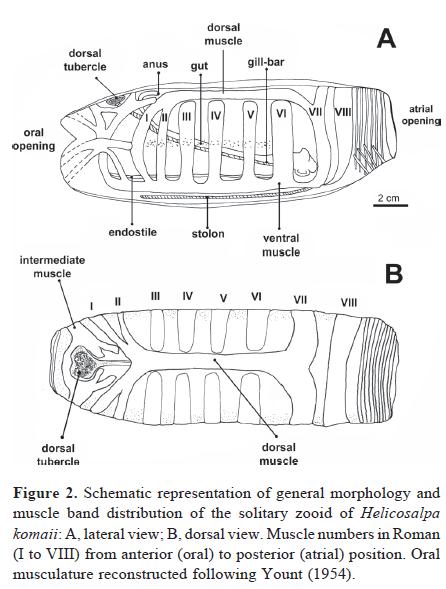
	    <p align="justify"><font face="verdana" size="2">The solitary zooid specimen of <i>H. komaii</i> collected and examined was physically damaged, since a section of the outer gelatinous tunic from the body wall was partially broken off. However, a careful handling of the organism in a wide glass container allowed a detailed observation of the main taxonomic features that distinguishes the solitary form of <i>H. komaii</i> from the other species known of the same genus: <i>H. virgula</i> and <i>H. younti</i>. Distinctive <i>H. komaii</i> taxonomic features are: the presence of 2 ventral longitudinal muscles (found only in <i>Helicosalpa</i>, absent in <i>Cyclosalpa</i>) stretching between the intermediate muscles and muscle VII, 1 dorsal longitudinal muscle, and a highly convoluted heart&#45;shaped dorsal tubercle (<a href="#f2">Figs. 2</a>, <a href="#f3">3</a>).</font></p>

	    <p align="center"><font face="verdana" size="2"><a name="f2"></a></font></p>

	    <p align="center"><font face="verdana" size="2"><img src="/img/revistas/rmbiodiv/v85n2/a29f2.jpg"></font></p>

	    ]]></body>
<body><![CDATA[<p align="center"><font face="verdana" size="2"><a name="f3"></a></font></p>

	    <p align="center"><font face="verdana" size="2"><img src="/img/revistas/rmbiodiv/v85n2/a29f3.jpg"></font></p>

	    <p align="justify"><font face="verdana" size="2">Another specimen corresponding to the aggregate form of the genus <i>Helicosalpa</i> was also found in the same zooplankton sample, bearing a horn&#45;like antero&#45;dorsal projection, which is also present in <i>H. virgula</i> and <i>H. younti</i>. The 8 mm length aggregate zooid resembled the sinistral individual of <i>H. komaii</i> (figure 6B in Komai, 1932) in the presence of a roundish postero&#45;ventral protrusion (not tapering posteriorly into a narrow point). The dorsal tubercle was not as convoluted as described by Van Soest (1974) for the aggregate zooid of <i>H. komaii</i>. However, Esnal et al. (1998) mention that this character is variable with size, being more convoluted in larger individuals. The disposition of body muscles and number of muscles fibers were difficult to observe in this small aggregate specimen, therefore its definitive identity remains dubious and emphasis is given on the collected solitary specimen.</font></p>

	    <p align="justify"><font face="verdana" size="2">Only 2 other studies provide biometric measurements of the solitary form of <i>H. komaii</i>. Komai (1932) described the largest specimen known (230 mm) from Seto, Japan, and Yount (1954) described another solitary (94 mm) collected south of Hawaii, outlining only slight differences between his and Komai's specimen. According to Nakamura and Yount (1958), this species is among the largest salps known in the Pacific Ocean, together with <i>Tethys vagina</i> and <i>Salpa maxima</i>. We compared our specimen based on the taxonomic characters used in the 2 previous morphometric descriptions, particularly taking care of the muscle arrangement and the presence/absence of other relevant taxonomic characters.</font></p>

	    <p align="justify"><font face="verdana" size="2"><i>Solitary form</i>. The solitary specimen from Baja California was approximately 200 mm length and 60 mm height, with a biovolume of 90 mL with 6 years of preservation after collection. Body muscles with variable number of muscles fibers (from 50 to 90). Total number of muscles fibers from M I to M VII= 517. Muscles I and II conjoined near mid&#45;dorsal line and continuing as 1 dorsal longitudinal muscle that joins M VII; it stretches backward ventrally at both sides of the body to form the paired ventral longitudinal muscles. Muscle VIII, named muscle Y in Yount (1954) description, emerges from the union of ventral longitudinal muscle with MVII, continuing dorsally as a single broad muscle (<i>i.e</i>., non&#45;branched as in Komai's description). Body muscles III&#45;VI free dorsally, but fused ventrally to longitudinal muscles (<a href="#f2">Fig. 2</a>). Oral musculature was similar to description in Yount (1954), but there is a muscle joining the posterior dorsal lip with retractor (intermediate) muscle before the latter fuses to M I dorsally, as described in Komai (1932). A conspicuous heart&#45;shaped dorsal tubercle highly convoluted (<a href="#f3">Fig. 3</a>). This was the main morphological feature to identify <i>H. komaii</i> at first sight<i>.</i> The alimentary canal had generic characteristics, extending obliquely and dorsally to gill&#45;bar, bending posteriorly at level of M I. Two prominent caeca are present at the opposite extreme of the intestine. A stolon is formed between muscles VI and VII and extends forward in the mid&#45;ventral line, reaching the anterior extreme of the salp. It was not possible to determine the place where the stolon emerged to the body surface because of loosening of the tunic in this section of the body. Strobilation was evident along the stolon; however, the forming aggregates were small and their arrangement pattern along the stolon was more irregular than the one typically observed in <i>H.</i> <i>virgula</i> or other salp species. Atrial languets were absent, similar to the specimen described in Yount (1954), but this is an ambiguous morphological feature because atrial languets were present in the specimen described by Komai (1932).</font></p>

	    <p align="justify"><font face="verdana" size="2">According to previous descriptions, the species is characterized by the presence of luminous organs forming a continuous line on each side of the body. This feature was not observed in the Baja California collected specimen, but vestiges of the luminous organs were detected. Overall, these structures are not as conspicuous in <i>H. komaii</i> as they are in the other 2 species of the genus. Yount (1954) noted that they apparently are formed by sparse masses of cells. Chemical preservation and time elapsed after collection may distort the appearance of this structure (Esnal et al., 1998).</font></p>

	    <p align="justify"><font face="verdana" size="2">The total number of muscle fibers (M I&#45;M VII) appears to be a taxonomic significant character to distinguish <i>H. komaii</i> from the other 2 species of the genus. This character is size and age independent and remains practically unaffected by chemical preservation (Esnal et al., 1998). Latitudinal variation in the total number of muscle fibers within a species has been reported, with an increasing number of muscle fibers from tropical to higher latitudes (Van Soest, 1975). The high number of muscles fibers determined for our specimen (517) surpasses the range known for <i>H. younti</i> (with 343 and 346 determined in 2 solitary zooids) (Esnal et al., 1998). It is also 2&#45;fold higher than that reported in <i>H. virgula</i> whose solitary zooids have on average 264 and 218 total muscles fibers in cold and warm waters, respectively (Van Soest, 1975). Unfortunately, information on the total number of muscle fibers was not provided in the 2 previous descriptions of the solitary form of <i>H. komaii</i> and no intra&#45;species comparison of this character is possible. We propose that this is another significant taxonomic character to identify the solitary specimen of <i>H. komaii</i>. For the aggregate zooid of the species, the average total number of muscle fibers from MI to MIV is 90 (range= 81&#45;97), doubling that of <i>H. virgula</i> aggregates (range= 27&#45;51; Van Soest, 1974) and similar to the upper limit of the range (65&#45;90) reported for <i>H. younti</i> (Esnal et al., 1998).</font></p>

	    <p align="justify"><font face="verdana" size="2">Salp biogeography is relevant because several species have been useful indicators of intrusions of warm oceanic waters into colder zones (Fraser, 1962; Blackburn, 1979; McAlice, 1986; Sims, 1996; Iguchi and Kidokoro, 2006). A recent study on the variability of different zooplankton groups' abundance off Baja California within the period 1998&#45;2007 denoted a marked seasonality in several taxa including salps. This seasonality is more notorious at the southern eco&#45;region (<a href="/img/revistas/rmbiodiv/v85n2/a29f1.jpg" target="_blank">Fig. 1</a>) due to a stronger influence of a tropical oceanic influx in that sector of the IMECOCAL area (Durazo et al., 2010; Lavaniegos et al., 2010). This tropical influence is more pronounced during El Ni&ntilde;o warm years and it is reflected in shifts in the species arrangement and geographic range extensions (Jim&eacute;nez&#45;P&eacute;rez and Lavaniegos, 2004; Linacre, 2005; Lavaniegos and Ambriz&#45;Arreola, 2012). The winter 2004, when the specimen of <i>Helicosalpa komaii</i> was collected<i>,</i> was followed by the moderate 2002&#45;2003 El Ni&ntilde;o that resulted in a zooplankton community rich in tropical species off Baja California (Lavaniegos and Ambriz&#45;Arreola, 2012). <i>Helicosalpa komaii</i> is distributed in low and mid latitudes in the Pacific Ocean, therefore its occurrence in the offshore station in the southern Baja California waters may have resulted from intrusion of warm water from the west&#45;southwest toward the coast. Similarly, the presence of <i>H. virgula</i> and other warm water salp species (e.g. <i>Thetys vagina, Ritteriella amboinensis, Thalia rhomboides</i>) off Oregon (Hubbard and Pearcy, 1971) and Baja California (Berner, 1967; Hereu et al., 2006) were associated to the onshore intrusion of tropical waters of west&#45;southwest origin and the weakening of the cold California Current during anomalous El Ni&ntilde;o years. The high abundance of salps and other pelagic tunicates (i.e, doliolids) in the winter of 2004, mainly in the southern eco&#45;region, reinforces the idea of a stronger influx of tropical oceanic waters in that area (Lavaniegos et al., 2006; Durazo, 2009). The determination of salp taxonomic identity in the remaining stations off Baja California in the winter 2004 cruise will help to reinforce the hypothesis.</font></p>

	    <p align="justify"><font face="verdana" size="2">This is the first report of <i>Helicosalpa komaii</i> in the California Current System (CCS) and the second report in the Northeast Pacific. With this new record, the number of salp species (gamma diversity) detected in Baja California waters is increased to 29 and to 30 in the Mexican Pacific (Berner, 1967; Esnal, 1976; Hereu et al., 2006; Lavaniegos and Hereu, 2009; Hereu et al. 2010). This report provides valuable information regarding the distribution of salps in the CCS given that there are no historical records of <i>H. komaii</i> previously identified in the area, including the long term CALCOFI sampling program of more than 50 years (Berner, 1967; Blackburn, 1979; Lavaniegos and Ohman, 2003). Ecosystem changes were detected within the CCS from changes in the assemblages of pelagic tunicates over the period 1951&#45;2002 in Southern California waters (Lavaniegos and Ohman, 2003). No <i>Helicosalpa</i> species were listed among the salps reported in Lavaniegos and Ohman (2003), hence it is still unclear if the occurrence of <i>H. komaii</i> in this sector of the northeast Pacific is new, or if it was not detected due to other factors. The pooling of samples before enumeration of organisms, as performed in that study, affects abundance estimates of rare organisms (Ohman and Lavaniegos, 2002). Also, their study based on samples from one season (spring) and was restricted to an area north to the IMECOCAL area where <i>H. komaii</i> was found. Interestingly, most recent records of <i>H. virgula</i> off California (2003, 2004 and 2005; Lavaniegos, unpublished data) coincide with a warming trend along most part of the CCS (Mackas et al<i>.,</i> 2006; Lavaniegos, 2009). The increased presence of <i>Helicosalpa</i> in the CCS and the process underlying this deserves further attention.</font></p>

	    <p align="justify"><font face="verdana" size="2">Rosa Mar&iacute;a Hern&aacute;ndez (ECOSUR&#45;Chetumal) deposited the specimen in the Collection of Zooplankton and provided the catalogue number. Humberto Bahena Basave (ECOSUR&#45;Chetumal) provided the photograph of the specimen. Valuable comments from Pablo Jorgensen improved an earlier version of the manuscript. The analysis of this additional material from the IMECOCAL cruises was possible with the aid of Comisi&oacute;n Nacional para el Conocimiento y Uso de la Biodiversidad (E.S&#45;M. grant number HC&#45;020, 2009) and the Conacyt grant CB&#45;129611 (for B.E. Lavaniegos). This work was completed during a post&#45;doctoral research stay of the first author in ECOSUR&#45;Chetumal. Two anonymous reviewers provided useful, constructive comments to improve a previous version of this contribution.</font></p>

	    ]]></body>
<body><![CDATA[<p>&nbsp;</p>

	    <p align="justify"><font face="verdana" size="2"><b>Literature cited</b></font></p>

	    <!-- ref --><p align="justify"><font face="verdana" size="2">Ay&oacute;n, P., M. I. Criales&#45;Hernandez, R. Schwamborn and H. J. Hirche. 2008. Zooplankton research off Peru: a review. Progress in Oceanography 79:238&#45;255.    &nbsp;&nbsp;&nbsp;&nbsp;&nbsp;&nbsp;&nbsp;&nbsp;[&#160;<a href="javascript:void(0);" onclick="javascript: window.open('/scielo.php?script=sci_nlinks&ref=7630159&pid=S1870-3453201400030002900001&lng=','','width=640,height=500,resizable=yes,scrollbars=1,menubar=yes,');">Links</a>&#160;]<!-- end-ref --></font></p>

	    <!-- ref --><p align="justify"><font face="verdana" size="2">Berner, L. D. 1967. Distributional atlas of Thaliacea in the California Current region. California Cooperative Oceanic Fisheries Investigations Atlas 8. 322 p.    &nbsp;&nbsp;&nbsp;&nbsp;&nbsp;&nbsp;&nbsp;&nbsp;[&#160;<a href="javascript:void(0);" onclick="javascript: window.open('/scielo.php?script=sci_nlinks&ref=7630161&pid=S1870-3453201400030002900002&lng=','','width=640,height=500,resizable=yes,scrollbars=1,menubar=yes,');">Links</a>&#160;]<!-- end-ref --></font></p>

	    <!-- ref --><p align="justify"><font face="verdana" size="2">Blackburn, M. 1979. Thaliacea of the California Current region: relations to temperature, chlorophyll, currents and upwelling. California Cooperative Oceanic Fisheries Investigations Report 20:184&#45;214.    &nbsp;&nbsp;&nbsp;&nbsp;&nbsp;&nbsp;&nbsp;&nbsp;[&#160;<a href="javascript:void(0);" onclick="javascript: window.open('/scielo.php?script=sci_nlinks&ref=7630163&pid=S1870-3453201400030002900003&lng=','','width=640,height=500,resizable=yes,scrollbars=1,menubar=yes,');">Links</a>&#160;]<!-- end-ref --></font></p>

	    <!-- ref --><p align="justify"><font face="verdana" size="2">Durazo, R. 2009. Climate and upper ocean variability off Baja California, Mexico: 1997&#45;2008. Progress in Oceanography 83:361&#45;368.    &nbsp;&nbsp;&nbsp;&nbsp;&nbsp;&nbsp;&nbsp;&nbsp;[&#160;<a href="javascript:void(0);" onclick="javascript: window.open('/scielo.php?script=sci_nlinks&ref=7630165&pid=S1870-3453201400030002900004&lng=','','width=640,height=500,resizable=yes,scrollbars=1,menubar=yes,');">Links</a>&#160;]<!-- end-ref --></font></p>

	    ]]></body>
<body><![CDATA[<!-- ref --><p align="justify"><font face="verdana" size="2">Durazo, R., A. M. Ram&iacute;rez&#45;Manguilar, L. Miranda and L. Soto&#45;Mardones. 2010. Climatolog&iacute;a de variables hidrogr&aacute;ficas. <i>In</i> Din&aacute;mica del ecosistema pel&aacute;gico frente a Baja California, 1997&#45;2007, G. Gaxiola&#45;Castro and R. Durazo (eds.). Instituto Nacional de Ecolog&iacute;a, M&eacute;xico, D. F. p. 25&#45;57.    &nbsp;&nbsp;&nbsp;&nbsp;&nbsp;&nbsp;&nbsp;&nbsp;[&#160;<a href="javascript:void(0);" onclick="javascript: window.open('/scielo.php?script=sci_nlinks&ref=7630167&pid=S1870-3453201400030002900005&lng=','','width=640,height=500,resizable=yes,scrollbars=1,menubar=yes,');">Links</a>&#160;]<!-- end-ref --></font></p>

	    <!-- ref --><p align="justify"><font face="verdana" size="2">Esnal, G. B. 1976. Los s&aacute;lpidos (Tunicata, Thaliacea) de la expedici&oacute;n EASTROPAC. Physis, Buenos Aires, secci&oacute;n A 35:169&#45;182.    &nbsp;&nbsp;&nbsp;&nbsp;&nbsp;&nbsp;&nbsp;&nbsp;[&#160;<a href="javascript:void(0);" onclick="javascript: window.open('/scielo.php?script=sci_nlinks&ref=7630169&pid=S1870-3453201400030002900006&lng=','','width=640,height=500,resizable=yes,scrollbars=1,menubar=yes,');">Links</a>&#160;]<!-- end-ref --></font></p>

	    <!-- ref --><p align="justify"><font face="verdana" size="2">Esnal, G. B., O. Miranda&#45;Eldan and A. Mujica&#45;Retamal. 1998. New data about <i>Helicosalpa younti</i> Kashkina 1973 (Tunicata: Thaliacea), a very rare salpid species. Bulletin of Marine Science 62:73&#45;79.    &nbsp;&nbsp;&nbsp;&nbsp;&nbsp;&nbsp;&nbsp;&nbsp;[&#160;<a href="javascript:void(0);" onclick="javascript: window.open('/scielo.php?script=sci_nlinks&ref=7630171&pid=S1870-3453201400030002900007&lng=','','width=640,height=500,resizable=yes,scrollbars=1,menubar=yes,');">Links</a>&#160;]<!-- end-ref --></font></p>

	    <!-- ref --><p align="justify"><font face="verdana" size="2">Fraser, J. H. 1962. Nature adrift: the story of marine plankton, Dufour Editions, Philadelphia. 178 p.    &nbsp;&nbsp;&nbsp;&nbsp;&nbsp;&nbsp;&nbsp;&nbsp;[&#160;<a href="javascript:void(0);" onclick="javascript: window.open('/scielo.php?script=sci_nlinks&ref=7630173&pid=S1870-3453201400030002900008&lng=','','width=640,height=500,resizable=yes,scrollbars=1,menubar=yes,');">Links</a>&#160;]<!-- end-ref --></font></p>

	    <!-- ref --><p align="justify"><font face="verdana" size="2">Govindarajan, A. F., A. Bucklin and L. P. Madin. 2010. A molecular phylogeny of the Thaliacea. Journal of Plankton Research 33:843&#45;853.    &nbsp;&nbsp;&nbsp;&nbsp;&nbsp;&nbsp;&nbsp;&nbsp;[&#160;<a href="javascript:void(0);" onclick="javascript: window.open('/scielo.php?script=sci_nlinks&ref=7630175&pid=S1870-3453201400030002900009&lng=','','width=640,height=500,resizable=yes,scrollbars=1,menubar=yes,');">Links</a>&#160;]<!-- end-ref --></font></p>

	    ]]></body>
<body><![CDATA[<!-- ref --><p align="justify"><font face="verdana" size="2">Hereu, C. M., B. E. Lavaniegos, G. Gaxiola&#45;Castro and M. D. Ohman. 2006. Composition and potential grazing impact of salp assemblages off Baja California during the 1997&#45;1999 El Ni&ntilde;o and La Ni&ntilde;a. Marine Ecology Progress Series 318:123&#45;140.    &nbsp;&nbsp;&nbsp;&nbsp;&nbsp;&nbsp;&nbsp;&nbsp;[&#160;<a href="javascript:void(0);" onclick="javascript: window.open('/scielo.php?script=sci_nlinks&ref=7630177&pid=S1870-3453201400030002900010&lng=','','width=640,height=500,resizable=yes,scrollbars=1,menubar=yes,');">Links</a>&#160;]<!-- end-ref --></font></p>

	    <!-- ref --><p align="justify"><font face="verdana" size="2">Hereu, C. M., B. E. Lavaniegos and R. Goericke. 2010. Grazing impact of salp (Tunicata, Thaliacea) assemblages in the eastern tropical North Pacific. Journal of Plankton Research 32:785&#45;804.    &nbsp;&nbsp;&nbsp;&nbsp;&nbsp;&nbsp;&nbsp;&nbsp;[&#160;<a href="javascript:void(0);" onclick="javascript: window.open('/scielo.php?script=sci_nlinks&ref=7630179&pid=S1870-3453201400030002900011&lng=','','width=640,height=500,resizable=yes,scrollbars=1,menubar=yes,');">Links</a>&#160;]<!-- end-ref --></font></p>

	    <!-- ref --><p align="justify"><font face="verdana" size="2">Hubbard, L. T. J. and W. G. Pearcy. 1971. Geographic distribution and relative abundance of Salpidae off the Oregon coast. Journal of the Fisheries Research Board of Canada 28:1831&#45;1836.    &nbsp;&nbsp;&nbsp;&nbsp;&nbsp;&nbsp;&nbsp;&nbsp;[&#160;<a href="javascript:void(0);" onclick="javascript: window.open('/scielo.php?script=sci_nlinks&ref=7630181&pid=S1870-3453201400030002900012&lng=','','width=640,height=500,resizable=yes,scrollbars=1,menubar=yes,');">Links</a>&#160;]<!-- end-ref --></font></p>

	    <!-- ref --><p align="justify"><font face="verdana" size="2">Iguchi, N. and H. Kidokoro. 2006. Horizontal distribution of <i>Thetys vagina</i> Tilesius (Tunicata, Thaliacea) in the Japan Sea during spring 2004. Journal of Plankton Research 28:537&#45;541.    &nbsp;&nbsp;&nbsp;&nbsp;&nbsp;&nbsp;&nbsp;&nbsp;[&#160;<a href="javascript:void(0);" onclick="javascript: window.open('/scielo.php?script=sci_nlinks&ref=7630183&pid=S1870-3453201400030002900013&lng=','','width=640,height=500,resizable=yes,scrollbars=1,menubar=yes,');">Links</a>&#160;]<!-- end-ref --></font></p>

	    <!-- ref --><p align="justify"><font face="verdana" size="2">IhIe, J. E. W. and M. E. Ihle&#45;Landenberg. 1936. <i>Cyclosalpa virgula</i> Vogt und <i>Cyclosalpa komaii</i> n. sp. Pubblicazioni Stazione zoologica di Napoli 16:274&#45;283.    &nbsp;&nbsp;&nbsp;&nbsp;&nbsp;&nbsp;&nbsp;&nbsp;[&#160;<a href="javascript:void(0);" onclick="javascript: window.open('/scielo.php?script=sci_nlinks&ref=7630185&pid=S1870-3453201400030002900014&lng=','','width=640,height=500,resizable=yes,scrollbars=1,menubar=yes,');">Links</a>&#160;]<!-- end-ref --></font></p>

	    ]]></body>
<body><![CDATA[<!-- ref --><p align="justify"><font face="verdana" size="2">Jim&eacute;nez&#45;P&eacute;rez, L. C. and B. E. Lavaniegos. 2004. Changes in dominance of copepods off Baja California during the 1997&#45;1999 El Ni&ntilde;o and La Ni&ntilde;a. Marine Ecology Progress Series 277:147&#45;165.    &nbsp;&nbsp;&nbsp;&nbsp;&nbsp;&nbsp;&nbsp;&nbsp;[&#160;<a href="javascript:void(0);" onclick="javascript: window.open('/scielo.php?script=sci_nlinks&ref=7630187&pid=S1870-3453201400030002900015&lng=','','width=640,height=500,resizable=yes,scrollbars=1,menubar=yes,');">Links</a>&#160;]<!-- end-ref --></font></p>

	    <!-- ref --><p align="justify"><font face="verdana" size="2">Komai, T. 1932. On some salps occurring in the vicinity of Seto with remarks on the enantiomorphism found in some aggregated forms. Memoirs of the College of Science, Kyoto Imperial University, Series B 8:65&#45;80.    &nbsp;&nbsp;&nbsp;&nbsp;&nbsp;&nbsp;&nbsp;&nbsp;[&#160;<a href="javascript:void(0);" onclick="javascript: window.open('/scielo.php?script=sci_nlinks&ref=7630189&pid=S1870-3453201400030002900016&lng=','','width=640,height=500,resizable=yes,scrollbars=1,menubar=yes,');">Links</a>&#160;]<!-- end-ref --></font></p>

	    <!-- ref --><p align="justify"><font face="verdana" size="2">Lavaniegos, B. E. 2009. Influence of a multiyear event of low salinity on the zooplankton from Mexican eco&#45;regions of the California Current. Progress in Oceanography 83:369&#45;375.    &nbsp;&nbsp;&nbsp;&nbsp;&nbsp;&nbsp;&nbsp;&nbsp;[&#160;<a href="javascript:void(0);" onclick="javascript: window.open('/scielo.php?script=sci_nlinks&ref=7630191&pid=S1870-3453201400030002900017&lng=','','width=640,height=500,resizable=yes,scrollbars=1,menubar=yes,');">Links</a>&#160;]<!-- end-ref --></font></p>

	    <!-- ref --><p align="justify"><font face="verdana" size="2">Lavaniegos, B. E., I. Ambriz&#45;Arreola, C. M. Hereu, J. L. Cadena&#45;Ram&iacute;rez and P. Garc&iacute;a&#45;Garc&iacute;a 2010. Variabilidad estacional e interanual del zooplancton. <i>In</i> Din&aacute;mica del ecosistema pel&aacute;gico frente a Baja California, 1997&#45;2007, G. Gaxiola&#45;Castro and R. Durazo (eds.). Instituto Nacional de Ecolog&iacute;a, M&eacute;xico, D. F. p. 87&#45;126.    &nbsp;&nbsp;&nbsp;&nbsp;&nbsp;&nbsp;&nbsp;&nbsp;[&#160;<a href="javascript:void(0);" onclick="javascript: window.open('/scielo.php?script=sci_nlinks&ref=7630193&pid=S1870-3453201400030002900018&lng=','','width=640,height=500,resizable=yes,scrollbars=1,menubar=yes,');">Links</a>&#160;]<!-- end-ref --></font></p>

	    <!-- ref --><p align="justify"><font face="verdana" size="2">Lavaniegos, B. and I. Ambriz&#45;Arreola. 2012. Interannual variability in krill off Baja California in the period 1997&#45;2005. Progress in Oceanography 97&#45;100:164&#45;173.    &nbsp;&nbsp;&nbsp;&nbsp;&nbsp;&nbsp;&nbsp;&nbsp;[&#160;<a href="javascript:void(0);" onclick="javascript: window.open('/scielo.php?script=sci_nlinks&ref=7630195&pid=S1870-3453201400030002900019&lng=','','width=640,height=500,resizable=yes,scrollbars=1,menubar=yes,');">Links</a>&#160;]<!-- end-ref --></font></p>

	    ]]></body>
<body><![CDATA[<!-- ref --><p align="justify"><font face="verdana" size="2">Lavaniegos, B. E., J. L. Cadena&#45;Ram&iacute;rez, D. L. S&aacute;nchez, P. Garc&iacute;a&#45;Garc&iacute;a and I. Ambriz&#45; Arreola. 2006. Zooplankton biomass and structure off the western coast of Baja California during 2004 (IMECOCAL cruises 0402, 0404, 0407, 0410), Technical report. Biomasa y estructura del zooplancton frente a la costa occidental de Baja California durante 2004 (Cruceros IMECOCAL 0402, 0404, 0407, 0410), Technical report. Departamento de Oceanograf&iacute;a Biol&oacute;gica, ed. CICESE, Ensenada. 61 p.    &nbsp;&nbsp;&nbsp;&nbsp;&nbsp;&nbsp;&nbsp;&nbsp;[&#160;<a href="javascript:void(0);" onclick="javascript: window.open('/scielo.php?script=sci_nlinks&ref=7630197&pid=S1870-3453201400030002900020&lng=','','width=640,height=500,resizable=yes,scrollbars=1,menubar=yes,');">Links</a>&#160;]<!-- end-ref --></font></p>

	    <!-- ref --><p align="justify"><font face="verdana" size="2">Lavaniegos, B. E. and C. M. Hereu. 2009. Seasonal variation in hyperiid amphipod abundance and diversity and influence of mesoscale structures off Baja California. Marine Ecology Progress Series 394:137&#45;152.    &nbsp;&nbsp;&nbsp;&nbsp;&nbsp;&nbsp;&nbsp;&nbsp;[&#160;<a href="javascript:void(0);" onclick="javascript: window.open('/scielo.php?script=sci_nlinks&ref=7630199&pid=S1870-3453201400030002900021&lng=','','width=640,height=500,resizable=yes,scrollbars=1,menubar=yes,');">Links</a>&#160;]<!-- end-ref --></font></p>

	    <!-- ref --><p align="justify"><font face="verdana" size="2">Lavaniegos, B. E. and M. D. Ohman. 2003. Long&#45;term changes in pelagic tunicates of the California Current. Deep&#45;Sea Research II 50:2473&#45;2498.    &nbsp;&nbsp;&nbsp;&nbsp;&nbsp;&nbsp;&nbsp;&nbsp;[&#160;<a href="javascript:void(0);" onclick="javascript: window.open('/scielo.php?script=sci_nlinks&ref=7630201&pid=S1870-3453201400030002900022&lng=','','width=640,height=500,resizable=yes,scrollbars=1,menubar=yes,');">Links</a>&#160;]<!-- end-ref --></font></p>

	    <!-- ref --><p align="justify"><font face="verdana" size="2">Linacre, L. 2005. Community structure of euphausiids in the southern part of the California Current during October 1997 (El Ni&ntilde;o) and October 1999 (La Ni&ntilde;a). California Cooperative Oceanic Fisheries Investigations Report 45:126&#45;135.    &nbsp;&nbsp;&nbsp;&nbsp;&nbsp;&nbsp;&nbsp;&nbsp;[&#160;<a href="javascript:void(0);" onclick="javascript: window.open('/scielo.php?script=sci_nlinks&ref=7630203&pid=S1870-3453201400030002900023&lng=','','width=640,height=500,resizable=yes,scrollbars=1,menubar=yes,');">Links</a>&#160;]<!-- end-ref --></font></p>

	    <!-- ref --><p align="justify"><font face="verdana" size="2">Locarnini, R. A., A. V. Mishonov, J. I. Antonov, T. P. Boyer, H. E. Garcia, O. K. Baranova, M. M. Zweng, and D. R. Johnson. 2010. World ocean atlas 2009, Volume 1: temperature. <i>In</i> NOAA Atlas NESDIS 68, S. Levitus (ed.). U.S. Government Printing Office, Washington, D. C. p. 1&#45;184.    &nbsp;&nbsp;&nbsp;&nbsp;&nbsp;&nbsp;&nbsp;&nbsp;[&#160;<a href="javascript:void(0);" onclick="javascript: window.open('/scielo.php?script=sci_nlinks&ref=7630205&pid=S1870-3453201400030002900024&lng=','','width=640,height=500,resizable=yes,scrollbars=1,menubar=yes,');">Links</a>&#160;]<!-- end-ref --></font></p>

	    ]]></body>
<body><![CDATA[<!-- ref --><p align="justify"><font face="verdana" size="2">Mackas, D. L., W. T. Peterson, M. D. Ohman and B. E. Lavaniegos. 2006. Zooplankton anomalies in the California Current system before and during the warm ocean conditions of 2005. Geophysical Research Letters 33(L22S07):1&#45;7.    &nbsp;&nbsp;&nbsp;&nbsp;&nbsp;&nbsp;&nbsp;&nbsp;[&#160;<a href="javascript:void(0);" onclick="javascript: window.open('/scielo.php?script=sci_nlinks&ref=7630207&pid=S1870-3453201400030002900025&lng=','','width=640,height=500,resizable=yes,scrollbars=1,menubar=yes,');">Links</a>&#160;]<!-- end-ref --></font></p>

	    <!-- ref --><p align="justify"><font face="verdana" size="2">Madin, L. P. 1968. Field studies on the biology of salps (Tunicata: Thaliacea). Theses, University of California, Davis. 203 p.    &nbsp;&nbsp;&nbsp;&nbsp;&nbsp;&nbsp;&nbsp;&nbsp;[&#160;<a href="javascript:void(0);" onclick="javascript: window.open('/scielo.php?script=sci_nlinks&ref=7630209&pid=S1870-3453201400030002900026&lng=','','width=640,height=500,resizable=yes,scrollbars=1,menubar=yes,');">Links</a>&#160;]<!-- end-ref --></font></p>

	    <!-- ref --><p align="justify"><font face="verdana" size="2">Madin, L. P., P. Kremer and S. Hacker. 1996. Distribution and vertical migration of salps (Tunicata, Thaliacea) near Bermuda. Journal of Plankton Research 18:747&#45;755.    &nbsp;&nbsp;&nbsp;&nbsp;&nbsp;&nbsp;&nbsp;&nbsp;[&#160;<a href="javascript:void(0);" onclick="javascript: window.open('/scielo.php?script=sci_nlinks&ref=7630211&pid=S1870-3453201400030002900027&lng=','','width=640,height=500,resizable=yes,scrollbars=1,menubar=yes,');">Links</a>&#160;]<!-- end-ref --></font></p>

	    <!-- ref --><p align="justify"><font face="verdana" size="2">McAlice, B. J. 1986. Occurrence of <i>Thetys vagina</i> Tilesius (Tunicata, Thaliacea) on the coast of Maine. Bulletin of Marine Science 39:717&#45;718.    &nbsp;&nbsp;&nbsp;&nbsp;&nbsp;&nbsp;&nbsp;&nbsp;[&#160;<a href="javascript:void(0);" onclick="javascript: window.open('/scielo.php?script=sci_nlinks&ref=7630213&pid=S1870-3453201400030002900028&lng=','','width=640,height=500,resizable=yes,scrollbars=1,menubar=yes,');">Links</a>&#160;]<!-- end-ref --></font></p>

	    <!-- ref --><p align="justify"><font face="verdana" size="2">Nakamura, E. L. and J. L. Yount. 1958. An unusually large salp. Pacific Science 12:181.    &nbsp;&nbsp;&nbsp;&nbsp;&nbsp;&nbsp;&nbsp;&nbsp;[&#160;<a href="javascript:void(0);" onclick="javascript: window.open('/scielo.php?script=sci_nlinks&ref=7630215&pid=S1870-3453201400030002900029&lng=','','width=640,height=500,resizable=yes,scrollbars=1,menubar=yes,');">Links</a>&#160;]<!-- end-ref --></font></p>

	    ]]></body>
<body><![CDATA[<!-- ref --><p align="justify"><font face="verdana" size="2">Ohman, M. D. and B. E. Lavaniegos. 2002. Comparative zooplankton sampling efficiency of a ring net and bongo net with comments on pooling of subsamples. California Cooperative Oceanic Fisheries Investigations Report 43:162&#45;173.    &nbsp;&nbsp;&nbsp;&nbsp;&nbsp;&nbsp;&nbsp;&nbsp;[&#160;<a href="javascript:void(0);" onclick="javascript: window.open('/scielo.php?script=sci_nlinks&ref=7630217&pid=S1870-3453201400030002900030&lng=','','width=640,height=500,resizable=yes,scrollbars=1,menubar=yes,');">Links</a>&#160;]<!-- end-ref --></font></p>

	    <!-- ref --><p align="justify"><font face="verdana" size="2">Sims, D. W. 1996. A rare record of the salp, <i>Thetys vagina</i> (Tunicata: Thaliacea) from western Scottish waters. Journal of the Marine Biological Association of the United Kingdom 76:833&#45;834.    &nbsp;&nbsp;&nbsp;&nbsp;&nbsp;&nbsp;&nbsp;&nbsp;[&#160;<a href="javascript:void(0);" onclick="javascript: window.open('/scielo.php?script=sci_nlinks&ref=7630219&pid=S1870-3453201400030002900031&lng=','','width=640,height=500,resizable=yes,scrollbars=1,menubar=yes,');">Links</a>&#160;]<!-- end-ref --></font></p>

	    <!-- ref --><p align="justify"><font face="verdana" size="2">Tew, K. S. and W. T. Lo. 2005. Distribution of Thaliacea in SW Taiwan coastal water in 1997, with special reference to <i>Doliolum denticulatum</i>, <i>Thalia democratica</i> and <i>T. orientalis</i>. Marine Ecology Progress Series 292:181&#45;193.    &nbsp;&nbsp;&nbsp;&nbsp;&nbsp;&nbsp;&nbsp;&nbsp;[&#160;<a href="javascript:void(0);" onclick="javascript: window.open('/scielo.php?script=sci_nlinks&ref=7630221&pid=S1870-3453201400030002900032&lng=','','width=640,height=500,resizable=yes,scrollbars=1,menubar=yes,');">Links</a>&#160;]<!-- end-ref --></font></p>

	    <!-- ref --><p align="justify"><font face="verdana" size="2">Thompson, H. 1948. Pelagic tunicates of Australia. Commonwealth Council for Scientific and Industrial Research, Melbourn. p. 1&#45;196.    &nbsp;&nbsp;&nbsp;&nbsp;&nbsp;&nbsp;&nbsp;&nbsp;[&#160;<a href="javascript:void(0);" onclick="javascript: window.open('/scielo.php?script=sci_nlinks&ref=7630223&pid=S1870-3453201400030002900033&lng=','','width=640,height=500,resizable=yes,scrollbars=1,menubar=yes,');">Links</a>&#160;]<!-- end-ref --></font></p>

	    <!-- ref --><p align="justify"><font face="verdana" size="2">Van Soest, R. W. M. 1974. Taxonomy of the subfamily Cyclosalpinae Yount, 1954, with descriptions of two new species. Beaufortia 22:17&#45;55.    &nbsp;&nbsp;&nbsp;&nbsp;&nbsp;&nbsp;&nbsp;&nbsp;[&#160;<a href="javascript:void(0);" onclick="javascript: window.open('/scielo.php?script=sci_nlinks&ref=7630225&pid=S1870-3453201400030002900034&lng=','','width=640,height=500,resizable=yes,scrollbars=1,menubar=yes,');">Links</a>&#160;]<!-- end-ref --></font></p>

	    ]]></body>
<body><![CDATA[<!-- ref --><p align="justify"><font face="verdana" size="2">Van Soest, R. W. M. 1998. The cladistic biogeography of salps and pyrosomas. <i>In</i> The biology of pelagic tunicates, Q. Bone (ed.).Oxford Universit y Press, Oxford. p. 231&#45;249.    &nbsp;&nbsp;&nbsp;&nbsp;&nbsp;&nbsp;&nbsp;&nbsp;[&#160;<a href="javascript:void(0);" onclick="javascript: window.open('/scielo.php?script=sci_nlinks&ref=7630227&pid=S1870-3453201400030002900035&lng=','','width=640,height=500,resizable=yes,scrollbars=1,menubar=yes,');">Links</a>&#160;]<!-- end-ref --></font></p>

      <!-- ref --><p align="justify"><font face="verdana" size="2">Van Soest, R. 2013. <i>Helicosalpa komaii</i> (Ihle and Ihle&#45;Landenberg, 1936). Accessed through: World Register of Marine Species: <a href="http://www.marinespecies.org/aphia.php?p=taxdetails&amp;id=266539" target="_blank">http://www.marinespecies.org/aphia.php?p=taxdetails&amp;id=266539</a>; last access: 21.I.2013.    &nbsp;&nbsp;&nbsp;&nbsp;&nbsp;&nbsp;&nbsp;&nbsp;[&#160;<a href="javascript:void(0);" onclick="javascript: window.open('/scielo.php?script=sci_nlinks&ref=7630229&pid=S1870-3453201400030002900036&lng=','','width=640,height=500,resizable=yes,scrollbars=1,menubar=yes,');">Links</a>&#160;]<!-- end-ref --></font></p>

	    <!-- ref --><p align="justify"><font face="verdana" size="2">Weikert, H. and J. Godeaux. 2008. Thaliacean distribution and abundance in the northern part of the Levantine Sea (Crete and Cyprus) during the eastern Mediterranean climatic transient, and a comparison with the western Mediterranean basin. Helgoland Marine Research 62:377&#45;387.    &nbsp;&nbsp;&nbsp;&nbsp;&nbsp;&nbsp;&nbsp;&nbsp;[&#160;<a href="javascript:void(0);" onclick="javascript: window.open('/scielo.php?script=sci_nlinks&ref=7630231&pid=S1870-3453201400030002900037&lng=','','width=640,height=500,resizable=yes,scrollbars=1,menubar=yes,');">Links</a>&#160;]<!-- end-ref --></font></p>

	    <!-- ref --><p align="justify"><font face="verdana" size="2">Wiebe, P., L. Madin, F. Pag&egrave;s, D. Lindsay, H. &#216;. Hansen, S. Panampunnayil, M. Angel, H. Matsuura, M. Kuriyama, A. Cornils, R. Hopcroft, C. D. Vargas, S. Watanabe, Y. Ujiie, H. Liu, B. Costas, T. Sutton, C. B. L. Devi, R. Jennings, P. B. Lona, B. Ortman, E. Unal, L. B. Bercial, N. Copley, C. Li, J. Catron and D. Allison. 2006. RV/Ronald H. Brown Cruise 06&#45;03 to the Western Subtropical and Tropical North Atlantic, 10 April to 30 April, 2006. A Census of Marine Zooplankton (CMarZ) Report, <a href="http://www.cmarz.org" target="_blank">http://www.cmarz.org</a>; last access: 22.II.2010.    &nbsp;&nbsp;&nbsp;&nbsp;&nbsp;&nbsp;&nbsp;&nbsp;[&#160;<a href="javascript:void(0);" onclick="javascript: window.open('/scielo.php?script=sci_nlinks&ref=7630233&pid=S1870-3453201400030002900038&lng=','','width=640,height=500,resizable=yes,scrollbars=1,menubar=yes,');">Links</a>&#160;]<!-- end-ref --></font></p>

	    <!-- ref --><p align="justify"><font face="verdana" size="2">Yount, J. L. 1954. The taxonomy of the Salpidae (Tunicata) of the central Pacific Ocean. Pacific Science 8:276&#45;330.    &nbsp;&nbsp;&nbsp;&nbsp;&nbsp;&nbsp;&nbsp;&nbsp;[&#160;<a href="javascript:void(0);" onclick="javascript: window.open('/scielo.php?script=sci_nlinks&ref=7630235&pid=S1870-3453201400030002900039&lng=','','width=640,height=500,resizable=yes,scrollbars=1,menubar=yes,');">Links</a>&#160;]<!-- end-ref --></font></p>
    ]]></body>
<body><![CDATA[ ]]></body><back>
<ref-list>
<ref id="B1">
<nlm-citation citation-type="journal">
<person-group person-group-type="author">
<name>
<surname><![CDATA[Ayón]]></surname>
<given-names><![CDATA[P.]]></given-names>
</name>
<name>
<surname><![CDATA[Criales-Hernandez]]></surname>
<given-names><![CDATA[M. I.]]></given-names>
</name>
<name>
<surname><![CDATA[Schwamborn]]></surname>
<given-names><![CDATA[R.]]></given-names>
</name>
<name>
<surname><![CDATA[Hirche]]></surname>
<given-names><![CDATA[H. J.]]></given-names>
</name>
</person-group>
<article-title xml:lang="en"><![CDATA[Zooplankton research off Peru: a review]]></article-title>
<source><![CDATA[Progress in Oceanography]]></source>
<year>2008</year>
<volume>79</volume>
<page-range>238-255</page-range></nlm-citation>
</ref>
<ref id="B2">
<nlm-citation citation-type="">
<person-group person-group-type="author">
<name>
<surname><![CDATA[Berner]]></surname>
<given-names><![CDATA[L. D.]]></given-names>
</name>
</person-group>
<source><![CDATA[Distributional atlas of Thaliacea in the California Current region]]></source>
<year>1967</year>
<page-range>322</page-range></nlm-citation>
</ref>
<ref id="B3">
<nlm-citation citation-type="journal">
<person-group person-group-type="author">
<name>
<surname><![CDATA[Blackburn]]></surname>
<given-names><![CDATA[M.]]></given-names>
</name>
</person-group>
<article-title xml:lang="en"><![CDATA[Thaliacea of the California Current region: relations to temperature, chlorophyll, currents and upwelling]]></article-title>
<source><![CDATA[California Cooperative Oceanic Fisheries Investigations Report]]></source>
<year>1979</year>
<volume>20</volume>
<page-range>184-214</page-range></nlm-citation>
</ref>
<ref id="B4">
<nlm-citation citation-type="journal">
<person-group person-group-type="author">
<name>
<surname><![CDATA[Durazo]]></surname>
<given-names><![CDATA[R.]]></given-names>
</name>
</person-group>
<article-title xml:lang="en"><![CDATA[Climate and upper ocean variability off Baja California, Mexico: 1997-2008]]></article-title>
<source><![CDATA[Progress in Oceanography]]></source>
<year>2009</year>
<volume>83</volume>
<page-range>361-368</page-range></nlm-citation>
</ref>
<ref id="B5">
<nlm-citation citation-type="book">
<person-group person-group-type="author">
<name>
<surname><![CDATA[Durazo]]></surname>
<given-names><![CDATA[R.]]></given-names>
</name>
<name>
<surname><![CDATA[Ramírez-Manguilar]]></surname>
<given-names><![CDATA[A. M.]]></given-names>
</name>
<name>
<surname><![CDATA[Miranda]]></surname>
<given-names><![CDATA[L.]]></given-names>
</name>
<name>
<surname><![CDATA[Soto-Mardones]]></surname>
<given-names><![CDATA[L.]]></given-names>
</name>
</person-group>
<article-title xml:lang="es"><![CDATA[Climatología de variables hidrográficas]]></article-title>
<person-group person-group-type="editor">
<name>
<surname><![CDATA[Gaxiola-Castro]]></surname>
<given-names><![CDATA[G.]]></given-names>
</name>
<name>
<surname><![CDATA[Durazo]]></surname>
<given-names><![CDATA[R.]]></given-names>
</name>
</person-group>
<source><![CDATA[Dinámica del ecosistema pelágico frente a Baja California, 1997-2007]]></source>
<year>2010</year>
<page-range>25-57</page-range><publisher-loc><![CDATA[México^eD. F. D. F.]]></publisher-loc>
<publisher-name><![CDATA[Instituto Nacional de Ecología]]></publisher-name>
</nlm-citation>
</ref>
<ref id="B6">
<nlm-citation citation-type="journal">
<person-group person-group-type="author">
<name>
<surname><![CDATA[Esnal]]></surname>
<given-names><![CDATA[G. B.]]></given-names>
</name>
</person-group>
<article-title xml:lang="es"><![CDATA[Los sálpidos (Tunicata, Thaliacea) de la expedición EASTROPAC]]></article-title>
<source><![CDATA[Physis, Buenos Aires, sección A]]></source>
<year>1976</year>
<volume>35</volume>
<page-range>169-182</page-range></nlm-citation>
</ref>
<ref id="B7">
<nlm-citation citation-type="journal">
<person-group person-group-type="author">
<name>
<surname><![CDATA[Esnal]]></surname>
<given-names><![CDATA[G. B.]]></given-names>
</name>
<name>
<surname><![CDATA[Miranda-Eldan]]></surname>
<given-names><![CDATA[O.]]></given-names>
</name>
<name>
<surname><![CDATA[Mujica-Retamal]]></surname>
<given-names><![CDATA[A.]]></given-names>
</name>
</person-group>
<article-title xml:lang="en"><![CDATA[New data about Helicosalpa younti Kashkina 1973 (Tunicata: Thaliacea), a very rare salpid species]]></article-title>
<source><![CDATA[Bulletin of Marine Science]]></source>
<year>1998</year>
<volume>62</volume>
<page-range>73-79</page-range></nlm-citation>
</ref>
<ref id="B8">
<nlm-citation citation-type="book">
<person-group person-group-type="author">
<name>
<surname><![CDATA[Fraser]]></surname>
<given-names><![CDATA[J. H.]]></given-names>
</name>
</person-group>
<source><![CDATA[Nature adrift: the story of marine plankton]]></source>
<year>1962</year>
<page-range>178</page-range><publisher-loc><![CDATA[Philadelphia ]]></publisher-loc>
<publisher-name><![CDATA[Dufour Editions]]></publisher-name>
</nlm-citation>
</ref>
<ref id="B9">
<nlm-citation citation-type="journal">
<person-group person-group-type="author">
<name>
<surname><![CDATA[Govindarajan]]></surname>
<given-names><![CDATA[A. F.]]></given-names>
</name>
<name>
<surname><![CDATA[Bucklin]]></surname>
<given-names><![CDATA[A.]]></given-names>
</name>
<name>
<surname><![CDATA[Madin]]></surname>
<given-names><![CDATA[L. P.]]></given-names>
</name>
</person-group>
<article-title xml:lang="en"><![CDATA[A molecular phylogeny of the Thaliacea]]></article-title>
<source><![CDATA[Journal of Plankton Research]]></source>
<year>2010</year>
<volume>33</volume>
<page-range>843-853</page-range></nlm-citation>
</ref>
<ref id="B10">
<nlm-citation citation-type="journal">
<person-group person-group-type="author">
<name>
<surname><![CDATA[Hereu]]></surname>
<given-names><![CDATA[C. M.]]></given-names>
</name>
<name>
<surname><![CDATA[Lavaniegos]]></surname>
<given-names><![CDATA[B. E.]]></given-names>
</name>
<name>
<surname><![CDATA[Gaxiola-Castro]]></surname>
<given-names><![CDATA[G.]]></given-names>
</name>
<name>
<surname><![CDATA[Ohman]]></surname>
<given-names><![CDATA[M. D.]]></given-names>
</name>
</person-group>
<article-title xml:lang="en"><![CDATA[Composition and potential grazing impact of salp assemblages off Baja California during the 1997-1999 El Niño and La Niña]]></article-title>
<source><![CDATA[Marine Ecology Progress Series]]></source>
<year>2006</year>
<volume>318</volume>
<page-range>123-140</page-range></nlm-citation>
</ref>
<ref id="B11">
<nlm-citation citation-type="journal">
<person-group person-group-type="author">
<name>
<surname><![CDATA[Hereu]]></surname>
<given-names><![CDATA[C. M.]]></given-names>
</name>
<name>
<surname><![CDATA[Lavaniegos]]></surname>
<given-names><![CDATA[B. E.]]></given-names>
</name>
<name>
<surname><![CDATA[Goericke]]></surname>
<given-names><![CDATA[R.]]></given-names>
</name>
</person-group>
<article-title xml:lang="en"><![CDATA[Grazing impact of salp (Tunicata, Thaliacea) assemblages in the eastern tropical North Pacific]]></article-title>
<source><![CDATA[Journal of Plankton Research]]></source>
<year>2010</year>
<volume>32</volume>
<page-range>785-804</page-range></nlm-citation>
</ref>
<ref id="B12">
<nlm-citation citation-type="journal">
<person-group person-group-type="author">
<name>
<surname><![CDATA[Hubbard]]></surname>
<given-names><![CDATA[L. T. J.]]></given-names>
</name>
<name>
<surname><![CDATA[Pearcy]]></surname>
<given-names><![CDATA[W. G.]]></given-names>
</name>
</person-group>
<article-title xml:lang="en"><![CDATA[Geographic distribution and relative abundance of Salpidae off the Oregon coast]]></article-title>
<source><![CDATA[Journal of the Fisheries Research Board of Canada]]></source>
<year>1971</year>
<volume>28</volume>
<page-range>1831-1836</page-range></nlm-citation>
</ref>
<ref id="B13">
<nlm-citation citation-type="journal">
<person-group person-group-type="author">
<name>
<surname><![CDATA[Iguchi]]></surname>
<given-names><![CDATA[N.]]></given-names>
</name>
<name>
<surname><![CDATA[Kidokoro]]></surname>
<given-names><![CDATA[H.]]></given-names>
</name>
</person-group>
<article-title xml:lang="en"><![CDATA[Horizontal distribution of Thetys vagina Tilesius (Tunicata, Thaliacea) in the Japan Sea during spring 2004]]></article-title>
<source><![CDATA[Journal of Plankton Research]]></source>
<year>2006</year>
<volume>28</volume>
<page-range>537-541</page-range></nlm-citation>
</ref>
<ref id="B14">
<nlm-citation citation-type="journal">
<person-group person-group-type="author">
<name>
<surname><![CDATA[IhIe]]></surname>
<given-names><![CDATA[J. E. W.]]></given-names>
</name>
<name>
<surname><![CDATA[Ihle-Landenberg]]></surname>
<given-names><![CDATA[M. E.]]></given-names>
</name>
</person-group>
<article-title xml:lang="de"><![CDATA[Cyclosalpa virgula Vogt und Cyclosalpa komaii n. sp]]></article-title>
<source><![CDATA[Pubblicazioni Stazione zoologica di Napoli]]></source>
<year>1936</year>
<volume>16</volume>
<page-range>274-283</page-range></nlm-citation>
</ref>
<ref id="B15">
<nlm-citation citation-type="journal">
<person-group person-group-type="author">
<name>
<surname><![CDATA[Jiménez-Pérez]]></surname>
<given-names><![CDATA[L. C.]]></given-names>
</name>
<name>
<surname><![CDATA[Lavaniegos]]></surname>
<given-names><![CDATA[B. E.]]></given-names>
</name>
</person-group>
<article-title xml:lang="en"><![CDATA[Changes in dominance of copepods off Baja California during the 1997-1999 El Niño and La Niña]]></article-title>
<source><![CDATA[Marine Ecology Progress Series]]></source>
<year>2004</year>
<volume>277</volume>
<page-range>147-165</page-range></nlm-citation>
</ref>
<ref id="B16">
<nlm-citation citation-type="journal">
<person-group person-group-type="author">
<name>
<surname><![CDATA[Komai]]></surname>
<given-names><![CDATA[T.]]></given-names>
</name>
</person-group>
<article-title xml:lang="en"><![CDATA[On some salps occurring in the vicinity of Seto with remarks on the enantiomorphism found in some aggregated forms]]></article-title>
<source><![CDATA[Memoirs of the College of Science, Kyoto Imperial University, Series B]]></source>
<year>1932</year>
<volume>8</volume>
<page-range>65-80</page-range></nlm-citation>
</ref>
<ref id="B17">
<nlm-citation citation-type="journal">
<person-group person-group-type="author">
<name>
<surname><![CDATA[Lavaniegos]]></surname>
<given-names><![CDATA[B. E.]]></given-names>
</name>
</person-group>
<article-title xml:lang="en"><![CDATA[Influence of a multiyear event of low salinity on the zooplankton from Mexican eco-regions of the California Current]]></article-title>
<source><![CDATA[Progress in Oceanography]]></source>
<year>2009</year>
<volume>83</volume>
<page-range>369-375</page-range></nlm-citation>
</ref>
<ref id="B18">
<nlm-citation citation-type="book">
<person-group person-group-type="author">
<name>
<surname><![CDATA[Lavaniegos]]></surname>
<given-names><![CDATA[B. E.]]></given-names>
</name>
<name>
<surname><![CDATA[Ambriz-Arreola]]></surname>
<given-names><![CDATA[I.]]></given-names>
</name>
<name>
<surname><![CDATA[Hereu]]></surname>
<given-names><![CDATA[C. M.]]></given-names>
</name>
<name>
<surname><![CDATA[Cadena-Ramírez]]></surname>
<given-names><![CDATA[J. L.]]></given-names>
</name>
<name>
<surname><![CDATA[García-García]]></surname>
<given-names><![CDATA[P.]]></given-names>
</name>
</person-group>
<article-title xml:lang="es"><![CDATA[Variabilidad estacional e interanual del zooplancton]]></article-title>
<person-group person-group-type="editor">
<name>
<surname><![CDATA[Gaxiola-Castro]]></surname>
<given-names><![CDATA[G.]]></given-names>
</name>
<name>
<surname><![CDATA[Durazo]]></surname>
<given-names><![CDATA[R.]]></given-names>
</name>
</person-group>
<source><![CDATA[Dinámica del ecosistema pelágico frente a Baja California, 1997-2007]]></source>
<year>2010</year>
<page-range>87-126</page-range><publisher-loc><![CDATA[México^eD. F. D. F.]]></publisher-loc>
<publisher-name><![CDATA[Instituto Nacional de Ecología]]></publisher-name>
</nlm-citation>
</ref>
<ref id="B19">
<nlm-citation citation-type="journal">
<person-group person-group-type="author">
<name>
<surname><![CDATA[Lavaniegos]]></surname>
<given-names><![CDATA[B.]]></given-names>
</name>
<name>
<surname><![CDATA[Ambriz-Arreola]]></surname>
<given-names><![CDATA[I.]]></given-names>
</name>
</person-group>
<article-title xml:lang="en"><![CDATA[Interannual variability in krill off Baja California in the period 1997-2005]]></article-title>
<source><![CDATA[Progress in Oceanography]]></source>
<year>2012</year>
<volume>97</volume><volume>100</volume>
<page-range>164-173</page-range></nlm-citation>
</ref>
<ref id="B20">
<nlm-citation citation-type="book">
<person-group person-group-type="author">
<name>
<surname><![CDATA[Lavaniegos]]></surname>
<given-names><![CDATA[B. E.]]></given-names>
</name>
<name>
<surname><![CDATA[Cadena-Ramírez]]></surname>
<given-names><![CDATA[J. L.]]></given-names>
</name>
<name>
<surname><![CDATA[Sánchez]]></surname>
<given-names><![CDATA[D. L.]]></given-names>
</name>
<name>
<surname><![CDATA[García-García]]></surname>
<given-names><![CDATA[P.]]></given-names>
</name>
<name>
<surname><![CDATA[Ambriz- Arreola]]></surname>
<given-names><![CDATA[I.]]></given-names>
</name>
</person-group>
<source><![CDATA[Zooplankton biomass and structure off the western coast of Baja California during 2004 (IMECOCAL cruises 0402, 0404, 0407, 0410)]]></source>
<year>2006</year>
<page-range>61</page-range><publisher-loc><![CDATA[Ensenada ]]></publisher-loc>
<publisher-name><![CDATA[Departamento de Oceanografía Biológica, ed. CICESE]]></publisher-name>
</nlm-citation>
</ref>
<ref id="B21">
<nlm-citation citation-type="journal">
<person-group person-group-type="author">
<name>
<surname><![CDATA[Lavaniegos]]></surname>
<given-names><![CDATA[B. E.]]></given-names>
</name>
<name>
<surname><![CDATA[Hereu]]></surname>
<given-names><![CDATA[C. M.]]></given-names>
</name>
</person-group>
<article-title xml:lang="en"><![CDATA[Seasonal variation in hyperiid amphipod abundance and diversity and influence of mesoscale structures off Baja California]]></article-title>
<source><![CDATA[Marine Ecology Progress Series]]></source>
<year>2009</year>
<volume>394</volume>
<page-range>137-152</page-range></nlm-citation>
</ref>
<ref id="B22">
<nlm-citation citation-type="journal">
<person-group person-group-type="author">
<name>
<surname><![CDATA[Lavaniegos]]></surname>
<given-names><![CDATA[B. E.]]></given-names>
</name>
<name>
<surname><![CDATA[Ohman]]></surname>
<given-names><![CDATA[M. D.]]></given-names>
</name>
</person-group>
<article-title xml:lang="en"><![CDATA[Long-term changes in pelagic tunicates of the California Current]]></article-title>
<source><![CDATA[Deep-Sea Research II]]></source>
<year>2003</year>
<volume>50</volume>
<page-range>2473-2498</page-range></nlm-citation>
</ref>
<ref id="B23">
<nlm-citation citation-type="journal">
<person-group person-group-type="author">
<name>
<surname><![CDATA[Linacre]]></surname>
<given-names><![CDATA[L.]]></given-names>
</name>
</person-group>
<article-title xml:lang="en"><![CDATA[Community structure of euphausiids in the southern part of the California Current during October 1997 (El Niño) and October 1999 (La Niña)]]></article-title>
<source><![CDATA[California Cooperative Oceanic Fisheries Investigations Report]]></source>
<year>2005</year>
<volume>45</volume>
<page-range>126-135</page-range></nlm-citation>
</ref>
<ref id="B24">
<nlm-citation citation-type="book">
<person-group person-group-type="author">
<name>
<surname><![CDATA[Locarnini]]></surname>
<given-names><![CDATA[R. A.]]></given-names>
</name>
<name>
<surname><![CDATA[Mishonov]]></surname>
<given-names><![CDATA[A. V.]]></given-names>
</name>
<name>
<surname><![CDATA[Antonov]]></surname>
<given-names><![CDATA[J. I.]]></given-names>
</name>
<name>
<surname><![CDATA[Boyer]]></surname>
<given-names><![CDATA[T. P.]]></given-names>
</name>
<name>
<surname><![CDATA[Garcia]]></surname>
<given-names><![CDATA[H. E.]]></given-names>
</name>
<name>
<surname><![CDATA[Baranova]]></surname>
<given-names><![CDATA[O. K.]]></given-names>
</name>
<name>
<surname><![CDATA[Zweng]]></surname>
<given-names><![CDATA[M. M.]]></given-names>
</name>
<name>
<surname><![CDATA[Johnson]]></surname>
<given-names><![CDATA[D. R.]]></given-names>
</name>
<name>
<surname><![CDATA[Levitus]]></surname>
<given-names><![CDATA[S.]]></given-names>
</name>
</person-group>
<source><![CDATA[World ocean atlas 2009, Volume 1: temperature]]></source>
<year>2010</year>
<page-range>1-184</page-range><publisher-loc><![CDATA[Washington^eD. C. D. C.]]></publisher-loc>
<publisher-name><![CDATA[U.S. Government Printing Office]]></publisher-name>
</nlm-citation>
</ref>
<ref id="B25">
<nlm-citation citation-type="journal">
<person-group person-group-type="author">
<name>
<surname><![CDATA[Mackas]]></surname>
<given-names><![CDATA[D. L.]]></given-names>
</name>
<name>
<surname><![CDATA[Peterson]]></surname>
<given-names><![CDATA[W. T.]]></given-names>
</name>
<name>
<surname><![CDATA[Ohman]]></surname>
<given-names><![CDATA[M. D.]]></given-names>
</name>
<name>
<surname><![CDATA[Lavaniegos]]></surname>
<given-names><![CDATA[B. E.]]></given-names>
</name>
</person-group>
<article-title xml:lang="en"><![CDATA[Zooplankton anomalies in the California Current system before and during the warm ocean conditions of 2005]]></article-title>
<source><![CDATA[Geophysical Research Letters]]></source>
<year>2006</year>
<volume>33</volume>
<numero>22</numero>
<issue>22</issue>
<page-range>1-7</page-range></nlm-citation>
</ref>
<ref id="B26">
<nlm-citation citation-type="book">
<person-group person-group-type="author">
<name>
<surname><![CDATA[Madin]]></surname>
<given-names><![CDATA[L. P.]]></given-names>
</name>
</person-group>
<source><![CDATA[Field studies on the biology of salps (Tunicata: Thaliacea)]]></source>
<year>1968</year>
<page-range>203</page-range><publisher-loc><![CDATA[Davis ]]></publisher-loc>
<publisher-name><![CDATA[University of California]]></publisher-name>
</nlm-citation>
</ref>
<ref id="B27">
<nlm-citation citation-type="journal">
<person-group person-group-type="author">
<name>
<surname><![CDATA[Madin]]></surname>
<given-names><![CDATA[L. P.]]></given-names>
</name>
<name>
<surname><![CDATA[Kremer]]></surname>
<given-names><![CDATA[P.]]></given-names>
</name>
<name>
<surname><![CDATA[Hacker]]></surname>
<given-names><![CDATA[S.]]></given-names>
</name>
</person-group>
<article-title xml:lang="en"><![CDATA[Distribution and vertical migration of salps (Tunicata, Thaliacea) near Bermuda]]></article-title>
<source><![CDATA[Journal of Plankton Research]]></source>
<year>1996</year>
<volume>18</volume>
<page-range>747-755</page-range></nlm-citation>
</ref>
<ref id="B28">
<nlm-citation citation-type="journal">
<person-group person-group-type="author">
<name>
<surname><![CDATA[McAlice]]></surname>
<given-names><![CDATA[B. J.]]></given-names>
</name>
</person-group>
<article-title xml:lang="en"><![CDATA[Occurrence of Thetys vagina Tilesius (Tunicata, Thaliacea) on the coast of Maine]]></article-title>
<source><![CDATA[Bulletin of Marine Science]]></source>
<year>1986</year>
<volume>39</volume>
<page-range>717-718</page-range></nlm-citation>
</ref>
<ref id="B29">
<nlm-citation citation-type="journal">
<person-group person-group-type="author">
<name>
<surname><![CDATA[Nakamura]]></surname>
<given-names><![CDATA[E. L.]]></given-names>
</name>
<name>
<surname><![CDATA[Yount]]></surname>
<given-names><![CDATA[J. L.]]></given-names>
</name>
</person-group>
<article-title xml:lang="en"><![CDATA[An unusually large salp]]></article-title>
<source><![CDATA[Pacific Science]]></source>
<year>1958</year>
<volume>12</volume>
<page-range>181</page-range></nlm-citation>
</ref>
<ref id="B30">
<nlm-citation citation-type="journal">
<person-group person-group-type="author">
<name>
<surname><![CDATA[Ohman]]></surname>
<given-names><![CDATA[M. D.]]></given-names>
</name>
<name>
<surname><![CDATA[Lavaniegos]]></surname>
<given-names><![CDATA[B. E.]]></given-names>
</name>
</person-group>
<article-title xml:lang="en"><![CDATA[Comparative zooplankton sampling efficiency of a ring net and bongo net with comments on pooling of subsamples]]></article-title>
<source><![CDATA[California Cooperative Oceanic Fisheries Investigations Report]]></source>
<year>2002</year>
<volume>43</volume>
<page-range>162-173</page-range></nlm-citation>
</ref>
<ref id="B31">
<nlm-citation citation-type="journal">
<person-group person-group-type="author">
<name>
<surname><![CDATA[Sims]]></surname>
<given-names><![CDATA[D. W.]]></given-names>
</name>
</person-group>
<article-title xml:lang="en"><![CDATA[A rare record of the salp, Thetys vagina (Tunicata: Thaliacea) from western Scottish waters]]></article-title>
<source><![CDATA[Journal of the Marine Biological Association of the United Kingdom]]></source>
<year>1996</year>
<volume>76</volume>
<page-range>833-834</page-range></nlm-citation>
</ref>
<ref id="B32">
<nlm-citation citation-type="journal">
<person-group person-group-type="author">
<name>
<surname><![CDATA[Tew]]></surname>
<given-names><![CDATA[K. S.]]></given-names>
</name>
<name>
<surname><![CDATA[Lo]]></surname>
<given-names><![CDATA[W. T.]]></given-names>
</name>
</person-group>
<article-title xml:lang="en"><![CDATA[Distribution of Thaliacea in SW Taiwan coastal water in 1997, with special reference to Doliolum denticulatum, Thalia democratica and T. orientalis]]></article-title>
<source><![CDATA[Marine Ecology Progress Series]]></source>
<year>2005</year>
<volume>292</volume>
<page-range>181-193</page-range></nlm-citation>
</ref>
<ref id="B33">
<nlm-citation citation-type="book">
<person-group person-group-type="author">
<name>
<surname><![CDATA[Thompson]]></surname>
<given-names><![CDATA[H.]]></given-names>
</name>
</person-group>
<source><![CDATA[Pelagic tunicates of Australia]]></source>
<year>1948</year>
<page-range>1-196</page-range><publisher-loc><![CDATA[Melbourn ]]></publisher-loc>
<publisher-name><![CDATA[Commonwealth Council for Scientific and Industrial Research]]></publisher-name>
</nlm-citation>
</ref>
<ref id="B34">
<nlm-citation citation-type="journal">
<person-group person-group-type="author">
<name>
<surname><![CDATA[Van Soest]]></surname>
<given-names><![CDATA[R. W. M.]]></given-names>
</name>
</person-group>
<article-title xml:lang="en"><![CDATA[Taxonomy of the subfamily Cyclosalpinae Yount, 1954, with descriptions of two new species]]></article-title>
<source><![CDATA[Beaufortia]]></source>
<year>1974</year>
<volume>22</volume>
<page-range>17-55</page-range></nlm-citation>
</ref>
<ref id="B35">
<nlm-citation citation-type="book">
<person-group person-group-type="author">
<name>
<surname><![CDATA[Van Soest]]></surname>
<given-names><![CDATA[R. W. M.]]></given-names>
</name>
</person-group>
<article-title xml:lang="en"><![CDATA[The cladistic biogeography of salps and pyrosomas]]></article-title>
<person-group person-group-type="editor">
<name>
<surname><![CDATA[Bone]]></surname>
<given-names><![CDATA[Q.]]></given-names>
</name>
</person-group>
<source><![CDATA[The biology of pelagic tunicates]]></source>
<year>1998</year>
<page-range>231-249</page-range><publisher-loc><![CDATA[Oxford ]]></publisher-loc>
<publisher-name><![CDATA[Oxford Universit y Press]]></publisher-name>
</nlm-citation>
</ref>
<ref id="B36">
<nlm-citation citation-type="book">
<person-group person-group-type="author">
<name>
<surname><![CDATA[Van Soest]]></surname>
<given-names><![CDATA[R.]]></given-names>
</name>
</person-group>
<source><![CDATA[Helicosalpa komaii (Ihle and Ihle-Landenberg, 1936)]]></source>
<year>2013</year>
<publisher-name><![CDATA[World Register of Marine Species]]></publisher-name>
</nlm-citation>
</ref>
<ref id="B37">
<nlm-citation citation-type="journal">
<person-group person-group-type="author">
<name>
<surname><![CDATA[Weikert]]></surname>
<given-names><![CDATA[H.]]></given-names>
</name>
<name>
<surname><![CDATA[Godeaux]]></surname>
<given-names><![CDATA[J.]]></given-names>
</name>
</person-group>
<article-title xml:lang="en"><![CDATA[Thaliacean distribution and abundance in the northern part of the Levantine Sea (Crete and Cyprus) during the eastern Mediterranean climatic transient, and a comparison with the western Mediterranean basin]]></article-title>
<source><![CDATA[Helgoland Marine Research]]></source>
<year>2008</year>
<volume>62</volume>
<page-range>377-387</page-range></nlm-citation>
</ref>
<ref id="B38">
<nlm-citation citation-type="">
<person-group person-group-type="author">
<name>
<surname><![CDATA[Wiebe]]></surname>
<given-names><![CDATA[P.]]></given-names>
</name>
<name>
<surname><![CDATA[Madin]]></surname>
<given-names><![CDATA[L.]]></given-names>
</name>
<name>
<surname><![CDATA[Pagès]]></surname>
<given-names><![CDATA[F.]]></given-names>
</name>
<name>
<surname><![CDATA[Lindsay]]></surname>
<given-names><![CDATA[D.]]></given-names>
</name>
<name>
<surname><![CDATA[Hansen]]></surname>
<given-names><![CDATA[H. Ø.]]></given-names>
</name>
<name>
<surname><![CDATA[Panampunnayil]]></surname>
<given-names><![CDATA[S.]]></given-names>
</name>
<name>
<surname><![CDATA[Angel]]></surname>
<given-names><![CDATA[M.]]></given-names>
</name>
<name>
<surname><![CDATA[Matsuura]]></surname>
<given-names><![CDATA[H.]]></given-names>
</name>
<name>
<surname><![CDATA[Kuriyama]]></surname>
<given-names><![CDATA[M.]]></given-names>
</name>
<name>
<surname><![CDATA[Cornils]]></surname>
<given-names><![CDATA[A.]]></given-names>
</name>
<name>
<surname><![CDATA[Hopcroft]]></surname>
<given-names><![CDATA[R.]]></given-names>
</name>
<name>
<surname><![CDATA[Vargas]]></surname>
<given-names><![CDATA[C. D.]]></given-names>
</name>
<name>
<surname><![CDATA[Watanabe]]></surname>
<given-names><![CDATA[S.]]></given-names>
</name>
<name>
<surname><![CDATA[Ujiie]]></surname>
<given-names><![CDATA[Y.]]></given-names>
</name>
<name>
<surname><![CDATA[Liu]]></surname>
<given-names><![CDATA[H.]]></given-names>
</name>
<name>
<surname><![CDATA[Costas]]></surname>
<given-names><![CDATA[B.]]></given-names>
</name>
<name>
<surname><![CDATA[Sutton]]></surname>
<given-names><![CDATA[T.]]></given-names>
</name>
<name>
<surname><![CDATA[Devi]]></surname>
<given-names><![CDATA[C. B. L.]]></given-names>
</name>
<name>
<surname><![CDATA[Jennings]]></surname>
<given-names><![CDATA[R.]]></given-names>
</name>
<name>
<surname><![CDATA[Lona]]></surname>
<given-names><![CDATA[P. B.]]></given-names>
</name>
<name>
<surname><![CDATA[Ortman]]></surname>
<given-names><![CDATA[B.]]></given-names>
</name>
<name>
<surname><![CDATA[Unal]]></surname>
<given-names><![CDATA[E.]]></given-names>
</name>
<name>
<surname><![CDATA[Bercial]]></surname>
<given-names><![CDATA[L. B.]]></given-names>
</name>
<name>
<surname><![CDATA[Copley]]></surname>
<given-names><![CDATA[N.]]></given-names>
</name>
<name>
<surname><![CDATA[Li]]></surname>
<given-names><![CDATA[C.]]></given-names>
</name>
<name>
<surname><![CDATA[Catron]]></surname>
<given-names><![CDATA[J.]]></given-names>
</name>
<name>
<surname><![CDATA[Allison]]></surname>
<given-names><![CDATA[D.]]></given-names>
</name>
</person-group>
<source><![CDATA[RV/Ronald H. Brown Cruise 06-03 to the Western Subtropical and Tropical North Atlantic, 10 April to 30 April, 2006. A Census of Marine Zooplankton (CMarZ) Report]]></source>
<year>2006</year>
</nlm-citation>
</ref>
<ref id="B39">
<nlm-citation citation-type="journal">
<person-group person-group-type="author">
<name>
<surname><![CDATA[Yount]]></surname>
<given-names><![CDATA[J. L.]]></given-names>
</name>
</person-group>
<article-title xml:lang="en"><![CDATA[The taxonomy of the Salpidae (Tunicata) of the central Pacific Ocean]]></article-title>
<source><![CDATA[Pacific Science]]></source>
<year>1954</year>
<volume>8</volume>
<page-range>276-330</page-range></nlm-citation>
</ref>
</ref-list>
</back>
</article>
