<?xml version="1.0" encoding="ISO-8859-1"?><article xmlns:mml="http://www.w3.org/1998/Math/MathML" xmlns:xlink="http://www.w3.org/1999/xlink" xmlns:xsi="http://www.w3.org/2001/XMLSchema-instance">
<front>
<journal-meta>
<journal-id>1870-3453</journal-id>
<journal-title><![CDATA[Revista mexicana de biodiversidad]]></journal-title>
<abbrev-journal-title><![CDATA[Rev. Mex. Biodiv.]]></abbrev-journal-title>
<issn>1870-3453</issn>
<publisher>
<publisher-name><![CDATA[Instituto de Biología]]></publisher-name>
</publisher>
</journal-meta>
<article-meta>
<article-id>S1870-34532014000100029</article-id>
<article-id pub-id-type="doi">10.7550/rmb.36480</article-id>
<title-group>
<article-title xml:lang="en"><![CDATA[First report of the genus Physaloptera (Nematoda: Physalopteridae) in Lithobates montezumae (Anura: Ranidae) from Mexico]]></article-title>
<article-title xml:lang="es"><![CDATA[Primer registro del género Physaloptera (Nematoda: Physalopteridae) en Lithobathes montezumae (Anura: Ranidae) de México]]></article-title>
</title-group>
<contrib-group>
<contrib contrib-type="author">
<name>
<surname><![CDATA[Velarde-Aguilar]]></surname>
<given-names><![CDATA[María G.]]></given-names>
</name>
<xref ref-type="aff" rid="A01"/>
</contrib>
<contrib contrib-type="author">
<name>
<surname><![CDATA[Romero-Mayén]]></surname>
<given-names><![CDATA[Ángeles R.]]></given-names>
</name>
<xref ref-type="aff" rid="A02"/>
</contrib>
<contrib contrib-type="author">
<name>
<surname><![CDATA[León-Règagnon]]></surname>
<given-names><![CDATA[Virginia]]></given-names>
</name>
<xref ref-type="aff" rid="A01"/>
</contrib>
</contrib-group>
<aff id="A01">
<institution><![CDATA[,Universidad Nacional Autónoma de México Instituto de Biología Estación de Biología Chamela]]></institution>
<addr-line><![CDATA[San Patricio Jalisco]]></addr-line>
<country>Mexico</country>
</aff>
<aff id="A02">
<institution><![CDATA[,Universidad Nacional Autónoma de México Instituto de Biología Departamento de Zoología]]></institution>
<addr-line><![CDATA[México D. F.]]></addr-line>
<country>Mexico</country>
</aff>
<pub-date pub-type="pub">
<day>00</day>
<month>00</month>
<year>2014</year>
</pub-date>
<pub-date pub-type="epub">
<day>00</day>
<month>00</month>
<year>2014</year>
</pub-date>
<volume>85</volume>
<numero>1</numero>
<fpage>304</fpage>
<lpage>307</lpage>
<copyright-statement/>
<copyright-year/>
<self-uri xlink:href="http://www.scielo.org.mx/scielo.php?script=sci_arttext&amp;pid=S1870-34532014000100029&amp;lng=en&amp;nrm=iso"></self-uri><self-uri xlink:href="http://www.scielo.org.mx/scielo.php?script=sci_abstract&amp;pid=S1870-34532014000100029&amp;lng=en&amp;nrm=iso"></self-uri><self-uri xlink:href="http://www.scielo.org.mx/scielo.php?script=sci_pdf&amp;pid=S1870-34532014000100029&amp;lng=en&amp;nrm=iso"></self-uri><abstract abstract-type="short" xml:lang="en"><p><![CDATA[Nematode third stage larvae of the genus Physaloptera (Nematoda: Physalopteridae) were recovered from the stomach of Lithobates montezumae (Anura: Ranidae) collected in the Pedregal de San Angel Ecological Reserve in Mexico D. F. (19º11'6.50" N, 99º11'41.42" W; 2 312 m asl). The morphology of the larvae is briefly described and a list of previously recorded localities and hosts in Mexico is given. This study is the first record of Physaloptera sp. parasitizing L. montezumae, and also represents the first helminthological record for anurans in this locality, as well as a new locality record for the nematode genus.]]></p></abstract>
<abstract abstract-type="short" xml:lang="es"><p><![CDATA[Se aislaron larvas de tercer estadio de Physaloptera (Nematoda: Physalopteridae) del estómago de Lithobates montezumae (Anura: Ranidae) capturados en la Reserva Ecológica del Pedregal de San Ángel en la Ciudad de México (19º11'6.50" N, 99º11'41.42" O; 2 312 m snm). La morfología de las larvas se describe brevemente y se proporciona un listado de los registros del género en México con localidad y hospedero. Este estudio es el primer registro de Physaloptera spp. como parásito de L. montezumae y también representa el primer registro helmintológico para anuros en esta localidad, así como un nuevo registro de localidad para este género de nemátodos.]]></p></abstract>
<kwd-group>
<kwd lng="en"><![CDATA[helminths]]></kwd>
<kwd lng="en"><![CDATA[stomach parasites]]></kwd>
<kwd lng="en"><![CDATA[leopard frog]]></kwd>
<kwd lng="en"><![CDATA[third stage larvae]]></kwd>
<kwd lng="en"><![CDATA[México D. F.]]></kwd>
<kwd lng="es"><![CDATA[helmintos]]></kwd>
<kwd lng="es"><![CDATA[parásitos de estómago]]></kwd>
<kwd lng="es"><![CDATA[ranas leopardo]]></kwd>
<kwd lng="es"><![CDATA[tercer estadio larvario]]></kwd>
<kwd lng="es"><![CDATA[México, D. F.]]></kwd>
</kwd-group>
</article-meta>
</front><body><![CDATA[ <p align="justify"><font face="verdana" size="4">Research note</font></p>              <p align="justify"><font face="verdana" size="2">&nbsp;</font></p>              <p align="center"><font face="verdana" size="4"><b>First report of the genus <i>Physaloptera</i> (Nematoda: Physalopteridae) in <i>Lithobates montezumae</i> (Anura: Ranidae) from Mexico</b></font></p>              <p align="center"><font face="verdana" size="2">&nbsp;</font></p>              <p align="center"><font face="verdana" size="3"><b>Primer registro del g&eacute;nero <i>Physaloptera</i> (Nematoda: Physalopteridae) en <i>Lithobathes montezumae</i> (Anura: Ranidae) de M&eacute;xico</b></font></p>              <p align="center"><font face="verdana" size="2">&nbsp;</font></p>              <p align="center"><font face="verdana" size="2"><b>Mar&iacute;a G. Velarde&#45;Aguilar<sup>1</sup>, &Aacute;ngeles R. Romero&#45;May&eacute;n<sup>2</sup> and Virginia Le&oacute;n&#45;R&egrave;gagnon<sup>1</sup><i>*</i></b></font></p>              <p align="justify"><font face="verdana" size="2">&nbsp;</font></p>              <p align="justify"><font face="verdana" size="2"><sup><i>1</i></sup><i> Estaci&oacute;n de Biolog&iacute;a Chamela, Instituto de Biolog&iacute;a, Universidad Nacional Aut&oacute;noma de M&eacute;xico. Apartado postal 21, 48980 San Patricio, Jalisco, Mexico.</i> * <a href="mailto:vleon@ib.unam.mx">vleon@ib.unam.mx</a>.</font></p>              <p align="justify"><font face="verdana" size="2"><sup><i>2</i></sup><i> Departamento de Zoolog&iacute;a, Instituto de Biolog&iacute;a, Universidad Nacional Aut&oacute;noma de M&eacute;xico. Apartado postal 70&#45;153, Coyoac&aacute;n, 04360 M&eacute;xico, D. F., Mexico.</i></font></p>              ]]></body>
<body><![CDATA[<p align="justify"><font face="verdana" size="2">&nbsp;</font></p>              <p align="justify"><font face="verdana" size="2">Recibido: 16 marzo 2013    <br>     Aceptado: 19 junio 2013</font></p>              <p align="justify"><font face="verdana" size="2">&nbsp;</font></p>              <p align="justify"><font face="verdana" size="2"><b>Abstract</b></font></p>              <p align="justify"><font face="verdana" size="2">Nematode third stage larvae of the genus <i>Physaloptera</i> (Nematoda: Physalopteridae) were recovered from the stomach of <i>Lithobates montezumae</i> (Anura: Ranidae) collected in the Pedregal de San Angel Ecological Reserve in Mexico D. F. (19&#186;11'6.50" N, 99&#186;11'41.42" W; 2 312 m asl). The morphology of the larvae is briefly described and a list of previously recorded localities and hosts in Mexico is given. This study is the first record of <i>Physaloptera</i> sp. parasitizing <i>L. montezumae</i>, and also represents the first helminthological record for anurans in this locality, as well as a new locality record for the nematode genus.</font></p>              <p align="justify"><font face="verdana" size="2"><b>Key words:</b> helminths, stomach parasites, leopard frog, third stage larvae, M&eacute;xico D. F.</font></p>              <p align="justify"><font face="verdana" size="2">&nbsp;</font></p>              <p align="justify"><font face="verdana" size="2"><b>Resumen</b></font></p>              <p align="justify"><font face="verdana" size="2">Se aislaron larvas de tercer estadio de <i>Physaloptera</i> (Nematoda: Physalopteridae) del est&oacute;mago de <i>Lithobates montezumae</i> (Anura: Ranidae) capturados en la Reserva Ecol&oacute;gica del Pedregal de San &Aacute;ngel en la Ciudad de M&eacute;xico (19&#186;11'6.50" N, 99&#186;11'41.42" O; 2 312 m snm). La morfolog&iacute;a de las larvas se describe brevemente y se proporciona un listado de los registros del g&eacute;nero en M&eacute;xico con localidad y hospedero. Este estudio es el primer registro de <i>Physaloptera</i> spp. como par&aacute;sito de <i>L. montezumae</i> y tambi&eacute;n representa el primer registro helmintol&oacute;gico para anuros en esta localidad, as&iacute; como un nuevo registro de localidad para este g&eacute;nero de nem&aacute;todos.</font></p>              ]]></body>
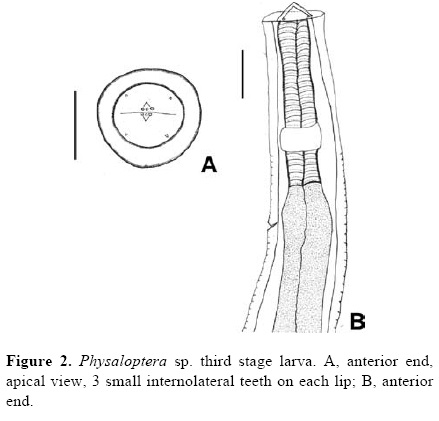
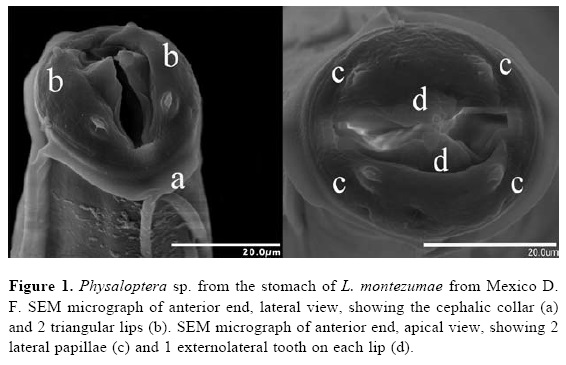
<body><![CDATA[<p align="justify"><font face="verdana" size="2"><b>Palabras clave:</b> helmintos, par&aacute;sitos de est&oacute;mago, ranas leopardo, tercer estadio larvario, M&eacute;xico, D. F.</font></p>              <p align="justify"><font face="verdana" size="2">&nbsp;</font></p>              <p align="justify"><font face="verdana" size="2"><i>Lithobates montezumae</i> Blaird 1854 (= <i>Rana montezumae</i>) (Anura: Ranidae) occurs in the center of Mexico through the states of Jalisco, Michoac&aacute;n, Puebla, Mexico State, Tlaxcala, M&eacute;xico D. F., San Luis Potos&iacute;, Hidalgo and Quer&eacute;taro. It breeds in lakes and large bodies of water of pine&#45;oak or oak forest above 2 000 m asl (AmphibiaWeb). Although <i>L. montezumae</i> is the amphibian species that has been most extensively studied for helminths in Mexico (P&eacute;rez&#45;Ponce de Le&oacute;n et al., 2002) there are no previous records of the nematode <i>Physaloptera</i> spp. parasitizing this host. Adults of <i>Physaloptera</i> occur in the stomach of mammals, snakes, and a few species of lizards and amphibians. The hosts acquire the infection through the ingestion of insects containing infective larvae. Larvae are common in amphibians and some lizards, which are considered as paratenic hosts (Anderson, 2000). Only 2 species of <i>Physaloptera</i> have been recorded as adults in anurans: <i>P. amphibia</i> Linstow 1899 described from <i>Limnonectes macrodon</i> (= <i>Rana macrodon</i>) from the Philippines and <i>P. tigrinae</i> Ali and Farooqui 1969 from <i>Hoplobatrachus tigrinus</i> (= <i>Rana tigrina</i>) in India (Baker, 1987). There is also a record of an adult female of <i>Physaloptera</i> sp. from <i>Lithobates brownorum</i> in Mexico (Ter&aacute;n&#45;Ju&aacute;rez, 2011). In addition to the present record, <i>Physaloptera</i> third stage larvae have been recorded in 12 Mexican anurans from the families Bufonidae, Hylidae, and Ranidae from 13 localities in 9 states of Mexico (<a href="/img/revistas/rmbiodiv/v85n1/a29t1.jpg" target="_blank">Table 1</a>).</font></p>              <p align="justify"><font face="verdana" size="2">The aim of the present work is to report for the first time the presence of <i>Physaloptera</i> sp. in <i>L. montezumae</i>.</font></p>              <p align="justify"><font face="verdana" size="2">On April 11, 2011, 2 specimens of <i>L. montezumae</i> were collected at the botanical garden of the Instituto de Biolog&iacute;a, Universidad Nacional Auton&oacute;ma de M&eacute;xico in Mexico D. F., which is surrounded by the Pedregal de San &Aacute;ngel Ecological Reserve. The frogs were ventrally dissected and all internal organs were examined for helminths using a dissecting microscope. Nematodes were isolated, rinsed in saline solution (0.65%), and fixed in 70% hot ethanol. Subsequently, they were cleared in ethanol&#45;glycerin (1:1) and examined via light microscopy. Some specimens were studied by scanning electron microscopy (SEM). These specimens were dehydrated in ethanol series, dried using the critical point technique, coated with gold, and examined with a Hitachi SU1510 scanning electron microscope. Measurements are presented as the range with means in parentheses and expressed in micrometers (&#956;m), unless otherwise stated. Prevalence and intensity of infection were calculated based on Bush et al. (1997). The studied specimens have been deposited in the Colecci&oacute;n Nacional de Helmintos, Instituto de Biolog&iacute;a, UNAM (CNHE # 8399).</font></p>              <p align="justify"><font face="verdana" size="2">A total of 131 third&#45;stage nematode larvae were found in the stomach of <i>Lithobates montezumae</i> (prevalence and intensity of infection: 1 of 2 host infected (50%), 131 specimens). Nematodes were identified as <i>Physaloptera</i> sp. Rudolphi, 1819 (Physalopteridae) by the presence of a cephalic collar and mouth with large and triangular lips, each provided with teeth (Yamaguti, 1961).</font></p>              <p align="justify"><font face="verdana" size="2">Description based on 10 specimens (<a href="#f1">Figs. 1</a>, <a href="#f2">2</a>). Body length 2.04&#45;2.5 (2.33) mm, maximum width at level of anterior intestine 90&#45;120 (110); cuticle forming a collar around the anterior end, subsequently turning slightly grooved to tail. Apical end with 2 large and triangular lateral lips; each lip with 2 lateral papillae, an externolateral tooth, and 3 small internolateral teeths. Esophagus 0.86&#45;1.09 (1) mm of total length; divided in short anterior muscular portion, and long posterior glandular portion: 130&#45;180 (160) long, 21&#45;26 (22) wide and 730&#45;930 (840) long, 40&#45;60 (54) wide, respectively. Nerve ring 90&#45;130 (110) from the anterior end. Excretory pore close to anterior part of the glandular esophagus, 200&#45;240 (210) from the anterior extremity. Tail conical, 82&#45;100 (93) long.</font></p>              <p align="center"><font face="verdana" size="2"><a name="f1"></a></font></p>              <p align="center"><font face="verdana" size="2"><img src="/img/revistas/rmbiodiv/v85n1/a29f1.jpg"></font></p>              <p align="center"><font face="verdana" size="2"><a name="f2"></a></font></p>              ]]></body>
<body><![CDATA[<p align="center"><font face="verdana" size="2"><img src="/img/revistas/rmbiodiv/v85n1/a29f2.jpg"></font></p>              <p align="justify"><font face="verdana" size="2">From examination of table I, and considering the role of amphibians in food chains as prey of snakes and mammals, it is clear that anurans are commonly used as paratenic hosts of nematodes of the genus <i>Physaloptera.</i> Common carnivores in the Pedregal de San &Aacute;ngel Ecological Reserve include mammals <i>Urocyon cinereoargenteus nigrirostris</i> (Canidae)<i>, Mephitis macroura macroura, Spilogale putorius angustifrons</i> (Mephitidae), <i>Bassariscus astutus astutus</i> (Procyonidae), and <i>Mustela frenata frenata</i> (Mustelidae) (Hortelano&#45;Moncada et al., 2009), and snakes <i>Thamnophis cyrtopis cyrtopis</i>, <i>T. eques eques</i>, <i>T. scaliger</i>, <i>T. scalaris, Diadophis punctatus</i>, and <i>Rhadinaea laureata</i> (Colubridae) (M&eacute;ndez&#45;de la Cruz et al., 2009), all of which are the potential definitive hosts of <i>Physaloptera</i> spp<i>.</i></font></p>              <p align="justify"><font face="verdana" size="2">The conducting of more studies on the helminth fauna of these vertebrates can provide additional information on food webs in the reserve through the linkage of larval and adult stages of parasitic forms using identification tools such as DNA barcodes. This study adds <i>L. montezumae</i> as new host of third&#45;stage larvae of <i>Physaloptera</i> sp. It is also the first record of anuran helminths in the Pedregal de San &Aacute;ngel Ecological Reserve in Mexico D. F., and the first record of the genus in this locality.</font></p>              <p align="justify"><font face="verdana" size="2">The authors thank Cinthya Mendoza&#45;Almeralla and Gabriela Parra&#45;Olea, at the Laboratorio de Herpetolog&iacute;a, IBUNAM, for donation of specimens of <i>L. montezumane</i> for examination. We also thank Luis Garc&iacute;a&#45;Prieto, at the CNHE, IBUNAM for his help in providing access to the CNHE records, and Berenit Mendoza&#45;Garfias at the Laboratory of Electron Microscopy and Photography, IBUNAM for processing the specimens for SEM. MGVA and ARRM thank Conacyt for support in the form of scholarships. This study was partially funded by PAPIIT&#45;UNAM proj. IN203911&#45;3 to VLR.</font></p>              <p align="justify"><font face="verdana" size="2">&nbsp;</font></p>              <p align="justify"><font face="verdana" size="2"><b>Literature cited</b></font></p>              <!-- ref --><p align="justify"><font face="verdana" size="2">AmphibiaWeb: Information on amphibian biology and conservation. &#91;web application&#93;. 2013. Berkeley, California: AmphibiaWeb. Available: <a href="http://amphibiaweb.org/" target="_blank">http://amphibiaweb.org/</a> (last access: 05.II.2013).    &nbsp;&nbsp;&nbsp;&nbsp;&nbsp;&nbsp;&nbsp;&nbsp;[&#160;<a href="javascript:void(0);" onclick="javascript: window.open('/scielo.php?script=sci_nlinks&ref=7612812&pid=S1870-3453201400010002900001&lng=','','width=640,height=500,resizable=yes,scrollbars=1,menubar=yes,');">Links</a>&#160;]<!-- end-ref --></font></p>              <!-- ref --><p align="justify"><font face="verdana" size="2">Anderson, R. C. 2000. Nematode parasites of vertebrates: their development and transmission. 2nd Edition. CABI Publishing, Wallingford. 650 p.    &nbsp;&nbsp;&nbsp;&nbsp;&nbsp;&nbsp;&nbsp;&nbsp;[&#160;<a href="javascript:void(0);" onclick="javascript: window.open('/scielo.php?script=sci_nlinks&ref=7612814&pid=S1870-3453201400010002900002&lng=','','width=640,height=500,resizable=yes,scrollbars=1,menubar=yes,');">Links</a>&#160;]<!-- end-ref --></font></p>              ]]></body>
<body><![CDATA[<!-- ref --><p align="justify"><font face="verdana" size="2">Baker, M. R. 1987. Synopsis of the nematoda parasitic in amphibians and reptiles. Memorial University of Newfoundland Occasional Papers in Biology. Number 11, 325 p.    &nbsp;&nbsp;&nbsp;&nbsp;&nbsp;&nbsp;&nbsp;&nbsp;[&#160;<a href="javascript:void(0);" onclick="javascript: window.open('/scielo.php?script=sci_nlinks&ref=7612816&pid=S1870-3453201400010002900003&lng=','','width=640,height=500,resizable=yes,scrollbars=1,menubar=yes,');">Links</a>&#160;]<!-- end-ref --></font></p>              <!-- ref --><p align="justify"><font face="verdana" size="2">Bursey, C. R. and S. R. Goldberg. 2001. <i>Falcaustra lowei</i> n. sp. and other helminths from the Tarahumara frog, <i>Rana tarahumarae</i> (Anura: Ranidae), from Sonora, Mexico. Journal of Parasitology 87:340&#45;344.    &nbsp;&nbsp;&nbsp;&nbsp;&nbsp;&nbsp;&nbsp;&nbsp;[&#160;<a href="javascript:void(0);" onclick="javascript: window.open('/scielo.php?script=sci_nlinks&ref=7612818&pid=S1870-3453201400010002900004&lng=','','width=640,height=500,resizable=yes,scrollbars=1,menubar=yes,');">Links</a>&#160;]<!-- end-ref --></font></p>              <!-- ref --><p align="justify"><font face="verdana" size="2">Bush, A. O., K. D. Lafferty, J. M. Lotz and A. W. Shostak. 1997. Parasitology meets ecology on its own terms: Margolis et al. revisited. Journal of Parasitology 83:575&#45;583.    &nbsp;&nbsp;&nbsp;&nbsp;&nbsp;&nbsp;&nbsp;&nbsp;[&#160;<a href="javascript:void(0);" onclick="javascript: window.open('/scielo.php?script=sci_nlinks&ref=7612820&pid=S1870-3453201400010002900005&lng=','','width=640,height=500,resizable=yes,scrollbars=1,menubar=yes,');">Links</a>&#160;]<!-- end-ref --></font></p>              <!-- ref --><p align="justify"><font face="verdana" size="2">Cabrera&#45;Guzm&aacute;n, E., V. Le&oacute;n&#45;R&egrave;gagnon and L. Garc&iacute;a&#45;Prieto. 2007. Helminth parasites of the leopard frog <i>Rana</i> cf. <i>forreri</i> (Amphibia: Ranidae) in Acapulco, Guerrero, Mexico. Comparative Parasitology 74:96&#45;107.    &nbsp;&nbsp;&nbsp;&nbsp;&nbsp;&nbsp;&nbsp;&nbsp;[&#160;<a href="javascript:void(0);" onclick="javascript: window.open('/scielo.php?script=sci_nlinks&ref=7612822&pid=S1870-3453201400010002900006&lng=','','width=640,height=500,resizable=yes,scrollbars=1,menubar=yes,');">Links</a>&#160;]<!-- end-ref --></font></p>              <!-- ref --><p align="justify"><font face="verdana" size="2">Espinoza&#45;Jim&eacute;nez, A., L. Garc&iacute;a&#45;Prieto, D. Osorio&#45;Sarabia and V. Le&oacute;n&#45;R&egrave;gagnon. 2007. Checklist of helminth parasites of the cane toad <i>Bufo marinus</i> (Anura: Bufonidae) from Mexico. Journal of Parasitology 93:937&#45;944.    &nbsp;&nbsp;&nbsp;&nbsp;&nbsp;&nbsp;&nbsp;&nbsp;[&#160;<a href="javascript:void(0);" onclick="javascript: window.open('/scielo.php?script=sci_nlinks&ref=7612824&pid=S1870-3453201400010002900007&lng=','','width=640,height=500,resizable=yes,scrollbars=1,menubar=yes,');">Links</a>&#160;]<!-- end-ref --></font></p>              ]]></body>
<body><![CDATA[<!-- ref --><p align="justify"><font face="verdana" size="2">Galicia&#45;Guerrero, S., C. R. Bursey, S. R. Goldberg and G. Salgado&#45;Maldonado. 2000. Helminths of 2 sympatric toad species, <i>Bufo marinus</i> (Linnaeus) and <i>Bufo marmoreus</i> Wiegmann, 1833 (Anura: Bufonidae) from Chamela, Jalisco, Mexico. Comparative Parasitology 67:129&#45;133.    &nbsp;&nbsp;&nbsp;&nbsp;&nbsp;&nbsp;&nbsp;&nbsp;[&#160;<a href="javascript:void(0);" onclick="javascript: window.open('/scielo.php?script=sci_nlinks&ref=7612826&pid=S1870-3453201400010002900008&lng=','','width=640,height=500,resizable=yes,scrollbars=1,menubar=yes,');">Links</a>&#160;]<!-- end-ref --></font></p>              <!-- ref --><p align="justify"><font face="verdana" size="2">Goldberg, S. R., C. R. Bursey and E. W. A. Gergus. 2001. Helminth communities of subpopulations of the Pacific treefrog, <i>Hyla regilla</i> (Hylidae), from Baja California, M&eacute;xico. The Southwestern Naturalist 46:223&#45;230.    &nbsp;&nbsp;&nbsp;&nbsp;&nbsp;&nbsp;&nbsp;&nbsp;[&#160;<a href="javascript:void(0);" onclick="javascript: window.open('/scielo.php?script=sci_nlinks&ref=7612828&pid=S1870-3453201400010002900009&lng=','','width=640,height=500,resizable=yes,scrollbars=1,menubar=yes,');">Links</a>&#160;]<!-- end-ref --></font></p>              <!-- ref --><p align="justify"><font face="verdana" size="2">Goldberg, S. R. and C. R. Bursey. 2002. Helminth parasites of seven anuran species from northwestern Mexico. Western North American Naturalist 62: 160&#45;169.    &nbsp;&nbsp;&nbsp;&nbsp;&nbsp;&nbsp;&nbsp;&nbsp;[&#160;<a href="javascript:void(0);" onclick="javascript: window.open('/scielo.php?script=sci_nlinks&ref=7612830&pid=S1870-3453201400010002900010&lng=','','width=640,height=500,resizable=yes,scrollbars=1,menubar=yes,');">Links</a>&#160;]<!-- end-ref --></font></p>              <!-- ref --><p align="justify"><font face="verdana" size="2">Goldberg, S. R., C. R. Bursey, G. Salgado&#45;Maldonado, R. B&aacute;ez&#45;Val&eacute; and C. Ca&ntilde;eda&#45;Guzm&aacute;n. 2002. Helminth parasites of six species of anurans from Los Tuxtlas and Catemaco Lake, Veracruz, Mexico. The Southwestern Naturalist 47:293&#45;399.    &nbsp;&nbsp;&nbsp;&nbsp;&nbsp;&nbsp;&nbsp;&nbsp;[&#160;<a href="javascript:void(0);" onclick="javascript: window.open('/scielo.php?script=sci_nlinks&ref=7612832&pid=S1870-3453201400010002900011&lng=','','width=640,height=500,resizable=yes,scrollbars=1,menubar=yes,');">Links</a>&#160;]<!-- end-ref --></font></p>              <!-- ref --><p align="justify"><font face="verdana" size="2">Hortelano&#45;Moncada, Y., F. A. Cervantes and A. Trejo&#45;Ortiz. 2009. Wild mammals of Reserva Ecol&oacute;gica del Pedregal de San &Aacute;ngel, Ciudad Universitaria, UNAM, Mexico, D. F. Revista Mexicana de Biodiversidad 80:507&#45;520.    &nbsp;&nbsp;&nbsp;&nbsp;&nbsp;&nbsp;&nbsp;&nbsp;[&#160;<a href="javascript:void(0);" onclick="javascript: window.open('/scielo.php?script=sci_nlinks&ref=7612834&pid=S1870-3453201400010002900012&lng=','','width=640,height=500,resizable=yes,scrollbars=1,menubar=yes,');">Links</a>&#160;]<!-- end-ref --></font></p>              ]]></body>
<body><![CDATA[<!-- ref --><p align="justify"><font face="verdana" size="2">M&eacute;ndez&#45;de la Cruz, F. R., A. H. D&iacute;az&#45;de la Vega P&eacute;rez and V. H. Jim&eacute;nez&#45;Arcos. 2009. Herpetofauna. <i>In</i> Biodiversidad del ecosistema del Pedregal de San &Aacute;ngel. Libro Conmemorativo del 25 aniversario de la Reserva Ecol&oacute;gica de Ciudad Universitaria (1983&#45;2008), A. Lot and Z. Cano&#45;Santana (eds.). Universidad Nacional Aut&oacute;noma de M&eacute;xico, M&eacute;xico, D. F. p. 243&#45;260.    &nbsp;&nbsp;&nbsp;&nbsp;&nbsp;&nbsp;&nbsp;&nbsp;[&#160;<a href="javascript:void(0);" onclick="javascript: window.open('/scielo.php?script=sci_nlinks&ref=7612836&pid=S1870-3453201400010002900013&lng=','','width=640,height=500,resizable=yes,scrollbars=1,menubar=yes,');">Links</a>&#160;]<!-- end-ref --></font></p>              <!-- ref --><p align="justify"><font face="verdana" size="2">P&eacute;rez&#45;Ponce de Le&oacute;n, G., L. Garc&iacute;a&#45;Prieto and U. Razo&#45;Mendivil. 2002. Species richness of helminth parasites in Mexican amphibians and reptiles. Diversity and Distribution 8:211&#45;218.    &nbsp;&nbsp;&nbsp;&nbsp;&nbsp;&nbsp;&nbsp;&nbsp;[&#160;<a href="javascript:void(0);" onclick="javascript: window.open('/scielo.php?script=sci_nlinks&ref=7612838&pid=S1870-3453201400010002900014&lng=','','width=640,height=500,resizable=yes,scrollbars=1,menubar=yes,');">Links</a>&#160;]<!-- end-ref --></font></p>              <!-- ref --><p align="justify"><font face="verdana" size="2">Ter&aacute;n&#45;Ju&aacute;rez, S. A. 2011. Helmintos par&aacute;sitos de cinco especies de anuros en el sur de Quintana Roo, M&eacute;xico. Tesis, Instituto Tecnol&oacute;gico de Chetumal, Chetumal, Quintana Roo. 125 p.    &nbsp;&nbsp;&nbsp;&nbsp;&nbsp;&nbsp;&nbsp;&nbsp;[&#160;<a href="javascript:void(0);" onclick="javascript: window.open('/scielo.php?script=sci_nlinks&ref=7612840&pid=S1870-3453201400010002900015&lng=','','width=640,height=500,resizable=yes,scrollbars=1,menubar=yes,');">Links</a>&#160;]<!-- end-ref --></font></p>  	    <!-- ref --><p align="justify"><font face="verdana" size="2">Yamaguti, S. 1961. Systema Helminthum. Vol. III. The nematodes of vertebrates. Interscience Publishers, Inc. New York. p. 623.    &nbsp;&nbsp;&nbsp;&nbsp;&nbsp;&nbsp;&nbsp;&nbsp;[&#160;<a href="javascript:void(0);" onclick="javascript: window.open('/scielo.php?script=sci_nlinks&ref=7612842&pid=S1870-3453201400010002900016&lng=','','width=640,height=500,resizable=yes,scrollbars=1,menubar=yes,');">Links</a>&#160;]<!-- end-ref --></font></p>      ]]></body><back>
<ref-list>
<ref id="B1">
<nlm-citation citation-type="book">
<source><![CDATA[AmphibiaWeb: Information on amphibian biology and conservation. [web application]]]></source>
<year>2013</year>
<publisher-loc><![CDATA[Berkeley^eCalifornia California]]></publisher-loc>
<publisher-name><![CDATA[AmphibiaWeb]]></publisher-name>
</nlm-citation>
</ref>
<ref id="B2">
<nlm-citation citation-type="book">
<person-group person-group-type="author">
<name>
<surname><![CDATA[Anderson]]></surname>
<given-names><![CDATA[R. C]]></given-names>
</name>
</person-group>
<source><![CDATA[Nematode parasites of vertebrates: their development and transmission]]></source>
<year>2000</year>
<edition>2</edition>
<page-range>650</page-range><publisher-loc><![CDATA[Wallingford ]]></publisher-loc>
<publisher-name><![CDATA[CABI Publishing]]></publisher-name>
</nlm-citation>
</ref>
<ref id="B3">
<nlm-citation citation-type="journal">
<person-group person-group-type="author">
<name>
<surname><![CDATA[Baker]]></surname>
<given-names><![CDATA[M. R.]]></given-names>
</name>
</person-group>
<article-title xml:lang="en"><![CDATA[Synopsis of the nematoda parasitic in amphibians and reptiles]]></article-title>
<source><![CDATA[Memorial University of Newfoundland Occasional Papers in Biology]]></source>
<year>1987</year>
<numero>11</numero>
<issue>11</issue>
<page-range>325</page-range></nlm-citation>
</ref>
<ref id="B4">
<nlm-citation citation-type="journal">
<person-group person-group-type="author">
<name>
<surname><![CDATA[Bursey]]></surname>
<given-names><![CDATA[C. R.]]></given-names>
</name>
<name>
<surname><![CDATA[Goldberg]]></surname>
<given-names><![CDATA[S. R.]]></given-names>
</name>
</person-group>
<article-title xml:lang="en"><![CDATA[Falcaustra lowei n. sp. and other helminths from the Tarahumara frog, Rana tarahumarae (Anura: Ranidae), from Sonora, Mexico]]></article-title>
<source><![CDATA[Journal of Parasitology]]></source>
<year>2001</year>
<volume>87</volume>
<page-range>340-344</page-range></nlm-citation>
</ref>
<ref id="B5">
<nlm-citation citation-type="journal">
<person-group person-group-type="author">
<name>
<surname><![CDATA[Bush]]></surname>
<given-names><![CDATA[A. O.]]></given-names>
</name>
<name>
<surname><![CDATA[Lafferty]]></surname>
<given-names><![CDATA[K. D.]]></given-names>
</name>
<name>
<surname><![CDATA[Lotz]]></surname>
<given-names><![CDATA[J. M.]]></given-names>
</name>
<name>
<surname><![CDATA[Shostak]]></surname>
<given-names><![CDATA[A. W.]]></given-names>
</name>
</person-group>
<article-title xml:lang="en"><![CDATA[Parasitology meets ecology on its own terms: Margolis et al. revisited]]></article-title>
<source><![CDATA[Journal of Parasitology]]></source>
<year>1997</year>
<volume>83</volume>
<page-range>575-583</page-range></nlm-citation>
</ref>
<ref id="B6">
<nlm-citation citation-type="journal">
<person-group person-group-type="author">
<name>
<surname><![CDATA[Cabrera-Guzmán]]></surname>
<given-names><![CDATA[E.]]></given-names>
</name>
<name>
<surname><![CDATA[León-Règagnon]]></surname>
<given-names><![CDATA[V.]]></given-names>
</name>
<name>
<surname><![CDATA[García-Prieto]]></surname>
<given-names><![CDATA[L.]]></given-names>
</name>
</person-group>
<article-title xml:lang="en"><![CDATA[Helminth parasites of the leopard frog Rana cf. forreri (Amphibia: Ranidae) in Acapulco, Guerrero, Mexico]]></article-title>
<source><![CDATA[Comparative Parasitology]]></source>
<year>2007</year>
<volume>74</volume>
<page-range>96-107</page-range></nlm-citation>
</ref>
<ref id="B7">
<nlm-citation citation-type="journal">
<person-group person-group-type="author">
<name>
<surname><![CDATA[Espinoza-Jiménez]]></surname>
<given-names><![CDATA[A.]]></given-names>
</name>
<name>
<surname><![CDATA[García-Prieto]]></surname>
<given-names><![CDATA[L.]]></given-names>
</name>
<name>
<surname><![CDATA[Osorio-Sarabia]]></surname>
<given-names><![CDATA[D.]]></given-names>
</name>
<name>
<surname><![CDATA[León-Règagnon]]></surname>
<given-names><![CDATA[V.]]></given-names>
</name>
</person-group>
<article-title xml:lang="en"><![CDATA[Checklist of helminth parasites of the cane toad Bufo marinus (Anura: Bufonidae) from Mexico]]></article-title>
<source><![CDATA[Journal of Parasitology]]></source>
<year>2007</year>
<volume>93</volume>
<page-range>937-944</page-range></nlm-citation>
</ref>
<ref id="B8">
<nlm-citation citation-type="journal">
<person-group person-group-type="author">
<name>
<surname><![CDATA[Galicia-Guerrero]]></surname>
<given-names><![CDATA[S.]]></given-names>
</name>
<name>
<surname><![CDATA[Bursey]]></surname>
<given-names><![CDATA[C. R.]]></given-names>
</name>
<name>
<surname><![CDATA[Goldberg]]></surname>
<given-names><![CDATA[S. R.]]></given-names>
</name>
<name>
<surname><![CDATA[Salgado-Maldonado]]></surname>
<given-names><![CDATA[G.]]></given-names>
</name>
</person-group>
<article-title xml:lang="en"><![CDATA[Helminths of 2 sympatric toad species, Bufo marinus (Linnaeus) and Bufo marmoreus Wiegmann, 1833 (Anura: Bufonidae) from Chamela, Jalisco, Mexico]]></article-title>
<source><![CDATA[Comparative Parasitology]]></source>
<year>2000</year>
<volume>67</volume>
<page-range>129-133</page-range></nlm-citation>
</ref>
<ref id="B9">
<nlm-citation citation-type="journal">
<person-group person-group-type="author">
<name>
<surname><![CDATA[Goldberg]]></surname>
<given-names><![CDATA[S. R.]]></given-names>
</name>
<name>
<surname><![CDATA[Bursey]]></surname>
<given-names><![CDATA[C. R.]]></given-names>
</name>
<name>
<surname><![CDATA[Gergus]]></surname>
<given-names><![CDATA[E. W. A.]]></given-names>
</name>
</person-group>
<article-title xml:lang="en"><![CDATA[Helminth communities of subpopulations of the Pacific treefrog, Hyla regilla (Hylidae), from Baja California, México]]></article-title>
<source><![CDATA[The Southwestern Naturalist]]></source>
<year>2001</year>
<volume>46</volume>
<page-range>223-230</page-range></nlm-citation>
</ref>
<ref id="B10">
<nlm-citation citation-type="journal">
<person-group person-group-type="author">
<name>
<surname><![CDATA[Goldberg]]></surname>
<given-names><![CDATA[S. R.]]></given-names>
</name>
<name>
<surname><![CDATA[Bursey]]></surname>
<given-names><![CDATA[C. R.]]></given-names>
</name>
</person-group>
<article-title xml:lang="en"><![CDATA[Helminth parasites of seven anuran species from northwestern Mexico]]></article-title>
<source><![CDATA[Western North American Naturalist]]></source>
<year>2002</year>
<volume>62</volume>
<page-range>160-169</page-range></nlm-citation>
</ref>
<ref id="B11">
<nlm-citation citation-type="journal">
<person-group person-group-type="author">
<name>
<surname><![CDATA[Goldberg]]></surname>
<given-names><![CDATA[S. R.]]></given-names>
</name>
<name>
<surname><![CDATA[Bursey]]></surname>
<given-names><![CDATA[C. R.]]></given-names>
</name>
<name>
<surname><![CDATA[Salgado-Maldonado]]></surname>
<given-names><![CDATA[G.]]></given-names>
</name>
<name>
<surname><![CDATA[Báez-Valé]]></surname>
<given-names><![CDATA[R.]]></given-names>
</name>
<name>
<surname><![CDATA[Cañeda-Guzmán]]></surname>
<given-names><![CDATA[C.]]></given-names>
</name>
</person-group>
<article-title xml:lang="en"><![CDATA[Helminth parasites of six species of anurans from Los Tuxtlas and Catemaco Lake, Veracruz, Mexico]]></article-title>
<source><![CDATA[The Southwestern Naturalist]]></source>
<year>2002</year>
<volume>47</volume>
<page-range>293-399</page-range></nlm-citation>
</ref>
<ref id="B12">
<nlm-citation citation-type="journal">
<person-group person-group-type="author">
<name>
<surname><![CDATA[Hortelano-Moncada]]></surname>
<given-names><![CDATA[Y.]]></given-names>
</name>
<name>
<surname><![CDATA[Cervantes]]></surname>
<given-names><![CDATA[F. A.]]></given-names>
</name>
<name>
<surname><![CDATA[Trejo-Ortiz]]></surname>
<given-names><![CDATA[A.]]></given-names>
</name>
</person-group>
<article-title xml:lang="en"><![CDATA[Wild mammals of Reserva Ecológica del Pedregal de San Ángel, Ciudad Universitaria, UNAM, Mexico, D. F]]></article-title>
<source><![CDATA[Revista Mexicana de Biodiversidad]]></source>
<year>2009</year>
<volume>80</volume>
<page-range>507-520</page-range></nlm-citation>
</ref>
<ref id="B13">
<nlm-citation citation-type="book">
<person-group person-group-type="author">
<name>
<surname><![CDATA[Méndez-de la Cruz]]></surname>
<given-names><![CDATA[F. R.]]></given-names>
</name>
<name>
<surname><![CDATA[Díaz-de la Vega Pérez]]></surname>
<given-names><![CDATA[A. H.]]></given-names>
</name>
<name>
<surname><![CDATA[Jiménez-Arcos]]></surname>
<given-names><![CDATA[V. H.]]></given-names>
</name>
</person-group>
<article-title xml:lang="es"><![CDATA[Herpetofauna]]></article-title>
<person-group person-group-type="editor">
<name>
<surname><![CDATA[Lot]]></surname>
<given-names><![CDATA[A.]]></given-names>
</name>
<name>
<surname><![CDATA[Cano-Santana]]></surname>
<given-names><![CDATA[Z.]]></given-names>
</name>
</person-group>
<source><![CDATA[Biodiversidad del ecosistema del Pedregal de San Ángel. Libro Conmemorativo del 25 aniversario de la Reserva Ecológica de Ciudad Universitaria (1983-2008)]]></source>
<year>2009</year>
<page-range>243-260</page-range><publisher-loc><![CDATA[MéxicoD. F. ]]></publisher-loc>
<publisher-name><![CDATA[Universidad Nacional Autónoma de México]]></publisher-name>
</nlm-citation>
</ref>
<ref id="B14">
<nlm-citation citation-type="journal">
<person-group person-group-type="author">
<name>
<surname><![CDATA[Pérez-Ponce de León]]></surname>
<given-names><![CDATA[G.]]></given-names>
</name>
<name>
<surname><![CDATA[García-Prieto]]></surname>
<given-names><![CDATA[L.]]></given-names>
</name>
<name>
<surname><![CDATA[Razo-Mendivil]]></surname>
<given-names><![CDATA[U.]]></given-names>
</name>
</person-group>
<article-title xml:lang="en"><![CDATA[Species richness of helminth parasites in Mexican amphibians and reptiles]]></article-title>
<source><![CDATA[Diversity and Distribution]]></source>
<year>2002</year>
<volume>8</volume>
<page-range>211-218</page-range></nlm-citation>
</ref>
<ref id="B15">
<nlm-citation citation-type="">
<person-group person-group-type="author">
<name>
<surname><![CDATA[Terán-Juárez]]></surname>
<given-names><![CDATA[S. A]]></given-names>
</name>
</person-group>
<source><![CDATA[Helmintos parásitos de cinco especies de anuros en el sur de Quintana Roo, México]]></source>
<year>2011</year>
<page-range>125</page-range></nlm-citation>
</ref>
<ref id="B16">
<nlm-citation citation-type="book">
<person-group person-group-type="author">
<name>
<surname><![CDATA[Yamaguti]]></surname>
<given-names><![CDATA[S.]]></given-names>
</name>
</person-group>
<source><![CDATA[Systema Helminthum. Vol. III. The nematodes of vertebrates]]></source>
<year>1961</year>
<page-range>623</page-range><publisher-loc><![CDATA[New York ]]></publisher-loc>
<publisher-name><![CDATA[Interscience Publishers, Inc.]]></publisher-name>
</nlm-citation>
</ref>
</ref-list>
</back>
</article>