<?xml version="1.0" encoding="ISO-8859-1"?><article xmlns:mml="http://www.w3.org/1998/Math/MathML" xmlns:xlink="http://www.w3.org/1999/xlink" xmlns:xsi="http://www.w3.org/2001/XMLSchema-instance">
<front>
<journal-meta>
<journal-id>1870-3453</journal-id>
<journal-title><![CDATA[Revista mexicana de biodiversidad]]></journal-title>
<abbrev-journal-title><![CDATA[Rev. Mex. Biodiv.]]></abbrev-journal-title>
<issn>1870-3453</issn>
<publisher>
<publisher-name><![CDATA[Instituto de Biología]]></publisher-name>
</publisher>
</journal-meta>
<article-meta>
<article-id>S1870-34532012000300021</article-id>
<article-id pub-id-type="doi">10.7550/rmb.21610</article-id>
<title-group>
<article-title xml:lang="en"><![CDATA[Vegetative propagation of native species potentially useful in the restoration of México City's vegetation]]></article-title>
<article-title xml:lang="es"><![CDATA[Propagación vegetativa de especies nativas potencialmente útiles en la restauración de la vegetación de la ciudad de México]]></article-title>
</title-group>
<contrib-group>
<contrib contrib-type="author">
<name>
<surname><![CDATA[Ramos-Palacios]]></surname>
<given-names><![CDATA[Renato]]></given-names>
</name>
<xref ref-type="aff" rid="A01"/>
</contrib>
<contrib contrib-type="author">
<name>
<surname><![CDATA[Orozco-Segovia]]></surname>
<given-names><![CDATA[Alma]]></given-names>
</name>
<xref ref-type="aff" rid="A01"/>
</contrib>
<contrib contrib-type="author">
<name>
<surname><![CDATA[Sánchez-Coronado]]></surname>
<given-names><![CDATA[María Esther]]></given-names>
</name>
<xref ref-type="aff" rid="A01"/>
</contrib>
<contrib contrib-type="author">
<name>
<surname><![CDATA[Barradas]]></surname>
<given-names><![CDATA[Víctor L.]]></given-names>
</name>
<xref ref-type="aff" rid="A01"/>
</contrib>
</contrib-group>
<aff id="A01">
<institution><![CDATA[,Universidad Nacional Autónoma de México Instituto de Ecología ]]></institution>
<addr-line><![CDATA[México D. F.]]></addr-line>
<country>México</country>
</aff>
<pub-date pub-type="pub">
<day>00</day>
<month>09</month>
<year>2012</year>
</pub-date>
<pub-date pub-type="epub">
<day>00</day>
<month>09</month>
<year>2012</year>
</pub-date>
<volume>83</volume>
<numero>3</numero>
<fpage>809</fpage>
<lpage>816</lpage>
<copyright-statement/>
<copyright-year/>
<self-uri xlink:href="http://www.scielo.org.mx/scielo.php?script=sci_arttext&amp;pid=S1870-34532012000300021&amp;lng=en&amp;nrm=iso"></self-uri><self-uri xlink:href="http://www.scielo.org.mx/scielo.php?script=sci_abstract&amp;pid=S1870-34532012000300021&amp;lng=en&amp;nrm=iso"></self-uri><self-uri xlink:href="http://www.scielo.org.mx/scielo.php?script=sci_pdf&amp;pid=S1870-34532012000300021&amp;lng=en&amp;nrm=iso"></self-uri><abstract abstract-type="short" xml:lang="en"><p><![CDATA[Hardwood and softwood cuttings of Buddleja cordata HBK, Dodonaea viscosa Jacq and Senecio praecox D.C. were tested to know their ability to form adventitious roots. Cuttings were prepared in 2 different seasons (wet and dry) and treated with different microclimatic conditions and auxin concentrations (IBA and NAA). Hardwood and softwood cuttings of B. cordata rooted during the dry and wet season, whilst hardwood and softwood cuttings of D. viscosa rooted only in the wet season, cuttings of S. praecox rooted only in wet season with a higher rooting for hardwood than softwood cuttings. Low hormone concentrations (10 - 100 ppm) favored the rooting percentage more than high concentrations (1000 - 10 000 ppm). However, high hormone concentrations favored number, length of roots and number of developed shoots. Natural regeneration of these species is limited and the species are difficult to propagate from seeds. Vegetative propagation of these species could be an alternative to get clonal planting stock for reforestation programs in some Mexico City areas.]]></p></abstract>
<abstract abstract-type="short" xml:lang="es"><p><![CDATA[Se probó la habilidad de estacas lignificadas y suaves de Buddleja cordata HBK, Dodonaea viscosa Jacq y Senecio praecox D.C. para formar raíces adventicias. Las estacas se prepararon en las estaciones húmeda y seca; se trataron con diferentes concentraciones de auxinas (IBA y NAA) y en diferentes condiciones microclimáticas. Las estacas de madera lignificadas y madera suave de B. cordata enraizaron durante la estación seca y húmeda, mientras que las de D. viscosa lo hicieron sólo en la época húmeda, las estacas de S. praecox sólo en la estación seca teniendo las estacas lignificadas un mayor enraizamiento que las de madera suave. Las concentraciones bajas de hormonas (10 - 100 ppm) favorecieron más el porcentaje de enraizamiento que las altas concentraciones (1000 - 10 000 ppm). ). Sin embargo, las concentraciones altas de hormonas favorecieron el número y la longitud de las raíces, además del número de yemas. La regeneración natural de estas especies es muy limitada y son difíciles de propagar por semillas. La propagación vegetativa de estas especies puede ser una alternativa para obtener una fuente de material clonal adecuado para los programas de reforestación en algunas áreas de la ciudad de México.]]></p></abstract>
<kwd-group>
<kwd lng="en"><![CDATA[auxins]]></kwd>
<kwd lng="en"><![CDATA[Buddleja cordata]]></kwd>
<kwd lng="en"><![CDATA[Dodonaea viscosa]]></kwd>
<kwd lng="en"><![CDATA[Senecio praecox]]></kwd>
<kwd lng="en"><![CDATA[rooting cuttings]]></kwd>
<kwd lng="es"><![CDATA[auxinas]]></kwd>
<kwd lng="es"><![CDATA[Buddleja cordata]]></kwd>
<kwd lng="es"><![CDATA[Dodonaea viscosa]]></kwd>
<kwd lng="es"><![CDATA[Senecio praecox]]></kwd>
<kwd lng="es"><![CDATA[enraizamiento de estacas]]></kwd>
</kwd-group>
</article-meta>
</front><body><![CDATA[  	    <p align="justify"><font face="verdana" size="4">Conservaci&oacute;n</font></p>  	    <p align="justify"><font face="verdana" size="2">&nbsp;</font></p>  	    <p align="center"><font face="verdana" size="4"><b>Vegetative propagation of native species potentially useful in the restoration of M&eacute;xico City's vegetation</b></font></p>  	    <p align="center"><font face="verdana" size="2">&nbsp;</font></p>  	    <p align="center"><font face="verdana" size="3"><b>Propagaci&oacute;n vegetativa de especies nativas potencialmente &uacute;tiles en la restauraci&oacute;n de la vegetaci&oacute;n de la ciudad de M&eacute;xico</b></font></p>  	    <p align="center"><font face="verdana" size="2">&nbsp;</font></p>  	    <p align="center"><font face="verdana" size="2"><b>Renato Ramos&#150;Palacios, Alma Orozco&#150;Segovia, Mar&iacute;a Esther S&aacute;nchez&#150;Coronado and V&iacute;ctor L. Barradas<sup>*</sup></b></font></p>  	    <p align="justify"><font face="verdana" size="2">&nbsp;</font></p>  	    <p align="justify"><font face="verdana" size="2"><i>Instituto de Ecolog&iacute;a, Universidad Nacional Aut&oacute;noma de M&eacute;xico, Apartado Postal 70&#150;275, Circuito Exterior, Ciudad Universitaria, 04510 M&eacute;xico, D. F., M&eacute;xico. *</i><a href="mailto:vbarrada@ecologia.unam.mx">vbarrada@ecologia.unam.mx</a></font></p>  	    ]]></body>
<body><![CDATA[<p align="justify"><font face="verdana" size="2">&nbsp;</font></p>  	    <p align="justify"><font face="verdana" size="2">Recibido: 10 diciembre 2012.    <br> 	Aceptado: 09 abril 2012.</font></p>  	    <p align="justify"><font face="verdana" size="2">&nbsp;</font></p>  	    <p align="justify"><font face="verdana" size="2"><b>Abstract</b></font></p>  	    <p align="justify"><font face="verdana" size="2">Hardwood and softwood cuttings of <i>Buddleja cordata</i> HBK, <i>Dodonaea viscosa</i> Jacq and <i>Senecio praecox</i> D.C. were tested to know their ability to form adventitious roots. Cuttings were prepared in 2 different seasons (wet and dry) and treated with different microclimatic conditions and auxin concentrations (IBA and NAA). Hardwood and softwood cuttings of <i>B. cordata</i> rooted during the dry and wet season, whilst hardwood and softwood cuttings of <i>D. viscosa</i> rooted only in the wet season, cuttings of <i>S. praecox</i> rooted only in wet season with a higher rooting for hardwood than softwood cuttings. Low hormone concentrations (10 &#150; 100 ppm) favored the rooting percentage more than high concentrations (1000 &#150; 10 000 ppm). However, high hormone concentrations favored number, length of roots and number of developed shoots. Natural regeneration of these species is limited and the species are difficult to propagate from seeds. Vegetative propagation of these species could be an alternative to get clonal planting stock for reforestation programs in some Mexico City areas.</font></p>  	    <p align="justify"><font face="verdana" size="2"><b>Key words:</b> auxins, <i>Buddleja cordata, Dodonaea viscosa, Senecio praecox,</i> rooting cuttings.</font></p>  	    <p align="justify"><font face="verdana" size="2">&nbsp;</font></p>  	    <p align="justify"><font face="verdana" size="2"><b>Resumen</b></font></p>  	    <p align="justify"><font face="verdana" size="2">Se prob&oacute; la habilidad de estacas lignificadas y suaves de <i>Buddleja cordata</i> HBK, <i>Dodonaea viscosa</i> Jacq y <i>Senecio praecox</i> D.C. para formar ra&iacute;ces adventicias. Las estacas se prepararon en las estaciones h&uacute;meda y seca; se trataron con diferentes concentraciones de auxinas (IBA y NAA) y en diferentes condiciones microclim&aacute;ticas. Las estacas de madera lignificadas y madera suave de <i>B. cordata</i> enraizaron durante la estaci&oacute;n seca y h&uacute;meda, mientras que las de <i>D. viscosa</i> lo hicieron s&oacute;lo en la &eacute;poca h&uacute;meda, las estacas de <i>S. praecox</i> s&oacute;lo en la estaci&oacute;n seca teniendo las estacas lignificadas un mayor enraizamiento que las de madera suave. Las concentraciones bajas de hormonas (10 &#150; 100 ppm) favorecieron m&aacute;s el porcentaje de enraizamiento que las altas concentraciones (1000 &#150; 10 000 ppm). ). Sin embargo, las concentraciones altas de hormonas favorecieron el n&uacute;mero y la longitud de las ra&iacute;ces, adem&aacute;s del n&uacute;mero de yemas. La regeneraci&oacute;n natural de estas especies es muy limitada y son dif&iacute;ciles de propagar por semillas. La propagaci&oacute;n vegetativa de estas especies puede ser una alternativa para obtener una fuente de material clonal adecuado para los programas de reforestaci&oacute;n en algunas &aacute;reas de la ciudad de M&eacute;xico.</font></p>  	    ]]></body>
<body><![CDATA[<p align="justify"><font face="verdana" size="2"><b>Palabras clave:</b> auxinas, <i>Buddleja cordata, Dodonaea viscosa, Senecio praecox,</i> enraizamiento de estacas.</font></p>  	    <p align="justify"><font face="verdana" size="2">&nbsp;</font></p>  	    <p align="justify"><font face="verdana" size="2"><b>Introduction</b></font></p>  	    <p align="justify"><font face="verdana" size="2">Exotic species have long been used for reforestation, but in many cases such species have produced undesirable ecological effects, because they can become invasive plants (D'Antonio and Meyerson, 2002). This situation and the alarmingly current deforestation rates have caused a shift towards the use of native species for reforestation and restoration purposes (Vazquez&#150;Yanes and Batis, 1996). However, since there is a lack of studies about most native species, it is necessary to increase our knowledge about plant propagation from seeds or cuttings to introduce them to the ecosystem instead of exotic plants. Because the first life stages are crucial for the establishment showing a high seedling mortality, it is very important to improve the use of native species vegetatively propagated, which have the advantage of avoiding these critical phases (Weber and Stoney, 1986; Arriaga et al., 1994; Leakey et al., 1994).</font></p>  	    <p align="justify"><font face="verdana" size="2">The Pedregal de San Angel Reserve (PSAR) was an extensive area to the south of Mexico City comprising 4000 ha, and considered as a place of great floristic richness (Lot and Cano&#150;Santana, 2009). Due to urban development its surface has been drastically reduced in spite of its importance as a recharge area for the basin aquifers (Ezcurra et al., 1999). Before 1989 this area endured severe disturbances caused by non&#150;regulated urban settlements (Sober&oacute;n et al., 1991). Although some of the originally reported species are no longer found, new species to the reserve have been reported, due to introduction of propagules in soil from other sites. Local extinction of taxa is associated with urbanization and illegal extraction of ornamental species. In this area the harsh conditions on the basaltic rock make seed germination and seedling and plant survival extremely difficult (V&aacute;zquez&#150;Yanes et al., 1999; Mendoza&#150;Hern&aacute;ndez, 2002).</font></p>  	    <p align="justify"><font face="verdana" size="2">One of the most conspicuous and abundant species in the reserve was <i>Senecio praecox,</i> an endemic species to the Pedregal, for this reason the vegetation of the Pedregal was called <i>Senecionetum praecoxis</i> by Rzedowski (1954). However, its relative abundance has been reduced due to competition with other species. This change could be due to the low seed germination of <i>S. praecox</i> (5%, P&eacute;rez and Franco, 2000) or poor recruitment (R. P&eacute;rez, personal communication). On the other hand, <i>Dodonaea viscosa</i> and <i>Buddleja cordata</i> are common pioneer tree species in the Basin of Mexico, frequently found in disturbed habitats (Rzedowski and Rzedowski, 2001) which have been proposed for restoration of the disturbed areas in the Mexico Valley (Sober&oacute;n et al., 1991).</font></p>  	    <p align="justify"><font face="verdana" size="2">In this way, <i>Buddleja cordata, Dodonaea viscosa, Senecio praecox,</i> and other Pedregal species could be reintroduced into the PSAR and other areas, at the same time this approach could improve the microenvironment for the establishment of the same and other plant species (Arriaga et al., 1994; Barradas, 2000a). This strategy could be used in the first steps of restoration programs, followed by the substitution of the vegetatively propagated individuals by saplings to avoid the reduction of genetic variability linked to vegetative propagation. <i>Buddleja cordata,</i> an evergreen species considered as pioneer, is well adapted to eroded places, so it is potentially useful in the recovery process of degraded zones (Gonz&aacute;lez and Camacho, 1994). <i>Dodonaea viscosa,</i> is an evergreen species growing in forest gaps, ravines and in altered land with irregular surface. It has also been considered a good species for reforestation due to its resistance to water deficit (Degollado, 2000). <i>Senecio praecox,</i> a deciduous shrub or tree, is greatly appreciated for its landscape value due to its conspicuous flowers, which appear during the dry season. These species are all native to, and dominant in, the PSAR.</font></p>  	    <p align="justify"><font face="verdana" size="2">Additionally, plants in the urban environment play an important role by mitigating extreme microclimates, collecting dust and gases from the air, and contributing to the recharge of aquifers (Sanders, 1986; McPherson and Nowak, 1993; Barradas et al., 1999; Johnson et al., 1999; Barradas, 2000b). Therefore, these species, mainly <i>S.</i> <i>preaecox,</i> can also be re&#150;introduced into parks and streets where the original lava substratum still remains.</font></p>  	    <p align="justify"><font face="verdana" size="2">In order to improve the use of native plants propagated by cuttings in restoration programs, rooting capacity from <i>Buddleja cordata, Dodonaea viscosa</i> and <i>Senecio praecox</i> was tested in hard and soft cuttings collected during the dry and/or the wet season in the PSAR to determine their potential for the restoration and/or rehabilitation of the southern part of Mexico City. We also determined optimum hormone types and concentrations to root the cuts of the studied species, which can be used as a basis for other studies.</font></p>  	    <p align="justify"><font face="verdana" size="2">&nbsp;</font></p>  	    ]]></body>
<body><![CDATA[<p align="justify"><font face="verdana" size="2"><b>Materials and methods</b></font></p>  	    <p align="justify"><font face="verdana" size="2"><i>Study site.</i> The PSAR is situated in the southeastern part of Mexico City, 2 300 m a.s.l., between 19&deg;20'22"&#150;19&deg;13'25" N, 99&deg;08'26"&#150; 99&deg;14'3" W (Rzedowski, 1954; Rojo, 1994). The Reserve's substrate is basaltic, and its topography very irregular (Rzedowski, 1954). The mean accumulated rainfall is 803 mm, 93% of which occurs during the rainy season (May to October). Mean annual temperature is 15.1&deg; C, the maximum average temperature is 29.5&deg; C and the minimum &#150;1.1&deg; C in January (S&aacute;nchez, 1990; Barradas et al., 1999).</font></p>  	    <p align="justify"><font face="verdana" size="2">The PSAR is characterized by a xerophilous shrubland vegetation growing on the shallow soils on a deep lava substratum and it is believed that the original number of plant species was about 350, but now it is possible to find only 226 species (Valiente&#150;Banuet and de Luna Garc&iacute;a, 1990). Although some of the originally reported species are no longer found, new species have been reported, due to introduction of propagules in soil from other sites, and the probable diaspore dispersion from oak forests. <i>Species studied, and selected donor plants.</i> Three plant species growing in the PSAR were selected for this study: <i>Buddleja cordata</i> H.B.K. Loganiaceae, <i>Dodonaea viscosa</i> Jacq. Sapindaceae, and <i>Senecio praecox</i> D.C. Compositae.</font></p>  	    <p align="justify"><font face="verdana" size="2">The donor individuals from each species were selected from areas outside the Reserve but with similar vegetation and environment, along the central road dividers, sidewalks, gardens and streets of the UNAM Campus. Only those individuals that looked anatomically and morphologically healthy and vigorous were selected. Sixty individuals of each species were chosen and numbered according to their location in the area. These individuals were used to obtain the stem cuttings for all treatments. Plants were upright stem, mature trees 2&#150;3 m high with similar morphological and environmental features for each species. <i>General procedures.</i> Cuttings were taken from the selected donor plants, and a layer of sealing paint Curabien (Agroqu&iacute;mica S.A. de C. V, M&eacute;xico, D.F.) was applied to each tip to prevent dehydration. They were then labeled and placed in moist paper bags. Foliose softwood cuttings were made from lateral branches at 2 m from the soil surface. Cuttings were 20 cm length, 3&#150;3.5 cm diameter, with 4 to 5 nodes and 6 to 20 leaves and coppiced. Leaves of cuttings were cut when there were more than 5 leaves in order to reduce evaporation. Cuttings were hormone treated and sown immediately after cutting.</font></p>  	    <p align="justify"><font face="verdana" size="2">The hormones used were: pure indolebutyric acid (IBA) (Sigma Chemical CO., MO, USA), commercial IBA in talc (Radix, Dise&ntilde;o y Control Electroqu&iacute;mico, S.A., M&eacute;xico, D.F.) and commercial naphtalenacetic acid (NAA) in talc (Rootone, Green Light Co., Texas, U.S.A.). Pure IBA was placed in 250 ml of alcohol and diluted with distilled water to get the concentrations required for each treatment, then cuttings were exposed to IBA immersing the tip in 4 ml of solution, for the control group 4 ml of distilled water was used. The cuttings were treated by IBA placing the base of the cuttings in the aqueous solution for 24 hours or in distilled water for the control; they were then placed on the substrate prepared before the cuttings had been cut. The cuttings with commercial IBA (Radix) and NAA (Rootone) in talc were placed inside damp paper bags to be placed on the substrate at the same time as the other cuttings.</font></p>  	    <p align="justify"><font face="verdana" size="2">The substrate consisted of a mixture of peat and agrolite in a 1:1 (v:v) proportion and sterilized at 90 &deg;C in an autoclave for 3 days. The substrate was then placed inside 24 x 24 cm black polyethylene bags, filling only 75%. The cuttings were individually set in the substrate at approximately 10 cm deep, watered with a very fine sprayer and placed on shelves in a nursery. They were watered near to field capacity and checked every third day. A 'shade net' was placed above them to reduce the maximum photosynthetic active radiation to 325 umol m<sup>&#150;2</sup> s<sup>&#150;1</sup>, at 13:00 hours during the month of May. After 5 months, the cuttings were removed from the bags and assessed for: a) The percentage of cuttings that had formed roots (at least one), b) the number of roots (NR), c) length of primary roots (LR), d) number of developed buds (NS) and e) survival of rooted cuts.</font></p>  	    <p align="justify"><font face="verdana" size="2"><i>Experiments.</i> Hormone treatments were combined with 4 experiments as shown in <a href="/img/revistas/rmbiodiv/v83n3/a21t1.jpg" target="_blank">Table 1</a>. The objective of the first 2 was to test the rooting capability of cuttings from hardwood stems collected during the wet and dry seasons and placed in a nursery. The third and fourth experiments were done only in the wet season, one with hardwood cuttings with leaves placed in a non&#150;mist&#150;poly&#150;propagator similar to that recommended by Longman and Wilson (1993) and V&aacute;zquez&#150;Yanes et al. (1997); and the other with softwood cuttings with new leaves placed in a mist&#150;propagation nursery with a 60 min burst frequency during the day (<a href="/img/revistas/rmbiodiv/v83n3/a21t1.jpg" target="_blank">Table 1</a>). For each kind of cut, the propagation place was established according to Longman and Wilson (1993) and Hartmann et al. (1997).</font></p>  	    <p align="justify"><font face="verdana" size="2">Experimental design was for the first and second experiments: 4 pure IBA concentrations x 1 commercial IBA concentration x 2 temperatures x 4 replicates x 30 cuttings, each. The third experiment design was 4 pure IBA concentrations x 2 commercial IBA concentrations x 2 temperatures x 4 replicates x 30 cuttings; and 4 pure IBA concentrations x 2 commercial IBA concentrations x 1 NAA concentration x 2 temperatures x 4 replicates x 10 cuttings for the fourth experiment. Control for each experiment was 2 temperatures x 4 replicates x 30 cuttings. Information on each experiment and species was analyzed by Kruskal&#150;Wallis tests and visually compared with box&#150;and&#150;whiskers plots (Tukey, 1977; Statgraphics, ver. 5.0, Statistical Graphics Co., Rockville, MD, USA). The probability of rooting was calculated by logistic regression analysis using JMP ver. 4 (SAS Institute, Inc., Cary, NC, USA).</font></p>  	    <p align="justify"><font face="verdana" size="2">&nbsp;</font></p>  	    <p align="justify"><font face="verdana" size="2"><b>Results</b></font></p>  	    ]]></body>
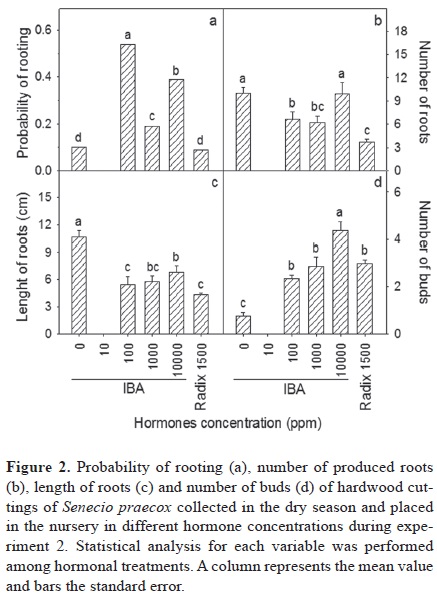
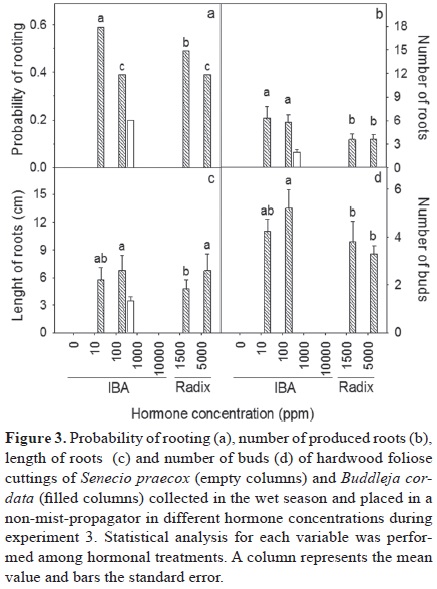
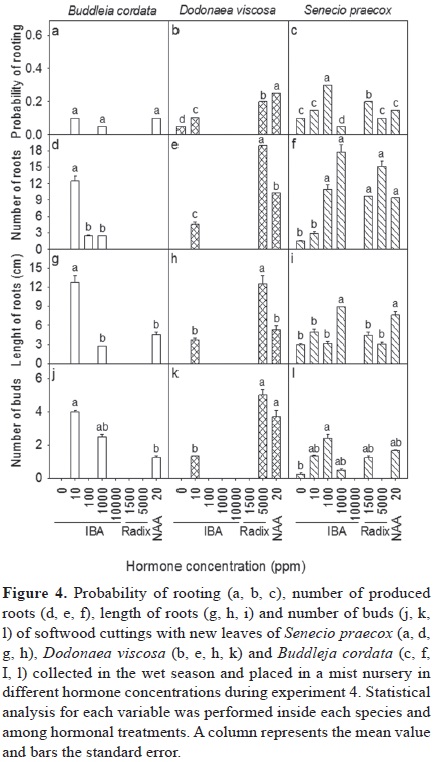
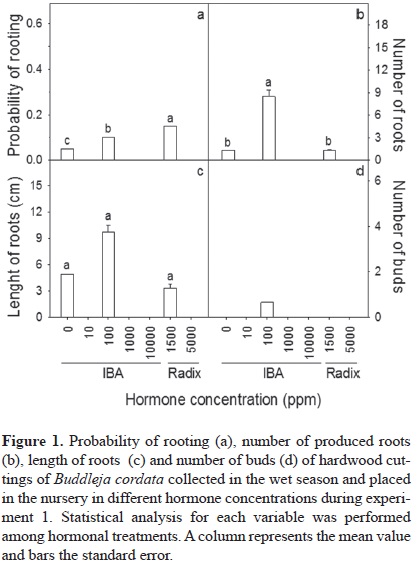
<body><![CDATA[<p align="justify"><font face="verdana" size="2">Probability of rooting, overall, was below 30% (except in <i>S. praecox,</i> in several treatments) (<a href="#f1">Figs. 1a</a>, <a href="#f2">2a</a>, <a href="#f3">3a</a>, <a href="#f4">4a</a>). The use of different hormonal concentrations of IBA or the use of commercial products (Radix and NAA) induced significant differences in cuts rooting. The effect of each one of them depended on the species and the experiment. <i>B. cordata</i> rooted in 3 of the 4 experiments, but always had low rooting (5&#150;15%); best results were obtained using radix 1500 and IBA 100 and 10 ppm in hardwood cuts collected in the wet season and sown with or without leaves (<a href="#f1">Figs 1a</a>, <a href="#f3">3a</a>). <i>D. viscosa</i> only rooted in the fourth experiment, the best probability of rooting was obtained using NAA 20 ppm (25%, <a href="#f4">Fig. 4b</a>). All cuts of all the species that rooted survived. Cuts of <i>S. praecox</i> rooted also in 3 of the 4 treatments, being the species with the highest probabilities. The best results were reached with hard cuts, independent of the collection season or the environment of propagation; in the second and third experiments rooting was higher than 50% and it was induced by IBA 100 and 10 ppm, respectively (<a href="#f2">Figs. 2a</a>, <a href="#f3">3a</a>). In this species softwood cuts reached the highest rooting with IBA 100 ppm (30%, <a href="#f4">Fig. 4c</a>).</font></p>  	    <p align="center"><font face="verdana" size="2"><a name="f1"></a></font></p>  	    <p align="center"><font face="verdana" size="2"><img src="/img/revistas/rmbiodiv/v83n3/a21f1.jpg"></font></p>  	    <p align="center"><font face="verdana" size="2"><a name="f2"></a></font></p>  	    <p align="center"><font face="verdana" size="2"><img src="/img/revistas/rmbiodiv/v83n3/a21f2.jpg"></font></p>  	    <p align="center"><font face="verdana" size="2"><a name="f3"></a></font></p>  	    <p align="center"><font face="verdana" size="2"><img src="/img/revistas/rmbiodiv/v83n3/a21f3.jpg"></font></p>  	    <p align="center"><font face="verdana" size="2"><a name="f4"></a></font></p>  	    <p align="center"><font face="verdana" size="2"><img src="/img/revistas/rmbiodiv/v83n3/a21f4.jpg"></font></p>  	    <p align="justify"><font face="verdana" size="2">In <i>B. cordata,</i> as in the other species, the best development of roots did not coincide with the treatments that had the highest rooting probabilities. The high length and number of roots were reached in experiments 1 and 4. In the first one with IBA 10 ppm and in the fourth one IBA 100 ppm produced a higher number of longer roots (<a href="#f1">Figs. 1b</a>, <a href="#f1">c</a>; <a href="#f4">4d</a>, <a href="#f4">g</a>). In <i>D. viscosa</i> the longest and the highest number of roots were reached with the NAA treatment (<a href="#f4">Fig. 4e</a>, <a href="#f4">h</a>). With <i>S. praecox</i> a good root development was reached in the 3 experiments where the species rooted; IBA, Radix and NAA produced good results in cuts of soft and hardwood (<a href="#f2">Figs. 2b</a>, <a href="#f2">c</a>, <a href="#f3">3b</a>, <a href="#f3">c</a>, <a href="#f4">4f</a>, <a href="#f4">i</a>). For the number of roots, the best result was obtained in the fourth experiment with IBA 1000 ppm, but this result did not differ significantly from others (<a href="#f4">Figs. 4f</a>, <a href="#f4">i</a>).</font></p>  	    ]]></body>
<body><![CDATA[<p align="justify"><font face="verdana" size="2">In the fourth experiment <i>Buddleja cordata</i> produced mainly buds which showed a very low rooting. The best hormonal treatment was IBA 10 and 1 000 ppm (<a href="#f4">Fig. 4j</a>). In the first experiment produced with IBA 100 ppm a low number of buds in relation to the buds produced in several treatments in the fourth experiment (<a href="#f1">Fig. 1d</a>). <i>D. viscosa</i> developed more buds in the same treatments where the development of roots was best, that is with IBA 20 ppm and NAA. <i>S. praecox</i> produced also buds in the 3 experiments where rooting occurred; bud development was best in the second and third experiment at 10 000 and 100 ppm of IBA, respectively.</font></p>  	    <p align="justify"><font face="verdana" size="2">&nbsp;</font></p>  	    <p align="justify"><font face="verdana" size="2"><b>Discussion</b></font></p>  	    <p align="justify"><font face="verdana" size="2">The rooting process in the 3 species showed considerable variation in the different experiments, and the rooting percentage of the species depended on species, season or month of collection and hormone level. <i>Buddleja cordata,</i> the species with the hardest wood, had low rooting probabilities (<u>&lt;</u> 0.2) in 3 of the 4 experiments (cuts of hard and softwood). Nevertheless, variables that are related to the health of the rooted cut as number and length of these and production of buds (de Andres et al., 1999), were best when the cuts were of softwood produced during the wet season (summer), this could be expected for woody species (Stankova and Panetsos, 1997; Agbo and Obi, 2007). In spite of the reduced rooting probability (0.1), the health of cuts and the low percentages of IBA required for rooting, make vegetative propagation an economic method that may favor the success of planting in the field. Because number of roots and root length indicate the cutting ability to assimilate nutrients, survive in the soil, have structural support, and develop buds to ensure the future CO<sub>2</sub> assimilation of the plant, these also indicate the acclimatization for future planting, which may increase survival in reforestation efforts (de Andres et al., 1999; 2004).</font></p>  	    <p align="justify"><font face="verdana" size="2"><i>Dodonaea viscosa</i> also had low rooting probabilities (<u>&lt;</u> 0.25), but in contrast with <i>B. cordata,</i> only the soft summer leafy cuttings rooted; the health of the cuts was good in most of the hormonal treatments, the best results were induced by NAA and Radix (5 000 ppm). Soft leafy cuttings as well as the collection season, adequate for <i>B. cordata</i> and <i>D. viscosa</i> propagation are also key to the propagation of other tree species such as <i>Robinia pseudoacacia, Grewia optiva</i> (Swamy et al., 2002) and <i>Olea europea</i> (Negash, 2003). It is possible that the low rooting capacity of <i>B. cordata</i> and <i>D. viscosa</i> may be due to the hardness of their lignified tissues. It has been reported for hardwood species that the use of cuttings from juvenile plants is more appropriate than the use of the low lignified soft cuts from mature plants (Swamy et al., 2002; Pignatti and Crobeddu, 2005; Agbo and Obi, 2007). The soft cuts were collected in the wet season, but in the future it will be necessary to take into account that the season of the year is relevant to the physiological condition of plants, therefore it could be necessary to harvest the soft cuts when lignification has started as had been suggested by Stankova and Panetsos (1997). This has been related to the hormonal and nutritional stage of plants, which ought to be adequate to produce new structures (Hartmann et al., 1997).</font></p>  	    <p align="justify"><font face="verdana" size="2">In contrast with the other 2 species, the non woody <i>S. praecox</i> reached higher rooting probabilities than the woody species and rooting and health of the cuttings was also good in hard cuttings (mature tissues), collected during the dry and the wet seasons. The percentages of rooting of hardwood cuttings reached more than the 50% considered as economically convenient for mass production in nurseries (Pignnatti and Crobeddu, 2005). Soft cuttings also had high rooting probabilities, but lower than hard cuttings (experiment 3). This occurs in some woody species, where a slight lignification is required for rooting (Stankova and Panetsos, 1997) as occurs in the mature tissues of <i>S. praecox,</i> which contain more initial carbohydrate reserves and a hormonal condition adequate to cope with the dry season, during which plants are deciduous but flowering occurs. Further, the stems of <i>S. praecox</i> are succulent, as they retain moisture, which probably influenced the rooting capability and the good development of the other evaluated traits. This is common among succulent plants (Baldini, 1992).</font></p>  	    <p align="justify"><font face="verdana" size="2">Low IBA concentrations (10 and 100 ppm) or Radix induce high rooting and good cutting health, which is important from the commercial point of view. Radix and low hormone concentrations favor rooting in other species such as <i>Colutea istrea, Dalbergia sissoo, Pachecoa venezuelensis</i> and <i>Tilia mexicana</i> (D&iacute;az et al., 1995; Sunil and Verma, 1996; Santiago and Vargas, 1999; de Andr&eacute;s, 2004). <i>Senecio praecox</i> reached the highest rooting probabilities in the nursery and the poly&#150;propagator without a moisture supply, which reflect its adaptation to dry environments. Differing from the other studied species, it is deciduous, has superficial roots and stores water in the stems, while the others only avoid low water availability by having deeper roots (Ramos&#150;V&aacute;zquez and Barradas, 1998; Corona, 1999; Degollado, 2000; Barradas et al., 2004). The influence of plant susceptibility to water stress in rooting capability has been reported for <i>Colutea arborescens</i> (de Andr&eacute;s, 1999).</font></p>  	    <p align="justify"><font face="verdana" size="2">For <i>S. praecox</i> and <i>B. cordata</i> rooting occurred in the non mist nursery or in the propagator, although it is known that mist&#150;propagators favor rooting (Hartmann et al., 1997). This is considered a low tech system suitable for rural areas (McDick et al., 1996). Differing from the latter, <i>D. viscosa</i> required a mist propagator and very low rooting percentages were reached. Cuts from juvenile plants at higher substrate temperatures (20 &#150; 33 &deg;C are recommended) than used (20 &#150; 24 &deg;C) could improve rooting in <i>D. viscosa</i> and in <i>B. cordata</i> (Iglesias et al., 1996; Leakey, 2004). Vegetative propagation of trees from the 3 studied species can improve restoration programs in the southern portion of Mexico City and other areas. Vegetative propagation is recommended to avoid the high mortality of seedlings and saplings and increase the success of restoration programs (Zahawi, 2005; 2008). Negative aspects of the use of vegetatively propagated plants can be overcome by using a large number of plant donors to increase genetic variability and by using these plants only for the first restoration steps before using those propagated from seeds.</font></p>  	    <p align="justify"><font face="verdana" size="2">Rooting capacity varied according to species and collection season. The highest rooting capability in <i>B. cordata</i> took place in hard tissue cuttings collected during the dry season, which might be due to a favorable eco&#150;physiological state. In <i>D. viscosa,</i> only the softwood cuttings with leaves achieved any rooting, so the type of cutting and the collection season are key elements in this species propagation. In <i>S. praecox,</i> the type of cutting and the turgidity of its tissues greatly promoted higher rooting capability of the cuttings collected during the wet season.</font></p>  	    <p align="justify"><font face="verdana" size="2">In spite of the low rooting response of 2 of the studied species, rooting can be effective ways of reforesting altered sites of the area known as PSAR as well as other areas still have the original volcanic substrate and/or other sites where these species are dominant. However, follow&#150;up research is needed to refine techniques to increase rooting percentage in all the studied species.</font></p>  	    ]]></body>
<body><![CDATA[<p align="justify"><font face="verdana" size="2">&nbsp;</font></p>  	    <p align="justify"><font face="verdana" size="2"><b>Acknowledgements</b></font></p>  	    <p align="justify"><font face="verdana" size="2">This study was supported by a grant from the Consejo Nacional de Ciencia y Tecnolog&iacute;a, Mexico, CONACYT (GOO11&#150;N).</font></p>  	    <p align="justify"><font face="verdana" size="2">&nbsp;</font></p>  	    <p align="justify"><font face="verdana" size="2"><b>Literature cited</b></font></p>  	    <!-- ref --><p align="justify"><font face="verdana" size="2">Agbo, C. U. and I. U. Obi. 2007. Variability in propagation potentials of stem cuttings of different physiological ages of <i>Gongronema latifolia</i> Benth. World Journal of Agricultural Sciences 3:576&#150;581.    &nbsp;&nbsp;&nbsp;&nbsp;&nbsp;&nbsp;&nbsp;&nbsp;[&#160;<a href="javascript:void(0);" onclick="javascript: window.open('/scielo.php?script=sci_nlinks&ref=7579765&pid=S1870-3453201200030002100001&lng=','','width=640,height=500,resizable=yes,scrollbars=1,menubar=yes,');">Links</a>&#160;]<!-- end-ref --></font></p>  	    <!-- ref --><p align="justify"><font face="verdana" size="2">Arriaga, V., V. Cervantes and A. Vargas&#150;Mena. 1994. Manual de reforestaci&oacute;n con especies nativas. SEDESOL, UNAM. M&eacute;xico, D. F. Mexico. 186 p.    &nbsp;&nbsp;&nbsp;&nbsp;&nbsp;&nbsp;&nbsp;&nbsp;[&#160;<a href="javascript:void(0);" onclick="javascript: window.open('/scielo.php?script=sci_nlinks&ref=7579767&pid=S1870-3453201200030002100002&lng=','','width=640,height=500,resizable=yes,scrollbars=1,menubar=yes,');">Links</a>&#160;]<!-- end-ref --></font></p>  	    <!-- ref --><p align="justify"><font face="verdana" size="2">Baldini, E. 1992. Arboricultura general. Spain. Mundi&#150;Prensa. Madrid. 384 p.    &nbsp;&nbsp;&nbsp;&nbsp;&nbsp;&nbsp;&nbsp;&nbsp;[&#160;<a href="javascript:void(0);" onclick="javascript: window.open('/scielo.php?script=sci_nlinks&ref=7579769&pid=S1870-3453201200030002100003&lng=','','width=640,height=500,resizable=yes,scrollbars=1,menubar=yes,');">Links</a>&#160;]<!-- end-ref --></font></p>  	    <!-- ref --><p align="justify"><font face="verdana" size="2">Barradas, V. L., A. Tejeda&#150;Martinez and E. J&aacute;uregui. 1999. Energy balance measurements in a suburban vegetated area in M&eacute;xico City. Atmospheric Environment 33:4109&#150;4113.    &nbsp;&nbsp;&nbsp;&nbsp;&nbsp;&nbsp;&nbsp;&nbsp;[&#160;<a href="javascript:void(0);" onclick="javascript: window.open('/scielo.php?script=sci_nlinks&ref=7579771&pid=S1870-3453201200030002100004&lng=','','width=640,height=500,resizable=yes,scrollbars=1,menubar=yes,');">Links</a>&#160;]<!-- end-ref --></font></p>  	    <!-- ref --><p align="justify"><font face="verdana" size="2">Barradas, V. L. 2000a. Modificaci&oacute;n del microclima con &eacute;nfasis en la conservaci&oacute;n y la restauraci&oacute;n ecol&oacute;gica. Bolet&iacute;n de la Sociedad Bot&aacute;nica de M&eacute;xico 65:83&#150;88.    &nbsp;&nbsp;&nbsp;&nbsp;&nbsp;&nbsp;&nbsp;&nbsp;[&#160;<a href="javascript:void(0);" onclick="javascript: window.open('/scielo.php?script=sci_nlinks&ref=7579773&pid=S1870-3453201200030002100005&lng=','','width=640,height=500,resizable=yes,scrollbars=1,menubar=yes,');">Links</a>&#160;]<!-- end-ref --></font></p>  	    <!-- ref --><p align="justify"><font face="verdana" size="2">Barradas, V. L. 2000b. Energy balance and transpiration in an urban tree hedgerow in Mexico City. Urban Ecosystems 4:55&#150;67.    &nbsp;&nbsp;&nbsp;&nbsp;&nbsp;&nbsp;&nbsp;&nbsp;[&#160;<a href="javascript:void(0);" onclick="javascript: window.open('/scielo.php?script=sci_nlinks&ref=7579775&pid=S1870-3453201200030002100006&lng=','','width=640,height=500,resizable=yes,scrollbars=1,menubar=yes,');">Links</a>&#160;]<!-- end-ref --></font></p>  	    <!-- ref --><p align="justify"><font face="verdana" size="2">Barradas, V. L., A. Ramos&#150;V&aacute;zquez and A. Orozco&#150;Segovia. 2004. Stomatal conductance in a tropical xerophilous shrubland at a lava substratum. International Journal of Biometeorology 48:119&#150;127.    &nbsp;&nbsp;&nbsp;&nbsp;&nbsp;&nbsp;&nbsp;&nbsp;[&#160;<a href="javascript:void(0);" onclick="javascript: window.open('/scielo.php?script=sci_nlinks&ref=7579777&pid=S1870-3453201200030002100007&lng=','','width=640,height=500,resizable=yes,scrollbars=1,menubar=yes,');">Links</a>&#160;]<!-- end-ref --></font></p>  	    <!-- ref --><p align="justify"><font face="verdana" size="2">Corona, J. N. 1999. Efecto de los eventos lluviosos en la conductividad estom&aacute;tica de <i>Buddleja cordata</i> H.B.K. (Loganiaceae) y <i>Verbesina virgata</i> Cav. (Compositae) del Pedregal de San Angel. Thesis, Facultad de Ciencias, Universidad Nacional Aut&oacute;noma de M&eacute;xico. M&eacute;xico, D. F. 69 p.    &nbsp;&nbsp;&nbsp;&nbsp;&nbsp;&nbsp;&nbsp;&nbsp;[&#160;<a href="javascript:void(0);" onclick="javascript: window.open('/scielo.php?script=sci_nlinks&ref=7579779&pid=S1870-3453201200030002100008&lng=','','width=640,height=500,resizable=yes,scrollbars=1,menubar=yes,');">Links</a>&#160;]<!-- end-ref --></font></p>  	    <!-- ref --><p align="justify"><font face="verdana" size="2">D'Antonio, C. and A. L. Meyerson. 2002. Exotic plant species as problem and solutions in ecological restoration: a synthesis. Restoration Ecology 10:703&#150;713.    &nbsp;&nbsp;&nbsp;&nbsp;&nbsp;&nbsp;&nbsp;&nbsp;[&#160;<a href="javascript:void(0);" onclick="javascript: window.open('/scielo.php?script=sci_nlinks&ref=7579781&pid=S1870-3453201200030002100009&lng=','','width=640,height=500,resizable=yes,scrollbars=1,menubar=yes,');">Links</a>&#160;]<!-- end-ref --></font></p>  	    <!-- ref --><p align="justify"><font face="verdana" size="2">de Andr&eacute;s, E. F., J. Alegre, J. L. Tenorio, M. Manzanares, F. J. S&aacute;nchez and L. Ayerbe. 1999. Vegetative propagation of <i>Colutea arborescens</i> L., a multipurpose leguminous shrub of semiarid climates. Agroforestry Systems 46:113&#150;121.    &nbsp;&nbsp;&nbsp;&nbsp;&nbsp;&nbsp;&nbsp;&nbsp;[&#160;<a href="javascript:void(0);" onclick="javascript: window.open('/scielo.php?script=sci_nlinks&ref=7579783&pid=S1870-3453201200030002100010&lng=','','width=640,height=500,resizable=yes,scrollbars=1,menubar=yes,');">Links</a>&#160;]<!-- end-ref --></font></p>  	    <!-- ref --><p align="justify"><font face="verdana" size="2">de Andr&eacute;s, E. F., F. J. S&aacute;nchez, G. Catal&aacute;n, J. L. Tenorio and L. Ayerbe. 2004. Vegetative propagation of <i>Colutea istria</i> Mill. from Leary stem cuttings. Agroforestry Systems 63:7&#150;14.    &nbsp;&nbsp;&nbsp;&nbsp;&nbsp;&nbsp;&nbsp;&nbsp;[&#160;<a href="javascript:void(0);" onclick="javascript: window.open('/scielo.php?script=sci_nlinks&ref=7579785&pid=S1870-3453201200030002100011&lng=','','width=640,height=500,resizable=yes,scrollbars=1,menubar=yes,');">Links</a>&#160;]<!-- end-ref --></font></p>  	    <!-- ref --><p align="justify"><font face="verdana" size="2">Degollado, D. 2000. Relaciones h&iacute;dricas internas de <i>Cissus sicyoides</i> L. y <i>Dodonaea viscosa</i> (L.) Jacq. de la reserva del pedregal de San Angel. Thesis, Facultad de Ciencias, Universidad Nacional Aut&oacute;noma de M&eacute;xico. M&eacute;xico, D. F. 65 p.    &nbsp;&nbsp;&nbsp;&nbsp;&nbsp;&nbsp;&nbsp;&nbsp;[&#160;<a href="javascript:void(0);" onclick="javascript: window.open('/scielo.php?script=sci_nlinks&ref=7579787&pid=S1870-3453201200030002100012&lng=','','width=640,height=500,resizable=yes,scrollbars=1,menubar=yes,');">Links</a>&#160;]<!-- end-ref --></font></p>  	    <!-- ref --><p align="justify"><font face="verdana" size="2">D&iacute;az, Y., J. Viera and G. Vargas.1995. Posibilidad de propagaci&oacute;n asexual por estacas en <i>Pachecoa venezuelensis</i> Burkart. Agronom&iacute;a Tropical 45:551&#150;559.    &nbsp;&nbsp;&nbsp;&nbsp;&nbsp;&nbsp;&nbsp;&nbsp;[&#160;<a href="javascript:void(0);" onclick="javascript: window.open('/scielo.php?script=sci_nlinks&ref=7579789&pid=S1870-3453201200030002100013&lng=','','width=640,height=500,resizable=yes,scrollbars=1,menubar=yes,');">Links</a>&#160;]<!-- end-ref --></font></p>  	    <!-- ref --><p align="justify"><font face="verdana" size="2">Ezcurra, E., M. Mazari, I. Pisanty and G. A. Aguilar. 1999. The basin of Mexico. United Nations University Press. New York. 206 p.    &nbsp;&nbsp;&nbsp;&nbsp;&nbsp;&nbsp;&nbsp;&nbsp;[&#160;<a href="javascript:void(0);" onclick="javascript: window.open('/scielo.php?script=sci_nlinks&ref=7579791&pid=S1870-3453201200030002100014&lng=','','width=640,height=500,resizable=yes,scrollbars=1,menubar=yes,');">Links</a>&#160;]<!-- end-ref --></font></p>  	    <!-- ref --><p align="justify"><font face="verdana" size="2">Gonz&aacute;lez&#150;Hidalgo, B., A. Orozco&#150;Segovia and N. Diego&#150;P&eacute;rez. 2001. La vegetaci&oacute;n de la Reserva Ecol&oacute;gica Lomas del Seminario, Ajusco, M&eacute;xico. Bolet&iacute;n de la Sociedad Bot&aacute;nica de Mexico 69:77&#150;99.    &nbsp;&nbsp;&nbsp;&nbsp;&nbsp;&nbsp;&nbsp;&nbsp;[&#160;<a href="javascript:void(0);" onclick="javascript: window.open('/scielo.php?script=sci_nlinks&ref=7579793&pid=S1870-3453201200030002100015&lng=','','width=640,height=500,resizable=yes,scrollbars=1,menubar=yes,');">Links</a>&#160;]<!-- end-ref --></font></p>  	    <!-- ref --><p align="justify"><font face="verdana" size="2">Gonz&aacute;lez, V. and F. Camacho. 1994. Avances en la propagaci&oacute;n de cuatro especies presentes en El Pedregal de San Angel D.F. <i>In</i> Reserva Ecol&oacute;gica del Pedregal de San Angel: Ecolog&iacute;a, Historia Natural y Manejo, A. Rojo (ed.). Universidad Nacional Aut&oacute;noma de M&eacute;xico, M&eacute;xico, D.F. p. 403&#150;410.    &nbsp;&nbsp;&nbsp;&nbsp;&nbsp;&nbsp;&nbsp;&nbsp;[&#160;<a href="javascript:void(0);" onclick="javascript: window.open('/scielo.php?script=sci_nlinks&ref=7579795&pid=S1870-3453201200030002100016&lng=','','width=640,height=500,resizable=yes,scrollbars=1,menubar=yes,');">Links</a>&#160;]<!-- end-ref --></font></p>  	    <!-- ref --><p align="justify"><font face="verdana" size="2">Hartmann, H. T., D. E. Kester and F. T. Davies. 1997. Plant propagation: principles and practices. Prentice&#150;Hall. New Jersey. 928 p.    &nbsp;&nbsp;&nbsp;&nbsp;&nbsp;&nbsp;&nbsp;&nbsp;[&#160;<a href="javascript:void(0);" onclick="javascript: window.open('/scielo.php?script=sci_nlinks&ref=7579797&pid=S1870-3453201200030002100017&lng=','','width=640,height=500,resizable=yes,scrollbars=1,menubar=yes,');">Links</a>&#160;]<!-- end-ref --></font></p>  	    <!-- ref --><p align="justify"><font face="verdana" size="2">Iglesias, G. L., R. Prieto, A. Jos&eacute; and B. M. Alarc&oacute;n. 1999. La propagaci&oacute;n vegetativa de plantas forestales. Ciencia Forestal en M&eacute;xico 21:15&#150;37.    &nbsp;&nbsp;&nbsp;&nbsp;&nbsp;&nbsp;&nbsp;&nbsp;[&#160;<a href="javascript:void(0);" onclick="javascript: window.open('/scielo.php?script=sci_nlinks&ref=7579799&pid=S1870-3453201200030002100018&lng=','','width=640,height=500,resizable=yes,scrollbars=1,menubar=yes,');">Links</a>&#160;]<!-- end-ref --></font></p>  	    <!-- ref --><p align="justify"><font face="verdana" size="2">Johnson, D. L., D. J. Nowak and V. A. Joureava. 1999. Characterizing individual particles on tree leaves using computer automated scanning electron microscopy. Advances in Environmental Research 2:456&#150;466.    &nbsp;&nbsp;&nbsp;&nbsp;&nbsp;&nbsp;&nbsp;&nbsp;[&#160;<a href="javascript:void(0);" onclick="javascript: window.open('/scielo.php?script=sci_nlinks&ref=7579801&pid=S1870-3453201200030002100019&lng=','','width=640,height=500,resizable=yes,scrollbars=1,menubar=yes,');">Links</a>&#160;]<!-- end-ref --></font></p>  	    <!-- ref --><p align="justify"><font face="verdana" size="2">Leakey, R. R. B. 2004. Physiology of vegetative reproduction. <i>In</i> Encyclopaedia of Forest Sciences, J. Burley, J. Evans and J. A. Youngquist (eds.). Academic Press, London. p. 1655-1668.    &nbsp;&nbsp;&nbsp;&nbsp;&nbsp;&nbsp;&nbsp;&nbsp;[&#160;<a href="javascript:void(0);" onclick="javascript: window.open('/scielo.php?script=sci_nlinks&ref=7579803&pid=S1870-3453201200030002100020&lng=','','width=640,height=500,resizable=yes,scrollbars=1,menubar=yes,');">Links</a>&#160;]<!-- end-ref --></font></p>  	    <!-- ref --><p align="justify"><font face="verdana" size="2">Leakey, R. R. B., A. C. Newton and J. McP. Dick. 1994. Capture of genetic variation by vegetative propagation: processes determining success. <i>In</i> Tropical Trees: The potential for domestication and the rebuilding of forest resources, R. R. B. Leakey and A. C. Newton (eds.). UK HMSO, London. p. 72&#150;83.    &nbsp;&nbsp;&nbsp;&nbsp;&nbsp;&nbsp;&nbsp;&nbsp;[&#160;<a href="javascript:void(0);" onclick="javascript: window.open('/scielo.php?script=sci_nlinks&ref=7579805&pid=S1870-3453201200030002100021&lng=','','width=640,height=500,resizable=yes,scrollbars=1,menubar=yes,');">Links</a>&#160;]<!-- end-ref --></font></p>  	    <!-- ref --><p align="justify"><font face="verdana" size="2">Longman, K. A. and R. H. F. Wilson. 1993. Tropical trees: propagation and planting manuals, Vol. 1, Tropical trees. Commonwealth Science Council, London. 142 p.    &nbsp;&nbsp;&nbsp;&nbsp;&nbsp;&nbsp;&nbsp;&nbsp;[&#160;<a href="javascript:void(0);" onclick="javascript: window.open('/scielo.php?script=sci_nlinks&ref=7579807&pid=S1870-3453201200030002100022&lng=','','width=640,height=500,resizable=yes,scrollbars=1,menubar=yes,');">Links</a>&#160;]<!-- end-ref --></font></p>  	    <!-- ref --><p align="justify"><font face="verdana" size="2">Lot, A. and Z. Cano&#150;Santana. 2009. Biodiversidad del Ecosistema del Pedregal de San Angel. Universidad Nacional Aut&oacute;noma de M&eacute;xico, M&eacute;xico, D. F. 538 p.    &nbsp;&nbsp;&nbsp;&nbsp;&nbsp;&nbsp;&nbsp;&nbsp;[&#160;<a href="javascript:void(0);" onclick="javascript: window.open('/scielo.php?script=sci_nlinks&ref=7579809&pid=S1870-3453201200030002100023&lng=','','width=640,height=500,resizable=yes,scrollbars=1,menubar=yes,');">Links</a>&#160;]<!-- end-ref --></font></p>  	    <!-- ref --><p align="justify"><font face="verdana" size="2">McPherson, E. G. and D. J. Nowak. 1993. Value of urban green space for air quality improvement: Lincoln Park, Chicago. Arborist News 2:30&#150;32.    &nbsp;&nbsp;&nbsp;&nbsp;&nbsp;&nbsp;&nbsp;&nbsp;[&#160;<a href="javascript:void(0);" onclick="javascript: window.open('/scielo.php?script=sci_nlinks&ref=7579811&pid=S1870-3453201200030002100024&lng=','','width=640,height=500,resizable=yes,scrollbars=1,menubar=yes,');">Links</a>&#160;]<!-- end-ref --></font></p>  	    <!-- ref --><p align="justify"><font face="verdana" size="2">Mendoza&#150;Hern&aacute;ndez, P. E. 2002. Sobrevivencia y crecimiento de los estadios iniciales de <i>Buddleja cordata</i> (tepoz&aacute;n) en ambientes contrastantes del Ajusco Medio, D.F. M&eacute;xico. Thesis, Facultad de Ciencias, Universidad Nacional Aut&oacute;noma de M&eacute;xico. Mexico, D. F. 85 p.    &nbsp;&nbsp;&nbsp;&nbsp;&nbsp;&nbsp;&nbsp;&nbsp;[&#160;<a href="javascript:void(0);" onclick="javascript: window.open('/scielo.php?script=sci_nlinks&ref=7579813&pid=S1870-3453201200030002100025&lng=','','width=640,height=500,resizable=yes,scrollbars=1,menubar=yes,');">Links</a>&#160;]<!-- end-ref --></font></p>  	    <!-- ref --><p align="justify"><font face="verdana" size="2">Negash, L. 2003. Vegetative propagation of the threatened African wild olive <i>&#91;Olea europea</i> L. subsp. <i>cuspidate</i> (Wall. Ex DC.) Ciffieri&#93;. New Forests 26:137&#150;146.    &nbsp;&nbsp;&nbsp;&nbsp;&nbsp;&nbsp;&nbsp;&nbsp;[&#160;<a href="javascript:void(0);" onclick="javascript: window.open('/scielo.php?script=sci_nlinks&ref=7579815&pid=S1870-3453201200030002100026&lng=','','width=640,height=500,resizable=yes,scrollbars=1,menubar=yes,');">Links</a>&#160;]<!-- end-ref --></font></p>  	    <!-- ref --><p align="justify"><font face="verdana" size="2">Perez, R. I. and M. Franco. 2000. <i>Senecio praecox</i> (Cav.) DC. Var. <i>praecox:</i> toda una vida impresa en su arquitectura. Cact&aacute;ceas y Suculentas Mexicanas 45:3&#150;10.    &nbsp;&nbsp;&nbsp;&nbsp;&nbsp;&nbsp;&nbsp;&nbsp;[&#160;<a href="javascript:void(0);" onclick="javascript: window.open('/scielo.php?script=sci_nlinks&ref=7579817&pid=S1870-3453201200030002100027&lng=','','width=640,height=500,resizable=yes,scrollbars=1,menubar=yes,');">Links</a>&#160;]<!-- end-ref --></font></p>  	    <!-- ref --><p align="justify"><font face="verdana" size="2">Pignatti, G. and S. Crobeddu. 2005. Effects of rejuvenation on cuttings propagation of Mediterranean shrub species. Forest 2:290&#150;295.    &nbsp;&nbsp;&nbsp;&nbsp;&nbsp;&nbsp;&nbsp;&nbsp;[&#160;<a href="javascript:void(0);" onclick="javascript: window.open('/scielo.php?script=sci_nlinks&ref=7579819&pid=S1870-3453201200030002100028&lng=','','width=640,height=500,resizable=yes,scrollbars=1,menubar=yes,');">Links</a>&#160;]<!-- end-ref --></font></p>  	    <!-- ref --><p align="justify"><font face="verdana" size="2">Ramos&#150;V&aacute;zquez, A. and V. L. Barradas. 1998. El efecto del microambiente en la conductividad estom&aacute;tica de <i>Buddleia</i> <i>cordata</i> H.B.K., en la reserva del Pedregal de San Angel. Bolet&iacute;n de la Sociedad Bot&aacute;nica de M&eacute;xico 62:63&#150;71.    &nbsp;&nbsp;&nbsp;&nbsp;&nbsp;&nbsp;&nbsp;&nbsp;[&#160;<a href="javascript:void(0);" onclick="javascript: window.open('/scielo.php?script=sci_nlinks&ref=7579821&pid=S1870-3453201200030002100029&lng=','','width=640,height=500,resizable=yes,scrollbars=1,menubar=yes,');">Links</a>&#160;]<!-- end-ref --></font></p>  	    <!-- ref --><p align="justify"><font face="verdana" size="2">Rojo, A. 1994. Reserva Ecol&oacute;gica del Pedregal de San Angel: Ecolog&iacute;a, Historia Natural y Manejo. Universidad Nacional Aut&oacute;noma de M&eacute;xico, M&eacute;xico, D. F. 410 p.    &nbsp;&nbsp;&nbsp;&nbsp;&nbsp;&nbsp;&nbsp;&nbsp;[&#160;<a href="javascript:void(0);" onclick="javascript: window.open('/scielo.php?script=sci_nlinks&ref=7579823&pid=S1870-3453201200030002100030&lng=','','width=640,height=500,resizable=yes,scrollbars=1,menubar=yes,');">Links</a>&#160;]<!-- end-ref --></font></p>  	    <!-- ref --><p align="justify"><font face="verdana" size="2">Rzedowski, J. 1954. Vegetaci&oacute;n del Pedregal de San Angel (Distrito Federal, M&eacute;xico). Anales de la Escuela Nacional de Ciencias Biol&oacute;gicas 8:59&#150;129.    &nbsp;&nbsp;&nbsp;&nbsp;&nbsp;&nbsp;&nbsp;&nbsp;[&#160;<a href="javascript:void(0);" onclick="javascript: window.open('/scielo.php?script=sci_nlinks&ref=7579825&pid=S1870-3453201200030002100031&lng=','','width=640,height=500,resizable=yes,scrollbars=1,menubar=yes,');">Links</a>&#160;]<!-- end-ref --></font></p>  	    <!-- ref --><p align="justify"><font face="verdana" size="2">Rzedowski, J. and G. Rzedowski. 2001. Flora fanerog&aacute;mica del Valle de M&eacute;xico. Instituto de Ecolog&iacute;a, A.C. &#150; CONABIO, Mexico, D. F. 1406 p.    &nbsp;&nbsp;&nbsp;&nbsp;&nbsp;&nbsp;&nbsp;&nbsp;[&#160;<a href="javascript:void(0);" onclick="javascript: window.open('/scielo.php?script=sci_nlinks&ref=7579827&pid=S1870-3453201200030002100032&lng=','','width=640,height=500,resizable=yes,scrollbars=1,menubar=yes,');">Links</a>&#160;]<!-- end-ref --></font></p>  	    <!-- ref --><p align="justify"><font face="verdana" size="2">S&aacute;nchez, J.B.C. 1990. An&aacute;lisis de algunas variables meteorol&oacute;gicas y su &aacute;rea de influencia en Ciudad Universitaria, D.F., durante el periodo 1963 a 1983. Thesis, Facultad Filosof&iacute;a y Letras, Universidad Nacional Autonoma de M&eacute;xico. M&eacute;xico, D.F. 124 p.    &nbsp;&nbsp;&nbsp;&nbsp;&nbsp;&nbsp;&nbsp;&nbsp;[&#160;<a href="javascript:void(0);" onclick="javascript: window.open('/scielo.php?script=sci_nlinks&ref=7579829&pid=S1870-3453201200030002100033&lng=','','width=640,height=500,resizable=yes,scrollbars=1,menubar=yes,');">Links</a>&#160;]<!-- end-ref --></font></p>  	    <!-- ref --><p align="justify"><font face="verdana" size="2">Sanders, R. A. 1986. Urban vegetation impacts on the hydrology of Dayton, Ohio. Urban Ecology 9:361&#150;376.    &nbsp;&nbsp;&nbsp;&nbsp;&nbsp;&nbsp;&nbsp;&nbsp;[&#160;<a href="javascript:void(0);" onclick="javascript: window.open('/scielo.php?script=sci_nlinks&ref=7579831&pid=S1870-3453201200030002100034&lng=','','width=640,height=500,resizable=yes,scrollbars=1,menubar=yes,');">Links</a>&#160;]<!-- end-ref --></font></p>  	    <!-- ref --><p align="justify"><font face="verdana" size="2">Santiago, G. D. and J. H. Vargas. 1999. Estudio de algunos factores que afectan el enraizamiento de estacas de <i>Tilia mexicana</i> Schl. Foresta Veracruzana 1:11&#150;18.    &nbsp;&nbsp;&nbsp;&nbsp;&nbsp;&nbsp;&nbsp;&nbsp;[&#160;<a href="javascript:void(0);" onclick="javascript: window.open('/scielo.php?script=sci_nlinks&ref=7579833&pid=S1870-3453201200030002100035&lng=','','width=640,height=500,resizable=yes,scrollbars=1,menubar=yes,');">Links</a>&#160;]<!-- end-ref --></font></p>  	    <!-- ref --><p align="justify"><font face="verdana" size="2">Sober&oacute;n, J., R. de la Maza, A. Hern&aacute;ndez, C. Bonfil, S. Careaga, J. Gamboa de Buen, H. Garc&iacute;a and G. Espinosa. 1991. Restauraci&oacute;n Ecol&oacute;gica de Lomas del Seminario Reporte T&eacute;cnico No 1. Departamento del Distrito Federal, Centro de Ecolog&iacute;a, UNAM and Coordinaci&oacute;n General de Reordenaci&oacute;n Urbana y Protecci&oacute;n Ecol&oacute;gica. M&eacute;xico, D.F. 85 p.    &nbsp;&nbsp;&nbsp;&nbsp;&nbsp;&nbsp;&nbsp;&nbsp;[&#160;<a href="javascript:void(0);" onclick="javascript: window.open('/scielo.php?script=sci_nlinks&ref=7579835&pid=S1870-3453201200030002100036&lng=','','width=640,height=500,resizable=yes,scrollbars=1,menubar=yes,');">Links</a>&#160;]<!-- end-ref --></font></p>  	    <!-- ref --><p align="justify"><font face="verdana" size="2">Sunil, P. and R. C. Verma. 1996. Vegetative propagation of <i>Dalbergia sissoo</i> Roxb. using softwood and hardwood stem cuttings. Journal of Arid Environments 34:235&#150;245.    &nbsp;&nbsp;&nbsp;&nbsp;&nbsp;&nbsp;&nbsp;&nbsp;[&#160;<a href="javascript:void(0);" onclick="javascript: window.open('/scielo.php?script=sci_nlinks&ref=7579837&pid=S1870-3453201200030002100037&lng=','','width=640,height=500,resizable=yes,scrollbars=1,menubar=yes,');">Links</a>&#160;]<!-- end-ref --></font></p>  	    <!-- ref --><p align="justify"><font face="verdana" size="2">Stankova, T. and K. Panetsos. 1997. Vegetative propagation of <i>Cupressus sempervirens</i> L. of Cretan origin by softwood stem cuttings. Silvae Genetica 46:137&#150;144.    &nbsp;&nbsp;&nbsp;&nbsp;&nbsp;&nbsp;&nbsp;&nbsp;[&#160;<a href="javascript:void(0);" onclick="javascript: window.open('/scielo.php?script=sci_nlinks&ref=7579839&pid=S1870-3453201200030002100038&lng=','','width=640,height=500,resizable=yes,scrollbars=1,menubar=yes,');">Links</a>&#160;]<!-- end-ref --></font></p>  	    <!-- ref --><p align="justify"><font face="verdana" size="2">Swamy, S. L., S. Puri and A. K. Singh. 2002. Effect of auxins (IBA and NAA) and season on rooting of juvenile and mature hardwood cuttings of <i>Robinia pseudoacacia</i> and <i>Grewia optiva.</i> New Forests 23:43&#150;157.    &nbsp;&nbsp;&nbsp;&nbsp;&nbsp;&nbsp;&nbsp;&nbsp;[&#160;<a href="javascript:void(0);" onclick="javascript: window.open('/scielo.php?script=sci_nlinks&ref=7579841&pid=S1870-3453201200030002100039&lng=','','width=640,height=500,resizable=yes,scrollbars=1,menubar=yes,');">Links</a>&#160;]<!-- end-ref --></font></p>  	    <!-- ref --><p align="justify"><font face="verdana" size="2">Tukey, J. W. 1997. Exploratory data analysis. Addison&#150;Wesley, Reading, M.A. 668 p.    &nbsp;&nbsp;&nbsp;&nbsp;&nbsp;&nbsp;&nbsp;&nbsp;[&#160;<a href="javascript:void(0);" onclick="javascript: window.open('/scielo.php?script=sci_nlinks&ref=7579843&pid=S1870-3453201200030002100040&lng=','','width=640,height=500,resizable=yes,scrollbars=1,menubar=yes,');">Links</a>&#160;]<!-- end-ref --></font></p>  	    <!-- ref --><p align="justify"><font face="verdana" size="2">Valiente&#150;Banuet, A. and E. G. de Luna. 1990. Una lista flor&iacute;stica actualizada para la reserva del Pedregal de San Angel, M&eacute;xico D. F. Acta Botanica Mexicana 9:13&#150;30.    &nbsp;&nbsp;&nbsp;&nbsp;&nbsp;&nbsp;&nbsp;&nbsp;[&#160;<a href="javascript:void(0);" onclick="javascript: window.open('/scielo.php?script=sci_nlinks&ref=7579845&pid=S1870-3453201200030002100041&lng=','','width=640,height=500,resizable=yes,scrollbars=1,menubar=yes,');">Links</a>&#160;]<!-- end-ref --></font></p>  	    <!-- ref --><p align="justify"><font face="verdana" size="2">V&aacute;zquez&#150;Yanes, C., A. Orozco&#150;Segovia, M. Rojas, M. E. S&aacute;nchez&#150;Coronado and V. Cervantes. 1997. La reproducci&oacute;n de las plantas: semillas y meristemos. La ciencia para todos. Fondo de Cultura Econ&oacute;mica. M&eacute;xico, D. F. 170 p.    &nbsp;&nbsp;&nbsp;&nbsp;&nbsp;&nbsp;&nbsp;&nbsp;[&#160;<a href="javascript:void(0);" onclick="javascript: window.open('/scielo.php?script=sci_nlinks&ref=7579847&pid=S1870-3453201200030002100042&lng=','','width=640,height=500,resizable=yes,scrollbars=1,menubar=yes,');">Links</a>&#160;]<!-- end-ref --></font></p>  	    <!-- ref --><p align="justify"><font face="verdana" size="2">V&aacute;zquez&#150;Yanes, C., A. I. Batis&#150;Mu&ntilde;oz, M. I. Alcocer&#150;Silva and M. Gual&#150;D&iacute;az and C. S&aacute;nchez&#150;Dirzo. 1999. &Aacute;rboles y arbustos potencialmente valiosos para la restauraci&oacute;n ecol&oacute;gica y la reforestaci&oacute;n. <i>Reporte t&eacute;cnico</i> del proyecto J084. CONABIO &#150; Instituto de Ecolog&iacute;a, UNAM. <a href="http://www.conabio.gob.mx/conocimiento/info_especies/arboles/doctos/introd-J084.html" target="_blank">http://www.conabio.gob.mx/conocimiento/info_especies/arboles/doctos/introd&#150;J084.html</a>. 311 p.    &nbsp;&nbsp;&nbsp;&nbsp;&nbsp;&nbsp;&nbsp;&nbsp;[&#160;<a href="javascript:void(0);" onclick="javascript: window.open('/scielo.php?script=sci_nlinks&ref=7579849&pid=S1870-3453201200030002100043&lng=','','width=640,height=500,resizable=yes,scrollbars=1,menubar=yes,');">Links</a>&#160;]<!-- end-ref --></font></p>  	    <!-- ref --><p align="justify"><font face="verdana" size="2">Weber, R. F. and C. Stoney. 1986. Reforestation in Arid Lands. Volunteers in Technical Assistance. U.S.A. 34 p.    &nbsp;&nbsp;&nbsp;&nbsp;&nbsp;&nbsp;&nbsp;&nbsp;[&#160;<a href="javascript:void(0);" onclick="javascript: window.open('/scielo.php?script=sci_nlinks&ref=7579851&pid=S1870-3453201200030002100044&lng=','','width=640,height=500,resizable=yes,scrollbars=1,menubar=yes,');">Links</a>&#160;]<!-- end-ref --></font></p>  	    <!-- ref --><p align="justify"><font face="verdana" size="2">Zahawi, R. A. 2005. Establishment and growth of living fence species: a overlooked tool for the restoration of degraded areas in the tropics. Restoration. Ecology 13:92&#150;102.    &nbsp;&nbsp;&nbsp;&nbsp;&nbsp;&nbsp;&nbsp;&nbsp;[&#160;<a href="javascript:void(0);" onclick="javascript: window.open('/scielo.php?script=sci_nlinks&ref=7579853&pid=S1870-3453201200030002100045&lng=','','width=640,height=500,resizable=yes,scrollbars=1,menubar=yes,');">Links</a>&#160;]<!-- end-ref --></font></p>  	    <!-- ref --><p align="justify"><font face="verdana" size="2">Zahawi, R. A. 2008. Instant trees: using giant vegetative stakes in tropical forest restoration. Forest Ecology and Management 255:3013&#150;3016.    &nbsp;&nbsp;&nbsp;&nbsp;&nbsp;&nbsp;&nbsp;&nbsp;[&#160;<a href="javascript:void(0);" onclick="javascript: window.open('/scielo.php?script=sci_nlinks&ref=7579855&pid=S1870-3453201200030002100046&lng=','','width=640,height=500,resizable=yes,scrollbars=1,menubar=yes,');">Links</a>&#160;]<!-- end-ref --></font></p>  	    <!-- ref --><p align="justify"><font face="verdana" size="2">Zar, J. H. 1974. Biostatistical analysis. Prentice&#150;Hall, Inc., London. 620 p.    &nbsp;&nbsp;&nbsp;&nbsp;&nbsp;&nbsp;&nbsp;&nbsp;[&#160;<a href="javascript:void(0);" onclick="javascript: window.open('/scielo.php?script=sci_nlinks&ref=7579857&pid=S1870-3453201200030002100047&lng=','','width=640,height=500,resizable=yes,scrollbars=1,menubar=yes,');">Links</a>&#160;]<!-- end-ref --></font></p>      ]]></body><back>
<ref-list>
<ref id="B1">
<nlm-citation citation-type="journal">
<person-group person-group-type="author">
<name>
<surname><![CDATA[Agbo]]></surname>
<given-names><![CDATA[C. U.]]></given-names>
</name>
<name>
<surname><![CDATA[Obi]]></surname>
<given-names><![CDATA[I. U.]]></given-names>
</name>
</person-group>
<article-title xml:lang="en"><![CDATA[Variability in propagation potentials of stem cuttings of different physiological ages of Gongronema latifolia Benth]]></article-title>
<source><![CDATA[World Journal of Agricultural Sciences]]></source>
<year>2007</year>
<volume>3</volume>
<page-range>576-581</page-range></nlm-citation>
</ref>
<ref id="B2">
<nlm-citation citation-type="book">
<person-group person-group-type="author">
<name>
<surname><![CDATA[Arriaga]]></surname>
<given-names><![CDATA[V.]]></given-names>
</name>
<name>
<surname><![CDATA[Cervantes]]></surname>
<given-names><![CDATA[V.]]></given-names>
</name>
<name>
<surname><![CDATA[Vargas-Mena]]></surname>
<given-names><![CDATA[A.]]></given-names>
</name>
</person-group>
<source><![CDATA[Manual de reforestación con especies nativas]]></source>
<year>1994</year>
<page-range>186</page-range><publisher-loc><![CDATA[México^eD. F. D. F.]]></publisher-loc>
<publisher-name><![CDATA[SEDESOLUNAM]]></publisher-name>
</nlm-citation>
</ref>
<ref id="B3">
<nlm-citation citation-type="book">
<person-group person-group-type="author">
<name>
<surname><![CDATA[Baldini]]></surname>
<given-names><![CDATA[E.]]></given-names>
</name>
</person-group>
<source><![CDATA[Arboricultura general]]></source>
<year>1992</year>
<page-range>384</page-range><publisher-loc><![CDATA[Madrid ]]></publisher-loc>
<publisher-name><![CDATA[Mundi-Prensa]]></publisher-name>
</nlm-citation>
</ref>
<ref id="B4">
<nlm-citation citation-type="journal">
<person-group person-group-type="author">
<name>
<surname><![CDATA[Barradas]]></surname>
<given-names><![CDATA[V. L.]]></given-names>
</name>
<name>
<surname><![CDATA[Tejeda-Martinez]]></surname>
<given-names><![CDATA[A.]]></given-names>
</name>
<name>
<surname><![CDATA[Jáuregui]]></surname>
<given-names><![CDATA[E.]]></given-names>
</name>
</person-group>
<article-title xml:lang="en"><![CDATA[Energy balance measurements in a suburban vegetated area in México City]]></article-title>
<source><![CDATA[Atmospheric Environment]]></source>
<year>1999</year>
<volume>33</volume>
<page-range>4109-4113</page-range></nlm-citation>
</ref>
<ref id="B5">
<nlm-citation citation-type="journal">
<person-group person-group-type="author">
<name>
<surname><![CDATA[Barradas]]></surname>
<given-names><![CDATA[V. L.]]></given-names>
</name>
</person-group>
<article-title xml:lang="es"><![CDATA[Modificación del microclima con énfasis en la conservación y la restauración ecológica]]></article-title>
<source><![CDATA[Boletín de la Sociedad Botánica de México]]></source>
<year>2000</year>
<volume>65</volume>
<page-range>83-88</page-range></nlm-citation>
</ref>
<ref id="B6">
<nlm-citation citation-type="journal">
<person-group person-group-type="author">
<name>
<surname><![CDATA[Barradas]]></surname>
<given-names><![CDATA[V. L.]]></given-names>
</name>
</person-group>
<article-title xml:lang="en"><![CDATA[Energy balance and transpiration in an urban tree hedgerow in Mexico City]]></article-title>
<source><![CDATA[Urban Ecosystems]]></source>
<year>2000</year>
<volume>4</volume>
<page-range>55-67</page-range></nlm-citation>
</ref>
<ref id="B7">
<nlm-citation citation-type="journal">
<person-group person-group-type="author">
<name>
<surname><![CDATA[Barradas]]></surname>
<given-names><![CDATA[V. L.]]></given-names>
</name>
<name>
<surname><![CDATA[Ramos-Vázquez]]></surname>
<given-names><![CDATA[A.]]></given-names>
</name>
<name>
<surname><![CDATA[Orozco-Segovia]]></surname>
<given-names><![CDATA[A.]]></given-names>
</name>
</person-group>
<article-title xml:lang="en"><![CDATA[Stomatal conductance in a tropical xerophilous shrubland at a lava substratum]]></article-title>
<source><![CDATA[International Journal of Biometeorology]]></source>
<year>2004</year>
<volume>48</volume>
<page-range>119-127</page-range></nlm-citation>
</ref>
<ref id="B8">
<nlm-citation citation-type="">
<person-group person-group-type="author">
<name>
<surname><![CDATA[Corona]]></surname>
<given-names><![CDATA[J. N.]]></given-names>
</name>
</person-group>
<source><![CDATA[Efecto de los eventos lluviosos en la conductividad estomática de Buddleja cordata H.B.K. (Loganiaceae) y Verbesina virgata Cav. (Compositae) del Pedregal de San Angel]]></source>
<year>1999</year>
<page-range>69</page-range></nlm-citation>
</ref>
<ref id="B9">
<nlm-citation citation-type="journal">
<person-group person-group-type="author">
<name>
<surname><![CDATA[D'Antonio]]></surname>
<given-names><![CDATA[C.]]></given-names>
</name>
<name>
<surname><![CDATA[Meyerson]]></surname>
<given-names><![CDATA[A. L.]]></given-names>
</name>
</person-group>
<article-title xml:lang="en"><![CDATA[Exotic plant species as problem and solutions in ecological restoration: a synthesis]]></article-title>
<source><![CDATA[Restoration Ecology]]></source>
<year>2002</year>
<volume>10</volume>
<page-range>703-713</page-range></nlm-citation>
</ref>
<ref id="B10">
<nlm-citation citation-type="journal">
<person-group person-group-type="author">
<name>
<surname><![CDATA[de Andrés]]></surname>
<given-names><![CDATA[E. F.]]></given-names>
</name>
<name>
<surname><![CDATA[Alegre]]></surname>
<given-names><![CDATA[J.]]></given-names>
</name>
<name>
<surname><![CDATA[Tenorio]]></surname>
<given-names><![CDATA[J. L.]]></given-names>
</name>
<name>
<surname><![CDATA[Manzanares]]></surname>
<given-names><![CDATA[M.]]></given-names>
</name>
<name>
<surname><![CDATA[Sánchez]]></surname>
<given-names><![CDATA[F. J.]]></given-names>
</name>
<name>
<surname><![CDATA[Ayerbe]]></surname>
<given-names><![CDATA[L.]]></given-names>
</name>
</person-group>
<article-title xml:lang="en"><![CDATA[Vegetative propagation of Colutea arborescens L., a multipurpose leguminous shrub of semiarid climates]]></article-title>
<source><![CDATA[Agroforestry Systems]]></source>
<year>1999</year>
<volume>46</volume>
<page-range>113-121</page-range></nlm-citation>
</ref>
<ref id="B11">
<nlm-citation citation-type="journal">
<person-group person-group-type="author">
<name>
<surname><![CDATA[de Andrés]]></surname>
<given-names><![CDATA[E. F.]]></given-names>
</name>
<name>
<surname><![CDATA[Sánchez]]></surname>
<given-names><![CDATA[F. J.]]></given-names>
</name>
<name>
<surname><![CDATA[Catalán]]></surname>
<given-names><![CDATA[G.]]></given-names>
</name>
<name>
<surname><![CDATA[Tenorio]]></surname>
<given-names><![CDATA[J. L.]]></given-names>
</name>
<name>
<surname><![CDATA[Ayerbe]]></surname>
<given-names><![CDATA[L.]]></given-names>
</name>
</person-group>
<article-title xml:lang="en"><![CDATA[Vegetative propagation of Colutea istria Mill. from Leary stem cuttings]]></article-title>
<source><![CDATA[Agroforestry Systems]]></source>
<year>2004</year>
<volume>63</volume>
<page-range>7-14</page-range></nlm-citation>
</ref>
<ref id="B12">
<nlm-citation citation-type="">
<person-group person-group-type="author">
<name>
<surname><![CDATA[Degollado]]></surname>
<given-names><![CDATA[D.]]></given-names>
</name>
</person-group>
<source><![CDATA[Relaciones hídricas internas de Cissus sicyoides L. y Dodonaea viscosa (L.) Jacq. de la reserva del pedregal de San Angel]]></source>
<year>2000</year>
<page-range>65</page-range></nlm-citation>
</ref>
<ref id="B13">
<nlm-citation citation-type="journal">
<person-group person-group-type="author">
<name>
<surname><![CDATA[Díaz]]></surname>
<given-names><![CDATA[Y.]]></given-names>
</name>
<name>
<surname><![CDATA[Viera]]></surname>
<given-names><![CDATA[J.]]></given-names>
</name>
<name>
<surname><![CDATA[Vargas.]]></surname>
<given-names><![CDATA[G.]]></given-names>
</name>
</person-group>
<article-title xml:lang="es"><![CDATA[Posibilidad de propagación asexual por estacas en Pachecoa venezuelensis Burkart]]></article-title>
<source><![CDATA[Agronomía Tropical]]></source>
<year>1995</year>
<volume>45</volume>
<page-range>551-559</page-range></nlm-citation>
</ref>
<ref id="B14">
<nlm-citation citation-type="book">
<person-group person-group-type="author">
<name>
<surname><![CDATA[Ezcurra]]></surname>
<given-names><![CDATA[E.]]></given-names>
</name>
<name>
<surname><![CDATA[Mazari]]></surname>
<given-names><![CDATA[M.]]></given-names>
</name>
<name>
<surname><![CDATA[Pisanty]]></surname>
<given-names><![CDATA[I.]]></given-names>
</name>
<name>
<surname><![CDATA[Aguilar]]></surname>
<given-names><![CDATA[G. A.]]></given-names>
</name>
</person-group>
<source><![CDATA[The basin of Mexico]]></source>
<year>1999</year>
<page-range>206</page-range><publisher-loc><![CDATA[New York ]]></publisher-loc>
<publisher-name><![CDATA[United Nations University Press]]></publisher-name>
</nlm-citation>
</ref>
<ref id="B15">
<nlm-citation citation-type="journal">
<person-group person-group-type="author">
<name>
<surname><![CDATA[González-Hidalgo]]></surname>
<given-names><![CDATA[B.]]></given-names>
</name>
<name>
<surname><![CDATA[Orozco-Segovia]]></surname>
<given-names><![CDATA[A.]]></given-names>
</name>
<name>
<surname><![CDATA[Diego-Pérez]]></surname>
<given-names><![CDATA[N.]]></given-names>
</name>
</person-group>
<article-title xml:lang="es"><![CDATA[La vegetación de la Reserva Ecológica Lomas del Seminario, Ajusco, México]]></article-title>
<source><![CDATA[Boletín de la Sociedad Botánica de Mexico]]></source>
<year>2001</year>
<volume>69</volume>
<page-range>77-99</page-range></nlm-citation>
</ref>
<ref id="B16">
<nlm-citation citation-type="book">
<person-group person-group-type="author">
<name>
<surname><![CDATA[González]]></surname>
<given-names><![CDATA[V.]]></given-names>
</name>
<name>
<surname><![CDATA[Camacho]]></surname>
<given-names><![CDATA[F.]]></given-names>
</name>
</person-group>
<article-title xml:lang="es"><![CDATA[Avances en la propagación de cuatro especies presentes en El Pedregal de San Angel D.F]]></article-title>
<person-group person-group-type="editor">
<name>
<surname><![CDATA[Rojo]]></surname>
<given-names><![CDATA[A.]]></given-names>
</name>
</person-group>
<source><![CDATA[Reserva Ecológica del Pedregal de San Angel: Ecología, Historia Natural y Manejo]]></source>
<year>1994</year>
<page-range>403-410</page-range><publisher-loc><![CDATA[México^eD.F. D.F.]]></publisher-loc>
<publisher-name><![CDATA[Universidad Nacional Autónoma de México]]></publisher-name>
</nlm-citation>
</ref>
<ref id="B17">
<nlm-citation citation-type="book">
<person-group person-group-type="author">
<name>
<surname><![CDATA[Hartmann]]></surname>
<given-names><![CDATA[H. T.]]></given-names>
</name>
<name>
<surname><![CDATA[Kester]]></surname>
<given-names><![CDATA[D. E.]]></given-names>
</name>
<name>
<surname><![CDATA[Davies]]></surname>
<given-names><![CDATA[F. T.]]></given-names>
</name>
</person-group>
<source><![CDATA[Plant propagation: principles and practices]]></source>
<year>1997</year>
<page-range>928</page-range><publisher-loc><![CDATA[^eNew Jersey New Jersey]]></publisher-loc>
<publisher-name><![CDATA[Prentice-Hall]]></publisher-name>
</nlm-citation>
</ref>
<ref id="B18">
<nlm-citation citation-type="journal">
<person-group person-group-type="author">
<name>
<surname><![CDATA[Iglesias]]></surname>
<given-names><![CDATA[G. L.]]></given-names>
</name>
<name>
<surname><![CDATA[Prieto]]></surname>
<given-names><![CDATA[R.]]></given-names>
</name>
<name>
<surname><![CDATA[José]]></surname>
<given-names><![CDATA[A.]]></given-names>
</name>
<name>
<surname><![CDATA[Alarcón]]></surname>
<given-names><![CDATA[B. M.]]></given-names>
</name>
</person-group>
<article-title xml:lang="es"><![CDATA[La propagación vegetativa de plantas forestales]]></article-title>
<source><![CDATA[Ciencia Forestal en México]]></source>
<year>1999</year>
<volume>21</volume>
<page-range>15-37</page-range></nlm-citation>
</ref>
<ref id="B19">
<nlm-citation citation-type="journal">
<person-group person-group-type="author">
<name>
<surname><![CDATA[Johnson]]></surname>
<given-names><![CDATA[D. L.]]></given-names>
</name>
<name>
<surname><![CDATA[Nowak]]></surname>
<given-names><![CDATA[D. J.]]></given-names>
</name>
<name>
<surname><![CDATA[Joureava]]></surname>
<given-names><![CDATA[V. A.]]></given-names>
</name>
</person-group>
<article-title xml:lang="en"><![CDATA[Characterizing individual particles on tree leaves using computer automated scanning electron microscopy]]></article-title>
<source><![CDATA[Advances in Environmental Research]]></source>
<year>1999</year>
<volume>2</volume>
<page-range>456-466</page-range></nlm-citation>
</ref>
<ref id="B20">
<nlm-citation citation-type="book">
<person-group person-group-type="author">
<name>
<surname><![CDATA[Leakey]]></surname>
<given-names><![CDATA[R. R. B.]]></given-names>
</name>
</person-group>
<article-title xml:lang="en"><![CDATA[Physiology of vegetative reproduction]]></article-title>
<person-group person-group-type="editor">
<name>
<surname><![CDATA[Burley]]></surname>
<given-names><![CDATA[J.]]></given-names>
</name>
<name>
<surname><![CDATA[Evans]]></surname>
<given-names><![CDATA[J.]]></given-names>
</name>
<name>
<surname><![CDATA[Youngquist]]></surname>
<given-names><![CDATA[J. A.]]></given-names>
</name>
</person-group>
<source><![CDATA[Encyclopaedia of Forest Sciences]]></source>
<year>2004</year>
<page-range>1655-1668</page-range><publisher-loc><![CDATA[London ]]></publisher-loc>
<publisher-name><![CDATA[Academic Press]]></publisher-name>
</nlm-citation>
</ref>
<ref id="B21">
<nlm-citation citation-type="book">
<person-group person-group-type="author">
<name>
<surname><![CDATA[Leakey]]></surname>
<given-names><![CDATA[R. R. B.]]></given-names>
</name>
<name>
<surname><![CDATA[Newton]]></surname>
<given-names><![CDATA[A. C.]]></given-names>
</name>
<name>
<surname><![CDATA[McP. Dick]]></surname>
<given-names><![CDATA[J.]]></given-names>
</name>
</person-group>
<article-title xml:lang="en"><![CDATA[Capture of genetic variation by vegetative propagation: processes determining success]]></article-title>
<person-group person-group-type="editor">
<name>
<surname><![CDATA[B. Leakey]]></surname>
<given-names><![CDATA[R. R.]]></given-names>
</name>
<name>
<surname><![CDATA[Newton]]></surname>
<given-names><![CDATA[A. C.]]></given-names>
</name>
</person-group>
<source><![CDATA[Tropical Trees: The potential for domestication and the rebuilding of forest resources]]></source>
<year>1994</year>
<page-range>72-83</page-range><publisher-loc><![CDATA[London ]]></publisher-loc>
<publisher-name><![CDATA[UK HMSO]]></publisher-name>
</nlm-citation>
</ref>
<ref id="B22">
<nlm-citation citation-type="book">
<person-group person-group-type="author">
<name>
<surname><![CDATA[Longman]]></surname>
<given-names><![CDATA[K. A.]]></given-names>
</name>
<name>
<surname><![CDATA[Wilson]]></surname>
<given-names><![CDATA[R. H. F.]]></given-names>
</name>
</person-group>
<source><![CDATA[Tropical trees: propagation and planting manuals]]></source>
<year>1993</year>
<volume>1</volume>
<page-range>142</page-range><publisher-loc><![CDATA[London ]]></publisher-loc>
<publisher-name><![CDATA[Commonwealth Science Council]]></publisher-name>
</nlm-citation>
</ref>
<ref id="B23">
<nlm-citation citation-type="book">
<person-group person-group-type="author">
<name>
<surname><![CDATA[Lot]]></surname>
<given-names><![CDATA[A.]]></given-names>
</name>
<name>
<surname><![CDATA[Cano-Santana]]></surname>
<given-names><![CDATA[Z.]]></given-names>
</name>
</person-group>
<source><![CDATA[Biodiversidad del Ecosistema del Pedregal de San Angel]]></source>
<year>2009</year>
<page-range>538</page-range><publisher-loc><![CDATA[México^eD. F. D. F.]]></publisher-loc>
<publisher-name><![CDATA[Universidad Nacional Autónoma de México]]></publisher-name>
</nlm-citation>
</ref>
<ref id="B24">
<nlm-citation citation-type="journal">
<person-group person-group-type="author">
<name>
<surname><![CDATA[McPherson]]></surname>
<given-names><![CDATA[E. G.]]></given-names>
</name>
<name>
<surname><![CDATA[Nowak]]></surname>
<given-names><![CDATA[D. J.]]></given-names>
</name>
</person-group>
<article-title xml:lang="en"><![CDATA[Value of urban green space for air quality improvement: Lincoln Park, Chicago]]></article-title>
<source><![CDATA[Arborist News]]></source>
<year>1993</year>
<volume>2</volume>
<page-range>30-32</page-range></nlm-citation>
</ref>
<ref id="B25">
<nlm-citation citation-type="">
<person-group person-group-type="author">
<name>
<surname><![CDATA[Mendoza-Hernández]]></surname>
<given-names><![CDATA[P. E.]]></given-names>
</name>
</person-group>
<source><![CDATA[Sobrevivencia y crecimiento de los estadios iniciales de Buddleja cordata (tepozán) en ambientes contrastantes del Ajusco Medio, D.F. México]]></source>
<year>2002</year>
<page-range>85</page-range></nlm-citation>
</ref>
<ref id="B26">
<nlm-citation citation-type="journal">
<person-group person-group-type="author">
<name>
<surname><![CDATA[Negash]]></surname>
<given-names><![CDATA[L.]]></given-names>
</name>
</person-group>
<article-title xml:lang="en"><![CDATA[Vegetative propagation of the threatened African wild olive [Olea europea L. subsp. cuspidate (Wall. Ex DC.) Ciffieri]]]></article-title>
<source><![CDATA[New Forests]]></source>
<year>2003</year>
<volume>26</volume>
<page-range>137-146</page-range></nlm-citation>
</ref>
<ref id="B27">
<nlm-citation citation-type="journal">
<person-group person-group-type="author">
<name>
<surname><![CDATA[Perez]]></surname>
<given-names><![CDATA[R. I.]]></given-names>
</name>
<name>
<surname><![CDATA[Franco]]></surname>
<given-names><![CDATA[M.]]></given-names>
</name>
</person-group>
<article-title xml:lang="es"><![CDATA[Senecio praecox (Cav.) DC. Var. praecox: toda una vida impresa en su arquitectura]]></article-title>
<source><![CDATA[Cactáceas y Suculentas Mexicanas]]></source>
<year>2000</year>
<volume>45</volume>
<page-range>3-10</page-range></nlm-citation>
</ref>
<ref id="B28">
<nlm-citation citation-type="journal">
<person-group person-group-type="author">
<name>
<surname><![CDATA[Pignatti]]></surname>
<given-names><![CDATA[G.]]></given-names>
</name>
<name>
<surname><![CDATA[Crobeddu]]></surname>
<given-names><![CDATA[S.]]></given-names>
</name>
</person-group>
<article-title xml:lang="en"><![CDATA[Effects of rejuvenation on cuttings propagation of Mediterranean shrub species]]></article-title>
<source><![CDATA[Forest]]></source>
<year>2005</year>
<volume>2</volume>
<page-range>290-295</page-range></nlm-citation>
</ref>
<ref id="B29">
<nlm-citation citation-type="journal">
<person-group person-group-type="author">
<name>
<surname><![CDATA[Ramos-Vázquez]]></surname>
<given-names><![CDATA[A.]]></given-names>
</name>
<name>
<surname><![CDATA[Barradas]]></surname>
<given-names><![CDATA[V. L.]]></given-names>
</name>
</person-group>
<article-title xml:lang="es"><![CDATA[El efecto del microambiente en la conductividad estomática de Buddleia cordata H.B.K., en la reserva del Pedregal de San Angel]]></article-title>
<source><![CDATA[Boletín de la Sociedad Botánica de México]]></source>
<year>1998</year>
<volume>62</volume>
<page-range>63-71</page-range></nlm-citation>
</ref>
<ref id="B30">
<nlm-citation citation-type="book">
<person-group person-group-type="author">
<name>
<surname><![CDATA[Rojo]]></surname>
<given-names><![CDATA[A.]]></given-names>
</name>
</person-group>
<source><![CDATA[Reserva Ecológica del Pedregal de San Angel: Ecología, Historia Natural y Manejo]]></source>
<year>1994</year>
<page-range>410</page-range><publisher-loc><![CDATA[México^eD. F. D. F.]]></publisher-loc>
<publisher-name><![CDATA[Universidad Nacional Autónoma de México]]></publisher-name>
</nlm-citation>
</ref>
<ref id="B31">
<nlm-citation citation-type="journal">
<person-group person-group-type="author">
<name>
<surname><![CDATA[Rzedowski]]></surname>
<given-names><![CDATA[J.]]></given-names>
</name>
</person-group>
<article-title xml:lang="es"><![CDATA[Vegetación del Pedregal de San Angel (Distrito Federal, México)]]></article-title>
<source><![CDATA[Anales de la Escuela Nacional de Ciencias Biológicas]]></source>
<year>1954</year>
<volume>8</volume>
<page-range>59-129</page-range></nlm-citation>
</ref>
<ref id="B32">
<nlm-citation citation-type="book">
<person-group person-group-type="author">
<name>
<surname><![CDATA[Rzedowski]]></surname>
<given-names><![CDATA[J.]]></given-names>
</name>
<name>
<surname><![CDATA[Rzedowski]]></surname>
<given-names><![CDATA[G.]]></given-names>
</name>
</person-group>
<source><![CDATA[Flora fanerogámica del Valle de México]]></source>
<year>2001</year>
<page-range>1406</page-range><publisher-loc><![CDATA[Mexico^eD. F. D. F.]]></publisher-loc>
<publisher-name><![CDATA[Instituto de Ecología, A.C.CONABIO]]></publisher-name>
</nlm-citation>
</ref>
<ref id="B33">
<nlm-citation citation-type="">
<person-group person-group-type="author">
<name>
<surname><![CDATA[Sánchez]]></surname>
<given-names><![CDATA[J.B.C.]]></given-names>
</name>
</person-group>
<source><![CDATA[Análisis de algunas variables meteorológicas y su área de influencia en Ciudad Universitaria, D.F., durante el periodo 1963 a 1983]]></source>
<year>1990</year>
<page-range>124</page-range></nlm-citation>
</ref>
<ref id="B34">
<nlm-citation citation-type="journal">
<person-group person-group-type="author">
<name>
<surname><![CDATA[Sanders]]></surname>
<given-names><![CDATA[R. A.]]></given-names>
</name>
</person-group>
<article-title xml:lang="en"><![CDATA[Urban vegetation impacts on the hydrology of Dayton, Ohio]]></article-title>
<source><![CDATA[Urban Ecology]]></source>
<year>1986</year>
<volume>9</volume>
<page-range>361-376</page-range></nlm-citation>
</ref>
<ref id="B35">
<nlm-citation citation-type="journal">
<person-group person-group-type="author">
<name>
<surname><![CDATA[Santiago]]></surname>
<given-names><![CDATA[G. D.]]></given-names>
</name>
<name>
<surname><![CDATA[Vargas]]></surname>
<given-names><![CDATA[J. H.]]></given-names>
</name>
</person-group>
<article-title xml:lang="es"><![CDATA[Estudio de algunos factores que afectan el enraizamiento de estacas de Tilia mexicana Schl]]></article-title>
<source><![CDATA[Foresta Veracruzana]]></source>
<year>1999</year>
<volume>1</volume>
<page-range>11-18</page-range></nlm-citation>
</ref>
<ref id="B36">
<nlm-citation citation-type="book">
<person-group person-group-type="author">
<name>
<surname><![CDATA[Soberón]]></surname>
<given-names><![CDATA[J.]]></given-names>
</name>
<name>
<surname><![CDATA[de la Maza]]></surname>
<given-names><![CDATA[R.]]></given-names>
</name>
<name>
<surname><![CDATA[Hernández]]></surname>
<given-names><![CDATA[A.]]></given-names>
</name>
<name>
<surname><![CDATA[Bonfil]]></surname>
<given-names><![CDATA[C.]]></given-names>
</name>
<name>
<surname><![CDATA[Careaga]]></surname>
<given-names><![CDATA[S.]]></given-names>
</name>
<name>
<surname><![CDATA[Gamboa de Buen]]></surname>
<given-names><![CDATA[J.]]></given-names>
</name>
<name>
<surname><![CDATA[García]]></surname>
<given-names><![CDATA[H.]]></given-names>
</name>
<name>
<surname><![CDATA[Espinosa]]></surname>
<given-names><![CDATA[G.]]></given-names>
</name>
</person-group>
<source><![CDATA[Restauración Ecológica de Lomas del Seminario Reporte Técnico No 1]]></source>
<year>1991</year>
<page-range>85</page-range><publisher-loc><![CDATA[México^eD.F. D.F.]]></publisher-loc>
<publisher-name><![CDATA[Departamento del Distrito FederalCentro de Ecología, UNAMCoordinación General de Reordenación Urbana y Protección Ecológica]]></publisher-name>
</nlm-citation>
</ref>
<ref id="B37">
<nlm-citation citation-type="journal">
<person-group person-group-type="author">
<name>
<surname><![CDATA[Sunil]]></surname>
<given-names><![CDATA[P.]]></given-names>
</name>
<name>
<surname><![CDATA[Verma]]></surname>
<given-names><![CDATA[R. C.]]></given-names>
</name>
</person-group>
<article-title xml:lang="en"><![CDATA[Vegetative propagation of Dalbergia sissoo Roxb. using softwood and hardwood stem cuttings]]></article-title>
<source><![CDATA[Journal of Arid Environments]]></source>
<year>1996</year>
<volume>34</volume>
<page-range>235-245</page-range></nlm-citation>
</ref>
<ref id="B38">
<nlm-citation citation-type="journal">
<person-group person-group-type="author">
<name>
<surname><![CDATA[Stankova]]></surname>
<given-names><![CDATA[T.]]></given-names>
</name>
<name>
<surname><![CDATA[Panetsos]]></surname>
<given-names><![CDATA[K.]]></given-names>
</name>
</person-group>
<article-title xml:lang="en"><![CDATA[Vegetative propagation of Cupressus sempervirens L. of Cretan origin by softwood stem cuttings]]></article-title>
<source><![CDATA[Silvae Genetica]]></source>
<year>1997</year>
<volume>46</volume>
<page-range>137-144</page-range></nlm-citation>
</ref>
<ref id="B39">
<nlm-citation citation-type="journal">
<person-group person-group-type="author">
<name>
<surname><![CDATA[Swamy]]></surname>
<given-names><![CDATA[S. L.]]></given-names>
</name>
<name>
<surname><![CDATA[Puri]]></surname>
<given-names><![CDATA[S.]]></given-names>
</name>
<name>
<surname><![CDATA[Singh]]></surname>
<given-names><![CDATA[A. K.]]></given-names>
</name>
</person-group>
<article-title xml:lang="en"><![CDATA[Effect of auxins (IBA and NAA) and season on rooting of juvenile and mature hardwood cuttings of Robinia pseudoacacia and Grewia optiva]]></article-title>
<source><![CDATA[New Forests]]></source>
<year>2002</year>
<volume>23</volume>
<page-range>43-157</page-range></nlm-citation>
</ref>
<ref id="B40">
<nlm-citation citation-type="book">
<person-group person-group-type="author">
<name>
<surname><![CDATA[Tukey]]></surname>
<given-names><![CDATA[J. W.]]></given-names>
</name>
</person-group>
<source><![CDATA[Exploratory data analysis]]></source>
<year>1997</year>
<page-range>668</page-range><publisher-loc><![CDATA[Reading^eM.A. M.A.]]></publisher-loc>
<publisher-name><![CDATA[Addison-Wesley]]></publisher-name>
</nlm-citation>
</ref>
<ref id="B41">
<nlm-citation citation-type="journal">
<person-group person-group-type="author">
<name>
<surname><![CDATA[Valiente-Banuet]]></surname>
<given-names><![CDATA[A.]]></given-names>
</name>
<name>
<surname><![CDATA[de Luna]]></surname>
<given-names><![CDATA[E. G.]]></given-names>
</name>
</person-group>
<article-title xml:lang="es"><![CDATA[Una lista florística actualizada para la reserva del Pedregal de San Angel, México D. F.]]></article-title>
<source><![CDATA[Acta Botanica Mexicana]]></source>
<year>1990</year>
<volume>9</volume>
<page-range>13-30</page-range></nlm-citation>
</ref>
<ref id="B42">
<nlm-citation citation-type="book">
<person-group person-group-type="author">
<name>
<surname><![CDATA[Vázquez-Yanes]]></surname>
<given-names><![CDATA[C.]]></given-names>
</name>
<name>
<surname><![CDATA[Orozco-Segovia]]></surname>
<given-names><![CDATA[A.]]></given-names>
</name>
<name>
<surname><![CDATA[Rojas]]></surname>
<given-names><![CDATA[M.]]></given-names>
</name>
<name>
<surname><![CDATA[Sánchez-Coronado]]></surname>
<given-names><![CDATA[M. E.]]></given-names>
</name>
<name>
<surname><![CDATA[Cervantes]]></surname>
<given-names><![CDATA[V.]]></given-names>
</name>
</person-group>
<source><![CDATA[La reproducción de las plantas: semillas y meristemos]]></source>
<year>1997</year>
<page-range>170</page-range><publisher-loc><![CDATA[México^eD. F. D. F.]]></publisher-loc>
<publisher-name><![CDATA[Fondo de Cultura Económica]]></publisher-name>
</nlm-citation>
</ref>
<ref id="B43">
<nlm-citation citation-type="book">
<person-group person-group-type="author">
<name>
<surname><![CDATA[Vázquez-Yanes]]></surname>
<given-names><![CDATA[C.]]></given-names>
</name>
<name>
<surname><![CDATA[Batis-Muñoz]]></surname>
<given-names><![CDATA[A. I.]]></given-names>
</name>
<name>
<surname><![CDATA[Alcocer-Silva]]></surname>
<given-names><![CDATA[M. I.]]></given-names>
</name>
<name>
<surname><![CDATA[Gual-Díaz]]></surname>
<given-names><![CDATA[M.]]></given-names>
</name>
<name>
<surname><![CDATA[Sánchez-Dirzo]]></surname>
<given-names><![CDATA[C.]]></given-names>
</name>
</person-group>
<source><![CDATA[Árboles y arbustos potencialmente valiosos para la restauración ecológica y la reforestación]]></source>
<year>1999</year>
<page-range>311</page-range><publisher-name><![CDATA[CONABIOInstituto de Ecología, UNAM]]></publisher-name>
</nlm-citation>
</ref>
<ref id="B44">
<nlm-citation citation-type="book">
<person-group person-group-type="author">
<name>
<surname><![CDATA[Weber]]></surname>
<given-names><![CDATA[R. F.]]></given-names>
</name>
<name>
<surname><![CDATA[Stoney]]></surname>
<given-names><![CDATA[C.]]></given-names>
</name>
</person-group>
<source><![CDATA[Reforestation in Arid Lands]]></source>
<year>1986</year>
<page-range>34</page-range><publisher-name><![CDATA[Volunteers in Technical Assistance]]></publisher-name>
</nlm-citation>
</ref>
<ref id="B45">
<nlm-citation citation-type="journal">
<person-group person-group-type="author">
<name>
<surname><![CDATA[Zahawi]]></surname>
<given-names><![CDATA[R. A.]]></given-names>
</name>
</person-group>
<article-title xml:lang="en"><![CDATA[Establishment and growth of living fence species: a overlooked tool for the restoration of degraded areas in the tropics]]></article-title>
<source><![CDATA[Restoration. Ecology]]></source>
<year>2005</year>
<volume>13</volume>
<page-range>92-102</page-range></nlm-citation>
</ref>
<ref id="B46">
<nlm-citation citation-type="journal">
<person-group person-group-type="author">
<name>
<surname><![CDATA[Zahawi]]></surname>
<given-names><![CDATA[R. A.]]></given-names>
</name>
</person-group>
<article-title xml:lang="en"><![CDATA[Instant trees: using giant vegetative stakes in tropical forest restoration]]></article-title>
<source><![CDATA[Forest Ecology and Management]]></source>
<year>2008</year>
<volume>255</volume>
<page-range>3013-3016</page-range></nlm-citation>
</ref>
<ref id="B47">
<nlm-citation citation-type="book">
<person-group person-group-type="author">
<name>
<surname><![CDATA[Zar]]></surname>
<given-names><![CDATA[J. H.]]></given-names>
</name>
</person-group>
<source><![CDATA[Biostatistical analysis]]></source>
<year>1974</year>
<page-range>620</page-range><publisher-loc><![CDATA[London ]]></publisher-loc>
<publisher-name><![CDATA[Prentice-Hall, Inc.]]></publisher-name>
</nlm-citation>
</ref>
</ref-list>
</back>
</article>