<?xml version="1.0" encoding="ISO-8859-1"?><article xmlns:mml="http://www.w3.org/1998/Math/MathML" xmlns:xlink="http://www.w3.org/1999/xlink" xmlns:xsi="http://www.w3.org/2001/XMLSchema-instance">
<front>
<journal-meta>
<journal-id>1870-3453</journal-id>
<journal-title><![CDATA[Revista mexicana de biodiversidad]]></journal-title>
<abbrev-journal-title><![CDATA[Rev. Mex. Biodiv.]]></abbrev-journal-title>
<issn>1870-3453</issn>
<publisher>
<publisher-name><![CDATA[Instituto de Biología]]></publisher-name>
</publisher>
</journal-meta>
<article-meta>
<article-id>S1870-34532012000200026</article-id>
<title-group>
<article-title xml:lang="en"><![CDATA[Culture-independent characterization of the bacterioplankton community composition of a mesotrophic reservoir (Embalse Río III, Argentina)]]></article-title>
<article-title xml:lang="es"><![CDATA[Caracterización independiente de la composición de la comunidad del bacterioplancton en un embalse mesotrófico (embalse Río III, Argentina)]]></article-title>
</title-group>
<contrib-group>
<contrib contrib-type="author">
<name>
<surname><![CDATA[Polverino]]></surname>
<given-names><![CDATA[Daniela]]></given-names>
</name>
<xref ref-type="aff" rid="A01"/>
</contrib>
<contrib contrib-type="author">
<name>
<surname><![CDATA[Mariñelarena]]></surname>
<given-names><![CDATA[Alejandro J.]]></given-names>
</name>
<xref ref-type="aff" rid="A02"/>
</contrib>
<contrib contrib-type="author">
<name>
<surname><![CDATA[McCarthy]]></surname>
<given-names><![CDATA[Christina B.]]></given-names>
</name>
<xref ref-type="aff" rid="A01"/>
</contrib>
<contrib contrib-type="author">
<name>
<surname><![CDATA[Rivera-Pomar]]></surname>
<given-names><![CDATA[Rolando V]]></given-names>
</name>
<xref ref-type="aff" rid="A01"/>
</contrib>
</contrib-group>
<aff id="A01">
<institution><![CDATA[,Universidad Nacional de La Plata Centro Regional de Estudios Genómicos ]]></institution>
<addr-line><![CDATA[ ]]></addr-line>
<country>Argentina</country>
</aff>
<aff id="A02">
<institution><![CDATA[,Universidad Nacional de La Plata Facultad de Ciencias Naturales y Museo Instituto de Limnología Dr. Raúl A. Ringuelet]]></institution>
<addr-line><![CDATA[ ]]></addr-line>
<country>Argentina</country>
</aff>
<pub-date pub-type="pub">
<day>00</day>
<month>06</month>
<year>2012</year>
</pub-date>
<pub-date pub-type="epub">
<day>00</day>
<month>06</month>
<year>2012</year>
</pub-date>
<volume>83</volume>
<numero>2</numero>
<fpage>548</fpage>
<lpage>552</lpage>
<copyright-statement/>
<copyright-year/>
<self-uri xlink:href="http://www.scielo.org.mx/scielo.php?script=sci_arttext&amp;pid=S1870-34532012000200026&amp;lng=en&amp;nrm=iso"></self-uri><self-uri xlink:href="http://www.scielo.org.mx/scielo.php?script=sci_abstract&amp;pid=S1870-34532012000200026&amp;lng=en&amp;nrm=iso"></self-uri><self-uri xlink:href="http://www.scielo.org.mx/scielo.php?script=sci_pdf&amp;pid=S1870-34532012000200026&amp;lng=en&amp;nrm=iso"></self-uri><abstract abstract-type="short" xml:lang="en"><p><![CDATA[This study represents the first analysis of the bacterioplankton community structure from a freshwater reservoir of Argentina using amplification of the entire 16S rDNA gene. It includes the description and the phylogenetic relationships of the bacterioplankton community from the photic and aphotic layers of the Río III Reservoir in Córdoba, Argentina. The classical ecological approach indicated that the photic layer had greater diversity whereas the aphotic layer had a better distribution of species and higher abundance. Nevertheless, when the microbial communities in both layers were compared using phylogenetic information, this analysis indicated that both environments were similar and that neither was enriched for any particular lineage. The phyla present in the Río III reservoir were Acidobacteria, Actinobacteria, and Proteobacteria and the 2 dominant species in both layers were "Candidatus Planktophila sp." (class Actinobacteria) and Polynucleobacter sp. (class Betaproteobacteria).]]></p></abstract>
<abstract abstract-type="short" xml:lang="es"><p><![CDATA[Este estudio constituye el primer análisis de la estructura de la comunidad del bacterioplancton en un reservorio de agua dulce de Argentina utilizando amplificación completa del gen ADNr 16S. Incluye las relaciones filogenéticas y una descripción del bacterioplacton de las zonas fótica y afótica del Embalse Río III, Córdoba, Argentina. El análisis ecológico clásico indicó que la zona fótica tenía mayor diversidad, mientras que la afótica tenía mayor abundancia y una distribución más uniforme de especies. Sin embargo, cuando se utilizó la información filogenética para comparar las comunidades microbianas de ambas zonas, este análisis indicó que ambos ambientes eran similares y que en ninguno predominaba algún linaje en particular. Los phyla identificados en el Embalse del Río III fueron Acidobacteria, Actinobacteria y Proteobacteria. Las especies dominantes en ambas zonas fueron "Candidatus Planktophila sp." (clase Actinobacteria) y Polynucleobacter sp. (clase Betaproteobacteria).]]></p></abstract>
<kwd-group>
<kwd lng="en"><![CDATA[Actinobacteria]]></kwd>
<kwd lng="en"><![CDATA[phylogenetic analysis]]></kwd>
<kwd lng="en"><![CDATA[Proteobacteria]]></kwd>
<kwd lng="en"><![CDATA[16S rDNA]]></kwd>
<kwd lng="es"><![CDATA[Actinobacteria]]></kwd>
<kwd lng="es"><![CDATA[análisis filogenético]]></kwd>
<kwd lng="es"><![CDATA[Proteobacteria]]></kwd>
<kwd lng="es"><![CDATA[ADNr 16S]]></kwd>
</kwd-group>
</article-meta>
</front><body><![CDATA[  	    <p align="justify"><font face="verdana" size="4">Nota cient&iacute;fica</font></p> 	    <p align="center"><font face="verdana" size="2">&nbsp;</font></p> 	    <p align="center"><font face="verdana" size="4"><b>Culture&#150;independent characterization of the bacterioplankton community composition of a mesotrophic reservoir (Embalse R&iacute;o III, Argentina)</b></font></p> 	    <p align="center"><font face="verdana" size="2">&nbsp;</font></p> 	    <p align="center"><font face="verdana" size="3"><b>Caracterizaci&oacute;n independiente de la composici&oacute;n de la comunidad del bacterioplancton en un embalse mesotr&oacute;fico (embalse R&iacute;o III, Argentina)</b></font></p> 	    <p align="center"><font face="verdana" size="2">&nbsp;</font></p> 	    <p align="center"><font face="verdana" size="2"><b>Daniela Polverino<sup>1*</sup>, Alejandro J. Mari&ntilde;elarena<sup>2</sup>, Christina B. McCarthy<sup>1</sup> and Rolando V. Rivera&#150;Pomar<sup>1</sup></b></font></p> 	    <p align="justify"><font face="verdana" size="2">&nbsp;</font></p> 	    <p align="justify"><font face="verdana" size="2"><sup><i>1 </i></sup><i>Centro Regional de Estudios Gen&oacute;micos, Universidad Nacional de La Plata (UNLP), Av. Calchaqu&iacute; km 23.5 4&deg; piso, (1888) Florencio Varela, Argentina.</i> *<a href="mailto:polverino.d@gmail.com">polverino.d@gmail.com</a>.</font></p> 	    ]]></body>
<body><![CDATA[<p align="justify"><font face="verdana" size="2"><sup><i>2</i></sup><i> Instituto de Limnolog&iacute;a "Dr. Ra&uacute;l A. Ringuelet", Facultad de Ciencias Naturales y Museo (UNLP)&#150;CONICET, Av. Calchaqu&iacute; km 23.5 2&deg; piso, (1888) Florencio Varela, Argentina.</i></font></p> 	    <p align="justify"><font face="verdana" size="2">&nbsp;</font></p> 	    <p align="justify"><font face="verdana" size="2">Recibido: 26 julio 2011             <br> Aceptado: 07 febrero 2012</font></p> 	    <p align="justify"><font face="verdana" size="2">&nbsp;</font></p> 	    <p align="justify"><font face="verdana" size="2"><b>Abstract</b></font></p> 	    <p align="justify"><font face="verdana" size="2">This study represents the first analysis of the bacterioplankton community structure from a freshwater reservoir of Argentina using amplification of the entire 16S rDNA gene. It includes the description and the phylogenetic relationships of the bacterioplankton community from the photic and aphotic layers of the R&iacute;o III Reservoir in C&oacute;rdoba, Argentina. The classical ecological approach indicated that the photic layer had greater diversity whereas the aphotic layer had a better distribution of species and higher abundance. Nevertheless, when the microbial communities in both layers were compared using phylogenetic information, this analysis indicated that both environments were similar and that neither was enriched for any particular lineage. The phyla present in the R&iacute;o III reservoir were Acidobacteria, Actinobacteria, and Proteobacteria and the 2 dominant species in both layers were "<i>Candidatus Planktophila</i> sp." (class Actinobacteria) and <i>Polynucleobacter</i> sp. (class Betaproteobacteria).</font></p> 	    <p align="justify"><font face="verdana" size="2"><b>Key words:</b> Actinobacteria, phylogenetic analysis, Proteobacteria, 16S rDNA.</font></p> 	    <p align="justify"><font face="verdana" size="2">&nbsp;</font></p> 	    <p align="justify"><font face="verdana" size="2"><b>Resumen</b></font></p> 	    ]]></body>
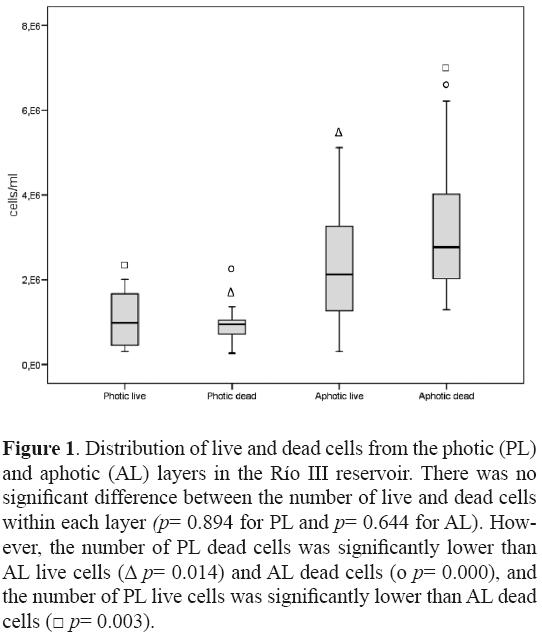
<body><![CDATA[<p align="justify"><font face="verdana" size="2">Este estudio constituye el primer an&aacute;lisis de la estructura de la comunidad del bacterioplancton en un reservorio de agua dulce de Argentina utilizando amplificaci&oacute;n completa del gen ADNr 16S. Incluye las relaciones filogen&eacute;ticas y una descripci&oacute;n del bacterioplacton de las zonas f&oacute;tica y af&oacute;tica del Embalse R&iacute;o III, C&oacute;rdoba, Argentina. El an&aacute;lisis ecol&oacute;gico cl&aacute;sico indic&oacute; que la zona f&oacute;tica ten&iacute;a mayor diversidad, mientras que la af&oacute;tica ten&iacute;a mayor abundancia y una distribuci&oacute;n m&aacute;s uniforme de especies. Sin embargo, cuando se utiliz&oacute; la informaci&oacute;n filogen&eacute;tica para comparar las comunidades microbianas de ambas zonas, este an&aacute;lisis indic&oacute; que ambos ambientes eran similares y que en ninguno predominaba alg&uacute;n linaje en particular. Los phyla identificados en el Embalse del R&iacute;o III fueron Acidobacteria, Actinobacteria y Proteobacteria. Las especies dominantes en ambas zonas fueron "<i>Candidatus Planktophila</i> sp." (clase Actinobacteria) y <i>Polynucleobacter</i> sp. (clase Betaproteobacteria).</font></p> 	    <p align="justify"><font face="verdana" size="2"><b>Palabras clave:</b> Actinobacteria, an&aacute;lisis filogen&eacute;tico, Proteobacteria, ADNr 16S.</font></p> 	    <p align="justify"><font face="verdana" size="2">&nbsp;</font></p> 	    <p align="justify"><font face="verdana" size="2">Prokaryotes represent a significant biomass component in aquatic planktonic ecosystems and play a major role in biogeochemical processes. Recent studies have examined the bacterioplankton community composition (BCC) in the epilimnion of freshwater lakes and reservoirs. As a result, a core group of bacterial phylotypes common to freshwater has emerged (Zwart et al., 2002), which shows that rivers and lakes have a specific bacterioplankton community, distinct from bacteria in environments such as soil and sediments. The dominant divisions include Proteobacteria, Bacteroidetes, Verrucomicrobia, Cyanobacteria, Actinobacteria, and green nonsulfur bacteria.</font></p> 	    <p align="justify"><font face="verdana" size="2">The R&iacute;o III Reservoir (32&deg;11' S, 64&deg;13' W) was built in 1936 over the R&iacute;o III for hydroelectric supply. The R&iacute;o III basin was strongly modified by damming for multipurpose uses including hydroelectricity, drinking water, and irrigation. Since then, water level fluctuations have been strongly reduced and the reservoir is usually oligo&#150;mesotrophic. The reservoir area is 4.3 km<sup>2</sup>, and has a volume of 5.6 &times; 10<sup>2</sup> hm<sup>3</sup>, with a mean depth of 12.2 m and a maximum depth of 46.5 m. Previous reports (Mari&ntilde;elarena et al., 2007, 2008) have focused on the planktonic abundance and biomass and bacterioplankton secondary production of this reservoir. Nevertheless, this study represents the first description of the bacterial community composition (BCC) of any freshwater inland water body in Argentina using molecular techniques and its results constitute the basis for future comparative studies.</font></p> 	    <p align="justify"><font face="verdana" size="2">Triplicate integrated samples of the water column were taken by pumping at 5 regular depth intervals during the month of September 2008. The limit between the photic (PL) and aphotic (AL) layers was established at the depth where 1% of the photosynthetically active radiation was measured (PAR 1%). Samples were stored at 4 &deg;C until they were processed. Three aliquots of 2 ml of water of each sample were processed according to Bostr&ouml;m et al. (2004). The 16S rDNA gene was amplified using universal bacterial primers 8f (5' AGA GTT TGA TCC TGG CTC AG 3') and 1542r (5' AGA AAG GAG GTG ATC CAG CC 3') (Crump et al., 1999). The PCR amplified 16S rDNA sequences were cloned into TOPO&#150;TA PCR Cloning Kit pCR 2.1&#150;TOPO Vector&reg; (Invitrogen, Carlsbald, California, USA) in accordance with the manufacturer's instructions and the ligation products were transformed into competent <i>Escherichia coli</i> DH5&#945;. DNA was purified with Illustra plasmidPrep Mini Spin Kit (GE Healthcare, Little Chalfont, Buckinghamshire, UK) and sequenced by Macrogen Inc, Korea.</font></p> 	    <p align="justify"><font face="verdana" size="2">The full or partial length 16S rDNA gene sequences from the 63 clones generated in this study were deposited in GenBank under accession numbers HQ008536 &#150; HQ008557 (from AL) and HQ008558 &#150; HQ008598 (from PL). Sequences were compared against 2 ribosomal databases: Ribosomal Database Project (RDP; <a href="http://rdp.cme.msu.edu/" target="_blank">http://rdp.cme.msu.edu/</a>; Cole et al., 2009) and EMBnet (<a href="http://www.ch.embnet.org/software/aBLAST.html" target="_blank">http://www.ch.embnet.org/software/aBLAST.html</a>). All sequences were checked for chimera using the <a href="http://www.bioinformatics-toolkit.org/Help/Topics/chimera.html" target="_blank">http://www.bioinformatics&#150;toolkit.org/Help/Topics/chimera.html</a> online tool, edited with BioEdit Sequence Alignment Editor 7.0.9.0, and aligned with Clustal &times; 2.0.11. Bayesian analysis (see details in <a href="/img/revistas/rmbiodiv/v83n2/a26f2.jpg" target="_blank">Figure 2</a>) was performed to build the phylogenetic tree using only full length 16S rDNA sequences, an outgroup (AB523784), and reference clones from GenBank.</font></p> 	    <p align="justify"><font face="verdana" size="2">To determine bacterial abundance, a volume of 200 &micro;l of water of each layer was filtered. Cells were stained with Live/Dead&reg;BacLightTM Bacterial Viability kit L&#150;13152 (Molecular Probes Inc., USA), according to the manufacturer's instructions. Fifteen photos of each sample were taken using a fluorescence binocular microscope (Leica DM 1000) with a built&#150;in CCD camera (CoolSNAP&#150;Pro cf color, Media Cybernetics). Cells were counted and their abundance was calculated using N= Y * A * D / a * v; where N is the number of bacteria per ml; Y is the average number of organisms per field; A is the effective filtration area; D is the dilution coefficient; a is the microscope's visual field area; v is the volume of filtered water sample. The SPSS 15.0 program was used to analyze and compare these values statistically.</font></p> 	    <p align="justify"><font face="verdana" size="2">The Shannon&#150;Wienner and Pielou indexes (Shannon and Wiener, 1949; Pielou, 1966) were used to describe generic diversity (H') and evenness (J) distribution in PL and AL communities. Clones which could not be resolved at the genus level (HQ008551, HQ008579, HQ008587) were incorporated in an upper level in the analysis.</font></p> 	    <p align="justify"><font face="verdana" size="2">After confronting the sequences to free databases, results were comparable in 51.42% of the cases. Only 1 clone was classified as unidentified bacteria (HQ008579) and clone HQ008548 was reclassified as <i>Polynucleobacter</i> sp. (phylum Proteobacteria; class Betaproteobacteria) at the moment of writing this research note. From the total of 63 clones, 41 corresponded to PL and 22 to AL (see <a href="/img/revistas/rmbiodiv/v83n2/a26t1.jpg" target="_blank">Table 1</a> and text below). Total bacteria abundance in the R&iacute;o III reservoir (<a href="#f1">Fig. 1</a>) was similar to others reports (Pedr&oacute;s&#150;Ali&oacute; and Guerrero, 1994), even though there was a significant difference between PL and AL, 2.32 &times; 106 cells/ml and 5.85 &times; 106 cells/ml, respectively (<i>P</i> = 0.000). Furthermore, the Shannon&#150;Wienner diversity index at genus level was 1.77 and 1.63 for PL and AL, respectively, whereas evenness was 0.77 and 0.84, respectively. This indicated that PL had a greater number of species but that the distribution of species in AL was more even, in concordance with previous studies (Markosova et al., 1990; Glockner et al., 1999).</font></p> 	    ]]></body>
<body><![CDATA[<p align="center"><font face="verdana" size="2"><a name="f1"></a></font></p> 	    <p align="center"><font face="verdana" size="2"><img src="/img/revistas/rmbiodiv/v83n2/a26f1.jpg"></font></p> 	    <p align="justify"><font face="verdana" size="2">Based on the relative abundance of clones, the most abundant group in both layers was "<i>Candidatus Planktophila</i> sp." (class Actinobacteria), comprising 36.59% (15/41) of clones from PL and 40.91% (9/22) from AL. <i>Polynucleobacter</i> sp. followed in abundance constituting 26.83% (11/41) of the clones from PL and 22.73% (5/22) from AL. For the rest of the clones, the relative abundance was lower than 10%. The prevalence of Actinobacteria clade acI in freshwater could be related to its high UV resistance capacity (Warnecke et al., 2005). The high number of Betaproteobacteria that inhabit freshwater could be due to its diverse metabolic composition (Burket et al., 2003), as this would enable phylogenetically similar taxa to occupy different niches within the same physical space (Newton et al., 2006). Furthermore, Actinobacteria and Betaproteobacteria tend to co&#150;occur and are very abundant in most lakes, suggesting continuous feeding with allochthonous bacteria from the catchment area (Barber&aacute;n and Casamayor, 2010). "<i>Candidatus Planktophila</i> sp." and Polynucleobacer sp. were dominant in both layers, also in accordance with previous reports (Jezbera et al., 2009; Barber&aacute;n and Casamayor, 2010; Hahn et al., 2010). Moreover, both species have a cosmopolitan distribution in freshwater and represent an important fraction of the plankton (Jezbera et al., 2009; Hahn et al., 2010).</font></p> 	    <p align="justify"><font face="verdana" size="2">Phylogenetic analysis (<a href="/img/revistas/rmbiodiv/v83n2/a26f2.jpg" target="_blank">Fig. 2</a>) revealed that the reservoir's bacterioplankton community comprised 3 phyla: Proteobacteria, Actinobacteria, and Acidobacteria. Furthermore, phyla Proteobacteria and Actinobacteria each formed 2 phylogenetically divergent groups (nodes <i>II</i> and <i>VI</i> for Actinobacteria and nodes <i>VII</i> and <i>XI</i> for Proteobacteria). The only representative of phylum Acidobacteria formed a branch (XV) phylogenetically more related to phylum Proteobacteria (node <i>X</i>). Phylogenetic clustering of Ca. Planktophila sp. (phylum Actinobacteria) (nodes <i>III </i>and <i>VI</i>) and <i>Polynucleobacter</i> sp. (phylum Proteobacteria) (nodes <i>VII</i> and <i>XI</i>), whose sequences dominated the BCC, indicated the existence of 2 evolutionarily divergent groups in each genera. More studies should be made to confirm and establish the significance of this divergence and to further characterize the natural bacterioplankton community and the way in which the environmental conditions determine the composition of this assemblage. In conclusion, this study represents the first analysis of bacterioplankton diversity from an Argentine freshwater reservoir using amplification of the entire 16S rDNA gene. The phyla found in the PL and AL of the R&iacute;o <i>III</i> reservoir in C&oacute;rdoba, province of Argentina, form part of the recently described core group of bacterial phylotypes common to freshwater (Zwart et al., 2002). Two genera, "<i>Candidatus Planktophila</i> sp." (class Actinobacteria) and <i>Polynucleobacter</i> sp. (class Betaproteobacteria), dominated the water column.</font></p> 	    <p align="justify"><font face="verdana" size="2">We thank Dr Miguel Di Siervi for his expertise and assistance with the microscope. This work was supported by ANPCYT, Ministerio de Ciencia, Tecnolog&iacute;a e Innovaci&oacute;n Productiva de la Naci&oacute;n, Argentina (grant PICT20366/07), and the Max Planck Society through the External Partner Laboratory Grant to R. V. R. P. (R. V. R. P. is a investigator of the Consejo Nacional de Ciencia y Tecnolog&iacute;a of Argentina, CONICET).</font></p> 	    <p align="justify"><font face="verdana" size="2">&nbsp;</font></p> 	    <p align="justify"><font face="verdana" size="2"><b>Literature cited</b></font></p> 	    <!-- ref --><p align="justify"><font face="verdana" size="2">Barber&aacute;n, A. and E. O. Casamayor. 2010. Global phylogenetic community structure and &#946;&#150;diversity patterns in surface bacterioplankton metacommunities. Aquatic Microbial Ecology 59:1&#150;10.    &nbsp;&nbsp;&nbsp;&nbsp;&nbsp;&nbsp;&nbsp;&nbsp;[&#160;<a href="javascript:void(0);" onclick="javascript: window.open('/scielo.php?script=sci_nlinks&ref=7565500&pid=S1870-3453201200020002600001&lng=','','width=640,height=500,resizable=yes,scrollbars=1,menubar=yes,');">Links</a>&#160;]<!-- end-ref --></font></p> 	    <!-- ref --><p align="justify"><font face="verdana" size="2">Bostr&ouml;m, K. H., K. Simu, A. Hagstr&ouml;m and L. Riemann. 2004. Optimization of DNA extraction for quantitative marine bacterioplankton community analysis. Limnology Oceanography: Methods 2:365&#150;373.    &nbsp;&nbsp;&nbsp;&nbsp;&nbsp;&nbsp;&nbsp;&nbsp;[&#160;<a href="javascript:void(0);" onclick="javascript: window.open('/scielo.php?script=sci_nlinks&ref=7565502&pid=S1870-3453201200020002600002&lng=','','width=640,height=500,resizable=yes,scrollbars=1,menubar=yes,');">Links</a>&#160;]<!-- end-ref --></font></p> 	    <!-- ref --><p align="justify"><font face="verdana" size="2">Burkert, U., F. Warnecke, D. Babenzien, E. Zwirnmann and J. Pernthaler. 2003. Members of a readily enriched beta&#150;proteobacterial clade are common in surface waters of a humic lake. Applied and Environmental Microbiology 69:6550&#150;6559.    &nbsp;&nbsp;&nbsp;&nbsp;&nbsp;&nbsp;&nbsp;&nbsp;[&#160;<a href="javascript:void(0);" onclick="javascript: window.open('/scielo.php?script=sci_nlinks&ref=7565504&pid=S1870-3453201200020002600003&lng=','','width=640,height=500,resizable=yes,scrollbars=1,menubar=yes,');">Links</a>&#160;]<!-- end-ref --></font></p> 	    <!-- ref --><p align="justify"><font face="verdana" size="2">Cole, J. R., Q. Wang, E. Cardenas, J. Fish, B. Chai, R. J. Farris, A. S. Kulam&#150;Syed&#150;Mohideen, D. M. McGarrell, T. Marsh, G. M. Garrity and J. M. Tiedje. 2009. The Ribosomal Database Project: improved alignments and new tools for rRNA analysis. Nucleic Acids Research 37:141&#150;145.    &nbsp;&nbsp;&nbsp;&nbsp;&nbsp;&nbsp;&nbsp;&nbsp;[&#160;<a href="javascript:void(0);" onclick="javascript: window.open('/scielo.php?script=sci_nlinks&ref=7565506&pid=S1870-3453201200020002600004&lng=','','width=640,height=500,resizable=yes,scrollbars=1,menubar=yes,');">Links</a>&#160;]<!-- end-ref --></font></p> 	    <!-- ref --><p align="justify"><font face="verdana" size="2">Crump, B. C., E. V. Armbrust and J. A. Baross. 1999. Phylogenetic analysis of particle&#150;attached and free&#150;living bacterial communities in the Columbia River, its estuary, and the adjacent coastal ocean. Applied and Environmental Microbiology 65:3192&#150;3204.    &nbsp;&nbsp;&nbsp;&nbsp;&nbsp;&nbsp;&nbsp;&nbsp;[&#160;<a href="javascript:void(0);" onclick="javascript: window.open('/scielo.php?script=sci_nlinks&ref=7565508&pid=S1870-3453201200020002600005&lng=','','width=640,height=500,resizable=yes,scrollbars=1,menubar=yes,');">Links</a>&#160;]<!-- end-ref --></font></p> 	    <!-- ref --><p align="justify"><font face="verdana" size="2">Glockner, F. O., B. M. Fuchs and R. Amann. 1999. Bacterioplankton compositions of lakes and oceans: a first comparison based on fluorescence in situ hybridization. Applied and Environmental Microbiology 65:3721&#150;3726.    &nbsp;&nbsp;&nbsp;&nbsp;&nbsp;&nbsp;&nbsp;&nbsp;[&#160;<a href="javascript:void(0);" onclick="javascript: window.open('/scielo.php?script=sci_nlinks&ref=7565510&pid=S1870-3453201200020002600006&lng=','','width=640,height=500,resizable=yes,scrollbars=1,menubar=yes,');">Links</a>&#160;]<!-- end-ref --></font></p> 	    <!-- ref --><p align="justify"><font face="verdana" size="2">Hahn, M. W., E. Lang, U. Brandt, H. Lunsdorf, Q. L. Wu and E. Stackebrandt. 2010. <i>Polynucleobacter</i> cosmopolitanus sp. nov., free&#150;living planktonic bacteria inhabiting freshwater lakes and rivers. International Journal of Systematic Evolutionary Microbiology 60:166&#150;173.    &nbsp;&nbsp;&nbsp;&nbsp;&nbsp;&nbsp;&nbsp;&nbsp;[&#160;<a href="javascript:void(0);" onclick="javascript: window.open('/scielo.php?script=sci_nlinks&ref=7565512&pid=S1870-3453201200020002600007&lng=','','width=640,height=500,resizable=yes,scrollbars=1,menubar=yes,');">Links</a>&#160;]<!-- end-ref --></font></p> 	    <!-- ref --><p align="justify"><font face="verdana" size="2">Jezbera, J., A. K. Sharma, U. Brandt, W. F. Doolittle and M. W. Hahn. 2009. '<i>Candidatus Planktophila</i> limnetica', an actinobacterium representing one of the most numerically important taxa in freshwater bacterioplankton. International Journal of Systematic Evolutionary Microbiology 59:2864&#150;2869.    &nbsp;&nbsp;&nbsp;&nbsp;&nbsp;&nbsp;&nbsp;&nbsp;[&#160;<a href="javascript:void(0);" onclick="javascript: window.open('/scielo.php?script=sci_nlinks&ref=7565514&pid=S1870-3453201200020002600008&lng=','','width=640,height=500,resizable=yes,scrollbars=1,menubar=yes,');">Links</a>&#160;]<!-- end-ref --></font></p> 	    <!-- ref --><p align="justify"><font face="verdana" size="2">Mari&ntilde;elarena, A., M. Casco, C. Claps, M. Di Siervi, J. Donadelli, M. Hechem, D. Colautti, M. Mac Donagh, L. Balboni and D. Ardohain. 2007. Estudio limnol&oacute;gico del Embalse del R&iacute;o III, C&oacute;rdoba. Informe final. Instituto de Limnolog&iacute;a "Ra&uacute;l A Ringuelet". Universidad Nacional de La Plata &#150; CONICET, Florencio Varela.    &nbsp;&nbsp;&nbsp;&nbsp;&nbsp;&nbsp;&nbsp;&nbsp;[&#160;<a href="javascript:void(0);" onclick="javascript: window.open('/scielo.php?script=sci_nlinks&ref=7565516&pid=S1870-3453201200020002600009&lng=','','width=640,height=500,resizable=yes,scrollbars=1,menubar=yes,');">Links</a>&#160;]<!-- end-ref --></font></p> 	    <!-- ref --><p align="justify"><font face="verdana" size="2">Mari&ntilde;elarena, A., M. Casco, C. Claps, M. Di Siervi, J. Donadelli, M. Hechem, D. Colautti, M. Mac Donagh, L. Balboni and D. Ardohain. 2008. Estudio limnol&oacute;gico del Embalse del R&iacute;o III, C&oacute;rdoba. Informe final. Instituto de Limnolog&iacute;a "Ra&uacute;l A Ringuelet". Universidad Nacional de La Plata &#150; CONICET, Florencio Varela.    &nbsp;&nbsp;&nbsp;&nbsp;&nbsp;&nbsp;&nbsp;&nbsp;[&#160;<a href="javascript:void(0);" onclick="javascript: window.open('/scielo.php?script=sci_nlinks&ref=7565518&pid=S1870-3453201200020002600010&lng=','','width=640,height=500,resizable=yes,scrollbars=1,menubar=yes,');">Links</a>&#160;]<!-- end-ref --></font></p> 	    <!-- ref --><p align="justify"><font face="verdana" size="2">Markosova, R., M. Benediktova and A. Volkova. 1990. Time and vertical distribution of bacterioplankton in a shallow eutrophic reservoir. Water Research 24:1057&#150;1067.    &nbsp;&nbsp;&nbsp;&nbsp;&nbsp;&nbsp;&nbsp;&nbsp;[&#160;<a href="javascript:void(0);" onclick="javascript: window.open('/scielo.php?script=sci_nlinks&ref=7565520&pid=S1870-3453201200020002600011&lng=','','width=640,height=500,resizable=yes,scrollbars=1,menubar=yes,');">Links</a>&#160;]<!-- end-ref --></font></p> 	    <!-- ref --><p align="justify"><font face="verdana" size="2">Newton, R. J., A. D. Kent, E. W. Triplett and K. D. Mcmahon. 2006. Microbial community dynamics in a humic lake: differential persistence of common freshwater phylotypes. Environmental Microbiology 8:956&#150;970.    &nbsp;&nbsp;&nbsp;&nbsp;&nbsp;&nbsp;&nbsp;&nbsp;[&#160;<a href="javascript:void(0);" onclick="javascript: window.open('/scielo.php?script=sci_nlinks&ref=7565522&pid=S1870-3453201200020002600012&lng=','','width=640,height=500,resizable=yes,scrollbars=1,menubar=yes,');">Links</a>&#160;]<!-- end-ref --></font></p> 	    <!-- ref --><p align="justify"><font face="verdana" size="2">Pedr&oacute;s&#150;Ali&oacute;, C. and R. Guerrero. 1994. Prokaryotology for the limnologist. In Limnology now: a paradigm of planetary problems, R. Margalef (ed.). Elsevier, Amsterdam. p. 37&#150;57.    &nbsp;&nbsp;&nbsp;&nbsp;&nbsp;&nbsp;&nbsp;&nbsp;[&#160;<a href="javascript:void(0);" onclick="javascript: window.open('/scielo.php?script=sci_nlinks&ref=7565524&pid=S1870-3453201200020002600013&lng=','','width=640,height=500,resizable=yes,scrollbars=1,menubar=yes,');">Links</a>&#160;]<!-- end-ref --></font></p> 	    <!-- ref --><p align="justify"><font face="verdana" size="2">Pielou, E. C. 1966. Species&#150;diversity and pattern&#150;diversity in the study of ecological succession. Journal of Theoretical Biology 10:370&#150;383.    &nbsp;&nbsp;&nbsp;&nbsp;&nbsp;&nbsp;&nbsp;&nbsp;[&#160;<a href="javascript:void(0);" onclick="javascript: window.open('/scielo.php?script=sci_nlinks&ref=7565526&pid=S1870-3453201200020002600014&lng=','','width=640,height=500,resizable=yes,scrollbars=1,menubar=yes,');">Links</a>&#160;]<!-- end-ref --></font></p> 	    <!-- ref --><p align="justify"><font face="verdana" size="2">Shannon, C. E. and W. Wiener. 1949. The mathematical theory of communication. Urbana: University of Illinois Press. 125 p.    &nbsp;&nbsp;&nbsp;&nbsp;&nbsp;&nbsp;&nbsp;&nbsp;[&#160;<a href="javascript:void(0);" onclick="javascript: window.open('/scielo.php?script=sci_nlinks&ref=7565528&pid=S1870-3453201200020002600015&lng=','','width=640,height=500,resizable=yes,scrollbars=1,menubar=yes,');">Links</a>&#160;]<!-- end-ref --></font></p> 	    <!-- ref --><p align="justify"><font face="verdana" size="2">Warnecke, F., R. Sommaruga, R. Sekar, J. S. Hofer and J. Pernthaler. 2005. Abundances, identity, and growth state of actinobacteria in mountain lakes of different UV transparency. Applied and Environmental Microbiology 71:5551&#150;5559.    &nbsp;&nbsp;&nbsp;&nbsp;&nbsp;&nbsp;&nbsp;&nbsp;[&#160;<a href="javascript:void(0);" onclick="javascript: window.open('/scielo.php?script=sci_nlinks&ref=7565530&pid=S1870-3453201200020002600016&lng=','','width=640,height=500,resizable=yes,scrollbars=1,menubar=yes,');">Links</a>&#160;]<!-- end-ref --></font></p> 	    <!-- ref --><p align="justify"><font face="verdana" size="2">Zwart, G., B. C. Crump, M. P. Kamst&#150;Van Agterveld, F. Hagen and S. K. Han. 2002. Typical freshwater bacteria: an analysis of available 16S rRNA gene sequences from plankton of lakes and rivers. Aquatic Microbial Ecology 28:141&#150;155.    &nbsp;&nbsp;&nbsp;&nbsp;&nbsp;&nbsp;&nbsp;&nbsp;[&#160;<a href="javascript:void(0);" onclick="javascript: window.open('/scielo.php?script=sci_nlinks&ref=7565532&pid=S1870-3453201200020002600017&lng=','','width=640,height=500,resizable=yes,scrollbars=1,menubar=yes,');">Links</a>&#160;]<!-- end-ref --></font></p>      ]]></body><back>
<ref-list>
<ref id="B1">
<nlm-citation citation-type="journal">
<person-group person-group-type="author">
<name>
<surname><![CDATA[Barberán]]></surname>
<given-names><![CDATA[A.]]></given-names>
</name>
<name>
<surname><![CDATA[Casamayor]]></surname>
<given-names><![CDATA[E. O.]]></given-names>
</name>
</person-group>
<article-title xml:lang="en"><![CDATA[Global phylogenetic community structure and &#946;-diversity patterns in surface bacterioplankton metacommunities]]></article-title>
<source><![CDATA[Aquatic Microbial Ecology]]></source>
<year>2010</year>
<volume>59</volume>
<page-range>1-10</page-range></nlm-citation>
</ref>
<ref id="B2">
<nlm-citation citation-type="journal">
<person-group person-group-type="author">
<name>
<surname><![CDATA[Boström]]></surname>
<given-names><![CDATA[K. H.]]></given-names>
</name>
<name>
<surname><![CDATA[Simu]]></surname>
<given-names><![CDATA[K.]]></given-names>
</name>
<name>
<surname><![CDATA[Hagström]]></surname>
<given-names><![CDATA[A.]]></given-names>
</name>
<name>
<surname><![CDATA[Riemann]]></surname>
<given-names><![CDATA[L.]]></given-names>
</name>
</person-group>
<article-title xml:lang="en"><![CDATA[Optimization of DNA extraction for quantitative marine bacterioplankton community analysis]]></article-title>
<source><![CDATA[Limnology Oceanography: Methods]]></source>
<year>2004</year>
<volume>2</volume>
<page-range>365-373</page-range></nlm-citation>
</ref>
<ref id="B3">
<nlm-citation citation-type="journal">
<person-group person-group-type="author">
<name>
<surname><![CDATA[Burkert]]></surname>
<given-names><![CDATA[U.]]></given-names>
</name>
<name>
<surname><![CDATA[Warnecke]]></surname>
<given-names><![CDATA[F.]]></given-names>
</name>
<name>
<surname><![CDATA[Babenzien]]></surname>
<given-names><![CDATA[D.]]></given-names>
</name>
<name>
<surname><![CDATA[Zwirnmann]]></surname>
<given-names><![CDATA[E.]]></given-names>
</name>
<name>
<surname><![CDATA[Pernthaler]]></surname>
<given-names><![CDATA[J.]]></given-names>
</name>
</person-group>
<article-title xml:lang="en"><![CDATA[Members of a readily enriched beta-proteobacterial clade are common in surface waters of a humic lake]]></article-title>
<source><![CDATA[Applied and Environmental Microbiology]]></source>
<year>2003</year>
<volume>69</volume>
<page-range>6550-6559</page-range></nlm-citation>
</ref>
<ref id="B4">
<nlm-citation citation-type="journal">
<person-group person-group-type="author">
<name>
<surname><![CDATA[Cole]]></surname>
<given-names><![CDATA[J. R.]]></given-names>
</name>
<name>
<surname><![CDATA[Wang]]></surname>
<given-names><![CDATA[Q.]]></given-names>
</name>
<name>
<surname><![CDATA[Cardenas]]></surname>
<given-names><![CDATA[E.]]></given-names>
</name>
<name>
<surname><![CDATA[Fish]]></surname>
<given-names><![CDATA[J.]]></given-names>
</name>
<name>
<surname><![CDATA[Chai]]></surname>
<given-names><![CDATA[B.]]></given-names>
</name>
<name>
<surname><![CDATA[Farris]]></surname>
<given-names><![CDATA[R. J.]]></given-names>
</name>
<name>
<surname><![CDATA[Kulam-Syed-Mohideen]]></surname>
<given-names><![CDATA[A. S.]]></given-names>
</name>
<name>
<surname><![CDATA[McGarrell]]></surname>
<given-names><![CDATA[D. M.]]></given-names>
</name>
<name>
<surname><![CDATA[Marsh]]></surname>
<given-names><![CDATA[T.]]></given-names>
</name>
<name>
<surname><![CDATA[Garrity]]></surname>
<given-names><![CDATA[G. M.]]></given-names>
</name>
<name>
<surname><![CDATA[Tiedje]]></surname>
<given-names><![CDATA[J. M.]]></given-names>
</name>
</person-group>
<article-title xml:lang="en"><![CDATA[The Ribosomal Database Project: improved alignments and new tools for rRNA analysis]]></article-title>
<source><![CDATA[Nucleic Acids Research]]></source>
<year>2009</year>
<volume>37</volume>
<page-range>141-145</page-range></nlm-citation>
</ref>
<ref id="B5">
<nlm-citation citation-type="journal">
<person-group person-group-type="author">
<name>
<surname><![CDATA[Crump]]></surname>
<given-names><![CDATA[B. C.]]></given-names>
</name>
<name>
<surname><![CDATA[Armbrust]]></surname>
<given-names><![CDATA[E. V.]]></given-names>
</name>
<name>
<surname><![CDATA[Baross]]></surname>
<given-names><![CDATA[J. A.]]></given-names>
</name>
</person-group>
<article-title xml:lang="en"><![CDATA[Phylogenetic analysis of particle-attached and free-living bacterial communities in the Columbia River, its estuary, and the adjacent coastal ocean]]></article-title>
<source><![CDATA[Applied and Environmental Microbiology]]></source>
<year>1999</year>
<volume>65</volume>
<page-range>3192-3204</page-range></nlm-citation>
</ref>
<ref id="B6">
<nlm-citation citation-type="journal">
<person-group person-group-type="author">
<name>
<surname><![CDATA[Glockner]]></surname>
<given-names><![CDATA[F. O.]]></given-names>
</name>
<name>
<surname><![CDATA[Fuchs]]></surname>
<given-names><![CDATA[B. M.]]></given-names>
</name>
<name>
<surname><![CDATA[Amann]]></surname>
<given-names><![CDATA[R.]]></given-names>
</name>
</person-group>
<article-title xml:lang="en"><![CDATA[Bacterioplankton compositions of lakes and oceans: a first comparison based on fluorescence in situ hybridization]]></article-title>
<source><![CDATA[Applied and Environmental Microbiology]]></source>
<year>1999</year>
<volume>65</volume>
<page-range>3721-3726</page-range></nlm-citation>
</ref>
<ref id="B7">
<nlm-citation citation-type="journal">
<person-group person-group-type="author">
<name>
<surname><![CDATA[Hahn]]></surname>
<given-names><![CDATA[M. W.]]></given-names>
</name>
<name>
<surname><![CDATA[Lang]]></surname>
<given-names><![CDATA[E.]]></given-names>
</name>
<name>
<surname><![CDATA[Brandt]]></surname>
<given-names><![CDATA[U.]]></given-names>
</name>
<name>
<surname><![CDATA[Lunsdorf]]></surname>
<given-names><![CDATA[H.]]></given-names>
</name>
<name>
<surname><![CDATA[Wu]]></surname>
<given-names><![CDATA[Q. L.]]></given-names>
</name>
<name>
<surname><![CDATA[Stackebrandt]]></surname>
<given-names><![CDATA[E.]]></given-names>
</name>
</person-group>
<article-title xml:lang="en"><![CDATA[Polynucleobacter cosmopolitanus sp. nov., free-living planktonic bacteria inhabiting freshwater lakes and rivers]]></article-title>
<source><![CDATA[International Journal of Systematic Evolutionary Microbiology]]></source>
<year>2010</year>
<volume>60</volume>
<page-range>166-173</page-range></nlm-citation>
</ref>
<ref id="B8">
<nlm-citation citation-type="journal">
<person-group person-group-type="author">
<name>
<surname><![CDATA[Jezbera]]></surname>
<given-names><![CDATA[J.]]></given-names>
</name>
<name>
<surname><![CDATA[Sharma]]></surname>
<given-names><![CDATA[A. K.]]></given-names>
</name>
<name>
<surname><![CDATA[Brandt]]></surname>
<given-names><![CDATA[U.]]></given-names>
</name>
<name>
<surname><![CDATA[Doolittle]]></surname>
<given-names><![CDATA[W. F.]]></given-names>
</name>
<name>
<surname><![CDATA[Hahn]]></surname>
<given-names><![CDATA[M. W.]]></given-names>
</name>
</person-group>
<article-title xml:lang="en"><![CDATA['Candidatus Planktophila limnetica', an actinobacterium representing one of the most numerically important taxa in freshwater bacterioplankton]]></article-title>
<source><![CDATA[International Journal of Systematic Evolutionary Microbiology]]></source>
<year>2009</year>
<volume>59</volume>
<page-range>2864-2869</page-range></nlm-citation>
</ref>
<ref id="B9">
<nlm-citation citation-type="book">
<person-group person-group-type="author">
<name>
<surname><![CDATA[Mariñelarena]]></surname>
<given-names><![CDATA[A.]]></given-names>
</name>
<name>
<surname><![CDATA[Casco]]></surname>
<given-names><![CDATA[M.]]></given-names>
</name>
<name>
<surname><![CDATA[Claps]]></surname>
<given-names><![CDATA[C.]]></given-names>
</name>
<name>
<surname><![CDATA[Di Siervi]]></surname>
<given-names><![CDATA[M.]]></given-names>
</name>
<name>
<surname><![CDATA[Donadelli]]></surname>
<given-names><![CDATA[J.]]></given-names>
</name>
<name>
<surname><![CDATA[Hechem]]></surname>
<given-names><![CDATA[M.]]></given-names>
</name>
<name>
<surname><![CDATA[Colautti]]></surname>
<given-names><![CDATA[D.]]></given-names>
</name>
<name>
<surname><![CDATA[Mac Donagh]]></surname>
<given-names><![CDATA[M.]]></given-names>
</name>
<name>
<surname><![CDATA[Balboni]]></surname>
<given-names><![CDATA[L.]]></given-names>
</name>
<name>
<surname><![CDATA[Ardohain]]></surname>
<given-names><![CDATA[D.]]></given-names>
</name>
</person-group>
<source><![CDATA[Estudio limnológico del Embalse del Río III, Córdoba. Informe final]]></source>
<year>2007</year>
<publisher-loc><![CDATA[Florencio Varela ]]></publisher-loc>
<publisher-name><![CDATA[Instituto de Limnología "Raúl A Ringuelet". Universidad Nacional de La PlataCONICET]]></publisher-name>
</nlm-citation>
</ref>
<ref id="B10">
<nlm-citation citation-type="book">
<person-group person-group-type="author">
<name>
<surname><![CDATA[Mariñelarena]]></surname>
<given-names><![CDATA[A.]]></given-names>
</name>
<name>
<surname><![CDATA[Casco]]></surname>
<given-names><![CDATA[M.]]></given-names>
</name>
<name>
<surname><![CDATA[Claps]]></surname>
<given-names><![CDATA[C.]]></given-names>
</name>
<name>
<surname><![CDATA[Di Siervi]]></surname>
<given-names><![CDATA[M.]]></given-names>
</name>
<name>
<surname><![CDATA[Donadelli]]></surname>
<given-names><![CDATA[J.]]></given-names>
</name>
<name>
<surname><![CDATA[Hechem]]></surname>
<given-names><![CDATA[M.]]></given-names>
</name>
<name>
<surname><![CDATA[Colautti]]></surname>
<given-names><![CDATA[D.]]></given-names>
</name>
<name>
<surname><![CDATA[Mac Donagh]]></surname>
<given-names><![CDATA[M.]]></given-names>
</name>
<name>
<surname><![CDATA[Balboni]]></surname>
<given-names><![CDATA[L.]]></given-names>
</name>
<name>
<surname><![CDATA[Ardohain]]></surname>
<given-names><![CDATA[D.]]></given-names>
</name>
</person-group>
<source><![CDATA[Estudio limnológico del Embalse del Río III, Córdoba. Informe final]]></source>
<year>2008</year>
<publisher-loc><![CDATA[Florencio Varela ]]></publisher-loc>
<publisher-name><![CDATA[Instituto de Limnología "Raúl A Ringuelet". Universidad Nacional de La PlataCONICET]]></publisher-name>
</nlm-citation>
</ref>
<ref id="B11">
<nlm-citation citation-type="journal">
<person-group person-group-type="author">
<name>
<surname><![CDATA[Markosova]]></surname>
<given-names><![CDATA[R.]]></given-names>
</name>
<name>
<surname><![CDATA[Benediktova]]></surname>
<given-names><![CDATA[M.]]></given-names>
</name>
<name>
<surname><![CDATA[Volkova]]></surname>
<given-names><![CDATA[A.]]></given-names>
</name>
</person-group>
<article-title xml:lang="en"><![CDATA[Time and vertical distribution of bacterioplankton in a shallow eutrophic reservoir]]></article-title>
<source><![CDATA[Water Research]]></source>
<year>1990</year>
<volume>24</volume>
<page-range>1057-1067</page-range></nlm-citation>
</ref>
<ref id="B12">
<nlm-citation citation-type="journal">
<person-group person-group-type="author">
<name>
<surname><![CDATA[Newton]]></surname>
<given-names><![CDATA[R. J.]]></given-names>
</name>
<name>
<surname><![CDATA[Kent]]></surname>
<given-names><![CDATA[A. D.]]></given-names>
</name>
<name>
<surname><![CDATA[Triplett]]></surname>
<given-names><![CDATA[E. W.]]></given-names>
</name>
<name>
<surname><![CDATA[Mcmahon]]></surname>
<given-names><![CDATA[K. D.]]></given-names>
</name>
</person-group>
<article-title xml:lang="en"><![CDATA[Microbial community dynamics in a humic lake: differential persistence of common freshwater phylotypes]]></article-title>
<source><![CDATA[Environmental Microbiology]]></source>
<year>2006</year>
<volume>8</volume>
<page-range>956-970</page-range></nlm-citation>
</ref>
<ref id="B13">
<nlm-citation citation-type="book">
<person-group person-group-type="author">
<name>
<surname><![CDATA[Pedrós-Alió]]></surname>
<given-names><![CDATA[C.]]></given-names>
</name>
<name>
<surname><![CDATA[Guerrero]]></surname>
<given-names><![CDATA[R.]]></given-names>
</name>
</person-group>
<article-title xml:lang="en"><![CDATA[Prokaryotology for the limnologist]]></article-title>
<person-group person-group-type="editor">
<name>
<surname><![CDATA[Margalef]]></surname>
<given-names><![CDATA[R.]]></given-names>
</name>
</person-group>
<source><![CDATA[Limnology now: a paradigm of planetary problems]]></source>
<year>1994</year>
<page-range>37-57</page-range><publisher-loc><![CDATA[Amsterdam ]]></publisher-loc>
<publisher-name><![CDATA[Elsevier]]></publisher-name>
</nlm-citation>
</ref>
<ref id="B14">
<nlm-citation citation-type="journal">
<person-group person-group-type="author">
<name>
<surname><![CDATA[Pielou]]></surname>
<given-names><![CDATA[E. C]]></given-names>
</name>
</person-group>
<article-title xml:lang="en"><![CDATA[Species-diversity and pattern-diversity in the study of ecological succession]]></article-title>
<source><![CDATA[Journal of Theoretical Biology]]></source>
<year>1966</year>
<volume>10</volume>
<page-range>370-383</page-range></nlm-citation>
</ref>
<ref id="B15">
<nlm-citation citation-type="book">
<person-group person-group-type="author">
<name>
<surname><![CDATA[Shannon]]></surname>
<given-names><![CDATA[C. E.]]></given-names>
</name>
<name>
<surname><![CDATA[Wiener]]></surname>
<given-names><![CDATA[W.]]></given-names>
</name>
</person-group>
<source><![CDATA[The mathematical theory of communication. Urbana]]></source>
<year>1949</year>
<page-range>125</page-range><publisher-name><![CDATA[University of Illinois Press]]></publisher-name>
</nlm-citation>
</ref>
<ref id="B16">
<nlm-citation citation-type="journal">
<person-group person-group-type="author">
<name>
<surname><![CDATA[Warnecke]]></surname>
<given-names><![CDATA[F.]]></given-names>
</name>
<name>
<surname><![CDATA[Sommaruga]]></surname>
<given-names><![CDATA[R.]]></given-names>
</name>
<name>
<surname><![CDATA[Sekar]]></surname>
<given-names><![CDATA[R.]]></given-names>
</name>
<name>
<surname><![CDATA[Hofer]]></surname>
<given-names><![CDATA[J. S.]]></given-names>
</name>
<name>
<surname><![CDATA[Pernthaler]]></surname>
<given-names><![CDATA[J.]]></given-names>
</name>
</person-group>
<article-title xml:lang="en"><![CDATA[Abundances, identity, and growth state of actinobacteria in mountain lakes of different UV transparency]]></article-title>
<source><![CDATA[Applied and Environmental Microbiology]]></source>
<year>2005</year>
<volume>71</volume>
<page-range>5551-5559</page-range></nlm-citation>
</ref>
<ref id="B17">
<nlm-citation citation-type="journal">
<person-group person-group-type="author">
<name>
<surname><![CDATA[Zwart]]></surname>
<given-names><![CDATA[G.]]></given-names>
</name>
<name>
<surname><![CDATA[Crump]]></surname>
<given-names><![CDATA[B. C.]]></given-names>
</name>
<name>
<surname><![CDATA[Kamst-Van Agterveld]]></surname>
<given-names><![CDATA[M. P.]]></given-names>
</name>
<name>
<surname><![CDATA[Hagen]]></surname>
<given-names><![CDATA[F.]]></given-names>
</name>
<name>
<surname><![CDATA[Han]]></surname>
<given-names><![CDATA[S. K.]]></given-names>
</name>
</person-group>
<article-title xml:lang="en"><![CDATA[Typical freshwater bacteria: an analysis of available 16S rRNA gene sequences from plankton of lakes and rivers]]></article-title>
<source><![CDATA[Aquatic Microbial Ecology]]></source>
<year>2002</year>
<volume>28</volume>
<page-range>141-155</page-range></nlm-citation>
</ref>
</ref-list>
</back>
</article>
