<?xml version="1.0" encoding="ISO-8859-1"?><article xmlns:mml="http://www.w3.org/1998/Math/MathML" xmlns:xlink="http://www.w3.org/1999/xlink" xmlns:xsi="http://www.w3.org/2001/XMLSchema-instance">
<front>
<journal-meta>
<journal-id>1870-3453</journal-id>
<journal-title><![CDATA[Revista mexicana de biodiversidad]]></journal-title>
<abbrev-journal-title><![CDATA[Rev. Mex. Biodiv.]]></abbrev-journal-title>
<issn>1870-3453</issn>
<publisher>
<publisher-name><![CDATA[Instituto de Biología]]></publisher-name>
</publisher>
</journal-meta>
<article-meta>
<article-id>S1870-34532012000200022</article-id>
<title-group>
<article-title xml:lang="en"><![CDATA[Knowledge of the Yucatec Maya in seasonal tropical forest management: the forage plants]]></article-title>
<article-title xml:lang="es"><![CDATA[El conocimiento de los mayas yucatecos en el manejo del bosque tropical estacional: las plantas forrajeras]]></article-title>
</title-group>
<contrib-group>
<contrib contrib-type="author">
<name>
<surname><![CDATA[Flores]]></surname>
<given-names><![CDATA[José Salvador]]></given-names>
</name>
<xref ref-type="aff" rid="A01"/>
</contrib>
<contrib contrib-type="author">
<name>
<surname><![CDATA[Bautista]]></surname>
<given-names><![CDATA[Francisco]]></given-names>
</name>
<xref ref-type="aff" rid="A02"/>
</contrib>
</contrib-group>
<aff id="A01">
<institution><![CDATA[,Universidad Autónoma de Yucatán Departamento de Botánica ]]></institution>
<addr-line><![CDATA[Mérida Yucatán]]></addr-line>
<country>México</country>
</aff>
<aff id="A02">
<institution><![CDATA[,Universidad Nacional Autónoma de México Centro de Investigaciones en Geografía Ambiental ]]></institution>
<addr-line><![CDATA[Morelia Michoacán]]></addr-line>
<country>México</country>
</aff>
<pub-date pub-type="pub">
<day>00</day>
<month>06</month>
<year>2012</year>
</pub-date>
<pub-date pub-type="epub">
<day>00</day>
<month>06</month>
<year>2012</year>
</pub-date>
<volume>83</volume>
<numero>2</numero>
<fpage>503</fpage>
<lpage>518</lpage>
<copyright-statement/>
<copyright-year/>
<self-uri xlink:href="http://www.scielo.org.mx/scielo.php?script=sci_arttext&amp;pid=S1870-34532012000200022&amp;lng=en&amp;nrm=iso"></self-uri><self-uri xlink:href="http://www.scielo.org.mx/scielo.php?script=sci_abstract&amp;pid=S1870-34532012000200022&amp;lng=en&amp;nrm=iso"></self-uri><self-uri xlink:href="http://www.scielo.org.mx/scielo.php?script=sci_pdf&amp;pid=S1870-34532012000200022&amp;lng=en&amp;nrm=iso"></self-uri><abstract abstract-type="short" xml:lang="en"><p><![CDATA[Indigenous knowledge and the millenary experience in management of natural vegetation on karstic landscapes are important aspects that should be considered in animal production in seasonal tropical environments. The aim of the present work was to make an inventory of native plants associated to soilscapes from seasonal tropical forests from the Yucatán Peninsula that are used as forage by Mayan people. The work was carried out in 27 Mayan communities on karst landscapes in the Yucatán Peninsula as a part of the "Ethnoflora Yucatanense" project of the Universidad Autónoma de Yucatán. Samples were taken of forage plants together with corresponding floristic and ethnobotanical information. Data were processed in EXCEL dynamic tables, grouped by plant family, geoforms and soils, life form and animal consumers. Results indicate that Mayan communities use 196 plant species as forage: 139 herbaceous, 17 shrubs, 35 trees and 2 palms. These plants are fed to cows, pigs, horses, lambs, turkeys, chickens, ducks and pigeons. The use of native forage plants may be an agricultural option both for rural communities and for intensive animal production on silvopastoral systems on karstic tropical landscapes from the Yucatán Peninsula.]]></p></abstract>
<abstract abstract-type="short" xml:lang="es"><p><![CDATA[El conocimiento indígena y la experiencia de milenios de años en el manejo de la vegetación natural en ambientes kársticos tropicales son aspectos importantes que deben ser considerados en la producción animal. El objetivo de este trabajo fue hacer un inventario de las plantas forrajeras nativas de los bosques tropicales estacionales de la península de Yucatán que son utilizadas por los mayas, incluyendo los paisajes edáficos en los que se encuentran las plantas, información que servirá de base para la planeación de las actividades agropecuarias. El trabajo se llevó al cabo en 27 comunidades indígenas mayas, como parte del proyecto "Etnoflora Yucatanense" de la Universidad Autónoma de Yucatán. Las muestras de plantas forrajeras se tomaron con información florística y etnobotánica. Los datos se manejaron mediante tablas dinámicas en Excel y fueron agrupados por familia florística, geoforma, forma de vida y por los animales que las consumen. Las comunidades mayas utilizan 196 especies de plantas para alimentar a los animales: 139 herbáceas, 17 arbustos, 35 árboles y dos palmeras. Las plantas forrajeras nativas son utilizadas para alimentar vacas, cerdos, caballos, corderos, pavos, pollos, patos y palomas. Las plantas forrajeras nativas pueden ser una opción de mejoramiento de la agricultura de temporal y también para la producción animal intensiva en sistemas silvopastoriles en los paisajes kársticos tropicales de la península de Yucatán.]]></p></abstract>
<kwd-group>
<kwd lng="en"><![CDATA[forage trees]]></kwd>
<kwd lng="en"><![CDATA[Maya culture]]></kwd>
<kwd lng="en"><![CDATA[animal production]]></kwd>
<kwd lng="en"><![CDATA[edible plants]]></kwd>
<kwd lng="en"><![CDATA[legumes]]></kwd>
<kwd lng="en"><![CDATA[tropical karst]]></kwd>
<kwd lng="es"><![CDATA[árboles forrajeros]]></kwd>
<kwd lng="es"><![CDATA[cultura maya]]></kwd>
<kwd lng="es"><![CDATA[producción animal]]></kwd>
<kwd lng="es"><![CDATA[plantas comestibles]]></kwd>
<kwd lng="es"><![CDATA[leguminosas]]></kwd>
<kwd lng="es"><![CDATA[karst tropical]]></kwd>
</kwd-group>
</article-meta>
</front><body><![CDATA[  	    <p align="justify"><font face="verdana" size="4">Manejo y aprovechamiento</font></p> 	    <p align="center"><font face="verdana" size="2">&nbsp;</font></p> 	    <p align="center"><font face="verdana" size="4"><b>Knowledge of the Yucatec Maya in seasonal tropical forest management: the forage plants</b></font></p> 	    <p align="center"><font face="verdana" size="2">&nbsp;</font></p> 	    <p align="center"><font face="verdana" size="3"><b>El conocimiento de los mayas yucatecos en el manejo del bosque tropical estacional: las plantas forrajeras</b></font></p> 	    <p align="center"><font face="verdana" size="2">&nbsp;</font></p> 	    <p align="center"><font face="verdana" size="2"><b>Jos&eacute; Salvador Flores<sup>1</sup> and Francisco Bautista<sup>2*</sup></b></font></p> 	    <p align="justify"><font face="verdana" size="2">&nbsp;</font></p> 	    <p align="justify"><font face="verdana" size="2"><sup><i>1</i></sup><i> Departamento de Bot&aacute;nica, Universidad Aut&oacute;noma de Yucat&aacute;n, Campus de Ciencias Biol&oacute;gicas y Agropecuarias, km 15.5 Carretera M&eacute;rida&#150; Xmatkuil, 97000 M&eacute;rida, Yucat&aacute;n, M&eacute;xico.</i></font></p> 	    ]]></body>
<body><![CDATA[<p align="justify"><font face="verdana" size="2"><i><sup>2</sup> Centro de Investigaciones en Geograf&iacute;a Ambiental, Universidad Nacional Aut&oacute;noma de M&eacute;xico, Antigua Carretera a P&aacute;tzcuaro No. 8701, Col. Ex&#150;Hacienda de San Jos&eacute; de La Huerta, 58190 Morelia, Michoac&aacute;n, M&eacute;xico.</i> *<a href="mailto:leptosol@ciga.unam.mx">leptosol@ciga.unam.mx</a>.</font></p> 	    <p align="justify"><font face="verdana" size="2">&nbsp;</font></p> 	    <p align="justify"><font face="verdana" size="2">Recibido: 06 mayo 2011             <br> Aceptado: 07 febrero 2012</font></p> 	    <p align="justify"><font face="verdana" size="2">&nbsp;</font></p> 	    <p align="justify"><font face="verdana" size="2"><b>Abstract</b></font></p> 	    <p align="justify"><font face="verdana" size="2">Indigenous knowledge and the millenary experience in management of natural vegetation on karstic landscapes are important aspects that should be considered in animal production in seasonal tropical environments. The aim of the present work was to make an inventory of native plants associated to soilscapes from seasonal tropical forests from the Yucat&aacute;n Peninsula that are used as forage by Mayan people. The work was carried out in 27 Mayan communities on karst landscapes in the Yucat&aacute;n Peninsula as a part of the "Ethnoflora Yucatanense" project of the Universidad Aut&oacute;noma de Yucat&aacute;n. Samples were taken of forage plants together with corresponding floristic and ethnobotanical information. Data were processed in EXCEL dynamic tables, grouped by plant family, geoforms and soils, life form and animal consumers. Results indicate that Mayan communities use 196 plant species as forage: 139 herbaceous, 17 shrubs, 35 trees and 2 palms. These plants are fed to cows, pigs, horses, lambs, turkeys, chickens, ducks and pigeons. The use of native forage plants may be an agricultural option both for rural communities and for intensive animal production on silvopastoral systems on karstic tropical landscapes from the Yucat&aacute;n Peninsula.</font></p> 	    <p align="justify"><font face="verdana" size="2"><b>Key words:</b> forage trees, Maya culture, animal production, edible plants, legumes, tropical karst.</font></p> 	    <p align="justify"><font face="verdana" size="2">&nbsp;</font></p> 	    <p align="justify"><font face="verdana" size="2"><b>Resumen</b></font></p> 	    ]]></body>
<body><![CDATA[<p align="justify"><font face="verdana" size="2">El conocimiento ind&iacute;gena y la experiencia de milenios de a&ntilde;os en el manejo de la vegetaci&oacute;n natural en ambientes k&aacute;rsticos tropicales son aspectos importantes que deben ser considerados en la producci&oacute;n animal. El objetivo de este trabajo fue hacer un inventario de las plantas forrajeras nativas de los bosques tropicales estacionales de la pen&iacute;nsula de Yucat&aacute;n que son utilizadas por los mayas, incluyendo los paisajes ed&aacute;ficos en los que se encuentran las plantas, informaci&oacute;n que servir&aacute; de base para la planeaci&oacute;n de las actividades agropecuarias. El trabajo se llev&oacute; al cabo en 27 comunidades ind&iacute;genas mayas, como parte del proyecto "Etnoflora Yucatanense" de la Universidad Aut&oacute;noma de Yucat&aacute;n. Las muestras de plantas forrajeras se tomaron con informaci&oacute;n flor&iacute;stica y etnobot&aacute;nica. Los datos se manejaron mediante tablas din&aacute;micas en Excel y fueron agrupados por familia flor&iacute;stica, geoforma, forma de vida y por los animales que las consumen. Las comunidades mayas utilizan 196 especies de plantas para alimentar a los animales: 139 herb&aacute;ceas, 17 arbustos, 35 &aacute;rboles y dos palmeras. Las plantas forrajeras nativas son utilizadas para alimentar vacas, cerdos, caballos, corderos, pavos, pollos, patos y palomas. Las plantas forrajeras nativas pueden ser una opci&oacute;n de mejoramiento de la agricultura de temporal y tambi&eacute;n para la producci&oacute;n animal intensiva en sistemas silvopastoriles en los paisajes k&aacute;rsticos tropicales de la pen&iacute;nsula de Yucat&aacute;n.</font></p> 	    <p align="justify"><font face="verdana" size="2"><b>Palabras clave:</b> &aacute;rboles forrajeros, cultura maya, producci&oacute;n animal, plantas comestibles, leguminosas, karst tropical.</font></p> 	    <p align="justify"><font face="verdana" size="2">&nbsp;</font></p> 	    <p align="justify"><font size="2" face="verdana"><b>Introduction</b></font></p> 	    <p align="justify"><font face="verdana" size="2">Mayan people have used their natural resources since the Preclassic period (approximately, between 2 000, some authors considering it could be 3 000, to 1 000 years B.C.) (Vargas, 2004). While studies about the Maya knowledge of plants (Barrera et al., 1976; Sosa et al., 1985; Flores et al., 2001; Arellano et al., 2003) and soils have been published (Bautista et al., 2003a; Bautista et al., 2005; Bautista and Zinck, 2010), studies made about forage plants are mainly focused on their chemical composition, animal consumption and plant productivity (Vargas et al., 1987; Mizrahi et al., 1998; Sosa et al., 2000; Solorio and Solorio, 2002; Sandoval et al., 2005; Zapata et al., 2009), without consideration of soils, geomorphic environments, geoforms and spatial aspects. For this reason, the Maya culture and its millenary knowledge provide an opportunity for studying the forage plants from seasonal tropical forest of karstic landscapes.</font></p> 	    <p align="justify"><font face="verdana" size="2">On the other hand, extensive cattle rising activities have been responsible for a large part of the deforestation of tropical and subtropical zones because of the conversion of forests in artificial grasslands. The gradual transformation of forests to pastures and agricultural lands has had negative ecological impacts, disturbing the functions of the karstic ecosystems, as well as altering and fragmenting the natural ecosystems (Harvey, 2001).</font></p> 	    <p align="justify"><font face="verdana" size="2">The expansion of pastures and the conservation of ecosystems are 2 incentives for the search of new forms of production in tropical karstic zones (Zapata et al., 2009; Castillo et al., 2010). Silvopastoral systems using wild plants are characterized by their biodiversity and by their amply demonstrated economic and environmental benefits, providing a possibility to improve the productivity and stability of land use systems (Giraldo et al., 1995; Solorio y Solorio, 2002; Llamas et al., 2004; Zapata et al., 2009). However, their establishment depends on availability of local knowledge and management of soils and plants, due to the fact that when exotic plants are used without any consideration for soils, the possibility of failure is increased.</font></p> 	    <p align="justify"><font face="verdana" size="2">Legume fodder trees are often planted, both within extensive grazing systems and in association with crops. However, the adoption of new agricultural systems has been slow because of the high costs of tree planting and management. Leptosols, Cambisols, Luvisols and Vertisols are the dominant soil groups in karstic areas, characterized by very fragmented soil&#150;relief patterns and high spatial soil heterogeneity (Bautista et al., 2004b; Bautista et al., 2005; Bautista et al., 2011). In karstic areas with seasonal tropical climate, studies carried out on the identification of new forage plants other than grasses are commonly scarce, but highly relevant (Sosa et al., 2000), which makes it difficult to formulate appropriate planning strategies for agriculture, animal production and environmental preservation (NAS, 1979; NRC, 1989; Acosta et al., 1998; Flores, 2001; Flores, 2002).</font></p> 	    <p align="justify"><font face="verdana" size="2">The aim of the present work was to do an inventory of forage plants used by Mayan people from soilscapes in the Yucat&aacute;n Peninsula, which could be used for designing silvopastoral systems for the karstic tropical zones.</font></p> 	    <p align="justify"><font face="verdana" size="2">&nbsp;</font></p> 	    ]]></body>
<body><![CDATA[<p align="justify"><font size="2" face="verdana"><b>Materials and methods</b></font></p> 	    <p align="justify"><font face="verdana" size="2"><i>Study area</i>. The Yucat&aacute;n Peninsula is located in southeastern Mexico between 18&deg; and 21&deg;30' of northern latitude. It is a region of low relief with elevations generally being below 50 m a.s.l. (Bautista et al., 2005). The highest areas lay in the center of the peninsula, the elevation decreasing eastward and westward from there abruptly. The higher elevations correspond to the Ticul and Sayil hills located in the southern part of the state of Yucat&aacute;n, with altitudes up to 250 m a.s.l. Four geomorphic environments with their respective soilscapes have been recognized in the Yucat&aacute;n Peninsula, i.e. karstic (Leptosols, Cambisols, Luvisols, Vertisols), coastal (Arenosol, Regosols, Solonchacks, Histosols), fluvio&#150;paludal (Gleysols, Solonchacks, Histosols), and tectono&#150;karstic (Leptosols, Cambisols, Luvisols, Vertisols) with plains and hills as main geoforms (Bautista et al., 2011). The karstic environment can be subdivided in incipient, juvenile, mature with good drainage and mature with poor drainage. The northern coast is the driest area of the Yucat&aacute;n Peninsula, with semi&#150;arid climate of the subtypes BS<sub>1</sub>(h')w and BS<sub>0</sub>(h')w. On the island of Cozumel, the climate is of the warm humid subtype Am(f) with abundant winter rainfall. The rest of the Yucat&aacute;n Peninsula has a warm subhumid climate with 3 subtypes of increasing moisture: Aw<sub>0</sub>, Aw<sub>1</sub> and Aw<sub>2</sub>. The driest areas are located in the west and the wetter areas in the east (Garc&iacute;a, 2004). Forest cover includes various types from tropical deciduous forest to tropical evergreen forest. In coastal and other low&#150;lying areas, vegetation includes savannah, petenes (i.e. tropical forests on residual hills), mangroves, coastal dune scrub, sedge, cattail marshes and tular (Flores and Espejel, 1994).</font></p> 	    <p align="justify"><font face="verdana" size="2">In the Yucat&aacute;n Peninsula there are 3 large areas dedicated to cattle raising; <i>1)</i>, the eastern part of the state of Yucat&aacute;n, with Leptosols having problems of effective depth, fertility, proliferation of weeds, besides the erratic midsummer rains (Bautista et al., 2011); <i>2)</i>, the southwestern part of the state of Campeche, with Leptosols, Vertisols and Gleysols presenting serious problems of internal drainage, and <i>3)</i>, the southwestern part of the state of Quintana Roo, with Leptosols, Gleysols and Vertisols with heavy soils with poor drainage. In these regions, the cattle density varies from 0.5 to 0.8 animals per hectare (Bautista et al., 2003b).</font></p> 	    <p align="justify"><font face="verdana" size="2"><i>Plant collection and data management. </i>During the 1989&#150;1999 period, 20 interviews were carried out in each of the 27 studied Mayan communities as a part of the "Ethnoflora Yucatanense Project" (EYP) of the Universidad Aut&oacute;noma de Yucat&aacute;n (UADY). Samples of forage plants were collected together with associated floristic and ethnobotanical information. Based on a survey designed within the EYP, it was possible to explore several information entries (data fields) on the use of the plants (life cycle, life form and reproduction, parts used, forms of use and handling), as well as information on the interviewees and their economic activities. Each record contained the following fields: common names (Mayan and common Castilian name), types of use (35 fields), potential uses, part used (14 fields), in the case of being of alimentary use for humans and animals the form of preparation is described (16 fields), evaluation of the information (4 fields), form of reproduction (5 fields), flowering period (6 fields), period of leaf fall (6 fields), management degree (6 fields), management type (7 fields), source of material (11 fields), type of information source (9 fields), locality, municipality, state, interviewer, collection date and general observations (BADEPY&#150;INIREB, 1985).</font></p> 	    <p align="justify"><font face="verdana" size="2">The information is completed with plant family, scientific name, life form (3 fields), the animal that consumes it (6 fields), geoforms and soilscapes in which the plant is located <a href="/img/revistas/rmbiodiv/v83n2/a22f1.jpg" target="_blank">(Fig. 1</a>) (Bautista et al., 2003b; Bautista et al., 2011), in accordance with the community in which the interview was carried out.</font></p> 	    <p align="justify"><font face="verdana" size="2">All the plants were collected during the 1989&#150;1999 time period and were deposited in the herbarium of the Campus of Biological and Agricultural Sciences of the UADY. The botanical information was included in the "Ethnobotanical database of the Yucat&aacute;n Peninsula" (BADEPY).</font></p> 	    <p align="justify"><font face="verdana" size="2">In addition, a bibliographic review was made in relation to the forage quality of native plants.</font></p> 	    <p align="justify"><font face="verdana" size="2">All plants were geographically located in the geomorphic environments, geoforms and soilscapes in which they were collected. Data on the scientific and Maya plant names, edible parts, life forms and consumption by domestic animals were managed in dynamic tables in EXCEL. Plant records may be grouped according to family, life form, geomorphic environment, geoforms, soilscapes or by animals consumption.</font></p> 	    <p align="justify"><font face="verdana" size="2">&nbsp;</font></p> 	    <p align="justify"><font face="verdana" size="2"><b>Results</b></font></p> 	    ]]></body>
<body><![CDATA[<p align="justify"><font face="verdana" size="2">A total of 196 plant species used as forage in the Yucat&aacute;n Peninsula were detected, the families Fabaceae and Poaceae being the most represented (74 and 29 species respectively), followed by Convolvulaceae (8), Solanaceae (7), Asteraceae (6), Malphighiaceae (6), Malvaceae (6), Nyctaginaceae (5), Verbenaceae (5), Amaranthaceae (5) and other families with less than 5 species each (<a href="/img/revistas/rmbiodiv/v83n2/a22f2.jpg" target="_blank">Fig. 2</a>, <a href="/img/revistas/rmbiodiv/v83n2/html/a22a1.htm" target="_blank">Appendix 1</a>).</font></p> 	    <p align="justify"><font face="verdana" size="2">The more widely distributed forage plants are: <i>Amaranthus spinosus</i> L., <i>Carica papay</i>a L., <i>Viguiera dentata </i>(Cav). Sprengel var.<i> helianthoides</i> (Kunth) Blake,<i> Eleusine indica</i> (L.) Gaertn, <i>Panicum maximum</i> Jacq., <i>Paspalum notatum</i> Alain ex Fl&uuml;gge., <i>Leptochloa virgata</i> (L.) P. Beauv., <i>Celosia virgata</i> Jacq., <i>Olyra yucatana</i> Chase, <i>Acacia pennatula</i> (Schltdl. and Cham.) Benth., <i>Acacia riparia</i> Kunth and <i>Centrosema virginianum</i> (L.) Benth. (<a href="/img/revistas/rmbiodiv/v83n2/a22t1.jpg" target="_blank">Table 1</a>).</font></p> 	    <p align="justify"><font face="verdana" size="2">From the total 196 species of fodder plants recorded, 140 (71%) are herbs, 19 (10%) shrubs, 35 (18%) trees and 2 (1%) are palms (<a href="/img/revistas/rmbiodiv/v83n2/a22f2.jpg" target="_blank">Fig. 2</a>). This fact is important since 73% of the species are herbaceous and therefore, of rapid growth (annual). Herbaceous forage plants have potential use in silvopastoral systems, more so considering that the majority belong to the legume family (Fabaceae).</font></p> 	    <p align="justify"><font face="verdana" size="2">The stem, leaves, buds and flowers of the arborescent and shrubby forage species have a potential as animal food sources. Moreover, 33 of these perennial plant species are multipurpose trees having uses such as wood, firewood, shade, live fences, medicinal, etc.</font></p> 	    <p align="justify"><font face="verdana" size="2">The comparison of our results with data from 3 cattle zones of the Yucat&aacute;n Peninsula showed that in the latter only 7 species of African grasses are used as forage plants: <i>Cynodon nlemfuensis</i> (African bermudagrass), <i>Hyparrhenia rufa</i> (jaragua grass), <i>Panicum maximun</i> (Guinea grass), <i>Pennisetum ciliare </i>(buffelgrass), <i>Pennisetum purpureum</i> (elephant grass), <i>Sorghum halepense</i> (Jhonson grass), <i>Stenotaphrum secundatum</i> (St. Agustin grass). These plants represent only 3.6% of the total of forage plants recorded in the present study, while a great diversity of forage plants are used in the raising of backyard animals, especially in the north of the Yucat&aacute;n Peninsula including part of the sisal, fruit tree and <i>milpera</i> zones (Barrera et al., 1976; S&aacute;nchez, 1993; Acosta et al., 1998; Flores, 2001; Flores, 2002).</font></p> 	    <p align="justify"><font face="verdana" size="2"><i>Forage species used by Mayan communities.</i> In the production of bovines, 25 arboreal species and 10 species of shrubs and 1 palm (<i>Sabal mexicana</i>) were found to have a potential for use in silvopastoral systems. Forage tree species are: <i>Carica papaya, Pithecellobium dulce, Acacia gaumeri, Piscidia piscipula, Lysiloma latisiliquum, Acacia pennatula, Sesbania grandiflora, Brosimum alicastrum, Bursera simaruba, Colubrina arborescens, Leucaena leucocephala, Lonchocarpus guatemalensis, Diphysa carthagenensis, Ficus cotinifolia, Guazuma ulmifolia, Lonchocarpus hondurensis, Vitex gaumeri, Lonchocarpus yucatanensis, Byrsonima bucidaefolia, Colubrina greggii, Duranta repens, Jacaratia mexicana, Swartzia cubensis, Lonchocarpus rugosus</i> and <i>Pithecellobium saman. Forage shrub species are: Acacia riparia, Dalbergia glabra, Tithonia diversifolia, Acacia collinsii, Bunchosia glandulosa, Malpighia punicifolia, Neomillspaughia emarginata, Senna undulada, Tithonia rotundifolia and Calliandra houstoniana. </i>Plants with a wider distribution are shown in <a href="/img/revistas/rmbiodiv/v83n2/a22f3.jpg" target="_blank">figure 3</a>. The chemical quality reported for some forage plants is presented in <a href="/img/revistas/rmbiodiv/v83n2/a22t2.jpg" target="_blank">table 2</a>.</font></p> 	    <p align="justify"><font face="verdana" size="2">The arboreal species with potential use as forage for porcine livestock are: <i>Bursera simaruba, Leucaena leucocephala, Enterolobium cyclocarpum, Byrsonima crassifolia, Ficus yucatanenses, Psidium guajava, Simarouba glauca, Byrsonima bucidaefolia, Jacaratia mexicana, Swartzia cubensis, Ziziphus yucatanensis, Artocarpus communis</i> and <i>Pithecellobium saman.</i> In addition, Bursera simaruba presents high ecological importance values in 12 and 26 year old fallows. Forage shrub species are: <i>Bauhinia divaricada, Sesbania emerus, Piper auritum, Bunchosia glandulosa, Malpighia lundellii </i>and <i>Malpighia glabra. Bauhinia divaricata, Bunchosia glandulosa, Sesbania emerus and Piper auritum</i> are woody forage plants consumed by pigs (<a href="/img/revistas/rmbiodiv/v83n2/a22f4.jpg" target="_blank">Fig. 4</a>).</font></p> 	    <p align="justify"><font face="verdana" size="2">Mayan knowledge includes 29 species of herbaceous and woody forage plants consumed by goats, of these species, those having a wider distribution (5 soilscapes o more) are: <i>Acacia gaumeri, Leptochloa virgata, Olyra yucatana, Panicum maximum, Acacia riparia, Lasiacis divaricata, Gouinia guatemalensis, Panicum hirsutum, Wissadula amplissima, Gayoides crispa </i>and <i>Leucaena leucocephala</i>. The preference displayed by goats for consumption of tree species is in the following order: <i>Brosimum alicastrum&gt; Lysiloma latisiliquum&gt; Piscidia piscipula&gt; Acacia pennatula</i> (Alonso&#150;D&iacute;az et al., 2008).</font></p> 	    <p align="justify"><font face="verdana" size="2">The 5 most important plants used by the Maya communities for domestic animal consumption were: <i>Carica papaya, Chloris virgata, Leptochloa virgata, Olyra yucatana, Desmodium procumbens, Rhynchosia yucatanensis and Byrsonima bucidaefolia</i> with presence on 21, 9, 9, 9, 3, 2, and 2 soilscapes respectively.</font></p> 	    <p align="justify"><font face="verdana" size="2">The most important plants used by the Mayan people to feed rabbits are: <i>Paspalum vaginatum, Boerhavia caribaea, Chaetocalyx scandens, Cracca greenmanii, Cracca panamensis</i> and <i>Crotalaria cajanifolia.</i></font></p> 	    ]]></body>
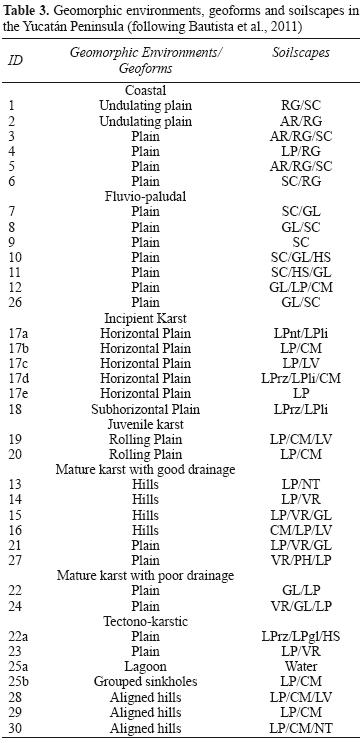
<body><![CDATA[<p align="justify"><font face="verdana" size="2">One hundred and twenty&#150;seven species of plants were reported as appropriate for feeding equines, of these, the most widely distributed in the studied soilscapes are: <i>Carica papaya, Pithecellobium dulce, Celosia virgata, Lysiloma latisiliquum, Piscidia piscipula, Chloris virgata, Leptochloa virgata, Olyra yucatana, Panicum maximum, Acacia riparia, Viguiera dentate, Eleusine indica, Lasiacis divaricata, Amaranthus dubius, Gouinia guatemalensis, Panicum hirsutum, Paspalum vaginatum, Senna occidentalis, Sida acuta, Sorghum halepense, Wissadula amplissima, Sesbania grandiflora, Brachiaria fasciculata, Gayoides crispa, Waltheria americana, Ximenia americana, Zea mays, Dalbergia glabra, Brosimum alicastrum, Bursera simaruba, Colubrina arborescens and Lonchocarpus guatemalensis</i> (5 o more soilscapes)</font></p> 	    <p align="justify"><font face="verdana" size="2">The Mayan people use 39 forest plants for feeding poultry, of these, those found in 5 or more soilscapes studied are: <i>Acacia gaumeri,Celosia virgata, Paspalum notatum, Amaranthus spinosus, Eleusine indica, Lasiacis divaricata, Amaranthus dubius, Hyptis suaveolens, Sida acuta, Amaranthus hybridus, Brachiaria fasciculata, Zea mays</i> and <i>Leucaena leucocephala.</i></font></p> 	    <p align="justify"><font face="verdana" size="2">&nbsp;</font></p> 	    <p align="justify"><font face="verdana" size="2"><b>Discussion</b></font></p> 	    <p align="justify"><font face="verdana" size="2">Arellano et al. (2003) estimated that the flora of the Yucat&aacute;n Peninsula includes 2 200 species, based on that number, 8.6% of the flora is used by Mayan communities as forage, largely for feeding backyard animals including equine, bovine and porcine livestock and poultry.</font></p> 	    <p align="justify"><font face="verdana" size="2">Some authors such as Standley (1930), Sousa and Cabrera (1983) and Sosa et al. (1985) consider the Fabaceae to be the family having the most abundant number of species in the flora of the Yucat&aacute;n Peninsula. It is noteworthy that legumes are amply recognized as being important forages for use to improve animal production (NAS, 1979; NRC, 1989).</font></p> 	    <p align="justify"><font face="verdana" size="2">L&oacute;pez et al. (2008) found that some species such as <i>Galactia multiflora, Psychotria nervosa, Macroptilium atropurpureum, Acalypha villosa, Cecropia obstusifolia, Piscidia piscipula, Trophis racemosa, Chaetocalyx scandens, Dalbergia glabra, Guazuma ulmifolia, Spondias mombin</i> and <i>Ampelocissus erdvendbergiana</i> have potential as protein sources in tropical ruminant diets; however, these plants also have antinutritional compounds such as phenols. Currently, Mayan people use the non&#150;legume species <i>Brosimum alicastrum </i>and <i>Guazuma ulmifolia</i> as forage sources for bovines (Sosa et al., 2004). Local producers in the study zone consider<i> Bursera simaruba, Sesbania grandiflora, Lonchocarpus guatemalensis, Acacia pennatula, Lysiloma latisiliquum, Gliricidia sepium</i> and <i>Acacia gaumeri </i>to be good quality forage plants (Ayala and Sandoval, 1995; Mizrahi et al., 1998; Solorio and Solorio, 2002; Llamas et al., 2004). In particular, <i>Bauhinia divaricata</i> and <i>B. glandulosa</i> are present in the natural vegetation in 12&#150;year&#150;old fallows, where they have high ecological importance values (Mizrahi et al., 1998). <i>Bauhinia divaricata</i> has the potential to be used in silvopastoral systems in seasonal tropical forests due to its coppicing capacity after pruning, thus forage can be produced during the dry season (Zapata et al., 2009). The recent karstic plain (ID 17) is dominated by Nudilithic Leptosols, Lithic Leptosols and Hyperskelethic Leptosols having low effective depth, low retention of humidity and a scarce amount of fine earth (<a href="#t3">Table 3</a>). Leptosols present extreme restrictions for plant growth (Bautista et al., 2003a,b; Bautista et al., 2011), however, most of the recorded forage species (140 plants) are present in this karstic plain with Leptosols, which constitutes an opportunity for the design of silvopastoral systems under these particularly unfavorable conditions.</font></p> 	    <p align="center"><font face="verdana" size="2"><a name="t3"></a></font></p> 	    <p align="center"><font face="verdana" size="2"><img src="/img/revistas/rmbiodiv/v83n2/a22t3.jpg"></font></p> 	    <p align="justify"><font face="verdana" size="2">Goats select the quality of the forage they eat, preferentially consuming plants with the highest <i>in vitro</i> apparent dry matter (DM), digestibility (IVDMD) and in vitro gas production (IVGP) (Alonso&#150;D&iacute;az et al., 2008). However, further studies are required in order to evaluate the quality of the remaining 56 plants.</font></p> 	    ]]></body>
<body><![CDATA[<p align="justify"><font face="verdana" size="2">Considering that the state of Yucat&aacute;n is the fourth largest pork producer in the country, and given the local relevance of the meat, the results of the present work could be used for the elaboration of nutritional supplements, thus diminishing the import of forage, principally by the use of <i>Bursera simaruba, Jacaratia mexicana, Swartzia cubensis, Bunchosia glandulosa, Sesbania emerus</i> and <i>Piper auritum.</i></font></p> 	    <p align="justify"><font face="verdana" size="2">A large amount of herbaceous plant species is used for feeding livestock and poultry in the Mayan communities, which constitutes another opportunity for further research on the chemical, physical and biological characteristics of these plants, as well as their agronomic properties and their assimilation by animals. Also, since most herbaceous plants grow during the rainy season when forage is abundant, future studies must be focused on the conservation of the forage quality of these species in order to used during the dry season.</font></p> 	    <p align="justify"><font face="verdana" size="2">On the other hand, in the Yucat&aacute;n Peninsula soils are highly heterogeneous, Leptosols, Cambisols, Luvisols, Vertisols and Gleysols being distributed in patches (Table 4) (Bautista et al., 2005; Zapata et al., 2009; Bautista et al., 2011). Therefore it is important to know soil distribution in order to design agricultural management practices that are appropriate for each soilscape for forage plants.</font></p> 	    <p align="justify"><font face="verdana" size="2">The design of silvopastoral systems considering forest management will allow for reducing tree establishment costs while also achieving meat and milk production from the beginning and in a continuous way.</font></p> 	    <p align="justify"><font face="verdana" size="2">The knowledge of Mayan people should be considered in the design of new agricultural programs of the region, especially in the cattle area. However, knowledge of the Mayan communities about the use of seasonal tropical forest plants as forage sources generates new research questions: What is the chemical quality of plants? What might be the problems generated by antinutritional compounds? What plants respond best to pruning? How does the quality and quantity of fodder vary in response to soil and climatic factors?</font></p> 	    <p align="justify"><font face="verdana" size="2">The present study is an example of the inclusion of the knowledge (<i>corpus and praxis</i>) of the Mayan people for the generation of natural resource productive strategies as new silvopastoral systems. However, to achieve sustainability goals it is also necessary to include the Maya cosmovision (<i>kosmos</i>), i.e., the respect for nature, and the concept that land occupants are not the "real" landowners.</font></p> 	    <p align="justify"><font face="verdana" size="2">The results of the present study allow for concluding that on the karstic tropical landscapes of the Yucat&aacute;n Peninsula the Mayan people manage 196 forage plants, mostly from the Fabaceae and Poaceae families.</font></p> 	    <p align="justify"><font face="verdana" size="2">Mayan traditional knowledge on forage plants includes the edible parts and the consumption by domestic animals. This knowledge can be used to improve animal production systems. In this study we include geographic location, geomorphic environment, geoforms and soilscapes of the fodder plants.</font></p> 	    <p align="justify"><font face="verdana" size="2">Knowledge of the Mayan people about the use of tropical seasonal forest forage plant species provides us with valuable information that could be used to improve existing forms of livestock and poultry production, as well as the design of new practices suited for particular combinations of landscape components (e.g., relief, aquifers, soils and climate), such as those present in the karstic soilscapes of the Yucat&aacute;n Peninsula.</font></p> 	    <p align="justify"><font face="verdana" size="2">&nbsp;</font></p> 	    ]]></body>
<body><![CDATA[<p align="justify"><font size="2" face="verdana"><b>Acknowledgements</b></font></p> 	    <p align="justify"><font face="verdana" size="2">The National Council for Science and Technology (CONACYT) supported the present research (Projects 0308P&#150;B9506; R31624&#150;B, 54&#150;2003&#150;2). The authors would like to thank Dra. Carmen Delgado&#150;Carranza and the two anonymous referees for the important comments on the manuscript.</font></p> 	    <p align="justify"><font face="verdana" size="2">&nbsp;</font></p> 	    <p align="justify"><font size="2" face="verdana"><b>Literature cited</b></font></p> 	    <!-- ref --><p align="justify"><font face="verdana" size="2">Acosta, B. L., J. S. Flores and A. G&oacute;mez&#150;Pompa. 1998. Uso y manejo de plantas forrajeras para la cr&iacute;a de animales dentro del solar en una comunidad maya en Yucat&aacute;n. Fasc&iacute;culo No. 14. Etnoflora Yucatanense. Facultad de Medicina Veterinaria y Zootecnia. UADY. Yucat&aacute;n, M&eacute;xico. 128 p.    &nbsp;&nbsp;&nbsp;&nbsp;&nbsp;&nbsp;&nbsp;&nbsp;[&#160;<a href="javascript:void(0);" onclick="javascript: window.open('/scielo.php?script=sci_nlinks&ref=7564503&pid=S1870-3453201200020002200001&lng=','','width=640,height=500,resizable=yes,scrollbars=1,menubar=yes,');">Links</a>&#160;]<!-- end-ref --></font></p> 	    <!-- ref --><p align="justify"><font face="verdana" size="2">Aguilera, N. 1963. Los recursos naturales del sureste y su aprovechamiento: suelos. Revista de la Escuela Nacional de Agricultura Chapingo. 3 (Suppl 11&#150;12):1&#150;54.    &nbsp;&nbsp;&nbsp;&nbsp;&nbsp;&nbsp;&nbsp;&nbsp;[&#160;<a href="javascript:void(0);" onclick="javascript: window.open('/scielo.php?script=sci_nlinks&ref=7564505&pid=S1870-3453201200020002200002&lng=','','width=640,height=500,resizable=yes,scrollbars=1,menubar=yes,');">Links</a>&#160;]<!-- end-ref --></font></p> 	    <!-- ref --><p align="justify"><font face="verdana" size="2">Alonso&#150;D&iacute;az, M. A., J. F. J. Torres&#150;Acosta, C. A. Sandoval, H. Hostec, A. J. Aguilar&#150;Caballero, C. and M. Capetillo&#150;Leal. 2008. Is goats' preference of forage trees affected by their tannin or fiber content when offered in cafeteria experiments? Animal Feed Science and Technology 141:36&#150;48.    &nbsp;&nbsp;&nbsp;&nbsp;&nbsp;&nbsp;&nbsp;&nbsp;[&#160;<a href="javascript:void(0);" onclick="javascript: window.open('/scielo.php?script=sci_nlinks&ref=7564507&pid=S1870-3453201200020002200003&lng=','','width=640,height=500,resizable=yes,scrollbars=1,menubar=yes,');">Links</a>&#160;]<!-- end-ref --></font></p> 	    ]]></body>
<body><![CDATA[<!-- ref --><p align="justify"><font face="verdana" size="2">Alonso&#150;D&iacute;az, M. A., J. F. J. Torres&#150;Acosta, C. A. Sandoval, H. Hostec, A. J. Aguilar&#150;Caballero, C. and M. Capetillo&#150;Leal. 2009. Sheep preference for different tanniniferous tree fodders and its relationship with in vitro gas production and digestibility. Animal Feed Science and Technology 151:75&#150;85.    &nbsp;&nbsp;&nbsp;&nbsp;&nbsp;&nbsp;&nbsp;&nbsp;[&#160;<a href="javascript:void(0);" onclick="javascript: window.open('/scielo.php?script=sci_nlinks&ref=7564509&pid=S1870-3453201200020002200004&lng=','','width=640,height=500,resizable=yes,scrollbars=1,menubar=yes,');">Links</a>&#160;]<!-- end-ref --></font></p> 	    <!-- ref --><p align="justify"><font face="verdana" size="2">Arellano, R. J. S., J. S. Flores and J. Tun&#150;Garrido. 2003. Nomenclatura forma de vida, uso, manejo y distribuci&oacute;n de las especies vegetales de la pen&iacute;nsula de Yucat&aacute;n. Fasc&iacute;culo No. 20. Etnoflora Yucatanense. Facultad de Medicina Veterinaria y Zootecnia. UADY. 320 p.    &nbsp;&nbsp;&nbsp;&nbsp;&nbsp;&nbsp;&nbsp;&nbsp;[&#160;<a href="javascript:void(0);" onclick="javascript: window.open('/scielo.php?script=sci_nlinks&ref=7564511&pid=S1870-3453201200020002200005&lng=','','width=640,height=500,resizable=yes,scrollbars=1,menubar=yes,');">Links</a>&#160;]<!-- end-ref --></font></p> 	    <!-- ref --><p align="justify"><font face="verdana" size="2">Ayala, A. and S. M. Sandoval. 1995. Establecimiento y producci&oacute;n temprana de forraje de ram&oacute;n (<i>Brosimum alicastrum </i>Sw.) en plantaciones a altas densidades en el norte de Yucat&aacute;n, M&eacute;xico. Agroforester&iacute;a de las Am&eacute;ricas 7:10&#150;21.    &nbsp;&nbsp;&nbsp;&nbsp;&nbsp;&nbsp;&nbsp;&nbsp;[&#160;<a href="javascript:void(0);" onclick="javascript: window.open('/scielo.php?script=sci_nlinks&ref=7564513&pid=S1870-3453201200020002200006&lng=','','width=640,height=500,resizable=yes,scrollbars=1,menubar=yes,');">Links</a>&#160;]<!-- end-ref --></font></p> 	    <!-- ref --><p align="justify"><font face="verdana" size="2">BADEPY&#150;INIREB (Banco de datos etnobot&aacute;nicos de la Pen&iacute;nsula de Yucat&aacute;n&#150;Instituto Nacional de Investigaciones sobre Recursos Bi&oacute;ticos). 1985. Centro de los recursos bi&oacute;ticos de la Pen&iacute;nsula de Yucat&aacute;n. INIREB. Veracruz, M&eacute;xico.    &nbsp;&nbsp;&nbsp;&nbsp;&nbsp;&nbsp;&nbsp;&nbsp;[&#160;<a href="javascript:void(0);" onclick="javascript: window.open('/scielo.php?script=sci_nlinks&ref=7564515&pid=S1870-3453201200020002200007&lng=','','width=640,height=500,resizable=yes,scrollbars=1,menubar=yes,');">Links</a>&#160;]<!-- end-ref --></font></p> 	    <!-- ref --><p align="justify"><font face="verdana" size="2">Barrera, A., A. Barrera&#150;V&aacute;zquez and R. M. L&oacute;pez&#150;Franco. 1976. Nomenclatura Etnobot&aacute;nica Maya. Una interpretaci&oacute;n Taxon&oacute;mica. Colecci&oacute;n cient&iacute;fica 36 Etnolog&iacute;a, Instituto Nacional de Antropolog&iacute;a e Historia. M&eacute;xico, D. F. 537 p.    &nbsp;&nbsp;&nbsp;&nbsp;&nbsp;&nbsp;&nbsp;&nbsp;[&#160;<a href="javascript:void(0);" onclick="javascript: window.open('/scielo.php?script=sci_nlinks&ref=7564517&pid=S1870-3453201200020002200008&lng=','','width=640,height=500,resizable=yes,scrollbars=1,menubar=yes,');">Links</a>&#160;]<!-- end-ref --></font></p> 	    ]]></body>
<body><![CDATA[<!-- ref --><p align="justify"><font face="verdana" size="2">Bautista, F. and J. A. Zinck. 2010. Construction of an Yucatec Maya soil classification and comparison with the WRB framework. Journal of Ethnobiology and Ethnomedicine 6:7doi:10.1186/1746&#150;4269&#150;6&#150;7.    &nbsp;&nbsp;&nbsp;&nbsp;&nbsp;&nbsp;&nbsp;&nbsp;[&#160;<a href="javascript:void(0);" onclick="javascript: window.open('/scielo.php?script=sci_nlinks&ref=7564519&pid=S1870-3453201200020002200009&lng=','','width=640,height=500,resizable=yes,scrollbars=1,menubar=yes,');">Links</a>&#160;]<!-- end-ref --></font></p> 	    <!-- ref --><p align="justify"><font face="verdana" size="2">Bautista, F., J. Jim&eacute;nez&#150;Osornio, J. Navarro&#150;Alberto, A. Manu and R. Lozano. 2003a. Microrelieve y color del suelo como propiedades de diagn&oacute;stico en Leptosoles c&aacute;rsticos. Terra 21:1&#150;11.    &nbsp;&nbsp;&nbsp;&nbsp;&nbsp;&nbsp;&nbsp;&nbsp;[&#160;<a href="javascript:void(0);" onclick="javascript: window.open('/scielo.php?script=sci_nlinks&ref=7564521&pid=S1870-3453201200020002200010&lng=','','width=640,height=500,resizable=yes,scrollbars=1,menubar=yes,');">Links</a>&#160;]<!-- end-ref --></font></p> 	    <!-- ref --><p align="justify"><font face="verdana" size="2">Bautista, F., E. Batllori, M. A. Ortiz, G. Palacio and M. Castillo. 2003b. Geoformas, agua y suelo en la Pen&iacute;nsula de Yucat&aacute;n. In Naturaleza y sociedad en el &aacute;rea maya, P. Colunga and A. Larque (eds.). Academia Mexicana de Ciencias y Centro de Investigaci&oacute;n Cient&iacute;fica de Yucat&aacute;n. Yucat&aacute;n, M&eacute;xico. p. 21&#150;35.    &nbsp;&nbsp;&nbsp;&nbsp;&nbsp;&nbsp;&nbsp;&nbsp;[&#160;<a href="javascript:void(0);" onclick="javascript: window.open('/scielo.php?script=sci_nlinks&ref=7564523&pid=S1870-3453201200020002200011&lng=','','width=640,height=500,resizable=yes,scrollbars=1,menubar=yes,');">Links</a>&#160;]<!-- end-ref --></font></p> 	    <!-- ref --><p align="justify"><font face="verdana" size="2">Bautista, F., E. Batllori, M. A. Ortiz, G. Palacio and M. Castillo. 2004a. El origen y el manejo maya de las geoformas, suelos y aguas en la Pen&iacute;nsula de Yucat&aacute;n. In Caracterizaci&oacute;n y manejo de suelos de la Pen&iacute;nsula de Yucat&aacute;n: Implicaciones Agropecuarias, Forestales y Ambientales, F. Bautista and G. Palacio (eds.). Universidad Aut&oacute;noma de Campeche y Universidad Aut&oacute;noma de Yucat&aacute;n. Campeche, M&eacute;xico. p. 21&#150;32.    &nbsp;&nbsp;&nbsp;&nbsp;&nbsp;&nbsp;&nbsp;&nbsp;[&#160;<a href="javascript:void(0);" onclick="javascript: window.open('/scielo.php?script=sci_nlinks&ref=7564525&pid=S1870-3453201200020002200012&lng=','','width=640,height=500,resizable=yes,scrollbars=1,menubar=yes,');">Links</a>&#160;]<!-- end-ref --></font></p> 	    <!-- ref --><p align="justify"><font face="verdana" size="2">Bautista, F., E. Batllori, M. A. Ortiz, G. Palacio and M. Castillo. 2004b. Integraci&oacute;n del conocimiento actual sobre las geoformas de la Pen&iacute;nsula de Yucat&aacute;n. In Caracterizaci&oacute;n y manejo de los suelos de la Pen&iacute;nsula de Yucat&aacute;n: implicaciones agropecuarias, forestales y ambientales, F. Bautista and G. Palacio (eds.). Universidad Aut&oacute;noma de Campeche y Universidad Aut&oacute;noma de Yucat&aacute;n. Campeche, M&eacute;xico. p. 33&#150;58.    &nbsp;&nbsp;&nbsp;&nbsp;&nbsp;&nbsp;&nbsp;&nbsp;[&#160;<a href="javascript:void(0);" onclick="javascript: window.open('/scielo.php?script=sci_nlinks&ref=7564527&pid=S1870-3453201200020002200013&lng=','','width=640,height=500,resizable=yes,scrollbars=1,menubar=yes,');">Links</a>&#160;]<!-- end-ref --></font></p> 	    ]]></body>
<body><![CDATA[<!-- ref --><p align="justify"><font face="verdana" size="2">Bautista, F., S. D&iacute;az, M. Castillo and A. J. Zinck. 2005. Soil heterogeneity in karst zone: Mayan Nomenclature, WRB, multivariate analysis and geostatistics. Eurasian Soil Science 38(S1):80&#150;87.    &nbsp;&nbsp;&nbsp;&nbsp;&nbsp;&nbsp;&nbsp;&nbsp;[&#160;<a href="javascript:void(0);" onclick="javascript: window.open('/scielo.php?script=sci_nlinks&ref=7564529&pid=S1870-3453201200020002200014&lng=','','width=640,height=500,resizable=yes,scrollbars=1,menubar=yes,');">Links</a>&#160;]<!-- end-ref --></font></p> 	    <!-- ref --><p align="justify"><font face="verdana" size="2">Bautista, F., G. Palacio, P. Quintana and J. A. Zinck. 2011. Spatial distribution and development of soils in tropical karst areas from Yucat&aacute;n, Mexico. Geomorphology 135:308&#150;321.    &nbsp;&nbsp;&nbsp;&nbsp;&nbsp;&nbsp;&nbsp;&nbsp;[&#160;<a href="javascript:void(0);" onclick="javascript: window.open('/scielo.php?script=sci_nlinks&ref=7564531&pid=S1870-3453201200020002200015&lng=','','width=640,height=500,resizable=yes,scrollbars=1,menubar=yes,');">Links</a>&#160;]<!-- end-ref --></font></p> 	    <!-- ref --><p align="justify"><font face="verdana" size="2">Castillo&#150;Caamal, J. B., J. A. Caamal&#150;Maldonado, J. J. M. Jim&eacute;nez&#150;Osornio, F. Bautista, M. J. Amaya&#150;Castro and R. Rodr&iacute;guez&#150;Carrillo. 2010. Evaluaci&oacute;n de tres leguminosas como coberturas asociadas con ma&iacute;z en el tr&oacute;pico subh&uacute;medo. Agronom&iacute;a mesoamericana 21:39&#150;50.    &nbsp;&nbsp;&nbsp;&nbsp;&nbsp;&nbsp;&nbsp;&nbsp;[&#160;<a href="javascript:void(0);" onclick="javascript: window.open('/scielo.php?script=sci_nlinks&ref=7564533&pid=S1870-3453201200020002200016&lng=','','width=640,height=500,resizable=yes,scrollbars=1,menubar=yes,');">Links</a>&#160;]<!-- end-ref --></font></p> 	    <!-- ref --><p align="justify"><font face="verdana" size="2">Duch, J. 1988. La conformaci&oacute;n territorial del estado de Yucat&aacute;n. Los componentes del medio f&iacute;sico Centro Regional de la Pen&iacute;nsula de Yucat&aacute;n (CRUPY), Universidad Aut&oacute;noma de Chapingo, Edo. de M&eacute;xico, M&eacute;xico. 180 p.    &nbsp;&nbsp;&nbsp;&nbsp;&nbsp;&nbsp;&nbsp;&nbsp;[&#160;<a href="javascript:void(0);" onclick="javascript: window.open('/scielo.php?script=sci_nlinks&ref=7564535&pid=S1870-3453201200020002200017&lng=','','width=640,height=500,resizable=yes,scrollbars=1,menubar=yes,');">Links</a>&#160;]<!-- end-ref --></font></p> 	    <!-- ref --><p align="justify"><font face="verdana" size="2">Duch, J. 2005. La nomenclatura maya de los suelos: una aproximaci&oacute;n a su diversidad y significado en el sur del estado de Yucat&aacute;n. In Caracterizaci&oacute;n y manejo de suelos en la Pen&iacute;nsula de Yucat&aacute;n, F. Bautista and G. Palacio (eds.). M&eacute;xico, D. F. UACAM&#150;UADY&#150;INE. p. 73&#150;86.    &nbsp;&nbsp;&nbsp;&nbsp;&nbsp;&nbsp;&nbsp;&nbsp;[&#160;<a href="javascript:void(0);" onclick="javascript: window.open('/scielo.php?script=sci_nlinks&ref=7564537&pid=S1870-3453201200020002200018&lng=','','width=640,height=500,resizable=yes,scrollbars=1,menubar=yes,');">Links</a>&#160;]<!-- end-ref --></font></p> 	    ]]></body>
<body><![CDATA[<!-- ref --><p align="justify"><font face="verdana" size="2">Flores, J. S. and I. Espejel. 1994. Tipos de vegetaci&oacute;n de la pen&iacute;nsula de Yucat&aacute;n, Etnoflora yucatanense. Fasc&iacute;culo 3. Universidad Aut&oacute;noma de Yucat&aacute;n. Yucat&aacute;n, M&eacute;xico. 136 p.    &nbsp;&nbsp;&nbsp;&nbsp;&nbsp;&nbsp;&nbsp;&nbsp;[&#160;<a href="javascript:void(0);" onclick="javascript: window.open('/scielo.php?script=sci_nlinks&ref=7564539&pid=S1870-3453201200020002200019&lng=','','width=640,height=500,resizable=yes,scrollbars=1,menubar=yes,');">Links</a>&#160;]<!-- end-ref --></font></p> 	    <!-- ref --><p align="justify"><font face="verdana" size="2">Flores, J. S. 2001. Leguminosae (Flor&iacute;stica, Etnobot&aacute;nica y Ecolog&iacute;a). Fasc&iacute;culo No. 18. Etnoflora Yucatanense. Facultad de Medicina Veterinaria y Zootecnia. UADY. 320 p.    &nbsp;&nbsp;&nbsp;&nbsp;&nbsp;&nbsp;&nbsp;&nbsp;[&#160;<a href="javascript:void(0);" onclick="javascript: window.open('/scielo.php?script=sci_nlinks&ref=7564541&pid=S1870-3453201200020002200020&lng=','','width=640,height=500,resizable=yes,scrollbars=1,menubar=yes,');">Links</a>&#160;]<!-- end-ref --></font></p> 	    <!-- ref --><p align="justify"><font face="verdana" size="2">Flores, J. S. 2002. Gu&iacute;a ilustrada de la flora costera representativa de la pen&iacute;nsula de Yucat&aacute;n. Programa Etnoflora Yucatanense. Fasc&iacute;culo 19. Universidad Aut&oacute;noma de Yucat&aacute;n. 133 p.    &nbsp;&nbsp;&nbsp;&nbsp;&nbsp;&nbsp;&nbsp;&nbsp;[&#160;<a href="javascript:void(0);" onclick="javascript: window.open('/scielo.php?script=sci_nlinks&ref=7564543&pid=S1870-3453201200020002200021&lng=','','width=640,height=500,resizable=yes,scrollbars=1,menubar=yes,');">Links</a>&#160;]<!-- end-ref --></font></p> 	    <!-- ref --><p align="justify"><font face="verdana" size="2">Garc&iacute;a, E. 2004. Modificaciones al sistema de clasificaci&oacute;n clim&aacute;tica de K&ouml;ppen, Serie Libros num. 6, 5a. ed., Instituto de Geograf&iacute;a, UNAM, M&eacute;xico, D. F. 90 p.    &nbsp;&nbsp;&nbsp;&nbsp;&nbsp;&nbsp;&nbsp;&nbsp;[&#160;<a href="javascript:void(0);" onclick="javascript: window.open('/scielo.php?script=sci_nlinks&ref=7564545&pid=S1870-3453201200020002200022&lng=','','width=640,height=500,resizable=yes,scrollbars=1,menubar=yes,');">Links</a>&#160;]<!-- end-ref --></font></p> 	    <!-- ref --><p align="justify"><font face="verdana" size="2">Giraldo, V., I. A. Botero, A. J. Saldarriaga and P. David. 1995. Efecto de tres densidades de &aacute;rboles en el potencial forrajero de un sistema silvopastoril natural, en la regi&oacute;n atl&aacute;ntica de Colombia. Agroforesteria de las Americas 8:14&#150;19.    &nbsp;&nbsp;&nbsp;&nbsp;&nbsp;&nbsp;&nbsp;&nbsp;[&#160;<a href="javascript:void(0);" onclick="javascript: window.open('/scielo.php?script=sci_nlinks&ref=7564547&pid=S1870-3453201200020002200023&lng=','','width=640,height=500,resizable=yes,scrollbars=1,menubar=yes,');">Links</a>&#160;]<!-- end-ref --></font></p> 	    ]]></body>
<body><![CDATA[<!-- ref --><p align="justify"><font face="verdana" size="2">Harvey, C. 2001. La conservaci&oacute;n de la biodiversidad en sistemas silvopastoriles. Simposio Internacional sobre Sistemas Silvopastoriles y Segundo Congreso sobre Agroforester&iacute;a y Producci&oacute;n de Ganado en Am&eacute;rica Latina, San Jos&eacute;, Costa Rica. 3 al 7 de abril. <a href="http://www.lead.virtualcentre.org/es/ele/conferencia3/articulo2.htm" target="_blank">http://www.lead.virtualcentre.org/es/ele/conferencia3/articulo2.htm</a>; 11.V.2012.    &nbsp;&nbsp;&nbsp;&nbsp;&nbsp;&nbsp;&nbsp;&nbsp;[&#160;<a href="javascript:void(0);" onclick="javascript: window.open('/scielo.php?script=sci_nlinks&ref=7564549&pid=S1870-3453201200020002200024&lng=','','width=640,height=500,resizable=yes,scrollbars=1,menubar=yes,');">Links</a>&#160;]<!-- end-ref --></font></p> 	    <!-- ref --><p align="justify"><font face="verdana" size="2">Llamas, E., J. Castillo, C. A. Sandoval and F. Bautista. 2004. Producci&oacute;n y calidad de follaje de &aacute;rboles forrajeros establecidos en minas de cal abandonadas. In Caracterizaci&oacute;n y manejo de los suelos de la Pen&iacute;nsula de Yucat&aacute;n: implicaciones agropecuarias, forestales y ambientales, F. Bautista y G. Palacio (eds.). Universidad Aut&oacute;noma de Campeche y Universidad Aut&oacute;noma de Yucat&aacute;n.Campeche, M&eacute;xico. p. 247&#150;257.    &nbsp;&nbsp;&nbsp;&nbsp;&nbsp;&nbsp;&nbsp;&nbsp;[&#160;<a href="javascript:void(0);" onclick="javascript: window.open('/scielo.php?script=sci_nlinks&ref=7564551&pid=S1870-3453201200020002200025&lng=','','width=640,height=500,resizable=yes,scrollbars=1,menubar=yes,');">Links</a>&#160;]<!-- end-ref --></font></p> 	    <!-- ref --><p align="justify"><font face="verdana" size="2">L&oacute;pez, E., C. A. Sandoval and R. C. Montes. 2007. Intake and digestivity of tree fodders by white tailed deer (<i>Odocoileus virginianus yucatanensis</i>). Journal of Animal and Veterinary Advances 6:39&#150;41.    &nbsp;&nbsp;&nbsp;&nbsp;&nbsp;&nbsp;&nbsp;&nbsp;[&#160;<a href="javascript:void(0);" onclick="javascript: window.open('/scielo.php?script=sci_nlinks&ref=7564553&pid=S1870-3453201200020002200026&lng=','','width=640,height=500,resizable=yes,scrollbars=1,menubar=yes,');">Links</a>&#160;]<!-- end-ref --></font></p> 	    <!-- ref --><p align="justify"><font face="verdana" size="2">L&oacute;pez, M. A, J. A. Rivera, L. Ortega, J. G. Escobedo, M. A. Maga&ntilde;a, J. R. Sangin&eacute;s and A. Carmelo. 2008. Contenido nutritivo y factores antinutricionales de plantas nativas forrajeras del norte de Quintana Roo, Mexico. T&eacute;cnica Pecuaria en M&eacute;xico 46:205&#150;215.    &nbsp;&nbsp;&nbsp;&nbsp;&nbsp;&nbsp;&nbsp;&nbsp;[&#160;<a href="javascript:void(0);" onclick="javascript: window.open('/scielo.php?script=sci_nlinks&ref=7564555&pid=S1870-3453201200020002200027&lng=','','width=640,height=500,resizable=yes,scrollbars=1,menubar=yes,');">Links</a>&#160;]<!-- end-ref --></font></p> 	    <!-- ref --><p align="justify"><font face="verdana" size="2">Mizrahi, P. A., L. Ram&iacute;rez, J. Castillo and P. Pool. 1998. Sheep food assessing the nutrient content of fodders trees in Yucat&aacute;n, M&eacute;xico. Agroforestry today 10:11:13.    &nbsp;&nbsp;&nbsp;&nbsp;&nbsp;&nbsp;&nbsp;&nbsp;[&#160;<a href="javascript:void(0);" onclick="javascript: window.open('/scielo.php?script=sci_nlinks&ref=7564557&pid=S1870-3453201200020002200028&lng=','','width=640,height=500,resizable=yes,scrollbars=1,menubar=yes,');">Links</a>&#160;]<!-- end-ref --></font></p> 	    ]]></body>
<body><![CDATA[<!-- ref --><p align="justify"><font face="verdana" size="2">NAS (National Academic Science). 1979. Tropical legumes: resources for the future national. Academic Science. Washington D. C. 331 p.    &nbsp;&nbsp;&nbsp;&nbsp;&nbsp;&nbsp;&nbsp;&nbsp;[&#160;<a href="javascript:void(0);" onclick="javascript: window.open('/scielo.php?script=sci_nlinks&ref=7564559&pid=S1870-3453201200020002200029&lng=','','width=640,height=500,resizable=yes,scrollbars=1,menubar=yes,');">Links</a>&#160;]<!-- end-ref --></font></p> 	    <!-- ref --><p align="justify"><font face="verdana" size="2">Norton, B. W. 1994. The Nutritive Value of Tree Legumes. In ForageTree Legumes in Tropical Agriculture, R. Gutteridge and H. M. Shelton (eds.). CAB International, UK. p. 177&#150;191.    &nbsp;&nbsp;&nbsp;&nbsp;&nbsp;&nbsp;&nbsp;&nbsp;[&#160;<a href="javascript:void(0);" onclick="javascript: window.open('/scielo.php?script=sci_nlinks&ref=7564561&pid=S1870-3453201200020002200030&lng=','','width=640,height=500,resizable=yes,scrollbars=1,menubar=yes,');">Links</a>&#160;]<!-- end-ref --></font></p> 	    <!-- ref --><p align="justify"><font face="verdana" size="2">NRC (National Research Council). 1989. Lost crops of the Incas. National Academy Press Washington D. C. 441 p.    &nbsp;&nbsp;&nbsp;&nbsp;&nbsp;&nbsp;&nbsp;&nbsp;[&#160;<a href="javascript:void(0);" onclick="javascript: window.open('/scielo.php?script=sci_nlinks&ref=7564563&pid=S1870-3453201200020002200031&lng=','','width=640,height=500,resizable=yes,scrollbars=1,menubar=yes,');">Links</a>&#160;]<!-- end-ref --></font></p> 	    <!-- ref --><p align="justify"><font face="verdana" size="2">Nsahlai, IV, N., N. Umunna and D. Negassa. 1995. The effect of multi&#150;purpose tree digesta on in vitro gas production from napier grass or neutral&#150;detergent fibre. Journal of the Science of Food and Agriculture, 69:519&#150;528.    &nbsp;&nbsp;&nbsp;&nbsp;&nbsp;&nbsp;&nbsp;&nbsp;[&#160;<a href="javascript:void(0);" onclick="javascript: window.open('/scielo.php?script=sci_nlinks&ref=7564565&pid=S1870-3453201200020002200032&lng=','','width=640,height=500,resizable=yes,scrollbars=1,menubar=yes,');">Links</a>&#160;]<!-- end-ref --></font></p> 	    <!-- ref --><p align="justify"><font face="verdana" size="2">Ortega, L., J. E. Castillo and F. A. Rivas. 2009. Conducta ingestiva de bovinos Ceb&uacute; adultos en <i>leucaena</i> manejada a dos alturas diferentes. T&eacute;cnica Pecuaria en M&eacute;xico 47:125&#150;134.    &nbsp;&nbsp;&nbsp;&nbsp;&nbsp;&nbsp;&nbsp;&nbsp;[&#160;<a href="javascript:void(0);" onclick="javascript: window.open('/scielo.php?script=sci_nlinks&ref=7564567&pid=S1870-3453201200020002200033&lng=','','width=640,height=500,resizable=yes,scrollbars=1,menubar=yes,');">Links</a>&#160;]<!-- end-ref --></font></p> 	    ]]></body>
<body><![CDATA[<!-- ref --><p align="justify"><font face="verdana" size="2">Pool, L. and E. Hern&aacute;ndez. 1987. Los contenidos de materia org&aacute;nica de suelos en &aacute;reas bajo el sistema agr&iacute;cola de roza, tumba y quema: importancia del muestreo. Terra 5:81&#150;92.    &nbsp;&nbsp;&nbsp;&nbsp;&nbsp;&nbsp;&nbsp;&nbsp;[&#160;<a href="javascript:void(0);" onclick="javascript: window.open('/scielo.php?script=sci_nlinks&ref=7564569&pid=S1870-3453201200020002200034&lng=','','width=640,height=500,resizable=yes,scrollbars=1,menubar=yes,');">Links</a>&#160;]<!-- end-ref --></font></p> 	    <!-- ref --><p align="justify"><font face="verdana" size="2">Ram&iacute;rez, A. L. and F. J. Solorio. 1997. <i>Leucena</i> spp. En los sistemas de producci&oacute;n bovina: experiencias y oportunidades. In Alternativas para la identificaci&oacute;n de sistemas ganaderos de doble prop&oacute;sito en el tr&oacute;pico, J. F. Santos (ed.). UADY. FMVZ. M&eacute;rida, M&eacute;xico. p. 65&#150;88.    &nbsp;&nbsp;&nbsp;&nbsp;&nbsp;&nbsp;&nbsp;&nbsp;[&#160;<a href="javascript:void(0);" onclick="javascript: window.open('/scielo.php?script=sci_nlinks&ref=7564571&pid=S1870-3453201200020002200035&lng=','','width=640,height=500,resizable=yes,scrollbars=1,menubar=yes,');">Links</a>&#160;]<!-- end-ref --></font></p> 	    <!-- ref --><p align="justify"><font face="verdana" size="2">Roshetko, J. M., D. O. Lantagne and M. A. Gold. 1998. In vitro digestibility and nutritive value of the leaves of native, naturalized, and recently introduced tree species in Jamaica. In Nitrogen fixing trees for fodder production, J. N. Daniel and J. M. Roshetko (eds.). Proceeding of an International workshop. Forest Farm and Community Tree Research Report. FACT Net. USA. p. 196&#150;204.    &nbsp;&nbsp;&nbsp;&nbsp;&nbsp;&nbsp;&nbsp;&nbsp;[&#160;<a href="javascript:void(0);" onclick="javascript: window.open('/scielo.php?script=sci_nlinks&ref=7564573&pid=S1870-3453201200020002200036&lng=','','width=640,height=500,resizable=yes,scrollbars=1,menubar=yes,');">Links</a>&#160;]<!-- end-ref --></font></p> 	    <!-- ref --><p align="justify"><font face="verdana" size="2">S&aacute;nchez, C. 1993.Uso y manejo de la le&ntilde;a en X&#150;uilub, Yucat&aacute;n. Fasc&iacute;culo. No. 8. Etnoflora Yucatanense. Universidad aut&oacute;noma de Yucat&aacute;n. Yucat&aacute;n, M&eacute;xico. 117 p.    &nbsp;&nbsp;&nbsp;&nbsp;&nbsp;&nbsp;&nbsp;&nbsp;[&#160;<a href="javascript:void(0);" onclick="javascript: window.open('/scielo.php?script=sci_nlinks&ref=7564575&pid=S1870-3453201200020002200037&lng=','','width=640,height=500,resizable=yes,scrollbars=1,menubar=yes,');">Links</a>&#160;]<!-- end-ref --></font></p> 	    <!-- ref --><p align="justify"><font face="verdana" size="2">S&aacute;nchez, C. 1993. Uso y manejo de la le&ntilde;a en Xuilub, Yucat&aacute;n. Etnoflora Yucatanense, Fasc&iacute;culo. No. 8. Universidad Aut&oacute;noma de Yucat&aacute;n. 117 p.    &nbsp;&nbsp;&nbsp;&nbsp;&nbsp;&nbsp;&nbsp;&nbsp;[&#160;<a href="javascript:void(0);" onclick="javascript: window.open('/scielo.php?script=sci_nlinks&ref=7564577&pid=S1870-3453201200020002200038&lng=','','width=640,height=500,resizable=yes,scrollbars=1,menubar=yes,');">Links</a>&#160;]<!-- end-ref --></font></p> 	    ]]></body>
<body><![CDATA[<!-- ref --><p align="justify"><font face="verdana" size="2">Sandoval, C. A., S. Anderson and J. D. Leaver. 1999. Influence of milking and restricted suckling regimes on milk production and calf growth in temperate and tropical enviroments. Animal Science 69:287&#150;296.    &nbsp;&nbsp;&nbsp;&nbsp;&nbsp;&nbsp;&nbsp;&nbsp;[&#160;<a href="javascript:void(0);" onclick="javascript: window.open('/scielo.php?script=sci_nlinks&ref=7564579&pid=S1870-3453201200020002200039&lng=','','width=640,height=500,resizable=yes,scrollbars=1,menubar=yes,');">Links</a>&#160;]<!-- end-ref --></font></p> 	    <!-- ref --><p align="justify"><font face="verdana" size="2">Sandoval, C. A., H. L. Lizarraga and F. J. Solorio&#150;S&aacute;nchez. 2005. Assessment of tree fodder preference by cattle using chemical composition, in vitro gas production and in situ degradability. Animal Feed Science and Technology 123&#150;124:277&#150;289.    &nbsp;&nbsp;&nbsp;&nbsp;&nbsp;&nbsp;&nbsp;&nbsp;[&#160;<a href="javascript:void(0);" onclick="javascript: window.open('/scielo.php?script=sci_nlinks&ref=7564581&pid=S1870-3453201200020002200040&lng=','','width=640,height=500,resizable=yes,scrollbars=1,menubar=yes,');">Links</a>&#160;]<!-- end-ref --></font></p> 	    <!-- ref --><p align="justify"><font face="verdana" size="2">Santos R. H. and J. E. Abreu. 1995. Evaluaci&oacute;n nutricional de <i>Leucaena leucocephala</i> y <i>Brosimun alicastrum </i>y su empleo en la alimentaci&oacute;n de cerdos. Veterinaria Mexico 26:51&#150;57.    &nbsp;&nbsp;&nbsp;&nbsp;&nbsp;&nbsp;&nbsp;&nbsp;[&#160;<a href="javascript:void(0);" onclick="javascript: window.open('/scielo.php?script=sci_nlinks&ref=7564583&pid=S1870-3453201200020002200041&lng=','','width=640,height=500,resizable=yes,scrollbars=1,menubar=yes,');">Links</a>&#160;]<!-- end-ref --></font></p> 	    <!-- ref --><p align="justify"><font face="verdana" size="2">Solorio, F. J. and B. Solorio. 2002. Integrating fodder trees into animal production systems in the tropics. Tropical and Subtropical Agroecosystems 1:1&#150;11.    &nbsp;&nbsp;&nbsp;&nbsp;&nbsp;&nbsp;&nbsp;&nbsp;[&#160;<a href="javascript:void(0);" onclick="javascript: window.open('/scielo.php?script=sci_nlinks&ref=7564585&pid=S1870-3453201200020002200042&lng=','','width=640,height=500,resizable=yes,scrollbars=1,menubar=yes,');">Links</a>&#160;]<!-- end-ref --></font></p> 	    <!-- ref --><p align="justify"><font face="verdana" size="2">Solorio, J. F., I. R. Armend&aacute;riz and J. Ku. 2000. Chemical content and in vitro dry matter digestibility of some fooder trees from the south east M&eacute;xico. Livestock Research and Rural Development 12(4). <a href="http://www.lrrd.org/lrrd12/4/cont124.htm" target="_blank">http://www.lrrd.org/lrrd12/4/cont124.htm</a>; 11.V.2012.    &nbsp;&nbsp;&nbsp;&nbsp;&nbsp;&nbsp;&nbsp;&nbsp;[&#160;<a href="javascript:void(0);" onclick="javascript: window.open('/scielo.php?script=sci_nlinks&ref=7564587&pid=S1870-3453201200020002200043&lng=','','width=640,height=500,resizable=yes,scrollbars=1,menubar=yes,');">Links</a>&#160;]<!-- end-ref --></font></p> 	    ]]></body>
<body><![CDATA[<!-- ref --><p align="justify"><font face="verdana" size="2">Sosa, V., J. S. Flores, V. Rico, R. Lira and J. J. Ortiz. 1985. Lista flor&iacute;stica y sinonimia maya. Fasc&iacute;culo. No.1 de Etnoflora Yucatanense, INIREB, XAL, Veracruz, M&eacute;xico. 225 p.    &nbsp;&nbsp;&nbsp;&nbsp;&nbsp;&nbsp;&nbsp;&nbsp;[&#160;<a href="javascript:void(0);" onclick="javascript: window.open('/scielo.php?script=sci_nlinks&ref=7564589&pid=S1870-3453201200020002200044&lng=','','width=640,height=500,resizable=yes,scrollbars=1,menubar=yes,');">Links</a>&#160;]<!-- end-ref --></font></p> 	    <!-- ref --><p align="justify"><font face="verdana" size="2">Sosa, E. E., L. I. Sansores, G. J. Zapata and L. Ortega. 2000. Botanical composition and nutritive value of cattle diet in secondary vegetation in Quintana Roo. T&eacute;cnica Pecuaria en M&eacute;xico 38:105&#150;117.    &nbsp;&nbsp;&nbsp;&nbsp;&nbsp;&nbsp;&nbsp;&nbsp;[&#160;<a href="javascript:void(0);" onclick="javascript: window.open('/scielo.php?script=sci_nlinks&ref=7564591&pid=S1870-3453201200020002200045&lng=','','width=640,height=500,resizable=yes,scrollbars=1,menubar=yes,');">Links</a>&#160;]<!-- end-ref --></font></p> 	    <!-- ref --><p align="justify"><font face="verdana" size="2">Sosa, E. E., D. P&eacute;rez, L. Ortega and G. J. Zapata. 2004. Tropical trees and shrubs forage potential for sheep feeding. T&eacute;cnica Pecuaria en M&eacute;xico 42:129&#150;144.    &nbsp;&nbsp;&nbsp;&nbsp;&nbsp;&nbsp;&nbsp;&nbsp;[&#160;<a href="javascript:void(0);" onclick="javascript: window.open('/scielo.php?script=sci_nlinks&ref=7564593&pid=S1870-3453201200020002200046&lng=','','width=640,height=500,resizable=yes,scrollbars=1,menubar=yes,');">Links</a>&#160;]<!-- end-ref --></font></p> 	    <!-- ref --><p align="justify"><font face="verdana" size="2">Sousa, M. and C. Cabrera. 1983. Listado flor&iacute;stico de M&eacute;xico II. Flora de Quintana Roo. Instituto de Biolog&iacute;a, UNAM. M&eacute;xico, D. F. 100 p.    &nbsp;&nbsp;&nbsp;&nbsp;&nbsp;&nbsp;&nbsp;&nbsp;[&#160;<a href="javascript:void(0);" onclick="javascript: window.open('/scielo.php?script=sci_nlinks&ref=7564595&pid=S1870-3453201200020002200047&lng=','','width=640,height=500,resizable=yes,scrollbars=1,menubar=yes,');">Links</a>&#160;]<!-- end-ref --></font></p> 	    <!-- ref --><p align="justify"><font face="verdana" size="2">Standley, P. C. 1930. Flora of Yucatan. Publication, Field Museum of Natural Hisory. Botanic Series 3:157&#150;492.    &nbsp;&nbsp;&nbsp;&nbsp;&nbsp;&nbsp;&nbsp;&nbsp;[&#160;<a href="javascript:void(0);" onclick="javascript: window.open('/scielo.php?script=sci_nlinks&ref=7564597&pid=S1870-3453201200020002200048&lng=','','width=640,height=500,resizable=yes,scrollbars=1,menubar=yes,');">Links</a>&#160;]<!-- end-ref --></font></p> 	    ]]></body>
<body><![CDATA[<!-- ref --><p align="justify"><font face="verdana" size="2">Vargas, P. 2004. El misterio maya. Revista InterSedes 5:1&#150;16</font>&nbsp;&nbsp;&nbsp;&nbsp;&nbsp;&nbsp;&nbsp;&nbsp;[&#160;<a href="javascript:void(0);" onclick="javascript: window.open('/scielo.php?script=sci_nlinks&ref=7564599&pid=S1870-3453201200020002200049&lng=','','width=640,height=500,resizable=yes,scrollbars=1,menubar=yes,');">Links</a>&#160;]<!-- end-ref --><!-- ref --><p align="justify"><font face="verdana" size="2">Vargas, B., E. Hugo, G. Pablo and S. Elvira. 1987. Composici&oacute;n qu&iacute;mica, digestibilidad y consumo de Leucaena (<i>Leucaena leucocephala</i>). Madre de cacao (<i>Gliricidia sepium</i>) y caulote (<i>Guazuma ulmifolia</i>). In <i>Gliricidia sepium</i> (Jacq.) Walp.: Management and Improvement, D. Withington, N. Glover and J. L. Brewbaker (eds.). Proceedings of a workshop at CATIE, Turrialba Costa Rica. NFTA Special Publication 87&#150;01. p. 217&#150;222.    &nbsp;&nbsp;&nbsp;&nbsp;&nbsp;&nbsp;&nbsp;&nbsp;[&#160;<a href="javascript:void(0);" onclick="javascript: window.open('/scielo.php?script=sci_nlinks&ref=7564600&pid=S1870-3453201200020002200050&lng=','','width=640,height=500,resizable=yes,scrollbars=1,menubar=yes,');">Links</a>&#160;]<!-- end-ref --></font></p> 	    <!-- ref --><p align="justify"><font face="verdana" size="2">Yerana, F., H. M. Ferreiro, R. Elliot, R. Godoy and T. R. Preston. 1978. Digestibilidad del ram&oacute;n (<i>Brosimun alicastrum</i>), <i>Leucaena leucocephala</i>, pasto buffel (<i>Cenchrus ciliaris</i>) y pulpa y bagazo de henequ&eacute;n (<i>Agave fourcroydes</i>). Producci&oacute;n Animal Tropical 3:70&#150;73.    &nbsp;&nbsp;&nbsp;&nbsp;&nbsp;&nbsp;&nbsp;&nbsp;[&#160;<a href="javascript:void(0);" onclick="javascript: window.open('/scielo.php?script=sci_nlinks&ref=7564602&pid=S1870-3453201200020002200051&lng=','','width=640,height=500,resizable=yes,scrollbars=1,menubar=yes,');">Links</a>&#160;]<!-- end-ref --></font></p> 	    <!-- ref --><p align="justify"><font face="verdana" size="2">Zapata, G., F. Bautista and M. Astier. 2009. Caracterizaci&oacute;n forrajera de un sistema silvopastoril de vegetaci&oacute;n secundaria con base en la aptitud de suelo. T&eacute;cnica Pecuaria en M&eacute;xico 47:257&#150;270.    &nbsp;&nbsp;&nbsp;&nbsp;&nbsp;&nbsp;&nbsp;&nbsp;[&#160;<a href="javascript:void(0);" onclick="javascript: window.open('/scielo.php?script=sci_nlinks&ref=7564604&pid=S1870-3453201200020002200052&lng=','','width=640,height=500,resizable=yes,scrollbars=1,menubar=yes,');">Links</a>&#160;]<!-- end-ref --></font></p>      ]]></body><back>
<ref-list>
<ref id="B1">
<nlm-citation citation-type="book">
<person-group person-group-type="author">
<name>
<surname><![CDATA[Acosta]]></surname>
<given-names><![CDATA[B. L.]]></given-names>
</name>
<name>
<surname><![CDATA[Flores]]></surname>
<given-names><![CDATA[J. S.]]></given-names>
</name>
<name>
<surname><![CDATA[Gómez-Pompa]]></surname>
<given-names><![CDATA[A.]]></given-names>
</name>
</person-group>
<source><![CDATA[Uso y manejo de plantas forrajeras para la cría de animales dentro del solar en una comunidad maya en Yucatán]]></source>
<year>1998</year>
<page-range>128</page-range><publisher-loc><![CDATA[Yucatán ]]></publisher-loc>
<publisher-name><![CDATA[Facultad de Medicina Veterinaria y Zootecnia. UADY]]></publisher-name>
</nlm-citation>
</ref>
<ref id="B2">
<nlm-citation citation-type="journal">
<person-group person-group-type="author">
<name>
<surname><![CDATA[Aguilera]]></surname>
<given-names><![CDATA[N]]></given-names>
</name>
</person-group>
<article-title xml:lang="es"><![CDATA[Los recursos naturales del sureste y su aprovechamiento: suelos]]></article-title>
<source><![CDATA[Revista de la Escuela Nacional de Agricultura Chapingo]]></source>
<year>1963</year>
<volume>3</volume>
<numero>11</numero><numero>12</numero>
<issue>11</issue><issue>12</issue>
<page-range>1-54</page-range></nlm-citation>
</ref>
<ref id="B3">
<nlm-citation citation-type="journal">
<person-group person-group-type="author">
<name>
<surname><![CDATA[Alonso-Díaz]]></surname>
<given-names><![CDATA[M. A.]]></given-names>
</name>
<name>
<surname><![CDATA[Torres-Acosta]]></surname>
<given-names><![CDATA[J. F. J.]]></given-names>
</name>
<name>
<surname><![CDATA[Sandoval]]></surname>
<given-names><![CDATA[C. A.]]></given-names>
</name>
<name>
<surname><![CDATA[Hostec]]></surname>
<given-names><![CDATA[H.]]></given-names>
</name>
<name>
<surname><![CDATA[Aguilar-Caballero]]></surname>
<given-names><![CDATA[A. J.]]></given-names>
</name>
<name>
<surname><![CDATA[Capetillo-Leal]]></surname>
<given-names><![CDATA[M.]]></given-names>
</name>
</person-group>
<article-title xml:lang="en"><![CDATA[Is goats' preference of forage trees affected by their tannin or fiber content when offered in cafeteria experiments]]></article-title>
<source><![CDATA[Animal Feed Science and Technology]]></source>
<year>2008</year>
<volume>141</volume>
<page-range>36-48</page-range></nlm-citation>
</ref>
<ref id="B4">
<nlm-citation citation-type="journal">
<person-group person-group-type="author">
<name>
<surname><![CDATA[Alonso-Díaz]]></surname>
<given-names><![CDATA[M. A.]]></given-names>
</name>
<name>
<surname><![CDATA[Torres-Acosta]]></surname>
<given-names><![CDATA[J. F. J.]]></given-names>
</name>
<name>
<surname><![CDATA[Sandoval]]></surname>
<given-names><![CDATA[C. A.]]></given-names>
</name>
<name>
<surname><![CDATA[Hostec]]></surname>
<given-names><![CDATA[H.]]></given-names>
</name>
<name>
<surname><![CDATA[Aguilar-Caballero]]></surname>
<given-names><![CDATA[A. J.]]></given-names>
</name>
<name>
<surname><![CDATA[Capetillo-Leal]]></surname>
<given-names><![CDATA[M.]]></given-names>
</name>
</person-group>
<article-title xml:lang="en"><![CDATA[Sheep preference for different tanniniferous tree fodders and its relationship with in vitro gas production and digestibility]]></article-title>
<source><![CDATA[Animal Feed Science and Technology]]></source>
<year>2009</year>
<volume>151</volume>
<page-range>75-85</page-range></nlm-citation>
</ref>
<ref id="B5">
<nlm-citation citation-type="book">
<person-group person-group-type="author">
<name>
<surname><![CDATA[Arellano]]></surname>
<given-names><![CDATA[R. J. S.]]></given-names>
</name>
<name>
<surname><![CDATA[Flores]]></surname>
<given-names><![CDATA[J. S.]]></given-names>
</name>
<name>
<surname><![CDATA[Tun-Garrido]]></surname>
<given-names><![CDATA[J.]]></given-names>
</name>
</person-group>
<source><![CDATA[Nomenclatura forma de vida, uso, manejo y distribución de las especies vegetales de la península de Yucatán]]></source>
<year>2003</year>
<page-range>320</page-range><publisher-name><![CDATA[Facultad de Medicina Veterinaria y Zootecnia. UADY]]></publisher-name>
</nlm-citation>
</ref>
<ref id="B6">
<nlm-citation citation-type="journal">
<person-group person-group-type="author">
<name>
<surname><![CDATA[Ayala]]></surname>
<given-names><![CDATA[A.]]></given-names>
</name>
<name>
<surname><![CDATA[Sandoval]]></surname>
<given-names><![CDATA[S. M.]]></given-names>
</name>
</person-group>
<article-title xml:lang="es"><![CDATA[Establecimiento y producción temprana de forraje de ramón (Brosimum alicastrum Sw.) en plantaciones a altas densidades en el norte de Yucatán, México]]></article-title>
<source><![CDATA[Agroforestería de las Américas]]></source>
<year>1995</year>
<volume>7</volume>
<page-range>10-21</page-range></nlm-citation>
</ref>
<ref id="B7">
<nlm-citation citation-type="book">
<collab>Instituto Nacional de Investigaciones sobre Recursos Bióticos^dBanco de datos etnobotánicos de la Península de Yucatán</collab>
<source><![CDATA[]]></source>
<year>1985</year>
<publisher-loc><![CDATA[Veracruz ]]></publisher-loc>
<publisher-name><![CDATA[Centro de los recursos bióticos de la Península de Yucatán. INIREB]]></publisher-name>
</nlm-citation>
</ref>
<ref id="B8">
<nlm-citation citation-type="book">
<person-group person-group-type="author">
<name>
<surname><![CDATA[Barrera]]></surname>
<given-names><![CDATA[A.]]></given-names>
</name>
<name>
<surname><![CDATA[Barrera-Vázquez]]></surname>
<given-names><![CDATA[A.]]></given-names>
</name>
<name>
<surname><![CDATA[López-Franco]]></surname>
<given-names><![CDATA[R. M.]]></given-names>
</name>
</person-group>
<source><![CDATA[Nomenclatura Etnobotánica Maya. Una interpretación Taxonómica]]></source>
<year>1976</year>
<page-range>537</page-range><publisher-loc><![CDATA[México^eD. F. D. F.]]></publisher-loc>
<publisher-name><![CDATA[Instituto Nacional de Antropología e Historia]]></publisher-name>
</nlm-citation>
</ref>
<ref id="B9">
<nlm-citation citation-type="journal">
<person-group person-group-type="author">
<name>
<surname><![CDATA[Bautista]]></surname>
<given-names><![CDATA[F.]]></given-names>
</name>
<name>
<surname><![CDATA[Zinck]]></surname>
<given-names><![CDATA[J. A.]]></given-names>
</name>
</person-group>
<article-title xml:lang="en"><![CDATA[Construction of an Yucatec Maya soil classification and comparison with the WRB framework]]></article-title>
<source><![CDATA[Journal of Ethnobiology and Ethnomedicine]]></source>
<year>2010</year>
<volume>6</volume>
</nlm-citation>
</ref>
<ref id="B10">
<nlm-citation citation-type="journal">
<person-group person-group-type="author">
<name>
<surname><![CDATA[Bautista]]></surname>
<given-names><![CDATA[F.]]></given-names>
</name>
<name>
<surname><![CDATA[Jiménez-Osornio]]></surname>
<given-names><![CDATA[J.]]></given-names>
</name>
<name>
<surname><![CDATA[Navarro-Alberto]]></surname>
<given-names><![CDATA[J.]]></given-names>
</name>
<name>
<surname><![CDATA[Manu]]></surname>
<given-names><![CDATA[A.]]></given-names>
</name>
<name>
<surname><![CDATA[Lozano]]></surname>
<given-names><![CDATA[R.]]></given-names>
</name>
</person-group>
<article-title xml:lang="es"><![CDATA[Microrelieve y color del suelo como propiedades de diagnóstico en Leptosoles cársticos]]></article-title>
<source><![CDATA[Terra]]></source>
<year>2003</year>
<volume>21</volume>
<page-range>1-11</page-range></nlm-citation>
</ref>
<ref id="B11">
<nlm-citation citation-type="book">
<person-group person-group-type="author">
<name>
<surname><![CDATA[Bautista]]></surname>
<given-names><![CDATA[F.]]></given-names>
</name>
<name>
<surname><![CDATA[Batllori]]></surname>
<given-names><![CDATA[E.]]></given-names>
</name>
<name>
<surname><![CDATA[Ortiz]]></surname>
<given-names><![CDATA[M. A.]]></given-names>
</name>
<name>
<surname><![CDATA[Palacio]]></surname>
<given-names><![CDATA[G.]]></given-names>
</name>
<name>
<surname><![CDATA[Castillo]]></surname>
<given-names><![CDATA[M.]]></given-names>
</name>
</person-group>
<article-title xml:lang="es"><![CDATA[Geoformas, agua y suelo en la Península de Yucatán]]></article-title>
<person-group person-group-type="editor">
<name>
<surname><![CDATA[Colunga]]></surname>
<given-names><![CDATA[P.]]></given-names>
</name>
<name>
<surname><![CDATA[Larque]]></surname>
<given-names><![CDATA[A.]]></given-names>
</name>
</person-group>
<source><![CDATA[Naturaleza y sociedad en el área maya]]></source>
<year>2003</year>
<page-range>21-35</page-range><publisher-loc><![CDATA[Yucatán ]]></publisher-loc>
<publisher-name><![CDATA[Academia Mexicana de Ciencias y Centro de Investigación Científica de Yucatán]]></publisher-name>
</nlm-citation>
</ref>
<ref id="B12">
<nlm-citation citation-type="book">
<person-group person-group-type="author">
<name>
<surname><![CDATA[Bautista]]></surname>
<given-names><![CDATA[F.]]></given-names>
</name>
<name>
<surname><![CDATA[Batllori]]></surname>
<given-names><![CDATA[E.]]></given-names>
</name>
<name>
<surname><![CDATA[Ortiz]]></surname>
<given-names><![CDATA[M. A.]]></given-names>
</name>
<name>
<surname><![CDATA[Palacio]]></surname>
<given-names><![CDATA[G.]]></given-names>
</name>
<name>
<surname><![CDATA[Castillo]]></surname>
<given-names><![CDATA[M.]]></given-names>
</name>
</person-group>
<article-title xml:lang="es"><![CDATA[El origen y el manejo maya de las geoformas, suelos y aguas en la Península de Yucatán]]></article-title>
<person-group person-group-type="editor">
<name>
<surname><![CDATA[Bautista]]></surname>
<given-names><![CDATA[F.]]></given-names>
</name>
<name>
<surname><![CDATA[Palacio]]></surname>
<given-names><![CDATA[G.]]></given-names>
</name>
</person-group>
<source><![CDATA[Caracterización y manejo de suelos de la Península de Yucatán: Implicaciones Agropecuarias, Forestales y Ambientales]]></source>
<year>2004</year>
<page-range>21-32</page-range><publisher-loc><![CDATA[México ]]></publisher-loc>
<publisher-name><![CDATA[Universidad Autónoma de Campeche y Universidad Autónoma de Yucatán. Campeche]]></publisher-name>
</nlm-citation>
</ref>
<ref id="B13">
<nlm-citation citation-type="book">
<person-group person-group-type="author">
<name>
<surname><![CDATA[Bautista]]></surname>
<given-names><![CDATA[F.]]></given-names>
</name>
<name>
<surname><![CDATA[Batllori]]></surname>
<given-names><![CDATA[E.]]></given-names>
</name>
<name>
<surname><![CDATA[Ortiz]]></surname>
<given-names><![CDATA[M. A.]]></given-names>
</name>
<name>
<surname><![CDATA[Palacio]]></surname>
<given-names><![CDATA[G.]]></given-names>
</name>
<name>
<surname><![CDATA[Castillo]]></surname>
<given-names><![CDATA[M.]]></given-names>
</name>
</person-group>
<article-title xml:lang="es"><![CDATA[Integración del conocimiento actual sobre las geoformas de la Península de Yucatán]]></article-title>
<person-group person-group-type="editor">
<name>
<surname><![CDATA[Bautista]]></surname>
<given-names><![CDATA[F.]]></given-names>
</name>
<name>
<surname><![CDATA[Palacio]]></surname>
<given-names><![CDATA[G.]]></given-names>
</name>
</person-group>
<source><![CDATA[Caracterización y manejo de los suelos de la Península de Yucatán: implicaciones agropecuarias, forestales y ambientales]]></source>
<year>2004</year>
<page-range>33-58</page-range><publisher-loc><![CDATA[México ]]></publisher-loc>
<publisher-name><![CDATA[Universidad Autónoma de Campeche y Universidad Autónoma de Yucatán. Campeche]]></publisher-name>
</nlm-citation>
</ref>
<ref id="B14">
<nlm-citation citation-type="journal">
<person-group person-group-type="author">
<name>
<surname><![CDATA[Bautista]]></surname>
<given-names><![CDATA[F.]]></given-names>
</name>
<name>
<surname><![CDATA[Díaz]]></surname>
<given-names><![CDATA[S.]]></given-names>
</name>
<name>
<surname><![CDATA[Castillo]]></surname>
<given-names><![CDATA[M.]]></given-names>
</name>
<name>
<surname><![CDATA[Zinck]]></surname>
<given-names><![CDATA[A. J.]]></given-names>
</name>
</person-group>
<article-title xml:lang="en"><![CDATA[Soil heterogeneity in karst zone: Mayan Nomenclature, WRB, multivariate analysis and geostatistics]]></article-title>
<source><![CDATA[Eurasian Soil Science]]></source>
<year>2005</year>
<volume>38</volume>
<numero>^sS1</numero>
<issue>^sS1</issue>
<supplement>S1</supplement>
<page-range>80-87</page-range></nlm-citation>
</ref>
<ref id="B15">
<nlm-citation citation-type="journal">
<person-group person-group-type="author">
<name>
<surname><![CDATA[Bautista]]></surname>
<given-names><![CDATA[F.]]></given-names>
</name>
<name>
<surname><![CDATA[Palacio]]></surname>
<given-names><![CDATA[G.]]></given-names>
</name>
<name>
<surname><![CDATA[Quintana]]></surname>
<given-names><![CDATA[P.]]></given-names>
</name>
<name>
<surname><![CDATA[Zinck]]></surname>
<given-names><![CDATA[J. A.]]></given-names>
</name>
</person-group>
<article-title xml:lang="en"><![CDATA[Spatial distribution and development of soils in tropical karst areas from Yucatán, Mexico]]></article-title>
<source><![CDATA[Geomorphology]]></source>
<year>2011</year>
<volume>135</volume>
<page-range>308-321</page-range></nlm-citation>
</ref>
<ref id="B16">
<nlm-citation citation-type="journal">
<person-group person-group-type="author">
<name>
<surname><![CDATA[Castillo-Caamal]]></surname>
<given-names><![CDATA[J. B.]]></given-names>
</name>
<name>
<surname><![CDATA[Caamal-Maldonado]]></surname>
<given-names><![CDATA[J. A.]]></given-names>
</name>
<name>
<surname><![CDATA[Jiménez-Osornio]]></surname>
<given-names><![CDATA[J. J. M.]]></given-names>
</name>
<name>
<surname><![CDATA[Bautista]]></surname>
<given-names><![CDATA[F.]]></given-names>
</name>
<name>
<surname><![CDATA[Amaya-Castro]]></surname>
<given-names><![CDATA[M. J.]]></given-names>
</name>
<name>
<surname><![CDATA[Rodríguez-Carrillo]]></surname>
<given-names><![CDATA[R.]]></given-names>
</name>
</person-group>
<article-title xml:lang="es"><![CDATA[Evaluación de tres leguminosas como coberturas asociadas con maíz en el trópico subhúmedo]]></article-title>
<source><![CDATA[Agronomía mesoamericana]]></source>
<year>2010</year>
<volume>21</volume>
<page-range>39-50</page-range></nlm-citation>
</ref>
<ref id="B17">
<nlm-citation citation-type="book">
<person-group person-group-type="author">
<name>
<surname><![CDATA[Duch]]></surname>
<given-names><![CDATA[J]]></given-names>
</name>
</person-group>
<source><![CDATA[La conformación territorial del estado de Yucatán. Los componentes del medio físico Centro Regional de la Península de Yucatán (CRUPY)]]></source>
<year>1988</year>
<page-range>180</page-range><publisher-loc><![CDATA[México^eEdo. de México Edo. de México]]></publisher-loc>
<publisher-name><![CDATA[Universidad Autónoma de Chapingo]]></publisher-name>
</nlm-citation>
</ref>
<ref id="B18">
<nlm-citation citation-type="book">
<person-group person-group-type="author">
<name>
<surname><![CDATA[Duch]]></surname>
<given-names><![CDATA[J]]></given-names>
</name>
</person-group>
<article-title xml:lang="es"><![CDATA[La nomenclatura maya de los suelos: una aproximación a su diversidad y significado en el sur del estado de Yucatán]]></article-title>
<person-group person-group-type="editor">
<name>
<surname><![CDATA[Bautista]]></surname>
<given-names><![CDATA[F.]]></given-names>
</name>
<name>
<surname><![CDATA[Palacio]]></surname>
<given-names><![CDATA[G.]]></given-names>
</name>
</person-group>
<source><![CDATA[Caracterización y manejo de suelos en la Península de Yucatán]]></source>
<year>2005</year>
<page-range>73-86</page-range><publisher-loc><![CDATA[México^eD. F. D. F.]]></publisher-loc>
<publisher-name><![CDATA[UACAMUADYINE]]></publisher-name>
</nlm-citation>
</ref>
<ref id="B19">
<nlm-citation citation-type="book">
<person-group person-group-type="author">
<name>
<surname><![CDATA[Flores]]></surname>
<given-names><![CDATA[J. S.]]></given-names>
</name>
<name>
<surname><![CDATA[Espejel]]></surname>
<given-names><![CDATA[I.]]></given-names>
</name>
</person-group>
<source><![CDATA[Tipos de vegetación de la península de Yucatán, Etnoflora yucatanense]]></source>
<year>1994</year>
<page-range>136</page-range><publisher-loc><![CDATA[Yucatán ]]></publisher-loc>
<publisher-name><![CDATA[Universidad Autónoma de Yucatán]]></publisher-name>
</nlm-citation>
</ref>
<ref id="B20">
<nlm-citation citation-type="book">
<person-group person-group-type="author">
<name>
<surname><![CDATA[Flores]]></surname>
<given-names><![CDATA[J. S]]></given-names>
</name>
</person-group>
<source><![CDATA[Leguminosae (Florística, Etnobotánica y Ecología)]]></source>
<year>2001</year>
<page-range>320</page-range><publisher-name><![CDATA[Facultad de Medicina Veterinaria y Zootecnia. UADY]]></publisher-name>
</nlm-citation>
</ref>
<ref id="B21">
<nlm-citation citation-type="book">
<person-group person-group-type="author">
<name>
<surname><![CDATA[Flores]]></surname>
<given-names><![CDATA[J. S]]></given-names>
</name>
</person-group>
<source><![CDATA[Guía ilustrada de la flora costera representativa de la península de Yucatán]]></source>
<year>2002</year>
<page-range>133</page-range><publisher-name><![CDATA[Universidad Autónoma de Yucatán]]></publisher-name>
</nlm-citation>
</ref>
<ref id="B22">
<nlm-citation citation-type="book">
<person-group person-group-type="author">
<name>
<surname><![CDATA[García]]></surname>
<given-names><![CDATA[E]]></given-names>
</name>
</person-group>
<source><![CDATA[Modificaciones al sistema de clasificación climática de Köppen]]></source>
<year>2004</year>
<edition>5</edition>
<page-range>90</page-range><publisher-loc><![CDATA[México^eD. F. D. F.]]></publisher-loc>
<publisher-name><![CDATA[Instituto de Geografía, UNAM]]></publisher-name>
</nlm-citation>
</ref>
<ref id="B23">
<nlm-citation citation-type="journal">
<person-group person-group-type="author">
<name>
<surname><![CDATA[Giraldo]]></surname>
<given-names><![CDATA[V.]]></given-names>
</name>
<name>
<surname><![CDATA[Botero]]></surname>
<given-names><![CDATA[I. A.]]></given-names>
</name>
<name>
<surname><![CDATA[Saldarriaga]]></surname>
<given-names><![CDATA[A. J.]]></given-names>
</name>
<name>
<surname><![CDATA[David]]></surname>
<given-names><![CDATA[P.]]></given-names>
</name>
</person-group>
<article-title xml:lang="es"><![CDATA[Efecto de tres densidades de árboles en el potencial forrajero de un sistema silvopastoril natural, en la región atlántica de Colombia]]></article-title>
<source><![CDATA[Agroforesteria de las Americas]]></source>
<year>1995</year>
<volume>8</volume>
<page-range>14-19</page-range></nlm-citation>
</ref>
<ref id="B24">
<nlm-citation citation-type="confpro">
<person-group person-group-type="author">
<name>
<surname><![CDATA[Harvey]]></surname>
<given-names><![CDATA[C]]></given-names>
</name>
</person-group>
<article-title xml:lang="es"><![CDATA[La conservación de la biodiversidad en sistemas silvopastoriles]]></article-title>
<source><![CDATA[]]></source>
<year>2001</year>
<conf-name><![CDATA[ Simposio Internacional sobre Sistemas Silvopastoriles y Segundo Congreso sobre Agroforestería y Producción de Ganado en América Latina]]></conf-name>
<conf-loc>San José </conf-loc>
</nlm-citation>
</ref>
<ref id="B25">
<nlm-citation citation-type="book">
<person-group person-group-type="author">
<name>
<surname><![CDATA[Llamas]]></surname>
<given-names><![CDATA[E.]]></given-names>
</name>
<name>
<surname><![CDATA[Castillo]]></surname>
<given-names><![CDATA[J.]]></given-names>
</name>
<name>
<surname><![CDATA[Sandoval]]></surname>
<given-names><![CDATA[C. A.]]></given-names>
</name>
<name>
<surname><![CDATA[Bautista]]></surname>
<given-names><![CDATA[F.]]></given-names>
</name>
</person-group>
<article-title xml:lang="es"><![CDATA[Producción y calidad de follaje de árboles forrajeros establecidos en minas de cal abandonadas]]></article-title>
<person-group person-group-type="editor">
<name>
<surname><![CDATA[Bautista]]></surname>
<given-names><![CDATA[F.]]></given-names>
</name>
<name>
<surname><![CDATA[Palacio]]></surname>
<given-names><![CDATA[G.]]></given-names>
</name>
</person-group>
<source><![CDATA[Caracterización y manejo de los suelos de la Península de Yucatán: implicaciones agropecuarias, forestales y ambientales]]></source>
<year>2004</year>
<page-range>247-257</page-range><publisher-loc><![CDATA[Campeche ]]></publisher-loc>
<publisher-name><![CDATA[Universidad Autónoma de Campeche y Universidad Autónoma de Yucatán]]></publisher-name>
</nlm-citation>
</ref>
<ref id="B26">
<nlm-citation citation-type="journal">
<person-group person-group-type="author">
<name>
<surname><![CDATA[López]]></surname>
<given-names><![CDATA[E.]]></given-names>
</name>
<name>
<surname><![CDATA[Sandoval]]></surname>
<given-names><![CDATA[C. A.]]></given-names>
</name>
<name>
<surname><![CDATA[Montes]]></surname>
<given-names><![CDATA[R. C.]]></given-names>
</name>
</person-group>
<article-title xml:lang="en"><![CDATA[Intake and digestivity of tree fodders by white tailed deer (Odocoileus virginianus yucatanensis)]]></article-title>
<source><![CDATA[Journal of Animal and Veterinary Advances]]></source>
<year>2007</year>
<volume>6</volume>
<page-range>39-41</page-range></nlm-citation>
</ref>
<ref id="B27">
<nlm-citation citation-type="journal">
<person-group person-group-type="author">
<name>
<surname><![CDATA[López]]></surname>
<given-names><![CDATA[M. A]]></given-names>
</name>
<name>
<surname><![CDATA[Rivera]]></surname>
<given-names><![CDATA[J. A.]]></given-names>
</name>
<name>
<surname><![CDATA[Ortega]]></surname>
<given-names><![CDATA[L.]]></given-names>
</name>
<name>
<surname><![CDATA[Escobedo]]></surname>
<given-names><![CDATA[J. G.]]></given-names>
</name>
<name>
<surname><![CDATA[Magaña]]></surname>
<given-names><![CDATA[M. A.]]></given-names>
</name>
<name>
<surname><![CDATA[Sanginés]]></surname>
<given-names><![CDATA[J. R.]]></given-names>
</name>
<name>
<surname><![CDATA[Carmelo]]></surname>
<given-names><![CDATA[A.]]></given-names>
</name>
</person-group>
<article-title xml:lang="es"><![CDATA[Contenido nutritivo y factores antinutricionales de plantas nativas forrajeras del norte de Quintana Roo, Mexico]]></article-title>
<source><![CDATA[Técnica Pecuaria en México]]></source>
<year>2008</year>
<volume>46</volume>
<page-range>205-215</page-range></nlm-citation>
</ref>
<ref id="B28">
<nlm-citation citation-type="journal">
<person-group person-group-type="author">
<name>
<surname><![CDATA[Mizrahi]]></surname>
<given-names><![CDATA[P. A.]]></given-names>
</name>
<name>
<surname><![CDATA[Ramírez]]></surname>
<given-names><![CDATA[L.]]></given-names>
</name>
<name>
<surname><![CDATA[Castillo]]></surname>
<given-names><![CDATA[J.]]></given-names>
</name>
<name>
<surname><![CDATA[Pool]]></surname>
<given-names><![CDATA[P.]]></given-names>
</name>
</person-group>
<article-title xml:lang="en"><![CDATA[Sheep food assessing the nutrient content of fodders trees in Yucatán, México]]></article-title>
<source><![CDATA[Agroforestry today]]></source>
<year>1998</year>
<volume>10</volume>
<page-range>11:13</page-range></nlm-citation>
</ref>
<ref id="B29">
<nlm-citation citation-type="book">
<collab>National Academic Science</collab>
<source><![CDATA[Tropical legumes: resources for the future national]]></source>
<year>1979</year>
<page-range>331</page-range><publisher-loc><![CDATA[Washington^eD. C. D. C.]]></publisher-loc>
<publisher-name><![CDATA[Academic Science]]></publisher-name>
</nlm-citation>
</ref>
<ref id="B30">
<nlm-citation citation-type="book">
<person-group person-group-type="author">
<name>
<surname><![CDATA[Norton]]></surname>
<given-names><![CDATA[B. W]]></given-names>
</name>
</person-group>
<article-title xml:lang="en"><![CDATA[The Nutritive Value of Tree Legumes]]></article-title>
<person-group person-group-type="editor">
<name>
<surname><![CDATA[Gutteridge]]></surname>
<given-names><![CDATA[R.]]></given-names>
</name>
<name>
<surname><![CDATA[Shelton]]></surname>
<given-names><![CDATA[H. M.]]></given-names>
</name>
</person-group>
<source><![CDATA[ForageTree Legumes in Tropical Agriculture]]></source>
<year>1994</year>
<page-range>177-191</page-range><publisher-name><![CDATA[CAB International]]></publisher-name>
</nlm-citation>
</ref>
<ref id="B31">
<nlm-citation citation-type="book">
<collab>National Research Council</collab>
<source><![CDATA[Lost crops of the Incas]]></source>
<year>1989</year>
<page-range>441</page-range><publisher-loc><![CDATA[Washington^eD. C. D. C.]]></publisher-loc>
<publisher-name><![CDATA[National Academy Press]]></publisher-name>
</nlm-citation>
</ref>
<ref id="B32">
<nlm-citation citation-type="journal">
<person-group person-group-type="author">
<name>
<surname><![CDATA[Nsahlai]]></surname>
<given-names><![CDATA[IV, N.]]></given-names>
</name>
<name>
<surname><![CDATA[Umunna]]></surname>
<given-names><![CDATA[N.]]></given-names>
</name>
<name>
<surname><![CDATA[Negassa]]></surname>
<given-names><![CDATA[D.]]></given-names>
</name>
</person-group>
<article-title xml:lang="en"><![CDATA[The effect of multi-purpose tree digesta on in vitro gas production from napier grass or neutral-detergent fibre]]></article-title>
<source><![CDATA[Journal of the Science of Food and Agriculture,]]></source>
<year>1995</year>
<volume>69</volume>
<page-range>519-528</page-range></nlm-citation>
</ref>
<ref id="B33">
<nlm-citation citation-type="journal">
<person-group person-group-type="author">
<name>
<surname><![CDATA[Ortega]]></surname>
<given-names><![CDATA[L.]]></given-names>
</name>
<name>
<surname><![CDATA[Castillo]]></surname>
<given-names><![CDATA[J. E.]]></given-names>
</name>
<name>
<surname><![CDATA[Rivas]]></surname>
<given-names><![CDATA[F. A.]]></given-names>
</name>
</person-group>
<article-title xml:lang="es"><![CDATA[Conducta ingestiva de bovinos Cebú adultos en leucaena manejada a dos alturas diferentes]]></article-title>
<source><![CDATA[Técnica Pecuaria en México]]></source>
<year>2009</year>
<volume>47</volume>
<page-range>125-134</page-range></nlm-citation>
</ref>
<ref id="B34">
<nlm-citation citation-type="journal">
<person-group person-group-type="author">
<name>
<surname><![CDATA[Pool]]></surname>
<given-names><![CDATA[L.]]></given-names>
</name>
<name>
<surname><![CDATA[Hernández]]></surname>
<given-names><![CDATA[E.]]></given-names>
</name>
</person-group>
<article-title xml:lang="es"><![CDATA[Los contenidos de materia orgánica de suelos en áreas bajo el sistema agrícola de roza, tumba y quema: importancia del muestreo]]></article-title>
<source><![CDATA[Terra]]></source>
<year>1987</year>
<volume>5</volume>
<page-range>81-92</page-range></nlm-citation>
</ref>
<ref id="B35">
<nlm-citation citation-type="book">
<person-group person-group-type="author">
<name>
<surname><![CDATA[Ramírez]]></surname>
<given-names><![CDATA[A. L.]]></given-names>
</name>
<name>
<surname><![CDATA[Solorio]]></surname>
<given-names><![CDATA[F. J.]]></given-names>
</name>
</person-group>
<article-title xml:lang="es"><![CDATA[Leucena spp. En los sistemas de producción bovina: experiencias y oportunidades]]></article-title>
<person-group person-group-type="editor">
<name>
<surname><![CDATA[Santos]]></surname>
<given-names><![CDATA[J. F.]]></given-names>
</name>
</person-group>
<source><![CDATA[Alternativas para la identificación de sistemas ganaderos de doble propósito en el trópico]]></source>
<year>1997</year>
<page-range>65-88</page-range><publisher-loc><![CDATA[Mérida ]]></publisher-loc>
<publisher-name><![CDATA[UADY. FMVZ]]></publisher-name>
</nlm-citation>
</ref>
<ref id="B36">
<nlm-citation citation-type="book">
<person-group person-group-type="author">
<name>
<surname><![CDATA[Roshetko]]></surname>
<given-names><![CDATA[J. M.]]></given-names>
</name>
<name>
<surname><![CDATA[Lantagne]]></surname>
<given-names><![CDATA[D. O.]]></given-names>
</name>
<name>
<surname><![CDATA[Gold]]></surname>
<given-names><![CDATA[M. A.]]></given-names>
</name>
</person-group>
<article-title xml:lang="en"><![CDATA[In vitro digestibility and nutritive value of the leaves of native, naturalized, and recently introduced tree species in Jamaica]]></article-title>
<person-group person-group-type="editor">
<name>
<surname><![CDATA[Daniel]]></surname>
<given-names><![CDATA[J. N.]]></given-names>
</name>
<name>
<surname><![CDATA[Roshetko]]></surname>
<given-names><![CDATA[J. M.]]></given-names>
</name>
</person-group>
<source><![CDATA[Nitrogen fixing trees for fodder productionProceeding of an International workshop. Forest Farm and Community Tree Research Report]]></source>
<year>1998</year>
<page-range>196-204</page-range><publisher-name><![CDATA[FACT Net]]></publisher-name>
</nlm-citation>
</ref>
<ref id="B37">
<nlm-citation citation-type="book">
<person-group person-group-type="author">
<name>
<surname><![CDATA[Sánchez]]></surname>
<given-names><![CDATA[C]]></given-names>
</name>
</person-group>
<source><![CDATA[Uso y manejo de la leña en X-uilub, Yucatán]]></source>
<year>1993</year>
<page-range>117</page-range><publisher-loc><![CDATA[México ]]></publisher-loc>
<publisher-name><![CDATA[Universidad autónoma de Yucatán]]></publisher-name>
</nlm-citation>
</ref>
<ref id="B38">
<nlm-citation citation-type="book">
<person-group person-group-type="author">
<name>
<surname><![CDATA[Sánchez]]></surname>
<given-names><![CDATA[C]]></given-names>
</name>
</person-group>
<source><![CDATA[Uso y manejo de la leña en Xuilub, Yucatán]]></source>
<year>1993</year>
<page-range>117</page-range><publisher-name><![CDATA[Universidad Autónoma de Yucatán]]></publisher-name>
</nlm-citation>
</ref>
<ref id="B39">
<nlm-citation citation-type="journal">
<person-group person-group-type="author">
<name>
<surname><![CDATA[Sandoval]]></surname>
<given-names><![CDATA[C. A.]]></given-names>
</name>
<name>
<surname><![CDATA[Anderson]]></surname>
<given-names><![CDATA[S.]]></given-names>
</name>
<name>
<surname><![CDATA[Leaver]]></surname>
<given-names><![CDATA[J. D.]]></given-names>
</name>
</person-group>
<article-title xml:lang="en"><![CDATA[Influence of milking and restricted suckling regimes on milk production and calf growth in temperate and tropical enviroments]]></article-title>
<source><![CDATA[Animal Science]]></source>
<year>1999</year>
<volume>69</volume>
<page-range>287-296</page-range></nlm-citation>
</ref>
<ref id="B40">
<nlm-citation citation-type="journal">
<person-group person-group-type="author">
<name>
<surname><![CDATA[Sandoval]]></surname>
<given-names><![CDATA[C. A.]]></given-names>
</name>
<name>
<surname><![CDATA[Lizarraga]]></surname>
<given-names><![CDATA[H. L.]]></given-names>
</name>
<name>
<surname><![CDATA[Solorio-Sánchez]]></surname>
<given-names><![CDATA[F. J.]]></given-names>
</name>
</person-group>
<article-title xml:lang="en"><![CDATA[Assessment of tree fodder preference by cattle using chemical composition, in vitro gas production and in situ degradability]]></article-title>
<source><![CDATA[Animal Feed Science and Technology]]></source>
<year>2005</year>
<volume>123</volume><volume>124</volume>
<page-range>277-289</page-range></nlm-citation>
</ref>
<ref id="B41">
<nlm-citation citation-type="journal">
<person-group person-group-type="author">
<name>
<surname><![CDATA[Santos]]></surname>
<given-names><![CDATA[R. H.]]></given-names>
</name>
<name>
<surname><![CDATA[Abreu]]></surname>
<given-names><![CDATA[J. E.]]></given-names>
</name>
</person-group>
<article-title xml:lang="es"><![CDATA[Evaluación nutricional de Leucaena leucocephala y Brosimun alicastrum y su empleo en la alimentación de cerdos]]></article-title>
<source><![CDATA[Veterinaria Mexico]]></source>
<year>1995</year>
<volume>26</volume>
<page-range>51-57</page-range></nlm-citation>
</ref>
<ref id="B42">
<nlm-citation citation-type="journal">
<person-group person-group-type="author">
<name>
<surname><![CDATA[Solorio]]></surname>
<given-names><![CDATA[F. J.]]></given-names>
</name>
<name>
<surname><![CDATA[Solorio]]></surname>
<given-names><![CDATA[B.]]></given-names>
</name>
</person-group>
<article-title xml:lang="en"><![CDATA[Integrating fodder trees into animal production systems in the tropics]]></article-title>
<source><![CDATA[Tropical and Subtropical Agroecosystems]]></source>
<year>2002</year>
<volume>1</volume>
<page-range>1-11</page-range></nlm-citation>
</ref>
<ref id="B43">
<nlm-citation citation-type="journal">
<person-group person-group-type="author">
<name>
<surname><![CDATA[Solorio]]></surname>
<given-names><![CDATA[J. F.]]></given-names>
</name>
<name>
<surname><![CDATA[Armendáriz]]></surname>
<given-names><![CDATA[I. R.]]></given-names>
</name>
<name>
<surname><![CDATA[Ku]]></surname>
<given-names><![CDATA[J.]]></given-names>
</name>
</person-group>
<article-title xml:lang="en"><![CDATA[Chemical content and in vitro dry matter digestibility of some fooder trees from the south east México]]></article-title>
<source><![CDATA[Livestock Research and Rural Development]]></source>
<year>2000</year>
<volume>12</volume>
<numero>4</numero>
<issue>4</issue>
</nlm-citation>
</ref>
<ref id="B44">
<nlm-citation citation-type="book">
<person-group person-group-type="author">
<name>
<surname><![CDATA[Sosa]]></surname>
<given-names><![CDATA[V.]]></given-names>
</name>
<name>
<surname><![CDATA[Flores]]></surname>
<given-names><![CDATA[J. S.]]></given-names>
</name>
<name>
<surname><![CDATA[Rico]]></surname>
<given-names><![CDATA[V.]]></given-names>
</name>
<name>
<surname><![CDATA[Lira]]></surname>
<given-names><![CDATA[R.]]></given-names>
</name>
<name>
<surname><![CDATA[Ortiz]]></surname>
<given-names><![CDATA[J. J.]]></given-names>
</name>
</person-group>
<source><![CDATA[Lista florística y sinonimia maya]]></source>
<year>1985</year>
<page-range>225</page-range><publisher-loc><![CDATA[XAL^eVeracruz Veracruz]]></publisher-loc>
<publisher-name><![CDATA[INIREB]]></publisher-name>
</nlm-citation>
</ref>
<ref id="B45">
<nlm-citation citation-type="journal">
<person-group person-group-type="author">
<name>
<surname><![CDATA[Sosa]]></surname>
<given-names><![CDATA[E. E.]]></given-names>
</name>
<name>
<surname><![CDATA[Sansores]]></surname>
<given-names><![CDATA[L. I.]]></given-names>
</name>
<name>
<surname><![CDATA[Zapata]]></surname>
<given-names><![CDATA[G. J.]]></given-names>
</name>
<name>
<surname><![CDATA[Ortega]]></surname>
<given-names><![CDATA[L.]]></given-names>
</name>
</person-group>
<article-title xml:lang="en"><![CDATA[Botanical composition and nutritive value of cattle diet in secondary vegetation in Quintana Roo]]></article-title>
<source><![CDATA[Técnica Pecuaria en México]]></source>
<year>2000</year>
<volume>38</volume>
<page-range>105-117</page-range></nlm-citation>
</ref>
<ref id="B46">
<nlm-citation citation-type="journal">
<person-group person-group-type="author">
<name>
<surname><![CDATA[Sosa]]></surname>
<given-names><![CDATA[E. E.]]></given-names>
</name>
<name>
<surname><![CDATA[Pérez]]></surname>
<given-names><![CDATA[D.]]></given-names>
</name>
<name>
<surname><![CDATA[Ortega]]></surname>
<given-names><![CDATA[L.]]></given-names>
</name>
<name>
<surname><![CDATA[Zapata]]></surname>
<given-names><![CDATA[G. J.]]></given-names>
</name>
</person-group>
<article-title xml:lang="en"><![CDATA[Tropical trees and shrubs forage potential for sheep feeding]]></article-title>
<source><![CDATA[Técnica Pecuaria en México]]></source>
<year>2004</year>
<volume>42</volume>
<page-range>129-144</page-range></nlm-citation>
</ref>
<ref id="B47">
<nlm-citation citation-type="book">
<person-group person-group-type="author">
<name>
<surname><![CDATA[Sousa]]></surname>
<given-names><![CDATA[M.]]></given-names>
</name>
<name>
<surname><![CDATA[Cabrera]]></surname>
<given-names><![CDATA[C.]]></given-names>
</name>
</person-group>
<source><![CDATA[Listado florístico de México II. Flora de Quintana Roo]]></source>
<year>1983</year>
<page-range>100</page-range><publisher-loc><![CDATA[México^eD. F. D. F.]]></publisher-loc>
<publisher-name><![CDATA[Instituto de Biología, UNAM]]></publisher-name>
</nlm-citation>
</ref>
<ref id="B48">
<nlm-citation citation-type="journal">
<person-group person-group-type="author">
<name>
<surname><![CDATA[Standley]]></surname>
<given-names><![CDATA[P. C]]></given-names>
</name>
</person-group>
<article-title xml:lang="en"><![CDATA[Flora of Yucatan. Publication, Field Museum of Natural Hisory]]></article-title>
<source><![CDATA[Botanic Series]]></source>
<year>1930</year>
<volume>3</volume>
<page-range>157-492</page-range></nlm-citation>
</ref>
<ref id="B49">
<nlm-citation citation-type="journal">
<person-group person-group-type="author">
<name>
<surname><![CDATA[Vargas]]></surname>
<given-names><![CDATA[P]]></given-names>
</name>
</person-group>
<article-title xml:lang="es"><![CDATA[El misterio maya]]></article-title>
<source><![CDATA[Revista InterSedes]]></source>
<year>2004</year>
<volume>5</volume>
<page-range>1-16</page-range></nlm-citation>
</ref>
<ref id="B50">
<nlm-citation citation-type="">
<person-group person-group-type="author">
<name>
<surname><![CDATA[Vargas]]></surname>
<given-names><![CDATA[B.]]></given-names>
</name>
<name>
<surname><![CDATA[Hugo]]></surname>
<given-names><![CDATA[E.]]></given-names>
</name>
<name>
<surname><![CDATA[Pablo]]></surname>
<given-names><![CDATA[G.]]></given-names>
</name>
<name>
<surname><![CDATA[Elvira]]></surname>
<given-names><![CDATA[S.]]></given-names>
</name>
</person-group>
<article-title xml:lang="es"><![CDATA[Composición química, digestibilidad y consumo de Leucaena (Leucaena leucocephala). Madre de cacao (Gliricidia sepium) y caulote (Guazuma ulmifolia)]]></article-title>
<person-group person-group-type="editor">
<name>
<surname><![CDATA[Withington]]></surname>
<given-names><![CDATA[D.]]></given-names>
</name>
<name>
<surname><![CDATA[Glover]]></surname>
<given-names><![CDATA[N.]]></given-names>
</name>
<name>
<surname><![CDATA[Brewbaker]]></surname>
<given-names><![CDATA[J. L.]]></given-names>
</name>
</person-group>
<source><![CDATA[Gliricidia sepium (Jacq.) Walp.: Management and ImprovementProceedings of a workshop at CATIE]]></source>
<year>1987</year>
<page-range>217-222</page-range><publisher-loc><![CDATA[Turrialba ]]></publisher-loc>
</nlm-citation>
</ref>
<ref id="B51">
<nlm-citation citation-type="journal">
<person-group person-group-type="author">
<name>
<surname><![CDATA[Yerana]]></surname>
<given-names><![CDATA[F.]]></given-names>
</name>
<name>
<surname><![CDATA[Ferreiro]]></surname>
<given-names><![CDATA[H. M.]]></given-names>
</name>
<name>
<surname><![CDATA[Elliot]]></surname>
<given-names><![CDATA[R.]]></given-names>
</name>
<name>
<surname><![CDATA[Godoy]]></surname>
<given-names><![CDATA[R.]]></given-names>
</name>
<name>
<surname><![CDATA[Preston]]></surname>
<given-names><![CDATA[T. R.]]></given-names>
</name>
</person-group>
<article-title xml:lang="es"><![CDATA[Digestibilidad del ramón (Brosimun alicastrum), Leucaena leucocephala, pasto buffel (Cenchrus ciliaris) y pulpa y bagazo de henequén (Agave fourcroydes)]]></article-title>
<source><![CDATA[Producción Animal Tropical]]></source>
<year>1978</year>
<volume>3</volume>
<page-range>70-73</page-range></nlm-citation>
</ref>
<ref id="B52">
<nlm-citation citation-type="journal">
<person-group person-group-type="author">
<name>
<surname><![CDATA[Zapata]]></surname>
<given-names><![CDATA[G.]]></given-names>
</name>
<name>
<surname><![CDATA[Bautista]]></surname>
<given-names><![CDATA[F.]]></given-names>
</name>
<name>
<surname><![CDATA[Astier]]></surname>
<given-names><![CDATA[M.]]></given-names>
</name>
</person-group>
<article-title xml:lang="es"><![CDATA[Caracterización forrajera de un sistema silvopastoril de vegetación secundaria con base en la aptitud de suelo]]></article-title>
<source><![CDATA[Técnica Pecuaria en México]]></source>
<year>2009</year>
<volume>47</volume>
<page-range>257-270</page-range></nlm-citation>
</ref>
</ref-list>
</back>
</article>
