
The taxonomic status of the Mexican oak Quercus undata (Fagaceae, Quercus, Section Quercus)
El estatus taxonómico del encino mexicano Quercus undata (Fagaceae, Quercus, Sección Quercus)
Jeffrey R. Bacon1, Patricia Dolores Dávila–Aranda2, Richard Spellenberg3 and M. Socorro González–Elizondo4
1 Instituto de Silvicultura e Industria de la Madera, Universidad Juárez del Estado de Durango, Boulevard del Guadiana #501, Ciudad Universitaria, 34160 Durango, Durango, México. durangojeff@gmail.com
2 Facultad de Estudios Superiores Iztacala, Universidad Nacional Autónoma de México, Avenida de los Barrios No 1, Los Reyes Iztacala, 54090 Tlalnepantla, Estado de Mexico, México.
]]> 3 Department of Biology, MSC 3AF, New Mexico State University, Las Cruces, NM 88003–8001, USA.4 CIIDIR IPN Unidad Durango, Sigma 119, Fracc. 20 de Noviembre II, 34220 Durango, Durango, México.
Recibido: 14 junio 2010;
aceptado: 15 abril 2011
Abstract
Quercus undata Trel. (Fagaceae, Quercus, Section Quercus) has a complex taxonomic and nomenclatural history. Intensive sampling of oaks at the type locality of Q. undata Trel. in Durango, Mexico and evaluation of herbarium specimens and plants in the field indicate that Q. undata represents variation in Quercus chihuahuensis Trel. in white oak communities where introgressive hybridization among Q. chihuahuensis, Q. grisea Liebm., and a third white oak, Q. arizonica Sarg. made species identification difficult. Endlich's type specimen of Q. undata, as designated by Trelease, was apparently destroyed in bombing raids on Berlin during World War II, and we propose herein as lectotype the Trelease illustration of the type. An epitype is also designated in support of the lectotype, given that some features cannot be critically observed on the illustration. The long peduncles of the specimen illustrated by Trelease indicate a close relation to Q. chihuahuensis.
Key words: Sierra Madre Occidental, Mexico, epitype, lectotype, introgressive hybridization.
]]> Resumen
Quercus undata Trel. (Fagaceae, Quercus, Section Quercus) tiene una compleja historia taxonómica y de nomenclatura. Un muestreo intensivo de los encinos en la localidad tipo de Q. undata en Durango, México y análisis de ejemplares en herbario y en el campo indican que Q. undata representa variación en Q. chihuahuensis Trel. en los sitios donde la hibridación introgresiva entre Q. chihuahuensis, Q. grisea Liebm., y un tercer encino blanco, Q. arizonica Sarg., dificultan la identificación de especies. El ejemplar tipo designado por Trelease aparentemente fue destruido en el bombardeo de Berlín durante la Segunda Guerra Mundial, por lo que se propone como lectotipo a la ilustración del tipo en la obra de Trelease. Se designa también un epitipo dado que algunos rasgos no pueden ser críticamente observados en la ilustración. Los largos pedúnculos del espécimen ilustrado por Trelease indican la relación cercana a Q. chihuahuensis.
Palabras clave: sierra Madre Occidental, México, epitipo, lectotipo, hibridación introgresiva.
Introduction
The genus Quercus in Mexico includes about 161 species (Valencia Avalos, 2004), and past estimates have placed more than 253 scientific names in the Mexican portion of the genus (Trelease, 1924). White oaks (Fagaceae, Section Quercus) in the Mexican flora remain taxonomically perplexing, due to poor morphological differentiation among many species, abundant hybridization, inadequate documentation of subgeneric epithets, and poor representation of fertile structures in herbaria. Herbarium specimens of Mexican white oaks are commonly misidentified. Therefore revision and adecuate typification of taxa in this group are important to understanding and clarifying the species.
Trelease (1924) described Quercus undata Trel. based on 3 herbarium specimens collected on the low elevation slopes of the interior of the Sierra Madre Occidental, in Durango, Mexico (Fig. 1). He considered Q. undata a close relative of Q. chihuahuensis Trel., a small tree from northern Mexico, common at low elevations in the Sierra Madre Occidental, having classified them in the same group (series): Chihuahuenses Trel. Martínez (1957) considered Q. undata to be a synonym of Q. chihuahuensis. Later, McVaugh (1974) suggested that Q. undata was probably a name that has been applied to hybrids between Q. grisea Liebm. and Q. chihuahuensis. Despite the placement of Q. undata into synonymy by Martínez and McVaugh's implication that the taxon probably represents a hybrid, the taxon has since been reported in species lists of different floristic and taxonomic revisions (González–Elizondo et al., 1991 and Valencia–Avalos, 2004) and appears as a name accepted for the species in the Royal Botanic Garden's Kew World Checklist of Seed Plants (Govaerts and Frodin, 1998) and sources citing this reference. In regional herbaria with numerous good collections there are few specimens identified as Quercus undata.
Fruits visible in the published photograph of the type specimen (Endlich 1) in Trelease (1924: 235) have peduncles that are much longer than those of the other cited specimens (Palmer 408 and 828). The latter were described as "[p]ossibly to be referred here also . . .," suggesting that Trelease may have been unsure of the range of morphological variation and character states defining this taxón; his brief description of the taxon, based on vegetative structures, lacks characters that clearly distinguish it from other taxa of low elevation white oaks (Fagaceae, Quercus, Section Quercus) in the region: Q. arizonica Sarg., Q. chihuahuensis, and Q. grisea.
]]> The type specimen of Q. undata, as designated by Trelease (1924): Mexico, Durango, Municipio Tepehuanes, Sierra de la Candela, 2500 m, 27 Aug 1903, Endlich 1 (B), was apparently destroyed in bombing raids on Berlin during World War II. In this paper we select the illustration of the type of Q. undata as a lectotype and designate an epitype to support it. This work aims to clarify the taxonomic nature of Q. undata as a means of rectifying the following:1. the absence of an extant type,
2. uncertain and unclear description of the taxon: citation, in the original description (Trelease, 1924) and, subsequently by Camus (1938 – 1939) of specimens with fruits clearly belonging to 2 distinct morphological species,
3. disagreements among taxonomists about the taxonomic nature of Q. undata (Trelease, 1924; Martínez, 1957; McVaugh, 1974; Valencia–Ávalos, 2004),
4. literature citations that use the name incorrectly (Govaerts and Frodin, 1998), and
5. taxonomic confusion among the species of white oaks in the region.
Materials and methods
Examination of herbarium specimens: specimens of Q. arizonica, Q. chihuahuensis, Q. grisea, Q. undata, and the other white oaks from the Sierra Madre Occidental region were examined at herbaria containing ample collections from the region: CIIDIR, F, IZTA, MEXU, NMC, P, and others. Remaining specimens cited in Trelease's description (Palmer 408 and 828) and deposited at A were also examined.
]]> Field sites: principal and secondary routes of the Sierra Madre Occidental were extensively searched, including transects described by Spellenberg (2001) and Spellenberg et al. (1998). The Sierra de la Candela area, where Endlich reported have collected the type specimen, was intensively searched and systematically surveyed throughout its altitudinal range, combinations of slope directions, and various vegetation types. Samples of all white oak species encountered were collected, pressed, dried, and identified in each of the habitat types where they occurred.The area of the type locality was determined (see "The Type Locality," below) to be in the zone where the 3 species of white oaks, Q. arizonica, Q. chihuahuensis, and Q. grisea were abundant and sympatric (15.4 km north of Tepehuanes, en route to Ciénega de Escobar, and centered on 25°03'38"N, 105°20'57"W). A 1 000 m × 30 m belt transect crossing a gradient from low to high elevation was sampled there, collecting material from all white oak individuals encountered.
Samples of foliage of each tree sampled were collected 2 m above ground level, on the south side of each tree. From each sample, morphological characters from the abaxial surface of 7 leaves and their trichomes were evaluated as shown in Fig. 2, and veins reaching the leaf margin and exceeding 0.5 mm in diameter were counted. Mean values of leaf and trichome variables were calculated for each variable and used for multivariate analyses.
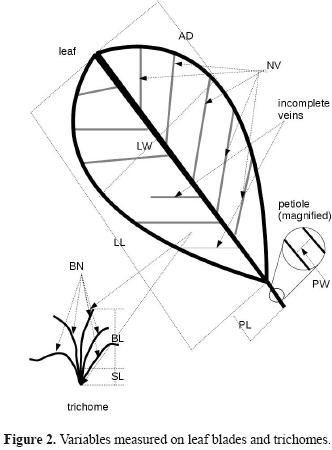
Plants from the site and other sites where each species was found in allopatry were evaluated based on vegetative characters (Fig. 2), with both principal coordinates analysis and principal components analysis, to evaluate morphological variation in Q. undata and related taxa. Data from all variables had relatively normal distributions and similar variance among taxa, making data transformation unnecessary.
Results
Review of herbarium and field specimens of white oaks from much of the Sierra Madre Occidental revealed that those identified as Quecus undata appeared to fall within the variation observed in Q. chihuahuensis in hybrid swarms from this region. Trelease's plate of the type (pl. 135) illustrates a specimen with densely pubescent leaves and long peduncles, characteristics of Q. chihuahuensis, that distinguish it from Q. arizonica, based on both characters, and Q. grisea based on the latter. Quercus chihuahuensis is the only low–elevation white oak with long (1.5– 3.0 [– 6.0] cm) peduncles and tomentose leaves in the Sierra de la Candela region.
According to the label data reported by Trelease (1924), Endlich collected the type specimen in the Sierra de la Candela at 2 500 m above sea level. Quercus arizonica, Q. chihuahuensis, and Q. grisea are common near this elevation in the Sierra de la Candela.
]]> Communities of low elevation white oak species discussed here, with morphological variation like that described in hybrid swarms of other species pairs (Bacon and Spellenberg, 1996; Howard et al., 1997; Scareli–Santos et al., 2007; Albarran–Lara et al., 2010; and documents cited in those papers) were present on the slopes of the Sierra de la Candela and much of the interior slopes of the Sierra Madre Occidental wherever these white oak species were found in sympatry.Descriptive statistics (Table 1) show little differentiation among vegetative characters of the taxa. Likewise, analysis of vegetative morphology from specimens at the type locality and sites where parental species were allopatric, using both principal components analysis (Fig. 3 and Table 2) and principal coordinates analysis (not shown, due to similarity in graphed point distributions) shows strongly overlapping, poorly defined groups when the first 2 components are graphed.

Taxonomic comments. The long, dense pubescence on leaf laminas and the long peduncles depicted in plate 135 (Trelease, 1924), suggest that the plate shows a specimen of Q. chihuahuensis. Lack of a scale on the photos and uncertainty as to whether the plate depicts one long peduncle partially covered by a leaf or 2 peduncles prevents precise determination of the peduncle length on the type. However, Trelease reported that the leaves of Q. undata vary from 5 to 7 cm in length, and the longest peduncle in the image measures 0.87 to 1.1 times (6 to 8 cm) the length of the longest leaf visible in the same photo. Hence the peduncle length of Q. undata is well beyond the maximum length of Q. grisea (0 to 30 mm) or Q. arizonica peduncles (0 to 15 mm) (Nixon and Muller, 1997).
Type locality: surveillance of the Sierra de la Candela at the altitudes near 2 500 m above sea level, where Trelease (1924) reported that Endlich collected the type specimen of Q. undata, revealed that Q. arizonica, Q. chihuahuensis, and Q. grisea were the only common low elevation white oaks that fitted the type description. Endlich likely traveled from Tepehuanes, the largest, and most well–connected old village in the range. Two travel routes lead upward into oak habitat from Tepehuanes. One route, following a ridge that leads up and over the Sierra de la Candela, to Boleras has only Q. arizonica populations and a single sapling of Q. grisea. That sapling was growing in a highly disturbed stream area at the lowest portion of the ridge, very much below any other white oaks, at a site long used nowdays as a garbage dump. The oak sapling may have been established as a result of recent dumping activities.
The second route, leading from Tepehuanes to Ciénega de Escobar, has been a major travel route for more than a century. This route climbs steadily through elevations where one may find several other oak species. The type specimen, according to Trelease's list of Endlich's cited specimens (page 235), was the first of a series collected in the Sierra de la Candela, beginning on 27 August of 1903 (Endlich 1). Following in the series were Q. eduardii Trel. (Endlich 2a), Q. striatula Trel., Q. depressipes Trel. (both from the mixed collection Endlich 3), Q. eduardii (Endlich 4), Q. fulva Liebm. (Endlich 5), and Q. jonesi Trel. (Endlich 6) (Trelease, 1924: 235). Climbing up along the highway from Tepehuanes to Ciénega de Escobar, one finds the same species sequence observed in Endlich's sequential collections from 27 August 1903, hence the type locality is on this route.
Role of introgression: communities of the 3 white oak species found on the lower slopes of the Sierra de la Candela, as in other parts of the Sierra Madre Occidental, were characterized by plants with morphological variation similar to that described in hybrid swarms from the region (Bacon and Spellenberg, 1996; Howard et al. 1997; and documents cited in both papers). Sympatry occurred over extensive areas, suggesting that introgressive hybridization is probably very common in this region.
Trelease's (1924) inclusion of specimens of Q. chihuahuensis and Q. grisea, with very distinctive fruits, in his description of Q. undata may seem surprising. However, the leaves of the low elevation white oaks in this region (Q. arizonica, Q. chihuahuensis, and Q. grisea) look similar, and the species identification is difficult at many sites where introgressive hybridization has played a role in populations of white oaks. Principal components analysis and principal coordinates analysis, as well as descriptive statistics measured on vegetative characters, confirmed that morphology of vegetative characters overlaps and that taxa are distinguished with difficulty based upon vegetative characters. Also evident is the fact that plants identified as Q. undata, based on foliage, do not group closely with any of the 3 taxa observed or with each other. As such, any of the hybrid combinations, hybrids subsequently crossing among themselves, selfing, or backcrossing to the parental types, could generate individuals with leaves fitting the description of Trelease's Q. undata. Fruits were not evaluated because they were not available the year plants were sampled, nor for two years thereafter, but results from these analyses coincide with observations that these white oak species are very difficult to distinguish based on the vegetative characters that Trelease used to describe Q. undata, which could explain the inclusion of 2 distinct taxa within the leaf variation that Trelease considered to encompass Q. undata.
Typification of Quercus undata: the name of Q. undata was published (Trelease, 1924) with (1), a type specimen (Endlich 1) deposited at the Botanic Garden and Botanic Museum–Berlin Dahlem, of the Free University of Berlin (B); (2), a brief descriptive text, and (3), a plate with 2 photographs documenting it (Trelease, 1924, page 235 + pl. 135, Endlich 1). Manfred Baessler at B, reported that the specimen does not exist in the collections (pers. comm., 1999). That herbarium lost many type specimens during a fire in a bombing raid on the night of March 1–2 in 1943 (Hiepko, 1987), and the type specimen of Q. undata (Endlich 1) most likely destroyed in that event. Other herbaria that might be expected to have an Endlich duplicate (including A, CIIDIR, F, ECON, FH, GH, MEXU, NEBC, and US) reported no duplicates of the collection. Remaining specimens cited in Trelease's description (Palmer 408 and 828) deposited at Arnold Arboretum (A) at Harvard University were available for examination (see Appendix A for a list of "Selected Specimens Examined" including herbaria consulted), but they do not correspond to Q. undata (see discussion below).
]]> Given that Endlich's specimen was apparently destroyed in bombing raids on Berlin during World War II and no duplicates are known to exist we propose here as a lectotype the Trelease illustration of the type depicted in plate 135 of Trelease's treatment (1924).Selection of Quercus undata epitype: because some features cannot be critically identified from the lectotype (plate 135 in Trelease (1924) for purposes of the precise application of the name Quercus undata, an epitype is designated here in support of the lectotype (see McNeill et al., 2006, Article 9.7): Mexico, Durango, Municipality Tepehuanes, along the highway from Tepehuanes to Ciénega de Escobar, 25°26'55"N, 105°47'27"W, 2 020 m, 19 Oct 2006, Bacon et Bustamante–Longoria 2006–XI–19–2 (CIIDIR).
This specimen is from a site at, or very near, the type locality of Q. undata in the Sierra de la Candela, Durango. It was collected from the lower edge of a hybrid swarm containing all 3 of the low elevation white oak species mentioned by Trelease (1924). Its morphology resembles that of Q. chihuahuensis, but varies in the nuances that Trelease noted when examining the Endlich specimen and, similarly, Palmer's Q. grisea specimens. It also has abundant vegetative and fertile material. Duplicates of the same collection, although not representing epitypes (McNeill et al., 2006, Article 9.19) will be distributed to other herbaria.
Originally, we considered that 1 of the other 2 specimens (Palmer 408 and 828) listed by Trelease (1924) in his description of Q. undata, and in Camus (1938 – 1939), could serve as a suitable type. However, neither of those specimens belongs to the same taxon. Both have very short peduncles and thick, leathery stellate–pubescent leaves with interlocking hairs typical of that described for Q. grisea (Nixon and Muller, 1997). The lectotype depicts variation of Q. chihuahuensis derived from genetic introgression, corresponding to the morphological characters described by Trelease for the published name Q. undata. Such variation and the presence of alleles introgressed from other species is common in white oaks (Bacon and Spellenberg, 1996; Howard et al., 1997; and documents cited in both papers).
The identity of Quercus undata: Quercus undata grows in hybrid swarms. Although we strongly considered the use of a hybrid name, Q. × undata, Trelease's type specimen is not intermediate between any species pair among the low elevation white oaks from this region. The presence of crisped leaf margins mentioned by Trelease and evident in the lectotype, is very common on leaves of trees at many sites where introgressive hybridization occurs between any 2 oak species. However, we cannot consider it a sure sign of hybridization. In addition, the specimen shown in Plate 135 (the lectotype) has much stronger affinity to Q. chihuahuensis than Q. grisea (or Q. arizonica) and, genetically, it probably coheres much more strongly to Q. chihuahuensis. We suggest that the name Q. undata applies to a population Q. chihuahuensis influenced by past hybridization.
Description of Q. undata: to clarify the nature of Q. undata we present, based on Trelease's (1924) original description, a modified and expanded description:
Small trees or shrubs, evergreen, to 4 m tall. Bark gray to brown, fissured, becoming brittle with age. Twigs round, occasionally laterally striated, often fluted in immature twigs, 3 (–4) mm in diam., densely tawny–yellow tomentose and variably hoary in mature. Buds brown or beige, densely hoary to glabrous, round to broadly obovate. Petioles 2 – 6 cm long, 1 mm in diam., tomentose with stellate trichomes. Leaf lamina base obtuse, rounded, or cordate; the lamina elliptical, entire or shallowly toothed apically, margins crisped, revolute or weakly revolute, horny to densely tomentose, (2.5–) 3 – 6 (–7) cm long, 1 – 4 cm wide, thick and leathery, abaxial surface glaucous green gray to blue green, densely to moderately tomentose, with variable stellate trichomes, occasionally weakly rugose, the midrib yellow tomentose, secondary veins 10 – 12 on each side, visible to slightly obscured, impressed, adaxial surface green to green gray, densely to moderately tomentose, with variable stellate trichomes, the midrib and secondary veins readily visible, raised and reticulate, colored like the lamina epidermis to yellowish; apex acute to broadly acute, rarely obtuse or rounded, generally mucronate. Fruits poorly known, the peduncles 6 – 8 (–10) cm long, with 2 – 3 elliptical acorns, ca. 1 cm in diam. Catkins (according to Trelease [1924]) 30 mm long, fleecy, rather loosely flowered, anthers glabrous and rounded, long–exserted.
Distribution and ecology of Q. undata: distributed on low elevation slopes (2 000 – 2 800 m) of the interior Sierra Madre Occidental, in Durango and Chihuahua, in low oak woodlands, where Q. arizonica, Q. chihuahuensis, and Q. grisea form hybrid swarms. Occasionally associated with the black oaks Q. conzattii Trel., Q. eduardi, or Q. emoryi Torr. Taxonomic summary. Specimens indicated as hybrids are more or less intermediate between the 2 putative parental species.
Quercus undata Trel. Mem. Natl. Acad. Sci. 20: 86. 1924. Lectotype, here designated: plate 135 in Trelease (1924), depicting Mexico, Durango, Municipio Tepehuanes, Sierra de la Candela, 2 500 m, 27 Aug 1903, Endlich 1 (B); epitype, here designated: along the highway from Tepehuanes to Ciénega de Escobar, 25°26'55"N, 105°47'27"W, 2 020 m, 19 Oct 2006, Bacon et Bustamante–Longoria 2006–XI–19–2 (MEXU, CIIDIR).
Collections that seem to represent Q. undata: Mexico. Chihuahua. W of Cuauhtemoc, 2 000 m, 10 Feb 1985, Spellenberg et al. 7965–B (DAV, INIF, MEXU, NMC); Durango, Municipio Tepehuanes, N of Tepehuanes, along the highway to Ciénega de Escobar, 25°03'38"N, 105°20'57"W, 2 259 m, 16 Aug 1996, Bacon et al. 3079 (CIIDIR, MEXU, NMC); Municipio Durango, S of Ferreria, 7 Jul 1992, Spellenberg and Bacon 11114–A, C, D and E (CAS, CIIDIR, MEXU, NMC); Presa Santiago Bayacora, 23°54'N, 104°42'W, 15 Dec 1992, González and González 5374 (CIIDIR); Municipio Durango, collection date unkown, Rosales 2 (CIIDIR); Rosales 3 (CIIDIR); Municipio Suchil, Cerro Blanco, Reserva La Michilia, 2 600 m, 23 Jul 1990, González and Spellenberg 4652 (CIIDIR).
]]> Other taxa: Quercus arizonica Sarg., U.S.A., Texas, Hidalgo Co., Peloncillo Mts., 17 Sep 1998, Spellenberg 9734 (NMC, BH, NY, TEX, UNM, CIIDIR); Arizona, Cochise Co., Chiricahua Mts., Cave Creek Canyon, 17 Sep 1988, Spellenberg 9731 (NMC, BH, CIIDIR); Mt. Huachuca, 23 March 1894, C. S. Sargent s/n (A! accession numbers, 00034034 and 00034033, the holotype). Mexico, Sonora, Municipio Los Alamos, Sierra de los Alamos, 18 Aug 1991, Schwabe 36–B (CIIDIR); Chihuahua, Municipio I. Zaragoza, SW of Buenaventura, Sierra Catarina, 29°46'N, 107°38'W, 1 975 m, 16 Nov 1986, Spellenberg and Zimmerman 8957 (NMC, CIIDIR); Municipio Madera, La Tinaja, Ejido El Largo, 1 840 m, 29 Aug 1990, Bravo–Bolaños 1340 (CIIDIR); Madera, 29°11'41.3"N, 108°14'55.0"W, 2200 m, 5 Aug 1998, Bacon et al. 5333 (CIIDIR). Municipio Saucillo, 28°24'10.2"N, 107°35'40.2"W, 2 390 m, 3 Aug 1998, Bacon et al. 5281 (BH, CIIDIR, NMC, F, IBUG, MEXU, IEB). Municipio Ocampo, Pinos Altos, W of Basaseachic, 28°17'54"N, 108°17'02"W, 1 700 – 2 000 m, 9–12 Oct 1977, Tejero–Diaz and Muñoz–Viveros 3962 (CIIDIR); Municipio Maguarichi, between Creel and San Rafael, 27°37'10.1"N, 107°49'06.8"W, 2 320 m, 6 Aug 1998, Bacon et al. 5362 (BH, CIIDIR, NMC); Municipio Guerrero, WSW of La Junta, 2 290 m, 21 Sep. 1991, Spellenberg et al. 10893 (NMC, CAS, MEXU, BH, IBUG, CIIDIR). Durango. Municipio Tepehuanes, N of Tepehuanes, along the highway to Ciénega de Escobar, 25°03'38"N, 105°20'57"W, 2 259 m, 16 Aug 1996, Bacon et al. 3076 (CIIDIR, MEXU, NMC); Municipio Santiago Papasquiaro, along the highway from Santiago Papasquiaro to Altares, 2 140 m, 30 Sep 1990, Benitez–P. and Famos–M. 2497 (CIIDIR); Municipio Nuevo Ideal, SSE of Los Molinos, 24°44'36"N, 105°0'29"W, 2 200 m, 15 Nov 1998, M. González and Torres 3007 (CIIDIR); Municipio Canatlan, Sierra del Epazote, La Cieneguita, 24°34'47"N, 104°57'58"W, 2 370 m, M. González et al. 3367 (CIIDIR).Quercus arizonica Sarg. × grisea Liebm., Mexico. Chihuahua. Municipio Chihuahua, S of Arco Iris, 106°18'W, 29°17'N, 6 Oct 1986, Spellenberg et al. 8896 (NMC, MEXU, NY, CIIDIR, IBUG, IEB, UC, BYU, BRIT, TEX, MT, RSA); Durango. Municipio Tepehuanes, N of Tepehuanes, along the highway to Ciénega de Escobar, 25°03'38"N, 105°20'57"W, 2 259 m, 16 Aug 1996, Bacon et al. 3076 (CIIDIR, MEXU, NMC).
Quercus chihuahuensis Trel., Mexico, Chihuahua, Municipio Chihuahua, N of Chihuahua, 5 500 ft., 12 Jul 1986, Spellenberg and Zimmerman 8566 (CIIDIR); Municipio Cuauhtemoc, E of Cuauhtemoc, 28°22'40.4"N, 106°39'48.1"W, 1 950 m, 3 Aug 1998, Bacon et al. 5276 (BH, CIIDIR, MEXU, NMC); Chihuahua, October 1885, C. G. Pringle 2401 (F!, the syntype); Municipio Matamoros, S. of Villa Matamoros, 5 300 ft., 14 Jul 1986, Spellenberg and Zimmerman 8,565 (CIIDIR, MEXU, NMC); Municipio Balleza, W of Chihuahua, 1 525 m, 3 Aug 1991, Spellenberg et al. 10,846 (CIIDIR, NMC); Durango, Municipio Ocampo, S of Las Nieves, 1 650 m, Spellenberg et al. 10,848 (CIIDIR, MEXU, NMC, NY); Municipio Tepehuanes, N of Tepehuanes, along the highway to Ciénega de Escobar, 25°03'38"N, 105°20'57"W, 2 259 m, 16 Aug 1996, Bacon et al. 3078 (CIIDIR, MEXU, NMC); Municipio Santiago Papasquiaro, between Santiago Papasquiaro and Topia, 1 770 m, 1 Jul 1992, Spellenberg and Bacon 11,097 (CIIDIR, MEXU, NMC); Municipio Tepehuanes, Rancho El Purgatorio, 1 580 m, 20 Oct 1990, González 2524 (CIIDIR); Municipio Villa Hidalgo, Casa Blanca, 1 700 m, 27 Jun 1992, Spellenberg and Bacon 11,006 (CAS, CIIDIR, MEXU, NMC); Municipio Rodeo, Boqulla de Gerardo, 21 Feb. 1987, Spellenberg et al. 9032 (CAS, CIIDIR, INIF, MEXU, NMC, NY); Municipio Nuevo Ideal, Guatimape, 24°55'49"N, 104°46'4"W, 2 140 m, 18 Sep 2001, González et al. 6369 (CIIDIR); Municipio Canatlan, W. of Santa Teresa de los Pinos, 24°34'30"N, 104°54'9"W, 2 054 m, 25 Jan 2000, M. González et al. 3358 (CIIDIR); Municipio Durango, Cd. Durango, 23°59.208'N, 104°44.897'W, 2 070 m, 28 Oct 1996, Bacon et al. 3226 (BRIT, CIIDIR, F, BH, IBUG, MOBOT, IEB, TEX, NMC); SW of Ferreria, 23°56'N, 104°42'W, 1 920 m, 6 Jan 1993, Spellenberg and Bacon 11691 (CIIDIR, NMC).
Quercus chihuahuensis Trel. × grisea Liebm., Mexico. Durango. Municipio Tepehuanes, N of Tepehuanes, along the highway to Ciénega de Escobar, 25°03'38"N, 105°20'57"W, 2 259 m, 16 Aug 1996, Bacon et al. 3078 (CIIDIR, MEXU, NMC); Municipio Durango, Presa Santiago Bayacora, 23°54'N, 104°42'W, 15 Dec 1992, González and González 5377 (CIIDIR).
Quercus grisea Liebm., U.S.A., New Mexico. San Miguel Co., Montezuma, 7 200 ft., 18 Oct 1995, Tucker 2937–19 (CIIDIR); Texas, Jeff Davis Co., S. of Fort Davis, 103°49.14'W, 30°31.65'N, 1 420 m, 31 Aug 1997, Spellenberg and Zucker 12450 (NMC, CIIDIR); western Texas, May – October 1849, C. Wright 665, GH! accession numbers 00034059, 00034060, the type); Mexico. Chihuahua, Municipio Manuel Benavides, Sierra Azul, 29°00'06"N, 103°56'47"W, 1 200 m, 18 Aug 2000, Carrera s/n (CIIDIR); Municipio Madera, Highway 16, 28°22'52.2"N, 107°47'17.1"W, 2 200 m, 3 Aug 1998, Bacon et al. 5288 (BH, CIIDIR, NMC, MEXU, IBUG, F, BRIT); Madera – Las Varas, 2 240 m, 5 Aug 1998, Bacon et al. 5310 (CIIDIR, NMC, MEXU); Municipio Chihuahua, N of Chihuahua, 1 570 m, 27 Sep 1997, Yen and Estrada 8820 (CIIDIR); Municipio Guadalupe y Calvo, América, 25°15'N, 105°0'W, 1 890 m, 27 Jun 1992, Bacon and Spellenberg 1214 (CIIDIR); Coahuila, Sierra Madera del Carmen, Rancho el Secadero, Cañon Polano, 102°20'W, 29°00'N, 2 100–2 800 m, 20 Aug 1994, Carranza et al. 111 (CIIDIR); Municipio General Cepeda, Sierra de la Concordia, Ejido La Casital, Santa Victoria, 25°13'45", 101°25'50"W, 2 345 m, 5 Oct 1998, Carranza and Zamora–M. C–3218 (CIIDIR); Durango, Municipio Durango, City of Durango, 17 May 1940, Palmer 828 (A); Las Nieves, 21 Feb. 1 1987, Spellenberg et al. 9033 (NMC, CIIDIR, CAS, MEXU); Municipio Hidalgo, W of La Zarca, 1 920 m, 27 Jun 1992, Spellenberg and Bacon 11,004 (NMC, CIIDIR, MEXU, CAS); Municipio Santiago Papasquiaro, Santiago Papasquiaro, Apr and Aug 1986, Palmer 408 (US); Municipio Tepehuanes, N of Tepehuanes, along the highway to Ciénega de Escobar, 25°03'38"N, 105°20'57"W, 2 259 m, 16 Aug 1996, Bacon et al. 3077 (CIIDIR, MEXU, NMC); Municipio Nuevo Ideal, Poblado America, 1 890 m, 27 Jun 1992, Spellenberg et Bacon 11,009 (NMC, CIIDIR); Municipio Cantatlan, San Diego de Alcala, 24°28'10"N, 105°9'58"W, 2 110 m, 27 Jan 2000, González et al. 3415 (CIIDIR); Municipio Panuco de Coronado, Ejido F. J. Mina, NW of Francisco I. Madero, 2 150 m, 7 Oct 1989, González et al. 4198 (CIIDIR); Municipio Durango, S. of Puerta de la Cantera, Cerro Chicuiquitillo, 24°54'N, 104°35'W, Bacon and Spellenberg 1289 (CIIDIR, NMC); Municipio Nombre de Dios, San Jose de la Parrilla, 23° N, 104° W, Sanchez 1595 (CIIDIR); Municipio Suchil, SW of Vicente Guerrero, 23°30'N, 104°10'W, 1 860 m, 6 Jul 9992, Bacon et al. 1316 (CIIDIR, NMC, F, MO); Arroyo El Aleman, between El Aleman and La Quebrada, 23°18'49"N, 104°10'45"W, 2 250 m, 26 Jun 1999, González et al. 6173 (CIIDIR); Zacatecas, Municipio Sombrerete, Parque Nacional Sierra de Organos, 23°46'45"N, 103°47'26"W, 2 300 m, 22 Sep 2001, Enriquez et al. s/n (CIIDIR).
Acknowledgments
Research associated with this study was conducted as a requirement for the principal author's doctorate degree in the Universidad Nacional de Mexico (UNAM), Mexico, D.F. and was funded by grants to Jeffrey R. Bacon by FOSIVILLA 9506187 and 9506187, FMCN D–0–97/011, and the ISIMA trust fund. Socorro Mora, Jorge L. Bretado–Velazquez, Esteban Perez–Canales, and Raul Solis–Moreno (ISIMA–UJED) provided administrative help, as did Hiram Medrano–Roldan and Francisco Zaldivar of COCYTED and Adelaida Garcia Ocampo (UBIPRO–UNAM, Itztacala). Araceli Arias–Bailon, Aliric D. Bacon–Arias, Sunny L. Bacon–Arias, Nora Gutierrez, Luc Descroix (IRD), Guadalupe Rodriguez–Carrillo (Facultad de Ciencias Forestales–UJED), and B. Elena Bustamante–Longoria (Escuela de Ciencias Quimicas, UJED) provided critical field help for this study. Laura Rentaria (FCF–UJED) and Abel Garcia–Arevalos helped with the collection of pilot study data. We thank Dr. Fernando Chiang (UNAM), Dr. Daniel Janzen (St. Mary's College), and Dan H. Nicolson for comments on the manuscript.
Literature cited
]]>Albarran–Lara, A. L., L. Mendoza–Cuenca, S. Valencia–Avalos, A. González –Rodrıguez and Ken Oyama. 2010. Fluctuating asymmetry increases with hybridization and introgression between Quercus magnoliifolia and Quercus resinosa (Fagaceae) through an altitudinal gradiente in Mexico. International Journal of Plant Sciences 171:310–322. [ Links ]
Bacon, J. R. and R. Spellenberg. 1996. Hybridization in two distantly related Mexican black oaks: Quercus conzattii and Quercus eduardii (Fagaceae: Quercus: Section Lobatae). (Fagaceae: Quercus: section Lobatae). Sida 17:17–41. [ Links ]
Camus, A. 1938–1939. Les Chênes: Monographie du genre Quercus. Tome II: Genre Quercus Sous–genre Euquercus (Sections Lepidobalanus et Macrobalanus). Encyclopedie Economique de Sylviculture VII. Paul Lechevalier, Editeur, Paris, France. [ Links ]
González–Elizondo, M., S. González–Elizondo and Y. Herrera–Arrieta. 1991. Listados Florísticos de México. IX. Flora de Durango. Instituto de Biología, Universidad Nacional Autónoma de México, México. 167 p. [ Links ]
Govaerts, R. and D. G. Frodin. 1998. World Checklist and Bibliography of Fagales (Betulaceae, Corylaceae, Fagaceae, and Ticodendraceae). Royal Botanical Gardens, Kew. 456 p. [ Links ]
]]>Hiepko, P. 1987. The collections of the Botanical Museum Berlin–Dahlem (B) and their history. Englera 7:219–252. [ Links ]
Howard, D. J., R. W. Preszler, J. Williams, S. Fenchel and W. J. Boecklen. 1997. How Discrete are Oak Species? Insights from a Hybrid Zone Between Quercus grisea and Quercus gambelii. Evolution 51:747–755. [ Links ]
Martínez, M. 1957. Los encinos de México IX. Anales Instituto de Biología de la Universidad Nacional Autónoma de México, Botánica. 28:200–221. [ Links ]
McNeil, J., F. R. Barrie, H. M. Burdett, V. Demoulin, D. L. Hawksworth, K. Marhold, D. H. Nicolson, J. Prado, P. C. Silva, J. E. Skog, J. H. Wiersema and N. J. Turland (eds.). 2006. International Code of Botanical Nomenclature (Vienna Code). Regnum Vegetabile 146:1–568. [ Links ]
McVaugh, R. 1974. Fagaceae. Flora Novo–Galiciana. Contributions of the University of Michigan Herbarium 12:1–93. [ Links ]
]]>Nixon, K. and C. H. Muller. 1997. Quercus, Section Quercus. In Flora of Flora of North America North of Mexico, vol. 3., North America Editorial Committee (ed.). Oxford University Press, New York. p. 471–506. [ Links ]
Scareli–Santos, C., M. L. Herrera–Arroyo, M. L. Sánchez–Mondragón, A. González–Rodríguez, J. Bacon and K. Oyama. 2007. Comparative analysis of micromorphological characters in two distantly related Mexican oaks, Quercus conzattii and Q. eduardii (Fagaceae), and their hybrids. Brittonia 59:37–48. [ Links ]
Spellenberg, R. 2001. The oaks of La Frontera and adjacent regions. In Changing Plant Life of La Frontera, Ch. 12, G. L. Webster and C. J. Bahre (eds.). University of New Mexico Press, Albuquerque. p. 176–186. [ Links ]
Spellenberg, R., J. R. Bacon and M. S. González–Elizondo. 1998. Los Encinos (Fagaceae: Quercus) de un Transecto sobre la Sierra Madre Occidental. Boletín del Instituto de Botánica de la Universidad de Guadalajara 5:357–387. [ Links ]
Trelease, W. 1924. The American oaks. Memoirs of the National Academy of Sciences 20:1–255. [ Links ]
]]>Valencia–Avalos, S. 2004. Diversidad del género Quercus (Fagaceae) en México. Boletín de la Sociedad Botánica de México 75:33–53. [ Links ]
]]>