<?xml version="1.0" encoding="ISO-8859-1"?><article xmlns:mml="http://www.w3.org/1998/Math/MathML" xmlns:xlink="http://www.w3.org/1999/xlink" xmlns:xsi="http://www.w3.org/2001/XMLSchema-instance">
<front>
<journal-meta>
<journal-id>1870-3453</journal-id>
<journal-title><![CDATA[Revista mexicana de biodiversidad]]></journal-title>
<abbrev-journal-title><![CDATA[Rev. Mex. Biodiv.]]></abbrev-journal-title>
<issn>1870-3453</issn>
<publisher>
<publisher-name><![CDATA[Instituto de Biología]]></publisher-name>
</publisher>
</journal-meta>
<article-meta>
<article-id>S1870-34532009000100006</article-id>
<title-group>
<article-title xml:lang="en"><![CDATA[Digenean parasites of six species of birds from Formosa Province, Argentina]]></article-title>
<article-title xml:lang="es"><![CDATA[Digéneos parásitos de seis especies de aves de la provincia de Formosa, Argentina]]></article-title>
</title-group>
<contrib-group>
<contrib contrib-type="author">
<name>
<surname><![CDATA[Lunaschi]]></surname>
<given-names><![CDATA[Lía Inés]]></given-names>
</name>
<xref ref-type="aff" rid="A01"/>
</contrib>
<contrib contrib-type="author">
<name>
<surname><![CDATA[Drago]]></surname>
<given-names><![CDATA[Fabiana Beatriz]]></given-names>
</name>
<xref ref-type="aff" rid="A01"/>
</contrib>
</contrib-group>
<aff id="A01">
<institution><![CDATA[,Museo de La Plata División Zoología Invertebrados ]]></institution>
<addr-line><![CDATA[La Plata Buenos Aires]]></addr-line>
<country>Argentina</country>
</aff>
<pub-date pub-type="pub">
<day>00</day>
<month>04</month>
<year>2009</year>
</pub-date>
<pub-date pub-type="epub">
<day>00</day>
<month>04</month>
<year>2009</year>
</pub-date>
<volume>80</volume>
<numero>1</numero>
<fpage>39</fpage>
<lpage>46</lpage>
<copyright-statement/>
<copyright-year/>
<self-uri xlink:href="http://www.scielo.org.mx/scielo.php?script=sci_arttext&amp;pid=S1870-34532009000100006&amp;lng=en&amp;nrm=iso"></self-uri><self-uri xlink:href="http://www.scielo.org.mx/scielo.php?script=sci_abstract&amp;pid=S1870-34532009000100006&amp;lng=en&amp;nrm=iso"></self-uri><self-uri xlink:href="http://www.scielo.org.mx/scielo.php?script=sci_pdf&amp;pid=S1870-34532009000100006&amp;lng=en&amp;nrm=iso"></self-uri><abstract abstract-type="short" xml:lang="en"><p><![CDATA[The aim of this paper is to increase the knowledge of the diversity of digenean parasites from birds collected in Formosa Province, Argentina. The helminthological survey of 15 specimens of 6 bird species revealed the presence of 5 digenean species: Clinostomatopsis sorbens (Braun, 1899) and Clinostomum marginatum (Rudolphi, 1819) (Clinostomidae) from the esophagus of Tigrisoma lineatum (Boddaert); Glaphyrostomum propinquum Braun, 1901 (Brachylaimidae) from the cloaca of Guira guira (Gmelin); Stomylotrema vicarium Braun, 1901 (Stomylotrematidae) from the cloaca of Busarellus nigricollis (Latham) and Buteogallus meridionalis (Latham); and Athesmia heterolecithodes (Braun, 1899) (Dicrocoeliidae) from the bile canaliculi of G. guira, Milvago chimachima (Vieillot) and Rostrhamus sociabilis (Vieillot). The present study adds new morphometric data on 2 species of digeneans (C. sorbens and G. propinquum) and new host records for C. sorbens, G. propinquum, A. heterolecithodes and S. vicarium. The genera Clinostomatopsis Dollfus, 1932 and Glaphyrostomum Braun, 1901 are reported for the first time in Argentina.]]></p></abstract>
<abstract abstract-type="short" xml:lang="es"><p><![CDATA[El propósito de este trabajo es incrementar el conocimiento sobre la diversidad de digéneos parásitos de aves recolectadas en la provincia de Formosa, Argentina. El estudio helmintológico de 15 ejemplares de 6 especies de aves reveló la presencia de 5 especies de digéneos: Clinostomatopsis sorbens (Braun, 1899) y Clinostomum marginatum (Rudolphi, 1819) (Clinostomidae) halladas en el esófago de Tigrisoma lineatum (Boddaert); Glaphyrostomum propinquum Braun, 1901 (Brachylaimidae) recolectada de la cloaca de Guira guira (Gmelin); Stomylotrema vicarium Braun, 1901 (Stomylotrematidae) encontrada en la cloaca de Busarellus nigricollis (Latham) y Buteogallus meridionalis (Latham); Athesmia heterolecithodes (Braun, 1899) (Dicrocoeliidae) hallada en los canalículos biliares de G. guira, Milvago chimachima (Vieillot) y Rostrhamus sociabilis (Vieillot). El presente estudio aporta nuevos datos morfométricos sobre 2 especies de digéneos (C. sorbens and G. propinquum) y nuevos registros de hospedadores para C. sorbens, G. propinquum, A. heterolecithodes and S. vicarium. Los géneros Clinostomatopsis Dollfus, 1932 y Glaphyrostomum Braun, 1901 son reportados por primera vez en Argentina.]]></p></abstract>
<kwd-group>
<kwd lng="en"><![CDATA[Clinostomatopsis sorbens]]></kwd>
<kwd lng="en"><![CDATA[Clinostomum marginatum]]></kwd>
<kwd lng="en"><![CDATA[Glaphyrostomum propinquum]]></kwd>
<kwd lng="en"><![CDATA[Athesmia heterolecithodes]]></kwd>
<kwd lng="en"><![CDATA[Stomylotrema vicarium]]></kwd>
<kwd lng="en"><![CDATA[Argentina]]></kwd>
<kwd lng="es"><![CDATA[Clinostomatopsis sorbens]]></kwd>
<kwd lng="es"><![CDATA[Clinostomum marginatum]]></kwd>
<kwd lng="es"><![CDATA[Glaphyrostomum propinquum]]></kwd>
<kwd lng="es"><![CDATA[Athesmia heterolecithodes]]></kwd>
<kwd lng="es"><![CDATA[Stomylotrema vicarium]]></kwd>
<kwd lng="es"><![CDATA[Argentina]]></kwd>
</kwd-group>
</article-meta>
</front><body><![CDATA[  				    <p align="justify"><font face="verdana" size="4">Taxonom&iacute;a y sistem&aacute;tica</font></p> 				    <p align="justify"><font face="verdana" size="2">&nbsp;</font></p> 				    <p align="center"><font face="verdana" size="4"><b>Digenean parasites of six species of birds from Formosa Province, Argentina</b></font></p> 				    <p align="justify"><font face="verdana" size="2">&nbsp;</font></p> 				    <p align="center"><font face="verdana" size="3"><b>Dig&eacute;neos par&aacute;sitos de seis especies de aves de la provincia de Formosa, Argentina</b></font></p> 				    <p align="justify"><font face="verdana" size="2">&nbsp;</font></p> 				    <p align="center"><font face="verdana" size="2"><b>L&iacute;a In&eacute;s Lunaschi* and Fabiana Beatriz Drago</b></font></p> 				    <p align="justify"><font face="verdana" size="2">&nbsp;</font></p> 				    <p align="justify"><font face="verdana" size="2">L<i>aboratorio de Helmintolog&iacute;a, Divisi&oacute;n Zoolog&iacute;a Invertebrados. Museo de La Plata. Paseo del Bosque S/N&deg;. 1900 La Plata. Buenos Aires. Argentina.</i></font></p> 				    ]]></body>
<body><![CDATA[<p align="justify"><font face="verdana" size="2">&nbsp;</font></p> 				    <p align="justify"><font face="verdana" size="2"><b>*Correspondent: </b>    <br> 			      <a href="mailto:lunaschi@fcnym.unlp.edu.ar">lunaschi@fcnym.unlp.edu.ar</a></font></p> 				    <p align="justify"><font face="verdana" size="2">&nbsp;</font></p> 				    <p align="justify"><font face="verdana" size="2">Recibido: 05 diciembre 2007    <br> 			    Aceptado: 20 mayo 2008</font></p> 				    <p align="justify"><font face="verdana" size="2">&nbsp;</font></p> 				    <p align="justify"><font face="verdana" size="2"><b>Abstract</b></font></p> 				    <p align="justify"><font face="verdana" size="2">The aim of this paper is to increase the knowledge of the diversity of digenean parasites from birds collected in Formosa Province, Argentina. The helminthological survey of 15 specimens of 6 bird species revealed the presence of 5 digenean species: <i>Clinostomatopsis sorbens</i> (Braun, 1899) and <i>Clinostomum marginatum</i> (Rudolphi, 1819) (Clinostomidae) from the esophagus of <i>Tigrisoma lineatum</i> (Boddaert); <i>Glaphyrostomum propinquum</i> Braun, 1901 (Brachylaimidae) from the cloaca of <i>Guira guira</i> (Gmelin); <i>Stomylotrema vicarium</i> Braun, 1901 (Stomylotrematidae) from the cloaca of <i>Busarellus nigricollis</i> (Latham) and <i>Buteogallus meridionalis</i> (Latham); and <i>Athesmia heterolecithodes</i> (Braun, 1899) (Dicrocoeliidae) from the bile canaliculi of <i>G. guira, Milvago chimachima</i> (Vieillot) and <i>Rostrhamus sociabilis</i> (Vieillot). The present study adds new morphometric data on 2 species of digeneans (<i>C. sorbens</i> and <i>G. propinquum</i>) and new host records for <i>C. sorbens</i>, G. <i>propinquum</i>, <i>A. heterolecithodes</i> and <i>S. vicarium</i>. The genera <i>Clinostomatopsis</i> Dollfus, 1932 and <i>Glaphyrostomum</i> Braun, 1901 are reported for the first time in Argentina.</font></p> 				    <p align="justify"><font face="verdana" size="2"><b>Key words: </b><i>Clinostomatopsis sorbens</i>, <i>Clinostomum marginatum</i>, <i>Glaphyrostomum propinquum</i>, <i>Athesmia heterolecithodes</i>, <i>Stomylotrema vicarium</i>, Argentina.</font></p> 				    ]]></body>
<body><![CDATA[<p align="justify"><font face="verdana" size="2">&nbsp;</font></p> 				    <p align="justify"><font face="verdana" size="2"><b>Resumen</b></font></p> 				    <p align="justify"><font face="verdana" size="2">El prop&oacute;sito de este trabajo es incrementar el conocimiento sobre la diversidad de dig&eacute;neos par&aacute;sitos de aves recolectadas en la provincia de Formosa, Argentina. El estudio helmintol&oacute;gico de 15 ejemplares de 6 especies de aves revel&oacute; la presencia de 5 especies de dig&eacute;neos: <i>Clinostomatopsis sorbens</i> (Braun, 1899) y <i>Clinostomum marginatum</i> (Rudolphi, 1819) (Clinostomidae) halladas en el es&oacute;fago de <i>Tigrisoma lineatum</i> (Boddaert); <i>Glaphyrostomum propinquum</i> Braun, 1901 (Brachylaimidae) recolectada de la cloaca de <i>Guira guira</i> (Gmelin); <i>Stomylotrema vicarium</i> Braun, 1901 (Stomylotrematidae) encontrada en la cloaca de <i>Busarellus nigricollis</i> (Latham) y <i>Buteogallus meridionalis</i> (Latham); <i>Athesmia heterolecithodes</i> (Braun, 1899) (Dicrocoeliidae) hallada en los canal&iacute;culos biliares de <i>G. guira, Milvago chimachima</i> (Vieillot) y <i>Rostrhamus sociabilis</i> (Vieillot). El presente estudio aporta nuevos datos morfom&eacute;tricos sobre 2 especies de dig&eacute;neos (<i>C. sorbens</i> and<i> G. propinquum</i>) y nuevos registros de hospedadores para <i>C. sorbens</i>, G. <i>propinquum</i>, <i>A. heterolecithodes</i> and <i>S. vicarium</i>. Los g&eacute;neros <i>Clinostomatopsis</i> Dollfus, 1932 y <i>Glaphyrostomum</i> Braun, 1901 son reportados por primera vez en Argentina.</font></p> 				    <p align="justify"><font face="verdana" size="2"><b>Palabras clave: </b><i>Clinostomatopsis sorbens</i>, <i>Clinostomum marginatum</i>, <i>Glaphyrostomum propinquum</i>, <i>Athesmia heterolecithodes</i>, <i>Stomylotrema vicarium</i>, Argentina.</font></p> 				    <p align="justify"><font face="verdana" size="2">&nbsp;</font></p> 				    <p align="justify"><font face="verdana" size="2"><b>Introduction</b></font></p> 				    <p align="justify"><font face="verdana" size="2">Formosa Province is included in the humid Chaco ecoregion of Argentina where almost 300 bird species have been reported, with a poorly known digenean fauna. At present, available information regards adults of strigeids from Buteo magnirostris (Gmelin), diplostomids from <i>Ardea alba</i> L., <i>Caracara plancus</i> (Miller) and <i>Phalacrocorax brasilianus</i> (Gmelin) (Lunaschi and Drago, 2005, 2006a, 2006b), and some metacercariae from fishes whose definitive hosts are birds (Szidat, 1969). During the course of this study, we have studied the digeneans found parasitizing the rufescent tiger&#150;heron <i>Tigrisoma lineatum</i> (Boddaert), the guira cuckoo <i>Guira guira</i> (Gmelin), the black&#150;collared hawk <i>Busarellus nigricollis</i> (Latham), the yellow&#150;headed caracara, <i>Milvago chimachima</i> (Vieillot), the snail kite <i>Rostrhamus sociabilis</i> (Vieillot), and the savanna hawk <i>Buteogallus meridionalis</i> (Latham). In Argentina, none of these species has previously been reported as digenean hosts (Lunaschi et al., 2007). Worldwide, the digenean fauna of these birds is poorly known or unknown (<a href="/img/revistas/rmbiodiv/v80n1/a6t1.jpg" target="_blank">Table 1</a>).</font></p> 				    <p align="justify"><font face="verdana" size="2">The aim of this paper is to report new taxonomic data for 5 digenean species found parasitizing these bird species from Formosa Province, Argentina, and to present new host and geographical records.</font></p> 				    <p align="justify"><font face="verdana" size="2">&nbsp;</font></p> 				    <p align="justify"><font face="verdana" size="2"><b>Material and methods</b></font></p> 				    ]]></body>
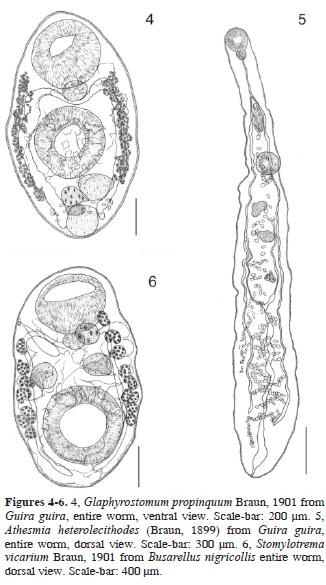
<body><![CDATA[<p align="justify"><font face="verdana" size="2">Fifteen birds (<i>T. lineatum</i> n=1; G. guira n=3; <i>M. chimachima</i> n=2; <i>R. sociabilis</i> n=3; <i>B. nigricollis</i> n=2; <i>B. meridionalis </i>n=4) were shot from October 2004 to October 2007 in Piran&eacute;, Formosa Province, Argentina. Birds were dissected and examined for helminths in the field or frozen and examined in the laboratory. Digeneans were fixed in formalin, unflattened, stained with hydrochloric carmine and mounted between 2 microscope coverslips in Canada balsam. Measurements are given in micrometers (&micro;m), unless otherwise stated, with the range followed by mean in parentheses. Drawings were made with the aid of a drawing tube. Voucher specimens were deposited in the Helminthological Collection of the Museo de La Plata (MLP), Argentina. The term <i>forebody</i> refers to the distance between the anterior extremity and the anterior margin of ventral sucker; the term <i>hindbody</i> refers to the distance between the posterior margin of ventral sucker and the posterior extremity. The terms esophagus and esophageal bulb utilized in <i>Clinostomum marginatum</i> (Rudolphi, 1819) Braun, 1899 were used according to Matthews and Cribb (1998).</font></p> 				    <p align="justify"><font face="verdana" size="2"><b>Redescriptions</b></font></p> 				    <p align="justify"><font face="verdana" size="2"><i>Clinostomatopsis sorbens</i> (Braun, 1899) Dollfus, 1932 (<a href="#f1af3">Fig 1&#150;2</a>)</font></p> 				    <p align="center"><font face="verdana" size="2"><a name="f1af3"></a></font></p> 				    <p align="center"><font face="verdana" size="2"><img src="/img/revistas/rmbiodiv/v80n1/a6f1af3.jpg"></font></p> 				    <p align="justify"><font face="verdana" size="2">Redescription based on 1 specimen. Body stout, linguiform, slightly convex dorsally, 9.1 mm long, 2.6 mm wide; tegument aspinous. Forebody 1.9 mm long, occupying 21% of total body length. Hindbody 5.6 mm long. Oral sucker subterminal, small, surrounded by incomplete collar&#150;like fold, 384 long, 540 wide. Ventral sucker well developed, strongly muscular, located about 1/3 distance down body from anterior end, 1.5 mm long, 1.4 mm wide. Sucker width ratio 1:2.5. Ratio of body length to ventral sucker length 1:6.1. Prepharynx short, 192 long; pharynx well developed, smaller than oral sucker, 269 long, 250 wide; esophagus absent; caeca simple, long, reaching to near posterior end, and connected to Y&#150;shaped excretory vesicle; excretory pore dorso&#150;subterminal. Ratio of oral sucker width to pharynx width 1:2.2. Testes tandem, large, deeply lobed, H&#150;shaped, near posterior extremity; anterior testis 1.1 mm long, 1.2 mm wide; posterior testis 1. 4 mm long, 1.3 mm wide. Cirrus sac large, intertesticular, containing voluminous seminal vesicle, 624 long, 461 wide; pars prostatic not seen. Genital pore median, intertesticular in posterior 1/3 of body. Ovary oval, intercecal, intertesticular, submedian and dextral, 336 long, 336 wide. Ratio of testes average width to ovary width 1:3.7. Ratio of cirrus sac width to ovary width 1:1.4. Laurer's canal short, opening immediately posterior to ovary on dorsal surface. Ootype surrounded by Mehlis' gland lateral sinistral to ovary, immediately posterior to cirrus sac. Vitellaria follicular distributed in intercecal, cecal and extracecal fields, commencing midway between intestinal bifurcation and anterior margin of ventral sucker and confluent below the ventral sucker and posterior end of body. Uterine duct thin, extends from intertesticular space, opens into uterine sac. Uterine seminal receptacle present. Eggs operculate, 115&#150;125 x 67. Ratio of body length to egg length 1:73&#150;79.</font></p> 				    <p align="justify"><font face="verdana" size="2">&nbsp;</font></p> 				    <p align="justify"><font face="verdana" size="2"><b>Taxonomic summary</b></font></p> 				    <p align="justify"><font face="verdana" size="2"><i>Host</i>: <i>Tigrisoma lineatum</i> (Boddaert) (Ardeidae).</font></p> 				    <p align="justify"><font face="verdana" size="2"><i>Locality</i>: Bellaco stream (26&deg;14'S; 58&deg;07'W), Piran&eacute;, Formosa Province, Argentina.</font></p> 				    ]]></body>
<body><![CDATA[<p align="justify"><font face="verdana" size="2"><i>Site of infection</i>: esophagus.</font></p> 				    <p align="justify"><font face="verdana" size="2"><i>Specimens deposited</i>: MLP 5573.</font></p> 				    <p align="justify"><font face="verdana" size="2">&nbsp;</font></p> 				    <p align="justify"><font face="verdana" size="2"><b>Remarks</b></font></p> 				    <p align="justify"><font face="verdana" size="2">Species of the genus <i>Clinostomatopsis</i> Dollfus, 1932 are known to parasitize the esophagus of neotropical birds, and are characterized by the presence of a cirrus sac and a genital pore in the intertesticular region. At present, 2 species are recognized: <i>C. sorbens</i> and <i>C. intermedialis</i> (Lamont, 1920). <i>Clinostomatopsis</i> intermedialis was described parasitizing the cormorants <i>Phalacrocorax brasilianus brasilianus</i> (Gmelin) (= <i>Phalacrocorax vigua</i>) and <i>Phalacrocorax penicillatus</i> (Brandt) from Venezuela and Mexico (Lamont, 1920; Bravo&#150;Hollis, 1947). This species differs from the specimen collected from <i>T. lineatum</i> in the anterior extent of the vitelline follicles (beginning at equatorial region of the ventral sucker or more posteriorly), in the size of the prepharynx (142&#150;160) and pharynx (355 x 273&#150;309), and in the shape of testes (anterior testis trilobed or ovoid, posterior testis trilobed) (Lamont, 1920; Bravo&#150;Hollis, 1947).</font></p> 				    <p align="justify"><font face="verdana" size="2"><i>Clinostomatopsis sorbens</i> was originally described by Diesing (1850) as <i>Distomum dimorphum</i> Diesing based on specimens from the wood stork, Mycteria americana L. (= Ciconia americana) (Ciconiidae) from Brazil. Braun (1899) transferred these specimens to the genus <i>Clinostomum</i> Leidy, 1856 as <i>Clinostomum sorbens</i> without adding any description, and later Dollfus (1932) created the genus <i>Clinostomatopsis</i> to include the specimens described by Diesing (1850) with the genital pore posterior to the anterior testis. Braun (1900) re&#150;described this species with few metric characteristics. Travassos (1922, 1928), Viana (1924) and Travassos et al. (1969), reported it for Brazil in <i>Ardea cocoi</i> L. (Ardeidae) and <i>Jabiru mycteria</i> (Lichtenstein) (Ciconiidae) providing no description. Since then, this species has not been mentioned from other hosts and/or localities. The morphology and the metric characters of the specimen studied in this paper correspond to the re&#150;description by Braun (1900).</font></p> 				    <p align="justify"><font face="verdana" size="2">In this paper, we present new morphological and morphometrical data (size of prepharynx, pharynx, testes, ovary and cirrus&#150;sac) of this species. The presence of <i>C. sorbens</i> in <i>T. lineatum</i> represents a new host record and the first report of a species of <i>Clinostomatopsis</i> in Argentinean birds.</font></p> 				    <p align="justify"><font face="verdana" size="2"><i>Clinostomum marginatum</i> (Rudolphi, 1819) Braun, 1899 (<a href="#f1af3">Fig. 3</a>)</font></p> 				    <p align="justify"><font face="verdana" size="2">Redescription based on 6 immature specimens. Body stout, linguiform, slightly convex dorsally, 2.8&#150;5.8 (4.7) mm long, 0.9&#150;1.4 (1.1) mm wide; tegument aspinous. Forebody, 0.8&#150;1.5 (1.1) mm long occupying 22&#150;28% (25%) of total body length. Hindbody 1.5&#150;3.5 (2.8) mm long. Oral sucker small, surrounded by collar&#150;like fold, 197&#150;278 (236) long, 240&#150;336 (299) wide. Ventral sucker very large, strongly muscular, located in second quarter of body, 605&#150;720 (677) long, 614&#150;720 (667) wide. Suckers width ratio 1:2.1&#150;2.6 (1:2.3). Ratio of body length to oral sucker length 1:13&#150;24 (1:19). Ratio of body length to ventral sucker length 1:4.7&#150;8.7 (1:6.7). Pharynx absent, esophagus 161&#150;225 (193) long with esophageal bulb poorly developed, 82&#150;161 (113) long, 82&#150;127 (98) wide; caeca long with small lateral diverticula in last quarter of body. Ratio of oral sucker length to esophageal bulb length 1:1.5&#150;2.9 (1:2.4). Testes tandem at posterior half of body; anterior testis triangular in posterior end of middle third of body, 336&#150;475 (384) long 350&#150;523 (442) wide; posterior testis feebly lobed in last quarter of body, 288&#150;480 (360) long x 432&#150;480 (464) wide. Cirrus sac oval, small, sub&#150;median, located in middle posterior of second third of body, between right caeca and anterior testis, 298&#150;414 (362) long, 136&#150;168 (151) wide; voluminous seminal vesicle present; pars prostatica not seen. Genital pore median, lateral to anterior testis. Ovary oval, small, intertesticular and median, 134&#150;173 (153) long, 106&#150;144 (122) wide. Ratio of cirrus sac length to ovary length 1:1.8&#150;3.0 (1:2.5). Ratio of testes average width to ovary width 1:3.5&#150;4.5 (1:3.8). Mehlis' gland well developed, lateral to ovary; Laurer's canal short, opening dorsally at ovarian region. Vitellarium not developed. Uterine sac anterior to testes. Excretory vesicle V&#150;shaped, connected to intestinal caeca; excretory pore terminal.</font></p> 				    <p align="justify"><font face="verdana" size="2">&nbsp;</font></p> 				    ]]></body>
<body><![CDATA[<p align="justify"><font face="verdana" size="2"><b>Taxonomic summary</b></font></p> 				    <p align="justify"><font face="verdana" size="2"><i>Host</i>: <i>Tigrisoma lineatum</i> (Boddaert) (Ardeidae).</font></p> 				    <p align="justify"><font face="verdana" size="2"><i>Locality</i>: Bellaco stream (26&deg;14'S; 58&deg;07'W), Piran&eacute;, Formosa Province, Argentina.</font></p> 				    <p align="justify"><font face="verdana" size="2"><i>Site of infection</i>: esophagus.</font></p> 				    <p align="justify"><font face="verdana" size="2"><i>Specimens deposited</i>: MLP 5574.</font></p> 				    <p align="justify"><font face="verdana" size="2"><b>Remarks</b></font></p> 				    <p align="justify"><font face="verdana" size="2">In the Neotropical region, 5 species of <i>Clinostomum</i> have been reported parasitizing ciconiform and pelecaniform birds: <i>C. detruncatum</i> Braun, 1899 in ardeids and ciconids from Brazil, Venezuela and Argentina; <i>C. heluans</i> Braun, 1899 in ardeids from Brazil, Venezuela, Cuba and Mexico; <i>C. complanatum</i> (Rud., 1819) Braun, 1899 in ardeids and phalacrocoracids from Cuba, Mexico, Argentina and Brazil; C. attenuatum Cort, 1913 in ardeids from Cuba, and <i>C. marginatum</i> in ardeid, ciconid, phalacrocoracid and anhingid birds from Brazil (Travassos, 1922; Bravo Hollis, 1947; P&eacute;rez Vigueras, 1955; Caballero and Diaz&#150;Ungr&iacute;a, 1958; Travassos et al., 1969; Boero and Led, 1971; Ramos&#150;Ramos, 1995; Lamothe&#150;Argumedo et al., 1997; Sutton and Damborenea, 2000; Arruda et al., 2001; Dias et al. 2003). Ukoli (1966) considers <i>C. complanatum</i> and <i>C. marginatum</i> synonymous, however Dzikowski et al., (2004), consider them as valid species, based on molecular evidence.</font></p> 				    <p align="justify"><font face="verdana" size="2">The morphological and metrical characters of the specimens of <i>C. marginatum</i> from Ardea sp. described by Braun (1900) are similar to those found in our material, except for the size of the body (7 mm); specimens from A. cocoi described by the same author differs from the Argentinean material only in body and ventral sucker length (8 mm and 1.07 mm, respectively).</font></p> 				    <p align="justify"><font face="verdana" size="2">In Argentina, the metacercariae of this species (cited as <i>Clinostomulum marginatum</i>) were found by Szidat (1969) encapsulated in the body cavity of Neofundulus paraguayensis (Eigenmann and Kennedy) (Pisces, Rivulidae) from Formosa Province. The morphological and metrical characters of these metacercariae are coincident with the immature specimens recovered from <i>T. lineatum</i>. <i>Clinostomum marginatum</i> and <i>C. sorbens</i> were found simultaneously in the same host. The presence of <i>C. marginatum</i> in <i>T. lineatum</i> represents the first report of this parasite in Argentinean birds.</font></p> 				    <p align="justify"><font face="verdana" size="2"><i>Glaphyrostomum propinquum</i> Braun, 1901 (<a href="#f4af6">Fig. 4</a>)</font></p> 				    ]]></body>
<body><![CDATA[<p align="center"><font face="verdana" size="2"><a name="f4af6"></a></font></p> 				    <p align="center"><font face="verdana" size="2"><img src="/img/revistas/rmbiodiv/v80n1/a6f4af6.jpg"></font></p> 				    <p align="justify"><font face="verdana" size="2">Redescription based on 3 specimens. Body oval, with maximum width at equatorial level, 1.1&#150;1.8 (1.3) mm long, 0.586&#150;0.672 (0.631) mm wide; tegument smooth. Forebody 497&#150;745 (583) long, occupying 41&#150;46% (44%) of total body length. Hindbody 299&#150;686 (435) long. Oral sucker round, subterminal, 341&#150;422 (376) long, 350&#150;432 (382) wide. Ventral sucker muscular, nearly the same size as the oral sucker, located in middle of body, 346&#150;432 (375) long, 365&#150;413 (384) wide. Suckers width ratio 1:0.96&#150;1.05 (1:0.99). Ratio of body length to ventral sucker length 1:3.1&#150;4.2 (1:3.6). Prepharynx absent, pharynx well developed, 106&#150;149 (122) long, 133&#150;170 (145) wide, esophagus absent, intestinal caeca straight, reaching to posterior end. Ratio of oral sucker length to pharynx length 1:2.8&#150;3.4 (1:3.1). Testes slightly diagonal, contiguous, smooth, intercecal, located in posterior end of body; anterior testis 121&#150;150 (136) long, 175&#150;184 (180) wide; posterior testis 112&#150;159 (136) long, 161&#150;172 (167) wide. Cirrus&#150;sac small, oval, overlapping posterior testis, 298&#150;414 (362) long, 136&#150;168 (151) wide. Genital pore median, at level of posterior testis. Ovary oval, smaller than testes, median, intercecal, intertesticular, 90&#150;97 (94) long, 87&#150;115 (101) wide. Ratio of ovary width to pharynx width 1:0.7&#150;0.9 (1:0.8). Ratio of testes average width to ovary width 1:1.6&#150;1.9 (1:1.7). Vitellaria follicular, cecal and extracecal, in 2 lateral fields extending from posterior margin of oral sucker to ovarian level. Uterus filling space delimited by ovary, oral sucker and caeca. Eggs small, oval, 23&#150;28 x 14&#150;18 (26 x 16). Ratio of body length to egg length 1:39&#150;79 (1:54). Excretory vesicle opening by median pore at posterior end of body.</font></p> 				    <p align="justify"><font face="verdana" size="2">&nbsp;</font></p> 				    <p align="justify"><font face="verdana" size="2"><b>Taxonomic summary</b></font></p> 				    <p align="justify"><font face="verdana" size="2"><i>Host</i>: <i>Guira guira</i> (Gmelin) (Cuculidae).</font></p> 				    <p align="justify"><font face="verdana" size="2"><i>Locality</i>: La Marcela farm (26&deg;17'35"S; 59&deg;06'67"W), Formosa Province, Argentina.</font></p> 				    <p align="justify"><font face="verdana" size="2"><i>Site of infection</i>: cloaca.</font></p> 				    <p align="justify"><font face="verdana" size="2"><i>Specimens deposited</i>: MLP 5575.</font></p> 				    <p align="justify"><font face="verdana" size="2"><b>Remarks</b></font></p> 				    ]]></body>
<body><![CDATA[<p align="justify"><font face="verdana" size="2">The species of the genus <i>Glaphyrostomum</i> Braun, 1901 (Brachylaimidae) have been reported parasitizing the intestine and the cloaca of birds from Neartic, Neotropical and Oriental regions.</font></p> 				    <p align="justify"><font face="verdana" size="2">In the Neotropical region, 3 species have been reported in Brazil: <i>G. adhaerens</i> Braun, 1901 in <i>Rhopornis ardesiacus</i> (Wied&#150;Neuwied) (cited as Myiothera sp.) (Thamnophilidae) and Gallinula sp. (cited as G. kioloides Puch) (Rallidae); <i>G. propinquum</i> collected in Dendrocolaptes certhia (Boddaert) (Dendrocolaptidae) and G. pintoi (Travassos and Kohn, 1964) Yamaguti, 1971 in the cloaca of <i>Tinamus solitarius</i> (Vieillot) (Tinamidae) (described as Cesartrema p.) (Braun, 1901a, 1902; Travassos and Kohn, 1964; Yamaguti, 1971). The original descriptions of these species were summarized by Travassos et al. (1969), although the figures of <i>G. adhaerens</i> and <i>G. propinquum</i> were interchanged (figs. 260 and 261).</font></p> 				    <p align="justify"><font face="verdana" size="2">The morphological characters of the specimens of <i>G. propinquum</i> from <i>D. certhia</i> are in full agreement with those described in the present paper, except for the body size (2.7 mm), which may be related to their degree of contraction. In this paper, we present new morphometrical data of <i>G. propinquum</i> found in a new host, G. guira. This is the first report of this species since its original description and the first report of a species of <i>Glaphyrostomum</i> in Argentina.</font></p> 				    <p align="justify"><font face="verdana" size="2"><i>Athesmia heterolecithodes</i> (Braun, 1899) Looss, 1899 (<a href="#f4af6">Fig. 5</a>)</font></p> 				    <p align="justify"><font face="verdana" size="2">Redescription based on 9 specimens from G. guira. Body elongate, flattened, 1.4&#150;3.5 (2.7) mm long, 0.2&#150;0.4 (0.3) mm wide; tegument aspinous, with papillae arranged irregularly in fore&#150; and hindbody. Forebody 406&#150;803 (589) long, occupying 15&#150;29% (23%) of total body length. Hindbody 0.909&#150;2.8 (2.0) mm long. Oral sucker subterminal, 107&#150;183 (147) long, 98&#150;169 (136) wide. Ventral sucker globular, feebly muscular, in anterior region of second quarter of body, nearly the same size as the oral sucker, 98&#150;155 (139) long, 100&#150;159 (135) wide. Sucker width ratio 1:0.8&#150;1.1 (1:1). Ratio of body length to ventral sucker length 1:12&#150;26 (1:19). Prepharynx absent; pharynx well developed, 45&#150;60 (52) long, 36&#150;57 (48) wide; esophagus long, 121&#150;262 (200); caeca long winding, reaching to anterior middle of posterior quarter of body. Ratio of oral sucker length to pharynx length 1:2.6&#150;3.3 (1:3). Testes slightly diagonal, in second quarter of body, irregular in shape or slightly lobed; anterior testis 51&#150;138 (92) long, 73&#150;95 (85) wide; posterior testis 63&#150;139 (106) long, 63&#150;100 (81) wide. Cirrus&#150;sac well developed, claviform, containing tubular and convoluted seminal vesicle, short pars prostatica surrounded by few gland cells, and well developed cirrus, 181&#150;200 (188) long, 36&#150;62 (51) wide. Ratio of body length to cirrus sac length 1:15&#150;19 (1:17). Ratio of cirrus sac length to ventral sucker length 1:1.2&#150;1.4 (1:1.3). Genital atrium shallow; genital pore posterior to caecal bifurcation, in first quarter of body. Ovary lobate, smaller than testes, postesticular, submedian, immediately posterior to equatorial region, 75&#150;92 (85) long, 58&#150;112 (88) wide; oviduct long. Ratio of testes average width to ovary width 1:0.7&#150;1.5 (1:1). Ratio of cirrus sac width to ovary width 1:0.3&#150;0.9 (1:0.6). Laurer's canal short, ascending, opening dorsally at ovarian level; seminal receptacle sacciform, 52&#150;90 (68) long, 52&#150;90 (74) wide. Vitellaria follicular composed of very small follicles distributed in 1 lateral field, extending throughout third quarter of body. Uterus coiled, extending from ovary to close to posterior extremity; opening in anterior extremity of genital atrium through a weakly muscular metraterm. Eggs numerous, small, oval, operculate, 15&#150;35 x 9&#150;24 (28 x 17). Ratio of ovary length to egg length 1:2.2&#150;3.7 (1:2.8). Ratio of body length to egg length 1:55&#150;118 (1:97). Excretory vesicle Y&#150;shaped, bifurcating posterior to ovary. Excretory pore median, at posterior end of body.</font></p> 				    <p align="justify"><font face="verdana" size="2">&nbsp;</font></p> 				    <p align="justify"><font face="verdana" size="2"><b>Taxonomic summary</b></font></p> 				    <p align="justify"><font face="verdana" size="2"><i>Hosts</i>: <i>Milvago chimachima</i> (Vieillot) (Falconidae); <i>Rostrhamus sociabilis</i> (Vieillot) (Accipitridae) and G. guira.</font></p> 				    <p align="justify"><font face="verdana" size="2"><i>Locality</i>: La Marcela farm (26&deg;17'35"S; 59&deg;06'67"W), Piran&eacute;, Formosa Province, Argentina.</font></p> 				    <p align="justify"><font face="verdana" size="2"><i>Site of infection</i>: bile ducts.</font></p> 				    ]]></body>
<body><![CDATA[<p align="justify"><font face="verdana" size="2"><i>Specimens deposited</i>: MLP 5576</font></p> 				    <p align="justify"><font face="verdana" size="2"><b>Remarks</b></font></p> 				    <p align="justify"><font face="verdana" size="2">This nearly cosmopolitan species of Dicrocoeliidae Odhner 1910 originally described from birds from the Old World (Teixeira de Freitas, 1962), has been reported from bird and mammalian hosts from Argentina. Digiani (2000) reported this species in 5 bird species from Buenos Aires Province: <i>Plegadis chihi</i> (Vieillot) (Threskiornithidae), <i>Jacana jacana jacana</i> (L.) (Jacanidae), <i>Aramides ypecaha</i> (Vieillot) (Rallidae), <i>Vanellus chilensis cayannensis</i> (Gmelin) (Charadriidae) and <i>Nothura maculosa</i> (Temminck) (Tinamidae).</font></p> 				    <p align="justify"><font face="verdana" size="2">The specimens of <i>A. heterolecithodes</i> studied here are smaller and their vitelline follicles are less developed than those described previously. This could be related to the wide range of intraspecific variation observed in this species (Teixeira de Freitas, 1962). The finding of <i>A. heterolecithodes</i> in R. sociabilis represents a new host record.</font></p> 				    <p align="justify"><font face="verdana" size="2"><i>Stomylotrema vicarium</i> Braun, 1901 (<a href="#f4af6">Fig. 6</a>)</font></p> 				    <p align="justify"><font face="verdana" size="2">Redescription based on 3 specimens from B. nigricollis and 1 specimen from <i>B. meridionalis</i>. Body oval, 1.7&#150;2.5 (2.1) mm long,1.2&#150;1.3 (1.3) mm wide; tegument aspinous. Forebody 0.9&#150;1.4 (1.1) mm long, occupying 50&#150;55 % (53 %) of total body length. Hindbody 203&#150;275 (238) long. Oral sucker subterminal, round, 532&#150;619 (577 long, 600&#150;725 (674) wide. Ventral sucker larger than oral sucker, in middle posterior of body, 696&#150;870 (774) long, 764&#150;861 (812) wide. Sucker width ratio 1:1.1&#150;1.4 (1:1.2). Ratio of body length to ventral sucker length 1:2.5&#150;2.9 (1:2.7). Prepharynx short, 48 long; pharynx well developed, 135&#150;193 (158) long, 193&#150;203 (200) wide; esophagus short, sacciform; caeca surround ventral sucker, reaching posterior extremity of body. Ratio of oral sucker length to pharynx length 1:3.2&#150;4.0 (1:3.7). Testes symmetrical, round or oval, intercecal, immediately pre&#150;equatorial; poral testis 208&#150;232 (222) long, 232&#150;290 (254) wide; aporal testis 193&#150;227 (208) long, 217&#150;256 (238) wide. Cirrus sac large, claviform, oblique, near anterior end of body, containing tubular and coiled seminal vesicle, 401&#150;555 (469) long, 121&#150;126 (124) wide. Ratio of oral sucker length to cirrus sac length 1:1.1&#150;1.3 (1:1.2). Genital atrium small. Genital pore on dextral margin of body close to anterior extremity. Ovary round, located in first third of body, anterior to aporal testis, 155&#150;217 (184) long, 193&#150;232 (214) wide. Ratio of ovary width to pharynx width 1:0.95&#150;1.14 (1:1.07). Ratio of testes average width to ovary width 1:1.1&#150;1.4 (1:1.2). Ratio of cirrus sac width to ovary width 1:0.54&#150;0.63 (1:0.58). Uterine seminal receptacle present; ootype surrounded by Mehlis' gland, on middle line of body in ovary&#150;testicular region. Laurer's canal short, opening at dorsal surface of body, near Mehlis' gland. Vitelline follicles oval or lobed, situated on each sides of body, extending from posterior border of oral sucker or ovarian level to middle or posterior border of ventral sucker; 7 poral follicles, extending posteriorly to genital pore, 9 aporal follicles, extending from anterior level of ovary to mid&#150;level of ventral sucker. Uterine coils occupy entire region between oral sucker and posterior end of body. Eggs small, yellow&#150;brown, oval, operculated, 26&#150;29 x 14&#150;17 (27 x 15). Ratio of body length to egg length 1:61&#150;97 (1:79). Excretory vesicle and pore not seen.</font></p> 				    <p align="justify"><font face="verdana" size="2">&nbsp;</font></p> 				    <p align="justify"><font face="verdana" size="2"><b>Taxonomic summary</b></font></p> 				    <p align="justify"><font face="verdana" size="2"><i>Hosts</i>: <i>Busarellus nigricollis</i> (Latham), <i>Buteogallus meridionalis</i> (Latham) (= <i>Heterospizias</i> m.) (Accipitridae).</font></p> 				    <p align="justify"><font face="verdana" size="2"><i>Locality</i>: La Marcela farm (26&deg;17'35"S; 59&deg;06'67"W), Piran&eacute;, Formosa Province, Argentina.</font></p> 				    ]]></body>
<body><![CDATA[<p align="justify"><font face="verdana" size="2"><i>Site of infection</i>: cloaca.</font></p> 				    <p align="justify"><font face="verdana" size="2"><i>Specimens deposited</i>: MLP 5577 and MLP 5743.</font></p> 				    <p align="justify"><font face="verdana" size="2"><b>Remarks</b></font></p> 				    <p align="justify"><font face="verdana" size="2">Seven species of <i>Stomylotrema</i> Looss, 1900 have been reported for the Neotropical region: <i>S. vicarium</i>, <i>S. bijugum</i> Braun, 1901, <i>S. fastosum</i> Braun, 1901, S. tagax Braun, 1901, <i>S. perpastum</i> Braun, 1902, <i>S. gratiosus</i> Travassos, 1922 and <i>S. ucremium</i> Brenes, Arroyo and Mu&ntilde;oz, 1966.</font></p> 				    <p align="justify"><font face="verdana" size="2">The morphology and the metric characters of the specimens re&#150;described in this study agree with the descriptions of <i>S. vicarium</i> by Braun (1902) and Macko et al. (1999), and differ from the specimens described by Szidat (1964) and Ostrowski de N&uacute;&ntilde;ez (1978) in having a smaller body size. Macko et al. (1999), reported high levels of variation in all metrical characters for all <i>Stomylotrema</i> spp.</font></p> 				    <p align="justify"><font face="verdana" size="2"><i>Stomylotrema vicarium</i> was found naturally parasitizing the intestine and cloaca of <i>Theristicus caerulescens</i> (Vieillot) (Threskiornithidae), <i>Ciconia maguari</i> (Gmelin) and <i>Jabiru mycteria</i> (Lichtenstein) (Ciconiidae) from Brazil; <i>Egretta caerulea</i> (L.) (Ardeidae) and <i>Tachybaptus dominicus</i> (L.) (cited as Podiceps dominicus dominicus (L.)) (Podicipedidae) from Cuba, and <i>Larus dominicanus</i> Lichtenstein (Laridae) from Argentina (Braun, 1901b; Travassos, 1922, 1928; Szidat, 1964; Travassos et al.,1969; Macko et al., 1999). In addition, <i>Vanellus chilensis</i> (Molina) (Charadriidae) and <i>Gallus gallus domesticus</i> (L.) (Phasianidae) were reported as experimental hosts by Ostrowski de N&uacute;&ntilde;ez (1978). The finding of <i>S. vicarium</i> parasitizing <i>B. nigricollis</i> and <i>B. meridionalis</i> represents 2 new host records and the first report in falconiform birds.</font></p> 				    <p align="justify"><font face="verdana" size="2">&nbsp;</font></p> 				    <p align="justify"><font face="verdana" size="2"><b>Acknowledgments</b></font></p> 				    <p align="justify"><font face="verdana" size="2">Special thanks to Dr. C. Montoya for his help and hospitality during our stay in Formosa Province, Dr. C. Darrieu, Secci&oacute;n Ornitolog&iacute;a (Divisi&oacute;n Zoolog&iacute;a Vertebrados, Museo de La Plata) for identification of bird hosts, Cecilia Moreno for the English review, and 2 anonymous referees for their constructive comments. The authors are members of the Comisi&oacute;n de Investigaciones Cient&iacute;ficas de la provincia de Buenos Aires (CIC) and Universidad Nacional de La Plata (UNLP), respectively. The present study was supported by a grant from the Comisi&oacute;n de Investigaciones Cient&iacute;ficas de la Provincia de Buenos Aires (File 2157&#150;1994/05, Res. 044).</font></p> 				    <p align="justify"><font face="verdana" size="2">&nbsp;</font></p> 				    ]]></body>
<body><![CDATA[<p align="justify"><font face="verdana" size="2"><b>Literature cited</b></font></p> 				    <!-- ref --><p align="justify"><font face="verdana" size="2">Arruda, V. S., R. M. Pinto and L. C. Muniz&#150;Pereira. 2001. New host and geographical records for helminths parasites of Ardeidae (Aves, Ciconiiformes) in Brazil. Revista Brasileira de Biologia 18:225&#150;232.</font>&nbsp;&nbsp;&nbsp;&nbsp;&nbsp;&nbsp;&nbsp;&nbsp;[&#160;<a href="javascript:void(0);" onclick="javascript: window.open('/scielo.php?script=sci_nlinks&ref=7500057&pid=S1870-3453200900010000600001&lng=','','width=640,height=500,resizable=yes,scrollbars=1,menubar=yes,');">Links</a>&#160;]<!-- end-ref --> 				    <!-- ref --><p align="justify"><font face="verdana" size="2">Boero, J. J. and J. E. Led. 1971. El parasitismo de la fauna aut&oacute;ctona. V. Los par&aacute;sitos de las aves argentinas. VI. Los par&aacute;sitos de los ofidios argentinos. VII. Los par&aacute;sitos de los murci&eacute;lagos argentinos. Analecta Veterinaria 3:91&#150;103.</font>&nbsp;&nbsp;&nbsp;&nbsp;&nbsp;&nbsp;&nbsp;&nbsp;[&#160;<a href="javascript:void(0);" onclick="javascript: window.open('/scielo.php?script=sci_nlinks&ref=7500059&pid=S1870-3453200900010000600002&lng=','','width=640,height=500,resizable=yes,scrollbars=1,menubar=yes,');">Links</a>&#160;]<!-- end-ref --> 				    <!-- ref --><p align="justify"><font face="verdana" size="2">Braun, M. 1899. I. Wissenschaftliche Mittheilungen. 1. &Uuml;ber <i>Clinostomum</i> Leidy. Zoologischer Anzeiger 22:489&#150;493.</font>&nbsp;&nbsp;&nbsp;&nbsp;&nbsp;&nbsp;&nbsp;&nbsp;[&#160;<a href="javascript:void(0);" onclick="javascript: window.open('/scielo.php?script=sci_nlinks&ref=7500061&pid=S1870-3453200900010000600003&lng=','','width=640,height=500,resizable=yes,scrollbars=1,menubar=yes,');">Links</a>&#160;]<!-- end-ref --> 				    <!-- ref --><p align="justify"><font face="verdana" size="2">Braun, M. 1900. Die Arten der Gattung <i>Clinostomum</i> Leidy. Zoologische Jahrb&uuml;echer Abteilung f&uuml;r Systematik &Ouml;ekologie und Geographie der Tiere 14:1&#150;48.</font>&nbsp;&nbsp;&nbsp;&nbsp;&nbsp;&nbsp;&nbsp;&nbsp;[&#160;<a href="javascript:void(0);" onclick="javascript: window.open('/scielo.php?script=sci_nlinks&ref=7500063&pid=S1870-3453200900010000600004&lng=','','width=640,height=500,resizable=yes,scrollbars=1,menubar=yes,');">Links</a>&#160;]<!-- end-ref --> 				    <!-- ref --><p align="justify"><font face="verdana" size="2">Braun, M. 1901a. Zur Revision der Trematoden der V&ouml;gel II. Zentralblatt fur Bakteriologie, Abth I, 29:941&#150;948.</font>&nbsp;&nbsp;&nbsp;&nbsp;&nbsp;&nbsp;&nbsp;&nbsp;[&#160;<a href="javascript:void(0);" onclick="javascript: window.open('/scielo.php?script=sci_nlinks&ref=7500065&pid=S1870-3453200900010000600005&lng=','','width=640,height=500,resizable=yes,scrollbars=1,menubar=yes,');">Links</a>&#160;]<!-- end-ref --> 				    <!-- ref --><p align="justify"><font face="verdana" size="2">Braun, M. 1901b. Zur Revision der Trematoden der V&ouml;gel II. Zentralblatt fur Bakteriologie, Abth I, 29:895&#150;897.</font>&nbsp;&nbsp;&nbsp;&nbsp;&nbsp;&nbsp;&nbsp;&nbsp;[&#160;<a href="javascript:void(0);" onclick="javascript: window.open('/scielo.php?script=sci_nlinks&ref=7500067&pid=S1870-3453200900010000600006&lng=','','width=640,height=500,resizable=yes,scrollbars=1,menubar=yes,');">Links</a>&#160;]<!-- end-ref --> 				    <!-- ref --><p align="justify"><font face="verdana" size="2">Braun, M. 1902. Fascioliden der V&ouml;gel. Zoologische Jahrb&uuml;cher, Abteilung f&uuml;r Systematik, &Ouml;kologie und Geographie der Tiere 16:1&#150;162.</font>&nbsp;&nbsp;&nbsp;&nbsp;&nbsp;&nbsp;&nbsp;&nbsp;[&#160;<a href="javascript:void(0);" onclick="javascript: window.open('/scielo.php?script=sci_nlinks&ref=7500069&pid=S1870-3453200900010000600007&lng=','','width=640,height=500,resizable=yes,scrollbars=1,menubar=yes,');">Links</a>&#160;]<!-- end-ref --> 				    <!-- ref --><p align="justify"><font face="verdana" size="2">Bravo&#150;Hollis, M. 1947. Dos especies de <i>Clinostomum</i> (Trematoda), de aves procedentes del Estado de Nuevo Le&oacute;n, M&eacute;xico. Anales del Instituto de Biolog&iacute;a, Universidad Nacional Aut&oacute;noma de M&eacute;xico 18:489&#150;498.</font>&nbsp;&nbsp;&nbsp;&nbsp;&nbsp;&nbsp;&nbsp;&nbsp;[&#160;<a href="javascript:void(0);" onclick="javascript: window.open('/scielo.php?script=sci_nlinks&ref=7500071&pid=S1870-3453200900010000600008&lng=','','width=640,height=500,resizable=yes,scrollbars=1,menubar=yes,');">Links</a>&#160;]<!-- end-ref --> 				    <!-- ref --><p align="justify"><font face="verdana" size="2">Caballero y C., E. and C. D&iacute;az&#150;Ungr&iacute;a. 1958. Intento de un cat&aacute;logo de los Trematodos digeneos registrados en territorio venezolano. Memoria de la Sociedad de Ciencias Naturales La Salle 18:19&#150;36.</font>&nbsp;&nbsp;&nbsp;&nbsp;&nbsp;&nbsp;&nbsp;&nbsp;[&#160;<a href="javascript:void(0);" onclick="javascript: window.open('/scielo.php?script=sci_nlinks&ref=7500073&pid=S1870-3453200900010000600009&lng=','','width=640,height=500,resizable=yes,scrollbars=1,menubar=yes,');">Links</a>&#160;]<!-- end-ref --> 				    <!-- ref --><p align="justify"><font face="verdana" size="2">Dias, M. L. G. G., J. C. Eiras, M. H. Machado, G. T. R. Souza and G. C. Pavanelli. 2003. The life cycle of <i>Clinostomum</i> complanatum Rudolphi, 1814 (Digenea, Clinostomidae) on the floodplain of the high Paran&aacute; River, Brazil. Parasitology Research 10:185&#150;187.</font>&nbsp;&nbsp;&nbsp;&nbsp;&nbsp;&nbsp;&nbsp;&nbsp;[&#160;<a href="javascript:void(0);" onclick="javascript: window.open('/scielo.php?script=sci_nlinks&ref=7500075&pid=S1870-3453200900010000600010&lng=','','width=640,height=500,resizable=yes,scrollbars=1,menubar=yes,');">Links</a>&#160;]<!-- end-ref --> 				    <!-- ref --><p align="justify"><font face="verdana" size="2">Diesing, C. M. 1850. Systema Helminthum, vol. 1. Vindoboae. 680 p.</font>&nbsp;&nbsp;&nbsp;&nbsp;&nbsp;&nbsp;&nbsp;&nbsp;[&#160;<a href="javascript:void(0);" onclick="javascript: window.open('/scielo.php?script=sci_nlinks&ref=7500077&pid=S1870-3453200900010000600011&lng=','','width=640,height=500,resizable=yes,scrollbars=1,menubar=yes,');">Links</a>&#160;]<!-- end-ref --> 				    <!-- ref --><p align="justify"><font face="verdana" size="2">Digiani, M. C. 2000. Digeneans and cestodes parasitic in the white&#150;faced ibis <i>Plegadis chihi</i> (Aves: Threskiornithidae) from Argentina. Folia Parasitologica 47:195&#150;204.</font>&nbsp;&nbsp;&nbsp;&nbsp;&nbsp;&nbsp;&nbsp;&nbsp;[&#160;<a href="javascript:void(0);" onclick="javascript: window.open('/scielo.php?script=sci_nlinks&ref=7500079&pid=S1870-3453200900010000600012&lng=','','width=640,height=500,resizable=yes,scrollbars=1,menubar=yes,');">Links</a>&#160;]<!-- end-ref --> 				    <!-- ref --><p align="justify"><font face="verdana" size="2">Dollfus, M. R. 1932. Mission Saharienne Augi&eacute;ras&#150;Draper, 1927&#150;1928. Tr&eacute;matodes de mammif&egrave;res, oiseaux et poissons. Bulletin du Mus&eacute;um National d'Histoire Naturelle 4:555&#150;563.</font>&nbsp;&nbsp;&nbsp;&nbsp;&nbsp;&nbsp;&nbsp;&nbsp;[&#160;<a href="javascript:void(0);" onclick="javascript: window.open('/scielo.php?script=sci_nlinks&ref=7500081&pid=S1870-3453200900010000600013&lng=','','width=640,height=500,resizable=yes,scrollbars=1,menubar=yes,');">Links</a>&#160;]<!-- end-ref --> 				    <!-- ref --><p align="justify"><font face="verdana" size="2">Dubois, G. 1970. Les Strigeata (Trematoda) de la collection A. Lutz. Mem&oacute;rias do Instituto Oswaldo Cruz 68:169&#150;196.</font>&nbsp;&nbsp;&nbsp;&nbsp;&nbsp;&nbsp;&nbsp;&nbsp;[&#160;<a href="javascript:void(0);" onclick="javascript: window.open('/scielo.php?script=sci_nlinks&ref=7500083&pid=S1870-3453200900010000600014&lng=','','width=640,height=500,resizable=yes,scrollbars=1,menubar=yes,');">Links</a>&#160;]<!-- end-ref --> 				    <!-- ref --><p align="justify"><font face="verdana" size="2">Dubois, G. 1978. Notes Helminthologiques IV: Strigeidae Railliet, Diplostomidae Poirier, Proterodiplostomidae Dubois et Cyathocotylidae Poche (Trematoda). Revue suisse de Zoologie 85:607&#150;615.</font>&nbsp;&nbsp;&nbsp;&nbsp;&nbsp;&nbsp;&nbsp;&nbsp;[&#160;<a href="javascript:void(0);" onclick="javascript: window.open('/scielo.php?script=sci_nlinks&ref=7500085&pid=S1870-3453200900010000600015&lng=','','width=640,height=500,resizable=yes,scrollbars=1,menubar=yes,');">Links</a>&#160;]<!-- end-ref --> 				    <!-- ref --><p align="justify"><font face="verdana" size="2">Dubois, G. 1985. Quelques Strigeoidea (Trematoda) r&eacute;colt&eacute;s chez des oiseaux du Paraguay par la Mission Claude Weber, automne 1983, du Mus&eacute;um d'Histoire naturelle de Gen&egrave;ve. Revue suisse de Zoologie 92:641&#150;648.</font>&nbsp;&nbsp;&nbsp;&nbsp;&nbsp;&nbsp;&nbsp;&nbsp;[&#160;<a href="javascript:void(0);" onclick="javascript: window.open('/scielo.php?script=sci_nlinks&ref=7500087&pid=S1870-3453200900010000600016&lng=','','width=640,height=500,resizable=yes,scrollbars=1,menubar=yes,');">Links</a>&#160;]<!-- end-ref --> 				    <!-- ref --><p align="justify"><font face="verdana" size="2">Dzikowski, R., M. G. Levy, M. F. Poore, J. R. Flowers and I. Paperna. 2004. <i>Clinostomum</i> complanatum and <i>Clinostomum marginatum</i> (Rudolphi, 1819) (Digenea: Clinostomidae) are separate species based on differences in ribosomal DNA. Journal of Parasitology 90:413&#150;414.</font>&nbsp;&nbsp;&nbsp;&nbsp;&nbsp;&nbsp;&nbsp;&nbsp;[&#160;<a href="javascript:void(0);" onclick="javascript: window.open('/scielo.php?script=sci_nlinks&ref=7500089&pid=S1870-3453200900010000600017&lng=','','width=640,height=500,resizable=yes,scrollbars=1,menubar=yes,');">Links</a>&#160;]<!-- end-ref --> 				    <!-- ref --><p align="justify"><font face="verdana" size="2">Kostadinova, A., C. Vaucher and D. I. Gibson. 2006. Megalophallus deblocki n. sp. (Digenea: Microphallidae) from <i>Rostrhamus sociabilis</i> (Vieillot) (Aves: Accipitridae) in Paraguay. Systematic Parasitology 63:119&#150;126.</font>&nbsp;&nbsp;&nbsp;&nbsp;&nbsp;&nbsp;&nbsp;&nbsp;[&#160;<a href="javascript:void(0);" onclick="javascript: window.open('/scielo.php?script=sci_nlinks&ref=7500091&pid=S1870-3453200900010000600018&lng=','','width=640,height=500,resizable=yes,scrollbars=1,menubar=yes,');">Links</a>&#160;]<!-- end-ref --> 				    <!-- ref --><p align="justify"><font face="verdana" size="2">Lamont, M. A. 1920. A new species of <i>Clinostomum</i>. Occasional Papers of the Museum of Zoology: 1&#150;5, plate I.</font>&nbsp;&nbsp;&nbsp;&nbsp;&nbsp;&nbsp;&nbsp;&nbsp;[&#160;<a href="javascript:void(0);" onclick="javascript: window.open('/scielo.php?script=sci_nlinks&ref=7500093&pid=S1870-3453200900010000600019&lng=','','width=640,height=500,resizable=yes,scrollbars=1,menubar=yes,');">Links</a>&#160;]<!-- end-ref --> 				    <!-- ref --><p align="justify"><font face="verdana" size="2">Lamothe&#150;Argumedo, R., L. Garc&iacute;a&#150;Prieto, D. Osorio&#150;Sarabia and G. P&eacute;rez&#150;Ponce de Le&oacute;n. 1997. Cat&aacute;logo de la Colecci&oacute;n Nacional de Helmintos. UNAM&#150;CONABIO, M&eacute;xico, D.F. 211 p.</font>&nbsp;&nbsp;&nbsp;&nbsp;&nbsp;&nbsp;&nbsp;&nbsp;[&#160;<a href="javascript:void(0);" onclick="javascript: window.open('/scielo.php?script=sci_nlinks&ref=7500095&pid=S1870-3453200900010000600020&lng=','','width=640,height=500,resizable=yes,scrollbars=1,menubar=yes,');">Links</a>&#160;]<!-- end-ref --> 				    <!-- ref --><p align="justify"><font face="verdana" size="2">Lunaschi, L. and F. Drago. 2005. Primer registro de <i>Neodiplostomum travassosi</i> Dubois, 1937 (Digenea&#150;Diplostomidae) en Argentina. Revista Mexicana de Biodiversidad 76:97&#150;100.</font>&nbsp;&nbsp;&nbsp;&nbsp;&nbsp;&nbsp;&nbsp;&nbsp;[&#160;<a href="javascript:void(0);" onclick="javascript: window.open('/scielo.php?script=sci_nlinks&ref=7500097&pid=S1870-3453200900010000600021&lng=','','width=640,height=500,resizable=yes,scrollbars=1,menubar=yes,');">Links</a>&#160;]<!-- end-ref --> 				    <!-- ref --><p align="justify"><font face="verdana" size="2">Lunaschi, L. and F. Drago. 2006a. First report of adult specimens of <i>Sphincterodiplostomum musculosum</i> (Digenea, Diplostomidae). Parasitology International 55:7&#150;10.</font>&nbsp;&nbsp;&nbsp;&nbsp;&nbsp;&nbsp;&nbsp;&nbsp;[&#160;<a href="javascript:void(0);" onclick="javascript: window.open('/scielo.php?script=sci_nlinks&ref=7500099&pid=S1870-3453200900010000600022&lng=','','width=640,height=500,resizable=yes,scrollbars=1,menubar=yes,');">Links</a>&#160;]<!-- end-ref --> 				    <!-- ref --><p align="justify"><font face="verdana" size="2">Lunaschi, L. and F. Drago. 2006b. Strigeid parasites of <i>Buteo magnirostris</i> (Aves: Falconiformes) from Argentina. Zootaxa 1106:25&#150;33.</font>&nbsp;&nbsp;&nbsp;&nbsp;&nbsp;&nbsp;&nbsp;&nbsp;[&#160;<a href="javascript:void(0);" onclick="javascript: window.open('/scielo.php?script=sci_nlinks&ref=7500101&pid=S1870-3453200900010000600023&lng=','','width=640,height=500,resizable=yes,scrollbars=1,menubar=yes,');">Links</a>&#160;]<!-- end-ref --> 				    <!-- ref --><p align="justify"><font face="verdana" size="2">Lunaschi, L. I., F. Cremonte and F. B. Drago. 2007. Checklist of digenean parasites of birds from Argentina. Zootaxa 1403:1&#150;36.</font>&nbsp;&nbsp;&nbsp;&nbsp;&nbsp;&nbsp;&nbsp;&nbsp;[&#160;<a href="javascript:void(0);" onclick="javascript: window.open('/scielo.php?script=sci_nlinks&ref=7500103&pid=S1870-3453200900010000600024&lng=','','width=640,height=500,resizable=yes,scrollbars=1,menubar=yes,');">Links</a>&#160;]<!-- end-ref --> 				    <!-- ref --><p align="justify"><font face="verdana" size="2">Macko, J. K., M. Spakulov&aacute; and J. C. Casanova. 1999. Morphology and taxonomy of <i>Stomylotrema</i> (Digenea: Stomylotrematidae) representatives from ciconiiform and podicipediform birds in Cuba. Folia Parasitologica 46:185&#150;190.</font>&nbsp;&nbsp;&nbsp;&nbsp;&nbsp;&nbsp;&nbsp;&nbsp;[&#160;<a href="javascript:void(0);" onclick="javascript: window.open('/scielo.php?script=sci_nlinks&ref=7500105&pid=S1870-3453200900010000600025&lng=','','width=640,height=500,resizable=yes,scrollbars=1,menubar=yes,');">Links</a>&#160;]<!-- end-ref --> 				    <!-- ref --><p align="justify"><font face="verdana" size="2">Matthews, D. and T. H. Cribb. 1998. Digenetic trematodes of the genus <i>Clinostomum</i> Leidy, 1856 (Digenea: Clinostomidae) from birds of Queensland, Australia, including C. wilsoni n. sp. from Egretta intermedia. Systematic Parasitology 39:199&#150;208.</font>&nbsp;&nbsp;&nbsp;&nbsp;&nbsp;&nbsp;&nbsp;&nbsp;[&#160;<a href="javascript:void(0);" onclick="javascript: window.open('/scielo.php?script=sci_nlinks&ref=7500107&pid=S1870-3453200900010000600026&lng=','','width=640,height=500,resizable=yes,scrollbars=1,menubar=yes,');">Links</a>&#160;]<!-- end-ref --> 				    <!-- ref --><p align="justify"><font face="verdana" size="2">Ostrowski de N&uacute;&ntilde;ez, M. 1978. Zum Entwicklungszyklus von <i>Stomylotrema vicarium</i>. Angewandte Parasitologie 19:208&#150;213.</font>&nbsp;&nbsp;&nbsp;&nbsp;&nbsp;&nbsp;&nbsp;&nbsp;[&#160;<a href="javascript:void(0);" onclick="javascript: window.open('/scielo.php?script=sci_nlinks&ref=7500109&pid=S1870-3453200900010000600027&lng=','','width=640,height=500,resizable=yes,scrollbars=1,menubar=yes,');">Links</a>&#160;]<!-- end-ref --> 				    <!-- ref --><p align="justify"><font face="verdana" size="2">P&eacute;rez Vigueras, I. 1955. Contribuci&oacute;n al conocimiento de la fauna helmintol&oacute;gica cubana. Mem&oacute;rias de la Sociedad Cubana de Historia Natural 22:21&#150;71.</font>&nbsp;&nbsp;&nbsp;&nbsp;&nbsp;&nbsp;&nbsp;&nbsp;[&#160;<a href="javascript:void(0);" onclick="javascript: window.open('/scielo.php?script=sci_nlinks&ref=7500111&pid=S1870-3453200900010000600028&lng=','','width=640,height=500,resizable=yes,scrollbars=1,menubar=yes,');">Links</a>&#160;]<!-- end-ref --> 				    <!-- ref --><p align="justify"><font face="verdana" size="2">Ramos&#150;Ramos, P. 1995. Algunos trematodes de vertebrados de la presa Miguel Aleman en Temascal, Oaxaca, M&eacute;xico. Anales del Instituto de Biolog&iacute;a, Universidad Nacional Aut&oacute;noma de M&eacute;xico, Serie Zoolog&iacute;a 66:241&#150;246.</font>&nbsp;&nbsp;&nbsp;&nbsp;&nbsp;&nbsp;&nbsp;&nbsp;[&#160;<a href="javascript:void(0);" onclick="javascript: window.open('/scielo.php?script=sci_nlinks&ref=7500113&pid=S1870-3453200900010000600029&lng=','','width=640,height=500,resizable=yes,scrollbars=1,menubar=yes,');">Links</a>&#160;]<!-- end-ref --> 				    <!-- ref --><p align="justify"><font face="verdana" size="2">Sutton, C. A. and M. C. Damborenea. 2000. Colecci&oacute;n Helmintol&oacute;gica del Museo de La Plata: I. Cat&aacute;logo de preparaciones microsc&oacute;picas, material tipo y no tipo. Serie T&eacute;cnica y Did&aacute;ctica Museo de La Plata 35:1&#150;20.</font>&nbsp;&nbsp;&nbsp;&nbsp;&nbsp;&nbsp;&nbsp;&nbsp;[&#160;<a href="javascript:void(0);" onclick="javascript: window.open('/scielo.php?script=sci_nlinks&ref=7500115&pid=S1870-3453200900010000600030&lng=','','width=640,height=500,resizable=yes,scrollbars=1,menubar=yes,');">Links</a>&#160;]<!-- end-ref --> 				    <!-- ref --><p align="justify"><font face="verdana" size="2">Szidat, L. 1964. Vergleichende Helminthologische untersuchungen an den argentinischen grossm&ouml;wen <i>Larus marinus dominicanus</i> Lichtenstein und <i>Larus ridibundus maculipennis</i> Lichtenstein nebst neuen beobachtungen &uuml;ber die artbildung bei parasiten. Zeitschrift fur Parasitenkunde 24:351&#150;414.</font>&nbsp;&nbsp;&nbsp;&nbsp;&nbsp;&nbsp;&nbsp;&nbsp;[&#160;<a href="javascript:void(0);" onclick="javascript: window.open('/scielo.php?script=sci_nlinks&ref=7500117&pid=S1870-3453200900010000600031&lng=','','width=640,height=500,resizable=yes,scrollbars=1,menubar=yes,');">Links</a>&#160;]<!-- end-ref --> 				    <!-- ref --><p align="justify"><font face="verdana" size="2">Szidat, L. 1969. Structure, development, and behaviour of new strigeatoid metacercariae from subtropical fishes of South America. Journal of the Fisheries Research Board of Canada 26:753&#150;786.</font>&nbsp;&nbsp;&nbsp;&nbsp;&nbsp;&nbsp;&nbsp;&nbsp;[&#160;<a href="javascript:void(0);" onclick="javascript: window.open('/scielo.php?script=sci_nlinks&ref=7500119&pid=S1870-3453200900010000600032&lng=','','width=640,height=500,resizable=yes,scrollbars=1,menubar=yes,');">Links</a>&#160;]<!-- end-ref --> 				    <!-- ref --><p align="justify"><font face="verdana" size="2">Teixeira de Freitas, J. F. 1962. Notas s&ocirc;bre o g&ecirc;nero Athesmia Looss, 1899. Arquivos do Museu Nacional do Rio de Janeiro 52:85&#150;104.</font>&nbsp;&nbsp;&nbsp;&nbsp;&nbsp;&nbsp;&nbsp;&nbsp;[&#160;<a href="javascript:void(0);" onclick="javascript: window.open('/scielo.php?script=sci_nlinks&ref=7500121&pid=S1870-3453200900010000600033&lng=','','width=640,height=500,resizable=yes,scrollbars=1,menubar=yes,');">Links</a>&#160;]<!-- end-ref --> 				    <!-- ref --><p align="justify"><font face="verdana" size="2">Thatcher, V. E. 1993. Tremat&oacute;deos Neotropicais. Instituo Nacional de Pesquisas de Amaz&ocirc;nia, Manaus, Amazonas. 553 p.</font>&nbsp;&nbsp;&nbsp;&nbsp;&nbsp;&nbsp;&nbsp;&nbsp;[&#160;<a href="javascript:void(0);" onclick="javascript: window.open('/scielo.php?script=sci_nlinks&ref=7500123&pid=S1870-3453200900010000600034&lng=','','width=640,height=500,resizable=yes,scrollbars=1,menubar=yes,');">Links</a>&#160;]<!-- end-ref --> 				    <!-- ref --><p align="justify"><font face="verdana" size="2">Travassos, L. 1922. Informa&ccedil;&otilde;es sobre a fauna helminthologica de Matto Grosso. Folha Medica 3:187&#150;190.</font>&nbsp;&nbsp;&nbsp;&nbsp;&nbsp;&nbsp;&nbsp;&nbsp;[&#160;<a href="javascript:void(0);" onclick="javascript: window.open('/scielo.php?script=sci_nlinks&ref=7500125&pid=S1870-3453200900010000600035&lng=','','width=640,height=500,resizable=yes,scrollbars=1,menubar=yes,');">Links</a>&#160;]<!-- end-ref --> 				    <!-- ref --><p align="justify"><font face="verdana" size="2">Travassos, L. 1928. Fauna helminthologica de Matto Grosso. Mem&oacute;rias do Instituto Oswaldo Cruz 21:309&#150;341.</font>&nbsp;&nbsp;&nbsp;&nbsp;&nbsp;&nbsp;&nbsp;&nbsp;[&#160;<a href="javascript:void(0);" onclick="javascript: window.open('/scielo.php?script=sci_nlinks&ref=7500127&pid=S1870-3453200900010000600036&lng=','','width=640,height=500,resizable=yes,scrollbars=1,menubar=yes,');">Links</a>&#160;]<!-- end-ref --> 				    <!-- ref --><p align="justify"><font face="verdana" size="2">Travassos, L. and A. Kohn. 1964. Notas sobre Brachylaimoidea (Trematoda). Atas da Sociedade de Biologia do Rio de Janeiro 8:45&#150;48.</font>&nbsp;&nbsp;&nbsp;&nbsp;&nbsp;&nbsp;&nbsp;&nbsp;[&#160;<a href="javascript:void(0);" onclick="javascript: window.open('/scielo.php?script=sci_nlinks&ref=7500129&pid=S1870-3453200900010000600037&lng=','','width=640,height=500,resizable=yes,scrollbars=1,menubar=yes,');">Links</a>&#160;]<!-- end-ref --> 				    <!-- ref --><p align="justify"><font face="verdana" size="2">Travassos, L., J. F. Teixeira de Freitas and A. Kohn. 1969. Tremat&oacute;deos do Brasil. Mem&oacute;rias do Instituto Oswaldo Cruz 67:1&#150;886.</font>&nbsp;&nbsp;&nbsp;&nbsp;&nbsp;&nbsp;&nbsp;&nbsp;[&#160;<a href="javascript:void(0);" onclick="javascript: window.open('/scielo.php?script=sci_nlinks&ref=7500131&pid=S1870-3453200900010000600038&lng=','','width=640,height=500,resizable=yes,scrollbars=1,menubar=yes,');">Links</a>&#160;]<!-- end-ref --> 				    <!-- ref --><p align="justify"><font face="verdana" size="2">Ukoli, F. M. A. 1966. On <i>Clinostomum tilapiae</i> n. sp. and <i>C. phalacrocoracis</i> Dubois, 1931 from Ghana, and a discussion of the systematics of the genus <i>Clinostomum</i> Leidy, 1856. Journal of Helminthology 40:187&#150;214.</font>&nbsp;&nbsp;&nbsp;&nbsp;&nbsp;&nbsp;&nbsp;&nbsp;[&#160;<a href="javascript:void(0);" onclick="javascript: window.open('/scielo.php?script=sci_nlinks&ref=7500133&pid=S1870-3453200900010000600039&lng=','','width=640,height=500,resizable=yes,scrollbars=1,menubar=yes,');">Links</a>&#160;]<!-- end-ref --> 				    <!-- ref --><p align="justify"><font face="verdana" size="2">Viana, L. 1924. Tentativa de cataloga&ccedil;&atilde;o das especies brazileiras de trematodeos. Mem&oacute;rias do Instituto Oswaldo Cruz 17:95&#150;227.</font>&nbsp;&nbsp;&nbsp;&nbsp;&nbsp;&nbsp;&nbsp;&nbsp;[&#160;<a href="javascript:void(0);" onclick="javascript: window.open('/scielo.php?script=sci_nlinks&ref=7500135&pid=S1870-3453200900010000600040&lng=','','width=640,height=500,resizable=yes,scrollbars=1,menubar=yes,');">Links</a>&#160;]<!-- end-ref --> 				    <!-- ref --><p align="justify"><font face="verdana" size="2">Yamaguti, S. 1971. Synopsis of digenetic trematodes of vertebrates. Tokyo Keigaku. 1074 p.</font>&nbsp;&nbsp;&nbsp;&nbsp;&nbsp;&nbsp;&nbsp;&nbsp;[&#160;<a href="javascript:void(0);" onclick="javascript: window.open('/scielo.php?script=sci_nlinks&ref=7500137&pid=S1870-3453200900010000600041&lng=','','width=640,height=500,resizable=yes,scrollbars=1,menubar=yes,');">Links</a>&#160;]<!-- end-ref --> ]]></body><back>
<ref-list>
<ref id="B1">
<nlm-citation citation-type="journal">
<person-group person-group-type="author">
<name>
<surname><![CDATA[Arruda]]></surname>
<given-names><![CDATA[V. S]]></given-names>
</name>
<name>
<surname><![CDATA[Pinto]]></surname>
<given-names><![CDATA[R. M.]]></given-names>
</name>
<name>
<surname><![CDATA[Muniz-Pereira]]></surname>
<given-names><![CDATA[L. C.]]></given-names>
</name>
</person-group>
<article-title xml:lang="en"><![CDATA[New host and geographical records for helminths parasites of Ardeidae (Aves, Ciconiiformes) in Brazil]]></article-title>
<source><![CDATA[Revista Brasileira de Biologia]]></source>
<year>2001</year>
<volume>18</volume>
<page-range>225-232</page-range></nlm-citation>
</ref>
<ref id="B2">
<nlm-citation citation-type="journal">
<person-group person-group-type="author">
<name>
<surname><![CDATA[Boero]]></surname>
<given-names><![CDATA[J. J.]]></given-names>
</name>
<name>
<surname><![CDATA[Led]]></surname>
<given-names><![CDATA[J. E.]]></given-names>
</name>
</person-group>
<article-title xml:lang="es"><![CDATA[El parasitismo de la fauna autóctona. V. Los parásitos de las aves argentinas. VI. Los parásitos de los ofidios argentinos. VII. Los parásitos de los murciélagos argentinos]]></article-title>
<source><![CDATA[Analecta Veterinaria]]></source>
<year>1971</year>
<volume>3</volume>
<page-range>91-103</page-range></nlm-citation>
</ref>
<ref id="B3">
<nlm-citation citation-type="journal">
<person-group person-group-type="author">
<name>
<surname><![CDATA[Braun]]></surname>
<given-names><![CDATA[M.]]></given-names>
</name>
</person-group>
<article-title xml:lang="de"><![CDATA[I. Wissenschaftliche Mittheilungen. 1. Über Clinostomum Leidy]]></article-title>
<source><![CDATA[Zoologischer Anzeiger]]></source>
<year>1899</year>
<volume>22</volume>
<page-range>489-493</page-range></nlm-citation>
</ref>
<ref id="B4">
<nlm-citation citation-type="book">
<person-group person-group-type="author">
<name>
<surname><![CDATA[Braun]]></surname>
<given-names><![CDATA[M.]]></given-names>
</name>
</person-group>
<source><![CDATA[Die Arten der Gattung Clinostomum Leidy]]></source>
<year>1900</year>
<volume>14</volume>
<page-range>1-48</page-range><publisher-name><![CDATA[Zoologische Jahrbüecher Abteilung für Systematik Öekologie und Geographie der Tiere]]></publisher-name>
</nlm-citation>
</ref>
<ref id="B5">
<nlm-citation citation-type="journal">
<person-group person-group-type="author">
<name>
<surname><![CDATA[Braun]]></surname>
<given-names><![CDATA[M.]]></given-names>
</name>
</person-group>
<article-title xml:lang="de"><![CDATA[Zur Revision der Trematoden der Vögel II]]></article-title>
<source><![CDATA[Zentralblatt fur Bakteriologie]]></source>
<year>1901</year>
<volume>29</volume>
<page-range>941-948</page-range></nlm-citation>
</ref>
<ref id="B6">
<nlm-citation citation-type="journal">
<person-group person-group-type="author">
<name>
<surname><![CDATA[Braun]]></surname>
<given-names><![CDATA[M.]]></given-names>
</name>
</person-group>
<article-title xml:lang="de"><![CDATA[Zur Revision der Trematoden der Vögel II]]></article-title>
<source><![CDATA[Zentralblatt fur Bakteriologie]]></source>
<year>1901</year>
<volume>29</volume>
<page-range>895-897</page-range></nlm-citation>
</ref>
<ref id="B7">
<nlm-citation citation-type="book">
<person-group person-group-type="author">
<name>
<surname><![CDATA[Braun]]></surname>
<given-names><![CDATA[M.]]></given-names>
</name>
</person-group>
<source><![CDATA[Fascioliden der Vögel]]></source>
<year>1902</year>
<volume>16</volume>
<page-range>1-162</page-range><publisher-name><![CDATA[Zoologische Jahrbücher, Abteilung für Systematik, Ökologie und Geographie der Tiere]]></publisher-name>
</nlm-citation>
</ref>
<ref id="B8">
<nlm-citation citation-type="journal">
<person-group person-group-type="author">
<name>
<surname><![CDATA[Bravo-Hollis]]></surname>
<given-names><![CDATA[M.]]></given-names>
</name>
</person-group>
<article-title xml:lang="es"><![CDATA[Dos especies de Clinostomum (Trematoda), de aves procedentes del Estado de Nuevo León, México]]></article-title>
<source><![CDATA[Anales del Instituto de Biología]]></source>
<year>1947</year>
<volume>18</volume>
<page-range>489-498</page-range><publisher-name><![CDATA[Universidad Nacional Autónoma de México]]></publisher-name>
</nlm-citation>
</ref>
<ref id="B9">
<nlm-citation citation-type="">
<person-group person-group-type="author">
<name>
<surname><![CDATA[Caballero y C.]]></surname>
<given-names><![CDATA[E.]]></given-names>
</name>
<name>
<surname><![CDATA[Díaz-Ungría]]></surname>
<given-names><![CDATA[C.]]></given-names>
</name>
</person-group>
<source><![CDATA[Intento de un catálogo de los Trematodos digeneos registrados en territorio venezolano]]></source>
<year>1958</year>
<volume>18</volume>
<page-range>19-36</page-range></nlm-citation>
</ref>
<ref id="B10">
<nlm-citation citation-type="journal">
<person-group person-group-type="author">
<name>
<surname><![CDATA[Dias]]></surname>
<given-names><![CDATA[M. L. G. G.]]></given-names>
</name>
<name>
<surname><![CDATA[Eiras]]></surname>
<given-names><![CDATA[J. C.]]></given-names>
</name>
<name>
<surname><![CDATA[Machado]]></surname>
<given-names><![CDATA[M. H.]]></given-names>
</name>
<name>
<surname><![CDATA[Souza]]></surname>
<given-names><![CDATA[G. T. R.]]></given-names>
</name>
<name>
<surname><![CDATA[Pavanelli]]></surname>
<given-names><![CDATA[G. C.]]></given-names>
</name>
</person-group>
<article-title xml:lang="en"><![CDATA[The life cycle of Clinostomum complanatum Rudolphi, 1814 (Digenea, Clinostomidae) on the floodplain of the high Paraná River, Brazil]]></article-title>
<source><![CDATA[Parasitology Research]]></source>
<year>2003</year>
<volume>10</volume>
<page-range>185-187</page-range></nlm-citation>
</ref>
<ref id="B11">
<nlm-citation citation-type="">
<person-group person-group-type="author">
<name>
<surname><![CDATA[Diesing]]></surname>
<given-names><![CDATA[C. M.]]></given-names>
</name>
</person-group>
<source><![CDATA[Systema Helminthum: vol. 1. Vindoboae]]></source>
<year>1850</year>
<page-range>680</page-range></nlm-citation>
</ref>
<ref id="B12">
<nlm-citation citation-type="journal">
<person-group person-group-type="author">
<name>
<surname><![CDATA[Digiani]]></surname>
<given-names><![CDATA[M. C.]]></given-names>
</name>
</person-group>
<article-title xml:lang="en"><![CDATA[Digeneans and cestodes parasitic in the white-faced ibis Plegadis chihi (Aves: Threskiornithidae) from Argentina]]></article-title>
<source><![CDATA[Folia Parasitologica]]></source>
<year>2000</year>
<volume>47</volume>
<page-range>195-204</page-range></nlm-citation>
</ref>
<ref id="B13">
<nlm-citation citation-type="journal">
<person-group person-group-type="author">
<name>
<surname><![CDATA[Dollfus]]></surname>
<given-names><![CDATA[M. R.]]></given-names>
</name>
</person-group>
<article-title xml:lang="fr"><![CDATA[Mission Saharienne Augiéras-Draper, 1927-1928: Trématodes de mammifères, oiseaux et poissons]]></article-title>
<source><![CDATA[Bulletin du Muséum National d'Histoire Naturelle]]></source>
<year>1932</year>
<volume>4</volume>
<page-range>555-563</page-range></nlm-citation>
</ref>
<ref id="B14">
<nlm-citation citation-type="journal">
<person-group person-group-type="author">
<name>
<surname><![CDATA[Dubois]]></surname>
<given-names><![CDATA[G.]]></given-names>
</name>
</person-group>
<article-title xml:lang="pt"><![CDATA[Les Strigeata (Trematoda) de la collection A. Lutz]]></article-title>
<source><![CDATA[Memórias do Instituto Oswaldo Cruz]]></source>
<year>1970</year>
<volume>68</volume>
<page-range>169-196</page-range></nlm-citation>
</ref>
<ref id="B15">
<nlm-citation citation-type="journal">
<person-group person-group-type="author">
<name>
<surname><![CDATA[Dubois]]></surname>
<given-names><![CDATA[G.]]></given-names>
</name>
</person-group>
<article-title xml:lang="en"><![CDATA[Notes Helminthologiques IV: Strigeidae Railliet, Diplostomidae Poirier, Proterodiplostomidae Dubois et Cyathocotylidae Poche (Trematoda)]]></article-title>
<source><![CDATA[Revue suisse de Zoologie]]></source>
<year>1978</year>
<volume>85</volume>
<page-range>607-615</page-range></nlm-citation>
</ref>
<ref id="B16">
<nlm-citation citation-type="journal">
<person-group person-group-type="author">
<name>
<surname><![CDATA[Dubois]]></surname>
<given-names><![CDATA[G.]]></given-names>
</name>
</person-group>
<article-title xml:lang="fr"><![CDATA[Quelques Strigeoidea (Trematoda) récoltés chez des oiseaux du Paraguay par la Mission Claude Weber, automne 1983, du Muséum d'Histoire naturelle de Genève]]></article-title>
<source><![CDATA[Revue suisse de Zoologie]]></source>
<year>1985</year>
<volume>92</volume>
<page-range>641-648</page-range></nlm-citation>
</ref>
<ref id="B17">
<nlm-citation citation-type="journal">
<person-group person-group-type="author">
<name>
<surname><![CDATA[Dzikowski]]></surname>
<given-names><![CDATA[R.]]></given-names>
</name>
<name>
<surname><![CDATA[Levy]]></surname>
<given-names><![CDATA[M. G.]]></given-names>
</name>
<name>
<surname><![CDATA[Poore]]></surname>
<given-names><![CDATA[M. F.]]></given-names>
</name>
<name>
<surname><![CDATA[Flowers]]></surname>
<given-names><![CDATA[J. R.]]></given-names>
</name>
<name>
<surname><![CDATA[Paperna]]></surname>
<given-names><![CDATA[I.]]></given-names>
</name>
</person-group>
<article-title xml:lang="en"><![CDATA[Clinostomum complanatum and Clinostomum marginatum (Rudolphi, 1819) (Digenea: Clinostomidae) are separate species based on differences in ribosomal DNA]]></article-title>
<source><![CDATA[Journal of Parasitology]]></source>
<year>2004</year>
<volume>90</volume>
<page-range>413-414</page-range></nlm-citation>
</ref>
<ref id="B18">
<nlm-citation citation-type="journal">
<person-group person-group-type="author">
<name>
<surname><![CDATA[Kostadinova]]></surname>
<given-names><![CDATA[A.]]></given-names>
</name>
<name>
<surname><![CDATA[Vaucher]]></surname>
<given-names><![CDATA[C.]]></given-names>
</name>
<name>
<surname><![CDATA[Gibson]]></surname>
<given-names><![CDATA[D. I.]]></given-names>
</name>
</person-group>
<article-title xml:lang="en"><![CDATA[Megalophallus deblocki n. sp. (Digenea: Microphallidae) from Rostrhamus sociabilis (Vieillot) (Aves: Accipitridae) in Paraguay]]></article-title>
<source><![CDATA[Systematic Parasitology]]></source>
<year>2006</year>
<volume>63</volume>
<page-range>119-126</page-range></nlm-citation>
</ref>
<ref id="B19">
<nlm-citation citation-type="journal">
<person-group person-group-type="author">
<name>
<surname><![CDATA[Lamont]]></surname>
<given-names><![CDATA[M. A.]]></given-names>
</name>
</person-group>
<article-title xml:lang="en"><![CDATA[A new species of Clinostomum]]></article-title>
<source><![CDATA[Occasional Papers of the Museum of Zoology]]></source>
<year>1920</year>
<numero>1-5</numero>
<issue>1-5</issue>
</nlm-citation>
</ref>
<ref id="B20">
<nlm-citation citation-type="book">
<person-group person-group-type="author">
<name>
<surname><![CDATA[Lamothe-Argumedo]]></surname>
<given-names><![CDATA[R.]]></given-names>
</name>
<name>
<surname><![CDATA[García-Prieto]]></surname>
<given-names><![CDATA[L.]]></given-names>
</name>
<name>
<surname><![CDATA[Osorio-Sarabia]]></surname>
<given-names><![CDATA[D.]]></given-names>
</name>
<name>
<surname><![CDATA[Pérez-Ponce de León]]></surname>
<given-names><![CDATA[G.]]></given-names>
</name>
</person-group>
<source><![CDATA[]]></source>
<year>1997</year>
<page-range>211</page-range><publisher-loc><![CDATA[México^eD.F. D.F.]]></publisher-loc>
<publisher-name><![CDATA[UNAMCONABIO]]></publisher-name>
</nlm-citation>
</ref>
<ref id="B21">
<nlm-citation citation-type="journal">
<person-group person-group-type="author">
<name>
<surname><![CDATA[Lunaschi]]></surname>
<given-names><![CDATA[L.]]></given-names>
</name>
<name>
<surname><![CDATA[Drago]]></surname>
<given-names><![CDATA[F.]]></given-names>
</name>
</person-group>
<article-title xml:lang="es"><![CDATA[Primer registro de Neodiplostomum travassosi Dubois, 1937 (Digenea-Diplostomidae) en Argentina]]></article-title>
<source><![CDATA[Revista Mexicana de Biodiversidad]]></source>
<year>2005</year>
<volume>76</volume>
<page-range>97-100</page-range></nlm-citation>
</ref>
<ref id="B22">
<nlm-citation citation-type="journal">
<person-group person-group-type="author">
<name>
<surname><![CDATA[Lunaschi]]></surname>
<given-names><![CDATA[L.]]></given-names>
</name>
<name>
<surname><![CDATA[Drago]]></surname>
<given-names><![CDATA[F.]]></given-names>
</name>
</person-group>
<article-title xml:lang="en"><![CDATA[First report of adult specimens of Sphincterodiplostomum musculosum (Digenea, Diplostomidae)]]></article-title>
<source><![CDATA[Parasitology International]]></source>
<year>2006</year>
<volume>55</volume>
<page-range>7-10</page-range></nlm-citation>
</ref>
<ref id="B23">
<nlm-citation citation-type="journal">
<person-group person-group-type="author">
<name>
<surname><![CDATA[Lunaschi]]></surname>
<given-names><![CDATA[L.]]></given-names>
</name>
<name>
<surname><![CDATA[Drago]]></surname>
<given-names><![CDATA[F.]]></given-names>
</name>
</person-group>
<article-title xml:lang="en"><![CDATA[Strigeid parasites of Buteo magnirostris (Aves: Falconiformes) from Argentina]]></article-title>
<source><![CDATA[Zootaxa]]></source>
<year>2006</year>
<volume>1106</volume>
<page-range>25-33</page-range></nlm-citation>
</ref>
<ref id="B24">
<nlm-citation citation-type="journal">
<person-group person-group-type="author">
<name>
<surname><![CDATA[Lunaschi]]></surname>
<given-names><![CDATA[L. I.]]></given-names>
</name>
<name>
<surname><![CDATA[Cremonte]]></surname>
<given-names><![CDATA[F.]]></given-names>
</name>
<name>
<surname><![CDATA[Drago]]></surname>
<given-names><![CDATA[F. B.]]></given-names>
</name>
</person-group>
<article-title xml:lang="en"><![CDATA[Checklist of digenean parasites of birds from Argentina]]></article-title>
<source><![CDATA[Zootaxa]]></source>
<year>2007</year>
<volume>1403</volume>
<page-range>1-36</page-range></nlm-citation>
</ref>
<ref id="B25">
<nlm-citation citation-type="journal">
<person-group person-group-type="author">
<name>
<surname><![CDATA[Macko]]></surname>
<given-names><![CDATA[J. K.]]></given-names>
</name>
<name>
<surname><![CDATA[Spakulová]]></surname>
<given-names><![CDATA[M.]]></given-names>
</name>
<name>
<surname><![CDATA[Casanova]]></surname>
<given-names><![CDATA[J. C.]]></given-names>
</name>
</person-group>
<article-title xml:lang="en"><![CDATA[Morphology and taxonomy of Stomylotrema (Digenea: Stomylotrematidae) representatives from ciconiiform and podicipediform birds in Cuba]]></article-title>
<source><![CDATA[Folia Parasitologica]]></source>
<year>1999</year>
<volume>46</volume>
<page-range>185-190</page-range></nlm-citation>
</ref>
<ref id="B26">
<nlm-citation citation-type="journal">
<person-group person-group-type="author">
<name>
<surname><![CDATA[Matthews]]></surname>
<given-names><![CDATA[D.]]></given-names>
</name>
<name>
<surname><![CDATA[Cribb]]></surname>
<given-names><![CDATA[T. H.]]></given-names>
</name>
</person-group>
<article-title xml:lang="en"><![CDATA[Digenetic trematodes of the genus Clinostomum Leidy, 1856 (Digenea: Clinostomidae) from birds of Queensland, Australia, including C. wilsoni n. sp. from Egretta intermedia]]></article-title>
<source><![CDATA[Systematic Parasitology]]></source>
<year>1998</year>
<volume>39</volume>
<page-range>199-208</page-range></nlm-citation>
</ref>
<ref id="B27">
<nlm-citation citation-type="journal">
<person-group person-group-type="author">
<name>
<surname><![CDATA[Ostrowski de Núñez]]></surname>
<given-names><![CDATA[M.]]></given-names>
</name>
</person-group>
<article-title xml:lang="de"><![CDATA[Zum Entwicklungszyklus von Stomylotrema vicarium]]></article-title>
<source><![CDATA[Angewandte Parasitologie]]></source>
<year>1978</year>
<volume>19</volume>
<page-range>208-213</page-range></nlm-citation>
</ref>
<ref id="B28">
<nlm-citation citation-type="journal">
<person-group person-group-type="author">
<name>
<surname><![CDATA[Pérez Vigueras]]></surname>
<given-names><![CDATA[I.]]></given-names>
</name>
</person-group>
<article-title xml:lang="es"><![CDATA[Contribución al conocimiento de la fauna helmintológica cubana]]></article-title>
<source><![CDATA[Memórias de la Sociedad Cubana de Historia Natural]]></source>
<year>1955</year>
<volume>22</volume>
<page-range>21-71</page-range></nlm-citation>
</ref>
<ref id="B29">
<nlm-citation citation-type="journal">
<person-group person-group-type="author">
<name>
<surname><![CDATA[Ramos-Ramos]]></surname>
<given-names><![CDATA[P.]]></given-names>
</name>
</person-group>
<article-title xml:lang="es"><![CDATA[Algunos trematodes de vertebrados de la presa Miguel Aleman en Temascal, Oaxaca, México]]></article-title>
<source><![CDATA[Anales del Instituto de Biología]]></source>
<year>1995</year>
<volume>66</volume>
<page-range>241-246</page-range><publisher-name><![CDATA[Universidad Nacional Autónoma de México]]></publisher-name>
</nlm-citation>
</ref>
<ref id="B30">
<nlm-citation citation-type="">
<person-group person-group-type="author">
<name>
<surname><![CDATA[Sutton]]></surname>
<given-names><![CDATA[C. A.]]></given-names>
</name>
<name>
<surname><![CDATA[Damborenea]]></surname>
<given-names><![CDATA[M. C.]]></given-names>
</name>
</person-group>
<source><![CDATA[Colección Helmintológica del Museo de La Plata: I. Catálogo de preparaciones microscópicas, material tipo y no tipo]]></source>
<year>2000</year>
<volume>35</volume>
<page-range>1-20</page-range></nlm-citation>
</ref>
<ref id="B31">
<nlm-citation citation-type="journal">
<person-group person-group-type="author">
<name>
<surname><![CDATA[Szidat]]></surname>
<given-names><![CDATA[L.]]></given-names>
</name>
</person-group>
<article-title xml:lang="de"><![CDATA[Vergleichende Helminthologische untersuchungen an den argentinischen grossmöwen Larus marinus dominicanus Lichtenstein und Larus ridibundus maculipennis Lichtenstein nebst neuen beobachtungen über die artbildung bei parasiten]]></article-title>
<source><![CDATA[Zeitschrift fur Parasitenkunde]]></source>
<year>1964</year>
<volume>24</volume>
<page-range>351-414</page-range></nlm-citation>
</ref>
<ref id="B32">
<nlm-citation citation-type="journal">
<person-group person-group-type="author">
<name>
<surname><![CDATA[Szidat]]></surname>
<given-names><![CDATA[L.]]></given-names>
</name>
</person-group>
<article-title xml:lang="en"><![CDATA[Structure, development, and behaviour of new strigeatoid metacercariae from subtropical fishes of South America]]></article-title>
<source><![CDATA[Journal of the Fisheries Research Board of Canada]]></source>
<year>1969</year>
<volume>26</volume>
<page-range>753-786</page-range></nlm-citation>
</ref>
<ref id="B33">
<nlm-citation citation-type="journal">
<person-group person-group-type="author">
<name>
<surname><![CDATA[Teixeira de Freitas]]></surname>
<given-names><![CDATA[J. F.]]></given-names>
</name>
</person-group>
<article-title xml:lang="pt"><![CDATA[Notas sôbre o gênero Athesmia Looss, 1899]]></article-title>
<source><![CDATA[Arquivos do Museu Nacional do Rio de Janeiro]]></source>
<year>1962</year>
<volume>52</volume>
<page-range>85-104</page-range></nlm-citation>
</ref>
<ref id="B34">
<nlm-citation citation-type="book">
<person-group person-group-type="author">
<name>
<surname><![CDATA[Thatcher]]></surname>
<given-names><![CDATA[V. E.]]></given-names>
</name>
</person-group>
<source><![CDATA[Trematódeos Neotropicais]]></source>
<year>1993</year>
<page-range>553</page-range><publisher-loc><![CDATA[Manaus^eAmazonas Amazonas]]></publisher-loc>
<publisher-name><![CDATA[Instituo Nacional de Pesquisas de Amazônia]]></publisher-name>
</nlm-citation>
</ref>
<ref id="B35">
<nlm-citation citation-type="journal">
<person-group person-group-type="author">
<name>
<surname><![CDATA[Travassos]]></surname>
<given-names><![CDATA[L.]]></given-names>
</name>
</person-group>
<article-title xml:lang="pt"><![CDATA[Informações sobre a fauna helminthologica de Matto Grosso]]></article-title>
<source><![CDATA[Folha Medica]]></source>
<year>1922</year>
<volume>3</volume>
<page-range>187-190</page-range></nlm-citation>
</ref>
<ref id="B36">
<nlm-citation citation-type="journal">
<person-group person-group-type="author">
<name>
<surname><![CDATA[Travassos]]></surname>
<given-names><![CDATA[L.]]></given-names>
</name>
</person-group>
<article-title xml:lang="pt"><![CDATA[Fauna helminthologica de Matto Grosso]]></article-title>
<source><![CDATA[Memórias do Instituto Oswaldo Cruz]]></source>
<year>1928</year>
<volume>21</volume>
<page-range>309-341</page-range></nlm-citation>
</ref>
<ref id="B37">
<nlm-citation citation-type="journal">
<person-group person-group-type="author">
<name>
<surname><![CDATA[Travassos]]></surname>
<given-names><![CDATA[L.]]></given-names>
</name>
<name>
<surname><![CDATA[Kohn]]></surname>
<given-names><![CDATA[A.]]></given-names>
</name>
</person-group>
<article-title xml:lang="es"><![CDATA[Notas sobre Brachylaimoidea (Trematoda)]]></article-title>
<source><![CDATA[Atas da Sociedade de Biologia do Rio de Janeiro]]></source>
<year>1964</year>
<volume>8</volume>
<page-range>45-48</page-range></nlm-citation>
</ref>
<ref id="B38">
<nlm-citation citation-type="journal">
<person-group person-group-type="author">
<name>
<surname><![CDATA[Travassos]]></surname>
<given-names><![CDATA[L.]]></given-names>
</name>
<name>
<surname><![CDATA[Teixeira de Freitas]]></surname>
<given-names><![CDATA[J. F.]]></given-names>
</name>
<name>
<surname><![CDATA[Kohn]]></surname>
<given-names><![CDATA[A.]]></given-names>
</name>
</person-group>
<article-title xml:lang="pt"><![CDATA[Trematódeos do Brasil]]></article-title>
<source><![CDATA[Memórias do Instituto Oswaldo Cruz]]></source>
<year>1969</year>
<volume>67</volume>
<page-range>1-886</page-range></nlm-citation>
</ref>
<ref id="B39">
<nlm-citation citation-type="journal">
<person-group person-group-type="author">
<name>
<surname><![CDATA[Ukoli]]></surname>
<given-names><![CDATA[F. M. A.]]></given-names>
</name>
</person-group>
<article-title xml:lang="en"><![CDATA[On Clinostomum tilapiae n. sp. and C. phalacrocoracis Dubois, 1931 from Ghana, and a discussion of the systematics of the genus Clinostomum Leidy, 1856]]></article-title>
<source><![CDATA[Journal of Helminthology]]></source>
<year>1966</year>
<volume>40</volume>
<page-range>187-214</page-range></nlm-citation>
</ref>
<ref id="B40">
<nlm-citation citation-type="journal">
<person-group person-group-type="author">
<name>
<surname><![CDATA[Viana]]></surname>
<given-names><![CDATA[L.]]></given-names>
</name>
</person-group>
<article-title xml:lang="pt"><![CDATA[Tentativa de catalogação das especies brazileiras de trematodeos]]></article-title>
<source><![CDATA[Memórias do Instituto Oswaldo Cruz]]></source>
<year>1924</year>
<volume>17</volume>
<page-range>95-227</page-range></nlm-citation>
</ref>
<ref id="B41">
<nlm-citation citation-type="">
<person-group person-group-type="author">
<name>
<surname><![CDATA[Yamaguti]]></surname>
<given-names><![CDATA[S.]]></given-names>
</name>
</person-group>
<source><![CDATA[Synopsis of digenetic trematodes of vertebrates]]></source>
<year>1971</year>
<page-range>1074</page-range></nlm-citation>
</ref>
</ref-list>
</back>
</article>