<?xml version="1.0" encoding="ISO-8859-1"?><article xmlns:mml="http://www.w3.org/1998/Math/MathML" xmlns:xlink="http://www.w3.org/1999/xlink" xmlns:xsi="http://www.w3.org/2001/XMLSchema-instance">
<front>
<journal-meta>
<journal-id>1870-3453</journal-id>
<journal-title><![CDATA[Revista mexicana de biodiversidad]]></journal-title>
<abbrev-journal-title><![CDATA[Rev. Mex. Biodiv.]]></abbrev-journal-title>
<issn>1870-3453</issn>
<publisher>
<publisher-name><![CDATA[Instituto de Biología]]></publisher-name>
</publisher>
</journal-meta>
<article-meta>
<article-id>S1870-34532007000100023</article-id>
<title-group>
<article-title xml:lang="en"><![CDATA[Modifications to the restriction method of Gentry and Casanas for otariid pups]]></article-title>
<article-title xml:lang="es"><![CDATA[Modificaciones al método de restricción de Gentry y Casanas para crías de otáridos]]></article-title>
</title-group>
<contrib-group>
<contrib contrib-type="author">
<name>
<surname><![CDATA[Égido-Villarreal]]></surname>
<given-names><![CDATA[Janitzio]]></given-names>
</name>
<xref ref-type="aff" rid="A01"/>
</contrib>
<contrib contrib-type="author">
<name>
<surname><![CDATA[Coria-Galindo]]></surname>
<given-names><![CDATA[Elsa María]]></given-names>
</name>
</contrib>
<contrib contrib-type="author">
<name>
<surname><![CDATA[Gallo-Reynoso]]></surname>
<given-names><![CDATA[Juan Pablo]]></given-names>
</name>
</contrib>
</contrib-group>
<aff id="A01">
<institution><![CDATA[,Centro de Investigación en Alimentación y Desarrollo, A.C.  ]]></institution>
<addr-line><![CDATA[Guaymas Sonora]]></addr-line>
<country>México</country>
</aff>
<pub-date pub-type="pub">
<day>00</day>
<month>06</month>
<year>2007</year>
</pub-date>
<pub-date pub-type="epub">
<day>00</day>
<month>06</month>
<year>2007</year>
</pub-date>
<volume>78</volume>
<numero>1</numero>
<fpage>213</fpage>
<lpage>216</lpage>
<copyright-statement/>
<copyright-year/>
<self-uri xlink:href="http://www.scielo.org.mx/scielo.php?script=sci_arttext&amp;pid=S1870-34532007000100023&amp;lng=en&amp;nrm=iso"></self-uri><self-uri xlink:href="http://www.scielo.org.mx/scielo.php?script=sci_abstract&amp;pid=S1870-34532007000100023&amp;lng=en&amp;nrm=iso"></self-uri><self-uri xlink:href="http://www.scielo.org.mx/scielo.php?script=sci_pdf&amp;pid=S1870-34532007000100023&amp;lng=en&amp;nrm=iso"></self-uri><abstract abstract-type="short" xml:lang="en"><p><![CDATA[To avoid risky and expensive chemical immobilization of otariid pups, physical restriction is a better option. For this reason we constructed a stretcher that permits wide liberty to interact with the pup and take a variety of samples in a safe, comfortable and easy way, for both the pup and the researcher.]]></p></abstract>
<abstract abstract-type="short" xml:lang="es"><p><![CDATA[Para evitar el uso de la riesgosa y cara restricción química en crías de otáridos la mejor opción es la restricción física. Por lo anterior construimos una camilla que permite amplia libertad para la toma de diferentes tipos de muestras de manera segura, cómoda y fácil tanto para la cría como para el investigador.]]></p></abstract>
<kwd-group>
<kwd lng="en"><![CDATA[physical restriction]]></kwd>
<kwd lng="en"><![CDATA[stretcher]]></kwd>
<kwd lng="en"><![CDATA[sea lion health]]></kwd>
<kwd lng="en"><![CDATA[Gulf of California]]></kwd>
<kwd lng="es"><![CDATA[restricción física]]></kwd>
<kwd lng="es"><![CDATA[camilla]]></kwd>
<kwd lng="es"><![CDATA[salud de lobos marinos]]></kwd>
<kwd lng="es"><![CDATA[Golfo de California]]></kwd>
</kwd-group>
</article-meta>
</front><body><![CDATA[ <p align="justify"><font face="verdana" size="4">Nota  cient&iacute;fica</font></p>     <p align="justify"><font face="verdana" size="2">&nbsp;</font></p>     <p align="center"><font face="verdana" size="4"><b>Modifications to the restriction method of  Gentry and Casanas for otariid pups</b></font></p>     <p align="center"><font face="verdana" size="2">&nbsp;</font></p>     <p align="center"><font face="verdana" size="3"><b>Modificaciones al m&eacute;todo de restricci&oacute;n de  Gentry y Casanas para cr&iacute;as de ot&aacute;ridos</b></font></p>     <p align="center"><font face="verdana" size="2">&nbsp;</font></p>     <p align="center"><font face="verdana" size="2"><b>Janitzio  &Eacute;gido&#150;Villarreal*, Elsa Mar&iacute;a Coria&#150;Galindo, Juan Pablo Gallo&#150;Reynoso</b></font></p>     <p align="center"><font face="verdana" size="2">&nbsp;</font></p>     <p align="justify"><font face="verdana" size="2"><i>Centro de Investigaci&oacute;n en Alimentaci&oacute;n y Desarrollo, A.C.  Unidad Guaymas. Carr. a Varadero Nacional Km 6.6, 85480, Guaymas, Sonora,  M&eacute;xico.</i></font></p>     <p align="justify"><font face="verdana" size="2">&nbsp;</font></p>     ]]></body>
<body><![CDATA[<p align="justify"><font face="verdana" size="2"><b>*Correspondent:</b>   <a href="mailto:janitzio@cascabel.ciad.mx">janitzio@cascabel.ciad.mx</a></font></p>     <p align="justify"><font face="verdana" size="2">&nbsp;</font></p>     <p align="justify"><font face="verdana" size="2">Recibido:  21 junio 2005         <br>   Aceptado:  08 septiembre 2006</font></p>     <p align="justify"><font face="verdana" size="2">&nbsp;</font></p>     <p align="justify"><font face="verdana" size="2"><b>Abstract</b></font></p>     <p align="justify"><font face="verdana" size="2">To avoid risky and expensive chemical  immobilization of otariid pups, physical restriction is a better option. For  this reason we constructed a stretcher that permits wide liberty to interact  with the pup and take a variety of samples in a safe, comfortable and easy way,  for both the pup and the researcher.  </font></p>     <p align="justify"><font face="verdana" size="2"><b>Key  words</b>: physical restriction, stretcher, sea lion health, Gulf of California.</font></p>     <p align="justify"><font face="verdana" size="2">&nbsp;</font></p>     <p align="justify"><font face="verdana" size="2"><b>Resumen</b></font></p>     ]]></body>
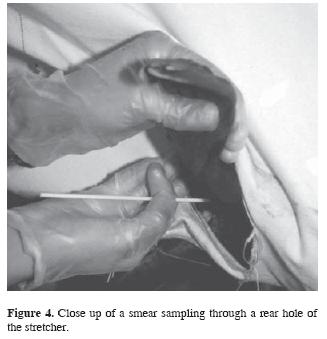
<body><![CDATA[<p align="justify"><font face="verdana" size="2">Para evitar el uso de la  riesgosa y cara restricci&oacute;n qu&iacute;mica en cr&iacute;as de ot&aacute;ridos la mejor opci&oacute;n es la  restricci&oacute;n f&iacute;sica. Por lo anterior construimos una camilla que permite amplia  libertad para la toma de diferentes tipos de muestras de manera segura, c&oacute;moda  y f&aacute;cil tanto para la cr&iacute;a como para el investigador.  </font></p>     <p align="justify"><font face="verdana" size="2"><b>Palabras  clave</b>: restricci&oacute;n f&iacute;sica, camilla, salud de lobos marinos, Golfo de  California.</font></p>     <p align="justify"><font face="verdana" size="2">&nbsp;</font></p>     <p align="justify"><font face="verdana" size="2">Most studies in  physiology, health and morphometry in otariids require the manipulation or the  instrumentation of the animal to acquire data about it or its environment, e.g.  time depth recorders, satellite tags, etc. Manipulation of an otariid requires  effective restriction, both for the safety of the animal and the researcher.  The most commonly used technique for restraining otariids is chemical immobilization  (Trillmich, 1983; Bester, 1988; Stirling and Sjare, 1988; Boyd, et al., 1990;  Mitchell and Burton, 1991; Griffits, et al., 1993), mostly used for large and  heavy individuals. Nevertheless, there are some cases in which this kind of  restriction method is not convenient. During our work with California sea lion  pups (<i>Zalophus californianus</i>) at Isla San Pedro Nolasco, where the  terrain is rocky, steep, and without beaches, it would have been difficult to  care for the pups during anesthesia and their total recovery from it.  Therefore, chemical immobilization could endanger the pups if they were  returned to the rookery and reached the water before being completely  recuperated. </font></p>     <p align="justify"><font face="verdana" size="2">We  needed to restrict the pups to take blood and smear samples, as well as measure  and weigh them. Due to the limitations of chemical restrictions mentioned  above, we&nbsp; decided to use physical  restriction which, in addition, is less expensive and risky for the pups  integrity. Moreover, according to Gentry &amp; Casanas (1997), it is a good idea  to take into account the behavior of animals to improve their manipulation.  However, the method of Gentry and Casanas (1977) presents certain  disadvantages, which include closed ends that prevent observation of the animal  as well as sampling craneal and caudal regions. That also represents the  possibility of restricting the breathing of the pup. The opening of the  stretcher is difficult and it is almost impossible to pour water directly on the  animal to cool it. The handling is uncomfortable being a single heavy piece of  wood in just one end of the fabric. In addition the full load of the pup falls  on one person. </font></p>     <p align="justify"><font face="verdana" size="2">In this regard, Lynch <i>et  al.</i> (1999) mention in their review on pinniped immobilization methods that  existing methods of physical restriction had the disadvantage of not allowing  the supervision of the physiological state of the animal, e.g. checking the  state of mucous in animals with covered heads, as in the method of Gentry and  Casanas (1997). </font></p>     <p align="justify"><font face="verdana" size="2">For these reasons we  modified the stretcher proposed by Gentry &amp; Casanas (1997) with the purpose  of obtaining a structure that allowed a more effective interaction with the  animal, that is more practical, manageable and easy&nbsp; to transport. One of these modifications is  the size of the holes which were of 7 x 13 cm for fore limbs and 5 x 10 cm for  hind limbs (see <a href="/img/revistas/rmbiodiv/v78n1/a23f1.jpg" target="_blank">Fig 1a</a>) contrasting the 5 x 10 cm in all the holes for <i>Callorhynus  ursinus</i> used by those authors.</font></p>     <p align="justify"><font face="verdana" size="2">The stretcher was  constructed with cotton canvas because of its durability and to be &ldquo;friendly&rdquo;  with the animal, avoiding injuries by rubbing with the fabric. The fabric was  folded on each side and sewn to form a passage for each one of the handlers,  leaving sufficient space in such a way that the wood was surrounded and could be  inserted and removed easily (see below). The seams were made by hand using  heavy cotton thread.</font></p>     <p align="justify"><font face="verdana" size="2">The handles were made  out of two thin pieces of solid pine wood (approximately 2 cm X 5 cm by 212 cm  long) instead of one single thick piece, each piece attached to an edge of the  fabric. This modification allows wrapping the fabric quickly around both pieces  of wood, closing the stretcher to the body of the pup (<a href="/img/revistas/rmbiodiv/v78n1/a23f1.jpg" target="_blank">Fig 1b</a>), restricting it,  but permitting opening of the stretcher (<a href="/img/revistas/rmbiodiv/v78n1/a23f2.jpg" target="_blank">Fig 2</a>) to take measurements such as  total length and thoracic perimeter. It is also possible to cool the pup by  pouring water on it to avoid hyperthermia. Using two pieces of wood improves  handling, making it comfortable, because the total width of the handles is  smaller than one made of a thick piece of wood.</font></p>     <p align="justify"><font face="verdana" size="2"> This stretcher  features open forward and back ends to permit access to the head, to take nasal  smears, and to the caudal region to take fecal smears and rectal temperature.  The design allows taking of blood samples or measurements from any of the four  limbs, because all of them hang free through their respective holes (<a href="#f3">Fig. 3</a>).  It is also possible to take cardiac and respiratory frequencies with  stethoscope throughout the fabric.</font></p>     ]]></body>
<body><![CDATA[<p align="center"><font face="verdana" size="2"><a name="f3"></a></font></p>     <p align="center"><font face="verdana" size="2"><img src="/img/revistas/rmbiodiv/v78n1/a23f3.jpg"></font></p>     <p align="justify"><font face="verdana" size="2">The stretcher was  upheld by two &ldquo;X&rdquo; shaped wood stands (<a href="/img/revistas/rmbiodiv/v78n1/a23f1.jpg" target="_blank">Fig. 1b,</a> <a href="#f4">4</a>), that helped researchers to  pick it up. These supports were useful in rocky terrain were we worked, because  they can be opened widely. These stands consist of two strip sections of pine  (approximately 2 cm X 5 cm by 103 cm long). They are attached at 20 cm of their  upper end by means of a screw (in an orifice of greater diameter), that allows  a free turn of both parts. The opening is limited by means of a nylon cord  whose ends are fixed to each one of strips at their lower end. </font></p>     <p align="center"><font face="verdana" size="2"><a name="f4"></a></font></p>     <p align="center"><font face="verdana" size="2"><img src="/img/revistas/rmbiodiv/v78n1/a23f4.jpg"></font></p>     <p align="justify"><font face="verdana" size="2">As  in the case of Gentry &amp; Casanas (1997) the pups that we worked with were  quiet during manipulation. Some pups, feeling themselves suspended, displayed  swimming movements, and few individuals defecated or urinated on the stretcher (4  of 40). The stretcher was able to restrain five month old pups (about 30 kg); in  fact, it worked well with pups weighing from 7 to 30 kg, with a total range in  length from 69 to 100 cm. We believe that it could be used to restrain older  and heavier individuals due to the robustness and length of the stretcher.  After working with 40 pups, we verified that handling, transport, storage and  cleaning of this stretcher is easy, and allows for excellent interaction with  the restrained individuals. </font></p>        <p align="justify"><font face="verdana" size="2">To  summarize, the modifications presented in this work allow greater control of the  conditions of the pup. In this new stretcher, the fact that the front and back  ends are open, allows access to diverse mucous sampling, like oral, nasal,  conjunctival, anal and prepucial or vaginal, for monitoring the physiological  state of the animal (including the rectal temperature). In addition, the  possibility of observing the opening and closing of the nostrils during  breathing allows the determination of the respiratory frequency. The  obstruction of nasal openings is also avoided. </font></p>       <p align="justify"><font face="verdana" size="2">An  additional advantage with respect to the method proposed by Gentry and Casanas  (1997) is the possibility of opening the stretcher separating the handles which  allows wetting the animal, as well as to measure and to review the body of the  pup. An added improvement concerns the user. This new stretcher has more  comfortable handles, which are at the same time that lighter and easy to  transport. In addition, the &ldquo;X&rdquo; stands avoid loading all the weight on one  person as in the Gentry and Casanas (1997) stretcher. These stands make it  possible to use the stretcher in places with irregular topography. </font></p>       <p align="justify"><font face="verdana" size="2">We want  to thank to M. Guerrero, G. Suarez, J. Pettis, H. Cabrera, M. Buckhorn, C. Navarro and F. Cota, who helped us  in the field work and to prove this device with the pups. We thank &Aacute;rea de  Protecci&oacute;n de Flora y Fauna Islas del Golfo de California, Comisi&oacute;n Nacional de  &Aacute;reas Naturales Protegidas, Coordinaci&oacute;n Sonora.     <br>   This study was conducted under  permit No. DOO.02.&shy;0468 SEMARNAT&#150;INE.</font></p>       ]]></body>
<body><![CDATA[<p align="justify"><font face="verdana" size="2">&nbsp;</font></p>       <p align="justify"><font face="verdana" size="2">    <b>Literature cited </b> </font></p>       <!-- ref --><p align="justify"><font face="verdana" size="2">Bester,  M. N. 1988. Chemical restrain of Antarctic fur seals      and southern elephant  seals. South African Journal of Wildlife Research 18:287&#150;289. </font>&nbsp;&nbsp;&nbsp;&nbsp;&nbsp;&nbsp;&nbsp;&nbsp;[&#160;<a href="javascript:void(0);" onclick="javascript: window.open('/scielo.php?script=sci_nlinks&ref=7524228&pid=S1870-3453200700010002300001&lng=','','width=640,height=500,resizable=yes,scrollbars=1,menubar=yes,');">Links</a>&#160;]<!-- end-ref --><!-- ref --><p align="justify"><font face="verdana" size="2">Boyd, I. L., N. J. Lunn, C. D. Duck and T. Barton. 1990.  Response of Antarctic fur seals to immobilization with ketamine, a  ketamine&#150;diazepam or ketamine&#150;xylazine mixture, and zoletil. Marine Mammal  Science 6:135&shy;145.</font>&nbsp;&nbsp;&nbsp;&nbsp;&nbsp;&nbsp;&nbsp;&nbsp;[&#160;<a href="javascript:void(0);" onclick="javascript: window.open('/scielo.php?script=sci_nlinks&ref=7524229&pid=S1870-3453200700010002300002&lng=','','width=640,height=500,resizable=yes,scrollbars=1,menubar=yes,');">Links</a>&#160;]<!-- end-ref --><!-- ref --><p align="justify"><font face="verdana" size="2">Gentry, R.L., and V.R. Casanas. 1997. A new method for  immobilizing otariid neonates. Marine Mammal Science 13:155&#150;157. </font>&nbsp;&nbsp;&nbsp;&nbsp;&nbsp;&nbsp;&nbsp;&nbsp;[&#160;<a href="javascript:void(0);" onclick="javascript: window.open('/scielo.php?script=sci_nlinks&ref=7524230&pid=S1870-3453200700010002300003&lng=','','width=640,height=500,resizable=yes,scrollbars=1,menubar=yes,');">Links</a>&#160;]<!-- end-ref --><!-- ref --><p align="justify"><font face="verdana" size="2">Griffits, D., O. Wiig and I. Gjertz. 1993. Immobilization of  walrus with etrophine hydrochloride and zoletil. Marine Mammal Science  9:250&#150;257. </font>&nbsp;&nbsp;&nbsp;&nbsp;&nbsp;&nbsp;&nbsp;&nbsp;[&#160;<a href="javascript:void(0);" onclick="javascript: window.open('/scielo.php?script=sci_nlinks&ref=7524231&pid=S1870-3453200700010002300004&lng=','','width=640,height=500,resizable=yes,scrollbars=1,menubar=yes,');">Links</a>&#160;]<!-- end-ref --><!-- ref --><p align="justify"><font face="verdana" size="2">Lynch, M.J., M.A. Tahmindjis and H. Gardner. 1999.  Immobilisation of pinniped species. Australian Veterinarian Journal 77:  181&#150;185. </font>&nbsp;&nbsp;&nbsp;&nbsp;&nbsp;&nbsp;&nbsp;&nbsp;[&#160;<a href="javascript:void(0);" onclick="javascript: window.open('/scielo.php?script=sci_nlinks&ref=7524232&pid=S1870-3453200700010002300005&lng=','','width=640,height=500,resizable=yes,scrollbars=1,menubar=yes,');">Links</a>&#160;]<!-- end-ref --><!-- ref --><p align="justify"><font face="verdana" size="2">Mitchell, P.J and H.R. Burton. 1991. Immobilization of southern  elephant seals and leopard seals with cyclohexamine anaesthetics and xylazine.  Veterinary Record 129:332&#150;336. </font>&nbsp;&nbsp;&nbsp;&nbsp;&nbsp;&nbsp;&nbsp;&nbsp;[&#160;<a href="javascript:void(0);" onclick="javascript: window.open('/scielo.php?script=sci_nlinks&ref=7524233&pid=S1870-3453200700010002300006&lng=','','width=640,height=500,resizable=yes,scrollbars=1,menubar=yes,');">Links</a>&#160;]<!-- end-ref --><!-- ref --><p align="justify"><font face="verdana" size="2">Stirling, I and B, Sjare.  1988. Preliminary observations of immobilizations male Atlantic walruses (<i>Odobenus  rosmarus rosmarus</i>) with Telazol. Marine Mammal Science 4:163&#150;168. </font>&nbsp;&nbsp;&nbsp;&nbsp;&nbsp;&nbsp;&nbsp;&nbsp;[&#160;<a href="javascript:void(0);" onclick="javascript: window.open('/scielo.php?script=sci_nlinks&ref=7524234&pid=S1870-3453200700010002300007&lng=','','width=640,height=500,resizable=yes,scrollbars=1,menubar=yes,');">Links</a>&#160;]<!-- end-ref --><!-- ref --><p align="justify"><font face="verdana" size="2">Trillmich F 1983. Ketamine&#150;Xylazine combination for the immobilization  of Gal&aacute;pagos sea lions and fur seals. Veterinary Record 112: 279&#150;280. </font>&nbsp;&nbsp;&nbsp;&nbsp;&nbsp;&nbsp;&nbsp;&nbsp;[&#160;<a href="javascript:void(0);" onclick="javascript: window.open('/scielo.php?script=sci_nlinks&ref=7524235&pid=S1870-3453200700010002300008&lng=','','width=640,height=500,resizable=yes,scrollbars=1,menubar=yes,');">Links</a>&#160;]<!-- end-ref --> ]]></body><back>
<ref-list>
<ref id="B1">
<nlm-citation citation-type="journal">
<person-group person-group-type="author">
<name>
<surname><![CDATA[Bester]]></surname>
<given-names><![CDATA[M. N.]]></given-names>
</name>
</person-group>
<article-title xml:lang="en"><![CDATA[Chemical restrain of Antarctic fur seals and southern elephant seals]]></article-title>
<source><![CDATA[South African Journal of Wildlife Research]]></source>
<year>1988</year>
<volume>18</volume>
<page-range>287-289</page-range></nlm-citation>
</ref>
<ref id="B2">
<nlm-citation citation-type="journal">
<person-group person-group-type="author">
<name>
<surname><![CDATA[Boyd]]></surname>
<given-names><![CDATA[I. L.]]></given-names>
</name>
<name>
<surname><![CDATA[Lunn]]></surname>
<given-names><![CDATA[N. J.]]></given-names>
</name>
<name>
<surname><![CDATA[Duck]]></surname>
<given-names><![CDATA[C. D.]]></given-names>
</name>
<name>
<surname><![CDATA[Barton]]></surname>
<given-names><![CDATA[T.]]></given-names>
</name>
</person-group>
<article-title xml:lang="en"><![CDATA[Response of Antarctic fur seals to immobilization with ketamine, a ketamine-diazepam or ketamine-xylazine mixture, and zoletil]]></article-title>
<source><![CDATA[Marine Mammal Science]]></source>
<year>1990</year>
<volume>6</volume>
<page-range>135­-145</page-range></nlm-citation>
</ref>
<ref id="B3">
<nlm-citation citation-type="journal">
<person-group person-group-type="author">
<name>
<surname><![CDATA[Gentry]]></surname>
<given-names><![CDATA[R.L.]]></given-names>
</name>
<name>
<surname><![CDATA[Casanas]]></surname>
<given-names><![CDATA[V.R.]]></given-names>
</name>
</person-group>
<article-title xml:lang="en"><![CDATA[A new method for immobilizing otariid neonates]]></article-title>
<source><![CDATA[Marine Mammal Science]]></source>
<year>1997</year>
<volume>13</volume>
<page-range>155-157</page-range></nlm-citation>
</ref>
<ref id="B4">
<nlm-citation citation-type="journal">
<person-group person-group-type="author">
<name>
<surname><![CDATA[Griffits]]></surname>
<given-names><![CDATA[D.]]></given-names>
</name>
<name>
<surname><![CDATA[Wiig]]></surname>
<given-names><![CDATA[O.]]></given-names>
</name>
<name>
<surname><![CDATA[Gjertz]]></surname>
<given-names><![CDATA[I.]]></given-names>
</name>
</person-group>
<article-title xml:lang="en"><![CDATA[Immobilization of walrus with etrophine hydrochloride and zoletil]]></article-title>
<source><![CDATA[Marine Mammal Science]]></source>
<year>1993</year>
<volume>9</volume>
<page-range>250-257</page-range></nlm-citation>
</ref>
<ref id="B5">
<nlm-citation citation-type="journal">
<person-group person-group-type="author">
<name>
<surname><![CDATA[Lynch]]></surname>
<given-names><![CDATA[M.J.]]></given-names>
</name>
<name>
<surname><![CDATA[Tahmindjis]]></surname>
<given-names><![CDATA[M.A.]]></given-names>
</name>
<name>
<surname><![CDATA[Gardner]]></surname>
<given-names><![CDATA[H.]]></given-names>
</name>
</person-group>
<article-title xml:lang="en"><![CDATA[Immobilisation of pinniped species]]></article-title>
<source><![CDATA[Australian Veterinarian Journal]]></source>
<year>1999</year>
<volume>77</volume>
<page-range>181-185</page-range></nlm-citation>
</ref>
<ref id="B6">
<nlm-citation citation-type="journal">
<person-group person-group-type="author">
<name>
<surname><![CDATA[Mitchell]]></surname>
<given-names><![CDATA[P.J]]></given-names>
</name>
<name>
<surname><![CDATA[Burton]]></surname>
<given-names><![CDATA[H.R.]]></given-names>
</name>
</person-group>
<article-title xml:lang="en"><![CDATA[Immobilization of southern elephant seals and leopard seals with cyclohexamine anaesthetics and xylazine]]></article-title>
<source><![CDATA[Veterinary Record]]></source>
<year>1991</year>
<volume>129</volume>
<page-range>332-336</page-range></nlm-citation>
</ref>
<ref id="B7">
<nlm-citation citation-type="journal">
<person-group person-group-type="author">
<name>
<surname><![CDATA[Stirling]]></surname>
<given-names><![CDATA[I]]></given-names>
</name>
<name>
<surname><![CDATA[Sjare]]></surname>
<given-names><![CDATA[B]]></given-names>
</name>
</person-group>
<article-title xml:lang="en"><![CDATA[Preliminary observations of immobilizations male Atlantic walruses (Odobenus rosmarus rosmarus) with Telazol]]></article-title>
<source><![CDATA[Marine Mammal Science]]></source>
<year>1988</year>
<volume>4</volume>
<page-range>163-168</page-range></nlm-citation>
</ref>
<ref id="B8">
<nlm-citation citation-type="journal">
<person-group person-group-type="author">
<name>
<surname><![CDATA[Trillmich]]></surname>
<given-names><![CDATA[F]]></given-names>
</name>
</person-group>
<article-title xml:lang="en"><![CDATA[Ketamine-Xylazine combination for the immobilization of Galápagos sea lions and fur seals]]></article-title>
<source><![CDATA[Veterinary Record]]></source>
<year>1983</year>
<volume>112</volume>
<page-range>279-280</page-range></nlm-citation>
</ref>
</ref-list>
</back>
</article>
