<?xml version="1.0" encoding="ISO-8859-1"?><article xmlns:mml="http://www.w3.org/1998/Math/MathML" xmlns:xlink="http://www.w3.org/1999/xlink" xmlns:xsi="http://www.w3.org/2001/XMLSchema-instance">
<front>
<journal-meta>
<journal-id>1870-249X</journal-id>
<journal-title><![CDATA[Journal of the Mexican Chemical Society]]></journal-title>
<abbrev-journal-title><![CDATA[J. Mex. Chem. Soc]]></abbrev-journal-title>
<issn>1870-249X</issn>
<publisher>
<publisher-name><![CDATA[Sociedad Química de México A.C.]]></publisher-name>
</publisher>
</journal-meta>
<article-meta>
<article-id>S1870-249X2014000300014</article-id>
<title-group>
<article-title xml:lang="en"><![CDATA[Electrochemical Hydrogen Peroxide Production in Acidic Medium Using a Tubular Photo-reactor: Application in Advanced Oxidation Processes]]></article-title>
</title-group>
<contrib-group>
<contrib contrib-type="author">
<name>
<surname><![CDATA[Peralta-Hernández]]></surname>
<given-names><![CDATA[Juan M.]]></given-names>
</name>
<xref ref-type="aff" rid="A01"/>
</contrib>
<contrib contrib-type="author">
<name>
<surname><![CDATA[Godínez]]></surname>
<given-names><![CDATA[Luis A.]]></given-names>
</name>
<xref ref-type="aff" rid="A02"/>
</contrib>
</contrib-group>
<aff id="A01">
<institution><![CDATA[,Centro de Innovación Aplicada en Tecnologías Competitivas Departamento de Investigación y Posgrado ]]></institution>
<addr-line><![CDATA[León Guanajuato]]></addr-line>
<country>México</country>
</aff>
<aff id="A02">
<institution><![CDATA[,Centro de Investigación y Desarrollo Tecnológico en Electroquímica S.C.  ]]></institution>
<addr-line><![CDATA[Pedro Escobedo Querétaro]]></addr-line>
<country>México</country>
</aff>
<pub-date pub-type="pub">
<day>00</day>
<month>09</month>
<year>2014</year>
</pub-date>
<pub-date pub-type="epub">
<day>00</day>
<month>09</month>
<year>2014</year>
</pub-date>
<volume>58</volume>
<numero>3</numero>
<fpage>348</fpage>
<lpage>355</lpage>
<copyright-statement/>
<copyright-year/>
<self-uri xlink:href="http://www.scielo.org.mx/scielo.php?script=sci_arttext&amp;pid=S1870-249X2014000300014&amp;lng=en&amp;nrm=iso"></self-uri><self-uri xlink:href="http://www.scielo.org.mx/scielo.php?script=sci_abstract&amp;pid=S1870-249X2014000300014&amp;lng=en&amp;nrm=iso"></self-uri><self-uri xlink:href="http://www.scielo.org.mx/scielo.php?script=sci_pdf&amp;pid=S1870-249X2014000300014&amp;lng=en&amp;nrm=iso"></self-uri><abstract abstract-type="short" xml:lang="en"><p><![CDATA[This paper describes the results obtained in the design and characterization of a tubular electrochemical reactor. The set-up was employed for on-site hydrogen peroxide (H2O2) production in an acidic medium (pH 3) to promote three electrochemical advanced oxidation processes (EAOP): electro-Fenton (EF), photoelectro-Fenton (PEF) and photocatalysis treatment (PT). These processes were evaluated by their abilities to degrade a commercial dye, Orange-II (OG-II), in solution using total organic carbon (TOC) removal and high performance liquid chromatography (HPLC). To have free solutions of iron in the EF and PEF systems, a Nafion&#8482; membrane with dispersed iron was prepared. For use in photocatalysis, electrodes with a large superficial area were prepared by coating carbon cloth fiber supports with titanium dioxide (TiO2) using the electrophoretic (EP) method. In this work, wastewater samples with a large number of microorganisms (coliform bacteria) were treated with this new reactor design.]]></p></abstract>
<abstract abstract-type="short" xml:lang="es"><p><![CDATA[En este trabajo se describen los resultados obtenidos en el diseño y la caracterización de un reactor electroquímico tubular. Dicho reactor se usó para llevar a cabo la producción in situ de peróxido de hidrógeno (H2O2) en medio ácido (pH 3) para promover tres procesos electroquímicos de oxidación avanzada (PEOA): electro-Fenton (EF), fotoelectro-Fenton (FEF) y fotocatálisis (FC). Estos procesos fueron evaluados por su capacidad para degradar un colorante comercial, Naranja-II (N-II), en solución. Para ello, se realizaron determinaciones de carbono orgánico total (COT) así como de cromatografía líquida de alta resolución (CLAR). Para tener soluciones libres de hierro en los procesos EF y FEF, se preparó una membrana NafionR con hierro disperso. Para las pruebas fotocatalíticas se desarrollaron electrodos con una gran área superficial que se prepararon mediante el recubrimiento con dióxido de titanio (TiO2) de una tela de fibra de carbono usando el método electroforético (ME). Además se trabajó con muestras de agua residual con un gran número de microorganismos (bacterias coliformes) la cual fue tratada con este nuevo diseño de reactor.]]></p></abstract>
<kwd-group>
<kwd lng="en"><![CDATA[Electro-Fenton]]></kwd>
<kwd lng="en"><![CDATA[Photoelecto-Fenton]]></kwd>
<kwd lng="en"><![CDATA[Hydrogen peroxide]]></kwd>
<kwd lng="en"><![CDATA[Photoelectrochemistry]]></kwd>
<kwd lng="en"><![CDATA[Electrochemical reactor]]></kwd>
<kwd lng="en"><![CDATA[Disinfection]]></kwd>
<kwd lng="es"><![CDATA[Electro-Fenton]]></kwd>
<kwd lng="es"><![CDATA[fotoelecto-Fenton]]></kwd>
<kwd lng="es"><![CDATA[peróxido de hidrógeno]]></kwd>
<kwd lng="es"><![CDATA[fotoelectroquímica]]></kwd>
<kwd lng="es"><![CDATA[reactor electroquímico]]></kwd>
<kwd lng="es"><![CDATA[Desinfección]]></kwd>
</kwd-group>
</article-meta>
</front><body><![CDATA[ <p align="justify"><font face="Verdana" size="4">Article</font></p>     <p align="justify"><font face="Verdana" size="2">&nbsp;</font></p>     <p align="center"><font face="verdana" size="4"><b>Electrochemical Hydrogen Peroxide Production in Acidic Medium Using a Tubular Photo&#45;reactor: Application in Advanced Oxidation Processes</b></font></p>     <p align="justify"><font face="Verdana" size="2">&nbsp;</font></p>     <p align="center"><font face="verdana" size="2"><b>Juan M. Peralta&#45;Hern&aacute;ndez,<sup>1,</sup>* and Luis A. God&iacute;nez<sup>2</sup></b></font></p>     <p align="justify"><font face="Verdana" size="2">&nbsp;</font></p>     <p align="justify"><font face="verdana" size="2"><i><sup>1</sup> Centro de Innovaci&oacute;n Aplicada en Tecnolog&iacute;as Competitivas (CIATEC), Departamento de Investigaci&oacute;n y Posgrado, Omega&#45;201, Fraccionamiento Industrial Delta. Le&oacute;n, 37545, Guanajuato, M&eacute;xico.</i> <a href="mailto:jperalta@ciatec.mx">jperalta@ciatec.mx</a></font></p>     <p align="justify"><font face="verdana" size="2"><i><sup>2</sup> Centro de Investigaci&oacute;n y Desarrollo Tecnol&oacute;gico en Electroqu&iacute;mica, Parque Tecnol&oacute;gico Quer&eacute;taro&#45;Sanfandila, Pedro Escobedo, 76703, Quer&eacute;taro, M&eacute;xico.</i></font></p>     <p align="justify"><font face="Verdana" size="2">&nbsp;</font></p>     <p align="justify"><font face="verdana" size="2">Received January 23<sup>rd</sup>, 2014    ]]></body>
<body><![CDATA[<br> Accepted April 23<sup>rd</sup>, 2014.</font></p>     <p align="justify"><font face="Verdana" size="2">&nbsp;</font></p>     <p align="justify"><font face="verdana" size="2"><b>Abstract</b></font></p>     <p align="justify"><font face="verdana" size="2">This paper describes the results obtained in the design and characterization of a tubular electrochemical reactor. The set&#45;up was employed for on&#45;site hydrogen peroxide (H<sub>2</sub>O<sub>2</sub>) production in an acidic medium (pH 3) to promote three electrochemical advanced oxidation processes (EAOP): electro&#45;Fenton (EF), photoelectro&#45;Fenton (PEF) and photocatalysis treatment (PT). These processes were evaluated by their abilities to degrade a commercial dye, Orange&#45;II (OG&#45;II), in solution using total organic carbon (TOC) removal and high performance liquid chromatography (HPLC). To have free solutions of iron in the EF and PEF systems, a Nafion&#153; membrane with dispersed iron was prepared. For use in photocatalysis, electrodes with a large superficial area were prepared by coating carbon cloth fiber supports with titanium dioxide (TiO<sub>2</sub>) using the electrophoretic (EP) method. In this work, wastewater samples with a large number of microorganisms (coliform bacteria) were treated with this new reactor design.</font></p>     <p align="justify"><font face="verdana" size="2"><b>Key Words:</b> Electro&#45;Fenton, Photoelecto&#45;Fenton, Hydrogen peroxide, Photoelectrochemistry, Electrochemical reactor, Disinfection.</font></p>     <p align="justify"><font face="Verdana" size="2">&nbsp;</font></p>     <p align="justify"><font face="verdana" size="2"><b>Resumen</b></font></p>     <p align="justify"><font face="verdana" size="2">En este trabajo se describen los resultados obtenidos en el dise&ntilde;o y la caracterizaci&oacute;n de un reactor electroqu&iacute;mico tubular. Dicho reactor se us&oacute; para llevar a cabo la producci&oacute;n in situ de per&oacute;xido de hidr&oacute;geno (H<sub>2</sub>O<sub>2</sub>) en medio &aacute;cido (pH 3) para promover tres procesos electroqu&iacute;micos de oxidaci&oacute;n avanzada (PEOA): electro&#45;Fenton (EF), fotoelectro&#45;Fenton (FEF) y fotocat&aacute;lisis (FC). Estos procesos fueron evaluados por su capacidad para degradar un colorante comercial, Naranja&#45;II (N&#45;II), en soluci&oacute;n. Para ello, se realizaron determinaciones de carbono org&aacute;nico total (COT) as&iacute; como de cromatograf&iacute;a l&iacute;quida de alta resoluci&oacute;n (CLAR). Para tener soluciones libres de hierro en los procesos EF y FEF, se prepar&oacute; una membrana Nafion<sup>R</sup> con hierro disperso. Para las pruebas fotocatal&iacute;ticas se desarrollaron electrodos con una gran &aacute;rea superficial que se prepararon mediante el recubrimiento con di&oacute;xido de titanio (TiO<sub>2</sub>) de una tela de fibra de carbono usando el m&eacute;todo electrofor&eacute;tico (ME). Adem&aacute;s se trabaj&oacute; con muestras de agua residual con un gran n&uacute;mero de microorganismos (bacterias coliformes) la cual fue tratada con este nuevo dise&ntilde;o de reactor.</font></p>     <p align="justify"><font face="verdana" size="2"><b>Palabras clave:</b> Electro&#45;Fenton, fotoelecto&#45;Fenton, per&oacute;xido de hidr&oacute;geno, fotoelectroqu&iacute;mica, reactor electroqu&iacute;mico, Desinfecci&oacute;n.</font></p>     <p align="justify"><font face="Verdana" size="2">&nbsp;</font></p>     ]]></body>
<body><![CDATA[<p align="justify"><font face="verdana" size="2"><b>Introduction</b></font></p>     <p align="justify"><font face="verdana" size="2">Hydrogen peroxide (H<sub>2</sub>O<sub>2</sub>) is currently one the most common chemicals used for water treatment and chemical production, and it is a promising oxidant for green chemistry processes in the near future &#91;1,2,3&#93;. The use of H<sub>2</sub>O<sub>2</sub> may offer an efficient alternative for controlling pollution in aqueous media. Hydrogen peroxide is one the most popular non&#45;selective oxidizing agents that are used to convert organic compounds to carbon dioxide and water &#91;4&#93;. Recently, several works have demonstrated that on&#45;site electrochemical generation of H<sub>2</sub>O<sub>2</sub> can be used successfully to decontaminate water treatment effluents with different organic compounds &#91;5&#45;8&#93;. In this process, H<sub>2</sub>O<sub>2</sub> is continuously supplied to the contaminated solution through oxygen (O<sub>2</sub>) reduction by two electrons in an acidic medium, according to the following equation &#91;9&#45;12&#93;:</font></p>     <p align="center"><font face="verdana" size="2">O<sub>2</sub> + 2H<sup>+</sup> + 2e<sup>&minus;</sup> &#x2192; H<sub>2</sub>O<sub>2</sub> (1)</font></p>     <p align="justify"><font face="verdana" size="2">The most common use of H<sub>2</sub>O<sub>2</sub> in environmental applications involves the addition of iron (Fe<sup>2+</sup>) to the acidic solution to increase the oxidizing power of the H<sub>2</sub>O<sub>2</sub> by forming hydroxyl radicals (<sup>&bull;</sup>OH) via the Fenton reaction, according to the equation &#91;13,14&#93;.</font></p>     <p align="center"><font face="verdana" size="2">Fe<sup>2+</sup> + H<sub>2</sub>O<sub>2</sub> &#x2192; Fe<sup>3+</sup> + <sup>&bull;</sup>OH + <sup>&minus;</sup>OH (2)</font></p>     <p align="justify"><font face="verdana" size="2">This method is commonly referred to as electro&#45;Fenton (EF) treatment and is considered an advanced oxidation process (AOP) &#91;15&#93;. The principal reason for combining on&#45;site hydrogen peroxide generation and the Fenton reaction is to improve the oxidation capacities of the two individual processes, creating a synergetic system &#91;16&#93;. The hydroxyl radical species that are produced through these processes are characterized by a large oxidation power (2.8 V <i>vs</i> ENH) &#91;17&#93; that is able to transform organic compounds into CO<sub>2</sub> and H<sub>2</sub>O &#91;18&#93;.</font></p>     <p align="justify"><font face="verdana" size="2">Similarly, another type of AOP is the photoelectro&#45;Fenton (PEF) system, in which the peroxide&#45;ferrous system is illuminated with UV light, and Reactions 3 and 4 take place in addition to Equation 2, increasing the production of hydroxyl radicals and improving the oxidation of organic compounds &#91;19&#93;.</font></p>     <p align="center"><font face="verdana" size="2">Fe<sup>2+</sup> + <sup>&bull;</sup>OH &#x2192; (FeOH)<sup>2+</sup> (3)</font></p>     <p align="center"><font face="verdana" size="2">(FeOH)<sup>2+</sup> + h&#957; &#x2192; Fe<sup>2+</sup> + <sup>&bull;</sup>OH (4)</font></p>     <p align="justify"><font face="verdana" size="2">This catalytic process is achieved by Fe<sup>2+</sup> regeneration, which takes place primarily by the reduction of Fe<sup>2+</sup> species by H<sub>2</sub>O<sub>2</sub>. When UV light is used, the mineralization process can be accelerated by the photolysis of complexes of Fe<sup>3+</sup> with some oxidation products and improvement in Fe<sup>2+</sup> regeneration from the additional photoreduction of Fe<sup>3+</sup> species through Equation 4 &#91;19&#93;.</font></p>     ]]></body>
<body><![CDATA[<p align="justify"><font face="verdana" size="2">In the case of the EF and PEF systems, the iron species represent a serious problem during organic compound oxidation in a homogeneous medium. The removal of iron ions is an easy process that can be carried out by precipitation or re&#45;dissolution of the iron ions after the treatment, but these operations generate additional costs in the treatment &#91;20&#93;.</font></p>     <p align="justify"><font face="verdana" size="2">However, in the recent years, the use of Nafion&#153; membranes covered with highly dispersed iron ions has been the focus of several studies because the iron&#45;coated Nafion&#153; membrane has a similar effect on H<sub>2</sub>O<sub>2</sub> decomposition as the iron ions in a homogeneous solution &#91;20, 21,22&#93;. The iron ions that are supported on the membrane allow the oxidation of the organic compounds through UV irradiation while avoiding the need for an expensive separation step &#91;20&#93;.</font></p>     <p align="justify"><font face="verdana" size="2">In addition to the Fenton&#45;related technologies, the photocatalytic process has become a commonly used technology because it can completely remove organic compounds &#91;23&#93;. Titanium dioxide (TiO<sub>2</sub>) is the most common semiconductor material for photocatalytic processes, and it has been applied in several photocatalytic water treatment studies &#91;24,25&#93;. The inherent advantages of this material are its low cost, its low toxicity, its good photocatalytic properties, and its particularly wide band gap (3.2 eV), which results in good stability and prevents photo&#45;corrosion &#91;26&#93;. When TiO<sub>2</sub> nanoparticles are subjected to radiation with sufficient energy, an electron is promoted from the valence band to the conduction band of the semiconductor, as indicated in Equation 5:</font></p>     <p align="center"><font face="Verdana" size="2"><img src="/img/revistas/jmcs/v58n3/a14e1.jpg"></font></p>     <p align="justify"><font face="verdana" size="2">The positively charged vacancy or hole (<i>h</i><sup>+</sup>) thus generated can react with either adsorbed water or hydroxyl ions to produce the powerful <sup>&bull;</sup>OH radical, as shown in Equations 6 and 7.</font></p>     <p align="center"><font face="Verdana" size="2"><img src="/img/revistas/jmcs/v58n3/a14e2.jpg"></font></p>     <p align="justify"><font face="verdana" size="2">Furthermore, if an organic pollutant, R, is adsorbed on the semiconductor surface, the hole can directly oxidize that species, as outlined in Equation 8 &#91;27&#93;.</font></p>     <p align="center"><font face="Verdana" size="2"><img src="/img/revistas/jmcs/v58n3/a14e3.jpg"></font></p>     <p align="justify"><font face="verdana" size="2">At the same time, the electrons that are photo&#45;injected into the conduction band can react with dissolved O<sub>2</sub> to produce H<sub>2</sub>O<sub>2</sub>, according to Equation 1, or they may be lost by recombination reactions with either unreached holes or with adsorbed <sup>&bull;</sup>OH radicals, as indicated in Equations 9 and 10, respectively &#91;28&#93;.</font></p>     <p align="center"><font face="Verdana" size="2"><img src="/img/revistas/jmcs/v58n3/a14e4.jpg"></font></p>     ]]></body>
<body><![CDATA[<p align="justify"><font face="verdana" size="2">If the semiconductor is used as an anode, those electrons can be extracted to the external circuit, retarding Equations 9 and 10.</font></p>     <p align="justify"><font face="verdana" size="2">Because TiO<sub>2</sub> is a suspended powder, the reactor design should be efficient to avoid problems related to illumination limitations, mass transfer and nanoparticle recovery at the end of the treatment process &#91;29,30&#93;. One promising way to overcome such problems is to immobilize the catalyst &#91;11,29&#93;. In this method, mass transfer limitations are reduced by using microfibers as a direct support for the TiO<sub>2</sub>, and the illumination source is placed directly over the TiO<sub>2</sub>&#45;covered face of the support.</font></p>     <p align="justify"><font face="verdana" size="2">The aim of this work is to compare the effectiveness of several of these water&#45;treatment processes by studying the degradation of the azo dye Orange&#45;II (OG&#45;II) using high performance liquid chromatography (HPLC) and total organic carbon (TOC) analysis on water containing microorganisms. Tests were carried out using a continuous flow reactor that was operated to produce on&#45;site H<sub>2</sub>O<sub>2</sub> using the EF and the PEF processes. In addition, a Nafion&#153; membrane with iron fixed in the lattice and a TiO<sub>2</sub>&#45;covered carbon cloth were incorporated to promote photocatalytic events and improve the oxidation of the organic compounds and microorganisms in the medium.</font></p>     <p align="justify"><font face="Verdana" size="2">&nbsp;</font></p>     <p align="justify"><font face="verdana" size="2"><b>Experimental details</b></font></p>     <p align="justify"><font face="verdana" size="2">The chemicals used in this work, such as sulfuric acid (H<sub>2</sub>SO<sub>4</sub>), sodium sulfate (Na<sub>2</sub>SO<sub>4</sub>), and ferrous sulfate (FeSO<sub>4</sub>7H<sub>2</sub>O), were purchased from J.T. Baker as ACS reagent grade and were used as received, without further purification. Titanium (IV) oxysulfate (TiOSO<sub>4</sub>, 99.99%, ca. 15 wt. diluted sulfuric acid solution) and the azo dye OG II (C<sub>16</sub>H<sub>11</sub>N<sub>2</sub>NaO<sub>4</sub>S, &#955;<sub>max</sub> = 487 nm, reagent grade) were purchased from Sigma&#45;Aldrich. The carbon cloth and Nafion&#153; membrane were provided by ElectroChem Inc.</font></p>     <p align="justify"><font face="verdana" size="2"><b>Electrochemical photo&#45;reactor</b></font></p>     <p align="justify"><font face="verdana" size="2">The experiments were performed in an annular flow reactor containing a graphite cloth cathode (geometrical area of 90 cm<sup>2</sup>) and a TiO<sub>2</sub>&#45;covered graphite cloth anode (geometrical area of 100 cm<sup>2</sup>), as shown in <a href="#f1">Figure 1</a>. Additional studies are being carried out using the same reactor design with minor modifications in the capacity and anode materials &#91;15&#93;.</font></p>     <p align="center"><font face="verdana" size="2"><a name="f1"></a></font></p>     <p align="center"><font face="verdana" size="2"><img src="/img/revistas/jmcs/v58n3/a14f1.jpg"></font></p>     ]]></body>
<body><![CDATA[<p align="justify"><font face="verdana" size="2">The reactor volume was 0.5 L, and the total solution volume, including that held in a reservoir stirred and sparged with pure O<sub>2</sub>, was 27 L. In this set&#45;up, a diaphragm pump (Shurflo) was used to create three flow rates, 56 L/h, 76 L/h and 96 L/h. Prior to the Fenton&#45;reagent oxidation tests, a ferrous sulfate solution was added to make an Fe<sup>2+</sup> concentration of either 0.02 or 0.05 mM. In the photo&#45;assisted experiments, the illumination was provided by a low&#45;pressure UV mercury lamp (UVP Inc., P = 75 mW/cm<sup>2</sup>, &#955; = 365 nm). The assays were carried out under galvanostatic conditions with a GW Model:GPR&#45;1820HD power supply.</font></p>     <p align="justify"><font face="verdana" size="2"><b>Evaluation of on&#45;site H<sub>2</sub>O<sub>2</sub> production</b></font></p>     <p align="justify"><font face="verdana" size="2">Electrolysis experiments were carried out to test the capacity of the reactor to produce H<sub>2</sub>O<sub>2</sub> through the cathodic reduction of dissolved O<sub>2</sub> in a 0.05 M solution of Na<sub>2</sub>SO<sub>4</sub>, adjusted to a pH of 3 with H<sub>2</sub>SO<sub>4</sub> and saturated with O<sub>2</sub>. The pH of the solution was determined with a glass&#45;electrode pH meter (Corning 320). The concentration of H<sub>2</sub>O<sub>2</sub> created during electrolysis was determined by titrating with titanium (IV) oxysulfate and measuring the intensity of the color of the H<sub>2</sub>O<sub>2</sub>&#45; reagent complex at a wavelength of 406 nm &#91;31&#93;.</font></p>     <p align="justify"><font face="verdana" size="2"><b>OG&#45;II solution preparation</b></font></p>     <p align="justify"><font face="verdana" size="2">An accurately weighed quantity of the OG&#45;II dye was dissolved in distilled water to prepare a stock solution (100 mg/L), and experimental solutions of the desired concentration (50 mg/L) were obtained by successive dilution. The synthetic textile dye wastewater solution was prepared in accordance with previous reports &#91;28&#93; in which dye concentrations ranging between 10 and 200 mg/L.</font></p>     <p align="justify"><font face="verdana" size="2"><b>Analytical procedure</b></font></p>     <p align="justify"><font face="verdana" size="2">The degradation of OG&#45;II was monitored by HPLC analysis, using a Hewlett Packard Series 1050 machine, equipped with a UV/Vis Detector and a reverse phase C&#45;18 Phenomenex (LUNA 5 micron&#45;C&#45;18, 3 x 150 mm) column. The injection volume was 20 &micro;L. The column was eluted with an ammonium acetate (20 mM)/acetonitrile 68:32 (v/v) mixture with a flow rate of 0.5 mL/min &#91;24&#93;. The TOC of the initial electrolyzed samples was determined with a TOC&#45;VSCN (Shimadzu Co) analyzer.</font></p>     <p align="justify"><font face="verdana" size="2"><b>Nafion<sup>TM</sup> membrane preparation</b></font></p>     <p align="justify"><font face="verdana" size="2">The Nafion&#153; membrane (EC&#45;NM&#45;117) was exchanged with FeCl<sub>3</sub><sup>&bull;</sup>6H<sub>2</sub>O (Fluka) at room temperature for a few minutes, after which the Nafion&#153; was immersed in HCl. After the ion exchange, the membrane was washed with water and then immersed in 1 M NaOH to hydrate the Fe<sup>3+</sup> ions, in accordance with Fernandez et al. &#91;21&#93;. For the TiO<sub>2</sub>&#45;covered carbon cloth electrodes, nano&#45;particulated P25 TiO<sub>2</sub> (80% anatase, 20% rutile, average particle diameter 20 nm), purchased from Degussa was used. The nanoparticles were deposited according to the methodology proposed by Manr&iacute;quez and God&iacute;nez &#91;32&#93;. Scanning electron microscopy (SEM) of the TiO<sub>2</sub> electrode surfaces was carried out using a JEOL&#45;5400LV microscope.</font></p>     <p align="justify"><font face="Verdana" size="2">&nbsp;</font></p>     ]]></body>
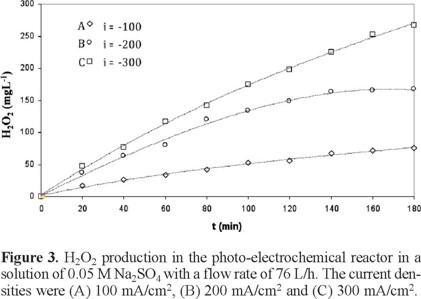
<body><![CDATA[<p align="justify"><font face="verdana" size="2"><b>Results and discussion</b></font></p>     <p align="justify"><font face="verdana" size="2"><b>Electrochemical generation of H<sub>2</sub>O<sub>2</sub> in the photo&#45;reactor at different flow rates</b></font></p>     <p align="justify"><font face="verdana" size="2">Several tests were performed to evaluate the electrochemically generated H<sub>2</sub>O<sub>2</sub> concentration in the reactor at different current densities (j) and flow rates (Q). The capacity of the system to electrochemically generate H<sub>2</sub>O<sub>2</sub> at the carbon cloth cathode through O<sub>2</sub> reduction (Eq. 1) was studied spectrophotometrically. <a href="#f2">Figure 2</a> shows the variation of the H<sub>2</sub>O<sub>2</sub> concentration as a function of the electrolysis time and current densities with a flow rate of 56 L/h. Curve 2(A) corresponds to a sample in which the current density was 100 mA/cm<sup>2</sup>; in this case, the H<sub>2</sub>O<sub>2</sub> concentration was approximately 39 mg/L after a reaction time of 180 min. Curve 2(B) corresponds to a current density of 200 mA/cm<sup>2</sup>, and the resulting H<sub>2</sub>O<sub>2</sub> accumulation was approximately 89 mg/L after 180 min of electrolysis. Finally, curve 2(C) shows a current density of 300 mA/cm<sup>2</sup>, which resulted in 133 mg/L H<sub>2</sub>O<sub>2</sub>.</font></p>     <p align="center"><font face="verdana" size="2"><a name="f2"></a></font></p>     <p align="center"><font face="verdana" size="2"><img src="/img/revistas/jmcs/v58n3/a14f2.jpg"></font></p>     <p align="justify"><font face="verdana" size="2">In all cases, it can be seen that the H<sub>2</sub>O<sub>2</sub> concentration is directly proportional to the current density supplied to the system. On the other hand, the H<sub>2</sub>O<sub>2</sub> concentration did not increase linearly with reaction time; after about 80 min, the H<sub>2</sub>O<sub>2</sub> concentration reached its plateau value and remained almost constant for the remainder of the reaction time. These results are in accordance whit previously reported &#91;33&#93;. From these results, it is apparent that H<sub>2</sub>O<sub>2</sub> undergoes chemical decomposition O<sub>2</sub> either on the anode (heterogeneous process) or in the medium (homogeneous process) &#91;34,35&#93;:</font></p>     <p align="center"><font face="verdana" size="2">H<sub>2</sub>O<sub>2</sub> &#x2192; HO<sup>&bull;</sup><sub>2</sub> + H<sup>+</sup> + e<sup>&minus;</sup> <b>(</b>11)</font></p>     <p align="center"><font face="verdana" size="2">HO<sup>&bull;</sup><sub>2</sub> &#x2192; O<sub>2(</sub><i><sub>g</sub></i><sub>)</sub> + H<sup>+</sup> + e<sup>&minus;</sup> <b>(</b>12)</font></p>     <p align="justify"><font face="verdana" size="2">An additional set of assays was carried out in which the flow rate was increased to 76 L/h, and the three current densities used in the previous assay were maintained. The results of this study are presented in <a href="#f3">Figure 3</a>. In these experiments, H<sub>2</sub>O<sub>2</sub> generation is favored by the increased the flow rate. The H<sub>2</sub>O<sub>2</sub> concentration was 75 mg/L after 180 min of reaction when a current density of 100 mA/cm<sup>2</sup> was applied, 166 mg/L when a current density of 200 mA/cm<sup>2</sup> was applied, 268 mg/L when a current density of 300 mA/ cm<sup>2</sup> was applied. In this last case, the maximal H<sub>2</sub>O<sub>2</sub> concentration is larger than what was obtained with the same current density at the lower flow rate (<a href="#f2">Figure 2(C)</a>).</font></p>     <p align="center"><font face="verdana" size="2"><a name="f3"></a></font></p>     ]]></body>
<body><![CDATA[<p align="center"><font face="verdana" size="2"><img src="/img/revistas/jmcs/v58n3/a14f3.jpg"></font></p>     <p align="justify"><font face="verdana" size="2">To improve the efficiency of H<sub>2</sub>O<sub>2</sub> generation, an additional flow rate of 96 L/h was tested using the same three current densities as before. The results are presented in <a href="#f4">Figure 4</a>. As in the previous tests, for current densities of 100 mA/cm<sup>2</sup> and 200 mA/cm<sup>2</sup>, the H<sub>2</sub>O<sub>2</sub> concentration is directly proportional to the applied charge, generating 54 mg/L (curve 4(A)) and 104 mg/L (curve 4(B)) after 180 min of reaction, respectively. However, when the current density was 300 mA/cm<sup>2</sup> (curve 4(C)), the H<sub>2</sub>O<sub>2</sub> concentration is drastically decreased relative to concentration obtained with the lower current densities. The maximal accumulation is approximately 95 mg/L after 180 min of reaction, a value that is smaller than what was obtained with a current density of 200 mA/cm<sup>2</sup>. A possible explanation for this phenomenon is the mass transfer coefficient of the H<sub>2</sub>O<sub>2</sub> formation in the system.</font></p>     <p align="center"><font face="verdana" size="2"><a name="f4"></a></font></p>     <p align="center"><font face="verdana" size="2"><img src="/img/revistas/jmcs/v58n3/a14f4.jpg"></font></p>     <p align="justify"><font face="verdana" size="2">The shape of the curves can be explained by considering the gradual accumulation of H<sub>2</sub>O<sub>2</sub> that must be associated with its proportional decomposition in a complex process that probably includes both homogeneous and heterogeneous reactions. Equation 13 for instance, shows that although the rate of H<sub>2</sub>O<sub>2</sub> production depends on the interfacial activity of the O<sub>2</sub> at the cathode and on the corresponding electrode transfer rate constant, <i>k</i><sub>1</sub>, decomposition can be assumed to depend on heterogeneous and homogeneous processes taking place at both the anode and the cathode. In this way, the combined decomposition rate is a function of the corresponding rate constants, <i>k</i><sub>2</sub>, <i>k</i><sub>3</sub>, <i>k</i><sub>4</sub> and <i>k</i><sub>5</sub> (<i>k</i><sub>2</sub> and <i>k</i><sub>4</sub> for homogeneous and <i>k</i><sub>3</sub> and <i>k</i><sub>5</sub> for heterogeneous processes) and of the local activity of H<sub>2</sub>O<sub>2</sub> at either the cathode or the anode (&#91;H<sub>2</sub>O<sub>2</sub>&#93;<sub>0,</sub><i><sub>c</sub></i> and &#91;H<sub>2</sub>O<sub>2</sub>&#93;<sub>0,</sub><i><sub>a</sub></i>, respectively).</font></p>     <p align="center"><font face="Verdana" size="2"><img src="/img/revistas/jmcs/v58n3/a14e5.jpg"></font></p>     <p align="justify"><font face="verdana" size="2">The activities of the compounds in the interfacial electrode solution in Equation 13 (&#91;O<sub>2</sub>&#93;<sub>0,</sub><i><sub>c</sub></i>, &#91;H<sub>2</sub>O<sub>2</sub>&#93;<sub>0,</sub><i><sub>c</sub></i> and &#91;H<sub>2</sub>O<sub>2</sub>&#93;<sub>0,</sub><i><sub>a</sub></i>) can be associated with those in the bulk solution (&#91;O<sub>2</sub>&#93;<i><sub>sol</sub></i> and &#91;H<sub>2</sub>O<sub>2</sub>&#93;<i><sub>sol</sub></i>) by assuming a linear relationship between the two activity values through a mass transfer&#45;related constant, which allows factorization and reduction of Equation 13 to Equation 14, in which two new constants, <i>k</i>' and <i>k</i>", contain information on the kinetic and mass transport properties of the system.</font></p>     <p align="center"><font face="Verdana" size="2"><img src="/img/revistas/jmcs/v58n3/a14e6.jpg"></font></p>     <p align="justify"><font face="verdana" size="2">Evaluation of this differential equation results in Equation 15, which demonstrates that the concentration of H<sub>2</sub>O<sub>2</sub> in the bulk solution follows an exponential relationship with time, which describes the behavior of each of the curves.</font></p>     <p align="center"><font face="Verdana" size="2"><img src="/img/revistas/jmcs/v58n3/a14e7.jpg"></font></p>     ]]></body>
<body><![CDATA[<p align="justify"><font face="verdana" size="2">We applied Equations 13 to 15 to the results from the experiment with a flow rate of 76 L/h because this experiment shows a define tendency than those with flow rates of 56 L/h and 96 L/h. The corresponding adjustments are shown in <a href="#f5">Figure 5</a>, and the resulting values of <i>k<sup>'</sup></i> and <i>k<sup>"</sup></i> are presented in <a href="#c1">Table 1</a>.</font></p>     <p align="center"><font face="verdana" size="2"><a name="f5"></a></font></p>     <p align="center"><font face="verdana" size="2"><img src="/img/revistas/jmcs/v58n3/a14f5.jpg"></font></p>     <p align="center">&nbsp;</p>     <p align="center"><font face="verdana" size="2"><a name="c1"></a></font></p>     <p align="center"><font face="verdana" size="2"><img src="/img/revistas/jmcs/v58n3/a14c1.jpg"></font></p>     <p align="justify"><font face="verdana" size="2">The results presented in <a href="#c1">Table 1</a> demonstrate that the greatest H<sub>2</sub>O<sub>2</sub> production takes place when a current density of 300 mA/ cm<sup>2</sup> and a flow rate of 76 L/h are applied. Under these conditions, <i>k<sup>"</sup></i> is greater than <i>k<sup>'</sup></i>, and therefore the decomposition of H<sub>2</sub>O<sub>2</sub> is inhibited.</font></p>     <p align="justify"><font face="verdana" size="2">At very long reaction times, Equation 15 predicts that the concentration of H<sub>2</sub>O<sub>2</sub> loses its dependence on time (as shown in Equation 16), reaching a constant value that depends only on the constants, <i>k&acute;</i> and <i>k<sup>"</sup></i>, and the concentration of dissolved O<sub>2</sub> in the electrolytic medium.</font></p>     <p align="center"><font face="Verdana" size="2"><img src="/img/revistas/jmcs/v58n3/a14e8.jpg"></font></p>     <p align="justify"><font face="verdana" size="2">This preliminary model predicts that operating under mass transfer conditions of the electrochemical reactor controls the limiting concentration of H<sub>2</sub>O<sub>2</sub> that can be produced because the concentration of O<sub>2</sub> in the medium is saturated and can be assumed to be constant.</font></p>     ]]></body>
<body><![CDATA[<p align="justify"><font face="verdana" size="2"><b>Degradation of OG&#45;II by the EF and PEF processes</b></font></p>     <p align="justify"><font face="verdana" size="2">Studies of OG&#45;II oxidation by electrically generated H<sub>2</sub>O<sub>2</sub> were carried out with a current density of 300 mA/cm<sup>2</sup> and a flow rate of 76 L/h. In these experiments, two Fe<sup>2+</sup> concentrations, 0.02 mM and 0.05 mM, in a total volume of 27 L were used. In both cases, the process started with an initial H<sub>2</sub>O<sub>2</sub> concentration of 250 mg/L. <a href="#f6">Figure 6(A)</a> shows the HPLC analysis of a solution containing 50 mg/L of OG&#45;II treated with the EF system with a Fe<sup>2+</sup> concentration of 0.02 mM, and <a href="#f6">Figure 6(B)</a> shows the results for the PEF process under the same conditions. The results show that both the EF and PEF systems completely decolorize the OG&#45;II system after 5 min of treatment, indicating that both are very effective for removing organic compound OG&#45;II.</font></p>     <p align="center"><font face="verdana" size="2"><a name="f6"></a></font></p>     <p align="center"><font face="verdana" size="2"><img src="/img/revistas/jmcs/v58n3/a14f6.jpg"></font></p>     <p align="justify"><font face="verdana" size="2"><a href="#f6">Figure 6(C)</a> shows TOC removal as a function of time for both the EF and PEF systems. With an Fe<sup>2+</sup> concentration of 0.02 mM, the mineralization level of the OG&#45;II dye was approximately 80% after 60 min of treatment with either the EF or PEF system. This phenomenon is caused by the photo&#45;reduction of Fe(OH)<sup>2+</sup> complexes to Fe<sup>2+</sup>, which increases the production of <sup>&bull;</sup>OH oxidant species in the medium, in accordance with Equation 4.</font></p>     <p align="justify"><font face="verdana" size="2">To estimate the effect of the Fe<sup>2+</sup> concentration on the removal of the OG&#45;II dye, a greater Fe<sup>2+</sup> concentration (0.05 mM) was tested in a similar manner using both the EF and PEF systems. The results of these experiments are presented in <a href="#f7">Figure 7</a>.</font></p>     <p align="center"><font face="verdana" size="2"><a name="f7"></a></font></p>     <p align="center"><font face="verdana" size="2"><img src="/img/revistas/jmcs/v58n3/a14f7.jpg"></font></p>     <p align="justify"><font face="verdana" size="2">The HPLC analysis of the OG&#45;II dye dissolution carried out with an Fe<sup>2+</sup> concentration of 0.05 mM by EF and PEF is shown in <a href="#f7">Figures 7(A)</a> and <a href="#f7">7(B)</a>, respectively. For each method, samples were collected at a number of time points during the experiment for quantification of OG&#45;II dye presence by HPLC. Again, it is evident that the oxidation of the OG&#45;II dye using either the EF or the PEF process is efficient because the color is removed, as seen by the decrease in signal at a wavelength of 487 nm.</font></p>     <p align="justify"><font face="verdana" size="2">To measure the mineralization by these two processes of the OG&#45;II dye, analysis of TOC was carried out. The results are shown in <a href="#f7">Figure 7(C)</a>. When the Fe<sup>2+</sup> concentration was 0.05 mM, the mineralization of the OG&#45;II dye is improved compared to the lower Fe<sup>2+</sup> concentration (0.02 mM), with, TOC removal close to 90% for the EF system and 100% for the PEF process after 60 min of treatment.</font></p>     ]]></body>
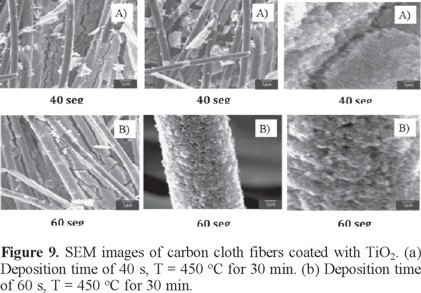
<body><![CDATA[<p align="justify"><font face="verdana" size="2"><i>Incorporation of a Nafion&#153; membrane with an immobilized iron catalyst in the photo&#45;electrochemical reactor</i></font></p>     <p align="justify"><font face="verdana" size="2">In this part of the work, a Nafion<sup>TM</sup> membrane was incorporated into the system to avoid the need for Fe<sup>2+</sup> addition to the solution and to promote photo&#45;assisted processes that can be used to mineralize pollutants. In <a href="#f8">Figure 8</a>, we show a SEM image of a membrane that was prepared by the method of Kiwi et al. &#91;20&#45;22&#93;. <a href="#f8">Figure 8(A)</a> shows the membrane without Fe<sup>2+</sup> in the lattice, and <a href="#f8">Figure 8(B)</a> shows the membrane with Fe<sup>2+</sup>. It is clear that the dispersion of Fe<sup>2+</sup> over the membrane lattice is homogeneous and is in the form of clusters. The Fe<sup>2+</sup> fixed in the Nafion&#153; membrane is excited by UV light, forming <sup>&bull;</sup>OH radicals via H<sub>2</sub>O<sub>2</sub> decomposition &#91;22&#93;.</font></p>     <p align="center"><font face="verdana" size="2"><a name="f8"></a></font></p>     <p align="center"><font face="verdana" size="2"><img src="/img/revistas/jmcs/v58n3/a14f8.jpg"></font></p>     <p align="justify"><font face="verdana" size="2"><i>Incorporation of carbon fibers coated with TiO<sub>2</sub> films in the photo&#45;electrochemical reactor</i></font></p>     <p align="justify"><font face="verdana" size="2">A new innovation of this photo&#45;electrochemical reactor is the incorporation of TiO<sub>2</sub> electrodes to promote photocatalytic phenomena to improve organic compound removal &#91;36&#93;. <a href="#f9">Figure 9</a> shows the SEM images of the TiO<sub>2</sub>&#45;carbon cloth electrodes that were prepared by electrophoretic deposition. As shown in <a href="#f9">Figure 9(A)</a>, the TiO<sub>2</sub> deposits (40 s deposition time) were not completely homogeneous, and in some places, the surface of the uncoated carbon cloth can be observed. However, when the electrophoretic deposition time was increased to 60 s, the coverage was uniform over the carbon cloth lattice, as shown in <a href="#f9">Figure 9(B)</a>.</font></p>     <p align="center"><font face="verdana" size="2"><a name="f9"></a></font></p>     <p align="center"><font face="verdana" size="2"><img src="/img/revistas/jmcs/v58n3/a14f9.jpg"></font></p>     <p align="justify"><font face="verdana" size="2"><i>Removal of coliforms in the photo&#45;electrochemical reactor using a Nafion&#153; membrane with dispersed iron, TiO<sub>2</sub>&#45;carbon cloth electrode and continuous H<sub>2</sub>O<sub>2</sub> electrogeneration</i></font></p>     <p align="justify"><font face="verdana" size="2">To evaluate the capacity of the new photo&#45;electrochemical reactor to remove coliforms from an effluent stream, several tests were performed with wastewater supplied from a municipal network. The experiment was carried out in the presence of H<sub>2</sub>O<sub>2</sub> that was continuously electro&#45;generated in the system with an Fe<sup>2+</sup>&#45;fixed Nafion&#153; membrane and a TiO<sub>2</sub>&#45;carbon cloth anode. The system was continuously illuminated to promote the photo&#45;oxidation process. <a href="#f10">Figure 10</a> shows the coliform removal, reported with a presumptive water quality test, through determination of the most probable number (NMP) of total coliforms, fecal coliforms (thermal tolerants), and <i>Escherichia coli</i>. The new photo&#45;electrochemical reactor removes 100% of the coliforms after 10 min of the oxidation process, indicating that the reactor is efficient in the removal of organic material in aqueous effluents.</font></p>     ]]></body>
<body><![CDATA[<p align="center"><font face="verdana" size="2"><a name="f10"></a></font></p>     <p align="center"><font face="verdana" size="2"><img src="/img/revistas/jmcs/v58n3/a14f10.jpg"></font></p>     <p align="justify"><font face="verdana" size="2">These results are in accordance whit reported recently by S.N. Hussain, et al &#91;37&#93;, where these authors carry out disinfection performance of a unique process of adsorption combined with electrochemical treatment.</font></p>     <p align="justify"><font face="Verdana" size="2">&nbsp;</font></p>     <p align="justify"><font face="verdana" size="2"><b>Conclusions</b></font></p>     <p align="justify"><font face="verdana" size="2">The carbon cloth is an efficient material for O<sub>2</sub> reduction and H<sub>2</sub>O<sub>2</sub> formation. In this new photo&#45;electrochemical reactor, the production of H<sub>2</sub>O<sub>2</sub> reaches 260 mg/L. Using dimensionless groups, we developed a general equation to scale&#45;up the photo&#45;electrochemical reactor. In the AOPs, the best Fe<sup>2+</sup> concentration was 0.05 mM, resulting in 90% color removal of the OG&#45;II dye. With the incorporation of a Fe<sup>2+</sup>&#45;fixed Nafion&#153; membrane and a TiO<sub>2</sub>&#45;carbon cloth anode, the system performs better than without these additions, with a measured coliform bacteria removal ability of 100%.</font></p>     <p align="justify"><font face="Verdana" size="2">&nbsp;</font></p>     <p align="justify"><font face="verdana" size="2"><b>Acknowledgments</b></font></p>     <p align="justify"><font face="verdana" size="2">The authors wish to thank the CONACyT for financial support this research.</font></p>     <p align="justify"><font face="Verdana" size="2">&nbsp;</font></p>     ]]></body>
<body><![CDATA[<p align="justify"><font face="verdana" size="2"><b>References</b></font></p>     <!-- ref --><p align="justify"><font face="verdana" size="2">1. Da Pozzo, A.; Di Palma, L.; Merli, C.; Petrucci. E. <i>J. Appl. Electrochem</i>. <b>2005</b>, <i>35</i>, 413&#45;419.    &nbsp;&nbsp;&nbsp;&nbsp;&nbsp;&nbsp;&nbsp;&nbsp;[&#160;<a href="javascript:void(0);" onclick="javascript: window.open('/scielo.php?script=sci_nlinks&ref=4949585&pid=S1870-249X201400030001400001&lng=','','width=640,height=500,resizable=yes,scrollbars=1,menubar=yes,');">Links</a>&#160;]<!-- end-ref --></font></p>     <!-- ref --><p align="justify"><font face="verdana" size="2">2. Da Pozzo, A.; Ferrantelli, P.; Merli, C.; Petrucci, E. <i>J. Appl. Electrochem</i>. <b>2005</b>, <i>35</i>, 391&#45;398.    &nbsp;&nbsp;&nbsp;&nbsp;&nbsp;&nbsp;&nbsp;&nbsp;[&#160;<a href="javascript:void(0);" onclick="javascript: window.open('/scielo.php?script=sci_nlinks&ref=4949587&pid=S1870-249X201400030001400002&lng=','','width=640,height=500,resizable=yes,scrollbars=1,menubar=yes,');">Links</a>&#160;]<!-- end-ref --></font></p>     <!-- ref --><p align="justify"><font face="verdana" size="2">3. Isarain&#45;Ch&aacute;vez, E.; de la Rosa, C.; Mart&iacute;nez&#45;Huitle, C.A.; Peralta&#45;Hern&aacute;ndez, J.M. <i>Int. J. Electrochem. Sci</i>. <b>2013</b>, <i>8</i>, 3084&#45;3094.    &nbsp;&nbsp;&nbsp;&nbsp;&nbsp;&nbsp;&nbsp;&nbsp;[&#160;<a href="javascript:void(0);" onclick="javascript: window.open('/scielo.php?script=sci_nlinks&ref=4949589&pid=S1870-249X201400030001400003&lng=','','width=640,height=500,resizable=yes,scrollbars=1,menubar=yes,');">Links</a>&#160;]<!-- end-ref --></font></p>     <!-- ref --><p align="justify"><font face="verdana" size="2">4. Badellino, C.; Arruda Rodrigues, C.; Bertazzoli, R. <i>J. Hazard Mat</i>. <b>2006</b>, <i>137</i>, 856&#45;864.    &nbsp;&nbsp;&nbsp;&nbsp;&nbsp;&nbsp;&nbsp;&nbsp;[&#160;<a href="javascript:void(0);" onclick="javascript: window.open('/scielo.php?script=sci_nlinks&ref=4949591&pid=S1870-249X201400030001400004&lng=','','width=640,height=500,resizable=yes,scrollbars=1,menubar=yes,');">Links</a>&#160;]<!-- end-ref --></font></p>     <!-- ref --><p align="justify"><font face="verdana" size="2">5. Mart&iacute;nez&#45;Huitle, C.A.; Brillas, E. <i>Appl. Cat. B: Environ</i>. <b>2009</b>, l <i>87</i>, 105&#45;145.    &nbsp;&nbsp;&nbsp;&nbsp;&nbsp;&nbsp;&nbsp;&nbsp;[&#160;<a href="javascript:void(0);" onclick="javascript: window.open('/scielo.php?script=sci_nlinks&ref=4949593&pid=S1870-249X201400030001400005&lng=','','width=640,height=500,resizable=yes,scrollbars=1,menubar=yes,');">Links</a>&#160;]<!-- end-ref --></font></p>     <!-- ref --><p align="justify"><font face="verdana" size="2">6. Cruz&#45;Gonz&aacute;lez, K.; Torres&#45;Lopez, O.; Garc&iacute;a&#45;Le&oacute;n, A.M.; Brillas, E.; Hern&aacute;ndez&#45;Ram&iacute;rez, A.; Peralta&#45;Hern&aacute;ndez, J.M. <i>Desalination</i> <b>2012</b>, <i>286</i>, 63&#45;68.    &nbsp;&nbsp;&nbsp;&nbsp;&nbsp;&nbsp;&nbsp;&nbsp;[&#160;<a href="javascript:void(0);" onclick="javascript: window.open('/scielo.php?script=sci_nlinks&ref=4949595&pid=S1870-249X201400030001400006&lng=','','width=640,height=500,resizable=yes,scrollbars=1,menubar=yes,');">Links</a>&#160;]<!-- end-ref --></font></p>     <!-- ref --><p align="justify"><font face="verdana" size="2">7. Skoumal, M.; Rodriguez, R.M.; Lluis Cabot, P.; Centellas, F.; Garrido, J.A.; Arias, C.; Brillas, E. <i>Electrochim. Acta</i> <b>2009</b>, <i>54</i>, 2077&#45;2085.    &nbsp;&nbsp;&nbsp;&nbsp;&nbsp;&nbsp;&nbsp;&nbsp;[&#160;<a href="javascript:void(0);" onclick="javascript: window.open('/scielo.php?script=sci_nlinks&ref=4949597&pid=S1870-249X201400030001400007&lng=','','width=640,height=500,resizable=yes,scrollbars=1,menubar=yes,');">Links</a>&#160;]<!-- end-ref --></font></p>     <!-- ref --><p align="justify"><font face="verdana" size="2">8. Peralta&#45;Hern&aacute;ndez, J.M.; Meas&#45;Vong, Y.; Rodr&iacute;guez, F.J.; Chapman, T.W.; Maldonado, M.I.; God&iacute;nez, L.A. <i>Dyes and Pigments</i> <b>2008</b>, <i>76</i>, 656&#45;662.    &nbsp;&nbsp;&nbsp;&nbsp;&nbsp;&nbsp;&nbsp;&nbsp;[&#160;<a href="javascript:void(0);" onclick="javascript: window.open('/scielo.php?script=sci_nlinks&ref=4949599&pid=S1870-249X201400030001400008&lng=','','width=640,height=500,resizable=yes,scrollbars=1,menubar=yes,');">Links</a>&#160;]<!-- end-ref --></font></p>     <!-- ref --><p align="justify"><font face="verdana" size="2">9. El&#45;Ghenymy, A.; Oturan, N.; Oturan, M.A.; Garrido, J.A.; Cabot, P.L.; Centellas, F.; Rodr&iacute;guez, R.M.; Brillas, E. <i>Chem. Eng. J.</i> <b>2013</b>, <i>234</i>, 115&#45;123.    &nbsp;&nbsp;&nbsp;&nbsp;&nbsp;&nbsp;&nbsp;&nbsp;[&#160;<a href="javascript:void(0);" onclick="javascript: window.open('/scielo.php?script=sci_nlinks&ref=4949601&pid=S1870-249X201400030001400009&lng=','','width=640,height=500,resizable=yes,scrollbars=1,menubar=yes,');">Links</a>&#160;]<!-- end-ref --></font></p>     <!-- ref --><p align="justify"><font face="verdana" size="2">10. Peralta&#45;Hern&aacute;ndez, J.M.; Mart&iacute;nez&#45;Huitle, C. A.; Guzm&aacute;n&#45;Mar, J. L.; Hern&aacute;ndez&#45;Ram&iacute;rez, A. <i>J. Environ. Eng. Manage</i> <b>2009</b>, <i>19</i>, 257&#45;265.    &nbsp;&nbsp;&nbsp;&nbsp;&nbsp;&nbsp;&nbsp;&nbsp;[&#160;<a href="javascript:void(0);" onclick="javascript: window.open('/scielo.php?script=sci_nlinks&ref=4949603&pid=S1870-249X201400030001400010&lng=','','width=640,height=500,resizable=yes,scrollbars=1,menubar=yes,');">Links</a>&#160;]<!-- end-ref --></font></p>     <!-- ref --><p align="justify"><font face="verdana" size="2">11. Peralta&#45;Hern&aacute;ndez, J.M.; Meas&#45;Vong, Y.; Rodr&iacute;guez, F.J.; Chapman, T.W.; Maldonado, M.I.; God&iacute;nez, L.A. <i>Water Res</i>. <b>2006</b>, <i>40</i>, 1754&#45;1762.    &nbsp;&nbsp;&nbsp;&nbsp;&nbsp;&nbsp;&nbsp;&nbsp;[&#160;<a href="javascript:void(0);" onclick="javascript: window.open('/scielo.php?script=sci_nlinks&ref=4949605&pid=S1870-249X201400030001400011&lng=','','width=640,height=500,resizable=yes,scrollbars=1,menubar=yes,');">Links</a>&#160;]<!-- end-ref --></font></p>     <!-- ref --><p align="justify"><font face="verdana" size="2">12. Cruz&#45;Gonz&aacute;lez, K.; Torres&#45;L&oacute;pez, O.; Garc&iacute;a&#45;Le&oacute;n, A.; Guzm&aacute;n&#45;Mar, J.L.; Reyes, L.H.; Hern&aacute;ndez&#45;Ram&iacute;rez, A.; Peralta&#45;Hern&aacute;ndez, J.M. <i>Chem. Eng. J</i>. <b>2010</b>, <i>160</i>, 199&#45;206.    &nbsp;&nbsp;&nbsp;&nbsp;&nbsp;&nbsp;&nbsp;&nbsp;[&#160;<a href="javascript:void(0);" onclick="javascript: window.open('/scielo.php?script=sci_nlinks&ref=4949607&pid=S1870-249X201400030001400012&lng=','','width=640,height=500,resizable=yes,scrollbars=1,menubar=yes,');">Links</a>&#160;]<!-- end-ref --></font></p>     <!-- ref --><p align="justify"><font face="verdana" size="2">13. Melgoza, D.; Hern&aacute;ndez&#45;Ram&iacute;rez, A.; Peralta&#45;Hern&aacute;ndez, J. M.; <i>Photochem. Photobiol. Sci</i>. <b>2009</b>, <i>8</i>, 596&#45;599.    &nbsp;&nbsp;&nbsp;&nbsp;&nbsp;&nbsp;&nbsp;&nbsp;[&#160;<a href="javascript:void(0);" onclick="javascript: window.open('/scielo.php?script=sci_nlinks&ref=4949609&pid=S1870-249X201400030001400013&lng=','','width=640,height=500,resizable=yes,scrollbars=1,menubar=yes,');">Links</a>&#160;]<!-- end-ref --></font></p>     <!-- ref --><p align="justify"><font face="verdana" size="2">14. Anotai, J.; Lu M&#45;Ch.; Chewpreecha, P. <i>Water Res</i>. <b>2006</b>, <i>40</i>, 1841&#45;1847.    &nbsp;&nbsp;&nbsp;&nbsp;&nbsp;&nbsp;&nbsp;&nbsp;[&#160;<a href="javascript:void(0);" onclick="javascript: window.open('/scielo.php?script=sci_nlinks&ref=4949611&pid=S1870-249X201400030001400014&lng=','','width=640,height=500,resizable=yes,scrollbars=1,menubar=yes,');">Links</a>&#160;]<!-- end-ref --></font></p>     <!-- ref --><p align="justify"><font face="verdana" size="2">15. Esquivel, K.; Arriaga, L.G.; Rodr&iacute;guez, F.J.; Mart&iacute;nez, L.; God&iacute;nez, L.A. <i>Water Res</i>. <b>2009</b>, <i>43</i>, 3593&#45;3603.    &nbsp;&nbsp;&nbsp;&nbsp;&nbsp;&nbsp;&nbsp;&nbsp;[&#160;<a href="javascript:void(0);" onclick="javascript: window.open('/scielo.php?script=sci_nlinks&ref=4949613&pid=S1870-249X201400030001400015&lng=','','width=640,height=500,resizable=yes,scrollbars=1,menubar=yes,');">Links</a>&#160;]<!-- end-ref --></font></p>     <!-- ref --><p align="justify"><font face="verdana" size="2">16. &Ouml;zcan, A.; Oturan, M.A.; Oturan, N.; Sahin, Y. <i>J. Hazard. Mat</i>. <b>2009</b>, <i>163</i>, 1213&#45;1220.    &nbsp;&nbsp;&nbsp;&nbsp;&nbsp;&nbsp;&nbsp;&nbsp;[&#160;<a href="javascript:void(0);" onclick="javascript: window.open('/scielo.php?script=sci_nlinks&ref=4949615&pid=S1870-249X201400030001400016&lng=','','width=640,height=500,resizable=yes,scrollbars=1,menubar=yes,');">Links</a>&#160;]<!-- end-ref --></font></p>     <!-- ref --><p align="justify"><font face="verdana" size="2">17. Guinea, E.; Arias, C.; Llu&iacute;s Cabot, P.; Garrido, J.A.; Rodr&iacute;guez, R.M.; Centellas, F.; Brillas, E. <i>Water Res</i>. <b>2008</b>, <i>42</i>, 499&#45;511.    &nbsp;&nbsp;&nbsp;&nbsp;&nbsp;&nbsp;&nbsp;&nbsp;[&#160;<a href="javascript:void(0);" onclick="javascript: window.open('/scielo.php?script=sci_nlinks&ref=4949617&pid=S1870-249X201400030001400017&lng=','','width=640,height=500,resizable=yes,scrollbars=1,menubar=yes,');">Links</a>&#160;]<!-- end-ref --></font></p>     <!-- ref --><p align="justify"><font face="verdana" size="2">18. Xie, Y.B.; L, X.Z. <i>Mat. Chem. Phys</i>. <b>2006</b>, <i>95</i>, 39&#45;50.    &nbsp;&nbsp;&nbsp;&nbsp;&nbsp;&nbsp;&nbsp;&nbsp;[&#160;<a href="javascript:void(0);" onclick="javascript: window.open('/scielo.php?script=sci_nlinks&ref=4949619&pid=S1870-249X201400030001400018&lng=','','width=640,height=500,resizable=yes,scrollbars=1,menubar=yes,');">Links</a>&#160;]<!-- end-ref --></font></p>     <!-- ref --><p align="justify"><font face="verdana" size="2">19. Isarain&#45;Ch&aacute;vez, E.; Rodr&iacute;guez, R.M.; Cabot, P.L.; Centellas, F.; Arias, C.; Garrido, J.A.; Brillas, E. <i>Water Res</i>. <b>2011</b>, <i>45</i>, 4119&#45;4130.    &nbsp;&nbsp;&nbsp;&nbsp;&nbsp;&nbsp;&nbsp;&nbsp;[&#160;<a href="javascript:void(0);" onclick="javascript: window.open('/scielo.php?script=sci_nlinks&ref=4949621&pid=S1870-249X201400030001400019&lng=','','width=640,height=500,resizable=yes,scrollbars=1,menubar=yes,');">Links</a>&#160;]<!-- end-ref --></font></p>     <!-- ref --><p align="justify"><font face="verdana" size="2">20. Fernandez, J.; Bandara, J.; Lopez, A.; Buffat, Ph.; Kiwi, J. <i>Langmuir</i> <b>1999</b>, <i>15</i>, 185&#45;192.    &nbsp;&nbsp;&nbsp;&nbsp;&nbsp;&nbsp;&nbsp;&nbsp;[&#160;<a href="javascript:void(0);" onclick="javascript: window.open('/scielo.php?script=sci_nlinks&ref=4949623&pid=S1870-249X201400030001400020&lng=','','width=640,height=500,resizable=yes,scrollbars=1,menubar=yes,');">Links</a>&#160;]<!-- end-ref --></font></p>     <!-- ref --><p align="justify"><font face="verdana" size="2">21. Fernandez, J.; Bandara, J.; Lopez, A.; Albers, P.; Kiwi, <i>J. Chem. Com</i>. <b>1998</b>, 1493.    &nbsp;&nbsp;&nbsp;&nbsp;&nbsp;&nbsp;&nbsp;&nbsp;[&#160;<a href="javascript:void(0);" onclick="javascript: window.open('/scielo.php?script=sci_nlinks&ref=4949625&pid=S1870-249X201400030001400021&lng=','','width=640,height=500,resizable=yes,scrollbars=1,menubar=yes,');">Links</a>&#160;]<!-- end-ref --></font></p>     <!-- ref --><p align="justify"><font face="verdana" size="2">22. Balanosky, E.; Fernandez, J.; Kiwi, J.; Lopez, A. <i>Wat. Sci. Tech</i>. <b>1999</b>, <i>40</i>, 417&#45; 424.    &nbsp;&nbsp;&nbsp;&nbsp;&nbsp;&nbsp;&nbsp;&nbsp;[&#160;<a href="javascript:void(0);" onclick="javascript: window.open('/scielo.php?script=sci_nlinks&ref=4949627&pid=S1870-249X201400030001400022&lng=','','width=640,height=500,resizable=yes,scrollbars=1,menubar=yes,');">Links</a>&#160;]<!-- end-ref --></font></p>     <!-- ref --><p align="justify"><font face="verdana" size="2">23. Rizzo, L.; Koch, J.; Belgiorno, V.; Anderson, M.A. <i>Desalination</i> <b>2007</b>, <i>211</i>, 1&#45;9.    &nbsp;&nbsp;&nbsp;&nbsp;&nbsp;&nbsp;&nbsp;&nbsp;[&#160;<a href="javascript:void(0);" onclick="javascript: window.open('/scielo.php?script=sci_nlinks&ref=4949629&pid=S1870-249X201400030001400023&lng=','','width=640,height=500,resizable=yes,scrollbars=1,menubar=yes,');">Links</a>&#160;]<!-- end-ref --></font></p>     <!-- ref --><p align="justify"><font face="verdana" size="2">24. Fujishima, A.; Rao, T.N.; Tryk, D.A. <i>J. Photochem. Photobiol. C: Photochem. Rev</i>. <b>2000</b>, <i>1</i>, 1&#45;21.    &nbsp;&nbsp;&nbsp;&nbsp;&nbsp;&nbsp;&nbsp;&nbsp;[&#160;<a href="javascript:void(0);" onclick="javascript: window.open('/scielo.php?script=sci_nlinks&ref=4949631&pid=S1870-249X201400030001400024&lng=','','width=640,height=500,resizable=yes,scrollbars=1,menubar=yes,');">Links</a>&#160;]<!-- end-ref --></font></p>     <!-- ref --><p align="justify"><font face="verdana" size="2">25. Gogate, P. R.; Pandit, A. B. <i>Adv. Env. Res</i>. <b>2004</b>, <i>8</i>, 501&#45;551.    &nbsp;&nbsp;&nbsp;&nbsp;&nbsp;&nbsp;&nbsp;&nbsp;[&#160;<a href="javascript:void(0);" onclick="javascript: window.open('/scielo.php?script=sci_nlinks&ref=4949633&pid=S1870-249X201400030001400025&lng=','','width=640,height=500,resizable=yes,scrollbars=1,menubar=yes,');">Links</a>&#160;]<!-- end-ref --></font></p>     <!-- ref --><p align="justify"><font face="verdana" size="2">26. Sheng, H.; Li, Q.; Wanhong, Ma.; Hongwei, Ji.; Chuncheng, Ch.; Jincai, Z. <i>Appl. Cat. B: Environ.</i> <b>2013</b>, <i>138</i>, 212&#45;218.    &nbsp;&nbsp;&nbsp;&nbsp;&nbsp;&nbsp;&nbsp;&nbsp;[&#160;<a href="javascript:void(0);" onclick="javascript: window.open('/scielo.php?script=sci_nlinks&ref=4949635&pid=S1870-249X201400030001400026&lng=','','width=640,height=500,resizable=yes,scrollbars=1,menubar=yes,');">Links</a>&#160;]<!-- end-ref --></font></p>     <!-- ref --><p align="justify"><font face="verdana" size="2">27. Pelizzetti, E.; Minero, C. <i>Electrochim. Acta</i>. <b>1993</b>, <i>38</i>, 47&#45;55.    &nbsp;&nbsp;&nbsp;&nbsp;&nbsp;&nbsp;&nbsp;&nbsp;[&#160;<a href="javascript:void(0);" onclick="javascript: window.open('/scielo.php?script=sci_nlinks&ref=4949637&pid=S1870-249X201400030001400027&lng=','','width=640,height=500,resizable=yes,scrollbars=1,menubar=yes,');">Links</a>&#160;]<!-- end-ref --></font></p>     <!-- ref --><p align="justify"><font face="verdana" size="2">28. Villanueva&#45;Rodr&iacute;guez, M.; Hern&aacute;ndez&#45;Ram&iacute;rez, A.; Peralta&#45;Hern&aacute;ndez, J.M.; Bandala, E.R.; Quiroz&#45;Alfaro, M.A<i>. J. Haz. Mat</i>. <b>2009</b>, <i>167</i>, 1226&#45;1230.    &nbsp;&nbsp;&nbsp;&nbsp;&nbsp;&nbsp;&nbsp;&nbsp;[&#160;<a href="javascript:void(0);" onclick="javascript: window.open('/scielo.php?script=sci_nlinks&ref=4949639&pid=S1870-249X201400030001400028&lng=','','width=640,height=500,resizable=yes,scrollbars=1,menubar=yes,');">Links</a>&#160;]<!-- end-ref --></font></p>     <!-- ref --><p align="justify"><font face="verdana" size="2">29. Keller, N.; Rebmann, G.; Barraud, E.; Zahraa, O.; Keller, V.; <i>Cat. Today</i>. <b>2005</b>, <i>101</i>, 323&#45;329.    &nbsp;&nbsp;&nbsp;&nbsp;&nbsp;&nbsp;&nbsp;&nbsp;[&#160;<a href="javascript:void(0);" onclick="javascript: window.open('/scielo.php?script=sci_nlinks&ref=4949641&pid=S1870-249X201400030001400029&lng=','','width=640,height=500,resizable=yes,scrollbars=1,menubar=yes,');">Links</a>&#160;]<!-- end-ref --></font></p>     <!-- ref --><p align="justify"><font face="verdana" size="2">30. Pak, D.; Chung, D.; Beck Ju, J. <i>Water Res.</i> <b>2001</b>, <i>35</i>, 57&#45;68.    &nbsp;&nbsp;&nbsp;&nbsp;&nbsp;&nbsp;&nbsp;&nbsp;[&#160;<a href="javascript:void(0);" onclick="javascript: window.open('/scielo.php?script=sci_nlinks&ref=4949643&pid=S1870-249X201400030001400030&lng=','','width=640,height=500,resizable=yes,scrollbars=1,menubar=yes,');">Links</a>&#160;]<!-- end-ref --></font></p>     <!-- ref --><p align="justify"><font face="verdana" size="2">31. Eisenberg, G.M. <i>Ind. Eng. Chem</i>. <b>1943</b>, <i>15</i>, 327&#45;328.    &nbsp;&nbsp;&nbsp;&nbsp;&nbsp;&nbsp;&nbsp;&nbsp;[&#160;<a href="javascript:void(0);" onclick="javascript: window.open('/scielo.php?script=sci_nlinks&ref=4949645&pid=S1870-249X201400030001400031&lng=','','width=640,height=500,resizable=yes,scrollbars=1,menubar=yes,');">Links</a>&#160;]<!-- end-ref --></font></p>     <!-- ref --><p align="justify"><font face="verdana" size="2">32. Manriquez, J.; God&iacute;nez, L.A. <i>Thin Solid Films</i>. <b>2007</b>, <i>515</i>, 3402&#45;3413.    &nbsp;&nbsp;&nbsp;&nbsp;&nbsp;&nbsp;&nbsp;&nbsp;[&#160;<a href="javascript:void(0);" onclick="javascript: window.open('/scielo.php?script=sci_nlinks&ref=4949647&pid=S1870-249X201400030001400032&lng=','','width=640,height=500,resizable=yes,scrollbars=1,menubar=yes,');">Links</a>&#160;]<!-- end-ref --></font></p>     <!-- ref --><p align="justify"><font face="verdana" size="2">33. Orlando Garc&iacute;a, Eloy Isarain&#45;Ch&aacute;vez, Sergi Garcia&#45;Segura, Enric Brillas, Juan M. Peralta&#45;Hern&aacute;ndez. <i>Electrocatalysis</i> <b>2013</b>, <i>4</i>, 224&#45;234.    &nbsp;&nbsp;&nbsp;&nbsp;&nbsp;&nbsp;&nbsp;&nbsp;[&#160;<a href="javascript:void(0);" onclick="javascript: window.open('/scielo.php?script=sci_nlinks&ref=4949649&pid=S1870-249X201400030001400033&lng=','','width=640,height=500,resizable=yes,scrollbars=1,menubar=yes,');">Links</a>&#160;]<!-- end-ref --></font></p>     <!-- ref --><p align="justify"><font face="verdana" size="2">34. Garc&iacute;a, O.; Isarain&#45;Ch&aacute;vez, E.; Garcia&#45;Segura, S.; Brillas, E.; Peralta&#45;Hern&aacute;ndez, J.M. <i>Electrocatalysis.</i> <b>2013</b>, <i>4</i>, 224&#45;234.    &nbsp;&nbsp;&nbsp;&nbsp;&nbsp;&nbsp;&nbsp;&nbsp;[&#160;<a href="javascript:void(0);" onclick="javascript: window.open('/scielo.php?script=sci_nlinks&ref=4949651&pid=S1870-249X201400030001400034&lng=','','width=640,height=500,resizable=yes,scrollbars=1,menubar=yes,');">Links</a>&#160;]<!-- end-ref --></font></p>     <!-- ref --><p align="justify"><font face="verdana" size="2">35. Garcia&#45;Segura, S.; Brillas, E. <i>Water Res</i>. <b>2011</b>, <i>45</i>, 2975&#45;2984.    &nbsp;&nbsp;&nbsp;&nbsp;&nbsp;&nbsp;&nbsp;&nbsp;[&#160;<a href="javascript:void(0);" onclick="javascript: window.open('/scielo.php?script=sci_nlinks&ref=4949653&pid=S1870-249X201400030001400035&lng=','','width=640,height=500,resizable=yes,scrollbars=1,menubar=yes,');">Links</a>&#160;]<!-- end-ref --></font></p>     <!-- ref --><p align="justify"><font face="verdana" size="2">36. Peralta&#45;Hern&aacute;ndez, J.M.; Manr&iacute;quez, J.; Meas&#45;Vong, Y.; Rodriguez Francisco, J.; Chapman, T.W.; Maldonado, M.I.; God&iacute;nez, L.A. <i>J. Hazard. Mat</i>. <b>2007</b>, <i>147</i>, 588&#45;593.    &nbsp;&nbsp;&nbsp;&nbsp;&nbsp;&nbsp;&nbsp;&nbsp;[&#160;<a href="javascript:void(0);" onclick="javascript: window.open('/scielo.php?script=sci_nlinks&ref=4949655&pid=S1870-249X201400030001400036&lng=','','width=640,height=500,resizable=yes,scrollbars=1,menubar=yes,');">Links</a>&#160;]<!-- end-ref --></font></p>     <!-- ref --><p align="justify"><font face="verdana" size="2">37. Hussain, S.N.; de las Heras, N.; Asghar, H.M.A.; Brown, N.W.; Roberts, E.P.L. <i>Water Res.</i> <b>2014</b>, <i>54</i>, 170&#45;78.    &nbsp;&nbsp;&nbsp;&nbsp;&nbsp;&nbsp;&nbsp;&nbsp;[&#160;<a href="javascript:void(0);" onclick="javascript: window.open('/scielo.php?script=sci_nlinks&ref=4949657&pid=S1870-249X201400030001400037&lng=','','width=640,height=500,resizable=yes,scrollbars=1,menubar=yes,');">Links</a>&#160;]<!-- end-ref --></font></p>      ]]></body><back>
<ref-list>
<ref id="B1">
<label>1</label><nlm-citation citation-type="journal">
<person-group person-group-type="author">
<name>
<surname><![CDATA[Da Pozzo]]></surname>
<given-names><![CDATA[A.]]></given-names>
</name>
<name>
<surname><![CDATA[Di Palma]]></surname>
<given-names><![CDATA[L.]]></given-names>
</name>
<name>
<surname><![CDATA[Merli]]></surname>
<given-names><![CDATA[C.]]></given-names>
</name>
<name>
<surname><![CDATA[Petrucci.]]></surname>
<given-names><![CDATA[E.]]></given-names>
</name>
</person-group>
<source><![CDATA[J. Appl. Electrochem.]]></source>
<year>2005</year>
<volume>35</volume>
<page-range>413-419</page-range></nlm-citation>
</ref>
<ref id="B2">
<label>2</label><nlm-citation citation-type="journal">
<person-group person-group-type="author">
<name>
<surname><![CDATA[Da Pozzo]]></surname>
<given-names><![CDATA[A.]]></given-names>
</name>
<name>
<surname><![CDATA[Ferrantelli]]></surname>
<given-names><![CDATA[P.]]></given-names>
</name>
<name>
<surname><![CDATA[Merli]]></surname>
<given-names><![CDATA[C.]]></given-names>
</name>
<name>
<surname><![CDATA[Petrucci]]></surname>
<given-names><![CDATA[E.]]></given-names>
</name>
</person-group>
<source><![CDATA[J. Appl. Electrochem.]]></source>
<year>2005</year>
<volume>35</volume>
<page-range>391-398</page-range></nlm-citation>
</ref>
<ref id="B3">
<label>3</label><nlm-citation citation-type="journal">
<person-group person-group-type="author">
<name>
<surname><![CDATA[Isarain-Chávez]]></surname>
<given-names><![CDATA[E.]]></given-names>
</name>
<name>
<surname><![CDATA[de la Rosa]]></surname>
<given-names><![CDATA[C.]]></given-names>
</name>
<name>
<surname><![CDATA[Martínez-Huitle]]></surname>
<given-names><![CDATA[C.A.]]></given-names>
</name>
<name>
<surname><![CDATA[Peralta-Hernández]]></surname>
<given-names><![CDATA[J.M.]]></given-names>
</name>
</person-group>
<source><![CDATA[Int. J. Electrochem. Sci.]]></source>
<year>2013</year>
<volume>8</volume>
<page-range>3084-3094</page-range></nlm-citation>
</ref>
<ref id="B4">
<label>4</label><nlm-citation citation-type="journal">
<person-group person-group-type="author">
<name>
<surname><![CDATA[Badellino]]></surname>
<given-names><![CDATA[C.]]></given-names>
</name>
<name>
<surname><![CDATA[Arruda Rodrigues]]></surname>
<given-names><![CDATA[C.]]></given-names>
</name>
<name>
<surname><![CDATA[Bertazzoli]]></surname>
<given-names><![CDATA[R.]]></given-names>
</name>
</person-group>
<source><![CDATA[J. Hazard Mat.]]></source>
<year>2006</year>
<volume>137</volume>
<page-range>856-864</page-range></nlm-citation>
</ref>
<ref id="B5">
<label>5</label><nlm-citation citation-type="journal">
<person-group person-group-type="author">
<name>
<surname><![CDATA[Martínez-Huitle]]></surname>
<given-names><![CDATA[C.A.]]></given-names>
</name>
<name>
<surname><![CDATA[Brillas]]></surname>
<given-names><![CDATA[E.]]></given-names>
</name>
</person-group>
<source><![CDATA[Appl. Cat. B: Environ.]]></source>
<year>2009</year>
<page-range>l 87, 105-145</page-range></nlm-citation>
</ref>
<ref id="B6">
<label>6</label><nlm-citation citation-type="journal">
<person-group person-group-type="author">
<name>
<surname><![CDATA[Cruz-González]]></surname>
<given-names><![CDATA[K.]]></given-names>
</name>
<name>
<surname><![CDATA[Torres-Lopez]]></surname>
<given-names><![CDATA[O.]]></given-names>
</name>
<name>
<surname><![CDATA[García-León]]></surname>
<given-names><![CDATA[A.M.]]></given-names>
</name>
<name>
<surname><![CDATA[Brillas]]></surname>
<given-names><![CDATA[E.]]></given-names>
</name>
<name>
<surname><![CDATA[Hernández-Ramírez]]></surname>
<given-names><![CDATA[A.]]></given-names>
</name>
<name>
<surname><![CDATA[Peralta-Hernández]]></surname>
<given-names><![CDATA[J.M.]]></given-names>
</name>
</person-group>
<source><![CDATA[Desalination]]></source>
<year>2012</year>
<volume>286</volume>
<page-range>63-68</page-range></nlm-citation>
</ref>
<ref id="B7">
<label>7</label><nlm-citation citation-type="journal">
<person-group person-group-type="author">
<name>
<surname><![CDATA[Skoumal]]></surname>
<given-names><![CDATA[M.]]></given-names>
</name>
<name>
<surname><![CDATA[Rodriguez]]></surname>
<given-names><![CDATA[R.M.]]></given-names>
</name>
<name>
<surname><![CDATA[Lluis Cabot]]></surname>
<given-names><![CDATA[P.]]></given-names>
</name>
<name>
<surname><![CDATA[Centellas]]></surname>
<given-names><![CDATA[F.]]></given-names>
</name>
<name>
<surname><![CDATA[Garrido]]></surname>
<given-names><![CDATA[J.A.]]></given-names>
</name>
<name>
<surname><![CDATA[Arias]]></surname>
<given-names><![CDATA[C.]]></given-names>
</name>
<name>
<surname><![CDATA[Brillas]]></surname>
<given-names><![CDATA[E.]]></given-names>
</name>
</person-group>
<source><![CDATA[Electrochim. Acta]]></source>
<year>2009</year>
<volume>54</volume>
<page-range>2077-2085</page-range></nlm-citation>
</ref>
<ref id="B8">
<label>8</label><nlm-citation citation-type="journal">
<person-group person-group-type="author">
<name>
<surname><![CDATA[Peralta-Hernández]]></surname>
<given-names><![CDATA[J.M.]]></given-names>
</name>
<name>
<surname><![CDATA[Meas-Vong]]></surname>
<given-names><![CDATA[Y.]]></given-names>
</name>
<name>
<surname><![CDATA[Rodríguez]]></surname>
<given-names><![CDATA[F.J.]]></given-names>
</name>
<name>
<surname><![CDATA[Chapman]]></surname>
<given-names><![CDATA[T.W.]]></given-names>
</name>
<name>
<surname><![CDATA[Maldonado]]></surname>
<given-names><![CDATA[M.I.]]></given-names>
</name>
<name>
<surname><![CDATA[Godínez]]></surname>
<given-names><![CDATA[L.A.]]></given-names>
</name>
</person-group>
<source><![CDATA[Dyes and Pigments]]></source>
<year>2008</year>
<volume>76</volume>
<page-range>656-662</page-range></nlm-citation>
</ref>
<ref id="B9">
<label>9</label><nlm-citation citation-type="journal">
<person-group person-group-type="author">
<name>
<surname><![CDATA[El-Ghenymy]]></surname>
<given-names><![CDATA[A.]]></given-names>
</name>
<name>
<surname><![CDATA[Oturan]]></surname>
<given-names><![CDATA[N.]]></given-names>
</name>
<name>
<surname><![CDATA[Oturan]]></surname>
<given-names><![CDATA[M.A.]]></given-names>
</name>
<name>
<surname><![CDATA[Garrido]]></surname>
<given-names><![CDATA[J.A.]]></given-names>
</name>
<name>
<surname><![CDATA[Cabot]]></surname>
<given-names><![CDATA[P.L.]]></given-names>
</name>
<name>
<surname><![CDATA[Centellas]]></surname>
<given-names><![CDATA[F.]]></given-names>
</name>
<name>
<surname><![CDATA[Rodríguez]]></surname>
<given-names><![CDATA[R.M.]]></given-names>
</name>
<name>
<surname><![CDATA[Brillas]]></surname>
<given-names><![CDATA[E.]]></given-names>
</name>
</person-group>
<source><![CDATA[Chem. Eng. J.]]></source>
<year>2013</year>
<volume>234</volume>
<page-range>115-123</page-range></nlm-citation>
</ref>
<ref id="B10">
<label>10</label><nlm-citation citation-type="journal">
<person-group person-group-type="author">
<name>
<surname><![CDATA[Peralta-Hernández]]></surname>
<given-names><![CDATA[J.M.]]></given-names>
</name>
<name>
<surname><![CDATA[Martínez-Huitle]]></surname>
<given-names><![CDATA[C. A.]]></given-names>
</name>
<name>
<surname><![CDATA[Guzmán-Mar]]></surname>
<given-names><![CDATA[J. L.]]></given-names>
</name>
<name>
<surname><![CDATA[Hernández-Ramírez]]></surname>
<given-names><![CDATA[A.]]></given-names>
</name>
</person-group>
<source><![CDATA[J. Environ. Eng. Manage]]></source>
<year>2009</year>
<volume>19</volume>
<page-range>257-265</page-range></nlm-citation>
</ref>
<ref id="B11">
<label>11</label><nlm-citation citation-type="journal">
<person-group person-group-type="author">
<name>
<surname><![CDATA[Peralta-Hernández]]></surname>
<given-names><![CDATA[J.M.]]></given-names>
</name>
<name>
<surname><![CDATA[Meas-Vong]]></surname>
<given-names><![CDATA[Y.]]></given-names>
</name>
<name>
<surname><![CDATA[Rodríguez]]></surname>
<given-names><![CDATA[F.J.]]></given-names>
</name>
<name>
<surname><![CDATA[Chapman]]></surname>
<given-names><![CDATA[T.W.]]></given-names>
</name>
<name>
<surname><![CDATA[Maldonado]]></surname>
<given-names><![CDATA[M.I.]]></given-names>
</name>
<name>
<surname><![CDATA[Godínez]]></surname>
<given-names><![CDATA[L.A.]]></given-names>
</name>
</person-group>
<source><![CDATA[Water Res.]]></source>
<year>2006</year>
<volume>40</volume>
<page-range>1754-1762</page-range></nlm-citation>
</ref>
<ref id="B12">
<label>12</label><nlm-citation citation-type="journal">
<person-group person-group-type="author">
<name>
<surname><![CDATA[Cruz-González]]></surname>
<given-names><![CDATA[K.]]></given-names>
</name>
<name>
<surname><![CDATA[Torres-López]]></surname>
<given-names><![CDATA[O.]]></given-names>
</name>
<name>
<surname><![CDATA[García-León]]></surname>
<given-names><![CDATA[A.]]></given-names>
</name>
<name>
<surname><![CDATA[Guzmán-Mar]]></surname>
<given-names><![CDATA[J.L.]]></given-names>
</name>
<name>
<surname><![CDATA[Reyes]]></surname>
<given-names><![CDATA[L.H.]]></given-names>
</name>
<name>
<surname><![CDATA[Hernández-Ramírez]]></surname>
<given-names><![CDATA[A.]]></given-names>
</name>
<name>
<surname><![CDATA[Peralta-Hernández]]></surname>
<given-names><![CDATA[J.M.]]></given-names>
</name>
</person-group>
<source><![CDATA[Chem. Eng. J.]]></source>
<year>2010</year>
<volume>160</volume>
<page-range>199-206</page-range></nlm-citation>
</ref>
<ref id="B13">
<label>13</label><nlm-citation citation-type="journal">
<person-group person-group-type="author">
<name>
<surname><![CDATA[Melgoza]]></surname>
<given-names><![CDATA[D.]]></given-names>
</name>
<name>
<surname><![CDATA[Hernández-Ramírez]]></surname>
<given-names><![CDATA[A.]]></given-names>
</name>
<name>
<surname><![CDATA[Peralta-Hernández]]></surname>
<given-names><![CDATA[J. M.]]></given-names>
</name>
</person-group>
<source><![CDATA[Photochem. Photobiol. Sci.]]></source>
<year>2009</year>
<volume>8</volume>
<page-range>596-599</page-range></nlm-citation>
</ref>
<ref id="B14">
<label>14</label><nlm-citation citation-type="journal">
<person-group person-group-type="author">
<name>
<surname><![CDATA[Anotai]]></surname>
<given-names><![CDATA[J.]]></given-names>
</name>
<name>
<surname><![CDATA[Lu M-Ch.; Chewpreecha]]></surname>
<given-names><![CDATA[P.]]></given-names>
</name>
</person-group>
<source><![CDATA[Water Res.]]></source>
<year>2006</year>
<volume>40</volume>
<page-range>1841-1847</page-range></nlm-citation>
</ref>
<ref id="B15">
<label>15</label><nlm-citation citation-type="journal">
<person-group person-group-type="author">
<name>
<surname><![CDATA[Esquivel]]></surname>
<given-names><![CDATA[K.]]></given-names>
</name>
<name>
<surname><![CDATA[Arriaga]]></surname>
<given-names><![CDATA[L.G.]]></given-names>
</name>
<name>
<surname><![CDATA[Rodríguez]]></surname>
<given-names><![CDATA[F.J.]]></given-names>
</name>
<name>
<surname><![CDATA[Martínez]]></surname>
<given-names><![CDATA[L.]]></given-names>
</name>
<name>
<surname><![CDATA[Godínez]]></surname>
<given-names><![CDATA[L.A.]]></given-names>
</name>
</person-group>
<source><![CDATA[Water Res.]]></source>
<year>2009</year>
<volume>43</volume>
<page-range>3593-3603</page-range></nlm-citation>
</ref>
<ref id="B16">
<label>16</label><nlm-citation citation-type="journal">
<person-group person-group-type="author">
<name>
<surname><![CDATA[Özcan]]></surname>
<given-names><![CDATA[A.]]></given-names>
</name>
<name>
<surname><![CDATA[Oturan]]></surname>
<given-names><![CDATA[M.A.]]></given-names>
</name>
<name>
<surname><![CDATA[Oturan]]></surname>
<given-names><![CDATA[N.]]></given-names>
</name>
<name>
<surname><![CDATA[Sahin]]></surname>
<given-names><![CDATA[Y.]]></given-names>
</name>
</person-group>
<source><![CDATA[J. Hazard. Mat.]]></source>
<year>2009</year>
<volume>163</volume>
<page-range>1213-1220</page-range></nlm-citation>
</ref>
<ref id="B17">
<label>17</label><nlm-citation citation-type="journal">
<person-group person-group-type="author">
<name>
<surname><![CDATA[Guinea]]></surname>
<given-names><![CDATA[E.]]></given-names>
</name>
<name>
<surname><![CDATA[Arias]]></surname>
<given-names><![CDATA[C.]]></given-names>
</name>
<name>
<surname><![CDATA[Lluís Cabot]]></surname>
<given-names><![CDATA[P.]]></given-names>
</name>
<name>
<surname><![CDATA[Garrido]]></surname>
<given-names><![CDATA[J.A.]]></given-names>
</name>
<name>
<surname><![CDATA[Rodríguez]]></surname>
<given-names><![CDATA[R.M.]]></given-names>
</name>
<name>
<surname><![CDATA[Centellas]]></surname>
<given-names><![CDATA[F.]]></given-names>
</name>
<name>
<surname><![CDATA[Brillas]]></surname>
<given-names><![CDATA[E.]]></given-names>
</name>
</person-group>
<source><![CDATA[Water Res.]]></source>
<year>2008</year>
<volume>42</volume>
<page-range>499-511</page-range></nlm-citation>
</ref>
<ref id="B18">
<label>18</label><nlm-citation citation-type="journal">
<person-group person-group-type="author">
<name>
<surname><![CDATA[Xie]]></surname>
<given-names><![CDATA[Y.B.]]></given-names>
</name>
<name>
<surname><![CDATA[L]]></surname>
<given-names><![CDATA[X.Z.]]></given-names>
</name>
</person-group>
<source><![CDATA[Mat. Chem. Phys.]]></source>
<year>2006</year>
<volume>95</volume>
<page-range>39-50</page-range></nlm-citation>
</ref>
<ref id="B19">
<label>19</label><nlm-citation citation-type="journal">
<person-group person-group-type="author">
<name>
<surname><![CDATA[Isarain-Chávez]]></surname>
<given-names><![CDATA[E.]]></given-names>
</name>
<name>
<surname><![CDATA[Rodríguez]]></surname>
<given-names><![CDATA[R.M.]]></given-names>
</name>
<name>
<surname><![CDATA[Cabot]]></surname>
<given-names><![CDATA[P.L.]]></given-names>
</name>
<name>
<surname><![CDATA[Centellas]]></surname>
<given-names><![CDATA[F.]]></given-names>
</name>
<name>
<surname><![CDATA[Arias]]></surname>
<given-names><![CDATA[C.]]></given-names>
</name>
<name>
<surname><![CDATA[Garrido]]></surname>
<given-names><![CDATA[J.A.]]></given-names>
</name>
<name>
<surname><![CDATA[Brillas]]></surname>
<given-names><![CDATA[E.]]></given-names>
</name>
</person-group>
<source><![CDATA[Water Res.]]></source>
<year>2011</year>
<volume>45</volume>
<page-range>4119-4130</page-range></nlm-citation>
</ref>
<ref id="B20">
<label>20</label><nlm-citation citation-type="journal">
<person-group person-group-type="author">
<name>
<surname><![CDATA[Fernandez]]></surname>
<given-names><![CDATA[J.]]></given-names>
</name>
<name>
<surname><![CDATA[Bandara]]></surname>
<given-names><![CDATA[J.]]></given-names>
</name>
<name>
<surname><![CDATA[Lopez]]></surname>
<given-names><![CDATA[A.]]></given-names>
</name>
<name>
<surname><![CDATA[Buffat]]></surname>
<given-names><![CDATA[Ph.]]></given-names>
</name>
<name>
<surname><![CDATA[Kiwi]]></surname>
<given-names><![CDATA[J.]]></given-names>
</name>
</person-group>
<source><![CDATA[Langmuir]]></source>
<year>1999</year>
<volume>15</volume>
<page-range>185-192</page-range></nlm-citation>
</ref>
<ref id="B21">
<label>21</label><nlm-citation citation-type="journal">
<person-group person-group-type="author">
<name>
<surname><![CDATA[Fernandez]]></surname>
<given-names><![CDATA[J.]]></given-names>
</name>
<name>
<surname><![CDATA[Bandara]]></surname>
<given-names><![CDATA[J.]]></given-names>
</name>
<name>
<surname><![CDATA[Lopez]]></surname>
<given-names><![CDATA[A.]]></given-names>
</name>
<name>
<surname><![CDATA[Albers]]></surname>
<given-names><![CDATA[P.]]></given-names>
</name>
<name>
<surname><![CDATA[Kiwi]]></surname>
<given-names><![CDATA[J.]]></given-names>
</name>
</person-group>
<source><![CDATA[Chem. Com.]]></source>
<year>1998</year>
<page-range>1493</page-range></nlm-citation>
</ref>
<ref id="B22">
<label>22</label><nlm-citation citation-type="journal">
<person-group person-group-type="author">
<name>
<surname><![CDATA[Balanosky]]></surname>
<given-names><![CDATA[E.]]></given-names>
</name>
<name>
<surname><![CDATA[Fernandez]]></surname>
<given-names><![CDATA[J.]]></given-names>
</name>
<name>
<surname><![CDATA[Kiwi]]></surname>
<given-names><![CDATA[J.]]></given-names>
</name>
<name>
<surname><![CDATA[Lopez]]></surname>
<given-names><![CDATA[A.]]></given-names>
</name>
</person-group>
<source><![CDATA[Wat. Sci. Tech.]]></source>
<year>1999</year>
<volume>40</volume>
<page-range>417- 424</page-range></nlm-citation>
</ref>
<ref id="B23">
<label>23</label><nlm-citation citation-type="journal">
<person-group person-group-type="author">
<name>
<surname><![CDATA[Rizzo]]></surname>
<given-names><![CDATA[L.]]></given-names>
</name>
<name>
<surname><![CDATA[Koch]]></surname>
<given-names><![CDATA[J.]]></given-names>
</name>
<name>
<surname><![CDATA[Belgiorno]]></surname>
<given-names><![CDATA[V.]]></given-names>
</name>
<name>
<surname><![CDATA[Anderson]]></surname>
<given-names><![CDATA[M.A.]]></given-names>
</name>
</person-group>
<source><![CDATA[Desalination]]></source>
<year>2007</year>
<volume>211</volume>
<page-range>1-9</page-range></nlm-citation>
</ref>
<ref id="B24">
<label>24</label><nlm-citation citation-type="journal">
<person-group person-group-type="author">
<name>
<surname><![CDATA[Fujishima]]></surname>
<given-names><![CDATA[A.]]></given-names>
</name>
<name>
<surname><![CDATA[Rao]]></surname>
<given-names><![CDATA[T.N.]]></given-names>
</name>
<name>
<surname><![CDATA[Tryk]]></surname>
<given-names><![CDATA[D.A.]]></given-names>
</name>
</person-group>
<source><![CDATA[J. Photochem. Photobiol. C: Photochem. Rev.]]></source>
<year>2000</year>
<volume>1</volume>
<page-range>1-21</page-range></nlm-citation>
</ref>
<ref id="B25">
<label>25</label><nlm-citation citation-type="journal">
<person-group person-group-type="author">
<name>
<surname><![CDATA[Gogate]]></surname>
<given-names><![CDATA[P. R.]]></given-names>
</name>
<name>
<surname><![CDATA[Pandit]]></surname>
<given-names><![CDATA[A. B.]]></given-names>
</name>
</person-group>
<source><![CDATA[Adv. Env. Res.]]></source>
<year>2004</year>
<volume>8</volume>
<page-range>501-551</page-range></nlm-citation>
</ref>
<ref id="B26">
<label>26</label><nlm-citation citation-type="journal">
<person-group person-group-type="author">
<name>
<surname><![CDATA[Sheng]]></surname>
<given-names><![CDATA[H.]]></given-names>
</name>
<name>
<surname><![CDATA[Li]]></surname>
<given-names><![CDATA[Q.]]></given-names>
</name>
<name>
<surname><![CDATA[Wanhong]]></surname>
<given-names><![CDATA[Ma.]]></given-names>
</name>
<name>
<surname><![CDATA[Hongwei]]></surname>
<given-names><![CDATA[Ji.]]></given-names>
</name>
<name>
<surname><![CDATA[Chuncheng]]></surname>
<given-names><![CDATA[Ch.]]></given-names>
</name>
<name>
<surname><![CDATA[Jincai]]></surname>
<given-names><![CDATA[Z.]]></given-names>
</name>
</person-group>
<source><![CDATA[Appl. Cat. B: Environ.]]></source>
<year>2013</year>
<volume>138</volume>
<page-range>212-218</page-range></nlm-citation>
</ref>
<ref id="B27">
<label>27</label><nlm-citation citation-type="journal">
<person-group person-group-type="author">
<name>
<surname><![CDATA[Pelizzetti]]></surname>
<given-names><![CDATA[E.]]></given-names>
</name>
<name>
<surname><![CDATA[Minero]]></surname>
<given-names><![CDATA[C.]]></given-names>
</name>
</person-group>
<source><![CDATA[Electrochim. Acta.]]></source>
<year>1993</year>
<volume>38</volume>
<page-range>47-55</page-range></nlm-citation>
</ref>
<ref id="B28">
<label>28</label><nlm-citation citation-type="journal">
<person-group person-group-type="author">
<name>
<surname><![CDATA[Villanueva-Rodríguez]]></surname>
<given-names><![CDATA[M.]]></given-names>
</name>
<name>
<surname><![CDATA[Hernández-Ramírez]]></surname>
<given-names><![CDATA[A.]]></given-names>
</name>
<name>
<surname><![CDATA[Peralta-Hernández]]></surname>
<given-names><![CDATA[J.M.]]></given-names>
</name>
<name>
<surname><![CDATA[Bandala]]></surname>
<given-names><![CDATA[E.R.]]></given-names>
</name>
<name>
<surname><![CDATA[Quiroz-Alfaro]]></surname>
<given-names><![CDATA[M.A.]]></given-names>
</name>
</person-group>
<source><![CDATA[J. Haz. Mat.]]></source>
<year>2009</year>
<volume>167</volume>
<page-range>1226-1230</page-range></nlm-citation>
</ref>
<ref id="B29">
<label>29</label><nlm-citation citation-type="journal">
<person-group person-group-type="author">
<name>
<surname><![CDATA[Keller]]></surname>
<given-names><![CDATA[N.]]></given-names>
</name>
<name>
<surname><![CDATA[Rebmann]]></surname>
<given-names><![CDATA[G.]]></given-names>
</name>
<name>
<surname><![CDATA[Barraud]]></surname>
<given-names><![CDATA[E.]]></given-names>
</name>
<name>
<surname><![CDATA[Zahraa]]></surname>
<given-names><![CDATA[O.]]></given-names>
</name>
<name>
<surname><![CDATA[Keller]]></surname>
<given-names><![CDATA[V.]]></given-names>
</name>
</person-group>
<source><![CDATA[Cat. Today.]]></source>
<year>2005</year>
<volume>101</volume>
<page-range>323-329</page-range></nlm-citation>
</ref>
<ref id="B30">
<label>30</label><nlm-citation citation-type="journal">
<person-group person-group-type="author">
<name>
<surname><![CDATA[Pak]]></surname>
<given-names><![CDATA[D.]]></given-names>
</name>
<name>
<surname><![CDATA[Chung]]></surname>
<given-names><![CDATA[D.]]></given-names>
</name>
<name>
<surname><![CDATA[Beck Ju]]></surname>
<given-names><![CDATA[J.]]></given-names>
</name>
</person-group>
<source><![CDATA[Water Res.]]></source>
<year>2001</year>
<volume>35</volume>
<page-range>57-68</page-range></nlm-citation>
</ref>
<ref id="B31">
<label>31</label><nlm-citation citation-type="journal">
<person-group person-group-type="author">
<name>
<surname><![CDATA[Eisenberg]]></surname>
<given-names><![CDATA[G.M.]]></given-names>
</name>
</person-group>
<source><![CDATA[Ind. Eng. Chem.]]></source>
<year>1943</year>
<volume>15</volume>
<page-range>327-328</page-range></nlm-citation>
</ref>
<ref id="B32">
<label>32</label><nlm-citation citation-type="journal">
<person-group person-group-type="author">
<name>
<surname><![CDATA[Manriquez]]></surname>
<given-names><![CDATA[J.]]></given-names>
</name>
<name>
<surname><![CDATA[Godínez]]></surname>
<given-names><![CDATA[L.A.]]></given-names>
</name>
</person-group>
<source><![CDATA[Thin Solid Films.]]></source>
<year>2007</year>
<volume>515</volume>
<page-range>3402-3413</page-range></nlm-citation>
</ref>
<ref id="B33">
<label>33</label><nlm-citation citation-type="journal">
<person-group person-group-type="author">
<name>
<surname><![CDATA[García]]></surname>
<given-names><![CDATA[Orlando]]></given-names>
</name>
<name>
<surname><![CDATA[Isarain-Chávez]]></surname>
<given-names><![CDATA[Eloy]]></given-names>
</name>
<name>
<surname><![CDATA[Garcia-Segura]]></surname>
<given-names><![CDATA[Sergi]]></given-names>
</name>
<name>
<surname><![CDATA[Brillas]]></surname>
<given-names><![CDATA[Enric]]></given-names>
</name>
<name>
<surname><![CDATA[Peralta-Hernández]]></surname>
<given-names><![CDATA[Juan M.]]></given-names>
</name>
</person-group>
<source><![CDATA[Electrocatalysis]]></source>
<year>2013</year>
<volume>4</volume>
<page-range>224-234</page-range></nlm-citation>
</ref>
<ref id="B34">
<label>34</label><nlm-citation citation-type="journal">
<person-group person-group-type="author">
<name>
<surname><![CDATA[García]]></surname>
<given-names><![CDATA[O.]]></given-names>
</name>
<name>
<surname><![CDATA[Isarain-Chávez]]></surname>
<given-names><![CDATA[E.]]></given-names>
</name>
<name>
<surname><![CDATA[Garcia-Segura]]></surname>
<given-names><![CDATA[S.]]></given-names>
</name>
<name>
<surname><![CDATA[Brillas]]></surname>
<given-names><![CDATA[E.]]></given-names>
</name>
<name>
<surname><![CDATA[Peralta-Hernández]]></surname>
<given-names><![CDATA[J.M.]]></given-names>
</name>
</person-group>
<source><![CDATA[Electrocatalysis]]></source>
<year>2013</year>
<volume>4</volume>
<page-range>224-234</page-range></nlm-citation>
</ref>
<ref id="B35">
<label>35</label><nlm-citation citation-type="journal">
<person-group person-group-type="author">
<name>
<surname><![CDATA[Garcia-Segura]]></surname>
<given-names><![CDATA[S.]]></given-names>
</name>
<name>
<surname><![CDATA[Brillas]]></surname>
<given-names><![CDATA[E.]]></given-names>
</name>
</person-group>
<source><![CDATA[Water Res.]]></source>
<year>2011</year>
<volume>45</volume>
<page-range>2975-2984</page-range></nlm-citation>
</ref>
<ref id="B36">
<label>36</label><nlm-citation citation-type="journal">
<person-group person-group-type="author">
<name>
<surname><![CDATA[Peralta-Hernández]]></surname>
<given-names><![CDATA[J.M.]]></given-names>
</name>
<name>
<surname><![CDATA[Manríquez]]></surname>
<given-names><![CDATA[J.]]></given-names>
</name>
<name>
<surname><![CDATA[Meas-Vong]]></surname>
<given-names><![CDATA[Y.]]></given-names>
</name>
<name>
<surname><![CDATA[Rodriguez Francisco]]></surname>
<given-names><![CDATA[J.]]></given-names>
</name>
<name>
<surname><![CDATA[Chapman]]></surname>
<given-names><![CDATA[T.W.]]></given-names>
</name>
<name>
<surname><![CDATA[Maldonado]]></surname>
<given-names><![CDATA[M.I.]]></given-names>
</name>
<name>
<surname><![CDATA[Godínez]]></surname>
<given-names><![CDATA[L.A.]]></given-names>
</name>
</person-group>
<source><![CDATA[J. Hazard. Mat.]]></source>
<year>2007</year>
<volume>147</volume>
<page-range>588-593</page-range></nlm-citation>
</ref>
<ref id="B37">
<label>37</label><nlm-citation citation-type="journal">
<person-group person-group-type="author">
<name>
<surname><![CDATA[Hussain]]></surname>
<given-names><![CDATA[S.N.]]></given-names>
</name>
<name>
<surname><![CDATA[de las Heras]]></surname>
<given-names><![CDATA[N.]]></given-names>
</name>
<name>
<surname><![CDATA[Asghar]]></surname>
<given-names><![CDATA[H.M.A.]]></given-names>
</name>
<name>
<surname><![CDATA[Brown]]></surname>
<given-names><![CDATA[N.W.]]></given-names>
</name>
<name>
<surname><![CDATA[Roberts]]></surname>
<given-names><![CDATA[E.P.L.]]></given-names>
</name>
</person-group>
<source><![CDATA[Water Res.]]></source>
<year>2014</year>
<volume>54</volume>
<page-range>170-78</page-range></nlm-citation>
</ref>
</ref-list>
</back>
</article>