<?xml version="1.0" encoding="ISO-8859-1"?><article xmlns:mml="http://www.w3.org/1998/Math/MathML" xmlns:xlink="http://www.w3.org/1999/xlink" xmlns:xsi="http://www.w3.org/2001/XMLSchema-instance">
<front>
<journal-meta>
<journal-id>1870-249X</journal-id>
<journal-title><![CDATA[Journal of the Mexican Chemical Society]]></journal-title>
<abbrev-journal-title><![CDATA[J. Mex. Chem. Soc]]></abbrev-journal-title>
<issn>1870-249X</issn>
<publisher>
<publisher-name><![CDATA[Sociedad Química de México A.C.]]></publisher-name>
</publisher>
</journal-meta>
<article-meta>
<article-id>S1870-249X2014000200016</article-id>
<title-group>
<article-title xml:lang="en"><![CDATA[Synthesis and Characterization of NBR's by RAFT Technique and their use as Rubber Precursor in ABS Type Resins]]></article-title>
</title-group>
<contrib-group>
<contrib contrib-type="author">
<name>
<surname><![CDATA[Enríquez-Medrano]]></surname>
<given-names><![CDATA[Francisco Javier]]></given-names>
</name>
<xref ref-type="aff" rid="A01"/>
</contrib>
<contrib contrib-type="author">
<name>
<surname><![CDATA[Soriano-Corral]]></surname>
<given-names><![CDATA[Florentino]]></given-names>
</name>
<xref ref-type="aff" rid="A01"/>
</contrib>
<contrib contrib-type="author">
<name>
<surname><![CDATA[Acuña-Vázquez]]></surname>
<given-names><![CDATA[Pablo]]></given-names>
</name>
<xref ref-type="aff" rid="A01"/>
</contrib>
<contrib contrib-type="author">
<name>
<surname><![CDATA[Cabrera-Álvarez]]></surname>
<given-names><![CDATA[Edgar N.]]></given-names>
</name>
<xref ref-type="aff" rid="A01"/>
</contrib>
<contrib contrib-type="author">
<name>
<surname><![CDATA[Saade-Caballero]]></surname>
<given-names><![CDATA[Hened]]></given-names>
</name>
<xref ref-type="aff" rid="A01"/>
</contrib>
<contrib contrib-type="author">
<name>
<surname><![CDATA[Castañeda-Facio]]></surname>
<given-names><![CDATA[Adalí]]></given-names>
</name>
<xref ref-type="aff" rid="A02"/>
</contrib>
<contrib contrib-type="author">
<name>
<surname><![CDATA[Valencia López]]></surname>
<given-names><![CDATA[Luis]]></given-names>
</name>
<xref ref-type="aff" rid="A02"/>
</contrib>
<contrib contrib-type="author">
<name>
<surname><![CDATA[Díaz de León-Gómez]]></surname>
<given-names><![CDATA[Ramón]]></given-names>
</name>
<xref ref-type="aff" rid="A02"/>
</contrib>
</contrib-group>
<aff id="A01">
<institution><![CDATA[,Centro de Investigación en Química Aplicada  ]]></institution>
<addr-line><![CDATA[Saltillo Coahuila]]></addr-line>
<country>México</country>
</aff>
<aff id="A02">
<institution><![CDATA[,Universidad Autónoma de Coahuila Facultad de Ciencias Químicas ]]></institution>
<addr-line><![CDATA[Saltillo Coahuila]]></addr-line>
<country>México</country>
</aff>
<pub-date pub-type="pub">
<day>00</day>
<month>06</month>
<year>2014</year>
</pub-date>
<pub-date pub-type="epub">
<day>00</day>
<month>06</month>
<year>2014</year>
</pub-date>
<volume>58</volume>
<numero>2</numero>
<fpage>194</fpage>
<lpage>201</lpage>
<copyright-statement/>
<copyright-year/>
<self-uri xlink:href="http://www.scielo.org.mx/scielo.php?script=sci_arttext&amp;pid=S1870-249X2014000200016&amp;lng=en&amp;nrm=iso"></self-uri><self-uri xlink:href="http://www.scielo.org.mx/scielo.php?script=sci_abstract&amp;pid=S1870-249X2014000200016&amp;lng=en&amp;nrm=iso"></self-uri><self-uri xlink:href="http://www.scielo.org.mx/scielo.php?script=sci_pdf&amp;pid=S1870-249X2014000200016&amp;lng=en&amp;nrm=iso"></self-uri><abstract abstract-type="short" xml:lang="en"><p><![CDATA[Different rubbers based on polybutadiene were synthesized in solution by the reversible addition-fragmentation chain-transfer polymerization (RAFT) technique using 4-cyano-4-[(dodecylsulfanylthiocarbonyl)sulfanyl] pentanoic acid as RAFT agent and 1,1'-azobiscy clohexanecarbonitrile (Vazo-88) as initiator. The results obtained in the polymerization of polybutadiene and poly(butadiene-co-acrylonitrile) (NBR) are discussed in terms of molecular weight distribution, composition and microstructure. Composition of polybutadiene in NBR's was kept constant along the copolymerization, and the vinyl, cis and trans isomers are shown in values of around 12, 26 and 62% in all cases. Resulting rubbers were used to synthesize acrylonitrile-butadiene-styrene (ABS) type resins through an in situ bulk polymerization. Dynamic-mechanical properties and the morphology were analyzed in all the different ABS resins. In DMA analyses, the rubber component presented two transitions as well as an increase in the magnitude of the transition located around -75 °C, which is explained by the significant amount of SAN occlusions in the morphology, analyzed by TEM.]]></p></abstract>
<abstract abstract-type="short" xml:lang="es"><p><![CDATA[Fueron sintetizados diferentes hules base polibutadieno siguiendo la técnica de polimerización RAFT (reversible addition-fragmentation chain-transfer polymerization) en solución utilizando el 4-ciano-4-[(dodecilsulfaniltiocarbonil)sulfanil] ácido pentanoico como agente RAFT y el 1,1'-azobisciclohexanocarbonitrilo (Vazo-88) como iniciador. Se presentan los resultados de obtención del polibutadieno y del poli(butadieno-co-acrilonitrilo) (conocido como el hule nitrilo, NBR) y estos resultados son discutidos en términos de la distribución del peso molecular, la composición y la microestructura. Durante la copolimerización se mantiene constante la composición del polibutadieno en todos los NBR's y los isómeros vinilo, cis y trans se encontraron en valores de alrededor de 12, 26 y 62% para todos los casos. Los diferentes hules obtenidos fueron utilizados para sintetizar resinas del tipo acrilonitrilo-butadieno-estireno (ABS) siguiendo el procedimiento in situ que consiste en la polimerización de la mezcla estireno-acrilonitrilo en presencia del hule. Se analizaron las propiedades dinámico-mecánicas y la morfología en todos los ABS. En los análisis por DMA de estos materiales el componente elastomérico (NBR) presentó dos transiciones y se observó un incremento de magnitud en la transición localizada alrededor de los -75 °C explicada por la cantidad importante de oclusiones de SAN en la morfología de las partículas elastoméricas analizadas por TEM.]]></p></abstract>
<kwd-group>
<kwd lng="en"><![CDATA[Nitrile rubber]]></kwd>
<kwd lng="en"><![CDATA[RAFT]]></kwd>
<kwd lng="en"><![CDATA[ABS resin]]></kwd>
<kwd lng="en"><![CDATA[TEM]]></kwd>
<kwd lng="en"><![CDATA[DMA]]></kwd>
<kwd lng="es"><![CDATA[Hule nitrilo]]></kwd>
<kwd lng="es"><![CDATA[RAFT]]></kwd>
<kwd lng="es"><![CDATA[ABS]]></kwd>
<kwd lng="es"><![CDATA[TEM]]></kwd>
<kwd lng="es"><![CDATA[DMA]]></kwd>
</kwd-group>
</article-meta>
</front><body><![CDATA[  	    <p align="justify"><font face="verdana" size="4">Article</font></p>  	    <p>&nbsp;</p>  	    <p align="center"><font face="verdana" size="4"><b>Synthesis and Characterization of NBR's by RAFT Technique and their use as Rubber Precursor in ABS Type Resins</b></font></p>  	    <p>&nbsp;</p>  	    <p align="center"><font face="verdana" size="2"><b>Francisco Javier Enr&iacute;quez&#45;Medrano,<sup>1</sup> Florentino Soriano&#45;Corral,<sup>1</sup> Pablo Acu&ntilde;a&#45;V&aacute;zquez,<sup>1</sup> Edgar N. Cabrera&#45;&Aacute;lvarez,<sup>1</sup> Hened Saade&#45;Caballero,<sup>1</sup> Adal&iacute; Casta&ntilde;eda&#45;Facio,<sup>2</sup> Luis Valencia L&oacute;pez,<sup>2</sup> and Ram&oacute;n D&iacute;az de Le&oacute;n&#45;G&oacute;mez<sup>1</sup>*</b></font></p>  	    <p>&nbsp;</p>  	    <p align="justify"><font face="verdana" size="2"><i><sup>1</sup> Centro de Investigaci&oacute;n en Qu&iacute;mica Aplicada, Blvd. Enrique Reyna No. 140, Saltillo, Coahuila, M&eacute;xico.</i> <a href="mailto:ramon.diazdeleon@ciqa.edu.mx">ramon.diazdeleon@ciqa.edu.mx</a></font></p>  	    <p align="justify"><font face="verdana" size="2"><i><sup>2 </sup>Facultad de Ciencias Qu&iacute;micas, Universidad Aut&oacute;noma de Coahuila, Blvd. V. Carranza s/n, Saltillo, Coahuila, M&eacute;xico.</i></font></p>  	    <p>&nbsp;</p>  	    ]]></body>
<body><![CDATA[<p align="justify"><font face="verdana" size="2">Received October 31<sup>st</sup>, 2013    <br> 	Accepted March 24<sup>th</sup>, 2014</font></p>  	    <p>&nbsp;</p>  	    <p align="justify"><font face="verdana" size="2"><b>Abstract</b></font></p>  	    <p align="justify"><font face="verdana" size="2">Different rubbers based on polybutadiene were synthesized in solution by the reversible addition&#45;fragmentation chain&#45;transfer polymerization (RAFT) technique using 4&#45;cyano&#45;4&#45;&#91;(dodecylsulfanylthiocarbonyl)sulfanyl&#93; pentanoic acid as RAFT agent and 1,1'&#45;azobiscy clohexanecarbonitrile (Vazo&#45;88) as initiator. The results obtained in the polymerization of polybutadiene and poly(butadiene&#45;<i>co</i>&#45;acrylonitrile) (NBR) are discussed in terms of molecular weight distribution, composition and microstructure. Composition of polybutadiene in NBR's was kept constant along the copolymerization, and the vinyl, <i>cis</i> and <i>trans</i> isomers are shown in values of around 12, 26 and 62% in all cases. Resulting rubbers were used to synthesize acrylonitrile&#45;butadiene&#45;styrene (ABS) type resins through an <i>in situ</i> bulk polymerization. Dynamic&#45;mechanical properties and the morphology were analyzed in all the different ABS resins. In DMA analyses, the rubber component presented two transitions as well as an increase in the magnitude of the transition located around &#45;75 &deg;C, which is explained by the significant amount of SAN occlusions in the morphology, analyzed by TEM.</font></p>      <p align="justify"><font face="verdana" size="2"><b>Key words</b>: Nitrile rubber, RAFT, ABS resin, TEM, DMA.</font></p>  	    <p>&nbsp;</p>  	    <p align="justify"><font face="verdana" size="2"><b>Resumen</b></font></p>  	    <p align="justify"><font face="verdana" size="2">Fueron sintetizados diferentes hules base polibutadieno siguiendo la t&eacute;cnica de polimerizaci&oacute;n RAFT (reversible addition&#45;fragmentation chain&#45;transfer polymerization) en soluci&oacute;n utilizando el 4&#45;ciano&#45;4&#45;&#91;(dodecilsulfaniltiocarbonil)sulfanil&#93; &aacute;cido pentanoico como agente RAFT y el 1,1'&#45;azobisciclohexanocarbonitrilo (Vazo&#45;88) como iniciador. Se presentan los resultados de obtenci&oacute;n del polibutadieno y del poli(butadieno&#45;<i>co</i>&#45;acrilonitrilo) (conocido como el hule nitrilo, NBR) y estos resultados son discutidos en t&eacute;rminos de la distribuci&oacute;n del peso molecular, la composici&oacute;n y la microestructura. Durante la copolimerizaci&oacute;n se mantiene constante la composici&oacute;n del polibutadieno en todos los NBR's y los is&oacute;meros vinilo, <i>cis</i> y <i>trans</i> se encontraron en valores de alrededor de 12, 26 y 62% para todos los casos. Los diferentes hules obtenidos fueron utilizados para sintetizar resinas del tipo acrilonitrilo&#45;butadieno&#45;estireno (ABS) siguiendo el procedimiento <i>in situ</i> que consiste en la polimerizaci&oacute;n de la mezcla estireno&#45;acrilonitrilo en presencia del hule. Se analizaron las propiedades din&aacute;mico&#45;mec&aacute;nicas y la morfolog&iacute;a en todos los ABS. En los an&aacute;lisis por DMA de estos materiales el componente elastom&eacute;rico (NBR) present&oacute; dos transiciones y se observ&oacute; un incremento de magnitud en la transici&oacute;n localizada alrededor de los &#45;75 &deg;C explicada por la cantidad importante de oclusiones de SAN en la morfolog&iacute;a de las part&iacute;culas elastom&eacute;ricas analizadas por TEM.</font></p>  	    <p align="justify"><font face="verdana" size="2"><b>Palabras clave</b>: Hule nitrilo, RAFT, ABS, TEM, DMA.</font></p>  	    ]]></body>
<body><![CDATA[<p>&nbsp;</p>  	    <p align="justify"><font face="verdana" size="2"><b>Introduction</b></font></p>  	    <p align="justify"><font face="verdana" size="2">Nowadays reversible deactivation radical polymerization (RDRP) techniques allow the synthesis of complex polymer architectures in a feasible way. ITP/RITP &#91;1&#93;, NMP &#91;2&#93;, ATRP &#91;3&#93; and RAFT &#91;4&#93; have been widely studied in the continuous search of new polymeric materials for an extensive range of applications such as compatibilizer copolymers in polymer blends or as specific polymer structures for optoelectronic &#91;5&#93; or drug delivery systems &#91;6&#93;. The polymerization of diene monomers (such as butadiene or isoprene) through techniques that involve free radicals have been predominantly performed by emulsion processes because of the difficulty of being carried out in homogenous systems, which is explained by the relatively high termination and propagation constants ratio (<i>k<sub>t</sub></i> / <i>k<sub>p</sub></i>) that present this kind of monomers &#91;7&#93; that causes very slow rates of polymerization and low molecular weights. In spite of the technological and scientific interest about this subject, the information reported in the literature is scarce. Some works evaluated the synthesis of polybutadiene (PB) based rubbers by means of RDRP techniques; however, low conversions and low molecular weights have been presented &#91;8&#45;12&#93;. Nevertheless, recently Barner&#45;Kowollik et al. reported the controlled synthesis of nitrile&#45;butadiene rubbers (NBR's) by a RAFT process in solution &#91;13&#45;15&#93;. They studied several RAFT agents, initiators and solvents obtaining good control on molecular weights (ranging from 6 to 60 kg/mol) and good polydispersity index (PDI), as well as moderate conversions (&gt;50%) in a relatively short reaction time (9 h). Barner&#45;Kowollik et al. also reported recently the synthesis of block copolymers of NBR and poly(styrene&#45;<i>co</i>&#45;acrylonitrile) (SAN) by means of the RAFT technique, by which they could synthesize a polymer with a complex architecture of the type 4&#45;miktoarm star polymers consisted of two NBR and two SAN arms &#91;16&#93;. Even though the NBR's draw attention because of its use in the preparation of oil&#45;resistant polymers, there are few reports in which these polymers were used to provide toughness into rubber&#45;modified polymers, such as acrylonitrile&#45;butadiene&#45;styrene resin, ABS. Sreenivasan et al. &#91;17&#93;, prepared blends of polystyrene (PS) with thin powder of NBR at 180 &deg;C in an internal mixer obtaining the best results by using 10 wt&#45;% of NBR (with 33 wt&#45;% of polyacrylonitrile, PAN) reaching an improvement of 69% in the impact strength (IS) value by using an uncrosslinked NBR and of 121% with a highly crosslinked NBR.</font></p>  	    <p align="justify"><font face="verdana" size="2">Ahn et al. &#91;18&#93; prepared by melt mixing different SAN/graft&#45;PB/NBR blends by varying the graft&#45;PB/NBR ratio from 30/0 to 20/10 wt&#45;% but maintaining in 70 wt&#45;% the amount of SAN. They observed that the size of the obtained NBR particles decreased from &#126;2 &#956;m to &#126;0.2 &#956;m when the graft&#45;PB/NBR ratio was 30/0; which caused a decrease in approximately 50% in the IS values. Ahn et al. &#91;19&#93; also reported the preparation of SAN/NBR blends at 30 wt&#45;% of rubber by melt mixing. This material showed an IS value 6 times higher than the SAN resin. Schott et al. &#91;20&#93; reported the preparation by melt mixing of SAN/NBR blends, in which different ratios of rubber were studied until a maximum concentration of 30 wt&#45;%, reaching an increment of about 4.5 times in the IS values respect to the SAN resin. Anandhan et al. &#91;21&#93; carried out the preparation of ABS modified with NBR. They noticed that depending in the amount of NBR it was possible to obtain from impact resistant materials to thermoplastic elastomers. They also appreciated that the incorporation of the NBR rubber stimulates the oil resistance and improve the mechanical properties, principally the tensile properties.</font></p>  	    <p align="justify"><font face="verdana" size="2">As it can be observed in the previous works related to the production of ABS using NBR, they all employ a melt mixing technique, and none of them indicate the use of the <i>in situ</i> polymerization technique (dissolution of one or more rubbers in one or more monomers and then polymerize); even though this offer a better alternative to produce rubber&#45;modified styrenic polymers (HIPS or ABS) &#91;22&#45;24&#93; since the <i>in situ</i> formation of graft copolymers (rubber&#45;<i>g</i>&#45;PS or &#45;SAN) allows them to act as compatibilizer agents by reducing the surface tension between the rubber particles and the PS or SAN matrix, and therefore, improving the interfacial activity between the phases and the mechanical properties of the final material. Even though, it can be found in the literature more than a few works related to the production of HIPS and ABS by the <i>in situ</i> technique using common PB or SBR (styrene&#45;butadiene copolymer) rubbers &#91;25&#45;28&#93;; but works about the synthesis of ABS with a NBR rubber by means of an <i>in situ</i> polymerization technique are practically nonexistent.</font></p>  	    <p align="justify"><font face="verdana" size="2">In this work we reported the synthesis and characterization of several NBR's by the RAFT technique based on the reported by Barner&#45;Kowollik &#91;15&#93; but using a different commercially available RAFT agent. The RAFT agent employed contains the substituent (CN)(CH3)(R)C&#45; as leaving group (RAFT mechanism), which has been reported as capable to re&#45;initiate the polymerization and confer a good control in RAFT polymerizations of several vinyl monomers. Later, in the second part of the work, the previously synthesized rubbers were used as precursors to produce ABS type resins by means of an <i>in situ</i> polymerization in order to improve the formation of compatibilizer agents during the polymerization of styrene and acrylonitrile monomers. The NBR's were thiocarbonylthio end&#45;funtionalized (see <a href="/img/revistas/jmcs/v58n2/a16f5.jpg" target="_blank">Fig. 5</a>) which consequently have two reaction points to form compatilizer agents; the typical graft copolymers NBR&#45;<i>g</i>&#45;SAN created through the double bonds of PB, and block copolymers NBR&#45;<i>b</i>&#45;SAN synthesized <i>in situ</i> by the RAFT end&#45;functionality of the synthesized NBR's.</font></p>  	    <p>&nbsp;</p>  	    <p align="justify"><font face="verdana" size="2"><b>Experimental Part</b></font></p>  	    <p align="justify"><font face="verdana" size="2"><b>Reagents</b></font></p>  	    <p align="justify"><font face="verdana" size="2">Acrylonitrile (AN,&gt;99%), styrene (S, 99.9%), dioxane (&gt;99%), 4&#45;cyano&#45;4&#45;&#91;(dodecylsulfanylthiocarbonyl)sulfanyl&#93; pentanoic acid (RAFT agent), 1,1'&#45;azobiscyclohexanecarbonitrile (Vazo&#45;88) and tert&#45;dodecylmercaptan (98.5%) were supplied by Sigma&#45;Aldrich and were used as received. Benzoyl peroxide (BPO, 98%) was purchased from Fluka and it was recrystallized from a methanol/chloroform mixture before use. Butadiene (Bu) from Praxair was purified through activated molecular sieve and alumina before use.</font></p>  	    ]]></body>
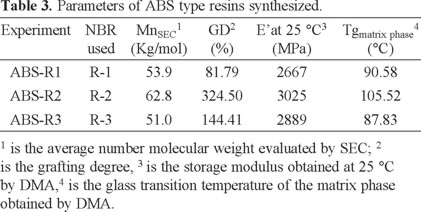
<body><![CDATA[<p align="justify"><font face="verdana" size="2"><b>Syntheses of NBR's</b></font></p>  	    <p align="justify"><font face="verdana" size="2">In experiment R&#45;2 presented in <a href="/img/revistas/jmcs/v58n2/a16c1.jpg" target="_blank">Table 1</a>, Vazo&#45;88 (3.61 &times; 10<sup>&#45;4</sup> mol, 0.088 g), RAFT agent (5.51 &times; 10<sup>&#45;4</sup> mol, 0.222 g) and AN (3.07 &times; 10<sup>&#45;1</sup> mol, 16.3 g) were dissolved in dioxane (2.74 mol, 241.2 g) and the resultant solution was transferred into a stainless steel PARR reactor (1 L of capacity), it was sealed and the solution was degassed by bubbling argon during 10 minutes. The reactor was filled/degassed with argon three times. Bu liquid (5.01 &times; 10<sup>&#45;1</sup> mol, 27.1 g) contained in a metal ampule and pressurized to 90 psi was added to the reactor under argon pressure. The sealed reactor was pressurized to 100 psi, stirred by a twin turbine at 60 rpm and heated to 100 &deg;C during 8 h. Aliquots were extracted at different time intervals and the conversion was determined gravimetrically. At the end of the polymerization the resulting solution was precipitated in methanol.</font></p>  	    <p align="justify"><font face="verdana" size="2"><b>Syntheses of ABS type resins</b></font></p>  	    <p align="justify"><font face="verdana" size="2">AN and S polymerization in presence of NBR were carried out in the reactor previously described. For example, in experiment ABS&#45;R2 presented in <a href="#c3">Table 3</a>, the dissolution, pre&#45;polymerization and termination stages were carried out under argon atmosphere. During the dissolution step, R&#45;2 (2.59 &times; 10<sup>&#45;4</sup> mol, 7.8 g) was dissolved in S (6.71 &times; 10<sup>&#45;1</sup> mol, 69.8 g) and AN (3.83 &times; 10<sup>&#45;1</sup> mol, 20.3 g) at room temperature for 12 h. At the beginning of the pre&#45;polymerization, BPO (2.02 &times; 10<sup>&#45;4</sup>mol, 0.049 g), tert&#45;dodecylmercaptan (5.19 &times; 10<sup>&#45;4</sup>mol, 0.105 g) and mineral oil (4.9 g) were added into the reactor. The sealed reactor was pressurized to 100 psi, stirred at 60 rpm (twin turbine configuration), and heated to 80 &deg;C. Aliquots were extracted from the reactor at different time intervals and conversion was determined gravimetrically. A conversion higher than 50% was pre&#45;established to assure the phase inversion phenomenon &#91;22&#93;. Once the reaction reached the 50% of conversion the whole mass was transferred into glass ampules (termination step) and by heating to 150 &deg;C and pressurizing to 100 psi for 20 h, the polymerization was continued and finished (conversion&asymp;99%). The obtained ABS type resin was analyzed by TEM, DMA and the physic&#45;chemical parameters as grafting degree (GD) and molecular weights were determined.</font></p>  	    <p align="justify"><font face="verdana" size="2"><b>Characterization</b></font></p>  	    <p align="justify"><font face="verdana" size="2">The molecular weights of polymer samples were determined by size exclusion chromatography (SEC) using a Hewlett&#45;Packard instrument (HPLC series 1100) equipped with a refractive index detector. A series of three PLGel columns at porosities of 10<sup>3</sup>, 10<sup>5</sup>, and 10<sup>6</sup> &Aring; was used. Calibration was carried out with polystyrene standards and THF (HPLC grade from Sigma&#45;Aldrich) was used as eluent at a flow rate of 1 mL/min.</font></p>  	    <p align="justify"><font face="verdana" size="2"><sup>1</sup>H and <sup>13</sup>C NMR spectra of polymers were obtained with a JEOL Eclipse&#45;300 MHz spectrometer, using CDCl<sub>3</sub>; and were used in order to calculate the microstructure of the PB section in the rubbers.</font></p>  	    <p align="justify"><font face="verdana" size="2">Transmission electron microscopy (TEM) analyses were performed on a TITAN 80&#45;300 kV. Samples were prepared by ultramicrotomy technique and stained with osmium tetroxide (OsO<sub>4</sub>) vapors.</font></p>  	    <p align="justify"><font face="verdana" size="2">Differential scanning calorimetry (DSC) analyses were performed with a Q1000 from TA Instruments. The samples were heated at 10 &deg;C/min from &#45;80 to 50 &deg;C.</font></p>  	    <p align="justify"><font face="verdana" size="2">Storage modulus and tan delta were measured on compression&#45;molded specimens 45 mm x 12.2 mm &times; 3.2 mm on a dynamic mechanical analyzer (DMA) TA Instrument, in flexural mode at a frequency of 0.1 Hz, and with a temperature range from &#45;125 &deg;C to 110 &deg;C. During the measurement the heating rate was 5 &deg;C/min and the amplitude was 0.5 mm.</font></p>  	    ]]></body>
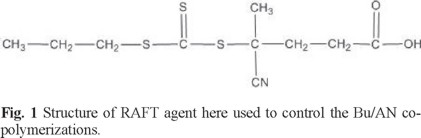
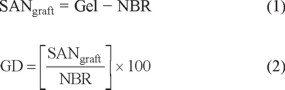
<body><![CDATA[<p align="justify"><font face="verdana" size="2">The gel (insoluble) fraction was isolated from the soluble fraction (free SAN) dissolving 1 g of ABS sample in 25 mL of toluene using the centrifugation technique under the following conditions: 45 min at 20,000 rpm at &#45;20 &deg;C. The soluble fraction was precipitated from methanol and both fractions were dried under vacuum at 50 &deg;C to constant weight and gravimetrically calculated. The grafting degree (<i>GD</i>), defined as the ratio between the mass of grafted PSAN branches and the original NBR fraction in the recipe, were calculated as described below:</font></p>  	    <p align="center"><font face="verdana" size="2"><img src="/img/revistas/jmcs/v58n2/a16e1.jpg"></font></p>  	    <p>&nbsp;</p>  	    <p align="justify"><font face="verdana" size="2"><b>Results</b></font></p>  	    <p align="justify"><font face="verdana" size="2"><b>Synthesis and characterization of NBR's</b></font></p>  	    <p align="justify"><font face="verdana" size="2">There are few publications on the literature related to the homo&#45; or copolymerization of diene monomers by means of RAFT processes, and most of them discuss results about isoprene monomer &#91;29, 30&#93;. The main impediment to successfully carry out this kind of polymerizations in homogenous systems is the high <i>k<sub>t</sub></i> / <i>k<sub>p</sub></i> ratio that present the diene monomers which lead to obtain very low molecular weights; for example this ratio is (100 &times; 10<sup>7</sup> L&#x0387;mol<sup>&#45;1</sup>&#x0387;s<sup>&#45;1</sup>)/(100 L&#x0387;mol<sup>&#45;1</sup>&#x0387;s<sup>&#45;1</sup>) for Bu polymerization at 60 &deg;C while S polymerization at the same temperature presents a ratio of (3.6 &times; 10<sup>7</sup> L&#x0387;mol<sup>&#45;1</sup>&#x0387;s<sup>&#45;1</sup>)/(176 (L&#x0387;mol<sup>&#45;1</sup>&#x0387;s<sup>&#45;1</sup>) &#91;31&#93;.</font></p>  	    <p align="justify"><font face="verdana" size="2">A series of experiments concerning to NBR's synthesized by the RAFT technique are presented in <a href="/img/revistas/jmcs/v58n2/a16c1.jpg" target="_blank">Table 1</a>. The first experiment corresponds to a NBR obtained in absence of the RAFT agent and the last experiment corresponds to a PB (with RAFT agent but without the AN component), both used as reference materials. The NBR's were synthesized in the azeotropic ratio for Bu/AN (AN charge between 35 and 40% by weight) thus, a constant composition is expected throughout the polymerization. Fixed reaction conditions for all synthesized NBR's were: dioxane as solvent in a volume ratio 4/1 versus monomers, a molar ratio Bu/AN of 0.62/0.38, a stirring rate of 60 rpm, a pressure of 100 psi, a temperature of 100 &deg;C and a reaction time of 8 h. Except for R&#45;4 that was carried out at 150 &deg;C during 1 h.</font></p>  	    <p align="justify"><font face="verdana" size="2">Typically, a poor control on molecular weight and broad PDI (&gt;3) are characteristics of PB and/or NBR synthesized by emulsion radical polymerizations &#91;32, 33&#93;. The use of an appropriate RAFT agent in free radicals polymerizations allows to predict the molecular weight and to control the PDI in values smaller than 1.5. Results of experiment R&#45;2 indicate that the 4&#45;cyano&#45;4&#45;&#91;(dodecylsulfanylthiocarbonyl)sulfanyl&#93; pentanoic acid (see <a href="#f1">Fig. 1</a>), here used as a RAFT agent, is a good controller for Bu/AN copolymerization in a molar ratio monomer/RAFT agent/initiator = 2238/1.5/1.</font></p>  	    <p align="center"><font face="verdana" size="2"><a name="f1"></a></font></p>  	    <p align="center"><font face="verdana" size="2"><img src="/img/revistas/jmcs/v58n2/a16f1.jpg"></font></p>  	    ]]></body>
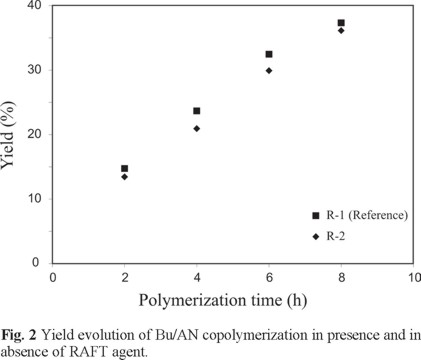
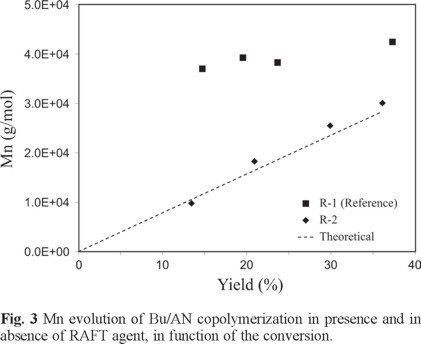
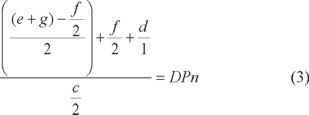
<body><![CDATA[<p align="justify"><font face="verdana" size="2">A high molecular weight around 80 kg/mol was targeted (expected at 100% of conversion) in this experiment (R&#45;2) that resulted in a thiocarbonylthio end&#45;functionalized poly(Bu&#45;<i>co</i>&#45;AN) with an experimental Mn<sub>SEC</sub> (number average molecular weight calculated by SEC analysis) of 30.1 kg/mol that is very close to the theoretical which was calculated to be 29.9 kg/mol and a PDI of 1.5. The reference experiment carried out in absence of RAFT agent (R&#45;1) resulted in a product with a broader PDI of 2.1 and a higher Mn<sub>SEC</sub> of 43.7 kg/mol. As can be observed in <a href="#f2">Fig. 2</a>, the conversions in two experiments were very similar, which corroborates that the trithiocarbonate here used as a RAFT agent did not retard significantly the polymerization rate of this system, which is in agreement with previous publications for this kind of controllers utilized in some other monomers &#91;34,35&#93;.</font></p>  	    <p align="center"><font face="verdana" size="2"><a name="f2"></a></font></p>  	    <p align="center"><font face="verdana" size="2"><img src="/img/revistas/jmcs/v58n2/a16f2.jpg"></font></p>  	    <p align="justify"><font face="verdana" size="2">In <a href="#f3">Fig. 3</a> it can be observed the control effect of the RAFT agent during the development of experiment R&#45;2. A quasilinear increase of Mn<sub>SEC</sub> with conversion and a good correlation between experimental and theoretical Mn can be observed in the Fig. of the experiment R&#45;2; however, in the experiment R&#45;1 a higher Mn<sub>SEC</sub> (around 40 kg/mol) was obtained since the beginning of the polymerization and it kept constant as the polymerization advanced, which is a typical behavior for conventional (not RDRP) radical polymerizations. The behavior of the Mn<sub>SEC</sub>, PDI values and conversion of R&#45;2 are consistent with those published by Barner&#45;Kowollik et al. &#91;13&#93; with some other different RAFT agents and also with different monomer/RAFT agent/ initiator ratios.</font></p>  	    <p align="center"><font face="verdana" size="2"><a name="f3"></a></font></p>  	    <p align="center"><font face="verdana" size="2"><img src="/img/revistas/jmcs/v58n2/a16f3.jpg"></font></p>  	    <p align="justify"><font face="verdana" size="2"><a href="#f4">Fig. 4</a> shows PB and PAN composition as well as the vinyl structure content in PB of the different aliquots taken during the synthesis of R&#45;2. As it was expected, the PB content kept constant along the polymerization in agreement with the 62% of Bu incorporated at the beginning to the reactor. In the same way, the PAN content also was constant from the beginning of the reaction until it was stopped, confirming that the system Bu/AN was polymerized in the azeotropic ratio for obtaining a better control of the final composition. The content of vinyl units in the PB was also constant during the reaction (approximately in 12%), which is an expected value for a PB synthesized by polymerizations initiated with free radicals, for example emulsion&#45;PB &#91;36&#93;.</font></p>  	    <p align="center"><font face="verdana" size="2"><a name="f4"></a></font></p>  	    <p align="center"><font face="verdana" size="2"><img src="/img/revistas/jmcs/v58n2/a16f4.jpg"></font></p>  	    <p align="justify"><font face="verdana" size="2">Trithiocarbonate end&#45;functionality provided by the RAFT agent in the poly(Bu&#45;<i>co</i>&#45;AN) (or NBR) which was obtained in R&#45;2 experiment was corroborated by <sup>1</sup>H NMR. The expected structure of the functionalized copolymer is presented in <a href="/img/revistas/jmcs/v58n2/a16f5.jpg" target="_blank">Fig. 5</a> as well as the <sup>1</sup>H NMR spectra corresponding to the products from R&#45;2 (RAFT agent functionalized) and R&#45;1 (non&#45;functionalized). The main difference in the two spectra is the presence of signals corresponding to the dodecyl group from the RAFT agent in the spectrum of R&#45;2, these signals were identified as <i>a</i>, <i>b</i> and <i>c</i>. These three signals were not present in the resultant spectrum from experiment R&#45;1, which was synthesized in absence of the RAFT agent. Signal <i>d</i> corresponds to PAN units and signals <i>e</i>, <i>f</i> and <i>g</i> correspond to PB structures (<i>cis</i>+<i>trans</i> and vinyl). Furthermore, from equation 3 and the <sup>1</sup>H NMR integrated signals, the degree of polymerization (DPn) was calculated in 531 and according to the PB/PAN composition this DPn corresponds to 28.5 kg/mol which is very close to the value calculated by SEC (30.1 kg/mol), which indicates that most of the polymeric chains are functionalized with the RAFT agent.</font></p>  	    ]]></body>
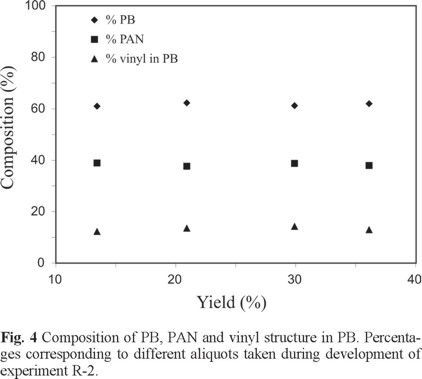
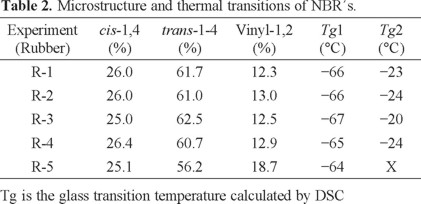
<body><![CDATA[<p align="center"><font face="verdana" size="2"><img src="/img/revistas/jmcs/v58n2/a16e2.jpg"></font></p>  	    <p align="justify"><font face="verdana" size="2">The molar ratio monomer/RAFT agent (2238/1.5 = 1492) used in the experiment R&#45;2 is considered high in comparison with the typical RAFT conditions. In RAFT polymerizations, monomer /RAFT agent ratios of around 300 are commonly employed to obtain well&#45;controlled polymers of low molecular weights &#91;37&#45;39&#93;, however in this work it was demonstrated that the experiment R&#45;2 was well&#45;controlled at this uncommon conditions. In the case of experiment R&#45;3 the ratio monomer/RAFT agent was increased to 2238/0.75 (or 2984) in order to determine the ability of the RAFT agent to control the polymerization of this system at a higher molar ratio. A high Mn value of about 160 Kg/mol was targeted in this experiment (at 100% of conversion) that resulted in a product with a Mn<sub>SEC</sub> of 34.5 kg/mol, which is not close to the theoretical result that was calculated to be 57.9 kg/mol. The Mn<sub>SEC</sub> value increased in comparison with R&#45;2, as well as the PDI which increased to 1.7; however there were not alterations on the conversion (36%) or composition (PB/PAN = 0.62/0.38). Even though the Mn<sub>SEC</sub> was not as predicted, this was explained by the very high and atypical ratio monomer/RAFT agent. Nevertheless a functionalized NBR was obtained with a microstructure and <i>Tg</i> similar to R&#45;2. A last NBR named R&#45;4 was synthesized under the same molar ratio monomer/RAFT agent/initiator than R&#45;3, but the temperature was increased to 150 &deg;C and the reaction time reduced to 1 h; which resulted in a lower conversion of 33% and a material with a Mn<sub>SEC</sub> value of 25.1 kg/mol, which was even more distant to the theoretical (53.1 Kg/mol), and with a broader PDI (1.8); however, the composition, <i>Tg</i> and microstructure were similar to all previous NBR's (R&#45;1 to R&#45;3).</font></p>  	    <p align="justify"><font face="verdana" size="2">On the other hand, Rubber&#45;5 corresponding to a Bu polymerization with a targeted Mn of 161.5 kg/mol, resulted in a PB of low Mn (10.5 kg/mol), which was three times lower than the expected at a conversion of 20% (32.3 kg/mol). The obtained PDI was of 1.6, which is moderately good; however what differ this material with the previous NBR's is the microstructure, since it presented a higher content of vinyl units (18.7%), nonetheless it is still in the expected range for PB synthesized by free radicals emulsion methods &#91;36&#93;. In brief, Bu polymerization leads to low conversions and low Mn<sub>SEC</sub>, as it is expected for Bu polymerizations initiated by free radicals in homogenous systems (bulk or solution).</font></p>  	    <p align="justify"><font face="verdana" size="2">DSC analysis of all the different NBR showed two transitions (<i>Tg</i>) located around &#45;66 and &#45;24 &deg;C. The transition at &#45;24 &deg;C is characteristic of this kind of rubbery copolymers poly(Bu&#45;<i>co</i>&#45;AN) with approximately 38% of PAN &#91;40, 41&#93;. The PB (R&#45;5) showed a transition at &#45;64 &deg;C typical of PB rubbers (see <a href="#c2">Table 2</a>).</font></p>  	    <p align="center"><font face="verdana" size="2"><a name="c2"></a></font></p>  	    <p align="center"><font face="verdana" size="2"><img src="/img/revistas/jmcs/v58n2/a16c2.jpg"></font></p>      	    <p align="center">&nbsp;</p>      <p align="center"><font face="verdana" size="2"><a name="c3"></a></font></p>  	    <p align="center"><font face="verdana" size="2"><img src="/img/revistas/jmcs/v58n2/a16c3.jpg"></font></p>  	    <p align="justify"><font face="verdana" size="2">According to previously reported researches about this topic &#91;36&#93;, the microstructure of PB's synthesized by free radicals polymerization methods contains a greater portion of <i>trans</i> isomer and is pretty common to obtain a vinyl content higher than by an anionic polymerization. Vinyl content value for PB here reported (synthesized by RAFT polymerization, experiment R&#45;5) was 18.7%, which is around two times higher than the typical 8&#45;10% present in a PB synthesized by anionic polymerization &#91;42&#93;. In the case of the different NBR's synthesized by RAFT copolymerization of Bu and AN (R&#45;2 to R&#45;4), the vinyl content was of 12.5% approximately, slightly higher than the values reported for anionic PB's prepared in non&#45;polar solvents. <i>Trans</i> isomer around 62% kept constant in all the synthesized rubbers, for example, R&#45;3 presents 62.5% of isomer <i>trans</i>, 25.0% of isomer <i>cis</i> and 12.5% of vinyl structure calculated by <sup>1</sup>H and <sup>13</sup>C NMR analyses according to reference &#91;43&#93; (see <a href="#c2">Table 2</a>).</font></p>  	    ]]></body>
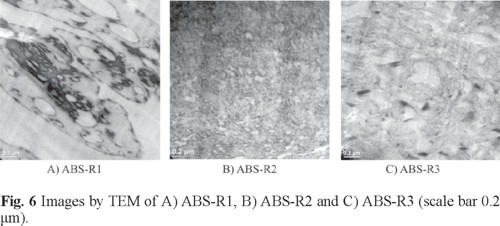
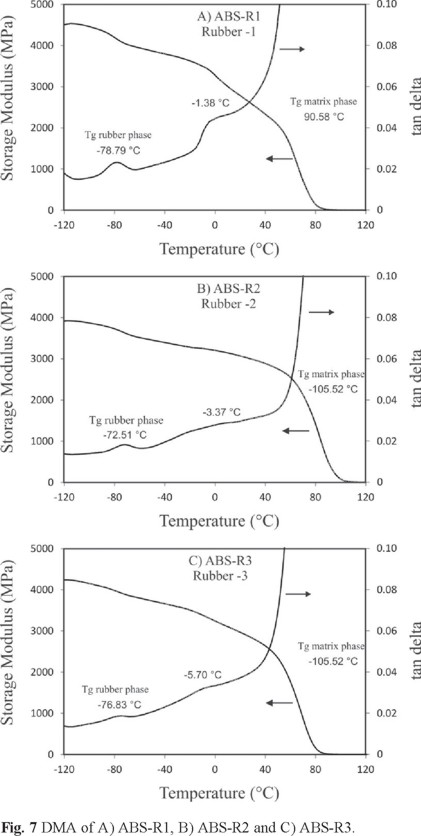
<body><![CDATA[<p align="justify"><font face="verdana" size="2">Some NBR's and one PB were prepared in presence of a RAFT agent, thus these rubbers contain the RAFT functionality. It is the first time that the RAFT agent 4&#45;cyano&#45;4&#45;&#91;(dodecylsulfanylthiocarbonyl)sulfanyl&#93; pentanoic acid is used to polymerize this kind of monomers and even though the molar ratios monomer/RAFT agents were unusually high, in some cases it was possible to predict the Mn and obtain low PDI such as in the case of R&#45;2. The RAFT functionality in these rubbers allows the synthesis of block copolymers if they are used as macro&#45;RAFT agents, thus some of they were evaluated as the elastomeric component to produce ABS type resins expecting the <i>in situ</i> formation of the block (by the RAFT functionality) and graft (by the double bonds of PB) copolymers during the S/AN copolymerization expecting a positive influence of these copolymers on the elastomeric morphology formation of ABS resins.</font></p>  	    <p align="justify"><font face="verdana" size="2"><b>Synthesis of ABS type resins</b></font></p>  	    <p align="justify"><font face="verdana" size="2">Acrylonitrile&#45;butadiene&#45;styrene resin (ABS) is an engineering polymeric resin of huge production and consumption around the world, since it is used in many applications due to its impact resistance, good dimensional stability, good processability, abrasion resistance, etc. PB or SBR rubbers are commonly used to produce different varieties of ABS, as well as the NBR, however very few publications mention or give details about this NBR&#45;toughened thermoplastic. Here it is reported the use of some previously reported NBR's synthesized by RAFT technique as elastomeric component to produce ABS type resins by an <i>in situ</i> polymerization bulk process. Several parameters and the morphology of the synthesized ABS resins are shown in <a href="#c3">Table 3</a> and <a href="#f6">Fig. 6</a> respectively.</font></p>  	    <p align="center"><font face="verdana" size="2"><a name="f6"></a></font></p>  	    <p align="center"><font face="verdana" size="2"><img src="/img/revistas/jmcs/v58n2/a16f6.jpg"></font></p>  	    <p align="justify"><font face="verdana" size="2">In first instance, ABS&#45;R1 (synthesized from the rubber R&#45;1, without RAFT agent) presents a quasi&#45;salami morphology containing occlusions of SAN; while, the ABS&#45;R2 (synthesized from the rubber R&#45;2) presents a poorly defined rubber phase and disperse SAN phase; finally, the ABS&#45;R3 (synthesized from the rubber R&#45;3) presents a very elongated morphology. During the production of ABS&#45;R2 and ABS&#45;R3 high monomer conversions were obtained in the pre&#45;polymerization step to reach the phase inversion phenomenon &#91;22&#93;, however the applied stirred was not efficient to promote the successful dispersion of the rubbery phase in the SAN matrix. The expected formation of block (NBR&#45;<i>b</i>&#45;SAN, by the RAFT functionality) and graft (NBR&#45;<i>g</i>&#45;SAN, by the double bonds of main chain) copolymers could be originating a high affinity between the rubber and the matrix which avoid a good phase separation. Another factor that could be affected was the high affinity between the NBR rubber and SAN matrix, it is in agreement with Mathew et al. who studied the compatibility of PS/NBR, SAN/NBR and ABS/NBR blends based on dilute solution viscosity measurements finding a better compatibility in the SAN/NBR blend &#91;44&#93;. This fact indicates that a greater amount of SAN is required to obtain a good dispersion of rubbery phase in the matrix. The high GD values (see <a href="#c3">Table 3</a>) in ABS&#45;R2 and ABS&#45;R3 avoid and/or inhibit the phase inversion by means of the surfactant effect &#91;45&#93;. While the <i>quasi</i> salami morphology of ABS&#45;R1 (see <a href="#f6">Fig. 6 A</a>) is attributed to the non&#45;functionalization of the rubber R&#45;1 which was prepared in absence of any RAFT agent, the block copolymers NBR&#45;<i>b</i>&#45;SAN are not produced <i>in situ</i> and the interfacial tension between the NBR rubber and the SAN matrix increases, independently of the equal co&#45;monomers composition in all NBR rubbers used. The grafting capacity could be associated to the molecular weight, if is taking in account the amount of radical initiator consumed in graft reaction for the ABS&#45;R2 (high GD) the rest of them will be result in higher SAN polymer chains as <a href="#c3">Table 3</a> shows.</font></p>  	    <p align="justify"><font face="verdana" size="2"><a href="#f7">Fig. 7</a> shows the DMA results of the three different ABS samples. In all cases three important relaxations are observed, the first one is presented at low temperatures around &#45;75 &deg;C, the second one is observed around &#45;3 &deg;C and the last one is presented around 100 &deg;C. The first two relaxations are assigned to the NBR used to synthesize the ABS resin and are comparable with the <i>Tg</i> observed by DSC which indicates the presence of PB domains highly segregated. The last relaxation (around 100 &deg;C) is assigned to the alpha relaxation of the SAN matrix. It is important to mention that the peak at &#45;75 &deg;C corresponding to the tan&#45;delta is more intense in the case of ABS&#45;R1 (<i>quasi</i> salami morphology) which means an increase in the rubber phase due to the contributions of SAN occlusions. In regard to the relaxations around &#45;3 &deg;C, it is easy to observe a more intense peak in ABS&#45;R1 which is the ABS that presents the lower GD, therefore the rubber does not have a good interaction with the matrix, which originates a more intense peak in the DMA results. It can be noticed in <a href="#c3">Table 3</a> that the storage modulus (at 25 &deg;C) value of ABS&#45;Rx&#45;1 is the lowest, which is related to its low Mn as well as its high rubbery particle size.</font></p>  	    <p align="center"><font face="verdana" size="2"><a name="f7"></a></font></p>  	    <p align="center"><font face="verdana" size="2"><img src="/img/revistas/jmcs/v58n2/a16f7.jpg"></font></p>  	    <p>&nbsp;</p>  	    ]]></body>
<body><![CDATA[<p align="justify"><font face="verdana" size="2"><b>Conclusions</b></font></p>  	    <p align="justify"><font face="verdana" size="2">Three different NBR's and one PB were synthesized in solution in presence of the RAFT agent 4&#45;cyano&#45;4&#45;&#91;(dodecylsulfanyl thiocarbonyl)sulfanyl&#93; pentanoic acid. A NBR was also obtained in absence of the RAFT agent as a reference material. The experiment R&#45;2, which was carried out under molar ratio monomer/RAFT agent/initiator = 2238/1.5 /1, presented a good correlation between the theoretical and the experimental (SEC and NMR) number average molecular weight as well as a low polydispersity index at 36% of conversion after 8 h of reaction. With the increment of the molar ratio monomer/RAFT agent to 2238/0.75 (R&#45;3 and R&#45;4) the molecular parameters were less controlled; however, the composition, the microstructure and the thermal behavior was similar to R&#45;2. The synthesized PB presented low conversion and low number average molecular weight as expected for this monomer polymerized with a solution technique. Three NBR's were chosen to be used as the elastomeric component during the syntheses of ABS type resins by the <i>in situ</i> polymerization bulk process. TEM analyses showed morphology type salami in one of the materials and an undefined morphology in the other two cases. DMA results of ABS indicate the presence of two relaxations at low temperatures corresponding to the rubbery component, which corroborates the DSC results from the different NBR's.</font></p>  	    <p>&nbsp;</p>  	    <p align="justify"><font face="verdana" size="2"><b>Acknowledgments</b></font></p>  	    <p align="justify"><font face="verdana" size="2">The authors thank to CONACYT for the financial support through the project 156366. We also thank to Ricardo Mendoza, Jos&eacute; D&iacute;az, Jes&uacute;s Cepeda, Guadalupe Mendez, Uriel Pe&ntilde;a, Judith Cabello and Francisco Zendejo for their technical support.</font></p>  	    <p>&nbsp;</p>  	    <p align="justify"><font face="verdana" size="2"><b>References</b></font></p>  	    <!-- ref --><p align="justify"><font face="verdana" size="2">1. Lacroix&#45;Desmazes, P.; Villa&#45;Hern&aacute;ndez, A.; Rayeroux, D. <i>Progress in Controlled Radical Polymerization: Mechanisms and Techniques</i> <b>2012</b>, <i>C21</i>, 317&#45;331.    &nbsp;&nbsp;&nbsp;&nbsp;&nbsp;&nbsp;&nbsp;&nbsp;[&#160;<a href="javascript:void(0);" onclick="javascript: window.open('/scielo.php?script=sci_nlinks&ref=4945892&pid=S1870-249X201400020001600001&lng=','','width=640,height=500,resizable=yes,scrollbars=1,menubar=yes,');">Links</a>&#160;]<!-- end-ref --></font></p>  	    <!-- ref --><p align="justify"><font face="verdana" size="2">2. Grubbs, R. B. <i>Polym. Rev.</i> <b>2011</b>, <i>51</i>, 104&#45;137.    &nbsp;&nbsp;&nbsp;&nbsp;&nbsp;&nbsp;&nbsp;&nbsp;[&#160;<a href="javascript:void(0);" onclick="javascript: window.open('/scielo.php?script=sci_nlinks&ref=4945894&pid=S1870-249X201400020001600002&lng=','','width=640,height=500,resizable=yes,scrollbars=1,menubar=yes,');">Links</a>&#160;]<!-- end-ref --></font></p>  	    <!-- ref --><p align="justify"><font face="verdana" size="2">3. Matyjaszewski, K. <i>Macromolecules</i> <b>2012</b>, <i>45(10)</i>, 4015&#45;4039.    &nbsp;&nbsp;&nbsp;&nbsp;&nbsp;&nbsp;&nbsp;&nbsp;[&#160;<a href="javascript:void(0);" onclick="javascript: window.open('/scielo.php?script=sci_nlinks&ref=4945896&pid=S1870-249X201400020001600003&lng=','','width=640,height=500,resizable=yes,scrollbars=1,menubar=yes,');">Links</a>&#160;]<!-- end-ref --></font></p>  	    <!-- ref --><p align="justify"><font face="verdana" size="2">4. Moad, G.; Rizzardo, E.; Thang, S. H. <i>Aust. J. Chem.</i> <b>2012</b>, <i>65(8)</i>, 985&#45;1076.    &nbsp;&nbsp;&nbsp;&nbsp;&nbsp;&nbsp;&nbsp;&nbsp;[&#160;<a href="javascript:void(0);" onclick="javascript: window.open('/scielo.php?script=sci_nlinks&ref=4945898&pid=S1870-249X201400020001600004&lng=','','width=640,height=500,resizable=yes,scrollbars=1,menubar=yes,');">Links</a>&#160;]<!-- end-ref --></font></p>  	    <!-- ref --><p align="justify"><font face="verdana" size="2">5. Moad, G.; Chen, M.; Haussler, M.; Postma, A.; Rizzardo, E.; Thang, S. H. <i>Polym. Chem.</i> <b>2011</b>, <i>2</i>, 492&#45;519.    &nbsp;&nbsp;&nbsp;&nbsp;&nbsp;&nbsp;&nbsp;&nbsp;[&#160;<a href="javascript:void(0);" onclick="javascript: window.open('/scielo.php?script=sci_nlinks&ref=4945900&pid=S1870-249X201400020001600005&lng=','','width=640,height=500,resizable=yes,scrollbars=1,menubar=yes,');">Links</a>&#160;]<!-- end-ref --></font></p>  	    <!-- ref --><p align="justify"><font face="verdana" size="2">6. Liu, J.; Duong, H.; Whittaker, M. R.; Davis, T. P.; Boyer, C. <i>Macromol. Rap. Commun.</i> <b>2012</b>, <i>33(9)</i>, 760&#45;766.    &nbsp;&nbsp;&nbsp;&nbsp;&nbsp;&nbsp;&nbsp;&nbsp;[&#160;<a href="javascript:void(0);" onclick="javascript: window.open('/scielo.php?script=sci_nlinks&ref=4945902&pid=S1870-249X201400020001600006&lng=','','width=640,height=500,resizable=yes,scrollbars=1,menubar=yes,');">Links</a>&#160;]<!-- end-ref --></font></p>  	    <!-- ref --><p align="justify"><font face="verdana" size="2">7. Weerts, P. A.; German, L. A.; Gilbert, R. G. <i>Macromolecules</i> <b>1991</b>, <i>24(7)</i>, 1622&#45;1628.    &nbsp;&nbsp;&nbsp;&nbsp;&nbsp;&nbsp;&nbsp;&nbsp;[&#160;<a href="javascript:void(0);" onclick="javascript: window.open('/scielo.php?script=sci_nlinks&ref=4945904&pid=S1870-249X201400020001600007&lng=','','width=640,height=500,resizable=yes,scrollbars=1,menubar=yes,');">Links</a>&#160;]<!-- end-ref --></font></p>  	    <!-- ref --><p align="justify"><font face="verdana" size="2">8. Pradel, J. L.; Boutevin, B.; Ameduri, B. <i>J. Polym. Sci. A: Polym. Chem.</i> <b>2000</b>, <i>38</i>, 3293&#45;3302.    &nbsp;&nbsp;&nbsp;&nbsp;&nbsp;&nbsp;&nbsp;&nbsp;[&#160;<a href="javascript:void(0);" onclick="javascript: window.open('/scielo.php?script=sci_nlinks&ref=4945906&pid=S1870-249X201400020001600008&lng=','','width=640,height=500,resizable=yes,scrollbars=1,menubar=yes,');">Links</a>&#160;]<!-- end-ref --></font></p>  	    <!-- ref --><p align="justify"><font face="verdana" size="2">9. Pradel, J&#45;L.; Ameduri, B.; Boutevin, B. <i>Macromol. Chem. Phys.</i> <b>1999</b>, <i>200</i>, 2304&#45;2308.    &nbsp;&nbsp;&nbsp;&nbsp;&nbsp;&nbsp;&nbsp;&nbsp;[&#160;<a href="javascript:void(0);" onclick="javascript: window.open('/scielo.php?script=sci_nlinks&ref=4945908&pid=S1870-249X201400020001600009&lng=','','width=640,height=500,resizable=yes,scrollbars=1,menubar=yes,');">Links</a>&#160;]<!-- end-ref --></font></p>  	    <!-- ref --><p align="justify"><font face="verdana" size="2">10. Heo, S. U.; Lee, D. W. <i>J. Ind. Eng. Chem.</i> <b>2005</b>, <i>11(6)</i>, 911&#45;917.    &nbsp;&nbsp;&nbsp;&nbsp;&nbsp;&nbsp;&nbsp;&nbsp;[&#160;<a href="javascript:void(0);" onclick="javascript: window.open('/scielo.php?script=sci_nlinks&ref=4945910&pid=S1870-249X201400020001600010&lng=','','width=640,height=500,resizable=yes,scrollbars=1,menubar=yes,');">Links</a>&#160;]<!-- end-ref --></font></p>  	    <!-- ref --><p align="justify"><font face="verdana" size="2">11. Lebreton, P.; Ameduri, B.; Boutevin, B.; Corpart, J&#45;M.; Juhue, D. <i>Macromol. Chem. Phys.</i> <b>2000</b>, <i>201</i>, 1016&#45;1024.    &nbsp;&nbsp;&nbsp;&nbsp;&nbsp;&nbsp;&nbsp;&nbsp;[&#160;<a href="javascript:void(0);" onclick="javascript: window.open('/scielo.php?script=sci_nlinks&ref=4945912&pid=S1870-249X201400020001600011&lng=','','width=640,height=500,resizable=yes,scrollbars=1,menubar=yes,');">Links</a>&#160;]<!-- end-ref --></font></p>  	    <!-- ref --><p align="justify"><font face="verdana" size="2">12. Bar&#45;Nes, G.; Hall, R.; Sharma, V.; Gaborieau, M.; Lucas, D.; Castignolles, P.; Gilbert, R. G. <i>Eur. Polym. J.</i> <b>2009</b>, <i>45</i>, 3149&#45;3163.    &nbsp;&nbsp;&nbsp;&nbsp;&nbsp;&nbsp;&nbsp;&nbsp;[&#160;<a href="javascript:void(0);" onclick="javascript: window.open('/scielo.php?script=sci_nlinks&ref=4945914&pid=S1870-249X201400020001600012&lng=','','width=640,height=500,resizable=yes,scrollbars=1,menubar=yes,');">Links</a>&#160;]<!-- end-ref --></font></p>  	    <!-- ref --><p align="justify"><font face="verdana" size="2">13. Kaiser, A.; Brandau, S.; Klimpel, M.; Barner&#45;Kowollik, C. <i>Macromol. Rap. Commun.</i> <b>2010</b>, <i>31</i>, 1616&#45;1621.    &nbsp;&nbsp;&nbsp;&nbsp;&nbsp;&nbsp;&nbsp;&nbsp;[&#160;<a href="javascript:void(0);" onclick="javascript: window.open('/scielo.php?script=sci_nlinks&ref=4945916&pid=S1870-249X201400020001600013&lng=','','width=640,height=500,resizable=yes,scrollbars=1,menubar=yes,');">Links</a>&#160;]<!-- end-ref --></font></p>  	    <!-- ref --><p align="justify"><font face="verdana" size="2">14. Durr, C. J.; Emmerling, S. G. J.; Kaiser, A.; Brandau, S.; Habicht, A. K.; Klimpel, M.; Barner&#45;Kowollik, C. <i>J. Polym. Sci. A: Polym. Chem.</i> <b>2012</b>, <i>50</i>, 174&#45;180.    &nbsp;&nbsp;&nbsp;&nbsp;&nbsp;&nbsp;&nbsp;&nbsp;[&#160;<a href="javascript:void(0);" onclick="javascript: window.open('/scielo.php?script=sci_nlinks&ref=4945918&pid=S1870-249X201400020001600014&lng=','','width=640,height=500,resizable=yes,scrollbars=1,menubar=yes,');">Links</a>&#160;]<!-- end-ref --></font></p>  	    <!-- ref --><p align="justify"><font face="verdana" size="2">15. Durr, C. J.; Emmerling, S. G. J.; Lederhose, P.; Kaiser, A.; Brandau, S.; Klimpel, M.; Barner&#45;Kowollik, C. <i>Polym. Chem.</i> <b>2012</b>, <i>3</i>, 1048&#45;1060.    &nbsp;&nbsp;&nbsp;&nbsp;&nbsp;&nbsp;&nbsp;&nbsp;[&#160;<a href="javascript:void(0);" onclick="javascript: window.open('/scielo.php?script=sci_nlinks&ref=4945920&pid=S1870-249X201400020001600015&lng=','','width=640,height=500,resizable=yes,scrollbars=1,menubar=yes,');">Links</a>&#160;]<!-- end-ref --></font></p>  	    <!-- ref --><p align="justify"><font face="verdana" size="2">16. D&uuml;rr, C. J.; Barner&#45;Kowollik, C.; Hlalele, L. <i>Macromolecules</i> <b>2013</b>, <i>46</i>, 49&#45;61.    &nbsp;&nbsp;&nbsp;&nbsp;&nbsp;&nbsp;&nbsp;&nbsp;[&#160;<a href="javascript:void(0);" onclick="javascript: window.open('/scielo.php?script=sci_nlinks&ref=4945922&pid=S1870-249X201400020001600016&lng=','','width=640,height=500,resizable=yes,scrollbars=1,menubar=yes,');">Links</a>&#160;]<!-- end-ref --></font></p>  	    <!-- ref --><p align="justify"><font face="verdana" size="2">17. Sreenivasan, P. V.; Kurian, P. <i>Int. J. Polym. Mat.</i> <b>2007</b>, <i>56</i>, 1041&#45;1050.    &nbsp;&nbsp;&nbsp;&nbsp;&nbsp;&nbsp;&nbsp;&nbsp;[&#160;<a href="javascript:void(0);" onclick="javascript: window.open('/scielo.php?script=sci_nlinks&ref=4945924&pid=S1870-249X201400020001600017&lng=','','width=640,height=500,resizable=yes,scrollbars=1,menubar=yes,');">Links</a>&#160;]<!-- end-ref --></font></p>  	    <!-- ref --><p align="justify"><font face="verdana" size="2">18. Ahn, S. J.; Kim, B. K.; Lee, K. H.; Jeong, H. M. <i>J. Macromol. Sci. B: Phys.</i> <b>2000</b>, <i>39(5&#45;6)</i>, 691&#45;700.    &nbsp;&nbsp;&nbsp;&nbsp;&nbsp;&nbsp;&nbsp;&nbsp;[&#160;<a href="javascript:void(0);" onclick="javascript: window.open('/scielo.php?script=sci_nlinks&ref=4945926&pid=S1870-249X201400020001600018&lng=','','width=640,height=500,resizable=yes,scrollbars=1,menubar=yes,');">Links</a>&#160;]<!-- end-ref --></font></p>  	    <!-- ref --><p align="justify"><font face="verdana" size="2">19. Ahn, S. J.; Lee, K. H.; Kim, B. K.; Jeong, H. M. <i>J. Appl. Polym. Sci.</i> <b>1999</b>, <i>73</i>, 935&#45;941.    &nbsp;&nbsp;&nbsp;&nbsp;&nbsp;&nbsp;&nbsp;&nbsp;[&#160;<a href="javascript:void(0);" onclick="javascript: window.open('/scielo.php?script=sci_nlinks&ref=4945928&pid=S1870-249X201400020001600019&lng=','','width=640,height=500,resizable=yes,scrollbars=1,menubar=yes,');">Links</a>&#160;]<!-- end-ref --></font></p>  	    <!-- ref --><p align="justify"><font face="verdana" size="2">20. Schott, N. R.; Dhabalia, D. <i>Toughness and Brittleness of Plastics&#45;Advances in Chemistry</i> <b>1976</b>, <i>C28</i>, <i>V154</i>, 344&#45;351.    &nbsp;&nbsp;&nbsp;&nbsp;&nbsp;&nbsp;&nbsp;&nbsp;[&#160;<a href="javascript:void(0);" onclick="javascript: window.open('/scielo.php?script=sci_nlinks&ref=4945930&pid=S1870-249X201400020001600020&lng=','','width=640,height=500,resizable=yes,scrollbars=1,menubar=yes,');">Links</a>&#160;]<!-- end-ref --></font></p>  	    <!-- ref --><p align="justify"><font face="verdana" size="2">21. Anandhan, S.; De, P. P.; De, S. K.; Bhowmick, A. K.; <i>Rubber Chem. Technol.</i> <b>2003</b>, 1145&#45;1163.    &nbsp;&nbsp;&nbsp;&nbsp;&nbsp;&nbsp;&nbsp;&nbsp;[&#160;<a href="javascript:void(0);" onclick="javascript: window.open('/scielo.php?script=sci_nlinks&ref=4945932&pid=S1870-249X201400020001600021&lng=','','width=640,height=500,resizable=yes,scrollbars=1,menubar=yes,');">Links</a>&#160;]<!-- end-ref --></font></p>  	    <!-- ref --><p align="justify"><font face="verdana" size="2">22. D&iacute;az de Le&oacute;n, R.; Morales, G.; Acu&ntilde;a, P.; Soriano, F. <i>Polym. Eng. Sci.</i> <b>2010</b>, 373&#45;383.    &nbsp;&nbsp;&nbsp;&nbsp;&nbsp;&nbsp;&nbsp;&nbsp;[&#160;<a href="javascript:void(0);" onclick="javascript: window.open('/scielo.php?script=sci_nlinks&ref=4945934&pid=S1870-249X201400020001600022&lng=','','width=640,height=500,resizable=yes,scrollbars=1,menubar=yes,');">Links</a>&#160;]<!-- end-ref --></font></p>  	    <!-- ref --><p align="justify"><font face="verdana" size="2">23. Morales&#45;Balado, G.; Flores&#45;Flores, R.; Montalvo&#45;Robles, A.; D&iacute;az de Le&oacute;n&#45;G&oacute;mez, R.; Acu&ntilde;a&#45;Vazquez, P. <i>Patent US</i> <b>2006</b><i>/0194915 A1</i></font>&nbsp;&nbsp;&nbsp;&nbsp;&nbsp;&nbsp;&nbsp;&nbsp;[&#160;<a href="javascript:void(0);" onclick="javascript: window.open('/scielo.php?script=sci_nlinks&ref=4945936&pid=S1870-249X201400020001600023&lng=','','width=640,height=500,resizable=yes,scrollbars=1,menubar=yes,');">Links</a>&#160;]<!-- end-ref --><!-- ref --><p align="justify"><font face="verdana" size="2">24. Li, D.; Peng, J.; Zhai, M.; Qiao, J.; Zhang, X.; Wei, G. <i>J. Appl. Polym. Sci.</i> <b>2008</b>, <i>109</i>, 2071&#45;2075.    &nbsp;&nbsp;&nbsp;&nbsp;&nbsp;&nbsp;&nbsp;&nbsp;[&#160;<a href="javascript:void(0);" onclick="javascript: window.open('/scielo.php?script=sci_nlinks&ref=4945937&pid=S1870-249X201400020001600024&lng=','','width=640,height=500,resizable=yes,scrollbars=1,menubar=yes,');">Links</a>&#160;]<!-- end-ref --></font></p>  	    <!-- ref --><p align="justify"><font face="verdana" size="2">25. Elizarraras, D.; Morales, G.; D&iacute;az de Le&oacute;n, R.; Luciani, C.; Estenoz, D. <i>Macromol. Theory Simul.</i> <b>2008</b>, <i>17</i>, 180&#45;197.    &nbsp;&nbsp;&nbsp;&nbsp;&nbsp;&nbsp;&nbsp;&nbsp;[&#160;<a href="javascript:void(0);" onclick="javascript: window.open('/scielo.php?script=sci_nlinks&ref=4945939&pid=S1870-249X201400020001600025&lng=','','width=640,height=500,resizable=yes,scrollbars=1,menubar=yes,');">Links</a>&#160;]<!-- end-ref --></font></p>  	    <!-- ref --><p align="justify"><font face="verdana" size="2">26. Rodriguez&#45;Tobias, H.; Morales, G.; Rodriguez&#45;Fernandez, O.; Acu&ntilde;a, P. <i>Macromolecular Symposia</i> <b>2013</b>, <i>325&#45;326</i>, 147&#45;155.    &nbsp;&nbsp;&nbsp;&nbsp;&nbsp;&nbsp;&nbsp;&nbsp;[&#160;<a href="javascript:void(0);" onclick="javascript: window.open('/scielo.php?script=sci_nlinks&ref=4945941&pid=S1870-249X201400020001600026&lng=','','width=640,height=500,resizable=yes,scrollbars=1,menubar=yes,');">Links</a>&#160;]<!-- end-ref --></font></p>  	    <!-- ref --><p align="justify"><font face="verdana" size="2">27. de Anda, C.; Morales, G.; Acu&ntilde;a, P.; Sosa, J.; Knoeppel, D.; Mays, J. <i>Macromolecular Rection Engineering</i> <b>2010</b>, <i>4</i>, 381&#45;386.    &nbsp;&nbsp;&nbsp;&nbsp;&nbsp;&nbsp;&nbsp;&nbsp;[&#160;<a href="javascript:void(0);" onclick="javascript: window.open('/scielo.php?script=sci_nlinks&ref=4945943&pid=S1870-249X201400020001600027&lng=','','width=640,height=500,resizable=yes,scrollbars=1,menubar=yes,');">Links</a>&#160;]<!-- end-ref --></font></p>  	    ]]></body>
<body><![CDATA[<!-- ref --><p align="justify"><font face="verdana" size="2">28. Acu&ntilde;a, P.; Morales, G. <i>Rev. Iberoamer. Pol&iacute;m.</i> <b>2011</b>, <i>12(3)</i>, 160&#45;168.    &nbsp;&nbsp;&nbsp;&nbsp;&nbsp;&nbsp;&nbsp;&nbsp;[&#160;<a href="javascript:void(0);" onclick="javascript: window.open('/scielo.php?script=sci_nlinks&ref=4945945&pid=S1870-249X201400020001600028&lng=','','width=640,height=500,resizable=yes,scrollbars=1,menubar=yes,');">Links</a>&#160;]<!-- end-ref --></font></p>  	    <!-- ref --><p align="justify"><font face="verdana" size="2">29. Germack, D. S.; Wooley, K. L. <i>J. Polym. Sci. A: Polym. Chem.</i> <b>2007</b>, <i>45</i>, 4100&#45;4108.    &nbsp;&nbsp;&nbsp;&nbsp;&nbsp;&nbsp;&nbsp;&nbsp;[&#160;<a href="javascript:void(0);" onclick="javascript: window.open('/scielo.php?script=sci_nlinks&ref=4945947&pid=S1870-249X201400020001600029&lng=','','width=640,height=500,resizable=yes,scrollbars=1,menubar=yes,');">Links</a>&#160;]<!-- end-ref --></font></p>  	    <!-- ref --><p align="justify"><font face="verdana" size="2">30. Jitchum, V.; Perrier, S. <i>Macromolecules</i> <b>2007</b>, <i>40(5)</i>, 1408&#45;1412.    &nbsp;&nbsp;&nbsp;&nbsp;&nbsp;&nbsp;&nbsp;&nbsp;[&#160;<a href="javascript:void(0);" onclick="javascript: window.open('/scielo.php?script=sci_nlinks&ref=4945949&pid=S1870-249X201400020001600030&lng=','','width=640,height=500,resizable=yes,scrollbars=1,menubar=yes,');">Links</a>&#160;]<!-- end-ref --></font></p>  	    <!-- ref --><p align="justify"><font face="verdana" size="2">31. Quirk, R. P.; Gomochak Pickel, D. L. <i>The Science and Technology of Rubber</i> <b>2005</b>, <i>C2</i>, 29&#45;104.    &nbsp;&nbsp;&nbsp;&nbsp;&nbsp;&nbsp;&nbsp;&nbsp;[&#160;<a href="javascript:void(0);" onclick="javascript: window.open('/scielo.php?script=sci_nlinks&ref=4945951&pid=S1870-249X201400020001600031&lng=','','width=640,height=500,resizable=yes,scrollbars=1,menubar=yes,');">Links</a>&#160;]<!-- end-ref --></font></p>  	    <!-- ref --><p align="justify"><font face="verdana" size="2">32. Vega, J. R.; Gugliotta, L. M.; Meira, G. R. <i>Latin Amer. Appl. Res.</i> <b>2003</b>, <i>33</i>, 115&#45;122.    &nbsp;&nbsp;&nbsp;&nbsp;&nbsp;&nbsp;&nbsp;&nbsp;[&#160;<a href="javascript:void(0);" onclick="javascript: window.open('/scielo.php?script=sci_nlinks&ref=4945953&pid=S1870-249X201400020001600032&lng=','','width=640,height=500,resizable=yes,scrollbars=1,menubar=yes,');">Links</a>&#160;]<!-- end-ref --></font></p>  	    ]]></body>
<body><![CDATA[<!-- ref --><p align="justify"><font face="verdana" size="2">33. Minari, R. J.; Gugliotta, L. M. Gugliotta,; Meira, G. R. <i>Latin Amer. Appl. Res.</i> <b>2006</b>, <i>36</i>, 301&#45;308.    &nbsp;&nbsp;&nbsp;&nbsp;&nbsp;&nbsp;&nbsp;&nbsp;[&#160;<a href="javascript:void(0);" onclick="javascript: window.open('/scielo.php?script=sci_nlinks&ref=4945955&pid=S1870-249X201400020001600033&lng=','','width=640,height=500,resizable=yes,scrollbars=1,menubar=yes,');">Links</a>&#160;]<!-- end-ref --></font></p>  	    <!-- ref --><p align="justify"><font face="verdana" size="2">34. Chiefari, J.; Mayadunne, R. T. A.; Moad, C. L.; Moad, G.; Rizzardo, E.; Postma, A.; Skidmore, M. A.; Thang, S. H. <i>Macromolecules</i> <b>2003</b>, 36, 2273&#45;2283.    &nbsp;&nbsp;&nbsp;&nbsp;&nbsp;&nbsp;&nbsp;&nbsp;[&#160;<a href="javascript:void(0);" onclick="javascript: window.open('/scielo.php?script=sci_nlinks&ref=4945957&pid=S1870-249X201400020001600034&lng=','','width=640,height=500,resizable=yes,scrollbars=1,menubar=yes,');">Links</a>&#160;]<!-- end-ref --></font></p>  	    <!-- ref --><p align="justify"><font face="verdana" size="2">35. Moad, G.; Rizzardo, E.; Thang, S. H. <i>Polymer</i> <b>2008</b>, <i>49</i>, 1079&#45;1131.    &nbsp;&nbsp;&nbsp;&nbsp;&nbsp;&nbsp;&nbsp;&nbsp;[&#160;<a href="javascript:void(0);" onclick="javascript: window.open('/scielo.php?script=sci_nlinks&ref=4945959&pid=S1870-249X201400020001600035&lng=','','width=640,height=500,resizable=yes,scrollbars=1,menubar=yes,');">Links</a>&#160;]<!-- end-ref --></font></p>  	    <!-- ref --><p align="justify"><font face="verdana" size="2">36. Binder, J. L. <i>Ind. Eng. Chem.</i> <b>1954</b>, <i>46(8)</i>, 1727&#45;1730.    &nbsp;&nbsp;&nbsp;&nbsp;&nbsp;&nbsp;&nbsp;&nbsp;[&#160;<a href="javascript:void(0);" onclick="javascript: window.open('/scielo.php?script=sci_nlinks&ref=4945961&pid=S1870-249X201400020001600036&lng=','','width=640,height=500,resizable=yes,scrollbars=1,menubar=yes,');">Links</a>&#160;]<!-- end-ref --></font></p>  	    <!-- ref --><p align="justify"><font face="verdana" size="2">37. Arita, T.; Buback, M.; Vana, P. <i>Macromolecules</i> <b>2005</b>, <i>38</i>, 7935&#45;7943.    &nbsp;&nbsp;&nbsp;&nbsp;&nbsp;&nbsp;&nbsp;&nbsp;[&#160;<a href="javascript:void(0);" onclick="javascript: window.open('/scielo.php?script=sci_nlinks&ref=4945963&pid=S1870-249X201400020001600037&lng=','','width=640,height=500,resizable=yes,scrollbars=1,menubar=yes,');">Links</a>&#160;]<!-- end-ref --></font></p>  	    ]]></body>
<body><![CDATA[<!-- ref --><p align="justify"><font face="verdana" size="2">38. Strube, O.; Nothdurft, L.; Drache, M.; Chmidt&#45;Naake, G. <i>Macromol. Chem. Phys.</i> <b>2011</b>, <i>212</i>, 574&#45;582.    &nbsp;&nbsp;&nbsp;&nbsp;&nbsp;&nbsp;&nbsp;&nbsp;[&#160;<a href="javascript:void(0);" onclick="javascript: window.open('/scielo.php?script=sci_nlinks&ref=4945965&pid=S1870-249X201400020001600038&lng=','','width=640,height=500,resizable=yes,scrollbars=1,menubar=yes,');">Links</a>&#160;]<!-- end-ref --></font></p>  	    <!-- ref --><p align="justify"><font face="verdana" size="2">39. Chiefari, J.; Chong, Y. K.; Ercole, F.; Krstina, J.; Jererry, J.; Le, T. P. T.; Mayadunne, R. T. A.; Meijs, G. F.; Moad, C. L.; Moad, G.; Rizzardo, E.; Thang, S. H. <i>Macromolecules</i> <b>1998</b>, <i>31</i>, 5559&#45;5562.    &nbsp;&nbsp;&nbsp;&nbsp;&nbsp;&nbsp;&nbsp;&nbsp;[&#160;<a href="javascript:void(0);" onclick="javascript: window.open('/scielo.php?script=sci_nlinks&ref=4945967&pid=S1870-249X201400020001600039&lng=','','width=640,height=500,resizable=yes,scrollbars=1,menubar=yes,');">Links</a>&#160;]<!-- end-ref --></font></p>  	    <!-- ref --><p align="justify"><font face="verdana" size="2">40. Gordon, M.; Taylor, J. S. <i>J. Appl. Chem.</i> <b>1956</b>, <i>2</i>, 493&#45;500.    &nbsp;&nbsp;&nbsp;&nbsp;&nbsp;&nbsp;&nbsp;&nbsp;[&#160;<a href="javascript:void(0);" onclick="javascript: window.open('/scielo.php?script=sci_nlinks&ref=4945969&pid=S1870-249X201400020001600040&lng=','','width=640,height=500,resizable=yes,scrollbars=1,menubar=yes,');">Links</a>&#160;]<!-- end-ref --></font></p>  	    <!-- ref --><p align="justify"><font face="verdana" size="2">41. Ahn, S. J.; Lee, K. H.; Kim, B. K.; Jeong, H. M. <i>J. Appl. Polym. Sci.</i> <b>2000</b>, <i>78</i>, 1861&#45;1868.    &nbsp;&nbsp;&nbsp;&nbsp;&nbsp;&nbsp;&nbsp;&nbsp;[&#160;<a href="javascript:void(0);" onclick="javascript: window.open('/scielo.php?script=sci_nlinks&ref=4945971&pid=S1870-249X201400020001600041&lng=','','width=640,height=500,resizable=yes,scrollbars=1,menubar=yes,');">Links</a>&#160;]<!-- end-ref --></font></p>  	    <!-- ref --><p align="justify"><font face="verdana" size="2">42. Hsieh, H. L.; Quirk, R. P. <i>Anionic Polymerization: Principles and Practical Applications</i> <b>1996</b>, Marcel Dekker, Inc., New York.    &nbsp;&nbsp;&nbsp;&nbsp;&nbsp;&nbsp;&nbsp;&nbsp;[&#160;<a href="javascript:void(0);" onclick="javascript: window.open('/scielo.php?script=sci_nlinks&ref=4945973&pid=S1870-249X201400020001600042&lng=','','width=640,height=500,resizable=yes,scrollbars=1,menubar=yes,');">Links</a>&#160;]<!-- end-ref --></font></p>  	    ]]></body>
<body><![CDATA[<!-- ref --><p align="justify"><font face="verdana" size="2">43. D&iacute;az de Le&oacute;n, R.; Alonso C&oacute;rdova, M. T.; Enr&iacute;quez Medrano, F. J.; Diaz Elizondo, J.; P&eacute;rez Camacho, O.; Romo Quiroz, A.; Narro C&eacute;spedes, R. I.; Casta&ntilde;eda Facio, A. <i>Macromolecular Symposia</i> <b>2013</b>, <i>325&#45;326</i>, 195&#45;202.    &nbsp;&nbsp;&nbsp;&nbsp;&nbsp;&nbsp;&nbsp;&nbsp;[&#160;<a href="javascript:void(0);" onclick="javascript: window.open('/scielo.php?script=sci_nlinks&ref=4945975&pid=S1870-249X201400020001600043&lng=','','width=640,height=500,resizable=yes,scrollbars=1,menubar=yes,');">Links</a>&#160;]<!-- end-ref --></font></p>  	    <!-- ref --><p align="justify"><font face="verdana" size="2">44. Mathew, M.; Ninan. K. N.; Thomas, S. <i>Polymer</i> <b>1998</b>, <i>39(25)</i>, 6235&#45;6241.    &nbsp;&nbsp;&nbsp;&nbsp;&nbsp;&nbsp;&nbsp;&nbsp;[&#160;<a href="javascript:void(0);" onclick="javascript: window.open('/scielo.php?script=sci_nlinks&ref=4945977&pid=S1870-249X201400020001600044&lng=','','width=640,height=500,resizable=yes,scrollbars=1,menubar=yes,');">Links</a>&#160;]<!-- end-ref --></font></p>  	    <!-- ref --><p align="justify"><font face="verdana" size="2">45. Morales, G.; D&iacute;az de Le&oacute;n, R.; Acu&ntilde;a, P.; Flores Flores, R.; Montalvo Robles, A. <i>Polym. Eng. Sci.</i> <b>2006</b>, 1333&#45;1341.    &nbsp;&nbsp;&nbsp;&nbsp;&nbsp;&nbsp;&nbsp;&nbsp;[&#160;<a href="javascript:void(0);" onclick="javascript: window.open('/scielo.php?script=sci_nlinks&ref=4945979&pid=S1870-249X201400020001600045&lng=','','width=640,height=500,resizable=yes,scrollbars=1,menubar=yes,');">Links</a>&#160;]<!-- end-ref --></font></p>      ]]></body><back>
<ref-list>
<ref id="B1">
<label>1</label><nlm-citation citation-type="">
<person-group person-group-type="author">
<name>
<surname><![CDATA[Lacroix-Desmazes]]></surname>
<given-names><![CDATA[P.]]></given-names>
</name>
<name>
<surname><![CDATA[Villa-Hernández]]></surname>
<given-names><![CDATA[A.]]></given-names>
</name>
<name>
<surname><![CDATA[Rayeroux]]></surname>
<given-names><![CDATA[D.]]></given-names>
</name>
</person-group>
<source><![CDATA[Progress in Controlled Radical Polymerization: Mechanisms and Techniques]]></source>
<year>2012</year>
<page-range>317-331</page-range></nlm-citation>
</ref>
<ref id="B2">
<label>2</label><nlm-citation citation-type="journal">
<person-group person-group-type="author">
<name>
<surname><![CDATA[Grubbs]]></surname>
<given-names><![CDATA[R. B.]]></given-names>
</name>
</person-group>
<source><![CDATA[Polym. Rev.]]></source>
<year>2011</year>
<volume>51</volume>
<page-range>104-137</page-range></nlm-citation>
</ref>
<ref id="B3">
<label>3</label><nlm-citation citation-type="journal">
<person-group person-group-type="author">
<name>
<surname><![CDATA[Matyjaszewski]]></surname>
<given-names><![CDATA[K.]]></given-names>
</name>
</person-group>
<source><![CDATA[Macromolecules]]></source>
<year>2012</year>
<volume>45</volume>
<numero>10</numero>
<issue>10</issue>
<page-range>4015-4039</page-range></nlm-citation>
</ref>
<ref id="B4">
<label>4</label><nlm-citation citation-type="journal">
<person-group person-group-type="author">
<name>
<surname><![CDATA[Moad]]></surname>
<given-names><![CDATA[G.]]></given-names>
</name>
<name>
<surname><![CDATA[Rizzardo]]></surname>
<given-names><![CDATA[E.]]></given-names>
</name>
<name>
<surname><![CDATA[Thang]]></surname>
<given-names><![CDATA[S. H.]]></given-names>
</name>
</person-group>
<source><![CDATA[Aust. J. Chem.]]></source>
<year>2012</year>
<volume>65</volume>
<numero>8</numero>
<issue>8</issue>
<page-range>985-1076</page-range></nlm-citation>
</ref>
<ref id="B5">
<label>5</label><nlm-citation citation-type="journal">
<person-group person-group-type="author">
<name>
<surname><![CDATA[Moad]]></surname>
<given-names><![CDATA[G.]]></given-names>
</name>
<name>
<surname><![CDATA[Chen]]></surname>
<given-names><![CDATA[M.]]></given-names>
</name>
<name>
<surname><![CDATA[Haussler]]></surname>
<given-names><![CDATA[M.]]></given-names>
</name>
<name>
<surname><![CDATA[Postma]]></surname>
<given-names><![CDATA[A.]]></given-names>
</name>
<name>
<surname><![CDATA[Rizzardo]]></surname>
<given-names><![CDATA[E.]]></given-names>
</name>
<name>
<surname><![CDATA[Thang]]></surname>
<given-names><![CDATA[S. H.]]></given-names>
</name>
</person-group>
<source><![CDATA[Polym. Chem.]]></source>
<year>2011</year>
<volume>2</volume>
<page-range>492-519</page-range></nlm-citation>
</ref>
<ref id="B6">
<label>6</label><nlm-citation citation-type="journal">
<person-group person-group-type="author">
<name>
<surname><![CDATA[Liu]]></surname>
<given-names><![CDATA[J.]]></given-names>
</name>
<name>
<surname><![CDATA[Duong]]></surname>
<given-names><![CDATA[H.]]></given-names>
</name>
<name>
<surname><![CDATA[Whittaker]]></surname>
<given-names><![CDATA[M. R.]]></given-names>
</name>
<name>
<surname><![CDATA[Davis]]></surname>
<given-names><![CDATA[T. P.]]></given-names>
</name>
<name>
<surname><![CDATA[Boyer]]></surname>
<given-names><![CDATA[C.]]></given-names>
</name>
</person-group>
<source><![CDATA[Macromol. Rap. Commun.]]></source>
<year>2012</year>
<volume>33</volume>
<numero>9</numero>
<issue>9</issue>
<page-range>760-766</page-range></nlm-citation>
</ref>
<ref id="B7">
<label>7</label><nlm-citation citation-type="journal">
<person-group person-group-type="author">
<name>
<surname><![CDATA[Weerts]]></surname>
<given-names><![CDATA[P. A.]]></given-names>
</name>
<name>
<surname><![CDATA[German]]></surname>
<given-names><![CDATA[L. A.]]></given-names>
</name>
<name>
<surname><![CDATA[Gilbert]]></surname>
<given-names><![CDATA[R. G.]]></given-names>
</name>
</person-group>
<source><![CDATA[Macromolecules]]></source>
<year>1991</year>
<volume>24</volume>
<numero>7</numero>
<issue>7</issue>
<page-range>1622-1628</page-range></nlm-citation>
</ref>
<ref id="B8">
<label>8</label><nlm-citation citation-type="journal">
<person-group person-group-type="author">
<name>
<surname><![CDATA[Pradel]]></surname>
<given-names><![CDATA[J. L.]]></given-names>
</name>
<name>
<surname><![CDATA[Boutevin]]></surname>
<given-names><![CDATA[B.]]></given-names>
</name>
<name>
<surname><![CDATA[Ameduri]]></surname>
<given-names><![CDATA[B.]]></given-names>
</name>
</person-group>
<source><![CDATA[J. Polym. Sci. A: Polym. Chem.]]></source>
<year>2000</year>
<volume>38</volume>
<page-range>3293-3302</page-range></nlm-citation>
</ref>
<ref id="B9">
<label>9</label><nlm-citation citation-type="journal">
<person-group person-group-type="author">
<name>
<surname><![CDATA[Pradel]]></surname>
<given-names><![CDATA[J-L.]]></given-names>
</name>
<name>
<surname><![CDATA[Ameduri]]></surname>
<given-names><![CDATA[B.]]></given-names>
</name>
<name>
<surname><![CDATA[Boutevin]]></surname>
<given-names><![CDATA[B.]]></given-names>
</name>
</person-group>
<source><![CDATA[Macromol. Chem. Phys.]]></source>
<year>1999</year>
<volume>200</volume>
<page-range>2304-2308</page-range></nlm-citation>
</ref>
<ref id="B10">
<label>10</label><nlm-citation citation-type="journal">
<person-group person-group-type="author">
<name>
<surname><![CDATA[Heo]]></surname>
<given-names><![CDATA[S. U.]]></given-names>
</name>
<name>
<surname><![CDATA[Lee]]></surname>
<given-names><![CDATA[D. W.]]></given-names>
</name>
</person-group>
<source><![CDATA[J. Ind. Eng. Chem.]]></source>
<year>2005</year>
<volume>11</volume>
<numero>6</numero>
<issue>6</issue>
<page-range>911-917</page-range></nlm-citation>
</ref>
<ref id="B11">
<label>11</label><nlm-citation citation-type="journal">
<person-group person-group-type="author">
<name>
<surname><![CDATA[Lebreton]]></surname>
<given-names><![CDATA[P.]]></given-names>
</name>
<name>
<surname><![CDATA[Ameduri]]></surname>
<given-names><![CDATA[B.]]></given-names>
</name>
<name>
<surname><![CDATA[Boutevin]]></surname>
<given-names><![CDATA[B.]]></given-names>
</name>
<name>
<surname><![CDATA[Corpart]]></surname>
<given-names><![CDATA[J-M.]]></given-names>
</name>
<name>
<surname><![CDATA[Juhue]]></surname>
<given-names><![CDATA[D.]]></given-names>
</name>
</person-group>
<source><![CDATA[Macromol. Chem. Phys.]]></source>
<year>2000</year>
<volume>201</volume>
<page-range>1016-1024</page-range></nlm-citation>
</ref>
<ref id="B12">
<label>12</label><nlm-citation citation-type="journal">
<person-group person-group-type="author">
<name>
<surname><![CDATA[Bar-Nes]]></surname>
<given-names><![CDATA[G.]]></given-names>
</name>
<name>
<surname><![CDATA[Hall]]></surname>
<given-names><![CDATA[R.]]></given-names>
</name>
<name>
<surname><![CDATA[Sharma]]></surname>
<given-names><![CDATA[V.]]></given-names>
</name>
<name>
<surname><![CDATA[Gaborieau]]></surname>
<given-names><![CDATA[M.]]></given-names>
</name>
<name>
<surname><![CDATA[Lucas]]></surname>
<given-names><![CDATA[D.]]></given-names>
</name>
<name>
<surname><![CDATA[Castignolles]]></surname>
<given-names><![CDATA[P.]]></given-names>
</name>
<name>
<surname><![CDATA[Gilbert]]></surname>
<given-names><![CDATA[R. G.]]></given-names>
</name>
</person-group>
<source><![CDATA[Eur. Polym. J.]]></source>
<year>2009</year>
<volume>45</volume>
<page-range>3149-3163</page-range></nlm-citation>
</ref>
<ref id="B13">
<label>13</label><nlm-citation citation-type="journal">
<person-group person-group-type="author">
<name>
<surname><![CDATA[Kaiser]]></surname>
<given-names><![CDATA[A.]]></given-names>
</name>
<name>
<surname><![CDATA[Brandau]]></surname>
<given-names><![CDATA[S.]]></given-names>
</name>
<name>
<surname><![CDATA[Klimpel]]></surname>
<given-names><![CDATA[M.]]></given-names>
</name>
<name>
<surname><![CDATA[Barner-Kowollik]]></surname>
<given-names><![CDATA[C.]]></given-names>
</name>
</person-group>
<source><![CDATA[Macromol. Rap. Commun.]]></source>
<year>2010</year>
<volume>31</volume>
<page-range>1616-1621</page-range></nlm-citation>
</ref>
<ref id="B14">
<label>14</label><nlm-citation citation-type="journal">
<person-group person-group-type="author">
<name>
<surname><![CDATA[Durr]]></surname>
<given-names><![CDATA[C. J.]]></given-names>
</name>
<name>
<surname><![CDATA[Emmerling]]></surname>
<given-names><![CDATA[S. G. J.]]></given-names>
</name>
<name>
<surname><![CDATA[Kaiser]]></surname>
<given-names><![CDATA[A.]]></given-names>
</name>
<name>
<surname><![CDATA[Brandau]]></surname>
<given-names><![CDATA[S.]]></given-names>
</name>
<name>
<surname><![CDATA[Habicht]]></surname>
<given-names><![CDATA[A. K.]]></given-names>
</name>
<name>
<surname><![CDATA[Klimpel]]></surname>
<given-names><![CDATA[M.]]></given-names>
</name>
<name>
<surname><![CDATA[Barner-Kowollik]]></surname>
<given-names><![CDATA[C.]]></given-names>
</name>
</person-group>
<source><![CDATA[J. Polym. Sci. A: Polym. Chem.]]></source>
<year>2012</year>
<volume>50</volume>
<page-range>174-180</page-range></nlm-citation>
</ref>
<ref id="B15">
<label>15</label><nlm-citation citation-type="journal">
<person-group person-group-type="author">
<name>
<surname><![CDATA[Durr]]></surname>
<given-names><![CDATA[C. J.]]></given-names>
</name>
<name>
<surname><![CDATA[Emmerling]]></surname>
<given-names><![CDATA[S. G. J.]]></given-names>
</name>
<name>
<surname><![CDATA[Lederhose]]></surname>
<given-names><![CDATA[P.]]></given-names>
</name>
<name>
<surname><![CDATA[Kaiser]]></surname>
<given-names><![CDATA[A.]]></given-names>
</name>
<name>
<surname><![CDATA[Brandau]]></surname>
<given-names><![CDATA[S.]]></given-names>
</name>
<name>
<surname><![CDATA[Klimpel]]></surname>
<given-names><![CDATA[M.]]></given-names>
</name>
<name>
<surname><![CDATA[Barner-Kowollik]]></surname>
<given-names><![CDATA[C.]]></given-names>
</name>
</person-group>
<source><![CDATA[Polym. Chem.]]></source>
<year>2012</year>
<volume>3</volume>
<page-range>1048-1060</page-range></nlm-citation>
</ref>
<ref id="B16">
<label>16</label><nlm-citation citation-type="journal">
<person-group person-group-type="author">
<name>
<surname><![CDATA[Dürr]]></surname>
<given-names><![CDATA[C. J.]]></given-names>
</name>
<name>
<surname><![CDATA[Barner-Kowollik]]></surname>
<given-names><![CDATA[C.]]></given-names>
</name>
<name>
<surname><![CDATA[Hlalele]]></surname>
<given-names><![CDATA[L.]]></given-names>
</name>
</person-group>
<source><![CDATA[Macromolecules]]></source>
<year>2013</year>
<volume>46</volume>
<page-range>49-61</page-range></nlm-citation>
</ref>
<ref id="B17">
<label>17</label><nlm-citation citation-type="journal">
<person-group person-group-type="author">
<name>
<surname><![CDATA[Sreenivasan]]></surname>
<given-names><![CDATA[P. V.]]></given-names>
</name>
<name>
<surname><![CDATA[Kurian]]></surname>
<given-names><![CDATA[P.]]></given-names>
</name>
</person-group>
<source><![CDATA[Int. J. Polym. Mat.]]></source>
<year>2007</year>
<volume>56</volume>
<page-range>1041-1050</page-range></nlm-citation>
</ref>
<ref id="B18">
<label>18</label><nlm-citation citation-type="journal">
<person-group person-group-type="author">
<name>
<surname><![CDATA[Ahn]]></surname>
<given-names><![CDATA[S. J.]]></given-names>
</name>
<name>
<surname><![CDATA[Kim]]></surname>
<given-names><![CDATA[B. K.]]></given-names>
</name>
<name>
<surname><![CDATA[Lee]]></surname>
<given-names><![CDATA[K. H.]]></given-names>
</name>
<name>
<surname><![CDATA[Jeong]]></surname>
<given-names><![CDATA[H. M.]]></given-names>
</name>
</person-group>
<source><![CDATA[J. Macromol. Sci. B: Phys.]]></source>
<year>2000</year>
<volume>39</volume>
<numero>5-6</numero>
<issue>5-6</issue>
<page-range>691-700</page-range></nlm-citation>
</ref>
<ref id="B19">
<label>19</label><nlm-citation citation-type="journal">
<person-group person-group-type="author">
<name>
<surname><![CDATA[Ahn]]></surname>
<given-names><![CDATA[S. J.]]></given-names>
</name>
<name>
<surname><![CDATA[Lee]]></surname>
<given-names><![CDATA[K. H.]]></given-names>
</name>
<name>
<surname><![CDATA[Kim]]></surname>
<given-names><![CDATA[B. K.]]></given-names>
</name>
<name>
<surname><![CDATA[Jeong]]></surname>
<given-names><![CDATA[H. M.]]></given-names>
</name>
</person-group>
<source><![CDATA[J. Appl. Polym. Sci.]]></source>
<year>1999</year>
<volume>73</volume>
<page-range>935-941</page-range></nlm-citation>
</ref>
<ref id="B20">
<label>20</label><nlm-citation citation-type="">
<person-group person-group-type="author">
<name>
<surname><![CDATA[Schott]]></surname>
<given-names><![CDATA[N. R.]]></given-names>
</name>
<name>
<surname><![CDATA[Dhabalia]]></surname>
<given-names><![CDATA[D.]]></given-names>
</name>
</person-group>
<source><![CDATA[Toughness and Brittleness of Plastics-Advances in Chemistry]]></source>
<year>1976</year>
<volume>V154</volume>
<page-range>344-351</page-range></nlm-citation>
</ref>
<ref id="B21">
<label>21</label><nlm-citation citation-type="journal">
<person-group person-group-type="author">
<name>
<surname><![CDATA[Anandhan]]></surname>
<given-names><![CDATA[S.]]></given-names>
</name>
<name>
<surname><![CDATA[De]]></surname>
<given-names><![CDATA[P. P.]]></given-names>
</name>
<name>
<surname><![CDATA[De]]></surname>
<given-names><![CDATA[S. K.]]></given-names>
</name>
<name>
<surname><![CDATA[Bhowmick]]></surname>
<given-names><![CDATA[A. K.]]></given-names>
</name>
</person-group>
<source><![CDATA[Rubber Chem. Technol.]]></source>
<year>2003</year>
<page-range>1145-1163</page-range></nlm-citation>
</ref>
<ref id="B22">
<label>22</label><nlm-citation citation-type="journal">
<person-group person-group-type="author">
<name>
<surname><![CDATA[Díaz de León]]></surname>
<given-names><![CDATA[R.]]></given-names>
</name>
<name>
<surname><![CDATA[Morales]]></surname>
<given-names><![CDATA[G.]]></given-names>
</name>
<name>
<surname><![CDATA[Acuña]]></surname>
<given-names><![CDATA[P.]]></given-names>
</name>
<name>
<surname><![CDATA[Soriano]]></surname>
<given-names><![CDATA[F.]]></given-names>
</name>
</person-group>
<source><![CDATA[Polym. Eng. Sci.]]></source>
<year>2010</year>
<page-range>373-383</page-range></nlm-citation>
</ref>
<ref id="B23">
<label>23</label><nlm-citation citation-type="">
<person-group person-group-type="author">
<name>
<surname><![CDATA[Morales-Balado]]></surname>
<given-names><![CDATA[G.]]></given-names>
</name>
<name>
<surname><![CDATA[Flores-Flores]]></surname>
<given-names><![CDATA[R.]]></given-names>
</name>
<name>
<surname><![CDATA[Montalvo-Robles]]></surname>
<given-names><![CDATA[A.]]></given-names>
</name>
<name>
<surname><![CDATA[Díaz de León-Gómez]]></surname>
<given-names><![CDATA[R.]]></given-names>
</name>
<name>
<surname><![CDATA[Acuña-Vazquez]]></surname>
<given-names><![CDATA[P.]]></given-names>
</name>
</person-group>
<source><![CDATA[Patent US 2006/0194915 A1]]></source>
<year></year>
</nlm-citation>
</ref>
<ref id="B24">
<label>24</label><nlm-citation citation-type="journal">
<person-group person-group-type="author">
<name>
<surname><![CDATA[Li]]></surname>
<given-names><![CDATA[D.]]></given-names>
</name>
<name>
<surname><![CDATA[Peng]]></surname>
<given-names><![CDATA[J.]]></given-names>
</name>
<name>
<surname><![CDATA[Zhai]]></surname>
<given-names><![CDATA[M.]]></given-names>
</name>
<name>
<surname><![CDATA[Qiao]]></surname>
<given-names><![CDATA[J.]]></given-names>
</name>
<name>
<surname><![CDATA[Zhang]]></surname>
<given-names><![CDATA[X.]]></given-names>
</name>
<name>
<surname><![CDATA[Wei]]></surname>
<given-names><![CDATA[G.]]></given-names>
</name>
</person-group>
<source><![CDATA[J. Appl. Polym. Sci.]]></source>
<year>2008</year>
<volume>109</volume>
<page-range>2071-2075</page-range></nlm-citation>
</ref>
<ref id="B25">
<label>25</label><nlm-citation citation-type="journal">
<person-group person-group-type="author">
<name>
<surname><![CDATA[Elizarraras]]></surname>
<given-names><![CDATA[D.]]></given-names>
</name>
<name>
<surname><![CDATA[Morales]]></surname>
<given-names><![CDATA[G.]]></given-names>
</name>
<name>
<surname><![CDATA[Díaz de León]]></surname>
<given-names><![CDATA[R.]]></given-names>
</name>
<name>
<surname><![CDATA[Luciani]]></surname>
<given-names><![CDATA[C.]]></given-names>
</name>
<name>
<surname><![CDATA[Estenoz]]></surname>
<given-names><![CDATA[D.]]></given-names>
</name>
</person-group>
<source><![CDATA[Macromol. Theory Simul.]]></source>
<year>2008</year>
<volume>17</volume>
<page-range>180-197</page-range></nlm-citation>
</ref>
<ref id="B26">
<label>26</label><nlm-citation citation-type="journal">
<person-group person-group-type="author">
<name>
<surname><![CDATA[Rodriguez-Tobias]]></surname>
<given-names><![CDATA[H.]]></given-names>
</name>
<name>
<surname><![CDATA[Morales]]></surname>
<given-names><![CDATA[G.]]></given-names>
</name>
<name>
<surname><![CDATA[Rodriguez-Fernandez]]></surname>
<given-names><![CDATA[O.]]></given-names>
</name>
<name>
<surname><![CDATA[Acuña]]></surname>
<given-names><![CDATA[P.]]></given-names>
</name>
</person-group>
<source><![CDATA[Macromolecular Symposia]]></source>
<year>2013</year>
<volume>325-326</volume>
<page-range>147-155</page-range></nlm-citation>
</ref>
<ref id="B27">
<label>27</label><nlm-citation citation-type="journal">
<person-group person-group-type="author">
<name>
<surname><![CDATA[de Anda]]></surname>
<given-names><![CDATA[C.]]></given-names>
</name>
<name>
<surname><![CDATA[Morales]]></surname>
<given-names><![CDATA[G.]]></given-names>
</name>
<name>
<surname><![CDATA[Acuña]]></surname>
<given-names><![CDATA[P.]]></given-names>
</name>
<name>
<surname><![CDATA[Sosa]]></surname>
<given-names><![CDATA[J.]]></given-names>
</name>
<name>
<surname><![CDATA[Knoeppel]]></surname>
<given-names><![CDATA[D.]]></given-names>
</name>
<name>
<surname><![CDATA[Mays]]></surname>
<given-names><![CDATA[J.]]></given-names>
</name>
</person-group>
<source><![CDATA[Macromolecular Rection Engineering]]></source>
<year>2010</year>
<volume>4</volume>
<page-range>381-386</page-range></nlm-citation>
</ref>
<ref id="B28">
<label>28</label><nlm-citation citation-type="journal">
<person-group person-group-type="author">
<name>
<surname><![CDATA[Acuña]]></surname>
<given-names><![CDATA[P.]]></given-names>
</name>
<name>
<surname><![CDATA[Morales]]></surname>
<given-names><![CDATA[G.]]></given-names>
</name>
</person-group>
<source><![CDATA[Rev. Iberoamer. Polím.]]></source>
<year>2011</year>
<volume>12</volume>
<numero>3</numero>
<issue>3</issue>
<page-range>160-168</page-range></nlm-citation>
</ref>
<ref id="B29">
<label>29</label><nlm-citation citation-type="journal">
<person-group person-group-type="author">
<name>
<surname><![CDATA[Germack]]></surname>
<given-names><![CDATA[D. S.]]></given-names>
</name>
<name>
<surname><![CDATA[Wooley]]></surname>
<given-names><![CDATA[K. L.]]></given-names>
</name>
</person-group>
<source><![CDATA[J. Polym. Sci. A: Polym. Chem.]]></source>
<year>2007</year>
<volume>45</volume>
<page-range>4100-4108</page-range></nlm-citation>
</ref>
<ref id="B30">
<label>30</label><nlm-citation citation-type="journal">
<person-group person-group-type="author">
<name>
<surname><![CDATA[Jitchum]]></surname>
<given-names><![CDATA[V.]]></given-names>
</name>
<name>
<surname><![CDATA[Perrier]]></surname>
<given-names><![CDATA[S.]]></given-names>
</name>
</person-group>
<source><![CDATA[Macromolecules]]></source>
<year>2007</year>
<volume>40</volume>
<numero>5</numero>
<issue>5</issue>
<page-range>1408-1412</page-range></nlm-citation>
</ref>
<ref id="B31">
<label>31</label><nlm-citation citation-type="">
<person-group person-group-type="author">
<name>
<surname><![CDATA[Quirk]]></surname>
<given-names><![CDATA[R. P.]]></given-names>
</name>
<name>
<surname><![CDATA[Gomochak Pickel]]></surname>
<given-names><![CDATA[D. L.]]></given-names>
</name>
</person-group>
<source><![CDATA[The Science and Technology of Rubber]]></source>
<year>2005</year>
<page-range>29-104</page-range></nlm-citation>
</ref>
<ref id="B32">
<label>32</label><nlm-citation citation-type="journal">
<person-group person-group-type="author">
<name>
<surname><![CDATA[Vega]]></surname>
<given-names><![CDATA[J. R.]]></given-names>
</name>
<name>
<surname><![CDATA[Gugliotta]]></surname>
<given-names><![CDATA[L. M.]]></given-names>
</name>
<name>
<surname><![CDATA[Meira]]></surname>
<given-names><![CDATA[G. R.]]></given-names>
</name>
</person-group>
<source><![CDATA[Latin Amer. Appl. Res.]]></source>
<year>2003</year>
<volume>33</volume>
<page-range>115-122</page-range></nlm-citation>
</ref>
<ref id="B33">
<label>33</label><nlm-citation citation-type="journal">
<person-group person-group-type="author">
<name>
<surname><![CDATA[Minari]]></surname>
<given-names><![CDATA[R. J.]]></given-names>
</name>
<name>
<surname><![CDATA[Gugliotta]]></surname>
<given-names><![CDATA[L. M. Gugliotta]]></given-names>
</name>
<name>
<surname><![CDATA[Meira]]></surname>
<given-names><![CDATA[G. R.]]></given-names>
</name>
</person-group>
<source><![CDATA[Latin Amer. Appl. Res.]]></source>
<year>2006</year>
<volume>36</volume>
<page-range>301-308</page-range></nlm-citation>
</ref>
<ref id="B34">
<label>34</label><nlm-citation citation-type="journal">
<person-group person-group-type="author">
<name>
<surname><![CDATA[Chiefari]]></surname>
<given-names><![CDATA[J.]]></given-names>
</name>
<name>
<surname><![CDATA[Mayadunne]]></surname>
<given-names><![CDATA[R. T. A.]]></given-names>
</name>
<name>
<surname><![CDATA[Moad]]></surname>
<given-names><![CDATA[C. L.]]></given-names>
</name>
<name>
<surname><![CDATA[Moad]]></surname>
<given-names><![CDATA[G.]]></given-names>
</name>
<name>
<surname><![CDATA[Rizzardo]]></surname>
<given-names><![CDATA[E.]]></given-names>
</name>
<name>
<surname><![CDATA[Postma]]></surname>
<given-names><![CDATA[A.]]></given-names>
</name>
<name>
<surname><![CDATA[Skidmore]]></surname>
<given-names><![CDATA[M. A.]]></given-names>
</name>
<name>
<surname><![CDATA[Thang]]></surname>
<given-names><![CDATA[S. H.]]></given-names>
</name>
</person-group>
<source><![CDATA[Macromolecules]]></source>
<year>2003</year>
<volume>36</volume>
<page-range>2273-2283</page-range></nlm-citation>
</ref>
<ref id="B35">
<label>35</label><nlm-citation citation-type="journal">
<person-group person-group-type="author">
<name>
<surname><![CDATA[Moad]]></surname>
<given-names><![CDATA[G.]]></given-names>
</name>
<name>
<surname><![CDATA[Rizzardo]]></surname>
<given-names><![CDATA[E.]]></given-names>
</name>
<name>
<surname><![CDATA[Thang]]></surname>
<given-names><![CDATA[S. H.]]></given-names>
</name>
</person-group>
<source><![CDATA[Polymer]]></source>
<year>2008</year>
<volume>49</volume>
<page-range>1079-1131</page-range></nlm-citation>
</ref>
<ref id="B36">
<label>36</label><nlm-citation citation-type="journal">
<person-group person-group-type="author">
<name>
<surname><![CDATA[Binder]]></surname>
<given-names><![CDATA[J. L.]]></given-names>
</name>
</person-group>
<source><![CDATA[Ind. Eng. Chem.]]></source>
<year>1954</year>
<volume>46</volume>
<numero>8</numero>
<issue>8</issue>
<page-range>1727-1730</page-range></nlm-citation>
</ref>
<ref id="B37">
<label>37</label><nlm-citation citation-type="journal">
<person-group person-group-type="author">
<name>
<surname><![CDATA[Arita]]></surname>
<given-names><![CDATA[T.]]></given-names>
</name>
<name>
<surname><![CDATA[Buback]]></surname>
<given-names><![CDATA[M.]]></given-names>
</name>
<name>
<surname><![CDATA[Vana]]></surname>
<given-names><![CDATA[P.]]></given-names>
</name>
</person-group>
<source><![CDATA[Macromolecules]]></source>
<year>2005</year>
<volume>38</volume>
<page-range>7935-7943</page-range></nlm-citation>
</ref>
<ref id="B38">
<label>38</label><nlm-citation citation-type="journal">
<person-group person-group-type="author">
<name>
<surname><![CDATA[Strube]]></surname>
<given-names><![CDATA[O.]]></given-names>
</name>
<name>
<surname><![CDATA[Nothdurft]]></surname>
<given-names><![CDATA[L.]]></given-names>
</name>
<name>
<surname><![CDATA[Drache]]></surname>
<given-names><![CDATA[M.]]></given-names>
</name>
<name>
<surname><![CDATA[Chmidt-Naake]]></surname>
<given-names><![CDATA[G.]]></given-names>
</name>
</person-group>
<source><![CDATA[Macromol. Chem. Phys.]]></source>
<year>2011</year>
<volume>212</volume>
<page-range>574-582</page-range></nlm-citation>
</ref>
<ref id="B39">
<label>39</label><nlm-citation citation-type="journal">
<person-group person-group-type="author">
<name>
<surname><![CDATA[Chiefari]]></surname>
<given-names><![CDATA[J.]]></given-names>
</name>
<name>
<surname><![CDATA[Chong]]></surname>
<given-names><![CDATA[Y. K.]]></given-names>
</name>
<name>
<surname><![CDATA[Ercole]]></surname>
<given-names><![CDATA[F.]]></given-names>
</name>
<name>
<surname><![CDATA[Krstina]]></surname>
<given-names><![CDATA[J.]]></given-names>
</name>
<name>
<surname><![CDATA[Jererry]]></surname>
<given-names><![CDATA[J.]]></given-names>
</name>
<name>
<surname><![CDATA[Le]]></surname>
<given-names><![CDATA[T. P. T.]]></given-names>
</name>
<name>
<surname><![CDATA[Mayadunne]]></surname>
<given-names><![CDATA[R. T. A.]]></given-names>
</name>
<name>
<surname><![CDATA[Meijs]]></surname>
<given-names><![CDATA[G. F.]]></given-names>
</name>
<name>
<surname><![CDATA[Moad]]></surname>
<given-names><![CDATA[C. L.]]></given-names>
</name>
<name>
<surname><![CDATA[Moad]]></surname>
<given-names><![CDATA[G.]]></given-names>
</name>
<name>
<surname><![CDATA[Rizzardo]]></surname>
<given-names><![CDATA[E.]]></given-names>
</name>
<name>
<surname><![CDATA[Thang]]></surname>
<given-names><![CDATA[S. H.]]></given-names>
</name>
</person-group>
<source><![CDATA[Macromolecules]]></source>
<year>1998</year>
<volume>31</volume>
<page-range>5559-5562</page-range></nlm-citation>
</ref>
<ref id="B40">
<label>40</label><nlm-citation citation-type="journal">
<person-group person-group-type="author">
<name>
<surname><![CDATA[Gordon]]></surname>
<given-names><![CDATA[M.]]></given-names>
</name>
<name>
<surname><![CDATA[Taylor]]></surname>
<given-names><![CDATA[J. S.]]></given-names>
</name>
</person-group>
<source><![CDATA[J. Appl. Chem.]]></source>
<year>1956</year>
<volume>2</volume>
<page-range>493-500</page-range></nlm-citation>
</ref>
<ref id="B41">
<label>41</label><nlm-citation citation-type="journal">
<person-group person-group-type="author">
<name>
<surname><![CDATA[Ahn]]></surname>
<given-names><![CDATA[S. J.]]></given-names>
</name>
<name>
<surname><![CDATA[Lee]]></surname>
<given-names><![CDATA[K. H.]]></given-names>
</name>
<name>
<surname><![CDATA[Kim]]></surname>
<given-names><![CDATA[B. K.]]></given-names>
</name>
<name>
<surname><![CDATA[Jeong]]></surname>
<given-names><![CDATA[H. M.]]></given-names>
</name>
</person-group>
<source><![CDATA[J. Appl. Polym. Sci.]]></source>
<year>2000</year>
<volume>78</volume>
<page-range>1861-1868</page-range></nlm-citation>
</ref>
<ref id="B42">
<label>42</label><nlm-citation citation-type="book">
<person-group person-group-type="author">
<name>
<surname><![CDATA[Hsieh]]></surname>
<given-names><![CDATA[H. L.]]></given-names>
</name>
<name>
<surname><![CDATA[Quirk]]></surname>
<given-names><![CDATA[R. P.]]></given-names>
</name>
</person-group>
<source><![CDATA[Anionic Polymerization: Principles and Practical Applications]]></source>
<year>1996</year>
<publisher-loc><![CDATA[New York ]]></publisher-loc>
<publisher-name><![CDATA[Marcel Dekker, Inc.]]></publisher-name>
</nlm-citation>
</ref>
<ref id="B43">
<label>43</label><nlm-citation citation-type="journal">
<person-group person-group-type="author">
<name>
<surname><![CDATA[Díaz de León]]></surname>
<given-names><![CDATA[R.]]></given-names>
</name>
<name>
<surname><![CDATA[Alonso Córdova]]></surname>
<given-names><![CDATA[M. T.]]></given-names>
</name>
<name>
<surname><![CDATA[Enríquez Medrano]]></surname>
<given-names><![CDATA[F. J.]]></given-names>
</name>
<name>
<surname><![CDATA[Diaz Elizondo]]></surname>
<given-names><![CDATA[J.]]></given-names>
</name>
<name>
<surname><![CDATA[Pérez Camacho]]></surname>
<given-names><![CDATA[O.]]></given-names>
</name>
<name>
<surname><![CDATA[Romo Quiroz]]></surname>
<given-names><![CDATA[A.]]></given-names>
</name>
<name>
<surname><![CDATA[Narro Céspedes]]></surname>
<given-names><![CDATA[R. I.]]></given-names>
</name>
<name>
<surname><![CDATA[Castañeda Facio]]></surname>
<given-names><![CDATA[A.]]></given-names>
</name>
</person-group>
<source><![CDATA[Macromolecular Symposia]]></source>
<year>2013</year>
<volume>325-326</volume>
<page-range>195-202</page-range></nlm-citation>
</ref>
<ref id="B44">
<label>44</label><nlm-citation citation-type="journal">
<person-group person-group-type="author">
<name>
<surname><![CDATA[Mathew]]></surname>
<given-names><![CDATA[M.]]></given-names>
</name>
<name>
<surname><![CDATA[Ninan]]></surname>
<given-names><![CDATA[K. N.]]></given-names>
</name>
<name>
<surname><![CDATA[Thomas]]></surname>
<given-names><![CDATA[S.]]></given-names>
</name>
</person-group>
<source><![CDATA[Polymer]]></source>
<year>1998</year>
<volume>39</volume>
<numero>25</numero>
<issue>25</issue>
<page-range>6235-6241</page-range></nlm-citation>
</ref>
<ref id="B45">
<label>45</label><nlm-citation citation-type="journal">
<person-group person-group-type="author">
<name>
<surname><![CDATA[Morales]]></surname>
<given-names><![CDATA[G.]]></given-names>
</name>
<name>
<surname><![CDATA[Díaz de León]]></surname>
<given-names><![CDATA[R.]]></given-names>
</name>
<name>
<surname><![CDATA[Acuña]]></surname>
<given-names><![CDATA[P.]]></given-names>
</name>
<name>
<surname><![CDATA[Flores Flores]]></surname>
<given-names><![CDATA[R.]]></given-names>
</name>
<name>
<surname><![CDATA[Montalvo Robles]]></surname>
<given-names><![CDATA[A.]]></given-names>
</name>
</person-group>
<source><![CDATA[Polym. Eng. Sci.]]></source>
<year>2006</year>
<page-range>1333-1341</page-range></nlm-citation>
</ref>
</ref-list>
</back>
</article>