<?xml version="1.0" encoding="ISO-8859-1"?><article xmlns:mml="http://www.w3.org/1998/Math/MathML" xmlns:xlink="http://www.w3.org/1999/xlink" xmlns:xsi="http://www.w3.org/2001/XMLSchema-instance">
<front>
<journal-meta>
<journal-id>1870-249X</journal-id>
<journal-title><![CDATA[Journal of the Mexican Chemical Society]]></journal-title>
<abbrev-journal-title><![CDATA[J. Mex. Chem. Soc]]></abbrev-journal-title>
<issn>1870-249X</issn>
<publisher>
<publisher-name><![CDATA[Sociedad Química de México A.C.]]></publisher-name>
</publisher>
</journal-meta>
<article-meta>
<article-id>S1870-249X2014000200004</article-id>
<title-group>
<article-title xml:lang="en"><![CDATA[Exploration of Diverse Interactions of Some Vitamins in Aqueous Mixtures of Cysteine]]></article-title>
</title-group>
<contrib-group>
<contrib contrib-type="author">
<name>
<surname><![CDATA[Roy]]></surname>
<given-names><![CDATA[Mahendra Nath]]></given-names>
</name>
<xref ref-type="aff" rid="A01"/>
</contrib>
<contrib contrib-type="author">
<name>
<surname><![CDATA[Chakraborti]]></surname>
<given-names><![CDATA[Palash]]></given-names>
</name>
</contrib>
</contrib-group>
<aff id="A01">
<institution><![CDATA[,University of North Bengal Department of Chemistry ]]></institution>
<addr-line><![CDATA[Darjeeling ]]></addr-line>
<country>India</country>
</aff>
<pub-date pub-type="pub">
<day>00</day>
<month>06</month>
<year>2014</year>
</pub-date>
<pub-date pub-type="epub">
<day>00</day>
<month>06</month>
<year>2014</year>
</pub-date>
<volume>58</volume>
<numero>2</numero>
<fpage>106</fpage>
<lpage>112</lpage>
<copyright-statement/>
<copyright-year/>
<self-uri xlink:href="http://www.scielo.org.mx/scielo.php?script=sci_arttext&amp;pid=S1870-249X2014000200004&amp;lng=en&amp;nrm=iso"></self-uri><self-uri xlink:href="http://www.scielo.org.mx/scielo.php?script=sci_abstract&amp;pid=S1870-249X2014000200004&amp;lng=en&amp;nrm=iso"></self-uri><self-uri xlink:href="http://www.scielo.org.mx/scielo.php?script=sci_pdf&amp;pid=S1870-249X2014000200004&amp;lng=en&amp;nrm=iso"></self-uri><abstract abstract-type="short" xml:lang="en"><p><![CDATA[The apparent molar volume (&#981;V), viscosity B-coefficient, molal refraction (R) and adiabatic compressibility (&#981;K) of Nicotinic Acid, Ascorbic Acid, and Folic Acid have been determined in 0.01, 0.03, 0.05 mol··dm-3 aqueous Cysteine solutions at 298.15 K from density (&#961;), viscosity (&#951;), refractive index (nD) and speed of sound (u) respectively. The limiting apparent molar volumes (&#981;V0) and experimental slopes (S*V), derived from the Masson equation, have been interpreted in terms of solute-solvent and solute-solute interactions respectively. The viscosity data were analyzed using the Jones-Dole equation and the derived parameters A and B have also been interpreted in terms of solute-solute and solute-solvent interactions respectively in the solutions. Using the Lorentz-Lorenz equation, molal refractions (R) have been calculated. At infinite dilution, limiting apparent molar adiabatic compressibilities (&#981;K0) of these vitamins were evaluated and discussed.]]></p></abstract>
<abstract abstract-type="short" xml:lang="es"><p><![CDATA[Fueron determinados el volumen molar aparente (&#981;V), el coeficiente B de viscosidad, la refracción molar (R) y la compresibilidad adiabática (&#981;K) de los ácidos nicotínico, ascórbico y fólico en soluciones acuosas de 0.01, 0.03, 0.05 mol·dm-3 cisteína (298.15 K) a partir de los valores experimentales de densidad (&#961;), viscosidad (&#951;), índice de refracción (nD) y (u), respectivamente. Los volúmenes molares aparentes límites (&#981;V0) y las pendientes experimentales (S*V), obtenidas con la ecuación de Masson, han sido asociados a las interacciones soluto-solvente y solvente-solvente, respectivamente. Los datos de viscosidad fueron analizados utilizando la ecuación de Jones-Dole y los parámetros A y B obtenidos de este análisis fueron también asociados con las interacciones soluto-solvente y solvente-solvente, respectivamente. Por otra parte, las refracciones molales (R) fueron calculadas con la ecuación de Lorentz-Lorenz. Los valores de compresibilidad molar límite aparente (&#981;K0) de estas vitaminas fueron obtenidos y discutidos.]]></p></abstract>
<kwd-group>
<kwd lng="en"><![CDATA[Apparent molar volume]]></kwd>
<kwd lng="en"><![CDATA[solute-solvent interaction]]></kwd>
<kwd lng="en"><![CDATA[solute-solute Interaction]]></kwd>
<kwd lng="en"><![CDATA[cysteine]]></kwd>
<kwd lng="en"><![CDATA[nicotinic acid]]></kwd>
<kwd lng="en"><![CDATA[ascorbic acid]]></kwd>
<kwd lng="en"><![CDATA[folic acid]]></kwd>
<kwd lng="es"><![CDATA[Apparent molar volume]]></kwd>
<kwd lng="es"><![CDATA[solute-solvent interaction]]></kwd>
<kwd lng="es"><![CDATA[solute-solute Interaction]]></kwd>
<kwd lng="es"><![CDATA[cysteine]]></kwd>
<kwd lng="es"><![CDATA[nicotinic acid]]></kwd>
<kwd lng="es"><![CDATA[ascorbic acid]]></kwd>
<kwd lng="es"><![CDATA[folic acid]]></kwd>
</kwd-group>
</article-meta>
</front><body><![CDATA[  	    <p align="justify"><font face="verdana" size="4">Article</font></p>  	    <p>&nbsp;</p>  	    <p align="center"><font face="verdana" size="4"><b>Exploration of Diverse Interactions of Some Vitamins in Aqueous Mixtures of Cysteine</b></font></p>  	    <p>&nbsp;</p>  	    <p align="center"><font face="verdana" size="2"><b>Mahendra Nath Roy,* and Palash Chakraborti</b></font></p>  	    <p>&nbsp;</p>  	    <p align="justify"><font face="verdana" size="2"><i>Department of Chemistry, University of North Bengal, Darjeeling&#45;734013, India.</i> <a href="mailto:mahendraroy2002@yahoo.co.in">mahendraroy2002@yahoo.co.in</a></font></p>  	    <p>&nbsp;</p>  	    <p align="justify"><font face="verdana" size="2">Received September 17<sup>th</sup>, 2013    ]]></body>
<body><![CDATA[<br> 	Accepted January 14<sup>th</sup>, 2014</font></p>  	    <p>&nbsp;</p>  	    <p align="justify"><font face="verdana" size="2"><b>Abstract</b></font></p>  	    <p align="justify"><font face="verdana" size="2">The apparent molar volume (<i>&#981;<sub>V</sub></i>), viscosity <i>B</i>&#45;coefficient, molal refraction (<i>R</i>) and adiabatic compressibility (<i>&#981;<sub>K</sub></i>) of Nicotinic Acid, Ascorbic Acid, and Folic Acid have been determined in 0.01, 0.03, 0.05 mol&middot;&middot;dm<sup>&#45;3</sup> aqueous Cysteine solutions at 298.15 K from density (<i>&#961;</i>), viscosity (<i>&#951;</i>), refractive index (<i>n<sub>D</sub></i>) and speed of sound (<i>u</i>) respectively. The limiting apparent molar volumes (<i>&#981;<sub>V</sub></i><sup>0</sup>) and experimental slopes (<i>S</i>*<i><sub>V</sub></i>), derived from the Masson equation, have been interpreted in terms of solute&#45;solvent and solute&#45;solute interactions respectively. The viscosity data were analyzed using the Jones&#45;Dole equation and the derived parameters <i>A</i> and <i>B</i> have also been interpreted in terms of solute&#45;solute and solute&#45;solvent interactions respectively in the solutions. Using the Lorentz&#45;Lorenz equation, molal refractions (<i>R</i>) have been calculated. At infinite dilution, limiting apparent molar adiabatic compressibilities (<i>&#981;<sub>K</sub></i><sup>0</sup>) of these vitamins were evaluated and discussed.</font></p>  	    <p align="justify"><font face="verdana" size="2"><b>Key words:</b> Apparent molar volume, solute&#45;solvent interaction, solute&#45;solute Interaction, cysteine, nicotinic acid, ascorbic acid, folic acid.</font></p>     <p align="justify">&nbsp;</p>      <p align="justify"><font face="verdana" size="2"><b>Resumen</b></font></p>     <p align="justify"><font face="verdana" size="2"> Fueron determinados el volumen molar aparente (<i>&#981;<sub>V</sub></i>), el coeficiente B de viscosidad, la refracci&oacute;n molar (<i>R</i>) y la compresibilidad adiab&aacute;tica (<i>&#981;<sub>K</sub></i>) de los &aacute;cidos nicot&iacute;nico, asc&oacute;rbico y f&oacute;lico en soluciones acuosas de 0.01, 0.03, 0.05 mol&middot;dm<sup>&#45;3</sup> ciste&iacute;na (298.15 K) a partir de los valores experimentales de densidad (<i>&#961;</i>), viscosidad (<i>&#951;</i>), &iacute;ndice de refracci&oacute;n (<i>n<sub>D</sub></i>) y (<i>u</i>), respectivamente. Los vol&uacute;menes molares aparentes l&iacute;mites (<i>&#981;<sub>V</sub></i><sup>0</sup>) y las pendientes experimentales (<i>S</i>*<i><sub>V</sub></i>), obtenidas con la ecuaci&oacute;n de Masson, han sido asociados a las interacciones soluto&#45;solvente y solvente&#45;solvente, respectivamente. Los datos de viscosidad fueron analizados utilizando la ecuaci&oacute;n de Jones&#45;Dole y los par&aacute;metros A y B obtenidos de este an&aacute;lisis fueron tambi&eacute;n asociados con las interacciones soluto&#45;solvente y solvente&#45;solvente, respectivamente. Por otra parte, las refracciones molales (<i>R</i>) fueron calculadas con la ecuaci&oacute;n de Lorentz&#45;Lorenz. Los valores de compresibilidad molar l&iacute;mite aparente (<i>&#981;<sub>K</sub></i><sup>0</sup>) de estas vitaminas fueron obtenidos y discutidos.</font></p>      <p align="justify"><font face="verdana" size="2"><b>Palabras clave:</b> Apparent molar volume, solute&#45;solvent interaction, solute&#45;solute Interaction, cysteine, nicotinic acid, ascorbic acid, folic acid.</font></p>  	    <p>&nbsp;</p>  	    ]]></body>
<body><![CDATA[<p align="justify"><font face="verdana" size="2"><b>Introduction</b></font></p>  	    <p align="justify"><font face="verdana" size="2">A vitamin is an organic compound required by an organism as a vital nutrient in limited amounts. Vitamins are essential precursors for various coenzymes. These coenzymes are therefore required in almost all metabolic pathways &#91;1&#93;. Nicotinic Acid, commonly known as vitamin B3 &#91;2&#93;, is a water&#45;soluble vitamin, an essential micronutrient and a reactive moiety of the coenzyme nicotinamide adenine dinucleotide (NAD). Ascorbic acid, known as vitamin C is water soluble vitamin, required for the synthesis of collagen, the intercellular "cement" which gives the structure of muscles, vascular tissues, bones, and tendon. Vitamin C plays an important role for the synthesis of several important peptide hormones neurotransmitters and creatinine. It also enhances the eye's ability and delay the progression of advanced age related muscular degeneration &#91;3&#93;. Folic acid is water&#45;soluble vitamin, known as vitamin B9 (folate). It is an essential vitamin that is yellow&#45;orange in color, is reported to be present in photosensitive organs, various mammalian metabolic pathways, and possibly involved in photosynthesis &#91;4&#93;. Humans cannot synthesize folate inside body; therefore, folate has to be supplied through the diet to meet their daily requirements. Children and adults both require folic acid to produce healthy red blood cells and prevent anemia &#91;5&#93;.</font></p>  	    <p align="justify"><font face="verdana" size="2">Cysteine is a semi&#45;essential amino acid, which means that it can be bio&#45;synthesized in human body &#91;6&#93; under normal physiological conditions if a sufficient quantity of methionine is available. Although classified as a non&#45;essential amino acid, in rare cases, cysteine may be essential for infants, the elderly, and individuals with certain metabolic disease.</font></p>  	    <p align="justify"><font face="verdana" size="2">To interpret various interactions occurring in solutions, the volumetric, viscometric and interferometric behavior of solutes has been proved to be very useful. To obtain information on solute&#45;solute, solute&#45;solvent, and solvent&#45;solvent interactions, studies on the effect of concentration (molality), the apparent molar volumes of solutes have been extensively used.</font></p>  	    <p align="justify"><font face="verdana" size="2">In view of the above and in continuation of our studies, we have undertaken a systematic study on the density, viscosity, refractive index and ultrasonic speed of some vitamins in aqueous cysteine solutions at 298.15 K and we have attempted to report the limiting apparent molar volume (<i>&#981;<sub>V</sub></i><sup>0</sup>), experimental slopes (<i>S</i>*<i><sub>V</sub></i>), viscosity <i>B</i>&#45;coefficients, molar refraction (<i>R</i>) and limiting apparent molar adiabatic compressibility (<i>&#981;<sub>K</sub></i><sup>0</sup>) for the cited vitamins in aqueous cysteine solution. The nature and mode of the cysteine, interacting with the additionally input vitamins has also been discussed.</font></p>  	    <p>&nbsp;</p>  	    <p align="justify"><font face="verdana" size="2"><b>Experimental section</b></font></p>  	    <p align="justify"><font face="verdana" size="2"><b>Source and purity of samples</b></font></p>  	    <p align="justify"><font face="verdana" size="2">The studied salts (Nicotinic acid, Ascorbic acid and Folic acid) and cysteine, puriss grade was purchased from Sigma&#45;Aldrich, Germany and was used as purchased. The mass purity of salts were &ge;0.99. The salts were dried from moisture at 353 K for 24 h, and then they were cooled and store in a desiccator prior to use. Triply distilled water with a specific conductance &lt;10<sup>&#45;6</sup> S cm<sup>&#45;1</sup> was used for the preparation of different aqueous cysteine solutions. The physical properties of different mass fraction of aqueous cysteine mixture are listed in <a href="#c1">Table 1</a>.</font></p>  	    <p align="center"><font face="verdana" size="2"><a name="c1"></a></font></p>  	    ]]></body>
<body><![CDATA[<p align="center"><font face="verdana" size="2"><img src="/img/revistas/jmcs/v58n2/a4c1.jpg"></font></p>  	    <p align="justify"><font face="verdana" size="2"><b>Apparatus and Procedure</b></font></p>  	    <p align="justify"><font face="verdana" size="2">Aqueous binary solution of cysteine was prepared by mass (Mettler Toledo AG&#45;285 with uncertainty &plusmn; 0.0003 g), which are used as solvent. Stock solutions of the salts (vitamins) were also prepared by mass and the working solutions were obtained by mass dilution. The conversion of molarity into molality was accomplished using experimental density values. All solutions were prepared afresh before use. The experimental values of densities (<i>&#961;</i>), viscosities (<i>&#951;</i>), refractive indices (<i>n<sub>D</sub></i>) and ultrasonic speeds (<i>u</i>) of solutions are reported in <a href="/img/revistas/jmcs/v58n2/a4c2.jpg" target="_blank">Table 2</a> and the derived parameters are reported in <a href="/img/revistas/jmcs/v58n2/a4c3.jpg" target="_blank">Table 3</a> and <a href="/img/revistas/jmcs/v58n2/a4c4.jpg" target="_blank">Table 4</a>.</font></p>  	    <p align="justify"><font face="verdana" size="2">The densities of the solutions (<i>&#961;</i>) were measured by means of vibrating&#45;u&#45;tube Anton Paar digital density meter (DMA 4500M) with a precision of &plusmn; 0.00005 g cm<sup>&#45;3</sup> maintained at &plusmn; 0.01 K of the desired temperature. It was calibrated by triply&#45;distilled water and passing dry air.</font></p>  	    <p align="justify"><font face="verdana" size="2">The viscosities were measured using a Brookfield DV&#45;III Ultra Programmable Rheometer with fitted spindle size&#45;42. The viscosities were obtained using the following equation</font></p>  	    <p align="center"><font face="verdana" size="2"><i>&#951;</i> = (100/RPM) &times; TK &times; torque &times; SMC&nbsp;&nbsp;&nbsp;&nbsp;&nbsp;(1)</font></p>  	    <p align="justify"><font face="verdana" size="2">where RPM, TK (0.09373) and SMC (0.327) are the speed, viscometer torque constant and spindle multiplier constant, respectively. The instrument was calibrated against the standard viscosity samples supplied with the instrument, water and aqueous CaCl<sub>2</sub> solutions &#91;7&#93;. Temperature of the solution was maintained within &plusmn; 0.01 &deg;C using Brookfield Digital TC&#45;500 temperature thermostat bath. The viscosities were measured with an accuracy of &plusmn; 1.0% &#91;viscosity of 0.01 molar aqueous CaCl<sub>2</sub> solution is 0.896 mPa s (at 25 &deg;C), water is 0.890 mPa s (at 25 &deg;C)&#93;. Each measurement reported herein is an average of triplicate reading with a precision of 0.3%.</font></p>  	    <p align="justify"><font face="verdana" size="2">Refractive index was measured with the help of a Digital Refractometer Mettler Toledo (Refracto 30 GS). The light source was LED, <i>&#955;</i> = 589.3 nm. The refractometer was calibrated twice using tripply distilled water, benzene and dry air and calibration was checked after every few measurements. The uncertainty of refractive index measurement was &plusmn; 0.0002 units.</font></p>  	    <p align="justify"><font face="verdana" size="2">The ultrasonic speed (<i>u</i>) was measured by multi frequency ultrasonic interferometer (Model M&#45;81) from Mittal Enterprises, India. The interferometer working at 5 MHz is based on the same principle as was used by Freyer et al. &#91;8&#93; and Kiyoharo et al. &#91;9&#93;. The obtained speeds were corrected for diffraction errors as given by Subrahmayan et al. &#91;10&#93;. The uncertainty in the speed is &plusmn;0.2 m s<sup>&#45;1</sup>. The temperature was controlled within &plusmn;0.01 K using a Lauda thermostat during the measurement.</font></p>  	    <p>&nbsp;</p>  	    ]]></body>
<body><![CDATA[<p align="justify"><font face="verdana" size="2"><b>Results and Discussions</b></font></p>  	    <p align="justify"><font face="verdana" size="2"><b>Density measurement</b></font></p>  	    <p align="justify"><font face="verdana" size="2">Apparent molar volumes (<i>&#981;<sub>V</sub></i>) were determined from the solution densities using the equation 2 &#91;11&#93;.</font></p>  	    <p align="center"><font face="verdana" size="2"><i>&#981;<sub>V</sub></i> = M/<i>&#961;</i> 1000(<i>&#961;</i> &#45; <i>&#961;</i><sub>0</sub>)/<i>m&#961;&#961;</i><sub>0</sub>&nbsp;&nbsp;&nbsp;&nbsp;&nbsp;(2)</font></p>  	    <p align="justify"><font face="verdana" size="2">where <i>M</i>(g mol<sup>&#45;1</sup>) is the molar mass of the solute, <i>m</i>(mol kg<sup>&#45;1</sup>) is the molality of the solution, <i>&#961;</i><sub>0</sub> (kg m<sup>&#45;3</sup>) and <i>&#961;</i> (kg m<sup>&#45;3</sup>) are the densities of the mixture and the solution respectively. The plots of <i>&#981;<sub>V</sub></i> against square root of molal concentration (&#8730;<i>m</i>) were found to be linear. Using a least&#45;square treatment to the plots of <i>&#981;<sub>V</sub></i> versus &#8730;<i>m</i> using the Masson equation, equation 3 &#91;12&#93;, the limiting apparent molar volume <i>&#981;<sub>V</sub></i><sup>0</sup> was calculated.</font></p>      <p align="center"><font face="verdana" size="2"><i>&#981;<sub>V</sub></i> = <i>&#981;<sub>V</sub></i><sup>0</sup> + <i>S</i>*<i><sub>V</sub></i> &#x221a;<i>m</i>&nbsp;&nbsp;&nbsp;&nbsp;&nbsp;(3)</font></p>  	    <p align="justify"><font face="verdana" size="2">where <i>&#981;<sub>V</sub></i><sup>0</sup> is the limiting apparent molar volume at infinite dilution and <i>S</i>*<i><sub>V</sub></i> is the experimental slope. Values of <i>&#981;<sub>V</sub></i><sup>0</sup> and <i>S</i>*<i><sub>V</sub></i> are reported in <a href="/img/revistas/jmcs/v58n2/a4c4.jpg" target="_blank">Table 4</a>.</font></p>  	    <p align="justify"><font face="verdana" size="2">A glance of <a href="/img/revistas/jmcs/v58n2/a4c4.jpg" target="_blank">Table 4</a> shows that <i>&#981;<sub>V</sub></i><sup>0</sup> values for vitamins are positive and increase with increasing concentrations in aqueous cysteine mixture, indicating the presence of strong solute&#45;solvent interactions and these interactions are further strengthened as increases the mass fraction of cysteine in the mixture. A probable interaction pattern is shown in <a href="#f4">scheme 1</a>.</font></p>  	    <p align="center"><font face="verdana" size="2"><a name="f4"></a></font></p>  	    <p align="center"><font face="verdana" size="2"><img src="/img/revistas/jmcs/v58n2/a4f4.jpg"></font></p>  	    ]]></body>
<body><![CDATA[<p align="justify"><font face="verdana" size="2">Interaction of vitamins with cysteine increases with increasing interacting centre of vitamins. The trend in the solute&#45;solvent interaction is</font></p>  	    <p align="center"><font face="verdana" size="2">Nicotinic Acid (NA) &lt; Ascorbic Acid (AA) &lt; Folic Acid (FA)</font></p>      <p align="justify"><font face="verdana" size="2">The <i>S</i>*<i><sub>V</sub></i> values of the vitamin solution given in <a href="/img/revistas/jmcs/v58n2/a4c4.jpg" target="_blank">Table 4</a> decreases with increase in the interactive centres of the studied vitamins and with increase in the mass fraction of cysteine in the solvent mixture rendering minimum solute&#45;solute interaction.</font></p>  	    <p align="justify"><font face="verdana" size="2">The magnitude of <i>&#981;<sub>V</sub></i><sup>0</sup> (<a href="#f1">Fig. 1</a>) values is much greater than those of <i>S</i>*<i><sub>V</sub></i> for all studies vitamins as well as mass fraction of cysteine in the mixture suggests that solute&#45;solvent interactions dominate over solute&#45;solute interactions.</font></p>  	    <p align="center"><font face="verdana" size="2"><a name="f1"></a></font></p>  	    <p align="center"><font face="verdana" size="2"><img src="/img/revistas/jmcs/v58n2/a4f1.jpg"></font></p>  	    <p align="justify"><font face="verdana" size="2"><b>Viscosity measurement</b></font></p>  	    <p align="justify"><font face="verdana" size="2">The viscosity data has been analyzed using Jones&#45;Dole equation, equation 4 &#91;13&#93;.</font></p>  	    <p align="center"><font face="verdana" size="2">(<i>&#951;</i>/<i>&#951;</i><sub>0</sub> &#45; 1)/<i>m</i><sup>1/2</sup> = <i>A</i> + <i>Bm</i><sup>1/2</sup> (4)</font></p>  	    <p align="justify"><font face="verdana" size="2">where <i>&#951;</i><sub>0</sub> (mPa s) and <i>&#951;</i> (mPa s) are the viscosities of the solvent and solution respectively, <i>m</i>(mol kg<sup>&#45;1</sup>) is the molality of the solution. <i>A</i>( kg mol<sup>&#45;1</sup>) and <i>B</i>( kg<sup>1/2</sup> mol<sup>&#45;1/2</sup>) are the viscosity co&#45;efficient estimated by a least&#45;squares method and are reported in <a href="/img/revistas/jmcs/v58n2/a4c4.jpg" target="_blank">Table 4</a>. The values of the <i>A</i> co&#45;efficient are found to decrease with the increase in the mass fraction of cysteine in solvent mixture. The results indicate the presence of very weak solute&#45;solute interactions. These results are in excellent agreement with those obtained from <i>S</i>*<i><sub>V</sub></i> values discussed earlier.</font></p>  	    ]]></body>
<body><![CDATA[<p align="justify"><font face="verdana" size="2">The effects of solute&#45;solvent interactions on the solution viscosity can be inferred from the <i>B</i>&#45;coefficient &#91;14, 15&#93;. The viscosity <i>B</i>&#45;coefficient is a valuable tool to provide information concerning the solvation of the solutes and their effects on the structure of the solvent. From <a href="/img/revistas/jmcs/v58n2/a4c4.jpg" target="_blank">Table 4</a> and <a href="#f2">Fig. 2</a> it is evident that the values of the <i>B</i>&#45;coefficient are positive, thereby suggesting the presence of strong solute&#45;solvent interactions, and strengthened with increase of mass fraction of cysteine in the solvent mixture, are in agreement with the results obtained from <i>&#981;<sub>V</sub></i><sup>0</sup> values discussed.</font></p>  	    <p align="center"><font face="verdana" size="2"><a name="f2"></a></font></p>  	    <p align="center"><font face="verdana" size="2"><img src="/img/revistas/jmcs/v58n2/a4f2.jpg"></font></p>  	    <p align="justify"><font face="verdana" size="2"><b>Refractive index measurement</b></font></p>  	    <p align="justify"><font face="verdana" size="2">The molar refraction, <i>R</i> can be evaluated from the Lorentz&#45;Lorenz relation, equation 5 &#91;16&#93;.</font></p>  	    <p align="center"><font face="verdana" size="2"><i>R</i> = &#123;(<i>n</i><sup>2</sup><i><sub>D</sub></i> &#45; 1)/(<i>n</i><sup>2</sup><i><sub>D</sub></i> + 2)&#125;(<i>M</i>/<i>&#961;</i>) (5)</font></p>  	    <p align="justify"><font face="verdana" size="2">where <i>R</i> (cm<sup>3</sup> mol<sup>&#45;1</sup>), <i>n<sub>D</sub></i>, <i>M</i> (gm&middot;mol<sup>&#45;1</sup>) and <i>&#961;</i> (kg m<sup>&#45;3</sup>) are the molar refraction, the refractive index, the molar mass and the density of solution respectively. The refractive index of a substance is defined as the ratio c<sub>0</sub>/c, where c is the speed of light in the medium and c<sub>0</sub> the speed of light in vacuum. Stated more simply, the refractive index of a compound describes its ability to refract light as it moves from one medium to another and thus, the higher the refractive index of a compound, the more the light is refracted &#91;17&#93;, as stated by Deetlefs et al. &#91;18&#93;.</font></p>  	    <p align="justify"><font face="verdana" size="2">The refractive index of a substance is higher when its molecules are more tightly packed or in general when the compound is denser and with the increase of mass fraction of cysteine in solvent mixture refractive index value also increases. Hence a perusal of <a href="/img/revistas/jmcs/v58n2/a4c2.jpg" target="_blank">Table 2</a> &amp; <a href="/img/revistas/jmcs/v58n2/a4c3.jpg" target="_blank">Table 3</a> we found that the refractive index and the molar refraction values respectively are higher for Folic Acid than Ascorbic Acid and Nicotinic Acid, indicating the fact that the molecules are more tightly packed in the mixture. The interaction in the solution is basically solute&#45;solvent interaction and a small amount of solute&#45;solute interaction. This is also good agreement with the results obtained from density and viscosity parameters discussed above. The trend in the package of the studied vitamins in aqueous mixture of cysteine is</font></p>  	    <p align="center"><font face="verdana" size="2">Nicotinic Acid &lt; Ascorbic Acid &lt; Folic Acid.</font></p>  	    <p align="justify"><font face="verdana" size="2"><b>Ultrasonic speed measurement</b></font></p>  	    ]]></body>
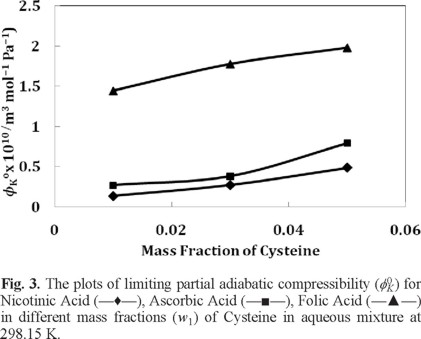
<body><![CDATA[<p align="justify"><font face="verdana" size="2">The adiabatic compressibility (<i>&#946;</i>) was evaluated from the following equation:</font></p>  	    <p align="center"><font face="verdana" size="2"><i>&#946;</i> = 1/<i>u</i><sup>2</sup>&#961;&nbsp;&nbsp;&nbsp;&nbsp;&nbsp;(6)</font></p>  	    <p align="justify"><font face="verdana" size="2">where <i>&#961;</i> (kg m<sup>&#45;3</sup>) is the density of solution and <i>u</i>(<i>ms</i><sup>&#45;1</sup>) is the speed of sound in the solution. The apparent molal adiabatic compressibility (<i>&#981;<sub>K</sub></i>) of the solutions was determined from the relation &#91;19&#93;.</font></p>  	    <p align="center"><font face="verdana" size="2"><i>&#981;<sub>K</sub></i> = <i>M&#946;</i>/<i>&#961;</i> + 1000(<i>&#946;&#961;</i><sub>0</sub> &#45; <i>&#946;</i><sub>0</sub><i>&#961;</i>)/<i>m&#961;&#961;</i><sub>0</sub>&nbsp;&nbsp;&nbsp;&nbsp;&nbsp;(7)</font></p>  	    <p align="justify"><font face="verdana" size="2">where <i>&#946;</i><sub>0</sub>, <i>&#946;</i> are the adiabatic compressibility of the solvent and solution respectively and <i>m</i> (mol kg<sup>&#45;1</sup>) is the molality of the solution. Limiting partial molal adiabatic compressibilities (<i>&#981;<sub>K</sub></i><sup>0</sup>) and experimental slopes (<i>S</i>*<i><sub>K</sub></i>) were obtained by fitting <i>&#981;<sub>K</sub></i> against the square root of molality of the electrolyte (&#x221a;<i>m</i>) using the method of least squares.</font></p>  	    <p align="center"><font face="verdana" size="2"><i>&#981;<sub>K</sub></i> = <i>&#981;<sub>K</sub></i><sup>0</sup> + <i>S</i>*<i><sub>K</sub></i> &middot; &#8730;<i>m</i>&nbsp;&nbsp;&nbsp;&nbsp;&nbsp;(8)</font></p>  	    <p align="justify"><font face="verdana" size="2">The values of <i>&#946;</i> and <i>&#981;<sub>K</sub></i> are reported in <a href="/img/revistas/jmcs/v58n2/a4c3.jpg" target="_blank">Table 3</a>. The values of <i>&#981;<sub>K</sub></i><sup>0</sup> (m<sup>3</sup> mol<sup>&#45;1</sup> Pa<sup>&#45;1</sup>) and <i>S</i>*<i><sub>K</sub></i> (m<sup>3</sup> mol<sup>&#45;3/2</sup> Pa<sup>&#45;1</sup> kg<sup>1/2</sup>) are presented in <a href="/img/revistas/jmcs/v58n2/a4c4.jpg" target="_blank">Table 4</a>. Since the values of <i>&#981;<sub>K</sub></i><sup>0</sup> and <i>S</i>*<i><sub>K</sub></i> are measures of solute&#45;solvent and solute&#45;solute interactions respectively, a perusal of <a href="/img/revistas/jmcs/v58n2/a4c4.jpg" target="_blank">Table 4</a> and <a href="#f3">Figure 3</a> shows that the <i>&#981;<sub>K</sub></i><sup>0</sup> values are in good agreement with those drawn from the values of <i>&#981;<sub>V</sub></i><sup>0</sup> discussed earlier.</font></p>  	    <p align="center"><font face="verdana" size="2"><a name="f3"></a></font></p>  	    <p align="center"><font face="verdana" size="2"><img src="/img/revistas/jmcs/v58n2/a4f3.jpg"></font></p>  	    <p>&nbsp;</p>  	    ]]></body>
<body><![CDATA[<p align="justify"><font face="verdana" size="2"><b>Conclusion</b></font></p>  	    <p align="justify"><font face="verdana" size="2">The positive effects of the derived parameters, as limiting apparent molar volume (<i>&#981;<sub>V</sub></i><sup>0</sup>), viscosity <i>B&#45;</i>coefficients and limiting partial isentropic compressibility (<i>&#981;<sub>K</sub></i><sup>0</sup>) suggested the presence of strong solute(vitamins)&#45;solvent(aq. mix. of Cystine) interactions; which increases with the increase in the interacting centres (groups) of vitamins and with increase of mass fraction of cysteine in the aqueous mixture. The refractive index and the molar refraction values imply that Folic Acid molecules are more tightly packed in the solution leading to higher solute&#45;solvent interaction than the other vitamins. The conclusions from experimental and derived parameters also provides important working function of the cysteine with vitamins in biological systems; which demands the uniqueness of the work.</font></p>  	    <p>&nbsp;</p>  	    <p align="justify"><font face="verdana" size="2"><b>Acknowledgement</b></font></p>  	    <p align="justify"><font face="verdana" size="2">The authors are grateful to the Departmental Special Assistance Scheme, Department of Chemistry, NBU under the University Grants Commission, New Delhi (No. 540/27/DRS/2007, SAP&#45;1) for financial support and instrumental facilities in order to continue this research work.</font></p>  	    <p align="justify"><font face="verdana" size="2">One of the authors, Prof. M. N. Roy is thankful to University Grant Commission, New Delhi, Government of India for being awarded one time grant under Basic Scientific Research via the grant&#45;in&#45;Aid No. F.4&#45;10/2010 (BSR) regarding his active service for augmenting of research facilities to facilitate further research work.</font></p>  	    <p>&nbsp;</p>  	    <p align="justify"><font face="verdana" size="2"><b>References</b></font></p>  	    <!-- ref --><p align="justify"><font face="verdana" size="2">1. Robinson, F. A. <i>The Vitamin B&#45;Complexes</i>, Chapter 4. Chapman &amp; Hall, London, <b>1951</b>.    &nbsp;&nbsp;&nbsp;&nbsp;&nbsp;&nbsp;&nbsp;&nbsp;[&#160;<a href="javascript:void(0);" onclick="javascript: window.open('/scielo.php?script=sci_nlinks&ref=4947704&pid=S1870-249X201400020000400001&lng=','','width=640,height=500,resizable=yes,scrollbars=1,menubar=yes,');">Links</a>&#160;]<!-- end-ref --></font></p>  	    ]]></body>
<body><![CDATA[<!-- ref --><p align="justify"><font face="verdana" size="2">2. Cakir, S.; Bulut, I.; Bicer, E.; Cakir, O. <i>Coord. J. Chem</i>. <b>2003</b>, <i>56</i>, 511&#45;521.    &nbsp;&nbsp;&nbsp;&nbsp;&nbsp;&nbsp;&nbsp;&nbsp;[&#160;<a href="javascript:void(0);" onclick="javascript: window.open('/scielo.php?script=sci_nlinks&ref=4947706&pid=S1870-249X201400020000400002&lng=','','width=640,height=500,resizable=yes,scrollbars=1,menubar=yes,');">Links</a>&#160;]<!-- end-ref --></font></p>  	    <!-- ref --><p align="justify"><font face="verdana" size="2">3. Roy, M. N.; Das, R. K.; Bhattacharjee, A. <i>Russian J. Phys. Chem. A</i> <b>2010</b>, <i>84</i>, 2201&#45;2210</font>&nbsp;&nbsp;&nbsp;&nbsp;&nbsp;&nbsp;&nbsp;&nbsp;[&#160;<a href="javascript:void(0);" onclick="javascript: window.open('/scielo.php?script=sci_nlinks&ref=4947708&pid=S1870-249X201400020000400003&lng=','','width=640,height=500,resizable=yes,scrollbars=1,menubar=yes,');">Links</a>&#160;]<!-- end-ref --><!-- ref --><p align="justify"><font face="verdana" size="2">4. Chahidi, C. ; Aubailly, M.; Momzikoff, A.; Bazin, M. <i>Photochem. Photobiol</i>. <b>1981</b>, <i>33</i>, 641.    &nbsp;&nbsp;&nbsp;&nbsp;&nbsp;&nbsp;&nbsp;&nbsp;[&#160;<a href="javascript:void(0);" onclick="javascript: window.open('/scielo.php?script=sci_nlinks&ref=4947709&pid=S1870-249X201400020000400004&lng=','','width=640,height=500,resizable=yes,scrollbars=1,menubar=yes,');">Links</a>&#160;]<!-- end-ref --></font></p>  	    <!-- ref --><p align="justify"><font face="verdana" size="2">5. "Dietary Supplement Fact Sheet: Folate", Office of Dietary Supplements, National Institutes of Health, <a href="http://ods.od.nih.gov/factsheets/folate.asp" target="_blank">http://ods.od.nih.gov/factsheets/folate.asp</a></font>&nbsp;&nbsp;&nbsp;&nbsp;&nbsp;&nbsp;&nbsp;&nbsp;[&#160;<a href="javascript:void(0);" onclick="javascript: window.open('/scielo.php?script=sci_nlinks&ref=4947711&pid=S1870-249X201400020000400005&lng=','','width=640,height=500,resizable=yes,scrollbars=1,menubar=yes,');">Links</a>&#160;]<!-- end-ref --><!-- ref --><p align="justify"><font face="verdana" size="2">6. "The primary structure of proteins is the amino acid sequence". <i>The Microbial World</i>. University of Wisconsin&#45;Madison Bacteriology Department. Retrieved 16 September 2012.    &nbsp;&nbsp;&nbsp;&nbsp;&nbsp;&nbsp;&nbsp;&nbsp;[&#160;<a href="javascript:void(0);" onclick="javascript: window.open('/scielo.php?script=sci_nlinks&ref=4947712&pid=S1870-249X201400020000400006&lng=','','width=640,height=500,resizable=yes,scrollbars=1,menubar=yes,');">Links</a>&#160;]<!-- end-ref -->&#93;</font></p>  	    <!-- ref --><p align="justify"><font face="verdana" size="2">7. Abdulagatov, I. M.; Azizov, N. D. <i>Fluid Phase Equilibria</i> <b>2006</b>, <i>240</i>, 204.    &nbsp;&nbsp;&nbsp;&nbsp;&nbsp;&nbsp;&nbsp;&nbsp;[&#160;<a href="javascript:void(0);" onclick="javascript: window.open('/scielo.php?script=sci_nlinks&ref=4947714&pid=S1870-249X201400020000400007&lng=','','width=640,height=500,resizable=yes,scrollbars=1,menubar=yes,');">Links</a>&#160;]<!-- end-ref --></font></p>  	    ]]></body>
<body><![CDATA[<!-- ref --><p align="justify"><font face="verdana" size="2">8. Freyer, E.B.; Hubbard, J.D.; Andrews, D.H. <i>J. Am. Chem. Soc.</i> <b>1929</b>, <i>51</i>, 759.    &nbsp;&nbsp;&nbsp;&nbsp;&nbsp;&nbsp;&nbsp;&nbsp;[&#160;<a href="javascript:void(0);" onclick="javascript: window.open('/scielo.php?script=sci_nlinks&ref=4947716&pid=S1870-249X201400020000400008&lng=','','width=640,height=500,resizable=yes,scrollbars=1,menubar=yes,');">Links</a>&#160;]<!-- end-ref --></font></p>  	    <!-- ref --><p align="justify"><font face="verdana" size="2">9. Kiyohara, O.; Grolier, J. P. E.; Benson, G. C. <i>Can. J. Chem.</i> <b>1974</b>, <i>52</i>, 2287</font>&nbsp;&nbsp;&nbsp;&nbsp;&nbsp;&nbsp;&nbsp;&nbsp;[&#160;<a href="javascript:void(0);" onclick="javascript: window.open('/scielo.php?script=sci_nlinks&ref=4947718&pid=S1870-249X201400020000400009&lng=','','width=640,height=500,resizable=yes,scrollbars=1,menubar=yes,');">Links</a>&#160;]<!-- end-ref --><!-- ref --><p align="justify"><font face="verdana" size="2">10. Murthy, N. M.; Subrahmanyam, S. V. <i>Bull. Chem. Soc. Jpn.</i> <b>1977</b>, <i>50</i>, 2589.    &nbsp;&nbsp;&nbsp;&nbsp;&nbsp;&nbsp;&nbsp;&nbsp;[&#160;<a href="javascript:void(0);" onclick="javascript: window.open('/scielo.php?script=sci_nlinks&ref=4947719&pid=S1870-249X201400020000400010&lng=','','width=640,height=500,resizable=yes,scrollbars=1,menubar=yes,');">Links</a>&#160;]<!-- end-ref --></font></p>  	    <!-- ref --><p align="justify"><font face="verdana" size="2">11. Ayranci, E. <i>J. Chem. Eng. Data</i> <b>1997</b>, <i>42</i>, 934&#45;937.    &nbsp;&nbsp;&nbsp;&nbsp;&nbsp;&nbsp;&nbsp;&nbsp;[&#160;<a href="javascript:void(0);" onclick="javascript: window.open('/scielo.php?script=sci_nlinks&ref=4947721&pid=S1870-249X201400020000400011&lng=','','width=640,height=500,resizable=yes,scrollbars=1,menubar=yes,');">Links</a>&#160;]<!-- end-ref --></font></p>  	    <!-- ref --><p align="justify"><font face="verdana" size="2">12. Masson, D. O. <i>Phil. Mag</i>. <b>1929</b>, 8, 218&#45;226.    &nbsp;&nbsp;&nbsp;&nbsp;&nbsp;&nbsp;&nbsp;&nbsp;[&#160;<a href="javascript:void(0);" onclick="javascript: window.open('/scielo.php?script=sci_nlinks&ref=4947723&pid=S1870-249X201400020000400012&lng=','','width=640,height=500,resizable=yes,scrollbars=1,menubar=yes,');">Links</a>&#160;]<!-- end-ref --></font></p>  	    <!-- ref --><p align="justify"><font face="verdana" size="2">13. Jones, G.; Dole, M. <i>J. Am. Chem. Soc</i>. <b>1929</b>, <i>51</i>, 2950&#45;2964.    &nbsp;&nbsp;&nbsp;&nbsp;&nbsp;&nbsp;&nbsp;&nbsp;[&#160;<a href="javascript:void(0);" onclick="javascript: window.open('/scielo.php?script=sci_nlinks&ref=4947725&pid=S1870-249X201400020000400013&lng=','','width=640,height=500,resizable=yes,scrollbars=1,menubar=yes,');">Links</a>&#160;]<!-- end-ref --></font></p>  	    <!-- ref --><p align="justify"><font face="verdana" size="2">14. Millero, F. J.; <i>Chem. Rev</i>. <b>1971</b>, <i>71</i>, 147&#45;176.    &nbsp;&nbsp;&nbsp;&nbsp;&nbsp;&nbsp;&nbsp;&nbsp;[&#160;<a href="javascript:void(0);" onclick="javascript: window.open('/scielo.php?script=sci_nlinks&ref=4947727&pid=S1870-249X201400020000400014&lng=','','width=640,height=500,resizable=yes,scrollbars=1,menubar=yes,');">Links</a>&#160;]<!-- end-ref --></font></p>  	    <!-- ref --><p align="justify"><font face="verdana" size="2">15. Millero, F. J.; Losurdo, A.; Shin, C<i>. J. Phys. Chem.</i> <b>1978</b>, <i>82</i>, 784&#45;792.    &nbsp;&nbsp;&nbsp;&nbsp;&nbsp;&nbsp;&nbsp;&nbsp;[&#160;<a href="javascript:void(0);" onclick="javascript: window.open('/scielo.php?script=sci_nlinks&ref=4947729&pid=S1870-249X201400020000400015&lng=','','width=640,height=500,resizable=yes,scrollbars=1,menubar=yes,');">Links</a>&#160;]<!-- end-ref --></font></p>  	    <!-- ref --><p align="justify"><font face="verdana" size="2">16. Minkin, V.; Osipov, O.; Zhdanov, Y. <i>Dipole Moments in Organic Chemistry</i>, Plenum Press, New York, London, <b>1970</b>.    &nbsp;&nbsp;&nbsp;&nbsp;&nbsp;&nbsp;&nbsp;&nbsp;[&#160;<a href="javascript:void(0);" onclick="javascript: window.open('/scielo.php?script=sci_nlinks&ref=4947731&pid=S1870-249X201400020000400016&lng=','','width=640,height=500,resizable=yes,scrollbars=1,menubar=yes,');">Links</a>&#160;]<!-- end-ref --></font></p>  	    <!-- ref --><p align="justify"><font face="verdana" size="2">17. Born, M.; Wolf, E.; <i>Principles of Optics: Electromagnetic Theory of Propagation, Interference and Diffraction of Light</i>, 7th ed., Cambridge University Press, London, <b>1999</b>.    &nbsp;&nbsp;&nbsp;&nbsp;&nbsp;&nbsp;&nbsp;&nbsp;[&#160;<a href="javascript:void(0);" onclick="javascript: window.open('/scielo.php?script=sci_nlinks&ref=4947733&pid=S1870-249X201400020000400017&lng=','','width=640,height=500,resizable=yes,scrollbars=1,menubar=yes,');">Links</a>&#160;]<!-- end-ref --></font></p>  	    <!-- ref --><p align="justify"><font face="verdana" size="2">18. Deetlefs, M.; Seddon, K.; Shara, M. <i>Phys. Chem. Chem. Phys</i>. <b>2006</b>, <i>8</i>, 642&#45;649.    &nbsp;&nbsp;&nbsp;&nbsp;&nbsp;&nbsp;&nbsp;&nbsp;[&#160;<a href="javascript:void(0);" onclick="javascript: window.open('/scielo.php?script=sci_nlinks&ref=4947735&pid=S1870-249X201400020000400018&lng=','','width=640,height=500,resizable=yes,scrollbars=1,menubar=yes,');">Links</a>&#160;]<!-- end-ref --></font></p>  	    <!-- ref --><p align="justify"><font face="verdana" size="2">19. Roy, M. N.; Ekka , D.; Dewan, R. <i>Acta Chim. Slov.</i> <b>2011</b>, <i>58</i>, 792&#45;796.    &nbsp;&nbsp;&nbsp;&nbsp;&nbsp;&nbsp;&nbsp;&nbsp;[&#160;<a href="javascript:void(0);" onclick="javascript: window.open('/scielo.php?script=sci_nlinks&ref=4947737&pid=S1870-249X201400020000400019&lng=','','width=640,height=500,resizable=yes,scrollbars=1,menubar=yes,');">Links</a>&#160;]<!-- end-ref --></font></p>      ]]></body><back>
<ref-list>
<ref id="B1">
<label>1</label><nlm-citation citation-type="book">
<person-group person-group-type="author">
<name>
<surname><![CDATA[Robinson]]></surname>
<given-names><![CDATA[F. A.]]></given-names>
</name>
</person-group>
<source><![CDATA[The Vitamin B-Complexes]]></source>
<year>1951</year>
<publisher-loc><![CDATA[London ]]></publisher-loc>
<publisher-name><![CDATA[Chapman & Hall]]></publisher-name>
</nlm-citation>
</ref>
<ref id="B2">
<label>2</label><nlm-citation citation-type="journal">
<person-group person-group-type="author">
<name>
<surname><![CDATA[Cakir]]></surname>
<given-names><![CDATA[S.]]></given-names>
</name>
<name>
<surname><![CDATA[Bulut]]></surname>
<given-names><![CDATA[I.]]></given-names>
</name>
<name>
<surname><![CDATA[Bicer]]></surname>
<given-names><![CDATA[E.]]></given-names>
</name>
<name>
<surname><![CDATA[Cakir]]></surname>
<given-names><![CDATA[O.]]></given-names>
</name>
</person-group>
<source><![CDATA[Coord. J. Chem.]]></source>
<year>2003</year>
<volume>56</volume>
<page-range>511-521</page-range></nlm-citation>
</ref>
<ref id="B3">
<label>3</label><nlm-citation citation-type="journal">
<person-group person-group-type="author">
<name>
<surname><![CDATA[Roy]]></surname>
<given-names><![CDATA[M. N.]]></given-names>
</name>
<name>
<surname><![CDATA[Das]]></surname>
<given-names><![CDATA[R. K.]]></given-names>
</name>
<name>
<surname><![CDATA[Bhattacharjee]]></surname>
<given-names><![CDATA[A.]]></given-names>
</name>
</person-group>
<source><![CDATA[Russian J. Phys. Chem.]]></source>
<year>2010</year>
<volume>84</volume>
<page-range>2201-2210</page-range></nlm-citation>
</ref>
<ref id="B4">
<label>4</label><nlm-citation citation-type="journal">
<person-group person-group-type="author">
<name>
<surname><![CDATA[Chahidi]]></surname>
<given-names><![CDATA[C.]]></given-names>
</name>
<name>
<surname><![CDATA[Aubailly]]></surname>
<given-names><![CDATA[M.]]></given-names>
</name>
<name>
<surname><![CDATA[Momzikoff]]></surname>
<given-names><![CDATA[A.]]></given-names>
</name>
<name>
<surname><![CDATA[Bazin]]></surname>
<given-names><![CDATA[M.]]></given-names>
</name>
</person-group>
<source><![CDATA[Photochem. Photobiol.]]></source>
<year>1981</year>
<volume>33</volume>
<page-range>641</page-range></nlm-citation>
</ref>
<ref id="B5">
<label>5</label><nlm-citation citation-type="book">
<source><![CDATA[Dietary Supplement Fact Sheet: Folate]]></source>
<year></year>
<publisher-name><![CDATA[Office of Dietary Supplements, National Institutes of Health]]></publisher-name>
</nlm-citation>
</ref>
<ref id="B6">
<label>6</label><nlm-citation citation-type="book">
<article-title xml:lang="en"><![CDATA[The primary structure of proteins is the amino acid sequence]]></article-title>
<source><![CDATA[The Microbial World]]></source>
<year>16 S</year>
<month>ep</month>
<day>te</day>
<publisher-name><![CDATA[University of Wisconsin-Madison Bacteriology Department]]></publisher-name>
</nlm-citation>
</ref>
<ref id="B7">
<label>7</label><nlm-citation citation-type="journal">
<person-group person-group-type="author">
<name>
<surname><![CDATA[Abdulagatov]]></surname>
<given-names><![CDATA[I. M.]]></given-names>
</name>
<name>
<surname><![CDATA[Azizov]]></surname>
<given-names><![CDATA[N. D.]]></given-names>
</name>
</person-group>
<source><![CDATA[Fluid Phase Equilibria]]></source>
<year>2006</year>
<volume>240</volume>
<page-range>204</page-range></nlm-citation>
</ref>
<ref id="B8">
<label>8</label><nlm-citation citation-type="journal">
<person-group person-group-type="author">
<name>
<surname><![CDATA[Freyer]]></surname>
<given-names><![CDATA[E.B.]]></given-names>
</name>
<name>
<surname><![CDATA[Hubbard]]></surname>
<given-names><![CDATA[J.D.]]></given-names>
</name>
<name>
<surname><![CDATA[Andrews]]></surname>
<given-names><![CDATA[D.H.]]></given-names>
</name>
</person-group>
<source><![CDATA[J. Am. Chem. Soc.]]></source>
<year>1929</year>
<volume>51</volume>
<page-range>759</page-range></nlm-citation>
</ref>
<ref id="B9">
<label>9</label><nlm-citation citation-type="journal">
<person-group person-group-type="author">
<name>
<surname><![CDATA[Kiyohara]]></surname>
<given-names><![CDATA[O.]]></given-names>
</name>
<name>
<surname><![CDATA[Grolier]]></surname>
<given-names><![CDATA[J. P. E.]]></given-names>
</name>
<name>
<surname><![CDATA[Benson]]></surname>
<given-names><![CDATA[G. C.]]></given-names>
</name>
</person-group>
<source><![CDATA[Can. J. Chem.]]></source>
<year>1974</year>
<volume>52</volume>
<page-range>2287</page-range></nlm-citation>
</ref>
<ref id="B10">
<label>10</label><nlm-citation citation-type="journal">
<person-group person-group-type="author">
<name>
<surname><![CDATA[Murthy]]></surname>
<given-names><![CDATA[N. M.]]></given-names>
</name>
<name>
<surname><![CDATA[Subrahmanyam]]></surname>
<given-names><![CDATA[S. V.]]></given-names>
</name>
</person-group>
<source><![CDATA[Bull. Chem. Soc. Jpn.]]></source>
<year>1977</year>
<volume>50</volume>
<page-range>2589</page-range></nlm-citation>
</ref>
<ref id="B11">
<label>11</label><nlm-citation citation-type="journal">
<person-group person-group-type="author">
<name>
<surname><![CDATA[Ayranci]]></surname>
<given-names><![CDATA[E.]]></given-names>
</name>
</person-group>
<source><![CDATA[J. Chem. Eng. Data]]></source>
<year>1997</year>
<volume>42</volume>
<page-range>934-937</page-range></nlm-citation>
</ref>
<ref id="B12">
<label>12</label><nlm-citation citation-type="journal">
<person-group person-group-type="author">
<name>
<surname><![CDATA[Masson]]></surname>
<given-names><![CDATA[D. O.]]></given-names>
</name>
</person-group>
<source><![CDATA[Phil. Mag.]]></source>
<year>1929</year>
<volume>8</volume>
<page-range>218-226</page-range></nlm-citation>
</ref>
<ref id="B13">
<label>13</label><nlm-citation citation-type="journal">
<person-group person-group-type="author">
<name>
<surname><![CDATA[Jones]]></surname>
<given-names><![CDATA[G.]]></given-names>
</name>
<name>
<surname><![CDATA[Dole]]></surname>
<given-names><![CDATA[M.]]></given-names>
</name>
</person-group>
<source><![CDATA[J. Am. Chem. Soc.]]></source>
<year>1929</year>
<volume>51</volume>
<page-range>2950-2964</page-range></nlm-citation>
</ref>
<ref id="B14">
<label>14</label><nlm-citation citation-type="journal">
<person-group person-group-type="author">
<name>
<surname><![CDATA[Millero]]></surname>
<given-names><![CDATA[F. J.]]></given-names>
</name>
</person-group>
<source><![CDATA[Chem. Rev.]]></source>
<year>1971</year>
<volume>71</volume>
<page-range>147-176</page-range></nlm-citation>
</ref>
<ref id="B15">
<label>15</label><nlm-citation citation-type="journal">
<person-group person-group-type="author">
<name>
<surname><![CDATA[Millero]]></surname>
<given-names><![CDATA[F. J.]]></given-names>
</name>
<name>
<surname><![CDATA[Losurdo]]></surname>
<given-names><![CDATA[A.]]></given-names>
</name>
<name>
<surname><![CDATA[Shin]]></surname>
<given-names><![CDATA[C.]]></given-names>
</name>
</person-group>
<source><![CDATA[J. Phys. Chem.]]></source>
<year>1978</year>
<volume>82</volume>
<page-range>784-792</page-range></nlm-citation>
</ref>
<ref id="B16">
<label>16</label><nlm-citation citation-type="book">
<person-group person-group-type="author">
<name>
<surname><![CDATA[Minkin]]></surname>
<given-names><![CDATA[V.]]></given-names>
</name>
<name>
<surname><![CDATA[Osipov]]></surname>
<given-names><![CDATA[O.]]></given-names>
</name>
<name>
<surname><![CDATA[Zhdanov]]></surname>
<given-names><![CDATA[Y.]]></given-names>
</name>
</person-group>
<source><![CDATA[Dipole Moments in Organic Chemistry]]></source>
<year>1970</year>
<publisher-loc><![CDATA[New YorkLondon ]]></publisher-loc>
<publisher-name><![CDATA[Plenum Press]]></publisher-name>
</nlm-citation>
</ref>
<ref id="B17">
<label>17</label><nlm-citation citation-type="book">
<person-group person-group-type="author">
<name>
<surname><![CDATA[Born]]></surname>
<given-names><![CDATA[M.]]></given-names>
</name>
<name>
<surname><![CDATA[Wolf]]></surname>
<given-names><![CDATA[E.]]></given-names>
</name>
</person-group>
<source><![CDATA[Principles of Optics: Electromagnetic Theory of Propagation, Interference and Diffraction of Light]]></source>
<year>1999</year>
<edition>7</edition>
<publisher-loc><![CDATA[London ]]></publisher-loc>
<publisher-name><![CDATA[Cambridge University Press]]></publisher-name>
</nlm-citation>
</ref>
<ref id="B18">
<label>18</label><nlm-citation citation-type="journal">
<person-group person-group-type="author">
<name>
<surname><![CDATA[Deetlefs]]></surname>
<given-names><![CDATA[M.]]></given-names>
</name>
<name>
<surname><![CDATA[Seddon]]></surname>
<given-names><![CDATA[K.]]></given-names>
</name>
<name>
<surname><![CDATA[Shara]]></surname>
<given-names><![CDATA[M.]]></given-names>
</name>
</person-group>
<source><![CDATA[Phys. Chem. Chem. Phys.]]></source>
<year>2006</year>
<volume>8</volume>
<page-range>642-649</page-range></nlm-citation>
</ref>
<ref id="B19">
<label>19</label><nlm-citation citation-type="journal">
<person-group person-group-type="author">
<name>
<surname><![CDATA[Roy]]></surname>
<given-names><![CDATA[M. N.]]></given-names>
</name>
<name>
<surname><![CDATA[Ekka]]></surname>
<given-names><![CDATA[D.]]></given-names>
</name>
<name>
<surname><![CDATA[Dewan]]></surname>
<given-names><![CDATA[R.]]></given-names>
</name>
</person-group>
<source><![CDATA[Acta Chim. Slov.]]></source>
<year>2011</year>
<volume>58</volume>
<page-range>792-796</page-range></nlm-citation>
</ref>
</ref-list>
</back>
</article>