<?xml version="1.0" encoding="ISO-8859-1"?><article xmlns:mml="http://www.w3.org/1998/Math/MathML" xmlns:xlink="http://www.w3.org/1999/xlink" xmlns:xsi="http://www.w3.org/2001/XMLSchema-instance">
<front>
<journal-meta>
<journal-id>1870-0578</journal-id>
<journal-title><![CDATA[Mexican law review]]></journal-title>
<abbrev-journal-title><![CDATA[Mex. law rev]]></abbrev-journal-title>
<issn>1870-0578</issn>
<publisher>
<publisher-name><![CDATA[Universidad Nacional Autónoma de México, Instituto de Investigaciones Jurídicas]]></publisher-name>
</publisher>
</journal-meta>
<article-meta>
<article-id>S1870-05782014000200006</article-id>
<title-group>
<article-title xml:lang="en"><![CDATA[The Regulation of Corporate Bribery in Brazil]]></article-title>
</title-group>
<contrib-group>
<contrib contrib-type="author">
<name>
<surname><![CDATA[Morosini]]></surname>
<given-names><![CDATA[Fabio]]></given-names>
</name>
<xref ref-type="aff" rid="A01"/>
</contrib>
<contrib contrib-type="author">
<name>
<surname><![CDATA[Vaz Ferreira]]></surname>
<given-names><![CDATA[Luciano]]></given-names>
</name>
<xref ref-type="aff" rid="A02"/>
</contrib>
</contrib-group>
<aff id="A01">
<institution><![CDATA[,Universidade Federal do Rio Grande do Sul School of Law Center for Law, Globalization and Development]]></institution>
<addr-line><![CDATA[Porto Alegre Rio Grande do Sul]]></addr-line>
<country>Brasil</country>
</aff>
<aff id="A02">
<institution><![CDATA[,Universidade Federal do Rio Grande do Sul  ]]></institution>
<addr-line><![CDATA[Porto Alegre Rio Grande do Sul]]></addr-line>
<country>Brasil</country>
</aff>
<pub-date pub-type="pub">
<day>00</day>
<month>12</month>
<year>2014</year>
</pub-date>
<pub-date pub-type="epub">
<day>00</day>
<month>12</month>
<year>2014</year>
</pub-date>
<volume>7</volume>
<numero>1</numero>
<fpage>139</fpage>
<lpage>150</lpage>
<copyright-statement/>
<copyright-year/>
<self-uri xlink:href="http://www.scielo.org.mx/scielo.php?script=sci_arttext&amp;pid=S1870-05782014000200006&amp;lng=en&amp;nrm=iso"></self-uri><self-uri xlink:href="http://www.scielo.org.mx/scielo.php?script=sci_abstract&amp;pid=S1870-05782014000200006&amp;lng=en&amp;nrm=iso"></self-uri><self-uri xlink:href="http://www.scielo.org.mx/scielo.php?script=sci_pdf&amp;pid=S1870-05782014000200006&amp;lng=en&amp;nrm=iso"></self-uri><abstract abstract-type="short" xml:lang="en"><p><![CDATA[This note explains the new legal initiatives in the regulation of private corporate bribery in Brazil. Corruption is an endemic problem in many States, including ones with an emerging economy such as Brazil. The development and implementation of anticorruption policies necessarily goes through Klitgaards "Principal-Agent-Client" model. According to this theory, it is important to create a system of punishment and incentive that focuses also on the "client," the private sector, a subject often forgotten in the drafting of anti-corruption laws. This note argues that previous Brazilian corruption laws did not foresee a consistent legal framework capable of preventing and punishing companies' use of bribery. In this scenario, one can observe that Brazil began a process of institutional change over the course of recent years, which consisted of developing new anti-corruption mechanisms. The creation of The Office of Comptroller General (Controladoria Geral da Uniao), a federal government organ specialized in corruption control, is a landmark. The implementation of Law No. 12.846, which will enter into force in 2014, shows great promise. The new law predicts harsher punishments to companies involved in bribery. One interesting aspect is the creation of incentive mechanisms directed at cooperation with government inspection, leniency agreements and a provision to decrease punishment when compliance programs are implemented. Although in order for it to be put into practice, the latter demands a more precise definition. The authors are optimistic about this new initiative and await further developments.]]></p></abstract>
<abstract abstract-type="short" xml:lang="es"><p><![CDATA[Este documento analiza las nuevas iniciativas legales en la regulación de soborno corporativo en Brasil. La corrupción es un problema endémico presente en muchos países, incluyendo países de economía emergente, como Brasil. El desarrollo y la implementación de políticas de lucha contra la corrupción implica necesariamente el modelo de "gestor-agente-cliente" de Klitgaard. Basándose en esta teoría, es importante crear un sistema de sanciones e incentivos que también se centren en la figura de "cliente", el sector privado, sujeto muchas veces a no ser tenido en cuenta en las leyes de anticorrupción. En la presente investigación, se constató que las antiguas leyes brasileras sobre corrupción no proporcionan un régimen jurídico consistente capaz de prevenir y sancionar el uso del soborno por las empresas. Desde este escenario, se observa que el país inició, en los últimos años, un proceso de cambio institucional, desarrollando nuevos mecanismos de lucha contra la corrupción. La creación de la Contraloría General de la Unión, órgano gubernamental federal especializado en el control de corrupción es un hito. La gran promesa es la implementación de la Ley No. 12.846, que entrará en vigor en 2014. La nueva ley prevé sanciones muy graves para las empresas envueltas en soborno. Un aspecto interesante es la creación de mecanismos de incentivos destinados a la cooperación con la fiscalización de gobierno, como los acuerdos de tolerancia y la previsión de reducción de la pena en la existencia de programas de cumplimiento, cuya utilización carece de una definición precisa. Los autores siguen siendo optimistas acerca de esta nueva iniciativa, a la espera de su evolución.]]></p></abstract>
<kwd-group>
<kwd lng="en"><![CDATA[Corruption]]></kwd>
<kwd lng="en"><![CDATA[Bribery]]></kwd>
<kwd lng="en"><![CDATA[Business]]></kwd>
<kwd lng="en"><![CDATA[Compliance]]></kwd>
<kwd lng="en"><![CDATA[Brazil]]></kwd>
<kwd lng="es"><![CDATA[Corrupción]]></kwd>
<kwd lng="es"><![CDATA[soborno]]></kwd>
<kwd lng="es"><![CDATA[negocios]]></kwd>
<kwd lng="es"><![CDATA[Compliance]]></kwd>
<kwd lng="es"><![CDATA[Brasil]]></kwd>
</kwd-group>
</article-meta>
</front><body><![CDATA[  	    <p align="justify"><font face="verdana" size="4">Note</font></p>  	    <p>&nbsp;</p>  	    <p align="center"><font face="verdana" size="4"><b>The Regulation of Corporate Bribery in Brazil</b></font></p>  	    <p>&nbsp;</p>  	    <p align="center"><font face="verdana" size="2"><b>Fabio Morosini<sup><a href="#notas">*</a></sup> and Luciano Vaz Ferreira<sup><a href="#notas">**</a></sup></b></font></p>  	    <p>&nbsp;</p>  	    <p align="justify"><font face="verdana" size="2"><b>Abstract</b></font></p>  	    <p align="justify"><font face="verdana" size="2">This note explains the new legal initiatives in the regulation of private corporate bribery in Brazil. Corruption is an endemic problem in many States, including ones with an emerging economy such as Brazil. The development and implementation of anticorruption policies necessarily goes through Klitgaards "Principal&#45;Agent&#45;Client" model. According to this theory, it is important to create a system of punishment and incentive that focuses also on the "client," the private sector, a subject often forgotten in the drafting of anti&#45;corruption laws. This note argues that previous Brazilian corruption laws did not foresee a consistent legal framework capable of preventing and punishing companies' use of bribery. In this scenario, one can observe that Brazil began a process of institutional change over the course of recent years, which consisted of developing new anti&#45;corruption mechanisms. The creation of The Office of Comptroller General (Controladoria Geral da Uniao), a federal government organ specialized in corruption control, is a landmark. The implementation of Law No. 12.846, which will enter into force in 2014, shows great promise. The new law predicts harsher punishments to companies involved in bribery. One interesting aspect is the creation of incentive mechanisms directed at cooperation with government inspection, leniency agreements and a provision to decrease punishment when compliance programs are implemented. Although in order for it to be put into practice, the latter demands a more precise definition. The authors are optimistic about this new initiative and await further developments.</font></p>  	    <p align="justify"><font face="verdana" size="2"><b>Key Words:</b> Corruption, Bribery, Business, Compliance, Brazil.</font></p>  	    ]]></body>
<body><![CDATA[<p>&nbsp;</p>  	    <p align="justify"><font face="verdana" size="2"><b>Resumen</b></font></p>  	    <p align="justify"><font face="verdana" size="2">Este documento analiza las nuevas iniciativas legales en la regulaci&oacute;n de soborno corporativo en Brasil. La corrupci&oacute;n es un problema end&eacute;mico presente en muchos pa&iacute;ses, incluyendo pa&iacute;ses de econom&iacute;a emergente, como Brasil. El desarrollo y la implementaci&oacute;n de pol&iacute;ticas de lucha contra la corrupci&oacute;n implica necesariamente el modelo de "gestor&#45;agente&#45;cliente" de Klitgaard. Bas&aacute;ndose en esta teor&iacute;a, es importante crear un sistema de sanciones e incentivos que tambi&eacute;n se centren en la figura de "cliente", el sector privado, sujeto muchas veces a no ser tenido en cuenta en las leyes de anticorrupci&oacute;n. En la presente investigaci&oacute;n, se constat&oacute; que las antiguas leyes brasileras sobre corrupci&oacute;n no proporcionan un r&eacute;gimen jur&iacute;dico consistente capaz de prevenir y sancionar el uso del soborno por las empresas. Desde este escenario, se observa que el pa&iacute;s inici&oacute;, en los &uacute;ltimos a&ntilde;os, un proceso de cambio institucional, desarrollando nuevos mecanismos de lucha contra la corrupci&oacute;n. La creaci&oacute;n de la Contralor&iacute;a General de la Uni&oacute;n, &oacute;rgano gubernamental federal especializado en el control de corrupci&oacute;n es un hito. La gran promesa es la implementaci&oacute;n de la Ley No. 12.846, que entrar&aacute; en vigor en 2014. La nueva ley prev&eacute; sanciones muy graves para las empresas envueltas en soborno. Un aspecto interesante es la creaci&oacute;n de mecanismos de incentivos destinados a la cooperaci&oacute;n con la fiscalizaci&oacute;n de gobierno, como los acuerdos de tolerancia y la previsi&oacute;n de reducci&oacute;n de la pena en la existencia de programas de cumplimiento, cuya utilizaci&oacute;n carece de una definici&oacute;n precisa. Los autores siguen siendo optimistas acerca de esta nueva iniciativa, a la espera de su evoluci&oacute;n.</font></p>  	    <p align="justify"><font face="verdana" size="2"><b>Palabras clave:</b> Corrupci&oacute;n, soborno, negocios, Compliance, Brasil.</font></p>  	    <p>&nbsp;</p>  	    <p align="center"><img src="/img/revistas/mlr/v7n1/a6t1.jpg"></p>     <p>&nbsp;</p>  	    <p align="justify"><font face="verdana" size="2"><b>I. Introduction</b></font></p>  	    <p align="justify"><font face="verdana" size="2">Long perceived as a highly corrupt country, Brazil has recently embarked on a journey toward anti&#45;corruption. In early 2012, the Brazilian Supreme Court ruled on the most high&#45;profile case in its history and sent several congressmen and leading figures of the ruling political party involved in corruption to jail. More recently, ordinary citizens in different Brazilian cities have gone to the streets to protest against the President of the Senate regarding charges of corruption. Simultaneously, foreign governments and international organizations have increased pressure to make the end of corruption a top government priority. In response to these claims, Brazil has ratified the most important anti&#45;corruption treaties and has implemented changes in its internal laws to set the country in the right direction.</font></p>  	    <p align="justify"><font face="verdana" size="2">The changes underway are grounded on the perception that corruption affects everyone in the country: from the poorest to the richest, and its consequences, in the long run, are welfare reducing.<sup><a href="#notas">1</a></sup> The private sector is surely not excluded from the corruption equation, bribery being the most common type of corrupt activity affecting corporations. For that reason, all the international treaties Brazil has ratified and the proposed changes in its domestic laws in the area of corruption are aimed at bribery, and more precisely, at the bribe payer.</font></p>  	    ]]></body>
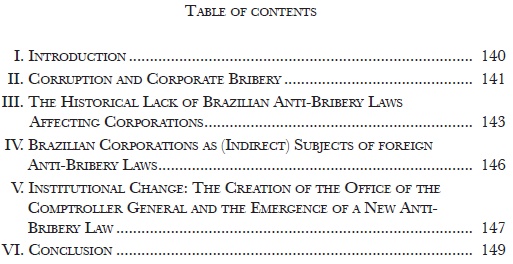
<body><![CDATA[<p align="justify"><font face="verdana" size="2">In this note, we address the status of Brazilian law in relation to corporate bribery. The note is structured in four sections and a conclusion. In Section 1, we start by defining corruption and demonstrating that bribery is one of the many forms in which corruption can occur. We frame the bribery dynamics under the "Principal&#45;Agent&#45;Client" approach, indicating the importance of placing strong emphasis on the role played by the client, <i>i.e.,</i> the bribe&#45;payer/ the corporation, in the design of anti&#45;bribery policies. Section 2 captures the historical lack of Brazilian anti&#45;corruption laws that have an impact on corporations in Brazil. Section 3 deals with companies connected to Brazil in some way that have been investigated and prosecuted in foreign jurisdictions under corruption charges. Section 4 focuses on the Brazilian recent experience concerning institutional changes and the approval of a new anti&#45;bribery law.</font></p>  	    <p>&nbsp;</p>  	    <p align="justify"><font face="verdana" size="2"><b>II. Corruption and Corporate Bribery</b></font></p>  	    <p align="justify"><font face="verdana" size="2">Corruption is an endemic problem present in many countries, including emerging economies such as Brazil. Defined as the "abuse of public office for private gain"<sup><a href="#notas">2</a></sup> and perceived as a major obstacle to development, corruption has long been associated with the inappropriate use of public funds,<sup><a href="#notas">3</a></sup> inefficient public policies,<sup><a href="#notas">4</a></sup> a loss of public confidence in democracy,<sup><a href="#notas">5</a></sup> procurement frauds and other anti&#45;competitive conducts,<sup><a href="#notas">6</a></sup> and a decrease in foreign direct investment inflows.<sup><a href="#notas">7</a></sup> As a product of human creativity, corruption can take several forms, the most common being patronage, embezzlement, trading influence, abuse of functions and, of course, bribery.<sup><a href="#notas">8</a></sup></font></p>  	    <p align="justify"><font face="verdana" size="2">This note employs the term bribery to refer to "use of a reward to pervert the judgment of a person in a position of trust."<sup><a href="#notas">9</a></sup> Reports of bribery have existed since the beginning of human history in different cultures around the globe.<sup><a href="#notas">10</a></sup> (Public) bribery<sup><a href="#notas">11</a></sup> is a result of constant interaction between public and private interests within the structure of the State. Accordingly, there will be incentives for corrupt practices whenever a public authority exercises her or his discretion on the distribution of a benefit, or a cost to the private sector.<sup><a href="#notas">12</a></sup> In other words, on one side of the bargain, there is the State, empowered to buy and sell goods and services, offer concessions and distribute subsidies &#91;benefits&#93;, as well as to collect taxes, enforce regulations and require authorizations &#91;costs&#93;. On the other side, there is the private sector, with economic power and willing to pay for benefits or to reduce costs. Given the central role of the State in many countries and the great influence of the private sector in most countries of the world, the existence of bribery &#151;at varying degrees&#151; is intuitive.</font></p>  	    <p align="justify"><font face="verdana" size="2">Scholars have long been concerned with bribery as a public policy issue and in response, have created models to help understand and solve bribery&#45;related problems. One way of approaching the bribery dynamics is through the "Principal&#45;Agent&#45;Client" model proposed by Klitgaard.<sup><a href="#notas">13</a></sup> The "principal" is portrayed as a superior officer in the public administration; the "agent" as a petty officer acting as a liaison between the "principal" and the "client;" and the "client" is represented by the private sector. "Principal," "agent" and "client" hold different interests.</font></p>  	    <p align="justify"><font face="verdana" size="2">The "principal," who is responsible for creating and implementing anti&#45;corruption policies, should have knowledge that the "agent" balances the benefits of taking a bribe against the costs of being caught. Meanwhile, the "client" feels compelled to corrupt the "agent" in order to obtain benefits unless he can foresee real chances of being punished. Accordingly, corruption can be defined as a "crime of calculation" and a matter of opportunity.<sup><a href="#notas">14</a></sup></font></p>  	    <p align="justify"><font face="verdana" size="2">Traditionally, policy makers and scholars have centered their anti&#45;bribery efforts on the role of the "agent," in this case, the "bribe taker." Despite the undeniable importance of this strategy, a more comprehensive approach has been widely adopted in recent years. This new approach emphasizes the role of the "client" (the "bribe payer") in the bribery dynamics since the private sector plays a fundamental role of providing economic resources for the machinery of corruption.</font></p>  	    <p align="justify"><font face="verdana" size="2">Milton Friedman once said that the "only social responsibility of business is to increase its profits."<sup><a href="#notas">15</a></sup> This assertion reflects the economic rationale that drives enterprises, but does not correspond to today's societal expectations on the behaviour or the private sector. Nowadays, the concept of governance prevails: the problems of society shall not be administered only by the State, but also by private actors, at local and global levels.<sup><a href="#notas">16</a></sup> In a governance environment, companies should be accountable for the impact their "activities may have on the social, political, economic and development aspects of society."<sup><a href="#notas">17</a></sup> Under this new approach, the accountability for monitoring corrupt practices is shared by the State and corporations. It is the State's responsibility to create a system of incentives and punishments to render corruption less attractive to corporations. The development of anti&#45;corruption laws focused on business practices can be an important mechanism for this purpose.</font></p>  	    <p>&nbsp;</p>  	    ]]></body>
<body><![CDATA[<p align="justify"><font face="verdana" size="2"><b>III. The Historical Lack of Brazilian Anti&#45;Bribery Laws Affecting Corporations</b></font></p>  	    <p align="justify"><font face="verdana" size="2">Like many other Latin American countries, Brazil is perceived as highly corrupt.<sup><a href="#notas">18</a></sup> In a recent poll conducted by Transparency International,<sup><a href="#notas">19</a></sup> an NGO committed to stopping corruption and promoting transparency, Brazil scored 4.3 in its corruption perception index,<sup><a href="#notas">20</a></sup> which places the country closer to highly corrupt than to clean. Although Brazil has ratified the most important international anti&#45;corruption treaties,<sup><a href="#notas">21</a></sup> the country has an incomplete legal framework on matters related to bribery. While its laws punish public servants involved in corrupt practices, they undermine the role of businesses in this process. Until 2013, there were few laws that could be enforced against "clients," which clearly shows that the Brazilian anti&#45;corruption laws and policies then in place contradicted the theoretical model proposed by Klitgaard.</font></p>  	    <p align="justify"><font face="verdana" size="2">At first, Brazil did not possess strong substantive laws to punish individuals and corporations engaged in bribery. Over the course of regulating this matter, the country has legislated in a piecemeal manner. The first piece of legislation dealing with corruption in our analysis is the Brazilian Criminal Code &#91;Decree Law No. 2.848&#93;.<sup><a href="#notas">22</a></sup> Article 333 provides criminal penalties for anyone who offers or promises undue advantage to a public servant in exchange for having her or him exercise, or refrain from exercising, her or his official duties. In 2002, Brazil reformed its criminal code and criminalized the practice of bribery in the context of international commercial transactions.<sup><a href="#notas">23</a></sup> Although important, this legislation is insufficient to control corruption in businesses since Brazilian law does not contemplate criminal liability for corporations, except in the case of environmental crimes.</font></p>  	    <p align="justify"><font face="verdana" size="2">Another piece of legislation worth analyzing is Law No. 8.666,<sup><a href="#notas">24</a></sup> which regulates biddings and contracts with the public administration, and establishes fines and temporary suspension from participation in future bidding procedures for corporations that have engaged in corruption. In such instances, the competent authorities issue a certificate of ineligibility <i>&#91;Declarando de inidoneidade&#93;,</i> a formal prohibition to celebrate contracts with the public administration (municipal, state, and federal levels) for a certain period of time. Under this law, sanctions are enforced through different channels. First, the public authority responsible for the bidding procedure, either at the municipal, state, or federal level puts into effect the sanction. Alternatively, sanctions can be levied by another internal body of the public administration, the Office of the Comptroller <i>&#91;Controladorias&#93;<sup><a href="#notas">25</a></sup></i> or an external body like the Audit Courts <i>&#91;Tribunais de</i> Contas&#93;.<sup><a href="#notas">26</a></sup></font></p>  	    <p align="justify"><font face="verdana" size="2">Aside from Law No. 8.666, corporations acting as bribe payers in Brazil may also be residually subject to Law No. 8.429,<sup><a href="#notas">27</a></sup> commonly referred to as the Administrative Misconduct Law <i>&#91;Lei de Improbidade Administrativa&#93;.</i> This law establishes the sanctions applicable to public servants who engage in unjust enrichment during the course of their activities. The available sanctions vary from political sanctions (i.e., the suspension of political rights) to civil sanctions (i.e., damages, fines, and suspension from contracting with the government or from obtaining subsidies). Procedurally, a lawsuit is filed by the Public Prosecutor's Office <i>&#91;Ministerio P&uacute;blico&#93;<sup><a href="#notas">28</a></sup></i> or by the Office of Public Advocacy <i>&#91;Advocada P&uacute;blica&#93;.<sup><a href="#notas">29</a></sup></i></font></p>  	    <p align="justify"><font face="verdana" size="2">The objective of the Administrative Misconduct Law is to prevent and punish acts of this type. The focus lies on the public sector, but civil sanctions against private actors are extended only if a private actor instigates, aids or benefits from an act of misconduct committed by the public servant. Since punishment is conditioned upon proof of actual misconduct, a burden rarely met, this law does little to combat corruption in businesses in Brazil.</font></p>  	    <p align="justify"><font face="verdana" size="2">In sum, these laws are clearly insufficient to establish an effective deterrent system against bribery. The current Criminal Code is unable to establish an effective system of criminal liability for corporations engaging in bribery. Although it imposes fines and temporary suspensions from contracting with the public administration, Law 8.666 is too limited in its scope to be able to change the <i>status quo.</i> The Administrative Misconduct Law, the scope of which is more general, does little to punish corrupt corporations, for the standards currently in place for burden of proof are so high that they are only rarely met. Not without reason did OECD experts recently conclude that Brazil lacks a proper legal framework endowed with dissuasive sanctions to establish an effective system against corporate bribery.<sup><a href="#notas">30</a></sup></font></p>  	    <p>&nbsp;</p>  	    <p align="justify"><font face="verdana" size="2"><b>IV. Brazilian Corporations as (Indirect) Subjects of foreign Anti&#45;Bribery Laws</b></font></p>  	    <p align="justify"><font face="verdana" size="2">Despite the lack of bribery laws applicable to "clients" in Brazil, Brazilian corporations have been at least indirectly subject to investigation and sanctions in foreign jurisdictions, as a result of the extraterritorial aspect of foreign anti&#45;bribery laws. The most effective legal system against bribery committed by Brazilian corporations is exercised by the United States with its Foreign Corrupt Practices Act &#91;FCPA&#93;, a statute that punishes U.S. corporations and foreign companies connected to U.S. jurisdiction<sup><a href="#notas">31</a></sup> engaged in bribery abroad.<sup><a href="#notas">32</a></sup> Several cases can be cited to illustrate this situation. The cases that follow describe instances in which American parent companies of Brazilian affiliates were investigated, and some were even punished for corrupt practices incurred by their affiliates. Although the Brazilian affiliates were not directly involved in the litigation, indirect consequences, such as firing employees with dirty hands, changing the internal structure of the corporation, improving internal control systems against bribery and so forth, should have ensued.</font></p>  	    ]]></body>
<body><![CDATA[<p align="justify"><font face="verdana" size="2">The first such case that effectively stopped bribery involving a Brazilian company took place in the safety equipment manufacturing business. In 2006, Tyco International faced prosecution by U.S. authorities when it bought a Brazilian company, Earth Tech Brazil, which was accused of corruption in Brazil.<sup><a href="#notas">33</a></sup> A $51 million fine followed.</font></p>  	    <p align="justify"><font face="verdana" size="2">Similarly, in 2009, Nature's Sunshine Products, a company in the business of health supplements, had to pay a $600,000 fine for acts committed by its Brazilian subsidiary. Nature's Sunshine Products was sued before a U.S. court after it was revealed that its Brazilian affiliate had bribed customs officials to ease restrictions on its products.<sup><a href="#notas">34</a></sup></font></p>  	    <p align="justify"><font face="verdana" size="2">In August 2010, U.S. authorities initiated proceedings against the American parent company Universal Corporation for acts committed by Universal Leaf Tobacco LTDA &#91;Universal Brazil&#93;, a limited liability company incorporated under Brazilian laws and headquartered in the city of Santa Cruz do Sul, in Southern Brazil. Universal Brazil is affiliated with the U.S. Universal Corporation, the world's leading tobacco merchant and processor. The Brazilian affiliate corporation was charged with bribing a State company in Thailand in exchange for purchasing Brazilian tobacco. The dispute ended with Universal Corporation's paying a fine in the amount of $4.4 million.<sup><a href="#notas">35</a></sup></font></p>  	    <p align="justify"><font face="verdana" size="2">Presently, a bribery investigation is underway against EMBRAER, a giant Brazilian aircraft manufacturer. EMBRAER is subject to the U.S. FCPA since its shares are issued and traded on the New York Stock Exchange. Following the United States' footsteps and with stronger anti&#45;bribery laws in place, several other jurisdictions are directing their investigations and enforcement mechanisms against Brazilian corporations that are allegedly engaged in bribery. According to a 2011 Transparency International report,<sup><a href="#notas">36</a></sup> four Brazilian corporations were investigated for corruption in the United Nations "Oil&#45;for&#45;Food" program.<sup><a href="#notas">37</a></sup> Charges of bribery committed by Brazilian corporations in Argentina, Bolivia, the Dominican Republic, Italy and Russia have also been reported.<sup><a href="#notas">38</a></sup></font></p>  	    <p>&nbsp;</p>  	    <p align="justify"><font face="verdana" size="2"><b>V. Institutional Change: The Creation of the Office of the Comptroller General and the Emergence of a New Anti&#45;Bribery Law</b></font></p>  	    <p align="justify"><font face="verdana" size="2">In 2003, Brazil created its first governmental body specializing in anti&#45;corruption policies. The Office of Comptroller General <i>&#91;Controladoria Geral da Unido</i> &#45; <i>CGU&#93;</i> is in charge of assisting the President of the Republic in matters within the Executive Branch which are related to defending public assets and enhancing management transparency through internal control activities, public audits, corrective and disciplinary measures, corruption prevention and combat, and coordinating ombudsman's activities.<sup><a href="#notas">39</a></sup> It exercises the dual function of internal auditor and as a disciplinary body for federal public servants. Although the scope of the Office of the Comptroller General is limited to corruption cases within the federal administration, it represents a positive difference in the overall anti&#45;corruption culture in Brazil, which can influence anti&#45;corruption practices outside the federal structure.</font></p>  	    <p align="justify"><font face="verdana" size="2">In its first few years of existence, the Office of Comptroller General created the "National Registry of Inapt and Suspicious Enterprises" <i>&#91;Cadastro Nacional de Empresas Inid&oacute;neas e Suspeitas &#45; CEIS&#93;,</i> a database that contains information on individuals and companies that have been suspended from participating in bidding procedures at any government level. In addition to data about the penalties imposed by federal authority, <i>CEIS</i> also contains information related to the sanctions imposed by the Federal Audit Court <i>&#91;Tribunal de Contas da Unido&#93;</i> and the Court's decisions on administrative improbity. Currently, twelve states<sup><a href="#notas">40</a></sup> and the Federal District already include this information in their information systems. In the future, a public administrator from any part of Brazil will be able to access this database and prevent these companies from participating in government contracts. On the other hand, if substantive anti&#45;corruption laws have limited effectiveness, there is only so much the Office of the Comptroller General can do.</font></p>  	    <p align="justify"><font face="verdana" size="2">Repeated bribery condemnations from abroad, and international and internal pressure for a bribery&#45;free country seemed to have echoed in the Brazilian legislative branch recently. After three years of discussions, Law No. 12.846,<sup><a href="#notas">41</a></sup> which deals with civil and administrative corporate liability involving corrupt practices, was approved by Congress and will enter into force in 2014. Originally proposed by former President Lula da Silva, this law is the result of a joint initiative between the Office of the Comptroller General, the Ministry of Justice and the Office of Federal Public Advocacy.</font></p>  	    <p align="justify"><font face="verdana" size="2">Law No. 12.846 creates a strict liability regime for corporate entities that engage in bribery or procurement fraud. The administrative penalties provided in the Law include fines from 0.1% up to 20% of the gross sales of the previous year, and publication of the decision in the press, which in turn affects the company's image. According to the text of this law, penalties may be milder upon the proven existence of "integrity mechanisms, audit and whistle blowing, and proof of implementation of codes of ethics" within the corporation. This requirement would fall under the category of a "compliance program." This law also has a section on "leniency agreements." In other words, by signing an agreement, a corporation can avoid severe penalties after pledging to cease corrupt practices and agreeing to cooperate with public authorities on the identification of irregularities. At a federal level, the Office of the Comptroller General is the public authority in charge of prosecuting cases concerning corporations involved in bribery.</font></p>  	    ]]></body>
<body><![CDATA[<p align="justify"><font face="verdana" size="2">In addition to administrative penalties, Law No. 12.846 stipulates that both the Office of Public Advocacy and the Public Prosecutor's Office may bring lawsuits against corporations on claims involving the loss of property rights, requests for partial suspension of corporate activities or the compulsory dissolution of legal entities involved in bribery.</font></p>  	    <p align="justify"><font face="verdana" size="2">Prior to being approved, Law No. 12.846 generated much debate in Brazil. Appraising the initiative, the Brazilian Institute for Business Law &#91;IBRADEMP&#93;, a non&#45;profit organization, highlighted the importance of an anti&#45;bribery system based on compliance programs which transfers part of the cost of corruption prevention to corporations. However, the Institute notes that, unlike from anti&#45;bribery laws in force in other countries, the Brazilian Law does not provide for a minimum requirement in compliance programs, nor does it clearly define what the exact benefits accrued from maintaining such programs are.<sup><a href="#notas">42</a></sup> It bears mentioning that although a compliance mechanism is not yet provided in Brazilian laws, several corporations with activities in the country, especially those aimed at foreign markets, have already adopted such programs. Large auditing companies and specialized law firms offer this service to Brazilian corporations.<sup><a href="#notas">43</a></sup></font></p>  	    <p>&nbsp;</p>  	    <p align="justify"><font face="verdana" size="2"><b>VI. Conclusion</b></font></p>  	    <p align="justify"><font face="verdana" size="2">Brazil seems to have finally embarked on the difficult journey to eliminate corporate bribery. Such a journey started with the adoption of criminal, administrative, and civil sanctions for those who chose to engage in such activities. Unfortunately, the results of these early laws demonstrate that they have not been sufficient to achieve the overall goal of the elimination of corporate bribery. Part of the reason for this unsuccessful story may have to do with the fact that these statutes were not addressed to the specific case of corporate bribery as such. In addition, some of the flaws of these laws may be attributed to their content and others to matters involving procedure. In terms of procedure, the creation of Brazil's first governmental body specialized in anti&#45;corruption policies, the Office of Comptroller General, certainly makes a positive difference. In terms of substance, the approval of Law No. 12.846 marks unprecedented progress for Brazil. It is the first statute in the country's history to target the "client" in the bribery equation, as prescribed by Klitgaard's theoretical model. It does so through a system of disincentives and benefits, which involves heavy sanctions for bribe payers and advantages for those companies that conduct their activities ethically. Law No. 12.846 also innovates by adopting compliance mechanisms and "leniency agreements." Although this new legal framework looks good on paper, its actual capacity to dissuade corporate bribery is yet to be seen.</font></p>  	    <p>&nbsp;</p>  	    <p align="justify"><font face="verdana" size="2"><a name="notas"></a><b>Notes</b></font></p>  	    <p align="justify"><font face="verdana" size="2">* Professor of International Law and Director of the <i>Center for Law, Globalization and Development</i> at the School of Law at the Federal University of Rio Grande do Sul, Brazil. He holds a Ph.D. and LL.M. in International Law from the University of Texas at Austin; and a Masters in Law and Economic Globalization from the University of Paris 1 / Institute of Political Studies of Paris.</font></p>  	    <p align="justify"><font face="verdana" size="2"><sup>**</sup> Ph.D. Candidate in International Strategic Studies at the Federal University of Rio Grande do Sul. He holds an LL.M. from UNISINOS. In 2013, he was a research fellow at the Center for Latin American and Latino Studies at American University (Washington, D.C.).</font></p>  	    <!-- ref --><p align="justify"><font face="verdana" size="2"><sup>1 </sup>Marilda Rosado de S&aacute; Ribeiro &amp; Carolina Ara&uacute;jo de Azevedo, <i>Corruption and Foreign Investments in Brazil,</i> 1 Panorama of Brazilian Law 39, 48 (2013).    &nbsp;&nbsp;&nbsp;&nbsp;&nbsp;&nbsp;&nbsp;&nbsp;[&#160;<a href="javascript:void(0);" onclick="javascript: window.open('/scielo.php?script=sci_nlinks&ref=5266328&pid=S1870-0578201400020000600001&lng=','','width=640,height=500,resizable=yes,scrollbars=1,menubar=yes,');">Links</a>&#160;]<!-- end-ref --></font></p>  	    <!-- ref --><p align="justify"><font face="verdana" size="2"><sup>2 </sup>The World Bank, Helping countries combat corruption 8 (Poverty Reduction and Economic Management Network, 1997) available at <a href="http://www1.worldbank.org/publicsector/anticorrupt/corruptn/corrptn.pdf" target="_blank">http://www1.worldbank.org/publicsector/anticorrupt/corruptn/corrptn.pdf</a>.    &nbsp;&nbsp;&nbsp;&nbsp;&nbsp;&nbsp;&nbsp;&nbsp;[&#160;<a href="javascript:void(0);" onclick="javascript: window.open('/scielo.php?script=sci_nlinks&ref=5266330&pid=S1870-0578201400020000600002&lng=','','width=640,height=500,resizable=yes,scrollbars=1,menubar=yes,');">Links</a>&#160;]<!-- end-ref --></font></p>  	    <!-- ref --><p align="justify"><font face="verdana" size="2"><sup>3 </sup>Paolo Mauro, <i>The Effects of Corruption on Growth, Investment, and Government Expenditure: A Cross Country Analysis, in</i> Corruption and the Global Economy 83, 87 (Kimberly Ann Elliott ed., 1997).    &nbsp;&nbsp;&nbsp;&nbsp;&nbsp;&nbsp;&nbsp;&nbsp;[&#160;<a href="javascript:void(0);" onclick="javascript: window.open('/scielo.php?script=sci_nlinks&ref=5266332&pid=S1870-0578201400020000600003&lng=','','width=640,height=500,resizable=yes,scrollbars=1,menubar=yes,');">Links</a>&#160;]<!-- end-ref --></font></p>  	    <!-- ref --><p align="justify"><font face="verdana" size="2"><sup>4 </sup>Andrei Schleifer &amp; Robert W. Vishny, <i>Corruption,</i> 108 Q. J. of Econ. 599, 616 (1993).    &nbsp;&nbsp;&nbsp;&nbsp;&nbsp;&nbsp;&nbsp;&nbsp;[&#160;<a href="javascript:void(0);" onclick="javascript: window.open('/scielo.php?script=sci_nlinks&ref=5266334&pid=S1870-0578201400020000600004&lng=','','width=640,height=500,resizable=yes,scrollbars=1,menubar=yes,');">Links</a>&#160;]<!-- end-ref --></font></p>  	    <!-- ref --><p align="justify"><font face="verdana" size="2"><sup>5 </sup>Vito Tanzi, <i>Corruption around the World: Causes, Consequences, Scope and Cures,</i> 45 IMF Staff Papers 559, 583 (1998).    &nbsp;&nbsp;&nbsp;&nbsp;&nbsp;&nbsp;&nbsp;&nbsp;[&#160;<a href="javascript:void(0);" onclick="javascript: window.open('/scielo.php?script=sci_nlinks&ref=5266336&pid=S1870-0578201400020000600005&lng=','','width=640,height=500,resizable=yes,scrollbars=1,menubar=yes,');">Links</a>&#160;]<!-- end-ref --></font></p>      <!-- ref --><p align="justify"><font face="verdana" size="2"><sup>6 </sup>Fritz F. Heimann, <i>Combating International Corruption: The Role of the Business Community, in</i> Corruption and the Global Economy 147, 148 (Kimberly Ann Elliot ed., 1997).    &nbsp;&nbsp;&nbsp;&nbsp;&nbsp;&nbsp;&nbsp;&nbsp;[&#160;<a href="javascript:void(0);" onclick="javascript: window.open('/scielo.php?script=sci_nlinks&ref=5266338&pid=S1870-0578201400020000600006&lng=','','width=640,height=500,resizable=yes,scrollbars=1,menubar=yes,');">Links</a>&#160;]<!-- end-ref --></font></p>  	    <!-- ref --><p align="justify"><font face="verdana" size="2"><sup>7</sup> Shang&#45;Jin Wei, <i>How Taxing is Corruption on International Investors?,</i> 82 Rev. of Econ. &amp; Stat. 1, 1 (2000).    &nbsp;&nbsp;&nbsp;&nbsp;&nbsp;&nbsp;&nbsp;&nbsp;[&#160;<a href="javascript:void(0);" onclick="javascript: window.open('/scielo.php?script=sci_nlinks&ref=5266340&pid=S1870-0578201400020000600007&lng=','','width=640,height=500,resizable=yes,scrollbars=1,menubar=yes,');">Links</a>&#160;]<!-- end-ref --></font></p>  	    <!-- ref --><p align="justify"><font face="verdana" size="2"><sup>8</sup> <i>See</i> Oxford English Dictionary (1970) (explaining that the word "bribery" comes from Old French,    &nbsp;&nbsp;&nbsp;&nbsp;&nbsp;&nbsp;&nbsp;&nbsp;[&#160;<a href="javascript:void(0);" onclick="javascript: window.open('/scielo.php?script=sci_nlinks&ref=5266342&pid=S1870-0578201400020000600008&lng=','','width=640,height=500,resizable=yes,scrollbars=1,menubar=yes,');">Links</a>&#160;]<!-- end-ref --> "briberie", a small piece of bread that was usually given to beggars).</font></p>  	    <!-- ref --><p align="justify"><font face="verdana" size="2"><sup>9</sup> Joseph S. Nye Jr., <i>Corruption and Political Development: A Cost&#45;Benefit Analysis, 61</i> Am. Pol. Sci. Rev. 417, 419 (June 1967).    &nbsp;&nbsp;&nbsp;&nbsp;&nbsp;&nbsp;&nbsp;&nbsp;[&#160;<a href="javascript:void(0);" onclick="javascript: window.open('/scielo.php?script=sci_nlinks&ref=5266344&pid=S1870-0578201400020000600009&lng=','','width=640,height=500,resizable=yes,scrollbars=1,menubar=yes,');">Links</a>&#160;]<!-- end-ref --></font></p>  	    <!-- ref --><p align="justify"><font face="verdana" size="2"><sup>10</sup> John T. Noonan Jr., Subornos 35 (Bertrand Brasil ed., 1989).    &nbsp;&nbsp;&nbsp;&nbsp;&nbsp;&nbsp;&nbsp;&nbsp;[&#160;<a href="javascript:void(0);" onclick="javascript: window.open('/scielo.php?script=sci_nlinks&ref=5266346&pid=S1870-0578201400020000600010&lng=','','width=640,height=500,resizable=yes,scrollbars=1,menubar=yes,');">Links</a>&#160;]<!-- end-ref --></font></p>  	    <p align="justify"><font face="verdana" size="2"><sup>11</sup> Due to the limited space for the article, we will not deal with "private&#45;to&#45;private" bribery.</font></p>  	    ]]></body>
<body><![CDATA[<!-- ref --><p align="justify"><font face="verdana" size="2"><sup>12 </sup>Susan Rose&#45;Ackerman, <i>The Political Economy of Corruption, in</i> Corruption and the Global Economy 31, 31 (Kimberly Ann Elliott ed., 1997).    &nbsp;&nbsp;&nbsp;&nbsp;&nbsp;&nbsp;&nbsp;&nbsp;[&#160;<a href="javascript:void(0);" onclick="javascript: window.open('/scielo.php?script=sci_nlinks&ref=5266349&pid=S1870-0578201400020000600011&lng=','','width=640,height=500,resizable=yes,scrollbars=1,menubar=yes,');">Links</a>&#160;]<!-- end-ref --></font></p>  	    <!-- ref --><p align="justify"><font face="verdana" size="2"><sup>13</sup> Robert Klitgaard, A Corrup&ccedil;&atilde;o sob Controle 83 (Jorge Zahar ed., 1994).    &nbsp;&nbsp;&nbsp;&nbsp;&nbsp;&nbsp;&nbsp;&nbsp;[&#160;<a href="javascript:void(0);" onclick="javascript: window.open('/scielo.php?script=sci_nlinks&ref=5266351&pid=S1870-0578201400020000600012&lng=','','width=640,height=500,resizable=yes,scrollbars=1,menubar=yes,');">Links</a>&#160;]<!-- end-ref --></font></p>  	    <!-- ref --><p align="justify"><font face="verdana" size="2"><sup>14</sup> Robert Klitgaard, Ronald Maclean&#45;Abaroa &amp; Lindsey H. Parris, Corrupt Cities: A Practical Guide to Cure and Prevention 27 (World Bank Publications ed., 2000).    &nbsp;&nbsp;&nbsp;&nbsp;&nbsp;&nbsp;&nbsp;&nbsp;[&#160;<a href="javascript:void(0);" onclick="javascript: window.open('/scielo.php?script=sci_nlinks&ref=5266353&pid=S1870-0578201400020000600013&lng=','','width=640,height=500,resizable=yes,scrollbars=1,menubar=yes,');">Links</a>&#160;]<!-- end-ref --></font></p>  	    <!-- ref --><p align="justify"><font face="verdana" size="2"><sup>15</sup> Milton Friedman, <i>The Social Responsibility of Business is Increase Its Profits,</i> N.Y. Times, Sep. 13, 1970, at 01.    &nbsp;&nbsp;&nbsp;&nbsp;&nbsp;&nbsp;&nbsp;&nbsp;[&#160;<a href="javascript:void(0);" onclick="javascript: window.open('/scielo.php?script=sci_nlinks&ref=5266355&pid=S1870-0578201400020000600014&lng=','','width=640,height=500,resizable=yes,scrollbars=1,menubar=yes,');">Links</a>&#160;]<!-- end-ref --></font></p>  	    <!-- ref --><p align="justify"><font face="verdana" size="2"><sup>16</sup> Comissao sobre Governanqa Global, Nossa Comunidade Global 02 (FGV ed., 1995).    &nbsp;&nbsp;&nbsp;&nbsp;&nbsp;&nbsp;&nbsp;&nbsp;[&#160;<a href="javascript:void(0);" onclick="javascript: window.open('/scielo.php?script=sci_nlinks&ref=5266357&pid=S1870-0578201400020000600015&lng=','','width=640,height=500,resizable=yes,scrollbars=1,menubar=yes,');">Links</a>&#160;]<!-- end-ref --></font></p>  	    ]]></body>
<body><![CDATA[<!-- ref --><p align="justify"><font face="verdana" size="2"><sup>17</sup> A. Adeyeye, <i>The Role of Global Governance in CSR,</i> 9 Santa Clara J. Int'l L. 147, 149 (2011).    &nbsp;&nbsp;&nbsp;&nbsp;&nbsp;&nbsp;&nbsp;&nbsp;[&#160;<a href="javascript:void(0);" onclick="javascript: window.open('/scielo.php?script=sci_nlinks&ref=5266359&pid=S1870-0578201400020000600016&lng=','','width=640,height=500,resizable=yes,scrollbars=1,menubar=yes,');">Links</a>&#160;]<!-- end-ref --></font></p>  	    <!-- ref --><p align="justify"><font face="verdana" size="2"><sup>18</sup><i> See</i> Matthew M. Taylor, <i>Corruption, Accountability Reforms, and Democracy in Brazil,</i> in Corruption and Democracy in Latin America 150, 151 (Stephen D. Morris &amp; Charles H. Blake eds., 2009) (noting that all post&#45;    &nbsp;&nbsp;&nbsp;&nbsp;&nbsp;&nbsp;&nbsp;&nbsp;[&#160;<a href="javascript:void(0);" onclick="javascript: window.open('/scielo.php?script=sci_nlinks&ref=5266361&pid=S1870-0578201400020000600017&lng=','','width=640,height=500,resizable=yes,scrollbars=1,menubar=yes,');">Links</a>&#160;]<!-- end-ref -->dictatorship administrations have been investigated on suspicions of corruption).</font></p>  	    <p align="justify"><font face="verdana" size="2"><sup>19</sup> The 2012 Corruption Perception Index measured the perceived levels of public sector corruption in 174 countries and territories around the world. The ranking is carried out through interviews conducted by respectable institutions, reflecting the views of observers around the world. They are consulted experts, risk analysts and businessmen, including people who live and work in the countries evaluated.</font></p>  	    <!-- ref --><p align="justify"><font face="verdana" size="2"><sup>20</sup> Transparency International, Corruption Perception Index (Transparency Int'l ed., 2012). <a href="http://www.transparency.org/cpi2012/results" target="_blank">http://www.transparency.org/cpi2012/results</a>.    &nbsp;&nbsp;&nbsp;&nbsp;&nbsp;&nbsp;&nbsp;&nbsp;[&#160;<a href="javascript:void(0);" onclick="javascript: window.open('/scielo.php?script=sci_nlinks&ref=5266364&pid=S1870-0578201400020000600018&lng=','','width=640,height=500,resizable=yes,scrollbars=1,menubar=yes,');">Links</a>&#160;]<!-- end-ref --></font></p>  	    <p align="justify"><font face="verdana" size="2"><sup>21</sup> Brazil has ratified the Organization of American States (OAS) Inter&#45;American Convention against Corruption, the Organization for Economic Cooperation and Development's (OECD) Convention on Combating Bribery of Foreign Public Officials in International Business Transactions and the United Nations (UN) Convention against Corruption. The main goal of these international law instruments is to establish a commitment from countries currently facing bribery issues through the exchange of experiences and the harmonization of national laws. All treaties contain obligations to prevent and punish bribery, with a focus on the supply side, usually a corporation.</font></p>  	    <!-- ref --><p align="justify"><font face="verdana" size="2"><sup>22</sup> Decreto&#45;Lei No. 2.848, de 7 de Dezembro de 1940, Di&aacute;rio Oficial da Uni&atilde;o &#91;D.O.U.&#93; de 31.12.1940 (Brazil).    &nbsp;&nbsp;&nbsp;&nbsp;&nbsp;&nbsp;&nbsp;&nbsp;[&#160;<a href="javascript:void(0);" onclick="javascript: window.open('/scielo.php?script=sci_nlinks&ref=5266367&pid=S1870-0578201400020000600019&lng=','','width=640,height=500,resizable=yes,scrollbars=1,menubar=yes,');">Links</a>&#160;]<!-- end-ref --></font></p>  	    ]]></body>
<body><![CDATA[<!-- ref --><p align="justify"><font face="verdana" size="2"><sup>23</sup> C&oacute;digo Penal &#91;C.P.&#93; &#91;Penal Code&#93;, art. 337B, 2002 (Brazil).    &nbsp;&nbsp;&nbsp;&nbsp;&nbsp;&nbsp;&nbsp;&nbsp;[&#160;<a href="javascript:void(0);" onclick="javascript: window.open('/scielo.php?script=sci_nlinks&ref=5266369&pid=S1870-0578201400020000600020&lng=','','width=640,height=500,resizable=yes,scrollbars=1,menubar=yes,');">Links</a>&#160;]<!-- end-ref --></font></p>  	    <!-- ref --><p align="justify"><font face="verdana" size="2"><sup>24</sup> Lei No. 8.666, de 21 de Junho de 1993, D.O.U. de 6.7.1994 (Brazil).    &nbsp;&nbsp;&nbsp;&nbsp;&nbsp;&nbsp;&nbsp;&nbsp;[&#160;<a href="javascript:void(0);" onclick="javascript: window.open('/scielo.php?script=sci_nlinks&ref=5266371&pid=S1870-0578201400020000600021&lng=','','width=640,height=500,resizable=yes,scrollbars=1,menubar=yes,');">Links</a>&#160;]<!-- end-ref --></font></p>  	    <p align="justify"><font face="verdana" size="2"><sup>25</sup> The Offices of Comptroller are bodies in the executive branch (at federal, state, and municipal levels) responsible for internal audits. At the federal level, it is called the Office of Comptroller General (Controladoria Geral da Uni&atilde;o).</font></p>  	    <p align="justify"><font face="verdana" size="2"><sup>26</sup> Audit Courts are bodies in the legislative branch (federal, state, and in some cases, municipal) responsible for external audits. At the federal level, it is called the Federal Audit Court (Tribunal de Contas da Uni&atilde;o).</font></p>  	    <!-- ref --><p align="justify"><font face="verdana" size="2"><sup>27</sup> Lei No. 8.429, de 2 Junho de 1992, D.O.U. de 3.6.1992 (Brazil).    &nbsp;&nbsp;&nbsp;&nbsp;&nbsp;&nbsp;&nbsp;&nbsp;[&#160;<a href="javascript:void(0);" onclick="javascript: window.open('/scielo.php?script=sci_nlinks&ref=5266375&pid=S1870-0578201400020000600022&lng=','','width=640,height=500,resizable=yes,scrollbars=1,menubar=yes,');">Links</a>&#160;]<!-- end-ref --></font></p>  	    <p align="justify"><font face="verdana" size="2"><sup>28</sup> The <i>Minist&eacute;rio P&uacute;blico</i> &#91;Public Prosecutor's Office&#93; is a body of independent public prosecutors acting at state and federal levels to prosecute criminal offenses and to defend other collective interests, such as environmental protection, consumer rights and human rights.</font></p>  	    <p align="justify"><font face="verdana" size="2"><sup>29</sup> The <i>Advocacia P&uacute;blica</i> &#91;Office of Public Advocacy&#93; has the function to defend the State's interests in courts and to provide legal counsel to the Executive Branch (at federal, state, and municipal levels). It is not part of the Public Prosecutor's Office and is not independent body, as it reports to the head of Executive Branch.</font></p>  	    ]]></body>
<body><![CDATA[<!-- ref --><p align="justify"><font face="verdana" size="2"><sup>30</sup> Org. for Econ. Cooperation and Development, Brazil Phase 2: Follow&#45;Up Report on the Implementation of the Phase 2 Recommendations 3 (2010), <i>available at </i><a href="http://www.oecd.org/daf/anti&#45;bribery/anti&#45;briberyconvention/45518279.pdf" target="_blank">http://www.oecd.org/daf/anti&#45;bribery/anti&#45;briberyconvention/45518279.pdf</a>.    &nbsp;&nbsp;&nbsp;&nbsp;&nbsp;&nbsp;&nbsp;&nbsp;[&#160;<a href="javascript:void(0);" onclick="javascript: window.open('/scielo.php?script=sci_nlinks&ref=5266379&pid=S1870-0578201400020000600023&lng=','','width=640,height=500,resizable=yes,scrollbars=1,menubar=yes,');">Links</a>&#160;]<!-- end-ref --></font></p>  	    <p align="justify"><font face="verdana" size="2"><sup>31</sup> This legislation applies not only to U.S. companies, but also to their subsidiaries operating in foreign countries, joint ventures, and even foreign companies with operations or mere registration in the United States, as well as companies that trade on the U.S. stock exchange (issuers).</font></p>  	    <!-- ref --><p align="justify"><font face="verdana" size="2"><sup>32</sup> Mike Koehler, <i>The Story of the Foreign Corrupt Practices Act,</i> 73 Ohio St. L. J., 929 (2012).    &nbsp;&nbsp;&nbsp;&nbsp;&nbsp;&nbsp;&nbsp;&nbsp;[&#160;<a href="javascript:void(0);" onclick="javascript: window.open('/scielo.php?script=sci_nlinks&ref=5266382&pid=S1870-0578201400020000600024&lng=','','width=640,height=500,resizable=yes,scrollbars=1,menubar=yes,');">Links</a>&#160;]<!-- end-ref --></font></p>  	    <p align="justify"><font face="verdana" size="2"><sup>33</sup><i> SEC v. Tyco International Ltd.,</i> No. 06&#45;CV&#45;2942 (S.D.N.Y 2006).</font></p>  	    <p align="justify"><font face="verdana" size="2"><sup>34</sup><i> SEC v. Nature's Sunshine Products, Inc. et al.</i>, No. 09&#45;0672 (D. Utah 2009).</font></p>  	    <p align="justify"><font face="verdana" size="2"><sup>35</sup><i> SEC v. Universal Corp.,</i> No. 10&#45;cv&#45;1318 (D.D.C. Aug. 6, 2010). <i>See also</i> Transparency International, Progress Report 2011: Enforcement of the OECD Anti&#45;Bribery Convention 21 (Transparency Int'l ed., 2011).</font></p>  	    <p align="justify"><font face="verdana" size="2"><sup>36</sup><i> Id.</i></font></p>  	    <p align="justify"><font face="verdana" size="2"><sup>37</sup> The program "Oil&#45;for&#45;Food" was established by the United Nations in the 1990s during the economic embargo imposed on the regime of President Saddam Hussein. For humanitarian reasons, the sale of Iraqi oil on the foreign market was authorized in exchange for food and medicine. In 2005, an independent commission (Independent Inquiry Committee into the United Nations Oil&#45;for&#45;Food Programme) identified a number of illicit payments from companies desirous of participating in the program.</font></p>  	    ]]></body>
<body><![CDATA[<p align="justify"><font face="verdana" size="2"><sup>38</sup> Transparency International, <i>supra</i> note 35, at 22.</font></p>  	    <p align="justify"><font face="verdana" size="2"><sup>39</sup> As a central agency, CGU is also in charge of technically supervising all of the departments that make up the Internal Control System, the Disciplinary System and the Ombudsman's units of the Federal Executive Branch, providing normative guidance as required. CGU also fulfills the important role of being the representative of Brazilian government in global forums that discuss corruption.</font></p>  	    <p align="justify"><font face="verdana" size="2"><sup>40</sup> These states are Acre, Alagoas, Bahia, Cear&aacute;, Espirito Santo, Goi&aacute;s, Minas Gerais, Pernambuco, Piaui, Sergipe, S&atilde;o Paulo and Tocantins.</font></p>  	    <!-- ref --><p align="justify"><font face="verdana" size="2"><sup>41</sup> Lei No. 12.846, de 1 de agosto de 2013, D.O.U. de 2.8.2013 (Brazil).    &nbsp;&nbsp;&nbsp;&nbsp;&nbsp;&nbsp;&nbsp;&nbsp;[&#160;<a href="javascript:void(0);" onclick="javascript: window.open('/scielo.php?script=sci_nlinks&ref=5266392&pid=S1870-0578201400020000600025&lng=','','width=640,height=500,resizable=yes,scrollbars=1,menubar=yes,');">Links</a>&#160;]<!-- end-ref --></font></p>  	    <!-- ref --><p align="justify"><font face="verdana" size="2"><sup>42</sup> Comit&eacute; Anticorrup&ccedil;&atilde;o e Compliance do Instituto Brasileiro de Direito Empresarial, Coment&aacute;rios ao Projeto de Lei no. 6.826/2010 &#91;Comentarles on Draft Bill No. 6.826&#93; 11&#45;18 (2011) <i>available at </i><a href="http://www.ibrademp.org.br" target="_blank">http://www.ibrademp.org.br</a>.    &nbsp;&nbsp;&nbsp;&nbsp;&nbsp;&nbsp;&nbsp;&nbsp;[&#160;<a href="javascript:void(0);" onclick="javascript: window.open('/scielo.php?script=sci_nlinks&ref=5266394&pid=S1870-0578201400020000600026&lng=','','width=640,height=500,resizable=yes,scrollbars=1,menubar=yes,');">Links</a>&#160;]<!-- end-ref --></font></p>  	    <p align="justify"><font face="verdana" size="2"><sup>43 </sup>The "Big Four", the world's largest auditing firms (KPMG, Ernest &amp; Young, Deloitte and PricewaterhouseCoopers), offer the corruption prevention services in Brazil. The largest Brazilian law firms also have begun to work with compliance programs in corporations.</font></p>      ]]></body><back>
<ref-list>
<ref id="B1">
<nlm-citation citation-type="journal">
<person-group person-group-type="author">
<name>
<surname><![CDATA[Ribeiro]]></surname>
<given-names><![CDATA[Marilda Rosado de Sá]]></given-names>
</name>
<name>
<surname><![CDATA[Azevedo]]></surname>
<given-names><![CDATA[Carolina Araújo de]]></given-names>
</name>
</person-group>
<article-title xml:lang="en"><![CDATA[Corruption and Foreign Investments in Brazil]]></article-title>
<source><![CDATA[Panorama of Brazilian Law]]></source>
<year>2013</year>
<page-range>39</page-range></nlm-citation>
</ref>
<ref id="B2">
<nlm-citation citation-type="book">
<collab>The World Bank</collab>
<source><![CDATA[Helping countries combat corruption]]></source>
<year>1997</year>
<page-range>8</page-range><publisher-name><![CDATA[Poverty Reduction and Economic Management Network]]></publisher-name>
</nlm-citation>
</ref>
<ref id="B3">
<nlm-citation citation-type="">
<person-group person-group-type="author">
<name>
<surname><![CDATA[Mauro]]></surname>
<given-names><![CDATA[Paolo]]></given-names>
</name>
</person-group>
<article-title xml:lang="en"><![CDATA[The Effects of Corruption on Growth, Investment, and Government Expenditure: A Cross Country Analysis]]></article-title>
<person-group person-group-type="editor">
<name>
<surname><![CDATA[Elliott]]></surname>
<given-names><![CDATA[Kimberly Ann]]></given-names>
</name>
</person-group>
<source><![CDATA[Corruption and the Global Economy]]></source>
<year>1997</year>
<page-range>83</page-range></nlm-citation>
</ref>
<ref id="B4">
<nlm-citation citation-type="journal">
<person-group person-group-type="author">
<name>
<surname><![CDATA[Schleifer]]></surname>
<given-names><![CDATA[Andrei]]></given-names>
</name>
<name>
<surname><![CDATA[Vishny]]></surname>
<given-names><![CDATA[Robert W.]]></given-names>
</name>
</person-group>
<article-title xml:lang="en"><![CDATA[Corruption]]></article-title>
<source><![CDATA[Q. J. of Econ.]]></source>
<year>1993</year>
<page-range>599</page-range></nlm-citation>
</ref>
<ref id="B5">
<nlm-citation citation-type="journal">
<person-group person-group-type="author">
<name>
<surname><![CDATA[Tanzi]]></surname>
<given-names><![CDATA[Vito]]></given-names>
</name>
</person-group>
<article-title xml:lang="en"><![CDATA[Corruption around the World: Causes, Consequences, Scope and Cures]]></article-title>
<source><![CDATA[IMF Staff Papers]]></source>
<year>1998</year>
<page-range>559</page-range></nlm-citation>
</ref>
<ref id="B6">
<nlm-citation citation-type="">
<person-group person-group-type="author">
<name>
<surname><![CDATA[Heimann]]></surname>
<given-names><![CDATA[Fritz F.]]></given-names>
</name>
</person-group>
<article-title xml:lang="en"><![CDATA[Combating International Corruption: The Role of the Business Community]]></article-title>
<person-group person-group-type="editor">
<name>
<surname><![CDATA[Elliot]]></surname>
<given-names><![CDATA[Kimberly Ann]]></given-names>
</name>
</person-group>
<source><![CDATA[Corruption and the Global Economy]]></source>
<year>1997</year>
<page-range>147</page-range></nlm-citation>
</ref>
<ref id="B7">
<nlm-citation citation-type="journal">
<person-group person-group-type="author">
<name>
<surname><![CDATA[Wei]]></surname>
<given-names><![CDATA[Shang-Jin]]></given-names>
</name>
</person-group>
<article-title xml:lang="en"><![CDATA[How Taxing is Corruption on International Investors?]]></article-title>
<source><![CDATA[Rev. of Econ. & Stat.]]></source>
<year>2000</year>
<page-range>1</page-range></nlm-citation>
</ref>
<ref id="B8">
<nlm-citation citation-type="">
<source><![CDATA[Oxford English Dictionary]]></source>
<year>1970</year>
</nlm-citation>
</ref>
<ref id="B9">
<nlm-citation citation-type="journal">
<person-group person-group-type="author">
<name>
<surname><![CDATA[Nye Jr.]]></surname>
<given-names><![CDATA[Joseph S.]]></given-names>
</name>
</person-group>
<article-title xml:lang="en"><![CDATA[Corruption and Political Development: A Cost-Benefit Analysis]]></article-title>
<source><![CDATA[Am. Pol. Sci. Rev.]]></source>
<year>June</year>
<month> 1</month>
<day>96</day>
<page-range>417</page-range></nlm-citation>
</ref>
<ref id="B10">
<nlm-citation citation-type="">
<person-group person-group-type="author">
<name>
<surname><![CDATA[Noonan Jr.]]></surname>
<given-names><![CDATA[John T.]]></given-names>
</name>
<name>
<surname><![CDATA[Brasil]]></surname>
<given-names><![CDATA[Bertrand]]></given-names>
</name>
</person-group>
<source><![CDATA[Subornos]]></source>
<year>1989</year>
<page-range>35</page-range></nlm-citation>
</ref>
<ref id="B11">
<nlm-citation citation-type="">
<person-group person-group-type="author">
<name>
<surname><![CDATA[Rose-Ackerman]]></surname>
<given-names><![CDATA[Susan]]></given-names>
</name>
</person-group>
<article-title xml:lang="en"><![CDATA[The Political Economy of Corruption]]></article-title>
<person-group person-group-type="editor">
<name>
<surname><![CDATA[Elliott]]></surname>
<given-names><![CDATA[Kimberly Ann]]></given-names>
</name>
</person-group>
<source><![CDATA[Corruption and the Global Economy]]></source>
<year>1997</year>
<page-range>31</page-range></nlm-citation>
</ref>
<ref id="B12">
<nlm-citation citation-type="">
<person-group person-group-type="author">
<name>
<surname><![CDATA[Klitgaard]]></surname>
<given-names><![CDATA[Robert]]></given-names>
</name>
<name>
<surname><![CDATA[Zahar]]></surname>
<given-names><![CDATA[Jorge]]></given-names>
</name>
</person-group>
<source><![CDATA[A Corrupção sob Controle]]></source>
<year>1994</year>
<page-range>83</page-range></nlm-citation>
</ref>
<ref id="B13">
<nlm-citation citation-type="book">
<person-group person-group-type="author">
<name>
<surname><![CDATA[Klitgaard]]></surname>
<given-names><![CDATA[Robert]]></given-names>
</name>
<name>
<surname><![CDATA[Maclean-Abaroa]]></surname>
<given-names><![CDATA[Ronald]]></given-names>
</name>
<name>
<surname><![CDATA[Parris]]></surname>
<given-names><![CDATA[Lindsey H.]]></given-names>
</name>
</person-group>
<source><![CDATA[Corrupt Cities: A Practical Guide to Cure and Prevention]]></source>
<year>2000</year>
<page-range>27</page-range><publisher-name><![CDATA[World Bank Publications]]></publisher-name>
</nlm-citation>
</ref>
<ref id="B14">
<nlm-citation citation-type="journal">
<person-group person-group-type="author">
<name>
<surname><![CDATA[Friedman]]></surname>
<given-names><![CDATA[Milton]]></given-names>
</name>
</person-group>
<article-title xml:lang="en"><![CDATA[The Social Responsibility of Business is Increase Its Profits]]></article-title>
<source><![CDATA[N.Y. Times]]></source>
<year>Sep.</year>
<month> 1</month>
<day>3,</day>
</nlm-citation>
</ref>
<ref id="B15">
<nlm-citation citation-type="book">
<collab>Comissao sobre Governanqa Global</collab>
<source><![CDATA[Nossa Comunidade Global]]></source>
<year>1995</year>
<page-range>02</page-range><publisher-name><![CDATA[FGV]]></publisher-name>
</nlm-citation>
</ref>
<ref id="B16">
<nlm-citation citation-type="journal">
<person-group person-group-type="author">
<name>
<surname><![CDATA[Adeyeye]]></surname>
<given-names><![CDATA[A.]]></given-names>
</name>
</person-group>
<article-title xml:lang="en"><![CDATA[The Role of Global Governance in CSR]]></article-title>
<source><![CDATA[Santa Clara J. Int'l L.]]></source>
<year>2011</year>
<page-range>147</page-range></nlm-citation>
</ref>
<ref id="B17">
<nlm-citation citation-type="">
<person-group person-group-type="author">
<name>
<surname><![CDATA[Taylor]]></surname>
<given-names><![CDATA[Matthew M.]]></given-names>
</name>
</person-group>
<article-title xml:lang="en"><![CDATA[Corruption, Accountability Reforms, and Democracy in Brazil]]></article-title>
<person-group person-group-type="editor">
<name>
<surname><![CDATA[Morris]]></surname>
<given-names><![CDATA[Stephen D.]]></given-names>
</name>
<name>
<surname><![CDATA[Blake]]></surname>
<given-names><![CDATA[Charles H.]]></given-names>
</name>
</person-group>
<source><![CDATA[Corruption and Democracy in Latin America]]></source>
<year>2009</year>
<page-range>150</page-range></nlm-citation>
</ref>
<ref id="B18">
<nlm-citation citation-type="book">
<collab>Transparency International</collab>
<source><![CDATA[Corruption Perception Index]]></source>
<year>2012</year>
<publisher-name><![CDATA[Transparency Int'l]]></publisher-name>
</nlm-citation>
</ref>
<ref id="B19">
<nlm-citation citation-type="journal">
<article-title xml:lang="pt"><![CDATA[Decreto-Lei No. 2.848, de 7 de Dezembro de 1940]]></article-title>
<source><![CDATA[Diário Oficial da União]]></source>
<year>31.1</year>
<month>2.</month>
<day>19</day>
</nlm-citation>
</ref>
<ref id="B20">
<nlm-citation citation-type="">
<source><![CDATA[Código Penal]]></source>
<year>2002</year>
</nlm-citation>
</ref>
<ref id="B21">
<nlm-citation citation-type="journal">
<article-title xml:lang="pt"><![CDATA[Lei No. 8.666, de 21 de Junho de 1993]]></article-title>
<source><![CDATA[D.O.U.]]></source>
<year>6.7.</year>
<month>19</month>
<day>94</day>
</nlm-citation>
</ref>
<ref id="B22">
<nlm-citation citation-type="journal">
<article-title xml:lang="pt"><![CDATA[Lei No. 8.429, de 2 Junho de 1992]]></article-title>
<source><![CDATA[D.O.U.]]></source>
<year>3.6.</year>
<month>19</month>
<day>92</day>
</nlm-citation>
</ref>
<ref id="B23">
<nlm-citation citation-type="">
<collab>Org. for Econ. Cooperation and Development</collab>
<source><![CDATA[Brazil Phase 2: Follow-Up Report on the Implementation of the Phase 2 Recommendations]]></source>
<year>2010</year>
<page-range>3</page-range></nlm-citation>
</ref>
<ref id="B24">
<nlm-citation citation-type="journal">
<person-group person-group-type="author">
<name>
<surname><![CDATA[Koehler]]></surname>
<given-names><![CDATA[Mike]]></given-names>
</name>
</person-group>
<article-title xml:lang="en"><![CDATA[The Story of the Foreign Corrupt Practices Act]]></article-title>
<source><![CDATA[Ohio St. L. J.]]></source>
<year>2012</year>
<page-range>929</page-range></nlm-citation>
</ref>
<ref id="B25">
<nlm-citation citation-type="journal">
<article-title xml:lang="pt"><![CDATA[Lei No. 12.846, de 1 de agosto de 2013]]></article-title>
<source><![CDATA[D.O.U.]]></source>
<year>2.8.</year>
<month>20</month>
<day>13</day>
</nlm-citation>
</ref>
<ref id="B26">
<nlm-citation citation-type="">
<collab>Instituto Brasileiro de Direito Empresarial^dComité Anticorrupção e Compliance</collab>
<source><![CDATA[Comentários ao Projeto de Lei no. 6.826/2010]]></source>
<year>2011</year>
<page-range>11-18</page-range></nlm-citation>
</ref>
</ref-list>
</back>
</article>
