<?xml version="1.0" encoding="ISO-8859-1"?><article xmlns:mml="http://www.w3.org/1998/Math/MathML" xmlns:xlink="http://www.w3.org/1999/xlink" xmlns:xsi="http://www.w3.org/2001/XMLSchema-instance">
<front>
<journal-meta>
<journal-id>1870-0462</journal-id>
<journal-title><![CDATA[Tropical and subtropical agroecosystems]]></journal-title>
<abbrev-journal-title><![CDATA[Trop. subtrop. agroecosyt]]></abbrev-journal-title>
<issn>1870-0462</issn>
<publisher>
<publisher-name><![CDATA[Universidad Autónoma de Yucatán, Facultad de Medicina Veterinaria]]></publisher-name>
</publisher>
</journal-meta>
<article-meta>
<article-id>S1870-04622011000400012</article-id>
<title-group>
<article-title xml:lang="en"><![CDATA[Evaluation of selected soil fertility management interventions for suppression of Fusarium spp. in a maize and beans intercrop]]></article-title>
<article-title xml:lang="es"><![CDATA[Evaluación de algunas acciones selectas de manejo de la fertilidad del suelo para la supresión de Fusarium spp. en un cultivo intercalado de maíz y frijol]]></article-title>
</title-group>
<contrib-group>
<contrib contrib-type="author">
<name>
<surname><![CDATA[Okoth]]></surname>
<given-names><![CDATA[Sheila A.]]></given-names>
</name>
<xref ref-type="aff" rid="A01"/>
</contrib>
<contrib contrib-type="author">
<name>
<surname><![CDATA[Siameto]]></surname>
<given-names><![CDATA[Elizabeth]]></given-names>
</name>
<xref ref-type="aff" rid="A02"/>
</contrib>
</contrib-group>
<aff id="A01">
<institution><![CDATA[,University of Nairobi School of Biological Sciences ]]></institution>
<addr-line><![CDATA[Nairobi ]]></addr-line>
</aff>
<aff id="A02">
<institution><![CDATA[,Narok University College  ]]></institution>
<addr-line><![CDATA[Narok ]]></addr-line>
</aff>
<pub-date pub-type="pub">
<day>00</day>
<month>00</month>
<year>2011</year>
</pub-date>
<pub-date pub-type="epub">
<day>00</day>
<month>00</month>
<year>2011</year>
</pub-date>
<volume>13</volume>
<numero>1</numero>
<fpage>73</fpage>
<lpage>80</lpage>
<copyright-statement/>
<copyright-year/>
<self-uri xlink:href="http://www.scielo.org.mx/scielo.php?script=sci_arttext&amp;pid=S1870-04622011000400012&amp;lng=en&amp;nrm=iso"></self-uri><self-uri xlink:href="http://www.scielo.org.mx/scielo.php?script=sci_abstract&amp;pid=S1870-04622011000400012&amp;lng=en&amp;nrm=iso"></self-uri><self-uri xlink:href="http://www.scielo.org.mx/scielo.php?script=sci_pdf&amp;pid=S1870-04622011000400012&amp;lng=en&amp;nrm=iso"></self-uri><abstract abstract-type="short" xml:lang="en"><p><![CDATA[Fusarium root rot of maize and beans is a common problem in Taita District, Kenya causing economic losses to the small scale farmers. The pathogen attacks maize and beans at all growth stages causing rot at the seedling stage, yellowing of the leaves, stunted growth, and death if severe. Potentially effective crop rotations to maintain the pathogen at low levels are not currently practical due to the small size of farms while fungicides are out of reach to the small scale farmer due to high prices. This study aimed at assessing alternatives to fungicides in controlling root infection by Fusarium sp. in maize and beans cropping systems. Field trials were done in Taita District where agriculture contributes to 95% of household income with limited use of any soil fertility amelioration by farmers. The following were tested in the trials; three types of inorganic fertilizers, cow manure, and Trichoderma inoculan! Planting was done during the long and short rains. Soil and roots were collected from the rhizosphere during harvesting and assessed for inoculum density while the roots were evaluated for incidence of infection by Fusarium spp. The most common species in both soil and roots were F. oxysporum (Schlecht) Snyd.et Hans, and F. sporotrichoides Sherb. Addition of soil amendments had a positive effect of reduced root infection and in some cases lowering inoculum density in the soil. Of the four integrated soil fertility interventions, Mavuno fertilizer had the highest yield and was the most effective in suppressing root colonisation by Fusarium spp.]]></p></abstract>
<kwd-group>
<kwd lng="en"><![CDATA[Fusarium spp.]]></kwd>
<kwd lng="en"><![CDATA[root infection]]></kwd>
<kwd lng="en"><![CDATA[fertilizers]]></kwd>
<kwd lng="en"><![CDATA[Trichoderma]]></kwd>
<kwd lng="en"><![CDATA[soil amendments]]></kwd>
</kwd-group>
</article-meta>
</front><body><![CDATA[  	    <p align="justify"><font face="verdana" size="4">Art&iacute;culos de investigaci&oacute;n</font></p>  	    <p align="justify"><font face="verdana" size="2">&nbsp;</font></p>  	    <p align="center"><font face="verdana" size="4"><b>Evaluation of selected soil fertility management interventions for suppression of <i>Fusarium</i> spp. in a maize and beans intercrop</b></font></p>  	    <p align="justify"><font face="verdana" size="2">&nbsp;</font></p>  	    <p align="center"><font face="verdana" size="3"><b>Evaluaci&oacute;n de algunas acciones selectas de manejo de la fertilidad del suelo para la supresi&oacute;n de <i>Fusarium</i> <i>spp.</i> en un cultivo intercalado de ma&iacute;z y frijol</b></font></p>  	    <p align="justify"><font face="verdana" size="2">&nbsp;</font></p>  	    <p align="center"><font face="verdana" size="2"><b>Sheila A. Okoth<sup>1</sup>* and Elizabeth Siameto<sup>2</sup></b></font></p>  	    <p align="justify"><font face="verdana" size="2">&nbsp;</font></p>  	    <p align="justify"><font face="verdana" size="2"><i><sup>1</sup> School of Biological Sciences, University of Nairobi P.O Box 30197, Nairobi. 	* Corresponding author E&#45;mail </i><a href="mailto:dorisokoth@yahoo.com">dorisokoth@yahoo.com</a></font></p>  	    ]]></body>
<body><![CDATA[<p align="justify"><font face="verdana" size="2"><i><sup>2</sup> Moi University, School of Sciences, Narok University College P. O Box 861, Narok.</i> </font></p>        <p align="justify"><font face="verdana" size="2">&nbsp;</font></p>  	    <p align="justify"><font face="verdana" size="2">Submitted February 15, 2010    <br> 	Accepted May 25, 2010    <br> 	Revised received June 10, 2010</font></p>  	    <p align="justify"><font face="verdana" size="2">&nbsp;</font></p>  	    <p align="justify"><font face="verdana" size="2"><b>Abstract</b></font></p>  	    <p align="justify"><font face="verdana" size="2"><i>Fusarium</i> root rot of maize and beans is a common problem in Taita District, Kenya causing economic losses to the small scale farmers. The pathogen attacks maize and beans at all growth stages causing rot at the seedling stage, yellowing of the leaves, stunted growth, and death if severe. Potentially effective crop rotations to maintain the pathogen at low levels are not currently practical due to the small size of farms while fungicides are out of reach to the small scale farmer due to high prices. This study aimed at assessing alternatives to fungicides in controlling root infection by <i>Fusarium sp.</i> in maize and beans cropping systems.</font></p>  	    <p align="justify"><font face="verdana" size="2">Field trials were done in Taita District where agriculture contributes to 95% of household income with limited use of any soil fertility amelioration by farmers. The following were tested in the trials; three types of inorganic fertilizers, cow manure, and <i>Trichoderma</i> inoculan! Planting was done during the long and short rains. Soil and roots were collected from the rhizosphere during harvesting and assessed for inoculum density while the roots were evaluated for incidence of infection by <i>Fusarium spp.</i> The most common species in both soil and roots were <i>F. oxysporum</i> (Schlecht) Snyd.et Hans, and <i>F. sporotrichoides</i> Sherb. Addition of soil amendments had a positive effect of reduced root infection and in some cases lowering inoculum density in the soil. Of the four integrated soil fertility interventions, Mavuno fertilizer had the highest yield and was the most effective in suppressing root colonisation by <i>Fusarium spp.</i></font></p>  	    <p align="justify"><font face="verdana" size="2"><b>Keywords:</b> <i>Fusarium</i> spp.; root infection; fertilizers; <i>Trichoderma;</i> soil amendments.</font></p>  	    ]]></body>
<body><![CDATA[<p align="justify"><font face="verdana" size="2">&nbsp;</font></p>  	    <p align="justify"><font face="verdana" size="2"><b>INTRODUCTION</b></font></p>  	    <p align="justify"><font face="verdana" size="2">Maize <i>(Zea mays</i> L.) is a staple food of the majority of inhabitants of sub Saharan Africa. In Kenya, maize is grown as an intercrop with common bean <i>(Phaseolus</i> <i>vulgaris</i> L.), an important source of protein. Apart from providing families with cheapest source of starch and protein, maize and bean harvest was source to generate incomes. Production of these crops is constraint by pests and diseases. Most farmers are small scale and cannot afford expensive inputs for crop protection. Moreover these pesticides are not environmentally friendly. Fungal infection of maize and beans not only results in reduced yields through rotting, but may also lead to mycotoxin production. Currently maize ear rot ranks highly as a maize production constraint in Kenya and is caused by a variety of fungi that belong to several genera which include <i>Fusarium spp, Stenocarpella</i> spp, <i>Penicillium</i> spp and <i>Aspergillus</i> spp (Kedera, <i>et al,</i> 1992, 1998; MacDonald and Chapman, 1997). Several phytopathogenic species of <i>Fusarium</i> are found to be associated with maize including <i>F. verticillioides</i> (Sacc.) Nirenberg, <i>F. proliferatum</i> (Matsushina) Nirenberg, <i>F. graminearum</i> Schwabe and <i>F. anthophilum</i> (A. Braun) Wollenweber (Scott, 1993; Munkvold and Desjardins, 1997). Root rot severely constrains bean production in Kenya especially where soil fertility is low and bean production is intensive (Otsyula <i>et al,</i> 1998; CIAT, 1992). Root rot is primarily caused by <i>Fusarium solani</i> fsp. <i>phaseoli, Rhizoctonia solani,</i> and <i>Pythium</i> species. (Nderitu <i>et al,</i> 1997). Root rot pathogens attack beans at all growth stages and cause damping&#45;off at the seedling stage, yellowing of the leaves, stunted growth, and death if severe. <i>Fusarium</i> species are ubiquitous in soils and are considered as field fungi invading more than 50% of maize grains before harvest (Robledo&#45;Robledo, 1991). Crop rotations which contribute to minimization of <i>Fusarium</i> inoculums in soils is not feasible due to scarcity of land and cultural values (Hall and Phillips, 1992).</font></p>  	    <p align="justify"><font face="verdana" size="2">The purpose of this study was therefore to evaluate the efficacy of soil amendments in management of <i>Fusarium sp.</i> in maize and beans cropping systems.</font></p>  	    <p align="justify"><font face="verdana" size="2">&nbsp;</font></p>  	    <p align="justify"><font face="verdana" size="2"><b>MATERIALS AND METHODS</b></font></p>  	    <p align="justify"><font face="verdana" size="2"><b>Description of the study site</b></font></p>  	    <p align="justify"><font face="verdana" size="2">The study was carried out in Taita Taveta District within the global UNEP&#45;GEF funded project: CSM&#45;BGBD (Conservation and Sustainable Management of belowground biodiversity) project. The District is located within the Taita Hills (lat 3&deg;25'; long 38&deg;20') situated in South&#45;Eastern Kenya, Coast Province. The altitude ranges between 1200 to 2000m with mean annual rainfall of 800 &#45; 2000mm. The district covers an area of 16,965 Km<sup>2</sup> and is divided into five divisions, Wundanyi, Tausa, Voi, Taveta and Mwatate. The study site was in Werugha and Wumingu locations of Wundanyi Division where majority of the farmers are small&#45;scale.</font></p>  	    <p align="justify"><font face="verdana" size="2">&nbsp;</font></p>  	    <p align="justify"><font face="verdana" size="2"><b>Establishing of the field trials</b></font></p>  	    ]]></body>
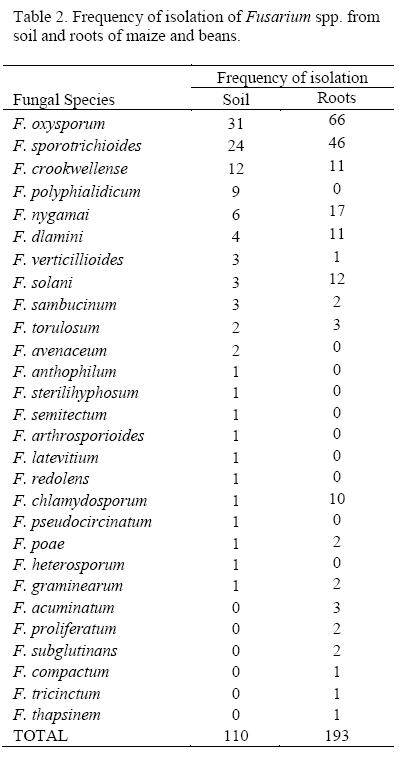
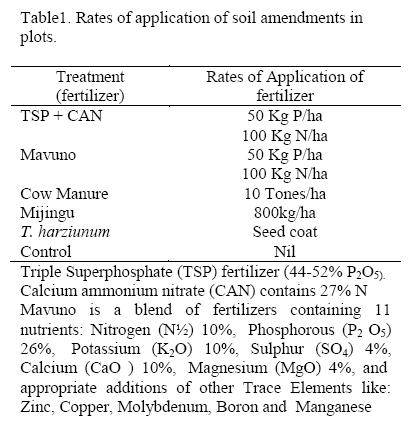
<body><![CDATA[<p align="justify"><font face="verdana" size="2">Field trials were established at the Agricultural Training Centre (ATC) and on selected farms. The experiment at the ATC was laid out in a Randomized Complete Block Design (RCBD) with treatments replicated five times. These treatments were established in selected twelve farms that were 500m apart and considered as replicates. One block constituted by the treatments described earlier were installed in each farm and measured 5 x 10m. Maize variety (H516) was sown at a spacing of 90 x 30cm with two seeds per hole. The bean variety was Mwezi moja planted at a spacing of 75 x 25 cm and two seeds per hole. The treatments were Triple superphosphate combined with Calcium ammonium nitrate (TSP + CAN), Mavuno fertilizer (a blend of fertilizer containing 11 nutrients) and Mijingu Rock Phosphate (MRP) fertilizers, Cow manure, and <i>Trichoderma</i> seed coating (<a href="#t1">Table 1</a>). The fertilizers were added by broadcasting during planting and top dressing of CAN and Mavuno done after first round of weeding. Planting was done during the long rains which occur between March and May and short rains between October and December. Soil and root samples were collected during harvesting from each treatment. Samples were bulked from five points in maize root and bean root rhizosphere respectively. The soils were transported in a cool box to the laboratory.</font></p>  	    <p align="center"><font face="verdana" size="2"><a name="t1"></a></font></p>  	    <p align="center"><font face="verdana" size="2"><img src="/img/revistas/tsa/v13n1/a12t1.jpg"></font></p>  	    <p align="justify"><font face="verdana" size="2">&nbsp;</font></p>  	    <p align="justify"><font face="verdana" size="2"><b>Assessment of <i>Fusarium</i> Density in Soil</b></font></p>  	    <p align="justify"><font face="verdana" size="2">One gram of the sampled soil was added to nine ml of 0.05% water agar (10 <sup>&#45;1</sup>) and shaken. One milliliter of the first dilution was pippeted and added to nine ml of 0.05% water agar (10<sup>&#45;2</sup>) and shaken. From this last soil dilution 1.0 ml was taken and pippeted to each of two Malachite Green Agar (MGA) plates and incubated at room temperature for six days. The colonies formed were counted (Leslie and Summerell, 2006).</font></p>  	    <p align="justify"><font face="verdana" size="2">A small piece of growth at the edge of the colonies identified as <i>Fusarium</i> was transferred to Potato Dextrose Agar (PDA) plates incubated at room temperature for five days and then transferred to Spezieller Nahrstoffarmer Agar (SNA) and Carnation Leaf Agar (CLA) for identification. Isolates of <i>Fusarium spp</i> obtained from SNA and CLA media were identified using the text references and taxonomic keys of Burgess <i>et al.,</i> (1994) and Booth (1971).</font></p>  	    <p align="justify"><font face="verdana" size="2">&nbsp;</font></p>  	    <p align="justify"><font face="verdana" size="2"><b>Assessment <i>of Fusarium</i> Infection Incidence in Plant Roots</b></font></p>  	    <p align="justify"><font face="verdana" size="2">From each soil sample, 20 small pieces of the thinnest roots were cut approximately one centimeter long, washed in 1% sodium hypochlorite for 30 seconds and sterilized distilled water before drying in sterilized paper towels. Five root pieces were transferred to two MGA plates each and incubated at room temperature for five days. Total infection incidence were calculated by considering the total number of root pieces as the 100% and the number of roots infected as the percentage of incidence (Singleton <i>et al.,</i> 1992). A small piece of agar at the edge of the colonies identified as <i>Fusarium</i> was transferred to a PDA plate incubated at room temperature for five days and transferred to SNA and CLA for identification.</font></p>  	    ]]></body>
<body><![CDATA[<p align="justify"><font face="verdana" size="2">&nbsp;</font></p>  	    <p align="justify"><font face="verdana" size="2"><b>Statistical Analysis</b></font></p>  	    <p align="justify"><font face="verdana" size="2">Analysis of variance tests were done to establish the effect of soil amendments on the occurrence of the fungus, soil fungal density and root infection. Fisher's Least Significance Difference (LSD) was used to compare treatment group means. Shannon's diversity indices were applied to compare fungal species diversity. Species accumulation curves were generated by plotting the total number of species recorded per sample from bean and maize rhizosphere soils and roots from all the treatments.</font></p>  	    <p align="justify"><font face="verdana" size="2">&nbsp;</font></p>  	    <p align="justify"><font face="verdana" size="2"><b>RESULTS</b></font></p>  	    <p align="justify"><font face="verdana" size="2">A total of 303 isolates <i>o&iacute; Fusarium</i> sp. were recovered, of which 164 were from the roots representing 18 species while 110 were from the soil and represented 22 species (<a href="#t2">Table 2</a>). The most frequently isolated species were <i>F. oxysporum and F. sporotrichioides</i> in both soil and roots. The frequency of isolation and diversity <i>o&iacute; Fusarium</i> varied with treatment (<a href="/img/revistas/tsa/v13n1/a12t3.jpg" target="_blank">Table 3</a>). The fungus was more abundant and diverse in plots treated with <i>Trichoderma</i> and Manure. Plots treated with Mijingu + CAN recorded the least frequency of isolation and diversity. Plots treated with <i>Trichoderma</i> had the highest frequency of isolation and diversity of the fungus in the roots too. Mavuno and Mavuno + <i>Trichoderma</i> also recorded values higher than the control. <i>Fusarium</i> was most rare and least diverse from roots in Mijingu + CAN treated plots.</font></p>  	    <p align="center"><font face="verdana" size="2"><a name="t2"></a></font></p>  	    <p align="center"><font face="verdana" size="2"><img src="/img/revistas/tsa/v13n1/a12t2.jpg"></font></p>  	    <p align="justify"><font face="verdana" size="2"><i>Fusarium</i> inoculum density in soil varied significantly across treatments (p&lt;0.001, <a href="/img/revistas/tsa/v13n1/a12t4.jpg" target="_blank">Table 4</a>). Plots treated with Mijingu + CAN fertilizer had the least amount of inoculum followed by those treated with <i>Trichoderma</i> seed coat and Manure. The highest inoculum density was recorded in plots treated with TSP + CAN. Mavuno,and Mavuno + <i>Trichoderma</i> recorded the lowest inoculum levels.. Root infection varied significantly with treatment (p=0.052). Mijingu + CAN had the highest infection incidence while TSP + CAN the least. The mean values (<a href="/img/revistas/tsa/v13n1/a12t5.jpg" target="_blank">Table 5</a>) showed variation with <i>Trichoderma</i> treatment recording the highest root infection for beans while Mijingu + CAN treatment recorded the highest root infection for maize. There was a significant interaction between crop type and treatment on <i>Fusarium</i> root infection . Soil inoculum density was highest from the TSP + CAN for both bean and maize rhizosphere and least in Mijingu + CAN. This difference was significant at pO.001. Crop type alone did not significantly affect the soil <i>Fusarium</i> abundance.</font></p>  	    <p align="justify"><font face="verdana" size="2">Soil amendments significantly influenced <i>Fusarium</i> richness in the roots , but not in the soil rhizosphere (<a href="/img/revistas/tsa/v13n1/a12t6.jpg" target="_blank">Table 6</a>). <i>Trichoderma</i> treated plots had the highest number of species in the roots followed by Mavuno + <i>Trichoderma.</i> Plots treated with TSP + CAN and Manure recorded levels lower than Control while Manure + <i>Trichoderma</i> treatment presented the lowest root infection. Mavuno and Mijingu + CAN plots had levels of root infection similar to Control plots according to Fisher's LSD grouping. Species diversity was influenced by crop type with bean rhizosphere being more diverse with <i>Fusarium</i> compared to maize rhizosphere as shown by Shannon indices (<a href="/img/revistas/tsa/v13n1/a12t7.jpg" target="_blank">Table 7</a>) and species accumulation curve (<a href="/img/revistas/tsa/v13n1/a12f1.jpg" target="_blank">Fig 1a</a>). However, the fungus was more diverse (<a href="/img/revistas/tsa/v13n1/a12t7.jpg" target="_blank">Table 7</a>) and rich (<a href="/img/revistas/tsa/v13n1/a12f1.jpg" target="_blank">Fig 1b</a>) in maize than bean roots. Fertilizer treatment influenced species accumulation in soils and roots with <i>Trichoderma</i> and manure treated plots having the highest number of species both in the soil and roots (<a href="/img/revistas/tsa/v13n1/a12f2.jpg" target="_blank">Fig 2a, b</a>).</font></p>  	    ]]></body>
<body><![CDATA[<p align="justify"><font face="verdana" size="2">&nbsp;</font></p>  	    <p align="justify"><font face="verdana" size="2"><b>DISCUSSION</b></font></p>  	    <p align="justify"><font face="verdana" size="2"><i>Fusarium</i> is of widespread distribution in soils and root tissues. Soil fertility management influenced the occurrence, diversity and abundance of this fungus. Plots treated with Mavuno fertiliser recorded the least root infection followed by TSP + CAN, Mavuno + <i>Trichoderma</i> and Manure + <i>Trichoderma.</i> These fertilizers may have controlled root infection by improving plant growth due to nutrient availability (Kapkiyai <i>et al.,</i> 1996). Low soil fertility has been reported to cause poor bean production in many parts of Kenya because of root rot by <i>Fusarium solani</i> sp. <i>phaseoli, Rhizoctonia solani</i> and <i>Pythium</i> species (CIAT, 1992, Gitu,1992). Application of cultural methods such as crop rotations to maintain the pathogen at low levels have not been successful due to the small acerages of smallholder farms leaving the use of farm amendments as the only affordable option (Hall and Phillips, 1992; Mutitu <i>et al.,</i> 1985 and 1989; Otsyula and Ajanga,1994)</font></p>  	    <p align="justify"><font face="verdana" size="2">Addition of fertilizer or organic manures may also affect the pathogens themselves. The population of soil <i>Fusarium</i> was markedly controlled in plots treated with Mijingu + Can fertilizer followed by Manure and <i>Trichoderma</i> However these treatments did not reduce root infection. TSP + CAN and manure promoted occurrence and diversity of <i>Fusarium</i> sp. in soil while controlling root infection. The effect of the fertilizer on the fungus could be encouraging competitive fungi to grow in the soil thereby reducing population of <i>Fusarium.</i> Alternatively the fertilizer may have made the environment of the soil non&#45; conducive for <i>Fusarium</i> proliferation. Kimani <i>et al.,</i> (2001) reported that manures or other organic inputs applied to the soil control the rate, pattern and extent of growth and activity of soil organisms and provide the source of carbon, energy and nutrients for the synthesis of soil organic matter. Manure can increase the humus content of soils by 15&#45;50%, depending on soil type, in addition to increasing soil aggregate stability and root permeability (Kapkiyai <i>et al.,</i> 1996). Kapkiyai <i>et al.</i> (1996) reported that manuring restocks the particulate organic matter fraction better than fresh crop residues. Manure also acts as a buffer, thus improving nutrient uptake for crops grown in acid soils. Using manures alleviates aluminium toxicity and improves the availability of nutrients such as P, particularly in soils with a high phosohorus (P) fixation, and sulphur (S). Manure also supplies essential elements such as Mg, and trace elements which may not be available in commonly used inorganic fertilizers. This indicates that manure still remains an important fertilizer and source of nutrients both to the plant and soil organisms.</font></p>  	    <p align="justify"><font face="verdana" size="2"><i>Trichoderma</i> as a bioherbicide also had promising effects. The bio&#45;inoculant, <i>Trichoderma,</i> and the organic amendment, manure were second to Mijingo + CAN in controlling the density of soil <i>Fusarium.</i> However, roots from these treatments recorded high infection incidences. Addition of <i>Trichoderma</i> with other fertilizers reduced root infection more than the bio&#45;inoculant or the fertilizer applied alone. <i>Trichoderma</i> as seed coat alone is not sufficient as a control of <i>Fusarium.</i> The fungus should be mixed with other fertilizers as manure and mavuno to promote its growth and effectiveness.</font></p>  	    <p align="justify"><font face="verdana" size="2">The interaction between crop rhizosphere and soil management influenced the diversity of <i>Fusarium.</i> Crop type alone did not have an effect. <i>Fusarium</i> species diversity was higher in bean than maize rhizosphere. However maize roots showed higher diversity of <i>Fusarium</i> root infestation than beans suggesting that the type of crop species is important when choosing a disease management strategy.</font></p>  	    <p align="justify"><font face="verdana" size="2">&nbsp;</font></p>  	    <p align="justify"><font face="verdana" size="2"><b>CONCLUSION</b></font></p>  	    <p align="justify"><font face="verdana" size="2">Integrated soil fertility management interventions could be used to control <i>Fusarium</i> root infections. The type of intervention chosen could be based on crop type and the fungus to be controlled. Overall, Mavuno fertilizer rated highest in this case followed by TSP + CAN which implied that chemical fertilizer use and low fertility could be the major cause for high <i>Fusarium</i> incidence in soil and use of the fertilizers would reduce the abundance.</font></p>  	    <p align="justify"><font face="verdana" size="2">&nbsp;</font></p>  	    ]]></body>
<body><![CDATA[<p align="justify"><font face="verdana" size="2"><b>REFERENCES</b></font></p>  	    <!-- ref --><p align="justify"><font face="verdana" size="2">Booth, C, 1971. The Genus <i>Fusarium.</i> Commonwealth Mycological Institute. Kew Surrey, England.    &nbsp;&nbsp;&nbsp;&nbsp;&nbsp;&nbsp;&nbsp;&nbsp;[&#160;<a href="javascript:void(0);" onclick="javascript: window.open('/scielo.php?script=sci_nlinks&ref=10109944&pid=S1870-0462201100040001200001&lng=','','width=640,height=500,resizable=yes,scrollbars=1,menubar=yes,');">Links</a>&#160;]<!-- end-ref --></font></p>  	    <!-- ref --><p align="justify"><font face="verdana" size="2">Burgess, L.W., Summerell, B. A., Bullock, S., Gott, K. P., and Backhouse, D., 1994 'Laboratory manual for <i>Fusarium</i> Research.' <i>(Fusarium</i> Research Laboratory, University of Sydney and Royal Botanic Gardens: Sydney).    &nbsp;&nbsp;&nbsp;&nbsp;&nbsp;&nbsp;&nbsp;&nbsp;[&#160;<a href="javascript:void(0);" onclick="javascript: window.open('/scielo.php?script=sci_nlinks&ref=10109946&pid=S1870-0462201100040001200002&lng=','','width=640,height=500,resizable=yes,scrollbars=1,menubar=yes,');">Links</a>&#160;]<!-- end-ref --></font></p>  	    <!-- ref --><p align="justify"><font face="verdana" size="2">CIAT, 1992. Pathology in Africa. CIAT Annual Report, 1992. Bean Programme, Cali, Colombia. 385pp.    &nbsp;&nbsp;&nbsp;&nbsp;&nbsp;&nbsp;&nbsp;&nbsp;[&#160;<a href="javascript:void(0);" onclick="javascript: window.open('/scielo.php?script=sci_nlinks&ref=10109948&pid=S1870-0462201100040001200003&lng=','','width=640,height=500,resizable=yes,scrollbars=1,menubar=yes,');">Links</a>&#160;]<!-- end-ref --></font></p>  	    <!-- ref --><p align="justify"><font face="verdana" size="2">Gitu, K.W., 1992. Agriculture Data Compendium. Technical Paper 92&#45;10. Long Range Planning Division, Ministry of Planning and National Development, Government of Kenya.    &nbsp;&nbsp;&nbsp;&nbsp;&nbsp;&nbsp;&nbsp;&nbsp;[&#160;<a href="javascript:void(0);" onclick="javascript: window.open('/scielo.php?script=sci_nlinks&ref=10109950&pid=S1870-0462201100040001200004&lng=','','width=640,height=500,resizable=yes,scrollbars=1,menubar=yes,');">Links</a>&#160;]<!-- end-ref --></font></p>  	    <!-- ref --><p align="justify"><font face="verdana" size="2">Hall, R. and Phillips, L.G., 1992. Effects of crop sequence and rainfall on population dynamics of Fusarium solani f. sp. phaseoli in soil. Canadian Journal of Botany 70:2005&#45;2008.    &nbsp;&nbsp;&nbsp;&nbsp;&nbsp;&nbsp;&nbsp;&nbsp;[&#160;<a href="javascript:void(0);" onclick="javascript: window.open('/scielo.php?script=sci_nlinks&ref=10109952&pid=S1870-0462201100040001200005&lng=','','width=640,height=500,resizable=yes,scrollbars=1,menubar=yes,');">Links</a>&#160;]<!-- end-ref --></font></p>  	    <!-- ref --><p align="justify"><font face="verdana" size="2">Kapkiyai J., Woomer, P. Oireshi I, Smithson, P. and Karanja N., 1996. Effects of Fertiliser and Organic Inputs on Soil Organic Matter and Nutrient Dynamics in Kenyan Nitisol. Paper presented to the International Symposium "Carbon and Nutrient Dynamics in Natural and Agricultural Tropical Ecosystems", Harare, Zimbabwe, 29 April&#45;4 May 1996.    &nbsp;&nbsp;&nbsp;&nbsp;&nbsp;&nbsp;&nbsp;&nbsp;[&#160;<a href="javascript:void(0);" onclick="javascript: window.open('/scielo.php?script=sci_nlinks&ref=10109954&pid=S1870-0462201100040001200006&lng=','','width=640,height=500,resizable=yes,scrollbars=1,menubar=yes,');">Links</a>&#160;]<!-- end-ref --></font></p>  	    <!-- ref --><p align="justify"><font face="verdana" size="2">Kedera, C.J., R.D. Platter and A.E. Desjadins, 1998. Incidence of <i>Fusarium</i> spp and levels of fumonisins in maize in Western Kenya. Applied and Environmental Microbiology. 65: 41&#45;44.    &nbsp;&nbsp;&nbsp;&nbsp;&nbsp;&nbsp;&nbsp;&nbsp;[&#160;<a href="javascript:void(0);" onclick="javascript: window.open('/scielo.php?script=sci_nlinks&ref=10109956&pid=S1870-0462201100040001200007&lng=','','width=640,height=500,resizable=yes,scrollbars=1,menubar=yes,');">Links</a>&#160;]<!-- end-ref --></font></p>  	    <!-- ref --><p align="justify"><font face="verdana" size="2">Kedera, C.J., J.F. Leslie and L. E. Claflin, 1992. Systematic Infection of corn by <i>Furasium moniliforme</i> (abstr.) Phytopathology, 82: 1138.    &nbsp;&nbsp;&nbsp;&nbsp;&nbsp;&nbsp;&nbsp;&nbsp;[&#160;<a href="javascript:void(0);" onclick="javascript: window.open('/scielo.php?script=sci_nlinks&ref=10109958&pid=S1870-0462201100040001200008&lng=','','width=640,height=500,resizable=yes,scrollbars=1,menubar=yes,');">Links</a>&#160;]<!-- end-ref --></font></p>  	    <!-- ref --><p align="justify"><font face="verdana" size="2">Kimani SK, M&aacute;ngale, N. Gichuru, M., Palm, C and Wamuongo, J., 2001. lntergrated Use and Effects of Manures with modest Application of Inorganic Fertilisers on soil properties and maize production in the central Kenya Highlands Final Technical Report to the Rockfeller Foundation May 2001.    &nbsp;&nbsp;&nbsp;&nbsp;&nbsp;&nbsp;&nbsp;&nbsp;[&#160;<a href="javascript:void(0);" onclick="javascript: window.open('/scielo.php?script=sci_nlinks&ref=10109960&pid=S1870-0462201100040001200009&lng=','','width=640,height=500,resizable=yes,scrollbars=1,menubar=yes,');">Links</a>&#160;]<!-- end-ref --></font></p>  	    <!-- ref --><p align="justify"><font face="verdana" size="2">Leslie J and Summerell B., 2006. The Fusarium Laboratory Manual. Blackwell Publishing 388 pages.    &nbsp;&nbsp;&nbsp;&nbsp;&nbsp;&nbsp;&nbsp;&nbsp;[&#160;<a href="javascript:void(0);" onclick="javascript: window.open('/scielo.php?script=sci_nlinks&ref=10109962&pid=S1870-0462201100040001200010&lng=','','width=640,height=500,resizable=yes,scrollbars=1,menubar=yes,');">Links</a>&#160;]<!-- end-ref --></font></p>  	    <!-- ref --><p align="justify"><font face="verdana" size="2">MacDonald, M.V. and R. Chapman, 1997. The incidence of <i>Fusarium moniliforme</i> on maize from Central America, Africa and Asia during 1992&#45;1995. Plant Pathology: 46:112&#45;126.    &nbsp;&nbsp;&nbsp;&nbsp;&nbsp;&nbsp;&nbsp;&nbsp;[&#160;<a href="javascript:void(0);" onclick="javascript: window.open('/scielo.php?script=sci_nlinks&ref=10109964&pid=S1870-0462201100040001200011&lng=','','width=640,height=500,resizable=yes,scrollbars=1,menubar=yes,');">Links</a>&#160;]<!-- end-ref --></font></p>  	    <!-- ref --><p align="justify"><font face="verdana" size="2">Munkvold GP, Desjardins AE., 1997. Fumonisins in maize. Can we reduce their occurrence? Plant Dis. 81 556&#45;584.    &nbsp;&nbsp;&nbsp;&nbsp;&nbsp;&nbsp;&nbsp;&nbsp;[&#160;<a href="javascript:void(0);" onclick="javascript: window.open('/scielo.php?script=sci_nlinks&ref=10109966&pid=S1870-0462201100040001200012&lng=','','width=640,height=500,resizable=yes,scrollbars=1,menubar=yes,');">Links</a>&#160;]<!-- end-ref --></font></p>  	    <!-- ref --><p align="justify"><font face="verdana" size="2">Mutitu, E.W., Mukunya, D.M. and Keya, S.O., 1989. Effect of organic amendments of Fusarium yellow disease on the bean host. Discovery Innovation 1:67&#45;70.    &nbsp;&nbsp;&nbsp;&nbsp;&nbsp;&nbsp;&nbsp;&nbsp;[&#160;<a href="javascript:void(0);" onclick="javascript: window.open('/scielo.php?script=sci_nlinks&ref=10109968&pid=S1870-0462201100040001200013&lng=','','width=640,height=500,resizable=yes,scrollbars=1,menubar=yes,');">Links</a>&#160;]<!-- end-ref --></font></p>  	    <!-- ref --><p align="justify"><font face="verdana" size="2">Mutitu, E.W., Mukunya, D.M and Keya, S.O., 1985. Biological control of Fusarium yellows on beans caused by Fusarium oxosporium Schl. F. sp. phaseoli Kendrick and Synder using organic amendments locally available in Kenya. Acta Horticulture 153:267&#45;274.    &nbsp;&nbsp;&nbsp;&nbsp;&nbsp;&nbsp;&nbsp;&nbsp;[&#160;<a href="javascript:void(0);" onclick="javascript: window.open('/scielo.php?script=sci_nlinks&ref=10109970&pid=S1870-0462201100040001200014&lng=','','width=640,height=500,resizable=yes,scrollbars=1,menubar=yes,');">Links</a>&#160;]<!-- end-ref --></font></p>  	    <!-- ref --><p align="justify"><font face="verdana" size="2">Nderitu J.H, Buruchara R.A, Ampofo K.O., 1997. lntergrated pest management of beans. African Highland Initiative.    &nbsp;&nbsp;&nbsp;&nbsp;&nbsp;&nbsp;&nbsp;&nbsp;[&#160;<a href="javascript:void(0);" onclick="javascript: window.open('/scielo.php?script=sci_nlinks&ref=10109972&pid=S1870-0462201100040001200015&lng=','','width=640,height=500,resizable=yes,scrollbars=1,menubar=yes,');">Links</a>&#160;]<!-- end-ref --></font></p>  	    <!-- ref --><p align="justify"><font face="verdana" size="2">Otsyula, R.M. and Ajanga, S.I., 1994. Control strategy for bean roor rot in Western Kenya Proceedings of the fourth KARI Scientific Conference held in Nairobi, Kenya.    &nbsp;&nbsp;&nbsp;&nbsp;&nbsp;&nbsp;&nbsp;&nbsp;[&#160;<a href="javascript:void(0);" onclick="javascript: window.open('/scielo.php?script=sci_nlinks&ref=10109974&pid=S1870-0462201100040001200016&lng=','','width=640,height=500,resizable=yes,scrollbars=1,menubar=yes,');">Links</a>&#160;]<!-- end-ref --></font></p>  	    <!-- ref --><p align="justify"><font face="verdana" size="2">Otsyula, R.M., Ajanga R.A. Buruchara and C.S. Wortmann, 1998. Development of an intergrated bean root rot control strategy for Western Kenya. African Crop Science Journal 6: 61&#45;67.    &nbsp;&nbsp;&nbsp;&nbsp;&nbsp;&nbsp;&nbsp;&nbsp;[&#160;<a href="javascript:void(0);" onclick="javascript: window.open('/scielo.php?script=sci_nlinks&ref=10109976&pid=S1870-0462201100040001200017&lng=','','width=640,height=500,resizable=yes,scrollbars=1,menubar=yes,');">Links</a>&#160;]<!-- end-ref --></font></p>  	    <!-- ref --><p align="justify"><font face="verdana" size="2">Robledo&#45;Robledo E., 1991. Strategies for the prevention and control of fungi and mycotoxins in Central and South America. In: Champ BR, Highely E. Hocking AD, Pitt JI. Eds. Fungi and mycotoxins in stored products. Proceedings of an international conference, Bangkok, Thailand, 23&#45;26 April 1991. p 39&#45;46.    &nbsp;&nbsp;&nbsp;&nbsp;&nbsp;&nbsp;&nbsp;&nbsp;[&#160;<a href="javascript:void(0);" onclick="javascript: window.open('/scielo.php?script=sci_nlinks&ref=10109978&pid=S1870-0462201100040001200018&lng=','','width=640,height=500,resizable=yes,scrollbars=1,menubar=yes,');">Links</a>&#160;]<!-- end-ref --></font></p>  	    <!-- ref --><p align="justify"><font face="verdana" size="2">Scott PM., 1993. Fumonisins, Int. J. Food Microbiol. 18: 257&#45;270.    &nbsp;&nbsp;&nbsp;&nbsp;&nbsp;&nbsp;&nbsp;&nbsp;[&#160;<a href="javascript:void(0);" onclick="javascript: window.open('/scielo.php?script=sci_nlinks&ref=10109980&pid=S1870-0462201100040001200019&lng=','','width=640,height=500,resizable=yes,scrollbars=1,menubar=yes,');">Links</a>&#160;]<!-- end-ref --></font></p>  	    <!-- ref --><p align="justify"><font face="verdana" size="2">Singleton, L. L., Mihail J. D. and Rush C. M., 1992. Methods for Research on soilborne phytopathogenic fungi. St Paul, MN, USA, American Phytopathological Society Press. 264 pages.    &nbsp;&nbsp;&nbsp;&nbsp;&nbsp;&nbsp;&nbsp;&nbsp;[&#160;<a href="javascript:void(0);" onclick="javascript: window.open('/scielo.php?script=sci_nlinks&ref=10109982&pid=S1870-0462201100040001200020&lng=','','width=640,height=500,resizable=yes,scrollbars=1,menubar=yes,');">Links</a>&#160;]<!-- end-ref --></font></p>      ]]></body><back>
<ref-list>
<ref id="B1">
<nlm-citation citation-type="book">
<person-group person-group-type="author">
<name>
<surname><![CDATA[Booth]]></surname>
<given-names><![CDATA[C]]></given-names>
</name>
</person-group>
<source><![CDATA[The Genus Fusarium]]></source>
<year>1971</year>
<publisher-loc><![CDATA[Kew^eSurrey Surrey]]></publisher-loc>
<publisher-name><![CDATA[Commonwealth Mycological Institute]]></publisher-name>
</nlm-citation>
</ref>
<ref id="B2">
<nlm-citation citation-type="book">
<person-group person-group-type="author">
<name>
<surname><![CDATA[Burgess]]></surname>
<given-names><![CDATA[L.W.]]></given-names>
</name>
<name>
<surname><![CDATA[Summerell]]></surname>
<given-names><![CDATA[B. A.]]></given-names>
</name>
<name>
<surname><![CDATA[Bullock]]></surname>
<given-names><![CDATA[S.]]></given-names>
</name>
<name>
<surname><![CDATA[Gott]]></surname>
<given-names><![CDATA[K. P.]]></given-names>
</name>
<name>
<surname><![CDATA[Backhouse]]></surname>
<given-names><![CDATA[D.]]></given-names>
</name>
</person-group>
<source><![CDATA[Laboratory manual for Fusarium Research]]></source>
<year>1994</year>
<publisher-loc><![CDATA[Sydney ]]></publisher-loc>
<publisher-name><![CDATA[Fusarium Research Laboratory, University of Sydney and Royal Botanic Gardens]]></publisher-name>
</nlm-citation>
</ref>
<ref id="B3">
<nlm-citation citation-type="">
<collab>CIAT</collab>
<source><![CDATA[Pathology in Africa. CIAT Annual Report]]></source>
<year>1992</year>
<month>19</month>
<day>92</day>
<page-range>385</page-range><publisher-loc><![CDATA[Cali ]]></publisher-loc>
</nlm-citation>
</ref>
<ref id="B4">
<nlm-citation citation-type="book">
<person-group person-group-type="author">
<name>
<surname><![CDATA[Gitu]]></surname>
<given-names><![CDATA[K.W.]]></given-names>
</name>
</person-group>
<source><![CDATA[Agriculture Data Compendium]]></source>
<year>1992</year>
<publisher-name><![CDATA[Long Range Planning Division, Ministry of Planning and National Development, Government of Kenya]]></publisher-name>
</nlm-citation>
</ref>
<ref id="B5">
<nlm-citation citation-type="journal">
<person-group person-group-type="author">
<name>
<surname><![CDATA[Hall]]></surname>
<given-names><![CDATA[R.]]></given-names>
</name>
<name>
<surname><![CDATA[Phillips]]></surname>
<given-names><![CDATA[L.G.]]></given-names>
</name>
</person-group>
<article-title xml:lang="en"><![CDATA[Effects of crop sequence and rainfall on population dynamics of Fusarium solani f. sp. phaseoli in soil]]></article-title>
<source><![CDATA[Canadian Journal of Botany]]></source>
<year>1992</year>
<volume>70</volume>
<page-range>2005-2008</page-range></nlm-citation>
</ref>
<ref id="B6">
<nlm-citation citation-type="confpro">
<person-group person-group-type="author">
<name>
<surname><![CDATA[Kapkiyai]]></surname>
<given-names><![CDATA[J.]]></given-names>
</name>
<name>
<surname><![CDATA[Woomer]]></surname>
<given-names><![CDATA[P.]]></given-names>
</name>
<name>
<surname><![CDATA[Oireshi]]></surname>
<given-names><![CDATA[I]]></given-names>
</name>
<name>
<surname><![CDATA[Smithson]]></surname>
<given-names><![CDATA[P.]]></given-names>
</name>
<name>
<surname><![CDATA[Karanja]]></surname>
<given-names><![CDATA[N.]]></given-names>
</name>
</person-group>
<source><![CDATA[Effects of Fertiliser and Organic Inputs on Soil Organic Matter and Nutrient Dynamics in Kenyan Nitisol]]></source>
<year>1996</year>
<conf-name><![CDATA[ Carbon and Nutrient Dynamics in Natural and Agricultural Tropical Ecosystems]]></conf-name>
<conf-date>29 April-4 May 1996</conf-date>
<conf-loc>Harare </conf-loc>
</nlm-citation>
</ref>
<ref id="B7">
<nlm-citation citation-type="journal">
<person-group person-group-type="author">
<name>
<surname><![CDATA[Kedera]]></surname>
<given-names><![CDATA[C.J.]]></given-names>
</name>
<name>
<surname><![CDATA[Platter]]></surname>
<given-names><![CDATA[R.D.]]></given-names>
</name>
<name>
<surname><![CDATA[Desjadins]]></surname>
<given-names><![CDATA[A.E.]]></given-names>
</name>
</person-group>
<article-title xml:lang="en"><![CDATA[Incidence of Fusarium spp and levels of fumonisins in maize in Western Kenya]]></article-title>
<source><![CDATA[Applied and Environmental Microbiology]]></source>
<year>1998</year>
<volume>65</volume>
<page-range>41-44</page-range></nlm-citation>
</ref>
<ref id="B8">
<nlm-citation citation-type="journal">
<person-group person-group-type="author">
<name>
<surname><![CDATA[Kedera]]></surname>
<given-names><![CDATA[C.J.]]></given-names>
</name>
<name>
<surname><![CDATA[Leslie]]></surname>
<given-names><![CDATA[J.F.]]></given-names>
</name>
<name>
<surname><![CDATA[Claflin]]></surname>
<given-names><![CDATA[L. E.]]></given-names>
</name>
</person-group>
<article-title xml:lang="en"><![CDATA[Systematic Infection of corn by Furasium moniliforme]]></article-title>
<source><![CDATA[Phytopathology]]></source>
<year>1992</year>
<volume>82</volume>
<page-range>1138</page-range></nlm-citation>
</ref>
<ref id="B9">
<nlm-citation citation-type="">
<person-group person-group-type="author">
<name>
<surname><![CDATA[Kimani]]></surname>
<given-names><![CDATA[SK]]></given-names>
</name>
<name>
<surname><![CDATA[Mángale]]></surname>
<given-names><![CDATA[N.]]></given-names>
</name>
<name>
<surname><![CDATA[Gichuru]]></surname>
<given-names><![CDATA[M.]]></given-names>
</name>
<name>
<surname><![CDATA[Palm]]></surname>
<given-names><![CDATA[C]]></given-names>
</name>
<name>
<surname><![CDATA[Wamuongo]]></surname>
<given-names><![CDATA[J.]]></given-names>
</name>
</person-group>
<source><![CDATA[lntergrated Use and Effects of Manures with modest Application of Inorganic Fertilisers on soil properties and maize production in the central Kenya Highlands]]></source>
<year>2001</year>
<month>Ma</month>
<day>y </day>
</nlm-citation>
</ref>
<ref id="B10">
<nlm-citation citation-type="book">
<person-group person-group-type="author">
<name>
<surname><![CDATA[Leslie]]></surname>
<given-names><![CDATA[J]]></given-names>
</name>
<name>
<surname><![CDATA[Summerell]]></surname>
<given-names><![CDATA[B.]]></given-names>
</name>
</person-group>
<source><![CDATA[The Fusarium Laboratory Manual]]></source>
<year>2006</year>
<page-range>388</page-range><publisher-name><![CDATA[Blackwell Publishing]]></publisher-name>
</nlm-citation>
</ref>
<ref id="B11">
<nlm-citation citation-type="journal">
<person-group person-group-type="author">
<name>
<surname><![CDATA[MacDonald]]></surname>
<given-names><![CDATA[M.V.]]></given-names>
</name>
<name>
<surname><![CDATA[Chapman]]></surname>
<given-names><![CDATA[R.]]></given-names>
</name>
</person-group>
<article-title xml:lang="en"><![CDATA[The incidence of Fusarium moniliforme on maize from Central America, Africa and Asia during 1992-1995]]></article-title>
<source><![CDATA[Plant Pathology:]]></source>
<year>1997</year>
<volume>46</volume>
<page-range>112-126</page-range></nlm-citation>
</ref>
<ref id="B12">
<nlm-citation citation-type="journal">
<person-group person-group-type="author">
<name>
<surname><![CDATA[Munkvold]]></surname>
<given-names><![CDATA[GP]]></given-names>
</name>
<name>
<surname><![CDATA[Desjardins]]></surname>
<given-names><![CDATA[AE]]></given-names>
</name>
</person-group>
<article-title xml:lang="en"><![CDATA[Fumonisins in maize. Can we reduce their occurrence?]]></article-title>
<source><![CDATA[Plant Dis.]]></source>
<year>1997</year>
<volume>81</volume>
<page-range>556-584</page-range></nlm-citation>
</ref>
<ref id="B13">
<nlm-citation citation-type="journal">
<person-group person-group-type="author">
<name>
<surname><![CDATA[Mutitu]]></surname>
<given-names><![CDATA[E.W.]]></given-names>
</name>
<name>
<surname><![CDATA[Mukunya]]></surname>
<given-names><![CDATA[D.M.]]></given-names>
</name>
<name>
<surname><![CDATA[Keya]]></surname>
<given-names><![CDATA[S.O.]]></given-names>
</name>
</person-group>
<article-title xml:lang="en"><![CDATA[Effect of organic amendments of Fusarium yellow disease on the bean host]]></article-title>
<source><![CDATA[Discovery Innovation]]></source>
<year>1989</year>
<volume>1</volume>
<page-range>67-70</page-range></nlm-citation>
</ref>
<ref id="B14">
<nlm-citation citation-type="journal">
<person-group person-group-type="author">
<name>
<surname><![CDATA[Mutitu]]></surname>
<given-names><![CDATA[E.W.]]></given-names>
</name>
<name>
<surname><![CDATA[Mukunya]]></surname>
<given-names><![CDATA[D.M]]></given-names>
</name>
<name>
<surname><![CDATA[Keya]]></surname>
<given-names><![CDATA[S.O.]]></given-names>
</name>
</person-group>
<article-title xml:lang="en"><![CDATA[Biological control of Fusarium yellows on beans caused by Fusarium oxosporium Schl. F. sp. phaseoli Kendrick and Synder using organic amendments locally available in Kenya]]></article-title>
<source><![CDATA[Acta Horticulture]]></source>
<year>1985</year>
<volume>153</volume>
<page-range>267-274</page-range></nlm-citation>
</ref>
<ref id="B15">
<nlm-citation citation-type="book">
<person-group person-group-type="author">
<name>
<surname><![CDATA[Nderitu]]></surname>
<given-names><![CDATA[J.H]]></given-names>
</name>
<name>
<surname><![CDATA[Buruchara]]></surname>
<given-names><![CDATA[R.A]]></given-names>
</name>
<name>
<surname><![CDATA[Ampofo]]></surname>
<given-names><![CDATA[K.O.]]></given-names>
</name>
</person-group>
<source><![CDATA[lntergrated pest management of beans]]></source>
<year>1997</year>
<publisher-name><![CDATA[African Highland Initiative]]></publisher-name>
</nlm-citation>
</ref>
<ref id="B16">
<nlm-citation citation-type="">
<person-group person-group-type="author">
<name>
<surname><![CDATA[Otsyula]]></surname>
<given-names><![CDATA[R.M.]]></given-names>
</name>
<name>
<surname><![CDATA[Ajanga]]></surname>
<given-names><![CDATA[S.I.]]></given-names>
</name>
</person-group>
<article-title xml:lang="en"><![CDATA[Control strategy for bean roor rot in Western Kenya]]></article-title>
<source><![CDATA[Proceedings of the fourth KARI Scientific Conference held in Nairobi, Kenya]]></source>
<year>1994</year>
</nlm-citation>
</ref>
<ref id="B17">
<nlm-citation citation-type="journal">
<person-group person-group-type="author">
<name>
<surname><![CDATA[Otsyula]]></surname>
<given-names><![CDATA[R.M.]]></given-names>
</name>
<name>
<surname><![CDATA[R.A. Buruchara]]></surname>
<given-names><![CDATA[Ajanga]]></given-names>
</name>
<name>
<surname><![CDATA[Wortmann]]></surname>
<given-names><![CDATA[C.S.]]></given-names>
</name>
</person-group>
<article-title xml:lang="en"><![CDATA[Development of an intergrated bean root rot control strategy for Western Kenya]]></article-title>
<source><![CDATA[African Crop Science Journal]]></source>
<year>1998</year>
<volume>6</volume>
<page-range>61-67</page-range></nlm-citation>
</ref>
<ref id="B18">
<nlm-citation citation-type="">
<person-group person-group-type="author">
<name>
<surname><![CDATA[Robledo-Robledo]]></surname>
<given-names><![CDATA[E.]]></given-names>
</name>
</person-group>
<article-title xml:lang="es"><![CDATA[Strategies for the prevention and control of fungi and mycotoxins in Central and South America]]></article-title>
<person-group person-group-type="editor">
<name>
<surname><![CDATA[Champ]]></surname>
<given-names><![CDATA[BR]]></given-names>
</name>
<name>
<surname><![CDATA[Highely]]></surname>
<given-names><![CDATA[E.]]></given-names>
</name>
<name>
<surname><![CDATA[Hocking]]></surname>
<given-names><![CDATA[AD]]></given-names>
</name>
<name>
<surname><![CDATA[Pitt]]></surname>
<given-names><![CDATA[JI]]></given-names>
</name>
</person-group>
<source><![CDATA[Fungi and mycotoxins in stored products. Proceedings of an international conference]]></source>
<year>1991</year>
<month>23</month>
<day>-2</day>
<page-range>39-46</page-range><publisher-loc><![CDATA[Bangkok ]]></publisher-loc>
</nlm-citation>
</ref>
<ref id="B19">
<nlm-citation citation-type="journal">
<person-group person-group-type="author">
<name>
<surname><![CDATA[Scott]]></surname>
<given-names><![CDATA[PM]]></given-names>
</name>
</person-group>
<article-title xml:lang="en"><![CDATA[Fumonisins]]></article-title>
<source><![CDATA[Int. J. Food Microbiol]]></source>
<year>1993</year>
<volume>18</volume>
<page-range>257-270</page-range></nlm-citation>
</ref>
<ref id="B20">
<nlm-citation citation-type="book">
<person-group person-group-type="author">
<name>
<surname><![CDATA[Singleton]]></surname>
<given-names><![CDATA[L. L.]]></given-names>
</name>
<name>
<surname><![CDATA[Mihail]]></surname>
<given-names><![CDATA[J. D.]]></given-names>
</name>
<name>
<surname><![CDATA[Rush]]></surname>
<given-names><![CDATA[C. M.]]></given-names>
</name>
</person-group>
<source><![CDATA[Methods for Research on soilborne phytopathogenic fungi]]></source>
<year>1992</year>
<page-range>264</page-range><publisher-loc><![CDATA[St Paul^eMN MN]]></publisher-loc>
<publisher-name><![CDATA[American Phytopathological Society Press]]></publisher-name>
</nlm-citation>
</ref>
</ref-list>
</back>
</article>