<?xml version="1.0" encoding="ISO-8859-1"?><article xmlns:mml="http://www.w3.org/1998/Math/MathML" xmlns:xlink="http://www.w3.org/1999/xlink" xmlns:xsi="http://www.w3.org/2001/XMLSchema-instance">
<front>
<journal-meta>
<journal-id>1870-0462</journal-id>
<journal-title><![CDATA[Tropical and subtropical agroecosystems]]></journal-title>
<abbrev-journal-title><![CDATA[Trop. subtrop. agroecosyt]]></abbrev-journal-title>
<issn>1870-0462</issn>
<publisher>
<publisher-name><![CDATA[Universidad Autónoma de Yucatán, Facultad de Medicina Veterinaria]]></publisher-name>
</publisher>
</journal-meta>
<article-meta>
<article-id>S1870-04622011000400011</article-id>
<title-group>
<article-title xml:lang="en"><![CDATA[Improved seedling emergence and growth of maize and beans by Trichoderma harziunum]]></article-title>
<article-title xml:lang="es"><![CDATA[Mejoramiento de la germinación y crecimiento del maíz y frijol por Trichoderma harzianum]]></article-title>
</title-group>
<contrib-group>
<contrib contrib-type="author">
<name>
<surname><![CDATA[Okoth]]></surname>
<given-names><![CDATA[Sheila A.]]></given-names>
</name>
<xref ref-type="aff" rid="A01"/>
</contrib>
<contrib contrib-type="author">
<name>
<surname><![CDATA[Otadoh]]></surname>
<given-names><![CDATA[Jane A.]]></given-names>
</name>
<xref ref-type="aff" rid="A02"/>
</contrib>
<contrib contrib-type="author">
<name>
<surname><![CDATA[Ochanda]]></surname>
<given-names><![CDATA[James O]]></given-names>
</name>
<xref ref-type="aff" rid="A02"/>
</contrib>
</contrib-group>
<aff id="A01">
<institution><![CDATA[,University of Nairobi School of Biological Sciences ]]></institution>
<addr-line><![CDATA[Nairobi ]]></addr-line>
<country>Kenya</country>
</aff>
<aff id="A02">
<institution><![CDATA[,University of Nairobi Centre of Biotechnology and Bioinformatics ]]></institution>
<addr-line><![CDATA[Nairobi ]]></addr-line>
</aff>
<pub-date pub-type="pub">
<day>00</day>
<month>00</month>
<year>2011</year>
</pub-date>
<pub-date pub-type="epub">
<day>00</day>
<month>00</month>
<year>2011</year>
</pub-date>
<volume>13</volume>
<numero>1</numero>
<fpage>65</fpage>
<lpage>71</lpage>
<copyright-statement/>
<copyright-year/>
<self-uri xlink:href="http://www.scielo.org.mx/scielo.php?script=sci_arttext&amp;pid=S1870-04622011000400011&amp;lng=en&amp;nrm=iso"></self-uri><self-uri xlink:href="http://www.scielo.org.mx/scielo.php?script=sci_abstract&amp;pid=S1870-04622011000400011&amp;lng=en&amp;nrm=iso"></self-uri><self-uri xlink:href="http://www.scielo.org.mx/scielo.php?script=sci_pdf&amp;pid=S1870-04622011000400011&amp;lng=en&amp;nrm=iso"></self-uri><abstract abstract-type="short" xml:lang="en"><p><![CDATA[An indigenous strain of Trichoderma spp. was tested for its ability to promote seed germination and growth of maize and bean seedlings grown in the field at Embu District, Kenya. The trial was carried out for three seasons with the following treatments; two types of fertilizers, cow manure, and Trichoderma seed coat. Seedlings were counted 14 days after emergence from soil and a sample gently uprooted using a spade. Shoot height, root length, stem and root diameter measurements were taken. Trichoderma inoculation significantly increased rate of maize seed germination but had no effect on emergence of bean seedlings. Maize seeds coated with Trichoderma inoculum and planted on soils without fertilizer addition recorded the highest germination rate of 82.7% followed by seeds coated with the inoculum and planted in soils treated with manure (82.2%). Combination of the inoculum and fertilizer performed better at improving maize seed germination compared with fertilizers applied singly. This was the case for shoot and root growth. Seeds coated with the inoculum and planted in soils ammended with Triple Superphosphate and Calcium Ammonium Nitrate recorded the greatest shoot and root growth in both maize and beans. Increased growth of shoot and root caused by Trichoderma implied that there was beneficial effect of inoculation on plant growth and development since root collar and stem diameters were a measure of survivability of seedlings.]]></p></abstract>
<kwd-group>
<kwd lng="en"><![CDATA[Growth-promoting effect]]></kwd>
<kwd lng="en"><![CDATA[Trichoderma spp.]]></kwd>
<kwd lng="en"><![CDATA[fertilizers]]></kwd>
<kwd lng="en"><![CDATA[inoculum]]></kwd>
</kwd-group>
</article-meta>
</front><body><![CDATA[  	    <p align="justify"><font face="verdana" size="4">Art&iacute;culos de investigaci&oacute;n</font></p>  	    <p align="justify"><font face="verdana" size="2">&nbsp;</font></p>  	    <p align="center"><font face="verdana" size="4"><b>Improved seedling emergence and growth of maize and beans by <i>Trichoderma harziunum</i></b></font></p>  	    <p align="center"><font face="verdana" size="2">&nbsp;</font></p>  	    <p align="center"><font face="verdana" size="3"><b>Mejoramiento de la germinaci&oacute;n y crecimiento del ma&iacute;z y frijol por <i>Trichoderma harzianum</i></b></font></p>  	    <p align="justify"><font face="verdana" size="2">&nbsp;</font></p>  	    <p align="center"><font face="verdana" size="2"><b>Sheila A. Okoth<sup>1</sup>*, Jane A. Otadoh<sup>2</sup> and James O. Ochanda<sup>2</sup></b></font></p>  	    <p align="justify"><font face="verdana" size="2">&nbsp;</font></p>  	    <p align="justify"><font face="verdana" size="2"><i><sup>1</sup> University of Nairobi, School of Biological Sciences, P.O. Box 30197 &#45; 00100, Nairobi. Kenya	* Corresponding author 	* Email:</i> <a href="mailto:dorisokoth@yahoo.com">dorisokoth@yahoo.com</a> </font></p>  	    ]]></body>
<body><![CDATA[<p align="justify"><font face="verdana" size="2"><i><sup>2</sup> University of Nairobi, Centre of Biotechnology and Bioinformatics, P. O. Box 30197 &#45; 00100, Nairobi.</i></font></p>          <p align="justify"><font face="verdana" size="2">&nbsp;</font></p>  	    <p align="justify"><font face="verdana" size="2">Submitted February 15, 2010    <br> 	Accepted May 25, 2010    <br> 	Revised received June 16, 2010</font></p>  	    <p align="justify"><font face="verdana" size="2">&nbsp;</font></p>  	    <p align="justify"><font face="verdana" size="2"><b>Abstract</b></font></p>  	    <p align="justify"><font face="verdana" size="2">An indigenous strain of <i>Trichoderma</i> spp. was tested for its ability to promote seed germination and growth of maize and bean seedlings grown in the field at Embu District, Kenya. The trial was carried out for three seasons with the following treatments; two types of fertilizers, cow manure, and <i>Trichoderma</i> seed coat. Seedlings were counted 14 days after emergence from soil and a sample gently uprooted using a spade. Shoot height, root length, stem and root diameter measurements were taken. <i>Trichoderma</i> inoculation significantly increased rate of maize seed germination but had no effect on emergence of bean seedlings. Maize seeds coated with <i>Trichoderma</i> inoculum and planted on soils without fertilizer addition recorded the highest germination rate of 82.7% followed by seeds coated with the inoculum and planted in soils treated with manure (82.2%). Combination of the inoculum and fertilizer performed better at improving maize seed germination compared with fertilizers applied singly. This was the case for shoot and root growth. Seeds coated with the inoculum and planted in soils ammended with Triple Superphosphate and Calcium Ammonium Nitrate recorded the greatest shoot and root growth in both maize and beans. Increased growth of shoot and root caused by <i>Trichoderma</i> implied that there was beneficial effect of inoculation on plant growth and development since root collar and stem diameters were a measure of survivability of seedlings.</font></p>  	    <p align="justify"><font face="verdana" size="2"><b>Key words:</b> Growth&#45;promoting effect; <i>Trichoderma</i> spp.; fertilizers; inoculum.</font></p>  	    <p align="justify"><font face="verdana" size="2">&nbsp;</font></p>  	    ]]></body>
<body><![CDATA[<p align="justify"><font face="verdana" size="2"><b>INTRODUCTION</b></font></p>  	    <p align="justify"><font face="verdana" size="2">Seed germination and seedling establishment are determined by several factors including quality of seeds and environmental factors. Within the environment of the seed and seedling are physical, chemical and biological factors that influence growth.</font></p>  	    <p align="justify"><font face="verdana" size="2">The rhizosphere, is relatively rich in nutrients, because as much as 40% of plant photo synthetic products are exudates from roots (Bais <i>et al,</i> 2006). Consequently the rhizosphere supports large microbial populations capable of exerting beneficial, neutral, or detrimental effects on plant growth. <i>Trichoderma</i> species are free&#45;living fungi that are common in soil and root ecosystems. They have been widely studied for their capacity to enhance plant growth, produce antibiotics, parasitize other fungi, and compete with deleterious plant microorganisms (Adams <i>et al,</i> 2007; Chang <i>et al,</i> 1986; Harman <i>et al,</i> 2004a,; Yedidia <i>et al,</i> 2001). The effectiveness of the use of microorganisms as biofertilisers and biocontrols however, is determined by a myriad of factors including virulence of the isolate, environmental factors, time of application, ability to survive in the environments other than their origin and colonize plants roots during certain period of time to control plant pathogens (Kredrics <i>et al,</i> 2003; Nemec <i>et al,</i> 1996; Stephan <i>et al,</i> 2005; Vinale <i>et al,</i> 2008 ) suggesting that augmenting of a local virulent strain would be more successful. This experiment was performed with an indigenous strain of <i>Trichoderma harziunum</i> to test whether it has an effect on germination rate and growth of maize and bean seedlings in Embu district, Kenya. Root rots, damping&#45;off before and after seedling emergence, and seed rots of maize and beans caused by <i>Fusarium, Rhizoctonia</i> and <i>Macrophomina</i> have been reported as a major problem in this region (Mwangombe <i>et al,</i> 2007). The desire for a more sustainable approach to agriculture, concerns about the impact of synthetic agrichemicals on human health and the environment, the high frequency of pathogen populations resistant to commonly used fungicides, the increasing cost of soil fumigation, and the continued search for methyl bromide alternatives has led to increased interest in the application of biological control for plant disease management. Hence the search for effect indigenous virulent microbial strains.</font></p>  	    <p align="justify"><font face="verdana" size="2">&nbsp;</font></p>  	    <p align="justify"><font face="verdana" size="2"><b>MATERIAL AND METHODS</b></font></p>  	    <p align="justify"><font face="verdana" size="2"><b>Study site</b></font></p>  	    <p align="justify"><font face="verdana" size="2">The study was carried out in Embu District located within the Mount Kenya region bounded by longitudes 37&deg; 18' East and Latitudes 0&deg; S and 0&deg; 28'S. The central point of the study area is transversed by Longitude 37&deg; 28' East and Latitude 0&deg; 20' S. The main land use systems are natural forest (Irangi forest), tea, coffee, mixed small&#45;scale cultivation of food crops, dairy cattle rearing and semi&#45;extensive livestock production.</font></p>  	    <p align="justify"><font face="verdana" size="2">&nbsp;</font></p>  	    <p align="justify"><font face="verdana" size="2"><b>Preparation and application of formulated <i>Trichoderma harziunum</i> inoculum</b></font></p>  	    <p align="justify"><font face="verdana" size="2">Indegenous <i>Trichoderma harziunum</i> strain initially isolated from the study site (BGBD Project benchmark site in Embu) (Okoth <i>et al.,</i> 2007) and evaluated in vitro for antagonistic actions against <i>Rhizoctonia solani, Fusarium oxysporum f. sp lycopersici F. oxysporum f. sp phaseoli</i> and <i>F. graminearum</i> was used as a seed coat in this experiment.</font></p>  	    ]]></body>
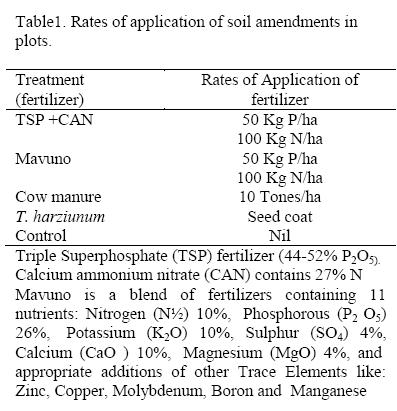
<body><![CDATA[<p align="justify"><font face="verdana" size="2">For mass production, the isolate was grown in 1000 ml conical flasks, containing 250g vermiculate, 250g of wheat bran and 250g Czapek&#45;Dox medium autoclaved for 20 minutes at 120&deg;C, on two consecutive days. After 25 days incubation period, contents of the flasks were transferred to plastic plates under sterile conditions, left to air dry then mixed in a blender to become powder and kept in a plastic container at room temperature until ready for use in the field.</font></p>  	    <p align="justify"><font face="verdana" size="2">The formulation was used as a dry seed treatment where 2g of the formulation was mixed with 1 kg of seeds and treated with 4ml of gum Ar&aacute;bica solution (30g/300ml) as sticker onto the seed. The seeds of maize and beans were surface&#45;sterilized by rinsing thoroughly in sterile distilled water, rolled with the formulation and planted immediately. Seeds treated with sterile distilled water served as control.</font></p>  	    <p align="justify"><font face="verdana" size="2">&nbsp;</font></p>  	    <p align="justify"><font face="verdana" size="2"><b>Field Trial to test effect of <i>Trichoderma</i> on seed germination and growth</b></font></p>  	    <p align="justify"><font face="verdana" size="2">Field trials were done in Kibugu and Ndunduri locations in Embu. The experiment was laid out at the ATC in a Randomized Complete Block Design (RCD) with treatments replicated 5 times. These treatments were further replicated on farm on 12 slit plots, 6 in each location, to nullify the effect of heterogeneity of farms. The farms were 500m apart to avoid autocorrelation (Groupe and Theriault Consultants, 1984). Each treatment was a stretch of 5 x 10m. The test crops were maize intercropped with beans. The maize type was hybrid (H516) with spacing of 90 x 30cm and planting done with two seeds per hole. Bean type was Mwezi moja with spacing of 75 x 25 cm and planted two seeds per hole. The treatments were Triple Superphosphate combined with Calcium ammonium nitrate (TSP + CAN), Mavuno (blend of fertilizer containing 11 nutrients), Cow manure, and <i>Trichoderma</i> seed coating (<a href="#t1">Table 1</a>). The fertilizers were added by broadcasting during planting and top dressing of CAN, TSP and Mavuno done after first round of weeding. Planting was done during the long rains which occur between March and May and short rains between October and December. The on station experiments were researcher managed while on farm trials were farmer managed.</font></p>  	    <p align="center"><font face="verdana" size="2"><a name="t1"></a></font></p>  	    <p align="center"><font face="verdana" size="2"><img src="/img/revistas/tsa/v13n1/a11t1.jpg"></font></p>  	    <p align="justify"><font face="verdana" size="2">Seedlings were counted 14 days after emergence. From each hole, one seedling was dug out using a spade and the following parameters measured; plant shoot/stem height was measured from soil surface to apical buds using a ruler. Stem/root caliper width measurement was also recorded.</font></p>  	    <p align="justify"><font face="verdana" size="2">&nbsp;</font></p>  	    <p align="justify"><font face="verdana" size="2"><b>Statistical Analysis</b></font></p>  	    ]]></body>
<body><![CDATA[<p align="justify"><font face="verdana" size="2">Analysis of variance tests were done to establish the effect of <i>Trichoderma</i> seed coat and soil amendments on the rate of germination and seedling establishment of maize and beans. Tukey's Honestly Significance Difference (HSD) was used to compare treatment group means (Kindt and Coe, 2005).</font></p>  	    <p align="justify"><font face="verdana" size="2">&nbsp;</font></p>  	    <p align="justify"><font face="verdana" size="2"><b>RESULTS</b></font></p>  	    <p align="justify"><font face="verdana" size="2"><b>Stimulative effect of <i>Trichoderma</i> spp. on seed germination</b></font></p>  	    <p align="justify"><font face="verdana" size="2">Germination rates of maize and beans planted in soils amended differently are shown in <a href="/img/revistas/tsa/v13n1/a11f1.jpg" target="_blank">Fig 1</a> and <a href="/img/revistas/tsa/v13n1/a11f2.jpg" target="_blank">2</a>. For maize, the effects were highly significant at p &lt; 0,001 with f&#45; value of 4.716. The highest rate of seedling emergence was 82.7% for seeds treated with <i>Trichoderma</i> inoculum followed by 82.2% for seeds coated with the inoculum and planted in soil amended with manure followed by 78.4% for seeds coated with <i>Trichoderma</i> and planted in soils amended with Mavuno fertilizer. Plots treated with TSP and CAN without the seed coat recorded the least germination rate (57.7%) followed by control (70.3%).</font></p>  	    <p align="justify"><font face="verdana" size="2">Treatment of bean seedlings with <i>Trichoderma</i> did not influence rate of germination significantly (p = 0.687; f&#45;value = 0.683) though differences were observed with Manure treatment recording the highest germination rate of 74.9% followed by <i>Manwe+Trichoderma</i> (74.0%) and <i>Trichoderma</i> seed coat alone (73.4%) (<a href="/img/revistas/tsa/v13n1/a11f2.jpg" target="_blank">Figure 2</a>). Control plots and those treated with TSP and CAN scored the least (69.6%).</font></p>  	    <p align="justify"><font face="verdana" size="2">The effect of soil amendments on bean growth was highly significant at pO.0001 with f value of 9.023, 3.805, 8.378 and 15.564 for root collar and length, stem diameter and length respectively. Plots treated with TSP/CAN recorded the highest values of root size and stem diameter followed by <i>TSP+CAN+Trichoderma</i> , <i>Mavuno+Trichoderma</i> and Mavuno (<a href="/img/revistas/tsa/v13n1/a11t4.jpg" target="_blank">Tables 4</a>,<a href="/img/revistas/tsa/v13n1/a11t5.jpg" target="_blank">5</a>). Again like in maize the combination treatments of fertilizer with <i>Trichoderma</i> performed better than single fertilizer or inoculum application. Though TSP+CAN performed the best for beans Tukey's HSD grouped the performance of TSP+CAN as equal to <i>TSP+CAN+Trichoderma, Mavano+Trichoderma</i> and <i>Manme+Trichoderma.</i></font></p>  	    <p align="justify"><font face="verdana" size="2">&nbsp;</font></p>  	    <p align="justify"><font face="verdana" size="2"><b>Effect of <i>Trichoderma</i> and soil fertility amendments on maize and bean growth</b></font></p>  	    <p align="justify"><font face="verdana" size="2">All the fertilizers and inoculum had positive effect on maize growth. The variables that were measured were all greater for the treatment compared to the control. This difference was highly significant at pO.0001 with f value of 13.149, 12.748, 7.612, and 17.115 for root collar diameter, root length, stem diameter and stem length respectively. Effect of <i>Trichoderma</i> on maize plant development was obvious with plots treated with TSP and CAN + <i>Trichoderma</i> recording the largest root and stem diameter and stem length followed by TSP and Mavuno+ <i>Trichoderma</i> fertilizers (<a href="/img/revistas/tsa/v13n1/a11t2.jpg" target="_blank">Table 2</a>,<a href="/img/revistas/tsa/v13n1/a11t3.jpg" target="_blank">3</a>) All the fertilizers performed better when combined with <i>Trichoderma</i> inoculum than when applied singly. Control plots recorded the smallest size of plants. Among the fertilizers manure performed the least close to control and Tuky's HSD grouped it with control.</font></p>  	    ]]></body>
<body><![CDATA[<p align="justify"><font face="verdana" size="2"><i>Trichoderma</i> increased lateral root growth of both maize and beans (<a href="/img/revistas/tsa/v13n1/a11f3.jpg" target="_blank">Fig 3</a>). The increase was more pronounced in seedlings grown in plots treated with combination of fertilizer.</font></p>  	    <p align="justify"><font face="verdana" size="2">&nbsp;</font></p>  	    <p align="justify"><font face="verdana" size="2"><b>DISCUSSION</b></font></p>  	    <p align="justify"><font face="verdana" size="2"><i>Trichoderma</i> increased the rate of germination of maize and seedling growth of both maize and beans. The increased root length and collar diameter, stem length and diameter by <i>Trichoderma</i> treatment are measures of seedling's survivability and illustrate the direct effect of the fungus on the plants. A number of mechanisms for plant growth promotion by <i>Trichoderma</i> have been proposed (Harman <i>et a. I,</i> 2004a; Jaleed <i>et ai,</i> 1988). These include production of antibiotics, parasitization of other fungi, and competition with deleterious plant microorganisms. Until recently, these traits were considered to be the basis for how <i>Trichoderma</i> exerted beneficial effects on plant growth and development. However it is becoming increasingly clear that certain strains have substantial direct influence on plant development and crop productivity (Harman, 2006).</font></p>  	    <p align="justify"><font face="verdana" size="2">Combination of <i>Trichoderma</i> inoculum and fertilizers performed better compared with single application of either fertilizer or inoculum showing that when soil fertility was increased, the level of increased maize and beans growth induced by <i>Trichoderma</i> spp. was enhanced. Addition of fertilizer could have provided substrate for proliferation of the fungus thereby increasing its overall performance. Windham <i>et al,</i> (1986) also reported that when soil fertility was increased, the level of increased tomato growth induced by <i>Trichoderma</i> spp. was enhanced. Manure effect on seedling growth was low compared to other fertilizers probably due to its quality and the short period of running the experiment. Manure has been reported to have several effects when added to the soil system which include, immediate supply of nutrients like nitrogen as ammonium, phosphorus, potassium, and micronutrients that can be used directly by plants and microorganisms; delayed supply of nutrients that are part of organic (carbon&#45;containing) compounds; lowered pH; salt and ammonia toxicity; improved soil structure; enhanced biological activity. The immediate supply of nutrients by manure could explain the improved effect of <i>Trichoderma</i> on germination when soils were treated with the fertilizer. The delayed supply of nutrients from manure explains the low effect of the fertilizer on eventual growth parameters of the seedlings. Gopichand <i>et al,</i> (2006) working on <i>Curcuma arom&aacute;tica,</i> and Zane and Basil (2004) working on <i>Pennisetum americanum</i> also reported such delayed effects on nutrient release from manure. Eghball <i>et al.,</i> (2004) also reported residual effects of manure and compost applications on corn production and soil properties.</font></p>  	    <p align="justify"><font face="verdana" size="2"><i>Trichoderma</i> promoted growth of primary root length and root branching in maize and beans by inducing lateral root growth. In plants auxins have been demonstrated to initiate lateral root growth (Casimiro <i>et al.</i> ,2001) and the observed effects of <i>Trichoderma</i> in promoting lateral root development is similar to in vitro experiments performed by Hexon <i>et al.,</i> (2009) that showed that <i>Trichoderma</i> spp. produced indole&#45;3&#45;acetic acid (IAA) that promoted lateral root formation in <i>Arabidopsis thaliana.</i> The root system is important for plant fitness because it provides anchorage, contributes to water use efficiency, and facilitates the acquisition of mineral nutrients from the soil (Lopez&#45;Bucio <i>et al,</i> 2005a). Increased root size resulted into increased shoot size which translates into increased shoot biomass production indicating a beneficial effect of inoculation on plant growth and development. The positive influence of <i>Trichoderma</i> on root system architecture would therefore relate to increased yield of plants. <i>Trichoderma</i> enhanced root biomass production and increased root hair development has also been reported by Bjorkman <i>et al,</i> 1998; Harman <i>etal,</i> 2004b.</font></p>  	    <p align="justify"><font face="verdana" size="2">&nbsp;</font></p>  	    <p align="justify"><font face="verdana" size="2"><b>CONCLUSION</b></font></p>  	    <p align="justify"><font face="verdana" size="2">We conclude that the <i>Trichoderma</i> spp. isolate tested increased the rate of seed germination and shoot and root growth of maize and bean seedlings. Addition of fertilizers enhanced <i>Trichoderma</i> activities. The development of this isolate as a successful biostimulant is dependent upon understanding of the complex interactions of this organism and plants in the soil ecosystem.</font></p> 	    <p align="justify">&nbsp;</p>      ]]></body>
<body><![CDATA[<p align="justify"><font face="verdana" size="2"><b>REFERENCES</b></font></p>  	    <!-- ref --><p align="justify"><font face="verdana" size="2">Adams P, De&#45;Leij FA, Lynch JM. 2007. <i>Trichoderma harzianum</i> Rifai 1295&#45;22 mediates growth promotion of Crack willow <i>(Salix fragilis)</i> saplings in both clean and metal contaminated soil. Microb Ecol 54:306&#45;313.    &nbsp;&nbsp;&nbsp;&nbsp;&nbsp;&nbsp;&nbsp;&nbsp;[&#160;<a href="javascript:void(0);" onclick="javascript: window.open('/scielo.php?script=sci_nlinks&ref=10047306&pid=S1870-0462201100040001100001&lng=','','width=640,height=500,resizable=yes,scrollbars=1,menubar=yes,');">Links</a>&#160;]<!-- end-ref --></font></p>  	    <!-- ref --><p align="justify"><font face="verdana" size="2">Bais H. P, Weir T. L, Perry L, Gilroy S, Vivanco JM. 2006. The role of root exudates in rhizosphere interactions with plants and other organisms. Annu Rev Plant Biol 57: 233&#45;266.    &nbsp;&nbsp;&nbsp;&nbsp;&nbsp;&nbsp;&nbsp;&nbsp;[&#160;<a href="javascript:void(0);" onclick="javascript: window.open('/scielo.php?script=sci_nlinks&ref=10047308&pid=S1870-0462201100040001100002&lng=','','width=640,height=500,resizable=yes,scrollbars=1,menubar=yes,');">Links</a>&#160;]<!-- end-ref --></font></p>  	    <!-- ref --><p align="justify"><font face="verdana" size="2">Bjorkman T, Blanchard LM, Harman GE. 1998. Growth enhancement of shrunken&#45;2 sweet corn when colonized with Trichoderma harzianum 1295&#45;22; effect of environmental stress. J Am Soc Hortic Sci 123: 35&#45;40.    &nbsp;&nbsp;&nbsp;&nbsp;&nbsp;&nbsp;&nbsp;&nbsp;[&#160;<a href="javascript:void(0);" onclick="javascript: window.open('/scielo.php?script=sci_nlinks&ref=10047310&pid=S1870-0462201100040001100003&lng=','','width=640,height=500,resizable=yes,scrollbars=1,menubar=yes,');">Links</a>&#160;]<!-- end-ref --></font></p>  	    <!-- ref --><p align="justify"><font face="verdana" size="2">Casimiro I, Marchant A, Bhalerao RP, Swamp R, Graham N, Inze D, Sandberg G, Caesro PJ, Bennett M. 2001. Auxin transport promotes Arabidopsis lateral root initiation. Plant Cell 13: 84&#45;852.    &nbsp;&nbsp;&nbsp;&nbsp;&nbsp;&nbsp;&nbsp;&nbsp;[&#160;<a href="javascript:void(0);" onclick="javascript: window.open('/scielo.php?script=sci_nlinks&ref=10047312&pid=S1870-0462201100040001100004&lng=','','width=640,height=500,resizable=yes,scrollbars=1,menubar=yes,');">Links</a>&#160;]<!-- end-ref --></font></p>  	    <!-- ref --><p align="justify"><font face="verdana" size="2">Chang Y. C, Baker R, Klefield O, Chet I. 1986. Increased growth of plants in the presence of the biological control agent <i>Trichoderma harzianum.</i> Plant Dis 70: 145&#45;148.    &nbsp;&nbsp;&nbsp;&nbsp;&nbsp;&nbsp;&nbsp;&nbsp;[&#160;<a href="javascript:void(0);" onclick="javascript: window.open('/scielo.php?script=sci_nlinks&ref=10047314&pid=S1870-0462201100040001100005&lng=','','width=640,height=500,resizable=yes,scrollbars=1,menubar=yes,');">Links</a>&#160;]<!-- end-ref --></font></p>  	    <!-- ref --><p align="justify"><font face="verdana" size="2">Eghball B, Ginting D, and Gilley J. E. Gilley, 2004. Residual Effects of Manure and Compost Applications on Corn Production and Soil Properties. Agron. J. 96(2): 442 &#45; 447.    &nbsp;&nbsp;&nbsp;&nbsp;&nbsp;&nbsp;&nbsp;&nbsp;[&#160;<a href="javascript:void(0);" onclick="javascript: window.open('/scielo.php?script=sci_nlinks&ref=10047316&pid=S1870-0462201100040001100006&lng=','','width=640,height=500,resizable=yes,scrollbars=1,menubar=yes,');">Links</a>&#160;]<!-- end-ref --></font></p>  	    <!-- ref --><p align="justify"><font face="verdana" size="2">Gopichand, R.D. Singh, R.L. Meena, M.K. Singh, V.K. Kaul, Brij Lai, Ruchi Acharya and Ramdeen Prasad. 2006. Effect of manure and plant spacing on crop growth, yield and oil&#45;quality of <i>Curcuma arom&aacute;tica</i> Salisb. in mid hill of western Himalaya. Industrial Crops and Products. 24:105&#45;112.    &nbsp;&nbsp;&nbsp;&nbsp;&nbsp;&nbsp;&nbsp;&nbsp;[&#160;<a href="javascript:void(0);" onclick="javascript: window.open('/scielo.php?script=sci_nlinks&ref=10047318&pid=S1870-0462201100040001100007&lng=','','width=640,height=500,resizable=yes,scrollbars=1,menubar=yes,');">Links</a>&#160;]<!-- end-ref --></font></p>  	    <!-- ref --><p align="justify"><font face="verdana" size="2">Harman G. E, 2006. Overview of mechanisms and uses of <i>Trichoderma</i> spp. Phytopathology 96: 190&#45;194.    &nbsp;&nbsp;&nbsp;&nbsp;&nbsp;&nbsp;&nbsp;&nbsp;[&#160;<a href="javascript:void(0);" onclick="javascript: window.open('/scielo.php?script=sci_nlinks&ref=10047320&pid=S1870-0462201100040001100008&lng=','','width=640,height=500,resizable=yes,scrollbars=1,menubar=yes,');">Links</a>&#160;]<!-- end-ref --></font></p>  	    <!-- ref --><p align="justify"><font face="verdana" size="2">Harman G E, Howell C. R, Vitrebo A, Chet I, Lorito M. 2004a. <i>Trichoderma</i> species opportunistic,arivulent plant symbionts. Nat Rev Microbiol 2:43&#45;56.    &nbsp;&nbsp;&nbsp;&nbsp;&nbsp;&nbsp;&nbsp;&nbsp;[&#160;<a href="javascript:void(0);" onclick="javascript: window.open('/scielo.php?script=sci_nlinks&ref=10047322&pid=S1870-0462201100040001100009&lng=','','width=640,height=500,resizable=yes,scrollbars=1,menubar=yes,');">Links</a>&#160;]<!-- end-ref --></font></p>  	    <!-- ref --><p align="justify"><font face="verdana" size="2">Harman GE, Petzoldt R, Comis A, Chen J., 2004b. Interaction between <i>Trichoderma harzianum</i> strain T&#45;22 and maize inbred Mo 17 and effects of these interactions on disease caused by <i>Phytium ultimum</i> and <i>Colletotrichum graminicola.</i> Phytopathology 94: 147&#45;153.    &nbsp;&nbsp;&nbsp;&nbsp;&nbsp;&nbsp;&nbsp;&nbsp;[&#160;<a href="javascript:void(0);" onclick="javascript: window.open('/scielo.php?script=sci_nlinks&ref=10047324&pid=S1870-0462201100040001100010&lng=','','width=640,height=500,resizable=yes,scrollbars=1,menubar=yes,');">Links</a>&#160;]<!-- end-ref --></font></p>  	    <!-- ref --><p align="justify"><font face="verdana" size="2">Hexon AC, Lourdes MR, Carlos CP and Jose LB, 2009. <i>Trichoderma virens,</i> a plant beneficial fungus, enhances biomass production and promotes lateral root growth through an auxin&#45;dependent mechanism in Arabidopsis. Plant Physiology 149: 1579&#45;1592.    &nbsp;&nbsp;&nbsp;&nbsp;&nbsp;&nbsp;&nbsp;&nbsp;[&#160;<a href="javascript:void(0);" onclick="javascript: window.open('/scielo.php?script=sci_nlinks&ref=10047326&pid=S1870-0462201100040001100011&lng=','','width=640,height=500,resizable=yes,scrollbars=1,menubar=yes,');">Links</a>&#160;]<!-- end-ref --></font></p>  	    <!-- ref --><p align="justify"><font face="verdana" size="2">Meed S. Ahmad and Ralph Baker. 1988.<i>Trichoderma</i> enhances plant growth and controls damping off of seedlings caused by <i>Pythium ultimum.</i> Canadian Journal Microbiology. 34: 229&#45;234.    &nbsp;&nbsp;&nbsp;&nbsp;&nbsp;&nbsp;&nbsp;&nbsp;[&#160;<a href="javascript:void(0);" onclick="javascript: window.open('/scielo.php?script=sci_nlinks&ref=10047328&pid=S1870-0462201100040001100012&lng=','','width=640,height=500,resizable=yes,scrollbars=1,menubar=yes,');">Links</a>&#160;]<!-- end-ref --></font></p>  	    <!-- ref --><p align="justify"><font face="verdana" size="2">Kredrics L., Antal Z, Manczinger L. SzekeresA., Kevei F., and Nagy E., 2003. Influence of Environmental Parameters on <i>Trichoderma</i> Strains with Biocontrol Potential. Food Technology Biotechnology. 41: 37&#45;42.    &nbsp;&nbsp;&nbsp;&nbsp;&nbsp;&nbsp;&nbsp;&nbsp;[&#160;<a href="javascript:void(0);" onclick="javascript: window.open('/scielo.php?script=sci_nlinks&ref=10047330&pid=S1870-0462201100040001100013&lng=','','width=640,height=500,resizable=yes,scrollbars=1,menubar=yes,');">Links</a>&#160;]<!-- end-ref --></font></p>  	    <!-- ref --><p align="justify"><font face="verdana" size="2">Kindt, R. and Coe, R., 2005. Tree diversity analysis. A manual and software for common statistical methods for ecological biodiversity studies. World Agro&#45;forestry Center (ICRAF. Nairobi, Kenya.    &nbsp;&nbsp;&nbsp;&nbsp;&nbsp;&nbsp;&nbsp;&nbsp;[&#160;<a href="javascript:void(0);" onclick="javascript: window.open('/scielo.php?script=sci_nlinks&ref=10047332&pid=S1870-0462201100040001100014&lng=','','width=640,height=500,resizable=yes,scrollbars=1,menubar=yes,');">Links</a>&#160;]<!-- end-ref --></font></p>  	    <!-- ref --><p align="justify"><font face="verdana" size="2">Lopez&#45;Bucio J, Cruz&#45;Ramirez A, Perez&#45;Torres A, Ramirez&#45;Pimentel JG, Sanchez&#45;Calderon L, Herrera&#45;Estrella L (2005a) Root architecture In C Turnbull, ed, Plant Architecture and its Manipulation. Blackwell Annual Review Series. Blackwell Scientific, Oxford, pp 181&#45;206.    &nbsp;&nbsp;&nbsp;&nbsp;&nbsp;&nbsp;&nbsp;&nbsp;[&#160;<a href="javascript:void(0);" onclick="javascript: window.open('/scielo.php?script=sci_nlinks&ref=10047334&pid=S1870-0462201100040001100015&lng=','','width=640,height=500,resizable=yes,scrollbars=1,menubar=yes,');">Links</a>&#160;]<!-- end-ref --></font></p>  	    <!-- ref --><p align="justify"><font face="verdana" size="2">Mwangombe A. W, Thiongo I. G., Olubayo M and Kiprop Z. E. K. 2007. Occurrence of root rot disease of common bean <i>(Phaseolus vulgaris</i> L.) in association with bean stem maggot <i>(Ophyiomia</i> sp.) in Embu District, Kenya. Plant Pathology Journal 6: 141 &#45; 146.    &nbsp;&nbsp;&nbsp;&nbsp;&nbsp;&nbsp;&nbsp;&nbsp;[&#160;<a href="javascript:void(0);" onclick="javascript: window.open('/scielo.php?script=sci_nlinks&ref=10047336&pid=S1870-0462201100040001100016&lng=','','width=640,height=500,resizable=yes,scrollbars=1,menubar=yes,');">Links</a>&#160;]<!-- end-ref --></font></p>  	    <!-- ref --><p align="justify"><font face="verdana" size="2">Nemec, S., Datnoff, L. and Strandberg, J 1996. Efficacy of biocontrl agents in planting mixes to colonize plant roots and control root disease of vegetables and citrus. Crop Protection 15: 735&#45;742.    &nbsp;&nbsp;&nbsp;&nbsp;&nbsp;&nbsp;&nbsp;&nbsp;[&#160;<a href="javascript:void(0);" onclick="javascript: window.open('/scielo.php?script=sci_nlinks&ref=10047338&pid=S1870-0462201100040001100017&lng=','','width=640,height=500,resizable=yes,scrollbars=1,menubar=yes,');">Links</a>&#160;]<!-- end-ref --></font></p>  	    <!-- ref --><p align="justify"><font face="verdana" size="2">Okoth, S. A. , Roimen, H, Mutsotso B., Muya E., Okoth, P. 2007. Land use systems and distribution of <i>Trichoderma</i> species in Embu region, Kenya. Tropical and Subtropical Agroecosystems, 7:105&#45;122.    &nbsp;&nbsp;&nbsp;&nbsp;&nbsp;&nbsp;&nbsp;&nbsp;[&#160;<a href="javascript:void(0);" onclick="javascript: window.open('/scielo.php?script=sci_nlinks&ref=10047340&pid=S1870-0462201100040001100018&lng=','','width=640,height=500,resizable=yes,scrollbars=1,menubar=yes,');">Links</a>&#160;]<!-- end-ref --></font></p>  	    <!-- ref --><p align="justify"><font face="verdana" size="2">Stephan D, Schmitt, M., Carvalho S, Seddon B and Koch E, 2005. Evaluation of biocontrol preparations and plant extracts for the control of <i>Phytophthora infestans</i> on potato leaves. European Journal of Plant Pathology 112: 235 &#45;246.    &nbsp;&nbsp;&nbsp;&nbsp;&nbsp;&nbsp;&nbsp;&nbsp;[&#160;<a href="javascript:void(0);" onclick="javascript: window.open('/scielo.php?script=sci_nlinks&ref=10047342&pid=S1870-0462201100040001100019&lng=','','width=640,height=500,resizable=yes,scrollbars=1,menubar=yes,');">Links</a>&#160;]<!-- end-ref --></font></p>  	    <!-- ref --><p align="justify"><font face="verdana" size="2">Vinale F., Krishnapillai S., Emilio L., Ghisalberti R. M., Sheridan L., Woo, M, L., 2008. <i>Trichoderma&#45;</i> plant&#45; pathogen interactions. Soil Biology Biochemistry 40: 1&#45;10.    &nbsp;&nbsp;&nbsp;&nbsp;&nbsp;&nbsp;&nbsp;&nbsp;[&#160;<a href="javascript:void(0);" onclick="javascript: window.open('/scielo.php?script=sci_nlinks&ref=10047344&pid=S1870-0462201100040001100020&lng=','','width=640,height=500,resizable=yes,scrollbars=1,menubar=yes,');">Links</a>&#160;]<!-- end-ref --></font></p>  	    <!-- ref --><p align="justify"><font face="verdana" size="2">Windham M. T., Y. Elad, and R. Baker 1986. A Mechanism for Increased Plant Growth Induced by <i>Trichoderma</i> spp. Phytopathology 76:518&#45;521.    &nbsp;&nbsp;&nbsp;&nbsp;&nbsp;&nbsp;&nbsp;&nbsp;[&#160;<a href="javascript:void(0);" onclick="javascript: window.open('/scielo.php?script=sci_nlinks&ref=10047346&pid=S1870-0462201100040001100021&lng=','','width=640,height=500,resizable=yes,scrollbars=1,menubar=yes,');">Links</a>&#160;]<!-- end-ref --></font></p>  	    <!-- ref --><p align="justify"><font face="verdana" size="2">Yedidia I, Shrivasta A. K, Kapulnik Y, Chet I. 2001. Effect of <i>Trichoderma harzianum</i> on microelement concentration and increased growth of cucumber plants. Plant Soil 235:235&#45;242.    &nbsp;&nbsp;&nbsp;&nbsp;&nbsp;&nbsp;&nbsp;&nbsp;[&#160;<a href="javascript:void(0);" onclick="javascript: window.open('/scielo.php?script=sci_nlinks&ref=10047348&pid=S1870-0462201100040001100022&lng=','','width=640,height=500,resizable=yes,scrollbars=1,menubar=yes,');">Links</a>&#160;]<!-- end-ref --></font></p>  	    <!-- ref --><p align="justify"><font face="verdana" size="2">Zane F. Lund and Basil D. Doss, 2004. Residual Effects of Dairy Cattle Manure on Plant Growth and Soil Properties Agronomy Journal. 96: 442 &#45; 447.    &nbsp;&nbsp;&nbsp;&nbsp;&nbsp;&nbsp;&nbsp;&nbsp;[&#160;<a href="javascript:void(0);" onclick="javascript: window.open('/scielo.php?script=sci_nlinks&ref=10047350&pid=S1870-0462201100040001100023&lng=','','width=640,height=500,resizable=yes,scrollbars=1,menubar=yes,');">Links</a>&#160;]<!-- end-ref --></font></p>      ]]></body><back>
<ref-list>
<ref id="B1">
<nlm-citation citation-type="journal">
<person-group person-group-type="author">
<name>
<surname><![CDATA[Adams]]></surname>
<given-names><![CDATA[P]]></given-names>
</name>
<name>
<surname><![CDATA[De-Leij]]></surname>
<given-names><![CDATA[FA]]></given-names>
</name>
<name>
<surname><![CDATA[Lynch]]></surname>
<given-names><![CDATA[JM]]></given-names>
</name>
</person-group>
<article-title xml:lang="en"><![CDATA[Trichoderma harzianum Rifai 1295-22 mediates growth promotion of Crack willow (Salix fragilis) saplings in both clean and metal contaminated soil]]></article-title>
<source><![CDATA[Microb Ecol]]></source>
<year>2007</year>
<volume>54</volume>
<page-range>306-313</page-range></nlm-citation>
</ref>
<ref id="B2">
<nlm-citation citation-type="journal">
<person-group person-group-type="author">
<name>
<surname><![CDATA[Bais]]></surname>
<given-names><![CDATA[H. P]]></given-names>
</name>
<name>
<surname><![CDATA[Weir]]></surname>
<given-names><![CDATA[T. L]]></given-names>
</name>
<name>
<surname><![CDATA[Perry]]></surname>
<given-names><![CDATA[L]]></given-names>
</name>
<name>
<surname><![CDATA[Gilroy]]></surname>
<given-names><![CDATA[S]]></given-names>
</name>
<name>
<surname><![CDATA[Vivanco]]></surname>
<given-names><![CDATA[JM]]></given-names>
</name>
</person-group>
<article-title xml:lang="en"><![CDATA[The role of root exudates in rhizosphere interactions with plants and other organisms]]></article-title>
<source><![CDATA[Annu Rev Plant Biol]]></source>
<year>2006</year>
<volume>57</volume>
<page-range>233-266</page-range></nlm-citation>
</ref>
<ref id="B3">
<nlm-citation citation-type="journal">
<person-group person-group-type="author">
<name>
<surname><![CDATA[Bjorkman]]></surname>
<given-names><![CDATA[T]]></given-names>
</name>
<name>
<surname><![CDATA[Blanchard]]></surname>
<given-names><![CDATA[LM]]></given-names>
</name>
<name>
<surname><![CDATA[Harman]]></surname>
<given-names><![CDATA[GE]]></given-names>
</name>
</person-group>
<article-title xml:lang="en"><![CDATA[Growth enhancement of shrunken-2 sweet corn when colonized with Trichoderma harzianum 1295-22; effect of environmental stress]]></article-title>
<source><![CDATA[J Am Soc Hortic Sci]]></source>
<year>1998</year>
<volume>123</volume>
<page-range>35-40</page-range></nlm-citation>
</ref>
<ref id="B4">
<nlm-citation citation-type="journal">
<person-group person-group-type="author">
<name>
<surname><![CDATA[Casimiro]]></surname>
<given-names><![CDATA[I]]></given-names>
</name>
<name>
<surname><![CDATA[Marchant]]></surname>
<given-names><![CDATA[A]]></given-names>
</name>
<name>
<surname><![CDATA[Bhalerao]]></surname>
<given-names><![CDATA[RP]]></given-names>
</name>
<name>
<surname><![CDATA[Swamp]]></surname>
<given-names><![CDATA[R]]></given-names>
</name>
<name>
<surname><![CDATA[Graham]]></surname>
<given-names><![CDATA[N]]></given-names>
</name>
<name>
<surname><![CDATA[Inze]]></surname>
<given-names><![CDATA[D]]></given-names>
</name>
<name>
<surname><![CDATA[Sandberg]]></surname>
<given-names><![CDATA[G]]></given-names>
</name>
<name>
<surname><![CDATA[Caesro]]></surname>
<given-names><![CDATA[PJ]]></given-names>
</name>
<name>
<surname><![CDATA[Bennett]]></surname>
<given-names><![CDATA[M.]]></given-names>
</name>
</person-group>
<article-title xml:lang="en"><![CDATA[Auxin transport promotes Arabidopsis lateral root initiation]]></article-title>
<source><![CDATA[Plant Cell]]></source>
<year>2001</year>
<volume>13</volume>
<page-range>84-852</page-range></nlm-citation>
</ref>
<ref id="B5">
<nlm-citation citation-type="journal">
<person-group person-group-type="author">
<name>
<surname><![CDATA[Chang]]></surname>
<given-names><![CDATA[Y. C]]></given-names>
</name>
<name>
<surname><![CDATA[Baker]]></surname>
<given-names><![CDATA[R]]></given-names>
</name>
<name>
<surname><![CDATA[Klefield]]></surname>
<given-names><![CDATA[O]]></given-names>
</name>
<name>
<surname><![CDATA[Chet]]></surname>
<given-names><![CDATA[I.]]></given-names>
</name>
</person-group>
<article-title xml:lang="en"><![CDATA[Increased growth of plants in the presence of the biological control agent Trichoderma harzianum]]></article-title>
<source><![CDATA[Plant Dis]]></source>
<year>1986</year>
<volume>70</volume>
<page-range>145-148</page-range></nlm-citation>
</ref>
<ref id="B6">
<nlm-citation citation-type="journal">
<person-group person-group-type="author">
<name>
<surname><![CDATA[Eghball]]></surname>
<given-names><![CDATA[B]]></given-names>
</name>
<name>
<surname><![CDATA[Ginting]]></surname>
<given-names><![CDATA[D]]></given-names>
</name>
<name>
<surname><![CDATA[Gilley]]></surname>
<given-names><![CDATA[J. E.]]></given-names>
</name>
</person-group>
<article-title xml:lang="en"><![CDATA[Residual Effects of Manure and Compost Applications on Corn Production and Soil Properties]]></article-title>
<source><![CDATA[Agron. J]]></source>
<year>2004</year>
<volume>96</volume>
<numero>2</numero>
<issue>2</issue>
<page-range>442 - 447</page-range></nlm-citation>
</ref>
<ref id="B7">
<nlm-citation citation-type="journal">
<person-group person-group-type="author">
<name>
<surname><![CDATA[Gopichand]]></surname>
<given-names><![CDATA[R.D.]]></given-names>
</name>
<name>
<surname><![CDATA[Singh]]></surname>
<given-names><![CDATA[R.L.]]></given-names>
</name>
<name>
<surname><![CDATA[Meena]]></surname>
<given-names><![CDATA[M.K.]]></given-names>
</name>
<name>
<surname><![CDATA[Singh]]></surname>
<given-names><![CDATA[V.K.]]></given-names>
</name>
<name>
<surname><![CDATA[Kaul]]></surname>
<given-names><![CDATA[Brij Lai]]></given-names>
</name>
<name>
<surname><![CDATA[Ruchi]]></surname>
<given-names><![CDATA[Acharya]]></given-names>
</name>
<name>
<surname><![CDATA[Ramdeen]]></surname>
<given-names><![CDATA[Prasad]]></given-names>
</name>
</person-group>
<article-title xml:lang="en"><![CDATA[Effect of manure and plant spacing on crop growth, yield and oil-quality of Curcuma aromática Salisb. in mid hill of western Himalaya]]></article-title>
<source><![CDATA[Industrial Crops and Products]]></source>
<year>2006</year>
<volume>24</volume>
<page-range>105-112</page-range></nlm-citation>
</ref>
<ref id="B8">
<nlm-citation citation-type="journal">
<person-group person-group-type="author">
<name>
<surname><![CDATA[Harman]]></surname>
<given-names><![CDATA[G. E]]></given-names>
</name>
</person-group>
<article-title xml:lang="en"><![CDATA[Overview of mechanisms and uses of Trichoderma spp]]></article-title>
<source><![CDATA[Phytopathology]]></source>
<year>2006</year>
<volume>96</volume>
<page-range>190-194</page-range></nlm-citation>
</ref>
<ref id="B9">
<nlm-citation citation-type="journal">
<person-group person-group-type="author">
<name>
<surname><![CDATA[Harman]]></surname>
<given-names><![CDATA[G E]]></given-names>
</name>
<name>
<surname><![CDATA[Howell]]></surname>
<given-names><![CDATA[C. R]]></given-names>
</name>
<name>
<surname><![CDATA[Vitrebo]]></surname>
<given-names><![CDATA[A]]></given-names>
</name>
<name>
<surname><![CDATA[Chet]]></surname>
<given-names><![CDATA[I]]></given-names>
</name>
<name>
<surname><![CDATA[Lorito]]></surname>
<given-names><![CDATA[M]]></given-names>
</name>
</person-group>
<article-title xml:lang="en"><![CDATA[Trichoderma species opportunistic,arivulent plant symbionts]]></article-title>
<source><![CDATA[Nat Rev Microbiol]]></source>
<year>2004</year>
<volume>2</volume>
<page-range>43-56</page-range></nlm-citation>
</ref>
<ref id="B10">
<nlm-citation citation-type="journal">
<person-group person-group-type="author">
<name>
<surname><![CDATA[Harman]]></surname>
<given-names><![CDATA[GE]]></given-names>
</name>
<name>
<surname><![CDATA[Petzoldt]]></surname>
<given-names><![CDATA[R]]></given-names>
</name>
<name>
<surname><![CDATA[Comis]]></surname>
<given-names><![CDATA[A]]></given-names>
</name>
<name>
<surname><![CDATA[Chen]]></surname>
<given-names><![CDATA[J]]></given-names>
</name>
</person-group>
<article-title xml:lang="en"><![CDATA[Interaction between Trichoderma harzianum strain T-22 and maize inbred Mo 17 and effects of these interactions on disease caused by Phytium ultimum and Colletotrichum graminicola]]></article-title>
<source><![CDATA[Phytopathology]]></source>
<year>2004</year>
<volume>94</volume>
<page-range>147-153</page-range></nlm-citation>
</ref>
<ref id="B11">
<nlm-citation citation-type="journal">
<person-group person-group-type="author">
<name>
<surname><![CDATA[Hexon]]></surname>
<given-names><![CDATA[AC]]></given-names>
</name>
<name>
<surname><![CDATA[Lourdes]]></surname>
<given-names><![CDATA[MR]]></given-names>
</name>
<name>
<surname><![CDATA[Carlos]]></surname>
<given-names><![CDATA[CP]]></given-names>
</name>
<name>
<surname><![CDATA[Jose]]></surname>
<given-names><![CDATA[LB]]></given-names>
</name>
</person-group>
<article-title xml:lang="en"><![CDATA[Trichoderma virens, a plant beneficial fungus, enhances biomass production and promotes lateral root growth through an auxin-dependent mechanism in Arabidopsis]]></article-title>
<source><![CDATA[Plant Physiology]]></source>
<year>2009</year>
<volume>149</volume>
<page-range>1579-1592</page-range></nlm-citation>
</ref>
<ref id="B12">
<nlm-citation citation-type="journal">
<person-group person-group-type="author">
<name>
<surname><![CDATA[Meed]]></surname>
<given-names><![CDATA[S. Ahmad]]></given-names>
</name>
<name>
<surname><![CDATA[Baker]]></surname>
<given-names><![CDATA[Ralph]]></given-names>
</name>
</person-group>
<article-title xml:lang="en"><![CDATA[Trichoderma enhances plant growth and controls damping off of seedlings caused by Pythium ultimum]]></article-title>
<source><![CDATA[Canadian Journal Microbiology]]></source>
<year>1988</year>
<volume>34</volume>
<page-range>229-234</page-range></nlm-citation>
</ref>
<ref id="B13">
<nlm-citation citation-type="journal">
<person-group person-group-type="author">
<name>
<surname><![CDATA[Kredrics]]></surname>
<given-names><![CDATA[L.]]></given-names>
</name>
<name>
<surname><![CDATA[Antal]]></surname>
<given-names><![CDATA[Z]]></given-names>
</name>
<name>
<surname><![CDATA[Manczinger]]></surname>
<given-names><![CDATA[L.]]></given-names>
</name>
<name>
<surname><![CDATA[Szekeres]]></surname>
<given-names><![CDATA[A.]]></given-names>
</name>
<name>
<surname><![CDATA[Kevei]]></surname>
<given-names><![CDATA[F.]]></given-names>
</name>
<name>
<surname><![CDATA[Nagy]]></surname>
<given-names><![CDATA[E.]]></given-names>
</name>
</person-group>
<article-title xml:lang="en"><![CDATA[Influence of Environmental Parameters on Trichoderma Strains with Biocontrol Potential]]></article-title>
<source><![CDATA[Food Technology Biotechnology]]></source>
<year>2003</year>
<volume>41</volume>
<page-range>37-42</page-range></nlm-citation>
</ref>
<ref id="B14">
<nlm-citation citation-type="book">
<person-group person-group-type="author">
<name>
<surname><![CDATA[Kindt]]></surname>
<given-names><![CDATA[R.]]></given-names>
</name>
<name>
<surname><![CDATA[Coe]]></surname>
<given-names><![CDATA[R.]]></given-names>
</name>
</person-group>
<source><![CDATA[Tree diversity analysis. A manual and software for common statistical methods for ecological biodiversity studies]]></source>
<year>2005</year>
<publisher-loc><![CDATA[Nairobi ]]></publisher-loc>
<publisher-name><![CDATA[World Agro-forestry Center]]></publisher-name>
</nlm-citation>
</ref>
<ref id="B15">
<nlm-citation citation-type="book">
<person-group person-group-type="author">
<name>
<surname><![CDATA[Lopez-Bucio]]></surname>
<given-names><![CDATA[J]]></given-names>
</name>
<name>
<surname><![CDATA[Cruz-Ramirez]]></surname>
<given-names><![CDATA[A]]></given-names>
</name>
<name>
<surname><![CDATA[Perez-Torres]]></surname>
<given-names><![CDATA[A]]></given-names>
</name>
<name>
<surname><![CDATA[Ramirez-Pimentel]]></surname>
<given-names><![CDATA[JG]]></given-names>
</name>
<name>
<surname><![CDATA[Sanchez-Calderon]]></surname>
<given-names><![CDATA[L]]></given-names>
</name>
<name>
<surname><![CDATA[Herrera-Estrella]]></surname>
<given-names><![CDATA[L]]></given-names>
</name>
</person-group>
<article-title xml:lang="en"><![CDATA[Root architecture]]></article-title>
<person-group person-group-type="editor">
<name>
<surname><![CDATA[Turnbull]]></surname>
<given-names><![CDATA[C]]></given-names>
</name>
</person-group>
<source><![CDATA[Plant Architecture and its Manipulation]]></source>
<year>2005</year>
<month>a</month>
<page-range>181-206</page-range><publisher-loc><![CDATA[Oxford ]]></publisher-loc>
<publisher-name><![CDATA[Blackwell Scientific]]></publisher-name>
</nlm-citation>
</ref>
<ref id="B16">
<nlm-citation citation-type="journal">
<person-group person-group-type="author">
<name>
<surname><![CDATA[Mwangombe]]></surname>
<given-names><![CDATA[A. W]]></given-names>
</name>
<name>
<surname><![CDATA[Thiongo]]></surname>
<given-names><![CDATA[I. G.]]></given-names>
</name>
<name>
<surname><![CDATA[Olubayo]]></surname>
<given-names><![CDATA[M]]></given-names>
</name>
<name>
<surname><![CDATA[Kiprop]]></surname>
<given-names><![CDATA[Z. E. K.]]></given-names>
</name>
</person-group>
<article-title xml:lang="en"><![CDATA[Occurrence of root rot disease of common bean (Phaseolus vulgaris L.) in association with bean stem maggot (Ophyiomia sp.) in Embu District, Kenya]]></article-title>
<source><![CDATA[Plant Pathology Journal]]></source>
<year>2007</year>
<volume>6</volume>
<page-range>141 - 146</page-range></nlm-citation>
</ref>
<ref id="B17">
<nlm-citation citation-type="journal">
<person-group person-group-type="author">
<name>
<surname><![CDATA[Nemec]]></surname>
<given-names><![CDATA[S.]]></given-names>
</name>
<name>
<surname><![CDATA[Datnoff]]></surname>
<given-names><![CDATA[L.]]></given-names>
</name>
<name>
<surname><![CDATA[Strandberg]]></surname>
<given-names><![CDATA[J]]></given-names>
</name>
</person-group>
<article-title xml:lang="en"><![CDATA[Efficacy of biocontrl agents in planting mixes to colonize plant roots and control root disease of vegetables and citrus]]></article-title>
<source><![CDATA[Crop Protection]]></source>
<year>1996</year>
<volume>15</volume>
<page-range>735-742</page-range></nlm-citation>
</ref>
<ref id="B18">
<nlm-citation citation-type="journal">
<person-group person-group-type="author">
<name>
<surname><![CDATA[Okoth]]></surname>
<given-names><![CDATA[S. A.]]></given-names>
</name>
<name>
<surname><![CDATA[Roimen]]></surname>
<given-names><![CDATA[H]]></given-names>
</name>
<name>
<surname><![CDATA[Mutsotso]]></surname>
<given-names><![CDATA[B.]]></given-names>
</name>
<name>
<surname><![CDATA[Muya]]></surname>
<given-names><![CDATA[E.]]></given-names>
</name>
<name>
<surname><![CDATA[Okoth]]></surname>
<given-names><![CDATA[P.]]></given-names>
</name>
</person-group>
<article-title xml:lang="en"><![CDATA[Land use systems and distribution of Trichoderma species in Embu region, Kenya]]></article-title>
<source><![CDATA[Tropical and Subtropical Agroecosystems]]></source>
<year>2007</year>
<volume>7</volume>
<page-range>105-122</page-range></nlm-citation>
</ref>
<ref id="B19">
<nlm-citation citation-type="journal">
<person-group person-group-type="author">
<name>
<surname><![CDATA[Stephan]]></surname>
<given-names><![CDATA[D]]></given-names>
</name>
<name>
<surname><![CDATA[Schmitt]]></surname>
<given-names><![CDATA[M.]]></given-names>
</name>
<name>
<surname><![CDATA[Carvalho]]></surname>
<given-names><![CDATA[S]]></given-names>
</name>
<name>
<surname><![CDATA[Seddon]]></surname>
<given-names><![CDATA[B]]></given-names>
</name>
<name>
<surname><![CDATA[Koch]]></surname>
<given-names><![CDATA[E]]></given-names>
</name>
</person-group>
<article-title xml:lang="en"><![CDATA[Evaluation of biocontrol preparations and plant extracts for the control of Phytophthora infestans on potato leaves]]></article-title>
<source><![CDATA[European Journal of Plant Pathology]]></source>
<year>2005</year>
<volume>112</volume>
<page-range>235 -246</page-range></nlm-citation>
</ref>
<ref id="B20">
<nlm-citation citation-type="journal">
<person-group person-group-type="author">
<name>
<surname><![CDATA[Vinale]]></surname>
<given-names><![CDATA[F.]]></given-names>
</name>
<name>
<surname><![CDATA[Krishnapillai]]></surname>
<given-names><![CDATA[S.]]></given-names>
</name>
<name>
<surname><![CDATA[Emilio]]></surname>
<given-names><![CDATA[L.]]></given-names>
</name>
<name>
<surname><![CDATA[Ghisalberti]]></surname>
<given-names><![CDATA[R. M.]]></given-names>
</name>
<name>
<surname><![CDATA[Sheridan]]></surname>
<given-names><![CDATA[L.]]></given-names>
</name>
<name>
<surname><![CDATA[Woo]]></surname>
<given-names><![CDATA[M, L.]]></given-names>
</name>
</person-group>
<article-title xml:lang="en"><![CDATA[Trichoderma- plant- pathogen interactions]]></article-title>
<source><![CDATA[Soil Biology Biochemistry]]></source>
<year>2008</year>
<volume>40</volume>
<page-range>1-10</page-range></nlm-citation>
</ref>
<ref id="B21">
<nlm-citation citation-type="journal">
<person-group person-group-type="author">
<name>
<surname><![CDATA[Windham]]></surname>
<given-names><![CDATA[M. T.]]></given-names>
</name>
<name>
<surname><![CDATA[Elad]]></surname>
<given-names><![CDATA[Y.]]></given-names>
</name>
<name>
<surname><![CDATA[Baker]]></surname>
<given-names><![CDATA[R.]]></given-names>
</name>
</person-group>
<article-title xml:lang="en"><![CDATA[A Mechanism for Increased Plant Growth Induced by Trichoderma spp]]></article-title>
<source><![CDATA[Phytopathology]]></source>
<year>1986</year>
<volume>76</volume>
<page-range>518-521</page-range></nlm-citation>
</ref>
<ref id="B22">
<nlm-citation citation-type="journal">
<person-group person-group-type="author">
<name>
<surname><![CDATA[Yedidia]]></surname>
<given-names><![CDATA[I]]></given-names>
</name>
<name>
<surname><![CDATA[Shrivasta]]></surname>
<given-names><![CDATA[A. K]]></given-names>
</name>
<name>
<surname><![CDATA[Kapulnik]]></surname>
<given-names><![CDATA[Y]]></given-names>
</name>
<name>
<surname><![CDATA[Chet]]></surname>
<given-names><![CDATA[I]]></given-names>
</name>
</person-group>
<article-title xml:lang="en"><![CDATA[Effect of Trichoderma harzianum on microelement concentration and increased growth of cucumber plants]]></article-title>
<source><![CDATA[Plant Soil]]></source>
<year>2001</year>
<volume>235</volume>
<page-range>235-242</page-range></nlm-citation>
</ref>
<ref id="B23">
<nlm-citation citation-type="journal">
<person-group person-group-type="author">
<name>
<surname><![CDATA[Zane]]></surname>
<given-names><![CDATA[F. Lund]]></given-names>
</name>
<name>
<surname><![CDATA[Basil]]></surname>
<given-names><![CDATA[D. Doss]]></given-names>
</name>
</person-group>
<article-title xml:lang="en"><![CDATA[Residual Effects of Dairy Cattle Manure on Plant Growth and Soil Properties]]></article-title>
<source><![CDATA[Agronomy Journal]]></source>
<year>2004</year>
<volume>96</volume>
<page-range>442 - 447</page-range></nlm-citation>
</ref>
</ref-list>
</back>
</article>
