<?xml version="1.0" encoding="ISO-8859-1"?><article xmlns:mml="http://www.w3.org/1998/Math/MathML" xmlns:xlink="http://www.w3.org/1999/xlink" xmlns:xsi="http://www.w3.org/2001/XMLSchema-instance">
<front>
<journal-meta>
<journal-id>1870-0195</journal-id>
<journal-title><![CDATA[Revista mexicana de ciencias farmacéuticas]]></journal-title>
<abbrev-journal-title><![CDATA[Rev. mex. cienc. farm]]></abbrev-journal-title>
<issn>1870-0195</issn>
<publisher>
<publisher-name><![CDATA[Asociación Farmacéutica Mexicana A.C.]]></publisher-name>
</publisher>
</journal-meta>
<article-meta>
<article-id>S1870-01952014000100003</article-id>
<title-group>
<article-title xml:lang="en"><![CDATA[Medicinal chemistry in public health: our experience in the design of potential therapeutic molecules]]></article-title>
<article-title xml:lang="es"><![CDATA[La química medicinal (química-farmacéutica) en la salud pública: nuestra experiencia en el diseño de moléculas con potencial terapéutico]]></article-title>
</title-group>
<contrib-group>
<contrib contrib-type="author">
<name>
<surname><![CDATA[Rivera]]></surname>
<given-names><![CDATA[Gildardo]]></given-names>
</name>
<xref ref-type="aff" rid="A01"/>
</contrib>
<contrib contrib-type="author">
<name>
<surname><![CDATA[Palos]]></surname>
<given-names><![CDATA[Isidro]]></given-names>
</name>
<xref ref-type="aff" rid="A01"/>
</contrib>
<contrib contrib-type="author">
<name>
<surname><![CDATA[Mireles-Martínez]]></surname>
<given-names><![CDATA[Maribel]]></given-names>
</name>
<xref ref-type="aff" rid="A01"/>
</contrib>
<contrib contrib-type="author">
<name>
<surname><![CDATA[Rosas-García]]></surname>
<given-names><![CDATA[Ninfa M.]]></given-names>
</name>
<xref ref-type="aff" rid="A01"/>
</contrib>
<contrib contrib-type="author">
<name>
<surname><![CDATA[Bocanegra-García]]></surname>
<given-names><![CDATA[Virgilio]]></given-names>
</name>
<xref ref-type="aff" rid="A01"/>
</contrib>
</contrib-group>
<aff id="A01">
<institution><![CDATA[,Instituto Politécnico Nacional Centro de Biotecnología Genómica ]]></institution>
<addr-line><![CDATA[Reynosa Tamaulipas]]></addr-line>
<country>México</country>
</aff>
<pub-date pub-type="pub">
<day>00</day>
<month>03</month>
<year>2014</year>
</pub-date>
<pub-date pub-type="epub">
<day>00</day>
<month>03</month>
<year>2014</year>
</pub-date>
<volume>45</volume>
<numero>1</numero>
<fpage>15</fpage>
<lpage>25</lpage>
<copyright-statement/>
<copyright-year/>
<self-uri xlink:href="http://www.scielo.org.mx/scielo.php?script=sci_arttext&amp;pid=S1870-01952014000100003&amp;lng=en&amp;nrm=iso"></self-uri><self-uri xlink:href="http://www.scielo.org.mx/scielo.php?script=sci_abstract&amp;pid=S1870-01952014000100003&amp;lng=en&amp;nrm=iso"></self-uri><self-uri xlink:href="http://www.scielo.org.mx/scielo.php?script=sci_pdf&amp;pid=S1870-01952014000100003&amp;lng=en&amp;nrm=iso"></self-uri><abstract abstract-type="short" xml:lang="en"><p><![CDATA[This paper briefly describes the progress that our research group has achieved in the design, synthesis and biological evaluation of new potential therapeutic molecules for public health problems such as obesity, cancer, tuberculosis, and American trypanosomiasis or Chagas disease. We briefly reviewed the relevance of each of these diseases, the drugs that have been used for treatment and those that are in development. Furthermore, we describe the rational design and synthesis strategies conducted by our research group, which have been focused on the development of new compounds with biological activity as potential anti-obesity, anti-cancer, anti-tuberculosis, and anti-trypanosomiasis agents.]]></p></abstract>
<abstract abstract-type="short" xml:lang="es"><p><![CDATA[En este artículo se describe de manera breve el trabajo que ha desarrollo nuestro grupo de investigación en el diseño, síntesis y evaluación biológica de moléculas con potencial terapéutico para problemas de salud pública tales como la obesidad, cáncer, tuberculosis y la tripanosomiasis americana o enfermedad de Chagas. Se realizó una revisión concisa de la relevancia de cada una de las enfermedades, los fármacos que se han usado para su tratamiento y aquellos que se han desarrollado recientemente. Además, se describen las estrategias de diseño racional y síntesis conducidas por nuestro grupo de investigación, las cuales se han enfocado en el desarrollo de nuevos compuestos con actividad biológica como potenciales agentes anti-obesidad, anti-cáncer, anti-tuberculosis y anti-tripanosomiasis.]]></p></abstract>
<kwd-group>
<kwd lng="en"><![CDATA[Medicinal chemistry]]></kwd>
<kwd lng="en"><![CDATA[obesity]]></kwd>
<kwd lng="en"><![CDATA[cancer]]></kwd>
<kwd lng="en"><![CDATA[tuberculosis]]></kwd>
<kwd lng="en"><![CDATA[trypanosomiasis]]></kwd>
<kwd lng="es"><![CDATA[Química medicinal y/o farmacéutica]]></kwd>
<kwd lng="es"><![CDATA[obesidad]]></kwd>
<kwd lng="es"><![CDATA[cáncer]]></kwd>
<kwd lng="es"><![CDATA[tuberculosis]]></kwd>
<kwd lng="es"><![CDATA[tripanosomiasis]]></kwd>
</kwd-group>
</article-meta>
</front><body><![CDATA[  	    <p align="justify"><font face="verdana" size="4">Revisi&oacute;n bibliogr&aacute;fica</font></p>  	    <p>&nbsp;</p>  	    <p align="center"><font face="verdana" size="4"><b>Medicinal chemistry in public health: our experience in the design of potential therapeutic molecules</b></font></p>  	    <p>&nbsp;</p>  	    <p align="center"><font face="verdana" size="3"><b>La qu&iacute;mica medicinal (qu&iacute;mica&#45;farmac&eacute;utica) en la salud p&uacute;blica: nuestra experiencia en el dise&ntilde;o de mol&eacute;culas con potencial terap&eacute;utico</b></font></p>  	    <p>&nbsp;</p>  	    <p align="center"><font face="verdana" size="2"><b>Gildardo Rivera, Isidro Palos, Maribel Mireles&#45;Mart&iacute;nez, Ninfa M. Rosas&#45;Garc&iacute;a, Virgilio Bocanegra&#45;Garc&iacute;a</b></font></p>  	    <p>&nbsp;</p>  	    <p align="justify"><font face="verdana" size="2"><i>Centro de Biotecnolog&iacute;a Gen&oacute;mica, Instituto Polit&eacute;cnico Nacional, Reynosa, Tamaulipas, M&eacute;xico.</i></font></p>  	    ]]></body>
<body><![CDATA[<p>&nbsp;</p>  	    <p align="justify"><font face="verdana" size="2"><b>Correspondencia:</b></font></p>  	    <p align="justify"><font face="verdana" size="2"><i>Dr. Gildardo Rivera S&aacute;nchez    <br> 	Centro de Biotecnolog&iacute;a Gen&oacute;mica    <br> 	Instituto Polit&eacute;cnico Nacional    <br> 	Boulevard del Maestro, s/n, Esq. El&iacute;as Pi&ntilde;a, 88710,    <br> 	Reynosa, M&eacute;xico    <br> 	Tel. +52 (899) 9243627 Ext. 87758    <br> 	e&#45;mail:</i> <a href="mailto:gildardors@hotmail.com">gildardors@hotmail.com</a></font></p>  	    <p>&nbsp;</p>  	    ]]></body>
<body><![CDATA[<p align="justify"><font face="verdana" size="2">Fecha de recepci&oacute;n: 02 de octubre de 2013    <br> 	Fecha de recepci&oacute;n de modificaciones: 24 de marzo de 2014    <br> 	Fecha de aceptaci&oacute;n: 25 de abril de 2014</font></p>  	    <p>&nbsp;</p>  	    <p align="justify"><font face="verdana" size="2"><b>Abstract</b></font></p>  	    <p align="justify"><font face="verdana" size="2">This paper briefly describes the progress that our research group has achieved in the design, synthesis and biological evaluation of new potential therapeutic molecules for public health problems such as obesity, cancer, tuberculosis, and American trypanosomiasis or Chagas disease. We briefly reviewed the relevance of each of these diseases, the drugs that have been used for treatment and those that are in development. Furthermore, we describe the rational design and synthesis strategies conducted by our research group, which have been focused on the development of new compounds with biological activity as potential anti&#45;obesity, anti&#45;cancer, anti&#45;tuberculosis, and anti&#45;trypanosomiasis agents.</font></p>  	    <p align="justify"><font face="verdana" size="2"><b>Key words:</b> Medicinal chemistry, obesity, cancer, tuberculosis, trypanosomiasis.</font></p>  	    <p>&nbsp;</p>  	    <p align="justify"><font face="verdana" size="2"><b>Resumen</b></font></p>  	    <p align="justify"><font face="verdana" size="2">En este art&iacute;culo se describe de manera breve el trabajo que ha desarrollo nuestro grupo de investigaci&oacute;n en el dise&ntilde;o, s&iacute;ntesis y evaluaci&oacute;n biol&oacute;gica de mol&eacute;culas con potencial terap&eacute;utico para problemas de salud p&uacute;blica tales como la obesidad, c&aacute;ncer, tuberculosis y la tripanosomiasis americana o enfermedad de Chagas. Se realiz&oacute; una revisi&oacute;n concisa de la relevancia de cada una de las enfermedades, los f&aacute;rmacos que se han usado para su tratamiento y aquellos que se han desarrollado recientemente. Adem&aacute;s, se describen las estrategias de dise&ntilde;o racional y s&iacute;ntesis conducidas por nuestro grupo de investigaci&oacute;n, las cuales se han enfocado en el desarrollo de nuevos compuestos con actividad biol&oacute;gica como potenciales agentes anti&#45;obesidad, anti&#45;c&aacute;ncer, anti&#45;tuberculosis y anti&#45;tripanosomiasis.</font></p>  	    ]]></body>
<body><![CDATA[<p align="justify"><font face="verdana" size="2"><b>Palabras clave:</b> Qu&iacute;mica medicinal y/o farmac&eacute;utica, obesidad, c&aacute;ncer, tuberculosis, tripanosomiasis.</font></p>  	    <p>&nbsp;</p>  	    <p align="justify"><font face="verdana" size="2"><b>Introducci&oacute;n</b></font></p>  	    <p align="justify"><font face="verdana" size="2">Medicinal chemistry (MC) is a chemistry&#45;based discipline, also involving aspects of biological, medical and pharmaceutical sciences. The term MC is equivalent to and sometimes adsorbed by the term "Qu&iacute;mica&#45;Farmac&eacute;utica", which is commonly used in Spanish speaking countries and others like France, Italy or Germany due to their long&#45;established traditions. MC is concerned with the invention, discovery, design, identification and preparation of biologically active compounds, the study of their metabolism, the interpretation of their mode of action at the molecular level and the construction of structure&#45;activity relationships (SAR).<sup>1</sup> One of the main aims of the MC is the rational design or search of new "lead compounds", and their modifications that can provide more effective compounds with low side effects. Currently, the development of new synthetic methods, instrumental techniques, bioinformatics, molecular biology, among others, allow the search based on the knowledge of a biological target, which is known as "Rational Drug Discovery".<sup>2</sup> Additionally, other important techniques employed in drug discovery are, analogue&#45;based drug discovery (strategy for drug discovery and/or optimization in which structural modification of an existing drug provides a new drug with improved chemical and/or biological properties), high&#45;throughput screening (method for the rapid assessment of the activity of samples from large compound collections), and <i>in silico</i> screening (evaluation of compounds using computational methods).<sup>3</sup></font></p>  	    <p align="justify"><font face="verdana" size="2">MC has been strongly developed in developed countries, especially in the United States. However, in recent years, countries with emerging economies, such as the People's Republic of China and India have had considerable progresses in the field. According to a bibliometric analysis conducted in 2009, countries such as Brazil, Mexico, and Argentina have developed the highest scientific production related to MC in Latin America.<sup>4</sup> In Mexico several, developing and consolidated research groups are conducting studies on aspects of MC, such as molecular modeling, chemical synthesis, biological evaluation with <i>in vitro</i> and <i>in vivo</i> models, and natural products. The most relevant institutions on this matter are: Instituto Polit&eacute;cnico Nacional (IPN), Universidad Nacional Aut&oacute;noma de M&eacute;xico (UNAM), Universidad Aut&oacute;noma Metropolitana (UAM), Universidad Aut&oacute;noma de Nuevo Le&oacute;n (UANL), Universidad Aut&oacute;noma del Estado de Morelos (UAEM), Benem&eacute;rita Universidad Aut&oacute;noma de Puebla (BUAP), and Universidad Aut&oacute;noma de Tamaulipas (UAT), among others. Despite the importance of this field of research, the "Consejo Nacional de Ciencia y Tecnolog&iacute;a" (National Council of Science and Technology) (CONACYT) from Mexico does not contemplate any postgraduate program focused on MC exclusively. Howeve, some postgraduate programs with a different name (chemistry, pharmacy, health, among others) include research lines and training in MC related subjects. Since 2005, our research group has been working on various projects focused on the discovery of new therapeutic options for obesity, cancer, tuberculosis, and Chagas disease.</font></p>  	    <p align="justify"><font face="verdana" size="2"><b>Development of anti&#45;obesity agents</b></font></p>  	    <p align="justify"><font face="verdana" size="2">In the past two decades, obesity has become a public health problem that has occurred in both developing and developed countries. Traditionally obesity is defined as abnormal or excessive fat accumulation that presents a risk to health. The Body Mass Index (BMI), which is calculated by dividing the individuals weight expressed in kilograms by their height in square meters, has been established as the most important obesity measure. The World Health Organization (WHO) has issued the following classification for obesity (<a href="#t1">Table 1</a>).<sup>5</sup></font></p>  	    <p align="center"><font face="verdana" size="2"><a name="t1"></a></font></p>  	    <p align="center"><font face="verdana" size="2"><img src="/img/revistas/rmcf/v45n1/a3t1.jpg"></font></p>  	    <p align="justify"><font face="verdana" size="2">According to the prevalence of obesity in recent years, the United States and Mexico are the two main countries with this public health problem.<sup>6</sup> In Mexico, according to the National Health and Nutrition Survey, adult men and women (&gt; 20 years) have a prevalence of obesity (BMI &gt;30) of 26.8 and 37.5%, respectively.<sup>7</sup></font></p>  	    ]]></body>
<body><![CDATA[<p align="justify"><font face="verdana" size="2">Currently, measures for the treatment of obesity focus on a reduction in calorie intake and increased energy expenditure, which at first instance can be provided in a simple manner through diet (balanced nutrition) and exercise. Subsequently, and only under medical supervision, anorectic drugs (those that reduce appetite or increase satiety), drugs that interfere with the absorption or metabolism of nutrients, and drugs that increase energy expenditure could be administered. For example, sibutramine is a neurotransmitter reuptake inhibitor that reduces the reuptake of serotonin, norepinephrine, and dopamine to help enhance satiety. Ephedrine is a sympathomimetic amine commonly used as an appetite suppressant (<a href="#f1">Fig. 1</a>).<sup>8</sup> Unfortunately, the use of these products have been associated with increased cardiovascular events and strokes, reasons whereby these products have been withdrawn from the market in the United States and European Union.</font></p>  	    <p align="center"><font face="verdana" size="2"><a name="f1"></a></font></p>  	    <p align="center"><font face="verdana" size="2"><img src="/img/revistas/rmcf/v45n1/a3f1.jpg"></font></p>  	    <p align="justify"><font face="verdana" size="2">In recent years, new compounds with antagonistic activity on neuropeptide Y (NPY), cannabinoid receptors (CB) and melanin concentrating hormone (MCH) receptors for obesity treatment have been discovered.<sup>9&#45;11</sup> Particularly, MCH offered great relevance during the first decade of the twenty&#45;first century, since MCH receptor was reported as a treating obesity drug target. This fact triggered the search for new specific antagonists compounds of the MCH&#45;R1 receptor by multinational pharmaceutical companies such as Takeda, Synaptic, GlaxoSmithKline, and Schering&#45;Plough, among others.<sup>12&#45;14</sup> Compounds that highlighted due to their inhibition and selectivity values for MCH&#45;R1 are shown in <a href="#f2">Fig. 2</a>.</font></p>  	    <p align="center"><font face="verdana" size="2"><a name="f2"></a></font></p>  	    <p align="center"><font face="verdana" size="2"><img src="/img/revistas/rmcf/v45n1/a3f2.jpg"></font></p>  	    <p align="justify"><font face="verdana" size="2">Under the supervision of Antonio Monge Ph.D. from the Drug Development and Research Unit of the University of Navarra, Spain, our research group addressed the development of new MCH&#45;R1 receptor antagonists. Thus, in 2007, we reported the design and synthesis of two new series derived from biphenylmethylurea as MCH&#45;R1 receptor antagonists (<a href="#f3">Fig. 3</a>). Design strategy (pharmacophore based drug design) to generate structures with potential antagonistic activity against the MCH&#45;R1 receptor, included biphenyl as a lipophilic moiety, urea as a donor/acceptor group, and the presence of a basic amine via a linker (substituted piperidine ring). It was interesting to observe that the biphenylmethylurea derivatives showed better biological activity if biphenyl moiety and the linker on the same nitrogen atom of the urea group are replaced. Then the resulting compound 2t (<a href="#f4">Fig. 4</a>), exhibited the best inhibitory activity of the MCH&#45;R1 receptor with a Ki value of 43 nM.<sup>15</sup> Later, in 2008, research group reported two new series of amide derivatives (<a href="#f5">Fig. 5</a>), which worked also as MCH&#45;R1 receptor antagonists. These series were considered analogous to those reported by Takeda and GlaxoSmithKline due to the presence of the lipophilic biphenyl moiety, the presence of a hydrogen donor&#45;acceptor group such as the amide, the inclusion of both aromatic and aliphatic linkers, and the presence of a second nitrogen atom. Interestingly new agents with the classic biphenylamide building block from the series of amide derivatives did not exhibit good inhibitory activity on the MCH&#45;R1 receptor (IC<sub>50</sub> &ge; 100 <i>&micro;</i>M<i>).</i> Surprisingly it was found that these compounds with a building block derived from diphenylamide improved inhibitory activity (IC<sub>50</sub> &le; 100 <i>&micro;</i>M<i>)</i> (<a href="#f6">Fig. 6</a>).<sup>16</sup> Finally, after a review of prospects for MCH&#45;R1 receptor antagonists as viable options for the pharmacologic treatment of obesity, it was noticed that the development and interest in these agents had decreased due to the fact that various MCH&#45;R1 receptor antagonists caused cardiovascular complications <i>in vivo</i> models.<sup>17</sup></font></p>  	    <p align="center"><font face="verdana" size="2"><a name="f3"></a></font></p>  	    <p align="center"><font face="verdana" size="2"><img src="/img/revistas/rmcf/v45n1/a3f3.jpg"></font></p>  	    <p align="center"><font face="verdana" size="2"><a name="f4"></a></font></p>  	    ]]></body>
<body><![CDATA[<p align="center"><font face="verdana" size="2"><img src="/img/revistas/rmcf/v45n1/a3f4.jpg"></font></p>  	    <p align="center"><font face="verdana" size="2"><a name="f5"></a></font></p>  	    <p align="center"><font face="verdana" size="2"><img src="/img/revistas/rmcf/v45n1/a3f5.jpg"></font></p>  	    <p align="center"><font face="verdana" size="2"><a name="f6"></a></font></p>  	    <p align="center"><font face="verdana" size="2"><img src="/img/revistas/rmcf/v45n1/a3f6.jpg"></font></p>  	    <p align="justify"><font face="verdana" size="2"><b>Development of anti&#45;cancer agents</b></font></p>  	    <p align="justify"><font face="verdana" size="2">According to the WHO, cancer is defined as the proliferation and uncontrolled growth of cells, which can affect any part of the body. This can cause the invasion of surrounding tissue and it can spread to different locations through metastases. Various types of cancer can now be cured by surgery, radiotherapy, or chemotherapy (<a href="#t2">Table 2</a>), if detected early.<sup>18</sup></font></p>  	    <p align="center"><font face="verdana" size="2"><a name="t2"></a></font></p>  	    <p align="center"><font face="verdana" size="2"><img src="/img/revistas/rmcf/v45n1/a3t2.jpg"></font></p>  	    <p align="justify"><font face="verdana" size="2">In the search for new anti&#45;cancer agents, compounds that inhibit carbonic anhydrase (CA), topoisomerases I and II, and kinases have been developed.<sup>19&#45;21</sup> Our group has approached the development of new CA inhibitors. CA is a metallo&#45;enzyme that regulates the physiological pH of cells, and it has been observed that isoforms II, IX, and XII are over&#45;expressed in certain types of tumors, therefore its inhibition may be a viable option for controlling tumor growth.<sup>22</sup> The main compounds with CA inhibitory activity that have been developed present one or two sulfonamide groups (Compound E70770, <a href="#f7">Fig. 7</a>). The free sulfonamide group is primarily responsible for interaction with the drug target.<sup>23</sup></font></p>  	    ]]></body>
<body><![CDATA[<p align="center"><font face="verdana" size="2"><a name="f7"></a></font></p>  	    <p align="center"><font face="verdana" size="2"><img src="/img/revistas/rmcf/v45n1/a3f7.jpg"></font></p>  	    <p align="justify"><font face="verdana" size="2">Sulfonamides are considered to have a "privileged structure"<sup>3</sup> because they are present in compounds with diverse biological activities as shown in <a href="#f8">Fig. 8</a>. It is noteworthy that they can lead us to find new chemical entities not only with potential anti&#45;cancer activity but also with a second potential activity as a hypoglycemic, diuretic, and anti&#45;bacterial drug, among others.</font></p>  	    <p align="center"><font face="verdana" size="2"><a name="f8"></a></font></p>  	    <p align="center"><font face="verdana" size="2"><img src="/img/revistas/rmcf/v45n1/a3f8.jpg"></font></p>  	    <p align="justify"><font face="verdana" size="2">Based on the above, our group has developed a series of compounds derived from sulfonamides that have been evaluated by the National Cancer Institute (NCI) of the United States in a panel of 60 tumor cell lines at a single test concentration of 1.00E&#45;5 M (<a href="#f9">Fig. 9</a> and <a href="#t3">Table 3</a>, <a href="#t4">4</a>, and <a href="#t5">5</a>). However, none of them have shown effective inhibitory activity of cell growth (&gt; 68%) so far.<sup>24</sup> Despite the low anti&#45;cancer activity found in sulfonamide derivatives that have been synthesized and evaluated, it is important to mention that we continue with the design and synthesis of more sulfonamide&#45;derived compounds to determine potential anti&#45;cancer activity, implementing different design strategies such as analogue based drug design, hybridization, bioisosteres, among others.</font></p>  	    <p align="center"><font face="verdana" size="2"><a name="f9"></a></font></p>  	    <p align="center"><font face="verdana" size="2"><img src="/img/revistas/rmcf/v45n1/a3f9.jpg"></font></p>  	    <p align="center"><font face="verdana" size="2"><a name="t3"></a></font></p>  	    <p align="center"><font face="verdana" size="2"><img src="/img/revistas/rmcf/v45n1/a3t3.jpg"></font></p>  	    ]]></body>
<body><![CDATA[<p align="center"><font face="verdana" size="2"><a name="t4"></a></font></p>  	    <p align="center"><font face="verdana" size="2"><img src="/img/revistas/rmcf/v45n1/a3t4.jpg"></font></p>  	    <p align="center"><font face="verdana" size="2"><a name="t5"></a></font></p>  	    <p align="center"><font face="verdana" size="2"><img src="/img/revistas/rmcf/v45n1/a3t5.jpg"></font></p>  	    <p align="justify"><font face="verdana" size="2">The most common process in the formation of a sulfonamide group involves the reaction of a sulfonyl chloride with a primary or secondary amine derivative using triethylamine (TEA) as a catalyst. It is noteworthy that our group has developed a sulfonamide derivatives synthesis process using solid supports, such as silica gel, alumine, fluorosil, montmorillonite KSF and K10 as catalysts. The advantage of using these supports is that they are easily separated and recovered from the reaction. In addition they are an economically and environmentally friendly option for the development of synthetic processes.<sup>25</sup> Moreover, our sulfonamide derivatives exhibit trypanocide activity against <i>Trypanosoma cruzi.</i> Compound P&#45;012 (<a href="#f10">Fig. 10</a>) showed better lytic activity than the reference drugs, nifurtimox and beznidazole on two (NINOA and INC&#45;5) strains endemic from Mexico, suggested the importance of the sulfonamide group as a scaffold for designing new anti&#45;trypanosomiasis agents.<sup>26</sup></font></p>  	    <p align="center"><font face="verdana" size="2"><a name="f10"></a></font></p>  	    <p align="center"><font face="verdana" size="2"><img src="/img/revistas/rmcf/v45n1/a3f10.jpg"></font></p>  	    <p align="justify"><font face="verdana" size="2">On the other hand, according to multiple reports of new azetidin&#45;2&#45;one derivatives (better known as &#946;&#45;lactams) with anti&#45;cancer activity (<a href="#f11">Fig. 11</a>)<sup>27</sup> we followed a second strategy to synthesize a new series of &#946;&#45;lactams derivatives as potential anti&#45;cancer agents.<sup>28,29</sup> Nowadays these derivatives are under biological evaluation in tumor cell lines to determine their potential anti&#45;cancer activity, together with Dr. Banik and his research group from the University of Texas&#45;Pan American in the United States. The formation of azetidin&#45;2&#45;one derivatives was carried out by reaction of an imine derivative and the corresponding acyl chloride, via the Staudinger reaction (<a href="#f12">Fig. 12</a>).</font></p>  	    <p align="center"><font face="verdana" size="2"><a name="f11"></a></font></p>  	    <p align="center"><font face="verdana" size="2"><img src="/img/revistas/rmcf/v45n1/a3f11.jpg"></font></p>  	    ]]></body>
<body><![CDATA[<p align="center"><font face="verdana" size="2"><a name="f12"></a></font></p>  	    <p align="center"><font face="verdana" size="2"><img src="/img/revistas/rmcf/v45n1/a3f12.jpg"></font></p>  	    <p align="justify"><font face="verdana" size="2"><b>Development of anti&#45;tuberculosis agents</b></font></p>  	    <p align="justify"><font face="verdana" size="2">Tuberculosis is an acute or chronic infectious disease caused by the <i>Mycobacterium tuberculosis</i> complex.<sup>30,31</sup> This complex currently includes five species: <i>M. tuberculosis, M. bovis, M. africanum, M. microti,</i> and <i>M. canetti.</i> Tuberculosis caused by <i>M. tuberculosis</i> is the most important disease from a point of view of health.<sup>32</sup> According to the WHO, tuberculosis causes greater mortality in more people than any other individual curable infectious disease in the world. Approximately four people die every minute from tuberculosis, and every second, emerges a new infection. About one third of mankind is considered to be infected and at risk of developing the disease. It is estimated that the incidence is around 9 million new cases per year.<sup>33</sup></font></p>  	    <p align="justify"><font face="verdana" size="2">Mexican states with a high incidence of tuberculosis are found in the west, along with the Gulf of Mexico. Tamaulipas and Baja California states show double the national rate (13.5); Along with Veracruz, Chiapas, Nuevo Le&oacute;n, Jalisco, Sinaloa, Nayarit, Guerrero, Sonora, Oaxaca, and Chihuahua concentrate 70% of the tuberculosis cases identified throughout the country (<a href="#f13">Fig. 13</a>).<sup>34</sup></font></p>  	    <p align="center"><font face="verdana" size="2"><a name="f13"></a></font></p>  	    <p align="center"><font face="verdana" size="2"><img src="/img/revistas/rmcf/v45n1/a3f13.jpg"></font></p>  	    <p align="justify"><font face="verdana" size="2">For the treatment of tuberculosis, anti&#45;tuberculosis drugs have been classified as first&#45; and second&#45;line drugs depending on their risk&#45;benefit ratio.</font></p>  	    <p align="justify"><font face="verdana" size="2"><i>First&#45;line drugs:</i> these are the drugs of choice (<a href="#f14">Fig. 14</a>), which have a different therapeutic target.</font></p>  	    <p align="center"><font face="verdana" size="2"><a name="f14"></a></font></p>  	    ]]></body>
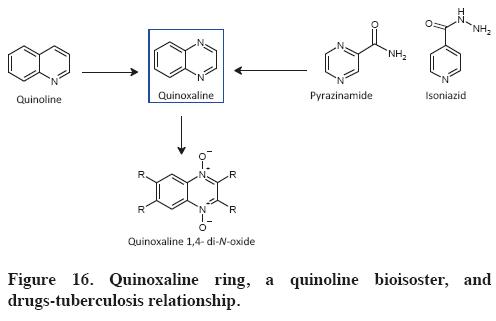
<body><![CDATA[<p align="center"><font face="verdana" size="2"><img src="/img/revistas/rmcf/v45n1/a3f14.jpg"></font></p>  	    <p align="justify"><font face="verdana" size="2"><i>Second&#45;line, secondary or minor drugs:</i> these can be used when toxicity of the former impedes their use or when treatments fail because of resistance.<sup>35</sup> Some of the secondary drugs used in tuberculosis treatment are shown in <a href="#f15">Fig. 15</a>.</font></p>  	    <p align="center"><font face="verdana" size="2"><a name="f15"></a></font></p>  	    <p align="center"><font face="verdana" size="2"><img src="/img/revistas/rmcf/v45n1/a3f15.jpg"></font></p>  	    <p align="justify"><font face="verdana" size="2">In the development of anti&#45;tuberculosis drugs, several studies have highlighted compounds containing a nitrogen atom in their structure. A good example is quinoxaline derivatives. They show numerous biological activities, and their ring is described as a bioisoster of the quinoline rings, naphthalene, benzothiophene and other aromatic rings, such as pyridine and pyrazine. Some of them are the basis of known anti&#45;malarial and anti&#45;tuberculosis agents for clinical use (<a href="#f16">Fig. 16</a>).<sup>36</sup></font></p>  	    <p align="center"><font face="verdana" size="2"><a name="f16"></a></font></p>  	    <p align="center"><font face="verdana" size="2"><img src="/img/revistas/rmcf/v45n1/a3f16.jpg"></font></p>  	    <p align="justify"><font face="verdana" size="2">Interestingly, in recent decades several studies have indicated that quinoxaline mono and di&#45;<i>N</i>&#45;oxides derivatives exhibit diverse biological activities.<sup>37,38</sup> Particularly quinoxaline 1,4&#45;di&#45;<i>N</i>&#45;oxide derivatives stand out in preclinical studies as anti&#45;tuberculosis agents.<sup>39</sup> In this sense, our research group in collaboration with Dr. Monge's group has focused on the design and synthesis of new quinoxaline 1,4&#45;di&#45;<i>N</i>&#45;oxide derivatives with the aim of improving the bioavailability of these derivatives. Although the formation of the quinoxaline ring commonly proceeds through the condensation reaction of an ortho&#45;diamine derivative and the corresponding diketone derivative (<a href="#f17">Fig. 17</a>)<sup>40</sup> we conduct a cycloaddition reaction of a benzofuroxan derivative and the respective &#945;,&#946;&#45;unsaturated diene ketone, 1,3&#45;diketone, enamine or enolate derivative, to form new quinoxaline 1,4&#45;di&#45;<i>N</i>&#45;oxide derivatives (<a href="#f17">Fig. 17</a>).<sup>41</sup></font></p>  	    <p align="center"><font face="verdana" size="2"><a name="f17"></a></font></p>  	    <p align="center"><font face="verdana" size="2"><img src="/img/revistas/rmcf/v45n1/a3f17.jpg"></font></p>  	    ]]></body>
<body><![CDATA[<p align="justify"><font face="verdana" size="2"><b>Development of anti&#45;trypanosomiasis agents</b></font></p>  	    <p align="justify"><font face="verdana" size="2">American trypanosomiasis, also called Chagas disease, was first described by Carlos Chagas in Minas Gerais, Brazil by 1909. The discovery was made through observation of flagellate parasites in peripheral blood from a 2&#45;year&#45;old girl who suffered from a disease whose signs and symptoms did not correlate with any of the conditions reported so far. Months later, this same scientist described and named three important parasites:</font></p>  	    <p align="justify"><font face="verdana" size="2"><i>Trypanosoma cruzi (T. cruzi),</i> a pathogenic flagellate from the order Kinetoplastida as the causative agent of Chagas disease. <i>Trypanosoma brucei,</i> the causative agent of sleeping sickness, and <i>Leishmania</i> spp, which causes visceral and tegumentary leishmaniasis and belongs to the Trypanosomatidae family.<sup>42</sup></font></p>  	    <p align="justify"><font face="verdana" size="2">Chagas disease is transmitted primarily through the feces at the moment of the bite by insects belonging to the Reduviidae family, subfamily Triatominae: <i>Triatoma infestans</i> (commonly known as "kissing bug&#45;Chinche besucona, Vinchuca or Chipo"). According to data collected by the WHO, Chagas disease causes the heaviest burden of morbidity and mortality produced by parasites distributed in Central and South America with 16&#45;18 million people affected by this condition and more than 100 million at risk of being infected.<sup>43</sup></font></p>  	    <p align="justify"><font face="verdana" size="2">The chemotherapy of Chagas disease includes only two trypanocide drugs, nifurtimox (Lampit&reg;) and benznidazole (Radanil&reg;), which are of limited access. Nifurtimox (Nfx) is a nitro derivative (<a href="#f18">Fig. 18</a>), which mechanism of action is the generation of a partial reduction of oxygen to hydrogen peroxide, hydroxyl radicals, and superoxide anions at different cell levels to nitro&#45;anion radicals and the transfer of electrons from the activated drug. The reactions of free radicals with cellular macromolecules include lipid peroxidation and membrane damage, inactivation of enzymes, and DNA damage. Nfx can also damage host tissue, by redox radical formation, causing severe side effects in mammals, such as anorexia, gastrointestinal intolerance, nervous irritability, insomnia, weight loss, and less commonly seizures.<sup>44</sup> The mechanism of action of benznidazole (Bnz) (<a href="#f19">Fig. 19</a>) also requires electron transfer, which occurs in the cell. After this, nitro radicals form covalent bonds with macromolecules, which culminate in the damage that destroys parasites. In spite of its high efficiency, Bnz administration causes some side effects such as anorexia, arthralgia, headache, and neuropathy.<sup>45,46</sup> In addition, Nfx and Bnz have shown trypanocidal action on trypomastigote and amastigote forms of <i>T. cruzi.</i><sup>47,48</sup></font></p>  	    <p align="center"><font face="verdana" size="2"><a name="f18"></a></font></p>  	    <p align="center"><font face="verdana" size="2"><img src="/img/revistas/rmcf/v45n1/a3f18.jpg"></font></p>  	    <p align="center"><font face="verdana" size="2"><a name="f19"></a></font></p>  	    <p align="center"><font face="verdana" size="2"><img src="/img/revistas/rmcf/v45n1/a3f19.jpg"></font></p>  	    <p align="justify"><font face="verdana" size="2">In the design of new therapeutic anti&#45;trypanosomiasis drugs, the most recently used therapeutic targets are farnesyl pyrophosphate synthase (FPPS), <i>trans</i>&#45;sialidase (TS), the cysteine protease cruzain, trypanothione reductase (TR), glucose&#45;6&#45;phosphate dehydrogenase (GPDH), glyceraldehyde&#45;3&#45;phosphate dehydrogenase (GAPDH) and &#945;&#45;hydroxyacid dehydrogenase (&#945;&#45;HADH), among others.<sup>49</sup> Considering this, our research group is designing (ligand based drug design) and synthesizing new compounds that inhibit <i>trans</i>&#45;sialidase and cruzain as new therapeutic options for Chagas disease and working in the development of a recombinant model of the trypanothione reductase from T. <i>cruzi</i> for <i>in vitro</i> assays in search of inhibitory compounds.</font></p>  	    ]]></body>
<body><![CDATA[<p align="justify"><font face="verdana" size="2"><b><i>Trans</i>&#45;</b><b>sialidase (TS)</b></font></p>  	    <p align="justify"><font face="verdana" size="2"><i>Trans</i>&#45;sialidase (TS) has 632 amino acid residues and a molecular mass of 110,109 kDa. It is a protein located on the surface of the parasite, attached to the cell membrane by a glycosylphosphatidylinositol anchor.<sup>50</sup> The TS of <i>T. cruzi</i> presents a novel biochemical pathway that is the only way to capture sialic acid residues in the parasite, the presence of these sugars becomes necessary for the recognition and/or infection of mammalian cells. Sialic acid is an important component of the <i>T. cruzi</i> membrane. Experimental evidence shows that the presence of sialic acid on the surface of the parasite plays an important role in the establishment of infection; however, the parasite is unable to synthesize it de <i>novo</i> or from its natural precursors. Therefore, expression of TS is essential for obtaining competent infective and invasive parasites.<sup>51&#45;54</sup> Considering the above and the comments recently made by Buchini <i>et al.</i> TS becomes a potential target for the design of inhibitors with potential therapeutic activity against <i>T. cruzi.<sup>55</sup></i> Buschiazzo <i>et al.</i> have presented the possible interaction between TS and the ligand 2,3&#45;dehydro&#45;3&#45;deoxy<i>&#45;N</i>&#45;acetylneuraminic acid (DANA) through hydrogen bonds, although they mention that the protein presents conformational changes introduced by the DANA substrate.<sup>56</sup> Recently, Neres <i>et al.</i> reported pyridine derivatives and benzoic acid as TS inhibitors of <i>T. cruzi.</i> These compounds are important because they occur in the sialic acid structure.<sup>57</sup> In this sense, our research group has focused on the development of new TS inhibitors.</font></p>  	    <p align="justify"><font face="verdana" size="2"><b>Cysteine protease Cruzain</b></font></p>  	    <p align="justify"><font face="verdana" size="2">Cruzain, is the largest <i>T. cruzi</i> cysteine protease. It has a molecular mass of 22,104 kDa and a polypeptide chain of 215 amino acid residues, consisting of two domains. The protease is expressed in all stages of the parasite life cycle and it is essential for replication of its intracellular form.<sup>58</sup> Selective inhibitors of this enzyme block the proliferation of extra&#45;cellular epimastigotes and intracellular amastigotes <i>in vitro.<sup>59</sup></i></font></p>  	    <p align="justify"><font face="verdana" size="2">In recent years there have been two main types of cruzain inhibitors: thiosemicarbazones and acylhydrazides derivatives.<sup>60</sup> Du <i>et al.</i> reported thiosemicarbazone derivatives as effective trypanocide cruzain inhibitors showing activity at concentrations that do not exhibit toxicity in mammalian cells.<sup>61</sup> Moreover, Rodriguez <i>et al</i> reported new inhibitors from alkylhydrazide cruzain derivatives (<a href="#f20">Fig. 20</a>).<sup>62</sup> Thus, our research group has also considered cruzain inhibition as one of its strategies in the design of new drugs to treat Chagas disease.</font></p>  	    <p align="center"><font face="verdana" size="2"><a name="f20"></a></font></p>  	    <p align="center"><font face="verdana" size="2"><img src="/img/revistas/rmcf/v45n1/a3f20.jpg"></font></p>  	    <p>&nbsp;</p>  	    <p align="justify"><font face="verdana" size="2"><b>Conclusions</b></font></p>  	    <p align="justify"><font face="verdana" size="2">Currently, there are health problems that have a high impact on our society such as obesity and cancer, and the "neglected diseases", such as tuberculosis and Chagas, for which the development of new drugs for treatment is a current urgent need. However, it is a process that will take many years and involve constant work of a multidisciplinary team, and large economic resources. In our laboratory, we have started with the formation of human resources trained in Medicinal Chemistry with promising progress. However, further measures are needed, both locally and nationally, to enable the country to have better development in drug design.</font></p>  	    ]]></body>
<body><![CDATA[<p>&nbsp;</p>  	    <p align="justify"><font face="verdana" size="2"><b>Acknowledgments</b></font></p>  	    <p align="justify"><font face="verdana" size="2">Gildardo Rivera, Ninfa M. Rosas&#45;Garc&iacute;a and Virgilio Bocanegra&#45;Garc&iacute;a holds a scholarship from the "Comisi&oacute;n de Operaci&oacute;n y Fomento de Actividades Acad&eacute;micas" (COFAA&#45;IPN) and "Programa de Est&iacute;mulos al Desempe&ntilde;o Acad&eacute;mico" (EDI&#45;IPN). All participants declare no conflict of interest.</font></p>  	    <p>&nbsp;</p>  	    <p align="justify"><font face="verdana" size="2"><b>References</b></font></p>  	    <!-- ref --><p align="justify"><font face="verdana" size="2">1.&nbsp;Wermuth CG, Ganellin CR, Lindberg P, Mitscher LA. Glossary of terms use in Medicinal Chemistry (IUPAC Recommendations 1998). Pure &amp; App Chem. 1998; 70(5):1129&#45;1143.    &nbsp;&nbsp;&nbsp;&nbsp;&nbsp;&nbsp;&nbsp;&nbsp;[&#160;<a href="javascript:void(0);" onclick="javascript: window.open('/scielo.php?script=sci_nlinks&ref=7922643&pid=S1870-0195201400010000300001&lng=','','width=640,height=500,resizable=yes,scrollbars=1,menubar=yes,');">Links</a>&#160;]<!-- end-ref --></font></p>  	    <!-- ref --><p align="justify"><font face="verdana" size="2">2.&nbsp;Avenda&ntilde;o C. Introducci&oacute;n a la Qu&iacute;mica Farmac&eacute;utica, 2<sup>a</sup> Ed, Madrid: McGraw&#45;Hill Interamericana, 2001, p. 25&#45;39.    &nbsp;&nbsp;&nbsp;&nbsp;&nbsp;&nbsp;&nbsp;&nbsp;[&#160;<a href="javascript:void(0);" onclick="javascript: window.open('/scielo.php?script=sci_nlinks&ref=7922645&pid=S1870-0195201400010000300002&lng=','','width=640,height=500,resizable=yes,scrollbars=1,menubar=yes,');">Links</a>&#160;]<!-- end-ref --></font></p>  	    <!-- ref --><p align="justify"><font face="verdana" size="2">3.&nbsp;Buckle DR, Erhardt Pw, Ganellin R, Kobayashi T, Perun TJ, Proudfoot J, Senn&#45;Bilfinger J. Glossary of terms use in Medicinal Chemistry. Part II (IUPAC Recommendations 2013). Pure Appl Chem. 2013; 85(8):1725&#45;1758.    &nbsp;&nbsp;&nbsp;&nbsp;&nbsp;&nbsp;&nbsp;&nbsp;[&#160;<a href="javascript:void(0);" onclick="javascript: window.open('/scielo.php?script=sci_nlinks&ref=7922647&pid=S1870-0195201400010000300003&lng=','','width=640,height=500,resizable=yes,scrollbars=1,menubar=yes,');">Links</a>&#160;]<!-- end-ref --></font></p>  	    <!-- ref --><p align="justify"><font face="verdana" size="2">4.&nbsp;Rivera G, Puras G, Palos I, Ordaz&#45;Pichardo C, Bocanegra&#45;Garcia V. Bibliometric analysis of scientific publications in the field of medical chemistry in Latin America, the People's Republic of China, and India. Med Chem Res. 2010; 19:603&#45;616.    &nbsp;&nbsp;&nbsp;&nbsp;&nbsp;&nbsp;&nbsp;&nbsp;[&#160;<a href="javascript:void(0);" onclick="javascript: window.open('/scielo.php?script=sci_nlinks&ref=7922649&pid=S1870-0195201400010000300004&lng=','','width=640,height=500,resizable=yes,scrollbars=1,menubar=yes,');">Links</a>&#160;]<!-- end-ref --></font></p>  	    <!-- ref --><p align="justify"><font face="verdana" size="2">5.&nbsp;World Health Organization. Obesity. <a href="http://www.who.int/topics/obesity/en/" target="_blank">http://www.who.int/topics/obesity/en/</a>. Acceso 13 Mar 2014.    &nbsp;&nbsp;&nbsp;&nbsp;&nbsp;&nbsp;&nbsp;&nbsp;[&#160;<a href="javascript:void(0);" onclick="javascript: window.open('/scielo.php?script=sci_nlinks&ref=7922651&pid=S1870-0195201400010000300005&lng=','','width=640,height=500,resizable=yes,scrollbars=1,menubar=yes,');">Links</a>&#160;]<!-- end-ref --></font></p>  	    <p align="justify"><font face="verdana" size="2">6.&nbsp;National Health and Nutrition Examination Survey, NHANES 2001&#45;2002. <a href="http://www.cdc.gov/nchs/nhanes/nhanes2001&#45;2002/nhanes01_02.htm" target="_blank">http://www.cdc.gov/nchs/nhanes/nhanes2001&#150;2002/nhanes01_02.htm</a>. Acceso 20 Abr 2011.</font></p>  	    <!-- ref --><p align="justify"><font face="verdana" size="2">7.&nbsp;Gutierrez JP, Rivera&#45;Dommarco J, Shamah&#45;Levy T, Villalpando&#45;Hernandez S, Franco A, Cuevas&#45;Nasu L, Romero&#45;Martinez M, Hernandez&#45;&Aacute;vila M. Encuesta Nacional de Salud y Nutrici&oacute;n 2012. Resultados Nacionales. Cuernavaca, M&eacute;xico: Instituto Nacional de Salud Publica (MX), 2012.    &nbsp;&nbsp;&nbsp;&nbsp;&nbsp;&nbsp;&nbsp;&nbsp;[&#160;<a href="javascript:void(0);" onclick="javascript: window.open('/scielo.php?script=sci_nlinks&ref=7922654&pid=S1870-0195201400010000300006&lng=','','width=640,height=500,resizable=yes,scrollbars=1,menubar=yes,');">Links</a>&#160;]<!-- end-ref --></font></p>  	    <!-- ref --><p align="justify"><font face="verdana" size="2">8.&nbsp;Rivera G, Bocanegra A, Acosta RI, De la Garza M, Flores G. Tratamiento de la obesidad; nuevas perspectivas. Rev Mex Cienc Farm. 2007; 38, 48&#45;56.    &nbsp;&nbsp;&nbsp;&nbsp;&nbsp;&nbsp;&nbsp;&nbsp;[&#160;<a href="javascript:void(0);" onclick="javascript: window.open('/scielo.php?script=sci_nlinks&ref=7922656&pid=S1870-0195201400010000300007&lng=','','width=640,height=500,resizable=yes,scrollbars=1,menubar=yes,');">Links</a>&#160;]<!-- end-ref --></font></p>  	    ]]></body>
<body><![CDATA[<!-- ref --><p align="justify"><font face="verdana" size="2">9.&nbsp;Yukioka H. A potent and selective neuropeptide Y Y5&#45;receptor antagonist, S&#45;2367, as an anti&#45;obesity agent. Nippon Yakurigaku Zasshi. 2010; 136(5):270&#45;274.    &nbsp;&nbsp;&nbsp;&nbsp;&nbsp;&nbsp;&nbsp;&nbsp;[&#160;<a href="javascript:void(0);" onclick="javascript: window.open('/scielo.php?script=sci_nlinks&ref=7922658&pid=S1870-0195201400010000300008&lng=','','width=640,height=500,resizable=yes,scrollbars=1,menubar=yes,');">Links</a>&#160;]<!-- end-ref --></font></p>  	    <!-- ref --><p align="justify"><font face="verdana" size="2">10.&nbsp;M&oslash;lh&oslash;j S, Hansen HS, Schweiger M, Zimmermann R, Johansen T, Malml&ouml;f K, Effect of the cannabinoid receptor&#45;1 antagonist rimonabant on lipolysis in rats. Eur J Pharmacol. 2010; 646:38&#45;45.    &nbsp;&nbsp;&nbsp;&nbsp;&nbsp;&nbsp;&nbsp;&nbsp;[&#160;<a href="javascript:void(0);" onclick="javascript: window.open('/scielo.php?script=sci_nlinks&ref=7922660&pid=S1870-0195201400010000300009&lng=','','width=640,height=500,resizable=yes,scrollbars=1,menubar=yes,');">Links</a>&#160;]<!-- end-ref --></font></p>  	    <!-- ref --><p align="justify"><font face="verdana" size="2">11.Surman MD, Freeman EE, Grabowski JF, Hadden M, Henderson AJ, Jiang G. 5&#45;(Pyridinon&#45;1&#45;yl)indazoles and 5&#45;(furopyridinon&#45;5&#45;yl)indazoles as MCH&#45;1 antagonists. Bioorg Med Chem Lett. 2010; 20(23):7015&#45;7019.    &nbsp;&nbsp;&nbsp;&nbsp;&nbsp;&nbsp;&nbsp;&nbsp;[&#160;<a href="javascript:void(0);" onclick="javascript: window.open('/scielo.php?script=sci_nlinks&ref=7922662&pid=S1870-0195201400010000300010&lng=','','width=640,height=500,resizable=yes,scrollbars=1,menubar=yes,');">Links</a>&#160;]<!-- end-ref --></font></p>  	    <!-- ref --><p align="justify"><font face="verdana" size="2">12.&nbsp;Takekawa S, Asami A, Ishihara Y, Terauchi J, Kato K, Shimomura Y, Mori M, Murakoshi H, Kato K, Suzuki N, Nishimura O, Fujino M. T&#45;226296: a novel, orally active and selective melanin&#45;concentrating hormone receptor antagonist. Eur J Pharmacol. 2002; 438 (3):129&#45;135.    &nbsp;&nbsp;&nbsp;&nbsp;&nbsp;&nbsp;&nbsp;&nbsp;[&#160;<a href="javascript:void(0);" onclick="javascript: window.open('/scielo.php?script=sci_nlinks&ref=7922664&pid=S1870-0195201400010000300011&lng=','','width=640,height=500,resizable=yes,scrollbars=1,menubar=yes,');">Links</a>&#160;]<!-- end-ref --></font></p>  	    <!-- ref --><p align="justify"><font face="verdana" size="2">13.&nbsp;Borowsky B, Durkin MM, Ogozalek K, Marzabadi MR, De Leon J, Lagu B. Heurich R, Lichtblau H, Shaposhnik Z, Daniewska I, Blackburn TP, Branchek TA, Gerald C, Vaysse PJ, Forray C. Antidepressant, anxiolytic and anorectic effects of a melanin&#45;concentrating hormone&#45;1 receptor antagonist. Nat Med. 2002; 8(8):825&#45;830.    &nbsp;&nbsp;&nbsp;&nbsp;&nbsp;&nbsp;&nbsp;&nbsp;[&#160;<a href="javascript:void(0);" onclick="javascript: window.open('/scielo.php?script=sci_nlinks&ref=7922666&pid=S1870-0195201400010000300012&lng=','','width=640,height=500,resizable=yes,scrollbars=1,menubar=yes,');">Links</a>&#160;]<!-- end-ref --></font></p>  	    ]]></body>
<body><![CDATA[<!-- ref --><p align="justify"><font face="verdana" size="2">14.&nbsp;Witty DR, Bateson JH, Hervieu GJ, Jeffrey P, Johnson CN, Muir AI, O'Hanlon PJ, Stemp G, Stevens AJ, Thewlis KM, Wilson S, Winborn KY, SAR of biphenyl carboxamide ligands of the human melanin&#45;concentrating hormone receptor 1 (MCH R1): Discovery of antagonist SB&#45;568849. Bioorg Med Chem Lett. 2006; 16(18):4865&#45;4871.    &nbsp;&nbsp;&nbsp;&nbsp;&nbsp;&nbsp;&nbsp;&nbsp;[&#160;<a href="javascript:void(0);" onclick="javascript: window.open('/scielo.php?script=sci_nlinks&ref=7922668&pid=S1870-0195201400010000300013&lng=','','width=640,height=500,resizable=yes,scrollbars=1,menubar=yes,');">Links</a>&#160;]<!-- end-ref --></font></p>  	    <!-- ref --><p align="justify"><font face="verdana" size="2">15.&nbsp;Galiano S, Ceras J, Cirauqui N, P&eacute;rez S, Juanenea L, Rivera G, Aldana I, Monge A. Novel series of substituted biphenylmethyl urea derivatives as MCH&#45;R1 antagonists for the treatment of obesity. Bioorg Med Chem. 2007; 15(11):3896&#45;3911.    &nbsp;&nbsp;&nbsp;&nbsp;&nbsp;&nbsp;&nbsp;&nbsp;[&#160;<a href="javascript:void(0);" onclick="javascript: window.open('/scielo.php?script=sci_nlinks&ref=7922670&pid=S1870-0195201400010000300014&lng=','','width=640,height=500,resizable=yes,scrollbars=1,menubar=yes,');">Links</a>&#160;]<!-- end-ref --></font></p>  	    <!-- ref --><p align="justify"><font face="verdana" size="2">16.&nbsp;Cirauqui N, Ceras J, Galiano S, Perez&#45;Silanes S, Juanenea L. Rivera G. Aldana, I. Monge A. New amide derivatives as melanin&#45;concentrating hormone receptor 1 antagonists for the treatment of obesity. Arzneimittel&#45;Forschung. 2008; 58(11):585&#45;591.    &nbsp;&nbsp;&nbsp;&nbsp;&nbsp;&nbsp;&nbsp;&nbsp;[&#160;<a href="javascript:void(0);" onclick="javascript: window.open('/scielo.php?script=sci_nlinks&ref=7922672&pid=S1870-0195201400010000300015&lng=','','width=640,height=500,resizable=yes,scrollbars=1,menubar=yes,');">Links</a>&#160;]<!-- end-ref --></font></p>  	    <!-- ref --><p align="justify"><font face="verdana" size="2">17.&nbsp;Rivera G, Bocanegra&#45;Garcia V, Galiano S, Cirauqui N, Ceras J, Perez S, Aldana I, Monge A. Melanin&#45;concentrating hormone receptor 1 antagonists: A new perspective for the pharmacologic treatment of obesity. Curr Med Chem. 2008; 15(10):1025&#45;1043.    &nbsp;&nbsp;&nbsp;&nbsp;&nbsp;&nbsp;&nbsp;&nbsp;[&#160;<a href="javascript:void(0);" onclick="javascript: window.open('/scielo.php?script=sci_nlinks&ref=7922674&pid=S1870-0195201400010000300016&lng=','','width=640,height=500,resizable=yes,scrollbars=1,menubar=yes,');">Links</a>&#160;]<!-- end-ref --></font></p>  	    <p align="justify"><font face="verdana" size="2">18.&nbsp;World Health Organization. Cancer. <a href="http://www.who.int/topics/cancer/en/" target="_blank">http://www.who.int/topics/cancer/en/</a>. Acceso 20 Abr 2011.</font></p>  	    <!-- ref --><p align="justify"><font face="verdana" size="2">19.&nbsp;Zatovicova M, Jelenska L, Hulikova A, Csaderova L, Ditte Z, Ditte P, Goliasova T, Pastorek J, Pastorekova S. Carbonic anhydrase IX as an anticancer therapy target: Preclinical evaluation of internalizing monoclonal antibody directed to catalytic domain. Curr Pharm Des. 2010; 16(29):3255&#45;3263.    &nbsp;&nbsp;&nbsp;&nbsp;&nbsp;&nbsp;&nbsp;&nbsp;[&#160;<a href="javascript:void(0);" onclick="javascript: window.open('/scielo.php?script=sci_nlinks&ref=7922677&pid=S1870-0195201400010000300017&lng=','','width=640,height=500,resizable=yes,scrollbars=1,menubar=yes,');">Links</a>&#160;]<!-- end-ref --></font></p>  	    <!-- ref --><p align="justify"><font face="verdana" size="2">20.&nbsp;Basnet A, Thapa P, Karki R, Choi H, Choi JH, Yun M, Jeong B&#45;S, Jahng Y, Na Y, Cho W&#45;J, Kwon Y, Lee C&#45;S, Lee E&#45;S. 2,6&#45;Dithienyl&#45;4&#45;furyl pyridines: Synthesis, topoisomerase I and II inhibition, cytotoxicity, structure&#45;activity relationship, and docking study. Bioorg Med Chem Lett. 2010; 20(1):42&#45;47.    &nbsp;&nbsp;&nbsp;&nbsp;&nbsp;&nbsp;&nbsp;&nbsp;[&#160;<a href="javascript:void(0);" onclick="javascript: window.open('/scielo.php?script=sci_nlinks&ref=7922679&pid=S1870-0195201400010000300018&lng=','','width=640,height=500,resizable=yes,scrollbars=1,menubar=yes,');">Links</a>&#160;]<!-- end-ref --></font></p>  	    <!-- ref --><p align="justify"><font face="verdana" size="2">21.&nbsp;Broxterman HJ, Georgopapadakou NH. New cancer therapeutics: target&#45;specific in, cytotoxics out?. Drug Resist Updat. 2004; 7(2):79&#45;87.    &nbsp;&nbsp;&nbsp;&nbsp;&nbsp;&nbsp;&nbsp;&nbsp;[&#160;<a href="javascript:void(0);" onclick="javascript: window.open('/scielo.php?script=sci_nlinks&ref=7922681&pid=S1870-0195201400010000300019&lng=','','width=640,height=500,resizable=yes,scrollbars=1,menubar=yes,');">Links</a>&#160;]<!-- end-ref --></font></p>  	    <!-- ref --><p align="justify"><font face="verdana" size="2">22.&nbsp;Supuran CT. Carbonic anhydrases an overview. Curr Pharm Des. 2008; 14(7):603&#45;614.    &nbsp;&nbsp;&nbsp;&nbsp;&nbsp;&nbsp;&nbsp;&nbsp;[&#160;<a href="javascript:void(0);" onclick="javascript: window.open('/scielo.php?script=sci_nlinks&ref=7922683&pid=S1870-0195201400010000300020&lng=','','width=640,height=500,resizable=yes,scrollbars=1,menubar=yes,');">Links</a>&#160;]<!-- end-ref --></font></p>  	    <!-- ref --><p align="justify"><font face="verdana" size="2">23.&nbsp;Abbate F, Casini A, Owa T, Scozzafava A, Supuran CT. Carbonic anhydrase inhibitors: E7070, a sulfonamide anticancer agent, potently inhibits cytosolic isozymes I and II, and transmembrane, tumor&#45;associated isozyme IX. Bioorg Med Chem Lett. 2004; 14(1):217&#45;223.    &nbsp;&nbsp;&nbsp;&nbsp;&nbsp;&nbsp;&nbsp;&nbsp;[&#160;<a href="javascript:void(0);" onclick="javascript: window.open('/scielo.php?script=sci_nlinks&ref=7922685&pid=S1870-0195201400010000300021&lng=','','width=640,height=500,resizable=yes,scrollbars=1,menubar=yes,');">Links</a>&#160;]<!-- end-ref --></font></p>  	    <!-- ref --><p align="justify"><font face="verdana" size="2">24.&nbsp;Camargo&#45;Ordo&ntilde;ez A, Bocanegra&#45;Garc&iacute;a V, Scior T, Rivera G. Dise&ntilde;o, s&iacute;ntesis y evaluaci&oacute;n biol&oacute;gica de nuevos compuestos derivados de bifenilsulfonamida con posible actividad antitumoral. En l&iacute;nea. Tu revista Digi.U&#64;T. 2009; 4(2). Acceso 30 Sep 2013.    &nbsp;&nbsp;&nbsp;&nbsp;&nbsp;&nbsp;&nbsp;&nbsp;[&#160;<a href="javascript:void(0);" onclick="javascript: window.open('/scielo.php?script=sci_nlinks&ref=7922687&pid=S1870-0195201400010000300022&lng=','','width=640,height=500,resizable=yes,scrollbars=1,menubar=yes,');">Links</a>&#160;]<!-- end-ref --></font></p>  	    <!-- ref --><p align="justify"><font face="verdana" size="2">25.&nbsp;Camargo&#45;Ordo&ntilde;ez A,&nbsp;Moreno&#45;Reyes T, Olazaran&#45;Santiba&ntilde;ez F, Martinez&#45;Hernandez S, Bocanegra&#45;Garcia V, Rivera G. Efficient synthesis of sulfonamide derivatives on solid supports catalyzed using solvente&#45;free and microwave&#45;assisted methods. Quim. Nova. 2011; 34(5):787&#45;791.    &nbsp;&nbsp;&nbsp;&nbsp;&nbsp;&nbsp;&nbsp;&nbsp;[&#160;<a href="javascript:void(0);" onclick="javascript: window.open('/scielo.php?script=sci_nlinks&ref=7922689&pid=S1870-0195201400010000300023&lng=','','width=640,height=500,resizable=yes,scrollbars=1,menubar=yes,');">Links</a>&#160;]<!-- end-ref --></font></p>  	    <!-- ref --><p align="justify"><font face="verdana" size="2">26.&nbsp;Bocanegra&#45;Garcia V, Villalobos&#45;Rocha JC, Nogueda&#45;Torres B, Lemus&#45;Hernandez ME, Camargo&#45;Ordonez A, Rosas&#45;Garcia NM, Rivera G. Synthesis and biological evaluation of new sulfonamide derivatives as potential anti<i>&#45;Trypanosoma cruzi</i> agents. Med Chem. 2012; 8(6):1039&#45;1044.    &nbsp;&nbsp;&nbsp;&nbsp;&nbsp;&nbsp;&nbsp;&nbsp;[&#160;<a href="javascript:void(0);" onclick="javascript: window.open('/scielo.php?script=sci_nlinks&ref=7922691&pid=S1870-0195201400010000300024&lng=','','width=640,height=500,resizable=yes,scrollbars=1,menubar=yes,');">Links</a>&#160;]<!-- end-ref --></font></p>  	    <!-- ref --><p align="justify"><font face="verdana" size="2">27.&nbsp;Banik BK, Becker FF. Novel 6,12&#45;disubstituted chrysene as potent anticancer agent: Synthesis, <i>in vitro</i> and <i>in vivo</i> study. Eur J Med Chem. 2010; 45(10):4687&#45;4691.    &nbsp;&nbsp;&nbsp;&nbsp;&nbsp;&nbsp;&nbsp;&nbsp;[&#160;<a href="javascript:void(0);" onclick="javascript: window.open('/scielo.php?script=sci_nlinks&ref=7922693&pid=S1870-0195201400010000300025&lng=','','width=640,height=500,resizable=yes,scrollbars=1,menubar=yes,');">Links</a>&#160;]<!-- end-ref --></font></p>  	    <!-- ref --><p align="justify"><font face="verdana" size="2">28.&nbsp;Rivera G, Bandyopadhyay D, Jaggi S, Gonzalez RC, Banik BK. An expeditious synthesis of 3&#45;amino &#946;&#45;lactams derived from polyaromatic compounds. Heterocycl Commun. 2011; 15(5):323&#45;326.    &nbsp;&nbsp;&nbsp;&nbsp;&nbsp;&nbsp;&nbsp;&nbsp;[&#160;<a href="javascript:void(0);" onclick="javascript: window.open('/scielo.php?script=sci_nlinks&ref=7922695&pid=S1870-0195201400010000300026&lng=','','width=640,height=500,resizable=yes,scrollbars=1,menubar=yes,');">Links</a>&#160;]<!-- end-ref --></font></p>  	    <!-- ref --><p align="justify"><font face="verdana" size="2">29.&nbsp;Bandyopadhyay D, Rivera G, Salinas I, Aguilar H, Bimal KB. Remarkable iodine&#45;catalyzed synthesis of novel pyrrole&#45;bearing N&#45;polyaromatic &#946;&#45;lactams. Molecules. 2010; 15 (22):1082&#45;1088.    &nbsp;&nbsp;&nbsp;&nbsp;&nbsp;&nbsp;&nbsp;&nbsp;[&#160;<a href="javascript:void(0);" onclick="javascript: window.open('/scielo.php?script=sci_nlinks&ref=7922697&pid=S1870-0195201400010000300027&lng=','','width=640,height=500,resizable=yes,scrollbars=1,menubar=yes,');">Links</a>&#160;]<!-- end-ref --></font></p>  	    <!-- ref --><p align="justify"><font face="verdana" size="2">30.&nbsp;Pelczar M, Reid R, Chain E. Microbiologia. 4a Ed. M&eacute;xico McGraw&#45;Hill. 1982 p.80.    &nbsp;&nbsp;&nbsp;&nbsp;&nbsp;&nbsp;&nbsp;&nbsp;[&#160;<a href="javascript:void(0);" onclick="javascript: window.open('/scielo.php?script=sci_nlinks&ref=7922699&pid=S1870-0195201400010000300028&lng=','','width=640,height=500,resizable=yes,scrollbars=1,menubar=yes,');">Links</a>&#160;]<!-- end-ref --></font></p>  	    <!-- ref --><p align="justify"><font face="verdana" size="2">31.&nbsp;Ryan KJ, Ray CG. Sherris. Microbiolog&iacute;a M&eacute;dica. 4a Ed. Mexico McGraw&#45;Hill, 2005, p.50&#45;100.    &nbsp;&nbsp;&nbsp;&nbsp;&nbsp;&nbsp;&nbsp;&nbsp;[&#160;<a href="javascript:void(0);" onclick="javascript: window.open('/scielo.php?script=sci_nlinks&ref=7922701&pid=S1870-0195201400010000300029&lng=','','width=640,height=500,resizable=yes,scrollbars=1,menubar=yes,');">Links</a>&#160;]<!-- end-ref --></font></p>  	    <!-- ref --><p align="justify"><font face="verdana" size="2">32.&nbsp;P&eacute;rez AJL, S&aacute;nz PO, Hern&aacute;ndez&#45;Cabrera M, Moreno MAA. Boletin epidemiologico periodico. Enf Emerg. 2005; 7: 6.    &nbsp;&nbsp;&nbsp;&nbsp;&nbsp;&nbsp;&nbsp;&nbsp;[&#160;<a href="javascript:void(0);" onclick="javascript: window.open('/scielo.php?script=sci_nlinks&ref=7922703&pid=S1870-0195201400010000300030&lng=','','width=640,height=500,resizable=yes,scrollbars=1,menubar=yes,');">Links</a>&#160;]<!-- end-ref --></font></p>  	    <!-- ref --><p align="justify"><font face="verdana" size="2">33.&nbsp;World Health Organization, TB prevalence. <a href="http://www.who.int/gho/mdg/diseases/tuberculosis/situation_trends_prevalence/en/" target="_blank">http://www.who.int/gho/mdg/diseases/tuberculosis/situation_trends_prevalence/en/</a>. Acceso 20 Abr 2011.    &nbsp;&nbsp;&nbsp;&nbsp;&nbsp;&nbsp;&nbsp;&nbsp;[&#160;<a href="javascript:void(0);" onclick="javascript: window.open('/scielo.php?script=sci_nlinks&ref=7922705&pid=S1870-0195201400010000300031&lng=','','width=640,height=500,resizable=yes,scrollbars=1,menubar=yes,');">Links</a>&#160;]<!-- end-ref --></font></p>  	    <!-- ref --><p align="justify"><font face="verdana" size="2">34.&nbsp;Secretaria de Salud, Sistema Nacional de Vigilancia Epidemiologica. Epidemiologia: Tuberculosis en Mexico. Sistema &uacute;nico de information. 2008; 14(25):1&#45;4. <a href="http://www.dgepi.salud.gob.mx/boletin/2008/sem14/pdf/edit1408.pdf" target="_blank">http://www.dgepi.salud.gob.mx/boletin/2008/sem14/pdf/edit1408.pdf</a>. Acceso 20 Abr 2011.    &nbsp;&nbsp;&nbsp;&nbsp;&nbsp;&nbsp;&nbsp;&nbsp;[&#160;<a href="javascript:void(0);" onclick="javascript: window.open('/scielo.php?script=sci_nlinks&ref=7922707&pid=S1870-0195201400010000300032&lng=','','width=640,height=500,resizable=yes,scrollbars=1,menubar=yes,');">Links</a>&#160;]<!-- end-ref --></font></p>  	    <!-- ref --><p align="justify"><font face="verdana" size="2">35.&nbsp;Carcas&#45;Suarsan AJ. Quimioterapia antituberculosa y antileprosa. Curso: 2011&#45;2012. <a href="http://www.uam.es/departamentos/medicina/farmacologia/especifica/F_General/FG_T69.pdf" target="_blank">http://www.uam.es/departamentos/medicina/farmacologia/especifica/F_General/FG_T69.pdf</a>. Acceso 01 May 2013.    &nbsp;&nbsp;&nbsp;&nbsp;&nbsp;&nbsp;&nbsp;&nbsp;[&#160;<a href="javascript:void(0);" onclick="javascript: window.open('/scielo.php?script=sci_nlinks&ref=7922709&pid=S1870-0195201400010000300033&lng=','','width=640,height=500,resizable=yes,scrollbars=1,menubar=yes,');">Links</a>&#160;]<!-- end-ref --></font></p>  	    <!-- ref --><p align="justify"><font face="verdana" size="2">36.&nbsp;Lima L, Barreiro E. Bioisosterism: a useful strategy for molecular modification and drug design. Curr Med Chem. 2005; 12(1):23&#45;49.    &nbsp;&nbsp;&nbsp;&nbsp;&nbsp;&nbsp;&nbsp;&nbsp;[&#160;<a href="javascript:void(0);" onclick="javascript: window.open('/scielo.php?script=sci_nlinks&ref=7922711&pid=S1870-0195201400010000300034&lng=','','width=640,height=500,resizable=yes,scrollbars=1,menubar=yes,');">Links</a>&#160;]<!-- end-ref --></font></p>  	    <!-- ref --><p align="justify"><font face="verdana" size="2">37.&nbsp;Brown D. Quinoxalines. Supplement II. Wiley &amp; Sons: New York, 2004, p.100150.    &nbsp;&nbsp;&nbsp;&nbsp;&nbsp;&nbsp;&nbsp;&nbsp;[&#160;<a href="javascript:void(0);" onclick="javascript: window.open('/scielo.php?script=sci_nlinks&ref=7922713&pid=S1870-0195201400010000300035&lng=','','width=640,height=500,resizable=yes,scrollbars=1,menubar=yes,');">Links</a>&#160;]<!-- end-ref --></font></p>  	    <!-- ref --><p align="justify"><font face="verdana" size="2">38.&nbsp;Carta A, Corona P, Loriga M. Quinoxaline 1,4&#45;dioxide: A versatile scaffold endowed with manifold activities. Curr Med Chem. 2005; 12(9):2259&#45;2272.    &nbsp;&nbsp;&nbsp;&nbsp;&nbsp;&nbsp;&nbsp;&nbsp;[&#160;<a href="javascript:void(0);" onclick="javascript: window.open('/scielo.php?script=sci_nlinks&ref=7922715&pid=S1870-0195201400010000300036&lng=','','width=640,height=500,resizable=yes,scrollbars=1,menubar=yes,');">Links</a>&#160;]<!-- end-ref --></font></p>  	    <!-- ref --><p align="justify"><font face="verdana" size="2">39.&nbsp;Vicente E, Villar R, Solano B, Burguete A, Ancizu S, P&eacute;rez&#45;Silanes S, Aldana I, Monge A. Derivados de 1,4&#45;di&#45;<i>N</i>&#45;oxido de quinoxalinas y enfermedades olvidadas. An R Acad Nac Farm. 2007; 73(4): 927&#45;945.    &nbsp;&nbsp;&nbsp;&nbsp;&nbsp;&nbsp;&nbsp;&nbsp;[&#160;<a href="javascript:void(0);" onclick="javascript: window.open('/scielo.php?script=sci_nlinks&ref=7922717&pid=S1870-0195201400010000300037&lng=','','width=640,height=500,resizable=yes,scrollbars=1,menubar=yes,');">Links</a>&#160;]<!-- end-ref --></font></p>  	    <!-- ref --><p align="justify"><font face="verdana" size="2">40.&nbsp;Heravi MM, Bakhtiari K, Tehrani MH, Javadi NM, Oskooie HA. Facile synthesis of quinoxaline derivatives using o&#45;iodoxibenzoic acid (IBX) at room temperature. ARKIVOC 2006; (xvi):16&#45;22.    &nbsp;&nbsp;&nbsp;&nbsp;&nbsp;&nbsp;&nbsp;&nbsp;[&#160;<a href="javascript:void(0);" onclick="javascript: window.open('/scielo.php?script=sci_nlinks&ref=7922719&pid=S1870-0195201400010000300038&lng=','','width=640,height=500,resizable=yes,scrollbars=1,menubar=yes,');">Links</a>&#160;]<!-- end-ref --></font></p>  	    <!-- ref --><p align="justify"><font face="verdana" size="2">41.&nbsp;Zerong, W. Comprehensive Organic Name Reactions and Reagents. John Wiley &amp; Sons Inc: Estados Unidos, 2010, p.120&#45;140.    &nbsp;&nbsp;&nbsp;&nbsp;&nbsp;&nbsp;&nbsp;&nbsp;[&#160;<a href="javascript:void(0);" onclick="javascript: window.open('/scielo.php?script=sci_nlinks&ref=7922721&pid=S1870-0195201400010000300039&lng=','','width=640,height=500,resizable=yes,scrollbars=1,menubar=yes,');">Links</a>&#160;]<!-- end-ref --></font></p>  	    <!-- ref --><p align="justify"><font face="verdana" size="2">42.&nbsp;Chagas C. Nova tripanozomiaze humana: estudos sobre a morfolojia e o ciclo evolutivo do <i>Schizotrypanum cruzi</i> n. gen., n. sp., ajente etiolojico de nova entidade morbida do homem. Mem Inst Oswaldo Cruz. 1909; 1(2):159&#45;218.    &nbsp;&nbsp;&nbsp;&nbsp;&nbsp;&nbsp;&nbsp;&nbsp;[&#160;<a href="javascript:void(0);" onclick="javascript: window.open('/scielo.php?script=sci_nlinks&ref=7922723&pid=S1870-0195201400010000300040&lng=','','width=640,height=500,resizable=yes,scrollbars=1,menubar=yes,');">Links</a>&#160;]<!-- end-ref --></font></p>  	    <!-- ref --><p align="justify"><font face="verdana" size="2">43.&nbsp;World Health Organization. WHO Technical Report Series 905. Control of Chagas disease. Second report of the WHO Expert Committee. Geneva. 2002. <a href="http://whqlibdoc.who.int/trs/WHO_TRS_905.pdf" target="_blank">http://whqlibdoc.who.int/trs/WHO_TRS_905.pdf</a>. Acceso 20 abril 2011.    &nbsp;&nbsp;&nbsp;&nbsp;&nbsp;&nbsp;&nbsp;&nbsp;[&#160;<a href="javascript:void(0);" onclick="javascript: window.open('/scielo.php?script=sci_nlinks&ref=7922725&pid=S1870-0195201400010000300041&lng=','','width=640,height=500,resizable=yes,scrollbars=1,menubar=yes,');">Links</a>&#160;]<!-- end-ref --></font></p>  	    <!-- ref --><p align="justify"><font face="verdana" size="2">44.&nbsp;Fairlamb AH. Chemotherapy of human African trypanosomiasis: current and future prospects. Trends Parasitol. 2003; 19(11):488&#45;494.    &nbsp;&nbsp;&nbsp;&nbsp;&nbsp;&nbsp;&nbsp;&nbsp;[&#160;<a href="javascript:void(0);" onclick="javascript: window.open('/scielo.php?script=sci_nlinks&ref=7922727&pid=S1870-0195201400010000300042&lng=','','width=640,height=500,resizable=yes,scrollbars=1,menubar=yes,');">Links</a>&#160;]<!-- end-ref --></font></p>  	    <!-- ref --><p align="justify"><font face="verdana" size="2">45.&nbsp;Sa&uacute;de&#45;Guimaraes DA, Faria AR. Subst&acirc;ncias da natureza com atividade anti<i>&#45;Trypanosoma cruzi.</i> Rev Bras Farmacogn. 2007; 17(3):455&#45;465.    &nbsp;&nbsp;&nbsp;&nbsp;&nbsp;&nbsp;&nbsp;&nbsp;[&#160;<a href="javascript:void(0);" onclick="javascript: window.open('/scielo.php?script=sci_nlinks&ref=7922729&pid=S1870-0195201400010000300043&lng=','','width=640,height=500,resizable=yes,scrollbars=1,menubar=yes,');">Links</a>&#160;]<!-- end-ref --></font></p>  	    <!-- ref --><p align="justify"><font face="verdana" size="2">46.&nbsp;Brener Z. Present status of chemotherapy and chemoprophylaxis of human trypanosomiasis in the Western Hemisphere. Pharmacol Therap. 1979; 7(1):71&#45;90.    &nbsp;&nbsp;&nbsp;&nbsp;&nbsp;&nbsp;&nbsp;&nbsp;[&#160;<a href="javascript:void(0);" onclick="javascript: window.open('/scielo.php?script=sci_nlinks&ref=7922731&pid=S1870-0195201400010000300044&lng=','','width=640,height=500,resizable=yes,scrollbars=1,menubar=yes,');">Links</a>&#160;]<!-- end-ref --></font></p>  	    <!-- ref --><p align="justify"><font face="verdana" size="2">47.&nbsp;Abraham DJ. Burger's Medicinal Chemistry and Drug Discovery. 6a Ed. New Jersey. John Wiley and sons. 2003. p.50&#45;100.    &nbsp;&nbsp;&nbsp;&nbsp;&nbsp;&nbsp;&nbsp;&nbsp;[&#160;<a href="javascript:void(0);" onclick="javascript: window.open('/scielo.php?script=sci_nlinks&ref=7922733&pid=S1870-0195201400010000300045&lng=','','width=640,height=500,resizable=yes,scrollbars=1,menubar=yes,');">Links</a>&#160;]<!-- end-ref --></font></p>  	    <!-- ref --><p align="justify"><font face="verdana" size="2">48.&nbsp;Brunton LL, Lazo JS, Parker KL. Las bases farmacol&oacute;gicas de la terap&eacute;utica. 11a Ed. McGraw&#45;Hill: M&eacute;xico. 2007. p.47&#45;73.    &nbsp;&nbsp;&nbsp;&nbsp;&nbsp;&nbsp;&nbsp;&nbsp;[&#160;<a href="javascript:void(0);" onclick="javascript: window.open('/scielo.php?script=sci_nlinks&ref=7922735&pid=S1870-0195201400010000300046&lng=','','width=640,height=500,resizable=yes,scrollbars=1,menubar=yes,');">Links</a>&#160;]<!-- end-ref --></font></p>  	    <!-- ref --><p align="justify"><font face="verdana" size="2">49.&nbsp;Rivera G, Bocanegra&#45;Garcia V, Ordaz&#45;Pichardo C, Nogueda&#45;Torres B, Monge A. New therapeutic targets for drug design against <i>Trypanosoma cruzi,</i> Advances and perspectives. Curr Med Chem. 2009; 16(25):3286&#45;3293.    &nbsp;&nbsp;&nbsp;&nbsp;&nbsp;&nbsp;&nbsp;&nbsp;[&#160;<a href="javascript:void(0);" onclick="javascript: window.open('/scielo.php?script=sci_nlinks&ref=7922737&pid=S1870-0195201400010000300047&lng=','','width=640,height=500,resizable=yes,scrollbars=1,menubar=yes,');">Links</a>&#160;]<!-- end-ref --></font></p>  	    <!-- ref --><p align="justify"><font face="verdana" size="2">50.&nbsp;Neres J, Bryce RA, Douglas KT. Rational drug design in parasitology: <i>trans</i>&#45;sialidase as a case study for Chagas disease. Drug Discov Today. 2008; 13(3&#45;4):110&#45;117.    &nbsp;&nbsp;&nbsp;&nbsp;&nbsp;&nbsp;&nbsp;&nbsp;[&#160;<a href="javascript:void(0);" onclick="javascript: window.open('/scielo.php?script=sci_nlinks&ref=7922739&pid=S1870-0195201400010000300048&lng=','','width=640,height=500,resizable=yes,scrollbars=1,menubar=yes,');">Links</a>&#160;]<!-- end-ref --></font></p>  	    <!-- ref --><p align="justify"><font face="verdana" size="2">51.&nbsp;Schenkman S, Jiang M&#45;S, Hart GW, Nussenzweig V. A novel cell surface <i>trans</i>&#45;sialidase of <i>Trypanosoma cruzi</i> generates a stage&#45;specific epitope required for invasion of mammalian cells. Cell. 1991; 65(7):117&#45;1125.    &nbsp;&nbsp;&nbsp;&nbsp;&nbsp;&nbsp;&nbsp;&nbsp;[&#160;<a href="javascript:void(0);" onclick="javascript: window.open('/scielo.php?script=sci_nlinks&ref=7922741&pid=S1870-0195201400010000300049&lng=','','width=640,height=500,resizable=yes,scrollbars=1,menubar=yes,');">Links</a>&#160;]<!-- end-ref --></font></p>  	    <!-- ref --><p align="justify"><font face="verdana" size="2">52.&nbsp;Tomlinson S, Raper J. Natural Human Immunity to Trypanosomes. Parasitol Today. 1998; 14(9):354&#45;359.    &nbsp;&nbsp;&nbsp;&nbsp;&nbsp;&nbsp;&nbsp;&nbsp;[&#160;<a href="javascript:void(0);" onclick="javascript: window.open('/scielo.php?script=sci_nlinks&ref=7922743&pid=S1870-0195201400010000300050&lng=','','width=640,height=500,resizable=yes,scrollbars=1,menubar=yes,');">Links</a>&#160;]<!-- end-ref --></font></p>  	    <!-- ref --><p align="justify"><font face="verdana" size="2">53.&nbsp;Schauer R, Reuter G, Muhlpfordt H, Andrade AF, Pereira ME. The occurrence of N&#45;acetyl&#45; and N&#45;glycoloylneuraminic acid in <i>Trypanosoma cruzi.</i> Hoppe Seylers Z Physiol Chem. 1983; 364(2):1053&#45;1058.    &nbsp;&nbsp;&nbsp;&nbsp;&nbsp;&nbsp;&nbsp;&nbsp;[&#160;<a href="javascript:void(0);" onclick="javascript: window.open('/scielo.php?script=sci_nlinks&ref=7922745&pid=S1870-0195201400010000300051&lng=','','width=640,height=500,resizable=yes,scrollbars=1,menubar=yes,');">Links</a>&#160;]<!-- end-ref --></font></p>  	    <!-- ref --><p align="justify"><font face="verdana" size="2">54.&nbsp;Previato JO, Andrade AFB, Pessolani MCV, Mendonca&#45;Previato L. Incorporation of sialic acid into <i>Trypanosoma cruzi</i> macromolecules. A proposal for a new metabolic route. Mol Biochem Parasitol. 1985; 16(1):85&#45;96.    &nbsp;&nbsp;&nbsp;&nbsp;&nbsp;&nbsp;&nbsp;&nbsp;[&#160;<a href="javascript:void(0);" onclick="javascript: window.open('/scielo.php?script=sci_nlinks&ref=7922747&pid=S1870-0195201400010000300052&lng=','','width=640,height=500,resizable=yes,scrollbars=1,menubar=yes,');">Links</a>&#160;]<!-- end-ref --></font></p>  	    <!-- ref --><p align="justify"><font face="verdana" size="2">55.&nbsp;Buchini S, Buschiazzo A, Withers SG. A new generation of specific <i>Trypanosoma cruzi</i> <i>trans</i>&#45;sialidase inhibitors. Angew Chem Int Ed Engl. 2008; 47(14):2700&#45;2703.    &nbsp;&nbsp;&nbsp;&nbsp;&nbsp;&nbsp;&nbsp;&nbsp;[&#160;<a href="javascript:void(0);" onclick="javascript: window.open('/scielo.php?script=sci_nlinks&ref=7922749&pid=S1870-0195201400010000300053&lng=','','width=640,height=500,resizable=yes,scrollbars=1,menubar=yes,');">Links</a>&#160;]<!-- end-ref --></font></p>  	    <!-- ref --><p align="justify"><font face="verdana" size="2">56.&nbsp;Buschiazzo A, Amaya MF, Cremona ML, Frasch AC, Alzari PM. The crystal structure and mode of action of <i>trans</i>&#45;sialidase, a key enzyme in <i>Trypanosoma cruzi</i> pathogenesis. Molecular Cell. 2002; 10(4):757&#45;768.    &nbsp;&nbsp;&nbsp;&nbsp;&nbsp;&nbsp;&nbsp;&nbsp;[&#160;<a href="javascript:void(0);" onclick="javascript: window.open('/scielo.php?script=sci_nlinks&ref=7922751&pid=S1870-0195201400010000300054&lng=','','width=640,height=500,resizable=yes,scrollbars=1,menubar=yes,');">Links</a>&#160;]<!-- end-ref --></font></p>  	    <!-- ref --><p align="justify"><font face="verdana" size="2">57.&nbsp;Neres J, Bonnet P, Edwards PN. Kotian PL, Bischiazzo A, Alzari PM, Bryce RA, Douglas KT. Benzoic acid and pyridine derivatives as inhibitors of <i>Trypanosoma cruzi</i> <i>trans</i>&#45;sialidase. Bioorg Med Chem. 2007; 15(5):2106&#45;2119.    &nbsp;&nbsp;&nbsp;&nbsp;&nbsp;&nbsp;&nbsp;&nbsp;[&#160;<a href="javascript:void(0);" onclick="javascript: window.open('/scielo.php?script=sci_nlinks&ref=7922753&pid=S1870-0195201400010000300055&lng=','','width=640,height=500,resizable=yes,scrollbars=1,menubar=yes,');">Links</a>&#160;]<!-- end-ref --></font></p>  	    <!-- ref --><p align="justify"><font face="verdana" size="2">58.&nbsp;McGrath ME, Eakin AE, Engel JC, McKerrow JH, Craik CS, Fletterick RJ. The crystal structure of cruzain: A therapeutic target for Chagas' disease. J Mol Biol. 1995; 247(2):251&#45;259.    &nbsp;&nbsp;&nbsp;&nbsp;&nbsp;&nbsp;&nbsp;&nbsp;[&#160;<a href="javascript:void(0);" onclick="javascript: window.open('/scielo.php?script=sci_nlinks&ref=7922755&pid=S1870-0195201400010000300056&lng=','','width=640,height=500,resizable=yes,scrollbars=1,menubar=yes,');">Links</a>&#160;]<!-- end-ref --></font></p>  	    <!-- ref --><p align="justify"><font face="verdana" size="2">59.&nbsp;Urbina JA. Docampo R. Specific chemotherapy of Chagas disease: controversies and advances. Trends Parasitol. 2003; 19(11):495&#45;501.    &nbsp;&nbsp;&nbsp;&nbsp;&nbsp;&nbsp;&nbsp;&nbsp;[&#160;<a href="javascript:void(0);" onclick="javascript: window.open('/scielo.php?script=sci_nlinks&ref=7922757&pid=S1870-0195201400010000300057&lng=','','width=640,height=500,resizable=yes,scrollbars=1,menubar=yes,');">Links</a>&#160;]<!-- end-ref --></font></p>  	    <!-- ref --><p align="justify"><font face="verdana" size="2">60.&nbsp;Rousch WR, Cheng J, Knapp&#45;Reed B, Alvarez&#45;Hernandez A, McKerrow JH, Hansel E, Enge JC. Potent second generation vinyl sulfonamide inhibitors of the trypanosomal cysteine protease cruzain. Bioorg Med Chem Lett. 2001; 11(20):2759&#45;2762.    &nbsp;&nbsp;&nbsp;&nbsp;&nbsp;&nbsp;&nbsp;&nbsp;[&#160;<a href="javascript:void(0);" onclick="javascript: window.open('/scielo.php?script=sci_nlinks&ref=7922759&pid=S1870-0195201400010000300058&lng=','','width=640,height=500,resizable=yes,scrollbars=1,menubar=yes,');">Links</a>&#160;]<!-- end-ref --></font></p>  	    <!-- ref --><p align="justify"><font face="verdana" size="2">61.&nbsp;Du X, Guo C, Hansell R, Doyle PS, Caffrey CR, Holler TP, McKerrow JH, Cohen FE. Synthesis and structure&#45;activity relationship study of potent trypanocidal thio semicarbazone inhibitors of the trypanosomal cysteine protease cruzain. J Med Chem. 2002; 45(13):2695&#45;2707.    &nbsp;&nbsp;&nbsp;&nbsp;&nbsp;&nbsp;&nbsp;&nbsp;[&#160;<a href="javascript:void(0);" onclick="javascript: window.open('/scielo.php?script=sci_nlinks&ref=7922761&pid=S1870-0195201400010000300059&lng=','','width=640,height=500,resizable=yes,scrollbars=1,menubar=yes,');">Links</a>&#160;]<!-- end-ref --></font></p>  	    <!-- ref --><p align="justify"><font face="verdana" size="2">62.&nbsp;Rodrigues CR, Flaherty TM, Springer C, McKerrow JH, Cohen FE. CoMFA and HQSAR of acylhydrazide cruzain inhibitors. Bioorg Med Chem Lett. 2002; 12(11):1537&#45;1541.    &nbsp;&nbsp;&nbsp;&nbsp;&nbsp;&nbsp;&nbsp;&nbsp;[&#160;<a href="javascript:void(0);" onclick="javascript: window.open('/scielo.php?script=sci_nlinks&ref=7922763&pid=S1870-0195201400010000300060&lng=','','width=640,height=500,resizable=yes,scrollbars=1,menubar=yes,');">Links</a>&#160;]<!-- end-ref --></font></p>      ]]></body><back>
<ref-list>
<ref id="B1">
<label>1</label><nlm-citation citation-type="journal">
<person-group person-group-type="author">
<name>
<surname><![CDATA[Wermuth]]></surname>
<given-names><![CDATA[CG]]></given-names>
</name>
<name>
<surname><![CDATA[Ganellin]]></surname>
<given-names><![CDATA[CR]]></given-names>
</name>
<name>
<surname><![CDATA[Lindberg]]></surname>
<given-names><![CDATA[P]]></given-names>
</name>
<name>
<surname><![CDATA[Mitscher]]></surname>
<given-names><![CDATA[LA]]></given-names>
</name>
</person-group>
<article-title xml:lang="en"><![CDATA[Glossary of terms use in Medicinal Chemistry (IUPAC Recommendations 1998)]]></article-title>
<source><![CDATA[Pure & App Chem]]></source>
<year>1998</year>
<volume>70</volume>
<numero>5</numero>
<issue>5</issue>
<page-range>1129-1143</page-range></nlm-citation>
</ref>
<ref id="B2">
<label>2</label><nlm-citation citation-type="book">
<person-group person-group-type="author">
<name>
<surname><![CDATA[Avendaño]]></surname>
<given-names><![CDATA[C]]></given-names>
</name>
</person-group>
<source><![CDATA[Introducción a la Química Farmacéutica]]></source>
<year>2001</year>
<edition>2a</edition>
<page-range>25-39</page-range><publisher-loc><![CDATA[Madrid ]]></publisher-loc>
<publisher-name><![CDATA[McGraw-Hill Interamericana]]></publisher-name>
</nlm-citation>
</ref>
<ref id="B3">
<label>3</label><nlm-citation citation-type="journal">
<person-group person-group-type="author">
<name>
<surname><![CDATA[Buckle]]></surname>
<given-names><![CDATA[DR]]></given-names>
</name>
<name>
<surname><![CDATA[Erhardt Pw]]></surname>
</name>
<name>
<surname><![CDATA[Ganellin]]></surname>
<given-names><![CDATA[R]]></given-names>
</name>
<name>
<surname><![CDATA[Kobayashi]]></surname>
<given-names><![CDATA[T]]></given-names>
</name>
<name>
<surname><![CDATA[Perun]]></surname>
<given-names><![CDATA[TJ]]></given-names>
</name>
<name>
<surname><![CDATA[Proudfoot]]></surname>
<given-names><![CDATA[J]]></given-names>
</name>
<name>
<surname><![CDATA[Senn-Bilfinger]]></surname>
<given-names><![CDATA[J]]></given-names>
</name>
</person-group>
<article-title xml:lang="en"><![CDATA[Glossary of terms use in Medicinal Chemistry: Part II (IUPAC Recommendations 2013)]]></article-title>
<source><![CDATA[Pure Appl Chem]]></source>
<year>2013</year>
<volume>85</volume>
<numero>8</numero>
<issue>8</issue>
<page-range>1725-1758</page-range></nlm-citation>
</ref>
<ref id="B4">
<label>4</label><nlm-citation citation-type="journal">
<person-group person-group-type="author">
<name>
<surname><![CDATA[Rivera]]></surname>
<given-names><![CDATA[G]]></given-names>
</name>
<name>
<surname><![CDATA[Puras]]></surname>
<given-names><![CDATA[G]]></given-names>
</name>
<name>
<surname><![CDATA[Palos]]></surname>
<given-names><![CDATA[I]]></given-names>
</name>
<name>
<surname><![CDATA[Ordaz-Pichardo]]></surname>
<given-names><![CDATA[C]]></given-names>
</name>
<name>
<surname><![CDATA[Bocanegra-Garcia]]></surname>
<given-names><![CDATA[V]]></given-names>
</name>
</person-group>
<article-title xml:lang="en"><![CDATA[Bibliometric analysis of scientific publications in the field of medical chemistry in Latin America, the People's Republic of China, and India]]></article-title>
<source><![CDATA[Med Chem Res]]></source>
<year>2010</year>
<volume>19</volume>
<page-range>603-616</page-range></nlm-citation>
</ref>
<ref id="B5">
<label>5</label><nlm-citation citation-type="">
<collab>World Health Organization</collab>
<source><![CDATA[Obesity]]></source>
<year></year>
</nlm-citation>
</ref>
<ref id="B6">
<label>7</label><nlm-citation citation-type="book">
<person-group person-group-type="author">
<name>
<surname><![CDATA[Gutierrez]]></surname>
<given-names><![CDATA[JP]]></given-names>
</name>
<name>
<surname><![CDATA[Rivera-Dommarco]]></surname>
<given-names><![CDATA[J]]></given-names>
</name>
<name>
<surname><![CDATA[Shamah-Levy]]></surname>
<given-names><![CDATA[T]]></given-names>
</name>
<name>
<surname><![CDATA[Villalpando-Hernandez]]></surname>
<given-names><![CDATA[S]]></given-names>
</name>
<name>
<surname><![CDATA[Franco]]></surname>
<given-names><![CDATA[A]]></given-names>
</name>
<name>
<surname><![CDATA[Cuevas-Nasu]]></surname>
<given-names><![CDATA[L]]></given-names>
</name>
<name>
<surname><![CDATA[Romero-Martinez]]></surname>
<given-names><![CDATA[M]]></given-names>
</name>
<name>
<surname><![CDATA[Hernandez-Ávila]]></surname>
<given-names><![CDATA[M]]></given-names>
</name>
</person-group>
<source><![CDATA[Encuesta Nacional de Salud y Nutrición 2012: Resultados Nacionales]]></source>
<year>2012</year>
<publisher-loc><![CDATA[Cuernavaca ]]></publisher-loc>
<publisher-name><![CDATA[Instituto Nacional de Salud Publica (MX)]]></publisher-name>
</nlm-citation>
</ref>
<ref id="B7">
<label>8</label><nlm-citation citation-type="journal">
<person-group person-group-type="author">
<name>
<surname><![CDATA[Rivera]]></surname>
<given-names><![CDATA[G]]></given-names>
</name>
<name>
<surname><![CDATA[Bocanegra]]></surname>
<given-names><![CDATA[A]]></given-names>
</name>
<name>
<surname><![CDATA[Acosta]]></surname>
<given-names><![CDATA[RI]]></given-names>
</name>
<name>
<surname><![CDATA[De la Garza]]></surname>
<given-names><![CDATA[M]]></given-names>
</name>
<name>
<surname><![CDATA[Flores]]></surname>
<given-names><![CDATA[G]]></given-names>
</name>
</person-group>
<article-title xml:lang="es"><![CDATA[Tratamiento de la obesidad; nuevas perspectivas]]></article-title>
<source><![CDATA[Rev Mex Cienc Farm]]></source>
<year>2007</year>
<volume>38</volume>
<page-range>48-56</page-range></nlm-citation>
</ref>
<ref id="B8">
<label>9</label><nlm-citation citation-type="journal">
<person-group person-group-type="author">
<name>
<surname><![CDATA[Yukioka]]></surname>
<given-names><![CDATA[H]]></given-names>
</name>
</person-group>
<article-title xml:lang="en"><![CDATA[A potent and selective neuropeptide Y Y5-receptor antagonist, S-2367, as an anti-obesity agent]]></article-title>
<source><![CDATA[Nippon Yakurigaku Zasshi]]></source>
<year>2010</year>
<volume>136</volume>
<numero>5</numero>
<issue>5</issue>
<page-range>270-274</page-range></nlm-citation>
</ref>
<ref id="B9">
<label>10</label><nlm-citation citation-type="journal">
<person-group person-group-type="author">
<name>
<surname><![CDATA[Mølhøj]]></surname>
<given-names><![CDATA[S]]></given-names>
</name>
<name>
<surname><![CDATA[Hansen]]></surname>
<given-names><![CDATA[HS]]></given-names>
</name>
<name>
<surname><![CDATA[Schweiger]]></surname>
<given-names><![CDATA[M]]></given-names>
</name>
<name>
<surname><![CDATA[Zimmermann]]></surname>
<given-names><![CDATA[R]]></given-names>
</name>
<name>
<surname><![CDATA[Johansen]]></surname>
<given-names><![CDATA[T]]></given-names>
</name>
<name>
<surname><![CDATA[Malmlöf]]></surname>
<given-names><![CDATA[K]]></given-names>
</name>
</person-group>
<article-title xml:lang="en"><![CDATA[Effect of the cannabinoid receptor-1 antagonist rimonabant on lipolysis in rats]]></article-title>
<source><![CDATA[Eur J Pharmacol]]></source>
<year>2010</year>
<volume>646</volume>
<page-range>38-45</page-range></nlm-citation>
</ref>
<ref id="B10">
<label>11</label><nlm-citation citation-type="journal">
<person-group person-group-type="author">
<name>
<surname><![CDATA[Surman]]></surname>
<given-names><![CDATA[MD]]></given-names>
</name>
<name>
<surname><![CDATA[Freeman]]></surname>
<given-names><![CDATA[EE]]></given-names>
</name>
<name>
<surname><![CDATA[Grabowski]]></surname>
<given-names><![CDATA[JF]]></given-names>
</name>
<name>
<surname><![CDATA[Hadden]]></surname>
<given-names><![CDATA[M]]></given-names>
</name>
<name>
<surname><![CDATA[Henderson]]></surname>
<given-names><![CDATA[AJ]]></given-names>
</name>
<name>
<surname><![CDATA[Jiang]]></surname>
<given-names><![CDATA[G]]></given-names>
</name>
</person-group>
<article-title xml:lang="en"><![CDATA[5-(Pyridinon-1-yl)indazoles and 5-(furopyridinon-5-yl)indazoles as MCH-1 antagonists]]></article-title>
<source><![CDATA[Bioorg Med Chem Lett]]></source>
<year>2010</year>
<volume>20</volume>
<numero>23</numero>
<issue>23</issue>
<page-range>7015-7019</page-range></nlm-citation>
</ref>
<ref id="B11">
<label>12</label><nlm-citation citation-type="journal">
<person-group person-group-type="author">
<name>
<surname><![CDATA[Takekawa]]></surname>
<given-names><![CDATA[S]]></given-names>
</name>
<name>
<surname><![CDATA[Asami]]></surname>
<given-names><![CDATA[A]]></given-names>
</name>
<name>
<surname><![CDATA[Ishihara]]></surname>
<given-names><![CDATA[Y]]></given-names>
</name>
<name>
<surname><![CDATA[Terauchi]]></surname>
<given-names><![CDATA[J]]></given-names>
</name>
<name>
<surname><![CDATA[Kato]]></surname>
<given-names><![CDATA[K]]></given-names>
</name>
<name>
<surname><![CDATA[Shimomura]]></surname>
<given-names><![CDATA[Y]]></given-names>
</name>
<name>
<surname><![CDATA[Mori]]></surname>
<given-names><![CDATA[M]]></given-names>
</name>
<name>
<surname><![CDATA[Murakoshi]]></surname>
<given-names><![CDATA[H]]></given-names>
</name>
<name>
<surname><![CDATA[Kato]]></surname>
<given-names><![CDATA[K]]></given-names>
</name>
<name>
<surname><![CDATA[Suzuki]]></surname>
<given-names><![CDATA[N]]></given-names>
</name>
<name>
<surname><![CDATA[Nishimura]]></surname>
<given-names><![CDATA[O]]></given-names>
</name>
<name>
<surname><![CDATA[Fujino]]></surname>
<given-names><![CDATA[M]]></given-names>
</name>
</person-group>
<article-title xml:lang="en"><![CDATA[T-226296: a novel, orally active and selective melanin-concentrating hormone receptor antagonist]]></article-title>
<source><![CDATA[Eur J Pharmacol]]></source>
<year>2002</year>
<volume>438</volume>
<numero>3</numero>
<issue>3</issue>
<page-range>129-135</page-range></nlm-citation>
</ref>
<ref id="B12">
<label>13</label><nlm-citation citation-type="journal">
<person-group person-group-type="author">
<name>
<surname><![CDATA[Borowsky]]></surname>
<given-names><![CDATA[B]]></given-names>
</name>
<name>
<surname><![CDATA[Durkin]]></surname>
<given-names><![CDATA[MM]]></given-names>
</name>
<name>
<surname><![CDATA[Ogozalek]]></surname>
<given-names><![CDATA[K]]></given-names>
</name>
<name>
<surname><![CDATA[Marzabadi]]></surname>
<given-names><![CDATA[MR]]></given-names>
</name>
<name>
<surname><![CDATA[De Leon]]></surname>
<given-names><![CDATA[J]]></given-names>
</name>
<name>
<surname><![CDATA[Lagu]]></surname>
<given-names><![CDATA[B]]></given-names>
</name>
<name>
<surname><![CDATA[Heurich]]></surname>
<given-names><![CDATA[R]]></given-names>
</name>
<name>
<surname><![CDATA[Lichtblau]]></surname>
<given-names><![CDATA[H]]></given-names>
</name>
<name>
<surname><![CDATA[Shaposhnik]]></surname>
<given-names><![CDATA[Z]]></given-names>
</name>
<name>
<surname><![CDATA[Daniewska]]></surname>
<given-names><![CDATA[I]]></given-names>
</name>
<name>
<surname><![CDATA[Blackburn]]></surname>
<given-names><![CDATA[TP]]></given-names>
</name>
<name>
<surname><![CDATA[Branchek]]></surname>
<given-names><![CDATA[TA]]></given-names>
</name>
<name>
<surname><![CDATA[Gerald]]></surname>
<given-names><![CDATA[C]]></given-names>
</name>
<name>
<surname><![CDATA[Vaysse]]></surname>
<given-names><![CDATA[PJ]]></given-names>
</name>
<name>
<surname><![CDATA[Forray]]></surname>
<given-names><![CDATA[C]]></given-names>
</name>
</person-group>
<article-title xml:lang="en"><![CDATA[Antidepressant, anxiolytic and anorectic effects of a melanin-concentrating hormone-1 receptor antagonist]]></article-title>
<source><![CDATA[Nat Med]]></source>
<year>2002</year>
<volume>8</volume>
<numero>8</numero>
<issue>8</issue>
<page-range>825-830</page-range></nlm-citation>
</ref>
<ref id="B13">
<label>14</label><nlm-citation citation-type="journal">
<person-group person-group-type="author">
<name>
<surname><![CDATA[Witty]]></surname>
<given-names><![CDATA[DR]]></given-names>
</name>
<name>
<surname><![CDATA[Bateson]]></surname>
<given-names><![CDATA[JH]]></given-names>
</name>
<name>
<surname><![CDATA[Hervieu]]></surname>
<given-names><![CDATA[GJ]]></given-names>
</name>
<name>
<surname><![CDATA[Jeffrey]]></surname>
<given-names><![CDATA[P]]></given-names>
</name>
<name>
<surname><![CDATA[Johnson]]></surname>
<given-names><![CDATA[CN]]></given-names>
</name>
<name>
<surname><![CDATA[Muir]]></surname>
<given-names><![CDATA[AI]]></given-names>
</name>
<name>
<surname><![CDATA[O'Hanlon PJ]]></surname>
</name>
<name>
<surname><![CDATA[Stemp]]></surname>
<given-names><![CDATA[G]]></given-names>
</name>
<name>
<surname><![CDATA[Stevens]]></surname>
<given-names><![CDATA[AJ]]></given-names>
</name>
<name>
<surname><![CDATA[Thewlis]]></surname>
<given-names><![CDATA[KM]]></given-names>
</name>
<name>
<surname><![CDATA[Wilson]]></surname>
<given-names><![CDATA[S]]></given-names>
</name>
<name>
<surname><![CDATA[Winborn]]></surname>
<given-names><![CDATA[KY]]></given-names>
</name>
</person-group>
<article-title xml:lang="en"><![CDATA[SAR of biphenyl carboxamide ligands of the human melanin-concentrating hormone receptor 1 (MCH R1): Discovery of antagonist SB-568849]]></article-title>
<source><![CDATA[Bioorg Med Chem Lett]]></source>
<year>2006</year>
<volume>16</volume>
<numero>18</numero>
<issue>18</issue>
<page-range>4865-4871</page-range></nlm-citation>
</ref>
<ref id="B14">
<label>15</label><nlm-citation citation-type="journal">
<person-group person-group-type="author">
<name>
<surname><![CDATA[Galiano]]></surname>
<given-names><![CDATA[S]]></given-names>
</name>
<name>
<surname><![CDATA[Ceras]]></surname>
<given-names><![CDATA[J]]></given-names>
</name>
<name>
<surname><![CDATA[Cirauqui]]></surname>
<given-names><![CDATA[N]]></given-names>
</name>
<name>
<surname><![CDATA[Pérez]]></surname>
<given-names><![CDATA[S]]></given-names>
</name>
<name>
<surname><![CDATA[Juanenea]]></surname>
<given-names><![CDATA[L]]></given-names>
</name>
<name>
<surname><![CDATA[Rivera]]></surname>
<given-names><![CDATA[G]]></given-names>
</name>
<name>
<surname><![CDATA[Aldana]]></surname>
<given-names><![CDATA[I]]></given-names>
</name>
<name>
<surname><![CDATA[Monge]]></surname>
<given-names><![CDATA[A]]></given-names>
</name>
</person-group>
<article-title xml:lang="en"><![CDATA[Novel series of substituted biphenylmethyl urea derivatives as MCH-R1 antagonists for the treatment of obesity]]></article-title>
<source><![CDATA[Bioorg Med Chem]]></source>
<year>2007</year>
<volume>15</volume>
<numero>11</numero>
<issue>11</issue>
<page-range>3896-3911</page-range></nlm-citation>
</ref>
<ref id="B15">
<label>16</label><nlm-citation citation-type="journal">
<person-group person-group-type="author">
<name>
<surname><![CDATA[Cirauqui]]></surname>
<given-names><![CDATA[N]]></given-names>
</name>
<name>
<surname><![CDATA[Ceras]]></surname>
<given-names><![CDATA[J]]></given-names>
</name>
<name>
<surname><![CDATA[Galiano]]></surname>
<given-names><![CDATA[S]]></given-names>
</name>
<name>
<surname><![CDATA[Perez-Silanes]]></surname>
<given-names><![CDATA[S]]></given-names>
</name>
<name>
<surname><![CDATA[Juanenea]]></surname>
<given-names><![CDATA[L]]></given-names>
</name>
<name>
<surname><![CDATA[Rivera]]></surname>
<given-names><![CDATA[G]]></given-names>
</name>
<name>
<surname><![CDATA[Aldana]]></surname>
<given-names><![CDATA[I]]></given-names>
</name>
<name>
<surname><![CDATA[Monge]]></surname>
<given-names><![CDATA[A]]></given-names>
</name>
</person-group>
<article-title xml:lang="en"><![CDATA[New amide derivatives as melanin-concentrating hormone receptor 1 antagonists for the treatment of obesity]]></article-title>
<source><![CDATA[Arzneimittel-Forschung]]></source>
<year>2008</year>
<volume>58</volume>
<numero>11</numero>
<issue>11</issue>
<page-range>585-591</page-range></nlm-citation>
</ref>
<ref id="B16">
<label>17</label><nlm-citation citation-type="journal">
<person-group person-group-type="author">
<name>
<surname><![CDATA[Rivera]]></surname>
<given-names><![CDATA[G]]></given-names>
</name>
<name>
<surname><![CDATA[Bocanegra-Garcia]]></surname>
<given-names><![CDATA[V]]></given-names>
</name>
<name>
<surname><![CDATA[Galiano]]></surname>
<given-names><![CDATA[S]]></given-names>
</name>
<name>
<surname><![CDATA[Cirauqui]]></surname>
<given-names><![CDATA[N]]></given-names>
</name>
<name>
<surname><![CDATA[Ceras]]></surname>
<given-names><![CDATA[J]]></given-names>
</name>
<name>
<surname><![CDATA[Perez]]></surname>
<given-names><![CDATA[S]]></given-names>
</name>
<name>
<surname><![CDATA[Aldana]]></surname>
<given-names><![CDATA[I]]></given-names>
</name>
<name>
<surname><![CDATA[Monge]]></surname>
<given-names><![CDATA[A]]></given-names>
</name>
</person-group>
<article-title xml:lang="en"><![CDATA[Melanin-concentrating hormone receptor 1 antagonists: A new perspective for the pharmacologic treatment of obesity]]></article-title>
<source><![CDATA[Curr Med Chem]]></source>
<year>2008</year>
<volume>15</volume>
<numero>10</numero>
<issue>10</issue>
<page-range>1025-1043</page-range></nlm-citation>
</ref>
<ref id="B17">
<label>19</label><nlm-citation citation-type="journal">
<person-group person-group-type="author">
<name>
<surname><![CDATA[Zatovicova]]></surname>
<given-names><![CDATA[M]]></given-names>
</name>
<name>
<surname><![CDATA[Jelenska]]></surname>
<given-names><![CDATA[L]]></given-names>
</name>
<name>
<surname><![CDATA[Hulikova]]></surname>
<given-names><![CDATA[A]]></given-names>
</name>
<name>
<surname><![CDATA[Csaderova]]></surname>
<given-names><![CDATA[L]]></given-names>
</name>
<name>
<surname><![CDATA[Ditte]]></surname>
<given-names><![CDATA[Z]]></given-names>
</name>
<name>
<surname><![CDATA[Ditte]]></surname>
<given-names><![CDATA[P]]></given-names>
</name>
<name>
<surname><![CDATA[Goliasova]]></surname>
<given-names><![CDATA[T]]></given-names>
</name>
<name>
<surname><![CDATA[Pastorek]]></surname>
<given-names><![CDATA[J]]></given-names>
</name>
<name>
<surname><![CDATA[Pastorekova]]></surname>
<given-names><![CDATA[S]]></given-names>
</name>
</person-group>
<article-title xml:lang="en"><![CDATA[Carbonic anhydrase IX as an anticancer therapy target: Preclinical evaluation of internalizing monoclonal antibody directed to catalytic domain]]></article-title>
<source><![CDATA[Curr Pharm Des]]></source>
<year>2010</year>
<volume>16</volume>
<numero>29</numero>
<issue>29</issue>
<page-range>3255-3263</page-range></nlm-citation>
</ref>
<ref id="B18">
<label>20</label><nlm-citation citation-type="journal">
<person-group person-group-type="author">
<name>
<surname><![CDATA[Basnet]]></surname>
<given-names><![CDATA[A]]></given-names>
</name>
<name>
<surname><![CDATA[Thapa]]></surname>
<given-names><![CDATA[P]]></given-names>
</name>
<name>
<surname><![CDATA[Karki]]></surname>
<given-names><![CDATA[R]]></given-names>
</name>
<name>
<surname><![CDATA[Choi]]></surname>
<given-names><![CDATA[H]]></given-names>
</name>
<name>
<surname><![CDATA[Choi]]></surname>
<given-names><![CDATA[JH]]></given-names>
</name>
<name>
<surname><![CDATA[Yun]]></surname>
<given-names><![CDATA[M]]></given-names>
</name>
<name>
<surname><![CDATA[Jeong]]></surname>
<given-names><![CDATA[B-S]]></given-names>
</name>
<name>
<surname><![CDATA[Jahng]]></surname>
<given-names><![CDATA[Y]]></given-names>
</name>
<name>
<surname><![CDATA[Na]]></surname>
<given-names><![CDATA[Y]]></given-names>
</name>
<name>
<surname><![CDATA[Cho]]></surname>
<given-names><![CDATA[W-J]]></given-names>
</name>
<name>
<surname><![CDATA[Kwon]]></surname>
<given-names><![CDATA[Y]]></given-names>
</name>
<name>
<surname><![CDATA[Lee]]></surname>
<given-names><![CDATA[C-S]]></given-names>
</name>
<name>
<surname><![CDATA[Lee]]></surname>
<given-names><![CDATA[E-S]]></given-names>
</name>
</person-group>
<article-title xml:lang="en"><![CDATA[2,6-Dithienyl-4-furyl pyridines: Synthesis, topoisomerase I and II inhibition, cytotoxicity, structure-activity relationship, and docking study]]></article-title>
<source><![CDATA[Bioorg Med Chem Lett]]></source>
<year>2010</year>
<volume>20</volume>
<numero>1</numero>
<issue>1</issue>
<page-range>42-47</page-range></nlm-citation>
</ref>
<ref id="B19">
<label>21</label><nlm-citation citation-type="journal">
<person-group person-group-type="author">
<name>
<surname><![CDATA[Broxterman]]></surname>
<given-names><![CDATA[HJ]]></given-names>
</name>
<name>
<surname><![CDATA[Georgopapadakou]]></surname>
<given-names><![CDATA[NH]]></given-names>
</name>
</person-group>
<article-title xml:lang="en"><![CDATA[New cancer therapeutics: target-specific in, cytotoxics out?]]></article-title>
<source><![CDATA[Drug Resist Updat]]></source>
<year>2004</year>
<volume>7</volume>
<numero>2</numero>
<issue>2</issue>
<page-range>79-87</page-range></nlm-citation>
</ref>
<ref id="B20">
<label>22</label><nlm-citation citation-type="journal">
<person-group person-group-type="author">
<name>
<surname><![CDATA[Supuran]]></surname>
<given-names><![CDATA[CT]]></given-names>
</name>
</person-group>
<article-title xml:lang="en"><![CDATA[Carbonic anhydrases an overview]]></article-title>
<source><![CDATA[Curr Pharm Des]]></source>
<year>2008</year>
<volume>14</volume>
<numero>7</numero>
<issue>7</issue>
<page-range>603-614</page-range></nlm-citation>
</ref>
<ref id="B21">
<label>23</label><nlm-citation citation-type="journal">
<person-group person-group-type="author">
<name>
<surname><![CDATA[Abbate]]></surname>
<given-names><![CDATA[F]]></given-names>
</name>
<name>
<surname><![CDATA[Casini]]></surname>
<given-names><![CDATA[A]]></given-names>
</name>
<name>
<surname><![CDATA[Owa]]></surname>
<given-names><![CDATA[T]]></given-names>
</name>
<name>
<surname><![CDATA[Scozzafava]]></surname>
<given-names><![CDATA[A]]></given-names>
</name>
<name>
<surname><![CDATA[Supuran]]></surname>
<given-names><![CDATA[CT]]></given-names>
</name>
</person-group>
<article-title xml:lang="en"><![CDATA[Carbonic anhydrase inhibitors: E7070, a sulfonamide anticancer agent, potently inhibits cytosolic isozymes I and II, and transmembrane, tumor-associated isozyme IX]]></article-title>
<source><![CDATA[Bioorg Med Chem Lett]]></source>
<year>2004</year>
<volume>14</volume>
<numero>1</numero>
<issue>1</issue>
<page-range>217-223</page-range></nlm-citation>
</ref>
<ref id="B22">
<label>24</label><nlm-citation citation-type="journal">
<person-group person-group-type="author">
<name>
<surname><![CDATA[Camargo-Ordoñez]]></surname>
<given-names><![CDATA[A]]></given-names>
</name>
<name>
<surname><![CDATA[Bocanegra-García]]></surname>
<given-names><![CDATA[V]]></given-names>
</name>
<name>
<surname><![CDATA[Scior]]></surname>
<given-names><![CDATA[T]]></given-names>
</name>
<name>
<surname><![CDATA[Rivera]]></surname>
<given-names><![CDATA[G]]></given-names>
</name>
</person-group>
<article-title xml:lang="es"><![CDATA[Diseño, síntesis y evaluación biológica de nuevos compuestos derivados de bifenilsulfonamida con posible actividad antitumoral]]></article-title>
<source><![CDATA[Tu revista Digi.U@T]]></source>
<year>2009</year>
<volume>4</volume>
<numero>2</numero>
<issue>2</issue>
</nlm-citation>
</ref>
<ref id="B23">
<label>25</label><nlm-citation citation-type="journal">
<person-group person-group-type="author">
<name>
<surname><![CDATA[Camargo-Ordoñez]]></surname>
<given-names><![CDATA[A]]></given-names>
</name>
<name>
<surname><![CDATA[Moreno-Reyes]]></surname>
<given-names><![CDATA[T]]></given-names>
</name>
<name>
<surname><![CDATA[Olazaran-Santibañez]]></surname>
<given-names><![CDATA[F]]></given-names>
</name>
<name>
<surname><![CDATA[Martinez-Hernandez]]></surname>
<given-names><![CDATA[S]]></given-names>
</name>
<name>
<surname><![CDATA[Bocanegra-Garcia]]></surname>
<given-names><![CDATA[V]]></given-names>
</name>
<name>
<surname><![CDATA[Rivera]]></surname>
<given-names><![CDATA[G]]></given-names>
</name>
</person-group>
<article-title xml:lang="en"><![CDATA[Efficient synthesis of sulfonamide derivatives on solid supports catalyzed using solvente-free and microwave-assisted methods]]></article-title>
<source><![CDATA[Quim Nova]]></source>
<year>2011</year>
<volume>34</volume>
<numero>5</numero>
<issue>5</issue>
<page-range>787-791</page-range></nlm-citation>
</ref>
<ref id="B24">
<label>26</label><nlm-citation citation-type="journal">
<person-group person-group-type="author">
<name>
<surname><![CDATA[Bocanegra-Garcia]]></surname>
<given-names><![CDATA[V]]></given-names>
</name>
<name>
<surname><![CDATA[Villalobos-Rocha]]></surname>
<given-names><![CDATA[JC]]></given-names>
</name>
<name>
<surname><![CDATA[Nogueda-Torres]]></surname>
<given-names><![CDATA[B]]></given-names>
</name>
<name>
<surname><![CDATA[Lemus-Hernandez]]></surname>
<given-names><![CDATA[ME]]></given-names>
</name>
<name>
<surname><![CDATA[Camargo-Ordonez]]></surname>
<given-names><![CDATA[A]]></given-names>
</name>
<name>
<surname><![CDATA[Rosas-Garcia]]></surname>
<given-names><![CDATA[NM]]></given-names>
</name>
<name>
<surname><![CDATA[Rivera]]></surname>
<given-names><![CDATA[G]]></given-names>
</name>
</person-group>
<article-title xml:lang="en"><![CDATA[Synthesis and biological evaluation of new sulfonamide derivatives as potential anti-Trypanosoma cruzi agents]]></article-title>
<source><![CDATA[Med Chem]]></source>
<year>2012</year>
<volume>8</volume>
<numero>6</numero>
<issue>6</issue>
<page-range>1039-1044</page-range></nlm-citation>
</ref>
<ref id="B25">
<label>27</label><nlm-citation citation-type="journal">
<person-group person-group-type="author">
<name>
<surname><![CDATA[Banik]]></surname>
<given-names><![CDATA[BK]]></given-names>
</name>
<name>
<surname><![CDATA[Becker]]></surname>
<given-names><![CDATA[FF]]></given-names>
</name>
</person-group>
<article-title xml:lang="en"><![CDATA[Novel 6,12-disubstituted chrysene as potent anticancer agent: Synthesis, in vitro and in vivo study]]></article-title>
<source><![CDATA[Eur J Med Chem]]></source>
<year>2010</year>
<volume>45</volume>
<numero>10</numero>
<issue>10</issue>
<page-range>4687-4691</page-range></nlm-citation>
</ref>
<ref id="B26">
<label>28</label><nlm-citation citation-type="journal">
<person-group person-group-type="author">
<name>
<surname><![CDATA[Rivera]]></surname>
<given-names><![CDATA[G]]></given-names>
</name>
<name>
<surname><![CDATA[Bandyopadhyay]]></surname>
<given-names><![CDATA[D]]></given-names>
</name>
<name>
<surname><![CDATA[Jaggi]]></surname>
<given-names><![CDATA[S]]></given-names>
</name>
<name>
<surname><![CDATA[Gonzalez]]></surname>
<given-names><![CDATA[RC]]></given-names>
</name>
<name>
<surname><![CDATA[Banik]]></surname>
<given-names><![CDATA[BK]]></given-names>
</name>
</person-group>
<article-title xml:lang="en"><![CDATA[An expeditious synthesis of 3-amino ß-lactams derived from polyaromatic compounds]]></article-title>
<source><![CDATA[Heterocycl Commun]]></source>
<year>2011</year>
<volume>15</volume>
<numero>5</numero>
<issue>5</issue>
<page-range>323-326</page-range></nlm-citation>
</ref>
<ref id="B27">
<label>29</label><nlm-citation citation-type="journal">
<person-group person-group-type="author">
<name>
<surname><![CDATA[Bandyopadhyay]]></surname>
<given-names><![CDATA[D]]></given-names>
</name>
<name>
<surname><![CDATA[Rivera]]></surname>
<given-names><![CDATA[G]]></given-names>
</name>
<name>
<surname><![CDATA[Salinas]]></surname>
<given-names><![CDATA[I]]></given-names>
</name>
<name>
<surname><![CDATA[Aguilar]]></surname>
<given-names><![CDATA[H]]></given-names>
</name>
<name>
<surname><![CDATA[Bimal]]></surname>
<given-names><![CDATA[KB]]></given-names>
</name>
</person-group>
<article-title xml:lang="en"><![CDATA[Remarkable iodine-catalyzed synthesis of novel pyrrole-bearing N-polyaromatic ß-lactams]]></article-title>
<source><![CDATA[Molecules]]></source>
<year>2010</year>
<volume>15</volume>
<numero>22</numero>
<issue>22</issue>
<page-range>1082-1088</page-range></nlm-citation>
</ref>
<ref id="B28">
<label>30</label><nlm-citation citation-type="book">
<person-group person-group-type="author">
<name>
<surname><![CDATA[Pelczar]]></surname>
<given-names><![CDATA[M]]></given-names>
</name>
<name>
<surname><![CDATA[Reid]]></surname>
<given-names><![CDATA[R]]></given-names>
</name>
<name>
<surname><![CDATA[Chain]]></surname>
<given-names><![CDATA[E]]></given-names>
</name>
</person-group>
<source><![CDATA[Microbiologia]]></source>
<year>1982</year>
<edition>4a</edition>
<page-range>80</page-range><publisher-loc><![CDATA[México ]]></publisher-loc>
<publisher-name><![CDATA[McGraw-Hill]]></publisher-name>
</nlm-citation>
</ref>
<ref id="B29">
<label>31</label><nlm-citation citation-type="book">
<person-group person-group-type="author">
<name>
<surname><![CDATA[Ryan]]></surname>
<given-names><![CDATA[KJ]]></given-names>
</name>
<name>
<surname><![CDATA[Ray]]></surname>
<given-names><![CDATA[CG]]></given-names>
</name>
</person-group>
<source><![CDATA[Sherris: Microbiología Médica]]></source>
<year>2005</year>
<edition>4a</edition>
<page-range>50-100</page-range><publisher-loc><![CDATA[Mexico ]]></publisher-loc>
<publisher-name><![CDATA[McGraw-Hill]]></publisher-name>
</nlm-citation>
</ref>
<ref id="B30">
<label>32</label><nlm-citation citation-type="journal">
<person-group person-group-type="author">
<name>
<surname><![CDATA[Pérez]]></surname>
<given-names><![CDATA[AJL]]></given-names>
</name>
<name>
<surname><![CDATA[Sánz]]></surname>
<given-names><![CDATA[PO]]></given-names>
</name>
<name>
<surname><![CDATA[Hernández-Cabrera]]></surname>
<given-names><![CDATA[M]]></given-names>
</name>
<name>
<surname><![CDATA[Moreno]]></surname>
<given-names><![CDATA[MAA]]></given-names>
</name>
</person-group>
<article-title xml:lang="pt"><![CDATA[Boletin epidemiologico periodico]]></article-title>
<source><![CDATA[Enf Emerg]]></source>
<year>2005</year>
<volume>7</volume>
<page-range>6</page-range></nlm-citation>
</ref>
<ref id="B31">
<label>33</label><nlm-citation citation-type="">
<collab>World Health Organization</collab>
<source><![CDATA[TB prevalence]]></source>
<year></year>
</nlm-citation>
</ref>
<ref id="B32">
<label>34</label><nlm-citation citation-type="journal">
<collab>Secretaria de Salud^dSistema Nacional de Vigilancia Epidemiologica</collab>
<article-title xml:lang="es"><![CDATA[Epidemiologia: Tuberculosis en Mexico]]></article-title>
<source><![CDATA[Sistema único de information]]></source>
<year>2008</year>
<volume>14</volume>
<numero>25</numero>
<issue>25</issue>
<page-range>1-4</page-range></nlm-citation>
</ref>
<ref id="B33">
<label>35</label><nlm-citation citation-type="">
<person-group person-group-type="author">
<name>
<surname><![CDATA[Carcas-Suarsan]]></surname>
<given-names><![CDATA[AJ]]></given-names>
</name>
</person-group>
<source><![CDATA[Quimioterapia antituberculosa y antileprosa: Curso: 2011-2012]]></source>
<year></year>
</nlm-citation>
</ref>
<ref id="B34">
<label>36</label><nlm-citation citation-type="journal">
<person-group person-group-type="author">
<name>
<surname><![CDATA[Lima]]></surname>
<given-names><![CDATA[L]]></given-names>
</name>
<name>
<surname><![CDATA[Barreiro]]></surname>
<given-names><![CDATA[E]]></given-names>
</name>
</person-group>
<article-title xml:lang="en"><![CDATA[Bioisosterism: a useful strategy for molecular modification and drug design]]></article-title>
<source><![CDATA[Curr Med Chem]]></source>
<year>2005</year>
<volume>12</volume>
<numero>1</numero>
<issue>1</issue>
<page-range>23-49</page-range></nlm-citation>
</ref>
<ref id="B35">
<label>37</label><nlm-citation citation-type="book">
<person-group person-group-type="author">
<name>
<surname><![CDATA[Brown]]></surname>
<given-names><![CDATA[D]]></given-names>
</name>
</person-group>
<source><![CDATA[Quinoxalines: Supplement II]]></source>
<year>2004</year>
<page-range>100150</page-range><publisher-loc><![CDATA[New York ]]></publisher-loc>
<publisher-name><![CDATA[Wiley & Sons]]></publisher-name>
</nlm-citation>
</ref>
<ref id="B36">
<label>38</label><nlm-citation citation-type="journal">
<person-group person-group-type="author">
<name>
<surname><![CDATA[Carta]]></surname>
<given-names><![CDATA[A]]></given-names>
</name>
<name>
<surname><![CDATA[Corona]]></surname>
<given-names><![CDATA[P]]></given-names>
</name>
<name>
<surname><![CDATA[Loriga]]></surname>
<given-names><![CDATA[M]]></given-names>
</name>
</person-group>
<article-title xml:lang="en"><![CDATA[Quinoxaline 1,4-dioxide: A versatile scaffold endowed with manifold activities]]></article-title>
<source><![CDATA[Curr Med Chem]]></source>
<year>2005</year>
<volume>12</volume>
<numero>9</numero>
<issue>9</issue>
<page-range>2259-2272</page-range></nlm-citation>
</ref>
<ref id="B37">
<label>39</label><nlm-citation citation-type="journal">
<person-group person-group-type="author">
<name>
<surname><![CDATA[Vicente]]></surname>
<given-names><![CDATA[E]]></given-names>
</name>
<name>
<surname><![CDATA[Villar]]></surname>
<given-names><![CDATA[R]]></given-names>
</name>
<name>
<surname><![CDATA[Solano]]></surname>
<given-names><![CDATA[B]]></given-names>
</name>
<name>
<surname><![CDATA[Burguete]]></surname>
<given-names><![CDATA[A]]></given-names>
</name>
<name>
<surname><![CDATA[Ancizu]]></surname>
<given-names><![CDATA[S]]></given-names>
</name>
<name>
<surname><![CDATA[Pérez-Silanes]]></surname>
<given-names><![CDATA[S]]></given-names>
</name>
<name>
<surname><![CDATA[Aldana]]></surname>
<given-names><![CDATA[I]]></given-names>
</name>
<name>
<surname><![CDATA[Monge]]></surname>
<given-names><![CDATA[A]]></given-names>
</name>
</person-group>
<article-title xml:lang="es"><![CDATA[Derivados de 1,4-di-N-oxido de quinoxalinas y enfermedades olvidadas]]></article-title>
<source><![CDATA[An R Acad Nac Farm]]></source>
<year>2007</year>
<volume>73</volume>
<numero>4</numero>
<issue>4</issue>
<page-range>927-945</page-range></nlm-citation>
</ref>
<ref id="B38">
<label>40</label><nlm-citation citation-type="journal">
<person-group person-group-type="author">
<name>
<surname><![CDATA[Heravi]]></surname>
<given-names><![CDATA[MM]]></given-names>
</name>
<name>
<surname><![CDATA[Bakhtiari]]></surname>
<given-names><![CDATA[K]]></given-names>
</name>
<name>
<surname><![CDATA[Tehrani]]></surname>
<given-names><![CDATA[MH]]></given-names>
</name>
<name>
<surname><![CDATA[Javadi]]></surname>
<given-names><![CDATA[NM]]></given-names>
</name>
<name>
<surname><![CDATA[Oskooie]]></surname>
<given-names><![CDATA[HA]]></given-names>
</name>
</person-group>
<article-title xml:lang="en"><![CDATA[Facile synthesis of quinoxaline derivatives using o-iodoxibenzoic acid (IBX) at room temperature]]></article-title>
<source><![CDATA[ARKIVOC]]></source>
<year>2006</year>
<numero>xvi</numero>
<issue>xvi</issue>
<page-range>16-22</page-range></nlm-citation>
</ref>
<ref id="B39">
<label>41</label><nlm-citation citation-type="book">
<person-group person-group-type="author">
<name>
<surname><![CDATA[Zerong]]></surname>
<given-names><![CDATA[W]]></given-names>
</name>
</person-group>
<source><![CDATA[Comprehensive Organic Name Reactions and Reagents]]></source>
<year>2010</year>
<page-range>120-140</page-range><publisher-name><![CDATA[John Wiley & Sons Inc]]></publisher-name>
</nlm-citation>
</ref>
<ref id="B40">
<label>42</label><nlm-citation citation-type="journal">
<person-group person-group-type="author">
<name>
<surname><![CDATA[Chagas]]></surname>
<given-names><![CDATA[C]]></given-names>
</name>
</person-group>
<article-title xml:lang="pt"><![CDATA[Nova tripanozomiaze humana: estudos sobre a morfolojia e o ciclo evolutivo do Schizotrypanum cruzi n. gen., n. sp., ajente etiolojico de nova entidade morbida do homem]]></article-title>
<source><![CDATA[Mem Inst Oswaldo Cruz]]></source>
<year>1909</year>
<volume>1</volume>
<numero>2</numero>
<issue>2</issue>
<page-range>159-218</page-range></nlm-citation>
</ref>
<ref id="B41">
<label>43</label><nlm-citation citation-type="">
<collab>World Health Organization</collab>
<source><![CDATA[Technical Report Series 905: Control of Chagas disease. Second report of the WHO Expert Committee]]></source>
<year>2002</year>
<publisher-loc><![CDATA[Geneva ]]></publisher-loc>
</nlm-citation>
</ref>
<ref id="B42">
<label>44</label><nlm-citation citation-type="journal">
<person-group person-group-type="author">
<name>
<surname><![CDATA[Fairlamb]]></surname>
<given-names><![CDATA[AH]]></given-names>
</name>
</person-group>
<article-title xml:lang="en"><![CDATA[Chemotherapy of human African trypanosomiasis: current and future prospects]]></article-title>
<source><![CDATA[Trends Parasitol]]></source>
<year>2003</year>
<volume>19</volume>
<numero>11</numero>
<issue>11</issue>
<page-range>488-494</page-range></nlm-citation>
</ref>
<ref id="B43">
<label>45</label><nlm-citation citation-type="journal">
<person-group person-group-type="author">
<name>
<surname><![CDATA[Saúde-Guimaraes]]></surname>
<given-names><![CDATA[DA]]></given-names>
</name>
<name>
<surname><![CDATA[Faria]]></surname>
<given-names><![CDATA[AR]]></given-names>
</name>
</person-group>
<article-title xml:lang="pt"><![CDATA[Substâncias da natureza com atividade anti-Trypanosoma cruzi]]></article-title>
<source><![CDATA[Rev Bras Farmacogn]]></source>
<year>2007</year>
<volume>17</volume>
<numero>3</numero>
<issue>3</issue>
<page-range>455-465</page-range></nlm-citation>
</ref>
<ref id="B44">
<label>46</label><nlm-citation citation-type="journal">
<person-group person-group-type="author">
<name>
<surname><![CDATA[Brener]]></surname>
<given-names><![CDATA[Z]]></given-names>
</name>
</person-group>
<article-title xml:lang="en"><![CDATA[Present status of chemotherapy and chemoprophylaxis of human trypanosomiasis in the Western Hemisphere]]></article-title>
<source><![CDATA[Pharmacol Therap]]></source>
<year>1979</year>
<volume>7</volume>
<numero>1</numero>
<issue>1</issue>
<page-range>71-90</page-range></nlm-citation>
</ref>
<ref id="B45">
<label>47</label><nlm-citation citation-type="book">
<person-group person-group-type="author">
<name>
<surname><![CDATA[Abraham]]></surname>
<given-names><![CDATA[DJ]]></given-names>
</name>
</person-group>
<source><![CDATA[Burger's Medicinal Chemistry and Drug Discovery]]></source>
<year>2003</year>
<edition>6a</edition>
<page-range>50-100</page-range><publisher-loc><![CDATA[^eNew Jersey New Jersey]]></publisher-loc>
<publisher-name><![CDATA[Wiley and sons]]></publisher-name>
</nlm-citation>
</ref>
<ref id="B46">
<label>48</label><nlm-citation citation-type="book">
<person-group person-group-type="author">
<name>
<surname><![CDATA[Brunton]]></surname>
<given-names><![CDATA[LL]]></given-names>
</name>
<name>
<surname><![CDATA[Lazo]]></surname>
<given-names><![CDATA[JS]]></given-names>
</name>
<name>
<surname><![CDATA[Parker]]></surname>
<given-names><![CDATA[KL]]></given-names>
</name>
</person-group>
<source><![CDATA[Las bases farmacológicas de la terapéutica]]></source>
<year>2007</year>
<edition>11a</edition>
<page-range>47-73</page-range><publisher-loc><![CDATA[México ]]></publisher-loc>
<publisher-name><![CDATA[McGraw-Hill]]></publisher-name>
</nlm-citation>
</ref>
<ref id="B47">
<label>49</label><nlm-citation citation-type="journal">
<person-group person-group-type="author">
<name>
<surname><![CDATA[Rivera]]></surname>
<given-names><![CDATA[G]]></given-names>
</name>
<name>
<surname><![CDATA[Bocanegra-Garcia]]></surname>
<given-names><![CDATA[V]]></given-names>
</name>
<name>
<surname><![CDATA[Ordaz-Pichardo]]></surname>
<given-names><![CDATA[C]]></given-names>
</name>
<name>
<surname><![CDATA[Nogueda-Torres]]></surname>
<given-names><![CDATA[B]]></given-names>
</name>
<name>
<surname><![CDATA[Monge]]></surname>
<given-names><![CDATA[A]]></given-names>
</name>
</person-group>
<article-title xml:lang="en"><![CDATA[New therapeutic targets for drug design against Trypanosoma cruzi, Advances and perspectives]]></article-title>
<source><![CDATA[Curr Med Chem]]></source>
<year>2009</year>
<volume>16</volume>
<numero>25</numero>
<issue>25</issue>
<page-range>3286-3293</page-range></nlm-citation>
</ref>
<ref id="B48">
<label>50</label><nlm-citation citation-type="journal">
<person-group person-group-type="author">
<name>
<surname><![CDATA[Neres]]></surname>
<given-names><![CDATA[J]]></given-names>
</name>
<name>
<surname><![CDATA[Bryce]]></surname>
<given-names><![CDATA[RA]]></given-names>
</name>
<name>
<surname><![CDATA[Douglas]]></surname>
<given-names><![CDATA[KT]]></given-names>
</name>
</person-group>
<article-title xml:lang="en"><![CDATA[Rational drug design in parasitology: trans-sialidase as a case study for Chagas disease]]></article-title>
<source><![CDATA[Drug Discov Today]]></source>
<year>2008</year>
<volume>13</volume>
<numero>3-4</numero>
<issue>3-4</issue>
<page-range>110-117</page-range></nlm-citation>
</ref>
<ref id="B49">
<label>51</label><nlm-citation citation-type="journal">
<person-group person-group-type="author">
<name>
<surname><![CDATA[Schenkman]]></surname>
<given-names><![CDATA[S]]></given-names>
</name>
<name>
<surname><![CDATA[Jiang]]></surname>
<given-names><![CDATA[M-S]]></given-names>
</name>
<name>
<surname><![CDATA[Hart]]></surname>
<given-names><![CDATA[GW]]></given-names>
</name>
<name>
<surname><![CDATA[Nussenzweig]]></surname>
<given-names><![CDATA[V]]></given-names>
</name>
</person-group>
<article-title xml:lang="en"><![CDATA[A novel cell surface trans-sialidase of Trypanosoma cruzi generates a stage-specific epitope required for invasion of mammalian cells]]></article-title>
<source><![CDATA[Cell]]></source>
<year>1991</year>
<volume>65</volume>
<numero>7</numero>
<issue>7</issue>
<page-range>117-1125</page-range></nlm-citation>
</ref>
<ref id="B50">
<label>52</label><nlm-citation citation-type="journal">
<person-group person-group-type="author">
<name>
<surname><![CDATA[Tomlinson]]></surname>
<given-names><![CDATA[S]]></given-names>
</name>
<name>
<surname><![CDATA[Raper]]></surname>
<given-names><![CDATA[J]]></given-names>
</name>
</person-group>
<article-title xml:lang="en"><![CDATA[Natural Human Immunity to Trypanosomes]]></article-title>
<source><![CDATA[Parasitol Today]]></source>
<year>1998</year>
<volume>14</volume>
<numero>9</numero>
<issue>9</issue>
<page-range>354-359</page-range></nlm-citation>
</ref>
<ref id="B51">
<label>53</label><nlm-citation citation-type="journal">
<person-group person-group-type="author">
<name>
<surname><![CDATA[Schauer]]></surname>
<given-names><![CDATA[R]]></given-names>
</name>
<name>
<surname><![CDATA[Reuter]]></surname>
<given-names><![CDATA[G]]></given-names>
</name>
<name>
<surname><![CDATA[Muhlpfordt]]></surname>
<given-names><![CDATA[H]]></given-names>
</name>
<name>
<surname><![CDATA[Andrade]]></surname>
<given-names><![CDATA[AF]]></given-names>
</name>
<name>
<surname><![CDATA[Pereira]]></surname>
<given-names><![CDATA[ME]]></given-names>
</name>
</person-group>
<article-title xml:lang="en"><![CDATA[The occurrence of N-acetyl- and N-glycoloylneuraminic acid in Trypanosoma cruzi]]></article-title>
<source><![CDATA[Hoppe Seylers Z Physiol Chem]]></source>
<year>1983</year>
<volume>364</volume>
<numero>2</numero>
<issue>2</issue>
<page-range>1053-1058</page-range></nlm-citation>
</ref>
<ref id="B52">
<label>54</label><nlm-citation citation-type="journal">
<person-group person-group-type="author">
<name>
<surname><![CDATA[Previato]]></surname>
<given-names><![CDATA[JO]]></given-names>
</name>
<name>
<surname><![CDATA[Andrade]]></surname>
<given-names><![CDATA[AFB]]></given-names>
</name>
<name>
<surname><![CDATA[Pessolani]]></surname>
<given-names><![CDATA[MCV]]></given-names>
</name>
<name>
<surname><![CDATA[Mendonca-Previato]]></surname>
<given-names><![CDATA[L]]></given-names>
</name>
</person-group>
<article-title xml:lang="en"><![CDATA[Incorporation of sialic acid into Trypanosoma cruzi macromolecules: A proposal for a new metabolic route]]></article-title>
<source><![CDATA[Mol Biochem Parasitol]]></source>
<year>1985</year>
<volume>16</volume>
<numero>1</numero>
<issue>1</issue>
<page-range>85-96</page-range></nlm-citation>
</ref>
<ref id="B53">
<label>55</label><nlm-citation citation-type="journal">
<person-group person-group-type="author">
<name>
<surname><![CDATA[Buchini]]></surname>
<given-names><![CDATA[S]]></given-names>
</name>
<name>
<surname><![CDATA[Buschiazzo]]></surname>
<given-names><![CDATA[A]]></given-names>
</name>
<name>
<surname><![CDATA[Withers]]></surname>
<given-names><![CDATA[SG]]></given-names>
</name>
</person-group>
<article-title xml:lang="en"><![CDATA[A new generation of specific Trypanosoma cruzi trans-sialidase inhibitors]]></article-title>
<source><![CDATA[Angew Chem Int Ed Engl]]></source>
<year>2008</year>
<volume>47</volume>
<numero>14</numero>
<issue>14</issue>
<page-range>2700-2703</page-range></nlm-citation>
</ref>
<ref id="B54">
<label>56</label><nlm-citation citation-type="journal">
<person-group person-group-type="author">
<name>
<surname><![CDATA[Buschiazzo]]></surname>
<given-names><![CDATA[A]]></given-names>
</name>
<name>
<surname><![CDATA[Amaya]]></surname>
<given-names><![CDATA[MF]]></given-names>
</name>
<name>
<surname><![CDATA[Cremona]]></surname>
<given-names><![CDATA[ML]]></given-names>
</name>
<name>
<surname><![CDATA[Frasch]]></surname>
<given-names><![CDATA[AC]]></given-names>
</name>
<name>
<surname><![CDATA[Alzari]]></surname>
<given-names><![CDATA[PM]]></given-names>
</name>
</person-group>
<article-title xml:lang="en"><![CDATA[The crystal structure and mode of action of trans-sialidase, a key enzyme in Trypanosoma cruzi pathogenesis]]></article-title>
<source><![CDATA[Molecular Cell]]></source>
<year>2002</year>
<volume>10</volume>
<numero>4</numero>
<issue>4</issue>
<page-range>757-768</page-range></nlm-citation>
</ref>
<ref id="B55">
<label>57</label><nlm-citation citation-type="journal">
<person-group person-group-type="author">
<name>
<surname><![CDATA[Neres]]></surname>
<given-names><![CDATA[J]]></given-names>
</name>
<name>
<surname><![CDATA[Bonnet]]></surname>
<given-names><![CDATA[P]]></given-names>
</name>
<name>
<surname><![CDATA[Edwards]]></surname>
<given-names><![CDATA[PN]]></given-names>
</name>
<name>
<surname><![CDATA[Kotian]]></surname>
<given-names><![CDATA[PL]]></given-names>
</name>
<name>
<surname><![CDATA[Bischiazzo]]></surname>
<given-names><![CDATA[A]]></given-names>
</name>
<name>
<surname><![CDATA[Alzari]]></surname>
<given-names><![CDATA[PM]]></given-names>
</name>
<name>
<surname><![CDATA[Bryce]]></surname>
<given-names><![CDATA[RA]]></given-names>
</name>
<name>
<surname><![CDATA[Douglas]]></surname>
<given-names><![CDATA[KT]]></given-names>
</name>
</person-group>
<article-title xml:lang="en"><![CDATA[Benzoic acid and pyridine derivatives as inhibitors of Trypanosoma cruzi trans-sialidase]]></article-title>
<source><![CDATA[Bioorg Med Chem]]></source>
<year>2007</year>
<volume>15</volume>
<numero>5</numero>
<issue>5</issue>
<page-range>2106-2119</page-range></nlm-citation>
</ref>
<ref id="B56">
<label>58</label><nlm-citation citation-type="journal">
<person-group person-group-type="author">
<name>
<surname><![CDATA[McGrath]]></surname>
<given-names><![CDATA[ME]]></given-names>
</name>
<name>
<surname><![CDATA[Eakin]]></surname>
<given-names><![CDATA[AE]]></given-names>
</name>
<name>
<surname><![CDATA[Engel]]></surname>
<given-names><![CDATA[JC]]></given-names>
</name>
<name>
<surname><![CDATA[McKerrow]]></surname>
<given-names><![CDATA[JH]]></given-names>
</name>
<name>
<surname><![CDATA[Craik]]></surname>
<given-names><![CDATA[CS]]></given-names>
</name>
<name>
<surname><![CDATA[Fletterick]]></surname>
<given-names><![CDATA[RJ]]></given-names>
</name>
</person-group>
<article-title xml:lang="en"><![CDATA[The crystal structure of cruzain: A therapeutic target for Chagas' disease]]></article-title>
<source><![CDATA[J Mol Biol]]></source>
<year>1995</year>
<volume>247</volume>
<numero>2</numero>
<issue>2</issue>
<page-range>251-259</page-range></nlm-citation>
</ref>
<ref id="B57">
<label>59</label><nlm-citation citation-type="journal">
<person-group person-group-type="author">
<name>
<surname><![CDATA[Urbina]]></surname>
<given-names><![CDATA[JA]]></given-names>
</name>
<name>
<surname><![CDATA[Docampo]]></surname>
<given-names><![CDATA[R]]></given-names>
</name>
</person-group>
<article-title xml:lang="en"><![CDATA[Specific chemotherapy of Chagas disease: controversies and advances]]></article-title>
<source><![CDATA[Trends Parasitol]]></source>
<year>2003</year>
<volume>19</volume>
<numero>11</numero>
<issue>11</issue>
<page-range>495-501</page-range></nlm-citation>
</ref>
<ref id="B58">
<label>60</label><nlm-citation citation-type="journal">
<person-group person-group-type="author">
<name>
<surname><![CDATA[Rousch]]></surname>
<given-names><![CDATA[WR]]></given-names>
</name>
<name>
<surname><![CDATA[Cheng]]></surname>
<given-names><![CDATA[J]]></given-names>
</name>
<name>
<surname><![CDATA[Knapp-Reed]]></surname>
<given-names><![CDATA[B]]></given-names>
</name>
<name>
<surname><![CDATA[Alvarez-Hernandez]]></surname>
<given-names><![CDATA[A]]></given-names>
</name>
<name>
<surname><![CDATA[McKerrow]]></surname>
<given-names><![CDATA[JH]]></given-names>
</name>
<name>
<surname><![CDATA[Hansel]]></surname>
<given-names><![CDATA[E]]></given-names>
</name>
<name>
<surname><![CDATA[Enge]]></surname>
<given-names><![CDATA[JC]]></given-names>
</name>
</person-group>
<article-title xml:lang="en"><![CDATA[Potent second generation vinyl sulfonamide inhibitors of the trypanosomal cysteine protease cruzain]]></article-title>
<source><![CDATA[Bioorg Med Chem Lett]]></source>
<year>2001</year>
<volume>11</volume>
<numero>20</numero>
<issue>20</issue>
<page-range>2759-2762</page-range></nlm-citation>
</ref>
<ref id="B59">
<label>61</label><nlm-citation citation-type="journal">
<person-group person-group-type="author">
<name>
<surname><![CDATA[Du]]></surname>
<given-names><![CDATA[X]]></given-names>
</name>
<name>
<surname><![CDATA[Guo]]></surname>
<given-names><![CDATA[C]]></given-names>
</name>
<name>
<surname><![CDATA[Hansell]]></surname>
<given-names><![CDATA[R]]></given-names>
</name>
<name>
<surname><![CDATA[Doyle]]></surname>
<given-names><![CDATA[PS]]></given-names>
</name>
<name>
<surname><![CDATA[Caffrey]]></surname>
<given-names><![CDATA[CR]]></given-names>
</name>
<name>
<surname><![CDATA[Holler]]></surname>
<given-names><![CDATA[TP]]></given-names>
</name>
<name>
<surname><![CDATA[McKerrow]]></surname>
<given-names><![CDATA[JH]]></given-names>
</name>
<name>
<surname><![CDATA[Cohen]]></surname>
<given-names><![CDATA[FE]]></given-names>
</name>
</person-group>
<article-title xml:lang="en"><![CDATA[Synthesis and structure-activity relationship study of potent trypanocidal thio semicarbazone inhibitors of the trypanosomal cysteine protease cruzain]]></article-title>
<source><![CDATA[J Med Chem]]></source>
<year>2002</year>
<volume>45</volume>
<numero>13</numero>
<issue>13</issue>
<page-range>2695-2707</page-range></nlm-citation>
</ref>
<ref id="B60">
<label>62</label><nlm-citation citation-type="journal">
<person-group person-group-type="author">
<name>
<surname><![CDATA[Rodrigues]]></surname>
<given-names><![CDATA[CR]]></given-names>
</name>
<name>
<surname><![CDATA[Flaherty]]></surname>
<given-names><![CDATA[TM]]></given-names>
</name>
<name>
<surname><![CDATA[Springer]]></surname>
<given-names><![CDATA[C]]></given-names>
</name>
<name>
<surname><![CDATA[McKerrow]]></surname>
<given-names><![CDATA[JH]]></given-names>
</name>
<name>
<surname><![CDATA[Cohen]]></surname>
<given-names><![CDATA[FE]]></given-names>
</name>
</person-group>
<article-title xml:lang="en"><![CDATA[CoMFA and HQSAR of acylhydrazide cruzain inhibitors]]></article-title>
<source><![CDATA[Bioorg Med Chem Lett]]></source>
<year>2002</year>
<volume>12</volume>
<numero>11</numero>
<issue>11</issue>
<page-range>1537-1541</page-range></nlm-citation>
</ref>
</ref-list>
</back>
</article>