<?xml version="1.0" encoding="ISO-8859-1"?><article xmlns:mml="http://www.w3.org/1998/Math/MathML" xmlns:xlink="http://www.w3.org/1999/xlink" xmlns:xsi="http://www.w3.org/2001/XMLSchema-instance">
<front>
<journal-meta>
<journal-id>1665-8906</journal-id>
<journal-title><![CDATA[Migraciones internacionales]]></journal-title>
<abbrev-journal-title><![CDATA[Migr. Inter]]></abbrev-journal-title>
<issn>1665-8906</issn>
<publisher>
<publisher-name><![CDATA[El Colegio de la Frontera Norte A.C.]]></publisher-name>
</publisher>
</journal-meta>
<article-meta>
<article-id>S1665-89062011000100007</article-id>
<title-group>
<article-title xml:lang="en"><![CDATA[U.S. Immigration Policy and the Mobility of Mexicans (1882-2005)]]></article-title>
<article-title xml:lang="es"><![CDATA[La política de inmigración de Estados Unidos y la movilidad de los mexicanos (1882-2005)]]></article-title>
</title-group>
<contrib-group>
<contrib contrib-type="author">
<name>
<surname><![CDATA[Alarcón]]></surname>
<given-names><![CDATA[Rafael]]></given-names>
</name>
<xref ref-type="aff" rid="A01"/>
</contrib>
</contrib-group>
<aff id="A01">
<institution><![CDATA[,El Colegio de la Frontera Norte  ]]></institution>
<addr-line><![CDATA[ ]]></addr-line>
</aff>
<pub-date pub-type="pub">
<day>00</day>
<month>06</month>
<year>2011</year>
</pub-date>
<pub-date pub-type="epub">
<day>00</day>
<month>06</month>
<year>2011</year>
</pub-date>
<volume>6</volume>
<numero>1</numero>
<fpage>185</fpage>
<lpage>218</lpage>
<copyright-statement/>
<copyright-year/>
<self-uri xlink:href="http://www.scielo.org.mx/scielo.php?script=sci_arttext&amp;pid=S1665-89062011000100007&amp;lng=en&amp;nrm=iso"></self-uri><self-uri xlink:href="http://www.scielo.org.mx/scielo.php?script=sci_abstract&amp;pid=S1665-89062011000100007&amp;lng=en&amp;nrm=iso"></self-uri><self-uri xlink:href="http://www.scielo.org.mx/scielo.php?script=sci_pdf&amp;pid=S1665-89062011000100007&amp;lng=en&amp;nrm=iso"></self-uri><abstract abstract-type="short" xml:lang="en"><p><![CDATA[Mexicans constitute the largest immigrant group in the United States. This article reviews history to examine the impact of U.S. immigration policy on the development of migration patterns from Mexico between 1882 and 2005. Despite the large number of Mexicans who have been admitted as immigrants, for several decades U.S. immigration policy sought to construct the Mexican immigrant as a temporary worker; however, recent legislation has established a more permanent migration pattern, currently involving seven million undocumented persons. The burden of more than a hundred years of U.S. immigration policy should grant undocumented Mexican immigrants special access to legal permanent residency.]]></p></abstract>
<abstract abstract-type="short" xml:lang="es"><p><![CDATA[Los mexicanos constituyen el grupo inmigrante más numeroso de Estados Unidos. En este artículo se revisa la historia para analizar el impacto que ha tenido la política de inmigración de Estados Unidos en la consolidación de patrones migratorios desde México entre 1882 y 2005. A pesar de la gran cantidad de mexicanos que han sido admitidos como inmigrantes, durante muchas décadas la política de inmigración de Estados Unidos buscó integrar al migrante mexicano como un trabajador temporal; sin embargo, legislaciones más recientes han instaurado un patrón de migración más permanente, en el que están involucradas siete millones de personas indocumentadas. El peso de más de cien años de política de inmigración de Estados Unidos debería garantizar el acceso especial a la residencia permanente legal a los inmigrantes indocumentados mexicanos.]]></p></abstract>
<kwd-group>
<kwd lng="en"><![CDATA[international migration]]></kwd>
<kwd lng="en"><![CDATA[immigration policies]]></kwd>
<kwd lng="en"><![CDATA[legislation]]></kwd>
<kwd lng="en"><![CDATA[United States]]></kwd>
<kwd lng="en"><![CDATA[Mexico]]></kwd>
<kwd lng="es"><![CDATA[migración internacional]]></kwd>
<kwd lng="es"><![CDATA[políticas de inmigración]]></kwd>
<kwd lng="es"><![CDATA[legislación]]></kwd>
<kwd lng="es"><![CDATA[Estados Unidos]]></kwd>
<kwd lng="es"><![CDATA[México]]></kwd>
</kwd-group>
</article-meta>
</front><body><![CDATA[ <p align="justify"><font face="verdana" size="4">Art&iacute;culos</font></p>       <p align="justify"><font face="verdana" size="2">&nbsp;</font></p>       <p align="center"><font face="verdana" size="4"><b>U.S. Immigration Policy and the Mobility of Mexicans (1882&#150;2005)</b></font></p>       <p align="center"><font face="verdana" size="2">&nbsp;</font></p>       <p align="center"><font face="verdana" size="3"><b>La pol&iacute;tica de inmigraci&oacute;n de Estados Unidos y la movilidad de los mexicanos (1882&#150;2005)</b></font></p>       <p align="justify"><font face="verdana" size="2">&nbsp;</font></p>       <p align="center"><font face="verdana" size="2"><b>Rafael Alarc&oacute;n</b></font></p>       <p align="justify"><font face="verdana" size="2">&nbsp;</font></p>       <p align="justify"><font face="verdana" size="2"><i>El Colegio de la Frontera Norte.</i> Direcci&oacute;n electr&oacute;nica: <a href="mailto:ralarcon@colef.mx">ralarcon@colef.mx</a>.</font></p>       <p align="justify"><font face="verdana" size="2">&nbsp;</font></p>       ]]></body>
<body><![CDATA[<p align="justify"><font face="verdana" size="2">Date of receipt: December 1, 2010.    <br>   Date of acceptance: January 20, 2011.</font></p>       <p align="justify"><font face="verdana" size="2">&nbsp;</font></p>       <p align="justify"><font face="verdana" size="2"><b>Abstract</b></font></p>       <p align="justify"><font face="verdana" size="2">Mexicans constitute the largest immigrant group in the United States. This article reviews history to examine the impact of U.S. immigration policy on the development of migration patterns from Mexico between 1882 and 2005. Despite the large number of Mexicans who have been admitted as immigrants, for several decades U.S. immigration policy sought to construct the Mexican immigrant as a temporary worker; however, recent legislation has established a more permanent migration pattern, currently involving seven million undocumented persons. The burden of more than a hundred years of U.S. immigration policy should grant undocumented Mexican immigrants special access to legal permanent residency.</font></p>       <p align="justify"><font face="verdana" size="2"><b>Keywords:</b>  international migration,  immigration policies,  legislation,  United States,  Mexico.</font></p>       <p align="justify"><font face="verdana" size="2">&nbsp;</font></p>       <p align="justify"><font face="verdana" size="2"><b>Resumen</b></font></p>       <p align="justify"><font face="verdana" size="2">Los mexicanos constituyen el grupo inmigrante m&aacute;s numeroso de Estados Unidos. En este art&iacute;culo se revisa la historia para analizar el impacto que ha tenido la pol&iacute;tica de inmigraci&oacute;n de Estados Unidos en la consolidaci&oacute;n de patrones migratorios desde M&eacute;xico entre 1882 y 2005. A pesar de la gran cantidad de mexicanos que han sido admitidos como inmigrantes, durante muchas d&eacute;cadas la pol&iacute;tica de inmigraci&oacute;n de Estados Unidos busc&oacute; integrar al migrante mexicano como un trabajador temporal; sin embargo, legislaciones m&aacute;s recientes han instaurado un patr&oacute;n de migraci&oacute;n m&aacute;s permanente, en el que est&aacute;n involucradas siete millones de personas indocumentadas. El peso de m&aacute;s de cien a&ntilde;os de pol&iacute;tica de inmigraci&oacute;n de Estados Unidos deber&iacute;a garantizar el acceso especial a la residencia permanente legal a los inmigrantes indocumentados mexicanos.</font></p>       <p align="justify"><font face="verdana" size="2"><b>Palabras clave:</b>  migraci&oacute;n internacional,  pol&iacute;ticas de inmigraci&oacute;n,  legislaci&oacute;n, Estados Unidos,  M&eacute;xico.</font></p>       ]]></body>
<body><![CDATA[<p align="justify"><font face="verdana" size="2">&nbsp;</font></p>       <p align="justify"><font face="verdana" size="2"><b><i>Introduction</i><sup><a href="#nota">1</a> </sup></b></font></p>       <p align="justify"><font face="verdana" size="2">Among all the factors that have contributed to generating and preserving migration from Mexico to the United States over the course of more than a hundred years, U.S. immigration policy has played a key role in this process. Other factors worthy of mention include the proximity between the two countries, the wage difference between them, the emergence of a specific labor market, and the construction of labor niches through the development of solid social networks between migrant communities in Mexico and their employers in the United States. </font></p>       <p align="justify"><font face="verdana" size="2">Mexicans constitute the largest immigrant group in the United States, accounting for almost a third of all immigrants. By volume they are only very distantly followed by those originating from China, the Philippines, and India. According to the <i>American Community Survey</i> (United States Census Bureau, 2007), in 2007 there were 11.7 million persons born in Mexico residing in the United States. This is a gigantic diaspora equivalent to close to 10 percent of the total Mexican population but it is in a disadvantaged position. The Pew Hispanic Center estimated that, as of March 2008, of the 11.9 million undocumented persons living in the United States, 7 million were Mexican (Passel and Cohn, 2008). The main objective of this article is to examine the impact of U.S. immigration policy on the development of migration patterns from Mexico between 1882 and 2005. The analysis centers around previous legislation and amendments of the Immigration and Nationality Act enacted in 1952, which is the basic immigration law. </font></p>       <p align="justify"><font face="verdana" size="2">States design immigration policies to establish admission criteria for visitors, refugees, temporary migrants, and immigrants, and ultimately, to grant citizenship. Traditional immigration destination countries such as the United States have constructed complex legislations and gigantic institutions to manage the admission of aliens. James Hollifield (2004:903) argues that the functions of States have evolved over time. They are initially defined by their military and security functions for protecting the territory and the population, and at least since the start of the Industrial Revolution, the Trading State emerged to assume an economic function to construct favorable regimes for trade and investment. The second half of the 20<sup>th</sup> century SAW the emergence of the Migration State, whose main purpose is to regulate international migration. </font></p>       <p align="justify"><font face="verdana" size="2">Ana Mar&iacute;a L&oacute;pez Sala (2005:112) defines immigration policy as the set of state norms, laws, practices and instruments designated to regulate the sequential access of aliens to the different spheres of the receiving society and to entitlement to rights. Based on the European context, she considers there to be three fields of action in which immigration policy operates: control of population flows, integration policies, and access to citizenship. It is pertinent to note the absence of integration policies in the case of the United States, where integration is the responsibility of immigrants. </font></p>       <p align="justify"><font face="verdana" size="2">Immigration policies obstruct the right to emigrate. Article 13&#150;2 of the Universal Declaration of Human Rights establishes that all persons have the right to leave any country, including their own, and to return to the same. However, given that only emigration is recognized as a fundamental right, the lack of possibilities of immigration questions the real meaning of the right to emigrate (Pecoud and de Guchtenaire, 2005:138; L&oacute;pez Sala, 2005:17).</font></p>       <p align="justify"><font face="verdana" size="2">Saskia Sassen (1988:7) argues that immigration policies, whether intentionally or not, address the effects of previous U.S. foreign policies and activities such as military operations and direct foreign investment in migrant&#150;sending countries. Lelio Marmora (2002:51) draws attention to the limitation of migratory policies, which, while they may act on certain population flow trends or their consequences or immediate causes, cannot modify the structural causes which, in the end, are what define population movements. </font></p>       <p align="justify"><font face="verdana" size="2">Although concern has existed since the foundation of the United States to regulate immigration, in 1790 Congress established a process to grant U.S. citizenship, and the first federal law to qualitatively limit immigration was enacted in 1875, prohibiting the admission of criminals and prostitutes. In 1876, the Supreme Court declared that the regulation of immigration was the exclusive responsibility of the federal government and the Immigration Service was subsequently founded in 1891 (U.S. Congress, 2006). </font></p>       <p align="justify"><font face="verdana" size="2">Aristide Zolberg (2006:1) argues that, since the country's political independence, U.S. immigration policy has emerged as an important nation&#150;building instrument. For this reason, the United States is "a nation of immigrants", albeit not of all immigrants, given that the country has adopted a resolute posture of selecting the aliens who may join them from abroad. In this nation building process, the United States made the express decision to eliminate the original dwellers and to exclude the slaves imported from Africa. Recent U.S. legal immigration policy is based on four fundamental principles: family reunification, admission of immigrants with labor skills that are in demand, protection of refugees, and diversity of immigrants by country of origin (U.S. Congress, 2006; Wasem, 2004:1). </font></p>       ]]></body>
<body><![CDATA[<p align="justify"><font face="verdana" size="2">Several studies have proposed distinct divisions of periods of the history of Mexican migration to the United States based on a combination of criteria such as impact of immigration policy and labor market characteristics (Bilateral Commission on the Future of United States&#150;Mexican Relations, 1989; Weintrub, <i>et al.</i>, 1998; Alarc&oacute;n and Mines, 2002; Massey Durand and Malone, 2002; Durand and Massey, 2003). As already noted, this article's analysis is exclusively focused on the impact of immigration&#150;related legislation adopted by the U.S. federal government. For this purpose, immigration history is divided into six periods. The first period begins with the enactment of the Chinese Exclusion Act of 1882 that led to the beginning of Mexican labor migration. The second phase, dating from the early 1920s to 1942, was marked by the emergence of restriction of immigration to the United States based on national origins and the massive deportations of Mexicans in the 1930s. The third period corresponds to the Bracero Program (1942&#150;1964) in which the Mexican and United States governments signed a series of agreements to allow the temporary labor of Mexicans in the latter country. The fourth period begins in 1965 and ends in 1986 with the passage of the Immigration Reform and Control Act (IRCA) of that year. The fifth period, between 1986 and 1994, examines the impact of IRCA on Mexican migration. Finally, the sixth period (1994&#150;2005) begins with the U.S. government's decision to heighten border enforcement, leading to the adoption of highly dangerous practices in undocumented border crossing, resulting in the deaths of a large number of migrants. </font></p>       <p align="justify"><font face="verdana" size="2">&nbsp;</font></p>       <p align="justify"><font face="verdana" size="2"><i><b>From Chinese Exclusion to Mexican Inclusion (1882&#150;1920)</b></i></font></p>       <p align="justify"><font face="verdana" size="2">The emergence of Mexico as an active supplier of labor for the United States occurred due to the confluence of two processes: passage of the Chinese Exclusion Act of 1882, and the inauguration of Mexico's <i>Ferrocarril Central</i> railroad in 1884 that connected Mexico City with Porfirio D&iacute;az City in Coahuila, facilitating the travel of Mexican workers to the United States northern border (Cardoso, 1980:13) and specifically to Paso del Norte, the most important point of entry in that time. However, &Aacute;lvaro Ochoa (1988) notes the testimony of Crescencio Garc&iacute;a, a resident of Cotija, Michoac&aacute;n, who in 1872 already mentioned his neighbors who had been leaving for the United States since 1845 to put their experience as mule drivers to use in the California gold rush. </font></p>       <p align="justify"><font face="verdana" size="2">According to Aristide Zolberg (2006:193), the first Chinese workers went to California as "49ers", numbering 20 026 in 1852. The conquest of California was the event that opened up the enormous Asian labor source to build the transcontinental railroad and to tend to the farmlands in the new territory snatched from Mexico. The majority of Chinese workers were male, among whom were many "coolies" who had been enslaved by debts. In 1850, the state of California enacted a very high foreign miners' tax originally directed against Mexicans but later including the Chinese to prevent them from employing themselves in mining. Chinese migration was extremely numerous, and in 1870 Chinese migrants made up 9 percent of the total population of California, including 20 percent of the economically active population. After a long debate among various economic and political interest groups, Chinese exclusion was converted into law on August 31, 1882. Faced with the absence of Chinese workers, United States employers looked for other Asian workers, such as the Japanese, and thereafter, shifted their gaze toward Mexico to recruit temporary workers (Zolberg, 2006:197&#150;198). </font></p>       <p align="justify"><font face="verdana" size="2">Between 1885 and 1924, 200 000 Japanese workers left for Hawaii and 180 000 for the United States. Ronald Takaki (1993:251&#150;252) reports how U.S. companies viewed their Asian workers as commodities. In a letter dated July 2, 1890, the Davies Company of Honolulu records the receipt of: "bone meal, canvas, Japanese laborers, macaroni, and Chinamen". </font></p>       <p align="justify"><font face="verdana" size="2">Unlike Chinese migrant workers, who were mostly men, the Japanese government was able to include women among the emigrants. The Japanese initially worked in agriculture, the railroad tracks, construction, and meat packing. But after two decades they began to turn into farmers through contract relations, tenant farming, and rent and purchase of farmlands. By 1910, Japanese farmers produced 70 percent of the strawberries in California (Takaki, 1993:268&#150;269). This success provoked a violent reaction from the native U.S. population; shortly thereafter, California and other states legally excluded Japanese immigrants from owning land based on their ineligibility for citizenship, as established in the 1790 law (Takaki, 1993:273). In 1907, the Gentlemen's Agreement established between the governments of Japan and the United States negotiated the end of migration of Japanese workers. </font></p>       <p align="justify"><font face="verdana" size="2">Mexican migration increased during the second decade of the 1900s as a result of the violence of the Mexican Revolution and the rising demand for Mexican labor in railroad track construction and maintenance, agriculture, mines, and foundries. Although the Foran Act of 1885 prohibited the immigration of workers contracted abroad, U.S. employers sent their Mexican or Mexican&#150;American foremen to recruit workers at the border and from inside Mexico (Cardoso, 1980; Zolberg, 2006:198). Along these lines, Presidents William Taft and Porfirio D&iacute;az signed an executive agreement authorizing the immigration of contract Mexican workers to support the nascent beet industry in Colorado and Nebraska. Zolberg (2006:241) estimates that half a million Mexican seasonal workers may have entered the United States between 1900 and 1910. Around that same period, between 1901 and 1910, the United States admitted a very high number of immigrants: 8.8 million (U.S. Immigration and Naturalization Service, 2001). Linda B. Hall (1982:23) notes that between July 1, 1910 and July 1, 1920, 890 371 Mexicans crossed the border as legal immigrants, temporary workers, refugees and illegal aliens. </font></p>       <p align="justify"><font face="verdana" size="2">Changes in immigration legislation began to point toward selective restriction based on national origins. The Dillingham Commission played a key role in the long and harsh discussion that finally led to the enactment of the Immigration Act of 1917. This law demanded, among other requirements, a literacy test in English or in other languages and an eight dollar head tax charged for entry into the United States. In the end, neither of these two requirements was applied to the Mexicans. Samora (1971:38) states that this was the first time that Mexican migrants were exempted from the application of U.S. legislation, stimulating the already important migration from Mexico.</font></p>       <p align="justify"><font face="verdana" size="2">&nbsp;</font></p>       ]]></body>
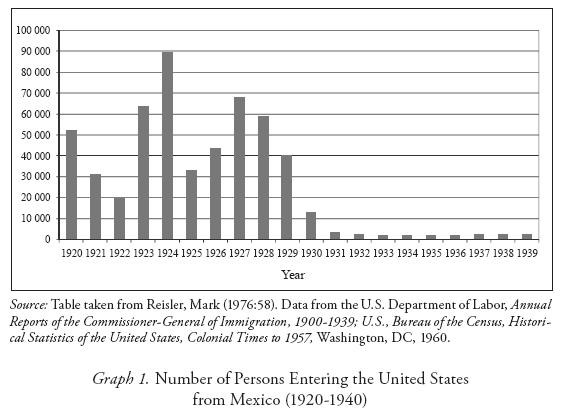
<body><![CDATA[<p align="justify"><font face="verdana" size="2"><i><b>Restriction of Immigration from Southern and Eastern Europe and Deportations of Mexicans (1921&#150;1942)</b></i></font></p>       <p align="justify"><font face="verdana" size="2">At the beginning of the 1920s, a growing popular anti&#150;immigrant sentiment led to the introduction of severe restrictions in United States immigration policy that came to be known as the "national origins quota system", which remained in operation until 1965. Margaret Usdansky and Thomas Espenshade (2001:32) conclude that the fear existed that the end of the First World War would produce an increase of European immigration to unprecedented levels, and that it would include communist infiltrators following the victory of the communist revolution in Russia. According to Lawrence Cardoso (1980:120), these measures were primarily designed to contain immigration from southern and eastern Europe, who were deemed "unable to assimilate or, indeed, even to comprehend the basic mechanisms of Anglo&#150;Saxon democracy". Although Mexicans were considered even more inferior because the majority were illiterate, of indigenous descent, and arrived fleeing the political turbulence of the Revolution, they were excluded from the restrictions of these laws as a result of their employers' support. </font></p>       <p align="justify"><font face="verdana" size="2">Mexican immigrants who worked in the Midwest region of the United States very likely benefited from the national origin quota system, given that the exclusion of Italian, Polish, Greek, and Romanian immigrants expanded their employment opportunities. Mexicans also benefited from the workers' program unilaterally instituted by the United States government between 1917 and 1922 as a result of World War I (Kiser and Silverman, 1979). </font></p>       <p align="justify"><font face="verdana" size="2">After the economic depression caused by World War I, Mexican migration was again reactivated in response to the rapid recovery of the United States economy. In addition to the continued demand they enjoyed on the part of railroad track construction and maintenance companies, Mexicans were also needed in the country's factories, foundries and mines. Almost overnight, Mexican migrants dominated employment in the cultivation of beets for sugar production. Recruiters working for these industries along the border and within Mexico itself played a fundamental role in taking many Mexicans to the United States (Cardoso, 1980; Alanis, 2004:75). Paul Taylor (1933) documented their activity in Arandas, Jalisco in the late 1920s. Jorge Durand and Douglas Massey (2003) referred to this labor system as the <i>enganche</i> (hook).</font></p>       <p align="justify"><font face="verdana" size="2">In 1921, immigration law numerically limited the annual admission of legal immigrants to three percent of the immigrant population volume of each nationality reported in the 1910 census. This provision favored immigration from the countries of northern and western Europe and drastically reduced it from Asian, African, and southern and eastern European countries (Heer, 1996). As a result of this law, the number of European immigrants, the majority of whom were unskilled, dropped to 309 556 between 1921 and 1922, a decrease of close to 500 000 compared to the previous fiscal year (Cardoso, 1980:83).</font></p>       <p align="justify"><font face="verdana" size="2">Later, the Immigration Law of 1924 included two new provisions further limiting the immigration that originated in particular from Italy, Poland, Greece and Romania. First, the United States Congress decided to assign an annual quota fixed at the equivalent of two percent of the number of immigrants of each restricted nationality residing in the United States in 1890. <sup><a href="#nota">2</a></sup> The number of admissions was established at 164 667 persons per year, a number in effect from May 26, 1924 until June 30, 1927. The second provision established that the annual admissions quota of immigrants from any country or nationality was the corresponding fraction of 150 000, according to the number of immigrants from that country residing in the United States in 1920. This specific system operated between July 1, 1927 and December 31, 1952, when U.S. immigration law was subjected to a major reform (U.S. Immigration and Naturalization Service, 1992, A.1&#150;6). </font></p>       <p align="justify"><font face="verdana" size="2">The Border Patrol was created in 1924 to originally control illegal crossings from Asian and Southern and Eastern European migrants through the U.S.&#150;Mexico border (Samora, 1977:37). Cardoso (1980:143) states that the economic depression of the 1930s rather than immigration laws achieved what the nativists had only dreamed of and more ... massive deportations of Mexicans. During the Great Depression, and more specifically between 1929 and 1935, over 415 000 Mexicans were deported from the United States, including many U.S. citizens of Mexican descent. This figure does not include those repatriated of their own volition or by the Mexican government (Hoffman, 1974:126). The deportations were carried out in tumultuous fashion all along the accessible points of the border. The deportation of Mexican migrants decreased considerably after 1934, thanks in part to the recovery programs of the government of President Franklin D. Roosevelt (1933&#150;1945) who promoted the reforms known as the New Deal (Alanis Enciso, 2004:78&#150;88).</font></p>       <p align="justify"><font face="verdana" size="2">The deportations and the economic depression drastically reduced the volume of Mexican migration. <a href="#g1">Graph 1</a> illustrates the significant variation in the entry of Mexicans into the United States between 1920 and 1929, fluctuating between 20 000 in 1922 and almost 90 000 in 1924, followed by the deportation era, between 1930 and 1939, when the volume of Mexicans entering the country dropped drastically to under 5 000 per year for most of the period. </font></p>       <p align="center"><font face="verdana" size="2"><a name="g1"></a></font></p>       <p align="center"><font face="verdana" size="2"><img src="/img/revistas/migra/v6n1/a7g1.jpg"></font></p>       ]]></body>
<body><![CDATA[<p align="justify"><font face="verdana" size="2">Although some deportation orders were issued by the federal government, the deportation policy was handled on a decentralized basis. State and local governments were allowed to implement the measures they deemed suitable. A large number of workers of Mexican descent and their families, some of them legal residents, were thereby voluntarily or involuntarily deported to Mexico. </font></p>       <p align="justify"><font face="verdana" size="2">&nbsp;</font></p>       <p align="justify"><font face="verdana" size="2"><i><b>The Bracero Program: Institutionalization of the Temporary Worker (1942&#150;1964)</b></i></font></p>       <p align="justify"><font face="verdana" size="2">Within the frame of World War II, in 1942, the governments of Mexico and the United States signed an agreement in which two programs were created for the massive recruitment of Mexican workers. The first was designed for agriculture, for which 4.6 million contracts were granted between 1942 and 1964 (Garc&iacute;a y Griego, 1988:116). The second was established for railroad tracks maintenance, and would result in the authorization of 69 000 contracts between 1943 and 1945 (McWilliams, 1990 &#91;1948&#93;).</font></p>       <p align="justify"><font face="verdana" size="2">The argument used by the governments of both countries was the scarcity of labor in agriculture caused by the war. Although this scarcity was real in some regions, the displacement of the U.S. workforce away from agriculture may also be explained by the poor labor conditions of the native agricultural workers. From the outset, the Bracero agreement established among its clauses the obligation of temporary stay for workers in the United States, aiming to avoid their permanent settlement. The work permits issued by the Immigration and Naturalization Service (INS) clearly indicated that their bearers were workers rather than immigrants (Garc&iacute;a y Griego, 1988:21).</font></p>       <p align="justify"><font face="verdana" size="2">Over the course of the Bracero Program, the clauses were modified on several occasions, largely due to changes in the power relations between the United States and Mexico. Garc&iacute;a y Griego (1988:xviii) establishes three periods in program development. The first phase, defined as wartime cooperation, lasted from 1942 to 1947. The author dates the second period between the immediate postwar years of 1947 and 1954 and is defined as the transition and conflict period. Finally, the third phase marks the stability and eventual termination of the program, covering the years between 1954 and 1964.</font></p>       <p align="justify"><font face="verdana" size="2">The first phase (1942&#150;1947) begins with the negotiations and design of the program with the participation of several government departments from both countries (Jones, 2007:89). A central characteristic of this phase was that the U.S. government functioned as the contractor of Mexican labor. It was also agreed that the rights of the Mexican workers who participated in the program would be protected by Article 29 of the Federal Labor Law of Mexico, which established payment of a minimum wage, housing, and transportation among other guarantees for the workers. In the same way, it was instituted that workers would not be subjected to discriminatory treatment, would not be used to displace other workers or reduce their wages, and would not be subject to military service (Morales, 1982:106). Finally, at the request of the Mexican government, a clause was introduced in which a 10 percent deduction was authorized from the wages of each Bracero worker to form a savings fund to be returned to them at the end of each contract. Because of the way in which the payment mechanisms were established, the struggle of former Braceros to recover their savings continues to the present.</font></p>       <p align="justify"><font face="verdana" size="2">During this first phase, the Mexican government held a position of force to negotiate that the rights of its co&#150;nationals be placed at the same level as those of the U.S. agricultural workers. However, the Mexican authorities were unaware of the fact that U.S. farm workers did not enjoy labor rights (Bustamante, 1980&#150;186). Just eight months after inauguration of the Bracero Program, the U.S. government violated the bilateral stature of the agreement when it passed Public Law 45 on April 29, 1943, which provided a legal basis for the program. A clause was introduced within this law that authorized the INS Commissioner to regulate the entry of foreign workers. Through this clause, the INS granted work visas outside the Bracero Program for more than one year to 2 000 Mexican workers. This clause was later retracted in response to strong protests on the part of the Mexican government. Within this same law, another two clauses also violated the program and harmed the rights of native farm workers. One of these prohibited U.S. federal agencies from using funds to recruit and transport native farm workers, and the other explicitly excluded them from the labor rights stipulated in the Bracero Program (Calavita, 1992). At the end of 1947, the program for contracting war&#150;time labor was officially terminated through Public Law 40.</font></p>       <p align="justify"><font face="verdana" size="2">In the second phase, covering the years from 1947 to 1954 and defined as the period of transition and conflict, the U.S. government ceased to function as an employer between 1947 and 1951, leaving the responsibility to the U.S. farmers to directly contract their workers. That led to an increase in violations of the Bracero Program and provoked the desertion of many workers, which in some areas reached 50 percent (Calavita, 1992:43). </font></p>       <p align="justify"><font face="verdana" size="2">Undocumented migration developed parallel to the Bracero Program and by 1944 had already become a serious problem. The decade of 1944&#150;1954 is defined as the "wetback decade" (Samora, 1971:45). To reduce undocumented migration, between 1947 and 1949, the governments of the United States and Mexico carried out a so&#150;called <i>Dry Out</i> practice, through which undocumented workers located in the United States crossed the border to be processed in the migratory stations of Mexicali, Ciudad Ju&aacute;rez and Reynosa, after which they re&#150;entered the United States as Braceros. However, this measure turned into a <i>de facto</i> recruitment program, through which many prospective Braceros illegally crossed the border and from there took refuge in the <i>Dry Out</i> practice. As a result of this procedure, 142 000 undocumented workers were "dried out" between 1947 and 1949 (Calavita, 1992:28). </font></p>       ]]></body>
<body><![CDATA[<p align="justify"><font face="verdana" size="2">However, the most effective actions to control undocumented migration were two deportation campaigns pursued by the United States government and backed by the Mexican government. One took place in 1947, primarily targeting undocumented immigrants in California and Texas. In the San Antonio, Texas district alone, 117 000 undocumented workers were deported. In the second campaign, the INS organized "Operation Wetback" in 1954. The INS Commissioner, General Swing, launched a massive military operation across the U.S. west coast and southwestern states, resulting in the deportation in just one year of over one million undocumented Mexican workers, some of whom were accompanied by their families. </font></p>       <p align="justify"><font face="verdana" size="2">In 1951, the United States Congress passed Public Law 78, which served to lend continuity to the contracting of Mexican workers. Both Kitty Calavita (1992) and Patricia Morales (1982) observe that the new agreement largely differed from the original, considering that the guarantees granted to the workers were notably reduced. </font></p>       <p align="justify"><font face="verdana" size="2">On June 27, 1952, in the midst of operation of the Bracero Program and for the first time in U.S. history, Congress approved a comprehensive set of laws on immigration and naturalization through the Immigration and Nationality Act (INA), also known as the "McCarran&#150;Walter Act", which became the basic immigration law. It contained key provisions. Although it made all races eligible for naturalization, it only changed the formula for establishing the national origins quota system. The law introduced a preferential quota structure for skilled immigrants and for families of U.S. citizens and immigrants and extended non&#150;quota status to the spouses and children of U.S. citizens (U.S. Immigration and Naturalization Service 1992, A.1&#150;6; Calavita, 1992; Zolberg, 2006). This law also created the H&#150;2A visa for temporary agricultural workers that was first granted to Caribbean migrants and is now mostly used by Mexican migrants.</font></p>       <p align="justify"><font face="verdana" size="2">Immigration data during the Bracero Program illustrate the way in which the national origin quota system was applied, favoring Mexicans. Considering the size of the populations of Mexico and China, whereas 299 811 Mexicans obtained permanent residency between 1951 and 1960, representing a 500 percent increase compared to the 1941&#150;1950 period, only 9 657 Chinese were admitted as immigrants during the 1950s (U.S. Immigration and Naturalization Service, 2000). </font></p>       <p align="justify"><font face="verdana" size="2">According to Ernesto Galarza (1964:62), through the McCarran&#150;Walter Act it became a punishment offense to harbor and conceal undocumented migrant workers, although Article 274 (a) stipulated that employment could not be considered as harboring or concealment. This cynical subterfuge is known as the "Texas Proviso", because it was introduced to benefit Texas farmers (Calavita, 1992:47). It was not until 1986 that the Immigration Reform and Control Act made knowingly hiring unauthorized immigrants a federal crime (Woodrow and Passel, 1990).</font></p>       <p align="justify"><font face="verdana" size="2">The third and final phase of the Bracero Program developed between 1956 and 1964 and was characterized by the stabilization achieved by the acceptance on the part of the Mexican government of the establishment of recruitment centers along the border, the admission of states such as Texas that had initially been excluded from the program; the acknowledgment that wage establishment would be the responsibility of the U.S. Labor Department, and the commitment by the Mexican government not to impede the flow of workers in the case of disagreements (Morales, 1982:141). </font></p>       <p align="justify"><font face="verdana" size="2"> During this period, the opposition to the Bracero Program on the part of labor unions and religious groups was reinforced by John F. Kennedy's election to the presidency, given the presence of strong opponents to the Bracero Program within key areas of the Kennedy administration, including the Department of Labor. In 1963, the program was extended one more year as a concession to the Mexican government, whose representatives argued that suspension of the program would have serious negative consequences in Mexico and that undocumented migration would increase. The Bracero Program was finally unilaterally cancelled by the United States on December 31, 1964.</font></p>       <p align="justify"><font face="verdana" size="2">&nbsp;</font></p>       <p align="justify"><font face="verdana" size="2"><i><b>The "Porous" Border and the Circular Migration of Undocumented Workers (1965&#150;1986)</b></i></font></p>       <p align="justify"><font face="verdana" size="2">There were no significant changes in the migratory pattern following termination of the Bracero Program, since a very high number of former Braceros and undocumented Mexicans continued to work in the United States on an illegal basis. The existence of a porous border due to negligent surveillance on the part of the United States government permitted the development of this migratory pattern. </font></p>       ]]></body>
<body><![CDATA[<p align="justify"><font face="verdana" size="2"> Douglas Massey, Jorge Durand, and Nolan Malone (2002) refer to this period between 1965 and 1985 as that of "undocumented migration". Cornelius (1992) argues that during this period, Mexican migrants in general adhered to a migratory pattern similar to that of the Bracero Program: a circular flow of undocumented young males who left their families in rural Mexican communities to work in seasonal agriculture in the United States for periods of six months or less before returning to their places of origin. The majority of these workers came from a group of rural communities located in seven or eight central western Mexican states, which for many years had sent the bulk of Mexican migration to the United States. </font></p>       <p align="justify"><font face="verdana" size="2">In the period following the Bracero Program, between 1965 and the first half of the 1970s, a high rate of family reunification occurred among Mexican farm workers. The Labor Department's certification program was decisive in this process, helping employers to legalize their workers and their families at a time when they felt that their access to workers from south of the border was uncertain. The employers of former Bracero workers even took out paid advertisements in Mexican newspapers inviting their workers to go to the United States to process their documents as permanent residents (Mines and Anzaldua, 1982). Mexican immigrant communities that included a high proportion of women began to emerge in rural areas of California and other states (Palerm, 1991; Alarc&oacute;n, 1995). In some cases, employers adopted new labor practices and housing programs to stimulate the settlement of families. There were also relatively higher wages in agriculture, and social programs were extended for agricultural workers. Unionization of this workforce also increased (Mines and Anzald&uacute;a, 1982; Zabin <i>et al .</i>, 1993; Alarc&oacute;n and Mines, 2002).</font></p>       <p align="justify"><font face="verdana" size="2">Evidence to confirm this period's "undocumented migration" pattern can be extracted from the data on arrests s conducted by the Border Patrol or other INS personnel during this period. These data are useful for estimating the migratory flows of undocumented workers rather than the number of undocumented workers, given that one person may be arrested on repeated occasions. </font></p>       <p align="justify"><font face="verdana" size="2">In 1974, the number of arrests exceeded half a million, and by the mid&#150;1980s it had reached around one million per year. Arrests reached their highest level in 1986, numbering just over 1.7 million (U.S. Immigration and Naturalization Service, 2000). Escobar, Bean and Weintraub (1999) use a more precise indicator to measure changes in the undocumented migratory flow, analyzing the number of arrests per man&#150;hour of surveillance carried out by the Border Patrol. Following this methodology, the average number of arrests per hour increased from 0.248 in the 1977&#150;1982 period to 0.354 in the 1983&#150;1986 period, indicating the growth of the undocumented flow. </font></p>       <p align="justify"><font face="verdana" size="2">At the federal level, a radical change occurred in U.S. immigration policy at the beginning of this period in the context of the country's civil rights movement. The Immigration and Nationality Act (also known as the Hart&#150;Celler Act), passed in 1965, banned the restrictive national origins quotas system established in 1921, eliminating national origin, race, and ancestry as bases for immigration to the United States. This led to a more diverse universe of legal immigrants, adhering to criteria of family reunification and occupational skills. This law came to correct the discriminatory system that especially affected Asians, eastern Europeans and Africans (Portes and Rumbaut, 2006). </font></p>       <p align="justify"><font face="verdana" size="2">The new law established a seven&#150;category preference system for the families of U.S. citizens, legal permanent residents and for persons with special occupational skills. However, immediate family members (parents, children, and spouses) of U.S. citizens continued to be exempted from all restrictions. This law maintained the principle of numerical restriction, limiting immigration from countries in the Eastern Hemisphere to 170 000 persons, and for the first time placing a limit on immigration from Western Hemispheric countries of 120 000 persons per year. This legislation also established a per&#150;country limit of 20 000 immigrants per year (U.S. Immigration and Naturalization Service, 1992). </font></p>       <p align="justify"><font face="verdana" size="2">Douglas Massey, Jorge Durand, and Nolan Malone (2002:43) argue that between 1960 and 1968, when Mexicans were able to enter without numerical restrictions, some 386 000 were admitted as legal permanent residents. In 1968, when the Western hemisphere cap of 120 000 was applied, Mexicans began to compete, for the first time, for a limited supply of visas. In this context, in 1977, the courts ordered the INS to set aside 144 946 visas that had been assigned to Cuban refugees, for Mexicans in addition to the hemispheric ceiling. These visas were known as "Silva Letters" because this was the last name of the lead plaintiff in the lawsuit.</font></p>       <p align="justify"><font face="verdana" size="2">This law reform resulted in radical change in immigration to the United States, with a decrease in European participation alongside the massive immigration of Asians and Latin Americans, among whom Mexicans predominate.</font></p>       <p align="justify"><font face="verdana" size="2">&nbsp;</font></p>       <p align="justify"><font face="verdana" size="2"><i><b>Immigration Reform and Control Act (IRCA): Amnesty and Settlement in the United States (1986&#150;1993)</b></i></font></p>       ]]></body>
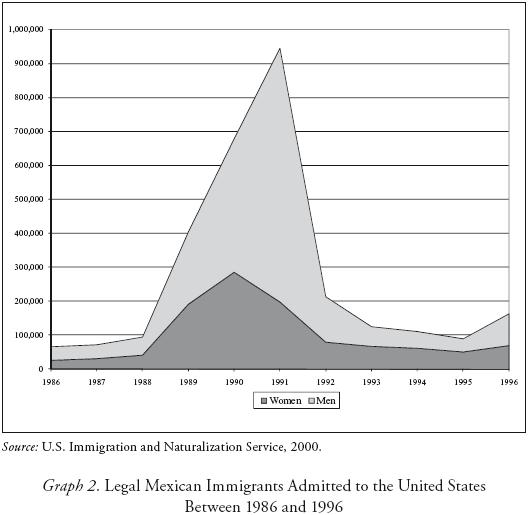
<body><![CDATA[<p align="justify"><font face="verdana" size="2">The massive presence of undocumented persons in the United States, estimated at 12 million, provoked a heated debate during the 1980s on how to address the problem. In 1986, the United States government approved IRCA, which was the result of a compromise between restrictionist groups, migrant advocates, and those protecting the interests of agricultural employers. The law had three primary elements: 1) an amnesty for undocumented workers, 2) sanctions against employers who knowingly hire undocumented workers, and 3) increased border enforcement (Woodrow and Passel, 1990).</font></p>       <p align="justify"><font face="verdana" size="2">Implementation of this law has occurred in a fragmented fashion. While amnesty was generously applied in accordance with the proposal, the sanctions against employers have never been more than symbolic, and true reinforcement of border surveillance did not begin until late 1993 when the Clinton administration decided to adopt this policy.</font></p>       <p align="justify"><font face="verdana" size="2">The amnesty was administered under two programs: the "general amnesty" and the Special Agricultural Workers' (SAW) program. Agricultural employers, fearful of employer sanctions and incapable of obtaining a guest workers' program to suit their taste, allied themselves with migrant&#150;defense groups to obtain this program to cover their labor needs. Both the "general amnesty" and the special agricultural workers program resulting in more than three million persons regularizing their immigration status. Of these, 2.3 million were from Mexico (Massey, Durand, and Malone 2002:90). The majority of men and women obtained legal permanent residence between 1988 and 1992 (see <a href="#g2">graph 2</a>).</font></p>       <p align="center"><font face="verdana" size="2"><a name="g2"></a></font></p>       <p align="center"><font face="verdana" size="2"><img src="/img/revistas/migra/v6n1/a7g2.jpg"></font></p>       <p align="justify"><font face="verdana" size="2">Despite the law's aim of decreasing illegal immigration, without intending to, the SAW program exacerbated this problem by attracting several thousand Mexicans with the idea of "fixing their papers" through this program. Between 1987 and 1988 there was a very large influx of undocumented males who eventually obtained permanent residence through the SAW program in a fraudulent manner. A study in Mexico showed that some of the SAW applicants, despite not meeting the requirements, had previously been in the United States as undocumented workers, although a high percentage entered the country for the first time to seek legalization (Cornelius, 1990). While there was an estimate that 350 000 unauthorized migrants worked in agriculture in the early 1980s, surprisingly, 1.3 million applied for SAW status (Martin, 1990:73). At the end, 1.1 million obtained legal permanent residency.</font></p>       <p align="justify"><font face="verdana" size="2">Many of the approximately one million applicants who obtained legalization through the SAW program were able to move freely back and forth across the border. This allowed many fathers and husbands who had gone many years without seeing their families to return to their communities in Mexico. This process in turn led to a notable decline in the number of arrests carried out by the Border Patrol. </font></p>       <p align="justify"><font face="verdana" size="2">The most important effect produced by IRCA was the emergence of a vigorous process of family reunification and settlement in the United States of documented and undocumented persons between the late 1980s and the early 1990s. The family reunification produced by this law led to the presence in several regions of the United States of a large number of families with mixed immigration status, with U.S. citizens, legal permanent residents, and undocumented relatives sharing the same household. </font></p>       <p align="justify"><font face="verdana" size="2">In 1990, the United States Congress once again reformed immigration law, emphasizing the human capital of the immigrants by highlighting the importance of educational attainment and labor skills in the admission of new immigrants. The Immigration Act of 1990 significantly expanded the proportion of visas issued for employment motives, increasing their number from 54 000 to 140 000 per year. Prior to 1990, less than 10 percent of immigrants were admitted to the United States under this category (Cheng and Yang, 1998:627).</font></p>       <p align="justify"><font face="verdana" size="2">Under the 1990 Immigration Act, 40 000 immigrant visas are granted each year for priority workers: immigrants with "extraordinary" ability in the sciences, arts, education, business or athletics. This first category also includes outstanding professors and researchers in addition to certain executives and managers of multinational corporations. The second category provides another 40 000 visas annually for immigrants with advanced university degrees or with exceptional abilities in the sciences, arts or business. The third category, with a further 40 000 visas, is for other skilled and unskilled workers, but only 10 000 visas are available for the latter. The category of special immigrants is designed for certain religious ministers and workers, and for United States government employees working abroad and given access to 10 000 visas a year. Finally, the fifth category provides 10 000 visas a year for entrepreneurs who set up a new commercial enterprise and invest between 500 000 and 3 million US dollars in the United States. Such investment must create at least 10 fulltime jobs for workers in the United States (Calavita, 1994; Papademetriou, 1996; Yale&#150;Loehr, 1991). This legislation, in part, would promote the temporary and permanent migration of more educated Mexicans in the near future. </font></p>       ]]></body>
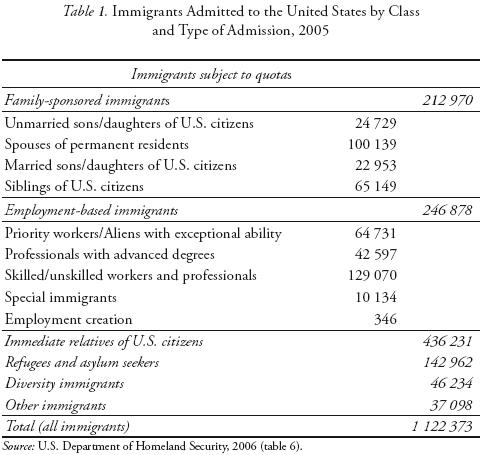
<body><![CDATA[<p align="justify"><font face="verdana" size="2">&nbsp;</font></p>       <p align="justify"><font face="verdana" size="2"><i><b>Increased Border Enforcement and the Diversification of Mexican Immigration (1994&#150;2005)</b></i></font></p>       <p align="justify"><font face="verdana" size="2">The rapid growth of undocumented migration following the termination of the Bracero Program drove the Mexican population in the United States from 760 000 in 1970 to over 11 million in 2004. During the 1990s, this population increased by an average of half a million persons a year (Passel, 2005:2&#150;3). In this context, in late 1993 the U.S. government decided to heighten border enforcement to curb undocumented migration from Mexico by implementing two important measures: a substantial increase in the budget of what is now called the Department of Homeland Security and a concentration of resources for the installation of walls and electronic surveillance equipment on the border routes that had been traditionally used by undocumented migrants (Cornelius, 2001; Reyes, Johnson and Van Swearingen, 2002).</font></p>       <p align="justify"><font face="verdana" size="2">This has brought into being a fortified border, which in turn has forced those now crossing the border without proper documentation to go deep into wilder and more dangerous areas where many of them drown in rivers and canals or die of heat in the desert or of cold in the mountains. This humanitarian crisis has caused the death of more than 5 000 persons since 1994 (Jimenez, 2009).</font></p>       <p align="justify"><font face="verdana" size="2">Building walls and increasing surveillance at the traditional points for undocumented crossings have proved extremely effective in changing the routes of clandestine crossing. The data are unequivocal. Between 1993 and 1998, Border Patrol agents reduced the number of arrests in traditional crossing areas in San Diego and El Paso to less than half their previous levels whereas El Centro, California, and Tucson, Arizona, SAW an increase in the number of arrests. During this process, Tijuana stopped being the most important undocumented crossing point and was replaced by the Sonora&#150;Arizona desert (Alarc&oacute;n and Mines, 2002). </font></p>       <p align="justify"><font face="verdana" size="2">In 1996 the Illegal Immigration Reform and Immigrant Responsibility Act drastically restricted access by legal and illegal immigrants to many public welfare programs which led to an unprecedented increase in the number of naturalizations of Mexican immigrants seeking to protect their access to these services. This rise in requests for naturalizations had not been achieved by Mexican American political organizations' campaigns. Increased border enforcement took a new turn when on November 26, 2001, the Patriot Act became law following the September 11 attacks and immigration to the United States became a matter of national security and soon after that became a global trend.</font></p>       <p align="justify"><font face="verdana" size="2">In 2000, the Mexican population in the United States was more diversified than in previous decades with the presence of more women, indigenous persons and skilled migrants. Mexican immigrants, in general, had many social and economic limitations in addition to their undocumented status. Census data from that year reveal that, as compared with immigrants from Europe, Asia, Africa, the Caribbean, Canada, and Central and South America, Mexicans were the youngest, with the highest proportion of men over women, and the lowest educational attainment. Mexican immigrants had likewise resided fewer years in the United States and had the lowest proportion of naturalized citizens. They participated in a labor market offering low pay. While their participation in managerial and professional specialties was very low, they were heavily concentrated in jobs as operators, fabricators and laborers, or in farming (Schmidley, 2001). </font></p>       <p align="justify"><font face="verdana" size="2">Data on the volume and types of immigrants admitted by the United States in 2005 reveal the effect of a hundred years of immigration policy. Mexicans received the highest proportion of immigrant visas (14%), most of which were for family reunification reasons. The United States admitted a total of 1 122 373 immigrants that year and 436 231 (39%) were admitted because they were direct relatives (spouses, parents and minor children) of U.S. citizens for whom there are no numerical restrictions. An additional 212 970 (19%), were admitted under family reunification preferences governed by a system of quotas in four categories. Likewise, 246 878 persons (22%) were admitted under employment preferences that have numerical restrictions distributed among the five categories described earlier. Lastly, 142 962 persons (13%) were refugees and asylum seekers, 46 234 persons (4%) were diversity immigrants due to the fact that they came from countries with few immigrants and 37 098 (3%) were immigrants admitted under other categories (see <a href="#t1">table 1</a>).</font></p>       <p align="center"><font face="verdana" size="2"><a name="t1"></a></font></p>       <p align="center"><font face="verdana" size="2"><img src="/img/revistas/migra/v6n1/a7t1.jpg"></font></p>       ]]></body>
<body><![CDATA[<p align="justify"><font face="verdana" size="2"><a href="#t2">Table 2</a> shows the seven countries with the largest number of immigrants admitted as permanent residents under employment preferences in 2005. It is noteworthy that Mexico, despite obtaining the largest number of immigrant visas (161 445), was only granted 16 347 (10%) for employment reasons, revealing that most Mexican immigrants entered the United States with low levels of human capital. With the exception of Vietnam, Asian countries have higher proportions of immigrants admitted for employment reasons than immigrants from Latin American countries; for instance, 56 percent of Indian immigrants were admitted under these preferences. </font></p>       <p align="center"><font face="verdana" size="2"><a name="t2"></a></font></p>       <p align="center"><font face="verdana" size="2"><img src="/img/revistas/migra/v6n1/a7t2.jpg"></font></p>       <p align="justify"><font face="verdana" size="2">With regard to temporary employment, in 2005, Mexico was the fourth recipient of H&#150;1B visas, designed for temporary workers employed in "special occupations" requiring highly specialized knowledge and at least one bachelor's degree or equivalent under the 1990 Immigration Act. Again Indian migrants were in the fore with one quarter of the 407 418 visas, followed by the United Kingdom with 30 755 (7.5%), Canada with 24 086 (5.9%) and Mexico with 17 063 (4.2%). This visa is initially granted for three years and may be renewed for a further three. It may also open the door to permanent residence (U.S. Department of Homeland Security, 2006).</font></p>       <p align="justify"><font face="verdana" size="2">Interestingly, skilled Mexicans showed very little interest in regards to the less known tn (Treaty National) visa in 2003. This visa was created under the North American Free Trade Agreement (NAFTA) in 1994 to facilitate the temporary movement of qualified professionals between Canada, Mexico, and the United States. Surprisingly, while Mexico received the largest number of NAFTA visa workers of the three countries, it sent the lowest number. Mexico received 282 533 tn visa holders from the United States and 21 676 from Canada while it sent 1 269 and 110 to the United States and Canada, respectively (Alarc&oacute;n, 2007:252&#150;254). Finally, Mexicans received the largest number of H&#150;2A and H&#150;2B visas for agricultural and service workers, respectively in 2005, showing the importance of unskilled work for these migrants. Of a total of 129 327 visas, Mexico was granted 90 466 (70%) followed by Jamaica (9.2%) and South Africa (2%). </font></p>       <p align="justify"><font face="verdana" size="2">&nbsp;</font></p>       <p align="justify"><font face="verdana" size="2"><i><b>Final Considerations</b></i></font></p>       <p align="justify"><font face="verdana" size="2">Immigration policy is not only a powerful state instrument for nation building thorough managing the admission of the foreign born into their territory, it is also very useful for improving the competitiveness of the national economy by selecting the employment skills of immigrants. </font></p>       <p align="justify"><font face="verdana" size="2">This study reveals that, as suggested by Saskia Sassen (1988), U.S. foreign policies such as direct recruitment in Mexico and investment in the construction of railroads created the conditions for the emergence of labor migration. In addition, in just over a hundred years, from the Chinese Exclusion Act of 1882 to the enactment of IRCA in 1986, despite the large number of Mexican men and women admitted as immigrants, U.S. immigration policy, by action and omission, sought to construct the Mexican migrant as a temporary worker, preferably male who would not settle in the United States yet would be prepared to comply with his employers' demands.</font></p>       <p align="justify"><font face="verdana" size="2">The Bracero Program is the single most important factor that led to the institutionalization of the temporary worker. Over a period of 22 years, not only did their U.S. employers became dependent on them but so did their communities in Mexico that received a significant proportion of their income from their work in the United States. The Bracero Program can be regarded as a resounding failure because the temporary workers, as stipulated by the program, did not return to Mexico in 1964, since millions of former Braceros continued to perform the same tasks as undocumented workers, joining the millions who had worked as such during the program. From a different perspective, the Bracero Program can be considered a success in that it created a massive movement of workers which in the last analysis, was the aim of U.S. immigration policy (Calavita, 1992:167). This failure also occurred in France, Germany and Switzerland whose temporary workers programs, from 1945 onwards, led to a massive influx of legal immigrants (Plewa and Miller, 2005). </font></p>       ]]></body>
<body><![CDATA[<p align="justify"><font face="verdana" size="2">While Jorge Bustamante (1979) viewed the undocumented status as an important factor of migrants' vulnerability during the "undocumented era", Massey, Durand and Malone (2002:71) consider that "a relatively stable, smoothly functioning migration system was functioning in the mid 1980s". For them, it was a system that minimized the negative consequences and maximized the gains for the United States and Mexico because Mexican migrants worked 45 hours a week in formal jobs, paid federal taxes, were unlikely to use social services and did not settle in the United States. For its part, Mexico had an "escape valve" for the unemployment pressures, since migration was circular, migrants were not "permanently lost for productive purposes" and remittances were a major source of foreign currency.</font></p>       <p align="justify"><font face="verdana" size="2">The Immigration Reform and Control Act radically transformed this migration pattern by promoting permanent settlement in the United States, which would subsequently be reinforced by&#150;heightened border surveillance, which further reduced the circularity of workers. Many Mexican immigrants became legal permanent residents and eventually obtained U.S. citizenship, which enabled them to acquire new rights and the possibility of offering new options to their children. Interestingly, at the same time that IRCA was implemented in the United States, Spain began its various processes of immigrant regularizations (Rela&ntilde;o Pastor, 2004).</font></p>       <p align="justify"><font face="verdana" size="2">The temporary migration of Mexican migrants prompts several reflections. In the first place, the number of skilled Mexicans who obtained H&#150;1B visas to work in the United States in 2005 is relatively high while the number of Mexicans receiving a NAFTA visa in 2003 was very low. The preference for the H&#150;1B visa that leads to permanent residence in the United States, is the most important factor explaining this difference. While, high&#150;tech entrepreneurs struggle to obtain more H1&#150;B visas, their agricultural counterparts want more access to undocumented workers. It is unfair that unlike professionals, unskilled Mexican migrants encounter severe restrictions on their international mobility. In fact, immigration policies, the power of corporations and their own class resources enable skilled migrants to cross borders more easily than unskilled migrants (Alarc&oacute;n, 2007).</font></p>       <p align="justify"><font face="verdana" size="2">The consequences of a hundred years of U.S. migration policy have led to the integration of 11.7 million Mexicans with different migration status, living under the same roof. This population is well integrated into the United States and the possibilities of return are increasingly reduced by the violence that erupted in Mexico in 2007. Not even the severe economic crisis that began the same year in the United States created a massive return to Mexico. </font></p>       <p align="justify"><font face="verdana" size="2">The review of Mexican history to the United States forces one to acknowledge the responsibility of U.S. immigration policy in the presence of 7 million undocumented persons in the country. Smith, Rogers (2010) has argued that Mexicans may be owed "special access to American residency and citizenship, ahead of the residents of the many countries less affected by U.S. policies, and in ways that should justify leniency toward undocumented Mexican immigrants". A change in U.S. immigration law that would regularize the situation of the undocumented can only be brought about by the will of U.S. citizens who can pressure their politicians to implement a new immigration system.</font></p>       <p align="justify"><font face="verdana" size="2">&nbsp;</font></p>       <p align="justify"><font face="verdana" size="2"><i><b>References</b></i></font></p>       <!-- ref --><p align="justify"><font face="verdana" size="2">Alanis Enciso, Fernando Sa&uacute;l, 2004, "Nos vamos al norte: La emigraci&oacute;n de San Luis Potos&iacute; a Estados Unidos entre 1920 y 1940", <i>Migraciones Internacionales</i>, 7, vol. 2, num. 4, July&#150;December, pp. 66&#150;94.    &nbsp;&nbsp;&nbsp;&nbsp;&nbsp;&nbsp;&nbsp;&nbsp;[&#160;<a href="javascript:void(0);" onclick="javascript: window.open('/scielo.php?script=sci_nlinks&ref=5351429&pid=S1665-8906201100010000700001&lng=','','width=640,height=500,resizable=yes,scrollbars=1,menubar=yes,');">Links</a>&#160;]<!-- end-ref --></font></p>       <!-- ref --><p align="justify"><font face="verdana" size="2">Alarc&oacute;n, Rafael, 1995, <i>Immigrants or Transnational Workers? The Settlement Process among Mexicans in Rural California</i>, Davis, California, California Institute for Rural Studies.    &nbsp;&nbsp;&nbsp;&nbsp;&nbsp;&nbsp;&nbsp;&nbsp;[&#160;<a href="javascript:void(0);" onclick="javascript: window.open('/scielo.php?script=sci_nlinks&ref=5351431&pid=S1665-8906201100010000700002&lng=','','width=640,height=500,resizable=yes,scrollbars=1,menubar=yes,');">Links</a>&#160;]<!-- end-ref --></font></p>       <!-- ref --><p align="justify"><font face="verdana" size="2">Alarc&oacute;n, Rafael, 2007, "The Free Circulation of Skilled Migrants in North America", in Antoine P&eacute;coud and Paul de Guchteneire (eds.), <i>Migration Without Borders. Essays on the Free Movement of People</i>, Paris/Oxford/New York, UNESCO Publishing/Berhahn Books.    &nbsp;&nbsp;&nbsp;&nbsp;&nbsp;&nbsp;&nbsp;&nbsp;[&#160;<a href="javascript:void(0);" onclick="javascript: window.open('/scielo.php?script=sci_nlinks&ref=5351433&pid=S1665-8906201100010000700003&lng=','','width=640,height=500,resizable=yes,scrollbars=1,menubar=yes,');">Links</a>&#160;]<!-- end-ref --></font></p>       <!-- ref --><p align="justify"><font face="verdana" size="2">Alarc&oacute;n, Rafael, and Rick Mines, 2002, "El retorno de 'los solos.' Migrantes mexicanos en la agricultura de los Estados Unidos", in Mar&iacute;a Eugenia Anguiano and Miguel Hern&aacute;ndez (eds). <i>Migraci&oacute;n internacional e identidades cambiantes</i>, Zamora, El Colegio de Michoac&aacute;n/El Colegio de la Frontera Norte.    &nbsp;&nbsp;&nbsp;&nbsp;&nbsp;&nbsp;&nbsp;&nbsp;[&#160;<a href="javascript:void(0);" onclick="javascript: window.open('/scielo.php?script=sci_nlinks&ref=5351435&pid=S1665-8906201100010000700004&lng=','','width=640,height=500,resizable=yes,scrollbars=1,menubar=yes,');">Links</a>&#160;]<!-- end-ref --></font></p>       <!-- ref --><p align="justify"><font face="verdana" size="2">Bilateral Commission on the Future of United States&#150;Mexican Relations, 1989, <i>The Challenge of Interdependence: Mexico and the United States</i>, Lanham/New York/London, University Press of America.    &nbsp;&nbsp;&nbsp;&nbsp;&nbsp;&nbsp;&nbsp;&nbsp;[&#160;<a href="javascript:void(0);" onclick="javascript: window.open('/scielo.php?script=sci_nlinks&ref=5351437&pid=S1665-8906201100010000700005&lng=','','width=640,height=500,resizable=yes,scrollbars=1,menubar=yes,');">Links</a>&#160;]<!-- end-ref --></font></p>       <!-- ref --><p align="justify"><font face="verdana" size="2">Bustamante Jorge, 1979, "Las mercanc&iacute;as migratorias. Indocumentados y capitalismo: Un enfoque", <i>Nexos</i>, num. 24, July.    &nbsp;&nbsp;&nbsp;&nbsp;&nbsp;&nbsp;&nbsp;&nbsp;[&#160;<a href="javascript:void(0);" onclick="javascript: window.open('/scielo.php?script=sci_nlinks&ref=5351439&pid=S1665-8906201100010000700006&lng=','','width=640,height=500,resizable=yes,scrollbars=1,menubar=yes,');">Links</a>&#160;]<!-- end-ref --></font></p>       <!-- ref --><p align="justify"><font face="verdana" size="2">Bustamante, Jorge, 1980, "Los problemas fronterizos", in Barkin, <i>et al.</i> (eds.), <i>Las relaciones Mexico/Estados Unidos</i>, 1, Mexico, Universidad Nacional Aut&oacute;noma de M&eacute;xico/Nueva Imagen.    &nbsp;&nbsp;&nbsp;&nbsp;&nbsp;&nbsp;&nbsp;&nbsp;[&#160;<a href="javascript:void(0);" onclick="javascript: window.open('/scielo.php?script=sci_nlinks&ref=5351441&pid=S1665-8906201100010000700007&lng=','','width=640,height=500,resizable=yes,scrollbars=1,menubar=yes,');">Links</a>&#160;]<!-- end-ref --> </font></p>       <!-- ref --><p align="justify"><font face="verdana" size="2">Bustamante, Jorge, 1983, <i>Espaldas mojadas: Materia prima para la expansi&oacute;n del capital norteamericano</i>, Mexico, D. F., El Colegio de M&eacute;xico (Cuadernos del CES, 9).    &nbsp;&nbsp;&nbsp;&nbsp;&nbsp;&nbsp;&nbsp;&nbsp;[&#160;<a href="javascript:void(0);" onclick="javascript: window.open('/scielo.php?script=sci_nlinks&ref=5351443&pid=S1665-8906201100010000700008&lng=','','width=640,height=500,resizable=yes,scrollbars=1,menubar=yes,');">Links</a>&#160;]<!-- end-ref --></font></p>       <!-- ref --><p align="justify"><font face="verdana" size="2">Calavita, Kitty, 1992, <i>Inside the State: The Bracero Program, Immigration and the I.N.S.</i>, New York, Routledge.    &nbsp;&nbsp;&nbsp;&nbsp;&nbsp;&nbsp;&nbsp;&nbsp;[&#160;<a href="javascript:void(0);" onclick="javascript: window.open('/scielo.php?script=sci_nlinks&ref=5351445&pid=S1665-8906201100010000700009&lng=','','width=640,height=500,resizable=yes,scrollbars=1,menubar=yes,');">Links</a>&#160;]<!-- end-ref --></font></p>       <!-- ref --><p align="justify"><font face="verdana" size="2">Calavita, Kitty, 1994, "U.S. Immigration and Policy Responses: The Limits of Legislation", in Wayne Cornelius, Philip Martin, and James Hollifield (eds.), <i>Controlling Immigration</i>. A Global Perspective, Stanford, Stanford University Press.    &nbsp;&nbsp;&nbsp;&nbsp;&nbsp;&nbsp;&nbsp;&nbsp;[&#160;<a href="javascript:void(0);" onclick="javascript: window.open('/scielo.php?script=sci_nlinks&ref=5351447&pid=S1665-8906201100010000700010&lng=','','width=640,height=500,resizable=yes,scrollbars=1,menubar=yes,');">Links</a>&#160;]<!-- end-ref --></font></p>       <!-- ref --><p align="justify"><font face="verdana" size="2">Cardoso, Lawrence A., 1980, <i>Mexican Emigration to the United States 1897&#150;1931. Socio&#150;Economic Patterns</i>, Tucson, Arizona, University of Arizona Press.    &nbsp;&nbsp;&nbsp;&nbsp;&nbsp;&nbsp;&nbsp;&nbsp;[&#160;<a href="javascript:void(0);" onclick="javascript: window.open('/scielo.php?script=sci_nlinks&ref=5351449&pid=S1665-8906201100010000700011&lng=','','width=640,height=500,resizable=yes,scrollbars=1,menubar=yes,');">Links</a>&#160;]<!-- end-ref --></font></p>       <!-- ref --><p align="justify"><font face="verdana" size="2">Cheng, Lucie, and Philip Q. Yang, 1998, "Global Interaction, Global Inequality and Migration of the Highly Trained to the United Sates", <i>International Migration Review</i>, vol. 23, num. 3, pp. 626&#150;653.    &nbsp;&nbsp;&nbsp;&nbsp;&nbsp;&nbsp;&nbsp;&nbsp;[&#160;<a href="javascript:void(0);" onclick="javascript: window.open('/scielo.php?script=sci_nlinks&ref=5351451&pid=S1665-8906201100010000700012&lng=','','width=640,height=500,resizable=yes,scrollbars=1,menubar=yes,');">Links</a>&#160;]<!-- end-ref --> </font></p>       <!-- ref --><p align="justify"><font face="verdana" size="2">Cornelius, Wayne, 1990, "Impacts of the 1986 U.S. Immigration Law on Emigration from Rural Mexican Sending Communities", in Frank Bean, Barry Edmonston, and Jeffrey Passel (eds.), <i>Undocumented Migration to the United States. IRCA and the Experience of the 1980s</i>, Lanham/London, RAND Corporation/The Urban Institute.    &nbsp;&nbsp;&nbsp;&nbsp;&nbsp;&nbsp;&nbsp;&nbsp;[&#160;<a href="javascript:void(0);" onclick="javascript: window.open('/scielo.php?script=sci_nlinks&ref=5351453&pid=S1665-8906201100010000700013&lng=','','width=640,height=500,resizable=yes,scrollbars=1,menubar=yes,');">Links</a>&#160;]<!-- end-ref --> </font></p>       <!-- ref --><p align="justify"><font face="verdana" size="2">Cornelius, Wayne, 1992, "From Sojourners to Settlers: The Changing Profile of Mexican Migration to the United States", Jorge Bustamante, Ra&uacute;l Hinojosa, and Clark Reynolds (eds.), <i>U.S.&#150;Mexico Relations: Labor Market Interdependence</i>, Stanford, Stanford University Press.    &nbsp;&nbsp;&nbsp;&nbsp;&nbsp;&nbsp;&nbsp;&nbsp;[&#160;<a href="javascript:void(0);" onclick="javascript: window.open('/scielo.php?script=sci_nlinks&ref=5351455&pid=S1665-8906201100010000700014&lng=','','width=640,height=500,resizable=yes,scrollbars=1,menubar=yes,');">Links</a>&#160;]<!-- end-ref --></font></p>       <!-- ref --><p align="justify"><font face="verdana" size="2">Cornelius, Wayne, 2001, "Death at the Border: Efficacy and Unintended Consequences of U.S. Immigration Control Policy", <i>Population and Development Review</i>, vol. 27, num. 4.    &nbsp;&nbsp;&nbsp;&nbsp;&nbsp;&nbsp;&nbsp;&nbsp;[&#160;<a href="javascript:void(0);" onclick="javascript: window.open('/scielo.php?script=sci_nlinks&ref=5351457&pid=S1665-8906201100010000700015&lng=','','width=640,height=500,resizable=yes,scrollbars=1,menubar=yes,');">Links</a>&#160;]<!-- end-ref --></font></p>       <!-- ref --><p align="justify"><font face="verdana" size="2">Craig, Richard B., 1971, <i>The Bracero Program: Interest Groups and Foreign Policy</i>, Austin, University of Texas Press.    &nbsp;&nbsp;&nbsp;&nbsp;&nbsp;&nbsp;&nbsp;&nbsp;[&#160;<a href="javascript:void(0);" onclick="javascript: window.open('/scielo.php?script=sci_nlinks&ref=5351459&pid=S1665-8906201100010000700016&lng=','','width=640,height=500,resizable=yes,scrollbars=1,menubar=yes,');">Links</a>&#160;]<!-- end-ref --></font></p>       <!-- ref --><p align="justify"><font face="verdana" size="2">Durand, Jorge, and Douglas Massey, 2003, <i>Clandestinos. Migraci&oacute;n M&eacute;xico&#150;Estados Unidos en los albores del siglo XXI </i>, Mexico, Universidad Aut&oacute;noma de Zacatecas/Miguel &Aacute;ngel Porr&uacute;a.    &nbsp;&nbsp;&nbsp;&nbsp;&nbsp;&nbsp;&nbsp;&nbsp;[&#160;<a href="javascript:void(0);" onclick="javascript: window.open('/scielo.php?script=sci_nlinks&ref=5351461&pid=S1665-8906201100010000700017&lng=','','width=640,height=500,resizable=yes,scrollbars=1,menubar=yes,');">Links</a>&#160;]<!-- end-ref --></font></p>       <!-- ref --><p align="justify"><font face="verdana" size="2">Escobar, Agust&iacute;n, Frank Bean, and Sidney Weintraub, 1999, <i>La din&aacute;mica de la emigraci&oacute;n mexicana</i>, Mexico, Centro de Investigaciones y Estudios Superiores en Antropolog&iacute;a Social/Miguel &Aacute;ngel Porr&uacute;a.    &nbsp;&nbsp;&nbsp;&nbsp;&nbsp;&nbsp;&nbsp;&nbsp;[&#160;<a href="javascript:void(0);" onclick="javascript: window.open('/scielo.php?script=sci_nlinks&ref=5351463&pid=S1665-8906201100010000700018&lng=','','width=640,height=500,resizable=yes,scrollbars=1,menubar=yes,');">Links</a>&#160;]<!-- end-ref --> </font></p>       <!-- ref --><p align="justify"><font face="verdana" size="2">Galarza, Ernesto, 1964, <i>Merchants of Labor. The Mexican Bracero Story</i>, California, McNally &amp; Loftin Publishers.    &nbsp;&nbsp;&nbsp;&nbsp;&nbsp;&nbsp;&nbsp;&nbsp;[&#160;<a href="javascript:void(0);" onclick="javascript: window.open('/scielo.php?script=sci_nlinks&ref=5351465&pid=S1665-8906201100010000700019&lng=','','width=640,height=500,resizable=yes,scrollbars=1,menubar=yes,');">Links</a>&#160;]<!-- end-ref --></font></p>       <!-- ref --><p align="justify"><font face="verdana" size="2">Garc&iacute;a y Griego, Larry Manuel, 1988, "The Bracero Policy Experiment: U.S.&#150;Mexican Responses to Mexican Labor Migration, 1942&#150;1955", doctoral dissertation, Los Angeles, California, University of California, Department of History.    &nbsp;&nbsp;&nbsp;&nbsp;&nbsp;&nbsp;&nbsp;&nbsp;[&#160;<a href="javascript:void(0);" onclick="javascript: window.open('/scielo.php?script=sci_nlinks&ref=5351467&pid=S1665-8906201100010000700020&lng=','','width=640,height=500,resizable=yes,scrollbars=1,menubar=yes,');">Links</a>&#160;]<!-- end-ref --> </font></p>       <!-- ref --><p align="justify"><font face="verdana" size="2">Garc&iacute;a y Griego, Manuel, 1996, "The Importation of Mexican Contract Laborers to the United States, 1942&#150;1964", in David Guti&eacute;rrez (ed.), <i>Between Two Worlds: Mexican Immigrants in the United States</i>, Wilmington, Delaware, Scholarly Resources.    &nbsp;&nbsp;&nbsp;&nbsp;&nbsp;&nbsp;&nbsp;&nbsp;[&#160;<a href="javascript:void(0);" onclick="javascript: window.open('/scielo.php?script=sci_nlinks&ref=5351469&pid=S1665-8906201100010000700021&lng=','','width=640,height=500,resizable=yes,scrollbars=1,menubar=yes,');">Links</a>&#160;]<!-- end-ref --></font></p>       <!-- ref --><p align="justify"><font face="verdana" size="2">Hall, Linda, 1982, "El refugio: Migraci&oacute;n mexicana a los Estados Unidos, 1910&#150;1920", <i>Hist&oacute;ricas. Bolet&iacute;n del Instituto de Investigaciones Hist&oacute;ricas</i>, num. 8, M&eacute;xico, D. F., Universidad Nacional Aut&oacute;noma de M&eacute;xico.    &nbsp;&nbsp;&nbsp;&nbsp;&nbsp;&nbsp;&nbsp;&nbsp;[&#160;<a href="javascript:void(0);" onclick="javascript: window.open('/scielo.php?script=sci_nlinks&ref=5351471&pid=S1665-8906201100010000700022&lng=','','width=640,height=500,resizable=yes,scrollbars=1,menubar=yes,');">Links</a>&#160;]<!-- end-ref --></font></p>       <!-- ref --><p align="justify"><font face="verdana" size="2">Heer, David, 1996, <i>Immigration in America's Future</i>, Boulder, Colorado, Westview Press.    &nbsp;&nbsp;&nbsp;&nbsp;&nbsp;&nbsp;&nbsp;&nbsp;[&#160;<a href="javascript:void(0);" onclick="javascript: window.open('/scielo.php?script=sci_nlinks&ref=5351473&pid=S1665-8906201100010000700023&lng=','','width=640,height=500,resizable=yes,scrollbars=1,menubar=yes,');">Links</a>&#160;]<!-- end-ref --></font></p>       <!-- ref --><p align="justify"><font face="verdana" size="2">Hoffman, Abraham, 1974, <i>Unwanted Mexican Americans in the Great Depression: Repatriation Pressures 1929&#150;1939</i>, Tucson, Arizona, The University of Arizona Press.    &nbsp;&nbsp;&nbsp;&nbsp;&nbsp;&nbsp;&nbsp;&nbsp;[&#160;<a href="javascript:void(0);" onclick="javascript: window.open('/scielo.php?script=sci_nlinks&ref=5351475&pid=S1665-8906201100010000700024&lng=','','width=640,height=500,resizable=yes,scrollbars=1,menubar=yes,');">Links</a>&#160;]<!-- end-ref --></font></p>       <!-- ref --><p align="justify"><font face="verdana" size="2">Hollifield, James, 2004, "The Emerging Migration State", <i>International Migration Review</i>, vol. 38, num. 3, fall, pp. 885&#150;912.    &nbsp;&nbsp;&nbsp;&nbsp;&nbsp;&nbsp;&nbsp;&nbsp;[&#160;<a href="javascript:void(0);" onclick="javascript: window.open('/scielo.php?script=sci_nlinks&ref=5351477&pid=S1665-8906201100010000700025&lng=','','width=640,height=500,resizable=yes,scrollbars=1,menubar=yes,');">Links</a>&#160;]<!-- end-ref --></font></p>       <!-- ref --><p align="justify"><font face="verdana" size="2">Jimenez, Maria, 2009, <i>Humanitarian Crisis: Migrant Deaths at the U.S.&#150;Mexico Border</i>, American Civil Liberties Union of San Diego &amp; Imperial Counties/Mexico's National Commission of Human Rights.    &nbsp;&nbsp;&nbsp;&nbsp;&nbsp;&nbsp;&nbsp;&nbsp;[&#160;<a href="javascript:void(0);" onclick="javascript: window.open('/scielo.php?script=sci_nlinks&ref=5351479&pid=S1665-8906201100010000700026&lng=','','width=640,height=500,resizable=yes,scrollbars=1,menubar=yes,');">Links</a>&#160;]<!-- end-ref --></font></p>       <!-- ref --><p align="justify"><font face="verdana" size="2">Jones, Robert C., 2007, "Los braceros mexicanos en Estados Unidos durante el per&iacute;odo b&eacute;lico. El programa estadounidense de prestaci&oacute;n de mano de obra", in Jorge Durand (comp.), <i>Braceros. Las miradas mexicana y estadounidense. Antolog&iacute;a 1945&#150;1964</i>, M&eacute;xico, D. F., Senado de la Rep&uacute;blica, LX Legislatura/Universidad Aut&oacute;noma de Zacatecas/Miguel &Aacute;ngel Porr&uacute;a.    &nbsp;&nbsp;&nbsp;&nbsp;&nbsp;&nbsp;&nbsp;&nbsp;[&#160;<a href="javascript:void(0);" onclick="javascript: window.open('/scielo.php?script=sci_nlinks&ref=5351481&pid=S1665-8906201100010000700027&lng=','','width=640,height=500,resizable=yes,scrollbars=1,menubar=yes,');">Links</a>&#160;]<!-- end-ref --></font></p>       <!-- ref --><p align="justify"><font face="verdana" size="2">Kiser, George and David Silverman, 1979, "Mexican Repatriation during the Great Depression", in George C. Kiser and Martha Woody Kiser (eds.), <i>Mexican Workers in the United States: Historical and Political Perspective</i>, Albuquerque, New Mexico, University of New Mexico Press, pp. 45&#150;66.    &nbsp;&nbsp;&nbsp;&nbsp;&nbsp;&nbsp;&nbsp;&nbsp;[&#160;<a href="javascript:void(0);" onclick="javascript: window.open('/scielo.php?script=sci_nlinks&ref=5351483&pid=S1665-8906201100010000700028&lng=','','width=640,height=500,resizable=yes,scrollbars=1,menubar=yes,');">Links</a>&#160;]<!-- end-ref --></font></p>       <!-- ref --><p align="justify"><font face="verdana" size="2">L&oacute;pez Sala, Ana Mar&iacute;a, 2005, <i>Inmigrantes y Estados: La respuesta pol&iacute;tica ante la cuesti&oacute;n migratoria</i>, Barcelona, Anthropos.    &nbsp;&nbsp;&nbsp;&nbsp;&nbsp;&nbsp;&nbsp;&nbsp;[&#160;<a href="javascript:void(0);" onclick="javascript: window.open('/scielo.php?script=sci_nlinks&ref=5351485&pid=S1665-8906201100010000700029&lng=','','width=640,height=500,resizable=yes,scrollbars=1,menubar=yes,');">Links</a>&#160;]<!-- end-ref --></font></p>       <!-- ref --><p align="justify"><font face="verdana" size="2">M&aacute;rmora, Lelio, 2002, "Pol&iacute;ticas de migraciones internacionales", Mexico, Paid&oacute;s Mexicana/Organizaci&oacute;n Internacional para las Migraciones.    &nbsp;&nbsp;&nbsp;&nbsp;&nbsp;&nbsp;&nbsp;&nbsp;[&#160;<a href="javascript:void(0);" onclick="javascript: window.open('/scielo.php?script=sci_nlinks&ref=5351487&pid=S1665-8906201100010000700030&lng=','','width=640,height=500,resizable=yes,scrollbars=1,menubar=yes,');">Links</a>&#160;]<!-- end-ref --></font></p>       <!-- ref --><p align="justify"><font face="verdana" size="2">Martin, Philip L., 1990, "Harvest of Confusion: Immigration Reform and California Agriculture", <i>International Migration Review</i>, vol. XXIV. num. 1, spring.    &nbsp;&nbsp;&nbsp;&nbsp;&nbsp;&nbsp;&nbsp;&nbsp;[&#160;<a href="javascript:void(0);" onclick="javascript: window.open('/scielo.php?script=sci_nlinks&ref=5351489&pid=S1665-8906201100010000700031&lng=','','width=640,height=500,resizable=yes,scrollbars=1,menubar=yes,');">Links</a>&#160;]<!-- end-ref --> </font></p>       <!-- ref --><p align="justify"><font face="verdana" size="2">Massey Douglas, Jorge Durand and Nolan Malone, 2002, <i>Beyond Smoke and Mirrors: Mexican Immigration in an Era of Economic Integration</i>, New York, Russell Sage Foundation.    &nbsp;&nbsp;&nbsp;&nbsp;&nbsp;&nbsp;&nbsp;&nbsp;[&#160;<a href="javascript:void(0);" onclick="javascript: window.open('/scielo.php?script=sci_nlinks&ref=5351491&pid=S1665-8906201100010000700032&lng=','','width=640,height=500,resizable=yes,scrollbars=1,menubar=yes,');">Links</a>&#160;]<!-- end-ref --></font></p>       <!-- ref --><p align="justify"><font face="verdana" size="2">McWilliams, Carey, 1990, &#91;1948&#93;, <i>North From Mexico: The Spanish&#150;Speaking People of the United States</i>, New York, Praeger.    &nbsp;&nbsp;&nbsp;&nbsp;&nbsp;&nbsp;&nbsp;&nbsp;[&#160;<a href="javascript:void(0);" onclick="javascript: window.open('/scielo.php?script=sci_nlinks&ref=5351493&pid=S1665-8906201100010000700033&lng=','','width=640,height=500,resizable=yes,scrollbars=1,menubar=yes,');">Links</a>&#160;]<!-- end-ref --> </font></p>       <!-- ref --><p align="justify"><font face="verdana" size="2">Mines, Richard and Ricardo Anzald&uacute;a, 1982, <i>New Migrants vs. Old Migrants: Alternative Labor Market Structures in the California Citrus Industry</i>, San Diego, California, University of California, Center for U.S.&#150;Mexican Studies (Monographs in U.S.&#150;Mexican Studies, num. 9).    &nbsp;&nbsp;&nbsp;&nbsp;&nbsp;&nbsp;&nbsp;&nbsp;[&#160;<a href="javascript:void(0);" onclick="javascript: window.open('/scielo.php?script=sci_nlinks&ref=5351495&pid=S1665-8906201100010000700034&lng=','','width=640,height=500,resizable=yes,scrollbars=1,menubar=yes,');">Links</a>&#160;]<!-- end-ref --></font></p>       <!-- ref --><p align="justify"><font face="verdana" size="2">Morales, Patricia, 1982, <i>Indocumentados mexicanos</i>, Mexico, Grijalbo.    &nbsp;&nbsp;&nbsp;&nbsp;&nbsp;&nbsp;&nbsp;&nbsp;[&#160;<a href="javascript:void(0);" onclick="javascript: window.open('/scielo.php?script=sci_nlinks&ref=5351497&pid=S1665-8906201100010000700035&lng=','','width=640,height=500,resizable=yes,scrollbars=1,menubar=yes,');">Links</a>&#160;]<!-- end-ref --></font></p>       <!-- ref --><p align="justify"><font face="verdana" size="2">Ochoa, &Aacute;lvaro, 1988, "Arrieros, braceros y migrantes del oeste michoacano, 1849&#150;1911", in Thomas Calvo and Gustavo L&oacute;pez (eds.), <i>Movimientos de poblaci&oacute;n en el occidente de M&eacute;xico</i>, Mexico, El Colegio de Michoac&aacute;n/Centre D'Etudes Mexicaines et Centramericaines.    &nbsp;&nbsp;&nbsp;&nbsp;&nbsp;&nbsp;&nbsp;&nbsp;[&#160;<a href="javascript:void(0);" onclick="javascript: window.open('/scielo.php?script=sci_nlinks&ref=5351499&pid=S1665-8906201100010000700036&lng=','','width=640,height=500,resizable=yes,scrollbars=1,menubar=yes,');">Links</a>&#160;]<!-- end-ref --></font></p>       <!-- ref --><p align="justify"><font face="verdana" size="2">Palerm, Juan Vicente, 1991, <i>Farm Labor Needs and Farm Workers in California 1970 to 1989</i>, Sacramento, California, California Employment Development Department.    &nbsp;&nbsp;&nbsp;&nbsp;&nbsp;&nbsp;&nbsp;&nbsp;[&#160;<a href="javascript:void(0);" onclick="javascript: window.open('/scielo.php?script=sci_nlinks&ref=5351501&pid=S1665-8906201100010000700037&lng=','','width=640,height=500,resizable=yes,scrollbars=1,menubar=yes,');">Links</a>&#160;]<!-- end-ref --> </font></p>       <!-- ref --><p align="justify"><font face="verdana" size="2">Papademetriou, Demetrios, 1996, <i>"U.S. Immigration Policy After the Cold War"</i>, Pittsburgh, University of Pittsburgh Press.    &nbsp;&nbsp;&nbsp;&nbsp;&nbsp;&nbsp;&nbsp;&nbsp;[&#160;<a href="javascript:void(0);" onclick="javascript: window.open('/scielo.php?script=sci_nlinks&ref=5351503&pid=S1665-8906201100010000700038&lng=','','width=640,height=500,resizable=yes,scrollbars=1,menubar=yes,');">Links</a>&#160;]<!-- end-ref --> </font></p>       <!-- ref --><p align="justify"><font face="verdana" size="2">Passel, Jeffrey, 2005, <i>Estimates of the Size and Characteristics of the Undocumented Population</i>, Washington, DC, Pew Hispanic Center.    &nbsp;&nbsp;&nbsp;&nbsp;&nbsp;&nbsp;&nbsp;&nbsp;[&#160;<a href="javascript:void(0);" onclick="javascript: window.open('/scielo.php?script=sci_nlinks&ref=5351505&pid=S1665-8906201100010000700039&lng=','','width=640,height=500,resizable=yes,scrollbars=1,menubar=yes,');">Links</a>&#160;]<!-- end-ref --></font></p>       <!-- ref --><p align="justify"><font face="verdana" size="2">Passel, Jeffrey and D'Vera Cohn, 2008, <i>Trends in Unauthorized Immigration: Undocumented Inflow Now Trails Legal Inflow</i>, Washington, DC, Pew Hispanic Center, October 2. Available at &lt;<a href="http://pewhispanic.org/files/reports/94.pdf" target="_blank">http://pewhispanic.org/files/reports/94.pdf</a>&gt; (last accessed on October 4, 2010 ).    &nbsp;&nbsp;&nbsp;&nbsp;&nbsp;&nbsp;&nbsp;&nbsp;[&#160;<a href="javascript:void(0);" onclick="javascript: window.open('/scielo.php?script=sci_nlinks&ref=5351507&pid=S1665-8906201100010000700040&lng=','','width=640,height=500,resizable=yes,scrollbars=1,menubar=yes,');">Links</a>&#160;]<!-- end-ref --></font></p>       <!-- ref --><p align="justify"><font face="verdana" size="2">P&eacute;coud, Antoine and Paul de Guchteneire, 2005, "Migraciones sin fronteras: Una investigaci&oacute;n sobre la libre circulaci&oacute;n de personas", <i>Migraciones Internacionales</i> 9, vol. 3, num. 2, July&#150;December.    &nbsp;&nbsp;&nbsp;&nbsp;&nbsp;&nbsp;&nbsp;&nbsp;[&#160;<a href="javascript:void(0);" onclick="javascript: window.open('/scielo.php?script=sci_nlinks&ref=5351509&pid=S1665-8906201100010000700041&lng=','','width=640,height=500,resizable=yes,scrollbars=1,menubar=yes,');">Links</a>&#160;]<!-- end-ref --></font></p>       <!-- ref --><p align="justify"><font face="verdana" size="2">Plewa, Piotr and Mark J. Miller, 2005, "Postwar and Post&#150;Cold War Generations of European Temporary Foreign Worker Policies: Implications from Spain", <i>Migraciones Internacionales</i> 9, vol 3, num. 2, July&#150;December, pp. 58&#150;83.    &nbsp;&nbsp;&nbsp;&nbsp;&nbsp;&nbsp;&nbsp;&nbsp;[&#160;<a href="javascript:void(0);" onclick="javascript: window.open('/scielo.php?script=sci_nlinks&ref=5351511&pid=S1665-8906201100010000700042&lng=','','width=640,height=500,resizable=yes,scrollbars=1,menubar=yes,');">Links</a>&#160;]<!-- end-ref --></font></p>       <!-- ref --><p align="justify"><font face="verdana" size="2">Portes, Alejandro and Ruben Rumbaut, 2006, <i>Immigrant America. A Portrait</i>, third ed., Berkeley, University of California Press.    &nbsp;&nbsp;&nbsp;&nbsp;&nbsp;&nbsp;&nbsp;&nbsp;[&#160;<a href="javascript:void(0);" onclick="javascript: window.open('/scielo.php?script=sci_nlinks&ref=5351513&pid=S1665-8906201100010000700043&lng=','','width=640,height=500,resizable=yes,scrollbars=1,menubar=yes,');">Links</a>&#160;]<!-- end-ref --></font></p>       <!-- ref --><p align="justify"><font face="verdana" size="2">Reisler, Mark, 1976, <i>By the Sweat of Their Brow: Mexican Immigrant Labor in the United States 1900&#150;1940</i>, Westport, Connecticut, Greenwood Press.    &nbsp;&nbsp;&nbsp;&nbsp;&nbsp;&nbsp;&nbsp;&nbsp;[&#160;<a href="javascript:void(0);" onclick="javascript: window.open('/scielo.php?script=sci_nlinks&ref=5351515&pid=S1665-8906201100010000700044&lng=','','width=640,height=500,resizable=yes,scrollbars=1,menubar=yes,');">Links</a>&#160;]<!-- end-ref --></font></p>       <!-- ref --><p align="justify"><font face="verdana" size="2">Rela&ntilde;o Pastor, Eugenia, 2004, "Los continuos cambios en la pol&iacute;tica de inmigraci&oacute;n en Espa&ntilde;a", <i>Migraciones Internacionales</i> 6, vol 2, num. 3, January&#150;June, pp. 110&#150;141.    &nbsp;&nbsp;&nbsp;&nbsp;&nbsp;&nbsp;&nbsp;&nbsp;[&#160;<a href="javascript:void(0);" onclick="javascript: window.open('/scielo.php?script=sci_nlinks&ref=5351517&pid=S1665-8906201100010000700045&lng=','','width=640,height=500,resizable=yes,scrollbars=1,menubar=yes,');">Links</a>&#160;]<!-- end-ref --></font></p>       <!-- ref --><p align="justify"><font face="verdana" size="2">Reyes, Belinda, Hans Johnson and Richard van Swearingen, 2002, <i>Holding the Line? The Effect of Recent Border Build&#150;Up on Unauthorized Immigration</i>, San Francisco, California, Public Policy Institute of California.    &nbsp;&nbsp;&nbsp;&nbsp;&nbsp;&nbsp;&nbsp;&nbsp;[&#160;<a href="javascript:void(0);" onclick="javascript: window.open('/scielo.php?script=sci_nlinks&ref=5351519&pid=S1665-8906201100010000700046&lng=','','width=640,height=500,resizable=yes,scrollbars=1,menubar=yes,');">Links</a>&#160;]<!-- end-ref --></font></p>       <!-- ref --><p align="justify"><font face="verdana" size="2">Samora, Julian, 1971, Los Mojados: <i>The Wetback Story</i>, Notre Dame, University of Notre Dame.    &nbsp;&nbsp;&nbsp;&nbsp;&nbsp;&nbsp;&nbsp;&nbsp;[&#160;<a href="javascript:void(0);" onclick="javascript: window.open('/scielo.php?script=sci_nlinks&ref=5351521&pid=S1665-8906201100010000700047&lng=','','width=640,height=500,resizable=yes,scrollbars=1,menubar=yes,');">Links</a>&#160;]<!-- end-ref --></font></p>       <!-- ref --><p align="justify"><font face="verdana" size="2">Sassen, Saskia, 1988, <i>The Mobility of Labor and Capital. A Study in International Investment and Labor Flow</i>, Cambridge, Massachusetts, Cambridge University Press.    &nbsp;&nbsp;&nbsp;&nbsp;&nbsp;&nbsp;&nbsp;&nbsp;[&#160;<a href="javascript:void(0);" onclick="javascript: window.open('/scielo.php?script=sci_nlinks&ref=5351523&pid=S1665-8906201100010000700048&lng=','','width=640,height=500,resizable=yes,scrollbars=1,menubar=yes,');">Links</a>&#160;]<!-- end-ref --></font></p>       <!-- ref --><p align="justify"><font face="verdana" size="2">Schmidley, Dianne, 2001, <i>Profile of the Foreign &#150; Born Population in the United States: 2000</i>, Washington, DC, U.S. Census Bureau/U.S. Government Printing Office (Current Population Reports, Series P23&#150;206).    &nbsp;&nbsp;&nbsp;&nbsp;&nbsp;&nbsp;&nbsp;&nbsp;[&#160;<a href="javascript:void(0);" onclick="javascript: window.open('/scielo.php?script=sci_nlinks&ref=5351525&pid=S1665-8906201100010000700049&lng=','','width=640,height=500,resizable=yes,scrollbars=1,menubar=yes,');">Links</a>&#160;]<!-- end-ref --></font></p>       <!-- ref --><p align="justify"><font face="verdana" size="2">Smith, Rogers M., 2010, "Constitutional Democracies, Coercion and Obligations to Include", in Jeffrey K. Tulis and Stephen Macedo (eds.), <i>The Limits of Constitutional Democracy</i>, Princeton, New Jersey, Princeton University Press.    &nbsp;&nbsp;&nbsp;&nbsp;&nbsp;&nbsp;&nbsp;&nbsp;[&#160;<a href="javascript:void(0);" onclick="javascript: window.open('/scielo.php?script=sci_nlinks&ref=5351527&pid=S1665-8906201100010000700050&lng=','','width=640,height=500,resizable=yes,scrollbars=1,menubar=yes,');">Links</a>&#160;]<!-- end-ref --></font></p>       <!-- ref --><p align="justify"><font face="verdana" size="2">Takaki, Ronald, 1993, <i>A Different Mirror: A History of Multicultural America</i>, Boston, Massachusetts, Little, Brown &amp; Co.    &nbsp;&nbsp;&nbsp;&nbsp;&nbsp;&nbsp;&nbsp;&nbsp;[&#160;<a href="javascript:void(0);" onclick="javascript: window.open('/scielo.php?script=sci_nlinks&ref=5351529&pid=S1665-8906201100010000700051&lng=','','width=640,height=500,resizable=yes,scrollbars=1,menubar=yes,');">Links</a>&#160;]<!-- end-ref --></font></p>       <!-- ref --><p align="justify"><font face="verdana" size="2">Taylor, Paul S., 1933, <i>A Spanish&#150;Mexican Peasant Community: Arandas in Jalisco</i>, Berkeley, University of California Press.    &nbsp;&nbsp;&nbsp;&nbsp;&nbsp;&nbsp;&nbsp;&nbsp;[&#160;<a href="javascript:void(0);" onclick="javascript: window.open('/scielo.php?script=sci_nlinks&ref=5351531&pid=S1665-8906201100010000700052&lng=','','width=640,height=500,resizable=yes,scrollbars=1,menubar=yes,');">Links</a>&#160;]<!-- end-ref --></font></p>       <!-- ref --><p align="justify"><font face="verdana" size="2">U.S. Congress, Congressional Budget Office, 2006, "Immigration Policy in the United States", (A CBO Paper ).    &nbsp;&nbsp;&nbsp;&nbsp;&nbsp;&nbsp;&nbsp;&nbsp;[&#160;<a href="javascript:void(0);" onclick="javascript: window.open('/scielo.php?script=sci_nlinks&ref=5351533&pid=S1665-8906201100010000700053&lng=','','width=640,height=500,resizable=yes,scrollbars=1,menubar=yes,');">Links</a>&#160;]<!-- end-ref --></font></p>       <!-- ref --><p align="justify"><font face="verdana" size="2">U.S. Department of Homeland Security, 2004, <i>Yearbook of Immigration Statistics 2003</i>, Washington, DC, U.S. Government Printing Office.    &nbsp;&nbsp;&nbsp;&nbsp;&nbsp;&nbsp;&nbsp;&nbsp;[&#160;<a href="javascript:void(0);" onclick="javascript: window.open('/scielo.php?script=sci_nlinks&ref=5351535&pid=S1665-8906201100010000700054&lng=','','width=640,height=500,resizable=yes,scrollbars=1,menubar=yes,');">Links</a>&#160;]<!-- end-ref --></font></p>       <!-- ref --><p align="justify"><font face="verdana" size="2">U.S. Immigration and Naturalization Service, 1992, <i>Statistical Yearbook of the Immigration and Naturalization Service, 1991</i>, Washington, DC, U.S. Government Printing Office.    &nbsp;&nbsp;&nbsp;&nbsp;&nbsp;&nbsp;&nbsp;&nbsp;[&#160;<a href="javascript:void(0);" onclick="javascript: window.open('/scielo.php?script=sci_nlinks&ref=5351537&pid=S1665-8906201100010000700055&lng=','','width=640,height=500,resizable=yes,scrollbars=1,menubar=yes,');">Links</a>&#160;]<!-- end-ref --></font></p>       <!-- ref --><p align="justify"><font face="verdana" size="2">U.S. Immigration and Naturalization Service, 2000, <i>Statistical Yearbook of the Immigration and Naturalization Service, 1998</i>, Washington, DC, U.S. Government Printing Office.    &nbsp;&nbsp;&nbsp;&nbsp;&nbsp;&nbsp;&nbsp;&nbsp;[&#160;<a href="javascript:void(0);" onclick="javascript: window.open('/scielo.php?script=sci_nlinks&ref=5351539&pid=S1665-8906201100010000700056&lng=','','width=640,height=500,resizable=yes,scrollbars=1,menubar=yes,');">Links</a>&#160;]<!-- end-ref --></font></p>       <!-- ref --><p align="justify"><font face="verdana" size="2">U.S. Immigration and Naturalization Service, 2001, <i>Statistical Yearbook of the Immigration and Naturalization Service, 2000</i>, Washington, DC, U.S. Government Printing Office.    &nbsp;&nbsp;&nbsp;&nbsp;&nbsp;&nbsp;&nbsp;&nbsp;[&#160;<a href="javascript:void(0);" onclick="javascript: window.open('/scielo.php?script=sci_nlinks&ref=5351541&pid=S1665-8906201100010000700057&lng=','','width=640,height=500,resizable=yes,scrollbars=1,menubar=yes,');">Links</a>&#160;]<!-- end-ref --></font></p>       <!-- ref --><p align="justify"><font face="verdana" size="2">United States Census Bureau, 2007, <i>American Community Survey.</i> Available at &lt;<a href="http://www.census.gov/acs/www/" target="_blank">http://www.census.gov/acs/www/</a>&gt; (last accessed on September 1, 2010).    &nbsp;&nbsp;&nbsp;&nbsp;&nbsp;&nbsp;&nbsp;&nbsp;[&#160;<a href="javascript:void(0);" onclick="javascript: window.open('/scielo.php?script=sci_nlinks&ref=5351543&pid=S1665-8906201100010000700058&lng=','','width=640,height=500,resizable=yes,scrollbars=1,menubar=yes,');">Links</a>&#160;]<!-- end-ref --></font></p>       <!-- ref --><p align="justify"><font face="verdana" size="2">Usdansky, Margaret and Thomas Espenshade, 2001, "The Evolution of U.S. Policy toward Employment Based Immigrants and Temporary Workers: The H&#150;1B Debate in Historical Perspective", in Wayne A. Cornelius, Thomas J. Espenshade and Idean Salehyan (eds.), <i>The International Migration of the Highly Skilled: Demand, Supply, and Development Consequences in Sending and Receiving Countries</i>, San Diego, California, University of California, Center for Comparative Immigration Studies.    &nbsp;&nbsp;&nbsp;&nbsp;&nbsp;&nbsp;&nbsp;&nbsp;[&#160;<a href="javascript:void(0);" onclick="javascript: window.open('/scielo.php?script=sci_nlinks&ref=5351545&pid=S1665-8906201100010000700059&lng=','','width=640,height=500,resizable=yes,scrollbars=1,menubar=yes,');">Links</a>&#160;]<!-- end-ref --></font></p>       <!-- ref --><p align="justify"><font face="verdana" size="2">Wasem, Ruth Ellen, 2004, "U.S. Immigration Policy on Permanent Admissions", CRS Report for Congress, Congressional Research Services, The Library of Congress , Washington, DC, February.    &nbsp;&nbsp;&nbsp;&nbsp;&nbsp;&nbsp;&nbsp;&nbsp;[&#160;<a href="javascript:void(0);" onclick="javascript: window.open('/scielo.php?script=sci_nlinks&ref=5351547&pid=S1665-8906201100010000700060&lng=','','width=640,height=500,resizable=yes,scrollbars=1,menubar=yes,');">Links</a>&#160;]<!-- end-ref --></font></p>       <!-- ref --><p align="justify"><font face="verdana" size="2">Weintraub, Sidney et al., 1998, "Responses to Migration Issues", <i>Estudio binacional M&eacute;xico&#150;Estados Unidos sobre migraci&oacute;n</i>, vol. 1, "Cap&iacute;tulos tem&aacute;ticos", M&eacute;xico, D. F./Washington, DC, Secretar&iacute;a de Relaciones Exteriores/Commission on Immigration Reform.    &nbsp;&nbsp;&nbsp;&nbsp;&nbsp;&nbsp;&nbsp;&nbsp;[&#160;<a href="javascript:void(0);" onclick="javascript: window.open('/scielo.php?script=sci_nlinks&ref=5351549&pid=S1665-8906201100010000700061&lng=','','width=640,height=500,resizable=yes,scrollbars=1,menubar=yes,');">Links</a>&#160;]<!-- end-ref --></font></p>       <!-- ref --><p align="justify"><font face="verdana" size="2">Woodrow, Karen A. and Jeffrey Passel, 1990, "Post&#150;IRCA Undocumented Immigration to the United States: An Assessment Based on the June 1988 CPS ", in Frank Bean, Barry Edmonston and Jeffrey Passel (eds.), <i>Undocumented Migration to the United States. IRCA and the Experience of the 1980s</i>, Lanham/London, RAND Corporation/The Urban Institute.    &nbsp;&nbsp;&nbsp;&nbsp;&nbsp;&nbsp;&nbsp;&nbsp;[&#160;<a href="javascript:void(0);" onclick="javascript: window.open('/scielo.php?script=sci_nlinks&ref=5351551&pid=S1665-8906201100010000700062&lng=','','width=640,height=500,resizable=yes,scrollbars=1,menubar=yes,');">Links</a>&#160;]<!-- end-ref --></font></p>       <!-- ref --><p align="justify"><font face="verdana" size="2">Yale&#150;Loehr, Stephen, 1991, <i>Understanding the Immigration Act of 1990</i>, Washington, DC, Federal Publications.    &nbsp;&nbsp;&nbsp;&nbsp;&nbsp;&nbsp;&nbsp;&nbsp;[&#160;<a href="javascript:void(0);" onclick="javascript: window.open('/scielo.php?script=sci_nlinks&ref=5351553&pid=S1665-8906201100010000700063&lng=','','width=640,height=500,resizable=yes,scrollbars=1,menubar=yes,');">Links</a>&#160;]<!-- end-ref --></font></p>       <!-- ref --><p align="justify"><font face="verdana" size="2">Zabin, Carol et al., 1993, <i>A New Cycle of Poverty. Mixtec Migrants in California Agriculture</i>, Davis, California, California Institute for Rural Studies.    &nbsp;&nbsp;&nbsp;&nbsp;&nbsp;&nbsp;&nbsp;&nbsp;[&#160;<a href="javascript:void(0);" onclick="javascript: window.open('/scielo.php?script=sci_nlinks&ref=5351555&pid=S1665-8906201100010000700064&lng=','','width=640,height=500,resizable=yes,scrollbars=1,menubar=yes,');">Links</a>&#160;]<!-- end-ref --></font></p>       <!-- ref --><p align="justify"><font face="verdana" size="2">Zolberg, Aristide, 2006, <i>A Nation by Design: Immigration Policy in the Fashioning of America</i>, Cambridge, Massachusetts, Harvard University Press.    &nbsp;&nbsp;&nbsp;&nbsp;&nbsp;&nbsp;&nbsp;&nbsp;[&#160;<a href="javascript:void(0);" onclick="javascript: window.open('/scielo.php?script=sci_nlinks&ref=5351557&pid=S1665-8906201100010000700065&lng=','','width=640,height=500,resizable=yes,scrollbars=1,menubar=yes,');">Links</a>&#160;]<!-- end-ref --></font></p>       <p align="justify"><font face="verdana" size="2">&nbsp;</font></p>       <p align="justify"><font face="verdana" size="2"><i><b><a name="nota"></a>Notes</b></i></font></p>           <p align="justify"><font face="verdana" size="2"><sup>1 </sup>I am indebted to Macrina Cardenas and two anonymous reviewers for their valuable comments and suggestions.</font></p>           ]]></body>
<body><![CDATA[<p align="justify"><font face="verdana" size="2"><sup>2 </sup>Cardoso (1980:83) notes that it is no coincidence that the year 1890 was established as the baseline, given that it was after that year that immigrants began to arrive in the United States in droves from southern and eastern Europe.</font></p>           <p align="justify"><font face="verdana" size="2">&nbsp;</font></p>           <p align="justify"><font face="verdana" size="2"><i><b>Information about author</b></i></font></p>           <p align="justify"><font face="verdana" size="2"><b>RAFAEL  ALARC&Oacute;N</b> es profesor&#150;investigador en el Departamento de Estudios Sociales de El Colegio de la Frontera Norte. Es tambi&eacute;n profesor invitado en el Master Internacional de Migraciones en la Universidad de Valencia. Obtuvo el doctorado en Planeaci&oacute;n Urbana y Regional por la Universidad de California en Berkeley y fue el director fundador de <i>Migraciones Internacionales</i>. Ha realizado investigaci&oacute;n sobre los efectos econ&oacute;micos y sociales de la migraci&oacute;n, la integraci&oacute;n de los inmigrantes y sobre la migraci&oacute;n calificada. Entre las publicaciones de su investigaci&oacute;n m&aacute;s reciente est&aacute;: <i>Recession Without Borders: Mexican Migrants Confront the Economic Downturn</i>, editado por David Scott Fitzgerald, Rafael Alarc&oacute;n y Leah Muse&#150;Orlinoff (Boulder: Lynne Rienner Publishers, 2011). </font></p>      ]]></body><back>
<ref-list>
<ref id="B1">
<nlm-citation citation-type="journal">
<person-group person-group-type="author">
<name>
<surname><![CDATA[Alanis Enciso]]></surname>
<given-names><![CDATA[Fernando Saúl]]></given-names>
</name>
</person-group>
<article-title xml:lang="es"><![CDATA[Nos vamos al norte: La emigración de San Luis Potosí a Estados Unidos entre 1920 y 1940]]></article-title>
<source><![CDATA[Migraciones Internacionales]]></source>
<year>2004</year>
<volume>2</volume>
<numero>4</numero>
<issue>4</issue>
<page-range>66-94</page-range></nlm-citation>
</ref>
<ref id="B2">
<nlm-citation citation-type="book">
<person-group person-group-type="author">
<name>
<surname><![CDATA[Alarcón]]></surname>
<given-names><![CDATA[Rafael]]></given-names>
</name>
</person-group>
<source><![CDATA[Immigrants or Transnational Workers? The Settlement Process among Mexicans in Rural California]]></source>
<year>1995</year>
<publisher-loc><![CDATA[Davis^eCalifornia California]]></publisher-loc>
<publisher-name><![CDATA[California Institute for Rural Studies]]></publisher-name>
</nlm-citation>
</ref>
<ref id="B3">
<nlm-citation citation-type="book">
<person-group person-group-type="author">
<name>
<surname><![CDATA[Alarcón]]></surname>
<given-names><![CDATA[Rafael]]></given-names>
</name>
</person-group>
<article-title xml:lang="en"><![CDATA[The Free Circulation of Skilled Migrants in North America]]></article-title>
<person-group person-group-type="editor">
<name>
<surname><![CDATA[Pécoud]]></surname>
<given-names><![CDATA[Antoine]]></given-names>
</name>
<name>
<surname><![CDATA[Guchteneire]]></surname>
<given-names><![CDATA[Paul de]]></given-names>
</name>
</person-group>
<source><![CDATA[Migration Without Borders. Essays on the Free Movement of People]]></source>
<year>2007</year>
<publisher-loc><![CDATA[ParisOxfordNew York ]]></publisher-loc>
<publisher-name><![CDATA[UNESCO PublishingBerhahn Books]]></publisher-name>
</nlm-citation>
</ref>
<ref id="B4">
<nlm-citation citation-type="book">
<person-group person-group-type="author">
<name>
<surname><![CDATA[Alarcón]]></surname>
<given-names><![CDATA[Rafael]]></given-names>
</name>
<name>
<surname><![CDATA[Mines]]></surname>
<given-names><![CDATA[Rick]]></given-names>
</name>
</person-group>
<article-title xml:lang="es"><![CDATA[El retorno de 'los solos.' Migrantes mexicanos en la agricultura de los Estados Unidos]]></article-title>
<person-group person-group-type="editor">
<name>
<surname><![CDATA[Anguiano]]></surname>
<given-names><![CDATA[María Eugenia]]></given-names>
</name>
<name>
<surname><![CDATA[Hernández]]></surname>
<given-names><![CDATA[Miguel]]></given-names>
</name>
</person-group>
<source><![CDATA[Migración internacional e identidades cambiantes]]></source>
<year>2002</year>
<publisher-loc><![CDATA[Zamora ]]></publisher-loc>
<publisher-name><![CDATA[El Colegio de MichoacánEl Colegio de la Frontera Norte]]></publisher-name>
</nlm-citation>
</ref>
<ref id="B5">
<nlm-citation citation-type="book">
<collab>Mexican Relations^dBilateral Commission on the Future of United States</collab>
<source><![CDATA[The Challenge of Interdependence: Mexico and the United States]]></source>
<year>1989</year>
<publisher-loc><![CDATA[LanhamNew YorkLondon ]]></publisher-loc>
<publisher-name><![CDATA[University Press of America]]></publisher-name>
</nlm-citation>
</ref>
<ref id="B6">
<nlm-citation citation-type="journal">
<person-group person-group-type="author">
<name>
<surname><![CDATA[Bustamante]]></surname>
<given-names><![CDATA[Jorge]]></given-names>
</name>
</person-group>
<article-title xml:lang="es"><![CDATA[Las mercancías migratorias. Indocumentados y capitalismo: Un enfoque]]></article-title>
<source><![CDATA[Nexos]]></source>
<year>1979</year>
<volume>24</volume>
</nlm-citation>
</ref>
<ref id="B7">
<nlm-citation citation-type="book">
<person-group person-group-type="author">
<name>
<surname><![CDATA[Bustamante]]></surname>
<given-names><![CDATA[Jorge]]></given-names>
</name>
</person-group>
<article-title xml:lang="es"><![CDATA[Los problemas fronterizos]]></article-title>
<person-group person-group-type="editor">
<name>
<surname><![CDATA[Barkin]]></surname>
</name>
</person-group>
<source><![CDATA[Las relaciones Mexico/Estados Unidos]]></source>
<year>1980</year>
<volume>1</volume>
<publisher-name><![CDATA[Universidad Nacional Autónoma de MéxicoNueva Imagen]]></publisher-name>
</nlm-citation>
</ref>
<ref id="B8">
<nlm-citation citation-type="book">
<person-group person-group-type="author">
<name>
<surname><![CDATA[Bustamante]]></surname>
<given-names><![CDATA[Jorge]]></given-names>
</name>
</person-group>
<source><![CDATA[Espaldas mojadas: Materia prima para la expansión del capital norteamericano]]></source>
<year>1983</year>
<volume>9</volume>
<publisher-loc><![CDATA[Mexico^eD. F. D. F.]]></publisher-loc>
<publisher-name><![CDATA[El Colegio de MéxicoCuadernos del CES]]></publisher-name>
</nlm-citation>
</ref>
<ref id="B9">
<nlm-citation citation-type="book">
<person-group person-group-type="author">
<name>
<surname><![CDATA[Calavita]]></surname>
<given-names><![CDATA[Kitty]]></given-names>
</name>
</person-group>
<source><![CDATA[Inside the State: The Bracero Program, Immigration and the I.N.S.]]></source>
<year>1992</year>
<publisher-loc><![CDATA[New York ]]></publisher-loc>
<publisher-name><![CDATA[Routledge]]></publisher-name>
</nlm-citation>
</ref>
<ref id="B10">
<nlm-citation citation-type="book">
<person-group person-group-type="author">
<name>
<surname><![CDATA[Calavita]]></surname>
<given-names><![CDATA[Kitty]]></given-names>
</name>
</person-group>
<article-title xml:lang="en"><![CDATA[U.S. Immigration and Policy Responses: The Limits of Legislation]]></article-title>
<person-group person-group-type="editor">
<name>
<surname><![CDATA[Cornelius]]></surname>
<given-names><![CDATA[Wayne]]></given-names>
</name>
<name>
<surname><![CDATA[Martin]]></surname>
<given-names><![CDATA[Philip]]></given-names>
</name>
<name>
<surname><![CDATA[Hollifield]]></surname>
<given-names><![CDATA[James]]></given-names>
</name>
</person-group>
<source><![CDATA[Controlling Immigration. A Global Perspective]]></source>
<year>1994</year>
<publisher-loc><![CDATA[Stanford ]]></publisher-loc>
<publisher-name><![CDATA[Stanford University Press]]></publisher-name>
</nlm-citation>
</ref>
<ref id="B11">
<nlm-citation citation-type="book">
<person-group person-group-type="author">
<name>
<surname><![CDATA[Cardoso]]></surname>
<given-names><![CDATA[Lawrence A.]]></given-names>
</name>
</person-group>
<source><![CDATA[Mexican Emigration to the United States 1897-1931. Socio-Economic Patterns]]></source>
<year>1980</year>
<publisher-loc><![CDATA[Tucson^eArizona Arizona]]></publisher-loc>
<publisher-name><![CDATA[University of Arizona Press]]></publisher-name>
</nlm-citation>
</ref>
<ref id="B12">
<nlm-citation citation-type="journal">
<person-group person-group-type="author">
<name>
<surname><![CDATA[Cheng]]></surname>
<given-names><![CDATA[Lucie]]></given-names>
</name>
<name>
<surname><![CDATA[Yang]]></surname>
<given-names><![CDATA[Philip Q.]]></given-names>
</name>
</person-group>
<article-title xml:lang="en"><![CDATA[Global Interaction, Global Inequality and Migration of the Highly Trained to the United Sates]]></article-title>
<source><![CDATA[International Migration Review]]></source>
<year>1998</year>
<volume>23</volume>
<numero>3</numero>
<issue>3</issue>
<page-range>626-653</page-range></nlm-citation>
</ref>
<ref id="B13">
<nlm-citation citation-type="book">
<person-group person-group-type="author">
<name>
<surname><![CDATA[Cornelius]]></surname>
<given-names><![CDATA[Wayne]]></given-names>
</name>
</person-group>
<article-title xml:lang="en"><![CDATA[Impacts of the 1986 U.S. Immigration Law on Emigration from Rural Mexican Sending Communities]]></article-title>
<person-group person-group-type="editor">
<name>
<surname><![CDATA[Bean]]></surname>
<given-names><![CDATA[Frank]]></given-names>
</name>
<name>
<surname><![CDATA[Edmonston]]></surname>
<given-names><![CDATA[Barry]]></given-names>
</name>
<name>
<surname><![CDATA[Passel]]></surname>
<given-names><![CDATA[Jeffrey]]></given-names>
</name>
</person-group>
<source><![CDATA[Undocumented Migration to the United States. IRCA and the Experience of the 1980s]]></source>
<year>1990</year>
<publisher-loc><![CDATA[LanhamLondon ]]></publisher-loc>
<publisher-name><![CDATA[RAND CorporationThe Urban Institute]]></publisher-name>
</nlm-citation>
</ref>
<ref id="B14">
<nlm-citation citation-type="book">
<person-group person-group-type="author">
<name>
<surname><![CDATA[Cornelius]]></surname>
<given-names><![CDATA[Wayne]]></given-names>
</name>
</person-group>
<article-title xml:lang="en"><![CDATA[From Sojourners to Settlers: The Changing Profile of Mexican Migration to the United States]]></article-title>
<person-group person-group-type="editor">
<name>
<surname><![CDATA[Bustamante]]></surname>
<given-names><![CDATA[Jorge]]></given-names>
</name>
<name>
<surname><![CDATA[Hinojosa]]></surname>
<given-names><![CDATA[Raúl]]></given-names>
</name>
<name>
<surname><![CDATA[Reynolds]]></surname>
<given-names><![CDATA[Clark]]></given-names>
</name>
</person-group>
<source><![CDATA[U.S.-Mexico Relations: Labor Market Interdependence]]></source>
<year>1992</year>
<publisher-loc><![CDATA[Stanford ]]></publisher-loc>
<publisher-name><![CDATA[Stanford University Press]]></publisher-name>
</nlm-citation>
</ref>
<ref id="B15">
<nlm-citation citation-type="journal">
<person-group person-group-type="author">
<name>
<surname><![CDATA[Cornelius]]></surname>
<given-names><![CDATA[Wayne]]></given-names>
</name>
</person-group>
<article-title xml:lang="en"><![CDATA[Death at the Border: Efficacy and Unintended Consequences of U.S. Immigration Control Policy]]></article-title>
<source><![CDATA[Population and Development Review]]></source>
<year>2001</year>
<volume>27</volume>
<numero>4</numero>
<issue>4</issue>
</nlm-citation>
</ref>
<ref id="B16">
<nlm-citation citation-type="book">
<person-group person-group-type="author">
<name>
<surname><![CDATA[Craig]]></surname>
<given-names><![CDATA[Richard B.]]></given-names>
</name>
</person-group>
<source><![CDATA[The Bracero Program: Interest Groups and Foreign Policy]]></source>
<year>1971</year>
<publisher-loc><![CDATA[Austin ]]></publisher-loc>
<publisher-name><![CDATA[University of Texas Press]]></publisher-name>
</nlm-citation>
</ref>
<ref id="B17">
<nlm-citation citation-type="book">
<person-group person-group-type="author">
<name>
<surname><![CDATA[Durand]]></surname>
<given-names><![CDATA[Jorge]]></given-names>
</name>
<name>
<surname><![CDATA[Massey]]></surname>
<given-names><![CDATA[Douglas]]></given-names>
</name>
</person-group>
<source><![CDATA[Clandestinos. Migración México-Estados Unidos en los albores del siglo XXI]]></source>
<year>2003</year>
<publisher-name><![CDATA[Universidad Autónoma de ZacatecasMiguel Ángel Porrúa]]></publisher-name>
</nlm-citation>
</ref>
<ref id="B18">
<nlm-citation citation-type="book">
<person-group person-group-type="author">
<name>
<surname><![CDATA[Escobar]]></surname>
<given-names><![CDATA[Agustín]]></given-names>
</name>
<name>
<surname><![CDATA[Bean]]></surname>
<given-names><![CDATA[Frank]]></given-names>
</name>
<name>
<surname><![CDATA[Weintraub]]></surname>
<given-names><![CDATA[Sidney]]></given-names>
</name>
</person-group>
<source><![CDATA[La dinámica de la emigración mexicana]]></source>
<year>1999</year>
<publisher-name><![CDATA[Centro de Investigaciones y Estudios Superiores en Antropología SocialMiguel Ángel Porrúa]]></publisher-name>
</nlm-citation>
</ref>
<ref id="B19">
<nlm-citation citation-type="book">
<person-group person-group-type="author">
<name>
<surname><![CDATA[Galarza]]></surname>
<given-names><![CDATA[Ernesto]]></given-names>
</name>
</person-group>
<source><![CDATA[Merchants of Labor. The Mexican Bracero Story]]></source>
<year>1964</year>
<publisher-loc><![CDATA[California ]]></publisher-loc>
<publisher-name><![CDATA[McNally & Loftin Publishers]]></publisher-name>
</nlm-citation>
</ref>
<ref id="B20">
<nlm-citation citation-type="">
<person-group person-group-type="author">
<name>
<surname><![CDATA[García y Griego]]></surname>
<given-names><![CDATA[Larry Manuel]]></given-names>
</name>
</person-group>
<source><![CDATA[The Bracero Policy Experiment: U.S.-Mexican Responses to Mexican Labor Migration, 1942-1955]]></source>
<year>1988</year>
</nlm-citation>
</ref>
<ref id="B21">
<nlm-citation citation-type="book">
<person-group person-group-type="author">
<name>
<surname><![CDATA[García y Griego]]></surname>
<given-names><![CDATA[Manuel]]></given-names>
</name>
</person-group>
<article-title xml:lang="en"><![CDATA[The Importation of Mexican Contract Laborers to the United States, 1942-1964]]></article-title>
<person-group person-group-type="editor">
<name>
<surname><![CDATA[Gutiérrez]]></surname>
<given-names><![CDATA[David]]></given-names>
</name>
</person-group>
<source><![CDATA[Between Two Worlds: Mexican Immigrants in the United States]]></source>
<year>1996</year>
<publisher-loc><![CDATA[Wilmington^eDelaware Delaware]]></publisher-loc>
<publisher-name><![CDATA[Scholarly Resources]]></publisher-name>
</nlm-citation>
</ref>
<ref id="B22">
<nlm-citation citation-type="journal">
<person-group person-group-type="author">
<name>
<surname><![CDATA[Hall]]></surname>
<given-names><![CDATA[Linda]]></given-names>
</name>
</person-group>
<article-title xml:lang="es"><![CDATA[El refugio: Migración mexicana a los Estados Unidos, 1910-1920]]></article-title>
<source><![CDATA[Históricas. Boletín del Instituto de Investigaciones Históricas]]></source>
<year>1982</year>
<volume>8</volume>
<publisher-loc><![CDATA[México ]]></publisher-loc>
<publisher-name><![CDATA[Universidad Nacional Autónoma de México]]></publisher-name>
</nlm-citation>
</ref>
<ref id="B23">
<nlm-citation citation-type="book">
<person-group person-group-type="author">
<name>
<surname><![CDATA[Heer]]></surname>
<given-names><![CDATA[David]]></given-names>
</name>
</person-group>
<source><![CDATA[Immigration in America's Future]]></source>
<year>1996</year>
<publisher-loc><![CDATA[Boulder^eColorado Colorado]]></publisher-loc>
<publisher-name><![CDATA[Westview Press]]></publisher-name>
</nlm-citation>
</ref>
<ref id="B24">
<nlm-citation citation-type="book">
<person-group person-group-type="author">
<name>
<surname><![CDATA[Hoffman]]></surname>
<given-names><![CDATA[Abraham]]></given-names>
</name>
</person-group>
<source><![CDATA[Unwanted Mexican Americans in the Great Depression: Repatriation Pressures 1929-1939]]></source>
<year>1974</year>
<publisher-loc><![CDATA[Tucson^eArizona Arizona]]></publisher-loc>
<publisher-name><![CDATA[The University of Arizona Press]]></publisher-name>
</nlm-citation>
</ref>
<ref id="B25">
<nlm-citation citation-type="journal">
<person-group person-group-type="author">
<name>
<surname><![CDATA[Hollifield]]></surname>
<given-names><![CDATA[James]]></given-names>
</name>
</person-group>
<article-title xml:lang="en"><![CDATA[The Emerging Migration State]]></article-title>
<source><![CDATA[International Migration Review]]></source>
<year>2004</year>
<volume>38</volume>
<numero>3</numero>
<issue>3</issue>
<page-range>885-912</page-range></nlm-citation>
</ref>
<ref id="B26">
<nlm-citation citation-type="book">
<person-group person-group-type="author">
<name>
<surname><![CDATA[Jimenez]]></surname>
<given-names><![CDATA[Maria]]></given-names>
</name>
</person-group>
<source><![CDATA[Humanitarian Crisis: Migrant Deaths at the U.S.-Mexico Border]]></source>
<year>2009</year>
<publisher-name><![CDATA[American Civil Liberties Union of San Diego & Imperial CountiesMexico's National Commission of Human Rights]]></publisher-name>
</nlm-citation>
</ref>
<ref id="B27">
<nlm-citation citation-type="book">
<person-group person-group-type="author">
<name>
<surname><![CDATA[Jones]]></surname>
<given-names><![CDATA[Robert C.]]></given-names>
</name>
</person-group>
<article-title xml:lang="es"><![CDATA[Los braceros mexicanos en Estados Unidos durante el período bélico. El programa estadounidense de prestación de mano de obra]]></article-title>
<person-group person-group-type="editor">
<name>
<surname><![CDATA[Durand]]></surname>
<given-names><![CDATA[Jorge]]></given-names>
</name>
</person-group>
<source><![CDATA[Braceros. Las miradas mexicana y estadounidense. Antología 1945-1964]]></source>
<year>2007</year>
<publisher-loc><![CDATA[México^eD. F. D. F.]]></publisher-loc>
<publisher-name><![CDATA[Senado de la República, LX LegislaturaUniversidad Autónoma de ZacatecasMiguel Ángel Porrúa]]></publisher-name>
</nlm-citation>
</ref>
<ref id="B28">
<nlm-citation citation-type="book">
<person-group person-group-type="author">
<name>
<surname><![CDATA[Kiser]]></surname>
<given-names><![CDATA[George]]></given-names>
</name>
<name>
<surname><![CDATA[Silverman]]></surname>
<given-names><![CDATA[David]]></given-names>
</name>
</person-group>
<article-title xml:lang="en"><![CDATA[Mexican Repatriation during the Great Depression]]></article-title>
<person-group person-group-type="editor">
<name>
<surname><![CDATA[Kiser]]></surname>
<given-names><![CDATA[George C.]]></given-names>
</name>
<name>
<surname><![CDATA[Woody Kiser]]></surname>
<given-names><![CDATA[Martha]]></given-names>
</name>
</person-group>
<source><![CDATA[Mexican Workers in the United States: Historical and Political Perspective]]></source>
<year>1979</year>
<page-range>45-66</page-range><publisher-loc><![CDATA[Albuquerque^eNew Mexico New Mexico]]></publisher-loc>
<publisher-name><![CDATA[University of New Mexico Press]]></publisher-name>
</nlm-citation>
</ref>
<ref id="B29">
<nlm-citation citation-type="book">
<person-group person-group-type="author">
<name>
<surname><![CDATA[López Sala]]></surname>
<given-names><![CDATA[Ana María]]></given-names>
</name>
</person-group>
<source><![CDATA[Inmigrantes y Estados: La respuesta política ante la cuestión migratoria]]></source>
<year>2005</year>
<publisher-loc><![CDATA[Barcelona ]]></publisher-loc>
<publisher-name><![CDATA[Anthropos]]></publisher-name>
</nlm-citation>
</ref>
<ref id="B30">
<nlm-citation citation-type="book">
<person-group person-group-type="author">
<name>
<surname><![CDATA[Mármora]]></surname>
<given-names><![CDATA[Lelio]]></given-names>
</name>
</person-group>
<source><![CDATA[Políticas de migraciones internacionales]]></source>
<year>2002</year>
<publisher-name><![CDATA[Paidós MexicanaOrganización Internacional para las Migraciones]]></publisher-name>
</nlm-citation>
</ref>
<ref id="B31">
<nlm-citation citation-type="journal">
<person-group person-group-type="author">
<name>
<surname><![CDATA[Martin]]></surname>
<given-names><![CDATA[Philip L.]]></given-names>
</name>
</person-group>
<article-title xml:lang="en"><![CDATA[Harvest of Confusion: Immigration Reform and California Agriculture]]></article-title>
<source><![CDATA[International Migration Review]]></source>
<year>1990</year>
<volume>XXIV</volume>
<numero>1</numero>
<issue>1</issue>
</nlm-citation>
</ref>
<ref id="B32">
<nlm-citation citation-type="book">
<person-group person-group-type="author">
<name>
<surname><![CDATA[Massey]]></surname>
<given-names><![CDATA[Douglas]]></given-names>
</name>
<name>
<surname><![CDATA[Durand]]></surname>
<given-names><![CDATA[Jorge]]></given-names>
</name>
<name>
<surname><![CDATA[Malone]]></surname>
<given-names><![CDATA[Nolan]]></given-names>
</name>
</person-group>
<source><![CDATA[Beyond Smoke and Mirrors: Mexican Immigration in an Era of Economic Integration]]></source>
<year>2002</year>
<publisher-loc><![CDATA[New York ]]></publisher-loc>
<publisher-name><![CDATA[Russell Sage Foundation]]></publisher-name>
</nlm-citation>
</ref>
<ref id="B33">
<nlm-citation citation-type="book">
<person-group person-group-type="author">
<name>
<surname><![CDATA[McWilliams]]></surname>
<given-names><![CDATA[Carey]]></given-names>
</name>
</person-group>
<source><![CDATA[North From Mexico: The Spanish-Speaking People of the United States]]></source>
<year>1990</year>
<publisher-loc><![CDATA[New York ]]></publisher-loc>
<publisher-name><![CDATA[Praeger]]></publisher-name>
</nlm-citation>
</ref>
<ref id="B34">
<nlm-citation citation-type="book">
<person-group person-group-type="author">
<name>
<surname><![CDATA[Mines]]></surname>
<given-names><![CDATA[Richard]]></given-names>
</name>
<name>
<surname><![CDATA[Anzaldúa]]></surname>
<given-names><![CDATA[Ricardo]]></given-names>
</name>
</person-group>
<source><![CDATA[New Migrants vs. Old Migrants: Alternative Labor Market Structures in the California Citrus Industry]]></source>
<year>1982</year>
<volume>9</volume>
<publisher-loc><![CDATA[San Diego^eCalifornia California]]></publisher-loc>
<publisher-name><![CDATA[University of CaliforniaCenter for U.S.-Mexican Studies]]></publisher-name>
</nlm-citation>
</ref>
<ref id="B35">
<nlm-citation citation-type="book">
<person-group person-group-type="author">
<name>
<surname><![CDATA[Morales]]></surname>
<given-names><![CDATA[Patricia]]></given-names>
</name>
</person-group>
<source><![CDATA[Indocumentados mexicanos]]></source>
<year>1982</year>
<publisher-name><![CDATA[Grijalbo]]></publisher-name>
</nlm-citation>
</ref>
<ref id="B36">
<nlm-citation citation-type="book">
<person-group person-group-type="author">
<name>
<surname><![CDATA[Ochoa]]></surname>
<given-names><![CDATA[Álvaro]]></given-names>
</name>
</person-group>
<article-title xml:lang="es"><![CDATA[Arrieros, braceros y migrantes del oeste michoacano, 1849-1911]]></article-title>
<person-group person-group-type="editor">
<name>
<surname><![CDATA[Calvo]]></surname>
<given-names><![CDATA[Thomas]]></given-names>
</name>
<name>
<surname><![CDATA[López]]></surname>
<given-names><![CDATA[Gustavo]]></given-names>
</name>
</person-group>
<source><![CDATA[Movimientos de población en el occidente de México]]></source>
<year>1988</year>
<publisher-name><![CDATA[El Colegio de MichoacánCentre D'Etudes Mexicaines et Centramericaines]]></publisher-name>
</nlm-citation>
</ref>
<ref id="B37">
<nlm-citation citation-type="book">
<person-group person-group-type="author">
<name>
<surname><![CDATA[Palerm]]></surname>
<given-names><![CDATA[Juan Vicente]]></given-names>
</name>
</person-group>
<source><![CDATA[Farm Labor Needs and Farm Workers in California 1970 to 1989]]></source>
<year>1991</year>
<publisher-loc><![CDATA[Sacramento^eCalifornia California]]></publisher-loc>
<publisher-name><![CDATA[California Employment Development Department]]></publisher-name>
</nlm-citation>
</ref>
<ref id="B38">
<nlm-citation citation-type="book">
<person-group person-group-type="author">
<name>
<surname><![CDATA[Papademetriou]]></surname>
<given-names><![CDATA[Demetrios]]></given-names>
</name>
</person-group>
<source><![CDATA[U.S. Immigration Policy After the Cold War]]></source>
<year>1996</year>
<publisher-loc><![CDATA[Pittsburgh ]]></publisher-loc>
<publisher-name><![CDATA[University of Pittsburgh Press]]></publisher-name>
</nlm-citation>
</ref>
<ref id="B39">
<nlm-citation citation-type="book">
<person-group person-group-type="author">
<name>
<surname><![CDATA[Passel]]></surname>
<given-names><![CDATA[Jeffrey]]></given-names>
</name>
</person-group>
<source><![CDATA[Estimates of the Size and Characteristics of the Undocumented Population]]></source>
<year>2005</year>
<publisher-loc><![CDATA[Washington^eDC DC]]></publisher-loc>
<publisher-name><![CDATA[Pew Hispanic Center]]></publisher-name>
</nlm-citation>
</ref>
<ref id="B40">
<nlm-citation citation-type="book">
<person-group person-group-type="author">
<name>
<surname><![CDATA[Passel]]></surname>
<given-names><![CDATA[Jeffrey]]></given-names>
</name>
<name>
<surname><![CDATA[Cohn]]></surname>
<given-names><![CDATA[D'Vera]]></given-names>
</name>
</person-group>
<source><![CDATA[Trends in Unauthorized Immigration: Undocumented Inflow Now Trails Legal Inflow]]></source>
<year>2008</year>
<publisher-loc><![CDATA[Washington^eDC DC]]></publisher-loc>
<publisher-name><![CDATA[Pew Hispanic Center]]></publisher-name>
</nlm-citation>
</ref>
<ref id="B41">
<nlm-citation citation-type="journal">
<person-group person-group-type="author">
<name>
<surname><![CDATA[Pécoud]]></surname>
<given-names><![CDATA[Antoine]]></given-names>
</name>
<name>
<surname><![CDATA[Guchteneire]]></surname>
<given-names><![CDATA[Paul de]]></given-names>
</name>
</person-group>
<article-title xml:lang="es"><![CDATA[Migraciones sin fronteras: Una investigación sobre la libre circulación de personas]]></article-title>
<source><![CDATA[Migraciones Internacionales]]></source>
<year>2005</year>
<volume>3</volume>
<numero>2</numero>
<issue>2</issue>
</nlm-citation>
</ref>
<ref id="B42">
<nlm-citation citation-type="journal">
<person-group person-group-type="author">
<name>
<surname><![CDATA[Plewa]]></surname>
<given-names><![CDATA[Piotr]]></given-names>
</name>
<name>
<surname><![CDATA[Miller]]></surname>
<given-names><![CDATA[Mark J.]]></given-names>
</name>
</person-group>
<article-title xml:lang="en"><![CDATA[Postwar and Post-Cold War Generations of European Temporary Foreign Worker Policies: Implications from Spain]]></article-title>
<source><![CDATA[Migraciones Internacionales]]></source>
<year>2005</year>
<volume>3</volume>
<numero>2</numero>
<issue>2</issue>
<page-range>58-83</page-range></nlm-citation>
</ref>
<ref id="B43">
<nlm-citation citation-type="book">
<person-group person-group-type="author">
<name>
<surname><![CDATA[Portes]]></surname>
<given-names><![CDATA[Alejandro]]></given-names>
</name>
<name>
<surname><![CDATA[Rumbaut]]></surname>
<given-names><![CDATA[Ruben]]></given-names>
</name>
</person-group>
<source><![CDATA[Immigrant America. A Portrait]]></source>
<year>2006</year>
<edition>third</edition>
<publisher-loc><![CDATA[Berkeley ]]></publisher-loc>
<publisher-name><![CDATA[University of California Press]]></publisher-name>
</nlm-citation>
</ref>
<ref id="B44">
<nlm-citation citation-type="book">
<person-group person-group-type="author">
<name>
<surname><![CDATA[Reisler]]></surname>
<given-names><![CDATA[Mark]]></given-names>
</name>
</person-group>
<source><![CDATA[By the Sweat of Their Brow: Mexican Immigrant Labor in the United States 1900-1940]]></source>
<year>1976</year>
<publisher-loc><![CDATA[Westport^eConnecticut Connecticut]]></publisher-loc>
<publisher-name><![CDATA[Greenwood Press]]></publisher-name>
</nlm-citation>
</ref>
<ref id="B45">
<nlm-citation citation-type="journal">
<person-group person-group-type="author">
<name>
<surname><![CDATA[Relaño Pastor]]></surname>
<given-names><![CDATA[Eugenia]]></given-names>
</name>
</person-group>
<article-title xml:lang="es"><![CDATA[Los continuos cambios en la política de inmigración en España]]></article-title>
<source><![CDATA[Migraciones Internacionales]]></source>
<year>2004</year>
<volume>2</volume>
<numero>3</numero>
<issue>3</issue>
<page-range>110-141</page-range></nlm-citation>
</ref>
<ref id="B46">
<nlm-citation citation-type="book">
<person-group person-group-type="author">
<name>
<surname><![CDATA[Reyes]]></surname>
<given-names><![CDATA[Belinda]]></given-names>
</name>
<name>
<surname><![CDATA[Johnson]]></surname>
<given-names><![CDATA[Hans]]></given-names>
</name>
<name>
<surname><![CDATA[Swearingen]]></surname>
<given-names><![CDATA[Richard van]]></given-names>
</name>
</person-group>
<source><![CDATA[Holding the Line? The Effect of Recent Border Build-Up on Unauthorized Immigration]]></source>
<year>2002</year>
<publisher-loc><![CDATA[San Francisco^eCalifornia California]]></publisher-loc>
<publisher-name><![CDATA[Public Policy Institute of California]]></publisher-name>
</nlm-citation>
</ref>
<ref id="B47">
<nlm-citation citation-type="book">
<person-group person-group-type="author">
<name>
<surname><![CDATA[Samora]]></surname>
<given-names><![CDATA[Julian]]></given-names>
</name>
</person-group>
<source><![CDATA[Los Mojados: The Wetback Story]]></source>
<year>1971</year>
<publisher-loc><![CDATA[Notre Dame ]]></publisher-loc>
<publisher-name><![CDATA[University of Notre Dame]]></publisher-name>
</nlm-citation>
</ref>
<ref id="B48">
<nlm-citation citation-type="book">
<person-group person-group-type="author">
<name>
<surname><![CDATA[Sassen]]></surname>
<given-names><![CDATA[Saskia]]></given-names>
</name>
</person-group>
<source><![CDATA[The Mobility of Labor and Capital. A Study in International Investment and Labor Flow]]></source>
<year>1988</year>
<publisher-loc><![CDATA[Cambridge^eMassachusetts Massachusetts]]></publisher-loc>
<publisher-name><![CDATA[Cambridge University Press]]></publisher-name>
</nlm-citation>
</ref>
<ref id="B49">
<nlm-citation citation-type="book">
<person-group person-group-type="author">
<name>
<surname><![CDATA[Schmidley]]></surname>
<given-names><![CDATA[Dianne]]></given-names>
</name>
</person-group>
<source><![CDATA[Profile of the Foreign - Born Population in the United States: 2000]]></source>
<year>2001</year>
<volume>P23-206</volume>
<publisher-loc><![CDATA[Washington^eDC DC]]></publisher-loc>
<publisher-name><![CDATA[U.S. Census BureauU.S. Government Printing Office]]></publisher-name>
</nlm-citation>
</ref>
<ref id="B50">
<nlm-citation citation-type="book">
<person-group person-group-type="author">
<name>
<surname><![CDATA[Smith]]></surname>
<given-names><![CDATA[Rogers M.]]></given-names>
</name>
</person-group>
<article-title xml:lang="en"><![CDATA[Constitutional Democracies, Coercion and Obligations to Include]]></article-title>
<person-group person-group-type="editor">
<name>
<surname><![CDATA[Tulis]]></surname>
<given-names><![CDATA[Jeffrey K.]]></given-names>
</name>
<name>
<surname><![CDATA[Macedo]]></surname>
<given-names><![CDATA[Stephen]]></given-names>
</name>
</person-group>
<source><![CDATA[The Limits of Constitutional Democracy]]></source>
<year>2010</year>
<publisher-loc><![CDATA[Princeton^eNew Jersey New Jersey]]></publisher-loc>
<publisher-name><![CDATA[Princeton University Press]]></publisher-name>
</nlm-citation>
</ref>
<ref id="B51">
<nlm-citation citation-type="book">
<person-group person-group-type="author">
<name>
<surname><![CDATA[Takaki]]></surname>
<given-names><![CDATA[Ronald]]></given-names>
</name>
</person-group>
<source><![CDATA[A Different Mirror: A History of Multicultural America]]></source>
<year>1993</year>
<publisher-loc><![CDATA[Boston^eMassachusetts Massachusetts]]></publisher-loc>
<publisher-name><![CDATA[Little, Brown & Co]]></publisher-name>
</nlm-citation>
</ref>
<ref id="B52">
<nlm-citation citation-type="book">
<person-group person-group-type="author">
<name>
<surname><![CDATA[Taylor]]></surname>
<given-names><![CDATA[Paul S.]]></given-names>
</name>
</person-group>
<source><![CDATA[A Spanish-Mexican Peasant Community: Arandas in Jalisco]]></source>
<year>1933</year>
<publisher-loc><![CDATA[Berkeley ]]></publisher-loc>
<publisher-name><![CDATA[University of California Press]]></publisher-name>
</nlm-citation>
</ref>
<ref id="B53">
<nlm-citation citation-type="">
<collab>U.S. Congress^dCongressional Budget Office</collab>
<source><![CDATA[Immigration Policy in the United States]]></source>
<year>2006</year>
</nlm-citation>
</ref>
<ref id="B54">
<nlm-citation citation-type="book">
<collab>U.S. Department of Homeland Security</collab>
<source><![CDATA[Yearbook of Immigration Statistics 2003]]></source>
<year>2004</year>
<publisher-loc><![CDATA[Washington^eDC DC]]></publisher-loc>
<publisher-name><![CDATA[U.S. Government Printing Office]]></publisher-name>
</nlm-citation>
</ref>
<ref id="B55">
<nlm-citation citation-type="book">
<collab>U.S. Immigration and Naturalization Service</collab>
<source><![CDATA[Statistical Yearbook of the Immigration and Naturalization Service, 1991]]></source>
<year>1992</year>
<publisher-loc><![CDATA[Washington^eDC DC]]></publisher-loc>
<publisher-name><![CDATA[U.S. Government Printing Office]]></publisher-name>
</nlm-citation>
</ref>
<ref id="B56">
<nlm-citation citation-type="book">
<collab>U.S. Immigration and Naturalization Service</collab>
<source><![CDATA[Statistical Yearbook of the Immigration and Naturalization Service, 1998]]></source>
<year>2000</year>
<publisher-loc><![CDATA[Washington^eDC DC]]></publisher-loc>
<publisher-name><![CDATA[U.S. Government Printing Office]]></publisher-name>
</nlm-citation>
</ref>
<ref id="B57">
<nlm-citation citation-type="book">
<collab>U.S. Immigration and Naturalization Service</collab>
<source><![CDATA[Statistical Yearbook of the Immigration and Naturalization Service, 2000]]></source>
<year>2001</year>
<publisher-loc><![CDATA[Washington^eDC DC]]></publisher-loc>
<publisher-name><![CDATA[U.S. Government Printing Office]]></publisher-name>
</nlm-citation>
</ref>
<ref id="B58">
<nlm-citation citation-type="">
<collab>United States Census Bureau</collab>
<source><![CDATA[American Community Survey]]></source>
<year>2007</year>
</nlm-citation>
</ref>
<ref id="B59">
<nlm-citation citation-type="book">
<person-group person-group-type="author">
<name>
<surname><![CDATA[Usdansky]]></surname>
<given-names><![CDATA[Margaret]]></given-names>
</name>
<name>
<surname><![CDATA[Espenshade]]></surname>
<given-names><![CDATA[Thomas]]></given-names>
</name>
</person-group>
<article-title xml:lang="en"><![CDATA[The Evolution of U.S. Policy toward Employment Based Immigrants and Temporary Workers: The H-1B Debate in Historical Perspective]]></article-title>
<person-group person-group-type="editor">
<name>
<surname><![CDATA[Cornelius]]></surname>
<given-names><![CDATA[Wayne A.]]></given-names>
</name>
<name>
<surname><![CDATA[Espenshade]]></surname>
<given-names><![CDATA[Thomas J.]]></given-names>
</name>
<name>
<surname><![CDATA[Salehyan]]></surname>
<given-names><![CDATA[Idean]]></given-names>
</name>
</person-group>
<source><![CDATA[The International Migration of the Highly Skilled: Demand, Supply, and Development Consequences in Sending and Receiving Countries]]></source>
<year>2001</year>
<publisher-loc><![CDATA[San Diego^eCalifornia California]]></publisher-loc>
<publisher-name><![CDATA[University of California, Center for Comparative Immigration Studies]]></publisher-name>
</nlm-citation>
</ref>
<ref id="B60">
<nlm-citation citation-type="book">
<person-group person-group-type="author">
<name>
<surname><![CDATA[Wasem]]></surname>
<given-names><![CDATA[Ruth Ellen]]></given-names>
</name>
</person-group>
<article-title xml:lang="en"><![CDATA[U.S. Immigration Policy on Permanent Admissions]]></article-title>
<source><![CDATA[]]></source>
<year>2004</year>
<publisher-loc><![CDATA[Washington^eDC DC]]></publisher-loc>
<publisher-name><![CDATA[Congressional Research Services, The Library of Congress]]></publisher-name>
</nlm-citation>
</ref>
<ref id="B61">
<nlm-citation citation-type="book">
<person-group person-group-type="author">
<name>
<surname><![CDATA[Weintraub]]></surname>
<given-names><![CDATA[Sidney]]></given-names>
</name>
</person-group>
<article-title xml:lang="en"><![CDATA[Responses to Migration Issues]]></article-title>
<source><![CDATA[Estudio binacional México-Estados Unidos sobre migración]]></source>
<year>1998</year>
<volume>1</volume>
<publisher-loc><![CDATA[México^eD. F.Washington^eDC D. F.DC]]></publisher-loc>
<publisher-name><![CDATA[Secretaría de Relaciones ExterioresCommission on Immigration Reform]]></publisher-name>
</nlm-citation>
</ref>
<ref id="B62">
<nlm-citation citation-type="book">
<person-group person-group-type="author">
<name>
<surname><![CDATA[Woodrow]]></surname>
<given-names><![CDATA[Karen A.]]></given-names>
</name>
<name>
<surname><![CDATA[Passel]]></surname>
<given-names><![CDATA[Jeffrey]]></given-names>
</name>
</person-group>
<article-title xml:lang="en"><![CDATA[Post-IRCA Undocumented Immigration to the United States: An Assessment Based on the June 1988 CPS]]></article-title>
<person-group person-group-type="editor">
<name>
<surname><![CDATA[Bean]]></surname>
<given-names><![CDATA[Frank]]></given-names>
</name>
<name>
<surname><![CDATA[Edmonston]]></surname>
<given-names><![CDATA[Barry]]></given-names>
</name>
<name>
<surname><![CDATA[Passel]]></surname>
<given-names><![CDATA[Jeffrey]]></given-names>
</name>
</person-group>
<source><![CDATA[Undocumented Migration to the United States. IRCA and the Experience of the 1980s]]></source>
<year>1990</year>
<publisher-loc><![CDATA[LanhamLondon ]]></publisher-loc>
<publisher-name><![CDATA[RAND CorporationThe Urban Institute]]></publisher-name>
</nlm-citation>
</ref>
<ref id="B63">
<nlm-citation citation-type="book">
<person-group person-group-type="author">
<name>
<surname><![CDATA[Yale-Loehr]]></surname>
<given-names><![CDATA[Stephen]]></given-names>
</name>
</person-group>
<source><![CDATA[Understanding the Immigration Act of 1990]]></source>
<year>1991</year>
<publisher-loc><![CDATA[Washington^eDC DC]]></publisher-loc>
<publisher-name><![CDATA[Federal Publications]]></publisher-name>
</nlm-citation>
</ref>
<ref id="B64">
<nlm-citation citation-type="book">
<person-group person-group-type="author">
<name>
<surname><![CDATA[Zabin]]></surname>
<given-names><![CDATA[Carol]]></given-names>
</name>
</person-group>
<source><![CDATA[A New Cycle of Poverty. Mixtec Migrants in California Agriculture]]></source>
<year>1993</year>
<publisher-loc><![CDATA[Davis^eCalifornia California]]></publisher-loc>
<publisher-name><![CDATA[California Institute for Rural Studies]]></publisher-name>
</nlm-citation>
</ref>
<ref id="B65">
<nlm-citation citation-type="book">
<person-group person-group-type="author">
<name>
<surname><![CDATA[Zolberg]]></surname>
<given-names><![CDATA[Aristide]]></given-names>
</name>
</person-group>
<source><![CDATA[A Nation by Design: Immigration Policy in the Fashioning of America]]></source>
<year>2006</year>
<publisher-loc><![CDATA[Cambridge^eMassachusetts Massachusetts]]></publisher-loc>
<publisher-name><![CDATA[Harvard University Press]]></publisher-name>
</nlm-citation>
</ref>
</ref-list>
</back>
</article>