Emigration and Economic Crisis: Recent Evidence from Uruguay
Adela Pellegrino y Andrea Vigorito
Universidad de la Republica, Dirección electrónica: apelleg@fcs.edu.uy, andrea@iecon1.iecon.ccee.edu.uy
Fecha de recepción: 31 de marzo de 2004. ]]> Fecha de aceptación: 8 de febrero de 2005.
Abstract
Uruguay is one of the South American countries with a significant proportion of population living abroad. Since the 1970s, it has had net emigration. Although this trend weak ened considerably in the early 1990s, the momentum was regained with the advent of a severe economic crisis in 1999.This article discusses the characteristics of recent Uruguayan emigration, and it provides evidence of the relationship between economic crisis and emigration. The volume of population outflow in 2002 was comparable to the waves of emigration that took place in the 1970s. College-educated emigrants are overrepresented when compared to the general population. Having access to networks of Uruguayan emigrants in destination countries correlates with the probability that a household had a member who emigrated in 2002.
Keywords: international migration, economic crisis, skilled migrants, South America, Uruguay.
Resumen
Uruguay es uno de los países sudamericanos con una proporción significativa de su poblacion viviendo en el exterior. Desde los años setenta, el país ha tenido una emigración neta. Aunque esta tendencia se debilitó a principios de los noventa, recobró fuerza con la llegada de una severa crisis económica en 1999. En este artículo se discuten las características de la migración reciente de uruguayos y se pone en evidencia la relación entre crisis económica y emigración. El volumen del flujo poblacional en 2002 es comparable con las olas de migración que tuvieron lugar en los setenta. Los emigrantes con educación universitaria están sobrerrepresentados en comparación con la población general. Existe una correlación entre el acceso a redes de emigrantes uruguayos en tos países de destino y la probabilidad de que un hogar haya tenido un miembro que emigró en 2002.
Palabras clave: migración internacional, crisis económica, migrantes calificados, América del Sur, Uruguay.
]]> In 1998, after almost ten years of continuous economic growth, the Uruguayan economy began to enter a severe economic recession. An acute crisis in the financial system triggered the decline to the lowest point, which was reached in 2002. That year, per capita GDP fell by 11.4% compared to the previous year, and the exchange rate plummeted by approximately 90%. The recession also severely affected the unemployment rate, which reached its highest point in 20 years.
The limited data on migration that is available for recent years suggests that a major wave of new emigration occurred during the economic crisis. The mass media took notice, as did academics and politicians. In spite of that interest, no specific Studies were done nor are Statistics available that permit an accurate assessment of recent migration.
Although migration is a very important issue in Uruguay, the data available to Study it is extremely poor. One possible explanation for that shortcoming is that the absolute number of Uruguayan emigrants is low compared to Other countries, even though the proportion of emigrants relative to the Uruguayan population as a whole is among the highest in South America. Consequently researchers in the destination countries do not place much emphasis on Uruguayan migration. The same is true of the Uruguayan government and the Instituto Nacional de Estadística, the official body that collects Statistical data on the country: The last migration survey was in 1982.
This article aims to provide an estimate of the extent of recent emigration from Uruguay, and to examine its main socioeconomic characteristics. We also provide evidence of the willingness to migrate that exists on the part of individuals still living in their household of origin, and we compare the socioeconomic profile of households that have members who are likely to emigrate with those households that have had recent emigrants.
This study is based on micro-data from the December 2002 World Bank survey, Encuesta de Caracterización Social (Social Characterization Survey, ECS). The sample covered 2,500 households in urban areas, where 90% of the Uruguayan population is located. This is the only source of data available to study recent population outflows in Uruguay. The ECS aimed to record the effect of the 2002 financial crisis on household well-being and to identify the Strategies Uruguayan households adopted to cope wíth the crisis. A set of questions on migration was included in order to estimate the extent of international emigration in households and to identify the characteristics of recent migrants. Consequently, our data set lacks information on households that emigrated en bloc. Households answered questions on emigration that occurred between March 1 and November 30, 2002,1 and, in order to compare past and present emigration, a small set of questions for all women over 12 years of age was included.
We begin by presenting the characteristics of the data and the techniques used in our analysis. In order to place the current migratory wave in a broader framework, we then briefly review the history of Uruguayan emigration. Next, we provide information on the magnitude of recent emigration, including the characteristics of international emigrants. In order to assess which households were most likely to have emigrants among their members, we performed a multivariate analysis, which we discuss in the fourth section. In the fifth section, we examine the willingness of current residents of Uruguay to migrate.
Methodology
The ECS surveyed urban households in Uruguay in December 2002 to assess the impact of the economic crisis on household well-being. For each household, the broad questionnaire gathered information on members, the type of dwelling, living Strategies, past and present employment status, current income, and internal household division of labor.
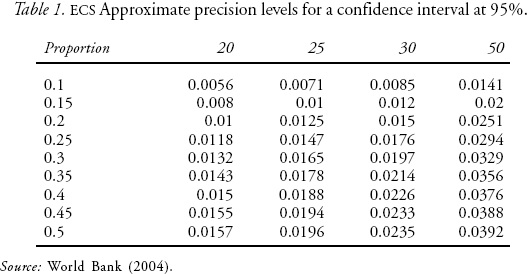
Interviewers visited 2,500 households. As with the Encuesta Continua de Hogares (Continuous Household Survey, Instituto Nacional de Estadística), the sample frame of ECS was the 1996 population census for capital cities in the 19 political administrations, or departments (departamentos), into which Uruguay is divided. Sampling occurred in two stages. In the first, the sampling units were census tracts, and in the second, households. The first Stage used four income strata in Montevideo: low, middle-low, middle-high and high income. The metropolitan area surrounding Montevideo was divided into three strata: the area around San José, the Ciudad de la Costa, and the area around Canelones. A single Stratum was used for the rest of the country. The two-stage procedure was applied to each Stratum and departmental capital. In the first stage, census tracts were selected with approximate probability proportional to the area size, based on the 1996 census. In the second stage, four households were chosen in each selected area (see Table 1 for the approximate levels of precision in the ECS).
]]>
A probit model was estimated in order to identify household characteristics associated with the probability of having a member who emigrated. We built a binary variable (Y) with the value 1 if someone in the household emigrated between March 1 and November 30, 2002. We can express the probability that a household had one or more members emigrating in that period as:
Ρr ob(Υ = 1/χ) = φ(β'χ)
where φ is the normal distribution function, β is a vector representing the correlated variable coefficients, and X is a vector of correlates.
Since the model parameters do not correspond to marginal effects of the correlates on the dependent variable, marginal effects for continuous variables were calculated estimating the following expression:
These calculations used average values of the correlates. In the case of binary variables, we calculated the marginal effect by subtracting the average value of the function (evaluated at the average values of the remaining variables) for the values of the variable (0 and 1). It should also be borne in mind that information is lost when marginal effects are calculated using the average, as it is possible that they are subject to significant dispersion across the distribution.
Finally, the adjustment of the model can be examined computing a pseudo R2 or McFadden's R2, assessing the proportion of correctly predicted values or using the log-likelihood ratio.
]]>Previous Uruguayan Emigration: Features and Interpretations
Uruguay is one of the smallest South American countries, both in area (177,000 km2) and population (3,400,000). Over the last three decades, it has had one of the highest percentages of population living abroad of any country in the region. Uruguayan migration has distinctive characteristics even though it is part of a general trend that has seen South Americans leaving the region since the early 1960s. Some of these features are the result of the particular demographic and social characteristics that distinguish Uruguay from Other Latin American countries.
Uruguays first demographic transition Started during the last decades of the nineteenth century (Barrán and Nahum, 1982; Pollero, 1994) when Italian and Spanish immigrants were flooding into the country. Despite the arrival of these immigrants, population growth was low throughout the twentieth century, so Uruguayan emigration cannot be related to demographic pressure. Moreover, Uruguays educational reform at the turn of last century resulted in a low illiteracy rate, giving the country one of the most highly educated populations in the region. Education was an important route to social mobility, and a solid middle class formed. Finally, despite frequent economic crises in the second half of the twentieth century, Uruguayan social and welfare indicators have been among the best in Latin America. Low economic inequality and a limited incidence of poverty are distinctive features of the country compared to the rest of the region (ECLAC, 2002).
Of all South American countries, Uruguay had the highest proportion of immigrants during the nineteenth century and the first half of twentieth, most coming from Southern Europe. Similar to Argentina and Southern Brazil, the foreign-born portion of the Uruguay's population was very high, 30% in 1850 and 17% around 1910 (Camou and Pellegrino, 1993). Additionally because Uruguay is located between those two countries, which are South Americas largest nations, population outflow through those borders was common. In the 1930s, with industrialization and concentration of economic activities in certain urban centers, urbanization became an increasingly important trend in Latin America. The expanding employment opportunities in the cities attracted Uruguayans, and people moved primarily to Monte Video and also to Buenos Aires.
In the late 1960s, household well-being in Uruguay declined as real wages fell and unemployment rose. This marked the beginning of large-scale emigration, and for the first time, net migration was negative. Although Argentina and Brazil, where some Uruguayans had settled previously, were the main destination for this first migratory wave, a new trend saw considerable numbers of emigrants heading for distant destinations, such as the United States, Australia, Venezuela, Mexico, and to a lesser extent, some European countries. An easing of immigration regulations in the United States, and the demand for workers in manufacturing and services there, Stimulated migration from Latin America. Australia also became an important destination because of an official program aimed at recruiting Uruguayan workers. In this period, most emigrants were manufacturing workers (Teja and Wonsever, 1985; Pellegrino, 1989).
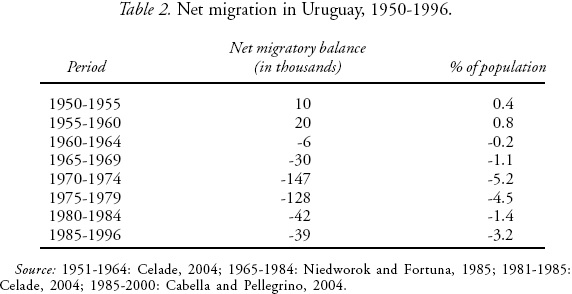
Inthe early 1970s, Uruguay's poor economic performance heightened social tensions and fed a political crisis that resulted in the 1973 coup d'état. The country was subsequently under a dictatorship until 1984. In that period, emigration rose considerably. Many trade unionists, political activists, and intellectuals became political exiles, and the new military regime also adopted economic measures aimed at improving the international competitiveness of Uruguayan products, causing a major decline in real wages (Melgar, 1979). Consequently many semiskilled workers also emigrated, leading to a very significant population out flow (Table 2).
The return to democracy did not meet expectations. Since 1986, poverty rates in Uruguay have exhibited a U-shaped pattern, declining until 1994 and rising since then. Most explanations point to increased labor-market inequality and unemployment and a 1990 reform in the mechanism for pension adjustment as the key variables underlying increased rates of poverty (Vigorito and Melgar, 2000).
Although the end of the military government in 1985 led to a small inflow of former emigrants—mainly those considered political exiles— emigration has become a permanent option for the Uruguayan populatiom Estimates based on 1996 population census data reveal that emigration had continued even though the number of people leaving following the democratic restoration was lower than in previous decades.
]]> Since 1999, the economic recession in Other South American countries has hit Uruguay hard. Many analysts consider this latest crisis the worst in modern Uruguayan history (Instituto de Economía, 2003). The lowest point was in 2002 when, in the wake of the Argentine crisis, the locaI financial system collapsed and the Uruguayan economy went into a severe recession. The Uruguayan peso was devalued by 90%, which then caused serious inflation. GDP fell by about 11.4% in 2002 compared to 2001, and unemployment climbed to figures even higher than during the 1982-1983 crisis. In 2003, economic activity showed some signs of recovery and unemployment fell 2 percentage points from the 2002 figure. Meanwhile, household well-being also severely eroded (Table 3).As a consequence of increasing inflation and rising unemployment, average household income fell almost 20% in real terms. Economic inequality also increased because loss of income was not evenly distributed across the income strata, and the probability ofbeing unemployed was inversely related to educational levels (Amarante and Arim, 2003). Therefore, income poverty rose during the crisis, and despite the beginnings of a recovery in 2003, it grew even more in that year.
At the same time, a new migratory wave that represented a sizeable proportion of the population has left the country. Although people have speculated about characteristics of this emigration and have estimated its magnitude based on the exit-and-entry register at Carrasco, Uruguay's international airport, there is scant empirical evidence to test these suppositions.
There is no evidence that population outflows as a response to the severe economic crisis in 2001-2002 are unique to Uruguay. Argentina has had simultaneous immigration and emigration, but no evidence is available to test whether the 2001 economic crisis significantly accelerated Argentine emigration.
Previous Research Findings
Uruguayan emigration has been analyzed from economic, social, and political perspectives. According to Gerónimo de Sierra (1979) and Israel Wonsewer and Ana María Teja (1985), the single factor most affecting emigration was real wages rather than unemployment. These authors also concluded that, in addition to the economic crisis, Uruguayans realized that the model of an open and democratic society with opportunities for social mobility—which had characterized Uruguayan society in the first part of the twentieth century—no longer existed.
Carlos Filgueira (1990) Stated that the erosion of conditions in the economy produced downward mobility, and this generated political and cultural responses: "The reasons for significant international emigration are to be found, then, in long-term cumulative processes, which created deeply rooted attitudes and expectations that were frustrated in broad sectors of the population. The relationship between the population's expectations and aspirations and real possibilities of satisfying them are more serious in Uruguay than in most Latin American countries." This "structural tension" is visible, for example, in the effects of education and urbanization as "factors legitimating aspirations in contrast with income rigidity" (1990:16).
In addition to the domestic factors, factors related to the destination countries also play a role. In Argentina, the principal destination of Uruguayan emigrants in the 1960s and 1970s, the demand for labor increased considerably in that period, and wages were higher than in Uruguay. In 1973-1974, the Argentine government implemented policies to attract immigrants, and it opened its borders to the populations of neighboring countries. This situation was reversed in 1976 when a military government came to power and many immigrants were deported, particularly those from Bolivia.
]]> Uruguayan emigration to Brazil has been quantitatively lower, but it is still significant qualitatively. During the 1970s, military governments implemented policies to provide incentives for scientific and technological development, and they protected technology-intensive manufacturing sectors. This resulted in an inflow of qualified immigrants from elsewhere in the region, including Uruguay. Other countries, such as Venezuela and Mexico, also had favorable entry conditions and offered employment opportunities and higher wages, which encouraged migration, despite the long distances involved and higher travel costs.Finally developed countries, particularly the United States, were also attractive because of the availability of good-paying jobs, which let Uruguayans meet the expectations they held, based on their high educational levels. However, internal pressures from the Uruguayan economic crisis were not the only reasons for emigration to the United States and Canada, and "return" emigration to Europe by Uruguayan offspring of European immigrants. Increased demand for labor in the United States and Europe has led to the implementation of policies in those countries aimed at recruiting immigrants, and consequently, increased emigration to those places has been evident not only from Uruguay but also from Other countries.2
Regarding emigration, after 1999, Uruguayans responded just as they had in the 1970s, and that reflects the consolidation of Uruguayan communities in the destination countries, the existence of which has propagated further emigration. Interviews with emigrants testify to the key role played by family networks as stimuli for migration (Pellegrino, 2002). Networks linking emigrants to their countries of origin enable the sharing of information and assistance, in a sort of feedback loop, further Stimulating population movement (Massey and García Espana, 1987; Gurak and Caces, 1992; Massey et al., 1993, 1997). Gunnar Myrdal originally formulated the cumulative causation theory in 1957, and Douglas Massey revisited it several decades later (Massey et al., 1998). According to this view, migration is a path-dependent process that modifies the social context in which household and individual make decisions, even long after the original causes for the migration have vanished. For example, incommunities in the country of origin, the demonstration effects of emigrants' economic success propagates new migratory options and simultaneously contributes to changed values and perceptions.
Comparative evidence is inconclusive about why people are more likely to migrate in certain countries than in others. Some authors agree that a single theory cannot explain international migration (Massey et al., 1998). From a wider perspective, historical contexts arguably create conditions that make some populations more prone to migrate. Although there are underlying economic and demographic factors that serve as the basis for population movements, we mustako consider Other reasons, such as political conflict, wars, naturaI disasters, and so forth.
Whatever the economic causes that make a population prone to migrate, the fact that a considerable number of Uruguayans live abroad establishes links and allows for network creation, and this makes emigration a feasible alternative for people facing a national economic crisis that results in diminished well-being at the household level.
Recent International Migration from Uruguay
As mentioned above, no official data sources exist that are designed to identify the extent and characteristics of Uruguay's recent migration. The most current population census in Uruguay dates from 1996, and data with detailed information from some of the main destination countries' censuses have not yet been published. Border-crossing records are not detailed enough to make a reliable evaluation. One can glean an idea of the extent of recent migration from the exit-and-entry register at Carrasco, Uruguay's international airport. These data show a small overall negative balance (entries minus exits) for the 1990s. In 2000 and 2001, net migration jumped to around 20,000 per year; in 2002, it was nearly 29,000; and in 2003, it was 24,000.3
Here, based on the ECS, we provide a rough estimate of the size of the 2002 emigration, and we try to identify the main characteristics of recent emigrants. Next, considering that previous migratory waves were a nonrandom sample biased toward young male and semi-skilled and highly skilled workers, we try to determine which household characteristics are correlated to the probability of migration, in an attempt to identify the socioeconomic sectors that emigration most affects.
]]> Estimated Size of the 2002 Wave of Emigration
According to the ECS data, 3.86% of urban households have at least one member who emigrated from Uruguay between March 1 and November 30, 2002.4 Applying this figure to the urban population yields a rough I estimate of 33,000 emigrants during the nine months covered by the survey. Based on the evidence presented above, it appears the Uruguayan emigration has increased significantly since the beginning of economic recession in 1999. The departure rate (12.3 people per 1,000) is comparable to the outflows in the 1970s. To determine the absolute number of emigrants, one can compare the departure rate to the natural annual increase of the Uruguayan population (the difference between births and deaths), which in recent years has been between 20,000 and 22,000 people.
Meanwhile, 6.9 percent of the mothers interviewed Stated that they have offspring living abroad. However, a significant number of mothers might have already joined their migrant children living abroad. Moreover, only surviving mothers are surveyed, so the older an emigrant, the higher the probability that his or her mother is deceased. Unfortunately, the emigration estimates cannot be adjusted based on the maternal mortality rates because the ECS sample size is too small.
Main characteristics of recent migrants from Uruguay
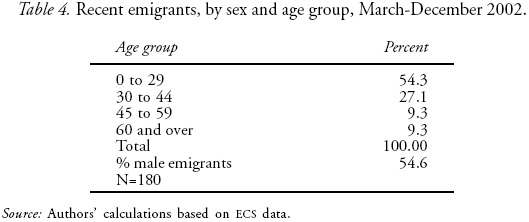
Today, Uruguayan emigrants are mainly young adults who are going to join the labor force in the country of destination, a characteristic shared with previous Uruguayan emigrants and with emigrants from Other Latin American nations (Table 4). Among emigrants in the oldest age group, family reunification is presumably a factor. Qualitative fieldwork has shown that once settled in the destination country, young emigrant couples who have children may persuade one of the grandmothers to join them, to help in rearing children and with housekeeping while young adults work outside the home (Fortuna et al., 1989).
With regard to educational achievement, census data available in the main destination countries have shown that the people in the migratory waves of the 1970s and 1980s were better educated than the overall population living in Uruguay, although the degree varied depending on the destination country. The average educational level of Uruguayan immigrants living in Argentina was similar to that of Uruguays population (Table 5), whereas those living in the United States, Venezuela, and Brazil had higher educational levels (Pellegrino, 2001). Previous studies that gathered census data from the 1980sand 1990s for various countries also show that approximately 10% of Uruguayan university graduates had settled in Other Latin American countries or the United States (Pellegrino, 1993; Pellegrino, 2001).
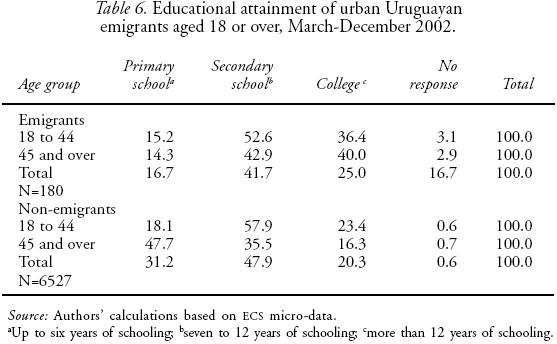
The same phenomenon currently prevails to the extent that recent emigrants 18 years of age and older are relatively highly skilled compared to the same cohort living in Uruguay (Table 6). This particularly interesting since returns to skill have been rising in the last 12 years (Amarante and Arim, 2003). The explanation for this apparent paradox may be that despite the increase, returns to skill remain lower than in most Latin American countries 0$forld Bank, 2003) and when compared to purchasing power in developing countries, the returns to skill are significantly lower in Uruguay.
]]>
According to George Borjas (1999), we can assess the economic impact of migration by considering the relative skills of emigrants and the extent to which they send remittances to their country of origin. If emigrants are skilled workers, the consequence can be an increase in returns to skill in the country of origin. Unfortunately the ECS did not gather data on labor force participation among emigrants.
Another distinctive feature of the recent emigration relates to the countries of destination. Although Uruguayan emigration to the United States, Europe, and Australia grew significantly during the 1970s and 1980s, half of the emigrants during that period wentto Argentina and 7.2% to Brazil (DGEC, 1982). This changed considerably in 2002. According to ECS, one-third of recent emigrants went to the United States, another one-third went to Spain, and 4.7% went to Italy whereas only 8.5% migrated to Argentina.
Although we only have a cross-sectional survey to assess the destination countries for recent migrants, and we cannot tell whether these new destinations indicate a trend, some facts are congruent with the idea that since 1999, moving to Argentina has not been an attractive option for Uruguayans. The reasons for this are to be found in the regional crisis: Argentina—the main destination of Uruguayan emigrants for three decades—has been suffering from high unemployment rates and a sharp decline in real wages. Brazil is also experiencing an adverse economic situation, although it is less acute. Additionally, Australia has changed its immigration policy, and currently, Uruguayan-born workers have great difficulty obtaining a residence visa.
Thus, the United States and Spain are the main poles of attraction for South American workers. In the last decade, the numbers of immigrants to both countries has increased significantly. According to 2000 census data, during the 1990s, the number of Uruguayans living in the United States remained steady. However, when we take into account that the ECS data show that the United States was one of the main destinations of the recent wave, it is probable that the number of Uruguayan immigrants in the United States has increased.5 In Spain, the 2001 population census recorded 24,600 Uruguayan-born residents (Table 7), which shows that Spain has became a popular destination. Regarding Argentina, census data show a decline in the total number of Uruguayans living there, which is in line with the results of the ECS survey. However, Argentina has the highest accumulated total of Uruguayan emigrants.
The reasons for recent emigration are clearly related to the poor labor market (low wages and unemployment), which affects even the relatively well educated (Table 8). As schooling increases, the probability declines that unemployment will cause an emigration, but the probability increases that the cause will be low wages. Seeking a better quality of life has also been an important reason for moving abroad, and that may be another indirect reflection of poor labor-market insertion.
International evidence and previous studies show that having relatives or friends living abroad facilitates the rapid entry of new emigrants into networks, making settlement in a new country easier. In this study, we only know whether surviving women aged 12 and over have offspring living abroad.
Finally, we turn our attention to remittances. The bulk of recent studies carried out for Mexico and Central America shows that remittances constitute an important income source for households in the country of origin. For Uruguay, however, this question has never been Studied in detail because it has been assumed that remittance transfers were minimal. Indeed, recent estimates by the Uruguayan Central Bank reveal that in 2002 remittances amounted to around 0.5% of GDP, a rather low figure given that Uruguayan GDP was extremely depressed and approximateiy 13% of the Uruguayan population was living abroad (Cabella and Pellegrino, 2004). Only 27.5% of recent emigrants currently send remittances to help support to their former households. This may be because recent emigrants are not yet established enough to be sending money to their relatives. Different educational and age groups have different behaviors: less educated groups, which may contain older people, tend to send more remittances. Households with members who have emigrated may have developed a substitution Strategy According to the ECS data, 53% of the households that have seen their income reduced because of the loss of a member through emigration did not replace that income. Some 40% had been receiving economic help from a family member who later emigrated, and 3% had members who started to work to offset the income loss.6
]]> The impact of remittances on household economic performance is an important subject, but more information is required to fully understand it. Even when remittance flows are limited, they could still have a significant impact on the receiving households if the recipients are primarily disadvantaged families, as this would help to overcome poverty.
Household characteristics and recent emigration
We needed to assess the main socioeconomic features of the households with members who emigrated between March and November 2002 in order to shed light on which socioeconomic sectors were most prone to emigrate. A probit model was estimated in order to obtain correlates for the probability of having emigrants in 2002 (Table 9).7 Variables included in the model aimed to reflect the households' demographic characteristics, human-capital endowment, and access to material resources, as well as the labor-market attachment of the head of the household and an approximation of members' access to international networks. Demographic variables included in the equation were the logarithm of present household members plus the emigrants, the presence of children aged o to 18, household structure, region of residence, birthplace, and age of the head of household.
Our results suggest that household size correlates negatively with the probability of having a member that emigrated between March and November 2002.8 Previous studies suggest that household size is associated with the probability of being poor, due to the presence of extended households among the poor and to the higher fertility rates of low-skilled women (Vigorito, 2003). The presence of children is positively associated with having recent emigrants, probably suggesting that this phenomenon occurs mostly in households in the early stages of the life cycle.
Household structure was represented through a set of dummy variables indicating one-person households, childless couples, couples with children, single-parent households, and extended households. Extended households were further separated out in order to isolate single-parent extended households. A binary variable reflected the gender of the head of the household.
Previous studies have identified extended households as the most dis-advantaged family arrangement (Melgar and Vigorito, 2000), as this structure probably reflects income pooling to defray housing costs. In that interpretation, they are identified as having a higher probability of a member having recently emigrated. Single-parent households also positively correlate with emigration, but this finding may reflect that one member of the couple lives abroad. Meanwhile, female-headed households are less likely to have had a member emigrate, perhaps because these households tend to comprise older adults, living alone.
Life-cycle variables involved four dummy variables reflecting the head of the household's age: 18 to 29; 30 to 44; 45 to 59; and 60 and over. The most significant effect was found in the 18 to 29 age group. This is in line with previous evidence from a broad range of countries and the data given above, as it shows that young people are the most likely to emigrate.
The probability of having a member who moved recently is not Statistically different for those households located in Montevideo compared to elsewhere in Uruguay, with the exception of regions 3 and 4 (which contain departments located in the center of the country).9
]]> A set of dummy variables designed to show the head of the household's birthplace, and evidence of internal migration, were also included in our multivariate analysis. We created a group of binary variables to reflect the migratory status of the head of the household: always lived in the city where the interview took place; moved within the same department; moved within Uruguay to a different department; and, Finally, if he/she was born in a foreign country. The first possibility was the omitted variable. The results show that the probability of having recent emigrants is the same for all groups except when it comes to international immigrants.Household human-capital endowment was included in the equation through a second order polynomial for the household head's years of schooling. Higher educational levels were positively correlated with the probability of having recent emigrants, which reaffirms the assertion above that emigrants are more skilled than the average Uruguayan. The fact that the second-order term of the polynomial was not significant shows that the marginal effects of an additional year of schooling on the probability of emigrating are linear.
Another set of variables reflected access to economic resources including current income, variations in income, and an approximation to household wealth. Current income is captured by the logarithm of present per capita household income. A set of dummy variables reflecting the economic crisis the household experienced during the 2002 crisis was included in the equation in order to assess whether changes in welfare rather than its absolute value, are related to international emigration. A wealth index was estimated in order to reflect household well-being in the long term. This index was constructed based on the presence in the household of a set of durable goods, and on that estimate, quintiles were computed, although the first quintile in the estimate was omitted.10
Household income did not have an effect on emigration independent from education. As education is a determinant of income, we kept years of schooling in the equation and removed per capita income. The recent economic crisis and the income shocks in 2002 do not have a noticeable impact on the probability for migration. This may indicate that the key factor is absolute lack of income rather than the degree to which the income level has changed. Another factor is that income shocks occurred, albeit with different intensities, across all income levels.11 Thus, recent emigration might be considered not as a Strategy against variations in nominal income but as a Strategy against decreasing real income. As to the wealth index, we found that households in the top 40% had a higher probability of emigrating. This is evidence that emigration is not a feasible Strategy for the poorest households because resources are needed in order to travel and settle in the destination countries.
Labor-market participation was reflected through the employment Status of the household head.. Emigration was likely when the household head was unemployed. It was rarer in retiree households, possibly because of life-cycle considerations and the 1990 pension reform, which provides those households with incomes that are often higher than those in households where the head participates in the labor force.
To gauge the impact of access to international networks, we created a variable reflecting previous international emigration. This variable was built with the information gathered from surviving mothers. We created a dummy variable that took the value 1 if any woman in the household declared that she had offspring living abroad who had left Uruguay before 2002, and zero otherwise. Of course, emigrants and household members could have Other relatives living abroad not recorded in this survey. However, the variable proved to be significant and showed a strong impact on the probability of emigration, having relatives abroad increases by 20% the probability of emigrating during the crisis.
Many studies on Other countries that assess the effect on emigration trends of the presence of emigrant communities located abroad have reached similar conclusions. Authors hypothesize that the presence of relatives living in foreign countries has a demonstration effect, and it encourages emigration as long as it creates access to networks (see for example, Massey, 1998).
Propensity to emigrate among current residents in Uruguay
We examined the propensity to emigrate of the population in urban areas. Approximately 29% of the households interviewed declared that they have members who would like to emigrate, and within this group, almost 90% State that they would like to move outside of Uruguay. The potential destination countries are broadly the same as those that received the most emigrants in 2002: Brazil (3.6%), the United States (20.6%), Spain (47%), and Italy (6.55%). The reasons that were cited for wanting to leave are broadly the same as those Stated for recent emigration (Table 10): low wages, unemployment, and to improve the quality of life account for almost 90% of the responses.
]]>
Finally a probit model was estimated in order to identify which households are more likely to emigrate, and to compare their profile with that of households where a member recently migrated (Table 11). Many variables that were significant when assessing the probability of having had recent emigrants m the household were not significant in this model, which may reflect that declaring a willingness to emigrate is more generalized across socioeconomic groups than is effective departure.
The poverty level of the household is positively associated with the propensity to move abroad (a notable difference from the findings for households with a member who has recently emigrated), and this variable shows a significant and separable effect. Therefore, we can conclude that most emigrants do not come from poor households, because those in the lower-income strata do not have the necessary material resources to emigrate, particularly outside of the region. However, households that expenenced a negative income shock are more prone to move.
The marginal effects suggest that when a household has had a member who has already emigrated, that significantly increases the probability that the household will currently have members who are willing to leave Uruguay. The positive correlation for the variable "had emigrants in 2002" may reflect a demonstration effect and household members will join their relatives abroad.
Conclusion
Having been a destination country for immigrants until the second half of the twentieth century, it is notable that Uruguay today is a country with net emigration. Previous Studies suggest that since the 1960s, emigration can be considered a major response from the Uruguayan population to adverse political and economic circumstances (Filgueira, 1988; Teja and Wonsewer, 1982). Over the past four decades, migration has been considerable, and net migration has been negative for many years. Population outflows increased significantly during economic crises and the political crisis of the 1970s. The magnitude of the 2002 population outflow is comparable to the migrations of the 1970s.
As to the economic impact of emigration, many authors consider that remittances have a positive effect on a country, whereas the loss of human capital is severely adverse. In Uruguay, today, emigration has become more generalized and widespread, and it now involves people from all educational levels. However, just as they were in earlier waves, highly skilled individuals are over-represented, and now the extent of that over-representation is greater than ever before. Thus, Uruguay's emigration signifies a serious loss of human capital.
According to ECS, a poor labor market (unemployment and low wages) is the primary motive for emigration. It constitutes an individual solution, and its effects on the Uruguayan labor market have not been Studied. ECS database does not permit an assessment of whether emigration reduces unemployment or what its impact on inequality might be, so those are questions to be addressed in further research.
]]> Remittances are another significant aspect of emigration's economic impact. According to the ECS, of all households in which a mother re-ports having at least one child living in another country 22.7% receive remittances" and approximately 25% of recent emigrants send contributions to their former households. The total amount of remittances is low compared to macroeconomic aggregates (0.5% of GDP), particularly when we consider that GDP fell in 2002 and that there is some evidence from Other countries that contributions from abroad can be counter-cyclical to the level of economic activity (Solimano, 2003). Nevertheless, the impact of remittances on poverty needs to be carefully Studied because if these funds mainly reach poor households, they could play a role in alleviating poverty. Considering that most emigrants do not come from lower-strata households, this hypothesis must be tested. An accurate evaluation would require generating new data because existing data sets are not suitable for answering this question.A significant proportion of the recent emigrants seem to have had access to networks of previous emigrants. Thus, links with Uruguayans living abroad seem to create opportunities that allow emigration to continue and feed back into itself. Access to international networks, which allows for a rapid response to economic crisis, proved to be a key variable in explaining the probability of emigration.
Almost one-third of the households interviewed reported having at least one member willing to emigrate. Although propensity to migrate must not be equated with future emigration, It is significant that willingness to leave Uruguay was positively correlated to higher levels of household poverty. Meanwhile, emigrants do not tend to come from lower-income strata households. Individuals living in households below the poverty line rarely have access to the financial resources needed to emigrate, particularly when migration to destinations within the region IS not an attractive option.
References
Aguiar, César, Uruguay país de emigración, Montevideo, Ediciones de la Banda Oriental, 1982. [ Links ]
Amarante, Verónica, and Rodrigo Arim, "El mercado laboral uruguayo entre 1991 у 2002" (mimeo), International Labor Organization, Santiago de Chile, 2003. [ Links ]
Barrán, José Pedro, and Benjamin Nahum, El Uruguay del novecientos. Batlle, los estancieros y el imperio británico, vol. I, Montevideo, Ediciones de la Banda Oriental, 1982. [ Links ]
Bertino, Magdalena, and Héctor Tajam, Una estimación del PBI uruguayo 1900-1955 y su relación con otros indicadores económicos, Montevideo, Ediciones de la Banda Oriental, 1999.
Borjas, George, "The Economics of International Migration", in Handbook of Labour Economics, North Holland, Amsterdam, 1999. [ Links ]
Cabella, Wanda, and Adela Pellegrino, "Estimación de la migración internacional en Uruguay 1963-2003" (mimeo), Programa de Población, Facultad de Ciencias Sociales, Universidad de la República, Montevideo, 2004. [ Links ]
Camou, María, and Adela Pellegrino, Una fotografía instantánea de Montevideo. 1858-1859, Montevideo, Universidad de la República (Ediciones del Quinto Centenario), 1993. [ Links ]
De Sierra, Gerónimo, "Migrantes uruguayos hacia la Argentina. Tendencias recientes" (mimeo), Migración y Desarrollo 5, Consejo Latinoamericano de Ciencias Sociales, 1979. [ Links ]
]]>Dirección General de Estadísticas y Censos (DGEC), Encuesta de Migración Internacional de 1981-1982, Montevideo, DGEC, 1983. [ Links ]
Economic Comission for Latin America and the Caribbean (ECLAC), Panorama social de América Latina, Santiago de Chile, Ediciones de la Cepal (ECLAC), 2003. [ Links ]
Filgueira, Carlos H., "El éxodo oriental", Cuadernos de Marcha, September 1990. [ Links ]
Filmer, Deon, and Lant Pritchett, "Estimating Wealth Effects without Expenditure Data—Or Tears: An Application to Educational Enrollments in States ofIndia", Demography 38 (1), February 2001. [ Links ]
Fortuna, Juan Carlos, Nelly Niedworok, and Adela Pellegrino, Uruguay y la emigración de los 70, Montevideo, Ediciones de la Banda Oriental, 1989. [ Links ]
]]>Fortuna, Juan Carlos, and Nelly Niedworok, La migración internacional de uruguayos en la última década, Comité Internacional de Migraciones, Hemisphere Project, Washington, D.C., Georgetown University, 1985. [ Links ]
Gurak, Douglas, and Fe Caces, "Migration Networks and the Shaping of Migrations Systems", in Mary Kritz, Lim Lin Lean, and Hania Zlotnik (eds.), International Migration Systems: A Global Approach, Oxford, Clarendon Press, 1992. [ Links ]
Hill, Kenneth, A Proposal for Estimating the Emigrant Population by Sex and Age from Special Census Questions, International Union for the Scientific Study of Population (IUSSP), Papers No. 18, IUSSP, Liege, Belgium, 1981. [ Links ]
Instituto de Economía, Informe de coyuntura económica 2002, Montevideo, Facultad de Ciencias Económicas y Administración-Universidad de la República, 2003. [ Links ]
Instituto Nacional de Estadística-Centro Latinoamericano de Demografía, Proyecciones de población, 2004. Available at http://www.ine.gub.uy/socio-demograficos/proyecciones.htm. [ Links ]
]]>Massey, Douglas, Joaquín Arango, Graeme Hugo, Ali Kohuaci, Adela Pellegrino, and Edward Taylor, Worlds in Motion. International Migration at Century's End, Oxford, Clarendon Press, 1998. [ Links ]
----------, "Theories of International Migration: A Review and Appraisal", Population and Development Review, 10 (3), September 1993. [ Links ]
Massey, Douglas, and Felipe García España, "The Social Process of International Migration", Science, 237, 1987. [ Links ]
Melgar, Alicia, and Andrea Vigorito, Uruguay. A Poverty Profile, Washington, D.C., World Bank (Background Paper), 2000. [ Links ]
Myrdal, Gunnar, Rich Lands and Poor, New York, Harper and Row, 1957. [ Links ]
]]>Papademetriou, Demetrios, and Philip L. Martin (eds.), The Unsettled Relationship. Labor Migration and Economic Development, Westport (Connecticut), Greenwood Press, 1991. [ Links ]
Pellegrino, Adela, "La movilidad internacional de la fuerza de trabajo calificada entre países de América Latina y hacia los Estados Unidos", Notas de Población, 21 (57), Centro Latinoamericano de Demografía (Celade), June 1993. [ Links ]
----------, La propensión migratoria de los jóvenes uruguayos. Estudio en base a datos de la Encuesta Nacional de Juventud 1989/1990 del Instituto Nacional de Estadística, Montevideo, Instituto de la Juventud/Comisión Económica para América Latina/Organización Internacional para las Migraciones, 1994. [ Links ]
Pellegrino, Adela, Migrantes latinoamericanos y caribeños, Montevideo, Comisión Económica para América Latina (CEPAL)/Programa de Población- Facultad de Ciencias Sociales, 200.
----------, "Éxodo, movilidad y circulación: nuevas modalidades de la migración calificada", Notas de Población, 38 (73), Centro Latinoamericano de Demografía (Celade), 2001. [ Links ]
----------, unpublished interviews with Uruguayans living in the United States, 2002. [ Links ]
Petruccelli, José L., and Juan C. Fortuna, La dinámica migratoria en el Uruguay del último siglo. 1875-1975, Montevideo, Centro de Informaciones y Estudios Sociales del Uruguay, 1976. [ Links ]
Pollero, Raquel, La transición de la fecundidad en Uruguay, Documento de Trabajo 17, Programa de Población-Facultad de Ciencias Sociales, Montevideo, 1994 [ Links ]
Solimano, Andrés, Remittances by Emigrants. Issues and Evidence, Discussion Paper 89/2003, Wider (World Institute for Development Research), Helsinki, 2003. [ Links ]
Somoza, Jorge, A Proposal for the Use of Information on Residence of Siblings to Estimate Emigration by Age, International Union for the Scientific Study of Population (IUSSP), PapersNo. 18, Liege, Belgium, 1981. [ Links ]
Vigorito Andrea, The Evolution of Poverty in Uruguay in the 90s, Washington, D.C., World Bank (Background Paper), 2003. [ Links ]
]]>Wonsewer, Israel, and Ana María Teja, La emigración uruguaya 1963-1975, Montevideo, Centro de Investigaciones Económicas/Ediciones de la Banda Oriental, 1982. [ Links ]
World Bank, Uruguay. Country Report, Washington, D.C., World Bank, 2003. [ Links ]
1 March 2002 has been identified as the Start of the economic crisis, and it was used as a benchmark date in the ECS to compare household well-being. Although poverty was on the increase before 2002, it accelerated significantly during tne crisis.
2 In some cases, workers were actively recruited. Adela Pellegrino (2002) interviewed emigrants who went to the United States in the 1960s and 1970s. They reported that personnel selection companies came to Montevideo to recruit qualified blue-collar workers for manufacturing and construction firms in New Jersey.
3 The decline in the number of exits in 2003 might be linked to tougher visa requirements set by the United States in the May of that year.
4 Estimating the number of emigrants is not an easy task. The simplest procedure is to take the difference between the recorded population in the last census and the current census minus the estimated population growtn from natural increase over the inter-census period, which gives a rough estimate of emigration. Border registration is another method: the difrerence between entries and exits may give as rough approximation of the net number of migrants (immigrants or emigrants). Using data on foreign-born populations in destination countries may also improve estimations. Jorge Somoza (1981) and Alan Hill (1981)proposed two "indirect methods" to estimate international migration. Somoza proposed including a question to mothers in the census questionnaire, asking them about the present residence of surviving children. In Hills method, the question about emigrants in the family is directed to brothers and sisters. Corrections using mortality rates and estimates of the number of complete family groups that have emigrated are required in order to estimate the total number of emigrants. The number of cases in our sample does not allow US to use Somoza's methodology on mothers, because cases in each cell are scarce. We have opted to use household information to estimate the number of people who emigrated from March through November 2002.
]]> 5 Because the Current Population Survey and the American Community Survey are not useful instruments, it is impossible to track the number of Uruguayan immigrants in the United States.6 The remaining 4% are non-responses.
7 See the second section for methodological details.
8 Estimates that consider the logarithm of the current number of household members provided almost the same results. Our sample does not contain one-person households or households that departed as a unit. Previous studies indicate that among young adults, one-person households are rare. Furthermore, it is probable that, with the period being so short, even when families as a whole were planning to emigrate, one member would go first to prepare for the arrival of the remaining household members.
9 We used the regionalization system of the Instituto Nacional de Estadística (National Statistics Institute).
10 We used Deon Filmer and Lant Pritchet's (2000) method for creating a wealth index. We chose a set of durables belonging to a household, and we weighted that using principal components methods.
11 We constructed the income-shock variable following a World Bank method (2003): If household members receiving income cited no income loss, no income shock was imputed. If any household member experienced a reduction in income, income shock was negative, and if any member experienced an increase in income, it was positive.
Información sobre los autores
ADELA PELLEGRINO es profesora de la Facultad de Ciencias Sociales de la Universidad de la República, en Uruguay, y es investigadora del Programa de Población de esa universidad. tiene formación como historiadora e hizo su doctorado en demografía histórica en la École des Hautes Études en Sciences Sociales de París. Sus principales intereses de investigación son la historia demográfica y la migración internacional. Recientemente realizó un estudio sobre las tendencias de la migración latinoamericana a Europa, que fue publicado por la Organización Internacional para las Migraciones (OIM).
]]> ANDREA VIGORITO es economista y se desempeña como investigadora y docente en la Facultad de Ciencias Económicas de la Universidad de la República, en Uruguay. Sus principales intereses de investigación son la pobreza y la desigualdad económica. Recientemente participó en la redacción del Informe Nacional de Desarrollo Humano 2005, publicado por el Programa de Desarrollo de las Naciones Unidas (PNUD). ]]>