
Human Capital versus Social Capital. A Comparative Analysis of Immigrant Wages and Labor Market Incorporation in Japan and the United States
Wayne A. Cornelius*, Takeyuki Tsuda* and Zulema Valdez**
* University of Michigan, San Diego.
** University of California.
]]> Fecha de recepción: 25 de marzo de 2002.
Abstract
For the United States, the most commonly used model of immigrant labor-market incorporation analyzes earnings largely as a function of human-capital variables. However, this simple model is not necessarily applicable cross-culturally and may lose much of its explanatory power in other societies, where immigrants encounter different labor-market conditions. This article evaluates multivariate models of wage determination for samples of foreign workers interviewed in 1996 in San Diego County, California, and the Japanese industrial city of Hamamatsu. In contrast to San Diego, the standard measures of human capital do not significantly influence immigrant wages in Hamamatsu. Instead, social capital has a much greater impact on immigrant wages in Japan than in the United States. Ethnographic research conducted at both sites suggests explanations for these divergent results and illustrates the importance of reception contexts (host societies) in determining labor-market outcomes for immigrant workers.
Keywords: international migration, social capital, wage determination, United States, Japan.
Resumen
El modelo de incorporación de inmigrantes al mercado de trabajo más comúnmente usado en los Estados Unidos analiza en gran medida los ingresos como una función de variables de capital humano. Sin embargo, este modelo no es necesariamente aplicable a diferentes culturas y puede perder mucho de su poder explicativo en sociedades donde los inmigrantes se enfrentan a diferentes condiciones del mercado laboral. Este artículo evalúa modelos multivariados para la determinación de salarios usando como muestra a trabajadores inmigrantes, entrevistados en 1996 en el condado de San Diego, California, y en la ciudad industrial japonesa de Hamamatsu. En contraste con San Diego, las medidas estándar de capital humano no influyen significativamente en los salarios de inmigrantes en Hamamatsu. Por su parte, el capital social tiene mucho más impacto en los salarios de los trabajadores inmigrantes en Japón que en los Estados Unidos. La investigación etnográfica realizada en los dos lugares sugiere explicaciones para estos resultados divergentes e ilustra la importancia de los contextos de recepción (sociedades receptoras) para determinar los escenarios del mercado de trabajo para trabajadores inmigrantes.
Palabras clave: migración internacional, capital social, determinación de salarios, Estados Unidos, Japón.
]]>Introduction: Human Capital and Social Capital in the Immigrant Labor Market
A common model of wage determination analyzes earnings based on human-capital variables, such as education and work experience (Becker, 1964; Ben-Porath, 1967; Mincer, 1974). According to this model, the accumulation of such individual skills and knowledge facilitates productivity, which is rewarded in the market economy with an increase in real wages (Coleman, 1988,S10). More recent work, specifically on immigrant wages, includes language proficiency and work experience in the host society as additional human-capital measures (Borjas, 1995; Portes and Rumbaut, 2001; Sanders and Nee, 1987; Zhou and Logan, 1989). Such research provides compelling evidence that human-capital characteristics are important in any explanation of immigrant wages in the United States.
Yet, such factors may not explain immigrants' earnings in other countries, where foreign workers encounter different economic and social conditions. As Portes and Rumbaut (1990, 2001) have observed, it is the combination of what immigrants "bring with them" (that is, human capital), as well as the "context of reception" in the host society that affects labor-market incorporation (Portes and Rumbaut, 1990:83-85, 2001:46-48). When differing contexts of reception are considered, social capital can become an important variable that influences economic outcomes among immigrants (cf. Portes and Rumbaut, 2001:46-48).
In contrast to human capital, which is based on individual-level skills and attributes like age, education, language proficiency, and employment experience, social capital is defined simply as "the ability to gain access to resources by virtue of membership [in a social group]..." (Granovetter, 1985; Massey, Alarcón, Durand, and González, 1987; Portes and Rumbaut, 2001:353; Portes and Sensenbrenner, 1993).1 Social capital, based on gender, ethnic, and other group affiliations, supply key resources, information, and opportunities that can significantly affect wage levels and the economic incorporation of immigrants (Light and Bonacich, 1988:18-19; Portes and Sensenbrenner, 1993; Sanders and Nee, 1996; Zhou and Logan, 1989).
Drawing on data from a comparative study of immigrant labor in the United States and Japan, this article illustrates the important variations in the explanatory power of these two variables depending on different contexts of immigrant reception. In the United States, human-capital variables have a much greater positive effect on foreign workers' wages than do social-capital variables. In contrast, social capital significantly increases workers' wages in Japan, whereas human capital does not.
The divergent impact of these two variables on foreign-worker earnings results from different socioeconomic conditions that prevail in the two countries in terms of immigrant labor markets as well as gender and ethnic attitudes. Japan is a recent country of immigration with a less developed and diversified immigrant labor market compared to the United States. Since most foreign workers are employed as temporary, unskilled workers with limited job mobility, human-capital variables, based on individual qualifications and experience, do not necessarily lead to better job prospects and higher wages. Instead, because many foreign workers are in Japan only temporarily, the social capital provided by immigrant social networks is used more often as a means of obtaining better-paying jobs. Gender and ethnic affiliation are also important social-capital determinants of immigrant wages because of significantly higher levels of gender and ethnic discrimination in Japan compared to the United States. This creates a discriminatory labor market where Japanese employers strongly prefer male foreign workers and Japanese-descent (nikkeijin) immigrants, both of whom earn much higher wages than do female and non-nikkeijin foreigners.
Because the United States has a longer history of immigration with a much larger number of foreign-born workers, the immigrant labor market is much more developed, extensive, and entrenched, and it offers a variety of long-term jobs at different levels. Therefore, the human capital that immigrants acquire over time in the United States is much more likely to lead to higher wages and job mobility. On the other hand, social capital based on immigrant social networks does not increase wage levels. Because a higher proportion of immigrants in the United States are long-term settlers, they use their social networks not just to obtain higher paying jobs but also to find ethnically satisfying work conditions. In addition, there is less gender and ethnic discrimination than in Japan so social-capital variables have less effect on immigrant wages. Thus, a comparative framework clearly illustrates how varying contexts of reception in host societies cause different variables to influence the level of economic incorporation of immigrant workers.
Data and Methods
]]> This article analyzes data from a comparative study of the role of immigrant labor in the U.S. and Japanese economies (Cornelius and Kuwahara, 1998). Survey interviews were conducted during the first half of 1996 with a randomly selected sample of 110 employers and 478 foreign workers in San Diego County and 104 employers and 244 foreign workers in the city of Hamamatsu, Japan. Telephone screening interviews and other methods corroborated that all employers were employing at least some foreign-born workers. For each firm, we interviewed the person primarily responsible for hiring decisions (in most cases, the firm owner). For immigrant workers, we collected information about labor market experiences as well as individual-level characteristics, such as age, gender, and work experience. All interviews were conducted in person, using standardized questionnaires, and averaged one hour in duration for employers and about 45 minutes for workers. In San Diego, at each firm where we interviewed an employer, five or six randomly selected immigrant employees were interviewed. In addition, we interviewed 116 irregularly employed, "street-corner" day laborers. In the Hamamatsu sample, the immigrant workers did not come from the same firms in which employers were interviewed.Our analysis examines the effect of various human-capital and social-capital variables on the natural log of monthly earnings for foreign workers (a continuous dependent variable).2 Human-capital variables include age, education, years with current employer, and language.3 Social capital is measured with five variables: the use of a labor broker to find jobs; the use of a friend, relative, or previous employer to find jobs; marital status; gender; and ethnicity (nikkeijin versus non-nikkeijin in Japan, Mexican versus non-Mexican in the United States).4 Since other variables besides human and social capital may influence earnings (such as the immigrant's length of stay in the host society, legal status, the number of hours worked per week, and the industry sector of employment), these are held constant as control variables.5 Table 1 contains definitions for the independent, dependent, and control variables.
Characteristics of Foreign Worker Samples
As shown in Table 2, there are some significant differences between immigrants in our samples from San Diego and Hamamatsu. In Hamamatsu, the percentage of male foreign workers found in each earnings category increases as wages increase.6 Male foreign workers in Hamamatsu are more likely to be in the high-wage category (77%), while female workers are more likely to be found in the medium-wage category (69%). In San Diego, most male and female foreign workers are concentrated in the low-wage category (60% and 80%, respectively). Hamamatsu workers are, on average, 4.5 years older than foreign workers in San Diego. The former are also better educated, since they have 4 more years of education than their counterparts in San Diego, who, on average, have 8.8 years. Because immigration to Japan is relatively new, the foreign workers in Hamamatsu have lived in Japan for just under 4 years, whereas their counterparts in San Diego have lived an average of 12 years in the United States. Nonetheless, a much larger percentage of immigrants in our Hamamatsu sample are legal (91% compared to 43% in San Diego).

The ethnic composition of the foreign-born population in each country is also very different, although each has a large population from one ethnic group. In Japan, the total number of foreign workers is probably close to 950,000, less than one percent of the country's population of 127 million (Tsuda and Cornelius forthcoming). The largest immigrant group is the nikkeijin, second- and third-generation Japanese descendants (mainly from Brazil), who number over 350,000, or 37% of the total immigrant population. Roughly 60% of all registered foreigners in Hamamatsu were Brazilian nikkeijin in 2001, equivalent to 2% of the city's entire population.7
]]> According to the most recent Census 2000 figures, the U.S. foreign-born population is 28.4 million, 10.4% of the total population (Schmidley 2001). Mexican immigrants are a relatively large proportion of this foreign-born population (28%), especially in San Diego, which is the second largest area of Mexican settlement in the United States (Rumbaut, 1994:602; Schmidley and Gibson, 1999). According to 1990 Census figures, 80% of the Latino population in San Diego County was of Mexican origin, equivalent to 30% of the county's total population. Therefore, although nikkeijin and Mexicans are the dominant immigrant groups, the United States has a much larger foreign-born population than does Japan, and San Diego County has a much higher concentration of Mexicans compared to nikkeijin in Hamamatsu.The sample for our study is not random since it consists of a disproportionate number of nikkeijin interviewees in Hamamatsu and Mexican interviewees in San Diego (72% and 82.5%, respectively). Although the study may not precisely represent the ethnic proportions of the foreign workers in each country, it successfully represents the labor market experiences of the majority immigrant group. In terms of gender, the majority of our sample is male (57% in Hamamatsu, 68% in San Diego).8
Results of Multivariate Analysis
Two multivariate regression models are presented for the Hamamatsu and San Diego cases (Table 3). The first measures the effect of human-capital and control variables on the natural log of monthly wages and the second does the same for the social-capital variables. Consistent with the standard model of immigrant wage determination, findings from San Diego indicate that the human-capital variables of employment experience and English proficiency have a statistically significant and positive effect on wages of foreign workers (Table 3, Model 3). For each year spent with the current employer (cumulative work experience), immigrant wages in San Diego increased markedly, by 13%. Moreover, foreign workers who understand and speak English received earnings that were 76% higher than the earnings of those who understand and speak English poorly or not at all. However, age and education do not significantly improve wages among foreign workers in San Diego, despite their importance as human capital. In contrast to human capital, social capital has very little influence on immigrant wages in San Diego (Table 3, Model 4). The use of social networks (of friends, relatives, or previous employers) to obtain jobs does not improve earnings. In addition, being male or a member of the dominant Mexican ethnic group does not influence economic outcomes.
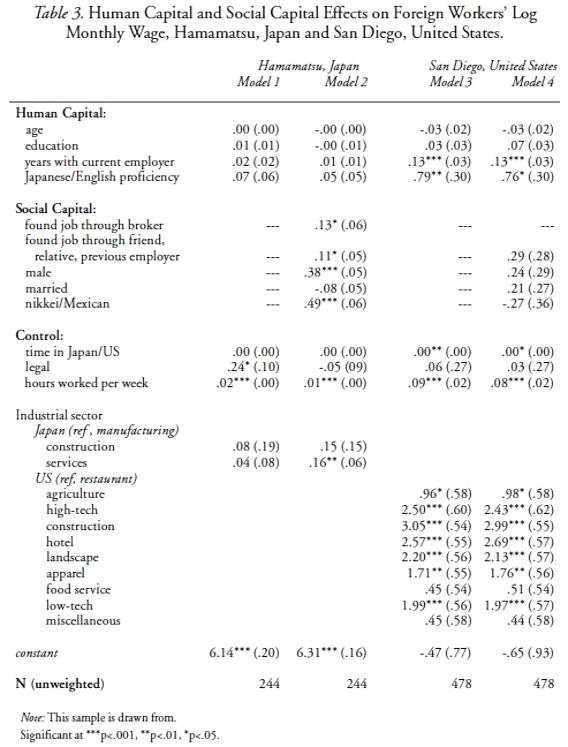
In contrast, none of the human-capital variables (age, education, years with current employer, Japanese proficiency) has a significant impact on foreign-worker wages in Hamamatsu (Table 3, Model 1). Instead, social-capital variables are the important determinants that increase immigrant wages (Table 3, Model 2). Foreign workers who find jobs through social networks improve their earnings by 11%, and those who use labor brokers increase their wages by 13%. In addition, male immigrant workers earn 38% more than their female counterparts do, and ethnic Japanese nikkeijin earn 49% more than other foreign workers.
Yet, when we examine the impact of the control variables, we see similarities in the two countries. Legal status (working legally or illegally) is not a significant predictor of wages in Hamamatsu or San Diego. Apparently, immigration control policies do not have much effect on the wages of foreign workers and are therefore not a major determinant of immigrant labor-market incorporation (cf. Reitz 1998, 69, 238). Not surprisingly, as hours worked per week increase, wages improve among foreign workers in both Japan and the United States. Finally, the industrial sectors employing foreign workers contribute to earnings outcomes. Although it was impossible to measure sectors consistently across countries, foreign workers in Japan's service sector earn significantly more than those in manufacturing and construction do. In the United States, most industrial sectors offer better wages than the lowest-paying restaurant business.
]]> Japan: When Human Capital Does Not Matter
Given the importance of human capital to wages in San Diego, why does it have little effect in Japan? Why does Japan deviate so strikingly from the standard immigrant wage determination model, which works so well in the United States? What are the differences in the reception context for these countries that would account for such divergent results? We argue that the fundamental reason lies in the underdeveloped nature of immigrant labor markets in recent countries of immigration, such as Japan, where foreign workers are employed almost exclusively in low-level, unskilled jobs with very little upward mobility. As a result, human capital based on individual qualifications and experience does not necessarily lead to better jobs at higher wages.
Japan was, for decades, the only advanced industrial country that did not rely on immigrant labor. Driven by insistence on ethnic homogeneity and refusal to accept unskilled foreign workers, Japan opted to meet its labor requirements by mechanizing and rationalizing production and making greater use of "untapped" sources of labor (female and elderly workers). By the mid-1980s, however, the rising demand for unskilled labor could not be met by the native-born workforce, which was being shaped by a sharp decline in the birth rate, rapid population aging, depletion of rural labor sources, and the refusal of increasingly affluent and well-educated Japanese youth to perform "3K" jobs (the Japanese acronym for dirty, dangerous, and difficult). In addition to this acute labor shortage, growing economic disparities between Japan and underdeveloped countries brought large numbers of foreign workers to Japan, causing the country to finally succumb to the pressures of global migration. Japan has an ethnically diverse immigrant population from East and Southeast Asia, the Middle East, and Latin America, including over 350,000 immigrant workers from Brazil, Peru, Argentina, Bolivia, and Paraguay who are predominantly nikkeijin. A substantial population has overstayed their visas (251,697 in 2000, a year in which 100,000 visas were issued to skilled and professional workers).
The Insignificance of Human Capital in Underdeveloped Immigrant Labor Markets
Ethnographic and survey interviews with employers help explain why educational background and Japanese-language competence as human capital do not significantly improve the wages of foreign workers in Hamamatsu. Since Japan is a recent country of immigration, its labor market for foreign workers is still relatively undeveloped and does not provide access to a wide range of jobs at various skill levels. Therefore, most foreign workers are hired only for unskilled, manual jobs in which education does not affect performance (Sellek, 2001:100-101). For instance, 91% of nikkeijin (overwhelmingly from Brazil) are performing unskilled or semi-skilled jobs involving simple, repetitive tasks that require no training or that can be learned within a week. Therefore, although these nikkeijin often were well-educated9 and had been white-collar workers in Brazil, in job interviews, few of their employers seriously inquired about educational background and past occupation. A labor broker explained:
As a procedural step, we generally ask about the person's educational background and the type of work he did back in Brazil, but we don't care about such issues. We are looking for simple manual laborers, and for such work, previous occupational and educational differences simply don't matter. Anyone can do this kind of work and ability differences don't show up between people of different social backgrounds.
As a result, a higher educational level among immigrants does not correspond with higher wages and better labor-market incorporation, as would normally be expected. When hiring Brazilian nikkeijin workers, the most important criteria used by all employers to screen applicants were visa status (whether the person is a legal immigrant), Japanese language ability, and ethnicity (whether the applicant is a pure Japanese-descent nikkeijin or of mixed heritage). Also considered were age (younger workers are preferred), personality and attitude (whether the person seems diligent), and past employment history (some employers avoid workers who frequently switch jobs).
Some Japanese employers even claim that the better-educated nikkeijin perform less well as unskilled workers because they have been spoiled by white-collar working conditions in Brazil and are less prepared to cope with the physical demands and fast pace of factory work. A labor broker who specializes in hiring Brazilian nikkeijin noted:
]]>Lots of the nikkeijin are well educated and some are quite intelligent, but they can't do the work as well as a typical unskilled Japanese worker with only a high school education because they have no experience with manual labor. They may have been extremely brilliant in Brazil, but they come to Japan and realize they can't compete with uneducated Japanese factory workers.
Consequently, a few employers even explicitly stated that they prefer to hire (less educated) nikkeijin from rural farming areas in Brazil because they are more accustomed to physical labor.
Only 9% of the nikkeijin in our sample were employed in higher paid, skilled or technical jobs in which educational background and learning ability are relevant. Previous education seems to have an effect on wages only for those bilingual nikkeijin who are hired as translators and liaisons (in the factory or company offices) to serve as intermediaries between Japanese managers and nikkeijin workers. College-educated nikkeijin are usually preferred for these "culturally skilled," higher-level positions, which pay better wages than assembly-line jobs.
The same general conditions apply for the employment of non-nikkeijin foreign workers. Although they are relatively well educated,10 89% are doing unskilled or semi-skilled jobs for which a college or advanced degree has no impact on performance. As a result, educational background does not improve their employability or ability to obtain higher-level jobs and wages.
Moreover, as our regression analysis reveals, Japanese-language competence as human capital also does not influence wages positively even though language ability is the top criterion Japanese employers use when hiring foreign workers. Bilingual workers have an easier time finding employment, but not necessarily in higher-paying jobs; instead, they are employed as low-level, unskilled manual laborers. For instance, employers who hire nikkeijin workers generally do not pay Japanese speakers better salaries because they do the same type of unskilled work as non-Japanese-speaking nikkeijin. In some factories, nikkeijin who speak Japanese are given jobs that are slightly more technical or lower-level supervisory positions on the factory floor, but these are not skilled jobs that would command higher wages. Again, only the few nikkeijin who become cultural intermediaries and translators in companies or labor brokerages receive higher salaries for their language proficiency. Thus, the different structure of the immigrant labor market in Japan, as a newer country of immigration, helps to explain why human capital does not contribute to wage levels among foreign workers in Japan.
Employment on the Margins and the Marginality of Employment Experience
Education and language ability are not the only human-capital attributes that do not produce significant earnings differentials among immigrants in Hamamatsu, Japan. The data also defy the commonsense expectation that the more years foreign workers remain with a certain employer, the higher will be their wages.
The Japanese employment system for foreign workers is the most important reason why immigrant workers do not advance to more skilled and higher-paying jobs. Although both foreign and Japanese workers are employed in the factories of subsidiary firms where virtually all of the work is low-skilled11 and the prospects for long-term job mobility are therefore quite restricted, unlike Japanese workers (seishain), foreign workers are hired strictly as hi-seishain (informal, casual workers) and are not put on the promotion track to receive gradual salary increases.
]]> This is especially true for foreign workers recruited and employed by labor brokerages. Japan's system of labor brokers (assen gaisha) has traditionally supplied companies with an informal, native-born workforce of part-time, seasonal, and day laborers (Sellek, 1996:254). During Japan's severe labor shortage in the late 1980s, migrant workers increasingly replaced temporary and part-time domestic workers. Today, immigrants have taken over as Japan's casual labor force (see Stevens, 1997). Indeed, most employers prefer nikkeijin workers to part-time or temporary Japanese workers because they perceive that the nikkeijin work harder and are more willing to do overtime.As Japan's new informal labor force, migrant workers (74% of the nikkeijin in our sample) are now employed by Japanese labor brokerages. These brokerages have extensive contacts with Japanese companies, which simply "borrow" foreign workers for limited periods of time when production increases. When the company no longer needs these workers, it "returns" them to the brokerage, which then transfers them to other companies with labor shortages. This system enables Japanese companies to use foreign workers as a flexible labor force in order to adjust cost effectively to fluctuations in production. Precisely for this reason, 71% of employers in our sample preferred to hire nikkeijin through brokerages than to hire them directly. Moreover, because labor brokers recruit, house, transport, insure, and provide social services for workers, 66% of Japanese employers in our study favor the brokerage system for its convenience in comparison to directly hiring nikkeijin.
Because nikkeijin migrants function as a temporary and disposable workforce, Japanese firms rarely hire them as permanent, regular workers who might be promoted over time to higher positions with better salaries. Instead, Japanese employers simply pay labor brokerages for the temporary use of its foreign laborers. This also means that while nikkeijin remain employees of brokerages, a longer stay in Japan also does not result in regular salary increases. Although brokerages employ substantially fewer non-nikkeijin foreign workers,12 their involvement in recruiting foreign workers in general in Japan is increasing (Iguchi, 1998).
Foreign workers employed directly by Japanese companies without brokerage mediation are usually given short-term contracts (for the nikkeijin, usually from six months to a year with the possibility of renewal).13 As a result, these workers usually stay at one firm for a longer time and the turnover rate is considerably lower than for brokered foreign workers.14 However, despite their more stable employment situation, they remain in the peripheral workforce of short-term, disposable, casual laborers, with little hope for regular promotion and wage increases over time.
Foreign migrants' tendency to switch jobs frequently undoubtedly reinforces Japanese employers' perception that these workers are suited only to temporary jobs. For instance, since most nikkeijin workers are target-earners, wishing to earn as much as possible during a short two- or three-year sojourn,15 they change companies often in search of jobs with higher hourly wages, better working conditions, and more overtime. Indeed, the nikkeijin in our sample changed jobs almost once a year on average. Likewise, non-nikkeijin workers also switch jobs frequently (2.7 times during their average stay in Japan of 3.25 years.
The perpetual marginalization of foreign workers in the Japanese labor market stigmatizes even those who have been hired directly by Japanese companies and have apparently made a long-term commitment to the firm. Employers, uncertain about whether nikkeijin will leave the firm (even, perhaps, returning to Brazil), are reluctant to make them permanent and regular seishain employees, who enjoy job mobility and long-term pay increases. At best, some companies (and even brokerages) provide foreign workers with a modest salary increase after a certain time. The inability of most foreign workers to speak Japanese proficiently may be another barrier that prevents them from being treated equally with regular Japanese employees. In Japan, where foreign workers are still restricted to the peripheral sectors of the labor market as casual workers and few are incorporated into the mainstream Japanese labor force regardless of how long they stay with the company, employment as an indicator of human capital does not correlate with higher wages and better economic incorporation.16
The United States: The Importance of Human Capital
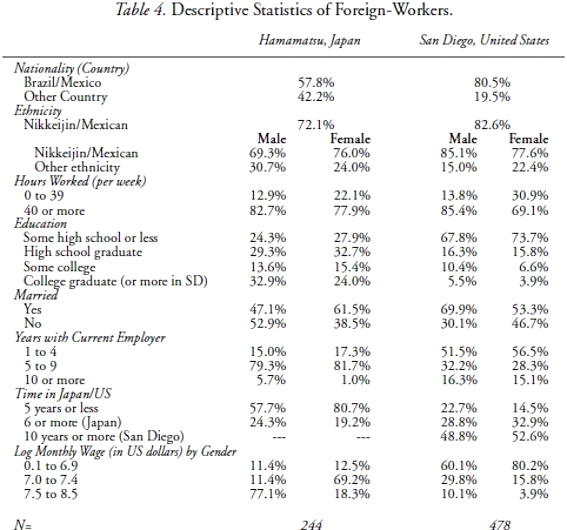
In contrast to Hamamatsu, human-capital variables have a much greater impact on immigrant wages in San Diego County because the United States, as a much older and advanced country of immigration, has a more highly developed and extensive foreign labor market, which has accommodated the permanent presence of large numbers of immigrant workers. By the turn of the twentieth century, most of the immigration to the United States was from Southern and Eastern Europe in contrast to earlier waves or predominantly Western European immigrants, resulting in nativist backlashes and restrictionist immigration policies in the 1920s (Rumbaut, 1994:584). The abolition of national-origins quotas with the Hart-Cellar Act of 1965 (Zhou, 1998) has resulted in a new wave of immigration from Asian and Latin American countries. California is arguably the leading destination for many immigrants, especially legal and undocumented Mexican migrants. Since San Diego County is the second largest area of Mexican immigrant settlement (Rumbaut, 1994:602), 80% of our sample of foreign workers from that location is of Mexican origin (Table 4).
]]>
In the immediate aftermath of World War II, a massive growth in durable manufacturing (including the automobile and aerospace industries) resulted in unprecedented economic mobility for immigrant groups that had previously faced discrimination and limited opportunities in the labor market. However, changing economic conditions, as well as the rapid increase in immigration levels since the 1960s, has had a profound effect on the immigrant labor market. With the shift in the United States from a manufacturing to a service-based economy, the Mexican immigrant population was especially hard hit as low-paid, temporary service jobs replaced manufacturing jobs with steady incomes. As a result, the earnings of Mexicans have actually declined since the 1960s and 1970s (Morales and Bonilla, 1993).
The immigrant labor market in the United States is somewhat similar to Japan since foreign workers are also disproportionately found in low-paid, unskilled work that requires little or no education (Waters and Eschbach, 1995). Our foreign-worker sample in San Diego is largely unskilled, uneducated, and not English proficient (see Tables 2 and 4). However, because the United States is a country of more advanced immigration flows, with a more developed and ethnically integrated immigrant labor market, foreign workers are employed in a more diverse range of jobs at various skill levels. Although many work in unskilled jobs, as do their counterparts in Japan, some also work in skilled jobs where human capital is relevant and wages are higher.17
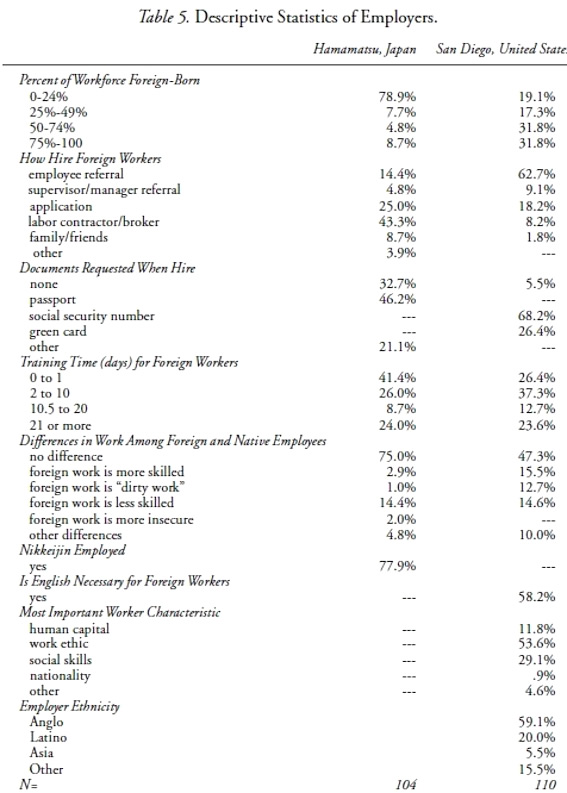
Therefore, unlike Japan, U.S. employers acknowledge the desirability of work experience and English proficiency despite the unskilled work most immigrants perform. According to the U.S. employers we surveyed, 12% consider education, language, and work experience to be among the most important characteristics of their immigrant workers, while over 50% of consider "work ethic" to be the most important attribute (Table 5). However, employers often correlate "work ethic" characteristics with human capital so that the two terms become synonymous. Indeed, 58% of employers claim that English is necessary for the immigrant jobs they offer. Undoubtedly, because of the more varied skill levels of the jobs available for immigrants, those who speak English are favored over non-English speakers, who cannot be hired for such higher paying jobs. Thus, employers in the United States continue to rely on human capital to indicate the potential skill of their immigrant employees, which, in turn, determines their wages.
In addition, although some immigrant workers in San Diego remain casual and temporary laborers, a much higher proportion of jobs available to them are permanent or at least long-term in character (see Cornelius 1998). In addition, no entrenched system of labor brokers exists to facilitate employers' use of immigrant workers as an informal labor force to conveniently hire and fire as production fluctuates. Of those workers surveyed in San Diego, over 31% have worked for the same employer for 5 to 9 years, and 16% have worked for their current employer for 10 or more years. In contrast, only 4% of foreign workers in Japan have worked for their current employer for 10 or more years. As immigrants work for extended periods at the same company, many move up the job ladder, which has a significant influence on wages and labor-market incorporation over time. Therefore, work experience (years with current employer) becomes a form of human capital that positively correlates with higher earnings.
Age and education level correlate positively with earnings for most workers in the United States, but not for the foreign workers considered here. Education acquired in the country of origin may be less important for some foreign workers, especially those relegated to low-wage, low-skilled occupations (Massey and Espinosa, 1997:948). Because age is correlated with length of residence (Archer, 1991), its effects may be muted by two other variables: years with current employer (another human capital variable) or time in the United States (a control variable), sometimes called migration-specific human capital (Chiswick, 1988; Massey and Espinosa, 1997).
From a neoclassical economic perspective, it may be surprising that education does not always increase immigrant earnings, but recent studies suggest that immigrants "confined to the same menial jobs in the United States" do not benefit from increased education (Massey and Espinosa, 1997; Portes and Bach, 1985; Zhou and Logan, 1989). And with respect to Mexican immigrants (80.5% of our sample), Massey and Espinosa (1997:948) claim, "In general, human capital acquired in Mexico is not well remunerated in the United States, especially if a migrant lacks documents." Similarly, Sanders and Nee claim that "foreign-earned human capital of most immigrants is not highly valued by U.S. employers" and does not increase wages (1996:232). Moreover, because of the low educational levels among foreign workers in our sample (an average of only 9 years), its marginal impact on immigrant wages is to be expected. Therefore, although not all of the human-capital variables are significant determinants of immigrant wage levels in the United States, those acquired in the host country (English proficiency and work experience) do contribute positively to earnings.
]]> Social Capital and Immigrant Wages
Japan: The Importance of Social Networks, Gender, and Ethnicity
The differential effect of social capital on immigrant wages in Japan and the United States is even more striking than our results for human capital. In Hamamatsu, all of our social-capital variables (except marital status) have a positive effect on immigrant wages whereas none is significant in the case of San Diego. Although immigrant workers in Japan are exclusively restricted to unskilled, temporary jobs where human capital makes little difference, some are able to find higher-paying jobs within this peripheral labor market through the social capital they possess based on membership in various social groups.
Although over 70% of immigrants in both countries use their social networks to find jobs (Table 2), such social capital has a positive effect on immigrant earnings only in Hamamatsu (Table 3). Again, we argue that the differential effect of social networks on immigrant wages in the two countries results from the very different conditions that prevail in countries of recent versus advanced immigration. Since most foreign workers in Japan still consider themselves to be temporary migrant workers, who wish to earn as much money as possible during a brief sojourn, they primarily use their social networks of relatives, friends, and labor brokers to find higher paying jobs with more overtime.
For instance, nikkeijin workers constantly exchange and compare information with acquaintances about the wages and amount of overtime offered at other firms, and they quickly switch to firms where compensation is higher. Nikkeijin who move to other areas of Japan are frequently asked by their acquaintances whether better-paying jobs are available in that region. In other words, the social networks of the nikkeijin primarily serve an instrumental, economic function.
Two other social-capital variables also significantly increase immigrant wages in Japan: gender (being male) and ethnicity (being a nikkeijin). These two attributes are key determinants of wages because Japan is a country with strong gender and ethnic discrimination, resulting in a discriminatory labor market that has significant disadvantages for women and non-Japanese ethnic groups.
Women in Japanese society face considerable wage and labor-market discrimination because of persisting traditional gender attitudes that relegate them to the family and household at the expense of a personal career.18 Because their career aspirations are not taken as seriously as those of men, women are frequently confined to part-time19 or subordinate occupational positions, and even those who work full time are not placed on the same promotional track as men. In addition, women receive less pay for doing the same type of job. As a result, a significant gender gap in wages persists despite Japanese anti-discrimination laws20 and litigation by Japanese women (see Brinton, 1993, and Ogasawara, 1998, for further details).
Although both male and female foreign workers in Japan are employed in predominantly unskilled jobs, men earn 38% more than women. For some immigrant groups, women and men work in different jobs. For example, among foreign workers from certain Southeast Asian countries (especially the Philippines), a substantial proportion of women work as bar hostesses and "entertainers," while men work in factories or in construction. However, for groups like the nikkeijin, women frequently do the same types of jobs as men in the same factories, but men earn substantially higher wages.21
In addition, in countries like Japan that perceive themselves as ethnically homogenous, immigrant groups of the same racial descent as the native-born population can be highly favored over other foreigners and enjoy significantly better employment and wage conditions, producing a discriminatory immigrant labor market. In Japan, the nikkeijin from South America are, by far, the most preferred among all foreign workers.
Both employers and labor brokers give first priority to nikkeijin when hiring foreign workers, and nikkeijin employers must pay high wages in order to attract the nikkeijin and to prevent them from moving to firms offering better wages.22 Hourly wages for some nikkeijin even equal or exceed those of workers born in Japan (Mori, 1994:627),23 and only the larger and more reputable companies are generally able to afford them. In our Hamamatsu sample, nikkeijin wages were 49% higher than those of other foreign workers.
]]> One primary reason why the nikkeijin are preferred over other foreign workers is their legal status; they are, by far, the largest group of legal immigrants in Japan. However, this preference also has an important ethnic component based on a certain amount of affinity that Japanese employers feel with the nikkeijin, who are assumed to be the most Japanese culturally.24 As one employer put it:We have both nikkeijin and non-nikkeijin workers at our firm, but we notice that the nikkeijin have a better work ethic. Those with Japanese blood are more diligent. They think more like the Japanese and are easier to relate to. The nisei [second generation] are the most orderly and punctual because their parents are Japanese. As you get further away in terms of generation, they become more Brazilian and don't work as seriously. They quit their jobs if the salary is better elsewhere because they care more about economic benefits than human relations. But they are still better than complete foreigners, who have no ninjo [Japanese human feeling].
Such attitudes are based on a common assumption that those who are "racially" Japanese will also be "culturally" Japanese, because they have been raised by Japanese parents (see Kondo, 1986; Tsuda, 1998). This makes them much more desirable as workers when compared with foreigners from other races and cultures.
Many employers whom we interviewed in Hamamatsu and elsewhere preferred nikkeijin workers who spoke very little Japanese to non-nikkeijin foreigners who had some Japanese language ability. One labor broker claimed that about half of his corporate clients preferred nikkeijin workers, even if they spoke no Japanese. In others words, ethnicity, as social capital, is so valued by some employers that it completely overrides human-capital attributes, such as Japanese proficiency, even when those attributes are technically more relevant to job performance. Consider the comments of one Japanese employer, who expressed an extreme version of a viewpoint generally held by his colleagues:
I always hire nikkeijin workers before I look at other foreigners. Because the nikkeijin are of the same blood, they share some Japanese values and we feel a sense of affinity to them, even if they don't speak the language. We may be able to more easily explain work instructions to foreigners (of non-Japanese descent) who speak Japanese, but they are, in general, no good. The nikkeijin are more majime (honest, serious) and reliable because they were raised by Japanese parents.
The ethnic desirability of Japanese descendants is so strong that Japanese employers generally prefer pure Japanese-descent nikkeijin over nikkeijin of mixed descent, although both are allowed to enter Japan legally. Therefore, employers and labor brokers often emphasize that when interviewing nikkeijin for a job, they look at the "face" of the prospective employee. Although a few employers denied that they discriminated on such a basis, many expressed such ethnic preferences. Some claimed that those of mixed-blood are less culturally Japanese, are less easy to relate to, and have more attributes that are undesirable. Among nikkeijin workers, it was general knowledge that the mestiços (nikkeijin of mixed blood) have a harder time finding jobs. In fact, some mestiços look sufficiently Japanese to "pass" as pure Japanese descendants, and they may even hide their mixed descent background in order to improve their employment prospects. Even among pure nikkeijin, there is some preference for nisei (second generation) over sansei (third generation) nikkeijin, who have supposedly become more culturally foreign (as shown by one of the employer statements above). Likewise, employers generally favored Brazilian nikkeijin over Peruvian nikkeijin because the latter do not speak Japanese as well and a higher proportion are of mixed descent. Indeed, a substantial percentage of the Peruvians are not of Japanese descent at all, but enter Japan as "fake" nikkeijin with false documents. As a result, Peruvian nikkeijin earn lower wages than their Brazilian counterparts and are three times more likely to be fired (Kitagawa, 1993:78).
The higher wages that nikkeijin enjoy by virtue of their legal and ethnic status is quite notable since they are by far the largest group of foreigners in Japan (37% of the total population of foreign workers in Japan and 60% of the registered foreigners in Hamamatsu). Although such an abundant supply of nikkeijin workers would normally depress their wages, a number of Japanese employers at smaller, subsidiary firms claim that they cannot attract sufficient nikkeijin because they are in such demand and therefore command high wages. As a result, such companies generally have to settle for less ethnically desirable foreign workers, such as those from East or Southeast Asia and the Middle East, who earn lower salaries (Kajita, 1994:73). As one small employer notes: "We're always being pressured by our parent company, which keeps telling us, "lower your costs, lower your costs." But we small companies, unlike medium-sized businesses, can't afford nikkeijin wages. So, we have to hire Asians [foreigners from Asia] or even Iranians. If it's Iranians, they are cheap and work hard. We can't do without them".
This hierarchy of ethnic preference (which basically correlated with wage levels) was acknowledged by another employer (cf. Mori, 1994):
]]>When it comes to hiring foreigners, there are clearly several levels based on like and dislike. We feel [ethnically] the closest to the nikkeijin, so they work at the best firms with the best wages. Then come Chinese and Koreans, whom we find less preferable and, therefore, they work in less desirable jobs. At the bottom are Bangladeshis and Iranians, who work in the smallest companies that pay the lowest wages. We avoid interacting with Middle Easterners the most, so they get the worst jobs. It really shouldn't be this way, but it just is.
In this manner, the strong gender and ethnic discrimination prevalent in Japan has created a foreign labor market where social capital rather than human capital is the primary determinant of immigrant wages and better economic incorporation because of the tendency among employers to strongly prefer male and nikkeijin immigrant workers.
The United States: The Unimportance of Social Capital
Although social capital contributes to higher wages among foreign workers in Hamamatsu, it does not influence foreign workers' wages in San Diego because of the different context of reception in the United States as a much older country of immigration. For example, in contrast to Japan, the use of immigrant social networks no longer functions as a significant form of social capital that increases wages. Because permanent immigrant settlement is more common in the United States, migrants with a strict sojourner mentality are rare (63.9% of foreign workers in San Diego are self-reported permanent settlers compared to only 9% in Hamamatsu). As long as foreign workers consider themselves to be temporary migrants driven by pure economic gain, they tend to shift from one job to another in search of the highest wage. However, once they decide to remain long-term or permanently in the host country, such purely instrumental motives begin to subside. Instead of dedicating their lives exclusively to work and maximization of earnings, long-term immigrant settlers become more concerned with quality-of-life issues and general social well-being (cf. Tsuda, 1999a). As a result, they no longer focus exclusively on wage levels and come to place more value on the working and social conditions that prevail at a particular firm.
Therefore, immigrant social networks in San Diego serve diverse social purposes rather than being merely social capital that facilitates access to better-paying jobs. For instance, through extensive social networks, Mexican immigrants in San Diego locate jobs that have socially satisfying conditions at companies where Spanish predominates and the workforce includes clusters of Mexican relatives and friends. The owner of the firm is more likely to be a Mexican immigrant as well. Although immigrant-owned businesses in San Diego almost exclusively have immigrant (often co-ethnic) labor forces and tend to pay lower wages (Cornelius, 1998:122-25), labor turnover rates at these firms are lower than in U.S. native-owned businesses, which suggests that the incentives of working at a firm with ethnic peers, where one can communicate in the native language, offsets economic disadvantages.
In addition, gender and ethnic affiliation as forms of social capital do not affect foreign workers' wages in San Diego as they do in Hamamatsu because of the lower levels of gender and ethnic discrimination in the much more developed and extensive immigrant labor markets of the United States. Because the United States has a longer history of immigration and a larger number of immigrants (9.7% of the population is foreign-born, compared to 0.75% in Japan), it is not surprising that there is a much higher concentration of both male and female foreign workers of various ethnicities in a wider range of industries than in Japan. The firms in our San Diego sample also have a much higher percentage of foreign-born employees than those in Japan. Whereas almost 80% of employers in Japan have workforces that are less than 25% foreign, over 60% of employers in San Diego have workforces that consist of at least 50% immigrants. In the San Diego labor market, foreign workers are the rule, not the exception. Because immigrants are so entrenched in a diverse labor market, male and female foreign workers of various nationalities have become commonplace, making ethnicity and gender less of a factor in hiring and wage determination. As a result, employers are more likely to use individual-level human capital attributes (work experience, language proficiency) in order to differentiate between prospective employees when making hiring decisions.
This is supported by survey interviews conducted with San Diego employers, who indicated that the social characteristics of immigrants, including ethnicity, gender, and foreign-born status, are not a significant consideration when hiring. For instance, fewer than one percent of employers acknowledge that workers' nationality is important in hiring decisions (Table 5). Factors such as work ethic and work experience (cited by 53.6% and 12% of employers respectively) are considered much more important than ethnicity, personality, and comfort level with the prospective employee. Hence, because employers do not seem to discriminate strongly against immigrants based on ethnic and gender affiliation, those variables do not appear to affect wages in San Diego, especially when compared to Japan.
Not surprisingly, therefore, no strong ethnic preference exists among San Diego employers. Although we did not run a wage regression analysis using national origin of foreign workers as an independent social-capital variable, the dominant Mexican ethnic group in San Diego does not receive significantly higher wages than do other immigrant workers. This seems to be the case even among Mexican or Mexican-American employers who might prefer to hire co-ethnics. (In fact, 20% of employers in our survey identify as Latino, predominantly Mexican.) However, even if certain Mexican employers are willing to pay extra to hire Mexican co-ethnics (analogous to Japanese employers preferring to hire nikkeijin at higher wages), such ethnic preferences do not put upward pressure on wage levels because of the abundant supply and concentration of Mexican immigrant labor in cities like San Diego where most foreign workers are of Mexican origin.25 In fact, the oversupply of Mexican workers in cities like San Diego, Los Angeles, and Chicago has caused a number of them to move to rural U.S. cities and towns where job competition is less fierce (Hernández-León and Zúñiga, n.d.).
]]>Conclusion: Marginality, Human Capital, and Social Mobility
Our comparative analysis suggests that the relative effect of human capital versus social capital on immigrant wages depends on the specific socioeconomic conditions of the host country (the context of immigrant reception). Although it seems self-evident that immigrant wages and economic incorporation are determined by human capital, this generalization seems to apply only to foreign labor markets in advanced countries of immigration like the United States, which have reached a certain level of internal diversity and differentiation, and not to those in recent countries of immigration that are still relatively undeveloped.
In recent countries of immigration like Japan, foreign workers are concentrated in the peripheral labor market because they are newer immigrants, who still have a sojourner mentality, and are employed strictly as informal and casual workers. In addition to their high turnover rate, foreign workers in Japan are hired temporarily through labor brokers, or they employed only on short-term contracts. Even those immigrants who have settled in Japan and have remained with the same employer for a considerable period are still regarded as temporary workers and are not incorporated into the regular labor market and placed on the promotion track. Therefore, because foreign workers are still predominantly confined to unskilled, marginal jobs with few opportunities for advancement, the human capital that they have acquired over time is not reflected in better jobs at higher earnings.
This does not mean that foreign workers in Japan earn low incomes. As noted earlier, the hourly wages of nikkeijin sometimes equal or exceed those for native Japanese workers. Undoubtedly, certain types of foreign workers in Japan are paid higher wages than others within the limited confines of the peripheral labor market. Although immigrants do not benefit from the human capital they have acquired, those with access to social capital in the form of immigrant networks, gender, and ethnicity can obtain jobs with higher wages. Because many foreign workers are still so-journers attempting to maximize their short-term economic returns, they use social networks to gain access to better-paying jobs. In addition, in a country with significant gender and ethnic discrimination that continues to discourage career aspirations among women and cherish ethnic homogeneity, Japanese employers strongly value and prefer men over women and ethnically similar nikkeijin over non-Japanese-descent foreigners, and they are willing to pay significantly higher wages to acquire such workers.
In classic countries of immigration, such as the United States, with more developed and differentiated immigrant labor markets, a much greater diversity of jobs at various skill and income levels is available for immigrant workers. In addition, there are many more long-term immigrants and permanent settlers in San Diego who are not as prone to change jobs constantly or to be hired as short-term foreign workers. Because immigrants are not confined to temporary employment on the periphery of the labor market, employers reward human capital, in the form of experience and ability, which enables at least some immigrants to escape unskilled, entry-level jobs and advance to higher-status, more stable, and better-paying positions. When compared to human capital, the social capital (ethnic and gender affiliations) of immigrant workers seems to have much less effect on wages in San Diego. Because of the much greater proportion of settled immigrants in the United States, they do not utilize their social networks exclusively for economic purposes (higher wages), as do their counterparts in Japan, but for social purposes (to find jobs with more satisfying social conditions). Because the United States has a stronger tradition of gender equality and multi-ethnicity, its labor market is less discriminatory, without a powerful bias against female workers or an overwhelming preference for a certain immigrant ethnic group.
Undoubtedly, the labor markets and institutions of the host societies matter in the determination of immigrant wages. The varying socioeconomic conditions that prevail in different countries account for the differential economic reception and incorporation of immigrants (Reitz, 1998). As a result, the individual characteristics and attributes of immigrants are not the sole reasons why certain immigrants earn more than others do (cf. Reitz, 1998). This article has shown that differences in complexity of immigrant labor markets in countries of recent and more advanced immigration as well as the amount of gender and ethnic discrimination explain why human capital determines immigrant economic incorporation in the United States whereas in Japan, social capital is the decisive factor. Different immigrant attributes become salient in the determination of wages only because they are embedded in certain institutional contexts in the host country that make them important.
Since immigration to Japan is still relatively new, it remains to be seen whether immigrant labor markets in cities like Hamamatsu will eventually evolve toward the more developed San Diego model. As Japan becomes a more advanced country of immigration, will foreign workers escape the peripheral sectors of the economy and enter the mainstream labor market? Does an initially restrictive immigrant labor market always become more diversified and varied over time, enabling immigrants to use their human capital to improve their occupational level and income?
In the near future, foreign workers in Japan are likely to remain confined to the peripheral job market. It is unlikely that a "job ladder" for foreign workers will begin to emerge as long as Japanese employers regard temporary migrant workers as a disposable, reserve labor force. In addition, there has been a long-term trend toward casualization of the Japanese labor market, because of an increasing need for an informal labor force of temporary workers.26 As the globalization of capitalist production has intensified, advanced industrialized economies, like Japan, have come to rely increasingly on migrant workers to cut production costs in the face of intense competition from developing countries with cheaper labor forces. Although many Japanese companies have moved production to Third World countries, those that remain in Japan have been forced to restructure. Unwilling to streamline production by dismissing their regular workers (Dore 1986, 93),27 these firms have become increasingly dependent on an expanding informal labor force of temporary and disposable migrant workers.28 Also, as Japanese manufacturers continue to shift production abroad, Japan's domestic economy, like that of the United States, will shift from an industrial base to the service sector, which also relies heavily on casual and unskilled workers (Sassen, 1991). As long as this increasing demand for casual labor persists, it appears that foreign workers in Japan will continue to be channeled exclusively into the peripheral labor market of temporary low-level jobs for which human capital does not translate into occupational advancement and higher wages.
At the same time, there are already indications that Japan's foreign labor market may come to resemble that of the United States. As the permanent settlement of immigrants in Japan increases and their sojourner mentality declines (see Tsuda, 1999a),29 immigrants will make more long-term commitments to their jobs, and many may leave the labor-broker system to look for more permanent jobs. With increased numbers of permanent immigrants, the immigrant enclave community will continue to develop in Japan and the number of ethnic business owners will increase. Meanwhile, Japan's demographic profile continues to change in ways that may benefit immigrants in the labor market in the future. Because of the country's low fertility and aging population, a recent United Nations report estimates that Japan would have to import over 640,000 immigrants per year just to maintain its present workforce (United Nations, 2000). As a result, the Japanese government will be forced to adopt more open immigration policies and develop measures to integrate immigrants into Japanese society. This will not only increase the number of immigrants in Japan but also promote their eventual labor-market incorporation. And of course, there is always the possibility that gender and ethnic discrimination in Japan will decline in the future, improving job opportunities for female and non-nikkeijin migrants. However, it will be some time before these changes occur and Japan's immigrant workers are able to overcome their current marginalization in the labor market. Only then will human capital become effective as a means to attain better jobs and salaries, allowing immigrants to incorporate gradually into mainstream Japanese society through social mobility.
]]>References
Archer, Melanie, "Self-Employment and Occupational Structure in an Industrializing City: Detroit 1880", Social Science History, 15, 1991, pp. 67-95. [ Links ]
Becker, Gary S., Human Capital, New York, National Bureau of Economic Research, 1964. [ Links ]
Ben-Porath, Yoram, "The Production of Human Capital and the Life Cycle of Earnings", Journal of Political Economy, 75, 1967, pp. 352-65. [ Links ]
Borjas, George J., "Assimilation and Changes in Cohort Quality Revisited: What Happened to Immigrant Earnings in the 1980s?", Journal of Labor Economics, 13(2), 1995, pp. 201-45. [ Links ]
]]>Brinton, Marry C., Women and the Economic Miracle: Gender and Work in Postwar Japan, Berkeley, University of California Press, 1993. [ Links ]
Chiswick, Barry R., Illegal Aliens: Their Employment and Employers, Kalamazoo (Michigan), Upjohn Institute for Employment Research, 1988. [ Links ]
Coleman, James S., "Social Capital in the Creation of Human Capital",American Journal of Sociology, 94, 1988, S95-S121. [ Links ]
Cornelius, Wayne A., "The Structural Embeddedness of Demand for Mexican Immigrant Labor: New Evidence from California", in Marcelo Suárez-Orozco (ed.), Crossings: Mexican Immigration in Interdisciplinary Perspective, Cambridge, Harvard University Press, 1998, pp. 114-44. [ Links ]
----------, and Yasuo Kuwahara, The Role of Immigrant Labor in the U.S. and Japanese Economies: A Comparative Study of San Diego and Hamamatsu, Japan, La Jolla (Calif.), Center for U.S.-Mexican Studies-University of California-San Diego, 1998 (April). [ Links ]
]]>Dore, Ronald P, Flexible Rigidities: Industrial Policy and Structural Adjustment in the Japanese Economy 1970-80, Stanford (Calif.), Stanford University Press, 1986. [ Links ]
Granovetter, Mark, "Economic Action and Social Structure: The Problem of Embeddedness", American Journal of Sociology, 91, 1985, pp. 481-510. [ Links ]
Hernández-León, Rubén, and Víctor Zúñiga, "Mexican Immigrant Communities in the South and Social Capital: The Case of Dalton, Georgia", Working Paper Series #64, La Jolla, Calif.: Center for Comparative Immigration Studies, n.d. Available at http://www.ccis-ucsd.org/publications/working_papers.htm. Accessed on June 21, 2003. [ Links ]
Iguchi, Yasushi, "International Migration in East Asia: A Growing Challenge for Japan", paper presented at the Fall Workshop of the University of California Comparative Immigration and Integration Program, University of California-Davis, October 9-10, 1998. [ Links ]
Kajita, Takamichi, Gaikokujin Rodosha to Nihon (Foreign Laborers and Japan), Tokyo, NHK Books, 1994. [ Links ]
]]>Kitagawa, Toyoie, "Hamamatsu-shi ni Okeru Gaikokujin no Seikatsu Jittai/Ishiki Chosa: Nikkei Burajiru/Perujin o Chushin ni" ("Survey of Living Conditions and Consciousness of Foreigners in Hamamatsu City: Focusing on Nikkei-Brazilians and Peruvians"), Hamamatsu Planning Section/International Exchange Office, 1993. [ Links ]
Kondo, Dorinne K., "Dissolution and Reconstitution of Self: Implications for Anthropological Epistemology", Cultural Anthropology, 1(1), 1986, pp. 74-88. [ Links ]
Light, Ivan, and Paraminder Bhachu, Immigration and Entrepreneurship: Culture, Capital, and Ethnic Networks, New Brunswick (New Jersey), Transaction Publishers, 1993. [ Links ]
Light, Ivan, and Edna Bonacich, Immigrant Entrepreneurs: Koreans in Los Angeles, Los Angeles, University of California Press, 1988. [ Links ]
Massey, Douglas S., Rafael Alarcón, Jorge Durand, and Humberto González, Return to Aztlan: The Social Process of International Migration from Western Mexico, Berkeley, University of California Press, 1987. [ Links ]
]]>Massey, Douglas S., and Kristin Espinosa, "What's Driving Mexico-U.S. Migration? A Theoretical, Empirical, and Policy Analysis", American Journal of Sociology, 102(4), 1997, pp. 939-99. [ Links ]
Mincer, Jacob, Schooling, Experience, and Earnings, New York, Columbia University Press, 1974. [ Links ]
Morales, Rebecca, and Frank Bonilla (eds.), Latinos in a Changing U.S. Economy: Comparative Perspectives on Growing Inequality, Newbury Park(CA), Sage Publications, 1993. [ Links ]
Mori, Hiromi, "Migrant Workers and Labor Market Segmentation in Japan", Asian and Pacific Migration Journal, 3(4), 1994, pp. 619-38. [ Links ]
Ogasawara, Yuko, Office Ladies and Salaried Men: Power, Gender, and Work in Japanese Companies, Berkeley, University of California Press, 1998. [ Links ]
]]>Ogawa, Naohiro, and Robert D. Retherford, "The Resumption of Fertility Decline in Japan: 1973-1992", Population and Development Review, 19(4), 1993, pp. 703-41. [ Links ]
Portes, Alejandro, "Social Capital: Its Origins and Applications in Modern Sociology", Annual Review of Sociology, 24, 1998, pp. 1-24. [ Links ]
----------, and Rubén G. Rumbaut, Immigrant America: A Portrait, Berkeley and Los Angeles, University of California Press, 1990. [ Links ]
----------, Legacies: The Story of the Immigrant Second Generation, Berkeley, University of California Press, 2001. [ Links ]
Portes, Alejandro, and Robert L. Bach, Latin Journey: Cuban and Mexican Immigrants in the United States, Berkeley, University of California Press, 1985. [ Links ]
]]>Portes, Alejandro, and Julia Sensenbrenner, "Embeddedness and Immigration: Notes on the Social Determinants of Economic Action", American Journal of Sociology, 93, 1993, pp. 1320-50. [ Links ]
Reitz, Jeffrey G., Warmth of the Welcome: The Social Causes of Economic Success for Immigrants in Different Nations and Cities, Boulder (Colo.), Westview Press, 1998. [ Links ]
Rumbaut, Rubén, "Origins and Destinies: Immigration to the United States Since World War II", Sociological Forum, 9, 4, December, 1994, pp. 583-621. [ Links ]
Sanders, Jimy M., and Victor Nee, "Limits of Ethnic Solidarity in the Enclave Economy", American Sociological Review, 52, 1987, pp. 745-73. [ Links ]
----------, "Social Capital, Human Capital, and Immigrant Self-Employment: The Family as Social Capital and the Value of Human Capital", American Sociological Review, 61, 1996, pp. 231-49. [ Links ]
]]>Sassen, Saskia, The Global City: New York, London, Tokyo, Princeton (New Jersey), Princeton University Press, 1991. [ Links ]
Schmidley, A. Dianne, "Profile of the Foreign-Born Population in the United States: 2000", U.S. Census Bureau, Current Population Reports, Series P23-P206, Washington, D.C., U.S. Government Printing Office, 2001. [ Links ]
----------, and Campbell Gibson, "Profile of the Foreign-Born Population in the United States: 1997", U.S. Census Bureau, Current Population Reports, Series P23-P195, Washington, D.C., U.S. Government Printing Office, 1999. [ Links ]
Sellek, Yoko, "The U-Turn Phenomenon among South American-Japanese Descendants: From Emigrants to Migrants", Immigrants and Minorities, 15(3), 1996, pp. 246-69. [ Links ]
----------, Migrant Labour in Japan, Hampshire, U.K. and New York, Palgrave, 2001. [ Links ]
]]>Stevens, Carolyn S., On the Margins of Japanese Society: Volunteers and the Welfare of the Urban Underclass, London, Routledge, 1997. [ Links ]
Tsuda, Takeyuki, "The Stigma of Ethnic Difference: The Structure of Prejudice and 'Discrimination' towards Japan's New Immigrant Minority", The Journal of Japanese Studies, 24(2), 1998, 317-59. [ Links ]
Tsuda, Takeyuki, "The Permanence of 'Temporary' Migration: The Structural Embeddedness of Japanese-Brazilian Immigrant Workers in Japan", JournalofAsian Studies 58(3), 1999a, pp. 687-722. [ Links ]
----------, "The Motivation to Migrate: The Ethnic and Sociocultural Constitution of the Japanese-Brazilian Return Migration System", Economic Development and Cultural Change, 48(1), 1999b, pp. 1-31. [ Links ]
----------, Strangers in the Ethnic Homeland: Japanese Brazilian Return Migration in Transnational Perspective, New York, Columbia University Press, 2003. [ Links ]
]]>----------, and Wayne A. Cornelius, "Japan: Government Policy, Immigrant Reality", in Wayne A. Cornelius, Takeyuki Tsuda, Philip L. Martin, and James F. Hollifield (eds.), Controlling Immigration: A Global Perspective, Stanford (Calif.), Stanford University Press (forthcoming). [ Links ]
United Nations, Replacement Migration: Is It a Solution to Declining and Aging Populations?, New York, Population Division-Department of Economic and Social Affairs-United Nations Secretariat, 2000. [ Links ]
Waters, Mary C., and Karl Eschbach, "Immigration and Ethnic and Racial Inequality in the United States", Annual Review of Sociology, 21, 1995, pp. 419-46. [ Links ]
Yamamoto, Kenji, "Nikkei Burajirujin no Rodo Ido" ("The Labor Migration of Brazilian Nikkeijin"), Kenkyu Hokoku, Bulletin of the Japan Statistics Research Institute, Tokyo, 1994, pp. 61-76. [ Links ]
Zhou, Min, Growing Up American: How Vietnamese Children Adapt to Life in the United States, New York, Russell Sage Foundation, 1998. [ Links ]
]]>----------, and John R. Logan, "Returns on Human Capital in Ethnic Enclaves: New York City's Chinatown", American Sociological Review, 54, 1989, pp. 809-20. [ Links ]
1 Social capital emerges from group affiliation and consists of "some aspect of social structures" that "facilitate actions within the structure" (Coleman, 1988:S98). It can include solidarity, trust, and reciprocal obligations and may be economic or non-economic in character (Portes and Sensenbrenner, 1993:1322).
2 The log of monthly earnings enables us to interpret the estimated coefficients as a percentage.
3 Age is a continuous variable that ranges from 17 to75 years old. Education is defined as years of schooling (0 to 20 years). Years with current employer is a continuous variable ranging from 1 to 32 years. Finally, language is a dichotomous variable with "speaks Japanese/English well or very well" coded as "1," and "speaks Japanese/English not well or not at all" coded as "0".
4 A dummy variable defines the use of a broker to acquire a job (reference) compared to those who did not use a broker or who used another source, such as an agency or labor union (coded "0"). The use of a friend, relative, or previous employer as social capital is coded as "1," compared to those who used another source or none at all (coded "0"). Married is defined as married (coded as "1") or not married, which includes single, divorced, widowed, or common-law relationship (coded as "0"). Male is a dichotomous variable defined as male (coded as "1") or female (coded as "0"). There are two ethnic dummy variables for each city. Nikkei is an ethnic group classification that includes Japanese descendants who have been admitted to Japan under special visa categories (coded "1"). Non-nikkei respondents are coded as "0". The variable Mexican includes Mexican-origin respondents working in the United States (coded as "1") or those of non-Mexican-origin (coded as "0").
5 Time in Japan/US is a continuous variable that ranges from 1-600 months. Legal status is defined as a dummy variable for the category of working in the host country legally (reference) or illegally (coded as "0"). Hours worked per week is a continuous variable that ranges from 1 to 80 hours. Industrial sector in Japan is defined as a series of dummy variables for the categories of manufacturing, construction, or services. The reference sector is the manufacturing sector, which has the lowest average wages. It was not possible in the case of Hamamatsu workers to match characteristics of the firm in which they are employed with the workers, except for the broad sector of the economy to which the firm belongs. The U.S. industrial sector includes 10 dummy variables for agriculture, high-tech, construction, hotel, restaurant, landscape, apparel, food service, low-tech, and miscellaneous service. The reference sector is the restaurant sector, which has the lowest wages for entry-level workers.
6 Earnings are in 1997 US dollars (¥130.6 = $1.00). For the purposes of this article, foreign workers' earnings are compared within each country, rather than across each country.
]]> 7 On the evolution of the return migration of Brazilian nikkeijin to Japan, see Tsuda (1999a, 1999b).8 Male and female workers are combined in the multivariate analysis of earnings, with gender included as an explanatory variable. The additional consideration of gender in our discussion and analysis of wages is important, since gender is used as an indicator of social capital and therefore contributes to the substantive argument presented here.
9 Of the nikkeijin, 37% nikkeijin have at least some college education.
10 Educational levels for non-nikkeijin immigrants are even higher than the nikkeijin, with 57% having at least some college education.
11 As a result, 75% of the employers surveyed claim that there is no difference in the jobs performed by foreign and native workers. Only 14% indicate that foreigners do less skilled work.
12 Among non-nikkeijin foreign workers, only 4% found their current jobs through labor brokers. Among those Japanese employers who hire only non-nikkeijin workers, 61% hire them directly and only 17% use brokers.
13 Of all foreign workers in our sample, 41% were employed directly by Japanese companies.
14 In one survey of nikkeijin workers by the Japan Statistics Research Institute, 48.5% of those employed by brokers had changed jobs, while only 21.2% of those employed directly had (Yamamoto, 1994).
15 On average, nikkeijin initially intend to stay in Japan only 2.6 years.
16 The inability of human capital to influence immigrant wages in Japan also explains why increased age does not result in higher wages either (again in contrast to the San Diego situation). Since the previous background of the immigrant is not considered when hiring, older workers (with more educational and occupational experience) are not given better jobs with higher wages. Instead, both older and younger immigrants are employed in similar unskilled, entry-level jobs with comparable wages. In San Diego, age is correlated with higher earnings. However, for older immigrants, time spent in the United States has a less positive impact on wages compared to younger immigrants.
]]> 17 Although 41% of foreign workers in Hamamatsu are doing unskilled jobs that require virtually no training, only 26% of foreign workers in San Diego are doing such work (see Table 5). In contrast, 37% of the jobs in San Diego require 2 to 10 days of training compared to only 26% of jobs in Hamamatsu.18 Japanese female labor-participation rates continue to exhibit an "M" pattern where women mainly work before marriage, quit their jobs once they marry, and then re-enter the labor force after they are finished raising children.
19 Although most women work full time before marriage, over half of married women are in part-time jobs (Ogawa and Retherford, 1993:727).
20 Japan has ratified the 1985 UN Convention on the Elimination of All Forms of Discrimination against Women (CEDAW) and has a domestic law that forbids workplace gender discrimination.
21 Certain manufacturing industries that require physically demanding labor tend to rely more on male nikkeijin workers. As expected, most nikkeijin workers in construction are men.
22 During the height of the Japanese labor shortage in the late 1980s, companies sometimes offered such amenities as furnished apartments, free utilities, free plane tickets to Brazil (for visits), and other perks to retain their nikkeijin workers.
23 However, because nikkeijin workers are not regular employees and thus do not receive bonuses or benefits, they are significantly cheaper to employ than Japanese workers.
24 See Tsuda (2003) for an in-depth discussion of the ethnic reception of the Brazilian nikkeijin in Japan.
25 In San Diego County, 30% of the total population is of Mexican origin. In contrast, only 2% of the total population in Hamamatsu consists of Brazilian nikkeijin.
26 According to Ministry of Labor surveys, the proportion of part-time workers steadily increased from 7% of all workers in 1970 to close to 20% in 1999. The increase has been especially notable among women. For instance, in 1980, there were only 5,403,000 part-time female workers, whereas by 1992, the number had jumped almost threefold to 14,456,000.
]]> 27 Japanese companies (especially the larger ones) generally do not layoff excess workers but usually rely on natural attrition (waiting for workers to retire or quit). Other means include encouraging early retirement and moving unnecessary workers to subsidiary firms. This inability of companies to sufficiently downsize and streamline their workforces has been one major reason why the Japanese economy has been unable to recover from a decade-long recession.28 In contrast to regular Japanese workers, foreign workers hired on short-term contracts or temporarily borrowed from labor brokers are more cost-effective because they generally receive lower hourly wages, are not paid bonuses or other benefits, and can be quickly dismissed during a decline in production.
29 In our sample, 63% of all immigrant workers reported that they had remained in Japan longer than they initially intended.
]]>