<?xml version="1.0" encoding="ISO-8859-1"?><article xmlns:mml="http://www.w3.org/1998/Math/MathML" xmlns:xlink="http://www.w3.org/1999/xlink" xmlns:xsi="http://www.w3.org/2001/XMLSchema-instance">
<front>
<journal-meta>
<journal-id>1665-2738</journal-id>
<journal-title><![CDATA[Revista mexicana de ingeniería química]]></journal-title>
<abbrev-journal-title><![CDATA[Rev. Mex. Ing. Quím]]></abbrev-journal-title>
<issn>1665-2738</issn>
<publisher>
<publisher-name><![CDATA[Universidad Autónoma Metropolitana, División de Ciencias Básicas e Ingeniería]]></publisher-name>
</publisher>
</journal-meta>
<article-meta>
<article-id>S1665-27382011000200015</article-id>
<title-group>
<article-title xml:lang="en"><![CDATA[Differential algebraic estimator for the monitoring of a class of partially known bioreactor models]]></article-title>
<article-title xml:lang="es"><![CDATA[Estimador algebraico diferencial para el monitoreo de una clase de biorreactores con modelos parcialmente conocidos]]></article-title>
</title-group>
<contrib-group>
<contrib contrib-type="author">
<name>
<surname><![CDATA[Mata-Machuca]]></surname>
<given-names><![CDATA[J. L.]]></given-names>
</name>
<xref ref-type="aff" rid="A01"/>
</contrib>
<contrib contrib-type="author">
<name>
<surname><![CDATA[Martínez-Guerra]]></surname>
<given-names><![CDATA[R.]]></given-names>
</name>
<xref ref-type="aff" rid="A01"/>
</contrib>
<contrib contrib-type="author">
<name>
<surname><![CDATA[Aguilar-López]]></surname>
<given-names><![CDATA[R.]]></given-names>
</name>
<xref ref-type="aff" rid="A02"/>
</contrib>
</contrib-group>
<aff id="A01">
<institution><![CDATA[,Centro de Investigación y de Estudios Avanzados Departamento de Control Automático ]]></institution>
<addr-line><![CDATA[ ]]></addr-line>
</aff>
<aff id="A02">
<institution><![CDATA[,Centro de Investigación y de Estudios Avanzados Departamento de Biotecnología y Bioingeniería ]]></institution>
<addr-line><![CDATA[México D.F.]]></addr-line>
</aff>
<pub-date pub-type="pub">
<day>00</day>
<month>08</month>
<year>2011</year>
</pub-date>
<pub-date pub-type="epub">
<day>00</day>
<month>08</month>
<year>2011</year>
</pub-date>
<volume>10</volume>
<numero>2</numero>
<fpage>313</fpage>
<lpage>320</lpage>
<copyright-statement/>
<copyright-year/>
<self-uri xlink:href="http://www.scielo.org.mx/scielo.php?script=sci_arttext&amp;pid=S1665-27382011000200015&amp;lng=en&amp;nrm=iso"></self-uri><self-uri xlink:href="http://www.scielo.org.mx/scielo.php?script=sci_abstract&amp;pid=S1665-27382011000200015&amp;lng=en&amp;nrm=iso"></self-uri><self-uri xlink:href="http://www.scielo.org.mx/scielo.php?script=sci_pdf&amp;pid=S1665-27382011000200015&amp;lng=en&amp;nrm=iso"></self-uri><abstract abstract-type="short" xml:lang="en"><p><![CDATA[The problem of monitoring in a common class of partially know bioreactor models is a d d ressed. A reduced order observer namely differential algebraic estimator is proposed. The biomass is estimated by means of substrate concentration measure ments. The estimation methodology is based on a suitable change of variable which allows generating artificial variables to infer the remaining mass concentrations constructing a differential-algebraic structure. The proposed methodology is applied to a class of Haldane unstructured kinetic model with success. Stability analysis in a Lyapunov sense for the estimation error is performed. Some remarks about the convergence characteristics of the proposed estimator are given and numerical simulations show its satisfactory performance. Finally, for comparison purposes, a high gain observer is presented: the convergence is possible only when the model is perfectly known.]]></p></abstract>
<abstract abstract-type="short" xml:lang="es"><p><![CDATA[En el presente trabajo se considera el problema del monitoreo de una clase de biorreactores con modelos parcialmente conocidos. Se propone un tipo de observador de orden reducido denominado estimador diferencial algebraico. La metodología de estimación se basa en un cambio de variables que permite generar variables artificiales para inferir las concentraciones no medibles. La metodología propuesta es aplicada a un modelo cinético no estructurado de Haldane con éxito. Se efectúa un análisis de Lyapunov para demostrar la estabilidad de la metodología considerada. Algunos comentarios sobre las características de la convergencia del estimador son proporcionados y simulaciones numéricas muestran un desempeño satisfactorio. Finalmente, con propósitos de comparación, un observador de alta ganancia se presenta en donde su convergencia se garantiza solo cuando se conoce perfectamente el modelo del sistema bajo estudio.]]></p></abstract>
<kwd-group>
<kwd lng="en"><![CDATA[differential-algebraic estimator]]></kwd>
<kwd lng="en"><![CDATA[state variable estimation]]></kwd>
<kwd lng="en"><![CDATA[continuous bioreactor]]></kwd>
<kwd lng="en"><![CDATA[Haldane kinetics]]></kwd>
<kwd lng="es"><![CDATA[estimador algebraico-diferencial]]></kwd>
<kwd lng="es"><![CDATA[estimación de variables de estado]]></kwd>
<kwd lng="es"><![CDATA[biorreactor continuo]]></kwd>
<kwd lng="es"><![CDATA[cinética de Haldane]]></kwd>
</kwd-group>
</article-meta>
</front><body><![CDATA[ <p align="justify"><font face="verdana" size="4">Simulaci&oacute;n y control</font></p>     <p align="justify"><font face="verdana" size="4">&nbsp;</font></p>     <p align="center"><font face="verdana" size="4"><b>Differential algebraic estimator for the monitoring of a class of partially known bioreactor models</b></font></p>     <p align="center"><font face="verdana" size="2">&nbsp;</font></p>     <p align="center"><font face="verdana" size="3"><b>Estimador algebraico diferencial para el monitoreo de una clase de biorreactores con modelos parcialmente conocidos</b></font></p>     <p align="center"><font face="verdana" size="2">&nbsp;</font></p>     <p align="center"><font face="verdana" size="2"><b>J. L. Mata&#150;Machuca<sup>1</sup>, R. Mart&iacute;nez&#150;Guerra<sup>1</sup> and R. Aguilar&#150;L&oacute;pez<sup>2</sup>*</b></font></p>     <p align="justify"><font face="verdana" size="2">&nbsp;</font></p>     <p align="justify"><font face="verdana" size="2"> <i><sup>1</sup> Departamento de Control Autom&aacute;tico&#150;CINVESTAV IPN. </i></font></p>     <p align="justify"><font face="verdana" size="2"><i><sup>2</sup> Departamento de Biotecnolog&iacute;a y Bioingenier&iacute;a CINVESTAV&#150;IPN . Av. Instituto Polit&eacute;cnico Nacional No. 2508, San Pedro Zacatenco, M&eacute;xico, D.</i>F. <i>C.P 07360. *Corresponding author. E&#150;mail: </i><a href="mailto:raguilar@cinvestav.mx">raguilar@cinvestav.mx</a><i> Tel. + 52 55 5747 3800</i></font></p>     ]]></body>
<body><![CDATA[<p align="justify"><font face="verdana" size="2">&nbsp;</font></p>     <p align="justify"><font face="verdana" size="2">Received 10 of March 2010.    <br> Accepted 13 of May 2011.</font></p>     <p align="justify"><font face="verdana" size="2">&nbsp;</font></p>     <p align="justify"><font face="verdana" size="2"><b>Abstract</b></font></p>     <p align="justify"><font face="verdana" size="2">The problem of monitoring in a common class of partially know bioreactor models is a d d ressed. A reduced order observer namely differential algebraic estimator is proposed. The biomass is estimated by means of substrate concentration measure ments. The estimation methodology is based on a suitable change of variable which allows generating artificial variables to infer the remaining mass concentrations constructing a differential&#150;algebraic structure. The proposed methodology is applied to a class of Haldane unstructured kinetic model with success. Stability analysis in a Lyapunov sense for the estimation error is performed. Some remarks about the convergence characteristics of the proposed estimator are given and numerical simulations show its satisfactory performance. Finally, for comparison purposes, a high gain observer is presented: the convergence is possible only when the model is perfectly known.</font></p>     <p align="justify"><font face="verdana" size="2"><b>Keywords: </b>differential&#150;algebraic estimator, state variable estimation, continuous bioreactor, Haldane kinetics.</font></p>     <p align="justify"><font face="verdana" size="2">&nbsp;</font></p>     <p align="justify"><font face="verdana" size="2"><b>Resumen</b></font></p>     <p align="justify"><font face="verdana" size="2">En el presente trabajo se considera el problema del monitoreo de una clase de biorreactores con modelos parcialmente conocidos. Se propone un tipo de observador de orden reducido denominado estimador diferencial algebraico. La metodolog&iacute;a de estimaci&oacute;n se basa en un cambio de variables que permite generar variables artificiales para inferir las concentraciones no medibles. La metodolog&iacute;a propuesta es aplicada a un modelo cin&eacute;tico no estructurado de Haldane con &eacute;xito. Se efect&uacute;a un an&aacute;lisis de Lyapunov para demostrar la estabilidad de la metodolog&iacute;a considerada. Algunos comentarios sobre las caracter&iacute;sticas de la convergencia del estimador son proporcionados y simulaciones num&eacute;ricas muestran un desempe&ntilde;o satisfactorio. Finalmente, con prop&oacute;sitos de comparaci&oacute;n, un observador de alta ganancia se presenta en donde su convergencia se garantiza solo cuando se conoce perfectamente el modelo del sistema bajo estudio.</font></p>     ]]></body>
<body><![CDATA[<p align="justify"><font face="verdana" size="2"><b>Palabras clave: </b>estimador algebraico&#150;diferencial, estimaci&oacute;n de variables de estado, biorreactor continuo, cin&eacute;tica de Haldane.</font></p>     <p align="justify"><font face="verdana" size="2">&nbsp;</font></p>     <p align="justify"><font face="verdana" size="2"><b>1    Introduction</b></font></p>     <p align="justify"><font face="verdana" size="2">Operating a bioreactor is not a simple task, as during a bioreacting process, variables such as concentrations are generally determined by off&#150;line laboratory analysis, making this set of variables of limited use for control purposes and on&#150;line monitoring. However, these variables can be on&#150;line estimated using <i>soft sensors</i>.</font></p>     <p align="justify"><font face="verdana" size="2">Over the last few years, the importance of on&#150;line monitoring of biotechnological processes has increased. A first step to efficient bioreactor operation is the adequate implementation of online measurements of essential variables such as substrate and    biomass   concentrations. Advantages    of continuous monitoring of key variables include gaining knowledge about the state of the process and the possibility of detecting and isolating abnormal process developments at early stages. This reduces process costs, contributes to process safety and helps in trouble&#150;shooting and process accommodation. The main problem in fermentation monitoring and control is the fact that process variables usually cannot be measured on&#150;line. Monitoring and controlling these processes can therefore be difficult because only indirect measurements are available online, while calculated values may be rather uncertain. This can be due to uncertainty with respect to the equations used, measurement errors or both. For automatic control this may have serious consequences, especially as the actual variables of interest often cannot be directly controlled and related variables are controlled instead. In fermentation processes, on&#150;line and offline measurements are the main source of information about the state of the process. In combination with model&#150;based calculations, they are used to produce estimations for monitoring purposes as well as for automatic and manual process control (Bastin and Dochain, 1990), (Masoud, 1997).</font></p>     <p align="justify"><font face="verdana" size="2">Observation schemes are widely used for reconstructing states of dynamical systems (Aguilar&#150;L&oacute;pez <i>et al.,</i> 2006). Most of the contributions are related to asymptotic observers for monitoring, fault detections and control issues whereas the real necessities of industrial plants are related to a fast response of the monitoring and regulation methodologies.</font></p>     <p align="justify"><font face="verdana" size="2">Special attention was given to filtering techniques, namely extended Kalman filter, adaptive observers, and artificial neural networks (ANN), (D&aacute;vila and Fridman, 2005), (Hu and Wang, 2002), (Levant, 2001), however for these techniques the right tuning of the estimators gains is difficult. It is shown that software based state estimation is a powerful technique that can be successfully used to enhance automatic control performance of biological systems as well as in system monitoring and on&#150;line optimization.</font></p>     <p align="justify"><font face="verdana" size="2">In this paper we consider the growth rate partially known. Following this idea, the necessity to adapt an observation scheme to the available knowledge of the growth rate immediately arises. The main contribution in this work is to show a state estimator which is a simplified version of the methodology given by (Lemesle and Gouz&eacute;, 2005) where a simple linear change of variable given in a natural manner allows to develop a differential&#150;algebraic state estimator. Results show an adequate performance of the considered methodology. The technique is not the same as (Alvarez&#150;Ramirez <i>et al, </i>1999) since we do not have derivators. The proposed estimation methodology is applied to a kind of unstructured kinetic model: the Haldane model, which is considered for biological process with substrate inhibition. The above mentioned kinetic model is applied to a class of continuous stirred bioreactors.</font></p>     <p align="justify"><font face="verdana" size="2">In what follows, the statement of the problem is presented; an observability condition is given in the differential&#150;algebraic setting. In section 3, the bounded error estimator is designed. Section 4 shows a high gain observer as a comparison with the proposed methodology. Finally, we give some concluding remarks.</font></p>     <p align="justify"><font face="verdana" size="2">&nbsp;</font></p>     ]]></body>
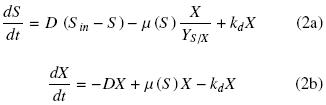
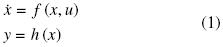
<body><![CDATA[<p align="justify"><font face="verdana" size="2"><b>2    Problem statement</b></font></p>     <p align="justify"><font face="verdana" size="2"><i>2.1    The model</i></font></p>     <p align="justify"><font face="verdana" size="2">Consider the following nonlinear system</font></p>     <p align="center"><font face="verdana" size="2"><img src="/img/revistas/rmiq/v10n2/a15s1.jpg"></font></p>     <p align="justify"><font face="verdana" size="2">where, <i>x <img src="/img/revistas/rmiq/v10n2/a15s29.jpg"> R<i><sup>n</sup></i>, u <i><img src="/img/revistas/rmiq/v10n2/a15s29.jpg"></i> R<sup>m</sup>, m </i><u>&lt;</u><i> n, </i>y<i> <i><img src="/img/revistas/rmiq/v10n2/a15s29.jpg"></i> R<sup>p</sup></i>.</font></p>     <p align="justify"><font face="verdana" size="2">Let us recall the classical observer definition. An observer for system (1) is a dynamical system <img src="/img/revistas/rmiq/v10n2/a15s30.jpg"><b><i> = </i></b><img src="/img/revistas/rmiq/v10n2/a15s31.jpg"> (<img src="/img/revistas/rmiq/v10n2/a15s32.jpg">, <i>u<b>, </b>y</i>), whose task is state estimation. Usually is required at least that &#124;&#124;<img src="/img/revistas/rmiq/v10n2/a15s32.jpg"> &#150; <i>x</i>&#124;&#124;<b> <img src="/img/revistas/rmiq/v10n2/a15s33.jpg"></b> 0 as <i>t <b><img src="/img/revistas/rmiq/v10n2/a15s33.jpg"></b></i> &infin;. Although in some cases, exponentially convergence is also required (Gauthier <i><i>et al.,</i> </i>1992). </font></p>     <p align="justify"><font face="verdana" size="2"><b>Definition 1:</b> an estimator is said to be bounded if the estimation error (&#124;&#124;<img src="/img/revistas/rmiq/v10n2/a15s32.jpg"> &#150; <i>x</i>&#124;&#124;) belongs to an open ball with radius proportional to some value that depends on its estimation error.</font></p>     <p align="justify"><font face="verdana" size="2">In all paper, we will consider a class of bioreactor model. The simplified Haldane model taken from (Vargas <i>et al.,</i> 2000), is described by </font></p>     <p align="center"><font face="verdana" size="2"><img src="/img/revistas/rmiq/v10n2/a15s2.jpg"></font></p>     <p align="justify"><font face="verdana" size="2">where <i>&#956;</i>(<i>S</i>)<i> = &#956;</i><sub>max</sub><i>S</i> / (<i>&#948;</i> + <i>S + S</i><sup>2</sup>/<i>&#966;</i>) is the specific growth rate and <i><i>&#956;</i><sub>max</sub><i></i> </i>is the maximum growth rate.</font></p>     ]]></body>
<body><![CDATA[<p align="justify"><font face="verdana" size="2">We assume that <i>&#956;</i>(<i>S</i>) is partially known, which is common in biology (Gouz&eacute; and Lemesle, 2001). Generally, <i>&#956;</i>(<i>S</i>) is between two bounds meaning that we know a function <img src="/img/revistas/rmiq/v10n2/a15s34.jpg">(<i>S</i>) such that &#124;<i>&#956;</i>(<i>S</i>) &#150;<img src="/img/revistas/rmiq/v10n2/a15s34.jpg"> (<i>S</i>)&#124;<i></i> &lt; <i>a</i>, where <i>a <img src="/img/revistas/rmiq/v10n2/a15s29.jpg"> R<sup>+</sup>, </i>and <i>&#956;</i>(0) = <img src="/img/revistas/rmiq/v10n2/a15s34.jpg">(0)<i> = </i>0. We introduce an important lemma about lower bounded properties of <i><i>&#956;</i></i>(<i><i>S</i></i>).</font></p>     <p align="justify"><font face="verdana" size="2"><b>Lema 1</b> (Hadj&#150;Sadok, 1999): there exists a constant <i>&#949; <i><img src="/img/revistas/rmiq/v10n2/a15s29.jpg"></i> R, </i>such that <i>S </i>(0) &gt; <i>&#949; </i>implies <i>S</i>(<i>t</i>) &gt;<i> &#949; </i>for all <i>t. </i>Thus, for any smooth function <i><i>&#956;</i></i>(<i><i>S</i></i>),<i> &#956; </i>(<i>S </i>(<i>t</i>)) &gt; <i>&#956; </i>(<i><i>&#949;</i></i>) for all <i>t.</i></font></p>     <p align="justify"><font face="verdana" size="2">From lemma 1, we could always choose <i>&#949; </i>such that <i>&#956; </i>(<i>S </i>(<i>t</i>)) &gt; <img src="/img/revistas/rmiq/v10n2/a15s34.jpg">(<i>&#949;</i>)<i> = r, </i>where <i>r <i><img src="/img/revistas/rmiq/v10n2/a15s29.jpg"></i> R<sup>+</sup>.</i></font></p>     <p align="justify"><font face="verdana" size="2">The state variables <i>S, X </i>are the substrate and biomass concentrations, respectively, <i>D = q</i>/<i>V </i>is the dilution rate with <i>V </i>the volume of the bioreactor and <i>q </i>the constant flow passing through the bioreactor, <i>S<sub>in</sub><i></i> </i>is the input substrate concentration, <i>Y<sub>S/X</sub><i></i> </i>is the corresponding yield coefficient. Let us notice that the inputs <i>D = u </i>and <i><i>S<sub>in</sub></i> </i>are fixed. Moreover, we assume that the measured output is,</font></p>     <p align="center"><font face="verdana" size="2"><img src="/img/revistas/rmiq/v10n2/a15s3.jpg"></font></p>     <p align="justify"><font face="verdana" size="2"><i>2.2   Algebraic     Observability     Condition (AOC)</i></font></p>     <p align="justify"><font face="verdana" size="2">Before proposing the bounded error estimator,   a definition   concerning   on   <i>algebraic   observability condition </i>is given, for more details see (Diop and Mart&iacute;nez&#150;Guerra, 2001). </font></p>     <p align="justify"><font face="verdana" size="2"><b>Definition 2:</b>  consider the system described by (1), where <i>x = </i>(<i> x<i><i><sub>1</sub></i></i> <i>x<i><i><sub>2</sub></i></i></i></i> ... <i>x<sub>n</sub> </i>)<i><sup>T</sup></i>.<i> A </i>state <i>x<i><sub>i</sub></i></i>,<i> i = </i>&#123;1, 2, ... ,<i>n</i>&#125;, is said to be algebraically observable with respect to &#123;<i>u,y</i>&#125; if it satisfies a differential polynomial in terms of <i>u, y </i>and some of their time derivatives, i.e., <i>P</i>(<i>x<i><i><sub>i</sub></i></i></i>, <i>u</i>,<i> <img src="/img/revistas/rmiq/v10n2/a15s35.jpg"> , </i>...,<i> y</i>, <img src="/img/revistas/rmiq/v10n2/a15s36.jpg">,..) = 0, <i>i</i> = &#123;1, 2, ... ,<i>n</i>&#125;.</font></p>     <p align="justify"><font face="verdana" size="2">Replacing   <i> y     =     S    </i>into   Eq.        (2a),    the algebraic observability condition for Haldane model is calculated as follows,</font></p>     <p align="center"><font face="verdana" size="2"><img src="/img/revistas/rmiq/v10n2/a15s4.jpg"></font></p>     ]]></body>
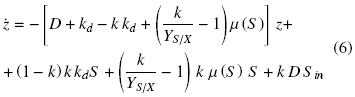
<body><![CDATA[<p align="justify"><font face="verdana" size="2">From Eq. (4), it is clear that the state variable X satisfies the AOC thus, X is algebraically observable.</font></p>     <p align="justify"><font face="verdana" size="2">&nbsp;</font></p>     <p align="justify"><font face="verdana" size="2"><b>3    Bounded error estimator</b></font></p>     <p align="justify"><font face="verdana" size="2"><i>3.1    Estimator design</i></font></p>     <p align="justify"><font face="verdana" size="2">In what follows, the corresponding estimated concentration is denoted by &#710;, and we assume that S is measured exactly, i.e., <i>S</i> = <img src="/img/revistas/rmiq/v10n2/a15s37.jpg">. Then, we only reconstruct the biomass variable X.</font></p>     <p align="justify"><font face="verdana" size="2">Consider the Haldane's model given by system (2), and make the change of variable</font></p>     <p align="center"><font face="verdana" size="2"><img src="/img/revistas/rmiq/v10n2/a15s5.jpg"></font></p>     <p align="justify"><font face="verdana" size="2">where <i>k <img src="/img/revistas/rmiq/v10n2/a15s29.jpg"> R </i>is fixed. </font></p>     <p align="justify"><font face="verdana" size="2">The dynamics of <i>z </i>is</font></p>     <p align="center"><font face="verdana" size="2"><img src="/img/revistas/rmiq/v10n2/a15s6.jpg"></font></p>     ]]></body>
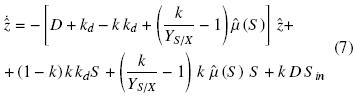
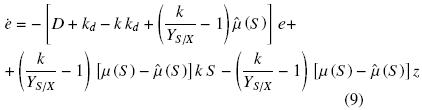
<body><![CDATA[<p align="justify"><font face="verdana" size="2"><b>Proposition 1:</b> if we choose the estimator's gain such that <i>Y<sub><i>S/X</i></sub> </i>&lt;<i> k </i><img src="/img/revistas/rmiq/v10n2/a15s38.jpg"> 1 + <i>D</i>/<i>k<i><sub><i>d</i></sub></i></i> and &#124;<i>&#956;</i>(<i>S</i>)<i> &#151; <img src="/img/revistas/rmiq/v10n2/a15s34.jpg"></i>(<i>S</i>)<i>&#124; </i>&lt;<i> a</i>,<i> a <i><img src="/img/revistas/rmiq/v10n2/a15s29.jpg"></i> R<sup>+</sup>. </i>Then, the system (7) is a bounded error estimator of (6).</font></p>     <p align="center"><font face="verdana" size="2"><img src="/img/revistas/rmiq/v10n2/a15s7.jpg"></font></p>     <p align="justify"><font face="verdana" size="2">For the proof, define the estimation error,</font></p>     <p align="center"><font face="verdana" size="2"><img src="/img/revistas/rmiq/v10n2/a15s8.jpg"></font></p>     <p align="justify"><font face="verdana" size="2">Then, using eqs.    (6) and (7) the estimation error dynamic is obtained as</font></p>     <p align="center"><font face="verdana" size="2"><img src="/img/revistas/rmiq/v10n2/a15s9.jpg"></font></p>     <p align="justify"><font face="verdana" size="2">To analyze the stability of Eq.   (9) we consider the following Lyapunov function candidate</font></p>     <p align="center"><font face="verdana" size="2"><img src="/img/revistas/rmiq/v10n2/a15s10.jpg"></font></p>     <p align="justify"><font face="verdana" size="2">The time derivative of Eq. (10) is</font></p>     <p align="center"><font face="verdana" size="2"><img src="/img/revistas/rmiq/v10n2/a15s11.jpg"></font></p>     ]]></body>
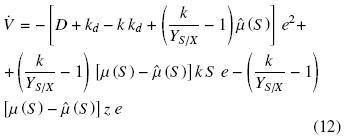
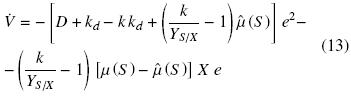
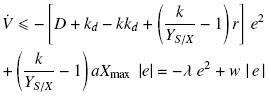
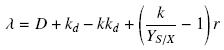
<body><![CDATA[<p align="justify"><font face="verdana" size="2">Replacing (9) into (11) yields</font></p>     <p align="center"><font face="verdana" size="2"><img src="/img/revistas/rmiq/v10n2/a15s12.jpg"></font></p>     <p align="justify"><font face="verdana" size="2">Equation (12) is written alternatively as</font></p>     <p align="center"><font face="verdana" size="2"><img src="/img/revistas/rmiq/v10n2/a15s13.jpg"></font></p>     <p align="justify"><font face="verdana" size="2">Now, from lemma 1 and taking into account that <i><i>Y<sub><i>S/X</i></sub> </i>&lt;<i> k </i>&#8804; 1 + <i>Dk<sub>d</sub></i> and &#124;<i>&#956;</i>(<i>S</i>)<i> &#151; <img src="/img/revistas/rmiq/v10n2/a15s34.jpg"></i>(<i>S</i>)<i>&#124; </i>&lt;<i> a</i></i>, and <i>X </i>is bounded, Eq. (13) leads to,</font></p>     <p align="center"><font face="verdana" size="2"><img src="/img/revistas/rmiq/v10n2/a15s18.jpg"></font></p>     <p align="justify"><font face="verdana" size="2">where,</font></p>     <p align="center"><font face="verdana" size="2"><img src="/img/revistas/rmiq/v10n2/a15s19.jpg"></font></p>     <p align="justify"><font face="verdana" size="2">and</font></p>     <p align="center"><font face="verdana" size="2"><img src="/img/revistas/rmiq/v10n2/a15s20.jpg"></font></p>     ]]></body>
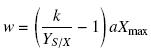
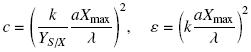
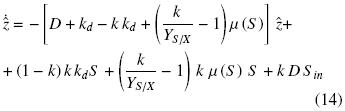
<body><![CDATA[<p align="justify"><font face="verdana" size="2">The right&#150;hand side of the foregoing inequality is not negative since near the origin, the positive linear term <i>w <i>&#124;</i>e<i>&#124;</i></i> dominates the negative quadratic term <i>&#150;&#955;e<sup>2</sup>. </i>However, <img src="/img/revistas/rmiq/v10n2/a15s39.jpg"> is negative outside the set &#123;&#124;<i>e</i>&#124; <i>= &#8804;</i> <i>w/&#955;</i>&#125;<i>. </i>Let <i>c</i>, <i>&#949; </i>be some upper bounds for <i>V</i>(<i>e</i>). With <i>c</i> &gt; <i>w<sup>2</sup> </i>/ 2<i>&#955;</i><sup>2</sup>, solutions starting in the set &#123;V(<i>e</i>)&#8804; <i>c</i>&#125; will remain therein for all time because <img src="/img/revistas/rmiq/v10n2/a15s39.jpg"> is negative on the boundary <i>V </i>=<i> c. </i>Hence, the solutions of Eq. (9) are uniformly bounded (Khalil, 2002). Moreover, if (<i><i>w<sup>2</sup> </i>/ 2<i>&#955;</i><sup>2</sup></i>) &lt;<i> &#949; </i>&lt;<i> c</i>, then <img src="/img/revistas/rmiq/v10n2/a15s39.jpg"> will be negative in the set &#123;<i>&#949;&#8804;</i> <i>V &#8804;</i> <i>c</i>&#125;, which shows that, in this set <i>V </i>will decrease monotonically until the solutions enters the set &#123;<i>V &#8804;</i> <i>&#949;</i>&#125;. From that time on, the solution cannot leave the set &#123;<i>V &#8804;</i> <i>&#949;</i>&#125;since <img src="/img/revistas/rmiq/v10n2/a15s39.jpg"> is negative on the boundary <i>V </i>=<i> &#949;. </i>According to (Khalil, 2002), the solution is uniformly ultimately bounded with the ultimate bound <i><i><i>&#124;</i></i>e</i>&#124; <i>&#8804;</i> V2e. For instance, defining c and <i>&#949; </i>as follows</font></p>     <p align="center"><font face="verdana" size="2"><img src="/img/revistas/rmiq/v10n2/a15s21.jpg"></font></p>     <p align="justify"><font face="verdana" size="2">the ultimate bound is, <i><i>&#124;</i>e</i>&#124; <i>&#8804;</i> <img src="/img/revistas/rmiq/v10n2/a15s41.jpg">. </font></p>     <p align="justify"><font face="verdana" size="2"><b>Corollary 1:</b> if the growth rate is perfectly known, i.e., <i>&#956; </i>(<i>S</i>) = <img src="/img/revistas/rmiq/v10n2/a15s34.jpg">(<i>S</i>), and we choose the estimator's gain such that <i><i><i>Y<sub><i>S/X</i></sub> </i>&lt;<i> k </i>&#8804; 1 + <i>D</i>/<i>k<i><sub><i>d</i></sub></i></i></i></i>. Then, the system (14) is an asymptotic estimator of (6).</font></p>     <p align="center"><font face="verdana" size="2"><img src="/img/revistas/rmiq/v10n2/a15s14.jpg"></font></p>     <p align="justify"><font face="verdana" size="2">Indeed, the dynamics of the error in this case is</font></p>     <p align="center"><font face="verdana" size="2"><img src="/img/revistas/rmiq/v10n2/a15s22.jpg"></font></p>     <p align="justify"><font face="verdana" size="2">and the corresponding time derivative of Lyapunov function candidate (10) is</font></p>     <p align="center"><font face="verdana" size="2"><img src="/img/revistas/rmiq/v10n2/a15s23.jpg"></font></p>     <p align="justify"><font face="verdana" size="2">Moreover, <i>X</i> can be reconstructed considering</font></p>     ]]></body>
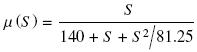
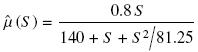
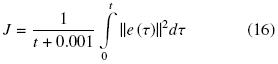
<body><![CDATA[<p align="center"><font face="verdana" size="2"><img src="/img/revistas/rmiq/v10n2/a15s15.jpg"></font></p>     <p align="justify"><font face="verdana" size="2"><i>3.2    Numerical simulations</i></font></p>     <p align="justify"><font face="verdana" size="2">For all simulations in this paper we take <i>S<i><sub><i>in</i></sub></i> = </i>50, <i>D = </i>0.1, <i>Y<i><sub><i>S/X</i></sub></i> = </i>0.9, <i>k<i><sub><i>d</i></sub></i> = </i>0.01 and the initial conditions <i>S </i>(0) = 60, X(0)<i> = </i>40, <img src="/img/revistas/rmiq/v10n2/a15s42.jpg">(0) = 30, <img src="/img/revistas/rmiq/v10n2/a15s43.jpg">(0) = 90, with appropriate units, these values are taken from Vargas <i>et al, </i>(2000). The estimator's gain is <i>k = </i>1. The growth rates are chosen as</font></p>     <p align="center"><font face="verdana" size="2"><img src="/img/revistas/rmiq/v10n2/a15s24.jpg"></font></p>     <p align="justify"><font face="verdana" size="2">and</font></p>     <p align="center"><font face="verdana" size="2"><img src="/img/revistas/rmiq/v10n2/a15s25.jpg"></font></p>     <p align="justify"><font face="verdana" size="2">when the model is well known for the asymptotic estimator and when the model is partially known for the bounded error estimator, respectively. The simulations results were carried out with the help of Matlab 7.1 Software with Simulink 6.3 as the toolbox.</font></p>     <p align="justify"><font face="verdana" size="2">The  performance  index  of the  corresponding estimation process is calculated as (Mart&iacute;nez&#150;Guerra <i><i>et al.,</i> </i>2000)</font></p>     <p align="center"><font face="verdana" size="2"><img src="/img/revistas/rmiq/v10n2/a15s16.jpg"></font></p>     <p align="justify"><font face="verdana" size="2">where <i>e</i>(<i>t</i>) is the corresponding state estimation error (the difference between the actual observed signal and its estimmate).</font></p>     ]]></body>
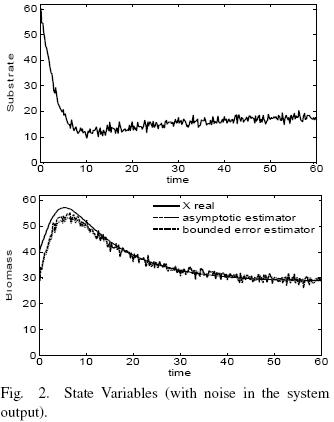
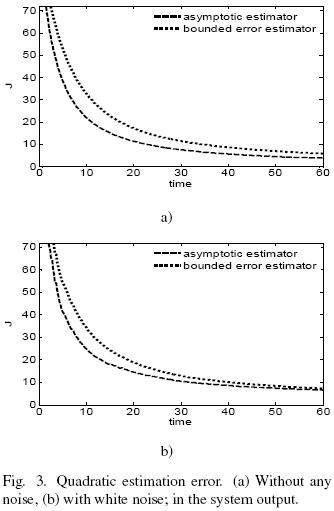
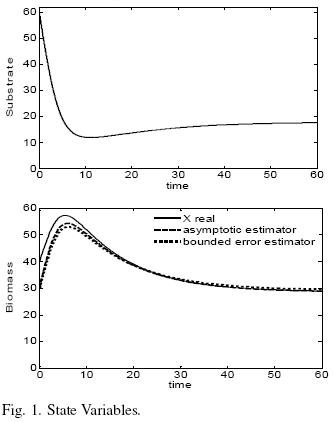
<body><![CDATA[<p align="justify"><font face="verdana" size="2">First, in <a href="#f1">Fig. 1</a> we show the simulation results for the bounded error estimator given by proposition 1, and the corresponding results for the asymptotic estimator given by corollary 1 (without any noise in the system output). Furthermore, in <a href="#f2">Fig. 2</a> is shown the effect of noise in the estimation process. A white noise is added in the measurement (&#963;= 0.1, &plusmn;10% around the current value of the measured output) this is considering the corres ponding measurement error of the corresponding sensor and/or experimental measurement technique. We can observe that the bounded error estimator is robust against noisy measurement. Finally, in <a href="#f3">Fig. 3</a> is illustrated the performance index given by (16) for the corresponding estimation process. It should be noted that the quadratic estimation error (performance index) is bounded on average and has a tendency to decrease.</font></p>     <p align="center"><font face="verdana" size="2"><a name="f1"></a></font></p>     <p align="center"><font face="verdana" size="2"><img src="/img/revistas/rmiq/v10n2/a15f1.jpg"></font></p>     <p align="center"><font face="verdana" size="2"><a name="f2"></a></font></p>     <p align="center"><font face="verdana" size="2"><img src="/img/revistas/rmiq/v10n2/a15f2.jpg"></font></p>     <p align="center"><font face="verdana" size="2"><a name="f3"></a></font></p>     <p align="center"><font face="verdana" size="2"><img src="/img/revistas/rmiq/v10n2/a15f3.jpg"></font></p>     <p align="justify"><font face="verdana" size="2">&nbsp;</font></p>     <p align="justify"><font face="verdana" size="2"><b>4    A note on full&#150;order observers: The high gain observer</b></font></p>     <p align="justify"><font face="verdana" size="2"><i>4.1    Observer design</i></font></p>     ]]></body>
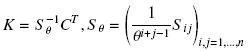
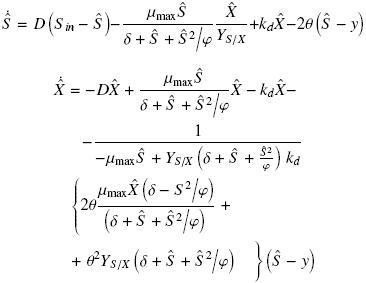
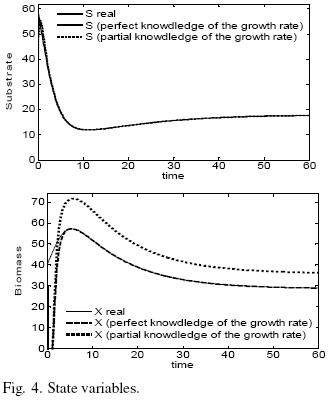
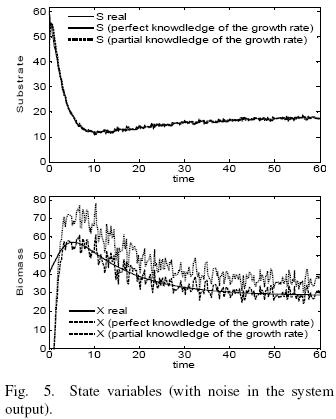
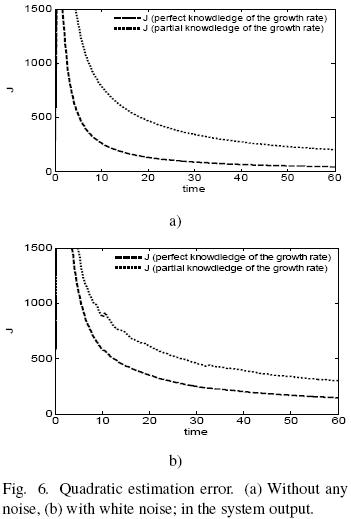
<body><![CDATA[<p align="justify"><font face="verdana" size="2">Consider that system (1) satisfies the AOC. In this case to estimate the state&#150;space vector <i>x</i>, we can suggest a nonlinear high gain observer (Gauthier <i>et ah, </i>1992), (Mart&iacute;nez&#150;Guerra <i>et al, </i>2000) with the following structure,</font></p>     <p align="center"><font face="verdana" size="2"><img src="/img/revistas/rmiq/v10n2/a15s17.jpg"></font></p>     <p align="justify"><font face="verdana" size="2">where the observer's g ain matrix is given by,</font></p>     <p align="center"><font face="verdana" size="2"><img src="/img/revistas/rmiq/v10n2/a15s26.jpg"></font></p>     <p align="justify"><font face="verdana" size="2">and the positive parameter <i>&#952; </i>determines the desired convergence velocity. Moreover, <i>S<i><sub><i>&#952;</i></sub></i> </i>&gt; 0, <i><i>S<i><sub><i>&#952;</i></sub></i></i> </i>= <img src="/img/revistas/rmiq/v10n2/a15s44.jpg"> should be a solution of the algebraic equation,</font></p>     <p align="center"><font face="verdana" size="2"><img src="/img/revistas/rmiq/v10n2/a15s27.jpg"></font></p>     <p align="justify"><font face="verdana" size="2">As shown by (Gauthier <i>et ai, </i>1992), (Mart&iacute;nez Guerra and de Leon&#150;Morales, 1996), under certain technical a assumptions (Lipschitz conditions for nonlinear functions under consideration) this nonlinear observer has an arbitrary exponential decay for any initial conditions. We obtain the following high order observer for the system (2) applying the observation scheme (17),</font></p>     <p align="center"><font face="verdana" size="2"><img src="/img/revistas/rmiq/v10n2/a15s28.jpg"></font></p>     <p align="justify"><font face="verdana" size="2"><i>4.2 Simulations</i></font></p>     <p align="justify"><font face="verdana" size="2">In the same way, we 8show two simulations: when the model is well known and when the model is partially known.   The initial conditions for the observer are <img src="/img/revistas/rmiq/v10n2/a15s37.jpg">(0) = 40, <img src="/img/revistas/rmiq/v10n2/a15s42.jpg">(0)<i> = </i>30, with appropriate units. The estimator's gain is <i> <i>&#952;</i> = 2. </i>The simulations results of high gain observer are presented in <a href="#f4">figs. 4</a> and <a href="#f5">5</a>. In <a href="#f4">Fig. 4</a>, without any noise in the system output, when the model is perfectly known the rate of convergence is fast, on the other hand, when the model is partially known the observer does not reconstruct the state variables. In <a href="#f5">Fig. 5</a>, we studied the effect of noise in the measurement (white noise with <i>&#963; = </i>0.1, +5% around the current value of the measured output), we can see that the high gain observer is very sensitive to the noise in the system output. <a href="#f6">Fig. 6</a> shows the performance index. It should be noted that this observer only reconstruct the state variables when the model is well known.</font></p>     ]]></body>
<body><![CDATA[<p align="center"><font face="verdana" size="2"><a name="f4"></a></font></p>     <p align="center"><font face="verdana" size="2"><img src="/img/revistas/rmiq/v10n2/a15f4.jpg"></font></p>     <p align="center"><font face="verdana" size="2"><a name="f5"></a></font></p>     <p align="center"><font face="verdana" size="2"><img src="/img/revistas/rmiq/v10n2/a15f5.jpg"></font></p>     <p align="center"><font face="verdana" size="2"><a name="f6"></a></font></p>     <p align="center"><font face="verdana" size="2"><img src="/img/revistas/rmiq/v10n2/a15f6.jpg"></font></p>     <p align="justify"><font face="verdana" size="2">&nbsp;</font></p>     <p align="justify"><font face="verdana" size="2"><b>Conclusions</b></font></p>     <p align="justify"><font face="verdana" size="2">In this paper we ha ve present ed a boun ded error estimator for bioprocess with unstructured growth models. We have proven the stability of the corresponding estimation error in a Lyapunov sense. By means of a linear change of variable given in a natural manner and with some algebraic manipulations have been constructed the state estimator, which converges to the current states of the reference model given. We have demonstrated that the bounded error estimator under consideration provides good enough state&#150;space estimates which were bounded on average, besides the proposed state estimator does not depend of a particular set of initial conditions or specific model structure. Moreover, we have constructed a high gain observer in which the convergence is fast only if the model is well known, but does not exists convergence if the model is partially known. Finally, we have presented some simulations to illustrate the effectiveness of the suggested approach, which shows some robustness properties against noisy measurements.</font></p>     <p align="justify"><font face="verdana" size="2">&nbsp;</font></p>     ]]></body>
<body><![CDATA[<p align="justify"><font face="verdana" size="2"><b>References</b></font></p>     <!-- ref --><p align="justify"><font face="verdana" size="2">Aguilar&#150;L&oacute;pez, R., Mart&iacute;nez&#150;Guerra, R., Mendoza&#150;Camargo, J., and M. Neria&#150;Gonz&aacute;lez (2006). Monitoring of and industrial wastewater plant employing finite&#150;time convergence observer.<i> Journal of Chemical Technology and Biotechnology 81</i>, 851&#150;857.    &nbsp;&nbsp;&nbsp;&nbsp;&nbsp;&nbsp;&nbsp;&nbsp;[&#160;<a href="javascript:void(0);" onclick="javascript: window.open('/scielo.php?script=sci_nlinks&ref=8600562&pid=S1665-2738201100020001500001&lng=','','width=640,height=500,resizable=yes,scrollbars=1,menubar=yes,');">Links</a>&#160;]<!-- end-ref --></font></p>     <!-- ref --><p align="justify"><font face="verdana" size="2">Alvarez&#150;Ramirez, J (1999).  Robust PI stabilization t).      of a class of continuously stirred&#150;tank reactors. <i>AIChE Journal 45</i>, 1992&#150;2000.    &nbsp;&nbsp;&nbsp;&nbsp;&nbsp;&nbsp;&nbsp;&nbsp;[&#160;<a href="javascript:void(0);" onclick="javascript: window.open('/scielo.php?script=sci_nlinks&ref=8600564&pid=S1665-2738201100020001500002&lng=','','width=640,height=500,resizable=yes,scrollbars=1,menubar=yes,');">Links</a>&#160;]<!-- end-ref --></font></p>     <!-- ref --><p align="justify"><font face="verdana" size="2">Bastin, G. and D. Dochain(1990). <i>On&#150;line estimation and adaptative control of bioreactors 1</i>. Elsevier, Amsterdam.    &nbsp;&nbsp;&nbsp;&nbsp;&nbsp;&nbsp;&nbsp;&nbsp;[&#160;<a href="javascript:void(0);" onclick="javascript: window.open('/scielo.php?script=sci_nlinks&ref=8600566&pid=S1665-2738201100020001500003&lng=','','width=640,height=500,resizable=yes,scrollbars=1,menubar=yes,');">Links</a>&#160;]<!-- end-ref --></font></p>     <!-- ref --><p align="justify"><font face="verdana" size="2">D&aacute;vila, J., Fridman, L. and A. Levant (2005). Second order sliding&#150;mode observer for mechanical systems. <i>IEEE Transactions on Automatic Control 50</i>, 1785&#150;1789.    &nbsp;&nbsp;&nbsp;&nbsp;&nbsp;&nbsp;&nbsp;&nbsp;[&#160;<a href="javascript:void(0);" onclick="javascript: window.open('/scielo.php?script=sci_nlinks&ref=8600568&pid=S1665-2738201100020001500004&lng=','','width=640,height=500,resizable=yes,scrollbars=1,menubar=yes,');">Links</a>&#160;]<!-- end-ref --></font></p>     <!-- ref --><p align="justify"><font face="verdana" size="2">Diop, S. and R. Mart&iacute;nez&#150;Guerra (2001). An algebraic and data derivative information approach to nonlinear system diagnosis. Proceedings of the European <i>Control Conference (ECC)</i>, Porto, Portugal, 2334&#150;2339.    &nbsp;&nbsp;&nbsp;&nbsp;&nbsp;&nbsp;&nbsp;&nbsp;[&#160;<a href="javascript:void(0);" onclick="javascript: window.open('/scielo.php?script=sci_nlinks&ref=8600570&pid=S1665-2738201100020001500005&lng=','','width=640,height=500,resizable=yes,scrollbars=1,menubar=yes,');">Links</a>&#160;]<!-- end-ref --></font></p>     <!-- ref --><p align="justify"><font face="verdana" size="2">Farza, M., Busawon, K. and H. Hammouri (1998). Simple nonlinear observers for online estimation of kinetics rates in bioreactors. <i>Automatica 34</i>, 301&#150;318.    &nbsp;&nbsp;&nbsp;&nbsp;&nbsp;&nbsp;&nbsp;&nbsp;[&#160;<a href="javascript:void(0);" onclick="javascript: window.open('/scielo.php?script=sci_nlinks&ref=8600572&pid=S1665-2738201100020001500006&lng=','','width=640,height=500,resizable=yes,scrollbars=1,menubar=yes,');">Links</a>&#160;]<!-- end-ref --></font></p>     <!-- ref --><p align="justify"><font face="verdana" size="2">Gauthier, J., Hammouri H. and S. Othman (1992). A simple observer for nonlinear systems. Applications to bioreactors. <i>IEEE Transactions on Automatic Control 37</i>, 875&#150;880.    &nbsp;&nbsp;&nbsp;&nbsp;&nbsp;&nbsp;&nbsp;&nbsp;[&#160;<a href="javascript:void(0);" onclick="javascript: window.open('/scielo.php?script=sci_nlinks&ref=8600574&pid=S1665-2738201100020001500007&lng=','','width=640,height=500,resizable=yes,scrollbars=1,menubar=yes,');">Links</a>&#160;]<!-- end-ref --></font></p>     <!-- ref --><p align="justify"><font face="verdana" size="2">Gouz&eacute;, J. and V. Lemesle (2001). A bounded error observer for a class of bioreactor models. <i>Proceeding of the European Control  Conference (ECC)</i>, Porto, Portugal.    &nbsp;&nbsp;&nbsp;&nbsp;&nbsp;&nbsp;&nbsp;&nbsp;[&#160;<a href="javascript:void(0);" onclick="javascript: window.open('/scielo.php?script=sci_nlinks&ref=8600576&pid=S1665-2738201100020001500008&lng=','','width=640,height=500,resizable=yes,scrollbars=1,menubar=yes,');">Links</a>&#160;]<!-- end-ref --></font></p>     <!-- ref --><p align="justify"><font face="verdana" size="2">Hadj&#150;Sadok, Z. (1999). <i>Mod&eacute;lisation et estimation dans les bior&eacute;acteurs; prise en compte des incertudes: application au traitement de l'eau</i>. PhD thesis. Nice&#150;Sophia Antipolis University. Nice.    &nbsp;&nbsp;&nbsp;&nbsp;&nbsp;&nbsp;&nbsp;&nbsp;[&#160;<a href="javascript:void(0);" onclick="javascript: window.open('/scielo.php?script=sci_nlinks&ref=8600578&pid=S1665-2738201100020001500009&lng=','','width=640,height=500,resizable=yes,scrollbars=1,menubar=yes,');">Links</a>&#160;]<!-- end-ref --></font></p>     <!-- ref --><p align="justify"><font face="verdana" size="2">Hu, S. and J. Wang (2002). Global asymptotic stability and global exponential stability of continuous time recurrent neural netwoks. <i>IEEE Transactions on Automatic Control 47</i>, 802&#150;807.    &nbsp;&nbsp;&nbsp;&nbsp;&nbsp;&nbsp;&nbsp;&nbsp;[&#160;<a href="javascript:void(0);" onclick="javascript: window.open('/scielo.php?script=sci_nlinks&ref=8600580&pid=S1665-2738201100020001500010&lng=','','width=640,height=500,resizable=yes,scrollbars=1,menubar=yes,');">Links</a>&#160;]<!-- end-ref --></font></p>     <!-- ref --><p align="justify"><font face="verdana" size="2">Keller, H (1987). Non&#150;linear observer design by transformation into a generalized observer canonical form. <i>International Journal of Control 46</i>, 1915&#150;1930.    &nbsp;&nbsp;&nbsp;&nbsp;&nbsp;&nbsp;&nbsp;&nbsp;[&#160;<a href="javascript:void(0);" onclick="javascript: window.open('/scielo.php?script=sci_nlinks&ref=8600582&pid=S1665-2738201100020001500011&lng=','','width=640,height=500,resizable=yes,scrollbars=1,menubar=yes,');">Links</a>&#160;]<!-- end-ref --></font></p>     <!-- ref --><p align="justify"><font face="verdana" size="2">Khalil, H (2002). <i>Nonlinear systems</i>. Third edition. Prentice Hall, New Jersey.    &nbsp;&nbsp;&nbsp;&nbsp;&nbsp;&nbsp;&nbsp;&nbsp;[&#160;<a href="javascript:void(0);" onclick="javascript: window.open('/scielo.php?script=sci_nlinks&ref=8600584&pid=S1665-2738201100020001500012&lng=','','width=640,height=500,resizable=yes,scrollbars=1,menubar=yes,');">Links</a>&#160;]<!-- end-ref --></font></p>     <!-- ref --><p align="justify"><font face="verdana" size="2">Lemesle, V. and J. Gouz&eacute; (2005). Hybrid bounded error observers for uncertain bioreactor models. <i>Bioprocess &amp; Biosystems Engineering 27</i>, 311&#150;318.    &nbsp;&nbsp;&nbsp;&nbsp;&nbsp;&nbsp;&nbsp;&nbsp;[&#160;<a href="javascript:void(0);" onclick="javascript: window.open('/scielo.php?script=sci_nlinks&ref=8600586&pid=S1665-2738201100020001500013&lng=','','width=640,height=500,resizable=yes,scrollbars=1,menubar=yes,');">Links</a>&#160;]<!-- end-ref --></font></p>     <!-- ref --><p align="justify"><font face="verdana" size="2">Levant, A (2001). Universal single&#150;input&#150;single&#150;output (SISO) sliding&#150;mode controllers with finite&#150;time convergence. <i>IEEE Transactions on Automatic Control 46</i>, 1447&#150;1451.    &nbsp;&nbsp;&nbsp;&nbsp;&nbsp;&nbsp;&nbsp;&nbsp;[&#160;<a href="javascript:void(0);" onclick="javascript: window.open('/scielo.php?script=sci_nlinks&ref=8600588&pid=S1665-2738201100020001500014&lng=','','width=640,height=500,resizable=yes,scrollbars=1,menubar=yes,');">Links</a>&#160;]<!-- end-ref --></font></p>     <!-- ref --><p align="justify"><font face="verdana" size="2">Luenberger, D (1979). <i>Introduction to Dynamic Systems. Theory Models and Applications</i>. Wiley, New York.    &nbsp;&nbsp;&nbsp;&nbsp;&nbsp;&nbsp;&nbsp;&nbsp;[&#160;<a href="javascript:void(0);" onclick="javascript: window.open('/scielo.php?script=sci_nlinks&ref=8600590&pid=S1665-2738201100020001500015&lng=','','width=640,height=500,resizable=yes,scrollbars=1,menubar=yes,');">Links</a>&#160;]<!-- end-ref --></font></p>     <!-- ref --><p align="justify"><font face="verdana" size="2">Mart&iacute;nez&#150;Guerra, R. and J. de Leon&#150;Morales (1996). Nonlinear estimators: a differential algebraic approach. <i>Journal of Mathematics and Computer Modelling 20</i>, 125&#150;132.    &nbsp;&nbsp;&nbsp;&nbsp;&nbsp;&nbsp;&nbsp;&nbsp;[&#160;<a href="javascript:void(0);" onclick="javascript: window.open('/scielo.php?script=sci_nlinks&ref=8600592&pid=S1665-2738201100020001500016&lng=','','width=640,height=500,resizable=yes,scrollbars=1,menubar=yes,');">Links</a>&#160;]<!-- end-ref --></font></p>     <!-- ref --><p align="justify"><font face="verdana" size="2">Mart&iacute;nez&#150;Guerra, R., Poznyak, A. and V. D&iacute;az (2000). Robustness of high&#150;gain observers for closed&#150;loop nonlinear systems: theoretical study and robotics control application.<i> International Journal of Systems Science 31</i>, 1519&#150;1529.    &nbsp;&nbsp;&nbsp;&nbsp;&nbsp;&nbsp;&nbsp;&nbsp;[&#160;<a href="javascript:void(0);" onclick="javascript: window.open('/scielo.php?script=sci_nlinks&ref=8600594&pid=S1665-2738201100020001500017&lng=','','width=640,height=500,resizable=yes,scrollbars=1,menubar=yes,');">Links</a>&#160;]<!-- end-ref --></font></p>     <!-- ref --><p align="justify"><font face="verdana" size="2">Masoud, S (1997). Nonlinear state&#150;observer design with application to reactors. <i>Chemical Engineering Science 52</i>, 387&#150;404.    &nbsp;&nbsp;&nbsp;&nbsp;&nbsp;&nbsp;&nbsp;&nbsp;[&#160;<a href="javascript:void(0);" onclick="javascript: window.open('/scielo.php?script=sci_nlinks&ref=8600596&pid=S1665-2738201100020001500018&lng=','','width=640,height=500,resizable=yes,scrollbars=1,menubar=yes,');">Links</a>&#160;]<!-- end-ref --></font></p>     <!-- ref --><p align="justify"><font face="verdana" size="2">Vargas, A., Soto, G., Moreno, J. and G. Buitr&oacute;n (2000), Observer based time&#150;optimal control of an aerobic SBR for chemical and petrochemical wastewater treatment. <i>Water Science and Technology 42</i>, 163&#150;170.    &nbsp;&nbsp;&nbsp;&nbsp;&nbsp;&nbsp;&nbsp;&nbsp;[&#160;<a href="javascript:void(0);" onclick="javascript: window.open('/scielo.php?script=sci_nlinks&ref=8600598&pid=S1665-2738201100020001500019&lng=','','width=640,height=500,resizable=yes,scrollbars=1,menubar=yes,');">Links</a>&#160;]<!-- end-ref --></font></p>      ]]></body><back>
<ref-list>
<ref id="B1">
<nlm-citation citation-type="journal">
<person-group person-group-type="author">
<name>
<surname><![CDATA[Aguilar-López]]></surname>
<given-names><![CDATA[R.]]></given-names>
</name>
<name>
<surname><![CDATA[Martínez-Guerra]]></surname>
<given-names><![CDATA[R.]]></given-names>
</name>
<name>
<surname><![CDATA[Mendoza-Camargo]]></surname>
<given-names><![CDATA[J.]]></given-names>
</name>
<name>
<surname><![CDATA[Neria-González]]></surname>
<given-names><![CDATA[M.]]></given-names>
</name>
</person-group>
<article-title xml:lang="en"><![CDATA[Monitoring of and industrial wastewater plant employing finite-time convergence observer]]></article-title>
<source><![CDATA[Journal of Chemical Technology and Biotechnology]]></source>
<year>2006</year>
<volume>81</volume>
<page-range>851-857</page-range></nlm-citation>
</ref>
<ref id="B2">
<nlm-citation citation-type="journal">
<person-group person-group-type="author">
<name>
<surname><![CDATA[Alvarez-Ramirez]]></surname>
<given-names><![CDATA[J]]></given-names>
</name>
</person-group>
<article-title xml:lang="en"><![CDATA[Robust PI stabilization t). of a class of continuously stirred-tank reactors]]></article-title>
<source><![CDATA[AIChE Journal]]></source>
<year>1999</year>
<volume>45</volume>
<page-range>1992-2000</page-range></nlm-citation>
</ref>
<ref id="B3">
<nlm-citation citation-type="book">
<person-group person-group-type="author">
<name>
<surname><![CDATA[Bastin]]></surname>
<given-names><![CDATA[G.]]></given-names>
</name>
<name>
<surname><![CDATA[Dochain]]></surname>
<given-names><![CDATA[D.]]></given-names>
</name>
</person-group>
<source><![CDATA[On-line estimation and adaptative control of bioreactors 1]]></source>
<year>1990</year>
<publisher-loc><![CDATA[Amsterdam ]]></publisher-loc>
<publisher-name><![CDATA[Elsevier]]></publisher-name>
</nlm-citation>
</ref>
<ref id="B4">
<nlm-citation citation-type="journal">
<person-group person-group-type="author">
<name>
<surname><![CDATA[Dávila]]></surname>
<given-names><![CDATA[J.]]></given-names>
</name>
<name>
<surname><![CDATA[Fridman]]></surname>
<given-names><![CDATA[L.]]></given-names>
</name>
<name>
<surname><![CDATA[Levant]]></surname>
<given-names><![CDATA[A.]]></given-names>
</name>
</person-group>
<article-title xml:lang="en"><![CDATA[Second order sliding-mode observer for mechanical systems]]></article-title>
<source><![CDATA[IEEE Transactions on Automatic Control]]></source>
<year>2005</year>
<volume>50</volume>
<page-range>1785-1789</page-range></nlm-citation>
</ref>
<ref id="B5">
<nlm-citation citation-type="confpro">
<person-group person-group-type="author">
<name>
<surname><![CDATA[Diop]]></surname>
<given-names><![CDATA[S.]]></given-names>
</name>
<name>
<surname><![CDATA[Martínez-Guerra]]></surname>
<given-names><![CDATA[R.]]></given-names>
</name>
</person-group>
<source><![CDATA[An algebraic and data derivative information approach to nonlinear system diagnosis]]></source>
<year>2001</year>
<conf-name><![CDATA[ European Control Conference]]></conf-name>
<conf-loc>Porto </conf-loc>
<page-range>2334-2339</page-range></nlm-citation>
</ref>
<ref id="B6">
<nlm-citation citation-type="journal">
<person-group person-group-type="author">
<name>
<surname><![CDATA[Farza]]></surname>
<given-names><![CDATA[M.]]></given-names>
</name>
<name>
<surname><![CDATA[Busawon]]></surname>
<given-names><![CDATA[K.]]></given-names>
</name>
<name>
<surname><![CDATA[Hammouri]]></surname>
<given-names><![CDATA[H.]]></given-names>
</name>
</person-group>
<article-title xml:lang="en"><![CDATA[Simple nonlinear observers for online estimation of kinetics rates in bioreactors]]></article-title>
<source><![CDATA[Automatica]]></source>
<year>1998</year>
<volume>34</volume>
<page-range>301-318</page-range></nlm-citation>
</ref>
<ref id="B7">
<nlm-citation citation-type="journal">
<person-group person-group-type="author">
<name>
<surname><![CDATA[Gauthier]]></surname>
<given-names><![CDATA[J.]]></given-names>
</name>
<name>
<surname><![CDATA[Hammouri]]></surname>
<given-names><![CDATA[H.]]></given-names>
</name>
<name>
<surname><![CDATA[Othman]]></surname>
<given-names><![CDATA[S.]]></given-names>
</name>
</person-group>
<article-title xml:lang="en"><![CDATA[A simple observer for nonlinear systems. Applications to bioreactors]]></article-title>
<source><![CDATA[IEEE Transactions on Automatic Control]]></source>
<year>1992</year>
<volume>37</volume>
<page-range>875-880</page-range></nlm-citation>
</ref>
<ref id="B8">
<nlm-citation citation-type="confpro">
<person-group person-group-type="author">
<name>
<surname><![CDATA[Gouzé]]></surname>
<given-names><![CDATA[J.]]></given-names>
</name>
<name>
<surname><![CDATA[Lemesle]]></surname>
<given-names><![CDATA[V.]]></given-names>
</name>
</person-group>
<source><![CDATA[A bounded error observer for a class of bioreactor models]]></source>
<year>2001</year>
<conf-name><![CDATA[ European Control Conference]]></conf-name>
<conf-loc>Porto </conf-loc>
</nlm-citation>
</ref>
<ref id="B9">
<nlm-citation citation-type="">
<person-group person-group-type="author">
<name>
<surname><![CDATA[Hadj-Sadok]]></surname>
<given-names><![CDATA[Z.]]></given-names>
</name>
</person-group>
<source><![CDATA[Modélisation et estimation dans les bioréacteurs; prise en compte des incertudes: application au traitement de l'eau]]></source>
<year>1999</year>
</nlm-citation>
</ref>
<ref id="B10">
<nlm-citation citation-type="journal">
<person-group person-group-type="author">
<name>
<surname><![CDATA[Hu]]></surname>
<given-names><![CDATA[S.]]></given-names>
</name>
<name>
<surname><![CDATA[Wang]]></surname>
<given-names><![CDATA[J.]]></given-names>
</name>
</person-group>
<article-title xml:lang="en"><![CDATA[Global asymptotic stability and global exponential stability of continuous time recurrent neural netwoks]]></article-title>
<source><![CDATA[IEEE Transactions on Automatic Control]]></source>
<year>2002</year>
<volume>47</volume>
<page-range>802-807</page-range></nlm-citation>
</ref>
<ref id="B11">
<nlm-citation citation-type="journal">
<person-group person-group-type="author">
<name>
<surname><![CDATA[Keller]]></surname>
<given-names><![CDATA[H]]></given-names>
</name>
</person-group>
<article-title xml:lang="en"><![CDATA[Non-linear observer design by transformation into a generalized observer canonical form]]></article-title>
<source><![CDATA[International Journal of Control]]></source>
<year>1987</year>
<volume>46</volume>
<page-range>1915-1930</page-range></nlm-citation>
</ref>
<ref id="B12">
<nlm-citation citation-type="book">
<person-group person-group-type="author">
<name>
<surname><![CDATA[Khalil]]></surname>
<given-names><![CDATA[H]]></given-names>
</name>
</person-group>
<source><![CDATA[Nonlinear systems]]></source>
<year>2002</year>
<edition>Third</edition>
<publisher-loc><![CDATA[^eNew Jersey New Jersey]]></publisher-loc>
<publisher-name><![CDATA[Prentice Hall]]></publisher-name>
</nlm-citation>
</ref>
<ref id="B13">
<nlm-citation citation-type="journal">
<person-group person-group-type="author">
<name>
<surname><![CDATA[Lemesle]]></surname>
<given-names><![CDATA[V.]]></given-names>
</name>
<name>
<surname><![CDATA[Gouzé]]></surname>
<given-names><![CDATA[J.]]></given-names>
</name>
</person-group>
<article-title xml:lang="en"><![CDATA[Hybrid bounded error observers for uncertain bioreactor models]]></article-title>
<source><![CDATA[Bioprocess & Biosystems Engineering]]></source>
<year>2005</year>
<volume>27</volume>
<page-range>311-318</page-range></nlm-citation>
</ref>
<ref id="B14">
<nlm-citation citation-type="journal">
<person-group person-group-type="author">
<name>
<surname><![CDATA[Levant]]></surname>
<given-names><![CDATA[A]]></given-names>
</name>
</person-group>
<article-title xml:lang="en"><![CDATA[Universal single-input-single-output (SISO) sliding-mode controllers with finite-time convergence]]></article-title>
<source><![CDATA[IEEE Transactions on Automatic Control]]></source>
<year>2001</year>
<volume>46</volume>
<page-range>1447-1451</page-range></nlm-citation>
</ref>
<ref id="B15">
<nlm-citation citation-type="book">
<person-group person-group-type="author">
<name>
<surname><![CDATA[Luenberger]]></surname>
<given-names><![CDATA[D]]></given-names>
</name>
</person-group>
<source><![CDATA[Introduction to Dynamic Systems. Theory Models and Applications]]></source>
<year>1979</year>
<publisher-loc><![CDATA[New York ]]></publisher-loc>
<publisher-name><![CDATA[Wiley]]></publisher-name>
</nlm-citation>
</ref>
<ref id="B16">
<nlm-citation citation-type="journal">
<person-group person-group-type="author">
<name>
<surname><![CDATA[Martínez-Guerra]]></surname>
<given-names><![CDATA[R.]]></given-names>
</name>
<name>
<surname><![CDATA[Leon-Morales]]></surname>
<given-names><![CDATA[J. de]]></given-names>
</name>
</person-group>
<article-title xml:lang="en"><![CDATA[Nonlinear estimators: a differential algebraic approach]]></article-title>
<source><![CDATA[Journal of Mathematics and Computer Modelling]]></source>
<year>1996</year>
<volume>20</volume>
<page-range>125-132</page-range></nlm-citation>
</ref>
<ref id="B17">
<nlm-citation citation-type="journal">
<person-group person-group-type="author">
<name>
<surname><![CDATA[Martínez-Guerra]]></surname>
<given-names><![CDATA[R.]]></given-names>
</name>
<name>
<surname><![CDATA[Poznyak]]></surname>
<given-names><![CDATA[A.]]></given-names>
</name>
<name>
<surname><![CDATA[Díaz]]></surname>
<given-names><![CDATA[V.]]></given-names>
</name>
</person-group>
<article-title xml:lang="en"><![CDATA[Robustness of high-gain observers for closed-loop nonlinear systems: theoretical study and robotics control application]]></article-title>
<source><![CDATA[International Journal of Systems Science]]></source>
<year>2000</year>
<volume>31</volume>
<page-range>1519-1529</page-range></nlm-citation>
</ref>
<ref id="B18">
<nlm-citation citation-type="journal">
<person-group person-group-type="author">
<name>
<surname><![CDATA[Masoud]]></surname>
<given-names><![CDATA[S]]></given-names>
</name>
</person-group>
<article-title xml:lang="en"><![CDATA[Nonlinear state-observer design with application to reactors]]></article-title>
<source><![CDATA[Chemical Engineering Science]]></source>
<year>1997</year>
<volume>52</volume>
<page-range>387-404</page-range></nlm-citation>
</ref>
<ref id="B19">
<nlm-citation citation-type="journal">
<person-group person-group-type="author">
<name>
<surname><![CDATA[Vargas]]></surname>
<given-names><![CDATA[A.]]></given-names>
</name>
<name>
<surname><![CDATA[Soto]]></surname>
<given-names><![CDATA[G.]]></given-names>
</name>
<name>
<surname><![CDATA[Moreno]]></surname>
<given-names><![CDATA[J.]]></given-names>
</name>
<name>
<surname><![CDATA[Buitrón]]></surname>
<given-names><![CDATA[G.]]></given-names>
</name>
</person-group>
<article-title xml:lang="en"><![CDATA[Observer based time-optimal control of an aerobic SBR for chemical and petrochemical wastewater treatment]]></article-title>
<source><![CDATA[Water Science and Technology]]></source>
<year>2000</year>
<volume>42</volume>
<page-range>163-170</page-range></nlm-citation>
</ref>
</ref-list>
</back>
</article>