<?xml version="1.0" encoding="ISO-8859-1"?><article xmlns:mml="http://www.w3.org/1998/Math/MathML" xmlns:xlink="http://www.w3.org/1999/xlink" xmlns:xsi="http://www.w3.org/2001/XMLSchema-instance">
<front>
<journal-meta>
<journal-id>1665-2738</journal-id>
<journal-title><![CDATA[Revista mexicana de ingeniería química]]></journal-title>
<abbrev-journal-title><![CDATA[Rev. Mex. Ing. Quím]]></abbrev-journal-title>
<issn>1665-2738</issn>
<publisher>
<publisher-name><![CDATA[Universidad Autónoma Metropolitana, División de Ciencias Básicas e Ingeniería]]></publisher-name>
</publisher>
</journal-meta>
<article-meta>
<article-id>S1665-27382011000200012</article-id>
<title-group>
<article-title xml:lang="en"><![CDATA[Effect of complementary microwave drying on three shapes of mango slices]]></article-title>
<article-title xml:lang="es"><![CDATA[Efecto del secado complementario con microondas sobre tres formas de rebanadas de mango]]></article-title>
</title-group>
<contrib-group>
<contrib contrib-type="author">
<name>
<surname><![CDATA[Villalpando-Guzmán]]></surname>
<given-names><![CDATA[J.]]></given-names>
</name>
<xref ref-type="aff" rid="A01"/>
</contrib>
<contrib contrib-type="author">
<name>
<surname><![CDATA[Herrera-López]]></surname>
<given-names><![CDATA[EJ.]]></given-names>
</name>
<xref ref-type="aff" rid="A02"/>
</contrib>
<contrib contrib-type="author">
<name>
<surname><![CDATA[Amaya-Delgado]]></surname>
<given-names><![CDATA[L.]]></given-names>
</name>
<xref ref-type="aff" rid="A02"/>
</contrib>
<contrib contrib-type="author">
<name>
<surname><![CDATA[Godoy-Zaragoza]]></surname>
<given-names><![CDATA[M.A.]]></given-names>
</name>
<xref ref-type="aff" rid="A02"/>
</contrib>
<contrib contrib-type="author">
<name>
<surname><![CDATA[Mateos-Díaz]]></surname>
<given-names><![CDATA[J.C.]]></given-names>
</name>
<xref ref-type="aff" rid="A02"/>
</contrib>
<contrib contrib-type="author">
<name>
<surname><![CDATA[Rodríguez-González]]></surname>
<given-names><![CDATA[J.]]></given-names>
</name>
<xref ref-type="aff" rid="A02"/>
</contrib>
<contrib contrib-type="author">
<name>
<surname><![CDATA[Jaubert-Garibay]]></surname>
<given-names><![CDATA[S.]]></given-names>
</name>
<xref ref-type="aff" rid="A01"/>
</contrib>
</contrib-group>
<aff id="A01">
<institution><![CDATA[,Universidad Autónoma de Nayarit Posgrado en Ciencias Biológico Agropecuarias y Pesqueras ]]></institution>
<addr-line><![CDATA[Tepic Nayarit]]></addr-line>
<country>México</country>
</aff>
<aff id="A02">
<institution><![CDATA[,Centro de Investigación y Asistencia en Tecnología y Diseño del Estado de Jalisco A.C Unidad de Biotecnología Industrial ]]></institution>
<addr-line><![CDATA[Guadalajara ]]></addr-line>
<country>México</country>
</aff>
<pub-date pub-type="pub">
<day>00</day>
<month>08</month>
<year>2011</year>
</pub-date>
<pub-date pub-type="epub">
<day>00</day>
<month>08</month>
<year>2011</year>
</pub-date>
<volume>10</volume>
<numero>2</numero>
<fpage>281</fpage>
<lpage>290</lpage>
<copyright-statement/>
<copyright-year/>
<self-uri xlink:href="http://www.scielo.org.mx/scielo.php?script=sci_arttext&amp;pid=S1665-27382011000200012&amp;lng=en&amp;nrm=iso"></self-uri><self-uri xlink:href="http://www.scielo.org.mx/scielo.php?script=sci_abstract&amp;pid=S1665-27382011000200012&amp;lng=en&amp;nrm=iso"></self-uri><self-uri xlink:href="http://www.scielo.org.mx/scielo.php?script=sci_pdf&amp;pid=S1665-27382011000200012&amp;lng=en&amp;nrm=iso"></self-uri><abstract abstract-type="short" xml:lang="en"><p><![CDATA[The effect of complementary microwave drying on three different, osmotically predehydrated mango slices (oval, longitudinal and transversal) was investigated. Sugar gain, weight reduction and water loss were evaluated for the three shapes after osmotic dehydration. Surface response methodology was used to determine the effect of microwave drying time and microwave plate load on the osmotically dehydrated slices. The results showed a significant effect on the response variables: dissolved sugar content (°Bx) and slice surface final temperature. At temperatures greater than 100°C, thermal damage was present in all the shapes. The maximum weight loss (35-45%) without thermal damage was achieved for all the shapes at temperatures between 95 to 98°C. This favorable drying range was bounded with upper and lower linear regressions, then microwave drying times and microwave plate loads to reach this zone were determined. The transversal slice dried the most plate loads (170 to 500 g), in less drying time (268 to 600 s) and achieved a sugar concentration between 77 to 63 °Bx.]]></p></abstract>
<abstract abstract-type="short" xml:lang="es"><p><![CDATA[Se investigó el efecto de secado complementario con microondas de tres diferentes rebanadas de mango (ovalado, longitudinal y transversal) pre-deshidratadas osmóticamente. Se determinó el incremento de azúcares, reducción de peso y pérdida de agua en las tres rebanadas después de la deshidratación osmótica. La metodología de Superficie de Respuesta se utilizó para determinar el efecto del tiempo de secado y del peso de la carga en el plato del microondas sobre las rebanadas osmo-deshidratadas, encontrando un efecto significativo sobre las variables de respuesta: azúcares disueltos (°Bx) y temperatura final en la superficie de la rebanada. En temperaturas mayores a 100°C se observó daño térmico en todas las rebanadas. En temperaturas entre 95-98°C se obtuvo la mayor pérdida de peso (35-45%) sin daño térmico en las rebanadas. Esta zona favorable de secado fue acotada con una línea superior e inferior, se dan condiciones para que los tiempos de secado y pesos de la carga permitan llegar a este rango deseado. De las tres rebanadas, la transversal secó la mayoría de las carga colocadas sobre el plato del microondas (170 a 500 g), en menor tiempo de secado (268 a 600 s) y alcanzando un contenido de azúcares entre 77 a 63 °Bx.]]></p></abstract>
<kwd-group>
<kwd lng="en"><![CDATA[mango]]></kwd>
<kwd lng="en"><![CDATA[slice]]></kwd>
<kwd lng="en"><![CDATA[osmotic dehydration]]></kwd>
<kwd lng="en"><![CDATA[microwave]]></kwd>
<kwd lng="en"><![CDATA[complementary drying]]></kwd>
<kwd lng="en"><![CDATA[surface temperature]]></kwd>
<kwd lng="es"><![CDATA[mango]]></kwd>
<kwd lng="es"><![CDATA[rebanada]]></kwd>
<kwd lng="es"><![CDATA[deshidratación osmótica]]></kwd>
<kwd lng="es"><![CDATA[microondas]]></kwd>
<kwd lng="es"><![CDATA[secado complementario]]></kwd>
<kwd lng="es"><![CDATA[temperatura superficial]]></kwd>
</kwd-group>
</article-meta>
</front><body><![CDATA[ <p align="justify"><font face="verdana" size="4">Ingenier&iacute;a de alimentos </font></p>     <p align="justify"><font face="verdana" size="4">&nbsp;</font></p>     <p align="center"><font face="verdana" size="4"><b>Effect of complementary microwave drying on three shapes of mango slices</b></font></p>     <p align="center"><font face="verdana" size="2">&nbsp;</font></p>     <p align="center"><font face="verdana" size="3"><b>Efecto del secado complementario con microondas sobre tres formas de rebanadas de mango</b></font></p>     <p align="center"><font face="verdana" size="2">&nbsp;</font></p>     <p align="center"><font face="verdana" size="2"><b>J. Villalpando&#150;Guzm&aacute;n<sup>1</sup>, EJ. Herrera&#150;L&oacute;pez<sup>2</sup>, L. Amaya&#150;Delgado<sup>2</sup>, M.A. Godoy&#150;Zaragoza<sup>2</sup>, J.C. Mateos&#150;D&iacute;az<sup>2</sup>, J. Rodr&iacute;guez&#150;Gonz&aacute;lez<sup>2</sup> and S. Jaubert&#150;Garibay<sup>1</sup>*</b></font></p>     <p align="justify"><font face="verdana" size="2">&nbsp;</font></p>     <p align="justify"><font face="verdana" size="2"><i><sup>1</sup>&nbsp;Posgrado en Ciencias Biol&oacute;gico Agropecuarias y Pesqueras (CBAP), Universidad Aut&oacute;noma de Nayarit, Ciudad de la Cultura, Amado Nervo, C.P. 63155, Tepic, Nayarit, M&eacute;xico. *Corresponding author. E&#150;mail: </i><a href="mailto:sergiojaubert@hotmail.com">sergiojaubert@hotmail.com</a> <i>Tel.: +52 311 1247773, Fax: +52 311 2118816</i></font></p>     <p align="justify"><font face="verdana" size="2"><i><sup>2</sup>&nbsp;Unidad de Biotecnolog&iacute;a Industrial, Centro de Investigaci&oacute;n y Asistencia en Tecnolog&iacute;a y Dise&ntilde;o del Estado de Jalisco A.C , Avenida Normalistas 800, Colinas de la Normal, C.P. 44270, Guadalajara, M&eacute;xico.</i></font></p>     ]]></body>
<body><![CDATA[<p align="justify"><font face="verdana" size="2">&nbsp;</font></p>     <p align="justify"><font face="verdana" size="2">Received 20 of January 2011.    <br> Accepted 1 of June 2011.</font></p>     <p align="justify"><font face="verdana" size="2">&nbsp;</font></p>     <p align="justify"><font face="verdana" size="2"><b>Abstract</b></font></p>     <p align="justify"><font face="verdana" size="2">The effect of complementary microwave drying on three different, osmotically predehydrated mango slices (oval, longitudinal and transversal) was investigated. Sugar gain, weight reduction and water loss were evaluated for the three shapes after osmotic dehydration. Surface response methodology was used to determine the effect of microwave drying time and microwave plate load on the osmotically dehydrated slices. The results showed a significant effect on the response variables: dissolved sugar content (&deg;Bx) and slice surface final temperature. At temperatures greater than 100&deg;C, thermal damage was present in all the shapes. The maximum weight loss (35&#150;45%) without thermal damage was achieved for all the shapes at temperatures between 95 to 98&deg;C. This favorable drying range was bounded with upper and lower linear regressions, then microwave drying times and microwave plate loads to reach this zone were determined. The transversal slice dried the most plate loads (170 to 500 g), in less drying time (268 to 600 s) and achieved a sugar concentration between 77 to 63 &deg;Bx.</font></p>     <p align="justify"><font face="verdana" size="2"><b>Keywords: </b>mango, slice, osmotic dehydration, microwave, complementary drying, surface temperature.</font></p>     <p align="justify"><font face="verdana" size="2">&nbsp;</font></p>     <p align="justify"><font face="verdana" size="2"><b>Resumen</b></font></p>     <p align="justify"><font face="verdana" size="2">Se investig&oacute; el efecto de secado complementario con microondas de tres diferentes rebanadas de mango (ovalado, longitudinal y transversal) pre&#150;deshidratadas osm&oacute;ticamente. Se determin&oacute; el incremento de az&uacute;cares, reducci&oacute;n de peso y p&eacute;rdida de agua en las tres rebanadas despu&eacute;s de la deshidrataci&oacute;n osm&oacute;tica. La metodolog&iacute;a de Superficie de Respuesta s<i>e </i>utiliz&oacute; para determinar el efecto del tiempo de secado y del peso de la carga en el plato del microondas sobre las rebanadas osmo&#150;deshidratadas, encontrando un efecto significativo sobre las variables de respuesta: az&uacute;cares disueltos (&deg;Bx) y temperatura final en la superficie de la rebanada. En temperaturas mayores a 100&deg;C se observ&oacute; da&ntilde;o t&eacute;rmico en todas las rebanadas. En temperaturas entre 95&#150;98&deg;C se obtuvo la mayor p&eacute;rdida de peso (35&#150;45%) sin da&ntilde;o t&eacute;rmico en las rebanadas. Esta zona favorable de secado fue acotada con una l&iacute;nea superior e inferior, se dan condiciones para que los tiempos de secado y pesos de la carga permitan llegar a este rango deseado. De las tres rebanadas, la transversal sec&oacute; la mayor&iacute;a de las carga colocadas sobre el plato del microondas (170 a 500 g), en menor tiempo de secado (268 a 600 s) y alcanzando un contenido de az&uacute;cares entre 77 a 63 &deg;Bx.</font></p>     ]]></body>
<body><![CDATA[<p align="justify"><font face="verdana" size="2"><b>Palabras clave: </b>mango, rebanada, deshidrataci&oacute;n osm&oacute;tica, microondas, secado complementario, temperatura superficial.</font></p>     <p align="justify"><font face="verdana" size="2">&nbsp;</font></p>     <p align="justify"><font face="verdana" size="2"><b>1 Introduction</b></font></p>     <p align="justify"><font face="verdana" size="2">Mango (<i>Mangifera indica</i> L.) is one of the most important commercial crops worldwide in terms of production, marketing and consumption. Unripe mangoes are rich in vitamin C, the ripe fruits are rich in provitamin A and contain moderate levels of vitamin C (Lakshminarayana, 1980). All mango varieties represent a potential source of natural antioxidants (Rocha <i>et al.,</i> 2007). A vast diversity of products may be prepared from fresh mango. However, fast and efficient methods are required to conserve the quality of the fruit from harvest to final consumption (Chua <i>et al.,</i> 2000). Mangoes are extremely perishable. Fruit damage may be caused by microorganisms, enzymatic activity or oxidation (Mayor and Sereno, 2004). Although mangoes can be preserved by freezing, energy costs and the lack of freezing facilities in some rural areas limit the use of this strategy (Machado&#150;Velasco and V&eacute;lez&#150;Ruiz, 2008). Other strategies are needed in order to preserve the fruit for long time, and maintaining, as much as possible the characteristics of the fresh fruit. Using proper dehydration techniques, dried mango with physicochemical and sensory qualities similar to those of fresh fruit can be obtained (Moreno <i>et al.,</i> 2010).</font></p>     <p align="justify"><font face="verdana" size="2">Osmotic dehydration (OD) involves the simultaneous elimination of moisture and incorporation of various solutes in food through immersion in hypertonic aqueous solutions composed of sugars, salts, polyols and other soluble solids (Matusek and Mer&eacute;sz, 2002). OD allows energy&#150;savings during drying, and improves the stability, texture, nutritional content, color and sensory quality of dehydrated foods (Shi and Le, 2002). Appealing fruit shapes for the consumer may be more readily derived from osmotic dehydrated products, since this process produce product with smooth surfaces (Chou and Chua, 2001).</font></p>     <p align="justify"><font face="verdana" size="2">Osmotic dehydration removes water from the fruit up to a certain level, and the final water content is too high for adequate food preservation. Therefore, these foods are not stable and usually a complementary drying process is required (Oliveira <i>et al.,</i> 2006; Kumar <i>et al.,</i> 2006). Some complementary drying methods for osmotic dehydrated foods include: hot air drying, vacuum pulse drying, freeze drying, solar drying and microwave drying (Venkatachalapathy and Raghavan, 1999). The quality characteristics and stability of osmotic dehydrated foods are strongly related to the operational conditions used in the complementary drying method (Fito <i>et al.,</i> 2001). Complementary microwave drying (MWD) of OD foods enhances product thermal expansion and nutrient retention (Sablani, 2006), requires shorter drying times (Zhang <i>et al.,</i> 2006), and eliminates the exposure to contaminants that occurs during solar or air drying (Beaudry <i>et al.,</i> 2003; Erle, 2005). Prothon et al. (2001) evaluated the effect of microwave drying of OD apple cubes and found that osmotic pre&#150;dehydration increased the quality of the final product.</font></p>     <p align="justify"><font face="verdana" size="2">One of the drawbacks to using microwaves as a drying process is that: excessive microwave power which can cause non&#150;uniform heating in some products (Brennan <i>et al.,</i> 1990). This results in extreme temperatures along the edges and corners of the products, which can lead to irreversible drying and the possibility of developing off&#150;flavors (Clark, 1996). In addition, fast mass transport by microwave power may result in quality damage or undesirable changes in the food texture by puffing (Nijhuis <i>et al.,</i> 1998). Due to the non&#150;uniform electromagnetic field generated in cavities during MWD, the materials to be dried should be in constant motion to avoid any hot spots. (Zhang <i>et al.,</i> 2006). However, many researchers have successfully dried vegetables with high heat&#150;sensitive compositions, as well as fruits with high sugar content, using microwaves. In all cases, the drying time is reduced significantly, and in most cases the quality of the dried food products is improved or kept the same characteristics as compared with only microwave dried or conventionally dried products (Zhang and Xu, 2003).</font></p>     <p align="justify"><font face="verdana" size="2">Treatment time, temperature, sugar concentration and microwave power level are all factors which may affect microwave mango drying. Other important factors are the shape and thickness of the fruit (Tripathy and Kumar, 2009). Several shapes have been used for mango drying including cubes (Moreno <i>et al.,</i> 2010), cylinders (Andr&eacute;s <i>et al.,</i> 2007; Giraldo <i>et al.,</i> 2003; Torres <i>et al.,</i> 2007), and slices (Madamba and Lopez, 2002; Ito <i>et al.,</i> 2007). To date, there are no studies evaluating the effect of MWD on different mango slice geometries. Therefore, the aim of this study is to evaluate the effect of complementary microwave drying time and microwave plate load on dissolved sugar content (&deg;Bx) and slice surface final temperature with three different osmotically pre&#150;dehydrated mango shapes: oval, longitudinal and transversal.</font></p>     <p align="justify"><font face="verdana" size="2">&nbsp;</font></p>     <p align="justify"><font face="verdana" size="2"><b>2 Materials and methods</b></font></p>     ]]></body>
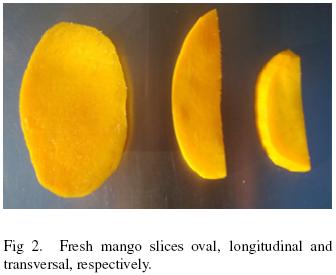
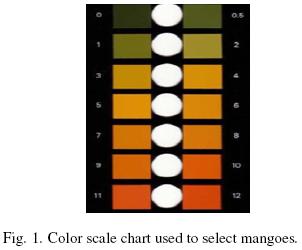
<body><![CDATA[<p align="justify"><font face="verdana" size="2"><i>2.1 Raw material</i></font></p>     <p align="justify"><font face="verdana" size="2">Mango (<i>Mangifera indica</i> L.) variety Tommy Atkins was acquired at retail from the local market "Central de Abastos" in Tepic, Nayarit. The mangoes were free of bumps or cracks. The fruit was manually selected to have similar size, rind color, maturity state and hand touch texture. The fruit length varied between 11 and 12 cm. The hand touch texture was evaluated by pressing the fruit with the fingertips to produce concave deformation. Only mangoes that showed elasticity by recovering their original shape were selected. Mangoes were hand washed and peeled manually using a stainless steel fruit peeler (Victorinox). The color scale chart shown in <a href="#f1">Fig. 1</a>, was used to select fruits with similar color. Mangoes matching pulp color level of 6 in the chart were chosen for the study.</font></p>     <p align="center"><font face="verdana" size="2"><a name="f1"></a></font></p>     <p align="center"><font face="verdana" size="2"><img src="/img/revistas/rmiq/v10n2/a12f1.jpg"></font></p>     <p align="justify"><font face="verdana" size="2">From peeled mango two primary parallel cuts to the width of the seed were done in each side of the mango. These cuts were made as close as possible to the seed, but without cutting it. From these principal cuts three different slice geom etries were obtained: longitudinal, transversal and oval. The longitudinal slice was obtained by making parallel cuts over the longest part of the primary cut getting slices with average dimensions of 11 &times; 1.0 &times;<b> </b>2.5 cm, representing length, width and height, respectively. To avoid significant differences in shape and weight only the three center portions were used for the study. The transverse slices were obtained by making parallel cuts over the widest part of the primary cut. These slices had average dimensions of 7 &times; 1.0 &times; 2.5 cm. Only four portions close to the center of the slice were used in the study. Finally, the oval slice was obtained by reducing the height of the primary cut from 2.5 cm to 1.0 cm, and keeping the thickest part of the mango. The dimensions of this piece were 11 &times; 7 &times; 1.0 cm. The three mango slices are shown in <a href="#f2">Fig. 2</a>.</font></p>     <p align="center"><font face="verdana" size="2"><a name="f2"></a></font></p>     <p align="center"><font face="verdana" size="2"><img src="/img/revistas/rmiq/v10n2/a12f2.jpg"></font></p>     <p align="justify"><font face="verdana" size="2"><i>2.2 Osmotic dehydration</i></font></p>     <p align="justify"><font face="verdana" size="2">Osmotic trays, with a load capacity of 30 kg each, were used to osmotically dehydrate the mango slices. For this study, nine trays were used, three for each of the shapes that was evaluated. On each tray 5 kg of mango slices were immersed in 25 kg (1:5) of hypertonic sucrose solution set at 67 &deg;Bx. Stainless steel grids were used as immersion traps to keep the fruit submerged in the sucrose solution. The mango slices were kept in the static hypertonic solution for 12 h at room temperature 22&#150;25 &deg;C. Afterwards, the osmotic dehydrated slices were removed from the trays and placed on a table with a center drain to draw off the osmotically diluted solution. Weight reduction, water loss and solids gain were determined after OD.</font></p>     <p align="justify"><font face="verdana" size="2"><i>2.3 Complementary microwave drying</i></font></p>     ]]></body>
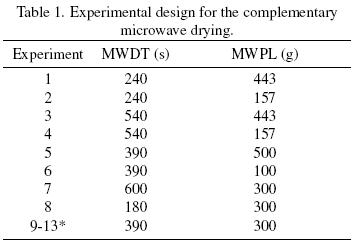
<body><![CDATA[<p align="justify"><font face="verdana" size="2">The osmotically predehydrated mango slices (oval, longitudinal and transversal) were submitted to a microwave drying process varying i) microwave drying time (MWDT) and ii) microwave plate load (MWPL). The complementary drying was done in Daewoo<sup>TM</sup> microwave ovens, model KOR&#150;164H full size, rated at 1000 watts and 2450 Mhz. The maximum power level was used.</font></p>     <p align="justify"><font face="verdana" size="2"><i>2.4 Analytical techniques</i></font></p>     <p align="justify"><font face="verdana" size="2">Weight was measured with a Torrey model L&#150;EQ 5/10 electronic balance. The concentration of &deg;Bx was measured at 20 &deg;C with an Abbe refractometer (Atago 1211 NAR&#150;1T liquid). Weight reduction (&Delta;<i>M</i>), water loss (&Delta;<i>M<sub>W</sub></i>) and solids gain (&Delta;<i>M<sub>s</sub></i>) for osmotic dehydration were calculated using the following equations (Lerici <i>et al.,</i> 1985):</font></p>     <p align="center"><font face="verdana" size="2"><img src="/img/revistas/rmiq/v10n2/a12s1.jpg"></font></p>     <p align="center"><font face="verdana" size="2"><img src="/img/revistas/rmiq/v10n2/a12s2.jpg"></font></p>     <p align="center"><font face="verdana" size="2"><img src="/img/revistas/rmiq/v10n2/a12s3.jpg"></font></p>     <p align="justify"><font face="verdana" size="2">where <i>M</i><sub>0</sub> is the initial mass (g), <i>M<sub>t</sub></i> is the final mass (g),  <img src="/img/revistas/rmiq/v10n2/a12s11.jpg"> is the initial mass fraction of water, <img src="/img/revistas/rmiq/v10n2/a12s12.jpg"> is the final mass fraction of water, <img src="/img/revistas/rmiq/v10n2/a12s13.jpg"> is the initial mass fraction of solids and  <img src="/img/revistas/rmiq/v10n2/a12s14.jpg"> is the final mass fraction of solids. Thermal damage of the product was determined by visual inspection of tissue which developed browning, typical of caramelization reactions. The superficial temperature of the mangoes was measured with a digital infrared thermometer STEREN HER&#150;425.</font></p>     <p align="justify"><font face="verdana" size="2"><i>2.5    Statistical analyses</i></font></p>     <p align="justify"><font face="verdana" size="2">To determine the effect of MWDT and MWPL, the software Design&#150;Expert<sup>TM</sup> 8.0.4 was used to design a surface response methodology with central composite design. The response variables were: &deg;Bx and slice surface final temperature (SSFT). The experimental design for each shape included 8 experiments and 5 replicates for the central point. <a href="#t1">Table 1</a> shows the experimental design for the controlled factors: i) MWDT and ii) MWPL. An ANOVA test was used to evaluate the effect of the controlled variables on the response variables. MATLAB<sup>TM</sup> 6.5 was used to generate SSFT graphs and &deg;Bx contours.</font></p>     <p align="center"><font face="verdana" size="2"><a name="t1"></a></font></p>     ]]></body>
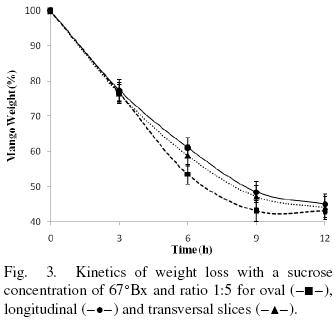
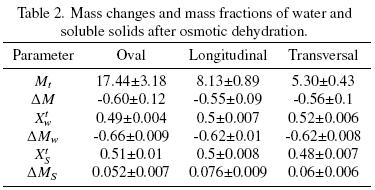
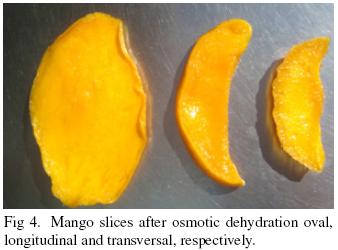
<body><![CDATA[<p align="center"><font face="verdana" size="2"><img src="/img/revistas/rmiq/v10n2/a12t1.jpg"></font></p>     <p align="justify"><font face="verdana" size="2">&nbsp;</font></p>     <p align="justify"><font face="verdana" size="2"><b>3 Results and discussion</b></font></p>     <p align="justify"><font face="verdana" size="2"><i>3.1 Osmotic dehydration</i></font></p>     <p align="justify"><font face="verdana" size="2">The fresh mango had a sugar concentration of 15&plusmn;1.2 (&deg;Bx) and water content of 0.85&plusmn;0.11. Each single slice weighted 41.2&plusmn;6.5 g, 18&plusmn;2.4 g and 12&plusmn;1.2 g, for oval, longitudinal and transversal slices, respectively. <a href="#f3">Figure 3</a> shows the kinetics of weight reduction for the different shapes. The oval slice loss more weight during the first nine hours of the kinetics. After 12 hours of osmotic dehydration all the shapes had similar weight reduction. However, the oval cut lost 60% of its weight followed closely by the transversal and longitudinal pieces. <a href="#t2">Table 2</a> shows the results for weight reduction (&Delta;<i>M</i>), water loss (&Delta;<i>M<sub>W</sub></i>) and solids gain (&Delta;<i>M<sub>S</sub></i>) after the osmotic dehydration. The longitudinal cut showed the greatest incorporation of grams of solute into the initial mass of the sample during the OD. The oval slice had the minor solid gain. <a href="#f4">Figure 4</a> shows mango slices after osmotic dehydration. According to the ANOVA no significant differences were present for &Delta;<i>M</i>, &Delta;<i>M<sub>W</sub></i> and &Delta;<i>M<sub>S</sub></i> after the OD.</font></p>     <p align="center"><font face="verdana" size="2"><a name="f3"></a></font></p>     <p align="center"><font face="verdana" size="2"><img src="/img/revistas/rmiq/v10n2/a12f3.jpg"></font></p>     <p align="center"><font face="verdana" size="2"><a name="t2"></a></font></p>     <p align="center"><font face="verdana" size="2"><img src="/img/revistas/rmiq/v10n2/a12t2.jpg"></font></p>     <p align="center"><font face="verdana" size="2"><a name="f4"></a></font></p>     ]]></body>
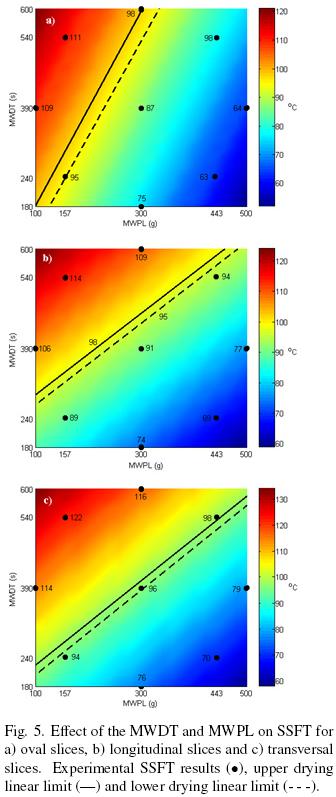
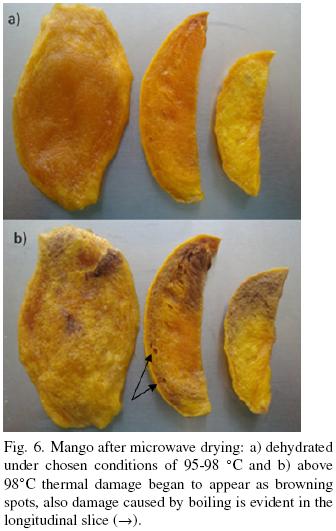
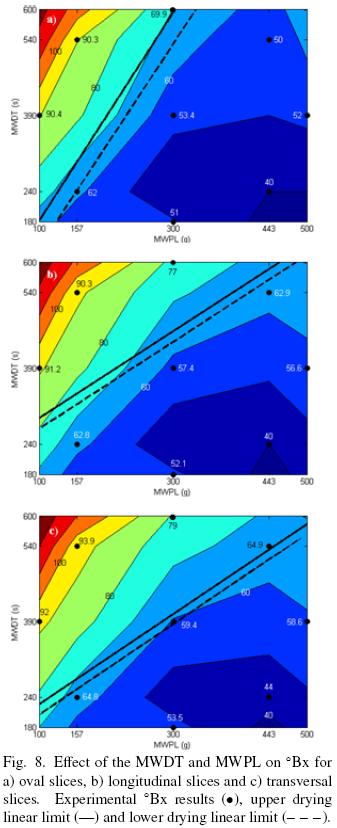
<body><![CDATA[<p align="center"><font face="verdana" size="2"><img src="/img/revistas/rmiq/v10n2/a12f4.jpg"></font></p>     <p align="justify"><font face="verdana" size="2"><i>3.2 Complementary microwave drying</i></font></p>     <p align="justify"><font face="verdana" size="2">After OD, a complementary microwave drying was performed according to the experimental design described in the methodology section. The results of experimental data slice surface final temperature (SSFT) and &deg;Bx was fitted to a response surface described as a function of two controlled variables: complementary microwave drying time (MWDT) and microwave plate load (MWPL).</font></p>     <p align="justify"><font face="verdana" size="2"><i>3.2.1 Effect of MWD on SSFT</i></font></p>     <p align="justify"><font face="verdana" size="2">Mango temperature was immediately measured on the surface of the slice after MWD for each condition tested in the experimental design. From these data, a response surface describing the SSFT was obtained, as shown in <a href="#f5">Figs. 5a</a>, <a href="#f5">b</a>, and <a href="#f5">c</a>, for oval, longitudinal and transversal cuts, respectively. The plane area in the figures describes the mango temperature gradients against the different conditions tested for MWPL and MWDT. Color bars in the figures represent the temperature reached by the slices during MWD. It was determined by visual inspection that at temperatures above 100&deg;C thermal damage appeared in all the slices. This was characterized by browning zones over the pieces. However, no thermal damage was observed in any of the slices at temperatures between 95&deg;C to 98&deg;C. Moreover, under those temperatures, some slices lost maximum weight 35% to 45%. This may be explained as follows: when a fruit is heated to the boiling point of water, the fruit temperature remains stable while water evaporates and the fruit is losing weight. After most of the water has evaporated from the fruit, the temperature rises above the boiling point, browning the fruit, and consequently damaging the tissue. The current study was carried out in Tepic, Nayarit, which has an altitude of 920 meters over the sea level, where the boiling point of water is 98 &deg;C.</font></p>     <p align="justify"><font face="verdana" size="2">Based on these results, it was decided that a proper temperature for MWD without thermal damage and maximize weight loss is between 95 to 98&deg;C. In order to find the proper combinations of  MWPL and MWDT in this favorable temperature region, two linear regressions were computed from the interpolated data of SSFT for all the MWD slices. One regression represented all the MWPL and MWDT values that gave a temperature upper limit of 98&deg;C, since temperatures above this value produce thermal damage. A second line, representing all the combinations of MWPL and MWDT that gave a temperature lower limits of 95&#150;96 &deg;C, was found for all the slices. Dried products below that line would not be completely processed. Finally, the zone between the two linear regressions represents the conditions where no thermal damage is shown and maximum weight reduction is achieved.</font></p>     <p align="justify"><font face="verdana" size="2"><i>3.2.2 Oval slice</i></font></p>     <p align="justify"><font face="verdana" size="2"><a href="#f5">Figure 5a</a> shows the temperatures profile of SSFT for the oval slice. Filled circles represent the results for all of the experimental conditions tested. It can be appreciated from the interpolated temperature surface that, at a low MWPL of 100 g and high treatment times of 600 s, this slice reaches a maximum temperature of 121&deg;C. On the other hand, the minimum temperature of 52&deg;C was given at high MWPL of 500 g and low MWDT of 180 s. The zone bounded between the solid and dashed lines in <a href="#f5">figure 5a</a> represents those conditions of MWDT and MWPL that provide the desired temperature of 95&deg;C to 98&deg;C. This linear relationship are given by the equations</font></p>     <p align="center"><font face="verdana" size="2"><img src="/img/revistas/rmiq/v10n2/a12s4.jpg"></font></p>     <p align="center"><font face="verdana" size="2"><img src="/img/revistas/rmiq/v10n2/a12s5.jpg"></font></p>     ]]></body>
<body><![CDATA[<p align="center"><a name="f5"></a></p>     <p align="center"><img src="/img/revistas/rmiq/v10n2/a12f5.jpg"></p>     <p align="justify"><font face="verdana" size="2">where <i>x</i> represents MWPL, y <i>_H</i> (high limit) and y <i>_L</i> (low limit) stands for MWDT. According to eqs. (4)&#150;(5), the oval slice was the first to reach the zone of 95&#150;98&deg;C with MWDT ranging from 180 to 182 s and MWPL from 100 to 126 g. However, the oval cut doubles the time required to dry the same load in comparison to the longitudinal and transversal slices. This is evident from the high value of the slope in eqs. (4)&#150;(5). Consequently drying 500 g of fruit in the favorable zone (95&#150;98&deg;C) will require 935 to 1006 s. The maximum load to dry at 600 s varied from 302 to 334 g of MWPL.</font></p>     <p align="justify"><font face="verdana" size="2"><i>3.2.3 Longitudinal slice</i></font></p>     <p align="justify"><font face="verdana" size="2">During the MWD, the longitudinal cut reached 124&deg;C at low MWPL of 100 g and 600 s of MWDT as shown in <a href="#f5">Fig. 5b</a>. The minimum temperature of 59&deg;C was given at MWPL of 500 g and MWDT of 180 s. MWDT and MWPL conditions to reach to the zone 95&#150;98&deg;C are given by the linear relationships (6)&#150;(7)</font></p>     <p align="center"><font face="verdana" size="2"><img src="/img/revistas/rmiq/v10n2/a12s6.jpg"></font></p>     <p align="center"><font face="verdana" size="2"><img src="/img/revistas/rmiq/v10n2/a12s7.jpg"></font></p>     <p align="justify"><font face="verdana" size="2">The nomenclature for <i>x</i>, <i>y_H</i> and <i>y_L </i>is the same as already defined for the oval cut and also applies to the transversal slice. The linear eqs. (6)&#150;(7) for the longitudinal slices had the minor slope from all the cuts. It required 270 to 291 s of MWDT to reach the desired range of 95&#150;98&deg;C at MWPL of 100 g. To dry maximum loads of 500 g in the desired range will require 614 to 634 s of MWDT. The maximum load that could be dried at 600 s varied from 458 to 482 g of MWPL. In the experimental condition of 300 g of MWPL and 600 s of MWDT, a temperature of 109&deg;C was reached.</font></p>     <p align="justify"><font face="verdana" size="2"><i>3.2.4 Transversal slice</i></font></p>     <p align="justify"><font face="verdana" size="2">This slice reached the highest temperature during MWD, reaching 134&deg;C at a low MWPL of 100 g and 600 s of MWDT as shown in <a href="#f5">Fig. 5c</a>. The minimum temperature of 59&deg;C was similar to the longitudinal cut at MWPL of 500 g and MWDT of 180 s. The MWDT and MWPL conditions that achiev e a temperature range of 95&#150;98&deg;C, are given by the following linear relationships:</font></p>     ]]></body>
<body><![CDATA[<p align="center"><font face="verdana" size="2"><img src="/img/revistas/rmiq/v10n2/a12s8.jpg"></font></p>     <p align="center"><font face="verdana" size="2"><img src="/img/revistas/rmiq/v10n2/a12s9.jpg"></font></p>     <p align="justify"><font face="verdana" size="2">The linear equation for this slice had a slope a little greater than the longitudinal slice. With this slice, it was possible to dry loads in the favorable zone (95&#150;98&deg;C) within treatment times given in the experimental design (180 to 600s). For instance, 205 to 225 s of MWDT were needed to reach the temperature range of 95&#150;98&deg;C at a low MWPL of 100 g, and it only required 564 to 584 s to dry the maximum MWLP of 500 g.</font></p>     <p align="justify"><font face="verdana" size="2">For loads from 100 to 170 g the oval slice could be dried faster than the other two cuts (182 to 268 s) at the desired temperature range of 95&#150;98&deg;C. Nevertheless, at loads higher than 170 g, the oval slice required twice the time needed by the longitudinal and transversal cuts to dry similar medium and high loads. The transversal slice dried most plate loads (170 to 500 g) in less drying time (268 to 600 s). In comparison to the transversal slice, the longitudinal cut took a bit longer to dry similar loads, i.e., drying MWPL of 500 g required 35 additional seconds. The ov al and longitudinal slices had similar lengths. Nevertheless the oval slice is seven times wider than longitudinal. This difference may explain the increase of almost 240% in the value of the slope of the linear models, and consequently it takes longer to dry this piece.</font></p>     <p align="justify"><font face="verdana" size="2">Based on the ANOVA analysis (<i>p </i>&lt; 0.05), the controlled factors MWDT and MWPL had a significant effect on response variable SSFT <a href="#f6">Fig. 6a</a> shows the mango slice after M W D. I t ca n be appreciated that, at the desired tem perature of 95&#150;98&deg;C, the mango was properly dried. However, at temperatures above 100&deg;C, thermal damage occurs for all the slices, as shown in <a href="#f6">Fig. 6b</a>. Thus mango surface temperature is an important factor during MWD.</font></p>     <p align="center"><font face="verdana" size="2"><a name="f6"></a></font></p>     <p align="center"><font face="verdana" size="2"><img src="/img/revistas/rmiq/v10n2/a12f6.jpg"></font></p>     <p align="justify"><font face="verdana" size="2"><i>3.3 Effect ofMWD on final &deg;Bx</i></font></p>     <p align="justify"><font face="verdana" size="2">From the experimental design, the controlled factors MWDT and MWPL proved to have significant effect (<i>p </i>&lt; 0.05) on the response variable &deg;Bx. The results from the response variable &deg;Bx were fitted to a mathematical model given by:</font></p>     <p align="center"><font face="verdana" size="2"><img src="/img/revistas/rmiq/v10n2/a12s10.jpg"></font></p>     ]]></body>
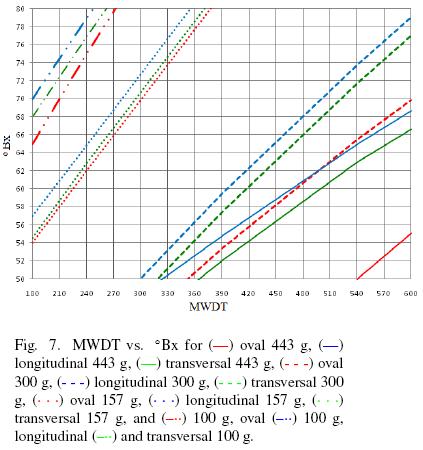
<body><![CDATA[<p align="justify"><font face="verdana" size="2">The three adjusted models had determination coefficients, <i>R<sup>2</sup> </i>&gt; 0.90. <a href="#f7">Fig. 7</a> shows the response variable &deg;Bx vs. MWDT at different MWPL (100, 157, 300 and 443 g). In this figure, it can be appreciated that under those MWPL, the oval is the slice with the lowest &deg;Bx concentrations. Meanwhile, the transversal slice obtained the highest &deg;Bx value under the tested MWPL conditions. This behavior is consistent regardless of the MWDT and the MWPL processed. This can be explained by the fact that the transversals have more area exposed to microwaves for the same load weight than the other slices, so it is easier to dry. The oval slice has the least area but the greatest mass exposed to microwaves and therefore the most difficult to dry. This behavior is similar to that observed when the temperature increased on the surface of the slice during MWD.</font></p>     <p align="center"><font face="verdana" size="2"><a name="f7"></a></font></p>     <p align="center"><font face="verdana" size="2"><img src="/img/revistas/rmiq/v10n2/a12f7.jpg"></font></p>     <p align="justify"><font face="verdana" size="2">The contour areas in the <a href="#f8">Fig. 8</a> describe the &deg;Bx profile under the different con dition s tested for MWPL and MWDT. The black filled circles are the &deg;Bx values obtained from the experimental design. The zone between the solid and the dashed lines represents the temperature range (95&#150;98&deg;C) where no thermal damage was shown and maximum weight reduction was achieved. In <a href="#f8">Fig. 8a</a>, it can be seen that for the oval slice in the desired drying zone, the soluble solids fluctuated from 60 to 67 &deg;Bx at low MWLP of 100 to 126 g. At MWLP of 302 to 334 s concentrations of 70 to 66 &deg;Bx were achieved for this slice. Sugar concentrations for the longitudinal slice in the favorable drying zone varied from 80 to 82 &deg;Bx at MWLP of 100 g, as can be seen in <a href="#f8">fig 8b</a>. Sugar concentrations from 66 to 64 &deg;Bx were achieved for high plate loads of 458 to 482 g. Finally, the transversal slice in the desired drying region achieved 74&#150;77 &deg;Bx at MWPL of 100 g, as shown in <a href="#f8">figure 8c</a>. At MWPL of 500 g, sugar concentrations varying from 65 to 63 &deg;Bx were achieved. Satisfactory concentrations greater than 63 &deg;Bx were achieved for the longitudinal and transversal slices at high MWPL close to 500 g.</font></p>     <p align="center"><font face="verdana" size="2"><a name="f8"></a></font></p>     <p align="center"><font face="verdana" size="2"><img src="/img/revistas/rmiq/v10n2/a12f8.jpg"></font></p>     <p align="justify"><font face="verdana" size="2">Thermal damage is an undesired characteristic during microwave drying. In addition, shrinkage may give a negative impression to consumers and can be considered to be a food quality problem (Santacruz&#150;V&aacute;zquez <i>et al.,</i> 2008). Tripathy and Kumar, 2009 determined that the water absorption of a dried product is influenced primarily by the rehydration temperature, followed by sample shape and method of drying. According to Schiffmann, (1986), the shape and the size of the product may influence microwave processing, and the presence of thin edges and corners could result in overheating. Therefore, the shape of these similar slices had a direct influence on thermal damage. Microwave power level can contribute to overheating and burning (Drouzas and Schubert, 1996, Andr&eacute;s <i>et al.,</i> 2007). This may explain why the transversal slice reached higher temperatures (134&deg;C) causing more thermal damage than for the other two shapes. Nevertheless, at the desired temperature range 95&#150;98&deg;C, the transversal slice proved to be the slice that could dry most plate loads (170 to 500 g) in the least drying time (268 to 600 s) and at the sugar contents of (77 to 63 &deg;Bx). The oval cut achieved concentrations close to 70 &deg;Bx at a medium MWPL of 300 g and a high MWDT of 600 s. Although this may appear to be a fine characteristic; it is eclipsed when compared<sup> </sup>with the MWDTs of the other two slices. The oval cut doubles the time (1006 s) required to dry 500 g of MWPL, increasing the consumption of microwave power and consequently the process drying costs. Thus MWPL and MWDT are important issues on SSFT and &deg;Bx during MWD. In addition, OD proves to be favorable to MWD; since drying fresh mango without OD requires higher drying rates (Andr&eacute;s <i>et al.,</i> 2007), because the fruit lost more mass, since there is no prior addition of soluble solids (Moreno <i>et al.,</i> 2010).</font></p>     <p align="justify"><font face="verdana" size="2">&nbsp;</font></p>     <p align="justify"><font face="verdana" size="2"><b>Conclusions</b></font></p>     <p align="justify"><font face="verdana" size="2">During complementary microwave drying, the controlled variables microwave drying time and microwave plate load showed significant effect on &deg;Bx and slice surface final temperature. A proper drying temperature range where there is no thermal damage and maximum weight loss (35&#150;45%) is achieved for all the slices is from 95 to 98&deg;C. It was possible to determine microwave drying times and microwave plate load conditions to reach this favorable range using mathematical linear functions. Of the three shapes evaluated, the transversal cut proved to be the slice that dried the most plate loads (170 to 500 g), in the shortest drying time (268 to 600 s) with the highest sugar concentration of (77 to 63 &deg;Bx).</font></p>     ]]></body>
<body><![CDATA[<p align="justify"><font face="verdana" size="2">&nbsp;</font></p>     <p align="justify"><font face="verdana" size="2"><b>Acknowledgments</b></font></p>     <p align="justify"><font face="verdana" size="2">The authors would like to thank the Consejo Nacional de Ciencia y Tecnolog&iacute;a (CONACYT) and the Fondo Mixto Nayarit for their support granted to project 92071. We would also thank John Dye of Peace Corps M&eacute;xico for helping in the preparation of this manuscript.</font></p>     <p align="justify"><font face="verdana" size="2">&nbsp;</font></p>     <p align="justify"><font face="verdana" size="2"><b>Abbreviations</b></font></p>     <p align="justify"><font face="verdana" size="2">&deg;Bx Brix degrees</font></p>     <p align="justify"><font face="verdana" size="2">MWD complementary microwave drying</font></p>     <p align="justify"><font face="verdana" size="2">MWDT complementary microwave drying time, s</font></p>     <p align="justify"><font face="verdana" size="2">MWPL microwave plate load, g</font></p>     <p align="justify"><font face="verdana" size="2">SSFT slice surface final temperature, &deg;C</font></p>     ]]></body>
<body><![CDATA[<p align="justify"><font face="verdana" size="2">&nbsp;</font></p>     <p align="justify"><font face="verdana" size="2"><b>References</b></font></p>     <!-- ref --><p align="justify"><font face="verdana" size="2">Andr&eacute;s, A., Fito, P., Heredia, A. and Rosa, E.M. (2007). Combined drying technologies for development of high&#150;quality shelf&#150;stable mango products. <i>Drying Technology 25</i> (11), 1857&#150;1866.    &nbsp;&nbsp;&nbsp;&nbsp;&nbsp;&nbsp;&nbsp;&nbsp;[&#160;<a href="javascript:void(0);" onclick="javascript: window.open('/scielo.php?script=sci_nlinks&ref=8546741&pid=S1665-2738201100020001200001&lng=','','width=640,height=500,resizable=yes,scrollbars=1,menubar=yes,');">Links</a>&#160;]<!-- end-ref --></font></p>     <!-- ref --><p align="justify"><font face="verdana" size="2">Beaudry, C., Raghavan, G.S.V. and Rennie, T.J. (2003). Microwave finish drying of osmotically dehydrated cranberries. <i>Drying Technology 21</i> (9), 1797&#150;1810.    &nbsp;&nbsp;&nbsp;&nbsp;&nbsp;&nbsp;&nbsp;&nbsp;[&#160;<a href="javascript:void(0);" onclick="javascript: window.open('/scielo.php?script=sci_nlinks&ref=8546743&pid=S1665-2738201100020001200002&lng=','','width=640,height=500,resizable=yes,scrollbars=1,menubar=yes,');">Links</a>&#160;]<!-- end-ref --></font></p>     <!-- ref --><p align="justify"><font face="verdana" size="2">Brennan, J.C., Butters, J.R., Cowell, N.D. and Lilly, A.E. (1990). <i>Food Engineering Operations</i>, Applied Science Editors, London.    &nbsp;&nbsp;&nbsp;&nbsp;&nbsp;&nbsp;&nbsp;&nbsp;[&#160;<a href="javascript:void(0);" onclick="javascript: window.open('/scielo.php?script=sci_nlinks&ref=8546745&pid=S1665-2738201100020001200003&lng=','','width=640,height=500,resizable=yes,scrollbars=1,menubar=yes,');">Links</a>&#160;]<!-- end-ref --></font></p>     <!-- ref --><p align="justify"><font face="verdana" size="2">Chou, S.K. and Chua, K.J. (2001). New hybrid drying technologies for heat sensitive foodstuffs. <i>Trends   in   Food   Science   and Technology 12</i> (10), 359&#150;369.    &nbsp;&nbsp;&nbsp;&nbsp;&nbsp;&nbsp;&nbsp;&nbsp;[&#160;<a href="javascript:void(0);" onclick="javascript: window.open('/scielo.php?script=sci_nlinks&ref=8546747&pid=S1665-2738201100020001200004&lng=','','width=640,height=500,resizable=yes,scrollbars=1,menubar=yes,');">Links</a>&#160;]<!-- end-ref --></font></p>     ]]></body>
<body><![CDATA[<!-- ref --><p align="justify"><font face="verdana" size="2">Chua, K.J., Mujumdar, A.S., Chou, S.K., Hawlader, M.N.A. and Ho, H.C. (2000). Convective drying of banana, guava and potato pieces: effect of cyclical variations of air temperature on drying kinetics and color change. <i>Drying Technology 18</i> (4, 5), 907&#150;936.    &nbsp;&nbsp;&nbsp;&nbsp;&nbsp;&nbsp;&nbsp;&nbsp;[&#160;<a href="javascript:void(0);" onclick="javascript: window.open('/scielo.php?script=sci_nlinks&ref=8546749&pid=S1665-2738201100020001200005&lng=','','width=640,height=500,resizable=yes,scrollbars=1,menubar=yes,');">Links</a>&#160;]<!-- end-ref --></font></p>     <!-- ref --><p align="justify"><font face="verdana" size="2">Clark, D.E. (1996). Microwave processing of materials. <i>Annual Review of Materials Science 26</i>, 299&#150;331</font>&nbsp;&nbsp;&nbsp;&nbsp;&nbsp;&nbsp;&nbsp;&nbsp;[&#160;<a href="javascript:void(0);" onclick="javascript: window.open('/scielo.php?script=sci_nlinks&ref=8546751&pid=S1665-2738201100020001200006&lng=','','width=640,height=500,resizable=yes,scrollbars=1,menubar=yes,');">Links</a>&#160;]<!-- end-ref --><!-- ref --><p align="justify"><font face="verdana" size="2">Drouzas, A.E. and Schubert, H. (1996). Microwave application in vacuum drying of fruits. <i>Journal of Food Engineering 28</i> (2), 203&#150;209.    &nbsp;&nbsp;&nbsp;&nbsp;&nbsp;&nbsp;&nbsp;&nbsp;[&#160;<a href="javascript:void(0);" onclick="javascript: window.open('/scielo.php?script=sci_nlinks&ref=8546752&pid=S1665-2738201100020001200007&lng=','','width=640,height=500,resizable=yes,scrollbars=1,menubar=yes,');">Links</a>&#160;]<!-- end-ref --></font></p>     <!-- ref --><p align="justify"><font face="verdana" size="2">Erle, U. (2005). Drying using microwave processing. In: <i>Microwave Processing of Foods.</i> (Schubert, H. and Regier, M. Ed.), Pp. 142&#150;152.Woodhead Publishing Limited, Cambridge England.    &nbsp;&nbsp;&nbsp;&nbsp;&nbsp;&nbsp;&nbsp;&nbsp;[&#160;<a href="javascript:void(0);" onclick="javascript: window.open('/scielo.php?script=sci_nlinks&ref=8546754&pid=S1665-2738201100020001200008&lng=','','width=640,height=500,resizable=yes,scrollbars=1,menubar=yes,');">Links</a>&#160;]<!-- end-ref --></font></p>     <!-- ref --><p align="justify"><font face="verdana" size="2">Fito, P., Chiralt, A., Barat, J.M.M., Andr&eacute;s, A., Mart&iacute;nez, M.J. and Mart&iacute;nez, N.N. (2001). Vacuum impregnation for development of new dehydrated products. <i>Journal of Food Engineering 49</i> (4), 297&#150;302.    &nbsp;&nbsp;&nbsp;&nbsp;&nbsp;&nbsp;&nbsp;&nbsp;[&#160;<a href="javascript:void(0);" onclick="javascript: window.open('/scielo.php?script=sci_nlinks&ref=8546756&pid=S1665-2738201100020001200009&lng=','','width=640,height=500,resizable=yes,scrollbars=1,menubar=yes,');">Links</a>&#160;]<!-- end-ref --></font></p>     <!-- ref --><p align="justify"><font face="verdana" size="2">Giraldo, G., Talens, P., Fito, P. and Chiralt, A. (2003). Influence of sucrose solution concentration on kinetics and yield during osmotic dehydration of mango. <i>Journal of Food Engineering 58</i> (1), 33&#150;43.    &nbsp;&nbsp;&nbsp;&nbsp;&nbsp;&nbsp;&nbsp;&nbsp;[&#160;<a href="javascript:void(0);" onclick="javascript: window.open('/scielo.php?script=sci_nlinks&ref=8546758&pid=S1665-2738201100020001200010&lng=','','width=640,height=500,resizable=yes,scrollbars=1,menubar=yes,');">Links</a>&#160;]<!-- end-ref --></font></p>     <!-- ref --><p align="justify"><font face="verdana" size="2">Ito, A.P., Cavenaghi, M., Bertoldo, C., Park, K.J. and Hubinger, M.D. (2007). Effeito do processo de desidrata&ccedil;&atilde;o osm&oacute;tica a pulso de v&aacute;cuo na transfer&ecirc;ncia de massa e nas propriedades reol&oacute;gicas e de cor de fatias de manga. <i>Ci&ecirc;ncia e Tecnologia de Alimentos 27</i> (1), 54&#150;63.    &nbsp;&nbsp;&nbsp;&nbsp;&nbsp;&nbsp;&nbsp;&nbsp;[&#160;<a href="javascript:void(0);" onclick="javascript: window.open('/scielo.php?script=sci_nlinks&ref=8546760&pid=S1665-2738201100020001200011&lng=','','width=640,height=500,resizable=yes,scrollbars=1,menubar=yes,');">Links</a>&#160;]<!-- end-ref --></font></p>     <!-- ref --><p align="justify"><font face="verdana" size="2">Kumar, P.S., Sagar, V.R. and Singh, U. (2006). Effect of tray load on drying kinetics of mango, guava and aonla. <i>Journal of Scientific &amp; Industrial Research 65</i> (8), 659&#150;664.    &nbsp;&nbsp;&nbsp;&nbsp;&nbsp;&nbsp;&nbsp;&nbsp;[&#160;<a href="javascript:void(0);" onclick="javascript: window.open('/scielo.php?script=sci_nlinks&ref=8546762&pid=S1665-2738201100020001200012&lng=','','width=640,height=500,resizable=yes,scrollbars=1,menubar=yes,');">Links</a>&#160;]<!-- end-ref --></font></p>     <!-- ref --><p align="justify"><font face="verdana" size="2">Lerici, C.L., Pinnavaia, G., Dalla Rosa, M. and Bartolucci, L. (1985). Osmotic dehydration of fruit: influence of osmotic agents on drying behaviour and product quality. <i>Journal Food Science 50</i>(5), 1217&#150;1219.    &nbsp;&nbsp;&nbsp;&nbsp;&nbsp;&nbsp;&nbsp;&nbsp;[&#160;<a href="javascript:void(0);" onclick="javascript: window.open('/scielo.php?script=sci_nlinks&ref=8546764&pid=S1665-2738201100020001200013&lng=','','width=640,height=500,resizable=yes,scrollbars=1,menubar=yes,');">Links</a>&#160;]<!-- end-ref --></font></p>     <!-- ref --><p align="justify"><font face="verdana" size="2">Lakshminarayana, S. (1980). Mango. In: <i>Tropical and Subtropical Fruits: Composition, Properties and Uses</i>, (S. Nagy and P.P. Shaw, Eds.), Pp. 184&#150;257. Avi Publishing, Westport, Connecticut.    &nbsp;&nbsp;&nbsp;&nbsp;&nbsp;&nbsp;&nbsp;&nbsp;[&#160;<a href="javascript:void(0);" onclick="javascript: window.open('/scielo.php?script=sci_nlinks&ref=8546766&pid=S1665-2738201100020001200014&lng=','','width=640,height=500,resizable=yes,scrollbars=1,menubar=yes,');">Links</a>&#160;]<!-- end-ref --></font></p>     <!-- ref --><p align="justify"><font face="verdana" size="2">Machado&#150;Velasco, K.M. and V&eacute;lez&#150;Ruiz, J.F. (2008). Estudio de propiedades f&iacute;sicas de alimentos mexicanos durante la congelaci&oacute;n y el almacenamiento congelado. <i>Revista Mexicana de Ingenier&iacute;a Qu&iacute;mica 7,</i> 41&#150;54.    &nbsp;&nbsp;&nbsp;&nbsp;&nbsp;&nbsp;&nbsp;&nbsp;[&#160;<a href="javascript:void(0);" onclick="javascript: window.open('/scielo.php?script=sci_nlinks&ref=8546768&pid=S1665-2738201100020001200015&lng=','','width=640,height=500,resizable=yes,scrollbars=1,menubar=yes,');">Links</a>&#160;]<!-- end-ref --></font></p>     <!-- ref --><p align="justify"><font face="verdana" size="2">Madamba, P.S. and Lopez, R.I. (2002). Optimization of the osmotic dehydration of mango ( <i>Mangifera indica</i> L.)    slices. <i>Drying Technology 20</i> (6), 1227&#150;1242.    &nbsp;&nbsp;&nbsp;&nbsp;&nbsp;&nbsp;&nbsp;&nbsp;[&#160;<a href="javascript:void(0);" onclick="javascript: window.open('/scielo.php?script=sci_nlinks&ref=8546770&pid=S1665-2738201100020001200016&lng=','','width=640,height=500,resizable=yes,scrollbars=1,menubar=yes,');">Links</a>&#160;]<!-- end-ref --></font></p>     <!-- ref --><p align="justify"><font face="verdana" size="2">Matusek, A. and Mer&eacute;sz, P. (2002). Modelling of sugar transfer during osmotic dehydration of carrots. <i>Periodica Polytechnica Chemical Engineering 46</i> (1, 2), 83&#150;92.    &nbsp;&nbsp;&nbsp;&nbsp;&nbsp;&nbsp;&nbsp;&nbsp;[&#160;<a href="javascript:void(0);" onclick="javascript: window.open('/scielo.php?script=sci_nlinks&ref=8546772&pid=S1665-2738201100020001200017&lng=','','width=640,height=500,resizable=yes,scrollbars=1,menubar=yes,');">Links</a>&#160;]<!-- end-ref --></font></p>     <!-- ref --><p align="justify"><font face="verdana" size="2">Mayor, L. and Sereno, A.M. (2004). Modelling shrinkage during convective drying of food materials. <i>Journal of Food Engineering 61</i> (3), 373&#150;386.    &nbsp;&nbsp;&nbsp;&nbsp;&nbsp;&nbsp;&nbsp;&nbsp;[&#160;<a href="javascript:void(0);" onclick="javascript: window.open('/scielo.php?script=sci_nlinks&ref=8546774&pid=S1665-2738201100020001200018&lng=','','width=640,height=500,resizable=yes,scrollbars=1,menubar=yes,');">Links</a>&#160;]<!-- end-ref --></font></p>     <!-- ref --><p align="justify"><font face="verdana" size="2">Moreno, A., Le&oacute;n, D., Giraldo, G. and Rios, E. (2010). Study of the physicochemical kinetics of mango (<i>Mangifera indica</i> L. Tommy Atkins) treated by combined methods of drying. <i>Dyna 77</i> (162), 75&#150;84.    &nbsp;&nbsp;&nbsp;&nbsp;&nbsp;&nbsp;&nbsp;&nbsp;[&#160;<a href="javascript:void(0);" onclick="javascript: window.open('/scielo.php?script=sci_nlinks&ref=8546776&pid=S1665-2738201100020001200019&lng=','','width=640,height=500,resizable=yes,scrollbars=1,menubar=yes,');">Links</a>&#160;]<!-- end-ref --></font></p>     <!-- ref --><p align="justify"><font face="verdana" size="2">Nijhuis, H.H., Torringa, H.M., Muresan, S., Yuksel, D., Leguijt, C. and Klock, W. (1998). Approaches to improving the quality of dried fruit and vegetables. <i>Trends in Food Science and Technology 9</i> (1), 13&#150;20.    &nbsp;&nbsp;&nbsp;&nbsp;&nbsp;&nbsp;&nbsp;&nbsp;[&#160;<a href="javascript:void(0);" onclick="javascript: window.open('/scielo.php?script=sci_nlinks&ref=8546778&pid=S1665-2738201100020001200020&lng=','','width=640,height=500,resizable=yes,scrollbars=1,menubar=yes,');">Links</a>&#160;]<!-- end-ref --></font></p>     <!-- ref --><p align="justify"><font face="verdana" size="2">Oliveira, I.M., Fernandes, F.A.N., Rodrigues, S., Sousa, P.H.M., Maia, G.A. and Figueiredo, R.W. (2006). Modelling and optimization of osmotic dehydration of banana followed by air drying. <i>Journal of Food Process Engineering 29 </i>(4), 400&#150;413.    &nbsp;&nbsp;&nbsp;&nbsp;&nbsp;&nbsp;&nbsp;&nbsp;[&#160;<a href="javascript:void(0);" onclick="javascript: window.open('/scielo.php?script=sci_nlinks&ref=8546780&pid=S1665-2738201100020001200021&lng=','','width=640,height=500,resizable=yes,scrollbars=1,menubar=yes,');">Links</a>&#160;]<!-- end-ref --></font></p>     <!-- ref --><p align="justify"><font face="verdana" size="2">Prothon, F., Ahrn&eacute;, L.M., Funebo, T., Kidman, S., Langton, M. and Sj&ouml;holm, I. (2001). Effects of combined osmotic and microwave dehydration of apple on texture, microstructure and rehydration characteristics. <i>Lebensmittel&#150;Wissenschaft und&#150;Technologie 34</i> (2), 95&#150;101.    &nbsp;&nbsp;&nbsp;&nbsp;&nbsp;&nbsp;&nbsp;&nbsp;[&#160;<a href="javascript:void(0);" onclick="javascript: window.open('/scielo.php?script=sci_nlinks&ref=8546782&pid=S1665-2738201100020001200022&lng=','','width=640,height=500,resizable=yes,scrollbars=1,menubar=yes,');">Links</a>&#160;]<!-- end-ref --></font></p>     <!-- ref --><p align="justify"><font face="verdana" size="2">Rocha, R.S.M., De Queiroz, J.H., Lopes, R., Milagres,   C.F.  and  Pinheiro,   S.M.   (2007). Antioxidant in mango (<i>Mangifera indica</i> L.) pulp.<i> Plant Foods for Human Nutrition 62</i> (1), 13&#150;17.    &nbsp;&nbsp;&nbsp;&nbsp;&nbsp;&nbsp;&nbsp;&nbsp;[&#160;<a href="javascript:void(0);" onclick="javascript: window.open('/scielo.php?script=sci_nlinks&ref=8546784&pid=S1665-2738201100020001200023&lng=','','width=640,height=500,resizable=yes,scrollbars=1,menubar=yes,');">Links</a>&#160;]<!-- end-ref --></font></p>     <!-- ref --><p align="justify"><font face="verdana" size="2">Sablani, S.S. (2006). Drying of fruits and vegetables: retention of nutritional/functional quality. <i>Drying Technology 24</i> (2), 123&#150;135.    &nbsp;&nbsp;&nbsp;&nbsp;&nbsp;&nbsp;&nbsp;&nbsp;[&#160;<a href="javascript:void(0);" onclick="javascript: window.open('/scielo.php?script=sci_nlinks&ref=8546786&pid=S1665-2738201100020001200024&lng=','','width=640,height=500,resizable=yes,scrollbars=1,menubar=yes,');">Links</a>&#160;]<!-- end-ref --></font></p>     <!-- ref --><p align="justify"><font face="verdana" size="2">Santacruz&#150;V&aacute;zquez, V., Santacruz&#150;V&aacute;zquez, C., Welti&#150;Chanes, J., Farrera&#150;Rebollo, R.R., Alamilla&#150;Beltr&aacute;n, L., Chanona&#150;P&eacute;rez J. and Guti&eacute;rrez&#150;L&oacute;pez, G.F. (2008). Effects of air&#150;drying on the shrinkage, surface temperatures and structural features of apples slabs by means of fractal analysis. <i>Revista Mexicana de Ingenier&iacute;a Qu&iacute;mica 7</i>(1), 55&#150;63.    &nbsp;&nbsp;&nbsp;&nbsp;&nbsp;&nbsp;&nbsp;&nbsp;[&#160;<a href="javascript:void(0);" onclick="javascript: window.open('/scielo.php?script=sci_nlinks&ref=8546788&pid=S1665-2738201100020001200025&lng=','','width=640,height=500,resizable=yes,scrollbars=1,menubar=yes,');">Links</a>&#160;]<!-- end-ref --></font></p>     <!-- ref --><p align="justify"><font face="verdana" size="2">Schiffmann, R.F. (1986). Food product development for microwave processing. <i>Food Technology 40</i> (6), 94&#150;98.    &nbsp;&nbsp;&nbsp;&nbsp;&nbsp;&nbsp;&nbsp;&nbsp;[&#160;<a href="javascript:void(0);" onclick="javascript: window.open('/scielo.php?script=sci_nlinks&ref=8546790&pid=S1665-2738201100020001200026&lng=','','width=640,height=500,resizable=yes,scrollbars=1,menubar=yes,');">Links</a>&#160;]<!-- end-ref --></font></p>     <!-- ref --><p align="justify"><font face="verdana" size="2">Shi, J. and Le M.M. (2002). Osmotic dehydration of foods: mass transfer and modeling aspects. <i>Food Reviews International 18 </i>(4), 305&#150;335.    &nbsp;&nbsp;&nbsp;&nbsp;&nbsp;&nbsp;&nbsp;&nbsp;[&#160;<a href="javascript:void(0);" onclick="javascript: window.open('/scielo.php?script=sci_nlinks&ref=8546792&pid=S1665-2738201100020001200027&lng=','','width=640,height=500,resizable=yes,scrollbars=1,menubar=yes,');">Links</a>&#160;]<!-- end-ref --></font></p>     <!-- ref --><p align="justify"><font face="verdana" size="2">Torres, J.D., Talens, P., Carot, J.M., Chiralt, A. and Escriche, I. (2007). Volatile profile of mango (<i>Mangifera indica</i> L.) as affected by osmotic dehydration. <i>Food Chemistry 101</i> (1), 219&#150;228.    &nbsp;&nbsp;&nbsp;&nbsp;&nbsp;&nbsp;&nbsp;&nbsp;[&#160;<a href="javascript:void(0);" onclick="javascript: window.open('/scielo.php?script=sci_nlinks&ref=8546794&pid=S1665-2738201100020001200028&lng=','','width=640,height=500,resizable=yes,scrollbars=1,menubar=yes,');">Links</a>&#160;]<!-- end-ref --></font></p>     <!-- ref --><p align="justify"><font face="verdana" size="2">Tripathy, P.P. and Kumar, S. (2009). Influence of sample geometry and rehydration temperature on quality attributes of potato dried under open sun and mixed&#150;mode solar drying.<i> International Journal of Green Energy 6</i> (2), 143&#150;156.    &nbsp;&nbsp;&nbsp;&nbsp;&nbsp;&nbsp;&nbsp;&nbsp;[&#160;<a href="javascript:void(0);" onclick="javascript: window.open('/scielo.php?script=sci_nlinks&ref=8546796&pid=S1665-2738201100020001200029&lng=','','width=640,height=500,resizable=yes,scrollbars=1,menubar=yes,');">Links</a>&#160;]<!-- end-ref --></font></p>     <!-- ref --><p align="justify"><font face="verdana" size="2">Venkatachalapathy, K. and Raghavan, G.S.V. (1999). Combined osmotic and microwave drying of strawberry. <i>Drying Technology 17</i> (4, 5), 837&#150;853.    &nbsp;&nbsp;&nbsp;&nbsp;&nbsp;&nbsp;&nbsp;&nbsp;[&#160;<a href="javascript:void(0);" onclick="javascript: window.open('/scielo.php?script=sci_nlinks&ref=8546798&pid=S1665-2738201100020001200030&lng=','','width=640,height=500,resizable=yes,scrollbars=1,menubar=yes,');">Links</a>&#160;]<!-- end-ref --></font></p>     <!-- ref --><p align="justify"><font face="verdana" size="2">Zhang, M., Tang, J., Mujumdar, A.S. and Wang, S. (2006). Trends in microwave related drying of fruits and vegetables. <i>Trends in Food Science &amp; Technology 17</i>, 524&#150;534.    &nbsp;&nbsp;&nbsp;&nbsp;&nbsp;&nbsp;&nbsp;&nbsp;[&#160;<a href="javascript:void(0);" onclick="javascript: window.open('/scielo.php?script=sci_nlinks&ref=8546800&pid=S1665-2738201100020001200031&lng=','','width=640,height=500,resizable=yes,scrollbars=1,menubar=yes,');">Links</a>&#160;]<!-- end-ref --></font></p>     <!-- ref --><p align="justify"><font face="verdana" size="2">Zhang, M., and Xu, Y.Y. (2003). Research developments of combination drying technology for fruits and vegetables at home and abroad. <i>Journal of Wuxi University of Light Industry 22</i> (6), 103&#150;106.    &nbsp;&nbsp;&nbsp;&nbsp;&nbsp;&nbsp;&nbsp;&nbsp;[&#160;<a href="javascript:void(0);" onclick="javascript: window.open('/scielo.php?script=sci_nlinks&ref=8546802&pid=S1665-2738201100020001200032&lng=','','width=640,height=500,resizable=yes,scrollbars=1,menubar=yes,');">Links</a>&#160;]<!-- end-ref --></font></p>      ]]></body><back>
<ref-list>
<ref id="B1">
<nlm-citation citation-type="journal">
<person-group person-group-type="author">
<name>
<surname><![CDATA[Andrés]]></surname>
<given-names><![CDATA[A.]]></given-names>
</name>
<name>
<surname><![CDATA[Fito]]></surname>
<given-names><![CDATA[P.]]></given-names>
</name>
<name>
<surname><![CDATA[Heredia]]></surname>
<given-names><![CDATA[A.]]></given-names>
</name>
<name>
<surname><![CDATA[Rosa]]></surname>
<given-names><![CDATA[E.M.]]></given-names>
</name>
</person-group>
<article-title xml:lang="en"><![CDATA[Combined drying technologies for development of high-quality shelf-stable mango products]]></article-title>
<source><![CDATA[Drying Technology]]></source>
<year>2007</year>
<volume>25</volume>
<numero>11</numero>
<issue>11</issue>
<page-range>1857-1866</page-range></nlm-citation>
</ref>
<ref id="B2">
<nlm-citation citation-type="journal">
<person-group person-group-type="author">
<name>
<surname><![CDATA[Beaudry]]></surname>
<given-names><![CDATA[C.]]></given-names>
</name>
<name>
<surname><![CDATA[Raghavan]]></surname>
<given-names><![CDATA[G.S.V.]]></given-names>
</name>
<name>
<surname><![CDATA[Rennie]]></surname>
<given-names><![CDATA[T.J.]]></given-names>
</name>
</person-group>
<article-title xml:lang="en"><![CDATA[Microwave finish drying of osmotically dehydrated cranberries]]></article-title>
<source><![CDATA[Drying Technology]]></source>
<year>2003</year>
<volume>21</volume>
<numero>9</numero>
<issue>9</issue>
<page-range>1797-1810</page-range></nlm-citation>
</ref>
<ref id="B3">
<nlm-citation citation-type="book">
<person-group person-group-type="author">
<name>
<surname><![CDATA[Brennan]]></surname>
<given-names><![CDATA[J.C.]]></given-names>
</name>
<name>
<surname><![CDATA[Butters]]></surname>
<given-names><![CDATA[J.R.]]></given-names>
</name>
<name>
<surname><![CDATA[Cowell]]></surname>
<given-names><![CDATA[N.D.]]></given-names>
</name>
<name>
<surname><![CDATA[Lilly]]></surname>
<given-names><![CDATA[A.E.]]></given-names>
</name>
</person-group>
<source><![CDATA[Food Engineering Operations]]></source>
<year>1990</year>
<publisher-loc><![CDATA[London ]]></publisher-loc>
<publisher-name><![CDATA[Applied Science Editors]]></publisher-name>
</nlm-citation>
</ref>
<ref id="B4">
<nlm-citation citation-type="journal">
<person-group person-group-type="author">
<name>
<surname><![CDATA[Chou]]></surname>
<given-names><![CDATA[S.K.]]></given-names>
</name>
<name>
<surname><![CDATA[Chua]]></surname>
<given-names><![CDATA[K.J.]]></given-names>
</name>
</person-group>
<article-title xml:lang="en"><![CDATA[New hybrid drying technologies for heat sensitive foodstuffs]]></article-title>
<source><![CDATA[Trends in Food Science and Technology]]></source>
<year>2001</year>
<volume>12</volume>
<numero>10</numero>
<issue>10</issue>
<page-range>359-369</page-range></nlm-citation>
</ref>
<ref id="B5">
<nlm-citation citation-type="journal">
<person-group person-group-type="author">
<name>
<surname><![CDATA[Chua]]></surname>
<given-names><![CDATA[K.J.]]></given-names>
</name>
<name>
<surname><![CDATA[Mujumdar]]></surname>
<given-names><![CDATA[A.S.]]></given-names>
</name>
<name>
<surname><![CDATA[Chou]]></surname>
<given-names><![CDATA[S.K.]]></given-names>
</name>
<name>
<surname><![CDATA[Hawlader]]></surname>
<given-names><![CDATA[M.N.A.]]></given-names>
</name>
<name>
<surname><![CDATA[Ho]]></surname>
<given-names><![CDATA[H.C.]]></given-names>
</name>
</person-group>
<article-title xml:lang="en"><![CDATA[Convective drying of banana, guava and potato pieces: effect of cyclical variations of air temperature on drying kinetics and color change]]></article-title>
<source><![CDATA[Drying Technology]]></source>
<year>2000</year>
<volume>18</volume>
<numero>4</numero><numero>5</numero>
<issue>4</issue><issue>5</issue>
<page-range>907-936</page-range></nlm-citation>
</ref>
<ref id="B6">
<nlm-citation citation-type="journal">
<person-group person-group-type="author">
<name>
<surname><![CDATA[Clark]]></surname>
<given-names><![CDATA[D.E.]]></given-names>
</name>
</person-group>
<article-title xml:lang="en"><![CDATA[Microwave processing of materials]]></article-title>
<source><![CDATA[Annual Review of Materials Science]]></source>
<year>1996</year>
<volume>26</volume>
<page-range>299-331</page-range></nlm-citation>
</ref>
<ref id="B7">
<nlm-citation citation-type="journal">
<person-group person-group-type="author">
<name>
<surname><![CDATA[Drouzas]]></surname>
<given-names><![CDATA[A.E.]]></given-names>
</name>
<name>
<surname><![CDATA[Schubert]]></surname>
<given-names><![CDATA[H.]]></given-names>
</name>
</person-group>
<article-title xml:lang="en"><![CDATA[Microwave application in vacuum drying of fruits]]></article-title>
<source><![CDATA[Journal of Food Engineering]]></source>
<year>1996</year>
<volume>28</volume>
<numero>2</numero>
<issue>2</issue>
<page-range>203-209</page-range></nlm-citation>
</ref>
<ref id="B8">
<nlm-citation citation-type="book">
<person-group person-group-type="author">
<name>
<surname><![CDATA[Erle]]></surname>
<given-names><![CDATA[U.]]></given-names>
</name>
</person-group>
<article-title xml:lang="en"><![CDATA[Drying using microwave processing]]></article-title>
<person-group person-group-type="editor">
<name>
<surname><![CDATA[Schubert]]></surname>
<given-names><![CDATA[H.]]></given-names>
</name>
<name>
<surname><![CDATA[Regier]]></surname>
<given-names><![CDATA[M.]]></given-names>
</name>
</person-group>
<source><![CDATA[Microwave Processing of Foods]]></source>
<year>2005</year>
<page-range>142-152</page-range><publisher-loc><![CDATA[Cambridge ]]></publisher-loc>
<publisher-name><![CDATA[Woodhead Publishing Limited]]></publisher-name>
</nlm-citation>
</ref>
<ref id="B9">
<nlm-citation citation-type="journal">
<person-group person-group-type="author">
<name>
<surname><![CDATA[Fito]]></surname>
<given-names><![CDATA[P.]]></given-names>
</name>
<name>
<surname><![CDATA[Chiralt]]></surname>
<given-names><![CDATA[A.]]></given-names>
</name>
<name>
<surname><![CDATA[Barat]]></surname>
<given-names><![CDATA[J.M.M.]]></given-names>
</name>
<name>
<surname><![CDATA[Andrés]]></surname>
<given-names><![CDATA[A.]]></given-names>
</name>
<name>
<surname><![CDATA[Martínez]]></surname>
<given-names><![CDATA[M.J.]]></given-names>
</name>
<name>
<surname><![CDATA[Martínez]]></surname>
<given-names><![CDATA[N.N.]]></given-names>
</name>
</person-group>
<article-title xml:lang="en"><![CDATA[Vacuum impregnation for development of new dehydrated products]]></article-title>
<source><![CDATA[Journal of Food Engineering]]></source>
<year>2001</year>
<volume>49</volume>
<numero>4</numero>
<issue>4</issue>
<page-range>297-302</page-range></nlm-citation>
</ref>
<ref id="B10">
<nlm-citation citation-type="journal">
<person-group person-group-type="author">
<name>
<surname><![CDATA[Giraldo]]></surname>
<given-names><![CDATA[G.]]></given-names>
</name>
<name>
<surname><![CDATA[Talens]]></surname>
<given-names><![CDATA[P.]]></given-names>
</name>
<name>
<surname><![CDATA[Fito]]></surname>
<given-names><![CDATA[P.]]></given-names>
</name>
<name>
<surname><![CDATA[Chiralt]]></surname>
<given-names><![CDATA[A.]]></given-names>
</name>
</person-group>
<article-title xml:lang="en"><![CDATA[Influence of sucrose solution concentration on kinetics and yield during osmotic dehydration of mango]]></article-title>
<source><![CDATA[Journal of Food Engineering]]></source>
<year>2003</year>
<volume>58</volume>
<numero>1</numero>
<issue>1</issue>
<page-range>33-43</page-range></nlm-citation>
</ref>
<ref id="B11">
<nlm-citation citation-type="journal">
<person-group person-group-type="author">
<name>
<surname><![CDATA[Ito]]></surname>
<given-names><![CDATA[A.P.]]></given-names>
</name>
<name>
<surname><![CDATA[Cavenaghi]]></surname>
<given-names><![CDATA[M.]]></given-names>
</name>
<name>
<surname><![CDATA[Bertoldo]]></surname>
<given-names><![CDATA[C.]]></given-names>
</name>
<name>
<surname><![CDATA[Park]]></surname>
<given-names><![CDATA[K.J.]]></given-names>
</name>
<name>
<surname><![CDATA[Hubinger]]></surname>
<given-names><![CDATA[M.D.]]></given-names>
</name>
</person-group>
<article-title xml:lang="pt"><![CDATA[Effeito do processo de desidratação osmótica a pulso de vácuo na transferência de massa e nas propriedades reológicas e de cor de fatias de manga]]></article-title>
<source><![CDATA[Ciência e Tecnologia de Alimentos]]></source>
<year>2007</year>
<volume>27</volume>
<numero>1</numero>
<issue>1</issue>
<page-range>54-63</page-range></nlm-citation>
</ref>
<ref id="B12">
<nlm-citation citation-type="journal">
<person-group person-group-type="author">
<name>
<surname><![CDATA[Kumar]]></surname>
<given-names><![CDATA[P.S.]]></given-names>
</name>
<name>
<surname><![CDATA[Sagar]]></surname>
<given-names><![CDATA[V.R.]]></given-names>
</name>
<name>
<surname><![CDATA[Singh]]></surname>
<given-names><![CDATA[U.]]></given-names>
</name>
</person-group>
<article-title xml:lang="en"><![CDATA[Effect of tray load on drying kinetics of mango, guava and aonla]]></article-title>
<source><![CDATA[Journal of Scientific & Industrial Research]]></source>
<year>2006</year>
<volume>65</volume>
<numero>8</numero>
<issue>8</issue>
<page-range>659-664</page-range></nlm-citation>
</ref>
<ref id="B13">
<nlm-citation citation-type="journal">
<person-group person-group-type="author">
<name>
<surname><![CDATA[Lerici]]></surname>
<given-names><![CDATA[C.L.]]></given-names>
</name>
<name>
<surname><![CDATA[Pinnavaia]]></surname>
<given-names><![CDATA[G.]]></given-names>
</name>
<name>
<surname><![CDATA[Dalla Rosa]]></surname>
<given-names><![CDATA[M.]]></given-names>
</name>
<name>
<surname><![CDATA[Bartolucci]]></surname>
<given-names><![CDATA[L.]]></given-names>
</name>
</person-group>
<article-title xml:lang="en"><![CDATA[Osmotic dehydration of fruit: influence of osmotic agents on drying behaviour and product quality]]></article-title>
<source><![CDATA[Journal Food Science]]></source>
<year>1985</year>
<volume>50</volume>
<numero>5</numero>
<issue>5</issue>
<page-range>1217-1219</page-range></nlm-citation>
</ref>
<ref id="B14">
<nlm-citation citation-type="book">
<person-group person-group-type="author">
<name>
<surname><![CDATA[Lakshminarayana]]></surname>
<given-names><![CDATA[S.]]></given-names>
</name>
</person-group>
<article-title xml:lang="en"><![CDATA[Mango]]></article-title>
<person-group person-group-type="editor">
<name>
<surname><![CDATA[Nagy]]></surname>
<given-names><![CDATA[S.]]></given-names>
</name>
<name>
<surname><![CDATA[Shaw]]></surname>
<given-names><![CDATA[P.P.]]></given-names>
</name>
</person-group>
<source><![CDATA[Tropical and Subtropical Fruits: Composition, Properties and Uses]]></source>
<year>1980</year>
<page-range>184-257</page-range><publisher-loc><![CDATA[Westport ]]></publisher-loc>
<publisher-name><![CDATA[Avi PublishingConnecticut]]></publisher-name>
</nlm-citation>
</ref>
<ref id="B15">
<nlm-citation citation-type="journal">
<person-group person-group-type="author">
<name>
<surname><![CDATA[Machado-Velasco]]></surname>
<given-names><![CDATA[K.M.]]></given-names>
</name>
<name>
<surname><![CDATA[Vélez-Ruiz]]></surname>
<given-names><![CDATA[J.F.]]></given-names>
</name>
</person-group>
<article-title xml:lang="es"><![CDATA[Estudio de propiedades físicas de alimentos mexicanos durante la congelación y el almacenamiento congelado]]></article-title>
<source><![CDATA[Revista Mexicana de Ingeniería Química]]></source>
<year>2008</year>
<volume>7</volume>
<page-range>41-54</page-range></nlm-citation>
</ref>
<ref id="B16">
<nlm-citation citation-type="journal">
<person-group person-group-type="author">
<name>
<surname><![CDATA[Madamba]]></surname>
<given-names><![CDATA[P.S.]]></given-names>
</name>
<name>
<surname><![CDATA[Lopez]]></surname>
<given-names><![CDATA[R.I.]]></given-names>
</name>
</person-group>
<article-title xml:lang="en"><![CDATA[Optimization of the osmotic dehydration of mango ( Mangifera indica L.) slices]]></article-title>
<source><![CDATA[Drying Technology]]></source>
<year>2002</year>
<volume>20</volume>
<numero>6</numero>
<issue>6</issue>
<page-range>1227-1242</page-range></nlm-citation>
</ref>
<ref id="B17">
<nlm-citation citation-type="journal">
<person-group person-group-type="author">
<name>
<surname><![CDATA[Matusek]]></surname>
<given-names><![CDATA[A.]]></given-names>
</name>
<name>
<surname><![CDATA[Merész]]></surname>
<given-names><![CDATA[P.]]></given-names>
</name>
</person-group>
<article-title xml:lang="en"><![CDATA[Modelling of sugar transfer during osmotic dehydration of carrots]]></article-title>
<source><![CDATA[Periodica Polytechnica Chemical Engineering]]></source>
<year>2002</year>
<volume>46</volume>
<numero>1</numero><numero>2</numero>
<issue>1</issue><issue>2</issue>
<page-range>83-92</page-range></nlm-citation>
</ref>
<ref id="B18">
<nlm-citation citation-type="journal">
<person-group person-group-type="author">
<name>
<surname><![CDATA[Mayor]]></surname>
<given-names><![CDATA[L.]]></given-names>
</name>
<name>
<surname><![CDATA[Sereno]]></surname>
<given-names><![CDATA[A.M.]]></given-names>
</name>
</person-group>
<article-title xml:lang="en"><![CDATA[Modelling shrinkage during convective drying of food materials]]></article-title>
<source><![CDATA[Journal of Food Engineering]]></source>
<year>2004</year>
<volume>61</volume>
<numero>3</numero>
<issue>3</issue>
<page-range>373-386</page-range></nlm-citation>
</ref>
<ref id="B19">
<nlm-citation citation-type="journal">
<person-group person-group-type="author">
<name>
<surname><![CDATA[Moreno]]></surname>
<given-names><![CDATA[A.]]></given-names>
</name>
<name>
<surname><![CDATA[León]]></surname>
<given-names><![CDATA[D.]]></given-names>
</name>
<name>
<surname><![CDATA[Giraldo]]></surname>
<given-names><![CDATA[G.]]></given-names>
</name>
<name>
<surname><![CDATA[Rios]]></surname>
<given-names><![CDATA[E.]]></given-names>
</name>
</person-group>
<article-title xml:lang="en"><![CDATA[Study of the physicochemical kinetics of mango (Mangifera indica L. Tommy Atkins) treated by combined methods of drying]]></article-title>
<source><![CDATA[Dyna]]></source>
<year>2010</year>
<volume>77</volume>
<numero>162</numero>
<issue>162</issue>
<page-range>75-84</page-range></nlm-citation>
</ref>
<ref id="B20">
<nlm-citation citation-type="journal">
<person-group person-group-type="author">
<name>
<surname><![CDATA[Nijhuis]]></surname>
<given-names><![CDATA[H.H.]]></given-names>
</name>
<name>
<surname><![CDATA[Torringa]]></surname>
<given-names><![CDATA[H.M.]]></given-names>
</name>
<name>
<surname><![CDATA[Muresan]]></surname>
<given-names><![CDATA[S.]]></given-names>
</name>
<name>
<surname><![CDATA[Yuksel]]></surname>
<given-names><![CDATA[D.]]></given-names>
</name>
<name>
<surname><![CDATA[Leguijt]]></surname>
<given-names><![CDATA[C.]]></given-names>
</name>
<name>
<surname><![CDATA[Klock]]></surname>
<given-names><![CDATA[W.]]></given-names>
</name>
</person-group>
<article-title xml:lang="en"><![CDATA[Approaches to improving the quality of dried fruit and vegetables]]></article-title>
<source><![CDATA[Trends in Food Science and Technology]]></source>
<year>1998</year>
<volume>9</volume>
<numero>1</numero>
<issue>1</issue>
<page-range>13-20</page-range></nlm-citation>
</ref>
<ref id="B21">
<nlm-citation citation-type="journal">
<person-group person-group-type="author">
<name>
<surname><![CDATA[Oliveira]]></surname>
<given-names><![CDATA[I.M.]]></given-names>
</name>
<name>
<surname><![CDATA[Fernandes]]></surname>
<given-names><![CDATA[F.A.N.]]></given-names>
</name>
<name>
<surname><![CDATA[Rodrigues]]></surname>
<given-names><![CDATA[S.]]></given-names>
</name>
<name>
<surname><![CDATA[Sousa]]></surname>
<given-names><![CDATA[P.H.M.]]></given-names>
</name>
<name>
<surname><![CDATA[Maia]]></surname>
<given-names><![CDATA[G.A.]]></given-names>
</name>
<name>
<surname><![CDATA[Figueiredo]]></surname>
<given-names><![CDATA[R.W.]]></given-names>
</name>
</person-group>
<article-title xml:lang="en"><![CDATA[Modelling and optimization of osmotic dehydration of banana followed by air drying]]></article-title>
<source><![CDATA[Journal of Food Process Engineering]]></source>
<year>2006</year>
<volume>29</volume>
<numero>4</numero>
<issue>4</issue>
<page-range>400-413</page-range></nlm-citation>
</ref>
<ref id="B22">
<nlm-citation citation-type="journal">
<person-group person-group-type="author">
<name>
<surname><![CDATA[Prothon]]></surname>
<given-names><![CDATA[F.]]></given-names>
</name>
<name>
<surname><![CDATA[Ahrné]]></surname>
<given-names><![CDATA[L.M.]]></given-names>
</name>
<name>
<surname><![CDATA[Funebo]]></surname>
<given-names><![CDATA[T.]]></given-names>
</name>
<name>
<surname><![CDATA[Kidman]]></surname>
<given-names><![CDATA[S.]]></given-names>
</name>
<name>
<surname><![CDATA[Langton]]></surname>
<given-names><![CDATA[M.]]></given-names>
</name>
<name>
<surname><![CDATA[Sjöholm]]></surname>
<given-names><![CDATA[I.]]></given-names>
</name>
</person-group>
<article-title xml:lang="en"><![CDATA[Effects of combined osmotic and microwave dehydration of apple on texture, microstructure and rehydration characteristics]]></article-title>
<source><![CDATA[Lebensmittel-Wissenschaft und-Technologie]]></source>
<year>2001</year>
<volume>34</volume>
<numero>2</numero>
<issue>2</issue>
<page-range>95-101</page-range></nlm-citation>
</ref>
<ref id="B23">
<nlm-citation citation-type="journal">
<person-group person-group-type="author">
<name>
<surname><![CDATA[Rocha]]></surname>
<given-names><![CDATA[R.S.M.]]></given-names>
</name>
<name>
<surname><![CDATA[De Queiroz]]></surname>
<given-names><![CDATA[J.H.]]></given-names>
</name>
<name>
<surname><![CDATA[Lopes]]></surname>
<given-names><![CDATA[R.]]></given-names>
</name>
<name>
<surname><![CDATA[Milagres]]></surname>
<given-names><![CDATA[C.F.]]></given-names>
</name>
<name>
<surname><![CDATA[Pinheiro]]></surname>
<given-names><![CDATA[S.M.]]></given-names>
</name>
</person-group>
<article-title xml:lang="en"><![CDATA[Antioxidant in mango (Mangifera indica L.) pulp]]></article-title>
<source><![CDATA[Plant Foods for Human Nutrition]]></source>
<year>2007</year>
<volume>62</volume>
<numero>1</numero>
<issue>1</issue>
<page-range>13-17</page-range></nlm-citation>
</ref>
<ref id="B24">
<nlm-citation citation-type="journal">
<person-group person-group-type="author">
<name>
<surname><![CDATA[Sablani]]></surname>
<given-names><![CDATA[S.S.]]></given-names>
</name>
</person-group>
<article-title xml:lang="en"><![CDATA[Drying of fruits and vegetables: retention of nutritional/functional quality]]></article-title>
<source><![CDATA[Drying Technology]]></source>
<year>2006</year>
<volume>24</volume>
<numero>2</numero>
<issue>2</issue>
<page-range>123-135</page-range></nlm-citation>
</ref>
<ref id="B25">
<nlm-citation citation-type="journal">
<person-group person-group-type="author">
<name>
<surname><![CDATA[Santacruz-Vázquez]]></surname>
<given-names><![CDATA[V.]]></given-names>
</name>
<name>
<surname><![CDATA[Santacruz-Vázquez]]></surname>
<given-names><![CDATA[C.]]></given-names>
</name>
<name>
<surname><![CDATA[Welti-Chanes]]></surname>
<given-names><![CDATA[J.]]></given-names>
</name>
<name>
<surname><![CDATA[Farrera-Rebollo]]></surname>
<given-names><![CDATA[R.R.]]></given-names>
</name>
<name>
<surname><![CDATA[Alamilla-Beltrán]]></surname>
<given-names><![CDATA[L.]]></given-names>
</name>
<name>
<surname><![CDATA[Chanona-Pérez]]></surname>
<given-names><![CDATA[J.]]></given-names>
</name>
<name>
<surname><![CDATA[Gutiérrez-López]]></surname>
<given-names><![CDATA[G.F.]]></given-names>
</name>
</person-group>
<article-title xml:lang="en"><![CDATA[Effects of air-drying on the shrinkage, surface temperatures and structural features of apples slabs by means of fractal analysis]]></article-title>
<source><![CDATA[Revista Mexicana de Ingeniería Química]]></source>
<year>2008</year>
<volume>7</volume>
<numero>1</numero>
<issue>1</issue>
<page-range>55-63</page-range></nlm-citation>
</ref>
<ref id="B26">
<nlm-citation citation-type="journal">
<person-group person-group-type="author">
<name>
<surname><![CDATA[Schiffmann]]></surname>
<given-names><![CDATA[R.F.]]></given-names>
</name>
</person-group>
<article-title xml:lang="en"><![CDATA[Food product development for microwave processing]]></article-title>
<source><![CDATA[Food Technology]]></source>
<year>1986</year>
<volume>40</volume>
<numero>6</numero>
<issue>6</issue>
<page-range>94-98</page-range></nlm-citation>
</ref>
<ref id="B27">
<nlm-citation citation-type="journal">
<person-group person-group-type="author">
<name>
<surname><![CDATA[Shi]]></surname>
<given-names><![CDATA[J.]]></given-names>
</name>
<name>
<surname><![CDATA[Le]]></surname>
<given-names><![CDATA[M.M.]]></given-names>
</name>
</person-group>
<article-title xml:lang="en"><![CDATA[Osmotic dehydration of foods: mass transfer and modeling aspects]]></article-title>
<source><![CDATA[Food Reviews International]]></source>
<year>2002</year>
<volume>18</volume>
<numero>4</numero>
<issue>4</issue>
<page-range>305-335</page-range></nlm-citation>
</ref>
<ref id="B28">
<nlm-citation citation-type="journal">
<person-group person-group-type="author">
<name>
<surname><![CDATA[Torres]]></surname>
<given-names><![CDATA[J.D.]]></given-names>
</name>
<name>
<surname><![CDATA[Talens]]></surname>
<given-names><![CDATA[P.]]></given-names>
</name>
<name>
<surname><![CDATA[Carot]]></surname>
<given-names><![CDATA[J.M.]]></given-names>
</name>
<name>
<surname><![CDATA[Chiralt]]></surname>
<given-names><![CDATA[A.]]></given-names>
</name>
<name>
<surname><![CDATA[Escriche]]></surname>
<given-names><![CDATA[I.]]></given-names>
</name>
</person-group>
<article-title xml:lang="en"><![CDATA[Volatile profile of mango (Mangifera indica L.) as affected by osmotic dehydration]]></article-title>
<source><![CDATA[Food Chemistry]]></source>
<year>2007</year>
<volume>101</volume>
<numero>1</numero>
<issue>1</issue>
<page-range>219-228</page-range></nlm-citation>
</ref>
<ref id="B29">
<nlm-citation citation-type="journal">
<person-group person-group-type="author">
<name>
<surname><![CDATA[Tripathy]]></surname>
<given-names><![CDATA[P.P.]]></given-names>
</name>
<name>
<surname><![CDATA[Kumar]]></surname>
<given-names><![CDATA[S.]]></given-names>
</name>
</person-group>
<article-title xml:lang="en"><![CDATA[Influence of sample geometry and rehydration temperature on quality attributes of potato dried under open sun and mixed-mode solar drying]]></article-title>
<source><![CDATA[International Journal of Green Energy]]></source>
<year>2009</year>
<volume>6</volume>
<numero>2</numero>
<issue>2</issue>
<page-range>143-156</page-range></nlm-citation>
</ref>
<ref id="B30">
<nlm-citation citation-type="journal">
<person-group person-group-type="author">
<name>
<surname><![CDATA[Venkatachalapathy]]></surname>
<given-names><![CDATA[K.]]></given-names>
</name>
<name>
<surname><![CDATA[Raghavan]]></surname>
<given-names><![CDATA[G.S.V.]]></given-names>
</name>
</person-group>
<article-title xml:lang="en"><![CDATA[Combined osmotic and microwave drying of strawberry]]></article-title>
<source><![CDATA[Drying Technology]]></source>
<year>1999</year>
<volume>17</volume>
<numero>4</numero><numero>5</numero>
<issue>4</issue><issue>5</issue>
<page-range>837-853</page-range></nlm-citation>
</ref>
<ref id="B31">
<nlm-citation citation-type="journal">
<person-group person-group-type="author">
<name>
<surname><![CDATA[Zhang]]></surname>
<given-names><![CDATA[M.]]></given-names>
</name>
<name>
<surname><![CDATA[Tang]]></surname>
<given-names><![CDATA[J.]]></given-names>
</name>
<name>
<surname><![CDATA[Mujumdar]]></surname>
<given-names><![CDATA[A.S.]]></given-names>
</name>
<name>
<surname><![CDATA[Wang]]></surname>
<given-names><![CDATA[S.]]></given-names>
</name>
</person-group>
<article-title xml:lang="en"><![CDATA[Trends in microwave related drying of fruits and vegetables]]></article-title>
<source><![CDATA[Trends in Food Science & Technology]]></source>
<year>2006</year>
<volume>17</volume>
<page-range>524-534</page-range></nlm-citation>
</ref>
<ref id="B32">
<nlm-citation citation-type="journal">
<person-group person-group-type="author">
<name>
<surname><![CDATA[Zhang]]></surname>
<given-names><![CDATA[M.]]></given-names>
</name>
<name>
<surname><![CDATA[Xu]]></surname>
<given-names><![CDATA[Y.Y.]]></given-names>
</name>
</person-group>
<article-title xml:lang="en"><![CDATA[Research developments of combination drying technology for fruits and vegetables at home and abroad]]></article-title>
<source><![CDATA[Journal of Wuxi University of Light Industry]]></source>
<year>2003</year>
<volume>22</volume>
<numero>6</numero>
<issue>6</issue>
<page-range>103-106</page-range></nlm-citation>
</ref>
</ref-list>
</back>
</article>