<?xml version="1.0" encoding="ISO-8859-1"?><article xmlns:mml="http://www.w3.org/1998/Math/MathML" xmlns:xlink="http://www.w3.org/1999/xlink" xmlns:xsi="http://www.w3.org/2001/XMLSchema-instance">
<front>
<journal-meta>
<journal-id>1665-2738</journal-id>
<journal-title><![CDATA[Revista mexicana de ingeniería química]]></journal-title>
<abbrev-journal-title><![CDATA[Rev. Mex. Ing. Quím]]></abbrev-journal-title>
<issn>1665-2738</issn>
<publisher>
<publisher-name><![CDATA[Universidad Autónoma Metropolitana, División de Ciencias Básicas e Ingeniería]]></publisher-name>
</publisher>
</journal-meta>
<article-meta>
<article-id>S1665-27382010000100005</article-id>
<title-group>
<article-title xml:lang="en"><![CDATA[Inhibition of Aeromonas hydrophila by probiotic strains isolated from the digestive tract of Pterophyllum scalare]]></article-title>
<article-title xml:lang="es"><![CDATA[Inhibición de Aeromonas hydrophila por cepas probióticas aisladas del tracto digestivo de Pterophyllum scalare]]></article-title>
</title-group>
<contrib-group>
<contrib contrib-type="author">
<name>
<surname><![CDATA[Monroy-Dosta]]></surname>
<given-names><![CDATA[M.C.]]></given-names>
</name>
<xref ref-type="aff" rid="A01"/>
</contrib>
<contrib contrib-type="author">
<name>
<surname><![CDATA[Castro-Barrera]]></surname>
<given-names><![CDATA[T.]]></given-names>
</name>
<xref ref-type="aff" rid="A01"/>
</contrib>
<contrib contrib-type="author">
<name>
<surname><![CDATA[Fernández-Perrino]]></surname>
<given-names><![CDATA[F.J.]]></given-names>
</name>
<xref ref-type="aff" rid="A02"/>
</contrib>
<contrib contrib-type="author">
<name>
<surname><![CDATA[Mayorga-Reyes]]></surname>
<given-names><![CDATA[L.]]></given-names>
</name>
<xref ref-type="aff" rid="A03"/>
</contrib>
</contrib-group>
<aff id="A01">
<institution><![CDATA[,Universidad Autónoma Metropolitana Departamento El Hombre y Su Ambiente Laboratorio de Alimento Vivo]]></institution>
<addr-line><![CDATA[México D. F.]]></addr-line>
</aff>
<aff id="A02">
<institution><![CDATA[,Universidad Autónoma Metropolitana Departamento de Biotecnología ]]></institution>
<addr-line><![CDATA[México D. F.]]></addr-line>
</aff>
<aff id="A03">
<institution><![CDATA[,Universidad Autónoma Metropolitana Departamento de Sistemas Biológicos ]]></institution>
<addr-line><![CDATA[México D. F.]]></addr-line>
</aff>
<pub-date pub-type="pub">
<day>00</day>
<month>04</month>
<year>2010</year>
</pub-date>
<pub-date pub-type="epub">
<day>00</day>
<month>04</month>
<year>2010</year>
</pub-date>
<volume>9</volume>
<numero>1</numero>
<fpage>37</fpage>
<lpage>42</lpage>
<copyright-statement/>
<copyright-year/>
<self-uri xlink:href="http://www.scielo.org.mx/scielo.php?script=sci_arttext&amp;pid=S1665-27382010000100005&amp;lng=en&amp;nrm=iso"></self-uri><self-uri xlink:href="http://www.scielo.org.mx/scielo.php?script=sci_abstract&amp;pid=S1665-27382010000100005&amp;lng=en&amp;nrm=iso"></self-uri><self-uri xlink:href="http://www.scielo.org.mx/scielo.php?script=sci_pdf&amp;pid=S1665-27382010000100005&amp;lng=en&amp;nrm=iso"></self-uri><abstract abstract-type="short" xml:lang="en"><p><![CDATA[The effect of three different probiotic strains of Bacillus (B1, B2 and B3) isolated from the digestive tract of Pterophyllum scalare against Aeromonas hydrophila was evaluated. All the fish that where fed with the different probiotic strains obtained higher resistance to the pathogen inoculation since they did not developed any signs of illness nor lesions and they stayed healthy until the end of the experiment, with an observed survival of 100 %. On the other hand, the fish where the probiotic bacteria were not administrated developed the infectious process caused by Aeromonas hydrophila with signs of illness and lesions in the gills and hemorrhagic eyes, irregular swim, and injuries on the skin. The survival in these treatments was barely up to 8%.]]></p></abstract>
<abstract abstract-type="short" xml:lang="es"><p><![CDATA[El efecto antagonista de tres diferentes cepas prebióticas de Bacillus (B1,B2 y B3) aisladas del tracto digestivo de Pterophyllum scalare frente a Aeomonas hydrophila fue evaluado. Todos los peces que fueron alimentados con las diferentes cepas prebióticas obtuvieron alta resistencia a la inoculación del patógeno y no mostraron signos de lesiones o enfermedad y permanecieron saludables hasta el final del experimento con una sobrevivencia del 100%. Los peces que no fueron alimentados con prebióticos desarrollaron el proceso infeccioso observándose signos y lesiones de enfermedad como branquias y ojos hemorrágicos, nado irregular y lesiones en la piel. La sobrevivencia en estos tratamientos fue escasamente del 8 %.]]></p></abstract>
<kwd-group>
<kwd lng="en"><![CDATA[Aeromonas hydrophila]]></kwd>
<kwd lng="en"><![CDATA[Bacillus sp]]></kwd>
<kwd lng="en"><![CDATA[Probiotics]]></kwd>
<kwd lng="en"><![CDATA[Pterophyllum scalare]]></kwd>
<kwd lng="es"><![CDATA[Aeromonas hydrophila]]></kwd>
<kwd lng="es"><![CDATA[Bacillus sp]]></kwd>
<kwd lng="es"><![CDATA[probióticos]]></kwd>
<kwd lng="es"><![CDATA[Pterophyllum scalare]]></kwd>
</kwd-group>
</article-meta>
</front><body><![CDATA[  	    <p align="justify"><font face="verdana" size="4">Control</font></p>  	    <p align="justify"><font face="verdana" size="2">&nbsp;</font></p>  	    <p align="center"><font face="verdana" size="4"><b>Inhibition of <i>Aeromonas hydrophila</i> by probiotic strains isolated from the digestive tract of <i>Pterophyllum scalare</i></b></font></p>  	    <p align="center"><font face="verdana" size="2">&nbsp;</font></p>  	    <p align="center"><font face="verdana" size="3"><b>Inhibici&oacute;n de <i>Aeromonas hydrophila</i> por cepas probi&oacute;ticas aisladas del tracto digestivo de <i>Pterophyllum scalare</i></b></font></p>  	    <p align="center"><font face="verdana" size="2">&nbsp;</font></p>  	    <p align="center"><font face="verdana" size="2"><b>M.C. Monroy&#45;Dosta<sup>1</sup>*, T. Castro&#45;Barrera<sup>1</sup>, F.J. Fern&aacute;ndez&#45;Perrino<sup>2</sup> and L. Mayorga&#45;Reyes<sup>3</sup></b></font></p>  	    <p align="center"><font face="verdana" size="2">&nbsp;</font></p>  	    <p align="justify"><font face="verdana" size="2"><i><sup>1</sup> Laboratorio de Alimento Vivo, Departamento El Hombre y Su Ambiente, Universidad Aut&oacute;noma Metropolitana&#45;Xochimilco, Calzada del Hueso 1100, Colonia Villa Quietud, C. P. 04960, M&eacute;xico, D. F. *Corresponding author. E&#45;mail:</i> <a href="mailto:monroydosta@hotmail.com">monroydosta@hotmail.com</a> <i>Tel. (52) 55&#45;5483&#45;7151 Fax (52) 55&#45;5483&#45;7469.</i></font></p>  	    ]]></body>
<body><![CDATA[<p align="justify"><font face="verdana" size="2"><i><sup>2</sup> Departamento de Biotecnolog&iacute;a, Universidad Aut&oacute;noma Metropolitana&#45;Iztapalapa Av. San Rafael Atlixco 186 Colonia Vicentina. C. P. 09340 M&eacute;xico D. F.</i></font></p>  	    <p align="justify"><font face="verdana" size="2"><i><sup>3</sup> Departamento de Sistemas Biol&oacute;gicos, Universidad Aut&oacute;noma Metropolitana&#45;Xochimilco, Calzada, del Hueso 1100, Colonia Villa Quietud, C. P. 04960, M&eacute;xico, D. F.</i></font></p>  	    <p align="justify"><font face="verdana" size="2">&nbsp;</font></p>  	    <p align="justify"><font face="verdana" size="2">Received 1 of October 2009;    <br> 	Accepted 22 of December 2010</font></p>  	    <p align="justify"><font face="verdana" size="2">&nbsp;</font></p>  	    <p align="justify"><font face="verdana" size="2"><b>Abstract</b></font></p>  	    <p align="justify"><font face="verdana" size="2">The effect of three different probiotic strains of <i>Bacillus</i> (B1, B2 and B3) isolated from the digestive tract of <i>Pterophyllum scalare</i> against <i>Aeromonas hydrophila</i> was evaluated. All the fish that where fed with the different probiotic strains obtained higher resistance to the pathogen inoculation since they did not developed any signs of illness nor lesions and they stayed healthy until the end of the experiment, with an observed survival of 100 %. On the other hand, the fish where the probiotic bacteria were not administrated developed the infectious process caused by <i>Aeromonas hydrophila</i> with signs of illness and lesions in the gills and hemorrhagic eyes, irregular swim, and injuries on the skin. The survival in these treatments was barely up to 8%.</font></p>  	    <p align="justify"><font face="verdana" size="2"><b>Keywords:</b> <i>Aeromonas hydrophila, Bacillus sp,</i> Probiotics, <i>Pterophyllum scalare.</i></font></p>  	    <p align="justify"><font face="verdana" size="2">&nbsp;</font></p>  	    ]]></body>
<body><![CDATA[<p align="justify"><font face="verdana" size="2"><b>Resumen</b></font></p>  	    <p align="justify"><font face="verdana" size="2">El efecto antagonista de tres diferentes cepas prebi&oacute;ticas de <i>Bacillus</i> (B1,B2 y B3) aisladas del tracto digestivo de <i>Pterophyllum scalare</i> frente a Aeomonas hydrophila fue evaluado. Todos los peces que fueron alimentados con las diferentes cepas prebi&oacute;ticas obtuvieron alta resistencia a la inoculaci&oacute;n del pat&oacute;geno y no mostraron signos de lesiones o enfermedad y permanecieron saludables hasta el final del experimento con una sobrevivencia del 100%. Los peces que no fueron alimentados con prebi&oacute;ticos desarrollaron el proceso infeccioso observ&aacute;ndose signos y lesiones de enfermedad como branquias y ojos hemorr&aacute;gicos, nado irregular y lesiones en la piel. La sobrevivencia en estos tratamientos fue escasamente del 8 %.</font></p>  	    <p align="justify"><font face="verdana" size="2"><b>Palabras clave:</b> <i>Aeromonas hydrophila, Bacillus sp,</i> probi&oacute;ticos, <i>Pterophyllum scalare.</i></font></p>          <p align="justify"><font face="verdana" size="2">&nbsp;</font></p>  	    <p align="justify"><font face="verdana" size="2"><b>1. Introduction</b></font></p>  	    <p align="justify"><font face="verdana" size="2">During the last few years, several papers have been directed to the use of probiotic microorganisms with the objective of reducing the amount of diseases during the culture of ornamental fish and restrict or reduce the use of antibiotics, as these compounds have provoked bacterial resilience, destruction of ecosystems, and high cost of production (Westerdahl <i>et al.,</i> 1991; Maeda 1994; Abraham <i>et al.</i> 2001; Nikoskelainen <i>et al.,</i> 2003). The probiotics are microorganisms that adhere to the gastrointestinal tract forming a thin biofilm and have benefic effects on the host, including improvements on digestion, immunity, and resistance against diseases as they produce substances like bacteriocins, acetic acid and lactic acid that inhibit the proliferation of pathogenic bacteria (Rengpipat <i>et al.,</i> 2000; Irianto and Austin, 2002; Vine <i>et al.,</i> 2004; Gullian <i>et al.,</i> 2004; Balc&aacute;zar <i>et al.,</i> 2006).</font></p>  	    <p align="justify"><font face="verdana" size="2">Amongst the most studied probitic strains, we find: the lactic bacteria, bifidobacteria, and yeasts (Abraham <i>et al.,</i> 2001; Singh <i>et al.,</i> 2001; Jameson, 2003). However, one of the problems on the use of probitics is the method to select them, according to Gaomez and Roque (1998) in most of the cases this process is based only on empiric observations and with limited scientific evidence as the bacteria used on fish culture are isolated from the digestive tract of humans or other mammals. Thus, the use of strains isolated from fishes might be an interesting possibility to obtain better results. The objective of the present work was to evaluate the response of Pterophylum scalare fed with three strains of <i>Bacillus</i> (isolated from fish) against <i>Aeromonas hydrophila,</i> a common bacteria found on infectious processes in aquatic organisms.</font></p>  	    <p align="justify"><font face="verdana" size="2">&nbsp;</font></p>  	    <p align="justify"><font face="verdana" size="2"><b>2. Materials and methods</b></font></p>  	    <p align="justify"><font face="verdana" size="2">2.1. <i>Microorganisms</i></font></p>  	    ]]></body>
<body><![CDATA[<p align="justify"><font face="verdana" size="2">The three strains that were used in this study were previously isolated from the digestive tract of health fish <i>P. scalare</i> in the laboratory. It is noteworthy that the molecular evidence to date indicates that these are three different strains of <i>Bacillus,</i> so to ease the handling during the experiment they were assigned with the nomenclature B1, B2 and B3.</font></p>  	    <p align="justify"><font face="verdana" size="2">2.2. <i>Isolation and identification of A. hydrophila obtained from the fish's kidney.</i></font></p>  	    <p align="justify"><font face="verdana" size="2">The strain of <i>A. hydrophila</i> was isolated from an ornamental fish farm during an infectious process. Samples of kidney and injuries on the skin, gills, fins, and eyes were collected and were placed in Petri dishes with TBCS agar. Colonies were purified by successive re&#45;seeding in BHI agar until a homogeneous cellular morphology was obtained. Gram staining and some confirmative biochemical test were performed (motility, citocrome C, glucose oxide fermentation, NaCl tolerance, catalase and resistance against the vibrostatic agent 0/129).</font></p>  	    <p align="justify"><font face="verdana" size="2">The molecular identification of <i>A. hydrophila</i> was done by DNA isolation (16s rDNA) with the DNA&#45;EASY kit (Qiagen) by following the manufacturer's instruction. To establish the presence of <i>A. hydrophila</i> in the samples, PCR technique was performed by using the sequence oligo Aer8&#45;5'&#45; TGCTGGCTGTGACGTTACTCGCAG&#45;3' and Aer9&#45;5'&#45;TTCGCCACCGGTATTCCTCCAGATC&#45;3' (Mart&iacute;nez&#45;Murcia <i>et al.,</i> 1992). Amplification reactions were done on a thermocycler (Amplitron II Thermolyne Barnstead International) under the following conditions: pre&#45;incubation: 95&deg;C during 10 min; denaturalization: 30 cycles at 95&deg;C for 1 min; aligning: 68<sup>&deg;</sup>C for 1 min, extension: 72<sup>&deg;</sup>C for 30 seconds and pause of 4<sup>&deg;</sup> C. The PCR products were analyzed on 1 % agarose gel with a photodocumentator GelDoc 2000 (Bio&#45;Rad, Hercules, California). A DNA sample of the strain <i>A. hydrophila</i> ATCC356554A was used as positive control.</font></p>  	    <p align="justify"><font face="verdana" size="2"><i>2.3. Probiotic preparation</i></font></p>  	    <p align="justify"><font face="verdana" size="2">A sample of each <i>Bacillus</i> was added to 500 mL of TSA broth, incubating them at 30<sup>&deg;</sup>C for 48 hrs or until achieving a 10<sup>7</sup> CFU/mL concentration. To measure the required bacterial concentration, a JENWAY 6400(g) spectrometer was used using a 620nm wave length. Also an CFU/mL count was done. The relationship between the obtained value by spectrometry and the CFU/mL was done according to Gullian <i>et al.</i> (2004).</font></p>  	    <p align="justify"><font face="verdana" size="2"><i>2.4. Enrichment Artemia franciscana adults</i></font></p>  	    <p align="justify"><font face="verdana" size="2">In a 200 mL beaker previously sterilized, 50 adults of <i>A. franciscana</i> were placed and 10mL of the different probiotic strains were added at a concentration of 10<sup>7</sup> CFU/mL. Enrichment was performed during 30 min with continuous aeration and after this period, the adults of <i>Artemia</i> were observed on a stereoscopic microscope to ensure that digestive tract was full with the bacteria, and them Artemia was washed with tap water and fed to the fish. Same procedure was followed to enrich the Artemia adults with the rest of the probiotic bacteria and the pathogen <i>Aeromonas hydrophila.</i></font></p>  	    <p align="justify"><font face="verdana" size="2">2.5. <i>Treatments</i></font></p>  	    <p align="justify"><font face="verdana" size="2">150 healthy juvenile fish (that not presented signs of infection or lesions) of the species <i>Pterophyllum scalare</i> were used. After a period of acclimatization of 30 days the experimental phase began. In 12 aquariums, each with a 40L capacity, 10 juvenile fish were distributed, on each of the aquariums at temperature of 28&ordm;C, pH 7, and 5 mg/L of dissolved oxygen and afterwards the following treatments were carried out:</font></p>  	    ]]></body>
<body><![CDATA[<p align="justify"><font face="verdana" size="2">Treatment 1 (control): Fish fed with <i>Artemia</i> adults (without any probiotics and <i>A. hydrophila)</i> during 30 days.</font></p>  	    <p align="justify"><font face="verdana" size="2">Treatment 2: Fish fed with <i>Artemia</i> adults inoculated with <i>A. hydrophila.</i></font></p>  	    <p align="justify"><font face="verdana" size="2">Treatment 3: Fish fed with the combination of the probiotic bacteria (B1, B2y B3) during 7 days, on the eighth day <i>A. hydrophila</i> was inoculated in the <i>Artemia</i> and then fed to the fish.</font></p>  	    <p align="justify"><font face="verdana" size="2">For treatments 4, 5, and 6, the fish were fed with <i>Artemia</i> adults enriched with the different probiotic bacteria and <i>A. hydrophila</i> was administrated in the same way that in the previous treatment.</font></p>  	    <p align="justify"><font face="verdana" size="2"><i>2.6. Characterization of the signs of injuries observed on the fish</i></font></p>  	    <p align="justify"><font face="verdana" size="2">24 hrs after the administration of the pathogen, mortality, changes in behavior, and signs of injuries on the skin were observed carefully, with the objective of developing a clinic history.</font></p>  	    <p align="justify"><font face="verdana" size="2">2.7. <i>Pathogen recovery</i></font></p>  	    <p align="justify"><font face="verdana" size="2">To ensure that <i>A. hydrophila</i> was the actual agent that produced the infection and/or the fish's death, samples were taken from the injuries and kidneys of the diseased animals. Samples were placed on a TCBS medium and were isolated afterwards on BHI medium. The presence of <i>A. hydrophila </i>was confirmed on samples using the PCR technique described previously.</font></p>  	    <p align="justify"><font face="verdana" size="2"><i>2.8. Statistical analysis</i></font></p>  	    <p align="justify"><font face="verdana" size="2">To determine which organ of the fish were the most affected by the inoculation of <i>A. hydrophila</i> a discriminate analysis was performed. The following variables were considered: coloration, skin, scales, fins and tail, mouth, gills, eyes, body, swimming, behavior, digestive tube, kidney, liver, swimming bladder, bile vesicle, heart, gonads and the grade of injuries: 0 when no damage or injuries were observed, 1 was associated with minor damage, 2 with major damage and 3 with severe damage.</font></p>  	    ]]></body>
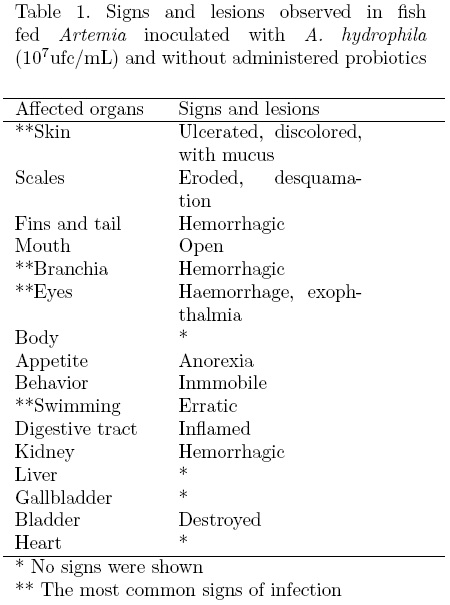
<body><![CDATA[<p align="justify"><font face="verdana" size="2">&nbsp;</font></p>  	    <p align="justify"><font face="verdana" size="2"><b>3. Results</b></font></p>  	    <p align="justify"><font face="verdana" size="2"><i>3.1 . Signs and lesions presented by the fish</i></font></p>  	    <p align="justify"><font face="verdana" size="2">24h after the pathogen administration, the infectious process began in the treatments where no probiotic was administrated. Characteristic signs of lesions and illness that were observed are shown on <a href="#t1">Table 1</a>. When making the statistical analysis using the Canonical discriminant functions (standardized by within variances), it was considered that the infection signs that developed the most after the pathogen administration were: hemorrhagic gills and eyes, irregular swim and skin lesions.</font></p>          <p align="center"><font face="verdana" size="2"><a name="t1"></a></font></p>          <p align="center"><font face="verdana" size="2"><img src="/img/revistas/rmiq/v9n1/a5t1.jpg"></font></p>  	    <p align="justify"><font face="verdana" size="2"><i>3.2. Survival</i></font></p>  	    <p align="justify"><font face="verdana" size="2">The inoculation of <i>A. hydrophila</i> in the fish that were not fed with the probiotics caused a mortality of more than 90 % of the organisms, while the fish tried with the different <i>Bacillus</i> strains resisted the pathogen administration better with a survival between 88 and 100% <a href="#f1">(Fig. 1</a>).</font></p>          <p align="center"><font face="verdana" size="2"><a name="f1"></a></font></p>          <p align="center"><font face="verdana" size="2"><img src="/img/revistas/rmiq/v9n1/a5f1.jpg"></font></p>          ]]></body>
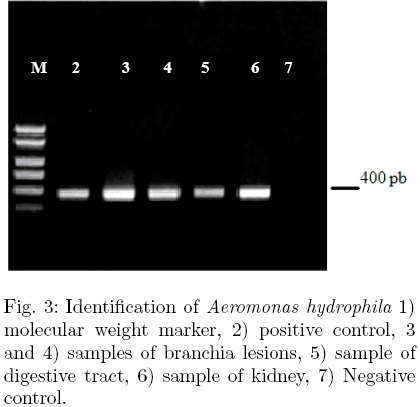
<body><![CDATA[<p align="justify"><font face="verdana" size="2"><i>3.3. Pathogen recovery</i></font></p>  	    <p align="justify"><font face="verdana" size="2"><i>A. hydrophila</i> was found in every sample gathered from the infected lesions. This microorganism was identified by PCR by amplifying a 400&#45;bp fragment that corresponded to an <i>A. hydrophila</i> positive control, thereby confirming the presence of the pathogen and its relationship with the infectious process in the fish not fed the probiotic strains (<a href="#f2">Figs. 2</a> and <a href="#f3">3</a>).</font></p>          <p align="center"><font face="verdana" size="2"><a name="f2"></a></font></p>          <p align="center"><font face="verdana" size="2"><img src="/img/revistas/rmiq/v9n1/a5f2.jpg"></font></p>          <p align="center"><font face="verdana" size="2"><a name="f3"></a></font></p>          <p align="center"><font face="verdana" size="2"><img src="/img/revistas/rmiq/v9n1/a5f3.jpg"></font></p>          <p align="justify"><font face="verdana" size="2">&nbsp;</font></p>  	    <p align="justify"><font face="verdana" size="2"><b>4. Discussion</b></font></p>  	    <p align="justify"><font face="verdana" size="2">Different studies have demonstrated the capacity of different microorganisms to improve the fish survival during their culture (Gatesoupe, 1994; Gullian <i>et al.,</i> 2004; Venkant <i>et al.,</i> 2004; Bagheri <i>et al.,</i> 2008). In agreement with the present work the use of the probiotic strains B1, B2, and B3, isolated from the digestive tract of <i>P. scalare,</i> used in an individual way or in a combined way they remarkably improved the survival of this ci&#45;chlid, showing higher resilience to the inoculation of <i>A. hydrophila.</i> The survival rate was of 100% in the treatments B1, B3, and the combination of the three bacteria. These results improved those obtained by Martinez <i>et al</i> (2008) who infected tilapias with different pathogens, after the challenge with the pathogenic bacteria, the highest survival was obtained in those treatments that the supplement <i>Bacillussp.</i> and <i>Lacto Bacillus casei</i> in comparison the treatment that was not given any bacteria (control). Gatesoupe (1994), improved the survival of <i>Scophthalmus maximus</i> larvae when gave them acid lactic bacteria; Lara (1999) carried out an investigation on the effect of three different probiotics fed to <i>Tilapia nilotica</i> (<i>Oreochromis niloticus)</i> subjected to different stress conditions, obtaining the best results in growth and survival with the addition of <i>Saccharomyces cerevisae.</i></font></p>  	    <p align="justify"><font face="verdana" size="2">On investigations on the use of probiotics for the pathogens exclusion in aquaculture Aly <i>et al.,</i> (2008), mention the exclusion of <i>Aeromonas hydrophila </i>with <i>Bacillus subtilis</i> and <i>Lacto Bacillus acidophillus</i> in <i>Tilapia nilotica.</i> However concerning to the use of specific probiotic strains for ornamental fish few studies have been made. This investigation reports the first advances on the use of bacteria isolated from the digestive tract of <i>P. scalare</i> with probiotic capacities; ornamental fish of great commercial importance that has been affected by infectious processes in those that frequently has been isolated bacterias like <i>A. hydrophila </i>(Cipriano <i>et al.,</i> 1984; Dixon and Issvoran, 1993, Baez <i>et al.,</i> 2008). The results obtained in this work are very encouraging because they demonstrate the live antagonistic effect of the three strains of <i>Bacillus sp.</i> setting them as specific probiotics for <i>P. scalare</i> due to the fact that they do not allow the development of the infection process in the treatments where this bacteria was administrated, also, after concluding the experiment their presence was verified inside the digestive tract of the fish which confirms their capacity to adhere to the digestive tract and their antagonistic potential. Therefore it is recommended the use of this strains that where isolated to battle against illnesses like hemorrhagic septicemia caused by <i>A. hydrophila</i> which occupies a highlighted place due to the economical losses of those that produce species that are specially important such as salmons, flounders, basses or sea basses, amongst some other and a great number of ornamental species (Sumawidjaja <i>et al.,</i> 2001; Rodr&iacute;guez, 2002; Harikrishnan and Balasundaram, 2005).</font></p>  	    ]]></body>
<body><![CDATA[<p align="justify"><font face="verdana" size="2">&nbsp;</font></p>  	    <p align="justify"><font face="verdana" size="2"><b>Acknowledgements</b></font></p>  	    <p align="justify"><font face="verdana" size="2">This work is part of the doctoral thesis of first author, inscribed in the Ph.D. program in Biological Sciences from the Universidad Aut&oacute;noma Metropolitana and funded by the National Science and Technology of M&eacute;xico (CONACyT) Record: 200491.</font></p>  	    <p align="justify"><font face="verdana" size="2">&nbsp;</font></p>  	    <p align="justify"><font face="verdana" size="2"><b>References</b></font></p>  	    <!-- ref --><p align="justify"><font face="verdana" size="2">Abraham, J. T., Shanmugham, S.A., Uma, A., Palaniappan, R., Dhevendaran, K., (2001). Biocontrol of shrimp bacterial pathogens using penaeid larvae associated bacterium, <i>Al&#45;teromonas sp. Journal of Aquaculture in the Tropics 16,</i> 11&#45;22.    &nbsp;&nbsp;&nbsp;&nbsp;&nbsp;&nbsp;&nbsp;&nbsp;[&#160;<a href="javascript:void(0);" onclick="javascript: window.open('/scielo.php?script=sci_nlinks&ref=8728505&pid=S1665-2738201000010000500001&lng=','','width=640,height=500,resizable=yes,scrollbars=1,menubar=yes,');">Links</a>&#160;]<!-- end-ref --></font></p>  	    <!-- ref --><p align="justify"><font face="verdana" size="2">Aly, M.S., Ahmed, Y. A. G., Ghareeb, A. A. A., Moahmed, F. M. (2008). Studies on <i>Bacillus subtilis</i> and <i>Lacto Bacillus acidophilus,</i> as potential probiotics, on the immune response and resistance of Tilapia nilotica (<i>Oreochromis niloticus</i>) to challenge infections. <i>Fish &amp; Shellfish Immunology 25,</i> 128 &#45;136.    &nbsp;&nbsp;&nbsp;&nbsp;&nbsp;&nbsp;&nbsp;&nbsp;[&#160;<a href="javascript:void(0);" onclick="javascript: window.open('/scielo.php?script=sci_nlinks&ref=8728507&pid=S1665-2738201000010000500002&lng=','','width=640,height=500,resizable=yes,scrollbars=1,menubar=yes,');">Links</a>&#160;]<!-- end-ref --></font></p>          <!-- ref --><p align="justify"><font face="verdana" size="2">Baez, H. R., Magi, G. E., Balboa, S., Barja, J. L., Romalde, L. (2008). Development of a PCR protocol for the detection of <i>Aeromonas salmonicida</i> in fish by amplification of the <i>fs&#45;tA</i> (ferric siderophore receptor) gene. <i>Veterinary Microbiology 128,</i> 3386&#45;394.    &nbsp;&nbsp;&nbsp;&nbsp;&nbsp;&nbsp;&nbsp;&nbsp;[&#160;<a href="javascript:void(0);" onclick="javascript: window.open('/scielo.php?script=sci_nlinks&ref=8728509&pid=S1665-2738201000010000500003&lng=','','width=640,height=500,resizable=yes,scrollbars=1,menubar=yes,');">Links</a>&#160;]<!-- end-ref --></font></p>  	    <!-- ref --><p align="justify"><font face="verdana" size="2">Balc&aacute;zar, J.L., de Blas, I., Ruiz&#45;Zarzuela, I., Cunningham, D., Vendrell, D., Muizquiz, J.L. (2006). The role of probiotics in aquaculture. <i>Veterinary Microbiology 114,</i> 173&#45;186.    &nbsp;&nbsp;&nbsp;&nbsp;&nbsp;&nbsp;&nbsp;&nbsp;[&#160;<a href="javascript:void(0);" onclick="javascript: window.open('/scielo.php?script=sci_nlinks&ref=8728511&pid=S1665-2738201000010000500004&lng=','','width=640,height=500,resizable=yes,scrollbars=1,menubar=yes,');">Links</a>&#160;]<!-- end-ref --></font></p>  	    <!-- ref --><p align="justify"><font face="verdana" size="2">Bagheri, T., Aliakbar, S., Yavari ,V., Alizade, M., Farzanfar, Ali. (2008). Growth, Survival and Gut Microbial Load of Rainbow Trout <i>(Onchorhynchus mykiss)</i> Fry Given Diet Supplemented with Probiotic during the Two Months of First Feeding. <i>Turkish Journal of Fisheries and Aquatic Sciences 8,</i> 43&#45;48</font>&nbsp;&nbsp;&nbsp;&nbsp;&nbsp;&nbsp;&nbsp;&nbsp;[&#160;<a href="javascript:void(0);" onclick="javascript: window.open('/scielo.php?script=sci_nlinks&ref=8728513&pid=S1665-2738201000010000500005&lng=','','width=640,height=500,resizable=yes,scrollbars=1,menubar=yes,');">Links</a>&#160;]<!-- end-ref --><!-- ref --><p align="justify"><font face="verdana" size="2">Cipriano, R. C., Bullock, L., Pyle, S. W. (1984). <i>Aeromonas hydrophila</i> and motile aeromonad septicaemia of fish. U.S. Fish and Wildish Service, <i>Fish Diseases Leaflet 68,</i> 215&#45;234.    &nbsp;&nbsp;&nbsp;&nbsp;&nbsp;&nbsp;&nbsp;&nbsp;[&#160;<a href="javascript:void(0);" onclick="javascript: window.open('/scielo.php?script=sci_nlinks&ref=8728514&pid=S1665-2738201000010000500006&lng=','','width=640,height=500,resizable=yes,scrollbars=1,menubar=yes,');">Links</a>&#160;]<!-- end-ref --></font></p>  	    <!-- ref --><p align="justify"><font face="verdana" size="2">Dixon, B. A., Issvoran, G. (1993). Antibacterial drug resistance in <i>Aeromonas spp.</i> isolated from domestic goldfish and Koi from California. <i>Journal World Aquaculture Society 24,</i> 102&#45;104.    &nbsp;&nbsp;&nbsp;&nbsp;&nbsp;&nbsp;&nbsp;&nbsp;[&#160;<a href="javascript:void(0);" onclick="javascript: window.open('/scielo.php?script=sci_nlinks&ref=8728516&pid=S1665-2738201000010000500007&lng=','','width=640,height=500,resizable=yes,scrollbars=1,menubar=yes,');">Links</a>&#160;]<!-- end-ref --></font></p>  	    <!-- ref --><p align="justify"><font face="verdana" size="2">Gatesoupe, F. J. (1994). Lactic acid bacteria increase the resistance of turbot larvae, <i>Scophthalmus maximus,</i> against pathogenic <i>Vibrio. Aquatic Living Resource 7,</i> 277&#45;282.    &nbsp;&nbsp;&nbsp;&nbsp;&nbsp;&nbsp;&nbsp;&nbsp;[&#160;<a href="javascript:void(0);" onclick="javascript: window.open('/scielo.php?script=sci_nlinks&ref=8728518&pid=S1665-2738201000010000500008&lng=','','width=640,height=500,resizable=yes,scrollbars=1,menubar=yes,');">Links</a>&#160;]<!-- end-ref --></font></p>  	    ]]></body>
<body><![CDATA[<!-- ref --><p align="justify"><font face="verdana" size="2">Gullian, M., Thompson, F., Rodr&iacute;guez, J.( 2004). Selection of probiotic bacteria and study of their inmunostimulatory effect in <i>Pennaeus vannamei. Aquaculture 233,</i> 1&#45;14.    &nbsp;&nbsp;&nbsp;&nbsp;&nbsp;&nbsp;&nbsp;&nbsp;[&#160;<a href="javascript:void(0);" onclick="javascript: window.open('/scielo.php?script=sci_nlinks&ref=8728520&pid=S1665-2738201000010000500009&lng=','','width=640,height=500,resizable=yes,scrollbars=1,menubar=yes,');">Links</a>&#160;]<!-- end-ref --></font></p>  	    <!-- ref --><p align="justify"><font face="verdana" size="2">G&oacute;mez, G. B., Roque, A. (1998). Selection of probiotic bacteria for use in aquaculture. pag 174 in T.W. Flegel, editor. <i>Avances in Shrimp Biotechnology.</i> Proceeding to the special Session on Shrimp Biothechnology 5th Asian Fisheries Forum Chiengmai, Tailand.    &nbsp;&nbsp;&nbsp;&nbsp;&nbsp;&nbsp;&nbsp;&nbsp;[&#160;<a href="javascript:void(0);" onclick="javascript: window.open('/scielo.php?script=sci_nlinks&ref=8728522&pid=S1665-2738201000010000500010&lng=','','width=640,height=500,resizable=yes,scrollbars=1,menubar=yes,');">Links</a>&#160;]<!-- end-ref --></font></p>  	    <!-- ref --><p align="justify"><font face="verdana" size="2">Harikrishnan, R., Balasundaram, C. (2005). Modern trends in <i>Aeromonas hydrophila</i> disease management with fish. <i>Reviews in Fisheries Science 13,</i> 281&#45; 320.    &nbsp;&nbsp;&nbsp;&nbsp;&nbsp;&nbsp;&nbsp;&nbsp;[&#160;<a href="javascript:void(0);" onclick="javascript: window.open('/scielo.php?script=sci_nlinks&ref=8728524&pid=S1665-2738201000010000500011&lng=','','width=640,height=500,resizable=yes,scrollbars=1,menubar=yes,');">Links</a>&#160;]<!-- end-ref --></font></p>  	    <!-- ref --><p align="justify"><font face="verdana" size="2">Irianto, A., Austin, B. (2002). Use of probiotics to control furunculosis in rainbow trout, <i>Oncorhynchus mykiss</i> (Walbaum). <i>Journal Fish Diseases 25,</i> 333&#45;342.    &nbsp;&nbsp;&nbsp;&nbsp;&nbsp;&nbsp;&nbsp;&nbsp;[&#160;<a href="javascript:void(0);" onclick="javascript: window.open('/scielo.php?script=sci_nlinks&ref=8728526&pid=S1665-2738201000010000500012&lng=','','width=640,height=500,resizable=yes,scrollbars=1,menubar=yes,');">Links</a>&#160;]<!-- end-ref --></font></p>  	    <!-- ref --><p align="justify"><font face="verdana" size="2">Jameson, J.D. (2003). Role of probiotics in aqua&#45;culture practices. <i>Fishing Chimes 23,</i> 9.    &nbsp;&nbsp;&nbsp;&nbsp;&nbsp;&nbsp;&nbsp;&nbsp;[&#160;<a href="javascript:void(0);" onclick="javascript: window.open('/scielo.php?script=sci_nlinks&ref=8728528&pid=S1665-2738201000010000500013&lng=','','width=640,height=500,resizable=yes,scrollbars=1,menubar=yes,');">Links</a>&#160;]<!-- end-ref --></font></p>  	    ]]></body>
<body><![CDATA[<!-- ref --><p align="justify"><font face="verdana" size="2">Lara, M. (1999). Efecto de la utilizaci&oacute;n de probi&oacute;ticos en la alimentaci&oacute;n de la Tilapia nil&oacute;tica (<i>Oreochromus niloticus</i>) sometida a diferentes condiciones de estr&eacute;s. Tesis de Maestr&iacute;a. <i>Centro de Investigaci&oacute;n y Estudios Avanzados del I.P.N.</i> Unidad M&eacute;rida, M&eacute;rida Yucat&aacute;n, M&eacute;xico, 67 pp.    &nbsp;&nbsp;&nbsp;&nbsp;&nbsp;&nbsp;&nbsp;&nbsp;[&#160;<a href="javascript:void(0);" onclick="javascript: window.open('/scielo.php?script=sci_nlinks&ref=8728530&pid=S1665-2738201000010000500014&lng=','','width=640,height=500,resizable=yes,scrollbars=1,menubar=yes,');">Links</a>&#160;]<!-- end-ref --></font></p>              <!-- ref --><p align="justify"><font face="verdana" size="2">Maeda, M. (1994). Biocontrol of the larvae rearing biotope in aquaculture. <i>Bulletin of the National Research Institute of Aquaculture 1,</i> 71&#45;74.    &nbsp;&nbsp;&nbsp;&nbsp;&nbsp;&nbsp;&nbsp;&nbsp;[&#160;<a href="javascript:void(0);" onclick="javascript: window.open('/scielo.php?script=sci_nlinks&ref=8728532&pid=S1665-2738201000010000500015&lng=','','width=640,height=500,resizable=yes,scrollbars=1,menubar=yes,');">Links</a>&#160;]<!-- end-ref --></font></p>  	    <!-- ref --><p align="justify"><font face="verdana" size="2">Martinez, A.D., Mora, J.L.,Moller,N.O.(2008). Diseases of Oncorhynchus mykiss and In&#45;mune enhancement by probiotics. <i>Fish and Shellfish Immunology 16,</i> 425&#45;452.    &nbsp;&nbsp;&nbsp;&nbsp;&nbsp;&nbsp;&nbsp;&nbsp;[&#160;<a href="javascript:void(0);" onclick="javascript: window.open('/scielo.php?script=sci_nlinks&ref=8728534&pid=S1665-2738201000010000500016&lng=','','width=640,height=500,resizable=yes,scrollbars=1,menubar=yes,');">Links</a>&#160;]<!-- end-ref --></font></p>  	    <!-- ref --><p align="justify"><font face="verdana" size="2">Mart&iacute;nez&#45;Murcia, A. J., Benlloch, S., Collins, M. D. (1992). Phylogenetic interrelationships of members of the genera Aeromonas and Plesiomonas as determined by 16S ribosomal DNA sequencing: lack of congruence with results of DNA&#45;DNA hybridizations. <i>International Journal of Systematic Bacteriology 42,</i> 142&#45; 421.    &nbsp;&nbsp;&nbsp;&nbsp;&nbsp;&nbsp;&nbsp;&nbsp;[&#160;<a href="javascript:void(0);" onclick="javascript: window.open('/scielo.php?script=sci_nlinks&ref=8728536&pid=S1665-2738201000010000500017&lng=','','width=640,height=500,resizable=yes,scrollbars=1,menubar=yes,');">Links</a>&#160;]<!-- end-ref --></font></p>  	    <!-- ref --><p align="justify"><font face="verdana" size="2">Nikoskelainen, S. A., Ouwehand, G., Bylund, S., Salminen, S., Lilius, E. M. (2003). Immune enhancement in rainbow trout (<i>Oncorhynchus mykiss</i>) by potential probiotic bacteria <i>(Lacto Bacillus rhamnosus). Fish Sellfish Immunology 15,</i> 443&#45; 452.    &nbsp;&nbsp;&nbsp;&nbsp;&nbsp;&nbsp;&nbsp;&nbsp;[&#160;<a href="javascript:void(0);" onclick="javascript: window.open('/scielo.php?script=sci_nlinks&ref=8728538&pid=S1665-2738201000010000500018&lng=','','width=640,height=500,resizable=yes,scrollbars=1,menubar=yes,');">Links</a>&#160;]<!-- end-ref --></font></p>          ]]></body>
<body><![CDATA[<!-- ref --><p align="justify"><font face="verdana" size="2">Rengpipat, S., Rukpratanporn, S., Piyatiratitivorakul, S., Menasaveta, P. (2000). Immunity enhancement in black tiger shrimp (<i>Penaeus monodon</i>) by a probiont bacterium <i>(Bacillus</i> S11). <i>Aquaculture 191,</i> 271&#45;288.    &nbsp;&nbsp;&nbsp;&nbsp;&nbsp;&nbsp;&nbsp;&nbsp;[&#160;<a href="javascript:void(0);" onclick="javascript: window.open('/scielo.php?script=sci_nlinks&ref=8728540&pid=S1665-2738201000010000500019&lng=','','width=640,height=500,resizable=yes,scrollbars=1,menubar=yes,');">Links</a>&#160;]<!-- end-ref --></font></p>          <!-- ref --><p align="justify"><font face="verdana" size="2">Rodr&iacute;guez, M. C. (2002). Frecuencia de aislamiento de <i>Aeromonas hydrophila</i> a partir del tracto digestivo de <i>Orechromis aureus</i> (tilapia) en cultivo y del agua en que viven. <i>I Congreso Iberoamericano Virtual de Acuicultura CIVA</i> 2002, pp. 947&#45; 957.    &nbsp;&nbsp;&nbsp;&nbsp;&nbsp;&nbsp;&nbsp;&nbsp;[&#160;<a href="javascript:void(0);" onclick="javascript: window.open('/scielo.php?script=sci_nlinks&ref=8728542&pid=S1665-2738201000010000500020&lng=','','width=640,height=500,resizable=yes,scrollbars=1,menubar=yes,');">Links</a>&#160;]<!-- end-ref --></font></p>  	    <!-- ref --><p align="justify"><font face="verdana" size="2">Singh, I.S.B., Jayaprakash, N. S., Somnath, P. ( 2001). Antagonistic bacteria as gut probiotics. IP 24. p. 55&#45;59. <i>National Workshop on Aquaculture Medicine,</i> January 18&#45; 20, 2001. Abstracts, CFDDM, SES, CUSAT, India.    &nbsp;&nbsp;&nbsp;&nbsp;&nbsp;&nbsp;&nbsp;&nbsp;[&#160;<a href="javascript:void(0);" onclick="javascript: window.open('/scielo.php?script=sci_nlinks&ref=8728544&pid=S1665-2738201000010000500021&lng=','','width=640,height=500,resizable=yes,scrollbars=1,menubar=yes,');">Links</a>&#160;]<!-- end-ref --></font></p>  	    <!-- ref --><p align="justify"><font face="verdana" size="2">Sumawidjaja, E., Eidman, M., Hardosjoworo, S., Anka, L. (2001). Hemorrhagic disease of fish: epizootic report of the team for disease control. <i>Bogor Agricultural University,</i> Bogor, Indonesia, 1 &#45; 115.    &nbsp;&nbsp;&nbsp;&nbsp;&nbsp;&nbsp;&nbsp;&nbsp;[&#160;<a href="javascript:void(0);" onclick="javascript: window.open('/scielo.php?script=sci_nlinks&ref=8728546&pid=S1665-2738201000010000500022&lng=','','width=640,height=500,resizable=yes,scrollbars=1,menubar=yes,');">Links</a>&#160;]<!-- end-ref --></font></p>  	    <!-- ref --><p align="justify"><font face="verdana" size="2">Venkat, H. K., Sahu, N. P., Jai N, K. K. (2004). Effect of feeding <i>Lacto Bacillus&#45;</i> based probiotic on the gut microflora, growth and survival of postlarvae of <i>Macrobrachium rosenbergii</i> (de Man). <i>Aquaculture Research 35,</i> 501&#45;507.    &nbsp;&nbsp;&nbsp;&nbsp;&nbsp;&nbsp;&nbsp;&nbsp;[&#160;<a href="javascript:void(0);" onclick="javascript: window.open('/scielo.php?script=sci_nlinks&ref=8728548&pid=S1665-2738201000010000500023&lng=','','width=640,height=500,resizable=yes,scrollbars=1,menubar=yes,');">Links</a>&#160;]<!-- end-ref --></font></p>  	    ]]></body>
<body><![CDATA[<!-- ref --><p align="justify"><font face="verdana" size="2">Vine, N.G., Leukes, W.D., Kaiser, H. (2004). In vitro growth characteristics of five candidate aquaculture probiotics and two fish pathogens grown in fish intestinal mucus. <i>FEMS Microbiology Letters 231,</i> 145&#45;152.    &nbsp;&nbsp;&nbsp;&nbsp;&nbsp;&nbsp;&nbsp;&nbsp;[&#160;<a href="javascript:void(0);" onclick="javascript: window.open('/scielo.php?script=sci_nlinks&ref=8728550&pid=S1665-2738201000010000500024&lng=','','width=640,height=500,resizable=yes,scrollbars=1,menubar=yes,');">Links</a>&#160;]<!-- end-ref --></font></p>  	    <!-- ref --><p align="justify"><font face="verdana" size="2">Westerdahl, A., Olsson, J., Kjelleberg, J. S. y Conway, P. (1991). Isolation and characterization of turbot (<i>Scophtalmus maximus</i>) associated bacteria with inhibitory effects against <i>Vibrio anguillarum. Applied and Environmental Microbiology 57,</i> 2223&#45;2228.    &nbsp;&nbsp;&nbsp;&nbsp;&nbsp;&nbsp;&nbsp;&nbsp;[&#160;<a href="javascript:void(0);" onclick="javascript: window.open('/scielo.php?script=sci_nlinks&ref=8728552&pid=S1665-2738201000010000500025&lng=','','width=640,height=500,resizable=yes,scrollbars=1,menubar=yes,');">Links</a>&#160;]<!-- end-ref --></font></p>      ]]></body>
<back>
<ref-list>
<ref id="B1">
<nlm-citation citation-type="journal">
<person-group person-group-type="author">
<name>
<surname><![CDATA[Abraham]]></surname>
<given-names><![CDATA[J. T.]]></given-names>
</name>
<name>
<surname><![CDATA[Shanmugham]]></surname>
<given-names><![CDATA[S.A.]]></given-names>
</name>
<name>
<surname><![CDATA[Uma]]></surname>
<given-names><![CDATA[A.]]></given-names>
</name>
<name>
<surname><![CDATA[Palaniappan]]></surname>
<given-names><![CDATA[R.]]></given-names>
</name>
<name>
<surname><![CDATA[Dhevendaran]]></surname>
<given-names><![CDATA[K.]]></given-names>
</name>
</person-group>
<article-title xml:lang="en"><![CDATA[Biocontrol of shrimp bacterial pathogens using penaeid larvae associated bacterium, Al-teromonas sp]]></article-title>
<source><![CDATA[Journal of Aquaculture in the Tropics]]></source>
<year>2001</year>
<volume>16</volume>
<page-range>11-22</page-range></nlm-citation>
</ref>
<ref id="B2">
<nlm-citation citation-type="journal">
<person-group person-group-type="author">
<name>
<surname><![CDATA[Aly]]></surname>
<given-names><![CDATA[M.S.]]></given-names>
</name>
<name>
<surname><![CDATA[Ahmed]]></surname>
<given-names><![CDATA[Y. A. G.]]></given-names>
</name>
<name>
<surname><![CDATA[Ghareeb]]></surname>
<given-names><![CDATA[A. A. A.]]></given-names>
</name>
<name>
<surname><![CDATA[Moahmed]]></surname>
<given-names><![CDATA[F. M.]]></given-names>
</name>
</person-group>
<article-title xml:lang="en"><![CDATA[Studies on Bacillus subtilis and Lacto Bacillus acidophilus, as potential probiotics, on the immune response and resistance of Tilapia nilotica (Oreochromis niloticus) to challenge infections]]></article-title>
<source><![CDATA[Fish & Shellfish Immunology]]></source>
<year>2008</year>
<volume>25</volume>
<page-range>128 -136</page-range></nlm-citation>
</ref>
<ref id="B3">
<nlm-citation citation-type="journal">
<person-group person-group-type="author">
<name>
<surname><![CDATA[Baez]]></surname>
<given-names><![CDATA[H. R.]]></given-names>
</name>
<name>
<surname><![CDATA[Magi]]></surname>
<given-names><![CDATA[G. E.]]></given-names>
</name>
<name>
<surname><![CDATA[Balboa]]></surname>
<given-names><![CDATA[S.]]></given-names>
</name>
<name>
<surname><![CDATA[Barja]]></surname>
<given-names><![CDATA[J. L.]]></given-names>
</name>
<name>
<surname><![CDATA[Romalde]]></surname>
<given-names><![CDATA[L.]]></given-names>
</name>
</person-group>
<article-title xml:lang="en"><![CDATA[Development of a PCR protocol for the detection of Aeromonas salmonicida in fish by amplification of the fs-tA (ferric siderophore receptor) gene]]></article-title>
<source><![CDATA[Veterinary Microbiology]]></source>
<year>2008</year>
<volume>128</volume>
<page-range>3386-394</page-range></nlm-citation>
</ref>
<ref id="B4">
<nlm-citation citation-type="journal">
<person-group person-group-type="author">
<name>
<surname><![CDATA[Balcázar]]></surname>
<given-names><![CDATA[J.L.]]></given-names>
</name>
<name>
<surname><![CDATA[de Blas]]></surname>
<given-names><![CDATA[I.]]></given-names>
</name>
<name>
<surname><![CDATA[Ruiz-Zarzuela]]></surname>
<given-names><![CDATA[I.]]></given-names>
</name>
<name>
<surname><![CDATA[Cunningham]]></surname>
<given-names><![CDATA[D.]]></given-names>
</name>
<name>
<surname><![CDATA[Vendrell]]></surname>
<given-names><![CDATA[D.]]></given-names>
</name>
<name>
<surname><![CDATA[Muizquiz]]></surname>
<given-names><![CDATA[J.L.]]></given-names>
</name>
</person-group>
<article-title xml:lang="en"><![CDATA[The role of probiotics in aquaculture]]></article-title>
<source><![CDATA[Veterinary Microbiology]]></source>
<year>2006</year>
<volume>114</volume>
<page-range>173-186</page-range></nlm-citation>
</ref>
<ref id="B5">
<nlm-citation citation-type="journal">
<person-group person-group-type="author">
<name>
<surname><![CDATA[Bagheri]]></surname>
<given-names><![CDATA[T.]]></given-names>
</name>
<name>
<surname><![CDATA[Aliakbar]]></surname>
<given-names><![CDATA[S.]]></given-names>
</name>
<name>
<surname><![CDATA[Yavari ,V.]]></surname>
<given-names><![CDATA[Alizade, M.]]></given-names>
</name>
<name>
<surname><![CDATA[Farzanfar]]></surname>
<given-names><![CDATA[Ali]]></given-names>
</name>
</person-group>
<article-title xml:lang="en"><![CDATA[Growth, Survival and Gut Microbial Load of Rainbow Trout (Onchorhynchus mykiss) Fry Given Diet Supplemented with Probiotic during the Two Months of First Feeding]]></article-title>
<source><![CDATA[Turkish Journal of Fisheries and Aquatic Sciences]]></source>
<year>2008</year>
<volume>8</volume>
<page-range>43-48</page-range></nlm-citation>
</ref>
<ref id="B6">
<nlm-citation citation-type="journal">
<person-group person-group-type="author">
<name>
<surname><![CDATA[Cipriano]]></surname>
<given-names><![CDATA[R. C.]]></given-names>
</name>
<name>
<surname><![CDATA[Bullock]]></surname>
<given-names><![CDATA[L.]]></given-names>
</name>
<name>
<surname><![CDATA[Pyle]]></surname>
<given-names><![CDATA[S. W.]]></given-names>
</name>
</person-group>
<article-title xml:lang="en"><![CDATA[Aeromonas hydrophila and motile aeromonad septicaemia of fish. U.S]]></article-title>
<source><![CDATA[Fish and Wildish Service, Fish Diseases Leaflet]]></source>
<year>1984</year>
<volume>68</volume>
<page-range>215-234</page-range></nlm-citation>
</ref>
<ref id="B7">
<nlm-citation citation-type="journal">
<person-group person-group-type="author">
<name>
<surname><![CDATA[Dixon]]></surname>
<given-names><![CDATA[B. A.]]></given-names>
</name>
<name>
<surname><![CDATA[Issvoran]]></surname>
<given-names><![CDATA[G.]]></given-names>
</name>
</person-group>
<article-title xml:lang="en"><![CDATA[Antibacterial drug resistance in Aeromonas spp. isolated from domestic goldfish and Koi from California]]></article-title>
<source><![CDATA[Journal World Aquaculture Society]]></source>
<year>1993</year>
<volume>24</volume>
<page-range>102-104</page-range></nlm-citation>
</ref>
<ref id="B8">
<nlm-citation citation-type="journal">
<person-group person-group-type="author">
<name>
<surname><![CDATA[Gatesoupe]]></surname>
<given-names><![CDATA[F. J.]]></given-names>
</name>
</person-group>
<article-title xml:lang="en"><![CDATA[Lactic acid bacteria increase the resistance of turbot larvae, Scophthalmus maximus, against pathogenic Vibrio]]></article-title>
<source><![CDATA[Aquatic Living Resource]]></source>
<year>1994</year>
<volume>7</volume>
<page-range>277-282</page-range></nlm-citation>
</ref>
<ref id="B9">
<nlm-citation citation-type="journal">
<person-group person-group-type="author">
<name>
<surname><![CDATA[Gullian]]></surname>
<given-names><![CDATA[M.]]></given-names>
</name>
<name>
<surname><![CDATA[Thompson]]></surname>
<given-names><![CDATA[F.]]></given-names>
</name>
<name>
<surname><![CDATA[Rodríguez]]></surname>
<given-names><![CDATA[J.]]></given-names>
</name>
</person-group>
<article-title xml:lang="en"><![CDATA[Selection of probiotic bacteria and study of their inmunostimulatory effect in Pennaeus vannamei]]></article-title>
<source><![CDATA[Aquaculture]]></source>
<year>2004</year>
<volume>233</volume>
<page-range>1-14</page-range></nlm-citation>
</ref>
<ref id="B10">
<nlm-citation citation-type="">
<person-group person-group-type="author">
<name>
<surname><![CDATA[Gómez]]></surname>
<given-names><![CDATA[G. B.]]></given-names>
</name>
<name>
<surname><![CDATA[Roque]]></surname>
<given-names><![CDATA[A.]]></given-names>
</name>
</person-group>
<article-title xml:lang="en"><![CDATA[Selection of probiotic bacteria for use in aquaculture]]></article-title>
<person-group person-group-type="editor">
<name>
<surname><![CDATA[Flegel]]></surname>
<given-names><![CDATA[T.W.]]></given-names>
</name>
</person-group>
<source><![CDATA[Avances in Shrimp Biotechnology]]></source>
<year>1998</year>
<page-range>174</page-range></nlm-citation>
</ref>
<ref id="B11">
<nlm-citation citation-type="journal">
<person-group person-group-type="author">
<name>
<surname><![CDATA[Harikrishnan]]></surname>
<given-names><![CDATA[R.]]></given-names>
</name>
<name>
<surname><![CDATA[Balasundaram]]></surname>
<given-names><![CDATA[C.]]></given-names>
</name>
</person-group>
<article-title xml:lang="en"><![CDATA[Modern trends in Aeromonas hydrophila disease management with fish]]></article-title>
<source><![CDATA[Reviews in Fisheries Science]]></source>
<year>2005</year>
<volume>13</volume>
<page-range>281- 320</page-range></nlm-citation>
</ref>
<ref id="B12">
<nlm-citation citation-type="journal">
<person-group person-group-type="author">
<name>
<surname><![CDATA[Irianto]]></surname>
<given-names><![CDATA[A.]]></given-names>
</name>
<name>
<surname><![CDATA[Austin]]></surname>
<given-names><![CDATA[B.]]></given-names>
</name>
</person-group>
<article-title xml:lang="en"><![CDATA[Use of probiotics to control furunculosis in rainbow trout, Oncorhynchus mykiss (Walbaum)]]></article-title>
<source><![CDATA[Journal Fish Diseases]]></source>
<year>2002</year>
<volume>25</volume>
<page-range>333-342</page-range></nlm-citation>
</ref>
<ref id="B13">
<nlm-citation citation-type="journal">
<person-group person-group-type="author">
<name>
<surname><![CDATA[Jameson]]></surname>
<given-names><![CDATA[J.D.]]></given-names>
</name>
</person-group>
<article-title xml:lang="en"><![CDATA[Role of probiotics in aqua-culture practices]]></article-title>
<source><![CDATA[Fishing Chimes]]></source>
<year>2003</year>
<volume>23</volume>
<page-range>9</page-range></nlm-citation>
</ref>
<ref id="B14">
<nlm-citation citation-type="">
<person-group person-group-type="author">
<name>
<surname><![CDATA[Lara]]></surname>
<given-names><![CDATA[M.]]></given-names>
</name>
</person-group>
<source><![CDATA[Efecto de la utilización de probióticos en la alimentación de la Tilapia nilótica (Oreochromus niloticus) sometida a diferentes condiciones de estrés]]></source>
<year>1999</year>
<page-range>67</page-range></nlm-citation>
</ref>
<ref id="B15">
<nlm-citation citation-type="journal">
<person-group person-group-type="author">
<name>
<surname><![CDATA[Maeda]]></surname>
<given-names><![CDATA[M.]]></given-names>
</name>
</person-group>
<article-title xml:lang="en"><![CDATA[Biocontrol of the larvae rearing biotope in aquaculture]]></article-title>
<source><![CDATA[Bulletin of the National Research Institute of Aquaculture]]></source>
<year>1994</year>
<volume>1</volume>
<page-range>71-74</page-range></nlm-citation>
</ref>
<ref id="B16">
<nlm-citation citation-type="journal">
<person-group person-group-type="author">
<name>
<surname><![CDATA[Martinez]]></surname>
<given-names><![CDATA[A.D.]]></given-names>
</name>
<name>
<surname><![CDATA[Mora]]></surname>
<given-names><![CDATA[J.L.]]></given-names>
</name>
<name>
<surname><![CDATA[Moller]]></surname>
<given-names><![CDATA[N.O.]]></given-names>
</name>
</person-group>
<article-title xml:lang="en"><![CDATA[Diseases of Oncorhynchus mykiss and In-mune enhancement by probiotics]]></article-title>
<source><![CDATA[Fish and Shellfish Immunology]]></source>
<year>2008</year>
<volume>16</volume>
<page-range>425-452</page-range></nlm-citation>
</ref>
<ref id="B17">
<nlm-citation citation-type="journal">
<person-group person-group-type="author">
<name>
<surname><![CDATA[Martínez-Murcia]]></surname>
<given-names><![CDATA[A. J.]]></given-names>
</name>
<name>
<surname><![CDATA[Benlloch]]></surname>
<given-names><![CDATA[S.]]></given-names>
</name>
<name>
<surname><![CDATA[Collins]]></surname>
<given-names><![CDATA[M. D.]]></given-names>
</name>
</person-group>
<article-title xml:lang="en"><![CDATA[Phylogenetic interrelationships of members of the genera Aeromonas and Plesiomonas as determined by 16S ribosomal DNA sequencing: lack of congruence with results of DNA-DNA hybridizations]]></article-title>
<source><![CDATA[International Journal of Systematic Bacteriology]]></source>
<year>1992</year>
<volume>42</volume>
<page-range>142- 421</page-range></nlm-citation>
</ref>
<ref id="B18">
<nlm-citation citation-type="journal">
<person-group person-group-type="author">
<name>
<surname><![CDATA[Nikoskelainen]]></surname>
<given-names><![CDATA[S. A.]]></given-names>
</name>
<name>
<surname><![CDATA[Ouwehand]]></surname>
<given-names><![CDATA[G.]]></given-names>
</name>
<name>
<surname><![CDATA[Bylund]]></surname>
<given-names><![CDATA[S.]]></given-names>
</name>
<name>
<surname><![CDATA[Salminen]]></surname>
<given-names><![CDATA[S.]]></given-names>
</name>
<name>
<surname><![CDATA[Lilius]]></surname>
<given-names><![CDATA[E. M.]]></given-names>
</name>
</person-group>
<article-title xml:lang="en"><![CDATA[Immune enhancement in rainbow trout (Oncorhynchus mykiss) by potential probiotic bacteria (Lacto Bacillus rhamnosus)]]></article-title>
<source><![CDATA[Fish Sellfish Immunology]]></source>
<year>2003</year>
<volume>15</volume>
<page-range>443- 452</page-range></nlm-citation>
</ref>
<ref id="B19">
<nlm-citation citation-type="journal">
<person-group person-group-type="author">
<name>
<surname><![CDATA[Rengpipat]]></surname>
<given-names><![CDATA[S.]]></given-names>
</name>
<name>
<surname><![CDATA[Rukpratanporn]]></surname>
<given-names><![CDATA[S.]]></given-names>
</name>
<name>
<surname><![CDATA[Piyatiratitivorakul]]></surname>
<given-names><![CDATA[S.]]></given-names>
</name>
<name>
<surname><![CDATA[Menasaveta]]></surname>
<given-names><![CDATA[P.]]></given-names>
</name>
</person-group>
<article-title xml:lang="en"><![CDATA[Immunity enhancement in black tiger shrimp (Penaeus monodon) by a probiont bacterium (Bacillus S11)]]></article-title>
<source><![CDATA[Aquaculture]]></source>
<year>2000</year>
<volume>191</volume>
<page-range>271-288</page-range></nlm-citation>
</ref>
<ref id="B20">
<nlm-citation citation-type="">
<person-group person-group-type="author">
<name>
<surname><![CDATA[Rodríguez]]></surname>
<given-names><![CDATA[M. C.]]></given-names>
</name>
</person-group>
<source><![CDATA[Frecuencia de aislamiento de Aeromonas hydrophila a partir del tracto digestivo de Orechromis aureus (tilapia) en cultivo y del agua en que viven]]></source>
<year>2002</year>
<page-range>947- 957</page-range></nlm-citation>
</ref>
<ref id="B21">
<nlm-citation citation-type="book">
<person-group person-group-type="author">
<name>
<surname><![CDATA[Singh]]></surname>
<given-names><![CDATA[I.S.B.]]></given-names>
</name>
<name>
<surname><![CDATA[Jayaprakash]]></surname>
<given-names><![CDATA[N. S.]]></given-names>
</name>
<name>
<surname><![CDATA[Somnath]]></surname>
<given-names><![CDATA[P.]]></given-names>
</name>
</person-group>
<source><![CDATA[Antagonistic bacteria as gut probiotics]]></source>
<year>2001</year>
<page-range>55-59</page-range><publisher-name><![CDATA[CFDDMSESCUSAT]]></publisher-name>
</nlm-citation>
</ref>
<ref id="B22">
<nlm-citation citation-type="book">
<person-group person-group-type="author">
<name>
<surname><![CDATA[Sumawidjaja]]></surname>
<given-names><![CDATA[E.]]></given-names>
</name>
<name>
<surname><![CDATA[Eidman]]></surname>
<given-names><![CDATA[M.]]></given-names>
</name>
<name>
<surname><![CDATA[Hardosjoworo]]></surname>
<given-names><![CDATA[S.]]></given-names>
</name>
<name>
<surname><![CDATA[Anka]]></surname>
<given-names><![CDATA[L.]]></given-names>
</name>
</person-group>
<source><![CDATA[Hemorrhagic disease of fish: epizootic report of the team for disease control]]></source>
<year>2001</year>
<page-range>1 - 115</page-range><publisher-loc><![CDATA[Bogor ]]></publisher-loc>
<publisher-name><![CDATA[Bogor Agricultural University]]></publisher-name>
</nlm-citation>
</ref>
<ref id="B23">
<nlm-citation citation-type="journal">
<person-group person-group-type="author">
<name>
<surname><![CDATA[Venkat]]></surname>
<given-names><![CDATA[H. K.]]></given-names>
</name>
<name>
<surname><![CDATA[Sahu]]></surname>
<given-names><![CDATA[N. P.]]></given-names>
</name>
<name>
<surname><![CDATA[Jai N]]></surname>
<given-names><![CDATA[K. K.]]></given-names>
</name>
</person-group>
<article-title xml:lang="en"><![CDATA[Effect of feeding Lacto Bacillus- based probiotic on the gut microflora, growth and survival of postlarvae of Macrobrachium rosenbergii (de Man)]]></article-title>
<source><![CDATA[Aquaculture Research]]></source>
<year>2004</year>
<volume>35</volume>
<page-range>501-507</page-range></nlm-citation>
</ref>
<ref id="B24">
<nlm-citation citation-type="journal">
<person-group person-group-type="author">
<name>
<surname><![CDATA[Vine]]></surname>
<given-names><![CDATA[N.G.]]></given-names>
</name>
<name>
<surname><![CDATA[Leukes]]></surname>
<given-names><![CDATA[W.D.]]></given-names>
</name>
<name>
<surname><![CDATA[Kaiser]]></surname>
<given-names><![CDATA[H.]]></given-names>
</name>
</person-group>
<article-title xml:lang="en"><![CDATA[In vitro growth characteristics of five candidate aquaculture probiotics and two fish pathogens grown in fish intestinal mucus]]></article-title>
<source><![CDATA[FEMS Microbiology Letters]]></source>
<year>2004</year>
<volume>231</volume>
<page-range>145-152</page-range></nlm-citation>
</ref>
<ref id="B25">
<nlm-citation citation-type="journal">
<person-group person-group-type="author">
<name>
<surname><![CDATA[Westerdahl]]></surname>
<given-names><![CDATA[A.]]></given-names>
</name>
<name>
<surname><![CDATA[Olsson]]></surname>
<given-names><![CDATA[J.]]></given-names>
</name>
<name>
<surname><![CDATA[Kjelleberg]]></surname>
<given-names><![CDATA[J. S.]]></given-names>
</name>
<name>
<surname><![CDATA[Conway]]></surname>
<given-names><![CDATA[P.]]></given-names>
</name>
</person-group>
<article-title xml:lang="en"><![CDATA[Isolation and characterization of turbot (Scophtalmus maximus) associated bacteria with inhibitory effects against Vibrio anguillarum]]></article-title>
<source><![CDATA[Applied and Environmental Microbiology]]></source>
<year>1991</year>
<volume>57</volume>
<page-range>2223-2228</page-range></nlm-citation>
</ref>
</ref-list>
</back>
</article>