<?xml version="1.0" encoding="ISO-8859-1"?><article xmlns:mml="http://www.w3.org/1998/Math/MathML" xmlns:xlink="http://www.w3.org/1999/xlink" xmlns:xsi="http://www.w3.org/2001/XMLSchema-instance">
<front>
<journal-meta>
<journal-id>1405-9940</journal-id>
<journal-title><![CDATA[Archivos de cardiología de México]]></journal-title>
<abbrev-journal-title><![CDATA[Arch. Cardiol. Méx.]]></abbrev-journal-title>
<issn>1405-9940</issn>
<publisher>
<publisher-name><![CDATA[Instituto Nacional de Cardiología Ignacio Chávez]]></publisher-name>
</publisher>
</journal-meta>
<article-meta>
<article-id>S1405-99402009000300003</article-id>
<title-group>
<article-title xml:lang="en"><![CDATA[Antiarrhythmic and arrhythmogenic action of inosine in experimental ventricular tachyarrhythmias]]></article-title>
<article-title xml:lang="es"><![CDATA[Efectos antiarrítmicos y arritmogénicos de la inosina en taquiarritmias ventriculares experimentales]]></article-title>
</title-group>
<contrib-group>
<contrib contrib-type="author">
<name>
<surname><![CDATA[de Micheli]]></surname>
<given-names><![CDATA[Alfredo]]></given-names>
</name>
<xref ref-type="aff" rid="A01"/>
</contrib>
<contrib contrib-type="author">
<name>
<surname><![CDATA[Pastelín]]></surname>
<given-names><![CDATA[Gustavo]]></given-names>
</name>
<xref ref-type="aff" rid="A02"/>
</contrib>
<contrib contrib-type="author">
<name>
<surname><![CDATA[Chávez Domínguez]]></surname>
<given-names><![CDATA[Rafael]]></given-names>
</name>
<xref ref-type="aff" rid="A03"/>
</contrib>
<contrib contrib-type="author">
<name>
<surname><![CDATA[Iturralde Torres]]></surname>
<given-names><![CDATA[Pedro]]></given-names>
</name>
<xref ref-type="aff" rid="A04"/>
</contrib>
<contrib contrib-type="author">
<name>
<surname><![CDATA[Medrano]]></surname>
<given-names><![CDATA[Gustavo A]]></given-names>
</name>
<xref ref-type="aff" rid="A01"/>
</contrib>
</contrib-group>
<aff id="A02">
<institution><![CDATA[,Instituto Nacional de Cardiología Ignacio Chávez Departamento de Farmacología ]]></institution>
<addr-line><![CDATA[ ]]></addr-line>
</aff>
<aff id="A03">
<institution><![CDATA[,Instituto Nacional de Cardiología Ignacio Chávez Departamento de Epidemiología ]]></institution>
<addr-line><![CDATA[ ]]></addr-line>
</aff>
<aff id="A04">
<institution><![CDATA[,Instituto Nacional de Cardiología Ignacio Chávez Departamento de Electrofisiología ]]></institution>
<addr-line><![CDATA[ ]]></addr-line>
</aff>
<aff id="A01">
<institution><![CDATA[,Instituto Nacional de Cardiología Ignacio Chávez  ]]></institution>
<addr-line><![CDATA[México D.F.]]></addr-line>
</aff>
<pub-date pub-type="pub">
<day>00</day>
<month>09</month>
<year>2009</year>
</pub-date>
<pub-date pub-type="epub">
<day>00</day>
<month>09</month>
<year>2009</year>
</pub-date>
<volume>79</volume>
<numero>3</numero>
<fpage>175</fpage>
<lpage>181</lpage>
<copyright-statement/>
<copyright-year/>
<self-uri xlink:href="http://www.scielo.org.mx/scielo.php?script=sci_arttext&amp;pid=S1405-99402009000300003&amp;lng=en&amp;nrm=iso"></self-uri><self-uri xlink:href="http://www.scielo.org.mx/scielo.php?script=sci_abstract&amp;pid=S1405-99402009000300003&amp;lng=en&amp;nrm=iso"></self-uri><self-uri xlink:href="http://www.scielo.org.mx/scielo.php?script=sci_pdf&amp;pid=S1405-99402009000300003&amp;lng=en&amp;nrm=iso"></self-uri><abstract abstract-type="short" xml:lang="en"><p><![CDATA[Objective: To study the possible action of inosine on experimental ventricular tachyarrhythmias. Material and methods: We used 92 mongrel dogs weighing 13 kg-17 kg, anesthetized with 30 mg/kg sodium pentobarbital applied intravenously. Myocardial lesions were induced by injecting 1ml-1.5 ml of 70% phenol in the free wall of the left ventricle. In 36 dogs, the ventricular arrhythmia (VT) was induced 30 min later with aconitine crystals inserted into the periphery of the damaged area; in 16, VT was due only to myocardial damage and in the other 13 VT was spontaneously originated. Twenty-nine animals constituted the control group; no inosine was administered to them. The possible effects of inosine were studied in 63 animals. Leads II, aVR or aVL, right and left unipolar intraventricular leads and that on the wall of the superior vena cava were recorded under control conditions, once the myocardial damage had been induced, during the ventricular tachycardia, and following the injection of inosine. Of the 63 inosine-treated animals; in 34, VT was due to aconitine; in 16, it was produced only by the myocardial damage and, in 13, VT was presented spontaneously. Results: Sinus rhythm was not reestablished in the animals of the control group. Inosine reestablished the sinus rhythm in 26 of 34 dogs (76%) that received phenol and aconitine, in 13 of the 16 (81%) presenting only the myocardial damage, and in 6 of the 13 (46%) with spontaneous ventricular tachycardia. In some experiments, inosine induced supraventricular tachycardias, ventricular-atrial blocks, and ventricular pre-excitation phenomena. Conclusions: In this experimental series, inosine showed antiarrhythmic and arrhythmogenic effects, similar to those of adenosine from which it derives.]]></p></abstract>
<abstract abstract-type="short" xml:lang="es"><p><![CDATA[Objetivo: Estudiar la posible acción de la inosina en taquiarritmias ventriculares experimentales. Material y métodos: Se utilizaron 92 perros mestizos de 13-17 kg, anestesiados con 30 mg/kg de pentobarbital sódico por vía intravenosa. En éstos, se produjo daño miocárdico por inyección intramural de 1-1.5 ml de fenol al 70% en la pared libre del ventrículo izquierdo, cerca de la punta. En 34 de ellos, mediante introducción de cristales de aconitina en la periferia del área dañada, se causó una taquiarritmia ventricular (TV). Veinte y nueve animales constituyen el grupo testigo, con evolución libre de dicha arritmia también debida a aconitina. La acción de la inosina se investigó en 63 animales. En todos, se registraron las derivaciones D II, aVR o aVL, las unipolares intraventriculares derecha e izquierda y la de la pared de la vena cava superior. Se hizo esto al comienzo del experimento (control), tras causar el daño miocárdico por fenol, con la TV, al final de la inyección de inosina en bolo por la vena cava superior y durante otra hora u hora y media. La duración total de cada experimento fue de unas 5 horas. Resultados: El ritmo sinusal (RS) no se restableció en ningún animal del grupo testigo. Por efecto de la inosina, el RS se restableció en 26 de los 34 perros(76%) que habían recibido fenol y aconitina, en 13 de los 16 (81%) con solo daño miocárdico y en 6 de los 13 (46%) con TV espontánea. En algunos experimentos, la inosina provocó también taquicardias supraventriculares, bloqueo ventriculoauricular y fenómenos de preexcitacion ventricular. Conclusiones: En esta serie experimental, la inosina ha mostrado tener efectos antiarrítmicos y arritmogénicos semejantes a los de la adenosina, de la que deriva.]]></p></abstract>
<kwd-group>
<kwd lng="en"><![CDATA[Inosine]]></kwd>
<kwd lng="en"><![CDATA[Inosine's antiarrhythmic effects]]></kwd>
<kwd lng="en"><![CDATA[Inosine's arrhytmogenic effects]]></kwd>
<kwd lng="es"><![CDATA[Inosina]]></kwd>
<kwd lng="es"><![CDATA[Efectos antiarrítmicos de la inosina]]></kwd>
<kwd lng="es"><![CDATA[Efectos arritmogénicos de la inosina]]></kwd>
</kwd-group>
</article-meta>
</front><body><![CDATA[ <p align="justify"><font face="verdana" size="4">Investigaci&oacute;n b&aacute;sica: electrofisiolog&iacute;a y arritmias</font></p>     <p align="justify"><font face="verdana" size="4">&nbsp;</font></p>     <p align="center"><font face="verdana" size="4"><b>Antiarrhythmic and arrhythmogenic action of inosine in experimental ventricular tachyarrhythmias</b></font></p>     <p align="center"><font face="verdana" size="2">&nbsp;</font></p>     <p align="center"><font face="verdana" size="3"><b>Efectos antiarr&iacute;tmicos y arritmog&eacute;nicos de la inosina en taquiarritmias ventriculares experimentales</b></font></p>     <p align="center"><font face="verdana" size="2">&nbsp;</font></p>     <p align="center"><font face="verdana" size="2"><b>Alfredo de Micheli,<sup>1</sup> Gustavo Pastel&iacute;n,<sup>2</sup> Rafael Ch&aacute;vez Dom&iacute;nguez,<sup>3</sup> Pedro Iturralde Torres,<sup>4</sup> and Gustavo A Medrano<sup>1</sup></b></font></p>     <p align="justify"><font face="verdana" size="2">&nbsp;</font></p>     <p align="justify"><font face="verdana" size="2"><i><sup>1</sup> Instituto Nacional de Cardiolog&iacute;a Ignacio Ch&aacute;vez. M&eacute;xico.</i></font></p>     <p align="justify"><font face="verdana" size="2"><i><sup>2</sup> Departamento de Farmacolog&iacute;a, Instituto Nacional de Cardiolog&iacute;a Ignacio Ch&aacute;vez.</i></font></p>     ]]></body>
<body><![CDATA[<p align="justify"><font face="verdana" size="2"><i><sup>3</sup> Jefe Departamento de Epidemiolog&iacute;a, Instituto Nacional de Cardiolog&iacute;a Ignacio Ch&aacute;vez.</i></font></p>     <p align="justify"><font face="verdana" size="2"><i><sup>4</sup> Departamento de Electrofisiolog&iacute;a, Instituto Nacional de Cardiolog&iacute;a Ignacio Ch&aacute;vez.</i></font></p>     <p align="justify"><font face="verdana" size="2">&nbsp;</font></p>     <p align="justify"><font face="verdana" size="2"><b>Corresponding author: </b>    <br>     <i>Dr. Alfredo de Micheli,     <br>     Instituto Nacional de Cardiolog&iacute;a Ignacio Ch&aacute;vez,     <br>     Juan Badiano No. 1, Col. Secci&oacute;n XVI,     <br>     M&eacute;xico, D.F. CP 14080.</i></font></p>     <p align="justify"><font face="verdana" size="2">&nbsp;</font></p>     <p align="justify"><font face="verdana" size="2">Received: March 31, 2009.    ]]></body>
<body><![CDATA[<br> Accepted: July 27, 2009.</font></p>     <p align="justify"><font face="verdana" size="2">&nbsp;</font></p>     <p align="justify"><font face="verdana" size="2"><b>Abstract</b></font></p>     <p align="justify"><font face="verdana" size="2"><i><b>Objective:</b> </i>To study the possible action of inosine on experimental ventricular tachyarrhythmias. </font></p>     <p align="justify"><font face="verdana" size="2"><i><b>Material and methods:</b> </i>We used 92 mongrel dogs weighing 13 kg&#150;17 kg, anesthetized with 30 mg/kg sodium pentobarbital applied intravenously. Myocardial lesions were induced by injecting 1ml&#150;1.5 ml of 70% phenol in the free wall of the left ventricle. In 36 dogs, the ventricular arrhythmia (VT) was induced 30 min later with aconitine crystals inserted into the periphery of the damaged area; in 16, VT was due only to myocardial damage and in the other 13 VT was spontaneously originated. Twenty&#150;nine animals constituted the control group; no inosine was administered to them. The possible effects of inosine were studied in 63 animals. Leads II, aVR or aVL, right and left unipolar intraventricular leads and that on the wall of the superior vena cava were recorded under control conditions, once the myocardial damage had been induced, during the ventricular tachycardia, and following the injection of inosine. Of the 63 inosine&#150;treated animals; in 34, VT was due to aconitine; in 16, it was produced only by the myocardial damage and, in 13, VT was presented spontaneously. </font></p>     <p align="justify"><font face="verdana" size="2"><i><b>Results:</b> </i>Sinus rhythm was not reestablished in the animals of the control group. Inosine reestablished the sinus rhythm in 26 of 34 dogs (76%) that received phenol and aconitine, in 13 of the 16 (81%) presenting only the myocardial damage, and in 6 of the 13 (46%) with spontaneous ventricular tachycardia. In some experiments, inosine induced supraventricular tachycardias, ventricular&#150;atrial blocks, and ventricular pre&#150;excitation phenomena. </font></p>     <p align="justify"><font face="verdana" size="2"><i><b>Conclusions:</b> </i>In this experimental series, inosine showed antiarrhythmic and arrhythmogenic effects, similar to those of adenosine from which it derives.</font></p>     <p align="justify"><font face="verdana" size="2"><b>Key words<sup><a href="#note">*</a></sup>: </b>Inosine; Inosine's antiarrhythmic effects; Inosine's arrhytmogenic effects.</font></p>     <p align="justify"><font face="verdana" size="2">&nbsp;</font></p>     <p align="justify"><font face="verdana" size="2"><b>Resumen</b></font></p>     ]]></body>
<body><![CDATA[<p align="justify"><font face="verdana" size="2"><i><b>Objetivo:</b> </i>Estudiar la posible acci&oacute;n de la inosina en taquiarritmias ventriculares experimentales. </font></p>     <p align="justify"><font face="verdana" size="2"><i><b>Material y m&eacute;todos:</b> </i>Se utilizaron 92 perros mestizos de 13&#150;17 kg, anestesiados con 30 mg/kg de pentobarbital s&oacute;dico por v&iacute;a intravenosa. En &eacute;stos, se produjo da&ntilde;o mioc&aacute;rdico por inyecci&oacute;n intramural de 1&#150;1.5 ml de fenol al 70% en la pared libre del ventr&iacute;culo izquierdo, cerca de la punta. En 34 de ellos, mediante introducci&oacute;n de cristales de aconitina en la periferia del &aacute;rea da&ntilde;ada, se caus&oacute; una taquiarritmia ventricular (TV). Veinte y nueve animales constituyen el grupo testigo, con evoluci&oacute;n libre de dicha arritmia tambi&eacute;n debida a aconitina. La acci&oacute;n de la inosina se investig&oacute; en 63 animales. En todos, se registraron las derivaciones D<sub>II</sub>, aVR o aVL, las unipolares intraventriculares derecha e izquierda y la de la pared de la vena cava superior. Se hizo esto al comienzo del experimento (control), tras causar el da&ntilde;o mioc&aacute;rdico por fenol, con la TV, al final de la inyecci&oacute;n de inosina en bolo por la vena cava superior y durante otra hora u hora y media. La duraci&oacute;n total de cada experimento fue de unas 5 horas. </font></p>     <p align="justify"><font face="verdana" size="2"><i><b>Resultados:</b> </i>El ritmo sinusal (RS) no se restableci&oacute; en ning&uacute;n animal del grupo testigo. Por efecto de la inosina, el RS se restableci&oacute; en 26 de los 34 perros(76%) que hab&iacute;an recibido fenol y aconitina, en 13 de los 16 (81%) con solo da&ntilde;o mioc&aacute;rdico y en 6 de los 13 (46%) con TV espont&aacute;nea. En algunos experimentos, la inosina provoc&oacute; tambi&eacute;n taquicardias supraventriculares, bloqueo ventriculoauricular y fen&oacute;menos de preexcitacion ventricular. </font></p>     <p align="justify"><font face="verdana" size="2"><i><b>Conclusiones:</b> </i>En esta serie experimental, la inosina ha mostrado tener efectos antiarr&iacute;tmicos y arritmog&eacute;nicos semejantes a los de la adenosina, de la que deriva.</font></p>     <p align="justify"><font face="verdana" size="2"><b>Palabras clave: </b>Inosina; Efectos antiarr&iacute;tmicos de la inosina; Efectos arritmog&eacute;nicos de la inosina.</font></p>     <p align="justify"><font face="verdana" size="2">&nbsp;</font></p>     <p align="justify"><font face="verdana" size="2"><b>Introduction</b></font></p>     <p align="justify"><font face="verdana" size="2">Inosine (IN) is a nudeoside, derived from adenosine by deamination.<sup>1</sup> Adenosine converts to inosine by the action of adenosine deaminase. Then, a nudeoside phosphorylase divides IN in hypoxanthine and pentose. In turn, hypoxanthine is oxidized to xanthine by the xanthine oxidase, a flavoprotein containing Fe and Mo. Xanthine is a substrate of xanthine oxidase, which converts it to uric acid, the terminal product of purines' degradation, to be eliminated essentially by urine.</font></p>     <p align="justify"><font face="verdana" size="2">Researches of the group of Bethesda, USA, have extensively studied the electrophysiological,<sup>23</sup> pharmacological,<sup>4</sup> and therapeutical<sup>5</sup> characteristics of adenosine, as well as its action on the specific elements of the atrioventricular conduction system.<sup>67</sup> Myocite receptors for adenosine have also been identified.<sup>8</sup> Moreover, purines modulate the phenomenon of cellular death produced by free oxygen radicals.<sup>9</sup> On its side, adenosine acts as an effective antiarrhythmic on supraventricular tachycardias and on certain ventricular tachyarrhythmias, particularly on those induced by catecholamines, probably due to inhibition of adenylate cyclase.<sup>10,11,12</sup></font></p>     <p align="justify"><font face="verdana" size="2">We have already pointed out the antiarrhythmic action of adenosine on certain clinical<sup>13</sup> and experimental<sup>14 </sup>ventricular tachycardias. In our experimental series, the antiarrhythmic effect of adenosine was generally biphasic: one, early and fleeting; the other, delayed.</font></p>     ]]></body>
<body><![CDATA[<p align="justify"><font face="verdana" size="2">Herein, we aim at establishing whether IN, derived from adenosine, has effects on experimental ventricular tachyarrhythmias, notwithstanding that some authors<sup>15 </sup>consider it "mostly inactive".</font></p>     <p align="justify"><font face="verdana" size="2">&nbsp;</font></p>     <p align="justify"><font face="verdana" size="2"><b>Methods and materials</b></font></p>     <p align="justify"><font face="verdana" size="2">This study was realized on 92 mongrel dogs weighing between 13 and 17 Kg. All animals were anesthetized with 30 mg/kg intravenous sodium pentobarbital, connected with an artificial respiration system, and received continuous infusion of Hartmann solution. After opening the thorax to expose the heart on the open pericardium, 1ml&#150;1.5 ml of 70% phenol &#150;depending on the weight of the animal&#150; were injected into the free left ventricular wall close to the apex. This produced a circumscribed, well defined myocardial lesion. Some 30 min&#150;60 min later, a ventricular tachycardia, generally left, was induced by introducing small crystals of aconitine (Sigma) into the myocardium, next to the damaged area. Some 15 min&#150;30 min later, an inosine bolus (12 mg) was injected through the superior vena cava. At the end of injection, a transient fall of the systolic arterial pressure always occurred, as in dogs treated with adenosine.<sup>14</sup> The IN's action was investigated in 63 dogs, while another 29 dogs did not receive it. In 34 of those 63 animals, the ventricular tachycardia (VT) was due to the crystals of aconitine inserted into myocardium, in other 16, the VT was produced only by myocardial damage caused by phenol and in 13, the VT was presented spontaneously without myocardial damage nather aconitine.</font></p>     <p align="justify"><font face="verdana" size="2">In all the experiments, leads II, aVR or aVL, the intraventricular right (IVD) and left (IVI) unipolar leads, as well as the unipolar lead on the wall of superior vena cava, were recorded. These were registered by a VR6 polygraph of Electronics for Medicine Co., with a speed of 100 mm/sec. These traces were obtained under control conditions and with VT. After the injection of IN, they were obtained immediately and every 5 min for the first 15 min, then every 30 min for the next hour or more. Nevertheless, traces were continuously monitored on the polygraph screen. The systolic blood pressure was measured at the same time using a U shaped mercury manometer attached to the right femoral artery, because variations in blood pressure were of more interest than its absolute values.</font></p>     <p align="justify"><font face="verdana" size="2">The recovery of sinus rhythm (SR) within 15 min after the IN injection was considered an early effect. If the same occurred between 30 and 60 min, it was considered a late effect. Recovery of SR was considered fleeting if lasting only a few seconds, and transitory when it lasted few minutes or more. This recovery was always followed by the return of VT. This finding is in favor of a cause&#150;effect relation and against some self&#150;limited tachyarrhythmias.</font></p>     <p align="justify"><font face="verdana" size="2">At the end of each experiment, the weight of the heart was established to determine the approximate dose of used IN in milligrams per gram of myocardium (0.07mg/g&#150;0.10 mg/g). Liquid volume, administered to each animal, and released to urine, was measured.</font></p>     <p align="justify"><font face="verdana" size="2">&nbsp;</font></p>     <p align="justify"><font face="verdana" size="2"><b>Statistical analysis</b></font></p>     <p align="justify"><font face="verdana" size="2">To contrast the distribution proportions of the animals treated with inosine that went into SR, and those of the control animals <a href="/img/revistas/acm/v79n3/a3t1.jpg" target="_blank">Table 1</a>, the data were submitted to the &#967;<sup>2</sup> statistical test, which revealed 27.22; and 24.88 with Yates correction. The statistical level of significance was p = 0.0000006, and with Fisher's Exact Test, p = 0.000004. Calculations were performed using Epi Info version 6.04b of CDC <img src="/img/revistas/acm/v79n3/a3s1.jpg"> WHO (2007) Geneve, Switzerland. The confidence intervals limits for proportions with a 0.95 significant level (ICL = Inferior Confidence Limit; SCL = Superior Confidence Limit) were consulted from "Confidence Limits for p", in Scientific Tables; Documents Geigy. Konrad Diem, Basel 1965, p 8.</font></p>     ]]></body>
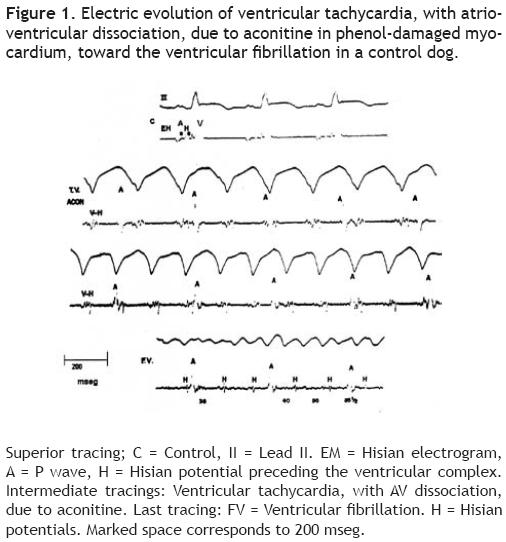
<body><![CDATA[<p align="justify"><font face="verdana" size="2">&nbsp;</font></p>     <p align="justify"><font face="verdana" size="2"><b>Results</b></font></p>     <p align="justify"><font face="verdana" size="2">Control animals showed neither fleeting nor transitory recovery of SR after the VT was unchained. This arrhythmia quickly accelerated until originating a ventricular fibrillation in 5 to 20 minutes. <a href="#f1">Figure 1</a> shows the electrocardiographic evolution, in a control dog, of ventricular tachycardia with atrio&#150;ventricular dissociation, toward ventricular fibrillation.</font></p>     <p align="center"><font face="verdana" size="2"><a name="f1"></a></font></p>     <p align="center"><font face="verdana" size="2"><img src="/img/revistas/acm/v79n3/a3f1.jpg"></font></p>     <p align="justify"><font face="verdana" size="2">&nbsp;</font></p>     <p align="justify"><font face="verdana" size="2"><b>Antiarrhythmic effects of inosine</b></font></p>     <p align="justify"><font face="verdana" size="2"><a href="/img/revistas/acm/v79n3/a3t1.jpg" target="_blank">Table 1</a> shows the different evolution of ventricular tachyarrhythmias in the IN&#150;treated dogs with respect to those developed in control dogs, regarding SR recovery. Inosine reestablished SR in 36 of the 63 treated animals (57.14%, ICL 44.05%; SCL 69.54%), whereas SR was not reestablished in 27 (42.86%). This difference is not statistically significant. However, concerning SR recovery between animals receiving and those not receiving IN (control group), a very significant difference was revealed by the analysis of proportions and confidence limits <a href="#t2">Table 2</a> as well as by the distribution of &#967;<sup>2</sup>, and p values.</font></p>     <p align="center"><font face="verdana" size="2"><a name="t2" id="t2"></a></font></p>     <p align="center"><font face="verdana" size="2"><img src="/img/revistas/acm/v79n3/a3t2.jpg"></font></p>     ]]></body>
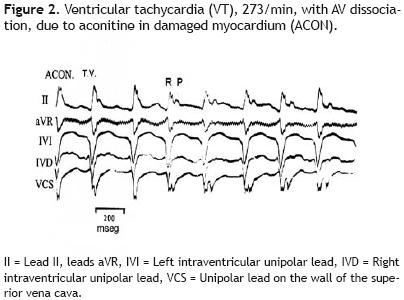
<body><![CDATA[<p align="justify"><font face="verdana" size="2">Analyzing the experiments distributed in three subgroups <a href="/img/revistas/acm/v79n3/a3t3.jpg" target="_blank">Table 3</a>, it can be noted that IN antiarrhythmic effects were obtained in 26 of 34 animals in which the VT was originated by aconitine in the phenol&#150;damaged myocardium (76.47%), in 13 of 16 animals, in which VT was solely due to phenol (81.25%) and in 6 of 13 dogs with VT spontaneously originated (46.15%). Not statistically significant difference between SR recovery in these subgroups was found.</font></p>     <p align="justify"><font face="verdana" size="2">&nbsp;</font></p>     <p align="justify"><font face="verdana" size="2"><b>Examples</b></font></p>     <p align="justify"><font face="verdana" size="2"><a href="#f2">Figure 2</a> reproduces the electrocardiographic tracings of a 273/min VT, with atrioventricular dissociation, induced by aconitine in the ventricular phenol&#150;damaged myocardium.</font></p>     <p align="center"><font face="verdana" size="2"><a name="f2"></a></font></p>     <p align="center"><font face="verdana" size="2"><img src="/img/revistas/acm/v79n3/a3f2.jpg"></font></p>     <p align="justify"><font face="verdana" size="2">The injection of 12 mg of IN through the superior vena cava <a href="#f3">Figure 3</a> immediately produced SR recovery (200/min).</font></p>     <p align="center"><font face="verdana" size="2"><a name="f3"></a></font></p>     <p align="center"><font face="verdana" size="2"><img src="/img/revistas/acm/v79n3/a3f3.jpg"></font></p>     <p align="justify"><font face="verdana" size="2"><a href="#f4">Figure 4</a> exhibits a left ventricular isorhythmic tachycardia, 166/min, and the morphology of ventricular complexes corresponding to an advanced degree RBBB, due only to myocardial damage by phenol. P waves patched to R waves can be seen.</font></p>     ]]></body>
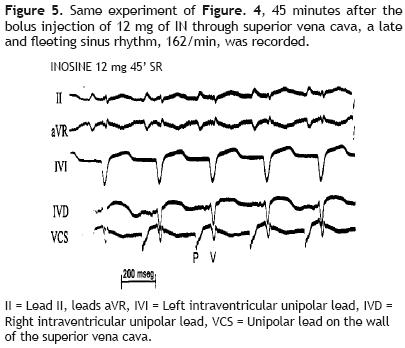
<body><![CDATA[<p align="center"><font face="verdana" size="2"><a name="f4"></a></font></p>     <p align="center"><font face="verdana" size="2"><img src="/img/revistas/acm/v79n3/a3f4.jpg"></font></p>     <p align="justify"><font face="verdana" size="2">Forty&#150;five minutes after the injection of 12 mg of inosine through the superior vena cava <a href="#f5">Figure 5</a> a late and fleeting SR, 162/mln, appeared. Now the RBBB morphologies are absent and P waves precede the ventricular complexes with constant intervals.</font></p>     <p align="center"><font face="verdana" size="2"><a name="f5"></a></font></p>     <p align="center"><font face="verdana" size="2"><img src="/img/revistas/acm/v79n3/a3f5.jpg"></font></p>     <p align="justify"><font face="verdana" size="2">&nbsp;</font></p>     <p align="justify"><font face="verdana" size="2"><b>Arrhythmogenic effects of inosine</b></font></p>     <p align="justify"><font face="verdana" size="2">Under the light of its pro&#150;arrhythmic effects, IN, administered to dogs with VT, produced atrial tachycardia in 10 dogs, causing also atrial flutter and fibrillation, as well as ventricular pre&#150;excitation phenomena in two animals.</font></p>     <p align="justify"><font face="verdana" size="2">Concerning the atrioventricular conduction system, the mentioned nucleoside induced ventricular&#150;atrial block of the second degree with progressive periods of Luciani&#150;Wenckebach type in two animals, similar to that observed previously with adenosine.<sup>14</sup></font></p>     <p align="justify"><font face="verdana" size="2">&nbsp;</font></p>     ]]></body>
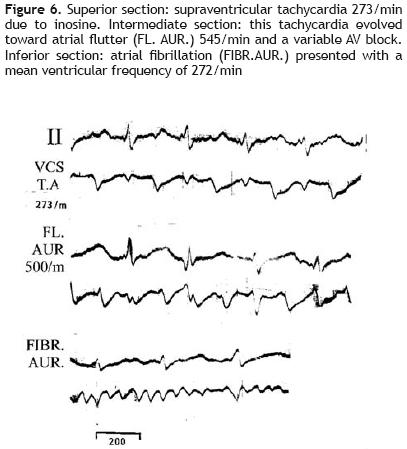
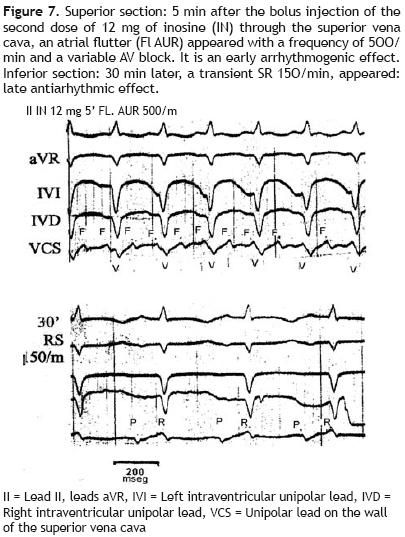
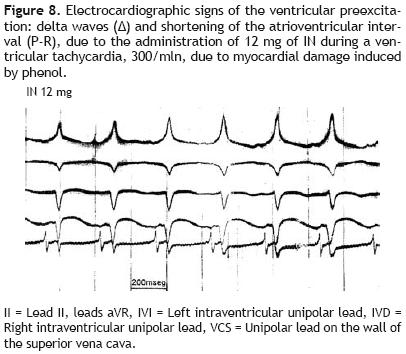
<body><![CDATA[<p align="justify"><font face="verdana" size="2"><b>Examples</b></font></p>     <p align="justify"><font face="verdana" size="2"><a href="#f6">Figure 6</a> shows, in its superior section, an atrial tachycardia, 273/min, due to inosine. This tachycardia evolved towards an atrial flutter, 545/min, with variable atrioventricular block (intermediate section) and, finally, to atrial fibrillation (inferior section).</font></p>     <p align="center"><font face="verdana" size="2"><a name="f6"></a></font></p>     <p align="center"><font face="verdana" size="2"><img src="/img/revistas/acm/v79n3/a3f6.jpg"></font></p>     <p align="justify"><font face="verdana" size="2"><a href="#f7">Figure 7</a> gives an example of both arrhythmogenic and antiarrhythmi'c actions of inosine in the same animal (a dog of 15.8 kg). During a VT, 230/min, due only to myocardial damage by phenol, the first dose of 12 mg of inosine, injected through the superior vena cava, reduced the frequency of this tachycardia to 193/min (not presented in this figure). A second dose of inosine, 5 min after its administration (superior section) originated an atrial flutter, 500/min, with a variable atrioventricular block (early arrhythmogenic effect of inosine). Thirty minutes later (inferior section) a transient SR, 150/min, with prolonged QTc:MV + 0.06 sec appeared, which corresponds to a late antiarrhythmi'c effect.</font></p>     <p align="center"><font face="verdana" size="2"><a name="f7"></a></font></p>     <p align="center"><font face="verdana" size="2"><img src="/img/revistas/acm/v79n3/a3f7.jpg"></font></p>     <p align="justify"><font face="verdana" size="2"><a href="#f8">Figure 8</a> reproduces the manifestation of ventricular pre&#150;excitation: presence of delta wave in the initial portion of the R wave and shortening of the P&#150;R interval, after the administration of 12 mg of IN during an experimental ventricular tachycardia, 300/min.</font></p>     <p align="center"><font face="verdana" size="2"><a name="f8"></a></font></p>     <p align="center"><font face="verdana" size="2"><img src="/img/revistas/acm/v79n3/a3f8.jpg"></font></p>     ]]></body>
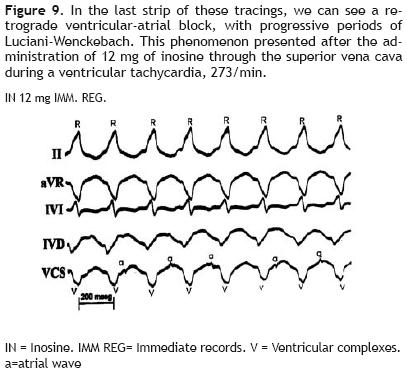
<body><![CDATA[<p align="justify"><font face="verdana" size="2"><a href="#f9">Figure 9</a> clearly shows, on its last strip, a retrograde ventricular&#150;atrial block of second degree, with progressive periods of Luciani&#150;Wenckebach type: progressive prolongation of ventricular&#150;atrial intervals (V&#150;a) until the interrupted passage of the retrograde activation impulse, and absence of the small atrial wave (a) after the fifth ventricularcomplex(V). This phenomenon was seen on the immediate recordings (IMM REG) after the administration of 12 mg of IN during a ventricular tachycardia, 273/min.</font></p>     <p align="center"><font face="verdana" size="2"><a name="f9"></a></font></p>     <p align="center"><font face="verdana" size="2"><img src="/img/revistas/acm/v79n3/a3f9.jpg"></font></p>     <p align="justify"><font face="verdana" size="2">&nbsp;</font></p>     <p align="justify"><font face="verdana" size="2"><b>Discussion</b></font></p>     <p align="justify"><font face="verdana" size="2">In 1987, Lubbe et al.<sup>16</sup> pointed out that all the nucleosides derived from adenine have an anticatecholaminic action. When these nudeosides reach a sufficient concentration, they are able to suppress the origin of ventricular arrhythmias due to catecholamines.<sup>10,11</sup> These purine compounds, by means of incompletely defined mechanisms, can act as antagonists of the increased myocardial vulnerability mediated by AMP<sub>c</sub>, which contributes to the genesis of the ventricular fibrillation during the early phase of myocardial ischemia.</font></p>     <p align="justify"><font face="verdana" size="2">The results of our study objectively show that IN has antiarrhythmic and arrhythmogenic effects similar to those of adenosine, from which it is derived. Concerning the relation chemical structure&#150;biological activity, this fact suggests that adenosine deamination does not remove the potential biological activity of this der&iacute;vate. The IN's antiarrhythmic effects are exerted on atrial and ventricular arrhythmias, probably due to the activation of A, receptors and through other intracellular mechanism.<sup>17</sup> Its action could be opposed by blockers of these receptors.</font></p>     <p align="justify"><font face="verdana" size="2">On the contrary, IN's arrhythmogenic effects can be due to sympathetic reflexes, similar to those mentioned by Belardinelli et al.<sup>3</sup> concerning adenosine.</font></p>     <p align="justify"><font face="verdana" size="2">Furthermore IN could increase the outward potassium current, like adenosine and acetylcholine, shortening the refractory period of myocytes. In fact, a physiologist of our Institute,<sup>18</sup> has observed that, in mouse myocytes, low doses of IN &#150;similar to those used in this study&#150; impel the outward potassium current, while high doses of this nucleoside increase the inward calcium current in myocardial cells. These observations could satisfactorily explain the origin of the atrial flutter and its passage to atrial fibrillation. On the other side, IN, as well as adenosine,<sup>19</sup> can allow for the manifestation of a ventricular preexcitation coincident with bradycardia or nodal block, also promoting the conduction through some accessory pathway, usually non&#150;functional: a secondary mechanism to a sympathetic activation.</font></p>     <p align="justify"><font face="verdana" size="2">Inosine apparently acts on the same adenosine receptors of myocytes. These, A, A<sub>2A</sub> and A<sub>3</sub><sup>8</sup>, are stored on the surface of protein G, regulating the effects by stimulating these receptors. Protein G activates the K and Ca&#150;6 channels<sup>20</sup> and, probably, phospholypase C. The receptor A1, coupled to a protein G system, reduces the levels of cyclic adenosine monophosphate (cAMP), opposing the increase of adenylate cyclase activity. Inosine could also act on other intracellular and sarcolemmal receptors that are influenced by adenosine, as well as on muscarinic channels of potassium (KACh, KADO), which mediate its chronotropic and dromotropic effects in atria but not in ventricles. When adenosine and IN are accumulated in the extracellular spaces, the outward current of intracellular potassium could increase, thereby inducing a fall in cellular conduction speed.<sup>7</sup></font></p>     ]]></body>
<body><![CDATA[<p align="justify"><font face="verdana" size="2">We present here the antiarrhythmic and arrhythmogenic effects of IN, an adenosine der&iacute;vate, which seems to act on the same receptor of adenosine and has a similar action. These effects of IN are shown in this study; although certain authors<sup>21</sup> suggest that variations in adenosine's structure implicate the loss of important interactions, and others<sup>9 </sup>describe its intracellular action independent from other adenosine receptors.</font></p>     <p align="justify"><font face="verdana" size="2">Concerning the arrhythmogenic effects of IN, we have observed that atrial tachycardia, flutter, and fibrillation present in treated animals, as well as in those that received adenosine,<sup>2223</sup> are probably due to a shortening of the atrial refractory period. It is worthwhile to mention that, during the treatment of ventricular arrhythmias with intravenously applied IN, electrocardiographic signs of ventricular preexcitation are manifested, as occurs with adenosine.<sup>24</sup> This fact already reported by other authors, regarding adenosine,<sup>2526</sup> can occur coincidentally with bradycardia or heart block, or could be due to a facilitated conduction through some accessory pathway usually not functional: a secondary phenomenon due to sympathetic activation.</font></p>     <p align="justify"><font face="verdana" size="2">&nbsp;</font></p>     <p align="justify"><font face="verdana" size="2"><b>Limitations of the study</b></font></p>     <p align="justify"><font face="verdana" size="2">The number of experiments included in each subgroup is rather small. A larger number of experiments could confirm the observations already made and support our results. On the other side, it is necessary to state that we did not find specific studies on the electrophysiology and pharmacology of IN, whereas there are numerous studies concerning adenosine. For this reason, we must rely on publications on the characteristics and effects of adenosine. It would be suitable to study also the action of IN infusions.</font></p>     <p align="justify"><font face="verdana" size="2">&nbsp;</font></p>     <p align="justify"><font face="verdana" size="2"><b>Conclusions</b></font></p>     <p align="justify"><font face="verdana" size="2">Inosine, a der&iacute;vate from adenosine, has antiarrhythmic and arrhythmogenic effects similar to those of adenosine. Its antiarrhythmic action is exerted on atrial and ventricular tachycardias, probably due to the activation of myocyte's receptors, which is opposed by their blockers.</font></p>     <p align="justify"><font face="verdana" size="2">The arrhythmogenic effects of IN are probably due to sympathetic reflexes stimulated by this nucleoside, similar to those stimulated by adenosine.</font></p>     <p align="justify"><font face="verdana" size="2">On the other hand, IN can produce a ventricular preexcitation coincident with bradycardia or heart block, or a facilitated conduction through an accessory, usually not functional pathway. The arrhythmogenic effects of IN can be due to sympathetic reflexes, similar to those stimulated by adenosine.</font></p>     ]]></body>
<body><![CDATA[<p align="justify"><font face="verdana" size="2">Concerning the alterations of atrioventricular and ventricular&#150;atrial conduction, IN, as well as adenosine, could reduce the voltage and duration of the action potentials, particularly in the cells of the central region of the atrio&#150;ventricular node.</font></p>     <p align="justify"><font face="verdana" size="2">&nbsp;</font></p>     <p align="justify"><font face="verdana" size="2"><b>Bibliography</b></font></p>     <!-- ref --><p align="justify"><font face="verdana" size="2">1. Brandan NC, Aispuru G. Metabolismo de compuestos hidrogenados.    <a href="http://med.unne.edu.ar/catedras/bioquimica/pdf/nitro.pdf" target="_blank">http://med.unne.edu.ar/catedras/bioquimica/pdf/nitro.pdf</a>.</font>&nbsp;&nbsp;&nbsp;&nbsp;&nbsp;&nbsp;&nbsp;&nbsp;[&#160;<a href="javascript:void(0);" onclick="javascript: window.open('/scielo.php?script=sci_nlinks&ref=1081323&pid=S1405-9940200900030000300001&lng=','','width=640,height=500,resizable=yes,scrollbars=1,menubar=yes,');">Links</a>&#160;]<!-- end-ref --><!-- ref --><p align="justify"><font face="verdana" size="2">2. Belardinelli L, Lerman BB. Adenosine: cardiac electrophysiology. Pacing Clin Electrophysiol 1991;14:1672&#150;80.</font>&nbsp;&nbsp;&nbsp;&nbsp;&nbsp;&nbsp;&nbsp;&nbsp;[&#160;<a href="javascript:void(0);" onclick="javascript: window.open('/scielo.php?script=sci_nlinks&ref=1081324&pid=S1405-9940200900030000300002&lng=','','width=640,height=500,resizable=yes,scrollbars=1,menubar=yes,');">Links</a>&#160;]<!-- end-ref --><!-- ref --><p align="justify"><font face="verdana" size="2">3. Belardinelli L, Shreyock KJC , Pelleg A. Cardiac electrophysiologic properties of adenosine. Coron Art Dis 1992;3:1122&#150;6.</font>&nbsp;&nbsp;&nbsp;&nbsp;&nbsp;&nbsp;&nbsp;&nbsp;[&#160;<a href="javascript:void(0);" onclick="javascript: window.open('/scielo.php?script=sci_nlinks&ref=1081325&pid=S1405-9940200900030000300003&lng=','','width=640,height=500,resizable=yes,scrollbars=1,menubar=yes,');">Links</a>&#160;]<!-- end-ref --><!-- ref --><p align="justify"><font face="verdana" size="2">4. Pelleg A, Porter RS. Pharmacology of adenosine. Pharmacotherapy 1990; 10:157&#150;74.</font>&nbsp;&nbsp;&nbsp;&nbsp;&nbsp;&nbsp;&nbsp;&nbsp;[&#160;<a href="javascript:void(0);" onclick="javascript: window.open('/scielo.php?script=sci_nlinks&ref=1081326&pid=S1405-9940200900030000300004&lng=','','width=640,height=500,resizable=yes,scrollbars=1,menubar=yes,');">Links</a>&#160;]<!-- end-ref --><!-- ref --><p align="justify"><font face="verdana" size="2">5. DiMarco J, Miles W, Akhtar M, Milstein S, Sharma AD, Platia E, et al. Adenosine for paroxysmal supraventricular tachycardia. Dose ranging and comparison with verapamil. Assessment in placebo&#150;controlled,  multicenter trials The adenosine for PSVT Study Group..Ann InternMed 1990;113:104&#150;10.</font>&nbsp;&nbsp;&nbsp;&nbsp;&nbsp;&nbsp;&nbsp;&nbsp;[&#160;<a href="javascript:void(0);" onclick="javascript: window.open('/scielo.php?script=sci_nlinks&ref=1081327&pid=S1405-9940200900030000300005&lng=','','width=640,height=500,resizable=yes,scrollbars=1,menubar=yes,');">Links</a>&#160;]<!-- end-ref --><!-- ref --><p align="justify"><font face="verdana" size="2">6. Froldi L, Belardinelli L. Species dependent effects of adenosine on heart rate and atrioventricular nodal conduction. Mechanism and physiological complications. Ore Res 1990;67:960&#150;78.</font>&nbsp;&nbsp;&nbsp;&nbsp;&nbsp;&nbsp;&nbsp;&nbsp;[&#160;<a href="javascript:void(0);" onclick="javascript: window.open('/scielo.php?script=sci_nlinks&ref=1081328&pid=S1405-9940200900030000300006&lng=','','width=640,height=500,resizable=yes,scrollbars=1,menubar=yes,');">Links</a>&#160;]<!-- end-ref --><!-- ref --><p align="justify"><font face="verdana" size="2">7. Cierno HF, Belardinelli L. Effects of adenosine on atrioventricular conduction. I:Site and characterization of adenosine action in the guinea pig atrioventricular node. Circ Res 1986;59:427&#150;36.</font>&nbsp;&nbsp;&nbsp;&nbsp;&nbsp;&nbsp;&nbsp;&nbsp;[&#160;<a href="javascript:void(0);" onclick="javascript: window.open('/scielo.php?script=sci_nlinks&ref=1081329&pid=S1405-9940200900030000300007&lng=','','width=640,height=500,resizable=yes,scrollbars=1,menubar=yes,');">Links</a>&#160;]<!-- end-ref --><!-- ref --><p align="justify"><font face="verdana" size="2">8. Chen Y, Barche RJ. Adenosine. A modulator of the cardiac response to stress. Circ Res 2003;93:691&#150;3.</font>&nbsp;&nbsp;&nbsp;&nbsp;&nbsp;&nbsp;&nbsp;&nbsp;[&#160;<a href="javascript:void(0);" onclick="javascript: window.open('/scielo.php?script=sci_nlinks&ref=1081330&pid=S1405-9940200900030000300008&lng=','','width=640,height=500,resizable=yes,scrollbars=1,menubar=yes,');">Links</a>&#160;]<!-- end-ref --><!-- ref --><p align="justify"><font face="verdana" size="2">9. Vir&aacute;g L, Szab&oacute; C. Purines inhibit poly (ADP&#150;ribose) polymerase activation and modulate oxidant&#150;induced cell death. FASEB J 2001;15:99&#150;107.</font>&nbsp;&nbsp;&nbsp;&nbsp;&nbsp;&nbsp;&nbsp;&nbsp;[&#160;<a href="javascript:void(0);" onclick="javascript: window.open('/scielo.php?script=sci_nlinks&ref=1081331&pid=S1405-9940200900030000300009&lng=','','width=640,height=500,resizable=yes,scrollbars=1,menubar=yes,');">Links</a>&#160;]<!-- end-ref --><!-- ref --><p align="justify"><font face="verdana" size="2">10. G&ouml;rge B, Kurz T, Katus HA, Richardt G. Endogenous adenosine suppresses norepinephrine&#150;induced ventricular arrhythmias in rat heart. Basic Res Cardiol 1998;93:264&#150;8.</font>&nbsp;&nbsp;&nbsp;&nbsp;&nbsp;&nbsp;&nbsp;&nbsp;[&#160;<a href="javascript:void(0);" onclick="javascript: window.open('/scielo.php?script=sci_nlinks&ref=1081332&pid=S1405-9940200900030000300010&lng=','','width=640,height=500,resizable=yes,scrollbars=1,menubar=yes,');">Links</a>&#160;]<!-- end-ref --><!-- ref --><p align="justify"><font face="verdana" size="2">11. Friedrichs GS, Merrill GF. Adenosine deaminase and adenosine attenuate ventricular arrhythmias caused by norepinephrine. Am J Physiol 1991;260(3Pt): H979&#150;84.</font>&nbsp;&nbsp;&nbsp;&nbsp;&nbsp;&nbsp;&nbsp;&nbsp;[&#160;<a href="javascript:void(0);" onclick="javascript: window.open('/scielo.php?script=sci_nlinks&ref=1081333&pid=S1405-9940200900030000300011&lng=','','width=640,height=500,resizable=yes,scrollbars=1,menubar=yes,');">Links</a>&#160;]<!-- end-ref --><!-- ref --><p align="justify"><font face="verdana" size="2">12. West G A, Isenberg G, Belardinelli L. Antagonism of forskolin effects by adenosine in guinea pig isolated hearts and ventricular myocytes: evidence that adrenergic effects of adenosine are due to inhibition of adenylate cyclase. Am J Physiol 1986;250:H769&#150;77.</font>&nbsp;&nbsp;&nbsp;&nbsp;&nbsp;&nbsp;&nbsp;&nbsp;[&#160;<a href="javascript:void(0);" onclick="javascript: window.open('/scielo.php?script=sci_nlinks&ref=1081334&pid=S1405-9940200900030000300012&lng=','','width=640,height=500,resizable=yes,scrollbars=1,menubar=yes,');">Links</a>&#160;]<!-- end-ref --><!-- ref --><p align="justify"><font face="verdana" size="2">13. Rodr&iacute;guez&#150;Castellano T J, Iturralde&#150;Torres P, de Micheli A, Ram&iacute;rez&#150;lnsunza J M, Ramirez J C, Corona Sapien C, et al. Respuesta de la taquicardia ventricular a la administraci&oacute;n de adenosina. Arch Inst Cardiol Mex 1994;64:445&#150;54.</font>&nbsp;&nbsp;&nbsp;&nbsp;&nbsp;&nbsp;&nbsp;&nbsp;[&#160;<a href="javascript:void(0);" onclick="javascript: window.open('/scielo.php?script=sci_nlinks&ref=1081335&pid=S1405-9940200900030000300013&lng=','','width=640,height=500,resizable=yes,scrollbars=1,menubar=yes,');">Links</a>&#160;]<!-- end-ref --><!-- ref --><p align="justify"><font face="verdana" size="2">14. De Micheli A, Ch&aacute;vez&#150;Dom&iacute;nguez R, Iturralde&#150;Torres P, Pastel&iacute;n G, Medrano G A. Efectos tempranos y tard&iacute;os de.la adenosina en taquicardias ventriculares experimentales. Rev Esp Cardiol 2005;58:159&#150;66.</font>&nbsp;&nbsp;&nbsp;&nbsp;&nbsp;&nbsp;&nbsp;&nbsp;[&#160;<a href="javascript:void(0);" onclick="javascript: window.open('/scielo.php?script=sci_nlinks&ref=1081336&pid=S1405-9940200900030000300014&lng=','','width=640,height=500,resizable=yes,scrollbars=1,menubar=yes,');">Links</a>&#160;]<!-- end-ref --><!-- ref --><p align="justify"><font face="verdana" size="2">15. Lerman BB, Belardinelli L. Cardiac electrophysiology of adenosine. Circulation 1991;83:1499&#150;509.</font>&nbsp;&nbsp;&nbsp;&nbsp;&nbsp;&nbsp;&nbsp;&nbsp;[&#160;<a href="javascript:void(0);" onclick="javascript: window.open('/scielo.php?script=sci_nlinks&ref=1081337&pid=S1405-9940200900030000300015&lng=','','width=640,height=500,resizable=yes,scrollbars=1,menubar=yes,');">Links</a>&#160;]<!-- end-ref --><!-- ref --><p align="justify"><font face="verdana" size="2">16. Lubbe W F, Gilchrist A I, Holland R K, Pybus J. Adenine nucleotides and ventricular fibrillation. J Mol Cell Cardiol 1987;19 Suppl5:23&#150;33.</font>&nbsp;&nbsp;&nbsp;&nbsp;&nbsp;&nbsp;&nbsp;&nbsp;[&#160;<a href="javascript:void(0);" onclick="javascript: window.open('/scielo.php?script=sci_nlinks&ref=1081338&pid=S1405-9940200900030000300016&lng=','','width=640,height=500,resizable=yes,scrollbars=1,menubar=yes,');">Links</a>&#160;]<!-- end-ref --><!-- ref --><p align="justify"><font face="verdana" size="2">17. Szab&oacute; G, Stumpf N, Radovits F, Sonnenberg K, Ger&oacute; D, Hagl S, et al. Effects of inosine on reperfusion injury after heart transplantation. Eur J Cardiothoracic Surg 2006; 30:96&#150;102.</font>&nbsp;&nbsp;&nbsp;&nbsp;&nbsp;&nbsp;&nbsp;&nbsp;[&#160;<a href="javascript:void(0);" onclick="javascript: window.open('/scielo.php?script=sci_nlinks&ref=1081339&pid=S1405-9940200900030000300017&lng=','','width=640,height=500,resizable=yes,scrollbars=1,menubar=yes,');">Links</a>&#160;]<!-- end-ref --><!-- ref --><p align="justify"><font face="verdana" size="2">18. Mart&iacute;nez M: Personal communication.</font>&nbsp;&nbsp;&nbsp;&nbsp;&nbsp;&nbsp;&nbsp;&nbsp;[&#160;<a href="javascript:void(0);" onclick="javascript: window.open('/scielo.php?script=sci_nlinks&ref=1081340&pid=S1405-9940200900030000300018&lng=','','width=640,height=500,resizable=yes,scrollbars=1,menubar=yes,');">Links</a>&#160;]<!-- end-ref --><!-- ref --><p align="justify"><font face="verdana" size="2">19. Garrat C J, Antoniou M J, Ward DE, Camm AJ. Use of intravenous adenosine in sinus rhythm as a diagnostic test for latent preexcitation. Am J Cardiol 1990;65:868 &#150;73.</font>&nbsp;&nbsp;&nbsp;&nbsp;&nbsp;&nbsp;&nbsp;&nbsp;[&#160;<a href="javascript:void(0);" onclick="javascript: window.open('/scielo.php?script=sci_nlinks&ref=1081341&pid=S1405-9940200900030000300019&lng=','','width=640,height=500,resizable=yes,scrollbars=1,menubar=yes,');">Links</a>&#160;]<!-- end-ref --><!-- ref --><p align="justify"><font face="verdana" size="2">20. Bases farmacol&oacute;gicas de la terap&eacute;utica. J G Hardman, L E Limbird, editors. M&eacute;xico. McGraw&#150;Hill Interamericana. 10th Ed. Vol I. p 958, Cuadro 35&#150;3.</font>&nbsp;&nbsp;&nbsp;&nbsp;&nbsp;&nbsp;&nbsp;&nbsp;[&#160;<a href="javascript:void(0);" onclick="javascript: window.open('/scielo.php?script=sci_nlinks&ref=1081342&pid=S1405-9940200900030000300020&lng=','','width=640,height=500,resizable=yes,scrollbars=1,menubar=yes,');">Links</a>&#160;]<!-- end-ref --><!-- ref --><p align="justify"><font face="verdana" size="2">21. Alunni S, Orr&uuml; M, Ottavi L. A study on the inhibition of adenosine deaminase enzyme. J Enzyme InhibMed Chem 2008;23:182&#150;9.</font>&nbsp;&nbsp;&nbsp;&nbsp;&nbsp;&nbsp;&nbsp;&nbsp;[&#160;<a href="javascript:void(0);" onclick="javascript: window.open('/scielo.php?script=sci_nlinks&ref=1081343&pid=S1405-9940200900030000300021&lng=','','width=640,height=500,resizable=yes,scrollbars=1,menubar=yes,');">Links</a>&#160;]<!-- end-ref --><!-- ref --><p align="justify"><font face="verdana" size="2">22. DiMarco J P. Electrophysiology of adenosine. J Cardiovasc Electrophysiol 1990; 1:340&#150;8.</font>&nbsp;&nbsp;&nbsp;&nbsp;&nbsp;&nbsp;&nbsp;&nbsp;[&#160;<a href="javascript:void(0);" onclick="javascript: window.open('/scielo.php?script=sci_nlinks&ref=1081344&pid=S1405-9940200900030000300022&lng=','','width=640,height=500,resizable=yes,scrollbars=1,menubar=yes,');">Links</a>&#160;]<!-- end-ref --><!-- ref --><p align="justify"><font face="verdana" size="2">23. Haines D P, Lerman BB, DiMarco J P. Intravenous adenosine shortens atrial refractoriness in man. Circulation 1988;78 Suppl 11:153.</font>&nbsp;&nbsp;&nbsp;&nbsp;&nbsp;&nbsp;&nbsp;&nbsp;[&#160;<a href="javascript:void(0);" onclick="javascript: window.open('/scielo.php?script=sci_nlinks&ref=1081345&pid=S1405-9940200900030000300023&lng=','','width=640,height=500,resizable=yes,scrollbars=1,menubar=yes,');">Links</a>&#160;]<!-- end-ref --><!-- ref --><p align="justify"><font face="verdana" size="2">24. de Micheli A, Iturralde Torres P, Pastelin G. Adenosina en taquicardias ventriculares inducidas. Communication to XX Congreso Mexicano de Cardiolog&iacute;a. M&eacute;rida, Yucat&aacute;n, November 1&#150;5,1997. Arch Inst Cardiol Mex 1997;67 Suppl l:No.224.</font>&nbsp;&nbsp;&nbsp;&nbsp;&nbsp;&nbsp;&nbsp;&nbsp;[&#160;<a href="javascript:void(0);" onclick="javascript: window.open('/scielo.php?script=sci_nlinks&ref=1081346&pid=S1405-9940200900030000300024&lng=','','width=640,height=500,resizable=yes,scrollbars=1,menubar=yes,');">Links</a>&#160;]<!-- end-ref --><!-- ref --><p align="justify"><font face="verdana" size="2">25. DiMarco J P, Lerman BB, Haines D F. Effects of adenosine on antegrade conduction in patients with manifest and concealed preexcitation. Abstract. Circulation 1987;76:IV&#150;67.</font>&nbsp;&nbsp;&nbsp;&nbsp;&nbsp;&nbsp;&nbsp;&nbsp;[&#160;<a href="javascript:void(0);" onclick="javascript: window.open('/scielo.php?script=sci_nlinks&ref=1081347&pid=S1405-9940200900030000300025&lng=','','width=640,height=500,resizable=yes,scrollbars=1,menubar=yes,');">Links</a>&#160;]<!-- end-ref --><!-- ref --><p align="justify"><font face="verdana" size="2">26. Alegret J M, V&iacute;nolas X, Palaz&oacute;n O, Vernls J M, Ferrer A, Oter R. Preexcitaci&oacute;n intermitente tras administraci&oacute;n de adenosina. Rev Esp Cardiol 2000;53:1132&#150;5.</font>&nbsp;&nbsp;&nbsp;&nbsp;&nbsp;&nbsp;&nbsp;&nbsp;[&#160;<a href="javascript:void(0);" onclick="javascript: window.open('/scielo.php?script=sci_nlinks&ref=1081348&pid=S1405-9940200900030000300026&lng=','','width=640,height=500,resizable=yes,scrollbars=1,menubar=yes,');">Links</a>&#160;]<!-- end-ref --><p align="justify"><font face="verdana" size="2">&nbsp;</font></p>     ]]></body>
<body><![CDATA[<p align="justify"><font size="2" face="verdana"><b><a name="note"></a>Note</b></font></p>     <p align="justify"><font face="verdana" size="2"><b>Abbrevations: </b></font></p>     <p align="justify"><font face="verdana" size="2">LIV: Left intraventricular lead </font></p>     <p align="justify"><font face="verdana" size="2">RIV: Right intraventricular lead</font></p>     <p align="justify"><font face="verdana" size="2">SVC: Superior vena cava</font></p>     <p align="justify"><font face="verdana" size="2">SR: Sinus rhythm</font></p>     <p align="justify"><font face="verdana" size="2">VT: Ventricular tachycardia</font></p>     <p align="justify"><font face="verdana" size="2">LVT: Left ventricular tachycardia</font></p>     <p align="justify"><font face="verdana" size="2">FL: Atrial flutter</font></p>     <p align="justify"><font face="verdana" size="2">FIBR: Atrial fibrillation</font></p>     ]]></body>
<body><![CDATA[<p align="justify"><font face="verdana" size="2">AT: Atrial tachycardia</font></p>     <p align="justify"><font face="verdana" size="2">IN: Inosine</font></p>     <p align="justify"><font face="verdana" size="2">RBBB: Right Bundle Branch Block</font></p>     <p align="justify"><font face="verdana" size="2">AAV: Mean Value</font></p>      ]]></body><back>
<ref-list>
<ref id="B1">
<label>1</label><nlm-citation citation-type="">
<person-group person-group-type="author">
<name>
<surname><![CDATA[Brandan]]></surname>
<given-names><![CDATA[NC]]></given-names>
</name>
<name>
<surname><![CDATA[Aispuru]]></surname>
<given-names><![CDATA[G.]]></given-names>
</name>
</person-group>
<source><![CDATA[Metabolismo de compuestos hidrogenados]]></source>
<year></year>
</nlm-citation>
</ref>
<ref id="B2">
<label>2</label><nlm-citation citation-type="journal">
<person-group person-group-type="author">
<name>
<surname><![CDATA[Belardinelli]]></surname>
<given-names><![CDATA[L]]></given-names>
</name>
<name>
<surname><![CDATA[Lerman]]></surname>
<given-names><![CDATA[BB.]]></given-names>
</name>
</person-group>
<article-title xml:lang="es"><![CDATA[Adenosine: cardiac electrophysiology]]></article-title>
<source><![CDATA[Pacing Clin Electrophysiol]]></source>
<year>1991</year>
<volume>14</volume>
<page-range>1672-80</page-range></nlm-citation>
</ref>
<ref id="B3">
<label>3</label><nlm-citation citation-type="journal">
<person-group person-group-type="author">
<name>
<surname><![CDATA[Belardinelli]]></surname>
<given-names><![CDATA[L]]></given-names>
</name>
<name>
<surname><![CDATA[Shreyock]]></surname>
<given-names><![CDATA[KJC]]></given-names>
</name>
<name>
<surname><![CDATA[Pelleg]]></surname>
<given-names><![CDATA[A.]]></given-names>
</name>
</person-group>
<article-title xml:lang="en"><![CDATA[Cardiac electrophysiologic properties of adenosine]]></article-title>
<source><![CDATA[Coron Art Dis]]></source>
<year>1992</year>
<volume>3</volume>
<page-range>1122-6</page-range></nlm-citation>
</ref>
<ref id="B4">
<label>4</label><nlm-citation citation-type="journal">
<person-group person-group-type="author">
<name>
<surname><![CDATA[Pelleg]]></surname>
<given-names><![CDATA[A]]></given-names>
</name>
<name>
<surname><![CDATA[Porter]]></surname>
<given-names><![CDATA[RS.]]></given-names>
</name>
</person-group>
<article-title xml:lang="en"><![CDATA[Pharmacology of adenosine]]></article-title>
<source><![CDATA[Pharmacotherapy]]></source>
<year>1990</year>
<volume>10</volume>
<page-range>157-74</page-range></nlm-citation>
</ref>
<ref id="B5">
<label>5</label><nlm-citation citation-type="journal">
<person-group person-group-type="author">
<name>
<surname><![CDATA[DiMarco]]></surname>
<given-names><![CDATA[J]]></given-names>
</name>
<name>
<surname><![CDATA[Miles]]></surname>
<given-names><![CDATA[W]]></given-names>
</name>
<name>
<surname><![CDATA[Akhtar]]></surname>
<given-names><![CDATA[M]]></given-names>
</name>
<name>
<surname><![CDATA[Milstein]]></surname>
<given-names><![CDATA[S]]></given-names>
</name>
<name>
<surname><![CDATA[Sharma]]></surname>
<given-names><![CDATA[AD]]></given-names>
</name>
<name>
<surname><![CDATA[Platia]]></surname>
<given-names><![CDATA[E]]></given-names>
</name>
</person-group>
<article-title xml:lang="en"><![CDATA[Adenosine for paroxysmal supraventricular tachycardia. Dose ranging and comparison with verapamil: Assessment in placebo-controlled, multicenter trials The adenosine for PSVT Study Group]]></article-title>
<source><![CDATA[Ann InternMed]]></source>
<year>1990</year>
<volume>113</volume>
<page-range>104-10</page-range></nlm-citation>
</ref>
<ref id="B6">
<label>6</label><nlm-citation citation-type="journal">
<person-group person-group-type="author">
<name>
<surname><![CDATA[Froldi]]></surname>
<given-names><![CDATA[L]]></given-names>
</name>
<name>
<surname><![CDATA[Belardinelli]]></surname>
<given-names><![CDATA[L.]]></given-names>
</name>
</person-group>
<article-title xml:lang="en"><![CDATA[Species dependent effects of adenosine on heart rate and atrioventricular nodal conduction: Mechanism and physiological complications]]></article-title>
<source><![CDATA[Ore Res]]></source>
<year>1990</year>
<volume>67</volume>
<page-range>960-78</page-range></nlm-citation>
</ref>
<ref id="B7">
<label>7</label><nlm-citation citation-type="journal">
<person-group person-group-type="author">
<name>
<surname><![CDATA[Cierno]]></surname>
<given-names><![CDATA[HF]]></given-names>
</name>
<name>
<surname><![CDATA[Belardinelli]]></surname>
<given-names><![CDATA[L.]]></given-names>
</name>
</person-group>
<article-title xml:lang="en"><![CDATA[Effects of adenosine on atrioventricular conduction. I: Site and characterization of adenosine action in the guinea pig atrioventricular node]]></article-title>
<source><![CDATA[Circ Res]]></source>
<year>1986</year>
<volume>59</volume>
<page-range>427-36</page-range></nlm-citation>
</ref>
<ref id="B8">
<label>8</label><nlm-citation citation-type="journal">
<person-group person-group-type="author">
<name>
<surname><![CDATA[Chen]]></surname>
<given-names><![CDATA[Y]]></given-names>
</name>
<name>
<surname><![CDATA[Barche]]></surname>
<given-names><![CDATA[RJ.]]></given-names>
</name>
</person-group>
<article-title xml:lang="en"><![CDATA[Adenosine: A modulator of the cardiac response to stress]]></article-title>
<source><![CDATA[Circ Res]]></source>
<year>2003</year>
<volume>93</volume>
<page-range>691-3</page-range></nlm-citation>
</ref>
<ref id="B9">
<label>9</label><nlm-citation citation-type="journal">
<person-group person-group-type="author">
<name>
<surname><![CDATA[Virág]]></surname>
<given-names><![CDATA[L]]></given-names>
</name>
<name>
<surname><![CDATA[Szabó]]></surname>
<given-names><![CDATA[C.]]></given-names>
</name>
</person-group>
<article-title xml:lang="en"><![CDATA[Purines inhibit poly (ADP-ribose) polymerase activation and modulate oxidant-induced cell death]]></article-title>
<source><![CDATA[FASEB J]]></source>
<year>2001</year>
<volume>15</volume>
<page-range>99-107</page-range></nlm-citation>
</ref>
<ref id="B10">
<label>10</label><nlm-citation citation-type="journal">
<person-group person-group-type="author">
<name>
<surname><![CDATA[Görge]]></surname>
<given-names><![CDATA[B]]></given-names>
</name>
<name>
<surname><![CDATA[Kurz]]></surname>
<given-names><![CDATA[T]]></given-names>
</name>
<name>
<surname><![CDATA[Katus]]></surname>
<given-names><![CDATA[HA]]></given-names>
</name>
<name>
<surname><![CDATA[Richardt]]></surname>
<given-names><![CDATA[G.]]></given-names>
</name>
</person-group>
<article-title xml:lang="en"><![CDATA[Endogenous adenosine suppresses norepinephrine-induced ventricular arrhythmias in rat heart]]></article-title>
<source><![CDATA[Basic Res Cardiol]]></source>
<year>1998</year>
<volume>93</volume>
<page-range>264-8</page-range></nlm-citation>
</ref>
<ref id="B11">
<label>11</label><nlm-citation citation-type="journal">
<person-group person-group-type="author">
<name>
<surname><![CDATA[Friedrichs]]></surname>
<given-names><![CDATA[GS]]></given-names>
</name>
<name>
<surname><![CDATA[Merrill]]></surname>
<given-names><![CDATA[GF.]]></given-names>
</name>
</person-group>
<article-title xml:lang="en"><![CDATA[Adenosine deaminase and adenosine attenuate ventricular arrhythmias caused by norepinephrine]]></article-title>
<source><![CDATA[Am J Physiol]]></source>
<year>1991</year>
<volume>260</volume>
</nlm-citation>
</ref>
<ref id="B12">
<label>12</label><nlm-citation citation-type="journal">
<person-group person-group-type="author">
<name>
<surname><![CDATA[West]]></surname>
<given-names><![CDATA[G A]]></given-names>
</name>
<name>
<surname><![CDATA[Isenberg]]></surname>
<given-names><![CDATA[G]]></given-names>
</name>
<name>
<surname><![CDATA[Belardinelli]]></surname>
<given-names><![CDATA[L.]]></given-names>
</name>
</person-group>
<article-title xml:lang="en"><![CDATA[Antagonism of forskolin effects by adenosine in guinea pig isolated hearts and ventricular myocytes: evidence that adrenergic effects of adenosine are due to inhibition of adenylate cyclase]]></article-title>
<source><![CDATA[Am J Physiol]]></source>
<year>1986</year>
<volume>250</volume>
</nlm-citation>
</ref>
<ref id="B13">
<label>13</label><nlm-citation citation-type="journal">
<person-group person-group-type="author">
<name>
<surname><![CDATA[Rodríguez-Castellano]]></surname>
<given-names><![CDATA[T J]]></given-names>
</name>
<name>
<surname><![CDATA[Iturralde-Torres]]></surname>
<given-names><![CDATA[P]]></given-names>
</name>
<name>
<surname><![CDATA[de Micheli]]></surname>
<given-names><![CDATA[A]]></given-names>
</name>
<name>
<surname><![CDATA[Ramírez-lnsunza]]></surname>
<given-names><![CDATA[J M]]></given-names>
</name>
<name>
<surname><![CDATA[Ramirez]]></surname>
<given-names><![CDATA[J C]]></given-names>
</name>
<name>
<surname><![CDATA[Corona Sapien]]></surname>
<given-names><![CDATA[C]]></given-names>
</name>
</person-group>
<article-title xml:lang="es"><![CDATA[Respuesta de la taquicardia ventricular a la administración de adenosina]]></article-title>
<source><![CDATA[Arch Inst Cardiol Mex]]></source>
<year>1994</year>
<volume>64</volume>
<page-range>445-54</page-range></nlm-citation>
</ref>
<ref id="B14">
<label>14</label><nlm-citation citation-type="journal">
<person-group person-group-type="author">
<name>
<surname><![CDATA[De Micheli]]></surname>
<given-names><![CDATA[A]]></given-names>
</name>
<name>
<surname><![CDATA[Chávez-Domínguez]]></surname>
<given-names><![CDATA[R]]></given-names>
</name>
<name>
<surname><![CDATA[Iturralde-Torres]]></surname>
<given-names><![CDATA[P]]></given-names>
</name>
<name>
<surname><![CDATA[Pastelín]]></surname>
<given-names><![CDATA[G]]></given-names>
</name>
<name>
<surname><![CDATA[Medrano]]></surname>
<given-names><![CDATA[G A.]]></given-names>
</name>
</person-group>
<article-title xml:lang="es"><![CDATA[Efectos tempranos y tardíos de.la adenosina en taquicardias ventriculares experimentales]]></article-title>
<source><![CDATA[Rev Esp Cardiol]]></source>
<year>2005</year>
<volume>58</volume>
<page-range>159-66</page-range></nlm-citation>
</ref>
<ref id="B15">
<label>15</label><nlm-citation citation-type="journal">
<person-group person-group-type="author">
<name>
<surname><![CDATA[Lerman]]></surname>
<given-names><![CDATA[BB]]></given-names>
</name>
<name>
<surname><![CDATA[Belardinelli]]></surname>
<given-names><![CDATA[L.]]></given-names>
</name>
</person-group>
<article-title xml:lang="en"><![CDATA[Cardiac electrophysiology of adenosine]]></article-title>
<source><![CDATA[Circulation]]></source>
<year>1991</year>
<volume>83</volume>
<page-range>1499-509</page-range></nlm-citation>
</ref>
<ref id="B16">
<label>16</label><nlm-citation citation-type="journal">
<person-group person-group-type="author">
<name>
<surname><![CDATA[Lubbe]]></surname>
<given-names><![CDATA[W F]]></given-names>
</name>
<name>
<surname><![CDATA[Gilchrist]]></surname>
<given-names><![CDATA[A I]]></given-names>
</name>
<name>
<surname><![CDATA[Holland]]></surname>
<given-names><![CDATA[R K]]></given-names>
</name>
<name>
<surname><![CDATA[Pybus]]></surname>
<given-names><![CDATA[J.]]></given-names>
</name>
</person-group>
<article-title xml:lang="en"><![CDATA[Adenine nucleotides and ventricular fibrillation]]></article-title>
<source><![CDATA[J Mol Cell Cardiol]]></source>
<year>1987</year>
<volume>19</volume>
<numero>5</numero>
<issue>5</issue>
<page-range>23-33</page-range></nlm-citation>
</ref>
<ref id="B17">
<label>17</label><nlm-citation citation-type="journal">
<person-group person-group-type="author">
<name>
<surname><![CDATA[Szabó]]></surname>
<given-names><![CDATA[G]]></given-names>
</name>
<name>
<surname><![CDATA[Stumpf]]></surname>
<given-names><![CDATA[N]]></given-names>
</name>
<name>
<surname><![CDATA[Radovits]]></surname>
<given-names><![CDATA[F]]></given-names>
</name>
<name>
<surname><![CDATA[Sonnenberg]]></surname>
<given-names><![CDATA[K]]></given-names>
</name>
<name>
<surname><![CDATA[Geró]]></surname>
<given-names><![CDATA[D]]></given-names>
</name>
<name>
<surname><![CDATA[Hagl]]></surname>
<given-names><![CDATA[S]]></given-names>
</name>
</person-group>
<article-title xml:lang="en"><![CDATA[Effects of inosine on reperfusion injury after heart transplantation]]></article-title>
<source><![CDATA[Eur J Cardiothoracic Surg]]></source>
<year>2006</year>
<volume>30</volume>
<page-range>96-102</page-range></nlm-citation>
</ref>
<ref id="B18">
<label>18</label><nlm-citation citation-type="">
<person-group person-group-type="author">
<name>
<surname><![CDATA[Martínez]]></surname>
<given-names><![CDATA[M]]></given-names>
</name>
</person-group>
<source><![CDATA[]]></source>
<year></year>
</nlm-citation>
</ref>
<ref id="B19">
<label>19</label><nlm-citation citation-type="journal">
<person-group person-group-type="author">
<name>
<surname><![CDATA[Garrat]]></surname>
<given-names><![CDATA[C J]]></given-names>
</name>
<name>
<surname><![CDATA[Antoniou]]></surname>
<given-names><![CDATA[M J]]></given-names>
</name>
<name>
<surname><![CDATA[Ward]]></surname>
<given-names><![CDATA[DE]]></given-names>
</name>
<name>
<surname><![CDATA[Camm]]></surname>
<given-names><![CDATA[AJ]]></given-names>
</name>
</person-group>
<article-title xml:lang="en"><![CDATA[Use of intravenous adenosine in sinus rhythm as a diagnostic test for latent preexcitation]]></article-title>
<source><![CDATA[Am J Cardiol]]></source>
<year>1990</year>
<volume>65</volume>
<page-range>868 -73</page-range></nlm-citation>
</ref>
<ref id="B20">
<label>20</label><nlm-citation citation-type="book">
<person-group person-group-type="author">
<name>
<surname><![CDATA[Hardman]]></surname>
<given-names><![CDATA[J G]]></given-names>
</name>
<name>
<surname><![CDATA[Limbird]]></surname>
<given-names><![CDATA[L E]]></given-names>
</name>
</person-group>
<source><![CDATA[Bases farmacológicas de la terapéutica]]></source>
<year></year>
<volume>I</volume>
<edition>10</edition>
<page-range>958</page-range><publisher-name><![CDATA[McGraw-Hill Interamericana]]></publisher-name>
</nlm-citation>
</ref>
<ref id="B21">
<label>21</label><nlm-citation citation-type="journal">
<person-group person-group-type="author">
<name>
<surname><![CDATA[Alunni]]></surname>
<given-names><![CDATA[S]]></given-names>
</name>
<name>
<surname><![CDATA[Orrü]]></surname>
<given-names><![CDATA[M]]></given-names>
</name>
<name>
<surname><![CDATA[Ottavi]]></surname>
<given-names><![CDATA[L.]]></given-names>
</name>
</person-group>
<article-title xml:lang="en"><![CDATA[A study on the inhibition of adenosine deaminase enzyme]]></article-title>
<source><![CDATA[J Enzyme InhibMed Chem]]></source>
<year>2008</year>
<volume>23</volume>
<page-range>182-9</page-range></nlm-citation>
</ref>
<ref id="B22">
<label>22</label><nlm-citation citation-type="journal">
<person-group person-group-type="author">
<name>
<surname><![CDATA[DiMarco]]></surname>
<given-names><![CDATA[J P.]]></given-names>
</name>
</person-group>
<article-title xml:lang="en"><![CDATA[Electrophysiology of adenosine]]></article-title>
<source><![CDATA[J Cardiovasc Electrophysiol]]></source>
<year>1990</year>
<volume>1</volume>
<page-range>340-8</page-range></nlm-citation>
</ref>
<ref id="B23">
<label>23</label><nlm-citation citation-type="journal">
<person-group person-group-type="author">
<name>
<surname><![CDATA[Haines]]></surname>
<given-names><![CDATA[D P]]></given-names>
</name>
<name>
<surname><![CDATA[Lerman]]></surname>
<given-names><![CDATA[BB]]></given-names>
</name>
<name>
<surname><![CDATA[DiMarco]]></surname>
<given-names><![CDATA[J P]]></given-names>
</name>
</person-group>
<article-title xml:lang="en"><![CDATA[Intravenous adenosine shortens atrial refractoriness in man]]></article-title>
<source><![CDATA[Circulation]]></source>
<year>1988</year>
<volume>78</volume>
<numero>^s11</numero>
<issue>^s11</issue>
<supplement>11</supplement>
<page-range>153</page-range></nlm-citation>
</ref>
<ref id="B24">
<label>24</label><nlm-citation citation-type="journal">
<person-group person-group-type="author">
<name>
<surname><![CDATA[de Micheli]]></surname>
<given-names><![CDATA[A]]></given-names>
</name>
<name>
<surname><![CDATA[Iturralde Torres]]></surname>
<given-names><![CDATA[P]]></given-names>
</name>
<name>
<surname><![CDATA[Pastelin]]></surname>
<given-names><![CDATA[G.]]></given-names>
</name>
</person-group>
<source><![CDATA[Arch Inst Cardiol MexAdenosina en taquicardias ventriculares inducidas]]></source>
<year>1997</year>
<volume>67</volume>
<numero>^sl</numero>
<conf-name><![CDATA[XX Congreso Mexicano de Cardiología]]></conf-name>
<conf-date>November 1-5,1997</conf-date>
<conf-loc>Mérida Yucatán</conf-loc>
<issue>^sl</issue>
<supplement>l</supplement>
</nlm-citation>
</ref>
<ref id="B25">
<label>25</label><nlm-citation citation-type="journal">
<person-group person-group-type="author">
<name>
<surname><![CDATA[DiMarco]]></surname>
<given-names><![CDATA[J P]]></given-names>
</name>
<name>
<surname><![CDATA[Lerman]]></surname>
<given-names><![CDATA[BB]]></given-names>
</name>
<name>
<surname><![CDATA[Haines]]></surname>
<given-names><![CDATA[D F.]]></given-names>
</name>
</person-group>
<article-title xml:lang="en"><![CDATA[Effects of adenosine on antegrade conduction in patients with manifest and concealed preexcitation]]></article-title>
<source><![CDATA[Circulation]]></source>
<year>1987</year>
<volume>76</volume>
</nlm-citation>
</ref>
<ref id="B26">
<label>26</label><nlm-citation citation-type="journal">
<person-group person-group-type="author">
<name>
<surname><![CDATA[Alegret]]></surname>
<given-names><![CDATA[J M]]></given-names>
</name>
<name>
<surname><![CDATA[Vínolas]]></surname>
<given-names><![CDATA[X]]></given-names>
</name>
<name>
<surname><![CDATA[Palazón]]></surname>
<given-names><![CDATA[O]]></given-names>
</name>
<name>
<surname><![CDATA[Vernls]]></surname>
<given-names><![CDATA[J M]]></given-names>
</name>
<name>
<surname><![CDATA[Ferrer]]></surname>
<given-names><![CDATA[A]]></given-names>
</name>
<name>
<surname><![CDATA[Oter]]></surname>
<given-names><![CDATA[R.]]></given-names>
</name>
</person-group>
<article-title xml:lang="es"><![CDATA[Preexcitación intermitente tras administración de adenosina]]></article-title>
<source><![CDATA[Rev Esp Cardiol]]></source>
<year>2000</year>
<volume>53</volume>
<page-range>1132-5</page-range></nlm-citation>
</ref>
</ref-list>
</back>
</article>