<?xml version="1.0" encoding="ISO-8859-1"?><article xmlns:mml="http://www.w3.org/1998/Math/MathML" xmlns:xlink="http://www.w3.org/1999/xlink" xmlns:xsi="http://www.w3.org/2001/XMLSchema-instance">
<front>
<journal-meta>
<journal-id>1405-9940</journal-id>
<journal-title><![CDATA[Archivos de cardiología de México]]></journal-title>
<abbrev-journal-title><![CDATA[Arch. Cardiol. Méx.]]></abbrev-journal-title>
<issn>1405-9940</issn>
<publisher>
<publisher-name><![CDATA[Instituto Nacional de Cardiología Ignacio Chávez]]></publisher-name>
</publisher>
</journal-meta>
<article-meta>
<article-id>S1405-99402001000300008</article-id>
<title-group>
<article-title xml:lang="en"><![CDATA[Bystander coronary sinus diverticulum and left anterolateral accessory pathway]]></article-title>
</title-group>
<contrib-group>
<contrib contrib-type="author">
<name>
<surname><![CDATA[Fuenmayor]]></surname>
<given-names><![CDATA[Abdel J]]></given-names>
</name>
<xref ref-type="aff" rid="A01"/>
</contrib>
<contrib contrib-type="author">
<name>
<surname><![CDATA[Fuenmayor]]></surname>
<given-names><![CDATA[Abdel M]]></given-names>
</name>
<xref ref-type="aff" rid="A01"/>
</contrib>
<contrib contrib-type="author">
<name>
<surname><![CDATA[Aranguibel]]></surname>
<given-names><![CDATA[Lissette]]></given-names>
</name>
<xref ref-type="aff" rid="A01"/>
</contrib>
</contrib-group>
<aff id="A01">
<institution><![CDATA[,Universidad de los Andes Cardiovascular Research Center Abdel M Fuenmayor P ]]></institution>
<addr-line><![CDATA[Mérida ]]></addr-line>
<country>Venezuela</country>
</aff>
<pub-date pub-type="pub">
<day>00</day>
<month>09</month>
<year>2001</year>
</pub-date>
<pub-date pub-type="epub">
<day>00</day>
<month>09</month>
<year>2001</year>
</pub-date>
<volume>71</volume>
<numero>3</numero>
<fpage>227</fpage>
<lpage>230</lpage>
<copyright-statement/>
<copyright-year/>
<self-uri xlink:href="http://www.scielo.org.mx/scielo.php?script=sci_arttext&amp;pid=S1405-99402001000300008&amp;lng=en&amp;nrm=iso"></self-uri><self-uri xlink:href="http://www.scielo.org.mx/scielo.php?script=sci_abstract&amp;pid=S1405-99402001000300008&amp;lng=en&amp;nrm=iso"></self-uri><self-uri xlink:href="http://www.scielo.org.mx/scielo.php?script=sci_pdf&amp;pid=S1405-99402001000300008&amp;lng=en&amp;nrm=iso"></self-uri><abstract abstract-type="short" xml:lang="en"><p><![CDATA[Left posteroseptal accessory pathways have been described inside coronary sinus diverticula. We here describe the case of a patient who was suffering from recurrent episodes of paroxysmal supraventricular tachycardia and had a concealed accessory pathway located in the left anterolateral margin of the mitral annulus and a left posterior coronary sinus diverticulum associated with an aneurysmal coronary sinus vein. In the electrophysiological study, an orthodromic supraventricular tachycardia was induced and reproduced. We performed a successful radiofrequency ablation of the pathway. Our case provides evidence of the coexistence of concealed accessory pathways capable of sustaining orthodromic tachycardia coexisting with a bystander posterior coronary sinus diverticulum and aneurysmal coronary sinus vein.]]></p></abstract>
<abstract abstract-type="short" xml:lang="es"><p><![CDATA[Se han descrito fascículos accesorios postero-septales ubicados dentro de divertículos del seno coronario. Aquí describimos el caso de un paciente que sufría episodios recurrentes de taquicardia supraventricular paroxística causada por un fascículo accesorio oculto localizado en la región anterolateral del anillo mitral. En el paciente también había un divertículo del seno coronario asociado con una vena coronaria aneurismática. En el estudio electrofisiológico, se indujo una taquicardia supraventricular ortodrómica que utilizaba el fascículo accesorio descrito, por lo que se realizó una ablación exitosa del fascículo y la paciente se hizo asintomática. Nuestro caso da prueba de la coexistencia de fascículos accesorios ocultos (ubicados en sitios distantes) y de un divertículo del seno coronario y una vena coronaria aneurismática.]]></p></abstract>
<kwd-group>
<kwd lng="en"><![CDATA[Bystander coronary sinus diverticulum]]></kwd>
<kwd lng="en"><![CDATA[Concealed accessory pathway]]></kwd>
<kwd lng="en"><![CDATA[Paroxysmal supraventricular tachycardia]]></kwd>
<kwd lng="es"><![CDATA[Divertículo del seno coronario]]></kwd>
<kwd lng="es"><![CDATA[Fascículo accesorio oculto]]></kwd>
<kwd lng="es"><![CDATA[Taquicardia supraventricular paroxística]]></kwd>
</kwd-group>
</article-meta>
</front><body><![CDATA[  	    <p align="justify"><font face="verdana" size="4">Comunicaciones breves</font></p>  	    <p align="justify"><font face="verdana" size="2">&nbsp;</font></p>  	    <p align="center"><font face="verdana" size="4"><b>Bystander coronary sinus diverticulum and left anterolateral accessory pathway</b></font></p>  	    <p align="center"><font face="verdana" size="2">&nbsp;</font></p>  	    <p align="center"><font face="verdana" size="3"><b>Abdel J Fuenmayor,* Abdel M Fuenmayor,* Lissette Aranguibel*</b></font></p>  	    <p align="justify"><font face="verdana" size="2">&nbsp;</font></p>  	    <p align="justify"><font face="verdana" size="2"><i>* Electrophysiology Section. Cardiovascular Research Center "Abdel M Fuenmayor P". University of The Andes. M&eacute;rida, Venezuela. </i></font></p>  	    <p align="justify"><font face="verdana" size="2">&nbsp;</font></p> 	    <p align="justify"><font face="verdana" size="2"><b>Correspondence</b></font></p> 	    ]]></body>
<body><![CDATA[<p align="justify"><font face="verdana" size="2">Abdel J Fuenmayor. </font>    <br>     <font face="verdana" size="2">Apartado Postal 154, M&eacute;rida, 5101, Venezuela.</font>    <br>     <font face="verdana" size="2">Phone and Fax number: Intern +58&#45;74&#45;447717. </font>    <br>     <font face="verdana" size="2">E&#45;mail: <a href="mailto:farocha@ing.ula.ve">farocha@ing.ula.ve</a></font></p>     <p align="justify"><font face="verdana" size="2">&nbsp;</font></p>  	    <p align="justify"><font face="verdana" size="2">Recepci&oacute;n: 26 de febrero de 2001.</font>    <br>     <font face="verdana" size="2">Aceptado: 1 de junio de 2001.</font></p>     <p align="justify"><font face="verdana" size="2">&nbsp;</font></p>  	    <p align="justify"><font face="verdana" size="2"><b>Abstract</b></font></p>  	    <p align="justify"><font face="verdana" size="2">Left posteroseptal accessory pathways have been described inside coronary sinus diverticula. We here describe the case of a patient who was suffering from recurrent episodes of paroxysmal supraventricular tachycardia and had a concealed accessory pathway located in the left anterolateral margin of the mitral annulus and a left posterior coronary sinus diverticulum associated with an aneurysmal coronary sinus vein. In the electrophysiological study, an orthodromic supraventricular tachycardia was induced and reproduced. We performed a successful radiofrequency ablation of the pathway. Our case provides evidence of the coexistence of concealed accessory pathways capable of sustaining orthodromic tachycardia coexisting with a bystander posterior coronary sinus diverticulum and aneurysmal coronary sinus vein.</font></p>  	    ]]></body>
<body><![CDATA[<p align="justify"><font face="verdana" size="2"><b>Key words:</b> Bystander coronary sinus diverticulum. Concealed accessory pathway. Paroxysmal supraventricular tachycardia.</font></p>     <p align="justify"><font face="verdana" size="2">&nbsp;</font></p>  	    <p align="justify"><font face="verdana" size="2"><b>Resumen</b></font></p>  	    <p align="justify"><font face="verdana" size="2">Se han descrito fasc&iacute;culos accesorios postero&#45;septales ubicados dentro de divert&iacute;culos del seno coronario. Aqu&iacute; describimos el caso de un paciente que sufr&iacute;a episodios recurrentes de taquicardia supraventricular parox&iacute;stica causada por un fasc&iacute;culo accesorio oculto localizado en la regi&oacute;n anterolateral del anillo mitral. En el paciente tambi&eacute;n hab&iacute;a un divert&iacute;culo del seno coronario asociado con una vena coronaria aneurism&aacute;tica. En el estudio electrofisiol&oacute;gico, se indujo una taquicardia supraventricular ortodr&oacute;mica que utilizaba el fasc&iacute;culo accesorio descrito, por lo que se realiz&oacute; una ablaci&oacute;n exitosa del fasc&iacute;culo y la paciente se hizo asintom&aacute;tica. Nuestro caso da prueba de la coexistencia de fasc&iacute;culos accesorios ocultos (ubicados en sitios distantes) y de un divert&iacute;culo del seno coronario y una vena coronaria aneurism&aacute;tica.</font></p>  	    <p align="justify"><font face="verdana" size="2"><b>Palabras clave:</b> Divert&iacute;culo del seno coronario. Fasc&iacute;culo accesorio oculto. Taquicardia supraventricular parox&iacute;stica.</font></p>      <p align="justify"><font face="verdana" size="2">&nbsp;</font></p>  	    <p align="justify"><font face="verdana" size="2"><b>Introduction</b></font></p>  	    <p align="justify"><font face="verdana" size="2">Left posterior accessory pathways have been reported to be associated with coronary sinus diverticula and/or middle cardiac vein anomalies.<sup>1</sup> When this association is present, the accessory pathway was found in close proximity or within the coronary sinus diverticulum or the coronary vein branches.<sup>1&#45;6</sup> To our knowledge, there are no previous reports of the existence of a concealed left anterolateral pathway with a coronary sinus diverticulum and vein anomalies acting as bystanders. We report here the case of a patient with drug refractory supraventricular tachycardia due to a concealed left anterolateral accessory pathway in association with a coronary sinus diverticulum and an aneurysmal coronary sinus vein.</font></p>  	    <p align="justify"><font face="verdana" size="2"><b><i>Case report:</i></b> S.O. is a thirty eight year&#45;old woman who came to our clinic because she was suffering from recurrent episodes (an average of 3 per week) of paroxysmal supraventricular tachycardia <i>(<a href="#f1">Fig. 1</a>)</i> refractory to treatment with beta&#45;blockers, verapamil and amiodarone. The patient accepted to be submitted to an electrophysiological study for diagnostic and, if indicated, therapeutic purposes (radiofrequency ablation). The physical examination and X&#45;ray did not reveal abnormalities. The ECG did not display pre&#45;excitation, and was within normal limits.</font></p> 	    <p align="center"><a name="f1"></a></p> 	    ]]></body>
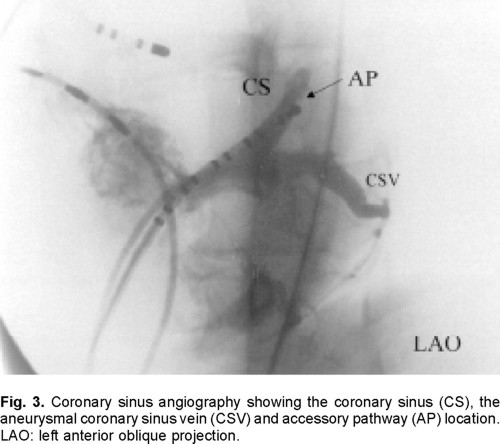
<body><![CDATA[<p align="center"><img src="/img/revistas/acm/v71n3/a8f1.jpg"></p>      <p align="justify"><font face="verdana" size="2"><b><i>Electrophysiological study:</i></b> During the programmed atrial stimulation, a reentrant tachycardia was induced <i>(<a href="#f2">Fig. 2</a>)</i> with an eccentric (left&#45;sided) ventriculo&#45;atrial activation. During the tachycardia the mapping procedure evidenced the shortest V&#45;A interval at the distal pair of electrodes of the coronary sinus catheter that was placed on the left border of the cardiac silhouette as displayed in the left anterior oblique projection. The shortest ventriculo&#45;atrial time recorded in that position was 110 milliseconds. As it was difficult to advance the coronary sinus catheter beyond this point, we decided to perform a coronary sinus angiography that evidenced that the catheter was positioned in an aneurysmal coronary sinus vein <i>(<a href="#f3">Fig. 3</a>).</i> After pulling back the angiographic, catheter, a second injection was performed and a coronary sinus diverticulum became evident <i>(<a href="#f4">Fig. 4</a>).</i></font></p>     <p align="center"><a name="f2"></a></p>     <p align="center"><img src="/img/revistas/acm/v71n3/a8f2.jpg"></p>     <p align="center"><a name="f3"></a></p>     <p align="center"><img src="/img/revistas/acm/v71n3/a8f3.jpg"></p>     <p align="center"><a name="f4"></a></p>     <p align="center"><img src="/img/revistas/acm/v71n3/a8f4.jpg"></p>      <p align="justify"><font face="verdana" size="2">The electrophysiology mapping was carefully repeated making particular emphasis upon the coronary sinus diverticulum and the coronary sinus vein. The shortest V&#45;A interval was found to be located in the anterolateral portion of the mitral ring (70 milliseconds) <i>(<a href="#f4">Fig. 4</a>).</i></font></p>  	    <p align="justify"><font face="verdana" size="2"><i><b>Radiofrequency catheter ablation:</b></i> The radiofrequency ablation was, performed with an <i>Atakr</i> RF generator system (Medtronic Inc., Minneapolis) and a <i>Mariner</i> ablation catheter (Medtronic Inc., Minneapolis). The supraventricular tachycardia was induced, and 1 second after the RF initiation the tachycardia stopped and could not be induced thereafter <i>(<a href="#f5">Fig. 5</a>).</i> Under ventricular stimulation the ventriculo&#45;atrial conduction became normal. The mapping procedure was repeated and no evidence of remaining accessory pathways was found. The programmed stimulation was then repeated after the patient was given a continuous intravenous infusion of adrenaline (50 &#951;g/kg/minute), but no tachycardia was inducible. The patient was discharged without complications, and six months later she still remains free of arrhythmia without receiving antiarrhythmic therapy.</font></p> 	    ]]></body>
<body><![CDATA[<p align="center"><a name="f5"></a></p> 	    <p align="center"><img src="/img/revistas/acm/v71n3/a8f5.jpg"></p>      <p align="justify"><font face="verdana" size="2"><b><i>Comment:</i></b> Coronary sinus diverticula have consistently been reported in patients with the Wolff&#45;Parkinson&#45;White syndrome in whom the electrocardiographic pattern consists in deep negative delta waves in the inferior leads and an r/S pattern in VR, V5 and V6.<sup>7</sup> Our patient's ECG was normal during the sinus rhythm, and the electrophysiological study did not reveal anterograde conduction through the accessory pathway; it could thus be inferred that the accessory pathway was of the concealed type.</font></p>  	    <p align="justify"><font face="verdana" size="2">The existence of an aneurysmal coronary vein misled the coronary sinus catheter away from the anterolateral portion of the left A&#45;V ring, and made it difficult for us to obtain proper electrograms and intervals for guiding the ablation. We thus took the decision to perform a coronary sinus angiography that disclosed the coronary vein anomaly and the diverticulum that could have been missed otherwise.</font></p>  	    <p align="justify"><font face="verdana" size="2">Transesophageal echocardiography has been shown to be an alternative means of coronary sinus diverticula's diagnosis,<sup>8</sup> but we did not perform it in our patient. Moreover, since we do not systematically perform coronary sinus angiography in all the patients who are submitted to radiofrequency ablation, the incidence of coronary sinus diverticulum and coronary vein anomalies is unknown. It is thus likely that the association of these anomalies is more frequent than suspected and that it goes undetected if a coronary sinus angiography or a transesophageal echocardiogram is not performed in patients submitted to electrophysiological studies.</font></p>  	    <p align="justify"><font face="verdana" size="2">The complications and therapeutic guidelines for the treatment of patients with coronary sinus vein anomalies that are not associated with accessory pathways are not well known, and more research is needed in this area. To our knowledge this is the first time a patient with a supraventricular tachycardia mediated by a concealed accessory pathway located in the left anterolateral portion and associated with coronary sinus vein anomalies is reported in the literature.</font></p>  	    <p align="justify"><font face="verdana" size="2">&nbsp;</font></p>  	    <p align="justify"><font face="verdana" size="2"><b>Conclusion</b></font></p>  	    <p align="justify"><font face="verdana" size="2">Our case provides evidence for the co&#45;existence of a coronary sinus diverticulum and coronary sinus vein anomalies acting as bystanders and associated with concealed accessory pathways located outside the vein anomalies.</font></p>  	    <p align="justify"><font face="verdana" size="2">&nbsp;</font></p>  	    ]]></body>
<body><![CDATA[<p align="justify"><font face="verdana" size="2"><b>Acknowledgment</b></font></p>  	    <p align="justify"><font face="verdana" size="2">We are thankful to Fran&ccedil;oise Meyer for her review of the manuscript.</font></p> 	    <p align="justify"><font face="verdana" size="2">This work was supported by grant N&ordm; EQ&#45;ESP&#45;M&#45;29&#45;93 from Consejo de Desarrollo Cient&iacute;fico, Human&iacute;stico y Tecnol&oacute;gico. University of the Andes.</font></p>      <p align="justify"><font face="verdana" size="2">&nbsp;</font></p>  	    <p align="justify"><font face="verdana" size="2"><b>References</b></font></p>  	    <!-- ref --><p align="justify"><font face="verdana" size="2">1. Guiraudon GM, Guiraudon CM, Klein GJ, Sharma AD, Yee R: <i>The coronary sinus diverticulum: a pathologic entity associated with the Wolff&#45;Parkinson&#45;White syndrome.</i> Am J Cardiol 1988; 62: 733&#45;35.    &nbsp;&nbsp;&nbsp;&nbsp;&nbsp;&nbsp;&nbsp;&nbsp;[&#160;<a href="javascript:void(0);" onclick="javascript: window.open('/scielo.php?script=sci_nlinks&ref=1009850&pid=S1405-9940200100030000800001&lng=','','width=640,height=500,resizable=yes,scrollbars=1,menubar=yes,');">Links</a>&#160;]<!-- end-ref --></font></p>  	    <!-- ref --><p align="justify"><font face="verdana" size="2">2. Shumacher B, Tebbenjohahhs J, Pfeiffer D, Omran H, Jung W, Luderitz B: <i>Prospective study of retrograde coronary venography in patients with postero&#45;septal and left&#45;sided accessory atrioventricular Pathways.</i> Am Heart J 1995; 130: 1031&#45;39.    &nbsp;&nbsp;&nbsp;&nbsp;&nbsp;&nbsp;&nbsp;&nbsp;[&#160;<a href="javascript:void(0);" onclick="javascript: window.open('/scielo.php?script=sci_nlinks&ref=1009852&pid=S1405-9940200100030000800002&lng=','','width=640,height=500,resizable=yes,scrollbars=1,menubar=yes,');">Links</a>&#160;]<!-- end-ref --></font></p>  	    <!-- ref --><p align="justify"><font face="verdana" size="2">3. Omran H, Pfeiffer D, Tebbenhohanns J, Shumacher B, Manz M, Lauck G, et al: <i>Echocardiographic imaging of coronary sinus diveticula and middle cardiac veins in patients with preexcitation syndrome: impact on radiofrequency catheter ablation of posteroseptal accessory pathways.</i> Pacing Clin Electrophysiol 1995; 18: 1236&#45;43.    &nbsp;&nbsp;&nbsp;&nbsp;&nbsp;&nbsp;&nbsp;&nbsp;[&#160;<a href="javascript:void(0);" onclick="javascript: window.open('/scielo.php?script=sci_nlinks&ref=1009854&pid=S1405-9940200100030000800003&lng=','','width=640,height=500,resizable=yes,scrollbars=1,menubar=yes,');">Links</a>&#160;]<!-- end-ref --></font></p>  	    <!-- ref --><p align="justify"><font face="verdana" size="2">4. Villacastin J, Merino JL, Almendral J, Arenal A, Tercedor L, Alberca T, et al: <i>Radiofrequency ablation of a posteroseptal accessory pathway associated with coronary sinus diverticulum.</i> Rev Esp Cardiol 1995; 48: 638&#45;41.    &nbsp;&nbsp;&nbsp;&nbsp;&nbsp;&nbsp;&nbsp;&nbsp;[&#160;<a href="javascript:void(0);" onclick="javascript: window.open('/scielo.php?script=sci_nlinks&ref=1009856&pid=S1405-9940200100030000800004&lng=','','width=640,height=500,resizable=yes,scrollbars=1,menubar=yes,');">Links</a>&#160;]<!-- end-ref --></font></p>  	    <!-- ref --><p align="justify"><font face="verdana" size="2">5. Beukema WP, Van Dessel PF, Van Hemel NM, Kingma JH: <i>Radiofrequency catheter ablation of accessory pathways associated with a coronary sinus diverticulum.</i> Eur Heart J 1994; 15: 1415&#45;18.    &nbsp;&nbsp;&nbsp;&nbsp;&nbsp;&nbsp;&nbsp;&nbsp;[&#160;<a href="javascript:void(0);" onclick="javascript: window.open('/scielo.php?script=sci_nlinks&ref=1009858&pid=S1405-9940200100030000800005&lng=','','width=640,height=500,resizable=yes,scrollbars=1,menubar=yes,');">Links</a>&#160;]<!-- end-ref --></font></p>  	    <!-- ref --><p align="justify"><font face="verdana" size="2">6. Lesh MD, Van Hare G, Kao AK, Scheinman MM: <i>Radiofrequency catheter ablation for Wolff&#45;Parkinson&#45;White syndrome associated with a coronary sinus diverticulum.</i> Pacing Clin Electrophysiol 1991; 14: 1479&#45;84.    &nbsp;&nbsp;&nbsp;&nbsp;&nbsp;&nbsp;&nbsp;&nbsp;[&#160;<a href="javascript:void(0);" onclick="javascript: window.open('/scielo.php?script=sci_nlinks&ref=1009860&pid=S1405-9940200100030000800006&lng=','','width=640,height=500,resizable=yes,scrollbars=1,menubar=yes,');">Links</a>&#160;]<!-- end-ref --></font></p>  	    <!-- ref --><p align="justify"><font face="verdana" size="2">7. Haissaguerre M, Jais P, Shah DC, Takahashi A, Barold SS, Cl&eacute;menty J: <i>A conceptual approach to radiofrequency catheter ablation of accessory pathways focusing on electrogram criteria.</i> In Singer I, Barold SS, Camm AJ (Eds.) <i>Nonpharmacological therapy of arrhythmias for the 21<sup>st</sup> century.</i> Armonk NY. Futura 1998: 57&#45;87.    &nbsp;&nbsp;&nbsp;&nbsp;&nbsp;&nbsp;&nbsp;&nbsp;[&#160;<a href="javascript:void(0);" onclick="javascript: window.open('/scielo.php?script=sci_nlinks&ref=1009862&pid=S1405-9940200100030000800007&lng=','','width=640,height=500,resizable=yes,scrollbars=1,menubar=yes,');">Links</a>&#160;]<!-- end-ref --></font></p>  	    <!-- ref --><p align="justify"><font face="verdana" size="2">8. Hamilton K, Castillo M, Arruda M, Jackman W: <i>Echocardiographic demonstration of coronary sinus diverticula in patients with Wolff&#45;Parkinson&#45;White syndrome.</i> J Am soc Echocardiogr 1996; 9: 337&#45;43.    &nbsp;&nbsp;&nbsp;&nbsp;&nbsp;&nbsp;&nbsp;&nbsp;[&#160;<a href="javascript:void(0);" onclick="javascript: window.open('/scielo.php?script=sci_nlinks&ref=1009864&pid=S1405-9940200100030000800008&lng=','','width=640,height=500,resizable=yes,scrollbars=1,menubar=yes,');">Links</a>&#160;]<!-- end-ref --></font></p>      ]]></body><back>
<ref-list>
<ref id="B1">
<label>1</label><nlm-citation citation-type="journal">
<person-group person-group-type="author">
<name>
<surname><![CDATA[Guiraudon]]></surname>
<given-names><![CDATA[GM]]></given-names>
</name>
<name>
<surname><![CDATA[Guiraudon]]></surname>
<given-names><![CDATA[CM]]></given-names>
</name>
<name>
<surname><![CDATA[Klein]]></surname>
<given-names><![CDATA[GJ]]></given-names>
</name>
<name>
<surname><![CDATA[Sharma]]></surname>
<given-names><![CDATA[AD]]></given-names>
</name>
<name>
<surname><![CDATA[Yee]]></surname>
<given-names><![CDATA[R]]></given-names>
</name>
</person-group>
<article-title xml:lang="en"><![CDATA[The coronary sinus diverticulum: a pathologic entity associated with the Wolff-Parkinson-White syndrome]]></article-title>
<source><![CDATA[Am J Cardiol]]></source>
<year>1988</year>
<volume>62</volume>
<page-range>733-35</page-range></nlm-citation>
</ref>
<ref id="B2">
<label>2</label><nlm-citation citation-type="journal">
<person-group person-group-type="author">
<name>
<surname><![CDATA[Shumacher]]></surname>
<given-names><![CDATA[B]]></given-names>
</name>
<name>
<surname><![CDATA[Tebbenjohahhs]]></surname>
<given-names><![CDATA[J]]></given-names>
</name>
<name>
<surname><![CDATA[Pfeiffer]]></surname>
<given-names><![CDATA[D]]></given-names>
</name>
<name>
<surname><![CDATA[Omran]]></surname>
<given-names><![CDATA[H]]></given-names>
</name>
<name>
<surname><![CDATA[Jung]]></surname>
<given-names><![CDATA[W]]></given-names>
</name>
<name>
<surname><![CDATA[Luderitz]]></surname>
<given-names><![CDATA[B]]></given-names>
</name>
</person-group>
<article-title xml:lang="en"><![CDATA[Prospective study of retrograde coronary venography in patients with postero-septal and left-sided accessory atrioventricular Pathways]]></article-title>
<source><![CDATA[Am Heart J]]></source>
<year>1995</year>
<volume>130</volume>
<page-range>1031-39</page-range></nlm-citation>
</ref>
<ref id="B3">
<label>3</label><nlm-citation citation-type="journal">
<person-group person-group-type="author">
<name>
<surname><![CDATA[Omran]]></surname>
<given-names><![CDATA[H]]></given-names>
</name>
<name>
<surname><![CDATA[Pfeiffer]]></surname>
<given-names><![CDATA[D]]></given-names>
</name>
<name>
<surname><![CDATA[Tebbenhohanns]]></surname>
<given-names><![CDATA[J]]></given-names>
</name>
<name>
<surname><![CDATA[Shumacher]]></surname>
<given-names><![CDATA[B]]></given-names>
</name>
<name>
<surname><![CDATA[Manz]]></surname>
<given-names><![CDATA[M]]></given-names>
</name>
<name>
<surname><![CDATA[Lauck]]></surname>
<given-names><![CDATA[G]]></given-names>
</name>
</person-group>
<article-title xml:lang="en"><![CDATA[Echocardiographic imaging of coronary sinus diveticula and middle cardiac veins in patients with preexcitation syndrome: impact on radiofrequency catheter ablation of posteroseptal accessory pathways]]></article-title>
<source><![CDATA[Pacing Clin Electrophysiol]]></source>
<year>1995</year>
<volume>18</volume>
<page-range>1236-43</page-range></nlm-citation>
</ref>
<ref id="B4">
<label>4</label><nlm-citation citation-type="journal">
<person-group person-group-type="author">
<name>
<surname><![CDATA[Villacastin]]></surname>
<given-names><![CDATA[J]]></given-names>
</name>
<name>
<surname><![CDATA[Merino]]></surname>
<given-names><![CDATA[JL]]></given-names>
</name>
<name>
<surname><![CDATA[Almendral]]></surname>
<given-names><![CDATA[J]]></given-names>
</name>
<name>
<surname><![CDATA[Arenal]]></surname>
<given-names><![CDATA[A]]></given-names>
</name>
<name>
<surname><![CDATA[Tercedor]]></surname>
<given-names><![CDATA[L]]></given-names>
</name>
<name>
<surname><![CDATA[Alberca]]></surname>
<given-names><![CDATA[T]]></given-names>
</name>
</person-group>
<article-title xml:lang="en"><![CDATA[Radiofrequency ablation of a posteroseptal accessory pathway associated with coronary sinus diverticulum]]></article-title>
<source><![CDATA[Rev Esp Cardiol]]></source>
<year>1995</year>
<volume>48</volume>
<page-range>638-41</page-range></nlm-citation>
</ref>
<ref id="B5">
<label>5</label><nlm-citation citation-type="journal">
<person-group person-group-type="author">
<name>
<surname><![CDATA[Beukema]]></surname>
<given-names><![CDATA[WP]]></given-names>
</name>
<name>
<surname><![CDATA[Van Dessel]]></surname>
<given-names><![CDATA[PF]]></given-names>
</name>
<name>
<surname><![CDATA[Van Hemel]]></surname>
<given-names><![CDATA[NM]]></given-names>
</name>
<name>
<surname><![CDATA[Kingma]]></surname>
<given-names><![CDATA[JH]]></given-names>
</name>
</person-group>
<article-title xml:lang="en"><![CDATA[Radiofrequency catheter ablation of accessory pathways associated with a coronary sinus diverticulum]]></article-title>
<source><![CDATA[Eur Heart J]]></source>
<year>1994</year>
<volume>15</volume>
<page-range>1415-18</page-range></nlm-citation>
</ref>
<ref id="B6">
<label>6</label><nlm-citation citation-type="journal">
<person-group person-group-type="author">
<name>
<surname><![CDATA[Lesh]]></surname>
<given-names><![CDATA[MD]]></given-names>
</name>
<name>
<surname><![CDATA[Van Hare]]></surname>
<given-names><![CDATA[G]]></given-names>
</name>
<name>
<surname><![CDATA[Kao]]></surname>
<given-names><![CDATA[AK]]></given-names>
</name>
<name>
<surname><![CDATA[Scheinman]]></surname>
<given-names><![CDATA[MM]]></given-names>
</name>
</person-group>
<article-title xml:lang="en"><![CDATA[Radiofrequency catheter ablation for Wolff-Parkinson-White syndrome associated with a coronary sinus diverticulum]]></article-title>
<source><![CDATA[Pacing Clin Electrophysiol]]></source>
<year>1991</year>
<volume>14</volume>
<page-range>1479-84</page-range></nlm-citation>
</ref>
<ref id="B7">
<label>7</label><nlm-citation citation-type="book">
<person-group person-group-type="author">
<name>
<surname><![CDATA[Haissaguerre]]></surname>
<given-names><![CDATA[M]]></given-names>
</name>
<name>
<surname><![CDATA[Jais]]></surname>
<given-names><![CDATA[P]]></given-names>
</name>
<name>
<surname><![CDATA[Shah]]></surname>
<given-names><![CDATA[DC]]></given-names>
</name>
<name>
<surname><![CDATA[Takahashi]]></surname>
<given-names><![CDATA[A]]></given-names>
</name>
<name>
<surname><![CDATA[Barold]]></surname>
<given-names><![CDATA[SS]]></given-names>
</name>
<name>
<surname><![CDATA[Clémenty]]></surname>
<given-names><![CDATA[J]]></given-names>
</name>
</person-group>
<article-title xml:lang="en"><![CDATA[A conceptual approach to radiofrequency catheter ablation of accessory pathways focusing on electrogram criteria]]></article-title>
<person-group person-group-type="editor">
<name>
<surname><![CDATA[Singer]]></surname>
<given-names><![CDATA[I]]></given-names>
</name>
<name>
<surname><![CDATA[Barold]]></surname>
<given-names><![CDATA[SS]]></given-names>
</name>
<name>
<surname><![CDATA[Camm]]></surname>
<given-names><![CDATA[AJ]]></given-names>
</name>
</person-group>
<source><![CDATA[Nonpharmacological therapy of arrhythmias for the 21st century]]></source>
<year>1998</year>
<page-range>57-87</page-range><publisher-loc><![CDATA[Armonk^eNY NY]]></publisher-loc>
<publisher-name><![CDATA[Futura]]></publisher-name>
</nlm-citation>
</ref>
<ref id="B8">
<label>8</label><nlm-citation citation-type="journal">
<person-group person-group-type="author">
<name>
<surname><![CDATA[Hamilton]]></surname>
<given-names><![CDATA[K]]></given-names>
</name>
<name>
<surname><![CDATA[Castillo]]></surname>
<given-names><![CDATA[M]]></given-names>
</name>
<name>
<surname><![CDATA[Arruda]]></surname>
<given-names><![CDATA[M]]></given-names>
</name>
<name>
<surname><![CDATA[Jackman]]></surname>
<given-names><![CDATA[W]]></given-names>
</name>
</person-group>
<article-title xml:lang="en"><![CDATA[Echocardiographic demonstration of coronary sinus diverticula in patients with Wolff-Parkinson-White syndrome]]></article-title>
<source><![CDATA[J Am soc Echocardiogr]]></source>
<year>1996</year>
<volume>9</volume>
<page-range>337-43</page-range></nlm-citation>
</ref>
</ref-list>
</back>
</article>