<?xml version="1.0" encoding="ISO-8859-1"?><article xmlns:mml="http://www.w3.org/1998/Math/MathML" xmlns:xlink="http://www.w3.org/1999/xlink" xmlns:xsi="http://www.w3.org/2001/XMLSchema-instance">
<front>
<journal-meta>
<journal-id>1405-9940</journal-id>
<journal-title><![CDATA[Archivos de cardiología de México]]></journal-title>
<abbrev-journal-title><![CDATA[Arch. Cardiol. Méx.]]></abbrev-journal-title>
<issn>1405-9940</issn>
<publisher>
<publisher-name><![CDATA[Instituto Nacional de Cardiología Ignacio Chávez]]></publisher-name>
</publisher>
</journal-meta>
<article-meta>
<article-id>S1405-99402001000200007</article-id>
<title-group>
<article-title xml:lang="en"><![CDATA[Unusual giant patent ductus arteriosus associated with ventricular septal defect and discrete aortic coarctation. A case report]]></article-title>
<article-title xml:lang="es"><![CDATA[Conducto arterioso persistente gigante asociado con comunicación interventricular y coartación aórtica leve. Informe de un caso]]></article-title>
</title-group>
<contrib-group>
<contrib contrib-type="author">
<name>
<surname><![CDATA[Basave]]></surname>
<given-names><![CDATA[Marcelo]]></given-names>
</name>
<xref ref-type="aff" rid="A01"/>
</contrib>
<contrib contrib-type="author">
<name>
<surname><![CDATA[Rangel]]></surname>
<given-names><![CDATA[Alberto]]></given-names>
</name>
<xref ref-type="aff" rid="A01"/>
</contrib>
<contrib contrib-type="author">
<name>
<surname><![CDATA[Albarrán]]></surname>
<given-names><![CDATA[Héctor]]></given-names>
</name>
<xref ref-type="aff" rid="A01"/>
</contrib>
<contrib contrib-type="author">
<name>
<surname><![CDATA[Nandayapa]]></surname>
<given-names><![CDATA[Óscar]]></given-names>
</name>
<xref ref-type="aff" rid="A02"/>
</contrib>
</contrib-group>
<aff id="A01">
<institution><![CDATA[,Instituto Mexicano del Seguro Social Centro Medico Nacional La Raza Hospital de Especialidades]]></institution>
<addr-line><![CDATA[México Distrito Federal]]></addr-line>
<country>México</country>
</aff>
<aff id="A02">
<institution><![CDATA[,Instituto Mexicano del Seguro Social Centro Medico Nacional La Raza Hospital de Especialidades]]></institution>
<addr-line><![CDATA[México Distrito Federal]]></addr-line>
<country>México</country>
</aff>
<pub-date pub-type="pub">
<day>00</day>
<month>06</month>
<year>2001</year>
</pub-date>
<pub-date pub-type="epub">
<day>00</day>
<month>06</month>
<year>2001</year>
</pub-date>
<volume>71</volume>
<numero>2</numero>
<fpage>146</fpage>
<lpage>150</lpage>
<copyright-statement/>
<copyright-year/>
<self-uri xlink:href="http://www.scielo.org.mx/scielo.php?script=sci_arttext&amp;pid=S1405-99402001000200007&amp;lng=en&amp;nrm=iso"></self-uri><self-uri xlink:href="http://www.scielo.org.mx/scielo.php?script=sci_abstract&amp;pid=S1405-99402001000200007&amp;lng=en&amp;nrm=iso"></self-uri><self-uri xlink:href="http://www.scielo.org.mx/scielo.php?script=sci_pdf&amp;pid=S1405-99402001000200007&amp;lng=en&amp;nrm=iso"></self-uri><abstract abstract-type="short" xml:lang="en"><p><![CDATA[The authors present the case of a 26 years old female, 56 kg weight and 154 cm height, with a giant patent ductus arteriosus (2.4 cm of internal diameter), ventricular septal defect, discrete preductal narrowing of the aortic arch and pulmonary artery hypertension that did not diminished after 100% oxygen breathing. The authors speculate about the origin of the giant ductus here presented, based on hemodynamic and embryological data.]]></p></abstract>
<abstract abstract-type="short" xml:lang="es"><p><![CDATA[Presentamos el caso de una mujer de 26 años de edad, con 56 kg de peso y 154 cm de estatura; persistencia de conducto arterioso gigante (2.4 cm de diámetro interno), comunicación interventricular, discreto estrechamiento preductal del arco aórtico e hipertensión arterial pulmonar que no disminuyó después de la inhalación de oxígeno al 100%. Con base en los datos hemodinámicos y embriológicos, especulamos, sobre el probable origen de la dilatación ductal.]]></p></abstract>
<kwd-group>
<kwd lng="en"><![CDATA[Giant ductus arteriosus]]></kwd>
<kwd lng="en"><![CDATA[Ventricular septal defect]]></kwd>
<kwd lng="en"><![CDATA[Aortic coarctation]]></kwd>
<kwd lng="en"><![CDATA[Conducto arterioso gigante]]></kwd>
<kwd lng="en"><![CDATA[Comunicación interventricular]]></kwd>
<kwd lng="en"><![CDATA[Coartación aórtica]]></kwd>
</kwd-group>
</article-meta>
</front><body><![CDATA[  	    <p align="justify"><font face="verdana" size="4">Comunicaciones breves</font></p>  	    <p align="justify"><font face="verdana" size="2">&nbsp;</font></p>  	    <p align="center"><font face="verdana" size="4"><b>Unusual giant patent ductus arteriosus associated with ventricular septal defect and discrete aortic coarctation. A case report</b></font></p>  	    <p align="center"><font face="verdana" size="2">&nbsp;</font></p>  	    <p align="center"><font face="verdana" size="3"><b>Conducto arterioso persistente gigante asociado con comunicaci&oacute;n interventricular y coartaci&oacute;n a&oacute;rtica leve. Informe de un caso</b></font></p>  	    <p align="center"><font face="verdana" size="2">&nbsp;</font></p>  	    <p align="center"><font face="verdana" size="2"><b>Marcelo Basave,* Alberto Rangel,* H&eacute;ctor Albarr&aacute;n,* &Oacute;scar Nandayapa**</b></font></p>  	    <p align="justify"><font face="verdana" size="2">&nbsp;</font></p>  	    <p align="justify"><font face="verdana" size="2"><i>Hospital de Especialidades. CMN La Raza. IMSS, M&eacute;xico, D.F. M&eacute;xico.</i></font></p>  	    ]]></body>
<body><![CDATA[<p align="justify"><font face="verdana" size="2"><i>* Departamento de Hemodinamia.</i></font></p>  	    <p align="justify"><font face="verdana" size="2"><i>** Departamento de Registros Gr&aacute;ficos.</i></font></p>  	    <p align="justify">&nbsp;</p> 	    <p align="justify"><font face="verdana" size="2"><b>Correspondence</b></font></p> 	    <p align="justify"><font face="verdana" size="2">Alberto Rangel. </font>    <br>     <font face="verdana" size="2">Departamento de Hemodinamia. Hospital de Especialidades. CMN La Raza. </font>    <br>     <font face="verdana" size="2">Seris y Zaachila s/n. Col. La Raza. M&eacute;xico, D.F. M&eacute;xico. C.P. 02990. </font>    <br>     <font face="verdana" size="2">Tel: 57821088, Ext. 1025. </font>    <br>     <font face="verdana" size="2">E&#45;mail: <a href="mailto:rangel_albertomx@yahoo.com.mx">rangel_albertomx@yahoo.com.mx</a></font></p>     <p align="justify"><font face="verdana" size="2">&nbsp;</font></p>  	    ]]></body>
<body><![CDATA[<p align="justify"><font face="verdana" size="2">Aceptado: 17 de octubre de 2000</font></p>  	    <p align="justify"><font face="verdana" size="2">&nbsp;</font></p>  	    <p align="justify"><font face="verdana" size="2"><b>Abstract</b></font></p>  	    <p align="justify"><font face="verdana" size="2">The authors present the case of a 26 years old female, 56 kg weight and 154 cm height, with a giant patent <i>ductus arteriosus</i> (2.4 cm of internal diameter), ventricular septal defect, discrete preductal narrowing of the aortic arch and pulmonary artery hypertension that did not diminished after 100% oxygen breathing. The authors speculate about the origin of the giant <i>ductus</i> here presented, based on hemodynamic and embryological data.</font></p>  	    <p align="justify"><font face="verdana" size="2"><b>Key words:</b> Giant <i>ductus arteriosus.</i> Ventricular septal defect. Aortic coarctation.</font></p>  	    <p align="justify"><font face="verdana" size="2">&nbsp;</font></p>  	    <p align="justify"><font face="verdana" size="2"><b>Resumen</b></font></p>  	    <p align="justify"><font face="verdana" size="2">Presentamos el caso de una mujer de 26 a&ntilde;os de edad, con 56 kg de peso y 154 cm de estatura; persistencia de conducto arterioso gigante (2.4 cm de di&aacute;metro interno), comunicaci&oacute;n interventricular, discreto estrechamiento preductal del arco a&oacute;rtico e hipertensi&oacute;n arterial pulmonar que no disminuy&oacute; despu&eacute;s de la inhalaci&oacute;n de ox&iacute;geno al 100%. Con base en los datos hemodin&aacute;micos y embriol&oacute;gicos, especulamos, sobre el probable origen de la dilataci&oacute;n ductal.</font></p>  	    <p align="justify"><font face="verdana" size="2"><b>Palabras clave:</b> Conducto arterioso gigante. Comunicaci&oacute;n interventricular. Coartaci&oacute;n a&oacute;rtica.</font></p>  	    <p align="justify"><font face="verdana" size="2">&nbsp;</font></p>  	    ]]></body>
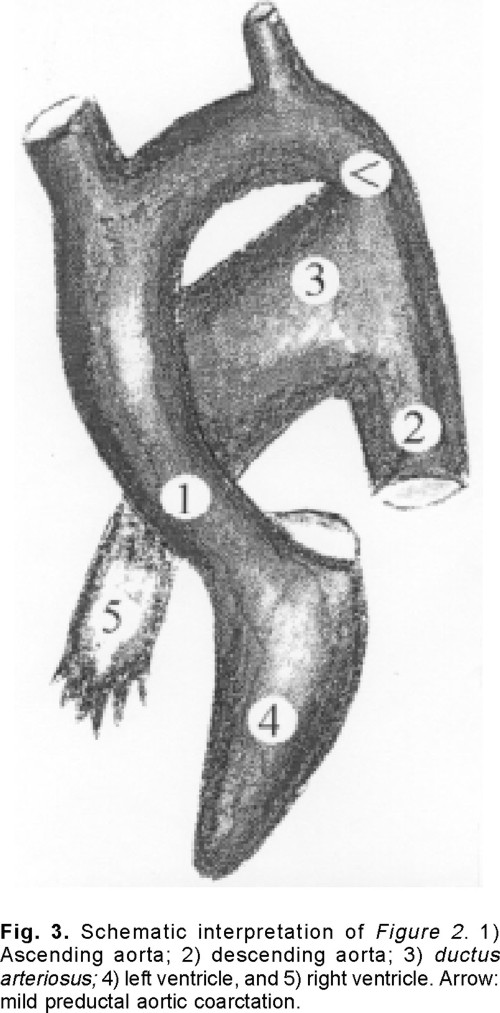
<body><![CDATA[<p align="justify"><font face="verdana" size="2"><b>Introduction</b></font></p>  	    <p align="justify"><font face="verdana" size="2">The giant patent <i>ductus arteriosus</i> (PDA) was defined as a ductal external diameter <u>&gt;</u> 1.5 cm.<sup>1</sup> Cases of patients with PDA measuring 2.5 cm or more of external diameter are rarely reported in the medical literature. Recently, the cases of two children with surgically corrected giant PDA were reported (internal diameters 2.1 cm and 2.2 cm respectively).<sup>2</sup> We present the case of an adult with an uncommon giant PDA (internal diameter 2.4 cm) associated with ventricular septal defect (VSD), and a discrete preductal narrowing of the aortic arch. Etiology of giant PDA is not well defined but its structural, hemodynamic, and embryologic features may be related with the associated defects. In order to maintain life, some cardiac malformations, such as pulmonary atresia, hypoplastic left ventricle and interrupted aortic arch (IAA) nearly always require the patency of a wide <i>ductus arteriosus</i> after birth.<sup>3</sup> Because of the unusual wide diameter of PDA present in the patient, we speculate about the likely factors (hemodynamic and genetic) which led morphogenetically to the giant PDA and its associated malformations in the patient here presented.</font></p>  	    <p align="justify"><font face="verdana" size="2">&nbsp;</font></p>  	    <p align="justify"><font face="verdana" size="2"><b>Case report</b></font></p>  	    <p align="justify"><font face="verdana" size="2">It is the case of a 26 years old woman (56 kg weight, and 154 cm height), in NYHA functional class I, with clinical, radiographic and electrocardiographic signs of PDA and VSD, associated with pulmonary artery hypertension. The transthoracic echocardiogram revealed a membranous VSD associated with almost 2 cm wide PDA and preductal aortic narrowing <i>(<a href="#f1">Fig. 1</a>).</i> Intravascular catheterization <i>(<a href="/img/revistas/acm/v71n2/a7c1.jpg" target="_blank">Table I</a>)</i> showed: a) left&#45;to&#45;right blood flow shunt; b) pulmonary artery hypertension and a 14 mmHg gradient between the ascending and descending aorta; c) during 100% oxygen inhalation, left&#45;to&#45;right blood flow shunt increased, pulmonary vascular resistance decreased and pulmonary artery pressure remained unchanged. The angiography <i>(<a href="#f2">Fig. 2</a>)</i> showed the presence of a giant PDA (internal diameter 2.4 cm) associated with a discrete preductal aortic narrowing and a VSD <i>(<a href="#f2">Fig. 2</a>). <a href="#f3">Figure 3</a></i> shows a schematic interpretation of <i><a href="#f2">Figure 2</a>.</i></font></p>  	    <p align="center"><font face="verdana" size="2"><a name="f1"></a></font></p>  	    <p align="center"><font face="verdana" size="2"><img src="/img/revistas/acm/v71n2/a7f1.jpg"></font></p>  	    <p align="center"><font face="verdana" size="2"><a name="f2"></a></font></p>  	    <p align="center"><font face="verdana" size="2"><img src="/img/revistas/acm/v71n2/a7f2.jpg"></font></p>  	    <p align="center"><font face="verdana" size="2"><a name="f3"></a></font></p>  	    ]]></body>
<body><![CDATA[<p align="center"><font face="verdana" size="2"><img src="/img/revistas/acm/v71n2/a7f3.jpg"></font></p>  	    <p align="justify"><font face="verdana" size="2">&nbsp;</font></p>  	    <p align="justify"><font face="verdana" size="2"><b>Discussion</b></font></p>  	    <p align="justify"><font face="verdana" size="2">In 1964, Oldham <i>et al</i> reported 817 cases of patients with PDA, 31 (4%) presented PDA with an external diameter <u>&gt;</u> 1.5 (the biggest being 2.5 cm). They definedthegiantPDAasaductalexternal diameter <u>&gt;</u> 1.5 cm.<sup>1</sup> In 1981, John <i>et al.<sup>2</sup></i> found in 131 patients with PDA, three cases with PDA outside diameter &gt; 3.0 cm. Fisher informed about 117 adults with PDA. The biggest PDA found in this case was 2.5 cm outside diameter.<sup>3</sup> In 1996, Chen <i>et al.</i> reported the case of an 18 years old girl and a 34 years old female with PDA measuring 2.1 cm and 2.2 cm of internal diameter, respectively.<sup>4</sup> Our patient has an internal PDA diameter of 2.4 cm, documented by the angiography. Its external diameter is almost certainly comparable with the biggest reported by others.</font></p>  	    <p align="justify"><font face="verdana" size="2">In our patient, a wide PDA was associated with VSD and preductal aortic coarctation. Association among congenital cardiopathies can be:<sup>5</sup> A) Fortuitous, i.e. VSD with PDA. B) Obligate, i.e. tricuspid atresia with atrial septal defect. C) Secondary to hemodynamic disturbances due to the primary cardiopathies, i.e. atrial septal defect and mitral valve prolapse.<sup>6</sup> D) Secondary to alterations of anatomical structures, whose embryological origin is similar, i.e. aneurysm of the <i>sinus</i> of Valsalva with aortic insufficiency and VSD.<sup>7</sup> No associated cardiac defects were found in most of the cases of wide PDA described in medical literature. In these cases, the origin of PDA wideness remains unexplainable.</font></p>  	    <p align="justify"><font face="verdana" size="2">In our patient, probably there is a fortuitous relationship between the ventricular septal defect with the PDA. However, it is possible that arterio&#45;venous blood flow shunt through the VSD could contribute hemodynamically to enlarge the <i>ductus arteriosus</i> during the patient fetal life; specially when the descending aortic pressure is less than the ascending aortic pressure caused by relative aortic narrowing present in our patient.<sup>8,9</sup> Wide PDA is associated with IAA. In our patient aortic obstruction was irrelevant. Patency of the <i>ductus arteriosus</i> after birth may result in cardiac failure.<sup>10</sup> But, it may provide the only way to preserve systemic or pulmonary arterial blood flow in presence of other cardiac malformations like pulmonary artery atresia; hypoplastic left ventricle; IAA or some severe forms of aortic coarctation.<sup>11</sup> From this point of view, it is explainable the persistence of a wide <i>ductus arteriosus</i> in most cases of IAA and unexplainable the wideness of PDA in absence of a complete closure of the aortic arch, as it occurred in our patient. Therefore in our case there is no obligate association between the giant <i>ductus arteriosus</i> and the aortic coarctation. If such association is not fortuitous, it could have an embryological origin. In our patient, aortic obstruction was preductal. There are no doubts that preductal aortic coarctation is a preceding stage of IAA. This is because preductal aortic coarctation, unperforated IAA with anatomical continuity between the pre and post&#45;coarcted segments, and IAA with interruption between such segments are rings of the same chain. So for, our patient's preductal aortic coarctation is a frustrated case of IAA.</font></p>  	    <p align="justify"><font face="verdana" size="2">Aortic coarctation and hypoplasia of the aortic arch present anatomical, histological and embryological differences. Anatomically, aortic coartactation is usually a shelf&#45;like lesion and the ligament of the <i>ductus arteriosus</i> almost always located between the <i>isthmus</i> and the descending aorta. It has been proposed that aortic coarctation may be related with an abnormal pattern of fetal blood flow in the <i>ductus arteriosus.</i> The shelf&#45;like structure dorsally located in the aortic wall resembles a normal vascular bifurcation. Some blood flows proximally into the aortic arch and the remainder distally into the descending aorta.<sup>1213</sup> Histologically, the shelflike tissue is indistinguishable from ductal tissue and is thought that closure of the <i>ductus arteriosus</i> after birth contributes to narrow the aortic <i>isthmus</i> by shrinkage of ductal tissue extended within the isthmic wall.<sup>14</sup> On the other hand, hypoplasia of the aortic arch is a particular entity in which the portion of the aorta between the left subclavian artery and the <i>ductus arteriosus (isthmus)</i> remains uniformly narrowed after infancy. Its histological structure is the same as the rest of the aorta and it is frequently associated with other major cardiac malformations like VSD or PDA.</font></p>  	    <p align="justify"><font face="verdana" size="2">In the present case, the <i>ductus arteriosus</i> remained widely patent because shrinkage of the ductal elements did not occur. Formation of a shelf&#45;like structure in the aortic wall opposite to the <i>ductus</i> did not occur. Pre&#45;isthmic coarctation of the aorta was mild, in spite of the partial absorption of the left paired dorsal aorta between the sixth brachial arch and the tenth intersomite segment, which surely took place during the fetal life.</font></p>  	    <p align="justify"><font face="verdana" size="2">In our patient we exclude the possibility of a pseudo&#45;coarctation of the aorta because in this entity, an elongation of a redundant aorta produces a "kicking" at the attachment of the <i>ligamentum arteriosum.</i> In this case, no pressure difference between, proximal and distal segments of the aorta is present.<sup>15</sup> When the arch is interrupted, there is no evidence of arch</font></p>  	    <p align="justify"><font face="verdana" size="2">segment at the site of interruption, and sometimes an unperforate segment of arch is found when the arch is interrupted. Atresia of the aortic arch is an intermediate stage between severe tubular hypoplasia and aortic interruption. As it occurs in severe aortic coarctation, IAA takes place at the preductal level<sup>716</sup> and most of the blood flow to the descending aorta takes place via a wide PDA.</font></p>  	    ]]></body>
<body><![CDATA[<p align="justify"><font face="verdana" size="2">&nbsp;</font></p>  	    <p align="justify"><font face="verdana" size="2"><b>Conclusions</b></font></p>  	    <p align="justify"><font face="verdana" size="2">Three cardiac malformations are associated in the case here presented. The most relevant one is the unexplainable wideness of the <i>ductus arteriosus.</i> Such wideness could be caused by the associated cardiopathies and explained as follow: 1) There is a fortuitous relationship between the three cardiac defects; in this case the cause of the ductal wideness is unknown. 2) Ductal wideness could be related to the hemodynamic disturbances caused by the increased arterio&#45;venous blood flow shunt through the ventricular septal defect, promoted by the discrete aortic coarctation during the patient fetal life. 3) Incomplete or frustrated preductal IAA and PDA wideness developed simultaneously as it were genetically programmed as it occurs in the unperforated or interrupted aortic ascending and descending segments.</font></p>  	    <p align="justify"><font face="verdana" size="2"><b>Acknowledgement.</b> We are in the debt of Mrs. Maggie Brunner for their expert help in the correction of the English language of this manuscript.</font></p>  	    <p align="justify"><font face="verdana" size="2">&nbsp;</font></p>  	    <p align="justify"><font face="verdana" size="2"><b>References</b></font></p>  	    <!-- ref --><p align="justify"><font face="verdana" size="2">1. Oldham H, Collins N, Pierce G, Sabiston D, Blalock A: <i>Giant patent ductus arteriosus.</i> J Thorac Cardiovasc Surg 1964; 47: 331&#45;336.    &nbsp;&nbsp;&nbsp;&nbsp;&nbsp;&nbsp;&nbsp;&nbsp;[&#160;<a href="javascript:void(0);" onclick="javascript: window.open('/scielo.php?script=sci_nlinks&ref=1007948&pid=S1405-9940200100020000700001&lng=','','width=640,height=500,resizable=yes,scrollbars=1,menubar=yes,');">Links</a>&#160;]<!-- end-ref --></font></p>  	    <!-- ref --><p align="justify"><font face="verdana" size="2">2. John S, Muralidharan S, Jairaj P, Mani G, Sukumar I, Cherian G: <i>The adult ductus: Review, of surgical experience with 131 patients.</i> J Thorac Cardiovasc Surg 1981; 82: 314&#45;319.    &nbsp;&nbsp;&nbsp;&nbsp;&nbsp;&nbsp;&nbsp;&nbsp;[&#160;<a href="javascript:void(0);" onclick="javascript: window.open('/scielo.php?script=sci_nlinks&ref=1007950&pid=S1405-9940200100020000700002&lng=','','width=640,height=500,resizable=yes,scrollbars=1,menubar=yes,');">Links</a>&#160;]<!-- end-ref --></font></p>  	    ]]></body>
<body><![CDATA[<!-- ref --><p align="justify"><font face="verdana" size="2">3. Fisher R, Moodie D, Streba R, Gill C: <i>Patent ductus arteriosus in adults; long&#45;term follow up. Nonsurgical versus surgical treatment.</i> J Am Coll Cardiol 1986; 8: 280&#45;284.    &nbsp;&nbsp;&nbsp;&nbsp;&nbsp;&nbsp;&nbsp;&nbsp;[&#160;<a href="javascript:void(0);" onclick="javascript: window.open('/scielo.php?script=sci_nlinks&ref=1007952&pid=S1405-9940200100020000700003&lng=','','width=640,height=500,resizable=yes,scrollbars=1,menubar=yes,');">Links</a>&#160;]<!-- end-ref --></font></p>  	    <!-- ref --><p align="justify"><font face="verdana" size="2">4. Chen Y, Chiu C, Lee C, Lai W, Hwang Y: <i>Surgical correction of giant patent ductus arteriosus.</i> J Cardiovasc Surg (Torino). 1996; 37: 309&#45;312.    &nbsp;&nbsp;&nbsp;&nbsp;&nbsp;&nbsp;&nbsp;&nbsp;[&#160;<a href="javascript:void(0);" onclick="javascript: window.open('/scielo.php?script=sci_nlinks&ref=1007954&pid=S1405-9940200100020000700004&lng=','','width=640,height=500,resizable=yes,scrollbars=1,menubar=yes,');">Links</a>&#160;]<!-- end-ref --></font></p>  	    <!-- ref --><p align="justify"><font face="verdana" size="2">5. Rangel A, P&eacute;rez J, Badu&iacute; E: <i>Cardiopat&iacute;as cong&eacute;nitas en el adulto. Distribuci&oacute;n de frecuencia, edad, g&eacute;nero y presi&oacute;n arterial pulmonar.</i> Arch Inst Cardiol M&eacute;x 1997; 67: 303&#45;317.    &nbsp;&nbsp;&nbsp;&nbsp;&nbsp;&nbsp;&nbsp;&nbsp;[&#160;<a href="javascript:void(0);" onclick="javascript: window.open('/scielo.php?script=sci_nlinks&ref=1007956&pid=S1405-9940200100020000700005&lng=','','width=640,height=500,resizable=yes,scrollbars=1,menubar=yes,');">Links</a>&#160;]<!-- end-ref --></font></p>  	    <!-- ref --><p align="justify"><font face="verdana" size="2">6. Liberthson RR, Boucher CA, Fallont JT, Buchey MJ: <i>Severe mitral regurgitation: a common occurrence in the aging patients with atrial septal defect.</i> Clin Cardiol 1981; 4: 229&#45;232.    &nbsp;&nbsp;&nbsp;&nbsp;&nbsp;&nbsp;&nbsp;&nbsp;[&#160;<a href="javascript:void(0);" onclick="javascript: window.open('/scielo.php?script=sci_nlinks&ref=1007958&pid=S1405-9940200100020000700006&lng=','','width=640,height=500,resizable=yes,scrollbars=1,menubar=yes,');">Links</a>&#160;]<!-- end-ref --></font></p>  	    <!-- ref --><p align="justify"><font face="verdana" size="2">7. Rangel A, Ch&aacute;vez E, Espinoza I: <i>Interruption of the aortic arch in adults.</i> Arch Inst Cardiol M&eacute;x 1999; 69: 144&#45;148.    &nbsp;&nbsp;&nbsp;&nbsp;&nbsp;&nbsp;&nbsp;&nbsp;[&#160;<a href="javascript:void(0);" onclick="javascript: window.open('/scielo.php?script=sci_nlinks&ref=1007960&pid=S1405-9940200100020000700007&lng=','','width=640,height=500,resizable=yes,scrollbars=1,menubar=yes,');">Links</a>&#160;]<!-- end-ref --></font></p>  	    ]]></body>
<body><![CDATA[<!-- ref --><p align="justify"><font face="verdana" size="2">8. Shinebourne E, Elseed A: <i>Relation between fetal flow patterns coarctation of the aorta, and</i> <i>pulmonary blood flow.</i> Br Heart J 1974; 36: 492&#45;498.    &nbsp;&nbsp;&nbsp;&nbsp;&nbsp;&nbsp;&nbsp;&nbsp;[&#160;<a href="javascript:void(0);" onclick="javascript: window.open('/scielo.php?script=sci_nlinks&ref=1007962&pid=S1405-9940200100020000700008&lng=','','width=640,height=500,resizable=yes,scrollbars=1,menubar=yes,');">Links</a>&#160;]<!-- end-ref --></font></p>  	    <!-- ref --><p align="justify"><font face="verdana" size="2">9. Gittenberger&#45;Degroot A: <i>Persistent ductus arteriosus: Most probably a primary congenital malformation.</i> Br Heart J 1977; 39: 610&#45;618.    &nbsp;&nbsp;&nbsp;&nbsp;&nbsp;&nbsp;&nbsp;&nbsp;[&#160;<a href="javascript:void(0);" onclick="javascript: window.open('/scielo.php?script=sci_nlinks&ref=1007964&pid=S1405-9940200100020000700009&lng=','','width=640,height=500,resizable=yes,scrollbars=1,menubar=yes,');">Links</a>&#160;]<!-- end-ref --></font></p>  	    <!-- ref --><p align="justify"><font face="verdana" size="2">10. Weidman W, Blount S Jr, Dushane J, Gersony W, Hayes C, Nadas A: <i>Clinical course in ventricular septal defect natural history study.</i> Circulation 1977; 56 (Suppl I): 156&#45;169.    &nbsp;&nbsp;&nbsp;&nbsp;&nbsp;&nbsp;&nbsp;&nbsp;[&#160;<a href="javascript:void(0);" onclick="javascript: window.open('/scielo.php?script=sci_nlinks&ref=1007966&pid=S1405-9940200100020000700010&lng=','','width=640,height=500,resizable=yes,scrollbars=1,menubar=yes,');">Links</a>&#160;]<!-- end-ref --></font></p>  	    <!-- ref --><p align="justify"><font face="verdana" size="2">11. Roberts W, Morrow A, Braunwald E: <i>Complete interruption of the aortic arch.</i> Circulation 1962; 26: 39&#45;59.    &nbsp;&nbsp;&nbsp;&nbsp;&nbsp;&nbsp;&nbsp;&nbsp;[&#160;<a href="javascript:void(0);" onclick="javascript: window.open('/scielo.php?script=sci_nlinks&ref=1007968&pid=S1405-9940200100020000700011&lng=','','width=640,height=500,resizable=yes,scrollbars=1,menubar=yes,');">Links</a>&#160;]<!-- end-ref --></font></p>  	    <!-- ref --><p align="justify"><font face="verdana" size="2">12. Hutchins G: <i>Coarctation of the aorta explained as a branch point of the ductus arteriosus.</i> Am J Pathol 1971; 63: 203&#45;209.    &nbsp;&nbsp;&nbsp;&nbsp;&nbsp;&nbsp;&nbsp;&nbsp;[&#160;<a href="javascript:void(0);" onclick="javascript: window.open('/scielo.php?script=sci_nlinks&ref=1007970&pid=S1405-9940200100020000700012&lng=','','width=640,height=500,resizable=yes,scrollbars=1,menubar=yes,');">Links</a>&#160;]<!-- end-ref --></font></p>  	    ]]></body>
<body><![CDATA[<!-- ref --><p align="justify"><font face="verdana" size="2">13. Talner N, Berman M: <i>Postnatal development obstruction in coarctation of the aorta: Role of the ductus arteriosus.</i> Pediatrics 1975; 56: 562&#45;569.    &nbsp;&nbsp;&nbsp;&nbsp;&nbsp;&nbsp;&nbsp;&nbsp;[&#160;<a href="javascript:void(0);" onclick="javascript: window.open('/scielo.php?script=sci_nlinks&ref=1007972&pid=S1405-9940200100020000700013&lng=','','width=640,height=500,resizable=yes,scrollbars=1,menubar=yes,');">Links</a>&#160;]<!-- end-ref --></font></p>  	    <!-- ref --><p align="justify"><font face="verdana" size="2">14. Wielenga G, Dankmeijer J: <i>Coarctation of the aorta.</i> J Pathol Bacteriol 1968; 95: 265&#45;274.    &nbsp;&nbsp;&nbsp;&nbsp;&nbsp;&nbsp;&nbsp;&nbsp;[&#160;<a href="javascript:void(0);" onclick="javascript: window.open('/scielo.php?script=sci_nlinks&ref=1007974&pid=S1405-9940200100020000700014&lng=','','width=640,height=500,resizable=yes,scrollbars=1,menubar=yes,');">Links</a>&#160;]<!-- end-ref --></font></p>  	    <!-- ref --><p align="justify"><font face="verdana" size="2">15. Smyth P, Edwards J: <i>Pseudocoarctation, kinking or bulcking of the aorta.</i> Circulation 1972; 46: 1027&#45;1032.    &nbsp;&nbsp;&nbsp;&nbsp;&nbsp;&nbsp;&nbsp;&nbsp;[&#160;<a href="javascript:void(0);" onclick="javascript: window.open('/scielo.php?script=sci_nlinks&ref=1007976&pid=S1405-9940200100020000700015&lng=','','width=640,height=500,resizable=yes,scrollbars=1,menubar=yes,');">Links</a>&#160;]<!-- end-ref --></font></p>  	    <!-- ref --><p align="justify"><font face="verdana" size="2">16. Bharati S, Lev M: <i>The surgical anatomyofthe heart in tubular hypoplasia of the transverse aorta (preductal coarctation).</i> J Thorac Cardiovasc Surg 1986; 91: 79&#45;85.    &nbsp;&nbsp;&nbsp;&nbsp;&nbsp;&nbsp;&nbsp;&nbsp;[&#160;<a href="javascript:void(0);" onclick="javascript: window.open('/scielo.php?script=sci_nlinks&ref=1007978&pid=S1405-9940200100020000700016&lng=','','width=640,height=500,resizable=yes,scrollbars=1,menubar=yes,');">Links</a>&#160;]<!-- end-ref --></font></p>      ]]></body><back>
<ref-list>
<ref id="B1">
<label>1</label><nlm-citation citation-type="journal">
<person-group person-group-type="author">
<name>
<surname><![CDATA[Oldham]]></surname>
<given-names><![CDATA[H]]></given-names>
</name>
<name>
<surname><![CDATA[Collins]]></surname>
<given-names><![CDATA[N]]></given-names>
</name>
<name>
<surname><![CDATA[Pierce]]></surname>
<given-names><![CDATA[G]]></given-names>
</name>
<name>
<surname><![CDATA[Sabiston]]></surname>
<given-names><![CDATA[D]]></given-names>
</name>
<name>
<surname><![CDATA[Blalock]]></surname>
<given-names><![CDATA[A]]></given-names>
</name>
</person-group>
<article-title xml:lang="en"><![CDATA[Giant patent ductus arteriosus]]></article-title>
<source><![CDATA[J Thorac Cardiovasc Surg]]></source>
<year>1964</year>
<volume>47</volume>
<page-range>331-336</page-range></nlm-citation>
</ref>
<ref id="B2">
<label>2</label><nlm-citation citation-type="journal">
<person-group person-group-type="author">
<name>
<surname><![CDATA[John]]></surname>
<given-names><![CDATA[S]]></given-names>
</name>
<name>
<surname><![CDATA[Muralidharan]]></surname>
<given-names><![CDATA[S]]></given-names>
</name>
<name>
<surname><![CDATA[Jairaj]]></surname>
<given-names><![CDATA[P]]></given-names>
</name>
<name>
<surname><![CDATA[Mani]]></surname>
<given-names><![CDATA[G]]></given-names>
</name>
<name>
<surname><![CDATA[Sukumar]]></surname>
<given-names><![CDATA[I]]></given-names>
</name>
<name>
<surname><![CDATA[Cherian]]></surname>
<given-names><![CDATA[G]]></given-names>
</name>
</person-group>
<article-title xml:lang="en"><![CDATA[The adult ductus: Review, of surgical experience with 131 patients]]></article-title>
<source><![CDATA[J Thorac Cardiovasc Surg]]></source>
<year>1981</year>
<volume>82</volume>
<page-range>314-319</page-range></nlm-citation>
</ref>
<ref id="B3">
<label>3</label><nlm-citation citation-type="journal">
<person-group person-group-type="author">
<name>
<surname><![CDATA[Fisher]]></surname>
<given-names><![CDATA[R]]></given-names>
</name>
<name>
<surname><![CDATA[Moodie]]></surname>
<given-names><![CDATA[D]]></given-names>
</name>
<name>
<surname><![CDATA[Streba]]></surname>
<given-names><![CDATA[R]]></given-names>
</name>
<name>
<surname><![CDATA[Gill]]></surname>
<given-names><![CDATA[C]]></given-names>
</name>
</person-group>
<article-title xml:lang="en"><![CDATA[Patent ductus arteriosus in adults; long-term follow up. Nonsurgical versus surgical treatment]]></article-title>
<source><![CDATA[J Am Coll Cardiol]]></source>
<year>1986</year>
<volume>8</volume>
<page-range>280-284</page-range></nlm-citation>
</ref>
<ref id="B4">
<label>4</label><nlm-citation citation-type="journal">
<person-group person-group-type="author">
<name>
<surname><![CDATA[Chen]]></surname>
<given-names><![CDATA[Y]]></given-names>
</name>
<name>
<surname><![CDATA[Chiu]]></surname>
<given-names><![CDATA[C]]></given-names>
</name>
<name>
<surname><![CDATA[Lee]]></surname>
<given-names><![CDATA[C]]></given-names>
</name>
<name>
<surname><![CDATA[Lai]]></surname>
<given-names><![CDATA[W]]></given-names>
</name>
<name>
<surname><![CDATA[Hwang]]></surname>
<given-names><![CDATA[Y]]></given-names>
</name>
</person-group>
<article-title xml:lang="en"><![CDATA[Surgical correction of giant patent ductus arteriosus]]></article-title>
<source><![CDATA[J Cardiovasc Surg]]></source>
<year>1996</year>
<volume>37</volume>
<page-range>309-312</page-range></nlm-citation>
</ref>
<ref id="B5">
<label>5</label><nlm-citation citation-type="journal">
<person-group person-group-type="author">
<name>
<surname><![CDATA[Rangel]]></surname>
<given-names><![CDATA[A]]></given-names>
</name>
<name>
<surname><![CDATA[Pérez]]></surname>
<given-names><![CDATA[J]]></given-names>
</name>
<name>
<surname><![CDATA[Baduí]]></surname>
<given-names><![CDATA[E]]></given-names>
</name>
</person-group>
<article-title xml:lang="es"><![CDATA[Cardiopatías congénitas en el adulto. Distribución de frecuencia, edad, género y presión arterial pulmonar]]></article-title>
<source><![CDATA[Arch Inst Cardiol Méx]]></source>
<year>1997</year>
<volume>67</volume>
<page-range>303-317</page-range></nlm-citation>
</ref>
<ref id="B6">
<label>6</label><nlm-citation citation-type="journal">
<person-group person-group-type="author">
<name>
<surname><![CDATA[Liberthson]]></surname>
<given-names><![CDATA[RR]]></given-names>
</name>
<name>
<surname><![CDATA[Boucher]]></surname>
<given-names><![CDATA[CA]]></given-names>
</name>
<name>
<surname><![CDATA[Fallont]]></surname>
<given-names><![CDATA[JT]]></given-names>
</name>
<name>
<surname><![CDATA[Buchey]]></surname>
<given-names><![CDATA[MJ]]></given-names>
</name>
</person-group>
<article-title xml:lang="en"><![CDATA[Severe mitral regurgitation: a common occurrence in the aging patients with atrial septal defect]]></article-title>
<source><![CDATA[Clin Cardiol]]></source>
<year>1981</year>
<volume>4</volume>
<page-range>229-232</page-range></nlm-citation>
</ref>
<ref id="B7">
<label>7</label><nlm-citation citation-type="journal">
<person-group person-group-type="author">
<name>
<surname><![CDATA[Rangel]]></surname>
<given-names><![CDATA[A]]></given-names>
</name>
<name>
<surname><![CDATA[Chávez]]></surname>
<given-names><![CDATA[E]]></given-names>
</name>
<name>
<surname><![CDATA[Espinoza]]></surname>
<given-names><![CDATA[I]]></given-names>
</name>
</person-group>
<article-title xml:lang="en"><![CDATA[Interruption of the aortic arch in adults]]></article-title>
<source><![CDATA[Arch Inst Cardiol Méx]]></source>
<year>1999</year>
<volume>69</volume>
<page-range>144-148</page-range></nlm-citation>
</ref>
<ref id="B8">
<label>8</label><nlm-citation citation-type="journal">
<person-group person-group-type="author">
<name>
<surname><![CDATA[Shinebourne]]></surname>
<given-names><![CDATA[E]]></given-names>
</name>
<name>
<surname><![CDATA[Elseed]]></surname>
<given-names><![CDATA[A]]></given-names>
</name>
</person-group>
<article-title xml:lang="en"><![CDATA[Relation between fetal flow patterns coarctation of the aorta, and pulmonary blood flow]]></article-title>
<source><![CDATA[Br Heart J]]></source>
<year>1974</year>
<volume>36</volume>
<page-range>492-498</page-range></nlm-citation>
</ref>
<ref id="B9">
<label>9</label><nlm-citation citation-type="journal">
<person-group person-group-type="author">
<name>
<surname><![CDATA[Gittenberger-Degroot]]></surname>
<given-names><![CDATA[A]]></given-names>
</name>
</person-group>
<article-title xml:lang="en"><![CDATA[Persistent ductus arteriosus: Most probably a primary congenital malformation]]></article-title>
<source><![CDATA[Br Heart J]]></source>
<year>1977</year>
<volume>39</volume>
<page-range>610-618</page-range></nlm-citation>
</ref>
<ref id="B10">
<label>10</label><nlm-citation citation-type="journal">
<person-group person-group-type="author">
<name>
<surname><![CDATA[Weidman]]></surname>
<given-names><![CDATA[W]]></given-names>
</name>
<name>
<surname><![CDATA[Blount]]></surname>
<given-names><![CDATA[S Jr]]></given-names>
</name>
<name>
<surname><![CDATA[Dushane]]></surname>
<given-names><![CDATA[J]]></given-names>
</name>
<name>
<surname><![CDATA[Gersony]]></surname>
<given-names><![CDATA[W]]></given-names>
</name>
<name>
<surname><![CDATA[Hayes]]></surname>
<given-names><![CDATA[C]]></given-names>
</name>
<name>
<surname><![CDATA[Nadas]]></surname>
<given-names><![CDATA[A]]></given-names>
</name>
</person-group>
<article-title xml:lang="en"><![CDATA[Clinical course in ventricular septal defect natural history study]]></article-title>
<source><![CDATA[Circulation]]></source>
<year>1977</year>
<volume>56</volume>
<numero>^sI</numero>
<issue>^sI</issue>
<supplement>I</supplement>
<page-range>156-169</page-range></nlm-citation>
</ref>
<ref id="B11">
<label>11</label><nlm-citation citation-type="journal">
<person-group person-group-type="author">
<name>
<surname><![CDATA[Roberts]]></surname>
<given-names><![CDATA[W]]></given-names>
</name>
<name>
<surname><![CDATA[Morrow]]></surname>
<given-names><![CDATA[A]]></given-names>
</name>
<name>
<surname><![CDATA[Braunwald]]></surname>
<given-names><![CDATA[E]]></given-names>
</name>
</person-group>
<article-title xml:lang="en"><![CDATA[Complete interruption of the aortic arch]]></article-title>
<source><![CDATA[Circulation]]></source>
<year>1962</year>
<volume>26</volume>
<page-range>39-59</page-range></nlm-citation>
</ref>
<ref id="B12">
<label>12</label><nlm-citation citation-type="journal">
<person-group person-group-type="author">
<name>
<surname><![CDATA[Hutchins]]></surname>
<given-names><![CDATA[G]]></given-names>
</name>
</person-group>
<article-title xml:lang="en"><![CDATA[Coarctation of the aorta explained as a branch point of the ductus arteriosus]]></article-title>
<source><![CDATA[Am J Pathol]]></source>
<year>1971</year>
<volume>63</volume>
<page-range>203-209</page-range></nlm-citation>
</ref>
<ref id="B13">
<label>13</label><nlm-citation citation-type="journal">
<person-group person-group-type="author">
<name>
<surname><![CDATA[Talner]]></surname>
<given-names><![CDATA[N]]></given-names>
</name>
<name>
<surname><![CDATA[Berman]]></surname>
<given-names><![CDATA[M]]></given-names>
</name>
</person-group>
<article-title xml:lang="en"><![CDATA[Postnatal development obstruction in coarctation of the aorta: Role of the ductus arteriosus]]></article-title>
<source><![CDATA[Pediatrics]]></source>
<year>1975</year>
<volume>56</volume>
<page-range>562-569</page-range></nlm-citation>
</ref>
<ref id="B14">
<label>14</label><nlm-citation citation-type="journal">
<person-group person-group-type="author">
<name>
<surname><![CDATA[Wielenga]]></surname>
<given-names><![CDATA[G]]></given-names>
</name>
<name>
<surname><![CDATA[Dankmeijer]]></surname>
<given-names><![CDATA[J]]></given-names>
</name>
</person-group>
<article-title xml:lang="en"><![CDATA[Coarctation of the aorta]]></article-title>
<source><![CDATA[J Pathol Bacteriol]]></source>
<year>1968</year>
<volume>95</volume>
<page-range>265-274</page-range></nlm-citation>
</ref>
<ref id="B15">
<label>15</label><nlm-citation citation-type="journal">
<person-group person-group-type="author">
<name>
<surname><![CDATA[Smyth]]></surname>
<given-names><![CDATA[P]]></given-names>
</name>
<name>
<surname><![CDATA[Edwards]]></surname>
<given-names><![CDATA[J]]></given-names>
</name>
</person-group>
<article-title xml:lang="en"><![CDATA[Pseudocoarctation, kinking or bulcking of the aorta]]></article-title>
<source><![CDATA[Circulation]]></source>
<year>1972</year>
<volume>46</volume>
<page-range>1027-1032</page-range></nlm-citation>
</ref>
<ref id="B16">
<label>16</label><nlm-citation citation-type="journal">
<person-group person-group-type="author">
<name>
<surname><![CDATA[Bharati]]></surname>
<given-names><![CDATA[S]]></given-names>
</name>
<name>
<surname><![CDATA[Lev]]></surname>
<given-names><![CDATA[M]]></given-names>
</name>
</person-group>
<article-title xml:lang="en"><![CDATA[The surgical anatomyofthe heart in tubular hypoplasia of the transverse aorta (preductal coarctation)]]></article-title>
<source><![CDATA[J Thorac Cardiovasc Surg]]></source>
<year>1986</year>
<volume>91</volume>
<page-range>79-85</page-range></nlm-citation>
</ref>
</ref-list>
</back>
</article>