<?xml version="1.0" encoding="ISO-8859-1"?><article xmlns:mml="http://www.w3.org/1998/Math/MathML" xmlns:xlink="http://www.w3.org/1999/xlink" xmlns:xsi="http://www.w3.org/2001/XMLSchema-instance">
<front>
<journal-meta>
<journal-id>1405-7743</journal-id>
<journal-title><![CDATA[Ingeniería, investigación y tecnología]]></journal-title>
<abbrev-journal-title><![CDATA[Ing. invest. y tecnol.]]></abbrev-journal-title>
<issn>1405-7743</issn>
<publisher>
<publisher-name><![CDATA[Universidad Nacional Autónoma de México, Facultad de Ingeniería]]></publisher-name>
</publisher>
</journal-meta>
<article-meta>
<article-id>S1405-77432015000300010</article-id>
<title-group>
<article-title xml:lang="en"><![CDATA[Numerical Modeling of the Thomson Ring in Stationary Levitation Using FEM-Electrical Network and Newton-Raphson]]></article-title>
<article-title xml:lang="es"><![CDATA[Modelación numérica del anillo de Thomson en levitación estacionaria usando circuitos eléctricos, MEF y Newton-Raphson]]></article-title>
</title-group>
<contrib-group>
<contrib contrib-type="author">
<name>
<surname><![CDATA[Guzmán]]></surname>
<given-names><![CDATA[Juan]]></given-names>
</name>
<xref ref-type="aff" rid="A01"/>
</contrib>
<contrib contrib-type="author">
<name>
<surname><![CDATA[González-Montañez]]></surname>
<given-names><![CDATA[Felipe de Jesús]]></given-names>
</name>
<xref ref-type="aff" rid="A02"/>
</contrib>
<contrib contrib-type="author">
<name>
<surname><![CDATA[Escarela-Pérez]]></surname>
<given-names><![CDATA[Rafael]]></given-names>
</name>
<xref ref-type="aff" rid="A03"/>
</contrib>
<contrib contrib-type="author">
<name>
<surname><![CDATA[Olivares-Galván]]></surname>
<given-names><![CDATA[Juan Carlos]]></given-names>
</name>
<xref ref-type="aff" rid="A04"/>
</contrib>
<contrib contrib-type="author">
<name>
<surname><![CDATA[Jiménez-Mondragon]]></surname>
<given-names><![CDATA[Victor Manuel]]></given-names>
</name>
<xref ref-type="aff" rid="A05"/>
</contrib>
</contrib-group>
<aff id="A01">
<institution><![CDATA[,Universidad Autónoma Metropolitana Departamento de Energía ]]></institution>
<addr-line><![CDATA[Azcapotzalco Distrito Federal]]></addr-line>
</aff>
<aff id="A02">
<institution><![CDATA[,Universidad Autónoma Metropolitana Departamento de Energía ]]></institution>
<addr-line><![CDATA[Azcapotzalco Distrito Federal]]></addr-line>
</aff>
<aff id="A03">
<institution><![CDATA[,Universidad Autónoma Metropolitana Departamento de Energía ]]></institution>
<addr-line><![CDATA[Azcapotzalco Distrito Federal]]></addr-line>
</aff>
<aff id="A04">
<institution><![CDATA[,Universidad Autónoma Metropolitana Departamento de Energía ]]></institution>
<addr-line><![CDATA[Azcapotzalco Distrito Federal]]></addr-line>
</aff>
<aff id="A05">
<institution><![CDATA[,Universidad Autónoma Metropolitana Departamento de Energía ]]></institution>
<addr-line><![CDATA[Azcapotzalco Distrito Federal]]></addr-line>
</aff>
<pub-date pub-type="pub">
<day>00</day>
<month>09</month>
<year>2015</year>
</pub-date>
<pub-date pub-type="epub">
<day>00</day>
<month>09</month>
<year>2015</year>
</pub-date>
<volume>16</volume>
<numero>3</numero>
<fpage>431</fpage>
<lpage>439</lpage>
<copyright-statement/>
<copyright-year/>
<self-uri xlink:href="http://www.scielo.org.mx/scielo.php?script=sci_arttext&amp;pid=S1405-77432015000300010&amp;lng=en&amp;nrm=iso"></self-uri><self-uri xlink:href="http://www.scielo.org.mx/scielo.php?script=sci_abstract&amp;pid=S1405-77432015000300010&amp;lng=en&amp;nrm=iso"></self-uri><self-uri xlink:href="http://www.scielo.org.mx/scielo.php?script=sci_pdf&amp;pid=S1405-77432015000300010&amp;lng=en&amp;nrm=iso"></self-uri><abstract abstract-type="short" xml:lang="en"><p><![CDATA[There are a lot of applications of the Thomson ring: levitation of superconductor materials, power interrupters (used as actuator) and elimination of electric arcs. Therefore, it is important the numerical modeling of Thomson ring. The aim of this work is to model the stationary levitation of the Thomson ring. This Thomson ring consists of a copper coil with ferromagnetic core and an aluminum ring threaded in the core. The coil is fed by a cosine voltage to ensure that the aluminum ring is in a stationary levitated position. In this situation, the state of the electromagnetic field is stable and can be used the phasor equations of the electromagnetic field. These equations are discretized using the Galerkin method in the Lagrange base space (finite element method, FEM). These equations are solved using the COMSOL software. A methodology is also described (which uses the Newton-Raphson method) that obtains the separation between coil and aluminum ring. The numerical solutions of this separation are compared with experimental data. The conclusion is that the magnetic coupling of the aluminum ring on the coil can be neglected if the source voltage is high.]]></p></abstract>
<abstract abstract-type="short" xml:lang="es"><p><![CDATA[Existen una gran cantidad de aplicaciones del anillo de Thomson: levitación de materiales superconductores, interruptores de potencia (usados como actuadores) y eliminación de arcos eléctricos. Por lo tanto, es importante la modelación del anillo de Thomson. El objetivo de este trabajo es modelar la levitación estacionaria del anillo de Thomson. Este anillo de Thomson consiste de una bobina de cobre con núcleo ferromagnético y un anillo de aluminio enhebrado en el núcleo. La bobina se alimenta por un voltaje cosenoidal para asegura el anillo de aluminio en una posición de levitación estacionaria. En esta situación, el campo electromagnético se puede considerar estable y se pueden emplear las ecuaciones fasoriales del campo electromagnético. Estas ecuaciones se discretizan usando el método de Galerkin en el espacio base de Lagrange (método de elementos finitos, FEM). Estas ecuaciones discretizadas se resuelven usando el código COMSOL. Además, se describe una metodología con la cual se puede obtener la separación entre la bobina y el anillo de aluminio. Esta metodología usa el método de Newton-Rapson. Las soluciones numéricas de esta separación se comparan con datos experimentales. Se concluye que el acoplamiento magnético entre el anillo de aluminio sobre la bobina se puede despreciar si el voltaje de alimentación es alto.]]></p></abstract>
<kwd-group>
<kwd lng="en"><![CDATA[Thomson ring]]></kwd>
<kwd lng="en"><![CDATA[levitation]]></kwd>
<kwd lng="en"><![CDATA[stationary]]></kwd>
<kwd lng="en"><![CDATA[modeling]]></kwd>
<kwd lng="en"><![CDATA[FEM]]></kwd>
<kwd lng="es"><![CDATA[anillo de Thomson]]></kwd>
<kwd lng="es"><![CDATA[levitación]]></kwd>
<kwd lng="es"><![CDATA[estacionaria]]></kwd>
<kwd lng="es"><![CDATA[modelación]]></kwd>
<kwd lng="es"><![CDATA[MEF]]></kwd>
</kwd-group>
</article-meta>
</front><body><![CDATA[  	    <p align="center"><font face="verdana" size="4"><b>Numerical Modeling of the Thomson Ring in Stationary Levitation Using FEM&#45;Electrical Network and Newton&#45;Raphson</b></font></p>     <p align="center">&nbsp;</p>     <p align="center"><font face="verdana" size="3"><b>Modelaci&oacute;n num&eacute;rica del anillo de Thomson en levitaci&oacute;n estacionaria usando circuitos el&eacute;ctricos, MEF y Newton&#45;Raphson</b></font></p>     <p align="center">&nbsp;</p>  	    <p align="center"><font face="verdana" size="2"><b>Guzm&aacute;n Juan<sup>1</sup>, Gonz&aacute;lez&#45;Monta&ntilde;ez Felipe de Jes&uacute;s<sup>2</sup>, Escarela&#45;P&eacute;rez Rafael<sup>3</sup>, Olivares&#45;Galv&aacute;n Juan Carlos<sup>4</sup>, Jim&eacute;nez&#45;Mondragon Victor Manuel<sup> 5</sup></b><sup></sup></font></p>     <p align="center">&nbsp;</p>  	    <p align="justify"><font face="verdana" size="2"><i><sup>1</sup> Departamento de Energ&iacute;a, Universidad Aut&oacute;noma Metropolitana (UAM), Unidad Azcapotzalco. </i>E&#45;mail: <a href="mailto:maestro_juan_rafael@hotmail.com">maestro_juan_rafael@hotmail.com</a>.</font></p>     <p align="justify"><font face="verdana" size="2"><i><sup>2</sup> Departamento de Energ&iacute;a, Universidad Aut&oacute;noma Metropolitana (UAM), Unidad Azcapotzalco. </i>E&#45;mail: <a href="mailto:fjgm@correo.azc.uam.mx">fjgm@correo.azc.uam.mx</a>.</font></p>     <p align="justify"><font face="verdana" size="2"><i><sup>3</sup> Departamento de Energ&iacute;a, Universidad Aut&oacute;noma Metropolitana (UAM), Unidad Azcapotzalco. </i>E&#45;mail: <a href="mailto:r.escarela@ieee.org">r.escarela@ieee.org</a>.</font></p>     ]]></body>
<body><![CDATA[<p align="justify"><font face="verdana" size="2"><i><sup>4 </sup>Departamento de Energ&iacute;a, Universidad Aut&oacute;noma Metropolitana (UAM), Unidad Azcapotzalco. </i>E&#45;mails: <a href="mailto:jolivarej_1999@yahoo.com">jolivarej_1999@yahoo.com</a>.</font></p>     <p align="justify"><font face="verdana" size="2"><i><sup>5 </sup>Departamento de Energ&iacute;a, Universidad Aut&oacute;noma Metropolitana (UAM), Unidad Azcapotzalco. </i>E&#45;mail: <a href="mailto:vmjm1986@gmail.com">vmjm1986@gmail.com</a>.</font></p>     <p align="justify">&nbsp;</p>  	    <p align="justify"><font face="verdana" size="2">Information on the article:  received: March 2014,    <br>Reevaluated: June 2014,    <br> 	Accepted: July 2014. </font></p> 	    <p align="justify">&nbsp;</p> 	    <p align="justify"><font face="verdana" size="2"><b>Abstract</b></font></p>  	    <p align="justify"><font face="verdana" size="2">There are a lot of applications of the Thomson ring: levitation of superconductor materials, power interrupters (used as actuator) and elimination of electric arcs. Therefore, it is important the numerical modeling of Thomson ring. The aim of this work is to model the stationary levitation of the Thomson ring. This Thomson ring consists of a copper coil with ferromagnetic core and an aluminum ring threaded in the core. The coil is fed by a cosine voltage to ensure that the aluminum ring is in a stationary levitated position. In this situation, the state of the electromagnetic field is stable and can be used the phasor equations of the electromagnetic field. These equations are discretized using the Galerkin method in the Lagrange base space <i>(finite element method,</i> FEM). These equations are solved using the COMSOL software. A methodology is also described (which uses the Newton&#45;Raphson method) that obtains the separation between coil and aluminum ring. The numerical solutions of this separation are compared with experimental data. The conclusion is that the magnetic coupling of the aluminum ring on the coil can be neglected if the source voltage is high.</font></p>  	    <p align="justify"><font face="verdana" size="2"><b>Keywords:</b> Thomson ring, levitation, stationary, modeling, FEM.</font></p>  	    ]]></body>
<body><![CDATA[<p align="justify">&nbsp;</p>  	    <p align="justify"><font face="verdana" size="2"><b>Resumen</b></font></p>  	    <p align="justify"><font face="verdana" size="2">Existen una gran cantidad de aplicaciones del anillo de Thomson: levitaci&oacute;n de materiales superconductores, interruptores de potencia (usados como actuadores) y eliminaci&oacute;n de arcos el&eacute;ctricos. Por lo tanto, es importante la modelaci&oacute;n del anillo de Thomson. El objetivo de este trabajo es modelar la levitaci&oacute;n estacionaria del anillo de Thomson. Este anillo de Thomson consiste de una bobina de cobre con n&uacute;cleo ferromagn&eacute;tico y un anillo de aluminio enhebrado en el n&uacute;cleo. La bobina se alimenta por un voltaje cosenoidal para asegura el anillo de aluminio en una posici&oacute;n de levitaci&oacute;n estacionaria. En esta situaci&oacute;n, el campo electromagn&eacute;tico se puede considerar estable y se pueden emplear las ecuaciones fasoriales del campo electromagn&eacute;tico. Estas ecuaciones se discretizan usando el m&eacute;todo de Galerkin en el espacio base de Lagrange (m&eacute;todo de elementos finitos, FEM). Estas ecuaciones discretizadas se resuelven usando el c&oacute;digo COMSOL. Adem&aacute;s, se describe una metodolog&iacute;a con la cual se puede obtener la separaci&oacute;n entre la bobina y el anillo de aluminio. Esta metodolog&iacute;a usa el m&eacute;todo de Newton&#45;Rapson. Las soluciones num&eacute;ricas de esta separaci&oacute;n se comparan con datos experimentales. Se concluye que el acoplamiento magn&eacute;tico entre el anillo de aluminio sobre la bobina se puede despreciar si el voltaje de alimentaci&oacute;n es alto.</font></p>  	    <p align="justify"><font face="verdana" size="2"><b>Descriptores:</b> anillo de Thomson, levitaci&oacute;n, estacionaria, modelaci&oacute;n, MEF.</font></p>     <p align="justify">&nbsp;</p>  	    <p align="justify"><font face="verdana" size="2"><b>Introduction</b></font></p>  	    <p align="justify"><font face="verdana" size="2">In the electric industry is important to have electric systems of immediate breaking and safe. Some of these electric systems consist of power switchers, which use the Thomson ring (Alferov <i>et al.,</i> 2008; Meyer and Rufer, 2006). Other systems utilize the Thomson ring as actuator to eliminate the electric arcs (Li <i>et al.,</i> 2010). Other applications of the Thomson ring consist in the levitation of superconductor materials (Patitsas, 2011). Therefore, it is important the numerical modeling of the Thomson ring. The Thomson ring consists of a coil with ferromagnetic core on which an aluminum ring levitates. The coil is fed by a cosine voltage.</font></p>  	    <p align="justify"><font face="verdana" size="2">The modeling of the electromagnetic field of any electric device (as the Thomson ring) requires of the knowledge of the current density. However, this knowledge cannot be known a priori. It is known a priori the power source voltage instead of current density. In the literature, several methods (Belforte <i>et al.,</i> 1985; Bissal <i>et al.,</i> 2010; Konrad, 1982; Lombard and Meunier, 1992, 1993; Meunier <i>et al.,</i> 1988; Piriou and Razek, 1989) have been developed to calculate the electromagnetic field if the power source voltage is supplied: integro&#45;differential method (Konrad, 1982); direct methods (Belforte <i>et al.,</i> 1985; Meunier <i>et ah,</i> 1988; Piriou and Razek, 1989); and methods that use electric networks equations (Barry and Casey, 1999; Bissal <i>et al,</i> 2010; Lombard and Meunier, 1992, 1993). In this work is supposed that the power source voltage is known and the current density is calculated using electric networks equations.</font></p>  	    <p align="justify"><font face="verdana" size="2">Several studies have analyzed the mathematical and physics models of the Thomson ring. In the work of Bissal <i>et al.</i> (2010) is modeled the dynamic behavior of the Thomson ring, which consist of a coil without ferromagnetic core. In this work, the coil is fed by a capacitor. Barry and Casey (1999) obtained analytical solutions of the force acting on the aluminum ring in a stationary levitated position. In the work of Li <i>et al.</i> (2010) is analyzed the dynamic characteristics of the Thomson ring used as actuator to eliminate the electric arcs. In the work of Patitsas (2011) is developed a new modality of Thomson ring. This modality consisted in keeping the stable levitation of a superconductor sphere immerse in a magnetic field supplied by a coil.</font></p>  	    <p align="justify"><font face="verdana" size="2">The aim of this work is to analyze the Thomson ring when the aluminum ring is a stationary levitated position. This situation is reached if the coil is fed by a cosine voltage. In the stationary levitation, the state of the electromagnetic field is stable and can be used the phasor equations of the electromagnetic field. These equations are discretized using the Galerkin method. These discretized equations are solved using the COMSOL software (COMSOL, 2008). It is described the methodology (which uses the Newton&#45;Raphson method) that obtains the separation between the coil and the aluminum ring in stationary levitation (mechanical equilibrium). Also, the separation obtained with this methodology is compared with the experimental data for different values of the power source voltage. It is concluded that the magnetic coupling of the aluminum ring on the coil can be neglected if the source voltage is high.</font></p>  	    ]]></body>
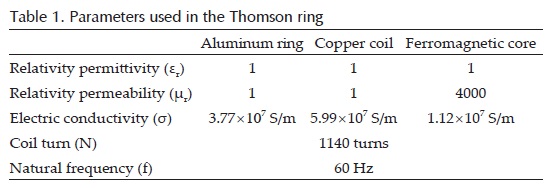
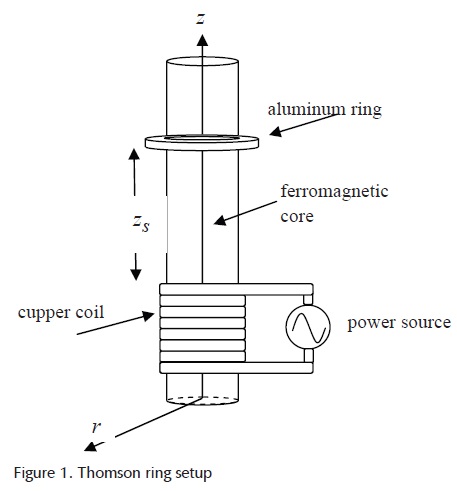
<body><![CDATA[<p align="justify">&nbsp;</p>     <p align="justify"><font face="verdana" size="2">Experimental setup</font></p>  	    <p align="justify"><font face="verdana" size="2">The Thomson ring used in this work consists of a coil with ferromagnetic core; where an aluminum ring is threaded on the core, as shown in <a href="#f1">Figure 1</a>. The ferromagnetic core consists in a solid cylinder that is collocated vertically, as is illustrated in <a href="#f1">Figure 1</a>. In this figure, Z<i><sub>s</sub></i> represents the distance between the coil and the aluminum ring.</font></p> 	    <p align="center"><a name="f1"></a></p> 	    <p align="center"><img src="/img/revistas/iit/v16n3/a10f1.jpg"></p>     <p align="justify"><font face="verdana" size="2">The coil is made of copper wire and consists of 1140 turns (see, <a href="#t1">Table 1</a>). This coil is fed by a cosine voltage given by</font></p>     <p align="center"><img src="/img/revistas/iit/v16n3/a10e1.jpg"></p>     <p align="center"><a name="t1"></a></p>     <p align="center"><img src="/img/revistas/iit/v16n3/a10t1.jpg"></p>     <p align="justify"><font face="verdana" size="2">where, <i>V<sub>0</sub></i> is the amplitude; <i>w = 2&#960;f</i> is the angular frequency <i>(f</i> being the natural frequency), as shown in <a href="#t1">Table 1</a>. The electric and magnetic characteristics of the materials used in the Thomson ring are indicated in <a href="#t1">Table 1</a>. The ferromagnetic core is iron whose relativity permeability is taken from the data base of COMSOL (2008).</font></p>   	    ]]></body>
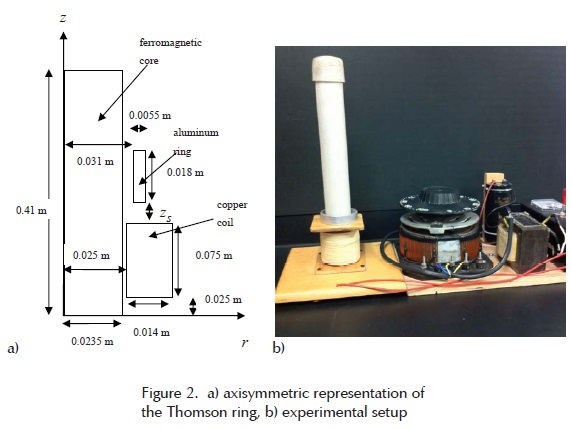
<body><![CDATA[<p align="justify"><font face="verdana" size="2">In order to take advantage of axial symmetry, the Thomson ring is represented by means of axisymmetric geometry as depicted in <a href="#f2">Figure 2</a>. In this Figure, a cylinder coordinate system is chosen so that the <i>r</i>&#45;axis represents the horizontal axis, the <i>z</i>&#45;axis represents the vertical axis. The dimensions of the aluminum ring are: interior radius of 0.031 m, exterior radius of 0.0365 m and height of 0.018 m as illustrated in <a href="#f2">Figure 2</a>. In this figure, Z<i><sub>s</sub></i> is the separation distance between aluminum ring and copper coil.</font></p> 	    <p align="center"><a name="f2"></a></p> 	    <p align="center"><img src="/img/revistas/iit/v16n3/a10f2.jpg"></p>  	    <p align="justify"><font face="verdana" size="2">The copper coil forms a toroid with dimensions: interior radius of 0.025 m, exterior radius of 0.039 m, and height of 0.075 m, as shown in <a href="#f2">Figure 2</a>. The distance between base of ferromagnetic core and base of copper coil is 0.025 m. The copper coil is threaded on a ferromagnetic cylinder (ferromagnetic core). The ferromagnetic core has a radius of 0.0235 m and height of 0.41 m, as depicted in <a href="#f2">Figure 2</a>.</font></p>  	    <p align="justify">&nbsp;</p>     <p align="justify"><font face="verdana" size="2"><b>Solution methodology</b> </font></p>     <p align="justify"><font face="verdana" size="2"><i>Electromagnetic field equations</i></font></p>  	    <p align="justify"><font face="verdana" size="2">In this section the equations that describe the electromagnetic field in the Thomson ring are presented. The magnetic field <i><img src="/img/revistas/iit/v16n3/a10b.jpg"> =</i>  	&#8711;  x <i><img src="/img/revistas/iit/v16n3/a10a.jpg"> (<img src="/img/revistas/iit/v16n3/a10a.jpg"></i> being the magnetic vector potential) satisfies the Ampere&#45;Maxwell equation</font></p>  	    <p align="center"><img src="/img/revistas/iit/v16n3/a10e2.jpg"></p>     <p align="justify"><font face="verdana" size="2">where, <i>v</i> is the reluctivity, <i><img src="/img/revistas/iit/v16n3/a10j.jpg"></i> is the current density; and <i><img src="/img/revistas/iit/v16n3/a10d.jpg"> = &#949;<img src="/img/revistas/iit/v16n3/a10e.jpg"> (&#949;</i> being the permittivity) is the electric density. The second term in the Eq. (2) represents the displacement current, which can be dropped if the frequency of the power source is small; in this case, the Eq. (2) is given by</font></p>  	    ]]></body>
<body><![CDATA[<p align="center"><img src="/img/revistas/iit/v16n3/a10e3.jpg"></p>     <p align="justify"><font face="verdana" size="2">The current density <i><img src="/img/revistas/iit/v16n3/a10j.jpg"></i> in this equation depends of the type of region (cupper coil, aluminum ring, air or ferromagnetic core) and is given by:</font></p>  	    <p align="justify"><font face="verdana" size="2"><i>1) Air and ferromagnetic core region</i></font></p>  	    <p align="justify"><font face="verdana" size="2">The current density in air and ferromagnetic core regions is <img src="/img/revistas/iit/v16n3/a10j.jpg"> = <img src="/img/revistas/iit/v16n3/a10ecero.jpg">; therefore</font></p>  	    <p align="center"><img src="/img/revistas/iit/v16n3/a10e3a.jpg"></p>     <p align="justify"><font face="verdana" size="2"><i>2) Aluminum ring region</i></font></p>  	    <p align="justify"><font face="verdana" size="2">The current density <i><img src="/img/revistas/iit/v16n3/a10j.jpg"> = &#963;<sub>r</sub><img src="/img/revistas/iit/v16n3/a10e.jpg"></i> (being <i>&#963;<sub>r</sub></i> the electric conductivity of the aluminum ring) is found using the Faraday law</font></p> 	    <p align="center"><img src="/img/revistas/iit/v16n3/a10e5.jpg"></p> 	    <p align="justify"><font face="verdana" size="2">Solving this equation for the vector potential <i><img src="/img/revistas/iit/v16n3/a10a.jpg"></i></font></p> 	    <p align="center"><img src="/img/revistas/iit/v16n3/a10e6.jpg"></p>   	    ]]></body>

<body><![CDATA[<p align="justify"><font face="verdana" size="2">It is observed that this equation does not contain the term of the scalar electric potential gradient (&#8711;<i>V</i>) due to that there is not a power source in the aluminum region. Substituting Eq. (6) in <i><img src="/img/revistas/iit/v16n3/a10j.jpg"> = &#963;<sub>r</sub><img src="/img/revistas/iit/v16n3/a10e.jpg"></i></font></p>     <p align="center"><img src="/img/revistas/iit/v16n3/a10e7.jpg"></p>  	    <p align="justify"><font face="verdana" size="2">Substituting Eq. (6) in Eq. (3)</font></p> 	    <p align="center"><font size="2" face="verdana"><img src="/img/revistas/iit/v16n3/a10e8.jpg"></font></p>     <p align="justify"><font face="verdana" size="2"><i>3) Copper coil region</i></font></p>  	    <p align="justify"><font face="verdana" size="2">The region of the copper coil is modeled as a region that contains N turns where each turn carries the same current <i>i<sub>c</sub>.</i> In this case, the current density / is uniform with value</font></p>     <p align="center"><img src="/img/revistas/iit/v16n3/a10e9.jpg"></p>     <p align="justify"><font face="verdana" size="2">where, <i>S<sub>c</sub></i> is the cross section area of the copper coil region. Substituting Eq. (9) in Eq. (3)</font></p>     <p align="center"><img src="/img/revistas/iit/v16n3/a10e10.jpg"></p>     <p align="justify"><font face="verdana" size="2">where, <i><img src="/img/revistas/iit/v16n3/a10i.jpg"></i> is a unit vector pointed in direction of the current density.</font></p>  	    ]]></body>
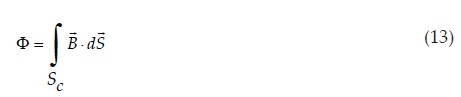
<body><![CDATA[<p align="justify">&nbsp;</p> 	    <p align="justify"><font face="verdana" size="2"><i>Electrical network equations</i></font></p>  	    <p align="justify"><font face="verdana" size="2">If the current is known, the solution of the Eq. (10) can be realized. However, this current cannot be known a priori. We know a priori the voltage <i>V</i> between the terminals of the coil. An additional equation is required. This equation is obtained using the Kirchhoff voltage law</font></p>  	    <p align="center"><img src="/img/revistas/iit/v16n3/a10e11.jpg"></p>     <p align="justify"><font face="verdana" size="2">where, <i>R</i> is the resistance, &#934; is the magnetic flux that cross all the turns of the coil. The resistance is given by</font></p>  	    <p align="center"><img src="/img/revistas/iit/v16n3/a10e12.jpg"></p>     <p align="justify"><font face="verdana" size="2">where, <i>&#963;<sub>c</sub></i> is the electric conductivity of the coil and L is the length of all the turns of the coil. The magnetic flux is given by</font></p>     <p align="center"><img src="/img/revistas/iit/v16n3/a10e13.jpg"></p>     <p align="justify"><font face="verdana" size="2">where, the surface <i>S<sub>c</sub></i> comprises all the surfaces of the turns of the coil. Using the fact <i><img src="/img/revistas/iit/v16n3/a10b.jpg"> =</i> &#8711; x <i><img src="/img/revistas/iit/v16n3/a10a.jpg"></i> and the Stokes theorem in Eq. (13) we obtain</font></p>  	    <p align="center"><img src="/img/revistas/iit/v16n3/a10e14.jpg"></p>     ]]></body>
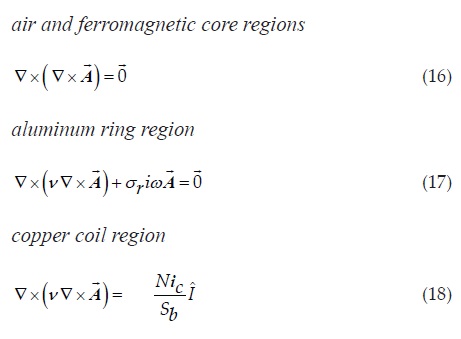
<body><![CDATA[<p align="justify"><font face="verdana" size="2">where, the trajectory C comprises all the turns of the coil. Substituting Eq. (14) in Eq. (11)</font></p>  	    <p align="center"><i><font size="2" face="verdana"> </font></i><img src="/img/revistas/iit/v16n3/a10e15.jpg"></p> 	    <p align="justify">&nbsp;</p>     <p align="justify"><font face="verdana" size="2">Phasor equations</font></p>  	    <p align="justify"><font face="verdana" size="2">The current in the copper coil is cosine to ensure that the aluminum ring stays in a stationary levitated position. In this situation, the state of the electromagnetic field is stable and the equations of the electromagnetic field can be given in phasor form. In phasor notation, the operator <i>d/dt</i> becomes <i>iw</i> in Eqs. (4), (8) and (10):</font></p> 	    <p align="center"><img src="/img/revistas/iit/v16n3/a10e16.jpg"></p>  	    <p align="justify"><font face="verdana" size="2">where, <i><img src="/img/revistas/iit/v16n3/a10a.jpg"></i> and <b><i>i</i></b><sub>c</sub> are phasors of the potential <b><i><img src="/img/revistas/iit/v16n3/a10a.jpg"></i></b> and the current <b><i>i</i></b><i><sub>c</sub>,</i> respectively.</font></p>     <p align="justify"><font face="verdana" size="2">The phasor equation of the electrical network equation Eq. (15) is</font></p>  	    <p align="center"><img src="/img/revistas/iit/v16n3/a10e19.jpg"></p>     <p align="justify"><font face="verdana" size="2">where, <i>V</i> is the phasor of the voltage <i>V.</i> </font></p>     ]]></body>
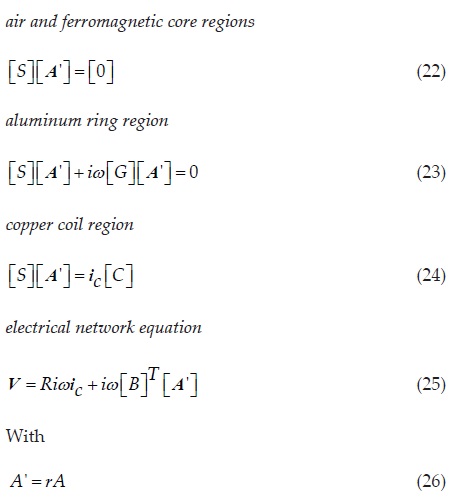
<body><![CDATA[<p align="justify">&nbsp;</p>     <p align="justify"><font face="verdana" size="2">Boundary conditions</font></p>  	    <p align="justify"><font face="verdana" size="2">It is observed that Eq. (3) is a second order partial differential equation for the magnetic vector potential <i><img src="/img/revistas/iit/v16n3/a10a.jpg"></i>. The solution of this partial differential equation requires boundary conditions for the vector potential <i><img src="/img/revistas/iit/v16n3/a10a.jpg"></i>. The boundary of the solution domain is chosen so that the vector potential can be dropped (magnetic insulation). The magnetic insulation condition is expressed as</font></p>  	    <p align="center"><img src="/img/revistas/iit/v16n3/a10e20.jpg"></p>     <p align="justify"><font face="verdana" size="2">where, &#915; is the boundary of solution domain. In phasor notation, the condition of magnetic insulation is</font></p>  	    <p align="center"><img src="/img/revistas/iit/v16n3/a10e21.jpg"></p> 	    <p align="justify">&nbsp;</p>  	    <p align="justify"><font face="verdana" size="2">Discretization</font></p>  	    <p align="justify"><font face="verdana" size="2">Using the Galerkin method (Hoole, 1989; Lombard and Meunier, 1992, 1993), Eqs. (16)&#45;(19) can be discretized:</font></p>     <p align="center"><img src="/img/revistas/iit/v16n3/a10e22.jpg"></p>     ]]></body>
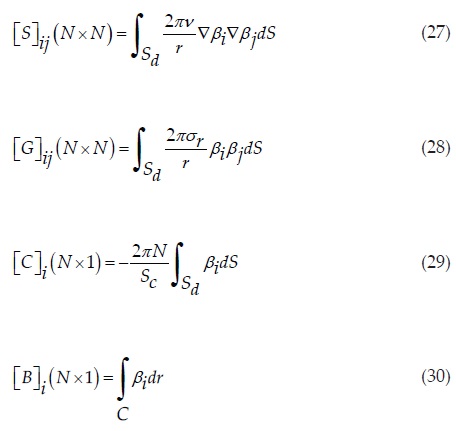
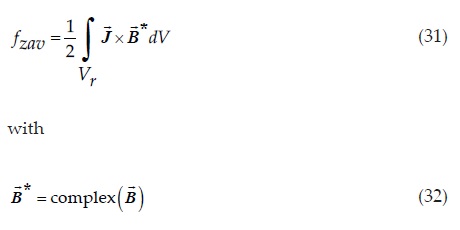
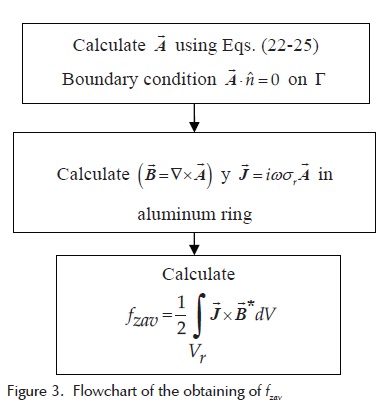
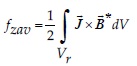
<body><![CDATA[<p align="justify"><font face="verdana" size="2">where <i>N</i> represents the number of nodes. The matrices and vectors are defined as</font></p>  	    <p align="center"><img src="/img/revistas/iit/v16n3/a10e27.jpg"></p>  	    <p align="justify"><font face="verdana" size="2">where, the vector potential <i>A</i> is expanded in the base function <i>&#946;</i><sub>i</sub>: <i>A = &#8721;&#946;<sub>j</sub>A<sub>j</sub>.</i> The surface <i>S<sub>d</sub></i> is the surface of the solution domain.</font></p>     <p align="justify">&nbsp;</p>  	    <p align="justify"><font face="verdana" size="2">Mechanical equilibrium</font></p>  	    <p align="justify"><font face="verdana" size="2">The voltage is a cosine in order to maintain the aluminum ring in a stationary levitated position. This stationary levitation is obtained when the mechanical equilibrium is reached; this is, the Lorente force averaged in a cycle, <i>f<sub>zav</sub></i> equals the gravity force <i>f<sub>g</sub>.</i> Using the complex notation, the Lorente force <i>f<sub>zav</sub></i> (Barry and Casey, 1999; Hayt and Buck, 2006) is given by</font></p>  	    <p align="center"><img src="/img/revistas/iit/v16n3/a10e31.jpg"></p>     <p align="justify"><font face="verdana" size="2">where, <i><img src="/img/revistas/iit/v16n3/a10b.jpg"></i> and <i><img src="/img/revistas/iit/v16n3/a10j.jpg"></i> are the phasors of magnetic density <img src="/img/revistas/iit/v16n3/a10b.jpg"> and current density <i><img src="/img/revistas/iit/v16n3/a10j.jpg"></i>, respectively. The factor 1/2 in Eq. (31) is due to that the Lorente force period is half of the magnetic field period (Barry and Casey, 1999). <a href="#f3">Figure 3</a> shows the flowchart of the obtaining of the average Lorente force. The steps of this methodology are:</font></p>     <p align="center"><a name="f3"></a></p>     <p align="center"><img src="/img/revistas/iit/v16n3/a10f3.jpg"></p>  	    ]]></body>
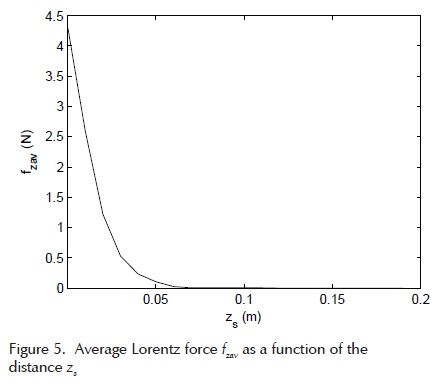
<body><![CDATA[<blockquote> 	      <p align="justify"><font face="verdana" size="2">1) Calculate the phasor potential using the phasor equations (Eqs. 22&#45;25) along with boundary condition of magnetic insulation<b><i> <img src="/img/revistas/iit/v16n3/a10e32a.jpg"></i></b>on &#915; (see Eq. 20).</font></p> 	      <p align="justify"><font face="verdana" size="2">2) Determine the phasor magnetic density <img src="/img/revistas/iit/v16n3/a10e32b.jpg">and phasor current density <i> <img src="/img/revistas/iit/v16n3/a10e32j.jpg"></i> (see Eq. 6) in the aluminum ring region.</font></p> 	      <p align="justify"><font face="verdana" size="2">3) Calculate the average Lorente force <img src="/img/revistas/iit/v16n3/a10e32f.jpg">(see Eq. 31).</font></p> </blockquote>      <p align="justify"><font face="verdana" size="2">The space distribution of the electromagnetic field depends of the separation <i>s<sub>z</sub> </i>between the aluminum ring and the copper coil. Therefore, the average Lorente force <i>f<sub>zav</sub></i> is a function of the separation <i>(f<sub>z</sub></i> = <i>f<sub>z</sub></i>(<i>s<sub>z</sub></i>)). In order to reach the stationary levitation of the aluminum ring, the average Lorente force <i>f<sub>zav</sub></i> equals to the gravity force <i>f<sub>g</sub>.</i></font></p> 	    <p align="center"><img src="/img/revistas/iit/v16n3/a10e33.jpg"></p>  	    <p align="justify"><font face="verdana" size="2">where, z<sub>s</sub>'  is the separation in stationary levitation and represents the root of Eq. (33). It is observed that Eq. (33) is a transcendental equation. The root of this transcendental equation can be found using a variant of the Newton&#45;Raphson method: secant method (Arfken and Weber, 2005). The convergence of Newton&#45;Raphson is guaranteed due to that the average Lorentz force <i>f<sub>zaw</sub>(</i>z<i><sub>s</sub>)</i> is a function decreasing of the separation z<sub>s</sub> (see <a href="#f5">Figure 5</a>). The secant method is defined by the recurrence relation</font></p>         <p align="center"><img src="/img/revistas/iit/v16n3/a10e34.jpg"></p>  	    <p align="center"><a name="f4"></a></p> 	    <p align="center"><img src="/img/revistas/iit/v16n3/a10f4.jpg"></p> 	    ]]></body>
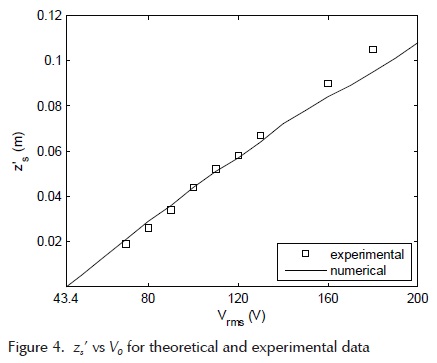
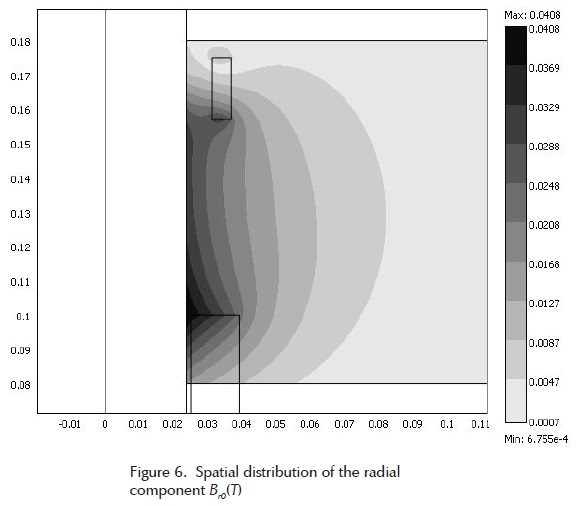
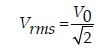
<body><![CDATA[<p align="center"><a name="f5"></a></p> 	    <p align="center"><img src="/img/revistas/iit/v16n3/a10f5.jpg"></p>     <p align="justify">&nbsp;</p>     <p align="justify"><font face="verdana" size="2"><b>Experimental validation</b></font></p>  	    <p align="justify"><font face="verdana" size="2">In this section we compared the numerical and experimental results for the separation in stationary levitation z<sub>s</sub>' as a function of the voltage amplitude in rms, <img src="/img/revistas/iit/v16n3/a10e34a.jpg">.  The experimental setup was described in the second section. The numerical results are obtained using the proposed methodology in the section above. <a href="#f4">Figure 4</a> shows the separation z<sub>s</sub>' as function of the voltage amplitude <i>V<sub>rms</sub></i> for both experimental and numerical results. The discrepancy between the theoretical and experimental data is at most 12%. This difference can be due to the fact that the numerical modeling does not take into account the temperature effect in the electric conductivity <i>&#963;.</i></font></p>     <p align="justify">&nbsp;</p>  	    <p align="justify"><font face="verdana" size="2"><b>Results and discussion</b></font></p>  	    <p align="justify"><font face="verdana" size="2">In this section some results obtained by the proposed modeling are studied. The average Lorente force is examined as a function of the separation distance; the ratio between coil current and ring current, and the spatial distribution of the magnetic field.</font></p>  	    <p align="justify"><font face="verdana" size="2"><a href="#f5">Figure 5</a> depicts the average Lorente force <i>f<sub>zav</sub></i> as function of the separation z<sub>s</sub> for a representative voltage amplitude <i>V<sub>rms</sub> =</i> 120 V. It is observed that the Lorente force is a decreasing function of the distance z<sub>s</sub>. This guarantees the convergence of the Newton&#45;Raphson method due to that the derivative <strike> <img src="/img/revistas/iit/v16n3/a10e34b.jpg"></strike> is negative.</font></p>     <p align="justify"><font face="verdana" size="2"><a href="#f6">Figure 6</a> shows the spatial distribution of the radial component <i>B<sub>r0</sub></i> of the magnetic density amplitude, for a representative voltage amplitude <i>V<sub>rms</sub> =</i> 120 V in state of stationary levitation (z<sub>s</sub>' = 0.057 m). It also presents the positions of the ferromagnetic core, copper coil and aluminum ring. This <a href="#f6">Figure 6</a> shows that the radial component is higher in regions close to the core, coil and ring edges. In contrast, the radial component <i>B<sub>r0</sub></i> presents small values in positions far away from above edges.</font></p>     ]]></body>
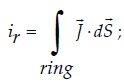
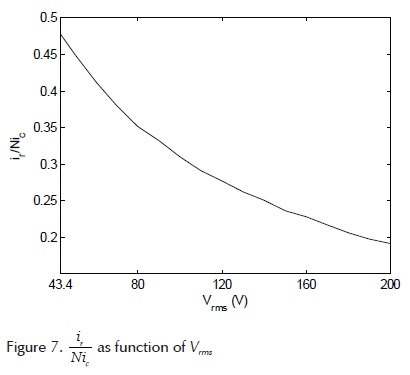
<body><![CDATA[<p align="center"><a name="f6"></a></p>     <p align="center"><img src="/img/revistas/iit/v16n3/a10f6.jpg"></p>     <p align="justify"><font face="verdana" size="2">The total current in the ring <i>i<sub>r</sub></i> is realized by means of <img src="/img/revistas/iit/v16n3/a10e34c.jpg">;while the total current in the region of the coil is <i>Ni<sub>c</sub>.</i> In <a href="#f7">Figure 7</a> is shown the ratio <img src="/img/revistas/iit/v16n3/a10e34d.jpg">as function of voltage amplitude <i>V<sub>rms</sub></i> in stationary levitation. It is observed that the highest value <i>(i<sub>r</sub> / Ni<sub>c</sub> =</i> 0.47) occurs in <i>V<sub>rms</sub> =</i> 43.4 V corresponding to a separation z<sub>s</sub>' = 0. The ratio <i>i<sub>r</sub> / Ni<sub>c</sub></i> decreases if the voltage amplitude <i>V<sub>rms</sub></i> increases. Also, in a first order approach, the magnetic field originated by any system is proportional to the current of this system. Therefore, the magnetic coupling of the ring on the coil can be neglected for high values of voltage amplitude.</font></p>  	    <p align="center"><a name="f7"></a></p> 	    <p align="center"><img src="/img/revistas/iit/v16n3/a10f7.jpg"></p>     <p align="justify">&nbsp;</p>     <p align="justify"><font face="verdana" size="2"><b>Conclusions</b></font></p>  	    <p align="justify"><font face="verdana" size="2">The aim of this work was to present a numerical modeling based upon the use of the Galerkin method to simulate the electromagnetic field of the Thomson ring. Also, this modeling is capable of simulating numerically the separation between aluminum ring and copper coil in situation of stationary levitation (the average Lorente force equals gravity force). This calculation of the separation uses the Newton&#45;Raphson method.</font></p>  	    <p align="justify"><font face="verdana" size="2">The proposed modeling was validated comparing theoretical and experimental results. The compared results were the separation between the aluminum ring and the copper coil (in stationary levitation) for different voltage amplitudes.</font></p>  	    <p align="justify"><font face="verdana" size="2">It is concluded that the magnetic coupling of the aluminum ring on the coil can be neglected if the source voltage is high. Therefore, the coil current can be modeled without taking into account the coupling ring&#45;coil. This means that the coil current is found using a RL (resistance&#45;inductance) circuit; where, the resistance and inductance are parameter of the coil.</font></p>     ]]></body>
<body><![CDATA[<p align="justify">&nbsp;</p>  	    <p align="justify"><font face="verdana" size="2"><b>References</b></font></p>  	    <!-- ref --><p align="justify"><font face="verdana" size="2">Alferov D,. Budovsky A., Evsin D., Ivanov V., Sidorov V., Yagnov V. DC vacuum circuit&#45;breaker, in: International Symposium on Discharges and Electrical Insulation in Vacuum, 24th, Bucharest, 2008, pp. 173&#45;176.    &nbsp;&nbsp;&nbsp;&nbsp;&nbsp;&nbsp;&nbsp;&nbsp;[&#160;<a href="javascript:void(0);" onclick="javascript: window.open('/scielo.php?script=sci_nlinks&ref=4298996&pid=S1405-7743201500030001000001&lng=','','width=640,height=500,resizable=yes,scrollbars=1,menubar=yes,');">Links</a>&#160;]<!-- end-ref --></font></p>  	    <!-- ref --><p align="justify"><font face="verdana" size="2">Arfken G.B., Weber H.J. <i>Mathematical methods for physicists,</i> sixth ed., New York, Elsevier, Academic Press, 2005.    &nbsp;&nbsp;&nbsp;&nbsp;&nbsp;&nbsp;&nbsp;&nbsp;[&#160;<a href="javascript:void(0);" onclick="javascript: window.open('/scielo.php?script=sci_nlinks&ref=4298998&pid=S1405-7743201500030001000002&lng=','','width=640,height=500,resizable=yes,scrollbars=1,menubar=yes,');">Links</a>&#160;]<!-- end-ref --></font></p>  	    <!-- ref --><p align="justify"><font face="verdana" size="2">Barry N., Casey R. Elihu Thomson's jumping ring in a levitated closed&#45;loop control experiment, Education. <i>IEEE Transactions on,</i> volume 42 (issue 1), 1999: 72&#45;80.    &nbsp;&nbsp;&nbsp;&nbsp;&nbsp;&nbsp;&nbsp;&nbsp;[&#160;<a href="javascript:void(0);" onclick="javascript: window.open('/scielo.php?script=sci_nlinks&ref=4299000&pid=S1405-7743201500030001000003&lng=','','width=640,height=500,resizable=yes,scrollbars=1,menubar=yes,');">Links</a>&#160;]<!-- end-ref --></font></p>  	    <!-- ref --><p align="justify"><font face="verdana" size="2">Belforte P., Chiampi M., Tartaglia M. A finite element computation procedure for electromagnetic fields under different supply conditions, Magnetics. <i>IEEE Transactions on,</i> volume 21 (issue 6), 1985: 2284&#45;2287.    &nbsp;&nbsp;&nbsp;&nbsp;&nbsp;&nbsp;&nbsp;&nbsp;[&#160;<a href="javascript:void(0);" onclick="javascript: window.open('/scielo.php?script=sci_nlinks&ref=4299002&pid=S1405-7743201500030001000004&lng=','','width=640,height=500,resizable=yes,scrollbars=1,menubar=yes,');">Links</a>&#160;]<!-- end-ref --></font></p>  	    ]]></body>
<body><![CDATA[<!-- ref --><p align="justify"><font face="verdana" size="2">Bissal A., Salinas E., Engdahl G., Ohrstrom M. Simulation and verification of Thomson actuator systems, in Proceedings of the COMSOL Conference, Paris, France, 2010.    &nbsp;&nbsp;&nbsp;&nbsp;&nbsp;&nbsp;&nbsp;&nbsp;[&#160;<a href="javascript:void(0);" onclick="javascript: window.open('/scielo.php?script=sci_nlinks&ref=4299004&pid=S1405-7743201500030001000005&lng=','','width=640,height=500,resizable=yes,scrollbars=1,menubar=yes,');">Links</a>&#160;]<!-- end-ref --></font></p>  	    <!-- ref --><p align="justify"><font face="verdana" size="2">COMSOL, AC/DC MODULE User's Guide, 2008.    &nbsp;&nbsp;&nbsp;&nbsp;&nbsp;&nbsp;&nbsp;&nbsp;[&#160;<a href="javascript:void(0);" onclick="javascript: window.open('/scielo.php?script=sci_nlinks&ref=4299006&pid=S1405-7743201500030001000006&lng=','','width=640,height=500,resizable=yes,scrollbars=1,menubar=yes,');">Links</a>&#160;]<!-- end-ref --></font></p>  	    <!-- ref --><p align="justify"><font face="verdana" size="2">Hayt W.H., Buck J.A. <i>Teor&iacute;a electromagn&eacute;tica,</i> New York, Me Graw Hill, 2006.    &nbsp;&nbsp;&nbsp;&nbsp;&nbsp;&nbsp;&nbsp;&nbsp;[&#160;<a href="javascript:void(0);" onclick="javascript: window.open('/scielo.php?script=sci_nlinks&ref=4299008&pid=S1405-7743201500030001000007&lng=','','width=640,height=500,resizable=yes,scrollbars=1,menubar=yes,');">Links</a>&#160;]<!-- end-ref --></font></p>     <!-- ref --><p align="justify"><font face="verdana" size="2">Hoole S.E.H. Computer aided analysis and design of electromagnetic devices, New York, Elsevier, 1989.    &nbsp;&nbsp;&nbsp;&nbsp;&nbsp;&nbsp;&nbsp;&nbsp;[&#160;<a href="javascript:void(0);" onclick="javascript: window.open('/scielo.php?script=sci_nlinks&ref=4299010&pid=S1405-7743201500030001000008&lng=','','width=640,height=500,resizable=yes,scrollbars=1,menubar=yes,');">Links</a>&#160;]<!-- end-ref --></font></p>  	    <!-- ref --><p align="justify"><font face="verdana" size="2">Konrad A. Integrodifferential finite element formulation of two&#45;dimensional steady&#45;state skin effect problems. <i>IEEE Transactions on Magnetics,</i> volume 18 (issue 1), 1982: 284&#45;292.    &nbsp;&nbsp;&nbsp;&nbsp;&nbsp;&nbsp;&nbsp;&nbsp;[&#160;<a href="javascript:void(0);" onclick="javascript: window.open('/scielo.php?script=sci_nlinks&ref=4299012&pid=S1405-7743201500030001000009&lng=','','width=640,height=500,resizable=yes,scrollbars=1,menubar=yes,');">Links</a>&#160;]<!-- end-ref --></font></p>  	    ]]></body>
<body><![CDATA[<!-- ref --><p align="justify"><font face="verdana" size="2">Li W., Jeong Y.W., Yoon H.S., Koh C.S. Analysis of parameters influence on the characteristics of Thomson coil type actuator of arc eliminator using adaptive segmentation equivalent circuit method. <i>Journal of Electrical Engineering &amp; Technology,</i> volume 5 (issue 2), 2010: 282&#45;289.    &nbsp;&nbsp;&nbsp;&nbsp;&nbsp;&nbsp;&nbsp;&nbsp;[&#160;<a href="javascript:void(0);" onclick="javascript: window.open('/scielo.php?script=sci_nlinks&ref=4299014&pid=S1405-7743201500030001000010&lng=','','width=640,height=500,resizable=yes,scrollbars=1,menubar=yes,');">Links</a>&#160;]<!-- end-ref --></font></p>  	    <!-- ref --><p align="justify"><font face="verdana" size="2">Lombard P., Meunier G. A general method for electric and magnetic coupled problem in 2D and magnetodynamic domain. <i>IEEE Transactions on Magnetics,</i> volume 28 (issue 2), 1992: 1291&#45;1294.    &nbsp;&nbsp;&nbsp;&nbsp;&nbsp;&nbsp;&nbsp;&nbsp;[&#160;<a href="javascript:void(0);" onclick="javascript: window.open('/scielo.php?script=sci_nlinks&ref=4299016&pid=S1405-7743201500030001000011&lng=','','width=640,height=500,resizable=yes,scrollbars=1,menubar=yes,');">Links</a>&#160;]<!-- end-ref --></font></p>  	    <!-- ref --><p align="justify"><font face="verdana" size="2">Lombard P., Meunier G. A general purpose method for electric and magnetic combined problems for 2D, axisymmetric and transient systems. <i>IEEE Transactions on Magnetics,</i> volume 29 (issue 2), 1993: 1737&#45;1740.    &nbsp;&nbsp;&nbsp;&nbsp;&nbsp;&nbsp;&nbsp;&nbsp;[&#160;<a href="javascript:void(0);" onclick="javascript: window.open('/scielo.php?script=sci_nlinks&ref=4299018&pid=S1405-7743201500030001000012&lng=','','width=640,height=500,resizable=yes,scrollbars=1,menubar=yes,');">Links</a>&#160;]<!-- end-ref --></font></p>  	    <!-- ref --><p align="justify"><font face="verdana" size="2">Meunier G, Shen D., Coulomb J.L. Modelisation of 2D and axisymmetric magnetodynamic domain by the finite elements method. <i>IEEE Transactions on Magnetics,</i> volume 24 (issue 1), 1998: 166&#45;169.    &nbsp;&nbsp;&nbsp;&nbsp;&nbsp;&nbsp;&nbsp;&nbsp;[&#160;<a href="javascript:void(0);" onclick="javascript: window.open('/scielo.php?script=sci_nlinks&ref=4299020&pid=S1405-7743201500030001000013&lng=','','width=640,height=500,resizable=yes,scrollbars=1,menubar=yes,');">Links</a>&#160;]<!-- end-ref --></font></p>  	    <!-- ref --><p align="justify"><font face="verdana" size="2">Meyer J.M., Rufer A. A DC hybrid circuit breaker with ultra&#45;fast contact opening and integrated gate&#45;commutated thyristors (IGCTs). <i>IEEE Transactions on Power Delivery,</i> volume 21 (issue 2), 2006: 646&#45;651.    &nbsp;&nbsp;&nbsp;&nbsp;&nbsp;&nbsp;&nbsp;&nbsp;[&#160;<a href="javascript:void(0);" onclick="javascript: window.open('/scielo.php?script=sci_nlinks&ref=4299022&pid=S1405-7743201500030001000014&lng=','','width=640,height=500,resizable=yes,scrollbars=1,menubar=yes,');">Links</a>&#160;]<!-- end-ref --></font></p>  	    ]]></body>
<body><![CDATA[<!-- ref --><p align="justify"><font face="verdana" size="2">Patitsas S.N. Stability analysis for axially&#45;symmetric magnetic field levitation of a superconducting sphere. <i>Physica C,</i> volume 471 (issues 1&#45;2), 2011: 12&#45;18.    &nbsp;&nbsp;&nbsp;&nbsp;&nbsp;&nbsp;&nbsp;&nbsp;[&#160;<a href="javascript:void(0);" onclick="javascript: window.open('/scielo.php?script=sci_nlinks&ref=4299024&pid=S1405-7743201500030001000015&lng=','','width=640,height=500,resizable=yes,scrollbars=1,menubar=yes,');">Links</a>&#160;]<!-- end-ref --></font></p>  	    <!-- ref --><p align="justify"><font face="verdana" size="2">Piriou F., Razek A. Simulation of electromagnetic systems by coupling of magnetic and electric equations. <i>Mathematics and Computers in Simulation,</i> volume 31 (issue 3), 1989: 189&#45;194.    &nbsp;&nbsp;&nbsp;&nbsp;&nbsp;&nbsp;&nbsp;&nbsp;[&#160;<a href="javascript:void(0);" onclick="javascript: window.open('/scielo.php?script=sci_nlinks&ref=4299026&pid=S1405-7743201500030001000016&lng=','','width=640,height=500,resizable=yes,scrollbars=1,menubar=yes,');">Links</a>&#160;]<!-- end-ref --></font></p>     <p align="justify">&nbsp;</p>  	    <p align="justify"><font face="verdana" size="2"><b>Citation for this article:</b></font></p>  	    <p align="justify"><font face="verdana" size="2"><b>Chicago citation style</b>    <br>Guzm&aacute;n, Juan, Felipe de Jes&uacute;s Gonz&aacute;lez&#45;Monta&ntilde;ez, Rafael Escarela&#45;P&eacute;rez, Juan Carlos Olivares&#45;Galv&aacute;n, Victor Manuel Jim&eacute;nez&#45;Mondragon. Numerical modeling of the Thomson ring in stationary levitation using FEM&#45;electrical network and Newton&#45;Raphson. <i>Ingenier&iacute;a Investigaci&oacute;n y Tecnolog&iacute;a,</i> XVI, 03 (2015): 431&#45;439.</font></p>  	    <p align="justify"><font face="verdana" size="2"><b>ISO 690 citation style</b>    <br>Guzm&aacute;n J., Gonz&aacute;lez&#45;Monta&ntilde;ez F.J., Escarela&#45;P&eacute;rez R., Olivares&#45;Galv&aacute;n J.C., Jim&eacute;nez&#45;Mondragon V.M. Numerical modeling of the Thomson ring in stationary levitation using FEM&#45;electrical network and Newton&#45;Raphson. <i>Ingenier&iacute;a Investigaci&oacute;n y Tecnolog&iacute;a,</i> volume XVI (issue 3), july 2015: 431&#45;439.</font></p>     ]]></body>
<body><![CDATA[<p align="justify">&nbsp;</p>  	    <p align="justify"><font face="verdana" size="2"><b>About the authors</b></font></p>  	    <p align="justify"><font face="verdana" size="2"><i><b>Juan Guzman.</b></i> Obtained Ph.D. in Energy Engineering from the Universidad Nacional Aut&oacute;noma de M&eacute;xico, M&eacute;xico City, Mexico, in 2008. He is currently with the &aacute;rea de ingenier&iacute;a energ&eacute;tica y electromagn&eacute;tica, Departamento de Energ&iacute;a, UAM, Azcapotzalco, M&eacute;xico.</font></p>  	    <p align="justify"><font face="verdana" size="2"><i><b>Felipe de Jes&uacute;s Gonz&aacute;lez&#45;Monta&ntilde;ez.</b></i> He received the M.Sc. degree in electrical engineering from the Centro de Investigaci&oacute;n y de Estudios Avanzados del IPN, M&eacute;xico City, Mexico, in 2011. His research interests include the modeling and control of electrical machines.</font></p>  	    <p align="justify"><font face="verdana" size="2"><i><b>Rafael Escarela&#45;P&eacute;rez.</b></i> He obtained his B.Sc. in electrical engineering from Universidad Aut&oacute;noma Metropolitana, Mexico City in 1992 and his Ph.D. from Imperial College, London in 1996. He is interested in the modeling of electrical machines.</font></p>  	    <p align="justify"><font face="verdana" size="2"><i><b>Juan Carlos Olivares&#45;Galv&aacute;n.</b></i> He received the Ph.D. degree in electrical engineering from CINVESTAV, Guadalajara, Mexico, in 2003. His main research interests are related to the experimental and numerical analysis of electromagnetic devices.</font></p>  	    <p align="justify"><font face="verdana" size="2"><i><b>Victor Manuel Jim&eacute;nez&#45;Mondragon.</b></i> He received the M.Sc. degree in electrical engineering from the Universidad Nacional Aut&oacute;noma de M&eacute;xico, M&eacute;xico City, Mexico, in 2012. He is interested in the modeling of electrical machines.</font></p>      ]]></body><back>
<ref-list>
<ref id="B1">
<nlm-citation citation-type="">
<person-group person-group-type="author">
<name>
<surname><![CDATA[Alferov]]></surname>
<given-names><![CDATA[D]]></given-names>
</name>
<name>
<surname><![CDATA[Budovsky]]></surname>
<given-names><![CDATA[A.]]></given-names>
</name>
<name>
<surname><![CDATA[Evsin]]></surname>
<given-names><![CDATA[D.]]></given-names>
</name>
<name>
<surname><![CDATA[Ivanov]]></surname>
<given-names><![CDATA[V.]]></given-names>
</name>
<name>
<surname><![CDATA[Sidorov]]></surname>
<given-names><![CDATA[V.]]></given-names>
</name>
<name>
<surname><![CDATA[Yagnov]]></surname>
<given-names><![CDATA[V.]]></given-names>
</name>
</person-group>
<article-title xml:lang="en"><![CDATA[DC vacuum circuit-breaker]]></article-title>
<source><![CDATA[International Symposium on Discharges and Electrical Insulation in Vacuum, 24th]]></source>
<year>2008</year>
<page-range>173-176</page-range><publisher-loc><![CDATA[Bucharest ]]></publisher-loc>
</nlm-citation>
</ref>
<ref id="B2">
<nlm-citation citation-type="book">
<person-group person-group-type="author">
<name>
<surname><![CDATA[Arfken]]></surname>
<given-names><![CDATA[G.B.]]></given-names>
</name>
<name>
<surname><![CDATA[Weber]]></surname>
<given-names><![CDATA[H.J.]]></given-names>
</name>
</person-group>
<source><![CDATA[Mathematical methods for physicists]]></source>
<year>2005</year>
<edition>sixth</edition>
<publisher-loc><![CDATA[New York ]]></publisher-loc>
<publisher-name><![CDATA[Elsevier, Academic Press]]></publisher-name>
</nlm-citation>
</ref>
<ref id="B3">
<nlm-citation citation-type="journal">
<person-group person-group-type="author">
<name>
<surname><![CDATA[Barry]]></surname>
<given-names><![CDATA[N.]]></given-names>
</name>
<name>
<surname><![CDATA[Casey]]></surname>
<given-names><![CDATA[R.]]></given-names>
</name>
</person-group>
<article-title xml:lang="en"><![CDATA[Elihu Thomson's jumping ring in a levitated closed-loop control experiment, Education]]></article-title>
<source><![CDATA[IEEE Transactions on]]></source>
<year>1999</year>
<volume>42</volume>
<numero>1</numero>
<issue>1</issue>
<page-range>72-80</page-range></nlm-citation>
</ref>
<ref id="B4">
<nlm-citation citation-type="journal">
<person-group person-group-type="author">
<name>
<surname><![CDATA[Belforte]]></surname>
<given-names><![CDATA[P.]]></given-names>
</name>
<name>
<surname><![CDATA[Chiampi]]></surname>
<given-names><![CDATA[M.]]></given-names>
</name>
<name>
<surname><![CDATA[Tartaglia]]></surname>
<given-names><![CDATA[M.]]></given-names>
</name>
</person-group>
<article-title xml:lang="en"><![CDATA[A finite element computation procedure for electromagnetic fields under different supply conditions, Magnetics]]></article-title>
<source><![CDATA[IEEE Transactions on]]></source>
<year>1985</year>
<volume>21</volume>
<numero>6</numero>
<issue>6</issue>
<page-range>2284-2287</page-range></nlm-citation>
</ref>
<ref id="B5">
<nlm-citation citation-type="book">
<person-group person-group-type="author">
<name>
<surname><![CDATA[Bissal]]></surname>
<given-names><![CDATA[A.]]></given-names>
</name>
<name>
<surname><![CDATA[Salinas]]></surname>
<given-names><![CDATA[E.]]></given-names>
</name>
<name>
<surname><![CDATA[Engdahl]]></surname>
<given-names><![CDATA[G.]]></given-names>
</name>
<name>
<surname><![CDATA[Ohrstrom]]></surname>
<given-names><![CDATA[M.]]></given-names>
</name>
</person-group>
<source><![CDATA[Simulation and verification of Thomson actuator systems]]></source>
<year>2010</year>
<publisher-loc><![CDATA[Paris ]]></publisher-loc>
<publisher-name><![CDATA[Proceedings of the COMSOL Conference]]></publisher-name>
</nlm-citation>
</ref>
<ref id="B6">
<nlm-citation citation-type="">
<collab>COMSOL, AC</collab>
<collab>DC MODULE</collab>
<source><![CDATA[User's Guide]]></source>
<year>2008</year>
</nlm-citation>
</ref>
<ref id="B7">
<nlm-citation citation-type="book">
<person-group person-group-type="author">
<name>
<surname><![CDATA[Hayt]]></surname>
<given-names><![CDATA[W.H.]]></given-names>
</name>
<name>
<surname><![CDATA[Buck]]></surname>
<given-names><![CDATA[J.A.]]></given-names>
</name>
</person-group>
<source><![CDATA[Teoría electromagnética]]></source>
<year>2006</year>
<publisher-loc><![CDATA[New York ]]></publisher-loc>
<publisher-name><![CDATA[Me Graw Hill]]></publisher-name>
</nlm-citation>
</ref>
<ref id="B8">
<nlm-citation citation-type="book">
<person-group person-group-type="author">
<name>
<surname><![CDATA[Hoole]]></surname>
<given-names><![CDATA[S.E.H.]]></given-names>
</name>
</person-group>
<source><![CDATA[Computer aided analysis and design of electromagnetic devices]]></source>
<year>1989</year>
<publisher-loc><![CDATA[New York ]]></publisher-loc>
<publisher-name><![CDATA[Elsevier]]></publisher-name>
</nlm-citation>
</ref>
<ref id="B9">
<nlm-citation citation-type="journal">
<person-group person-group-type="author">
<name>
<surname><![CDATA[Konrad]]></surname>
<given-names><![CDATA[A.]]></given-names>
</name>
</person-group>
<article-title xml:lang="en"><![CDATA[Integrodifferential finite element formulation of two-dimensional steady-state skin effect problems]]></article-title>
<source><![CDATA[IEEE Transactions on Magnetics]]></source>
<year>1982</year>
<volume>18</volume>
<numero>1</numero>
<issue>1</issue>
<page-range>284-292</page-range></nlm-citation>
</ref>
<ref id="B10">
<nlm-citation citation-type="journal">
<person-group person-group-type="author">
<name>
<surname><![CDATA[Li]]></surname>
<given-names><![CDATA[W.]]></given-names>
</name>
<name>
<surname><![CDATA[Jeong]]></surname>
<given-names><![CDATA[Y.W.]]></given-names>
</name>
<name>
<surname><![CDATA[Yoon]]></surname>
<given-names><![CDATA[H.S.]]></given-names>
</name>
<name>
<surname><![CDATA[Koh]]></surname>
<given-names><![CDATA[C.S.]]></given-names>
</name>
</person-group>
<article-title xml:lang="en"><![CDATA[Analysis of parameters influence on the characteristics of Thomson coil type actuator of arc eliminator using adaptive segmentation equivalent circuit method]]></article-title>
<source><![CDATA[Journal of Electrical Engineering & Technology]]></source>
<year>2010</year>
<volume>5</volume>
<numero>2</numero>
<issue>2</issue>
<page-range>282-289</page-range></nlm-citation>
</ref>
<ref id="B11">
<nlm-citation citation-type="journal">
<person-group person-group-type="author">
<name>
<surname><![CDATA[Lombard]]></surname>
<given-names><![CDATA[P.]]></given-names>
</name>
<name>
<surname><![CDATA[Meunier]]></surname>
<given-names><![CDATA[G.]]></given-names>
</name>
</person-group>
<article-title xml:lang="en"><![CDATA[A general method for electric and magnetic coupled problem in 2D and magnetodynamic domain]]></article-title>
<source><![CDATA[IEEE Transactions on Magnetics]]></source>
<year>1992</year>
<volume>28</volume>
<numero>2</numero>
<issue>2</issue>
<page-range>1291-1294</page-range></nlm-citation>
</ref>
<ref id="B12">
<nlm-citation citation-type="journal">
<person-group person-group-type="author">
<name>
<surname><![CDATA[Lombard]]></surname>
<given-names><![CDATA[P.]]></given-names>
</name>
<name>
<surname><![CDATA[Meunier]]></surname>
<given-names><![CDATA[G.]]></given-names>
</name>
</person-group>
<article-title xml:lang="en"><![CDATA[A general purpose method for electric and magnetic combined problems for 2D, axisymmetric and transient systems]]></article-title>
<source><![CDATA[IEEE Transactions on Magnetics]]></source>
<year>1993</year>
<volume>29</volume>
<numero>2</numero>
<issue>2</issue>
<page-range>1737-1740</page-range></nlm-citation>
</ref>
<ref id="B13">
<nlm-citation citation-type="journal">
<person-group person-group-type="author">
<name>
<surname><![CDATA[Meunier]]></surname>
<given-names><![CDATA[G]]></given-names>
</name>
<name>
<surname><![CDATA[Shen]]></surname>
<given-names><![CDATA[D.]]></given-names>
</name>
<name>
<surname><![CDATA[Coulomb]]></surname>
<given-names><![CDATA[J.L.]]></given-names>
</name>
</person-group>
<article-title xml:lang="en"><![CDATA[Modelisation of 2D and axisymmetric magnetodynamic domain by the finite elements method]]></article-title>
<source><![CDATA[IEEE Transactions on Magnetics]]></source>
<year>1998</year>
<volume>24</volume>
<numero>1</numero>
<issue>1</issue>
<page-range>166-169</page-range></nlm-citation>
</ref>
<ref id="B14">
<nlm-citation citation-type="journal">
<person-group person-group-type="author">
<name>
<surname><![CDATA[Meyer]]></surname>
<given-names><![CDATA[J.M.]]></given-names>
</name>
<name>
<surname><![CDATA[Rufer]]></surname>
<given-names><![CDATA[A.]]></given-names>
</name>
</person-group>
<article-title xml:lang="en"><![CDATA[A DC hybrid circuit breaker with ultra-fast contact opening and integrated gate-commutated thyristors (IGCTs)]]></article-title>
<source><![CDATA[IEEE Transactions on Power Delivery]]></source>
<year>2006</year>
<volume>21</volume>
<numero>2</numero>
<issue>2</issue>
<page-range>646-651</page-range></nlm-citation>
</ref>
<ref id="B15">
<nlm-citation citation-type="journal">
<person-group person-group-type="author">
<name>
<surname><![CDATA[Patitsas]]></surname>
<given-names><![CDATA[S.N.]]></given-names>
</name>
</person-group>
<article-title xml:lang="en"><![CDATA[Stability analysis for axially-symmetric magnetic field levitation of a superconducting sphere]]></article-title>
<source><![CDATA[Physica C]]></source>
<year>2011</year>
<volume>471</volume>
<numero>1</numero><numero>2</numero>
<issue>1</issue><issue>2</issue>
<page-range>12-18</page-range></nlm-citation>
</ref>
<ref id="B16">
<nlm-citation citation-type="journal">
<person-group person-group-type="author">
<name>
<surname><![CDATA[Piriou]]></surname>
<given-names><![CDATA[F.]]></given-names>
</name>
<name>
<surname><![CDATA[Razek]]></surname>
<given-names><![CDATA[A.]]></given-names>
</name>
</person-group>
<article-title xml:lang="en"><![CDATA[Simulation of electromagnetic systems by coupling of magnetic and electric equations]]></article-title>
<source><![CDATA[Mathematics and Computers in Simulation]]></source>
<year>1989</year>
<volume>31</volume>
<numero>3</numero>
<issue>3</issue>
<page-range>189-194</page-range></nlm-citation>
</ref>
</ref-list>
</back>
</article>