<?xml version="1.0" encoding="ISO-8859-1"?><article xmlns:mml="http://www.w3.org/1998/Math/MathML" xmlns:xlink="http://www.w3.org/1999/xlink" xmlns:xsi="http://www.w3.org/2001/XMLSchema-instance">
<front>
<journal-meta>
<journal-id>1405-7743</journal-id>
<journal-title><![CDATA[Ingeniería, investigación y tecnología]]></journal-title>
<abbrev-journal-title><![CDATA[Ing. invest. y tecnol.]]></abbrev-journal-title>
<issn>1405-7743</issn>
<publisher>
<publisher-name><![CDATA[Universidad Nacional Autónoma de México, Facultad de Ingeniería]]></publisher-name>
</publisher>
</journal-meta>
<article-meta>
<article-id>S1405-77432013000400005</article-id>
<title-group>
<article-title xml:lang="en"><![CDATA[Cluster and Principal Components Analyses on the Contents of (Total and Sorbed) Trace Metals in Fresh Marine Sediments from the Southwest of the Gulf of Mexico]]></article-title>
<article-title xml:lang="es"><![CDATA[Análisis de componentes principales y clusters de metales trazas (totales y sorbidos) en sedimentos marinos recientes del Suroeste del Golfo de México]]></article-title>
</title-group>
<contrib-group>
<contrib contrib-type="author">
<name>
<surname><![CDATA[De Lorenz-Santos]]></surname>
<given-names><![CDATA[Fernando Jesús]]></given-names>
</name>
<xref ref-type="aff" rid="A01"/>
</contrib>
<contrib contrib-type="author">
<name>
<surname><![CDATA[Vázquez]]></surname>
<given-names><![CDATA[Felipe]]></given-names>
</name>
<xref ref-type="aff" rid="A02"/>
</contrib>
<contrib contrib-type="author">
<name>
<surname><![CDATA[Fernández-Villagómez]]></surname>
<given-names><![CDATA[Georgina]]></given-names>
</name>
<xref ref-type="aff" rid="A03"/>
</contrib>
<contrib contrib-type="author">
<name>
<surname><![CDATA[Cervini-Silva]]></surname>
<given-names><![CDATA[Javiera]]></given-names>
</name>
<xref ref-type="aff" rid="A04"/>
</contrib>
</contrib-group>
<aff id="A01">
<institution><![CDATA[,Universidad Nacional Autónoma de México. División de Ingeniería Civil y Geomática. Facultad de Ingeniería.]]></institution>
<addr-line><![CDATA[ ]]></addr-line>
</aff>
<aff id="A02">
<institution><![CDATA[,Universidad Nacional Autónoma de México. Instituto de Ciencias del Mar y Limnología. Laboratorio de Fisicoquímica Marina.]]></institution>
<addr-line><![CDATA[ ]]></addr-line>
</aff>
<aff id="A03">
<institution><![CDATA[,Universidad Nacional Autónoma de México. División de Ingeniería Civil y Geomática. ]]></institution>
<addr-line><![CDATA[ ]]></addr-line>
</aff>
<aff id="A04">
<institution><![CDATA[,Universidad Autónoma Metropolitana. División de Ciencias Naturales e Ingeniería. Departamento de Procesos y Tecnología.]]></institution>
<addr-line><![CDATA[ ]]></addr-line>
</aff>
<pub-date pub-type="pub">
<day>00</day>
<month>12</month>
<year>2013</year>
</pub-date>
<pub-date pub-type="epub">
<day>00</day>
<month>12</month>
<year>2013</year>
</pub-date>
<volume>14</volume>
<numero>4</numero>
<fpage>511</fpage>
<lpage>522</lpage>
<copyright-statement/>
<copyright-year/>
<self-uri xlink:href="http://www.scielo.org.mx/scielo.php?script=sci_arttext&amp;pid=S1405-77432013000400005&amp;lng=en&amp;nrm=iso"></self-uri><self-uri xlink:href="http://www.scielo.org.mx/scielo.php?script=sci_abstract&amp;pid=S1405-77432013000400005&amp;lng=en&amp;nrm=iso"></self-uri><self-uri xlink:href="http://www.scielo.org.mx/scielo.php?script=sci_pdf&amp;pid=S1405-77432013000400005&amp;lng=en&amp;nrm=iso"></self-uri><abstract abstract-type="short" xml:lang="en"><p><![CDATA[The amounts of total and sorbed Al, Ba, Cr, Fe, Mn, Ni, and V present in three sediment cores from the South of the Gulf of Mexico (N1, N2, and N3) were determined. Of the three samples studied herein (N1. N2, and N3), one of them (N2) is associated to a natural "chapopotera". ICP/MS analyses show that total concentrations of Al, Fe, Mn, Ba, Cr, Ni, Pb, and V for N1 and N3 were found to be ca. 4.2, 2.3, 206.5, 165, 91, 72, 14 and 97 mg kg¹, and ca. 5.2 (Al2O3), 4, 401.50, 269, 89, 62, 18, and 118 mg kg-1 for N2. As evidenced by the correlation matrices, there is a positive association among metals distribution, except for the case of Mn, regardless of the sediment core. Nevertheless, Cluster and Principal Components Analyses denote variability in metal-spatial distribution, signature variability in the composition of the water column. Magnitude values for the enrichment factor (EF) relative to background values found in the Southern Gulf of Mexico (bulk seawater) for Al, Fe, Mn, Ba, Cr, Ni, Pb, and V were estimated. The outcome of this work show distinctive EF values, ranging from moderate to high EF values, regardless of the core source.]]></p></abstract>
<abstract abstract-type="short" xml:lang="es"><p><![CDATA[Se determinaron las cantidades total y adsorbidas de Al, Ba, Cr, Fe, Mn, Ni, y V presentes en tres núcleos de sedimentos del Sur del Golfo de México (N1, N2 y N3). De las tres muestras estudiadas en el presente documento, una de ellas (N2) se asocia a las chapopoteras naturales. El análisis en ICP/MS demuestra que las concentraciones totales de Al, Fe, Mn, Ba, Cr, Pb y V para el N1 y N3 son 4.2, 2.3, 206.5, 165, 91, 72, 14 7y 97 mg kg-1, y para N2 son 5.2 (Al2O3), 4, 401.50, 269, 89, 62, 18, and 118 mg kg-1. Como se evidencia por las matrices de correlación, existe una relación positiva entre la distribución de los metales excepto para el Mn, independientemente del núcleo de sedimentos. Sin embargo, el Cluster y análisis de componentes principales denotan la variabilidad de la distribución espacial del Mn, la cual se confirma en la columna de agua. También se calcularon valores de magnitud para el factor de enriquecimiento (EF) de Al, Fe, Mn, Ba, Cr, Ni, Pb, y V, relativos a los valores del fondo que se encuentran en el sur del Golfo de México (mar grueso). Finalmente, el resultado de este trabajo muestra valores y comportamiento distintivos del EF, que van de moderados a altos, independientes de su fuente principal.]]></p></abstract>
<kwd-group>
<kwd lng="en"><![CDATA[trace metals partitioning]]></kwd>
<kwd lng="en"><![CDATA[enrichment factor]]></kwd>
<kwd lng="en"><![CDATA["chapopotera"]]></kwd>
<kwd lng="es"><![CDATA[partición de metales traza]]></kwd>
<kwd lng="es"><![CDATA[factor de enriquecimiento]]></kwd>
<kwd lng="es"><![CDATA["chapopoteras"]]></kwd>
</kwd-group>
</article-meta>
</front><body><![CDATA[   	    <p align="center"><font face="verdana" size="4"><b>Cluster and Principal Components Analyses on the Contents of (Total and Sorbed) Trace Metals in Fresh Marine Sediments from the Southwest of the Gulf of Mexico</b></font></p>      <p align="center"><font face="verdana" size="2">&nbsp;</font></p>  	    <p align="center"><font face="verdana" size="3"><b>An&aacute;lisis de componentes principales y clusters de metales trazas (totales y sorbidos) en sedimentos marinos recientes del Suroeste del Golfo de M&eacute;xico</b></font></p>      <p align="center"><font face="verdana" size="2">&nbsp;</font></p>  	    <p align="center"><font face="verdana" size="2"><b>De Lorenz&#45;Santos Fernando Jes&uacute;s<sup>1</sup>, V&aacute;zquez Felipe<sup>2&#8224;</sup>, Fern&aacute;ndez&#45;Villag&oacute;mez Georgina<sup>3</sup> y Cervini&#45;Silva Javiera<sup>4</sup></b></font></p>  	    <p align="center"><font face="verdana" size="2">&nbsp;</font></p>  	    <p align="justify"><font face="verdana" size="2"><sup>1</sup> <i>Facultad de Ingenier&iacute;a Divisi&oacute;n de Ingenier&iacute;a Civil y Geom&aacute;tica, Universidad Nacional Aut&oacute;noma de M&eacute;xico.</i> E&#45;mail: <a href="mailto:fersin562000@yahoo.com.mx">fersin562000@yahoo.com.mx</a></font></p>  	    <p align="justify"><font face="verdana" size="2"><sup>2</sup> <i>Laboratorio de Fisicoqu&iacute;mica Marina Instituto de Ciencias del Mar y Limnolog&iacute;a, Universidad Nacional Aut&oacute;noma de M&eacute;xico.</i></font></p>  	    <p align="justify"><font face="verdana" size="2"><sup>3</sup> <i>Facultad de Ingenier&iacute;a Divisi&oacute;n de Ingenier&iacute;a Civil y Geom&aacute;tica, Universidad Nacional Aut&oacute;noma de M&eacute;xico.</i> E&#45;mail: <a href="mailto:gfv19@hotmail.com">gfv19@hotmail.com</a></font></p>  	    ]]></body>
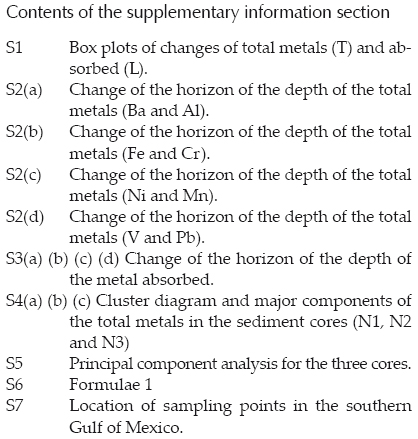
<body><![CDATA[<p align="justify"><font face="verdana" size="2"><sup>4</sup> <i>Departamento de Procesos y Tecnolog&iacute;a Divisi&oacute;n de Ciencias Naturales e Ingenier&iacute;a, Universidad Aut&oacute;noma Metropolitana Unidad Cuajimalpa.</i> E&#45;mail: <a href="mailto:jcervini@correo.cua.unam.mx">jcervini@correo.cua.unam.mx</a></font></p>  	    <p align="justify"><font face="verdana" size="2">&nbsp;</font></p>  	    <p align="justify"><font face="verdana" size="2">Information on the article: received: April 2012.    <br> 	Reevaluated: August 2012.    <br> 	Accepted: December 2012</font></p>  	    <p align="justify"><font face="verdana" size="2">&nbsp;</font></p>  	    <p align="justify"><font face="verdana" size="2"><b>Abstract</b></font></p>  	    <p align="justify"><font face="verdana" size="2">The amounts of total and sorbed Al, Ba, Cr, Fe, Mn, Ni, and V present in three sediment cores from the South of the Gulf of Mexico (N1, N2, and N3) were determined. Of the three samples studied herein (N1. N2, and N3), one of them (N2) is associated to a natural <i>"chapopotera".</i> ICP/MS analyses show that total concentrations of Al, Fe, Mn, Ba, Cr, Ni, Pb, and V for N1 and N3 were found to be <i>ca.</i> 4.2, 2.3, 206.5, 165, 91, 72, 14 and 97 mg kg<sup>1</sup>, and <i>ca.</i> 5.2 (Al<sub>2</sub>O<sub>3</sub>), 4, 401.50, 269, 89, 62, 18, and 118 mg kg<sup>&#45;1</sup> for N2. As evidenced by the correlation matrices, there is a positive association among metals distribution, except for the case of Mn, regardless of the sediment core. Nevertheless, Cluster and Principal Components Analyses denote variability in metal&#45;spatial distribution, signature variability in the composition of the water column. Magnitude values for the enrichment factor (EF) relative to background values found in the Southern Gulf of Mexico (bulk seawater) for Al, Fe, Mn, Ba, Cr, Ni, Pb, and V were estimated. The outcome of this work show distinctive EF values, ranging from moderate to high EF values, regardless of the core source.</font></p>  	    <p align="justify"><font face="verdana" size="2"><b>Keywords:</b> trace metals partitioning, enrichment factor, "<i>chapopotera</i>".</font></p>  	    <p align="justify"><font face="verdana" size="2">&nbsp;</font></p>  	    ]]></body>
<body><![CDATA[<p align="justify"><font face="verdana" size="2"><b>Resumen</b></font></p>  	    <p align="justify"><font face="verdana" size="2">Se determinaron las cantidades total y adsorbidas de Al, Ba, Cr, Fe, Mn, Ni, y V presentes en tres n&uacute;cleos de sedimentos del Sur del Golfo de M&eacute;xico (N1, N2 y N3). De las tres muestras estudiadas en el presente documento, una de ellas (N2) se asocia a las chapopoteras naturales. El an&aacute;lisis en ICP/MS demuestra que las concentraciones totales de Al, Fe, Mn, Ba, Cr, Pb y V para el N1 y N3 son 4.2, 2.3, 206.5, 165, 91, 72, 14 7y 97 mg kg<sup>&#45;1</sup>, y para N2 son 5.2 (Al<sub>2</sub>O<sub>3</sub>), 4, 401.50, 269, 89, 62, 18, and 118 mg kg<sup>&#45;1</sup>. Como se evidencia por las matrices de correlaci&oacute;n, existe una relaci&oacute;n positiva entre la distribuci&oacute;n de los metales excepto para el Mn, independientemente del n&uacute;cleo de sedimentos. Sin embargo, el Cluster y an&aacute;lisis de componentes principales denotan la variabilidad de la distribuci&oacute;n espacial del Mn, la cual se confirma en la columna de agua. Tambi&eacute;n se calcularon valores de magnitud para el factor de enriquecimiento (EF) de Al, Fe, Mn, Ba, Cr, Ni, Pb, y V, relativos a los valores del fondo que se encuentran en el sur del Golfo de M&eacute;xico (mar grueso). Finalmente, el resultado de este trabajo muestra valores y comportamiento distintivos del EF, que van de moderados a altos, independientes de su fuente principal.</font></p>  	    <p align="justify"><font face="verdana" size="2"><b>Descriptores:</b> partici&oacute;n de metales traza, factor de enriquecimiento, "<i>chapopoteras</i>".</font></p>  	    <p align="justify"><font face="verdana" size="2">&nbsp;</font></p>  	    <p align="justify"><font face="verdana" size="2"><b>Introduction</b></font></p>  	    <p align="justify"><font face="verdana" size="2">Metals are pivotal to biogeochemical processes, thereby the importance of understanding their partitioning mechanism(s) in marine sediments; particularly so in either mineral surfaces or biological matrices. In the former case, metal sorption in marine sediments will vary depending on pH, redox potential, and the composition of suspended solids (Kitano and Fujiyoshi, 1980; Hakansson <i>et al.,</i> 1989; Calmano <i>et al.,</i> 1993; Wiechula <i>et al.,</i> 2000). In the latter case, metals will interact with organic matter (humic acid), (HS<sup>&#45;</sup>, S<sup>&#61;</sup>), and react with other metals, prior to entering to the trophic chain (Ford and Ryan, 1995; Bosecker, 1997; Schippers and Sand, 1999; Gutjahr <i>et al.,</i> 2007; Sparrevik <i>et al.,</i> 2009; Scholz <i>et al.,</i> 2009). Three main rivers, namely, Grijalva, San Pedro, Gonz&aacute;lez, Tonal&aacute;, and Coatzacoalcos drain to the South of the Gulf of Mexico. These rivers carry high contents of suspended solids. Such high turbidity has been attributed in part to changes in the land use and deforestation (V&aacute;zquez <i>et al.,</i> 2006; Vela, 2005). In particular, recent reports provide evidence to show water inflows from coastal rivers and lagoons containing suspended solids concentrations as high as <i>ca.</i> 10439 ton d<sup>&#45;1</sup> (PEP&#45;UNAM, 2008; Scholz <i>et al.,</i> 2009), with chemical components found in the deep zone, &#8805; 3,000 m. The presence of high amounts of suspended material has been explained by the inflows of the Coatzacoalcos and Grijalba&#45;Usumacinta rivers in light that marine currents are responsible for distributing particulated coastal supplies into the deep zone (Vazquez and Alexander, 2008). Other anthropogenic&#45;borne sources of particulated material prevailing in this geographical region include the presence of the oil industry and imminent natural oil spills commonly referred as <i>"chapopoteras",</i> marine&#45;transit discharges, or atmospheric precipitation of Pb, Ni, Ba, V, SO<sub>x</sub> and NO<sub>x</sub> particles (Prospero, 1999; Prospero <i>et al.,</i> 2004). All these input sources ensure the continuous accumulation of metals at the sediment&#45;water pore interface. The purpose of this work was to study the spatial distribution of Al, Ba, Cr, Fe, Mn, Ni, Pb and V, in three distinct sediment environments in from the South of the Gulf of Mexico. The study was conducted to better understand metals partitioning as characterized by Cluster and Principal Component Analyses based on Enrichment Factor (EF) determinations.</font></p>  	    <p align="justify"><font face="verdana" size="2">&nbsp;</font></p>  	    <p align="justify"><font face="verdana" size="2"><b>Material and methods</b></font></p>  	    <p align="justify"><font face="verdana" size="2">Three sediment cores were collected on board of the B/O (Oceanographic Vessel) Justo Sierra which belongs to the Universidad Nacional Autonoma de Mexico (UNAM). The collection sites for the sediment cores were located at the forefront of the Coatzacoalcos and Grijalva&#45;Usumacinta. The site was affected by a natural oil spill (<a href="/img/revistas/iit/v14n4/a5f1.jpg" target="_blank">Figure 1</a>).</font></p>  	    <p align="justify"><font face="verdana" size="2">The cores (N1, N2, and N3) were collected in 0.01 m<sup>3</sup> boxes. Each core was 12 cm in diameter. The cores thickness varied from 12 to 31 cm. The cores were collected using hydraulic PVC tubes. The tubes were washed with an acid solution and water Type III (millipore, Milli&#45;Q) prior to use. The sediment cores were stored in plastic bags right after collection. Plastic bags were opened right before use to prevent oxygen diffusion and a subsequent plausible metal&#45;oxidation. In all samples, the supernatant water from the core top was removed. The cores were then sealed and cap&#45;closed using Teflon cylinder(s). All cores collected were kept at 4&deg;C prior to analyses (<a href="/img/revistas/iit/v14n4/a5f1.jpg" target="_blank">Figure 1</a>).</font></p>  	    ]]></body>
<body><![CDATA[<p align="justify"><font face="verdana" size="2">The sediment samples were obtained by sectioning the cores at 0.5&#45;cm regular intervals for N1 and N2, and 1.0&#45;cm regular intervals for N3. Twenty six samples for N1, 64 for N2, and 30 for N3 were obtained. The depths selected for this study were 2100 (N2), 250 (N1), and 15 m (N3). Sections of dry sediment were homogenized with an agate mortar and stored in high&#45;density plastic jars. For determining total&#45;metals contents, dry&#45;sediment samples were digested in a 1:1 HCl: HNO<sub>3</sub> mixture inside a CEM MARS 5 microwave, according to a method reported by Tessier <i>et al.</i> (1979); De Lorenz (2004); V&aacute;zquez <i>et al.</i> (2004), and (2006); PEP&#45;UNAM, </font><font face="verdana" size="2">(2008). Metal quantification was conducted using an ICP/MS and Atomic Absorbance equipped with an impact cell and an automatic sampler. All experiments were analyzed randomly and by duplicates. The analytical recoveries relative to standard solutions (High&#45;purity standards; Lot number 830702, Cat. Number CRM&#45;MS&#45;S) for total&#45;metal determinations were 91.5% for Al; 94.5% for Ba; 98.4% for Cr; 99.5% for Fe; 95.4% for Mn; 95% for Ni; and 97.5% for V. For sorbed metals determinations, the analytical recoveries corresponded to <i>ca.</i> 96% for Al; 93% for Ba; 87% for Cr; 98% for Fe; 85% for Mn; 91% for Ni; and 95 % for V.</font></p>     <p align="justify"><font face="verdana" size="2">&nbsp;</font></p>  	    <p align="justify"><font face="verdana" size="2"><b>Results and discussion</b></font></p>  	    <p align="justify"><font face="verdana" size="2">Our results show atypical values for all metals studied. The magnitude values for the concentrations of total metals revealed a broad distribution for Fe<sub>T</sub> (total Fe), Mn<sub>T</sub> , Ba<sub>T</sub> , and Al<sub>T</sub>. Mean values obtained indicate a higher data dispersion for the 50 and 75% quartiles, along with a concomitant negative data slanting. A comparison of the degree of data dispersion for the contents of sorbed and total metals for N1 shows a greater magnitude value for the contents of sorbed metals. A comparison between data trends obtained for N1 and N2 shows a difference in the distribution of total metals perhaps because of its proximity with natural <i>"chapopoteras"</i> (Scholz <i>et al.,</i> 2009). The concentrations of Mn<sub>T,</sub> are higher in magnitude for N2. Also, the distribution of sorbed metals was also found to vary from N1 to N2. The distribution of the data for sorbed metals in N2 was found to present a greater dispersion. This is particularly the case for either sorbed Ni (Ni<sub>a</sub>) or V (V<sub>a</sub>), arguably due to the presence of <i>"chapopoteras".</i> Also, sorbed Fe (Fe<sub>a</sub>), Mn (Mn<sub>a</sub>), and Ba (Ba<sub>a</sub>) were found to present lower magnitude values in N1 compared to N2 (S1, Supplementary Information Section).</font></p>  	    <p align="justify"><font face="verdana" size="2">Overall data trends showed higher dispersion values for N1. Finally, the amounts of Fe, either in dissolved (Fe<sub>s</sub>) or sorbed (Fe<sub>a</sub>) form, were found to surpass in magnitude those registered for any other metal. This was found to be the case in either N1 and N2. Total Ba (Ba<sub>T</sub>), Cr (Cr<sub>T</sub>), Pb (Pb<sub>T</sub>), and Mn (Mn<sub>T</sub>) magnitude values were found to be similar in N2 and N3. By contrast, total Fe (Fe<sub>T</sub>), Ni (Ni<sub>T</sub>), and V (V<sub>T</sub>) magnitude values in N3 were found to be higher relative to those found for N1 or N2. Total Fe (Fe<sub>T</sub>), Mn (Mn<sub>T</sub>), Ba (Ba<sub>T</sub>), and V(V<sub>T</sub>) mean &#177; S.E. values indicated a greater data dispersion between the 50 and 75% quartiles, along with a concomitant negative slanting of the data (S2 and S3, Supplementary Information Section).</font></p>  	    <p align="justify"><font face="verdana" size="2">The partitioning behavior of metals in the environment depends on the enlargement on their intrinsic reactivity, as well as biogeochemical conditions. In particular for Al, a conservative element, the environmental fate is constrained by diffusion and precipitation&#45;dissolution reactions processes (Caschetto and Wollast, 1979; Carroll <i>et al.,</i> 2002). For these reasons, various researchers have suggested the usage of Al as an indicator of anthropogenic activity (Rubio <i>et al.,</i> 2000; Rubio <i>et al.,</i> 1998; Covelli and Fontolan, 1997; Balls <i>et al.,</i> 1997; Marcet <i>et al.,</i> 1997; Ryan and Windom, 1988). Pertinent herein is the fact that Al is found in abundance in native clay minerals from the South of the Gulf of Mexico (Scholz <i>et al.,</i> 2009; PEP&#45;UNAM, 2008; V&aacute;zquez <i>et al.,</i> 2000). The variability observed for the Cr distribution among sediment cores can be attributed in part to the presence of either organic matter (Salomons and F&oacute;rstner, 1984), iron and manganese oxides (Williams <i>et al.,</i> 1974; V&aacute;zquez <i>et al.,</i> 2000, 2004 and 2006), or iron&#45;calcareous residues (Jickells and Knap, 1984). In deep zones, Cr becomes immobilized when reacting with aqueous Fe (II) (Lan <i>et al.,</i> 2006). Iron reacts to form insoluble sulfides (Hurt&#45;gen <i>et al.,</i> 1990; Carol <i>et al.,</i> 2002). Data showing high concentrations of soluble iron, however, is explained by the sorption&#45;desorption processes coupled with metal complexation by bioorganic compounds. The variability observed for the amounts of soluble Mn is explained in part by the formation of manganese oxides or manganese organic&#45;matter complexes. Given that the sampling sites are biologically active (Anschutz <i>et al.,</i> 2005), we do not discard the notion that Mn (III) becomes the predominant species. The variability observed among the contents of Ni can be explained by the interaction(s) with sulphide species or organic matter (Ni&#45;OM); bioturbation; desorption; migration of Ni from the deep zone to the surface; bio&#45;transformations; or the ionization of NiCO<sub>3</sub> species at the core deep zone (Williamson and Wilcock, 1994). Variations in Pb accumulation observed in the core deep zones can be explained in part by the formation of insoluble Pb sulfides, Pb&#45;organic matter complexes (Huerta and Morse, 1992; V&aacute;zquez <i>et al.,</i> 2004), or PbCO<sub>3</sub>. Nevertheless, the high amounts of source Pb observed throughout the core are an indication of undersaturation with respect to pyrite or other insoluble sulfides (Huerta and Morse, 1992). The variability in the amounts of soluble V registered can be explained by the complexation with organic compounds originated the nearby <i>"chapopoteras"</i> (Scholz <i>et al.,</i> 2009). Vanadium is found in the environment primarily as V(V). Vanadium (V) interacts with a variety of organic compounds including humic and fulvic acids, and minerals, most importantly with iron oxides (Van and Jawoski, 1980).</font></p>  	    <p align="justify"><font face="verdana" size="2">&nbsp;</font></p>  	    <p align="justify"><font face="verdana" size="2">Metal Distribution and Principal Component Analyses</font></p>  	    <p align="justify"><font face="verdana" size="2">Core N1. The normalization of total metals data trends for Cr (Cr<sub>T</sub>), Ni (Ni<sub>T</sub>) and V (V<sub>T</sub>) in N1 did not show significant changes because anthropogenic activities provided the lack of variation with depth (<a href="/img/revistas/iit/v14n4/a5f2.jpg" target="_blank">Figure 2</a>). On the other hand, normalized Ba<sub>T</sub> values present changes throughout the core perhaps due to the supplies of barite (BaCO<sub>3</sub>; PEP&#45;UNAM, 2008). Normalized Fe<sub>T</sub> and Mn<sub>T</sub> values show changes along the core. Variations in the concentration of these redox&#45;active metals (Stumm and Morgan, 1996) is related to diagenetic processes, which are strongly dependent on the concentration of dissolved O<sub>2</sub>, pH, and E<sub>H</sub> values (Finney and Huh, 1989). At the same time, the high Fe<sub>T</sub> and Mn<sub>T</sub> values reported (<a href="/img/revistas/iit/v14n4/a5f2.jpg" target="_blank">Figure 2</a>) in the core&#45;upper layer(s) is consistent with inputs from the Coatzacoalcos River.</font></p>  	    <p align="justify"><font face="verdana" size="2">Normalized Fe<sub>T</sub> and Mn<sub>T</sub> values show changes along the core. Variations in the concentration of these redox&#45;active metals (Stumm and Morgan, 1996) are related to diagenetic processes, which are strongly dependent on the concentration of dissolved O<sub>2</sub>, pH, and E<sub>H</sub> values (Finney and Huh, 1989). At the same time, the high Fe<sub>T</sub> and Mn<sub>T</sub> values reported (<a href="/img/revistas/iit/v14n4/a5f2.jpg" target="_blank">Figure 2</a>) in the core&#45;upper layer(s) are consistent with inputs from the Coatzacoalcos River.</font></p>  	    ]]></body>
<body><![CDATA[<p align="justify"><font face="verdana" size="2">A significant statistical correlation (p &lt; 0.05, <i>n</i> = 26) (<a href="/img/revistas/iit/v14n4/a5t1.jpg" target="_blank">Table 1</a>) between normalized total metals at 0&#45;13 cm depth becomes evident. These results further confirm the idea of the existence of a significant supply of suspended solids from the Coatzacoalcos River and/or atmospheric particles (PEP&#45;UNAM, 2008; V&aacute;zquez <i>et al.,</i> 2000). Cluster and Principal Components Analyses for total metals (S4, Supplementary Information Section) further suggest the prevalence of similar geochemical processes occurring at different core depths. Likely, a non&#45;homogeneous distribution of organic matter of showed about microenvironments with varying "redox" potential values.</font></p>  	    <p align="justify"><font face="verdana" size="2">Our results for absorbed metals provide an indication that the accumulation of Cr (Cr<sub>a</sub>) and Ni (Ni<sub>a</sub>) is best explained by anthropogenic activities (<a href="/img/revistas/iit/v14n4/a5f3.jpg" target="_blank">Figure 3</a>). With respect to Ba<sub>a</sub>, Fe<sub>a</sub>, Mn<sub>a</sub>, Pb<sub>a</sub> and V<sub>a</sub>, visible changes are present along the core. Correlations with statistical significance (p &lt; 0.05, <i>n</i> = 64) (<a href="/img/revistas/iit/v14n4/a5t1.jpg" target="_blank">Table 1</a>), except for Ba (Ba<sub>a</sub>) become evident, in consistency with the anthropogenic activities from the petroleum industry.</font></p>  	    <p align="justify"><font face="verdana" size="2">Core N2. Cluster and principal components analyses of normalized data for total metals in N2 are explained because prevailing similarities between geochemical processes with depth. Data conglomerates become evident (S4, Supplementary Information Section). Normalization on the accumulation of total metals show similar changes for all metals with depth (<a href="/img/revistas/iit/v14n4/a5f3.jpg" target="_blank">Figure 3</a>) A high correlation of normalized&#45;total metals, except for Ba<sub>T</sub> and Mn<sub>T</sub> (p &lt; 0.05, N = 64) (<a href="/img/revistas/iit/v14n4/a5t1.jpg" target="_blank">Table 1</a>) (PEP&#45;UNAM, 2008) was observed.</font></p>  	    <p align="justify"><font face="verdana" size="2">Normalization of data trends for sorbed metals show significant changes along the core. Data variability becomes more notorious compared to N1. This is particularly true for the cases of Ba<sub>a</sub> and Fe<sub>a</sub>, The close proximity of natural <i>"chapopoteras"</i> and high concentrations of oil derivatives is thought to influence the compartmentalization of metals.</font></p>  	    <p align="justify"><font face="verdana" size="2">Magnitude values for Fe<sub>a</sub> serves as an indication of metal mobility with depth. By contrast, obtained values for Cr<sub>a</sub> and Ni<sub>a</sub> suggest variations to a lesser degree and, thereby, a lower mobility. Particularly so, for the case of Ni<sub>a</sub>. Hence, natural <i>"chapopoteras"</i> have an effect on the environmental mobility and compartmentalization of Cr<sub>a</sub> and Ni<sub>a</sub>. Variations in V<sub>a</sub> magnitude values determined along the core is in agreement with vanadium input originated from natural <i>"chapopoteras",</i> arguably in the form of either vanadium&#45;porphyrin or vanadium&#45;non&#45;porphyrines complexes (Fish and Komelenic, 1984). The behavior of Pb<sub>a</sub> denotes little changes along the core, with accumulation in the deep zones only (Balsam <i>et al.,</i> 2007).</font></p>  	    <p align="justify"><font face="verdana" size="2">Our results show a lack of correlation between normalized absorbed metals data trends <i>(p</i> &lt; 0.05; <i>n</i> = 64). However, data trends for V<sub>a</sub> show a significant correlation with data trends for Cr<sub>a</sub> and Fe<sub>a</sub>, in consistency with the idea of supplies in the deep zone originated from the Grijalva River (<a href="/img/revistas/iit/v14n4/a5t1.jpg" target="_blank">Table 1</a>; PEP&#45;UNAM, 2008; V&aacute;zquez <i>et al.,</i> 2000).</font></p>  	    <p align="justify"><font face="verdana" size="2">Core N3. Normalization of data trends for total metals show variations for the Fe/Al and Mn/Al ratios, in consistency with normalized data trends for N1. These findings can be explained in part because both zones receive water supply from the Grijalva River (<a href="/img/revistas/iit/v14n4/a5f1.jpg" target="_blank">Figure 1</a>). Perhaps the decreases in magnitude values observed can be attributed to reactions between Fe and Mn with HS<sup>&#45;</sup>, S<sup>&#61;</sup>, and/or other metals (Stumm and Morgan, 1996).</font></p>  	    <p align="justify"><font face="verdana" size="2">The Ba/Al ratio shows variations probably because the formation of Ba&#45;carbonates (e.g., BaCO<sub>3</sub>) or sulfates (BaSO<sub>4</sub>; Hurtgen <i>et al.,</i> 1999). The Cr/Al ratio presents similar variations, with no indication of the presence of Cr in the beaches of Tabasco (V&aacute;zquez <i>et al.,</i> 2006; Fuschsman <i>et al.,</i> 2007). The Ni/Al and V/Al ratios present similar variations along the core and in agreement with those observed for N1. The Pb/Al ratio in the top (5 to 6 cm) show high values that may be a result of an unusual Pb supply originated from either the Grijalva River, the atmospheric supplies, or the oil&#45;industry related activities (Varela, 2007). Furthermore, a correlation analyses of normalized data for total metals, namely Fe/Al with Mn/Al, Ni/Al with V/Al, and Ni/Al with V/Al were found to be statistically significant (p &lt; 0.05; <i>n</i> = 24; <a href="/img/revistas/iit/v14n4/a5t1.jpg" target="_blank">Table 1</a>). These results further confirm an influence of sediments originated from oil wells. Additional cluster and principal components analyses for normalized data of total metals reveal four conglomerates formed by the Fe/Al, Mn/Al, Ni/Al and V/Al ratios, while those presenting no statistical significance were found to be the Pb/Al and Ba/Al ratios (Balsam <i>et al.,</i> 2007), (S4, Supplementary Information Section).</font></p>  	    <p align="justify"><font face="verdana" size="2">Cores N1, N2, and N3. Principal components analyses of total metals data sets for the three cores show three different groupings (S5, Supplementary Information Section). The core N3 shows a metal grouping, with the exception of Pb/Al and Ba/Al. A second group of conglomerates in N2 is observed, with the exception of Ba/ Al. A third metal conglomerate becomes evident for N1, with the exception of Mn/Al. The later results are explained in part by a higher input of Mn to N1 relative to N2 or N3 originated from heterogeneous&#45;industrial activities at the Coatzacoalcos River vicinity (V&aacute;zquez <i>et al.,</i> 2000; PEP&#45;UNAM, 2008; Geissen <i>et al.,</i> 2009).</font></p>  	    <p align="justify"><font face="verdana" size="2">Finally, normalized data trends obtained for N1 were found to be similar to those reported for the time series of stations near the influence of the Coatzacoalcos River (PEP&#45;UNAM, 2008). Likewise, normalized data trends obtained for N2 were found to be similar to those reported for the time series for stations near the <i>"chapopoteras"</i> (PEP&#45;UNAM, 2008). Normalized data trends obtained for N3 were found to be similar to those reported for the time series of stations near the Grijalva River (V&aacute;zquez and Virender, 2004; V&aacute;zquez <i>et</i> <i>al.,</i> 2006).</font></p>  	    ]]></body>
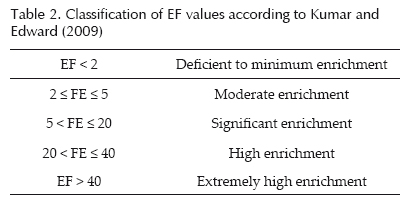
<body><![CDATA[<p align="justify"><font face="verdana" size="2">&nbsp;</font></p>  	    <p align="justify"><font face="verdana" size="2">Metal enrichment factors in marine sediments</font></p>  	    <p align="justify"><font face="verdana" size="2">Diverse methods have been proposed for evaluating the degree and enrichment of metals in marine sediments (Salomons and F&oacute;rstner, 1984; Abrahim and Parker, 2008). The simplest method for estimating the level of pollution factor involves the normalization of concentration values to grain size (Rubio <i>et al.,</i> 2000). The Enrichment Factor (EF) is calculated on the basis of the AIT (where AlT is total aluminum and AlL is lixiviate aluminum) values according to supplementary information (S6 Supplementary Information Section).</font></p>  	    <p align="justify"><font face="verdana" size="2">Calculated EF values are classified according to Table 2 (Kumar and Edward, 2009).</font></p>  	    <p align="justify"><font face="verdana" size="2">Our results for N1 (<a href="/img/revistas/iit/v14n4/a5f4.jpg" target="_blank">Figure 4</a>) show that Cr and Ni present a minimum enrichment, Fe and V a moderate enrichment, and Ba, Mn and Pb a significant enrichment. The significant enrichment of Ba, Mn and Pb can be explained by industrial supplies and natural drainage received from the Coatzacoalcos River. Except for the case of Ba, data trends for all metals show decreases in EF values with core depth (<a href="/img/revistas/iit/v14n4/a5f4.jpg" target="_blank">Figure 4</a>).</font></p>  	    <p align="justify"><font face="verdana" size="2">Results for N2 at <i>ca.</i> 0.5 to 7.5, 18.0&#45;27.0, and 30.032.0 cm depth indicate high EF values, except for the case of Mn (<a href="/img/revistas/iit/v14n4/a5f4.jpg" target="_blank">Figure 4</a>). These results can be explained by the manganese oxides in organic matter mineralization or secondary environmental reactions (Luther <i>et al.,</i> 1997; Hulth <i>et al,</i> 1999; Anschutz and Blanc, 1995; Anschutz <i>et al.,</i> 2005).</font></p>  	    <p align="justify"><font face="verdana" size="2">Results for N3 show EF values corresponding to significant&#45;to&#45;high enrichment (<a href="#t2">Table 2</a>; <a href="/img/revistas/iit/v14n4/a5f4.jpg" target="_blank">Figure 4</a>). These results are all based on the proximity of the coast to the sampling site; therefore, EF values provide an indication of the influence from the Grijalva River on metal accumulation in sediments. Barium, Fe, Pb, Ni, and V showed EF values that correspond to the category of significant enrichment, and manganese to the category of high enrichment.</font></p>  	    <p align="center"><font face="verdana" size="2"><a name="t2"></a></font></p>  	    <p align="center"><font face="verdana" size="2"><img src="/img/revistas/iit/v14n4/a5t2.jpg"></font></p>  	    <p align="justify"><font face="verdana" size="2">These results may not be attributed to anthropogenic activities, but to the diagenetic processes instead. In contrast, chromium showed and EF value that correspond to the category of high enrichment. We explain these latter values due to the presence of chromite in</font></p>  	    ]]></body>
<body><![CDATA[<p align="justify"><font face="verdana" size="2">the coasts of Tabasco (PEP&#45;UNAM, 2008). The EF values determined in N3 for Cr were found to be high relative to those determined in N1 or N2 (<a href="/img/revistas/iit/v14n4/a5f4.jpg" target="_blank">Figure 4</a>).</font></p>  	    <p align="justify"><font face="verdana" size="2">&nbsp;</font></p>  	    <p align="justify"><font face="verdana" size="2"><b>Conclusions</b></font></p>  	    <p align="justify"><font face="verdana" size="2">The metals were normalized with respect to Al, which maintains a natural change in the south of the Gulf of Mexico. The analysis of conglomerate and principal components allowed us to compare metal the three sediment cores obtained from in close proximity to the Coatzacoalcos River, a natural <i>"chapopoteras"</i> and the Grijalva River. Analyses of EF values showed that metals present with the same core can present diverse enrichment behavior. Value for EF of Mn in N2 is consistent with a significant enrichment not attribute to anthropogenic activities (PEP&#45;UNAM, 2008). Values EF for Mn accounts only import to Mn distribution. Either is necessary to distribute between Mn in geochemical processes and those introduced by the anthropogenic activity. In N3, EF values for Cr<sub>T</sub> were found to be high perhaps due to the precipitation&#45;dissolution processes of chromite in the coast of Tabasco.</font></p>  	    <p align="justify"><font face="verdana" size="2">&nbsp;</font></p>  	    <p align="justify"><font face="verdana" size="2"><img src="/img/revistas/iit/v14n4/a5img1.jpg"></font></p>  	    <p align="justify"><font face="verdana" size="2">&nbsp;</font></p>  	    <p align="justify"><font face="verdana" size="2"><b>References</b></font></p>  	    <!-- ref --><p align="justify"><font face="verdana" size="2">Abrahim G.M. and Parker R.J. Assessment of Heavy Metal Enrichment Factors and the Degree of Contamination in Marine Sediments from Tamaki Estuary, Auckland, New Zealand. Environ. Monit. Assess, volume 136 (issues 1&#45;3), 2008: 227&#45;38.    &nbsp;&nbsp;&nbsp;&nbsp;&nbsp;&nbsp;&nbsp;&nbsp;[&#160;<a href="javascript:void(0);" onclick="javascript: window.open('/scielo.php?script=sci_nlinks&ref=4280795&pid=S1405-7743201300040000500001&lng=','','width=640,height=500,resizable=yes,scrollbars=1,menubar=yes,');">Links</a>&#160;]<!-- end-ref --></font></p>  	    ]]></body>
<body><![CDATA[<!-- ref --><p align="justify"><font face="verdana" size="2">Anschutz T.P., Dedieu K., Desmazes F., Chaillou G. Speciation, Oxidation State and Reactivity of Particulate Manganese in Marine Sediments. <i>Chem. Geol.,</i> volume 218, 2005: 265&#45;279.    &nbsp;&nbsp;&nbsp;&nbsp;&nbsp;&nbsp;&nbsp;&nbsp;[&#160;<a href="javascript:void(0);" onclick="javascript: window.open('/scielo.php?script=sci_nlinks&ref=4280797&pid=S1405-7743201300040000500002&lng=','','width=640,height=500,resizable=yes,scrollbars=1,menubar=yes,');">Links</a>&#160;]<!-- end-ref --></font></p>  	    <!-- ref --><p align="justify"><font face="verdana" size="2">Anschutz P. and Blanc G. Chemical Mass Balances in Metalliferous Deposits from the Atlantis II Deep (Red Sea). <i>Geochim. Cosmochim, Acta.,</i> volume 59, 1995: 4205&#45;4218.    &nbsp;&nbsp;&nbsp;&nbsp;&nbsp;&nbsp;&nbsp;&nbsp;[&#160;<a href="javascript:void(0);" onclick="javascript: window.open('/scielo.php?script=sci_nlinks&ref=4280799&pid=S1405-7743201300040000500003&lng=','','width=640,height=500,resizable=yes,scrollbars=1,menubar=yes,');">Links</a>&#160;]<!-- end-ref --></font></p>  	    <!-- ref --><p align="justify"><font face="verdana" size="2">Balsam W., Damuth J.E., Deaton B. Marine Sediment Components: Identification and Dispersal Assessed by Diffuse Reflectance Spectrophotometry. <i>International Journal of Environment and Health,</i> volume 1 (issue 3), 2007: 403&#45;426.    &nbsp;&nbsp;&nbsp;&nbsp;&nbsp;&nbsp;&nbsp;&nbsp;[&#160;<a href="javascript:void(0);" onclick="javascript: window.open('/scielo.php?script=sci_nlinks&ref=4280801&pid=S1405-7743201300040000500004&lng=','','width=640,height=500,resizable=yes,scrollbars=1,menubar=yes,');">Links</a>&#160;]<!-- end-ref --></font></p>  	    <!-- ref --><p align="justify"><font face="verdana" size="2">Balls P.W., Hull S., Miller B.S., Pirie J.M., Proctor W. Trace Metal in Scottish Estuarine and Coastal Sediments. <i>Mar. Pollut. Bull.,</i> volume 34, 1997: 42&#45;50.    &nbsp;&nbsp;&nbsp;&nbsp;&nbsp;&nbsp;&nbsp;&nbsp;[&#160;<a href="javascript:void(0);" onclick="javascript: window.open('/scielo.php?script=sci_nlinks&ref=4280803&pid=S1405-7743201300040000500005&lng=','','width=640,height=500,resizable=yes,scrollbars=1,menubar=yes,');">Links</a>&#160;]<!-- end-ref --></font></p>  	    <!-- ref --><p align="justify"><font face="verdana" size="2">Bosecker K. Bioleaching: Metal Solubilization by Microorganisms. <i>FEMS Microbiol. Rev.,</i> volume 20, 1997: 591&#45;604.    &nbsp;&nbsp;&nbsp;&nbsp;&nbsp;&nbsp;&nbsp;&nbsp;[&#160;<a href="javascript:void(0);" onclick="javascript: window.open('/scielo.php?script=sci_nlinks&ref=4280805&pid=S1405-7743201300040000500006&lng=','','width=640,height=500,resizable=yes,scrollbars=1,menubar=yes,');">Links</a>&#160;]<!-- end-ref --></font></p>  	    ]]></body>
<body><![CDATA[<!-- ref --><p align="justify"><font face="verdana" size="2">Calmano W., F&oacute;rstner U. Hong J. Mobilization and Scavenging of Heavy Metals Following Resuspension of Anoxic Sediments from the Elbe River, on: Environmental Geochemistry of Sulfide Oxidation, Charles N. Alpers, David W. Blowes <i>(eds.). ACS Symposium Series,</i> volume 550, Chapter 21, 1993, pp 298&#45;321.    &nbsp;&nbsp;&nbsp;&nbsp;&nbsp;&nbsp;&nbsp;&nbsp;[&#160;<a href="javascript:void(0);" onclick="javascript: window.open('/scielo.php?script=sci_nlinks&ref=4280807&pid=S1405-7743201300040000500007&lng=','','width=640,height=500,resizable=yes,scrollbars=1,menubar=yes,');">Links</a>&#160;]<!-- end-ref --></font></p>  	    <!-- ref --><p align="justify"><font face="verdana" size="2">Carroll S., Peggy A., O'Day&#45;Essera B., Randall S. Speciation and Fate of Trace Metals in Estuarine Sediments Under Reduced and Oxidized Conditions, Seaplane Lagoon, Alameda Naval Air Station (USA). <i>Geochem. Trans.,</i> volume 3 (issue 10), 2002: 81&#45;101.    &nbsp;&nbsp;&nbsp;&nbsp;&nbsp;&nbsp;&nbsp;&nbsp;[&#160;<a href="javascript:void(0);" onclick="javascript: window.open('/scielo.php?script=sci_nlinks&ref=4280809&pid=S1405-7743201300040000500008&lng=','','width=640,height=500,resizable=yes,scrollbars=1,menubar=yes,');">Links</a>&#160;]<!-- end-ref --></font></p>  	    <!-- ref --><p align="justify"><font face="verdana" size="2">Caschetto S. and Wollast R. Dissolved Aluminium in Interstitial Waters of Recent Marine Sediments. Geochim. <i>Cosmochim.</i> <i>Acta.,</i> volume 43 (issue 3), 1979: 425&#45;428.    &nbsp;&nbsp;&nbsp;&nbsp;&nbsp;&nbsp;&nbsp;&nbsp;[&#160;<a href="javascript:void(0);" onclick="javascript: window.open('/scielo.php?script=sci_nlinks&ref=4280811&pid=S1405-7743201300040000500009&lng=','','width=640,height=500,resizable=yes,scrollbars=1,menubar=yes,');">Links</a>&#160;]<!-- end-ref --></font></p>  	    <!-- ref --><p align="justify"><font face="verdana" size="2">Covelli S., Fontolan G. Application of a Normalization Procedure in Determining Regional Geochemical Baselines. <i>Environ. Geol,</i> volume 30, 1997: 34&#45;45.    &nbsp;&nbsp;&nbsp;&nbsp;&nbsp;&nbsp;&nbsp;&nbsp;[&#160;<a href="javascript:void(0);" onclick="javascript: window.open('/scielo.php?script=sci_nlinks&ref=4280813&pid=S1405-7743201300040000500010&lng=','','width=640,height=500,resizable=yes,scrollbars=1,menubar=yes,');">Links</a>&#160;]<!-- end-ref --></font></p>  	    <!-- ref --><p align="justify"><font face="verdana" size="2">De Lorenz S.F.J. <i>Din&aacute;mica de las part&iacute;culas suspendidas en la zona Oriente de la Laguna de T&eacute;rminos, Camp.,</i> tesis (maestr&iacute;a en ingenier&iacute;a ambiental), Facultad de Ingenier&iacute;a, UNAM, 2004.    &nbsp;&nbsp;&nbsp;&nbsp;&nbsp;&nbsp;&nbsp;&nbsp;[&#160;<a href="javascript:void(0);" onclick="javascript: window.open('/scielo.php?script=sci_nlinks&ref=4280815&pid=S1405-7743201300040000500011&lng=','','width=640,height=500,resizable=yes,scrollbars=1,menubar=yes,');">Links</a>&#160;]<!-- end-ref --></font></p>  	    ]]></body>
<body><![CDATA[<!-- ref --><p align="justify"><font face="verdana" size="2">Finney B.P. and Huh C.A. History of Metal Pollution in the Southern California Bight: an Update. <i>Environ. Sci. Technol.,</i> volume 23, 1989: 294&#45;303.    &nbsp;&nbsp;&nbsp;&nbsp;&nbsp;&nbsp;&nbsp;&nbsp;[&#160;<a href="javascript:void(0);" onclick="javascript: window.open('/scielo.php?script=sci_nlinks&ref=4280817&pid=S1405-7743201300040000500012&lng=','','width=640,height=500,resizable=yes,scrollbars=1,menubar=yes,');">Links</a>&#160;]<!-- end-ref --></font></p>  	    <!-- ref --><p align="justify"><font face="verdana" size="2">Fish R.H. and Komlenic J.J. Molecular Characterization and Profile Identifications of Vanadyl Compounds in Heavy Petroleums by Liquid Chromatography / Graphite Furmace Atomic Absorption Spectrometry. <i>Anal. Chem.,</i> volume 56, 1984: 510&#45;517.    &nbsp;&nbsp;&nbsp;&nbsp;&nbsp;&nbsp;&nbsp;&nbsp;[&#160;<a href="javascript:void(0);" onclick="javascript: window.open('/scielo.php?script=sci_nlinks&ref=4280819&pid=S1405-7743201300040000500013&lng=','','width=640,height=500,resizable=yes,scrollbars=1,menubar=yes,');">Links</a>&#160;]<!-- end-ref --></font></p>  	    <!-- ref --><p align="justify"><font face="verdana" size="2">Ford T. and Ryan D. Toxic Metals in Aquatic Ecosystems: A Microbiological Perspective. Environ. <i>Health Perspect.,</i> volume 103, 1995: 25&#45;28.    &nbsp;&nbsp;&nbsp;&nbsp;&nbsp;&nbsp;&nbsp;&nbsp;[&#160;<a href="javascript:void(0);" onclick="javascript: window.open('/scielo.php?script=sci_nlinks&ref=4280821&pid=S1405-7743201300040000500014&lng=','','width=640,height=500,resizable=yes,scrollbars=1,menubar=yes,');">Links</a>&#160;]<!-- end-ref --></font></p>  	    <!-- ref --><p align="justify"><font face="verdana" size="2">Fuchsman M.L., Sorensen P., Magar M.V. and Wenning R.J. Chromium Geochemistry and Bioaccumulation in Sediments from the Lower Hackensack River, New Jersey. <i>Arch. Environ. Contam. Toxicol.,</i> volume 53 (issue 3), 2007: 337&#45;350.    &nbsp;&nbsp;&nbsp;&nbsp;&nbsp;&nbsp;&nbsp;&nbsp;[&#160;<a href="javascript:void(0);" onclick="javascript: window.open('/scielo.php?script=sci_nlinks&ref=4280823&pid=S1405-7743201300040000500015&lng=','','width=640,height=500,resizable=yes,scrollbars=1,menubar=yes,');">Links</a>&#160;]<!-- end-ref --></font></p>  	    <!-- ref --><p align="justify"><font face="verdana" size="2">Geissen V., S&aacute;nchez&#45;Hern&aacute;ndez R., Kampichler C., Ramos&#45;Reyes R., Sepulveda&#45;Lozada A., Ochoa&#45;Goana S., de Jong B.H.J., Huerta&#45;Lwanga E., Hern&aacute;ndez&#45;Daumas S. Effects of Land&#45;Use Change on Some Properties of Tropical Soils&#45;An Example from Southeast Mexico. <i>Geoderma,</i> volume 151, 2009: 87&#45;97.    &nbsp;&nbsp;&nbsp;&nbsp;&nbsp;&nbsp;&nbsp;&nbsp;[&#160;<a href="javascript:void(0);" onclick="javascript: window.open('/scielo.php?script=sci_nlinks&ref=4280825&pid=S1405-7743201300040000500016&lng=','','width=640,height=500,resizable=yes,scrollbars=1,menubar=yes,');">Links</a>&#160;]<!-- end-ref --></font></p>  	    ]]></body>
<body><![CDATA[<!-- ref --><p align="justify"><font face="verdana" size="2">Gutjahr M., Frank M., Stirling C.H., Klemm V., Van de Flierdt T., Halliday A.N. Reliable Extraction of a Deepwater Trace Metal Isotope Signal from Fe&#45;Mn Oxyhydroxide Coatings of Marine Sediments. <i>Chem. Geol.,</i> volume 242, 2007: 351&#45;370.    &nbsp;&nbsp;&nbsp;&nbsp;&nbsp;&nbsp;&nbsp;&nbsp;[&#160;<a href="javascript:void(0);" onclick="javascript: window.open('/scielo.php?script=sci_nlinks&ref=4280827&pid=S1405-7743201300040000500017&lng=','','width=640,height=500,resizable=yes,scrollbars=1,menubar=yes,');">Links</a>&#160;]<!-- end-ref --></font></p>  	    <!-- ref --><p align="justify"><font face="verdana" size="2">Hakansson K., Karlsson S., Allard B. Effects of pH on the Accumulation and Redistribution of Metals in a Polluted Stream Bed Sediment. <i>Sci. Total Environ.,</i> 1989: 87&#45;88 and 43&#45;57.    &nbsp;&nbsp;&nbsp;&nbsp;&nbsp;&nbsp;&nbsp;&nbsp;[&#160;<a href="javascript:void(0);" onclick="javascript: window.open('/scielo.php?script=sci_nlinks&ref=4280829&pid=S1405-7743201300040000500018&lng=','','width=640,height=500,resizable=yes,scrollbars=1,menubar=yes,');">Links</a>&#160;]<!-- end-ref --></font></p>  	    <!-- ref --><p align="justify"><font face="verdana" size="2">Huerta&#45;Diaz M.A. and Morse J.W.. Pyritization of Trace Metals in Anoxic Marine Sediments. <i>Geochim. Cosmochim. Acta.,</i> volume 56 (issue 7), 1992: 2681&#45;2702.    &nbsp;&nbsp;&nbsp;&nbsp;&nbsp;&nbsp;&nbsp;&nbsp;[&#160;<a href="javascript:void(0);" onclick="javascript: window.open('/scielo.php?script=sci_nlinks&ref=4280831&pid=S1405-7743201300040000500019&lng=','','width=640,height=500,resizable=yes,scrollbars=1,menubar=yes,');">Links</a>&#160;]<!-- end-ref --></font></p>  	    <!-- ref --><p align="justify"><font face="verdana" size="2">Hulth S., Aller R.C., Gilbert F. Coupled Anoxic Nitrification/Manganese Reduction in Marine Sediments. <i>Geochim. Cosmochim.</i> Acta., volume 63, 1999: 49&#45;66.    &nbsp;&nbsp;&nbsp;&nbsp;&nbsp;&nbsp;&nbsp;&nbsp;[&#160;<a href="javascript:void(0);" onclick="javascript: window.open('/scielo.php?script=sci_nlinks&ref=4280833&pid=S1405-7743201300040000500020&lng=','','width=640,height=500,resizable=yes,scrollbars=1,menubar=yes,');">Links</a>&#160;]<!-- end-ref --></font></p>  	    <!-- ref --><p align="justify"><font face="verdana" size="2">Hurtgen M.T., Lyons W.T., Ingall E.D., Calmano W., Ahlf W., Forstner U. Exchange of Heavy Metals Between Sediment Components and Water, on: Metal Speciation in the Environment, Broekaert J.A.C., Gucer S., Adams F. (Eds.), 1990, pp. 503&#45;522.    &nbsp;&nbsp;&nbsp;&nbsp;&nbsp;&nbsp;&nbsp;&nbsp;[&#160;<a href="javascript:void(0);" onclick="javascript: window.open('/scielo.php?script=sci_nlinks&ref=4280835&pid=S1405-7743201300040000500021&lng=','','width=640,height=500,resizable=yes,scrollbars=1,menubar=yes,');">Links</a>&#160;]<!-- end-ref --></font></p>  	    ]]></body>
<body><![CDATA[<!-- ref --><p align="justify"><font face="verdana" size="2">Hurtgen, T.W. Timothy W. Lyons W.T., Ingall D.E., Cruse A.M. Anomalous Enrichments of Iron Monosulfide in Euxinic Marine Sediments and the Role of H<sub>2</sub>S in Iron Sulfide Transformations: Examples from Efingham Inlet, Orca Basin, and the Black Sea. <i>Am. J. Sci.,</i> volume 299, 1999: 556&#45;588.    &nbsp;&nbsp;&nbsp;&nbsp;&nbsp;&nbsp;&nbsp;&nbsp;[&#160;<a href="javascript:void(0);" onclick="javascript: window.open('/scielo.php?script=sci_nlinks&ref=4280837&pid=S1405-7743201300040000500022&lng=','','width=640,height=500,resizable=yes,scrollbars=1,menubar=yes,');">Links</a>&#160;]<!-- end-ref --></font></p>  	    <!-- ref --><p align="justify"><font face="verdana" size="2">Jickells T.D. and Knap A.H. The Distribution and Geochemistry of Some Trace Metals in the Bermuda Coastal Environment. <i>Estuarine Coastal Shelf Sci.,</i> volume 18, 1984: 245&#45;262.    &nbsp;&nbsp;&nbsp;&nbsp;&nbsp;&nbsp;&nbsp;&nbsp;[&#160;<a href="javascript:void(0);" onclick="javascript: window.open('/scielo.php?script=sci_nlinks&ref=4280839&pid=S1405-7743201300040000500023&lng=','','width=640,height=500,resizable=yes,scrollbars=1,menubar=yes,');">Links</a>&#160;]<!-- end-ref --></font></p>  	    <!-- ref --><p align="justify"><font face="verdana" size="2">Kitano Y. and Fujiyoshi R. Partitioning of Cadmium, Copper, Manganese and Iron into Mineral and Organic Fractions in Core Sediments from the Osaka Bay, on: Kumar S.P. and Edward K.P., 2009.    &nbsp;&nbsp;&nbsp;&nbsp;&nbsp;&nbsp;&nbsp;&nbsp;[&#160;<a href="javascript:void(0);" onclick="javascript: window.open('/scielo.php?script=sci_nlinks&ref=4280841&pid=S1405-7743201300040000500024&lng=','','width=640,height=500,resizable=yes,scrollbars=1,menubar=yes,');">Links</a>&#160;]<!-- end-ref --><!-- ref --> <i>Indian J. of Mar. Sci.,</i> volume 38 (issue 2), 1980: 235&#45;248.    &nbsp;&nbsp;&nbsp;&nbsp;&nbsp;&nbsp;&nbsp;&nbsp;[&#160;<a href="javascript:void(0);" onclick="javascript: window.open('/scielo.php?script=sci_nlinks&ref=4280842&pid=S1405-7743201300040000500025&lng=','','width=640,height=500,resizable=yes,scrollbars=1,menubar=yes,');">Links</a>&#160;]<!-- end-ref --></font></p>  	    <!-- ref --><p align="justify"><font face="verdana" size="2">Kumar S.P. and Edward K.P. <i>Indian Journal of Marine Sciences,</i> volume 38 (issue 2), 2009: 235&#45;248.    &nbsp;&nbsp;&nbsp;&nbsp;&nbsp;&nbsp;&nbsp;&nbsp;[&#160;<a href="javascript:void(0);" onclick="javascript: window.open('/scielo.php?script=sci_nlinks&ref=4280844&pid=S1405-7743201300040000500026&lng=','','width=640,height=500,resizable=yes,scrollbars=1,menubar=yes,');">Links</a>&#160;]<!-- end-ref --></font></p>  	    <!-- ref --><p align="justify"><font face="verdana" size="2">Lan Y., Yang J., Deng B. Catalysis of Dissolved and Adsorbed Iron in Soil Suspension for Chromium (VI) Reduction by Sulfide. <i>Pedosphere,</i> volume 16 (issue 5), 2006: 572&#45;578.    &nbsp;&nbsp;&nbsp;&nbsp;&nbsp;&nbsp;&nbsp;&nbsp;[&#160;<a href="javascript:void(0);" onclick="javascript: window.open('/scielo.php?script=sci_nlinks&ref=4280846&pid=S1405-7743201300040000500027&lng=','','width=640,height=500,resizable=yes,scrollbars=1,menubar=yes,');">Links</a>&#160;]<!-- end-ref --></font></p>  	    <!-- ref --><p align="justify"><font face="verdana" size="2">Luther III G.W., Sundby B., Lewis B.L., Brendel P.J., Silverberg N. Interactions of Manganese with the Nitrogene Cycle: Alternative Pathways to Dinitrogen. Geochim. Cosmochim., Acta 61, 1997, pp. 4043&#45;4052.    &nbsp;&nbsp;&nbsp;&nbsp;&nbsp;&nbsp;&nbsp;&nbsp;[&#160;<a href="javascript:void(0);" onclick="javascript: window.open('/scielo.php?script=sci_nlinks&ref=4280848&pid=S1405-7743201300040000500028&lng=','','width=640,height=500,resizable=yes,scrollbars=1,menubar=yes,');">Links</a>&#160;]<!-- end-ref --></font></p>  	    <!-- ref --><p align="justify"><font face="verdana" size="2">Marcet&#45;Miramontes P., Andrade&#45;Couce M.L., Montero&#45;Vilari&ntilde;o M.J. Contenido y enriquecimiento de metales pesados en sedimentos de la R&iacute;a de Vigo (Espa&ntilde;a). <i>Thalassas,</i> volume 13, 1997: 87&#45;97.    &nbsp;&nbsp;&nbsp;&nbsp;&nbsp;&nbsp;&nbsp;&nbsp;[&#160;<a href="javascript:void(0);" onclick="javascript: window.open('/scielo.php?script=sci_nlinks&ref=4280850&pid=S1405-7743201300040000500029&lng=','','width=640,height=500,resizable=yes,scrollbars=1,menubar=yes,');">Links</a>&#160;]<!-- end-ref --></font></p>  	    <!-- ref --><p align="justify"><font face="verdana" size="2">PEMEX&#45;EXPLORACI&Oacute;N&#45;PRODUCCI&Oacute;N&#45;UNAM(PEP&#45;UNAM). Campa&ntilde;a Oceanogr&aacute;fica SGM &#45; 2008, Informe Final: V&aacute;zquez G.F. Seis, volume 3550, 2008.    &nbsp;&nbsp;&nbsp;&nbsp;&nbsp;&nbsp;&nbsp;&nbsp;[&#160;<a href="javascript:void(0);" onclick="javascript: window.open('/scielo.php?script=sci_nlinks&ref=4280852&pid=S1405-7743201300040000500030&lng=','','width=640,height=500,resizable=yes,scrollbars=1,menubar=yes,');">Links</a>&#160;]<!-- end-ref --></font></p>  	    <!-- ref --><p align="justify"><font face="verdana" size="2">Prospero J.M. Long&#45;range Transport of Mineral Dust in the Global Atmosphere: Long&#45;Range Transport of Mineral Dust in the Global Atmosphere. <i>Impact of African Dust on the Environment of the Southeastern United States,</i> volume 96 (issue 7), 1999: 3396&#45;3403.    &nbsp;&nbsp;&nbsp;&nbsp;&nbsp;&nbsp;&nbsp;&nbsp;[&#160;<a href="javascript:void(0);" onclick="javascript: window.open('/scielo.php?script=sci_nlinks&ref=4280854&pid=S1405-7743201300040000500031&lng=','','width=640,height=500,resizable=yes,scrollbars=1,menubar=yes,');">Links</a>&#160;]<!-- end-ref --></font></p>  	    <!-- ref --><p align="justify"><font face="verdana" size="2">Prospero J.M., Olmez I., Ames M. Al and Fe in PM 2.5 and PM 10 Suspended Particles in South&#45;Central Florida: The Impact of the Long Range Transport of African Mineral Dust. <i>Water Air Soil Pollut,</i> volume 125 (issue 1), 2004: 291&#45;317.    &nbsp;&nbsp;&nbsp;&nbsp;&nbsp;&nbsp;&nbsp;&nbsp;[&#160;<a href="javascript:void(0);" onclick="javascript: window.open('/scielo.php?script=sci_nlinks&ref=4280856&pid=S1405-7743201300040000500032&lng=','','width=640,height=500,resizable=yes,scrollbars=1,menubar=yes,');">Links</a>&#160;]<!-- end-ref --></font></p>  	    <!-- ref --><p align="justify"><font face="verdana" size="2">Rubio B., Nombela M.A. y Vilas F. La contaminaci&oacute;n por metales pesados en las R&iacute;as Baixas gallegas: nuevos valores de fondo para la R&iacute;a de Vigo (NO de Espa&ntilde;a). <i>J. Iberian Geol.,</i> volume 26, 2000: 121&#45;149.    &nbsp;&nbsp;&nbsp;&nbsp;&nbsp;&nbsp;&nbsp;&nbsp;[&#160;<a href="javascript:void(0);" onclick="javascript: window.open('/scielo.php?script=sci_nlinks&ref=4280858&pid=S1405-7743201300040000500033&lng=','','width=640,height=500,resizable=yes,scrollbars=1,menubar=yes,');">Links</a>&#160;]<!-- end-ref --></font></p>  	    <!-- ref --><p align="justify"><font face="verdana" size="2">Rubio B., Nombela M.A., Pazos O., Gago L., Vilas F. Distribution and Assessment of Heavy Metal Pollution in Surface Sediments in the Ria de Vigo (Galicia, NW Spain), on: Proc. 15 th International Sedimentological Congress, Alicante,1998, pp: 678&#45;680.    &nbsp;&nbsp;&nbsp;&nbsp;&nbsp;&nbsp;&nbsp;&nbsp;[&#160;<a href="javascript:void(0);" onclick="javascript: window.open('/scielo.php?script=sci_nlinks&ref=4280860&pid=S1405-7743201300040000500034&lng=','','width=640,height=500,resizable=yes,scrollbars=1,menubar=yes,');">Links</a>&#160;]<!-- end-ref --></font></p>  	    <!-- ref --><p align="justify"><font face="verdana" size="2">Ryan J.D., Windom H.L. A Geochemical and Statistical Approach for Assessing Metal Pollution in Coastal Sediments, on: Metals in Coastal environments of Latin America, U. Seeliger (ed.), Springer&#45;Verlag, Berlin, 1998, pp. 47&#45;58.    &nbsp;&nbsp;&nbsp;&nbsp;&nbsp;&nbsp;&nbsp;&nbsp;[&#160;<a href="javascript:void(0);" onclick="javascript: window.open('/scielo.php?script=sci_nlinks&ref=4280862&pid=S1405-7743201300040000500035&lng=','','width=640,height=500,resizable=yes,scrollbars=1,menubar=yes,');">Links</a>&#160;]<!-- end-ref --></font></p>  	    <!-- ref --><p align="justify"><font face="verdana" size="2">Salomons W. and F&ouml;rstner U. 1984. <i>Metals in the hydrocycle.</i> 349 p.    &nbsp;&nbsp;&nbsp;&nbsp;&nbsp;&nbsp;&nbsp;&nbsp;[&#160;<a href="javascript:void(0);" onclick="javascript: window.open('/scielo.php?script=sci_nlinks&ref=4280864&pid=S1405-7743201300040000500036&lng=','','width=640,height=500,resizable=yes,scrollbars=1,menubar=yes,');">Links</a>&#160;]<!-- end-ref --> </font></p> 	    <!-- ref --><p align="justify"><font face="verdana" size="2">Schippers A. and Sand W. Bacterial Leaching of Metal Sulfides Proceeds by Two Indirect Mechanisms via Thiosulfate or via Polysulfides and Sulfur. <i>Appl. Environ. Microbiol.,</i> volume 65 (issue1), 1999: 319&#45;321.    &nbsp;&nbsp;&nbsp;&nbsp;&nbsp;&nbsp;&nbsp;&nbsp;[&#160;<a href="javascript:void(0);" onclick="javascript: window.open('/scielo.php?script=sci_nlinks&ref=4280866&pid=S1405-7743201300040000500037&lng=','','width=640,height=500,resizable=yes,scrollbars=1,menubar=yes,');">Links</a>&#160;]<!-- end-ref --></font></p>      <!-- ref --><p align="justify"><font face="verdana" size="2">Scholz&#45;B&ouml;ttcher B.M., Ahlf S., V&aacute;zquez&#45;Guti&eacute;rrez F., Rullk&ouml;tter J. Natural vs. Anthropogenic Sources of Hydrocarbons as Revealed Through Biomarker Analysis: A Case Study in the Southern Gulf of Mexico. <i>Bolet&iacute;n de la Sociedad Geol&oacute;gica Mexicana,</i> volume 61 (issue 1), 2009: 47&#45;56.    &nbsp;&nbsp;&nbsp;&nbsp;&nbsp;&nbsp;&nbsp;&nbsp;[&#160;<a href="javascript:void(0);" onclick="javascript: window.open('/scielo.php?script=sci_nlinks&ref=4280868&pid=S1405-7743201300040000500038&lng=','','width=640,height=500,resizable=yes,scrollbars=1,menubar=yes,');">Links</a>&#160;]<!-- end-ref --></font></p>  	    <!-- ref --><p align="justify"><font face="verdana" size="2">Sparrevik M., Eek E., Grini R.S. The Importance of Sulphide Binding for Leaching of Heavy Metals from Contaminated Norwegian Marine Sediments Treated by Stabilization/Solidification. <i>Environ. Technol.,</i> volume 30 (issue 8), 2009: 831&#45;40.    &nbsp;&nbsp;&nbsp;&nbsp;&nbsp;&nbsp;&nbsp;&nbsp;[&#160;<a href="javascript:void(0);" onclick="javascript: window.open('/scielo.php?script=sci_nlinks&ref=4280870&pid=S1405-7743201300040000500039&lng=','','width=640,height=500,resizable=yes,scrollbars=1,menubar=yes,');">Links</a>&#160;]<!-- end-ref --></font></p>  	    <!-- ref --><p align="justify"><font face="verdana" size="2">Stumm W. and Morgan J.J. Aquatic Chemistry. <i>An Introduction Emphasizing Chemical Equilibria in Natural Waters,</i> 3a ed., Intersciene, US Wiley&#45;Sons, 1996, 583 p.    &nbsp;&nbsp;&nbsp;&nbsp;&nbsp;&nbsp;&nbsp;&nbsp;[&#160;<a href="javascript:void(0);" onclick="javascript: window.open('/scielo.php?script=sci_nlinks&ref=4280872&pid=S1405-7743201300040000500040&lng=','','width=640,height=500,resizable=yes,scrollbars=1,menubar=yes,');">Links</a>&#160;]<!-- end-ref --></font></p>  	    <!-- ref --><p align="justify"><font face="verdana" size="2">Sutherland R.A. Bed Sediment&#45;Associated Trace Metals in an Urban Stream, Oahu, Hawaii. <i>Environ. Geol.,</i> volume 39, 2000: 611&#45;637.    &nbsp;&nbsp;&nbsp;&nbsp;&nbsp;&nbsp;&nbsp;&nbsp;[&#160;<a href="javascript:void(0);" onclick="javascript: window.open('/scielo.php?script=sci_nlinks&ref=4280874&pid=S1405-7743201300040000500041&lng=','','width=640,height=500,resizable=yes,scrollbars=1,menubar=yes,');">Links</a>&#160;]<!-- end-ref --></font></p>  	    <!-- ref --><p align="justify"><font face="verdana" size="2">Tessier A., Campbell P.G.C., Bisson M. Sequential Extraction Procedure for the Speciation of Particulate Trace Metals. <i>Anal.</i> <i>Chem.,</i> volume 51, 1979: 844&#45;851.    &nbsp;&nbsp;&nbsp;&nbsp;&nbsp;&nbsp;&nbsp;&nbsp;[&#160;<a href="javascript:void(0);" onclick="javascript: window.open('/scielo.php?script=sci_nlinks&ref=4280876&pid=S1405-7743201300040000500042&lng=','','width=640,height=500,resizable=yes,scrollbars=1,menubar=yes,');">Links</a>&#160;]<!-- end-ref --></font></p>  	    <!-- ref --><p align="justify"><font face="verdana" size="2">Van&#45;Zinderen&#45;Bakker E.M. and Jaworski J.F. Effects of Vanadium in the Canadian Environment. National Research Council of Canada, Associate Committee on Scientific Criteria for Environmental Quality, Subcommittee on Heavy Metals and Certain Other Compounds, NRCC Issue 18132, 1980.    &nbsp;&nbsp;&nbsp;&nbsp;&nbsp;&nbsp;&nbsp;&nbsp;[&#160;<a href="javascript:void(0);" onclick="javascript: window.open('/scielo.php?script=sci_nlinks&ref=4280878&pid=S1405-7743201300040000500043&lng=','','width=640,height=500,resizable=yes,scrollbars=1,menubar=yes,');">Links</a>&#160;]<!-- end-ref --></font></p>  	    <!-- ref --><p align="justify"><font face="verdana" size="2">Varela V.E. <i>Presencia de hidrocarburos y plaguicidas en Boca del Carmen, Laguna de T&eacute;rminos, Campeche,</i> tesis (licenciatura en Ingeniero Qu&iacute;mico), Facultad de Qu&iacute;mica, UNAM, enero 22, 2007.    &nbsp;&nbsp;&nbsp;&nbsp;&nbsp;&nbsp;&nbsp;&nbsp;[&#160;<a href="javascript:void(0);" onclick="javascript: window.open('/scielo.php?script=sci_nlinks&ref=4280880&pid=S1405-7743201300040000500044&lng=','','width=640,height=500,resizable=yes,scrollbars=1,menubar=yes,');">Links</a>&#160;]<!-- end-ref --></font></p>  	    <!-- ref --><p align="justify"><font face="verdana" size="2">V&aacute;zquez G.F., Rangel R., Mendoza Q. MA., Fern&aacute;ndez J., Aguayo E., Palacio A., Virender K.S. Southern Gulf of Mexico, on: Seas at The Milennium an Enviromental Evaluation. Shepard C. (ed.), cap. 29, 2000, pp. 467&#45;482.    &nbsp;&nbsp;&nbsp;&nbsp;&nbsp;&nbsp;&nbsp;&nbsp;[&#160;<a href="javascript:void(0);" onclick="javascript: window.open('/scielo.php?script=sci_nlinks&ref=4280882&pid=S1405-7743201300040000500045&lng=','','width=640,height=500,resizable=yes,scrollbars=1,menubar=yes,');">Links</a>&#160;]<!-- end-ref --></font></p>  	    <!-- ref --><p align="justify"><font face="verdana" size="2">V&aacute;zquez G.F. and Virender K.S. Major and Trace Elements in sediments of the Campeche Sound, southeast Gulf of Mexico. <i>Mar. Pollut. Bull.,</i> volume 48, 2004: 87&#45;90.    &nbsp;&nbsp;&nbsp;&nbsp;&nbsp;&nbsp;&nbsp;&nbsp;[&#160;<a href="javascript:void(0);" onclick="javascript: window.open('/scielo.php?script=sci_nlinks&ref=4280884&pid=S1405-7743201300040000500046&lng=','','width=640,height=500,resizable=yes,scrollbars=1,menubar=yes,');">Links</a>&#160;]<!-- end-ref --></font></p>  	    <!-- ref --><p align="justify"><font face="verdana" size="2">V&aacute;zquez G.F., Alexander V.H., Frausto C.A. Metales pesados (Cadmio, Cromo N&iacute;quel y Vanadio) absorbidos en sedimentos de la Sonda de Campeche. Campa&ntilde;a oceanogr&aacute;fica SGM&#45;9, on: XVI Congreso Nacional de Geoqu&iacute;mica, M&eacute;rida, Yucat&aacute;n, 4 al 8 de septiembre, 2006.    &nbsp;&nbsp;&nbsp;&nbsp;&nbsp;&nbsp;&nbsp;&nbsp;[&#160;<a href="javascript:void(0);" onclick="javascript: window.open('/scielo.php?script=sci_nlinks&ref=4280886&pid=S1405-7743201300040000500047&lng=','','width=640,height=500,resizable=yes,scrollbars=1,menubar=yes,');">Links</a>&#160;]<!-- end-ref --></font></p>  	    <!-- ref --><p align="justify"><font face="verdana" size="2">V&aacute;zquez G.F. and Alexander V.H. Determinaci&oacute;n de Lignina en sedimentos de la Sonda de Campeche Campa&ntilde;a Oceanogr&aacute;fica SGM&#45;2005, on: 43 Congreso Mexicano de Qu&iacute;mica,September 27&#45; October 1o, 2008, Tijuana, Baja California.    &nbsp;&nbsp;&nbsp;&nbsp;&nbsp;&nbsp;&nbsp;&nbsp;[&#160;<a href="javascript:void(0);" onclick="javascript: window.open('/scielo.php?script=sci_nlinks&ref=4280888&pid=S1405-7743201300040000500048&lng=','','width=640,height=500,resizable=yes,scrollbars=1,menubar=yes,');">Links</a>&#160;]<!-- end-ref --></font></p>  	    <!-- ref --><p align="justify"><font face="verdana" size="2">Vela M.J.A. <i>Evaluaci&oacute;n de los Par&aacute;metros Bromatol&oacute;gicos en Sedimentos del Sur del Golfo de M&eacute;xico 2001,</i> tesis (licenciatura en Biolog&iacute;a), Facultad de Ciencias, UNAM, October 2005.    &nbsp;&nbsp;&nbsp;&nbsp;&nbsp;&nbsp;&nbsp;&nbsp;[&#160;<a href="javascript:void(0);" onclick="javascript: window.open('/scielo.php?script=sci_nlinks&ref=4280890&pid=S1405-7743201300040000500049&lng=','','width=640,height=500,resizable=yes,scrollbars=1,menubar=yes,');">Links</a>&#160;]<!-- end-ref --></font></p>  	    <!-- ref --><p align="justify"><font face="verdana" size="2">Wiechuta D., Loska K., Korus I. Lead Partitioning in the Bottom Sediment of Rybnik Reservoir (Southern Poland). <i>Water Air Soil Pollut,</i> volume 164 (issues 1&#45;4), 2000: 315&#45;327.    &nbsp;&nbsp;&nbsp;&nbsp;&nbsp;&nbsp;&nbsp;&nbsp;[&#160;<a href="javascript:void(0);" onclick="javascript: window.open('/scielo.php?script=sci_nlinks&ref=4280892&pid=S1405-7743201300040000500050&lng=','','width=640,height=500,resizable=yes,scrollbars=1,menubar=yes,');">Links</a>&#160;]<!-- end-ref --></font></p>  	    <!-- ref --><p align="justify"><font face="verdana" size="2">Williams S.L. Aulenbach D.B., Clesceri N.C. Distribution of Trace Metals in Aquatic Environment, on: Rubin (ed.) Aqueous&#45;Environmental Chemistry of Metals, Ann Arbor Science Publishers, Ann Arbor, Michigan, 1974, pp. 77&#45;127.    &nbsp;&nbsp;&nbsp;&nbsp;&nbsp;&nbsp;&nbsp;&nbsp;[&#160;<a href="javascript:void(0);" onclick="javascript: window.open('/scielo.php?script=sci_nlinks&ref=4280894&pid=S1405-7743201300040000500051&lng=','','width=640,height=500,resizable=yes,scrollbars=1,menubar=yes,');">Links</a>&#160;]<!-- end-ref --></font></p>  	    <!-- ref --><p align="justify"><font face="verdana" size="2">Williamson R.B. and Wilcock R.J. The Distribution and Fate of Contaminants in Estuarine Sediments: Recommendations for Environmental Monitoring and Assessment, Technical Publication, 47, New Zealand, 1994.    &nbsp;&nbsp;&nbsp;&nbsp;&nbsp;&nbsp;&nbsp;&nbsp;[&#160;<a href="javascript:void(0);" onclick="javascript: window.open('/scielo.php?script=sci_nlinks&ref=4280896&pid=S1405-7743201300040000500052&lng=','','width=640,height=500,resizable=yes,scrollbars=1,menubar=yes,');">Links</a>&#160;]<!-- end-ref --></font></p>  	    <p align="justify"><font face="verdana" size="2">&nbsp;</font></p>  	    <p align="justify"><font face="verdana" size="2"><b>About the authors</b></font></p>  	    <p align="justify"><font face="verdana" size="2"><i>Fernando Jes&uacute;s De Lorenz&#45;Santos.</i> Holds a Master's in Engineering degree, is an expert on soil and aquifer pollution, water quality, sustainability, and environmental impact. He has more than 10 yrs of professional experience as a Professor at the Universidad Nacional Autonoma de Mexico (UNAM) and is appointed as a full&#45;time professor (tenure) at the School of Engineering; has directed 10 B.Sc. theses and revised more than 30 theses. He is a Ph.D. candidate in the Earth Sciences Program at UNAM. His work has been presented and recognized in various national and international forums.</font></p>  	    <p align="justify"><font face="verdana" size="2"><i>Georgina Fern&aacute;ndez&#45;Villag&oacute;mez.</i> She is an expert on storage, production, transportation, distribution, treatment and disposal of materials and hazardous wastes; prevention and mitigation of chemical hazards, and water quality control. She has more than 34 yrs of professional experience as a Professor at the Universidad Nacional Autonoma de Mexico (UNAM) and is appointed as a full&#45;time professor (tenure) at the School of Engineering; has directed 34 B.Sc. theses, 37 master's theses, and 5 underway; has also held several professional positions at the National Center for Disaster Prevention. The work of Dr. Fern&aacute;ndez has received worldwide recognition.</font></p>  	    <p align="justify"><font face="verdana" size="2"><i>Javiera Cervini&#45;Silva.</i> Holds knowledge on environmental geochemistry, with more than 15 yrs of research experience, and is appointed as Titular Professor "C" (tenure) at Universidad Autonoma Metropolitana. She supervises thesis work at the Bachelor, Master, and Doctoral levels. Dr. Cervini has served on the editorial board of international journals. She is a member of the NASA Astrobiology Institute, Academia Mexicana de Ciencias, and SNI. She has been distinguished with the Perfil Deseable PROMEP recognition, and ad honorum positions at the Lawrence Berkeley National Laboratory (EUA) and the Laboratoire of Geophysique Interne et Technophysique&#45;Observatoire des Sciences de la Terre de Grenoble (Francia).</font></p>      ]]></body><back>
<ref-list>
<ref id="B1">
<nlm-citation citation-type="journal">
<person-group person-group-type="author">
<name>
<surname><![CDATA[Abrahim]]></surname>
<given-names><![CDATA[G.M.]]></given-names>
</name>
<name>
<surname><![CDATA[Parker]]></surname>
<given-names><![CDATA[R.J.]]></given-names>
</name>
</person-group>
<article-title xml:lang="en"><![CDATA[Assessment of Heavy Metal Enrichment Factors and the Degree of Contamination in Marine Sediments from Tamaki Estuary, Auckland, New Zealand]]></article-title>
<source><![CDATA[Environ. Monit. Assess]]></source>
<year>2008</year>
<volume>136</volume>
<numero>1-3</numero>
<issue>1-3</issue>
<page-range>227-38</page-range></nlm-citation>
</ref>
<ref id="B2">
<nlm-citation citation-type="journal">
<person-group person-group-type="author">
<name>
<surname><![CDATA[Anschutz]]></surname>
<given-names><![CDATA[T.P.]]></given-names>
</name>
<name>
<surname><![CDATA[Dedieu]]></surname>
<given-names><![CDATA[K.]]></given-names>
</name>
<name>
<surname><![CDATA[Desmazes]]></surname>
<given-names><![CDATA[F.]]></given-names>
</name>
<name>
<surname><![CDATA[Chaillou]]></surname>
<given-names><![CDATA[G.]]></given-names>
</name>
</person-group>
<article-title xml:lang="en"><![CDATA[Speciation, Oxidation State and Reactivity of Particulate Manganese in Marine Sediments]]></article-title>
<source><![CDATA[Chem. Geol.]]></source>
<year>2005</year>
<volume>218</volume>
<page-range>265-279</page-range></nlm-citation>
</ref>
<ref id="B3">
<nlm-citation citation-type="journal">
<person-group person-group-type="author">
<name>
<surname><![CDATA[Anschutz]]></surname>
<given-names><![CDATA[P.]]></given-names>
</name>
<name>
<surname><![CDATA[Blanc]]></surname>
<given-names><![CDATA[G.]]></given-names>
</name>
</person-group>
<article-title xml:lang="en"><![CDATA[Chemical Mass Balances in Metalliferous Deposits from the Atlantis II Deep (Red Sea)]]></article-title>
<source><![CDATA[Geochim. Cosmochim, Acta.]]></source>
<year>1995</year>
<volume>59</volume>
<page-range>4205-4218</page-range></nlm-citation>
</ref>
<ref id="B4">
<nlm-citation citation-type="journal">
<person-group person-group-type="author">
<name>
<surname><![CDATA[Balsam]]></surname>
<given-names><![CDATA[W.]]></given-names>
</name>
<name>
<surname><![CDATA[Damuth]]></surname>
<given-names><![CDATA[J.E.]]></given-names>
</name>
<name>
<surname><![CDATA[Deaton]]></surname>
<given-names><![CDATA[B.]]></given-names>
</name>
</person-group>
<article-title xml:lang="en"><![CDATA[Marine Sediment Components: Identification and Dispersal Assessed by Diffuse Reflectance Spectrophotometry]]></article-title>
<source><![CDATA[International Journal of Environment and Health]]></source>
<year>2007</year>
<volume>1</volume>
<numero>3</numero>
<issue>3</issue>
<page-range>403-426</page-range></nlm-citation>
</ref>
<ref id="B5">
<nlm-citation citation-type="journal">
<person-group person-group-type="author">
<name>
<surname><![CDATA[Balls]]></surname>
<given-names><![CDATA[P.W.]]></given-names>
</name>
<name>
<surname><![CDATA[Hull]]></surname>
<given-names><![CDATA[S.]]></given-names>
</name>
<name>
<surname><![CDATA[Miller]]></surname>
<given-names><![CDATA[B.S.]]></given-names>
</name>
<name>
<surname><![CDATA[Pirie]]></surname>
<given-names><![CDATA[J.M.]]></given-names>
</name>
<name>
<surname><![CDATA[Proctor]]></surname>
<given-names><![CDATA[W.]]></given-names>
</name>
</person-group>
<article-title xml:lang="en"><![CDATA[Trace Metal in Scottish Estuarine and Coastal Sediments]]></article-title>
<source><![CDATA[Mar. Pollut. Bull.]]></source>
<year>1997</year>
<volume>34</volume>
<page-range>42-50</page-range></nlm-citation>
</ref>
<ref id="B6">
<nlm-citation citation-type="journal">
<person-group person-group-type="author">
<name>
<surname><![CDATA[Bosecker]]></surname>
<given-names><![CDATA[K.]]></given-names>
</name>
</person-group>
<article-title xml:lang="en"><![CDATA[Bioleaching: Metal Solubilization by Microorganisms]]></article-title>
<source><![CDATA[FEMS Microbiol. Rev.]]></source>
<year>1997</year>
<volume>20</volume>
<page-range>591-604</page-range></nlm-citation>
</ref>
<ref id="B7">
<nlm-citation citation-type="">
<person-group person-group-type="author">
<name>
<surname><![CDATA[Calmano]]></surname>
<given-names><![CDATA[W.]]></given-names>
</name>
<name>
<surname><![CDATA[Fórstner]]></surname>
<given-names><![CDATA[U.]]></given-names>
</name>
<name>
<surname><![CDATA[Hong]]></surname>
<given-names><![CDATA[J.]]></given-names>
</name>
</person-group>
<article-title xml:lang="en"><![CDATA[Mobilization and Scavenging of Heavy Metals Following Resuspension of Anoxic Sediments from the Elbe River]]></article-title>
<person-group person-group-type="editor">
<name>
<surname><![CDATA[Alpers]]></surname>
<given-names><![CDATA[Charles N.]]></given-names>
</name>
<name>
<surname><![CDATA[Blowes]]></surname>
<given-names><![CDATA[David W.]]></given-names>
</name>
</person-group>
<collab>Environmental Geochemistry of Sulfide Oxidation</collab>
<source><![CDATA[]]></source>
<year>1993</year>
<page-range>298-321</page-range></nlm-citation>
</ref>
<ref id="B8">
<nlm-citation citation-type="journal">
<person-group person-group-type="author">
<name>
<surname><![CDATA[Carroll]]></surname>
<given-names><![CDATA[S.]]></given-names>
</name>
<name>
<surname><![CDATA[Peggy]]></surname>
<given-names><![CDATA[A.]]></given-names>
</name>
<name>
<surname><![CDATA[O'Day-Essera]]></surname>
<given-names><![CDATA[B.]]></given-names>
</name>
<name>
<surname><![CDATA[Randall]]></surname>
<given-names><![CDATA[S.]]></given-names>
</name>
</person-group>
<article-title xml:lang="en"><![CDATA[Speciation and Fate of Trace Metals in Estuarine Sediments Under Reduced and Oxidized Conditions, Seaplane Lagoon, Alameda Naval Air Station (USA)]]></article-title>
<source><![CDATA[Geochem. Trans.]]></source>
<year>2002</year>
<volume>3</volume>
<numero>10</numero>
<issue>10</issue>
<page-range>81-101</page-range></nlm-citation>
</ref>
<ref id="B9">
<nlm-citation citation-type="journal">
<person-group person-group-type="author">
<name>
<surname><![CDATA[Caschetto]]></surname>
<given-names><![CDATA[S.]]></given-names>
</name>
<name>
<surname><![CDATA[Wollast]]></surname>
<given-names><![CDATA[R.]]></given-names>
</name>
</person-group>
<article-title xml:lang="en"><![CDATA[Dissolved Aluminium in Interstitial Waters of Recent Marine Sediments]]></article-title>
<source><![CDATA[Geochim. Cosmochim. Acta.]]></source>
<year>1979</year>
<volume>43</volume>
<numero>3</numero>
<issue>3</issue>
<page-range>425-428</page-range></nlm-citation>
</ref>
<ref id="B10">
<nlm-citation citation-type="journal">
<person-group person-group-type="author">
<name>
<surname><![CDATA[Covelli]]></surname>
<given-names><![CDATA[S.]]></given-names>
</name>
<name>
<surname><![CDATA[Fontolan]]></surname>
<given-names><![CDATA[G.]]></given-names>
</name>
</person-group>
<article-title xml:lang="en"><![CDATA[Application of a Normalization Procedure in Determining Regional Geochemical Baselines]]></article-title>
<source><![CDATA[Environ. Geol]]></source>
<year>1997</year>
<volume>30</volume>
<page-range>34-45</page-range></nlm-citation>
</ref>
<ref id="B11">
<nlm-citation citation-type="">
<person-group person-group-type="author">
<name>
<surname><![CDATA[De Lorenz]]></surname>
<given-names><![CDATA[S.F.J.]]></given-names>
</name>
</person-group>
<source><![CDATA[Dinámica de las partículas suspendidas en la zona Oriente de la Laguna de Términos, Camp.]]></source>
<year></year>
</nlm-citation>
</ref>
<ref id="B12">
<nlm-citation citation-type="journal">
<person-group person-group-type="author">
<name>
<surname><![CDATA[Finney]]></surname>
<given-names><![CDATA[B.P.]]></given-names>
</name>
<name>
<surname><![CDATA[Huh]]></surname>
<given-names><![CDATA[C.A.]]></given-names>
</name>
</person-group>
<article-title xml:lang="en"><![CDATA[History of Metal Pollution in the Southern California Bight: an Update]]></article-title>
<source><![CDATA[Environ. Sci. Technol.]]></source>
<year>1989</year>
<volume>23</volume>
<page-range>294-303</page-range></nlm-citation>
</ref>
<ref id="B13">
<nlm-citation citation-type="journal">
<person-group person-group-type="author">
<name>
<surname><![CDATA[Fish]]></surname>
<given-names><![CDATA[R.H.]]></given-names>
</name>
<name>
<surname><![CDATA[Komlenic]]></surname>
<given-names><![CDATA[J.J.]]></given-names>
</name>
</person-group>
<article-title xml:lang="en"><![CDATA[Molecular Characterization and Profile Identifications of Vanadyl Compounds in Heavy Petroleums by Liquid Chromatography / Graphite Furmace Atomic Absorption Spectrometry]]></article-title>
<source><![CDATA[Anal. Chem.]]></source>
<year>1984</year>
<volume>56</volume>
<page-range>510-517</page-range></nlm-citation>
</ref>
<ref id="B14">
<nlm-citation citation-type="journal">
<person-group person-group-type="author">
<name>
<surname><![CDATA[Ford]]></surname>
<given-names><![CDATA[T.]]></given-names>
</name>
<name>
<surname><![CDATA[Ryan]]></surname>
<given-names><![CDATA[D.]]></given-names>
</name>
</person-group>
<article-title xml:lang="en"><![CDATA[Toxic Metals in Aquatic Ecosystems: A Microbiological Perspective]]></article-title>
<source><![CDATA[Environ. Health Perspect.]]></source>
<year>1995</year>
<volume>103</volume>
<page-range>25-28</page-range></nlm-citation>
</ref>
<ref id="B15">
<nlm-citation citation-type="journal">
<person-group person-group-type="author">
<name>
<surname><![CDATA[Fuchsman]]></surname>
<given-names><![CDATA[M.L.]]></given-names>
</name>
<name>
<surname><![CDATA[Sorensen]]></surname>
<given-names><![CDATA[P.]]></given-names>
</name>
<name>
<surname><![CDATA[Magar]]></surname>
<given-names><![CDATA[M.V.]]></given-names>
</name>
<name>
<surname><![CDATA[Wenning]]></surname>
<given-names><![CDATA[R.J.]]></given-names>
</name>
</person-group>
<article-title xml:lang="en"><![CDATA[Chromium Geochemistry and Bioaccumulation in Sediments from the Lower Hackensack River, New Jersey]]></article-title>
<source><![CDATA[Arch. Environ. Contam. Toxicol.]]></source>
<year>2007</year>
<volume>53</volume>
<numero>3</numero>
<issue>3</issue>
<page-range>337-350</page-range></nlm-citation>
</ref>
<ref id="B16">
<nlm-citation citation-type="journal">
<person-group person-group-type="author">
<name>
<surname><![CDATA[Geissen]]></surname>
<given-names><![CDATA[V.]]></given-names>
</name>
<name>
<surname><![CDATA[Sánchez-Hernández]]></surname>
<given-names><![CDATA[R.]]></given-names>
</name>
<name>
<surname><![CDATA[Kampichler]]></surname>
<given-names><![CDATA[C.]]></given-names>
</name>
<name>
<surname><![CDATA[Ramos-Reyes]]></surname>
<given-names><![CDATA[R.]]></given-names>
</name>
<name>
<surname><![CDATA[Sepulveda-Lozada]]></surname>
<given-names><![CDATA[A.]]></given-names>
</name>
<name>
<surname><![CDATA[Ochoa-Goana]]></surname>
<given-names><![CDATA[S.]]></given-names>
</name>
<name>
<surname><![CDATA[de Jong]]></surname>
<given-names><![CDATA[B.H.J.]]></given-names>
</name>
<name>
<surname><![CDATA[Huerta-Lwanga]]></surname>
<given-names><![CDATA[E.]]></given-names>
</name>
<name>
<surname><![CDATA[Hernández-Daumas]]></surname>
<given-names><![CDATA[S.]]></given-names>
</name>
</person-group>
<article-title xml:lang="en"><![CDATA[Effects of Land-Use Change on Some Properties of Tropical Soils-An Example from Southeast Mexico]]></article-title>
<source><![CDATA[Geoderma]]></source>
<year>2009</year>
<volume>151</volume>
<page-range>87-97</page-range></nlm-citation>
</ref>
<ref id="B17">
<nlm-citation citation-type="journal">
<person-group person-group-type="author">
<name>
<surname><![CDATA[Gutjahr]]></surname>
<given-names><![CDATA[M.]]></given-names>
</name>
<name>
<surname><![CDATA[Frank]]></surname>
<given-names><![CDATA[M.]]></given-names>
</name>
<name>
<surname><![CDATA[Stirling]]></surname>
<given-names><![CDATA[C.H.]]></given-names>
</name>
<name>
<surname><![CDATA[Klemm]]></surname>
<given-names><![CDATA[V.]]></given-names>
</name>
<name>
<surname><![CDATA[Van de Flierdt]]></surname>
<given-names><![CDATA[T.]]></given-names>
</name>
<name>
<surname><![CDATA[Halliday]]></surname>
<given-names><![CDATA[A.N.]]></given-names>
</name>
</person-group>
<article-title xml:lang="en"><![CDATA[Reliable Extraction of a Deepwater Trace Metal Isotope Signal from Fe-Mn Oxyhydroxide Coatings of Marine Sediments]]></article-title>
<source><![CDATA[Chem. Geol.]]></source>
<year>2007</year>
<volume>242</volume>
<page-range>351-370</page-range></nlm-citation>
</ref>
<ref id="B18">
<nlm-citation citation-type="journal">
<person-group person-group-type="author">
<name>
<surname><![CDATA[Hakansson]]></surname>
<given-names><![CDATA[K.]]></given-names>
</name>
<name>
<surname><![CDATA[Karlsson]]></surname>
<given-names><![CDATA[S.]]></given-names>
</name>
<name>
<surname><![CDATA[Allard]]></surname>
<given-names><![CDATA[B.]]></given-names>
</name>
</person-group>
<article-title xml:lang="en"><![CDATA[Effects of pH on the Accumulation and Redistribution of Metals in a Polluted Stream Bed Sediment]]></article-title>
<source><![CDATA[Sci. Total Environ.]]></source>
<year>1989</year>
<page-range>87-88 and 43-57</page-range></nlm-citation>
</ref>
<ref id="B19">
<nlm-citation citation-type="journal">
<person-group person-group-type="author">
<name>
<surname><![CDATA[Huerta-Diaz]]></surname>
<given-names><![CDATA[M.A.]]></given-names>
</name>
<name>
<surname><![CDATA[Morse]]></surname>
<given-names><![CDATA[J.W.]]></given-names>
</name>
</person-group>
<article-title xml:lang="en"><![CDATA[Pyritization of Trace Metals in Anoxic Marine Sediments]]></article-title>
<source><![CDATA[Geochim. Cosmochim. Acta.]]></source>
<year>1992</year>
<volume>56</volume>
<numero>7</numero>
<issue>7</issue>
<page-range>2681-2702</page-range></nlm-citation>
</ref>
<ref id="B20">
<nlm-citation citation-type="journal">
<person-group person-group-type="author">
<name>
<surname><![CDATA[Hulth]]></surname>
<given-names><![CDATA[S.]]></given-names>
</name>
<name>
<surname><![CDATA[Aller]]></surname>
<given-names><![CDATA[R.C.]]></given-names>
</name>
<name>
<surname><![CDATA[Gilbert]]></surname>
<given-names><![CDATA[F.]]></given-names>
</name>
</person-group>
<article-title xml:lang="en"><![CDATA[Coupled Anoxic Nitrification/Manganese Reduction in Marine Sediments]]></article-title>
<source><![CDATA[Geochim. Cosmochim. Acta.]]></source>
<year>1999</year>
<volume>63</volume>
<page-range>49-66</page-range></nlm-citation>
</ref>
<ref id="B21">
<nlm-citation citation-type="">
<person-group person-group-type="author">
<name>
<surname><![CDATA[Hurtgen]]></surname>
<given-names><![CDATA[M.T.]]></given-names>
</name>
<name>
<surname><![CDATA[Lyons]]></surname>
<given-names><![CDATA[W.T.]]></given-names>
</name>
<name>
<surname><![CDATA[Ingall]]></surname>
<given-names><![CDATA[E.D.]]></given-names>
</name>
<name>
<surname><![CDATA[Calmano]]></surname>
<given-names><![CDATA[W.]]></given-names>
</name>
<name>
<surname><![CDATA[Ahlf]]></surname>
<given-names><![CDATA[W.]]></given-names>
</name>
<name>
<surname><![CDATA[Forstner]]></surname>
<given-names><![CDATA[U]]></given-names>
</name>
</person-group>
<article-title xml:lang="en"><![CDATA[Exchange of Heavy Metals Between Sediment Components and Water]]></article-title>
<person-group person-group-type="editor">
<name>
<surname><![CDATA[Broekaert]]></surname>
<given-names><![CDATA[J.A.C.]]></given-names>
</name>
<name>
<surname><![CDATA[Gucer]]></surname>
<given-names><![CDATA[S.]]></given-names>
</name>
<name>
<surname><![CDATA[Adams]]></surname>
<given-names><![CDATA[F.]]></given-names>
</name>
</person-group>
<source><![CDATA[Metal Speciation in the Environment]]></source>
<year>1990</year>
<page-range>503-522</page-range></nlm-citation>
</ref>
<ref id="B22">
<nlm-citation citation-type="journal">
<person-group person-group-type="author">
<name>
<surname><![CDATA[Hurtgen]]></surname>
<given-names><![CDATA[T.W.]]></given-names>
</name>
<name>
<surname><![CDATA[Timothy]]></surname>
<given-names><![CDATA[W.]]></given-names>
</name>
<name>
<surname><![CDATA[Lyons]]></surname>
<given-names><![CDATA[W.T.]]></given-names>
</name>
<name>
<surname><![CDATA[Ingall]]></surname>
<given-names><![CDATA[D.E.]]></given-names>
</name>
<name>
<surname><![CDATA[Cruse]]></surname>
<given-names><![CDATA[A.M.]]></given-names>
</name>
</person-group>
<article-title xml:lang="en"><![CDATA[Anomalous Enrichments of Iron Monosulfide in Euxinic Marine Sediments and the Role of H2S in Iron Sulfide Transformations: Examples from Efingham Inlet, Orca Basin, and the Black Sea]]></article-title>
<source><![CDATA[Am. J. Sci.]]></source>
<year>1999</year>
<volume>299</volume>
<page-range>556-588</page-range></nlm-citation>
</ref>
<ref id="B23">
<nlm-citation citation-type="journal">
<person-group person-group-type="author">
<name>
<surname><![CDATA[Jickells]]></surname>
<given-names><![CDATA[T.D.]]></given-names>
</name>
<name>
<surname><![CDATA[Knap]]></surname>
<given-names><![CDATA[A.H.]]></given-names>
</name>
</person-group>
<article-title xml:lang="en"><![CDATA[The Distribution and Geochemistry of Some Trace Metals in the Bermuda Coastal Environment]]></article-title>
<source><![CDATA[Estuarine Coastal Shelf Sci.]]></source>
<year>1984</year>
<volume>18</volume>
<page-range>245-262</page-range></nlm-citation>
</ref>
<ref id="B24">
<nlm-citation citation-type="">
<person-group person-group-type="author">
<name>
<surname><![CDATA[Kitano]]></surname>
<given-names><![CDATA[Y.]]></given-names>
</name>
<name>
<surname><![CDATA[Fujiyoshi]]></surname>
<given-names><![CDATA[R.]]></given-names>
</name>
</person-group>
<article-title xml:lang="en"><![CDATA[Partitioning of Cadmium, Copper, Manganese and Iron into Mineral and Organic Fractions in Core Sediments from the Osaka Bay]]></article-title>
<person-group person-group-type="editor">
<name>
<surname><![CDATA[Kumar]]></surname>
<given-names><![CDATA[S.P.]]></given-names>
</name>
<name>
<surname><![CDATA[Edward]]></surname>
<given-names><![CDATA[K.P.]]></given-names>
</name>
</person-group>
<source><![CDATA[]]></source>
<year>2009</year>
</nlm-citation>
</ref>
<ref id="B25">
<nlm-citation citation-type="journal">
<source><![CDATA[Indian J. of Mar. Sci.]]></source>
<year>1980</year>
<volume>38</volume>
<numero>2</numero>
<issue>2</issue>
<page-range>235-248</page-range></nlm-citation>
</ref>
<ref id="B26">
<nlm-citation citation-type="journal">
<person-group person-group-type="author">
<name>
<surname><![CDATA[Kumar]]></surname>
<given-names><![CDATA[S.P.]]></given-names>
</name>
<name>
<surname><![CDATA[Edward]]></surname>
<given-names><![CDATA[K.P.]]></given-names>
</name>
</person-group>
<source><![CDATA[Indian Journal of Marine Sciences]]></source>
<year>2009</year>
<volume>38</volume>
<numero>2</numero>
<issue>2</issue>
<page-range>235-248</page-range></nlm-citation>
</ref>
<ref id="B27">
<nlm-citation citation-type="journal">
<person-group person-group-type="author">
<name>
<surname><![CDATA[Lan]]></surname>
<given-names><![CDATA[Y.]]></given-names>
</name>
<name>
<surname><![CDATA[Yang]]></surname>
<given-names><![CDATA[J.]]></given-names>
</name>
<name>
<surname><![CDATA[Deng]]></surname>
<given-names><![CDATA[B.]]></given-names>
</name>
</person-group>
<article-title xml:lang="en"><![CDATA[Catalysis of Dissolved and Adsorbed Iron in Soil Suspension for Chromium (VI) Reduction by Sulfide]]></article-title>
<source><![CDATA[Pedosphere]]></source>
<year>2006</year>
<volume>16</volume>
<numero>5</numero>
<issue>5</issue>
<page-range>572-578</page-range></nlm-citation>
</ref>
<ref id="B28">
<nlm-citation citation-type="journal">
<person-group person-group-type="author">
<name>
<surname><![CDATA[Luther III]]></surname>
<given-names><![CDATA[G.W.]]></given-names>
</name>
<name>
<surname><![CDATA[Sundby]]></surname>
<given-names><![CDATA[B.]]></given-names>
</name>
<name>
<surname><![CDATA[Lewis]]></surname>
<given-names><![CDATA[B.L.]]></given-names>
</name>
<name>
<surname><![CDATA[Brendel]]></surname>
<given-names><![CDATA[P.J.]]></given-names>
</name>
<name>
<surname><![CDATA[Silverberg]]></surname>
<given-names><![CDATA[N.]]></given-names>
</name>
</person-group>
<article-title xml:lang="en"><![CDATA[Interactions of Manganese with the Nitrogene Cycle: Alternative Pathways to Dinitrogen]]></article-title>
<source><![CDATA[Geochim. Cosmochim., Acta]]></source>
<year>1997</year>
<volume>61</volume>
<page-range>4043-4052</page-range></nlm-citation>
</ref>
<ref id="B29">
<nlm-citation citation-type="journal">
<person-group person-group-type="author">
<name>
<surname><![CDATA[Marcet-Miramontes]]></surname>
<given-names><![CDATA[P.]]></given-names>
</name>
<name>
<surname><![CDATA[Andrade-Couce]]></surname>
<given-names><![CDATA[M.L.]]></given-names>
</name>
<name>
<surname><![CDATA[Montero-Vilariño]]></surname>
<given-names><![CDATA[M.J.]]></given-names>
</name>
</person-group>
<article-title xml:lang="es"><![CDATA[Contenido y enriquecimiento de metales pesados en sedimentos de la Ría de Vigo (España)]]></article-title>
<source><![CDATA[Thalassas]]></source>
<year>1997</year>
<volume>13</volume>
<page-range>87-97</page-range></nlm-citation>
</ref>
<ref id="B30">
<nlm-citation citation-type="">
<collab>PEMEX^dEXPLORACIÓN-PRODUCCIÓN</collab>
<collab>UNAM^dPEP</collab>
<source><![CDATA[Campaña Oceanográfica SGM - 2008, Informe Final: Vázquez G.F. Seis]]></source>
<year>2008</year>
<volume>3550</volume>
</nlm-citation>
</ref>
<ref id="B31">
<nlm-citation citation-type="journal">
<person-group person-group-type="author">
<name>
<surname><![CDATA[Prospero]]></surname>
<given-names><![CDATA[J.M.]]></given-names>
</name>
</person-group>
<article-title xml:lang="en"><![CDATA[Long-range Transport of Mineral Dust in the Global Atmosphere: Long-Range Transport of Mineral Dust in the Global Atmosphere]]></article-title>
<source><![CDATA[Impact of African Dust on the Environment of the Southeastern United States]]></source>
<year>1999</year>
<volume>96</volume>
<numero>7</numero>
<issue>7</issue>
<page-range>3396-3403</page-range></nlm-citation>
</ref>
<ref id="B32">
<nlm-citation citation-type="journal">
<person-group person-group-type="author">
<name>
<surname><![CDATA[Prospero]]></surname>
<given-names><![CDATA[J.M.]]></given-names>
</name>
<name>
<surname><![CDATA[Olmez]]></surname>
<given-names><![CDATA[I.]]></given-names>
</name>
<name>
<surname><![CDATA[Ames]]></surname>
<given-names><![CDATA[M.]]></given-names>
</name>
</person-group>
<article-title xml:lang="en"><![CDATA[Al and Fe in PM 2.5 and PM 10 Suspended Particles in South-Central Florida: The Impact of the Long Range Transport of African Mineral Dust]]></article-title>
<source><![CDATA[Water Air Soil Pollut]]></source>
<year>2004</year>
<volume>125</volume>
<numero>1</numero>
<issue>1</issue>
<page-range>291-317</page-range></nlm-citation>
</ref>
<ref id="B33">
<nlm-citation citation-type="journal">
<person-group person-group-type="author">
<name>
<surname><![CDATA[Rubio]]></surname>
<given-names><![CDATA[B.]]></given-names>
</name>
<name>
<surname><![CDATA[Nombela]]></surname>
<given-names><![CDATA[M.A.]]></given-names>
</name>
<name>
<surname><![CDATA[Vilas]]></surname>
<given-names><![CDATA[F.]]></given-names>
</name>
</person-group>
<article-title xml:lang="es"><![CDATA[La contaminación por metales pesados en las Rías Baixas gallegas: nuevos valores de fondo para la Ría de Vigo (NO de España)]]></article-title>
<source><![CDATA[J. Iberian Geol.]]></source>
<year>2000</year>
<volume>26</volume>
<page-range>121-149</page-range></nlm-citation>
</ref>
<ref id="B34">
<nlm-citation citation-type="">
<person-group person-group-type="author">
<name>
<surname><![CDATA[Rubio]]></surname>
<given-names><![CDATA[B.]]></given-names>
</name>
<name>
<surname><![CDATA[Nombela]]></surname>
<given-names><![CDATA[M.A.]]></given-names>
</name>
<name>
<surname><![CDATA[Pazos]]></surname>
<given-names><![CDATA[O.]]></given-names>
</name>
<name>
<surname><![CDATA[Gago]]></surname>
<given-names><![CDATA[L.]]></given-names>
</name>
<name>
<surname><![CDATA[Vilas]]></surname>
<given-names><![CDATA[F]]></given-names>
</name>
</person-group>
<article-title xml:lang="en"><![CDATA[Distribution and Assessment of Heavy Metal Pollution in Surface Sediments in the Ria de Vigo (Galicia, NW Spain)]]></article-title>
<source><![CDATA[Proc. 15 th International Sedimentological Congress]]></source>
<year>1998</year>
<page-range>678-680</page-range><publisher-loc><![CDATA[Alicante ]]></publisher-loc>
</nlm-citation>
</ref>
<ref id="B35">
<nlm-citation citation-type="book">
<person-group person-group-type="author">
<name>
<surname><![CDATA[Ryan]]></surname>
<given-names><![CDATA[J.D.]]></given-names>
</name>
<name>
<surname><![CDATA[Windom]]></surname>
<given-names><![CDATA[H.L]]></given-names>
</name>
</person-group>
<article-title xml:lang="en"><![CDATA[A Geochemical and Statistical Approach for Assessing Metal Pollution in Coastal Sediments]]></article-title>
<person-group person-group-type="editor">
<name>
<surname><![CDATA[Seeliger]]></surname>
<given-names><![CDATA[U.]]></given-names>
</name>
</person-group>
<source><![CDATA[Metals in Coastal environments of Latin America]]></source>
<year>1998</year>
<page-range>47-58</page-range><publisher-loc><![CDATA[Berlin ]]></publisher-loc>
<publisher-name><![CDATA[Springer-Verlag]]></publisher-name>
</nlm-citation>
</ref>
<ref id="B36">
<nlm-citation citation-type="">
<person-group person-group-type="author">
<name>
<surname><![CDATA[Salomons]]></surname>
<given-names><![CDATA[W.]]></given-names>
</name>
<name>
<surname><![CDATA[Förstner]]></surname>
<given-names><![CDATA[U.]]></given-names>
</name>
</person-group>
<source><![CDATA[Metals in the hydrocycle]]></source>
<year>1984</year>
<page-range>349</page-range></nlm-citation>
</ref>
<ref id="B37">
<nlm-citation citation-type="journal">
<person-group person-group-type="author">
<name>
<surname><![CDATA[Schippers]]></surname>
<given-names><![CDATA[A.]]></given-names>
</name>
<name>
<surname><![CDATA[Sand]]></surname>
<given-names><![CDATA[W.]]></given-names>
</name>
</person-group>
<article-title xml:lang="en"><![CDATA[Bacterial Leaching of Metal Sulfides Proceeds by Two Indirect Mechanisms via Thiosulfate or via Polysulfides and Sulfur]]></article-title>
<source><![CDATA[Appl. Environ. Microbiol.]]></source>
<year>1999</year>
<volume>65</volume>
<numero>1</numero>
<issue>1</issue>
<page-range>319-321</page-range></nlm-citation>
</ref>
<ref id="B38">
<nlm-citation citation-type="journal">
<person-group person-group-type="author">
<name>
<surname><![CDATA[Scholz-Böttcher]]></surname>
<given-names><![CDATA[B.M.]]></given-names>
</name>
<name>
<surname><![CDATA[Ahlf]]></surname>
<given-names><![CDATA[S.]]></given-names>
</name>
<name>
<surname><![CDATA[Vázquez-Gutiérrez]]></surname>
<given-names><![CDATA[F.]]></given-names>
</name>
<name>
<surname><![CDATA[Rullkötter]]></surname>
<given-names><![CDATA[J.]]></given-names>
</name>
</person-group>
<article-title xml:lang="en"><![CDATA[Natural vs. Anthropogenic Sources of Hydrocarbons as Revealed Through Biomarker Analysis: A Case Study in the Southern Gulf of Mexico]]></article-title>
<source><![CDATA[Boletín de la Sociedad Geológica Mexicana]]></source>
<year>2009</year>
<volume>61</volume>
<numero>1</numero>
<issue>1</issue>
<page-range>47-56</page-range></nlm-citation>
</ref>
<ref id="B39">
<nlm-citation citation-type="journal">
<person-group person-group-type="author">
<name>
<surname><![CDATA[Sparrevik]]></surname>
<given-names><![CDATA[M.]]></given-names>
</name>
<name>
<surname><![CDATA[Eek]]></surname>
<given-names><![CDATA[E.]]></given-names>
</name>
<name>
<surname><![CDATA[Grini]]></surname>
<given-names><![CDATA[R.S.]]></given-names>
</name>
</person-group>
<article-title xml:lang="en"><![CDATA[The Importance of Sulphide Binding for Leaching of Heavy Metals from Contaminated Norwegian Marine Sediments Treated by Stabilization/Solidification]]></article-title>
<source><![CDATA[Environ. Technol.]]></source>
<year>2009</year>
<volume>30</volume>
<numero>8</numero>
<issue>8</issue>
<page-range>831-40</page-range></nlm-citation>
</ref>
<ref id="B40">
<nlm-citation citation-type="book">
<person-group person-group-type="author">
<name>
<surname><![CDATA[Stumm]]></surname>
<given-names><![CDATA[W.]]></given-names>
</name>
<name>
<surname><![CDATA[Morgan]]></surname>
<given-names><![CDATA[J.J.]]></given-names>
</name>
</person-group>
<source><![CDATA[Aquatic Chemistry. An Introduction Emphasizing Chemical Equilibria in Natural Waters]]></source>
<year>1996</year>
<edition>3</edition>
<page-range>583</page-range><publisher-name><![CDATA[InterscieneUS Wiley-Sons]]></publisher-name>
</nlm-citation>
</ref>
<ref id="B41">
<nlm-citation citation-type="journal">
<person-group person-group-type="author">
<name>
<surname><![CDATA[Sutherland]]></surname>
<given-names><![CDATA[R.A.]]></given-names>
</name>
</person-group>
<article-title xml:lang="en"><![CDATA[Bed Sediment-Associated Trace Metals in an Urban Stream, Oahu, Hawaii]]></article-title>
<source><![CDATA[Environ. Geol.]]></source>
<year>2000</year>
<volume>39</volume>
<page-range>611-637</page-range></nlm-citation>
</ref>
<ref id="B42">
<nlm-citation citation-type="journal">
<person-group person-group-type="author">
<name>
<surname><![CDATA[Tessier]]></surname>
<given-names><![CDATA[A.]]></given-names>
</name>
<name>
<surname><![CDATA[Campbell]]></surname>
<given-names><![CDATA[P.G.C.]]></given-names>
</name>
<name>
<surname><![CDATA[Bisson]]></surname>
<given-names><![CDATA[M.]]></given-names>
</name>
</person-group>
<article-title xml:lang="en"><![CDATA[Sequential Extraction Procedure for the Speciation of Particulate Trace Metals]]></article-title>
<source><![CDATA[Anal. Chem.]]></source>
<year>1979</year>
<volume>51</volume>
<page-range>844-851</page-range></nlm-citation>
</ref>
<ref id="B43">
<nlm-citation citation-type="book">
<person-group person-group-type="author">
<name>
<surname><![CDATA[Van-Zinderen-Bakker]]></surname>
<given-names><![CDATA[E.M.]]></given-names>
</name>
<name>
<surname><![CDATA[Jaworski]]></surname>
<given-names><![CDATA[J.F.]]></given-names>
</name>
</person-group>
<source><![CDATA[Effects of Vanadium in the Canadian Environment]]></source>
<year>1980</year>
<publisher-name><![CDATA[National Research Council of CanadaAssociate Committee on Scientific Criteria for Environmental QualitySubcommittee on Heavy Metals and Certain Other Compounds]]></publisher-name>
</nlm-citation>
</ref>
<ref id="B44">
<nlm-citation citation-type="">
<person-group person-group-type="author">
<name>
<surname><![CDATA[Varela]]></surname>
<given-names><![CDATA[V.E]]></given-names>
</name>
</person-group>
<source><![CDATA[Presencia de hidrocarburos y plaguicidas en Boca del Carmen, Laguna de Términos, Campeche]]></source>
<year></year>
</nlm-citation>
</ref>
<ref id="B45">
<nlm-citation citation-type="">
<person-group person-group-type="author">
<name>
<surname><![CDATA[Vázquez]]></surname>
<given-names><![CDATA[G.F.]]></given-names>
</name>
<name>
<surname><![CDATA[Rangel]]></surname>
<given-names><![CDATA[R.]]></given-names>
</name>
<name>
<surname><![CDATA[Mendoza]]></surname>
<given-names><![CDATA[Q. MA.]]></given-names>
</name>
<name>
<surname><![CDATA[Fernández]]></surname>
<given-names><![CDATA[J.]]></given-names>
</name>
<name>
<surname><![CDATA[Aguayo]]></surname>
<given-names><![CDATA[E.]]></given-names>
</name>
<name>
<surname><![CDATA[Palacio]]></surname>
<given-names><![CDATA[A.]]></given-names>
</name>
<name>
<surname><![CDATA[Virender]]></surname>
<given-names><![CDATA[K.S.]]></given-names>
</name>
</person-group>
<article-title xml:lang="en"><![CDATA[Southern Gulf of Mexico]]></article-title>
<person-group person-group-type="editor">
<name>
<surname><![CDATA[Shepard]]></surname>
<given-names><![CDATA[C.]]></given-names>
</name>
</person-group>
<source><![CDATA[Seas at The Milennium an Enviromental Evaluation]]></source>
<year>2000</year>
<page-range>467-482</page-range></nlm-citation>
</ref>
<ref id="B46">
<nlm-citation citation-type="journal">
<person-group person-group-type="author">
<name>
<surname><![CDATA[Vázquez]]></surname>
<given-names><![CDATA[G.F.]]></given-names>
</name>
<name>
<surname><![CDATA[Virender]]></surname>
<given-names><![CDATA[K.S.]]></given-names>
</name>
</person-group>
<article-title xml:lang="en"><![CDATA[Major and Trace Elements in sediments of the Campeche Sound, southeast Gulf of Mexico]]></article-title>
<source><![CDATA[Mar. Pollut. Bull.]]></source>
<year>2004</year>
<volume>48</volume>
<page-range>87-90</page-range></nlm-citation>
</ref>
<ref id="B47">
<nlm-citation citation-type="">
<person-group person-group-type="author">
<name>
<surname><![CDATA[Vázquez]]></surname>
<given-names><![CDATA[G.F.]]></given-names>
</name>
<name>
<surname><![CDATA[Alexander]]></surname>
<given-names><![CDATA[V.H.]]></given-names>
</name>
<name>
<surname><![CDATA[Frausto]]></surname>
<given-names><![CDATA[C.A]]></given-names>
</name>
</person-group>
<article-title xml:lang="en"><![CDATA[Metales pesados (Cadmio, Cromo Níquel y Vanadio) absorbidos en sedimentos de la Sonda de Campeche. Campaña oceanográfica SGM-9]]></article-title>
<source><![CDATA[XVI Congreso Nacional de Geoquímica]]></source>
<year>4 al</year>
<month> 8</month>
<day> d</day>
<publisher-loc><![CDATA[Mérida^eYucatán Yucatán]]></publisher-loc>
</nlm-citation>
</ref>
<ref id="B48">
<nlm-citation citation-type="">
<person-group person-group-type="author">
<name>
<surname><![CDATA[Vázquez]]></surname>
<given-names><![CDATA[G.F.]]></given-names>
</name>
<name>
<surname><![CDATA[Alexander]]></surname>
<given-names><![CDATA[V.H.]]></given-names>
</name>
</person-group>
<article-title xml:lang="es"><![CDATA[Determinación de Lignina en sedimentos de la Sonda de Campeche Campaña Oceanográfica SGM-2005]]></article-title>
<source><![CDATA[43 Congreso Mexicano de Química,September 27- October 1o, 2008]]></source>
<year></year>
<publisher-loc><![CDATA[Tijuana^eBaja California Baja California]]></publisher-loc>
</nlm-citation>
</ref>
<ref id="B49">
<nlm-citation citation-type="">
<person-group person-group-type="author">
<name>
<surname><![CDATA[Vela]]></surname>
<given-names><![CDATA[M.J.A.]]></given-names>
</name>
</person-group>
<source><![CDATA[Evaluación de los Parámetros Bromatológicos en Sedimentos del Sur del Golfo de México 2001]]></source>
<year></year>
</nlm-citation>
</ref>
<ref id="B50">
<nlm-citation citation-type="journal">
<person-group person-group-type="author">
<name>
<surname><![CDATA[Wiechuta]]></surname>
<given-names><![CDATA[D.]]></given-names>
</name>
<name>
<surname><![CDATA[Loska]]></surname>
<given-names><![CDATA[K.]]></given-names>
</name>
<name>
<surname><![CDATA[Korus]]></surname>
<given-names><![CDATA[I.]]></given-names>
</name>
</person-group>
<article-title xml:lang="en"><![CDATA[Lead Partitioning in the Bottom Sediment of Rybnik Reservoir (Southern Poland)]]></article-title>
<source><![CDATA[Water Air Soil Pollut]]></source>
<year>2000</year>
<volume>164</volume>
<numero>1-4</numero>
<issue>1-4</issue>
<page-range>315-327</page-range></nlm-citation>
</ref>
<ref id="B51">
<nlm-citation citation-type="book">
<person-group person-group-type="author">
<name>
<surname><![CDATA[Williams]]></surname>
<given-names><![CDATA[S.L.]]></given-names>
</name>
<name>
<surname><![CDATA[Aulenbach]]></surname>
<given-names><![CDATA[D.B.]]></given-names>
</name>
<name>
<surname><![CDATA[Clesceri]]></surname>
<given-names><![CDATA[N.C.]]></given-names>
</name>
</person-group>
<article-title xml:lang="en"><![CDATA[Distribution of Trace Metals in Aquatic Environment]]></article-title>
<person-group person-group-type="editor">
<name>
<surname><![CDATA[Rubin]]></surname>
</name>
</person-group>
<source><![CDATA[Aqueous-Environmental Chemistry of Metals]]></source>
<year>1974</year>
<page-range>77-127</page-range><publisher-loc><![CDATA[Ann Arbor^eMichigan Michigan]]></publisher-loc>
<publisher-name><![CDATA[Ann Arbor Science Publishers]]></publisher-name>
</nlm-citation>
</ref>
<ref id="B52">
<nlm-citation citation-type="journal">
<person-group person-group-type="author">
<name>
<surname><![CDATA[Williamson]]></surname>
<given-names><![CDATA[R.B.]]></given-names>
</name>
<name>
<surname><![CDATA[Wilcock]]></surname>
<given-names><![CDATA[R.J.]]></given-names>
</name>
</person-group>
<article-title xml:lang="en"><![CDATA[The Distribution and Fate of Contaminants in Estuarine Sediments: Recommendations for Environmental Monitoring and Assessment]]></article-title>
<source><![CDATA[Technical Publication]]></source>
<year>1994</year>
<volume>47</volume>
</nlm-citation>
</ref>
</ref-list>
</back>
</article>