<?xml version="1.0" encoding="ISO-8859-1"?><article xmlns:mml="http://www.w3.org/1998/Math/MathML" xmlns:xlink="http://www.w3.org/1999/xlink" xmlns:xsi="http://www.w3.org/2001/XMLSchema-instance">
<front>
<journal-meta>
<journal-id>1405-7743</journal-id>
<journal-title><![CDATA[Ingeniería, investigación y tecnología]]></journal-title>
<abbrev-journal-title><![CDATA[Ing. invest. y tecnol.]]></abbrev-journal-title>
<issn>1405-7743</issn>
<publisher>
<publisher-name><![CDATA[Universidad Nacional Autónoma de México, Facultad de Ingeniería]]></publisher-name>
</publisher>
</journal-meta>
<article-meta>
<article-id>S1405-77432013000200002</article-id>
<title-group>
<article-title xml:lang="en"><![CDATA[Estimation of Extreme Wind Speeds by Using Mixed Distributions]]></article-title>
<article-title xml:lang="es"><![CDATA[Estimación de velocidades de viento extremo utilizando distribuciones mezcladas]]></article-title>
</title-group>
<contrib-group>
<contrib contrib-type="author">
<name>
<surname><![CDATA[Escalante-Sandoval]]></surname>
<given-names><![CDATA[Carlos Agustín]]></given-names>
</name>
<xref ref-type="aff" rid="A01"/>
</contrib>
</contrib-group>
<aff id="A01">
<institution><![CDATA[,Nacional Autónoma de México Facultad de Ingeniería División de Ingenierías Civil y Geomática]]></institution>
<addr-line><![CDATA[ ]]></addr-line>
</aff>
<pub-date pub-type="pub">
<day>00</day>
<month>06</month>
<year>2013</year>
</pub-date>
<pub-date pub-type="epub">
<day>00</day>
<month>06</month>
<year>2013</year>
</pub-date>
<volume>14</volume>
<numero>2</numero>
<fpage>153</fpage>
<lpage>162</lpage>
<copyright-statement/>
<copyright-year/>
<self-uri xlink:href="http://www.scielo.org.mx/scielo.php?script=sci_arttext&amp;pid=S1405-77432013000200002&amp;lng=en&amp;nrm=iso"></self-uri><self-uri xlink:href="http://www.scielo.org.mx/scielo.php?script=sci_abstract&amp;pid=S1405-77432013000200002&amp;lng=en&amp;nrm=iso"></self-uri><self-uri xlink:href="http://www.scielo.org.mx/scielo.php?script=sci_pdf&amp;pid=S1405-77432013000200002&amp;lng=en&amp;nrm=iso"></self-uri><abstract abstract-type="short" xml:lang="en"><p><![CDATA[Structures are designed with the intention of safely withstanding ordinary and extreme wind loads over the entire intended economic lifetime. Due to the fact that extreme wind speeds are essentially random, appropriate statistical procedures needed to be developed in order design more accurately wind-sensitive structures. Five mixed extreme value distributions, with Gumbel, reverse Weibull and General Extreme Value components along with the Two Component Extreme Value distribution were used to model extreme wind speeds. The general procedure to estimate their parameters based on the maximum likelihood method is presented in the paper. A total of 45 sets, ranging from 9-year to 56-year, of largest annual wind speeds gathered from stations located in The Netherlands were fitted to mixed distributions. The best model was selected based on a goodness-of-fit test. The return levels were estimated and compared with those obtained by assuming the data arise from a single distribution. 87% of analyzed samples were better fitted with a mixed distribution. The best mixed models were the mixed reverse Weibull distribution and the mixture Gumbel-Reverse Weibull. Results suggest that it is very important to consider the mixed distributions as an additional mathematical tool when analyzing extreme wind speeds.]]></p></abstract>
<abstract abstract-type="short" xml:lang="es"><p><![CDATA[Las estructuras son diseñadas para resistir de forma segura las cargas de viento ordinarias o extremas en el periodo de su vida útil. Debido a que las velocidades de viento son esencialmente aleatorias se requiere de procedimientos estadísticos que estimen de manera más confiable la carga por viento, para la cual una estructura trabajará eficientemente. En este trabajo se presentan cinco distribuciones de probabilidad de valores extremos mixtas, cuyas componentes son las distribuciones Gumbel, Weibull, General de Valores Extremos y TCEV para modelar velocidades extremas de viento. Los parámetros de dichas distribuciones son obtenidos por la técnica de máxima verosimilitud. Para aplicar las distribuciones mezcladas propuestas se utilizaron los registros de velocidades de viento máximo anual de 45 estaciones localizadas en Holanda, cuyas longitudes varían de 9 a 56 años. El mejor modelo univariado o mezclado fue elegido a través de un criterio de bondad de ajuste. Un 87% de las muestras analizadas se ajustaron mejor a una distribución mezclada y las mejores combinaciones fueron las de Gumbel-Weibull y la Weibull-Weibull. Los resultados sugieren que es muy importante considerar a las distribuciones mezcladas como una herramienta adicional en el análisis de velocidades de vientos extremos.]]></p></abstract>
<kwd-group>
<kwd lng="en"><![CDATA[wind speed frequency analysis]]></kwd>
<kwd lng="en"><![CDATA[mixed extreme value distributions]]></kwd>
<kwd lng="en"><![CDATA[maximum likelihood parameter estimation]]></kwd>
<kwd lng="en"><![CDATA[goodness-of-fit]]></kwd>
<kwd lng="es"><![CDATA[análisis de frecuencias de velocidades de viento]]></kwd>
<kwd lng="es"><![CDATA[distribuciones de valores extremos mixtas]]></kwd>
<kwd lng="es"><![CDATA[estimación de parámetros por máxima verosimilitud]]></kwd>
<kwd lng="es"><![CDATA[bondad de ajuste]]></kwd>
</kwd-group>
</article-meta>
</front><body><![CDATA[  	    <p align="center"><font face="verdana" size="4"><b>Estimation of Extreme Wind Speeds by Using Mixed Distributions</b></font></p>  	    <p align="justify"><font face="verdana" size="2">&nbsp;</font></p>  	    <p align="center"><font face="verdana" size="3"><b>Estimaci&oacute;n de velocidades de viento extremo utilizando distribuciones mezcladas</b></font></p>  	    <p align="justify"><font face="verdana" size="2">&nbsp;</font></p>  	    <p align="center"><font face="verdana" size="2"><b>Escalante&#45;Sandoval Carlos Agust&iacute;n</b></font></p>  	    <p align="justify"><font face="verdana" size="2">&nbsp;</font></p>  	    <p align="justify"><font face="verdana" size="2"><i>Divisi&oacute;n de Ingenier&iacute;as Civil y Geom&aacute;tica, Facultad de Ingenier&iacute;a, Universidad Nacional Aut&oacute;noma de M&eacute;xico.</i> E&#45;mail: <a href="mailto:caes@unam.mx">caes@unam.mx</a></font></p>  	    <p align="justify"><font face="verdana" size="2">&nbsp;</font></p>  	    <p align="justify"><font face="verdana" size="2">Information on the article: received: November 2009,    ]]></body>
<body><![CDATA[<br> 	Accepted: June 2012</font></p>  	    <p align="justify"><font face="verdana" size="2">&nbsp;</font></p>  	    <p align="justify"><font face="verdana" size="2"><b>Abstract</b></font></p>  	    <p align="justify"><font face="verdana" size="2">Structures are designed with the intention of safely withstanding ordinary and extreme wind loads over the entire intended economic lifetime. Due to the fact that extreme wind speeds are essentially random, appropriate statistical procedures needed to be developed in order design more accurately wind&#45;sensitive structures. Five mixed extreme value distributions, with Gumbel, reverse Weibull and General Extreme Value components along with the Two Component Extreme Value distribution were used to model extreme wind speeds. The general procedure to estimate their parameters based on the maximum likelihood method is presented in the paper. A total of 45 sets, ranging from 9&#45;year to 56&#45;year, of largest annual wind speeds gathered from stations located in The Netherlands were fitted to mixed distributions. The best model was selected based on a goodness&#45;of&#45;fit test. The return levels were estimated and compared with those obtained by assuming the data arise from a single distribution. 87% of analyzed samples were better fitted with a mixed distribution. The best mixed models were the mixed reverse Weibull distribution and the mixture Gumbel&#45;Reverse Weibull. Results suggest that it is very important to consider the mixed distributions as an additional mathematical tool when analyzing extreme wind speeds.</font></p>  	    <p align="justify"><font face="verdana" size="2"><b>Keywords:</b> wind speed frequency analysis, mixed extreme value distributions, maximum likelihood parameter estimation, goodness&#45;of&#45;fit.</font></p>  	    <p align="justify"><font face="verdana" size="2">&nbsp;</font></p>  	    <p align="justify"><font face="verdana" size="2"><b>Resumen</b></font></p>  	    <p align="justify"><font face="verdana" size="2">Las estructuras son dise&ntilde;adas para resistir de forma segura las cargas de viento ordinarias o extremas en el periodo de su vida &uacute;til. Debido a que las velocidades de viento son esencialmente aleatorias se requiere de procedimientos estad&iacute;sticos que estimen de manera m&aacute;s confiable la carga por viento, para la cual una estructura trabajar&aacute; eficientemente. En este trabajo se presentan cinco distribuciones de probabilidad de valores extremos mixtas, cuyas componentes son las distribuciones Gumbel, Weibull, General de Valores Extremos y TCEV para modelar velocidades extremas de viento. Los par&aacute;metros de dichas distribuciones son obtenidos por la t&eacute;cnica de m&aacute;xima verosimilitud. Para aplicar las distribuciones mezcladas propuestas se utilizaron los registros de velocidades de viento m&aacute;ximo anual de 45 estaciones localizadas en Holanda, cuyas longitudes var&iacute;an de 9 a 56 a&ntilde;os. El mejor modelo univariado o mezclado fue elegido a trav&eacute;s de un criterio de bondad de ajuste. Un 87% de las muestras analizadas se ajustaron mejor a una distribuci&oacute;n mezclada y&nbsp; las mejores combinaciones fueron las de Gumbel&#45;Weibull y la Weibull&#45;Weibull. Los resultados sugieren que es muy importante considerar a las distribuciones mezcladas como una herramienta adicional en el an&aacute;lisis de velocidades de vientos extremos.</font></p>  	    <p align="justify"><font face="verdana" size="2"><b>Descriptores:</b> an&aacute;lisis de frecuencias de velocidades de viento, distribuciones de valores extremos mixtas, estimaci&oacute;n de par&aacute;metros por m&aacute;xima verosimilitud, bondad de ajuste.</font></p>  	    <p align="justify"><font face="verdana" size="2">&nbsp;</font></p>  	    ]]></body>
<body><![CDATA[<p align="justify"><font face="verdana" size="2"><b>Introduction</b></font></p>  	    <p align="justify"><font face="verdana" size="2">Structures are designed with the intention of safely withstanding ordinary and extreme wind loads over the entire intended economic lifetime. The wind pressures on a structure are a function of the characteristics of the approaching wind, the geometry of the structure under consideration, and the geometry and proximity of the structures upwind. The pressures are not uniformly distributed over the surface of the structure and they can result in fatigue damage and in a probable dynamic excitation. Because of the many uncertainties involved, the maximum wind loads experienced by a structure during its lifetime, may vary widely from those assumed in design.</font></p>  	    <blockquote> 		    <p align="justify"><font face="verdana" size="2">1) Stability against overturning, uplift and/or sliding of the structure as a whole.</font></p>  		    <p align="justify"><font face="verdana" size="2">2) Strength of the structural components of the building is required to be sufficient to withstand imposed loading without failure during the life of the structure.</font></p>  		    <p align="justify"><font face="verdana" size="2">3) Serviceability for example for buildings, where interstorey and overall deflections are expected to remain within acceptable limits.</font></p> 	</blockquote>  	    <p align="justify"><font face="verdana" size="2">The ultimate limit state wind speed is adopted by most international codes to satisfy stability and strength limit state requirements. In many codes such a speed has a return period of fifty years (<i>&Ucirc;</i><sub>50</sub>).</font></p>  	    <p align="justify"><font face="verdana" size="2">The objective of wind speed frequency analysis is to obtain the most accurate estimates to any return period of occurrence through the use of probability distributions.</font></p>  	    <p align="justify"><font face="verdana" size="2">Much of the work in extreme value theory begins with the assumption that <i>X</i><sub>1</sub>, <i>X</i><sub>2</sub>, . . . , <i>X</i><sub>n</sub> are independent and identically distributed observations with some common, but unknown, distribution function <i>F</i>(<i>x</i>): The Fr&eacute;chet distribution (with infinite upper tail), The Gumbel distribution (with infinite upper tail) and the reverse Weibull distribution, whose upper tail is finite (Castillo, 1988).</font></p>  	    <p align="justify"><font face="verdana" size="2">In the early 1970's two competing models of extreme wind speeds were widely used: the extreme value type II or Fr&eacute;chet distribution and the extreme value distribution type I or Gumbel distribution. However, for long return periods the Fr&eacute;chet distribution can lead to unrealistically high estimated speeds and inefficient for design purposes (Simiu <i>et al</i>., 1978).</font></p>  	    ]]></body>
<body><![CDATA[<p align="justify"><font face="verdana" size="2">In some works (Dukes and Palutikof, 1995; Simiu and Heckert, 1996; Heckert and Simiu, 1998, and Simiu <i>et al</i>., 2001) the Reverse Weibull distribution, based on epochal and peaks over threshold (POT) approaches, has been considered to be better in comparison to the Gumbel distribution for modeling extreme wind speeds.</font></p>  	    <p align="justify"><font face="verdana" size="2">In contrast, Galambos and Macri (1999) found that the assumption of bounded wind speeds and the subsequent implementation of the POT method for estimating the required parameters from wind speeds data lead to contradictions and that the Gumbel distribution is better to model extreme wind speeds. Perrin <i>et al</i>. (2006) also found that the Reverse Weibull distribution generates incorrect estimates of the tails of the distributions of wind speeds and of the distribution of annual maxima wind speed.</font></p>  	    <p align="justify"><font face="verdana" size="2">According to results obtained in those works, none of two extreme distributions (Gumbel or Reverse Weibull) can be considered better or totally adequate to model extreme wind speeds.</font></p>  	    <p align="justify"><font face="verdana" size="2">Simiu (2002) wrote "<i>It is likely that better probabilistic models of extreme wind speeds could be developed if statistics of thunderstorm and large&#45;scale storm wind speeds could be developed separately and combined in mixed distributions</i>". So, efforts in this direction have already been reported (Holmes and Moriarty, 1999; Dougherty <i>et al</i>., 2003).</font></p>  	    <p align="justify"><font face="verdana" size="2">In order to continue with this topic, six mixed extreme value distributions are proposed to model annual maximum wind speed samples.</font></p>  	    <p align="justify"><font face="verdana" size="2">&nbsp;</font></p>  	    <p align="justify"><font face="verdana" size="2"><b>Univariate extreme value distributions</b></font></p>  	    <p align="justify"><font face="verdana" size="2">In general, extreme value distributions have been widely used for fitting the distribution of extreme wind speeds. The name extreme value is attached to these distributions because they can be obtained as limiting distributions (as n &#8594; &#8734;) of the greatest value among <i>n</i> independent random variables, each having the same continuous distribution.</font></p>  	    <p align="justify"><font face="verdana" size="2">The general solution of the functional equation that must satisfy the extreme values has been called General Extreme Value distribution, which directly represents the Types II, and III extreme value distributions. Type I distribution results as limiting condition of the General Extreme Value distribution. Each type is characterized by the value of the shape parameter &#946; as: Gumbel distribution &#946; = 0, Fr&eacute;chet distribution &#946; &lt; 0 and Weibull distribution &#946; &gt; 0.</font></p>  	    <p align="justify"><font face="verdana" size="2">The probability density function (pdf) of the Gumbel distribution is</font></p>  	    ]]></body>
<body><![CDATA[<p align="center"><font face="verdana" size="2"><img src="/img/revistas/iit/v14n2/a2e1.jpg"></font></p>  	    <p align="justify"><font face="verdana" size="2">where <i>&#965;</i> and &#945; are the location and scale parameters, and &#945; &gt;0.</font></p>  	    <p align="justify"><font face="verdana" size="2">The pdf of the standard Fr&eacute;chet distribution is</font></p>  	    <p align="center"><font face="verdana" size="2"><img src="/img/revistas/iit/v14n2/a2e2.jpg"></font></p>  	    <p align="justify"><font face="verdana" size="2">where &#963; and &#955;&nbsp;are the scale and shape parameters, with &#963; &gt;0&nbsp;and &#955; &gt;0.</font></p>  	    <p align="justify"><font face="verdana" size="2">The pdf of the Reverse Weibull distribution is</font></p>  	    <p align="center"><font face="verdana" size="2"><img src="/img/revistas/iit/v14n2/a2e3.jpg"></font></p>  	    <p align="justify"><font face="verdana" size="2">where &#966; and &#954;&nbsp;are the scale and shape parameters, with &#966; &gt; 0 and &#954; &gt; 0.</font></p>  	    <p align="justify"><font face="verdana" size="2">The pdf of the General Extreme Value distribution is</font></p>  	    <p align="center"><font face="verdana" size="2"><img src="/img/revistas/iit/v14n2/a2e4.jpg"></font></p>  	    ]]></body>
<body><![CDATA[<p align="justify"><font face="verdana" size="2">where &#969;, &#951;, and &#946; are the location, scale and shape parameters, and &#951; &gt;0.</font></p>  	    <p align="justify"><font face="verdana" size="2">&nbsp;</font></p>  	    <p align="justify"><font face="verdana" size="2"><b>Mixed distributions</b></font></p>  	    <p align="justify"><font face="verdana" size="2">Extreme wind speeds (EWS) have been analyzed through the use of univariate distributions. Several assumptions underlay the statistical estimate of the wind speed. The most important one that all extremes (up to return periods of 10<sup>4</sup> yr) belong to the same population is hard to verify from the available short observational sets.</font></p>  	    <p align="justify"><font face="verdana" size="2">Van <i>et al</i>. (2004) noticed the existence of areas where the extreme value distribution of extratropical winds was double populated.</font></p>  	    <p align="justify"><font face="verdana" size="2">They demonstrated that the local wind can be caused by two meteorological systems "<i>1</i>" and&nbsp; "<i>2</i>" of different physical nature, each of them generating its own distribution <i>F</i><sub>1</sub>(<i>x</i>) and <i>F</i><sub>2</sub>(<i>x</i>). Then, the parent distribution <i>F</i>(<i>x</i>) is said to be mixed.</font></p>  	    <p align="justify"><font face="verdana" size="2">The use of a mixture of probability distributions functions for modeling samples of data coming from two populations have been proposed long time ago (Mood <i>et al</i>., 1974):</font></p>  	    <p align="center"><font face="verdana" size="2"><img src="/img/revistas/iit/v14n2/a2e5.jpg"></font></p>  	    <p align="justify"><font face="verdana" size="2">where <i>p</i> is a factor used to weight the relative contribution of each population (0 &lt; <i>p</i> &lt; 1).</font></p>  	    <p align="justify"><font face="verdana" size="2"><i>Mixed Gumbel Distribution</i> (MG)</font></p>  	    ]]></body>
<body><![CDATA[<p align="justify"><font face="verdana" size="2">If <i>F</i><sub>1</sub>(<i>x</i>) and <i>F</i><sub>2</sub>(<i>x</i>) of (5) are Gumbel distributions, the corresponding mixed pdf is (Raynal and Guevara, 1997):</font></p>  	    <p align="center"><font face="verdana" size="2"><img src="/img/revistas/iit/v14n2/a2e6.jpg"></font></p>  	    <p align="justify"><font face="verdana" size="2">where <i>&#965;</i><sub>1</sub><i>, &#945;</i><sub>1</sub> and <i>&#965;</i><sub>2</sub><i>, &#945;</i><sub>2</sub> are the location and scale parameters for the first and second population, respectively, and <i>p</i> is the association parameter (0 &lt; <i>p</i> &lt; 1).</font></p>  	    <p align="justify"><font face="verdana" size="2"><i>Mixed General Extreme Value Distribution</i> (MGEV)</font></p>  	    <p align="justify"><font face="verdana" size="2">If <i>F</i><sub>1</sub>(<i>x</i>) and <i>F</i><sub>2</sub>(<i>x</i>) of equation (5) are General Extreme Value distributions, the mixed pdf is (Raynal and Santillan, 1986):</font></p>  	    <p align="center"><font face="verdana" size="2"><img src="/img/revistas/iit/v14n2/a2e7.jpg"></font></p>  	    <p align="justify"><font face="verdana" size="2">where &#969;<sub>1</sub>, &#951;<sub>1</sub>, &#946;<sub>1</sub> and &#969;<sub>2</sub>, &#951;<sub>2</sub>, &#946;<sub>2</sub> are the location, scale and shape&nbsp; parameters for the first and second population, respectively, and&nbsp; <i>p</i>&nbsp; is the association parameter (0 &lt; <i>p</i> &lt; 1).</font></p>  	    <p align="justify"><font face="verdana" size="2"><i>Mixed Reverse Weibull Distribution</i> (MRW)</font></p>  	    <p align="justify"><font face="verdana" size="2">If <i>F</i><sub>1</sub>(<i>x</i>) and <i>F</i><sub>1</sub>(<i>x</i>) of equation (5) are Reverse Weibull distributions, the mixed pdf is (Escalante, 2006):</font></p>  	    <p align="center"><font face="verdana" size="2"><img src="/img/revistas/iit/v14n2/a2e8.jpg"></font></p>  	    ]]></body>
<body><![CDATA[<p align="justify"><font face="verdana" size="2">where &#966;<sub>1</sub>, &#954;<sub>1</sub> and &#966;<sub>2</sub>, &#954;<sub>2</sub> are the scale and shape parameters for the first and second population, respectively, and <i>p</i> is the association parameter (0 &lt; <i>p</i> &lt; 1).</font></p>  	    <p align="justify"><font face="verdana" size="2"><i>Mixed Gumbel&#45;Reverse Weibull Distribution</i> (G&#45;RW)</font></p>  	    <p align="justify"><font face="verdana" size="2">Assuming that first and second populations behave as Gumbel and Reverse Weibull distributions, respectively, the pdf of equation (5) yields to the five&#45;parameter mixture model:</font></p>  	    <p align="center"><font face="verdana" size="2"><img src="/img/revistas/iit/v14n2/a2e9.jpg"></font></p>  	    <p align="justify"><font face="verdana" size="2">where <i>&#965;</i><sub>1</sub><i>, &#945;</i><sub>1</sub> are the location and scale parameters for the first population, &#966;<sub>2</sub>, &#954;<sub>2</sub> are the scale and shape parameters for the second population, and <i>p</i> is the association parameter (0 &lt; <i>p</i> &lt; 1).</font></p>  	    <p align="justify"><font face="verdana" size="2"><i>Mixed Gumbel&#45;General Extreme Valued Distribution</i> (G&#45;GEV)</font></p>  	    <p align="justify"><font face="verdana" size="2">Assuming that first and second populations behave as Gumbel and General Extreme Value distributions, respectively, the pdf of equation (5) yields to the six&#45;parameter mixture model:</font></p>  	    <p align="center"><font face="verdana" size="2"><img src="/img/revistas/iit/v14n2/a2e10.jpg"></font></p>  	    <p align="justify"><font face="verdana" size="2">where <i>&#965;</i><sub>1</sub><i>, &#945;</i><sub>1</sub> are the location and scale parameters for the first population, and &#969;<sub>2</sub>, &#951;<sub>2</sub>, &#946;<sub>2</sub> are the location, scale and shape&nbsp; parameters for the first and second population, and <i>p</i> is the association parameter (0 &lt; <i>p</i> &lt; 1).</font></p>  	    <p align="justify"><font face="verdana" size="2"><i>Two Component Extreme Value</i> (TCEV) <i>Distribution</i></font></p>  	    ]]></body>
<body><![CDATA[<p align="justify"><font face="verdana" size="2">The cumulative density function is (Rossi <i>et al</i>., 1984):</font></p>  	    <p align="center"><font face="verdana" size="2"><img src="/img/revistas/iit/v14n2/a2e11.jpg"></font></p>  	    <p align="justify"><font face="verdana" size="2">The corresponding pdf is</font></p>  	    <p align="center"><font face="verdana" size="2"><img src="/img/revistas/iit/v14n2/a2e12.jpg"></font></p>  	    <p align="justify"><font face="verdana" size="2">&nbsp;</font></p>  	    <p align="justify"><font face="verdana" size="2"><b>Estimation of parameters by maximum likelihood</b></font></p>  	    <p align="justify"><font face="verdana" size="2">Since the parameters of the mixed distributions are unknown, they must be estimated from data. The method of maximum likelihood for estimation of the parameters of the mixed extreme value distribution was selected due to its wide applicability and the efficiency features associated with it, which are not easily found in other methods of parameter estimation.</font></p>  	    <p align="justify"><font face="verdana" size="2">The likelihood function of <i>n</i> random variables is defined to be the joint density of <i>n</i> random variables and it is a function of the parameters. If is a random sample of a univariate density function, the corresponding likelihood function is (Mood <i>et al</i>., 1974):</font></p>  	    <p align="center"><font face="verdana" size="2"><img src="/img/revistas/iit/v14n2/a2e13.jpg"></font></p>  	    <p align="justify"><font face="verdana" size="2">The logarithmic function will be used instead of the likelihood function because it is easier to handle. So, equation (13) is transformed:</font></p>  	    ]]></body>
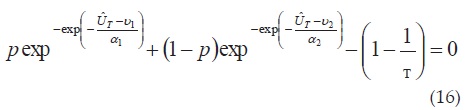
<body><![CDATA[<p align="center"><font face="verdana" size="2"><img src="/img/revistas/iit/v14n2/a2e14.jpg"></font></p>  	    <p align="justify"><font face="verdana" size="2">where L is called the likelihood function; Ln is the natural logarithm; <i>&#952;</i> is the set of parameters to be estimated, and <i>f</i> (<i>x</i>, <i><u>&#952;</u></i>)is the univariate or mixed pdf.</font></p>  	    <p align="justify"><font face="verdana" size="2">For the case of the G&#45;GEV distribution, equation (14) is</font></p>  	    <p align="center"><font face="verdana" size="2"><img src="/img/revistas/iit/v14n2/a2e15.jpg"></font></p>  	    <p align="justify"><font face="verdana" size="2">Due to the complexity of the mathematical expressions in (14) and the partial derivatives with respect to the parameters, the constrained multivariable Rosenbrock method (Kuester and &nbsp;Mize, 1973) was applied to obtain the estimators of the parameters by the direct maximization of (14).</font></p>  	    <p align="justify"><font face="verdana" size="2">Once obtained the parameters, the quantiles for different return periods can be estimated by solving equation (5). For the case of MG distribution:</font></p>  	    <p align="center"><font face="verdana" size="2"><img src="/img/revistas/iit/v14n2/a2e16.jpg"></font></p>  	    <p align="justify"><font face="verdana" size="2">where <i>&Ucirc;<sub>T</sub></i> is the maximum extreme wind speed (in m/s) associated with T years of return period.</font></p>  	    <p align="justify"><font face="verdana" size="2">The best model can be selected based on the criterion of minimum standard error of fit (<i>SEF</i>), as defined by Kite (1988):</font></p>  	    <p align="center"><font face="verdana" size="2"><img src="/img/revistas/iit/v14n2/a2e17.jpg"></font></p>  	    ]]></body>
<body><![CDATA[<p align="justify"><font face="verdana" size="2">where g<sub><i>i</i></sub>, <i>i</i> = 1, ... , <i>n</i> are the recorded events; h<sub><i>i</i></sub>, <i>i</i> = 1, ... , <i>n</i> are the event magnitudes computed from the univariate or mixed distributions at probabilities obtained from the sorted ranks of g<sub><i>i</i></sub>, <i>i</i> = 1, ... , <i>n</i>; <i>q</i> is the number of parameters estimated for the univariate or mixed distributions; <i>n</i> is the length of record, and <i>j</i> is the number of the analyzed station.</font></p>  	    <p align="justify"><font face="verdana" size="2">So, <i>q</i> = 2 for the Gumbel and Reverse Weibull distributions; <i>q</i> = 3 for the General Extreme Value Distribution; <i>q</i> = 4 for the TCEV distribution; <i>q</i> = 5 for the MG, MRW and G&#45;RW distributions, and <i>q</i> = 6 for the MGEV distribution.</font></p>  	    <p align="justify"><font face="verdana" size="2">&nbsp;</font></p>  	    <p align="justify"><font face="verdana" size="2"><b>Case study</b></font></p>  	    <p align="justify"><font face="verdana" size="2">The mixed extreme value distributions were applied to model the annual maxima wind speed data gathered of the hourly potential winds computed at 45 stations located in The Netherlands (<a href="/img/revistas/iit/v14n2/a2f1.jpg" target="_blank">Figure 1</a>). This country has a typical midLatitude oceanic climate with prevailing westerly winds. Winter storms are the result of differences in temperature between the polar air masses and the air in the middle latitudes in autumn and winter. These extratropical cyclones generally have less destructive power than tropical cyclones by they are able to provide damaging winds over wide coastal and inland areas.</font></p>  	    <p align="justify"><font face="verdana" size="2">Data are available from the Royal Netherlands Meteorological Institute (KNMI). Lengths of record vary from 9 to 56 years (<a href="/img/revistas/iit/v14n2/a2t1.jpg" target="_blank">Table 1</a>).</font></p>  	    <p align="justify"><font face="verdana" size="2">As it is known, in any of the multivariable constrained non&#45;linear optimization techniques, global optimality is never assured. Therefore, care must be taken in order to avoid a local optimum. It is suggested to start always with a set of initial parameters (Moments estimators). For example, in Schiphol station for the case of the G&#45;RW distribution, sample is sorted in decreasing order of magnitude and divided into two parts. The first one contains a third of the sample (association parameter <i>p</i> = 0.33) with a mean equal to 23.85 m/s and standard deviation equal to 1.62 m/s. With these values and by using equations (18) and (19), the initial parameters for the Reverse Weibull distribution are computed (<img src="/img/revistas/iit/v14n2/a2i1.jpg"> = 18.546, <img src="/img/revistas/iit/v14n2/a2i2.jpg"> = 24.546). For the rest of the sample with a mean equal to 19.41 m/s and standard deviation equal to 1.56 m/s, initial parameters for the Gumbel distribution are computed with equations (20) and (21), (<img src="/img/revistas/iit/v14n2/a2i3.jpg"> = 18.70, <img src="/img/revistas/iit/v14n2/a2i4.jpg"> = 1.214).</font></p>  	    <p align="center"><font face="verdana" size="2"><img src="/img/revistas/iit/v14n2/a2e18.jpg"></font></p>  	    <p align="justify"><font face="verdana" size="2">The final maximum likelihood estimators by the direct maximization of equation (14) are:</font></p>  	    <p align="center"><font face="verdana" size="2"><img src="/img/revistas/iit/v14n2/a2ea.jpg"></font></p>  	    ]]></body>
<body><![CDATA[<p align="justify"><font face="verdana" size="2">In this station the best univariate fit was obtained using the General Extreme Value distribution with a <i>SEF</i> = 0.320 m/s and <i>&Ucirc;</i><sub>50</sub> = 26.7 m/s.</font></p>  	    <p align="justify"><font face="verdana" size="2">In <a href="/img/revistas/iit/v14n2/a2f2.jpg" target="_blank">Figure 2</a>, a graphical comparison between the empirical and fitted distributions (G&#45;RW) is made.</font></p>  	    <p align="justify"><font face="verdana" size="2">The univariate and mixed return levels <i>U</i>(m/s) for different return periods T(years) along with the minimum value of the standard error of fit were obtained for each analyzed station. If only the univariate distributions had been considered in the wind speed frequency analysis 40% of the samples would have been better fitted with the Gumbel distribution, 56% with the General Extreme Value distribution, and 4% with the Reverse Weibull distribution.</font></p>  	    <p align="justify"><font face="verdana" size="2">It was possible to reduce the standard error of fit when mixed distributions were applied. 40% of samples were better fitted with the MRW distribution, and another 40% with the G&#45;RW distribution. For instance, in station K13 with 22 years of record, the best univariate fit was obtained with the General Extreme Value distribution, <i>SEF</i> = 0.910 m/s and <i>&Ucirc;</i><sub>50</sub> = 32.7 m/s, and the best mixed fit was obtained with the MRW distribution with a <i>SEF</i> = 0.443 m/s and the return level reduced to <i>&Ucirc;</i><sub>50</sub> = 30.9 m/s, which also represents a significant difference for design purposes.</font></p>  	    <p align="justify"><font face="verdana" size="2">It was also seen that the reduction of the <i>SEF</i> was important in the cases when the analyzed sample has a short length of record. This fact represents a great advantage of the mixed distributions with reference to univariate distributions. The final values of the return levels are shown in <a href="/img/revistas/iit/v14n2/a2t2.jpg" target="_blank">table 2</a>.</font></p>  	    <p align="justify"><font face="verdana" size="2">&nbsp;</font></p>  	    <p align="justify"><font face="verdana" size="2"><b>Conclusions</b></font></p>  	    <p align="justify"><font face="verdana" size="2">The general objective of this study is to show how the mixed distributions can be applied to model extreme wind speeds.</font></p>  	    <p align="justify"><font face="verdana" size="2">Five mixed extreme value distributions, with Gumbel, Reverse Weibull, and General Extreme Value components along with the Two Component Extreme Value distribution were used to model extreme wind speeds. The maximum likelihood estimators of the parameters were obtained numerically by using the multivariable constrained Rosenbrock optimization algorithm, which worked out very well in all cases.</font></p>  	    <p align="justify"><font face="verdana" size="2">Results have shown that there exists a reduction in the standard error of fit when estimating the parameters with mixed distributions instead of its univariate counterpart, and differences between univariate and mixed design events can be significant as return period increases. 87% of samples were better fitted with a mixed distribution. In 34 analyzed samples at least one of the components of the mixed distribution is the Reverse Weibull distribution. Besides, the final return levels were not observed like unrealistic design events even for long return periods.</font></p>  	    ]]></body>
<body><![CDATA[<p align="justify"><font face="verdana" size="2">Results suggest that it is very important to consider the mixed distributions as an additional mathematical tool when analyzing extreme wind speeds.</font></p>  	    <p align="justify"><font face="verdana" size="2">&nbsp;</font></p>  	    <p align="justify"><font face="verdana" size="2"><b>References</b></font></p>  	    <!-- ref --><p align="justify"><font face="verdana" size="2">Castillo E. <i>Extreme Value Theory in Engineering</i>, Boston, USA, Academic Press, 1988.    &nbsp;&nbsp;&nbsp;&nbsp;&nbsp;&nbsp;&nbsp;&nbsp;[&#160;<a href="javascript:void(0);" onclick="javascript: window.open('/scielo.php?script=sci_nlinks&ref=4275236&pid=S1405-7743201300020000200001&lng=','','width=640,height=500,resizable=yes,scrollbars=1,menubar=yes,');">Links</a>&#160;]<!-- end-ref --></font></p>  	    <!-- ref --><p align="justify"><font face="verdana" size="2">Dougherty A.M., Corotis R.B., Segurson A. Design Wind Speed Prediction. <i>Journal of Structural Engineering,</i> volume 129 (issue 9), 2003: 1268&#45;1274.    &nbsp;&nbsp;&nbsp;&nbsp;&nbsp;&nbsp;&nbsp;&nbsp;[&#160;<a href="javascript:void(0);" onclick="javascript: window.open('/scielo.php?script=sci_nlinks&ref=4275238&pid=S1405-7743201300020000200002&lng=','','width=640,height=500,resizable=yes,scrollbars=1,menubar=yes,');">Links</a>&#160;]<!-- end-ref --></font></p>  	    <!-- ref --><p align="justify"><font face="verdana" size="2">Dukes M., Palutikof J. Estimation of Extreme Wind Speeds with Very Long Return Period. <i>Journal of Applied Meteorology</i> volume 34, 1995: 1950&#45;1961.    &nbsp;&nbsp;&nbsp;&nbsp;&nbsp;&nbsp;&nbsp;&nbsp;[&#160;<a href="javascript:void(0);" onclick="javascript: window.open('/scielo.php?script=sci_nlinks&ref=4275240&pid=S1405-7743201300020000200003&lng=','','width=640,height=500,resizable=yes,scrollbars=1,menubar=yes,');">Links</a>&#160;]<!-- end-ref --></font></p>  	    <!-- ref --><p align="justify"><font face="verdana" size="2">Escalante C. Application of Bivariate Extreme Value Distribution to Flood Frequency Analysis: A Case Study of Northwestern Mexico. <i>Natural Hazards</i> DOI: 10.1007/s11069&#45;006&#45;9044&#45;7, 2006a, On line.    &nbsp;&nbsp;&nbsp;&nbsp;&nbsp;&nbsp;&nbsp;&nbsp;[&#160;<a href="javascript:void(0);" onclick="javascript: window.open('/scielo.php?script=sci_nlinks&ref=4275242&pid=S1405-7743201300020000200004&lng=','','width=640,height=500,resizable=yes,scrollbars=1,menubar=yes,');">Links</a>&#160;]<!-- end-ref --></font></p>  	    <!-- ref --><p align="justify"><font face="verdana" size="2">Galambos J., Macri N. Classical Extreme Value Model and Prediction of Extreme Events. <i>Journal of Structural Engineering,</i> volume 125 (issue 7), 1999: 792&#45;794.    &nbsp;&nbsp;&nbsp;&nbsp;&nbsp;&nbsp;&nbsp;&nbsp;[&#160;<a href="javascript:void(0);" onclick="javascript: window.open('/scielo.php?script=sci_nlinks&ref=4275244&pid=S1405-7743201300020000200005&lng=','','width=640,height=500,resizable=yes,scrollbars=1,menubar=yes,');">Links</a>&#160;]<!-- end-ref --></font></p>  	    <!-- ref --><p align="justify"><font face="verdana" size="2">Heckert N.A., Simiu E. Estimates of Hurricane Wind Speeds by "Peaks Over Threshold" Method. <i>Journal of Structural Engineering,</i> volume 124 (issue 4), 1998: 445&#45;449.    &nbsp;&nbsp;&nbsp;&nbsp;&nbsp;&nbsp;&nbsp;&nbsp;[&#160;<a href="javascript:void(0);" onclick="javascript: window.open('/scielo.php?script=sci_nlinks&ref=4275246&pid=S1405-7743201300020000200006&lng=','','width=640,height=500,resizable=yes,scrollbars=1,menubar=yes,');">Links</a>&#160;]<!-- end-ref --></font></p>  	    <!-- ref --><p align="justify"><font face="verdana" size="2">Dougherty A.M., Corotis R.B., Segurson A. Design Wind Speed Prediction. <i>Journal of Structural Engineering,</i> volume 129 (issue 9), 2003: 1268&#45;1274.    &nbsp;&nbsp;&nbsp;&nbsp;&nbsp;&nbsp;&nbsp;&nbsp;[&#160;<a href="javascript:void(0);" onclick="javascript: window.open('/scielo.php?script=sci_nlinks&ref=4275248&pid=S1405-7743201300020000200007&lng=','','width=640,height=500,resizable=yes,scrollbars=1,menubar=yes,');">Links</a>&#160;]<!-- end-ref --></font></p>  	    <!-- ref --><p align="justify"><font face="verdana" size="2">Holmes J.D., Moriarty W.W. Application of the Generalized Pareto Distribution to Extreme Value Analysis in Wind Engineering. <i>Journal of Wind Engineering and Industrial Aerodynamics,</i> volume 83, 1999: 1&#45;10.    &nbsp;&nbsp;&nbsp;&nbsp;&nbsp;&nbsp;&nbsp;&nbsp;[&#160;<a href="javascript:void(0);" onclick="javascript: window.open('/scielo.php?script=sci_nlinks&ref=4275250&pid=S1405-7743201300020000200008&lng=','','width=640,height=500,resizable=yes,scrollbars=1,menubar=yes,');">Links</a>&#160;]<!-- end-ref --></font></p>  	    <!-- ref --><p align="justify"><font face="verdana" size="2">Kite G.W. <i>Frequency and Risk Analyses in Hydrology</i>, USA, Water Resources Publication, 1988.    &nbsp;&nbsp;&nbsp;&nbsp;&nbsp;&nbsp;&nbsp;&nbsp;[&#160;<a href="javascript:void(0);" onclick="javascript: window.open('/scielo.php?script=sci_nlinks&ref=4275252&pid=S1405-7743201300020000200009&lng=','','width=640,height=500,resizable=yes,scrollbars=1,menubar=yes,');">Links</a>&#160;]<!-- end-ref --></font></p>  	    <!-- ref --><p align="justify"><font face="verdana" size="2">Kuester J.L., Mize J.H. <i>Optimization Techniques with FORTRAN</i>,&nbsp; USA, McGraw&#45;Hill, 1973.    &nbsp;&nbsp;&nbsp;&nbsp;&nbsp;&nbsp;&nbsp;&nbsp;[&#160;<a href="javascript:void(0);" onclick="javascript: window.open('/scielo.php?script=sci_nlinks&ref=4275254&pid=S1405-7743201300020000200010&lng=','','width=640,height=500,resizable=yes,scrollbars=1,menubar=yes,');">Links</a>&#160;]<!-- end-ref --></font></p>  	    <!-- ref --><p align="justify"><font face="verdana" size="2">Mood A., Graybill F., Boes D. <i>Introduction to the Theory of Statistics</i>, 3rd. Ed., McGraw&#45;Hill, USA, 1974.    &nbsp;&nbsp;&nbsp;&nbsp;&nbsp;&nbsp;&nbsp;&nbsp;[&#160;<a href="javascript:void(0);" onclick="javascript: window.open('/scielo.php?script=sci_nlinks&ref=4275256&pid=S1405-7743201300020000200011&lng=','','width=640,height=500,resizable=yes,scrollbars=1,menubar=yes,');">Links</a>&#160;]<!-- end-ref --></font></p>  	    <!-- ref --><p align="justify"><font face="verdana" size="2">Perrin O., Rootz&eacute;n H., Taesler R. A Discussion of Statistical Methods Used to Estimate Extreme Wind Speeds. <i>Theoretical and Applied Climatology,</i> volume 85, 2006: 203&#45;215.    &nbsp;&nbsp;&nbsp;&nbsp;&nbsp;&nbsp;&nbsp;&nbsp;[&#160;<a href="javascript:void(0);" onclick="javascript: window.open('/scielo.php?script=sci_nlinks&ref=4275258&pid=S1405-7743201300020000200012&lng=','','width=640,height=500,resizable=yes,scrollbars=1,menubar=yes,');">Links</a>&#160;]<!-- end-ref --></font></p>  	    <!-- ref --><p align="justify"><font face="verdana" size="2">Raynal J., Guevara J. Maximum Likelihood Estimators for the Two Populations Gumbel Distribution. <i>Hydrological Science and Technology,</i> volume 13 (issues 1&#45;4), 1997: 47&#45;56.    &nbsp;&nbsp;&nbsp;&nbsp;&nbsp;&nbsp;&nbsp;&nbsp;[&#160;<a href="javascript:void(0);" onclick="javascript: window.open('/scielo.php?script=sci_nlinks&ref=4275260&pid=S1405-7743201300020000200013&lng=','','width=640,height=500,resizable=yes,scrollbars=1,menubar=yes,');">Links</a>&#160;]<!-- end-ref --></font></p>  	    <!-- ref --><p align="justify"><font face="verdana" size="2">Raynal J., Santillan O. Maximum Likelihood Estimators of the Parameters of the Mixed GEV Distribution, on: IX Congreso Nacional de Hidr&aacute;ulica, AMH, Quer&eacute;taro, Qro., Mex., 1986, pp. 79&#45;90, (In Spanish).    &nbsp;&nbsp;&nbsp;&nbsp;&nbsp;&nbsp;&nbsp;&nbsp;[&#160;<a href="javascript:void(0);" onclick="javascript: window.open('/scielo.php?script=sci_nlinks&ref=4275262&pid=S1405-7743201300020000200014&lng=','','width=640,height=500,resizable=yes,scrollbars=1,menubar=yes,');">Links</a>&#160;]<!-- end-ref --></font></p>  	    <!-- ref --><p align="justify"><font face="verdana" size="2">Rossi F., Fiorentino M, Versace P. Two&#45;Component Extreme Value Distribution for Flood Frequency Analysis. <i>Water Resources Research,</i> volume 20 (issue 7), 1984: 847&#45;856.    &nbsp;&nbsp;&nbsp;&nbsp;&nbsp;&nbsp;&nbsp;&nbsp;[&#160;<a href="javascript:void(0);" onclick="javascript: window.open('/scielo.php?script=sci_nlinks&ref=4275264&pid=S1405-7743201300020000200015&lng=','','width=640,height=500,resizable=yes,scrollbars=1,menubar=yes,');">Links</a>&#160;]<!-- end-ref --></font></p>  	    <!-- ref --><p align="justify"><font face="verdana" size="2">Simiu E., Bi&eacute;try J., Filliben J.J. Sampling Errors in Estimation of Extreme Wind Speeds. <i>Journal of Structural Division ASCE,</i> volume 104, 1978: 491&#45;501.    &nbsp;&nbsp;&nbsp;&nbsp;&nbsp;&nbsp;&nbsp;&nbsp;[&#160;<a href="javascript:void(0);" onclick="javascript: window.open('/scielo.php?script=sci_nlinks&ref=4275266&pid=S1405-7743201300020000200016&lng=','','width=640,height=500,resizable=yes,scrollbars=1,menubar=yes,');">Links</a>&#160;]<!-- end-ref --></font></p>  	    <!-- ref --><p align="justify"><font face="verdana" size="2">Simiu E., Heckert N.A. Extreme Wind Distribution Tails: a "Peaks Over Threshold" Approach. <i>Journal of Structural Engineering,</i> volume 122 (issue 5), 1996: 539&#45;547.    &nbsp;&nbsp;&nbsp;&nbsp;&nbsp;&nbsp;&nbsp;&nbsp;[&#160;<a href="javascript:void(0);" onclick="javascript: window.open('/scielo.php?script=sci_nlinks&ref=4275268&pid=S1405-7743201300020000200017&lng=','','width=640,height=500,resizable=yes,scrollbars=1,menubar=yes,');">Links</a>&#160;]<!-- end-ref --></font></p>  	    <!-- ref --><p align="justify"><font face="verdana" size="2">Simiu E., Heckert N.A., Fillibe, J., Johnson S. Extreme Wind Load Estimates on the Gumbel Distribution of Dynamic Pressures: An Assessment.  <i>Structural Safety,</i> volume23, 2001: 221&#45;229.    &nbsp;&nbsp;&nbsp;&nbsp;&nbsp;&nbsp;&nbsp;&nbsp;[&#160;<a href="javascript:void(0);" onclick="javascript: window.open('/scielo.php?script=sci_nlinks&ref=4275270&pid=S1405-7743201300020000200018&lng=','','width=640,height=500,resizable=yes,scrollbars=1,menubar=yes,');">Links</a>&#160;]<!-- end-ref --></font></p>  	    <!-- ref --><p align="justify"><font face="verdana" size="2">Simiu E. <i>Meteorological Extremes</i>, on: Encyclopedia of Environmetrics, UK, El&#45;Shaarawi A.H.,&nbsp; Piegorsch W.W. (eds), volume 3, John Wiley and Sons, 2002, pp. 1255&#45;1259.    &nbsp;&nbsp;&nbsp;&nbsp;&nbsp;&nbsp;&nbsp;&nbsp;[&#160;<a href="javascript:void(0);" onclick="javascript: window.open('/scielo.php?script=sci_nlinks&ref=4275272&pid=S1405-7743201300020000200019&lng=','','width=640,height=500,resizable=yes,scrollbars=1,menubar=yes,');">Links</a>&#160;]<!-- end-ref --></font></p>  	    <!-- ref --><p align="justify"><font face="verdana" size="2">Van&#45;Den&#45;Brink H.W., Konnen G.P., Opsteegh J.D. Statistics of Extreme Synoptic&#45;Scale Wind Speeds in Ensemble Simulations of Current and Future Climate. <i>J. Climate</i>, volume 17, 2004: 4564&#45;4574.    &nbsp;&nbsp;&nbsp;&nbsp;&nbsp;&nbsp;&nbsp;&nbsp;[&#160;<a href="javascript:void(0);" onclick="javascript: window.open('/scielo.php?script=sci_nlinks&ref=4275274&pid=S1405-7743201300020000200020&lng=','','width=640,height=500,resizable=yes,scrollbars=1,menubar=yes,');">Links</a>&#160;]<!-- end-ref --></font></p>  	    <p align="justify"><font face="verdana" size="2">&nbsp;</font></p>  	    <p align="justify"><font face="verdana" size="2"><b>About the author</b></font></p>  	    <p align="justify"><font face="verdana" size="2"><i>Carlos Agust&iacute;n Escalante&#45;Sandoval</i>. Civil engineer (BUAP, 1985), M.E. with major in water resources (UNAM, 1988), PhD with major in hydraulics (UNAM, 1991). He was head of Hydraulics Department up to 2007 and currently Head of Civil Engineering Graduated Department, both in the Faculty of Engineering at UNAM. He has been granted some academic and scientific prizes such as the Gabino Barreda Medal in 1991 by UNAM and the prize for Research "Enzo Levi" in 2000 by the Mexican Association of Hydraulics. He is member of the ASCE, AWRA, AGU, AMC, AI and the National System of Researches.</font></p>      ]]></body><back>
<ref-list>
<ref id="B1">
<nlm-citation citation-type="book">
<person-group person-group-type="author">
<name>
<surname><![CDATA[Castillo]]></surname>
<given-names><![CDATA[E.]]></given-names>
</name>
</person-group>
<source><![CDATA[Extreme Value Theory in Engineering]]></source>
<year>1988</year>
<publisher-loc><![CDATA[Boston ]]></publisher-loc>
<publisher-name><![CDATA[Academic Press]]></publisher-name>
</nlm-citation>
</ref>
<ref id="B2">
<nlm-citation citation-type="journal">
<person-group person-group-type="author">
<name>
<surname><![CDATA[Dougherty]]></surname>
<given-names><![CDATA[A.M.]]></given-names>
</name>
<name>
<surname><![CDATA[Corotis]]></surname>
<given-names><![CDATA[R.B.]]></given-names>
</name>
<name>
<surname><![CDATA[Segurson]]></surname>
<given-names><![CDATA[A.]]></given-names>
</name>
</person-group>
<article-title xml:lang="en"><![CDATA[Design Wind Speed Prediction]]></article-title>
<source><![CDATA[Journal of Structural Engineering]]></source>
<year>2003</year>
<volume>129</volume>
<numero>9</numero>
<issue>9</issue>
<page-range>1268-1274</page-range></nlm-citation>
</ref>
<ref id="B3">
<nlm-citation citation-type="journal">
<person-group person-group-type="author">
<name>
<surname><![CDATA[Dukes]]></surname>
<given-names><![CDATA[M.]]></given-names>
</name>
<name>
<surname><![CDATA[Palutikof]]></surname>
<given-names><![CDATA[J.]]></given-names>
</name>
</person-group>
<article-title xml:lang="en"><![CDATA[Estimation of Extreme Wind Speeds with Very Long Return Period]]></article-title>
<source><![CDATA[Journal of Applied Meteorology]]></source>
<year>1995</year>
<volume>34</volume>
<page-range>1950-1961</page-range></nlm-citation>
</ref>
<ref id="B4">
<nlm-citation citation-type="journal">
<person-group person-group-type="author">
<name>
<surname><![CDATA[Escalante]]></surname>
<given-names><![CDATA[C.]]></given-names>
</name>
</person-group>
<article-title xml:lang="en"><![CDATA[Application of Bivariate Extreme Value Distribution to Flood Frequency Analysis: A Case Study of Northwestern Mexico]]></article-title>
<source><![CDATA[Natural Hazards]]></source>
<year>2006</year>
</nlm-citation>
</ref>
<ref id="B5">
<nlm-citation citation-type="journal">
<person-group person-group-type="author">
<name>
<surname><![CDATA[Galambos]]></surname>
<given-names><![CDATA[J.]]></given-names>
</name>
<name>
<surname><![CDATA[Macri]]></surname>
<given-names><![CDATA[N.]]></given-names>
</name>
</person-group>
<article-title xml:lang="en"><![CDATA[Classical Extreme Value Model and Prediction of Extreme Events]]></article-title>
<source><![CDATA[Journal of Structural Engineering]]></source>
<year>1999</year>
<volume>125</volume>
<numero>7</numero>
<issue>7</issue>
<page-range>792-794</page-range></nlm-citation>
</ref>
<ref id="B6">
<nlm-citation citation-type="journal">
<person-group person-group-type="author">
<name>
<surname><![CDATA[Heckert]]></surname>
<given-names><![CDATA[N.A.]]></given-names>
</name>
<name>
<surname><![CDATA[Simiu]]></surname>
<given-names><![CDATA[E.]]></given-names>
</name>
</person-group>
<article-title xml:lang="en"><![CDATA[Estimates of Hurricane Wind Speeds by "Peaks Over Threshold" Method]]></article-title>
<source><![CDATA[Journal of Structural Engineering]]></source>
<year>1998</year>
<volume>124</volume>
<numero>4</numero>
<issue>4</issue>
<page-range>445-449</page-range></nlm-citation>
</ref>
<ref id="B7">
<nlm-citation citation-type="journal">
<person-group person-group-type="author">
<name>
<surname><![CDATA[Dougherty]]></surname>
<given-names><![CDATA[A.M.]]></given-names>
</name>
<name>
<surname><![CDATA[Corotis]]></surname>
<given-names><![CDATA[R.B.]]></given-names>
</name>
<name>
<surname><![CDATA[Segurson]]></surname>
<given-names><![CDATA[A.]]></given-names>
</name>
</person-group>
<article-title xml:lang="en"><![CDATA[Design Wind Speed Prediction]]></article-title>
<source><![CDATA[Journal of Structural Engineering]]></source>
<year>2003</year>
<volume>129</volume>
<numero>9</numero>
<issue>9</issue>
<page-range>1268-1274</page-range></nlm-citation>
</ref>
<ref id="B8">
<nlm-citation citation-type="journal">
<person-group person-group-type="author">
<name>
<surname><![CDATA[Holmes]]></surname>
<given-names><![CDATA[J.D.]]></given-names>
</name>
<name>
<surname><![CDATA[Moriarty]]></surname>
<given-names><![CDATA[W.W.]]></given-names>
</name>
</person-group>
<article-title xml:lang="en"><![CDATA[Application of the Generalized Pareto Distribution to Extreme Value Analysis in Wind Engineering]]></article-title>
<source><![CDATA[Journal of Wind Engineering and Industrial Aerodynamics]]></source>
<year>1999</year>
<volume>83</volume>
<page-range>1-10</page-range></nlm-citation>
</ref>
<ref id="B9">
<nlm-citation citation-type="book">
<person-group person-group-type="author">
<name>
<surname><![CDATA[Kite]]></surname>
<given-names><![CDATA[G.W]]></given-names>
</name>
</person-group>
<source><![CDATA[Frequency and Risk Analyses in Hydrology]]></source>
<year>1988</year>
<publisher-name><![CDATA[Water Resources Publication]]></publisher-name>
</nlm-citation>
</ref>
<ref id="B10">
<nlm-citation citation-type="book">
<person-group person-group-type="author">
<name>
<surname><![CDATA[Kuester]]></surname>
<given-names><![CDATA[J.L.]]></given-names>
</name>
<name>
<surname><![CDATA[Mize]]></surname>
<given-names><![CDATA[J.H.]]></given-names>
</name>
</person-group>
<source><![CDATA[Optimization Techniques with FORTRAN]]></source>
<year>1973</year>
<publisher-name><![CDATA[McGraw-Hill]]></publisher-name>
</nlm-citation>
</ref>
<ref id="B11">
<nlm-citation citation-type="book">
<person-group person-group-type="author">
<name>
<surname><![CDATA[Mood]]></surname>
<given-names><![CDATA[A.]]></given-names>
</name>
<name>
<surname><![CDATA[Graybill]]></surname>
<given-names><![CDATA[F.]]></given-names>
</name>
<name>
<surname><![CDATA[Boes]]></surname>
<given-names><![CDATA[D.]]></given-names>
</name>
</person-group>
<source><![CDATA[Introduction to the Theory of Statistics]]></source>
<year>1974</year>
<edition>3</edition>
<publisher-name><![CDATA[McGraw-Hill]]></publisher-name>
</nlm-citation>
</ref>
<ref id="B12">
<nlm-citation citation-type="journal">
<person-group person-group-type="author">
<name>
<surname><![CDATA[Perrin]]></surname>
<given-names><![CDATA[O.]]></given-names>
</name>
<name>
<surname><![CDATA[Rootzén]]></surname>
<given-names><![CDATA[H.]]></given-names>
</name>
<name>
<surname><![CDATA[Taesler]]></surname>
<given-names><![CDATA[R.]]></given-names>
</name>
</person-group>
<article-title xml:lang="en"><![CDATA[A Discussion of Statistical Methods Used to Estimate Extreme Wind Speeds]]></article-title>
<source><![CDATA[Theoretical and Applied Climatology]]></source>
<year>2006</year>
<volume>85</volume>
<page-range>203-215</page-range></nlm-citation>
</ref>
<ref id="B13">
<nlm-citation citation-type="journal">
<person-group person-group-type="author">
<name>
<surname><![CDATA[Raynal]]></surname>
<given-names><![CDATA[J.]]></given-names>
</name>
<name>
<surname><![CDATA[Guevara]]></surname>
<given-names><![CDATA[J.]]></given-names>
</name>
</person-group>
<article-title xml:lang="en"><![CDATA[Maximum Likelihood Estimators for the Two Populations Gumbel Distribution]]></article-title>
<source><![CDATA[Hydrological Science and Technology]]></source>
<year>1997</year>
<volume>13</volume>
<numero>1</numero><numero>4</numero>
<issue>1</issue><issue>4</issue>
<page-range>47-56</page-range></nlm-citation>
</ref>
<ref id="B14">
<nlm-citation citation-type="book">
<person-group person-group-type="author">
<name>
<surname><![CDATA[Raynal]]></surname>
<given-names><![CDATA[J.]]></given-names>
</name>
<name>
<surname><![CDATA[Santillan]]></surname>
<given-names><![CDATA[O.]]></given-names>
</name>
</person-group>
<article-title xml:lang="en"><![CDATA[Maximum Likelihood Estimators of the Parameters of the Mixed GEV Distribution]]></article-title>
<source><![CDATA[IX Congreso Nacional de Hidráulica]]></source>
<year>1986</year>
<page-range>79-90</page-range><publisher-loc><![CDATA[Querétaro^eQro. Qro.]]></publisher-loc>
<publisher-name><![CDATA[AMH]]></publisher-name>
</nlm-citation>
</ref>
<ref id="B15">
<nlm-citation citation-type="journal">
<person-group person-group-type="author">
<name>
<surname><![CDATA[Rossi]]></surname>
<given-names><![CDATA[F.]]></given-names>
</name>
<name>
<surname><![CDATA[Fiorentino]]></surname>
<given-names><![CDATA[M]]></given-names>
</name>
<name>
<surname><![CDATA[Versace]]></surname>
<given-names><![CDATA[P.]]></given-names>
</name>
</person-group>
<article-title xml:lang="en"><![CDATA[Two-Component Extreme Value Distribution for Flood Frequency Analysis]]></article-title>
<source><![CDATA[Water Resources Research]]></source>
<year>1984</year>
<volume>20</volume>
<numero>7</numero>
<issue>7</issue>
<page-range>847-856</page-range></nlm-citation>
</ref>
<ref id="B16">
<nlm-citation citation-type="journal">
<person-group person-group-type="author">
<name>
<surname><![CDATA[Simiu]]></surname>
<given-names><![CDATA[E.]]></given-names>
</name>
<name>
<surname><![CDATA[Biétry]]></surname>
<given-names><![CDATA[J.]]></given-names>
</name>
<name>
<surname><![CDATA[Filliben]]></surname>
<given-names><![CDATA[J.J.]]></given-names>
</name>
</person-group>
<article-title xml:lang="en"><![CDATA[Sampling Errors in Estimation of Extreme Wind Speeds]]></article-title>
<source><![CDATA[Journal of Structural Division ASCE]]></source>
<year>1978</year>
<volume>104</volume>
<page-range>491-501</page-range></nlm-citation>
</ref>
<ref id="B17">
<nlm-citation citation-type="journal">
<person-group person-group-type="author">
<name>
<surname><![CDATA[Simiu]]></surname>
<given-names><![CDATA[E.]]></given-names>
</name>
<name>
<surname><![CDATA[Heckert]]></surname>
<given-names><![CDATA[N.A.]]></given-names>
</name>
</person-group>
<article-title xml:lang="en"><![CDATA[Extreme Wind Distribution Tails: a "Peaks Over Threshold" Approach]]></article-title>
<source><![CDATA[Journal of Structural Engineering]]></source>
<year>1996</year>
<volume>122</volume>
<numero>5</numero>
<issue>5</issue>
<page-range>539-547</page-range></nlm-citation>
</ref>
<ref id="B18">
<nlm-citation citation-type="journal">
<person-group person-group-type="author">
<name>
<surname><![CDATA[Simiu]]></surname>
<given-names><![CDATA[E.]]></given-names>
</name>
<name>
<surname><![CDATA[Heckert]]></surname>
<given-names><![CDATA[N.A.]]></given-names>
</name>
<name>
<surname><![CDATA[Fillibe]]></surname>
<given-names><![CDATA[J.]]></given-names>
</name>
<name>
<surname><![CDATA[Johnson]]></surname>
<given-names><![CDATA[S.]]></given-names>
</name>
</person-group>
<article-title xml:lang="en"><![CDATA[Extreme Wind Load Estimates on the Gumbel Distribution of Dynamic Pressures: An Assessment]]></article-title>
<source><![CDATA[Structural Safety]]></source>
<year>2001</year>
<volume>23</volume>
<page-range>221-229</page-range></nlm-citation>
</ref>
<ref id="B19">
<nlm-citation citation-type="book">
<person-group person-group-type="author">
<name>
<surname><![CDATA[Simiu]]></surname>
<given-names><![CDATA[E.]]></given-names>
</name>
</person-group>
<article-title xml:lang="en"><![CDATA[Meteorological Extremes]]></article-title>
<person-group person-group-type="editor">
<name>
<surname><![CDATA[El-Shaarawi]]></surname>
<given-names><![CDATA[A.H.]]></given-names>
</name>
<name>
<surname><![CDATA[Piegorsch]]></surname>
<given-names><![CDATA[W.W.]]></given-names>
</name>
</person-group>
<source><![CDATA[Encyclopedia of Environmetrics]]></source>
<year>2002</year>
<volume>3</volume>
<page-range>1255-1259</page-range><publisher-name><![CDATA[John Wiley and Sons]]></publisher-name>
</nlm-citation>
</ref>
<ref id="B20">
<nlm-citation citation-type="journal">
<person-group person-group-type="author">
<name>
<surname><![CDATA[Van-Den-Brink]]></surname>
<given-names><![CDATA[H.W.]]></given-names>
</name>
<name>
<surname><![CDATA[Konnen]]></surname>
<given-names><![CDATA[G.P.]]></given-names>
</name>
<name>
<surname><![CDATA[Opsteegh]]></surname>
<given-names><![CDATA[J.D.]]></given-names>
</name>
</person-group>
<article-title xml:lang="en"><![CDATA[Statistics of Extreme Synoptic-Scale Wind Speeds in Ensemble Simulations of Current and Future Climate]]></article-title>
<source><![CDATA[J. Climate]]></source>
<year>2004</year>
<volume>17</volume>
<page-range>4564-4574</page-range></nlm-citation>
</ref>
</ref-list>
</back>
</article>