<?xml version="1.0" encoding="ISO-8859-1"?><article xmlns:mml="http://www.w3.org/1998/Math/MathML" xmlns:xlink="http://www.w3.org/1999/xlink" xmlns:xsi="http://www.w3.org/2001/XMLSchema-instance">
<front>
<journal-meta>
<journal-id>1405-7743</journal-id>
<journal-title><![CDATA[Ingeniería, investigación y tecnología]]></journal-title>
<abbrev-journal-title><![CDATA[Ing. invest. y tecnol.]]></abbrev-journal-title>
<issn>1405-7743</issn>
<publisher>
<publisher-name><![CDATA[Universidad Nacional Autónoma de México, Facultad de Ingeniería]]></publisher-name>
</publisher>
</journal-meta>
<article-meta>
<article-id>S1405-77432010000300010</article-id>
<title-group>
<article-title xml:lang="en"><![CDATA[Ordered Hunt Schemes for Overlaid CDMA Cellular Systems]]></article-title>
<article-title xml:lang="es"><![CDATA[Esquemas de ordenamiento en sistemas celulares sobrepuestos CDMA]]></article-title>
</title-group>
<contrib-group>
<contrib contrib-type="author">
<name>
<surname><![CDATA[Castañeda-Camacho]]></surname>
<given-names><![CDATA[J.]]></given-names>
</name>
<xref ref-type="aff" rid="A01"/>
</contrib>
<contrib contrib-type="author">
<name>
<surname><![CDATA[Lara-Rodríguez]]></surname>
<given-names><![CDATA[D.]]></given-names>
</name>
<xref ref-type="aff" rid="A02"/>
</contrib>
</contrib-group>
<aff id="A01">
<institution><![CDATA[,Benemérita Universidad Autónoma de Puebla Electronic Department Communications Area ]]></institution>
<addr-line><![CDATA[ ]]></addr-line>
</aff>
<aff id="A02">
<institution><![CDATA[,Instituto Politécnico Nacional Electrical Engineering Department Communications Section ]]></institution>
<addr-line><![CDATA[México DF]]></addr-line>
</aff>
<pub-date pub-type="pub">
<day>00</day>
<month>09</month>
<year>2010</year>
</pub-date>
<pub-date pub-type="epub">
<day>00</day>
<month>09</month>
<year>2010</year>
</pub-date>
<volume>11</volume>
<numero>3</numero>
<fpage>349</fpage>
<lpage>365</lpage>
<copyright-statement/>
<copyright-year/>
<self-uri xlink:href="http://www.scielo.org.mx/scielo.php?script=sci_arttext&amp;pid=S1405-77432010000300010&amp;lng=en&amp;nrm=iso"></self-uri><self-uri xlink:href="http://www.scielo.org.mx/scielo.php?script=sci_abstract&amp;pid=S1405-77432010000300010&amp;lng=en&amp;nrm=iso"></self-uri><self-uri xlink:href="http://www.scielo.org.mx/scielo.php?script=sci_pdf&amp;pid=S1405-77432010000300010&amp;lng=en&amp;nrm=iso"></self-uri><abstract abstract-type="short" xml:lang="en"><p><![CDATA[The CDMA overlay concept, has been proposed as one alternative to take advantage of the bandwidth available in narrowband systems. In fact, the basic idea of the CDMA overlay is to allow to wideband CDMA wave forms, to share a common spectrum with narrowband conventional wave forms. In this work, we have focused in the analysis of the performance of the forward link of the CDMA and TDMA systems when they are overlaid. In our model, in order to limit the interference into the CDMA layer caused by the TDMA system, the use of notch filters has been considered. However, one drawback of the filters is that it rejects only one part of the interference generated by the TDMA system. Therefore, we have proposed two new ideas of reduction of the interference which can not be eliminated by filters; ordered hunt and real location of the slots. Finally, we present an analytical evaluation of the forward link capacity of the systems involved in the overlaid process, due to this is the limiting link and as a function of the outage probabilities. Practical considerations such as power requirements, power control, handoff, the offered load for different services and scenarios are also addressed.]]></p></abstract>
<abstract abstract-type="short" xml:lang="es"><p><![CDATA[La sobreposición CDMA ha sido propuesta como una alternativa para el aprovechamiento del ancho de banda disponible en sistemas de banda angosta. Dentro de este contexto, la sobreposición implica que las formas de onda de banda ancha de un sistema CDMA puedan compartir la misma banda espectral que las formas de onda convencionales de banda angosta. Ahora bien, en este trabajo nos hemos enfocado en presentar el análisis del desempeño del enlace de bajada de un sistema CDMA y TDMA cuando se sobreponen. Con el objeto de limitar la interferencia dentro del sistema CDMA causada por el TDMA, en nuestro modelo estamos considerando la presencia de filtros notch. Sin embargo, una de las desventajas de este tipo de filtros es que solamente eliminan una parte de la interferencia generada por el sistema TDMA. Por lo tanto, hemos propuesto dos ideas novedosas que nos permitirán reducir la interferencia que no puede ser eliminada por el uso de filtros, las cuales hemos denominado ordenamiento y reasignación de ranuras. Finalmente, presentamos una evaluación analítica de la capacidad del enlace de bajada de los sistemas involucrados en el proceso de sobreposición, debido a que este es el enlace limitante y en función de la probabilidad de falla. Diversas consideraciones prácticas como requerimientos de potencia, control de potencia, transferencia de llamada cargas de tráfico para diferentes servicios y diferentes escenarios están incluidos.]]></p></abstract>
<kwd-group>
<kwd lng="en"><![CDATA[Overlaid system]]></kwd>
<kwd lng="en"><![CDATA[CDMA performance]]></kwd>
<kwd lng="en"><![CDATA[TDMA]]></kwd>
<kwd lng="en"><![CDATA[ordered hunt]]></kwd>
<kwd lng="es"><![CDATA[sistema sobrepuesto]]></kwd>
<kwd lng="es"><![CDATA[desempeño CDMA]]></kwd>
<kwd lng="es"><![CDATA[TDMA]]></kwd>
<kwd lng="es"><![CDATA[hunt ordenado]]></kwd>
</kwd-group>
</article-meta>
</front><body><![CDATA[ <p align="center"><font face="verdana" size="4"><b>Ordered Hunt Schemes for Overlaid CDMA Cellular Systems</b></font></p>     <p align="center"><font face="verdana" size="2">&nbsp;</font></p>     <p align="center"><font face="verdana" size="3"><b>Esquemas de ordenamiento en sistemas celulares sobrepuestos CDMA</b></font></p>     <p align="center"><font face="verdana" size="2">&nbsp;</font></p>     <p align="center"><font face="verdana" size="2"><b>Casta&ntilde;eda&#150;Camacho  J.<sup>1</sup> y Lara&#150;Rodr&iacute;guez D.<sup>2</sup></b></font></p>     <p align="center"><font face="verdana" size="2">&nbsp;</font></p>     <p align="justify"><font face="verdana" size="2"><i><sup>1</sup> Electronic Department Communications Area, Benem&eacute;rita Universidad Aut&oacute;noma de Puebla, Puebla, M&eacute;xico, E&#150;mail:</i> <a href="mailto:jcastane@ece.buap.mx">jcastane@ece.buap.mx</a></font></p>     <p align="justify"><font face="verdana" size="2"><i><sup>2</sup> Electrical Engineering  Department Communications Section, Instituto Polit&eacute;cnico Nacional. M&eacute;xico  DF, E&#150;mail:</i> <a href="mailto:dlara@mail.cinvestav.mx">dlara@mail.cinvestav.mx</a></font></p>     <p align="justify"><font face="verdana" size="2">&nbsp;</font></p>     <p align="justify"><font face="verdana" size="2">Recibido: noviembre  de 2008    ]]></body>
<body><![CDATA[<br> Aceptado:  septiembre  de  2009</font></p>     <p align="justify"><font face="verdana" size="2">&nbsp;</font></p>     <p align="justify"><font face="verdana" size="2"><b>Abstract</b></font></p>     <p align="justify"><font face="verdana" size="2">The CDMA overlay concept, has been proposed as one alternative to take advantage of the bandwidth available in narrowband systems. In fact, the basic idea of the CDMA overlay is to allow to wideband CDMA wave forms, to share a common spectrum with narrowband conventional wave forms. In this work, we have focused in the analysis of the performance of the forward link of the CDMA and TDMA systems when they are overlaid. In our model, in order to limit the interference into the CDMA layer caused by the TDMA system, the use of notch filters has been considered. However, one drawback of the filters is that it rejects only one part of the interference generated by the TDMA system. Therefore, we have proposed two new ideas of reduction of the interference which can not be eliminated by filters; ordered hunt and real location of the slots. Finally, we present an analytical evaluation of the forward link capacity of the systems involved in the overlaid process, due to this is the limiting link and as a function of the outage probabilities. Practical considerations such as power requirements, power control, handoff, the offered load for different services and scenarios are also addressed.</font></p>     <p align="justify"><font face="verdana" size="2"><b>Keywords: </b>Overlaid system, CDMA performance, TDMA, ordered hunt.</font></p>     <p align="justify"><font face="verdana" size="2">&nbsp;</font></p>     <p align="justify"><font face="verdana" size="2"><b>Resumen</b></font></p>     <p align="justify"><font face="verdana" size="2"><i>La sobreposici&oacute;n CDMA ha sido propuesta como una alternativa para el aprovechamiento del ancho de banda disponible en sistemas de banda angosta. Dentro de este contexto, la sobreposici&oacute;n implica que las formas de onda de banda ancha de un sistema CDMA puedan compartir la misma banda espectral que las formas de onda convencionales de banda angosta. Ahora bien, en este trabajo nos hemos enfocado en presentar el an&aacute;lisis del desempe&ntilde;o del enlace de bajada de un sistema CDMA y TDMA cuando se sobreponen. Con el objeto de limitar la interferencia dentro del sistema CDMA causada por el TDMA, en nuestro modelo estamos considerando la presencia de filtros notch. Sin embargo, una de las desventajas de este tipo de filtros es que solamente eliminan una parte de la interferencia generada por el sistema TDMA. Por lo tanto, hemos propuesto dos ideas novedosas que nos permitir&aacute;n reducir la interferencia que no puede ser eliminada por el uso de filtros, las cuales hemos denominado ordenamiento y reasignaci&oacute;n de ranuras. Finalmente, presentamos una evaluaci&oacute;n anal&iacute;tica de la capacidad del enlace de bajada de los sistemas involucrados en el proceso de sobreposici&oacute;n, debido a que este es el enlace limitante y en funci&oacute;n de la probabilidad de falla. Diversas consideraciones pr&aacute;cticas como requerimientos de potencia, control de potencia, transferencia de llamada cargas de tr&aacute;fico para diferentes servicios y diferentes escenarios est&aacute;n incluidos.</i></font></p>     <p align="justify"><font face="verdana" size="2"><b>Descriptores: </b><i>sistema sobrepuesto, desempe&ntilde;o CDMA, TDMA, hunt ordenado.</i></font></p>     <p align="justify"><font face="verdana" size="2">&nbsp;</font></p>     ]]></body>
<body><![CDATA[<p align="justify"><font face="verdana" size="2"><b>Introduction</b></font></p>     <p align="justify"><font face="verdana" size="2">The continuous growth in the traffic volume and the emergence of new services are increasing the rate of change of the wireless networks. To appreciate the growth of the wireless sector; notice that in 1990 only, they existed 10 million of cell phone suscribers mostly using analog FM technology. To day, there are al most one billion of suscribers and it is expected to increase to more than two billion of subscribers in next years. In China alone, more than 15 million cell phone subscribers are being added each month; more than the cumulative number of wireless suscribers that existed throughout the entire world in 1991 &#91;1&#150;3&#93;. With the expected wireless revolution in telecommunications, the efficient use of the available spectrum is crucial. One step in this direction is the spread spectrum overlaid, which could be utilized as an easy migration path toward third generation cellular systems (for example IS&#150;136 to CDMA2000 or GSM to WCDMA).</font></p>     <p align="justify"><font face="verdana" size="2">A big number of authors have explored the performance of the CDMA overlaid systems. For example; one of the first works describe the results of both propagation and field strength measurements, to demonstrate that broadband CDMA wave forms can coexist in the same frequency band with conventional microwave narrowband system and thus to increase the overall spectral efficiency in that frequency band &#91;4&#93;. However, we have observed that all the experiments and performance analysis have had the following fundamental goals &#91;4&#150;46&#93;.</font></p>     <blockquote>       <p align="justify"><font face="verdana" size="2">a) Verify that the spread spectrum overlay would not cause excessive interference to the narrowband system.</font></p>       <p align="justify"><font face="verdana" size="2">b) Verify that the spread spectrum system can operate efficiently in the presence of the interference produced by the narrowband system.</font></p> </blockquote>     <p align="justify"><font face="verdana" size="2">In the literature, the overlay problem has been widely explored specially for CDMA systems.</font></p>     <p align="justify"><font face="verdana" size="2">For example, some papers have developed the performance of the overlay of CDMA and microwave systems &#91;5&#150;11&#93;. In others, the performance of the CDMA overlay with FDMA or TDMA systems has been studied in terms of analytical models, which quantify a deterministic SIR ratio for very simplified scenarios &#91;12&#150;18&#93;.</font></p>     <p align="justify"><font face="verdana" size="2">In order to successfully implement the overlay of the systems, in a manner such that neither set of users causes excessive interference to the other set; it has been proposed the use of notch filters at the CDMA transmitters and receivers.</font></p>     <p align="justify"><font face="verdana" size="2">A big number of authors have explored the performance of the interference suppression filters in the CDMA overlaid systems &#91;19&#150;39&#93;. Some of these studies have concentrated on quantifying the SIR ratio at the filter output, and others have obtained the bit&#150;error&#150;rate (BER) performance.</font></p>     ]]></body>
<body><![CDATA[<p align="justify"><font face="verdana" size="2">As a way to improve the performance of the CDMA overlay, other authors examine the use of multicarrier CDMA &#91;40&#150;44&#93;. An other proposed alternative is the use of frequency&#150;diversity spread spectrum (FD&#150;SS) &#91;12, 44&#93;. One of the most recent proposals is the signal level clipper in the CDMA transmitter and receiver &#91;45&#150;46&#93;.</font></p>     <p align="justify"><font face="verdana" size="2">Motivated by the fact that most of the existing works are done partially through measurements, simulations and very simplified analytical models; the first objective of our work is to establish a mathematical model to derive the performance in terms of the Erlang capacity of the overlaid system.</font></p>     <p align="justify"><font face="verdana" size="2">Therefore, we will evaluate the capacity of the overlaid CDMA and TDMA systems considering the Poisson nature of the arrivals, the service activity detection, imperfections on the power control loop, handoff, the effect of the adjacent cell interference, and the use of suppression filters. Our second objective is to show that the interference not rejected by the filters is quite harmful for the overlaid system. Nevertheless, we have proposed a new mechanism to reduce the interference effect, which implies the ordering and reallocation of the TDMA slots<sup><a href="#nota">1</a></sup>.</font></p>     <p align="justify"><font face="verdana" size="2">The paper is organized as follows. In Section II we present the system model and the overlay situation to be considered including the two new proposals. In Section III and IV the performance of the forward link is evaluated. Section V presents numerical results of the capacity estimation for different scenarios. Finally, Section VI gives our conclusions and remarks.</font></p>     <p align="justify"><font face="verdana" size="2">&nbsp;</font></p>     <p align="justify"><font face="verdana" size="2"><b>Sistem   model</b></font></p>     <p align="justify"><font face="verdana" size="2">In this work two layers of CDMA and TDMA macrocells are spectrally overlaid. Base stations of both systems are located in the same position and the use of sectored antennas is assumed. The mobile users are uniformly distributed within the cells, and all cells operate at 100% loading.</font></p>     <p align="justify"><font face="verdana" size="2">To make possible the overlay situation, notch filters are placed on the CDMA mobile transmitter and base station receiver. In addition two new proposals are investigated; the ordered hunt and ordered hunt with real location of the slots, in order to reduce the probability of occupation of the TDMA co&#150;channel slots (slots inside the CDMA bandwidth) and increase the overlay system capacity. In particular, the ordered hunt scheme assumes that the TDMA slots are numbered 1, 2,..., <i>N<sub>TS</sub> </i>(<i>N<sub>TS</sub> </i>is defined as the total available TDMA slots) in a way that co&#150;channel slots are placed at the end of the list. Consequently, each incoming user takes the lowest&#150;numbered idle slot. In the slots reallocation strategy, in addition to which the co&#150;channel TDMA slots are placed at the end of the list, if one slot is set free among the first <i>m </i>ordered busy slots the user who occupies the <i>m&#150;th </i>slot (final position) will be reallocated to the released position.</font></p>     <p align="justify"><font face="verdana" size="2">The rest of the section will be devoted to the requirements of the CDMA and TDMA systems and to the derivation of the probability density function of the number of active TDMA users inside the <i>W<sub>C </sub></i>bandwidth.</font></p>     <p align="justify"><font face="verdana" size="2">&nbsp;</font></p>     ]]></body>
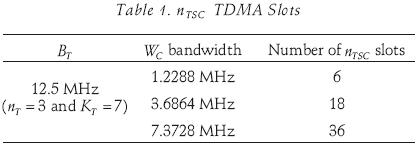
<body><![CDATA[<p align="justify"><font face="verdana" size="2"><b>CDMA   system</b></font></p>     <p align="justify"><font face="verdana" size="2">In the CDMA system, the energy to interference ratio requirement denoted by (<i>E<sub>b</sub> </i>/<i>I</i><sub>0</sub>), is considered a variable different for each service. In the system, <i>N<sub>S</sub> </i>will denote the number of services present in the spreading bandwidth, <i>W<sub>C</sub></i>. Thus, the transmission rate <i>R<sub>k</sub> </i>and the required   (<i>E<sub>b</sub>   </i>/<i>I</i><sub>0</sub>)<i><sub>k</sub></i><sub>(<i>req</i>)</sub>   define   the   <i>k</i>th   class   of   service   for <i>1&lt;k&lt; N<sub>s</sub>. </i>In the CDMA system the co&#150;channel interference received from the outside of the cell will be modeled as <i>f<b><sub>c</sub> </b></i>times the total power received from the intra&#150;cell, in the forward link <i>(f<sub>c</sub> </i>is defined as the other cell interference factor). Some other important assumptions are:</font></p>     <blockquote>       <p align="justify"><font face="verdana" size="2">a) A log&#150;normal random variable, &epsilon;<i><sub>k</sub> </i>(with parameters of its characteristic Gaussian random variable, mean <i>m<sub>k</sub> </i>and standard deviation <i>&sigma;<sub>k</sub>), </i>will model the variable <i>(E<sub>b</sub>/I<sub>0</sub>)<sub>k</sub> </i>of each user. Then, some typical values are, <i>&sigma;<sub>k</sub> </i>=1.5dB and <i>m<sub>k</sub> =(E<sub>b</sub>/I<sub>0</sub>)<sub>k(req)</sub> </i>&#91;50&#150;52&#93;.</font></p>       <p align="justify"><font face="verdana" size="2">b) The number of active calls for each class of service <i>k </i>is modeled through a Poisson random variable, with mean the offered load denoted by (&lambda; / &tau;)<i><sub>C</sub></i><sub>(<i>k)</i></sub> = <i>a<sub>C(k)</sub>. </i>In previous equation, &lambda; is the arrival rate, and <i>&tau;</i> is the call duration.</font></p>       <p align="justify"><font face="verdana" size="2">c) The activity factor for each <i>k </i>class of service is modeled as a binary distributed random variable, <i>v<sub>k</sub></i>, with <i>P</i>(<i>v<sub>k</sub></i> =1)= <i>&rho;<sub>k</sub></i>.</font></p> </blockquote>     <p align="justify"><font face="verdana" size="2">TDMA system</font></p>     <p align="justify"><font face="verdana" size="2">In the TDMA system we consider a frequency reuse factor <i>K<sub>T</sub>, </i>it means that the total system bandwidth will be divided in <i>K<sub>T</sub> </i>groups of frequency, each one consisting of a number of channels separated in frequency. Therefore, we assume that the TDMA system supports a maximum of <i>N<sub>TS</sub> </i>users per sector, given by</font></p>     <p align="center"><font face="verdana" size="2"><img src="/img/revistas/iit/v11n3/a10e1.jpg"></font></p>     <p align="justify"><font face="verdana" size="2">where <i>B<sub>T</sub> </i>is the TDMA available bandwidth, <i>n<sub>T</sub> </i>is the number of TDMA time slots per carrier, <i>K<sub>T</sub> </i>is the reuse factor of the TDMA system, <i>B<sub>TS</sub> </i>is the bandwidth of a TDMA channel and <i>s </i>corresponds to the number of sectors on the system. Each sector has <i>N<sub>TS</sub> </i>time slots of which <i>n<sub>TSC</sub> </i>slots are in the <i>W<sub>C</sub> </i>bandwidth, that is, <i>n<sub>TSC </sub></i>are the co&#150;channel time slots for the CDMA system. Depending on the <i>W<sub>C</sub> </i>bandwidth we have different values of the parameter <i>n<sub>TSC</sub> </i>as we can see on <a href="#tabla1">table 1</a>.</font></p>     ]]></body>
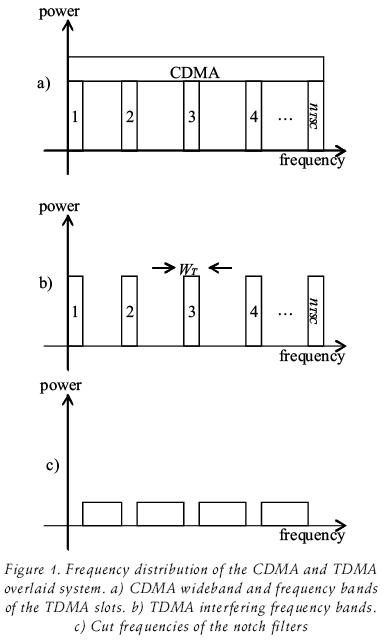
<body><![CDATA[<p align="center"><font face="verdana" size="2"><a name="tabla1"></a></font></p>     <p align="center"><font face="verdana" size="2"><img src="/img/revistas/iit/v11n3/a10t1.jpg"></font></p>     <p align="justify"><font face="verdana" size="2">In the TDMA system the total bit rate per user is <i>R<sub>T </sub></i>kbps in an equivalent bandwidth of <i>W<sub>T</sub>=B<sub>TS</sub>/n<sub>T</sub> </i>&#91;17, 18&#93;. Thus, we can conclude that the total TDMA co&#150;channel interference bandwidth is given by <i>W <sub>Tcoc</sub> =sK<sub>T</sub> W<sub>T</sub> n<sub>T</sub> .</i></font></p>     <p align="justify"><font face="verdana" size="2">In the proposed system model, it is assumed that the CDMA bandwidth is completely overlaid by the TDMA system. This setup corresponds to a situation of practical interest in which the overlay could be utilized as an easy migration path toward third generation cellular systems; for example, IS&#150;136 to CDMA2000 or GSM to WCDMA &#91;14&#150;15, 18&#150;24&#93;.</font></p>     <p align="justify"><font face="verdana" size="2">Like the frequency bands of the narrow band interference are known, the CDMA system can reduce the interference produced by or toward the TDMA system by employing notch filters at the CDMA receivers or transmitters respectively (<a href="#figura1">figure 1</a>).</font></p>     <p align="center"><font face="verdana" size="2"><a name="figura1"></a></font></p>     <p align="center"><font face="verdana" size="2"><img src="/img/revistas/iit/v11n3/a10f1.jpg"></font></p>     <p align="justify"><font face="verdana" size="2">However, such filters also reduce the effective available spread bandwidth of the CDMA system. If a fraction <i>p </i>of the original available spread bandwidth of the CDMA system is filtered, the resulting effective CDMA bandwidth is</font></p>     <p align="center"><font face="verdana" size="2"><img src="/img/revistas/iit/v11n3/a10e2.jpg"></font></p>     <p align="justify"><font face="verdana" size="2">wherein, for ideal notch filters <i>p = (n<sub>TSC</sub>*W<sub>T</sub>)/W<sub>C</sub>. </i>From the CDMA cell of interest, each TDMA cell except the co&#150;channel cells has a different group of <i>n<sub>TSC</sub> </i>interfering slots, in this manner, the use of notch filters can reduce the interference produced by TDMA system only on the desired and co&#150;channel cells (in the evaluation we assume an effective co&#150;channel TDMA bandwidth <i>W<sub>Tcoc,ef</sub> </i>which excludes the frequency bands assigned to the desired and co&#150;channel cells).</font></p>     ]]></body>
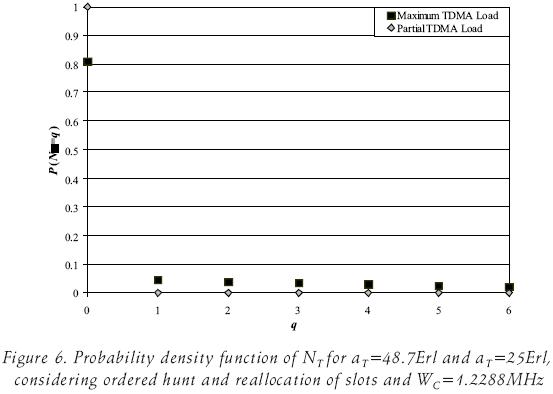
<body><![CDATA[<p align="justify"><font face="verdana" size="2">The same situation occurs from the TDMA cell point of view, where the interference only is reduced in the CDMA cells that overlap the desired and co&#150;channel TDMA cells.</font></p>     <p align="justify"><font face="verdana" size="2">TDMA without ordered hunt</font></p>     <p align="justify"><font face="verdana" size="2">The proposed TDMA system has <i>N<sub>TS</sub> </i>available slots per sector, from which <i>n<sub>TSC</sub> </i>slots are inside the <i>W<b><sub>C</sub> </b></i>bandwidth. Therefore, the probability density function of the number of active TDMA users, <i>N<sub>T</sub>, </i>inside the <i>W<sub>C</sub> </i> bandwidth denoted as <i>P(N<sub>T</sub> =q) </i>for 0&le;<i>q</i>&le;<i>n<sub>TSC</sub></i>, is expressed as</font></p>     <p align="center"><font face="verdana" size="2"><img src="/img/revistas/iit/v11n3/a10e3.jpg"></font></p>     <p align="justify"><font face="verdana" size="2">where <i>L </i>is the maximum occupancy for<i> N<sub>T</sub>=q, </i>which is given by <i>(N <sub>TS</sub> &#150;n<sub>TSC</sub> ) + q&middot;<img src="/img/revistas/iit/v11n3/a10e4.jpg"><sub>TSC</sub> =N<sub>TS</sub>  &#150;n<sub>TSC</sub> </i>are the slots outside of the <i>W<b><sub>C</sub> </b></i>bandwidth, therefore in (3) we have</font></p>     <blockquote>       <p align="justify"><font face="verdana" size="2"><i>P</i>(from <i>N<sub>TS</sub></i> slots <i>j</i> are bussy, <i>N<sub>T</sub> =q </i>slots of<i> j</i> are inside <i>W<sub>C</sub>)=</i></font></p>       <p align="justify"><font face="verdana" size="2"><i>P(</i>from<i> N<sub>TS </sub></i>slots <i>j </i>are <i>bussy)P(N<sub>T</sub> =q </i>slots of <i>j</i> are inside <i>W<b><sub>C</sub> </b></i>/from <i>N<sub>TS </sub></i>slots <i>j </i>are bussy)=</font></p> </blockquote>     <p align="center"><font face="verdana" size="2"><img src="/img/revistas/iit/v11n3/a10e5.jpg"></font></p>     <p align="justify"><font face="verdana" size="2">where <i>a<sub>T</sub> </i>is the TDMA load given by the product of the arrival rate, <i>&lambda;<sub>T</sub>, </i>and the mean service time, 1/<i>&tau;<sub>T</sub></i>. In <a href="/img/revistas/iit/v11n3/a10f2.jpg" target="_blank">figure 2</a> we show the probability density function of <i>N<sub>T </sub></i>for two different TDMA loads and for <i>W<sub>C</sub>=</i>1.2288MHz. Notice that when the TDMA load increases the probability of occupation of the TDMA co&#150;channel slots also increases. Thus, it was necessary to reduce the TDMA load until values that would make possible the operation of the overlaid system. Therefore we have evaluated two different load conditions</font></p>     ]]></body>
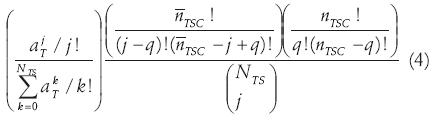
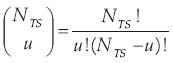
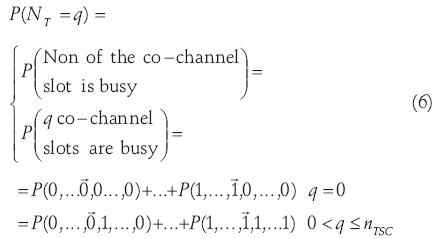
<body><![CDATA[<blockquote>       <p align="justify"><font face="verdana" size="2">a) The maximum TDMA load that the system can offer for a blocking probability of 2%, given by <i>a<sub>T</sub></i>=48.7 Erl.</font></p>       <p align="justify"><font face="verdana" size="2">b) One scenario in which we have approximately one half of the maximum load (partial value), given by <i>a<sub>T</sub>=25</i>Erl<i>. </i>This value originates a blocking probability of 3.0135e&#150;009.</font></p> </blockquote>     <p align="justify"><font face="verdana" size="2">Finally, the probability that the <i>q</i>&#150;th slot is busy is &#91;53&#93; </font></p>     <p align="center"><font face="verdana" size="2"><img src="/img/revistas/iit/v11n3/a10e6.jpg"></font></p>     <p align="justify"><font face="verdana" size="2">wherein <i>B</i>(<i>N<sub>TS</sub>,a<sub>T</sub></i>) is the Erlang loss formula for <i>N<sub>TS </sub></i>busy slots.</font></p>     <p align="justify"><font face="verdana" size="2">TDMA  with  ordered  hunt</font></p>     <p align="justify"><font face="verdana" size="2">For the ordered hunt scheme we assume that the TDMA slots are numbered 1, 2,...,<i>N<sub>TS</sub> </i>in a way that co&#150;channel slots are placed at the end of the list, and each incoming user takes the lowest&#150;numbered idle slot. Thus, we can model the slot occupancy as a Markov chain with 2<i>N<sub>TS</sub> </i>states, as we can see in <a href="/img/revistas/iit/v11n3/a10f3.jpg" target="_blank">figure 3</a>, wherein the general macrostate <i>E<sub>u</sub> </i>represents the number of busy slots in the system, for <i>u</i>=0,...,<i>N<sub>TS</sub></i>. The microstates of the form (0,0,...,0) represent all the possible positions of occupancy of <i>u </i>slots. Then for <i>u</i>=0, the state (0,0,...,0) represents the non&#150;occupancy of the slots. For <i>u</i>=1 the states (1,0,...,0) to (0,0,...,1) models the occupancy of one slot, from the first position to the final position. We follow in this way until the value, <i>u</i>=<i>N<sub>TS</sub></i>, for which the state (1,1,...,1) models the occupancy of all the slots. In general, each <i>E<sub>u</sub> </i>is integrated by a group</font></p>     <p align="center"><font face="verdana" size="2"><img src="/img/revistas/iit/v11n3/a10e7.jpg"></font></p>     <p align="justify"><font face="verdana" size="2">of  states,  which  are  representing  all  the  possible  positions of occupancy of <i>u </i>slots.</font></p>     ]]></body>
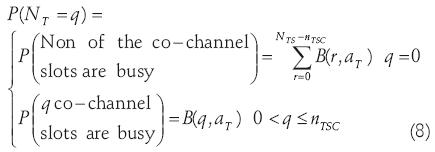
<body><![CDATA[<p align="justify"><font face="verdana" size="2">We can model this ordering through the Markov chains of <a href="/img/revistas/iit/v11n3/a10f3.jpg" target="_blank">figure 3</a>, from which we find the probability density function of the number of active TDMA users inside the <i>W<sub>C</sub> </i>bandwidth. Therefore, the <i>P(N<sub>T</sub>=q), </i>is found directly from the probability of being in each microstate.</font></p>     <p align="center"><font face="verdana" size="2"><img src="/img/revistas/iit/v11n3/a10e8.jpg"></font></p>     <p align="justify"><font face="verdana" size="2">where the mark <img src="/img/revistas/iit/v11n3/a10e9.jpg"> indicates the position of the last non co&#150;channel slot given by the difference <i>N<sub>TS</sub>&#150;n<sub>TSC</sub>. </i>In (6) the probability to be in each microstate was obtained with a simulation because the analytical solution is not tractable. <a href="/img/revistas/iit/v11n3/a10f4.jpg" target="_blank">Figure 4</a> shows the <i>P(N<sub>T</sub>=q) </i>considering ordered hunt, for maximum and partial TDMA loads. As we can observe, especially for the partial TDMA load the occupation probability of the non co&#150;channel slots is drastically incremented. Associated to this we have an improvement of the system performance.</font></p>     <p align="justify"><font face="verdana" size="2">Finally, in the ordered hunt &#91;53&#93;</font></p>     <p align="center"><font face="verdana" size="2"><img src="/img/revistas/iit/v11n3/a10e10.jpg"></font></p>     <p align="justify"><font face="verdana" size="2">where <i>a<sub>T</sub> </i>is the TDMA load and <i>B</i>(<i>q,a<sub>T</sub></i>) is the Erlang loss formula for <i>q </i>ordered busy slots.</font></p>     <p align="justify"><font face="verdana" size="2">TDMA  with  ordered  hunt  and reallocation  of  the  slots</font></p>     <p align="justify"><font face="verdana" size="2">In the slots reallocation strategy the co&#150;channel TDMA slots are placed at the end of the list, but if one slot is set free among the first <i>m </i>ordered busy slots the user who occupies the <i>m&#150;th </i>slot (final position) will be reallocated to the released position. In this strategy, as we force to the system to remain in the microstates (0,0,...,0), (1,0,...,0), (1,1,...,0),...,(1,1,...,1) the system can be modeled with a Markov chain with <i>N<sub>TS</sub></i>+1 states.</font></p>     <p align="justify"><font face="verdana" size="2">As we can see in <a href="/img/revistas/iit/v11n3/a10f5.jpg" target="_blank">figure 5</a>, each microstate corresponds with the general macrostate <i>E</i><sub>0</sub>,...,<i>E<sub>NTS</sub> </i>of an Erlang loss system.</font></p>     <p align="justify"><font face="verdana" size="2">Hence, we find that the probability density function of the random variable, <i>N<sub>T</sub></i>, is given by</font></p>     ]]></body>
<body><![CDATA[<p align="center"><font face="verdana" size="2"><img src="/img/revistas/iit/v11n3/a10e11.jpg"></font></p>     <p align="justify"><font face="verdana" size="2">where <i>B</i>(<i>q</i>,<i>a<sub>T</sub></i>) is the Erlang&#150;B formula, given by</font></p>     <p align="center"><font face="verdana" size="2"><i><img src="/img/revistas/iit/v11n3/a10e12.jpg"></i></font></p>     <p align="justify"><font face="verdana" size="2">for <i>a<sub>T</sub> </i>the TDMA load. <a href="#figura6">Figure 6</a> shows the probability density function of the number of active TDMA users. Notice     that     due     to     the     reallocation     strategy     the occupation probability of non co&#150;channel slots is incremented in comparison with the previous schemes. </font></p>     <p align="center"><font face="verdana" size="2"><a name="figura6"></a></font></p>     <p align="center"><font face="verdana" size="2"><img src="/img/revistas/iit/v11n3/a10f6.jpg"></font></p>     <p align="justify"><font face="verdana" size="2">Additionally, we have that</font></p>     <p align="center"><font face="verdana" size="2"><img src="/img/revistas/iit/v11n3/a10e13.jpg"></font></p>     <p align="justify"><font face="verdana" size="2">where <i>B</i>(<i>r</i>,<i>a<sub>T</sub></i>) is the Erlang&#150;B formula.</font></p>     <p align="justify"><font face="verdana" size="2">&nbsp;</font></p>     ]]></body>
<body><![CDATA[<p align="justify"><font face="verdana" size="2"><b>Forward   link   performance</b></font></p>     <p align="justify"><font face="verdana" size="2">CDMA  performance</font></p>     <p align="justify"><font face="verdana" size="2">The forward link capacity depends on the power that is available for the traffic channels &#91;54&#150;56&#93;. Typically, the power allocation to each overhead channel is determined from experimental tests. To maximize the capacity of the forward link, it is essential to control the power of the cell in order to allocate the power to an individual mobile according to its needs. Then, for the user 1 of the service <i>k</i>=<i>i</i>, the received bit energy to interference density ratio will be</font></p>     <p align="center"><font face="verdana" size="2"><img src="/img/revistas/iit/v11n3/a10e14.jpg"></font></p>     <p align="justify"><font face="verdana" size="2">where <i>W<sub>Cef</sub> </i>is the effective spreading bandwidth, <i>R<sub>i</sub> </i>is the transmission rate of the <i>i&#150;</i>th class of service, <i>c</i><sup>0<sub>i(1)</sub></sup> is the fraction of the total power received by user 1 of class <i>i </i>from the 0&#150;th base station. <i>I<sub>C,C</sub>W<sub>Cef</sub> </i>and <i>I<sub>C,T</sub>W<sub>Tef </sub></i>are the interference power in the CDMA user due to CDMA and TDMA base stations respectively and <i>N</i><sub>0</sub><i>W<sub>C</sub> </i>is the power of the thermal noise. In (11) we have</font></p>     <p align="center"><font face="verdana" size="2"><img src="/img/revistas/iit/v11n3/a10e15.jpg"></font></p>     <p align="justify"><font face="verdana" size="2">where <i>F</i><sub>i(1)</sub> represents the impact of the loss of orthogonally at user 1 of class <i>i</i> in the downlink and <i>F</i><sub>i(1)</sub><img src="/img/revistas/iit/v11n3/a10e16.jpg"> &#91;0,1&#93;. This term is often referred as the multipath loss factor of the radio channel &#91;54&#150;56&#93;, and it is the measure of the degree of orthogonally among the own cell signals received by a particular user. Hence, <i>F</i><sub>i(1)</sub> =0 indicates that the orthogonally of the own cell signal is maintained at the receiver, while 0&lt;<i>F</i><sub>i(1)</sub>&le;1 corresponds to the case where the orthogonally is partly or fully destroyed. <i>N<sub>s </sub></i>and <i>N<sub>BS</sub> </i>are the number of services and the number of interfering base stations included in the system, respectively. <i>N<sub>i</sub> </i>and <i>N<sub>k</sub> </i>are the CDMA users of the <i>i&#150;</i>th and <i>k</i> <i>&#150;</i>th service modeled as Poisson random variables. <i>I<sub>otheri(1)</sub> </i>is the individual other cell interference at user 1 of class <i>i. </i>We assume that the fraction of the total power received by user 1 from its CDMA control power base station is</font></p>     <p align="center"><font face="verdana" size="2"><img src="/img/revistas/iit/v11n3/a10e17.jpg"></font></p>     <p align="justify"><font face="verdana" size="2">where &omega;<sub>i(1)</sub> is the downlink resource consumption of user 1 of class <i>i</i> and <i>c</i><sub>0</sub> is the total power received by user 1 from its CDMA power control base station.</font></p>     <p align="justify"><font face="verdana" size="2">The interference power in the CDMA user due to TDMA base stations is given by</font></p>     ]]></body>
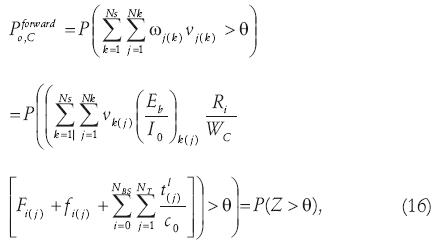
<body><![CDATA[<p align="center"><font face="verdana" size="2"><img src="/img/revistas/iit/v11n3/a10e18.jpg"></font></p>     <p align="justify"><font face="verdana" size="2">where <i>T <sup>l<sub>(j)</sub></sup>      </i>is the power designed to the <i>j</i>&#150;th user on the <i>l</i>&#150;th   TDMA   base   station   received   by   user   1   of   class   <i>i</i>. <i>N<sub>BS </sub>&#150; N<sub>BS,coc</sub> </i>is the number of interfering base stations included in the system.</font></p>     <p align="justify"><font face="verdana" size="2">Solving (11) with (12), (13) and (14), we have the following result for &omega;<i><sub>i</sub></i><sub>(1)</sub></font></p>     <p align="center"><font face="verdana" size="2"><img src="/img/revistas/iit/v11n3/a10e19.jpg"></font></p>     <p align="justify"><font face="verdana" size="2">where <i>f<sub>i</sub></i><sub>(1)</sub> is the forward link other cell interference factor for the user 1 of class <i>i</i>. In practical systems, a fraction of the total transmitted power is devoted to the pilot channel and other common control channels destined to all users. We assume this overhead as (1&#150;9). Therefore, the remaining fraction 9 of the total power is then allocated to all users controlled by the base station in the sector. The system will be in an outage situation if the total allocated transmission power exceeds the total available power at the base station. Then, let us define the system outage probability of the forward link as &#91;54&#150;56&#93;</font></p>     <p align="center"><font face="verdana" size="2"><img src="/img/revistas/iit/v11n3/a10e20.jpg"></font></p>     <p align="justify"><font face="verdana" size="2">where <i>v<sub>k</sub> </i>is the activity of the users of the <i>k&#150;</i>th service class modeled as a binary random variable and <i>(E<sub>b</sub>/I<sub>0</sub>)<sub>k(j)</sub>=E </i>is a log&#150;normal random variable that defines the required <i>(E<sub>b</sub>/I<sub>0</sub>) </i>of the <i>j&#150;</i>th user of the <i>k&#150;</i>th service class. Using the central limit theorem in (16), <i>Z </i>can be approximated as a Gaussian random variable. Since <i>f<sub>i(j)</sub></i> depends on the position of the users, we approximate the estimation by taking the average at all the locations in the sector. Thus, the outage probability is given by</font></p>     <p align="center"><font face="verdana" size="2"><img src="/img/revistas/iit/v11n3/a10e21.jpg"></font></p>     <p align="justify"><font face="verdana" size="2">where &theta; is the fraction of the total transmitted power dedicated to the traffic channels, typically between 71% and 80% &#91;55&#93;. Soft handoff on the forward link makes the power allocation even more complicated. For simplicity, we assume that a fraction <i>g</i>&lt;1 of all users is in soft handoff and a maximum of three base stations involved in the process &#91;54&#93;. For each user in soft handoff, we assume that the base stations in volved allocate the same power fraction to that user. Then, the number of users in each cell is increased by 2<i>g </i>because of soft handoff.</font></p>     <p align="justify"><font face="verdana" size="2">The values <i>E</i>{<i>Z</i>} and <i>Var</i>{<i>Z</i>} are the following</font></p>     ]]></body>
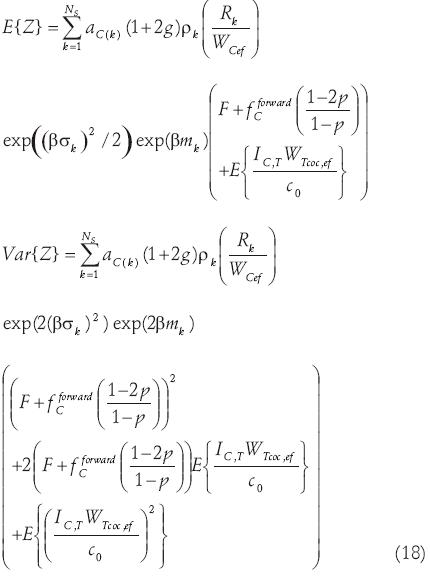
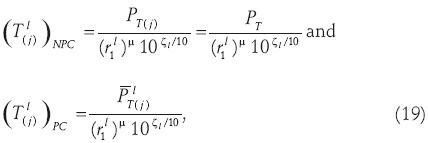
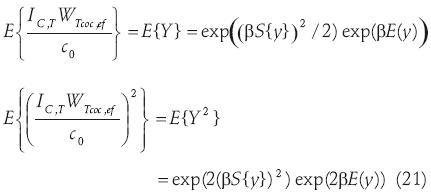
<body><![CDATA[<p align="center"><font face="verdana" size="2"><img src="/img/revistas/iit/v11n3/a10e22.jpg"></font></p>     <p align="justify"><font face="verdana" size="2">where <i>a<sub>C(k)</sub>(1+2g) </i>is the traffic load of the CDMA system, &rho;<sub>k</sub> is the activity factor of the <i>k&#150;</i>th class of service, &beta;=ln(10)/10,&sigma;<sub>k</sub> <i>= </i>1.5 dB, <i>m<sub>k</sub> =(E<sub>b</sub>/I<sub>0</sub>)<sub>k(req)</sub>, f</i><sub>C</sub><sup>forward</sup> is the other&#150;cell interference factor of the CDMA system. For the case in which we use notch filters, the other&#150;cell interference factor is affected by (1 <i>&#150;2p /</i>1 &#150; <i>p). F </i>is the impact of the loss of orthogonally whose value depends on the specific scenario, e.g. <i>F=0</i>.4 in a vehicular scenario and <i>F</i>=0.06 in a pedestrian scenario &#91;54&#93;.</font></p>     <p align="justify"><font face="verdana" size="2">In (18), the values <i>E{I<sub>TC</sub>  W<sub>Tcoc,ef </sub>/ c<sub>0</sub> } </i>and <i>E{(<i>I<sub>TC</sub> W<sub>Tcoc,ef </sub>/ c<sub>0</sub> </i> )<sup>2</sup>} </i>are obtained as suming two different scenarios; the TDMA system without power control and with power control.</font></p>     <p align="justify"><font face="verdana" size="2">We   have   that   the   received   power   on   the   interest CDMA user from the <i>l</i>&#150;th BS is</font></p>     <p align="center"><font face="verdana" size="2"><img src="/img/revistas/iit/v11n3/a10e23.jpg"></font></p>     <p align="justify"><font face="verdana" size="2">where <i>P<sub>T</sub> is </i>the transmitted power by the TDMA base station per user, and (<i>r<sub>1<sup>l</sup></sub></i>)<sup>&micro;</sup> 10<sup>&zeta;1/10</sup> models the propagation losses given by the product of the &micro;<i>&#150;</i>th power of the distance between the CDMA interest user and the <i>l&#150;</i>th base station and a log&#150;normal component representing shadowing losses where &zeta; <sub>0</sub> is the dB attenuation with zero mean and standard deviation &Delta;. <img src="/img/revistas/iit/v11n3/a10e24.jpg"> is the average TDMA transmitted power by the <i>l</i>&#150;th base station which power controls to the <i>j</i>&#150;th user, and which is given by</font></p>     <p align="center"><font face="verdana" size="2"><img src="/img/revistas/iit/v11n3/a10e25.jpg"></font></p>     <p align="justify"><font face="verdana" size="2">where <i>(r<sup>l</sup><sub>(j)</sub></i>) is the distance between the <i>l</i>&#150;th base station and all the possible positions of the <i>j</i>&#150;th TDMA user inside of the coverage area of the <i>l</i>&#150;th BS and <i>f</i>(<i>a</i>)=1 / <i>cell </i>area.</font></p>     <p align="justify"><font face="verdana" size="2">Let us assume a log&#150;normal approximation for the value by the Schwartz and Yeh method. Then in equation (18) we have</font></p>     <p align="center"><font face="verdana" size="2"><img src="/img/revistas/iit/v11n3/a10e26.jpg"></font></p>     ]]></body>
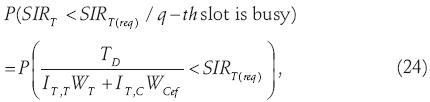
<body><![CDATA[<p align="justify"><font face="verdana" size="2">where <i>E{y} </i>and <i>S</i>{<i>y</i>} are the mean and standard deviation of the random variable which characterize to <i>Y </i>and change in accordance to the non power control scheme or power control scheme used in the TDMA layer.</font></p>     <p align="justify"><font face="verdana" size="2">CDMA Performance</font></p>     <p align="justify"><font face="verdana" size="2">As the outage probability of the forward link, (17), is a function of the position of the CDMA user of interest, we have obtained an average over a large set of mobile positions inside its coverage area. Then</font></p>     <p align="center"><font face="verdana" size="2"><img src="/img/revistas/iit/v11n3/a10e27.jpg"></font></p>     <p align="justify"><font face="verdana" size="2">where <i>Max </i>is the total number of mobile positions.</font></p>     <p align="justify"><font face="verdana" size="2">TDMA performance</font></p>     <p align="justify"><font face="verdana" size="2">For the TDMA system we evaluate the probability of not having an adequate signal to interference ratio, <i>SIR<sub>T</sub></i><sub>(req)</sub>, known as the outage probability. Hence, the outage probability due to the <i>q&#150;</i>th slot is busy, is given by</font></p>     <p align="center"><font face="verdana" size="2"><img src="/img/revistas/iit/v11n3/a10e28.jpg"></font></p>     <p align="justify"><font face="verdana" size="2">where in accordance with the slots allocation scheme we can know the <i>P(q&#150;th </i>slot is busy). Then, we follow to obtaining</font></p>     <p align="center"><font face="verdana" size="2"><img src="/img/revistas/iit/v11n3/a10e29.jpg"></font></p>     ]]></body>
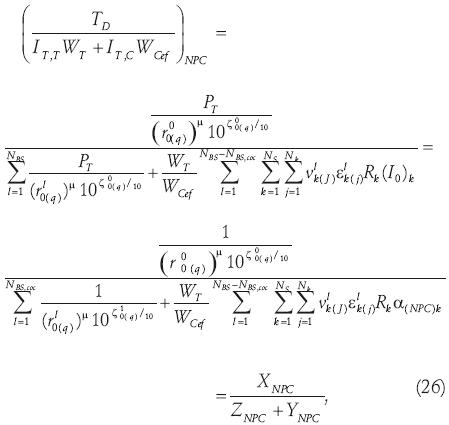
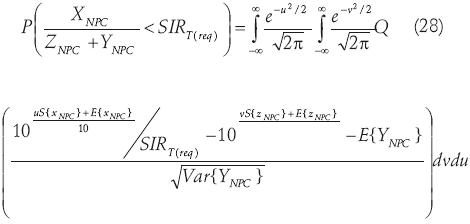
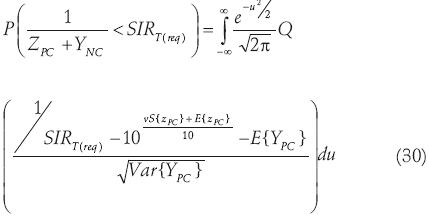
<body><![CDATA[<p align="justify"><font face="verdana" size="2">where   <i>T<sub>D</sub>   </i>is   the   power   of   the   desired   signal   on   the TDMA   system,   <i>I<sub>T,T</sub>W<sub>T</sub>   </i>and   <i>I<sub>T,C</sub>W<sub>Cef</sub></i>,   are   the   powers   of the   interference  in   the  TDMA  system   due   to   TDMA and CDMA systems respectively. In (24)</font></p>     <p align="center"><font face="verdana" size="2"><img src="/img/revistas/iit/v11n3/a10e30.jpg"></font></p>     <p align="justify"><font face="verdana" size="2">where <i>N<sub>k</sub> </i>is a Poisson random variable which models the CDMA active users. <i>v<sup>l</sup><sub>k(j)</sub></i> and <i>&epsilon;<sup>l</sup><sub>k(j)</sub></i> are a binary and log&#150;normal random variables which defines the activity of the services and the <i>(E<sub>b</sub>/I<sub>0</sub>) </i>of the<i> j&#150;</i>th user of the <i>k&#150;</i>th class of service in the <i>l&#150;</i>th base station respectively. <i>R<sub>k</sub> </i>is the bit rate requirement of the <i>k</i>&#150;th service and <i>(I<sub>0</sub>)<sub>k</sub> </i>is the CDMA interference spectral density for the <i>k</i>&#150;th service. <i>W<sub>T</sub> is </i>the equivalent TDMA slot bandwidth and <i>W<sub>Cef</sub> </i>is the effective spreading bandwidth. Again, the evaluation of (24) is conditioned to the consideration or not of power control in the TDMA layer.</font></p>     <p align="justify"><font face="verdana" size="2">TDMA  System  without  and  with  power  control </font></p>     <p align="justify"><font face="verdana" size="2">Without power control</font></p>     <p align="center"><font face="verdana" size="2"><img src="/img/revistas/iit/v11n3/a10e31.jpg"></font></p>     <p align="justify"><font face="verdana" size="2">where &alpha;<i><sub>(NPC)k</sub></i> is the ratio between CDMA spectral interference density received in the base station for the <i>k</i>&#150;th service and the TDMA transmitted signal power. Additionally in (26) we have approximated <i>X<sub>NPC</sub> </i>by a log&#150;normal random variable, whose characteristic Gaussian random variable has the mean and standard deviation</font></p>     <p align="center"><font face="verdana" size="2"><img src="/img/revistas/iit/v11n3/a10e32.jpg"></font></p>     <p align="justify"><font face="verdana" size="2">The random variable <i>Z<sub>NPC</sub> </i>is approximated as a Gaussian random variable invoking the central limit theorem and <i>Y<sub>NPC</sub> </i>by a log&#150;normal random variable using the Schwartz and Yeh method. Therefore</font></p>     <p align="center"><font face="verdana" size="2"><img src="/img/revistas/iit/v11n3/a10e33.jpg"></font></p>     ]]></body>
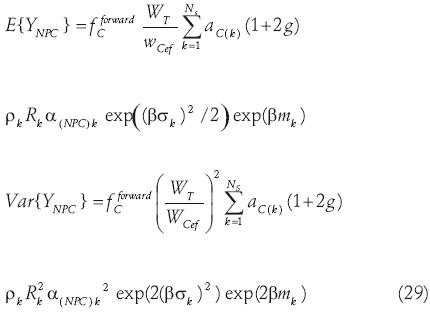
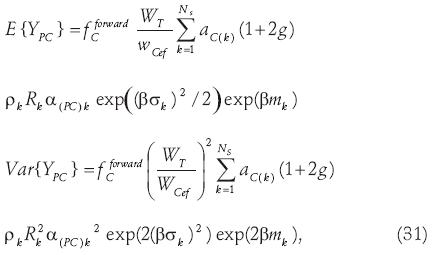
<body><![CDATA[<p align="justify"><font face="verdana" size="2">where <i>E</i>{<i>z<sub>NPC</sub></i>} and <i>S</i>{<i>z<sub>NPC</sub></i>} are the mean and standard deviation of the Gaussian random variable which characterize to <i>Z<sub>NPC</sub></i>. The <i>E</i>{<i>Y<sub>NPC</sub></i>} and <i>Var</i>{<i>Y<sub>NPC</sub></i>}are given by</font></p>     <p align="center"><font face="verdana" size="2"><img src="/img/revistas/iit/v11n3/a10e34.jpg"></font></p>     <p align="justify"><font face="verdana" size="2">where &alpha;<i><sub>(NPC)k</sub></i> is the ratio between the CDMA spectral interference density received in the mobile for the<i> k</i>&#150;th service and the TDMA base station transmitted signal power.</font></p>     <p align="justify"><font face="verdana" size="2">With power control in the TDMA layer we have</font></p>     <p align="center"><font face="verdana" size="2"><img src="/img/revistas/iit/v11n3/a10e35.jpg"></font></p>     <p align="justify"><font face="verdana" size="2">where <i>E</i>{<i>z<sub>PC</sub></i>} and <i>S</i>{<i>z<sub>PC</sub></i>} are the mean and standard deviation of the random variable which characterize to the log&#150;normal variable <i>Z<sub>PC</sub> </i>obtained by Schwartz and Yeh method.</font></p>     <p align="justify"><font face="verdana" size="2">The <i>E</i>{<i>Y<sub>NPC</sub></i>} and <i>Var</i>{<i>Y<sub>NPC</sub></i>}are given by</font></p>     <p align="center"><font face="verdana" size="2"><img src="/img/revistas/iit/v11n3/a10e36.jpg"></font></p>     <p align="justify"><font face="verdana" size="2">where <i>&alpha;<i><sub>(NPC)k</sub></i> </i>is the ratio between the CDMA spectral interference density received in the mobile for the <i>k</i>&#150;th service and the TDMA base station received signal power.</font></p>     <p align="justify"><font face="verdana" size="2">TDMA performance</font></p>     ]]></body>
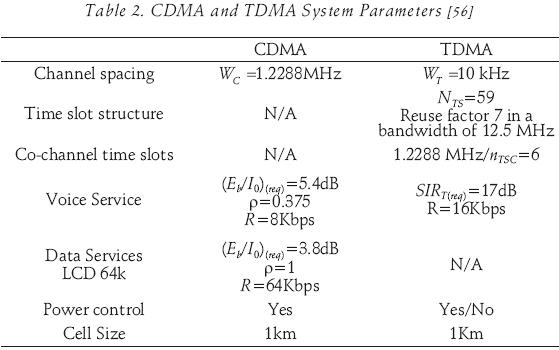
<body><![CDATA[<p align="justify"><font face="verdana" size="2">The outage probability is a function of the position of the CDMA user of interest. Therefore, we have obtained an average over a large set of mobile positions inside its coverage area, then</font></p>     <p align="center"><font face="verdana" size="2"><img src="/img/revistas/iit/v11n3/a10e37.jpg"></font></p>     <p align="justify"><font face="verdana" size="2">where is the total number of mobile positions.</font></p>     <p align="justify"><font face="verdana" size="2">&nbsp;</font></p>     <p align="justify"><font face="verdana" size="2"><b>Numerical results</b></font></p>     <p align="justify"><font face="verdana" size="2">In this section, we evaluate the performance of the forward link of the CDMA and TDMA overlaid system. All of our evaluations consider different values of the ratios &gamma; and &alpha;, the service time on the TDMA layer equal to 2 minutes, &Delta;=8dB, &micro;=4, <i>f</i><sub>C</sub><i><sup>forward</sup></i> =0.3632 (when 3 BS are participating in the soft handoff) and all the parameters listed on the <a href="#tabla2">table 2</a>.</font></p>     <p align="center"><font face="verdana" size="2"><a name="tabla2"></a></font></p>     <p align="center"><font face="verdana" size="2"><img src="/img/revistas/iit/v11n3/a10t2.jpg"></font></p>     <p align="justify"><font face="verdana" size="2">In the numerical evaluations we have considered two different settings, the TDMA layer with and with no power control. Also, we have considered four models of evaluation of the overlaid system. In the mode 1, it has been evaluated the isolated CDMA or TDMA systems. In the mode 2, it has been evaluated the overlaid system which is operating with the normal allocation of the slots in the TDMA layer. In the mode 3, it has been evaluated the overlaid system when it implements ordered hunt in the allocation of the TDMA slots. Finally in the mode 4, it has been evaluated the overlaid system when the TDMA layer implements the ordered hunt and relocation of the slots.</font></p>     <p align="justify"><font face="verdana" size="2">We evaluate the performance of the CDMA system for two types of services in the presence of the TDMA system. We have considered a maximum capacity in the CDMA layer given by, <i>a<sub>Voice</sub> = </i>16.44 Erl and <i>a<sub>Data</sub>=</i>1 Erl for a blocking probability of around 2%. The TDMA system has been evaluated when it operates at a tolerable capacity, <i>a<sub>T</sub></i>=25 Erl for a blocking probability less than 2%.</font></p>     ]]></body>

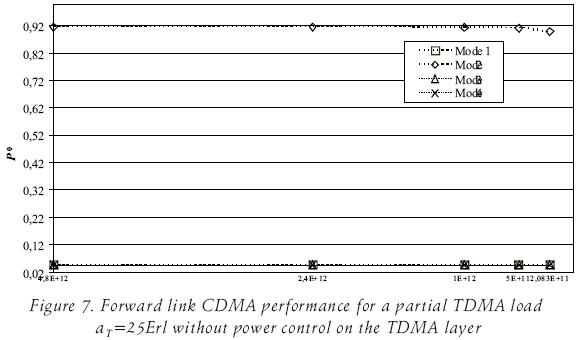
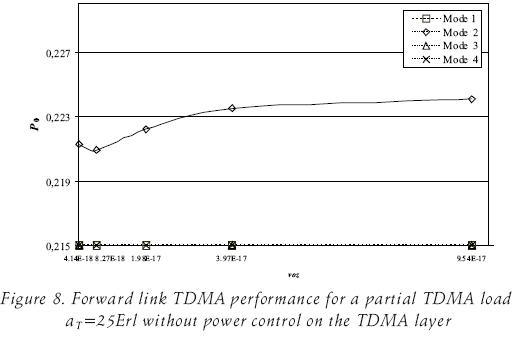
<body><![CDATA[<p align="justify"><font face="verdana" size="2"><a href="/img/revistas/iit/v11n3/a10t3.jpg" target="_blank">Table 3</a> show the CDMA and TDMA power requirements for different values of the &gamma; and &alpha; ratios. As we mentioned previously &gamma; and &alpha; ratios, depend on the link and the power control, and are given as parameters. In the forward link without power control on the TDMA layer, <i>&gamma;<sub>NPC</sub> </i>is the ratio between the transmitted power by the TDMA base station per user and the total power received by CDMA user from its CDMA power control base station and <i>&alpha;<sub>(NPC)k</sub> </i>is the ratio between the CDMA spectral interference density received in the mobile for the <i>k</i>&#150;th service and the TDMA base station transmitted signal power.</font></p>     <p align="justify"><font face="verdana" size="2">With power control on the TDMA layer, <i>&gamma;<sub>pc</sub> </i>is the ratio between the average transmitted power by the TDMA base station per user and the total power received by CDMA user from its CDMA power control base  station,  and  a <i>&alpha;<sub>(PC)k</sub></i> is  the ratio between the CDMA spectral interference density received in the mobile for the <i>k</i>&#150;th service and the TDMA base station transmitted signal power.</font></p>     <p align="justify"><font face="verdana" size="2">In <a href="/img/revistas/iit/v11n3/a10t3.jpg" target="_blank">table 3</a> as a way to approximate the parameter &alpha;, we assume that the maximum tolerable CDMA spectral interference density is given by I<sup>k</sup><sub>&alpha;(max)</sub> =<i>P<sub>CDMArx </sub></i>/<i>R<sub>k</sub></i>)/(<i>E<sub>b</sub> </i>/ <i>I </i><sub>0</sub> ) <i>k </i>. Where R<sub>k</sub> and (<i>E<sub>b</sub> </i>/ <i>I </i><sub>0</sub> )<i><sub>k</sub></i> are the bit rate and the required bit energy to interference density ratio.</font></p>     <p align="justify"><font face="verdana" size="2">&nbsp;</font></p>     <p align="justify"><font face="verdana" size="2"><b>No power control on the TDMA layer: Forward link performance</b></font></p>     <p align="justify"><font face="verdana" size="2">For this macrocell scenario, the performance of the overlaid system when it has maximum load in the TDMA layer is poor, therefore in those conditions it is impossible the operation of the system. <a href="#figura7">Figures 7</a> and <a href="#figura8">8</a> show the CDMA and TDMA performance of the forward link for two classes of services in the presence of the TDMA system when <i>a<sub>T</sub>=25</i>Erl<i>, </i>for a blocking probability of 2% in CDMA layer and less than 2% in TDMA layer.</font></p>     <p align="center"><font face="verdana" size="2"><a name="figura7"></a></font></p>     <p align="center"><font face="verdana" size="2"><img src="/img/revistas/iit/v11n3/a10f7.jpg"></font></p>     <p align="center"><font face="verdana" size="2"><a name="figura8"></a></font></p>     <p align="center"><font face="verdana" size="2"><img src="/img/revistas/iit/v11n3/a10f8.jpg"></font></p>     ]]></body>
<body><![CDATA[<p align="justify"><font face="verdana" size="2">Notice that, although for the normal al location of the slots the operation of the system is impossible due to the poor performance; we can observe that in the CDMA layer in agreement the ratio g decreases, we have a better performance of the overlaid system because of the reduction in the TDMA transmitted power or the increment in the CDMA transmitted power. The same situation occurs with the ratio &alpha;, in agreement this  goes a decrement, the TDMA layer has a better TDMA performance.</font></p>     <p align="justify"><font face="verdana" size="2">A significantly improve on the performance of the overlaid system is  observed when the system implements the ordered hunt or slots reallocation strategies.</font></p>     <p align="justify"><font face="verdana" size="2">Power control on the TDMA layer: Forward link performance</font></p>     <p align="justify"><font face="verdana" size="2"><a href="#figura9">Figures 9</a> and <a href="/img/revistas/iit/v11n3/a10f10.jpg" target="_blank">10</a> show the performance of the CDMA and TDMA layers when we consider the partial load condition and power control in the TDMA layer. Because of the power control in the TDMA layer, the operation of the overlaid system under more realistic conditions in terms of power requirements and quality levels is possible for both strategies, ordered hunt and reallocation of the slots.</font></p>     <p align="center"><font face="verdana" size="2"><a name="figura9"></a></font></p>     <p align="center"><font face="verdana" size="2"><img src="/img/revistas/iit/v11n3/a10f9.jpg"></font></p>     <p align="justify"><font face="verdana" size="2">Capacity gain</font></p>     <p align="justify"><font face="verdana" size="2">To improve the overlaid system performance we have considered a TDMA load <i>a<sub>T</sub>=25 </i>Erl. Then, from previous results we can conclude that the co&#150;channel ordered slots strategies and the power control scheme on the TDMA system increase the total system capacity in a factor equal to 1.25 This is possible for a CDMA performance <i>P<sub>0</sub>&lt;</i>10% and a TDMA performance <i>P<sub>0</sub>&lt;</i>16%.</font></p>     <p align="justify"><font face="verdana" size="2">If better conditions of quality are required, the offered load of the TDMA layer can be reduced.</font></p>     <p align="justify"><font face="verdana" size="2">&nbsp;</font></p>     ]]></body>
<body><![CDATA[<p align="justify"><font face="verdana" size="2"><b>Conclusions</b></font></p>     <p align="justify"><font face="verdana" size="2">From the results we can observe that in the assumed macrocell scenario, the overlay situation is not possible if only filtering is used. Therefore, in addition to the filtering techniques which are not enough to reduce the impact of the interference between the layers of the overlaid system, two new ideas the ordered hunt and slots reallocation of the TDMA co&#150;channel slots were proposed. Thus, it was theoretically shown that the CDMA overlaying can increase the total system capacity because of the power control in the TDMA layer and the slot allocation strategies.</font></p>     <p align="justify"><font face="verdana" size="2">In this work we have obtained general expressions of the performance of the forward link for different scenarios as a function of the &gamma; value, which is the limiting factor on the overlaid capacity. In fact, with smaller &gamma; ratios, higher capacities of the overlaid system can be achieved. Without power control on the TDMA layer the overlaid system has a poor performance. Then, from previous results we can conclude that the co&#150;channel ordered slots strategies and the power control scheme on the TDMA system increase the total system capacity in a factor equal to 1.25 This is possible for a CDMA performance <i>P<sub>b</sub></i>&lt;10% and a TDMA performance <i>P</i><sub>0</sub>&lt;16%.</font></p>     <p align="justify"><font face="verdana" size="2">&nbsp;</font></p>     <p align="justify"><font face="verdana" size="2"><b>References</b></font></p>     <!-- ref --><p align="justify"><font face="verdana" size="2">&#91;1&#93; Rappaport T.S., Annamalai A. <i>et al</i>. Wireless communications: Past events and Future Perspective. On: IEEE Commun. Magazine, 50th Anniversary Commemorative Issue, pp. 148&#150;161, May 2002.</font>&nbsp;&nbsp;&nbsp;&nbsp;&nbsp;&nbsp;&nbsp;&nbsp;[&#160;<a href="javascript:void(0);" onclick="javascript: window.open('/scielo.php?script=sci_nlinks&ref=4253309&pid=S1405-7743201000030001000001&lng=','','width=640,height=500,resizable=yes,scrollbars=1,menubar=yes,');">Links</a>&#160;]<!-- end-ref --><!-- ref --><p align="justify"><font face="verdana" size="2">&#91;2&#93; Esmailzadeh R., Nakagawa M. TDD&#150;CDMA for the 4th Generation of Wireless Communications. On: IEEE Wireless Commun., pp. 8&#150;15, August 2003.</font>&nbsp;&nbsp;&nbsp;&nbsp;&nbsp;&nbsp;&nbsp;&nbsp;[&#160;<a href="javascript:void(0);" onclick="javascript: window.open('/scielo.php?script=sci_nlinks&ref=4253310&pid=S1405-7743201000030001000002&lng=','','width=640,height=500,resizable=yes,scrollbars=1,menubar=yes,');">Links</a>&#160;]<!-- end-ref --><!-- ref --><p align="justify"><font face="verdana" size="2">&#91;3&#93; Rappaport T.S. <i>Wireless Communications, Principles and Practice</i>. 2d Ed. NJ. Prentice Hall. Upper Saddle River. 2002.</font>&nbsp;&nbsp;&nbsp;&nbsp;&nbsp;&nbsp;&nbsp;&nbsp;[&#160;<a href="javascript:void(0);" onclick="javascript: window.open('/scielo.php?script=sci_nlinks&ref=4253311&pid=S1405-7743201000030001000003&lng=','','width=640,height=500,resizable=yes,scrollbars=1,menubar=yes,');">Links</a>&#160;]<!-- end-ref --><!-- ref --><p align="justify"><font face="verdana" size="2">&#91;4&#93; Milstein L.B., Schilling D.L., Pickholtz R.L. <i>et al</i>. On the Feasibility of a CDMA Overlay for Personal Communications Networks. <i>IEEE J. Select Areas Commun.</i>, 10:655&#150;668, May 1992.</font>&nbsp;&nbsp;&nbsp;&nbsp;&nbsp;&nbsp;&nbsp;&nbsp;[&#160;<a href="javascript:void(0);" onclick="javascript: window.open('/scielo.php?script=sci_nlinks&ref=4253312&pid=S1405-7743201000030001000004&lng=','','width=640,height=500,resizable=yes,scrollbars=1,menubar=yes,');">Links</a>&#160;]<!-- end-ref --><!-- ref --><p align="justify"><font face="verdana" size="2">&#91;5&#93; Filis K.G., Gupta S.C. Overlay of Cellular CDMA on FSM. <i>IEEE Trans. On Veh. Technol.</i>, 43(1):86&#150;98, Feb. 1994.</font>&nbsp;&nbsp;&nbsp;&nbsp;&nbsp;&nbsp;&nbsp;&nbsp;[&#160;<a href="javascript:void(0);" onclick="javascript: window.open('/scielo.php?script=sci_nlinks&ref=4253313&pid=S1405-7743201000030001000005&lng=','','width=640,height=500,resizable=yes,scrollbars=1,menubar=yes,');">Links</a>&#160;]<!-- end-ref --><!-- ref --><p align="justify"><font face="verdana" size="2">&#91;6&#93; Wang J. Cellular CDMA Overlay Situations. <i>IEE Proc.&#150;Commun.</i>, 143(6):389&#150;395, Dec. 1996.</font>&nbsp;&nbsp;&nbsp;&nbsp;&nbsp;&nbsp;&nbsp;&nbsp;[&#160;<a href="javascript:void(0);" onclick="javascript: window.open('/scielo.php?script=sci_nlinks&ref=4253314&pid=S1405-7743201000030001000006&lng=','','width=640,height=500,resizable=yes,scrollbars=1,menubar=yes,');">Links</a>&#160;]<!-- end-ref --><!-- ref --><p align="justify"><font face="verdana" size="2">&#91;7&#93; Wang J. LMS Filters for Cellular CDMA Overlay. On: International Conference on Commun. ICCT, pp. 366&#150;369, 1996.</font>&nbsp;&nbsp;&nbsp;&nbsp;&nbsp;&nbsp;&nbsp;&nbsp;[&#160;<a href="javascript:void(0);" onclick="javascript: window.open('/scielo.php?script=sci_nlinks&ref=4253315&pid=S1405-7743201000030001000007&lng=','','width=640,height=500,resizable=yes,scrollbars=1,menubar=yes,');">Links</a>&#160;]<!-- end-ref --><!-- ref --><p align="justify"><font face="verdana" size="2">&#91;8&#93;  Ywh&#150;Ren  T.,  Jin&#150;Fu  Ch.   Feasibility  of  Adding  a  Personal Communications   Network   to   an   Existing   Fixed&#150;Service Microwave   System.   <i>IEEE   Trans.   On   Commun</i>.,    44:76&#150;83, Jan. 1996. </font>&nbsp;&nbsp;&nbsp;&nbsp;&nbsp;&nbsp;&nbsp;&nbsp;[&#160;<a href="javascript:void(0);" onclick="javascript: window.open('/scielo.php?script=sci_nlinks&ref=4253316&pid=S1405-7743201000030001000008&lng=','','width=640,height=500,resizable=yes,scrollbars=1,menubar=yes,');">Links</a>&#160;]<!-- end-ref --><!-- ref --><p align="justify"><font face="verdana" size="2">&#91;9&#93;   Schilling  D.L.,   Milstein  L.B.,   Pickholtz  R.L. <i>et  al</i>. <i>A  Spectrally     Efficient     CDMA      Overlay</i>.     MILCOM.      1997.     Pp. 1183&#150;1185. </font>&nbsp;&nbsp;&nbsp;&nbsp;&nbsp;&nbsp;&nbsp;&nbsp;[&#160;<a href="javascript:void(0);" onclick="javascript: window.open('/scielo.php?script=sci_nlinks&ref=4253317&pid=S1405-7743201000030001000009&lng=','','width=640,height=500,resizable=yes,scrollbars=1,menubar=yes,');">Links</a>&#160;]<!-- end-ref --><!-- ref --><p align="justify"><font face="verdana" size="2">&#91;10&#93;   Shad   A.,   Haimovich   A.M.   Performance   of   Space&#150;   Time Receiver    Architectures    for    CDMA   Overlay    of   Narrowband Wave forms for Personal Communications Systems. On:   International   Conference   on   Commun.   ICC,   1997, pp. 314&#150;318. </font>&nbsp;&nbsp;&nbsp;&nbsp;&nbsp;&nbsp;&nbsp;&nbsp;[&#160;<a href="javascript:void(0);" onclick="javascript: window.open('/scielo.php?script=sci_nlinks&ref=4253318&pid=S1405-7743201000030001000010&lng=','','width=640,height=500,resizable=yes,scrollbars=1,menubar=yes,');">Links</a>&#160;]<!-- end-ref --><!-- ref --><p align="justify"><font face="verdana" size="2">&#91;11&#93;     Papproth     E.,     Kaleh     G.K.     A     CDMA     Overlay     Using Frequency   Diversity   Spread   Spectrum.   <i>IEEE   Trans.   Veh. Technol.</i>, 48(2):397&#150;404, March 1999. </font>&nbsp;&nbsp;&nbsp;&nbsp;&nbsp;&nbsp;&nbsp;&nbsp;[&#160;<a href="javascript:void(0);" onclick="javascript: window.open('/scielo.php?script=sci_nlinks&ref=4253319&pid=S1405-7743201000030001000011&lng=','','width=640,height=500,resizable=yes,scrollbars=1,menubar=yes,');">Links</a>&#160;]<!-- end-ref --><!-- ref --><p align="justify"><font face="verdana" size="2">&#91;12&#93;    Schilling     D.L.,     Lomp    G.R.,     Garodnick     J.     Broad band CDMA  Overlay.  On: IEEE  Vehicular  Technology Conference VTC, 1993, pp. 452&#150;455. </font>&nbsp;&nbsp;&nbsp;&nbsp;&nbsp;&nbsp;&nbsp;&nbsp;[&#160;<a href="javascript:void(0);" onclick="javascript: window.open('/scielo.php?script=sci_nlinks&ref=4253320&pid=S1405-7743201000030001000012&lng=','','width=640,height=500,resizable=yes,scrollbars=1,menubar=yes,');">Links</a>&#160;]<!-- end-ref --><!-- ref --><p align="justify"><font face="verdana" size="2">&#91;13&#93; Grieco D.M., Garodnick J. y Schilling D.L. <i>Capacity Limitations       due       to       Adjacent      Cell       Dissimilar       Technologies. </i>MILCOM. 1993. Pp. 543&#150;549. </font>&nbsp;&nbsp;&nbsp;&nbsp;&nbsp;&nbsp;&nbsp;&nbsp;[&#160;<a href="javascript:void(0);" onclick="javascript: window.open('/scielo.php?script=sci_nlinks&ref=4253321&pid=S1405-7743201000030001000013&lng=','','width=640,height=500,resizable=yes,scrollbars=1,menubar=yes,');">Links</a>&#160;]<!-- end-ref --><!-- ref --><p align="justify"><font face="verdana" size="2">&#91;14&#93;    Grieco    D.M.    The    Capacity    Achievable    with    a    Broadband CDMA   Micro cell   Underlay   to   an   Existing   Cellular   Macrosystem. <i>IEEE J. Select Areas Commun.</i>, 12(4):744&#150;750, May 1994. </font>&nbsp;&nbsp;&nbsp;&nbsp;&nbsp;&nbsp;&nbsp;&nbsp;[&#160;<a href="javascript:void(0);" onclick="javascript: window.open('/scielo.php?script=sci_nlinks&ref=4253322&pid=S1405-7743201000030001000014&lng=','','width=640,height=500,resizable=yes,scrollbars=1,menubar=yes,');">Links</a>&#160;]<!-- end-ref --><!-- ref --><p align="justify"><font face="verdana" size="2">&#91;15&#93; Parsa K., Zadeh S.G. <i>B&#150;CDMA Overlay Forward Link and Reverse  Link  Capacity  Based on  Random  Traffic and  a  New CDMA     Call     Blocking     Model</i>.     GLOBECOM.     1995.     Pp. 2171&#150;2176. </font>&nbsp;&nbsp;&nbsp;&nbsp;&nbsp;&nbsp;&nbsp;&nbsp;[&#160;<a href="javascript:void(0);" onclick="javascript: window.open('/scielo.php?script=sci_nlinks&ref=4253323&pid=S1405-7743201000030001000015&lng=','','width=640,height=500,resizable=yes,scrollbars=1,menubar=yes,');">Links</a>&#160;]<!-- end-ref --><!-- ref --><p align="justify"><font face="verdana" size="2">&#91;16&#93; Hmimy H.H., Gupta S.C. Overlay of Cellular CDMA on AMPS   Forward   and   Reverse   Link   Analysis.   <i>IEEE   Trans. Veh. Technol.</i>, 45(1):51&#150;56, Feb. 1996. </font>&nbsp;&nbsp;&nbsp;&nbsp;&nbsp;&nbsp;&nbsp;&nbsp;[&#160;<a href="javascript:void(0);" onclick="javascript: window.open('/scielo.php?script=sci_nlinks&ref=4253324&pid=S1405-7743201000030001000016&lng=','','width=640,height=500,resizable=yes,scrollbars=1,menubar=yes,');">Links</a>&#160;]<!-- end-ref --><!-- ref --><p align="justify"><font face="verdana" size="2">&#91;17&#93;   Wu   J.S.,   Sze   M.T.,   Chung   J.K.   Uplink   and   Downlink Capacity Analysis for Two&#150;Tier CDMA Cellular Systems. IEEE   Vehicular   Technology  Conference  VTC.     1997.   Pp. 626&#150;633. </font>&nbsp;&nbsp;&nbsp;&nbsp;&nbsp;&nbsp;&nbsp;&nbsp;[&#160;<a href="javascript:void(0);" onclick="javascript: window.open('/scielo.php?script=sci_nlinks&ref=4253325&pid=S1405-7743201000030001000017&lng=','','width=640,height=500,resizable=yes,scrollbars=1,menubar=yes,');">Links</a>&#160;]<!-- end-ref --><!-- ref --><p align="justify"><font face="verdana" size="2">&#91;18&#93;      Chih&#150;Lin      I., L.J.      Greenstein,      Gitlin      R.D.      A      Microcell/ Macrocell   Cellular   Architecture   for   Low&#150;   and   High&#150;Mobility   Wireless    Users.    <i>IEEE   J.    Select   Areas    Commun.</i>, 11(6):885&#150;891, August 1993. </font>&nbsp;&nbsp;&nbsp;&nbsp;&nbsp;&nbsp;&nbsp;&nbsp;[&#160;<a href="javascript:void(0);" onclick="javascript: window.open('/scielo.php?script=sci_nlinks&ref=4253326&pid=S1405-7743201000030001000018&lng=','','width=640,height=500,resizable=yes,scrollbars=1,menubar=yes,');">Links</a>&#160;]<!-- end-ref --><!-- ref --><p align="justify"><font face="verdana" size="2">&#91;19&#93;    Grieco    D.M.,    Schilling    D.L.    The    Capacity    of    Broad band CDMA  Overlaying  a  GSM  Cellular  System.  On:  IEEE   Vehicular Technology Conference VTC, 1994, pp. 31&#150;35. </font>&nbsp;&nbsp;&nbsp;&nbsp;&nbsp;&nbsp;&nbsp;&nbsp;[&#160;<a href="javascript:void(0);" onclick="javascript: window.open('/scielo.php?script=sci_nlinks&ref=4253327&pid=S1405-7743201000030001000019&lng=','','width=640,height=500,resizable=yes,scrollbars=1,menubar=yes,');">Links</a>&#160;]<!-- end-ref --><!-- ref --><p align="justify"><font face="verdana" size="2">&#91;20&#93;    Widdowson    T.   A   CDMA    Data    Overlay    of    the    GSM Network.       On:       IEEE       International       Symposium       on Published PIMRC, 1997. </font>&nbsp;&nbsp;&nbsp;&nbsp;&nbsp;&nbsp;&nbsp;&nbsp;[&#160;<a href="javascript:void(0);" onclick="javascript: window.open('/scielo.php?script=sci_nlinks&ref=4253328&pid=S1405-7743201000030001000020&lng=','','width=640,height=500,resizable=yes,scrollbars=1,menubar=yes,');">Links</a>&#160;]<!-- end-ref --><!-- ref --><p align="justify"><font face="verdana" size="2">&#91;21&#93; Moelker D.J., Prasad R. <i>Capacity of Co&#150;existent Cellular CDMA and    GSM   with    Shadowing    and    Imperfect   Sectorization,    Power Control and Notch Filtering</i>. IEEE PIMRC. 1997. </font>&nbsp;&nbsp;&nbsp;&nbsp;&nbsp;&nbsp;&nbsp;&nbsp;[&#160;<a href="javascript:void(0);" onclick="javascript: window.open('/scielo.php?script=sci_nlinks&ref=4253329&pid=S1405-7743201000030001000021&lng=','','width=640,height=500,resizable=yes,scrollbars=1,menubar=yes,');">Links</a>&#160;]<!-- end-ref --><!-- ref --><p align="justify"><font face="verdana" size="2">&#91;22&#93; Koorevar P., Ruprecht J. Frequency Overlay of GSM and Cellular  B&#150;CDMA.  <i>IEEE  Trans. Veh.  Technol.</i>,  48:696&#150;707, May 1999.</font>&nbsp;&nbsp;&nbsp;&nbsp;&nbsp;&nbsp;&nbsp;&nbsp;[&#160;<a href="javascript:void(0);" onclick="javascript: window.open('/scielo.php?script=sci_nlinks&ref=4253330&pid=S1405-7743201000030001000022&lng=','','width=640,height=500,resizable=yes,scrollbars=1,menubar=yes,');">Links</a>&#160;]<!-- end-ref --><!-- ref --><p align="justify"><font face="verdana" size="2">&#91;23&#93;    No&euml;l    L.,    Widdowson    T.    Experimental    CDMA    Data Overlay     of     GSM     Network.     <i>Electronics     Letters</i>,     35(8): 614&#150;615, April 1999. </font>&nbsp;&nbsp;&nbsp;&nbsp;&nbsp;&nbsp;&nbsp;&nbsp;[&#160;<a href="javascript:void(0);" onclick="javascript: window.open('/scielo.php?script=sci_nlinks&ref=4253331&pid=S1405-7743201000030001000023&lng=','','width=640,height=500,resizable=yes,scrollbars=1,menubar=yes,');">Links</a>&#160;]<!-- end-ref --><!-- ref --><p align="justify"><font face="verdana" size="2">&#91;24&#93; T. Widdowson and L. No&euml;l, "Uplink and Down link Experimental    CDMA    Overlay    of    GSM    Network    in    Fading Environment,"    <i>Electronics    Letters</i>,    Vol.    35,    No.    17,    pp. 1440&#150;1441, August 1999. </font>&nbsp;&nbsp;&nbsp;&nbsp;&nbsp;&nbsp;&nbsp;&nbsp;[&#160;<a href="javascript:void(0);" onclick="javascript: window.open('/scielo.php?script=sci_nlinks&ref=4253332&pid=S1405-7743201000030001000024&lng=','','width=640,height=500,resizable=yes,scrollbars=1,menubar=yes,');">Links</a>&#160;]<!-- end-ref --><!-- ref --><p align="justify"><font face="verdana" size="2">&#91;25&#93; Milstein L.B., Wang  J. <i>Interference Suppression for CDMA Overlays    of    Narrowband    Wave forms</i>.    ISSSTA,    1994,    pp. 61&#150;68. </font>&nbsp;&nbsp;&nbsp;&nbsp;&nbsp;&nbsp;&nbsp;&nbsp;[&#160;<a href="javascript:void(0);" onclick="javascript: window.open('/scielo.php?script=sci_nlinks&ref=4253333&pid=S1405-7743201000030001000025&lng=','','width=640,height=500,resizable=yes,scrollbars=1,menubar=yes,');">Links</a>&#160;]<!-- end-ref --><!-- ref --><p align="justify"><font face="verdana" size="2">&#91;26&#93;   Wang   J.,   Milstein   L.B.   CDMA   Overlay   Situations   for Microcellular    Mobile    Communications.    <i>IEEE    Trans.    on Commun</i>., 43(2&#150;4):603&#150;614, Feb.&#150;Apr., 1995. </font>&nbsp;&nbsp;&nbsp;&nbsp;&nbsp;&nbsp;&nbsp;&nbsp;[&#160;<a href="javascript:void(0);" onclick="javascript: window.open('/scielo.php?script=sci_nlinks&ref=4253334&pid=S1405-7743201000030001000026&lng=','','width=640,height=500,resizable=yes,scrollbars=1,menubar=yes,');">Links</a>&#160;]<!-- end-ref --><!-- ref --><p align="justify"><font face="verdana" size="2">&#91;27&#93;    Wang    J.,     Milstein    L.B.    Interference    Suppression    for CDMA   Overlay   of   a   Narrowband   Wave form.   <i>Electronic Letters</i>, 31(24):2074&#150;2075, Nov. 1995. </font>&nbsp;&nbsp;&nbsp;&nbsp;&nbsp;&nbsp;&nbsp;&nbsp;[&#160;<a href="javascript:void(0);" onclick="javascript: window.open('/scielo.php?script=sci_nlinks&ref=4253335&pid=S1405-7743201000030001000027&lng=','','width=640,height=500,resizable=yes,scrollbars=1,menubar=yes,');">Links</a>&#160;]<!-- end-ref --><!-- ref --><p align="justify"><font face="verdana" size="2">&#91;28&#93; Rainbolt B.J., Miller S.L. CDMA Transmitter Filtering for Cellular     Overlay     Systems.     <i>IEEE     Trans.     on     Commun</i>., 48(2):290&#150;297, Feb. 2000. </font>&nbsp;&nbsp;&nbsp;&nbsp;&nbsp;&nbsp;&nbsp;&nbsp;[&#160;<a href="javascript:void(0);" onclick="javascript: window.open('/scielo.php?script=sci_nlinks&ref=4253336&pid=S1405-7743201000030001000028&lng=','','width=640,height=500,resizable=yes,scrollbars=1,menubar=yes,');">Links</a>&#160;]<!-- end-ref --><!-- ref --><p align="justify"><font face="verdana" size="2">&#91;29&#93;     Wei    P.,     Zeidler    R.,    Ku    W.H.    Adaptive     Interference Suppresion   for   CDMA   Overlay   Systems.   <i>IEEE   J.   Select Areas Commun.</i>, 12(9):1510&#150;1523, Dec. 1994. </font>&nbsp;&nbsp;&nbsp;&nbsp;&nbsp;&nbsp;&nbsp;&nbsp;[&#160;<a href="javascript:void(0);" onclick="javascript: window.open('/scielo.php?script=sci_nlinks&ref=4253337&pid=S1405-7743201000030001000029&lng=','','width=640,height=500,resizable=yes,scrollbars=1,menubar=yes,');">Links</a>&#160;]<!-- end-ref --><!-- ref --><p align="justify"><font face="verdana" size="2">&#91;30&#93; Gottesman L.D., Milstein L.B. On the Use of Interference Suppresion    to    Enhance    Acquisition    Performance    in    a CDMA Overlay Scenario. On: IEEE Vehicular Technology Conference VTC, 1995, pp. 1219&#150;1223,. </font>&nbsp;&nbsp;&nbsp;&nbsp;&nbsp;&nbsp;&nbsp;&nbsp;[&#160;<a href="javascript:void(0);" onclick="javascript: window.open('/scielo.php?script=sci_nlinks&ref=4253338&pid=S1405-7743201000030001000030&lng=','','width=640,height=500,resizable=yes,scrollbars=1,menubar=yes,');">Links</a>&#160;]<!-- end-ref --><!-- ref --><p align="justify"><font face="verdana" size="2">&#91;31&#93;   Gottesman   L.D.,   Milstein   L.B.   The   Coarse   Acquisition Performance   of   a   CDMA   Overlay   System.   <i>IEEE   J.   Select Areas Commun.</i>, 14(8):1627&#150;1635, Oct. 1996. </font>&nbsp;&nbsp;&nbsp;&nbsp;&nbsp;&nbsp;&nbsp;&nbsp;[&#160;<a href="javascript:void(0);" onclick="javascript: window.open('/scielo.php?script=sci_nlinks&ref=4253339&pid=S1405-7743201000030001000031&lng=','','width=640,height=500,resizable=yes,scrollbars=1,menubar=yes,');">Links</a>&#160;]<!-- end-ref --><!-- ref --><p align="justify"><font face="verdana" size="2">&#91;32&#93;  Wang  J.  On  the  Use  of  a  Suppresion  Filter  for  CDMA Overlay.    <i>IEEE    Trans.    on    Veh.    Technol.</i>,    48(2).    405&#150;414, March 1999. </font>&nbsp;&nbsp;&nbsp;&nbsp;&nbsp;&nbsp;&nbsp;&nbsp;[&#160;<a href="javascript:void(0);" onclick="javascript: window.open('/scielo.php?script=sci_nlinks&ref=4253340&pid=S1405-7743201000030001000032&lng=','','width=640,height=500,resizable=yes,scrollbars=1,menubar=yes,');">Links</a>&#160;]<!-- end-ref --><!-- ref --><p align="justify"><font face="verdana" size="2">&#91;33&#93; Yu A., Wang J. CDMA Overlay in the Presence of Power Control    Error.    On:    IEEE    Vehicular    Technology    Conference VTC, 1999, pp. 1831&#150;1835. </font>&nbsp;&nbsp;&nbsp;&nbsp;&nbsp;&nbsp;&nbsp;&nbsp;[&#160;<a href="javascript:void(0);" onclick="javascript: window.open('/scielo.php?script=sci_nlinks&ref=4253341&pid=S1405-7743201000030001000033&lng=','','width=640,height=500,resizable=yes,scrollbars=1,menubar=yes,');">Links</a>&#160;]<!-- end-ref --><!-- ref --><p align="justify"><font face="verdana" size="2">&#91;34&#93; Ugweje O.C., Matin S.A. Performance of CDMA Overlay Systems Using Filtering and Diversity. <i>IEEE Trans. on Veh. Tecnol., </i>52(2):456&#150;462, March 2003. </font>&nbsp;&nbsp;&nbsp;&nbsp;&nbsp;&nbsp;&nbsp;&nbsp;[&#160;<a href="javascript:void(0);" onclick="javascript: window.open('/scielo.php?script=sci_nlinks&ref=4253342&pid=S1405-7743201000030001000034&lng=','','width=640,height=500,resizable=yes,scrollbars=1,menubar=yes,');">Links</a>&#160;]<!-- end-ref --><!-- ref --><p align="justify"><font face="verdana" size="2">&#91;35&#93; Kim J.Y., Lee J.H. Performance of PN Code Acquisition in a DS/CDMA Overlay Environment with Imperfect Power Control.     On:     IEEE     Vehicular     Technology     Conference VTC, 1997, pp. 108&#150;2112. </font>&nbsp;&nbsp;&nbsp;&nbsp;&nbsp;&nbsp;&nbsp;&nbsp;[&#160;<a href="javascript:void(0);" onclick="javascript: window.open('/scielo.php?script=sci_nlinks&ref=4253343&pid=S1405-7743201000030001000035&lng=','','width=640,height=500,resizable=yes,scrollbars=1,menubar=yes,');">Links</a>&#160;]<!-- end-ref --><!-- ref --><p align="justify"><font face="verdana" size="2">&#91;36&#93;    Moeneclaey    M.,    Bladel    M.V.,    Sari    H.    Sensitivity    of M&uacute;ltiple&#150;Access     Techniques     to     Narrow&#150;Band     Interference.    <i>IEEE    Trans.    on    Commun.,       </i>49(3):497&#150;505,    March 2001. </font>&nbsp;&nbsp;&nbsp;&nbsp;&nbsp;&nbsp;&nbsp;&nbsp;[&#160;<a href="javascript:void(0);" onclick="javascript: window.open('/scielo.php?script=sci_nlinks&ref=4253344&pid=S1405-7743201000030001000036&lng=','','width=640,height=500,resizable=yes,scrollbars=1,menubar=yes,');">Links</a>&#160;]<!-- end-ref --><!-- ref --><p align="justify"><font face="verdana" size="2">&#91;37&#93;    Poor    H.V    Active    Interference    Suppresion    in    CDMA Overlay Systems. <i>IEEE J. Select Areas Commun.</i>, 19(1):4&#150;20, Jan. 2001. </font>&nbsp;&nbsp;&nbsp;&nbsp;&nbsp;&nbsp;&nbsp;&nbsp;[&#160;<a href="javascript:void(0);" onclick="javascript: window.open('/scielo.php?script=sci_nlinks&ref=4253345&pid=S1405-7743201000030001000037&lng=','','width=640,height=500,resizable=yes,scrollbars=1,menubar=yes,');">Links</a>&#160;]<!-- end-ref --><!-- ref --><p align="justify"><font face="verdana" size="2">&#91;38&#93; Heiska K., Posti H. <i>et al</i>. Capacity Reduction of WCDMA Downlink in the Presence of Interference  From Adjacent Narrow&#150;Band      System.      <i>IEEE      Trans.      on      Veh.      Tecnol., </i>51(1):37&#150;51, Jan 2002. </font>&nbsp;&nbsp;&nbsp;&nbsp;&nbsp;&nbsp;&nbsp;&nbsp;[&#160;<a href="javascript:void(0);" onclick="javascript: window.open('/scielo.php?script=sci_nlinks&ref=4253346&pid=S1405-7743201000030001000038&lng=','','width=640,height=500,resizable=yes,scrollbars=1,menubar=yes,');">Links</a>&#160;]<!-- end-ref --><!-- ref --><p align="justify"><font face="verdana" size="2">&#91;39&#93;   Rainbolt   B.J.,   Miller   S.L.   The   Necessity   for   and   Use   of CDMA Transmitter Filtering in Overlay Systems. <i>IEEE J. Select Areas Commun.</i>, 16(9):1756&#150;1764, Dec. 1998. </font>&nbsp;&nbsp;&nbsp;&nbsp;&nbsp;&nbsp;&nbsp;&nbsp;[&#160;<a href="javascript:void(0);" onclick="javascript: window.open('/scielo.php?script=sci_nlinks&ref=4253347&pid=S1405-7743201000030001000039&lng=','','width=640,height=500,resizable=yes,scrollbars=1,menubar=yes,');">Links</a>&#160;]<!-- end-ref --><!-- ref --><p align="justify"><font face="verdana" size="2">&#91;40&#93;   Milstein   L.B.   The    CDMA    Overlay    Concept. <i>IEEE   SS Techniques &amp; Applications Proceedings, </i>1996. </font>&nbsp;&nbsp;&nbsp;&nbsp;&nbsp;&nbsp;&nbsp;&nbsp;[&#160;<a href="javascript:void(0);" onclick="javascript: window.open('/scielo.php?script=sci_nlinks&ref=4253348&pid=S1405-7743201000030001000040&lng=','','width=640,height=500,resizable=yes,scrollbars=1,menubar=yes,');">Links</a>&#160;]<!-- end-ref --><!-- ref --><p align="justify"><font face="verdana" size="2">&#91;41&#93; Kim I.G., Kim D. Spectral Overlay of Multicarrier CDMA on     Existing     CDMA     Mobile     Systems.     <i>IEEE     Commun. Letters</i>, 3(3).15&#150;17, Jan. 1999. </font>&nbsp;&nbsp;&nbsp;&nbsp;&nbsp;&nbsp;&nbsp;&nbsp;[&#160;<a href="javascript:void(0);" onclick="javascript: window.open('/scielo.php?script=sci_nlinks&ref=4253349&pid=S1405-7743201000030001000041&lng=','','width=640,height=500,resizable=yes,scrollbars=1,menubar=yes,');">Links</a>&#160;]<!-- end-ref --><!-- ref --><p align="justify"><font face="verdana" size="2">&#91;42&#93; Rainbolt B.J., Miller S.L. Multicarrier CDMA for Cellular Overlay        Systems.        <i>IEEE        J.        Select       Areas        Commun.</i>, 17(10):1807&#150;1814, Oct. 1999. </font>&nbsp;&nbsp;&nbsp;&nbsp;&nbsp;&nbsp;&nbsp;&nbsp;[&#160;<a href="javascript:void(0);" onclick="javascript: window.open('/scielo.php?script=sci_nlinks&ref=4253350&pid=S1405-7743201000030001000042&lng=','','width=640,height=500,resizable=yes,scrollbars=1,menubar=yes,');">Links</a>&#160;]<!-- end-ref --><!-- ref --><p align="justify"><font face="verdana" size="2">&#91;43&#93;   Tung   W.T.,   Wang   J.   MMSE   Receiver   for   Multicarrier CDMA    Overlay    in    Ultra&#150;Wide&#150;Band    Communications. <i>IEEE Trans. Veh. Technol</i>., 54(2):603&#150;614, March 2005. </font>&nbsp;&nbsp;&nbsp;&nbsp;&nbsp;&nbsp;&nbsp;&nbsp;[&#160;<a href="javascript:void(0);" onclick="javascript: window.open('/scielo.php?script=sci_nlinks&ref=4253351&pid=S1405-7743201000030001000043&lng=','','width=640,height=500,resizable=yes,scrollbars=1,menubar=yes,');">Links</a>&#160;]<!-- end-ref --><!-- ref --><p align="justify"><font face="verdana" size="2">&#91;44&#93;     Papproth     E.,     Kaleh     G.K.     A     CDMA <i>Overlay     Using Frequency   Diversity   Spread   Spectrum</i>.   IEEE   PIMRC.   1997. Pp. 630&#150;634. </font>&nbsp;&nbsp;&nbsp;&nbsp;&nbsp;&nbsp;&nbsp;&nbsp;[&#160;<a href="javascript:void(0);" onclick="javascript: window.open('/scielo.php?script=sci_nlinks&ref=4253352&pid=S1405-7743201000030001000044&lng=','','width=640,height=500,resizable=yes,scrollbars=1,menubar=yes,');">Links</a>&#160;]<!-- end-ref --><!-- ref --><p align="justify"><font face="verdana" size="2">&#91;45&#93;   Zhou   J.,   Yamamoto   U.,   Onozato   Y.   Impact   of   Interference      Supression      Techniques      on      Spectrum      Overlaid Systems of TDMA/W&#150;CDMA and N&#150;CDMA/W&#150;CDMA. <i>IEICE      Trans.      Fundamentals</i>,      E84&#150;B(3):539&#150;549,      March 2001. </font>&nbsp;&nbsp;&nbsp;&nbsp;&nbsp;&nbsp;&nbsp;&nbsp;[&#160;<a href="javascript:void(0);" onclick="javascript: window.open('/scielo.php?script=sci_nlinks&ref=4253353&pid=S1405-7743201000030001000045&lng=','','width=640,height=500,resizable=yes,scrollbars=1,menubar=yes,');">Links</a>&#160;]<!-- end-ref --><!-- ref --><p align="justify"><font face="verdana" size="2">&#91;46&#93;  Zhou  J.,  Kikuchi  H. <i>et al</i>.  Forward  Link  Performance  of TDMA/W&#150;CDMA      Spectrum      Over laid      Systems      with Interference  Cancellation for Future  Wireless  Communications.   <i>IEICE   Trans.   Fundamentals</i>,   E85&#150;A(7):1536&#150;1545, July 2002. </font>&nbsp;&nbsp;&nbsp;&nbsp;&nbsp;&nbsp;&nbsp;&nbsp;[&#160;<a href="javascript:void(0);" onclick="javascript: window.open('/scielo.php?script=sci_nlinks&ref=4253354&pid=S1405-7743201000030001000046&lng=','','width=640,height=500,resizable=yes,scrollbars=1,menubar=yes,');">Links</a>&#160;]<!-- end-ref --><!-- ref --><p align="justify"><font face="verdana" size="2">&#91;47&#93; Casta&ntilde;eda&#150;Camacho J., Lara&#150;Rodriguez D. Erlang Capacity of Overlaid  Multiclass  CDMA and TDMA  Systems. IEEE     Vehicular     Technology     Conference     (VTC     2002), 2002.</font>&nbsp;&nbsp;&nbsp;&nbsp;&nbsp;&nbsp;&nbsp;&nbsp;[&#160;<a href="javascript:void(0);" onclick="javascript: window.open('/scielo.php?script=sci_nlinks&ref=4253355&pid=S1405-7743201000030001000047&lng=','','width=640,height=500,resizable=yes,scrollbars=1,menubar=yes,');">Links</a>&#160;]<!-- end-ref --><!-- ref --><p align="justify"><font face="verdana" size="2">&#91;48&#93; Casta&ntilde;eda&#150;Camacho J., Lara&#150;Rodriguez D. Forward Link Capacity of Overlaid Multiclass CDMA Systems and TDMA Systems with Slots Reallocation on the TDMA Layer. IEEE Vehicular Technology Conference (VTC 2003), 2003.</font>&nbsp;&nbsp;&nbsp;&nbsp;&nbsp;&nbsp;&nbsp;&nbsp;[&#160;<a href="javascript:void(0);" onclick="javascript: window.open('/scielo.php?script=sci_nlinks&ref=4253356&pid=S1405-7743201000030001000048&lng=','','width=640,height=500,resizable=yes,scrollbars=1,menubar=yes,');">Links</a>&#160;]<!-- end-ref --><!-- ref --><p align="justify"><font face="verdana" size="2">&#91;49&#93; Casta&ntilde;eda&#150;Camacho J., Lara&#150;Rodriguez D. Overlay of TDMA and Multiclass CDMA Systems with Slots Reallocation on the TDMA Layer<i>. IEEE International Conference on Communications (I</i>CC 2003), 2003.</font>&nbsp;&nbsp;&nbsp;&nbsp;&nbsp;&nbsp;&nbsp;&nbsp;[&#160;<a href="javascript:void(0);" onclick="javascript: window.open('/scielo.php?script=sci_nlinks&ref=4253357&pid=S1405-7743201000030001000049&lng=','','width=640,height=500,resizable=yes,scrollbars=1,menubar=yes,');">Links</a>&#160;]<!-- end-ref --><!-- ref --><p align="justify"><font face="verdana" size="2">&#91;50&#93; Sarkar S. Reverse Link Capacity for CDMA2000. On: IEEE Vehicular Technology Conference (VTC 2001), vol. 1, pp. 123, Spring 2001.</font>&nbsp;&nbsp;&nbsp;&nbsp;&nbsp;&nbsp;&nbsp;&nbsp;[&#160;<a href="javascript:void(0);" onclick="javascript: window.open('/scielo.php?script=sci_nlinks&ref=4253358&pid=S1405-7743201000030001000050&lng=','','width=640,height=500,resizable=yes,scrollbars=1,menubar=yes,');">Links</a>&#160;]<!-- end-ref --><!-- ref --><p align="justify"><font face="verdana" size="2">&#91;51&#93; Zhang Q., On&#150;Chin Y. UMTS Air Interface Voice/Data Capacity&#150;Part 1: Reverse Link Analysis. On: IEEE Vehicular Technology Conference (VTC 2001), Vol. 1, pp. 200<i>, </i>Spring, 2001.</font>&nbsp;&nbsp;&nbsp;&nbsp;&nbsp;&nbsp;&nbsp;&nbsp;[&#160;<a href="javascript:void(0);" onclick="javascript: window.open('/scielo.php?script=sci_nlinks&ref=4253359&pid=S1405-7743201000030001000051&lng=','','width=640,height=500,resizable=yes,scrollbars=1,menubar=yes,');">Links</a>&#160;]<!-- end-ref --><!-- ref --><p align="justify"><font face="verdana" size="2">&#91;52&#93; Casta&ntilde;eda&#150;Camacho J., Uc&#150;Rios C.E., Lara&#150;Rodriguez D. Reverse Link Erlang Capacity of multiclass CDMA Cellular System Considering Non&#150;Ideal Antenna Sectorization. <i>IEEE Trans. Vehic. Technol.</i>, 52(6), Nov. 2003.</font>&nbsp;&nbsp;&nbsp;&nbsp;&nbsp;&nbsp;&nbsp;&nbsp;[&#160;<a href="javascript:void(0);" onclick="javascript: window.open('/scielo.php?script=sci_nlinks&ref=4253360&pid=S1405-7743201000030001000052&lng=','','width=640,height=500,resizable=yes,scrollbars=1,menubar=yes,');">Links</a>&#160;]<!-- end-ref --><!-- ref --><p align="justify"><font face="verdana" size="2">&#91;53&#93; Cooper R.B. <i>Introduction to Queueing Theory</i>. New York. The Macmillan Company. 1972.</font>&nbsp;&nbsp;&nbsp;&nbsp;&nbsp;&nbsp;&nbsp;&nbsp;[&#160;<a href="javascript:void(0);" onclick="javascript: window.open('/scielo.php?script=sci_nlinks&ref=4253361&pid=S1405-7743201000030001000053&lng=','','width=640,height=500,resizable=yes,scrollbars=1,menubar=yes,');">Links</a>&#160;]<!-- end-ref --><!-- ref --><p align="justify"><font face="verdana" size="2">&#91;54&#93; Zhang Q. UMTS Air Interface Voice/Data Capacity&#150;Part 2:Forward Link Analysis. IEEE Vehicular Technology Conference (VTC 2001)<i>, </i>Spring 2001.</font>&nbsp;&nbsp;&nbsp;&nbsp;&nbsp;&nbsp;&nbsp;&nbsp;[&#160;<a href="javascript:void(0);" onclick="javascript: window.open('/scielo.php?script=sci_nlinks&ref=4253362&pid=S1405-7743201000030001000054&lng=','','width=640,height=500,resizable=yes,scrollbars=1,menubar=yes,');">Links</a>&#160;]<!-- end-ref --><!-- ref --><p align="justify"><font face="verdana" size="2">&#91;55&#93; M&uuml;ckenheim J., Bernhard U. A Framework Load Control in 3<sup>rd</sup> Generation CDMA Networks. IEEE Vehicular Technology Conference VTC, Fall 2001.</font>&nbsp;&nbsp;&nbsp;&nbsp;&nbsp;&nbsp;&nbsp;&nbsp;[&#160;<a href="javascript:void(0);" onclick="javascript: window.open('/scielo.php?script=sci_nlinks&ref=4253363&pid=S1405-7743201000030001000055&lng=','','width=640,height=500,resizable=yes,scrollbars=1,menubar=yes,');">Links</a>&#160;]<!-- end-ref --><!-- ref --><p align="justify"><font face="verdana" size="2">&#91;56&#93; Garg V.K. <i>Wireless Network Evolution 2G to 3G</i>. Prentice Hall. 2002.</font>&nbsp;&nbsp;&nbsp;&nbsp;&nbsp;&nbsp;&nbsp;&nbsp;[&#160;<a href="javascript:void(0);" onclick="javascript: window.open('/scielo.php?script=sci_nlinks&ref=4253364&pid=S1405-7743201000030001000056&lng=','','width=640,height=500,resizable=yes,scrollbars=1,menubar=yes,');">Links</a>&#160;]<!-- end-ref --><!-- ref --><p align="justify"><font face="verdana" size="2">&#91;57&#93; Yeh Y.S., Schwartz S.C. Outage Probability in Mobile Telephony due to Multiple Log&#150;Normal Interferers, <i>IEEE Trans. Comm</i>, 32(4):380&#150;388, April 1984.</font>&nbsp;&nbsp;&nbsp;&nbsp;&nbsp;&nbsp;&nbsp;&nbsp;[&#160;<a href="javascript:void(0);" onclick="javascript: window.open('/scielo.php?script=sci_nlinks&ref=4253365&pid=S1405-7743201000030001000057&lng=','','width=640,height=500,resizable=yes,scrollbars=1,menubar=yes,');">Links</a>&#160;]<!-- end-ref --><p align="justify"><font face="verdana" size="2">&nbsp;</font></p>     <p align="justify"><font face="verdana" size="2"><b><a name="nota"></a>Note</b></font></p>     <p align="justify"><font face="verdana" size="2"><sup>1</sup> The overlay problem with ordering and reallocation is partially based on previous works &#91;47&#150;49&#93;.</font></p>     <p align="justify"><font face="verdana" size="2">&nbsp;</font></p>     <p align="justify"><font face="verdana" size="2"><b>About  authors</b></font></p>     <p align="justify"><font face="verdana" size="2"><i>Josefina Casta&ntilde;eda&#150;Camacho</i>. (S'99) Was born in Puebla, Puebla, M&eacute;xico, in 1973. She received the B.Sc. degree from the Autonomous University of Puebla (UAP), Mexico, in 1996 and the M.Sc. degree from the CINVESTAV&#150;IPN, M&eacute;xico in 2000, and her Ph. D. degree in 2007 from the CINVESTAV&#150;IPN, M&eacute;xico, all in electrical engineering. Currently, she is in the Autonomous University of Puebla (BUAP) in the telecommunications research group. Her main research interests include teletraffic analysis, cellular system dimensioning and performance modeling and the evaluation of overlaid systems and packet networks.</font></p>     <p align="justify"><font face="verdana" size="2"><i>Domingo Lara&#150;Rodr&iacute;guez</i>. (S'97&#151;M'00) Received his Ph. D. and M.Sc. degrees in Electrical Engineering from the CINVESTAV&#150;IPN and the B.Sc. in Electronics and Communications Engineering from the National Polytechnic Institute of Mexico (IPN). Currently, he is with the Mobile Telecommunications Research Group in the Center for Research Advanced Studies &#151; IPN in Mexico. His main research interests include radio resource management, performance modeling and architectural design in mobile cellular, indoor and wireless local loop systems.</font></p>      ]]></body><back>
<ref-list>
<ref id="B1">
<label>1</label><nlm-citation citation-type="journal">
<person-group person-group-type="author">
<name>
<surname><![CDATA[Rappaport]]></surname>
<given-names><![CDATA[T.S.]]></given-names>
</name>
<name>
<surname><![CDATA[Annamalai]]></surname>
<given-names><![CDATA[A.]]></given-names>
</name>
</person-group>
<article-title xml:lang="en"><![CDATA[Wireless communications: Past events and Future Perspective]]></article-title>
<source><![CDATA[IEEE Commun. Magazine]]></source>
<year>May </year>
<month>20</month>
<day>02</day>
<page-range>148-161</page-range></nlm-citation>
</ref>
<ref id="B2">
<label>2</label><nlm-citation citation-type="journal">
<person-group person-group-type="author">
<name>
<surname><![CDATA[Esmailzadeh]]></surname>
<given-names><![CDATA[R.]]></given-names>
</name>
<name>
<surname><![CDATA[Nakagawa]]></surname>
<given-names><![CDATA[M.]]></given-names>
</name>
</person-group>
<article-title xml:lang="en"><![CDATA[TDD-CDMA for the 4th Generation of Wireless Communications]]></article-title>
<source><![CDATA[IEEE Wireless Commun.]]></source>
<year>Augu</year>
<month>st</month>
<day> 2</day>
<page-range>8-15</page-range></nlm-citation>
</ref>
<ref id="B3">
<label>3</label><nlm-citation citation-type="book">
<person-group person-group-type="author">
<name>
<surname><![CDATA[Rappaport]]></surname>
<given-names><![CDATA[T.S.]]></given-names>
</name>
</person-group>
<source><![CDATA[Wireless Communications, Principles and Practice]]></source>
<year>2002</year>
<edition>2d</edition>
<publisher-loc><![CDATA[Upper Saddle River^eNJ NJ]]></publisher-loc>
<publisher-name><![CDATA[Prentice Hall]]></publisher-name>
</nlm-citation>
</ref>
<ref id="B4">
<label>4</label><nlm-citation citation-type="journal">
<person-group person-group-type="author">
<name>
<surname><![CDATA[Milstein]]></surname>
<given-names><![CDATA[L.B.]]></given-names>
</name>
<name>
<surname><![CDATA[Schilling]]></surname>
<given-names><![CDATA[D.L.]]></given-names>
</name>
<name>
<surname><![CDATA[Pickholtz]]></surname>
<given-names><![CDATA[R.L.]]></given-names>
</name>
</person-group>
<article-title xml:lang="en"><![CDATA[On the Feasibility of a CDMA Overlay for Personal Communications Networks]]></article-title>
<source><![CDATA[IEEE J. Select Areas Commun.]]></source>
<year>May </year>
<month>19</month>
<day>92</day>
<volume>10</volume>
<page-range>655-668</page-range></nlm-citation>
</ref>
<ref id="B5">
<label>5</label><nlm-citation citation-type="journal">
<person-group person-group-type="author">
<name>
<surname><![CDATA[Filis]]></surname>
<given-names><![CDATA[K.G.]]></given-names>
</name>
<name>
<surname><![CDATA[Gupta]]></surname>
<given-names><![CDATA[S.C.]]></given-names>
</name>
</person-group>
<article-title xml:lang="en"><![CDATA[Overlay of Cellular CDMA on FSM]]></article-title>
<source><![CDATA[IEEE Trans. On Veh. Technol.]]></source>
<year>Feb.</year>
<month> 1</month>
<day>99</day>
<volume>43</volume>
<numero>1</numero>
<issue>1</issue>
<page-range>86-98</page-range></nlm-citation>
</ref>
<ref id="B6">
<label>6</label><nlm-citation citation-type="journal">
<person-group person-group-type="author">
<name>
<surname><![CDATA[Wang]]></surname>
<given-names><![CDATA[J.]]></given-names>
</name>
</person-group>
<article-title xml:lang="en"><![CDATA[Cellular CDMA Overlay Situations]]></article-title>
<source><![CDATA[IEE Proc.-Commun.]]></source>
<year>Dec.</year>
<month> 1</month>
<day>99</day>
<volume>143</volume>
<numero>6</numero>
<issue>6</issue>
<page-range>389-395</page-range></nlm-citation>
</ref>
<ref id="B7">
<label>7</label><nlm-citation citation-type="confpro">
<person-group person-group-type="author">
<name>
<surname><![CDATA[Wang]]></surname>
<given-names><![CDATA[J.]]></given-names>
</name>
</person-group>
<article-title xml:lang="en"><![CDATA[LMS Filters for Cellular CDMA Overlay]]></article-title>
<source><![CDATA[]]></source>
<year>1996</year>
<conf-name><![CDATA[ International Conference on Commun]]></conf-name>
<conf-loc> </conf-loc>
<page-range>366-369</page-range></nlm-citation>
</ref>
<ref id="B8">
<label>8</label><nlm-citation citation-type="journal">
<person-group person-group-type="author">
<name>
<surname><![CDATA[Ywh-Ren]]></surname>
<given-names><![CDATA[T.]]></given-names>
</name>
<name>
<surname><![CDATA[Jin-Fu]]></surname>
<given-names><![CDATA[Ch.]]></given-names>
</name>
</person-group>
<article-title xml:lang="en"><![CDATA[Feasibility of Adding a Personal Communications Network to an Existing Fixed-Service Microwave System]]></article-title>
<source><![CDATA[IEEE Trans. On Commun.]]></source>
<year>Jan.</year>
<month> 1</month>
<day>99</day>
<volume>44</volume>
<page-range>76-83</page-range></nlm-citation>
</ref>
<ref id="B9">
<label>9</label><nlm-citation citation-type="book">
<person-group person-group-type="author">
<name>
<surname><![CDATA[Schilling]]></surname>
<given-names><![CDATA[D.L.]]></given-names>
</name>
<name>
<surname><![CDATA[Milstein]]></surname>
<given-names><![CDATA[L.B.]]></given-names>
</name>
<name>
<surname><![CDATA[Pickholtz]]></surname>
<given-names><![CDATA[R.L.]]></given-names>
</name>
</person-group>
<source><![CDATA[A Spectrally Efficient CDMA Overlay]]></source>
<year>1997</year>
<page-range>1183-1185</page-range><publisher-name><![CDATA[MILCOM]]></publisher-name>
</nlm-citation>
</ref>
<ref id="B10">
<label>10</label><nlm-citation citation-type="confpro">
<person-group person-group-type="author">
<name>
<surname><![CDATA[Shad]]></surname>
<given-names><![CDATA[A.]]></given-names>
</name>
<name>
<surname><![CDATA[Haimovich]]></surname>
<given-names><![CDATA[A.M.]]></given-names>
</name>
</person-group>
<article-title xml:lang="en"><![CDATA[Performance of Space- Time Receiver Architectures for CDMA Overlay of Narrowband Wave forms for Personal Communications Systems]]></article-title>
<source><![CDATA[]]></source>
<year></year>
<conf-name><![CDATA[ International Conference on Commun]]></conf-name>
<conf-date>1997</conf-date>
<conf-loc> </conf-loc>
<page-range>314-318</page-range></nlm-citation>
</ref>
<ref id="B11">
<label>11</label><nlm-citation citation-type="journal">
<person-group person-group-type="author">
<name>
<surname><![CDATA[Papproth]]></surname>
<given-names><![CDATA[E.]]></given-names>
</name>
<name>
<surname><![CDATA[Kaleh]]></surname>
<given-names><![CDATA[G.K.]]></given-names>
</name>
</person-group>
<article-title xml:lang="en"><![CDATA[A CDMA Overlay Using Frequency Diversity Spread Spectrum]]></article-title>
<source><![CDATA[IEEE Trans. Veh. Technol.]]></source>
<year>Marc</year>
<month>h </month>
<day>19</day>
<volume>48</volume>
<numero>2</numero>
<issue>2</issue>
<page-range>397-404</page-range></nlm-citation>
</ref>
<ref id="B12">
<label>12</label><nlm-citation citation-type="confpro">
<person-group person-group-type="author">
<name>
<surname><![CDATA[Schilling]]></surname>
<given-names><![CDATA[D.L.]]></given-names>
</name>
<name>
<surname><![CDATA[Lomp]]></surname>
<given-names><![CDATA[G.R.]]></given-names>
</name>
<name>
<surname><![CDATA[Garodnick]]></surname>
<given-names><![CDATA[J.]]></given-names>
</name>
</person-group>
<article-title xml:lang="en"><![CDATA[Broad band CDMA Overlay]]></article-title>
<source><![CDATA[]]></source>
<year></year>
<conf-name><![CDATA[ Vehicular Technology Conference VTC]]></conf-name>
<conf-date>1993</conf-date>
<conf-loc> </conf-loc>
<page-range>452-455</page-range></nlm-citation>
</ref>
<ref id="B13">
<label>13</label><nlm-citation citation-type="book">
<person-group person-group-type="author">
<name>
<surname><![CDATA[Grieco]]></surname>
<given-names><![CDATA[D.M.]]></given-names>
</name>
<name>
<surname><![CDATA[Garodnick]]></surname>
<given-names><![CDATA[J.]]></given-names>
</name>
<name>
<surname><![CDATA[Schilling]]></surname>
<given-names><![CDATA[D.L.]]></given-names>
</name>
</person-group>
<source><![CDATA[Capacity Limitations due to Adjacent Cell Dissimilar Technologies]]></source>
<year>1993</year>
<page-range>543-549</page-range><publisher-name><![CDATA[MILCOM]]></publisher-name>
</nlm-citation>
</ref>
<ref id="B14">
<label>14</label><nlm-citation citation-type="journal">
<person-group person-group-type="author">
<name>
<surname><![CDATA[Grieco]]></surname>
<given-names><![CDATA[D.M.]]></given-names>
</name>
</person-group>
<article-title xml:lang="en"><![CDATA[The Capacity Achievable with a Broadband CDMA Micro cell Underlay to an Existing Cellular Macrosystem]]></article-title>
<source><![CDATA[IEEE J. Select Areas Commun.]]></source>
<year>May </year>
<month>19</month>
<day>94</day>
<volume>12</volume>
<numero>4</numero>
<issue>4</issue>
<page-range>744-750</page-range></nlm-citation>
</ref>
<ref id="B15">
<label>15</label><nlm-citation citation-type="book">
<person-group person-group-type="author">
<name>
<surname><![CDATA[Parsa]]></surname>
<given-names><![CDATA[K.]]></given-names>
</name>
<name>
<surname><![CDATA[Zadeh]]></surname>
<given-names><![CDATA[S.G.]]></given-names>
</name>
</person-group>
<source><![CDATA[B-CDMA Overlay Forward Link and Reverse Link Capacity Based on Random Traffic and a New CDMA Call Blocking Model]]></source>
<year>1995</year>
<page-range>2171-2176</page-range><publisher-name><![CDATA[GLOBECOM]]></publisher-name>
</nlm-citation>
</ref>
<ref id="B16">
<label>16</label><nlm-citation citation-type="journal">
<person-group person-group-type="author">
<name>
<surname><![CDATA[Hmimy]]></surname>
<given-names><![CDATA[H.H.]]></given-names>
</name>
<name>
<surname><![CDATA[Gupta]]></surname>
<given-names><![CDATA[S.C.]]></given-names>
</name>
</person-group>
<article-title xml:lang="en"><![CDATA[Overlay of Cellular CDMA on AMPS Forward and Reverse Link Analysis]]></article-title>
<source><![CDATA[IEEE Trans. Veh. Technol.]]></source>
<year>Feb.</year>
<month> 1</month>
<day>99</day>
<volume>45</volume>
<numero>1</numero>
<issue>1</issue>
<page-range>51-56</page-range></nlm-citation>
</ref>
<ref id="B17">
<label>17</label><nlm-citation citation-type="confpro">
<person-group person-group-type="author">
<name>
<surname><![CDATA[Wu]]></surname>
<given-names><![CDATA[J.S.]]></given-names>
</name>
<name>
<surname><![CDATA[Sze]]></surname>
<given-names><![CDATA[M.T.]]></given-names>
</name>
<name>
<surname><![CDATA[Chung]]></surname>
<given-names><![CDATA[J.K.]]></given-names>
</name>
</person-group>
<article-title xml:lang="en"><![CDATA[Uplink and Downlink Capacity Analysis for Two-Tier CDMA Cellular Systems]]></article-title>
<source><![CDATA[]]></source>
<year></year>
<conf-name><![CDATA[ Vehicular Technology Conference VTC]]></conf-name>
<conf-date>1997</conf-date>
<conf-loc> </conf-loc>
<page-range>626-633</page-range></nlm-citation>
</ref>
<ref id="B18">
<label>18</label><nlm-citation citation-type="journal">
<person-group person-group-type="author">
<name>
<surname><![CDATA[Chih-Lin]]></surname>
<given-names><![CDATA[I.]]></given-names>
</name>
<name>
<surname><![CDATA[Greenstein]]></surname>
<given-names><![CDATA[L.J.]]></given-names>
</name>
<name>
<surname><![CDATA[Gitlin]]></surname>
<given-names><![CDATA[R.D.]]></given-names>
</name>
</person-group>
<article-title xml:lang="en"><![CDATA[A Microcell/ Macrocell Cellular Architecture for Low- and High-Mobility Wireless Users]]></article-title>
<source><![CDATA[IEEE J. Select Areas Commun.]]></source>
<year>Augu</year>
<month>st</month>
<day> 1</day>
<volume>11</volume>
<numero>6</numero>
<issue>6</issue>
<page-range>885-891</page-range></nlm-citation>
</ref>
<ref id="B19">
<label>19</label><nlm-citation citation-type="confpro">
<person-group person-group-type="author">
<name>
<surname><![CDATA[Grieco]]></surname>
<given-names><![CDATA[D.M.]]></given-names>
</name>
<name>
<surname><![CDATA[Schilling]]></surname>
<given-names><![CDATA[D.L.]]></given-names>
</name>
</person-group>
<article-title xml:lang="en"><![CDATA[The Capacity of Broad band CDMA Overlaying a GSM Cellular System]]></article-title>
<source><![CDATA[]]></source>
<year></year>
<conf-name><![CDATA[ Vehicular Technology Conference VTC]]></conf-name>
<conf-date>1994</conf-date>
<conf-loc> </conf-loc>
<page-range>31-35</page-range></nlm-citation>
</ref>
<ref id="B20">
<label>20</label><nlm-citation citation-type="confpro">
<person-group person-group-type="author">
<name>
<surname><![CDATA[Widdowson]]></surname>
<given-names><![CDATA[T.]]></given-names>
</name>
</person-group>
<article-title xml:lang="en"><![CDATA[A CDMA Data Overlay of the GSM Network]]></article-title>
<source><![CDATA[]]></source>
<year></year>
<conf-name><![CDATA[ International Symposium on Published PIMRC]]></conf-name>
<conf-date>1997</conf-date>
<conf-loc> </conf-loc>
</nlm-citation>
</ref>
<ref id="B21">
<label>21</label><nlm-citation citation-type="book">
<person-group person-group-type="author">
<name>
<surname><![CDATA[Moelker]]></surname>
<given-names><![CDATA[D.J.]]></given-names>
</name>
<name>
<surname><![CDATA[Prasad]]></surname>
<given-names><![CDATA[R.]]></given-names>
</name>
</person-group>
<source><![CDATA[Capacity of Co-existent Cellular CDMA and GSM with Shadowing and Imperfect Sectorization, Power Control and Notch Filtering]]></source>
<year>1997</year>
<publisher-name><![CDATA[IEEE PIMRC]]></publisher-name>
</nlm-citation>
</ref>
<ref id="B22">
<label>22</label><nlm-citation citation-type="journal">
<person-group person-group-type="author">
<name>
<surname><![CDATA[Koorevar]]></surname>
<given-names><![CDATA[P.]]></given-names>
</name>
<name>
<surname><![CDATA[Ruprecht]]></surname>
<given-names><![CDATA[J.]]></given-names>
</name>
</person-group>
<article-title xml:lang="en"><![CDATA[Frequency Overlay of GSM and Cellular B-CDMA]]></article-title>
<source><![CDATA[IEEE Trans. Veh. Technol.]]></source>
<year>May </year>
<month>19</month>
<day>99</day>
<volume>48</volume>
<page-range>696-707</page-range></nlm-citation>
</ref>
<ref id="B23">
<label>23</label><nlm-citation citation-type="journal">
<person-group person-group-type="author">
<name>
<surname><![CDATA[Noël]]></surname>
<given-names><![CDATA[L.]]></given-names>
</name>
<name>
<surname><![CDATA[Widdowson]]></surname>
<given-names><![CDATA[T.]]></given-names>
</name>
</person-group>
<article-title xml:lang="en"><![CDATA[Experimental CDMA Data Overlay of GSM Network]]></article-title>
<source><![CDATA[Electronics Letters]]></source>
<year>Apri</year>
<month>l </month>
<day>19</day>
<volume>35</volume>
<numero>8</numero>
<issue>8</issue>
<page-range>614-615</page-range></nlm-citation>
</ref>
<ref id="B24">
<label>24</label><nlm-citation citation-type="journal">
<person-group person-group-type="author">
<name>
<surname><![CDATA[Widdowson]]></surname>
<given-names><![CDATA[T.]]></given-names>
</name>
<name>
<surname><![CDATA[Noël]]></surname>
<given-names><![CDATA[L.]]></given-names>
</name>
</person-group>
<article-title xml:lang="en"><![CDATA[Uplink and Down link Experimental CDMA Overlay of GSM Network in Fading Environment]]></article-title>
<source><![CDATA[Electronics Letters]]></source>
<year>Augu</year>
<month>st</month>
<day> 1</day>
<volume>35</volume>
<numero>17</numero>
<issue>17</issue>
<page-range>1440-1441</page-range></nlm-citation>
</ref>
<ref id="B25">
<label>25</label><nlm-citation citation-type="book">
<person-group person-group-type="author">
<name>
<surname><![CDATA[Milstein]]></surname>
<given-names><![CDATA[L.B.]]></given-names>
</name>
<name>
<surname><![CDATA[Wang]]></surname>
<given-names><![CDATA[J.]]></given-names>
</name>
</person-group>
<source><![CDATA[Interference Suppression for CDMA Overlays of Narrowband Wave forms]]></source>
<year>1994</year>
<page-range>61-68</page-range><publisher-name><![CDATA[ISSSTA]]></publisher-name>
</nlm-citation>
</ref>
<ref id="B26">
<label>26</label><nlm-citation citation-type="journal">
<person-group person-group-type="author">
<name>
<surname><![CDATA[Wang]]></surname>
<given-names><![CDATA[J.]]></given-names>
</name>
<name>
<surname><![CDATA[Milstein]]></surname>
<given-names><![CDATA[L.B.]]></given-names>
</name>
</person-group>
<article-title xml:lang="en"><![CDATA[CDMA Overlay Situations for Microcellular Mobile Communications]]></article-title>
<source><![CDATA[IEEE Trans. on Commun.]]></source>
<year>Feb.</year>
<month>-A</month>
<day>pr</day>
<volume>43</volume>
<numero>2-4</numero>
<issue>2-4</issue>
<page-range>603-614</page-range></nlm-citation>
</ref>
<ref id="B27">
<label>27</label><nlm-citation citation-type="journal">
<person-group person-group-type="author">
<name>
<surname><![CDATA[Wang]]></surname>
<given-names><![CDATA[J.]]></given-names>
</name>
<name>
<surname><![CDATA[Milstein]]></surname>
<given-names><![CDATA[L.B.]]></given-names>
</name>
</person-group>
<article-title xml:lang="en"><![CDATA[Interference Suppression for CDMA Overlay of a Narrowband Wave form]]></article-title>
<source><![CDATA[Electronic Letters]]></source>
<year>Nov.</year>
<month> 1</month>
<day>99</day>
<volume>31</volume>
<numero>24</numero>
<issue>24</issue>
<page-range>2074-2075</page-range></nlm-citation>
</ref>
<ref id="B28">
<label>28</label><nlm-citation citation-type="journal">
<person-group person-group-type="author">
<name>
<surname><![CDATA[Rainbolt]]></surname>
<given-names><![CDATA[B.J.]]></given-names>
</name>
<name>
<surname><![CDATA[Miller]]></surname>
<given-names><![CDATA[S.L.]]></given-names>
</name>
</person-group>
<article-title xml:lang="en"><![CDATA[CDMA Transmitter Filtering for Cellular Overlay Systems]]></article-title>
<source><![CDATA[IEEE Trans. on Commun.]]></source>
<year>Feb.</year>
<month> 2</month>
<day>00</day>
<volume>48</volume>
<numero>2</numero>
<issue>2</issue>
<page-range>290-297</page-range></nlm-citation>
</ref>
<ref id="B29">
<label>29</label><nlm-citation citation-type="journal">
<person-group person-group-type="author">
<name>
<surname><![CDATA[Wei]]></surname>
<given-names><![CDATA[P.]]></given-names>
</name>
<name>
<surname><![CDATA[Zeidler]]></surname>
<given-names><![CDATA[R.]]></given-names>
</name>
<name>
<surname><![CDATA[Ku]]></surname>
<given-names><![CDATA[W.H.]]></given-names>
</name>
</person-group>
<article-title xml:lang="en"><![CDATA[Adaptive Interference Suppresion for CDMA Overlay Systems]]></article-title>
<source><![CDATA[IEEE J. Select Areas Commun.]]></source>
<year>Dec.</year>
<month> 1</month>
<day>99</day>
<volume>12</volume>
<numero>9</numero>
<issue>9</issue>
<page-range>1510-1523</page-range></nlm-citation>
</ref>
<ref id="B30">
<label>30</label><nlm-citation citation-type="confpro">
<person-group person-group-type="author">
<name>
<surname><![CDATA[Gottesman]]></surname>
<given-names><![CDATA[L.D.]]></given-names>
</name>
<name>
<surname><![CDATA[Milstein]]></surname>
<given-names><![CDATA[L.B.]]></given-names>
</name>
</person-group>
<article-title xml:lang="en"><![CDATA[On the Use of Interference Suppresion to Enhance Acquisition Performance in a CDMA Overlay Scenario]]></article-title>
<source><![CDATA[]]></source>
<year></year>
<conf-name><![CDATA[ Vehicular Technology Conference VTC]]></conf-name>
<conf-date>1995</conf-date>
<conf-loc> </conf-loc>
<page-range>1219-1223</page-range></nlm-citation>
</ref>
<ref id="B31">
<label>31</label><nlm-citation citation-type="journal">
<person-group person-group-type="author">
<name>
<surname><![CDATA[Gottesman]]></surname>
<given-names><![CDATA[L.D.]]></given-names>
</name>
<name>
<surname><![CDATA[Milstein]]></surname>
<given-names><![CDATA[L.B.]]></given-names>
</name>
</person-group>
<article-title xml:lang="en"><![CDATA[The Coarse Acquisition Performance of a CDMA Overlay System]]></article-title>
<source><![CDATA[IEEE J. Select Areas Commun.]]></source>
<year>Oct.</year>
<month> 1</month>
<day>99</day>
<volume>14</volume>
<numero>8</numero>
<issue>8</issue>
<page-range>1627-1635</page-range></nlm-citation>
</ref>
<ref id="B32">
<label>32</label><nlm-citation citation-type="journal">
<person-group person-group-type="author">
<name>
<surname><![CDATA[Wang]]></surname>
<given-names><![CDATA[J.]]></given-names>
</name>
</person-group>
<article-title xml:lang="en"><![CDATA[On the Use of a Suppresion Filter for CDMA Overlay]]></article-title>
<source><![CDATA[IEEE Trans. on Veh. Technol.]]></source>
<year>Marc</year>
<month>h </month>
<day>19</day>
<volume>48</volume>
<numero>2</numero>
<issue>2</issue>
<page-range>405-414</page-range></nlm-citation>
</ref>
<ref id="B33">
<label>33</label><nlm-citation citation-type="confpro">
<person-group person-group-type="author">
<name>
<surname><![CDATA[Yu]]></surname>
<given-names><![CDATA[A.]]></given-names>
</name>
<name>
<surname><![CDATA[Wang]]></surname>
<given-names><![CDATA[J.]]></given-names>
</name>
</person-group>
<article-title xml:lang="en"><![CDATA[CDMA Overlay in the Presence of Power Control Error]]></article-title>
<source><![CDATA[]]></source>
<year></year>
<conf-name><![CDATA[ Vehicular Technology Conference VTC]]></conf-name>
<conf-date>1999</conf-date>
<conf-loc> </conf-loc>
<page-range>1831-1835</page-range></nlm-citation>
</ref>
<ref id="B34">
<label>34</label><nlm-citation citation-type="journal">
<person-group person-group-type="author">
<name>
<surname><![CDATA[Ugweje]]></surname>
<given-names><![CDATA[O.C.]]></given-names>
</name>
<name>
<surname><![CDATA[Matin]]></surname>
<given-names><![CDATA[S.A.]]></given-names>
</name>
</person-group>
<article-title xml:lang="en"><![CDATA[Performance of CDMA Overlay Systems Using Filtering and Diversity]]></article-title>
<source><![CDATA[IEEE Trans. on Veh. Tecnol.]]></source>
<year>Marc</year>
<month>h </month>
<day>20</day>
<volume>52</volume>
<numero>2</numero>
<issue>2</issue>
<page-range>456-462</page-range></nlm-citation>
</ref>
<ref id="B35">
<label>35</label><nlm-citation citation-type="confpro">
<person-group person-group-type="author">
<name>
<surname><![CDATA[Kim]]></surname>
<given-names><![CDATA[J.Y.]]></given-names>
</name>
<name>
<surname><![CDATA[Lee]]></surname>
<given-names><![CDATA[J.H.]]></given-names>
</name>
</person-group>
<article-title xml:lang="en"><![CDATA[Performance of PN Code Acquisition in a DS/CDMA Overlay Environment with Imperfect Power Control]]></article-title>
<source><![CDATA[]]></source>
<year></year>
<conf-name><![CDATA[ Vehicular Technology Conference VTC]]></conf-name>
<conf-date>1997</conf-date>
<conf-loc> </conf-loc>
<page-range>108-2112</page-range></nlm-citation>
</ref>
<ref id="B36">
<label>36</label><nlm-citation citation-type="journal">
<person-group person-group-type="author">
<name>
<surname><![CDATA[Moeneclaey]]></surname>
<given-names><![CDATA[M.]]></given-names>
</name>
<name>
<surname><![CDATA[Bladel]]></surname>
<given-names><![CDATA[M.V.]]></given-names>
</name>
<name>
<surname><![CDATA[Sari]]></surname>
<given-names><![CDATA[H.]]></given-names>
</name>
</person-group>
<article-title xml:lang="en"><![CDATA[Sensitivity of Múltiple-Access Techniques to Narrow-Band Interference]]></article-title>
<source><![CDATA[IEEE Trans. on Commun.]]></source>
<year>Marc</year>
<month>h </month>
<day>20</day>
<volume>49</volume>
<numero>3</numero>
<issue>3</issue>
<page-range>497-505</page-range></nlm-citation>
</ref>
<ref id="B37">
<label>37</label><nlm-citation citation-type="journal">
<person-group person-group-type="author">
<name>
<surname><![CDATA[Poor]]></surname>
<given-names><![CDATA[H.V]]></given-names>
</name>
</person-group>
<article-title xml:lang="en"><![CDATA[Active Interference Suppresion in CDMA Overlay Systems]]></article-title>
<source><![CDATA[IEEE J. Select Areas Commun.]]></source>
<year>Jan.</year>
<month> 2</month>
<day>00</day>
<volume>19</volume>
<numero>1</numero>
<issue>1</issue>
<page-range>4-20</page-range></nlm-citation>
</ref>
<ref id="B38">
<label>38</label><nlm-citation citation-type="journal">
<person-group person-group-type="author">
<name>
<surname><![CDATA[Heiska]]></surname>
<given-names><![CDATA[K.]]></given-names>
</name>
<name>
<surname><![CDATA[Posti]]></surname>
<given-names><![CDATA[H.]]></given-names>
</name>
</person-group>
<article-title xml:lang="en"><![CDATA[Capacity Reduction of WCDMA Downlink in the Presence of Interference From Adjacent Narrow-Band System]]></article-title>
<source><![CDATA[IEEE Trans. on Veh. Tecnol.]]></source>
<year>Jan </year>
<month>20</month>
<day>02</day>
<volume>51</volume>
<numero>1</numero>
<issue>1</issue>
<page-range>37-51</page-range></nlm-citation>
</ref>
<ref id="B39">
<label>39</label><nlm-citation citation-type="journal">
<person-group person-group-type="author">
<name>
<surname><![CDATA[Rainbolt]]></surname>
<given-names><![CDATA[B.J.]]></given-names>
</name>
<name>
<surname><![CDATA[Miller]]></surname>
<given-names><![CDATA[S.L.]]></given-names>
</name>
</person-group>
<article-title xml:lang="en"><![CDATA[The Necessity for and Use of CDMA Transmitter Filtering in Overlay Systems]]></article-title>
<source><![CDATA[IEEE J. Select Areas Commun.]]></source>
<year>Dec.</year>
<month> 1</month>
<day>99</day>
<volume>16</volume>
<numero>9</numero>
<issue>9</issue>
<page-range>1756-1764</page-range></nlm-citation>
</ref>
<ref id="B40">
<label>40</label><nlm-citation citation-type="confpro">
<person-group person-group-type="author">
<name>
<surname><![CDATA[Milstein]]></surname>
<given-names><![CDATA[L.B.]]></given-names>
</name>
</person-group>
<source><![CDATA[The CDMA Overlay Concept]]></source>
<year></year>
<conf-name><![CDATA[ SS Techniques & Applications Proceedings]]></conf-name>
<conf-date>1996</conf-date>
<conf-loc> </conf-loc>
</nlm-citation>
</ref>
<ref id="B41">
<label>41</label><nlm-citation citation-type="journal">
<person-group person-group-type="author">
<name>
<surname><![CDATA[Kim]]></surname>
<given-names><![CDATA[I.G.]]></given-names>
</name>
<name>
<surname><![CDATA[Kim]]></surname>
<given-names><![CDATA[D.]]></given-names>
</name>
</person-group>
<article-title xml:lang="en"><![CDATA[Spectral Overlay of Multicarrier CDMA on Existing CDMA Mobile Systems]]></article-title>
<source><![CDATA[IEEE Commun. Letters]]></source>
<year>Jan.</year>
<month> 1</month>
<day>99</day>
<volume>3</volume>
<numero>3</numero>
<issue>3</issue>
<page-range>15-17</page-range></nlm-citation>
</ref>
<ref id="B42">
<label>42</label><nlm-citation citation-type="journal">
<person-group person-group-type="author">
<name>
<surname><![CDATA[Rainbolt]]></surname>
<given-names><![CDATA[B.J.]]></given-names>
</name>
<name>
<surname><![CDATA[Miller]]></surname>
<given-names><![CDATA[S.L.]]></given-names>
</name>
</person-group>
<article-title xml:lang="en"><![CDATA[Multicarrier CDMA for Cellular Overlay Systems]]></article-title>
<source><![CDATA[IEEE J. Select Areas Commun.]]></source>
<year>Oct.</year>
<month> 1</month>
<day>99</day>
<volume>17</volume>
<numero>10</numero>
<issue>10</issue>
<page-range>1807-1814</page-range></nlm-citation>
</ref>
<ref id="B43">
<label>43</label><nlm-citation citation-type="journal">
<person-group person-group-type="author">
<name>
<surname><![CDATA[Tung]]></surname>
<given-names><![CDATA[W.T.]]></given-names>
</name>
<name>
<surname><![CDATA[Wang]]></surname>
<given-names><![CDATA[J.]]></given-names>
</name>
</person-group>
<article-title xml:lang="en"><![CDATA[MMSE Receiver for Multicarrier CDMA Overlay in Ultra-Wide-Band Communications]]></article-title>
<source><![CDATA[IEEE Trans. Veh. Technol.]]></source>
<year>Marc</year>
<month>h </month>
<day>20</day>
<volume>54</volume>
<numero>2</numero>
<issue>2</issue>
<page-range>603-614</page-range></nlm-citation>
</ref>
<ref id="B44">
<label>44</label><nlm-citation citation-type="book">
<person-group person-group-type="author">
<name>
<surname><![CDATA[Papproth]]></surname>
<given-names><![CDATA[E.]]></given-names>
</name>
<name>
<surname><![CDATA[Kaleh]]></surname>
<given-names><![CDATA[G.K.]]></given-names>
</name>
</person-group>
<source><![CDATA[A CDMA Overlay Using Frequency Diversity Spread Spectrum]]></source>
<year>1997</year>
<page-range>630-634</page-range><publisher-name><![CDATA[IEEE PIMRC]]></publisher-name>
</nlm-citation>
</ref>
<ref id="B45">
<label>45</label><nlm-citation citation-type="journal">
<person-group person-group-type="author">
<name>
<surname><![CDATA[Zhou]]></surname>
<given-names><![CDATA[J.]]></given-names>
</name>
<name>
<surname><![CDATA[Yamamoto]]></surname>
<given-names><![CDATA[U.]]></given-names>
</name>
<name>
<surname><![CDATA[Onozato]]></surname>
<given-names><![CDATA[Y.]]></given-names>
</name>
</person-group>
<article-title xml:lang="en"><![CDATA[Impact of Interference Supression Techniques on Spectrum Overlaid Systems of TDMA/W-CDMA and N-CDMA/W-CDMA]]></article-title>
<source><![CDATA[IEICE Trans. Fundamentals]]></source>
<year>Marc</year>
<month>h </month>
<day>20</day>
<volume>E84-B</volume>
<numero>3</numero>
<issue>3</issue>
<page-range>539-549</page-range></nlm-citation>
</ref>
<ref id="B46">
<label>46</label><nlm-citation citation-type="journal">
<person-group person-group-type="author">
<name>
<surname><![CDATA[Zhou]]></surname>
<given-names><![CDATA[J.]]></given-names>
</name>
<name>
<surname><![CDATA[Kikuchi]]></surname>
<given-names><![CDATA[H.]]></given-names>
</name>
</person-group>
<article-title xml:lang="en"><![CDATA[Forward Link Performance of TDMA/W-CDMA Spectrum Over laid Systems with Interference Cancellation for Future Wireless Communications]]></article-title>
<source><![CDATA[IEICE Trans. Fundamentals]]></source>
<year>July</year>
<month> 2</month>
<day>00</day>
<volume>E85-A</volume>
<numero>7</numero>
<issue>7</issue>
<page-range>1536-1545</page-range></nlm-citation>
</ref>
<ref id="B47">
<label>47</label><nlm-citation citation-type="confpro">
<person-group person-group-type="author">
<name>
<surname><![CDATA[Castañeda-Camacho]]></surname>
<given-names><![CDATA[J.]]></given-names>
</name>
<name>
<surname><![CDATA[Lara-Rodriguez]]></surname>
<given-names><![CDATA[D.]]></given-names>
</name>
</person-group>
<source><![CDATA[Erlang Capacity of Overlaid Multiclass CDMA and TDMA Systems]]></source>
<year>2002</year>
<conf-name><![CDATA[ Vehicular Technology Conference (VTC]]></conf-name>
<conf-date>2002</conf-date>
<conf-loc> </conf-loc>
</nlm-citation>
</ref>
<ref id="B48">
<label>48</label><nlm-citation citation-type="confpro">
<person-group person-group-type="author">
<name>
<surname><![CDATA[Castañeda-Camacho]]></surname>
<given-names><![CDATA[J.]]></given-names>
</name>
<name>
<surname><![CDATA[Lara-Rodriguez]]></surname>
<given-names><![CDATA[D.]]></given-names>
</name>
</person-group>
<source><![CDATA[Forward Link Capacity of Overlaid Multiclass CDMA Systems and TDMA Systems with Slots Reallocation on the TDMA Layer]]></source>
<year>2003</year>
<conf-name><![CDATA[ Vehicular Technology Conference (VTC]]></conf-name>
<conf-date>2003</conf-date>
<conf-loc> </conf-loc>
</nlm-citation>
</ref>
<ref id="B49">
<label>49</label><nlm-citation citation-type="confpro">
<person-group person-group-type="author">
<name>
<surname><![CDATA[Castañeda-Camacho]]></surname>
<given-names><![CDATA[J.]]></given-names>
</name>
<name>
<surname><![CDATA[Lara-Rodriguez]]></surname>
<given-names><![CDATA[D.]]></given-names>
</name>
</person-group>
<source><![CDATA[Overlay of TDMA and Multiclass CDMA Systems with Slots Reallocation on the TDMA Layer]]></source>
<year>2003</year>
<conf-name><![CDATA[ International Conference on Communications (ICC]]></conf-name>
<conf-date>2003</conf-date>
<conf-loc> </conf-loc>
</nlm-citation>
</ref>
<ref id="B50">
<label>50</label><nlm-citation citation-type="confpro">
<person-group person-group-type="author">
<name>
<surname><![CDATA[Sarkar]]></surname>
<given-names><![CDATA[S.]]></given-names>
</name>
</person-group>
<article-title xml:lang="en"><![CDATA[Reverse Link Capacity for CDMA2000]]></article-title>
<source><![CDATA[]]></source>
<year>2001</year>
<volume>1</volume>
<conf-name><![CDATA[ Vehicular Technology Conference (VTC]]></conf-name>
<conf-date>2001</conf-date>
<conf-loc> </conf-loc>
<page-range>123</page-range></nlm-citation>
</ref>
<ref id="B51">
<label>51</label><nlm-citation citation-type="confpro">
<person-group person-group-type="author">
<name>
<surname><![CDATA[Zhang]]></surname>
<given-names><![CDATA[Q.]]></given-names>
</name>
<name>
<surname><![CDATA[On-Chin]]></surname>
<given-names><![CDATA[Y.]]></given-names>
</name>
</person-group>
<article-title xml:lang="en"><![CDATA[UMTS Air Interface Voice/Data Capacity-Part 1: Reverse Link Analysis]]></article-title>
<source><![CDATA[]]></source>
<year>2001</year>
<volume>1</volume>
<conf-name><![CDATA[ Vehicular Technology Conference (VTC]]></conf-name>
<conf-date>2001</conf-date>
<conf-loc> </conf-loc>
<page-range>200</page-range></nlm-citation>
</ref>
<ref id="B52">
<label>52</label><nlm-citation citation-type="journal">
<person-group person-group-type="author">
<name>
<surname><![CDATA[Castañeda-Camacho]]></surname>
<given-names><![CDATA[J.]]></given-names>
</name>
<name>
<surname><![CDATA[Uc-Rios]]></surname>
<given-names><![CDATA[C.E.]]></given-names>
</name>
<name>
<surname><![CDATA[Lara-Rodriguez]]></surname>
<given-names><![CDATA[D.]]></given-names>
</name>
</person-group>
<article-title xml:lang="en"><![CDATA[Reverse Link Erlang Capacity of multiclass CDMA Cellular System Considering Non-Ideal Antenna Sectorization]]></article-title>
<source><![CDATA[IEEE Trans. Vehic. Technol.]]></source>
<year>Nov.</year>
<month> 2</month>
<day>00</day>
<volume>52</volume>
<numero>6</numero>
<issue>6</issue>
</nlm-citation>
</ref>
<ref id="B53">
<label>53</label><nlm-citation citation-type="book">
<person-group person-group-type="author">
<name>
<surname><![CDATA[Cooper]]></surname>
<given-names><![CDATA[R.B.]]></given-names>
</name>
</person-group>
<source><![CDATA[Introduction to Queueing Theory]]></source>
<year>1972</year>
<publisher-loc><![CDATA[New York ]]></publisher-loc>
<publisher-name><![CDATA[The Macmillan Company]]></publisher-name>
</nlm-citation>
</ref>
<ref id="B54">
<label>54</label><nlm-citation citation-type="confpro">
<person-group person-group-type="author">
<name>
<surname><![CDATA[Zhang]]></surname>
<given-names><![CDATA[Q.]]></given-names>
</name>
</person-group>
<source><![CDATA[UMTS Air Interface Voice/Data Capacity-Part 2: Forward Link Analysis]]></source>
<year>2001</year>
<conf-name><![CDATA[ Vehicular Technology Conference (VTC]]></conf-name>
<conf-date>2001</conf-date>
<conf-loc> </conf-loc>
</nlm-citation>
</ref>
<ref id="B55">
<label>55</label><nlm-citation citation-type="confpro">
<person-group person-group-type="author">
<name>
<surname><![CDATA[Mückenheim]]></surname>
<given-names><![CDATA[J.]]></given-names>
</name>
<name>
<surname><![CDATA[Bernhard]]></surname>
<given-names><![CDATA[U.]]></given-names>
</name>
</person-group>
<source><![CDATA[A Framework Load Control in 3rd Generation CDMA Networks]]></source>
<year></year>
<conf-name><![CDATA[ Vehicular Technology Conference VTC]]></conf-name>
<conf-date>2001</conf-date>
<conf-loc> </conf-loc>
</nlm-citation>
</ref>
<ref id="B56">
<label>56</label><nlm-citation citation-type="book">
<person-group person-group-type="author">
<name>
<surname><![CDATA[Garg]]></surname>
<given-names><![CDATA[V.K.]]></given-names>
</name>
</person-group>
<source><![CDATA[Wireless Network Evolution 2G to 3G]]></source>
<year>2002</year>
<publisher-name><![CDATA[Prentice Hall]]></publisher-name>
</nlm-citation>
</ref>
<ref id="B57">
<label>57</label><nlm-citation citation-type="journal">
<person-group person-group-type="author">
<name>
<surname><![CDATA[Yeh]]></surname>
<given-names><![CDATA[Y.S.]]></given-names>
</name>
<name>
<surname><![CDATA[Schwartz]]></surname>
<given-names><![CDATA[S.C.]]></given-names>
</name>
</person-group>
<article-title xml:lang="en"><![CDATA[Outage Probability in Mobile Telephony due to Multiple Log-Normal Interferers]]></article-title>
<source><![CDATA[IEEE Trans. Comm]]></source>
<year>Apri</year>
<month>l </month>
<day>19</day>
<volume>32</volume>
<numero>4</numero>
<issue>4</issue>
<page-range>380-388</page-range></nlm-citation>
</ref>
</ref-list>
</back>
</article>