<?xml version="1.0" encoding="ISO-8859-1"?><article xmlns:mml="http://www.w3.org/1998/Math/MathML" xmlns:xlink="http://www.w3.org/1999/xlink" xmlns:xsi="http://www.w3.org/2001/XMLSchema-instance">
<front>
<journal-meta>
<journal-id>1405-7743</journal-id>
<journal-title><![CDATA[Ingeniería, investigación y tecnología]]></journal-title>
<abbrev-journal-title><![CDATA[Ing. invest. y tecnol.]]></abbrev-journal-title>
<issn>1405-7743</issn>
<publisher>
<publisher-name><![CDATA[Universidad Nacional Autónoma de México, Facultad de Ingeniería]]></publisher-name>
</publisher>
</journal-meta>
<article-meta>
<article-id>S1405-77432009000300002</article-id>
<title-group>
<article-title xml:lang="en"><![CDATA[Exponential Convergence of Multiquadric Collocation Method: a Numerical Study]]></article-title>
<article-title xml:lang="es"><![CDATA[Convergencia exponencial del esquema de colocación con multicuádricos: un estudio numérico]]></article-title>
</title-group>
<contrib-group>
<contrib contrib-type="author">
<name>
<surname><![CDATA[Muñoz-Gómez]]></surname>
<given-names><![CDATA[J.A.]]></given-names>
</name>
<xref ref-type="aff" rid="A01"/>
</contrib>
<contrib contrib-type="author">
<name>
<surname><![CDATA[González-Casanova]]></surname>
<given-names><![CDATA[P.]]></given-names>
</name>
<xref ref-type="aff" rid="A02"/>
</contrib>
<contrib contrib-type="author">
<name>
<surname><![CDATA[Rodríguez-Gómez]]></surname>
<given-names><![CDATA[G.]]></given-names>
</name>
<xref ref-type="aff" rid="A03"/>
</contrib>
</contrib-group>
<aff id="A01">
<institution><![CDATA[,Universidad de Guadalajara Centro Universitario de la Costa Sur Departamento de Ingenierías]]></institution>
<addr-line><![CDATA[Autlán Jalisco]]></addr-line>
<country>México</country>
</aff>
<aff id="A02">
<institution><![CDATA[,Universidad Nacional Autónoma de México Dirección General de Servicios de Cómputo Académico Unidad de Investigación en Cómputo Aplicado]]></institution>
<addr-line><![CDATA[ ]]></addr-line>
</aff>
<aff id="A03">
<institution><![CDATA[,Instituto Nacional de Astrofísica, Óptica y Electrónica  ]]></institution>
<addr-line><![CDATA[ ]]></addr-line>
</aff>
<pub-date pub-type="pub">
<day>00</day>
<month>09</month>
<year>2009</year>
</pub-date>
<pub-date pub-type="epub">
<day>00</day>
<month>09</month>
<year>2009</year>
</pub-date>
<volume>10</volume>
<numero>3</numero>
<fpage>197</fpage>
<lpage>206</lpage>
<copyright-statement/>
<copyright-year/>
<self-uri xlink:href="http://www.scielo.org.mx/scielo.php?script=sci_arttext&amp;pid=S1405-77432009000300002&amp;lng=en&amp;nrm=iso"></self-uri><self-uri xlink:href="http://www.scielo.org.mx/scielo.php?script=sci_abstract&amp;pid=S1405-77432009000300002&amp;lng=en&amp;nrm=iso"></self-uri><self-uri xlink:href="http://www.scielo.org.mx/scielo.php?script=sci_pdf&amp;pid=S1405-77432009000300002&amp;lng=en&amp;nrm=iso"></self-uri><abstract abstract-type="short" xml:lang="en"><p><![CDATA[Recent numerical studies have proved that multiquadric collocation methods can achieve exponential rate of convergence for elliptic problems. Although some investigations has been performed for time dependent problems, the influence of the shape parameter of the multiquadric kernel on the convergence rate of these schemes has not been studied. In this article, we investigate this issue and the influence of the Péclet number on the rate of convergence for a convection diffusion problem by using both an explicit and implicit multiquadric collocation techniques. We found that for low to moderate Péclet number an exponential rate of convergence can be attained. In addition, we found that increasing the value of the Péclet number produces a value reduction of the coefficient that determines the exponential rate of convergence. More over, we numerically showed that the optimal value of the shape parameter decreases monotonically when the diffusive coefficient is reduced.]]></p></abstract>
<abstract abstract-type="short" xml:lang="es"><p><![CDATA[Experimentos numéricos recientes sobre los métodos de colocación con mulitcuádricos han demostrado que éstos pueden alcanzar razones de convergencia exponencial en problemas de tipo elípticos. Si bien, algunas investigaciones se han realizado para problemas dependientes del tiempo, la influencia del parámetro c del núcleo multicuádrico en la razón de convergencia de éstos esquemas no ha sido estudiada. En la presente investigación se analiza este tópico y la influencia del número de Péclet en la razón de convergencia para un problema convectivo difusivo, considerando un esquema de discretización implícito y explicito con técnicas de colocación con mulitcuádricos. Demostramos numéricamente que para valores bajos a moderados del coeficiente de Péclet se obtiene una razón de convergencia exponencial. Además, encontramos que al aumentar el número de Péclet origina una reducción en valor del coeficiente que determina la razón de convergencia exponencial. Adicionalmente, determinamos que el valor óptimo del parámetro c decrece monótonicamente cuando el coeficiente difusivo es disminuido.]]></p></abstract>
<kwd-group>
<kwd lng="en"><![CDATA[Radial basis functions]]></kwd>
<kwd lng="en"><![CDATA[multiquadric]]></kwd>
<kwd lng="en"><![CDATA[convection-diffusion]]></kwd>
<kwd lng="en"><![CDATA[partial differential equation]]></kwd>
<kwd lng="es"><![CDATA[Funciones de base radial]]></kwd>
<kwd lng="es"><![CDATA[multicuádrico]]></kwd>
<kwd lng="es"><![CDATA[convección-difusión]]></kwd>
<kwd lng="es"><![CDATA[ecuación diferencial parcial]]></kwd>
</kwd-group>
</article-meta>
</front><body><![CDATA[ <p align="center"><font face="verdana" size="4"><b>Exponential Convergence of Multiquadric Collocation Method: a Numerical Study</b></font></p>     <p align="justify"><font face="verdana" size="2">&nbsp;</font></p>     <p align="center"><font face="verdana" size="3"><b><i>Convergencia exponencial del esquema de colocaci&oacute;n con multicu&aacute;dricos: un estudio num&eacute;rico</i></b></font></p>     <p align="justify"><font face="verdana" size="2">&nbsp;</font></p>     <p align="center"><font face="verdana" size="2"><b>J.A. Mu&ntilde;oz&#150;G&oacute;mez<sup>1</sup>, P. Gonz&aacute;lez&#150;Casanova<sup>2</sup> and G. Rodr&iacute;guez&#150;G&oacute;mez<sup>3</sup></b></font></p>     <p align="justify"><font face="verdana" size="2">&nbsp;</font></p>     <p align="justify"><font face="verdana" size="2"><sup>1</sup><i> Departamento de Ingenier&iacute;as, CUCSUR. Universidad de Guadalajara, Autl&aacute;n, Jalisco, M&eacute;xico. E&#150;mail: <a href="mailto:jose.munoz@cucsur.udg.mx">jose.munoz@cucsur.udg.mx</a></i></font></p>     <p align="justify"><font face="verdana" size="2"><sup>2</sup><i> UICA&#150;DGSCA, Universidad Nacional Aut&oacute;noma de M&eacute;xico. E&#150;mail: <a href="mailto:pedrogc@dgsca2.unam.mx">pedrogc@dgsca2.unam.mx</a></i></font></p>     <p align="justify"><font face="verdana" size="2"><sup>3</sup><i> Ciencias Computacionales. Instituto Nacional de Astrof&iacute;sica, &Oacute;ptica y Electr&oacute;nica, Puebla, M&eacute;xico. E&#150;mail: <a href="mailto:grodrig@inaoep.mx">grodrig@inaoep.mx</a></i></font></p>     <p align="justify"><font face="verdana" size="2">&nbsp;</font></p>     ]]></body>
<body><![CDATA[<p align="justify"><font face="verdana" size="2">Recibido: noviembre de 2006    <br> Aceptado: noviembre de 2008</font></p>     <p align="justify"><font face="verdana" size="2">&nbsp;</font></p>     <p align="justify"><font face="verdana" size="2"><b>Abstract</b></font></p>     <p align="justify"><font face="verdana" size="2">Recent numerical studies have proved that multiquadric collocation methods can achieve exponential rate of convergence for elliptic problems. Although some investigations has been performed for time dependent problems, the influence of the shape parameter of the multiquadric kernel on the convergence rate of these schemes has not been studied. In this article, we investigate this issue and the influence of the P&eacute;clet number on the rate of convergence for a convection diffusion problem by using both an explicit and implicit multiquadric collocation techniques. We found that for low to moderate P&eacute;clet number an exponential rate of convergence can be attained. In addition, we found that increasing the value of the P&eacute;clet number produces a value reduction of the coefficient that determines the exponential rate of convergence. More over, we numerically showed that the optimal value of the shape parameter decreases monotonically when the diffusive coefficient is reduced.</font></p>     <p align="justify"><font face="verdana" size="2"><b>Keywords: </b>Radial basis functions, multiquadric, convection&#150;diffusion, partial differential equation.</font></p>     <p align="justify"><font face="verdana" size="2">&nbsp;</font></p>     <p align="justify"><font face="verdana" size="2"><b><i>Resumen</i></b></font></p>     <p align="justify"><font face="verdana" size="2"><i>Experimentos num&eacute;ricos recientes sobre los m&eacute;todos de colocaci&oacute;n con mulitcu&aacute;dricos han demostrado que &eacute;stos pueden alcanzar razones de convergencia exponencial en problemas de tipo el&iacute;pticos. Si bien, algunas investigaciones se han realizado para problemas dependientes del tiempo, la influencia del par&aacute;metro c del n&uacute;cleo multicu&aacute;drico en la raz&oacute;n de convergencia de &eacute;stos esquemas no ha sido estudiada. En la presente investigaci&oacute;n se analiza este t&oacute;pico y la influencia del n&uacute;mero de P&eacute;clet en la raz&oacute;n de convergencia para un problema convectivo difusivo, considerando un esquema de discretizaci&oacute;n impl&iacute;cito y </i><i>explicito con t&eacute;cnicas de colocaci&oacute;n con mulitcu&aacute;dricos. Demostramos num&eacute;ricamente que para valores bajos a moderados del coeficiente de P&eacute;clet se obtiene una raz&oacute;n de convergencia exponencial. Adem&aacute;s, encontramos que al aumentar el n&uacute;mero de P&eacute;clet origina una reducci&oacute;n en valor del coeficiente que determina la raz&oacute;n de convergencia exponencial. Adicionalmente, determinamos que el valor &oacute;ptimo del par&aacute;metro c decrece mon&oacute;tonicamente cuando el coeficiente difusivo es disminuido.</i></font></p>     <p align="justify"><font face="verdana" size="2"><b><i>Desciptores: </i></b><i>Funciones de base radial, multicu&aacute;drico, convecci&oacute;n&#150;difusi&oacute;n, ecuaci&oacute;n diferencial parcial.</i></font></p>     ]]></body>
<body><![CDATA[<p align="justify"><font face="verdana" size="2">&nbsp;</font></p>     <p align="justify"><font face="verdana" size="2"><b>Introduction</b></font></p>     <p align="justify"><font face="verdana" size="2">It is well known that within the study of the numerical multiquadric unsymmetric collocation methods for partial differential equations (Kansa, 1990), a major problem is the determination of the shape parameter. Several authors have avoided the use of this radial basis function due to this difficulty, see; (Boztosun <i>et al., </i>2002; Zerroukat <i>et al., </i>2000; Li <i>et al., </i>2003). Some recent studies has been done to investigate this problem, (Fornberg <i>et al., </i>2004; Larsson <i>et al., </i>2005). In particular (Cheng <i>et al., </i>2003), has treated an elliptic problem showing that an exponential rate of convergence can be attained for <i>h&#150;c </i>refinement multiquadric collocation schemes. In the case of evolutionary convection&#150;diffusion problems, the number of articles are even fewer. In (Sarra, 2005), the author recently studied the behavior of adaptive multiquadric methods concluding that their performance is comparable to spectral Chebyshev techniques. How ever, among the several open problems in this field, the in fluence of reducing the diffusion coefficient on the behavior of the shape parameter of the partial differential equation, is up to the authors knowledge, an open problem which has not been studied. In this article, by using both an explicit and implicit multiquadric collocation techniques applied to a convective diffusive problem, we numerical study the effect of the shape parameter on the spectral rate of convergence of these methods. We found that increasing the value of the P&eacute;clet number produces a value reduction of the coefficient which determines the exponential rate of convergence. Moreover, we numerically showed that the optimal value of the shape parameter decreases monotonically when the diffusive coefficient is reduced. This suggest that convection dominated problems may be efficiently solved by means of <i>h&#150;c </i>multiquadric collocation methods at an exponential rate of convergence.</font></p>     <p align="justify"><font face="verdana" size="2">We   also   numerically verified   that   the  implicit scheme is unconditionally stable and that the increase of the time step parameter reduces the exponential rate of convergence, i.e. decreases the slope of the corresponding straight lines in a semi&#150;log scale. We also found that for parabolic dominated problems the range of the shape parameter that leads to spectral rate of convergence is larger.</font></p>     <p align="justify"><font face="verdana" size="2">This paper is organized as follows. In section 2, we introduce the continuous advection&#150;diffusion problem. Section 3 is devoted to introduce a meshless collocation method for time dependent problems. In section 4, we conduct a series of experiments to determine the spectral convergences for both explicit and implicit schemes with multiquadrics, we further explore how does the shape parameter influence the convergence behavior. Finally, conclusions are given at the end of the paper.</font></p>     <p align="justify">&nbsp;</p>     <p align="justify"><font size="2" face="verdana"><b>Advection&#150;diffusion equation</b></font></p>     <p align="justify"><font face="verdana" size="2">Although in this article we shall be concerned with a <i>1D </i>problem, we shall state the continuous problem in <i>3D. </i>This is due to the fact that the code of the algorithm is essentially the same in one or three dimensions.</font></p>     <p align="justify"><font face="verdana" size="2">The three&#150;dimensional advection&#150;diffusion can be written as</font></p>     <p align="center"><font face="verdana" size="2"><img src="/img/revistas/iit/v10n3/a2s1.jpg"></font></p>     ]]></body>
<body><![CDATA[<p align="justify"><font face="verdana" size="2">together with the boundary and initial conditions</font></p>     <p align="center"><font face="verdana" size="2"><img src="/img/revistas/iit/v10n3/a2s2.jpg"></font></p>     <p align="justify"><font face="verdana" size="2">where <i>u(x,t) </i>is the unknown function at the position <i>x </i>at time <i>t, </i><img src="/img/revistas/iit/v10n3/a2s3.jpg"> the gradient differential operator, &Omega; a bounded domain in <img src="/img/revistas/iit/v10n3/a2s4.jpg">, &part; &Omega; the boundary of &Omega;, &beta; the diffusion coefficient, &micro; =&#91;&micro;<i><sub>x</sub></i>,&micro;<i><sub>y</sub></i>,&micro;<i><sub>z</sub></i>&#93;<sup>T</sup> the advection coefficient (or velocity) vector, <i>c</i><sub>1</sub> and c<sub>2</sub> are real con stants, <i>f</i>(<i>x,t</i>) and <i>u<sub>0</sub> </i>(<i>x</i>) are know functions.</font></p>     <p align="justify"><font face="verdana" size="2">A large number of real problems can be modeled by the advection&#150;diffusion equation. For example, dispersion of polluting agents, transport of multiple reacting chemicals, variation of as set prices on stock&#150;market and heat transfer.</font></p>     <p align="justify">&nbsp;</p>     <p align="justify"><font size="2" face="verdana"><b>Implicit and explicit schemes</b></font></p>     <p align="justify"><font face="verdana" size="2">We discretize equation (1) with respect to time and space by means of the standard &theta; scheme, 0 <u>&lt;</u> &theta; <u>&lt;</u> 1, which can be expressed as follows</font></p>     <p align="center"><font face="verdana" size="2"><img src="/img/revistas/iit/v10n3/a2s5.jpg"></font></p>     <p align="justify"><font face="verdana" size="2">where   &Delta;<i>t</i>   is   the   time   step.   Using   the   notation <i>u<sup>n</sup> = u(x, t<sup>n</sup>) </i>and <i>t<sup>n</sup> = t<sup>n&#150;1</sup> + </i>&Delta;<i>t, </i>equation (4 ) can be reformulated as</font></p>     <p align="center"><font face="verdana" size="2"><img src="/img/revistas/iit/v10n3/a2s6.jpg"></font></p>     ]]></body>
<body><![CDATA[<p align="justify"><font face="verdana" size="2">where &alpha;= H<sub>+</sub>=&#150;&beta;&theta;&Delta;<i>t</i><i>,</i> <i>&eta; =</i>&#91;<i>n<sub>x</sub> ,n<sub>y</sub> ,n<sub>z</sub></i>&#93;<i><sup>T</sup> </i>=&#150;&theta;A&Delta;<i>t</i>&micro;, <i>v</i> =&beta;&Delta;<i>t</i>(l&#150;&theta;) y &xi;<i> = </i>&#91;&xi;<i><sub>x</sub>,</i>&xi;<i><sub>y</sub>,</i>&xi;<i><sub>z</sub></i>&#93;<i><sup>T</sup> = </i>&Delta;<i>t</i>(l&#150; &theta;)&micro;. Moreover, this last equation (5), can be expressed in a more compact form</font></p>     <p align="center"><font face="verdana" size="2"><img src="/img/revistas/iit/v10n3/a2s7.jpg"></font></p>     <p align="justify"><font face="verdana" size="2">where <img src="/img/revistas/iit/v10n3/a2s8.jpg">. The right hand side of (6) represent the know solution at time <i>t<sub>k</sub></i>, while left term is the unknown solution at the time <i>t<sub>k+1</sub>. </i>The selection of &theta; in equation (4) determines whether the method is an implicit scheme, 9=1/2, or an explicit scheme &theta;=0.</font></p>     <p align="justify">&nbsp;</p>     <p align="justify"><font size="2" face="verdana"><b>Radial basis functions method</b></font></p>     <p align="justify"><font face="verdana" size="2">In this section, we depict how to apply Kansa's unsymmetric collocation method to the initial value problem, defined by (1), (2) and (3). Let <img src="/img/revistas/iit/v10n3/a2s9.jpg"> be N collocation nodes, and we assume that these nodes can be divided in <i><sub><img src="/img/revistas/iit/v10n3/a2s10.jpg"> </sub></i>interior nodes and <i><sub><img src="/img/revistas/iit/v10n3/a2s11.jpg"></sub></i> boundary nodes. In order to obtain the approximate sollution <img src="/img/revistas/iit/v10n3/a2s12.jpg"> to the exact solution <i>u</i>(<i>x,t</i>) of the initial value problem, we first de fine the radial anzat <img src="/img/revistas/iit/v10n3/a2s12.jpg"> given by</font></p>     <p align="center"><font face="verdana" size="2"><img src="/img/revistas/iit/v10n3/a2s13.jpg"></font></p>     <p align="justify"><font face="verdana" size="2">where <i>&lambda;</i><sub>j</sub>(<i>t</i>) are the unknown time dependent coefficients to be determine at each time step. Here  <img src="/img/revistas/iit/v10n3/a2s14.jpg">where <img src="/img/revistas/iit/v10n3/a2s15.jpg"> is the Euclidean norm, is any sufficiently differentiable semi&#150;positive definite radial basis function (RBF), see <a href="#t1">table 1</a>. Substituting (7) in (5) and applying the boundary condition (2) with <i>c<sub>2</sub> </i>=0 and <i>c<sub>1 </sub></i>= 1<i>, </i>we obtain</font></p>     <p align="center"><font face="verdana" size="2"><img src="/img/revistas/iit/v10n3/a2s16.jpg"></font></p>     <p align="center"><font size="2" face="verdana"><a name="t1"></a><img src="/img/revistas/iit/v10n3/a2t1.jpg"></font></p>     ]]></body>
<body><![CDATA[<p align="justify"><font face="verdana" size="2">where the matrix <b>&Phi;</b> is defined as</font></p>     <p align="center"><font face="verdana" size="2"><img src="/img/revistas/iit/v10n3/a2s17.jpg"></font></p>     <p align="justify"><font face="verdana" size="2">which is a symmetric matrix<b> &Phi;</b><sup>T</sup> = <b>&Phi;</b>. The RBFs approximations of the gradient and Laplacian are expressed as follows:</font></p>     <p align="center"><font face="verdana" size="2"><img src="/img/revistas/iit/v10n3/a2s18.jpg"></font></p>     <p align="justify"><font face="verdana" size="2">where the matrices <b>&Phi;</b>, <b>&Phi;</b>' and <b>&Phi;</b>" e <img src="/img/revistas/iit/v10n3/a2s19.jpg">. The spatial derivatives are applied over the radial basis function <img src="/img/revistas/iit/v10n3/a1s40.jpg"> and only affects the interior nodes.</font></p>     <p align="justify"><font face="verdana" size="2">If we consider the explicit scheme; that is &theta;=0, equation (8) can be written as</font></p>     <p align="center"><font face="verdana" size="2"><img src="/img/revistas/iit/v10n3/a2s20.jpg"></font></p>     <p align="justify"><font face="verdana" size="2">where &Delta;<i>t</i> is the time step length.</font></p>     <p align="justify"><font face="verdana" size="2">The RBFs are in sensitive to spatial dimensions and it is easier to prepare the code to solve partial differential equations (PDEs) in comparison to meshes based methods. To illustrate this problem more clearly, we show the pseudo&#150;code to solve the general time dependent ad vection&#150;diffusion problem with an explicit method (9); see Algorithm 1.</font></p>     <p align="justify"><font face="verdana" size="2">The out put of the Algorithm 1 is the vector <i>&lambda;</i>(<i>t</i>), that is used to compute the numerical solution <img src="/img/revistas/iit/v10n3/a2s12.jpg"> by the interpolation equation (7), which it has a complexity <i>O(N) </i>for each interpolation node.</font></p>     ]]></body>
<body><![CDATA[<p align="justify"><font face="verdana" size="2">At each time iteration of Algorithm 1, we solve an algebraic linear system of equations <b>&Phi;&lambda;</b><i><sup>n+1</sup> = H </i>by Gaussian elimination with partial pivoting, with complexity <i>O</i>(<i>tN<sup>3</sup></i>). The Algorithm 1 has &tau; = t<sub>max</sub> / &Delta;<i>t</i> iterations, in consequence the complexities are <i>O(&tau;N</i><sup>3</sup><i>) </i>in time and <i>O</i>(<i>N<sup>2</sup></i>) in space.</font></p>     <p align="justify">&nbsp;</p>     <p align="justify"><font size="2" face="verdana"><b>Algorithm 1 Explicit method</b></font></p>     <p align="justify"><font face="verdana" size="2">&#150; Compute <b>&Phi;</b> and his derivatives <b>&Phi;</b>', <b>&Phi;</b>"</font></p>     <p align="justify"><font face="verdana" size="2">&#150; Approximate the initial condition <b>&Phi;&lambda;</b><sup>0</sup><i>= u<sub>0</sub></i>(<i>x</i>) and initialize t = 0</font></p>     <p align="justify"><font face="verdana" size="2"><b>while </b>t &lt;<i>t<sub>max</sub></i><i> </i><b>do</b></font></p>     <p align="justify"><font face="verdana" size="2"><img src="/img/revistas/iit/v10n3/a2s21.jpg"></font></p>     <p align="justify"><font face="verdana" size="2"><b>end while</b></font></p>     <p align="justify"><font face="verdana" size="2">The implicit scheme, &theta;=0.5, can be implemented in a similar way as showed above. It is only necessary to change the time step increment &Delta;<i>t</i> to &Delta;<i>t</i>t/2, and in the stage Solution of the Algorithm 1, we require to solve the following interpolation problem</font></p>     <p align="center"><font face="verdana" size="2"><img src="/img/revistas/iit/v10n3/a2s22.jpg"></font></p>     ]]></body>
<body><![CDATA[<p align="justify"><font face="verdana" size="2">The implicit method is unconditionally stable and has second&#150;order accurate in time, the explicit method is conditionally stable and it is only first order accurate in time. The stability analysis based on algebraic system's eigenvalues can be found in (Zerroukat <i>et al., </i>2000).</font></p>     <p align="justify"><font face="verdana" size="2">It is known that the accuracy of the multiquadric interpolant depends on the selection of <i>c </i>(Carlson <i>et al., </i>1991; Rippa, 1999; Fornberg <i>et al., </i>2004; Larsson <i>et al., </i>2005). When <img src="/img/revistas/iit/v10n3/a2s23.jpg"> the multiquadric interpolate becomes more accurate but simultaneously the condition number increases in magnitude; see (Schaback, 1995). A fundamental, and by no means an easy problem, is to find the best value <i>c </i>before the algebraic system be come numerically unstable.</font></p>     <p align="justify"><font face="verdana" size="2">In our numerical examples, we have used the multiquadric (MQ) function shown in <a href="#t1">table 1</a>, where the shape parameter is selected by using the following inequality</font></p>     <p align="center"><font face="verdana" size="2"><img src="/img/revistas/iit/v10n3/a2s24.jpg"></font></p>     <p align="justify"><font face="verdana" size="2">where <img src="/img/revistas/iit/v10n3/a2s25.jpg">are the analytical and numerical solution respectively. We selected the increments of <i>c </i>in such way that c<sub>i</sub> =0.1&#150;1 with <img src="/img/revistas/iit/v10n3/a2s26.jpg">. In fact when (10) is satisfied, we increase the <i>c</i> value; other wise we choose the last <i>c</i> that meets (10).</font></p>     <p align="justify">&nbsp;</p>     <p align="justify"><font size="2" face="verdana"><b>Convergence study for different P&eacute;clet numbers</b></font></p>     <p align="justify"><font face="verdana" size="2">It is well know that for convective dominated problems, the numerical solution tends to present a highly oscillatory behavior close to the regions where the solution is sharp. In this section we numerically study the convergence rates of implicit and explicit collocation methods for different P&eacute;clet numbers. We emphasize the study of the numerical behavior of the rate of convergence for <i>h</i>&#150;refinement schemes. Our aim is to show that   for   moderate   P&eacute;clet   numbers   both   schemes preserves an exponential order of convergence. And we show how this behavior is changed. We also study the convective effect on the shape parameter.</font></p>     <p align="justify">&nbsp;</p>     <p align="justify"><font size="2" face="verdana"><b>Linear convection&#150;diffusion problem</b></font></p>     ]]></body>
<body><![CDATA[<p align="justify"><font face="verdana" size="2">Through out this paper we shall consider the following linear advection&#150;diffusion equation in one&#150;dimension:</font></p>     <p align="center"><font face="verdana" size="2"><img src="/img/revistas/iit/v10n3/a2s27.jpg"></font></p>     <p align="justify"><font face="verdana" size="2">together with Dirichlet boundary and initial conditions</font></p>     <p align="center"><font face="verdana" size="2"><img src="/img/revistas/iit/v10n3/a2s28.jpg"></font></p>     <p align="justify"><font face="verdana" size="2">where &beta; is the diffusion parameter while &micro; is the advection velocity. Through out this paper we will use the values, a = 107 and b=0.5, and the explicit and implicit schemes with multiquadrics will be re ferred as EMQ and IMQ respectively.</font></p>     <p align="justify">&nbsp;</p>     <p align="justify"><font size="2" face="verdana"><b>Experimental error analysis for implicit method</b></font></p>     <p align="justify"><font face="verdana" size="2">Our goal in this section is to experimentally determine the IMQ convergence rate. For this purpose, the following parameters where selected: tmax=1 with &Delta;t=0.01; the nodes are taken equally spaced on the setthe setually spaced on the set N={10,20},...,50}, and <img src="/img/revistas/iit/v10n3/a2s36.jpg"></font></p>     <p align="justify"><font face="verdana" size="2">When we restrict the P&eacute;clet = &micro;/&beta; &lt;&lt; 30 the analytical solutions are smooth. On the other hand, if <img src="/img/revistas/iit/v10n3/a2s37.jpg"> the analytical solution presents greater gradients near to the origin. Holding fixed the convective coefficient &micro; and varying the diffusion term &beta; on {0.1, 0.02, 0.01, 0.005, 0.0033}, we determine 5 test cases for which we analyze the convergence rate. For all cases, the shape parameter is determined by (10) with N=50 and tmax = 1.</font></p>     <p align="justify"><font face="verdana" size="2"><a href="#f1">Figure 1</a> shows the convergences rates of IMQ collocation method obtained for the following five test cases: a) 0 = 0.1, &micro;=0.1 with c=1.3, b) &beta; = 0.02, &micro;=0.1 with c = 1.3, c) &beta; = 0.01, &micro;=0.1 with c = 1.2, d) &beta;=0.005, &micro;=0.1 with c = 1.3 and e) &beta; = 0.0033, &micro;=0.1 with c = 1.2. We can read this picture as: holding fixed the shape parameter and increasing the number of nodes, the approximation error converge in an exponential way.</font></p>     ]]></body>
<body><![CDATA[<p align="center"><font face="verdana" size="2"><a name="f1"></a></font></p>     <p align="center"><font face="verdana" size="2"><img src="/img/revistas/iit/v10n3/a2f1.jpg"></font></p>     <p align="justify"><font face="verdana" size="2">We would like to remark that the major accuracy obtained corresponds to small P&eacute;clet numbers, which is related to the predominant parabolic case. As we increase the P&eacute;clet number; see <a href="#f1">figure 1</a>, from be low to top, the slope of each line de crease, be sides this reduction the scheme is exponentially convergent.</font></p>     <p align="justify"><font face="verdana" size="2">For completeness, in <a href="#f2">figure 2</a> we display the form of the analytic and numerical solution of the five test cases analyzed.</font></p>     <p align="center"><font face="verdana" size="2"><a name="f2"></a></font></p>     <p align="center"><font face="verdana" size="2"><img src="/img/revistas/iit/v10n3/a2f2.jpg"></font></p>     <p align="justify"><font face="verdana" size="2">As it has been showed in (Madych and Nelson, 1990; Madych, 1992), there are two ways to decrease the approximation error for the interpolation case: increasing the nodes number <i>(h</i>&#150;refinement) or increasing the shape parameter (c&#150;refinement). An example of <i>h </i>&#150;refinement is given in <a href="#f1">figure 1</a>, which is the traditional way to increase the accuracy. However, <i>h</i>&#150;refinement has two draw backs: as the number of nodes be comes larger the memory storage increases as well as the computational effort. As it has been observed in (Cheng <i>et al., </i>2003), decreasing <i>h </i>without corresponding change in <i>c </i>is equivalent to fixing <i>h </i>and increasing <i>c.</i></font></p>     <p align="justify"><font face="verdana" size="2">Our task is now to explore the c&#150;convergence for time dependent problems. For this purpose consider the numerical scheme IMQ with the following parameters: N=30, &Delta;<i>t</i>=0.001, &beta;= 0.9, &micro;=0.4 and tmax=1.</font></p>     <p align="justify"><font face="verdana" size="2"><a href="#f3">Figure 3</a> shows in a semilog scale the RMS for each <i>c </i>that belongs to the set &#91;0, 2.5&#93; with increments of 0.1. We can observe that increasing the <i>c </i>value, the RMS decrease in an exponential way. When c&gt;2.5, we have an overflow in the numerical solution, owing to the ill&#150;conditioned of the algebraic system.</font></p>     <p align="center"><font face="verdana" size="2"><a name="f3"></a></font></p>     ]]></body>
<body><![CDATA[<p align="center"><font face="verdana" size="2"><img src="/img/revistas/iit/v10n3/a2f3.jpg"></font></p>     <p align="justify"><font face="verdana" size="2">Now we consider the case where the coefficient velocity &micro; dominate the diffusion term &beta;; Pe = 1000. In order to capture the region of high gradient near to the origin (x=0) and diminish the numerical oscillations, it is necessary to use a very small <i>h </i>value. This can be accomplished in two ways: by means of the classical Cartesian <i>h </i>&#150;refinement scheme or an adaptive nodere finement scheme (ANR). We select the second approach because it has been showed to be computational efficient (Mu&ntilde;oz&#150;G&oacute;mez <i>et al., </i>2006; Driscoll <i>et al., </i>2006).</font></p>     <p align="justify"><font face="verdana" size="2">The ANR scheme is based on the error indicator function <i>&eta;</i>(<i>x</i>), which can be understood as a function which reflect the local approximation quality around each node, and serves to determine where the approximate solution <img src="/img/revistas/iit/v10n3/a2s12.jpg"> require more accuracy. For each node <i>x, </i>the local approximation <img src="/img/revistas/iit/v10n3/a2s30.jpg"> is built with a set of neighborhoods <i>N<sub>x</sub> /x, </i>using the Thin&#150;Plate Spline radial basis function with a polynomial of degree 1. Now we define the error indicator as a local error of the interpolation function</font></p>     <p align="center"><font face="verdana" size="2"><img src="/img/revistas/iit/v10n3/a2s31.jpg"></font></p>     <p align="justify"><font face="verdana" size="2">based on this error indicator (Behrens <i>et al., </i>2002), we can define the rules to refine/coarse the nodes.</font></p>     <p align="justify"><font face="verdana" size="2">Definition 1</font></p>     <p align="justify"><font face="verdana" size="2">We say that a node <img src="/img/revistas/iit/v10n3/a2s32.jpg"> is flagged to be refined if &eta;<i>(x)&gt;</i>&theta;<i><sub>r</sub>, </i>otherwise if &eta;<i><i>(x)&lt;</i></i>&theta;<i><sub>c</sub> </i>the node is flagged to be coarse, with &theta;<sub>c</sub>&lt;&theta;<sub>r</sub></font></p>     <p align="justify"><font face="verdana" size="2">Observe that each node cannot be refined and removed at the same time. For each node <i>x<sub>i</sub> </i>flagged to refine we insert 2 nodes</font></p>     <p align="center"><font face="verdana" size="2"><img src="/img/revistas/iit/v10n3/a2s33.jpg"></font></p>     <p align="justify"><font face="verdana" size="2">Each node <i>x<sub>i</sub> </i>marked to remove is erased only when the nodes {<i>x<sub>1&#150;t</sub> ,x<sub>i+1</sub></i>} are marked to remove. This simple rule permit us to avoid the elimination of consecutive nodes. Each time that we refine/remove nodes, is necessary to construct the new matrices of derivatives <b><b>&Phi;</b></b>',<b> &Phi;</b>'', and the matrix <b>&Phi;</b>. In addition, we require to interpolate the current numerical to the new grid to obtain the new vector &lambda;<i>; </i>see section Radial Basis Functions Method.</font></p>     ]]></body>
<body><![CDATA[<p align="justify"><font face="verdana" size="2">The ANR scheme depicted above is applied each t steep times, in our case we select t=2. This means that each two step times we ask if the numerical approximation based on the current set of nodes require to refine or to remove nodes. The previous scheme is applied for the initial condition in a loop while exists nodes to be refined, in each steep of the loop we initialize the time at t=0.</font></p>     <p align="justify"><font face="verdana" size="2">It is necessary to adapt locally the shape pa ram e ter of the multiquadric function, after the ANR scheme is applied to the current numerical solution at time <i>t<sup>n</sup> =t<sup>n&#150;1</sup> +</i>&Delta;<i>t.</i></font></p>     <p align="justify"><font face="verdana" size="2">In particular these values are selected as</font></p>     <p align="justify"><font face="verdana" size="2"><img src="/img/revistas/iit/v10n3/a2s34.jpg"></font></p>     <p align="justify"><font face="verdana" size="2">as we increase locally the number of nodes the shape parameter goes to zero. This simple function permit us to reduce locally the shape parameter in the regions were more accuracy is required, which correspond to regions with high gradient.</font></p>     <p align="justify"><font face="verdana" size="2">With the ANR scheme for time de pendent problems depicted previously, now we can numerically approximate the solution of the analyzed advection&#150;diffusion problem with a high P&eacute;clet number; Pe = 1000, given by the values &beta; = 0.0001 and &micro;=&#150;0.1. For this purpose, the following parameters where selected: &theta;<sub>r</sub>=0.01, &theta;<sub>c</sub>=0.0005, &Delta;t=0.01 and tmax=1, with a uniform initial node distribution N=601.</font></p>     <p align="justify"><font face="verdana" size="2"><a href="#f4">Figure 4</a> shows the reconstruction of the numerical approximation with ANR scheme. It can be observed from this picture, that the zone of high gradient is well captured, the final number of nodes are N=248, with <i>RMS= </i>1.792e&#150;002 and</font></p>     <p align="center"><font face="verdana" size="2"><img src="/img/revistas/iit/v10n3/a2s35.jpg"></font></p>     <p align="center"><font face="verdana" size="2"><a name="f4"></a></font></p>     <p align="center"><font face="verdana" size="2"><img src="/img/revistas/iit/v10n3/a2f4.jpg"></font></p>     ]]></body>
<body><![CDATA[<p align="justify"><font face="verdana" size="2">From the 50 times that we run the ANR scheme, only 21 times was necessary to refine/re move nodes. As the figure shows, the nodes are able to track the region with high gradient quite efficiently. Observe that near to the center of the graph <i>(x=3) </i>we require a less density of nodes and near to the boundaries the node density increases. This gradual diminution of nodes corresponds to the imposed restriction 2:1 in the level of refinement.</font></p>     <p align="justify"><font face="verdana" size="2">Moreover, it was observed that the spectral convergence rate error of the implicit scheme is related to the time step &Delta;t. When increasing &Delta;t the approximation error is in creased but we still obtain the spectral convergence. The above behavior is displayed in <a href="#f5">figure 5</a>. In this figure it is depicted the error for different time steps. The following parameters were used, N=50, &beta;=0.2, &micro;=l and we display the graph in semilog scale. The relation between the <i>c </i>and &Delta;t parameters is shown in <a href="#t2">table 2</a>. It can be observe that the value of <i>c</i> becomes smaller when &Delta;<i>t</i> is in creased.</font></p>     <p align="center"><font face="verdana" size="2"><a name="f5"></a></font></p>     <p align="center"><font face="verdana" size="2"><img src="/img/revistas/iit/v10n3/a2f5.jpg"></font></p>     <p align="center"><font size="2" face="verdana"><a name="t2"></a><img src="/img/revistas/iit/v10n3/a2t2.jpg"></font></p>     <p align="justify">&nbsp;</p>     <p align="justify"><font face="verdana" size="2"><b>Experimental error analysis for explicit method</b></font></p>     <p align="justify"><font face="verdana" size="2">In a similar way to the numerical experiments realized at the beginning of the previous section, now our goal is to find out if the explicit method with multiquadric kernel has an exponential convergence rate. In addition, we explore the influence of the shape parameter by using the <i>h</i>&#150;refinement scheme.</font></p>     <p align="justify"><font face="verdana" size="2">We shall hold fixed the advection velocity &micro;, and we vary the diffusion coefficient &beta; In this way it is possible to reproduce alike numerical experiments than those obtained with IMQ in the beginning of the previous section. We use a small time step &Delta;t=0.001.</font></p>     <p align="justify"><font face="verdana" size="2"><a href="#f6">Figure 6</a> display the numerical results obtained for five test cases. To facilitate data interpretation, we employ a semilog scale to display them. The five analyzed cases are the following: a) (&beta; = 0.1, &micro;=0.1 with c=1.3, b) &beta; =0.02, &micro;=0.1 with c=1.2, c) 0=0.01, &micro;=0.1 with c=1.1, d) &beta;=0.005, &micro;=0.1 with c=1.2 and e) &beta;=0.003, &micro;=0.1 with c=1.2. We can observe that the RMS decrease in an exponential rate as we increase the nodes numbers.</font></p>     ]]></body>
<body><![CDATA[<p align="center"><font face="verdana" size="2"><a name="f6"></a></font></p>     <p align="center"><font face="verdana" size="2"><img src="/img/revistas/iit/v10n3/a2f6.jpg"></font></p>     <p align="justify"><font face="verdana" size="2">As we increase the P&eacute;clet number; see <a href="#f6">figure 6</a> from be low to top, the slopes of the straight lines de creases. For low P&eacute;clet numbers we observed a high accuracy in the numerical solution, which correspond to the predominant parabolic case. We recall that the implicit method has the above behavior.</font></p>     <p align="justify"><font face="verdana" size="2">Note that the time step At for the EMQ is considerable smaller than the correspond ing &Delta;t for the IMQ. Thus in this last case we have a reduction of the time processing.</font></p>     <p align="justify"><font face="verdana" size="2">Based on the results obtained for the unsymmetric collocation method for a time de pendent convection&#150;diffusion problem, we can conclude that both schemes, IMQ and EMQ, have a spectral convergence rate. The accuracy of the numerical solution is determined by the coefficients, &beta; (diffusive) and &micro; (convective) of the PDE.</font></p>     <p align="justify"><font face="verdana" size="2">In <a href="#f7">figure 7</a> we show the effect of varying the shape parameter by simultaneously performing an <i>h</i>&#150;refinement. The x&#150;axis represents the nodes number and the y&#150;axis shows the RMS. The <i>c</i>&#150;values be longs to the set {0.1, 0.2,.,0.4}.</font></p>     <p align="center"><font face="verdana" size="2"><a name="f7"></a></font></p>     <p align="center"><font face="verdana" size="2"><img src="/img/revistas/iit/v10n3/a2f7.jpg"></font></p>     <p align="justify"><font face="verdana" size="2">As we can see from <a href="#f7">figure 7</a>, for all the c&#150;values chosen it was ob tained a straight line in the semilog scale, indicating a spectral convergence rate. It should be noted, that for the case of <i>c</i> = 1.4 we only can reach N=40 since the matrix be comes ill&#150;conditioned. A similar result it was obtained with the implicit method.</font></p>     <p align="justify"><font face="verdana" size="2">We want to remark that the variation of the time step , shown in <a href="#f5">figure 5</a>, for the implicit method, produces a similar effect than the one obtained for the variation of the shape parameter in the former section, see <a href="#f7">figure 7</a>.</font></p>     ]]></body>
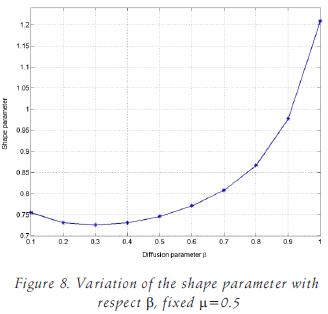
<body><![CDATA[<p align="justify">&nbsp;</p>     <p align="justify"><font face="verdana" size="2"><b>Behavior of the shape para meter with respect to diffusive coefficient</b></font></p>     <p align="justify"><font face="verdana" size="2">Our goal now is to find the relation between the shape parameter c and the diffusion coefficient p. The numerical experiment was done with N=50, u=0.5, and P be longing to {0.1, 0.2,..., 1}. For each p, the best value of c is determined by means of (10). The initial value of c is zero and it is augmented with increments of 0.001.</font></p>     <p align="justify"><font face="verdana" size="2">It was observed that the shape parameter decreases monotonically from c = 1.2 to 0.72 for 0.3 &lt; p &lt; 1; as shown in <a href="#f8">figure 8</a>. When p&lt;0.3, the shape parameter has a small increment. From <a href="#f8">figure 8</a>, we can observe that as we decrease the diffusive coefficient P the P&eacute;clet number increases.</font></p>     <p align="center"><font face="verdana" size="2"><a name="f8"></a></font></p>     <p align="center"><font face="verdana" size="2"><img src="/img/revistas/iit/v10n3/a2f8.jpg"></font></p>     <p align="justify"><font face="verdana" size="2">We note that in this numerical experiment, we hold fixed the parameters N, &micro; and tmax, and that the only variable parameter is &beta;, which in fact characterizes the PDE structure. Therefore, it can be conclude that the determination of the shape parameter is related to the structure of the time dependent advection&#150;diffusion partial differential equation.</font></p>     <p align="justify">&nbsp;</p>     <p align="justify"><font face="verdana" size="2"><b>Conclusions</b></font></p>     <p align="justify"><font face="verdana" size="2">In this article we investigated the numerical performance of multiquadric collocation methods for a time dependent convection diffusion problem in one dimension. For both implic it and explicit collocation techniques, we found that for moderate P&eacute;clet numbers an exponential rate of convergence is at tained. For the explicit technique the time step is restricted by a CFL condition, implying that in order to obtain the same RMS for both schemes, the time step for the explicit method should be one order of magnitude smaller.</font></p>     ]]></body>
<body><![CDATA[<p align="justify"><font face="verdana" size="2">We numerically found, that as we increase the P&eacute;clet number, for both methods, the slopes of the straight lines in semilog scale which corresponds to the exponential convergence rate are reduced. These results were obtained for h&#150;refinement techniques. We also shown, that exponential rate of convergence is also sat is fied for a c&#150;refinement scheme. More over, we also numerically found that the optimal value of the shape parameter c, de creases monotonically as the P&eacute;clet number is increased. This result is a first step towards to determine in an easier way the range of acceptable values of c for which spectral convergence can be at tained. We stress that within the region where the solution presents a sharp gradient, an h&#150;local refinement was used in order to reduce numerical oscillations. This suggest that in order to handle strongly convective dominated problems by means of multiquadric collocation methods, both a an <i>h&#150;c </i>refinement and a domain decomposi tion methods should be used. Recent results in this last direction are in progress and will be published elsewhere.</font></p>     <p align="justify"><font face="verdana" size="2">&nbsp;</font></p>     <p align="justify"><font face="verdana" size="2"><b>Acknowledgments</b></font></p>     <p align="justify"><font face="verdana" size="2">The first author would like to thank CONACyT for supporting this work under grant 145052.</font></p>     <p align="justify"><font face="verdana" size="2">&nbsp;</font></p>     <p align="justify"><font face="verdana" size="2"><b>References</b></font></p>     <!-- ref --><p align="justify"><font face="verdana" size="2">Behrens J., Iske A. Grid&#150;Free Adaptive Semi&#150;Lagran gian Advection Using Radial Basis Functions. <i>Computers and Mathematics with Applications, </i>43(3&#150;5):319&#150;327. 2002.</font>&nbsp;&nbsp;&nbsp;&nbsp;&nbsp;&nbsp;&nbsp;&nbsp;[&#160;<a href="javascript:void(0);" onclick="javascript: window.open('/scielo.php?script=sci_nlinks&ref=4247330&pid=S1405-7743200900030000200001&lng=','','width=640,height=500,resizable=yes,scrollbars=1,menubar=yes,');">Links</a>&#160;]<!-- end-ref --><!-- ref --><p align="justify"><font face="verdana" size="2">Boztosun I., Charafi A. An Analysis of the Linear Advection&#150;Diffusion Equation Using Mesh&#150;Free and Mesh&#150;Dependent Methods. <i>Engineering Analysis with Boundary Elements, </i>26(10):889&#150;895. 2002.</font>&nbsp;&nbsp;&nbsp;&nbsp;&nbsp;&nbsp;&nbsp;&nbsp;[&#160;<a href="javascript:void(0);" onclick="javascript: window.open('/scielo.php?script=sci_nlinks&ref=4247331&pid=S1405-7743200900030000200002&lng=','','width=640,height=500,resizable=yes,scrollbars=1,menubar=yes,');">Links</a>&#160;]<!-- end-ref --><!-- ref --><p align="justify"><font face="verdana" size="2">Carlson R.E., Foley T.A. The Parameter in Multiquadric Interpolation. <i>Computers and Mathematics with Applications, </i>21(9):29&#150;42. 1991.</font>&nbsp;&nbsp;&nbsp;&nbsp;&nbsp;&nbsp;&nbsp;&nbsp;[&#160;<a href="javascript:void(0);" onclick="javascript: window.open('/scielo.php?script=sci_nlinks&ref=4247332&pid=S1405-7743200900030000200003&lng=','','width=640,height=500,resizable=yes,scrollbars=1,menubar=yes,');">Links</a>&#160;]<!-- end-ref --><!-- ref --><p align="justify"><font face="verdana" size="2">Cheng A.H. Golberg M.A., Kansa E.J., Zammito G. Exponential convergence and <i>h&#150;c </i>Multiquadric Collocation Method for Partial Differential Equations. <i>Numerical Methods for Partial Differential Equations , </i>19(5):571&#150;594. 2003.</font>&nbsp;&nbsp;&nbsp;&nbsp;&nbsp;&nbsp;&nbsp;&nbsp;[&#160;<a href="javascript:void(0);" onclick="javascript: window.open('/scielo.php?script=sci_nlinks&ref=4247333&pid=S1405-7743200900030000200004&lng=','','width=640,height=500,resizable=yes,scrollbars=1,menubar=yes,');">Links</a>&#160;]<!-- end-ref --><!-- ref --><p align="justify"><font face="verdana" size="2">Driscoll T.A., Heryudono A.R.H. Adaptive Residual Subsampling Methods for Radial Basis Function Interpolation and Collocation Problems. <i>Submited to Computers and Mathematics with Applications.</i> 2006.</font>&nbsp;&nbsp;&nbsp;&nbsp;&nbsp;&nbsp;&nbsp;&nbsp;[&#160;<a href="javascript:void(0);" onclick="javascript: window.open('/scielo.php?script=sci_nlinks&ref=4247334&pid=S1405-7743200900030000200005&lng=','','width=640,height=500,resizable=yes,scrollbars=1,menubar=yes,');">Links</a>&#160;]<!-- end-ref --><!-- ref --><p align="justify"><font face="verdana" size="2">Fornberg B., Wright G. Stable Computation of Multiquadric Interpolants for all Values of the Shape Parameter. <i>Computers and Mathematics with Applications, </i>48(5&#150;6): 853&#150;867. 2004.</font>&nbsp;&nbsp;&nbsp;&nbsp;&nbsp;&nbsp;&nbsp;&nbsp;[&#160;<a href="javascript:void(0);" onclick="javascript: window.open('/scielo.php?script=sci_nlinks&ref=4247335&pid=S1405-7743200900030000200006&lng=','','width=640,height=500,resizable=yes,scrollbars=1,menubar=yes,');">Links</a>&#160;]<!-- end-ref --><!-- ref --><p align="justify"><font face="verdana" size="2">Kansa E.J. Multiquadrics&#151;a Scattered Data Approximation Scheme with Applications to Computational Fluid&#150;Dynamics. II. Solutions to Parabolic, Hyperbolic and Elliptic Partial Differential Equations. <i>Computers and Mathematics with Applications, </i>19(8&#150;9): 147&#150;161.1990.</font>&nbsp;&nbsp;&nbsp;&nbsp;&nbsp;&nbsp;&nbsp;&nbsp;[&#160;<a href="javascript:void(0);" onclick="javascript: window.open('/scielo.php?script=sci_nlinks&ref=4247336&pid=S1405-7743200900030000200007&lng=','','width=640,height=500,resizable=yes,scrollbars=1,menubar=yes,');">Links</a>&#160;]<!-- end-ref --><!-- ref --><p align="justify"><font face="verdana" size="2">Larsson E., Fornberg B. Theoretical and Computational Aspects of Multivariate Interpolation with Increasing Flat Radial Basis Functions. <i>Computers and Mathematics With Applications, </i>49(1): 103&#150;130. 2005.</font>&nbsp;&nbsp;&nbsp;&nbsp;&nbsp;&nbsp;&nbsp;&nbsp;[&#160;<a href="javascript:void(0);" onclick="javascript: window.open('/scielo.php?script=sci_nlinks&ref=4247337&pid=S1405-7743200900030000200008&lng=','','width=640,height=500,resizable=yes,scrollbars=1,menubar=yes,');">Links</a>&#160;]<!-- end-ref --><!-- ref --><p align="justify"><font face="verdana" size="2">Li Jichun, Chen C.S. Some Observations on Unsymmetric Radial Basis Function Collocation Methods for Convection&#150;Diffusion Problems. <i>International Journal for Numerical Methods in Engineering, </i>57(8):1085&#150;1094. 2003.</font>&nbsp;&nbsp;&nbsp;&nbsp;&nbsp;&nbsp;&nbsp;&nbsp;[&#160;<a href="javascript:void(0);" onclick="javascript: window.open('/scielo.php?script=sci_nlinks&ref=4247338&pid=S1405-7743200900030000200009&lng=','','width=640,height=500,resizable=yes,scrollbars=1,menubar=yes,');">Links</a>&#160;]<!-- end-ref --><!-- ref --><p align="justify"><font face="verdana" size="2">Madych W.R., Nelson S.A. Multivariate Interpolation and Conditionally Positive Definite Functions. <i>Mathematics of Computation, </i>54(189): 211&#150;230. 1990.</font>&nbsp;&nbsp;&nbsp;&nbsp;&nbsp;&nbsp;&nbsp;&nbsp;[&#160;<a href="javascript:void(0);" onclick="javascript: window.open('/scielo.php?script=sci_nlinks&ref=4247339&pid=S1405-7743200900030000200010&lng=','','width=640,height=500,resizable=yes,scrollbars=1,menubar=yes,');">Links</a>&#160;]<!-- end-ref --><!-- ref --><p align="justify"><font face="verdana" size="2">Madych W.R. Miscellaneous Error Bounds for Multiquadric and Related Interpolators. <i>Computers and Mathematics with Applications, </i>24(12):121&#150;138. 1992.</font>&nbsp;&nbsp;&nbsp;&nbsp;&nbsp;&nbsp;&nbsp;&nbsp;[&#160;<a href="javascript:void(0);" onclick="javascript: window.open('/scielo.php?script=sci_nlinks&ref=4247340&pid=S1405-7743200900030000200011&lng=','','width=640,height=500,resizable=yes,scrollbars=1,menubar=yes,');">Links</a>&#160;]<!-- end-ref --><!-- ref --><p align="justify"><font face="verdana" size="2">Mu&ntilde;oz&#150;G&oacute;mez J.A., Gonz&aacute;lez&#150;Casanova P., Rodr&iacute;guez&#150;G&oacute;mez G. Adaptive Node Refinement Collocation Method for Partial Differential Equations. IEEE Computer Society: Seventh Mexican International Conference on Computer Science, San Luis Potosi, M&eacute;xico, septiembre, pp. 70&#150;77. 2006.</font>&nbsp;&nbsp;&nbsp;&nbsp;&nbsp;&nbsp;&nbsp;&nbsp;[&#160;<a href="javascript:void(0);" onclick="javascript: window.open('/scielo.php?script=sci_nlinks&ref=4247341&pid=S1405-7743200900030000200012&lng=','','width=640,height=500,resizable=yes,scrollbars=1,menubar=yes,');">Links</a>&#160;]<!-- end-ref --><!-- ref --><p align="justify"><font face="verdana" size="2">Rippa S. An Algorithm for Selecting a Good Value for the Parameter <i>c </i>in Radial Basis Function Interpolation. <i>Advances in Computational Mathematics, </i>11(2&#150;3):193&#150;210. 1999.</font>&nbsp;&nbsp;&nbsp;&nbsp;&nbsp;&nbsp;&nbsp;&nbsp;[&#160;<a href="javascript:void(0);" onclick="javascript: window.open('/scielo.php?script=sci_nlinks&ref=4247342&pid=S1405-7743200900030000200013&lng=','','width=640,height=500,resizable=yes,scrollbars=1,menubar=yes,');">Links</a>&#160;]<!-- end-ref --><!-- ref --><p align="justify"><font face="verdana" size="2">Sarra Scott A. Adaptive Radial Basis Function Methods for Time Dependent Partial Differential Equations. <i>Applied Numerical Mathematics, </i>54(1):79&#150;94. 2005.</font>&nbsp;&nbsp;&nbsp;&nbsp;&nbsp;&nbsp;&nbsp;&nbsp;[&#160;<a href="javascript:void(0);" onclick="javascript: window.open('/scielo.php?script=sci_nlinks&ref=4247343&pid=S1405-7743200900030000200014&lng=','','width=640,height=500,resizable=yes,scrollbars=1,menubar=yes,');">Links</a>&#160;]<!-- end-ref --><!-- ref --><p align="justify"><font face="verdana" size="2">Schaback Robert Error Estimates and Condition Numbers for Radial Basis Function Interpolation. <i>Advances in Computational Mathematics, </i>3(3):251&#150;264. 1995.</font>&nbsp;&nbsp;&nbsp;&nbsp;&nbsp;&nbsp;&nbsp;&nbsp;[&#160;<a href="javascript:void(0);" onclick="javascript: window.open('/scielo.php?script=sci_nlinks&ref=4247344&pid=S1405-7743200900030000200015&lng=','','width=640,height=500,resizable=yes,scrollbars=1,menubar=yes,');">Links</a>&#160;]<!-- end-ref --><!-- ref --><p align="justify"><font face="verdana" size="2">Zerroukat M., Djidjeli K., Charafi A. Explicit and Implicit Meshless Methods for Linear Advection&#150;Diffusion&#150;Type Partial Differential Equations. <i>International Journal for Numerical Methods in Engineering, </i>48(1):19&#150;35. 2000.</font>&nbsp;&nbsp;&nbsp;&nbsp;&nbsp;&nbsp;&nbsp;&nbsp;[&#160;<a href="javascript:void(0);" onclick="javascript: window.open('/scielo.php?script=sci_nlinks&ref=4247345&pid=S1405-7743200900030000200016&lng=','','width=640,height=500,resizable=yes,scrollbars=1,menubar=yes,');">Links</a>&#160;]<!-- end-ref --><p align="justify"><font face="verdana" size="2">&nbsp;</font></p>     <p align="justify"><font face="verdana" size="2"><b>About the authors</b></font></p>     <p align="justify"><font face="verdana" size="2"><i>Jos&eacute; Antonio Mu&ntilde;oz&#150;G&oacute;mez. </i>He has a PhD degree in Computer Science from National Institute of Astrophysics, Optics and Electronics (INAOE). He is member of the "Sistema Nacional de Investigadores", level candidate. He currently works at the engineering department in University of Guadalajara, campus Autlan. His current research interests include numerical solution of partial differential equations, domain decomposition methods and high performance computing.</font></p>     <p align="justify"><font face="verdana" size="2"><i>Pedro Gonz&aacute;lez&#150;Casanova. </i>Is a Researcher at Universidad Nacional Autonoma de M&eacute;xico (UNAM) at DGSCA. He has an Under graduate Degree in Physics form Universidad Nacional Autonoma de Mexico and a PhD in Mathematics from Oxford University, GB, where he was research fellow. He is currently area Coordinator of the Mathematical Modeling and Scientific Computation field of the PhD programme in Mathematics at UNAM. He is a member of the "Sistema Nacional de Investigadores", level, II.</font></p>     <p align="justify"><font face="verdana" size="2"><i>Gustavo Rodr&iacute;guez&#150;G&oacute;mez. </i>Received the Bachelor degree and Master degree in Mathematics from the National Autonomous University of Mexico (UNAM). He has a PhD degree in Computational Sciences from the National Institute of Astrophysics, Optics and Electronics (INAOE). His current research interests include scientific computing and the numerical solution of partial differential equations and ordinary differential equations with radial basis functions, multirate methods also called subcycling methods.</font></p>      ]]></body><back>
<ref-list>
<ref id="B1">
<nlm-citation citation-type="journal">
<person-group person-group-type="author">
<name>
<surname><![CDATA[Behrens]]></surname>
<given-names><![CDATA[J]]></given-names>
</name>
<name>
<surname><![CDATA[Iske]]></surname>
<given-names><![CDATA[A]]></given-names>
</name>
</person-group>
<article-title xml:lang="en"><![CDATA[Grid-Free Adaptive Semi-Lagran gian Advection Using Radial Basis Functions]]></article-title>
<source><![CDATA[Computers and Mathematics with Applications]]></source>
<year>2002</year>
<volume>43</volume>
<numero>3-5</numero>
<issue>3-5</issue>
<page-range>319-327</page-range></nlm-citation>
</ref>
<ref id="B2">
<nlm-citation citation-type="journal">
<person-group person-group-type="author">
<name>
<surname><![CDATA[Boztosun]]></surname>
<given-names><![CDATA[I]]></given-names>
</name>
<name>
<surname><![CDATA[Charafi]]></surname>
<given-names><![CDATA[A]]></given-names>
</name>
</person-group>
<article-title xml:lang="en"><![CDATA[An Analysis of the Linear Advection-Diffusion Equation Using Mesh-Free and Mesh-Dependent Methods]]></article-title>
<source><![CDATA[Engineering Analysis with Boundary Elements]]></source>
<year>2002</year>
<volume>26</volume>
<numero>10</numero>
<issue>10</issue>
<page-range>889-895</page-range></nlm-citation>
</ref>
<ref id="B3">
<nlm-citation citation-type="journal">
<person-group person-group-type="author">
<name>
<surname><![CDATA[Carlson]]></surname>
<given-names><![CDATA[R.E.]]></given-names>
</name>
<name>
<surname><![CDATA[Foley]]></surname>
<given-names><![CDATA[T.A.]]></given-names>
</name>
</person-group>
<article-title xml:lang="en"><![CDATA[The Parameter in Multiquadric Interpolation]]></article-title>
<source><![CDATA[Computers and Mathematics with Applications]]></source>
<year>1991</year>
<volume>21</volume>
<numero>9</numero>
<issue>9</issue>
<page-range>29-42</page-range></nlm-citation>
</ref>
<ref id="B4">
<nlm-citation citation-type="journal">
<person-group person-group-type="author">
<name>
<surname><![CDATA[Cheng]]></surname>
<given-names><![CDATA[A.H.]]></given-names>
</name>
<name>
<surname><![CDATA[Golberg]]></surname>
<given-names><![CDATA[M.A.]]></given-names>
</name>
<name>
<surname><![CDATA[Kansa]]></surname>
<given-names><![CDATA[E.J.]]></given-names>
</name>
<name>
<surname><![CDATA[Zammito]]></surname>
<given-names><![CDATA[G]]></given-names>
</name>
</person-group>
<article-title xml:lang="en"><![CDATA[Exponential convergence and h-c Multiquadric Collocation Method for Partial Differential Equations]]></article-title>
<source><![CDATA[Numerical Methods for Partial Differential Equations]]></source>
<year>2003</year>
<volume>19</volume>
<numero>5</numero>
<issue>5</issue>
<page-range>571-594</page-range></nlm-citation>
</ref>
<ref id="B5">
<nlm-citation citation-type="journal">
<person-group person-group-type="author">
<name>
<surname><![CDATA[Driscoll]]></surname>
<given-names><![CDATA[T.A.]]></given-names>
</name>
<name>
<surname><![CDATA[Heryudono]]></surname>
<given-names><![CDATA[A.R.H.]]></given-names>
</name>
</person-group>
<article-title xml:lang="en"><![CDATA[Adaptive Residual Subsampling Methods for Radial Basis Function Interpolation and Collocation Problems]]></article-title>
<source><![CDATA[Computers and Mathematics with Applications]]></source>
<year>2006</year>
</nlm-citation>
</ref>
<ref id="B6">
<nlm-citation citation-type="journal">
<person-group person-group-type="author">
<name>
<surname><![CDATA[Fornberg]]></surname>
<given-names><![CDATA[B]]></given-names>
</name>
<name>
<surname><![CDATA[Wright]]></surname>
<given-names><![CDATA[G]]></given-names>
</name>
</person-group>
<article-title xml:lang="en"><![CDATA[Stable Computation of Multiquadric Interpolants for all Values of the Shape Parameter]]></article-title>
<source><![CDATA[Computers and Mathematics with Applications]]></source>
<year>2004</year>
<volume>48</volume>
<numero>5-6</numero>
<issue>5-6</issue>
<page-range>853-867</page-range></nlm-citation>
</ref>
<ref id="B7">
<nlm-citation citation-type="journal">
<person-group person-group-type="author">
<name>
<surname><![CDATA[Kansa]]></surname>
<given-names><![CDATA[E.J.]]></given-names>
</name>
</person-group>
<article-title xml:lang="en"><![CDATA[Multiquadrics-a Scattered Data Approximation Scheme with Applications to Computational Fluid-Dynamics: II. Solutions to Parabolic, Hyperbolic and Elliptic Partial Differential Equations]]></article-title>
<source><![CDATA[Computers and Mathematics with Applications]]></source>
<year>1990</year>
<volume>19</volume>
<page-range>8-9</page-range><page-range>147-161</page-range></nlm-citation>
</ref>
<ref id="B8">
<nlm-citation citation-type="journal">
<person-group person-group-type="author">
<name>
<surname><![CDATA[Larsson]]></surname>
<given-names><![CDATA[E]]></given-names>
</name>
<name>
<surname><![CDATA[Fornberg]]></surname>
<given-names><![CDATA[B]]></given-names>
</name>
</person-group>
<article-title xml:lang="en"><![CDATA[Theoretical and Computational Aspects of Multivariate Interpolation with Increasing Flat Radial Basis Functions]]></article-title>
<source><![CDATA[Computers and Mathematics With Applications]]></source>
<year>2005</year>
<volume>49</volume>
<numero>1</numero>
<issue>1</issue>
<page-range>103-130</page-range></nlm-citation>
</ref>
<ref id="B9">
<nlm-citation citation-type="journal">
<person-group person-group-type="author">
<name>
<surname><![CDATA[Li]]></surname>
<given-names><![CDATA[Jichun]]></given-names>
</name>
<name>
<surname><![CDATA[Chen]]></surname>
<given-names><![CDATA[C.S.]]></given-names>
</name>
</person-group>
<article-title xml:lang="en"><![CDATA[Some Observations on Unsymmetric Radial Basis Function Collocation Methods for Convection-Diffusion Problems]]></article-title>
<source><![CDATA[International Journal for Numerical Methods in Engineering]]></source>
<year>2003</year>
<volume>57</volume>
<numero>8</numero>
<issue>8</issue>
<page-range>1085-1094</page-range></nlm-citation>
</ref>
<ref id="B10">
<nlm-citation citation-type="journal">
<person-group person-group-type="author">
<name>
<surname><![CDATA[Madych]]></surname>
<given-names><![CDATA[W.R.]]></given-names>
</name>
<name>
<surname><![CDATA[Nelson]]></surname>
<given-names><![CDATA[S.A.]]></given-names>
</name>
</person-group>
<article-title xml:lang="en"><![CDATA[Multivariate Interpolation and Conditionally Positive Definite Functions]]></article-title>
<source><![CDATA[Mathematics of Computation]]></source>
<year>1990</year>
<volume>54</volume>
<numero>189</numero>
<issue>189</issue>
<page-range>211-230</page-range></nlm-citation>
</ref>
<ref id="B11">
<nlm-citation citation-type="journal">
<person-group person-group-type="author">
<name>
<surname><![CDATA[Madych]]></surname>
<given-names><![CDATA[W.R.]]></given-names>
</name>
</person-group>
<article-title xml:lang="en"><![CDATA[Miscellaneous Error Bounds for Multiquadric and Related Interpolators]]></article-title>
<source><![CDATA[Computers and Mathematics with Applications]]></source>
<year>1992</year>
<volume>24</volume>
<numero>12</numero>
<issue>12</issue>
<page-range>121-138</page-range></nlm-citation>
</ref>
<ref id="B12">
<nlm-citation citation-type="confpro">
<person-group person-group-type="author">
<name>
<surname><![CDATA[Muñoz-Gómez]]></surname>
<given-names><![CDATA[J.A.]]></given-names>
</name>
<name>
<surname><![CDATA[González-Casanova]]></surname>
<given-names><![CDATA[P]]></given-names>
</name>
<name>
<surname><![CDATA[Rodríguez-Gómez]]></surname>
<given-names><![CDATA[G]]></given-names>
</name>
</person-group>
<source><![CDATA[Adaptive Node Refinement Collocation Method for Partial Differential Equations]]></source>
<year>2006</year>
<conf-name><![CDATA[ Seventh Mexican International Conference on Computer Science]]></conf-name>
<conf-loc>San Luis Potosi San Luis Potosi</conf-loc>
<page-range>70-77</page-range></nlm-citation>
</ref>
<ref id="B13">
<nlm-citation citation-type="journal">
<person-group person-group-type="author">
<name>
<surname><![CDATA[Rippa]]></surname>
<given-names><![CDATA[S]]></given-names>
</name>
</person-group>
<article-title xml:lang="en"><![CDATA[An Algorithm for Selecting a Good Value for the Parameter c in Radial Basis Function Interpolation]]></article-title>
<source><![CDATA[Advances in Computational Mathematics]]></source>
<year>1999</year>
<volume>11</volume>
<numero>2-3</numero>
<issue>2-3</issue>
<page-range>193-210</page-range></nlm-citation>
</ref>
<ref id="B14">
<nlm-citation citation-type="journal">
<person-group person-group-type="author">
<name>
<surname><![CDATA[Sarra Scott]]></surname>
<given-names><![CDATA[A]]></given-names>
</name>
</person-group>
<article-title xml:lang="en"><![CDATA[Adaptive Radial Basis Function Methods for Time Dependent Partial Differential Equations]]></article-title>
<source><![CDATA[Applied Numerical Mathematics]]></source>
<year>2005</year>
<volume>54</volume>
<numero>1</numero>
<issue>1</issue>
<page-range>79-94</page-range></nlm-citation>
</ref>
<ref id="B15">
<nlm-citation citation-type="journal">
<person-group person-group-type="author">
<name>
<surname><![CDATA[Schaback]]></surname>
<given-names><![CDATA[Robert]]></given-names>
</name>
</person-group>
<article-title xml:lang="en"><![CDATA[Error Estimates and Condition Numbers for Radial Basis Function Interpolation]]></article-title>
<source><![CDATA[Advances in Computational Mathematics]]></source>
<year>1995</year>
<volume>3</volume>
<numero>3</numero>
<issue>3</issue>
<page-range>251-264</page-range></nlm-citation>
</ref>
<ref id="B16">
<nlm-citation citation-type="journal">
<person-group person-group-type="author">
<name>
<surname><![CDATA[Zerroukat]]></surname>
<given-names><![CDATA[M]]></given-names>
</name>
<name>
<surname><![CDATA[Djidjeli]]></surname>
<given-names><![CDATA[K]]></given-names>
</name>
<name>
<surname><![CDATA[Charafi]]></surname>
<given-names><![CDATA[A]]></given-names>
</name>
</person-group>
<article-title xml:lang="en"><![CDATA[Explicit and Implicit Meshless Methods for Linear Advection-Diffusion-Type Partial Differential Equations]]></article-title>
<source><![CDATA[International Journal for Numerical Methods in Engineering]]></source>
<year>2000</year>
<volume>48</volume>
<numero>1</numero>
<issue>1</issue>
<page-range>19-35</page-range></nlm-citation>
</ref>
</ref-list>
</back>
</article>