<?xml version="1.0" encoding="ISO-8859-1"?><article xmlns:mml="http://www.w3.org/1998/Math/MathML" xmlns:xlink="http://www.w3.org/1999/xlink" xmlns:xsi="http://www.w3.org/2001/XMLSchema-instance">
<front>
<journal-meta>
<journal-id>1405-7743</journal-id>
<journal-title><![CDATA[Ingeniería, investigación y tecnología]]></journal-title>
<abbrev-journal-title><![CDATA[Ing. invest. y tecnol.]]></abbrev-journal-title>
<issn>1405-7743</issn>
<publisher>
<publisher-name><![CDATA[Universidad Nacional Autónoma de México, Facultad de Ingeniería]]></publisher-name>
</publisher>
</journal-meta>
<article-meta>
<article-id>S1405-77432009000100003</article-id>
<title-group>
<article-title xml:lang="en"><![CDATA[Secure Communication System Using Chaotic Signals]]></article-title>
<article-title xml:lang="es"><![CDATA[Sistema de comunicación seguro usando señales caóticas]]></article-title>
</title-group>
<contrib-group>
<contrib contrib-type="author">
<name>
<surname><![CDATA[Campos-Cantón]]></surname>
<given-names><![CDATA[I]]></given-names>
</name>
<xref ref-type="aff" rid="A01"/>
</contrib>
<contrib contrib-type="author">
<name>
<surname><![CDATA[Campos-Cantón]]></surname>
<given-names><![CDATA[E]]></given-names>
</name>
<xref ref-type="aff" rid="A02"/>
</contrib>
<contrib contrib-type="author">
<name>
<surname><![CDATA[Murguía-Ibarra]]></surname>
<given-names><![CDATA[J.S.]]></given-names>
</name>
<xref ref-type="aff" rid="A03"/>
</contrib>
<contrib contrib-type="author">
<name>
<surname><![CDATA[Chavira-Rodríguez]]></surname>
<given-names><![CDATA[M.E.]]></given-names>
</name>
<xref ref-type="aff" rid="A04"/>
</contrib>
</contrib-group>
<aff id="A01">
<institution><![CDATA[,Universidad Autónoma de San Luis Potosí Facultad de Ciencias ]]></institution>
<addr-line><![CDATA[ ]]></addr-line>
<country>México</country>
</aff>
<aff id="A02">
<institution><![CDATA[,Universidad Autónoma de San Luis Potosí Departamento de Físico Matemáticas ]]></institution>
<addr-line><![CDATA[ ]]></addr-line>
<country>México</country>
</aff>
<aff id="A03">
<institution><![CDATA[,Universidad Autónoma de San Luis Potosí Departamento de Físico Matemáticas ]]></institution>
<addr-line><![CDATA[ ]]></addr-line>
<country>México</country>
</aff>
<aff id="A04">
<institution><![CDATA[,Universidad Autónoma de San Luis Potosí Departamento de Físico Matemáticas ]]></institution>
<addr-line><![CDATA[ ]]></addr-line>
<country>México</country>
</aff>
<pub-date pub-type="pub">
<day>00</day>
<month>03</month>
<year>2009</year>
</pub-date>
<pub-date pub-type="epub">
<day>00</day>
<month>03</month>
<year>2009</year>
</pub-date>
<volume>10</volume>
<numero>1</numero>
<fpage>21</fpage>
<lpage>27</lpage>
<copyright-statement/>
<copyright-year/>
<self-uri xlink:href="http://www.scielo.org.mx/scielo.php?script=sci_arttext&amp;pid=S1405-77432009000100003&amp;lng=en&amp;nrm=iso"></self-uri><self-uri xlink:href="http://www.scielo.org.mx/scielo.php?script=sci_abstract&amp;pid=S1405-77432009000100003&amp;lng=en&amp;nrm=iso"></self-uri><self-uri xlink:href="http://www.scielo.org.mx/scielo.php?script=sci_pdf&amp;pid=S1405-77432009000100003&amp;lng=en&amp;nrm=iso"></self-uri><abstract abstract-type="short" xml:lang="en"><p><![CDATA[We present experimental results of a chaotic communication system that employs direct modulation, with the Chua's chaotic oscillator as a core of the transmitter block. The main result is that its possible to recover the information signal if we modulate over one state of oscillator and transmit a different state, avoiding a correlation between the information signal and the chaotic carrier.]]></p></abstract>
<abstract abstract-type="short" xml:lang="es"><p><![CDATA[Se presentan resultados experimentales de un sistema de comunicación caótico que emplea modulación directa, con el oscilador caótico de Chua como corazón del bloque transmisor. El principal objetivo es que es posible recuperar la señal de información al modular un estado del oscilador y transmitir un estado diferente, evitando una correlación entre la señal de información y la portadora caótica.]]></p></abstract>
<kwd-group>
<kwd lng="en"><![CDATA[Chaotic communication]]></kwd>
<kwd lng="en"><![CDATA[chaotic carrier]]></kwd>
<kwd lng="en"><![CDATA[chaos synchronization]]></kwd>
<kwd lng="en"><![CDATA[transmitter block]]></kwd>
<kwd lng="en"><![CDATA[receiver block]]></kwd>
<kwd lng="es"><![CDATA[Comunicación caótica]]></kwd>
<kwd lng="es"><![CDATA[portadora caótica]]></kwd>
<kwd lng="es"><![CDATA[sincronización de caos]]></kwd>
<kwd lng="es"><![CDATA[bloque transmisor]]></kwd>
<kwd lng="es"><![CDATA[bloque receptor]]></kwd>
</kwd-group>
</article-meta>
</front><body><![CDATA[ <p align="justify"><font face="verdana" size="4">Estudios e investigaciones recientes</font></p>     <p align="justify"><font face="verdana" size="2">&nbsp;</font></p>     <p align="center"><font face="verdana" size="4"><b>Secure Communication System Using Chaotic Signals</b></font></p>     <p align="center"><font face="verdana" size="2">&nbsp;</font></p>     <p align="center"><font face="verdana" size="3"><b>Sistema de comunicaci&oacute;n seguro usando se&ntilde;ales ca&oacute;ticas</b></font></p>     <p align="center"><font face="verdana" size="2">&nbsp;</font></p>     <p align="center"><font face="verdana" size="2"><b>I. Campos&#150;Cant&oacute;n<sup>1</sup>, E. Campos&#150;Cant&oacute;n<sup>2</sup>, J.S. Murgu&iacute;a&#150;Ibarra<sup>3</sup> and M.E. Chavira&#150;Rodr&iacute;guez<sup>4</sup></b></font></p>     <p align="justify"><font face="verdana" size="2">&nbsp;</font></p>     <p align="justify"><font face="verdana" size="2"><i><sup>1</sup> Facultad de Ciencias </i><i>Universidad Aut&oacute;noma de San Luis Potos&iacute;, M&eacute;xico E&#150;mail: <a href="mailto:icamposu@galia.fc.aslp.mx">icamposu@galia.fc.aslp.mx</a></i></font></p>     <p align="justify"><font face="verdana" size="2"><i><sup>2</sup> Departamento de F&iacute;sico Matem&aacute;ticas, CIEP&#150;FI </i><i>Universidad Aut&oacute;noma de San Luis Potos&iacute;, M&eacute;xico E&#150;mail: <a href="mailto:ecamp@uaslp.mx">ecamp@uaslp.mx</a></i></font></p>     ]]></body>
<body><![CDATA[<p align="justify"><font face="verdana" size="2"><i><sup>3 </sup>Departamento de F&iacute;sico Matem&aacute;ticas Universidad Aut&oacute;noma de San Luis Potos&iacute;, M&eacute;xico E&#150;mail: <a href="mailto:ondeleto@uaslp.mx">ondeleto@uaslp.mx</a></i></font></p>     <p align="justify"><font face="verdana" size="2"><i><sup>4</sup> Departamento de F&iacute;sico Matem&aacute;ticas </i><i>Universidad Aut&oacute;noma de San Luis Potos&iacute;, M&eacute;xico E&#150;mail: <a href="mailto:mchavira@uaslp.mx">mchavira@uaslp.mx</a></i></font></p>     <p align="justify"><font face="verdana" size="2">&nbsp;</font></p>     <p align="justify"><font face="verdana" size="2">Recibido: agosto de 2006     <br> Aceptado: enero de 2008</font></p>     <p align="justify"><font face="verdana" size="2">&nbsp;</font></p>     <p align="justify"><font face="verdana" size="2"><b><i>Abstract</i></b></font></p>     <p align="justify"><font face="verdana" size="2"><i>We present experimental results of a chaotic communication system that employs direct modulation, with the Chua's chaotic oscillator as a core of the transmitter block. The main result is that its possible to recover the information signal if we modulate over one state of oscillator and transmit a different state, avoiding a correlation between the information signal and the chaotic carrier.</i></font></p>     <p align="justify"><font face="verdana" size="2"><b><i>Keywords: </i></b><i>Chaotic communication, chaotic carrier, chaos synchronization, transmitter block, receiver block.</i></font></p>     <p align="justify"><font face="verdana" size="2">&nbsp;</font></p>     ]]></body>
<body><![CDATA[<p align="justify"><font face="verdana" size="2"><b>Resumen</b></font></p>     <p align="justify"><font face="verdana" size="2">Se presentan resultados experimentales de un sistema de comunicaci&oacute;n ca&oacute;tico que emplea modulaci&oacute;n directa, con el oscilador ca&oacute;tico de Chua como coraz&oacute;n del bloque transmisor. El principal objetivo es que es posible recuperar la se&ntilde;al de informaci&oacute;n al modular un estado del oscilador y transmitir un estado diferente, evitando una correlaci&oacute;n entre la se&ntilde;al de informaci&oacute;n y la portadora ca&oacute;tica.</font></p>     <p align="justify"><font face="verdana" size="2"><b>Descriptores: </b>Comunicaci&oacute;n ca&oacute;tica, portadora ca&oacute;tica, sincronizaci&oacute;n de caos, bloque transmisor, bloque receptor.</font></p>     <p align="justify"><font face="verdana" size="2">&nbsp;</font></p>     <p align="justify"><font face="verdana" size="2"><b>Introduction</b></font></p>     <p align="justify"><font face="verdana" size="2">Despite the fact that there exist several conventional communication systems, one main interest is to warrant privacy of the information. In this aspect the   chaotic   communication   systems   have   beencontributed to the secure communication area. Research in the last two decades  (Itho <i>et al., </i>1995; Sushchik <i>et al., </i>2000; Maybhate A. <i>et al., </i>2003) indicates that chaotic behavior has several characteristics  that makes it attractive for use in communication systems   as   carrier   signals.   To   mention   some   basic techniques, we can consider chaotic mask, direct modulation, and binary modulation. a) <i>Chaotic mask </i>(Cuomo <i>et al., </i>1993; Kocarev et <i>al., </i>1992), where the information signal is added to the chaotic carrier in the transmitter block, and the receiver block just takes the chaotic carrier away from the receiver signal in order to recover the information signal. b) For <i>direct modulation </i>(Halle <i>et al., </i>1993; Ur&iacute;as, 1999; Volkovskii <i>et al., </i>1993), we refer to the action of adding the information signal to the dynamics of the chaotic oscillator in the transmitter block, whereas an inverse operation is carried out on the receiver block to recover the information signal, c) In <i>binary modulation </i>(Dedieu <i>et al., </i>1993; Parlitz et <i>al., </i>1992), the information signal is codified by two distinct chaotic systems, and it is recovered by detecting synchronization with similar corresponding systems in the receiver block. One target is to improve or propose new schemes (Dmitriev A.S. <i>et al., </i>2003; Larson <i>et al., </i>2006) of this kind of communication systems.</font></p>     <p align="justify"><font face="verdana" size="2">However, some problems have been presented when chaotic oscillators are used to modulate information signals. For instance, for a certain range of amplitudes and frequencies of the information signal there exist a high correlation between the chaotic carrier signal and the information signal, as long as destruction of chaotic behavior is presented, respectively. These two problems avoid the main purpose of "masking" information signal using chaos.</font></p>     <p align="justify"><font face="verdana" size="2">In this work, we propose a procedure to avoid correlation between information signal and chaotic carrier signal, and the possibility to recover the information signal. The physical implementation of this communication system is based on Chua's circuit under the same spirit that in (Corron <i>et al., </i>1997).</font></p>     <p align="justify"><font face="verdana" size="2">The structure of this paper is as follows. The section called chaotic communication system describes the general theory of this communication system. The following section contains the physical implementation of such communication system. finally, the experimental results and conclusions are presented.</font></p>     <p align="justify"><font face="verdana" size="2">&nbsp;</font></p>     ]]></body>
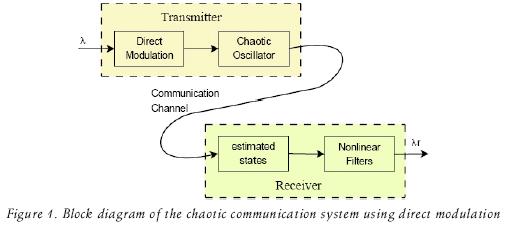
<body><![CDATA[<p align="justify"><font face="verdana" size="2"><b>Chaotic Communication System</b></font></p>     <p align="justify"><font face="verdana" size="2"><a href="#f1">Figure 1</a> shows the basic functional blocks of our chaotic communication system. The main blocks are the transmitter and the receiver, respectively. It is possible to consider a c ommunication system with the follow ing characteristics:</font></p>     <blockquote>       <p align="justify"><font face="verdana" size="2">a) In the transmitter, we modulate one state of the system with the information signal and use a different state as a chaotic carrier. With this, we mask the in formation signal and avoid correlation between these signals.</font></p>       <p align="justify"><font face="verdana" size="2">b)&nbsp;In the receiver, we reconstruct others states that were not transmitted using a convergence strategy; further more, we use a non&#150;lineal fi lters to reconstruct the information signal.</font></p> </blockquote>     <p align="justify"><font face="verdana" size="2">The components of our chaotic communication system are described be low.</font></p>     <p align="center"><font face="verdana" size="2"><a name="f1"></a></font></p>     <p align="center"><font face="verdana" size="2"><img src="/img/revistas/iit/v10n1/a3f1.jpg"></font></p>     <p align="justify"><font face="verdana" size="2">&nbsp;</font></p>     <p align="justify"><font face="verdana" size="2"><b>The Transmitter</b></font></p>     ]]></body>
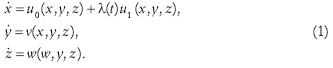
<body><![CDATA[<p align="justify"><font face="verdana" size="2">Basically, the transmitter couples the information signal to the communication channel. It is comprised of a chaotic oscillator, which is modulated by the information signal using direct modulation. Considering a third order oscillator, the transmitter has the form</font></p>     <p align="center"><font face="verdana" size="2"><img src="/img/revistas/iit/v10n1/a3s1.jpg"></font></p>     <p align="justify"><font face="verdana" size="2">The parameter <i>&lambda;(t) </i>is a prescribed function of time that represents the information to be communicated. The set of equations 1, which represents the transmitter, has to sat isfy the follow ing requirements.</font></p>     <p align="justify"><font face="verdana" size="2">1. To make use of one state to modulate and the other one as a carrier. In our case <i>&lambda; </i>is the state modulated, where as the <i>y </i>state is transmitted.</font></p>     <p align="justify"><font face="verdana" size="2">2.&nbsp;The acceptable values of <i>&lambda;(t)</i>need to sat isfy the con dition   &zwnj; <i>&lambda;(t)</i>  &zwnj; &lt;&epsilon;. The constant &epsilon; is selected such that the oscillator in al ways op er ates in a chaotic regime.</font></p>     <p align="justify"><font face="verdana" size="2">In our approach, the carrier is <i>y(t), </i>in contrast to (Corron <i>et al., </i>1997), where the carrier was <i>x(t)</i>and the sub system formed by <i>(y,z) </i>is in dependent of the param eter <i>&lambda;.</i></font></p>     <p align="justify"><font face="verdana" size="2">&nbsp;</font></p>     <p align="justify"><font face="verdana" size="2"><b>The Receiver</b></font></p>     <p align="justify"><font face="verdana" size="2">It is well known that the main function of the receiver is to extract the information signal from the degraded version of the transmitted signal coming from the channel. From <a href="#f1">figure 1</a>, the receiver consists of two blocks, where the first one is useful to reconstruct the states that were not transmitted. The way to reconstruct states depends strongly of the chaotic oscillator employed. In the next section is presented the approach to estimate the non&#150;transmitted states using the Chua's oscillator. The original signals <i>x </i>and <i>z </i>are reconstructed from signal, as long as <i>x<sub>r</sub> </i>and z<sub>r</sub> by means of chaotic synchronization at the receiving end. The second block is utilized to estimate the information signal. The naive approach to recover <i>&lambda;(t)</i>would be to use the estimation</font></p>     <p align="center"><font face="verdana" size="2"><img src="/img/revistas/iit/v10n1/a3s2.jpg"></font></p>     ]]></body>
<body><![CDATA[<p align="justify"><font face="verdana" size="2">However, if we use equation (2) to implement the demodulator, singularities are encountered whenever <i>u</i><sub>1</sub>= (<i>x<sub>r</sub></i>, <i>y</i>, <i>z</i><sub>r</sub>) = 0. In order to avoid this situation we use a low pass filter.</font></p>     <p align="justify"><font face="verdana" size="2">Alternatively to estimate equation (2), we used the uncoupled pair of first order filters</font></p>     <p align="center"><font face="verdana" size="2"><img src="/img/revistas/iit/v10n1/a3s3.jpg"></font></p>     <p align="center"><font face="verdana" size="2"><img src="/img/revistas/iit/v10n1/a3s4.jpg"></font></p>     <p align="justify"><font face="verdana" size="2">In the filters (3)&#150;(4), the con stant <i>&kappa; </i>&gt;0 works as a tuning parameter. Its main functionality is to reduce residues of the carrier in the output of the receiver. Consequently, the information signal is estimated as <i><img src="/img/revistas/iit/v10n1/a3s12.jpg">=</i>(<i>x&#150;p<sub>0 </sub>) </i>/<i> p<sub>1</sub>, </i>where the parameters <i>p<sub>0</sub> </i>and <i>p<sub>1</sub> </i>are the outputs of the filters (3)&#150;(4). This signal<i> &lambda;<sub>r </sub> </i>is further passed through the low&#150;pass filter.</font></p>     <p align="center"><font face="verdana" size="2"><img src="/img/revistas/iit/v10n1/a3s5.jpg"></font></p>     <p align="justify"><font face="verdana" size="2">Summarizing, the receiver block consists of a subsystem to estimate the variable states <i>x<sub>r</sub> </i>and <i>z<sub>r</sub> , </i>that is driven by the in coming carrier <i>y, </i>which was gener ated by the transmitter and followed by the filters (3)&#150;(5). The demodulated signal is <i>&lambda;<sub>f </sub>, </i>and the quantities <i>&kappa; </i>and &tau;<i><sub>f</sub></i> , are tuning p a ram e ters of the receiver.</font></p>     <p align="justify"><font face="verdana" size="2">&nbsp;</font></p>     <p align="justify"><font face="verdana" size="2"><b>Physical Implementation</b></font></p>     <p align="justify"><font face="verdana" size="2">The physical implementation of this communication system is based on a chaotic electriccircuit that does not involve an a log multiplication, and it is a very handy and cheap electric system. It uses only resistors, capacitors, diodes and operational amplifiers as we will see.</font></p>     ]]></body>
<body><![CDATA[<p align="justify"><font face="verdana" size="2">&nbsp;</font></p>     <p align="justify"><font face="verdana" size="2"><b>The Transmitter</b></font></p>     <p align="justify"><font face="verdana" size="2"><a href="#f2">Figure 2</a> shows the electronic circuit of the transmitter block. It is worth to note that the Chua's oscillator is the core of the transmitter, where the component values employed for its construction are setting to have a chaotic behavior, and the value of potentiometer was fixed at 1.8k<b>&Omega;</b>. For more information of Chua's circuit see (Chua <i>et al., </i>1992).</font></p>     <p align="center"><font face="verdana" size="2"><a name="f2"></a></font></p>     <p align="center"><font face="verdana" size="2"><img src="/img/revistas/iit/v10n1/a3f2.jpg"></font></p>     <p align="justify"><font face="verdana" size="2">The mathematic model of the transmitter block is described by the follow ing set of equations:</font></p>     <p align="center"><font face="verdana" size="2"><img src="/img/revistas/iit/v10n1/a3s6.jpg"></font></p>     <p align="center"><font face="verdana" size="2"><img src="/img/revistas/iit/v10n1/a3s7.jpg"></font></p>     <p align="center"><font face="verdana" size="2"><img src="/img/revistas/iit/v10n1/a3s8.jpg"></font></p>     <p align="justify"><font face="verdana" size="2">where <i>V<sub>1</sub> ,V<sub>2</sub>, </i>and <i>I<sub>L</sub> </i>are the corresponding states, and , <i>G<sub>m</sub> = </i>1 / R<sub>1</sub> , G = 1 / <i>Potl, </i>C<sub>1</sub> , C<sub>2</sub> and <i>L </i>are parameters of the system. According to our model (1), <i>x =V<sub>1 </sub>, Y=V<sub>2 </sub></i>and <i>z = I<sub>L</sub>. </i>Here, the direct modulation is applied to the node V<sub>1</sub> , the information signal <i>V<sub>m</sub> </i>is injected to the oscillator by the resistor <i>R<sub>1</sub></i>, and is transmitted the state <i>V<sub>2 </sub></i>. With this will avoid correlation between the in formation signal <i>V<sub>m</sub> </i>and the chaotic carrier <i>V<sub>2 </sub></i><sub></sub>.</font></p>     ]]></body>
<body><![CDATA[<p align="justify"><font face="verdana" size="2">&nbsp;</font></p>     <p align="justify"><font face="verdana" size="2"><b>The Receiver</b></font></p>     <p align="justify"><font face="verdana" size="2">In the receiver block, the problem is how we can estimate the non&#150;transmitted states using just one state. As we said, the <i>V<sub>2</sub> </i>state is the chaotic carrier and it is employed to estimate the states <i>V<sub>1</sub> </i>and <i>I<sub>L</sub>. </i>To achieve the estimation of the non&#150;transmitted states <i>V<sub>1</sub> </i>and <i>I<sub>L</sub></i>, we use equations <i>V</i><sub>1</sub> and <i>I<sub>L</sub>' </i>to obtain the estimated states and as follow</font></p>     <p align="center"><font face="verdana" size="2"><img src="/img/revistas/iit/v10n1/a3s9.jpg"></font></p>     <p align="center"><font face="verdana" size="2"><img src="/img/revistas/iit/v10n1/a3s10.jpg"></font></p>     <p align="justify"><font face="verdana" size="2"><a href="#f3">Figure 3</a> shows the estimator block to estimate states Vj and <i>I<sub>L</sub>'. </i>This estimator is the realization of equations 9 and 10.</font></p>     <p align="center"><font face="verdana" size="2"><a name="f3"></a></font></p>     <p align="center"><font face="verdana" size="2"><img src="/img/revistas/iit/v10n1/a3f3.jpg"></font></p>     <p align="justify"><font face="verdana" size="2">In <a href="#f4">figure 4</a> is shown the electrical circuit diagram to implement the estimator block. This subsystem is formed for one integrator, one differentiator and one adder circuits. The values ad justed of the potentiometers were Pot2 = 390 <b>&Omega;</b>, Pot3 = 4.4 k<b>&Omega;</b>, Pot4 = 390 <b>&Omega;</b>, Pot5 = 3.9 k<b>&Omega;</b> and Pot6 = 3.6 k<b>&Omega;</b>. These values of the potentiometers were tuning to work properly with the frequency of the chaotic carrier signal.</font></p>     <p align="center"><font face="verdana" size="2"><a name="f4"></a></font></p>     ]]></body>
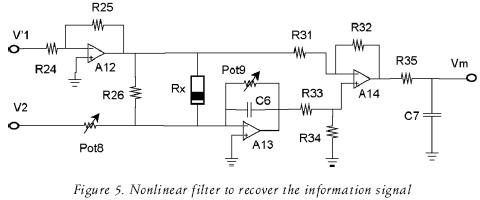
<body><![CDATA[<p align="center"><font face="verdana" size="2"><img src="/img/revistas/iit/v10n1/a3f4.jpg"></font></p>     <p align="justify"><font face="verdana" size="2">In order to recover the information signal , we need to use the equation. There fore, the information signal can be recovered as follows</font></p>     <p align="justify"><font face="verdana" size="2">This circuit estimates the state <i>V<sub>1</sub>' </i>using the state V<i> <sup>2</sup>. </i>The component values employed are</font></p>     <p align="justify"><font face="verdana" size="2"><i>R</i><sub>1</sub> = 10 <i>&kappa;</i><b>&Omega;</b></font></p>     <p align="justify"><font face="verdana" size="2"><i>R<sub>6</sub>= R</i><sub>7</sub><i> =</i>1<i> <i>&kappa;</i></i><b>&Omega;</b>,</font></p>     <p align="justify"><font face="verdana" size="2"><i>R</i><sub>8</sub><i> = R</i><sub>9</sub> <i>=R</i><sub>10</sub><i> =R</i><sub>11</sub><i> =R</i><sub>12</sub> = <i>R</i><sub>13</sub><i>= </i>10 <b>&Omega;</b>, </font></p>     <p align="justify"><font face="verdana" size="2"><i>Pot </i>2,3,4,6<i> =</i> 10<i> <i><i>&kappa;</i></i></i><b>&Omega;</b>,</font></p>     <p align="justify"><font face="verdana" size="2"><i>Pot 5 = </i>100<i> <i><i>&kappa;</i></i></i><b>&Omega;</b>.</font></p>     <p align="justify"><font face="verdana" size="2">C<sub>3</sub> = C<sub>4</sub> <i>=</i> 100<i> nF </i>and the operational amplifiers are TL&#150;082.</font></p>     <p align="justify"><font face="verdana" size="2">In <a href="#f5">figure 5</a> is shown the recover information block. The de vice labeled a s Rx is a negative non linear resistive and is shown in the transmitter block, see <a href="#f2">figure 2</a>. The values of th e potentiometers and were ad justed to 1.9 &kappa;<b>&Omega;</b> and 1.71 &kappa;<b>&Omega;</b>, respectively.</font></p>     ]]></body>
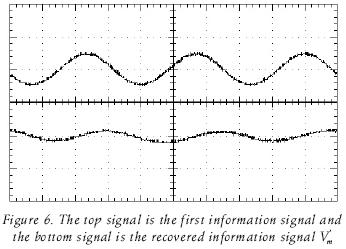
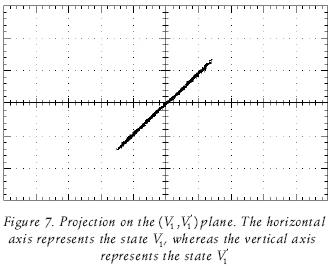
<body><![CDATA[<p align="center"><font face="verdana" size="2"><a name="f5"></a></font></p>     <p align="center"><font face="verdana" size="2"><img src="/img/revistas/iit/v10n1/a3f5.jpg"></font></p>     <p align="justify"><font face="verdana" size="2">The element labeled as Rx is an identical Chua's diode, which is showed in the transmitter circuit (<a href="#f2">figure 2</a>). The component values employed to implement the non&#150;linear of the receiver block</font></p>     <p align="justify"><font face="verdana" size="2"><i>R</i><sub>24</sub>= <i>R</i><sub>25</sub>=<i> R</i><sub>26</sub>= <i>R</i><sub>31</sub>= <i>R</i><sub>32</sub>= 12<i><i><i>&kappa;</i></i></i><b>&Omega;</b>,</font></p>     <p align="justify"><font face="verdana" size="2"><i>R</i><sub>33</sub>= <i>R</i><sub>34</sub>= <i>R</i><sub>35</sub>= 10&Omega;</font></p>     <p align="justify"><font face="verdana" size="2"><i>Pot </i>8,9 =10<i> <i><i>&kappa;</i></i></i><b>&Omega;,</b></font></p>     <p align="justify"><font face="verdana" size="2"><i>C</i><sub>6</sub><i>=C</i><sub>7</sub><i> =10 nF </i>and the operational amplifiers are TL&#150;082.</font></p>     <p align="justify"><font face="verdana" size="2">&nbsp;</font></p>     <p align="justify"><font face="verdana" size="2"><b>Results and Conclusions</b></font></p>     <p align="justify"><font face="verdana" size="2">Three different signals were considered as information signal V<i><sub>m </sub>, </i>and we use couple wire transmission to transmit all signals. The first information signal was a simple sine function V<i><sub>m</sub> </i>=Asin <b>&omega;</b><i>t</i>, with amplitude <i>A </i>=0.5V and angular frequency <i>w=</i>2<i>&pi;f </i>(<i>f =</i>3<i>&kappa;Hz). </i>This signal is shown in <a href="#f6">figure 6</a> (top signal). Following our approach, in the receiver block we have three states (V<sub>1</sub>',<i>V</i><sub>2</sub>',<i> I<sub>L</sub></i>'). <a href="#f7">Figure 7</a> shows the projection on the (V<sub>1</sub>, V<sub>1</sub>) plane, the receiver variable V<sub>1</sub> against its transmitter    counterpart V<sub>1</sub>     . This    graph    indicates synchronization between these two signals, despite the fact that both circuits are running chaotically. The recovered information signal is shown in <a href="#f6">figure 6</a> (bottom signal). The attenuation and delay of the reconstructed signal are introduced by the filters used for its reconstruction.</font></p>     ]]></body>
<body><![CDATA[<p align="center"><font face="verdana" size="2"><a name="f6"></a></font></p>     <p align="center"><font face="verdana" size="2"><img src="/img/revistas/iit/v10n1/a3f6.jpg"></font></p>     <p align="center"><font face="verdana" size="2"><a name="f7"></a></font></p>     <p align="center"><font face="verdana" size="2"><img src="/img/revistas/iit/v10n1/a3f7.jpg"></font></p>     <p align="justify"><font face="verdana" size="2">The results of correlation between the information signal and the chaotic carrier are shown in <a href="#f8">figure 8</a>. <a href="#f8">Figure 8</a> shows the information signal (A), the modulated state V<sub>1</sub> (B), and the chaotic carrier V<sub>2</sub> (C), respectively. We can observe that there is no correlation between the signals of <a href="#f8">figure 8</a> (A) and (C), whereas in signals of <a href="#f10">figure 10</a> (A) and (B) is evident a correlation.</font></p>     <p align="center"><font face="verdana" size="2"><a name="f8"></a></font></p>     <p align="center"><font face="verdana" size="2"><img src="/img/revistas/iit/v10n1/a3f8.jpg"></font></p>     <p align="center"><font face="verdana" size="2"><a name="f9"></a></font></p>     <p align="center"><font face="verdana" size="2"><img src="/img/revistas/iit/v10n1/a3f9.jpg"></font></p>     <p align="center"><font face="verdana" size="2"><a name="f10"></a></font></p>     ]]></body>
<body><![CDATA[<p align="center"><font face="verdana" size="2"><img src="/img/revistas/iit/v10n1/a3f10.jpg"></font></p>     <p align="justify"><font face="verdana" size="2">The second information signal analyzed was a square signal with amplitude equals to 1 Vpp, and a frequency of 100 Hz. The results obtained with this signal are shown in <a href="#f9">Figure 9</a>; the top signal is <i>V<sub>m</sub></i>, whereas the bottom signal is the recovered information signal <i>V'<sub>m</sub></i>. The smoothening of the transitions in the demodulated signal is introduced by the filters.</font></p>     <p align="justify"><font face="verdana" size="2">Finally, we consider as an information signal <i>V<sub>m</sub> </i>a music signal, obtained from the sound card of the PC. <a href="#f10">Figure 10</a> shows a seg ment of this signal (top), and the corresponding demodulated signal (bottom). The music was recovered very well.</font></p>     <p align="justify"><font face="verdana" size="2">In conclusion, a method of chaotic communication using direct modulation was proposed here, and a practical experimental implementation of this communication system was realized. We could recover the information signal using this method, where correlation between the information signal and the chaotic carrier was avoided. It is clear that Chua's chaotic oscillator al lowed making a practical evaluation of the direct modulation approach to secure communications.</font></p>     <p align="justify"><font face="verdana" size="2">Finally, despite we do not consider the effect of the noise in the experiments, the possibility to consider the noise will be examined in an other publication.</font></p>     <p align="justify"><font face="verdana" size="2">&nbsp;</font></p>     <p align="justify"><font face="verdana" size="2"><b>Acknowledgments</b></font></p>     <p align="justify"><font face="verdana" size="2">ECC received financial support from FAI&#150;UASLP under contract C07&#150;FAI&#150;11&#150;38.74, and JSM received financial support from PROMEP and FAI&#150;UASLP.</font></p>     <p align="justify"><font face="verdana" size="2">&nbsp;</font></p>     <p align="justify"><font face="verdana" size="2"><b>References</b></font></p>     ]]></body>
<body><![CDATA[<!-- ref --><p align="justify"><font face="verdana" size="2">Chua L.O., Kocarev L., Eckert K., Itoh M. Experimental Chaos Synchronization in Chua's Circuit. <i>Int. J. Bifur. &amp; chaos,</i> (12):705&#150;708.1992. </font>&nbsp;&nbsp;&nbsp;&nbsp;&nbsp;&nbsp;&nbsp;&nbsp;[&#160;<a href="javascript:void(0);" onclick="javascript: window.open('/scielo.php?script=sci_nlinks&ref=4244745&pid=S1405-7743200900010000300001&lng=','','width=640,height=500,resizable=yes,scrollbars=1,menubar=yes,');">Links</a>&#160;]<!-- end-ref --><!-- ref --><p align="justify"><font face="verdana" size="2">Corron N.J., Hahs D.W. A New Approach to Communications Using Chaotic Signals. <i>IEEE, Trans. Circuits System,</i> I(44):373&#150;382. 1997. </font>&nbsp;&nbsp;&nbsp;&nbsp;&nbsp;&nbsp;&nbsp;&nbsp;[&#160;<a href="javascript:void(0);" onclick="javascript: window.open('/scielo.php?script=sci_nlinks&ref=4244746&pid=S1405-7743200900010000300002&lng=','','width=640,height=500,resizable=yes,scrollbars=1,menubar=yes,');">Links</a>&#160;]<!-- end-ref --><!-- ref --><p align="justify"><font face="verdana" size="2">Cuomo K.M., Oppenheim A.V., Strogatz S.H. Robustness and Signal Recovery in a Synchronized Chaotic System.<i> Int. J. Bifur. and Chaos, </i>(3):1629&#150;1638. 1993. </font>&nbsp;&nbsp;&nbsp;&nbsp;&nbsp;&nbsp;&nbsp;&nbsp;[&#160;<a href="javascript:void(0);" onclick="javascript: window.open('/scielo.php?script=sci_nlinks&ref=4244747&pid=S1405-7743200900010000300003&lng=','','width=640,height=500,resizable=yes,scrollbars=1,menubar=yes,');">Links</a>&#160;]<!-- end-ref --><!-- ref --><p align="justify"><font face="verdana" size="2">Dedieu H., Kennedy M.P., Hasler M. Chaotic Shift Keying: Modulation and Demodulation of Chaotic Carrier Using Self&#150;Synchronization Chua's Circuit. <i>IEEE Trans. Circuits </i><i>Syst. </i>II(40):634&#150;642.1993. </font>&nbsp;&nbsp;&nbsp;&nbsp;&nbsp;&nbsp;&nbsp;&nbsp;[&#160;<a href="javascript:void(0);" onclick="javascript: window.open('/scielo.php?script=sci_nlinks&ref=4244748&pid=S1405-7743200900010000300004&lng=','','width=640,height=500,resizable=yes,scrollbars=1,menubar=yes,');">Links</a>&#160;]<!-- end-ref --><!-- ref --><p align="justify"><font face="verdana" size="2">Dmitriev A.S., Kyarginsky B.Y., Panas A.I., Starkov S.O. Experiments on Ultra Wideband Direct Chaotic Information Transmission in Microwave Band. <i>Int. J. Bifur. &amp; </i><i>Chaos, </i>(13):1495&#150;1507. 2003. </font>&nbsp;&nbsp;&nbsp;&nbsp;&nbsp;&nbsp;&nbsp;&nbsp;[&#160;<a href="javascript:void(0);" onclick="javascript: window.open('/scielo.php?script=sci_nlinks&ref=4244749&pid=S1405-7743200900010000300005&lng=','','width=640,height=500,resizable=yes,scrollbars=1,menubar=yes,');">Links</a>&#160;]<!-- end-ref --><!-- ref --><p align="justify"><font face="verdana" size="2">Halle K.S., Wu C.W., Itoh M., Chua L.O. Spread Spectrum Communication Through Modulation of Chaos. <i>Int. J. of</i><i> Bifur. and Chaos, </i>(3):469&#150;477. 1993. </font>&nbsp;&nbsp;&nbsp;&nbsp;&nbsp;&nbsp;&nbsp;&nbsp;[&#160;<a href="javascript:void(0);" onclick="javascript: window.open('/scielo.php?script=sci_nlinks&ref=4244750&pid=S1405-7743200900010000300006&lng=','','width=640,height=500,resizable=yes,scrollbars=1,menubar=yes,');">Links</a>&#160;]<!-- end-ref --><!-- ref --><p align="justify"><font face="verdana" size="2">Itho M., Murakami V. New Communication System Via Chaotic Synchronizations and Modulations. <i>IEICE Trans. </i><i>Fundament., </i>E78A:285&#150;290. 1995.</font>&nbsp;&nbsp;&nbsp;&nbsp;&nbsp;&nbsp;&nbsp;&nbsp;[&#160;<a href="javascript:void(0);" onclick="javascript: window.open('/scielo.php?script=sci_nlinks&ref=4244751&pid=S1405-7743200900010000300007&lng=','','width=640,height=500,resizable=yes,scrollbars=1,menubar=yes,');">Links</a>&#160;]<!-- end-ref --><!-- ref --><p align="justify"><font face="verdana" size="2">Larson&#150;Lawrence L.J.M., Tsimring L. <i>Digital Communications Using Chaos and Nonlinear Dynamics. </i>Edt. Springer. 2006.</font>&nbsp;&nbsp;&nbsp;&nbsp;&nbsp;&nbsp;&nbsp;&nbsp;[&#160;<a href="javascript:void(0);" onclick="javascript: window.open('/scielo.php?script=sci_nlinks&ref=4244752&pid=S1405-7743200900010000300008&lng=','','width=640,height=500,resizable=yes,scrollbars=1,menubar=yes,');">Links</a>&#160;]<!-- end-ref --><!-- ref --><p align="justify"><font face="verdana" size="2">Kocarev V, Halle K.S., Eckert K., Chua L.O., Parlitz V. Experimental Demonstration of Secure Communications Via Chaotic Synchronization. <i>Int. J. Bifur. and Chaos, </i>(2):709 713. 1992.</font>&nbsp;&nbsp;&nbsp;&nbsp;&nbsp;&nbsp;&nbsp;&nbsp;[&#160;<a href="javascript:void(0);" onclick="javascript: window.open('/scielo.php?script=sci_nlinks&ref=4244753&pid=S1405-7743200900010000300009&lng=','','width=640,height=500,resizable=yes,scrollbars=1,menubar=yes,');">Links</a>&#160;]<!-- end-ref --><!-- ref --><p align="justify"><font face="verdana" size="2">Maybhate A., Amritkar R.E., Kulkarni D.R. Estimation of Initial Conditions and Secure Communication. <i>Int. J. Bifur. and Chaos, </i>(13):3079&#150;3084. 2003.</font>&nbsp;&nbsp;&nbsp;&nbsp;&nbsp;&nbsp;&nbsp;&nbsp;[&#160;<a href="javascript:void(0);" onclick="javascript: window.open('/scielo.php?script=sci_nlinks&ref=4244754&pid=S1405-7743200900010000300010&lng=','','width=640,height=500,resizable=yes,scrollbars=1,menubar=yes,');">Links</a>&#160;]<!-- end-ref --><!-- ref --><p align="justify"><font face="verdana" size="2">Parlitz V, Chua L.O, Kocarev V, Halle K., Shang A. Transmission of Digital Signals by Chaotic Synchronization. <i>Int. J. Bifur. and Chaos, </i>(2):973&#150;977. 1992.</font>&nbsp;&nbsp;&nbsp;&nbsp;&nbsp;&nbsp;&nbsp;&nbsp;[&#160;<a href="javascript:void(0);" onclick="javascript: window.open('/scielo.php?script=sci_nlinks&ref=4244755&pid=S1405-7743200900010000300011&lng=','','width=640,height=500,resizable=yes,scrollbars=1,menubar=yes,');">Links</a>&#160;]<!-- end-ref --><!-- ref --><p align="justify"><font face="verdana" size="2">Sushchik M.M., Rulkov N.F., Larsen L., Tsimring L.S., Abarbanel H.D.I., Yan K., Volkovskii A.R. Chaotic Pulse Position Modulation: a Robust Method of Communicating with Chaos. <i>IEEE Comm. Lett., </i>(4):128&#150;130. 2000.</font>&nbsp;&nbsp;&nbsp;&nbsp;&nbsp;&nbsp;&nbsp;&nbsp;[&#160;<a href="javascript:void(0);" onclick="javascript: window.open('/scielo.php?script=sci_nlinks&ref=4244756&pid=S1405-7743200900010000300012&lng=','','width=640,height=500,resizable=yes,scrollbars=1,menubar=yes,');">Links</a>&#160;]<!-- end-ref --><!-- ref --><p align="justify"><font face="verdana" size="2">Ur&iacute;as J. Analog Modulation and Demodulation of a Chaotic Oscillator. <i>Rev. Mex. de F&iacute;s., </i>(45):331&#150;335. 1999.</font>&nbsp;&nbsp;&nbsp;&nbsp;&nbsp;&nbsp;&nbsp;&nbsp;[&#160;<a href="javascript:void(0);" onclick="javascript: window.open('/scielo.php?script=sci_nlinks&ref=4244757&pid=S1405-7743200900010000300013&lng=','','width=640,height=500,resizable=yes,scrollbars=1,menubar=yes,');">Links</a>&#160;]<!-- end-ref --><!-- ref --><p align="justify"><font face="verdana" size="2">Volkovskii A.R., Rulkov N.F. Synchronous Chaotic Response of a Nonlinear Oscillator System as a Principle for the Detection of the information Component of Chaos. <i>Tech. Phys. Lett., </i>(19):97&#150;99. 1993.</font>&nbsp;&nbsp;&nbsp;&nbsp;&nbsp;&nbsp;&nbsp;&nbsp;[&#160;<a href="javascript:void(0);" onclick="javascript: window.open('/scielo.php?script=sci_nlinks&ref=4244758&pid=S1405-7743200900010000300014&lng=','','width=640,height=500,resizable=yes,scrollbars=1,menubar=yes,');">Links</a>&#160;]<!-- end-ref --><p align="justify"><font face="verdana" size="2">&nbsp;</font></p>     <p align="justify"><font face="verdana" size="2"><b>About the authors</b></font></p>     <p align="justify"><font face="verdana" size="2"><i>Isaac Campos&#150;Cant&oacute;n. </i>Received the Master's degree in electrical engineering from the School of Engineering, UNAM in 1997, in this moment he is working in his doctorate at IICO, UASLP, his current research is on the electronic circuits with nonlinear behavior and complex networks.<i> </i></font></p>     <p align="justify"><font face="verdana" size="2"><i>Eric Campos&#150;Cant&oacute;n. </i>Received the Master's degree in electrical engineering in 1999 and the Ph. D. degree in Applied Science in 2003 from Universidad Aut&oacute;noma de San Luis Potos&iacute;. Since then, he has been a Professor at the same University. He contributed in the book <i>Digital Communications using Chaos and Nonlinear Dynamics </i>(Springer, 2006). His research inte rests include dynamical systems with nonlinear behavior and its applications to engineering and science.</font></p>     <p align="justify"><font face="verdana" size="2"><i>Jos&eacute; Salom&eacute; Murgu&iacute;a&#150;Ibarra. </i>Obtained his B.Sc. degree in 1998 in Electronic Engineer with a specialization in Digital Systems from the Autonomous University of San Luis Potos&iacute; (AUSLP). He got his M.Sc. degree in Electrical Engineering and his PhD degree in Applied Sciences in the AUSLP, in 1999 and 2003, respectively. Since January 2003, he has been Professor&#150;Researcher of the Physics&#150;Mathematical Department of the AUSLP. He is actually a member of the Researchers National System, and his research interests include signal processing, wavelet analysis and applied mathematics.</font></p>     <p align="justify"><font face="verdana" size="2"><i>Mayra Elizabeth Chavira&#150;Rodr&iacute;guez. </i>Obtained her Master Engineering degree in 2000, and her Doctorate in Science in 2004 from the Universidad Aut&oacute;noma de San Luis Potos&iacute;. Actually, she works at Departamento Fisico&#150;Matematicas at the Universidad Aut&oacute;noma de San Luis Potos&iacute;; she is a member of Sistema Nacional de Investigadores and her works deal with physics of semiconductors and applications in sciences, including mathematical modeling.</font></p>     ]]></body>
<body><![CDATA[ ]]></body><back>
<ref-list>
<ref id="B1">
<nlm-citation citation-type="journal">
<person-group person-group-type="author">
<name>
<surname><![CDATA[Chua]]></surname>
<given-names><![CDATA[L.O.]]></given-names>
</name>
<name>
<surname><![CDATA[Kocarev]]></surname>
<given-names><![CDATA[L]]></given-names>
</name>
<name>
<surname><![CDATA[Eckert]]></surname>
<given-names><![CDATA[K]]></given-names>
</name>
<name>
<surname><![CDATA[Itoh]]></surname>
<given-names><![CDATA[M]]></given-names>
</name>
</person-group>
<article-title xml:lang="en"><![CDATA[Experimental Chaos Synchronization in Chua's Circuit]]></article-title>
<source><![CDATA[Int. J. Bifur. & chaos]]></source>
<year>1992</year>
<numero>12</numero>
<issue>12</issue>
<page-range>705-708</page-range></nlm-citation>
</ref>
<ref id="B2">
<nlm-citation citation-type="journal">
<person-group person-group-type="author">
<name>
<surname><![CDATA[Corron]]></surname>
<given-names><![CDATA[N.J.]]></given-names>
</name>
<name>
<surname><![CDATA[Hahs]]></surname>
<given-names><![CDATA[D.W.]]></given-names>
</name>
</person-group>
<article-title xml:lang="en"><![CDATA[A New Approach to Communications Using Chaotic Signals]]></article-title>
<source><![CDATA[IEEE, Trans. Circuits System]]></source>
<year>1997</year>
<volume>I</volume>
<numero>44</numero>
<issue>44</issue>
<page-range>373-382</page-range></nlm-citation>
</ref>
<ref id="B3">
<nlm-citation citation-type="journal">
<person-group person-group-type="author">
<name>
<surname><![CDATA[Cuomo]]></surname>
<given-names><![CDATA[K.M.]]></given-names>
</name>
<name>
<surname><![CDATA[Oppenheim]]></surname>
<given-names><![CDATA[A.V.]]></given-names>
</name>
<name>
<surname><![CDATA[Strogatz]]></surname>
<given-names><![CDATA[S.H.]]></given-names>
</name>
</person-group>
<article-title xml:lang="en"><![CDATA[Robustness and Signal Recovery in a Synchronized Chaotic System]]></article-title>
<source><![CDATA[Int. J. Bifur. and Chaos]]></source>
<year>1993</year>
<numero>3</numero>
<issue>3</issue>
<page-range>1629-1638</page-range></nlm-citation>
</ref>
<ref id="B4">
<nlm-citation citation-type="journal">
<person-group person-group-type="author">
<name>
<surname><![CDATA[Dedieu]]></surname>
<given-names><![CDATA[H]]></given-names>
</name>
<name>
<surname><![CDATA[Kennedy]]></surname>
<given-names><![CDATA[M.P.]]></given-names>
</name>
<name>
<surname><![CDATA[Hasler]]></surname>
<given-names><![CDATA[M]]></given-names>
</name>
</person-group>
<article-title xml:lang="en"><![CDATA[Chaotic Shift Keying: Modulation and Demodulation of Chaotic Carrier Using Self-Synchronization Chua's Circuit]]></article-title>
<source><![CDATA[IEEE Trans. Circuits Syst.]]></source>
<year>1993</year>
<volume>II</volume>
<numero>40</numero>
<issue>40</issue>
<page-range>634-642</page-range></nlm-citation>
</ref>
<ref id="B5">
<nlm-citation citation-type="journal">
<person-group person-group-type="author">
<name>
<surname><![CDATA[Dmitriev]]></surname>
<given-names><![CDATA[A.S.]]></given-names>
</name>
<name>
<surname><![CDATA[Kyarginsky]]></surname>
<given-names><![CDATA[B.Y.]]></given-names>
</name>
<name>
<surname><![CDATA[Panas]]></surname>
<given-names><![CDATA[A.I.]]></given-names>
</name>
<name>
<surname><![CDATA[Starkov]]></surname>
<given-names><![CDATA[S.O.]]></given-names>
</name>
</person-group>
<article-title xml:lang="en"><![CDATA[Experiments on Ultra Wideband Direct Chaotic Information Transmission in Microwave Band]]></article-title>
<source><![CDATA[Int. J. Bifur. & Chaos]]></source>
<year>2003</year>
<numero>13</numero>
<issue>13</issue>
<page-range>1495-1507</page-range></nlm-citation>
</ref>
<ref id="B6">
<nlm-citation citation-type="journal">
<person-group person-group-type="author">
<name>
<surname><![CDATA[Halle]]></surname>
<given-names><![CDATA[K.S.]]></given-names>
</name>
<name>
<surname><![CDATA[Wu]]></surname>
<given-names><![CDATA[C.W.]]></given-names>
</name>
<name>
<surname><![CDATA[Itoh]]></surname>
<given-names><![CDATA[M]]></given-names>
</name>
<name>
<surname><![CDATA[Chua]]></surname>
<given-names><![CDATA[L.O.]]></given-names>
</name>
</person-group>
<article-title xml:lang="en"><![CDATA[Spread Spectrum Communication Through Modulation of Chaos]]></article-title>
<source><![CDATA[Int. J. of Bifur. and Chaos]]></source>
<year>1993</year>
<numero>3</numero>
<issue>3</issue>
<page-range>469-477</page-range></nlm-citation>
</ref>
<ref id="B7">
<nlm-citation citation-type="journal">
<person-group person-group-type="author">
<name>
<surname><![CDATA[Itho]]></surname>
<given-names><![CDATA[M]]></given-names>
</name>
<name>
<surname><![CDATA[Murakami]]></surname>
<given-names><![CDATA[V]]></given-names>
</name>
</person-group>
<article-title xml:lang="en"><![CDATA[New Communication System Via Chaotic Synchronizations and Modulations]]></article-title>
<source><![CDATA[IEICE Trans. Fundament.]]></source>
<year>1995</year>
<numero>E78A</numero>
<issue>E78A</issue>
<page-range>285-290</page-range></nlm-citation>
</ref>
<ref id="B8">
<nlm-citation citation-type="book">
<person-group person-group-type="author">
<name>
<surname><![CDATA[Larson-Lawrence]]></surname>
<given-names><![CDATA[L.J.M.]]></given-names>
</name>
<name>
<surname><![CDATA[Tsimring]]></surname>
<given-names><![CDATA[L]]></given-names>
</name>
</person-group>
<source><![CDATA[Digital Communications Using Chaos and Nonlinear Dynamics]]></source>
<year>2006</year>
<publisher-name><![CDATA[Edt. Springer]]></publisher-name>
</nlm-citation>
</ref>
<ref id="B9">
<nlm-citation citation-type="journal">
<person-group person-group-type="author">
<name>
<surname><![CDATA[Kocarev]]></surname>
<given-names><![CDATA[V]]></given-names>
</name>
<name>
<surname><![CDATA[Halle]]></surname>
<given-names><![CDATA[K.S.]]></given-names>
</name>
<name>
<surname><![CDATA[Eckert]]></surname>
<given-names><![CDATA[K]]></given-names>
</name>
<name>
<surname><![CDATA[Chua]]></surname>
<given-names><![CDATA[L.O.]]></given-names>
</name>
<name>
<surname><![CDATA[Parlitz]]></surname>
<given-names><![CDATA[V]]></given-names>
</name>
</person-group>
<article-title xml:lang="en"><![CDATA[Experimental Demonstration of Secure Communications Via Chaotic Synchronization]]></article-title>
<source><![CDATA[Int. J. Bifur. and Chaos]]></source>
<year>1992</year>
<numero>2</numero>
<issue>2</issue>
</nlm-citation>
</ref>
<ref id="B10">
<nlm-citation citation-type="journal">
<person-group person-group-type="author">
<name>
<surname><![CDATA[Maybhate]]></surname>
<given-names><![CDATA[A]]></given-names>
</name>
<name>
<surname><![CDATA[Amritkar]]></surname>
<given-names><![CDATA[R.E.]]></given-names>
</name>
<name>
<surname><![CDATA[Kulkarni]]></surname>
<given-names><![CDATA[D.R.]]></given-names>
</name>
</person-group>
<article-title xml:lang="en"><![CDATA[Estimation of Initial Conditions and Secure Communication]]></article-title>
<source><![CDATA[Int. J. Bifur. and Chaos]]></source>
<year>2003</year>
<numero>13</numero>
<issue>13</issue>
<page-range>3079-3084</page-range></nlm-citation>
</ref>
<ref id="B11">
<nlm-citation citation-type="journal">
<person-group person-group-type="author">
<name>
<surname><![CDATA[Parlitz]]></surname>
<given-names><![CDATA[V]]></given-names>
</name>
<name>
<surname><![CDATA[Chua]]></surname>
<given-names><![CDATA[L.O]]></given-names>
</name>
<name>
<surname><![CDATA[Kocarev]]></surname>
<given-names><![CDATA[V]]></given-names>
</name>
<name>
<surname><![CDATA[Halle]]></surname>
<given-names><![CDATA[K]]></given-names>
</name>
<name>
<surname><![CDATA[Shang]]></surname>
<given-names><![CDATA[A]]></given-names>
</name>
</person-group>
<article-title xml:lang="en"><![CDATA[Transmission of Digital Signals by Chaotic Synchronization]]></article-title>
<source><![CDATA[Int. J. Bifur. and Chaos]]></source>
<year>1992</year>
<numero>2</numero>
<issue>2</issue>
<page-range>973-977</page-range></nlm-citation>
</ref>
<ref id="B12">
<nlm-citation citation-type="journal">
<person-group person-group-type="author">
<name>
<surname><![CDATA[Sushchik]]></surname>
<given-names><![CDATA[M.M.]]></given-names>
</name>
<name>
<surname><![CDATA[Rulkov]]></surname>
<given-names><![CDATA[N.F.]]></given-names>
</name>
<name>
<surname><![CDATA[Larsen]]></surname>
<given-names><![CDATA[L]]></given-names>
</name>
<name>
<surname><![CDATA[Tsimring]]></surname>
<given-names><![CDATA[L.S.]]></given-names>
</name>
<name>
<surname><![CDATA[Abarbanel]]></surname>
<given-names><![CDATA[H.D.I.]]></given-names>
</name>
<name>
<surname><![CDATA[Yan]]></surname>
<given-names><![CDATA[K]]></given-names>
</name>
<name>
<surname><![CDATA[Volkovskii]]></surname>
<given-names><![CDATA[A.R.]]></given-names>
</name>
</person-group>
<article-title xml:lang="en"><![CDATA[Chaotic Pulse Position Modulation: a Robust Method of Communicating with Chaos]]></article-title>
<source><![CDATA[IEEE Comm. Lett.]]></source>
<year>2000</year>
<numero>4</numero>
<issue>4</issue>
<page-range>128-130</page-range></nlm-citation>
</ref>
<ref id="B13">
<nlm-citation citation-type="journal">
<person-group person-group-type="author">
<name>
<surname><![CDATA[Urías]]></surname>
<given-names><![CDATA[J]]></given-names>
</name>
</person-group>
<article-title xml:lang="en"><![CDATA[Analog Modulation and Demodulation of a Chaotic Oscillator]]></article-title>
<source><![CDATA[Rev. Mex. de Fís.]]></source>
<year>1999</year>
<numero>45</numero>
<issue>45</issue>
<page-range>331-335</page-range></nlm-citation>
</ref>
<ref id="B14">
<nlm-citation citation-type="journal">
<person-group person-group-type="author">
<name>
<surname><![CDATA[Volkovskii]]></surname>
<given-names><![CDATA[A.R.]]></given-names>
</name>
<name>
<surname><![CDATA[Rulkov]]></surname>
<given-names><![CDATA[N.F.]]></given-names>
</name>
</person-group>
<article-title xml:lang="en"><![CDATA[Synchronous Chaotic Response of a Nonlinear Oscillator System as a Principle for the Detection of the information Component of Chaos]]></article-title>
<source><![CDATA[Tech. Phys. Lett.]]></source>
<year>1993</year>
<numero>19</numero>
<issue>19</issue>
<page-range>97-99</page-range></nlm-citation>
</ref>
</ref-list>
</back>
</article>