<?xml version="1.0" encoding="ISO-8859-1"?><article xmlns:mml="http://www.w3.org/1998/Math/MathML" xmlns:xlink="http://www.w3.org/1999/xlink" xmlns:xsi="http://www.w3.org/2001/XMLSchema-instance">
<front>
<journal-meta>
<journal-id>1405-3322</journal-id>
<journal-title><![CDATA[Boletín de la Sociedad Geológica Mexicana]]></journal-title>
<abbrev-journal-title><![CDATA[Bol. Soc. Geol. Mex]]></abbrev-journal-title>
<issn>1405-3322</issn>
<publisher>
<publisher-name><![CDATA[Sociedad Geológica Mexicana A.C.]]></publisher-name>
</publisher>
</journal-meta>
<article-meta>
<article-id>S1405-33222012000200006</article-id>
<title-group>
<article-title xml:lang="en"><![CDATA[Objects made of copal resin: a radiological analysis]]></article-title>
<article-title xml:lang="es"><![CDATA[Objetos de resina de copal: análisis radiológico]]></article-title>
</title-group>
<contrib-group>
<contrib contrib-type="author">
<name>
<surname><![CDATA[Lona]]></surname>
<given-names><![CDATA[Naoli Victoria]]></given-names>
</name>
<xref ref-type="aff" rid="A01"/>
</contrib>
</contrib-group>
<aff id="A01">
<institution><![CDATA[,Universidad Nacional Autónoma de México Instituto de Investigaciones Antropológicas ]]></institution>
<addr-line><![CDATA[México Distrito Federal]]></addr-line>
<country>México</country>
</aff>
<pub-date pub-type="pub">
<day>00</day>
<month>08</month>
<year>2012</year>
</pub-date>
<pub-date pub-type="epub">
<day>00</day>
<month>08</month>
<year>2012</year>
</pub-date>
<volume>64</volume>
<numero>2</numero>
<fpage>207</fpage>
<lpage>213</lpage>
<copyright-statement/>
<copyright-year/>
<self-uri xlink:href="http://www.scielo.org.mx/scielo.php?script=sci_arttext&amp;pid=S1405-33222012000200006&amp;lng=en&amp;nrm=iso"></self-uri><self-uri xlink:href="http://www.scielo.org.mx/scielo.php?script=sci_abstract&amp;pid=S1405-33222012000200006&amp;lng=en&amp;nrm=iso"></self-uri><self-uri xlink:href="http://www.scielo.org.mx/scielo.php?script=sci_pdf&amp;pid=S1405-33222012000200006&amp;lng=en&amp;nrm=iso"></self-uri><abstract abstract-type="short" xml:lang="en"><p><![CDATA[Since pre-Hispanic times, copal (Bursera bipinnata resin) has been used for different purposes, from medical to ritual or religious, which promoted its transportation from what is now the state of Guerrero to Morelos, Puebla, and Mexico City, as has been verified by ethnographic studies. During the Late Post-classic period, the resin was transported to Tenochtitlan where it was transformed into different objects such as bars, spheres, conglomerates, bases of sacrificial knives, anthropomorphic figurines and diverse amorphous fragments. The macroscopic and microscopic study of more than 300 copal objects from the offerings of the Great Temple archaeological zone (Templo Mayor) permitted the establishment of a methodology in the manufacturing processes of several formal groups, which were then corroborated by Computerized Axial Tomography, more commonly known by its abbreviated names, CT scan or CAT scan. This radiological technique, created for the study of living human organisms, is very effective in archaeological applications, since it is not invasive but still allows observation of the surface of an object as well as its interior by means of virtual slices. Additionally, it allows the detection of different densities of the components of the object, making it possible to know the composition of different materials.]]></p></abstract>
<abstract abstract-type="short" xml:lang="es"><p><![CDATA[Desde la época prehispánica el copal (resina de Bursera bipinnata) ha sido utilizado para diferentes fines y contextos, desde uno medicinal hasta uno ritual o religioso, lo que ha promovido su transportación desde el actual estado de Guerrero hacia Morelos, Puebla y la misma ciudad de México, tal como ha sido verificado por los estudios etnográficos realizados en estos lugares. Así, para el Posclásico tardío, como ha sido comprobado etnográficamente, la resina era llevada a Tenochtitlan donde la transformaban en diferentes objetos como barras, esferas, conglomerados, bases de cuchillos de sacrificio, figurillas antropomorfas y fragmentos diversos amorfos. Gracias al estudio macroscópico y microscópico de más de 300 objetos de copal provenientes de las ofrendas de la zona arqueológica del Templo Mayor, se pudo establecer una constante en los procesos de manufactura de cada grupo formal, siendo sometida dicha observación a una corroboración mediante análisis tales como la Tomografía Axial Computarizada (TAC). Esta es una técnica de principio radiológico creada para el estudio del organismo humano vivo, más se ha descubierto que este tipo de estudio es muy efectivo en la aplicación arqueológica, ya que es una técnica no invasiva que permite observar no sólo la superficie del objeto, sino su interior mediante cortes virtuales, además de detectar las densidades de los elementos inmersos del mismo, es decir, establecer diferentes materiales que le componen.]]></p></abstract>
<kwd-group>
<kwd lng="en"><![CDATA[Resin]]></kwd>
<kwd lng="en"><![CDATA[copal]]></kwd>
<kwd lng="en"><![CDATA[archaeological objects]]></kwd>
<kwd lng="en"><![CDATA[mexica]]></kwd>
<kwd lng="en"><![CDATA[Great Temple of Tenochtitlan]]></kwd>
<kwd lng="en"><![CDATA[Late Post-classical period]]></kwd>
<kwd lng="en"><![CDATA[computerized axial tomography (CAT)]]></kwd>
<kwd lng="es"><![CDATA[Resina]]></kwd>
<kwd lng="es"><![CDATA[copal]]></kwd>
<kwd lng="es"><![CDATA[objetos arqueológicos]]></kwd>
<kwd lng="es"><![CDATA[mexica]]></kwd>
<kwd lng="es"><![CDATA[Templo Mayor de Tenochtitlan]]></kwd>
<kwd lng="es"><![CDATA[Posclásico tardío]]></kwd>
<kwd lng="es"><![CDATA[tomografía axial computarizada (TAC)]]></kwd>
</kwd-group>
</article-meta>
</front><body><![CDATA[  	    <p align="justify"><font face="verdana" size="4">Art&iacute;culos</font></p>  	    <p align="justify"><font face="verdana" size="2">&nbsp;</font></p>  	    <p align="center"><font face="verdana" size="4"><b>Objects made of copal resin: a radiological analysis</b></font></p>  	    <p align="center"><font face="verdana" size="2">&nbsp;</font></p>  	    <p align="center"><font face="verdana" size="3"><b>Objetos de resina de copal: an&aacute;lisis radiol&oacute;gico</b></font></p>  	    <p align="center"><font face="verdana" size="2">&nbsp;</font></p>  	    <p align="center"><font face="verdana" size="2"><b>Naoli Victoria Lona<sup>1,*</sup></b></font></p>  	    <p align="justify"><font face="verdana" size="2">&nbsp;</font></p>  	    <p align="justify"><font face="verdana" size="2"><sup><i>1</i></sup> <i>Posgrado en Antropolog&iacute;a, Facultad de Filosof&iacute;a y Letras/Instituto de Investigaciones Antropol&oacute;gicas, Universidad Nacional Aut&oacute;noma de M&eacute;xico, Circuito Exterior &#45; Mario de la Cueva s/n, Ciudad Universitaria, Coyoac&aacute;n, M&eacute;xico, Distrito Federal, C.P. 04510, M&eacute;xico.</i> <sup>*</sup><a href="mailto:naoliv@hotmail.com">naoliv@hotmail.com</a></font></p>  	    ]]></body>
<body><![CDATA[<p align="justify"><font face="verdana" size="2">&nbsp;</font></p>  	    <p align="justify"><font face="verdana" size="2">Manuscript received: December 22, 2010.    <br> 	Corrected manuscript received: June 14, 2011.    <br> 	Manuscript accepted: April 10, 2012.</font></p>  	    <p align="justify"><font face="verdana" size="2">&nbsp;</font></p>  	    <p align="justify"><font face="verdana" size="2"><b>Abstract</b></font></p>  	    <p align="justify"><font face="verdana" size="2">Since pre&#45;Hispanic times, copal (<i>Bursera bipinnata</i> resin) has been used for different purposes, from medical to ritual or religious, which promoted its transportation from what is now the state of Guerrero to Morelos, Puebla, and Mexico City, as has been verified by ethnographic studies.</font></p>  	    <p align="justify"><font face="verdana" size="2">During the Late Post&#45;classic period, the resin was transported to Tenochtitlan where it was transformed into different objects such as bars, spheres, conglomerates, bases of sacrificial knives, anthropomorphic figurines and diverse amorphous fragments. The macroscopic and microscopic study of more than 300 copal objects from the offerings of the Great Temple archaeological zone (Templo Mayor) permitted the establishment of a methodology in the manufacturing processes of several formal groups, which were then corroborated by Computerized Axial Tomography, more commonly known by its abbreviated names, CT scan or CAT scan. This radiological technique, created for the study of living human organisms, is very effective in archaeological applications, since it is not invasive but still allows observation of the surface of an object as well as its interior by means of virtual slices. Additionally, it allows the detection of different densities of the components of the object, making it possible to know the composition of different materials.</font></p>  	    <p align="justify"><font face="verdana" size="2"><b>Keywords:</b> Resin, copal, archaeological objects, mexica, Great Temple of Tenochtitlan, Late Post&#45;classical period, computerized axial tomography (CAT).</font></p>  	    <p align="justify"><font face="verdana" size="2">&nbsp;</font></p>  	    ]]></body>
<body><![CDATA[<p align="justify"><font face="verdana" size="2"><b>Resumen</b></font></p>  	    <p align="justify"><font face="verdana" size="2">Desde la &eacute;poca prehisp&aacute;nica el copal (resina de <u><i>Bursera bipinnata</i></u>) ha sido utilizado para diferentes fines y contextos, desde uno medicinal hasta uno ritual o religioso, lo que ha promovido su transportaci&oacute;n desde el actual estado de Guerrero hacia Morelos, Puebla y la misma ciudad de M&eacute;xico, tal como ha sido verificado por los estudios etnogr&aacute;ficos realizados en estos lugares.</font></p>  	    <p align="justify"><font face="verdana" size="2">As&iacute;, para el Poscl&aacute;sico tard&iacute;o, como ha sido comprobado etnogr&aacute;ficamente, la resina era llevada a Tenochtitlan donde la transformaban en diferentes objetos como barras, esferas, conglomerados, bases de cuchillos de sacrificio, figurillas antropomorfas y fragmentos diversos amorfos. Gracias al estudio macrosc&oacute;pico y microsc&oacute;pico de m&aacute;s de 300 objetos de copal provenientes de las ofrendas de la zona arqueol&oacute;gica del Templo Mayor, se pudo establecer una constante en los procesos de manufactura de cada grupo formal, siendo sometida dicha observaci&oacute;n a una corroboraci&oacute;n mediante an&aacute;lisis tales como la Tomograf&iacute;a Axial Computarizada (TAC). Esta es una t&eacute;cnica de principio radiol&oacute;gico creada para el estudio del organismo humano vivo, m&aacute;s se ha descubierto que este tipo de estudio es muy efectivo en la aplicaci&oacute;n arqueol&oacute;gica, ya que es una t&eacute;cnica no invasiva que permite observar no s&oacute;lo la superficie del objeto, sino su interior mediante cortes virtuales, adem&aacute;s de detectar las densidades de los elementos inmersos del mismo, es decir, establecer diferentes materiales que le componen.</font></p>  	    <p align="justify"><font face="verdana" size="2"><b>Palabras clave:</b> Resina, copal, objetos arqueol&oacute;gicos, mexica, Templo Mayor de Tenochtitlan, Poscl&aacute;sico tard&iacute;o, tomograf&iacute;a axial computarizada (TAC).</font></p>  	    <p align="justify"><font face="verdana" size="2">&nbsp;</font></p>  	    <p align="justify"><font face="verdana" size="2"><b>1. Introduction</b></font></p>  	    <p align="justify"><font face="verdana" size="2">Copal is an immature recent resin, unlike the fossilized, hardened resin that is known as amber (Anderson and Crelling, 1995). It is a name that refers to tree resin used as an aromatic resin by the pre&#45;Columbian Mesoamerican cultures as incense that is burned ceremonially and used for other purposes (Stross, 1997; Ryan <i>et al</i>., 2003). Copal (in Nahuatl: <i>copalli</i>) is obtained from the Bursera tree. In pre&#45;Hispanic times it was known as <i>copalcu&aacute;huitl</i>, or copal tree, and its resin was called "<i>copalli</i>" (incense) (Hern&aacute;ndez, 1959; Cruz, 1964; Mart&iacute;nez&#45;Cort&eacute;s, 1974; D&iacute;az del Castillo, 2000; Sahag&uacute;n, 2000; Montemayor, 2007).</font></p>  	    <p align="justify"><font face="verdana" size="2">Copal is one of the vegetal resins that has been used most frequently in ceremonial contexts in Mesoamerica since pre&#45;Hispanic times. Apart from that, it was also used for its medicinal properties (Hern&aacute;ndez, 1959; Strucker, 1963; Coggins and Ladd, 1992; Bork <i>et al</i>., 1996; Flores and Ricalde, 1996; Sahag&uacute;n, 2000). Characteristic of the copal is its peculiar odor and its white smoke while burning, which is believed to facilitate the communication between humans and the deities that govern the earthly order (Berdan and Rieff, 1992, 1997; Sahag&uacute;n, 2000).</font></p>  	    <p align="justify"><font face="verdana" size="2">The present analysis is part of an interdisciplinary investigation (Victoria&#45;Lona, 2004) that was one of the first to propose the systematization of the archaeological research of copal. It is based on copal that was found in different <i>mexica</i> contexts of the <i>Templo Mayor</i> archaeological zone, where the Great Temple of Tenochtitlan (Late Post&#45;classical period: 1325 &#45; 1521 AD) is located (Matos&#45;Moctezuma, 1981; L&oacute;pez&#45;Luj&aacute;n, 1993; L&oacute;pez&#45;Austin and L&oacute;pez&#45;Luj&aacute;n, 2002). In order to understand the ancient role of the copal, it was also important to consider its modern production by interlocking archaeological, historical, botanical and ethnographic aspects, including physical, chemical and radiological analyses, such as Computerized Axial Tomography. This analytical technique is more commonly known by its abbreviated names, CT scan or CAT scan (Smith&#45;Bindman <i>et al</i>., 2009).</font></p>  	    <p align="justify"><font face="verdana" size="2">Two presentations of copal exist from the same tree (<i>Bursera bipinnata</i>) for Mesoamerican area (Rzedowski, 1978; Rzedowski and Guevara&#45;F&eacute;fer, 1992; Rzedowski and Calder&oacute;n de Rzedowski, 1996), the main difference being in the way it is obtained, as well as in its external appearance: gum, stone or wild copal and <i>santa</i> ("saint"), white or <i>penca</i> (leaf of aloe) copal. According to historical sources and ethnographic study, the names date from pre&#45;Hispanic times and are due to its exterior look. The first one exudates naturally on the surface of the trunk in the form of little, mostly grayish drops. A curved knife is used to scratch the surface of the trunk and branches, separating the fragments of fresh copal with a gumlike consistency that look like small stones.</font></p>  	    ]]></body>
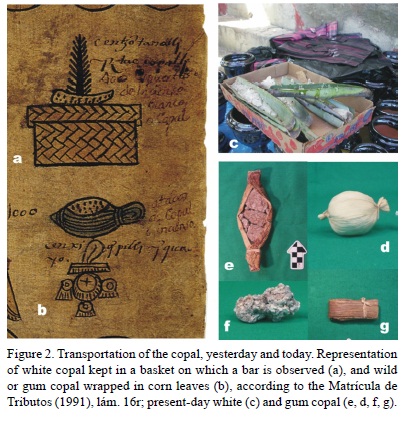
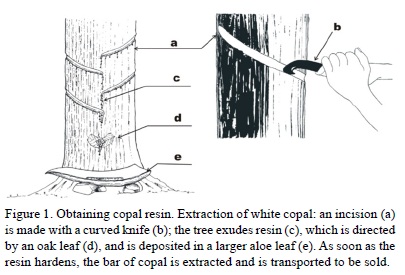
<body><![CDATA[<p align="justify"><font face="verdana" size="2">White copal is obtained by making diagonal cuts in the trunk or branches provoking the emanation of the semi&#45;liquid milky sap of the tree, which accumulates in <i>agave</i> leaves (<a href="#f1">Figure 1</a>). As the substance hardens, it takes the form of its container, resulting in bars of white copal. This is the most common form in which this type of resin has been transported since pre&#45;Hispanic times as a tribute from the provinces of Tlachco and Tepecuacuilco, in what is now the State of Guerrero, to Tenochtitlan, now the center of Mexico City. In pre&#45;Hispanic times, every 80 days 8000 packages of wild copal wrapped in maize leaves and 400 baskets of white copal in bars were tribute (Matr&iacute;cula de Tributos, 1991, fs. 16r&#45;17r; Berdan and Rieff, 1992, fs. 38r&#45;39r); even in some places today, copal is still packed in this way (<a href="#f2">Figure 2</a>).</font></p>  	    <p align="center"><font face="verdana" size="2"><a name="f1"></a></font></p>  	    <p align="center"><font face="verdana" size="2"><img src="/img/revistas/bsgm/v64n2/a6f1.jpg"></font></p>  	    <p align="center"><font face="verdana" size="2"><a name="f2"></a></font></p>  	    <p align="center"><font face="verdana" size="2"><img src="/img/revistas/bsgm/v64n2/a6f2.jpg"></font></p>  	    <p align="justify"><font face="verdana" size="2">&nbsp;</font></p>  	    <p align="justify"><font face="verdana" size="2"><b>2. Study material and methodology</b></font></p>  	    <p align="justify"><font face="verdana" size="2">2.1. Formal groups of objects of copal</font></p>  	    <p align="justify"><font face="verdana" size="2">The formal classification of the archaeological collection of copal is based on the macroscopic and microscopic analysis of over 300 elements of copal found in 61 offerings. These analyses included the detailed description of each object and its graphic recording (drawing) and photographic recording (Appendix 4 in Victoria&#45;Lona, 2004).</font></p>  	    <p align="justify"><font face="verdana" size="2">In addition, physical analysis was made, such as: humidity measurement to record how it affects materials, application of hydrochloric acid (HCl) to detect the presence or absence of stucco (CaCO<sub>3</sub>), application of alcohol (copal recovers its properties by rehydrating with a mixture of alcohol &#150; water, 2:1), and exposure to fire to corroborate that it is authentic resin. For this analysis, objects in different stages of conservation were selected from each formal group.</font></p>  	    ]]></body>
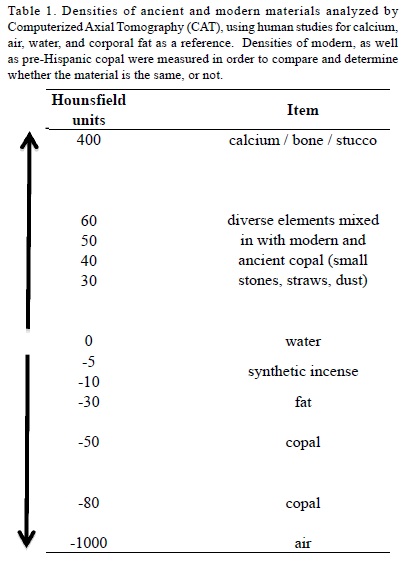
<body><![CDATA[<p align="justify"><font face="verdana" size="2">The conservation status refers to the percentage of the preserved object (90 % to 100 % means the object is in good condition, while 20 % represents a poor state of conservation), and the quality of the materials that it contains (stucco compactly adhered to the surface of copal shows a good state of preservation, while stucco that is crumbly or has broken off from the copal represents poor conservation).</font></p>  	    <p align="justify"><font face="verdana" size="2">Thus, the copal collection has been classified into six formal groups: bars, spheres, conglomerates, bases of sacrificial knives, anthropomorphic figurines, and miscellaneous fragments, all recovered from the Great Temple of Tenochtitlan and adjacent buildings.</font></p>  	    <p align="justify"><font face="verdana" size="2">As part of the macroscopic analysis, the manufacturing process was established based on a detailed description, chemical analysis and analysis of the deterioration process of every object in the archaeological collection under consideration. Study of the material in different stages of deterioration was helpful in reconstruction of the manufacturing process, including surface as well as interior features, in order for the hypothesis to be tested.</font></p>  	    <p align="justify"><font face="verdana" size="2">Understanding the deterioration process allowed us to establish the different stages of of the manufacturing process. Macroscopic analysis was complemented by analyses of radiological type that corroborated some of the hypotheses developed as a result of the first stage of the study.</font></p>  	    <p align="justify"><font face="verdana" size="2">Once the macroscopic analysis was completed and the formal groups established, representative pieces from each formal group were chosen to be studied by CAT to corroborate the hypotheses related to the prime material by comparing densities, as well as the different stages of the manufacturing process (<a href="#t1">Table 1</a>).</font></p>  	    <p align="center"><font face="verdana" size="2"><a name="t1"></a></font></p>  	    <p align="center"><font face="verdana" size="2"><img src="/img/revistas/bsgm/v64n2/a6t1.jpg"></font></p>  	    <p align="justify"><font face="verdana" size="2">&nbsp;</font></p>  	    <p align="justify"><font face="verdana" size="2">2.2. Physical principle of Computerized Axial Tomography (CAT)</font></p>  	    <p align="justify"><font face="verdana" size="2">Computerized Axial Tomography is a method of sectional imaging that shows the structures in axial or transverse plane, without overlapping, taking into account the density of the materials in a system of units called Hounsfield units (<a href="#f3">Figure 3</a>). The analysis of the density of human organs generates basic information with values that identify water, muscles and organs, calcium and bone, fat, and air (Harwood&#45;Nash, 1979; Lee <i>et al</i>., 1983).</font></p>  	    ]]></body>
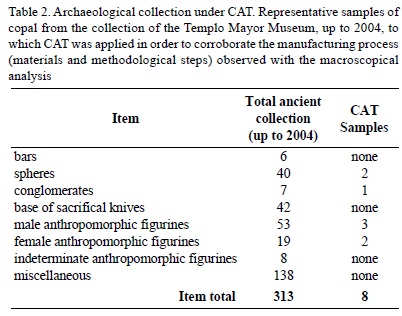
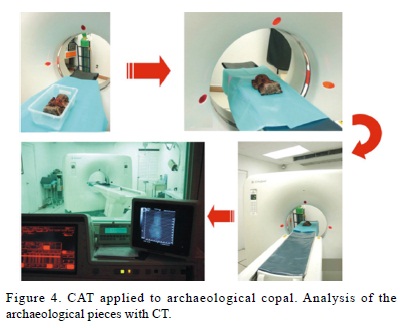
<body><![CDATA[<p align="center"><font face="verdana" size="2"><a name="f3"></a></font></p>  	    <p align="center"><font face="verdana" size="2"><img src="/img/revistas/bsgm/v64n2/a6f3.jpg"></font></p>  	    <p align="justify"><font face="verdana" size="2">Eight pre&#45;Hispanic copal objects were chosen as representatives of each formal group: two of 40 spheres, one of seven conglomerates, and five of 80 anthropomorphic figurines. Bars were not taken into account because the ethnographic work shows its origin, nor were the bases of sacrificial knives because the material and manufacturing process were clearly demonstrated with the macroscopic analysis thanks to the different states of preservation; the material classified as miscellaneous was also left out (<a href="#t2">Table 2</a>).</font></p>  	    <p align="center"><font face="verdana" size="2"><a name="t2"></a></font></p>  	    <p align="center"><font face="verdana" size="2"><img src="/img/revistas/bsgm/v64n2/a6t2.jpg"></font></p>  	    <p align="justify"><font face="verdana" size="2">Some density data was taken from human studies, such as air and calcium, which have a base composition similar to the stucco (calcium carbonate (CaCO<sub>3</sub>) present in the copal anthropomorphic figurines. To establish a reliable comparison, it was necessary to record the density of modern copal, so it could be contrasted with the value of pre&#45;Hispanic material. The density of known incense was included. This incense is burned for its aromatic effect and has a synthetic origin, unlike the copal that is a vegetal resin (<a href="#f4">Figure 4</a>).</font></p>  	    <p align="center"><font face="verdana" size="2"><a name="f4"></a></font></p>  	    <p align="center"><font face="verdana" size="2"><img src="/img/revistas/bsgm/v64n2/a6f4.jpg"></font></p>  	    <p align="justify"><font face="verdana" size="2">Some materials were identified in the interior of the pieces of copal. The same procedure used for humans was applied to the archaeological material. The piece was placed on the table that slides towards the gantry in order to take the images, to measure densities, and to generate three&#45;dimensional images.</font></p>  	    <p align="justify"><font face="verdana" size="2">To be able to work the resin in all its presentations, heat is necessary to smooth and shape it like clay. Different evidence indicates the application of direct and indirect heat on the vegetal material, such as crystallized areas and stains on one hand, and fingerprints from shaping the resin or warming the resin in pots on the other.</font></p>  	    ]]></body>
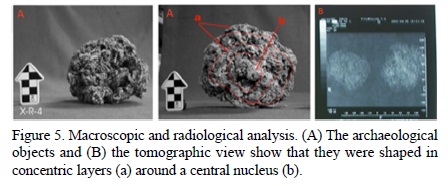
<body><![CDATA[<p align="justify"><font face="verdana" size="2">This latter procedure is suggested by Fray Bernardino de Sahag&uacute;n (2000), who described how copal and other substances like the <i>chapopotli</i> (tar) and the <i>ulli</i> (rubber), were crumbled to melt them in pots that were placed on embers in order to make medicinal ointments or a kind of cream. It is probable that the copal resin was warmed in the same way to manufacture objects.</font></p>  	    <p align="justify"><font face="verdana" size="2">&nbsp;</font></p>  	    <p align="justify"><font face="verdana" size="2"><b>3. Results</b></font></p>  	    <p align="justify"><font face="verdana" size="2">3.1. Bars of white copal</font></p>  	    <p align="justify"><font face="verdana" size="2">The ethnographic study of copal helped significantly to understand the manufacture of the bars and "tears" because, as previously mentioned, the fresh resin takes the shape of the <i>agave</i> leaf which is used like a mold and the consequent marks are visible on the surface.</font></p>  	    <p align="justify"><font face="verdana" size="2">&nbsp;</font></p>  	    <p align="justify"><font face="verdana" size="2">3.2. Spheres and conglomerates of gum and white copal</font></p>  	    <p align="justify"><font face="verdana" size="2">These objects are asymmetric but with a clear general shape, showing small visible depressions possibly caused by finger pressure, and in other cases resulting from smoothing or polishing.</font></p>  	    <p align="justify"><font face="verdana" size="2">The process of manufacture starts by joining fragments of the resin in order to make a spherical nucleus. Concentric layers are added until the desired form and size is obtained, leaving spaces between every layer and the fragments of copal adhered, as seen in the radiological analysis (<a href="#f5">Figure 5</a>).</font></p>  	    <p align="center"><font face="verdana" size="2"><a name="f5"></a></font></p>  	    ]]></body>
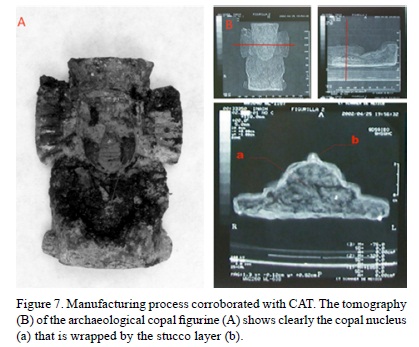
<body><![CDATA[<p align="center"><font face="verdana" size="2"><img src="/img/revistas/bsgm/v64n2/a6f5.jpg"></font></p>  	    <p align="justify"><font face="verdana" size="2">The external layer of the object was smoothed or polished, and subjected to heat in order to enhance the adhesive properties of the resin and to assure the consolidation of the piece.</font></p>  	    <p align="justify"><font face="verdana" size="2">&nbsp;</font></p>  	    <p align="justify"><font face="verdana" size="2">3.3. Bases of sacrificial knives of gum and white copal</font></p>  	    <p align="justify"><font face="verdana" size="2">The principle is similar to that of the spheres and conglomerates, the difference being that the fragments of copal do not stick to a nucleus of resin, but to the proximal section of the knife starting with the flat faces, and later, the lateral ones. The object is then smoothed or polished. Fire or heat is applied in order to consolidate the components.</font></p>  	    <p align="justify"><font face="verdana" size="2">&nbsp;</font></p>  	    <p align="justify"><font face="verdana" size="2">3.4. Anthropomorphic figurines of white copal</font></p>  	    <p align="justify"><font face="verdana" size="2">The process of manufacture of anthropomorphic figurines was established on the basis of the analysis of 80 pieces from this group, composed of 19 female figurines, 53 male figurines and eight of indeterminate genre as a result of poor conservation.</font></p>  	    <p align="justify"><font face="verdana" size="2">A nucleus of copal is evident, with specific facial and corporal characteristics, made by joining fragments of resin in a mold until it is filled. The nucleus is then covered with a layer of stucco, using a double mold where the representation of facial and corporal features is evident, such as apparel.</font></p>  	    <p align="justify"><font face="verdana" size="2">Finally the figurines are decorated by pigments and garments made of paper, and occasionally complementary elements such as flags (<a href="/img/revistas/bsgm/v64n2/a6f6.jpg" target="_blank">Figure 6</a>).</font></p>  	    ]]></body>
<body><![CDATA[<p align="justify"><font face="verdana" size="2">&nbsp;</font></p>  	    <p align="justify"><font face="verdana" size="2"><b>4. Discussion</b></font></p>  	    <p align="justify"><font face="verdana" size="2">Copal is a resin that has been used since pre&#45;Hispanic times, with both curative and religious uses, which was burned and buried in diverse forms. There are two types of copal produced by the same tree: gum, stone or wild copal and the "saint" (<i>santa</i>), white or <i>penca</i> (leaf of <i>agave</i>) copal. These two kinds of archaeological copal were found in the Great Temple (Templo Mayor archaeological zone) and are both observed in massive forms and in small leaves or flakes.</font></p>  	    <p align="justify"><font face="verdana" size="2">The archaeological collection (of over 300 elements of copal found in 61 offerings) has been classified in six formal groups: bars, spheres, conglomerates, bases of sacrificial knives, anthropomorphic figurines, and miscellaneous fragments.</font></p>  	    <p align="justify"><font face="verdana" size="2">The manufacturing process was established based on a detailed description of every object. For the successful manufacture of copal objects, it was necessary to soften the resin, thus the application of heat is an essential part of the process.</font></p>  	    <p align="justify"><font face="verdana" size="2">At the moment when the material is obtained, the fresh resin takes the shape of the <i>agave</i> leaf used like a mold and the consequent marks are visible on the surface creating the bars of copal; but sometimes the resin spills, and the drops are called <i>l&aacute;grimas</i> (tears).</font></p>  	    <p align="justify"><font face="verdana" size="2">Resin fragments were commonly adhered together to obtain the desired forms, and surface was smoothed to give the appearance of a single unit, such as for the spheres, conglomerates and bases of sacrificial knives.</font></p>  	    <p align="justify"><font face="verdana" size="2">The figurines were elaborated by shaping a nucleus of copal with stucco covering, across which the decoration was placed.</font></p>  	    <p align="justify"><font face="verdana" size="2">The process of deterioration is useful in reconstructing the manufacturing process of the copal objects; the first stage of the study consisted of macroscopical and microscopical observations. These were complemented with CAT, which is a noninvasive technique. It analyzes the objects in different thin layers, identifying their densities. These densities can be classified according to a table of comparison, which was first established from the macroscopical observations and the analysis of physical types, and second, from all the chemical types of the representative samples of the copal study collection.</font></p>  	    <p align="justify"><font face="verdana" size="2">The complement of both analyses allowed us to establish the manufacturing process and the materials of which the copal objects were made. Although the copal was the predominant material, stucco (ground limestone), small stones, straw, paper, pigments, and other materials, were used as well. The most important contribution is that all this was possible without destroying the archaeological material (<a href="#f7">Figure 7</a>).</font></p>  	    ]]></body>
<body><![CDATA[<p align="center"><font face="verdana" size="2"><a name="f7"></a></font></p>  	    <p align="center"><font face="verdana" size="2"><img src="/img/revistas/bsgm/v64n2/a6f7.jpg"></font></p>  	    <p align="justify"><font face="verdana" size="2">&nbsp;</font></p>  	    <p align="justify"><font face="verdana" size="2"><b>5. Conclusions</b></font></p>  	    <p align="justify"><font face="verdana" size="2">The macroscopic analysis of more than 300 objects made of copal provides an important base to propose and to corroborate the manufacture hypothesis.</font></p>  	    <p align="justify"><font face="verdana" size="2">The use of analytic tools of different disciplines, such as the invaluable contribution of Computerized Axial Tomography, allowed us to corroborate the macroscopic observations, thus providing more information about the technical process of manufacture, such as the materials used in the manufacture of the objects without destroying the archaeological pieces, because it is a non&#45;invasive and very exact tool.</font></p>  	    <p align="justify"><font face="verdana" size="2">&nbsp;</font></p>  	    <p align="justify"><font face="verdana" size="2"><b>Acknowledgments</b></font></p>  	    <p align="justify"><font face="verdana" size="2">We acknowledge the support of Jos&eacute; Luis Criales, director of CT Scanner de M&eacute;xico, Leonardo L&oacute;pez Luj&aacute;n from the Museo del Templo Mayor, Instituto Nacional de Antropolog&iacute;a e Historia; Jorge E. Gama, Carolina Jasso, and Leticia Alba from the Instituto de Geolog&iacute;a, Universidad Nacional Aut&oacute;noma de M&eacute;xico; Adri&aacute;n Ben&iacute;tez, Daniela Huber, Jos&eacute; Luis Hern&aacute;ndez, Julio Emilio Romero, and the people who made the ethnographic work possible, as well as many specialists from different areas who participated in developing this research. We culminated this study thanks to the enthusiasm of all those who supported this research.</font></p>  	    <p align="justify"><font face="verdana" size="2">&nbsp;</font></p>  	    ]]></body>
<body><![CDATA[<p align="justify"><font face="verdana" size="2"><b>References</b></font></p>  	    <!-- ref --><p align="justify"><font face="verdana" size="2">Anderson, K.B., Crelling, J.C., 1995, Amber, resinite, and fossil resins: American Chemical Society. Washington, DC: American Chemical Society. ACS Symposium Series No. 617. 297p.    &nbsp;&nbsp;&nbsp;&nbsp;&nbsp;&nbsp;&nbsp;&nbsp;[&#160;<a href="javascript:void(0);" onclick="javascript: window.open('/scielo.php?script=sci_nlinks&ref=1401120&pid=S1405-3322201200020000600001&lng=','','width=640,height=500,resizable=yes,scrollbars=1,menubar=yes,');">Links</a>&#160;]<!-- end-ref --></font></p>  	    <!-- ref --><p align="justify"><font face="verdana" size="2">Berdan, F.F., Rieff, P.A., 1992, The Codex Mendoza: Berkeley, University of California Press, 1997 xii, 436 p.    &nbsp;&nbsp;&nbsp;&nbsp;&nbsp;&nbsp;&nbsp;&nbsp;[&#160;<a href="javascript:void(0);" onclick="javascript: window.open('/scielo.php?script=sci_nlinks&ref=1401122&pid=S1405-3322201200020000600002&lng=','','width=640,height=500,resizable=yes,scrollbars=1,menubar=yes,');">Links</a>&#160;]<!-- end-ref --></font></p>  	    <!-- ref --><p align="justify"><font face="verdana" size="2">Berdan, F.F., Rieff P.A., 1997, The Essential Codex Mendoza: Berkeley, University of California Press, 436 p.    &nbsp;&nbsp;&nbsp;&nbsp;&nbsp;&nbsp;&nbsp;&nbsp;[&#160;<a href="javascript:void(0);" onclick="javascript: window.open('/scielo.php?script=sci_nlinks&ref=1401124&pid=S1405-3322201200020000600003&lng=','','width=640,height=500,resizable=yes,scrollbars=1,menubar=yes,');">Links</a>&#160;]<!-- end-ref --></font></p>  	    <!-- ref --><p align="justify"><font face="verdana" size="2">Bork, P.M., Schmitz, M.L. Weimann, C., Kist, M., Heinrich, M., 1996, Nahua Indian medicinal plants (Mexico): inhibitory activity on NF&#45;kB as an anti&#45;inflammatory model and antibacterial effects: Phytomedicine, 3, 263&#150;269.    &nbsp;&nbsp;&nbsp;&nbsp;&nbsp;&nbsp;&nbsp;&nbsp;[&#160;<a href="javascript:void(0);" onclick="javascript: window.open('/scielo.php?script=sci_nlinks&ref=1401126&pid=S1405-3322201200020000600004&lng=','','width=640,height=500,resizable=yes,scrollbars=1,menubar=yes,');">Links</a>&#160;]<!-- end-ref --></font></p>  	    <!-- ref --><p align="justify"><font face="verdana" size="2">Coggins, C.C., Ladd, J.M., 1992, Copal and rubber offerings: Memoirs of the Peabody Museum of Archaeological &amp; Ethnology, 10, 345&#150;357.    &nbsp;&nbsp;&nbsp;&nbsp;&nbsp;&nbsp;&nbsp;&nbsp;[&#160;<a href="javascript:void(0);" onclick="javascript: window.open('/scielo.php?script=sci_nlinks&ref=1401128&pid=S1405-3322201200020000600005&lng=','','width=640,height=500,resizable=yes,scrollbars=1,menubar=yes,');">Links</a>&#160;]<!-- end-ref --></font></p>  	    <!-- ref --><p align="justify"><font face="verdana" size="2">Cruz, M. de la, 1964, Libellus de Medicinalibus Indorum Herbis (tambi&eacute;n llamado C&oacute;dice de la Cruz&#45;Badiano). Manuscrito Azteca de 1552. Seg&uacute;n traducci&oacute;n latina de Juan Badiano. Versi&oacute;n espa&ntilde;ola y comentarios por diversos autores: M&eacute;xico, Instituto Mexicano del Seguro Social. 349 p.    &nbsp;&nbsp;&nbsp;&nbsp;&nbsp;&nbsp;&nbsp;&nbsp;[&#160;<a href="javascript:void(0);" onclick="javascript: window.open('/scielo.php?script=sci_nlinks&ref=1401130&pid=S1405-3322201200020000600006&lng=','','width=640,height=500,resizable=yes,scrollbars=1,menubar=yes,');">Links</a>&#160;]<!-- end-ref --></font></p>  	    <!-- ref --><p align="justify"><font face="verdana" size="2">D&iacute;az del Castillo, B., 2000, Historia verdadera de la conquista de la Nueva Espa&ntilde;a. Antolog&iacute;a. Estudio introductorio y selecci&oacute;n Miguel Le&oacute;n&#45;Portilla: M&eacute;xico, CONACULTA, Cien de M&eacute;xico 298p.    &nbsp;&nbsp;&nbsp;&nbsp;&nbsp;&nbsp;&nbsp;&nbsp;[&#160;<a href="javascript:void(0);" onclick="javascript: window.open('/scielo.php?script=sci_nlinks&ref=1401132&pid=S1405-3322201200020000600007&lng=','','width=640,height=500,resizable=yes,scrollbars=1,menubar=yes,');">Links</a>&#160;]<!-- end-ref --></font></p>  	    <!-- ref --><p align="justify"><font face="verdana" size="2">Flores, J.S, Ricalde, R.V., 1996, The secretions and exudates of plants used in Mayan traditional medicine: Journal of Herbs, Spices &amp; Medicinal Plants, 4, 153&#150;159.    &nbsp;&nbsp;&nbsp;&nbsp;&nbsp;&nbsp;&nbsp;&nbsp;[&#160;<a href="javascript:void(0);" onclick="javascript: window.open('/scielo.php?script=sci_nlinks&ref=1401134&pid=S1405-3322201200020000600008&lng=','','width=640,height=500,resizable=yes,scrollbars=1,menubar=yes,');">Links</a>&#160;]<!-- end-ref --></font></p>  	    <!-- ref --><p align="justify"><font face="verdana" size="2">Harwood&#45;Nash, D.C., 1979, Computed Tomography of Ancient Egyptian Mummies: Journal of Computer Assisted Tomography, 3(6), 768&#45;773.    &nbsp;&nbsp;&nbsp;&nbsp;&nbsp;&nbsp;&nbsp;&nbsp;[&#160;<a href="javascript:void(0);" onclick="javascript: window.open('/scielo.php?script=sci_nlinks&ref=1401136&pid=S1405-3322201200020000600009&lng=','','width=640,height=500,resizable=yes,scrollbars=1,menubar=yes,');">Links</a>&#160;]<!-- end-ref --></font></p>  	    <!-- ref --><p align="justify"><font face="verdana" size="2">Hern&aacute;ndez, F., 1959, Historia natural de Nueva Espa&ntilde;a: M&eacute;xico, Universidad Nacional Aut&oacute;noma de M&eacute;xico, II, libro 4, 666p.    &nbsp;&nbsp;&nbsp;&nbsp;&nbsp;&nbsp;&nbsp;&nbsp;[&#160;<a href="javascript:void(0);" onclick="javascript: window.open('/scielo.php?script=sci_nlinks&ref=1401138&pid=S1405-3322201200020000600010&lng=','','width=640,height=500,resizable=yes,scrollbars=1,menubar=yes,');">Links</a>&#160;]<!-- end-ref --></font></p>  	    <!-- ref --><p align="justify"><font face="verdana" size="2">Lee, J.K.T., Sagel, S.S., Stanley, R.J., 1983, Computed Body Tomography: New York, Raven Press, 1&#45;5.    &nbsp;&nbsp;&nbsp;&nbsp;&nbsp;&nbsp;&nbsp;&nbsp;[&#160;<a href="javascript:void(0);" onclick="javascript: window.open('/scielo.php?script=sci_nlinks&ref=1401140&pid=S1405-3322201200020000600011&lng=','','width=640,height=500,resizable=yes,scrollbars=1,menubar=yes,');">Links</a>&#160;]<!-- end-ref --></font></p>  	    <!-- ref --><p align="justify"><font face="verdana" size="2">L&oacute;pez&#45;Austin, A., L&oacute;pez Luj&aacute;n, L., 2002, La periodizaci&oacute;n de la historia mesoamericana: Arqueolog&iacute;a Mexicana, 11, 6&#45;15.    &nbsp;&nbsp;&nbsp;&nbsp;&nbsp;&nbsp;&nbsp;&nbsp;[&#160;<a href="javascript:void(0);" onclick="javascript: window.open('/scielo.php?script=sci_nlinks&ref=1401142&pid=S1405-3322201200020000600012&lng=','','width=640,height=500,resizable=yes,scrollbars=1,menubar=yes,');">Links</a>&#160;]<!-- end-ref --></font></p>  	    <!-- ref --><p align="justify"><font face="verdana" size="2">L&oacute;pez&#45;Luj&aacute;n, L., 1993, Las ofrendas del Templo Mayor de Tenochtitlan: M&eacute;xico, Instituto Nacional de Antropolog&iacute;a e Historia, 438p.    &nbsp;&nbsp;&nbsp;&nbsp;&nbsp;&nbsp;&nbsp;&nbsp;[&#160;<a href="javascript:void(0);" onclick="javascript: window.open('/scielo.php?script=sci_nlinks&ref=1401144&pid=S1405-3322201200020000600013&lng=','','width=640,height=500,resizable=yes,scrollbars=1,menubar=yes,');">Links</a>&#160;]<!-- end-ref --></font></p>  	    <!-- ref --><p align="justify"><font face="verdana" size="2">Mart&iacute;nez&#45;Cort&eacute;s, F., 1974, Pegamentos, gomas y resinas en el M&eacute;xico prehisp&aacute;nico: M&eacute;xico, SEP Setentas, 158p.    &nbsp;&nbsp;&nbsp;&nbsp;&nbsp;&nbsp;&nbsp;&nbsp;[&#160;<a href="javascript:void(0);" onclick="javascript: window.open('/scielo.php?script=sci_nlinks&ref=1401146&pid=S1405-3322201200020000600014&lng=','','width=640,height=500,resizable=yes,scrollbars=1,menubar=yes,');">Links</a>&#160;]<!-- end-ref --></font></p>  	    <!-- ref --><p align="justify"><font face="verdana" size="2">Matos&#45;Moctezuma, E., 1981, Una visita al Templo Mayor de Tenochtitlan: M&eacute;xico, Secretar&iacute;a de Educaci&oacute;n P&uacute;blica/Instituto Nacional de Antropolog&iacute;a e Historia, 77p.    &nbsp;&nbsp;&nbsp;&nbsp;&nbsp;&nbsp;&nbsp;&nbsp;[&#160;<a href="javascript:void(0);" onclick="javascript: window.open('/scielo.php?script=sci_nlinks&ref=1401148&pid=S1405-3322201200020000600015&lng=','','width=640,height=500,resizable=yes,scrollbars=1,menubar=yes,');">Links</a>&#160;]<!-- end-ref --></font></p>  	    <!-- ref --><p align="justify"><font face="verdana" size="2">Matr&iacute;cula de Tributos, Nuevos Estudios, 1991, Interpretaci&oacute;n de V&iacute;ctor M. Castillo y Ma. Teresa Sep&uacute;lveda: M&eacute;xico, Edici&oacute;n facsimilar de la Secretar&iacute;a de Hacienda y Cr&eacute;dito P&uacute;blico, 154 p.    &nbsp;&nbsp;&nbsp;&nbsp;&nbsp;&nbsp;&nbsp;&nbsp;[&#160;<a href="javascript:void(0);" onclick="javascript: window.open('/scielo.php?script=sci_nlinks&ref=1401150&pid=S1405-3322201200020000600016&lng=','','width=640,height=500,resizable=yes,scrollbars=1,menubar=yes,');">Links</a>&#160;]<!-- end-ref --></font></p>  	    <!-- ref --><p align="justify"><font face="verdana" size="2">Montemayor, C., 2007, Diccionario del n&aacute;huatl en el espa&ntilde;ol de M&eacute;xico: M&eacute;xico, Universidad Nacional Aut&oacute;noma de M&eacute;xico&#45;Gobierno del Distrito Federal, 57 p.    &nbsp;&nbsp;&nbsp;&nbsp;&nbsp;&nbsp;&nbsp;&nbsp;[&#160;<a href="javascript:void(0);" onclick="javascript: window.open('/scielo.php?script=sci_nlinks&ref=1401152&pid=S1405-3322201200020000600017&lng=','','width=640,height=500,resizable=yes,scrollbars=1,menubar=yes,');">Links</a>&#160;]<!-- end-ref --></font></p>  	    <!-- ref --><p align="justify"><font face="verdana" size="2">Ryan, J., Tucker, A.O., Maciarello, M.J., Wheeler, K.A., 2003, Chemistry and Ethnobotany of Commercial Incense Copals, Copal Blanco, Copal Oro, and Copal Negro of North America: Economic Botany, 57(2), 89&#45;202.    &nbsp;&nbsp;&nbsp;&nbsp;&nbsp;&nbsp;&nbsp;&nbsp;[&#160;<a href="javascript:void(0);" onclick="javascript: window.open('/scielo.php?script=sci_nlinks&ref=1401154&pid=S1405-3322201200020000600018&lng=','','width=640,height=500,resizable=yes,scrollbars=1,menubar=yes,');">Links</a>&#160;]<!-- end-ref --></font></p>  	    <!-- ref --><p align="justify"><font face="verdana" size="2">Rzedowski, J., 1978, Vegetaci&oacute;n de M&eacute;xico: M&eacute;xico, Limusa, 504p.    &nbsp;&nbsp;&nbsp;&nbsp;&nbsp;&nbsp;&nbsp;&nbsp;[&#160;<a href="javascript:void(0);" onclick="javascript: window.open('/scielo.php?script=sci_nlinks&ref=1401156&pid=S1405-3322201200020000600019&lng=','','width=640,height=500,resizable=yes,scrollbars=1,menubar=yes,');">Links</a>&#160;]<!-- end-ref --></font></p>  	    <!-- ref --><p align="justify"><font face="verdana" size="2">Rzedowski, J., Calder&oacute;n de Rzedowski, G., 1996, Burseraceae, <i>in</i> Flora de Veracruz: Xalapa, Veracruz, Instituto de Ecolog&iacute;a, 94, 37 p.    &nbsp;&nbsp;&nbsp;&nbsp;&nbsp;&nbsp;&nbsp;&nbsp;[&#160;<a href="javascript:void(0);" onclick="javascript: window.open('/scielo.php?script=sci_nlinks&ref=1401158&pid=S1405-3322201200020000600020&lng=','','width=640,height=500,resizable=yes,scrollbars=1,menubar=yes,');">Links</a>&#160;]<!-- end-ref --></font></p>  	    <!-- ref --><p align="justify"><font face="verdana" size="2">Rzedowski, J., Guevara&#45;F&eacute;fer, F., 1992, Familia Burseraceae, <i>in</i> Flora del Baj&iacute;o y de regiones adyacentes: Centro Regional del Baj&iacute;o, P&aacute;tzcuaro, Michoac&aacute;n, CONACYT / SEP, Instituto de Ecolog&iacute;a, Xalapa, Veracruz, 3, 46 p.    &nbsp;&nbsp;&nbsp;&nbsp;&nbsp;&nbsp;&nbsp;&nbsp;[&#160;<a href="javascript:void(0);" onclick="javascript: window.open('/scielo.php?script=sci_nlinks&ref=1401160&pid=S1405-3322201200020000600021&lng=','','width=640,height=500,resizable=yes,scrollbars=1,menubar=yes,');">Links</a>&#160;]<!-- end-ref --></font></p>  	    <!-- ref --><p align="justify"><font face="verdana" size="2">Sahag&uacute;n, B. de, 2000, Historia General de las cosas de Nueva Espa&ntilde;a, 3 vols. Estudio introductorio, paleograf&iacute;a, glosario y notas Alfredo L&oacute;pez Austin y Josefina Garc&iacute;a Quintana: M&eacute;xico, Cien de M&eacute;xico / CONACULTA, 1450p.    &nbsp;&nbsp;&nbsp;&nbsp;&nbsp;&nbsp;&nbsp;&nbsp;[&#160;<a href="javascript:void(0);" onclick="javascript: window.open('/scielo.php?script=sci_nlinks&ref=1401162&pid=S1405-3322201200020000600022&lng=','','width=640,height=500,resizable=yes,scrollbars=1,menubar=yes,');">Links</a>&#160;]<!-- end-ref --></font></p>  	    <!-- ref --><p align="justify"><font face="verdana" size="2">Smith&#45;Bindman, R., Lipson, J., Marcus, R., 2009, Radiation dose associated with common computed tomography examinations and the associated lifetime attributable risk of cancer: Archives of Internal Medicine, 169(22), 2078&#150;86.    &nbsp;&nbsp;&nbsp;&nbsp;&nbsp;&nbsp;&nbsp;&nbsp;[&#160;<a href="javascript:void(0);" onclick="javascript: window.open('/scielo.php?script=sci_nlinks&ref=1401164&pid=S1405-3322201200020000600023&lng=','','width=640,height=500,resizable=yes,scrollbars=1,menubar=yes,');">Links</a>&#160;]<!-- end-ref --></font></p>  	    <!-- ref --><p align="justify"><font face="verdana" size="2">Stross, B., 1997, Mesoamerican copal resins: Austin, University of Texas at Austin, U Mut Maya, VI, 177&#150;186.    &nbsp;&nbsp;&nbsp;&nbsp;&nbsp;&nbsp;&nbsp;&nbsp;[&#160;<a href="javascript:void(0);" onclick="javascript: window.open('/scielo.php?script=sci_nlinks&ref=1401166&pid=S1405-3322201200020000600024&lng=','','width=640,height=500,resizable=yes,scrollbars=1,menubar=yes,');">Links</a>&#160;]<!-- end-ref --></font></p>  	    <!-- ref --><p align="justify"><font face="verdana" size="2">Strucker, J. D., 1963, Some ritual aspects of the use of copal among ancient and present&#45;day Maya speakers: Harvard University Freshman Seminar Program 1, 1&#150;16.    &nbsp;&nbsp;&nbsp;&nbsp;&nbsp;&nbsp;&nbsp;&nbsp;[&#160;<a href="javascript:void(0);" onclick="javascript: window.open('/scielo.php?script=sci_nlinks&ref=1401168&pid=S1405-3322201200020000600025&lng=','','width=640,height=500,resizable=yes,scrollbars=1,menubar=yes,');">Links</a>&#160;]<!-- end-ref --></font></p>  	    <!-- ref --><p align="justify"><font face="verdana" size="2">Victoria&#45;Lona, N., 2004, El copal en las ofrendas del Templo Mayor de Tenochtitlan: M&eacute;xico, D. F., Escuela Nacional de Antropolog&iacute;a e Historia, tesis de licenciatura, 295p.    &nbsp;&nbsp;&nbsp;&nbsp;&nbsp;&nbsp;&nbsp;&nbsp;[&#160;<a href="javascript:void(0);" onclick="javascript: window.open('/scielo.php?script=sci_nlinks&ref=1401170&pid=S1405-3322201200020000600026&lng=','','width=640,height=500,resizable=yes,scrollbars=1,menubar=yes,');">Links</a>&#160;]<!-- end-ref --></font></p>      ]]></body><back>
<ref-list>
<ref id="B1">
<nlm-citation citation-type="book">
<person-group person-group-type="author">
<name>
<surname><![CDATA[Anderson]]></surname>
<given-names><![CDATA[K.B.]]></given-names>
</name>
<name>
<surname><![CDATA[Crelling]]></surname>
<given-names><![CDATA[J.C.]]></given-names>
</name>
</person-group>
<source><![CDATA[Amber, resinite, and fossil resins]]></source>
<year>1995</year>
<page-range>297</page-range><publisher-loc><![CDATA[Washington^eDC DC]]></publisher-loc>
<publisher-name><![CDATA[American Chemical Society]]></publisher-name>
</nlm-citation>
</ref>
<ref id="B2">
<nlm-citation citation-type="book">
<person-group person-group-type="author">
<name>
<surname><![CDATA[Berdan]]></surname>
<given-names><![CDATA[F.F.]]></given-names>
</name>
<name>
<surname><![CDATA[Rieff]]></surname>
<given-names><![CDATA[P.A.]]></given-names>
</name>
</person-group>
<source><![CDATA[The Codex Mendoza: Berkeley]]></source>
<year>1992</year>
<page-range>436</page-range><publisher-name><![CDATA[University of California Press]]></publisher-name>
</nlm-citation>
</ref>
<ref id="B3">
<nlm-citation citation-type="book">
<person-group person-group-type="author">
<name>
<surname><![CDATA[Berdan]]></surname>
<given-names><![CDATA[F.F.]]></given-names>
</name>
<name>
<surname><![CDATA[Rieff]]></surname>
<given-names><![CDATA[P.A.]]></given-names>
</name>
</person-group>
<source><![CDATA[The Essential Codex Mendoza]]></source>
<year>1997</year>
<page-range>436</page-range><publisher-loc><![CDATA[Berkeley ]]></publisher-loc>
<publisher-name><![CDATA[University of California Press]]></publisher-name>
</nlm-citation>
</ref>
<ref id="B4">
<nlm-citation citation-type="journal">
<person-group person-group-type="author">
<name>
<surname><![CDATA[Bork]]></surname>
<given-names><![CDATA[P.M.]]></given-names>
</name>
<name>
<surname><![CDATA[Schmitz]]></surname>
<given-names><![CDATA[M.L.]]></given-names>
</name>
<name>
<surname><![CDATA[Weimann]]></surname>
<given-names><![CDATA[C.]]></given-names>
</name>
<name>
<surname><![CDATA[Kist]]></surname>
<given-names><![CDATA[M.]]></given-names>
</name>
<name>
<surname><![CDATA[Heinrich]]></surname>
<given-names><![CDATA[M.]]></given-names>
</name>
</person-group>
<article-title xml:lang="en"><![CDATA[Nahua Indian medicinal plants (Mexico): inhibitory activity on NF-kB as an anti-inflammatory model and antibacterial effects]]></article-title>
<source><![CDATA[Phytomedicine]]></source>
<year>1996</year>
<volume>3</volume>
<page-range>263-269</page-range></nlm-citation>
</ref>
<ref id="B5">
<nlm-citation citation-type="journal">
<person-group person-group-type="author">
<name>
<surname><![CDATA[Coggins]]></surname>
<given-names><![CDATA[C.C.]]></given-names>
</name>
<name>
<surname><![CDATA[Ladd]]></surname>
<given-names><![CDATA[J.M.]]></given-names>
</name>
</person-group>
<article-title xml:lang="en"><![CDATA[Copal and rubber offerings]]></article-title>
<source><![CDATA[Memoirs of the Peabody Museum of Archaeological & Ethnology]]></source>
<year>1992</year>
<volume>10</volume>
<page-range>345-357</page-range></nlm-citation>
</ref>
<ref id="B6">
<nlm-citation citation-type="">
<person-group person-group-type="author">
<name>
<surname><![CDATA[Cruz]]></surname>
<given-names><![CDATA[M. de la]]></given-names>
</name>
</person-group>
<source><![CDATA[Libellus de Medicinalibus Indorum Herbis (también llamado Códice de la Cruz-Badiano)]]></source>
<year>1964</year>
</nlm-citation>
</ref>
<ref id="B7">
<nlm-citation citation-type="book">
<person-group person-group-type="author">
<name>
<surname><![CDATA[Díaz del Castillo]]></surname>
<given-names><![CDATA[B.]]></given-names>
</name>
</person-group>
<source><![CDATA[Historia verdadera de la conquista de la Nueva España: Antología. Estudio introductorio y selección Miguel León-Portilla]]></source>
<year>2000</year>
<page-range>298</page-range><publisher-loc><![CDATA[México ]]></publisher-loc>
<publisher-name><![CDATA[CONACULTACien de México]]></publisher-name>
</nlm-citation>
</ref>
<ref id="B8">
<nlm-citation citation-type="journal">
<person-group person-group-type="author">
<name>
<surname><![CDATA[Flores]]></surname>
<given-names><![CDATA[J.S]]></given-names>
</name>
<name>
<surname><![CDATA[Ricalde]]></surname>
<given-names><![CDATA[R.V.]]></given-names>
</name>
</person-group>
<article-title xml:lang="en"><![CDATA[The secretions and exudates of plants used in Mayan traditional medicine]]></article-title>
<source><![CDATA[Journal of Herbs, Spices & Medicinal Plants]]></source>
<year>1996</year>
<volume>4</volume>
<page-range>153-159</page-range></nlm-citation>
</ref>
<ref id="B9">
<nlm-citation citation-type="journal">
<person-group person-group-type="author">
<name>
<surname><![CDATA[Harwood-Nash]]></surname>
<given-names><![CDATA[D.C.]]></given-names>
</name>
</person-group>
<article-title xml:lang="en"><![CDATA[Computed Tomography of Ancient Egyptian Mummies]]></article-title>
<source><![CDATA[Journal of Computer Assisted Tomography]]></source>
<year>1979</year>
<volume>3</volume>
<numero>6</numero>
<issue>6</issue>
<page-range>768-773</page-range></nlm-citation>
</ref>
<ref id="B10">
<nlm-citation citation-type="book">
<person-group person-group-type="author">
<name>
<surname><![CDATA[Hernández]]></surname>
<given-names><![CDATA[F.]]></given-names>
</name>
</person-group>
<source><![CDATA[Historia natural de Nueva España]]></source>
<year>1959</year>
<page-range>666</page-range><publisher-loc><![CDATA[México ]]></publisher-loc>
<publisher-name><![CDATA[Universidad Nacional Autónoma de México]]></publisher-name>
</nlm-citation>
</ref>
<ref id="B11">
<nlm-citation citation-type="book">
<person-group person-group-type="author">
<name>
<surname><![CDATA[Lee]]></surname>
<given-names><![CDATA[J.K.T.]]></given-names>
</name>
<name>
<surname><![CDATA[Sagel]]></surname>
<given-names><![CDATA[S.S.]]></given-names>
</name>
<name>
<surname><![CDATA[Stanley]]></surname>
<given-names><![CDATA[R.J.]]></given-names>
</name>
</person-group>
<source><![CDATA[Computed Body Tomography]]></source>
<year>1983</year>
<page-range>1-5</page-range><publisher-loc><![CDATA[New York ]]></publisher-loc>
<publisher-name><![CDATA[Raven Press]]></publisher-name>
</nlm-citation>
</ref>
<ref id="B12">
<nlm-citation citation-type="journal">
<person-group person-group-type="author">
<name>
<surname><![CDATA[López-Austin]]></surname>
<given-names><![CDATA[A.]]></given-names>
</name>
<name>
<surname><![CDATA[López Luján]]></surname>
<given-names><![CDATA[L.]]></given-names>
</name>
</person-group>
<article-title xml:lang="es"><![CDATA[La periodización de la historia mesoamericana]]></article-title>
<source><![CDATA[Arqueología Mexicana]]></source>
<year>2002</year>
<volume>11</volume>
<page-range>6-15</page-range></nlm-citation>
</ref>
<ref id="B13">
<nlm-citation citation-type="book">
<person-group person-group-type="author">
<name>
<surname><![CDATA[López-Luján]]></surname>
<given-names><![CDATA[L.]]></given-names>
</name>
</person-group>
<source><![CDATA[Las ofrendas del Templo Mayor de Tenochtitlan]]></source>
<year>1993</year>
<page-range>438</page-range><publisher-loc><![CDATA[México ]]></publisher-loc>
<publisher-name><![CDATA[Instituto Nacional de Antropología e Historia]]></publisher-name>
</nlm-citation>
</ref>
<ref id="B14">
<nlm-citation citation-type="book">
<person-group person-group-type="author">
<name>
<surname><![CDATA[Martínez-Cortés]]></surname>
<given-names><![CDATA[F.]]></given-names>
</name>
</person-group>
<source><![CDATA[Pegamentos, gomas y resinas en el México prehispánico]]></source>
<year>1974</year>
<page-range>158</page-range><publisher-loc><![CDATA[México ]]></publisher-loc>
<publisher-name><![CDATA[SEP Setentas]]></publisher-name>
</nlm-citation>
</ref>
<ref id="B15">
<nlm-citation citation-type="book">
<person-group person-group-type="author">
<name>
<surname><![CDATA[Matos-Moctezuma]]></surname>
<given-names><![CDATA[E.]]></given-names>
</name>
</person-group>
<source><![CDATA[Una visita al Templo Mayor de Tenochtitlan]]></source>
<year>1981</year>
<page-range>77</page-range><publisher-loc><![CDATA[México ]]></publisher-loc>
<publisher-name><![CDATA[Secretaría de Educación Pública/Instituto Nacional de Antropología e Historia]]></publisher-name>
</nlm-citation>
</ref>
<ref id="B16">
<nlm-citation citation-type="book">
<source><![CDATA[Matrícula de Tributos, Nuevos Estudios]]></source>
<year>1991</year>
<page-range>154</page-range><publisher-loc><![CDATA[México ]]></publisher-loc>
<publisher-name><![CDATA[Secretaría de Hacienda y Crédito Público]]></publisher-name>
</nlm-citation>
</ref>
<ref id="B17">
<nlm-citation citation-type="book">
<person-group person-group-type="author">
<name>
<surname><![CDATA[Montemayor]]></surname>
<given-names><![CDATA[C]]></given-names>
</name>
</person-group>
<source><![CDATA[Diccionario del náhuatl en el español de México]]></source>
<year>2007</year>
<page-range>57</page-range><publisher-loc><![CDATA[México ]]></publisher-loc>
<publisher-name><![CDATA[Universidad Nacional Autónoma de MéxicoGobierno del Distrito Federal]]></publisher-name>
</nlm-citation>
</ref>
<ref id="B18">
<nlm-citation citation-type="journal">
<person-group person-group-type="author">
<name>
<surname><![CDATA[Ryan]]></surname>
<given-names><![CDATA[J.]]></given-names>
</name>
<name>
<surname><![CDATA[Tucker]]></surname>
<given-names><![CDATA[A.O.]]></given-names>
</name>
<name>
<surname><![CDATA[Maciarello]]></surname>
<given-names><![CDATA[M.J.]]></given-names>
</name>
<name>
<surname><![CDATA[Wheeler]]></surname>
<given-names><![CDATA[K.A.]]></given-names>
</name>
</person-group>
<article-title xml:lang="en"><![CDATA[Chemistry and Ethnobotany of Commercial Incense Copals, Copal Blanco, Copal Oro, and Copal Negro of North America]]></article-title>
<source><![CDATA[Economic Botany]]></source>
<year>2003</year>
<volume>57</volume>
<numero>2</numero>
<issue>2</issue>
<page-range>89-202</page-range></nlm-citation>
</ref>
<ref id="B19">
<nlm-citation citation-type="book">
<person-group person-group-type="author">
<name>
<surname><![CDATA[Rzedowski]]></surname>
<given-names><![CDATA[J.]]></given-names>
</name>
</person-group>
<source><![CDATA[Vegetación de México]]></source>
<year>1978</year>
<page-range>504</page-range><publisher-loc><![CDATA[México ]]></publisher-loc>
<publisher-name><![CDATA[Limusa]]></publisher-name>
</nlm-citation>
</ref>
<ref id="B20">
<nlm-citation citation-type="book">
<person-group person-group-type="author">
<name>
<surname><![CDATA[Rzedowski]]></surname>
<given-names><![CDATA[J.]]></given-names>
</name>
<name>
<surname><![CDATA[Calderón de Rzedowski]]></surname>
<given-names><![CDATA[G.]]></given-names>
</name>
</person-group>
<article-title xml:lang="en"><![CDATA[Burseraceae]]></article-title>
<source><![CDATA[Flora de Veracruz]]></source>
<year>1996</year>
<page-range>37</page-range><publisher-loc><![CDATA[Xalapa^eVeracruz Veracruz]]></publisher-loc>
<publisher-name><![CDATA[Instituto de Ecología]]></publisher-name>
</nlm-citation>
</ref>
<ref id="B21">
<nlm-citation citation-type="book">
<person-group person-group-type="author">
<name>
<surname><![CDATA[Rzedowski]]></surname>
<given-names><![CDATA[J.]]></given-names>
</name>
<name>
<surname><![CDATA[Guevara-Féfer]]></surname>
<given-names><![CDATA[F.]]></given-names>
</name>
</person-group>
<article-title xml:lang="en"><![CDATA[Familia Burseraceae]]></article-title>
<source><![CDATA[Flora del Bajío y de regiones adyacentes]]></source>
<year>1992</year>
<page-range>46</page-range><publisher-loc><![CDATA[Pátzcuaro^eMichoacán Michoacán]]></publisher-loc>
<publisher-name><![CDATA[CONACYTSEPInstituto de Ecología]]></publisher-name>
</nlm-citation>
</ref>
<ref id="B22">
<nlm-citation citation-type="book">
<person-group person-group-type="author">
<name>
<surname><![CDATA[Sahagún]]></surname>
<given-names><![CDATA[B. de]]></given-names>
</name>
</person-group>
<source><![CDATA[Historia General de las cosas de Nueva España, 3 vols. Estudio introductorio]]></source>
<year>2000</year>
<page-range>1450</page-range><publisher-loc><![CDATA[México ]]></publisher-loc>
<publisher-name><![CDATA[Cien de MéxicoCONACULTA]]></publisher-name>
</nlm-citation>
</ref>
<ref id="B23">
<nlm-citation citation-type="journal">
<person-group person-group-type="author">
<name>
<surname><![CDATA[Smith-Bindman]]></surname>
<given-names><![CDATA[R.]]></given-names>
</name>
<name>
<surname><![CDATA[Lipson]]></surname>
<given-names><![CDATA[J.]]></given-names>
</name>
<name>
<surname><![CDATA[Marcus]]></surname>
<given-names><![CDATA[R.]]></given-names>
</name>
</person-group>
<article-title xml:lang="en"><![CDATA[Radiation dose associated with common computed tomography examinations and the associated lifetime attributable risk of cancer]]></article-title>
<source><![CDATA[Archives of Internal Medicine]]></source>
<year>2009</year>
<volume>169</volume>
<numero>22</numero>
<issue>22</issue>
<page-range>2078-86</page-range></nlm-citation>
</ref>
<ref id="B24">
<nlm-citation citation-type="book">
<person-group person-group-type="author">
<name>
<surname><![CDATA[Stross]]></surname>
<given-names><![CDATA[B.]]></given-names>
</name>
</person-group>
<source><![CDATA[Mesoamerican copal resins]]></source>
<year>1997</year>
<page-range>177-186</page-range><publisher-loc><![CDATA[Austin ]]></publisher-loc>
<publisher-name><![CDATA[University of Texas at Austin]]></publisher-name>
</nlm-citation>
</ref>
<ref id="B25">
<nlm-citation citation-type="book">
<person-group person-group-type="author">
<name>
<surname><![CDATA[Strucker]]></surname>
<given-names><![CDATA[J. D.]]></given-names>
</name>
</person-group>
<source><![CDATA[Some ritual aspects of the use of copal among ancient and present-day Maya speakers]]></source>
<year>1963</year>
<page-range>1-16</page-range><publisher-name><![CDATA[Harvard University Freshman Seminar Program]]></publisher-name>
</nlm-citation>
</ref>
<ref id="B26">
<nlm-citation citation-type="">
<person-group person-group-type="author">
<name>
<surname><![CDATA[Victoria-Lona]]></surname>
<given-names><![CDATA[N.]]></given-names>
</name>
</person-group>
<source><![CDATA[El copal en las ofrendas del Templo Mayor de Tenochtitlan]]></source>
<year>2004</year>
<page-range>295</page-range></nlm-citation>
</ref>
</ref-list>
</back>
</article>