<?xml version="1.0" encoding="ISO-8859-1"?><article xmlns:mml="http://www.w3.org/1998/Math/MathML" xmlns:xlink="http://www.w3.org/1999/xlink" xmlns:xsi="http://www.w3.org/2001/XMLSchema-instance">
<front>
<journal-meta>
<journal-id>1405-3322</journal-id>
<journal-title><![CDATA[Boletín de la Sociedad Geológica Mexicana]]></journal-title>
<abbrev-journal-title><![CDATA[Bol. Soc. Geol. Mex]]></abbrev-journal-title>
<issn>1405-3322</issn>
<publisher>
<publisher-name><![CDATA[Sociedad Geológica Mexicana A.C.]]></publisher-name>
</publisher>
</journal-meta>
<article-meta>
<article-id>S1405-33222011000200014</article-id>
<title-group>
<article-title xml:lang="en"><![CDATA[New constraints on timing of Hidalgoan (Laramide) deformation in the Parras and La Popa basins, NE Mexico]]></article-title>
<article-title xml:lang="es"><![CDATA[Nuevas limitantes en la temporalidad de la deformación Hidalgoana (Laramídica) en las cuencas de Parras y La Popa, NE México]]></article-title>
</title-group>
<contrib-group>
<contrib contrib-type="author">
<name>
<surname><![CDATA[Gray]]></surname>
<given-names><![CDATA[Gary G.]]></given-names>
</name>
<xref ref-type="aff" rid="A01"/>
</contrib>
<contrib contrib-type="author">
<name>
<surname><![CDATA[Lawton]]></surname>
<given-names><![CDATA[Timothy F.]]></given-names>
</name>
<xref ref-type="aff" rid="A02"/>
</contrib>
</contrib-group>
<aff id="A01">
<institution><![CDATA[,ExxonMobil Upstream Research Company  ]]></institution>
<addr-line><![CDATA[Houston Texas]]></addr-line>
<country>USA</country>
</aff>
<aff id="A02">
<institution><![CDATA[,New Mexico State University  ]]></institution>
<addr-line><![CDATA[Las Cruces New Mexico]]></addr-line>
<country>USA</country>
</aff>
<pub-date pub-type="pub">
<day>00</day>
<month>08</month>
<year>2011</year>
</pub-date>
<pub-date pub-type="epub">
<day>00</day>
<month>08</month>
<year>2011</year>
</pub-date>
<volume>63</volume>
<numero>2</numero>
<fpage>333</fpage>
<lpage>343</lpage>
<copyright-statement/>
<copyright-year/>
<self-uri xlink:href="http://www.scielo.org.mx/scielo.php?script=sci_arttext&amp;pid=S1405-33222011000200014&amp;lng=en&amp;nrm=iso"></self-uri><self-uri xlink:href="http://www.scielo.org.mx/scielo.php?script=sci_abstract&amp;pid=S1405-33222011000200014&amp;lng=en&amp;nrm=iso"></self-uri><self-uri xlink:href="http://www.scielo.org.mx/scielo.php?script=sci_pdf&amp;pid=S1405-33222011000200014&amp;lng=en&amp;nrm=iso"></self-uri><abstract abstract-type="short" xml:lang="en"><p><![CDATA[The Parras and La Popa basins of northeastern Mexico together contain at least three separate types of structures that were active during Maastrichtian through Early Eocene time. These structures include salt diapirs and salt welds, E-W trending anticlines detached within the Campanian Parras shale, and large NW-SE trending anticlines detached within the Jurassic salt layers. The oldest halokinetic structure, the La Popa salt weld, began to form by Late Aptian time. This structure is parallel to the later NW-SE contractional folds, but it pre-dates regional contraction. The earliest dated contractional structures in the Sierra Madre Oriental are E-W trending folds and faults found east of the La Popa syncline. These structures were active only briefly during the deposition of the lower Maastrichtian Muerto Formation. Very similar east-west structures in the northern Parras Basin contain growth strata of upper Maastrichtian and Paleocene age. Folding of upper Paleocene beds indicates that this shortening continued into the Eocene. Very Large amplitude NW-SE trending anticlines in La Popa Basin also formed due to regional contraction, and they clearly re-fold the shallow-detached E-W set. Regional evidence suggests that all contractional deformation ceased around 40 Ma. Salt withdrawal may have continued after the cessation of contractional deformation. The contractional deformation in these basins is similar in structural style to the Sevier orogen in the U. S. A., but it is later and of shorter duration than the Sevier orogeny; it is time-equivalent to the Laramide orogeny, but it differs significantly from the Laramide structural style. Thus, the Mexican orogenic system differs from the U. S. A. orogens. This uniqueness was recognized by Guzmán and De Cserna (1963) who named this deformational event in Mexico the Hidalgoan orogeny.]]></p></abstract>
<abstract abstract-type="short" xml:lang="es"><p><![CDATA[En las Cuencas de Parras y La Popa del noreste del México, contienen al menos tres estilos de estructuras distintas que estuvieron activas durante el Maastrichtiano hasta el Ecoeno temprano.. Estas estructuras incluyen diapiros de sal, soldaduras de sal, anticlinales orientados E-W, despegados en la lutita Parras del Campaniano, y grandes anticlinales orientados noroeste-sureste despegados en capas de sal del Jurásico. La estructura halocinética mas antigua, la soldadura de La Popa, inició su formación en el Aptiano tardío. Dicha estructura es paralela a pliegues de contracción NW-SE posteriores, pero precede a la contracción regional. Las estructuras de contracción más temprana fechadas en la Sierra Madre Oriental son pliegues y fallas de orientación Este-Oeste ubicados al oriente del sinclinal de La Popa. Estas estructuras estuvieron activas sólo brevemente durante la deposición de la Formación El Muerto del Maastrichtiano inferior. Estructuras muy similares E-W al norte de la Cuenca de Parras contienen estratos de crecimiento del Maastrichtiano superior y del Paleoceno. El plegamiento de las capas del Paleoceno superior indica que el acortamiento continuó en el Eoceno. Anticlinales de gran amplitud, orientados NW-SE en la Cuenca de La Popa se formaron también por la contracción regional y claramente repliegan las estructuras de desprendimiento someros orientadas E-W. La evidencia regional sugiere que la deformación contraccional terminó hace alrededor de 40 Ma. La evacuación de la sal pudo haber continuado después del cese de la deformación contraccional. La deformación por contracción en estas cuencas es similar en estilo estructural a la orogenia Sevier en los E. U. A., pero es de ocurrencia posterior y de menor duración; es equivalente en tiempo a la orogenia Laramide, pero difiere significativamente de su estilo estructural. Por lo tanto, el sistema orogénico mexicano es diferente al de los E. U. A. Esta particularidad fue reconocida por Guzmán y De Cserna (1963), quienes nombraron este episodio deformacional la orogenia Hidalgoana en México.]]></p></abstract>
<kwd-group>
<kwd lng="en"><![CDATA[Laramide orogeny]]></kwd>
<kwd lng="en"><![CDATA[Hidalgoan orogeny]]></kwd>
<kwd lng="en"><![CDATA[Mexico]]></kwd>
<kwd lng="en"><![CDATA[La Popa Basin]]></kwd>
<kwd lng="en"><![CDATA[Parras Basin]]></kwd>
<kwd lng="en"><![CDATA[Sierra Madre Oriental]]></kwd>
<kwd lng="es"><![CDATA[Orogenia Laramide]]></kwd>
<kwd lng="es"><![CDATA[orogenia Hidalgoana]]></kwd>
<kwd lng="es"><![CDATA[Cuenca de La Popa]]></kwd>
<kwd lng="es"><![CDATA[Cuenca de Parras]]></kwd>
<kwd lng="es"><![CDATA[Sierra Madre Oriental]]></kwd>
</kwd-group>
</article-meta>
</front><body><![CDATA[  	    <p align="justify"><font face="verdana" size="4">Art&iacute;culos</font></p> 	    <p align="center"><font face="verdana" size="2">&nbsp;</font></p> 	    <p align="center"><font face="verdana" size="4"><b>New constraints on timing of Hidalgoan (Laramide) deformation in the Parras and La Popa basins, NE Mexico</b></font></p> 	    <p align="center"><font face="verdana" size="2">&nbsp;</font></p> 	    <p align="center"><font face="verdana" size="3"><b>Nuevas limitantes en la temporalidad de la deformaci&oacute;n Hidalgoana (Laram&iacute;dica) en las cuencas de Parras y La Popa, NE M&eacute;xico </b></font></p> 	    <p align="center"><font face="verdana" size="2">&nbsp;</font></p> 	    <p align="center"><font face="verdana" size="2"><b>Gary G. Gray<sup>1,*</sup> y Timothy F. Lawton<sup>2</sup></b></font></p> 	    <p align="justify"><font face="verdana" size="2">&nbsp;</font></p> 	    <p align="justify"><font face="verdana" size="2"><sup><i>1</i></sup><i> ExxonMobil Upstream Research Company, Houston, Texas 77027, USA.</i>*<a href="mailto:gary.g.gray@exxonmobil.com">gary.g.gray@exxonmobil.com</a>.</font></p> 	    ]]></body>
<body><![CDATA[<p align="justify"><font face="verdana" size="2"><i><sup>2</sup> New Mexico State University, Las Cruces, New Mexico 88003, USA.</i></font></p> 	    <p align="justify"><font face="verdana" size="2">&nbsp;</font></p> 	    <p align="justify"><font face="verdana" size="2">Manuscript received: July 9, 2009.    <br>     Corrected manuscript received: May 12, 2010.    <br>     Manuscript accepted: June 11, 2010.</font></p> 	    <p align="justify"><font face="verdana" size="2">&nbsp;</font></p> 	    <p align="justify"><font face="verdana" size="2"><b>Abstract</b></font></p> 	    <p align="justify"><font face="verdana" size="2">The Parras and La Popa basins of northeastern Mexico together contain at least three separate types of structures that were active during Maastrichtian through Early Eocene time. These structures include salt diapirs and salt welds, E&#150;W trending anticlines detached within the Campanian Parras shale, and large NW&#150;SE trending anticlines detached within the Jurassic salt layers. The oldest halokinetic structure, the La Popa salt weld, began to form by Late Aptian time. This structure is parallel to the later NW&#150;SE contractional folds, but it pre&#150;dates regional contraction. The earliest dated contractional structures in the Sierra Madre Oriental are E&#150;W trending folds and faults found east of the La Popa syncline. These structures were active only briefly during the deposition of the lower Maastrichtian Muerto Formation. Very similar east&#150;west structures in the northern Parras Basin contain growth strata of upper Maastrichtian and Paleocene age. Folding of upper Paleocene beds indicates that this shortening continued into the Eocene. Very Large amplitude NW&#150;SE trending anticlines in La Popa Basin also formed due to regional contraction, and they clearly re&#150;fold the shallow&#150;detached E&#150;W set. Regional evidence suggests that all contractional deformation ceased around 40 Ma. Salt withdrawal may have continued after the cessation of contractional deformation. The contractional deformation in these basins is similar in structural style to the Sevier orogen in the U. S. A., but it is later and of shorter duration than the Sevier orogeny; it is time&#150;equivalent to the Laramide orogeny, but it differs significantly from the Laramide structural style. Thus, the Mexican orogenic system differs from the U. S. A. orogens. This uniqueness was recognized by Guzm&aacute;n and De Cserna (1963) who named this deformational event in Mexico the Hidalgoan orogeny.</font></p> 	    <p align="justify"><font face="verdana" size="2"><b>Keywords:</b> Laramide orogeny, Hidalgoan orogeny, Mexico, La Popa Basin, Parras Basin, Sierra Madre Oriental.</font></p> 	    <p align="justify"><font face="verdana" size="2">&nbsp;</font></p> 	    ]]></body>
<body><![CDATA[<p align="justify"><font face="verdana" size="2"><b>Resumen</b></font></p> 	    <p align="justify"><font face="verdana" size="2">En las Cuencas de Parras y La Popa del noreste del M&eacute;xico, contienen al menos tres estilos de estructuras distintas que estuvieron activas durante el Maastrichtiano hasta el Ecoeno temprano.. Estas estructuras incluyen diapiros de sal, soldaduras de sal, anticlinales orientados E&#150;W, despegados en la lutita Parras del Campaniano, y grandes anticlinales orientados noroeste&#150;sureste despegados en capas de sal del Jur&aacute;sico. La estructura halocin&eacute;tica mas antigua, la soldadura de La Popa, inici&oacute; su formaci&oacute;n en el Aptiano tard&iacute;o. Dicha estructura es paralela a pliegues de contracci&oacute;n NW&#150;SE posteriores, pero precede a la contracci&oacute;n regional. Las estructuras de contracci&oacute;n m&aacute;s temprana fechadas en la Sierra Madre Oriental son pliegues y fallas de orientaci&oacute;n Este&#150;Oeste ubicados al oriente del sinclinal de La Popa. Estas estructuras estuvieron activas s&oacute;lo brevemente durante la deposici&oacute;n de la Formaci&oacute;n El Muerto del Maastrichtiano inferior. Estructuras muy similares E&#150;W al norte de la Cuenca de Parras contienen estratos de crecimiento del Maastrichtiano superior y del Paleoceno. El plegamiento de las capas del Paleoceno superior indica que el acortamiento continu&oacute; en el Eoceno. Anticlinales de gran amplitud, orientados NW&#150;SE en la Cuenca de La Popa se formaron tambi&eacute;n por la contracci&oacute;n regional y claramente repliegan las estructuras de desprendimiento someros orientadas E&#150;W. La evidencia regional sugiere que la deformaci&oacute;n contraccional termin&oacute; hace alrededor de 40 Ma. La evacuaci&oacute;n de la sal pudo haber continuado despu&eacute;s del cese de la deformaci&oacute;n contraccional. La deformaci&oacute;n por contracci&oacute;n en estas cuencas es similar en estilo estructural a la orogenia Sevier en los E. U. A., pero es de ocurrencia posterior y de menor duraci&oacute;n; es equivalente en tiempo a la orogenia Laramide, pero difiere significativamente de su estilo estructural. Por lo tanto, el sistema orog&eacute;nico mexicano es diferente al de los E. U. A. Esta particularidad fue reconocida por Guzm&aacute;n y De Cserna (1963), quienes nombraron este episodio deformacional la orogenia Hidalgoana en M&eacute;xico.</font></p> 	    <p align="justify"><font face="verdana" size="2"><b>Palabras Clave:</b> Orogenia Laramide, orogenia Hidalgoana, Cuenca de La Popa, Cuenca de Parras, Sierra Madre Oriental.</font></p> 	    <p align="justify"><font face="verdana" size="2">&nbsp;</font></p> 	    <p align="justify"><font face="verdana" size="2"><b>1. Introduction</b></font></p> 	    <p align="justify"><font face="verdana" size="2">The greater Sierra Madre Oriental and adjacent Coahuila foldbelt of NE Mexico comprise one of the most spectacular fold provinces on Earth (<a href="#f1">Figure 1</a>). This mountain belt is an extension of the Sevier&#150;Laramide orogenic system into Mexico (De Cserna, 1956; Aranda&#150;Garc&iacute;a, 1991). A thick succession of Upper Jurassic through lower Eocene strata (<a href="/img/revistas/bsgm/v63n2/a14f2.jpg" target="_blank">Figure 2</a>) is fully involved in the deformation (De Cserna, 1971; Eguiluz de Antu&ntilde;ano, 2001; Gray <i>et al.</i>, 2001), indicating a minimum early Cenozoic age for the contractional deformation. This timing is coeval with the latter part of the Laramide and Sevier events in the western United States (Craddock <i>et al.</i>, 1988, Kulik and Schmidt 1988; Lawton and Trexler, 1991; Lawton <i>et al.</i>, 1993). The style of deformation in the Mexican cordillera is predominantly thin&#150;skinned, similar to the Sevier orogen in the U. S. A. (e.g., De Cserna, 1956; Armstrong, 1968; Padilla y S&aacute;nchez, 1985).</font></p> 	    <p align="center"><font face="verdana" size="2"><a name="f1"></a></font></p> 	    <p align="center"><font face="verdana" size="2"><img src="/img/revistas/bsgm/v63n2/a14f1.jpg"></font></p> 	    <p align="justify"><font face="verdana" size="2">The timing of this orogenic event has been previously inferred from unconformities in adjacent basins (Prost <i>et al.</i>, 1994; Prost and Aranda, 2001; Eguiluz de Antu&ntilde;ano, 2001) and from interpretations of syn&#150;kinematic and post&#150;kinematic plutons in the Sabinas Basin (Ch&aacute;vez&#150;Cabello, 2005). Although the onset of folding has not been previously constrained, these analyses place the end of contractional deformation in the late Eocene (41&#150;38 Ma). Gray <i>et al.</i> (2001) attempted to date cooling related to the onset of this orogeny via apatite fission track analysis, but all apatites they examined were thermally reset in the mid&#150;Tertiary. Gray <i>et al.</i> (2001) did obtain a 62 Ma K/Ar age on fault gouge from a Hidalgoan thrust near Xilitla, San Luis Potos&iacute;, that was interpreted as the last stage of movement on this structure.</font></p> 	    <p align="justify"><font face="verdana" size="2">Contractional deformation created two distinct fold trends in the region (<a href="/img/revistas/bsgm/v63n2/a14f3.jpg" target="_blank">Figure 3</a>; e.g., Soegaard <i>et al.</i>, 2003). Very large northwest&#150;southeast folds are parallel to the overall trend of the orogen and are detached within the underlying Middle Jurassic evaporites. Smaller east&#150;west folds are detached within the Upper Cretaceous Parras shale. These two sets of structures are superimposed in the La Popa Basin. The primary purpose of this paper is to document this overprinting relationship and to present detailed evidence for the timing of the two sets of structures. In particular, we review evidence for the onset of contractional deformation in the early Maastrichtian.</font></p> 	    ]]></body>
<body><![CDATA[<p align="justify"><font face="verdana" size="2">&nbsp;</font></p> 	    <p align="justify"><font face="verdana" size="2"><b>2. Salt <i>vs</i>. 'Tectonic' structures</b></font></p> 	    <p align="justify"><font face="verdana" size="2">The southern end of the Sabinas Basin encompasses a region of structures arising from the movement of underlying salt layers (<a href="/img/revistas/bsgm/v63n2/a14f3.jpg" target="_blank">Figure 3</a>; Lawton <i>et al.</i>, 2001; Rowan <i>et al.</i>, 2003). Part of this region also has a significant accumulation of Cenozoic strata. The area with significant Cenozoic deposits is referred to as La Popa Basin (McBride <i>et al.</i>, 1974; Laudon, 1984; Vega&#150;Vera <i>et al.</i>, 1989; Lawton <i>et al.</i>, 2001). La Popa Basin is unique in the region in that it contains the only well&#150;documented examples of salt diapirs and vertical salt welds in northern Mexico (Lawton <i>et al.</i>, 2001). La Popa and the southern Sabinas Basin contain very large, northwest&#150;trending folds. These folds have average lengths of &gt; 60 km, widths of 8 km, and amplitudes in excess of 1 km. The folds are detached within the Jurassic Minas Viejas Formation. They trend parallel to analogous detachment folds in Lower Cretaceous carbonate strata that occupy the Coahuila folded province (Eguiluz de Antu&ntilde;ano, 2001; Ch&aacute;vez&#150;Cabello, 2005).</font></p> 	    <p align="justify"><font face="verdana" size="2">Relatively thick Cenozoic strata are also present in the Parras Basin, although no salt structures are present (<a href="/img/revistas/bsgm/v63n2/a14f3.jpg" target="_blank">Figure 3</a>; McBride <i>et al.</i>, 1974; Ye <i>et al.</i>, 1997; Soegaard <i>et al.</i>, 2003). These rocks are folded into E&#150;W trending, north&#150;verging anticlines with larger amplitudes in the south that decrease to the north. Well exposed folds along the plunging eastern margin of the Coahuila uplift indicate that these structures are detached within the Campanian Parras Shale (<a href="/img/revistas/bsgm/v63n2/a14f5.jpg" target="_blank">Figure 5</a>; Couch, 2005). In the Parras Basin, where no salt is known to exist, all of the structures are tectonic in origin and have northward vergence (Weidie and Murray, 1967; Dillman, 1985). In contrast, the salt diapirs and salt weld structures of the La Popa Basin are halokinetic in origin (Giles and Lawton, 1999, 2002; Rowan <i>et al.</i>, 2003). To the north, in the Coahuila folded belt, northwest&#150;trending salt&#150;cored anticlines are clearly part of the regional, northeast&#150;directed contractional deformation (Eguiluz de Antu&ntilde;ano, 2001). The northwest&#150;trending folds in La Popa and Sabinas basins are interpreted to be detached on salt, and to be cored by salt. Although the role of contractional tectonics in forming the large northwest&#150;trending folds in La Popa Basin is not clear, the similarity of fold trends in the La Popa and Sabinas basins suggests that the La Popa folds are largely the result of regional shortening.</font></p> 	    <p align="center"><font face="verdana" size="2"><img src="/img/revistas/bsgm/v63n2/a14f4.jpg"></font></p> 	    <p align="justify"><font face="verdana" size="2">&nbsp;</font></p> 	    <p align="justify"><font face="verdana" size="2"><b>3. Evidence for the timing of salt structures</b></font></p> 	    <p align="justify"><font face="verdana" size="2">The onset of salt movement in La Popa Basin is primarily determined from growth relationships adjacent to the salt bodies. The most obvious growth strata are localized shoaling carbonate bodies, named lentils by McBride <i>et al.</i> (1974). These lentils are generally composed of bioclastic limestone near the salt bodies, and become more carbonate mud&#150;rich as they thin away from the salt. They are interpreted to represent deposition on localized bathymetric highs related to the upward movement of salt (Giles and Lawton, 2002; Rowan <i>et al.</i>, 2003). The oldest recognized lentil is Aptian (Lawton <i>et al.</i>, 2001) adjacent to the La Popa salt weld. The lentils range from Aptian to early Eocene, with an apparent increase in number (as currently exposed in the basin) in the upper Maastrichtian through Paleocene section.</font></p> 	    <p align="justify"><font face="verdana" size="2">The large northwest&#150;southeast trending folds that characterize La Popa Basin, in particular the El Gordo anticline, appear to be younger than the onset of diapirism, although they too are interpreted to be cored by salt (Lawton <i>et al.</i>, 2001; Rowan <i>et al.</i>, 2003). Weislogel (2001) demonstrated that the Maastrichtian Muerto Formation thins in proximity to the El Gordo diapir, yet maintains constant thickness across the adjacent northwest&#150;trending El Gordo anticline, indicating that the diapir predates and the anticline post&#150;dates deposition of the Muerto Formation. Hon (2001) demonstrated that the Muerto Formation onlaps the margin of the La Popa weld, but does not thicken into the adjacent northwest&#150;trending La Popa syncline likewise indicating post&#150;Muerto Formation onset of shortening (<a href="/img/revistas/bsgm/v63n2/a14f5.jpg" target="_blank">Figure 5</a>). Druke (2005) documented growth geometries within the La Popa syncline in strata of the upper Maastrichtian Potrerillos Formation (<a href="/img/revistas/bsgm/v63n2/a14f6.jpg" target="_blank">Figure 6</a>). Thus, the La Popa salt weld, with lentils as old as Aptian, is the oldest documented salt structure in the basin. The El Gordo diapir is also an early structure (Weislogel, 2001). The oldest salt rise associated with the El Papalote diapir can only be dated as late Maastrichtian due to lack of exposure of older units. On the basis of the data described above, the earliest reliable age for the northwest&#150;southeast folding away from the La Popa weld is late Maastrichtian.</font></p> 	    <p align="justify"><font face="verdana" size="2">Evidence for the end of salt deformation in La Popa Basin varies depending upon the particular salt structure in question. Local thinning relationships demonstrate that the El Papalote diapir continued to rise during deposition of the Paleocene upper sandstone member of the Potrerillos Formation (Shelley and Lawton, 2005), but ceased to move during deposition of the lower Eocene Adjuntas Formation (Gray, unpublished data). Lower Eocene Viento beds are folded by the El Gordo diapir, so salt movement there continued later into the early Eocene, but that is the end of the sedimentary record. The youngest unit preserved in the basin is the early Eocene Carroza Formation (Vega&#150;Vera <i>et al.</i>, 1989), which is only present in a mini&#150;basin directly southwest of the La Popa weld. There are no preserved early Eocene beds on the north side of the weld, but projection of the top Paleocene surface onto the weld, from both sides, indicates an offset of at least 1 km. This post&#150;early Eocene displacement is approximately 30 % of the total slip along this weld and suggests that salt movement along the La Popa weld continued well into the Tertiary.</font></p> 	    ]]></body>
<body><![CDATA[<p align="justify"><font face="verdana" size="2">&nbsp;</font></p> 	    <p align="justify"><font face="verdana" size="2"><b>4. Evidence for timing of contractional structures</b></font></p> 	    <p align="justify"><font face="verdana" size="2">The first indication of orogeny in the Parras&#150;La Popa basin area is recorded by a marked shift from carbonate to clastic deposition at the beginning of Campanian time. Marls of the Santonian Indidura Formation and the Campanian Parras Shale are both deep marine deposits, but the striking change in mineralogy at the beginning of the Campanian suggests that uplift and erosion had begun in the west (Gray <i>et al.</i>, 2001; Gray and Lawton, 2008). Thick Campanian shales are prominent features of the Cretaceous Western Interior Seaway of the central U. S. A.; however, the transition to Campanian shale is more marked in NE Mexico due to the abrupt termination of carbonate deposition. The initial appearance of carbonate rock fragments in Parras Basin strata occurs in the upper Campanian Ca&ntilde;on del Tule Formation (Baker, 1970). These recycled carbonate lithic grains were derived from an uplifted hinterland that exposed Lower Cretaceous carbonates to the west (e.g., Lawton <i>et al.</i>, 2009).</font></p> 	    <p align="justify"><font face="verdana" size="2">The oldest direct evidence for the onset of tectonic shortening is folding and faulting of the Muerto Formation in the La Popa Basin, east of La Popa syncline (<a href="/img/revistas/bsgm/v63n2/a14f7.jpg" target="_blank">Figure 7</a>). These structures are east&#150;west trending and have an overall appearance very similar to the E&#150;W trending structures in the Parras Basin. These structures are detached within the Campanian Parras Shale, although the detachment depth is not the same in all structures (<a href="/img/revistas/bsgm/v63n2/a14f7.jpg" target="_blank">Figure 7</a>; Couch <i>et al.</i>, 2004; Couch, 2005). Near La Popa syncline, these structures deform the lower Muerto Formation, but the uppermost Muerto Formation sands onlap the folds (<a href="/img/revistas/bsgm/v63n2/a14f8.jpg" target="_blank">Figure 8</a>). These onlapping upper Muerto Formation beds in turn are slightly folded. The lower Potrerillos Formation overlaps these structures without evidence of E&#150;W folding. These contractional structures are therefore early Maastrichtian in age. In the northern Parras Basin, Couch (2005) documented syntectonic growth on two east&#150;west&#150;trending folds, which she named the Los Tulillos fold complex. The main period of growth on the Los Tulillos structures occurred during deposition of the upper Maastrichtian Las Encinas Formation. Couch (2005) also demonstrated that fold growth appears to be younger to the south.</font></p> 	    <p align="justify"><font face="verdana" size="2">The E&#150;W trending folds in the Parras Basin involve the entire stratigraphic section above the Parras Shale (<a href="/img/revistas/bsgm/v63n2/a14f2.jpg" target="_blank">Figure 2</a>). Even the upper Paleocene growth strata in the Los Tulillos folds have been folded, indicating that contractional deformation in the Parras Basin continued into the Eocene. In the eastern La Popa Basin, all of the E&#150;W trending contractional structures appear to be early Maastrichtian. The E&#150;W structures in western La Popa Basin have not been dated, although it appears that they involve only the lower Potrerillos Formation and hence could be slightly younger than the eastern structures. These relationships suggest a probable latest Cretaceous in age (<a href="/img/revistas/bsgm/v63n2/a14f3.jpg" target="_blank">Figure 3</a>).</font></p> 	    <p align="justify"><font face="verdana" size="2">Eguiluz de Antu&ntilde;ano (2001) interpreted the end of folding in the Coahuila folded province at 39.5 Ma, based upon an angular unconformity in the adjacent Burgos Basin. Chavez&#150;Cabello (2005) also placed an upper age limit on contractional deformation in the Coahuila folded belt using evidence from the late Eocene Monclova&#150;Candela intrusive suite. He interpreted the 44 Ma Mercado intrusive as a syntectonic pluton based upon a pronounced foliation within the body, while the slightly younger 42&#150;39 Ma intrusives appear to be entirely post&#150;tectonic. There are no preserved overlapping strata of late Eocene age or younger, so these textural data are the best extant constraints regarding the end of contractional deformation in the region.</font></p> 	    <p align="justify"><font face="verdana" size="2">&nbsp;</font></p> 	    <p align="justify"><font face="verdana" size="2"><b>5. Relationship between halokinetic and contractional structures</b></font></p> 	    <p align="justify"><font face="verdana" size="2">The oldest of structures in the Parras, La Popa, and southern Sabinas basins are related to the vertical movement of salt. These structures began to move by Aptian time, and appear to have formed as a result of sediment loading alone while the surrounding region was a very large carbonate platform (Goldhammer, 1999; Lehmann <i>et al.</i>, 1999). The diapiric structures in La Popa Basin do not appear to have a preferred orientation. The large salt weld along the northeast side of the basin, however, parallels the later contractional structures. The carbonates deposited in this platform are regionally quite uniform in thickness, indicating that regional tectonic deformation had not begun. Salt withdrawal continued into Eocene and possibly into Oligocene time (Gray <i>et al.</i>, 2001). East&#150;west trending contractional structures in eastern La Popa Basin were the next structures to form. These structures formed during a brief time of shortening in the early Maastrichtian.</font></p> 	    <p align="justify"><font face="verdana" size="2">Between late Maastrichtian and early Eocene time, both E&#150;W and NW&#150;SE trending structures were active, but the E&#150;W folds were limited to the Parras Basin area, and the northwest&#150;trending folds were active in the La Popa and southern Sabinas basins (<a href="/img/revistas/bsgm/v63n2/a14f2.jpg" target="_blank">Figure 2</a>). We speculate that folding of the early Maastrichtian d&eacute;collements in La Popa Basin by salt movement, as documented at La Popa syncline (Druke, 2005) and La Gavia anticline (Couch <i>et al.</i>, 2004; Couch, 2005), may have prevented further development of detached structures within the Parras Shale, and limited subsequent deformation on E&#150;W trending folds to the Parras Basin.</font></p> 	    ]]></body>
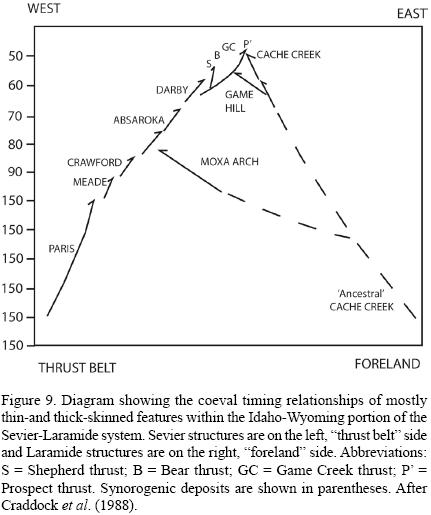
<body><![CDATA[<p align="justify"><font face="verdana" size="2">&nbsp;</font></p> 	    <p align="justify"><font face="verdana" size="2"><b>6. Comparison of timing between NE Mexico and Sevier&#150;Laramide province</b></font></p> 	    <p align="justify"><font face="verdana" size="2">As noted earlier, the NW&#150;SE and E&#150;W trending folding in northeast Mexico was coeval in part with the late stages of both the Sevier and Laramide orogenies in the western U. S. A. The Late Cretaceous&#150;Paleogene timing of deformation in Mexico is typically referred to as "Laramide" by most authors. We take exception to the usage of the term Laramide for several reasons. First and foremost is the implication that Laramide structures are characterized by the basement&#150;involved style present at the 'type' Laramide in southern Wyoming. Secondly, despite abundant references citing the Laramide orogeny as occurring over a very similar time period as deformation in northeast Mexico (e.g. Dickinson <i>et al.</i>, 1988), a growing number of studies demonstrate that this distinctive structural style began earlier in the Cretaceous within the classic Laramide province than previously thought (DeCelles, 1986; Craddock <i>et al.</i>, 1988; Barth <i>et al.</i>, 2004; Jacques&#150;Ayala <i>et al.</i>, 2009). "Laramide&#150;time" and "Sevier&#150;time" are therefore essentially synonymous (<a href="#f9">Figure 9</a>).</font></p> 	    <p align="center"><font face="verdana" size="2"><a name="f9"></a></font></p> 	    <p align="center"><font face="verdana" size="2"><img src="/img/revistas/bsgm/v63n2/a14f9.jpg"></font></p> 	    <p align="justify"><font face="verdana" size="2">An obvious alternative would be to compare the Sierra Madre Oriental and Sabinas structures to the Sevier orogen. They are similar in style, especially in the areas where the Mexican foldbelts are strongly faulted. The late stages of the Sevier orogeny also overlap completely in time with the Mexican orogen (Craddock <i>et al.</i>, 1988; Lawton and Trexler, 1991; Lawton <i>et al.</i>, 1993) but the Sevier thrusting began in the Early Cretaceous, whereas the Sierra Madre Oriental and Sabinas structures were demonstrably not active until the latest Cretaceous. Although there are many similarities with the type Sevier and Laramide systems to the north, we think the differences in structural history within Mexico are significant enough to warrant retaining the term Hidalgoan orogeny as originally proposed by Guzm&aacute;n and De Cserna (1963) by virtue of younger age and contrasting, salt&#150; and shale&#150;detached style of deformation in the northeastern Mexican cordillera. It is only by recognizing the kinematic and temporal differences between these areas that we will understand important variations in crustal type, crustal structure, stratigraphy, and plate interactions that drove these deformational events all along the margin of North America.</font></p> 	    <p align="justify"><font face="verdana" size="2">&nbsp;</font></p> 	    <p align="justify"><font face="verdana" size="2"><b>Acknowledgments</b></font></p> 	    <p align="justify"><font face="verdana" size="2">The authors would like to thank NMSU students Rachel Couch, Dominic Druke, Kevin Hon, David Shelley and Amy Weislogel, whose MS work was critical to this summary. The authors have benefited from discussions with many other colleagues regarding the geology of NE Mexico, in particular Samuel Eguiluz, Kate Giles, Bob Goldhammer, Rolando Peterson and James Wilson. Mark Rowan, Dante Mor&aacute;n and Gabriel Ch&aacute;vez Cabello are thanked for their thoughtful reviews. ExxonMobil Upstream Research Company is thanked for supporting many years of fieldwork and analyses and for permission to publish this work.</font></p> 	    <p align="justify"><font face="verdana" size="2">&nbsp;</font></p> 	    ]]></body>
<body><![CDATA[<p align="justify"><font face="verdana" size="2"><b>References</b></font></p> 	    <!-- ref --><p align="justify"><font face="verdana" size="2">Aranda&#150;Garc&iacute;a, M., 1991, El segmento San Felipe del cintur&oacute;n cabalgado, Sierra Madre Oriental, estado de Durango, M&eacute;xico: Bolet&iacute;n de la Asociaci&oacute;n Mexicana de Ge&oacute;logos Petroleros, 41, 18&#150;36.    &nbsp;&nbsp;&nbsp;&nbsp;&nbsp;&nbsp;&nbsp;&nbsp;[&#160;<a href="javascript:void(0);" onclick="javascript: window.open('/scielo.php?script=sci_nlinks&ref=1391820&pid=S1405-3322201100020001400001&lng=','','width=640,height=500,resizable=yes,scrollbars=1,menubar=yes,');">Links</a>&#160;]<!-- end-ref --></font></p> 	    <!-- ref --><p align="justify"><font face="verdana" size="2">Armstrong, R.L., 1968, Sevier orogenic belt in Nevada and Utah: Geological Society of America Bulletin, 79, 429&#150;458.    &nbsp;&nbsp;&nbsp;&nbsp;&nbsp;&nbsp;&nbsp;&nbsp;[&#160;<a href="javascript:void(0);" onclick="javascript: window.open('/scielo.php?script=sci_nlinks&ref=1391822&pid=S1405-3322201100020001400002&lng=','','width=640,height=500,resizable=yes,scrollbars=1,menubar=yes,');">Links</a>&#160;]<!-- end-ref --></font></p> 	    <!-- ref --><p align="justify"><font face="verdana" size="2">Baker, R.A. III, 1970, Stratigraphy and sedimentology of the Ca&ntilde;on del Tule Formation (Upper Cretaceous), Parras Basin, Northeastern Mexico: Austin, Texas, U. S. A., The University of Texas at Austin, Ph. D. Thesis, 322 p.    &nbsp;&nbsp;&nbsp;&nbsp;&nbsp;&nbsp;&nbsp;&nbsp;[&#160;<a href="javascript:void(0);" onclick="javascript: window.open('/scielo.php?script=sci_nlinks&ref=1391824&pid=S1405-3322201100020001400003&lng=','','width=640,height=500,resizable=yes,scrollbars=1,menubar=yes,');">Links</a>&#160;]<!-- end-ref --></font></p> 	    <!-- ref --><p align="justify"><font face="verdana" size="2">Barth, A.P., Wooden, J.L., Jacobsen, C.E., Probst, K., 2004, U&#150;Pb geochronology and geochemistry of the McCoy Mountains Formation, southern California: a Cretaceous retroarc foreland basin: Geological Society of America Bulletin, 116, 142&#150;153.    &nbsp;&nbsp;&nbsp;&nbsp;&nbsp;&nbsp;&nbsp;&nbsp;[&#160;<a href="javascript:void(0);" onclick="javascript: window.open('/scielo.php?script=sci_nlinks&ref=1391826&pid=S1405-3322201100020001400004&lng=','','width=640,height=500,resizable=yes,scrollbars=1,menubar=yes,');">Links</a>&#160;]<!-- end-ref --></font></p> 	    <!-- ref --><p align="justify"><font face="verdana" size="2">Campa&#150;Uranga, M.F., 1985, The Mexican thrust belt, in Howell, D.G. (ed.), Tectonostratigraphic terranes of the circum&#150;Pacific: Council for Energy and Mineral Resources, Earth Science Series, 299&#150;313.    &nbsp;&nbsp;&nbsp;&nbsp;&nbsp;&nbsp;&nbsp;&nbsp;[&#160;<a href="javascript:void(0);" onclick="javascript: window.open('/scielo.php?script=sci_nlinks&ref=1391828&pid=S1405-3322201100020001400005&lng=','','width=640,height=500,resizable=yes,scrollbars=1,menubar=yes,');">Links</a>&#160;]<!-- end-ref --></font></p> 	    <!-- ref --><p align="justify"><font face="verdana" size="2">Ch&aacute;vez&#150;Cabello, G., 2005, Deformaci&oacute;n y magmatismo Cenozoicos en el sur de la cuenca Sabinas, Coahuila, M&eacute;xico: M&eacute;xico, D.F., Universidad Nacional Aut&oacute;noma de M&eacute;xico, Ph. D. Thesis, 313 p.    &nbsp;&nbsp;&nbsp;&nbsp;&nbsp;&nbsp;&nbsp;&nbsp;[&#160;<a href="javascript:void(0);" onclick="javascript: window.open('/scielo.php?script=sci_nlinks&ref=1391830&pid=S1405-3322201100020001400006&lng=','','width=640,height=500,resizable=yes,scrollbars=1,menubar=yes,');">Links</a>&#160;]<!-- end-ref --></font></p> 	    <!-- ref --><p align="justify"><font face="verdana" size="2">Couch, R.D., 2005, Style, timing, and uplift history of the frontal Sierra Madre Oriental fold belt determined through analysis of growth strata and vitrinite reflectance: Las Cruces, New Mexico, U.S.A., New Mexico State University, M.S. Thesis, 243 p.    &nbsp;&nbsp;&nbsp;&nbsp;&nbsp;&nbsp;&nbsp;&nbsp;[&#160;<a href="javascript:void(0);" onclick="javascript: window.open('/scielo.php?script=sci_nlinks&ref=1391832&pid=S1405-3322201100020001400007&lng=','','width=640,height=500,resizable=yes,scrollbars=1,menubar=yes,');">Links</a>&#160;]<!-- end-ref --></font></p> 	    <!-- ref --><p align="justify"><font face="verdana" size="2">Couch, R.D., Lawton, T.F., Gray, G.G., Rowan, M.G., Vega, F.J., 2004, Relative ages of detachment folding and basin inversion, foreland basin system of Sierra Madre Oriental, northeastern Mexico: Geological Society of America Abstracts with Programs, 36, 88.    &nbsp;&nbsp;&nbsp;&nbsp;&nbsp;&nbsp;&nbsp;&nbsp;[&#160;<a href="javascript:void(0);" onclick="javascript: window.open('/scielo.php?script=sci_nlinks&ref=1391834&pid=S1405-3322201100020001400008&lng=','','width=640,height=500,resizable=yes,scrollbars=1,menubar=yes,');">Links</a>&#160;]<!-- end-ref --></font></p> 	    <!-- ref --><p align="justify"><font face="verdana" size="2">Craddock, J.P., Kopania, A.A., Wiltschko, D.V., 1988, Interaction between the northern Idaho&#150;Wyoming thrust belt and bounding basement blocks, central western Wyoming, in Schmidt, C.J., Perry, W.J. Jr. (eds.), Interaction of the Rocky Mountain foreland and the Cordilleran Thrust Belt: Geological Society of America Memoirs, 171, 333&#150;352.    &nbsp;&nbsp;&nbsp;&nbsp;&nbsp;&nbsp;&nbsp;&nbsp;[&#160;<a href="javascript:void(0);" onclick="javascript: window.open('/scielo.php?script=sci_nlinks&ref=1391836&pid=S1405-3322201100020001400009&lng=','','width=640,height=500,resizable=yes,scrollbars=1,menubar=yes,');">Links</a>&#160;]<!-- end-ref --></font></p> 	    <!-- ref --><p align="justify"><font face="verdana" size="2">Cserna, Z. De, 1956, Tectonica de la Sierra Madre Oriental de M&eacute;xico entre Torre&oacute;n y Monterrey, in 20th International Geological Congress: M&eacute;xico, D.F., 87 p.    &nbsp;&nbsp;&nbsp;&nbsp;&nbsp;&nbsp;&nbsp;&nbsp;[&#160;<a href="javascript:void(0);" onclick="javascript: window.open('/scielo.php?script=sci_nlinks&ref=1391838&pid=S1405-3322201100020001400010&lng=','','width=640,height=500,resizable=yes,scrollbars=1,menubar=yes,');">Links</a>&#160;]<!-- end-ref --></font></p>     <!-- ref --><p align="justify"><font face="verdana" size="2">Cserna, Z. De, 1971, Taconian (early Caledonian) deformation in the Huasteca structural belt of eastern Mexico: American Journal of Science, 271, 544&#150;550.    &nbsp;&nbsp;&nbsp;&nbsp;&nbsp;&nbsp;&nbsp;&nbsp;[&#160;<a href="javascript:void(0);" onclick="javascript: window.open('/scielo.php?script=sci_nlinks&ref=1391840&pid=S1405-3322201100020001400011&lng=','','width=640,height=500,resizable=yes,scrollbars=1,menubar=yes,');">Links</a>&#160;]<!-- end-ref --></font></p>     <!-- ref --><p align="justify"><font face="verdana" size="2">DeCelles, P.G., 1986, Sedimentation in a tectonically partitioned, nonmarine foreland basin: the Lower Cretaceous Kootenai Formation, southwestern Montana: Geological Society of America Bulletin, 97, 911&#150;931.    &nbsp;&nbsp;&nbsp;&nbsp;&nbsp;&nbsp;&nbsp;&nbsp;[&#160;<a href="javascript:void(0);" onclick="javascript: window.open('/scielo.php?script=sci_nlinks&ref=1391842&pid=S1405-3322201100020001400012&lng=','','width=640,height=500,resizable=yes,scrollbars=1,menubar=yes,');">Links</a>&#160;]<!-- end-ref --></font></p> 	    <!-- ref --><p align="justify"><font face="verdana" size="2">Dickinson, W.R., Klute, M.A., Hayes, M.J., Janecke, S.U., Lundin, E.R., McKittrick, M.A., Olivares, M.D., 1988, Paleogeographic and paleotectonic setting of Laramide sedimentary basins in the central Rocky Mountain region: Geological Society of America Bulletin, 100, 1023&#150;1039.    &nbsp;&nbsp;&nbsp;&nbsp;&nbsp;&nbsp;&nbsp;&nbsp;[&#160;<a href="javascript:void(0);" onclick="javascript: window.open('/scielo.php?script=sci_nlinks&ref=1391844&pid=S1405-3322201100020001400013&lng=','','width=640,height=500,resizable=yes,scrollbars=1,menubar=yes,');">Links</a>&#160;]<!-- end-ref --></font></p> 	    <!-- ref --><p align="justify"><font face="verdana" size="2">Dillman, G.J., 1985, Structural investigation and tectonic history of the central Parras basin, Saltillo, Coahuila, Mexico: Houston, Texas, U. S. A., University of Houston, M.S. Thesis, 293 p.    &nbsp;&nbsp;&nbsp;&nbsp;&nbsp;&nbsp;&nbsp;&nbsp;[&#160;<a href="javascript:void(0);" onclick="javascript: window.open('/scielo.php?script=sci_nlinks&ref=1391846&pid=S1405-3322201100020001400014&lng=','','width=640,height=500,resizable=yes,scrollbars=1,menubar=yes,');">Links</a>&#160;]<!-- end-ref --></font></p> 	    <!-- ref --><p align="justify"><font face="verdana" size="2">Drewes, H., 1988, Development of the foreland zone and adjacent terranes of the Cordilleran orogenic belt near the U.S.&#150;Mexican border, in Schmidt, C.A., Perry, W.J., Jr., (eds.), Interaction of the Rocky Mountain foreland and the Cordilleran thrust front: Geological Society of America Memoir, 171, 447&#150;463.    &nbsp;&nbsp;&nbsp;&nbsp;&nbsp;&nbsp;&nbsp;&nbsp;[&#160;<a href="javascript:void(0);" onclick="javascript: window.open('/scielo.php?script=sci_nlinks&ref=1391848&pid=S1405-3322201100020001400015&lng=','','width=640,height=500,resizable=yes,scrollbars=1,menubar=yes,');">Links</a>&#160;]<!-- end-ref --></font></p> 	    <!-- ref --><p align="justify"><font face="verdana" size="2">Druke, D.C., 2005, Sedimentology and stratigraphy of the San Jose lentil, La Popa basin, Mexico and implications for carbonate development in a tectonically influenced salt basin: Las Cruces, New Mexico, U. S. A., New Mexico State University, M.S. Thesis, 132 p.    &nbsp;&nbsp;&nbsp;&nbsp;&nbsp;&nbsp;&nbsp;&nbsp;[&#160;<a href="javascript:void(0);" onclick="javascript: window.open('/scielo.php?script=sci_nlinks&ref=1391850&pid=S1405-3322201100020001400016&lng=','','width=640,height=500,resizable=yes,scrollbars=1,menubar=yes,');">Links</a>&#160;]<!-- end-ref --></font></p> 	    <!-- ref --><p align="justify"><font face="verdana" size="2">Eguiluz de Antu&ntilde;ano, S., 2001, Geologic evolution and gas resources of the Sabinas basin in Northeastern Mexico, in Bartolini, C., Buffler, R.T., Cant&uacute;&#150;Chapa, A. (eds.), The western Gulf of Mexico basin: Tectonics, sedimentary basins, and petroleum systems: American Association of Petroleum Geologists Memoir, 75, 241&#150;270.    &nbsp;&nbsp;&nbsp;&nbsp;&nbsp;&nbsp;&nbsp;&nbsp;[&#160;<a href="javascript:void(0);" onclick="javascript: window.open('/scielo.php?script=sci_nlinks&ref=1391852&pid=S1405-3322201100020001400017&lng=','','width=640,height=500,resizable=yes,scrollbars=1,menubar=yes,');">Links</a>&#160;]<!-- end-ref --></font></p> 	    <!-- ref --><p align="justify"><font face="verdana" size="2">Giles, K.A., Lawton, T.F., 1999, Attributes and evolution of an exhumed salt weld, La Popa Basin, Northeastern Mexico: Geology, 27, 323&#150;326.    &nbsp;&nbsp;&nbsp;&nbsp;&nbsp;&nbsp;&nbsp;&nbsp;[&#160;<a href="javascript:void(0);" onclick="javascript: window.open('/scielo.php?script=sci_nlinks&ref=1391854&pid=S1405-3322201100020001400018&lng=','','width=640,height=500,resizable=yes,scrollbars=1,menubar=yes,');">Links</a>&#160;]<!-- end-ref --></font></p> 	    <!-- ref --><p align="justify"><font face="verdana" size="2">Giles, K.A., Lawton, T.F., 2002, Halokinetic sequence stratigraphy adjacent to El Papalote diapir, La Popa basin, northeastern Mexico: American Association of Petroleum Geologists Bulletin, 86, 823&#150;841.    &nbsp;&nbsp;&nbsp;&nbsp;&nbsp;&nbsp;&nbsp;&nbsp;[&#160;<a href="javascript:void(0);" onclick="javascript: window.open('/scielo.php?script=sci_nlinks&ref=1391856&pid=S1405-3322201100020001400019&lng=','','width=640,height=500,resizable=yes,scrollbars=1,menubar=yes,');">Links</a>&#160;]<!-- end-ref --></font></p> 	    <!-- ref --><p align="justify"><font face="verdana" size="2">Goldhammer, R.K., 1999, Mesozoic sequence stratigraphy and paleogeographic evolution of northeastern Mexico, in Bartolini, C., Wilson, J.L., Lawton, T.F. (eds.), Mesozoic sedimentary and tectonic history of north&#150;central Mexico: Geological Society of America Special Paper, 340, 1&#150;59.    &nbsp;&nbsp;&nbsp;&nbsp;&nbsp;&nbsp;&nbsp;&nbsp;[&#160;<a href="javascript:void(0);" onclick="javascript: window.open('/scielo.php?script=sci_nlinks&ref=1391858&pid=S1405-3322201100020001400020&lng=','','width=640,height=500,resizable=yes,scrollbars=1,menubar=yes,');">Links</a>&#160;]<!-- end-ref --></font></p> 	    <!-- ref --><p align="justify"><font face="verdana" size="2">Gray, G.G., Lawton, T.F., 2008, Evidence for basement type distribution using zircon U/Pb age spectra from Jurassic and Cretaceous sandstones, greater Monterrey area, Mexico (abstract): Geological Society of American Abstracts with Programs, 40, 199.    &nbsp;&nbsp;&nbsp;&nbsp;&nbsp;&nbsp;&nbsp;&nbsp;[&#160;<a href="javascript:void(0);" onclick="javascript: window.open('/scielo.php?script=sci_nlinks&ref=1391860&pid=S1405-3322201100020001400021&lng=','','width=640,height=500,resizable=yes,scrollbars=1,menubar=yes,');">Links</a>&#160;]<!-- end-ref --></font></p> 	    <!-- ref --><p align="justify"><font face="verdana" size="2">Gray, G.G., Pottorf, R.J., Yurewicz, D.A., Mahon, K.I., Pevear, D.R., Chuchla, R.J., 2001, Thermal and chronological record of syn&#150; to post&#150;Laramide burial and exhumation, Sierra Madre Oriental, Mexico, in Bartolini, C., Buffler, R.T., Cant&uacute;&#150;Chapa, A. (eds.), The western Gulf of Mexico Basin: Tectonics, sedimentary basins, and petroleum systems: American Association of Petroleum Geologists Memoir, 75, 159&#150;181.    &nbsp;&nbsp;&nbsp;&nbsp;&nbsp;&nbsp;&nbsp;&nbsp;[&#160;<a href="javascript:void(0);" onclick="javascript: window.open('/scielo.php?script=sci_nlinks&ref=1391862&pid=S1405-3322201100020001400022&lng=','','width=640,height=500,resizable=yes,scrollbars=1,menubar=yes,');">Links</a>&#160;]<!-- end-ref --></font></p> 	    <!-- ref --><p align="justify"><font face="verdana" size="2">Guzm&aacute;n, E.J., Cserna, Z. De, 1963, Tectonic history of Mexico, in Childs, O.E., Beebe, B.W. (eds.), Backbone of the Americas &#150; tectonic history from pole to pole: American Association of Petroleum Geologists Memoir, 2, 113&#150;129.    &nbsp;&nbsp;&nbsp;&nbsp;&nbsp;&nbsp;&nbsp;&nbsp;[&#160;<a href="javascript:void(0);" onclick="javascript: window.open('/scielo.php?script=sci_nlinks&ref=1391864&pid=S1405-3322201100020001400023&lng=','','width=640,height=500,resizable=yes,scrollbars=1,menubar=yes,');">Links</a>&#160;]<!-- end-ref --></font></p>     <!-- ref --><p align="justify"><font face="verdana" size="2">Hon, K., 2001, Salt&#150;influenced growth&#150;stratal geometries and structure of the Muerto Formation adjacent to an ancient secondary salt weld, La Popa Basin, Nuevo Leon, Mexico: Las Cruces, New Mexico, U. S. A., New Mexico State University, M.Sc. Thesis, 97 p.    &nbsp;&nbsp;&nbsp;&nbsp;&nbsp;&nbsp;&nbsp;&nbsp;[&#160;<a href="javascript:void(0);" onclick="javascript: window.open('/scielo.php?script=sci_nlinks&ref=1391866&pid=S1405-3322201100020001400024&lng=','','width=640,height=500,resizable=yes,scrollbars=1,menubar=yes,');">Links</a>&#160;]<!-- end-ref --></font></p> 	    <!-- ref --><p align="justify"><font face="verdana" size="2">Jacques&#150;Ayala, C., Barth, A.P., Wooden, J.L., Jacobson, C.E., 2009, Provenance and U&#150;Pb geochronology of the Upper Cretaceous El Chanate Group, northwest Sonora, Mexico, and its tectonic significance: International Geology Review: 51, 1051&#150;1077.    &nbsp;&nbsp;&nbsp;&nbsp;&nbsp;&nbsp;&nbsp;&nbsp;[&#160;<a href="javascript:void(0);" onclick="javascript: window.open('/scielo.php?script=sci_nlinks&ref=1391868&pid=S1405-3322201100020001400025&lng=','','width=640,height=500,resizable=yes,scrollbars=1,menubar=yes,');">Links</a>&#160;]<!-- end-ref --></font></p> 	    <!-- ref --><p align="justify"><font face="verdana" size="2">Kulik, D.M., Schmidt, C.J., 1988, Region of overlap and styles of interaction of Cordilleran thrust belt and Rocky Mountain foreland, in Schmidt, C A., Perry, W.J. Jr. (eds.), Interaction of the Rocky Mountain foreland and the Cordilleran thrust front: Geological Society of America Memoir, 171, 75&#150;98.    &nbsp;&nbsp;&nbsp;&nbsp;&nbsp;&nbsp;&nbsp;&nbsp;[&#160;<a href="javascript:void(0);" onclick="javascript: window.open('/scielo.php?script=sci_nlinks&ref=1391870&pid=S1405-3322201100020001400026&lng=','','width=640,height=500,resizable=yes,scrollbars=1,menubar=yes,');">Links</a>&#160;]<!-- end-ref --></font></p> 	    <!-- ref --><p align="justify"><font face="verdana" size="2">Laudon, R.C., 1984, Evaporite diapirs of the La Popa basin, Nuevo Le&oacute;n, M&eacute;xico: Geological Society of America Bulletin, 95, 1219&#150;1225.    &nbsp;&nbsp;&nbsp;&nbsp;&nbsp;&nbsp;&nbsp;&nbsp;[&#160;<a href="javascript:void(0);" onclick="javascript: window.open('/scielo.php?script=sci_nlinks&ref=1391872&pid=S1405-3322201100020001400027&lng=','','width=640,height=500,resizable=yes,scrollbars=1,menubar=yes,');">Links</a>&#160;]<!-- end-ref --></font></p> 	    <!-- ref --><p align="justify"><font face="verdana" size="2">Lawton, T.F., Trexler, J.H. Jr., 1991, Piggyback basin in the Sevier orogenic belt, Utah: implications for development of the thrust wedge: Geology, 19, 827&#150;830.    &nbsp;&nbsp;&nbsp;&nbsp;&nbsp;&nbsp;&nbsp;&nbsp;[&#160;<a href="javascript:void(0);" onclick="javascript: window.open('/scielo.php?script=sci_nlinks&ref=1391874&pid=S1405-3322201100020001400028&lng=','','width=640,height=500,resizable=yes,scrollbars=1,menubar=yes,');">Links</a>&#160;]<!-- end-ref --></font></p> 	    <!-- ref --><p align="justify"><font face="verdana" size="2">Lawton, T.F., 2008, Laramide sedimentary basins, in Miall, A. (ed.) The Sedimentary Basins of the United States and Canada: Amsterdam, The Netherlands, Elsevier, 429&#150;450.    &nbsp;&nbsp;&nbsp;&nbsp;&nbsp;&nbsp;&nbsp;&nbsp;[&#160;<a href="javascript:void(0);" onclick="javascript: window.open('/scielo.php?script=sci_nlinks&ref=1391876&pid=S1405-3322201100020001400029&lng=','','width=640,height=500,resizable=yes,scrollbars=1,menubar=yes,');">Links</a>&#160;]<!-- end-ref --></font></p> 	    <!-- ref --><p align="justify"><font face="verdana" size="2">Lawton, T.F., Bradford, I.A., Vega, F.J., Gehrels, G.E., Amato, J.M., 2009, Provenance of Upper Cretaceous&#150;Paleogene sandstones in the foreland basin system of the Sierra Madre Oriental, northeastern Mexico, and its bearing on fluvial dispersal systems of the Mexican Laramide Province: Geological Society of America Bulletin, 121, 820&#150;836.    &nbsp;&nbsp;&nbsp;&nbsp;&nbsp;&nbsp;&nbsp;&nbsp;[&#160;<a href="javascript:void(0);" onclick="javascript: window.open('/scielo.php?script=sci_nlinks&ref=1391878&pid=S1405-3322201100020001400030&lng=','','width=640,height=500,resizable=yes,scrollbars=1,menubar=yes,');">Links</a>&#160;]<!-- end-ref --></font></p> 	    <!-- ref --><p align="justify"><font face="verdana" size="2">Lawton, T.F., Talling, P.J., Hobbs, R.S., Trexler, J.H. Jr., Weiss, M.P., Burbank, D.W., 1993, Structure and stratigraphy of Upper Cretaceous and Paleocene strata (North Horn Formation), eastern San Pitch Mountains, Utah &#150; Sedimentation at the front of the Sevier orogenic belt: U. S. Geological Survey Professional Paper, 1787&#150;II, 33 p.    &nbsp;&nbsp;&nbsp;&nbsp;&nbsp;&nbsp;&nbsp;&nbsp;[&#160;<a href="javascript:void(0);" onclick="javascript: window.open('/scielo.php?script=sci_nlinks&ref=1391880&pid=S1405-3322201100020001400031&lng=','','width=640,height=500,resizable=yes,scrollbars=1,menubar=yes,');">Links</a>&#160;]<!-- end-ref --></font></p> 	    <!-- ref --><p align="justify"><font face="verdana" size="2">Lawton, T.F., Vega, F.J., Giles, K.A., Rosales&#150;Dominguez, C., 2001, Stratigraphy and origin of the La Popa basin, Nuevo Leon and Coahuila, Mexico, in Bartolini, C., Buffler, R.T., Cant&uacute;&#150;Chapa, A. (eds.), Mesozoic and Cenozoic evolution of the western Gulf of Mexico basin: Tectonics, sedimentary basins and petroleum systems: American Association of Petroleum Geologists Memoir, 75, 219&#150;240.    &nbsp;&nbsp;&nbsp;&nbsp;&nbsp;&nbsp;&nbsp;&nbsp;[&#160;<a href="javascript:void(0);" onclick="javascript: window.open('/scielo.php?script=sci_nlinks&ref=1391882&pid=S1405-3322201100020001400032&lng=','','width=640,height=500,resizable=yes,scrollbars=1,menubar=yes,');">Links</a>&#160;]<!-- end-ref --></font></p> 	    <!-- ref --><p align="justify"><font face="verdana" size="2">Lehmann, C., Osleger, D.A., Monta&ntilde;ez, I.P., Sliter, W., Arnaud&#150;Vanneau, A., Banner, J., 1999, Evolution of Cupido and Coahuila carbonate platforms, Early Cretaceous, northeastern Mexico: Geological Society of America Bulletin, 111, 1010&#150;1029.    &nbsp;&nbsp;&nbsp;&nbsp;&nbsp;&nbsp;&nbsp;&nbsp;[&#160;<a href="javascript:void(0);" onclick="javascript: window.open('/scielo.php?script=sci_nlinks&ref=1391884&pid=S1405-3322201100020001400033&lng=','','width=640,height=500,resizable=yes,scrollbars=1,menubar=yes,');">Links</a>&#160;]<!-- end-ref --></font></p> 	    <!-- ref --><p align="justify"><font face="verdana" size="2">McBride, E.F., Weidie, A.E., Wolleben, J.A., Laudon, R.C., 1974, Stratigraphy and structure of the Parras and La Popa basins, northeastern Mexico: Geological Society of America Bulletin, 85, 1603&#150;1622.    &nbsp;&nbsp;&nbsp;&nbsp;&nbsp;&nbsp;&nbsp;&nbsp;[&#160;<a href="javascript:void(0);" onclick="javascript: window.open('/scielo.php?script=sci_nlinks&ref=1391886&pid=S1405-3322201100020001400034&lng=','','width=640,height=500,resizable=yes,scrollbars=1,menubar=yes,');">Links</a>&#160;]<!-- end-ref --></font></p> 	    <!-- ref --><p align="justify"><font face="verdana" size="2">Padilla y S&aacute;nchez, R.J., 1985, Las estructuras de la Curvatura de Monterrey, Estados de Coahuila, Nuevo Le&oacute;n, Zacatecas y San Lu&iacute;s de Potos&iacute;: Revista del Instituto de Geolog&iacute;a, Universidad Nacional Aut&oacute;noma de M&eacute;xico, 6, 1&#150;20.    &nbsp;&nbsp;&nbsp;&nbsp;&nbsp;&nbsp;&nbsp;&nbsp;[&#160;<a href="javascript:void(0);" onclick="javascript: window.open('/scielo.php?script=sci_nlinks&ref=1391888&pid=S1405-3322201100020001400035&lng=','','width=640,height=500,resizable=yes,scrollbars=1,menubar=yes,');">Links</a>&#160;]<!-- end-ref --></font></p> 	    <!-- ref --><p align="justify"><font face="verdana" size="2">Prost, G., Aranda, M., 2001, Tectonics and Hydrocarbon Systems of the Veracruz Basin, Mexico, in Bartolini, C., Buffler, R.T., Cant&uacute;&#150;Chapa, A. (eds.), The western Gulf of Mexico Basin: Tectonics, sedimentary basins, and petroleum systems: American Association of Petroleum Geologists Memoir, 75, 271&#150;291.    &nbsp;&nbsp;&nbsp;&nbsp;&nbsp;&nbsp;&nbsp;&nbsp;[&#160;<a href="javascript:void(0);" onclick="javascript: window.open('/scielo.php?script=sci_nlinks&ref=1391890&pid=S1405-3322201100020001400036&lng=','','width=640,height=500,resizable=yes,scrollbars=1,menubar=yes,');">Links</a>&#160;]<!-- end-ref --></font></p> 	    <!-- ref --><p align="justify"><font face="verdana" size="2">Prost, G., Marrett, R., Aranda, M., Eguiluz, S., Galicia, J., Banda, J., 1994, Deformation history of the Sierra Madre Oriental, Mexico, and associated hydrocarbon generation&#150;preservation (abstract): Houston, Texas, First Joint AAPG/AMPG Research Conference Abstracts, 3.    &nbsp;&nbsp;&nbsp;&nbsp;&nbsp;&nbsp;&nbsp;&nbsp;[&#160;<a href="javascript:void(0);" onclick="javascript: window.open('/scielo.php?script=sci_nlinks&ref=1391892&pid=S1405-3322201100020001400037&lng=','','width=640,height=500,resizable=yes,scrollbars=1,menubar=yes,');">Links</a>&#160;]<!-- end-ref --></font></p> 	    <!-- ref --><p align="justify"><font face="verdana" size="2">Rowan, M.G., Lawton, T.F., Giles, K.A., Ratliffe, R.A., 2003, Near&#150;salt deformation in La Popa basin, Mexico, and the northern Gulf of Mexico: a general model for passive diapirism: American Association of Petroleum Geologists Bulletin, 87, 733&#150;756.    &nbsp;&nbsp;&nbsp;&nbsp;&nbsp;&nbsp;&nbsp;&nbsp;[&#160;<a href="javascript:void(0);" onclick="javascript: window.open('/scielo.php?script=sci_nlinks&ref=1391894&pid=S1405-3322201100020001400038&lng=','','width=640,height=500,resizable=yes,scrollbars=1,menubar=yes,');">Links</a>&#160;]<!-- end-ref --></font></p> 	    <!-- ref --><p align="justify"><font face="verdana" size="2">Shelley, D.C., Lawton, T.F., 2005, Sequence stratigraphy of tidally influenced deposits in a salt&#150;withdrawal minibasin: Upper sandstone member of the Potrerillos Formation (Paleocene), La Popa Basin, northeastern Mexico: American Association of Petroleum Geologists Bulletin, 89, 1157&#150;1179.    &nbsp;&nbsp;&nbsp;&nbsp;&nbsp;&nbsp;&nbsp;&nbsp;[&#160;<a href="javascript:void(0);" onclick="javascript: window.open('/scielo.php?script=sci_nlinks&ref=1391896&pid=S1405-3322201100020001400039&lng=','','width=640,height=500,resizable=yes,scrollbars=1,menubar=yes,');">Links</a>&#160;]<!-- end-ref --></font></p> 	    <!-- ref --><p align="justify"><font face="verdana" size="2">Soegaard, K., Ye, H., Halik, N., Daniels, A., Arney, J., Garrick, S., 2003, Stratigraphic evolution of latest Cretaceous to Early Tertiary Difunta foreland basin in northeast Mexico: Influence of salt withdrawal on tectonically induced subsidence by the Sierra Madre Oriental fold and thrust belt, in Bartolini, C., Buffler, R.T., Blickwede, J. (eds.), The Circum&#150;Gulf of Mexico and the Caribbean: Hydrocarbon habitats, basin formation and plate tectonics: American Association of Petroleum Geologists Memoir, 79, 364&#150;394.    &nbsp;&nbsp;&nbsp;&nbsp;&nbsp;&nbsp;&nbsp;&nbsp;[&#160;<a href="javascript:void(0);" onclick="javascript: window.open('/scielo.php?script=sci_nlinks&ref=1391898&pid=S1405-3322201100020001400040&lng=','','width=640,height=500,resizable=yes,scrollbars=1,menubar=yes,');">Links</a>&#160;]<!-- end-ref --></font></p> 	    <!-- ref --><p align="justify"><font face="verdana" size="2">Vega&#150;Vera, F.J., Mitre&#150;Salazar, L.M., Mart&iacute;nez, E., 1989, Contribuci&oacute;n al conocimiento de la estratigraf&iacute;a del grupo Difunta (Cret&aacute;cico superior&#150;Terciario) en el noreste de M&eacute;xico: Revista del Instituto de Geolog&iacute;a, Universidad Nacional Aut&oacute;noma de M&eacute;xico, 8, 179&#150;187.    &nbsp;&nbsp;&nbsp;&nbsp;&nbsp;&nbsp;&nbsp;&nbsp;[&#160;<a href="javascript:void(0);" onclick="javascript: window.open('/scielo.php?script=sci_nlinks&ref=1391900&pid=S1405-3322201100020001400041&lng=','','width=640,height=500,resizable=yes,scrollbars=1,menubar=yes,');">Links</a>&#160;]<!-- end-ref --></font></p> 	    <!-- ref --><p align="justify"><font face="verdana" size="2">Weidie, A.E., Murray, G.E., 1967, Geology of the Parras Basin and adjacent areas of northeastern Mexico: American Association of Petroleum Geologists Bulletin, 51, 678&#150;695.    &nbsp;&nbsp;&nbsp;&nbsp;&nbsp;&nbsp;&nbsp;&nbsp;[&#160;<a href="javascript:void(0);" onclick="javascript: window.open('/scielo.php?script=sci_nlinks&ref=1391902&pid=S1405-3322201100020001400042&lng=','','width=640,height=500,resizable=yes,scrollbars=1,menubar=yes,');">Links</a>&#160;]<!-- end-ref --></font></p> 	    <!-- ref --><p align="justify"><font face="verdana" size="2">Weislogel, A.L., 2001, The influence of diapirism and foreland evolution on the depositional system, stratigraphy, and petrology of the Maastrichtian Muerto Formation, La Popa Basin, Mexico: Las Cruces, New Mexico, U. S. A., New Mexico State University, M.Sc. Thesis, 242 p.    &nbsp;&nbsp;&nbsp;&nbsp;&nbsp;&nbsp;&nbsp;&nbsp;[&#160;<a href="javascript:void(0);" onclick="javascript: window.open('/scielo.php?script=sci_nlinks&ref=1391904&pid=S1405-3322201100020001400043&lng=','','width=640,height=500,resizable=yes,scrollbars=1,menubar=yes,');">Links</a>&#160;]<!-- end-ref --></font></p> 	    <!-- ref --><p align="justify"><font face="verdana" size="2">Ye, H., 1997, The arcuate Sierra Madre Oriental orogenic belt, NE Mexico: Tectonic infilling of a recess along the southwestern North American continental margin, in Soegaard, K., Giles, K., Vega, F.J., Lawton, T.F. (eds.), Structure, Stratigraphy, and Paleontology of Late Cretaceous&#150;Early Tertiary Parras&#150;La Popa foreland basin near Monterrey, Mexico: Dallas, Texas, U. S. A., Annual Meeting of the American Association of Petroleum Geologists Field Trip Guide 10, 85&#150;115.    &nbsp;&nbsp;&nbsp;&nbsp;&nbsp;&nbsp;&nbsp;&nbsp;[&#160;<a href="javascript:void(0);" onclick="javascript: window.open('/scielo.php?script=sci_nlinks&ref=1391906&pid=S1405-3322201100020001400044&lng=','','width=640,height=500,resizable=yes,scrollbars=1,menubar=yes,');">Links</a>&#160;]<!-- end-ref --></font></p>      ]]></body><back>
<ref-list>
<ref id="B1">
<nlm-citation citation-type="journal">
<person-group person-group-type="author">
<name>
<surname><![CDATA[Aranda-García]]></surname>
<given-names><![CDATA[M]]></given-names>
</name>
</person-group>
<article-title xml:lang="es"><![CDATA[El segmento San Felipe del cinturón cabalgado, Sierra Madre Oriental, estado de Durango, México]]></article-title>
<source><![CDATA[Boletín de la Asociación Mexicana de Geólogos Petroleros]]></source>
<year>1991</year>
<volume>41</volume>
<page-range>18-36</page-range></nlm-citation>
</ref>
<ref id="B2">
<nlm-citation citation-type="journal">
<person-group person-group-type="author">
<name>
<surname><![CDATA[Armstrong]]></surname>
<given-names><![CDATA[R.L.]]></given-names>
</name>
</person-group>
<article-title xml:lang="en"><![CDATA[Sevier orogenic belt in Nevada and Utah]]></article-title>
<source><![CDATA[Geological Society of America Bulletin]]></source>
<year>1968</year>
<volume>79</volume>
<page-range>429-458</page-range></nlm-citation>
</ref>
<ref id="B3">
<nlm-citation citation-type="book">
<person-group person-group-type="author">
<name>
<surname><![CDATA[Baker]]></surname>
<given-names><![CDATA[R.A. III]]></given-names>
</name>
</person-group>
<source><![CDATA[Stratigraphy and sedimentology of the Cañon del Tule Formation (Upper Cretaceous), Parras Basin, Northeastern Mexico]]></source>
<year>1970</year>
<page-range>322</page-range><publisher-loc><![CDATA[Austin^eTexas Texas]]></publisher-loc>
<publisher-name><![CDATA[The University of Texas at Austin]]></publisher-name>
</nlm-citation>
</ref>
<ref id="B4">
<nlm-citation citation-type="journal">
<person-group person-group-type="author">
<name>
<surname><![CDATA[Barth]]></surname>
<given-names><![CDATA[A.P.]]></given-names>
</name>
<name>
<surname><![CDATA[Wooden]]></surname>
<given-names><![CDATA[J.L.]]></given-names>
</name>
<name>
<surname><![CDATA[Jacobsen]]></surname>
<given-names><![CDATA[C.E.]]></given-names>
</name>
<name>
<surname><![CDATA[Probst]]></surname>
<given-names><![CDATA[K]]></given-names>
</name>
</person-group>
<article-title xml:lang="en"><![CDATA[U-Pb geochronology and geochemistry of the McCoy Mountains Formation, southern California: a Cretaceous retroarc foreland basin]]></article-title>
<source><![CDATA[Geological Society of America Bulletin]]></source>
<year>2004</year>
<volume>116</volume>
<page-range>142-153</page-range></nlm-citation>
</ref>
<ref id="B5">
<nlm-citation citation-type="journal">
<person-group person-group-type="author">
<name>
<surname><![CDATA[Campa-Uranga]]></surname>
<given-names><![CDATA[M.F.]]></given-names>
</name>
</person-group>
<article-title xml:lang="en"><![CDATA[The Mexican thrust belt, in Howell, D.G. (ed.), Tectonostratigraphic terranes of the circum-Pacific]]></article-title>
<source><![CDATA[Council for Energy and Mineral Resources]]></source>
<year>1985</year>
<page-range>299-313</page-range></nlm-citation>
</ref>
<ref id="B6">
<nlm-citation citation-type="book">
<person-group person-group-type="author">
<name>
<surname><![CDATA[Chávez-Cabello]]></surname>
<given-names><![CDATA[G]]></given-names>
</name>
</person-group>
<source><![CDATA[Deformación y magmatismo Cenozoicos en el sur de la cuenca Sabinas, Coahuila, México]]></source>
<year>2005</year>
<page-range>313</page-range><publisher-loc><![CDATA[México^eD.F. D.F.]]></publisher-loc>
<publisher-name><![CDATA[Universidad Nacional Autónoma de México]]></publisher-name>
</nlm-citation>
</ref>
<ref id="B7">
<nlm-citation citation-type="book">
<person-group person-group-type="author">
<name>
<surname><![CDATA[Couch]]></surname>
<given-names><![CDATA[R.D.]]></given-names>
</name>
</person-group>
<source><![CDATA[Style, timing, and uplift history of the frontal Sierra Madre Oriental fold belt determined through analysis of growth strata and vitrinite reflectance]]></source>
<year>2005</year>
<page-range>243</page-range><publisher-loc><![CDATA[Las Cruces^eNew Mexico New Mexico]]></publisher-loc>
<publisher-name><![CDATA[New Mexico State University]]></publisher-name>
</nlm-citation>
</ref>
<ref id="B8">
<nlm-citation citation-type="journal">
<person-group person-group-type="author">
<name>
<surname><![CDATA[Couch]]></surname>
<given-names><![CDATA[R.D.]]></given-names>
</name>
<name>
<surname><![CDATA[Lawton]]></surname>
<given-names><![CDATA[T.F.]]></given-names>
</name>
<name>
<surname><![CDATA[Gray]]></surname>
<given-names><![CDATA[G.G.]]></given-names>
</name>
<name>
<surname><![CDATA[Rowan]]></surname>
<given-names><![CDATA[M.G.]]></given-names>
</name>
<name>
<surname><![CDATA[Vega]]></surname>
<given-names><![CDATA[F.J.]]></given-names>
</name>
</person-group>
<article-title xml:lang="en"><![CDATA[Relative ages of detachment folding and basin inversion, foreland basin system of Sierra Madre Oriental, northeastern Mexico]]></article-title>
<source><![CDATA[Geological Society of America Abstracts with Programs]]></source>
<year>2004</year>
<volume>36</volume>
<page-range>88</page-range></nlm-citation>
</ref>
<ref id="B9">
<nlm-citation citation-type="book">
<person-group person-group-type="author">
<name>
<surname><![CDATA[Craddock]]></surname>
<given-names><![CDATA[J.P.]]></given-names>
</name>
<name>
<surname><![CDATA[Kopania]]></surname>
<given-names><![CDATA[A.A.]]></given-names>
</name>
<name>
<surname><![CDATA[Wiltschko]]></surname>
<given-names><![CDATA[D.V.]]></given-names>
</name>
</person-group>
<article-title xml:lang="en"><![CDATA[Interaction between the northern Idaho-Wyoming thrust belt and bounding basement blocks, central western Wyoming]]></article-title>
<person-group person-group-type="editor">
<name>
<surname><![CDATA[Schmidt]]></surname>
<given-names><![CDATA[C.J.]]></given-names>
</name>
<name>
<surname><![CDATA[Perry]]></surname>
<given-names><![CDATA[W.J. Jr.]]></given-names>
</name>
</person-group>
<source><![CDATA[Interaction of the Rocky Mountain foreland and the Cordilleran Thrust Belt]]></source>
<year>1988</year>
<volume>171</volume>
<page-range>333-352</page-range><publisher-name><![CDATA[Geological Society of America Memoirs]]></publisher-name>
</nlm-citation>
</ref>
<ref id="B10">
<nlm-citation citation-type="confpro">
<person-group person-group-type="author">
<name>
<surname><![CDATA[Cserna]]></surname>
<given-names><![CDATA[Z. De]]></given-names>
</name>
</person-group>
<source><![CDATA[Tectonica de la Sierra Madre Oriental de México entre Torreón y Monterrey]]></source>
<year>1956</year>
<conf-name><![CDATA[20 International Geological Congress]]></conf-name>
<conf-loc>México D.F.</conf-loc>
<page-range>87</page-range></nlm-citation>
</ref>
<ref id="B11">
<nlm-citation citation-type="journal">
<person-group person-group-type="author">
<name>
<surname><![CDATA[Cserna]]></surname>
<given-names><![CDATA[Z. De]]></given-names>
</name>
</person-group>
<article-title xml:lang="en"><![CDATA[Taconian (early Caledonian) deformation in the Huasteca structural belt of eastern Mexico]]></article-title>
<source><![CDATA[American Journal of Science]]></source>
<year>1971</year>
<volume>271</volume>
<page-range>544-550</page-range></nlm-citation>
</ref>
<ref id="B12">
<nlm-citation citation-type="journal">
<person-group person-group-type="author">
<name>
<surname><![CDATA[DeCelles]]></surname>
<given-names><![CDATA[P.G.]]></given-names>
</name>
</person-group>
<article-title xml:lang="en"><![CDATA[Sedimentation in a tectonically partitioned, nonmarine foreland basin: the Lower Cretaceous Kootenai Formation, southwestern Montana]]></article-title>
<source><![CDATA[Geological Society of America Bulletin]]></source>
<year>1986</year>
<volume>97</volume>
<page-range>911-931</page-range></nlm-citation>
</ref>
<ref id="B13">
<nlm-citation citation-type="journal">
<person-group person-group-type="author">
<name>
<surname><![CDATA[Dickinson]]></surname>
<given-names><![CDATA[W.R.]]></given-names>
</name>
<name>
<surname><![CDATA[Klute]]></surname>
<given-names><![CDATA[M.A.]]></given-names>
</name>
<name>
<surname><![CDATA[Hayes]]></surname>
<given-names><![CDATA[M.J.]]></given-names>
</name>
<name>
<surname><![CDATA[Janecke]]></surname>
<given-names><![CDATA[S.U.]]></given-names>
</name>
<name>
<surname><![CDATA[Lundin]]></surname>
<given-names><![CDATA[E.R.]]></given-names>
</name>
<name>
<surname><![CDATA[McKittrick]]></surname>
<given-names><![CDATA[M.A.]]></given-names>
</name>
<name>
<surname><![CDATA[Olivares]]></surname>
<given-names><![CDATA[M.D.]]></given-names>
</name>
</person-group>
<article-title xml:lang="en"><![CDATA[Paleogeographic and paleotectonic setting of Laramide sedimentary basins in the central Rocky Mountain region]]></article-title>
<source><![CDATA[Geological Society of America Bulletin]]></source>
<year>1988</year>
<volume>100</volume>
<page-range>1023-1039</page-range></nlm-citation>
</ref>
<ref id="B14">
<nlm-citation citation-type="book">
<person-group person-group-type="author">
<name>
<surname><![CDATA[Dillman]]></surname>
<given-names><![CDATA[G.J.]]></given-names>
</name>
</person-group>
<source><![CDATA[Structural investigation and tectonic history of the central Parras basin, Saltillo, Coahuila, Mexico]]></source>
<year>1985</year>
<page-range>29</page-range><publisher-loc><![CDATA[Houston^eTexas Texas]]></publisher-loc>
<publisher-name><![CDATA[University of Houston]]></publisher-name>
</nlm-citation>
</ref>
<ref id="B15">
<nlm-citation citation-type="book">
<person-group person-group-type="author">
<name>
<surname><![CDATA[Drewes]]></surname>
<given-names><![CDATA[H]]></given-names>
</name>
</person-group>
<article-title xml:lang="en"><![CDATA[Development of the foreland zone and adjacent terranes of the Cordilleran orogenic belt near the U.S.-Mexican border]]></article-title>
<person-group person-group-type="editor">
<name>
<surname><![CDATA[Schmidt]]></surname>
<given-names><![CDATA[C.A.]]></given-names>
</name>
<name>
<surname><![CDATA[Perry]]></surname>
<given-names><![CDATA[W.J., Jr.]]></given-names>
</name>
</person-group>
<source><![CDATA[Interaction of the Rocky Mountain foreland and the Cordilleran thrust front]]></source>
<year>1988</year>
<volume>171</volume>
<page-range>447-463</page-range><publisher-name><![CDATA[Geological Society of America Memoir]]></publisher-name>
</nlm-citation>
</ref>
<ref id="B16">
<nlm-citation citation-type="book">
<person-group person-group-type="author">
<name>
<surname><![CDATA[Druke]]></surname>
<given-names><![CDATA[D.C.]]></given-names>
</name>
</person-group>
<source><![CDATA[Sedimentology and stratigraphy of the San Jose lentil, La Popa basin, Mexico and implications for carbonate development in a tectonically influenced salt basin]]></source>
<year>2005</year>
<page-range>132</page-range><publisher-loc><![CDATA[Las Cruces^eNew Mexico New Mexico]]></publisher-loc>
<publisher-name><![CDATA[New Mexico State University]]></publisher-name>
</nlm-citation>
</ref>
<ref id="B17">
<nlm-citation citation-type="book">
<person-group person-group-type="author">
<name>
<surname><![CDATA[Eguiluz de Antuñano]]></surname>
<given-names><![CDATA[S]]></given-names>
</name>
</person-group>
<article-title xml:lang="en"><![CDATA[Geologic evolution and gas resources of the Sabinas basin in Northeastern Mexico]]></article-title>
<person-group person-group-type="editor">
<name>
<surname><![CDATA[Bartolini]]></surname>
<given-names><![CDATA[C]]></given-names>
</name>
<name>
<surname><![CDATA[Buffler]]></surname>
<given-names><![CDATA[R.T.]]></given-names>
</name>
<name>
<surname><![CDATA[Cantú-Chapa]]></surname>
<given-names><![CDATA[A]]></given-names>
</name>
</person-group>
<source><![CDATA[The western Gulf of Mexico basin: Tectonics, sedimentary basins, and petroleum systems]]></source>
<year>2001</year>
<volume>75</volume>
<page-range>241-270</page-range><publisher-name><![CDATA[American Association of Petroleum Geologists Memoir]]></publisher-name>
</nlm-citation>
</ref>
<ref id="B18">
<nlm-citation citation-type="journal">
<person-group person-group-type="author">
<name>
<surname><![CDATA[Giles]]></surname>
<given-names><![CDATA[K.A.]]></given-names>
</name>
<name>
<surname><![CDATA[Lawton]]></surname>
<given-names><![CDATA[T.F.]]></given-names>
</name>
</person-group>
<article-title xml:lang="en"><![CDATA[Attributes and evolution of an exhumed salt weld, La Popa Basin, Northeastern Mexico]]></article-title>
<source><![CDATA[Geology]]></source>
<year>1999</year>
<volume>27</volume>
<page-range>323-326</page-range></nlm-citation>
</ref>
<ref id="B19">
<nlm-citation citation-type="journal">
<person-group person-group-type="author">
<name>
<surname><![CDATA[Giles]]></surname>
<given-names><![CDATA[K.A.]]></given-names>
</name>
<name>
<surname><![CDATA[Lawton]]></surname>
<given-names><![CDATA[T.F.]]></given-names>
</name>
</person-group>
<article-title xml:lang="es"><![CDATA[Halokinetic sequence stratigraphy adjacent to El Papalote diapir, La Popa basin, northeastern Mexico]]></article-title>
<source><![CDATA[American Association of Petroleum Geologists Bulletin]]></source>
<year>2002</year>
<volume>86</volume>
<page-range>823-841</page-range></nlm-citation>
</ref>
<ref id="B20">
<nlm-citation citation-type="book">
<person-group person-group-type="author">
<name>
<surname><![CDATA[Goldhammer]]></surname>
<given-names><![CDATA[R.K.]]></given-names>
</name>
</person-group>
<article-title xml:lang="en"><![CDATA[Mesozoic sequence stratigraphy and paleogeographic evolution of northeastern Mexico]]></article-title>
<person-group person-group-type="editor">
<name>
<surname><![CDATA[Bartolini]]></surname>
<given-names><![CDATA[C]]></given-names>
</name>
<name>
<surname><![CDATA[Wilson]]></surname>
<given-names><![CDATA[J.L.]]></given-names>
</name>
<name>
<surname><![CDATA[Lawton]]></surname>
<given-names><![CDATA[T.F.]]></given-names>
</name>
</person-group>
<source><![CDATA[Mesozoic sedimentary and tectonic history of north-central Mexico]]></source>
<year>1999</year>
<volume>340</volume>
<page-range>1-59</page-range><publisher-name><![CDATA[Geological Society of America]]></publisher-name>
</nlm-citation>
</ref>
<ref id="B21">
<nlm-citation citation-type="journal">
<person-group person-group-type="author">
<name>
<surname><![CDATA[Gray]]></surname>
<given-names><![CDATA[G.G.]]></given-names>
</name>
<name>
<surname><![CDATA[Lawton]]></surname>
<given-names><![CDATA[T.F.]]></given-names>
</name>
</person-group>
<article-title xml:lang="en"><![CDATA[Evidence for basement type distribution using zircon U/Pb age spectra from Jurassic and Cretaceous sandstones, greater Monterrey area, Mexico (abstract)]]></article-title>
<source><![CDATA[Geological Society of American Abstracts with Programs]]></source>
<year>2008</year>
<volume>40</volume>
<page-range>199</page-range></nlm-citation>
</ref>
<ref id="B22">
<nlm-citation citation-type="book">
<person-group person-group-type="author">
<name>
<surname><![CDATA[Gray]]></surname>
<given-names><![CDATA[G.G.]]></given-names>
</name>
<name>
<surname><![CDATA[Pottorf]]></surname>
<given-names><![CDATA[R.J.]]></given-names>
</name>
<name>
<surname><![CDATA[Yurewicz]]></surname>
<given-names><![CDATA[D.A.]]></given-names>
</name>
<name>
<surname><![CDATA[Mahon]]></surname>
<given-names><![CDATA[K.I.]]></given-names>
</name>
<name>
<surname><![CDATA[Pevear]]></surname>
<given-names><![CDATA[D.R.]]></given-names>
</name>
<name>
<surname><![CDATA[Chuchla]]></surname>
<given-names><![CDATA[R.J.]]></given-names>
</name>
</person-group>
<article-title xml:lang="en"><![CDATA[Thermal and chronological record of syn- to post-Laramide burial and exhumation, Sierra Madre Oriental, Mexico]]></article-title>
<person-group person-group-type="editor">
<name>
<surname><![CDATA[Bartolini]]></surname>
<given-names><![CDATA[C]]></given-names>
</name>
<name>
<surname><![CDATA[Buffler]]></surname>
<given-names><![CDATA[R.T.]]></given-names>
</name>
<name>
<surname><![CDATA[Cantú-Chapa]]></surname>
<given-names><![CDATA[A]]></given-names>
</name>
</person-group>
<source><![CDATA[The western Gulf of Mexico Basin: Tectonics, sedimentary basins, and petroleum systems]]></source>
<year>2001</year>
<volume>75</volume>
<page-range>159-181</page-range><publisher-name><![CDATA[American Association of Petroleum Geologists Memoir]]></publisher-name>
</nlm-citation>
</ref>
<ref id="B23">
<nlm-citation citation-type="journal">
<person-group person-group-type="author">
<name>
<surname><![CDATA[Guzmán]]></surname>
<given-names><![CDATA[E.J.]]></given-names>
</name>
<name>
<surname><![CDATA[Cserna]]></surname>
<given-names><![CDATA[Z. De]]></given-names>
</name>
</person-group>
<article-title xml:lang="en"><![CDATA[Tectonic history of Mexico, in Childs, O.E., Beebe, B.W. (eds.), Backbone of the Americas - tectonic history from pole to pole]]></article-title>
<source><![CDATA[American Association of Petroleum Geologists Memoir]]></source>
<year>1963</year>
<volume>2</volume>
<page-range>113-129</page-range></nlm-citation>
</ref>
<ref id="B24">
<nlm-citation citation-type="book">
<person-group person-group-type="author">
<name>
<surname><![CDATA[Hon]]></surname>
<given-names><![CDATA[K]]></given-names>
</name>
</person-group>
<source><![CDATA[Salt-influenced growth-stratal geometries and structure of the Muerto Formation adjacent to an ancient secondary salt weld, La Popa Basin, Nuevo Leon, Mexico]]></source>
<year>2001</year>
<page-range>97</page-range><publisher-loc><![CDATA[Las Cruces^eNew Mexico New Mexico]]></publisher-loc>
<publisher-name><![CDATA[New Mexico State University]]></publisher-name>
</nlm-citation>
</ref>
<ref id="B25">
<nlm-citation citation-type="journal">
<person-group person-group-type="author">
<name>
<surname><![CDATA[Jacques-Ayala]]></surname>
<given-names><![CDATA[C]]></given-names>
</name>
<name>
<surname><![CDATA[Barth]]></surname>
<given-names><![CDATA[A.P.]]></given-names>
</name>
<name>
<surname><![CDATA[Wooden]]></surname>
<given-names><![CDATA[J.L.]]></given-names>
</name>
<name>
<surname><![CDATA[Jacobson]]></surname>
<given-names><![CDATA[C.E.]]></given-names>
</name>
</person-group>
<article-title xml:lang="en"><![CDATA[Provenance and U-Pb geochronology of the Upper Cretaceous El Chanate Group, northwest Sonora, Mexico, and its tectonic significance]]></article-title>
<source><![CDATA[International Geology Review]]></source>
<year>2009</year>
<volume>51</volume>
<page-range>1051-1077</page-range></nlm-citation>
</ref>
<ref id="B26">
<nlm-citation citation-type="book">
<person-group person-group-type="author">
<name>
<surname><![CDATA[Kulik]]></surname>
<given-names><![CDATA[D.M.]]></given-names>
</name>
<name>
<surname><![CDATA[Schmidt]]></surname>
<given-names><![CDATA[C.J.]]></given-names>
</name>
</person-group>
<article-title xml:lang="en"><![CDATA[Region of overlap and styles of interaction of Cordilleran thrust belt and Rocky Mountain foreland]]></article-title>
<person-group person-group-type="editor">
<name>
<surname><![CDATA[Schmidt]]></surname>
<given-names><![CDATA[C A.]]></given-names>
</name>
<name>
<surname><![CDATA[Perry]]></surname>
<given-names><![CDATA[W.J. Jr.]]></given-names>
</name>
</person-group>
<source><![CDATA[Interaction of the Rocky Mountain foreland and the Cordilleran thrust front]]></source>
<year>1988</year>
<volume>171</volume>
<page-range>75-98</page-range><publisher-name><![CDATA[Geological Society of America Memoir]]></publisher-name>
</nlm-citation>
</ref>
<ref id="B27">
<nlm-citation citation-type="journal">
<person-group person-group-type="author">
<name>
<surname><![CDATA[Laudon]]></surname>
<given-names><![CDATA[R.C.]]></given-names>
</name>
</person-group>
<article-title xml:lang="en"><![CDATA[Evaporite diapirs of the La Popa basin, Nuevo León, México]]></article-title>
<source><![CDATA[Geological Society of America Bulletin]]></source>
<year>1984</year>
<volume>95</volume>
<page-range>1219-1225</page-range></nlm-citation>
</ref>
<ref id="B28">
<nlm-citation citation-type="journal">
<person-group person-group-type="author">
<name>
<surname><![CDATA[Lawton]]></surname>
<given-names><![CDATA[T.F.]]></given-names>
</name>
<name>
<surname><![CDATA[Trexler]]></surname>
<given-names><![CDATA[J.H. Jr.]]></given-names>
</name>
</person-group>
<article-title xml:lang="en"><![CDATA[Piggyback basin in the Sevier orogenic belt, Utah: implications for development of the thrust wedge]]></article-title>
<source><![CDATA[Geology]]></source>
<year>1991</year>
<volume>19</volume>
<page-range>827-830</page-range></nlm-citation>
</ref>
<ref id="B29">
<nlm-citation citation-type="book">
<person-group person-group-type="author">
<name>
<surname><![CDATA[Lawton]]></surname>
<given-names><![CDATA[T.F.]]></given-names>
</name>
</person-group>
<article-title xml:lang="en"><![CDATA[Laramide sedimentary basins]]></article-title>
<person-group person-group-type="editor">
<name>
<surname><![CDATA[Miall]]></surname>
<given-names><![CDATA[A]]></given-names>
</name>
</person-group>
<source><![CDATA[The Sedimentary Basins of the United States and Canada]]></source>
<year>2008</year>
<page-range>429-450</page-range><publisher-loc><![CDATA[Amsterdam ]]></publisher-loc>
<publisher-name><![CDATA[Elsevier]]></publisher-name>
</nlm-citation>
</ref>
<ref id="B30">
<nlm-citation citation-type="journal">
<person-group person-group-type="author">
<name>
<surname><![CDATA[Lawton]]></surname>
<given-names><![CDATA[T.F.]]></given-names>
</name>
<name>
<surname><![CDATA[Bradford]]></surname>
<given-names><![CDATA[I.A.]]></given-names>
</name>
<name>
<surname><![CDATA[Vega]]></surname>
<given-names><![CDATA[F.J.]]></given-names>
</name>
<name>
<surname><![CDATA[Gehrels]]></surname>
<given-names><![CDATA[G.E.]]></given-names>
</name>
<name>
<surname><![CDATA[Amato]]></surname>
<given-names><![CDATA[J.M.]]></given-names>
</name>
</person-group>
<article-title xml:lang="en"><![CDATA[Provenance of Upper Cretaceous-Paleogene sandstones in the foreland basin system of the Sierra Madre Oriental, northeastern Mexico, and its bearing on fluvial dispersal systems of the Mexican Laramide Province]]></article-title>
<source><![CDATA[Geological Society of America Bulletin]]></source>
<year>2009</year>
<volume>121</volume>
<page-range>820-836</page-range></nlm-citation>
</ref>
<ref id="B31">
<nlm-citation citation-type="">
<person-group person-group-type="author">
<name>
<surname><![CDATA[Lawton]]></surname>
<given-names><![CDATA[T.F.]]></given-names>
</name>
<name>
<surname><![CDATA[Talling]]></surname>
<given-names><![CDATA[P.J.]]></given-names>
</name>
<name>
<surname><![CDATA[Hobbs]]></surname>
<given-names><![CDATA[R.S.]]></given-names>
</name>
<name>
<surname><![CDATA[Trexler]]></surname>
<given-names><![CDATA[J.H. Jr.]]></given-names>
</name>
<name>
<surname><![CDATA[Weiss]]></surname>
<given-names><![CDATA[M.P.]]></given-names>
</name>
<name>
<surname><![CDATA[Burbank]]></surname>
<given-names><![CDATA[D.W.]]></given-names>
</name>
</person-group>
<source><![CDATA[Structure and stratigraphy of Upper Cretaceous and Paleocene strata (North Horn Formation), eastern San Pitch Mountains, Utah - Sedimentation at the front of the Sevier orogenic belt]]></source>
<year>1993</year>
<volume>1787-II</volume>
<page-range>33</page-range></nlm-citation>
</ref>
<ref id="B32">
<nlm-citation citation-type="book">
<person-group person-group-type="author">
<name>
<surname><![CDATA[Lawton]]></surname>
<given-names><![CDATA[T.F.]]></given-names>
</name>
<name>
<surname><![CDATA[Vega]]></surname>
<given-names><![CDATA[F.J.]]></given-names>
</name>
<name>
<surname><![CDATA[Giles]]></surname>
<given-names><![CDATA[K.A.]]></given-names>
</name>
<name>
<surname><![CDATA[Rosales-Dominguez]]></surname>
<given-names><![CDATA[C]]></given-names>
</name>
</person-group>
<article-title xml:lang="en"><![CDATA[Stratigraphy and origin of the La Popa basin, Nuevo Leon and Coahuila, Mexico]]></article-title>
<person-group person-group-type="editor">
<name>
<surname><![CDATA[Bartolini]]></surname>
<given-names><![CDATA[C]]></given-names>
</name>
<name>
<surname><![CDATA[Buffler]]></surname>
<given-names><![CDATA[R.T.]]></given-names>
</name>
<name>
<surname><![CDATA[Cantú-Chapa]]></surname>
<given-names><![CDATA[A]]></given-names>
</name>
</person-group>
<source><![CDATA[Mesozoic and Cenozoic evolution of the western Gulf of Mexico basin: Tectonics, sedimentary basins and petroleum systems]]></source>
<year>2001</year>
<volume>75</volume>
<page-range>219-240</page-range><publisher-name><![CDATA[American Association of Petroleum Geologists Memoir]]></publisher-name>
</nlm-citation>
</ref>
<ref id="B33">
<nlm-citation citation-type="journal">
<person-group person-group-type="author">
<name>
<surname><![CDATA[Lehmann]]></surname>
<given-names><![CDATA[C]]></given-names>
</name>
<name>
<surname><![CDATA[Osleger]]></surname>
<given-names><![CDATA[D.A.]]></given-names>
</name>
<name>
<surname><![CDATA[Montañez]]></surname>
<given-names><![CDATA[I.P.]]></given-names>
</name>
<name>
<surname><![CDATA[Sliter]]></surname>
<given-names><![CDATA[W]]></given-names>
</name>
<name>
<surname><![CDATA[Arnaud-Vanneau]]></surname>
<given-names><![CDATA[A]]></given-names>
</name>
<name>
<surname><![CDATA[Banner]]></surname>
<given-names><![CDATA[J]]></given-names>
</name>
</person-group>
<article-title xml:lang="en"><![CDATA[Evolution of Cupido and Coahuila carbonate platforms, Early Cretaceous, northeastern Mexico]]></article-title>
<source><![CDATA[Geological Society of America Bulletin]]></source>
<year>1999</year>
<volume>111</volume>
<page-range>1010-1029</page-range></nlm-citation>
</ref>
<ref id="B34">
<nlm-citation citation-type="journal">
<person-group person-group-type="author">
<name>
<surname><![CDATA[McBride]]></surname>
<given-names><![CDATA[E.F.]]></given-names>
</name>
<name>
<surname><![CDATA[Weidie]]></surname>
<given-names><![CDATA[A.E.]]></given-names>
</name>
<name>
<surname><![CDATA[Wolleben]]></surname>
<given-names><![CDATA[J.A.]]></given-names>
</name>
<name>
<surname><![CDATA[Laudon]]></surname>
<given-names><![CDATA[R.C.]]></given-names>
</name>
</person-group>
<article-title xml:lang="en"><![CDATA[Stratigraphy and structure of the Parras and La Popa basins, northeastern Mexico]]></article-title>
<source><![CDATA[Geological Society of America Bulletin]]></source>
<year>1974</year>
<volume>85</volume>
<page-range>1603-1622</page-range></nlm-citation>
</ref>
<ref id="B35">
<nlm-citation citation-type="journal">
<person-group person-group-type="author">
<name>
<surname><![CDATA[Padilla y Sánchez]]></surname>
<given-names><![CDATA[R.J.]]></given-names>
</name>
</person-group>
<article-title xml:lang="es"><![CDATA[Las estructuras de la Curvatura de Monterrey, Estados de Coahuila, Nuevo León, Zacatecas y San Luís de Potosí]]></article-title>
<source><![CDATA[Revista del Instituto de Geología]]></source>
<year>1985</year>
<volume>6</volume>
<page-range>1-20</page-range><publisher-name><![CDATA[Universidad Nacional Autónoma de México]]></publisher-name>
</nlm-citation>
</ref>
<ref id="B36">
<nlm-citation citation-type="book">
<person-group person-group-type="author">
<name>
<surname><![CDATA[Prost]]></surname>
<given-names><![CDATA[G]]></given-names>
</name>
<name>
<surname><![CDATA[Aranda]]></surname>
<given-names><![CDATA[M]]></given-names>
</name>
</person-group>
<article-title xml:lang="en"><![CDATA[Tectonics and Hydrocarbon Systems of the Veracruz Basin, Mexico]]></article-title>
<person-group person-group-type="editor">
<name>
<surname><![CDATA[Bartolini]]></surname>
<given-names><![CDATA[C]]></given-names>
</name>
<name>
<surname><![CDATA[Buffler]]></surname>
<given-names><![CDATA[R.T.]]></given-names>
</name>
<name>
<surname><![CDATA[Cantú-Chapa]]></surname>
<given-names><![CDATA[A]]></given-names>
</name>
</person-group>
<source><![CDATA[The western Gulf of Mexico Basin: Tectonics, sedimentary basins, and petroleum systems]]></source>
<year>2001</year>
<volume>75</volume>
<page-range>271-291</page-range><publisher-name><![CDATA[American Association of Petroleum Geologists Memoir]]></publisher-name>
</nlm-citation>
</ref>
<ref id="B37">
<nlm-citation citation-type="confpro">
<person-group person-group-type="author">
<name>
<surname><![CDATA[Prost]]></surname>
<given-names><![CDATA[G]]></given-names>
</name>
<name>
<surname><![CDATA[Marrett]]></surname>
<given-names><![CDATA[R]]></given-names>
</name>
<name>
<surname><![CDATA[Aranda]]></surname>
<given-names><![CDATA[M]]></given-names>
</name>
<name>
<surname><![CDATA[Eguiluz]]></surname>
<given-names><![CDATA[S]]></given-names>
</name>
<name>
<surname><![CDATA[Galicia]]></surname>
<given-names><![CDATA[J]]></given-names>
</name>
<name>
<surname><![CDATA[Banda]]></surname>
<given-names><![CDATA[J]]></given-names>
</name>
</person-group>
<source><![CDATA[Deformation history of the Sierra Madre Oriental, Mexico, and associated hydrocarbon generation-preservation (abstract)]]></source>
<year>1994</year>
<volume>3</volume>
<conf-name><![CDATA[ First Joint AAPG/AMPG Research Conference Abstracts]]></conf-name>
<conf-loc> </conf-loc>
<publisher-loc><![CDATA[Houston^eTexas Texas]]></publisher-loc>
</nlm-citation>
</ref>
<ref id="B38">
<nlm-citation citation-type="journal">
<person-group person-group-type="author">
<name>
<surname><![CDATA[Rowan]]></surname>
<given-names><![CDATA[M.G.]]></given-names>
</name>
<name>
<surname><![CDATA[Lawton]]></surname>
<given-names><![CDATA[T.F.]]></given-names>
</name>
<name>
<surname><![CDATA[Giles]]></surname>
<given-names><![CDATA[K.A.]]></given-names>
</name>
<name>
<surname><![CDATA[Ratliffe]]></surname>
<given-names><![CDATA[R.A.]]></given-names>
</name>
</person-group>
<article-title xml:lang="en"><![CDATA[Near-salt deformation in La Popa basin, Mexico, and the northern Gulf of Mexico: a general model for passive diapirism]]></article-title>
<source><![CDATA[American Association of Petroleum Geologists Bulletin]]></source>
<year>2003</year>
<volume>87</volume>
<page-range>733-756</page-range></nlm-citation>
</ref>
<ref id="B39">
<nlm-citation citation-type="journal">
<person-group person-group-type="author">
<name>
<surname><![CDATA[Shelley]]></surname>
<given-names><![CDATA[D.C.]]></given-names>
</name>
<name>
<surname><![CDATA[Lawton]]></surname>
<given-names><![CDATA[T.F.]]></given-names>
</name>
</person-group>
<article-title xml:lang="en"><![CDATA[Sequence stratigraphy of tidally influenced deposits in a salt-withdrawal minibasin: Upper sandstone member of the Potrerillos Formation (Paleocene), La Popa Basin, northeastern Mexico]]></article-title>
<source><![CDATA[American Association of Petroleum Geologists Bulletin]]></source>
<year>2005</year>
<volume>89</volume>
<page-range>1157-1179</page-range></nlm-citation>
</ref>
<ref id="B40">
<nlm-citation citation-type="book">
<person-group person-group-type="author">
<name>
<surname><![CDATA[Soegaard]]></surname>
<given-names><![CDATA[K]]></given-names>
</name>
<name>
<surname><![CDATA[Ye]]></surname>
<given-names><![CDATA[H]]></given-names>
</name>
<name>
<surname><![CDATA[Halik]]></surname>
<given-names><![CDATA[N]]></given-names>
</name>
<name>
<surname><![CDATA[Daniels]]></surname>
<given-names><![CDATA[A]]></given-names>
</name>
<name>
<surname><![CDATA[Arney]]></surname>
<given-names><![CDATA[J]]></given-names>
</name>
<name>
<surname><![CDATA[Garrick]]></surname>
<given-names><![CDATA[S]]></given-names>
</name>
</person-group>
<article-title xml:lang="en"><![CDATA[Stratigraphic evolution of latest Cretaceous to Early Tertiary Difunta foreland basin in northeast Mexico: Influence of salt withdrawal on tectonically induced subsidence by the Sierra Madre Oriental fold and thrust belt]]></article-title>
<person-group person-group-type="editor">
<name>
<surname><![CDATA[Bartolini]]></surname>
<given-names><![CDATA[C]]></given-names>
</name>
<name>
<surname><![CDATA[Buffler]]></surname>
<given-names><![CDATA[R.T.]]></given-names>
</name>
<name>
<surname><![CDATA[Blickwede]]></surname>
<given-names><![CDATA[J]]></given-names>
</name>
</person-group>
<source><![CDATA[The Circum-Gulf of Mexico and the Caribbean: Hydrocarbon habitats, basin formation and plate tectonics]]></source>
<year>2003</year>
<volume>79</volume>
<page-range>364-394</page-range><publisher-name><![CDATA[American Association of Petroleum Geologists Memoir]]></publisher-name>
</nlm-citation>
</ref>
<ref id="B41">
<nlm-citation citation-type="journal">
<person-group person-group-type="author">
<name>
<surname><![CDATA[Vega-Vera]]></surname>
<given-names><![CDATA[F.J.]]></given-names>
</name>
<name>
<surname><![CDATA[Mitre-Salazar]]></surname>
<given-names><![CDATA[L.M.]]></given-names>
</name>
<name>
<surname><![CDATA[Martínez]]></surname>
<given-names><![CDATA[E]]></given-names>
</name>
</person-group>
<article-title xml:lang="es"><![CDATA[Contribución al conocimiento de la estratigrafía del grupo Difunta (Cretácico superior-Terciario) en el noreste de México]]></article-title>
<source><![CDATA[Revista del Instituto de Geología]]></source>
<year>1989</year>
<volume>8</volume>
<page-range>179-187</page-range><publisher-name><![CDATA[Universidad Nacional Autónoma de México]]></publisher-name>
</nlm-citation>
</ref>
<ref id="B42">
<nlm-citation citation-type="journal">
<person-group person-group-type="author">
<name>
<surname><![CDATA[Weidie]]></surname>
<given-names><![CDATA[A.E.]]></given-names>
</name>
<name>
<surname><![CDATA[Murray]]></surname>
<given-names><![CDATA[G.E.]]></given-names>
</name>
</person-group>
<article-title xml:lang="en"><![CDATA[Geology of the Parras Basin and adjacent areas of northeastern Mexico]]></article-title>
<source><![CDATA[American Association of Petroleum Geologists Bulletin]]></source>
<year>1967</year>
<volume>51</volume>
<page-range>678-695</page-range></nlm-citation>
</ref>
<ref id="B43">
<nlm-citation citation-type="book">
<person-group person-group-type="author">
<name>
<surname><![CDATA[Weislogel]]></surname>
<given-names><![CDATA[A.L.]]></given-names>
</name>
</person-group>
<source><![CDATA[The influence of diapirism and foreland evolution on the depositional system, stratigraphy, and petrology of the Maastrichtian Muerto Formation, La Popa Basin, Mexico]]></source>
<year>2001</year>
<page-range>242</page-range><publisher-loc><![CDATA[Las Cruces^eNew Mexico New Mexico]]></publisher-loc>
<publisher-name><![CDATA[New Mexico State University]]></publisher-name>
</nlm-citation>
</ref>
<ref id="B44">
<nlm-citation citation-type="confpro">
<person-group person-group-type="author">
<name>
<surname><![CDATA[Ye]]></surname>
<given-names><![CDATA[H]]></given-names>
</name>
</person-group>
<article-title xml:lang="pt"><![CDATA[The arcuate Sierra Madre Oriental orogenic belt, NE Mexico: Tectonic infilling of a recess along the southwestern North American continental margin]]></article-title>
<person-group person-group-type="editor">
<name>
<surname><![CDATA[Soegaard]]></surname>
<given-names><![CDATA[K]]></given-names>
</name>
<name>
<surname><![CDATA[Giles]]></surname>
<given-names><![CDATA[K]]></given-names>
</name>
<name>
<surname><![CDATA[Vega]]></surname>
<given-names><![CDATA[F.J.]]></given-names>
</name>
<name>
<surname><![CDATA[Lawton]]></surname>
<given-names><![CDATA[T.F.]]></given-names>
</name>
</person-group>
<source><![CDATA[Structure, Stratigraphy, and Paleontology of Late Cretaceous-Early Tertiary Parras-La Popa foreland basin near Monterrey, Mexico]]></source>
<year>1997</year>
<volume>10</volume>
<conf-name><![CDATA[ Annual Meeting of the American Association of Petroleum Geologists Field Trip Guide]]></conf-name>
<conf-loc> </conf-loc>
<page-range>85-115</page-range><publisher-loc><![CDATA[Dallas^eTexas Texas]]></publisher-loc>
</nlm-citation>
</ref>
</ref-list>
</back>
</article>