<?xml version="1.0" encoding="ISO-8859-1"?><article xmlns:mml="http://www.w3.org/1998/Math/MathML" xmlns:xlink="http://www.w3.org/1999/xlink" xmlns:xsi="http://www.w3.org/2001/XMLSchema-instance">
<front>
<journal-meta>
<journal-id>1405-3195</journal-id>
<journal-title><![CDATA[Agrociencia]]></journal-title>
<abbrev-journal-title><![CDATA[Agrociencia]]></abbrev-journal-title>
<issn>1405-3195</issn>
<publisher>
<publisher-name><![CDATA[Colegio de Postgraduados]]></publisher-name>
</publisher>
</journal-meta>
<article-meta>
<article-id>S1405-31952014000700004</article-id>
<title-group>
<article-title xml:lang="en"><![CDATA[Multiplex PCR assay to identify Trichogramma parasitoids (Hymenoptera, trichogrammatidae) reared from mexican insectaries]]></article-title>
<article-title xml:lang="es"><![CDATA[PCR múltiple para identificar especies de Trichogramma (Hymenoptera, trichogrammatidae) parasitoides criadas en insectarios mexicanos]]></article-title>
</title-group>
<contrib-group>
<contrib contrib-type="author">
<name>
<surname><![CDATA[González-Cabrera]]></surname>
<given-names><![CDATA[Jaime]]></given-names>
</name>
<xref ref-type="aff" rid="A01"/>
</contrib>
<contrib contrib-type="author">
<name>
<surname><![CDATA[Arredondo-Bernal]]></surname>
<given-names><![CDATA[Hugo C.]]></given-names>
</name>
<xref ref-type="aff" rid="A01"/>
</contrib>
<contrib contrib-type="author">
<name>
<surname><![CDATA[Stouthamer]]></surname>
<given-names><![CDATA[Richard]]></given-names>
</name>
<xref ref-type="aff" rid="A02"/>
</contrib>
</contrib-group>
<aff id="A01">
<institution><![CDATA[,Centro Nacional de Referencia de Control Biológico  ]]></institution>
<addr-line><![CDATA[Tecomán Colima]]></addr-line>
<country>México</country>
</aff>
<aff id="A02">
<institution><![CDATA[,University of California Department of Entomology ]]></institution>
<addr-line><![CDATA[Riverside California]]></addr-line>
<country>Estados Unidos de América</country>
</aff>
<pub-date pub-type="pub">
<day>00</day>
<month>11</month>
<year>2014</year>
</pub-date>
<pub-date pub-type="epub">
<day>00</day>
<month>11</month>
<year>2014</year>
</pub-date>
<volume>48</volume>
<numero>7</numero>
<fpage>703</fpage>
<lpage>711</lpage>
<copyright-statement/>
<copyright-year/>
<self-uri xlink:href="http://www.scielo.org.mx/scielo.php?script=sci_arttext&amp;pid=S1405-31952014000700004&amp;lng=en&amp;nrm=iso"></self-uri><self-uri xlink:href="http://www.scielo.org.mx/scielo.php?script=sci_abstract&amp;pid=S1405-31952014000700004&amp;lng=en&amp;nrm=iso"></self-uri><self-uri xlink:href="http://www.scielo.org.mx/scielo.php?script=sci_pdf&amp;pid=S1405-31952014000700004&amp;lng=en&amp;nrm=iso"></self-uri><abstract abstract-type="short" xml:lang="en"><p><![CDATA[Accurate identification of species as biological candidates is the first step in establishing successful biological control programs. In Mexico, Trichogramma parasitoids are identified using morphological characters, which is a laborious procedure made only by experts; in addition, some morphological structures are susceptible to changes due to differences in diet or environment, and consequently there is a latent risk of misidentification. Moreover, morphological identification requires the presence of males, leaving female-only populations unidentifiable. As an alternative to morphological identification, the purpose of this work was to develop a molecular method for the identification of Trichogramma parasitoids from Mexican insectaries. Trichogramma species reared in six insectaries were DNA-identified and subsequently, based on differences in ITS2 sequences, a DNA-multiplex PCR assay was designed to distinguish among those reared species. Thus, discrepancies were found between the reported and DNA-determined species identity, whereas the sample of all the insectaries together was supposed to contain three species of Trichogramma (T. pretiosum, T. exiguum and T. platneri), only two species (T. pretiosum and T. fUentesi) were present. In addition, it was found the presence of unnoticed species replacement. Fortunately, an accurate taxonomic identification of Trichogramma species can be made by using the DNA-multiplex PCR assay that was generated in this work. Additionally, this methodology may identify the native Trichogramma species, whose use in mass rearing projects is uncommon.]]></p></abstract>
<abstract abstract-type="short" xml:lang="es"><p><![CDATA[La identificación precisa de insectos benéficos es el primer paso en el establecimiento de programas exitosos de control biológico. En México, los parasitoides Trichogramma se identifican mediante caracteres morfológicos, lo cual es un procedimiento laborioso realizado solo por expertos; además, algunas estructuras morfológicas son susceptibles a cambios debido a las diferencias en la dieta o las condiciones ambientales, y por tanto existe el riesgo latente de una identificación taxonómica errónea. Más aún, la identificación morfológica requiere la presencia de machos, dejando a las poblaciones conformadas por solo hembras (partenogenéticas) sin identificar. Como alternativa a la identificación morfológica, el propósito de este estudio fue desarrollar un método molecular para la identificación de parasitoides Trichogramma de insectarios mexicanos. Las especies de Trichogramma reproducidas en seis insectarios se identificaron por ADN y después, con base en diferencias de las secuencias de ITS2, se diseñó una prueba PCR-múltiple para distinguir entre las especies reproducidas. Así, se encontraron discrepancias entre la identidad reportada y la determinada por ADN: se suponía que las muestras de todos los insectarios contenían tres especies de Trichogramma (T. pretiosum, T. exiguum y T. platneri), pero solo hubo dos especies (T. pretiosum y T. fuentesi) presentes. Además, se encontró la presencia de especies de reemplazo. Afortunadamente, utilizando la prueba PCR ADN-múltiple generada en este estudio puede hacerse una identificación taxonómica exacta de las especies de Trichogramma. Además, esta metodología puede identificar las especies nativas de Trichogramma, cuyo uso en proyectos de reproducción masiva es rara.]]></p></abstract>
<kwd-group>
<kwd lng="en"><![CDATA[Trichogramma pretiosum]]></kwd>
<kwd lng="en"><![CDATA[T. exiguum]]></kwd>
<kwd lng="en"><![CDATA[T platneri]]></kwd>
<kwd lng="en"><![CDATA[T. fuentesi]]></kwd>
<kwd lng="en"><![CDATA[DNA-identification]]></kwd>
<kwd lng="en"><![CDATA[ITS2 sequences]]></kwd>
<kwd lng="es"><![CDATA[Trichogramma pretiosum]]></kwd>
<kwd lng="es"><![CDATA[T. exiguum]]></kwd>
<kwd lng="es"><![CDATA[T. platneri]]></kwd>
<kwd lng="es"><![CDATA[T. fuentesi]]></kwd>
<kwd lng="es"><![CDATA[Identificación-DNA]]></kwd>
<kwd lng="es"><![CDATA[secuencias de ADN ITS2]]></kwd>
</kwd-group>
</article-meta>
</front><body><![CDATA[  	    <p align="justify"><font face="verdana" size="4">Protecci&oacute;n vegetal</font></p>  	    <p align="justify"><font face="verdana" size="2">&nbsp;</font></p>  	    <p align="center"><font face="verdana" size="4"><b>Multiplex PCR assay to identify <i>Trichogramma</i> parasitoids (Hymenoptera, trichogrammatidae) reared from mexican insectaries</b></font></p>  	    <p align="center"><font face="verdana" size="2">&nbsp;</font></p>  	    <p align="center"><font face="verdana" size="3"><b>PCR m&uacute;ltiple para identificar especies de <i>Trichogramma</i> (Hymenoptera, trichogrammatidae) parasitoides criadas en insectarios mexicanos</b></font></p>  	    <p align="center"><font face="verdana" size="2">&nbsp;</font></p>  	    <p align="center"><font face="verdana" size="2"><b>Jaime Gonz&aacute;lez&#45;Cabrera<sup>1</sup>, Hugo C. Arredondo&#45;Bernal<sup>1&#42;</sup> , Richard Stouthamer<sup>2</sup></b></font>	</p>     <p align="justify">&nbsp;</p>     <p align="justify"><font face="verdana" size="2"><sup><i>1</i></sup> <i>Centro Nacional de Referencia de Control Biol&oacute;gico. Km 1.5 Carretera Tecom&aacute;n&#45;Estaci&oacute;n FFCC. 28110. Colonia Tepeyac. Tecom&aacute;n, Colima, M&eacute;xico.</i> (<a href="mailto:jgonz017@student.ucr.edu">jgonz017@student.ucr.edu</a>) <i>*Author for correspondence</i> (<a href="mailto:hugo.arredondo@senasica.gob.mx">hugo.arredondo@senasica.gob.mx</a>).</font></p>      ]]></body>
<body><![CDATA[<p align="justify"><font face="verdana" size="2"><sup><i>2</i></sup> <i>Department of Entomology, University of California, Riverside, CA 92521, USA.</i> (<a href="mailto:richard.stouthamer@ucr.edu">richard.stouthamer@ucr.edu</a>).</font></p>  	    <p align="justify"><font face="verdana" size="2">&nbsp;</font></p>  	    <p align="justify"><font face="verdana" size="2">Received: June, 2013.    <br> 	Approved: July, 2014.</font></p>  	    <p align="justify"><font face="verdana" size="2">&nbsp;</font></p>  	    <p align="justify"><font face="verdana" size="2"><b>Abstract</b></font></p>  	    <p align="justify"><font face="verdana" size="2">Accurate identification of species as biological candidates is the first step in establishing successful biological control programs. In Mexico, <i>Trichogramma</i> parasitoids are identified using morphological characters, which is a laborious procedure made only by experts; in addition, some morphological structures are susceptible to changes due to differences in diet or environment, and consequently there is a latent risk of misidentification. Moreover, morphological identification requires the presence of males, leaving female&#45;only populations unidentifiable. As an alternative to morphological identification, the purpose of this work was to develop a molecular method for the identification of <i>Trichogramma</i> parasitoids from Mexican insectaries. <i>Trichogramma</i> species reared in six insectaries were DNA&#45;identified and subsequently, based on differences in ITS2 sequences, a DNA&#45;multiplex PCR assay was designed to distinguish among those reared species. Thus, discrepancies were found between the reported and DNA&#45;determined species identity, whereas the sample of all the insectaries together was supposed to contain three species of <i>Trichogramma</i> (<i>T. pretiosum, T. exiguum</i> and <i>T. platneri</i>), only two species (<i>T. pretiosum</i> and <i>T. fUentesi</i>) were present. In addition, it was found the presence of unnoticed species replacement. Fortunately, an accurate taxonomic identification of <i>Trichogramma</i> species can be made by using the DNA&#45;multiplex PCR assay that was generated in this work. Additionally, this methodology may identify the native <i>Trichogramma</i> species, whose use in mass rearing projects is uncommon.</font></p>  	    <p align="justify"><font face="verdana" size="2"><b>Key words:</b> <i>Trichogramma</i> <i>pretiosum</i>, <i>T. exiguum, T platneri, T. fuentesi,</i> DNA&#45;identification, ITS2 sequences.</font></p>  	    <p align="justify"><font face="verdana" size="2">&nbsp;</font></p>  	    <p align="justify"><font face="verdana" size="2"><b>Resumen</b></font></p>  	    ]]></body>
<body><![CDATA[<p align="justify"><font face="verdana" size="2">La identificaci&oacute;n precisa de insectos ben&eacute;ficos es el primer paso en el establecimiento de programas exitosos de control biol&oacute;gico. En M&eacute;xico, los parasitoides <i>Trichogramma</i> se identifican mediante caracteres morfol&oacute;gicos, lo cual es un procedimiento laborioso realizado solo por expertos; adem&aacute;s, algunas estructuras morfol&oacute;gicas son susceptibles a cambios debido a las diferencias en la dieta o las condiciones ambientales, y por tanto existe el riesgo latente de una identificaci&oacute;n taxon&oacute;mica err&oacute;nea. M&aacute;s a&uacute;n, la identificaci&oacute;n morfol&oacute;gica requiere la presencia de machos, dejando a las poblaciones conformadas por solo hembras (partenogen&eacute;ticas) sin identificar. Como alternativa a la identificaci&oacute;n morfol&oacute;gica, el prop&oacute;sito de este estudio fue desarrollar un m&eacute;todo molecular para la identificaci&oacute;n de parasitoides <i>Trichogramma</i> de insectarios mexicanos. Las especies de <i>Trichogramma</i> reproducidas en seis insectarios se identificaron por ADN y despu&eacute;s, con base en diferencias de las secuencias de ITS2, se dise&ntilde;&oacute; una prueba PCR&#45;m&uacute;ltiple para distinguir entre las especies reproducidas. As&iacute;, se encontraron discrepancias entre la identidad reportada y la determinada por ADN: se supon&iacute;a que las muestras de todos los insectarios conten&iacute;an tres especies de <i>Trichogramma</i> (<i>T. pretiosum, T. exiguum</i> y <i>T. platneri</i>), pero solo hubo dos especies (<i>T. pretiosum</i> y <i>T. fuentesi</i>) presentes. Adem&aacute;s, se encontr&oacute; la presencia de especies de reemplazo. Afortunadamente, utilizando la prueba PCR ADN&#45;m&uacute;ltiple generada en este estudio puede hacerse una identificaci&oacute;n taxon&oacute;mica exacta de las especies de <i>Trichogramma</i>. Adem&aacute;s, esta metodolog&iacute;a puede identificar las especies nativas de <i>Trichogramma</i>, cuyo uso en proyectos de reproducci&oacute;n masiva es rara.</font></p>  	    <p align="justify"><font face="verdana" size="2"><b>Palabras clave:</b> <i>Trichogramma</i> <i>pretiosum, T. exiguum, T. platneri, T. fuentesi,</i> Identificaci&oacute;n&#45;DNA, secuencias de ADN ITS2.</font></p>  	    <p align="justify"><font face="verdana" size="2">&nbsp;</font></p>  	    <p align="justify"><font face="verdana" size="2"><b>INTRODUCTION</b></font></p>  	    <p align="justify"><font face="verdana" size="2">In M&eacute;xico, <i>Trichogramma</i> parasitoids are important agents of biological control against lepidoptera pests (Williams <i>et al</i>., 2013). These parasitoids are released to protect crops such as apples, sugarcane or tobacco, in approximately 1.5 million ha <sup>&#45;1</sup> (Dom&iacute;nguez, 1996). Worldwide, Mexico occupies the third place in area treated with <i>Trichogramma</i> (van&#45;Lenteren and Bueno, 2003; Gonz&aacute;lez&#45;Cabrera <i>et al</i>., 2014). Althoug the efficacy of <i>Trichogramma</i> parasitoids is known, there are reports that mass&#45;reared <i>Trichogramma</i>, as compared to wild wasps, have a low field performance with respect to survival (Mansfield and Mills, 2002), parasitization (Ashley <i>et al</i>., 1973; Lundgren and Heimpel, 2002; Vejar&#45;Cota <i>et al</i>., 2005) and host acceptance (Bergeijk <i>et al</i>., 1989). Inadequate field performance of <i>Trichogramma</i> parasitoids can be caused by cold temperatures, heavy rain, high parasitoid dispersion or a mismatch between the intended and released specie. Some <i>Trichogramma</i> species are habitat (Thorpe, 1985; Hassan, 1994; Romeis <i>et al</i>., 2005) and host specific (Curl and Burbutis, 1978; Yu <i>et al</i>., 1984; Stevens, 1995); consequently, mass rearing and releasing the wrong <i>Trichogramma</i> specie could result in failure to control the target pest.</font></p>  	    <p align="justify"><font face="verdana" size="2"><i>Trichogramma</i> parasitoids are identified using morphological characters, a method with the following drawbacks: 1) it is a laborious procedure carried out only by experts (Pinto, 1998; Platner <i>et al</i>., 1999); 2) some morphological structures are susceptible to changes due to differences in diet or environment (Pinto <i>et al</i>., 1989); consecuently, some of these characters can be misinterpreted by the observer; 3) morphological identification requires the presence of males (Pinto, 1998), leaving female&#45;only populations unidentifiable. Using molecular biology techniques it is possible to generate an accurate multiplex PCR key to identify <i>Trichogramma</i> species in a geographical area (Stouthamer <i>et al</i>., 1999). Misidentification of <i>Trichogramma</i> parasitoids using morphological characters was reported in Mexico (Garc&iacute;a&#45;Gonz&aacute;lez <i>et al</i>., 2005; Espa&ntilde;a&#45;Luna <i>et al</i>., 2006) and delivering wrong species does not contribute to the field success of <i>Trichogramma</i> parasitoids, and should be prevented. Therefore, the objective of this study was to develop a molecular method for the identification of those Trichogramma parasitoids that are reared in Mexican insectaries.</font></p>  	    <p align="justify">&nbsp;</p> 	    <p align="justify"><font face="verdana" size="2"><b>MATERIALS AND METHODS</b></font></p>      <p align="justify"><font face="verdana" size="2">In early 2010, an e&#45;mail letter stating the objectives of this study was sent to 27 <i>Trichogramma</i> producers (privates, it included the centers for the study and production of beneficial insects, hereafter called CREROB), which were listed in the "Directorio&#45;2010 de laboratorios reproductores y comercializadores de agentes de control biol&oacute;gico, Direcci&oacute;n General de Sanidad Vegetal y del Servicio Nacional de Sanidad, Inocuidad y Calidad Agroalimentaria/Centro Nacional de Referencia de Control Biol&oacute;gico". By the end of 2010, six insectaries sent three separate samples of their <i>Trichogramma</i> rearings (individual colonies), which were a total of 10. In this study, to maintain anonymity of the collaborating insectaries, it is mentioned only their state location: Baja California Sur, Coahuila, Colima, Durango and Sonora.</font></p>  	    <p align="justify"><font face="verdana" size="2">&nbsp;</font></p>  	    ]]></body>
<body><![CDATA[<p align="justify"><font face="verdana" size="2"><b>Obtention of <i>Trichogramma</i> samples</b></font></p>  	    <p align="justify"><font face="verdana" size="2">On site, personnel of each insectary put live host egg cards on enclosed containers and let the wasp to emerge. Upon the natural death of the emerged adults these containers were sent to San Luis Rio Colorado, Sonora, M&eacute;xico. One week after the arrival of each shipment, these containers were sent to the Entomology Department of the University of California, Riverside, USA, for its analysis.</font></p>  	    <p align="justify"><font face="verdana" size="2">&nbsp;</font></p>  	    <p align="justify"><font face="verdana" size="2"><b>Sequencing of DNA, aligning and comparing of ITS2 sequences</b></font></p>  	    <p align="justify"><font face="verdana" size="2">The reared species from the 10 <i>Trichogramma</i> spp. colonies were DNA&#45;identified, as follows: per rearing sample the DNA of four random individuals was obtained using the Chelex DNA extraction method (Walsh <i>et al</i>., 1991). Each wasp was ground in 60 <i>&#956;</i>L 5 % Chelex&#45;100 (Bio&#45;Rad laboratories, Hercules, California, USA) and 2 <i>&#956;</i>L proteinase K (20 mg mL <sup>&#45;1</sup>); the mixture was incubated for 60 min at 55 &deg;C, followed by 10 min at 99 &deg;C. Using the lTS2&#45;forward (5'&#45;TGTGAACTGCAGGACACATG&#45;3') and lTS2&#45;reverse (5'&#45;GTCTTGCCTGCTCTGAG&#45;3') primers the entire ITS2 region of rDNA (Stouthamer <i>et al</i>., 1999) was amplified. PCR was performed in 25 <i>&#956;</i>L reactions containing 2 <i>&#956;</i>L DNA template, 1X PCR&#45;buffer (New England Biolabs. Ipswich Massachusetts, USA), 0.2 <i>&#956;</i>mol L <sup>&#45;1</sup> each dATP, dCTP, dGTP 0.4 <i>&#956;</i>M dUTP 1 <i>&#956;</i>mol L<sup>&#45;1</sup> MgCl<sub>2</sub>, 0.2 <i>&#956;</i>M forward and reverse primer, 1 U Taq polymerase enzyme (NEB), and 13.3 <i>&#956;</i>L sterile distilled water. PCR was performed using a thermocycler Ep gradient S (Eppendorf AG. Hamburg, Germany). The PCR cycling program was 3 min at 95 &deg;C, followed by 37 cycles of 45 s at 92 &deg;C, 45 s at 53 &deg;C and 1 min at 72 &deg;C with 3 min at 72 &deg;C after the last cycle. PCR products were separated on a 1 % agarose gel and stained with ethidium bromide; size ladders (1 kb bp, Fermentas<sup>&reg;</sup>, Thermo Fisher Scientific, Vilnius Lithuania) were run along with the samples for reference. PCR products and ladders were photographed with a Carestream Molecular Imaging V.5.0.2.3.0 (Carestream Health, Inc. Rochester New York, USA). PCR products were purified using the Wizard PCR Preps DNA Purification System (Promega Corporation. Madison Wisconsin, USA) and direct&#45;sequenced in both directions at the University of California, Riverside, Genomics Institute, Core Instrumentation Facility using an Applied Biosytems 3730 DNA analyzer with a Big&#45;Dye<sup>&reg;</sup> V3.1 kit (Applied Biosystems. Foster City California, USA). The resultant ITS&#45;2 sequences were imported and manually aligned and edited in BioEdit version 7.0.5.3 (Hall, 1999). The identity of specimens was determined by comparing their DNA sequence with those present in GenBank<sup>&reg;</sup> (Benson etal., 2008) (accession numbers 37730880AY182765 and 37778494AY187261).</font></p>  	    <p align="justify"><font face="verdana" size="2">&nbsp;</font></p>  	    <p align="justify"><font face="verdana" size="2"><b>Multiplex&#45;PCR design</b></font></p>  	    <p align="justify"><font face="verdana" size="2">A multiplex PCR assay was designed to identify the species (as indicated by the ITS&#45;2 sequences) in the samples, as follows (Gariepy <i>et al</i>. 2005, for an overview of the principles of multiplex PCR): based on the alignment of ITS2 sequences, three PCR primers were designed using Primer3 v.0.4.0 (Rozen and Skaletsky, 2000): a common forward primer T.pf&#45;uni&#45;F (5'&#45;TCAAACGAAACGCAAGAGAA&#45;3'); two species&#45;specific reverse primers, T.sps1&#45;R (5'&#45;GAGCCTGATCGTGTGCTAAA&#45;3') and T.sp2&#45;R (5'&#45;GAGCTAGCCAGGCGCTATAA&#45;3'). T.sp1&#45;R and T.sp2&#45;R primers resulted in PCR products of 173 bp and 250 bp, respectively.</font></p>  	    <p align="justify"><font face="verdana" size="2">&nbsp;</font></p>  	    <p align="justify"><font face="verdana" size="2"><b>Multiplex&#45;PCR conditions</b></font></p>  	    ]]></body>
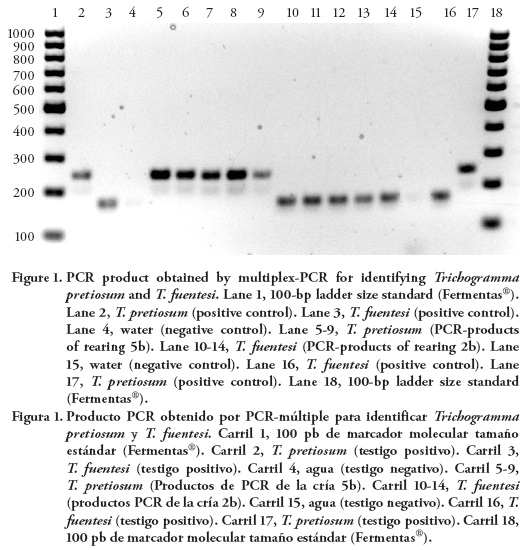
<body><![CDATA[<p align="justify"><font face="verdana" size="2">To identify <i>Trichogramma</i> species that were reared in the insectaries, this multiplex PCR assay was used on 20 random wasps per sample. The described DNA extraction method, PCR master mix, PCR cycling program, agarose gel and UV&#45;photograph equipment were used with the following modifications: PCR master mix, 12.8 <i>&#956;</i>L sterile distilled water, 0.2 <i>&#956;</i>mol L <sup>&#45;1</sup> forward and two reverse primer; PCR program, 30 s in the first and second step of the 37 cycles, the first step at 94 &deg;C and the second step at 59 &deg;C; and the product was run in a 1.5 % agarose gel. In each gel, negative and positive controls were included; such DNA belonged to the material that previously was sent to sequencing.</font></p>  	    <p align="justify"><font face="verdana" size="2">&nbsp;</font></p>  	    <p align="justify"><font face="verdana" size="2"><b>RESULTS AND DISCUSSION</b></font></p>  	    <p align="justify"><font face="verdana" size="2">Intraspecific variation in the ITS2 sequences allowed the design of a common forward primer T.pf&#45;uni&#45;F and two species&#45;specific reverse primers, T.sps1&#45;R and T.sp2&#45;R; those primers resulted in PCR product size consistent with either <i>T. pretiosum</i> or <i>T. fuentesi</i>. The utility of the DNA&#45;multiplex PCR assay to identify <i>Trichogramma</i> species that were reared in six Mexican insectaries was demonstrated using 20 random wasps per sample, in agarose gel each specimen matched one of the positive controls (<a href="#f1">Figure 1</a>), <i>i.e</i>., it identified <i>T. pretiosum</i> and <i>T. fuentesi</i>. Along with an accurate identification of the mass&#45;reared <i>Trichogramma</i>, this DNA&#45;Multiplex may open a path for using native or local species; in M&eacute;xico 23 especies were reported (Pinto, 1998; Garc&iacute;a&#45;Gonz&aacute;lez <i>et al.</i>, 2005; Espa&ntilde;a&#45;Luna <i>et al</i>., 2008). The local Mexican especies can be identified accurately using the DNA&#45;based method that was described in this study, and after linking the ITS2 DNA sequence for those species with their names based on morphology, these local parasitoids can be tested for their fecundity or host specificity. To develop a multiplex&#45;PCR for identifying these 23 local species, first, it is necessary to determine the DNA sequences of the ITS2 region for each species. Second, based in the size of each ITS2, roughly subdivide the species in three species&#45;specific multiplex&#45;PCR groups, grouping together the species with similar ITS2 sizes. Third, based on the need for identifying specific species, species&#45;specific primers can be developed for each group based on the areas of maximal difference of the species specific DNA fragments (as it was done in this study). In Portugal and Espa&ntilde;a, a similar approach of molecular identification was developed to distinguish five local species of <i>Trichogramma</i> (Silva <i>et al</i>., 1999; Del&#45;Pino <i>et al</i>., 2013); and in Mexico, Espa&ntilde;a&#45;Luna <i>et al</i>. (2008) developed a dichotomous molecular key to identify five <i>Trichogramma</i> species of agricultural importance. These latter authors, reported along with <i>T. fuentesi</i> and <i>T. pretiosum</i>, also <i>T. atopovirilia</i>, <i>T. exiguum</i> and <i>T. pintoi</i>. Twenty three <i>Trichogramma</i> species are present in Mexico; however, as shown in this (<a href="/img/revistas/agro/v48n7/a4t1.jpg" target="_blank">Table 1</a>) and others studies (Garc&iacute;a&#45;Gonz&aacute;lez <i>et al</i>., 2005; Espa&ntilde;a&#45;Luna <i>et al</i>., 2008), the Mexican insectaries rear almost exclusively <i>T. pretiosum</i>. In addition to identifying accurately mass reared and local <i>Trichogramma</i>, this DNA&#45;multiplex can identify female&#45;only populations because only one specimen is required to make its taxonomic identification. In Mexico, female&#45;only populations of <i>Trichogramma</i> were reported (Stouthamer and Luck, 1993; Stouthamer and Werren, 1993).</font></p>  	    <p align="center"><font face="verdana" size="2"><a name="f1"></a></font></p>  	    <p align="center"><font face="verdana" size="2"><img src="/img/revistas/agro/v48n7/a4f1.jpg"></font></p>  	    <p align="justify"><font face="verdana" size="2">Mexican insectary personnel reported that in the ten rearings (individual colonies) three species of <i>Trichogramma</i> (<i>T. pretiosum</i>, <i>T. exiguum</i> and <i>T. platneri</i>) were reared; however, the multiplex PCR assay identified either <i>T. pretiosum</i> or <i>T. fuentesi</i> (<a href="/img/revistas/agro/v48n7/a4t1.jpg" target="_blank">Table 1</a>, <a href="#f1">Figure 1</a>). This homogeneity (only two species were reared) is explained because the initial stock in five cases originated from other Mexican insectaries and because in two cases the insectaries initiated their rearing stocks from field collected <i>Trichogramma</i>. For the latter situation, Pinto (1998) and Kuske <i>et al</i>. (2003) mentioned that collecting in the field raises the possibility of capturing species that were previously released, and in M&eacute;xico field release of <i>Trichogramma</i> occurred since 1920s (Williams <i>et al</i>., 2013).</font></p>  	    <p align="justify"><font face="verdana" size="2">From the ten rearings, the insectary personnel correctly identified <i>T. pretiosum</i> in four cases, but in two cases <i>T. fuentesi</i> were mistaken as <i>T. exiguum</i> and also in two cases <i>T. pretiosum</i> were thought as <i>T. exiguum</i>; in a similar vein, in one case <i>T. pretiosum</i> was misidentified as <i>T. platneri</i> (<a href="/img/revistas/agro/v48n7/a4t1.jpg" target="_blank">Table 1</a>). Misidentification of <i>Trichogramma</i> parasitoids using morphological characters were reported in M&eacute;xico (Garc&iacute;a&#45;Gonz&aacute;lez <i>et al</i>., 2005; Espa&ntilde;a&#45;Luna <i>et al</i>., 2006). Slight morphological variation in the broad and short ventral ridge of <i>T. fuentesi</i> can be interpreted as narrow and long; if this mistake occurs the identified species would be <i>T. exiguum</i> (Pinto, 1998). For the same reason, <i>i.e.</i>, phenotypic plasticity of the morphological characters, <i>T. pretiosum</i> can be identified either as <i>T. platneri</i> or <i>T. exiguum</i> (Pinto, 1998).</font></p>  	    <p align="justify"><font face="verdana" size="2">Throughout the study, unnoticed species replacement was found. In the first shipment, <i>T. fuentesi</i> was produced in two rearings; however, in one rearing during the second and third shipments <i>T. fuentesi</i> was replaced by <i>T. pretiosum</i> (<a href="/img/revistas/agro/v48n7/a4t1.jpg" target="_blank">Table 1</a>). Unnoticed replacement of <i>Trichogramma</i> species was reported in M&eacute;xico (Garc&iacute;a&#45;Gonz&aacute;lez <i>et al</i>., 2005) and USA (Lundgren and Heimpel, 2002; Lundgren and Heimpel, 2003).</font></p>  	    <p align="justify"><font face="verdana" size="2">The laborious training required to identify <i>Trichogramma</i> parasitoids using morphological characters, which is a procedure made only by experts (Pinto, 1998; Platner <i>et al</i>., 1999), along with the latent risk of misidentification, remains an obstacle for using native or local <i>Trichogramma</i> species in biological control projects (Pinto, 1998). Then, to avoid unnoticed replacement, taxonomic misidentification (both cases were found in this study) and foment the use of local <i>Trichogramma</i> species, it is recommended to identify <i>Trichogramma</i> species using a DNA&#45;Multiplex PCR assay. The biggest obstacle to adopt molecular techniques is the cost of the equipment. Molecular identification is accurate (Stouthamer <i>et al</i>., 1999), and possibly in the long run the benefits of molecular identification will outweigh the high initial cost of molecular equipment.</font></p>  	    ]]></body>
<body><![CDATA[<p align="justify"><font face="verdana" size="2">&nbsp;</font></p>  	    <p align="justify"><font face="verdana" size="2"><b>CONCLUSIONS</b></font></p>  	    <p align="justify"><font face="verdana" size="2">As a results of implementing DNA&#45;multiplex on the <i>Trichogramma</i> samples from the Mexican insectaries there were found discrepancies between the reported and DNA&#45;determined species identity, while the sample of all the insectaries together was supposed to contain three species of <i>Trichogramma</i> (<i>T. pretiosum, T. exiguum</i> and <i>T. platneri</i>), only two species were present (<i>T. pretiosum</i> and <i>T. fuentesi</i>). Also there was found unnoticed species replacement: throughout the study, in one colony <i>T. fuentesi</i> was replaced by <i>T. pretiosum</i>.</font></p>  	    <p align="justify"><font face="verdana" size="2">&nbsp;</font></p>  	    <p align="justify"><font face="verdana" size="2"><b>ACKNOWLEDGEMENTS</b></font></p>  	    <p align="justify"><font face="verdana" size="2">Thanks to Paul Rugman&#45;Jones for guidance in the molecular analysis and for proof reading the article, Anabel Valencia Villalobos and Marco Antonio Mellin Rosas for their coordination on the delivery of the <i>Trichogramma</i> samples, and special thanks to the personnel of the collaborating insectaries. This research was supported in whole or in part by UC MEXUS&#151;CONACYT agreement in higher education and research, Robert and Peggy van den Bosch Memorial Scholarship, and the University of California, campus Riverside, Entomology department.</font></p>  	    <p align="justify"><font face="verdana" size="2">&nbsp;</font></p>  	    <p align="justify"><font face="verdana" size="2"><b>LITERATURE CITED</b></font></p>  	    <!-- ref --><p align="justify"><font face="verdana" size="2">Ashley, T. R., D. Gonz&aacute;lez, and T. F. Leigh. 1973. Reduction in effectiveness of laboratory&#45;reared <i>Trichogramma</i>. Environ. Entomol. 2: 1069&#45;1073.    &nbsp;&nbsp;&nbsp;&nbsp;&nbsp;&nbsp;&nbsp;&nbsp;[&#160;<a href="javascript:void(0);" onclick="javascript: window.open('/scielo.php?script=sci_nlinks&ref=591762&pid=S1405-3195201400070000400001&lng=','','width=640,height=500,resizable=yes,scrollbars=1,menubar=yes,');">Links</a>&#160;]<!-- end-ref --></font></p>  	    ]]></body>
<body><![CDATA[<!-- ref --><p align="justify"><font face="verdana" size="2">Benson, D. A., I. Karsch&#45;Mizrachi, D. J. Lipman, J. Ostell, and D. L. Wheeler. 2008. GenBank. Nucl. Acids Res. 36: 25&#45;30.    &nbsp;&nbsp;&nbsp;&nbsp;&nbsp;&nbsp;&nbsp;&nbsp;[&#160;<a href="javascript:void(0);" onclick="javascript: window.open('/scielo.php?script=sci_nlinks&ref=591764&pid=S1405-3195201400070000400002&lng=','','width=640,height=500,resizable=yes,scrollbars=1,menubar=yes,');">Links</a>&#160;]<!-- end-ref --></font></p>  	    <!-- ref --><p align="justify"><font face="verdana" size="2">Bergeijk, K. E. V., F. Bigler, N. K. Kaashoek, and G. A. Pak. 1989. Changes in host acceptance and host suitability as an effect of rearing <i>Trichogramma</i> <i>maidis</i> on a factitious host. Entomol. Exp. Appl. 52: 229&#45;238.    &nbsp;&nbsp;&nbsp;&nbsp;&nbsp;&nbsp;&nbsp;&nbsp;[&#160;<a href="javascript:void(0);" onclick="javascript: window.open('/scielo.php?script=sci_nlinks&ref=591766&pid=S1405-3195201400070000400003&lng=','','width=640,height=500,resizable=yes,scrollbars=1,menubar=yes,');">Links</a>&#160;]<!-- end-ref --></font></p>  	    <!-- ref --><p align="justify"><font face="verdana" size="2">Curl, G. D., and P. P. Burbutis. 1978. Host preference studies with <i>Trichogramma</i> <i>nubilale</i> (Hymenoptera&#45; <i>Trichogramma</i>tidae). Environ. Entomol. 7: 541&#45;543.    &nbsp;&nbsp;&nbsp;&nbsp;&nbsp;&nbsp;&nbsp;&nbsp;[&#160;<a href="javascript:void(0);" onclick="javascript: window.open('/scielo.php?script=sci_nlinks&ref=591768&pid=S1405-3195201400070000400004&lng=','','width=640,height=500,resizable=yes,scrollbars=1,menubar=yes,');">Links</a>&#160;]<!-- end-ref --></font></p>  	    <!-- ref --><p align="justify"><font face="verdana" size="2">Del&#45;Pino, M., P. F. Rugman&#45;Jones, E. Hern&aacute;ndez&#45;Su&aacute;rez, A. Polaszek, and R. Stouthamer. 2013. Rapid molecular identification of five species of <i>Trichogramma</i> occurring in the Canary Islands with notes on their distribution in banana groves. Biocontrol 58: 515&#45;524.    &nbsp;&nbsp;&nbsp;&nbsp;&nbsp;&nbsp;&nbsp;&nbsp;[&#160;<a href="javascript:void(0);" onclick="javascript: window.open('/scielo.php?script=sci_nlinks&ref=591770&pid=S1405-3195201400070000400005&lng=','','width=640,height=500,resizable=yes,scrollbars=1,menubar=yes,');">Links</a>&#160;]<!-- end-ref --></font></p>  	    <!-- ref --><p align="justify"><font face="verdana" size="2">Dom&iacute;nguez, E. R. 1996. Control biol&oacute;gico de plagas agr&iacute;colas en M&eacute;xico. <i>In</i>: Zapatero, M. C. (ed). El Control Biol&oacute;gico en Am&eacute;rica Latina. IOBC. Buenos Aires, Argentina. pp: 55&#45;62.    &nbsp;&nbsp;&nbsp;&nbsp;&nbsp;&nbsp;&nbsp;&nbsp;[&#160;<a href="javascript:void(0);" onclick="javascript: window.open('/scielo.php?script=sci_nlinks&ref=591772&pid=S1405-3195201400070000400006&lng=','','width=640,height=500,resizable=yes,scrollbars=1,menubar=yes,');">Links</a>&#160;]<!-- end-ref --></font></p>  	    ]]></body>
<body><![CDATA[<!-- ref --><p align="justify"><font face="verdana" size="2">Espa&ntilde;a&#45;Luna, M. P., O. C. Alvarado&#45;G&oacute;mez, A. Gonz&aacute;lez&#45;Hern&aacute;ndez, S. Favela&#45;Lara, J. Lozano&#45;Guti&eacute;rrez, and F. Garc&iacute;a&#45; Gonz&aacute;lez. 2006. Diferenciaci&oacute;n gen&eacute;tica de especies cr&iacute;pticas de <i>Trichogramma</i> Westwood (Hymenoptera: <i>Trichogramma</i>tidae). Folia Entomol. Mex. 45: 283&#45;290.    &nbsp;&nbsp;&nbsp;&nbsp;&nbsp;&nbsp;&nbsp;&nbsp;[&#160;<a href="javascript:void(0);" onclick="javascript: window.open('/scielo.php?script=sci_nlinks&ref=591774&pid=S1405-3195201400070000400007&lng=','','width=640,height=500,resizable=yes,scrollbars=1,menubar=yes,');">Links</a>&#160;]<!-- end-ref --></font></p>  	    <!-- ref --><p align="justify"><font face="verdana" size="2">Espa&ntilde;a&#45;Luna, M. P., A. Gonz&aacute;lez&#45;Hern&aacute;ndez, O. G. Alvarado&#45;G&oacute;mez, and J. Lozano&#45;Guti&eacute;rrez. 2008. Identificaci&oacute;n molecular de especies cr&iacute;pticas de <i>Trichogramma</i> Westwood (Hymenoptera: <i>Trichogramma</i>tidae) de importancia agr&iacute;cola en M&eacute;xico. Acta Zool. Mex. (n.s.) 24:1&#45;14.    &nbsp;&nbsp;&nbsp;&nbsp;&nbsp;&nbsp;&nbsp;&nbsp;[&#160;<a href="javascript:void(0);" onclick="javascript: window.open('/scielo.php?script=sci_nlinks&ref=591776&pid=S1405-3195201400070000400008&lng=','','width=640,height=500,resizable=yes,scrollbars=1,menubar=yes,');">Links</a>&#160;]<!-- end-ref --></font></p>  	    <!-- ref --><p align="justify"><font face="verdana" size="2">Garc&iacute;a&#45;Gonz&aacute;lez, F., A. Gonz&aacute;lez&#45;Hern&aacute;ndez, and M. P Espa&ntilde;a&#45;Luna. 2005. Especies de <i>Trichogramma</i> Westwood (Hymenoptera: <i>Trichogramma</i>tidae) presentes en centros reproductores de M&eacute;xico. Acta Zool. Mex. (n.s.). 21(3): 125&#45;135.    &nbsp;&nbsp;&nbsp;&nbsp;&nbsp;&nbsp;&nbsp;&nbsp;[&#160;<a href="javascript:void(0);" onclick="javascript: window.open('/scielo.php?script=sci_nlinks&ref=591778&pid=S1405-3195201400070000400009&lng=','','width=640,height=500,resizable=yes,scrollbars=1,menubar=yes,');">Links</a>&#160;]<!-- end-ref --></font></p>  	    <!-- ref --><p align="justify"><font face="verdana" size="2">Gariepy, T. D., U. Kuhlmann, T. Haye, C. Gillott, and M. Erlandson, M. 2005. A single&#45;step multiplex PCR assay for the detection of European <i>Peristenus</i> spp., parasitoids of <i>Lygus</i> spp. Biocontrol Sci. Technol. 15: 481&#45;495.    &nbsp;&nbsp;&nbsp;&nbsp;&nbsp;&nbsp;&nbsp;&nbsp;[&#160;<a href="javascript:void(0);" onclick="javascript: window.open('/scielo.php?script=sci_nlinks&ref=591780&pid=S1405-3195201400070000400010&lng=','','width=640,height=500,resizable=yes,scrollbars=1,menubar=yes,');">Links</a>&#160;]<!-- end-ref --></font></p>  	    <!-- ref --><p align="justify"><font face="verdana" size="2">Gonz&aacute;lez&#45;Cabrera, J., H. C. Arredondo&#45;Bernal, and R. Stouthamer. 2014. Quality assessment of trichogramma parasitoids (<i>Trichogramma</i> spp.) from six Mexican insectaries. Agrociencia 48: 321&#45;329.    &nbsp;&nbsp;&nbsp;&nbsp;&nbsp;&nbsp;&nbsp;&nbsp;[&#160;<a href="javascript:void(0);" onclick="javascript: window.open('/scielo.php?script=sci_nlinks&ref=591782&pid=S1405-3195201400070000400011&lng=','','width=640,height=500,resizable=yes,scrollbars=1,menubar=yes,');">Links</a>&#160;]<!-- end-ref --></font></p>  	    ]]></body>
<body><![CDATA[<!-- ref --><p align="justify"><font face="verdana" size="2">Hassan, S. A. 1994. Strategies to select Trichogramma species for use in biological control. <i>In</i>: E. Wajnberg and S. A. Hassan (eds). Biological Control with Egg Parasitoids. CAB International, Wallingford, pp: 55&#45;72.    &nbsp;&nbsp;&nbsp;&nbsp;&nbsp;&nbsp;&nbsp;&nbsp;[&#160;<a href="javascript:void(0);" onclick="javascript: window.open('/scielo.php?script=sci_nlinks&ref=591784&pid=S1405-3195201400070000400012&lng=','','width=640,height=500,resizable=yes,scrollbars=1,menubar=yes,');">Links</a>&#160;]<!-- end-ref --></font></p>  	    <!-- ref --><p align="justify"><font face="verdana" size="2">Kuske, S., F. Widmer, P. J. Edwards, T. C. J. Turlings, D. Babendreier, and F. Bigler. 2003. Dispersal and persistence of mass released <i>Trichogramma brassicae</i> (Hymenoptera: <i>Trichogrammatidae</i>) in non&#45;target habitats. Biol. Control 27: 181&#45;193.    &nbsp;&nbsp;&nbsp;&nbsp;&nbsp;&nbsp;&nbsp;&nbsp;[&#160;<a href="javascript:void(0);" onclick="javascript: window.open('/scielo.php?script=sci_nlinks&ref=591786&pid=S1405-3195201400070000400013&lng=','','width=640,height=500,resizable=yes,scrollbars=1,menubar=yes,');">Links</a>&#160;]<!-- end-ref --></font></p>  	    <!-- ref --><p align="justify"><font face="verdana" size="2">Lundgren, J. G., and G. E. Heimpel. 2002. Augmentation of <i>Trichogramma brassicae</i> for control of cruciferous lepidoptera. In: Proc. 1st Int. Sympo. on Biological Control of Arthropods. Honolulu, Hawaii, USA. pp: 160&#45;166.    &nbsp;&nbsp;&nbsp;&nbsp;&nbsp;&nbsp;&nbsp;&nbsp;[&#160;<a href="javascript:void(0);" onclick="javascript: window.open('/scielo.php?script=sci_nlinks&ref=591788&pid=S1405-3195201400070000400014&lng=','','width=640,height=500,resizable=yes,scrollbars=1,menubar=yes,');">Links</a>&#160;]<!-- end-ref --></font></p>  	    <!-- ref --><p align="justify"><font face="verdana" size="2">Lundgren, J. G., and G. E. Heimpel. 2003. Quality assessment of three species of commercially produced <i>Trichogramma</i> and the first report of thelytoky in commercially produced <i>Trichogramma</i>. Biol. Control 26: 68&#45;73.    &nbsp;&nbsp;&nbsp;&nbsp;&nbsp;&nbsp;&nbsp;&nbsp;[&#160;<a href="javascript:void(0);" onclick="javascript: window.open('/scielo.php?script=sci_nlinks&ref=591790&pid=S1405-3195201400070000400015&lng=','','width=640,height=500,resizable=yes,scrollbars=1,menubar=yes,');">Links</a>&#160;]<!-- end-ref --></font></p>  	    <!-- ref --><p align="justify"><font face="verdana" size="2">Mansfield, S., and N. J. Mills. 2002. Direct estimation of the survival time of commercially produced adult <i>Trichogramma</i> platneri Nagarkatti (Hymenoptera: <i>Trichogramma</i>tidae) under field conditions. Biol. Control 25: 41&#45;48.    &nbsp;&nbsp;&nbsp;&nbsp;&nbsp;&nbsp;&nbsp;&nbsp;[&#160;<a href="javascript:void(0);" onclick="javascript: window.open('/scielo.php?script=sci_nlinks&ref=591792&pid=S1405-3195201400070000400016&lng=','','width=640,height=500,resizable=yes,scrollbars=1,menubar=yes,');">Links</a>&#160;]<!-- end-ref --></font></p>  	    ]]></body>
<body><![CDATA[<!-- ref --><p align="justify"><font face="verdana" size="2">Pinto, J. D. 1998. Systematics of the North American species of <i>Trichogramma</i> Westwood (Hymenoptera: <i>Trichogramma</i>tidae). Memoirs of the Entomological Society of Washington. Num. 22. The Entomological Society of Washington, Washington, D.C.    &nbsp;&nbsp;&nbsp;&nbsp;&nbsp;&nbsp;&nbsp;&nbsp;[&#160;<a href="javascript:void(0);" onclick="javascript: window.open('/scielo.php?script=sci_nlinks&ref=591794&pid=S1405-3195201400070000400017&lng=','','width=640,height=500,resizable=yes,scrollbars=1,menubar=yes,');">Links</a>&#160;]<!-- end-ref --></font></p>  	    <!-- ref --><p align="justify"><font face="verdana" size="2">Pinto, J. D., R. K. Velten, G. R. Platner, and E. R. Oatman. 1989. Phenotypic plasticity and taxonomic characters in <i>Trichogramma</i> (Hymenoptera, Trichogrammatidae). Ann. Entomol. Soc. Am. 82: 414&#45;425.    &nbsp;&nbsp;&nbsp;&nbsp;&nbsp;&nbsp;&nbsp;&nbsp;[&#160;<a href="javascript:void(0);" onclick="javascript: window.open('/scielo.php?script=sci_nlinks&ref=591796&pid=S1405-3195201400070000400018&lng=','','width=640,height=500,resizable=yes,scrollbars=1,menubar=yes,');">Links</a>&#160;]<!-- end-ref --></font></p>  	    <!-- ref --><p align="justify"><font face="verdana" size="2">Platner, G. R., R. K. Velten, M. Planoutene, and J. D. Pinto. 1999. Slide&#45;mounting techniques for <i>Trichogramma</i> (<i>Trichogramma</i>tidae) and other &nbsp;&nbsp;&nbsp;minute parasitic Hymenoptera. Entomol. News 110: 56&#45;64.    &nbsp;&nbsp;&nbsp;&nbsp;&nbsp;&nbsp;&nbsp;&nbsp;[&#160;<a href="javascript:void(0);" onclick="javascript: window.open('/scielo.php?script=sci_nlinks&ref=591798&pid=S1405-3195201400070000400019&lng=','','width=640,height=500,resizable=yes,scrollbars=1,menubar=yes,');">Links</a>&#160;]<!-- end-ref --></font></p>  	    <!-- ref --><p align="justify"><font face="verdana" size="2">Romeis, J., D. Babendreier, F. L. Wackers, and T. G. Shanower. 2005. Habitat and plant specificity of <i>Trichogramma</i> egg parasitoids: underlying mechanisms and implications. Basic Appl. Ecol. 6: 215&#45;236.    &nbsp;&nbsp;&nbsp;&nbsp;&nbsp;&nbsp;&nbsp;&nbsp;[&#160;<a href="javascript:void(0);" onclick="javascript: window.open('/scielo.php?script=sci_nlinks&ref=591800&pid=S1405-3195201400070000400020&lng=','','width=640,height=500,resizable=yes,scrollbars=1,menubar=yes,');">Links</a>&#160;]<!-- end-ref --></font></p>  	    <!-- ref --><p align="justify"><font face="verdana" size="2">Rozen, S., and H. Skaletsky. 2000. Primer3 on the WWW for general users and for biologist programmers. <i>In</i>: Krawetz, S. and S. Misener (eds). Bioinformatics Methods and Protocols: Methods in Molecular Biology. Humana Press. Totowa, NJ, USA, pp: 365&#45;386.    &nbsp;&nbsp;&nbsp;&nbsp;&nbsp;&nbsp;&nbsp;&nbsp;[&#160;<a href="javascript:void(0);" onclick="javascript: window.open('/scielo.php?script=sci_nlinks&ref=591802&pid=S1405-3195201400070000400021&lng=','','width=640,height=500,resizable=yes,scrollbars=1,menubar=yes,');">Links</a>&#160;]<!-- end-ref --></font></p>  	    ]]></body>
<body><![CDATA[<!-- ref --><p align="justify"><font face="verdana" size="2">Silva, I. M. M. S., J. Honda, F. V. Kan, J. G. Hu, L. Neto, B. Pintureau, and R. Stouthamer. 1999. Molecular differentiation of five <i>Trichogramma</i> species occurring in Portugal. Biol. Control 16: 177&#45;184.    &nbsp;&nbsp;&nbsp;&nbsp;&nbsp;&nbsp;&nbsp;&nbsp;[&#160;<a href="javascript:void(0);" onclick="javascript: window.open('/scielo.php?script=sci_nlinks&ref=591804&pid=S1405-3195201400070000400022&lng=','','width=640,height=500,resizable=yes,scrollbars=1,menubar=yes,');">Links</a>&#160;]<!-- end-ref --></font></p>  	    <!-- ref --><p align="justify"><font face="verdana" size="2">Stevens, P. S. 1995. Host preferences of <i>Trichogramma</i>toidea Bactrae fumata (Hym.: <i>Trichogramma</i>tidae) an egg parasitoid of leafrollers (Lep.: Tortricidae). Entomophaga 40: 379&#45;385.    &nbsp;&nbsp;&nbsp;&nbsp;&nbsp;&nbsp;&nbsp;&nbsp;[&#160;<a href="javascript:void(0);" onclick="javascript: window.open('/scielo.php?script=sci_nlinks&ref=591806&pid=S1405-3195201400070000400023&lng=','','width=640,height=500,resizable=yes,scrollbars=1,menubar=yes,');">Links</a>&#160;]<!-- end-ref --></font></p>  	    <!-- ref --><p align="justify"><font face="verdana" size="2">Stouthamer, R., and J. H. Werren. 1993. Microbes associated with parthenogenesis in wasps of the genus <i>Trichogramma</i>. J. Invertebr. Pathol. 61: 6&#45;9.    &nbsp;&nbsp;&nbsp;&nbsp;&nbsp;&nbsp;&nbsp;&nbsp;[&#160;<a href="javascript:void(0);" onclick="javascript: window.open('/scielo.php?script=sci_nlinks&ref=591808&pid=S1405-3195201400070000400024&lng=','','width=640,height=500,resizable=yes,scrollbars=1,menubar=yes,');">Links</a>&#160;]<!-- end-ref --></font></p>  	    <!-- ref --><p align="justify"><font face="verdana" size="2">Stouthamer, R., and R. F. Luck. 1993. Influence of microbe&#45;associated parthenogenesis on the fecundity of <i>Trichogramma</i> <i>deion</i> and <i>Trichogramma</i> <i>pretiosum</i>. Entomol. Exp. Appl. 67: 183&#45;192.    &nbsp;&nbsp;&nbsp;&nbsp;&nbsp;&nbsp;&nbsp;&nbsp;[&#160;<a href="javascript:void(0);" onclick="javascript: window.open('/scielo.php?script=sci_nlinks&ref=591810&pid=S1405-3195201400070000400025&lng=','','width=640,height=500,resizable=yes,scrollbars=1,menubar=yes,');">Links</a>&#160;]<!-- end-ref --></font></p>  	    <!-- ref --><p align="justify"><font face="verdana" size="2">Stouthamer, R., J. G. Hu, F. V. Kan, G. R. Platner, and J. D. Pinto. 1999. The utility of internally transcribed spacer 2 DNA sequences of the nuclear ribosomal gene for distinguishing sibling species of <i>Trichogramma</i>. Biocontrol 43: 421&#45;440.    &nbsp;&nbsp;&nbsp;&nbsp;&nbsp;&nbsp;&nbsp;&nbsp;[&#160;<a href="javascript:void(0);" onclick="javascript: window.open('/scielo.php?script=sci_nlinks&ref=591812&pid=S1405-3195201400070000400026&lng=','','width=640,height=500,resizable=yes,scrollbars=1,menubar=yes,');">Links</a>&#160;]<!-- end-ref --></font></p>  	    ]]></body>
<body><![CDATA[<!-- ref --><p align="justify"><font face="verdana" size="2">Thorpe, K. W. 1985. Effects of height and habitat type on egg parasitism by <i>Trichogramma</i> <i>minutum</i> and <i>Trichogramma</i> <i>pretiosum</i> (Hymenoptera, <i>Trichogramma</i>tidae). Agric. Ecosyst. Environ. 12: 117&#45;126.    &nbsp;&nbsp;&nbsp;&nbsp;&nbsp;&nbsp;&nbsp;&nbsp;[&#160;<a href="javascript:void(0);" onclick="javascript: window.open('/scielo.php?script=sci_nlinks&ref=591814&pid=S1405-3195201400070000400027&lng=','','width=640,height=500,resizable=yes,scrollbars=1,menubar=yes,');">Links</a>&#160;]<!-- end-ref --></font></p>  	    <!-- ref --><p align="justify"><font face="verdana" size="2">van&#45;Lenteren, J. C., and V. Bueno. 2003. Augmentative biological control of arthropods in Latin America. Biocontrol 48: 123&#45;139.    &nbsp;&nbsp;&nbsp;&nbsp;&nbsp;&nbsp;&nbsp;&nbsp;[&#160;<a href="javascript:void(0);" onclick="javascript: window.open('/scielo.php?script=sci_nlinks&ref=591816&pid=S1405-3195201400070000400028&lng=','','width=640,height=500,resizable=yes,scrollbars=1,menubar=yes,');">Links</a>&#160;]<!-- end-ref --></font></p>  	    <!-- ref --><p align="justify"><font face="verdana" size="2">Vejar&#45;Cota, G., A. Caro, L.A. Rodr&iacute;guez&#45;del&#45;Bosque, and D. Sahag&uacute;n. 2005. Inundative releases of hymenopterous parasitoids against <i>Diatraea considerata</i> (Lepidoptera: Crambidae) on sugarcane in Northwestern M&eacute;xico. J. Entomol. Sci. 40: 231&#45;233.    &nbsp;&nbsp;&nbsp;&nbsp;&nbsp;&nbsp;&nbsp;&nbsp;[&#160;<a href="javascript:void(0);" onclick="javascript: window.open('/scielo.php?script=sci_nlinks&ref=591818&pid=S1405-3195201400070000400029&lng=','','width=640,height=500,resizable=yes,scrollbars=1,menubar=yes,');">Links</a>&#160;]<!-- end-ref --></font></p>  	    <!-- ref --><p align="justify"><font face="verdana" size="2">Walsh, P. S., D. A. Metzger, and R. Higuchi. 1991. Chelex 100 as a medium for simple extraction of DNA for PCR&#45;based typing from forensic material. Biotechniques 10:506&#45;513.    &nbsp;&nbsp;&nbsp;&nbsp;&nbsp;&nbsp;&nbsp;&nbsp;[&#160;<a href="javascript:void(0);" onclick="javascript: window.open('/scielo.php?script=sci_nlinks&ref=591820&pid=S1405-3195201400070000400030&lng=','','width=640,height=500,resizable=yes,scrollbars=1,menubar=yes,');">Links</a>&#160;]<!-- end-ref --></font></p>  	    <!-- ref --><p align="justify"><font face="verdana" size="2">Williams, T., H. C. Arredondo&#45;Bernal, and L. A. Rodr&iacute;guez&#45;del&#45;Bosque. 2013. Biological pest control in M&eacute;xico. Annu. Rev. Entomol. 58: 119&#45;40.    &nbsp;&nbsp;&nbsp;&nbsp;&nbsp;&nbsp;&nbsp;&nbsp;[&#160;<a href="javascript:void(0);" onclick="javascript: window.open('/scielo.php?script=sci_nlinks&ref=591822&pid=S1405-3195201400070000400031&lng=','','width=640,height=500,resizable=yes,scrollbars=1,menubar=yes,');">Links</a>&#160;]<!-- end-ref --></font></p>  	    ]]></body>
<body><![CDATA[<!-- ref --><p align="justify"><font face="verdana" size="2">Yu, D. S. K., E. A. C. Hagley, and J. E. Laing. 1984. Biology of <i>Trichogramma minutum</i> Riley collected from apples in Southern Ontario. Environ. Entomol. 13: 1324&#45;1329.    &nbsp;&nbsp;&nbsp;&nbsp;&nbsp;&nbsp;&nbsp;&nbsp;[&#160;<a href="javascript:void(0);" onclick="javascript: window.open('/scielo.php?script=sci_nlinks&ref=591824&pid=S1405-3195201400070000400032&lng=','','width=640,height=500,resizable=yes,scrollbars=1,menubar=yes,');">Links</a>&#160;]<!-- end-ref --></font></p>      ]]></body><back>
<ref-list>
<ref id="B1">
<nlm-citation citation-type="journal">
<person-group person-group-type="author">
<name>
<surname><![CDATA[Ashley]]></surname>
<given-names><![CDATA[T. R.]]></given-names>
</name>
<name>
<surname><![CDATA[González]]></surname>
<given-names><![CDATA[D.]]></given-names>
</name>
<name>
<surname><![CDATA[Leigh]]></surname>
<given-names><![CDATA[T. F.]]></given-names>
</name>
</person-group>
<article-title xml:lang="en"><![CDATA[Reduction in effectiveness of laboratory-reared Trichogramma]]></article-title>
<source><![CDATA[Environ. Entomol.]]></source>
<year>1973</year>
<volume>2</volume>
<page-range>1069-1073</page-range></nlm-citation>
</ref>
<ref id="B2">
<nlm-citation citation-type="journal">
<person-group person-group-type="author">
<name>
<surname><![CDATA[Benson]]></surname>
<given-names><![CDATA[D. A.]]></given-names>
</name>
<name>
<surname><![CDATA[Karsch-Mizrachi]]></surname>
<given-names><![CDATA[I.]]></given-names>
</name>
<name>
<surname><![CDATA[Lipman]]></surname>
<given-names><![CDATA[D. J.]]></given-names>
</name>
<name>
<surname><![CDATA[Ostell]]></surname>
<given-names><![CDATA[J.]]></given-names>
</name>
<name>
<surname><![CDATA[Wheeler]]></surname>
<given-names><![CDATA[D. L.]]></given-names>
</name>
</person-group>
<article-title xml:lang="en"><![CDATA[GenBank]]></article-title>
<source><![CDATA[Nucl. Acids Res.]]></source>
<year>2008</year>
<volume>36</volume>
<page-range>25-30</page-range></nlm-citation>
</ref>
<ref id="B3">
<nlm-citation citation-type="journal">
<person-group person-group-type="author">
<name>
<surname><![CDATA[Bergeijk]]></surname>
<given-names><![CDATA[K. E. V.]]></given-names>
</name>
<name>
<surname><![CDATA[Bigler]]></surname>
<given-names><![CDATA[F.]]></given-names>
</name>
<name>
<surname><![CDATA[Kaashoek]]></surname>
<given-names><![CDATA[N. K.]]></given-names>
</name>
<name>
<surname><![CDATA[Pak]]></surname>
<given-names><![CDATA[G. A.]]></given-names>
</name>
</person-group>
<article-title xml:lang="en"><![CDATA[Changes in host acceptance and host suitability as an effect of rearing Trichogramma maidis on a factitious host]]></article-title>
<source><![CDATA[Entomol. Exp. Appl.]]></source>
<year>1989</year>
<volume>52</volume>
<page-range>229-238</page-range></nlm-citation>
</ref>
<ref id="B4">
<nlm-citation citation-type="journal">
<person-group person-group-type="author">
<name>
<surname><![CDATA[Curl]]></surname>
<given-names><![CDATA[G. D.]]></given-names>
</name>
<name>
<surname><![CDATA[Burbutis]]></surname>
<given-names><![CDATA[P. P.]]></given-names>
</name>
</person-group>
<article-title xml:lang="en"><![CDATA[Host preference studies with Trichogramma nubilale (Hymenoptera- Trichogrammatidae)]]></article-title>
<source><![CDATA[Environ. Entomol.]]></source>
<year>1978</year>
<volume>7</volume>
<page-range>541-543</page-range></nlm-citation>
</ref>
<ref id="B5">
<nlm-citation citation-type="journal">
<person-group person-group-type="author">
<name>
<surname><![CDATA[Del-Pino]]></surname>
<given-names><![CDATA[M.]]></given-names>
</name>
<name>
<surname><![CDATA[Rugman-Jones]]></surname>
<given-names><![CDATA[P. F.]]></given-names>
</name>
<name>
<surname><![CDATA[Hernández-Suárez]]></surname>
<given-names><![CDATA[E.]]></given-names>
</name>
<name>
<surname><![CDATA[Polaszek]]></surname>
<given-names><![CDATA[A.]]></given-names>
</name>
<name>
<surname><![CDATA[Stouthamer]]></surname>
<given-names><![CDATA[R.]]></given-names>
</name>
</person-group>
<article-title xml:lang="en"><![CDATA[Rapid molecular identification of five species of Trichogramma occurring in the Canary Islands with notes on their distribution in banana groves]]></article-title>
<source><![CDATA[Biocontrol]]></source>
<year>2013</year>
<volume>58</volume>
<page-range>515-524</page-range></nlm-citation>
</ref>
<ref id="B6">
<nlm-citation citation-type="book">
<person-group person-group-type="author">
<name>
<surname><![CDATA[Domínguez]]></surname>
<given-names><![CDATA[E. R.]]></given-names>
</name>
</person-group>
<article-title xml:lang="es"><![CDATA[Control biológico de plagas agrícolas en México]]></article-title>
<person-group person-group-type="editor">
<name>
<surname><![CDATA[Zapatero]]></surname>
<given-names><![CDATA[M. C.]]></given-names>
</name>
</person-group>
<source><![CDATA[El Control Biológico en América Latina]]></source>
<year>1996</year>
<page-range>55-62</page-range><publisher-loc><![CDATA[Buenos Aires ]]></publisher-loc>
<publisher-name><![CDATA[IOBC.]]></publisher-name>
</nlm-citation>
</ref>
<ref id="B7">
<nlm-citation citation-type="journal">
<person-group person-group-type="author">
<name>
<surname><![CDATA[España-Luna]]></surname>
<given-names><![CDATA[M. P.]]></given-names>
</name>
<name>
<surname><![CDATA[Alvarado-Gómez]]></surname>
<given-names><![CDATA[O. C.]]></given-names>
</name>
<name>
<surname><![CDATA[González-Hernández]]></surname>
<given-names><![CDATA[A.]]></given-names>
</name>
<name>
<surname><![CDATA[Favela-Lara]]></surname>
<given-names><![CDATA[S.]]></given-names>
</name>
<name>
<surname><![CDATA[Lozano-Gutiérrez]]></surname>
<given-names><![CDATA[J.]]></given-names>
</name>
<name>
<surname><![CDATA[García- González]]></surname>
<given-names><![CDATA[F.]]></given-names>
</name>
</person-group>
<article-title xml:lang="es"><![CDATA[Diferenciación genética de especies crípticas de Trichogramma Westwood (Hymenoptera: Trichogrammatidae)]]></article-title>
<source><![CDATA[Folia Entomol. Mex.]]></source>
<year>2006</year>
<volume>45</volume>
<page-range>283-290</page-range></nlm-citation>
</ref>
<ref id="B8">
<nlm-citation citation-type="journal">
<person-group person-group-type="author">
<name>
<surname><![CDATA[España-Luna]]></surname>
<given-names><![CDATA[M. P.]]></given-names>
</name>
<name>
<surname><![CDATA[González-Hernández]]></surname>
<given-names><![CDATA[A.]]></given-names>
</name>
<name>
<surname><![CDATA[Alvarado-Gómez]]></surname>
<given-names><![CDATA[O. G.]]></given-names>
</name>
<name>
<surname><![CDATA[Lozano-Gutiérrez]]></surname>
<given-names><![CDATA[J.]]></given-names>
</name>
</person-group>
<article-title xml:lang="es"><![CDATA[Identificación molecular de especies crípticas de Trichogramma Westwood (Hymenoptera: Trichogrammatidae) de importancia agrícola en México]]></article-title>
<source><![CDATA[Acta Zool. Mex.]]></source>
<year>2008</year>
<volume>24</volume>
<page-range>1-14</page-range></nlm-citation>
</ref>
<ref id="B9">
<nlm-citation citation-type="journal">
<person-group person-group-type="author">
<name>
<surname><![CDATA[García-González]]></surname>
<given-names><![CDATA[F.]]></given-names>
</name>
<name>
<surname><![CDATA[González-Hernández]]></surname>
<given-names><![CDATA[A.]]></given-names>
</name>
<name>
<surname><![CDATA[España-Luna]]></surname>
<given-names><![CDATA[M. P]]></given-names>
</name>
</person-group>
<article-title xml:lang="es"><![CDATA[Especies de Trichogramma Westwood (Hymenoptera: Trichogrammatidae) presentes en centros reproductores de México]]></article-title>
<source><![CDATA[Acta Zool. Mex.]]></source>
<year>2005</year>
<volume>21</volume>
<numero>3</numero>
<issue>3</issue>
<page-range>125-135</page-range></nlm-citation>
</ref>
<ref id="B10">
<nlm-citation citation-type="journal">
<person-group person-group-type="author">
<name>
<surname><![CDATA[Gariepy]]></surname>
<given-names><![CDATA[T. D.]]></given-names>
</name>
<name>
<surname><![CDATA[Kuhlmann]]></surname>
<given-names><![CDATA[U.]]></given-names>
</name>
<name>
<surname><![CDATA[Haye]]></surname>
<given-names><![CDATA[T.]]></given-names>
</name>
<name>
<surname><![CDATA[Gillott]]></surname>
<given-names><![CDATA[C.]]></given-names>
</name>
<name>
<surname><![CDATA[Erlandson, M.]]></surname>
<given-names><![CDATA[M.]]></given-names>
</name>
</person-group>
<article-title xml:lang="en"><![CDATA[A single-step multiplex PCR assay for the detection of European Peristenus spp., parasitoids of Lygus spp.]]></article-title>
<source><![CDATA[Biocontrol Sci. Technol.]]></source>
<year>2005</year>
<volume>15</volume>
<page-range>481-495</page-range></nlm-citation>
</ref>
<ref id="B11">
<nlm-citation citation-type="journal">
<person-group person-group-type="author">
<name>
<surname><![CDATA[González-Cabrera]]></surname>
<given-names><![CDATA[J.]]></given-names>
</name>
<name>
<surname><![CDATA[Arredondo-Bernal]]></surname>
<given-names><![CDATA[H. C.]]></given-names>
</name>
<name>
<surname><![CDATA[Stouthamer]]></surname>
<given-names><![CDATA[R.]]></given-names>
</name>
</person-group>
<article-title xml:lang="en"><![CDATA[Quality assessment of trichogramma parasitoids (Trichogramma spp.) from six Mexican insectaries]]></article-title>
<source><![CDATA[Agrociencia]]></source>
<year>2014</year>
<volume>48</volume>
<page-range>321-329</page-range></nlm-citation>
</ref>
<ref id="B12">
<nlm-citation citation-type="book">
<person-group person-group-type="author">
<name>
<surname><![CDATA[Hassan]]></surname>
<given-names><![CDATA[S. A.]]></given-names>
</name>
</person-group>
<article-title xml:lang="en"><![CDATA[Strategies to select Trichogramma species for use in biological control]]></article-title>
<person-group person-group-type="editor">
<name>
<surname><![CDATA[Wajnberg]]></surname>
<given-names><![CDATA[E.]]></given-names>
</name>
<name>
<surname><![CDATA[Hassan]]></surname>
<given-names><![CDATA[S. A.]]></given-names>
</name>
</person-group>
<source><![CDATA[Biological Control with Egg Parasitoids]]></source>
<year>1994</year>
<page-range>55-72</page-range><publisher-loc><![CDATA[Wallingford ]]></publisher-loc>
<publisher-name><![CDATA[CAB International]]></publisher-name>
</nlm-citation>
</ref>
<ref id="B13">
<nlm-citation citation-type="journal">
<person-group person-group-type="author">
<name>
<surname><![CDATA[Kuske]]></surname>
<given-names><![CDATA[S.]]></given-names>
</name>
<name>
<surname><![CDATA[Widmer]]></surname>
<given-names><![CDATA[F.]]></given-names>
</name>
<name>
<surname><![CDATA[Edwards]]></surname>
<given-names><![CDATA[P. J.]]></given-names>
</name>
<name>
<surname><![CDATA[Turlings]]></surname>
<given-names><![CDATA[T. C. J.]]></given-names>
</name>
<name>
<surname><![CDATA[Babendreier]]></surname>
<given-names><![CDATA[D.]]></given-names>
</name>
<name>
<surname><![CDATA[Bigler]]></surname>
<given-names><![CDATA[F.]]></given-names>
</name>
</person-group>
<article-title xml:lang="en"><![CDATA[Dispersal and persistence of mass released Trichogramma brassicae (Hymenoptera: Trichogrammatidae) in non-target habitats]]></article-title>
<source><![CDATA[Biol. Control]]></source>
<year>2003</year>
<volume>27</volume>
<page-range>181-193</page-range></nlm-citation>
</ref>
<ref id="B14">
<nlm-citation citation-type="">
<person-group person-group-type="author">
<name>
<surname><![CDATA[Lundgren]]></surname>
<given-names><![CDATA[J. G.]]></given-names>
</name>
<name>
<surname><![CDATA[Heimpel]]></surname>
<given-names><![CDATA[G. E.]]></given-names>
</name>
</person-group>
<article-title xml:lang="en"><![CDATA[Augmentation of Trichogramma brassicae for control of cruciferous lepidoptera]]></article-title>
<source><![CDATA[Proc. 1st Int. Sympo. on Biological Control of Arthropods]]></source>
<year>2002</year>
<page-range>160-166</page-range><publisher-loc><![CDATA[Honolulu^eHawaii Hawaii]]></publisher-loc>
</nlm-citation>
</ref>
<ref id="B15">
<nlm-citation citation-type="journal">
<person-group person-group-type="author">
<name>
<surname><![CDATA[Lundgren]]></surname>
<given-names><![CDATA[J. G.]]></given-names>
</name>
<name>
<surname><![CDATA[Heimpel]]></surname>
<given-names><![CDATA[G. E.]]></given-names>
</name>
</person-group>
<article-title xml:lang="en"><![CDATA[Quality assessment of three species of commercially produced Trichogramma and the first report of thelytoky in commercially produced Trichogramma]]></article-title>
<source><![CDATA[Biol. Control]]></source>
<year>2003</year>
<volume>26</volume>
<page-range>68-73</page-range></nlm-citation>
</ref>
<ref id="B16">
<nlm-citation citation-type="journal">
<person-group person-group-type="author">
<name>
<surname><![CDATA[Mansfield]]></surname>
<given-names><![CDATA[S.]]></given-names>
</name>
<name>
<surname><![CDATA[Mills]]></surname>
<given-names><![CDATA[N. J.]]></given-names>
</name>
</person-group>
<article-title xml:lang="en"><![CDATA[Direct estimation of the survival time of commercially produced adult Trichogramma platneri Nagarkatti (Hymenoptera: Trichogrammatidae) under field conditions]]></article-title>
<source><![CDATA[Biol. Control]]></source>
<year>2002</year>
<volume>25</volume>
<page-range>41-48</page-range></nlm-citation>
</ref>
<ref id="B17">
<nlm-citation citation-type="journal">
<person-group person-group-type="author">
<name>
<surname><![CDATA[Pinto]]></surname>
<given-names><![CDATA[J. D.]]></given-names>
</name>
</person-group>
<article-title xml:lang="en"><![CDATA[Systematics of the North American species of Trichogramma Westwood (Hymenoptera: Trichogrammatidae)]]></article-title>
<source><![CDATA[Memoirs of the Entomological Society of Washington]]></source>
<year>1998</year>
<numero>22</numero>
<issue>22</issue>
<publisher-loc><![CDATA[Washington ]]></publisher-loc>
<publisher-name><![CDATA[The Entomological Society of Washington]]></publisher-name>
</nlm-citation>
</ref>
<ref id="B18">
<nlm-citation citation-type="journal">
<person-group person-group-type="author">
<name>
<surname><![CDATA[Pinto]]></surname>
<given-names><![CDATA[J. D.]]></given-names>
</name>
<name>
<surname><![CDATA[Velten]]></surname>
<given-names><![CDATA[R. K.]]></given-names>
</name>
<name>
<surname><![CDATA[Platner]]></surname>
<given-names><![CDATA[G. R.]]></given-names>
</name>
<name>
<surname><![CDATA[Oatman]]></surname>
<given-names><![CDATA[E. R.]]></given-names>
</name>
</person-group>
<article-title xml:lang="en"><![CDATA[Phenotypic plasticity and taxonomic characters in Trichogramma (Hymenoptera, Trichogrammatidae)]]></article-title>
<source><![CDATA[Ann. Entomol. Soc. Am.]]></source>
<year>1989</year>
<volume>82</volume>
<page-range>414-425</page-range></nlm-citation>
</ref>
<ref id="B19">
<nlm-citation citation-type="journal">
<person-group person-group-type="author">
<name>
<surname><![CDATA[Platner]]></surname>
<given-names><![CDATA[G. R.]]></given-names>
</name>
<name>
<surname><![CDATA[Velten]]></surname>
<given-names><![CDATA[R. K.]]></given-names>
</name>
<name>
<surname><![CDATA[Planoutene]]></surname>
<given-names><![CDATA[M.]]></given-names>
</name>
<name>
<surname><![CDATA[Pinto]]></surname>
<given-names><![CDATA[J. D.]]></given-names>
</name>
</person-group>
<article-title xml:lang="en"><![CDATA[Slide-mounting techniques for Trichogramma (Trichogrammatidae) and other minute parasitic Hymenoptera]]></article-title>
<source><![CDATA[Entomol. News]]></source>
<year>1999</year>
<volume>110</volume>
<page-range>56-64</page-range></nlm-citation>
</ref>
<ref id="B20">
<nlm-citation citation-type="journal">
<person-group person-group-type="author">
<name>
<surname><![CDATA[Romeis]]></surname>
<given-names><![CDATA[J.]]></given-names>
</name>
<name>
<surname><![CDATA[Babendreier]]></surname>
<given-names><![CDATA[D.]]></given-names>
</name>
<name>
<surname><![CDATA[Wackers]]></surname>
<given-names><![CDATA[F. L.]]></given-names>
</name>
<name>
<surname><![CDATA[Shanower]]></surname>
<given-names><![CDATA[T. G.]]></given-names>
</name>
</person-group>
<article-title xml:lang="en"><![CDATA[Habitat and plant specificity of Trichogramma egg parasitoids: underlying mechanisms and implications]]></article-title>
<source><![CDATA[Basic Appl. Ecol.]]></source>
<year>2005</year>
<volume>6</volume>
<page-range>215-236</page-range></nlm-citation>
</ref>
<ref id="B21">
<nlm-citation citation-type="book">
<person-group person-group-type="author">
<name>
<surname><![CDATA[Rozen]]></surname>
<given-names><![CDATA[S.]]></given-names>
</name>
<name>
<surname><![CDATA[Skaletsky]]></surname>
<given-names><![CDATA[H.]]></given-names>
</name>
</person-group>
<article-title xml:lang="en"><![CDATA[Primer3 on the WWW for general users and for biologist programmers]]></article-title>
<person-group person-group-type="editor">
<name>
<surname><![CDATA[Krawetz]]></surname>
<given-names><![CDATA[S.]]></given-names>
</name>
<name>
<surname><![CDATA[Misener]]></surname>
<given-names><![CDATA[S.]]></given-names>
</name>
</person-group>
<source><![CDATA[Bioinformatics Methods and Protocols: Methods in Molecular Biology]]></source>
<year>2000</year>
<page-range>365-386</page-range><publisher-loc><![CDATA[Totowa^eNJ NJ]]></publisher-loc>
<publisher-name><![CDATA[Humana Press]]></publisher-name>
</nlm-citation>
</ref>
<ref id="B22">
<nlm-citation citation-type="journal">
<person-group person-group-type="author">
<name>
<surname><![CDATA[Silva]]></surname>
<given-names><![CDATA[I. M. M. S.]]></given-names>
</name>
<name>
<surname><![CDATA[Honda]]></surname>
<given-names><![CDATA[J.]]></given-names>
</name>
<name>
<surname><![CDATA[Kan]]></surname>
<given-names><![CDATA[F. V.]]></given-names>
</name>
<name>
<surname><![CDATA[Hu]]></surname>
<given-names><![CDATA[J. G.]]></given-names>
</name>
<name>
<surname><![CDATA[Neto]]></surname>
<given-names><![CDATA[L.]]></given-names>
</name>
<name>
<surname><![CDATA[Pintureau]]></surname>
<given-names><![CDATA[B.]]></given-names>
</name>
<name>
<surname><![CDATA[Stouthamer]]></surname>
<given-names><![CDATA[R.]]></given-names>
</name>
</person-group>
<article-title xml:lang="en"><![CDATA[Molecular differentiation of five Trichogramma species occurring in Portugal]]></article-title>
<source><![CDATA[Biol. Control]]></source>
<year>1999</year>
<volume>16</volume>
<page-range>177-184</page-range></nlm-citation>
</ref>
<ref id="B23">
<nlm-citation citation-type="journal">
<person-group person-group-type="author">
<name>
<surname><![CDATA[Stevens]]></surname>
<given-names><![CDATA[P. S.]]></given-names>
</name>
</person-group>
<article-title xml:lang="en"><![CDATA[Host preferences of Trichogrammatoidea Bactrae fumata (Hym.: Trichogrammatidae) an egg parasitoid of leafrollers (Lep.: Tortricidae)]]></article-title>
<source><![CDATA[Entomophaga]]></source>
<year>1995</year>
<volume>40</volume>
<page-range>379-385</page-range></nlm-citation>
</ref>
<ref id="B24">
<nlm-citation citation-type="journal">
<person-group person-group-type="author">
<name>
<surname><![CDATA[Stouthamer]]></surname>
<given-names><![CDATA[R.]]></given-names>
</name>
<name>
<surname><![CDATA[Werren]]></surname>
<given-names><![CDATA[J. H.]]></given-names>
</name>
</person-group>
<article-title xml:lang="en"><![CDATA[Microbes associated with parthenogenesis in wasps of the genus Trichogramma]]></article-title>
<source><![CDATA[J. Invertebr. Pathol.]]></source>
<year>1993</year>
<volume>61</volume>
<page-range>6-9</page-range></nlm-citation>
</ref>
<ref id="B25">
<nlm-citation citation-type="journal">
<person-group person-group-type="author">
<name>
<surname><![CDATA[Stouthamer]]></surname>
<given-names><![CDATA[R.]]></given-names>
</name>
<name>
<surname><![CDATA[Luck]]></surname>
<given-names><![CDATA[R. F.]]></given-names>
</name>
</person-group>
<article-title xml:lang="en"><![CDATA[Influence of microbe-associated parthenogenesis on the fecundity of Trichogramma deion and Trichogramma pretiosum]]></article-title>
<source><![CDATA[Entomol. Exp. Appl.]]></source>
<year>1993</year>
<volume>67</volume>
<page-range>183-192</page-range></nlm-citation>
</ref>
<ref id="B26">
<nlm-citation citation-type="journal">
<person-group person-group-type="author">
<name>
<surname><![CDATA[Stouthamer]]></surname>
<given-names><![CDATA[R.]]></given-names>
</name>
<name>
<surname><![CDATA[Hu]]></surname>
<given-names><![CDATA[J. G.]]></given-names>
</name>
<name>
<surname><![CDATA[Kan]]></surname>
<given-names><![CDATA[F. V.]]></given-names>
</name>
<name>
<surname><![CDATA[Platner]]></surname>
<given-names><![CDATA[G. R.]]></given-names>
</name>
<name>
<surname><![CDATA[Pinto]]></surname>
<given-names><![CDATA[J. D.]]></given-names>
</name>
</person-group>
<article-title xml:lang="en"><![CDATA[The utility of internally transcribed spacer 2 DNA sequences of the nuclear ribosomal gene for distinguishing sibling species of Trichogramma]]></article-title>
<source><![CDATA[Biocontrol]]></source>
<year>1999</year>
<volume>43</volume>
<page-range>421-440</page-range></nlm-citation>
</ref>
<ref id="B27">
<nlm-citation citation-type="journal">
<person-group person-group-type="author">
<name>
<surname><![CDATA[Thorpe]]></surname>
<given-names><![CDATA[K. W.]]></given-names>
</name>
</person-group>
<article-title xml:lang="en"><![CDATA[Effects of height and habitat type on egg parasitism by Trichogramma minutum and Trichogramma pretiosum (Hymenoptera, Trichogrammatidae)]]></article-title>
<source><![CDATA[Agric. Ecosyst. Environ.]]></source>
<year>1985</year>
<volume>12</volume>
<page-range>117-126</page-range></nlm-citation>
</ref>
<ref id="B28">
<nlm-citation citation-type="journal">
<person-group person-group-type="author">
<name>
<surname><![CDATA[van-Lenteren]]></surname>
<given-names><![CDATA[J. C.]]></given-names>
</name>
<name>
<surname><![CDATA[Bueno]]></surname>
<given-names><![CDATA[V.]]></given-names>
</name>
</person-group>
<article-title xml:lang="en"><![CDATA[Augmentative biological control of arthropods in Latin America]]></article-title>
<source><![CDATA[Biocontrol]]></source>
<year>2003</year>
<volume>48</volume>
<page-range>123-139</page-range></nlm-citation>
</ref>
<ref id="B29">
<nlm-citation citation-type="journal">
<person-group person-group-type="author">
<name>
<surname><![CDATA[Vejar-Cota]]></surname>
<given-names><![CDATA[G.]]></given-names>
</name>
<name>
<surname><![CDATA[Caro]]></surname>
<given-names><![CDATA[A.]]></given-names>
</name>
<name>
<surname><![CDATA[Rodríguez-del-Bosque]]></surname>
<given-names><![CDATA[L.A.]]></given-names>
</name>
<name>
<surname><![CDATA[Sahagún]]></surname>
<given-names><![CDATA[D.]]></given-names>
</name>
</person-group>
<article-title xml:lang="en"><![CDATA[Inundative releases of hymenopterous parasitoids against Diatraea considerata (Lepidoptera: Crambidae) on sugarcane in Northwestern México]]></article-title>
<source><![CDATA[J. Entomol. Sci.]]></source>
<year>2005</year>
<volume>40</volume>
<page-range>231-233</page-range></nlm-citation>
</ref>
<ref id="B30">
<nlm-citation citation-type="journal">
<person-group person-group-type="author">
<name>
<surname><![CDATA[Walsh]]></surname>
<given-names><![CDATA[P. S.]]></given-names>
</name>
<name>
<surname><![CDATA[Metzger]]></surname>
<given-names><![CDATA[D. A.]]></given-names>
</name>
<name>
<surname><![CDATA[Higuchi]]></surname>
<given-names><![CDATA[R.]]></given-names>
</name>
</person-group>
<article-title xml:lang="en"><![CDATA[Chelex 100 as a medium for simple extraction of DNA for PCR-based typing from forensic material]]></article-title>
<source><![CDATA[Biotechniques]]></source>
<year>1991</year>
<volume>10</volume>
<page-range>506-513</page-range></nlm-citation>
</ref>
<ref id="B31">
<nlm-citation citation-type="journal">
<person-group person-group-type="author">
<name>
<surname><![CDATA[Williams]]></surname>
<given-names><![CDATA[T.]]></given-names>
</name>
<name>
<surname><![CDATA[Arredondo-Bernal]]></surname>
<given-names><![CDATA[H. C.]]></given-names>
</name>
<name>
<surname><![CDATA[Rodríguez-del-Bosque]]></surname>
<given-names><![CDATA[L. A.]]></given-names>
</name>
</person-group>
<article-title xml:lang="en"><![CDATA[Biological pest control in México]]></article-title>
<source><![CDATA[Annu. Rev. Entomol.]]></source>
<year>2013</year>
<volume>58</volume>
<page-range>119-40</page-range></nlm-citation>
</ref>
<ref id="B32">
<nlm-citation citation-type="journal">
<person-group person-group-type="author">
<name>
<surname><![CDATA[Yu]]></surname>
<given-names><![CDATA[D. S. K.]]></given-names>
</name>
<name>
<surname><![CDATA[Hagley]]></surname>
<given-names><![CDATA[E. A. C.]]></given-names>
</name>
<name>
<surname><![CDATA[Laing]]></surname>
<given-names><![CDATA[J. E.]]></given-names>
</name>
</person-group>
<article-title xml:lang="en"><![CDATA[Biology of Trichogramma minutum Riley collected from apples in Southern Ontario]]></article-title>
<source><![CDATA[Environ. Entomol.]]></source>
<year>1984</year>
<volume>13</volume>
<page-range>1324-1329</page-range></nlm-citation>
</ref>
</ref-list>
</back>
</article>
