<?xml version="1.0" encoding="ISO-8859-1"?><article xmlns:mml="http://www.w3.org/1998/Math/MathML" xmlns:xlink="http://www.w3.org/1999/xlink" xmlns:xsi="http://www.w3.org/2001/XMLSchema-instance">
<front>
<journal-meta>
<journal-id>1405-3195</journal-id>
<journal-title><![CDATA[Agrociencia]]></journal-title>
<abbrev-journal-title><![CDATA[Agrociencia]]></abbrev-journal-title>
<issn>1405-3195</issn>
<publisher>
<publisher-name><![CDATA[Colegio de Postgraduados]]></publisher-name>
</publisher>
</journal-meta>
<article-meta>
<article-id>S1405-31952014000200004</article-id>
<title-group>
<article-title xml:lang="en"><![CDATA[Embryogenic induction of torch ginger (Etlingera elatior) callus]]></article-title>
<article-title xml:lang="es"><![CDATA[Inducción embriogénica en callo de jengibre antorcha (Etlingera elatior)]]></article-title>
</title-group>
<contrib-group>
<contrib contrib-type="author">
<name>
<surname><![CDATA[Días]]></surname>
<given-names><![CDATA[Gabrielen de M. Gomes]]></given-names>
</name>
<xref ref-type="aff" rid="A01"/>
</contrib>
<contrib contrib-type="author">
<name>
<surname><![CDATA[Rodrigues]]></surname>
<given-names><![CDATA[Filipe Almendagna]]></given-names>
</name>
<xref ref-type="aff" rid="A01"/>
</contrib>
<contrib contrib-type="author">
<name>
<surname><![CDATA[Soares]]></surname>
<given-names><![CDATA[J. Dória Rodrigues]]></given-names>
</name>
<xref ref-type="aff" rid="A01"/>
</contrib>
<contrib contrib-type="author">
<name>
<surname><![CDATA[Pasqual]]></surname>
<given-names><![CDATA[Moacir]]></given-names>
</name>
<xref ref-type="aff" rid="A01"/>
</contrib>
<contrib contrib-type="author">
<name>
<surname><![CDATA[Carvalho]]></surname>
<given-names><![CDATA[A. Cristina Portugal- Pinto de]]></given-names>
</name>
<xref ref-type="aff" rid="A02"/>
</contrib>
</contrib-group>
<aff id="A01">
<institution><![CDATA[,Federal University of Lavras Departamento of Agriculture ]]></institution>
<addr-line><![CDATA[Lavras MG]]></addr-line>
<country>Brazil</country>
</aff>
<aff id="A02">
<institution><![CDATA[,Embrapa Tropical Agroindustry  ]]></institution>
<addr-line><![CDATA[Fortaleza CE]]></addr-line>
<country>Brazil</country>
</aff>
<pub-date pub-type="pub">
<day>00</day>
<month>03</month>
<year>2014</year>
</pub-date>
<pub-date pub-type="epub">
<day>00</day>
<month>03</month>
<year>2014</year>
</pub-date>
<volume>48</volume>
<numero>2</numero>
<fpage>173</fpage>
<lpage>184</lpage>
<copyright-statement/>
<copyright-year/>
<self-uri xlink:href="http://www.scielo.org.mx/scielo.php?script=sci_arttext&amp;pid=S1405-31952014000200004&amp;lng=en&amp;nrm=iso"></self-uri><self-uri xlink:href="http://www.scielo.org.mx/scielo.php?script=sci_abstract&amp;pid=S1405-31952014000200004&amp;lng=en&amp;nrm=iso"></self-uri><self-uri xlink:href="http://www.scielo.org.mx/scielo.php?script=sci_pdf&amp;pid=S1405-31952014000200004&amp;lng=en&amp;nrm=iso"></self-uri><abstract abstract-type="short" xml:lang="en"><p><![CDATA[Torch ginger Etlingera elatior (Jack) R.M. Smith is a tropical herb-like, rhizome-like and perennial plant that possesses inflorescences that are both pretty and showy at different colour shades, and have a great visual appeal. Producing seedlings at a high enough level when done conventionally by the division of tussocks, has high costs and phytosanitary problems. The objective of this study was to evaluate the induction of somatic embryogenesis and its potential for subsequent plant regeneration in torch ginger. Rhizomes, leaves and roots from the seedlings grown in vitro were used as explant segments. The different explants were cultured on MS medium supplemented with 30 g L-1 sucrose, and it was solidified with 5.5 g L-1 of agar. The effect of 2.4-D and picloram concentrations of 0.0, 1.0, 2.0 and 4.0 mg L-1 was studied. Astructural analysis was performed by scanning electron microscopy (SEM). Cytochemical analysis were performed to detect nucleeous with carmine acetic, starch with lugol and lipids with Sudan III, and a flow cytometry analysis to verify the stability of ploidy in the callus. Results indicate that the culture medium with 2.4-D yielded the induction of embryogenic callus with the characteristics of the rhizome segments of the explant. Regarding the ultrastructural analysis of embryogenic callus characteristics, the cells showed a similar isodiametric form as somatic embryos in the globular stage and cytochemical analysis. The presence of callus cells in pro-embryogenic explants containing each of the regulators was confirmed. In the cytometry analysis, the average DNA content of callus ranged from 5.43 to 10.15 pg, and the coefficients of variation varied between 0.3 to 2.26. Callus induced with 2.4-D showed 86 % stability, and with picloram was 64 %. The callus formation was more evident after application of 2.4 D. This is the first study of embryogenic potential in cells of the torch ginger, and showed that 2,4-D induced callus with higher starch content and genetically stable.]]></p></abstract>
<abstract abstract-type="short" xml:lang="es"><p><![CDATA[El jengibre antorcha Etlingera elatior (Jack) R. M. Smith es una planta tropical perenne, similar al rizoma, que tiene inflorescencias que son bellas y llamativas, de diferentes colores y matices y de un gran atractivo visual. La producción de plántulas en un nivel lo suficientemente alto cuando se hace convencionalmente utilizando la división de matas tiene altos costos y problemas fitosanitarios. El objetivo de este estudio fue evaluar la inducción de la embriogénesis somática y su uso potencial para la reproducción posterior de plantas de jengibre antorcha. Los rizomas, hojas y raíces de las plántulas cultivadas in vitro se utilizaron como segmentos de explantes. Los diferentes explantes se cultivaron en un medio MS al que se le agregaron 30 g L-1 de sacarosa y fue solidificado con 5.5 g de agar L-1. Se estudió el efecto del 2.4-D y picloram en concentraciones de 0.0, 1.0, 2.0 y 4.0 mg L-1. El análisis estructural se llevó a cabo por microscopía electrónica de barrido (SEM). Se realizaron análisis citoquímicos para detectar núcleos con carmín acético, almidón con lugol y lípidos con Sudán III; y un análisis de citometría de flujo para verificar la estabilidad de la ploidía en el callo. Los resultados indicaron que el medio de cultivo con 2.4-D produjo la inducción de callo embriogénico con las características de los segmentos de rizomas del explante. En el análisis ultraestructural de las características del callo embriogénico, las células mostraron una forma isodiamétrica similar a embriones somáticos en etapa globular y análisis citoquímico. Se confirmó la presencia de células de callo en explantes pro- embriogénicos conteniendo cada uno de los reguladores. En el análisis de citometría, el contenido medio de ADN del callo varió de 5.43 a 10.15 pg, y los coeficientes de variación oscilaron entre 0.3 y 2.26. El 2.4-D indujo callos con estabilidad de 86 %, y con picloram fue 64 %. La formación de callo fue más evidente después de aplicar 2.4-D. Éste es el primer estudio del potencial embriogénico de células del jengibre antorcha, y mostró que el 2.4-D indujo la formación de callo con mayor contenido de almidón y genéticamente estable.]]></p></abstract>
<kwd-group>
<kwd lng="en"><![CDATA[Zingiberaceae]]></kwd>
<kwd lng="en"><![CDATA[Etlingera elatior]]></kwd>
<kwd lng="en"><![CDATA[viability]]></kwd>
<kwd lng="es"><![CDATA[Zingiberaceae]]></kwd>
<kwd lng="es"><![CDATA[Etlingera elatior]]></kwd>
<kwd lng="es"><![CDATA[viabilidad]]></kwd>
</kwd-group>
</article-meta>
</front><body><![CDATA[  	    <p align="justify"><font face="verdana" size="4">Fitociencia</font></p>     <p align="justify">&nbsp;</p> 	    <p align="center"><font face="verdana" size="4"><b>Embryogenic induction of torch ginger (<i>Etlingera elatior</i>) callus</b> </font></p>     <p align="center">&nbsp;</p> 	    <p align="center"><font face="verdana" size="3"><b>Inducci&oacute;n embriog&eacute;nica en callo de jengibre antorcha <i>(Etlingera elatior)</i></b></font></p>     <p align="center">&nbsp;</p>      <p align="center"><font face="verdana" size="2"><b>Gabrielen de M. Gomes&#45;D&iacute;as<sup>1</sup>*, Filipe Almendagna&#45;Rodrigues<sup>1</sup>, J. D&oacute;ria Rodrigues&#45;Soares<sup>1</sup>, Moacir Pasqual<sup>1</sup>, A. Cristina Portugal&#45; Pinto de Carvalho<sup>2</sup><sup></sup></b></font></p>     <p align="center">&nbsp;</p>      <p align="justify"><font face="verdana" size="2"><sup><i>1</i></sup><i> Federal University of Lavras (UFLA), Departamento of Agriculture, Postal Office 3037, 37200&#45;000, Lavras&#45;MG, Brazil. * Author for correspondence</i> (<a href="mailto:gabriellen@gmail.com">gabriellen@gmail.com</a>). </font></p>     ]]></body>
<body><![CDATA[<p align="justify"><font face="verdana" size="2"><sup><i>2 </i></sup><i>Embrapa Tropical Agroindustry (CNPAT), Dra. Sara Mesquita Street, 2270, 60511&#45;110, Fortaleza&#45;CE, Brazil.</i></font></p>     <p align="justify">&nbsp;</p>     <p align="justify"><font face="verdana" size="2">Received: February, 2013.     <br> Approved: February, 2014.</font></p>     <p align="justify">&nbsp;</p>      <p align="justify"><font face="verdana" size="2"><b>Abstract</b></font></p>     <p align="justify"><font face="verdana" size="2">Torch ginger <i>Etlingera elatior</i> (Jack) R.M. Smith is a tropical herb&#45;like, rhizome&#45;like and perennial plant that possesses inflorescences that are both pretty and showy at different colour shades, and have a great visual appeal. Producing seedlings at a high enough level when done conventionally by the division of tussocks, has high costs and phytosanitary problems. The objective of this study was to evaluate the induction of somatic embryogenesis and its potential for subsequent plant regeneration in torch ginger. Rhizomes, leaves and roots from the seedlings grown <i>in vitro</i> were used as explant segments. The different explants were cultured on MS medium supplemented with 30 g L<sup>&#45;1</sup> sucrose, and it was solidified with 5.5 g L<sup>&#45;1</sup> of agar. The effect of 2.4&#45;D and picloram concentrations of 0.0, 1.0, 2.0 and 4.0 mg L<sup>&#45;1</sup> was studied. Astructural analysis was performed by scanning electron microscopy (SEM). Cytochemical analysis were performed to detect nucleeous with carmine acetic, starch with lugol and lipids with Sudan III, and a flow cytometry analysis to verify the stability of ploidy in the callus. Results indicate that the culture medium with 2.4&#45;D yielded the induction of embryogenic callus with the characteristics of the rhizome segments of the explant. Regarding the ultrastructural analysis of embryogenic callus characteristics, the cells showed a similar isodiametric form as somatic embryos in the globular stage and cytochemical analysis. The presence of callus cells in pro&#45;embryogenic explants containing each of the regulators was confirmed. In the cytometry analysis, the average DNA content of callus ranged from 5.43 to 10.15 pg, and the coefficients of variation varied between 0.3 to 2.26. Callus induced with 2.4&#45;D showed 86 &#37; stability, and with picloram was 64 &#37;. The callus formation was more evident after application of 2.4 D. This is the first study of embryogenic potential in cells of the torch ginger, and showed that 2,4&#45;D induced callus with higher starch content and genetically stable.</font></p>     <p align="justify"><font face="verdana" size="2"><b>Keywords:</b> Zingiberaceae, <i>Etlingera elatior,</i> viability.</font></p>     <p align="justify">&nbsp;</p> 	    <p align="justify"><font face="verdana" size="2"><b>Resumen</b></font></p>      ]]></body>
<body><![CDATA[<p align="justify"><font face="verdana" size="2">El jengibre antorcha <i>Etlingera elatior</i> (Jack) R. M. Smith es una planta tropical perenne, similar al rizoma, que tiene inflorescencias que son bellas y llamativas, de diferentes colores y matices y de un gran atractivo visual. La producci&oacute;n de pl&aacute;ntulas en un nivel lo suficientemente alto cuando se hace convencionalmente utilizando la divisi&oacute;n de matas tiene altos costos y problemas fitosanitarios. El objetivo de este estudio fue evaluar la inducci&oacute;n de la embriog&eacute;nesis som&aacute;tica y su uso potencial para la reproducci&oacute;n posterior de plantas de jengibre antorcha. Los rizomas, hojas y ra&iacute;ces de las pl&aacute;ntulas cultivadas <i>in vitro</i> se utilizaron como segmentos de explantes. Los diferentes explantes se cultivaron en un medio MS al que se le agregaron 30 g L<sup>&#45;1</sup> de sacarosa y fue solidificado con 5.5 g de agar L<sup>&#45;1</sup>. Se estudi&oacute; el efecto del 2.4&#45;D y picloram en concentraciones de 0.0, 1.0, 2.0 y 4.0 mg L<sup>&#45;1</sup>. El an&aacute;lisis estructural se llev&oacute; a cabo por microscop&iacute;a electr&oacute;nica de barrido (SEM). Se realizaron an&aacute;lisis citoqu&iacute;micos para detectar n&uacute;cleos con carm&iacute;n ac&eacute;tico, almid&oacute;n con lugol y l&iacute;pidos con Sud&aacute;n III; y un an&aacute;lisis de citometr&iacute;a de flujo para verificar la estabilidad de la ploid&iacute;a en el callo. Los resultados indicaron que el medio de cultivo con 2.4&#45;D produjo la inducci&oacute;n de callo embriog&eacute;nico con las caracter&iacute;sticas de los segmentos de rizomas del explante. En el an&aacute;lisis ultraestructural de las caracter&iacute;sticas del callo embriog&eacute;nico, las c&eacute;lulas mostraron una forma isodiam&eacute;trica similar a embriones som&aacute;ticos en etapa globular y an&aacute;lisis citoqu&iacute;mico. Se confirm&oacute; la presencia de c&eacute;lulas de callo en explantes pro&#45; embriog&eacute;nicos conteniendo cada uno de los reguladores. En el an&aacute;lisis de citometr&iacute;a, el contenido medio de ADN del callo vari&oacute; de 5.43 a 10.15 pg, y los coeficientes de variaci&oacute;n oscilaron entre 0.3 y 2.26. El 2.4&#45;D indujo callos con estabilidad de 86 &#37;, y con picloram fue 64 &#37;. La formaci&oacute;n de callo fue m&aacute;s evidente despu&eacute;s de aplicar 2.4&#45;D. &Eacute;ste es el primer estudio del potencial embriog&eacute;nico de c&eacute;lulas del jengibre antorcha, y mostr&oacute; que el 2.4&#45;D indujo la formaci&oacute;n de callo con mayor contenido de almid&oacute;n y gen&eacute;ticamente estable.</font></p>     <p align="justify"><font face="verdana" size="2"><b>Palabras clave:</b> Zingiberaceae, <i>Etlingera elatior,</i> viabilidad.</font></p>      <p align="justify">&nbsp;</p>     <p align="justify"><font face="verdana" size="2"><b>INTRODUCTION</b></font></p>  	    <p align="justify"><font face="verdana" size="2">The main species of tropical flowers in Brazil belong to the families Araceae, Heliconiaceae, Musaceae and Zingiberaceae; they are found either as natural vegetation or in conventional plantations in tropical America, Asia and the western Pacific (Assis <i><i>et al.</i>,</i> 2002). Among these plants, there is propagation and cultivation of the <i>Etlingera</i> genus that belongs to the Zingiberaceae family; in particular, the torch ginger <i>(Etlingera elatior</i> (Jack) R. M. Smith) and is propagated by rhizomatous clumps division or seeds. This vegetative propagation spread pests and diseases causing production problems (Lins and Coelho, 2004).</font></p>  	    <p align="justify"><font face="verdana" size="2">Somatic embryogenesis is an <i>in vitro</i> propagation technology with promising results for improving plant cloning. It has elicited interest, especially from research institutions and Brazilian companies with advanced breeding and cloning programs (Titon <i><i>et al.</i>,</i> 2007). Somatic embryogenesis is an important system for vegetative propagation in which somatic cells can generate embryos due to totipotency of plant cells. This process provides a useful experimental model to investigate the events of plant embryogenesis; besides, it is one of the most important techniques for mass propagation of elite or genetically modified plants (Santos <i><i>et al.</i>,</i> 2002). <i>In vitro</i> regeneration is achieved via organogenesis (Yunus <i><i>et al.</i>,</i> 2012); however, in the literature reviewed no references were found about somatic embryogenesis in torch ginger.</font></p>  	    <p align="justify"><font face="verdana" size="2">The objective of this study was to evaluate different types of explants and growth regulators concentrations in relation to the potential for callus induction in torch ginger <i>(Etlingera elatior</i> (Jack) RM Smith) var. Porcelain.</font></p>     <p align="justify">&nbsp;</p>      <p align="justify"><font face="verdana" size="2"><b>MATERIALS AND METHODS</b></font></p>  	    <p align="justify"><font face="verdana" size="2">The study was carried out in the Laboratory of Plant Tissue Culture of the Department of Agriculture (DAG) at the Federal University of Lavras (UFLA), between January to July 2010.</font></p>     ]]></body>
<body><![CDATA[<p align="justify"><font face="verdana" size="2">The plants established <i>in vitro</i> from shoot meristems of torch ginger var. Porcelain. These were provided by the Brazilian Unit of Agricultural Research (EMBRAPA), located in Fortaleza, Cear&aacute;. These plants were subcultured monthly for 60 d under aseptic conditions on MS medium (Murashige and Skoog, 1962) containing 2.5 mg L<sup>&#45;1</sup> of 6&#45;benzilamonopurine (BAP) (SIGMA<sup>&#174;</sup>) solidified with agar (5.5 g L<sup>&#45;1</sup>). The cultures were maintained in a growth chamber at 25 &plusmn;2 &deg;C, irradiance of 36 mmol m<sup>&#45;2</sup> s<sup>&#45;1</sup> and for a 16&#45;h photoperiod.</font></p>  	    <p align="justify"><font face="verdana" size="2">Leaf segments (0.7 cm<sup>2</sup>), root segments (1.0 cm) and rhizome segments (0.5 cm) were removed from the micropropagated plants, and the rhizome was cut longitudinally into three segments corresponding to positions R1 (apical), R2 (middle) and R3 (basal). The segments were transferred to test tubes containing MS medium supplemented with four concentrations of 2.4&#45;D (SIGMA<sup>&#174;</sup>) and and four of picloram (SIGMA<sup>&#174;</sup>) (0.0, 1.0, 2.0 and 4.0 mg L<sup>&#45;1</sup>). The cultures were incubated in a growth chamber at 25&plusmn;2 &deg;C in complee darkness. At 120 d after inoculation, the percentage of callus formation was measured in all treatments.</font></p>      <p align="justify"><font face="verdana" size="2">The experimental design was completely randomized with 40 treatments (eight auxin concentrations and five types of explants) and five replicates per treatment (two test tubes each). The data were statistically analyzed for variance and regression using the program SISVAR (Ferreira, 2011).</font></p>  	    <p align="justify"><font face="verdana" size="2">Aditionally a scanning electron microscopy (SEM) study, a cytochemical test and a ploidy study level by flow cytometry were performed on each treatment at 120 d. For the SEM study, the callus tissue was fixed in Karnovsky (Karnovisky, 1965), fixative solution (pH 7.2) for 24 h inder refrigeration (4 &deg;C). Then, samples were washed in 0.056 M cacodylate buffer (three times) for 10 min each and postfixed in 1 &#37; osmium tetroxide in 0.05 M cacodylate (SIGMA<sup>&#174;</sup>) buffer for 4 h at room temperature (20 &deg;C). Afterwards, the samples were washed three times in distilled water and dehydrated in a serial of acetone solutions (25, 50, 75 and 90 &#37;) for 10 min each and three times in 100 &#37; acetone for 1 min. The samples were dried in a critical point drier using an Instrument Bal&#45;Tec (model CPD 030 Critical Point Dryer, Germany) and gold coated. The specimens were observed with SEM (LEO Evo 040, Germany), operating at 10 and 20 kV, at the Laboratory of Electron Microscopy and Ultrastructural Analysis (LME) of the Plant Pathology Department (UFLA).</font></p>      <p align="justify"><font face="verdana" size="2">For the cytochemical analysis callus fragments of 100 mg were double stained with acetic carmine blue Evans (positive reaction indicates embryogenic potential of cells), lugol for starch and Sudan III for lipids, according to Steiner <i><i>et al.</i></i> (2005). The photomicrographs were made with a digital camera EIREKAM 3.0 (effective pixels 2048 x 1536, USA) coupled to a light microscope (Olympus BX 60).</font></p>     <p align="justify"><font face="verdana" size="2">The determination of DNA amount and ploidy level was performed in three replicates of 300 mg from callus of each treatment. The samples were crushed in a petri dish containing 1 mL of extraction buffer LB01 (Dolezel <i><i>et al.</i>,</i> 1989). A leaf weight of pea <i>(Pisum sativum)</i> was used as reference standard quantity of DNA=9.9 pg. Histograms were obtained on a FACSCalibur cytometer (Becton Dickinson, USA) with the Cell Quest software (Dickinson, 1998). The amount of DNA (pg) was calculated with the equation: Amount of DNA (pg) = (G1 peak position of sample / G1 peak position pea <i>(Pisum sativum))</i> x9.09. The statistical analysis of the data was performed using WinMDI 2.8 software (Trotter, 2000).</font></p>     <p align="justify">&nbsp;</p>      <p align="justify"><font face="verdana" size="2"><b>RESULTS AND DISUSSION</b></font></p>  	    <p align="justify"><font face="verdana" size="2">In the absence of growth regulators, there was no callus in any of the five tested explants butthe rhizomes formed whole plants and lateral shoots (<a href="/img/revistas/agro/v48n2/a4f1.jpg" target="_blank">Figure 1 D</a>). Most species require growth regulators to initiate the process of callus formation, since the concentrations of endogenous auxin and cytokinins are not sufficient to perform this process (George, 2008). The use of 2.4&#45;D and picloram was effective to induce friable embryogenic callus in the different tested explants, after 120 d of <i>in vitro</i> inoculation (<a href="/img/revistas/agro/v48n2/a4f1.jpg" target="_blank">Figure 1 B</a>). In contrast, Miachir <i><i>et al.</i></i> (2004) found no induction of callus explant in any of <i>Curcuma zedoaria</i> when using only 2.4&#45;D in the culture medium.</font></p>  	    <p align="justify"><font face="verdana" size="2">There was an increase in the percentage of callus (100 &#37;) on the surface of the explant R1 rhizome as the concentrations of picloram or 2.4&#45;D were raised to 2.5 mg (<a href="/img/revistas/agro/v48n2/a4f2.jpg" target="_blank">Figure 2 A</a>). These results are different to those obtained by Lincy <i><i>et al.</i></i> (2009), who found that the use of 2.4&#45;D at 1.0 and 2.0 mg L<sup>&#45;1</sup> in rhizomes of <i>Zingiber officinale</i> Rosc. favored callus induction by 70 and 100 &#37;.</font></p>  	    ]]></body>
<body><![CDATA[<p align="justify"><font face="verdana" size="2">A similar tendency was observed for R2 rhizomes, with an increase in callus formation (100 &#37;) for 1.0 and 2.0 mg L<sup>&#45;1</sup> 2.4&#45;D and 4.0 mg L<sup>&#45;1</sup> picloram, and there were significant differences between the treatments (<a href="/img/revistas/agro/v48n2/a4f2.jpg" target="_blank">Figure 2 B</a>). This result is analogous to that obtained by Roopadarshini (2010) who, using <i>in vitro</i> vegetative buds of <i>Curcuma longa</i> L., reported 86 &#37; callus with 3.0 mg L<sup>&#45;1</sup> 2.4&#45;D and 38 &#37; with 0.5 mg L<sup>&#45;</sup><sup>1</sup> 2.4&#45;D.</font></p>  	    <p align="justify"><font face="verdana" size="2">There were significant differences for callus formation in explants of rhizome R3. Thus, the best response (100 &#37;) was for 4.0 mg L<sup>&#45;1</sup> picloram (<a href="/img/revistas/agro/v48n2/a4f2.jpg" target="_blank">Figure 2 C</a>), whereas with 2,4&#45;D callus formation was similar for 1.0 and 2.0 mg L<sup>&#45;</sup><sup>1</sup> (90 &#37;) but with 4.0 mg L<sup>&#45;1</sup> it decreased to 60 &#37;. Different results were obtained by Rostiana and Syahid (2008) who found a significant difference for meristems of <i>Zingiber officinale</i> Rosc. with 1.0 (87 &#37;), 2.0 (47 &#37;) and 3.0 mg L<sup>&#45;1</sup> (28 &#37;) of 2.4&#45;D.</font></p>  	    <p align="justify"><font face="verdana" size="2">For root segments, there were also significant differences between treatments at the concentrations of 1.0 mg L<sup>&#45;1</sup> 2.4&#45;D and 4.0 mg L<sup>&#45;1</sup> picloram (100 &#37;) (<a href="/img/revistas/agro/v48n2/a4f2.jpg" target="_blank">Figure 2 D</a>). This result is different to that reported by Miachir <i><i>et al.</i></i> (2004) who found no callus formation in root segments in <i>Curcuma zedoaria</i> when using 2.4&#45;D.</font></p>     <p align="justify"><font face="verdana" size="2">The high percentages of embryogenic callus arising from root segments and sections of rhizome increase the availability of sources of torch ginger explants, since it was obtained in 60 to 100 &#37; of embryogenic callus with the regulators utilized in the present study.</font></p>  	    <p align="justify"><font face="verdana" size="2">The increase in the concentrations of 2.4&#45;D and picloram caused only a small increase in callus formation in leaf explants, but there was no significant difference between treatments and the maximum was 20 &#37; with 4.0 mg L<sup>&#45;1</sup> of both growth regulators. Different results were reported by Sultana <i><i>et al.</i></i> (2009) who found that leaf explants of <i>Zingiber officinale</i> Rosc. induced 67 &#37; of embryogenic callus.</font></p>  	    <p align="justify"><font face="verdana" size="2">The effects 2.4&#45;D and picloram were studied in somatic embryogenesis of <i>Cleome rosea</i> Vahl by Sim&otilde;es <i><i>et al.</i></i> (2010), who found that both regulators were effective in callus formation but only 2.4&#45;D caused somatic embryogenesis. According to Jimenez (2005), 2.4&#45;D is the most used auxin in the induction of callus and somatic embryos, combined with picloram, which may be more effective than 2.4&#45;D (George, 2008). However, in the present study, picloram was more efficient for all segments used (except for leaves). The callus formed in the presence of both 2.4&#45;D and picloram had a white&#45;yellowish coloration without oxidation, a friable appearance, and formation of a structure similar to globular embryos (<a href="/img/revistas/agro/v48n2/a4f1.jpg" target="_blank">Figure 1G</a>, <a href="/img/revistas/agro/v48n2/a4f1.jpg" target="_blank">H</a> and <a href="/img/revistas/agro/v48n2/a4f1.jpg" target="_blank">I</a>). These structures are characteristic of the first stage of tissue differentiation and are the first indication of success in a protocol that aims for somatic embryogenesis.</font></p>  	    <p align="justify"><font face="verdana" size="2">A more friable texture was fund in callus grown at 1.0 and 2.0 mg L<sup>&#45;1</sup> 2.4&#45;D. Root&#45;like structures were observed in callus masses that formed in roots segments on medium with 4.0 mg L<sup>&#45;1</sup> 2.4&#45;D, which were probably originated via somatic embryogenesis. This would agree with Reis <i><i>et al.</i></i> (2007), who showed roots originated from callus on <i>Schizolobium parahyba</i> grown at 6.0 mg L<sup>&#45;1</sup> 2.4&#45;D. These roots had no vascular communication with the explant.</font></p>  	    <p align="justify"><font face="verdana" size="2">In the analysis by SEM, it was observed that the cell masses developed under the influence of 2.4&#45;D had a rounded shape in all explants tested (<a href="/img/revistas/agro/v48n2/a4f1.jpg" target="_blank">Figure 1 N, O, P, Q, R and S</a>). It was possible to distinguish regions with a spherical organization presenting isodiametric cells with a similar shape to the globular stage of somatic embryos, which, according to Evert (2006), is characteristic of meristematic cells.</font></p>     <p align="justify"><font face="verdana" size="2">Similar results were also found by Ulisses <i><i>et al.</i></i> (2010), who used 2.4&#45;D to induce callus in <i>Heliconia chartaceae</i> and obtained round cells and in cell division. According to Zuo <i><i>et al.</i></i> (2002), 2.4&#45;D has the function of inducing somatic embryogenesis. Nogueira <i><i>et al.</i></i> (2007) also found that it was possible, with SEM, to observe clear cellular changes in shape over time of exposure in leaf segments of <i>Byrsonima intermediate</i> with the use of 2.4&#45;D. This indicates that the presence of auxin is a crucial factor in signaling cell dedifferentiation and subsequent resumption of meristematic characteristics and it also favors somatic embryogenesis.</font></p>  	    <p align="justify"><font face="verdana" size="2">The cell masses under the influence of picloram showed cells in clusters with rounded shape, demonstrating the morphogenic ability of both auxins and, according to Steiner <i><i>et al.</i></i> (2005), isodiametric cells with such a shape are characteristic of embryogenic formations. Besides, it was observed that callus formation in the treatments containing picloram presented cells surrounded by a thin layer, typical of cells at the beginning of callus formation (<a href="/img/revistas/agro/v48n2/a4f1.jpg" target="_blank">Figure 1 R</a> and <a href="/img/revistas/agro/v48n2/a4f1.jpg" target="_blank">S</a>). The analysis with SEM confirmed the presence of proembryos in the callus and morphogenetic capacity of rhizome segments of torch ginger var. Porcelain. All callus originated with the addition of 2.4&#45;D (<a href="/img/revistas/agro/v48n2/a4f1.jpg" target="_blank">Figure 1 J</a>) and picloram showed a positive reaction to acetocarmine stain, which confirmed the presence of pro&#45;embryogenic cells. According to Besson <i><i>et al.</i></i> (2010), friable callus with granular texture exhibit small isodiametric cells, which react with acetocarmine and are indicative of the presence of glycoproteins associated with the embryogenesis route. Steiner <i><i>et al.</i></i> (2005) pointed out that the positive reaction to acetocarmine staining is associated with cell development competence. Besides, it was observed that there were two cell types in embryogenic cultures. For 2.4&#45;D, the cells were less clustered (friable), for picloram, the cells had a certain clustering (compact).</font></p>  	    ]]></body>
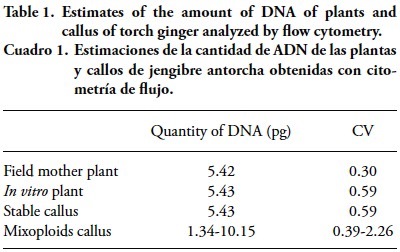
<body><![CDATA[<p align="justify"><font face="verdana" size="2">The presence of starch was detected in embryogenic cells from both growth regulators. Starch grains were mainly found in the inner part of the proembiogenic tissue (<a href="/img/revistas/agro/v48n2/a4f1.jpg" target="_blank">Figure 1 L</a>). Pescador <i><i>et al.</i></i> (2008) showed remarkable differences in nonstructural carbohydrates, with lower values of soluble sugars and a higher starch content in somatic embryos of <i>Acca sellowiana</i> when compared to zygotes. The possible role of starch in the somatic embryogenesis process is still unclear, but it is known that the reserve components found here are necessary for reorganization and cell differentiation. A positive reaction with Sudan III detected the presence of lipids, shown in a dark orange color (<a href="/img/revistas/agro/v48n2/a4f1.jpg" target="_blank">Figure 1 M</a>), what highlights its importance as a reservesubstance. The starch synthesis can be directly associated with the mobilization of the lipid content via the glyoxylate cycle, since starch grains were detected in larger amounts than the lipid grains at the same development stage (Taiz, 2010).</font></p>  	    <p align="justify"><font face="verdana" size="2">The ploidy analysis by flow cytometry indicated that the amount of DNA of the individual plant and the <i>in vitro</i> plant showed no change, remaining at 5.42 &plusmn; 0.01 pg. The amount of DNA of callus, estimated with three samples, ranged from 5.43 to 10.15 pg (<a href="#t1">Table 1</a>).</font></p> 	    <p align="center"><a name="t1"></a><img src="/img/revistas/agro/v48n2/a4t1.jpg"></p>      <p align="justify"><font face="verdana" size="2">These results show evidence of the genetic stability of the callus in relation to the Mother plant in the field, which is important for plants requiring DNA and no genetic variability. Quantification of the amount onf nuclear DNA may replace chromosome counting, which facilitates the work with a very large number of individuas (Schifino&#45;Wittmann, 2001). The coefficient of variation (CV) from 0.3 to 2.26 (<a href="#t1">Table 1</a>) indicated the uniformity of the population and reliability of the data. Marie and Brown (1993) and Ulrich and Ulrich (1991) showed that a CV between 1 and 2 &#37; indicates high quality results, and approximately 3 &#37; is routine, while Galbraith <i>et</i> al. (1983) define a CV below 5 &#37; as an acceptance criterion for international publications.</font></p>  	    <p align="justify"><font face="verdana" size="2">The peaks of the mother plant and <i>in vitro</i> plant indicated that they were diploid plants (<a href="/img/revistas/agro/v48n2/a4f3.jpg" target="_blank">Figure 3</a>) with scarce mitotic divisions in their tissue. Callus induced by 2.4&#45;D showed 86 &#37; stable and 14 &#37; mixoploids (<a href="#t2">Table 2</a>), while those induced by picloram were 64 &#37; stable and 36 &#37; mixoploids. These results show greater variability in ploidy in callus induced by picloram. Lo Schiavo <i><i>et al.</i></i> (1989) indicated that the methylation degree increased as concentration of 2.4&#45;D raised in the culture medium, whereas Muller <i><i>et al.</i></i> (1990) found that 2.4&#45;D tends to accelerate cell division, which may indirectly affect genetic alteration and the methylation degree, which may interferes with DNA quantification.</font></p> 	    <p align="center"><a name="t2"></a><img src="/img/revistas/agro/v48n2/a4t2.jpg"></p>      <p align="justify"><font face="verdana" size="2">The variations found in callus induced by 2.4&#45;D and picloram may be related to the exposure time in the culture medium or to the high cell division or the explant. The mixoploidy found in the callus appeared from explants of the rhizome segments, which is consistent with the quote from Gutierrez and Ferrero (2005) that explants, as leaf tissue, roots and rhizomes, can accumulate a large number of somatic mutations.</font></p>  	    <p align="justify"><font face="verdana" size="2">The best results were obtained with the use of 2.4&#45;D with rhizome explant of <i>in vitro</i> seedlings, where more evidence of somatic embryos was exhibited. With the flow cytometric technique, it was possible to obtain the ploidy level of the embryogenic cells of torch ginger, and the regulator 2.4&#45;D reached 84 &#37; of stable callus. The callus induced by picloram showed greater mitotic activity (mixoploids) in the genetic material, compared to callus induced by 2.4&#45;D.</font></p>     <p align="justify">&nbsp;</p>      <p align="justify"><font face="verdana" size="2"><b>CONCLUSIONS</b></font></p>  	    ]]></body>
<body><![CDATA[<p align="justify"><font face="verdana" size="2">The growth regulator 2,4&#45;D induced callus geneticaly stable with high starch content and great potential for embryogenic callus induction, which inables the development of future methodologies.</font></p>     <p align="justify">&nbsp;</p>      <p align="justify"><font face="verdana" size="2"><b>ACKNOWLEDGMENTS</b></font></p>  	    <p align="justify"><font face="verdana" size="2">We thank CNPq (Conselho Nacional de Desenvolvimento Cient&iacute;fico e Tecnol&oacute;gico) for the granting of a scholarship and Embrapa Tropical Agroindustry Corporation for providing the seedlings for this work.</font></p>     <p align="justify">&nbsp;</p>      <p align="justify"><font face="verdana" size="2"><b>LITERATURE CITED</b></font></p>  	    <!-- ref --><p align="justify"><font face="verdana" size="2">Assis, S. M. P., R. R. L. Marinho, M. G. C. Goim J&uacute;nior, M. Menezes, e R. C. T. Rosa. 2002. Doen&ccedil;as e Pragas de Helic&ocirc;nias. Diseases and Pests of Helic&ocirc;nias. Recife UFRPE. 102 p.    &nbsp;&nbsp;&nbsp;&nbsp;&nbsp;&nbsp;&nbsp;&nbsp;[&#160;<a href="javascript:void(0);" onclick="javascript: window.open('/scielo.php?script=sci_nlinks&ref=584979&pid=S1405-3195201400020000400001&lng=','','width=640,height=500,resizable=yes,scrollbars=1,menubar=yes,');">Links</a>&#160;]<!-- end-ref --></font></p>  	    <!-- ref --><p align="justify"><font face="verdana" size="2">Besson, J. C. F., L. K. Oliveira, F. Cavalini, W. Neiverth, A. F. Neves, e S. Stefanello. 2010. Influ&ecirc;ncia de reguladores de crescimento e extratos vegetais na resposta morfogen&eacute;tica de calos de <i>Solanum sessiliflorum</i> DUNAL. Rev. Agr. Meio Amb. 3(3): 311&#45;322.    &nbsp;&nbsp;&nbsp;&nbsp;&nbsp;&nbsp;&nbsp;&nbsp;[&#160;<a href="javascript:void(0);" onclick="javascript: window.open('/scielo.php?script=sci_nlinks&ref=584981&pid=S1405-3195201400020000400002&lng=','','width=640,height=500,resizable=yes,scrollbars=1,menubar=yes,');">Links</a>&#160;]<!-- end-ref --> </font></p>     ]]></body>
<body><![CDATA[<!-- ref --><p align="justify"><font face="verdana" size="2">Dickinson, B. 1998. CellQuest Software Reference Manual, rev. B. San Jose &#91;s.n.&#93; 227 p.    &nbsp;&nbsp;&nbsp;&nbsp;&nbsp;&nbsp;&nbsp;&nbsp;[&#160;<a href="javascript:void(0);" onclick="javascript: window.open('/scielo.php?script=sci_nlinks&ref=584983&pid=S1405-3195201400020000400003&lng=','','width=640,height=500,resizable=yes,scrollbars=1,menubar=yes,');">Links</a>&#160;]<!-- end-ref --> </font></p>     <!-- ref --><p align="justify"><font face="verdana" size="2">Dolezel, J., P. Binarova and S. Lucretti. 1989. Analysis of nuclear DNA content in plant cells by flow cytometry. Biol. Plantarum 31(2): 113&#45;120.    &nbsp;&nbsp;&nbsp;&nbsp;&nbsp;&nbsp;&nbsp;&nbsp;[&#160;<a href="javascript:void(0);" onclick="javascript: window.open('/scielo.php?script=sci_nlinks&ref=584985&pid=S1405-3195201400020000400004&lng=','','width=640,height=500,resizable=yes,scrollbars=1,menubar=yes,');">Links</a>&#160;]<!-- end-ref --> </font></p> 	    <p align="justify"><font face="verdana" size="2">Evert, R. F. 2006. Esau's Plant Anatomy, 3rd edn. Meristems, Cells and Tissues of the Plant Body &#151; their Structure Function and Development. Wiley&#45;Interscience, New Jersey. </font></p>     <!-- ref --><p align="justify"><font face="verdana" size="2">Ferreira, D. F. 2011. SISVAR: A Computer Statistical Analysis System. Ci&ecirc;ncia Agrotecnologia 35(6): 1039&#45;1042.    &nbsp;&nbsp;&nbsp;&nbsp;&nbsp;&nbsp;&nbsp;&nbsp;[&#160;<a href="javascript:void(0);" onclick="javascript: window.open('/scielo.php?script=sci_nlinks&ref=584988&pid=S1405-3195201400020000400006&lng=','','width=640,height=500,resizable=yes,scrollbars=1,menubar=yes,');">Links</a>&#160;]<!-- end-ref --></font></p>  	    <!-- ref --><p align="justify"><font face="verdana" size="2">Galbraith, D. W., K. R. Harkins, J. M. Maddox, N. M. Ayres, D. P. Sharma, and E. Firoozabady. 1983. Rapid flow cytometric analysis of the cell&#45;cycle in intact plant&#45;tissues. Science 220(4601): 1049&#45;1051.    &nbsp;&nbsp;&nbsp;&nbsp;&nbsp;&nbsp;&nbsp;&nbsp;[&#160;<a href="javascript:void(0);" onclick="javascript: window.open('/scielo.php?script=sci_nlinks&ref=584990&pid=S1405-3195201400020000400007&lng=','','width=640,height=500,resizable=yes,scrollbars=1,menubar=yes,');">Links</a>&#160;]<!-- end-ref --> </font></p>     <!-- ref --><p align="justify"><font face="verdana" size="2">Gutierrez, L. G. L., and V. M. Ferrero. 2005. An&aacute;lise de ploidia por citometria de flujo de callos embriog&eacute;nicos de Aliso andino <i>(Alnus acuminata</i> H. B. K.). Sci. Tech. 11(28):157&#45; 161.    &nbsp;&nbsp;&nbsp;&nbsp;&nbsp;&nbsp;&nbsp;&nbsp;[&#160;<a href="javascript:void(0);" onclick="javascript: window.open('/scielo.php?script=sci_nlinks&ref=584992&pid=S1405-3195201400020000400008&lng=','','width=640,height=500,resizable=yes,scrollbars=1,menubar=yes,');">Links</a>&#160;]<!-- end-ref --></font></p>  	    <!-- ref --><p align="justify"><font face="verdana" size="2">George, E. F. 2008. Plant Propagation by Tissue Culture. 3. ed. Hants Exegetics. 1, 501 p.    &nbsp;&nbsp;&nbsp;&nbsp;&nbsp;&nbsp;&nbsp;&nbsp;[&#160;<a href="javascript:void(0);" onclick="javascript: window.open('/scielo.php?script=sci_nlinks&ref=584994&pid=S1405-3195201400020000400009&lng=','','width=640,height=500,resizable=yes,scrollbars=1,menubar=yes,');">Links</a>&#160;]<!-- end-ref --></font></p>     <!-- ref --><p align="justify"><font face="verdana" size="2">Jim&eacute;nez, V. M. 2005. Involvement of plant hormones and plant growth regulators on <i>in vitro</i> somatic embryogenesis. Plant Growth Regul. 47(1/2): 91&#45;110.    &nbsp;&nbsp;&nbsp;&nbsp;&nbsp;&nbsp;&nbsp;&nbsp;[&#160;<a href="javascript:void(0);" onclick="javascript: window.open('/scielo.php?script=sci_nlinks&ref=584996&pid=S1405-3195201400020000400010&lng=','','width=640,height=500,resizable=yes,scrollbars=1,menubar=yes,');">Links</a>&#160;]<!-- end-ref --></font></p>  	    <!-- ref --><p align="justify"><font face="verdana" size="2">Karnovsky, M. J. 1965. A formaldehyde&#45;glutaraldehyde fixative in high osmolality for use in electron microscopy. J. Cell Biol. 27: 137&#45;138.    &nbsp;&nbsp;&nbsp;&nbsp;&nbsp;&nbsp;&nbsp;&nbsp;[&#160;<a href="javascript:void(0);" onclick="javascript: window.open('/scielo.php?script=sci_nlinks&ref=584998&pid=S1405-3195201400020000400011&lng=','','width=640,height=500,resizable=yes,scrollbars=1,menubar=yes,');">Links</a>&#160;]<!-- end-ref --></font></p>  	    <!-- ref --><p align="justify"><font face="verdana" size="2">Lincy, A. K., A. B. Remashree, and B. Sasikumar. 2009. Indirect and direct somatic embryogenesis from aerial stem explants of ginger <i>(Zingiber officinale</i> Rosc.). Acta Bot. Croatica 68(1): 93&#45;103.    &nbsp;&nbsp;&nbsp;&nbsp;&nbsp;&nbsp;&nbsp;&nbsp;[&#160;<a href="javascript:void(0);" onclick="javascript: window.open('/scielo.php?script=sci_nlinks&ref=585000&pid=S1405-3195201400020000400012&lng=','','width=640,height=500,resizable=yes,scrollbars=1,menubar=yes,');">Links</a>&#160;]<!-- end-ref --></font></p>  	    <!-- ref --><p align="justify"><font face="verdana" size="2">Lins, S. R. O., e R. S. B. Coelho. 2004. Ocorr&ecirc;ncia de doen&ccedil;as em plantas ornamentais tropicais no Estado de Pernambuco. Fitopatol. Bras. 29: 332&#45;335.    &nbsp;&nbsp;&nbsp;&nbsp;&nbsp;&nbsp;&nbsp;&nbsp;[&#160;<a href="javascript:void(0);" onclick="javascript: window.open('/scielo.php?script=sci_nlinks&ref=585002&pid=S1405-3195201400020000400013&lng=','','width=640,height=500,resizable=yes,scrollbars=1,menubar=yes,');">Links</a>&#160;]<!-- end-ref --></font></p>     <!-- ref --><p align="justify"><font face="verdana" size="2">Lo Schiavo, F., L. Pitto, G. Giuliano, G. Torti, V. Nuti&#45;Ronchi,, D. Marazziti, R. Vergara, S. Orselli, and M. Terzi. 1989. DNA methylation of embryogenic carrot cell cultures and its varation as caused by mutation, differetation, hormones and hypomethylating drugs. Theor. Appl. Genet. 77: 325&#45;331.    &nbsp;&nbsp;&nbsp;&nbsp;&nbsp;&nbsp;&nbsp;&nbsp;[&#160;<a href="javascript:void(0);" onclick="javascript: window.open('/scielo.php?script=sci_nlinks&ref=585004&pid=S1405-3195201400020000400014&lng=','','width=640,height=500,resizable=yes,scrollbars=1,menubar=yes,');">Links</a>&#160;]<!-- end-ref --> </font></p> 	    <!-- ref --><p align="justify"><font face="verdana" size="2">Marie, D., and S. A. Brown. 1993. A cytometric exercice in plant DNA histograms, with 2C values for 70 species. Biol. Cell 78: 41&#45;51.    &nbsp;&nbsp;&nbsp;&nbsp;&nbsp;&nbsp;&nbsp;&nbsp;[&#160;<a href="javascript:void(0);" onclick="javascript: window.open('/scielo.php?script=sci_nlinks&ref=585006&pid=S1405-3195201400020000400015&lng=','','width=640,height=500,resizable=yes,scrollbars=1,menubar=yes,');">Links</a>&#160;]<!-- end-ref --></font></p>      <!-- ref --><p align="justify"><font face="verdana" size="2">Miachir, J. I., V. L. M. Romani, A. F. de C. Amaral, M. O. Mello, O. J. Crocomo, and M. Melo. 2004. Micropropagation and callogenesis of <i>Curcuma zedoria</i> Roscoe. Scientia Agricola 61: 427&#45;432.    &nbsp;&nbsp;&nbsp;&nbsp;&nbsp;&nbsp;&nbsp;&nbsp;[&#160;<a href="javascript:void(0);" onclick="javascript: window.open('/scielo.php?script=sci_nlinks&ref=585008&pid=S1405-3195201400020000400016&lng=','','width=640,height=500,resizable=yes,scrollbars=1,menubar=yes,');">Links</a>&#160;]<!-- end-ref --></font></p>  	    <!-- ref --><p align="justify"><font face="verdana" size="2">Muller, E., P. T. H. Brown, S. Hartke, and H. Lorz. 1990. DNA variation in tissue culture&#45;derived rice plants. Theor. Appl. Genet. 80: 673&#45;679.    &nbsp;&nbsp;&nbsp;&nbsp;&nbsp;&nbsp;&nbsp;&nbsp;[&#160;<a href="javascript:void(0);" onclick="javascript: window.open('/scielo.php?script=sci_nlinks&ref=585010&pid=S1405-3195201400020000400017&lng=','','width=640,height=500,resizable=yes,scrollbars=1,menubar=yes,');">Links</a>&#160;]<!-- end-ref --></font></p>  	    <!-- ref --><p align="justify"><font face="verdana" size="2">Murashige, T., and F. A. Skoog. 1962. A revised medium for rapid growth and bioassay with tobacco tissue culture. Physiologia Plantarum 25: 473&#45;497.    &nbsp;&nbsp;&nbsp;&nbsp;&nbsp;&nbsp;&nbsp;&nbsp;[&#160;<a href="javascript:void(0);" onclick="javascript: window.open('/scielo.php?script=sci_nlinks&ref=585012&pid=S1405-3195201400020000400018&lng=','','width=640,height=500,resizable=yes,scrollbars=1,menubar=yes,');">Links</a>&#160;]<!-- end-ref --></font></p>  	    <!-- ref --><p align="justify"><font face="verdana" size="2">Nogueira, R. C., R. P. Paiva, J. M. P. Porto, P. M. Nicioli, V. C. Stein, S. Deuner, and E. Alves. 2007. An&aacute;lise ultraestrutural de calos embriog&ecirc;nicos de murici&#45;pequeno (Bysonima interm&eacute;dia a. Juuss.). Rev. Bras. Bioci&ecirc;n. 5: 48&#45;50.    &nbsp;&nbsp;&nbsp;&nbsp;&nbsp;&nbsp;&nbsp;&nbsp;[&#160;<a href="javascript:void(0);" onclick="javascript: window.open('/scielo.php?script=sci_nlinks&ref=585014&pid=S1405-3195201400020000400019&lng=','','width=640,height=500,resizable=yes,scrollbars=1,menubar=yes,');">Links</a>&#160;]<!-- end-ref --></font></p>      <!-- ref --><p align="justify"><font face="verdana" size="2">Pescador, R., G. B. Kerbauy, J. E. Kraus, W de W. M. Ferreira, M. P. Guerra, and R. de C. L. F. Ribeiro. 2008. Changes in soluble carbohydrates and starch amounts during somatic and zygotic embryogenesis of <i>Acca sellowiana</i> (Myrtaceae). Vitro Cellular Develop. Biology&#45;Plant 44: 289&#45;299.    &nbsp;&nbsp;&nbsp;&nbsp;&nbsp;&nbsp;&nbsp;&nbsp;[&#160;<a href="javascript:void(0);" onclick="javascript: window.open('/scielo.php?script=sci_nlinks&ref=585016&pid=S1405-3195201400020000400020&lng=','','width=640,height=500,resizable=yes,scrollbars=1,menubar=yes,');">Links</a>&#160;]<!-- end-ref --> </font></p>     <!-- ref --><p align="justify"><font face="verdana" size="2">Reis, I. N. R. de S., O. A. Lameira, e I. M. C. C. Cordeiro. 2007. Efeito do 2,4&#45;D na indu&ccedil;&atilde;o de calos <i>in vitro</i> de paric&aacute; <i>(Schizolobium parahyba var. amazonicum</i> (Huber ex Ducke) Barneby). Rev. Bras. Bioci&ecirc;n. 5: 498&#45;500.    &nbsp;&nbsp;&nbsp;&nbsp;&nbsp;&nbsp;&nbsp;&nbsp;[&#160;<a href="javascript:void(0);" onclick="javascript: window.open('/scielo.php?script=sci_nlinks&ref=585018&pid=S1405-3195201400020000400021&lng=','','width=640,height=500,resizable=yes,scrollbars=1,menubar=yes,');">Links</a>&#160;]<!-- end-ref --></font></p>  	    <!-- ref --><p align="justify"><font face="verdana" size="2">Roopadarshini, V. 2010. High frequency shoot multiplication and callus regeneration of turmeric. Int. J. Biotechnol. Biochem. 6: 723&#45;733.    &nbsp;&nbsp;&nbsp;&nbsp;&nbsp;&nbsp;&nbsp;&nbsp;[&#160;<a href="javascript:void(0);" onclick="javascript: window.open('/scielo.php?script=sci_nlinks&ref=585020&pid=S1405-3195201400020000400022&lng=','','width=640,height=500,resizable=yes,scrollbars=1,menubar=yes,');">Links</a>&#160;]<!-- end-ref --></font></p>  	    <!-- ref --><p align="justify"><font face="verdana" size="2">Rostiana, O., and S. F. Syahid. 2008. Somatic embryogenesis from meristem explants of ginger. Biotropia 15: 12&#45;24.    &nbsp;&nbsp;&nbsp;&nbsp;&nbsp;&nbsp;&nbsp;&nbsp;[&#160;<a href="javascript:void(0);" onclick="javascript: window.open('/scielo.php?script=sci_nlinks&ref=585022&pid=S1405-3195201400020000400023&lng=','','width=640,height=500,resizable=yes,scrollbars=1,menubar=yes,');">Links</a>&#160;]<!-- end-ref --></font></p>  	    <!-- ref --><p align="justify"><font face="verdana" size="2">Santos, A. L. W, V. Silveira, N. Steiner, M. Vidor, and M. P. Guerra. 2002. Embriog&ecirc;nese som&aacute;tica em arauc&aacute;ria (Araucaria angustifolia (Bert.) O. Kuntze). Braz. Arch. Biol. Technol. 45: 97&#45;106.    &nbsp;&nbsp;&nbsp;&nbsp;&nbsp;&nbsp;&nbsp;&nbsp;[&#160;<a href="javascript:void(0);" onclick="javascript: window.open('/scielo.php?script=sci_nlinks&ref=585024&pid=S1405-3195201400020000400024&lng=','','width=640,height=500,resizable=yes,scrollbars=1,menubar=yes,');">Links</a>&#160;]<!-- end-ref --></font></p>  	    <!-- ref --><p align="justify"><font face="verdana" size="2">Sim&otilde;es, C., N. Albarello, C. H. Callado, T. C. Castro, and E. Mansur, E. 2010. Somatic embryogenesis and pant regeneration from callus cultures of cleome rosea vahl. Brazilian Arch. Biol. Technol. 53: 679&#45;686.    &nbsp;&nbsp;&nbsp;&nbsp;&nbsp;&nbsp;&nbsp;&nbsp;[&#160;<a href="javascript:void(0);" onclick="javascript: window.open('/scielo.php?script=sci_nlinks&ref=585026&pid=S1405-3195201400020000400025&lng=','','width=640,height=500,resizable=yes,scrollbars=1,menubar=yes,');">Links</a>&#160;]<!-- end-ref --></font></p>  	    <!-- ref --><p align="justify"><font face="verdana" size="2">Steiner, N., F. N. Vieira, S. Maldonado, and M. P. Guerra. 2005. Effect of carbon source onmorphology and histodifferenciation of Araucariaangustifolia embriogenic cultures. Braz. Arch. Biol. Technol. 48: 895&#45;903.    &nbsp;&nbsp;&nbsp;&nbsp;&nbsp;&nbsp;&nbsp;&nbsp;[&#160;<a href="javascript:void(0);" onclick="javascript: window.open('/scielo.php?script=sci_nlinks&ref=585028&pid=S1405-3195201400020000400026&lng=','','width=640,height=500,resizable=yes,scrollbars=1,menubar=yes,');">Links</a>&#160;]<!-- end-ref --> </font></p>     <!-- ref --><p align="justify"><font face="verdana" size="2">Sultana, A., L. Hassan, S. D. Ahmad, A. H. Shah, F. Batool, M. A. Islam, R. Rahman, and S. Moonmoon. 2009. In vitro regeneration of ginger using leaf, shoot tip and root explants. Pak. J. Bot. 41: 1667&#45;1675.    &nbsp;&nbsp;&nbsp;&nbsp;&nbsp;&nbsp;&nbsp;&nbsp;[&#160;<a href="javascript:void(0);" onclick="javascript: window.open('/scielo.php?script=sci_nlinks&ref=585030&pid=S1405-3195201400020000400027&lng=','','width=640,height=500,resizable=yes,scrollbars=1,menubar=yes,');">Links</a>&#160;]<!-- end-ref --> </font></p> 	    <!-- ref --><p align="justify"><font face="verdana" size="2">Titon, M., A. Xavier, W. C. Otoni, e S. Y. Motoikes. 2007. Efeito dos reguladores de crescimento dicamba e picloram na indu&ccedil;&atilde;o de embriog&ecirc;nese som&aacute;tica em Eucalyptus grandis. Revista &Aacute;rvore 31: 417&#45;426.    &nbsp;&nbsp;&nbsp;&nbsp;&nbsp;&nbsp;&nbsp;&nbsp;[&#160;<a href="javascript:void(0);" onclick="javascript: window.open('/scielo.php?script=sci_nlinks&ref=585032&pid=S1405-3195201400020000400028&lng=','','width=640,height=500,resizable=yes,scrollbars=1,menubar=yes,');">Links</a>&#160;]<!-- end-ref --> </font></p> 	    <!-- ref --><p align="justify"><font face="verdana" size="2">Trotter, J. 2000. WinMDI&copy; Version 2.8. La Jolla, CA: The Scripps Research Institute. <a href="http://facs.scripps.edu/software.html" target="_blank">http://facs.scripps.edu/software.html</a>.    &nbsp;&nbsp;&nbsp;&nbsp;&nbsp;&nbsp;&nbsp;&nbsp;[&#160;<a href="javascript:void(0);" onclick="javascript: window.open('/scielo.php?script=sci_nlinks&ref=585034&pid=S1405-3195201400020000400029&lng=','','width=640,height=500,resizable=yes,scrollbars=1,menubar=yes,');">Links</a>&#160;]<!-- end-ref --></font></p>      <!-- ref --><p align="justify"><font face="verdana" size="2">Ulrich, I., and W. Ulrich. 1991. High&#45;resolution flow cytometry DNA in higher plants. Protoplasma 165: 212&#45;215.    &nbsp;&nbsp;&nbsp;&nbsp;&nbsp;&nbsp;&nbsp;&nbsp;[&#160;<a href="javascript:void(0);" onclick="javascript: window.open('/scielo.php?script=sci_nlinks&ref=585036&pid=S1405-3195201400020000400030&lng=','','width=640,height=500,resizable=yes,scrollbars=1,menubar=yes,');">Links</a>&#160;]<!-- end-ref --></font></p>  	    <!-- ref --><p align="justify"><font face="verdana" size="2">Ulisses, C., T. R. Camara, C. C. de A. Wiladino, and J. Z. Brito. 2010. Early somatic embryogenesis in <i>Heliconia chartacea</i> Lane ex Barreiros cv. Sexy Pink ovary section explants. Braz. Arch. Biol. Technol. 53: 11&#45;18.    &nbsp;&nbsp;&nbsp;&nbsp;&nbsp;&nbsp;&nbsp;&nbsp;[&#160;<a href="javascript:void(0);" onclick="javascript: window.open('/scielo.php?script=sci_nlinks&ref=585038&pid=S1405-3195201400020000400031&lng=','','width=640,height=500,resizable=yes,scrollbars=1,menubar=yes,');">Links</a>&#160;]<!-- end-ref --></font></p>  	    <!-- ref --><p align="justify"><font face="verdana" size="2">Yunus, M. F., M. A. Aziz, M. A. Kadir, and A. A. Rashid. 2012. <i>In vitro</i> propagation of <i>Etlingera elatior</i> (Jack) (torch ginger). Scientia Horticulturae 135: 145&#45;150.    &nbsp;&nbsp;&nbsp;&nbsp;&nbsp;&nbsp;&nbsp;&nbsp;[&#160;<a href="javascript:void(0);" onclick="javascript: window.open('/scielo.php?script=sci_nlinks&ref=585040&pid=S1405-3195201400020000400032&lng=','','width=640,height=500,resizable=yes,scrollbars=1,menubar=yes,');">Links</a>&#160;]<!-- end-ref --> </font></p>     <!-- ref --><p align="justify"><font face="verdana" size="2">Zuo, J., Q. W. G. Niu, and N. H. C. Frugis. 2002. The <i>WUSCHEL</i> gene promotes vegetative&#45;to&#45;embryonic transition in <i>Arabidopsis.</i> The Plant J. 30: 349&#45;359.    &nbsp;&nbsp;&nbsp;&nbsp;&nbsp;&nbsp;&nbsp;&nbsp;[&#160;<a href="javascript:void(0);" onclick="javascript: window.open('/scielo.php?script=sci_nlinks&ref=585042&pid=S1405-3195201400020000400033&lng=','','width=640,height=500,resizable=yes,scrollbars=1,menubar=yes,');">Links</a>&#160;]<!-- end-ref --></font></p>      ]]></body><back>
<ref-list>
<ref id="B1">
<nlm-citation citation-type="book">
<person-group person-group-type="author">
<name>
<surname><![CDATA[Assis]]></surname>
<given-names><![CDATA[S. M. P.]]></given-names>
</name>
<name>
<surname><![CDATA[Marinho]]></surname>
<given-names><![CDATA[R. R. L.]]></given-names>
</name>
<name>
<surname><![CDATA[Goim Júnior]]></surname>
<given-names><![CDATA[M. G. C.]]></given-names>
</name>
<name>
<surname><![CDATA[Menezes]]></surname>
<given-names><![CDATA[M.]]></given-names>
</name>
<name>
<surname><![CDATA[Rosa]]></surname>
<given-names><![CDATA[R. C. T.]]></given-names>
</name>
</person-group>
<source><![CDATA[Doenças e Pragas de Helicônias. Diseases and Pests of Helicônias]]></source>
<year>2002</year>
<page-range>102</page-range><publisher-loc><![CDATA[Recife ]]></publisher-loc>
<publisher-name><![CDATA[UFRPE]]></publisher-name>
</nlm-citation>
</ref>
<ref id="B2">
<nlm-citation citation-type="journal">
<person-group person-group-type="author">
<name>
<surname><![CDATA[Besson]]></surname>
<given-names><![CDATA[J. C. F.]]></given-names>
</name>
<name>
<surname><![CDATA[Oliveira]]></surname>
<given-names><![CDATA[L. K.]]></given-names>
</name>
<name>
<surname><![CDATA[Cavalini]]></surname>
<given-names><![CDATA[F.]]></given-names>
</name>
<name>
<surname><![CDATA[Neiverth]]></surname>
<given-names><![CDATA[W.]]></given-names>
</name>
<name>
<surname><![CDATA[Neves]]></surname>
<given-names><![CDATA[A. F.]]></given-names>
</name>
<name>
<surname><![CDATA[Stefanello]]></surname>
<given-names><![CDATA[S.]]></given-names>
</name>
</person-group>
<article-title xml:lang="pt"><![CDATA[Influência de reguladores de crescimento e extratos vegetais na resposta morfogenética de calos de Solanum sessiliflorum DUNAL]]></article-title>
<source><![CDATA[Rev. Agr. Meio Amb.]]></source>
<year>2010</year>
<volume>3</volume>
<numero>3</numero>
<issue>3</issue>
<page-range>311-322</page-range></nlm-citation>
</ref>
<ref id="B3">
<nlm-citation citation-type="journal">
<person-group person-group-type="author">
<name>
<surname><![CDATA[Dickinson]]></surname>
<given-names><![CDATA[B.]]></given-names>
</name>
</person-group>
<article-title xml:lang="en"><![CDATA[CellQuest Software Reference Manual]]></article-title>
<source><![CDATA[rev. B. San Jose]]></source>
<year>1998</year>
<page-range>227</page-range></nlm-citation>
</ref>
<ref id="B4">
<nlm-citation citation-type="journal">
<person-group person-group-type="author">
<name>
<surname><![CDATA[Dolezel]]></surname>
<given-names><![CDATA[J.]]></given-names>
</name>
<name>
<surname><![CDATA[Binarova]]></surname>
<given-names><![CDATA[P.]]></given-names>
</name>
<name>
<surname><![CDATA[Lucretti]]></surname>
<given-names><![CDATA[S.]]></given-names>
</name>
</person-group>
<article-title xml:lang="en"><![CDATA[Analysis of nuclear DNA content in plant cells by flow cytometry]]></article-title>
<source><![CDATA[Biol. Plantarum]]></source>
<year>1989</year>
<volume>31</volume>
<numero>2</numero>
<issue>2</issue>
<page-range>113-120</page-range></nlm-citation>
</ref>
<ref id="B5">
<nlm-citation citation-type="book">
<person-group person-group-type="author">
<name>
<surname><![CDATA[Evert]]></surname>
<given-names><![CDATA[R. F.]]></given-names>
</name>
</person-group>
<source><![CDATA[Esau's Plant Anatomy, Meristems, Cells and Tissues of the Plant Body - their Structure Function and Development.]]></source>
<year>2006</year>
<edition>3rd edn.</edition>
<publisher-loc><![CDATA[^eNew Jersey New Jersey]]></publisher-loc>
<publisher-name><![CDATA[WileyInterscience]]></publisher-name>
</nlm-citation>
</ref>
<ref id="B6">
<nlm-citation citation-type="journal">
<person-group person-group-type="author">
<name>
<surname><![CDATA[Ferreira]]></surname>
<given-names><![CDATA[D. F.]]></given-names>
</name>
</person-group>
<article-title xml:lang="en"><![CDATA[SISVAR: A Computer Statistical Analysis System]]></article-title>
<source><![CDATA[Ciência Agrotecnologia]]></source>
<year>2011</year>
<volume>35</volume>
<numero>6</numero>
<issue>6</issue>
<page-range>1039-1042</page-range></nlm-citation>
</ref>
<ref id="B7">
<nlm-citation citation-type="journal">
<person-group person-group-type="author">
<name>
<surname><![CDATA[Galbraith]]></surname>
<given-names><![CDATA[D. W.]]></given-names>
</name>
<name>
<surname><![CDATA[Harkins]]></surname>
<given-names><![CDATA[K. R.]]></given-names>
</name>
<name>
<surname><![CDATA[Maddox]]></surname>
<given-names><![CDATA[J. M.]]></given-names>
</name>
<name>
<surname><![CDATA[Ayres]]></surname>
<given-names><![CDATA[N. M.]]></given-names>
</name>
<name>
<surname><![CDATA[Sharma]]></surname>
<given-names><![CDATA[D. P.]]></given-names>
</name>
<name>
<surname><![CDATA[Firoozabady]]></surname>
<given-names><![CDATA[E.]]></given-names>
</name>
</person-group>
<article-title xml:lang="en"><![CDATA[Rapid flow cytometric analysis of the cell-cycle in intact plant-tissues]]></article-title>
<source><![CDATA[Science]]></source>
<year>1983</year>
<volume>220</volume>
<numero>4601</numero>
<issue>4601</issue>
<page-range>1049-1051</page-range></nlm-citation>
</ref>
<ref id="B8">
<nlm-citation citation-type="journal">
<person-group person-group-type="author">
<name>
<surname><![CDATA[Gutierrez]]></surname>
<given-names><![CDATA[L. G. L.]]></given-names>
</name>
<name>
<surname><![CDATA[Ferrero]]></surname>
<given-names><![CDATA[V. M.]]></given-names>
</name>
</person-group>
<article-title xml:lang="es"><![CDATA[Análise de ploidia por citometria de flujo de callos embriogénicos de Aliso andino (Alnus acuminata H. B. K.)]]></article-title>
<source><![CDATA[Sci. Tech.]]></source>
<year>2005</year>
<volume>11</volume>
<numero>28</numero>
<issue>28</issue>
<page-range>157- 161</page-range></nlm-citation>
</ref>
<ref id="B9">
<nlm-citation citation-type="">
<person-group person-group-type="author">
<name>
<surname><![CDATA[George]]></surname>
<given-names><![CDATA[E. F.]]></given-names>
</name>
</person-group>
<source><![CDATA[Plant Propagation by Tissue Culture]]></source>
<year>2008</year>
<edition>3</edition>
<page-range>501</page-range></nlm-citation>
</ref>
<ref id="B10">
<nlm-citation citation-type="journal">
<person-group person-group-type="author">
<name>
<surname><![CDATA[Jiménez]]></surname>
<given-names><![CDATA[V. M.]]></given-names>
</name>
</person-group>
<article-title xml:lang="en"><![CDATA[Involvement of plant hormones and plant growth regulators on in vitro somatic embryogenesis]]></article-title>
<source><![CDATA[Plant Growth Regul.]]></source>
<year>2005</year>
<volume>47</volume>
<numero>1/2</numero>
<issue>1/2</issue>
<page-range>91-110</page-range></nlm-citation>
</ref>
<ref id="B11">
<nlm-citation citation-type="journal">
<person-group person-group-type="author">
<name>
<surname><![CDATA[Karnovsky]]></surname>
<given-names><![CDATA[M. J.]]></given-names>
</name>
</person-group>
<article-title xml:lang="en"><![CDATA[A formaldehyde-glutaraldehyde fixative in high osmolality for use in electron microscopy]]></article-title>
<source><![CDATA[J. Cell Biol.]]></source>
<year>1965</year>
<volume>27</volume>
<page-range>137-138</page-range></nlm-citation>
</ref>
<ref id="B12">
<nlm-citation citation-type="journal">
<person-group person-group-type="author">
<name>
<surname><![CDATA[Lincy]]></surname>
<given-names><![CDATA[A. K.]]></given-names>
</name>
<name>
<surname><![CDATA[Remashree]]></surname>
<given-names><![CDATA[A. B.]]></given-names>
</name>
<name>
<surname><![CDATA[Sasikumar]]></surname>
<given-names><![CDATA[B.]]></given-names>
</name>
</person-group>
<article-title xml:lang="en"><![CDATA[Indirect and direct somatic embryogenesis from aerial stem explants of ginger (Zingiber officinale Rosc.)]]></article-title>
<source><![CDATA[Acta Bot. Croatica]]></source>
<year>2009</year>
<volume>68</volume>
<numero>1</numero>
<issue>1</issue>
<page-range>93-103</page-range></nlm-citation>
</ref>
<ref id="B13">
<nlm-citation citation-type="journal">
<person-group person-group-type="author">
<name>
<surname><![CDATA[Lins]]></surname>
<given-names><![CDATA[S. R. O.]]></given-names>
</name>
<name>
<surname><![CDATA[Coelho]]></surname>
<given-names><![CDATA[R. S. B.]]></given-names>
</name>
</person-group>
<article-title xml:lang="pt"><![CDATA[Ocorrência de doenças em plantas ornamentais tropicais no Estado de Pernambuco]]></article-title>
<source><![CDATA[Fitopatol. Bras.]]></source>
<year>2004</year>
<volume>29</volume>
<page-range>332-335</page-range></nlm-citation>
</ref>
<ref id="B14">
<nlm-citation citation-type="journal">
<person-group person-group-type="author">
<name>
<surname><![CDATA[Lo Schiavo]]></surname>
<given-names><![CDATA[F.]]></given-names>
</name>
<name>
<surname><![CDATA[Pitto]]></surname>
<given-names><![CDATA[L.]]></given-names>
</name>
<name>
<surname><![CDATA[Giuliano]]></surname>
<given-names><![CDATA[G.]]></given-names>
</name>
<name>
<surname><![CDATA[Torti]]></surname>
<given-names><![CDATA[G.]]></given-names>
</name>
<name>
<surname><![CDATA[Nuti-Ronchi]]></surname>
<given-names><![CDATA[V.]]></given-names>
</name>
<name>
<surname><![CDATA[Marazziti]]></surname>
<given-names><![CDATA[D.]]></given-names>
</name>
<name>
<surname><![CDATA[Vergara]]></surname>
<given-names><![CDATA[R.]]></given-names>
</name>
<name>
<surname><![CDATA[Orselli]]></surname>
<given-names><![CDATA[S.]]></given-names>
</name>
<name>
<surname><![CDATA[Terzi]]></surname>
<given-names><![CDATA[M.]]></given-names>
</name>
</person-group>
<article-title xml:lang="en"><![CDATA[DNA methylation of embryogenic carrot cell cultures and its varation as caused by mutation, differetation, hormones and hypomethylating drugs]]></article-title>
<source><![CDATA[Theor. Appl. Genet.]]></source>
<year>1989</year>
<volume>77</volume>
<page-range>325-331</page-range></nlm-citation>
</ref>
<ref id="B15">
<nlm-citation citation-type="journal">
<person-group person-group-type="author">
<name>
<surname><![CDATA[Marie]]></surname>
<given-names><![CDATA[D.]]></given-names>
</name>
<name>
<surname><![CDATA[Brown]]></surname>
<given-names><![CDATA[S. A.]]></given-names>
</name>
</person-group>
<article-title xml:lang="en"><![CDATA[A cytometric exercice in plant DNA histograms, with 2C values for 70 species]]></article-title>
<source><![CDATA[Biol. Cell]]></source>
<year>1993</year>
<volume>78</volume>
<page-range>41-51</page-range></nlm-citation>
</ref>
<ref id="B16">
<nlm-citation citation-type="journal">
<person-group person-group-type="author">
<name>
<surname><![CDATA[Miachir]]></surname>
<given-names><![CDATA[J. I.]]></given-names>
</name>
<name>
<surname><![CDATA[Romani]]></surname>
<given-names><![CDATA[V. L. M.]]></given-names>
</name>
<name>
<surname><![CDATA[Amaral]]></surname>
<given-names><![CDATA[A. F. de C.]]></given-names>
</name>
<name>
<surname><![CDATA[Mello]]></surname>
<given-names><![CDATA[M. O.]]></given-names>
</name>
<name>
<surname><![CDATA[Crocomo]]></surname>
<given-names><![CDATA[O. J.]]></given-names>
</name>
<name>
<surname><![CDATA[Melo]]></surname>
<given-names><![CDATA[M.]]></given-names>
</name>
</person-group>
<article-title xml:lang="en"><![CDATA[Micropropagation and callogenesis of Curcuma zedoria Roscoe]]></article-title>
<source><![CDATA[Scientia Agricola]]></source>
<year>2004</year>
<volume>61</volume>
<page-range>427-432</page-range></nlm-citation>
</ref>
<ref id="B17">
<nlm-citation citation-type="journal">
<person-group person-group-type="author">
<name>
<surname><![CDATA[Muller]]></surname>
<given-names><![CDATA[E.]]></given-names>
</name>
<name>
<surname><![CDATA[Brown]]></surname>
<given-names><![CDATA[P. T. H.]]></given-names>
</name>
<name>
<surname><![CDATA[Hartke]]></surname>
<given-names><![CDATA[S.]]></given-names>
</name>
<name>
<surname><![CDATA[Lorz]]></surname>
<given-names><![CDATA[H.]]></given-names>
</name>
</person-group>
<article-title xml:lang="en"><![CDATA[DNA variation in tissue culture-derived rice plants]]></article-title>
<source><![CDATA[Theor. Appl. Genet.]]></source>
<year>1990</year>
<volume>80</volume>
<page-range>673-679</page-range></nlm-citation>
</ref>
<ref id="B18">
<nlm-citation citation-type="journal">
<person-group person-group-type="author">
<name>
<surname><![CDATA[Murashige]]></surname>
<given-names><![CDATA[T.]]></given-names>
</name>
<name>
<surname><![CDATA[Skoog]]></surname>
<given-names><![CDATA[F. A.]]></given-names>
</name>
</person-group>
<article-title xml:lang="en"><![CDATA[A revised medium for rapid growth and bioassay with tobacco tissue culture]]></article-title>
<source><![CDATA[Physiologia Plantarum]]></source>
<year>1962</year>
<volume>25</volume>
<page-range>473-497</page-range></nlm-citation>
</ref>
<ref id="B19">
<nlm-citation citation-type="journal">
<person-group person-group-type="author">
<name>
<surname><![CDATA[Nogueira]]></surname>
<given-names><![CDATA[R. C.]]></given-names>
</name>
<name>
<surname><![CDATA[Paiva]]></surname>
<given-names><![CDATA[R. P.]]></given-names>
</name>
<name>
<surname><![CDATA[Porto]]></surname>
<given-names><![CDATA[J. M. P.]]></given-names>
</name>
<name>
<surname><![CDATA[Nicioli]]></surname>
<given-names><![CDATA[P. M.]]></given-names>
</name>
<name>
<surname><![CDATA[Stein]]></surname>
<given-names><![CDATA[V. C.]]></given-names>
</name>
<name>
<surname><![CDATA[Deuner]]></surname>
<given-names><![CDATA[S.]]></given-names>
</name>
<name>
<surname><![CDATA[Alves]]></surname>
<given-names><![CDATA[E.]]></given-names>
</name>
</person-group>
<article-title xml:lang="pt"><![CDATA[Análise ultraestrutural de calos embriogênicos de murici-pequeno (Bysonima intermédia a. Juuss.)]]></article-title>
<source><![CDATA[Rev. Bras. Biociên.]]></source>
<year>2007</year>
<volume>5</volume>
<page-range>48-50</page-range></nlm-citation>
</ref>
<ref id="B20">
<nlm-citation citation-type="journal">
<person-group person-group-type="author">
<name>
<surname><![CDATA[Pescador]]></surname>
<given-names><![CDATA[R.]]></given-names>
</name>
<name>
<surname><![CDATA[Kerbauy]]></surname>
<given-names><![CDATA[G. B.]]></given-names>
</name>
<name>
<surname><![CDATA[Kraus]]></surname>
<given-names><![CDATA[J. E.]]></given-names>
</name>
<name>
<surname><![CDATA[Ferreira]]></surname>
<given-names><![CDATA[W de W. M.]]></given-names>
</name>
<name>
<surname><![CDATA[Guerra]]></surname>
<given-names><![CDATA[M. P.]]></given-names>
</name>
<name>
<surname><![CDATA[Ribeiro]]></surname>
<given-names><![CDATA[R. de C. L. F.]]></given-names>
</name>
</person-group>
<article-title xml:lang="en"><![CDATA[Changes in soluble carbohydrates and starch amounts during somatic and zygotic embryogenesis of Acca sellowiana (Myrtaceae)]]></article-title>
<source><![CDATA[Vitro Cellular Develop. Biology-Plant]]></source>
<year>2008</year>
<volume>44</volume>
<page-range>289-299</page-range></nlm-citation>
</ref>
<ref id="B21">
<nlm-citation citation-type="journal">
<person-group person-group-type="author">
<name>
<surname><![CDATA[. N. R. de S.]]></surname>
<given-names><![CDATA[Reis]]></given-names>
</name>
<name>
<surname><![CDATA[Lameira]]></surname>
<given-names><![CDATA[O. A.]]></given-names>
</name>
<name>
<surname><![CDATA[Cordeiro]]></surname>
<given-names><![CDATA[I. M. C. C.]]></given-names>
</name>
</person-group>
<article-title xml:lang="pt"><![CDATA[Efeito do 2,4-D na indução de calos in vitro de paricá (Schizolobium parahyba var. amazonicum (Huber ex Ducke) Barneby)]]></article-title>
<source><![CDATA[Rev. Bras. Biociên.]]></source>
<year>2007</year>
<volume>5</volume>
<page-range>498-500</page-range></nlm-citation>
</ref>
<ref id="B22">
<nlm-citation citation-type="journal">
<person-group person-group-type="author">
<name>
<surname><![CDATA[Roopadarshini]]></surname>
<given-names><![CDATA[V.]]></given-names>
</name>
</person-group>
<article-title xml:lang="en"><![CDATA[High frequency shoot multiplication and callus regeneration of turmeric]]></article-title>
<source><![CDATA[Int. J. Biotechnol. Biochem.]]></source>
<year>2010</year>
<volume>6</volume>
<page-range>723-733</page-range></nlm-citation>
</ref>
<ref id="B23">
<nlm-citation citation-type="journal">
<person-group person-group-type="author">
<name>
<surname><![CDATA[Rostiana]]></surname>
<given-names><![CDATA[O.]]></given-names>
</name>
<name>
<surname><![CDATA[Syahid]]></surname>
<given-names><![CDATA[S. F.]]></given-names>
</name>
</person-group>
<article-title xml:lang="en"><![CDATA[Somatic embryogenesis from meristem explants of ginger]]></article-title>
<source><![CDATA[Biotropia]]></source>
<year>2008</year>
<volume>15</volume>
<page-range>12-24</page-range></nlm-citation>
</ref>
<ref id="B24">
<nlm-citation citation-type="journal">
<person-group person-group-type="author">
<name>
<surname><![CDATA[Santos]]></surname>
<given-names><![CDATA[A. L. W]]></given-names>
</name>
<name>
<surname><![CDATA[Silveira]]></surname>
<given-names><![CDATA[V.]]></given-names>
</name>
<name>
<surname><![CDATA[Steiner]]></surname>
<given-names><![CDATA[N.]]></given-names>
</name>
<name>
<surname><![CDATA[Vidor]]></surname>
<given-names><![CDATA[M.]]></given-names>
</name>
<name>
<surname><![CDATA[Guerra]]></surname>
<given-names><![CDATA[M. P.]]></given-names>
</name>
</person-group>
<article-title xml:lang="pt"><![CDATA[Embriogênese somática em araucária (Araucaria angustifolia (Bert.) O. Kuntze)]]></article-title>
<source><![CDATA[Braz. Arch. Biol. Technol.]]></source>
<year>2002</year>
<volume>45</volume>
<page-range>97-106</page-range></nlm-citation>
</ref>
<ref id="B25">
<nlm-citation citation-type="journal">
<person-group person-group-type="author">
<name>
<surname><![CDATA[Simões]]></surname>
<given-names><![CDATA[C.]]></given-names>
</name>
<name>
<surname><![CDATA[Albarello]]></surname>
<given-names><![CDATA[N.]]></given-names>
</name>
<name>
<surname><![CDATA[Callado]]></surname>
<given-names><![CDATA[C. H.]]></given-names>
</name>
<name>
<surname><![CDATA[Castro]]></surname>
<given-names><![CDATA[T. C.]]></given-names>
</name>
<name>
<surname><![CDATA[E. Mansur]]></surname>
<given-names><![CDATA[E.]]></given-names>
</name>
</person-group>
<article-title xml:lang="en"><![CDATA[Somatic embryogenesis and pant regeneration from callus cultures of cleome rosea vahl]]></article-title>
<source><![CDATA[Brazilian Arch. Biol. Technol.]]></source>
<year>2010</year>
<volume>53</volume>
<page-range>679-686</page-range></nlm-citation>
</ref>
<ref id="B26">
<nlm-citation citation-type="journal">
<person-group person-group-type="author">
<name>
<surname><![CDATA[Steiner]]></surname>
<given-names><![CDATA[N.]]></given-names>
</name>
<name>
<surname><![CDATA[Vieira]]></surname>
<given-names><![CDATA[F. N.]]></given-names>
</name>
<name>
<surname><![CDATA[Maldonado]]></surname>
<given-names><![CDATA[S.]]></given-names>
</name>
<name>
<surname><![CDATA[Guerra]]></surname>
<given-names><![CDATA[M. P.]]></given-names>
</name>
</person-group>
<article-title xml:lang="en"><![CDATA[Effect of carbon source onmorphology and histodifferenciation of Araucariaangustifolia embriogenic cultures]]></article-title>
<source><![CDATA[Braz. Arch. Biol. Technol.]]></source>
<year>2005</year>
<volume>48</volume>
<page-range>895-903</page-range></nlm-citation>
</ref>
<ref id="B27">
<nlm-citation citation-type="journal">
<person-group person-group-type="author">
<name>
<surname><![CDATA[Sultana]]></surname>
<given-names><![CDATA[A.]]></given-names>
</name>
<name>
<surname><![CDATA[Hassan]]></surname>
<given-names><![CDATA[L.]]></given-names>
</name>
<name>
<surname><![CDATA[Ahmad]]></surname>
<given-names><![CDATA[S. D.]]></given-names>
</name>
<name>
<surname><![CDATA[Shah]]></surname>
<given-names><![CDATA[A. H.]]></given-names>
</name>
<name>
<surname><![CDATA[Batool]]></surname>
<given-names><![CDATA[F.]]></given-names>
</name>
<name>
<surname><![CDATA[Islam]]></surname>
<given-names><![CDATA[M. A.]]></given-names>
</name>
<name>
<surname><![CDATA[Rahman]]></surname>
<given-names><![CDATA[R.]]></given-names>
</name>
<name>
<surname><![CDATA[Moonmoon]]></surname>
<given-names><![CDATA[S.]]></given-names>
</name>
</person-group>
<article-title xml:lang="en"><![CDATA[In vitro regeneration of ginger using leaf, shoot tip and root explants]]></article-title>
<source><![CDATA[Pak. J. Bot.]]></source>
<year>2009</year>
<volume>41</volume>
<page-range>1667-1675</page-range></nlm-citation>
</ref>
<ref id="B28">
<nlm-citation citation-type="journal">
<person-group person-group-type="author">
<name>
<surname><![CDATA[Titon]]></surname>
<given-names><![CDATA[M.]]></given-names>
</name>
<name>
<surname><![CDATA[Xavier]]></surname>
<given-names><![CDATA[A.]]></given-names>
</name>
<name>
<surname><![CDATA[Otoni]]></surname>
<given-names><![CDATA[W. C.]]></given-names>
</name>
<name>
<surname><![CDATA[Motoikes]]></surname>
<given-names><![CDATA[S. Y.]]></given-names>
</name>
</person-group>
<article-title xml:lang="en"><![CDATA[Efeito dos reguladores de crescimento dicamba e picloram na indução de embriogênese somática em Eucalyptus grandis]]></article-title>
<source><![CDATA[Revista Árvore]]></source>
<year>2007</year>
<volume>31</volume>
<page-range>417-426</page-range></nlm-citation>
</ref>
<ref id="B29">
<nlm-citation citation-type="book">
<person-group person-group-type="author">
<name>
<surname><![CDATA[Trotter]]></surname>
<given-names><![CDATA[J.]]></given-names>
</name>
</person-group>
<source><![CDATA[WinMDI© Version 2.8]]></source>
<year>2000</year>
<publisher-loc><![CDATA[La Jolla^eCA CA]]></publisher-loc>
<publisher-name><![CDATA[The Scripps Research Institute]]></publisher-name>
</nlm-citation>
</ref>
<ref id="B30">
<nlm-citation citation-type="journal">
<person-group person-group-type="author">
<name>
<surname><![CDATA[Ulrich]]></surname>
<given-names><![CDATA[I.]]></given-names>
</name>
<name>
<surname><![CDATA[Ulrich]]></surname>
<given-names><![CDATA[W.]]></given-names>
</name>
</person-group>
<article-title xml:lang="en"><![CDATA[High-resolution flow cytometry DNA in higher plants]]></article-title>
<source><![CDATA[Protoplasma]]></source>
<year>1991</year>
<volume>165</volume>
<page-range>212-215</page-range></nlm-citation>
</ref>
<ref id="B31">
<nlm-citation citation-type="journal">
<person-group person-group-type="author">
<name>
<surname><![CDATA[Ulisses]]></surname>
<given-names><![CDATA[C.]]></given-names>
</name>
<name>
<surname><![CDATA[Camara]]></surname>
<given-names><![CDATA[T. R.]]></given-names>
</name>
<name>
<surname><![CDATA[Wiladino]]></surname>
<given-names><![CDATA[C. C. de A.]]></given-names>
</name>
<name>
<surname><![CDATA[Brito]]></surname>
<given-names><![CDATA[J. Z.]]></given-names>
</name>
</person-group>
<article-title xml:lang="en"><![CDATA[Early somatic embryogenesis in Heliconia chartacea Lane ex Barreiros cv. Sexy Pink ovary section explants]]></article-title>
<source><![CDATA[Braz. Arch. Biol. Technol.]]></source>
<year>2010</year>
<volume>53</volume>
<page-range>11-18</page-range></nlm-citation>
</ref>
<ref id="B32">
<nlm-citation citation-type="journal">
<person-group person-group-type="author">
<name>
<surname><![CDATA[Yunus]]></surname>
<given-names><![CDATA[M. F.]]></given-names>
</name>
<name>
<surname><![CDATA[Aziz]]></surname>
<given-names><![CDATA[M. A.]]></given-names>
</name>
<name>
<surname><![CDATA[Kadir]]></surname>
<given-names><![CDATA[M. A.]]></given-names>
</name>
<name>
<surname><![CDATA[Rashid]]></surname>
<given-names><![CDATA[A. A.]]></given-names>
</name>
</person-group>
<article-title xml:lang="en"><![CDATA[In vitro propagation of Etlingera elatior (Jack) (torch ginger)]]></article-title>
<source><![CDATA[Scientia Horticulturae]]></source>
<year>2012</year>
<volume>135</volume>
<page-range>145-150</page-range></nlm-citation>
</ref>
<ref id="B33">
<nlm-citation citation-type="journal">
<person-group person-group-type="author">
<name>
<surname><![CDATA[Zuo]]></surname>
<given-names><![CDATA[J.]]></given-names>
</name>
<name>
<surname><![CDATA[Niu]]></surname>
<given-names><![CDATA[Q. W. G.]]></given-names>
</name>
<name>
<surname><![CDATA[Frugis]]></surname>
<given-names><![CDATA[N. H. C.]]></given-names>
</name>
</person-group>
<article-title xml:lang="en"><![CDATA[The WUSCHEL gene promotes vegetative-to-embryonic transition in Arabidopsis]]></article-title>
<source><![CDATA[The Plant J.]]></source>
<year>2002</year>
<volume>30</volume>
<page-range>349-359</page-range></nlm-citation>
</ref>
</ref-list>
</back>
</article>
